US9508016B2 - Dynamic lane line detection system and method - Google Patents

Dynamic lane line detection system and method Download PDF

Info

Publication number
US9508016B2
US9508016B2 US14/317,471 US201414317471A US9508016B2 US 9508016 B2 US9508016 B2 US 9508016B2 US 201414317471 A US201414317471 A US 201414317471A US 9508016 B2 US9508016 B2 US 9508016B2
Authority
US
United States
Prior art keywords
image
vehicular
signal
lane line
line detection
Prior art date
Legal status (The legal status is an assumption and is not a legal conclusion. Google has not performed a legal analysis and makes no representation as to the accuracy of the status listed.)
Active, expires
Application number
US14/317,471
Other versions
US20150278611A1 (en
Inventor
Hao-Han CHI
Li-You Hsu
Current Assignee (The listed assignees may be inaccurate. Google has not performed a legal analysis and makes no representation or warranty as to the accuracy of the list.)
Automotive Research and Testing Center
Original Assignee
Automotive Research and Testing Center
Priority date (The priority date is an assumption and is not a legal conclusion. Google has not performed a legal analysis and makes no representation as to the accuracy of the date listed.)
Filing date
Publication date
Application filed by Automotive Research and Testing Center filed Critical Automotive Research and Testing Center
Assigned to AUTOMOTIVE RESEARCH & TEST CENTER reassignment AUTOMOTIVE RESEARCH & TEST CENTER ASSIGNMENT OF ASSIGNORS INTEREST (SEE DOCUMENT FOR DETAILS). Assignors: CHI, HAO-HAN, HSU, LI-YOU
Publication of US20150278611A1 publication Critical patent/US20150278611A1/en
Application granted granted Critical
Publication of US9508016B2 publication Critical patent/US9508016B2/en
Active legal-status Critical Current
Adjusted expiration legal-status Critical

Links

Images

Classifications

    • GPHYSICS
    • G06COMPUTING OR CALCULATING; COUNTING
    • G06VIMAGE OR VIDEO RECOGNITION OR UNDERSTANDING
    • G06V20/00Scenes; Scene-specific elements
    • G06V20/50Context or environment of the image
    • G06V20/56Context or environment of the image exterior to a vehicle by using sensors mounted on the vehicle
    • G06V20/58Recognition of moving objects or obstacles, e.g. vehicles or pedestrians; Recognition of traffic objects, e.g. traffic signs, traffic lights or roads
    • G06V20/586Recognition of moving objects or obstacles, e.g. vehicles or pedestrians; Recognition of traffic objects, e.g. traffic signs, traffic lights or roads of parking space
    • GPHYSICS
    • G06COMPUTING OR CALCULATING; COUNTING
    • G06VIMAGE OR VIDEO RECOGNITION OR UNDERSTANDING
    • G06V20/00Scenes; Scene-specific elements
    • G06V20/50Context or environment of the image
    • G06V20/56Context or environment of the image exterior to a vehicle by using sensors mounted on the vehicle
    • G06V20/588Recognition of the road, e.g. of lane markings; Recognition of the vehicle driving pattern in relation to the road
    • G06K9/00798
    • BPERFORMING OPERATIONS; TRANSPORTING
    • B60VEHICLES IN GENERAL
    • B60RVEHICLES, VEHICLE FITTINGS, OR VEHICLE PARTS, NOT OTHERWISE PROVIDED FOR
    • B60R11/00Arrangements for holding or mounting articles, not otherwise provided for
    • B60R11/02Arrangements for holding or mounting articles, not otherwise provided for for radio sets, television sets, telephones, or the like; Arrangement of controls thereof
    • BPERFORMING OPERATIONS; TRANSPORTING
    • B60VEHICLES IN GENERAL
    • B60RVEHICLES, VEHICLE FITTINGS, OR VEHICLE PARTS, NOT OTHERWISE PROVIDED FOR
    • B60R11/00Arrangements for holding or mounting articles, not otherwise provided for
    • B60R11/04Mounting of cameras operative during drive; Arrangement of controls thereof relative to the vehicle
    • BPERFORMING OPERATIONS; TRANSPORTING
    • B60VEHICLES IN GENERAL
    • B60WCONJOINT CONTROL OF VEHICLE SUB-UNITS OF DIFFERENT TYPE OR DIFFERENT FUNCTION; CONTROL SYSTEMS SPECIALLY ADAPTED FOR HYBRID VEHICLES; ROAD VEHICLE DRIVE CONTROL SYSTEMS FOR PURPOSES NOT RELATED TO THE CONTROL OF A PARTICULAR SUB-UNIT
    • B60W30/00Purposes of road vehicle drive control systems not related to the control of a particular sub-unit, e.g. of systems using conjoint control of vehicle sub-units
    • B60W30/08Active safety systems predicting or avoiding probable or impending collision or attempting to minimise its consequences
    • B60W30/095Predicting travel path or likelihood of collision
    • BPERFORMING OPERATIONS; TRANSPORTING
    • B60VEHICLES IN GENERAL
    • B60WCONJOINT CONTROL OF VEHICLE SUB-UNITS OF DIFFERENT TYPE OR DIFFERENT FUNCTION; CONTROL SYSTEMS SPECIALLY ADAPTED FOR HYBRID VEHICLES; ROAD VEHICLE DRIVE CONTROL SYSTEMS FOR PURPOSES NOT RELATED TO THE CONTROL OF A PARTICULAR SUB-UNIT
    • B60W30/00Purposes of road vehicle drive control systems not related to the control of a particular sub-unit, e.g. of systems using conjoint control of vehicle sub-units
    • B60W30/10Path keeping
    • B60W30/12Lane keeping
    • G06K9/00812
    • BPERFORMING OPERATIONS; TRANSPORTING
    • B60VEHICLES IN GENERAL
    • B60WCONJOINT CONTROL OF VEHICLE SUB-UNITS OF DIFFERENT TYPE OR DIFFERENT FUNCTION; CONTROL SYSTEMS SPECIALLY ADAPTED FOR HYBRID VEHICLES; ROAD VEHICLE DRIVE CONTROL SYSTEMS FOR PURPOSES NOT RELATED TO THE CONTROL OF A PARTICULAR SUB-UNIT
    • B60W50/00Details of control systems for road vehicle drive control not related to the control of a particular sub-unit, e.g. process diagnostic or vehicle driver interfaces
    • B60W2050/0062Adapting control system settings
    • B60W2050/0075Automatic parameter input, automatic initialising or calibrating means
    • B60W2050/0083Setting, resetting, calibration
    • BPERFORMING OPERATIONS; TRANSPORTING
    • B60VEHICLES IN GENERAL
    • B60WCONJOINT CONTROL OF VEHICLE SUB-UNITS OF DIFFERENT TYPE OR DIFFERENT FUNCTION; CONTROL SYSTEMS SPECIALLY ADAPTED FOR HYBRID VEHICLES; ROAD VEHICLE DRIVE CONTROL SYSTEMS FOR PURPOSES NOT RELATED TO THE CONTROL OF A PARTICULAR SUB-UNIT
    • B60W50/00Details of control systems for road vehicle drive control not related to the control of a particular sub-unit, e.g. process diagnostic or vehicle driver interfaces
    • B60W50/08Interaction between the driver and the control system
    • B60W50/14Means for informing the driver, warning the driver or prompting a driver intervention
    • B60W2050/146Display means
    • BPERFORMING OPERATIONS; TRANSPORTING
    • B60VEHICLES IN GENERAL
    • B60WCONJOINT CONTROL OF VEHICLE SUB-UNITS OF DIFFERENT TYPE OR DIFFERENT FUNCTION; CONTROL SYSTEMS SPECIALLY ADAPTED FOR HYBRID VEHICLES; ROAD VEHICLE DRIVE CONTROL SYSTEMS FOR PURPOSES NOT RELATED TO THE CONTROL OF A PARTICULAR SUB-UNIT
    • B60W2552/00Input parameters relating to infrastructure

Definitions

  • the present invention relates to a technology for detecting images surrounding a vehicle, particularly to a detection system and method, which transforms the distorted images, which are captured by wide-angle lenses, into undistorted images and dynamically provides lane line information in response to the vehicular signals.
  • vehicles are normally equipped with various vehicular safety devices, such as panoramic image detection systems, rear barrier detection systems, parking-assistant systems, and lane deviation detection systems, to protect the safety of drivers.
  • vehicular safety devices such as panoramic image detection systems, rear barrier detection systems, parking-assistant systems, and lane deviation detection systems.
  • lenses are arranged at the front, rear, left and right of a vehicle and cooperate with the vehicular computer to detect the images surrounding the vehicle; the programs inside the vehicular computer transforms the panoramic images into an aerial view for the driver's reference; the rear lens cooperates with the vehicular computer and the programs thereinside to detect barriers behind the vehicle and provide a parking-assistant function; the screen of the vehicular computer presents the predicted track for backing the vehicle; the front lens captures the image before the vehicle and cooperates with the programs to detect lane departure and present information of lane departure warning on the screen.
  • the lane departure warning system and the parking-assistant system need dedicated lenses, which are different from the lenses for panoramic images.
  • the moving obstacle detection is usually integrated with the lane departure warning system and the parking-assistant system. In such a case, the moving obstacle detection cannot detect the barriers at the left and right of the vehicle but can only detect the barriers before and behind the vehicle. If the driver intends to detect the barriers at the left and right of the vehicle, he must equip the vehicle with additional lenses. Therefore, a vehicle cannot detect panoramic images, front and rear lanes, and barriers simultaneously unless the vehicle is equipped with at least 6 lenses.
  • the present invention proposes a dynamic lane line detection system and method, which uses wide-angle lenses, an image integration system and an image correction method to present lane departure warning information on an image display system, whereby various vehicular safety devices can be integrated in an identical system more effectively.
  • the primary objective of the present invention is to provide a dynamic lane line detection system and method, which uses a vehicular image integration unit to transform distorted images captured by wide-angle lenses into ordinary planar images, and which uses a vehicular signal receiving device to receive vehicular signals, whereby the present invention can automatically detect lane lines and actively warn the driver of lane departure without using lane detection-dedicated lenses, whereby the present invention can decrease the economical burden of the vehicle buyer and reduce the volume of hardware.
  • Another objective of the present invention is to provide a dynamic lane line detection system and method, which can automatically switch the safety devices of the vehicle according to the vehicular signals, including the gearshift signal and the speed signal, to dynamically provide the most effective automatic safety detection mode and detect the traffic environment surrounding the vehicle, whereby the driver can grasp the vehicular status and driving environment without splitting his mind to manually adjust the driving safety devices.
  • the present invention discloses a dynamic lane line detection system, wherein a vehicular image integration unit is electrically connected with four wide-angle lenses, which are respectively at the front, rear, left and right of a vehicle, and wherein the vehicular image integration unit is also electrically connected with a vehicular signal receiving device and an image display device.
  • the vehicular image integration unit integrates the distorted images captured by the wide-angle lenses and the vehicular signals received by the vehicular signal receiving device, such as the gearshift signal, the speed signal, and the turning angle signal of the steering wheel.
  • the vehicular image integration unit uses an image correction method to transform the distorted images captured by the front wide-angle lens into an ordinary planar image and presents the information of lane departure warning on the image display device.
  • the rear wide-angle lens is to implement the track prediction of parallel parking and the track prediction of backing into a garage.
  • the front, rear, left and right wide-angle lenses are to implement around view monitor and moving obstacle detection.
  • the present invention also discloses a dynamic lane line detection method, which comprises steps: obtaining distorted images with wide-angle lenses respectively arranged at four sides of a vehicle; using an image correction method to correct the distorted images and generate a planar image; detecting lane departure warning while a vehicular signal receiving device receives a non-reverse shift signal and a speed signal over a default speed; transmitting the planar image to an image display device, showing lane lines on the planar image, and providing alert sounds of lane departure warning; and selectively undertaking moving obstacle detection, around view monitor, track prediction for parallel parking or track prediction for backing into a garage while the vehicular signal receiving device receives a reverse shift signal or a speed signal below the default speed.
  • FIG. 1 is a block diagram schematically showing a dynamic lane line detection system according to one embodiment of the present invention
  • FIG. 2 is a diagram schematically showing a dynamic lane line detection system 10 according to one embodiment of the present invention
  • FIG. 3 shows a flowchart of a lane departure warning process of a dynamic lane line detection method according to one embodiment of the present invention
  • FIG. 4 shows transformation of a distorted image according to one embodiment of the present invention
  • FIG. 5 schematically shows the principle of an image correction method according to one embodiment of the present invention
  • FIG. 6 shows a flowchart simultaneously involving parking assistant system and moving obstacle detection of a dynamic lane line detection method according to one embodiment of the present invention
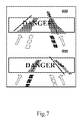
  • FIG. 7 shows diagrams of lane departure warning according to one embodiment of the present invention.
  • FIGS. 8 a -8 d respectively show diagrams of parallel parking, track prediction for parallel backing, backing into a garage, and track prediction of backing into a garage according to one embodiment of the present invention.
  • FIG. 9 a and FIG. 9 b respectively show a panoramic image and a diagram of moving obstacle detection according to one embodiment of the present invention.
  • the present invention proposes a dynamic lane line detection system and method, whose technical means includes using a vehicular image integration unit to integrate wide-angle lenses, a vehicular signal receiving device, and an image correction method to transform distorted images captured by the wide-angle lenses into ordinary planar images; presenting the images of the front lane lines on an image display device; if the signal received by the vehicular signal receiving device does not direct the system to detect lane departure warning (LDW), the system automatically switches to undertake moving obstacle detection (MOD), around view monitor (AVM), parking assistant system (PAS).
  • LDW lane departure warning
  • MOD moving obstacle detection
  • AVS parking assistant system
  • the dynamic lane line detection system 10 comprises a vehicular image integration unit 12 .
  • the vehicular image integration unit 12 includes a processor, such as Digital Signal Processor (DSP), Field-Programmable Gate Array (FPGA), Car PC, or System on Chip (SoC), to process digital signals.
  • DSP Digital Signal Processor
  • FPGA Field-Programmable Gate Array
  • SoC System on Chip
  • the vehicular image integration unit 10 is electrically connected with a plurality of wide-angle lenses.
  • the wide-angle lenses include a front wide-angle lens 14 a , a left wide-angle lens 14 b , a rear wide-angle lens 14 c and a right wide-angle lens 14 d , which are respectively arranged at the front, left, rear and right of a vehicle, and the wide-angle lenses 14 a - 14 d are 190 degree wide-angle lenses.
  • the vehicular image integration unit 10 is also electrically connected with a vehicular signal receiving device 16 and an image display device 18 .
  • the image display device 18 is an Light Emitting Diode(LED) display device or an liquid crystal display(LCD) device.
  • the image display device 18 can emit sounds via a speaker or a buzzer.
  • the vehicular signal receiving device 16 receives a gearshift signal 20 , a speed signal 22 and a turning angle signal 24 (of a steering wheel) transmitted by the vehicle.
  • the vehicular image integration unit 12 presets the default speed to be 60 Km/h. However, the present invention does not limit that the default speed must be 60 Km/h. In the present invention, the default speed can be modified according to the driving habit of the driver. Refer to FIG. 1 , FIG. 3 and FIG. 4 .
  • the front wide-angle lens 14 a which is arranged at the front of the vehicle, captures a distorted image 26 of the environment before the vehicle.
  • Step S 12 the distorted image 26 is transmitted to the vehicular image integration unit 12 , and the vehicular image integration unit 12 uses an image correction method to transform the distorted image 26 into an ordinary planar image 28 without undertaking the conversion of viewing angles.
  • the vehicular signal receiving device 16 receives the gearshift signal 20 , the speed signal 22 and the turning angle signal 24 (of the steering wheel), and transmits these signals to the vehicular image integration unit 12 . While the vehicular image integration unit 12 receives a non-reverse shift signal and a speed signal over the default speed (60 Km/h in this embodiment), the process proceeds to Step S 14 . In Step S 14 , the system undertakes lane departure warning.
  • Step S 16 the vehicular image integration unit 12 transmits the planar image 28 to the image display device 18 .
  • Step S 18 the vehicular image integration unit 12 presents the planar image 28 and the lane lines on the image display device 18 simultaneously, and controls the image display device 18 to warn the driver of lane departure warning with alert sounds in realtime.
  • the image correction method obtains the coordinates (u, v) of two points at the chord of an arc.
  • the method cross-projects the two points along two non-parallel lines to a plane and generates the coordinates of two new points ( ⁇ , v ).
  • the distance between the two new points ( ⁇ , v ) can be calculated from the ratio of the incident angle ⁇ and the refractive angle ⁇ and the length of the arc according to Equations (1)-(3):
  • FIG. 6 shows a flowchart simultaneously involving PAS and MOD of a dynamic lane line detection method according to one embodiment of the present invention.
  • Step S 22 the wide-angle lenses 14 a - 14 d at the peripheral of the vehicle capture a plurality of distorted images 26 and transmits these distorted images 26 to the vehicular image integration unit 12 .
  • Step S 24 the vehicular image integration unit 12 uses Equations (1)-(3) to transform these distorted images 26 into ordinary planar images 28 .
  • the vehicular signal receiving device 16 receives the gearshift signal 20 and the speed signal 22 and transmits these signals to the vehicular image integration unit 12 .
  • Step S 28 the vehicular image integration unit 12 examines whether the gearshift signal 20 is a non-reverse shift signal; if yes, it means that the gearshift signal 20 is a signal of a forward shift, such as the signal of the first shift, the second shift, the third shift or the D shift, and the process proceeds to Step S 30 ; if not, it means that the gearshift signal 20 is a reverse shift signal, and the process proceeds to Step S 34 .
  • Step S 30 the vehicular image integration unit 12 examines whether the speed signal 22 is over the default speed (60 Km/h in this embodiment); if yes, it means that the vehicle is running at a speed over the default speed 60 Km/h, and the process proceeds to Step S 32 ; if not, it means that the vehicle is running at a speed below the default speed 60 Km/h, and the process proceeds to Step S 36 .
  • Step S 32 the system undertakes lane departure warning.
  • Step S 34 the system undertakes moving obstacle detection, around view monitor, track detection of parallel parking, and track prediction of backing into a garage.
  • Step S 36 the system undertakes around view monitor and moving obstacle detection.
  • FIG. 7 shows diagrams of LDW according to one embodiment of the present invention. These images are presented on the image display device 18 . While the vehicle is going to exceed the lane line, the image display device 18 presents the word “Danger” to warn the driver.
  • FIGS. 8 a -8 d respectively showing diagrams of parallel parking, track prediction for parallel backing, backing into a garage, and track prediction of backing into a garage according to one embodiment of the present invention.
  • FIG. 8 a While the vehicular signal receiving device 16 detects a reverse shift signal 20 and a turning angle signal 24 of a steering wheel, it indicates that the driver is preparing for parallel parking.
  • the diagram display device 18 presents the diagram of the region behind the vehicle and shows a virtual frame of the parking bay where the driver intends to park his vehicle.
  • FIG. 8 c showing a diagram of a vehicle preparing for backing into a garage.
  • FIG. 8 d According to the turning angle signal, the diagram display device 18 shows the predicted track to enable the driver to park his vehicle safely.
  • the vehicular diagram integration unit 12 integrates the planar images 28 , which are respectively captured at four different directions, into a panoramic image, and converts the panoramic image into an aerial view, and then presents the aerial view on the image display device 18 . While the vehicular signal receiving device 16 receives a reverse shift signal 20 or a speed signal below 60 Km/h, the system can simultaneously generate panoramic images and detect barriers around the vehicle.
  • the abovementioned barriers include the barriers at the front, rear, left and right of the vehicle, as shown in FIG. 9 a .
  • the vehicular signal receiving device 16 receives a reverse shift signal 20 , it means that the driver is preparing for parallel parking or backing into a garage, and the system predicts a driving track for the driver, and detects the surrounding barriers, especially the barriers behind the vehicle.
  • the system further controls the image display device 18 to present the images of barriers and emits alert sound to warn the driver of the barriers lest the vehicle collide with the barriers, as shown in FIG. 9 b.
  • the present invention can effectively integrate ordinary wide-angle lenses to detect lane departure, exempted from using special lenses dedicated to LDW.
  • the present invention uses a vehicular image integration unit to integrate four wide-angle lenses, which are respectively arranged at the front, rear, left and right of the vehicle, and the vehicular signals to detect lane departure, predict the driving track for parallel parking or backing into a garage, generate panoramic images, and recognize surrounding barriers.
  • the present invention can also adopt lenses able to directly convert distorted images into ordinary planar images.
  • the present invention uses the vehicular image integration unit to automatically switch the safety detection mode according to the vehicular signals, guaranteeing the driving safety of the driver.

Landscapes

  • Engineering & Computer Science (AREA)
  • Mechanical Engineering (AREA)
  • Physics & Mathematics (AREA)
  • General Physics & Mathematics (AREA)
  • Multimedia (AREA)
  • Theoretical Computer Science (AREA)
  • Automation & Control Theory (AREA)
  • Transportation (AREA)
  • Traffic Control Systems (AREA)
  • Closed-Circuit Television Systems (AREA)
  • Image Processing (AREA)

Abstract

A dynamic lane line detection system and method is disclosed herein. Four wide-angle lenses are respectively arranged at four sides of a vehicle and capture distorted images. A vehicular image integration unit transforms the distorted images into an ordinary planar image and presents the planar image on an image display device together with an image of lane lines as information of lane departure warning for the driver. The system undertakes moving obstacle detection, around view monitor, or parking assistant according to images captured by four wide-angle lenses and the gearshift signal, speed signal, turning angle signal received by a vehicular signal receiving device. The present invention uses the wide-angle lenses and the vehicular image integration unit to effectively integrate lane departure information with a panoramic image, whereby to decrease the economical burden of the vehicle buyer and reduce the volume of hardware.

Description

This application claims priority for Taiwan patent application no. 103112119 filed at Apr. 1, 2014, the content of which is incorporated by reference in its entirely.
BACKGROUND OF THE INVENTION
Field of the Invention
The present invention relates to a technology for detecting images surrounding a vehicle, particularly to a detection system and method, which transforms the distorted images, which are captured by wide-angle lenses, into undistorted images and dynamically provides lane line information in response to the vehicular signals.
Description of the Related Art
At present, vehicles are normally equipped with various vehicular safety devices, such as panoramic image detection systems, rear barrier detection systems, parking-assistant systems, and lane deviation detection systems, to protect the safety of drivers. Sometimes, lenses are arranged at the front, rear, left and right of a vehicle and cooperate with the vehicular computer to detect the images surrounding the vehicle; the programs inside the vehicular computer transforms the panoramic images into an aerial view for the driver's reference; the rear lens cooperates with the vehicular computer and the programs thereinside to detect barriers behind the vehicle and provide a parking-assistant function; the screen of the vehicular computer presents the predicted track for backing the vehicle; the front lens captures the image before the vehicle and cooperates with the programs to detect lane departure and present information of lane departure warning on the screen.
Some of the prior arts provide vehicular safety technologies integrating all vehicular safety devices in a single system. However, the lane departure warning system and the parking-assistant system need dedicated lenses, which are different from the lenses for panoramic images. The moving obstacle detection is usually integrated with the lane departure warning system and the parking-assistant system. In such a case, the moving obstacle detection cannot detect the barriers at the left and right of the vehicle but can only detect the barriers before and behind the vehicle. If the driver intends to detect the barriers at the left and right of the vehicle, he must equip the vehicle with additional lenses. Therefore, a vehicle cannot detect panoramic images, front and rear lanes, and barriers simultaneously unless the vehicle is equipped with at least 6 lenses. So far, there has not yet been a wide-angle lens able to support the abovementioned four technical characteristics. Even though all vehicular safety devices can be mounted on a vehicle, there has not yet been a system able to effectively integrate four wide-angle lenses and process information for all the vehicular safety devices. Besides, the additional lenses would increase the fabrication cost. Therefore, the vehicles available in the market can only support some of the vehicular safety devices.
In order to solve the abovementioned problems, the present invention proposes a dynamic lane line detection system and method, which uses wide-angle lenses, an image integration system and an image correction method to present lane departure warning information on an image display system, whereby various vehicular safety devices can be integrated in an identical system more effectively.
SUMMARY OF THE INVENTION
The primary objective of the present invention is to provide a dynamic lane line detection system and method, which uses a vehicular image integration unit to transform distorted images captured by wide-angle lenses into ordinary planar images, and which uses a vehicular signal receiving device to receive vehicular signals, whereby the present invention can automatically detect lane lines and actively warn the driver of lane departure without using lane detection-dedicated lenses, whereby the present invention can decrease the economical burden of the vehicle buyer and reduce the volume of hardware.
Another objective of the present invention is to provide a dynamic lane line detection system and method, which can automatically switch the safety devices of the vehicle according to the vehicular signals, including the gearshift signal and the speed signal, to dynamically provide the most effective automatic safety detection mode and detect the traffic environment surrounding the vehicle, whereby the driver can grasp the vehicular status and driving environment without splitting his mind to manually adjust the driving safety devices.
To achieve the abovementioned objectives, the present invention discloses a dynamic lane line detection system, wherein a vehicular image integration unit is electrically connected with four wide-angle lenses, which are respectively at the front, rear, left and right of a vehicle, and wherein the vehicular image integration unit is also electrically connected with a vehicular signal receiving device and an image display device. The vehicular image integration unit integrates the distorted images captured by the wide-angle lenses and the vehicular signals received by the vehicular signal receiving device, such as the gearshift signal, the speed signal, and the turning angle signal of the steering wheel. The vehicular image integration unit uses an image correction method to transform the distorted images captured by the front wide-angle lens into an ordinary planar image and presents the information of lane departure warning on the image display device. The rear wide-angle lens is to implement the track prediction of parallel parking and the track prediction of backing into a garage. The front, rear, left and right wide-angle lenses are to implement around view monitor and moving obstacle detection.
The present invention also discloses a dynamic lane line detection method, which comprises steps: obtaining distorted images with wide-angle lenses respectively arranged at four sides of a vehicle; using an image correction method to correct the distorted images and generate a planar image; detecting lane departure warning while a vehicular signal receiving device receives a non-reverse shift signal and a speed signal over a default speed; transmitting the planar image to an image display device, showing lane lines on the planar image, and providing alert sounds of lane departure warning; and selectively undertaking moving obstacle detection, around view monitor, track prediction for parallel parking or track prediction for backing into a garage while the vehicular signal receiving device receives a reverse shift signal or a speed signal below the default speed.
Below, the embodiments are described in detail in cooperation with the attached drawings to make easily understood the objectives, technical contents, characteristics and accomplishments of the present invention.
BRIEF DESCRIPTION OF THE DRAWINGS
FIG. 1 is a block diagram schematically showing a dynamic lane line detection system according to one embodiment of the present invention;
FIG. 2 is a diagram schematically showing a dynamic lane line detection system 10 according to one embodiment of the present invention;
FIG. 3 shows a flowchart of a lane departure warning process of a dynamic lane line detection method according to one embodiment of the present invention;
FIG. 4 shows transformation of a distorted image according to one embodiment of the present invention;
FIG. 5 schematically shows the principle of an image correction method according to one embodiment of the present invention;
FIG. 6 shows a flowchart simultaneously involving parking assistant system and moving obstacle detection of a dynamic lane line detection method according to one embodiment of the present invention;
FIG. 7 shows diagrams of lane departure warning according to one embodiment of the present invention;
FIGS. 8a-8d respectively show diagrams of parallel parking, track prediction for parallel backing, backing into a garage, and track prediction of backing into a garage according to one embodiment of the present invention; and
FIG. 9a and FIG. 9b respectively show a panoramic image and a diagram of moving obstacle detection according to one embodiment of the present invention.
DETAILED DESCRIPTION OF THE INVENTION
The present invention proposes a dynamic lane line detection system and method, whose technical means includes using a vehicular image integration unit to integrate wide-angle lenses, a vehicular signal receiving device, and an image correction method to transform distorted images captured by the wide-angle lenses into ordinary planar images; presenting the images of the front lane lines on an image display device; if the signal received by the vehicular signal receiving device does not direct the system to detect lane departure warning (LDW), the system automatically switches to undertake moving obstacle detection (MOD), around view monitor (AVM), parking assistant system (PAS).
Refer to FIG. 1 and FIG. 2 for a dynamic lane line detection system 10 according to one embodiment of the present invention. The dynamic lane line detection system 10 comprises a vehicular image integration unit 12. The vehicular image integration unit 12 includes a processor, such as Digital Signal Processor (DSP), Field-Programmable Gate Array (FPGA), Car PC, or System on Chip (SoC), to process digital signals. The vehicular image integration unit 10 is electrically connected with a plurality of wide-angle lenses. The wide-angle lenses include a front wide-angle lens 14 a, a left wide-angle lens 14 b, a rear wide-angle lens 14 cand a right wide-angle lens 14 d, which are respectively arranged at the front, left, rear and right of a vehicle, and the wide-angle lenses 14 a-14 dare 190 degree wide-angle lenses. The vehicular image integration unit 10 is also electrically connected with a vehicular signal receiving device 16 and an image display device 18. In one embodiment, the image display device 18 is an Light Emitting Diode(LED) display device or an liquid crystal display(LCD) device. In one embodiment, the image display device 18 can emit sounds via a speaker or a buzzer. The vehicular signal receiving device 16 receives a gearshift signal 20, a speed signal 22 and a turning angle signal 24 (of a steering wheel) transmitted by the vehicle.
Succeeding to the description of the dynamic lane line detection system, a dynamic lane line detection method will be described below. In one embodiment, the vehicular image integration unit 12 presets the default speed to be 60 Km/h. However, the present invention does not limit that the default speed must be 60 Km/h. In the present invention, the default speed can be modified according to the driving habit of the driver. Refer to FIG. 1, FIG. 3 and FIG. 4. In Step S10, the front wide-angle lens 14 a, which is arranged at the front of the vehicle, captures a distorted image 26 of the environment before the vehicle. In Step S12, the distorted image 26 is transmitted to the vehicular image integration unit 12, and the vehicular image integration unit 12 uses an image correction method to transform the distorted image 26 into an ordinary planar image 28 without undertaking the conversion of viewing angles. The vehicular signal receiving device 16 receives the gearshift signal 20, the speed signal 22 and the turning angle signal 24 (of the steering wheel), and transmits these signals to the vehicular image integration unit 12. While the vehicular image integration unit 12 receives a non-reverse shift signal and a speed signal over the default speed (60 Km/h in this embodiment), the process proceeds to Step S14. In Step S14, the system undertakes lane departure warning. In Step S16, the vehicular image integration unit 12 transmits the planar image 28 to the image display device 18. In Step S18, the vehicular image integration unit 12 presents the planar image 28 and the lane lines on the image display device 18 simultaneously, and controls the image display device 18 to warn the driver of lane departure warning with alert sounds in realtime.
Refer to FIG. 5 for the image correction method used in Step S12. The image correction method obtains the coordinates (u, v) of two points at the chord of an arc. Next, the method cross-projects the two points along two non-parallel lines to a plane and generates the coordinates of two new points (ū, v). The distance between the two new points (ū,v) can be calculated from the ratio of the incident angle θ and the refractive angle Φ and the length of the arc according to Equations (1)-(3):
u _ = 1 ω r 2 R _ arctan ( r tan ( ω 2 ) R _ ) ( u - u 0 ) + u 0 ( 1 ) v _ = 1 ω r 2 γ R _ arctan ( r tan ( ω 2 ) γ R _ ) ( v - v 0 ) + v 0 ( 2 ) r = ( u - u 0 ) 2 + ( v - v 0 γ ) 2 ( 3 )
wherein (u, v) are the coordinates on the distorted image, (u0,v0) the coordinates of the center on the distorted image, (ū,v) the coordinates of the new points on the corrected image, and wherein ω is the curvature radius, R the radius of the distorted image, r is the distance between the two new points.
Refer to FIG. 1 and FIG. 6. FIG. 6 shows a flowchart simultaneously involving PAS and MOD of a dynamic lane line detection method according to one embodiment of the present invention. In Step S22, the wide-angle lenses 14 a-14 d at the peripheral of the vehicle capture a plurality of distorted images 26 and transmits these distorted images 26 to the vehicular image integration unit 12. In Step S24, the vehicular image integration unit 12 uses Equations (1)-(3) to transform these distorted images 26 into ordinary planar images 28. In Step S26, the vehicular signal receiving device 16 receives the gearshift signal 20 and the speed signal 22 and transmits these signals to the vehicular image integration unit 12. In Step S28, the vehicular image integration unit 12 examines whether the gearshift signal 20 is a non-reverse shift signal; if yes, it means that the gearshift signal 20 is a signal of a forward shift, such as the signal of the first shift, the second shift, the third shift or the D shift, and the process proceeds to Step S30; if not, it means that the gearshift signal 20 is a reverse shift signal, and the process proceeds to Step S34. In Step S30, the vehicular image integration unit 12 examines whether the speed signal 22 is over the default speed (60 Km/h in this embodiment); if yes, it means that the vehicle is running at a speed over the default speed 60 Km/h, and the process proceeds to Step S32; if not, it means that the vehicle is running at a speed below the default speed 60 Km/h, and the process proceeds to Step S36. In Step S32, the system undertakes lane departure warning. In Step S34, the system undertakes moving obstacle detection, around view monitor, track detection of parallel parking, and track prediction of backing into a garage. In Step S36, the system undertakes around view monitor and moving obstacle detection.
The specification further provides diagrams taken in the abovementioned steps for reference. Refer to FIG. 1 and FIG. 7. FIG. 7 shows diagrams of LDW according to one embodiment of the present invention. These images are presented on the image display device 18. While the vehicle is going to exceed the lane line, the image display device 18 presents the word “Danger” to warn the driver. Refer to FIGS. 8a-8d respectively showing diagrams of parallel parking, track prediction for parallel backing, backing into a garage, and track prediction of backing into a garage according to one embodiment of the present invention. Refer to FIG. 8a . While the vehicular signal receiving device 16 detects a reverse shift signal 20 and a turning angle signal 24 of a steering wheel, it indicates that the driver is preparing for parallel parking. Refer to FIG. 8b . The diagram display device 18 presents the diagram of the region behind the vehicle and shows a virtual frame of the parking bay where the driver intends to park his vehicle. Refer to FIG. 8c showing a diagram of a vehicle preparing for backing into a garage. Refer to FIG. 8d . According to the turning angle signal, the diagram display device 18 shows the predicted track to enable the driver to park his vehicle safely.
Refer to FIG. 9a and FIG. 9b respectively showing a panoramic image and a diagram of MOD according to one embodiment of the present invention, and refer to FIG. 1 also. The vehicular diagram integration unit 12 integrates the planar images 28, which are respectively captured at four different directions, into a panoramic image, and converts the panoramic image into an aerial view, and then presents the aerial view on the image display device 18. While the vehicular signal receiving device 16 receives a reverse shift signal 20 or a speed signal below 60 Km/h, the system can simultaneously generate panoramic images and detect barriers around the vehicle. The abovementioned barriers include the barriers at the front, rear, left and right of the vehicle, as shown in FIG. 9a . While the vehicular signal receiving device 16 receives a reverse shift signal 20, it means that the driver is preparing for parallel parking or backing into a garage, and the system predicts a driving track for the driver, and detects the surrounding barriers, especially the barriers behind the vehicle. The system further controls the image display device 18 to present the images of barriers and emits alert sound to warn the driver of the barriers lest the vehicle collide with the barriers, as shown in FIG. 9 b.
From the above description, it is known: the present invention can effectively integrate ordinary wide-angle lenses to detect lane departure, exempted from using special lenses dedicated to LDW. The present invention uses a vehicular image integration unit to integrate four wide-angle lenses, which are respectively arranged at the front, rear, left and right of the vehicle, and the vehicular signals to detect lane departure, predict the driving track for parallel parking or backing into a garage, generate panoramic images, and recognize surrounding barriers. The present invention can also adopt lenses able to directly convert distorted images into ordinary planar images. The present invention uses the vehicular image integration unit to automatically switch the safety detection mode according to the vehicular signals, guaranteeing the driving safety of the driver.
The embodiments described above are to demonstrate the technical thought and characteristics of the present invention and enable the persons skilled in the art to understand, make, and use the present invention. However, these embodiments are only to exemplify the present invention but not to limit the scope of the present invention. Any equivalent modification or variation according to the spirit of the present invention is to be also included within the scope of the present invention.

Claims (17)

What is claimed is:
1. A dynamic lane line detection system comprising:
at least four wide-angle lenses respectively arranged at front, rear, left and right of a vehicle;
a vehicular signal receiving device receiving a gearshift signal of said vehicle, a speed signal of said vehicle, and a turning angle signal of a steering wheel of said vehicle;
an image display device presenting images and outputting sounds; and
a vehicular image integration unit connected with said at least four wide-angle lenses, electrically connected with said vehicular signal receiving device and said image display device, integrating distorted images captured by said at least four wide-angle lenses, said gearshift signal, said speed signal and said turning angle signal, correcting distorted images captured by said wide-angle lens arranged at front of said vehicle into a planar image, presenting said planar image and lane lines before said vehicle on said image display device,.
wherein said vehicular image integration unit uses an image correction method to correct said distorted image captured by said wide-angle lens arranged at front of said vehicle, and wherein said image correction method obtains coordinates of two points at a chord of an arc, cross-projects said two points along two non-parallel lines to a plane to generate coordinates of two new points, and calculates distance between said two new points from a length of said arc and a ratio of an incident angle and a refractive angle.
2. The dynamic lane line detection system according to claim 1, wherein said image correction method is expressed by
u _ = 1 ω r 2 R _ arctan ( r tan ( ω 2 ) R _ ) ( u - u 0 ) + u 0 v _ = 1 ω r 2 γ R _ arctan ( r tan ( ω 2 ) γ R _ ) ( v - v 0 ) + v 0 and r = ( u - u 0 ) 2 + ( v - v 0 γ ) 2
wherein (u, v) are coordinates on said distorted image, coordinates of a center on said distorted image, and coordinates of said new points, and wherein ω is a curvature radius, a radius of said distorted image, and r a distance between said two new points.
3. The dynamic lane line detection system according to claim 1, wherein said vehicular image integration unit integrates said gearshift signal coming from said vehicular signal receiving device and said distorted images captured by said wide-angle lenses respectively arranged at front, rear, left and right of said vehicle, corrects said distorted images into said planar image, and transmits said planar image to said image display device for presenting a panoramic image surrounding said vehicle.
4. The dynamic lane line detection system according to claim 1, wherein said vehicular image integration unit integrates said speed signal and said gearshift signal, which come from said vehicular signal receiving device, and said distorted images captured by said wide-angle lenses respectively arranged at front, rear, left and right of said vehicle, corrects said distorted images into said planar image, and transmits said planar image to said image display device for presenting information of barriers surrounding said vehicle.
5. The dynamic lane line detection system according to claim 1, wherein said vehicular image integration unit integrates said gearshift signal and said turning angle signal of said steering wheel, which come from said vehicular signal receiving device, and said distorted images captured by said wide-angle lenses respectively arranged at rear of said vehicle, corrects said distorted images into said planar image, and transmits said planar image to said image display device for presenting an image of a predicted track for parallel parking or backing into a garage.
6. The dynamic lane line detection system according to claim 1, wherein said wide-angle lenses are 190 degree wide-angle lenses.
7. The dynamic lane line detection system according to claim 1, wherein said wide-angle lenses are Complementary Metal Oxide Semiconductor (CMOS) based sensors or Charge Coupled Device (CCD) based elements.
8. The dynamic lane line detection system according to claim 1, wherein said image display device is an Light Emitting Diode (LED) display device or an liquid crystal display (LCD) device.
9. The dynamic lane line detection system according to claim 1, wherein said image display device uses a speaker or a buzzer to output sounds.
10. The dynamic lane line detection system according to claim 1, wherein said vehicular image integration unit is Digital Signal Processor (DSP), Field-Programmable Gate Array (FPGA), Car PC, or System on Chip (SoC).
11. A dynamic lane line detection method comprising steps:
obtaining distorted images with wide-angle lenses respectively arranged at front, rear, left and right of a vehicle;
using an image correction method to correct said distorted images and generate a planar image;
detecting lane departure while a vehicular signal receiving device receives a non-reverse shift signal and a speed signal over a default speed; and
transmitting said planar image to an image display device, showing lane lines on said planar image, and providing alert sounds,
wherein said image correction method corrects said distorted images via obtaining coordinates of two points at a chord of an arc, cross-projecting said two points along two non-parallel lines to a plane to generate coordinates of two new points and calculating distance between said two new points from a length of said arc and a ratio of an incident angle and a refractive angle.
12. The dynamic lane line detection method according to claim 11, which selectively undertakes moving obstacle detection, around view monitor, track prediction for parallel parking or track prediction for backing into a garage while said vehicular signal receiving device receives a reverse shift signal or a speed signal below said default speed.
13. The dynamic lane line detection method according to claim 12, which undertakes said around view monitor while said vehicular signal receiving device receives a reverse shift signal or a speed signal below said default speed.
14. The dynamic lane line detection method according to claim 12, which undertakes said moving obstacle detection while said vehicular signal receiving device receives a reverse shift signal or a speed signal below said default speed.
15. The dynamic lane line detection method according to claim 12, which undertakes said track prediction for parallel parking or said track prediction for backing into a garage while said vehicular signal receiving device receives a reverse shift signal and a turning angle signal of a steering wheel.
16. The dynamic lane line detection method according to claim 11, wherein said image correction method is expressed by
u _ = 1 ω r 2 R _ arctan ( r tan ( ω 2 ) R _ ) ( u - u 0 ) + u 0 v _ = 1 ω r 2 γ R _ arctan ( r tan ( ω 2 ) γ R _ ) ( v - v 0 ) + v 0 and r = ( u - u 0 ) 2 + ( v - v 0 γ ) 2
wherein (u, v) are coordinates on said distorted image, coordinates of a center on said distorted image, and coordinates of said new points, and wherein ω is a curvature radius, a radius of said distorted image, and r a distance between said two new points.
17. The dynamic lane line detection method according to claim 11, wherein said default speed is preset in a vehicular image integration unit.
US14/317,471 2014-04-01 2014-06-27 Dynamic lane line detection system and method Active 2035-04-29 US9508016B2 (en)

Applications Claiming Priority (3)

Application Number Priority Date Filing Date Title
TW103112119A TWI600558B (en) 2014-04-01 2014-04-01 Dynamic lane detection system and method
TW103112119A 2014-04-01
TW103112119 2014-04-01

Publications (2)

Publication Number Publication Date
US20150278611A1 US20150278611A1 (en) 2015-10-01
US9508016B2 true US9508016B2 (en) 2016-11-29

Family

ID=51305863

Family Applications (1)

Application Number Title Priority Date Filing Date
US14/317,471 Active 2035-04-29 US9508016B2 (en) 2014-04-01 2014-06-27 Dynamic lane line detection system and method

Country Status (3)

Country Link
US (1) US9508016B2 (en)
CN (1) CN103991448B (en)
TW (1) TWI600558B (en)

Cited By (1)

* Cited by examiner, † Cited by third party
Publication number Priority date Publication date Assignee Title
US10850680B2 (en) 2016-10-05 2020-12-01 Lg Electronics Inc. Vehicle display apparatus and vehicle having the same

Families Citing this family (27)

* Cited by examiner, † Cited by third party
Publication number Priority date Publication date Assignee Title
US20160121887A1 (en) * 2014-11-04 2016-05-05 Hyundai Motor Company Apparatus and method for detecting collision object of vehicle
CN104309606B (en) * 2014-11-06 2017-05-03 中科院微电子研究所昆山分所 360-degree panorama based lane departure warning method
JP6344275B2 (en) * 2015-03-18 2018-06-20 トヨタ自動車株式会社 Vehicle control device
US9821812B2 (en) * 2015-04-23 2017-11-21 Ford Global Technologies, Llc Traffic complexity estimation
JP6613795B2 (en) * 2015-10-16 2019-12-04 株式会社デンソー Display control device and vehicle control device
DE102016202594A1 (en) * 2016-02-19 2017-08-24 Robert Bosch Gmbh Method and device for interpreting a vehicle environment of a vehicle and vehicle
WO2017154317A1 (en) * 2016-03-09 2017-09-14 株式会社Jvcケンウッド Vehicle display control device, vehicle display system, vehicle display control method, and program
JP6366881B2 (en) * 2016-04-15 2018-08-01 三菱電機株式会社 Parking assistance device
CN106080774A (en) * 2016-07-13 2016-11-09 重庆长安汽车股份有限公司 Guiding parking system and method
CN107111757B (en) * 2016-08-08 2020-08-28 深圳市锐明技术股份有限公司 Lane line detection method and device
TWI622297B (en) * 2016-12-19 2018-04-21 Display method capable of simultaneously displaying rear panorama and turning picture when the vehicle turns
CN106778661A (en) * 2016-12-28 2017-05-31 深圳市美好幸福生活安全系统有限公司 A kind of express lane line detecting method based on morphological transformation and adaptive threshold
DE102017200216A1 (en) * 2017-01-09 2018-07-12 Bayerische Motoren Werke Aktiengesellschaft Control unit and method for providing a correction train for a reversing assistance system
KR102719930B1 (en) 2017-01-23 2024-10-23 삼성전자주식회사 Method and apparatus for generating an image representing an object around a vehicle
CN110969068B (en) * 2018-09-30 2024-08-02 北京奇虎科技有限公司 Method and device for drawing reversing line
KR20200056497A (en) * 2018-11-09 2020-05-25 현대자동차주식회사 Automated Valet Parking System, and infrastructure and vehicle thereof
KR102751271B1 (en) * 2019-01-21 2025-01-10 현대자동차주식회사 Apparatus for recognizing lane and method thereof
JP2020163903A (en) * 2019-03-28 2020-10-08 本田技研工業株式会社 Display control device, display control method, and program
CN110316206B (en) * 2019-05-20 2020-11-06 广汽蔚来新能源汽车科技有限公司 Vehicle-mounted panoramic image display automatic control method and device and computer equipment
CN110775063B (en) * 2019-09-25 2021-08-13 华为技术有限公司 Information display method, device and vehicle for vehicle-mounted equipment
JP7259698B2 (en) * 2019-10-17 2023-04-18 トヨタ自動車株式会社 automatic parking system
US11731639B2 (en) * 2020-03-03 2023-08-22 GM Global Technology Operations LLC Method and apparatus for lane detection on a vehicle travel surface
JP2022123239A (en) * 2021-02-12 2022-08-24 本田技研工業株式会社 Line recognition device
US12084077B2 (en) * 2021-05-03 2024-09-10 Nissan North America, Inc. System and method of curb management for a vehicle
CN114267027B (en) * 2021-12-21 2025-04-08 北京百度网讯科技有限公司 Image processing method and device
CN116416321A (en) * 2023-02-13 2023-07-11 星河智联汽车科技有限公司 Vehicle-mounted panoramic looking-around automatic calibration method, system, equipment and storage medium
CN118722617B (en) * 2023-03-30 2025-10-17 比亚迪股份有限公司 Driving assistance method, device, equipment and medium

Citations (13)

* Cited by examiner, † Cited by third party
Publication number Priority date Publication date Assignee Title
CN101487895A (en) 2008-01-15 2009-07-22 华晶科技股份有限公司 Reverse radar system capable of displaying aerial vehicle image
US7576767B2 (en) 2004-07-26 2009-08-18 Geo Semiconductors Inc. Panoramic vision system and method
US20100220190A1 (en) * 2009-02-27 2010-09-02 Hyundai Motor Japan R&D Center, Inc. Apparatus and method for displaying bird's eye view image of around vehicle
US20110169626A1 (en) * 2010-01-13 2011-07-14 Denso International America, Inc. Hand-held device integration for automobile safety
US20110181441A1 (en) 2010-01-26 2011-07-28 Delphi Technologies, Inc. Parking guidance system
US8081211B2 (en) 2007-12-28 2011-12-20 Altek Corporation Reverse or peripheral sensing system for a vehicle
TW201226237A (en) 2010-12-16 2012-07-01 Weltrend Semiconductor Inc Calibration circuit for automatically calibrating a view image around a car and method thereof
US20120262578A1 (en) 2011-04-18 2012-10-18 Acard Technology Corp. Vehicular around-view driving monitor and recorder
US8315433B2 (en) 2009-07-31 2012-11-20 Automotive Research & Test Center Obstacle determination system and method implemented through utilizing bird's-eye-view images
CN202806557U (en) 2012-06-14 2013-03-20 北京万得嘉瑞汽车技术有限公司 Panoramic parking and lane departure warning function integrated driving assistance system
US20130286205A1 (en) * 2012-04-27 2013-10-31 Fujitsu Limited Approaching object detection device and method for detecting approaching objects
US8611598B2 (en) 2011-07-26 2013-12-17 Harman International (China) Holdings Co., Ltd. Vehicle obstacle detection system
US20140111637A1 (en) * 2012-10-22 2014-04-24 GM Global Technology Operations LLC Dynamic Rearview Mirror Adaptive Dimming Overlay Through Scene Brightness Estimation

Family Cites Families (8)

* Cited by examiner, † Cited by third party
Publication number Priority date Publication date Assignee Title
JPH06282793A (en) * 1993-03-30 1994-10-07 Isuzu Motors Ltd Lane departure warning device
DE102004057296A1 (en) * 2004-11-26 2006-06-08 Daimlerchrysler Ag Lane departure warning with distinction between lane markings and the construction boundary of the lane
JP2009147628A (en) * 2007-12-13 2009-07-02 Denso Corp In-vehicle image processing apparatus and in-vehicle image display device
TWM353849U (en) * 2008-09-17 2009-04-01 Jyh-Chiang Liou Integrated driving assistance apparatus
KR100956858B1 (en) * 2009-05-19 2010-05-11 주식회사 이미지넥스트 Sensing method and apparatus of lane departure using vehicle around image
TWI365145B (en) * 2009-11-02 2012-06-01 Ind Tech Res Inst Method and system for asisting driver
TWM444536U (en) * 2012-09-12 2013-01-01 Acard Technology Corp Integrated type security tachograph system
CN103192829A (en) * 2013-03-22 2013-07-10 上海交通大学 Lane departure warning method and lane departure warning device based on around view

Patent Citations (13)

* Cited by examiner, † Cited by third party
Publication number Priority date Publication date Assignee Title
US7576767B2 (en) 2004-07-26 2009-08-18 Geo Semiconductors Inc. Panoramic vision system and method
US8081211B2 (en) 2007-12-28 2011-12-20 Altek Corporation Reverse or peripheral sensing system for a vehicle
CN101487895A (en) 2008-01-15 2009-07-22 华晶科技股份有限公司 Reverse radar system capable of displaying aerial vehicle image
US20100220190A1 (en) * 2009-02-27 2010-09-02 Hyundai Motor Japan R&D Center, Inc. Apparatus and method for displaying bird's eye view image of around vehicle
US8315433B2 (en) 2009-07-31 2012-11-20 Automotive Research & Test Center Obstacle determination system and method implemented through utilizing bird's-eye-view images
US20110169626A1 (en) * 2010-01-13 2011-07-14 Denso International America, Inc. Hand-held device integration for automobile safety
US20110181441A1 (en) 2010-01-26 2011-07-28 Delphi Technologies, Inc. Parking guidance system
TW201226237A (en) 2010-12-16 2012-07-01 Weltrend Semiconductor Inc Calibration circuit for automatically calibrating a view image around a car and method thereof
US20120262578A1 (en) 2011-04-18 2012-10-18 Acard Technology Corp. Vehicular around-view driving monitor and recorder
US8611598B2 (en) 2011-07-26 2013-12-17 Harman International (China) Holdings Co., Ltd. Vehicle obstacle detection system
US20130286205A1 (en) * 2012-04-27 2013-10-31 Fujitsu Limited Approaching object detection device and method for detecting approaching objects
CN202806557U (en) 2012-06-14 2013-03-20 北京万得嘉瑞汽车技术有限公司 Panoramic parking and lane departure warning function integrated driving assistance system
US20140111637A1 (en) * 2012-10-22 2014-04-24 GM Global Technology Operations LLC Dynamic Rearview Mirror Adaptive Dimming Overlay Through Scene Brightness Estimation

Cited By (1)

* Cited by examiner, † Cited by third party
Publication number Priority date Publication date Assignee Title
US10850680B2 (en) 2016-10-05 2020-12-01 Lg Electronics Inc. Vehicle display apparatus and vehicle having the same

Also Published As

Publication number Publication date
US20150278611A1 (en) 2015-10-01
TW201538364A (en) 2015-10-16
TWI600558B (en) 2017-10-01
CN103991448A (en) 2014-08-20
CN103991448B (en) 2017-04-12

Similar Documents

Publication Publication Date Title
US9508016B2 (en) Dynamic lane line detection system and method
US12384401B2 (en) Vehicular driving assist system with driver monitoring
US11308718B2 (en) Vehicular vision system
US11112804B2 (en) Autonomous driving control apparatus and program product
US10926764B2 (en) Lane keeping assistance apparatus, vehicle having the same and method for controlling the same
US11012666B2 (en) Surround camera system for autonomous driving
US10915100B2 (en) Control system for vehicle
US9620009B2 (en) Vehicle surroundings monitoring device
CN102768808B (en) The apparatus and method of auxiliary driver
US10896338B2 (en) Control system
US10869002B2 (en) Vehicle camera device for capturing the surroundings of a motor vehicle and driver assistance device for detecting objects with such a vehicle camera device
JP2012527681A (en) Lane departure detection method and apparatus using vehicle periphery image
US20210253025A1 (en) Information processing device and information processing method
US20170178591A1 (en) Sign display apparatus and method for vehicle
US20210387634A1 (en) Vehicular driver assist system using acoustic sensors
US20250018864A1 (en) Apparatus and method for blind-spot monitoring of vehicle based on rear camera
US12202481B2 (en) Vehicular driver assist system with automatic speed setting parameters
US12371046B2 (en) Displaying objects to assist a driver in conditions of low visibility
US20220185174A1 (en) Vehicular alert system for alerting drivers of other vehicles responsive to a change in driving conditions
JP2007142765A (en) Vehicle periphery monitoring device
KR102124998B1 (en) Method and apparatus for correcting a position of ADAS camera during driving
JP3231104U (en) Imaging equipment for mobile vehicles compatible with radar equipment
TWM482526U (en) Navigation monitoring device
US10814885B1 (en) Car and neighboring vehicle lane departure warning system and method
JP2019110390A (en) Vehicle periphery monitoring device

Legal Events

Date Code Title Description
AS Assignment

Owner name: AUTOMOTIVE RESEARCH & TEST CENTER, TAIWAN

Free format text: ASSIGNMENT OF ASSIGNORS INTEREST;ASSIGNORS:CHI, HAO-HAN;HSU, LI-YOU;REEL/FRAME:033198/0518

Effective date: 20140609

STCF Information on status: patent grant

Free format text: PATENTED CASE

MAFP Maintenance fee payment

Free format text: PAYMENT OF MAINTENANCE FEE, 4TH YR, SMALL ENTITY (ORIGINAL EVENT CODE: M2551); ENTITY STATUS OF PATENT OWNER: SMALL ENTITY

Year of fee payment: 4

MAFP Maintenance fee payment

Free format text: PAYMENT OF MAINTENANCE FEE, 8TH YR, SMALL ENTITY (ORIGINAL EVENT CODE: M2552); ENTITY STATUS OF PATENT OWNER: SMALL ENTITY

Year of fee payment: 8