US9496508B2 - Material for organic electroluminescent element and organic electroluminescent element using same - Google Patents
Material for organic electroluminescent element and organic electroluminescent element using same Download PDFInfo
- Publication number
- US9496508B2 US9496508B2 US14/363,761 US201214363761A US9496508B2 US 9496508 B2 US9496508 B2 US 9496508B2 US 201214363761 A US201214363761 A US 201214363761A US 9496508 B2 US9496508 B2 US 9496508B2
- Authority
- US
- United States
- Prior art keywords
- substituted
- unsubstituted
- carbon atoms
- group including
- group
- Prior art date
- Legal status (The legal status is an assumption and is not a legal conclusion. Google has not performed a legal analysis and makes no representation as to the accuracy of the status listed.)
- Expired - Fee Related, expires
Links
- LYELLBXLFMFLIN-CMBBICFISA-N C.C=CC1=C(C)N(/C(C)=C/C2=C(C)C(C)(C)C(C=C)=C2C=C)C2=C1C=CC=C2 Chemical compound C.C=CC1=C(C)N(/C(C)=C/C2=C(C)C(C)(C)C(C=C)=C2C=C)C2=C1C=CC=C2 LYELLBXLFMFLIN-CMBBICFISA-N 0.000 description 4
- 0 *C1(*)C(*=*)=C(*=*)C(*=C(*)[n]2c(****3)c3c(*=*)c2*)=C1* Chemical compound *C1(*)C(*=*)=C(*=*)C(*=C(*)[n]2c(****3)c3c(*=*)c2*)=C1* 0.000 description 3
- SASXAYGLYMGTOP-YDWWNLAKSA-N C=CC1=C(C=C)C(C)(C)C(C)=C1/C=C(\C)N1C(C)=C(/C=C(\C)C(=C)/C=C2\C(=C)N(C)C(C)=C2C)C2=C1C=CC=C2.CC Chemical compound C=CC1=C(C=C)C(C)(C)C(C)=C1/C=C(\C)N1C(C)=C(/C=C(\C)C(=C)/C=C2\C(=C)N(C)C(C)=C2C)C2=C1C=CC=C2.CC SASXAYGLYMGTOP-YDWWNLAKSA-N 0.000 description 3
- QSLBXWYXVXNGOD-DRRQWBPISA-N C=CC1=C(C=C)C(C)(C)C(C)=C1/C=C(\C)N1C(C)=C(/C=C(\C)C(=C)/C=C2\C(=C)[Y]C(C)=C2C)C2=C1C=CC=C2.CC Chemical compound C=CC1=C(C=C)C(C)(C)C(C)=C1/C=C(\C)N1C(C)=C(/C=C(\C)C(=C)/C=C2\C(=C)[Y]C(C)=C2C)C2=C1C=CC=C2.CC QSLBXWYXVXNGOD-DRRQWBPISA-N 0.000 description 3
- HBQGNESSZOKFGL-PGXCWKBOSA-N C.C1=CC=C2C(=C1)[Y]C1=C2C=CC=C1.C=CC1=C(C)N(/C(C)=C/C2=C(C)C(C)(C)C(C=C)=C2C=C)C2=C1C=CC=C2.CC Chemical compound C.C1=CC=C2C(=C1)[Y]C1=C2C=CC=C1.C=CC1=C(C)N(/C(C)=C/C2=C(C)C(C)(C)C(C=C)=C2C=C)C2=C1C=CC=C2.CC HBQGNESSZOKFGL-PGXCWKBOSA-N 0.000 description 2
- VWVFEGUWHGKXSR-SXKWEXTPSA-N C.C1=CC=C2[W]C3=C(C=CC=C3)[Y]C2=C1.C=CC1=C(C)N(/C(C)=C/C2=C(C)C(C)(C)C(C=C)=C2C=C)C2=C1C=CC=C2.CC Chemical compound C.C1=CC=C2[W]C3=C(C=CC=C3)[Y]C2=C1.C=CC1=C(C)N(/C(C)=C/C2=C(C)C(C)(C)C(C=C)=C2C=C)C2=C1C=CC=C2.CC VWVFEGUWHGKXSR-SXKWEXTPSA-N 0.000 description 2
- CUIUPEWCKGTQNN-UHFFFAOYSA-N BrB(Br)Br.CC1(C)C2=CC=C(O)C=C2C2=C1C=CC=N2.CC1=CC=C2C(=C1)C1=C(C=CC=N1)C2(C)C Chemical compound BrB(Br)Br.CC1(C)C2=CC=C(O)C=C2C2=C1C=CC=N2.CC1=CC=C2C(=C1)C1=C(C=CC=N1)C2(C)C CUIUPEWCKGTQNN-UHFFFAOYSA-N 0.000 description 1
- HXXUFIJYXJAQLC-RGIFKZQSSA-N C.C.C=CC1=C(C=C)C(C)(C)C(C)=C1/C=C(\C)N1C(C)=C(/C=C(\C)N2C(=C)/C(=C\C)C(C)=C2C=C)C2=C1C=CC=C2 Chemical compound C.C.C=CC1=C(C=C)C(C)(C)C(C)=C1/C=C(\C)N1C(C)=C(/C=C(\C)N2C(=C)/C(=C\C)C(C)=C2C=C)C2=C1C=CC=C2 HXXUFIJYXJAQLC-RGIFKZQSSA-N 0.000 description 1
- VMCNXFXUFNMBGP-LONLNGKHSA-N C.C/C=C\C1=C(C)[Y]C2=CC=CC=C21.C=CC1=C(C)N(/C(C)=C/C2=C(C)C(C)(C)C(C=C)=C2C=C)C2=C1C=CC=C2.CC Chemical compound C.C/C=C\C1=C(C)[Y]C2=CC=CC=C21.C=CC1=C(C)N(/C(C)=C/C2=C(C)C(C)(C)C(C=C)=C2C=C)C2=C1C=CC=C2.CC VMCNXFXUFNMBGP-LONLNGKHSA-N 0.000 description 1
- YVAJHKXPOASZEH-XIHQFUGTSA-N C.C/C=C\C1=C(C)[Y]C2=CC=CC=C2[W]1.C=CC1=C(C)N(/C(C)=C/C2=C(C)C(C)(C)C(C=C)=C2C=C)C2=C1C=CC=C2.CC Chemical compound C.C/C=C\C1=C(C)[Y]C2=CC=CC=C2[W]1.C=CC1=C(C)N(/C(C)=C/C2=C(C)C(C)(C)C(C=C)=C2C=C)C2=C1C=CC=C2.CC YVAJHKXPOASZEH-XIHQFUGTSA-N 0.000 description 1
- UEZJWVPETBGDDT-GKACNYPMSA-N C.C=C/C=C1\C(=C)N(/C(C)=C/C2=C(C)N(/C(C)=C/C3=C(C)C(C)(C)C(C=C)=C3C=C)C3=C2C=CC=C3)C(C=C)=C1C Chemical compound C.C=C/C=C1\C(=C)N(/C(C)=C/C2=C(C)N(/C(C)=C/C3=C(C)C(C)(C)C(C=C)=C3C=C)C3=C2C=CC=C3)C(C=C)=C1C UEZJWVPETBGDDT-GKACNYPMSA-N 0.000 description 1
- FLLHQWXDUODZEH-GKACNYPMSA-N C.C=CC1=C(C=C)C(C)(C)C(C)=C1/C=C(\C)N1C(C)=C(/C=C(\C)N2C(=C)/C(=C\CC)C(C)=C2C=C)C2=C1C=CC=C2 Chemical compound C.C=CC1=C(C=C)C(C)(C)C(C)=C1/C=C(\C)N1C(C)=C(/C=C(\C)N2C(=C)/C(=C\CC)C(C)=C2C=C)C2=C1C=CC=C2 FLLHQWXDUODZEH-GKACNYPMSA-N 0.000 description 1
- RJQKSQHKVVTYLQ-UHFFFAOYSA-N C.CC1(C)C2=CC=C(O)C=C2C2=C1C=CC=N2.CC1=CC=C2C(=C1)C1=C(C=CC=N1)C2(C)C Chemical compound C.CC1(C)C2=CC=C(O)C=C2C2=C1C=CC=N2.CC1=CC=C2C(=C1)C1=C(C=CC=N1)C2(C)C RJQKSQHKVVTYLQ-UHFFFAOYSA-N 0.000 description 1
- OZHBDJQQSSCJPF-UHFFFAOYSA-N C.CC1=CC=C2C(=C1)C1=C(C=CC=N1)C2(C)C.CC1=CC=CC(C2=NC=CC=C2C(C)(C)O)=C1 Chemical compound C.CC1=CC=C2C(=C1)C1=C(C=CC=N1)C2(C)C.CC1=CC=CC(C2=NC=CC=C2C(C)(C)O)=C1 OZHBDJQQSSCJPF-UHFFFAOYSA-N 0.000 description 1
- JHLWIAXQLHBRJS-UHFFFAOYSA-N C1=CC(C2=C/C3=C(\C=C/2)OC2=C3C=C(N3C4=C(C=CC=C4)C4=C3C=CC=C4)C=C2)=CC(N2C3=C(C=CC=C3)C3=C2C=CC=C3)=C1.C1=CC=C(C2=CC=C(C3=CC=C(N(C4=CC=CC=C4)C4=CC=C(C5=CC=C(N(C6=CC=C(C7=CC=CC=C7)C=C6)C6=CC=C(C7=CC=CC=C7)C=C6)C=C5)C=C4)C=C3)C=C2)C=C1.C1=CC=C(C2=NC3=C(C=CC=C3)N2C2=CC=C(C3=C4C=CC=CC4=C(C4=CC5=CC=CC=C5C=C4)C4=C3C=CC=C4)C=C2)C=C1.C1=CC=C(N(C2=CC=CC=C2)C2=CC=C(C3=CC=C(N(C4=CC=C(C5=CC=C(N(C6=CC=C(C7=CC=C(N(C8=CC=CC=C8)C8=CC=CC=C8)C=C7)C=C6)C6=C7C=CC=CC7=CC=C6)C=C5)C=C4)C4=CC=CC5=C4C=CC=C5)C=C3)C=C2)C=C1.CC1=CC(C)=C(N2C=CN3=C2C2=CC=CC=C2[Ir]3)C(C)=C1 Chemical compound C1=CC(C2=C/C3=C(\C=C/2)OC2=C3C=C(N3C4=C(C=CC=C4)C4=C3C=CC=C4)C=C2)=CC(N2C3=C(C=CC=C3)C3=C2C=CC=C3)=C1.C1=CC=C(C2=CC=C(C3=CC=C(N(C4=CC=CC=C4)C4=CC=C(C5=CC=C(N(C6=CC=C(C7=CC=CC=C7)C=C6)C6=CC=C(C7=CC=CC=C7)C=C6)C=C5)C=C4)C=C3)C=C2)C=C1.C1=CC=C(C2=NC3=C(C=CC=C3)N2C2=CC=C(C3=C4C=CC=CC4=C(C4=CC5=CC=CC=C5C=C4)C4=C3C=CC=C4)C=C2)C=C1.C1=CC=C(N(C2=CC=CC=C2)C2=CC=C(C3=CC=C(N(C4=CC=C(C5=CC=C(N(C6=CC=C(C7=CC=C(N(C8=CC=CC=C8)C8=CC=CC=C8)C=C7)C=C6)C6=C7C=CC=CC7=CC=C6)C=C5)C=C4)C4=CC=CC5=C4C=CC=C5)C=C3)C=C2)C=C1.CC1=CC(C)=C(N2C=CN3=C2C2=CC=CC=C2[Ir]3)C(C)=C1 JHLWIAXQLHBRJS-UHFFFAOYSA-N 0.000 description 1
- UOMCZWDQPSQPGB-UHFFFAOYSA-L C1=CC2=C(C=C1)C1=C(C=CC(C3=CC4=C(C=C3)NC3=C4C=CC=C3)=C1)N2.CC(=O)O[Pd]OC(C)=O.CC(C)C1=CC(C(C)C)=C(C2=C(P(C(C)(C)C)C(C)(C)C)C=CC=C2)C(C(C)C)=C1.CC1(C)C2=C(N=CC=C2)C2=C1/C=C\C(N1C3=C(C=CC=C3)C3=C1C=CC(C1=CC4=C(C=C1)N(C1=C/C=C5C(=C/1)/C1=C(C=CC=N1)C/5(C)C)C1=C4C=CC=C1)=C3)=C/2.CC1=CC=C2C(=C1)C1=C(C=CC=N1)C2(C)C Chemical compound C1=CC2=C(C=C1)C1=C(C=CC(C3=CC4=C(C=C3)NC3=C4C=CC=C3)=C1)N2.CC(=O)O[Pd]OC(C)=O.CC(C)C1=CC(C(C)C)=C(C2=C(P(C(C)(C)C)C(C)(C)C)C=CC=C2)C(C(C)C)=C1.CC1(C)C2=C(N=CC=C2)C2=C1/C=C\C(N1C3=C(C=CC=C3)C3=C1C=CC(C1=CC4=C(C=C1)N(C1=C/C=C5C(=C/1)/C1=C(C=CC=N1)C/5(C)C)C1=C4C=CC=C1)=C3)=C/2.CC1=CC=C2C(=C1)C1=C(C=CC=N1)C2(C)C UOMCZWDQPSQPGB-UHFFFAOYSA-L 0.000 description 1
- RNSCMQRJGUCLFV-UHFFFAOYSA-N C1=CC=C(C2(C3=CC=CC=C3)C3=CC=C(N4C5=CC=C(C6=CC7=C(C=C6)N(C6=C/C8=C(\C=C/6)C(C6=CC=CC=C6)(C6=CC=CC=C6)C6=C8C=CC=C6)C6=C7C=CC=C6)C=C5C5=C4C=CC=C5)C=C3C3=C2/C=C\C=N/3)C=C1.C1=CC=C(C2(C3=NC=CC=C3)C3=CC=C(N4C5=CC=C(C6=CC7=C(C=C6)N(C6=C/C8=C(\C=C/6)C(C6=CC=CC=N6)(C6=NC=CC=C6)C6=C8C=CC=C6)C6=C7C=CC=C6)C=C5C5=C4C=CC=C5)C=C3C3=C2/C=C\C=N/3)N=C1.CC1(C)C2=C(C=CC=C2)C2=C1/C=C\C(N1C3=C(C=CC=C3)C3=C1C=CC(C1=CC=CC(C4=CC=C5C(=C4)C4=C(C=CC=C4)N5C4=C/C=C5C(=C/4)/C4=C(C=CC=N4)C/5(C)C)=C1)=C3)=C/2.CC1(C)C2=C(C=CC=C2)C2=C1C=CC(N1C3=C(C=CC=C3)C(C)(C)C3=C1C=CC(C1=CC=C4C(=C1)C1=C(C=CC=C1)N4C1=CC=C4C(=C1)C1=C(/C=C\C=N/1)C4(C)C)=C3)=C2.CC1(C)C2=CC=C(C3(C4=CC5=C(C=C4)C(C)(C)C4=C5C=CC=C4)C4=CC=C(N5C6=CC=C(C7=CC8=C(C=C7)N(C7=CC=CC=C7)C7=C8C=CC=C7)C=C6C6=C5C=CC=C6)C=C4C4=C3/C=C\C=N/4)C=C2C2=C1C=CC=C2.CC1(C)C2=CC=C(N3C4=CC=C(C5=CC6=C(C=C5)N(C5=C/C7=C(\C=C/5)C(C)(C)C5=C7C=CC=C5)C5=C6C=CC=C5)C=C4C4=C3C=CC=C4)C=C2C2=C1/C=C\C=N/2.CC1(C)C2=CC=C(N3C4=CC=C(C5=COC=C5C5=C/C=C6/OC7=C(N=CC=C7)/C6=C\5)C=C4C4=C3C=CC=C4)C=C2C2=C1/C=C\C=N/2.CC1(C)C2=CC=C(N3C4=CC=C(C5=COC=C5C5=C/C=C6C(=C/5)\C5=C(C=CC=C5)N\6C5=CC=CC=C5)C=C4C4=C3C=CC=C4)C=C2C2=C1/C=C\C=N/2.CC1(C)C2=CC=C(N3C4=CC=C(C5=CSC=C5C5=C/C=C6C(=C/5)\C5=C(C=CC=C5)N\6C5=CC=CC=C5)C=C4C4=C3C=CC=C4)C=C2C2=C1/C=C\C=N/2.CC1(C)C2=CC=C(N3C4=CC=C(C5=CSC=C5C5=C/C=C6C(=C/5)\C5=C(C=CC=N5)N\6C5=CC=CC=C5)C=C4C4=C3C=CC=C4)C=C2C2=C1/C=C\C=N/2 Chemical compound C1=CC=C(C2(C3=CC=CC=C3)C3=CC=C(N4C5=CC=C(C6=CC7=C(C=C6)N(C6=C/C8=C(\C=C/6)C(C6=CC=CC=C6)(C6=CC=CC=C6)C6=C8C=CC=C6)C6=C7C=CC=C6)C=C5C5=C4C=CC=C5)C=C3C3=C2/C=C\C=N/3)C=C1.C1=CC=C(C2(C3=NC=CC=C3)C3=CC=C(N4C5=CC=C(C6=CC7=C(C=C6)N(C6=C/C8=C(\C=C/6)C(C6=CC=CC=N6)(C6=NC=CC=C6)C6=C8C=CC=C6)C6=C7C=CC=C6)C=C5C5=C4C=CC=C5)C=C3C3=C2/C=C\C=N/3)N=C1.CC1(C)C2=C(C=CC=C2)C2=C1/C=C\C(N1C3=C(C=CC=C3)C3=C1C=CC(C1=CC=CC(C4=CC=C5C(=C4)C4=C(C=CC=C4)N5C4=C/C=C5C(=C/4)/C4=C(C=CC=N4)C/5(C)C)=C1)=C3)=C/2.CC1(C)C2=C(C=CC=C2)C2=C1C=CC(N1C3=C(C=CC=C3)C(C)(C)C3=C1C=CC(C1=CC=C4C(=C1)C1=C(C=CC=C1)N4C1=CC=C4C(=C1)C1=C(/C=C\C=N/1)C4(C)C)=C3)=C2.CC1(C)C2=CC=C(C3(C4=CC5=C(C=C4)C(C)(C)C4=C5C=CC=C4)C4=CC=C(N5C6=CC=C(C7=CC8=C(C=C7)N(C7=CC=CC=C7)C7=C8C=CC=C7)C=C6C6=C5C=CC=C6)C=C4C4=C3/C=C\C=N/4)C=C2C2=C1C=CC=C2.CC1(C)C2=CC=C(N3C4=CC=C(C5=CC6=C(C=C5)N(C5=C/C7=C(\C=C/5)C(C)(C)C5=C7C=CC=C5)C5=C6C=CC=C5)C=C4C4=C3C=CC=C4)C=C2C2=C1/C=C\C=N/2.CC1(C)C2=CC=C(N3C4=CC=C(C5=COC=C5C5=C/C=C6/OC7=C(N=CC=C7)/C6=C\5)C=C4C4=C3C=CC=C4)C=C2C2=C1/C=C\C=N/2.CC1(C)C2=CC=C(N3C4=CC=C(C5=COC=C5C5=C/C=C6C(=C/5)\C5=C(C=CC=C5)N\6C5=CC=CC=C5)C=C4C4=C3C=CC=C4)C=C2C2=C1/C=C\C=N/2.CC1(C)C2=CC=C(N3C4=CC=C(C5=CSC=C5C5=C/C=C6C(=C/5)\C5=C(C=CC=C5)N\6C5=CC=CC=C5)C=C4C4=C3C=CC=C4)C=C2C2=C1/C=C\C=N/2.CC1(C)C2=CC=C(N3C4=CC=C(C5=CSC=C5C5=C/C=C6C(=C/5)\C5=C(C=CC=N5)N\6C5=CC=CC=C5)C=C4C4=C3C=CC=C4)C=C2C2=C1/C=C\C=N/2 RNSCMQRJGUCLFV-UHFFFAOYSA-N 0.000 description 1
- LVCDNZKTQPBCKL-UHFFFAOYSA-N C1=CC=C(C2(C3=CC=CC=C3)C3=CC=C(N4C5=CC=C(C6=CC7=C(C=C6)N(C6=C/C8=C(\C=C/6)C(C6=CC=CC=C6)(C6=CC=CC=C6)C6=C8N=CC=C6)C6=C7C=CC=C6)C=C5C5=C4C=CC=C5)C=C3C3=C2C=CC=N3)C=C1.C1=CC=C(C2(C3=NC=CC=C3)C3=CC=C(N4C5=CC=C(C6=CC7=C(C=C6)N(C6=C/C8=C(\C=C/6)C(C6=CC=CC=N6)(C6=NC=CC=C6)C6=C8N=CC=C6)C6=C7C=CC=C6)C=C5C5=C4C=CC=C5)C=C3C3=C2C=CC=N3)N=C1.CC1(C)C2=CC=C(N3C4=CC=C(C5=CC6=C(C=C5)N(C5=C/C7=C(\C=C/5)C(C)(C)C5=C7N=CC=C5)C5=C6C=CC=C5)C=C4C4=C3C=CC=C4)C=C2C2=C1C=CC=N2.CC1(C)C2=CC=C(N3C4=CC=C(C5=CC6=C(C=C5)N(C5=C/C7=C(\C=C/5)C(C)(C)C5=C7N=CC=C5)C5=C6N=CC=C5)C=C4C4=C3C=CC=N4)C=C2C2=C1C=CC=N2.CC1(C)C2=CC=C(N3C4=CC=C(C5=CC6=C(C=C5)N(C5=C/C7=C(\C=C/5)C(C)(C)C5=C7N=CN=C5)C5=C6C=CC=C5)C=C4C4=C3C=CC=C4)C=C2C2=C1C=NC=N2 Chemical compound C1=CC=C(C2(C3=CC=CC=C3)C3=CC=C(N4C5=CC=C(C6=CC7=C(C=C6)N(C6=C/C8=C(\C=C/6)C(C6=CC=CC=C6)(C6=CC=CC=C6)C6=C8N=CC=C6)C6=C7C=CC=C6)C=C5C5=C4C=CC=C5)C=C3C3=C2C=CC=N3)C=C1.C1=CC=C(C2(C3=NC=CC=C3)C3=CC=C(N4C5=CC=C(C6=CC7=C(C=C6)N(C6=C/C8=C(\C=C/6)C(C6=CC=CC=N6)(C6=NC=CC=C6)C6=C8N=CC=C6)C6=C7C=CC=C6)C=C5C5=C4C=CC=C5)C=C3C3=C2C=CC=N3)N=C1.CC1(C)C2=CC=C(N3C4=CC=C(C5=CC6=C(C=C5)N(C5=C/C7=C(\C=C/5)C(C)(C)C5=C7N=CC=C5)C5=C6C=CC=C5)C=C4C4=C3C=CC=C4)C=C2C2=C1C=CC=N2.CC1(C)C2=CC=C(N3C4=CC=C(C5=CC6=C(C=C5)N(C5=C/C7=C(\C=C/5)C(C)(C)C5=C7N=CC=C5)C5=C6N=CC=C5)C=C4C4=C3C=CC=N4)C=C2C2=C1C=CC=N2.CC1(C)C2=CC=C(N3C4=CC=C(C5=CC6=C(C=C5)N(C5=C/C7=C(\C=C/5)C(C)(C)C5=C7N=CN=C5)C5=C6C=CC=C5)C=C4C4=C3C=CC=C4)C=C2C2=C1C=NC=N2 LVCDNZKTQPBCKL-UHFFFAOYSA-N 0.000 description 1
- JVCWKFLVFCLZGE-UHFFFAOYSA-N C1=CC=C(C2(C3=CC=CC=C3)C3=CC=C(N4C5=CC=C(C6=CC7=C(C=C6)N(C6=NC=CC=C6)C6=C7C=CC=C6)C=C5C5=C4C=CC=C5)C=C3C3=C2C=CC=N3)C=C1.C1=CC=C(N2C3=C(C=CC=C3)C3=C2C=CC(C2=CC=C4C(=C2)C2=C(C=CC=C2)N4C2=CC=C4C(=C2)C2=C(C=CC=N2)C4(C2=CC=C4OC5=C(C=CC=C5)C4=C2)C2=CC4=C(C=C2)OC2=C4C=CC=C2)=C3)C=C1.C1=CC=C(N2C3=C(C=CC=C3)C3=C2C=CC(C2=CC=C4C(=C2)C2=C(C=CC=C2)N4C2=CC=C4C(=C2)C2=C(C=CC=N2)C4(C2=CC=CC=C2)C2=CC=CC=C2)=C3)C=C1.C1=CC=C(N2C3=C(C=CC=C3)C3=C2C=CC(C2=CC=C4C(=C2)C2=C(C=CC=C2)N4C2=CC=C4C(=C2)C2=C(C=CC=N2)C4(C2=CC=CC=N2)C2=NC=CC=C2)=C3)C=C1.CC1(C)C2=CC=C(N3C4=CC=C(C5=CC6=C(C=C5)N(C5=CC7=C(C=C5)OC5=C7N=CC=C5)C5=C6C=CC=C5)C=C4C4=C3C=CC=C4)C=C2C2=C1C=CC=N2.CC1(C)C2=CC=C(N3C4=CC=C(C5=CC6=C(C=C5)N(C5=CC7=C(C=C5)SC5=C7C=CC=C5)C5=C6C=CC=C5)C=C4C4=C3C=CC=C4)C=C2C2=C1C=CC=N2 Chemical compound C1=CC=C(C2(C3=CC=CC=C3)C3=CC=C(N4C5=CC=C(C6=CC7=C(C=C6)N(C6=NC=CC=C6)C6=C7C=CC=C6)C=C5C5=C4C=CC=C5)C=C3C3=C2C=CC=N3)C=C1.C1=CC=C(N2C3=C(C=CC=C3)C3=C2C=CC(C2=CC=C4C(=C2)C2=C(C=CC=C2)N4C2=CC=C4C(=C2)C2=C(C=CC=N2)C4(C2=CC=C4OC5=C(C=CC=C5)C4=C2)C2=CC4=C(C=C2)OC2=C4C=CC=C2)=C3)C=C1.C1=CC=C(N2C3=C(C=CC=C3)C3=C2C=CC(C2=CC=C4C(=C2)C2=C(C=CC=C2)N4C2=CC=C4C(=C2)C2=C(C=CC=N2)C4(C2=CC=CC=C2)C2=CC=CC=C2)=C3)C=C1.C1=CC=C(N2C3=C(C=CC=C3)C3=C2C=CC(C2=CC=C4C(=C2)C2=C(C=CC=C2)N4C2=CC=C4C(=C2)C2=C(C=CC=N2)C4(C2=CC=CC=N2)C2=NC=CC=C2)=C3)C=C1.CC1(C)C2=CC=C(N3C4=CC=C(C5=CC6=C(C=C5)N(C5=CC7=C(C=C5)OC5=C7N=CC=C5)C5=C6C=CC=C5)C=C4C4=C3C=CC=C4)C=C2C2=C1C=CC=N2.CC1(C)C2=CC=C(N3C4=CC=C(C5=CC6=C(C=C5)N(C5=CC7=C(C=C5)SC5=C7C=CC=C5)C5=C6C=CC=C5)C=C4C4=C3C=CC=C4)C=C2C2=C1C=CC=N2 JVCWKFLVFCLZGE-UHFFFAOYSA-N 0.000 description 1
- HNFAVCOPEMJEAF-UHFFFAOYSA-N C1=CC=C(N2C3=C(C=CC=C3)C3=C2C=CC(C2=CC=C4C(=C2)C2=C(C=CC=C2)N4C2=CC=C4C(=C2)C2=C(C=CC=N2)C4(C2=CC=C4OC5=C(N=CC=C5)C4=C2)C2=CC4=C(C=C2)OC2=C4N=CC=C2)=C3)C=C1.CC(C)(C)C1=CC2=C(N=C1)C(C)(C)C1=CC=C(N3C4=CC=C(C5=CC6=C(C=C5)N(C5=CC7=C(C=C5)C(C)(C)C5=C7C=C(C(C)(C)C)C=N5)C5=C6C=CC=C5)C=C4C4=C3C=CC=C4)C=C12.CC1(C)C2=CC=C(N3C4=CC=C(C5=CC6=C(C=C5)N(C5=CC=CC=C5)C5=C6C=CC=C5)C=C4C4=C3C=CC=C4)C=C2C2=C1N=CC([Si](C1=CC=CC=C1)(C1=CC=CC=C1)C1=CC=CC=C1)=C2.CC1(C)C2=CC=C(N3C4=CC=C(C5=CC6=C(C=C5)OC5=C6C=C(N6C7=C(C=CC=C7)C7=C6C=CC=C7)C=C5)C=C4C4=C3C=CC=C4)C=C2C2=C1C=CC=N2.CC1(C)C2=CC=C(N3C4=CC=C(C5=CC6=C(C=C5)OC5=C6C=CC=C5)C=C4C4=C3C=CC(C3=CC=C5OC6=C(C=CC=C6)C5=C3)=C4)C=C2C2=C1C=CC=N2.CC1(C)C2=CC=C(N3C4=CC=C(C5=CC6=C(C=C5)OC5=C6C=CC=C5)C=C4C4=C3C=CC=C4)C=C2C2=C1C=CC=N2.COC1=CC2=C(N=C1)C(C)(C)C1=C2C=C(N2C3=C(C=CC=C3)C3=C2C=CC(C2=CC=C4C(=C2)C2=C(C=CC=C2)N4C2=CC=C4C(=C2)C2=C(N=CC(C)=C2)C4(C)C)=C3)C=C1 Chemical compound C1=CC=C(N2C3=C(C=CC=C3)C3=C2C=CC(C2=CC=C4C(=C2)C2=C(C=CC=C2)N4C2=CC=C4C(=C2)C2=C(C=CC=N2)C4(C2=CC=C4OC5=C(N=CC=C5)C4=C2)C2=CC4=C(C=C2)OC2=C4N=CC=C2)=C3)C=C1.CC(C)(C)C1=CC2=C(N=C1)C(C)(C)C1=CC=C(N3C4=CC=C(C5=CC6=C(C=C5)N(C5=CC7=C(C=C5)C(C)(C)C5=C7C=C(C(C)(C)C)C=N5)C5=C6C=CC=C5)C=C4C4=C3C=CC=C4)C=C12.CC1(C)C2=CC=C(N3C4=CC=C(C5=CC6=C(C=C5)N(C5=CC=CC=C5)C5=C6C=CC=C5)C=C4C4=C3C=CC=C4)C=C2C2=C1N=CC([Si](C1=CC=CC=C1)(C1=CC=CC=C1)C1=CC=CC=C1)=C2.CC1(C)C2=CC=C(N3C4=CC=C(C5=CC6=C(C=C5)OC5=C6C=C(N6C7=C(C=CC=C7)C7=C6C=CC=C7)C=C5)C=C4C4=C3C=CC=C4)C=C2C2=C1C=CC=N2.CC1(C)C2=CC=C(N3C4=CC=C(C5=CC6=C(C=C5)OC5=C6C=CC=C5)C=C4C4=C3C=CC(C3=CC=C5OC6=C(C=CC=C6)C5=C3)=C4)C=C2C2=C1C=CC=N2.CC1(C)C2=CC=C(N3C4=CC=C(C5=CC6=C(C=C5)OC5=C6C=CC=C5)C=C4C4=C3C=CC=C4)C=C2C2=C1C=CC=N2.COC1=CC2=C(N=C1)C(C)(C)C1=C2C=C(N2C3=C(C=CC=C3)C3=C2C=CC(C2=CC=C4C(=C2)C2=C(C=CC=C2)N4C2=CC=C4C(=C2)C2=C(N=CC(C)=C2)C4(C)C)=C3)C=C1 HNFAVCOPEMJEAF-UHFFFAOYSA-N 0.000 description 1
- GDIREUFUJPPPFG-UHFFFAOYSA-N C=CC1=C(C=C)C(C)(C)C2=C1C=CC=C2.CC Chemical compound C=CC1=C(C=C)C(C)(C)C2=C1C=CC=C2.CC GDIREUFUJPPPFG-UHFFFAOYSA-N 0.000 description 1
- QIBYJWRFKJPJSV-UHFFFAOYSA-N CC(C)(c(ccc(-[n](c1ccccc1c1c2)c1ccc2-c(cc1)cc(c2ccccc22)c1[n]2-c1ccc(C(C)(C)c(c-2c3)ncc3OC)c-2c1)c1)c1-c1c2)c1ncc2OC Chemical compound CC(C)(c(ccc(-[n](c1ccccc1c1c2)c1ccc2-c(cc1)cc(c2ccccc22)c1[n]2-c1ccc(C(C)(C)c(c-2c3)ncc3OC)c-2c1)c1)c1-c1c2)c1ncc2OC QIBYJWRFKJPJSV-UHFFFAOYSA-N 0.000 description 1
- OCBNCBCJWMHIEE-UHFFFAOYSA-N CC(CC=C1)C=C1c1nc(-c2ccccc2)nc(-[n](c2ccccc2c2c3)c2ccc3-c(cc2)cc(c3c4cccc3)c2[n]4-c2ccc(C(C)(C)c3cccnc3-3)c-3c2)n1 Chemical compound CC(CC=C1)C=C1c1nc(-c2ccccc2)nc(-[n](c2ccccc2c2c3)c2ccc3-c(cc2)cc(c3c4cccc3)c2[n]4-c2ccc(C(C)(C)c3cccnc3-3)c-3c2)n1 OCBNCBCJWMHIEE-UHFFFAOYSA-N 0.000 description 1
- RYQFNCZOQKNGJC-UHFFFAOYSA-N CC1(C)C2=C(/C=C(N3C4=C(C=CC=C4)C4=C3C=CC(C3=CC=C5C(=C3)C3=C(C=CC=C3)N5C3=CC=C5C(=C3)C3=C(/N=C\C(F)=C/3)C5(C)C)=C4)\C=C/2)C2=C1N=CC(F)=C2.CC1(C)C2=CC=C(N3C4=CC=C(C5=CC(C6=CC=C7C(=C6)C6=C(C=CC=C6)N7C6=CC=CC=C6)=CN=C5)C=C4C4=C3C=CC=C4)C=C2C2=C1/C=C\C=N/2.CC1(C)C2=CC=C(N3C4=CC=C(C5=CC(C6=CC=C7OC8=C(C=CC=C8)C7=C6)=CC=C5)C=C4C4=C3C=CC=C4)C=C2C2=C1/C=C\C=N/2.CC1(C)C2=CC=C(N3C4=CC=C(C5=CC(C6=CC=C7OC8=C(C=CC=C8)C7=C6)=CN=C5)C=C4C4=C3C=CC=C4)C=C2C2=C1/C=C\C=N/2.CC1(C)C2=CC=C(N3C4=CC=C(C5=CC(C6=CC=CC=C6)=CC(C6=CC=CC=C6)=C5)C=C4C4=C3C=CC=C4)C=C2C2=C1/C=C\C=N/2.CC1(C)C2=CC=C(N3C4=CC=C(C5=NC(C6=CC=C7OC8=C(C=CC=C8)C7=C6)=CC=C5)C=C4C4=C3C=CC=C4)C=C2C2=C1/C=C\C=N/2.CC1(C)C2=CC=C(N3C4=CC=C(C5=NC(C6=CC=CC=C6)=NC(C6=CC=CC=C6)=N5)C=C4C4=C3C=CC=C4)C=C2C2=C1/C=C\C=N/2.CC1(C)C2=CC=C(N3C4=CC=C(C5=NC(C6=CC=CC=C6)=NC=C5)C=C4C4=C3C=CC=C4)C=C2C2=C1/C=C\C=N/2.CC1(C)C2=CC=C(N3C4=CC=C(C5=NC=CC=C5)C=C4C4=C3C=CC=C4)C=C2C2=C1/C=C\C=N/2 Chemical compound CC1(C)C2=C(/C=C(N3C4=C(C=CC=C4)C4=C3C=CC(C3=CC=C5C(=C3)C3=C(C=CC=C3)N5C3=CC=C5C(=C3)C3=C(/N=C\C(F)=C/3)C5(C)C)=C4)\C=C/2)C2=C1N=CC(F)=C2.CC1(C)C2=CC=C(N3C4=CC=C(C5=CC(C6=CC=C7C(=C6)C6=C(C=CC=C6)N7C6=CC=CC=C6)=CN=C5)C=C4C4=C3C=CC=C4)C=C2C2=C1/C=C\C=N/2.CC1(C)C2=CC=C(N3C4=CC=C(C5=CC(C6=CC=C7OC8=C(C=CC=C8)C7=C6)=CC=C5)C=C4C4=C3C=CC=C4)C=C2C2=C1/C=C\C=N/2.CC1(C)C2=CC=C(N3C4=CC=C(C5=CC(C6=CC=C7OC8=C(C=CC=C8)C7=C6)=CN=C5)C=C4C4=C3C=CC=C4)C=C2C2=C1/C=C\C=N/2.CC1(C)C2=CC=C(N3C4=CC=C(C5=CC(C6=CC=CC=C6)=CC(C6=CC=CC=C6)=C5)C=C4C4=C3C=CC=C4)C=C2C2=C1/C=C\C=N/2.CC1(C)C2=CC=C(N3C4=CC=C(C5=NC(C6=CC=C7OC8=C(C=CC=C8)C7=C6)=CC=C5)C=C4C4=C3C=CC=C4)C=C2C2=C1/C=C\C=N/2.CC1(C)C2=CC=C(N3C4=CC=C(C5=NC(C6=CC=CC=C6)=NC(C6=CC=CC=C6)=N5)C=C4C4=C3C=CC=C4)C=C2C2=C1/C=C\C=N/2.CC1(C)C2=CC=C(N3C4=CC=C(C5=NC(C6=CC=CC=C6)=NC=C5)C=C4C4=C3C=CC=C4)C=C2C2=C1/C=C\C=N/2.CC1(C)C2=CC=C(N3C4=CC=C(C5=NC=CC=C5)C=C4C4=C3C=CC=C4)C=C2C2=C1/C=C\C=N/2 RYQFNCZOQKNGJC-UHFFFAOYSA-N 0.000 description 1
- KSKXRFACUVTAKZ-UHFFFAOYSA-N CC1(C)C2=C(N=CC=C2)C2=C/C(N3C4=CC=C(C5=CC(C6=C/C7=C(\C=C/6)N(C6=C/C8=C(\C=C/6)OC6=C8C=CC=C6)C6=C7C=CC=C6)=CC=C5)C=C4C4=C3C=CC=C4)=C\C=C\21.CC1(C)C2=C(N=CC=C2)C2=C/C(N3C4=CC=C(C5=CC(C6=C/C7=C(\C=C/6)N(C6=C/C8=C(\C=C/6)OC6=C8N=CC=C6)C6=C7C=CC=C6)=CC=C5)C=C4C4=C3C=CC=C4)=C\C=C\21.CC1(C)C2=C(N=CC=C2)C2=C1/C=C\C(N1C3=C(C=CC=C3)C3=C1/C=C\C(C1=CC=CC(C4=CC=C5C(=C4)C4=C(C=CC=C4)N5C4=C/C=C5C(=C/4)/C4=C(C=CC=N4)C/5(C)C)=C1)=C/3)=C/2.CC1(C)C2=CC=C(N3C4=CC=C(C5=CC(C6=CC=C7C(=C6)C6=C(C=CC=C6)N7C6=CC=CC=C6)=CC=C5)C=C4C4=C3C=CC=C4)C=C2C2=C1/C=C\C=N/2.CC1(C)C2=CC=C(N3C4=CC=C(C5=CC(C6=CC=C7OC8=C(C=CC=C8)C7=C6)=CC(C6=CC7=C(C=C6)OC6=C7C=CC=C6)=C5)C=C4C4=C3C=CC=C4)C=C2C2=C1/C=C\C=N/2.CC1(C)C2=CC=C(N3C4=CC=C(C5=CC(C6=CC=C7OC8=C(N=CC=C8)C7=C6)=CC(C6=CC7=C(C=C6)OC6=C7N=CC=C6)=C5)C=C4C4=C3C=CC=C4)C=C2C2=C1/C=C\C=N/2.CC1(C)C2=CC=C(N3C4=CC=C(C5=CC(C6=CC=C7OC8=C(N=CC=C8)C7=C6)=CC=C5)C=C4C4=C3C=CC=C4)C=C2C2=C1/C=C\C=N/2 Chemical compound CC1(C)C2=C(N=CC=C2)C2=C/C(N3C4=CC=C(C5=CC(C6=C/C7=C(\C=C/6)N(C6=C/C8=C(\C=C/6)OC6=C8C=CC=C6)C6=C7C=CC=C6)=CC=C5)C=C4C4=C3C=CC=C4)=C\C=C\21.CC1(C)C2=C(N=CC=C2)C2=C/C(N3C4=CC=C(C5=CC(C6=C/C7=C(\C=C/6)N(C6=C/C8=C(\C=C/6)OC6=C8N=CC=C6)C6=C7C=CC=C6)=CC=C5)C=C4C4=C3C=CC=C4)=C\C=C\21.CC1(C)C2=C(N=CC=C2)C2=C1/C=C\C(N1C3=C(C=CC=C3)C3=C1/C=C\C(C1=CC=CC(C4=CC=C5C(=C4)C4=C(C=CC=C4)N5C4=C/C=C5C(=C/4)/C4=C(C=CC=N4)C/5(C)C)=C1)=C/3)=C/2.CC1(C)C2=CC=C(N3C4=CC=C(C5=CC(C6=CC=C7C(=C6)C6=C(C=CC=C6)N7C6=CC=CC=C6)=CC=C5)C=C4C4=C3C=CC=C4)C=C2C2=C1/C=C\C=N/2.CC1(C)C2=CC=C(N3C4=CC=C(C5=CC(C6=CC=C7OC8=C(C=CC=C8)C7=C6)=CC(C6=CC7=C(C=C6)OC6=C7C=CC=C6)=C5)C=C4C4=C3C=CC=C4)C=C2C2=C1/C=C\C=N/2.CC1(C)C2=CC=C(N3C4=CC=C(C5=CC(C6=CC=C7OC8=C(N=CC=C8)C7=C6)=CC(C6=CC7=C(C=C6)OC6=C7N=CC=C6)=C5)C=C4C4=C3C=CC=C4)C=C2C2=C1/C=C\C=N/2.CC1(C)C2=CC=C(N3C4=CC=C(C5=CC(C6=CC=C7OC8=C(N=CC=C8)C7=C6)=CC=C5)C=C4C4=C3C=CC=C4)C=C2C2=C1/C=C\C=N/2 KSKXRFACUVTAKZ-UHFFFAOYSA-N 0.000 description 1
- RRKJQKYWAHWJEE-UHFFFAOYSA-N CC1(C)C2=C(N=CC=C2)C2=C/C(N3C4=CC=C(C5=CC6=C(C=C5)N(C5=CC=CC=C5)C5=C6C=C(C6=C/C=C7/OC8=C(C=CC=C8)/C7=C\6)C=C5)C=C4C4=C3C=CC=C4)=C\C=C\21.CC1(C)C2=C(N=CC=C2)C2=C/C(N3C4=CC=C(C5=CC6=C(C=C5)N(C5=CC=CC=C5)C5=C6C=C(C6=C/C=C7C(=C/6)\C6=C(C=CC=C6)N\7C6=CC=CC=C6)C=C5)C=C4C4=C3C=CC=C4)=C\C=C\21.CC1(C)C2=CC=C(N3C4=CC=C(C5=CC6=C(C=C5)N(C5=CC7=C(C=C5)OC5=C7C=CC=C5)C5=C(C=CC=C5)C6(C)C)C=C4C4=C3C=CC=C4)C=C2C2=C1C=CC=N2.CC1(C)C2=CC=C(N3C4=CC=C(C5=CC6=C(C=C5)N(C5=CC7=C(C=C5)OC5=C7N=CC=C5)C5=C(C=CC=C5)C6(C)C)C=C4C4=C3C=CC=C4)C=C2C2=C1C=CC=N2.CC1(C)C2=CC=C(N3C4=CC=C(C5=CC6=C(C=C5)N(C5=CC=CC=C5)C5=C(C=CC=C5)C6(C)C)C=C4C4=C3C=CC=C4)C=C2C2=C1C=CC=N2.CC1(C)C2=CC=C(N3C4=CC=C(N5C6=C(C=CC=C6)C(C)(C)C6=C5C=CC=C6)C=C4C4=C3C=CC=C4)C=C2C2=C1C=CC=N2.CC1(C)C2=CC=C(N3C4=CC=C(N5C6=C(C=CC=C6)C6=C5C=CC(C5=C/C7=C(\C=C/5)N(C5=CC=CC=C5)C5=C7C=CC=C5)=C6)C=C4C4=C3C=CC=C4)C=C2C2=C1C=CC=N2.CC1(C)C2=CC=C(N3C4=CC=C(N5C6=C(C=CC=C6)C6=C5C=CC(N5C7=C(C=CC=C7)C7=C5C=CC=C7)=C6)C=C4C4=C3C=CC=C4)C=C2C2=C1C=CC=N2.CC1(C)C2=CC=C(N3C4=CC=C(N5C6=C(C=CC=C6)OC6=C5C=CC=C6)C=C4C4=C3C=CC=C4)C=C2C2=C1C=CC=N2.CC1(C)C2=CC=C(N3C4=CC=C(N5C6=C(C=CC=C6)SC6=C5C=CC=C6)C=C4C4=C3C=CC=C4)C=C2C2=C1C=CC=N2 Chemical compound CC1(C)C2=C(N=CC=C2)C2=C/C(N3C4=CC=C(C5=CC6=C(C=C5)N(C5=CC=CC=C5)C5=C6C=C(C6=C/C=C7/OC8=C(C=CC=C8)/C7=C\6)C=C5)C=C4C4=C3C=CC=C4)=C\C=C\21.CC1(C)C2=C(N=CC=C2)C2=C/C(N3C4=CC=C(C5=CC6=C(C=C5)N(C5=CC=CC=C5)C5=C6C=C(C6=C/C=C7C(=C/6)\C6=C(C=CC=C6)N\7C6=CC=CC=C6)C=C5)C=C4C4=C3C=CC=C4)=C\C=C\21.CC1(C)C2=CC=C(N3C4=CC=C(C5=CC6=C(C=C5)N(C5=CC7=C(C=C5)OC5=C7C=CC=C5)C5=C(C=CC=C5)C6(C)C)C=C4C4=C3C=CC=C4)C=C2C2=C1C=CC=N2.CC1(C)C2=CC=C(N3C4=CC=C(C5=CC6=C(C=C5)N(C5=CC7=C(C=C5)OC5=C7N=CC=C5)C5=C(C=CC=C5)C6(C)C)C=C4C4=C3C=CC=C4)C=C2C2=C1C=CC=N2.CC1(C)C2=CC=C(N3C4=CC=C(C5=CC6=C(C=C5)N(C5=CC=CC=C5)C5=C(C=CC=C5)C6(C)C)C=C4C4=C3C=CC=C4)C=C2C2=C1C=CC=N2.CC1(C)C2=CC=C(N3C4=CC=C(N5C6=C(C=CC=C6)C(C)(C)C6=C5C=CC=C6)C=C4C4=C3C=CC=C4)C=C2C2=C1C=CC=N2.CC1(C)C2=CC=C(N3C4=CC=C(N5C6=C(C=CC=C6)C6=C5C=CC(C5=C/C7=C(\C=C/5)N(C5=CC=CC=C5)C5=C7C=CC=C5)=C6)C=C4C4=C3C=CC=C4)C=C2C2=C1C=CC=N2.CC1(C)C2=CC=C(N3C4=CC=C(N5C6=C(C=CC=C6)C6=C5C=CC(N5C7=C(C=CC=C7)C7=C5C=CC=C7)=C6)C=C4C4=C3C=CC=C4)C=C2C2=C1C=CC=N2.CC1(C)C2=CC=C(N3C4=CC=C(N5C6=C(C=CC=C6)OC6=C5C=CC=C6)C=C4C4=C3C=CC=C4)C=C2C2=C1C=CC=N2.CC1(C)C2=CC=C(N3C4=CC=C(N5C6=C(C=CC=C6)SC6=C5C=CC=C6)C=C4C4=C3C=CC=C4)C=C2C2=C1C=CC=N2 RRKJQKYWAHWJEE-UHFFFAOYSA-N 0.000 description 1
- IDSMEIXKVQLQAD-UHFFFAOYSA-N CC1(C)C2=C(N=CC=C2)C2=C1/C=C\C(N1C3=C(C=CC=C3)C3=C1C=CC(C1=CC4=C(C=C1)N(C1=CC5=C(C=C1)C(C)(C)C1=C5/N=C\C=C/1)C1=C4C=CC=C1)=C3)=C/2 Chemical compound CC1(C)C2=C(N=CC=C2)C2=C1/C=C\C(N1C3=C(C=CC=C3)C3=C1C=CC(C1=CC4=C(C=C1)N(C1=CC5=C(C=C1)C(C)(C)C1=C5/N=C\C=C/1)C1=C4C=CC=C1)=C3)=C/2 IDSMEIXKVQLQAD-UHFFFAOYSA-N 0.000 description 1
- XXQFCYHUWPOJNI-UHFFFAOYSA-N CC1(C)C2=CC=C(N3C4=CC=C(C5=CC(C6=CC=C7C(=C6)C6=C(C=CC=C6)N7C6=CC=CC=C6)=CC(C6=CC7=C(C=C6)N(C6=CC=CC=C6)C6=C7C=CC=C6)=C5)C=C4C4=C3C=CC=C4)C=C2C2=C1/C=C\C=N/2.CC1(C)C2=CC=C(N3C4=CC=C(C5=CC(C6=CC=C7OC8=C(C=CC=C8)C7=C6)=CC(C6=CC7=C(C=C6)N(C6=CC=CC=C6)C6=C7C=CC=C6)=C5)C=C4C4=C3C=CC=C4)C=C2C2=C1/C=C\C=N/2.CC1(C)C2=CC=C(N3C4=CC=C(C5=CC(N6C7=C(C=CC=C7)C7=C6C=CC=C7)=CC(C6=CC7=C(C=C6)OC6=C7C=CC=C6)=C5)C=C4C4=C3C=CC=C4)C=C2C2=C1/C=C\C=N/2.CC1(C)C2=CC=C(N3C4=CC=C(C5=CC(N6C7=C(C=CC=C7)C7=C6C=CC=C7)=CC(N6C7=C(C=CC=C7)C7=C6C=CC=C7)=C5)C=C4C4=C3C=CC=C4)C=C2C2=C1/C=C\C=N/2.CC1(C)C2=CC=C(N3C4=CC=C(C5=CC(N6C7=C(C=CC=C7)C7=C6C=CC=C7)=CC=C5)C=C4C4=C3C=CC=C4)C=C2C2=C1/C=C\C=N/2.CC1(C)C2=CC=C(N3C4=CC=C(C5=CC(N6C7=C(C=CC=C7)C7=C6C=CC=C7)=CN=C5)C=C4C4=C3C=CC=C4)C=C2C2=C1/C=C\C=N/2.CC1(C)C2=CC=C(N3C4=CC=C(C5=CSC=C5C5=C/C=C6/OC7=C(C=CC=C7)/C6=C\5)C=C4C4=C3C=CC=C4)C=C2C2=C1/C=C\C=N/2.CC1(C)C2=CC=C(N3C4=CC=C(C5=CSC=C5C5=C/C=C6/OC7=C(N=CC=C7)/C6=C\5)C=C4C4=C3C=CC=C4)C=C2C2=C1/C=C\C=N/2 Chemical compound CC1(C)C2=CC=C(N3C4=CC=C(C5=CC(C6=CC=C7C(=C6)C6=C(C=CC=C6)N7C6=CC=CC=C6)=CC(C6=CC7=C(C=C6)N(C6=CC=CC=C6)C6=C7C=CC=C6)=C5)C=C4C4=C3C=CC=C4)C=C2C2=C1/C=C\C=N/2.CC1(C)C2=CC=C(N3C4=CC=C(C5=CC(C6=CC=C7OC8=C(C=CC=C8)C7=C6)=CC(C6=CC7=C(C=C6)N(C6=CC=CC=C6)C6=C7C=CC=C6)=C5)C=C4C4=C3C=CC=C4)C=C2C2=C1/C=C\C=N/2.CC1(C)C2=CC=C(N3C4=CC=C(C5=CC(N6C7=C(C=CC=C7)C7=C6C=CC=C7)=CC(C6=CC7=C(C=C6)OC6=C7C=CC=C6)=C5)C=C4C4=C3C=CC=C4)C=C2C2=C1/C=C\C=N/2.CC1(C)C2=CC=C(N3C4=CC=C(C5=CC(N6C7=C(C=CC=C7)C7=C6C=CC=C7)=CC(N6C7=C(C=CC=C7)C7=C6C=CC=C7)=C5)C=C4C4=C3C=CC=C4)C=C2C2=C1/C=C\C=N/2.CC1(C)C2=CC=C(N3C4=CC=C(C5=CC(N6C7=C(C=CC=C7)C7=C6C=CC=C7)=CC=C5)C=C4C4=C3C=CC=C4)C=C2C2=C1/C=C\C=N/2.CC1(C)C2=CC=C(N3C4=CC=C(C5=CC(N6C7=C(C=CC=C7)C7=C6C=CC=C7)=CN=C5)C=C4C4=C3C=CC=C4)C=C2C2=C1/C=C\C=N/2.CC1(C)C2=CC=C(N3C4=CC=C(C5=CSC=C5C5=C/C=C6/OC7=C(C=CC=C7)/C6=C\5)C=C4C4=C3C=CC=C4)C=C2C2=C1/C=C\C=N/2.CC1(C)C2=CC=C(N3C4=CC=C(C5=CSC=C5C5=C/C=C6/OC7=C(N=CC=C7)/C6=C\5)C=C4C4=C3C=CC=C4)C=C2C2=C1/C=C\C=N/2 XXQFCYHUWPOJNI-UHFFFAOYSA-N 0.000 description 1
- YZSAHNSESDAXEN-UHFFFAOYSA-N CC1(C)C2=CC=C(N3C4=CC=C(C5=CC6=C(C=C5)N(C5=CC(C7=CC=CC=C7)=CC(C7=CC=CC=C7)=C5)C5=C6C=CC=C5)C=C4C4=C3C=CC=C4)C=C2C2=C1C=CC=N2.CC1(C)C2=CC=C(N3C4=CC=C(C5=CC6=C(C=C5)N(C5=CC7=C(C=C5)OC5=C7C=CC=C5)C5=C6C=CC=C5)C=C4C4=C3C=CC=C4)C=C2C2=C1C=CC=N2.CC1(C)C2=CC=C(N3C4=CC=C(C5=CC6=C(C=C5)N(C5=CC=CC=C5)C5=C6C=CC=C5)C=C4C4=C3C=CC=C4)C=C2C2=C1C=CC=N2.CC1(C)C2=CC=C(N3C4=CC=C(C5=CC6=C(C=C5)N(C5=NC(C7=CC=CC=C7)=NC(C7=CC=CC=C7)=N5)C5=C6C=CC=C5)C=C4C4=C3C=CC=C4)C=C2C2=C1C=CC=N2.CC1(C)C2=CC=C(N3C4=CC=C(C5=CC6=C(C=C5)N(C5=NC(C7=CC=CC=C7)=NC=C5)C5=C6C=CC=C5)C=C4C4=C3C=CC=C4)C=C2C2=C1C=CC=N2.CC1(C)C2=CC=C(N3C4=CC=C(C5=CC6=C(C=C5)N(C5=NC=CC=C5)C5=C6C=CC=C5)C=C4C4=C3C=CC=C4)C=C2C2=C1C=CC=N2 Chemical compound CC1(C)C2=CC=C(N3C4=CC=C(C5=CC6=C(C=C5)N(C5=CC(C7=CC=CC=C7)=CC(C7=CC=CC=C7)=C5)C5=C6C=CC=C5)C=C4C4=C3C=CC=C4)C=C2C2=C1C=CC=N2.CC1(C)C2=CC=C(N3C4=CC=C(C5=CC6=C(C=C5)N(C5=CC7=C(C=C5)OC5=C7C=CC=C5)C5=C6C=CC=C5)C=C4C4=C3C=CC=C4)C=C2C2=C1C=CC=N2.CC1(C)C2=CC=C(N3C4=CC=C(C5=CC6=C(C=C5)N(C5=CC=CC=C5)C5=C6C=CC=C5)C=C4C4=C3C=CC=C4)C=C2C2=C1C=CC=N2.CC1(C)C2=CC=C(N3C4=CC=C(C5=CC6=C(C=C5)N(C5=NC(C7=CC=CC=C7)=NC(C7=CC=CC=C7)=N5)C5=C6C=CC=C5)C=C4C4=C3C=CC=C4)C=C2C2=C1C=CC=N2.CC1(C)C2=CC=C(N3C4=CC=C(C5=CC6=C(C=C5)N(C5=NC(C7=CC=CC=C7)=NC=C5)C5=C6C=CC=C5)C=C4C4=C3C=CC=C4)C=C2C2=C1C=CC=N2.CC1(C)C2=CC=C(N3C4=CC=C(C5=CC6=C(C=C5)N(C5=NC=CC=C5)C5=C6C=CC=C5)C=C4C4=C3C=CC=C4)C=C2C2=C1C=CC=N2 YZSAHNSESDAXEN-UHFFFAOYSA-N 0.000 description 1
- CZVPSEPXSPEBQM-UHFFFAOYSA-N CC1(C)C2=CC=C(N3C4=CC=C(C5=CC6=C(C=C5)N(C5=CC=CC=C5)C5=C6C=C(N6C7=C(C=CC=C7)C7=C6C=CC=C7)C=C5)C=C4C4=C3C=CC=C4)C=C2C2=C1C=CC=N2.CC1(C)C2=CC=C(N3C4=CC=C(C5=CC6=C(C=C5)N(C5=CC=CC=C5)C5=C6C=CC=C5)C=C4C4=C3C=CC(N3C5=C(C=CC=C5)C5=C3C=CC=C5)=C4)C=C2C2=C1C=CC=N2.CC1(C)C2=CC=C(N3C4=CC=C(C5=CC6=C(C=C5)OC5=C6C=C(C6=CC=C7C(=C6)C6=C(C=CC=C6)N7C6=CC=CC=C6)C=C5)C=C4C4=C3C=CC=C4)C=C2C2=C1C=CC=N2.CC1(C)C2=CC=C(N3C4=CC=C(C5=CC6=C(C=C5)OC5=C6C=C(C6=CC=C7OC8=C(C=CC=C8)C7=C6)C=C5)C=C4C4=C3C=CC=C4)C=C2C2=C1C=CC=N2.CC1(C)C2=CC=C(N3C4=CC=C(C5=CC6=C(C=C5)OC5=C6C=C(N6C7=C(C=CC=C7)C7=C6C=CC=C7)C=C5)C=C4C4=C3C=CC=C4)C=C2C2=C1C=CC=N2.CC1(C)C2=CC=C(N3C4=CC=C(C5=CC6=C(C=C5)OC5=C6C=CC=C5)C=C4C4=C3C=CC(N3C5=C(C=CC=C5)C5=C3C=CC=C5)=C4)C=C2C2=C1C=CC=N2.CC1(C)C2=CC=C(N3C4=CC=C(N5C6=C(C=CC=C6)C6=C5C=CC=C6)C=C4C4=C3C=CC(N3C5=C(C=CC=C5)C5=C3C=CC=C5)=C4)C=C2C2=C1C=CC=N2.CC1(C)C2=CC=C(N3C4=CC=C(N5C6=C(C=CC=C6)C6=C5C=CC=C6)C=C4C4=C3C=CC=C4)C=C2C2=C1C=CC=N2 Chemical compound CC1(C)C2=CC=C(N3C4=CC=C(C5=CC6=C(C=C5)N(C5=CC=CC=C5)C5=C6C=C(N6C7=C(C=CC=C7)C7=C6C=CC=C7)C=C5)C=C4C4=C3C=CC=C4)C=C2C2=C1C=CC=N2.CC1(C)C2=CC=C(N3C4=CC=C(C5=CC6=C(C=C5)N(C5=CC=CC=C5)C5=C6C=CC=C5)C=C4C4=C3C=CC(N3C5=C(C=CC=C5)C5=C3C=CC=C5)=C4)C=C2C2=C1C=CC=N2.CC1(C)C2=CC=C(N3C4=CC=C(C5=CC6=C(C=C5)OC5=C6C=C(C6=CC=C7C(=C6)C6=C(C=CC=C6)N7C6=CC=CC=C6)C=C5)C=C4C4=C3C=CC=C4)C=C2C2=C1C=CC=N2.CC1(C)C2=CC=C(N3C4=CC=C(C5=CC6=C(C=C5)OC5=C6C=C(C6=CC=C7OC8=C(C=CC=C8)C7=C6)C=C5)C=C4C4=C3C=CC=C4)C=C2C2=C1C=CC=N2.CC1(C)C2=CC=C(N3C4=CC=C(C5=CC6=C(C=C5)OC5=C6C=C(N6C7=C(C=CC=C7)C7=C6C=CC=C7)C=C5)C=C4C4=C3C=CC=C4)C=C2C2=C1C=CC=N2.CC1(C)C2=CC=C(N3C4=CC=C(C5=CC6=C(C=C5)OC5=C6C=CC=C5)C=C4C4=C3C=CC(N3C5=C(C=CC=C5)C5=C3C=CC=C5)=C4)C=C2C2=C1C=CC=N2.CC1(C)C2=CC=C(N3C4=CC=C(N5C6=C(C=CC=C6)C6=C5C=CC=C6)C=C4C4=C3C=CC(N3C5=C(C=CC=C5)C5=C3C=CC=C5)=C4)C=C2C2=C1C=CC=N2.CC1(C)C2=CC=C(N3C4=CC=C(N5C6=C(C=CC=C6)C6=C5C=CC=C6)C=C4C4=C3C=CC=C4)C=C2C2=C1C=CC=N2 CZVPSEPXSPEBQM-UHFFFAOYSA-N 0.000 description 1
- RCAJNDDSWIRMPY-UHFFFAOYSA-N CC1(C)c2cccnc2-c2cc(-[n](c(c3c4)ccc4-c(cc4c5c6C=CCN5C)ccc4[n]6-c4ccc(C(C)(C)C5=C6NCC=C5)c6c4)c4c3nccc4)ccc12 Chemical compound CC1(C)c2cccnc2-c2cc(-[n](c(c3c4)ccc4-c(cc4c5c6C=CCN5C)ccc4[n]6-c4ccc(C(C)(C)C5=C6NCC=C5)c6c4)c4c3nccc4)ccc12 RCAJNDDSWIRMPY-UHFFFAOYSA-N 0.000 description 1
- BPYNIMVPKDLDEU-UHFFFAOYSA-N CC1(C)c2cccnc2-c2cc(-[n](c(cccc3)c3c3c4)c3ccc4-c(cc3c4c5cccc4)ccc3[n]5-c3ccccn3)ccc12 Chemical compound CC1(C)c2cccnc2-c2cc(-[n](c(cccc3)c3c3c4)c3ccc4-c(cc3c4c5cccc4)ccc3[n]5-c3ccccn3)ccc12 BPYNIMVPKDLDEU-UHFFFAOYSA-N 0.000 description 1
- VOIYCASQWDJQOB-UHFFFAOYSA-N CC1(C)c2cccnc2-c2cc(-[n](c(cccc3)c3c3c4)c3ccc4-c(cc3c4c5cccc4)ccc3[n]5-c3nc(-c4ccccc4)ncc3)ccc12 Chemical compound CC1(C)c2cccnc2-c2cc(-[n](c(cccc3)c3c3c4)c3ccc4-c(cc3c4c5cccc4)ccc3[n]5-c3nc(-c4ccccc4)ncc3)ccc12 VOIYCASQWDJQOB-UHFFFAOYSA-N 0.000 description 1
- ROUQGUJPXLRJQQ-UHFFFAOYSA-N CC1(C)c2cccnc2-c2cc(-[n](c(cccc3)c3c3c4)c3ccc4-c(cc3c4ccccc44)ccc3[n]4-c3ccccc3)ccc12 Chemical compound CC1(C)c2cccnc2-c2cc(-[n](c(cccc3)c3c3c4)c3ccc4-c(cc3c4ccccc44)ccc3[n]4-c3ccccc3)ccc12 ROUQGUJPXLRJQQ-UHFFFAOYSA-N 0.000 description 1
- WNEPSJSHIPHEOS-UHFFFAOYSA-N CC1(C)c2cccnc2-c2cc(-[n]3c(ccc(-c4ccc5[o]c(ccc(-[n]6c7ccccc7c7c6cccc7)c6)c6c5c4)c4)c4c4ccccc34)ccc12 Chemical compound CC1(C)c2cccnc2-c2cc(-[n]3c(ccc(-c4ccc5[o]c(ccc(-[n]6c7ccccc7c7c6cccc7)c6)c6c5c4)c4)c4c4ccccc34)ccc12 WNEPSJSHIPHEOS-UHFFFAOYSA-N 0.000 description 1
- NBNDVWMQEDXFAT-UHFFFAOYSA-N CC1(C)c2cccnc2-c2cc(-[n]3c(ccc(-c4ccc5[o]c(cccc6)c6c5c4)c4)c4c4c3cccc4)ccc12 Chemical compound CC1(C)c2cccnc2-c2cc(-[n]3c(ccc(-c4ccc5[o]c(cccc6)c6c5c4)c4)c4c4c3cccc4)ccc12 NBNDVWMQEDXFAT-UHFFFAOYSA-N 0.000 description 1
- RDEXODLKHQORFA-UHFFFAOYSA-N CC1=CC=CC(B(O)O)=C1.CCC1=C(Cl)N=CC=C1.CCOC(=O)C1=CC=CN=C1C1=CC(C)=CC=C1.O=C=O Chemical compound CC1=CC=CC(B(O)O)=C1.CCC1=C(Cl)N=CC=C1.CCOC(=O)C1=CC=CN=C1C1=CC(C)=CC=C1.O=C=O RDEXODLKHQORFA-UHFFFAOYSA-N 0.000 description 1
- OECBHQOYAMDRQL-UHFFFAOYSA-N CC1=CC=CC(C2=NC=CC=C2C(C)(C)O)=C1.CCOC(=O)C1=CC=CN=C1C1=CC(C)=CC=C1.[Li]C Chemical compound CC1=CC=CC(C2=NC=CC=C2C(C)(C)O)=C1.CCOC(=O)C1=CC=CN=C1C1=CC(C)=CC=C1.[Li]C OECBHQOYAMDRQL-UHFFFAOYSA-N 0.000 description 1
- BKIODLMYMZYLKQ-UHFFFAOYSA-N c(cc1)ccc1-[n]1c(ccc(-c(cc2)cc(c3ccccc33)c2[n]3-c2ccc(C(c3cccnc3-3)(c4ccc5[o]c(cccc6)c6c5c4)c(cc4)cc5c4[o]c4ccccc54)c-3c2)c2)c2c2ccccc12 Chemical compound c(cc1)ccc1-[n]1c(ccc(-c(cc2)cc(c3ccccc33)c2[n]3-c2ccc(C(c3cccnc3-3)(c4ccc5[o]c(cccc6)c6c5c4)c(cc4)cc5c4[o]c4ccccc54)c-3c2)c2)c2c2ccccc12 BKIODLMYMZYLKQ-UHFFFAOYSA-N 0.000 description 1
- QVSUFHIHOCFDDV-UHFFFAOYSA-N c(cc1)ccc1-[n]1c(ccc(-c(cc2)cc(c3ccccc33)c2[n]3-c2ccc(C(c3cccnc3-3)(c4ccc5[o]c6cccnc6c5c4)c(cc4)cc5c4[o]c4cccnc54)c-3c2)c2)c2c2ccccc12 Chemical compound c(cc1)ccc1-[n]1c(ccc(-c(cc2)cc(c3ccccc33)c2[n]3-c2ccc(C(c3cccnc3-3)(c4ccc5[o]c6cccnc6c5c4)c(cc4)cc5c4[o]c4cccnc54)c-3c2)c2)c2c2ccccc12 QVSUFHIHOCFDDV-UHFFFAOYSA-N 0.000 description 1
Images


Classifications
-
- C—CHEMISTRY; METALLURGY
- C07—ORGANIC CHEMISTRY
- C07D—HETEROCYCLIC COMPOUNDS
- C07D401/00—Heterocyclic compounds containing two or more hetero rings, having nitrogen atoms as the only ring hetero atoms, at least one ring being a six-membered ring with only one nitrogen atom
- C07D401/14—Heterocyclic compounds containing two or more hetero rings, having nitrogen atoms as the only ring hetero atoms, at least one ring being a six-membered ring with only one nitrogen atom containing three or more hetero rings
-
- H01L51/0072—
-
- C—CHEMISTRY; METALLURGY
- C07—ORGANIC CHEMISTRY
- C07D—HETEROCYCLIC COMPOUNDS
- C07D235/00—Heterocyclic compounds containing 1,3-diazole or hydrogenated 1,3-diazole rings, condensed with other rings
- C07D235/02—Heterocyclic compounds containing 1,3-diazole or hydrogenated 1,3-diazole rings, condensed with other rings condensed with carbocyclic rings or ring systems
- C07D235/04—Benzimidazoles; Hydrogenated benzimidazoles
- C07D235/18—Benzimidazoles; Hydrogenated benzimidazoles with aryl radicals directly attached in position 2
-
- C—CHEMISTRY; METALLURGY
- C07—ORGANIC CHEMISTRY
- C07D—HETEROCYCLIC COMPOUNDS
- C07D401/00—Heterocyclic compounds containing two or more hetero rings, having nitrogen atoms as the only ring hetero atoms, at least one ring being a six-membered ring with only one nitrogen atom
- C07D401/02—Heterocyclic compounds containing two or more hetero rings, having nitrogen atoms as the only ring hetero atoms, at least one ring being a six-membered ring with only one nitrogen atom containing two hetero rings
- C07D401/04—Heterocyclic compounds containing two or more hetero rings, having nitrogen atoms as the only ring hetero atoms, at least one ring being a six-membered ring with only one nitrogen atom containing two hetero rings directly linked by a ring-member-to-ring-member bond
-
- C—CHEMISTRY; METALLURGY
- C07—ORGANIC CHEMISTRY
- C07D—HETEROCYCLIC COMPOUNDS
- C07D403/00—Heterocyclic compounds containing two or more hetero rings, having nitrogen atoms as the only ring hetero atoms, not provided for by group C07D401/00
- C07D403/14—Heterocyclic compounds containing two or more hetero rings, having nitrogen atoms as the only ring hetero atoms, not provided for by group C07D401/00 containing three or more hetero rings
-
- C—CHEMISTRY; METALLURGY
- C07—ORGANIC CHEMISTRY
- C07D—HETEROCYCLIC COMPOUNDS
- C07D405/00—Heterocyclic compounds containing both one or more hetero rings having oxygen atoms as the only ring hetero atoms, and one or more rings having nitrogen as the only ring hetero atom
- C07D405/14—Heterocyclic compounds containing both one or more hetero rings having oxygen atoms as the only ring hetero atoms, and one or more rings having nitrogen as the only ring hetero atom containing three or more hetero rings
-
- C—CHEMISTRY; METALLURGY
- C07—ORGANIC CHEMISTRY
- C07D—HETEROCYCLIC COMPOUNDS
- C07D409/00—Heterocyclic compounds containing two or more hetero rings, at least one ring having sulfur atoms as the only ring hetero atoms
- C07D409/14—Heterocyclic compounds containing two or more hetero rings, at least one ring having sulfur atoms as the only ring hetero atoms containing three or more hetero rings
-
- C—CHEMISTRY; METALLURGY
- C07—ORGANIC CHEMISTRY
- C07D—HETEROCYCLIC COMPOUNDS
- C07D413/00—Heterocyclic compounds containing two or more hetero rings, at least one ring having nitrogen and oxygen atoms as the only ring hetero atoms
- C07D413/14—Heterocyclic compounds containing two or more hetero rings, at least one ring having nitrogen and oxygen atoms as the only ring hetero atoms containing three or more hetero rings
-
- C—CHEMISTRY; METALLURGY
- C07—ORGANIC CHEMISTRY
- C07D—HETEROCYCLIC COMPOUNDS
- C07D471/00—Heterocyclic compounds containing nitrogen atoms as the only ring hetero atoms in the condensed system, at least one ring being a six-membered ring with one nitrogen atom, not provided for by groups C07D451/00 - C07D463/00
- C07D471/02—Heterocyclic compounds containing nitrogen atoms as the only ring hetero atoms in the condensed system, at least one ring being a six-membered ring with one nitrogen atom, not provided for by groups C07D451/00 - C07D463/00 in which the condensed system contains two hetero rings
- C07D471/04—Ortho-condensed systems
-
- C—CHEMISTRY; METALLURGY
- C07—ORGANIC CHEMISTRY
- C07D—HETEROCYCLIC COMPOUNDS
- C07D519/00—Heterocyclic compounds containing more than one system of two or more relevant hetero rings condensed among themselves or condensed with a common carbocyclic ring system not provided for in groups C07D453/00 or C07D455/00
-
- C—CHEMISTRY; METALLURGY
- C09—DYES; PAINTS; POLISHES; NATURAL RESINS; ADHESIVES; COMPOSITIONS NOT OTHERWISE PROVIDED FOR; APPLICATIONS OF MATERIALS NOT OTHERWISE PROVIDED FOR
- C09K—MATERIALS FOR MISCELLANEOUS APPLICATIONS, NOT PROVIDED FOR ELSEWHERE
- C09K11/00—Luminescent materials, e.g. electroluminescent or chemiluminescent
- C09K11/06—Luminescent materials, e.g. electroluminescent or chemiluminescent containing organic luminescent materials
-
- H—ELECTRICITY
- H05—ELECTRIC TECHNIQUES NOT OTHERWISE PROVIDED FOR
- H05B—ELECTRIC HEATING; ELECTRIC LIGHT SOURCES NOT OTHERWISE PROVIDED FOR; CIRCUIT ARRANGEMENTS FOR ELECTRIC LIGHT SOURCES, IN GENERAL
- H05B33/00—Electroluminescent light sources
- H05B33/12—Light sources with substantially two-dimensional [2D] radiating surfaces
- H05B33/20—Light sources with substantially two-dimensional [2D] radiating surfaces characterised by the chemical or physical composition or the arrangement of the material in which the electroluminescent material is embedded
-
- H—ELECTRICITY
- H10—SEMICONDUCTOR DEVICES; ELECTRIC SOLID-STATE DEVICES NOT OTHERWISE PROVIDED FOR
- H10K—ORGANIC ELECTRIC SOLID-STATE DEVICES
- H10K85/00—Organic materials used in the body or electrodes of devices covered by this subclass
- H10K85/60—Organic compounds having low molecular weight
- H10K85/649—Aromatic compounds comprising a hetero atom
- H10K85/657—Polycyclic condensed heteroaromatic hydrocarbons
- H10K85/6572—Polycyclic condensed heteroaromatic hydrocarbons comprising only nitrogen in the heteroaromatic polycondensed ring system, e.g. phenanthroline or carbazole
-
- C—CHEMISTRY; METALLURGY
- C09—DYES; PAINTS; POLISHES; NATURAL RESINS; ADHESIVES; COMPOSITIONS NOT OTHERWISE PROVIDED FOR; APPLICATIONS OF MATERIALS NOT OTHERWISE PROVIDED FOR
- C09K—MATERIALS FOR MISCELLANEOUS APPLICATIONS, NOT PROVIDED FOR ELSEWHERE
- C09K2211/00—Chemical nature of organic luminescent or tenebrescent compounds
- C09K2211/10—Non-macromolecular compounds
- C09K2211/1003—Carbocyclic compounds
- C09K2211/1007—Non-condensed systems
-
- C—CHEMISTRY; METALLURGY
- C09—DYES; PAINTS; POLISHES; NATURAL RESINS; ADHESIVES; COMPOSITIONS NOT OTHERWISE PROVIDED FOR; APPLICATIONS OF MATERIALS NOT OTHERWISE PROVIDED FOR
- C09K—MATERIALS FOR MISCELLANEOUS APPLICATIONS, NOT PROVIDED FOR ELSEWHERE
- C09K2211/00—Chemical nature of organic luminescent or tenebrescent compounds
- C09K2211/10—Non-macromolecular compounds
- C09K2211/1003—Carbocyclic compounds
- C09K2211/1011—Condensed systems
-
- C—CHEMISTRY; METALLURGY
- C09—DYES; PAINTS; POLISHES; NATURAL RESINS; ADHESIVES; COMPOSITIONS NOT OTHERWISE PROVIDED FOR; APPLICATIONS OF MATERIALS NOT OTHERWISE PROVIDED FOR
- C09K—MATERIALS FOR MISCELLANEOUS APPLICATIONS, NOT PROVIDED FOR ELSEWHERE
- C09K2211/00—Chemical nature of organic luminescent or tenebrescent compounds
- C09K2211/10—Non-macromolecular compounds
- C09K2211/1003—Carbocyclic compounds
- C09K2211/1014—Carbocyclic compounds bridged by heteroatoms, e.g. N, P, Si or B
-
- C—CHEMISTRY; METALLURGY
- C09—DYES; PAINTS; POLISHES; NATURAL RESINS; ADHESIVES; COMPOSITIONS NOT OTHERWISE PROVIDED FOR; APPLICATIONS OF MATERIALS NOT OTHERWISE PROVIDED FOR
- C09K—MATERIALS FOR MISCELLANEOUS APPLICATIONS, NOT PROVIDED FOR ELSEWHERE
- C09K2211/00—Chemical nature of organic luminescent or tenebrescent compounds
- C09K2211/10—Non-macromolecular compounds
- C09K2211/1018—Heterocyclic compounds
- C09K2211/1022—Heterocyclic compounds bridged by heteroatoms, e.g. N, P, Si or B
-
- C—CHEMISTRY; METALLURGY
- C09—DYES; PAINTS; POLISHES; NATURAL RESINS; ADHESIVES; COMPOSITIONS NOT OTHERWISE PROVIDED FOR; APPLICATIONS OF MATERIALS NOT OTHERWISE PROVIDED FOR
- C09K—MATERIALS FOR MISCELLANEOUS APPLICATIONS, NOT PROVIDED FOR ELSEWHERE
- C09K2211/00—Chemical nature of organic luminescent or tenebrescent compounds
- C09K2211/10—Non-macromolecular compounds
- C09K2211/1018—Heterocyclic compounds
- C09K2211/1025—Heterocyclic compounds characterised by ligands
- C09K2211/1029—Heterocyclic compounds characterised by ligands containing one nitrogen atom as the heteroatom
-
- C—CHEMISTRY; METALLURGY
- C09—DYES; PAINTS; POLISHES; NATURAL RESINS; ADHESIVES; COMPOSITIONS NOT OTHERWISE PROVIDED FOR; APPLICATIONS OF MATERIALS NOT OTHERWISE PROVIDED FOR
- C09K—MATERIALS FOR MISCELLANEOUS APPLICATIONS, NOT PROVIDED FOR ELSEWHERE
- C09K2211/00—Chemical nature of organic luminescent or tenebrescent compounds
- C09K2211/10—Non-macromolecular compounds
- C09K2211/1018—Heterocyclic compounds
- C09K2211/1025—Heterocyclic compounds characterised by ligands
- C09K2211/1029—Heterocyclic compounds characterised by ligands containing one nitrogen atom as the heteroatom
- C09K2211/1033—Heterocyclic compounds characterised by ligands containing one nitrogen atom as the heteroatom with oxygen
-
- C—CHEMISTRY; METALLURGY
- C09—DYES; PAINTS; POLISHES; NATURAL RESINS; ADHESIVES; COMPOSITIONS NOT OTHERWISE PROVIDED FOR; APPLICATIONS OF MATERIALS NOT OTHERWISE PROVIDED FOR
- C09K—MATERIALS FOR MISCELLANEOUS APPLICATIONS, NOT PROVIDED FOR ELSEWHERE
- C09K2211/00—Chemical nature of organic luminescent or tenebrescent compounds
- C09K2211/10—Non-macromolecular compounds
- C09K2211/1018—Heterocyclic compounds
- C09K2211/1025—Heterocyclic compounds characterised by ligands
- C09K2211/1044—Heterocyclic compounds characterised by ligands containing two nitrogen atoms as heteroatoms
-
- C—CHEMISTRY; METALLURGY
- C09—DYES; PAINTS; POLISHES; NATURAL RESINS; ADHESIVES; COMPOSITIONS NOT OTHERWISE PROVIDED FOR; APPLICATIONS OF MATERIALS NOT OTHERWISE PROVIDED FOR
- C09K—MATERIALS FOR MISCELLANEOUS APPLICATIONS, NOT PROVIDED FOR ELSEWHERE
- C09K2211/00—Chemical nature of organic luminescent or tenebrescent compounds
- C09K2211/10—Non-macromolecular compounds
- C09K2211/1018—Heterocyclic compounds
- C09K2211/1025—Heterocyclic compounds characterised by ligands
- C09K2211/1059—Heterocyclic compounds characterised by ligands containing three nitrogen atoms as heteroatoms
-
- C—CHEMISTRY; METALLURGY
- C09—DYES; PAINTS; POLISHES; NATURAL RESINS; ADHESIVES; COMPOSITIONS NOT OTHERWISE PROVIDED FOR; APPLICATIONS OF MATERIALS NOT OTHERWISE PROVIDED FOR
- C09K—MATERIALS FOR MISCELLANEOUS APPLICATIONS, NOT PROVIDED FOR ELSEWHERE
- C09K2211/00—Chemical nature of organic luminescent or tenebrescent compounds
- C09K2211/10—Non-macromolecular compounds
- C09K2211/1018—Heterocyclic compounds
- C09K2211/1025—Heterocyclic compounds characterised by ligands
- C09K2211/1088—Heterocyclic compounds characterised by ligands containing oxygen as the only heteroatom
-
- C—CHEMISTRY; METALLURGY
- C09—DYES; PAINTS; POLISHES; NATURAL RESINS; ADHESIVES; COMPOSITIONS NOT OTHERWISE PROVIDED FOR; APPLICATIONS OF MATERIALS NOT OTHERWISE PROVIDED FOR
- C09K—MATERIALS FOR MISCELLANEOUS APPLICATIONS, NOT PROVIDED FOR ELSEWHERE
- C09K2211/00—Chemical nature of organic luminescent or tenebrescent compounds
- C09K2211/10—Non-macromolecular compounds
- C09K2211/1018—Heterocyclic compounds
- C09K2211/1025—Heterocyclic compounds characterised by ligands
- C09K2211/1092—Heterocyclic compounds characterised by ligands containing sulfur as the only heteroatom
-
- H01L2251/5376—
-
- H01L51/5016—
-
- H01L51/5044—
-
- H01L51/5072—
-
- H01L51/5092—
-
- H01L51/5096—
-
- H—ELECTRICITY
- H10—SEMICONDUCTOR DEVICES; ELECTRIC SOLID-STATE DEVICES NOT OTHERWISE PROVIDED FOR
- H10K—ORGANIC ELECTRIC SOLID-STATE DEVICES
- H10K2101/00—Properties of the organic materials covered by group H10K85/00
- H10K2101/10—Triplet emission
-
- H—ELECTRICITY
- H10—SEMICONDUCTOR DEVICES; ELECTRIC SOLID-STATE DEVICES NOT OTHERWISE PROVIDED FOR
- H10K—ORGANIC ELECTRIC SOLID-STATE DEVICES
- H10K2101/00—Properties of the organic materials covered by group H10K85/00
- H10K2101/27—Combination of fluorescent and phosphorescent emission
-
- H—ELECTRICITY
- H10—SEMICONDUCTOR DEVICES; ELECTRIC SOLID-STATE DEVICES NOT OTHERWISE PROVIDED FOR
- H10K—ORGANIC ELECTRIC SOLID-STATE DEVICES
- H10K50/00—Organic light-emitting devices
- H10K50/10—OLEDs or polymer light-emitting diodes [PLED]
- H10K50/11—OLEDs or polymer light-emitting diodes [PLED] characterised by the electroluminescent [EL] layers
-
- H—ELECTRICITY
- H10—SEMICONDUCTOR DEVICES; ELECTRIC SOLID-STATE DEVICES NOT OTHERWISE PROVIDED FOR
- H10K—ORGANIC ELECTRIC SOLID-STATE DEVICES
- H10K50/00—Organic light-emitting devices
- H10K50/10—OLEDs or polymer light-emitting diodes [PLED]
- H10K50/11—OLEDs or polymer light-emitting diodes [PLED] characterised by the electroluminescent [EL] layers
- H10K50/125—OLEDs or polymer light-emitting diodes [PLED] characterised by the electroluminescent [EL] layers specially adapted for multicolour light emission, e.g. for emitting white light
- H10K50/13—OLEDs or polymer light-emitting diodes [PLED] characterised by the electroluminescent [EL] layers specially adapted for multicolour light emission, e.g. for emitting white light comprising stacked EL layers within one EL unit
- H10K50/131—OLEDs or polymer light-emitting diodes [PLED] characterised by the electroluminescent [EL] layers specially adapted for multicolour light emission, e.g. for emitting white light comprising stacked EL layers within one EL unit with spacer layers between the electroluminescent layers
-
- H—ELECTRICITY
- H10—SEMICONDUCTOR DEVICES; ELECTRIC SOLID-STATE DEVICES NOT OTHERWISE PROVIDED FOR
- H10K—ORGANIC ELECTRIC SOLID-STATE DEVICES
- H10K50/00—Organic light-emitting devices
- H10K50/10—OLEDs or polymer light-emitting diodes [PLED]
- H10K50/14—Carrier transporting layers
- H10K50/16—Electron transporting layers
-
- H—ELECTRICITY
- H10—SEMICONDUCTOR DEVICES; ELECTRIC SOLID-STATE DEVICES NOT OTHERWISE PROVIDED FOR
- H10K—ORGANIC ELECTRIC SOLID-STATE DEVICES
- H10K50/00—Organic light-emitting devices
- H10K50/10—OLEDs or polymer light-emitting diodes [PLED]
- H10K50/17—Carrier injection layers
- H10K50/171—Electron injection layers
-
- H—ELECTRICITY
- H10—SEMICONDUCTOR DEVICES; ELECTRIC SOLID-STATE DEVICES NOT OTHERWISE PROVIDED FOR
- H10K—ORGANIC ELECTRIC SOLID-STATE DEVICES
- H10K50/00—Organic light-emitting devices
- H10K50/10—OLEDs or polymer light-emitting diodes [PLED]
- H10K50/18—Carrier blocking layers
-
- H—ELECTRICITY
- H10—SEMICONDUCTOR DEVICES; ELECTRIC SOLID-STATE DEVICES NOT OTHERWISE PROVIDED FOR
- H10K—ORGANIC ELECTRIC SOLID-STATE DEVICES
- H10K50/00—Organic light-emitting devices
- H10K50/10—OLEDs or polymer light-emitting diodes [PLED]
- H10K50/18—Carrier blocking layers
- H10K50/181—Electron blocking layers
Definitions
- the invention relates to a novel compound suited for a material for an organic electroluminescence device, and an organic electroluminescence device using the same.
- Organic electroluminescence (EL) devices are divided into two types, i.e. a fluorescent type and a phosphorescent type.
- a fluorescent type i.e. a fluorescent type
- a phosphorescent type i.e. a phosphorescent type
- an optical device design has been studied according to the emission mechanism.
- the phosphorescent organic EL device it is known that due to its emission properties, a high-performance device cannot be obtained by simple application of the fluorescent device technique. The reason therefor is generally considered as follows.
- the phosphorescent emission utilizes triplet excitons and thus a compound used in an emitting layer has to have a large energy gap, since the energy gap value (hereinafter also referred to as singlet energy) of a compound is normally larger than the triplet energy value (referred to as the difference in energy between the lowest excited triplet state and the ground state in the invention) of the compound.
- the energy gap value hereinafter also referred to as singlet energy
- the triplet energy value referred to as the difference in energy between the lowest excited triplet state and the ground state in the invention
- a host material having a larger triplet energy than that of a phosphorescent dopant material be used in the emitting layer.
- an electron-transporting layer and a hole-transporting layer be provided adjacent to the emitting layer, and compounds having a triplet energy larger than that of the phosphorescent dopant material be used in the electron-transporting layer and the hole-transporting layer.
- designing an organic EL device based on the traditional design concept leads to the use in the phosphorescent organic EL device a compound having a larger energy gap than that of a compound used in the fluorescent organic EL device, thereby to increase the driving voltage of the whole organic EL device.
- a hydrocarbon-based compound having a high oxidation resistance and a high reduction resistance which is useful for a fluorescent device, has a broad pi-electron cloud, and hence a small energy gap.
- a hydrocarbon-based compound is unlikely to be selected, but an organic compound containing a hetero atom such as oxygen or nitrogen is rather selected. Consequently, the phosphorescent organic EL device has a problem that it has a shorter life as compared with the fluorescent organic EL device.
- the device performance is greatly affected by the fact that the relaxation rate of triplet excitons of a phosphorescent dopant material is very slower than that of singlent excitons thereof. That is, the emission from singlet excitons is expected to be efficient, since the rate of the relaxation leading to the emission is so rapid that excitons are unlikely to diffuse to the neighboring layers of an emitting layer (hole-transporting layer or electron-transporting layer, for example). On the other hand, since emission from triplet excitons is spin-forbidden and has a slow relaxation rate, the triplet excitons are likely to diffuse to the neighboring layers, so that the triplet excitons are thermally energy-deactivated unless the phosphorescent dopant material is a specific phosphorescent compound. In short, in the phosphorescent organic EL device, control of electrons and holes in the recombination region is more important as compared with the fluorescent organic EL device.
- the transporting property of carriers tends to lower. That is, the pi-conjugated bond is required to be extended for higher transporting property of carriers. However, doing so causes a problem that the triplet energy is lowered.
- Non-Patent Document 1 discloses the use of an N-fluorenyl carazole compound as a material for an organic EL device, for example.
- Non-Patent Document 1 Organic Electronics 12 (2011), P. 785-793
- the invention is aimed at providing a material which can be used as a material for a blue phosphorescent organic EL device and has high triplet energy.
- the following compounds, materials for an organic EL device and organic EL devices are provided.
- X 1 to X 7 are independently a nitrogen atom, or a carbon atom that R 1 is bonded to, provided that at least one of X 1 to X 7 is a nitrogen atom;
- R 1 represents a hydrogen atom, a substituted or unsubstituted alkyl group including 1 to 20 carbon atoms, a substituted or unsubstituted cycloalkyl group including 3 to 18 carbon atoms that form a ring (hereinafter referred to as the “ring carbon atoms”), a substituted or unsubstituted alkoxy group including 1 to 20 carbon atoms, a substituted or unsubstituted cycloalkoxy group including 3 to 18 ring carbon atoms, a substituted or unsubstituted silyl group, or a fluoro group, and when two or more R 1 s are present in the formula (1), R 1 s may be the same or different from each other;
- X 8 to X 15 are independently a nitrogen atom, or a carbon atom that R 2 is bonded to;
- R 2 represents a hydrogen atom, a substituted or unsubstituted alkyl group including 1 to 20 carbon atoms, a substituted or unsubstituted cycloalkyl group including 3 to 18 ring carbon atoms, a substituted or unsubstituted alkoxy group including 1 to 20 carbon atoms, a substituted or unsubstituted cycloalkoxy group including 3 to 18 ring carbon atoms, a substituted or unsubstituted aryl group including 6 to 18 ring carbon atoms, a substituted or unsubstituted aryloxy group including 6 to 18 ring carbon atoms, a substituted or unsubstituted heteroaryl group including 5 to 18 atoms that form a ring (hereinafter referred to as the “ring atoms”), a substituted or unsubstituted amino group, a substituted or unsubstituted silyl group, a fluoro group, or a cyan
- a 1 and A 2 are independently a substituted or unsubstituted alkyl group including 1 to 20 carbon atoms, a substituted or unsubstituted cycloalkyl group including 3 to 18 ring carbon atoms, a substituted or unsubstituted alkoxy group including 1 to 20 carbon atoms, a substituted or unsubstituted cycloalkoxy group including 3 to 18 ring carbon atoms, a substituted or unsubstituted aryl group including 6 to 18 ring carbon atoms, a substituted or unsubstituted aryloxy group including 6 to 18 ring carbon atoms, a substituted or unsubstituted heteroaryl group including 5 to 18 ring atoms, a substituted or unsubstituted amino group, a substituted or unsubstituted silyl group, a fluoro group, or a cyano group.
- X 18 to X 23 are independently a nitrogen atom, or a carbon atom that R 3 is bonded to;
- R 3 represents a hydrogen atom, a substituted or unsubstituted alkyl group including 1 to 20 carbon atoms, a substituted or unsubstituted cycloalkyl group including 3 to 18 ring carbon atoms, a substituted or unsubstituted alkoxy group including 1 to 20 carbon atoms, a substituted or unsubstituted cycloalkoxy group including 3 to 18 ring carbon atoms, a substituted or unsubstituted aryl group including 6 to 18 ring carbon atoms, a substituted or unsubstituted aryloxy group including 6 to 18 ring carbon atoms, a substituted or unsubstituted heteroaryl group including 5 to 18 ring atoms, a substituted or unsubstituted amino group, a substituted or unsubstituted silyl group, a fluoro group, or a cyano group, and when two or more R 3 s are present in the formula (2),
- Y represents an oxygen atom (O), a sulfur atom (S) or NR 4 ;
- R 4 represents a substituted or unsubstituted alkyl group including 1 to 20 carbon atoms, a substituted or unsubstituted cycloalkyl group including 3 to 18 ring carbon atoms, a substituted or unsubstituted alkoxy group including 1 to 20 carbon atoms, a substituted or unsubstituted cycloalkoxy group including 3 to 18 ring carbon atoms, a substituted or unsubstituted aryl group including 6 to 18 ring carbon atoms, a substituted or unsubstituted aryloxy group including 6 to 18 ring carbon atoms, a substituted or unsubstituted heteroaryl group including 5 to 18 ring atoms, a substituted or unsubstituted amino group, a substituted or unsubstituted silyl group, a fluoro group, or a cyano group;
- W represents a single bond, O, S, P(R 5 ), P( ⁇ O)(R 6 ), N(R 7 ), Si(R 8 )(R 9 ) or C(R 10 )(R 11 );
- R 5 to R 11 independently represent a substituted or unsubstituted alkyl group including 1 to 20 carbon atoms, a substituted or unsubstituted cycloalkyl group including 3 to 18 ring carbon atoms, a substituted or unsubstituted alkoxy group including 1 to 20 carbon atoms, a substituted or unsubstituted cycloalkoxy group including 3 to 18 ring carbon atoms, a substituted or unsubstituted aryl group including 6 to 18 ring carbon atoms, a substituted or unsubstituted aryloxy group including 6 to 18 ring carbon atoms, a substituted or unsubstituted heteroaryl group including 5 to 18 ring atoms, a substituted or unsubstituted amino group, a substituted or unsubstituted silyl group, a fluoro group, or a cyano group, provided that one carbon atom selected from X 12 to X 15 is bonded
- a 3 represents a substituted or unsubstituted alkyl group including 1 to 20 carbon atoms, a substituted or unsubstituted cycloalkyl group including 3 to 18 ring carbon atoms, a substituted or unsubstituted alkoxy group including 1 to 20 carbon atoms, a substituted or unsubstituted cycloalkoxy group including 3 to 18 ring carbon atoms, a substituted or unsubstituted aryl group including 6 to 18 ring carbon atoms, a substituted or unsubstituted aryloxy group including 6 to 18 ring carbon atoms, a substituted or unsubstituted heteroaryl group including 5 to 18 ring atoms, a substituted or unsubstituted amino group, a substituted or unsubstituted silyl group, a fluoro group, or a cyano group.
- a compound having high triplet energy and high carrier-transporting property can be provided.
- the compound is suited for a material for an organic EL device.
- FIG. 1 is a schematic view showing the layer construction according to one embodiment of the organic EL device of the invention.
- FIG. 2 is a schematic view showing the layer construction according to another embodiment of the organic EL device of the invention.
- the compound of the invention is represented by the following formula (1).
- the compound represented by the formula (1) has a structure in which an aza-fluorenyl group and a group having a carbazole analogous skeleton are bonded at a specific position.
- an aza-fluorenyl group has a high electron-transporting property, its triplet energy (T1) is low.
- T1 triplet energy
- the resulting compound can have a high triplet energy while it maintains a high carrier-transporting property.
- X 1 to X 7 are independently a nitrogen atom, or a carbon atom that R 1 is bonded to, provided that at least one of X 1 to X 7 is a nitrogen atom.
- R 1 represents a hydrogen atom, a substituted or unsubstituted alkyl group including 1 to 20 carbon atoms, a substituted or unsubstituted cycloalkyl group including 3 to 18 ring carbon atoms, a substituted or unsubstituted alkoxy group including 1 to 20 carbon atoms, a substituted or unsubstituted cycloalkoxy group including 3 to 18 ring carbon atoms, a substituted or unsubstituted silyl group, or a fluoro group, and when two or more R 1 s are present in the formula (1), R 1 s may be the same or different from each other.
- R 1 bonded to the aza-fluorenyl group is neither an aryl group nor a heteroaryl group. If the aza-fluorenyl group has the substituents of these aromatic rings, the compound represented by the formula (1) cannot keep the triplet energy high due to the spread conjugated system of the compound.
- X 8 to X 15 are independently a nitrogen atom, or a carbon atom that R 2 is bonded to.
- R 2 represents a hydrogen atom, a substituted or unsubstituted alkyl group including 1 to 20 carbon atoms, a substituted or unsubstituted cycloalkyl group including 3 to 18 ring carbon atoms, a substituted or unsubstituted alkoxy group including 1 to 20 carbon atoms, a substituted or unsubstituted cycloalkoxy group including 3 to 18 ring carbon atoms, a substituted or unsubstituted aryl group including 6 to 18 ring carbon atoms, a substituted or unsubstituted aryloxy group including 6 to 18 ring carbon atoms, a substituted or unsubstituted heteroaryl group including 5 to 18 ring atoms, a substituted or unsubstituted amino group, a substituted or unsubstituted silyl group, a fluoro group, or a cyano group, and when two or more R 2 s are present in the formula (1),
- a 1 and A 2 are independently a substituted or unsubstituted alkyl group including 1 to 20 carbon atoms, a substituted or unsubstituted cycloalkyl group including 3 to 18 ring carbon atoms, a substituted or unsubstituted alkoxy group including 1 to 20 carbon atoms, a substituted or unsubstituted cycloalkoxy group including 3 to 18 ring carbon atoms, a substituted or unsubstituted aryl group including 6 to 18 ring carbon atoms, a substituted or unsubstituted aryloxy group including 6 to 18 ring carbon atoms, a substituted or unsubstituted heteroaryl group including 5 to 18 ring atoms, a substituted or unsubstituted amino group, a substituted or unsubstituted silyl group, a fluoro group, or a cyano group.
- X 1 to X 15 , A 1 and A 2 independently represent the same as in the formula (1).
- the compound of the formula (2) is a compound in which one of X 12 to X 15 in the formula (1) is bonded through a single bond to the group in parenthesis.
- X 16 to X 23 are independently a nitrogen atom, or a carbon atom that R 3 is bonded to.
- R 3 represents a hydrogen atom, a substituted or unsubstituted alkyl group including 1 to 20 carbon atoms, a substituted or unsubstituted cycloalkyl group including 3 to 18 ring carbon atoms, a substituted or unsubstituted alkoxy group including 1 to 20 carbon atoms, a substituted or unsubstituted cycloalkoxy group including 3 to 18 ring carbon atoms, a substituted or unsubstituted aryl group including 6 to 18 ring carbon atoms, a substituted or unsubstituted aryloxy group including 6 to 18 ring carbon atoms, a substituted or unsubstituted heteroaryl group including 5 to 18 ring atoms, a substituted or unsubstituted amino group, a substituted or unsubstituted silyl group, a fluoro group, or a cyano group, and when two or more R 3 s are present in the formula (2),
- Y represents an oxygen atom (O), a sulfur atom (S) or N(R 4 ).
- R 4 represents a substituted or unsubstituted alkyl group including 1 to 20 carbon atoms, a substituted or unsubstituted cycloalkyl group including 3 to 18 ring carbon atoms, a substituted or unsubstituted alkoxy group including 1 to 20 carbon atoms, a substituted or unsubstituted cycloalkoxy group including 3 to 18 ring carbon atoms, a substituted or unsubstituted aryl group including 6 to 18 ring carbon atoms, a substituted or unsubstituted aryloxy group including 6 to 18 ring carbon atoms, a substituted or unsubstituted heteroaryl group including 5 to 18 ring atoms, a substituted or unsubstituted amino group, a substituted or unsubstituted silyl group, a fluoro group, or a cyano group.
- W represents a single bond, O, S, P(R 5 ), P( ⁇ O)(R 6 ), N(R 7 ), Si(R 8 )(R 9 ) or C(R 10 )(R 11 ).
- R 5 to R 11 independently represent a substituted or unsubstituted alkyl group including 1 to 20 carbon atoms, a substituted or unsubstituted cycloalkyl group including 3 to 18 ring carbon atoms, a substituted or unsubstituted alkoxy group including 1 to 20 carbon atoms, a substituted or unsubstituted cycloalkoxy group including 3 to 18 ring carbon atoms, a substituted or unsubstituted aryl group including 6 to 18 ring carbon atoms, a substituted or unsubstituted aryloxy group including 6 to 18 ring carbon atoms, a substituted or unsubstituted heteroaryl group including 5 to 18 ring atoms, a substituted or unsubstituted amino group, a substituted or unsubstituted silyl group, a fluoro group, or a cyano group.
- one carbon atom selected from X 12 to X 15 is bonded through a single bond to one carbon atom selected from X 16 to X 19 or a nitrogen atom when Y is NR 4 .
- the nitrogen atom is not bonded to R 4 but to a carbon atom selected from X 12 to X 15 .
- X 1 to X 12 , X 14 to X 17 , X 19 to X 23 , A 1 and A 2 independently represent the same as in the formula (2).
- a 3 represents the same as the above-mentioned R 4 .
- a 3 is preferably a substituted or unsubstituted heteroaryl group including 5 to 18 ring atoms.
- a group represented by the following formula is preferable.
- X 1 to X 7 , A 1 and A 2 independently represent the same as in the formula (1).
- X represents the same as X 1 to X 7 .
- At least one of X 1 to X 7 and X is a nitrogen atom, provided that at least one of X 1 to X 7 and X is bonded through a single bond to an N atom in the formula (5).
- At least one of X 1 to X 4 and X 7 is preferalbly N.
- the aryl group includes a monocyclic aromatic hydrocarbon ring group and a fused aromatic hydrocarbon ring group obtained by fusing plural hydrocarbon rings.
- the heteroaryl group includes a monocyclic hetero aromatic ring group, and a hetero fused aromatic ring group obtained by fusing plural hetero aromatic rings, and a hetero fused aromatic ring group obtained by fusing an aromatic hydrocarbon ring and a hetero aromatic ring.
- unsubstituted in “substituted or unsubstituted” means the state substituted by a hydrogen atom.
- the hydrogen atom in the material of the invention includes protium, deuterium and tritium.
- alkyl group including 1 to 20 carbon atoms include a methyl group, an ethyl group, a propyl group, an isopropyl group, an n-butyl group, an s-butyl group, an isobutyl group, a tert-butyl group, an n-pentyl group, an n-hexyl group, an n-heptyl group, an n-octyl group, an n-nonyl group, an n-decyl group, an n-undecyl group, an n-dodecyl group, an n-tridecyl group, an n-tetradecyl group, an n-pentadecyl group, an n-hexadecyl group, an n-heptadecyl group, an n-octadecyl group, a neopentyl group,
- cycloalkyl group including 3 to 18 ring carbon atoms include a cyclopropyl group, a cyclobutyl group, a cyclopentyl group, a cyclohexyl group, a cycloheptyl group, a norbornyl group and an adamantyl group.
- the above-mentioned cycloalkyl group preferably includes 5 or 6 ring carbon atoms.
- carbon atoms that form a ring means carbon atoms constituting a saturated ring, an unsaturated ring or an aromatic ring.
- alkoxy group including 1 to 20 carbon atoms a methoxy group, an ethoxy group, a propoxy group, a penthyloxy group, a hexyloxy group or the like can be given.
- the alkoxy group including 3 or more carbon atoms may be a linear or branched one.
- the above-mentioned alkoxy group preferably includes 1 to 6 carbon atoms.
- cycloalkoxy group including 3 to 18 ring carbon atoms
- a cyclopenthoxy group, a cyclohexyloxy group or the like can be given.
- the above-mentioned cycloalkoxy group preferably includes 5 or 6 ring carbon atoms.
- aryl group including 6 to 18 ring carbon atoms include a phenyl group, a tolyl group, a xylyl group, a mesityl group, an o-biphenyl group, an m-biphenyl group, a p-biphenyl group, an o-terphenyl group, an m-terphenyl group, a p-terphenyl group, a naphthyl group, a phenanthryl group and a triphenylenyl group.
- a phenyl group is preferable.
- aryloxy group including 6 to 18 ring carbon atoms a phenoxy group, a biphenoxy group or the like can be given.
- a phenoxy group is preferable.
- heteroaryl group including 5 to 18 ring atoms include a pyrrolyl group, a pyrazinyl group, a pyridinyl group, a pyrimidinyl group, a pyridazinyl group, a triazinyl group, an indolyl group, an isoindolyl group, a furyl group, a benzofuranyl group, an isobenzofuranyl group, a dibenzofuranyl group, a dibenzothiophenyl group, a quinolyl group, an isoquinolyl group, a quinoxalinyl group, a carbazolyl group, an azacarbazolyl group, a phenanthridinyl group, an acridinyl group, a phenanthrolinyl group, a thienyl group, a pyrrolidinyl group, a dioxanyl group, a piperidyn
- atoms that form a ring means atoms constituting a saturated ring, an unsaturated ring or an aromatic ring.
- an amino group, an alkylamino group and dialkylamino group including 1 to 10 (preferably 1 to 6) carbon atoms, an arylamono group and diarylamino group including 6 to 30 (preferably 6 to 20, more preferably 6 to 10) carbon atoms and the like can be given.
- Preferable is a diphenylamino group.
- a silyl group As the substituted or unsubstituted silyl group, a silyl group, an alkylsilyl group including 1 to 10 (preferably 1 to 6) carbon atoms, an arylsilyl group including 6 to 30 (preferably 6 to 20, more preferably 6 to 10) carbon atoms and the like can be given.
- alkylsilyl group examples include a trimethysilyl group, a triethylsilyl group, a t-butyldimethylsilyl group, a vinyldimethylsilyl group and a propyldimethylsilyl group.
- arylsilyl group examples include a triphenylsilyl group, a phenyldimethylsilyl group, a t-butyldiphenylsilyl group, a tritolylsilyl group, a trixylylsilyl group and a trinaphtylsilyl group.
- substituent of “substituted or unsubstituted” for each of the above-mentioned groups in addition to the above-mentioned alkyl group, substituted or unsbstituted amino group, substituted or usubstituted silyl group, aromatic hydrocarbon ring group, cycloalkyl group, hetero aromatic ring group and alkoxy group, a halogen atom (fluorine, chlorine, bromine, iodine and the like can be given, fluorine is preferable), a fluoroalkyl group, a hydroxyl group, a nitro group, a cyano group, a carboxy group, an aryloxy group and the like can be given.
- the compound represented by the formula (1) can be obtained by the following synthesis route, for example.
- R represents the same as R 2 in the formula (1).
- the material for an organic electroluminescence device (organic EL device) of the invention (hereinafter, also referred to as the material of the invention) is characterized by containing the above-mentioned compound of the invention.
- the material for an organic EL device of the invention can be suitably used as a material for an organic thin film layer constituting an organic EL device.
- the organic EL device of the invention comprises one or more organic thin film layers including an emitting layer between an anode and a cathode.
- the material for an organic EL device of the invention is contained in at least one of the organic thin film layers.
- the emitting layer contain the material for an organic EL device of the invention as a host material.
- the emitting layer contain a phosphorescent emitting material, and the phosphorescent emitting material be an ortho-metalated complex of a metal atom selected from iridium (Ir), osmium (Os), and platinum (Pt).
- a metal atom selected from iridium (Ir), osmium (Os), and platinum (Pt).
- an electron-transporting region be disposed between the cathode and the emitting layer, and the electron-transporting region comprise the material for an organic EL device of the invention.
- an electron-injecting layer be disposed between the emitting layer and the cathode, and the electron-injecting layer comprise a nitrogen-containing ring derivative.
- a hole-transporting region be disposed between the emitting layer and the anode, and the hole-transporting region comprise the above-mentioned material for an organic electroluminescence device.
- FIG. 1 is a schematic view showing the layer construction according to one embodiment of the organic EL device of the invention.
- the organic EL device 1 has a construction in which an anode 20 , a hole-transporting region 30 , a phosphorescent emitting layer 40 , an electron-transporting region 50 and a cathode 60 are stacked on a substrate 10 in this order.
- the hole-transporting region 30 means a hole-transporting layer, a hole-injecting layer or the like.
- the electron-transporting region 50 means an electron-transporting layer, an electron-injecting layer or the like. These layers may not be formed. It is preferred that one or more of these layers be formed.
- each organic layer provided in the hole-transporting region 30 , the phosphorescent emitting layer 40 and each organic layer provided in the electron-transporting region 50 correspond to the above-mentioned organic thin film layers.
- at least one layer contains the material for an organic EL device of the invention. Thereby, the resulting organic EL device can be driven at a low voltage.
- the content of the material is preferably 1 to 100% by weight.
- the material for an organic EL device of the invention is preferably contained in the phosphorescent emitting layer 40 , and in particular, is preferably used as a host material in the emitting layer. Since the material of the invention has sufficiently large triplet energy, even if a blue phosphorescent dopant material is used, the triplet energy of the phosphorescent dopant material can be efficiently confined in the emitting layer. Meanwhile, the material of the invention can be used not only in a blue emitting layer but also in an emitting layer which emits light having a longer wave length (green to red or the like).
- the phosphorescent emitting layer contains a phosphorescent emitting material (phosphorescent dopant).
- phosphorescent dopant metal complex compounds can be given.
- metal complex compounds Preferable is a compound having a metal atom selected from Ir, Pt, Os, Au, Cu, Re and Ru and a ligand.
- the ligand preferably has an ortho-metal bond.
- the phosphorescent dopant is preferably a compound having a metal atom selected from Ir, Os and Pt. Further preferable are a metal complex such as an iridium complex, an osmium complex and a platinum complex. Among them, an iridium complex and a platinum complex are more preferable, and an ortho-metalated iridium complex is most preferable.
- the dopant may be used singly or in combination of two or more.
- the concentration of the phosphorescent dopant in the phosphorescent emitting layer is, but not particularly limited to, preferably 0.1 to 30% by weight, with 0.1 to 20% by weight being more preferable.
- the material of the invention be used in layers adjacent to the phosphorescent emitting layer 40 .
- the layer can function as an electron-blocking layer and an exciton-barrier layer.
- the layer when a layer containing the material of the invention is formed between the phosphorescent emitting layer 40 and the electron-transporting region 50 , (which is the layer adjacent to the emitting layer in the cathode side), the layer can function as a hole-blocking layer and an exciton-barrier layer.
- the blocking (barrier) layer is the layer which blocks transporting of carriers or diffusion of excitons.
- the organic layer which prevents electrons from leaking from an emitting layer into a hole-transporting region is mainly defined as an electron-blocking layer.
- the organic layer which prevents holes from leaking from an emitting layer into an electron-transporting region is often defined as a hole-blocking layer.
- the organic layer which prevents triplet excitons generated in an emitting layer from diffusing to the peripheral layers having lower triplet energy than that of the emitting layer is often defined as an exciton-barrier layer (triplet-blocking layer).
- the material of the invention can be suitably used in a spacing layer formed between the emitting layers.
- FIG. 2 is a schematic view showing the layer construction according to another embodiment of the organic EL device of the invention.
- the organic EL device 2 is an example of a hybrid-type organic EL device in which a phosphorescent emitting layer and a fluorescent emitting layer are stacked.
- the organic EL device 2 has the same construction as the above-mentioned organic EL device 1 , except that a spacing layer 42 and a fluorescent emitting layer 44 are formed between a phosphorescent emitting layer 40 and an electron-transporting region 50 .
- the spacing layer 42 may be provided between the fluorescent emitting layer 44 and the phosphorescent emitting layer 40 . Since the material of the invention has a large triplet energy, it can function as a spacing layer.
- the organic EL device 2 for example, by allowing the phosphorescent emitting layer to emit yellow light and by allowing the fluorescent emitting layer to emit blue light, an organic EL device which emits white light can be obtained.
- the phosphorescent emitting layer and the fluorescent emitting layer are each formed as a single layer.
- the configuration is not limited thereto, and they may be each formed as two or more layers. Their manner of formation can be selected appropriately depending on the intended use such as lightning or a display device.
- the phosphorescent emitting layer and the fluorescent emitting layer preferably include emissions in the plural wave length regions such as red, green and blue (RGB), or red, green, blue and yellow (RGBY) in respect of color rendering properties.
- RGB red, green and blue
- RGBY red, green, blue and yellow
- the organic EL device of the invention can employ various known structures. Further, the emission from an emitting layer can be outcoupled from the anode side, the cathode side or the both sides.
- the constitution of layers other than those using the above-mentioned material of an organic EL device of the invention is not particularly limited.
- the constitution of the layers known materials and the like can be used.
- the layers of the device according to the embodiment 1 will be briefly explained.
- the materials applied to the organic EL device of the invention are not limited to the following.
- a glass plate, a polymer plate or the like can be used as the substrate.
- glass plate particularly, soda-lime glass, barium/strontium-containing glass, lead glass, aluminosilicate glass, borosilicate glass, barium borosilicate glass, quartz or the like can be given.
- polymer plate polycarbonate, acrylic resin, polyethylene terephthalate, polyethersulfone, polysulfone or the like can be given.
- the anode is formed of a conductive material, for example.
- a conductive material having a work function larger than 4 eV is suitable.
- Examples of the above-mentioned conductive material include carbon, aluminum, vanadium, iron, cobalt, nickel, tungsten, silver, gold, platinum, palladium or the like and alloys thereof, a metal oxide such as tin oxide or indium oxide used in ITO substrate or NESA substrate, and an organic conductive resin such as polythiophene and polypyrrole.
- the anode can be formed in the form of two or more layers if needed.
- the cathode is formed of a conductive material, for example.
- a conductive material having a work function smaller than 4 eV is suitable.
- Examples of the above-mentioned conductive material include magnesium, calcium, tin, lead, titanium, yttrium, lithium, ruthenium, manganese, aluminum, lithium fluoride or the like, and alloys thereof, but not limited thereto.
- representative examples of the above-mentioned alloys include magnesium/silver, magnesium/indium, lithium/aluminum, but not limited thereto.
- the ratio of the alloy can be selected appropriately by controlling the temperature of a deposition source, the atmosphere, the vacuum level or the like.
- the cathode may be formed in the form of two or more layers if needed.
- the cathode can be prepared by forming a thin film of the above-mentioned conductive material by deposition, sputtering or the like.
- the transmittance for emission of the cathode be larger than 10%.
- the sheet resistance as a cathode is preferably several hundred ⁇ / ⁇ or less.
- the thickness is normally 10 nm to 1 ⁇ m, with 50 to 200 nm being preferable.
- a phosphorescent emitting layer is formed by using materials other than the material for an organic EL device of the invention, materials which are known as a material for a phosphorescent emitting layer can be used. Specifically, reference can be made to WO2005/079118 or the like.
- the organic EL device of the invention may comprise a fluorescent emitting layer as the device shown in FIG. 2 .
- a fluorescent emitting layer known materials can be used.
- the emitting layer can be a double-host (often referred to as host/co-host) type. Specifically, in the emitting layer, an electron-transporting host and a hole-transporting host may be combined to control the carrier balance.
- the emitting layer also can be of a double-dopant type.
- each dopant emits. For example, there may be a case that a yellow emitting layer is realized by co-depositing a host, and a red dopant and a green dopant.
- the emitting layer may be a single layer, or have a stacked structure.
- the emitting layer has a stacked structure, due to the accumulation of electrons and holes in the interface of the emitting layers, the recombination region can be concentrated in the interface of the emitting layers, thereby increasing the quantum efficiency.
- the hole-injecting/transporting layer helps holes to be injected to an emitting layer and transports the injected holes to an emitting region. It has a large hole mobility and normally a small ionization energy of 5.6 eV or less.
- the material for a hole-injecting/transporting layer materials which can transport holes to an emitting layer at a lower electric field intensity are preferable.
- the hole mobility be at least 10 -4 cm 2 /V ⁇ second when an electric field intensity of 10 4 to 10 6 V/cm is applied, for example.
- materials for a hole-injecting/transporting layer include triazole derivatives (see U.S. Pat. No. 3,112,197 and others), oxadiazole derivatives (see U.S. Pat. No. 3,189,447 and others), imidazole derivatives (see JP-B-37-16096 and others), polyarylalkane derivatives (see U.S. Pat. Nos. 3,615,402, 3,820,989 and 3,542,544, JP-B-45-555 and 51-10983, JP-A-51-93224, 55-17105, 56-4148, 55-108667, 55-156953 and 56-36656, and others), pyrazoline derivatives and pyrazolone derivatives (see U.S.
- an inorganic compound such as p-type Si and p-type SiC can be used as the hole-injecting material.
- a cross-linking material As the material for a hole-injecting/transporting layer, a cross-linking material can be used.
- a cross-linking hole-injecting/transporting layer a layer formed of the cross-linking material disclosed in Chem. Mater. 2008, 20, 413-422, Chem. Mater. 2011, 23(3), 658-681, WO2008108430, WO2009102027, WO2009123269, WO2010016555, WO2010018813 or the like insolubilized by heat, light or the like can be given, for example.
- the electron-injecting/transporting layer helps electrons to be injected to an emitting layer and transports the injected electrons to an emitting region. It has a large electron mobility.
- the film thickness of the electron injecting/transporting layer is appropriately selected to be several nm to several ⁇ m.
- the electron mobility be at least 10 ⁇ 5 cm 2 /V ⁇ s or more at an applied electric field intensity of 10 4 to 10 6 V/cm in order to avoid an increase in voltage.
- an aromatic hetero ring compound containing one or more hetero atoms in the molecule is preferably used, with a nitrogen-containing ring derivative being particularly preferable.
- a nitrogen-containing ring derivative an aromatic ring having a nitrogen-containing six-membered ring or five-membered ring skeleton, or a fused aromatic ring compound having a nitrogen-containing six-membered ring or five-membered ring skeleton is preferable.
- Examples thereof include compounds containing a pyridine ring, a pyrimidine ring, a triazine ring, a benzimidazole ring, a phenanthroline ring, a quinazoline ring or the like in the skeleton.
- an organic layer with a semiconductor property may be formed by doping a donor material (n) or doping an acceptor material (p).
- Representative examples of N-doping include doping of an electron-transporting material with a metal such as Li or Cs.
- Representative examples of P-doping include doping of a hole-transporting material with an acceptor material such as F4TCNQ (see Japan Patent No. 3695714, for example).
- the organic EL device of the invention preferably comprises at least one of an electron-donating dopant and an organic metal complex in the interface region between a cathode and an organic thin film layer.
- the organic EL device can have an improved luminance and a prolonged life.
- At least one selected from an alkali metal, an alkali metal compound, an alkaline-earth metal, an alkaline-earth metal compound, a rare-earth metal and a rare-earth metal compound can be given.
- organic metal complex at least one selected from an organic metal complex including an alkali metal, an organic metal complex including an alkaline-earth metal and an organic metal complex including a rare-earth metal can be given.
- lithium (Li) (work function: 2.93 eV), sodium (Na) (work function: 2.36 eV), potassium (K) (work function: 2.28 eV), rubidium (Rb) (work function: 2.16 eV), cesium (Cs) (work function: 1.95 eV) and the like can be given.
- One having a work function of 2.9 eV or less is particularly preferable.
- K, Rb and Cs are preferable, Rb or Cs is further preferable, and Cs is most preferable.
- alkaline-earth metal calcium (work function: 2.9 eV), strontium (Sr) (work function: 2.0 eV or more and 2.5 eV or less), barium (Ba) (work function: 2.52 eV) and the like can be given.
- Ca work function: 2.9 eV
- strontium strontium
- Ba barium
- rare-earth metal scandium (Sc), yttrium (Y), cerium (Ce), terbium (Tb), ytterbium (Yb) and the like can be given.
- One having a work function of 2.9 eV or less is particularly preferable.
- the preferable metals of the above-mentioned metals have a particularly high reducing ability, and hence can provide the resulting organic EL device with an improved luminance and a prolonged life by adding a relative small amount of the metal to an electron-injecting region.
- alkali metal compound examples include an alkali oxide such as lithium oxide (Li 2 O), cesium oxide (Cs 2 O) or potassium oxide (K 2 O), and an alkali halide such as lithium fluoride (LiF), sodium fluoride (NaF), cesium fluoride (CsF) or potassium fluoride (KF).
- an alkali oxide such as lithium oxide (Li 2 O), cesium oxide (Cs 2 O) or potassium oxide (K 2 O
- alkali halide such as lithium fluoride (LiF), sodium fluoride (NaF), cesium fluoride (CsF) or potassium fluoride (KF).
- lithium fluoride (LiF), lithium oxide (Li 2 O) and sodium fluoride (NaF) are preferable.
- alkaline-earth metal compound examples include barium oxide (BaO), strontium oxide (SrO), calcium oxide (CaO), and mixtures thereof such as barium strontium oxide (Ba x Sr 1-x O) (0 ⁇ x ⁇ 1) and barium calcium oxide (Ba x Ca 1-x O) (0 ⁇ x ⁇ 1). Of these, BaO, SrO and CaO are preferred.
- rare-earth metal compound examples include ytterbium fluoride (YbF 3 ), scandium fluoride (ScF 3 ), scandium oxide (ScO 3 ), yttrium oxide (Y 2 O 3 ), cerium oxide (Ce 2 O 3 ), gadolinium fluoride (GdF 3 ) and terbium fluoride (TbF 3 ).
- YbF 3 , ScF 3 and TbF 3 are preferable.
- the organic metal complexes are not particularly limited as long as the complexes each contain, as a metal ion, at least one of alkali metal ions, alkaline-earth metal ions, and rare-earth metal ions, as mentioned above.
- preferred examples of the ligand include, but are not limited to, quinolinol, benzoquinolinol, acridinol, phenanthridinol, hydroxyphenyloxazole, hydroxyphenylthiazole, hydroxydiaryloxadiazole, hydroxydiarylthiadiazole, hydroxyphenylpyridine, hydroxyphenylbenzimidazole, hydroxybenzotriazole, hydroxyfluborane, bipyridyl, phenanthroline, phthalocyanine, porphyrin, cyclopentadiene, ⁇ -diketones, azomethines, and derivatives thereof.
- the electron-donating dopant and the organic metal complex be formed in a shape of a layer or an island in the interfacial region.
- a preferred method for the formation is a method in which while at least one of the electron-donating dopant and the organic metal complex is deposited by a resistant heating deposition method, an organic substance as a light emitting material or an electron-injecting material for forming the interfacial region is deposited at the same time, thereby dispersing at least one of the electron-donating dopant and the organic metal complex reducing dopant in the organic substance.
- the disperse concentration by molar ratio of the organic substance to the electron-donating dopant and/or the organic metal complex is normally 100:1 to 1:100, preferably 5:1 to 1:5.
- the light emitting material or electron injecting material which serves as an organic layer in the interface is formed into the shape of a layer.
- at least one of the electron-donating dopant and the organic metal complex is solely deposited by the resistant heating deposition method to form a layer preferably having a thickness of 0.1 nm or more and 15 nm or less.
- the light emitting material or the electron injecting material which serves as an organic layer in the interface is formed into the shape of an island.
- at least one of the electron-donating dopant and the organic metal complex is solely deposited by the resistant heating deposition method to form an island preferably having a thickness of 0.05 nm or more and 1 nm or less.
- the ratio of the main component (the emitting material or the electron-injecting material) to at least one of the electron-donating dopant and the organic metal complex in the organic EL device of the invention is preferably 5:1 to 1:5, more preferably 2:1 to 1:2 in terms of a molar ratio.
- Each layer of the organic EL device of the invention can be formed by using known methods including the dry-type film formation such as vacuum deposition, sputtering, plasma ion-plating or the like and the wet-type film formation such as spin coating, dipping, flow coating or the like.
- the film thickness of each layer is not particularly limited, but is required to be set to be a proper thickness. If the film thickness is too large, a large applied voltage is required in order to obtain the predetermined light output, thereby leading to low efficiency. If the film thickness is too small, due to generation of pinholes or the like, sufficient luminance cannot be obtained when an electric field is applied. Normally, the film thickness is preferably 5 nm to 10 ⁇ m, and the range of 10 nm to 0.2 ⁇ m is further preferable.
- the resulting mixture was cooled to room temperature, and then subjected to extraction with dichloromethane by means of a separating funnel and dried with anhydrous magnesium sulfate, followed by filtration and concentration.
- the crude product obtained was purified by a using silica gel column to obtain a yellow oily matter (intermediate (1-a)). The yield was 25.72 g and the percent yield was 100%.
- the mixture was subjected to extraction with ethyl acetate by using a separating funnel, and dried with anhydrous magnesium sulfate, followed by filtration and concentration.
- the crude product obtained was purified by using a silica gel column to obtain yellow solids (intermediate (1-b)). The yield was 14.81 g and the percent yield was 61%.
- the mixture was subjected to extraction with dichloromethane by using a separating funnel, and dried with anhydrous magnesium sulfate, followed by filtration and concentration.
- the crude product obtained was purified by using a silica gel column to obtain white solids (intermediate (1-d)). The yield was 6.20 g and the percent yield was 90%.
- the mixture was subjected to extraction with dichloromethane by using a separating funnel.
- the extracted matter was washed with a saturated aqueous solution of sodium hydrogen carbonate, and dried with anhydrous magnesium sulfate, followed by filtration and concentration.
- the crude product obtained was purified by using silica gel column to obtain white solids (intermediate (1-e)). The yield was 9.10 g and the percent yield was 89%.
- a glass substrate with ITO electrode lines having a film thickness of 130 nm was subjected to ultrasonic cleaning in isopropyl alcohol for 5 minutes and then UV ozone cleaning for 30 minutes.
- the cleaned glass substrate with transparent electrode lines was mounted on a substrate holder in a vacuum deposition apparatus.
- the following compound (HI1) was deposited by resistance heating on the surface of the glass substrate on which the transparent electrode lines had been formed such that the ITO electrode lines were covered to form a 20 nm-thick film, and subsequently the following compound (HT1) to form a 60 nm-thick film.
- the films were formed at a deposition rate of 1 ⁇ /s. These thin films served as a hole-injecting layer and a hole-transporting layer, respectively.
- the following compound (H1) and the following compound (BD1) were simultaneously deposited by resistance heating to form a 50 nm-thick film.
- compound (BD1) was deposited such that the mass ratio of compound (BD1) relative to the total mass of compound (H1) and compound (BD1) become 20%.
- the film formation rates were set to be 1.2 ⁇ /s and 0.3 ⁇ /s, respectively. This thin film served as a phosphorescent emitting layer.
- the compound (1) obtained in synthesis example 1 was deposited by resistance heating to form a 10 nm-thick thin film.
- the film formation rate was 1.2 ⁇ /s. This thin film served as a blocking layer.
- the following compound (ET1) was deposited by resistance heating to form a 10 nm-thick thin film.
- the film formation rate was 1 ⁇ /s.
- This thin film served as an electron-injecting layer.
- LiF was deposited at a film formation rate of 0.1 ⁇ /s to form a 1.0 nm-thick thin film.
- metal aluminum was deposited at a film formation rate of 8.0 ⁇ /s to form a 80 nm-thick metal electrode, whereby an organic EL device was obtained.
- the organic EL device produced was evaluated for the following items. Table 1 shows the results.
- the external quantum efficiency at a luminance of 1000 cd/m 2 was measured by using a luminous meter (spectral radiance meter CS-1000 manufactured by Konica Minolta, Inc.).
- a continuous current (direct current) test was conducted at an initial luminance of 1000 cd/m 2 . The time taken for the luminance to decrease by half was determined.
- a voltage was applied to a device which has been electrically-wired, thereby to allow the device to emit.
- the voltage applied to the wiring resistance other the device was deducted from the entire applied voltage, whereby the voltage applied to the device was determined.
- luminous measurement was conducted by using a luminous meter (spectral radiance meter CS-1000 manufactured by Konica Minolta, Inc.). From these measurement results, the voltage at a device luminance of 100 cd/m 2 was read.
- Table 2 shows the triplet energies of the materials for an organic EL device used in Examples.
- the organic EL device using the material for an organic EL device of the invention has a long life, a high efficiency, and can be driven at a low voltage.
- the material for an organic EL device of the invention has a high triplet energy, which can be used as a blocking layer material for a blue phosphorescence-emitting EL device.
- the organic EL device of the invention can be utilized for a planar emitting body such as a flat panel display of a wall-hanging television, a copier, a printer, a back light of a liquid crystal display, or a light source in instruments or the like, a sign board, a signal light or the like.
- the material for an organic EL device of the invention can be used for an organic EL device, an organic EL display, lightnings, an organic semiconductor, an organic solar cell or the like.
- the material for an organic EL device of the invention is useful for realizing an organic EL device which can be driven at a low voltage with a high efficiency and a prolonged life.
Landscapes
- Chemical & Material Sciences (AREA)
- Organic Chemistry (AREA)
- Engineering & Computer Science (AREA)
- Materials Engineering (AREA)
- Physics & Mathematics (AREA)
- Spectroscopy & Molecular Physics (AREA)
- Electroluminescent Light Sources (AREA)
Abstract

Description
- 1. A compound represented by the following formula (1):

wherein X1 to X7 are independently a nitrogen atom, or a carbon atom that R1 is bonded to, provided that at least one of X1 to X7 is a nitrogen atom;
- 2. The compound according to 1, which is a compound represented by the following formula (2):

wherein X1 to X15, A1 and A2 independently represent the same as in the formula (1);
- 3. The compound according to 2, which is a compound represented by the following formula (3):

wherein X1 to X23, A1, A2 and Y independently represent the same as in the formula (2).
- 4. The compound according to 2 or 3, which is a compound represented by the following formula (4):

wherein X1 to X12, X14 to X17, X19 to X23, A1, A2 and Y independently represent the same as in the formula (2).
- 5. The compound according to any one of 2 to 4, which is a compound represented by the following formula (5):

wherein X1 to X12, X14 to X17, X19 to X23, A1 and A2 independently represent the same as in the formula (2); and
- 6. The compound according to 2 or 3, which is a compound represented by the following formula (6):

wherein X1 to X12, X14 to X23, A1 and A2 independently represent the same as in the formula (2).
- 7. The compound according to any one of 1 to 6, wherein at least one of X1 to X4 and X7 is N.
- 8. A material for an organic electroluminescence device comprising the compound according to any one of 1 to 7.
- 9. An organic electroluminescence device comprising one or more organic thin film layers including an emitting layer between a cathode and an anode, wherein at least one layer of the organic thin film layers comprises the material for an organic electroluminescence device according to 8.
- 10. The organic electroluminescence device according to 9, wherein the organic emitting layer comprises the material for an organic electroluminescence device.
- 11. The organic electroluminescence device according to 9 or 10, wherein the organic emitting layer comprises a phosphorescent material, the phosphorescent material being an ortho-metalated complex of a metal atom selected from iridium (Ir), osmium (Os) and platinum (Pt).
- 12. The organic electroluminescence device according to any one of 9 to 11, which comprises an electron-transporting region between the cathode and the emitting layer, the electron-transporting region comprising the material for an organic electroluminescence device.
- 13. The electroluminescence device according to any one of 9 to 12, which comprises an electron-injecting layer between the organic emitting layer and the cathode, the electron-injecting layer comprising a nitrogen-containing ring derivative.


wherein X1 to X23, A1, A2 and Y independently represent the same as in the formula (2).

wherein X1 to X12, X14 to X17, X19 to X23, A1, A2 and Y independently represent the same as in the formula (2).

wherein X1 to X12, X14 to X17, X19 to X23, A1 and A2 independently represent the same as in the formula (2). A3 represents the same as the above-mentioned R4.

wherein X1 to X7, A1 and A2 independently represent the same as in the formula (1). X represents the same as X1 to X7. At least one of X1 to X7 and X is a nitrogen atom, provided that at least one of X1 to X7 and X is bonded through a single bond to an N atom in the formula (5).

wherein X1 to X12, X14 to X23, A1 and A2 independently represent the same as in the formula (2)


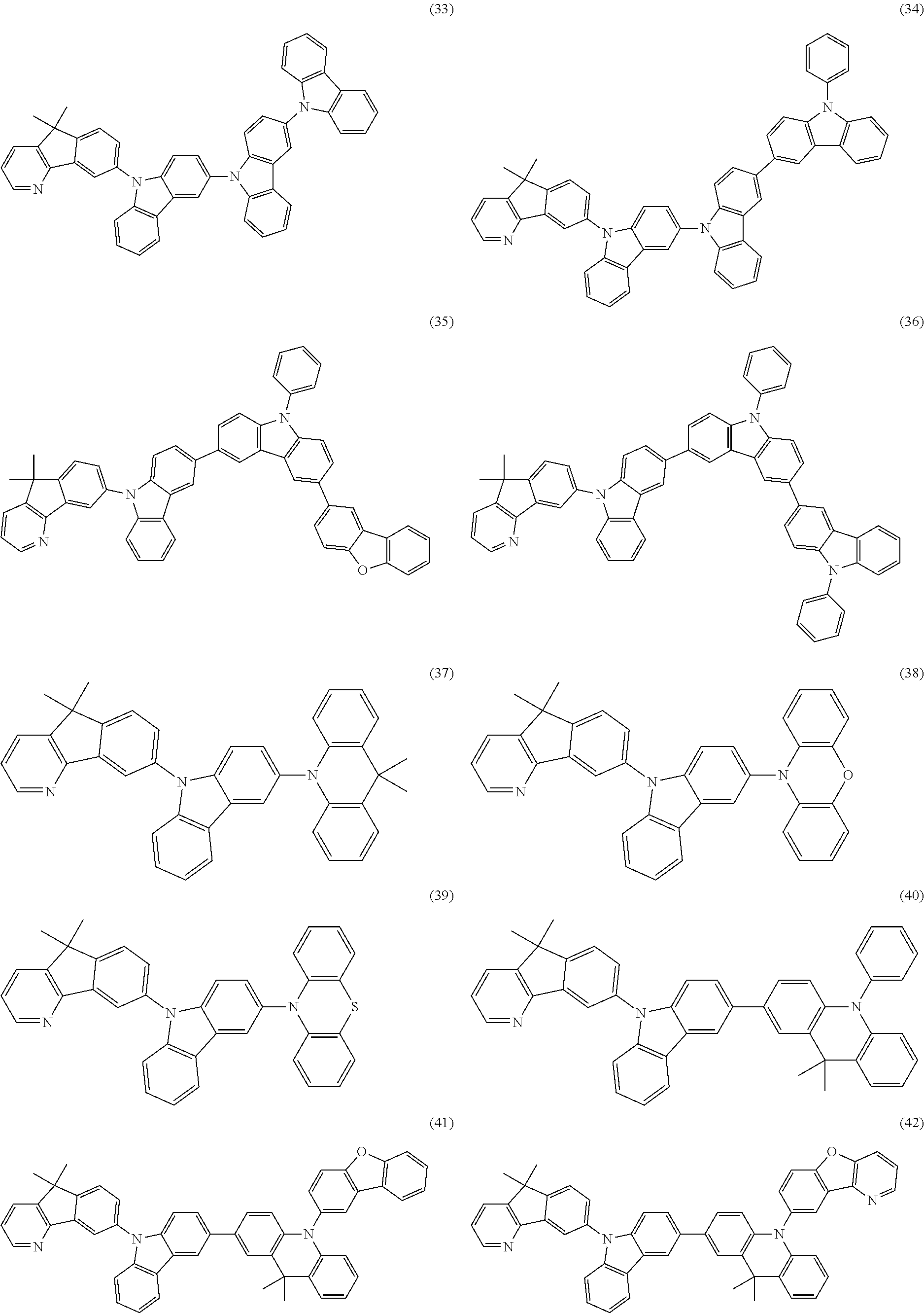


wherein R represents the same as R2 in the formula (1).

- (1) Synthesis of Intermediate (1-a)

- (2) Synthesis of Intermediate (1-b)

- (3) Synthesis of Intermediate (1-c)

- (4) Synthesis of Intermediate (1-d)

- (5) Synthesis of Intermediate (1-e)

- (6) Synthesis of Compound (1)


- (1) External Quantum Efficiency (%)
- (2) Half Life (Hours)
- (3) Voltage (V)
| TABLE 1 | |||||
| External | Luminance | ||||
| quantum | Half life | ||||
| Blocking layer | Voltage (V) | efficiency (%) | (hours) | ||
| Example 1 | Compound (1) | 4.8 | 17.5 | 7300 |
| TABLE 2 | |||
| Compound | Triplet energy (eV) | ||
| Compound (1) | 2.91 | ||
| Compound (BD1) | 2.64 | ||
Claims (16)


Applications Claiming Priority (3)
| Application Number | Priority Date | Filing Date | Title |
|---|---|---|---|
| JP2011268228 | 2011-12-07 | ||
| JP2011-268228 | 2011-12-07 | ||
| PCT/JP2012/007789 WO2013084484A1 (en) | 2011-12-07 | 2012-12-05 | Material for organic electroluminescent element and organic electroluminescent element using same |
Publications (2)
| Publication Number | Publication Date |
|---|---|
| US20140353650A1 US20140353650A1 (en) | 2014-12-04 |
| US9496508B2 true US9496508B2 (en) | 2016-11-15 |
Family
ID=48573874
Family Applications (1)
| Application Number | Title | Priority Date | Filing Date |
|---|---|---|---|
| US14/363,761 Expired - Fee Related US9496508B2 (en) | 2011-12-07 | 2012-12-05 | Material for organic electroluminescent element and organic electroluminescent element using same |
Country Status (3)
| Country | Link |
|---|---|
| US (1) | US9496508B2 (en) |
| TW (1) | TW201336836A (en) |
| WO (1) | WO2013084484A1 (en) |
Families Citing this family (2)
| Publication number | Priority date | Publication date | Assignee | Title |
|---|---|---|---|---|
| KR101560061B1 (en) * | 2012-11-30 | 2015-10-15 | 주식회사 엘지화학 | New compounds and organic electronic device using the same |
| KR101812581B1 (en) | 2013-10-11 | 2017-12-27 | 제일모직 주식회사 | Organic alloy for organic optoelectric device and organic optoelectric device and display device |
Citations (6)
| Publication number | Priority date | Publication date | Assignee | Title |
|---|---|---|---|---|
| JP2006131783A (en) | 2004-11-08 | 2006-05-25 | Konica Minolta Holdings Inc | ORGANIC ELECTROLUMINESCENT ELEMENT MATERIAL, ORGANIC ELECTROLUMINESCENT ELEMENT, LIGHTING DEVICE AND DISPLAY DEVICE |
| JP2010114180A (en) * | 2008-11-05 | 2010-05-20 | Konica Minolta Holdings Inc | Organic electroluminescent element, white organic electroluminescent element, display device and illuminator |
| JP2011054931A (en) | 2009-08-05 | 2011-03-17 | Konica Minolta Holdings Inc | Organic electroluminescent element and method of manufacturing the same |
| WO2011055934A2 (en) | 2009-11-03 | 2011-05-12 | 제일모직 주식회사 | Compound for an organic photoelectric device, and organic photoelectric device comprising same |
| KR20120072787A (en) * | 2010-12-24 | 2012-07-04 | 에스에프씨 주식회사 | Pyridine derivative compound and organic electroluminescent devices comprising the same |
| KR20120092908A (en) | 2011-02-14 | 2012-08-22 | 에스에프씨 주식회사 | Pyridine derivative compound and organic electroluminescent device comprising the same |
-
2012
- 2012-12-05 US US14/363,761 patent/US9496508B2/en not_active Expired - Fee Related
- 2012-12-05 WO PCT/JP2012/007789 patent/WO2013084484A1/en not_active Ceased
- 2012-12-07 TW TW101146043A patent/TW201336836A/en unknown
Patent Citations (7)
| Publication number | Priority date | Publication date | Assignee | Title |
|---|---|---|---|---|
| JP2006131783A (en) | 2004-11-08 | 2006-05-25 | Konica Minolta Holdings Inc | ORGANIC ELECTROLUMINESCENT ELEMENT MATERIAL, ORGANIC ELECTROLUMINESCENT ELEMENT, LIGHTING DEVICE AND DISPLAY DEVICE |
| JP2010114180A (en) * | 2008-11-05 | 2010-05-20 | Konica Minolta Holdings Inc | Organic electroluminescent element, white organic electroluminescent element, display device and illuminator |
| JP2011054931A (en) | 2009-08-05 | 2011-03-17 | Konica Minolta Holdings Inc | Organic electroluminescent element and method of manufacturing the same |
| WO2011055934A2 (en) | 2009-11-03 | 2011-05-12 | 제일모직 주식회사 | Compound for an organic photoelectric device, and organic photoelectric device comprising same |
| EP2497811A2 (en) | 2009-11-03 | 2012-09-12 | Cheil Industries Inc. | Compound for an organic photoelectric device, and organic photoelectric device comprising same |
| KR20120072787A (en) * | 2010-12-24 | 2012-07-04 | 에스에프씨 주식회사 | Pyridine derivative compound and organic electroluminescent devices comprising the same |
| KR20120092908A (en) | 2011-02-14 | 2012-08-22 | 에스에프씨 주식회사 | Pyridine derivative compound and organic electroluminescent device comprising the same |
Non-Patent Citations (5)
| Title |
|---|
| International Search Report issue in International Application No. PCT/JP2012/007789 dated Feb. 19, 2013. |
| Min-Gi Shin et al., Organic Electronics 12 (2011), p. 785-793. |
| Seyhan, S., et al, Theoretical Investigation of Triscarbazole Derivatives as Host Materials for Blue Electrophosphorescence: Effects of Topology, Chemistry of Materials, Nov. 7, 2011, vol. 23, Issue 23, pp. 5223-5230. |
| Written Opinion of the International Searching Authority issued in International Application No. PCT/JP2012/007789 dated Jun. 19, 2014. |
| Xin, G., et al, Bipolar Host Molecules for Efficient Blue Electrophosphorescence: A Quantum Chemical Design, Journal of Physical Chemistry A, 2010, vol. 114, Issue 2, pp. 965-972. |
Also Published As
| Publication number | Publication date |
|---|---|
| US20140353650A1 (en) | 2014-12-04 |
| TW201336836A (en) | 2013-09-16 |
| WO2013084484A1 (en) | 2013-06-13 |
Similar Documents
| Publication | Publication Date | Title |
|---|---|---|
| US9991447B2 (en) | Material for organic electroluminescent element, and organic electroluminescent element produced using same | |
| US9685614B2 (en) | Material for organic electroluminescent element, and element using same | |
| KR102048688B1 (en) | Nitrogen-containing heteroaromatic ring compound | |
| US9960364B2 (en) | Ladder compound, and organic electroluminescent element using same | |
| US20150034927A1 (en) | Material for organic electroluminescent element, and organic electroluminescent element using same | |
| WO2013175747A1 (en) | Organic electroluminescent element | |
| WO2013035329A1 (en) | Organic electroluminescence element | |
| WO2011046182A1 (en) | Fluorene-containing aromatic compound, material for organic electroluminescent element, and organic electroluminescent element using same | |
| WO2013175746A1 (en) | Organic electroluminescent element | |
| WO2013102992A1 (en) | Material for organic electroluminescence element and element using same | |
| CN103635471A (en) | Material for organic electroluminescence element and organic electroluminescence element using same | |
| WO2013179645A1 (en) | Organic-electroluminescent-element material, and organic electroluminescent element using same | |
| JP2013108015A (en) | Material for organic electroluminescent element | |
| JPWO2013108589A1 (en) | NOVEL COMPOUND, MATERIAL FOR ORGANIC ELECTROLUMINESCENT DEVICE AND ORGANIC ELECTROLUMINESCENT DEVICE | |
| JP6031302B2 (en) | Heteroaromatic compound and organic electroluminescence device using the same | |
| US9496508B2 (en) | Material for organic electroluminescent element and organic electroluminescent element using same | |
| WO2014112359A1 (en) | Organic electroluminescent element |
Legal Events
| Date | Code | Title | Description |
|---|---|---|---|
| AS | Assignment |
Owner name: IDEMITSU KOSAN CO., LTD., JAPAN Free format text: ASSIGNMENT OF ASSIGNORS INTEREST;ASSIGNORS:SHIOMI, TAKUSHI;HASHIMOTO, RYOHEI;NAGASHIMA, HIDEAKI;SIGNING DATES FROM 20140421 TO 20140423;REEL/FRAME:033051/0821 |
|
| ZAAA | Notice of allowance and fees due |
Free format text: ORIGINAL CODE: NOA |
|
| ZAAB | Notice of allowance mailed |
Free format text: ORIGINAL CODE: MN/=. |
|
| STCF | Information on status: patent grant |
Free format text: PATENTED CASE |
|
| CC | Certificate of correction | ||
| MAFP | Maintenance fee payment |
Free format text: PAYMENT OF MAINTENANCE FEE, 4TH YEAR, LARGE ENTITY (ORIGINAL EVENT CODE: M1551); ENTITY STATUS OF PATENT OWNER: LARGE ENTITY Year of fee payment: 4 |
|
| LAPS | Lapse for failure to pay maintenance fees |
Free format text: PATENT EXPIRED FOR FAILURE TO PAY MAINTENANCE FEES (ORIGINAL EVENT CODE: EXP.); ENTITY STATUS OF PATENT OWNER: LARGE ENTITY |
|
| STCH | Information on status: patent discontinuation |
Free format text: PATENT EXPIRED DUE TO NONPAYMENT OF MAINTENANCE FEES UNDER 37 CFR 1.362 |
|
| FP | Lapsed due to failure to pay maintenance fee |
Effective date: 20241115 |