US9492588B2 - Antibacterial and osteoinductive implant coating, method of producing such coating, and implant coated with same - Google Patents
Antibacterial and osteoinductive implant coating, method of producing such coating, and implant coated with same Download PDFInfo
- Publication number
- US9492588B2 US9492588B2 US13/746,461 US201313746461A US9492588B2 US 9492588 B2 US9492588 B2 US 9492588B2 US 201313746461 A US201313746461 A US 201313746461A US 9492588 B2 US9492588 B2 US 9492588B2
- Authority
- US
- United States
- Prior art keywords
- copper
- calcium phosphate
- coating
- implant
- highly porous
- Prior art date
- Legal status (The legal status is an assumption and is not a legal conclusion. Google has not performed a legal analysis and makes no representation as to the accuracy of the status listed.)
- Expired - Fee Related
Links
Images


Classifications
-
- A—HUMAN NECESSITIES
- A61—MEDICAL OR VETERINARY SCIENCE; HYGIENE
- A61L—METHODS OR APPARATUS FOR STERILISING MATERIALS OR OBJECTS IN GENERAL; DISINFECTION, STERILISATION OR DEODORISATION OF AIR; CHEMICAL ASPECTS OF BANDAGES, DRESSINGS, ABSORBENT PADS OR SURGICAL ARTICLES; MATERIALS FOR BANDAGES, DRESSINGS, ABSORBENT PADS OR SURGICAL ARTICLES
- A61L27/00—Materials for grafts or prostheses or for coating grafts or prostheses
- A61L27/28—Materials for coating prostheses
- A61L27/30—Inorganic materials
- A61L27/32—Phosphorus-containing materials, e.g. apatite
-
- A—HUMAN NECESSITIES
- A61—MEDICAL OR VETERINARY SCIENCE; HYGIENE
- A61L—METHODS OR APPARATUS FOR STERILISING MATERIALS OR OBJECTS IN GENERAL; DISINFECTION, STERILISATION OR DEODORISATION OF AIR; CHEMICAL ASPECTS OF BANDAGES, DRESSINGS, ABSORBENT PADS OR SURGICAL ARTICLES; MATERIALS FOR BANDAGES, DRESSINGS, ABSORBENT PADS OR SURGICAL ARTICLES
- A61L27/00—Materials for grafts or prostheses or for coating grafts or prostheses
- A61L27/50—Materials characterised by their function or physical properties, e.g. injectable or lubricating compositions, shape-memory materials, surface modified materials
- A61L27/54—Biologically active materials, e.g. therapeutic substances
-
- A—HUMAN NECESSITIES
- A61—MEDICAL OR VETERINARY SCIENCE; HYGIENE
- A61L—METHODS OR APPARATUS FOR STERILISING MATERIALS OR OBJECTS IN GENERAL; DISINFECTION, STERILISATION OR DEODORISATION OF AIR; CHEMICAL ASPECTS OF BANDAGES, DRESSINGS, ABSORBENT PADS OR SURGICAL ARTICLES; MATERIALS FOR BANDAGES, DRESSINGS, ABSORBENT PADS OR SURGICAL ARTICLES
- A61L27/00—Materials for grafts or prostheses or for coating grafts or prostheses
- A61L27/50—Materials characterised by their function or physical properties, e.g. injectable or lubricating compositions, shape-memory materials, surface modified materials
- A61L27/56—Porous materials, e.g. foams or sponges
-
- A—HUMAN NECESSITIES
- A61—MEDICAL OR VETERINARY SCIENCE; HYGIENE
- A61L—METHODS OR APPARATUS FOR STERILISING MATERIALS OR OBJECTS IN GENERAL; DISINFECTION, STERILISATION OR DEODORISATION OF AIR; CHEMICAL ASPECTS OF BANDAGES, DRESSINGS, ABSORBENT PADS OR SURGICAL ARTICLES; MATERIALS FOR BANDAGES, DRESSINGS, ABSORBENT PADS OR SURGICAL ARTICLES
- A61L2300/00—Biologically active materials used in bandages, wound dressings, absorbent pads or medical devices
- A61L2300/10—Biologically active materials used in bandages, wound dressings, absorbent pads or medical devices containing or releasing inorganic materials
- A61L2300/102—Metals or metal compounds, e.g. salts such as bicarbonates, carbonates, oxides, zeolites, silicates
-
- A—HUMAN NECESSITIES
- A61—MEDICAL OR VETERINARY SCIENCE; HYGIENE
- A61L—METHODS OR APPARATUS FOR STERILISING MATERIALS OR OBJECTS IN GENERAL; DISINFECTION, STERILISATION OR DEODORISATION OF AIR; CHEMICAL ASPECTS OF BANDAGES, DRESSINGS, ABSORBENT PADS OR SURGICAL ARTICLES; MATERIALS FOR BANDAGES, DRESSINGS, ABSORBENT PADS OR SURGICAL ARTICLES
- A61L2300/00—Biologically active materials used in bandages, wound dressings, absorbent pads or medical devices
- A61L2300/40—Biologically active materials used in bandages, wound dressings, absorbent pads or medical devices characterised by a specific therapeutic activity or mode of action
- A61L2300/404—Biocides, antimicrobial agents, antiseptic agents
Definitions
- the present invention relates to an antibacterial and at the same time osteoinductively active coating for implants, in particular for metallic implants and for implants that are sufficiently conductive for an electrochemical coating, a method of producing such a coating, and an implant having such a coating.
- implant surfaces need to be modified for an optimum integration of the implants in the surrounding body tissue. This requires these surfaces to be bioactive. This means that tissues or cells are specifically influenced, that is, with a view to their differentiation and proliferation, by the implant surface such that they enter into a durable, force-fitting bond with the implant surface.
- hydroxylapatite a poorly soluble calcium phosphate phase
- TPS plasma-sprayed titanium
- HA hydroxylapatite
- the hydroxylapatite is applied onto the implant surfaces in a thickness of >50-200 ⁇ m, likewise using a plasma spraying method.
- the porosity and, hence, the layer quality are influenced by thermal influences due to the plasma spraying in such a way that the layer applied is monolithic.
- the low porosity leads to the poor solubility of the plasma-sprayed calcium phosphate phase. Further, complex geometries are difficult to coat by means of plasma spraying.
- Amorphous calcium phosphate may, for example, lead to layer delaminations and flaking because of its very high solubility in vivo. As a consequence of such layer delaminations, formation of a connective tissue capsule may occur in the gap produced, which would eventually result in an aseptic loosening of the implant (see Heimann R.: Engineering biokeramischer Be Anlagen für H Fundamentalendoprothesen Section 2; www.tu-clausthal.de/presse/tucontact/2005/Mai/pdf).
- Calcium phosphate layers deposited on implants from electrolytic baths are very similar in their genesis to the processes occurring in bone growth. Their microporous structure can be maintained as no thermal influences appear. The microporous structure favors an immobilization of cells proceeding from which new bone tissue can form, with which the implant can grow together as in normal wound healing.
- Calcium phosphates such as brushite and monetite which, in comparison with hydroxylapatite, have a very much higher solubility, are thus of a special importance specially to the healing-in phase of the implant into the bone since, owing to the higher porosity, they have a higher solubility, whereby the concentrations of the calcium ions and phosphate ions quickly increases.
- an implant-induced infection with bacteria constitutes the most dreaded complication. Therefore, there is a particularly great interest in configuring the implant surfaces such as to additionally provide them with an antibacterial effect.
- the bacteriostatic properties of copper have already been described in the literature many times, such as, for example, in Hubacher et al. N Engl J Med 345 (2001) 561-7, and in the above-mentioned dissertation by Prinz. It has been known for some time that, in addition to its angiogenesis-promoting effect, copper has an antibacterial effect also in a free form not bound to proteins. Like with silver, one speaks of the oligodynamic effect here. Although the mechanism of action is not yet fully clear, it is considered to be certain that metal cations attack the cells at various points and in this way inactivate physiological functions such as, e.g., the synthesis of the cell membrane, of RNA and DNA, the translation or protein synthesis.
- the copper ions are intended to prohibit the adhesion and reproduction of clinical bacteria such as Staphylococcus aureus on the implant surface and prevent the reproduction thereof in the surrounding body tissue by a defined release rate.
- Copper ions are of essential importance to cell metabolism and are present in the body media with concentrations of approx. 1 mg/l. A local increase in this concentration to ten times as much is sufficient to achieve a considerable antibacterial effect.
- a anti-infectious surface modification of bone implants with copper thereby offers the chance to inhibit the development of the bacteria present in the prepared implant bearing without appreciably damaging the endogenous tissue cells or impairing them in their development (above-cited publication by Hubacher et al.).
- GHK-Cu2+ has an anti-inflammatory effect and promotes tissue regeneration.
- GHK glycosyl-L-histidyl-L-lysine
- angiogenesis and endothelial cell proliferation are stimulated by Cu2+ ions (Borkow, G. (2004): “Copper's Role in Wound Healing”, Review of Literature, Property of Cupron Inc (CUPRON Better Health Through TechnologyTM) http://www.pedorthicnewswire.com/ . . .
- WO 2009/062671 One example of a coating that is applied by means of a thermal spraying method is shown in WO 2009/062671.
- a method is indicated by means of which an implant is coated in the anchoring area with a cover layer as a coating, consisting of calcium phosphate and antibacterially active ingredients.
- This cover layer is applied using a thermal spray method, which produces a monolithic structure.
- the calcium phosphate spray powder is of a grainy quality and is mixed with metal grains.
- the calcium phosphate portion preferably consists of hydroxylapatite; silver and/or copper are preferred for the antibacterially active ingredients.
- the object of the invention is to provide a coating having an improved antibacterial effectiveness, and therefore to improve the connection of an implant provided with this coating with the bone.
- the layer deposited on the surface of the bone implant is, in addition, intended to optimally assist in the healing-in of the implant into the bone while being fully resorbed, and in this way allow the direct and complete force-fitting contact of the bone with the implant.
- the calcium phosphate layer is highly porous since this guarantees a high solubility.
- the subsequent introduction of the copper ions into the highly porous calcium phosphate layer ensures that the copper ions are adsorbed at the weak points of the calcium phosphate layer. In this way, the defined release rate of the copper ions can be achieved since they are distributed discontinuously and inhomogeneously in the calcium phosphate layer previously applied.
- this layer has a highly porous structure which allows the layer to be modified in a controlled manner both during deposition and also by a post-treatment in regard to its phase composition and solubility, and thus a controlled resorption of this layer is possible.
- the coating can be adjusted to the requirements of the site of use of the implant.
- the porosity of the calcium phosphate layer is associated here with the solubility of this layer, the solubility being an important parameter for the connection of the implant with the bone tissue.
- this layer is configured to elute copper ions that promote the angiogenesis of the adjacent tissue.
- the composite layer additionally contains copper phosphate phases and copper. Accordingly, in addition to the copper ions, the calcium ions and phosphate ions that stimulate cell growth also elute from this composite layer.
- the highly porous calcium phosphate phase favors the adhesion of the cells. The formation of a bacterial biofilm is made more difficult or prevented by the elution of the copper ions.
- the structure, composition and thickness of the composite layer may be adapted to the respective implant and the bone surrounding the implant.
- the production of this composite may proceed such that the individual phases are deposited at the same time or else successively, or such that portions of one phase, e.g., the more soluble calcium phosphate phase, are transformed to a less soluble phase by a chemical reaction.
- the copper concentration in the coating is selected such that a high initial elution has a sufficiently antimicrobial effect by the dissolution of elemental copper and a moderate longer-term dissolution of copper phosphates does not cause any toxic effect.
- the copper-containing phases ensure a bacteria-free healing-in zone over a longer period of time and therefore favor the growth and stabilization of the new bone tissue.
- the highly porous calcium phosphate layer ensures the high solubility and the attendant high initial elution of the copper.
- the composite layer cannot, and is not to, serve as a barrier between the implant and the bone, but is intended to serve as a harmonizing factor or host in the endogenous structuring of the boundary layer between the implant and the bone.
- Cell and bacterial adhesion processes are highly dependent on the surface quality. Above all, the chemical composition, the hygroscopic properties and also the roughness of the surface play a role here that is not to be neglected.
- the layer can release copper at such a rate that a copper concentration of 90 to 160 ⁇ mol/l is obtained in a body fluid surrounding the implant.
- the copper content in the coating is sufficiently high to develop an antimicrobial effect.
- the concentration of the copper ions released in the body is not so high as to effect cell damage and thus an impairment of the on-growth of the implant. As a result, this copper concentration ensures that the antimicrobial effect is able to develop while any toxic consequences for the cell tissue surrounding the implant do not yet appear.
- the layer thickness amounts to 20 ⁇ m ⁇ 10 ⁇ m. This small layer thickness is sufficient for ensuring that the implant grows into the cell tissue, this being made possible on the basis of the highly porous structure of the calcium phosphate layer.
- an implant having a coating of the type mentioned above and which, owing to the coating applied, has the advantages mentioned above with respect to angiogenesis.
- the calcium phosphate is deposited, in particular electrochemically, while the substrate is in an ultrasonic bath.
- the ultrasound serves to remove any calcium phosphate crystals that are bound too weakly to the implant surface.
- the holes produced in the layer in this process are newly coated promptly.
- the copper is electrodeposited. This offers the advantage that the copper can accumulate even in complex geometries of the substrate coated with the calcium phosphate layer.
- the gaps in the calcium phosphate layer that are generated by the ultrasound are predominantly filled with copper here.
- the copper thus attaches to the weak points of the calcium phosphate layer which become apparent due to the ultrasonic bath.
- any poorly adhering copper ions are detached by the ultrasonic bath; these places may be provided with copper once again.
- the calcium phosphate is deposited to have a thickness of about 20 ⁇ m. Owing to the highly porous calcium phosphate layer, this thickness is already sufficient to ensure the ingrowth.
- the copper is deposited with a mass of about 1 ⁇ g/mm 2 .
- This deposition rate ensures that the copper concentration in the coating is selected to provide a sufficiently antimicrobial effect while, however, producing no toxic effect leading to damage to the surrounding tissue.
- FIG. 1 shows a scanning electron microscopic image of an electrochemically deposited calcium phosphate (brushite)/copper coating according to the invention
- FIG. 2 shows the copper release from a calcium phosphate/copper (CaP/Cu) implant coating according to the invention in RPMI cell culture medium;
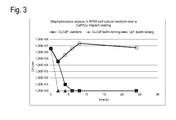
- FIG. 3 shows the behavior of biofilm-forming and planktonic Staphylococcus aureus in RPMI cell culture medium over a CaP/Cu implant coating according to the invention and over a copper-free CaP coating.
- FIG. 1 shows a scanning electron microscopic image of a calcium phosphate/copper coating according to the invention that was electrochemically deposited; brushite was used here for the highly porous calcium phosphate layer into which copper was incorporated discontinuously.
- the highly porous structure of the calcium phosphate layer is hard to see in FIG. 1 since owing to the scanning electron microscopic image, a very detailed image was taken of the coating.
- the calcium phosphate crystallites can be recognized, which are fixed in the form of platelets or needles almost vertically on the implant surface. A large reactive surface is provided by this microporous or highly porous calcium phosphate layer for the interaction with the biological environment.
- copper ions can be recognized, which have been incorporated or embedded in the highly porous calcium phosphate layer in a discontinuously and inhomogeneously distributed fashion.
- the calcium phosphate layer has been applied onto the implant by means of an electrochemical deposition method, with the copper also having been galvanically incorporated into the existing calcium phosphate layer.
- the coating results from an electrochemical process in which at first, by applying a negative voltage to the metallic implant, a calcium phosphate (brushite) layer having a thickness of about 15 ⁇ m, a high porosity and therefore a high bioactivity is deposited from the electrolyte onto the highly alkaline surface of the implant.
- the copper is galvanically incorporated in the highly porous calcium phosphate layer in a discontinuous and inhomogeneous fashion, preferably from a saturated copper acetate solution.
- the calcium phosphate layer and also the copper are preferably incorporated electrochemically, the coating process occurring during an ultrasonic bath.
- the ultrasonic bath makes sure that any weak points of the coating are detached and such points can therefore be newly coated. This applies both to the basic coating of the implant with the calcium phosphate layer and to the later introduction of the copper into the existing highly porous calcium phosphate layer.
- the copper is incorporated in weak points of the calcium phosphate layer. This implies that the copper is distributed discontinuously and inhomogeneously in the calcium phosphate layer.
- FIG. 2 shows the release of the copper from a calcium phosphate/copper coating according to the invention versus time.
- the discontinuously distributed copper in an RPMI cell culture medium is dissolved very rapidly.
- 90% of the copper deposited on the specimen surface can be detected in the RPMI medium.
- the presence of copper stimulates angiogenesis and has a positive influence on the wound healing process. Therefore, it is of advantage that the copper is deposited rapidly in order to develop its effect accordingly.
- FIG. 3 compares the behavior of biofilm-forming and planktonic Staphylococcus aureus in an RPMI cell culture medium of a calcium phosphate/copper coating according to the invention to a copper-free calcium phosphate coating.
- FIG. 3 thus illustrates more clearly the antibacterial effect of the copper introduced in the calcium phosphate layer as compared to a calcium phosphate layer without an incorporation of copper.
- the graph shown in FIG. 3 illustrates the bacteria concentration versus time; for examining the antibacterial effect, the clinically relevant Staphylococcus aureus ATCC25923 bacterial strain was used.
- the antibacterial effect of the copper is therefore clear.
- the rapid decrease in the bacterial concentration is accompanied by the very rapid copper release as has been shown in FIG. 2 , the copper being able to dissolve from the highly porous calcium phosphate layer since the copper is distributed discontinuously and inhomogeneously in this highly porous layer.
- a further reason for the rapid release rate of the copper resides in that the copper has been incorporated predominantly in weak points of the calcium phosphate layer.
- the copper-loaded CaP layer according to the invention was examined with respect to its influence on signal transduction in new vessel formation and in inflammation. It could be found that there are no indications of an appearance of cell death. CD31 protein staining even suggested an activation of the cells by copper.
- FIGS. 1 to 3 A preferred embodiment of a substrate and the process of coating it with the calcium phosphate/copper coating according to the invention will now be indicated below.
- a suitable experimental arrangement for coating a substrate in a manner according to the invention is as follows: A beaker with 100 ml of an aqueous electrolyte containing 0.1 mol/l NH 4 H 2 PO 4 and 0.167 mol/l CaCl 2 is placed in an ultrasonic bath. A titanium sample (1 mm thick, 20 mm in diameter) as the cathode is connected in the electrolyte to an inert carbon anode via a DC power supply unit. A highly porous, adhesively strong calcium phosphate layer (approx. 20 ⁇ g/mm 2 ) is deposited to a thickness of 20 ⁇ m at a moderate ultrasound at 6 volts in 10 minutes.
- a suitable experimental setup here is as follows: The sample coated with calcium phosphate as the cathode is connected via a DC power supply unit to a copper anode in a saturated aqueous copper acetate solution and coated with copper at 6 volts for 10 seconds. In the process, approx. 1 ⁇ g copper/mm 2 is deposited.
- a calcium phosphate/copper coating according to the invention has thus been applied on a substrate which has an improved antibacterial effectiveness as provided by the coating.
- stage I the copper ions are flushed out.
- this process is accelerated by a high affinity of the bacteria for metal cations.
- bacteria take up copper exactly until such time as their lethal dose is reached.
- the time period required therefor is determined by the supply of copper. This has been shown in FIGS. 2 and 3 and suitably discussed.
- the process described in the literature as the “race for the surface” (“race” between the endogenous cells and the microorganisms introduced during surgery), which takes place immediately after introduction of the implant, is, owing to the copper, shifted for the benefit of the cells.
- stage II the largest local increase in the calcium ion and phosphate ion concentrations present in the boundary layer between the implant and the bone is essentially determined by the more readily soluble phases. In this stage it must be ensured that no fibrous encapsulation of the implant occurs, and its direct osteointegration is made possible in this way.
- the porosity of the composite first increases by the decrease in the more readily soluble phases, making room for new bone tissue.
- stage III the less readily soluble composite portion is dissolved.
- the copper phosphates precipitated by the presence of copper ions determine the local ion balance and in particular assist in mineralization and angiogenesis of the new bone tissue.
- the less soluble calcium phosphate phases have been dissolved, the entire composite has been transformed into bone tissue.
- a coating for an implant having an improved antimicrobial effect and at the same time speeding up the healing-in process.
Landscapes
- Health & Medical Sciences (AREA)
- Chemical & Material Sciences (AREA)
- Life Sciences & Earth Sciences (AREA)
- Medicinal Chemistry (AREA)
- Public Health (AREA)
- General Health & Medical Sciences (AREA)
- Transplantation (AREA)
- Epidemiology (AREA)
- Veterinary Medicine (AREA)
- Animal Behavior & Ethology (AREA)
- Oral & Maxillofacial Surgery (AREA)
- Dermatology (AREA)
- Inorganic Chemistry (AREA)
- Engineering & Computer Science (AREA)
- Biomedical Technology (AREA)
- Molecular Biology (AREA)
- Dispersion Chemistry (AREA)
- Materials For Medical Uses (AREA)
- Prostheses (AREA)
Applications Claiming Priority (3)
| Application Number | Priority Date | Filing Date | Title |
|---|---|---|---|
| DE102012001260.8A DE102012001260B4 (de) | 2012-01-23 | 2012-01-23 | Antibakterielle und osteoinduktive Implantatbeschichtung |
| DE102012001260 | 2012-01-23 | ||
| DE102012001260.8 | 2012-01-23 |
Publications (2)
| Publication Number | Publication Date |
|---|---|
| US20130189323A1 US20130189323A1 (en) | 2013-07-25 |
| US9492588B2 true US9492588B2 (en) | 2016-11-15 |
Family
ID=47559309
Family Applications (1)
| Application Number | Title | Priority Date | Filing Date |
|---|---|---|---|
| US13/746,461 Expired - Fee Related US9492588B2 (en) | 2012-01-23 | 2013-01-22 | Antibacterial and osteoinductive implant coating, method of producing such coating, and implant coated with same |
Country Status (3)
| Country | Link |
|---|---|
| US (1) | US9492588B2 (de) |
| EP (1) | EP2617439B1 (de) |
| DE (1) | DE102012001260B4 (de) |
Families Citing this family (4)
| Publication number | Priority date | Publication date | Assignee | Title |
|---|---|---|---|---|
| FR3020759B1 (fr) * | 2014-05-06 | 2017-10-13 | Rv Finances | Materiau de revetement pour dispositif medical implantable, dispositif medical implantable revetu d'un tel materiau et procede de fabrication correspondant |
| US10064273B2 (en) | 2015-10-20 | 2018-08-28 | MR Label Company | Antimicrobial copper sheet overlays and related methods for making and using |
| DE102022128813A1 (de) | 2022-10-31 | 2024-05-02 | Universität Siegen, Körperschaft des öffentlichen Rechts | Antiadhäsive Polymer-Beschichtungen für Kurzzeitimplantate |
| CN118267518B (zh) * | 2024-04-16 | 2025-08-22 | 大连大学附属中山医院 | 一种医用掺铜纳米羟基磷灰石涂层多孔钽植入材料及其制备方法 |
Citations (6)
| Publication number | Priority date | Publication date | Assignee | Title |
|---|---|---|---|---|
| WO1999053971A1 (en) | 1998-04-17 | 1999-10-28 | University College London | Bone implant |
| WO2002005862A1 (de) | 2000-07-17 | 2002-01-24 | Dot Gmbh | Elektrochemisch abgeschiedene, bioaktive calciumphosphat-kompositschichten auf implantaten |
| WO2009062671A2 (de) | 2007-11-12 | 2009-05-22 | Medicoat Ag | Implantat und verfahren zur beschichtung eines implantats |
| WO2009111307A2 (en) | 2008-02-29 | 2009-09-11 | Smith & Nephew, Inc. | Coating and coating method |
| US20100249925A1 (en) * | 2007-02-09 | 2010-09-30 | Ucl Business Plc | Article and a method of surface treatment of an article |
| WO2010112044A1 (en) | 2009-04-02 | 2010-10-07 | Smith & Nephew Orthopaedics Ag | A method of surface treatment of an implant, an implant treated by said method and an electrolyte solution for use in said method |
Family Cites Families (5)
| Publication number | Priority date | Publication date | Assignee | Title |
|---|---|---|---|---|
| US5310464A (en) | 1991-01-04 | 1994-05-10 | Redepenning Jody G | Electrocrystallization of strongly adherent brushite coatings on prosthetic alloys |
| US5205921A (en) | 1991-02-04 | 1993-04-27 | Queen's University At Kingston | Method for depositing bioactive coatings on conductive substrates |
| DE4431862C2 (de) | 1994-09-07 | 1997-12-11 | Dot Duennschicht Und Oberflaec | Verfahren zur Beschichtung von Metall- und Keramikoberflächen mit Hydroxylapatit |
| DE19504386C2 (de) | 1995-02-10 | 1997-08-28 | Univ Dresden Tech | Verfahren zur Herstellung einer gradierten Beschichtung aus Calciumphosphatphasen und Metalloxidphasen auf metallischen Implantaten |
| AU2002246785A1 (en) | 2000-12-28 | 2002-08-06 | The Board Of Regents Of The University Of Nebraska | Electrolytic deposition of coatings for prosthetic metals and alloys |
-
2012
- 2012-01-23 DE DE102012001260.8A patent/DE102012001260B4/de not_active Expired - Fee Related
-
2013
- 2013-01-15 EP EP13151346.7A patent/EP2617439B1/de active Active
- 2013-01-22 US US13/746,461 patent/US9492588B2/en not_active Expired - Fee Related
Patent Citations (8)
| Publication number | Priority date | Publication date | Assignee | Title |
|---|---|---|---|---|
| WO1999053971A1 (en) | 1998-04-17 | 1999-10-28 | University College London | Bone implant |
| WO2002005862A1 (de) | 2000-07-17 | 2002-01-24 | Dot Gmbh | Elektrochemisch abgeschiedene, bioaktive calciumphosphat-kompositschichten auf implantaten |
| US20100249925A1 (en) * | 2007-02-09 | 2010-09-30 | Ucl Business Plc | Article and a method of surface treatment of an article |
| WO2009062671A2 (de) | 2007-11-12 | 2009-05-22 | Medicoat Ag | Implantat und verfahren zur beschichtung eines implantats |
| US20100286790A1 (en) | 2007-11-12 | 2010-11-11 | Medicoat Ag | Implant and method for coating an implant |
| WO2009111307A2 (en) | 2008-02-29 | 2009-09-11 | Smith & Nephew, Inc. | Coating and coating method |
| US20110008407A1 (en) | 2008-02-29 | 2011-01-13 | Smith & Nephew, Inc. | Coating and coating method |
| WO2010112044A1 (en) | 2009-04-02 | 2010-10-07 | Smith & Nephew Orthopaedics Ag | A method of surface treatment of an implant, an implant treated by said method and an electrolyte solution for use in said method |
Non-Patent Citations (2)
| Title |
|---|
| Heidenau (A novel antibacterial titania coating: Metal ion toxicity and in vitro surface colonization, J. Mater. Sci.: Mater. Med. 16 (2005) pp. 883-888). * |
| Prinz (Antibacterial Titanium/Calcium Phosphate Implant Surfaces, Key Eng. Mater. 396 (2009) pp. 299-302). * |
Also Published As
| Publication number | Publication date |
|---|---|
| EP2617439A3 (de) | 2015-11-25 |
| DE102012001260B4 (de) | 2015-04-02 |
| EP2617439A2 (de) | 2013-07-24 |
| EP2617439B1 (de) | 2019-02-27 |
| US20130189323A1 (en) | 2013-07-25 |
| DE102012001260A1 (de) | 2013-07-25 |
Similar Documents
| Publication | Publication Date | Title |
|---|---|---|
| Song et al. | Antibacterial properties of Ag (or Pt)‐containing calcium phosphate coatings formed by micro‐arc oxidation | |
| Zhou et al. | Multifunction Sr, Co and F co-doped microporous coating on titanium of antibacterial, angiogenic and osteogenic activities | |
| Zhao et al. | Antibacterial and osteogenic activity of a multifunctional microporous coating codoped with Mg, Cu and F on titanium | |
| US7229545B2 (en) | Process for the coating for metallic implant materials | |
| CN102216500B (zh) | 形成生物活性涂层的方法 | |
| Qiao et al. | Si, Sr, Ag co-doped hydroxyapatite/TiO 2 coating: enhancement of its antibacterial activity and osteoinductivity | |
| Alves et al. | Tribocorrosion behavior of calcium-and phosphorous-enriched titanium oxide films and study of osteoblast interactions for dental implants | |
| US10004604B2 (en) | Bioimplant for artifical joint with evanescent coating film | |
| US20100249925A1 (en) | Article and a method of surface treatment of an article | |
| KR20100057796A (ko) | 스트론튬 이온을 포함하는 골 조직 임플란트 | |
| CN107661544B (zh) | 抗菌促成骨复合功能多孔骨科植入物及其制备方法 | |
| KR20100055408A (ko) | 리튬 이온을 포함하는 골 조직 임플란트 | |
| Song et al. | Antibacterial properties and biocompatibility in vivo and vitro of composite coating of pure magnesium ultrasonic micro-arc oxidation phytic acid copper loaded | |
| CN101511399A (zh) | 生物植入物 | |
| Ji et al. | Influence of Ag/Ca ratio on the osteoblast growth and antibacterial activity of TiN coatings on Ti-6Al-4V by Ag and Ca ion implantation | |
| CN107233618A (zh) | 一种在钛合金上制备Ag/ZnO/HA纳米复合涂层的方法 | |
| US20130189323A1 (en) | Antibacterial and osteoinductive implant coating, method of producing such coating, and implant coated with same | |
| CN106606801B (zh) | 一种Zn-ZnO系锌合金及其制备方法与应用 | |
| JP7453333B2 (ja) | 抗細菌性とオステオインテグレイティブ性とを有するインプラントロジー用途の金属基材 | |
| RU2765921C1 (ru) | Способ изготовления дентального имплантата с использованием композитного нанопокрытия | |
| Pae et al. | Cell attachment and proliferation of bone marrow-derived osteoblast on zirconia of various surface treatment | |
| Zhan et al. | Evaluation of sustained drug release performance and osteoinduction of magnetron-sputtered tantalum-coated titanium dioxide nanotubes | |
| CN101862269A (zh) | 再生活性与抗菌性的纳米涂层微孔表面种植体的制备 | |
| KR20070063114A (ko) | 금속 임플란트 및 그 제조방법 | |
| Wang et al. | Micro-patterned titanium coatings with a grid-like structure doped with vancomycin against bacteria and affecting osteogenic differentiation |
Legal Events
| Date | Code | Title | Description |
|---|---|---|---|
| AS | Assignment |
Owner name: DOT GMBH, GERMANY Free format text: ASSIGNMENT OF ASSIGNORS INTEREST;ASSIGNORS:NEUMANN, HANS-GEORG, DR.;PRINZ, CORNELIA, DR.;REEL/FRAME:029667/0935 Effective date: 20130121 |
|
| STCF | Information on status: patent grant |
Free format text: PATENTED CASE |
|
| FEPP | Fee payment procedure |
Free format text: ENTITY STATUS SET TO SMALL (ORIGINAL EVENT CODE: SMAL); ENTITY STATUS OF PATENT OWNER: SMALL ENTITY |
|
| MAFP | Maintenance fee payment |
Free format text: PAYMENT OF MAINTENANCE FEE, 4TH YR, SMALL ENTITY (ORIGINAL EVENT CODE: M2551); ENTITY STATUS OF PATENT OWNER: SMALL ENTITY Year of fee payment: 4 |
|
| LAPS | Lapse for failure to pay maintenance fees |
Free format text: PATENT EXPIRED FOR FAILURE TO PAY MAINTENANCE FEES (ORIGINAL EVENT CODE: EXP.); ENTITY STATUS OF PATENT OWNER: SMALL ENTITY |
|
| STCH | Information on status: patent discontinuation |
Free format text: PATENT EXPIRED DUE TO NONPAYMENT OF MAINTENANCE FEES UNDER 37 CFR 1.362 |
|
| FP | Lapsed due to failure to pay maintenance fee |
Effective date: 20241115 |