US9443835B2 - Methods for performing embedded wafer-level packaging (eWLP) and eWLP devices, packages and assemblies made by the methods - Google Patents
Methods for performing embedded wafer-level packaging (eWLP) and eWLP devices, packages and assemblies made by the methods Download PDFInfo
- Publication number
- US9443835B2 US9443835B2 US14/330,022 US201414330022A US9443835B2 US 9443835 B2 US9443835 B2 US 9443835B2 US 201414330022 A US201414330022 A US 201414330022A US 9443835 B2 US9443835 B2 US 9443835B2
- Authority
- US
- United States
- Prior art keywords
- ewlp
- chip
- wafer
- back side
- type
- Prior art date
- Legal status (The legal status is an assumption and is not a legal conclusion. Google has not performed a legal analysis and makes no representation as to the accuracy of the status listed.)
- Active
Links
Images




Classifications
-
- H—ELECTRICITY
- H10—SEMICONDUCTOR DEVICES; ELECTRIC SOLID-STATE DEVICES NOT OTHERWISE PROVIDED FOR
- H10W—GENERIC PACKAGES, INTERCONNECTIONS, CONNECTORS OR OTHER CONSTRUCTIONAL DETAILS OF DEVICES COVERED BY CLASS H10
- H10W90/00—Package configurations
-
- H01L25/167—
-
- H01L21/568—
-
- H01L21/76877—
-
- H01L25/50—
-
- H01L31/02002—
-
- H01L31/0203—
-
- H01L31/12—
-
- H—ELECTRICITY
- H10—SEMICONDUCTOR DEVICES; ELECTRIC SOLID-STATE DEVICES NOT OTHERWISE PROVIDED FOR
- H10F—INORGANIC SEMICONDUCTOR DEVICES SENSITIVE TO INFRARED RADIATION, LIGHT, ELECTROMAGNETIC RADIATION OF SHORTER WAVELENGTH OR CORPUSCULAR RADIATION
- H10F55/00—Radiation-sensitive semiconductor devices covered by groups H10F10/00, H10F19/00 or H10F30/00 being structurally associated with electric light sources and electrically or optically coupled thereto
-
- H—ELECTRICITY
- H10—SEMICONDUCTOR DEVICES; ELECTRIC SOLID-STATE DEVICES NOT OTHERWISE PROVIDED FOR
- H10F—INORGANIC SEMICONDUCTOR DEVICES SENSITIVE TO INFRARED RADIATION, LIGHT, ELECTROMAGNETIC RADIATION OF SHORTER WAVELENGTH OR CORPUSCULAR RADIATION
- H10F55/00—Radiation-sensitive semiconductor devices covered by groups H10F10/00, H10F19/00 or H10F30/00 being structurally associated with electric light sources and electrically or optically coupled thereto
- H10F55/20—Radiation-sensitive semiconductor devices covered by groups H10F10/00, H10F19/00 or H10F30/00 being structurally associated with electric light sources and electrically or optically coupled thereto wherein the electric light source controls the radiation-sensitive semiconductor devices, e.g. optocouplers
- H10F55/25—Radiation-sensitive semiconductor devices covered by groups H10F10/00, H10F19/00 or H10F30/00 being structurally associated with electric light sources and electrically or optically coupled thereto wherein the electric light source controls the radiation-sensitive semiconductor devices, e.g. optocouplers wherein the radiation-sensitive devices and the electric light source are all semiconductor devices
-
- H—ELECTRICITY
- H10—SEMICONDUCTOR DEVICES; ELECTRIC SOLID-STATE DEVICES NOT OTHERWISE PROVIDED FOR
- H10F—INORGANIC SEMICONDUCTOR DEVICES SENSITIVE TO INFRARED RADIATION, LIGHT, ELECTROMAGNETIC RADIATION OF SHORTER WAVELENGTH OR CORPUSCULAR RADIATION
- H10F77/00—Constructional details of devices covered by this subclass
- H10F77/50—Encapsulations or containers
-
- H—ELECTRICITY
- H10—SEMICONDUCTOR DEVICES; ELECTRIC SOLID-STATE DEVICES NOT OTHERWISE PROVIDED FOR
- H10F—INORGANIC SEMICONDUCTOR DEVICES SENSITIVE TO INFRARED RADIATION, LIGHT, ELECTROMAGNETIC RADIATION OF SHORTER WAVELENGTH OR CORPUSCULAR RADIATION
- H10F77/00—Constructional details of devices covered by this subclass
- H10F77/93—Interconnections
-
- H—ELECTRICITY
- H10—SEMICONDUCTOR DEVICES; ELECTRIC SOLID-STATE DEVICES NOT OTHERWISE PROVIDED FOR
- H10W—GENERIC PACKAGES, INTERCONNECTIONS, CONNECTORS OR OTHER CONSTRUCTIONAL DETAILS OF DEVICES COVERED BY CLASS H10
- H10W20/00—Interconnections in chips, wafers or substrates
- H10W20/01—Manufacture or treatment
- H10W20/031—Manufacture or treatment of conductive parts of the interconnections
- H10W20/056—Manufacture or treatment of conductive parts of the interconnections by filling conductive material into holes, grooves or trenches
-
- H—ELECTRICITY
- H10—SEMICONDUCTOR DEVICES; ELECTRIC SOLID-STATE DEVICES NOT OTHERWISE PROVIDED FOR
- H10W—GENERIC PACKAGES, INTERCONNECTIONS, CONNECTORS OR OTHER CONSTRUCTIONAL DETAILS OF DEVICES COVERED BY CLASS H10
- H10W70/00—Package substrates; Interposers; Redistribution layers [RDL]
- H10W70/01—Manufacture or treatment
- H10W70/05—Manufacture or treatment of insulating or insulated package substrates, or of interposers, or of redistribution layers
- H10W70/08—Manufacture or treatment of insulating or insulated package substrates, or of interposers, or of redistribution layers by depositing layers on the chip or wafer, e.g. "chip-first" RDLs
- H10W70/09—Manufacture or treatment of insulating or insulated package substrates, or of interposers, or of redistribution layers by depositing layers on the chip or wafer, e.g. "chip-first" RDLs extending onto an encapsulation that laterally surrounds the chip or wafer, e.g. fan-out wafer level package [FOWLP] RDLs
-
- H—ELECTRICITY
- H10—SEMICONDUCTOR DEVICES; ELECTRIC SOLID-STATE DEVICES NOT OTHERWISE PROVIDED FOR
- H10W—GENERIC PACKAGES, INTERCONNECTIONS, CONNECTORS OR OTHER CONSTRUCTIONAL DETAILS OF DEVICES COVERED BY CLASS H10
- H10W70/00—Package substrates; Interposers; Redistribution layers [RDL]
- H10W70/60—Insulating or insulated package substrates; Interposers; Redistribution layers
-
- H—ELECTRICITY
- H10—SEMICONDUCTOR DEVICES; ELECTRIC SOLID-STATE DEVICES NOT OTHERWISE PROVIDED FOR
- H10W—GENERIC PACKAGES, INTERCONNECTIONS, CONNECTORS OR OTHER CONSTRUCTIONAL DETAILS OF DEVICES COVERED BY CLASS H10
- H10W72/00—Interconnections or connectors in packages
- H10W72/01—Manufacture or treatment
- H10W72/0198—Manufacture or treatment batch processes
-
- H—ELECTRICITY
- H10—SEMICONDUCTOR DEVICES; ELECTRIC SOLID-STATE DEVICES NOT OTHERWISE PROVIDED FOR
- H10W—GENERIC PACKAGES, INTERCONNECTIONS, CONNECTORS OR OTHER CONSTRUCTIONAL DETAILS OF DEVICES COVERED BY CLASS H10
- H10W74/00—Encapsulations, e.g. protective coatings
- H10W74/01—Manufacture or treatment
- H10W74/019—Manufacture or treatment using temporary auxiliary substrates
-
- H01L2224/11—
-
- H01L2224/18—
-
- H01L23/3107—
-
- H01L23/3121—
-
- H—ELECTRICITY
- H10—SEMICONDUCTOR DEVICES; ELECTRIC SOLID-STATE DEVICES NOT OTHERWISE PROVIDED FOR
- H10W—GENERIC PACKAGES, INTERCONNECTIONS, CONNECTORS OR OTHER CONSTRUCTIONAL DETAILS OF DEVICES COVERED BY CLASS H10
- H10W70/00—Package substrates; Interposers; Redistribution layers [RDL]
- H10W70/099—Connecting interconnections to insulating or insulated package substrates, interposers or redistribution layers
-
- H—ELECTRICITY
- H10—SEMICONDUCTOR DEVICES; ELECTRIC SOLID-STATE DEVICES NOT OTHERWISE PROVIDED FOR
- H10W—GENERIC PACKAGES, INTERCONNECTIONS, CONNECTORS OR OTHER CONSTRUCTIONAL DETAILS OF DEVICES COVERED BY CLASS H10
- H10W72/00—Interconnections or connectors in packages
- H10W72/01—Manufacture or treatment
- H10W72/012—Manufacture or treatment of bump connectors, dummy bumps or thermal bumps
-
- H—ELECTRICITY
- H10—SEMICONDUCTOR DEVICES; ELECTRIC SOLID-STATE DEVICES NOT OTHERWISE PROVIDED FOR
- H10W—GENERIC PACKAGES, INTERCONNECTIONS, CONNECTORS OR OTHER CONSTRUCTIONAL DETAILS OF DEVICES COVERED BY CLASS H10
- H10W72/00—Interconnections or connectors in packages
- H10W72/071—Connecting or disconnecting
- H10W72/073—Connecting or disconnecting of die-attach connectors
-
- H—ELECTRICITY
- H10—SEMICONDUCTOR DEVICES; ELECTRIC SOLID-STATE DEVICES NOT OTHERWISE PROVIDED FOR
- H10W—GENERIC PACKAGES, INTERCONNECTIONS, CONNECTORS OR OTHER CONSTRUCTIONAL DETAILS OF DEVICES COVERED BY CLASS H10
- H10W72/00—Interconnections or connectors in packages
- H10W72/071—Connecting or disconnecting
- H10W72/073—Connecting or disconnecting of die-attach connectors
- H10W72/07302—Connecting or disconnecting of die-attach connectors using an auxiliary member
- H10W72/07304—Connecting or disconnecting of die-attach connectors using an auxiliary member the auxiliary member being temporary, e.g. a sacrificial coating
- H10W72/07307—Connecting or disconnecting of die-attach connectors using an auxiliary member the auxiliary member being temporary, e.g. a sacrificial coating the auxiliary member being a temporary substrate, e.g. a removable substrate
-
- H—ELECTRICITY
- H10—SEMICONDUCTOR DEVICES; ELECTRIC SOLID-STATE DEVICES NOT OTHERWISE PROVIDED FOR
- H10W—GENERIC PACKAGES, INTERCONNECTIONS, CONNECTORS OR OTHER CONSTRUCTIONAL DETAILS OF DEVICES COVERED BY CLASS H10
- H10W72/00—Interconnections or connectors in packages
- H10W72/20—Bump connectors, e.g. solder bumps or copper pillars; Dummy bumps; Thermal bumps
- H10W72/241—Dispositions, e.g. layouts
-
- H—ELECTRICITY
- H10—SEMICONDUCTOR DEVICES; ELECTRIC SOLID-STATE DEVICES NOT OTHERWISE PROVIDED FOR
- H10W—GENERIC PACKAGES, INTERCONNECTIONS, CONNECTORS OR OTHER CONSTRUCTIONAL DETAILS OF DEVICES COVERED BY CLASS H10
- H10W72/00—Interconnections or connectors in packages
- H10W72/851—Dispositions of multiple connectors or interconnections
- H10W72/874—On different surfaces
-
- H—ELECTRICITY
- H10—SEMICONDUCTOR DEVICES; ELECTRIC SOLID-STATE DEVICES NOT OTHERWISE PROVIDED FOR
- H10W—GENERIC PACKAGES, INTERCONNECTIONS, CONNECTORS OR OTHER CONSTRUCTIONAL DETAILS OF DEVICES COVERED BY CLASS H10
- H10W72/00—Interconnections or connectors in packages
- H10W72/90—Bond pads, in general
- H10W72/941—Dispositions of bond pads
- H10W72/9413—Dispositions of bond pads on encapsulations
-
- H—ELECTRICITY
- H10—SEMICONDUCTOR DEVICES; ELECTRIC SOLID-STATE DEVICES NOT OTHERWISE PROVIDED FOR
- H10W—GENERIC PACKAGES, INTERCONNECTIONS, CONNECTORS OR OTHER CONSTRUCTIONAL DETAILS OF DEVICES COVERED BY CLASS H10
- H10W72/00—Interconnections or connectors in packages
- H10W72/90—Bond pads, in general
- H10W72/941—Dispositions of bond pads
- H10W72/944—Dispositions of multiple bond pads
-
- H—ELECTRICITY
- H10—SEMICONDUCTOR DEVICES; ELECTRIC SOLID-STATE DEVICES NOT OTHERWISE PROVIDED FOR
- H10W—GENERIC PACKAGES, INTERCONNECTIONS, CONNECTORS OR OTHER CONSTRUCTIONAL DETAILS OF DEVICES COVERED BY CLASS H10
- H10W74/00—Encapsulations, e.g. protective coatings
- H10W74/10—Encapsulations, e.g. protective coatings characterised by their shape or disposition
- H10W74/111—Encapsulations, e.g. protective coatings characterised by their shape or disposition the semiconductor body being completely enclosed
-
- H—ELECTRICITY
- H10—SEMICONDUCTOR DEVICES; ELECTRIC SOLID-STATE DEVICES NOT OTHERWISE PROVIDED FOR
- H10W—GENERIC PACKAGES, INTERCONNECTIONS, CONNECTORS OR OTHER CONSTRUCTIONAL DETAILS OF DEVICES COVERED BY CLASS H10
- H10W74/00—Encapsulations, e.g. protective coatings
- H10W74/10—Encapsulations, e.g. protective coatings characterised by their shape or disposition
- H10W74/111—Encapsulations, e.g. protective coatings characterised by their shape or disposition the semiconductor body being completely enclosed
- H10W74/114—Encapsulations, e.g. protective coatings characterised by their shape or disposition the semiconductor body being completely enclosed by a substrate and the encapsulations
-
- H—ELECTRICITY
- H10—SEMICONDUCTOR DEVICES; ELECTRIC SOLID-STATE DEVICES NOT OTHERWISE PROVIDED FOR
- H10W—GENERIC PACKAGES, INTERCONNECTIONS, CONNECTORS OR OTHER CONSTRUCTIONAL DETAILS OF DEVICES COVERED BY CLASS H10
- H10W90/00—Package configurations
- H10W90/10—Configurations of laterally-adjacent chips
-
- H—ELECTRICITY
- H10—SEMICONDUCTOR DEVICES; ELECTRIC SOLID-STATE DEVICES NOT OTHERWISE PROVIDED FOR
- H10W—GENERIC PACKAGES, INTERCONNECTIONS, CONNECTORS OR OTHER CONSTRUCTIONAL DETAILS OF DEVICES COVERED BY CLASS H10
- H10W90/00—Package configurations
- H10W90/701—Package configurations characterised by the relative positions of pads or connectors relative to package parts
- H10W90/731—Package configurations characterised by the relative positions of pads or connectors relative to package parts of die-attach connectors
- H10W90/734—Package configurations characterised by the relative positions of pads or connectors relative to package parts of die-attach connectors between a chip and a stacked insulating package substrate, interposer or RDL
-
- H—ELECTRICITY
- H10—SEMICONDUCTOR DEVICES; ELECTRIC SOLID-STATE DEVICES NOT OTHERWISE PROVIDED FOR
- H10W—GENERIC PACKAGES, INTERCONNECTIONS, CONNECTORS OR OTHER CONSTRUCTIONAL DETAILS OF DEVICES COVERED BY CLASS H10
- H10W90/00—Package configurations
- H10W90/701—Package configurations characterised by the relative positions of pads or connectors relative to package parts
- H10W90/731—Package configurations characterised by the relative positions of pads or connectors relative to package parts of die-attach connectors
- H10W90/736—Package configurations characterised by the relative positions of pads or connectors relative to package parts of die-attach connectors between a chip and a stacked lead frame, conducting package substrate or heat sink
Definitions
- the invention relates to embedded Wafer-Level Packaging (eWLP) technology, and more particularly, to eWLP methods and eWLP devices, packages and assemblies made by the methods.
- eWLP embedded Wafer-Level Packaging
- eWLP technology is a semiconductor device packaging technology in which a multiplicity of device packages having semiconductor dies or chips embedded therein are co-formed with one another as part of a single “wafer” of moldable material and then transformed into individual packages by dicing or singulating the wafer.
- various types of passive electrical components and optical elements may also be embedded in the wafer.
- the process of forming eWLP packages commonly begins with mounting a multiplicity of semiconductor dies on an adhesive tape base. A robotic pick-and-place machine is commonly employed in the mounting step. Next, a layer of molding compound, such as a liquid polymer, is applied to the dies and to the adhesive tape base, thereby embedding, or potting, the dies within the molding compound.
- the molding compound is then cured to harden it.
- the resulting assembly is analogous to a wafer of the type traditionally employed in semiconductor fabrication in that the assembly is singulated in a later step of the process. For this reason, such an eWLP assembly is sometimes referred to as a wafer.
- the tape base is removed from the assembly, exposing the front side of the assembly.
- the molding compound surface on the back side of the assembly is ground down until the assembly has a target thickness.
- a metal layer is applied to one or both surfaces of the assembly by, for example, metal sputtering, electro-plating, or both in sequential order.
- Each metal layer is then photolithographically patterned to form a redistribution layer (RDL) that defines electrical signal paths.
- RDL redistribution layer
- arrays of solder balls are formed on the RDL.
- the assembly is then diced into individual eWLP packages, each containing one or more semiconductor chips.
- Optoelectronic devices or modules having eWLP packages are known.
- Optoelectronic modules such as optical transmitter and receiver modules, for example, are used in optical communications systems and sensor systems.
- an optical transmitter can convert electrical signals that are modulated with information into optical signals for transmission over an optical fiber.
- An optoelectronic light source such as a laser diode, performs the electrical-to-optical signal conversion in the optical transmitter.
- An optical receiver can receive the optical signals transmitted over the optical fiber and recover the information by demodulating the optical signals.
- An optoelectronic light detector such as a photodiode, performs the optical-to-electrical signal conversion in the optical receiver.
- optoelectronic modules in sensor systems are very similar, with an emitting device (e.g., a laser diode) performing the electrical-to-optical conversion and a receiving device (e.g., a photodiode) performing the optical-to-electrical conversion.
- a receiving device e.g., a photodiode
- Additional integrated circuits (ICs) might be included in the eWLP package for controlling the system or processing data and signals in the system.
- the optoelectronic light sources, receivers and/or ICs incorporated into the eWLP packages have front side and/or back side contacts on them.
- the front side contacts become accessible when the adhesive tape is removed from the front side of the wafer.
- Any back side contacts are typically encapsulated within the hardened molding compound, and therefore are not easily accessible.
- One way to access the back side contacts is to form thru-silicon vias (TSVs) or thru-mold vias (TMVs) in the bulk material of the chips or in the mold material, respectively, to create electrical pathways from the front side of the wafer to the back side of the wafer.
- TSVs thru-silicon vias
- TMVs thru-mold vias
- Electrical connections may then be used to connect the ends of the vias disposed on the back side of the wafer to electrical contacts disposed on the back sides of the chips.
- the manner in which such connections are made within the wafer affects manufacturing economy.
- the invention is directed to eWLP methods and eWLP devices, packages and assemblies made by the methods.
- the eWLP method comprises forming an eWLP artificial wafer comprising a plurality of components partially encapsulated within a hard molded compound, forming an electrical interface on either the front side or the back side of the eWLP artificial wafer, and dicing the eWLP wafer into a plurality of eWLP packages. Front sides of the components are outside of the hard molded compound and disposed on a front side of the eWLP artificial wafer.
- the components include an IC chip of a first type having at least a first electrical contact element disposed on the front side thereof and at least a second electrical contact element disposed on a back side thereof.
- the second electrical contact element is electrically coupled with a first electrically-conductive back side interconnect element.
- a portion of the interconnect element is outside of the hard molded compound and disposed on a back side of the eWLP artificial wafer.
- Each eWLP package that results from the dicing step includes at least one of the IC chips of the first type.
- the eWLP assembly comprises an eWLP package diced from an eWLP artificial wafer, an electrical interface on either the front side or the back side of the eWLP package, and a carrier on which the eWLP package is mounted.
- the eWLP package comprises at least an IC chip of a first type partially encapsulated within a hard molded compound of the eWLP package.
- the IC chip of the first type has at least a first electrical contact element disposed on a front side thereof and at least a second electrical contact element disposed on a back side thereof.
- the second electrical contact element is electrically coupled with a first electrically-conductive back side interconnect element of the eWLP package.
- a portion of the interconnect element is outside of the hard molded compound and is disposed on a back side of the eWLP package.
- the first electrical contact element is outside of the hard molded compound and is disposed on a front side of the eWLP package.
- the carrier has an electrical interface that is interfaced with the electrical interface of the eWLP package.
- the eWLP method comprises forming an eWLP artificial wafer having a front side, a back side, and a plurality of interconnect elements extending between the front side and the back side of the eWLP artificial wafer.
- Each interconnect element has a first end disposed on a front side of the eWLP artificial wafer outside of the wafer and having a second end disposed on a back side of the eWLP artificial wafer outside of the wafer.
- Each interconnect element comprising a semiconductor material that has been doped to increase an electrical conductivity of the semiconductor material such that the interconnect element acts as an electrical interconnect between the front side of the eWLP artificial wafer and the back side of the eWLP artificial wafer.
- FIG. 1A illustrates a side cross-sectional view of a semiconductor wafer having a plurality of optoelectronic chips formed therein.
- FIG. 1B illustrates a side cross-sectional view of the wafer shown in FIG. 1A after a metallization layer has been applied to the front side of the wafer.
- FIG. 1C illustrates a side cross-sectional view of the wafer shown in FIG. 1B after the wafer has been diced, or singulated, to separate the chips from one another.
- FIG. 2A illustrates a cross-sectional view of one of the chips shown in FIGS. 1A-1C , two other chips, and a block of electrically-conductive bulk material as they are all being mounted on an adhesive tape base.
- FIG. 2B illustrates a cross-sectional view of the chips and the block of bulk material shown in FIG. 2A after they have been mounted on the adhesive tape base.
- FIG. 2C illustrates a cross-sectional view of the chips and the block of bulk material mounted on the adhesive tape base as shown in FIG. 2B as a mold compound is being poured over the tape base, the chips and the block of bulk material.
- FIG. 2D illustrates a cross-sectional view of the chips and the block of bulk material shown in FIG. 2C encapsulated in the cured mold material forming an artificial eWLP wafer.
- FIG. 2E illustrates a cross-sectional view of the artificial eWLP wafer shown in FIG. 2D being subjected to a down-grinding process.
- FIG. 2F illustrates a cross-sectional view of the artificial eWLP wafer shown in FIG. 2E after it has been ground down to expose portions of back side interconnect elements, the interior of the bulk material block and the bulk material of one of the chips.
- FIG. 2G illustrates a cross-sectional view of the artificial wafer shown in FIG. 2F after a metal layer and a dielectric material layer have been deposited on a back side of the artificial eWLP wafer.
- FIG. 2H illustrates a cross-sectional view of the artificial eWLP wafer shown in FIG. 2G after the adhesive tape base has been removed and the wafer has been flipped and mounted on a second adhesive tape base.
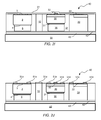
- FIG. 2I illustrates a cross-sectional view of the eWLP wafer shown in FIG. 2H after the front side of the wafer has been subjected to a metal deposition process to form a metal layer on the front side of the wafer.
- FIG. 2J illustrates a cross-sectional view of the eWLP wafer shown in FIG. 2I with the portions of the metal layer remaining after structuring disposed on the functional structures of the chips.
- FIG. 2K illustrates a cross-sectional view of the eWLP wafer shown in FIG. 2J with the structured metal layer covered with a layer of dielectric material.
- FIG. 2L illustrates a cross-sectional view of the eWLP wafer shown in FIG. 2K after the dielectric layer has been structured, or patterned, to form patterned dielectric layer.
- FIG. 2M illustrates a cross-sectional view of the eWLP wafer shown in FIG. 2L after contact elements have been placed on portions of the structured metal layer.
- FIG. 2N illustrates a cross-sectional view of the singulated eWLP package that results from performing a dicing operation on the eWLP wafer shown in FIG. 2M .
- FIG. 3 illustrates a cross-sectional view of an eWLP assembly comprising the eWLP package shown in FIG. 2N electrically connected to a PCB.
- FIG. 4A illustrates a cross-sectional view of the eWLP wafer shown in FIG. 2G without the dielectric material layer shown in FIG. 2G .
- FIG. 4B illustrates a cross-sectional view of the eWLP wafer shown in FIG. 4A after the dielectric material layer and the metal layer have been structured.
- FIG. 4C illustrates a cross-sectional view of the eWLP wafer shown in FIG. 4B after the tape base has been removed and the eWLP wafer has been flipped and placed on another tape base.
- FIG. 4D illustrates a cross-sectional view of the eWLP wafer shown in FIG. 4C after a layer of metal has been deposited on the front side of the eWLP wafer.
- FIG. 4E illustrates a cross-sectional view of the eWLP wafer shown in FIG. 4D after the metal layer has been structured and covered with a layer of dielectric material.
- FIG. 4F illustrates a cross-sectional view of the eWLP wafer shown in FIG. 4E after the tape base has been removed and the wafer has been flipped and placed on another tape base.
- FIG. 4G illustrates a cross-sectional view of the eWLP wafer shown in FIG. 4F after electrically-conductive contact elements have been placed in contact with portions of the structured metal layer disposed on the back side of the wafer.
- FIG. 4H illustrates a cross-sectional view of the eWLP wafer shown in FIG. 4G after as it is being singulated.
- FIG. 4I illustrates a cross-sectional view of the eWLP wafer shown in FIG. 4H after it has been singulated into multiple eWLP packages.
- FIG. 5 illustrates a cross-sectional view of an eWLP assembly comprising the eWLP package shown in FIG. 4I flipped and mounted on a PCB.
- FIG. 6 illustrates a cross-sectional view of an example of an optoelectronic eWLP package in accordance with an illustrative embodiment.
- FIG. 7 illustrates a cross-sectional view of an example of an optoelectronic eWLP package in accordance with an illustrative embodiment.
- FIG. 8 illustrates a cross-sectional view of an example of an optoelectronic eWLP package in accordance with an illustrative embodiment.
- FIG. 9 illustrates a cross-sectional view of an example of an optoelectronic eWLP package in accordance with an illustrative embodiment.
- FIG. 10 illustrates a cross-sectional view of an example of an optoelectronic eWLP package in accordance with an illustrative embodiment.
- FIG. 11 illustrates a cross-sectional view of an example of an optoelectronic eWLP package in accordance with an illustrative embodiment.
- eWLP methods, devices, packages and assemblies are provided.
- the eWLP methods allow electrical interconnections to be easily and economically made to the back sides of the chips at the eWLP wafer level without having to use TMVs or TSVs to make such interconnections.
- the eWLP methods also allow thermal and optical interconnections between the back side and the front side of the eWLP wafer to be easily and economically made.
- the eWLP methods allow electrical and optical interfaces to be formed on the front side and/or on the back side of the eWLP wafer.
- the eWLP methods eliminate the need for bond wires for making back side electrical interconnections and eliminate the need for housings for the optoelectronic devices, packages and assemblies, which enables a variety of very thin optoelectronic devices, packages and assemblies having a various useful configurations to be made with high volume, high yield and high throughput.
- SMT Surface mount technology
- SMT generally includes the processes of die attaching chips to a leadframe or PCB, wire bonding the electrical contacts of the chips to a leadframe and/or to a PCB, and using over-molding, pre-molding and/or casting techniques to create a housing or encapsulation for the package or assembly.
- over-molding, pre-molding and/or casting techniques to create a housing or encapsulation for the package or assembly.
- FIGS. 1A-4I Illustrative embodiments of the eWLP methods will first be described with reference to FIGS. 1A-4I , and then a variety of eWLP optoelectronic devices, packages and assemblies that may be made by the eWLP methods will be described with reference to FIGS. 6-11 .
- Like reference numerals in the figures represent like elements, features or components. Elements, features or components in the figures are not drawn to scale and are not intended to be dimensionally accurate.
- FIG. 1A illustrates a side cross-sectional view of a semiconductor wafer 1 having a plurality of optoelectronic chips 2 formed therein.
- FIG. 1B illustrates a side cross-sectional view of the wafer 1 shown in FIG. 1A after a metallization layer 4 has been applied to the front side of the wafer 1 such that the metallization layer 4 covers the front sides of the chips 2 .
- FIG. 1C illustrates a side cross-sectional view of the wafer 1 shown in FIG. 1B after the wafer 1 has been diced, or singulated, to separate the chips 2 from one another.
- the wafer 1 has a front side 1 a and a back side 1 b .
- a plurality of electrically-conductive functional structures 3 are formed on the front side 1 a of the wafer 1 during known semiconductor wafer processes.
- the functional structures 3 may be any type of structures, but are typically electrical contacts for providing electrical pathways to electrical contact pads (not shown) formed in the respective chips 2 .
- Each chip 2 has a bulk 2 a , which is the primary material of which the chip 2 is made.
- the bulk 2 a may be made of any type of material, such as a semiconductive material, a conductive material, an insulative material, or any combination thereof.
- a metallization layer 4 is formed on the front side 1 a of the wafer 1 by known wafer-level processes, e.g., sputtering, vapor deposition, etc.
- the metallization layer 4 is not needed in all cases, as will be described below in more detail.
- FIG. 1B illustrates a side cross-sectional view of the wafer 1 shown in FIG. 1A after a metallization layer 4 has been applied to the front side of the wafer 1 such that the metallization layer 4 covers the front sides of the chips 2 .
- FIG. 1C illustrates a side cross-sectional view of the wafer 1 shown in FIG. 1B after the wafer 1 has been diced, or singulated, to separate the chips 2 from one another. After the chips 2 have been singulated from one another, the chips 2 are used in combination with other components to form an artificial wafer, as will now be described with reference to FIGS. 2A-2N .
- FIG. 2A illustrates a cross-sectional view of one of the chips 2 shown in FIGS. 1A-1C , two other chips 20 and 30 , and a block of bulk material 10 as they are all being mounted on an adhesive tape base 13 .
- the adhesive tape base 13 forms the base of the artificial wafer.
- the chips 20 and 30 are different types of chips that have been formed on respective semiconductor wafers (not shown) and singulated therefrom using semiconductor wafer processes similar to those described above with reference to FIGS. 1A-1C .
- Chips 20 and 30 are also different in type from chip 2 .
- the block of bulk material 10 may be obtained by singulating a wafer (not shown) of the bulk material into individual blocks of bulk material 10 .
- chip 30 has a metallization layer 31 that has previously been formed on the back side thereof by a known wafer-level metallization process in the same manner in which the metallization layer 4 is formed on the chips 2 .
- a plurality of electrically-conductive functional structures 22 and 32 were previously formed on the front side of the chips 20 and 30 , respectively, by one or more known wafer-level processes prior to the chips 20 and 30 being mounted on the tape base 13 .
- the functional structures 22 and 32 may be any type of structures, but are typically electrical contacts that provide electrical pathways from the front sides of the chips to electrical circuitry (not shown) located inside of the chips 20 and 30 .
- FIG. 2B illustrates a cross-sectional view of the chips 2 , 20 and 30 and the block of bulk material 10 after they have been mounted on the adhesive tape base 13 by the pick-and-place machine.
- respective back side interconnect elements 5 and 35 are placed by the pick-and-place machine on the metallization layers 4 and 31 of the chips 2 and 30 , respectively.
- the interconnect elements 5 and 35 may comprise any type of electrically-conductive or electrically-semiconductive material, but typically comprise an electrically-semiconductive material such as silicon that has been doped with an n-type material such as phosphorus, for example, to make it highly electrically conductive. Silicon is a material that is compatible with wafer-level microelectronic chip fabrication processes, which makes it very suitable for use with the other wafer-level processes being described herein. For these reasons, n-doped silicon blocks are typically used for the back side interconnect elements 5 and 35 . For illustrative purposes, it will be assumed that the back side interconnect elements 5 and 35 are silicon blocks, although it will be understood that the invention is not limited to using silicon blocks for this purpose. For example, the interconnect elements 5 and 35 could instead be, for example, solder bumps.
- the silicon blocks 5 and 35 are diced from respective n-doped silicon wafers prior to the pick-and-place process being performed.
- the lower surfaces of the blocks 5 and 35 Prior to attaching the blocks 5 and 35 to the metallization layers 4 and 31 , respectively, the lower surfaces of the blocks 5 and 35 are dipped in an adhesive material (not shown). The step of dipping the blocks 5 and 35 in the adhesive material typically occurs during the pick-and-place process. After the blocks 5 and 35 have been dipped in the adhesive material, they are placed on the metallization layers 4 and 31 by the pick-and-place machine, as shown in FIG. 2B . The process of curing the adhesive material may be accomplished in different ways.
- the epoxy may be cured thermally after the blocks 5 and 35 have been placed on the metallization layers 4 and 31 , respectively.
- the curing process may be pre-initiated by exposing it to ultraviolet light just prior to placing the blocks 5 and 35 on the metallization layers 4 and 31 , respectively.
- these two curing processes may be combined.
- chip 20 is made of a bulk material such as n-doped silicon that makes the bulk material of the chip 20 highly conductive. For this reason, chip 20 does not have a metallization layer or a back side interconnect element.
- FIG. 2C illustrates a cross-sectional view of the chips 2 , 20 and 30 , and the block of bulk material 10 mounted on the adhesive tape base 13 as a mold compound 36 is being poured over the tape base 13 , the chips 2 , 20 , 30 and the block of bulk material 10 .
- the mold compound 36 is poured into a mold (not shown) and cured to cause it to harden.
- FIG. 2D illustrates a cross-sectional view of the chips 2 , 20 and 30 and the block of bulk material 10 encapsulated in the cured mold material 37 , which is in contact with portions of the adhesive tape base 13 in between the areas where the chips 2 , 20 , 30 and the block of bulk material 10 are in contact with the adhesive tape base 13 .
- the configuration shown in FIG. 2D represents the eWLP artificial wafer 40 in accordance with an illustrative embodiment.
- FIG. 2E illustrates a cross-sectional view of the artificial wafer 40 being subjected to the down-grinding process.
- a down-grinding device 41 is used to perform a down-grinding operation that grinds down the top surface 40 a of the artificial wafer 40 until the wafer 40 has a particular, or desired, thickness.
- the manner in which such down-grinding operations are performed to thin wafers to a desired thickness is well known.
- the artificial wafer 40 is ground down to expose portions of the interconnect elements 5 , 35 the interior of the bulk material block 10 and the bulk material of the chip 20 .
- FIG. 2F illustrates a cross-sectional view of the artificial wafer 40 after it has been ground down to expose portions of the interconnect elements 5 , 35 , the interior of the bulk material block 10 and the interior of the bulk material of chip 20 .
- the block of bulk material 10 and the bulk material of chip 20 will be used to provide electrically-conductive pathways from the front side of the eWLP wafer 40 to the back side of the eWLP wafer 40 .
- p-type or n-type wells (not shown) electrically isolate the functional structures 22 of chip 20 from any back side electrical contact of chip 20 , in cases where the chip 20 includes a back side electrical contact.
- the interconnect elements 5 , 35 are used to provide electrically-conductive pathways from the back side of the eWLP wafer 40 to the metallization layers 4 and 31 , respectively. Providing all of these electrically-conductive pathways eliminates the need to form TMVs or TSVs in the mold material 37 or in the chips 2 , 20 and 30 in order to provide electrically-conductive pathways from the front side to the back side of the eWLP wafer. Also, by forming these electrically-conductive pathways between the front side and the back side of the wafer 40 , other process such as galvanic growth processes and electroplating processes that are sometimes used to provide electrically-conductive contact areas on the back side of an eWLP wafer are avoided. Such processes typically use copper or nickel as the electrically-conductive material.
- FIG. 2G illustrates a cross-sectional view of the artificial wafer 40 being subjected to a metal deposition process.
- a metal layer 42 is formed on the top surface 40 a of the eWLP wafer 40 .
- the metal layer 42 is in contact with the interconnect elements 5 , 35 , with the block of bulk material 10 and with the bulk material of the chip 20 .
- a layer of dielectric material 43 is deposited over the metal layer 42 .
- the adhesive tape base 13 is then removed.
- FIG. 2H illustrates a cross-sectional view of the eWLP wafer 40 shown in FIG.
- FIG. 2I illustrates a cross-sectional view of the eWLP wafer 40 shown in FIG. 2H after the front side of the wafer 40 has been subjected to a metal deposition process to form a metal layer 51 on the front side of the wafer 40 .
- the metal layer 51 covers the electrically-conductive functional structures 3 , 22 and 32 .
- FIG. 2J illustrates a cross-sectional view of the eWLP wafer 40 shown in FIG. 2I with the remaining portions 51 a after structuring of the metal layer 51 disposed on the functional structures 3 , 22 and 32 .
- FIG. 2I illustrates a cross-sectional view of the eWLP wafer 40 shown in FIG. 2H after the front side of the wafer 40 has been subjected to a metal deposition process to form a metal layer 51 on the front side of the wafer 40 .
- the metal layer 51 covers the electrically-conductive functional structures 3 , 22 and 32 .
- FIG. 2J illustrates a cross-sectional view
- FIG. 2K illustrates a cross-sectional view of the eWLP wafer 40 shown in FIG. 2J with the structured metal layer 51 a covered with a layer of dielectric material 52 .
- FIG. 2L illustrates a cross-sectional view of the eWLP wafer 40 shown in FIG. 2K after the dielectric layer 52 has been structured, or patterned, to form patterned dielectric layer 52 a .
- Known photolithographic processes are used to pattern the dielectric layer 52 .
- the patterned dielectric layer 52 a provides dielectric features that insulate the metal portions 51 a from adjacent metal portions 51 a.
- FIG. 2M which illustrates a cross-sectional view of the eWLP wafer 40 shown in FIG. 2L after the contact elements 61 have been placed on the portions 51 a of the metal layer 51 .
- FIG. 2M illustrates a cross-sectional view of the eWLP wafer 40 shown in FIG. 2L after the contact elements 61 have been placed on the portions 51 a of the metal layer 51 .
- a singulation process is performed to singulate the eWLP package shown in FIG. 2M from the other eWLP packages formed in the same wafer 40 . Although only one package is shown in FIG.
- FIG. 2M there will typically be many such packages formed in a single eWLP wafer.
- the dashed lines 55 in FIG. 2M represent the dicing locations at which the wafer 40 is sawed.
- FIG. 2N illustrates a cross-sectional view of the singulated eWLP package 60 that results from performing the dicing operation represented by the dashed lines 55 .
- the second adhesive tape base 50 is removed, resulting in the finished eWLP package 60 shown in FIG. 2N .
- the package 60 shown in FIG. 2N may considered finished, or completed, further processing of the package 60 may occur if further processing is needed or desired to add additional features, components or elements.
- FIG. 3 illustrates a cross-sectional view of an eWLP assembly 100 comprising the eWLP package 60 shown in FIG. 2N electrically connected to a PCB 70 .
- the eWLP package 60 is electrically connected to the PCB 70 via the contact elements 61 of the package 60 being placed in contact with respective electrically-conductive contact elements 71 of the PCB 70 .
- Other mechanisms may be used to mechanically couple the PCB 70 with the package 60 and to provide mechanical stability for the assembly 100 .
- Optical windows 72 and 73 formed in the PCB 70 extend from a top side 70 a of the PCB 70 to a bottom side 70 b of the PCB 70 .
- the PCB 70 is only one type of carrier that is suitable for use with the eWLP package 60 .
- the eWLP package 60 could be mounted on and interfaced with other types of carriers.
- a substrate that is transparent to the light 74 and 75 could be used instead of the PCB 70 , in which case there would be no need to form optical windows 72 and 73 in the carrier.
- the carrier could be a glass substrate having electrical conductors (e.g., wires or traces) disposed therein and electrical contact pads disposed on a surface thereof.
- Such a carrier could also have optical elements (e.g., reflective elements, refractive elements and/or diffractive elements) formed therein for controlling the direction of propagation of light within the carrier and directing light between the carrier and the eWLP package 60 .
- the chip 2 is an optoelectronic receiver chip, such as, for example, a photodiode chip
- the chip 30 is an optoelectronic transmitter chip, such as, for example, a light emitting diode (LED) or laser diode chip.
- the arrow 74 represents light passing through the window 72 and impinging on a light-receiving area of the chip 2 and the arrow 75 represents light emitted from the chip 30 and passing through the window 73 .
- the windows 72 and 73 are transparent to operating wavelengths of the chips 2 and 30 , respectively.
- the chip 20 may be, for example, a receiver chip for processing electrical sense signals produced by the chip 2 , a laser diode driver chip for producing electrical drive signals that drive the chip 30 , or a combination of the two.
- the chip 2 is a receiver chip, a driver chip, and a processor chip
- chip 30 is a transmitter or emitter chip, in which case chip 20 can be eliminated from the eWLP assembly 100 because its functions are performed by chip 2 .
- chip 30 emits the same wavelength of light that is detected by chip 2 and at least one of the chips 2 , 20 and 30 is a processor chip having processing circuitry (not shown) that processes the electrical sense signals produced by chip 2 to determine the proximity, distance and/or a gesture of a reflective object 76 relative to the eWLP assembly 100 .
- the object 76 may be any reflective object.
- An example of a reflective object 76 is a part of the user's body, such as, for example, a hand, a finger, a face, or an ear.
- the eWLP assembly 100 may be incorporated into a mobile device, such as, for example, a mobile phone, although the invention is not limited with respect to the types of devices or systems in which the eWLP packages and assemblies of the invention are used.
- the processing circuitry of chip 20 processes the electrical sense signals produced by chip 2 to determine, for example, when a user has moved the phone in proximity to the user's face, when the user has made a gesture with a hand or finger relative to the mobile device, or when the phone is within a particular distance from the user's face. Such determinations may be made in order to perform power management in the mobile device. For example, if the processing circuitry determines that the user has moved a hand or finger in proximity to the mobile device, the processing circuitry may cause the phone to be powered on, or changed from a lower power mode (e.g., a power-saving mode) to a higher power mode (e.g., an active mode). For example, in the power-saving mode, the display and/or keyboard of the mobile device may be unlit to save power, whereas in the higher-power mode the display and/or keyboard may be lit or turned on to visually aid the user.
- a lower power mode e.g., a power-saving mode
- a higher power mode e.
- One of the advantages of the eWLP wafer-level processes described herein is that they may be used to make very thin, or flat, optoelectronic devices that may be incorporated into useful devices and systems in which space utilization is of great concern.
- Consumer electronic devices such as mobile phones, laptop computers, notebook computers, and tablets incorporate ever-increasing types of functionality without increasing their sizes. In most cases, attempts are being made to decrease the sizes of such devices, particularly in thickness, even as additional functionality is being added to the devices. With current processes for making optoelectronic devices, it is difficult or impossible to make devices with thicknesses of less than about 700 to 800 micrometers (microns).
- optoelectronic devices such as the eWLP package 60 shown in FIG. 3 can easily be made with a thickness or flatness that is less than 700 microns measured as the distance between the top surface of layer 52 and the bottom surface of layer 43 .
- the thickness of the eWLP package is essentially the thickness of the eWLP wafer 40 , which is limited only by eWLP wafer-level processing technology. Also, because the need for bond wires is eliminated, the eWLP packages can be made thinner than known eWLP packages that include bond wires. It should be noted, however, that the eWLP packages and assemblies of the invention are not limited to having any particular dimensions.
- the eWLP assembly 100 has an optical interface and an electrical interface with the PCB 70 that are on the same side of the eWLP package 60 .
- electrical contact between the PCB 70 and the back side of the eWLB package 60 and any electrical contacts (not shown) located on the back sides of the chips 2 and 30 may be made via conductive pathways made up of one or more of the following: contact elements 61 and 71 , the bulk material of block 10 , the bulk material of chip 20 , the metal layer 42 , and the back side interconnect elements 5 and 35 .
- the bulk material of the block 10 has an electrical conductivity that is sufficiently high to allow it to be used as an electrical pathway.
- the bulk material of chip 20 may also have an electrical conductivity that is sufficiently high to allow it to be used as an electrical pathway.
- the bulk material may be, for example n-doped (e.g., Phosphorus-doped) silicon.
- further processing of the eWLP package 60 can be performed to form a redistribution layer in the metal layer 42 to further facilitate electrically interfacing the chips 2 , 20 and 30 to each other and/or to other devices (not shown).
- the manner in which such redistribution layers may be formed is well known and therefore will not be further described herein in the interest of brevity.
- FIG. 4A is similar to FIG. 2G , except that the dielectric layer 43 shown in FIG. 2G is missing from FIG. 4A .
- FIG. 4B illustrates a cross-sectional view of the wafer 40 shown in FIG. 4A after it has been (1) subjected to a photolithographic structuring process to structure the metal layer 42 into contact pads 42 a , (2) the contact pads 42 a have been covered with a layer of dielectric material 45 , and (3) the dielectric material layer 45 has been patterned.
- FIG. 4A is similar to FIG. 2G , except that the dielectric layer 43 shown in FIG. 2G is missing from FIG. 4A .
- FIG. 4B illustrates a cross-sectional view of the wafer 40 shown in FIG. 4A after it has been (1) subjected to a photolithographic structuring process to structure the metal layer 42 into contact pads 42 a , (2) the contact pads 42 a have been covered with a layer of dielectric material 45 , and (3) the dielectric material layer 45 has been patterned.
- FIG. 4C illustrates a cross-sectional view of the wafer 40 after the adhesive tape base 13 has been removed, the wafer 40 has been flipped and the back side of the wafer 40 has been placed in contact with another adhesive tape base 120 such that the patterned dielectric layer 45 is contact with the adhesive of the tape base 120 .
- the wafer 40 is then subjected to a metal deposition process by which a metal layer 121 is formed on the front side of the wafer 40 , as represented by the cross-sectional view shown in FIG. 4D .
- a metal layer structuring, or patterning, process is then performed on the wafer 40 to pattern, or structure, the metal layer 121 to form a structured metal layer 121 a on the front side of the wafer 40 , which is then covered with a layer of dielectric material 122 , as represented by the cross-sectional view of the wafer 40 shown in FIG. 4E .
- the tape base 120 is then removed from the wafer 40 shown in FIG. 4E and the wafer 40 is flipped and placed on another adhesive tape base 130 , as represented by the cross-sectional view of the wafer 40 shown in FIG. 4F .
- Electrically-conductive contact elements 133 are then placed on the back side of the wafer 40 on the contact pads 42 a above the back side interconnect elements 5 , 35 and above the top surfaces of the bulk material block 10 and chip 20 , as represented by the cross-sectional view of the wafer 40 shown in FIG. 4G .
- the wafer 40 shown in FIG. 4G is then singulated into multiple eWLP packages, as indicated by the dashed lines 134 in the cross-sectional view of the wafer 40 shown in FIG. 4H .
- the adhesive tape base 130 is then removed, resulting in the finished eWLP package 140 shown in FIG. 4I .
- FIG. 5 illustrates a cross-sectional view of an eWLP assembly 150 comprising the eWLP package 140 shown in FIG. 4I flipped and mounted on a PCB 160 such that the contact elements 133 of the eWLP package 140 are in contact with respective contact elements 161 of the PCB 160 .
- Other mechanisms may be used to mechanically couple the PCB 160 with the eWLP package 140 and to provide mechanical stability for the assembly 150 .
- No optical windows are needed in the PCB 160 because the optical interface is on the side of the assembly 150 opposite the PCB 160 .
- the chip 2 is an optoelectronic receiver chip such as, for example, a photodiode chip
- the chip 30 is an optoelectronic transmitter chip such as, for example, a laser diode chip
- the chip 20 is also an optoelectronic receiver chip such as, for example, a photodiode chip.
- the arrows 164 and 166 represent light impinging on chips 2 and 20 , respectively, and arrow 165 represents light emitted from the chip 30 .
- One of the chips 2 , 20 and 30 may also be a processor or controller chip for processing electrical sense signals produced by chips 2 and 20 .
- chip 30 emits the same wavelength of light that is detected by chip 2 and at least one of the chips 2 , 20 and 30 is a processor chip having processing circuitry (not shown) that processes the electrical sense signals produced by chip 2 to determine the proximity and/or distance of the object 167 relative to the eWLP assembly 150 by performing a Time-of-Flight (ToF) algorithm.
- ToF Time-of-Flight
- the manner in which ToF algorithms are performed to determine the proximity and/or distance of an object relative to an optical receiver based on light that is emitted from an optical transmitter co-located with the optical receiver, reflected off of the object and received by the optical receiver is known. Therefore, the ToF algorithm that is used for this purpose will not be further described herein in the interest of brevity.
- the object 167 may be any reflective object. Examples of object 167 are a user's hand, finger, face or ear.
- An example of an application of the eWLP assembly 150 is its use in a mobile device such as a mobile phone to perform power management.
- the processing circuitry processes the electrical sense signals produced by chip 2 to determine, for example, when a user has moved a hand or a finger in proximity to the mobile phone.
- the processing circuitry determines that the user has moved a hand or finger in proximity to the mobile phone, the processing circuitry causes the phone to be powered on, or to be placed in a lower power mode, such as a power-saving mode, or to be placed in a higher power mode in which the display or keyboard of the phone is lit.
- the chip 20 is a receiver chip having one or more photosensors, such as photodiodes, that detect ambient light.
- the photosensors may detect the broad range of wavelengths that make up ambient light, or they may detect red, green and blue (RGB) light and/or ultraviolet (UV) light.
- the processing circuitry processes the electrical sense signals produced by chip 20 to determine the level of ambient light that is being received.
- the processing circuitry determines that the ambient light level is above a threshold level
- the processing circuitry may, for example, cause the light intensity of a display and/or of a keypad of the mobile device to be increased.
- the processing circuitry may, for example, cause the light intensity of a display and/or of a keypad of the mobile device to be decreased.
- the eWLP assembly 150 has an optical interface at one side of the assembly 150 and an electrical interface with the PCB 160 at the opposite side of the assembly 150 .
- electrical contact between the PCB 160 and the electrical contacts 3 , 22 and 32 located on the front sides of the chips 2 , 20 and 30 , respectively, may be made by electrically-conductive pathways made up of various combinations of the following: contact elements 161 and 133 ; the bulk material block 10 ; the respective metal contact pads 42 a ; the bulk material of chip 20 ; and the patterned metal layer 121 a .
- the contact elements 161 and 133 have electrical conductivities that are sufficiently high to allow them to be used as electrical pathways from the back side of the eWLP package 140 to the front side of the eWLP package 140 . This may be accomplished by, for example, using silicon as the bulk material of block 10 and of chip 20 and doping the bulk material with, for example, phosphorus, to increase its electrical conductivity.
- electrical contact between the PCB 160 and the electrical contacts 3 , 22 and 32 may be accomplished in other ways.
- further processing of the eWLP package 140 can be performed to form a redistribution layer in the patterned metal layer 121 a to further facilitate electrically interfacing the contacts 3 , 22 , and 32 of the chips 2 , 20 and 30 , respectively, to one another and/or to other devices (not shown).
- the semiconductor wafer processes described above with reference to FIGS. 1A-1C and the eWLP artificial wafer processes described above with reference to FIGS. 2A-4I , and variations thereof, may be used to create a number of useful optoelectronic eWLP packages and assemblies that are very thin while making it easier and more cost effective to make electrical connections to the back sides of eWLP packages.
- Various examples of such assemblies will now be described with reference to FIGS. 6-11 .
- FIG. 6 illustrates a cross-sectional view of an example of an eWLP package 200 that is similar to the eWLP package 60 shown in FIG. 2N except that chip 30 , the block of bulk material 10 and the associated elements shown in FIG. 2N have been eliminated.
- the chips 2 and 20 are an LED chip and an LED driver chip, respectively.
- the package 200 is formed by processes similar to those described above with reference to FIGS. 1A-2N , except that some of those process steps have been skipped. For example, the process steps of adding the metallization layer 4 and the interconnect element 5 have been skipped because they are not needed.
- the back side of the package 200 has a metal layer 201 thereon that is added during the eWLP wafer-level process after the eWLP wafer has been ground down.
- the metal layer 201 interconnects electrical contacts (not shown) disposed on the back sides of the chips 2 and 20 .
- the back side electrical contacts of the chips 2 and 20 are at the same electrical potential.
- p-type or n-type wells electrically isolate the functional structures 22 of chip 20 from the back side electrical contact of chip 20 .
- the arrow 202 represents light emitted by the LED chip 2 .
- the configuration shown in FIG. 6 is advantageous because LED chips often have one front side electrical contact and one back side electrical contact. Another advantage of the configuration shown in FIG. 6 is that a heat sink device (not shown) may be secured to the metal layer 201 to allow heat generated by the chips 2 and 20 to be dissipated through the back side of the package 200 .
- FIG. 7 illustrates a cross-sectional view of an example of an eWLP package 210 that is similar to the eWLP package 60 shown in FIG. 2N except that chips 20 and 30 and the associated elements shown in FIG. 2N have been eliminated.
- the chip 2 is an LED chip driven by external LED driver circuitry (not shown).
- the package 210 is formed by processes similar to those described above with reference to FIGS. 1A-2N , except that some of those process steps have been skipped.
- the back side of the package 210 has a metal layer 211 thereon that interconnects electrical contacts (not shown) disposed on the back side of the chip 2 with the bulk material of the block of bulk material 10 .
- the bulk material (e.g., n-doped silicon) of block 10 is sufficiently electrically conductive to conduct enough electrical current to drive the LED chip 2 .
- the external LED driver circuitry is connected to the electrical contact element 61 disposed above the block 10 .
- the block 10 conducts the electrical drive current to the back side of the package 210 into the metal layer 211 , which is connected to the back side electrical contact (not shown) of the chip 2 . In this way, the external LED driver circuitry drives the LED chip 2 .
- the arrow 212 represents light emitted by the LED chip 2 .
- the eWLP package 210 shown in FIG. 7 allows an electrical connection to be easily and economically made to the back side electrical contact of the LED chip 2 .
- a heat sink device (not shown) may be secured to the metal layer 211 of the package 210 to allow heat generated by the chip 2 and block 10 to be dissipated through the back side of the package 210 .
- FIG. 8 illustrates a cross-sectional view of an example of an eWLP package 220 that is similar to the eWLP package 200 shown in FIG. 6 except that chip 20 has been replaced by chip 221 , which is a combined LED driver and photodiode chip.
- chip 221 is both an optoelectronic receiver chip, including an integrated photodiode and amplifier, and an LED driver chip.
- the arrow 222 represents light emitted by the LED chip 2 .
- the arrow 223 represents light received by the photodiode/LED driver chip 221 .
- the metal layer 224 disposed on the back side of the package 220 interconnects electrical contacts (not shown) disposed on the back sides of the chips 2 and 221 .
- the eWLP package 220 shown in FIG. 8 allows an electrical connection to be easily and economically made to the back side electrical contacts of the LED chip 2 and of the photodiode/LED driver chip 221 .
- a heat sink device (not shown) may be secured to the metal layer 224 of the package 220 to allow heat generated by the chips 2 and 221 to be dissipated through the back side of the package 220 .
- FIG. 9 illustrates a cross-sectional view of an example of an eWLP package 230 that is similar to the eWLP package 100 shown in FIG. 3 except that the interconnect elements 5 and 35 and the metallization layers 4 and 31 are not part of the package 230 , either because they were never included or because the back side of the eWLP wafer has been grinded down to the point that they have been eliminated.
- a metal layer 234 disposed on the back side of the package 230 is in contact with any electrical contacts disposed on the back sides of the chips 2 , 20 and/or 30 .
- the bulk materials of block 10 and of chip 20 provide electrically-conductive pathways from the front side of the package 230 to the metal layer 234 .
- FIG. 10 illustrates a cross-sectional view of an example of an eWLP package 240 that is similar to the eWLP package 140 shown in FIG. 5 except that the block of bulk material 10 has been eliminated and the chip 20 has been replaced by a jumper chip 250 having electrically-isolated vias 251 extending through the bulk material of the chip 250 between the front and back sides of the chip 250 .
- the ends of the vias 251 are in contact with the structured metal layer 121 a .
- the ends of the vias 251 are in contact with contact pads 42 a .
- the bulk material 252 of the chip 250 that is disposed in between the vias 251 may be constructed of silicon, glass, or any other suitable bulk material used in the TSV arts that is capable of electrically insolating the vias 251 from one another.
- the electrically-conductive material within the vias 251 may include one or more of copper, gold, aluminum, or any other material of high electrical conductivity.
- the conductive material may be deposited within the vias 251 using known deposition techniques such as Chemical Vapor Deposition (CVD), Atomic Layer Deposition (ALD), sputtering, photolithography, etc.
- One or more conductive vias 251 may carry current between a bottom contact pad 42 a and the structured metal layer 121 a .
- each conductive via 251 is isolated from all other vias in the jumper chip 250 , the different portions of the structured metal layer 121 a that are in contact with the vias 251 and the different bottom contact pads 42 a that are in contact with the vias 251 can be electrically isolated from one another.
- the vias 251 conduct electrical current between the PCB 255 and the structured metal layer 121 a , which is connected to the functional structures 3 and 32 of the chips 2 and 30 , respectively. Electrical current is conducted from the PCB 255 to any electrical contacts disposed on the back sides of the chips 2 and 30 by the respective elements 161 , 133 , 42 a , and 5 or 35 .
- the chip 2 is a receiver chip and the chip 30 is a transmitter chip.
- the receiver chip 2 comprises an array of photosensors.
- the array of photosensors may an array of 3-D pixel sensors. Such pixel sensor arrays are known in the art of ToF range finders.
- Either chip 2 or chip 30 is also a processor chip.
- light 165 produced by chip 30 is reflected 164 from the reflective target 167 onto chip 2 and the corresponding electrical sense signals produced by chip 2 are processed by the processing circuitry of the processor chip 2 or 30 to determine the position of the object 167 from the eWLP package 240 in 3-dimensional (3-D) space.
- the processor chip 2 or 30 performs a ToF algorithm to determine the 3-D position of the object 167 relative to the eWLP package 240 .
- ToF algorithms are performed using the electrical sense signals output from an array of 3-D pixel sensors to determine the position of an object in 3-D space is known.
- FIG. 11 illustrates a cross-sectional view of an example of an eWLP package 260 that is similar to the eWLP package 240 shown in FIG. 10 except that the chip 30 has been eliminated and chip 2 is detecting the level of intensity of ambient light being received by it.
- the vias 251 conduct electrical current between the PCB 265 and the structured metal layer 121 a , which is connected to the functional structures 3 of the chip 2 . Electrical current is conducted from the PCB 265 to any electrical contacts disposed on the back side of the chip 2 by the elements 161 , 133 , 42 a , and 5 .
- the receiver chip 2 is a receiver chip cable of sensing ambient light or RGB light.
- the receiver chip 2 is also a processor chip comprising processing circuitry for processing the electrical sense signals produced by chip 2 to determine the level of intensity of ambient light that is being received by chip 2 .
- the array of photosensors may an array of ambient light sensors that directly measure the level of intensity of ambient light being received by the chip 2 .
- the array of photosensors may an array of RGB light sensors that indirectly measure the level of intensity of ambient light being received by the chip 2 .
- the processing circuitry processes the RGB sense signals to determine the level of intensity of the ambient light based on the amount of RGB light received. Both types of pixel sensor arrays are known in the art.
- the jumper chip 250 has been described as comprising an electrically-isolating bulk material 252 having electrically-conductive vias 251 formed therein for interconnecting the structured metal layer 121 a disposed on the front side of the packages 240 , 260 with the contact pads 42 a disposed on the back side of the packages 240 , 260 .
- the jumper chip 250 essentially acts as an electrical interconnection between the electrical interface on the front side of the chip 250 and the electrical interface on the back side of the chip 250 .
- Other types of bulk material 252 and via material 251 can be used for the chip 250 to provide an optical interface between the front side of the packages 240 , 260 and the back sides of the packages 240 , 260 .
- a bulk material 252 for the chip 250 that is opaque to an operational wavelength of light and a via material 251 that is transparent to the operational wavelength of light causes the vias 251 to act as optical interconnects, or light pipes, to pass light of the operational wavelength between the front and back sides of the packages 240 , 260 .
- a bulk material 252 for the chip 250 that is thermally non-conductive and a via material 251 that is thermally conductive causes the vias 251 to act as thermal interconnects, or heat pipes, that pass heat between the front and back sides of the packages 240 , 260 .
- the thermal and optical vias can be intermixed in the chip 250 to allow the chip to perform the thermal and optical interconnect functions.
- the ends of the vias do not need to be in contact with the structured metal layer 121 or with the contact pads 42 a , and thus the portions of the structured metal layer 121 and the contact pads 42 a adjacent the ends of the vias 251 can be eliminated.
Landscapes
- Engineering & Computer Science (AREA)
- Manufacturing & Machinery (AREA)
- Microelectronics & Electronic Packaging (AREA)
- Dicing (AREA)
Abstract
Description
Claims (31)
Priority Applications (3)
| Application Number | Priority Date | Filing Date | Title |
|---|---|---|---|
| US14/330,022 US9443835B2 (en) | 2014-03-14 | 2014-07-14 | Methods for performing embedded wafer-level packaging (eWLP) and eWLP devices, packages and assemblies made by the methods |
| US14/523,880 US9541503B2 (en) | 2014-03-14 | 2014-10-25 | Compact systems, compact devices, and methods for sensing luminescent activity |
| DE102015111424.0A DE102015111424B9 (en) | 2014-07-14 | 2015-07-14 | Methods for implementing wafer-level embedded structure and interconnection technologies (eWLP) and eWLP devices, devices and assemblies manufactured using the methods |
Applications Claiming Priority (2)
| Application Number | Priority Date | Filing Date | Title |
|---|---|---|---|
| US14/213,342 US9305908B2 (en) | 2014-03-14 | 2014-03-14 | Methods for performing extended wafer-level packaging (eWLP) and eWLP devices made by the methods |
| US14/330,022 US9443835B2 (en) | 2014-03-14 | 2014-07-14 | Methods for performing embedded wafer-level packaging (eWLP) and eWLP devices, packages and assemblies made by the methods |
Related Parent Applications (1)
| Application Number | Title | Priority Date | Filing Date |
|---|---|---|---|
| US14/213,342 Continuation-In-Part US9305908B2 (en) | 2014-03-14 | 2014-03-14 | Methods for performing extended wafer-level packaging (eWLP) and eWLP devices made by the methods |
Related Child Applications (1)
| Application Number | Title | Priority Date | Filing Date |
|---|---|---|---|
| US14/523,880 Continuation-In-Part US9541503B2 (en) | 2014-03-14 | 2014-10-25 | Compact systems, compact devices, and methods for sensing luminescent activity |
Publications (2)
| Publication Number | Publication Date |
|---|---|
| US20150262984A1 US20150262984A1 (en) | 2015-09-17 |
| US9443835B2 true US9443835B2 (en) | 2016-09-13 |
Family
ID=54069729
Family Applications (1)
| Application Number | Title | Priority Date | Filing Date |
|---|---|---|---|
| US14/330,022 Active US9443835B2 (en) | 2014-03-14 | 2014-07-14 | Methods for performing embedded wafer-level packaging (eWLP) and eWLP devices, packages and assemblies made by the methods |
Country Status (1)
| Country | Link |
|---|---|
| US (1) | US9443835B2 (en) |
Cited By (4)
| Publication number | Priority date | Publication date | Assignee | Title |
|---|---|---|---|---|
| US20220302079A1 (en) * | 2013-12-13 | 2022-09-22 | Taiwan Semiconductor Manufacturing Company, Ltd. | Tools and Systems for Processing Semiconductor Devices, and Methods of Processing Semiconductor Devices |
| US20220373648A1 (en) * | 2019-10-22 | 2022-11-24 | AMOSENSE Co.,Ltd | Distance sensor module |
| US20240102853A1 (en) * | 2022-09-22 | 2024-03-28 | Innolux Corporation | Electronic device and related tiled electronic device |
| US12176220B2 (en) | 2020-12-15 | 2024-12-24 | Stmicroelectronics Pte Ltd | Optical sensor package and method of making an optical sensor package |
Families Citing this family (18)
| Publication number | Priority date | Publication date | Assignee | Title |
|---|---|---|---|---|
| CN111477592B (en) * | 2015-01-29 | 2023-10-10 | 索尼半导体解决方案公司 | display device |
| US9541717B2 (en) | 2015-01-30 | 2017-01-10 | Avago Technologies General IP (Singapore) Pta. Ltd. | Optoelectronic assembly incorporating an optical fiber alignment structure |
| DE102016203453A1 (en) * | 2016-03-02 | 2017-09-07 | Fraunhofer-Gesellschaft zur Förderung der angewandten Forschung e.V. | Method for producing a semiconductor component and semiconductor component |
| TWI649856B (en) * | 2016-05-13 | 2019-02-01 | Xintec Inc. | Chip package and manufacturing method thereof |
| WO2018125113A1 (en) * | 2016-12-29 | 2018-07-05 | Intel Corporation | Photonic engine platform utilizing embedded wafer level packaging integration |
| US10269671B2 (en) | 2017-01-03 | 2019-04-23 | Powertech Technology Inc. | Package structure and manufacturing method thereof |
| DE102017123552B3 (en) * | 2017-10-10 | 2018-11-22 | Sick Ag | Method for producing optoelectronic sensors, in particular miniature sensors |
| US10665560B2 (en) * | 2017-10-27 | 2020-05-26 | Taiwan Semiconductor Manufacturing Company Ltd. | Optical semiconductor package and method for manufacturing the same |
| KR102068161B1 (en) * | 2018-03-14 | 2020-01-20 | (주)파트론 | Optical sensor package and method for manufacturig the same |
| US10804305B2 (en) * | 2018-04-23 | 2020-10-13 | Sunny Opotech North America Inc. | Manufacture of semiconductor module with dual molding |
| CN110752225B (en) | 2018-07-23 | 2022-07-12 | 宁波舜宇光电信息有限公司 | Photosensitive assembly and manufacturing method thereof |
| SG10201908828WA (en) * | 2019-09-23 | 2021-04-29 | Apple Inc | Embedded Packaging Concepts for Integration of ASICs and Optical Components |
| WO2023076490A1 (en) * | 2021-10-27 | 2023-05-04 | Avicenatech Corp. | Separate optoelectronic substrate |
| US12153268B2 (en) * | 2022-01-03 | 2024-11-26 | Apple Inc. | Technologies for increased volumetric and functional efficiencies of optical packages |
| EP4481816A4 (en) * | 2022-02-14 | 2025-12-17 | Lipac Co Ltd | OPTICAL SYSTEM IN A BOX, AND OPTICAL MODULE AND OPTICAL TRANSCEIVER USING IT |
| US20230268999A1 (en) * | 2022-02-23 | 2023-08-24 | Robert Kalman | Parallel microled-based free space optical interconnects |
| US20250219350A1 (en) * | 2022-03-23 | 2025-07-03 | Lipac Co., Ltd. | Optical system-in-package, and optical module and optical transceiver using same |
| US20250096075A1 (en) * | 2023-09-18 | 2025-03-20 | Qualcomm Incorporated | Memory cell structures using full backside connectivity |
Citations (47)
| Publication number | Priority date | Publication date | Assignee | Title |
|---|---|---|---|---|
| US4711997A (en) | 1986-11-14 | 1987-12-08 | American Telephone And Telegraph Company, At&T Bell Laboratories | Optical interconnection of devices on chips |
| US4713841A (en) | 1985-06-03 | 1987-12-15 | Itt Electro Optical Products, A Division Of Itt Corporation | Synchronous, asynchronous, data rate transparent fiber optic communications link |
| US5532512A (en) | 1994-10-03 | 1996-07-02 | General Electric Company | Direct stacked and flip chip power semiconductor device structures |
| WO2000002247A1 (en) | 1998-07-06 | 2000-01-13 | Fraunhofer-Gesellschaft zur Förderung der angewandten Forschung e.V. | Method and device for producing an interconnection between a carrier element and at least one component contained therein |
| US20020095077A1 (en) | 2000-08-31 | 2002-07-18 | David Swedlow | Oximeter sensor with digital memory encoding patient data |
| US20040037514A1 (en) | 2000-03-29 | 2004-02-26 | Francois Marion | Method and device for passive alignment of optical fibres and optoelectronic components |
| US20040057648A1 (en) | 2002-09-24 | 2004-03-25 | Mohammad Yunus | Optical coupling for a flip chip optoelectronic assembly |
| US20040069997A1 (en) | 1999-05-27 | 2004-04-15 | Edwin Dair | Method and apparatus for multiboard fiber optic modules and fiber optic module arrays |
| US20040156597A1 (en) | 2003-02-10 | 2004-08-12 | Seiko Epson Corporation | Connection structure between optical element and optical fiber, connection method thereof, and optical module |
| US20040217366A1 (en) | 2001-07-30 | 2004-11-04 | Gale Michael Thomas | Fabrication of alignment and assembly microstructures |
| US20040223704A1 (en) | 2003-03-10 | 2004-11-11 | Eiichi Fujii | Manufacturing method of optical communication module, optical communication module, and electronic apparatus |
| US20040259282A1 (en) | 2001-12-03 | 2004-12-23 | Sony Corporation | Transferring semiconductor crystal from a substrate to a resin |
| US20050226565A1 (en) | 2002-06-24 | 2005-10-13 | Kari Kautio | Alignment of an optic or electronic component |
| US20060045431A1 (en) | 2004-08-24 | 2006-03-02 | Boisvert Joseph C | Integrated fiber alignment photodetector |
| US7048450B2 (en) | 2003-07-14 | 2006-05-23 | Infineon Technologies, Ag | Optoelectronic module with transmitter chip and connecting piece for the module with respect to an optical fiber and with respect to a circuit board, and methods for producing the same |
| US7170049B2 (en) | 2003-12-30 | 2007-01-30 | Dxray, Inc. | Pixelated cadmium zinc telluride based photon counting mode detector |
| US20080122122A1 (en) | 2006-11-08 | 2008-05-29 | Weng Fei Wong | Semiconductor package with encapsulant delamination-reducing structure and method of making the package |
| US20080186702A1 (en) | 2004-11-12 | 2008-08-07 | Lumileds Lighting U.S., Llc | Array of Light Emitting Devices to Produce a White Light Source |
| US7486847B1 (en) | 2008-03-31 | 2009-02-03 | International Business Machines Corporation | Chip carrier package with optical vias |
| US7536066B2 (en) | 2005-07-25 | 2009-05-19 | Fujitsu Limited | Semiconductor chip module |
| US20090166857A1 (en) | 2007-12-28 | 2009-07-02 | Fujitsu Limited | Method and System for Providing an Aligned Semiconductor Assembly |
| US20100061106A1 (en) | 2008-09-10 | 2010-03-11 | San-Woei Shyu | Plano-fresnel led lens and led assembly thereof |
| US7833480B2 (en) | 2001-01-24 | 2010-11-16 | Ric Investments, Inc. | Oxygen monitoring apparatus and methods of using the apparatus |
| US20100316184A1 (en) | 2008-10-17 | 2010-12-16 | Jan Iwanczyk | Silicon photomultiplier detector for computed tomography |
| US7863088B2 (en) | 2007-05-16 | 2011-01-04 | Infineon Technologies Ag | Semiconductor device including covering a semiconductor with a molding compound and forming a through hole in the molding compound |
| US20110024916A1 (en) | 2008-12-01 | 2011-02-03 | Stats Chippac, Ltd. | Semiconductor Device and Method of Forming an Interposer Package with Through Silicon Vias |
| US20110042798A1 (en) | 2009-08-21 | 2011-02-24 | Stats Chippac, Ltd. | Semiconductor Device and Method of Stacking Die on Leadframe Electrically Connected by Conductive Pillars |
| US20110095426A1 (en) | 2008-02-20 | 2011-04-28 | Chang Li-Tien | Hybrid Package |
| US20110193241A1 (en) | 2010-02-09 | 2011-08-11 | Yu-Lin Yen | Chip package and method for forming the same |
| US20110194265A1 (en) | 2010-02-05 | 2011-08-11 | Advanced Semiconductor Engineering, Inc. | Embedded Component Substrate and Manufacturing Methods Thereof |
| US8064739B2 (en) | 2007-10-23 | 2011-11-22 | Hewlett-Packard Development Company, L.P. | Three-dimensional die stacks with inter-device and intra-device optical interconnect |
| US20120038044A1 (en) | 2010-08-12 | 2012-02-16 | Siliconware Precision Industries Co., Ltd. | Chip scale package and fabrication method thereof |
| US20120220082A1 (en) | 2010-11-15 | 2012-08-30 | United Test And Assembly Center, Ltd. | Semiconductor packages and methods of packaging semiconductor devices |
| US20130001795A1 (en) | 2011-02-28 | 2013-01-03 | Agency For Science, Technology And Research | Wafer Level Package and a Method of Forming the Same |
| US8352009B2 (en) | 2005-09-30 | 2013-01-08 | Covidien Lp | Medical sensor and technique for using the same |
| US20130075924A1 (en) | 2011-09-23 | 2013-03-28 | Stats Chippac, Ltd. | Semiconductor Device and Method of Forming Stacked Vias Within Interconnect Structure for FO-WLCSP |
| US20130237774A1 (en) | 2010-07-07 | 2013-09-12 | Therasyn Sensors, Inc. | Device and Method for Continuous Chemical Sensing |
| US20130241077A1 (en) | 2012-03-19 | 2013-09-19 | Infineon Technologies Ag | Semiconductor Package and Methods of Formation Thereof |
| US20130264684A1 (en) | 2012-04-09 | 2013-10-10 | Taiwan Semiconductor Manufacturing Company, Ltd. | Methods and Apparatus of Wafer Level Package for Heterogeneous Integration Technology |
| US20130266255A1 (en) | 2011-01-11 | 2013-10-10 | Michael Renne Ty Tan | Passive optical alignment |
| US20130320471A1 (en) | 2012-05-31 | 2013-12-05 | Stmicroelectronics Pte Ltd. | Wafer level optical sensor package and low profile camera module, and method of manufacture |
| US8642385B2 (en) | 2011-08-09 | 2014-02-04 | Alpha & Omega Semiconductor, Inc. | Wafer level package structure and the fabrication method thereof |
| US8642397B1 (en) | 2012-09-09 | 2014-02-04 | Alpha & Omega Semiconductor, Inc. | Semiconductor wafer level package (WLP) and method of manufacture thereof |
| US8742370B2 (en) | 2012-03-21 | 2014-06-03 | Bah Holdings Llc | Gas sensor |
| US20150003792A1 (en) | 2012-01-31 | 2015-01-01 | Sagi Varghese Mathai | Monolithically integrated, self-aligning, optical-fiber ferrule |
| US20150118770A1 (en) | 2013-10-28 | 2015-04-30 | Avago Technologies General Ip (Singapore) Pte. Ltd. | Wafer-level packages having voids for opto-electronic devices |
| US20150262983A1 (en) * | 2014-03-14 | 2015-09-17 | Avago Technologies General Ip (Singapore) Pte. Ltd. | METHODS FOR PERFORMING EXTENDED WAFER-LEVEL PACKAGING (eWLP) AND eWLP DEVICES MADE BY THE METHODS |
-
2014
- 2014-07-14 US US14/330,022 patent/US9443835B2/en active Active
Patent Citations (47)
| Publication number | Priority date | Publication date | Assignee | Title |
|---|---|---|---|---|
| US4713841A (en) | 1985-06-03 | 1987-12-15 | Itt Electro Optical Products, A Division Of Itt Corporation | Synchronous, asynchronous, data rate transparent fiber optic communications link |
| US4711997A (en) | 1986-11-14 | 1987-12-08 | American Telephone And Telegraph Company, At&T Bell Laboratories | Optical interconnection of devices on chips |
| US5532512A (en) | 1994-10-03 | 1996-07-02 | General Electric Company | Direct stacked and flip chip power semiconductor device structures |
| WO2000002247A1 (en) | 1998-07-06 | 2000-01-13 | Fraunhofer-Gesellschaft zur Förderung der angewandten Forschung e.V. | Method and device for producing an interconnection between a carrier element and at least one component contained therein |
| US20040069997A1 (en) | 1999-05-27 | 2004-04-15 | Edwin Dair | Method and apparatus for multiboard fiber optic modules and fiber optic module arrays |
| US20040037514A1 (en) | 2000-03-29 | 2004-02-26 | Francois Marion | Method and device for passive alignment of optical fibres and optoelectronic components |
| US20020095077A1 (en) | 2000-08-31 | 2002-07-18 | David Swedlow | Oximeter sensor with digital memory encoding patient data |
| US7833480B2 (en) | 2001-01-24 | 2010-11-16 | Ric Investments, Inc. | Oxygen monitoring apparatus and methods of using the apparatus |
| US20040217366A1 (en) | 2001-07-30 | 2004-11-04 | Gale Michael Thomas | Fabrication of alignment and assembly microstructures |
| US20040259282A1 (en) | 2001-12-03 | 2004-12-23 | Sony Corporation | Transferring semiconductor crystal from a substrate to a resin |
| US20050226565A1 (en) | 2002-06-24 | 2005-10-13 | Kari Kautio | Alignment of an optic or electronic component |
| US20040057648A1 (en) | 2002-09-24 | 2004-03-25 | Mohammad Yunus | Optical coupling for a flip chip optoelectronic assembly |
| US20040156597A1 (en) | 2003-02-10 | 2004-08-12 | Seiko Epson Corporation | Connection structure between optical element and optical fiber, connection method thereof, and optical module |
| US20040223704A1 (en) | 2003-03-10 | 2004-11-11 | Eiichi Fujii | Manufacturing method of optical communication module, optical communication module, and electronic apparatus |
| US7048450B2 (en) | 2003-07-14 | 2006-05-23 | Infineon Technologies, Ag | Optoelectronic module with transmitter chip and connecting piece for the module with respect to an optical fiber and with respect to a circuit board, and methods for producing the same |
| US7170049B2 (en) | 2003-12-30 | 2007-01-30 | Dxray, Inc. | Pixelated cadmium zinc telluride based photon counting mode detector |
| US20060045431A1 (en) | 2004-08-24 | 2006-03-02 | Boisvert Joseph C | Integrated fiber alignment photodetector |
| US20080186702A1 (en) | 2004-11-12 | 2008-08-07 | Lumileds Lighting U.S., Llc | Array of Light Emitting Devices to Produce a White Light Source |
| US7536066B2 (en) | 2005-07-25 | 2009-05-19 | Fujitsu Limited | Semiconductor chip module |
| US8352009B2 (en) | 2005-09-30 | 2013-01-08 | Covidien Lp | Medical sensor and technique for using the same |
| US20080122122A1 (en) | 2006-11-08 | 2008-05-29 | Weng Fei Wong | Semiconductor package with encapsulant delamination-reducing structure and method of making the package |
| US7863088B2 (en) | 2007-05-16 | 2011-01-04 | Infineon Technologies Ag | Semiconductor device including covering a semiconductor with a molding compound and forming a through hole in the molding compound |
| US8064739B2 (en) | 2007-10-23 | 2011-11-22 | Hewlett-Packard Development Company, L.P. | Three-dimensional die stacks with inter-device and intra-device optical interconnect |
| US20090166857A1 (en) | 2007-12-28 | 2009-07-02 | Fujitsu Limited | Method and System for Providing an Aligned Semiconductor Assembly |
| US20110095426A1 (en) | 2008-02-20 | 2011-04-28 | Chang Li-Tien | Hybrid Package |
| US7486847B1 (en) | 2008-03-31 | 2009-02-03 | International Business Machines Corporation | Chip carrier package with optical vias |
| US20100061106A1 (en) | 2008-09-10 | 2010-03-11 | San-Woei Shyu | Plano-fresnel led lens and led assembly thereof |
| US20100316184A1 (en) | 2008-10-17 | 2010-12-16 | Jan Iwanczyk | Silicon photomultiplier detector for computed tomography |
| US20110024916A1 (en) | 2008-12-01 | 2011-02-03 | Stats Chippac, Ltd. | Semiconductor Device and Method of Forming an Interposer Package with Through Silicon Vias |
| US20110042798A1 (en) | 2009-08-21 | 2011-02-24 | Stats Chippac, Ltd. | Semiconductor Device and Method of Stacking Die on Leadframe Electrically Connected by Conductive Pillars |
| US20110194265A1 (en) | 2010-02-05 | 2011-08-11 | Advanced Semiconductor Engineering, Inc. | Embedded Component Substrate and Manufacturing Methods Thereof |
| US20110193241A1 (en) | 2010-02-09 | 2011-08-11 | Yu-Lin Yen | Chip package and method for forming the same |
| US20130237774A1 (en) | 2010-07-07 | 2013-09-12 | Therasyn Sensors, Inc. | Device and Method for Continuous Chemical Sensing |
| US20120038044A1 (en) | 2010-08-12 | 2012-02-16 | Siliconware Precision Industries Co., Ltd. | Chip scale package and fabrication method thereof |
| US20120220082A1 (en) | 2010-11-15 | 2012-08-30 | United Test And Assembly Center, Ltd. | Semiconductor packages and methods of packaging semiconductor devices |
| US20130266255A1 (en) | 2011-01-11 | 2013-10-10 | Michael Renne Ty Tan | Passive optical alignment |
| US20130001795A1 (en) | 2011-02-28 | 2013-01-03 | Agency For Science, Technology And Research | Wafer Level Package and a Method of Forming the Same |
| US8642385B2 (en) | 2011-08-09 | 2014-02-04 | Alpha & Omega Semiconductor, Inc. | Wafer level package structure and the fabrication method thereof |
| US20130075924A1 (en) | 2011-09-23 | 2013-03-28 | Stats Chippac, Ltd. | Semiconductor Device and Method of Forming Stacked Vias Within Interconnect Structure for FO-WLCSP |
| US20150003792A1 (en) | 2012-01-31 | 2015-01-01 | Sagi Varghese Mathai | Monolithically integrated, self-aligning, optical-fiber ferrule |
| US20130241077A1 (en) | 2012-03-19 | 2013-09-19 | Infineon Technologies Ag | Semiconductor Package and Methods of Formation Thereof |
| US8742370B2 (en) | 2012-03-21 | 2014-06-03 | Bah Holdings Llc | Gas sensor |
| US20130264684A1 (en) | 2012-04-09 | 2013-10-10 | Taiwan Semiconductor Manufacturing Company, Ltd. | Methods and Apparatus of Wafer Level Package for Heterogeneous Integration Technology |
| US20130320471A1 (en) | 2012-05-31 | 2013-12-05 | Stmicroelectronics Pte Ltd. | Wafer level optical sensor package and low profile camera module, and method of manufacture |
| US8642397B1 (en) | 2012-09-09 | 2014-02-04 | Alpha & Omega Semiconductor, Inc. | Semiconductor wafer level package (WLP) and method of manufacture thereof |
| US20150118770A1 (en) | 2013-10-28 | 2015-04-30 | Avago Technologies General Ip (Singapore) Pte. Ltd. | Wafer-level packages having voids for opto-electronic devices |
| US20150262983A1 (en) * | 2014-03-14 | 2015-09-17 | Avago Technologies General Ip (Singapore) Pte. Ltd. | METHODS FOR PERFORMING EXTENDED WAFER-LEVEL PACKAGING (eWLP) AND eWLP DEVICES MADE BY THE METHODS |
Non-Patent Citations (15)
| Title |
|---|
| "Renesas to Commercialize FO-WLP Technology in MCU Product Line by 2011," /-Micronews, Advanced Packaging, Oct. 10, 2010, http://www.renesas.com. |
| Artur Dybko, "Fiber Optic Chemical Sensors," Chemical Sensors Research Group, 2005, 9 pages, http://csrg.ch.pw.edu.pl/tutorials/fiber. |
| eWLB Embedded Wafer-Level Ball Grid Array, Aug. 2011, p. 1-2, STATS chipPAC ltd. Singapore, www.statschippac.com. |
| Garrou, P., "IFTLE 29 IEEE 3D IC Test Workshop Part 2." Solid State Technnology [online]. Dec. 22, 2010. [retrieved on Jun. 27, 2013], 127 pages. Retrieved from the Internet: . |
| Garrou, P., "IFTLE 29 IEEE 3D IC Test Workshop Part 2." Solid State Technnology [online]. Dec. 22, 2010. [retrieved on Jun. 27, 2013], 127 pages. Retrieved from the Internet: <URL: http://www.electroiq.com/blogs/insights-from-leading-edge/2010.html>. |
| Kim, Do-Won et al., "High Efficiency and Stable Optical Transmitter Using VCSEL-direct-bonded Connector for Optical Interconnection," Nov. 13, 2007, 9 pages. |
| Kitronik Ltd., "Kitronik ltd-5mm RGB LED Common Anode," Technology data Sheet & Specifications, http://www.kitronik.co.uk, 3 pages. |
| Paniccia, Mario, "The Silicon Solution," Oct. 1, 2005, 8 pages. |
| Siliconcore Technology, "SiliconCore LED Display Products," www.silicon-core.com, SiliconCore Technology Inc, Jan. 4, 2013, 53 pages. |
| Souriau, J., et al. "Wafer Level Processing of 3D System in Package for RF and Data Applications." IEEE 2005 Electronic Components and Technology Conference. pp. 356-361. |
| Thingm Labs, "Blinkm Datasheet," blinkm.thingm.com, V20100810, Thingm Labs, Pasadena, CA, 50 pages. |
| W.R. Bottoms & William T. Chen, "A Description of What Will Specifically Be Needed to Support the Continuation of the Rapid Pace of Progress Achieved by the Electronics Industry," ITRS Chapter: Assembly & Packaging, Future Fab International Issue 40, Jan. 12, 2012,Future Fab International, http://www.future-fab.com. |
| W.R. Bottoms & William T. Chen, "An Overview of the Innovations, Emerging Technologies and Difficult Challenges Regarding the Assembly & Packaging Chapter of the ITRS," Assembly & Packaging, Jan. 15, 2009, 4 pages, Future Fab International Issue 28, Future Fab International, http://www.future-fab.com. |
| Wafer Level Chip Scale Package (WLCSP), Freescale Semiconductor Application Note, Aug. 2009, 16 pages, AN3846, Rev. 2.0. |
| William Henry, "MicroLEDs Enabling New Generation of Fluorescence Instruments," BioPhotonics, www.photonics.com, 2014, 5 pages. |
Cited By (6)
| Publication number | Priority date | Publication date | Assignee | Title |
|---|---|---|---|---|
| US20220302079A1 (en) * | 2013-12-13 | 2022-09-22 | Taiwan Semiconductor Manufacturing Company, Ltd. | Tools and Systems for Processing Semiconductor Devices, and Methods of Processing Semiconductor Devices |
| US12142594B2 (en) * | 2013-12-13 | 2024-11-12 | Taiwan Semiconductor Manufacturing Company | Tools and systems for processing semiconductor devices, and methods of processing semiconductor devices |
| US20220373648A1 (en) * | 2019-10-22 | 2022-11-24 | AMOSENSE Co.,Ltd | Distance sensor module |
| US12176220B2 (en) | 2020-12-15 | 2024-12-24 | Stmicroelectronics Pte Ltd | Optical sensor package and method of making an optical sensor package |
| US20240102853A1 (en) * | 2022-09-22 | 2024-03-28 | Innolux Corporation | Electronic device and related tiled electronic device |
| US12504323B2 (en) * | 2022-09-22 | 2025-12-23 | Innolux Corporation | Electronic device and related tiled electronic device |
Also Published As
| Publication number | Publication date |
|---|---|
| US20150262984A1 (en) | 2015-09-17 |
Similar Documents
| Publication | Publication Date | Title |
|---|---|---|
| US20150262984A1 (en) | METHODS FOR PERFORMING EMBEDDED WAFER-LEVEL PACKAGING (eWLP) AND eWLP DEVICES, PACKAGES AND ASSEMBLIES MADE BY THE METHODS | |
| US9425175B2 (en) | Methods for performing extended wafer-level packaging (eWLP) and eWLP devices made by the methods | |
| US9496247B2 (en) | Integrated camera module and method of making same | |
| CN106057964B (en) | Wafer-level optoelectronic device package with crosstalk barrier and method of making the same | |
| US9570648B2 (en) | Wafer level optical proximity sensors and systems including wafer level optical proximity sensors | |
| US9373660B2 (en) | Method of forming a low profile image sensor package with an image sensor substrate, a support substrate and a printed circuit board | |
| US9305967B1 (en) | Wafer Level optoelectronic device packages and methods for making the same | |
| US20170287886A1 (en) | Wafer level proximity sensor | |
| KR101671581B1 (en) | Low profile sensor package with cooling feature and method of making same | |
| US20180182801A1 (en) | Image sensor with processor package | |
| EP4481817A1 (en) | Sensor and tof camera using same | |
| CN215955279U (en) | Optical sensing package | |
| US9190443B2 (en) | Low profile image sensor | |
| US9018645B2 (en) | Optoelectronics assembly and method of making optoelectronics assembly | |
| US9219091B2 (en) | Low profile sensor module and method of making same | |
| DE102015111424B4 (en) | Methods for performing embedded wafer level packaging and interconnection (eWLP) technologies, and eWLP devices, units and assemblies fabricated using the methods | |
| CN120166808A (en) | Optical sensor packaging | |
| CN119230480A (en) | Wafer-level proximity sensor and method of manufacturing the same |
Legal Events
| Date | Code | Title | Description |
|---|---|---|---|
| AS | Assignment |
Owner name: BANK OF AMERICA, N.A., AS COLLATERAL AGENT, NORTH CAROLINA Free format text: PATENT SECURITY AGREEMENT;ASSIGNOR:AVAGO TECHNOLOGIES GENERAL IP (SINGAPORE) PTE. LTD.;REEL/FRAME:037808/0001 Effective date: 20160201 Owner name: BANK OF AMERICA, N.A., AS COLLATERAL AGENT, NORTH Free format text: PATENT SECURITY AGREEMENT;ASSIGNOR:AVAGO TECHNOLOGIES GENERAL IP (SINGAPORE) PTE. LTD.;REEL/FRAME:037808/0001 Effective date: 20160201 |
|
| AS | Assignment |
Owner name: AVAGO TECHNOLOGIES GENERAL IP (SINGAPORE) PTE. LTD Free format text: ASSIGNMENT OF ASSIGNORS INTEREST;ASSIGNORS:KRABE, DETLEF BERND;WEIGERT, MARTIN;SIGNING DATES FROM 20140711 TO 20140714;REEL/FRAME:038970/0416 |
|
| STCF | Information on status: patent grant |
Free format text: PATENTED CASE |
|
| AS | Assignment |
Owner name: AVAGO TECHNOLOGIES GENERAL IP (SINGAPORE) PTE. LTD., SINGAPORE Free format text: TERMINATION AND RELEASE OF SECURITY INTEREST IN PATENTS;ASSIGNOR:BANK OF AMERICA, N.A., AS COLLATERAL AGENT;REEL/FRAME:041710/0001 Effective date: 20170119 Owner name: AVAGO TECHNOLOGIES GENERAL IP (SINGAPORE) PTE. LTD Free format text: TERMINATION AND RELEASE OF SECURITY INTEREST IN PATENTS;ASSIGNOR:BANK OF AMERICA, N.A., AS COLLATERAL AGENT;REEL/FRAME:041710/0001 Effective date: 20170119 |
|
| AS | Assignment |
Owner name: AVAGO TECHNOLOGIES INTERNATIONAL SALES PTE. LIMITE Free format text: MERGER;ASSIGNOR:AVAGO TECHNOLOGIES GENERAL IP (SINGAPORE) PTE. LTD.;REEL/FRAME:047422/0464 Effective date: 20180509 |
|
| AS | Assignment |
Owner name: AVAGO TECHNOLOGIES INTERNATIONAL SALES PTE. LIMITE Free format text: CORRECTIVE ASSIGNMENT TO CORRECT THE EXECUTION DATE PREVIOUSLY RECORDED AT REEL: 047422 FRAME: 0464. ASSIGNOR(S) HEREBY CONFIRMS THE MERGER;ASSIGNOR:AVAGO TECHNOLOGIES GENERAL IP (SINGAPORE) PTE. LTD.;REEL/FRAME:048883/0702 Effective date: 20180905 |
|
| MAFP | Maintenance fee payment |
Free format text: PAYMENT OF MAINTENANCE FEE, 4TH YEAR, LARGE ENTITY (ORIGINAL EVENT CODE: M1551); ENTITY STATUS OF PATENT OWNER: LARGE ENTITY Year of fee payment: 4 |
|
| MAFP | Maintenance fee payment |
Free format text: PAYMENT OF MAINTENANCE FEE, 8TH YEAR, LARGE ENTITY (ORIGINAL EVENT CODE: M1552); ENTITY STATUS OF PATENT OWNER: LARGE ENTITY Year of fee payment: 8 |