US9406513B2 - Graphene laminate with band gap - Google Patents

Graphene laminate with band gap Download PDF

Info

Publication number
US9406513B2
US9406513B2 US14/186,055 US201414186055A US9406513B2 US 9406513 B2 US9406513 B2 US 9406513B2 US 201414186055 A US201414186055 A US 201414186055A US 9406513 B2 US9406513 B2 US 9406513B2
Authority
US
United States
Prior art keywords
graphene
layer
piezoelectric material
laminate
material layer
Prior art date
Legal status (The legal status is an assumption and is not a legal conclusion. Google has not performed a legal analysis and makes no representation as to the accuracy of the status listed.)
Active, expires
Application number
US14/186,055
Other versions
US20140299840A1 (en
Inventor
Si-Young Lee
Young-Hee Lee
Jae-Young Choi
Current Assignee (The listed assignees may be inaccurate. Google has not performed a legal analysis and makes no representation or warranty as to the accuracy of the list.)
Samsung Electronics Co Ltd
Original Assignee
Samsung Electronics Co Ltd
Priority date (The priority date is an assumption and is not a legal conclusion. Google has not performed a legal analysis and makes no representation as to the accuracy of the date listed.)
Filing date
Publication date
Application filed by Samsung Electronics Co Ltd filed Critical Samsung Electronics Co Ltd
Assigned to SAMSUNG ELECTRONICS CO., LTD. reassignment SAMSUNG ELECTRONICS CO., LTD. ASSIGNMENT OF ASSIGNORS INTEREST (SEE DOCUMENT FOR DETAILS). Assignors: CHOI, JAE-YOUNG, LEE, SI-YOUNG, LEE, YOUNG-HEE
Publication of US20140299840A1 publication Critical patent/US20140299840A1/en
Application granted granted Critical
Publication of US9406513B2 publication Critical patent/US9406513B2/en
Active legal-status Critical Current
Adjusted expiration legal-status Critical

Links

Images

Classifications

    • CCHEMISTRY; METALLURGY
    • C01INORGANIC CHEMISTRY
    • C01BNON-METALLIC ELEMENTS; COMPOUNDS THEREOF; METALLOIDS OR COMPOUNDS THEREOF NOT COVERED BY SUBCLASS C01C
    • C01B32/00Carbon; Compounds thereof
    • C01B32/15Nano-sized carbon materials
    • C01B32/182Graphene
    • HELECTRICITY
    • H01ELECTRIC ELEMENTS
    • H01LSEMICONDUCTOR DEVICES NOT COVERED BY CLASS H10
    • H01L21/00Processes or apparatus adapted for the manufacture or treatment of semiconductor or solid state devices or of parts thereof
    • H01L21/02Manufacture or treatment of semiconductor devices or of parts thereof
    • H01L21/04Manufacture or treatment of semiconductor devices or of parts thereof the devices having potential barriers, e.g. a PN junction, depletion layer or carrier concentration layer
    • H01L21/18Manufacture or treatment of semiconductor devices or of parts thereof the devices having potential barriers, e.g. a PN junction, depletion layer or carrier concentration layer the devices having semiconductor bodies comprising elements of Group IV of the Periodic Table or AIIIBV compounds with or without impurities, e.g. doping materials
    • H10P10/00
    • BPERFORMING OPERATIONS; TRANSPORTING
    • B32LAYERED PRODUCTS
    • B32BLAYERED PRODUCTS, i.e. PRODUCTS BUILT-UP OF STRATA OF FLAT OR NON-FLAT, e.g. CELLULAR OR HONEYCOMB, FORM
    • B32B9/00Layered products comprising a layer of a particular substance not covered by groups B32B11/00 - B32B29/00
    • B32B9/005Layered products comprising a layer of a particular substance not covered by groups B32B11/00 - B32B29/00 comprising one layer of ceramic material, e.g. porcelain, ceramic tile
    • B32B9/007Layered products comprising a layer of a particular substance not covered by groups B32B11/00 - B32B29/00 comprising one layer of ceramic material, e.g. porcelain, ceramic tile comprising carbon, e.g. graphite, composite carbon
    • H01L29/1606
    • H01L29/78684
    • HELECTRICITY
    • H10SEMICONDUCTOR DEVICES; ELECTRIC SOLID-STATE DEVICES NOT OTHERWISE PROVIDED FOR
    • H10DINORGANIC ELECTRIC SEMICONDUCTOR DEVICES
    • H10D30/00Field-effect transistors [FET]
    • H10D30/60Insulated-gate field-effect transistors [IGFET]
    • H10D30/67Thin-film transistors [TFT]
    • H10D30/674Thin-film transistors [TFT] characterised by the active materials
    • H10D30/6741Group IV materials, e.g. germanium or silicon carbide
    • HELECTRICITY
    • H10SEMICONDUCTOR DEVICES; ELECTRIC SOLID-STATE DEVICES NOT OTHERWISE PROVIDED FOR
    • H10DINORGANIC ELECTRIC SEMICONDUCTOR DEVICES
    • H10D62/00Semiconductor bodies, or regions thereof, of devices having potential barriers
    • H10D62/80Semiconductor bodies, or regions thereof, of devices having potential barriers characterised by the materials
    • H10D62/881Semiconductor bodies, or regions thereof, of devices having potential barriers characterised by the materials being a two-dimensional material
    • H10D62/882Graphene
    • HELECTRICITY
    • H10SEMICONDUCTOR DEVICES; ELECTRIC SOLID-STATE DEVICES NOT OTHERWISE PROVIDED FOR
    • H10NELECTRIC SOLID-STATE DEVICES NOT OTHERWISE PROVIDED FOR
    • H10N30/00Piezoelectric or electrostrictive devices
    • H01L29/778
    • HELECTRICITY
    • H10SEMICONDUCTOR DEVICES; ELECTRIC SOLID-STATE DEVICES NOT OTHERWISE PROVIDED FOR
    • H10DINORGANIC ELECTRIC SEMICONDUCTOR DEVICES
    • H10D30/00Field-effect transistors [FET]
    • H10D30/40FETs having zero-dimensional [0D], one-dimensional [1D] or two-dimensional [2D] charge carrier gas channels
    • H10D30/47FETs having zero-dimensional [0D], one-dimensional [1D] or two-dimensional [2D] charge carrier gas channels having 2D charge carrier gas channels, e.g. nanoribbon FETs or high electron mobility transistors [HEMT]

Definitions

  • Some example embodiments relate to graphene, and more particularly, to graphene as a material for electronic devices.
  • Graphene is a two-dimensional structure of a monatomic layer of carbon. Graphene has a unique band structure, a relatively high electron mobility of about 200,000 cm 2 V ⁇ 's ⁇ 1 , and a quantum hole effect (QHE) at room temperature. However, graphene has no band gap, and is not applicable in electronic devices, specifically in switching devices, such as transistors. Therefore, research has been conducted to render a band gap to graphene.
  • graphene may be patterned into nanoribbons having a width of about 10 nm or less.
  • forming graphene nanoribbons with a band gap requires the use of expensive special equipment.
  • manufacturing a relatively large array of graphene nanoribbons for integrated circuits is extremely difficult with the current technology.
  • a band gap in graphene may be induced by breaking the symmetry in a band structure of a two-layered graphene laminate with an AB-stacked structure. For example, a relatively strong electric field may be applied between opposite surfaces of the two-layered graphene laminate to open a band gap in the AB-stacked graphene.
  • This method uses a relatively high voltage.
  • Another method of opening a band gap in graphene is doping one or opposite surfaces of single-layer graphene or double-layer graphene with a dopant.
  • a charge transfer from the dopant to the graphene may cause a doping state in graphene, consequently leading to increased scattering and reduced mobility of charges in graphene.
  • Some example embodiments provide graphene laminates with relatively high charge mobility and a band gap.
  • a graphene laminate includes a first piezoelectric material layer having a negatively-charged surface and a positively-charged surface, a first graphene layer under the first piezoelectric material layer, the first graphene layer contacting the positively-charged surface of the first piezoelectric material layer, a second graphene layer underlying the first graphene layer, and a second piezoelectric material layer under the second graphene layer, the second piezoelectric material layer having a negatively-charged surface and a positively-charged surface, the negatively-charged surface contacting the second graphene layer.
  • a method of preparing a graphene laminate with a band gap includes applying an electric field to a laminate, the laminate including a first piezoelectric material layer, a first graphene layer underlying the first piezoelectric material layer, a second graphene layer underlying the first graphene layer, and a second piezoelectric material layer underlying the second graphene layer.
  • a graphene laminate includes a first piezoelectric material layer, a first graphene layer underlying the first piezoelectric material layer, a second graphene layer underlying the first graphene layer, and a second piezoelectric material layer underlying the second graphene layer.
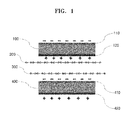
  • FIG. 1 is a sectional view of a graphene laminate according to an example embodiment.
  • FIG. 2 illustrates a graphene laminate including two AB-stacked grapheme sheets between polyvinylidene fluoride (PVDF) layers having permanent dipoles; and
  • FIG. 3 illustrates a calculated band structure of the graphene laminate of FIG. 2 .
  • FIG. 1 is a sectional view of a graphene laminate according to an example embodiment.
  • the graphene laminate includes a first piezoelectric material layer 100 , a first graphene layer 200 , a second graphene layer 300 , and a second piezoelectric material layer 400 .
  • Opposite upper and lower surfaces of the first piezoelectric material layer 100 may be negatively and positively charged, respectively.
  • the first piezoelectric material layer 100 has a negatively-charged surface 110 and a positively-charged surface 120 .
  • the first graphene layer 200 is disposed under the first piezoelectric material layer 100 .
  • the first graphene layer 200 is a single-layered graphene sheet. An upper surface of the first graphene layer 200 contacts the positively-charged surface 120 of the first piezoelectric material layer 100 .
  • the second graphene layer 300 is disposed under the first graphene layer 200 .
  • the second graphene layer 300 is a single-layered graphene sheet.
  • the first graphene layer 200 and the second graphene layer 300 form a double-layered graphene sheet.
  • the first graphene layer 200 and the second graphene layer 300 form an AB-stacked structure.
  • the second piezoelectric material layer 400 is disposed under the second graphene layer 300 . Opposite upper and lower surfaces of the second piezoelectric material layer 400 may be negatively and positively charged, respectively.
  • the second piezoelectric material layer 400 has a negatively-charged surface 410 and a positively-charged surface 420 .
  • the negatively-charged surface 410 of the second piezoelectric material layer 400 contacts the second graphene layer 300 .
  • the first graphene layer 200 and the second graphene layer 300 are disposed between the positively-charged surface 120 of the first piezoelectric material layer 100 and the negatively-charged surface 410 of the second piezoelectric material layer 400 .
  • a distance between the positively-charged surface 120 of the first piezoelectric material layer 100 and the negatively-charged surface 410 of the second piezoelectric material layer 400 is relatively short and equal to the sum of the thicknesses of the first graphene layer 200 and the second graphene layer 300 .
  • a relatively strong electric field may be generated between the positively-charged surface 120 of the first piezoelectric material layer 100 and the negatively-charged surface 410 of the second piezoelectric material layer 400 .
  • Symmetry in band structure between the first graphene layer 200 and the second graphene layer 300 may be broken by this relatively strong electric field, and consequently, a band gap of the double-layered graphene sheet comprising the first graphene layer 200 and the second graphene layer 300 may be opened.
  • the first piezoelectric material layer 100 and the second piezoelectric material layer 400 may be formed of, for example, a material selected from quartz, lead zirconate titanate (PZT, Pb[Zr x Ti 1-x ]O 3 , where 0 ⁇ x ⁇ 1), gallium orthophosphate, langasite, barium titanate, lead titanate, potassium niobate, zinc oxide, sodium tungstate, lithium tantalate, lithium niobate, polyvinylidene fluoride (PVDF), poly[(vinylidenefluoride-co-trifluoroethylene (PVDF-TrFE), or a mixture thereof.
  • the first piezoelectric material layer 100 and the second piezoelectric material layer 400 may be formed of the same material or a different material.
  • the first graphene layer 200 and the second graphene layer 300 may each be a single-layered graphene sheet.
  • the first graphene layer 200 and the second graphene layer 300 may form an AB-stacked graphene.
  • the AB-stacked graphene is a structure including upper and lower graphene layers stably overlapping with one another, wherein half of the carbon atoms in the upper graphene layer are located directly above half of the carbon atoms in the lower graphene layer.
  • the AB-stacked graphene including the first graphene layer 200 and the second graphene layer 300 may have a band gap of, for example, greater than about 0 eV and less than or equal to about 0.3 eV.
  • FIG. 2 A graphene laminate according to another embodiment is illustrated in FIG. 2 .
  • the graphene laminate of FIG. 2 includes two AB-stacked graphene sheets between polyvinylidene fluoride (PVDF) layers having permanent dipoles.
  • FIG. 3 illustrates a calculated band gap of the graphene laminate of FIG. 2 . Referring to FIG. 3 , it was found that the two graphene sheets of the graphene laminate of FIG. 2 have a band gap of about 0.25 eV. Furthermore, a doping state is not present in the band gap of FIG. 3 .
  • the graphene laminate according to example embodiments of the present inventive concepts may have a band gap, and no doping state appears in the graphene of the graphene laminate. Accordingly, the graphene laminate may have a charge mobility not lower than that of graphene itself. According to example embodiments of the present inventive concepts, the graphene laminate may be used in, for example, switch devices, sensor devices, high-frequency devices, optical devices, or the like. A device with faster information-processing ability than conventional Si-based devices may be manufactured using the graphene laminate with high charge-mobility according to the present inventive concepts. According to example embodiments of the present inventive concepts, the graphene laminate may also be used in flexible devices due to flexibilities of the graphene and the piezoelectric material.
  • a switch device may include any of the graphene laminates according to an example embodiment.
  • a sensor device may include any of the graphene laminates according to the first aspect of the present disclosure.
  • an embodiment of a method of manufacturing a graphene laminate according to another example embodiment may include applying an electric field to a laminate, the laminate including a first piezoelectric material layer, a first graphene layer underlying the first piezoelectric material layer, a second graphene layer underlying the first graphene layer, and a second piezoelectric material layer underlying the second graphene layer.
  • the applying of an electric field to the first laminate may include, for example, disposing the laminate between two electrodes and applying a voltage between the two electrodes.
  • the voltage applied across the two electrodes may be, for example, from about 10V to about 100V.
  • first piezoelectric material layer and the second piezoelectric material layer may have surfaces charged in the same manner. For example, when an upper surface of the first piezoelectric material layer is positively charged, an upper surface of the second piezoelectric material layer may be positively charged. In some embodiments, when a lower surface of the first piezoelectric material layer is positively charged, a lower surface of the second piezoelectric material layer may be positively charged.
  • a graphene laminate includes a first piezoelectric material layer, a first graphene layer underlying the first piezoelectric material layer, a second graphene layer underlying the first graphene layer, and a second piezoelectric material layer underlying the second graphene layer.
  • this graphene laminate may be used as a source material in the method of manufacturing a graphene laminate described above as an example embodiment of the present inventive concepts.
  • the graphene laminate according to another example embodiment may be prepared, for example, as follows.
  • a second piezoelectric material layer may be formed of a piezoelectric material on a doped silicon wafer with relatively low resistivity.
  • Two graphene layers may be formed on the second piezoelectric material layer by using graphene separated from natural graphite, such as, for example, highly ordered pyrolytic graphite (HOPG) or Kish graphite, or by using graphene grown through chemical vapor deposition (CVD).
  • HOPG highly ordered pyrolytic graphite
  • CVD chemical vapor deposition
  • a first piezoelectric material layer may then be formed on the two graphene layers in the same manner as the second piezoelectric material layer.
  • PVDF-TrFE poly[(vinylidenefluoride-co-trifluoroethylene (PVDF-TrFE) as a piezoelectric material for the second piezoelectric material layer
  • a PVDF-TrFE powder may be dissolved in a concentration of about 20 wt % in dimethylformamide (DMF).
  • DMF dimethylformamide
  • This solution may be spin-coated on a doped silicon wafer with low resistivity to a thickness of about 500 nm, followed by drying at about 60° C. to remove the DMF and form the second piezoelectric material layer.
  • two graphene layers may be formed on the second piezoelectric material layer by using graphene separated from natural graphite, for example, highly ordered pyrolytic graphite (HOPG) or Kish graphite, or by using graphene grown through chemical vapor deposition (CVD).
  • the first piezoelectric material layer may be formed on the two graphene layers by the same method as used to form the second piezoelectric material layer, thereby manufacturing a graphene laminate.
  • An electrode may then be formed on the graphene laminate (which has been patterned by photolithography or electron beam lithography, or with a shadow mask), using an electron beam/thermal evaporator, followed by applying a voltage between the electrode and the silicon wafer to orient dipoles of the first and second piezoelectric material layers in a direction.
  • dipoles in a piezoelectric material layer may be artificially oriented in a direction by applying a strong electric field to the piezoelectric material layer, thus becoming permanent dipoles charging one of the opposite surfaces of the piezoelectric material layer with positive charges and the other surface with negative charges.
  • a strong electric field may be generated between a positively-charged surface of one of the piezoelectric material layers and a negatively-charged surface of the other piezoelectric material layer.
  • This strong electric field may break the symmetry in a band structure of the two graphene sheets, thereby opening a bad gap in the graphene sheets. Due to a relatively large band gap of piezoelectric material, a charge transfer may not occur between the piezoelectric material and graphene even in contact with each other, so that no doping state appears in the band gap of the graphene. For this reason, even when the two graphene sheets are disposed between the piezoelectric material layers, a charge mobility of the graphene sheets may not deteriorate.
  • the piezoelectric material layers may also serve as insulating layers. This may simplify the manufacturing of a device since an additional insulating layer may not be formed.

Landscapes

  • Chemical & Material Sciences (AREA)
  • Engineering & Computer Science (AREA)
  • Organic Chemistry (AREA)
  • Materials Engineering (AREA)
  • Nanotechnology (AREA)
  • Inorganic Chemistry (AREA)
  • Ceramic Engineering (AREA)
  • Laminated Bodies (AREA)
  • Carbon And Carbon Compounds (AREA)
  • Physics & Mathematics (AREA)
  • Condensed Matter Physics & Semiconductors (AREA)
  • General Physics & Mathematics (AREA)
  • Manufacturing & Machinery (AREA)
  • Computer Hardware Design (AREA)
  • Microelectronics & Electronic Packaging (AREA)
  • Power Engineering (AREA)

Abstract

A graphene laminate includes a first piezoelectric material layer having a negatively-charged surface and a positively-charged surface, a first graphene layer under the first piezoelectric material layer, the first graphene layer contacting the positively-charged surface of the first piezoelectric material layer, a second graphene layer underlying the first graphene layer, and a second piezoelectric material layer under the second graphene layer, the second piezoelectric material layer having a negatively-charged surface and a positively-charged surface, the negatively-charged surface contacting the second graphene layer.

Description

CROSS-REFERENCE TO RELATED APPLICATIONS
This application claims the benefit of Korean Patent Application No. 10-2013-0038845, filed on Apr. 9, 2013, in the Korean Intellectual Property Office, the entire disclosure of which is incorporated herein by reference.
BACKGROUND
1. Field
Some example embodiments relate to graphene, and more particularly, to graphene as a material for electronic devices.
2. Description of the Related Art
Graphene is a two-dimensional structure of a monatomic layer of carbon. Graphene has a unique band structure, a relatively high electron mobility of about 200,000 cm2V's−1, and a quantum hole effect (QHE) at room temperature. However, graphene has no band gap, and is not applicable in electronic devices, specifically in switching devices, such as transistors. Therefore, research has been conducted to render a band gap to graphene.
For example, to open a band gap in graphene, graphene may be patterned into nanoribbons having a width of about 10 nm or less. However, forming graphene nanoribbons with a band gap requires the use of expensive special equipment. Furthermore, manufacturing a relatively large array of graphene nanoribbons for integrated circuits is extremely difficult with the current technology.
Another method of opening a band gap in graphene is using AB-stacked graphene. A band gap in graphene may be induced by breaking the symmetry in a band structure of a two-layered graphene laminate with an AB-stacked structure. For example, a relatively strong electric field may be applied between opposite surfaces of the two-layered graphene laminate to open a band gap in the AB-stacked graphene. This method uses a relatively high voltage.
Another method of opening a band gap in graphene is doping one or opposite surfaces of single-layer graphene or double-layer graphene with a dopant. However, a charge transfer from the dopant to the graphene may cause a doping state in graphene, consequently leading to increased scattering and reduced mobility of charges in graphene. Furthermore, it is difficult to control a doping concentration of the dopant in graphene with this method.
SUMMARY
Some example embodiments provide graphene laminates with relatively high charge mobility and a band gap.
Additional aspects will be set forth in part in the description which follows and, in part, will be apparent from the description, or may be learned by practice of example embodiments.
According to an example embodiment, a graphene laminate includes a first piezoelectric material layer having a negatively-charged surface and a positively-charged surface, a first graphene layer under the first piezoelectric material layer, the first graphene layer contacting the positively-charged surface of the first piezoelectric material layer, a second graphene layer underlying the first graphene layer, and a second piezoelectric material layer under the second graphene layer, the second piezoelectric material layer having a negatively-charged surface and a positively-charged surface, the negatively-charged surface contacting the second graphene layer.
According to another example embodiment, a method of preparing a graphene laminate with a band gap includes applying an electric field to a laminate, the laminate including a first piezoelectric material layer, a first graphene layer underlying the first piezoelectric material layer, a second graphene layer underlying the first graphene layer, and a second piezoelectric material layer underlying the second graphene layer.
According to another example embodiment, a graphene laminate includes a first piezoelectric material layer, a first graphene layer underlying the first piezoelectric material layer, a second graphene layer underlying the first graphene layer, and a second piezoelectric material layer underlying the second graphene layer.
BRIEF DESCRIPTION OF THE DRAWINGS
These and/or other aspects will become apparent and more readily appreciated from the following description of the embodiments, taken in conjunction with the accompanying drawings of which:
FIG. 1 is a sectional view of a graphene laminate according to an example embodiment.
FIG. 2 illustrates a graphene laminate including two AB-stacked grapheme sheets between polyvinylidene fluoride (PVDF) layers having permanent dipoles; and
FIG. 3 illustrates a calculated band structure of the graphene laminate of FIG. 2.
DETAILED DESCRIPTION
Reference will now be made in detail to the inventive concepts, examples of which are illustrated in the accompanying drawings, wherein like reference numerals refer to the like elements throughout. In this regard, the present embodiments may have different forms and should not be construed as being limited to the descriptions set forth herein. Accordingly, the embodiments are merely described below, by referring to the figures, to explain aspects of the present description. As used herein, the term “and/or” includes any and all combinations of one or more of the associated listed items. Expressions such as “at least one of,” when preceding a list of elements, modify the entire list of elements and do not modify the individual elements of the list.
It will be understood that, although the terms first, second, third etc. may be used herein to describe various elements, these elements should not be limited by these terms. These terms are used to distinguish one element from another. Thus, a first element discussed below could be termed a second element without departing from the teachings of example embodiments. As used herein, the term “and/or” includes any and all combinations of one or more of the associated listed items.
The terminology used herein is for the purpose of describing particular example embodiments only and is not intended to be limiting of the present inventive concept. As used herein, the singular forms “a,” “an” and “the” are intended to include the plural forms as well, unless the context clearly indicates otherwise. It will be further understood that the terms “comprises” and/or “comprising,” when used in this specification, specify the presence of stated features, integers, steps, operations, elements, and/or components, but do not preclude the presence or addition of one or more other features, integers, steps, operations, elements, components, and/or groups thereof.
Unless otherwise defined, all terms (including technical and scientific terms) used herein have the same meaning as commonly understood by one of ordinary skill in the art to which this inventive concept belongs. It will be further understood that terms, such as those defined in commonly used dictionaries, should be interpreted as having a meaning that is consistent with their meaning in the context of the relevant art and will not be interpreted in an idealized or overly formal sense unless expressly so defined herein.
FIG. 1 is a sectional view of a graphene laminate according to an example embodiment.
Referring to FIG. 1, the graphene laminate includes a first piezoelectric material layer 100, a first graphene layer 200, a second graphene layer 300, and a second piezoelectric material layer 400. Opposite upper and lower surfaces of the first piezoelectric material layer 100 may be negatively and positively charged, respectively. The first piezoelectric material layer 100 has a negatively-charged surface 110 and a positively-charged surface 120. The first graphene layer 200 is disposed under the first piezoelectric material layer 100. The first graphene layer 200 is a single-layered graphene sheet. An upper surface of the first graphene layer 200 contacts the positively-charged surface 120 of the first piezoelectric material layer 100. The second graphene layer 300 is disposed under the first graphene layer 200. The second graphene layer 300 is a single-layered graphene sheet.
Accordingly, the first graphene layer 200 and the second graphene layer 300 form a double-layered graphene sheet. The first graphene layer 200 and the second graphene layer 300 form an AB-stacked structure. The second piezoelectric material layer 400 is disposed under the second graphene layer 300. Opposite upper and lower surfaces of the second piezoelectric material layer 400 may be negatively and positively charged, respectively. The second piezoelectric material layer 400 has a negatively-charged surface 410 and a positively-charged surface 420. The negatively-charged surface 410 of the second piezoelectric material layer 400 contacts the second graphene layer 300.
The first graphene layer 200 and the second graphene layer 300 are disposed between the positively-charged surface 120 of the first piezoelectric material layer 100 and the negatively-charged surface 410 of the second piezoelectric material layer 400. A distance between the positively-charged surface 120 of the first piezoelectric material layer 100 and the negatively-charged surface 410 of the second piezoelectric material layer 400 is relatively short and equal to the sum of the thicknesses of the first graphene layer 200 and the second graphene layer 300. Thus, a relatively strong electric field may be generated between the positively-charged surface 120 of the first piezoelectric material layer 100 and the negatively-charged surface 410 of the second piezoelectric material layer 400. Symmetry in band structure between the first graphene layer 200 and the second graphene layer 300 may be broken by this relatively strong electric field, and consequently, a band gap of the double-layered graphene sheet comprising the first graphene layer 200 and the second graphene layer 300 may be opened.
The first piezoelectric material layer 100 and the second piezoelectric material layer 400 may be formed of, for example, a material selected from quartz, lead zirconate titanate (PZT, Pb[ZrxTi1-x]O3, where 0≦x≦1), gallium orthophosphate, langasite, barium titanate, lead titanate, potassium niobate, zinc oxide, sodium tungstate, lithium tantalate, lithium niobate, polyvinylidene fluoride (PVDF), poly[(vinylidenefluoride-co-trifluoroethylene (PVDF-TrFE), or a mixture thereof. The first piezoelectric material layer 100 and the second piezoelectric material layer 400 may be formed of the same material or a different material.
The first graphene layer 200 and the second graphene layer 300 may each be a single-layered graphene sheet. The first graphene layer 200 and the second graphene layer 300 may form an AB-stacked graphene. The AB-stacked graphene is a structure including upper and lower graphene layers stably overlapping with one another, wherein half of the carbon atoms in the upper graphene layer are located directly above half of the carbon atoms in the lower graphene layer.
In the graphene laminate of FIG. 1, the AB-stacked graphene including the first graphene layer 200 and the second graphene layer 300 may have a band gap of, for example, greater than about 0 eV and less than or equal to about 0.3 eV. A graphene laminate according to another embodiment is illustrated in FIG. 2. The graphene laminate of FIG. 2 includes two AB-stacked graphene sheets between polyvinylidene fluoride (PVDF) layers having permanent dipoles. FIG. 3 illustrates a calculated band gap of the graphene laminate of FIG. 2. Referring to FIG. 3, it was found that the two graphene sheets of the graphene laminate of FIG. 2 have a band gap of about 0.25 eV. Furthermore, a doping state is not present in the band gap of FIG. 3.
The graphene laminate according to example embodiments of the present inventive concepts may have a band gap, and no doping state appears in the graphene of the graphene laminate. Accordingly, the graphene laminate may have a charge mobility not lower than that of graphene itself. According to example embodiments of the present inventive concepts, the graphene laminate may be used in, for example, switch devices, sensor devices, high-frequency devices, optical devices, or the like. A device with faster information-processing ability than conventional Si-based devices may be manufactured using the graphene laminate with high charge-mobility according to the present inventive concepts. According to example embodiments of the present inventive concepts, the graphene laminate may also be used in flexible devices due to flexibilities of the graphene and the piezoelectric material. According to an example embodiment of the present inventive concepts, a switch device may include any of the graphene laminates according to an example embodiment. According to another example embodiment of the present inventive concepts, a sensor device may include any of the graphene laminates according to the first aspect of the present disclosure.
Hereinafter, a method of manufacturing a graphene laminate according to another example embodiment will now be described in greater detail. For example, an embodiment of a method of manufacturing a graphene laminate according to another example embodiment may include applying an electric field to a laminate, the laminate including a first piezoelectric material layer, a first graphene layer underlying the first piezoelectric material layer, a second graphene layer underlying the first graphene layer, and a second piezoelectric material layer underlying the second graphene layer.
In some embodiments, the applying of an electric field to the first laminate may include, for example, disposing the laminate between two electrodes and applying a voltage between the two electrodes. The voltage applied across the two electrodes may be, for example, from about 10V to about 100V.
When an electric field is applied to the laminate, dipoles in the piezoelectric material layers of the laminate are oriented in the direction of the electric field, and become permanent dipoles in the piezoelectric material layers of the laminate. Accordingly, the opposite surfaces of the first and second piezoelectric material layers are positively or negatively charged. The first piezoelectric material layer and the second piezoelectric material layer may have surfaces charged in the same manner. For example, when an upper surface of the first piezoelectric material layer is positively charged, an upper surface of the second piezoelectric material layer may be positively charged. In some embodiments, when a lower surface of the first piezoelectric material layer is positively charged, a lower surface of the second piezoelectric material layer may be positively charged.
According to another example embodiment, a graphene laminate includes a first piezoelectric material layer, a first graphene layer underlying the first piezoelectric material layer, a second graphene layer underlying the first graphene layer, and a second piezoelectric material layer underlying the second graphene layer. According to example embodiments of the present inventive concepts, this graphene laminate may be used as a source material in the method of manufacturing a graphene laminate described above as an example embodiment of the present inventive concepts.
The graphene laminate according to another example embodiment may be prepared, for example, as follows. A second piezoelectric material layer may be formed of a piezoelectric material on a doped silicon wafer with relatively low resistivity. Two graphene layers may be formed on the second piezoelectric material layer by using graphene separated from natural graphite, such as, for example, highly ordered pyrolytic graphite (HOPG) or Kish graphite, or by using graphene grown through chemical vapor deposition (CVD). A first piezoelectric material layer may then be formed on the two graphene layers in the same manner as the second piezoelectric material layer. For example, when using poly[(vinylidenefluoride-co-trifluoroethylene (PVDF-TrFE) as a piezoelectric material for the second piezoelectric material layer, first, a PVDF-TrFE powder may be dissolved in a concentration of about 20 wt % in dimethylformamide (DMF).
This solution may be spin-coated on a doped silicon wafer with low resistivity to a thickness of about 500 nm, followed by drying at about 60° C. to remove the DMF and form the second piezoelectric material layer. Afterwards, two graphene layers may be formed on the second piezoelectric material layer by using graphene separated from natural graphite, for example, highly ordered pyrolytic graphite (HOPG) or Kish graphite, or by using graphene grown through chemical vapor deposition (CVD). The first piezoelectric material layer may be formed on the two graphene layers by the same method as used to form the second piezoelectric material layer, thereby manufacturing a graphene laminate. An electrode may then be formed on the graphene laminate (which has been patterned by photolithography or electron beam lithography, or with a shadow mask), using an electron beam/thermal evaporator, followed by applying a voltage between the electrode and the silicon wafer to orient dipoles of the first and second piezoelectric material layers in a direction.
As described above, according to the one or more of the above example embodiments of the present inventive concepts, dipoles in a piezoelectric material layer may be artificially oriented in a direction by applying a strong electric field to the piezoelectric material layer, thus becoming permanent dipoles charging one of the opposite surfaces of the piezoelectric material layer with positive charges and the other surface with negative charges. When two graphene sheets are disposed between two piezoelectric material layers with dipoles arranged in the same direction, a strong electric field may be generated between a positively-charged surface of one of the piezoelectric material layers and a negatively-charged surface of the other piezoelectric material layer.
This strong electric field may break the symmetry in a band structure of the two graphene sheets, thereby opening a bad gap in the graphene sheets. Due to a relatively large band gap of piezoelectric material, a charge transfer may not occur between the piezoelectric material and graphene even in contact with each other, so that no doping state appears in the band gap of the graphene. For this reason, even when the two graphene sheets are disposed between the piezoelectric material layers, a charge mobility of the graphene sheets may not deteriorate. The piezoelectric material layers may also serve as insulating layers. This may simplify the manufacturing of a device since an additional insulating layer may not be formed.
It should be understood that the example embodiments described therein should be considered in a descriptive sense only and not for purposes of limitation. Descriptions of features or aspects within each embodiment should typically be considered as available for other similar features or aspects in other embodiments.

Claims (19)

What is claimed is:
1. A graphene laminate comprising:
a first piezoelectric material layer having a negatively-charged surface and a positively-charged surface;
a first graphene layer under the first piezoelectric material layer, the first graphene layer contacting the positively-charged surface of the first piezoelectric material layer;
a second graphene layer underlying the first graphene layer; and
a second piezoelectric material layer under the second graphene layer, the second piezoelectric material layer having a negatively-charged surface and a positively-charged surface, the negatively-charged surface contacting the second graphene layer.
2. The graphene laminate of claim 1, wherein the first piezoelectric material layer and the second piezoelectric material layer comprise one of lead zirconate titanate (PZT, Pb[ZrxTi1-x]O3, where 0≦x≦1), gallium orthophosphate, langasite, barium titanate, lead titanate, potassium niobate, zinc oxide, sodium tungstate, lithium tantalate, lithium niobate, polyvinylidene fluoride (PVDF), poly[(vinylidenefluoride-co-trifluoroethylene (PVDF-TrFE), and a mixture thereof.
3. The graphene laminate of claim 1, wherein the first piezoelectric material layer and the second piezoelectric material layer comprise one of a same material and different materials.
4. The graphene laminate of claim 1, wherein the first graphene layer and the second graphene layer are each a single-layered graphene sheet.
5. The graphene laminate of claim 1, wherein the first graphene layer and the second graphene layer form an AB-stacked graphene sheet.
6. The graphene laminate of claim 1, wherein the first graphene layer and the second graphene layer have a band gap greater than 0 eV to about 0.3 eV.
7. A switching device comprising the graphene laminate of claim 1.
8. A sensor device comprising the graphene laminate of claim 1.
9. A method of preparing a graphene laminate with a band gap, the method comprising:
applying an electric field to a laminate, the laminate including,
a first piezoelectric material layer,
a first graphene layer underlying the first piezoelectric material layer,
a second graphene layer underlying the first graphene layer, and
a second piezoelectric material layer underlying the second graphene layer.
10. The method of claim 9, wherein the applying an electric field to the laminate comprises:
disposing the laminate between two electrodes; and
applying a voltage across the two electrodes.
11. The method of claim 10, wherein the applying applies the voltage from about 10V to about 100V.
12. A graphene laminate comprising:
a first piezoelectric material layer;
a first graphene layer underlying the first piezoelectric material layer;
a second graphene layer underlying the first graphene layer; and
a second piezoelectric material layer underlying the second graphene layer.
13. The graphene laminate of claim 12, wherein the first piezoelectric material layer and the second piezoelectric material layer comprise one of lead zirconate titanate (PZT, Pb[ZrxTi1-x]O3, where 0≦x≦1), gallium orthophosphate, langasite, barium titanate, lead titanate, potassium niobate, zinc oxide, sodium tungstate, lithium tantalate, lithium niobate, polyvinylidene fluoride (PVDF), poly[(vinylidenefluoride-co-trifluoroethylene (PVDF-TrFE), and a mixture thereof.
14. The graphene laminate of claim 12, wherein the first piezoelectric material layer and the second piezoelectric material layer comprise one of a same material and different materials.
15. The graphene laminate of claim 12, wherein the first graphene layer and the second graphene layer are each a single-layered graphene sheet.
16. The graphene laminate of claim 12, wherein the first graphene layer and the second graphene layer form an AB-stacked graphene sheet.
17. The graphene laminate of claim 12, wherein the first graphene layer and the second graphene layer have a band gap greater than 0 eV to about 0.3 eV.
18. A switching device comprising the graphene laminate of claim 12.
19. A sensor device comprising the graphene laminate of claim 12.
US14/186,055 2013-04-09 2014-02-21 Graphene laminate with band gap Active 2034-06-16 US9406513B2 (en)

Applications Claiming Priority (2)

Application Number Priority Date Filing Date Title
KR1020130038845A KR102023616B1 (en) 2013-04-09 2013-04-09 Graphene with a bandgap
KR10-2013-0038845 2013-04-09

Publications (2)

Publication Number Publication Date
US20140299840A1 US20140299840A1 (en) 2014-10-09
US9406513B2 true US9406513B2 (en) 2016-08-02

Family

ID=51653831

Family Applications (1)

Application Number Title Priority Date Filing Date
US14/186,055 Active 2034-06-16 US9406513B2 (en) 2013-04-09 2014-02-21 Graphene laminate with band gap

Country Status (2)

Country Link
US (1) US9406513B2 (en)
KR (1) KR102023616B1 (en)

Families Citing this family (3)

* Cited by examiner, † Cited by third party
Publication number Priority date Publication date Assignee Title
GB2557611A (en) 2016-12-12 2018-06-27 Virtuosys Ltd Edge computing system
CN110690342B (en) * 2019-10-13 2021-05-14 浙江大学 Flexible piezoelectric energy conversion device based on carbon-coated barium titanate/PVDF
CN113904589B (en) * 2021-09-13 2022-09-02 广东墨睿科技有限公司 Preparation method of piezoelectric film substrate-enhanced graphene power generation device

Citations (10)

* Cited by examiner, † Cited by third party
Publication number Priority date Publication date Assignee Title
KR100819458B1 (en) 2007-05-15 2008-04-04 재단법인서울대학교산학협력재단 Graphite thin film manufacturing method using electrostatic force
KR20100108106A (en) 2009-03-27 2010-10-06 영남대학교 산학협력단 Preparation method of graphene sheets by the reduction of carbon monoxide
US20110101309A1 (en) * 2009-11-04 2011-05-05 International Business Machines Corporation Graphene based switching device having a tunable bandgap
KR20110081519A (en) 2010-01-08 2011-07-14 한국과학기술원 Graphene nanostructure manufacturing method using self-assembled material
KR101071110B1 (en) 2010-07-20 2011-10-10 한국과학기술원 Nano structured optical sensor using photo-induced charge transfer material
US20110313194A1 (en) 2010-06-21 2011-12-22 Samsung Electronics Co., Ltd. Graphene substituted with boron and nitrogen , method of fabricating the same, and transistor having the same
US20110309336A1 (en) 2010-06-18 2011-12-22 Samsung Electronics Co., Ltd. Semiconducting graphene composition, and electrical device including the same
US20120068161A1 (en) 2010-09-16 2012-03-22 Lee Keon-Jae Method for forming graphene using laser beam, graphene semiconductor manufactured by the same, and graphene transistor having graphene semiconductor
JP2012082093A (en) 2010-10-08 2012-04-26 Nippon Telegr & Teleph Corp <Ntt> Method for forming carbon thin film
US20120153119A1 (en) 2010-12-13 2012-06-21 Vikram Arvind Patil Active bandgap tuning of graphene for tunable photodetection applications

Patent Citations (10)

* Cited by examiner, † Cited by third party
Publication number Priority date Publication date Assignee Title
KR100819458B1 (en) 2007-05-15 2008-04-04 재단법인서울대학교산학협력재단 Graphite thin film manufacturing method using electrostatic force
KR20100108106A (en) 2009-03-27 2010-10-06 영남대학교 산학협력단 Preparation method of graphene sheets by the reduction of carbon monoxide
US20110101309A1 (en) * 2009-11-04 2011-05-05 International Business Machines Corporation Graphene based switching device having a tunable bandgap
KR20110081519A (en) 2010-01-08 2011-07-14 한국과학기술원 Graphene nanostructure manufacturing method using self-assembled material
US20110309336A1 (en) 2010-06-18 2011-12-22 Samsung Electronics Co., Ltd. Semiconducting graphene composition, and electrical device including the same
US20110313194A1 (en) 2010-06-21 2011-12-22 Samsung Electronics Co., Ltd. Graphene substituted with boron and nitrogen , method of fabricating the same, and transistor having the same
KR101071110B1 (en) 2010-07-20 2011-10-10 한국과학기술원 Nano structured optical sensor using photo-induced charge transfer material
US20120068161A1 (en) 2010-09-16 2012-03-22 Lee Keon-Jae Method for forming graphene using laser beam, graphene semiconductor manufactured by the same, and graphene transistor having graphene semiconductor
JP2012082093A (en) 2010-10-08 2012-04-26 Nippon Telegr & Teleph Corp <Ntt> Method for forming carbon thin film
US20120153119A1 (en) 2010-12-13 2012-06-21 Vikram Arvind Patil Active bandgap tuning of graphene for tunable photodetection applications

Also Published As

Publication number Publication date
KR102023616B1 (en) 2019-09-20
US20140299840A1 (en) 2014-10-09
KR20140122134A (en) 2014-10-17

Similar Documents

Publication Publication Date Title
US10833102B2 (en) Low power 2D memory transistor for flexible electronics and the fabrication methods thereof
Si et al. Ferroelectric field-effect transistors based on MoS2 and CuInP2S6 two-dimensional van der Waals heterostructure
JP6285717B2 (en) Transparent conductor including graphene layer and permanent dipole layer, solar cell, organic light emitting diode, touch panel or display including transparent conductor, and method for manufacturing transparent conductor
Hong et al. Graphene flash memory
US8105928B2 (en) Graphene based switching device having a tunable bandgap
US9391094B2 (en) Thin-film ambipolar logic
US9455256B2 (en) Inverter including two-dimensional material, method of manufacturing the same and logic device including inverter
US8043978B2 (en) Electronic device and method for producing electronic device
CN102347368B (en) Transistor, method of manufacturing transistor, and electronic device including transistor
CN102983176B (en) Thin film transistor (TFT) including nanoconductor layer
CN107204371A (en) A kind of ferro-electric field effect transistor and preparation method thereof
Hassanpour Amiri et al. Design rules for memories based on graphene ferroelectric field-effect transistors
Tsai et al. Oxide heteroepitaxy-based flexible ferroelectric transistor
US20150144884A1 (en) Graphene film, electronic device, and method for manufacturing electronic device
KR101919426B1 (en) Graphene electronic device and Manufacturing method of the same
US9406513B2 (en) Graphene laminate with band gap
Chen et al. Negative capacitance field effect transistors based on van der Waals 2D materials
Chen et al. Flexoelectric effects in a bent α-In 2 Se 3 ferroelectric monolayer
KR101900045B1 (en) Method for manufacturing transister comprising transition metal chalcogenides channel using dielectric with high dielectric constant and transister manufactured by the same
US10141407B2 (en) Graphene device and method of manufacturing the same
CN108878429B (en) Two-dimensional material-organic ferroelectric material superlattice memory unit and preparation thereof
CN115548134A (en) Solar cells with spontaneously polarized structures
CN110323277A (en) Field effect transistor and preparation method thereof
JP2015153902A (en) Thin film transistor device and manufacturing method of the same
Misirlioglu et al. Low-voltage ferroelectric–paraelectric superlattices as gate materials for field-effect transistors

Legal Events

Date Code Title Description
AS Assignment

Owner name: SAMSUNG ELECTRONICS CO., LTD., KOREA, REPUBLIC OF

Free format text: ASSIGNMENT OF ASSIGNORS INTEREST;ASSIGNORS:LEE, SI-YOUNG;LEE, YOUNG-HEE;CHOI, JAE-YOUNG;REEL/FRAME:032319/0411

Effective date: 20140213

STCF Information on status: patent grant

Free format text: PATENTED CASE

MAFP Maintenance fee payment

Free format text: PAYMENT OF MAINTENANCE FEE, 4TH YEAR, LARGE ENTITY (ORIGINAL EVENT CODE: M1551); ENTITY STATUS OF PATENT OWNER: LARGE ENTITY

Year of fee payment: 4

MAFP Maintenance fee payment

Free format text: PAYMENT OF MAINTENANCE FEE, 8TH YEAR, LARGE ENTITY (ORIGINAL EVENT CODE: M1552); ENTITY STATUS OF PATENT OWNER: LARGE ENTITY

Year of fee payment: 8