US9403780B2 - Pyridine- or pyrazine-containing compounds - Google Patents
Pyridine- or pyrazine-containing compounds Download PDFInfo
- Publication number
- US9403780B2 US9403780B2 US14/781,946 US201414781946A US9403780B2 US 9403780 B2 US9403780 B2 US 9403780B2 US 201414781946 A US201414781946 A US 201414781946A US 9403780 B2 US9403780 B2 US 9403780B2
- Authority
- US
- United States
- Prior art keywords
- pyridine
- reaction
- bis
- pyridyl group
- alkynyl
- Prior art date
- Legal status (The legal status is an assumption and is not a legal conclusion. Google has not performed a legal analysis and makes no representation as to the accuracy of the status listed.)
- Active
Links
- 150000001875 compounds Chemical class 0.000 title claims description 22
- KYQCOXFCLRTKLS-UHFFFAOYSA-N Pyrazine Chemical compound C1=CN=CC=N1 KYQCOXFCLRTKLS-UHFFFAOYSA-N 0.000 title claims description 14
- PCNDJXKNXGMECE-UHFFFAOYSA-N Phenazine Natural products C1=CC=CC2=NC3=CC=CC=C3N=C21 PCNDJXKNXGMECE-UHFFFAOYSA-N 0.000 title claims description 10
- AFSDNFLWKVMVRB-UHFFFAOYSA-N Ellagic acid Chemical class OC1=C(O)C(OC2=O)=C3C4=C2C=C(O)C(O)=C4OC(=O)C3=C1 AFSDNFLWKVMVRB-UHFFFAOYSA-N 0.000 claims abstract description 15
- 150000001893 coumarin derivatives Chemical class 0.000 claims abstract 2
- JUJWROOIHBZHMG-UHFFFAOYSA-N pyridine Substances C1=CC=NC=C1 JUJWROOIHBZHMG-UHFFFAOYSA-N 0.000 claims description 21
- UMJSCPRVCHMLSP-UHFFFAOYSA-N pyridine Natural products COC1=CC=CN=C1 UMJSCPRVCHMLSP-UHFFFAOYSA-N 0.000 claims description 15
- 125000000339 4-pyridyl group Chemical group N1=C([H])C([H])=C([*])C([H])=C1[H] 0.000 claims description 11
- 125000004076 pyridyl group Chemical group 0.000 claims description 7
- VGGSQFUCUMXWEO-UHFFFAOYSA-N Ethene Chemical compound C=C VGGSQFUCUMXWEO-UHFFFAOYSA-N 0.000 claims description 6
- 239000005977 Ethylene Substances 0.000 claims description 6
- 125000003349 3-pyridyl group Chemical group N1=C([H])C([*])=C([H])C([H])=C1[H] 0.000 claims description 5
- 125000000113 cyclohexyl group Chemical group [H]C1([H])C([H])([H])C([H])([H])C([H])(*)C([H])([H])C1([H])[H] 0.000 claims description 5
- IYABWNGZIDDRAK-UHFFFAOYSA-N allene Chemical group C=C=C IYABWNGZIDDRAK-UHFFFAOYSA-N 0.000 claims description 3
- 125000001570 methylene group Chemical group [H]C([H])([*:1])[*:2] 0.000 claims description 3
- QQONPFPTGQHPMA-UHFFFAOYSA-N propylene Natural products CC=C QQONPFPTGQHPMA-UHFFFAOYSA-N 0.000 claims description 3
- 125000004805 propylene group Chemical group [H]C([H])([H])C([H])([*:1])C([H])([H])[*:2] 0.000 claims description 3
- 238000000034 method Methods 0.000 abstract description 5
- 238000006243 chemical reaction Methods 0.000 description 25
- WYURNTSHIVDZCO-UHFFFAOYSA-N Tetrahydrofuran Chemical compound C1CCOC1 WYURNTSHIVDZCO-UHFFFAOYSA-N 0.000 description 20
- 239000003054 catalyst Substances 0.000 description 20
- WEVYAHXRMPXWCK-UHFFFAOYSA-N Acetonitrile Chemical compound CC#N WEVYAHXRMPXWCK-UHFFFAOYSA-N 0.000 description 15
- 0 *C(*)(O)C#CC1=CN=CC(C#CC(*)(*)O)=N1 Chemical compound *C(*)(O)C#CC1=CN=CC(C#CC(*)(*)O)=N1 0.000 description 13
- 239000002904 solvent Substances 0.000 description 12
- ATJXMQHAMYVHRX-CPCISQLKSA-N Ellagic acid Natural products OC1=C(O)[C@H]2OC(=O)c3cc(O)c(O)c4OC(=O)C(=C1)[C@H]2c34 ATJXMQHAMYVHRX-CPCISQLKSA-N 0.000 description 10
- 229920002079 Ellagic acid Polymers 0.000 description 10
- 229960002852 ellagic acid Drugs 0.000 description 10
- 235000004132 ellagic acid Nutrition 0.000 description 10
- FAARLWTXUUQFSN-UHFFFAOYSA-N methylellagic acid Natural products O1C(=O)C2=CC(O)=C(O)C3=C2C2=C1C(OC)=C(O)C=C2C(=O)O3 FAARLWTXUUQFSN-UHFFFAOYSA-N 0.000 description 10
- YLQBMQCUIZJEEH-UHFFFAOYSA-N tetrahydrofuran Natural products C=1C=COC=1 YLQBMQCUIZJEEH-UHFFFAOYSA-N 0.000 description 10
- ZMXDDKWLCZADIW-UHFFFAOYSA-N N,N-Dimethylformamide Chemical compound CN(C)C=O ZMXDDKWLCZADIW-UHFFFAOYSA-N 0.000 description 9
- ZMANZCXQSJIPKH-UHFFFAOYSA-N Triethylamine Chemical compound CCN(CC)CC ZMANZCXQSJIPKH-UHFFFAOYSA-N 0.000 description 9
- -1 pyridine compound Chemical class 0.000 description 9
- ZYGHJZDHTFUPRJ-UHFFFAOYSA-N coumarin Chemical compound C1=CC=C2OC(=O)C=CC2=C1 ZYGHJZDHTFUPRJ-UHFFFAOYSA-N 0.000 description 8
- 239000000463 material Substances 0.000 description 8
- 150000003222 pyridines Chemical class 0.000 description 8
- XEKOWRVHYACXOJ-UHFFFAOYSA-N Ethyl acetate Chemical compound CCOC(C)=O XEKOWRVHYACXOJ-UHFFFAOYSA-N 0.000 description 7
- 238000010992 reflux Methods 0.000 description 7
- 239000000126 substance Substances 0.000 description 7
- YMWUJEATGCHHMB-UHFFFAOYSA-N Dichloromethane Chemical compound ClCCl YMWUJEATGCHHMB-UHFFFAOYSA-N 0.000 description 6
- BZLVMXJERCGZMT-UHFFFAOYSA-N Methyl tert-butyl ether Chemical compound COC(C)(C)C BZLVMXJERCGZMT-UHFFFAOYSA-N 0.000 description 6
- IDLHTECVNDEOIY-UHFFFAOYSA-N 2-pyridin-4-ylethanamine Chemical compound NCCC1=CC=NC=C1 IDLHTECVNDEOIY-UHFFFAOYSA-N 0.000 description 5
- VYPSYNLAJGMNEJ-UHFFFAOYSA-N Silicium dioxide Chemical compound O=[Si]=O VYPSYNLAJGMNEJ-UHFFFAOYSA-N 0.000 description 5
- 150000004775 coumarins Chemical class 0.000 description 5
- 239000002243 precursor Substances 0.000 description 5
- 239000000047 product Substances 0.000 description 5
- 150000003216 pyrazines Chemical class 0.000 description 5
- 238000005160 1H NMR spectroscopy Methods 0.000 description 4
- VHYFNPMBLIVWCW-UHFFFAOYSA-N 4-Dimethylaminopyridine Chemical compound CN(C)C1=CC=NC=C1 VHYFNPMBLIVWCW-UHFFFAOYSA-N 0.000 description 4
- KDLHZDBZIXYQEI-UHFFFAOYSA-N Palladium Chemical compound [Pd] KDLHZDBZIXYQEI-UHFFFAOYSA-N 0.000 description 4
- YNHIGQDRGKUECZ-UHFFFAOYSA-L bis(triphenylphosphine)palladium(ii) dichloride Chemical compound [Cl-].[Cl-].[Pd+2].C1=CC=CC=C1P(C=1C=CC=CC=1)C1=CC=CC=C1.C1=CC=CC=C1P(C=1C=CC=CC=1)C1=CC=CC=C1 YNHIGQDRGKUECZ-UHFFFAOYSA-L 0.000 description 4
- 229960000956 coumarin Drugs 0.000 description 4
- 235000001671 coumarin Nutrition 0.000 description 4
- 238000001914 filtration Methods 0.000 description 4
- 238000002360 preparation method Methods 0.000 description 4
- 239000011541 reaction mixture Substances 0.000 description 4
- 238000003756 stirring Methods 0.000 description 4
- LSEAAPGIZCDEEH-UHFFFAOYSA-N 2,6-dichloropyrazine Chemical compound ClC1=CN=CC(Cl)=N1 LSEAAPGIZCDEEH-UHFFFAOYSA-N 0.000 description 3
- RTZKZFJDLAIYFH-UHFFFAOYSA-N Diethyl ether Chemical compound CCOCC RTZKZFJDLAIYFH-UHFFFAOYSA-N 0.000 description 3
- 238000005481 NMR spectroscopy Methods 0.000 description 3
- UAOMVDZJSHZZME-UHFFFAOYSA-N diisopropylamine Chemical compound CC(C)NC(C)C UAOMVDZJSHZZME-UHFFFAOYSA-N 0.000 description 3
- VLKZOEOYAKHREP-UHFFFAOYSA-N n-Hexane Chemical compound CCCCCC VLKZOEOYAKHREP-UHFFFAOYSA-N 0.000 description 3
- 239000003880 polar aprotic solvent Substances 0.000 description 3
- 239000011369 resultant mixture Substances 0.000 description 3
- 239000000741 silica gel Substances 0.000 description 3
- 229910002027 silica gel Inorganic materials 0.000 description 3
- WOXFMYVTSLAQMO-UHFFFAOYSA-N 2-Pyridinemethanamine Chemical compound NCC1=CC=CC=N1 WOXFMYVTSLAQMO-UHFFFAOYSA-N 0.000 description 2
- NAHHNSMHYCLMON-UHFFFAOYSA-N 2-pyridin-3-ylethanamine Chemical compound NCCC1=CC=CN=C1 NAHHNSMHYCLMON-UHFFFAOYSA-N 0.000 description 2
- XPQIPUZPSLAZDV-UHFFFAOYSA-N 2-pyridylethylamine Chemical compound NCCC1=CC=CC=N1 XPQIPUZPSLAZDV-UHFFFAOYSA-N 0.000 description 2
- UGYRJDSEKCYZKI-UHFFFAOYSA-N 3-pyridin-2-ylpropan-1-amine Chemical compound NCCCC1=CC=CC=N1 UGYRJDSEKCYZKI-UHFFFAOYSA-N 0.000 description 2
- CORPZWBVJRCLMW-UHFFFAOYSA-N 3-pyridin-3-ylpropan-1-amine Chemical compound NCCCC1=CC=CN=C1 CORPZWBVJRCLMW-UHFFFAOYSA-N 0.000 description 2
- JURFPUSNTWSSPJ-UHFFFAOYSA-N 3-pyridin-4-ylpropan-1-amine Chemical compound NCCCC1=CC=NC=C1 JURFPUSNTWSSPJ-UHFFFAOYSA-N 0.000 description 2
- NWQBYMPNIJXFNQ-UHFFFAOYSA-N 7,8-dihydroxy-4-methyl-1-benzopyran-2-one Chemical compound OC1=C(O)C=CC2=C1OC(=O)C=C2C NWQBYMPNIJXFNQ-UHFFFAOYSA-N 0.000 description 2
- IJGRMHOSHXDMSA-UHFFFAOYSA-N Atomic nitrogen Chemical compound N#N IJGRMHOSHXDMSA-UHFFFAOYSA-N 0.000 description 2
- RYGMFSIKBFXOCR-UHFFFAOYSA-N Copper Chemical compound [Cu] RYGMFSIKBFXOCR-UHFFFAOYSA-N 0.000 description 2
- 229910021595 Copper(I) iodide Inorganic materials 0.000 description 2
- IAZDPXIOMUYVGZ-WFGJKAKNSA-N Dimethyl sulfoxide Chemical compound [2H]C([2H])([2H])S(=O)C([2H])([2H])[2H] IAZDPXIOMUYVGZ-WFGJKAKNSA-N 0.000 description 2
- JGFZNNIVVJXRND-UHFFFAOYSA-N N,N-Diisopropylethylamine (DIPEA) Chemical compound CCN(C(C)C)C(C)C JGFZNNIVVJXRND-UHFFFAOYSA-N 0.000 description 2
- 238000003477 Sonogashira cross-coupling reaction Methods 0.000 description 2
- HEDRZPFGACZZDS-MICDWDOJSA-N Trichloro(2H)methane Chemical compound [2H]C(Cl)(Cl)Cl HEDRZPFGACZZDS-MICDWDOJSA-N 0.000 description 2
- NAMQITDKEFYMKT-SREVYHEPSA-N [H]N(CC)C(=O)/C=C(/C)C1=CC=C(O)C(O)=C1O Chemical compound [H]N(CC)C(=O)/C=C(/C)C1=CC=C(O)C(O)=C1O NAMQITDKEFYMKT-SREVYHEPSA-N 0.000 description 2
- DMNNFBOFGATWNW-XQRVVYSFSA-N [H]N(CC)C(=O)/C=C\C1=CC=C(O)C(O)=C1O Chemical compound [H]N(CC)C(=O)/C=C\C1=CC=C(O)C(O)=C1O DMNNFBOFGATWNW-XQRVVYSFSA-N 0.000 description 2
- LWPUVNRAVLCMJK-UHFFFAOYSA-N [H]N(CC)C(=O)C1=CC(O)=C(O)C(O)=C1C1=C(C(=O)N([H])CC)C=C(O)C(O)=C1O Chemical compound [H]N(CC)C(=O)C1=CC(O)=C(O)C(O)=C1C1=C(C(=O)N([H])CC)C=C(O)C(O)=C1O LWPUVNRAVLCMJK-UHFFFAOYSA-N 0.000 description 2
- IPCNCHPDKCLMBQ-UHFFFAOYSA-N [H]N(CC)C(=O)CCC1=CC=C(O)C(O)=C1O Chemical compound [H]N(CC)C(=O)CCC1=CC=C(O)C(O)=C1O IPCNCHPDKCLMBQ-UHFFFAOYSA-N 0.000 description 2
- IKBGAFSOZAJJFT-UHFFFAOYSA-N [H]N(CCC)C(=O)C1=CC(O)=C(O)C(O)=C1C1=C(C(=O)N([H])CCC)C=C(O)C(O)=C1O Chemical compound [H]N(CCC)C(=O)C1=CC(O)=C(O)C(O)=C1C1=C(C(=O)N([H])CCC)C=C(O)C(O)=C1O IKBGAFSOZAJJFT-UHFFFAOYSA-N 0.000 description 2
- JRCXOQYOTYFOKJ-UHFFFAOYSA-N [H]N(CCCC)C(=O)C1=CC(O)=C(O)C(O)=C1C1=C(C(=O)N([H])CCCC)C=C(O)C(O)=C1O Chemical compound [H]N(CCCC)C(=O)C1=CC(O)=C(O)C(O)=C1C1=C(C(=O)N([H])CCCC)C=C(O)C(O)=C1O JRCXOQYOTYFOKJ-UHFFFAOYSA-N 0.000 description 2
- 238000007259 addition reaction Methods 0.000 description 2
- 125000002947 alkylene group Chemical group 0.000 description 2
- OTJZCIYGRUNXTP-UHFFFAOYSA-N but-3-yn-1-ol Chemical compound OCCC#C OTJZCIYGRUNXTP-UHFFFAOYSA-N 0.000 description 2
- 125000004432 carbon atom Chemical group C* 0.000 description 2
- 239000007795 chemical reaction product Substances 0.000 description 2
- 229910052802 copper Inorganic materials 0.000 description 2
- 239000010949 copper Substances 0.000 description 2
- LSXDOTMGLUJQCM-UHFFFAOYSA-M copper(i) iodide Chemical compound I[Cu] LSXDOTMGLUJQCM-UHFFFAOYSA-M 0.000 description 2
- 238000004519 manufacturing process Methods 0.000 description 2
- 229910052751 metal Inorganic materials 0.000 description 2
- 239000002184 metal Substances 0.000 description 2
- 125000004433 nitrogen atom Chemical group N* 0.000 description 2
- 229910052763 palladium Inorganic materials 0.000 description 2
- NFHFRUOZVGFOOS-UHFFFAOYSA-N palladium;triphenylphosphane Chemical compound [Pd].C1=CC=CC=C1P(C=1C=CC=CC=1)C1=CC=CC=C1.C1=CC=CC=C1P(C=1C=CC=CC=1)C1=CC=CC=C1.C1=CC=CC=C1P(C=1C=CC=CC=1)C1=CC=CC=C1.C1=CC=CC=C1P(C=1C=CC=CC=1)C1=CC=CC=C1 NFHFRUOZVGFOOS-UHFFFAOYSA-N 0.000 description 2
- UCBCBMOOIZMOTR-UHFFFAOYSA-N pyrazine;pyridine Chemical compound C1=CC=NC=C1.C1=CN=CC=N1 UCBCBMOOIZMOTR-UHFFFAOYSA-N 0.000 description 2
- 125000003373 pyrazinyl group Chemical group 0.000 description 2
- HDOUGSFASVGDCS-UHFFFAOYSA-N pyridin-3-ylmethanamine Chemical compound NCC1=CC=CN=C1 HDOUGSFASVGDCS-UHFFFAOYSA-N 0.000 description 2
- TXQWFIVRZNOPCK-UHFFFAOYSA-N pyridin-4-ylmethanamine Chemical compound NCC1=CC=NC=C1 TXQWFIVRZNOPCK-UHFFFAOYSA-N 0.000 description 2
- 150000003839 salts Chemical class 0.000 description 2
- 239000007787 solid Substances 0.000 description 2
- 239000007858 starting material Substances 0.000 description 2
- 238000003786 synthesis reaction Methods 0.000 description 2
- 230000009466 transformation Effects 0.000 description 2
- 238000000844 transformation Methods 0.000 description 2
- IMNIMPAHZVJRPE-UHFFFAOYSA-N triethylenediamine Chemical compound C1CN2CCN1CC2 IMNIMPAHZVJRPE-UHFFFAOYSA-N 0.000 description 2
- RIOQSEWOXXDEQQ-UHFFFAOYSA-N triphenylphosphine Chemical compound C1=CC=CC=C1P(C=1C=CC=CC=1)C1=CC=CC=C1 RIOQSEWOXXDEQQ-UHFFFAOYSA-N 0.000 description 2
- 238000005406 washing Methods 0.000 description 2
- 125000004178 (C1-C4) alkyl group Chemical group 0.000 description 1
- VKGQPUZNCZPZKI-UHFFFAOYSA-N (diaminomethylideneamino)azanium;sulfate Chemical compound NN=C(N)N.NN=C(N)N.OS(O)(=O)=O VKGQPUZNCZPZKI-UHFFFAOYSA-N 0.000 description 1
- QYLFHLNFIHBCPR-UHFFFAOYSA-N 1-ethynylcyclohexan-1-ol Chemical compound C#CC1(O)CCCCC1 QYLFHLNFIHBCPR-UHFFFAOYSA-N 0.000 description 1
- WMQUKDQWMMOHSA-UHFFFAOYSA-N 1-pyridin-4-ylethanone Chemical compound CC(=O)C1=CC=NC=C1 WMQUKDQWMMOHSA-UHFFFAOYSA-N 0.000 description 1
- FILKGCRCWDMBKA-UHFFFAOYSA-N 2,6-dichloropyridine Chemical compound ClC1=CC=CC(Cl)=N1 FILKGCRCWDMBKA-UHFFFAOYSA-N 0.000 description 1
- 125000004105 2-pyridyl group Chemical group N1=C([*])C([H])=C([H])C([H])=C1[H] 0.000 description 1
- VMUXSMXIQBNMGZ-UHFFFAOYSA-N 3,4-dihydrocoumarin Chemical compound C1=CC=C2OC(=O)CCC2=C1 VMUXSMXIQBNMGZ-UHFFFAOYSA-N 0.000 description 1
- WPGHPGAUFIJVJF-UHFFFAOYSA-N 3,5-dichloropyridine Chemical compound ClC1=CN=CC(Cl)=C1 WPGHPGAUFIJVJF-UHFFFAOYSA-N 0.000 description 1
- GOLORTLGFDVFDW-UHFFFAOYSA-N 3-(1h-benzimidazol-2-yl)-7-(diethylamino)chromen-2-one Chemical compound C1=CC=C2NC(C3=CC4=CC=C(C=C4OC3=O)N(CC)CC)=NC2=C1 GOLORTLGFDVFDW-UHFFFAOYSA-N 0.000 description 1
- VIIIJFZJKFXOGG-UHFFFAOYSA-N 3-methylchromen-2-one Chemical compound C1=CC=C2OC(=O)C(C)=CC2=C1 VIIIJFZJKFXOGG-UHFFFAOYSA-N 0.000 description 1
- KVOJTUXGYQVLAJ-UHFFFAOYSA-N 6,7-dihydroxy-4-methylcoumarin Chemical compound C1=C(O)C(O)=CC2=C1OC(=O)C=C2C KVOJTUXGYQVLAJ-UHFFFAOYSA-N 0.000 description 1
- CFNMUZCFSDMZPQ-GHXNOFRVSA-N 7-[(z)-3-methyl-4-(4-methyl-5-oxo-2h-furan-2-yl)but-2-enoxy]chromen-2-one Chemical compound C=1C=C2C=CC(=O)OC2=CC=1OC/C=C(/C)CC1OC(=O)C(C)=C1 CFNMUZCFSDMZPQ-GHXNOFRVSA-N 0.000 description 1
- RNDOLKMVDAVJHA-UHFFFAOYSA-N C.CCCC#CC1=CC(C#CCCO)=CN=C1.CCCC#CC1=NC(C#CCCO)=CC=C1 Chemical compound C.CCCC#CC1=CC(C#CCCO)=CN=C1.CCCC#CC1=NC(C#CCCO)=CC=C1 RNDOLKMVDAVJHA-UHFFFAOYSA-N 0.000 description 1
- FXTJQDIDZBFNFZ-KHPPLWFESA-N C/C(=C/C(=O)NCCC1=CC=NC=C1)C1=CC=C(O)C(O)=C1O Chemical compound C/C(=C/C(=O)NCCC1=CC=NC=C1)C1=CC=C(O)C(O)=C1O FXTJQDIDZBFNFZ-KHPPLWFESA-N 0.000 description 1
- KQQNHPNEHBGGGR-UHFFFAOYSA-N CC(C)(O)C#CC1=CN=CC(C#CC(C)(C)O)=N1.CC(C)(O)CC#CC1=CN=CC(C#CCC(C)(C)O)=N1.CC1(C#CC2=NC(C#CC3(O)CCCCC3)=CN=C2)CCCCC1.OCC#CC1=CN=CC(C#CCO)=N1 Chemical compound CC(C)(O)C#CC1=CN=CC(C#CC(C)(C)O)=N1.CC(C)(O)CC#CC1=CN=CC(C#CCC(C)(C)O)=N1.CC1(C#CC2=NC(C#CC3(O)CCCCC3)=CN=C2)CCCCC1.OCC#CC1=CN=CC(C#CCO)=N1 KQQNHPNEHBGGGR-UHFFFAOYSA-N 0.000 description 1
- HUWOPCFPQMDHBV-UHFFFAOYSA-N CCCC#CC1=CC(C#CCCO)=CN=C1.CCCC#CC1=NC(C#CCCO)=CC=C1 Chemical compound CCCC#CC1=CC(C#CCCO)=CN=C1.CCCC#CC1=NC(C#CCCO)=CC=C1 HUWOPCFPQMDHBV-UHFFFAOYSA-N 0.000 description 1
- JJPSBTPPKORVJF-UHFFFAOYSA-N CCCC#CC1=NC(C#CCCO)=CC=C1.OCCC#CC1=CN=CC(C#CCCO)=C1 Chemical compound CCCC#CC1=NC(C#CCCO)=CC=C1.OCCC#CC1=CN=CC(C#CCCO)=C1 JJPSBTPPKORVJF-UHFFFAOYSA-N 0.000 description 1
- 239000004593 Epoxy Substances 0.000 description 1
- 230000005526 G1 to G0 transition Effects 0.000 description 1
- 239000005909 Kieselgur Substances 0.000 description 1
- ZYDAWVRRPPJCSG-UHFFFAOYSA-N O=C(CCCC1=CC=NC=C1)C1=C(C2=C(O)C(O)=C(O)C=C2C(=O)NCCC2=CC=NC=C2)C(O)=C(O)C(O)=C1 Chemical compound O=C(CCCC1=CC=NC=C1)C1=C(C2=C(O)C(O)=C(O)C=C2C(=O)NCCC2=CC=NC=C2)C(O)=C(O)C(O)=C1 ZYDAWVRRPPJCSG-UHFFFAOYSA-N 0.000 description 1
- HSROMNORBBTHOC-UHFFFAOYSA-N OCCC#CC1=CN=CC(C#CCCO)=N1 Chemical compound OCCC#CC1=CN=CC(C#CCCO)=N1 HSROMNORBBTHOC-UHFFFAOYSA-N 0.000 description 1
- 235000019502 Orange oil Nutrition 0.000 description 1
- RRPDQLCQLHZYAQ-UHFFFAOYSA-N [H]N(CC)C(=O)C1=CC(O)=C(O)C(O)=C1C1=C(C(=O)N([H])CC)C=C(O)C(O)=C1O.[H]N(CCC)C(=O)C1=CC(O)=C(O)C(O)=C1C1=C(C(=O)N([H])CCC)C=C(O)C(O)=C1O.[H]N(CCCC)C(=O)C1=CC(O)=C(O)C(O)=C1C1=C(C(=O)N([H])CCCC)C=C(O)C(O)=C1O Chemical compound [H]N(CC)C(=O)C1=CC(O)=C(O)C(O)=C1C1=C(C(=O)N([H])CC)C=C(O)C(O)=C1O.[H]N(CCC)C(=O)C1=CC(O)=C(O)C(O)=C1C1=C(C(=O)N([H])CCC)C=C(O)C(O)=C1O.[H]N(CCCC)C(=O)C1=CC(O)=C(O)C(O)=C1C1=C(C(=O)N([H])CCCC)C=C(O)C(O)=C1O RRPDQLCQLHZYAQ-UHFFFAOYSA-N 0.000 description 1
- 239000000853 adhesive Substances 0.000 description 1
- 230000001070 adhesive effect Effects 0.000 description 1
- 239000003905 agrochemical Substances 0.000 description 1
- 150000001298 alcohols Chemical class 0.000 description 1
- 125000000304 alkynyl group Chemical group 0.000 description 1
- 230000004075 alteration Effects 0.000 description 1
- 239000008346 aqueous phase Substances 0.000 description 1
- 238000004577 artificial photosynthesis Methods 0.000 description 1
- 125000003118 aryl group Chemical group 0.000 description 1
- 230000004071 biological effect Effects 0.000 description 1
- 239000013590 bulk material Substances 0.000 description 1
- 239000006227 byproduct Substances 0.000 description 1
- FJDQFPXHSGXQBY-UHFFFAOYSA-L caesium carbonate Chemical compound [Cs+].[Cs+].[O-]C([O-])=O FJDQFPXHSGXQBY-UHFFFAOYSA-L 0.000 description 1
- 229910000024 caesium carbonate Inorganic materials 0.000 description 1
- 230000009920 chelation Effects 0.000 description 1
- 238000000576 coating method Methods 0.000 description 1
- 238000001816 cooling Methods 0.000 description 1
- GBRBMTNGQBKBQE-UHFFFAOYSA-L copper;diiodide Chemical compound I[Cu]I GBRBMTNGQBKBQE-UHFFFAOYSA-L 0.000 description 1
- 125000000332 coumarinyl group Chemical group O1C(=O)C(=CC2=CC=CC=C12)* 0.000 description 1
- 238000002425 crystallisation Methods 0.000 description 1
- 230000008025 crystallization Effects 0.000 description 1
- NXQGGXCHGDYOHB-UHFFFAOYSA-L cyclopenta-1,4-dien-1-yl(diphenyl)phosphane;dichloropalladium;iron(2+) Chemical compound [Fe+2].Cl[Pd]Cl.[CH-]1C=CC(P(C=2C=CC=CC=2)C=2C=CC=CC=2)=C1.[CH-]1C=CC(P(C=2C=CC=CC=2)C=2C=CC=CC=2)=C1 NXQGGXCHGDYOHB-UHFFFAOYSA-L 0.000 description 1
- 238000007872 degassing Methods 0.000 description 1
- DMSHWWDRAYHEBS-UHFFFAOYSA-N dihydrocoumarin Natural products C1CC(=O)OC2=C1C=C(OC)C(OC)=C2 DMSHWWDRAYHEBS-UHFFFAOYSA-N 0.000 description 1
- 229940043279 diisopropylamine Drugs 0.000 description 1
- 239000003814 drug Substances 0.000 description 1
- 238000001035 drying Methods 0.000 description 1
- 229920006332 epoxy adhesive Polymers 0.000 description 1
- 239000003446 ligand Substances 0.000 description 1
- 229910021645 metal ion Inorganic materials 0.000 description 1
- 150000002739 metals Chemical class 0.000 description 1
- 239000000203 mixture Substances 0.000 description 1
- 238000012986 modification Methods 0.000 description 1
- 230000004048 modification Effects 0.000 description 1
- 229910052757 nitrogen Inorganic materials 0.000 description 1
- 239000012299 nitrogen atmosphere Substances 0.000 description 1
- 238000000655 nuclear magnetic resonance spectrum Methods 0.000 description 1
- 230000000269 nucleophilic effect Effects 0.000 description 1
- 239000010502 orange oil Substances 0.000 description 1
- 125000002524 organometallic group Chemical group 0.000 description 1
- PIBWKRNGBLPSSY-UHFFFAOYSA-L palladium(II) chloride Chemical compound Cl[Pd]Cl PIBWKRNGBLPSSY-UHFFFAOYSA-L 0.000 description 1
- 239000000843 powder Substances 0.000 description 1
- 239000002244 precipitate Substances 0.000 description 1
- 230000008569 process Effects 0.000 description 1
- TVDSBUOJIPERQY-UHFFFAOYSA-N prop-2-yn-1-ol Chemical compound OCC#C TVDSBUOJIPERQY-UHFFFAOYSA-N 0.000 description 1
- 238000007142 ring opening reaction Methods 0.000 description 1
- 238000010898 silica gel chromatography Methods 0.000 description 1
Classifications
-
- C—CHEMISTRY; METALLURGY
- C07—ORGANIC CHEMISTRY
- C07D—HETEROCYCLIC COMPOUNDS
- C07D241/00—Heterocyclic compounds containing 1,4-diazine or hydrogenated 1,4-diazine rings
- C07D241/02—Heterocyclic compounds containing 1,4-diazine or hydrogenated 1,4-diazine rings not condensed with other rings
- C07D241/10—Heterocyclic compounds containing 1,4-diazine or hydrogenated 1,4-diazine rings not condensed with other rings having three double bonds between ring members or between ring members and non-ring members
- C07D241/12—Heterocyclic compounds containing 1,4-diazine or hydrogenated 1,4-diazine rings not condensed with other rings having three double bonds between ring members or between ring members and non-ring members with only hydrogen atoms, hydrocarbon or substituted hydrocarbon radicals, directly attached to ring carbon atoms
-
- C—CHEMISTRY; METALLURGY
- C07—ORGANIC CHEMISTRY
- C07D—HETEROCYCLIC COMPOUNDS
- C07D213/00—Heterocyclic compounds containing six-membered rings, not condensed with other rings, with one nitrogen atom as the only ring hetero atom and three or more double bonds between ring members or between ring members and non-ring members
- C07D213/02—Heterocyclic compounds containing six-membered rings, not condensed with other rings, with one nitrogen atom as the only ring hetero atom and three or more double bonds between ring members or between ring members and non-ring members having three double bonds between ring members or between ring members and non-ring members
- C07D213/04—Heterocyclic compounds containing six-membered rings, not condensed with other rings, with one nitrogen atom as the only ring hetero atom and three or more double bonds between ring members or between ring members and non-ring members having three double bonds between ring members or between ring members and non-ring members having no bond between the ring nitrogen atom and a non-ring member or having only hydrogen or carbon atoms directly attached to the ring nitrogen atom
- C07D213/24—Heterocyclic compounds containing six-membered rings, not condensed with other rings, with one nitrogen atom as the only ring hetero atom and three or more double bonds between ring members or between ring members and non-ring members having three double bonds between ring members or between ring members and non-ring members having no bond between the ring nitrogen atom and a non-ring member or having only hydrogen or carbon atoms directly attached to the ring nitrogen atom with substituted hydrocarbon radicals attached to ring carbon atoms
- C07D213/28—Radicals substituted by singly-bound oxygen or sulphur atoms
- C07D213/30—Oxygen atoms
-
- C—CHEMISTRY; METALLURGY
- C07—ORGANIC CHEMISTRY
- C07D—HETEROCYCLIC COMPOUNDS
- C07D213/00—Heterocyclic compounds containing six-membered rings, not condensed with other rings, with one nitrogen atom as the only ring hetero atom and three or more double bonds between ring members or between ring members and non-ring members
- C07D213/02—Heterocyclic compounds containing six-membered rings, not condensed with other rings, with one nitrogen atom as the only ring hetero atom and three or more double bonds between ring members or between ring members and non-ring members having three double bonds between ring members or between ring members and non-ring members
- C07D213/04—Heterocyclic compounds containing six-membered rings, not condensed with other rings, with one nitrogen atom as the only ring hetero atom and three or more double bonds between ring members or between ring members and non-ring members having three double bonds between ring members or between ring members and non-ring members having no bond between the ring nitrogen atom and a non-ring member or having only hydrogen or carbon atoms directly attached to the ring nitrogen atom
- C07D213/24—Heterocyclic compounds containing six-membered rings, not condensed with other rings, with one nitrogen atom as the only ring hetero atom and three or more double bonds between ring members or between ring members and non-ring members having three double bonds between ring members or between ring members and non-ring members having no bond between the ring nitrogen atom and a non-ring member or having only hydrogen or carbon atoms directly attached to the ring nitrogen atom with substituted hydrocarbon radicals attached to ring carbon atoms
- C07D213/36—Radicals substituted by singly-bound nitrogen atoms
- C07D213/40—Acylated substituent nitrogen atom
Definitions
- Pyridine- and pyrazine-containing compounds are valued materials in the fields of organic synthesis, supramolecular chemistry, and materials science.
- Pyridines and pyrazines are also valuable as synthons in organic synthesis, and are particularly useful in the preparation of pharmaceuticals and agrochemicals due to their propensity towards high biological activity.
- Pyridines and pyrazines also serve as ligands in the chelation of a variety of metals and metal ions, and the resultant organometallic complexes of pyridines and pyrazines are utilized, for example, as catalysts in asymmetric organic transformations, as dye sensitizers in solar cells, in organic light emitting diodes, and in the fields of artificial photosynthesis and related photogenerated energy transfer processes.
- Pyridines and pyrazines are also utilized industrially as components of adhesives, films, or other polymeric materials in which their properties, either alone or as metal complexes, impart valuable characteristics to the bulk material. Due to this widespread utility, there is a continuous desire to identify novel pyridine- and/or pyrazine-containing compounds.
- pyridine- and pyrazine-containing compounds and their method of making are described, such compounds include those selected from the group consisting essentially of:
- R is selected from H, CH 3 , or the two adjacent R groups join to form a cyclohexane ring;
- R is selected from H, CH 3 , or the two adjacent R groups join to form a cyclohexane ring;
- X is a pyridyl group
- X is a pyridyl group
- X is selected from a pyridyl group
- X is a 4-pyridyl group and R′′ is methylene, ethylene, or a propylene, or (ii) X is a 3-pyridyl group and R′′ is a methylene;
- X is a 4-pyridyl group and R′′ is ethylene
- X is a 4-pyridyl group and R′′ is ethylene.
- a and/or B includes, (A and B) and (A or B).
- At least one includes all numbers of one and greater (e.g., at least 2, at least 4, at least 6, at least 8, at least 10, at least 25, at least 50, at least 100, etc.).
- three groups of compounds comprising either a pyridine- or pyrazine ring are disclosed based on their method of making. These groups are divided into (a) bis-alkynyl pyrazine and bis-alkynyl pyridines; (b) bispyridine substituted ellagic acid derivatives; and (c) pyridine-substituted coumarin derivatives.
- compounds comprising two alkynyl groups i.e., a triple bond between two carbon atoms
- a pyridine or pyrazine group may be prepared from a bis-chloro precursor as shown in the reaction below:
- the bis-chloro precursor is reacted with an alkynyl-terminated compound in the presence of a catalyst under basic conditions in a reaction known as the Sonogashira reaction.
- the bis-chloro precursor may be selected from 2,6-dichloropyrazine, 2,6-dichloropyridine, or 3,5-dichloropyridine.
- the alkynyl-terminated compound may be selected from: alkynyl-terminated alcohols, comprising 2-10 carbon atoms, including for example, propargyl alcohol; 2-methyl-3-buyn-2-ol, 1-ethynyl-1-cyclohexanol, 3-butyn-1-ol.
- the ratio of the alkynyl-terminated compound to the bis-chloro precursor to produce the bis-alkynyl pyrazine or bis-alkynyl pyridine should be at least 2:1 or even 3:1. Preferably there is an excess of alkynyl-terminated compound in the Sonogashira coupling reaction.
- the reaction described above is run under basic pH conditions by adding an excess of a base.
- exemplary bases include triethylamine, diisopropylamine, N,N-diisopropylethylamine, and cesium carbonate.
- the reaction is also run in the presence of one or more catalysts.
- catalysts include palladium and copper.
- Exemplary palladium catalysts include: bis(triphenylphosphine)palladium (II) dichloride, 1,1′-bis(diphenylphosphino)ferrocene palladium (II) dichloride, and tetrakis(triphenylphosphine)palladium (0).
- Exemplary copper catalysts include copper (I) iodide. In one embodiment, one catalyst is used; in another embodiment, more than one catalyst is used. Typically the catalysts are added in small quantities such as no more than 5 mol %, 2.5 mol %, 1 mol %, or even 0.5 mol %.
- a solvent typically a polar aprotic solvent system, however polar protics solvents have also been used.
- exemplary solvents include: tetrahydrofuran, diethyl ether, methyl tert-butyl ether, dimethylformamide, and acetonitrile.
- the reaction between the bis-chloro precursor and the alkynyl-terminated compound may be conducted at a temperature of between at least room temperature, 25, 30, or even 35° C.; at most 90, 100, or even 150° C.
- reaction products must be separated from remaining catalysts, catalyst by-products, bases, and other salts present. Such techniques are known in the art. Typically this accomplished by filtration of the reaction mixture through a stationary phase such as diatomaceous earth (Celite) and/or washing the reaction mixture with an aqueous phase. Upon removal of the solvent and/or other volatile components under reduced pressure, the reaction product can optionally be purified by silica gel chromatography and/or crystallization from an appropriate solvent.
- a stationary phase such as diatomaceous earth (Celite)
- Exemplary compounds made according to the above reaction include:
- R is selected from H or a C1-C4 alkyl group or the two adjacent R groups join to form a cyclohexane ring and the aromatic ring comprises 1 or 2 nitrogen atoms.
- Specific pyrazine-containing compounds include for example:
- pyridine-containing compounds include:
- Ellagic acid may be used and/or alternatively a salt or hydrate form of Ellagic acid.
- XRNH 2 represents a primary amine-substituted pyridine compound, wherein R is a bond, or a C1-C4 alkylene group.
- the pyridine may be a 2-, 3-, or 4-pyridyl group.
- Exemplary primary amine-substituted pyridine compounds include: 2-(aminomethyl)pyridine, 3-(aminomethyl)pyridine, 4-(aminomethyl)pyridine, 2-(2-aminoethyl)pyridine, 3-(2-aminoethyl)pyridine, 4-(2-aminoethyl)pyridine, 3-(2-pyridyl)-1-propanamine, 3-(3-pyridyl)-1-propanamine, and 3-(4-pyridyl)-1-propanamine.
- the ratio of the primary amine-substituted pyridine compound to the Ellagic acid to produce the bispyridine substituted ellagic acid derivative is at least 2:1 or even 3:1. Preferably there is an excess of the primary amine-substituted pyridine compound in the addition reaction.
- a solvent is used, specifically a polar aprotic solvent system.
- exemplary solvents include: tetrahydrofuran, methyl tert-butyl ether, dimethylformamide, and acetonitrile.
- the reaction between the primary amine-substituted pyridine compound and the Ellagic acid is conducted at temperatures higher than room temperature.
- temperatures higher than room temperature typically at the reflux temperature of the solvent is used, for example, temperatures between at least room temperature, 25, 30, or even 35° C.; at most 90, 100, or 150° C.
- a catalyst may be added.
- the catalyst may increase the rate of reaction at any given temperature, or allow the reaction to be performed at a lower temperature.
- Exemplary catalysts include 4-dimethylaminopyridine and 1,4-diazabicyclo[2.2.2]octane. Amounts of catalysts added may be no more than 10 mol %, 5 mol %, or even 2 mol %.
- the resulting product may be collected via filtration and washed with solvent.
- Exemplary compounds made according to the above reaction include:
- X is selected from a pyridyl group (2-, 3-, or 4-pyridyl group).
- compounds comprising a pyridine group are prepared from a coumarin ring opening reaction as shown in the reaction below:
- a coumarin is reacted with a primary amine-substituted pyridine compounds to form a pyridine-substituted coumarin derivative.
- Coumarin starting materials include: 4-methylesculetin, coumarin, dihydrocoumarin, and 7,8-dihydroxy-4-methylcoumarin.
- XRNH 2 represents a primary amine-substituted pyridine compound, wherein R is a bond, or a C1-C4 alkylene group.
- the primary amine-substituted pyridine compounds may be selected from: 2-(aminomethyl)pyridine, 3-(aminomethyl)pyridine, 4-(aminomethyl)pyridine, 2-(2-aminoethyl)pyridine, 3-(2-aminoethyl)pyridine, 4-(2-aminoethyl)pyridine, 3-(2-pyridyl)-1-propanamine, 3-(3-pyridyl)-1-propanamine, and 3-(4-pyridyl)-1-propanamine.
- the ratio of the primary amine-substituted pyridine compound to the coumarin to produce the pyridine substituted coumarin derivative should be at least 1:1 or even 1.5:1. Preferably there is an excess of the primary amine-substituted pyridine compound in the addition reaction.
- a solvent is used, specifically a polar aprotic solvent system.
- exemplary solvents include: tetrahydrofuran, methyl tert-butyl ether, dimethylformamide, and acetonitrile.
- the reaction between the primary amine-substituted pyridine compound and the coumarin is conducted at temperatures higher than room temperature.
- temperatures higher than room temperature typically at the reflux temperature of the solvent used, for example, temperatures between at least room temperature, 25, 30, or even 35° C.; at most 90, 100, or even 150° C.
- a catalyst may be added.
- the catalyst may increase the rate of reaction at any given temperature, or allow the reaction to be performed at a lower temperature.
- Exemplary catalysts include 4-dimethylaminopyridine and 1,4-diazabicyclo[2.2.2]octane. Amounts of catalysts added may be no more than 10 mol %, 5 mol %, or even 2 mol %.
- Exemplary compounds made according to the above reaction include:
- X is a 4-pyridyl group and R is methylene, ethylene, or a propylene, or (ii) X is a 3-pyridyl group and R is a methylene;
- X is a 4-pyridyl group and R is ethylene
- X is a 4-pyridyl group and R is ethylene.
- the compounds as disclosed herein may be used as starting materials, or may be used in compositions such as epoxy adhesives and epoxy powder coatings as disclosed in U.S. Appl. No. 61/823,111, filed May 14, 2013, the disclosure herein incorporated by reference in its entirety.
- a 500 mL three neck round-bottomed flask was equipped with a reflux condenser, pressure-equalizing addition funnel, and magnetic stirbar.
- 2,6-dichloropyrazine (14.0 g, 94.0 mmol)
- 3-butyn-1-ol (16.5 g, 235 mmol)
- triethylamine 39.4 mL, 282 mmol
- 200 mL acetonitrile were added to the flask, and the resultant solution was degassed using several cycles of evacuation/nitrogen back flow.
- ellagic acid (9.07 g, 30.0 mmol) and tetrahydrofuran (40 mL).
- a solution of 4-(2-aminoethyl)pyridine (7.33 g, 60.0 mmol) in tetrahydrofuran (20 mL) was added via pipette, and the resultant mixture was heated at reflux overnight while stirring vigorously. After cooling to ambient temperature, the precipitated product was collected via filtration, washing with additional tetrahydrofuran. Drying under vacuum provided the product (13.5 g, 83% of theoretical yield) as a tan solid.
Landscapes
- Chemical & Material Sciences (AREA)
- Organic Chemistry (AREA)
- Plural Heterocyclic Compounds (AREA)
- Pyridine Compounds (AREA)
- Heterocyclic Carbon Compounds Containing A Hetero Ring Having Oxygen Or Sulfur (AREA)
Abstract
Description
- (a) bis-alkynyl pyrazine and bis-alkynyl pyridines of the formulas:

wherein R is selected from H, CH3, or the two adjacent R groups join to form a cyclohexane ring;

wherein R is selected from H, CH3, or the two adjacent R groups join to form a cyclohexane ring;

- (b) bispyridine substituted ellagic acid derivatives of the formulas:

wherein X is a pyridyl group;

wherein X is a pyridyl group; and

wherein X is selected from a pyridyl group; and
- (c) pyridine-substituted coumarin derivatives of the formulas:

wherein (i) X is a 4-pyridyl group and R″ is methylene, ethylene, or a propylene, or (ii) X is a 3-pyridyl group and R″ is a methylene;

wherein X is a 4-pyridyl group and R″ is ethylene; and

wherein X is a 4-pyridyl group and R″ is ethylene.

In the above reaction, the bis-chloro precursor is reacted with an alkynyl-terminated compound in the presence of a catalyst under basic conditions in a reaction known as the Sonogashira reaction.

wherein R is selected from H or a C1-C4 alkyl group or the two adjacent R groups join to form a cyclohexane ring and the aromatic ring comprises 1 or 2 nitrogen atoms. Specific pyrazine-containing compounds include for example:

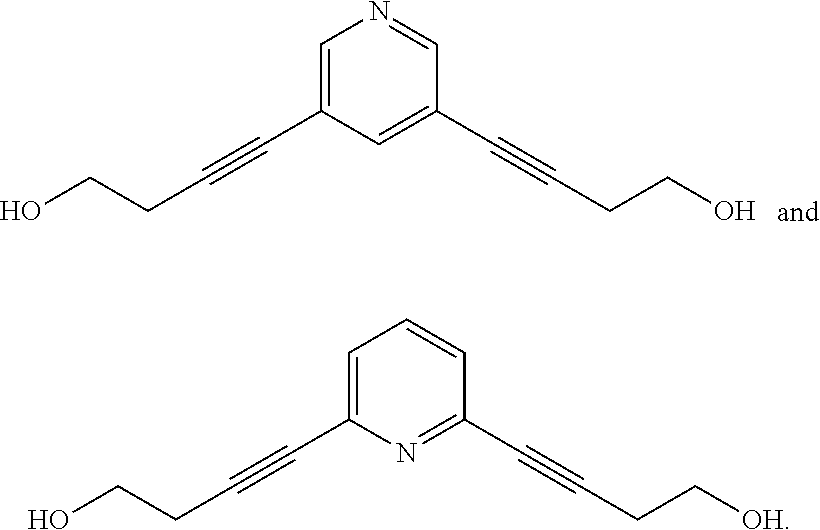
Specific pyridine-containing compounds include:

In the above reaction, Ellagic acid is reacted with a primary amine-substituted pyridine compound (XRNH2) to form bis-pyridine derivatives.

wherein X is selected from a pyridyl group (2-, 3-, or 4-pyridyl group).

In the above reaction, a coumarin is reacted with a primary amine-substituted pyridine compounds to form a pyridine-substituted coumarin derivative.

wherein (i) X is a 4-pyridyl group and R is methylene, ethylene, or a propylene, or (ii) X is a 3-pyridyl group and R is a methylene;

wherein X is a 4-pyridyl group and R is ethylene; and

wherein X is a 4-pyridyl group and R is ethylene.
| Materials |
| Material | Source |
| Acetonitrile | EMD Chemicals, Inc.; Gibbstown, NJ |
| 4-Acetylpyridine | Sigma Aldrich; St. Louis, MO |
| 4-(2-Aminoethyl)pyridine | TCI America; Portland, OR |
| Aminoguanidine sulfate | Alfa Aesar; Ward Hil, MA |
| Bis(triphenylphosphine) | TCI America; Portland, OR |
| palladium(II) dichloride | |
| 3-Butyn-1-ol | Sigma Aldrich; St. Louis, MO |
| Copper (I) iodide | Sigma Aldrich; St. Louis, MO |
| Dichloromethane | EMD Chemicals, Inc.; Gibbstown, NJ |
| 2,6-Dichloropyrazine | Sigma Aldrich; St. Louis, MO |
| 7,8-Dihydroxy-4- | Sigma Aldrich; St. Louis, MO |
| methylcoumarin | |
| Ellagic acid | AmplaChem, Inc.; Carmel, IN |
| Ethyl acetate | EMD Chemicals, Inc.; Gibbstown, NJ |
| Hexane | EMD Chemicals, Inc.; Gibbstown, NJ |
| Silica gel (230-400 Mesh) | Alfa Aesar; Ward Hil, MA |
| Tetrahydrofuran | EMD Chemicals, Inc.; Gibbstown, NJ |
| Triethylamine | EMD Chemicals, Inc.; Gibbstown, NJ |
| NMR: Nuclear magnetic resonance spectra (proton - 1H NMR) were analyzed and recorded using an NMR spectrometer (UltraShield ™Plus 500 MHz NMR spectrometer; Bruker Corporation; Billerica, MA). | |


Claims (1)


Priority Applications (1)
| Application Number | Priority Date | Filing Date | Title |
|---|---|---|---|
| US14/781,946 US9403780B2 (en) | 2013-05-14 | 2014-04-23 | Pyridine- or pyrazine-containing compounds |
Applications Claiming Priority (3)
| Application Number | Priority Date | Filing Date | Title |
|---|---|---|---|
| US201361822939P | 2013-05-14 | 2013-05-14 | |
| PCT/US2014/035132 WO2014186101A1 (en) | 2013-05-14 | 2014-04-23 | Pyridine- or pyrazine-containing compounds |
| US14/781,946 US9403780B2 (en) | 2013-05-14 | 2014-04-23 | Pyridine- or pyrazine-containing compounds |
Publications (2)
| Publication Number | Publication Date |
|---|---|
| US20160052893A1 US20160052893A1 (en) | 2016-02-25 |
| US9403780B2 true US9403780B2 (en) | 2016-08-02 |
Family
ID=51898779
Family Applications (1)
| Application Number | Title | Priority Date | Filing Date |
|---|---|---|---|
| US14/781,946 Active US9403780B2 (en) | 2013-05-14 | 2014-04-23 | Pyridine- or pyrazine-containing compounds |
Country Status (6)
| Country | Link |
|---|---|
| US (1) | US9403780B2 (en) |
| EP (1) | EP2997013A4 (en) |
| JP (1) | JP6336579B2 (en) |
| KR (1) | KR20160007581A (en) |
| CN (1) | CN105209435B (en) |
| WO (1) | WO2014186101A1 (en) |
Families Citing this family (3)
| Publication number | Priority date | Publication date | Assignee | Title |
|---|---|---|---|---|
| KR101885703B1 (en) | 2013-05-14 | 2018-08-06 | 쓰리엠 이노베이티브 프로퍼티즈 컴파니 | Epoxy resins comprising a pyrazine-containing compound |
| CN104299614B (en) | 2013-07-16 | 2017-12-29 | 华为技术有限公司 | Decoding method and decoding device |
| US10927070B2 (en) * | 2016-06-09 | 2021-02-23 | Cedars-Sinai Medical Center | Compositions and methods for treating cancer |
Citations (4)
| Publication number | Priority date | Publication date | Assignee | Title |
|---|---|---|---|---|
| US4122128A (en) | 1977-01-07 | 1978-10-24 | Ciba-Geigy Corporation | Storable rapidly hardening epoxy resin adhesive |
| US20090215785A1 (en) | 2008-02-25 | 2009-08-27 | Dubois Daisy Joe | Pyrrolopyrazine kinase inhibitors |
| KR20100114094A (en) | 2008-02-25 | 2010-10-22 | 에프. 호프만-라 로슈 아게 | Pyrrolopyrazine kinase inhibitors |
| WO2014186151A1 (en) | 2013-05-14 | 2014-11-20 | 3M Innovative Properties Company | Epoxy resins comprising a pyrazine-containing compound |
Family Cites Families (4)
| Publication number | Priority date | Publication date | Assignee | Title |
|---|---|---|---|---|
| JPS5892661A (en) * | 1981-11-30 | 1983-06-02 | Japan Synthetic Rubber Co Ltd | Preparation of diethynylpyridine |
| EP1368317B1 (en) * | 2001-02-21 | 2006-12-27 | Altana Pharma AG | Tryptase inhibitors |
| WO2010110353A1 (en) * | 2009-03-25 | 2010-09-30 | 味の素株式会社 | Novel amide derivative and skin whitening agent |
| CN102010347B (en) * | 2010-11-19 | 2014-08-06 | 西安交通大学 | Biphenyl compound serving as antitumor medicament and preparation method thereof |
-
2014
- 2014-04-23 US US14/781,946 patent/US9403780B2/en active Active
- 2014-04-23 CN CN201480027192.3A patent/CN105209435B/en active Active
- 2014-04-23 JP JP2016513962A patent/JP6336579B2/en active Active
- 2014-04-23 KR KR1020157034874A patent/KR20160007581A/en not_active Withdrawn
- 2014-04-23 EP EP14798345.6A patent/EP2997013A4/en not_active Withdrawn
- 2014-04-23 WO PCT/US2014/035132 patent/WO2014186101A1/en not_active Ceased
Patent Citations (4)
| Publication number | Priority date | Publication date | Assignee | Title |
|---|---|---|---|---|
| US4122128A (en) | 1977-01-07 | 1978-10-24 | Ciba-Geigy Corporation | Storable rapidly hardening epoxy resin adhesive |
| US20090215785A1 (en) | 2008-02-25 | 2009-08-27 | Dubois Daisy Joe | Pyrrolopyrazine kinase inhibitors |
| KR20100114094A (en) | 2008-02-25 | 2010-10-22 | 에프. 호프만-라 로슈 아게 | Pyrrolopyrazine kinase inhibitors |
| WO2014186151A1 (en) | 2013-05-14 | 2014-11-20 | 3M Innovative Properties Company | Epoxy resins comprising a pyrazine-containing compound |
Non-Patent Citations (5)
| Title |
|---|
| Chen, "Amphiphatic Piperazine, Pyrazine, and Pyridine Derivaties as the Thermal Latency for Epoxy-Phenolic Resins", Polymer Journal, 2009, vol. 41, No. 8, pp. 685-690. |
| Goto, "Single-Site Modifications and Their Effect on the Folding Stability of m-Phenylene Ethynylene Oligomers", Organic letters. Feb. 2004, vol. 6, No. 6, pp. 889-892. |
| International Search Report for PCT International Application No. PCT/US2014/035132, mailed on Oct. 7, 2014, 6pgs. |
| Jean, "Stereoselective access to heteroarylmethylenesubstituted pyrrolidines: fully organocatalytic Mannich-hydroamination reactions", Chemical Communications, Jan. 2013, vol. 49, pp. 1651-1653. |
| Nakamura, Bimodal chemiluminescence of 8-chlorostyryl-6-phenylethynylimidazopyrazinone: Large bathochromic shift caused by a styryl group at 8-position, Tetrahedron Letters, 1998. vol. 39, pp. 301-304. |
Also Published As
| Publication number | Publication date |
|---|---|
| EP2997013A1 (en) | 2016-03-23 |
| WO2014186101A1 (en) | 2014-11-20 |
| EP2997013A4 (en) | 2017-03-22 |
| JP2016522198A (en) | 2016-07-28 |
| CN105209435A (en) | 2015-12-30 |
| US20160052893A1 (en) | 2016-02-25 |
| KR20160007581A (en) | 2016-01-20 |
| JP6336579B2 (en) | 2018-06-06 |
| CN105209435B (en) | 2018-02-02 |
Similar Documents
| Publication | Publication Date | Title |
|---|---|---|
| US8586742B2 (en) | Process for preparing amines from alcohols and ammonia | |
| US8598351B2 (en) | Phospho-amino pincer-type ligands and catalytic metal complexes thereof | |
| CN112739689B (en) | Fluorine-containing pyrimidine compound and method for producing the same | |
| US9403780B2 (en) | Pyridine- or pyrazine-containing compounds | |
| CN104341457B (en) | A kind of 1,2,3 triazole functionalization N-heterocyclic carbine double-core nickel compounds and preparation method thereof | |
| CN102381950A (en) | Catalytic oxidation method for preparing vanillin | |
| US20060287544A1 (en) | Nucleophilic heterocyclic carbene derivatives of Pd(acac)2 for cross-coupling reactions | |
| EP3016922A1 (en) | Method for the methylation of nitrogen-containing organic compounds | |
| US11498901B2 (en) | Hydrogenation of imines with Ru complexes | |
| US20100234607A1 (en) | Process for preparing 2-amino-4- (haloalkyl) pyridine derivatives by cyclizing suitable nitrile precursors with nitrogen compounds | |
| CN111100147B (en) | Synthesis method of copper-nitrogen heterocyclic carbene complex catalyst | |
| US20100004443A1 (en) | Linear pyridazine and pyrrole compounds, method for obtaining them and applications | |
| US10093692B2 (en) | Phosphines, synthesis thereof and their use in catalysis | |
| KR102399171B1 (en) | Copper catalyst compound, method for producing same, and method for producing triazole compound using the same | |
| CN104230752B (en) | A kind of preparation method of 2,4,4,4-tetrachloro butyronitrile | |
| US20100280253A1 (en) | Production method of 6-halogeno-3-arylpyridine derivative | |
| CN101531621A (en) | Method for preparing guanidine compound | |
| CN104230751A (en) | Method for synthesizing 2,4,4,4-tetrachlorobutyronitrile | |
| CN115108980B (en) | A kind of preparation method of No. 4 acylated derivatives of 2-methylquinoline compound | |
| KR101922520B1 (en) | Novel absorbent and catalyst for CO2 capture and conversion | |
| CN119707848B (en) | Water-containing salicylaldehyde diamine oxazoline compound and metal complex thereof, and preparation method and application thereof | |
| US12441700B2 (en) | Hydrogenation of imines with RU complexes | |
| CN108774137B (en) | Method for catalytically synthesizing secondary amine compound by dinuclear manganese complex | |
| JP2018140985A (en) | Method for production of aromatic compound | |
| Jain et al. | Synthesis and characterization of 2, 7-bis (2-pyridyl)-1, 8-diazaanthraquinone—A redox-active ligand designed for the construction of supramolecular grids |
Legal Events
| Date | Code | Title | Description |
|---|---|---|---|
| AS | Assignment |
Owner name: 3M INNOVATIVE PROPERTIES COMPANY, MINNESOTA Free format text: ASSIGNMENT OF ASSIGNORS INTEREST;ASSIGNOR:MOSER, WILLIAM H.;REEL/FRAME:036709/0843 Effective date: 20150924 |
|
| STCF | Information on status: patent grant |
Free format text: PATENTED CASE |
|
| MAFP | Maintenance fee payment |
Free format text: PAYMENT OF MAINTENANCE FEE, 4TH YEAR, LARGE ENTITY (ORIGINAL EVENT CODE: M1551); ENTITY STATUS OF PATENT OWNER: LARGE ENTITY Year of fee payment: 4 |
|
| MAFP | Maintenance fee payment |
Free format text: PAYMENT OF MAINTENANCE FEE, 8TH YEAR, LARGE ENTITY (ORIGINAL EVENT CODE: M1552); ENTITY STATUS OF PATENT OWNER: LARGE ENTITY Year of fee payment: 8 |