US937726A - Machine and process for treating fabric belts. - Google Patents
Machine and process for treating fabric belts. Download PDFInfo
- Publication number
- US937726A US937726A US44624208A US1908446242A US937726A US 937726 A US937726 A US 937726A US 44624208 A US44624208 A US 44624208A US 1908446242 A US1908446242 A US 1908446242A US 937726 A US937726 A US 937726A
- Authority
- US
- United States
- Prior art keywords
- belt
- rolls
- series
- machine
- fabric belts
- Prior art date
- Legal status (The legal status is an assumption and is not a legal conclusion. Google has not performed a legal analysis and makes no representation as to the accuracy of the status listed.)
- Expired - Lifetime
Links
- 238000000034 method Methods 0.000 title description 8
- 239000004744 fabric Substances 0.000 title description 6
- 239000011248 coating agent Substances 0.000 description 4
- 238000000576 coating method Methods 0.000 description 4
- 238000001816 cooling Methods 0.000 description 4
- 238000001035 drying Methods 0.000 description 4
- 239000012530 fluid Substances 0.000 description 3
- 239000000463 material Substances 0.000 description 3
- 238000007790 scraping Methods 0.000 description 3
- 239000004575 stone Substances 0.000 description 3
- 238000010521 absorption reaction Methods 0.000 description 1
- 238000007664 blowing Methods 0.000 description 1
- 238000010438 heat treatment Methods 0.000 description 1
- 238000003825 pressing Methods 0.000 description 1
- 230000002035 prolonged effect Effects 0.000 description 1
- 230000000717 retained effect Effects 0.000 description 1
- 238000004904 shortening Methods 0.000 description 1
Images
Classifications
-
- B—PERFORMING OPERATIONS; TRANSPORTING
- B29—WORKING OF PLASTICS; WORKING OF SUBSTANCES IN A PLASTIC STATE IN GENERAL
- B29D—PRODUCING PARTICULAR ARTICLES FROM PLASTICS OR FROM SUBSTANCES IN A PLASTIC STATE
- B29D29/00—Producing belts or bands
-
- D—TEXTILES; PAPER
- D06—TREATMENT OF TEXTILES OR THE LIKE; LAUNDERING; FLEXIBLE MATERIALS NOT OTHERWISE PROVIDED FOR
- D06M—TREATMENT, NOT PROVIDED FOR ELSEWHERE IN CLASS D06, OF FIBRES, THREADS, YARNS, FABRICS, FEATHERS OR FIBROUS GOODS MADE FROM SUCH MATERIALS
- D06M15/00—Treating fibres, threads, yarns, fabrics, or fibrous goods made from such materials, with macromolecular compounds; Such treatment combined with mechanical treatment
- D06M15/19—Treating fibres, threads, yarns, fabrics, or fibrous goods made from such materials, with macromolecular compounds; Such treatment combined with mechanical treatment with synthetic macromolecular compounds
- D06M15/37—Macromolecular compounds obtained otherwise than by reactions only involving carbon-to-carbon unsaturated bonds
- D06M15/39—Aldehyde resins; Ketone resins; Polyacetals
- D06M15/423—Amino-aldehyde resins
Definitions
- r 2 is a tank provided with hollow walls 3 through which steam is circulated to provide heat for the bath.
- This bath comprises the State of Ohio, have invented certain new and useful Improvements in Machines and Processes for Treating Fabric Belts, of which I hereby, declare the following to be a full, clear, and exact description, such as will enable others skilled in the art to which it appertains to make and use the same.
- the objects of the invention are to provide mechanism and a process for treating a fabric belt with a composition which will give life and flexibility thereto and will add greatly to the gripping power thereof upon the pulley over which it passes, and thus enable the belt to make better contact with the pulleys and to, utilize its full pulling strength thereon.
- a gelatinous composition is applied to the belt, the gelatinous composition being first heated to reduce'it to a fluid condition and hence capable of absorption by the fibrousfbelt, and after being thoroughly incorporated with the belt so as to vfill the; interstices thereof is chilled and approximately dried, so as to be permanently retained therein. .1 I
- a further object of the invention is to stretch the treated belt whilestill. heated and while the belt is still moist and to immediately set and harden thencomposition in the belt so that very little if any stretching of the belt will occur while it is in use.
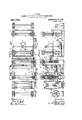
- Fig. 2 is a side elevation
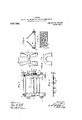
- Fig, 3 is a side elevation of the stretching rolls show-o in the sliding frame for the stretching ro ls
- Fig. 4 is a longitudinal sectionv of the :izpplicator for a shorter treatment" shown in igs land 2 and rFi' 5 is a plan View of the bottom thereof
- ig. 6 is an elevation of a double formof applicator
- Fig. 8 is an elegaflon of a rod bearing four guides for 5 6 tS. l r
- l is the roll' or drum upon gelatinous composition in which the belt is j immersed and which is reduced to a fluid state by means of the application of heat 'so that it is in condition to permeateevery part of the fabric, 4, 4 are rolls journaled in the blocks5, 5 which are secured at each end of the tank. Over these rolls the belt passes from one end of the tank to the other so as to become permeated with the fiuidcomposition.
- the frames in which the rolls are journaled are vertically movable by means of screws 6, 6, passing through the frames 7, 7 so that when the machine is stopped.
- the belt After passing'through'the bath the belt is' passed between' the edges of preferably wooden scra rs 8, 8, which remove superfluous material therefrom, and thence the belt passes between guides A adjustable by means of screws S, and through a stretching frame formed in opposite sections, 9 and 10, one oft-which is $11 mgly movable in relation to the other. Journaled in each section are the'rolls'll, 11, and 12, 12, over the process of stretching the belt is being carried on. The rolls in each section are Patented Oct. 19, 1909.
- a common operat 1 ing rod and wheel W and W and bevel gears G are employed to turn these screws.
- the movable section is provided with piston rods 16, 16 and pistons 17,517, which areforced outwardly in their respective cylinders 18, 18, by means of hydrau ic or other power, the inlet pipes being shown at 19, 19,
- gage 20 is employed to indicate the so as to consolidate and partially dry the composition thereon.
- This blast is shown to pass through the flattened conduit or tube 21, and after passing therethrough, the action of the compresslng rollers 12, 12 serves to furtherset' and consolidate the coatm and to finish the surface of the belt, an
- a very simple and efiicient method of treatin the belt and preparing it for use is obtained by means of the above described machinery and process and a finished article is produced thereby, having the qualities of flexibility and durability and it is thoroughly stretched before it is dried.
- a device for the purpose o f'treating a belt with ,a'heated composition. and; for stretching the same, a tank adapted to hold of gripping rolls and an opposed series of gripping rolls, "over which r'olls said belt passes, one series of rolls being movable relatively to the other, a stationary support for one series of rolls; a movable support for the other series of rolls, a set of cylinders upon the stationary sup ort, therefor operatively ,connecte wit said movable support, means for supplying fluid under pressure to said cylinders and means for cooling and drying saidv belt.
- a device for treating a fabric 19 It with a coating of heated comp ion, adap d to be solidified by a blast cold air in combination, a tank adapted to contain the hot composition rolls in said tank,'arranged at each end to support the belt therein, wooden scrapers at one end of the tank between which the belt travels, guide rod and guides adjustable thereon, between which said belt' is assed, a series of gripping rolls over whlch the belt passes, a slmilar series of gripping rolls opposed thereto, a device for exerting a pressure upon one series of rolls istons the. composition, a scraping device, a series 1 to separate them from the other series, while the belt is wound thereon to stretch the same,
- means for indicating the degree of pressure employed means for partially drying and solidifying the coating upon the belt, simultaneously with-stretching the same.
Landscapes
- Engineering & Computer Science (AREA)
- Chemical & Material Sciences (AREA)
- Chemical Kinetics & Catalysis (AREA)
- Textile Engineering (AREA)
- Mechanical Engineering (AREA)
- Treatment Of Fiber Materials (AREA)
Description
v F. STONE. MACHINE AND PROCESS FOR TREATING FABRIC BELTS.
APPLICATION FILED JULY 31, 1908.
937,726. Patnted 0613. 19, 1909.
2 SHEETS-QEEET 1.
F. STONE.
MACHINE AND'IROGESS FOR TREATING FABRIC BELTS.
APPLICATION FILED JULY 31, 1908.
.. Patented Oct. 19, 1909.
2 SHEETS-SHEET 2.
UNITED STATES PATENT OFFICE,
FRANK STONE, or LAKEWOOD, onro, nssrenoa 0E ONE-HALF 'ro JESSIE R. MARTIN, 0E
LAKEWOOD, 01110.
MAGHINE Ann PROCESS FOR TREATING FABRIC BELTS.
Specification of Letters Patent.
Application filed. July 81, 1908. Serial No. 446,242.
To all whom it may concern:
Be it known that I, FRANK STONE, a citizen of the United States,,and resident of Lakewood, in the county of Cuyahoga and i which the belt is wound before treatment, r 2 is a tank provided with hollow walls 3 through which steam is circulated to provide heat for the bath. This bath comprises the State of Ohio, have invented certain new and useful Improvements in Machines and Processes for Treating Fabric Belts, of which I hereby, declare the following to be a full, clear, and exact description, such as will enable others skilled in the art to which it appertains to make and use the same.
The objects of the invention are to provide mechanism and a process for treating a fabric belt with a composition which will give life and flexibility thereto and will add greatly to the gripping power thereof upon the pulley over which it passes, and thus enable the belt to make better contact with the pulleys and to, utilize its full pulling strength thereon. To accomplish these objects a gelatinous composition is applied to the belt, the gelatinous composition being first heated to reduce'it to a fluid condition and hence capable of absorption by the fibrousfbelt, and after being thoroughly incorporated with the belt so as to vfill the; interstices thereof is chilled and approximately dried, so as to be permanently retained therein. .1 I
A further object of the invention is to stretch the treated belt whilestill. heated and while the belt is still moist and to immediately set and harden thencomposition in the belt so that very little if any stretching of the belt will occur while it is in use.
The constant stretching of treated belts and the loss of time required in shortening them has heretofore occasioned much annoyance.
is a plan view 0 the complete apparatus'em- 1 ployed; Fig. 2 is a side elevation; Fig, 3 is a side elevation of the stretching rolls show-o in the sliding frame for the stretching ro ls; Fig. 4 is a longitudinal sectionv of the :izpplicator for a shorter treatment" shown in igs land 2 and rFi' 5 is a plan View of the bottom thereof; ig. 6 is an elevation of a double formof applicator; and 'Flg. 7
is a plan view thereof; Fig. 8 is an elegaflon of a rod bearing four guides for 5 6 tS. l r
In these views l is the roll' or drum upon gelatinous composition in which the belt is j immersed and which is reduced to a fluid state by means of the application of heat 'so that it is in condition to permeateevery part of the fabric, 4, 4 are rolls journaled in the blocks5, 5 which are secured at each end of the tank. Over these rolls the belt passes from one end of the tank to the other so as to become permeated with the fiuidcomposition. I
The frames in which the rolls are journaled are vertically movable by means of screws 6, 6, passing through the frames 7, 7 so that when the machine is stopped. the
rolls and belt thereon can be lifted out of thetank. Y
After passing'through'the bath the belt is' passed between' the edges of preferably wooden scra rs 8, 8, which remove superfluous material therefrom, and thence the belt passes between guides A adjustable by means of screws S, and through a stretching frame formed in opposite sections, 9 and 10, one oft-which is $11 mgly movable in relation to the other. Journaled in each section are the'rolls'll, 11, and 12, 12, over the process of stretching the belt is being carried on. The rolls in each section are Patented Oct. 19, 1909.
relativelyadjustable toward arid from each movement of the boxes. A common operat 1 ing rod and wheel W and W and bevel gears G are employed to turn these screws.
The movable section is provided with piston rods 16, 16 and pistons 17,517, which areforced outwardly in their respective cylinders 18, 18, by means of hydrau ic or other power, the inlet pipes being shown at 19, 19,
and a gage 20 is employed to indicate the so as to consolidate and partially dry the composition thereon. This blast is shown to pass through the flattened conduit or tube 21, and after passing therethrough, the action of the compresslng rollers 12, 12 serves to furtherset' and consolidate the coatm and to finish the surface of the belt, an
after the belt has been in this manner set and partially dried it is then subjected to a cold air blast for a longer period to place the treated belt in condition for industrial use.
' To accomplish the final cooling and drying of the belt it is passed over two setsof rollers 22, 22 and 23, 23 separated to expose the belt to a blast of air passing. through the blast chamber 24. -As soon as com leted the belt is wound upon. a drum 25. ower can be applied through the band wheels 27 and 28-and gears 29 and 30 upon the roller journals and in this 7 manner the belt 1s drawn through the machine,'31 is a blower which can be powerful enough to supply the air blast required. When a less prolonged treatment is requireda diflerent device for applying the hot composition is employed and is shown in the figures. In this device 40 is an elevated chamber located above the tank and having a horizontal bottom 41 perforated with openings 42. At each cnd of this chamber are journaled the rolls 43, 43 arranged one above and one below each opening 44, through which the belt can be passed for treatment. The composition is pumped up from the tank by any suitable means such as a pump 45 and is showered down upon the belt and finally escapes through the erforated bottom. In Figs. 6 and 7 a doub e form is shown of this device separating the chambers to provide for treatment of two belts simultaneously.
A very simple and efiicient method of treatin the belt and preparing it for use is obtained by means of the above described machinery and process and a finished article is produced thereby, having the qualities of flexibility and durability and it is thoroughly stretched before it is dried.
Having described the invention what I claim as new and desire to secure by Letters Patent is moving superfluous material from said belt,
a guide rod over which said belt passes, a
a pair of blades having scraping 'edges between which the belt passes to remove superfluous material, a series of ressure rolls throughawhich said-belt is rawn, and a similar series of rolls opposed thereto over which said beltpa'sses, one of said series of rolls being movable relatively tothe other series offrolls, means for applying pressure to one series of rolls, a blowing device and a passage through which said belt passes and through which the current of air from the blower passes, a blast chamber, a series of rolls therein, an opposed'series of rolls therei in over which said belt ing drum forthe belt.
passes, and awind- 3. In a device for the purpose o f'treating a belt with ,a'heated composition. and; for stretching the same, a tank adapted to hold of gripping rolls and an opposed series of gripping rolls, "over which r'olls said belt passes, one series of rolls being movable relatively to the other, a stationary support for one series of rolls; a movable support for the other series of rolls, a set of cylinders upon the stationary sup ort, therefor operatively ,connecte wit said movable support, means for supplying fluid under pressure to said cylinders and means for cooling and drying saidv belt.
4. A device for treating a fabric 19 It with a coating of heated comp ion, adap d to be solidified by a blast cold air, in combination, a tank adapted to contain the hot composition rolls in said tank,'arranged at each end to support the belt therein, wooden scrapers at one end of the tank between which the belt travels, guide rod and guides adjustable thereon, between which said belt' is assed, a series of gripping rolls over whlch the belt passes, a slmilar series of gripping rolls opposed thereto, a device for exerting a pressure upon one series of rolls istons the. composition, a scraping device, a series 1 to separate them from the other series, while the belt is wound thereon to stretch the same,
means for indicating the degree of pressure employed, means for partially drying and solidifying the coating upon the belt, simultaneously with-stretching the same.
5. The heretofore described process of treatin a fibrous belt with a composition adapte to provide flexibility anddurability thereto consisting of first heating the comment by subjecting the belt to the influence position to enable it to enter the interstices of a cooling blast. 10 of the belt and immersing the belt therein In testimony whereof I hereunto set my until coated, scraping off the superfluous hand this 19th day of July 1908.
coating, stretching the heated belt and simul- FRANK STONE. taneously' cooling and drying the same to In presence ofset and partially solidify the coating and GEO. S; COLE,
surface the same and completing the treat- WM. M. MONROE.
Priority Applications (1)
| Application Number | Priority Date | Filing Date | Title |
|---|---|---|---|
| US44624208A US937726A (en) | 1908-07-31 | 1908-07-31 | Machine and process for treating fabric belts. |
Applications Claiming Priority (1)
| Application Number | Priority Date | Filing Date | Title |
|---|---|---|---|
| US44624208A US937726A (en) | 1908-07-31 | 1908-07-31 | Machine and process for treating fabric belts. |
Publications (1)
| Publication Number | Publication Date |
|---|---|
| US937726A true US937726A (en) | 1909-10-19 |
Family
ID=3006147
Family Applications (1)
| Application Number | Title | Priority Date | Filing Date |
|---|---|---|---|
| US44624208A Expired - Lifetime US937726A (en) | 1908-07-31 | 1908-07-31 | Machine and process for treating fabric belts. |
Country Status (1)
| Country | Link |
|---|---|
| US (1) | US937726A (en) |
-
1908
- 1908-07-31 US US44624208A patent/US937726A/en not_active Expired - Lifetime
Similar Documents
| Publication | Publication Date | Title |
|---|---|---|
| US2666369A (en) | Method of making soft papers adaptable to impregnation | |
| US2721370A (en) | Machine and process for shrinking and finishing woven textile fabrics | |
| KR20150015228A (en) | Apparatus and methods for finishing textile | |
| US1893197A (en) | Method of and apparatus for treating tubular textile fabrics | |
| US2450022A (en) | Cloth finishing | |
| US3053717A (en) | Reinforced continuous sheeting and the method and apparatus for making same | |
| US2174215A (en) | Decatizing fabrics | |
| US2388392A (en) | Ironing apparatus | |
| ITUD970116A1 (en) | WET SANDING PROCEDURE FOR TEXTILE MATERIAL AND RELATED DEVICE | |
| US776532A (en) | Machine for sizing and finishing veilings or other tulles. | |
| US1306650A (en) | Emil weinheim | |
| US1854192A (en) | Process and apparatus for drying and impregnating sheet material | |
| US3076724A (en) | Method for treatment of textile materials with liquids | |
| US645237A (en) | Process of fixing the finish on cotton piece goods. | |
| US1773167A (en) | Method of and apparatus for finishing cloth | |
| US869895A (en) | Steam-table. | |
| US1471980A (en) | Felt-treating machine | |
| US886024A (en) | Ribbozine-machine. | |
| US2005407A (en) | Method of manufacturing impregnated textile belting | |
| US28202A (en) | Machistest toe | |
| US1414462A (en) | Method of and apparatus for impregnating material | |
| US1512095A (en) | Method and apparatus for rubberizing filamentary material | |
| US615045A (en) | Emmanuel pbevost | |
| US201112A (en) | Improvement in processes and apparatus for finishing cloth | |
| US1925448A (en) | Process for improving the transparency of glassine paper |