US9331284B2 - Polymer compound and light-emitting device using same - Google Patents
Polymer compound and light-emitting device using same Download PDFInfo
- Publication number
- US9331284B2 US9331284B2 US13/575,348 US201113575348A US9331284B2 US 9331284 B2 US9331284 B2 US 9331284B2 US 201113575348 A US201113575348 A US 201113575348A US 9331284 B2 US9331284 B2 US 9331284B2
- Authority
- US
- United States
- Prior art keywords
- group
- unsubstituted
- formula
- substituted
- light
- Prior art date
- Legal status (The legal status is an assumption and is not a legal conclusion. Google has not performed a legal analysis and makes no representation as to the accuracy of the status listed.)
- Expired - Fee Related, expires
Links
- 0 *[1*]C.*[2*]C.B[1*]C.B[2*]C.C1=CC=C(C2(C3=CC=CC=C3)C3=C(C=CC=C3)C3=C2/C=C\C=C/3)C=C1.CC.CC.CC.CC.[3*]C.[4*]C Chemical compound *[1*]C.*[2*]C.B[1*]C.B[2*]C.C1=CC=C(C2(C3=CC=CC=C3)C3=C(C=CC=C3)C3=C2/C=C\C=C/3)C=C1.CC.CC.CC.CC.[3*]C.[4*]C 0.000 description 24
- LMFRTSBQRLSJHC-UHFFFAOYSA-N CC1=CC(C)=CC(Br)=C1 Chemical compound CC1=CC(C)=CC(Br)=C1 LMFRTSBQRLSJHC-UHFFFAOYSA-N 0.000 description 2
- VGUUGMAOYFEOJO-UHFFFAOYSA-N CC1=CC(C)=CC(Br)=C1.CC1=CC(C)=CC(C(O)(C2=CC(C)=CC(C)=C2)C2=CC(Br)=CC=C2C2=CC=C(Br)C=C2)=C1.COC(=O)C1=CC(Br)=CC=C1C1=CC=C(Br)C=C1 Chemical compound CC1=CC(C)=CC(Br)=C1.CC1=CC(C)=CC(C(O)(C2=CC(C)=CC(C)=C2)C2=CC(Br)=CC=C2C2=CC=C(Br)C=C2)=C1.COC(=O)C1=CC(Br)=CC=C1C1=CC=C(Br)C=C1 VGUUGMAOYFEOJO-UHFFFAOYSA-N 0.000 description 2
- AGHOBCGGVSSAAU-UHFFFAOYSA-N CC1=CC(C)=CC(C2(C3=CC(C)=CC(C)=C3)C3=C(C=CC(Br)=C3)C3=C2/C=C(Br)\C=C/3)=C1 Chemical compound CC1=CC(C)=CC(C2(C3=CC(C)=CC(C)=C3)C3=C(C=CC(Br)=C3)C3=C2/C=C(Br)\C=C/3)=C1 AGHOBCGGVSSAAU-UHFFFAOYSA-N 0.000 description 2
- DCAPZGYTDXQOIH-UHFFFAOYSA-N CC1=CC(C)=CC(C2(C3=CC(C)=CC(C)=C3)C3=C(C=CC(C)=C3)C3=C2/C=C(C)\C=C/3)=C1.CC1=CC2=C(C=C1)C1=C(/C=C(C)\C=C/1)C2(C)C.CC1=CC=C(N(C2=CC=C(N(C3=CC=C(C)C=C3)C3=C(C)C=C(C(C)(C)C)C=C3C)C=C2)C2=C(C)C=C(C(C)(C)C)C=C2C)C=C1 Chemical compound CC1=CC(C)=CC(C2(C3=CC(C)=CC(C)=C3)C3=C(C=CC(C)=C3)C3=C2/C=C(C)\C=C/3)=C1.CC1=CC2=C(C=C1)C1=C(/C=C(C)\C=C/1)C2(C)C.CC1=CC=C(N(C2=CC=C(N(C3=CC=C(C)C=C3)C3=C(C)C=C(C(C)(C)C)C=C3C)C=C2)C2=C(C)C=C(C(C)(C)C)C=C2C)C=C1 DCAPZGYTDXQOIH-UHFFFAOYSA-N 0.000 description 2
- CHEUMIFUYGVODI-UHFFFAOYSA-N BrC1=CC2=C(C=C1)C1=C(/C=C(Br)\C=C/1)C2(C1=CC=C2CCC2=C1)C1=CC2=C(C=C1)CC2.CC1=CC=C(N(C2=CC=C(Br)C=C2)C2=CC3=C(C=C2)C2=C(/C=C(N(C4=CC=C(C)C=C4)C4=CC=C(Br)C=C4)\C=C/2)C3(C)C)C=C1 Chemical compound BrC1=CC2=C(C=C1)C1=C(/C=C(Br)\C=C/1)C2(C1=CC=C2CCC2=C1)C1=CC2=C(C=C1)CC2.CC1=CC=C(N(C2=CC=C(Br)C=C2)C2=CC3=C(C=C2)C2=C(/C=C(N(C4=CC=C(C)C=C4)C4=CC=C(Br)C=C4)\C=C/2)C3(C)C)C=C1 CHEUMIFUYGVODI-UHFFFAOYSA-N 0.000 description 1
- VXECELACAUNZME-UHFFFAOYSA-N BrC1=CC=C(N(C2=CC=C(Br)C=C2)C2=CC3=C(C=C2)CC3)C=C1.CC1=CC(B2OC(C)(C)C(C)(C)O2)=C(C)C=C1B1OC(C)(C)C(C)(C)O1.CCC(C)C1=CC=C(N(C2=CC=C(Br)C=C2)C2=CC=C(Br)C=C2)C=C1 Chemical compound BrC1=CC=C(N(C2=CC=C(Br)C=C2)C2=CC3=C(C=C2)CC3)C=C1.CC1=CC(B2OC(C)(C)C(C)(C)O2)=C(C)C=C1B1OC(C)(C)C(C)(C)O1.CCC(C)C1=CC=C(N(C2=CC=C(Br)C=C2)C2=CC=C(Br)C=C2)C=C1 VXECELACAUNZME-UHFFFAOYSA-N 0.000 description 1
- PXTAQWPRUWLBHB-UHFFFAOYSA-N Brc(cc1C(c2c3)(c4cc(CC5)c5cc4)c4cc(CC5)c5cc4)ccc1-c2ccc3Br Chemical compound Brc(cc1C(c2c3)(c4cc(CC5)c5cc4)c4cc(CC5)c5cc4)ccc1-c2ccc3Br PXTAQWPRUWLBHB-UHFFFAOYSA-N 0.000 description 1
- QZGLGWBNJKMJJP-SYVOYJLJSA-N C/C=C/C(=O)OCCCCC.C=C(C)C(=O)OCCCCC.C=CC(=O)CCCCC.C=CC(=O)OCCCCC Chemical compound C/C=C/C(=O)OCCCCC.C=C(C)C(=O)OCCCCC.C=CC(=O)CCCCC.C=CC(=O)OCCCCC QZGLGWBNJKMJJP-SYVOYJLJSA-N 0.000 description 1
- JATYDOWUWJMZGJ-JGEYHCJJSA-N C1=CC2=CC=N3C(=C2C=C1)C1=C(C=CC=C1)[Ir]312(C3=C(C=CC=C3)C3=C4C=CC=CC4=CC=N31)C1=C(C=CC=C1)C1=C3C=CC=CC3=CC=N12.CC(C)(C)C1=CC=C(C2=CC3=C(C=C2)[Ir]24(C5=C(C=C(C6=CC=C(C(C)(C)C)C=C6)C=C5)C5=C6C=CC=CC6=CC=N52)(C2=C(C=C(C5=CC=C(C(C)(C)C)C=C5)C=C2)C2=C5C=CC=CC5=CC=N24)N2=CC=C4C=CC=CC4=C32)C=C1.CCC1=C(CC)C2=N3C1=CC1=C(CC)C(CC)=C4/C=C5/C(CC)=C(CC)C6=N5[Pt]3(N14)N1/C(=C\2)C(CC)=C(CC)/C1=C/6 Chemical compound C1=CC2=CC=N3C(=C2C=C1)C1=C(C=CC=C1)[Ir]312(C3=C(C=CC=C3)C3=C4C=CC=CC4=CC=N31)C1=C(C=CC=C1)C1=C3C=CC=CC3=CC=N12.CC(C)(C)C1=CC=C(C2=CC3=C(C=C2)[Ir]24(C5=C(C=C(C6=CC=C(C(C)(C)C)C=C6)C=C5)C5=C6C=CC=CC6=CC=N52)(C2=C(C=C(C5=CC=C(C(C)(C)C)C=C5)C=C2)C2=C5C=CC=CC5=CC=N24)N2=CC=C4C=CC=CC4=C32)C=C1.CCC1=C(CC)C2=N3C1=CC1=C(CC)C(CC)=C4/C=C5/C(CC)=C(CC)C6=N5[Pt]3(N14)N1/C(=C\2)C(CC)=C(CC)/C1=C/6 JATYDOWUWJMZGJ-JGEYHCJJSA-N 0.000 description 1
- JKWBLDVHNXNSDS-WBDPWONWSA-L C1=CC=N2C(=C1)C1=C(C=CC=C1)[Ir]213(C2=C(C=CC=C2)C2=CC=CC=N21)C1=C(C=CC=C1)C1=CC=CC=N13.CC1=CC(C)=O[Ir]2(O1)C1=C(SC3=C1C=CC=C3)C1=N2C=CC=C1.CC1=CC2=C(C=C1)C1=CC=CC=N1[Ir]213(C2=C(C=CC(C)=C2)C2=CC=CC=N21)C1=C(C=CC(C)=C1)C1=CC=CC=N13.O=C1O[Ir]2(C3=CC(F)=CC(F)=C3C3=N2C=CC=C3)N2=CC=CC=C12 Chemical compound C1=CC=N2C(=C1)C1=C(C=CC=C1)[Ir]213(C2=C(C=CC=C2)C2=CC=CC=N21)C1=C(C=CC=C1)C1=CC=CC=N13.CC1=CC(C)=O[Ir]2(O1)C1=C(SC3=C1C=CC=C3)C1=N2C=CC=C1.CC1=CC2=C(C=C1)C1=CC=CC=N1[Ir]213(C2=C(C=CC(C)=C2)C2=CC=CC=N21)C1=C(C=CC(C)=C1)C1=CC=CC=N13.O=C1O[Ir]2(C3=CC(F)=CC(F)=C3C3=N2C=CC=C3)N2=CC=CC=C12 JKWBLDVHNXNSDS-WBDPWONWSA-L 0.000 description 1
- NMTQKNCWZVKKQJ-NZNJMXOKSA-N C=C/C=C/C.C=C/C=C/CC.C=C/C=C/CCCC.C=C/C=C/CCCCC.C=CCCCC.C=CCCCCC.C=CCCCOC1=CC=C(C)C=C1.CCCC/C=C/C=C(C)C.CCCC=C(C)C.CCCCCCCOCC1(CC)COC1.CCCCCOCC1(CC)COC1 Chemical compound C=C/C=C/C.C=C/C=C/CC.C=C/C=C/CCCC.C=C/C=C/CCCCC.C=CCCCC.C=CCCCCC.C=CCCCOC1=CC=C(C)C=C1.CCCC/C=C/C=C(C)C.CCCC=C(C)C.CCCCCCCOCC1(CC)COC1.CCCCCOCC1(CC)COC1 NMTQKNCWZVKKQJ-NZNJMXOKSA-N 0.000 description 1
- XKVWXSSQKHVMOR-UHFFFAOYSA-N C=CC1=CC(C)=CC=C1.C=CC1=CC=C(C)C=C1.C=CCCC.C=CCCC1=CC=C(C)C=C1.C=CCCCC1=CC=C(C)C=C1.CC(C)=CCCC1=CC=C(C)C=C1.CC1=CC2=C(C=C1)CC2.CC1=CC2=C(CC2)C(C)=C1.CCCCC1=CC2=C(C=C1)CC2.CCCCCC1=CC2=C(C=C1)CC2.CCCCCCC1=CC2=C(C=C1)CC2.COC1=CC(C)=CC2=C1CC2 Chemical compound C=CC1=CC(C)=CC=C1.C=CC1=CC=C(C)C=C1.C=CCCC.C=CCCC1=CC=C(C)C=C1.C=CCCCC1=CC=C(C)C=C1.CC(C)=CCCC1=CC=C(C)C=C1.CC1=CC2=C(C=C1)CC2.CC1=CC2=C(CC2)C(C)=C1.CCCCC1=CC2=C(C=C1)CC2.CCCCCC1=CC2=C(C=C1)CC2.CCCCCCC1=CC2=C(C=C1)CC2.COC1=CC(C)=CC2=C1CC2 XKVWXSSQKHVMOR-UHFFFAOYSA-N 0.000 description 1
- LABKULALQPRTLL-UHFFFAOYSA-N C=CC1=CC=C(C2(C3=CC=C(C=C)C=C3)C3=C(C=CC(C)=C3)C3=C2/C=C(C)\C=C/3)C=C1.C=CCCC1(CCC=C)C2=C(C=CC(C)=C2)C2=C1/C=C(C)\C=C/2.CC1=CC2=C(C=C1)C1=C(/C=C(C)\C=C/1)C2(C)C1=CC2=C(C=C1)CC2.CC1=CC2=C(C=C1)C1=C(/C=C(C)\C=C/1)C2(C1=CC=C2CCC2=C1)C1=CC2=C(C=C1)CC2.CC1=CC2=C(C=C1)C1=C(/C=C(C)\C=C/1)C2(CCCCCC1=CC=C2CCC2=C1)CCCCCC1=CC2=C(C=C1)CC2 Chemical compound C=CC1=CC=C(C2(C3=CC=C(C=C)C=C3)C3=C(C=CC(C)=C3)C3=C2/C=C(C)\C=C/3)C=C1.C=CCCC1(CCC=C)C2=C(C=CC(C)=C2)C2=C1/C=C(C)\C=C/2.CC1=CC2=C(C=C1)C1=C(/C=C(C)\C=C/1)C2(C)C1=CC2=C(C=C1)CC2.CC1=CC2=C(C=C1)C1=C(/C=C(C)\C=C/1)C2(C1=CC=C2CCC2=C1)C1=CC2=C(C=C1)CC2.CC1=CC2=C(C=C1)C1=C(/C=C(C)\C=C/1)C2(CCCCCC1=CC=C2CCC2=C1)CCCCCC1=CC2=C(C=C1)CC2 LABKULALQPRTLL-UHFFFAOYSA-N 0.000 description 1
- VOVNSYWFARIOGB-UHFFFAOYSA-N C=CC1=CC=C(N(C2=CC=C(C)C=C2)C2=CC=C(C)C=C2)C=C1.C=CCCC1=CC=C(N(C2=CC=C(C)C=C2)C2=CC=C(C)C=C2)C=C1.CC1=CC=C(N(C2=CC=C(C)C=C2)C2=CC=C3CCC3=C2)C=C1.CC1=CC=C(N(C2=CC=C(N(C3=CC=C(C)C=C3)C3=CC=C4CCC4=C3)C=C2)C2=CC=C3CCC3=C2)C=C1 Chemical compound C=CC1=CC=C(N(C2=CC=C(C)C=C2)C2=CC=C(C)C=C2)C=C1.C=CCCC1=CC=C(N(C2=CC=C(C)C=C2)C2=CC=C(C)C=C2)C=C1.CC1=CC=C(N(C2=CC=C(C)C=C2)C2=CC=C3CCC3=C2)C=C1.CC1=CC=C(N(C2=CC=C(N(C3=CC=C(C)C=C3)C3=CC=C4CCC4=C3)C=C2)C2=CC=C3CCC3=C2)C=C1 VOVNSYWFARIOGB-UHFFFAOYSA-N 0.000 description 1
- IMLVVPYPTDLWBO-UHFFFAOYSA-N C=CCCC1=CC=C(C2(C3=CC=C(CCC=C)C=C3)C3=C(C=CC(C)=C3)C3=C2/C=C(C)\C=C/3)C=C1.C=CCCCC1(C2=CC=C(C)C=C2)C2=C(C=CC(C)=C2)C2=C1/C=C(C)\C=C/2.C=CCCCC1(CCCC=C)C2=C(C=CC(C)=C2)C2=C1/C=C(C)\C=C/2 Chemical compound C=CCCC1=CC=C(C2(C3=CC=C(CCC=C)C=C3)C3=C(C=CC(C)=C3)C3=C2/C=C(C)\C=C/3)C=C1.C=CCCCC1(C2=CC=C(C)C=C2)C2=C(C=CC(C)=C2)C2=C1/C=C(C)\C=C/2.C=CCCCC1(CCCC=C)C2=C(C=CC(C)=C2)C2=C1/C=C(C)\C=C/2 IMLVVPYPTDLWBO-UHFFFAOYSA-N 0.000 description 1
- BOQYFQZACPVPSQ-UHFFFAOYSA-N CB1OC(C)(C)C(C)(C)O1.CB1OC2=C(C=CC=C2)O1.CB1OCCCO1.CB1OCCO1.CCOB(C)OCC.COB(C)OC Chemical compound CB1OC(C)(C)C(C)(C)O1.CB1OC2=C(C=CC=C2)O1.CB1OCCCO1.CB1OCCO1.CCOB(C)OCC.COB(C)OC BOQYFQZACPVPSQ-UHFFFAOYSA-N 0.000 description 1
- RVWPOLRHWBIIQZ-UHFFFAOYSA-N CC(C)(C)C1=CC=C(C2=CC3=C(C=C2)[Ir]24(C5=C(C=C(C6=CC=C(C(C)(C)C)C=C6)C=C5)C5=C6C=CC=CC6=CC=N52)(C2=C(C=C(C5=CC=C(C(C)(C)C)C=C5)C=C2)C2=C5C=CC=CC5=CC=N24)N2=CC=C4C=CC=CC4=C32)C=C1 Chemical compound CC(C)(C)C1=CC=C(C2=CC3=C(C=C2)[Ir]24(C5=C(C=C(C6=CC=C(C(C)(C)C)C=C6)C=C5)C5=C6C=CC=CC6=CC=N52)(C2=C(C=C(C5=CC=C(C(C)(C)C)C=C5)C=C2)C2=C5C=CC=CC5=CC=N24)N2=CC=C4C=CC=CC4=C32)C=C1 RVWPOLRHWBIIQZ-UHFFFAOYSA-N 0.000 description 1
- PZYFKCVBNAYNPL-UHFFFAOYSA-N CC1(C)C2=C(C=CC(B3OC(C)(C)C(C)(C)O3)=C2)C2=C1/C=C(B1OC(C)(C)C(C)(C)O1)\C=C/2.CCCCC1=CC=C(N2C3=C(C=C(Br)C=C3)OC3=C2C=CC(Br)=C3)C=C1 Chemical compound CC1(C)C2=C(C=CC(B3OC(C)(C)C(C)(C)O3)=C2)C2=C1/C=C(B1OC(C)(C)C(C)(C)O1)\C=C/2.CCCCC1=CC=C(N2C3=C(C=C(Br)C=C3)OC3=C2C=CC(Br)=C3)C=C1 PZYFKCVBNAYNPL-UHFFFAOYSA-N 0.000 description 1
- OTURKCIEEZDWMD-UHFFFAOYSA-N CC1(C)C2=C(C=CC(B3OCCO3)=C2)C2=C1/C=C(B1OCCO1)\C=C/2.CC1(C)C2=C(C=CC(Br)=C2)C2=C1/C=C(Br)\C=C/2.CC1=CC(C(C)(C)C)=CC(C)=C1N(C1=CC=C(Br)C=C1)C1=CC=C(N(C2=CC=C(Br)C=C2)C2=C(C)C=C(C(C)(C)C)C=C2C)C=C1 Chemical compound CC1(C)C2=C(C=CC(B3OCCO3)=C2)C2=C1/C=C(B1OCCO1)\C=C/2.CC1(C)C2=C(C=CC(Br)=C2)C2=C1/C=C(Br)\C=C/2.CC1=CC(C(C)(C)C)=CC(C)=C1N(C1=CC=C(Br)C=C1)C1=CC=C(N(C2=CC=C(Br)C=C2)C2=C(C)C=C(C(C)(C)C)C=C2C)C=C1 OTURKCIEEZDWMD-UHFFFAOYSA-N 0.000 description 1
- MKSDQVKQNLFEEB-UHFFFAOYSA-N CC1=C(C)C(C)=C(C)C2=NSN=C21.CC1=C(C)C(C)=C(C)C2=NSN=C21.CC1=CC=C(C)C2=NSN=C12.CCCCC1=CC=C(C2=C(C)C3=NSN=C3C(C)=C2C2=CC=C(CCCC)C=C2)C=C1.CCCCOC1=C(C)C2=NSN=C2C(C)=C1OCCCC.COC1=C(C)C2=NSN=C2C(C)=C1CO Chemical compound CC1=C(C)C(C)=C(C)C2=NSN=C21.CC1=C(C)C(C)=C(C)C2=NSN=C21.CC1=CC=C(C)C2=NSN=C12.CCCCC1=CC=C(C2=C(C)C3=NSN=C3C(C)=C2C2=CC=C(CCCC)C=C2)C=C1.CCCCOC1=C(C)C2=NSN=C2C(C)=C1OCCCC.COC1=C(C)C2=NSN=C2C(C)=C1CO MKSDQVKQNLFEEB-UHFFFAOYSA-N 0.000 description 1
- DCUKSDIWKHUPLH-UHFFFAOYSA-N CC1=C(C)C(C)=C(C2=CC=C(C3=C(C)C(C)=C(C)S3)C3=NSN=C23)S1.CC1=C(C)SC(C2=CC=C(C3=CC(C)=C(C)S3)C3=NSN=C23)=C1.CC1=CC(C)=C(C2=CC=C(C3=C(C)C=C(C)S3)C3=NSN=C23)S1.CC1=CC(C)=C(C2=CC=C(C3=C(C)C=C(C)S3)C3=NSN=C23)S1.CC1=CC=C(C2=C(C)C(C)=C(C3=CC=C(C)S3)C3=NSN=C32)S1.CC1=CC=C(C2=C(C)SC(C3=CC=C(C4=CC(C5=CC=C(C)C=C5)=C(C)S4)C4=NSN=C34)=C2)C=C1.CC1=CC=C(C2=CC=C(C3=CC=C(C)S3)C3=NSN=C23)S1 Chemical compound CC1=C(C)C(C)=C(C2=CC=C(C3=C(C)C(C)=C(C)S3)C3=NSN=C23)S1.CC1=C(C)SC(C2=CC=C(C3=CC(C)=C(C)S3)C3=NSN=C23)=C1.CC1=CC(C)=C(C2=CC=C(C3=C(C)C=C(C)S3)C3=NSN=C23)S1.CC1=CC(C)=C(C2=CC=C(C3=C(C)C=C(C)S3)C3=NSN=C23)S1.CC1=CC=C(C2=C(C)C(C)=C(C3=CC=C(C)S3)C3=NSN=C32)S1.CC1=CC=C(C2=C(C)SC(C3=CC=C(C4=CC(C5=CC=C(C)C=C5)=C(C)S4)C4=NSN=C34)=C2)C=C1.CC1=CC=C(C2=CC=C(C3=CC=C(C)S3)C3=NSN=C23)S1 DCUKSDIWKHUPLH-UHFFFAOYSA-N 0.000 description 1
- GDSWSGMJEBNZCW-UHFFFAOYSA-N CC1=C2C=CC=CC2=C(C2=C3C=CC=CC3=C(C)C3=C2C=CC=C3)C2=C1C=CC=C2.CC1=C2C=CC=CC2=C(C2=C3C=CC=CC3=C(C)C=C2)C=C1.CC1=CC=C(C2=CC=C(C)C=C2)C=C1.CC1=CC=C(C2=NC=C(C)C=C2)N=C1 Chemical compound CC1=C2C=CC=CC2=C(C2=C3C=CC=CC3=C(C)C3=C2C=CC=C3)C2=C1C=CC=C2.CC1=C2C=CC=CC2=C(C2=C3C=CC=CC3=C(C)C=C2)C=C1.CC1=CC=C(C2=CC=C(C)C=C2)C=C1.CC1=CC=C(C2=NC=C(C)C=C2)N=C1 GDSWSGMJEBNZCW-UHFFFAOYSA-N 0.000 description 1
- AWTWHIKYNBHGLN-UHFFFAOYSA-N CC1=CC(C(C)(C)C)=CC(C2(C3=CC(C(C)(C)C)=CC(C)=C3)C3=C(C=CC(C)=C3)C3=C2/C=C(C)\C=C/3)=C1.CC1=CC(C(C)(C)C)=CC(C2(C3=CC(C(C)(C)C)=CC(C)=C3)C3=C(C=CC(C)=C3)C3=C2/C=C(C)\C=C/3)=C1.CCCC(C)(C)C1=CC(C)=CC(C2(C3=CC(C)=CC(C(C)(C)CCC)=C3)C3=C(C=CC(C)=C3)C3=C2/C=C(C)\C=C/3)=C1.CCCCC1=CC(C(C)(C)C)=CC(C2(C3=CC(C(C)(C)C)=CC(CCCC)=C3)C3=C(C=CC(C)=C3)C3=C2/C=C(C)\C=C/3)=C1.CCCCCC1=CC(C(C)(C)CCC)=CC(C2(C3=CC(C(C)(C)CCC)=CC(CCCCC)=C3)C3=C(C=CC(C)=C3)C3=C2/C=C(C)\C=C/3)=C1 Chemical compound CC1=CC(C(C)(C)C)=CC(C2(C3=CC(C(C)(C)C)=CC(C)=C3)C3=C(C=CC(C)=C3)C3=C2/C=C(C)\C=C/3)=C1.CC1=CC(C(C)(C)C)=CC(C2(C3=CC(C(C)(C)C)=CC(C)=C3)C3=C(C=CC(C)=C3)C3=C2/C=C(C)\C=C/3)=C1.CCCC(C)(C)C1=CC(C)=CC(C2(C3=CC(C)=CC(C(C)(C)CCC)=C3)C3=C(C=CC(C)=C3)C3=C2/C=C(C)\C=C/3)=C1.CCCCC1=CC(C(C)(C)C)=CC(C2(C3=CC(C(C)(C)C)=CC(CCCC)=C3)C3=C(C=CC(C)=C3)C3=C2/C=C(C)\C=C/3)=C1.CCCCCC1=CC(C(C)(C)CCC)=CC(C2(C3=CC(C(C)(C)CCC)=CC(CCCCC)=C3)C3=C(C=CC(C)=C3)C3=C2/C=C(C)\C=C/3)=C1 AWTWHIKYNBHGLN-UHFFFAOYSA-N 0.000 description 1
- IOOZCZVCEOFDTE-UHFFFAOYSA-N CC1=CC(C(C)C)=CC(C2(C3=CC(C(C)C)=CC(C)=C3)C3=C(C=CC(C)=C3)C3=C2/C=C(C)\C=C/3)=C1.CC1=CC(C2C3CCC2CC3)=CC(C2(C3=CC(C4C5CCC4CC5)=CC(C)=C3)C3=C(C=CC(C)=C3)C3=C2/C=C(C)\C=C/3)=C1.CC1=CC(C2CCCCC2)=CC(C2(C3=CC(C4CCCCC4)=CC(C)=C3)C3=C(C=CC(C)=C3)C3=C2/C=C(C)\C=C/3)=C1.CCC(C)C1=CC(C)=CC(C2(C3=CC(C)=CC(C(C)CC)=C3)C3=C(C=CC(C)=C3)C3=C2/C=C(C)\C=C/3)=C1.CCCCC1=CC(C(C)C)=CC(C2(C3=CC(C(C)C)=CC(CCCC)=C3)C3=C(C=CC(C)=C3)C3=C2/C=C(C)\C=C/3)=C1 Chemical compound CC1=CC(C(C)C)=CC(C2(C3=CC(C(C)C)=CC(C)=C3)C3=C(C=CC(C)=C3)C3=C2/C=C(C)\C=C/3)=C1.CC1=CC(C2C3CCC2CC3)=CC(C2(C3=CC(C4C5CCC4CC5)=CC(C)=C3)C3=C(C=CC(C)=C3)C3=C2/C=C(C)\C=C/3)=C1.CC1=CC(C2CCCCC2)=CC(C2(C3=CC(C4CCCCC4)=CC(C)=C3)C3=C(C=CC(C)=C3)C3=C2/C=C(C)\C=C/3)=C1.CCC(C)C1=CC(C)=CC(C2(C3=CC(C)=CC(C(C)CC)=C3)C3=C(C=CC(C)=C3)C3=C2/C=C(C)\C=C/3)=C1.CCCCC1=CC(C(C)C)=CC(C2(C3=CC(C(C)C)=CC(CCCC)=C3)C3=C(C=CC(C)=C3)C3=C2/C=C(C)\C=C/3)=C1 IOOZCZVCEOFDTE-UHFFFAOYSA-N 0.000 description 1
- DJDPTUIENMJTRW-UHFFFAOYSA-N CC1=CC(C(C)C)=CC(C2(C3=CC(C(C)C)=CC(C)=C3)C3=C(C=CC(C)=C3)C3=C2/C=C(C)\C=C/3)=C1.CC1=CC2=C(C=C1)C1=C(/C=C(C)\C=C/1)C2(C1=CC=C(C(C)C)C(C)=C1)C1=CC(C)=C(C(C)C)C=C1.CCC(C)C1=CC=C(C2(C3=CC(C)=C(C(C)CC)C=C3)C3=C(C=CC(C)=C3)C3=C2/C=C(C)\C=C/3)C=C1C.CCCCC1=CC(C2(C3=CC(CCCC)=C(C(C)C)C=C3)C3=C(C=CC(C)=C3)C3=C2/C=C(C)\C=C/3)=CC=C1C(C)C.CCCCCC(CC)C1=CC=C(C2(C3=CC(CCCC)=C(C(CC)CCCCC)C=C3)C3=C(C=CC(C)=C3)C3=C2/C=C(C)\C=C/3)C=C1CCCC Chemical compound CC1=CC(C(C)C)=CC(C2(C3=CC(C(C)C)=CC(C)=C3)C3=C(C=CC(C)=C3)C3=C2/C=C(C)\C=C/3)=C1.CC1=CC2=C(C=C1)C1=C(/C=C(C)\C=C/1)C2(C1=CC=C(C(C)C)C(C)=C1)C1=CC(C)=C(C(C)C)C=C1.CCC(C)C1=CC=C(C2(C3=CC(C)=C(C(C)CC)C=C3)C3=C(C=CC(C)=C3)C3=C2/C=C(C)\C=C/3)C=C1C.CCCCC1=CC(C2(C3=CC(CCCC)=C(C(C)C)C=C3)C3=C(C=CC(C)=C3)C3=C2/C=C(C)\C=C/3)=CC=C1C(C)C.CCCCCC(CC)C1=CC=C(C2(C3=CC(CCCC)=C(C(CC)CCCCC)C=C3)C3=C(C=CC(C)=C3)C3=C2/C=C(C)\C=C/3)C=C1CCCC DJDPTUIENMJTRW-UHFFFAOYSA-N 0.000 description 1
- VVHKXFKWHKADKM-UHFFFAOYSA-N CC1=CC(C)=C(C)C(C)=C1.CC1=CC(C)=C(C)C(C)=C1.CC1=CC(C)=CC(C)=C1.CC1=CC(C)=CC(C)=C1.CC1=CC=C(C2=CC(C)=C(C3=CC=C(C)C=C3)C=C2C)C=C1.CC1=CC=C(C2=CC(C)=CC(C)=C2)C=C1.CC1=CC=CC(C)=C1.CC1=CC=CC(C)=C1C Chemical compound CC1=CC(C)=C(C)C(C)=C1.CC1=CC(C)=C(C)C(C)=C1.CC1=CC(C)=CC(C)=C1.CC1=CC(C)=CC(C)=C1.CC1=CC=C(C2=CC(C)=C(C3=CC=C(C)C=C3)C=C2C)C=C1.CC1=CC=C(C2=CC(C)=CC(C)=C2)C=C1.CC1=CC=CC(C)=C1.CC1=CC=CC(C)=C1C VVHKXFKWHKADKM-UHFFFAOYSA-N 0.000 description 1
- ALBLLJYWTBLPFH-UHFFFAOYSA-N CC1=CC(C)=C(C)C(C2(C3=C(C)C(C)=CC(C)=C3)C3=C(C=CC(C)=C3)C3=C2/C=C(C)\C=C/3)=C1.CC1=CC2=C(C=C1)C1=C(/C=C(C)\C=C/1)C2(C1=CC(C)=C(C)C=C1C)C1=C(C)C=C(C)C(C)=C1.CC1=CC2=C(C=C1)C1=C(/C=C(C)\C=C/1)C2(C1=CC=C(C)C(C)=C1C)C1=C(C)C(C)=C(C)C=C1.CCCCC1=C(C)C=CC(C2(C3=CC=C(C)C(CCCC)=C3C)C3=C(C=CC(C)=C3)C3=C2/C=C(C)\C=C/3)=C1C.CCCCC1=CC=C(C2(C3=C(C)C(C)=C(CCCC)C=C3)C3=C(C=CC(C)=C3)C3=C2/C=C(C)\C=C/3)C(C)=C1C Chemical compound CC1=CC(C)=C(C)C(C2(C3=C(C)C(C)=CC(C)=C3)C3=C(C=CC(C)=C3)C3=C2/C=C(C)\C=C/3)=C1.CC1=CC2=C(C=C1)C1=C(/C=C(C)\C=C/1)C2(C1=CC(C)=C(C)C=C1C)C1=C(C)C=C(C)C(C)=C1.CC1=CC2=C(C=C1)C1=C(/C=C(C)\C=C/1)C2(C1=CC=C(C)C(C)=C1C)C1=C(C)C(C)=C(C)C=C1.CCCCC1=C(C)C=CC(C2(C3=CC=C(C)C(CCCC)=C3C)C3=C(C=CC(C)=C3)C3=C2/C=C(C)\C=C/3)=C1C.CCCCC1=CC=C(C2(C3=C(C)C(C)=C(CCCC)C=C3)C3=C(C=CC(C)=C3)C3=C2/C=C(C)\C=C/3)C(C)=C1C ALBLLJYWTBLPFH-UHFFFAOYSA-N 0.000 description 1
- RXMOVYHHVKMHQX-UHFFFAOYSA-N CC1=CC(C)=C(C)C=C1.CC1=CC(C)=C(C)C=C1C.CC1=CC(C2CCCCC2)=C(C)C=C1C1CCCCC1.CC1=CC=C(C)C=C1.CCCCC1=C(C)C=CC(C)=C1.CCCCC1=CC(C)=C(CCCC)C=C1C.CCCCOC1=CC(C)=C(OCCCC)C=C1C.COC1=C(C)C=CC(C)=C1 Chemical compound CC1=CC(C)=C(C)C=C1.CC1=CC(C)=C(C)C=C1C.CC1=CC(C2CCCCC2)=C(C)C=C1C1CCCCC1.CC1=CC=C(C)C=C1.CCCCC1=C(C)C=CC(C)=C1.CCCCC1=CC(C)=C(CCCC)C=C1C.CCCCOC1=CC(C)=C(OCCCC)C=C1C.COC1=C(C)C=CC(C)=C1 RXMOVYHHVKMHQX-UHFFFAOYSA-N 0.000 description 1
- RMAWPWJAMQGRMU-UHFFFAOYSA-N CC1=CC(C)=C(C)C=C1C.CC1=CC(C)=CC(C2(C3=CC(C)=CC(C)=C3)C3=C(C=CC(C)=C3)C3=C2/C=C(C)\C=C/3)=C1.CC1=CC(C)=CC(C2(C3=CC(C)=CC(C)=C3)C3=C(C=CC(C)=C3)C3=C2/C=C(C)\C=C/3)=C1.CC1=CC(C)=CC(C2(C3=CC(C)=CC(C)=C3)C3=C(C=CC(C)=C3)C3=C2/C=C(C)\C=C/3)=C1.CC1=CC=C(N(C2=CC=C(N(C3=CC=C(C)C=C3)C3=C(C)C=C(C(C)(C)C)C=C3C)C=C2)C2=C(C)C=C(C(C)(C)C)C=C2C)C=C1.CC1=CC=C2C3=C(C=C(C)C=C3)[Ir]34(C5=C(C=CC=C5)C5=CC=CC=N53)(C3=C(C=CC=C3)C3=CC=CC=N34)N2=C1 Chemical compound CC1=CC(C)=C(C)C=C1C.CC1=CC(C)=CC(C2(C3=CC(C)=CC(C)=C3)C3=C(C=CC(C)=C3)C3=C2/C=C(C)\C=C/3)=C1.CC1=CC(C)=CC(C2(C3=CC(C)=CC(C)=C3)C3=C(C=CC(C)=C3)C3=C2/C=C(C)\C=C/3)=C1.CC1=CC(C)=CC(C2(C3=CC(C)=CC(C)=C3)C3=C(C=CC(C)=C3)C3=C2/C=C(C)\C=C/3)=C1.CC1=CC=C(N(C2=CC=C(N(C3=CC=C(C)C=C3)C3=C(C)C=C(C(C)(C)C)C=C3C)C=C2)C2=C(C)C=C(C(C)(C)C)C=C2C)C=C1.CC1=CC=C2C3=C(C=C(C)C=C3)[Ir]34(C5=C(C=CC=C5)C5=CC=CC=N53)(C3=C(C=CC=C3)C3=CC=CC=N34)N2=C1 RMAWPWJAMQGRMU-UHFFFAOYSA-N 0.000 description 1
- WNYQJAAZHJLRDF-UHFFFAOYSA-N CC1=CC(C)=C(C)C=C1C.CC1=CC=C(N(C2=CC=C(C)C=C2)C2=CC3=C(C=C2)CC3)C=C1.CCC(C)C1=CC=C(N(C2=CC=C(C)C=C2)C2=CC=C(C)C=C2)C=C1 Chemical compound CC1=CC(C)=C(C)C=C1C.CC1=CC=C(N(C2=CC=C(C)C=C2)C2=CC3=C(C=C2)CC3)C=C1.CCC(C)C1=CC=C(N(C2=CC=C(C)C=C2)C2=CC=C(C)C=C2)C=C1 WNYQJAAZHJLRDF-UHFFFAOYSA-N 0.000 description 1
- GMLPQKPBWJXTOT-UHFFFAOYSA-N CC1=CC(C)=CC(C2(C3=CC(C)=CC(C)=C3)C3=C(C(C)=CC(C)=C3)C3=C2/C=C(C)\C=C/3)=C1.CCCCC1=CC(C)=CC2=C1C1=C(/C=C(C)\C=C/1)C2(C1=CC(C)=C(CCCC)C(C)=C1)C1=CC(C)=C(CCCC)C(C)=C1.CCCCC1=CC(C)=CC2=C1C1=C(/C=C(C)\C=C/1)C2(C1=CC=C(C)C(C)=C1)C1=CC(C)=C(C)C=C1.CCCCC1=CC(CCCC)=CC(C2(C3=CC(CCCC)=CC(CCCC)=C3)C3=C(C(C)=CC(C)=C3)C3=C2/C=C(C)\C=C/3)=C1.CCCCOC1=C(C)C(C)=C(C2(C3=C(C)C(C(=O)OCC)=C(OCCCC)C(C)=C3C)C3=C(C=CC(C)=C3)C3=C2/C=C(C)\C=C/3)C(C)=C1C(=O)OCC Chemical compound CC1=CC(C)=CC(C2(C3=CC(C)=CC(C)=C3)C3=C(C(C)=CC(C)=C3)C3=C2/C=C(C)\C=C/3)=C1.CCCCC1=CC(C)=CC2=C1C1=C(/C=C(C)\C=C/1)C2(C1=CC(C)=C(CCCC)C(C)=C1)C1=CC(C)=C(CCCC)C(C)=C1.CCCCC1=CC(C)=CC2=C1C1=C(/C=C(C)\C=C/1)C2(C1=CC=C(C)C(C)=C1)C1=CC(C)=C(C)C=C1.CCCCC1=CC(CCCC)=CC(C2(C3=CC(CCCC)=CC(CCCC)=C3)C3=C(C(C)=CC(C)=C3)C3=C2/C=C(C)\C=C/3)=C1.CCCCOC1=C(C)C(C)=C(C2(C3=C(C)C(C(=O)OCC)=C(OCCCC)C(C)=C3C)C3=C(C=CC(C)=C3)C3=C2/C=C(C)\C=C/3)C(C)=C1C(=O)OCC GMLPQKPBWJXTOT-UHFFFAOYSA-N 0.000 description 1
- SJXBERRHKVOQBZ-UHFFFAOYSA-N CC1=CC(C)=CC(C2(C3=CC(C)=CC(C)=C3)C3=C(C=C(C)C=C3)C3=C2/C=C\C(C)=C/3)=C1.CC1=CC(C)=CC(C2(C3=CC(C)=CC(C)=C3)C3=C(C=C(C)C=C3)C3=C2/C=C\C(C)=C/3)=C1 Chemical compound CC1=CC(C)=CC(C2(C3=CC(C)=CC(C)=C3)C3=C(C=C(C)C=C3)C3=C2/C=C\C(C)=C/3)=C1.CC1=CC(C)=CC(C2(C3=CC(C)=CC(C)=C3)C3=C(C=C(C)C=C3)C3=C2/C=C\C(C)=C/3)=C1 SJXBERRHKVOQBZ-UHFFFAOYSA-N 0.000 description 1
- FIWKPBXMZPXATM-UHFFFAOYSA-N CC1=CC(C)=CC(C2(C3=CC(C)=CC(C)=C3)C3=C(C=CC(B4OC(C)(C)C(C)(C)O4)=C3)C3=C2/C=C(B2OC(C)(C)C(C)(C)O2)\C=C/3)=C1 Chemical compound CC1=CC(C)=CC(C2(C3=CC(C)=CC(C)=C3)C3=C(C=CC(B4OC(C)(C)C(C)(C)O4)=C3)C3=C2/C=C(B2OC(C)(C)C(C)(C)O2)\C=C/3)=C1 FIWKPBXMZPXATM-UHFFFAOYSA-N 0.000 description 1
- YENFDYIRZWTSHK-UHFFFAOYSA-N CC1=CC(C)=CC(C2(C3=CC(C)=CC(C)=C3)C3=C(C=CC(C)=C3)C3=C2/C=C(C)\C=C/3)=C1.CC1=CC(C)=CC(C2(C3=CC(C)=CC(C)=C3)C3=C(C=CC(C)=C3)C3=C2/C=C(C)\C=C/3)=C1.CC1=CC(C)=CC(C2(C3=CC(C)=CC(C)=C3)C3=C(C=CC(C)=C3)C3=C2/C=C(C)\C=C/3)=C1.CCCCC1=CC(C)=CC(C2(C3=CC(C)=CC(CCCC)=C3)C3=C(C=CC(C)=C3)C3=C2/C=C(C)\C=C/3)=C1.CCCCC1=CC(C)=CC(C2(C3=CC(C)=CC(CCCC)=C3)C3=C(C=CC(C)=C3)C3=C2/C=C(C)\C=C/3)=C1 Chemical compound CC1=CC(C)=CC(C2(C3=CC(C)=CC(C)=C3)C3=C(C=CC(C)=C3)C3=C2/C=C(C)\C=C/3)=C1.CC1=CC(C)=CC(C2(C3=CC(C)=CC(C)=C3)C3=C(C=CC(C)=C3)C3=C2/C=C(C)\C=C/3)=C1.CC1=CC(C)=CC(C2(C3=CC(C)=CC(C)=C3)C3=C(C=CC(C)=C3)C3=C2/C=C(C)\C=C/3)=C1.CCCCC1=CC(C)=CC(C2(C3=CC(C)=CC(CCCC)=C3)C3=C(C=CC(C)=C3)C3=C2/C=C(C)\C=C/3)=C1.CCCCC1=CC(C)=CC(C2(C3=CC(C)=CC(CCCC)=C3)C3=C(C=CC(C)=C3)C3=C2/C=C(C)\C=C/3)=C1 YENFDYIRZWTSHK-UHFFFAOYSA-N 0.000 description 1
- RNEJPTHUYIAPPR-UHFFFAOYSA-N CC1=CC(C)=CC(C2(C3=CC(C)=CC(C)=C3)C3=C(C=CC(C)=C3)C3=C2/C=C(C)\C=C/3)=C1.CC1=CC(C)=CC(C2(C3=CC(C)=CC(C)=C3)C3=C(C=CC(C)=C3)C3=C2/C=C(C)\C=C/3)=C1.CC1=CC2=C(C=C1)C1=C(/C=C(C)\C=C/1)C2(C1=CC=C(C)C(C)=C1)C1=CC(C)=C(C)C=C1.CCC1=CC(CC)=CC(C2(C3=CC(CC)=CC(CC)=C3)C3=C(C=CC(C)=C3)C3=C2/C=C(C)\C=C/3)=C1.CCCC1=CC(CCC)=CC(C2(C3=CC(CCC)=CC(CCC)=C3)C3=C(C=CC(C)=C3)C3=C2/C=C(C)\C=C/3)=C1.CCCCC1=CC(CCCC)=CC(C2(C3=CC(CCCC)=CC(CCCC)=C3)C3=C(C=CC(C)=C3)C3=C2/C=C(C)\C=C/3)=C1 Chemical compound CC1=CC(C)=CC(C2(C3=CC(C)=CC(C)=C3)C3=C(C=CC(C)=C3)C3=C2/C=C(C)\C=C/3)=C1.CC1=CC(C)=CC(C2(C3=CC(C)=CC(C)=C3)C3=C(C=CC(C)=C3)C3=C2/C=C(C)\C=C/3)=C1.CC1=CC2=C(C=C1)C1=C(/C=C(C)\C=C/1)C2(C1=CC=C(C)C(C)=C1)C1=CC(C)=C(C)C=C1.CCC1=CC(CC)=CC(C2(C3=CC(CC)=CC(CC)=C3)C3=C(C=CC(C)=C3)C3=C2/C=C(C)\C=C/3)=C1.CCCC1=CC(CCC)=CC(C2(C3=CC(CCC)=CC(CCC)=C3)C3=C(C=CC(C)=C3)C3=C2/C=C(C)\C=C/3)=C1.CCCCC1=CC(CCCC)=CC(C2(C3=CC(CCCC)=CC(CCCC)=C3)C3=C(C=CC(C)=C3)C3=C2/C=C(C)\C=C/3)=C1 RNEJPTHUYIAPPR-UHFFFAOYSA-N 0.000 description 1
- MRZZXRMGMWFFAY-UHFFFAOYSA-N CC1=CC(C)=CC(C2(C3=CC(C)=CC(C)=C3)C3=C(C=CC(C)=C3)C3=C2/C=C(C)\C=C/3)=C1.CC1=CC2=C(C=C1)C1=C(/C=C(C)\C=C/1)C2(C)C.CC1=CC2=C(C=C1)C1=C(/C=C(C)\C=C/1)C2(C1=CC=C2CCC2=C1)C1=CC2=C(C=C1)CC2.CC1=CC=C(N(C2=CC=C(C)C=C2)C2=CC3=C(C=C2)C2=C(/C=C(N(C4=CC=C(C)C=C4)C4=CC=C(C)C=C4)\C=C/2)C3(C)C)C=C1 Chemical compound CC1=CC(C)=CC(C2(C3=CC(C)=CC(C)=C3)C3=C(C=CC(C)=C3)C3=C2/C=C(C)\C=C/3)=C1.CC1=CC2=C(C=C1)C1=C(/C=C(C)\C=C/1)C2(C)C.CC1=CC2=C(C=C1)C1=C(/C=C(C)\C=C/1)C2(C1=CC=C2CCC2=C1)C1=CC2=C(C=C1)CC2.CC1=CC=C(N(C2=CC=C(C)C=C2)C2=CC3=C(C=C2)C2=C(/C=C(N(C4=CC=C(C)C=C4)C4=CC=C(C)C=C4)\C=C/2)C3(C)C)C=C1 MRZZXRMGMWFFAY-UHFFFAOYSA-N 0.000 description 1
- NAOCADHMCCQTEX-UHFFFAOYSA-N CC1=CC(C)=CC(C2(C3=CC(C)=CC(C)=C3)C3=C(C=CC(C)=C3)C3=C2/C=C(C)\C=C/3)=C1.CC1=CC2=C(C=C1)C1=C(/C=C(C)\C=C/1)C2(C)C.CC1=CC2=C(C=C1)C1=C(/C=C(C)\C=C/1)C2(C1=CC=C2CCC2=C1)C1=CC2=C(C=C1)CC2.CCCCC1=CC(C)=C(N(C2=CC=C(C)C=C2)C2=CC=C(N(C3=CC=C(C)C=C3)C3=C(C)C=C(CCCC)C=C3C)C=C2)C(C)=C1 Chemical compound CC1=CC(C)=CC(C2(C3=CC(C)=CC(C)=C3)C3=C(C=CC(C)=C3)C3=C2/C=C(C)\C=C/3)=C1.CC1=CC2=C(C=C1)C1=C(/C=C(C)\C=C/1)C2(C)C.CC1=CC2=C(C=C1)C1=C(/C=C(C)\C=C/1)C2(C1=CC=C2CCC2=C1)C1=CC2=C(C=C1)CC2.CCCCC1=CC(C)=C(N(C2=CC=C(C)C=C2)C2=CC=C(N(C3=CC=C(C)C=C3)C3=C(C)C=C(CCCC)C=C3C)C=C2)C(C)=C1 NAOCADHMCCQTEX-UHFFFAOYSA-N 0.000 description 1
- VRYIMCPVNMALKH-UHFFFAOYSA-N CC1=CC(C)=CC(C2(C3=CC(C)=CC(C)=C3)C3=C(C=CC(C)=C3)C3=C2/C=C(C)\C=C/3)=C1.CC1=CC2=C(C=C1)C1=C(/C=C(C)\C=C/1)C2(C)C.CCCCC1=CC=C(N2C3=C(C=C(C)C=C3)OC3=C2C=CC(C)=C3)C=C1 Chemical compound CC1=CC(C)=CC(C2(C3=CC(C)=CC(C)=C3)C3=C(C=CC(C)=C3)C3=C2/C=C(C)\C=C/3)=C1.CC1=CC2=C(C=C1)C1=C(/C=C(C)\C=C/1)C2(C)C.CCCCC1=CC=C(N2C3=C(C=C(C)C=C3)OC3=C2C=CC(C)=C3)C=C1 VRYIMCPVNMALKH-UHFFFAOYSA-N 0.000 description 1
- RGTIINRNZVIQGL-UHFFFAOYSA-N CC1=CC(C2C3CC4CC(C3)CC2C4)=CC(C2(C3=CC(C4C5CC6CC(C5)CC4C6)=CC(C)=C3)C3=C(C=CC(C)=C3)C3=C2/C=C(C)\C=C/3)=C1.CC1=CC(C2CCCCC2)=CC(C2(C3=CC(C4CCCCC4)=CC(C)=C3)C3=C(C=CC(C)=C3)C3=C2/C=C(C)\C=C/3)=C1.CCCCC1=CC(C(C)CC)=CC(C2(C3=CC(C(C)CC)=CC(CCCC)=C3)C3=C(C=CC(C)=C3)C3=C2/C=C(C)\C=C/3)=C1.CCCCC1=CC(C2CCCCC2)=CC(C2(C3=CC(C4CCCCC4)=CC(CCCC)=C3)C3=C(C=CC(C)=C3)C3=C2/C=C(C)\C=C/3)=C1 Chemical compound CC1=CC(C2C3CC4CC(C3)CC2C4)=CC(C2(C3=CC(C4C5CC6CC(C5)CC4C6)=CC(C)=C3)C3=C(C=CC(C)=C3)C3=C2/C=C(C)\C=C/3)=C1.CC1=CC(C2CCCCC2)=CC(C2(C3=CC(C4CCCCC4)=CC(C)=C3)C3=C(C=CC(C)=C3)C3=C2/C=C(C)\C=C/3)=C1.CCCCC1=CC(C(C)CC)=CC(C2(C3=CC(C(C)CC)=CC(CCCC)=C3)C3=C(C=CC(C)=C3)C3=C2/C=C(C)\C=C/3)=C1.CCCCC1=CC(C2CCCCC2)=CC(C2(C3=CC(C4CCCCC4)=CC(CCCC)=C3)C3=C(C=CC(C)=C3)C3=C2/C=C(C)\C=C/3)=C1 RGTIINRNZVIQGL-UHFFFAOYSA-N 0.000 description 1
- NMDLVCGPYXFNJX-UHFFFAOYSA-N CC1=CC(N2C3=C(C=C(C)C=C3)OC3=C2C=CC(C)=C3)=CC=C1.CC1=CC=C(N2C3=C(C=C(C)C=C3)OC3=C2C=CC(C)=C3)C=C1.CCC(C)C1=CC=C(N2C3=C(C=C(C)C=C3)OC3=C2C=CC(C)=C3)C=C1.CCCCOC1=CC=C(N2C3=C(C=C(C)C=C3)OC3=C2C=CC(C)=C3)C=C1.CCOC(=O)C1=CC=C(N2C3=C(C=C(C)C=C3)OC3=C2C=CC(C)=C3)C=C1.COC1=CC=C(N2C3=C(C=C(C)C=C3)OC3=C2C=CC(C)=C3)C=C1 Chemical compound CC1=CC(N2C3=C(C=C(C)C=C3)OC3=C2C=CC(C)=C3)=CC=C1.CC1=CC=C(N2C3=C(C=C(C)C=C3)OC3=C2C=CC(C)=C3)C=C1.CCC(C)C1=CC=C(N2C3=C(C=C(C)C=C3)OC3=C2C=CC(C)=C3)C=C1.CCCCOC1=CC=C(N2C3=C(C=C(C)C=C3)OC3=C2C=CC(C)=C3)C=C1.CCOC(=O)C1=CC=C(N2C3=C(C=C(C)C=C3)OC3=C2C=CC(C)=C3)C=C1.COC1=CC=C(N2C3=C(C=C(C)C=C3)OC3=C2C=CC(C)=C3)C=C1 NMDLVCGPYXFNJX-UHFFFAOYSA-N 0.000 description 1
- GOBZKRCNVFANMU-UHFFFAOYSA-N CC1=CC2=C(C=C1)C1=C(/C=C(C)\C=C/1)C2(C)C.CC1=CC2=C(C=C1)C1=C(/C=C(C)\C=C/1)C2(C1=CC=C2CCC2=C1)C1=CC2=C(C=C1)CC2.CC1=CC=C(N(C2=CC=C(C)C=C2)C2=CC3=C(C=C2)C2=C(/C=C(N(C4=CC=C(C)C=C4)C4=CC=C(C)C=C4)\C=C/2)C3(C)C)C=C1 Chemical compound CC1=CC2=C(C=C1)C1=C(/C=C(C)\C=C/1)C2(C)C.CC1=CC2=C(C=C1)C1=C(/C=C(C)\C=C/1)C2(C1=CC=C2CCC2=C1)C1=CC2=C(C=C1)CC2.CC1=CC=C(N(C2=CC=C(C)C=C2)C2=CC3=C(C=C2)C2=C(/C=C(N(C4=CC=C(C)C=C4)C4=CC=C(C)C=C4)\C=C/2)C3(C)C)C=C1 GOBZKRCNVFANMU-UHFFFAOYSA-N 0.000 description 1
- NGTOKRLKJSGHQG-UHFFFAOYSA-N CC1=CC2=C(C=C1)C1=C(/C=C(C)\C=C/1)C2(C)C.CC1=CC=C(N(C2=CC=C(C)C=C2)C2=CC3=C(C=C2)CC3)C=C1.CCC(C)C1=CC=C(N(C2=CC=C(C)C=C2)C2=CC=C(C)C=C2)C=C1 Chemical compound CC1=CC2=C(C=C1)C1=C(/C=C(C)\C=C/1)C2(C)C.CC1=CC=C(N(C2=CC=C(C)C=C2)C2=CC3=C(C=C2)CC3)C=C1.CCC(C)C1=CC=C(N(C2=CC=C(C)C=C2)C2=CC=C(C)C=C2)C=C1 NGTOKRLKJSGHQG-UHFFFAOYSA-N 0.000 description 1
- BAFUYTFFKSDXGM-UHFFFAOYSA-N CC1=CC2=C(C=C1)C1=C(/C=C(C)\C=C/1)C2(C)C.CC1=CC=C(N(C2=CC=C(N(C3=CC=C(C)C=C3)C3=C(C)C=C(C(C)(C)C)C=C3C)C=C2)C2=C(C)C=C(C(C)(C)C)C=C2C)C=C1 Chemical compound CC1=CC2=C(C=C1)C1=C(/C=C(C)\C=C/1)C2(C)C.CC1=CC=C(N(C2=CC=C(N(C3=CC=C(C)C=C3)C3=C(C)C=C(C(C)(C)C)C=C3C)C=C2)C2=C(C)C=C(C(C)(C)C)C=C2C)C=C1 BAFUYTFFKSDXGM-UHFFFAOYSA-N 0.000 description 1
- KRLXTFVNLIDNST-UHFFFAOYSA-N CC1=CC2=C(C=C1)C1=C(/C=C(C)\C=C/1)C2(C)C.CCCCC1=CC=C(N2C3=C(C=C(C)C=C3)OC3=C2C=CC(C)=C3)C=C1 Chemical compound CC1=CC2=C(C=C1)C1=C(/C=C(C)\C=C/1)C2(C)C.CCCCC1=CC=C(N2C3=C(C=C(C)C=C3)OC3=C2C=CC(C)=C3)C=C1 KRLXTFVNLIDNST-UHFFFAOYSA-N 0.000 description 1
- HZOVRASDYMIGFK-UHFFFAOYSA-N CC1=CC2=C(C=C1)C1=C(/C=C(C)\C=C/1)C2(C1=C(C)C(C)=C(C)C(C)=C1C)C1=C(C)C(C)=C(C)C(C)=C1C.CC1=CC2=C(C=C1)C1=C(/C=C(C)\C=C/1)C2(C1=CC(C(F)(F)F)=CC(C)=C1C)C1=C(C)C(C)=CC(C(F)(F)F)=C1.CCCCC1=C(C)C(C)=C(C2(C3=C(C)C(C)=C(CCCC)C(C)=C3C)C3=C(C=CC(C)=C3)C3=C2/C=C(C)\C=C/3)C(C)=C1C.CCCCC1=C(C)C(C2(C3=C(C)C(CCCC)=C(CCCC)C(CCCC)=C3C)C3=C(C=CC(C)=C3)C3=C2/C=C(C)\C=C/3)=C(C)C(CCCC)=C1CCCC.CCCCC1=CC(C(F)(F)F)=CC(C2(C3=CC(C(F)(F)F)=CC(CCCC)=C3C)C3=C(C=CC(C)=C3)C3=C2/C=C(C)\C=C/3)=C1C Chemical compound CC1=CC2=C(C=C1)C1=C(/C=C(C)\C=C/1)C2(C1=C(C)C(C)=C(C)C(C)=C1C)C1=C(C)C(C)=C(C)C(C)=C1C.CC1=CC2=C(C=C1)C1=C(/C=C(C)\C=C/1)C2(C1=CC(C(F)(F)F)=CC(C)=C1C)C1=C(C)C(C)=CC(C(F)(F)F)=C1.CCCCC1=C(C)C(C)=C(C2(C3=C(C)C(C)=C(CCCC)C(C)=C3C)C3=C(C=CC(C)=C3)C3=C2/C=C(C)\C=C/3)C(C)=C1C.CCCCC1=C(C)C(C2(C3=C(C)C(CCCC)=C(CCCC)C(CCCC)=C3C)C3=C(C=CC(C)=C3)C3=C2/C=C(C)\C=C/3)=C(C)C(CCCC)=C1CCCC.CCCCC1=CC(C(F)(F)F)=CC(C2(C3=CC(C(F)(F)F)=CC(CCCC)=C3C)C3=C(C=CC(C)=C3)C3=C2/C=C(C)\C=C/3)=C1C HZOVRASDYMIGFK-UHFFFAOYSA-N 0.000 description 1
- GEHRVXVDFGQSPV-UHFFFAOYSA-N CC1=CC2=C(C=C1)C1=C(/C=C(C)\C=C/1)C2(C1=C(C)C=C(C(C)C)C=C1C)C1=C(C)C=C(C(C)C)C=C1C.CC1=CC2=C(C=C1)C1=C(/C=C(C)\C=C/1)C2(C1=C(C)C=C(C2CCCCC2)C=C1C)C1=C(C)C=C(C2CCCCC2)C=C1C.CC1=CC2=C(C=C1)C1=C(/C=C(C)\C=C/1)C2(C1=CC(C)=C(C)C(C)=C1)C1=CC(C)=C(C)C(C)=C1.CC1=CC2=C(C=C1)C1=C(/C=C(C)\C=C/1)C2(C1=CC(C)=C(C)C(C)=C1)C1=CC(C)=C(C)C(C)=C1.CCCC1=CC(C)=C(C2(C3=C(C)C=C(CCC)C=C3C)C3=C(C=CC(C)=C3)C3=C2/C=C(C)\C=C/3)C(C)=C1 Chemical compound CC1=CC2=C(C=C1)C1=C(/C=C(C)\C=C/1)C2(C1=C(C)C=C(C(C)C)C=C1C)C1=C(C)C=C(C(C)C)C=C1C.CC1=CC2=C(C=C1)C1=C(/C=C(C)\C=C/1)C2(C1=C(C)C=C(C2CCCCC2)C=C1C)C1=C(C)C=C(C2CCCCC2)C=C1C.CC1=CC2=C(C=C1)C1=C(/C=C(C)\C=C/1)C2(C1=CC(C)=C(C)C(C)=C1)C1=CC(C)=C(C)C(C)=C1.CC1=CC2=C(C=C1)C1=C(/C=C(C)\C=C/1)C2(C1=CC(C)=C(C)C(C)=C1)C1=CC(C)=C(C)C(C)=C1.CCCC1=CC(C)=C(C2(C3=C(C)C=C(CCC)C=C3C)C3=C(C=CC(C)=C3)C3=C2/C=C(C)\C=C/3)C(C)=C1 GEHRVXVDFGQSPV-UHFFFAOYSA-N 0.000 description 1
- SPDIWUWOWBEMRP-UHFFFAOYSA-N CC1=CC2=C(C=C1)C1=C(/C=C(C)\C=C/1)C2(C1=C(C)C=CC(C)=C1C)C1=C(C)C(C)=CC=C1C.CC1=CC2=C(C=C1)C1=C(/C=C(C)\C=C/1)C2(C1=CC(C(C)(C)C)=C(C)C=C1C)C1=C(C)C=C(C)C(C(C)(C)C)=C1.CC1=CC2=C(C=C1)C1=C(/C=C(C)\C=C/1)C2(C1=CC(C)=C(C(C)C)C=C1C)C1=C(C)C=C(C(C)C)C(C)=C1.CC1=CC2=C(C=C1)C1=C(/C=C(C)\C=C/1)C2(C1=CC(C)=C(C)C(C)=C1)C1=CC(C)=C(C)C(C)=C1.CC1=CC2=C(C=C1)C1=C(/C=C(C)\C=C/1)C2(C1=CC(C)=C(C)C=C1C)C1=C(C)C=C(C)C(C)=C1 Chemical compound CC1=CC2=C(C=C1)C1=C(/C=C(C)\C=C/1)C2(C1=C(C)C=CC(C)=C1C)C1=C(C)C(C)=CC=C1C.CC1=CC2=C(C=C1)C1=C(/C=C(C)\C=C/1)C2(C1=CC(C(C)(C)C)=C(C)C=C1C)C1=C(C)C=C(C)C(C(C)(C)C)=C1.CC1=CC2=C(C=C1)C1=C(/C=C(C)\C=C/1)C2(C1=CC(C)=C(C(C)C)C=C1C)C1=C(C)C=C(C(C)C)C(C)=C1.CC1=CC2=C(C=C1)C1=C(/C=C(C)\C=C/1)C2(C1=CC(C)=C(C)C(C)=C1)C1=CC(C)=C(C)C(C)=C1.CC1=CC2=C(C=C1)C1=C(/C=C(C)\C=C/1)C2(C1=CC(C)=C(C)C=C1C)C1=C(C)C=C(C)C(C)=C1 SPDIWUWOWBEMRP-UHFFFAOYSA-N 0.000 description 1
- MPCSUKZSNWKRTE-UHFFFAOYSA-N CC1=CC2=C(C=C1)C1=C(/C=C(C)\C=C/1)C2(C1=C(C)C=CC=C1C)C1=C(C)C=CC=C1C.CC1=CC2=C(C=C1)C1=C(/C=C(C)\C=C/1)C2(C1=CC=C(C)C(C)=C1)C1=CC(C)=C(C)C=C1.CC1=CC=C(C)C(C2(C3=C(C)C=CC(C)=C3)C3=C(C=CC(C)=C3)C3=C2/C=C(C)\C=C/3)=C1.CCC1=CC=CC(C)=C1C1(C2=C(CC)C=CC=C2C)C2=C(C=CC(C)=C2)C2=C1/C=C(C)\C=C/2.CCCCC1=CC=CC(C)=C1C1(C2=C(CCCC)C=CC=C2C)C2=C(C=CC(C)=C2)C2=C1/C=C(C)\C=C/2.CCCCC1=CC=CC(CCCC)=C1C1(C2=C(CCCC)C=CC=C2CCCC)C2=C(C=CC(C)=C2)C2=C1/C=C(C)\C=C/2 Chemical compound CC1=CC2=C(C=C1)C1=C(/C=C(C)\C=C/1)C2(C1=C(C)C=CC=C1C)C1=C(C)C=CC=C1C.CC1=CC2=C(C=C1)C1=C(/C=C(C)\C=C/1)C2(C1=CC=C(C)C(C)=C1)C1=CC(C)=C(C)C=C1.CC1=CC=C(C)C(C2(C3=C(C)C=CC(C)=C3)C3=C(C=CC(C)=C3)C3=C2/C=C(C)\C=C/3)=C1.CCC1=CC=CC(C)=C1C1(C2=C(CC)C=CC=C2C)C2=C(C=CC(C)=C2)C2=C1/C=C(C)\C=C/2.CCCCC1=CC=CC(C)=C1C1(C2=C(CCCC)C=CC=C2C)C2=C(C=CC(C)=C2)C2=C1/C=C(C)\C=C/2.CCCCC1=CC=CC(CCCC)=C1C1(C2=C(CCCC)C=CC=C2CCCC)C2=C(C=CC(C)=C2)C2=C1/C=C(C)\C=C/2 MPCSUKZSNWKRTE-UHFFFAOYSA-N 0.000 description 1
- AKNHRDXAYJOZFX-UHFFFAOYSA-N CC1=CC2=C(C=C1)C1=C(/C=C(C)\C=C/1)C2(C1=CC(C(C(C)C)C(C)C)=CC(C(C(C)C)C(C)C)=C1)C1=CC(C(C(C)C)C(C)C)=CC(C(C(C)C)C(C)C)=C1.CC1=CC2=C(C=C1)C1=C(/C=C(C)\C=C/1)C2(C1=CC(C(C)C)=CC(C(C)C)=C1)C1=CC(C(C)C)=CC(C(C)C)=C1.CC1=CC2=C(C=C1)C1=C(/C=C(C)\C=C/1)C2(C1=CC(C2CCCCC2)=CC(C2CCCCC2)=C1)C1=CC(C2CCCCC2)=CC(C2CCCCC2)=C1.CCC(C)C1=CC(C(C)CC)=CC(C2(C3=CC(C(C)CC)=CC(C(C)CC)=C3)C3=C(C=CC(C)=C3)C3=C2/C=C(C)\C=C/3)=C1.CCCCCC1=CC(C2C3CC4CC(C3)CC2C4)=CC(C2(C3=CC(C4C5CC6CC(C5)CC4C6)=CC(CCCCC)=C3)C3=C(C=CC(C)=C3)C3=C2/C=C(C)\C=C/3)=C1 Chemical compound CC1=CC2=C(C=C1)C1=C(/C=C(C)\C=C/1)C2(C1=CC(C(C(C)C)C(C)C)=CC(C(C(C)C)C(C)C)=C1)C1=CC(C(C(C)C)C(C)C)=CC(C(C(C)C)C(C)C)=C1.CC1=CC2=C(C=C1)C1=C(/C=C(C)\C=C/1)C2(C1=CC(C(C)C)=CC(C(C)C)=C1)C1=CC(C(C)C)=CC(C(C)C)=C1.CC1=CC2=C(C=C1)C1=C(/C=C(C)\C=C/1)C2(C1=CC(C2CCCCC2)=CC(C2CCCCC2)=C1)C1=CC(C2CCCCC2)=CC(C2CCCCC2)=C1.CCC(C)C1=CC(C(C)CC)=CC(C2(C3=CC(C(C)CC)=CC(C(C)CC)=C3)C3=C(C=CC(C)=C3)C3=C2/C=C(C)\C=C/3)=C1.CCCCCC1=CC(C2C3CC4CC(C3)CC2C4)=CC(C2(C3=CC(C4C5CC6CC(C5)CC4C6)=CC(CCCCC)=C3)C3=C(C=CC(C)=C3)C3=C2/C=C(C)\C=C/3)=C1 AKNHRDXAYJOZFX-UHFFFAOYSA-N 0.000 description 1
- QVIPGNBZIVRTID-UHFFFAOYSA-N CC1=CC2=C(C=C1)C1=C(/C=C(C)\C=C/1)C2(C1=CC(C(C)(C)C)=CC(C(C)(C)C(C)C)=C1)C1=CC(C(C)(C)C(C)C)=CC(C(C)(C)C)=C1.CC1=CC2=C(C=C1)C1=C(/C=C(C)\C=C/1)C2(C1=CC(C(C)(C)C)=CC(C(C)(C)C)=C1)C1=CC(C(C)(C)C)=CC(C(C)(C)C)=C1.CC1=CC2=C(C=C1)C1=C(/C=C(C)\C=C/1)C2(C1=CC(C(C)C)=CC(C(C)(C)C(C)C)=C1)C1=CC(C(C)(C)C(C)C)=CC(C(C)C)=C1.CC1=CC2=C(C=C1)C1=C(/C=C(C)\C=C/1)C2(C1=CC(C(C)C)=CC(C(C)(C)C)=C1)C1=CC(C(C)(C)C)=CC(C(C)C)=C1.CC1=CC2=C(C=C1)C1=C(/C=C(C)\C=C/1)C2(C1=CC(C2CCCCC2)=CC(C(C)(C)C)=C1)C1=CC(C(C)(C)C)=CC(C2CCCCC2)=C1 Chemical compound CC1=CC2=C(C=C1)C1=C(/C=C(C)\C=C/1)C2(C1=CC(C(C)(C)C)=CC(C(C)(C)C(C)C)=C1)C1=CC(C(C)(C)C(C)C)=CC(C(C)(C)C)=C1.CC1=CC2=C(C=C1)C1=C(/C=C(C)\C=C/1)C2(C1=CC(C(C)(C)C)=CC(C(C)(C)C)=C1)C1=CC(C(C)(C)C)=CC(C(C)(C)C)=C1.CC1=CC2=C(C=C1)C1=C(/C=C(C)\C=C/1)C2(C1=CC(C(C)C)=CC(C(C)(C)C(C)C)=C1)C1=CC(C(C)(C)C(C)C)=CC(C(C)C)=C1.CC1=CC2=C(C=C1)C1=C(/C=C(C)\C=C/1)C2(C1=CC(C(C)C)=CC(C(C)(C)C)=C1)C1=CC(C(C)(C)C)=CC(C(C)C)=C1.CC1=CC2=C(C=C1)C1=C(/C=C(C)\C=C/1)C2(C1=CC(C2CCCCC2)=CC(C(C)(C)C)=C1)C1=CC(C(C)(C)C)=CC(C2CCCCC2)=C1 QVIPGNBZIVRTID-UHFFFAOYSA-N 0.000 description 1
- SZALXAAFHWMKJA-UHFFFAOYSA-N CC1=CC2=C(C=C1)C1=C(/C=C(C)\C=C/1)C2(C1=CC(C(F)(F)F)=C(C)C=C1C)C1=C(C)C=C(C)C(C(F)(F)F)=C1.CC1=CC2=C(C=C1)C1=C(/C=C(C)\C=C/1)C2(C1=CC(C)=C(C(F)(F)F)C=C1C)C1=C(C)C=C(C(F)(F)F)C(C)=C1.CCCCC1=CC(OC)=CC(C2(C3=CC(OC)=CC(CCCC)=C3C)C3=C(C=CC(C)=C3)C3=C2/C=C(C)\C=C/3)=C1C.CCCCOC1=CC(C)=C(C)C(C2(C3=C(C)C(C)=CC(OCCCC)=C3)C3=C(C=CC(C)=C3)C3=C2/C=C(C)\C=C/3)=C1.CCCCOC1=CC(C)=CC(C2(C3=CC(C)=CC(OCCCC)=C3C)C3=C(C=CC(C)=C3)C3=C2/C=C(C)\C=C/3)=C1C Chemical compound CC1=CC2=C(C=C1)C1=C(/C=C(C)\C=C/1)C2(C1=CC(C(F)(F)F)=C(C)C=C1C)C1=C(C)C=C(C)C(C(F)(F)F)=C1.CC1=CC2=C(C=C1)C1=C(/C=C(C)\C=C/1)C2(C1=CC(C)=C(C(F)(F)F)C=C1C)C1=C(C)C=C(C(F)(F)F)C(C)=C1.CCCCC1=CC(OC)=CC(C2(C3=CC(OC)=CC(CCCC)=C3C)C3=C(C=CC(C)=C3)C3=C2/C=C(C)\C=C/3)=C1C.CCCCOC1=CC(C)=C(C)C(C2(C3=C(C)C(C)=CC(OCCCC)=C3)C3=C(C=CC(C)=C3)C3=C2/C=C(C)\C=C/3)=C1.CCCCOC1=CC(C)=CC(C2(C3=CC(C)=CC(OCCCC)=C3C)C3=C(C=CC(C)=C3)C3=C2/C=C(C)\C=C/3)=C1C SZALXAAFHWMKJA-UHFFFAOYSA-N 0.000 description 1
- CESBFUAMUZZEFK-UHFFFAOYSA-N CC1=CC2=C(C=C1)C1=C(/C=C(C)\C=C/1)C2(C1=CC(C)=C(C)C(C#N)=C1)C1=CC(C#N)=C(C)C(C)=C1.CCCCC1=CC(C2(C3=CC(CCCC)=C(C#N)C(CCCC)=C3)C3=C(C=CC(C)=C3)C3=C2/C=C(C)\C=C/3)=CC(CCCC)=C1C#N.CCCCC1=CC(C2(C3=CC(CCCC)=C(CCCC)C(C(=O)OCC)=C3)C3=C(C=CC(C)=C3)C3=C2/C=C(C)\C=C/3)=CC(C(=O)OCC)=C1CCCC.COC1=C(C)C(C)=C(C)C(CO)=C1C1(C2=C(CO)C(C)=C(C)C(C)=C2OC)C2=C(C=CC(C)=C2)C2=C1/C=C(C)\C=C/2.COC1=C(C)C(CO)=C(C2(C3=C(OC)C(C)=C(CO)C(C)=C3OC)C3=C(C=CC(C)=C3)C3=C2/C=C(C)\C=C/3)C(OC)=C1C Chemical compound CC1=CC2=C(C=C1)C1=C(/C=C(C)\C=C/1)C2(C1=CC(C)=C(C)C(C#N)=C1)C1=CC(C#N)=C(C)C(C)=C1.CCCCC1=CC(C2(C3=CC(CCCC)=C(C#N)C(CCCC)=C3)C3=C(C=CC(C)=C3)C3=C2/C=C(C)\C=C/3)=CC(CCCC)=C1C#N.CCCCC1=CC(C2(C3=CC(CCCC)=C(CCCC)C(C(=O)OCC)=C3)C3=C(C=CC(C)=C3)C3=C2/C=C(C)\C=C/3)=CC(C(=O)OCC)=C1CCCC.COC1=C(C)C(C)=C(C)C(CO)=C1C1(C2=C(CO)C(C)=C(C)C(C)=C2OC)C2=C(C=CC(C)=C2)C2=C1/C=C(C)\C=C/2.COC1=C(C)C(CO)=C(C2(C3=C(OC)C(C)=C(CO)C(C)=C3OC)C3=C(C=CC(C)=C3)C3=C2/C=C(C)\C=C/3)C(OC)=C1C CESBFUAMUZZEFK-UHFFFAOYSA-N 0.000 description 1
- JWPOFIVVLBZMRJ-UHFFFAOYSA-N CC1=CC2=C(C=C1)C1=C(/C=C(C)\C=C/1)C2(C1=CC(C)=C(C)C(C)=C1)C1=CC(C)=C(C)C(C)=C1.CC1=CC2=C(C=C1)C1=C(/C=C(C)\C=C/1)C2(C1=CC(C)=C(C)C(C)=C1)C1=CC(C)=C(C)C(C)=C1.CCC1=CC(C2(C3=CC(CC)=C(C)C(C)=C3)C3=C(C=CC(C)=C3)C3=C2/C=C(C)\C=C/3)=CC(C)=C1C.CCC1=CC(C2(C3=CC(CC)=C(CC)C(C)=C3)C3=C(C=CC(C)=C3)C3=C2/C=C(C)\C=C/3)=CC(C)=C1CC.CCCCC1=CC(C2(C3=CC(CCCC)=C(C)C(C)=C3)C3=C(C=CC(C)=C3)C3=C2/C=C(C)\C=C/3)=CC(C)=C1C Chemical compound CC1=CC2=C(C=C1)C1=C(/C=C(C)\C=C/1)C2(C1=CC(C)=C(C)C(C)=C1)C1=CC(C)=C(C)C(C)=C1.CC1=CC2=C(C=C1)C1=C(/C=C(C)\C=C/1)C2(C1=CC(C)=C(C)C(C)=C1)C1=CC(C)=C(C)C(C)=C1.CCC1=CC(C2(C3=CC(CC)=C(C)C(C)=C3)C3=C(C=CC(C)=C3)C3=C2/C=C(C)\C=C/3)=CC(C)=C1C.CCC1=CC(C2(C3=CC(CC)=C(CC)C(C)=C3)C3=C(C=CC(C)=C3)C3=C2/C=C(C)\C=C/3)=CC(C)=C1CC.CCCCC1=CC(C2(C3=CC(CCCC)=C(C)C(C)=C3)C3=C(C=CC(C)=C3)C3=C2/C=C(C)\C=C/3)=CC(C)=C1C JWPOFIVVLBZMRJ-UHFFFAOYSA-N 0.000 description 1
- KKMFXSBKHZXUKP-UHFFFAOYSA-N CC1=CC2=C(C=C1)C1=C(/C=C(C)\C=C/1)C2(C1=CC(C)=C(C)C(C2=NC=NC=N2)=C1)C1=CC(C2=NC=NC=N2)=C(C)C(C)=C1.CC1=CC2=C(C=C1)C1=C(/C=C(C)\C=C/1)C2(C1=CC(C)=C(C)C(F)=C1)C1=CC(F)=C(C)C(C)=C1.CC1=CC2=C(C=C1)C1=C(/C=C(C)\C=C/1)C2(C1=CC(C)=C(C)C([Si](C)(C)C)=C1)C1=CC([Si](C)(C)C)=C(C)C(C)=C1.CC1=CC2=C(C=C1)C1=C(/C=C(C)\C=C/1)C2(C1=CC(C)=C(F)C(C)=C1)C1=CC(C)=C(F)C(C)=C1.CCCCC1=CC(C2(C3=CC(CCCC)=C(F)C(CCCC)=C3)C3=C(C=CC(C)=C3)C3=C2/C=C(C)\C=C/3)=CC(CCCC)=C1F Chemical compound CC1=CC2=C(C=C1)C1=C(/C=C(C)\C=C/1)C2(C1=CC(C)=C(C)C(C2=NC=NC=N2)=C1)C1=CC(C2=NC=NC=N2)=C(C)C(C)=C1.CC1=CC2=C(C=C1)C1=C(/C=C(C)\C=C/1)C2(C1=CC(C)=C(C)C(F)=C1)C1=CC(F)=C(C)C(C)=C1.CC1=CC2=C(C=C1)C1=C(/C=C(C)\C=C/1)C2(C1=CC(C)=C(C)C([Si](C)(C)C)=C1)C1=CC([Si](C)(C)C)=C(C)C(C)=C1.CC1=CC2=C(C=C1)C1=C(/C=C(C)\C=C/1)C2(C1=CC(C)=C(F)C(C)=C1)C1=CC(C)=C(F)C(C)=C1.CCCCC1=CC(C2(C3=CC(CCCC)=C(F)C(CCCC)=C3)C3=C(C=CC(C)=C3)C3=C2/C=C(C)\C=C/3)=CC(CCCC)=C1F KKMFXSBKHZXUKP-UHFFFAOYSA-N 0.000 description 1
- UAKITNKZIOTWTO-UHFFFAOYSA-N CC1=CC2=C(C=C1)C1=C(/C=C(C)\C=C/1)C2(C1=CC(C)=C(C2=CC=NC=C2)C(C)=C1)C1=CC(C)=C(C2=CC=NC=C2)C(C)=C1.CC1=CC=C(C2=CC(C3(C4=CC(C5=CC=C(C)C=C5)=C(C)C(C)=C4)C4=C(C=CC(C)=C4)C4=C3/C=C(C)\C=C/4)=CC(C)=C2C)C=C1.CCCCC1=CC(C2(C3=CC(CCCC)=C(CCCC)C(OC4=CC=CC=C4)=C3)C3=C(C=CC(C)=C3)C3=C2/C=C(C)\C=C/3)=CC(OC2=CC=CC=C2)=C1CCCC.CCCCC1=CC(C2(C3=CC(CCCC)=C(OC4=CC=CC=C4)C(CCCC)=C3)C3=C(C=CC(C)=C3)C3=C2/C=C(C)\C=C/3)=CC(CCCC)=C1OC1=CC=CC=C1.CCCCC1=CC=C(C2=C(C)C=C(C3(C4=CC(C)=C(C5=NC=C(CCCC)C=C5)C(C)=C4)C4=C(C=CC(C)=C4)C4=C3/C=C(C)\C=C/4)C=C2C)N=C1 Chemical compound CC1=CC2=C(C=C1)C1=C(/C=C(C)\C=C/1)C2(C1=CC(C)=C(C2=CC=NC=C2)C(C)=C1)C1=CC(C)=C(C2=CC=NC=C2)C(C)=C1.CC1=CC=C(C2=CC(C3(C4=CC(C5=CC=C(C)C=C5)=C(C)C(C)=C4)C4=C(C=CC(C)=C4)C4=C3/C=C(C)\C=C/4)=CC(C)=C2C)C=C1.CCCCC1=CC(C2(C3=CC(CCCC)=C(CCCC)C(OC4=CC=CC=C4)=C3)C3=C(C=CC(C)=C3)C3=C2/C=C(C)\C=C/3)=CC(OC2=CC=CC=C2)=C1CCCC.CCCCC1=CC(C2(C3=CC(CCCC)=C(OC4=CC=CC=C4)C(CCCC)=C3)C3=C(C=CC(C)=C3)C3=C2/C=C(C)\C=C/3)=CC(CCCC)=C1OC1=CC=CC=C1.CCCCC1=CC=C(C2=C(C)C=C(C3(C4=CC(C)=C(C5=NC=C(CCCC)C=C5)C(C)=C4)C4=C(C=CC(C)=C4)C4=C3/C=C(C)\C=C/4)C=C2C)N=C1 UAKITNKZIOTWTO-UHFFFAOYSA-N 0.000 description 1
- WKMONRNIJRUKST-UHFFFAOYSA-N CC1=CC2=C(C=C1)C1=C(/C=C(C)\C=C/1)C2(C1=CC(C2=CC=CC=C2)=C(C)C=C1C)C1=C(C)C=C(C)C(C2=CC=CC=C2)=C1.CCCCC1=CC=C(C2=CC(C3(C4=CC(C5=CC=C(CCCC)C=C5)=C(C)C=C4C)C4=C(C=CC(C)=C4)C4=C3/C=C(C)\C=C/4)=C(C)C=C2C)C=C1.COC1=C(C)C=C(C2(C3=C(C)C=C(CO)C(C)=C3)C3=C(C=CC(C)=C3)C3=C2/C=C(C)\C=C/3)C(C)=C1.COCCOC1=CC(C)=C(C2(C3=CC(C)=C(OCCOC)C=C3C)C3=C(C=CC(C)=C3)C3=C2/C=C(C)\C=C/3)C=C1C.COCOC1=CC(C2(C3=CC(OCOC)=C(C)C=C3C)C3=C(C=CC(C)=C3)C3=C2/C=C(C)\C=C/3)=C(C)C=C1C Chemical compound CC1=CC2=C(C=C1)C1=C(/C=C(C)\C=C/1)C2(C1=CC(C2=CC=CC=C2)=C(C)C=C1C)C1=C(C)C=C(C)C(C2=CC=CC=C2)=C1.CCCCC1=CC=C(C2=CC(C3(C4=CC(C5=CC=C(CCCC)C=C5)=C(C)C=C4C)C4=C(C=CC(C)=C4)C4=C3/C=C(C)\C=C/4)=C(C)C=C2C)C=C1.COC1=C(C)C=C(C2(C3=C(C)C=C(CO)C(C)=C3)C3=C(C=CC(C)=C3)C3=C2/C=C(C)\C=C/3)C(C)=C1.COCCOC1=CC(C)=C(C2(C3=CC(C)=C(OCCOC)C=C3C)C3=C(C=CC(C)=C3)C3=C2/C=C(C)\C=C/3)C=C1C.COCOC1=CC(C2(C3=CC(OCOC)=C(C)C=C3C)C3=C(C=CC(C)=C3)C3=C2/C=C(C)\C=C/3)=C(C)C=C1C WKMONRNIJRUKST-UHFFFAOYSA-N 0.000 description 1
- OCORMMNXZMRDJJ-UHFFFAOYSA-N CC1=CC2=C(C=C1)C1=C(/C=C(C)\C=C/1)C2(C1=CC=C(C(C)C)C(C)=C1)C1=CC(C)=C(C(C)C)C=C1.CCC(C)C1=CC=C(C2(C3=CC(C)=C(C(C)CC)C=C3)C3=C(C=CC(C)=C3)C3=C2/C=C(C)\C=C/3)C=C1C.CCCCC1=CC(C2(C3=CC(C)=CC(C)=C3)C3=C(C=CC(C)=C3)C3=C2/C=C(C)\C=C/3)=CC(C)=C1.CCCCC1=CC(C2(C3=CC(C)=CC(C)=C3)C3=C(C=CC(C)=C3)C3=C2/C=C(C)\C=C/3)=CC(C)=C1.CCCCCC(CC)C1=CC=C(C2(C3=CC(C)=C(C(CC)CCCCC)C=C3)C3=C(C=CC(C)=C3)C3=C2/C=C(C)\C=C/3)C=C1C Chemical compound CC1=CC2=C(C=C1)C1=C(/C=C(C)\C=C/1)C2(C1=CC=C(C(C)C)C(C)=C1)C1=CC(C)=C(C(C)C)C=C1.CCC(C)C1=CC=C(C2(C3=CC(C)=C(C(C)CC)C=C3)C3=C(C=CC(C)=C3)C3=C2/C=C(C)\C=C/3)C=C1C.CCCCC1=CC(C2(C3=CC(C)=CC(C)=C3)C3=C(C=CC(C)=C3)C3=C2/C=C(C)\C=C/3)=CC(C)=C1.CCCCC1=CC(C2(C3=CC(C)=CC(C)=C3)C3=C(C=CC(C)=C3)C3=C2/C=C(C)\C=C/3)=CC(C)=C1.CCCCCC(CC)C1=CC=C(C2(C3=CC(C)=C(C(CC)CCCCC)C=C3)C3=C(C=CC(C)=C3)C3=C2/C=C(C)\C=C/3)C=C1C OCORMMNXZMRDJJ-UHFFFAOYSA-N 0.000 description 1
- YCDQSJUUSPAXSH-UHFFFAOYSA-N CC1=CC2=C(C=C1)C1=C(/C=C(C)\C=C/1)C2(C1=CC=C(C)C(C)=C1)C1=CC(C)=C(C)C=C1.CC1=CC2=C(C=C1)C1=C(/C=C(C)\C=C/1)C2(C1=CC=C(C)C(C)=C1)C1=CC(C)=C(C)C=C1.CC1=CC2=C(C=C1)C1=C(/C=C(C)\C=C/1)C2(C1=CC=C(C)C(C)=C1)C1=CC(C)=C(C)C=C1.CCCCC1=CC(C2(C3=CC(CCCC)=C(C)C=C3)C3=C(C=CC(C)=C3)C3=C2/C=C(C)\C=C/3)=CC=C1C.CCCCC1=CC=C(C2(C3=CC(C)=C(CCCC)C=C3)C3=C(C=CC(C)=C3)C3=C2/C=C(C)\C=C/3)C=C1C.CCCCC1=CC=C(C2(C3=CC(CCCC)=C(CCCC)C=C3)C3=C(C=CC(C)=C3)C3=C2/C=C(C)\C=C/3)C=C1CCCC Chemical compound CC1=CC2=C(C=C1)C1=C(/C=C(C)\C=C/1)C2(C1=CC=C(C)C(C)=C1)C1=CC(C)=C(C)C=C1.CC1=CC2=C(C=C1)C1=C(/C=C(C)\C=C/1)C2(C1=CC=C(C)C(C)=C1)C1=CC(C)=C(C)C=C1.CC1=CC2=C(C=C1)C1=C(/C=C(C)\C=C/1)C2(C1=CC=C(C)C(C)=C1)C1=CC(C)=C(C)C=C1.CCCCC1=CC(C2(C3=CC(CCCC)=C(C)C=C3)C3=C(C=CC(C)=C3)C3=C2/C=C(C)\C=C/3)=CC=C1C.CCCCC1=CC=C(C2(C3=CC(C)=C(CCCC)C=C3)C3=C(C=CC(C)=C3)C3=C2/C=C(C)\C=C/3)C=C1C.CCCCC1=CC=C(C2(C3=CC(CCCC)=C(CCCC)C=C3)C3=C(C=CC(C)=C3)C3=C2/C=C(C)\C=C/3)C=C1CCCC YCDQSJUUSPAXSH-UHFFFAOYSA-N 0.000 description 1
- BHDQLQMUPDATDD-UHFFFAOYSA-N CC1=CC2=C(C=C1)C1=C(/C=C(C)\C=C/1)C2(C1=CC=CC(C)=C1C)C1=C(C)C(C)=CC=C1.CC1=CC2=C(C=C1)C1=C(/C=C(C)\C=C/1)C2(C1=CC=CC(C)=C1C)C1=C(C)C(C)=CC=C1.CC1=CC=C(C2(C3=C(C)C=C(C)C=C3)C3=C(C=CC(C)=C3)C3=C2/C=C(C)\C=C/3)C(C)=C1.CC1=CC=C(C2(C3=C(C)C=C(C)C=C3)C3=C(C=CC(C)=C3)C3=C2/C=C(C)\C=C/3)C(C)=C1.CCC1=CC=CC(C2(C3=CC=CC(CC)=C3C)C3=C(C=CC(C)=C3)C3=C2/C=C(C)\C=C/3)=C1C.CCCCC1=C(C)C=CC=C1C1(C2=C(CCCC)C(C)=CC=C2)C2=C(C=CC(C)=C2)C2=C1/C=C(C)\C=C/2.CCCCC1=CC=C(C2(C3=C(C)C=C(CCCC)C=C3)C3=C(C=CC(C)=C3)C3=C2/C=C(C)\C=C/3)C(C)=C1 Chemical compound CC1=CC2=C(C=C1)C1=C(/C=C(C)\C=C/1)C2(C1=CC=CC(C)=C1C)C1=C(C)C(C)=CC=C1.CC1=CC2=C(C=C1)C1=C(/C=C(C)\C=C/1)C2(C1=CC=CC(C)=C1C)C1=C(C)C(C)=CC=C1.CC1=CC=C(C2(C3=C(C)C=C(C)C=C3)C3=C(C=CC(C)=C3)C3=C2/C=C(C)\C=C/3)C(C)=C1.CC1=CC=C(C2(C3=C(C)C=C(C)C=C3)C3=C(C=CC(C)=C3)C3=C2/C=C(C)\C=C/3)C(C)=C1.CCC1=CC=CC(C2(C3=CC=CC(CC)=C3C)C3=C(C=CC(C)=C3)C3=C2/C=C(C)\C=C/3)=C1C.CCCCC1=C(C)C=CC=C1C1(C2=C(CCCC)C(C)=CC=C2)C2=C(C=CC(C)=C2)C2=C1/C=C(C)\C=C/2.CCCCC1=CC=C(C2(C3=C(C)C=C(CCCC)C=C3)C3=C(C=CC(C)=C3)C3=C2/C=C(C)\C=C/3)C(C)=C1 BHDQLQMUPDATDD-UHFFFAOYSA-N 0.000 description 1
- SRRVCIUVJZOPCG-UHFFFAOYSA-N CC1=CC2=C(C=C1)C1=C(/C=C(C)\C=C/1)C2(C1=CC=CC(C2CCCCC2)=C1)C1=CC(C2CCCCC2)=CC=C1.CC1=CC=C(C2=CC=C(C3(C4=CC=C(C5=CC=C(C)C=C5)C=C4)C4=C(C=CC(C)=C4)C4=C3/C=C(C)\C=C/4)C=C2)C=C1.CC1=CC=C(C2=CC=CC(C3(C4=CC=CC(C5=CC=C(C)C=C5)=C4)C4=C(C=CC(C)=C4)C4=C3/C=C(C)\C=C/4)=C2)C=C1.CC1=CC=CC(C2(C3=CC=CC(C)=C3)C3=C(C=CC(C)=C3)C3=C2/C=C(C)\C=C/3)=C1.CC1=CC=CC(C2(C3=CC=CC(C)=C3)C3=C(C=CC(C)=C3)C3=C2/C=C(C)\C=C/3)=C1.CCCCC1=CC=CC(C2(C3=CC=CC(CCCC)=C3)C3=C(C=CC(C)=C3)C3=C2/C=C(C)\C=C/3)=C1.CCCCOC1=CC=C(C2(C3=CC=C(OCCCC)C=C3)C3=C(C=CC(C)=C3)C3=C2/C=C(C)\C=C/3)C=C1.COC1=CC=C(C2(C3=CC=C(CO)C=C3)C3=C(C=CC(C)=C3)C3=C2/C=C(C)\C=C/3)C=C1.COC1=CC=C(C2(C3=CC=C(OC)C=C3)C3=C(C=CC(C)=C3)C3=C2/C=C(C)\C=C/3)C=C1.COC1=CC=CC(C2(C3=CC=CC(OC)=C3)C3=C(C=CC(C)=C3)C3=C2/C=C(C)\C=C/3)=C1 Chemical compound CC1=CC2=C(C=C1)C1=C(/C=C(C)\C=C/1)C2(C1=CC=CC(C2CCCCC2)=C1)C1=CC(C2CCCCC2)=CC=C1.CC1=CC=C(C2=CC=C(C3(C4=CC=C(C5=CC=C(C)C=C5)C=C4)C4=C(C=CC(C)=C4)C4=C3/C=C(C)\C=C/4)C=C2)C=C1.CC1=CC=C(C2=CC=CC(C3(C4=CC=CC(C5=CC=C(C)C=C5)=C4)C4=C(C=CC(C)=C4)C4=C3/C=C(C)\C=C/4)=C2)C=C1.CC1=CC=CC(C2(C3=CC=CC(C)=C3)C3=C(C=CC(C)=C3)C3=C2/C=C(C)\C=C/3)=C1.CC1=CC=CC(C2(C3=CC=CC(C)=C3)C3=C(C=CC(C)=C3)C3=C2/C=C(C)\C=C/3)=C1.CCCCC1=CC=CC(C2(C3=CC=CC(CCCC)=C3)C3=C(C=CC(C)=C3)C3=C2/C=C(C)\C=C/3)=C1.CCCCOC1=CC=C(C2(C3=CC=C(OCCCC)C=C3)C3=C(C=CC(C)=C3)C3=C2/C=C(C)\C=C/3)C=C1.COC1=CC=C(C2(C3=CC=C(CO)C=C3)C3=C(C=CC(C)=C3)C3=C2/C=C(C)\C=C/3)C=C1.COC1=CC=C(C2(C3=CC=C(OC)C=C3)C3=C(C=CC(C)=C3)C3=C2/C=C(C)\C=C/3)C=C1.COC1=CC=CC(C2(C3=CC=CC(OC)=C3)C3=C(C=CC(C)=C3)C3=C2/C=C(C)\C=C/3)=C1 SRRVCIUVJZOPCG-UHFFFAOYSA-N 0.000 description 1
- VZNMTKRPFTXBSD-UHFFFAOYSA-N CC1=CC2=C(C=C1)C1=C(/C=C(C)\C=C/1)C2.CC1=CC2=C(C=C1)C1=C(/C=C(C)\C=C/1)C2(C)C.CC1=CC2=C(C=C1)C1=C(/C=C(C)\C=C/1)C2(C)C.CC1=CC2=C(C=C1)C1=C(/C=C(C)\C=C/1)C2(C)C.CC1=CC2=C(C=C1)C1=C(/C=C(C)\C=C/1)C2(C)C.CC1=CC2=C(C=C1)C1=C(/C=C(C)\C=C/1)C2(C1=CC=C(C(C)(C)C)C=C1)C1=CC=C(C(C)(C)C)C=C1.CC1=CC2=C(C=C1)C1=C(/C=C(C)\C=C/1)C2(C1=CC=CC=C1)C1=CC=CC=C1.CC1=CC=C(C2(C3=CC=C(C)C=C3)C3=C(C=CC(C)=C3)C3=C2/C=C(C)\C=C/3)C=C1.CC1=CC=C(C2(C3=CC=C(C)C=C3)C3=C(C=CC(C)=C3)C3=C2/C=C(C)\C=C/3)C=C1.CC1=CC=C(C2(C3=CC=C(C)C=C3)C3=C(C=CC(C)=C3)C3=C2/C=C(C)\C=C/3)C=C1.CCC(C)CC1(CC(C)CC)C2=C(C=CC(C)=C2)C2=C1/C=C(C)\C=C/2.CCCCC1(CCCC)C2=C(C=CC(C)=C2)C2=C1/C=C(C)\C=C/2.CCCCC1=CC=C(C2(C3=CC=C(CCCC)C=C3)C3=C(C=CC(C)=C3)C3=C2/C=C(C)\C=C/3)C=C1.CCCCCC1(CCCCC)C2=C(C=CC(C)=C2)C2=C1/C=C(C)\C=C/2 Chemical compound CC1=CC2=C(C=C1)C1=C(/C=C(C)\C=C/1)C2.CC1=CC2=C(C=C1)C1=C(/C=C(C)\C=C/1)C2(C)C.CC1=CC2=C(C=C1)C1=C(/C=C(C)\C=C/1)C2(C)C.CC1=CC2=C(C=C1)C1=C(/C=C(C)\C=C/1)C2(C)C.CC1=CC2=C(C=C1)C1=C(/C=C(C)\C=C/1)C2(C)C.CC1=CC2=C(C=C1)C1=C(/C=C(C)\C=C/1)C2(C1=CC=C(C(C)(C)C)C=C1)C1=CC=C(C(C)(C)C)C=C1.CC1=CC2=C(C=C1)C1=C(/C=C(C)\C=C/1)C2(C1=CC=CC=C1)C1=CC=CC=C1.CC1=CC=C(C2(C3=CC=C(C)C=C3)C3=C(C=CC(C)=C3)C3=C2/C=C(C)\C=C/3)C=C1.CC1=CC=C(C2(C3=CC=C(C)C=C3)C3=C(C=CC(C)=C3)C3=C2/C=C(C)\C=C/3)C=C1.CC1=CC=C(C2(C3=CC=C(C)C=C3)C3=C(C=CC(C)=C3)C3=C2/C=C(C)\C=C/3)C=C1.CCC(C)CC1(CC(C)CC)C2=C(C=CC(C)=C2)C2=C1/C=C(C)\C=C/2.CCCCC1(CCCC)C2=C(C=CC(C)=C2)C2=C1/C=C(C)\C=C/2.CCCCC1=CC=C(C2(C3=CC=C(CCCC)C=C3)C3=C(C=CC(C)=C3)C3=C2/C=C(C)\C=C/3)C=C1.CCCCCC1(CCCCC)C2=C(C=CC(C)=C2)C2=C1/C=C(C)\C=C/2 VZNMTKRPFTXBSD-UHFFFAOYSA-N 0.000 description 1
- HQCCNAFPPJSUFG-UHFFFAOYSA-N CC1=CC2=C(C=C1)N(C)C1=C(C=C(C)C=C1)O2.CC1=CC2=C(C=C1)N(C)C1=C(C=C(C)C=C1)O2.CC1=CC2=C(C=C1)N(C1=CC=CC=C1)C1=C(C=C(C)C=C1)O2.CC1=CC=C(N2C3=C(C=C(C)C=C3)C3=C2C=CC(C)=C3)C=C1.CCCCC1=CC=C(N2C3=C(C=C(C)C=C3)C3=C2C=CC(C)=C3)C=C1.CCCCC1=CC=C(N2C3=C(C=C(C)C=C3)OC3=C2C=CC(C)=C3)C=C1.CCCCN1C2=C(C=C(C)C=C2)C2=C1C=CC(C)=C2 Chemical compound CC1=CC2=C(C=C1)N(C)C1=C(C=C(C)C=C1)O2.CC1=CC2=C(C=C1)N(C)C1=C(C=C(C)C=C1)O2.CC1=CC2=C(C=C1)N(C1=CC=CC=C1)C1=C(C=C(C)C=C1)O2.CC1=CC=C(N2C3=C(C=C(C)C=C3)C3=C2C=CC(C)=C3)C=C1.CCCCC1=CC=C(N2C3=C(C=C(C)C=C3)C3=C2C=CC(C)=C3)C=C1.CCCCC1=CC=C(N2C3=C(C=C(C)C=C3)OC3=C2C=CC(C)=C3)C=C1.CCCCN1C2=C(C=C(C)C=C2)C2=C1C=CC(C)=C2 HQCCNAFPPJSUFG-UHFFFAOYSA-N 0.000 description 1
- QSYOIPFRDVGQEE-UHFFFAOYSA-N CC1=CC=C(C)C(C2(C3=C(C)C=CC(C)=C3)C3=C(C=CC(C)=C3)C3=C2/C=C(C)\C=C/3)=C1.CC1=CC=C(C)C(C2(C3=C(C)C=CC(C)=C3)C3=C(C=CC(C)=C3)C3=C2/C=C(C)\C=C/3)=C1.CC1=CC=C(C)C(C2(C3=C(C)C=CC(C)=C3)C3=C(C=CC(C)=C3)C3=C2/C=C(C)\C=C/3)=C1.CC1=CC=C(C)C(C2(C3=C(C)C=CC(C)=C3)C3=C(C=CC(C)=C3)C3=C2/C=C(C)\C=C/3)=C1.CCCC1=CC=C(C)C(C2(C3=C(C)C=CC(CCC)=C3)C3=C(C=CC(C)=C3)C3=C2/C=C(C)\C=C/3)=C1.CCCCC1=CC(C)=CC=C1C1(C2=C(CCCC)C=C(C)C=C2)C2=C(C=CC(C)=C2)C2=C1/C=C(C)\C=C/2 Chemical compound CC1=CC=C(C)C(C2(C3=C(C)C=CC(C)=C3)C3=C(C=CC(C)=C3)C3=C2/C=C(C)\C=C/3)=C1.CC1=CC=C(C)C(C2(C3=C(C)C=CC(C)=C3)C3=C(C=CC(C)=C3)C3=C2/C=C(C)\C=C/3)=C1.CC1=CC=C(C)C(C2(C3=C(C)C=CC(C)=C3)C3=C(C=CC(C)=C3)C3=C2/C=C(C)\C=C/3)=C1.CC1=CC=C(C)C(C2(C3=C(C)C=CC(C)=C3)C3=C(C=CC(C)=C3)C3=C2/C=C(C)\C=C/3)=C1.CCCC1=CC=C(C)C(C2(C3=C(C)C=CC(CCC)=C3)C3=C(C=CC(C)=C3)C3=C2/C=C(C)\C=C/3)=C1.CCCCC1=CC(C)=CC=C1C1(C2=C(CCCC)C=C(C)C=C2)C2=C(C=CC(C)=C2)C2=C1/C=C(C)\C=C/2 QSYOIPFRDVGQEE-UHFFFAOYSA-N 0.000 description 1
- YWYWIRLGTGXPAT-UHFFFAOYSA-N CC1=CC=C(C2(CCCCC3=CC4=C(C=C3)[Ir]35(C6=C(C=CC=C6)C6=C7C=CC=CC7=CC=N63)(C3=C(C=CC=C3)C3=C6C=CC=CC6=CC=N35)N3=CC=C5C=CC=CC5=C43)C3=C(C=CC(C)=C3)C3=C2/C=C(C)\C=C/3)C=C1 Chemical compound CC1=CC=C(C2(CCCCC3=CC4=C(C=C3)[Ir]35(C6=C(C=CC=C6)C6=C7C=CC=CC7=CC=N63)(C3=C(C=CC=C3)C3=C6C=CC=CC6=CC=N35)N3=CC=C5C=CC=CC5=C43)C3=C(C=CC(C)=C3)C3=C2/C=C(C)\C=C/3)C=C1 YWYWIRLGTGXPAT-UHFFFAOYSA-N 0.000 description 1
- ORHDTEHPDXXKBD-UHFFFAOYSA-N CC1=CC=C(C2=C(C)C=C(C3(C4=CC(C)=C(C5=CC=C(C)C=C5)C(C)=C4)C4=C(C=CC(C)=C4)C4=C3/C=C(C)\C=C/4)C=C2C)C=C1.CC1=CC=C(C2=CC(C)=C(C3(C4=CC(C)=C(C5=CC=C(C)C=C5)C=C4C)C4=C(C=CC(C)=C4)C4=C3/C=C(C)\C=C/4)C=C2C)C=C1.CCCCC1=CC(C2(C3=CC(CCCC)=C(C(F)(F)F)C(CCCC)=C3)C3=C(C=CC(C)=C3)C3=C2/C=C(C)\C=C/3)=CC(CCCC)=C1C(F)(F)F.CCCCOC1=C(CCCC)C=C(C2(C3=CC(CCCC)=C(OCCCC)C(CCCC)=C3)C3=C(C=CC(C)=C3)C3=C2/C=C(C)\C=C/3)C=C1CCCC.COC1=CC(C2(C3=CC(OC)=C(C)C(C)=C3)C3=C(C=CC(C)=C3)C3=C2/C=C(C)\C=C/3)=CC(C)=C1C Chemical compound CC1=CC=C(C2=C(C)C=C(C3(C4=CC(C)=C(C5=CC=C(C)C=C5)C(C)=C4)C4=C(C=CC(C)=C4)C4=C3/C=C(C)\C=C/4)C=C2C)C=C1.CC1=CC=C(C2=CC(C)=C(C3(C4=CC(C)=C(C5=CC=C(C)C=C5)C=C4C)C4=C(C=CC(C)=C4)C4=C3/C=C(C)\C=C/4)C=C2C)C=C1.CCCCC1=CC(C2(C3=CC(CCCC)=C(C(F)(F)F)C(CCCC)=C3)C3=C(C=CC(C)=C3)C3=C2/C=C(C)\C=C/3)=CC(CCCC)=C1C(F)(F)F.CCCCOC1=C(CCCC)C=C(C2(C3=CC(CCCC)=C(OCCCC)C(CCCC)=C3)C3=C(C=CC(C)=C3)C3=C2/C=C(C)\C=C/3)C=C1CCCC.COC1=CC(C2(C3=CC(OC)=C(C)C(C)=C3)C3=C(C=CC(C)=C3)C3=C2/C=C(C)\C=C/3)=CC(C)=C1C ORHDTEHPDXXKBD-UHFFFAOYSA-N 0.000 description 1
- FJTDGGSAZUGLTN-UHFFFAOYSA-N CC1=CC=C(C2=CC(C)=C(C)C(C)=C2)C=C1.CC1=CC=C(C2=CC(C)=CC(C)=C2)C=C1.CCCCC1=CC=C(C2=CC(C)=C(C)C(C)=C2)C=C1.COC1=CC(C)=C(OC)C(C)=C1.COC1=CC(C)=CC(C)=C1 Chemical compound CC1=CC=C(C2=CC(C)=C(C)C(C)=C2)C=C1.CC1=CC=C(C2=CC(C)=CC(C)=C2)C=C1.CCCCC1=CC=C(C2=CC(C)=C(C)C(C)=C2)C=C1.COC1=CC(C)=C(OC)C(C)=C1.COC1=CC(C)=CC(C)=C1 FJTDGGSAZUGLTN-UHFFFAOYSA-N 0.000 description 1
- AVXXSBSQZYTFPS-UHFFFAOYSA-N CC1=CC=C(C2=NC(C3=CC=C(C)C=C3)=NC(C3=CC=C(C)C=C3)=N2)C=C1.CC1=CC=C(C2=NC(C3=CC=C(C)C=C3)=NC(C3=CC=C(C)C=C3)=N2)C=C1.CC1=CC=C(C2=NC(C3=CC=C(C)C=C3)=NC(C3=CC=C(C)C=C3)=N2)C=C1.CCCCC1=CC(C)=C(C2=NC(C3=CC=C(C)C=C3)=NC(C3=CC=C(C)C=C3)=N2)C(C)=C1.CCCCC1=CC=C(C2=NC(C3=CC=C(C)C=C3)=NC(C3=CC=C(C)C=C3)=N2)C=C1 Chemical compound CC1=CC=C(C2=NC(C3=CC=C(C)C=C3)=NC(C3=CC=C(C)C=C3)=N2)C=C1.CC1=CC=C(C2=NC(C3=CC=C(C)C=C3)=NC(C3=CC=C(C)C=C3)=N2)C=C1.CC1=CC=C(C2=NC(C3=CC=C(C)C=C3)=NC(C3=CC=C(C)C=C3)=N2)C=C1.CCCCC1=CC(C)=C(C2=NC(C3=CC=C(C)C=C3)=NC(C3=CC=C(C)C=C3)=N2)C(C)=C1.CCCCC1=CC=C(C2=NC(C3=CC=C(C)C=C3)=NC(C3=CC=C(C)C=C3)=N2)C=C1 AVXXSBSQZYTFPS-UHFFFAOYSA-N 0.000 description 1
- QAUCPKBBTHSQEQ-UHFFFAOYSA-N CC1=CC=C(N(C2=C(C)C=C(C(C)(C)C)C=C2C)C2=C3C=CC=CC3=C(N(C3=CC=C(C)C=C3)C3=C(C)C=C(C(C)(C)C)C=C3C)C3=C2C=CC=C3)C=C1.CC1=CC=C(N(C2=CC=C(C(C)(C)C)C=C2)C2=C3C=CC(C)=CC3=C(N(C3=CC=C(C)C=C3)C3=CC=C(C(C)(C)C)C=C3)C3=C2C=CC=C3)C=C1.CC1=CC=C(N(C2=CC=C(C(C)(C)C)C=C2)C2=C3C=CC=CC3=C(N(C3=CC=C(C)C=C3)C3=CC=C(C(C)(C)C)C=C3)C3=C2C=CC=C3)C=C1.CC1=CC=C(N(C2=CC=C(C)C=C2)C2=C3C=CC=CC3=C(N(C3=CC=C(C)C=C3)C3=CC=C(C)C=C3)C3=C2C=CC=C3)C=C1.CC1=CC=C(N(C2=CC=C(C)C=C2)C2=CC=C(C3=CC=C(N(C4=CC=C(C)C=C4)C4=CC=C(C)C=C4)C=C3)C=C2)C=C1.CC1=CC=C(N(C2=CC=C(C3=CC=C(N(C4=CC=C(C)C=C4)C4=C(C)C=C(C(C)(C)C)C=C4C)C=C3)C=C2)C2=C(C)C=C(C(C)(C)C)C=C2C)C=C1.CCCCC1=CC=C(N(C2=CC=C(C)C=C2)C2=CC=C(C3=CC=C(N(C4=CC=C(C)C=C4)C4=CC=C(CCCC)C=C4)C=C3)C=C2)C=C1.CCCCC1=CC=CC(N(C2=CC=C(C)C=C2)C2=CC=C(C3=CC=C(N(C4=CC=C(C)C=C4)C4=CC=CC(CCCC)=C4)C=C3)C=C2)=C1.CCCCOC1=CC=C(N(C2=CC=C(C)C=C2)C2=C3C=CC=CC3=C(N(C3=CC=C(C)C=C3)C3=CC=C(OCCCC)C=C3)C3=C2C=CC=C3)C=C1.CCCCOC1=CC=C(N(C2=CC=C(C)C=C2)C2=CC=C(C3=CC=C(N(C4=CC=C(C)C=C4)C4=CC=C(OCCCC)C=C4)C=C3)C=C2)C=C1.CCCCOC1=CC=C(N(C2=CC=C(C)C=C2)C2=CC=C3C(=C2)C(C)(C)C2=C3C=CC(N(C3=CC=C(C)C=C3)C3=CC=C(OCCCC)C=C3)=C2)C=C1 Chemical compound CC1=CC=C(N(C2=C(C)C=C(C(C)(C)C)C=C2C)C2=C3C=CC=CC3=C(N(C3=CC=C(C)C=C3)C3=C(C)C=C(C(C)(C)C)C=C3C)C3=C2C=CC=C3)C=C1.CC1=CC=C(N(C2=CC=C(C(C)(C)C)C=C2)C2=C3C=CC(C)=CC3=C(N(C3=CC=C(C)C=C3)C3=CC=C(C(C)(C)C)C=C3)C3=C2C=CC=C3)C=C1.CC1=CC=C(N(C2=CC=C(C(C)(C)C)C=C2)C2=C3C=CC=CC3=C(N(C3=CC=C(C)C=C3)C3=CC=C(C(C)(C)C)C=C3)C3=C2C=CC=C3)C=C1.CC1=CC=C(N(C2=CC=C(C)C=C2)C2=C3C=CC=CC3=C(N(C3=CC=C(C)C=C3)C3=CC=C(C)C=C3)C3=C2C=CC=C3)C=C1.CC1=CC=C(N(C2=CC=C(C)C=C2)C2=CC=C(C3=CC=C(N(C4=CC=C(C)C=C4)C4=CC=C(C)C=C4)C=C3)C=C2)C=C1.CC1=CC=C(N(C2=CC=C(C3=CC=C(N(C4=CC=C(C)C=C4)C4=C(C)C=C(C(C)(C)C)C=C4C)C=C3)C=C2)C2=C(C)C=C(C(C)(C)C)C=C2C)C=C1.CCCCC1=CC=C(N(C2=CC=C(C)C=C2)C2=CC=C(C3=CC=C(N(C4=CC=C(C)C=C4)C4=CC=C(CCCC)C=C4)C=C3)C=C2)C=C1.CCCCC1=CC=CC(N(C2=CC=C(C)C=C2)C2=CC=C(C3=CC=C(N(C4=CC=C(C)C=C4)C4=CC=CC(CCCC)=C4)C=C3)C=C2)=C1.CCCCOC1=CC=C(N(C2=CC=C(C)C=C2)C2=C3C=CC=CC3=C(N(C3=CC=C(C)C=C3)C3=CC=C(OCCCC)C=C3)C3=C2C=CC=C3)C=C1.CCCCOC1=CC=C(N(C2=CC=C(C)C=C2)C2=CC=C(C3=CC=C(N(C4=CC=C(C)C=C4)C4=CC=C(OCCCC)C=C4)C=C3)C=C2)C=C1.CCCCOC1=CC=C(N(C2=CC=C(C)C=C2)C2=CC=C3C(=C2)C(C)(C)C2=C3C=CC(N(C3=CC=C(C)C=C3)C3=CC=C(OCCCC)C=C3)=C2)C=C1 QAUCPKBBTHSQEQ-UHFFFAOYSA-N 0.000 description 1
- KPPLDYNVVSKJFI-UHFFFAOYSA-N CC1=CC=C(N(C2=C3C=CC=CC3=C(N(C3=CC=C(C)C=C3)C3=C(C)C=C(C(C)(C)C)C=C3C)C=C2)C2=C(C)C=C(C(C)(C)C)C=C2C)C=C1.CC1=CC=C(N(C2=CC=C(C)C=C2)C2=CC3=C(C=C2)C2=C(C=C(N(C4=CC=C(C)C=C4)C4=CC=C(C)C=C4)C=C2)C3(C)C)C=C1.CC1=CC=C(N(C2=CC=C3C(=C2)C(C)(C)C2=C3C=CC(N(C3=CC=C(C)C=C3)C3=C(C)C=C(C)C=C3C)=C2)C2=C(C)C=C(C)C=C2C)C=C1.CCCCC1=CC=C(N(C2=CC=C(C)C=C2)C2=C3C=CC=CC3=C(N(C3=CC=C(C)C=C3)C3=CC=C(CCCC)C=C3)C=C2)C=C1.CCCCC1=CC=C(N(C2=CC=C(C)C=C2)C2=CC=C3C(=C2)C(C)(C)C2=C3C=CC(N(C3=CC=C(C)C=C3)C3=CC=C(CCCC)C=C3)=C2)C=C1.CCCCC1=CC=CC(N(C2=CC=C(C)C=C2)C2=CC3=C(C=C2)C2=CC=C(N(C4=CC=C(C)C=C4)C4=CC=CC(CCCC)=C4)C=C2C3(C)C)=C1.CCOC(=O)C1=CC=C(N(C2=CC=C(C)C=C2)C2=CC=C(N(C3=CC=C(C)C=C3)C3=CC=C(C(=O)OCC)C=C3)C=C2)C=C1.CCOC(=O)C1=CC=CC(N(C2=CC=C(C)C=C2)C2=CC=C(N(C3=CC=C(C)C=C3)C3=CC=CC(C(=O)OCC)=C3)C=C2)=C1.COC1=CC=C(C2=CC=C(N(C3=CC=C(C)C=C3)C3=CC=C(N(C4=CC=C(C)C=C4)C4=CC=C(C5=CC=C(OC)C=C5)C=C4)C=C3)C=C2)C=C1 Chemical compound CC1=CC=C(N(C2=C3C=CC=CC3=C(N(C3=CC=C(C)C=C3)C3=C(C)C=C(C(C)(C)C)C=C3C)C=C2)C2=C(C)C=C(C(C)(C)C)C=C2C)C=C1.CC1=CC=C(N(C2=CC=C(C)C=C2)C2=CC3=C(C=C2)C2=C(C=C(N(C4=CC=C(C)C=C4)C4=CC=C(C)C=C4)C=C2)C3(C)C)C=C1.CC1=CC=C(N(C2=CC=C3C(=C2)C(C)(C)C2=C3C=CC(N(C3=CC=C(C)C=C3)C3=C(C)C=C(C)C=C3C)=C2)C2=C(C)C=C(C)C=C2C)C=C1.CCCCC1=CC=C(N(C2=CC=C(C)C=C2)C2=C3C=CC=CC3=C(N(C3=CC=C(C)C=C3)C3=CC=C(CCCC)C=C3)C=C2)C=C1.CCCCC1=CC=C(N(C2=CC=C(C)C=C2)C2=CC=C3C(=C2)C(C)(C)C2=C3C=CC(N(C3=CC=C(C)C=C3)C3=CC=C(CCCC)C=C3)=C2)C=C1.CCCCC1=CC=CC(N(C2=CC=C(C)C=C2)C2=CC3=C(C=C2)C2=CC=C(N(C4=CC=C(C)C=C4)C4=CC=CC(CCCC)=C4)C=C2C3(C)C)=C1.CCOC(=O)C1=CC=C(N(C2=CC=C(C)C=C2)C2=CC=C(N(C3=CC=C(C)C=C3)C3=CC=C(C(=O)OCC)C=C3)C=C2)C=C1.CCOC(=O)C1=CC=CC(N(C2=CC=C(C)C=C2)C2=CC=C(N(C3=CC=C(C)C=C3)C3=CC=CC(C(=O)OCC)=C3)C=C2)=C1.COC1=CC=C(C2=CC=C(N(C3=CC=C(C)C=C3)C3=CC=C(N(C4=CC=C(C)C=C4)C4=CC=C(C5=CC=C(OC)C=C5)C=C4)C=C3)C=C2)C=C1 KPPLDYNVVSKJFI-UHFFFAOYSA-N 0.000 description 1
- QWTZZDBWFGMVBS-UHFFFAOYSA-N CC1=CC=C(N(C2=CC=C(C)C=C2)C2=CC=C(N(C3=CC=C(C)C=C3)C3=CC=C(C)C=C3)C=C2)C=C1.CC1=CC=C(N(C2=CC=C(C)C=C2)C2=CC=C(N(C3=CC=C(C)C=C3)C3=CC=C(C)C=C3)C=C2)C=C1.CC1=CC=C(N(C2=CC=C(C3=CC=C(C(C)(C)C)C=C3)C=C2)C2=CC=C(N(C3=CC=C(C)C=C3)C3=CC=C(C4=CC=C(C(C)(C)C)C=C4)C=C3)C=C2)C=C1.CC1=CC=C(N(C2=CC=C(N(C3=CC=C(C)C=C3)C3=C(C)C=C(C(C)(C)C)C=C3C)C=C2)C2=C(C)C=C(C(C)(C)C)C=C2C)C=C1.CCCCC1=CC(C)=C(N(C2=CC=C(C)C=C2)C2=CC=C(N(C3=CC=C(C)C=C3)C3=C(C)C=C(CCCC)C=C3C)C=C2)C(C)=C1.CCCCC1=CC=C(N(C2=CC=C(C)C=C2)C2=CC=C(N(C3=CC=C(C)C=C3)C3=CC=C(CCCC)C=C3)C=C2)C=C1.CCCCC1=CC=C(N(C2=CC=C(C)C=C2)C2=CC=CC(N(C3=CC=C(C)C=C3)C3=CC=C(CCCC)C=C3)=C2)C=C1.CCCCC1=CC=CC(N(C2=CC=C(C)C=C2)C2=CC=C(N(C3=CC=C(C)C=C3)C3=CC=CC(CCCC)=C3)C=C2)=C1.CCCCOC1=CC(C)=C(N(C2=CC=C(C)C=C2)C2=CC=C(N(C3=CC=C(C)C=C3)C3=C(C)C=C(OCCCC)C=C3C)C=C2)C(C)=C1.CCCCOC1=CC=C(N(C2=CC=C(C)C=C2)C2=CC=C(N(C3=CC=C(C)C=C3)C3=CC=C(OCCCC)C=C3)C=C2)C=C1 Chemical compound CC1=CC=C(N(C2=CC=C(C)C=C2)C2=CC=C(N(C3=CC=C(C)C=C3)C3=CC=C(C)C=C3)C=C2)C=C1.CC1=CC=C(N(C2=CC=C(C)C=C2)C2=CC=C(N(C3=CC=C(C)C=C3)C3=CC=C(C)C=C3)C=C2)C=C1.CC1=CC=C(N(C2=CC=C(C3=CC=C(C(C)(C)C)C=C3)C=C2)C2=CC=C(N(C3=CC=C(C)C=C3)C3=CC=C(C4=CC=C(C(C)(C)C)C=C4)C=C3)C=C2)C=C1.CC1=CC=C(N(C2=CC=C(N(C3=CC=C(C)C=C3)C3=C(C)C=C(C(C)(C)C)C=C3C)C=C2)C2=C(C)C=C(C(C)(C)C)C=C2C)C=C1.CCCCC1=CC(C)=C(N(C2=CC=C(C)C=C2)C2=CC=C(N(C3=CC=C(C)C=C3)C3=C(C)C=C(CCCC)C=C3C)C=C2)C(C)=C1.CCCCC1=CC=C(N(C2=CC=C(C)C=C2)C2=CC=C(N(C3=CC=C(C)C=C3)C3=CC=C(CCCC)C=C3)C=C2)C=C1.CCCCC1=CC=C(N(C2=CC=C(C)C=C2)C2=CC=CC(N(C3=CC=C(C)C=C3)C3=CC=C(CCCC)C=C3)=C2)C=C1.CCCCC1=CC=CC(N(C2=CC=C(C)C=C2)C2=CC=C(N(C3=CC=C(C)C=C3)C3=CC=CC(CCCC)=C3)C=C2)=C1.CCCCOC1=CC(C)=C(N(C2=CC=C(C)C=C2)C2=CC=C(N(C3=CC=C(C)C=C3)C3=C(C)C=C(OCCCC)C=C3C)C=C2)C(C)=C1.CCCCOC1=CC=C(N(C2=CC=C(C)C=C2)C2=CC=C(N(C3=CC=C(C)C=C3)C3=CC=C(OCCCC)C=C3)C=C2)C=C1 QWTZZDBWFGMVBS-UHFFFAOYSA-N 0.000 description 1
- IVFFITDPVYDAAT-UHFFFAOYSA-N CC1=CC=C(N2C3=C(C=C(C)C=C3)SC3=C2C=CC(C)=C3)C=C1.CCCCC1=CC=C(N2C3=C(C=C(C)C=C3)C(CCCC)(CCCC)C3=C2C=CC(C)=C3)C=C1.CCCCC1=CC=C(N2C3=C(C=C(C)C=C3)SC3=C2C=CC(C)=C3)C=C1.CCCCOC1=CC=C(N2C3=C(C=C(C)C=C3)SC3=C2C=CC(C)=C3)C=C1 Chemical compound CC1=CC=C(N2C3=C(C=C(C)C=C3)SC3=C2C=CC(C)=C3)C=C1.CCCCC1=CC=C(N2C3=C(C=C(C)C=C3)C(CCCC)(CCCC)C3=C2C=CC(C)=C3)C=C1.CCCCC1=CC=C(N2C3=C(C=C(C)C=C3)SC3=C2C=CC(C)=C3)C=C1.CCCCOC1=CC=C(N2C3=C(C=C(C)C=C3)SC3=C2C=CC(C)=C3)C=C1 IVFFITDPVYDAAT-UHFFFAOYSA-N 0.000 description 1
- YYDRNXMALCDNKW-UHFFFAOYSA-N CCCCC1=CC(C)=C(N(C2=CC=C(Br)C=C2)C2=CC=C(N(C3=CC=C(Br)C=C3)C3=C(C)C=C(CCCC)C=C3C)C=C2)C(C)=C1 Chemical compound CCCCC1=CC(C)=C(N(C2=CC=C(Br)C=C2)C2=CC=C(N(C3=CC=C(Br)C=C3)C3=C(C)C=C(CCCC)C=C3C)C=C2)C(C)=C1 YYDRNXMALCDNKW-UHFFFAOYSA-N 0.000 description 1
- DOXSZAYKHUFBGK-UHFFFAOYSA-N CCCCCCCC(C(C(CCCCCCC)N)(c1c2)c3cc(N(c4ccc(C)cc4)c(cc4)ccc4Br)ccc3-c1ccc2N(c1ccc(C)cc1)c(cc1)ccc1Br)N Chemical compound CCCCCCCC(C(C(CCCCCCC)N)(c1c2)c3cc(N(c4ccc(C)cc4)c(cc4)ccc4Br)ccc3-c1ccc2N(c1ccc(C)cc1)c(cc1)ccc1Br)N DOXSZAYKHUFBGK-UHFFFAOYSA-N 0.000 description 1
- OMOKOYAIYOKZHH-UHFFFAOYSA-N CCCCOC1=CC=C(C2=C(C)C3=NSN=C3C(C)=C2C2=CC=C(OCCCC)C=C2)C=C1 Chemical compound CCCCOC1=CC=C(C2=C(C)C3=NSN=C3C(C)=C2C2=CC=C(OCCCC)C=C2)C=C1 OMOKOYAIYOKZHH-UHFFFAOYSA-N 0.000 description 1
- RCRXBZJXFOJENU-UHFFFAOYSA-N CCCCOC1=CC=C(C2=NC(C3=CC=C(C)C=C3)=NC(C3=CC=C(C)C=C3)=N2)C=C1 Chemical compound CCCCOC1=CC=C(C2=NC(C3=CC=C(C)C=C3)=NC(C3=CC=C(C)C=C3)=N2)C=C1 RCRXBZJXFOJENU-UHFFFAOYSA-N 0.000 description 1
- HJFHAHXAVSOHEA-UHFFFAOYSA-N CCOC(=O)C1=CC(C2(C3=CC(C(=O)OCC)=C(OC)C=C3)C3=C(C=CC(C)=C3)C3=C2/C=C(C)\C=C/3)=CC=C1OC.CCOC(=O)C1=CC=C(C2(C3=CC(OC)=C(C(=O)OCC)C=C3)C3=C(C=CC(C)=C3)C3=C2/C=C(C)\C=C/3)C=C1OC.CCOC(=O)C1=CC=C(C2(C3=CC=C(C(=O)OCC)C=C3)C3=C(C=CC(C)=C3)C3=C2/C=C(C)\C=C/3)C=C1.CCOC(=O)C1=CC=CC(C2(C3=CC=CC(C(=O)OCC)=C3)C3=C(C=CC(C)=C3)C3=C2/C=C(C)\C=C/3)=C1.CCOCCOC1=CC=C(C2(C3=CC=C(OCCOCC)C=C3)C3=C(C=CC(C)=C3)C3=C2/C=C(C)\C=C/3)C=C1.COC1=CC=C(C2(C3=CC(OC)=C(OC)C=C3)C3=C(C=CC(C)=C3)C3=C2/C=C(C)\C=C/3)C=C1OC.COC1=CC=CC(C2(C3=CC=CC(OC)=C3)C3=C(C=CC(C)=C3)C3=C2/C=C(C)\C=C/3)=C1 Chemical compound CCOC(=O)C1=CC(C2(C3=CC(C(=O)OCC)=C(OC)C=C3)C3=C(C=CC(C)=C3)C3=C2/C=C(C)\C=C/3)=CC=C1OC.CCOC(=O)C1=CC=C(C2(C3=CC(OC)=C(C(=O)OCC)C=C3)C3=C(C=CC(C)=C3)C3=C2/C=C(C)\C=C/3)C=C1OC.CCOC(=O)C1=CC=C(C2(C3=CC=C(C(=O)OCC)C=C3)C3=C(C=CC(C)=C3)C3=C2/C=C(C)\C=C/3)C=C1.CCOC(=O)C1=CC=CC(C2(C3=CC=CC(C(=O)OCC)=C3)C3=C(C=CC(C)=C3)C3=C2/C=C(C)\C=C/3)=C1.CCOCCOC1=CC=C(C2(C3=CC=C(OCCOCC)C=C3)C3=C(C=CC(C)=C3)C3=C2/C=C(C)\C=C/3)C=C1.COC1=CC=C(C2(C3=CC(OC)=C(OC)C=C3)C3=C(C=CC(C)=C3)C3=C2/C=C(C)\C=C/3)C=C1OC.COC1=CC=CC(C2(C3=CC=CC(OC)=C3)C3=C(C=CC(C)=C3)C3=C2/C=C(C)\C=C/3)=C1 HJFHAHXAVSOHEA-UHFFFAOYSA-N 0.000 description 1
- XNGAJOXKMJJAOR-UHFFFAOYSA-N COC1=CC=C(C2=C(C)SC(C3=CC=C(C4=CC(C5=CC=C(OC)C=C5)=C(C)S4)C4=NSN=C34)=C2)C=C1 Chemical compound COC1=CC=C(C2=C(C)SC(C3=CC=C(C4=CC(C5=CC=C(OC)C=C5)=C(C)S4)C4=NSN=C34)=C2)C=C1 XNGAJOXKMJJAOR-UHFFFAOYSA-N 0.000 description 1
- VJXQVFFUJQQKBO-XTXOHDESSA-M FC(F)(F)C1=CC(C2=CC=CS2)=O[Eu]2(O1)N1=CC=CC3=C1C1=N2C=CC=C1/C=C\3 Chemical compound FC(F)(F)C1=CC(C2=CC=CS2)=O[Eu]2(O1)N1=CC=CC3=C1C1=N2C=CC=C1/C=C\3 VJXQVFFUJQQKBO-XTXOHDESSA-M 0.000 description 1
Images


Classifications
-
- H01L51/0043—
-
- C—CHEMISTRY; METALLURGY
- C07—ORGANIC CHEMISTRY
- C07C—ACYCLIC OR CARBOCYCLIC COMPOUNDS
- C07C25/00—Compounds containing at least one halogen atom bound to a six-membered aromatic ring
- C07C25/18—Polycyclic aromatic halogenated hydrocarbons
- C07C25/22—Polycyclic aromatic halogenated hydrocarbons with condensed rings
-
- C—CHEMISTRY; METALLURGY
- C08—ORGANIC MACROMOLECULAR COMPOUNDS; THEIR PREPARATION OR CHEMICAL WORKING-UP; COMPOSITIONS BASED THEREON
- C08G—MACROMOLECULAR COMPOUNDS OBTAINED OTHERWISE THAN BY REACTIONS ONLY INVOLVING UNSATURATED CARBON-TO-CARBON BONDS
- C08G61/00—Macromolecular compounds obtained by reactions forming a carbon-to-carbon link in the main chain of the macromolecule
- C08G61/02—Macromolecular compounds containing only carbon atoms in the main chain of the macromolecule, e.g. polyxylylenes
-
- C—CHEMISTRY; METALLURGY
- C08—ORGANIC MACROMOLECULAR COMPOUNDS; THEIR PREPARATION OR CHEMICAL WORKING-UP; COMPOSITIONS BASED THEREON
- C08G—MACROMOLECULAR COMPOUNDS OBTAINED OTHERWISE THAN BY REACTIONS ONLY INVOLVING UNSATURATED CARBON-TO-CARBON BONDS
- C08G61/00—Macromolecular compounds obtained by reactions forming a carbon-to-carbon link in the main chain of the macromolecule
- C08G61/12—Macromolecular compounds containing atoms other than carbon in the main chain of the macromolecule
-
- C—CHEMISTRY; METALLURGY
- C09—DYES; PAINTS; POLISHES; NATURAL RESINS; ADHESIVES; COMPOSITIONS NOT OTHERWISE PROVIDED FOR; APPLICATIONS OF MATERIALS NOT OTHERWISE PROVIDED FOR
- C09K—MATERIALS FOR MISCELLANEOUS APPLICATIONS, NOT PROVIDED FOR ELSEWHERE
- C09K11/00—Luminescent materials, e.g. electroluminescent or chemiluminescent
- C09K11/06—Luminescent materials, e.g. electroluminescent or chemiluminescent containing organic luminescent materials
-
- H—ELECTRICITY
- H10—SEMICONDUCTOR DEVICES; ELECTRIC SOLID-STATE DEVICES NOT OTHERWISE PROVIDED FOR
- H10K—ORGANIC ELECTRIC SOLID-STATE DEVICES
- H10K85/00—Organic materials used in the body or electrodes of devices covered by this subclass
- H10K85/10—Organic polymers or oligomers
- H10K85/151—Copolymers
-
- H—ELECTRICITY
- H10—SEMICONDUCTOR DEVICES; ELECTRIC SOLID-STATE DEVICES NOT OTHERWISE PROVIDED FOR
- H10K—ORGANIC ELECTRIC SOLID-STATE DEVICES
- H10K85/00—Organic materials used in the body or electrodes of devices covered by this subclass
- H10K85/30—Coordination compounds
- H10K85/341—Transition metal complexes, e.g. Ru(II)polypyridine complexes
- H10K85/342—Transition metal complexes, e.g. Ru(II)polypyridine complexes comprising iridium
-
- B—PERFORMING OPERATIONS; TRANSPORTING
- B32—LAYERED PRODUCTS
- B32B—LAYERED PRODUCTS, i.e. PRODUCTS BUILT-UP OF STRATA OF FLAT OR NON-FLAT, e.g. CELLULAR OR HONEYCOMB, FORM
- B32B2457/00—Electrical equipment
- B32B2457/20—Displays, e.g. liquid crystal displays, plasma displays
- B32B2457/206—Organic displays, e.g. OLED
-
- C07C2103/18—
-
- C—CHEMISTRY; METALLURGY
- C07—ORGANIC CHEMISTRY
- C07C—ACYCLIC OR CARBOCYCLIC COMPOUNDS
- C07C2603/00—Systems containing at least three condensed rings
- C07C2603/02—Ortho- or ortho- and peri-condensed systems
- C07C2603/04—Ortho- or ortho- and peri-condensed systems containing three rings
- C07C2603/06—Ortho- or ortho- and peri-condensed systems containing three rings containing at least one ring with less than six ring members
- C07C2603/10—Ortho- or ortho- and peri-condensed systems containing three rings containing at least one ring with less than six ring members containing five-membered rings
- C07C2603/12—Ortho- or ortho- and peri-condensed systems containing three rings containing at least one ring with less than six ring members containing five-membered rings only one five-membered ring
- C07C2603/18—Fluorenes; Hydrogenated fluorenes
-
- C—CHEMISTRY; METALLURGY
- C08—ORGANIC MACROMOLECULAR COMPOUNDS; THEIR PREPARATION OR CHEMICAL WORKING-UP; COMPOSITIONS BASED THEREON
- C08G—MACROMOLECULAR COMPOUNDS OBTAINED OTHERWISE THAN BY REACTIONS ONLY INVOLVING UNSATURATED CARBON-TO-CARBON BONDS
- C08G2261/00—Macromolecular compounds obtained by reactions forming a carbon-to-carbon link in the main chain of the macromolecule
- C08G2261/10—Definition of the polymer structure
- C08G2261/14—Side-groups
- C08G2261/141—Side-chains having aliphatic units
- C08G2261/1412—Saturated aliphatic units
-
- C—CHEMISTRY; METALLURGY
- C08—ORGANIC MACROMOLECULAR COMPOUNDS; THEIR PREPARATION OR CHEMICAL WORKING-UP; COMPOSITIONS BASED THEREON
- C08G—MACROMOLECULAR COMPOUNDS OBTAINED OTHERWISE THAN BY REACTIONS ONLY INVOLVING UNSATURATED CARBON-TO-CARBON BONDS
- C08G2261/00—Macromolecular compounds obtained by reactions forming a carbon-to-carbon link in the main chain of the macromolecule
- C08G2261/10—Definition of the polymer structure
- C08G2261/14—Side-groups
- C08G2261/148—Side-chains having aromatic units
-
- C—CHEMISTRY; METALLURGY
- C08—ORGANIC MACROMOLECULAR COMPOUNDS; THEIR PREPARATION OR CHEMICAL WORKING-UP; COMPOSITIONS BASED THEREON
- C08G—MACROMOLECULAR COMPOUNDS OBTAINED OTHERWISE THAN BY REACTIONS ONLY INVOLVING UNSATURATED CARBON-TO-CARBON BONDS
- C08G2261/00—Macromolecular compounds obtained by reactions forming a carbon-to-carbon link in the main chain of the macromolecule
- C08G2261/30—Monomer units or repeat units incorporating structural elements in the main chain
- C08G2261/31—Monomer units or repeat units incorporating structural elements in the main chain incorporating aromatic structural elements in the main chain
- C08G2261/314—Condensed aromatic systems, e.g. perylene, anthracene or pyrene
- C08G2261/3142—Condensed aromatic systems, e.g. perylene, anthracene or pyrene fluorene-based, e.g. fluorene, indenofluorene, or spirobifluorene
-
- C—CHEMISTRY; METALLURGY
- C08—ORGANIC MACROMOLECULAR COMPOUNDS; THEIR PREPARATION OR CHEMICAL WORKING-UP; COMPOSITIONS BASED THEREON
- C08G—MACROMOLECULAR COMPOUNDS OBTAINED OTHERWISE THAN BY REACTIONS ONLY INVOLVING UNSATURATED CARBON-TO-CARBON BONDS
- C08G2261/00—Macromolecular compounds obtained by reactions forming a carbon-to-carbon link in the main chain of the macromolecule
- C08G2261/30—Monomer units or repeat units incorporating structural elements in the main chain
- C08G2261/31—Monomer units or repeat units incorporating structural elements in the main chain incorporating aromatic structural elements in the main chain
- C08G2261/316—Monomer units or repeat units incorporating structural elements in the main chain incorporating aromatic structural elements in the main chain bridged by heteroatoms, e.g. N, P, Si or B
- C08G2261/3162—Arylamines
-
- C—CHEMISTRY; METALLURGY
- C08—ORGANIC MACROMOLECULAR COMPOUNDS; THEIR PREPARATION OR CHEMICAL WORKING-UP; COMPOSITIONS BASED THEREON
- C08G—MACROMOLECULAR COMPOUNDS OBTAINED OTHERWISE THAN BY REACTIONS ONLY INVOLVING UNSATURATED CARBON-TO-CARBON BONDS
- C08G2261/00—Macromolecular compounds obtained by reactions forming a carbon-to-carbon link in the main chain of the macromolecule
- C08G2261/40—Polymerisation processes
- C08G2261/41—Organometallic coupling reactions
- C08G2261/411—Suzuki reactions
-
- C—CHEMISTRY; METALLURGY
- C08—ORGANIC MACROMOLECULAR COMPOUNDS; THEIR PREPARATION OR CHEMICAL WORKING-UP; COMPOSITIONS BASED THEREON
- C08G—MACROMOLECULAR COMPOUNDS OBTAINED OTHERWISE THAN BY REACTIONS ONLY INVOLVING UNSATURATED CARBON-TO-CARBON BONDS
- C08G2261/00—Macromolecular compounds obtained by reactions forming a carbon-to-carbon link in the main chain of the macromolecule
- C08G2261/70—Post-treatment
- C08G2261/76—Post-treatment crosslinking
-
- C—CHEMISTRY; METALLURGY
- C08—ORGANIC MACROMOLECULAR COMPOUNDS; THEIR PREPARATION OR CHEMICAL WORKING-UP; COMPOSITIONS BASED THEREON
- C08G—MACROMOLECULAR COMPOUNDS OBTAINED OTHERWISE THAN BY REACTIONS ONLY INVOLVING UNSATURATED CARBON-TO-CARBON BONDS
- C08G2261/00—Macromolecular compounds obtained by reactions forming a carbon-to-carbon link in the main chain of the macromolecule
- C08G2261/90—Applications
- C08G2261/95—Use in organic luminescent diodes
-
- C—CHEMISTRY; METALLURGY
- C09—DYES; PAINTS; POLISHES; NATURAL RESINS; ADHESIVES; COMPOSITIONS NOT OTHERWISE PROVIDED FOR; APPLICATIONS OF MATERIALS NOT OTHERWISE PROVIDED FOR
- C09K—MATERIALS FOR MISCELLANEOUS APPLICATIONS, NOT PROVIDED FOR ELSEWHERE
- C09K2211/00—Chemical nature of organic luminescent or tenebrescent compounds
- C09K2211/14—Macromolecular compounds
- C09K2211/1408—Carbocyclic compounds
- C09K2211/1416—Condensed systems
-
- C—CHEMISTRY; METALLURGY
- C09—DYES; PAINTS; POLISHES; NATURAL RESINS; ADHESIVES; COMPOSITIONS NOT OTHERWISE PROVIDED FOR; APPLICATIONS OF MATERIALS NOT OTHERWISE PROVIDED FOR
- C09K—MATERIALS FOR MISCELLANEOUS APPLICATIONS, NOT PROVIDED FOR ELSEWHERE
- C09K2211/00—Chemical nature of organic luminescent or tenebrescent compounds
- C09K2211/14—Macromolecular compounds
- C09K2211/1408—Carbocyclic compounds
- C09K2211/1425—Non-condensed systems
-
- C—CHEMISTRY; METALLURGY
- C09—DYES; PAINTS; POLISHES; NATURAL RESINS; ADHESIVES; COMPOSITIONS NOT OTHERWISE PROVIDED FOR; APPLICATIONS OF MATERIALS NOT OTHERWISE PROVIDED FOR
- C09K—MATERIALS FOR MISCELLANEOUS APPLICATIONS, NOT PROVIDED FOR ELSEWHERE
- C09K2211/00—Chemical nature of organic luminescent or tenebrescent compounds
- C09K2211/14—Macromolecular compounds
- C09K2211/1408—Carbocyclic compounds
- C09K2211/1433—Carbocyclic compounds bridged by heteroatoms, e.g. N, P, Si or B
-
- C—CHEMISTRY; METALLURGY
- C09—DYES; PAINTS; POLISHES; NATURAL RESINS; ADHESIVES; COMPOSITIONS NOT OTHERWISE PROVIDED FOR; APPLICATIONS OF MATERIALS NOT OTHERWISE PROVIDED FOR
- C09K—MATERIALS FOR MISCELLANEOUS APPLICATIONS, NOT PROVIDED FOR ELSEWHERE
- C09K2211/00—Chemical nature of organic luminescent or tenebrescent compounds
- C09K2211/14—Macromolecular compounds
- C09K2211/1441—Heterocyclic
- C09K2211/1458—Heterocyclic containing sulfur as the only heteroatom
-
- C—CHEMISTRY; METALLURGY
- C09—DYES; PAINTS; POLISHES; NATURAL RESINS; ADHESIVES; COMPOSITIONS NOT OTHERWISE PROVIDED FOR; APPLICATIONS OF MATERIALS NOT OTHERWISE PROVIDED FOR
- C09K—MATERIALS FOR MISCELLANEOUS APPLICATIONS, NOT PROVIDED FOR ELSEWHERE
- C09K2211/00—Chemical nature of organic luminescent or tenebrescent compounds
- C09K2211/14—Macromolecular compounds
- C09K2211/1441—Heterocyclic
- C09K2211/1466—Heterocyclic containing nitrogen as the only heteroatom
-
- C—CHEMISTRY; METALLURGY
- C09—DYES; PAINTS; POLISHES; NATURAL RESINS; ADHESIVES; COMPOSITIONS NOT OTHERWISE PROVIDED FOR; APPLICATIONS OF MATERIALS NOT OTHERWISE PROVIDED FOR
- C09K—MATERIALS FOR MISCELLANEOUS APPLICATIONS, NOT PROVIDED FOR ELSEWHERE
- C09K2211/00—Chemical nature of organic luminescent or tenebrescent compounds
- C09K2211/14—Macromolecular compounds
- C09K2211/1441—Heterocyclic
- C09K2211/1483—Heterocyclic containing nitrogen and sulfur as heteroatoms
-
- C—CHEMISTRY; METALLURGY
- C09—DYES; PAINTS; POLISHES; NATURAL RESINS; ADHESIVES; COMPOSITIONS NOT OTHERWISE PROVIDED FOR; APPLICATIONS OF MATERIALS NOT OTHERWISE PROVIDED FOR
- C09K—MATERIALS FOR MISCELLANEOUS APPLICATIONS, NOT PROVIDED FOR ELSEWHERE
- C09K2323/00—Functional layers of liquid crystal optical display excluding electroactive liquid crystal layer characterised by chemical composition
- C09K2323/04—Charge transferring layer characterised by chemical composition, i.e. conductive
-
- H01L51/0085—
-
- H01L51/5016—
-
- H—ELECTRICITY
- H10—SEMICONDUCTOR DEVICES; ELECTRIC SOLID-STATE DEVICES NOT OTHERWISE PROVIDED FOR
- H10K—ORGANIC ELECTRIC SOLID-STATE DEVICES
- H10K2101/00—Properties of the organic materials covered by group H10K85/00
- H10K2101/10—Triplet emission
-
- H—ELECTRICITY
- H10—SEMICONDUCTOR DEVICES; ELECTRIC SOLID-STATE DEVICES NOT OTHERWISE PROVIDED FOR
- H10K—ORGANIC ELECTRIC SOLID-STATE DEVICES
- H10K50/00—Organic light-emitting devices
- H10K50/10—OLEDs or polymer light-emitting diodes [PLED]
- H10K50/11—OLEDs or polymer light-emitting diodes [PLED] characterised by the electroluminescent [EL] layers
-
- Y10T428/1055—
Definitions
- the present invention relates to a polymer compound, and more specifically to a fluorene-based polymer compound and a light-emitting device using it.
- Light-emitting devices such as organic electroluminescence elements have been an object of interest in recent years as their properties including low-voltage driving and high luminance render them suitable for use in displays and the like.
- Light-emitting materials and charge transport materials are used in the production of light-emitting devices.
- Polymer compounds that allow formation of organic layers by dissolution in solvents and coating are being studied as light-emitting materials and charge transport materials, and as such polymer compounds there have been proposed polymer compounds that comprise constitutional units derived from fluorene having alkyl group substituents (PTL 1).
- the invention provides, firstly, a polymer compound comprising a constitutional unit represented by formula (1).
- R 1A , R 1B , R 2A and R 2B each independently represent an unsubstituted alkyl group
- R 3 and R 4 each independently represent an unsubstituted or substituted alkyl group, an unsubstituted or substituted alkoxy group, an unsubstituted or substituted aryl group, an unsubstituted or substituted aryloxy group, an unsubstituted or substituted monovalent heterocyclic group, an unsubstituted or substituted silyl group, a halogen atom, an alkoxycarbonyl group, a carboxyl group or a cyano group
- R 5 and R 6 each independently represent an unsubstituted or substituted alkyl group, an unsubstituted or substituted alkoxy group or an unsubstituted or substituted aryl group
- the letters a, b, c and d each independently represent an integer of 0 to 3; when multiple R 3 , R 4
- R 1A is preferably a primary or secondary unsubstituted alkyl group.
- R 2A is preferably a primary or secondary unsubstituted alkyl group.
- At least one of a combination of R 1A and R 1B and a combination of R 2A and R 2B is a combination of mutually differing groups.
- the constitutional unit represented by formula (1) is preferably a constitutional unit represented by formula (2).
- R 1A , R 1B , R 2A , R 2B , R 3 , R 4 , a and b have the same meanings specified above.
- a and b each independently represent 0 or 1
- R 3 and R 4 each independently represent an unsubstituted alkyl group.
- the constitutional unit represented by formula (2) is preferably a constitutional unit represented by formula (3).
- R 1A , R 1B , R 2A and R 2B have the same meanings specified above.
- the constitutional unit represented by formula (3) is more preferably a constitutional unit represented by formula (4) above.
- R 1A , R 1B , R 2A and R 2B have the same meanings specified above.
- the polymer compound of the invention preferably further comprises one or more constitutional units selected from the group consisting of constitutional units represented by formula (6) and constitutional units represented by formula (7).
- Ar 1 represents an unsubstituted or substituted arylene group or an unsubstituted or substituted divalent heterocyclic group; this is with the proviso that the constitutional unit represented by formula (6) is a constitutional unit having a different structure from the constitutional unit represented by formula (1); in formula (7), Ar 2 , Ar 3 and Ar 4 each independently represent an unsubstituted or substituted arylene group, an unsubstituted or substituted divalent aromatic heterocyclic group or an unsubstituted or substituted divalent group in which two aromatic rings are linked by a single bond; R A and R B each independently represent a hydrogen atom, an unsubstituted or substituted alkyl group, an unsubstituted or substituted aryl group or an unsubstituted or substituted monovalent heterocyclic group; the letter e represents 0 or 1.]
- the constitutional unit represented by formula (6) is preferably a constitutional unit represented by formula (8), a constitutional unit represented by formula (9), a constitutional unit represented by formula (10) or a constitutional unit represented by formula (11).
- R 9 represents an unsubstituted or substituted alkyl group, an unsubstituted or substituted alkoxy group, an unsubstituted or substituted aryl group, an unsubstituted or substituted aryloxy group, an unsubstituted or substituted monovalent heterocyclic group, an unsubstituted or substituted silyl group, a halogen atom, an alkoxycarbonyl group, a carboxyl group or a cyano group; the letter f represents an integer of 0 to 4; when multiple R 9 groups are present, they may be the same or different; in formula (9), R 10 and R 11 each independently represent a hydrogen atom, an unsubstituted or substituted alkyl group or an unsubstituted or substituted aryl group; this is with the proviso that the constitutional unit represented by formula (9) is a constitutional unit having a different structure from the constitutional unit represented by formula (1); in formula (10), R 12 represents an unsubviso that the constitutional
- Such a polymer compound preferably includes one or more constitutional units selected from the group consisting of constitutional units represented by formula (12) and constitutional units represented by formula (13).
- R 14 , R 15 , R 16 , R 17 , R 18 and R 19 each independently represent a hydrogen atom, an unsubstituted or substituted alkyl group, an unsubstituted or substituted alkoxy group, an unsubstituted or substituted aryl group, an unsubstituted or substituted aryloxy group, an unsubstituted or substituted monovalent heterocyclic group, an unsubstituted or substituted silyl group, a halogen atom, an alkoxycarbonyl group, a carboxyl group or a cyano group; in formula (13), R 20 represents an unsubstituted or substituted alkyl group, an unsubstituted or substituted alkoxy group, an unsubstituted or substituted aryl group, an unsubstituted or substituted aryloxy group, an unsubstituted or substituted monovalent heterocyclic group, an unsubstituted or substituted
- the constitutional unit represented by formula (7) is preferably a constitutional unit represented by formula (14).
- R D and R E each independently represent an unsubstituted or substituted alkyl group, an unsubstituted or substituted alkoxy group, an unsubstituted or substituted aryl group, an unsubstituted or substituted aryloxy group, an unsubstituted or substituted monovalent heterocyclic group, an unsubstituted or substituted silyl group, a halogen atom, an alkoxycarbonyl group, a carboxyl group or a cyano group; the letters h and i each independently represent an integer of 0 to 5; when multiple groups are present for R D and R E , they may be the same or different.
- the polymer compound of the invention preferably further comprises one or more constitutional units selected from the group consisting of constitutional units represented by formula (15) and constitutional units represented by formula (16).
- R 21 represents a crosslinkable group
- R 22 represents a hydrogen atom, a crosslinkable group, an unsubstituted or substituted alkyl group or an unsubstituted or substituted aryl group
- the constitutional unit represented by formula (15) is a constitutional unit having a different structure from the constitutional unit represented by formula (1), the constitutional unit represented by formula (6) and the constitutional unit represented by formula (9)
- R 23 represents a crosslinkable group
- R 24 represents a crosslinkable group, an unsubstituted or substituted alkyl group or an unsubstituted or substituted aryl group
- the letter j represents 0 or 1; this is with the proviso that the constitutional unit represented by formula (16) is a constitutional unit having a different structure from the constitutional unit represented by formula (7) and the constitutional unit represented by formula (14).
- a particularly preferred example of the polymer compound of the invention is one comprising a constitutional unit represented by formula (1), and at least one constitutional unit selected from the group consisting of a constitutional unit represented by formula (6) and a constitutional units represented by formula (7).
- the invention provides, secondly, a composition comprising at least one material selected from the group consisting of hole transport materials, electron transport materials and light-emitting materials, and the aforementioned polymer compound of the invention.
- the invention provides, thirdly, a composition comprising the aforementioned polymer compound of the invention and a solvent.
- the invention provides, fourthly, a film comprising the aforementioned polymer compound of the invention.
- the invention provides, fifthly, a light-emitting device comprising electrodes consisting of an anode and a cathode, and a layer comprising the aforementioned polymer compound of the invention formed between the electrodes.
- the invention provides, sixthly, a compound represented by formula (a).
- R 1A , R 1B , R 2A and R 2B each independently represent an unsubstituted alkyl group
- R 3 and R 4 each independently represent an unsubstituted or substituted alkyl group, an unsubstituted or substituted alkoxy group, an unsubstituted or substituted aryl group, an unsubstituted or substituted aryloxy group, an unsubstituted or substituted monovalent heterocyclic group, an unsubstituted or substituted silyl group, a halogen atom, an alkoxycarbonyl group, a carboxyl group or a cyano group
- R 5 and R 6 each independently represent an unsubstituted or substituted alkyl group, an unsubstituted or substituted alkoxy group or an unsubstituted or substituted aryl group
- the letters a, b, c and d each independently represent an integer of 0 to 3; when multiple R 3 , R 4
- the polymer compound of the invention having the specific structure described above when used for fabrication of a light-emitting device, results in excellent luminance life for the obtained light-emitting device.
- the polymer compound of the invention is therefore useful as an electronic component material, such as a light-emitting material or charge transport material.
- the polymer compound and light-emitting device of the invention are useful for liquid crystal display backlights, curved or flat light sources for illumination, segment type display devices, dot matrix flat panel displays, and the like.
- FIG. 1 is a schematic cross-sectional view showing an embodiment of a light-emitting device of the invention.
- FIG. 2 is a schematic cross-sectional view showing another embodiment of a light-emitting device of the invention.
- FIG. 3 is a schematic cross-sectional view showing an embodiment of a surface light source of the invention.
- substitutional unit refers to a unit of which at least one is present in the polymer compound.
- n-valent heterocyclic group (where n is 1 or 2) means a group derived by removing n hydrogen atoms from a heterocyclic compound (especially an aromatic heterocyclic compound).
- heterocyclic compound refers to an organic compound with a ring structure, wherein the elements composing the ring are not only carbon atoms but also include a heteroatom such as an oxygen atom, sulfur atom, nitrogen atom, phosphorus atom or boron atom.
- arylene group refers to an atomic group derived by removing 2 hydrogens from an aromatic hydrocarbon.
- aryl group refers to an atomic group derived by removing one hydrogen from an aromatic hydrocarbon, and it includes groups with fused rings, and directly bonded independent benzene rings or two or more fused rings.
- the polymer compound of the invention comprises a constitutional unit represented by formula (1) above.
- R 1A , R 1B , R 2A and R 2B each independently represent an unsubstituted alkyl group.
- the unsubstituted alkyl groups represented by R 1A , R 1B , R 2A and R 2B may be straight-chain, branched or cyclic.
- the number of carbon atoms of each unsubstituted alkyl group will usually be 1-20, preferably 1-15, more preferably 1-10, even more preferably 1-8 and particularly preferably 1-6.
- R 1A and R 2A are each preferably a primary or secondary unsubstituted alkyl group.
- R 1A and R 2A are preferably each independently a primary or secondary unsubstituted alkyl group such as methyl group, ethyl group, n-propyl group, isopropyl group, n-butyl group, isobutyl group, n-pentyl group, isoamyl group, n-hexyl group, cyclohexyl group, n-heptyl group, n-octyl group, 2-ethylhexyl group, n-nonyl group, n-decyl group, 3,7-dimethyloctyl group or n-dodecyl group.
- alkyl group such as methyl group, ethyl group, n-propyl group, isopropyl group, n-butyl group, isobutyl group, n-pentyl group, isoamyl group, n-hexyl group, cyclohe
- primary unsubstituted alkyl groups such as methyl group, ethyl group, n-propyl group, n-butyl group, n-pentyl group, n-hexyl group, n-heptyl group, n-octyl group, 2-ethylhexyl group, n-nonyl group, n-decyl group, 3,7-dimethyloctyl group and n-dodecyl group, and more preferably are primary straight-chain unsubstituted alkyl groups such as methyl group, ethyl group, n-propyl group, n-butyl group, n-pentyl group, n-hexyl group, n-heptyl group and n-octyl group.
- R 1B and R 2B are preferably each independently a primary or tertiary unsubstituted alkyl group such as methyl group, ethyl group, n-propyl group, n-butyl group, t-butyl group, n-pentyl group, 1,1-dimethylpropyl group, n-hexyl group, n-heptyl group, n-octyl group, 2-ethylhexyl group, n-nonyl group, n-decyl group, 3,7-dimethyloctyl group, n-dodecyl group or 1-adamantyl group.
- alkyl group such as methyl group, ethyl group, n-propyl group, n-butyl group, t-butyl group, n-pentyl group, 1,1-dimethylpropyl group, n-hexyl group, n-hept
- primary unsubstituted alkyl groups such as methyl group, ethyl group, n-propyl group, n-butyl group, n-pentyl group, n-hexyl group, n-heptyl group, n-octyl group, 2-ethylhexyl group, n-nonyl group, n-decyl group, 3,7-dimethyloctyl group and n-dodecyl group, and more preferably are primary straight-chain unsubstituted alkyl groups such as methyl group, ethyl group, n-propyl group, n-butyl group, n-pentyl group, n-hexyl group, n-heptyl group and n-octyl group.
- either or both the combination of R 1A and R 1B and/or the combination of R 2A and R 2B is a combination of mutually differing groups. More preferably, R 1A and R 1B are different groups, and R 2A and R 2B are different groups.
- either or both the combination of R 1A and R 1B and/or the combination of R 2A and R 2B is a combination of identical groups. More preferably, R 1A and R 1B are identical groups and R 2A and R 2B are identical groups.
- R 3 and R 4 each independently represent unsubstituted or substituted alkyl group, unsubstituted or substituted alkoxy group, unsubstituted or substituted aryl group, unsubstituted or substituted aryloxy group, an unsubstituted or substituted monovalent heterocyclic group, unsubstituted or substituted silyl group, a halogen atom, alkoxycarbonyl group, carboxyl group or cyano group.
- unsubstituted or substituted alkyl group unsubstituted or substituted alkoxy group, unsubstituted or substituted aryl group and alkoxycarbonyl groups, more preferred are unsubstituted or substituted alkyl group and unsubstituted or substituted alkoxy groups, even more preferred are unsubstituted or substituted alkyl groups, and most preferred are unsubstituted alkyl groups.
- the unsubstituted alkyl groups represented by R 3 and R 4 may be straight-chain, branched or cyclic.
- the number of carbon atoms will usually be 1-20, preferably 1-15, more preferably 1-10, even more preferably 1-8 and particularly preferably 1-6.
- the unsubstituted alkyl groups represented by R 3 and R 4 may be methyl group, ethyl group, n-propyl group, isopropyl group, n-butyl group, isobutyl group, tert-butyl group, n-pentyl group, isoamyl group, n-hexyl group, cyclohexyl group, n-heptyl group, n-octyl group, 2-ethylhexyl group, n-nonyl group, n-decyl group, 3,7-dimethyloctyl group, lauryl group or the like.
- the substituted alkyl groups represented by R 3 and R 4 may be straight-chain, branched or cyclic.
- the number of carbon atoms is usually 1-20, preferably 1-15 and more preferably 1-10, not including the number of carbon atoms of substituents.
- the substituted alkyl groups represented by R 3 and R 4 may include alkyl groups substituted with halogen atoms, such as trifluoromethyl group, pentafluoroethyl group, perfluorobutyl group, perfluorohexyl group and perfluorooctyl group, alkyl groups substituted with aryl groups, such as phenylmethyl group and 4-(4-hexylphenyl)butyl group, and alkyl groups substituted with alkoxy groups such as ethyloxymethyl group and ethyloxyethyl group.
- halogen atoms such as trifluoromethyl group, pentafluoroethyl group, perfluorobutyl group, perfluorohexyl group and perfluorooctyl group
- alkyl groups substituted with aryl groups such as phenylmethyl group and 4-(4-hexylphenyl)butyl group
- the unsubstituted or substituted alkoxy groups represented by R 3 and R 4 may be straight-chain, branched or cyclic.
- the number of carbon atoms is usually 1-20, preferably 1-15 and more preferably 4-10, not including the number of carbon atoms of substituents.
- Unsubstituted or substituted alkoxy groups represented by R 3 and R 4 include methoxy group, ethoxy group, n-propyloxy group, isopropyloxy group, n-butyloxy group, isobutyloxy group, tert-butyloxy group, n-pentyloxy group, n-hexyloxy group, cyclohexyloxy group, n-heptyloxy group, n-octyloxy group, 2-ethylhexyloxy group, n-nonyloxy group, n-decyloxy group, 3,7-dimethyloctyloxy group, lauryloxy group, trifluoromethoxy group, pentafluoroethoxy group, perfluorobutoxy group, perfluorohexyloxy group, perfluorooctyloxy group, methoxymethyloxy group, 2-methoxyethyloxy group and 2-ethoxyethy
- n-butyloxy group, n-pentyloxy group, n-hexyloxy group, n-octyloxy group, 2-ethylhexyloxy group, n-decyloxy group, 3,7-dimethyloctyloxy group and 2-ethoxyethyloxy groups are preferred.
- the number of carbon atoms of an unsubstituted or substituted aryl group represented by R 3 and R 4 will usually be 6-60, preferably 6-48, more preferably 6-20 and even more preferably 6-10, not including the number of carbon atoms of substituents.
- Unsubstituted or substituted aryl groups represented by R 3 and R 4 include phenyl group, 1-naphthyl group, 2-naphthyl group, 1-anthracenyl group, 2-anthracenyl group, 9-anthracenyl group, 1-pyrenyl group, 2-pyrenyl group, 4-pyrenyl group, 2-perylenyl group, 3-perylenyl group, 2-fluorenyl group, 3-fluorenyl group, 4-fluorenyl group, 1-biphenylenyl group, 2-biphenylenyl group, 2-phenanthrenyl group, 9-phenanthrenyl group, 2-phenylphenyl group, 3-phenylphenyl group, 4-phenylphenyl group, and these groups having a hydrogen atom replaced with alkyl group, alkoxy group, alkyloxycarbonyl group, acyl group, N,N-dialkylamino group, N,N-di
- Alkyl-substituted phenyl groups include 2-methylphenyl group, 3-methylphenyl group, 4-methylphenyl group, 3-n-butylphenyl group, 4-n-butylphenyl group, 4-tert-butylphenyl group, 3-n-hexylphenyl group, 4-n-hexylphenyl group, 4-n-octylphenyl group, 3,5-dimethylphenyl group, 3-n-hexyl-5-methylphenyl group and 3,5-dihexylphenyl group.
- the number of carbon atoms of an unsubstituted or substituted aryloxy group represented by R 3 and R 4 will usually be 6-60 and preferably 7-48, not including the number of carbon atoms of substituents.
- Unsubstituted or substituted aryloxy groups represented by R 3 and R 4 include phenoxy group, 1-naphthyloxy group, 2-naphthyloxy group, 1-anthracenyloxy group, 9-anthracenyloxy group, 1-pyrenyloxy group, and these groups having a hydrogen atom replaced with alkyl group, alkoxy group, alkyloxycarbonyl group, acyl group, N,N-dialkylamino group, N,N-diarylamino group, cyano group, nitro group, chlorine atom, fluorine atom or the like.
- the number of carbon atoms of an unsubstituted or substituted monovalent heterocyclic group represented by R 3 and R 4 will usually be 4-60 and preferably 4-20, not including the number of carbon atoms of substituents.
- Unsubstituted or substituted monovalent heterocyclic groups represented by R 3 and R 4 include thienyl group, pyrrolyl group, furyl group, pyridyl group, piperidyl group, quinolyl group, isoquinolyl group, pyrimidyl group, triazinyl group, and these groups having a hydrogen atom replaced with alkyl group, alkoxy group or the like.
- Preferred among these are thienyl group, pyridyl group, quinolyl group, isoquinolyl group, pyrimidyl group, triazinyl group, and these groups having a hydrogen atom replaced with alkyl group or alkoxy group, and more preferred are pyridyl group, pyrimidyl group, triazinyl group, and these groups having a hydrogen atom replaced with alkyl group or alkoxy group.
- Substituted silyl groups represented by R 3 and R 4 include silyl groups substituted with 1-3 groups selected from the group consisting of unsubstituted alkyl group, unsubstituted or substituted aryl group and unsubstituted or substituted monovalent heterocyclic groups.
- the definitions and examples of unsubstituted alkyl group, unsubstituted or substituted aryl group and unsubstituted or substituted monovalent heterocyclic groups are the same as above.
- the number of carbon atoms of an substituted silyl group will usually be 1-60 and is preferably 3-48.
- Substituted silyl groups represented by R 3 and R 4 include trimethylsilyl group, triethylsilyl group, tri-n-propylsilyl group, tri-isopropylsilyl group, dimethyl-isopropylsilyl group, tert-butyldimethylsilyl group, triphenylsilyl group, tri-p-xylylsilyl group, tribenzylsilyl group, diphenylmethylsilyl group, tert-butyldiphenylsilyl group and dimethylphenylsilyl group.
- Halogen atoms represented by R 3 and R 4 include fluorine atom, chlorine atom, bromine atom and iodine atom, with fluorine atom being preferred.
- Alkoxycarbonyl groups include methoxycarbonyl group, ethoxycarbonyl group, n-propyloxycarbonyl group, isopropyloxycarbonyl group, n-butyloxycarbonyl group and tert-butyloxycarbonyl group.
- R 5 and R 6 in formula (1) each independently represent unsubstituted or substituted alkyl group, unsubstituted or substituted alkoxy group or unsubstituted or substituted aryl group.
- R 5 and R 6 are the same as the definitions and examples of unsubstituted or substituted alkyl group, unsubstituted or substituted alkoxy group or unsubstituted or substituted aryl groups represented by R 3 and R 4 , respectively.
- a and b each independently represent an integer of 0 to 3, preferably an integer of 0 to 2, more preferably 0 or 1 and particularly preferably 0.
- c and d each independently represent an integer of 0 to 3, preferably 0 or 1 and more preferably 0.
- the constitutional unit represented by formula (1) is preferably a constitutional unit represented by formula (2), more preferably a constitutional unit represented by formula (3), even more preferably a constitutional unit represented by formula (4), formula (4A) or formula (4B), especially preferably a constitutional unit represented by formula (4) or a constitutional unit represented by formula (4B), and particularly preferably a constitutional unit represented by formula (4).
- Constitutional units represented by formula (1) include constitutional units represented by the following formulas (1A-1) to (1A-4), (1B-1) to (1B-4), (1C-1) to (1C-6), (1D-1) to (1D-4), (1E-1) to (1E-8), (1F-1) to (1F-12), (1G-1) to (1G-7), (1H-1) to (1H-10), (1J-1) to (1J-6), (1K-1) to (1K-4), (1L-1) to (1L-3), (1M-1) to (1M-2), (1N-1) to (1N-23), (1P-1) to (1P-33) and (1Q-1) to (1Q-6).
- the polymer compound of this embodiment preferably comprises one or more constitutional units selected from the group consisting of constitutional units represented by formula (6) and constitutional units represented by formula (7), in addition to a constitutional unit represented by formula (1).
- Ar 1 represents an unsubstituted or substituted arylene group or unsubstituted or substituted divalent heterocyclic group.
- Ar 2 , Ar 3 and Ar 4 each independently represent unsubstituted or substituted arylene group, an unsubstituted or substituted divalent aromatic heterocyclic group or an unsubstituted or substituted divalent group in which 2 aromatic rings are linked by a single bond.
- R A and R B each independently represent hydrogen atom, unsubstituted or substituted alkyl group, unsubstituted or substituted aryl group or an unsubstituted or substituted monovalent heterocyclic group.
- the letter e represents 0 or 1.
- Ar 1 represents an unsubstituted or substituted arylene group or unsubstituted or substituted divalent heterocyclic group. This is with the proviso that the constitutional unit represented by formula (6) is a constitutional unit having a different structure from the constitutional unit represented by formula (1).
- the number of carbon atoms of an unsubstituted or substituted arylene group represented by Ar 1 in formula (6) will usually be 6-60, preferably 6-30, more preferably 6-18 and even more preferably 6-14, not including the number of carbon atoms of substituents.
- An unsubstituted or substituted arylene group represented by Ar 1 may be an unsubstituted or substituted phenylene group such as unsubstituted or substituted 1,4-phenylene group, unsubstituted or substituted 1,3-phenylene group or unsubstituted or substituted 1,2-phenylene group; an unsubstituted or substituted naphthalenediyl group such as unsubstituted or substituted 1,4-naphthalenediyl group, unsubstituted or substituted 1,5-naphthalenediyl group or unsubstituted or substituted 2,6-naphthalenediyl group; an unsubstituted or substituted anthracenediyl group such as unsubstituted or substituted 1,4-anthracenediyl group, unsubstituted or substituted 1,5-anthracenediyl group, unsubstituted or substituted 2,6-anthracenediyl group or unsub
- the number of carbon atoms of an unsubstituted or substituted divalent aromatic heterocyclic group represented by Ar 1 will usually be 4-60, preferably 4-30, more preferably 5-22 and particularly preferably 5-12, not including the number of carbon atoms of substituents.
- An unsubstituted or substituted divalent aromatic heterocyclic group represented by Ar 1 may be an unsubstituted or substituted pyridinediyl group such as unsubstituted or substituted 2,5-pyridinediyl group and unsubstituted or substituted 2,6-pyridinediyl group; an unsubstituted or substituted furandiyl group such as unsubstituted or substituted 2,5-furandiyl group; an unsubstituted or substituted quinolinediyl group such as unsubstituted or substituted 2,6-quinolinediyl group; an unsubstituted or substituted isoquinolinediyl group such as unsubstituted or substituted 1,4-isoquinolinediyl group or unsubstituted or substituted 1,5-isoquinolinediyl group; an unsubstituted or substituted quinoxalinediyl group such as unsubstituted or substituted
- the substituent is preferably unsubstituted or substituted alkyl group, unsubstituted or substituted alkoxy group, unsubstituted or substituted aryl group, unsubstituted or substituted aryloxy group, an unsubstituted or substituted monovalent heterocyclic group, unsubstituted or substituted silyl group, a halogen atom, alkoxycarbonyl group, carboxyl or cyano group.
- unsubstituted or substituted alkyl group More preferred are unsubstituted or substituted alkyl group, unsubstituted or substituted alkoxy group and unsubstituted or substituted aryl group, and even more preferred are unsubstituted alkyl group and substituted aryl group.
- unsubstituted or substituted alkyl group, unsubstituted or substituted alkoxy group, unsubstituted or substituted aryl group, unsubstituted or substituted aryloxy group, unsubstituted or substituted monovalent heterocyclic group, unsubstituted or substituted silyl group, halogen atom and alkoxycarbonyl group that may serve as the aforementioned substituents are the same as the definitions and examples of unsubstituted or substituted alkyl group, unsubstituted or substituted alkoxy group, unsubstituted or substituted aryl group, unsubstituted or substituted aryloxy group, unsubstituted or substituted monovalent heterocyclic group, unsubstituted or substituted silyl group, halogen atom and alkoxycarbonyl group represented by R 3 and R 4 , respectively.
- the constitutional unit represented by formula (6) is preferably a constitutional unit represented by formula (8), (9), (10) or (11), and more preferably a constitutional unit represented by formula (8), (9) or (10).
- R 9 represents unsubstituted or substituted alkyl group, unsubstituted or substituted alkoxy group, unsubstituted or substituted aryl group, unsubstituted or substituted aryloxy group, an unsubstituted or substituted monovalent heterocyclic group, unsubstituted or substituted silyl group, a halogen atom, alkoxycarbonyl group, carboxyl group or cyano group.
- the letter f represents an integer of 0 to 4. When multiple R 9 groups are present, they may be the same or different.
- R 10 and R 11 each independently represent hydrogen atom, unsubstituted or substituted alkyl group or unsubstituted or substituted aryl group. This is with the proviso that the constitutional unit represented by formula (9) is a constitutional unit having a different structure from the constitutional unit represented by formula (1).
- R 12 represents unsubstituted or substituted alkyl group, unsubstituted or substituted aryl group or an unsubstituted or substituted monovalent heterocyclic group.
- X represents a single bond, —O—, —S— or —C(R c ) 2 —.
- R c represents unsubstituted or substituted alkyl group or unsubstituted or substituted aryl group. The two R c groups may be the same or different.
- R 13 and R 13′ each independently represent hydrogen atom, unsubstituted or substituted alkyl group, unsubstituted or substituted alkoxy group, unsubstituted or substituted aryl group, unsubstituted or substituted aryloxy group, an unsubstituted or substituted monovalent heterocyclic group, unsubstituted or substituted silyl group, a halogen atom, alkoxycarbonyl group, carboxyl group or cyano group.
- R 9 represents unsubstituted or substituted alkyl group, unsubstituted or substituted alkoxy group, unsubstituted or substituted aryl group, unsubstituted or substituted aryloxy group, an unsubstituted or substituted monovalent heterocyclic group, unsubstituted or substituted silyl group, a halogen atom, alkoxycarbonyl group, carboxyl group or cyano group.
- unsubstituted alkyl group unsubstituted alkoxy group and substituted aryl group
- more preferred are unsubstituted alkyl group and unsubstituted alkoxy group
- especially preferred are unsubstituted alkyl groups.
- unsubstituted or substituted alkyl group, unsubstituted or substituted alkoxy group, unsubstituted or substituted aryl group, unsubstituted or substituted aryloxy group, unsubstituted or substituted monovalent heterocyclic group, unsubstituted or substituted silyl group, halogen atom and alkoxycarbonyl group represented by R 9 are the same as the definitions and examples of unsubstituted or substituted alkyl group, unsubstituted or substituted alkoxy group, unsubstituted or substituted aryl group, unsubstituted or substituted aryloxy group, unsubstituted or substituted monovalent heterocyclic group, unsubstituted or substituted silyl group, halogen atom and alkoxycarbonyl group represented by R 3 and R 4 , respectively.
- f represents an integer of 0 to 4, and it preferably represents an integer of 0 to 2.
- Constitutional units represented by formula (8) include constitutional units represented by the following formulas (8A-1) to (8A-9) and formulas (8B-1) to (8B-12).
- R 10 and R 11 each independently represent hydrogen atom, unsubstituted or substituted alkyl group or unsubstituted or substituted aryl group.
- R 10 and R 11 are the same as the definitions and examples of unsubstituted or substituted alkyl group and unsubstituted or substituted aryl group represented by R 3 and R 4 , respectively.
- Constitutional units represented by formula (9) include constitutional units represented by the following formulas (9A-1) to (9A-31).
- R 12 represents unsubstituted or substituted alkyl group, unsubstituted or substituted aryl group or an unsubstituted or substituted monovalent heterocyclic group.
- R 12 The definitions and examples of unsubstituted or substituted alkyl group, unsubstituted or substituted aryl group and unsubstituted or substituted monovalent heterocyclic group represented by R 12 are the same as the definitions and examples of unsubstituted or substituted alkyl group, unsubstituted or substituted aryl group and unsubstituted or substituted monovalent heterocyclic group represented by R 3 and R 4 .
- X represents a single bond, —O—, —S— or —C(R c ) 2 —, preferably —O— or —S—, and more preferably —O—.
- R c represents unsubstituted or substituted alkyl group or unsubstituted or substituted aryl group.
- the definitions and examples of unsubstituted or substituted alkyl group and unsubstituted or substituted aryl group are the same as the definitions and examples of unsubstituted or substituted alkyl group and unsubstituted or substituted aryl group represented by R 3 and R 4 , respectively.
- Constitutional units represented by formula (10) include constitutional units represented by the following formulas (10A-1) to (10A-17).
- R 13 and R 13′ each independently represent hydrogen atom, unsubstituted or substituted alkyl group, unsubstituted or substituted alkoxy group, unsubstituted or substituted aryl group, unsubstituted or substituted aryloxy group, an unsubstituted or substituted monovalent heterocyclic group, unsubstituted or substituted 10 silyl group, a halogen atom, alkoxycarbonyl group, carboxyl group or cyano group.
- R 13 and R 13′ are the same as the definitions and examples of unsubstituted or substituted alkyl, unsubstituted or substituted alkoxy, unsubstituted or substituted aryl, unsubstituted or substituted aryloxy, unsubstituted or substituted monovalent heterocyclic, unsubstituted or substituted silyl, halogen atom and alkoxycarbonyl groups represented by R 13 and R 13′ are the same as the definitions and examples of unsubstituted or substituted alkyl, unsubstituted or substituted alkoxy, unsubstituted or substituted aryl, unsubstituted or substituted aryloxy, unsubstituted or substituted monovalent heterocyclic, unsubstituted or substituted silyl, halogen atom and alkoxycarbonyl groups represented by R 3 and R 4 , respectively.
- Constitutional units represented by formula (11) include constitutional units represented by the following formulas (11A-1) to (11A-7).
- Ar 2 , Ar 3 and Ar 4 each independently represent unsubstituted or substituted arylene group, an unsubstituted or substituted divalent aromatic heterocyclic group or an unsubstituted or substituted divalent group in which 2 aromatic rings are linked by a single bond.
- the number of carbon atoms of an unsubstituted or substituted arylene group represented by Ar 2 , Ar 3 or Ar 4 is usually 6-60, preferably 6-30, more preferably 6-18, even more preferably 6-10 and particularly preferably 6, not including the number of carbon atoms of substituents.
- Unsubstituted arylene groups represented by Ar 2 , Ar 3 and Ar 4 include phenylene groups such as 1,3-phenylene group and 1,4-phenylene group; naphthalenediyl groups such as 1,4-naphthalenediyl group and 2,6-naphthalenediyl group; anthracenediyl groups such as 9,10-anthracenediyl group; phenanthrenediyl groups such as 2,7-phenanthrenediyl group; naphthacenediyl groups such as 5,12-naphthacenediyl group; fluorenediyl groups such as 2,7-fluorenediyl group; perylenediyl groups such as 3,8-perylenediyl group; and chrysenediyl groups such as 2,8-chrysenediyl group and 6,12-chrysenediyl group.
- phenylene groups such as 1,3-phenylene group and 1,4-phenylene
- the number of carbon atoms of an unsubstituted or substituted divalent aromatic heterocyclic group represented by Ar 2 , Ar 3 or Ar 4 will usually be 4-60, preferably 4-20, more preferably 4-9 and even more preferably 4 or 5, not including the number of carbon atoms of substituents.
- Unsubstituted divalent aromatic heterocyclic groups represented by Ar 2 , Ar 3 and Ar 4 include pyrrolediyl groups such as N-methyl-2,5-pyrrolediyl group; furandiyl groups such as 2,5-furandiyl group; pyridinediyl groups such as 2,5-pyridinediyl group and 2,6-pyridinediyl group; quinolinediyl groups such as 2,4-quinolinediyl group and 2,6-quinolinediyl group; isoquinolinediyl groups such as 1,4-isoquinolinediyl group and 1,5-isoquinolinediyl group; phenoxazinediyl groups such as 3,7-phenoxazinediyl group; and carbazolediyl groups such as 3,6-carbazolediyl group.
- pyrrolediyl groups such as N-methyl-2,5-pyrrolediyl group
- An unsubstituted divalent group having 2 aromatic rings linked by a single bond represented by Ar 2 , Ar 3 or Ar 4 , is a divalent group resulting by forming a single bond between one bonding site of a divalent group selected from the group consisting of unsubstituted or substituted arylene groups and unsubstituted or substituted divalent heterocyclic groups, and one bonding site of another divalent group selected from among the same groups.
- these include the groups represented by the following formulas (7A-1) to (7A-4). They are preferably groups represented by formulas (7A-1) to (7A-3), and more preferably groups represented by the following formula (7A-1).
- Ar 2 and Ar 3 are preferably unsubstituted or substituted arylene groups, more preferably unsubstituted or substituted 1,3-phenylene group, unsubstituted or substituted 1,4-phenylene group, unsubstituted or substituted 1,4-naphthalenediyl group or unsubstituted or substituted 2,6-naphthalenediyl groups, even more preferably unsubstituted or substituted 1,4-phenylene group or unsubstituted or substituted 1,4-naphthalenediyl groups, and particularly preferably unsubstituted or substituted 1,4-phenylene groups.
- Ar 4 is preferably unsubstituted or substituted arylene group or an unsubstituted or substituted divalent group in which 2 aromatic rings are linked by a single bond, more preferably unsubstituted or substituted 1,3-phenylene group, unsubstituted or substituted 1,4-phenylene group, unsubstituted or substituted 1,4-naphthalenediyl group, unsubstituted or substituted 2,7-fluorenediyl group, 9,10-anthracenediyl group or an unsubstituted or substituted group represented by formula (7A-1), even more preferably unsubstituted or substituted 1,4-phenylene group, unsubstituted or substituted 1,4-naphthalenediyl group, unsubstituted or substituted 2,7-fluorenediyl group, 9,10-anthracenediyl group or an unsubstituted or substituted group represented by formula (7A-1), and particularly preferably unsubstitute
- unsubstituted or substituted alkyl group, unsubstituted or substituted alkoxy group, unsubstituted or substituted aryl group, unsubstituted or substituted aryloxy group, unsubstituted or substituted monovalent heterocyclic group, unsubstituted or substituted silyl group, halogen atom and alkoxycarbonyl groups that may serve as substituents are the same as the definitions and examples of unsubstituted or substituted alkyl group, unsubstituted or substituted alkoxy group, unsubstituted or substituted aryl group, unsubstituted or substituted aryloxy group, unsubstituted or substituted monovalent heterocyclic group, unsubstituted or substituted silyl group, halogen atom and alkoxycarbonyl groups represented by R 3 and R 4 , respectively.
- R A and R B in formula (7) each independently represent hydrogen atom, unsubstituted or substituted alkyl group, unsubstituted or substituted aryl group or an unsubstituted or substituted monovalent heterocyclic group.
- R A and R B are the same as the definitions and examples of unsubstituted or substituted alkyl group, unsubstituted or substituted aryl group and unsubstituted or substituted monovalent heterocyclic groups represented by R 3 and R 4 , respectively.
- e is 0 or 1 and preferably 1.
- the constitutional unit represented by formula (7) is preferably a constitutional unit represented by formula (14).
- R D and R E each independently represent unsubstituted or substituted alkyl group, unsubstituted or substituted alkoxy group, unsubstituted or substituted aryl group, unsubstituted or substituted aryloxy group, an unsubstituted or substituted monovalent heterocyclic group, unsubstituted or substituted silyl group, a halogen atom, alkoxycarbonyl group, carboxyl group or cyano group.
- the letters h and i each independently represent an integer of 0 to 5. When multiple groups are present for R D and R E , they may be the same or different.
- R D and R E each independently represent unsubstituted or substituted alkyl group, unsubstituted or substituted alkoxy group, unsubstituted or substituted aryl group, unsubstituted or substituted aryloxy group, an unsubstituted or substituted monovalent heterocyclic group, unsubstituted or substituted silyl group, a halogen atom, alkoxycarbonyl group, carboxyl group or cyano group.
- R D and R E are the same as the definitions and examples of unsubstituted or substituted alkyl group, unsubstituted or substituted alkoxy group, unsubstituted or substituted aryl group, unsubstituted or substituted aryloxy group, unsubstituted or substituted monovalent heterocyclic group, unsubstituted or substituted silyl group, halogen atom and alkoxycarbonyl groups represented by R D and R E are the same as the definitions and examples of unsubstituted or substituted alkyl group, unsubstituted or substituted alkoxy group, unsubstituted or substituted aryl group, unsubstituted or substituted aryloxy group, unsubstituted or substituted monovalent heterocyclic group, unsubstituted or substituted silyl group, halogen atom and alkoxycarbonyl groups represented by R 3 and R 4 , respectively.
- h and i each independently represent an integer of 0 to 5, preferably represent an integer of 1 to 3, and even more preferably represent 1 or 3.
- Constitutional units represented by formula (14) include constitutional units represented by the following formulas (14A-1) to (14A-30).
- the polymer compound of this embodiment preferably contains a constitutional unit represented by formula (12) composed of a constitutional unit which is a combination of multiple constitutional units represented by formula (6), and at least one constitutional unit selected from the group consisting of constitutional units represented by formula (13).
- R 14 , R 15 , R 16 , R 17 , R 18 and R 19 each independently represent hydrogen atom, unsubstituted or substituted alkyl group, unsubstituted or substituted alkoxy group, unsubstituted or substituted aryl group, unsubstituted or substituted aryloxy group, an unsubstituted or substituted monovalent heterocyclic group, unsubstituted or substituted silyl group, a halogen atom, alkoxycarbonyl group, carboxyl group or cyano group.
- R 20 represents unsubstituted or substituted alkyl group, unsubstituted or substituted alkoxy group, unsubstituted or substituted aryl group, unsubstituted or substituted aryloxy group, an unsubstituted or substituted monovalent heterocyclic group, unsubstituted or substituted silyl group, a halogen atom, alkoxycarbonyl group, carboxyl group or cyano group.
- the letter g represents an integer of 0 to 5. When multiple R 20 groups are present, they may be the same or different.
- unsubstituted or substituted alkyl group, unsubstituted or substituted alkoxy group, unsubstituted or substituted aryl group, unsubstituted or substituted aryloxy group, unsubstituted or substituted monovalent heterocyclic, unsubstituted or substituted silyl group, halogen atom and alkoxycarbonyl groups represented by R 14 , R 15 , R 16 , R 17 , R 18 and R 19 in formula (12) are the same as the definitions and examples of unsubstituted or substituted alkyl group, unsubstituted or substituted alkoxy group, unsubstituted or substituted aryl group, unsubstituted or substituted aryloxy group, unsubstituted or substituted monovalent heterocyclic group, unsubstituted or substituted silyl group, halogen atom and alkoxycarbonyl groups represented by R 3 and R 4 , respectively.
- Constitutional units represented by formula (12) include constitutional units represented by the following formulas (12A-1) to (12A-8).
- R 20 in formula (13) The definitions and examples of unsubstituted or substituted alkyl group, unsubstituted or substituted alkoxy group, unsubstituted or substituted aryl group, unsubstituted or substituted aryloxy group, unsubstituted or substituted monovalent heterocyclic group, unsubstituted or substituted silyl group, halogen atom and alkoxycarbonyl groups represented by R 20 in formula (13) are the same as the definitions and examples of unsubstituted or substituted alkyl group, unsubstituted or substituted alkoxy group, unsubstituted or substituted aryl group, unsubstituted or substituted aryloxy group, unsubstituted or substituted monovalent heterocyclic group, unsubstituted or substituted silyl group, halogen atom and alkoxycarbonyl groups represented by R 3 and R 4 , respectively.
- g represents an integer of 0 to 5, preferably an integer of 1 to 3, and more preferably 1.
- Constitutional units represented by formula (13) include constitutional units represented by the following formulas (13A-1) to (13A-6).
- the polymer compound of this embodiment preferably further contains at least one constitutional unit selected from the group consisting of a constitutional unit represented by formula (15) and a constitutional units represented by formula (16), in addition to a constitutional unit represented by formula (1).
- R 21 represents a crosslinkable group.
- R 22 represents hydrogen atom, a crosslinkable group, unsubstituted or substituted alkyl group or unsubstituted or substituted aryl group.
- the constitutional unit represented by formula (15) is a constitutional unit having a different structure from the constitutional unit represented by formula (1), the constitutional unit represented by formula (6) and the constitutional unit represented by formula (9).
- R 23 represents a crosslinkable group.
- R 24 represents a crosslinkable group, unsubstituted or substituted alkyl group or unsubstituted or substituted aryl group.
- the letter j represents 0 or 1. This is with the proviso that the constitutional unit represented by formula (16) is a constitutional unit having a different structure from the constitutional unit represented by formula (7) and the constitutional unit represented by formula (14).]
- R 21 represents a crosslinkable group.
- a crosslinkable group is a group represented by any of the following formulas (15A-1) to (15A-27). In order to increase the luminance life of the element to be obtained, it is preferably a group represented by any of formulas (15A-3) to (15A-15), and more preferably a group represented by any of formulas (15A-6) to (15A-9) or formulas (15A-12) to (15A-14).
- the “*” symbol in the following formulas represents a bonding site.
- R 22 in formula (15) represents a crosslinkable group, hydrogen atom, unsubstituted or substituted alkyl group or unsubstituted or substituted aryl group.
- R 22 preferably represents a crosslinkable group or an unsubstituted or substituted aryl group, and more preferably a crosslinkable group.
- crosslinkable groups represented by R 22 are the same as the definitions and examples of crosslinkable groups represented by R 21 .
- R 22 The definitions and examples of unsubstituted or substituted alkyl or unsubstituted or substituted aryl groups represented by R 22 are the same as the definitions and examples of unsubstituted or substituted alkyl group or unsubstituted or substituted aryl groups represented by R 3 and R 4 , respectively. This is with the proviso that an unsubstituted or substituted alkyl group or unsubstituted or substituted aryl group represented by R 22 is a group with a different structure than the crosslinkable group represented by R 21 .
- Constitutional units represented by formula (15) include constitutional units represented by the following formulas (15B-1) to (15B-8). In order to further lengthen the luminance life of the element to be obtained, there are preferred constitutional units represented by formulas (15B-2) to (15B-8), more preferably constitutional units represented by formula (15B-2) and formulas (15B-4) to (15B-6), and even more preferably constitutional units represented by formula (15B-2), formula (15B-5) or formula (15B-6).
- R 23 represents a crosslinkable group.
- the definitions and examples of crosslinkable groups represented by R 23 are the same as the definitions and examples of crosslinkable groups represented by R 21 .
- R 24 in formula (16) represents a crosslinkable group, unsubstituted or substituted alkyl group or unsubstituted or substituted aryl group, and preferably a crosslinkable group.
- crosslinkable groups represented by R 24 are the same as the definitions and examples of crosslinkable groups represented by R 21 .
- R 24 The definitions and examples of unsubstituted or substituted alkyl group or unsubstituted or substituted aryl groups represented by R 24 are the same as the definitions and examples of unsubstituted or substituted alkyl group or unsubstituted or substituted aryl groups represented by R 3 and R 4 , respectively.
- j represents 0 or 1, and preferably 0.
- Constitutional units represented by formula (16) include constitutional units represented by the following formulas (16A-1) to (16A-4). In order to further lengthen the luminance life of the obtained light-emitting device, a constitutional unit represented by formula (16A-2) or formula (16A-4) is preferred, and a constitutional unit represented by formula (16A-2) is more preferred.
- the polymer compound of the invention is preferably a polymer compound comprising a constitutional unit represented by formula (1), and at least one constitutional unit selected from the group consisting of constitutional units represented by formula (6) and constitutional units represented by formula (7) (hereunder referred to as “polymer compound A”).
- polymer compound B a polymer compound comprising a constitutional unit represented by formula (1) and at least one constitutional unit selected from the group consisting of constitutional units represented by formula (6) and constitutional units represented by formula (7) (hereunder referred to as “polymer compound B”), and
- polymer compound C a polymer compound comprising a constitutional unit represented by formula (1) and at least one constitutional unit selected from the group consisting of constitutional units represented by formula (8), constitutional units represented by formula (9), constitutional units represented by formula (10) and constitutional units represented by formula (14) (hereunder referred to as “polymer compound C”).
- polymer compound D comprising a constitutional unit represented by formula (1) and at least one constitutional unit selected from the group consisting of constitutional units represented by formula (8), constitutional units represented by formula (9), constitutional units represented by formula (10) and constitutional units represented by formula (14) (hereunder referred to as “polymer compound D”), and
- polymer compound E there is more preferred a polymer compound comprising a constitutional unit represented by formula (1) and at least one constitutional unit selected from the group consisting of constitutional units represented by formula (9), constitutional units represented by formula (10) and constitutional units represented by formula (14) (hereunder referred to as “polymer compound E”).
- polymer compound F comprising a constitutional unit represented by formula (1), at least one constitutional unit selected from the group consisting of constitutional units represented by formula (12) and constitutional units represented by formula (13), and at least one constitutional unit selected from the group consisting of constitutional units represented by formula (8), constitutional units represented by formula (9), constitutional units represented by formula (10) and constitutional units represented by formula (14) (hereunder referred to as “polymer compound F”), and
- polymer compound G comprising a constitutional unit represented by formula (1), at least one constitutional unit selected from the group consisting of constitutional units represented by formula (12) and constitutional units represented by formula (13), and at least one constitutional unit selected from the group consisting of constitutional units represented by formula (8), constitutional units represented by formula (9), constitutional units represented by formula (10) and constitutional units represented by formula (14) (hereunder referred to as “polymer compound G”).
- polymer compound H a polymer compound comprising a constitutional unit represented by formula (1) and at least one constitutional unit selected from the group consisting of constitutional units represented by formula (9), constitutional units represented by formula (12) and constitutional units represented by formula (14) (hereunder referred to as “polymer compound H”), and
- polymer compound I a polymer compound comprising a constitutional unit represented by formula (1) and at least one constitutional unit selected from the group consisting of constitutional units represented by formula (8), constitutional units represented by formula (9) and constitutional units represented by formula (13) (hereunder referred to as “polymer compound I”).
- polymer compound I there is preferred a polymer compound comprising a constitutional unit represented by formula (1), and at least one constitutional unit selected from the group consisting of constitutional units represented by formula (8), constitutional units represented by formula (9) and constitutional units represented by formula (13) (hereunder referred to as “polymer compound J”).
- polymer compound K a polymer compound comprising a constitutional unit represented by formula (1), at least one constitutional unit selected from the group consisting of constitutional units represented by formula (6) and constitutional units represented by formula (7), and at least one constitutional unit selected from the group consisting of constitutional units represented by formula (15) and constitutional units represented by formula (16) (hereunder referred to as “polymer compound K”).
- polymer compound L comprising a constitutional unit represented by formula (1), at least one constitutional unit selected from the group consisting of constitutional units represented by formula (8), constitutional units represented by formula (9), constitutional units represented by formula (10) and constitutional units represented by formula (14), and at least one constitutional unit selected from the group consisting of constitutional units represented by formula (15) and constitutional units represented by formula (16) (hereunder referred to as “polymer compound L”), and
- polymer compound M comprising a constitutional unit represented by formula (1), a constitutional unit represented by formula (9) and a constitutional unit represented by formula (14), and at least one constitutional unit selected from the group consisting of constitutional units represented by formula (15) and constitutional units represented by formula (16) (hereunder referred to as “polymer compound M”).
- the proportion of the total number of moles of constitutional units represented by formula (1), constitutional units represented by formula (6) and constitutional units represented by formula (7) with respect to the total number of moles of all of the constitutional units in polymer compound A is preferably 80-100%, more preferably 90-100% and even more preferably 95-100%. The case where this proportion is 100% corresponds to polymer compound B.
- the total of the constitutional unit represented by formula (6) and the constitutional unit represented by formula (7) is preferably 1-700 parts by mole, more preferably 5-200 parts by mole and especially 15-200 parts by mole, where the constitutional unit represented by formula (1) is defined as 100 parts by mole.
- the proportion of the total number of moles of the constitutional unit represented by formula (1), the constitutional unit represented by formula (8), the constitutional unit represented by formula (9), the constitutional unit represented by formula (10) and the constitutional unit represented by formula (14) is preferably 80-100%, more preferably 90-100% and particularly preferably 95-100%, with respect to the total number of moles of all of the constitutional units.
- the case where this proportion is 100% corresponds to polymer compound D or E.
- the total of the constitutional unit represented by formula (8), the constitutional unit represented by formula (9), the constitutional unit represented by formula (10) and the constitutional unit represented by formula (14) is preferably 1-700 parts by mole, more preferably 5-200 parts by mole and especially 15-200 parts by mole, where the constitutional unit represented by formula (1) is defined as 100 parts by mole.
- the total of the constitutional unit represented by formula (9), the constitutional unit represented by formula (10) and the constitutional unit represented by formula (14) is preferably 1-700 parts by mole, more preferably 5-200 parts by mole and especially 15-200 parts by mole, where the constitutional unit represented by formula (1) is defined as 100 parts by mole.
- the proportion of the total moles of the constitutional unit represented by formula (1), the constitutional unit represented by formula (12), the constitutional unit represented by formula (13), the constitutional unit represented by formula (8), the constitutional unit represented by formula (9), the constitutional unit represented by formula (10) and the constitutional unit represented by formula (14) is preferably 80-100%, more preferably 90-100% and particularly preferably 95-100%, with respect to the total number of moles of all of the constitutional units.
- the case where this proportion is 100% corresponds to polymer compound G.
- the total of the constitutional unit represented by formula (12) and the constitutional unit represented by formula (13) is preferably 0.1-100 parts by mole, more preferably 1-50 parts by mole and especially 5-30 parts by mole, where the constitutional unit represented by formula (1) is defined as 100 parts by mole.
- the total of the constitutional unit represented by formula (8), the constitutional unit represented by formula (9), the constitutional unit represented by formula (10) and the constitutional unit represented by formula (14) is preferably 1-700 parts by mole, more preferably 5-200 parts by mole and particularly preferably 15-200 parts by mole.
- the proportion of the total number of moles of the constitutional unit represented by formula (1), the constitutional unit represented by formula (9), the constitutional unit represented by formula (12) and the constitutional unit represented by formula (14) is preferably 80-100%, more preferably 90-100% and even more preferably 95-100%, with respect to the total number of moles of all of the constitutional units.
- the total of the constitutional unit represented by formula (9), the constitutional unit represented by formula (12) and the constitutional unit represented by formula (13) is preferably 0.1-200 parts by mole, more preferably 1-100 parts by mole and particularly preferably 5-50 parts by mole, where the constitutional unit represented by formula (1) is defined as 100 parts by mole.
- the proportion of the total number of moles of the constitutional unit represented by formula (1), the constitutional unit represented by formula (8), the constitutional unit represented by formula (9) and the constitutional unit represented by formula (13) is preferably 80-100%, more preferably 90-100% and even more preferably 95-100%, with respect to the total number of moles of all of the constitutional units.
- the case where this proportion is 100% corresponds to polymer compound J.
- the total of the constitutional unit represented by formula (8), the constitutional unit represented by formula (9) and the constitutional unit represented by formula (13) is preferably 50-1000 parts by mole, more preferably 75-500 parts by mole and particularly preferably 100-300 parts by mole, where the constitutional unit represented by formula (1) is defined as 100 parts by mole.
- the proportion of the total number of moles of the constitutional unit represented by formula (1), the constitutional unit represented by formula (6), the constitutional unit represented by formula (7), the constitutional unit represented by formula (15) and the constitutional unit represented by formula (16) is preferably 80-100%, more preferably 90-100% and particularly preferably 95-100%, with respect to the total number of moles of all of the constitutional units.
- the total of the constitutional unit represented by formula (6) and the constitutional unit represented by formula (7) is preferably 1-300 parts by mole, more preferably 30-200 parts by mole and especially 50-150 parts by mole, where the constitutional unit represented by formula (1) is defined as 100 parts by mole.
- the total of the constitutional unit represented by formula (15) and the constitutional unit represented by formula (16) is preferably 1-100 parts by mole, more preferably 3-50 parts by mole and particularly preferably 5-30 parts by mole.
- the proportion of the total number of moles of the constitutional unit represented by formula (1), the constitutional unit represented by formula (8), the constitutional unit represented by formula (9), the constitutional unit represented by formula (10), the constitutional unit represented by formula (14), the constitutional unit represented by formula (15) and the constitutional unit represented by formula (16) is preferably 80-100%, more preferably 90-100% and particularly preferably 95-100%, with respect to the total number of moles of all of the constitutional units.
- the total of the constitutional unit represented by formula (8), the constitutional unit represented by formula (9), the constitutional unit represented by formula (10) and the constitutional unit represented by formula (14) is preferably 1-300 parts by mole, more preferably 30-200 parts by mole and particularly preferably 50-150 parts by mole, and the total of the constitutional unit represented by formula (15) and the constitutional unit represented by formula (16) is preferably 1-100 parts by mole, more preferably 3-50 parts by mole and particularly preferably 5-30 parts by mole, where the constitutional unit represented by formula (1) is defined as 100 parts by mole.
- the proportion of the total number of moles of the constitutional unit represented by formula (1), the constitutional unit represented by formula (9), the constitutional unit represented by formula (14), the constitutional unit represented by formula (15) and the constitutional unit represented by formula (16) is preferably 80-100%, more preferably 90-100% and particularly preferably 95-100%, with respect to the total number of moles of all of the constitutional units.
- the total of the constitutional unit represented by formula (9) and the constitutional unit represented by formula (14) is preferably 1-300 parts by mole, more preferably 30-200 parts by mole and particularly preferably 50-150 parts by mole, and the total of the constitutional unit represented by formula (15) and the constitutional unit represented by formula (16) is preferably 1-100 parts by mole, more preferably 3-50 parts by mole and particularly preferably 5-30 parts by mole, where the constitutional unit represented by formula (1) is defined as 100 parts by mole.
- the polystyrene-equivalent number-average molecular weight (Mn) of the polymer compound of this embodiment will usually be 1 ⁇ 10 3 to 1 ⁇ 10 8 and is preferably 1 ⁇ 10 4 to 1 ⁇ 10 6 .
- the polystyrene-equivalent weight-average molecular weight (Mw) of the polymer compound of this embodiment will usually be 1 ⁇ 10 3 to 1 ⁇ 10 8 , and for satisfactory film formability, it is preferably 1 ⁇ 10 4 to 5 ⁇ 10 6 , more preferably 3 ⁇ 10 4 to 1 ⁇ 10 6 and even more preferably 5 ⁇ 10 4 to 5 ⁇ 10 5 .
- the end groups of the polymer compound of this embodiment remain as polymerizing active groups, the luminescence property and usable life may potentially be reduced when the polymer compound is used to fabricate a light-emitting device, and therefore stable groups are preferred.
- the end groups are preferably groups that have conjugated bonds with the main chain, and these include groups bonded to aryl group or monovalent heterocyclic group via carbon-carbon bonds (specifically, the substituents shown in formula 10 of Japanese Unexamined Patent Application Publication HEI No. 9-45478).
- the polymer compound of this embodiment may be a block copolymer, random copolymer, alternating copolymer or graft copolymer, or it may be in another form.
- polymer compound (P-1) is a copolymer comprising 2 different constitutional units in the molar ratio Q1:Q2, and polymer compounds (P-2) to (P-14) are likewise.
- Q1 to Q42 are numbers (molar ratios) satisfying the relational formula for the chemical formulas representing each of the compounds.
- the molecular weights of polymer compounds (P-1) to (P-14) are the same as explained above for the polymer compound molecular weights.
- a preferred embodiment of the polymer compound may be produced, for example, by condensation polymerization of a compound represented by formula (a).
- R 1A , R 1B , R 2A , R 2B , R 3 , R 4 , R 5 , R 6 , a, b, c and d have the same meanings specified above.
- Y 1 is a halogen atom, methoxy group, boric acid ester residue group, boric acid residue group (i.e. —B(OH) 2 ), a group represented by formula (a-1), a group represented by formula (a-2), a group represented by formula (a-3) or a group represented by formula (a-4).
- Two Y 1 groups when present may be the same or different.
- R T represents unsubstituted or substituted alkyl group or unsubstituted or substituted aryl group. Multiple R T groups in formula (a-4) may be the same or different.
- X A represents a halogen atom.
- such a polymer compound can be obtained, for example, by condensation polymerization of a compound represented by formula (a), and at least one compound selected from the group consisting of compounds represented by formula (b-1) and compounds represented by formula (b-2).
- the halogen atoms represented by Y 1 and X A may be chlorine atom, bromine atom or iodine atom.
- the boric acid ester residue group represented by Y 1 may be a group represented by the following formula.
- R T the definitions and examples of unsubstituted alkyl groups represented by R T are the same as the definitions and examples of unsubstituted alkyl groups represented by R 3 and R 4 .
- substituted alkyl groups are the same as the definitions and examples of substituted alkyl groups represented by R 3 and R 4 .
- Sulfonate groups represented by formula (a-1) include methane sulfonate group, trifluoromethane sulfonate group, phenyl sulfonate group and 4-methylphenyl sulfonate group.
- Groups represented by formula (a-4) include trimethylstannanyl group, triethylstannanyl group and tributylstannanyl group.
- the compounds represented by formulas (a), (b-1) and (b-2) may be synthesized and isolated beforehand, or they may be prepared in the reaction system and used directly.
- Y 1 is preferably a halogen atom, boric acid ester residue group or boric acid residue group in order to improve convenience of synthesis and ease of handling of the compound represented by formula (a), (b-1) or (b-2).
- the method of condensation polymerization may be a method of reacting a compound represented by formula (a), (b-1) or (b-2), using an appropriate catalyst and an appropriate base.
- Such catalysts include transition metal complexes which may be palladium complexes such as palladium [tetrakis(triphenylphosphine)], [tris(dibenzylideneacetone)]dipalladium and palladium acetate or nickel complexes such as nickel [tetrakis(triphenylphosphine)], [1,3-bis(diphenylphosphino)propane]dichloronickel and [bis(1,4-cyclooctadiene)]nickel, or catalysts further comprising ligands such as triphenylphosphine, tri(tert-butylphosphine), tricyclohexylphosphine, diphenylphosphinopropane or bipyridyl as necessary.
- the catalyst may be synthesized beforehand or prepared in the reaction system and used directly. These catalysts may be used alone or in combinations of two or more.
- the amount of use is preferably 0.00001-3 mol equivalents, more preferably 0.00005-0.5 mol equivalents and even more preferably 0.0001-0.2 mol equivalents, as the amount of transition metal compound with respect to the total number of moles of the compound represented by formula (a), (b-1) or (b-2).
- bases include inorganic bases such as sodium carbonate, potassium carbonate, cesium carbonate, potassium fluoride, cesium fluoride and tripotassium phosphate, and organic bases such as tetrabutylammonium fluoride, tetrabutylammonium chloride, tetrabutylammonium bromide and tetrabutylammonium hydroxide. These bases may be used alone or in combinations of two or more.
- the amount of use is preferably 0.5-20 mol equivalents and more preferably 1-10 mol equivalents with respect to the total number of moles of the compound represented by formula (a), (b-1) or (b-2).
- the condensation polymerization may usually be conducted in the presence of a solvent such as an organic solvent.
- the organic solvent will differ depending on the type of compound represented by formula (a), (b-1) or (b-2) and on the reaction, and examples include toluene, xylene, mesitylene, tetrahydrofuran, 1,4-dioxane, dimethoxyethane, N,N-dimethylacetamide and N,N-dimethylformamide.
- examples include toluene, xylene, mesitylene, tetrahydrofuran, 1,4-dioxane, dimethoxyethane, N,N-dimethylacetamide and N,N-dimethylformamide.
- solvents are preferably subjected to deoxidizing treatment. These organic solvents may be used alone or in combinations of two or more.
- the amount of organic solvent used is such that the total concentration of the compound represented by formula (a), (b-1) or (b-2) is usually 0.1-90 wt %, preferably 1-50 wt % and more preferably 2-30 wt %.
- the reaction temperature for the condensation polymerization is preferably ⁇ 100° C. to 200° C., more preferably ⁇ 80° C. to 150° C. and even more preferably 0° C. to 120° C.
- the reaction time will depend on the conditions such as the reaction temperature, but it will usually be at least 1 hour, and is preferably 2-500 hours.
- the condensation polymerization is preferably conducted under anhydrous conditions when Y 1 in formula (a), (b-1) or (b-2) is a group represented by formula (a-2), for example.
- the method of condensation polymerization may be a method of polymerization by Suzuki reaction (Chem. Rev. Vol. 95, p. 2457 (1995)), a method of polymerization by Grignard reaction (Kobunshi Kinou Zairyo Series Vol. 2, “Polymer Syntheses and Reactions (2), p. 432-433, Kyoritsu Publishing), or a method of polymerization by Yamamoto polymerization (Prog. Polym. Sci., Vol. 17, p. 1153-1205, 1992).
- Post-treatment after condensation polymerization may be carried out by a known method, such as adding the reaction solution obtained by condensation polymerization to a lower alcohol such as methanol and filtering and drying the deposited precipitate.
- Such post-treatment can yield a polymer compound, but if the purity of the polymer compound is low it may be purified by common methods such as recrystallization, continuous extraction with a Soxhlet extractor, or column chromatography.
- a preferred embodiment of the first composition comprises at least one material selected from the group consisting of hole transport materials, electron transport materials and light-emitting materials, and a polymer compound according to the invention.
- Such a composition can be used as a charge transport material or light-emitting material, for example.
- Hole transport materials, electron transport materials and light-emitting materials include hole transport materials, electron transport materials and light-emitting materials which may be present in the organic layers of light-emitting devices, as described hereunder.
- the content ratio of the one or more materials selected from the group consisting of hole transport materials, electron transport materials and light-emitting materials and the polymer compound of the invention may be set according to the purpose of use.
- the amount of the polymer compound is usually 20-99 parts by weight and more preferably 40-95 parts by weight, with respect to 100 parts by weight as the total weight of the composition.
- the polystyrene-equivalent number-average molecular weight of the first composition will usually be 1 ⁇ 10 3 to 1 ⁇ 10 8 and is preferably 1 ⁇ 10 4 to 1 ⁇ 10 6 .
- the polystyrene-equivalent weight-average molecular weight of the composition will usually be 1 ⁇ 10 3 to 1 ⁇ 10 8 , and for satisfactory film formability and more excellent luminous efficiency of the light-emitting device to be obtained, it is preferably 1 ⁇ 10 4 to 5 ⁇ 10 6 .
- the average molecular weight of the composition is the value obtained by GPC analysis of the composition.
- a preferred embodiment of the second composition is a composition comprising a polymer compound of the invention and a solvent.
- a composition is often referred to as “solution”, “ink” or “ink composition”, and will hereunder be referred to as “solution of the invention”.
- the solution of the invention is useful for fabrication of elements by coating, such as in ink jet printing method or press printing method.
- the solution of the invention may also contain hole transport materials, electron transport materials, light-emitting materials, stabilizers, thickeners (high-molecular-weight compounds or poor solvents for increased viscosity), low-molecular-weight compounds to lower the viscosity, surfactants (to lower the surface tension), antioxidants and the like.
- the proportion of the polymer compound of the invention in the solution of the invention will usually be 0.1-99.9 parts by weight, and is preferably 0.1-10 parts by weight, more preferably 0.2-7 parts by weight and even more preferably 0.5-2 parts by weight, with respect to 100 parts by weight of the solution.
- the viscosity of the solution of the invention may be adjusted depending on the type of printing method, but when the solution is to be passed through a discharge apparatus as in ink jet printing method, the viscosity is preferably in the range of 1-20 mPa ⁇ s at 25° C. to prevent clogging or curving trajectory of the ink during discharge.
- a high-molecular-weight compound to be used as a thickener may be soluble in the same solvents as the polymer compound without interfering with luminescence or charge transport.
- high-molecular-weight polystyrene or high-molecular-weight polymethyl methacrylate may be used.
- These high-molecular-weight compounds preferably have polystyrene-equivalent weight-average molecular weights of 500,000 or greater and more preferably 1,000,000 or greater.
- a poor solvent may be used as a thickener.
- the viscosity can be increased by adding a small amount of a poor solvent for the solid portion in the solution of the invention.
- the type and amount of solvent may be selected in a range so that the solid portion in the solution is not deposited.
- the amount of poor solvent is preferably no greater than 50 parts by weight and even more preferably no greater than 30 parts by weight with respect to 100 parts by weight of the total solution.
- An antioxidant is used to improve the storage stability of the solution of the invention.
- An antioxidant may be one that is soluble in the same solvents as the polymer compound of the invention and does not interfere with luminescence or charge transport. Examples include phenol-based antioxidants and phosphorus-based antioxidants.
- the solvent in the solution of the invention is preferably one that can dissolve or evenly disperse the solid components in the solution.
- Solvents include chlorine-based solvents such as chloroform, methylene chloride, 1,2-dichloroethane, 1,1,2-trichloroethane, chlorobenzene and o-dichlorobenzene, ether-based solvents such as tetrahydrofuran, dioxane, anisole and 4-methylanisole, aromatic hydrocarbon-based solvents such as toluene, xylene, mesitylene, ethylbenzene, n-hexylbenzene and cyclohexylbenzene, aliphatic hydrocarbon-based solvents such as cyclohexane, methylcyclohexane, n-pentane, n-hexane, n-heptane, n-octane, n-nonane and n-decane, ket
- aromatic hydrocarbon-based solvents for increased solubility of the polymer compound and increased uniformity and viscosity characteristics during film formation, there are preferred aromatic hydrocarbon-based solvents, ether-based solvents, aliphatic hydrocarbon-based solvents, ester-based solvents and ketone-based solvents, and there are more preferred toluene, xylene, ethylbenzene, diethylbenzene, trimethylbenzene, n-propylbenzene, isopropylbenzene, n-butylbenzene, isobutylbenzene, sec-butylbenzene, n-hexylbenzene, cyclohexylbenzene, 1-methylnaphthalene, tetralin, anisole, 4-methylanisole, ethoxybenzene, cyclohexane, bicyclohexyl, cyclohexenylcyclohexanone, n-heptylcyclohe
- the solvent is preferably a combination of two or more solvents, more preferably a combination of 2 to 3 different solvents, and particularly preferably a combination of 2 different solvents.
- one of the solvents When two different solvents are included in the solution of the invention, one of them may be in solid state at 25° C.
- one of the solvents preferably has a boiling point of 180° C. or higher and more preferably 200° C. or higher.
- the polymer compound preferably dissolves in both solvents to a concentration of 1 wt % or greater at 60° C., and the polymer compound preferably dissolves in one of the two solvents to a concentration of 1 wt % or greater at 25° C.
- the solvent with the highest boiling point is preferably present at 40-90 wt %, more preferably at 50-90 wt % and even more preferably at 65-85 wt % of the total weight of solvents in the solution.
- the polymer compound of the invention in the solution of the invention may be of a single type or 2 or more types.
- a high-molecular-weight compound other than a polymer compound of the invention may also be included in a range that does not impair the element characteristics.
- the solution of the invention may also comprise water or a metal or its salt, in a range of 1-1000 ppm by weight.
- Metals include lithium, sodium, calcium, potassium, iron, copper, nickel, aluminum, zinc, chromium, manganese, cobalt, platinum and iridium.
- the solution of the invention may also contain silicon, phosphorus, fluorine, chlorine, bromine or the like in ranges of 1-1000 ppm by weight.
- a film according to a preferred embodiment comprises a polymer compound of the invention, i.e. it is formed using a polymer compound of the invention.
- the film may be one comprising the polymer compound of the invention as is, or comprising the polymer compound of the invention with crosslinks within molecules and/or between molecules.
- the film of this embodiment is, for example, a light-emitting thin-film, a conductive thin-film or an organic semiconductor thin-film.
- the film of this embodiment may be formed by spin coating method, casting method, microgravure coating method, gravure coating method, bar coating method, roll coating method, wire bar coating method, dip coating method, spray coating method, screen printing method, flexographic printing method, offset printing method, ink jet printing method, capillary coating method or nozzle coating method, for example. It is preferably formed by screen printing method, flexographic printing method, offset printing method or ink jet printing method, and more preferably by an ink-jet method.
- heating may be performed at a temperature of 100° C. or higher because of the high glass transition temperature of the polymer compound of the invention in the solution, and reduction in the element characteristics is minimal even with heating at a temperature of 130° C. Heating may even be suitable at a temperature of 160° C. or higher, depending on the type of polymer compound.
- the light-emitting film has a light-emitting quantum yield of preferably 30% or greater, more preferably 50% or greater, even more preferably 60% or greater and particularly preferably 70% or greater, for satisfactory element brightness and initial light-emitting voltage.
- the surface resistance is preferably no greater than 1K ⁇ /sq., more preferably no greater than 100 ⁇ /sq. and even more preferably no greater than 10 ⁇ /sq.
- the conductive film may be doped with a Lewis acid, ionic compound or the like, thereby further increasing the electric conductivity.
- the greater of the electron mobility or hole mobility of the organic semiconductor film is preferably 1 ⁇ 10 ⁇ 5 cm 2 /V ⁇ s or greater, more preferably 1 ⁇ 10 ⁇ 3 cm 2 /V ⁇ s or greater and even more preferably 1 ⁇ 10 ⁇ 1 cm 2 /V ⁇ s or greater.
- An organic transistor can be fabricated by forming the organic semiconductor film on a Si board comprising a gate electrode and an insulating film made of SiO 2 or the like, and then forming a source electrode and drain electrode of Au or the like.
- a light-emitting device has electrodes consisting of an anode and a cathode, and a layer comprising the aforementioned polymer compound formed between the electrodes.
- a layer comprising the polymer compound of the invention is a layer formed using the polymer compound of the invention, and the layer includes those comprising the polymer compound of the invention as is, or comprising the polymer compound of the invention with crosslinks within molecules and/or between molecules.
- the layer comprising the polymer compound of the invention preferably consists of one or more light-emitting layers, hole transport layers, hole injection layers, electron transport layers, electron injection layers or interlayers, more preferably one or more layers from among electron transport layers, electron injection layers and light-emitting layers, and even more preferably a light-emitting layer.
- a light-emitting layer is a layer having a light-emitting function.
- a hole transport layer is a layer having a hole transporting function.
- An electron transport layer is a layer having an electron transporting function.
- An interlayer is a layer situated between the light-emitting layer and anode and adjacent to the light-emitting layer, performing the role of separating the light-emitting layer and anode, or the light-emitting layer and the hole injection layer or hole transport layer.
- Electron transport layers and hole transport layers are collectively referred to as “charge transport layers”, and electron injection layers and hole injection layers are collectively referred to as “charge injection layers”.
- the light-emitting layer, hole transport layer, hole injection layer, electron transport layer, electron injection layer and interlayer may each consist of a single layer or two or more layers.
- the light-emitting layer may further comprise a hole transport material, electron transport material, light-emitting material, and additives that extend the luminance life of the light-emitting device.
- the term “light-emitting material” as used herein refers to a material exhibiting fluorescence and/or phosphorescence (excluding polymer compounds of the invention).
- the layer comprising a polymer compound comprises both the polymer compound of the invention and a hole transport material
- the proportion of the hole transport material with respect to 100 parts by weight as the total of the polymer compound of the invention and the hole transport material will normally be 1-80 parts by weight, and is preferably 5-60 parts by weight.
- the layer comprising a polymer compound comprises both the polymer compound of the invention and an electron transport material
- the proportion of the electron transport material with respect to 100 parts by weight as the total of the polymer compound of the invention and the electron transport material will also normally be 1-80 parts by weight, and is preferably 5-60 parts by weight.
- the layer comprising a polymer compound comprises both the polymer compound of the invention and a light-emitting material
- the proportion of the light-emitting material with respect to 100 parts by weight as the total of the polymer compound of the invention and the light-emitting material will normally be 1-80 parts by weight, and is preferably 5-60 parts by weight.
- a layer comprising a polymer compound comprises both the polymer compound of the invention and 2 or more selected from the group consisting of hole transport materials, electron transport materials and light-emitting materials
- the proportion of the light-emitting material with respect to 100 parts by weight as their total will normally be 1-50 parts by weight, and is preferably 5-40 parts by weight.
- the total proportion of the hole transport material and electron transport material with respect to 100 parts by weight as their total will normally be 1-50 parts by weight and is preferably 5-40 parts by weight.
- the hole transport material, electron transport material and light-emitting material may also employ publicly known low-molecular-weight compounds, triplet emitting complexes and high-molecular-weight compounds.
- High-molecular-weight compounds include polymers and copolymers (polymers and copolymers will hereinafter be collectively referred to as “(co)polymers”) having fluorenediyl groups as constitutional units, (co)polymers having arylene groups as constitutional units, (co)polymers having arylenevinylene groups as constitutional units and (co)polymers having divalent aromatic amine groups as constitutional units, which are described in WO99/13692, WO99/48160, GB2340304A, WO00/53656, WO01/19834, WO00/55927, GB2348316, WO00/46321, WO00/06665, WO99/54943, WO99/54385, U.S. Pat.
- Low-molecular-weight compounds include naphthalene derivatives, anthracene and its derivatives, perylene and its derivatives, polymethine-based, xanthene-based, coumarin-based and cyanine-based pigments, metal complexes of 8-hydroxyquinoline and its derivatives, aromatic amines, tetraphenylcyclopentadiene and its derivatives and tetraphenylbutadiene and its derivatives.
- these include the compounds mentioned in Japanese Unexamined Patent Application Publication SHO No. 57-51781 and Japanese Unexamined Patent Application Publication SHO No. 59-194393.
- Triplet emitting complexes include Ir(ppy) 3 , Btp 2 Ir(acac), FIrpic, COM-1, COM-2, COM-3 and ADS066GE marketed by American Dye Source, Inc., which have iridium as the central metal, PtOEP which has platinum as the central metal, and Eu(TTA) 3 -phen which has europium as the central metal.
- These triplet emitting complexes are represented by the chemical formulas shown below. Specifically, they include the triplet emitting complexes described in Nature, (1998), 395, 151, Appl. Phys. Lett. (1999), 75(1), 4, Proc. SPIE-Int. Soc. Opt. Eng.
- Triplet emitting complexes may be bonded to the main chain, side chains or ends of a polymer compound of the invention.
- polymer compounds include the following polymer compounds (PB-1) and (PB-2).
- Additives include bipyridyls such as 2,2′-bipyridyl, 3,3′-bipyridyl and 4,4′-bipyridyl, and bipyridyl derivatives such as 4-methyl-2,2′-bipyridyl, 5-methyl-2,2′-bipyridyl and 5,5′-dimethyl-2,2′-bipyridyl.
- the optimum thickness of the light-emitting layer will differ depending on the material used, and it may be selected so that optimal values are obtained for the driving voltage and luminous efficiency. This will usually be between 1 nm and 1 ⁇ m, preferably between 2 nm and 500 nm, more preferably between 5 nm and 200 nm, and even more preferably between 50 nm and 150 nm.
- the method of forming the light-emitting layer may involve formation of a film from a solution.
- the film formation from a solution may be accomplished by a coating method such as spin coating method, casting method, microgravure coating method, gravure coating method, bar coating method, roll coating method, wire bar coating method, dip coating method, spray coating method, screen printing method, flexographic printing method, offset printing method, ink jet printing method, capillary coating method or nozzle coating method.
- a coating method such as spin coating method, casting method, microgravure coating method, gravure coating method, bar coating method, roll coating method, wire bar coating method, dip coating method, spray coating method, screen printing method, flexographic printing method, offset printing method, ink jet printing method, capillary coating method or nozzle coating method.
- printing methods such as screen printing method, flexographic printing method, offset printing method and ink jet printing method, to facilitate pattern formation and separate coating of multiple colors.
- solvents to be used in film formation from a solution include chlorine-based solvents such as chloroform, methylene chloride, 1,2-dichloroethane, 1,1,2-trichloroethane, chlorobenzene and o-dichlorobenzene, ether-based solvents such as tetrahydrofuran and dioxane, aromatic hydrocarbon-based solvents such as toluene, xylene, mesitylene, ethylbenzene, n-hexylbenzene, cyclohexylbenzene, anisole and 4-methylanisole, aliphatic hydrocarbon-based solvents such as cyclohexane, methylcyclohexane, n-pentane, n-hexane, n-heptane, n-octane, n-nonane and n-decane, ketone-based solvents such as acetone, methyl ethyl
- Light-emitting devices include light-emitting devices having an electron transport layer formed between a cathode and a light-emitting layer, light-emitting devices having a hole transport layer formed between an anode and a light-emitting layer, and light-emitting devices having an electron transport layer formed between a cathode and a light-emitting layer and having a hole transport layer formed between an anode and a light-emitting layer.
- Examples of such light-emitting device structures include the following structures a) to d).
- an interlayer may be provided between the light-emitting layer and anode, adjacent to the light-emitting layer.
- Examples of such light-emitting device structures include the following structures a′) to d′).
- the hole transport layer will usually contain the hole transport material (high-molecular-weight compound or low-molecular-weight compound).
- hole transport materials include polyvinylcarbazole and its derivatives, polysilane and its derivatives, polysiloxane derivatives having aromatic amines on side chains or the main chain, pyrazoline derivatives, arylamine derivatives, stilbene derivatives, triphenyldiamine derivatives, polyaniline and its derivatives, polythiophene and its derivatives, polypyrrole and its derivatives, polyp-phenylenevinylene) and its derivatives and poly(2,5-thienylenevinylene) and its derivatives, as well as those described in Japanese Unexamined Patent Application Publication SHO No. 63-70257 and No. 63-175860 and Japanese Unexamined Patent Application Publication HEI No. 2-135359, No. 2-135361, No. 2-209988, No. 3-37992
- Preferred among these as high-molecular-weight compounds are polyvinylcarbazole and its derivatives, polysilane and its derivatives, polysiloxane derivatives having aromatic amine compound group on side chains or the main chain, polyaniline and its derivatives, polythiophene and its derivatives, polyp-phenylenevinylene) and its derivatives and poly(2,5-thienylenevinylene) and its derivatives, with polyvinylcarbazole and its derivatives, polysilane and its derivatives and polysiloxane derivatives having aromatic amines on side chains or the main chain being more preferred.
- Low-molecular-weight compounds Pyrazoline derivatives, arylamine derivatives, stilbene derivatives and triphenyldiamine derivatives are preferred as low-molecular-weight compounds. These low-molecular-weight compounds are preferably used after dispersion in a high molecular binder.
- macromolecular binders there are preferably used compounds that produce minimal interference with charge transport, and with weak absorption for visible light.
- examples include poly(N-vinylcarbazole), polyaniline and its derivatives, polythiophene and its derivatives, poly(p-phenylenevinylene) and its derivatives, poly(2,5-thienylenevinylene) and its derivatives, polycarbonates, polyacrylates, polymethyl acrylates, polymethyl methacrylates, polystyrenes, polyvinyl chlorides, polysiloxanes and the like.
- Polyvinylcarbazole and its derivatives may be obtained, for example, by cationic polymerization or radical polymerization of vinyl monomers.
- polysilane and its derivatives examples include the compounds mentioned in Chem. Rev. Vol. 89, p. 1359 (1989) and GB2300196.
- the synthesis methods described in this literature may be used, although the Kipping method is particularly preferred.
- polysiloxane and its derivatives are preferably compounds having a structure with a low-molecular-weight hole transport material on a side chain or the main chain, and more preferably compounds having a structure derived from a hole transporting aromatic amine on a side chain or the main chain.
- the method of forming the hole transport layer may be film formation from a mixture with a high molecular binder, if a low-molecular-weight compound is used.
- the method may be film formation from a solution, if a high-molecular-weight compound is used.
- the solvent used for film formation from a solution is preferably one that can dissolve or evenly disperse the hole transport material.
- solvents include chlorine-based solvents such as chloroform, methylene chloride, 1,2-dichloroethane, 1,1,2-trichloroethane, chlorobenzene and o-dichlorobenzene, ether-based solvents such as tetrahydrofuran and dioxane, aromatic hydrocarbon-based solvents such as toluene, xylene, mesitylene, ethylbenzene, n-hexylbenzene, cyclohexylbenzene, anisole and 4-methylanisole, aliphatic hydrocarbon-based solvents such as cyclohexane, methylcyclohexane, n-pentane, n-hexane, n-heptane, n-octane, n-nonane and n-decane, ketone
- the film formation from a solution may be accomplished by a coating method such as spin coating method, casting method, microgravure coating method, gravure coating method, bar coating method, roll coating method, wire bar coating method, dip coating method, spray coating method, screen printing method, flexographic printing method, offset printing method, ink jet printing method, capillary coating method or nozzle coating method.
- a coating method such as spin coating method, casting method, microgravure coating method, gravure coating method, bar coating method, roll coating method, wire bar coating method, dip coating method, spray coating method, screen printing method, flexographic printing method, offset printing method, ink jet printing method, capillary coating method or nozzle coating method.
- the optimum value for the thickness of the hole transport layer will differ depending on the material used, and it may be selected for suitable values for the driving voltage and luminous efficiency, but since the thickness must be such that pinholes are not generated, it is usually 1 nm to 1 ⁇ m, preferably 2 nm to 500 nm, and even more preferably 5 nm to 200 nm.
- the electron transport layer will usually contain the electron transport material (high-molecular-weight compound or low-molecular-weight compound).
- a known electron transport material may be used. Examples include oxadiazole derivatives, quinodimethane and its derivatives, benzoquinone and its derivatives, naphthoquinone and its derivatives, anthraquinone and its derivatives, tetracyanoquinodimethane and its derivatives, fluorenone derivatives, diphenyldicyanoethylene and its derivatives, diphenoquinone derivatives, metal complexes of 8-hydroxyquinoline and its derivatives, polyquinoline and its derivatives, polyquinoxaline and its derivatives and polyfluorene and its derivatives, as well as the compounds mentioned in Japanese Unexamined Patent Application Publication SHO No.
- oxadiazole derivatives benzoquinone and its derivatives, anthraquinone and its derivatives, metal complexes of 8-hydroxyquinoline and its derivatives, polyquinoline and its derivatives, polyquinoxaline and its derivatives and polyfluorene and its derivatives, with 2-(4-biphenylyl)-5-(4-tert-butylphenyl)-1,3,4-oxadiazole, benzoquinone, anthraquinone, tris(8-quinolinol)aluminum and polyquinoline being even more preferred.
- the method of forming the electron transport layer may be vacuum vapor deposition method from a powder state or film formation method from a solution or molten state, if a low-molecular-weight compound is used.
- the method may be film formation from a solution or molten state.
- the aforementioned high molecular binder may also be used for film formation from a solution or molten state.
- the solvent used for film formation from a solution is preferably a solvent that can dissolve or evenly disperse the electron transport material and/or high molecular binder.
- solvents include chlorine-based solvents such as chloroform, methylene chloride, 1,2-dichloroethane, 1,1,2-trichloroethane, chlorobenzene and o-dichlorobenzene, ether-based solvents such as tetrahydrofuran and dioxane, aromatic hydrocarbon-based solvents such as toluene, xylene, mesitylene, ethylbenzene, n-hexylbenzene, cyclohexylbenzene, anisole and 4-methylanisole, aliphatic hydrocarbon-based solvents such as cyclohexane, methylcyclohexane, n-pentane, n-hexane, n-heptane, n-octane, n-nonane
- the film formation from a solution or molten state may be accomplished by a coating method such as spin coating method, casting method, microgravure coating method, gravure coating method, bar coating method, roll coating method, wire bar coating method, dip coating method, spray coating method, screen printing method, flexographic printing method, offset printing method, ink jet printing method, capillary coating method or nozzle coating method.
- a coating method such as spin coating method, casting method, microgravure coating method, gravure coating method, bar coating method, roll coating method, wire bar coating method, dip coating method, spray coating method, screen printing method, flexographic printing method, offset printing method, ink jet printing method, capillary coating method or nozzle coating method.
- the optimum value for the thickness of the electron transport layer will differ depending on the material used, and it may be selected for suitable values for the driving voltage and luminous efficiency, but since the thickness must be such that pinholes are not generated, it is usually 1 nm to 1 preferably 2 nm to 500 nm, and even more preferably 5 nm to 200 nm.
- the hole injection layer and electron injection layer, of the charge transport layers formed adjacent to the electrodes have the function of improving the charge injection efficiency from the electrodes, and have an effect of lowering the driving voltage of the light-emitting device.
- a charge injection layer or insulating layer In order to increase adhesiveness with and improve charge injection from the electrodes, there may be provided adjacent to the electrodes a charge injection layer or insulating layer (normally with a mean thickness of 0.5-4.0 nm, same hereunder).
- a thin buffer layer may be inserted at the interface with the charge transport layer or light-emitting layer to improve the interfacial adhesiveness and prevent intermixture.
- the order and number of the laminated layers and the thickness of each layer may be modified in consideration of the desired luminous efficiency and element lifespan.
- light-emitting devices provided with charge injection layers include light-emitting devices provided with a charge injection layer adjacent to the cathode and light-emitting devices provided with a charge injection layer adjacent to the anode.
- Examples of such light-emitting device structures include the following structures e) to p).
- an interlayer may be provided between the light-emitting layer and anode, adjacent to the light-emitting layer.
- the interlayer may even serve as the hole injection layer and/or the hole transport layer.
- the charge injection layer may be a layer comprising a conductive polymer, a layer provided between the anode and hole transport layer which comprises a material having an ionization potential between that of the anode material and the hole transport material in the hole transport layer, or a layer provided between the cathode and electron transport layer which comprises a material having electron affinity between that of the cathode material and the electron transport material in the electron transport layer.
- the electric conductivity of the conductive polymer is preferably 1 ⁇ 10 ⁇ 5 to 1 ⁇ 10 3 S/cm, and in order to allow the leak current between light-emitting picture elements to be reduced, it is more preferably 1 ⁇ 10 ⁇ 5 to 1 ⁇ 10 2 S/cm and even more preferably 1 ⁇ 10 ⁇ 5 to 1 ⁇ 10 1 S/cm.
- the conductive polymer will usually be moderately doped with an ion.
- the type of ion used for doping may be an anion for the hole injection layer or a cation for the electron injection layer.
- anions include polystyrenesulfonate ion, alkylbenzenesulfonate ion and camphorsulfonate ion.
- cations include lithium ion, sodium ion, potassium ion and tetrabutylammonium ion.
- the material used in the charge injection layer may be selected in terms of the relationship with the material of the electrode or adjacent layers.
- materials to be used for the charge injection layer include conductive polymers, such as polyaniline and its derivatives, polythiophene and its derivatives, polypyrrole and its derivatives, polyphenylenevinylene and its derivatives, polythienylenevinylene and its derivatives, polyquinoline and its derivatives and polyquinoxaline and its derivatives, polymers comprising an aromatic amine structure on the main chain or a side chain, or metal phthalocyanines (copper phthalocyanine or the like), and carbon.
- conductive polymers such as polyaniline and its derivatives, polythiophene and its derivatives, polypyrrole and its derivatives, polyphenylenevinylene and its derivatives, polythienylenevinylene and its derivatives, polyquinoline and its derivatives and polyquinoxaline and its derivatives, polymers comprising an aromatic amine structure on the main chain or a side chain, or
- the material of the insulating layer may be a metal fluoride, metal oxide, organic insulating material, or the like.
- a light-emitting device provided with the insulating layer may be a light-emitting device with the insulating layer adjacent to the cathode or a light-emitting device with the insulating layer adjacent to the anode.
- Examples of such light-emitting device structures include the following structures q) to ab).
- an interlayer may be provided between the light-emitting layer and anode, adjacent to the light-emitting layer.
- the interlayer may even serve as the hole injection layer and/or the hole transport layer.
- the interlayer is preferably provided between the anode and light-emitting layer, and it is preferably composed of a material with ionization potential between that of the anode or the hole injection layer or hole transport layer, and the polymer compound composing the light-emitting layer.
- the material used in the interlayer may be a polyvinylcarbazole or a derivative thereof, a polyarylene derivative having an aromatic amine on a side chain or the main chain, or a polymer comprising an aromatic amine such as an arylamine derivative or triphenyldiamine derivative.
- the film-forming method for the interlayer may be a method of film formation from a solution.
- the solvent used for film formation from a solution is preferably one that can dissolve or evenly disperse the material to be used in the interlayer.
- solvents include chlorine-based solvents such as chloroform, methylene chloride, 1,2-dichloroethane, 1,1,2-trichloroethane, chlorobenzene and o-dichlorobenzene, ether-based solvents such as tetrahydrofuran and dioxane, aromatic hydrocarbon-based solvents such as toluene, xylene, mesitylene, ethylbenzene, n-hexylbenzene, cyclohexylbenzene, anisole and 4-methylanisole, aliphatic hydrocarbon-based solvents such as cyclohexane, methylcyclohexane, n-pentane, n-hexane, n-heptane, n-octane, n-nonane and n-decan
- the film formation from a solution may be accomplished by a coating method such as spin coating method, casting method, microgravure coating method, gravure coating method, bar coating method, roll coating method, wire bar coating method, dip coating method, spray coating method, screen printing method, flexographic printing method, offset printing method, ink jet printing method, capillary coating method or nozzle coating method.
- a coating method such as spin coating method, casting method, microgravure coating method, gravure coating method, bar coating method, roll coating method, wire bar coating method, dip coating method, spray coating method, screen printing method, flexographic printing method, offset printing method, ink jet printing method, capillary coating method or nozzle coating method.
- the optimum thickness of the interlayer will differ depending on the material used, and it may be selected so that optimal values are obtained for the driving voltage and luminous efficiency. It will usually be 1 nm to 1 ⁇ m, preferably 2 to 500 nm and more preferably 5 to 200 nm.
- the materials of the two layers sometimes become mixed, resulting in undesirable effects on the element characteristics.
- the light-emitting layer is to be formed by a coating method after the interlayer has been formed by coating, mixing between the materials of the two layers can be reduced by a method of forming the interlayer by coating and heating the interlayer to insolubilize it to the organic solvent that is to be used to form the light-emitting layer, and then subsequently forming the light-emitting layer.
- the heating temperature will normally be 150° C. to 300° C.
- the heating time will usually be between 1 minute and 1 hour.
- the heating may be followed by rinsing of the interlayer with the solvent to be used to form the light-emitting layer, before forming the light-emitting layer, in order to remove the components that have not been insolubilized to the solvent by heating.
- Such rinsing may be omitted if the insolubilization by heating has been sufficient.
- the number of polymerizable groups is preferably at least 5% of the number of constitutional units in the molecule.
- the substrate of the light-emitting device may be one that allows formation of an electrode and is not altered during formation of organic material layers. Examples include substrates made of materials such as glass, plastic, polymer films, silicon and the like. In the case of an opaque substrate, the opposite electrode is preferably transparent or semi-transparent.
- Either or both the anode and cathode in a light-emitting device will usually be transparent or semi-transparent, but preferably the anode is transparent or semi-transparent.
- the material of the anode may be a conductive metal oxide film or a semi-transparent metal film. Specifically, there may be used a film formed using a conductive compound composed of indium oxide, zinc oxide, tin oxide, or their complexes such as indium tin oxide (ITO) or indium zinc oxide, or NESA, gold, platinum, silver, copper or the like. ITO, indium zinc oxide and tin oxide are preferred among these.
- the forming method may be vacuum vapor deposition method, sputtering method, ion plating method, plating method or the like.
- the anode used may be an organic transparent conductive film made of polyaniline or its derivative or polythiophene or its derivative. The anode may even consist of a multilayer structure of 2 or more layers.
- the thickness of the anode may be selected in consideration of light permeability and electric conductivity. For example, it may be 10 nm to 10 ⁇ m, preferably 20 nm to 1 ⁇ m and more preferably 50 to 500 nm.
- anode In order to facilitate charge injection, there may be provided on the anode a layer composed of a phthalocyanine derivative, conductive polymer, carbon or the like, or an insulating layer composed of a metal oxide, metal fluoride, organic insulating material or the like.
- the material for the cathode is preferably one with a low work function, e.g. a metal such as lithium, sodium, potassium, rubidium, cesium, beryllium, magnesium, calcium, strontium, barium, aluminum, scandium, vanadium, zinc, yttrium, indium, cerium, samarium, europium, terbium or ytterbium, or an alloy of two or more of these metals, or an alloy of one or more of these metals with one or more of gold, silver, platinum, copper, manganese, titanium, cobalt, nickel, tungsten or tin, or graphite or a graphite interlaminar compound.
- a metal such as lithium, sodium, potassium, rubidium, cesium, beryllium, magnesium, calcium, strontium, barium, aluminum, scandium, vanadium, zinc, yttrium, indium, cerium, samarium, europium, terbium or ytterb
- alloys include magnesium-silver alloys, magnesium-indium alloys, magnesium-aluminum alloys, indium-silver alloys, lithium-aluminum alloys, lithium-magnesium alloys, lithium-indium alloys and calcium-aluminum alloys.
- the cathode may also consist of a multilayer structure of 2 or more layers.
- the thickness of the cathode may be adjusted in consideration of electric conductivity and durability. It will usually be 10 nm to 10 ⁇ m, preferably 20 nm to 1 ⁇ m and more preferably 50 to 500 nm.
- the method used to form the cathode may be vacuum vapor deposition method, sputtering method, or a laminating method involving thermocompression bonding of a metal thin-film.
- an organic layer that is, any layer comprising a polymer compound of the invention
- a protective layer for protection of the light-emitting device may also be provided after formation of the cathode.
- a protective layer and/or protective cover is preferably situated to protect the element from the external environment.
- a protective layer may be a high-molecular-weight compound, metal oxide, metal fluoride or metal boride.
- the protective cover used may be a metal sheet, glass plate, or a plastic sheet subjected to low-permeability treatment on the surface.
- a spacer may be used to maintain spacing, thus helping to prevent damage to the element. If an inert gas such as nitrogen or argon is filled into the space, it is possible to prevent oxidation of the cathode.
- placing a desiccant such as barium oxide in the space will help to prevent damage to the element by moisture adsorbed in the production steps or trace moisture infiltrating through the cured resin. It is preferred to employ one or more of these strategies.
- FIG. 1 is a schematic cross-sectional view of an embodiment of a light-emitting device of the invention (a light-emitting device having construction (p) above).
- the light-emitting device 100 shown in FIG. 1 comprises a substrate 10 , an anode 11 formed on the substrate 10 , a hole injection layer 12 , a hole transport layer 13 , a light-emitting layer 14 , an electron transport layer 15 , an electron injection layer 16 and a cathode 17 .
- the anode 11 is provided on the substrate 10 in contact with the substrate 10 , and on the side of the anode 11 opposite the substrate 10 there are laminated the hole injection layer 12 , hole transport layer 13 , light-emitting layer 14 , electron transport layer 15 , electron injection layer 16 and cathode 17 , in that order.
- FIG. 2 is a schematic cross-sectional view of another embodiment of a light-emitting device of the invention (a light-emitting device having construction (h) above).
- the light-emitting device 110 shown in FIG. 2 comprises a substrate 10 , an anode 11 formed on the substrate 10 , a hole injection layer 12 , a hole transport layer 13 , a light-emitting layer 14 and a cathode 17 .
- the anode 11 is provided on the substrate 10 in contact with the substrate, while the hole injection layer 12 , hole transport layer 13 , light-emitting layer 14 and cathode 17 are laminated in that order on the side of the anode 11 opposite the substrate 10 side.
- the light-emitting device is useful as a planar light source, segment display device, dot matrix display device or liquid crystal display apparatus backlight.
- a planar anode and cathode may be stacked together to obtain planar luminescence using the light-emitting device.
- Luminescence in a pattern form can be obtained by a method in which a mask with a patterned window is set on the front side of the planar light-emitting device, a method in which layers for non-luminous sections are formed extremely thin to render them essentially non-luminous, and a method in which an anode or cathode, or both electrodes, are formed in a pattern shape.
- the anode and cathode may both be formed as stripes and configured in a crossing manner.
- a partial color display or multicolor display can also be formed by a method in which different types of polymer compounds with different light-emitting colors are coated or a method using a color filter or fluorescence conversion filter.
- the dot matrix display device may be passively driven or actively driven in combination with a TFT or the like. These display devices may be used for computers, televisions, portable terminals, cellular phones, car navigation systems, video camera viewfinders, and the like.
- the planar light-emitting device is a selfluminous thin type, and can therefore also be suitably used as a backlight surface light source for a liquid crystal display device, or a planar illumination light source. Moreover, using a flexible substrate will allow its use as a curved light source or display device.
- FIG. 3 is a schematic cross-sectional view showing an embodiment of a surface light source of the invention.
- the surface light source 200 shown in FIG. 3 comprises a substrate 20 , an anode 21 , a hole injection layer 22 , a light-emitting layer 23 , a cathode 24 and a protective layer 25 .
- the anode 21 is provided on the substrate 20 in contact with the substrate 20 , and the hole injection layer 22 , light-emitting layer 23 and cathode 24 are laminated in that order on the side of the anode 21 opposite the substrate 20 side.
- the protective layer 25 is formed so as to cover the anode 21 , charge injection layer 22 , light-emitting layer 23 and cathode 24 that are formed on the substrate 20 , and so as to contact the substrate 20 at the ends.
- the polymer compound is included in the light-emitting layer 23 .
- the surface light source 200 shown in FIG. 3 comprises light-emitting layers in addition to the light-emitting layer 23 , and a red light-emitting material, blue light-emitting material and green light-emitting material are used in each light-emitting layer, with driving of each light-emitting layer being controlled to obtain a color display device.
- the polystyrene-equivalent number-average molecular weights and the polystyrene-equivalent weight-average molecular weights were determined by gel permeation chromatography (GPC, trade name: LC-10Avp by Shimadzu Corp.).
- the polymer compound to be measured was dissolved in tetrahydrofuran to a concentration of about 0.5 wt % and 30 ⁇ L thereof was injected into the GPC.
- the GPC mobile phase was tetrahydrofuran, and the flow rate was 0.6 mL/min.
- the columns used were two TSKgel SuperHM-H (Tosoh Corp.) columns and one TSKgel SuperH2000 (Tosoh Corp.) column, connected in series.
- the detector used was a differential refractometer (trade name: RID-10A, product of Shimadzu Corp.).
- Solution B was added dropwise to solution A while keeping the temperature of solution A at ⁇ 70° C., and the mixture was stirred. The reaction solution was then stirred at room temperature for 15 hours. Water (150 mL) was added to the reaction solution at 0° C., and the mixture was stirred. After then removing the solvent by concentration under reduced pressure and adding hexane (1 L) and water (200 mL) to the residue, the mixture was stirred and allowed to stand, and the produced aqueous layer was removed to obtain an organic layer. After rinsing the organic layer with brine (200 mL) and drying over anhydrous magnesium sulfate, it was concentrated under reduced pressure to obtain compound 1-2 represented by the following formula as a white solid.
- reaction solution was cooled to room temperature and then passed through silica gel, the silica gel was rinsed with toluene, and the obtained solution was concentrated to remove the solvent and obtain a brown liquid.
- the liquid was purified by silica gel column chromatography using hexane as the developing solvent and then concentrated, and acetonitrile was added to the obtained liquid to obtain a solid.
- the solid was recrystallized once using acetonitrile and toluene and once using dichloromethane and methanol, and then dried under reduced pressure to obtain compound 1 represented by the following formula (29.29 g).
- Mixture A was added dropwise to a mixture of 1,3,5-tribromobenzene (5.04 g, 16.0 mmol), cyclopentyl methyl ether (45 mL) and a 1,1-bis(diphenylphosphino)ferrocene-dichloropalladium(II)-dichloromethane complex (Pd(dppf).CH 2 Cl 2 , 32.7 mg) over a period of 30 minutes at 40° C. to 45° C. under an argon atmosphere, and the mixture was stirred at 40° C. for 5 hours.
- reaction mixture was cooled to 0° C., 1 M hydrochloric acid was added and the mixture was stirred and allowed to stand, and the obtained aqueous layer was removed from the organic layer.
- the organic layer was rinsed with water (80 mL), a saturated sodium hydrogencarbonate aqueous solution (80 mL) and water (80 mL), and then anhydrous magnesium sulfate was added, and the mixture was stirred and filtered to obtain a filtrate which was concentrated under reduced pressure to obtain a crude product.
- the reaction mixture was filtered, the filtrate was concentrated, heptane (400 mL) and water (20 mL) were added, the mixture was stirred and allowed to stand, and the aqueous layer was removed from the separated organic layer.
- Brine 100 mL was added to the organic layer, the mixture was stirred and allowed to stand, and the aqueous layer was removed from the separated organic layer.
- Magnesium sulfate (approximately 30 g) was added to the organic layer, the mixture was stirred and filtered, and the obtained filtrate was concentrated to obtain 234 g of the target compound 2-2 represented by the following formula.
- the obtained reaction mixture was cooled to room temperature and then filtered with a filter packed with Celite (100 g) and silica gel (100 g), and the obtained filtrate was concentrated to remove the solvent.
- active carbon 38.4 g
- the mixture was stirred for 1 hour at the reflux temperature for hexane. After cooling to room temperature, it was filtered with a filter packed with Celite, and concentrated to remove the solvent. Recrystallization was then performed using toluene and acetonitrile, to obtain 101 g of the target compound 2 represented by the following formula.
- compound 3-1 represented by the following formula (3.1502 g, 5.94 mmol)
- compound 3 represented by the following formula (2.9615 g, 5.40 mmol)
- compound 4 represented by the following formula (0.4431 g, 0.60 mmol)
- dichlorobis(triphenylphosphine)palladium 4.3 mg
- trioctylmethylammonium chloride trade name: Aliquat336 (product of Aldrich Co.), 0.79 g
- toluene 60 ml
- the precipitate was dissolved in toluene (190 mL) and passed through an alumina column and a silica gel column in that order for purification.
- the obtained solution was added dropwise to methanol (930 ml) and stirred, and then the resulting precipitate was filtered and dried to obtain 3.61 g of polymer compound 1.
- the polystyrene-equivalent number-average molecular weight of polymer compound 1 was 1.0 ⁇ 10 5
- the polystyrene-equivalent weight-average molecular weight was 2.3 ⁇ 10 5 .
- Polymer compound 1 is a random copolymer comprising a constitutional unit represented by the following formula (1a) and a constitutional unit represented by the following formula (1b) in a molar ratio of 95:5, as the theoretical value calculated from the amounts of charged starting materials.
- the precipitate was dissolved in toluene (62 mL) and passed through an alumina column and a silica gel column in that order for purification.
- the obtained solution was added dropwise to methanol (310 ml) and stirred, and then the resulting precipitate was filtered and dried to obtain 1.37 g of polymer compound 2.
- the polystyrene-equivalent number-average molecular weight of polymer compound 2 was 1.8 ⁇ 10 5
- the polystyrene-equivalent weight-average molecular weight was 4.3 ⁇ 10 5 .
- Polymer compound 2 is a random copolymer comprising a constitutional unit represented by the following formula (2a), a constitutional unit represented by the following formula (2b) and a constitutional unit represented by the following formula (2c) in a molar ratio of 50:45:5, as the theoretical value calculated from the amounts of the charged starting materials.
- the precipitate was dissolved in toluene (124 mL) and passed through an alumina column and a silica gel column in that order for purification.
- the obtained solution was added dropwise to methanol (620 ml) and stirred, and then the resulting precipitate was filtered and dried to obtain 1.94 g of polymer compound 3.
- the polystyrene-equivalent number-average molecular weight of polymer compound 3 was 4.4 ⁇ 10 4
- the polystyrene-equivalent weight-average molecular weight was 1.1 ⁇ 10 5 .
- Polymer compound 3 is a random copolymer comprising a constitutional unit represented by the following formula (3a), a constitutional unit represented by the following formula (3b) and a constitutional unit represented by the following formula (3c) in a molar ratio of 49.9:42.6:7.5, as the theoretical value calculated from the amounts of the charged starting materials.
- a composition for formation of a hole injection layer was coated onto a glass panel on which an ITO anode had been formed, and a coating film with a film thickness of 60 nm was obtained by spin coating method.
- the coating film-formed substrate was heated at 200° C. for 10 minutes, and after insolubilizing the coating film, it was allowed to naturally cool to room temperature to obtain a hole injection layer.
- the composition used for formation of the hole injection layer was a PEDOT:PSS aqueous solution (poly(3,4-ethylenedioxythiophene):polystyrenesulfonic acid, product name: Baytron), available from Starck-V Tech.
- Polymer compound 3 and xylene were combined to a polymer compound 3 concentration of 0.7 wt %, to obtain a composition for formation of a hole transport layer.
- the hole injection layer was coated with the composition for formation of a hole transport layer by spin coating method, to obtain a coating film with a thickness of 20 nm.
- the coating film-formed substrate was heated at 180° C. for 60 minutes, and after insolubilizing the coating film, it was allowed to naturally cool to room temperature to obtain a hole transport layer.
- Polymer compound 1 and xylene were combined to a polymer compound 1 concentration of 1.3 wt %, to obtain a composition for formation of a light-emitting layer.
- the hole transport layer of the obtained substrate which comprised an anode, hole injection layer and hole transport layer, was coated with the composition for formation of a light-emitting layer by spin coating method to obtain a coating film with a thickness of 60 nm.
- the coating film-formed substrate was heated at 130° C. for 20 minutes, and after evaporating off the solvent, it was allowed to naturally cool to room temperature to obtain a light-emitting layer.
- the light-emitting layer of the obtained substrate which comprised an anode, hole injection layer, hole transport layer and light-emitting layer, was subjected to vacuum vapor deposition method to continuously form a barium layer with a thickness of 5 nm and then an aluminum layer with a thickness of 80 nm, thereby forming a cathode.
- the obtained substrate having such a multilayer structure was removed from the vacuum vapor deposition apparatus and was sealed with sealing glass and a two-pack mixture epoxy resin under a nitrogen atmosphere, to obtain light-emitting device 1.
- EL Blue electroluminescence
- Light-emitting device 2 was fabricated in the same manner as Comparative Example 2, except that polymer compound 2 was used instead of polymer compound 1 in Comparative Example 2.
- Blue electroluminescence (EL) was observed when a voltage was applied to the light-emitting device 2.
- the maximum current efficiency of light-emitting device 2 was 9.3 cd/A, and the maximum external quantum yield was 8.3%.
- a voltage was applied for the same number of emitted photons as Comparative Example 2, and the luminance half-life, as the time from the initial luminance of 3500 cd/m 2 to half-luminance, was measured to be 4.2 hours.
- aqueous sodium carbonate 2.0 M, 14 mL was added to the reaction solution, which was refluxed for 16.5 hours.
- Phenylboric acid 0.5 g was added and reflux was continued for 7 hours.
- Water 50 mL was added to the organic layer obtained by removing the aqueous layer, the mixture was stirred and allowed to stand, and the separated aqueous layer was removed.
- Sodium diethyldithiocarbamate (0.75 g) and water (50 mL) were added to the obtained organic layer, and the mixture was stirred at 85° C. for 16 hours.
- the obtained reaction mixture was allowed to stand, the separated aqueous layer was removed, the remaining organic layer was rinsed 3 times with water (100 mL), and the obtained solution was passed through a silica gel and basic alumina column.
- the obtained solution was added dropwise to methanol and stirred, and then the resulting precipitate was filtered and dried to obtain 4.2 g of polymer compound 4.
- the polystyrene-equivalent number-average molecular weight of polymer compound 4 was 4.4 ⁇ 10 4
- the polystyrene-equivalent weight-average molecular weight was 1.2 ⁇ 10 5 .
- Polymer compound 4 is a random copolymer comprising a constitutional unit represented by the following formula (4a), a constitutional unit represented by the following formula (4b) and a constitutional unit represented by the following formula (4c) in a molar ratio of 50.0:42.5:7.5, as the theoretical value calculated from the amounts of the charged starting materials.
- Light-emitting device 3 was fabricated in the same manner as Comparative Example 2, except that polymer compound 4 was used instead of polymer compound 3 in Comparative Example 2.
- EL Blue electroluminescence
- Light-emitting device 4 was fabricated in the same manner as Comparative Example 2, except that polymer compound 2 was used instead of polymer compound 1 and polymer compound 4 was used instead of polymer compound 3 in Comparative Example 2.
- the precipitate was dissolved in toluene (100 mL) and passed through an alumina column and a silica gel column in that order for purification.
- the obtained solution was added dropwise to methanol (500 ml) and stirred, and then the resulting precipitate was filtered and dried to obtain 2.45 g of polymer compound 5.
- the polystyrene-equivalent number-average molecular weight of polymer compound 5 was 8.3 ⁇ 10 4
- the polystyrene-equivalent weight-average molecular weight was 2.3 ⁇ 10 5 .
- Polymer compound 5 is a random copolymer comprising a constitutional unit represented by the following formula (5a), a constitutional unit represented by the following formula (5b) and a constitutional unit represented by the following formula (5c) in a molar ratio of 50:45:5, as the theoretical value calculated from the amounts of the charged starting materials.
- Light-emitting device 5 was fabricated in the same manner as Comparative Example 2, except that the thickness of the hole injection layer was 50 nm instead of 60 nm in Comparative Example 2, and polymer compound 4 was used instead of polymer compound 3.
- EL Blue electroluminescence
- Light-emitting device 6 was fabricated in the same manner as Comparative Example 2, except that the thickness of the hole injection layer was 50 nm instead of 60 nm in Comparative Example 2, polymer compound 5 was used instead of polymer compound 1, and polymer compound 4 was used instead of polymer compound 3.
- the precipitate was dissolved in toluene (94 mL) and passed through an alumina column and a silica gel column in that order for purification.
- the obtained solution was added dropwise to methanol (325 ml) and stirred, and then the resulting precipitate was filtered and dried to obtain 1.77 g of polymer compound 6.
- the polystyrene-equivalent number-average molecular weight of polymer compound 6 was 1.1 ⁇ 10 5
- the polystyrene-equivalent weight-average molecular weight was 3.5 ⁇ 10 5 .
- Polymer compound 6 is a random copolymer comprising a constitutional unit represented by the following formula (6a) and a constitutional unit represented by the following formula (6b) in a molar ratio of 95:5, as the theoretical value calculated from the amounts of charged starting materials.
- the precipitate was dissolved in toluene (62 mL) and passed through an alumina column and a silica gel column in that order for purification.
- the obtained solution was added dropwise to methanol (310 ml) and stirred, and then the resulting precipitate was filtered and dried to obtain 1.53 g of polymer compound 7.
- the polystyrene-equivalent number-average molecular weight of polymer compound 7 was 1.9 ⁇ 10 5
- the polystyrene-equivalent weight-average molecular weight was 5.1 ⁇ 10 5 .
- Polymer compound 7 is a random copolymer comprising a constitutional unit represented by the following formula (7a), a constitutional unit represented by the following formula (7b) and a constitutional unit represented by the following formula (7c) in a molar ratio of 50:45:5, as the theoretical value calculated from the amounts of the charged starting materials.
- Light-emitting device 7 was fabricated in the same manner as Comparative Example 2, except that the thickness of the hole injection layer was 50 nm instead of 60 nm in Comparative Example 2, polymer compound 6 was used instead of polymer compound 1 and polymer compound 4 was used instead of polymer compound 3.
- EL Blue electroluminescence
- the maximum current efficiency of light-emitting device 7 was 6.4 cd/A, and the maximum external quantum yield was 4.8%.
- the luminance half-life which is the time from the initial luminance of 3800 cd/m 2 to half-luminance, was measured to be 9.3 hours.
- Light-emitting device 8 was fabricated in the same manner as Comparative Example 2, except that the thickness of the hole injection layer was 50 nm instead of 60 nm in Comparative Example 2, polymer compound 7 was used instead of polymer compound 1, and polymer compound 4 was used instead of polymer compound 3.
- Light-emitting device 9 was fabricated in the same manner as Comparative Example 2, except that polymer compound 7 was used instead of polymer compound 1 and polymer compound 4 was used instead of polymer compound 3 in Comparative Example 2.
- EL Blue electroluminescence
- the maximum current efficiency of light-emitting device 9 was 10.9 cd/A, and the maximum external quantum yield was 7.0%.
- the luminance half-life which is the time from the initial luminance of 5810 cd/m 2 to half-luminance, was measured to be 38.1 hours.
- the precipitate was dissolved in toluene (100 mL) and passed through an alumina column and a silica gel column in that order for purification.
- the obtained solution was added dropwise to methanol (450 ml) and stirred, and then the resulting precipitate was filtered and dried to obtain 2.47 g of polymer compound 8.
- the polystyrene-equivalent number-average molecular weight of polymer compound 8 was 5.4 ⁇ 10 4
- the polystyrene-equivalent weight-average molecular weight was 2.1 ⁇ 10 5 .
- Polymer compound 8 is a random copolymer comprising a constitutional unit represented by the following formula (8a), a constitutional unit represented by the following formula (8b) and a constitutional unit represented by the following formula (8c) in a molar ratio of 62.5:30:7.5, as the theoretical value calculated from the amounts of the charged starting materials.
- the precipitate was dissolved in toluene (100 mL) and passed through an alumina column and a silica gel column in that order for purification.
- the obtained solution was added dropwise to methanol (500 ml) and stirred, and then the resulting precipitate was filtered and dried to obtain 3.12 g of polymer compound 9.
- the polystyrene-equivalent number-average molecular weight of polymer compound 9 was 7.8 ⁇ 10 4
- the polystyrene-equivalent weight-average molecular weight was 2.6 ⁇ 10 5 .
- Polymer compound 9 is a random copolymer comprising a constitutional unit represented by the following formula (9a), a constitutional unit represented by the following formula (9b), a constitutional unit represented by the following formula (9c) and a constitutional unit represented by the following formula (9d), in a molar ratio of 50:12.5:30:7.5, as the theoretical value calculated from the charged starting materials.
- the precipitate was dissolved in toluene (351 mL) and passed through an alumina column and a silica gel column in that order for purification.
- the obtained solution was added dropwise to methanol (1243 ml) and stirred, and then the resulting precipitate was filtered and dried to obtain 6.42 g of polymer compound 10.
- the polystyrene-equivalent number-average molecular weight of polymer compound 10 was 8.5 ⁇ 10 4
- the polystyrene-equivalent weight-average molecular weight was 2.9 ⁇ 10 5 .
- Polymer compound 10 is a random copolymer comprising a constitutional unit represented by the following formula (10a), a constitutional unit represented by the following formula (10b), a constitutional unit represented by the following formula (10c) and a constitutional unit represented by the following formula (10d), in a molar ratio of 50:12.5:30:7.5, as the theoretical value calculated from the charged starting materials.
- Light-emitting device 10 was fabricated in the same manner as Comparative Example 2, except that the thickness of the hole injection layer was 50 nm instead of 60 nm in Comparative Example 2, polymer compound 2 was used instead of polymer compound 1 and polymer compound 8 was used instead of polymer compound 3.
- EL Blue electroluminescence
- Light-emitting device 11 was fabricated in the same manner as Comparative Example 2, except that the thickness of the hole injection layer was 50 nm instead of 60 nm in Comparative Example 2, polymer compound 2 was used instead of polymer compound 1 and polymer compound 9 was used instead of polymer compound 3.
- Light-emitting device 12 was fabricated in the same manner as Comparative Example 2, except that the thickness of the hole injection layer was 50 nm instead of 60 nm in Comparative Example 2, polymer compound 2 was used instead of polymer compound 1 and polymer compound 10 was used instead of polymer compound 3.
- Blue electroluminescence (EL) was observed when a voltage was applied to the light-emitting device 12.
- the maximum current efficiency of light-emitting device 12 was 6.4 cd/A, and the maximum external quantum yield was 5.5%.
- a voltage was applied for the same number of emitted photons as Comparative Example 11, and the luminance life, as the time from the initial luminance of 3290 cd/m 2 to 55% luminance, was measured to be 148.2 hours.
- a composition for formation of a hole injection layer was coated onto a glass panel on which an ITO anode had been formed, and a coating film with a thickness of 50 nm was obtained by spin coating method.
- the coating film-formed substrate was heated at 200° C. for 10 minutes, and after insolubilizing the coating film, it was allowed to naturally cool to room temperature to obtain a hole injection layer.
- the composition used for formation of the hole injection layer was a PEDOT:PSS aqueous solution (poly(3,4-ethylenedioxythiophene):polystyrenesulfonic acid, product name: Baytron), available from Starck-V Tech.
- Polymer compound 9 and xylene were combined to a polymer compound 9 concentration of 0.7 wt %, to obtain a composition for formation of a hole transport layer.
- the hole injection layer was coated with the composition for formation of a hole transport layer by spin coating method, to obtain a coating film with a thickness of 20 nm.
- the coating film-formed substrate was heated at 180° C. for 60 minutes, and after insolubilizing the coating film, it was allowed to naturally cool to room temperature to obtain a hole transport layer.
- Polymer compound 1, compound COM-3 represented by the following formula and xylene were combined to a total polymer compound 1/compound COM-3 concentration of 1.3 wt %, to obtain a composition for formation of a light-emitting layer.
- the mixing was to a weight ratio of 95:5 for polymer compound 1 and compound COM-3.
- the hole transport layer of the obtained substrate which comprised an anode, hole injection layer and hole transport layer, was coated with the composition for formation of a light-emitting layer by spin coating method to obtain a coating film with a thickness of 80 nm.
- the coating film-formed substrate was heated at 130° C. for 20 minutes, and after evaporating off the solvent, it was allowed to naturally cool to room temperature to obtain a light-emitting layer.
- the light-emitting layer of the obtained substrate which comprised an anode, hole injection layer, hole transport layer and light-emitting layer, was subjected to vacuum vapor deposition method to continuously form a barium layer with a thickness of 5 nm and then an aluminum layer with a thickness of 80 nm, thereby forming a cathode.
- the obtained substrate having such a multilayer structure was removed from the vacuum vapor deposition apparatus and was sealed with sealing glass and a two-pack mixture epoxy resin under a nitrogen atmosphere, to obtain light-emitting device 13.
- Red electroluminescence (EL) was observed when a voltage was applied to the light-emitting device 13.
- the maximum current efficiency of light-emitting device 13 was 7.9 cd/A, and the maximum external quantum yield was 9.4%.
- the luminance half-life which is the time from the initial luminance of 12,000 cd/m 2 to half-luminance, was 13.4 hours.
- Light-emitting device 14 was fabricated in the same manner as Example 14, except that polymer compound 5 was used instead of polymer compound 1 in Example 14.
- Red electroluminescence was observed when a voltage was applied to the light-emitting device 14.
- the maximum current efficiency of light-emitting device 14 was 9.8 cd/A, and the maximum external quantum yield was 11.7%.
- a voltage was applied for the same number of emitted photons as Example 14, and the luminance half-life, as the time from the initial luminance of 12,000 cd/m 2 to half-luminance, was 41.9 hours.
Landscapes
- Chemical & Material Sciences (AREA)
- Organic Chemistry (AREA)
- Medicinal Chemistry (AREA)
- Polymers & Plastics (AREA)
- Health & Medical Sciences (AREA)
- Chemical Kinetics & Catalysis (AREA)
- Materials Engineering (AREA)
- Engineering & Computer Science (AREA)
- Crystallography & Structural Chemistry (AREA)
- Inorganic Chemistry (AREA)
- Electroluminescent Light Sources (AREA)
- Compositions Of Macromolecular Compounds (AREA)
- Polyoxymethylene Polymers And Polymers With Carbon-To-Carbon Bonds (AREA)
- Organic Low-Molecular-Weight Compounds And Preparation Thereof (AREA)
Abstract

[In formula (1), R1A, R1B, R2A, R2B represent an unsubstituted alkyl group, R3 and R4 represented an unsubstituted or substituted alkyl group, an unsubstituted or substituted alkoxy group, an unsubstituted or substituted aryl group, an unsubstituted or substituted aryloxy group, an unsubstituted or substituted heterocyclic group, an unsubstituted or substituted silyl group, a halogen atom, an alkoxycarbonyl group, a carboxyl or a cyano group, and R5 and R6 represent an unsubstituted or substituted alkyl group, an unsubstituted or substituted alkoxy group or an unsubstituted or substituted aryl group. The letters a, b, c and d each represent an integer of 0 to 3. When multiple R3, R4, R5 and R6 groups are present, they may be the same or different.]
Description
- [PTL 1] Japanese Patent Public Inspection No. 2001-520289

[in formula (1), R1A, R1B, R2A and R2B each independently represent an unsubstituted alkyl group; R3 and R4 each independently represent an unsubstituted or substituted alkyl group, an unsubstituted or substituted alkoxy group, an unsubstituted or substituted aryl group, an unsubstituted or substituted aryloxy group, an unsubstituted or substituted monovalent heterocyclic group, an unsubstituted or substituted silyl group, a halogen atom, an alkoxycarbonyl group, a carboxyl group or a cyano group; R5 and R6 each independently represent an unsubstituted or substituted alkyl group, an unsubstituted or substituted alkoxy group or an unsubstituted or substituted aryl group; the letters a, b, c and d each independently represent an integer of 0 to 3; when multiple R3, R4, R5 and R6 groups are present, they may be the same or different.]

[In formula (2), R1A, R1B, R2A, R2B, R3, R4, a and b have the same meanings specified above.]

[In formula (3), R1A, R1B, R2A and R2B have the same meanings specified above.]

[In formula (4), R1A, R1B, R2A and R2B have the same meanings specified above.]

[in formula (6), Ar1 represents an unsubstituted or substituted arylene group or an unsubstituted or substituted divalent heterocyclic group; this is with the proviso that the constitutional unit represented by formula (6) is a constitutional unit having a different structure from the constitutional unit represented by formula (1);
in formula (7), Ar2, Ar3 and Ar4 each independently represent an unsubstituted or substituted arylene group, an unsubstituted or substituted divalent aromatic heterocyclic group or an unsubstituted or substituted divalent group in which two aromatic rings are linked by a single bond; RA and RB each independently represent a hydrogen atom, an unsubstituted or substituted alkyl group, an unsubstituted or substituted aryl group or an unsubstituted or substituted monovalent heterocyclic group; the letter e represents 0 or 1.]
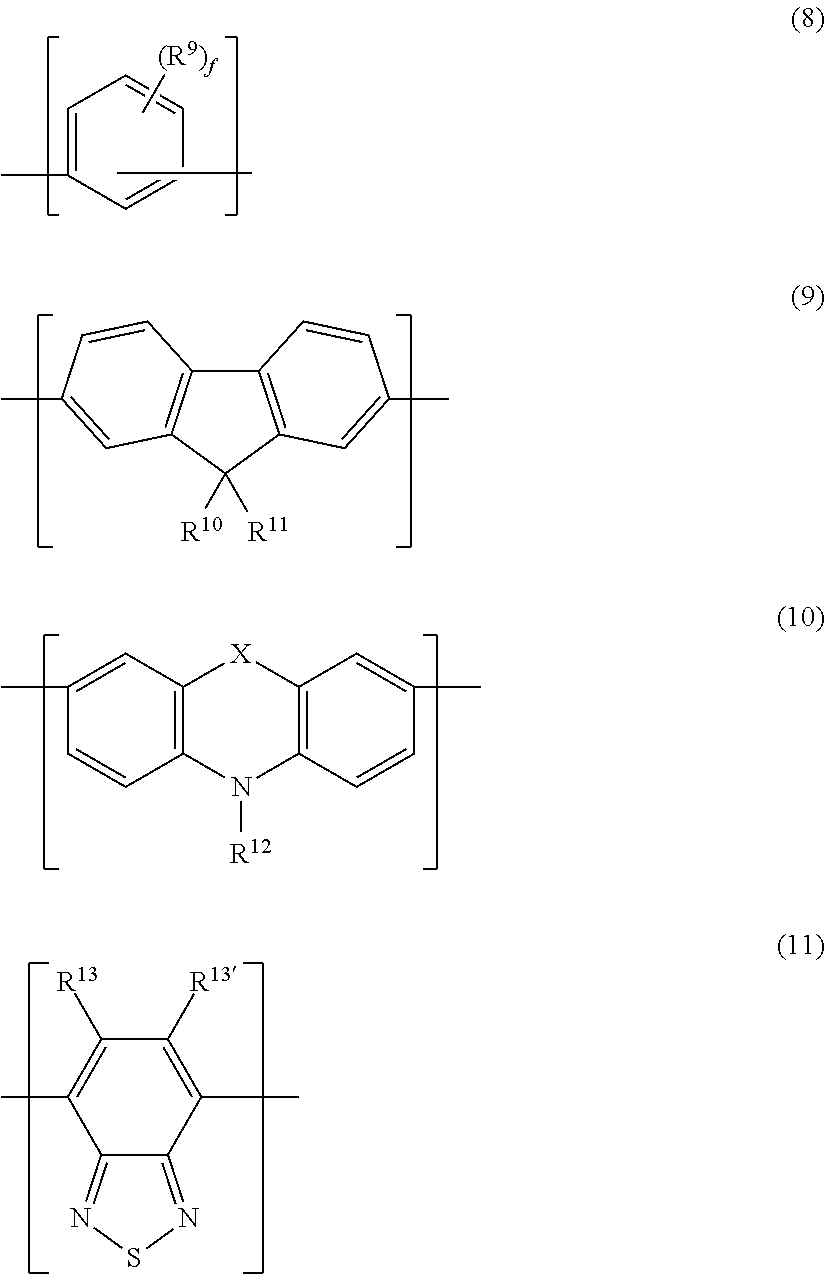
[in formula (8), R9 represents an unsubstituted or substituted alkyl group, an unsubstituted or substituted alkoxy group, an unsubstituted or substituted aryl group, an unsubstituted or substituted aryloxy group, an unsubstituted or substituted monovalent heterocyclic group, an unsubstituted or substituted silyl group, a halogen atom, an alkoxycarbonyl group, a carboxyl group or a cyano group; the letter f represents an integer of 0 to 4; when multiple R9 groups are present, they may be the same or different;
in formula (9), R10 and R11 each independently represent a hydrogen atom, an unsubstituted or substituted alkyl group or an unsubstituted or substituted aryl group; this is with the proviso that the constitutional unit represented by formula (9) is a constitutional unit having a different structure from the constitutional unit represented by formula (1); in formula (10), R12 represents an unsubstituted or substituted alkyl group, an unsubstituted or substituted aryl group or an unsubstituted or substituted monovalent heterocyclic group; X represents a single bond, —O—, —S— or —C(Rc)2—; Rc represents an unsubstituted or substituted alkyl group or an unsubstituted or substituted aryl group; the two Rc groups may be the same or different;
in formula (11), R13 and R13′ each independently represent a hydrogen atom, an unsubstituted or substituted alkyl group, an unsubstituted or substituted alkoxy group, an unsubstituted or substituted aryl group, an unsubstituted or substituted aryloxy group, an unsubstituted or substituted monovalent heterocyclic group, an unsubstituted or substituted silyl group, a halogen atom, an alkoxycarbonyl group, a carboxyl group or a cyano group.]

[in formula (12), R14, R15, R16, R17, R18 and R19 each independently represent a hydrogen atom, an unsubstituted or substituted alkyl group, an unsubstituted or substituted alkoxy group, an unsubstituted or substituted aryl group, an unsubstituted or substituted aryloxy group, an unsubstituted or substituted monovalent heterocyclic group, an unsubstituted or substituted silyl group, a halogen atom, an alkoxycarbonyl group, a carboxyl group or a cyano group; in formula (13), R20 represents an unsubstituted or substituted alkyl group, an unsubstituted or substituted alkoxy group, an unsubstituted or substituted aryl group, an unsubstituted or substituted aryloxy group, an unsubstituted or substituted monovalent heterocyclic group, an unsubstituted or substituted silyl group, a halogen atom, an alkoxycarbonyl group, a carboxyl group or a cyano group; the letter g represents an integer of 0 to 5, when multiple R20 groups are present, they may be the same or different.]

[in formula (14), Ar4 and e have the same meanings specified above; RD and RE each independently represent an unsubstituted or substituted alkyl group, an unsubstituted or substituted alkoxy group, an unsubstituted or substituted aryl group, an unsubstituted or substituted aryloxy group, an unsubstituted or substituted monovalent heterocyclic group, an unsubstituted or substituted silyl group, a halogen atom, an alkoxycarbonyl group, a carboxyl group or a cyano group; the letters h and i each independently represent an integer of 0 to 5; when multiple groups are present for RD and RE, they may be the same or different.]

[in formula (15), R21 represents a crosslinkable group; R22 represents a hydrogen atom, a crosslinkable group, an unsubstituted or substituted alkyl group or an unsubstituted or substituted aryl group; this is with the proviso that the constitutional unit represented by formula (15) is a constitutional unit having a different structure from the constitutional unit represented by formula (1), the constitutional unit represented by formula (6) and the constitutional unit represented by formula (9);
in formula (16), R23 represents a crosslinkable group; R24 represents a crosslinkable group, an unsubstituted or substituted alkyl group or an unsubstituted or substituted aryl group; the letter j represents 0 or 1; this is with the proviso that the constitutional unit represented by formula (16) is a constitutional unit having a different structure from the constitutional unit represented by formula (7) and the constitutional unit represented by formula (14).]

[in formula (a), R1A, R1B, R2A and R2B each independently represent an unsubstituted alkyl group; R3 and R4 each independently represent an unsubstituted or substituted alkyl group, an unsubstituted or substituted alkoxy group, an unsubstituted or substituted aryl group, an unsubstituted or substituted aryloxy group, an unsubstituted or substituted monovalent heterocyclic group, an unsubstituted or substituted silyl group, a halogen atom, an alkoxycarbonyl group, a carboxyl group or a cyano group; R5 and R6 each independently represent an unsubstituted or substituted alkyl group, an unsubstituted or substituted alkoxy group or an unsubstituted or substituted aryl group; the letters a, b, c and d each independently represent an integer of 0 to 3; when multiple R3, R4, R5 and R6 groups are present, they may be the same or different; Y1 is a halogen atom, a methoxy group, a boric acid ester residue, a boric acid residue, a group represented by formula (a-1), a group represented by formula (a-2), a group represented by formula (a-3) or a group represented by formula (a-4); Two Y1 groups may be the same or different;
in formulas (a-1) and (a-4), RT represents an unsubstituted or substituted alkyl group or an unsubstituted or substituted aryl group; multiple RT groups in formula (a-4) may be the same or different;
in formulas (a-2) and (a-3), XA represents a halogen atom.]

[In formulas (2), (3), (4), (4A) and (4B), R1A, R1B, R2A, R2B, R3, R4, a and b have the same meanings specified above.]


[In formula (6), Ar1 represents an unsubstituted or substituted arylene group or unsubstituted or substituted divalent heterocyclic group. In formula (7), Ar2, Ar3 and Ar4 each independently represent unsubstituted or substituted arylene group, an unsubstituted or substituted divalent aromatic heterocyclic group or an unsubstituted or substituted divalent group in which 2 aromatic rings are linked by a single bond. RA and RB each independently represent hydrogen atom, unsubstituted or substituted alkyl group, unsubstituted or substituted aryl group or an unsubstituted or substituted monovalent heterocyclic group. The letter e represents 0 or 1.]

[In formula (8), R9 represents unsubstituted or substituted alkyl group, unsubstituted or substituted alkoxy group, unsubstituted or substituted aryl group, unsubstituted or substituted aryloxy group, an unsubstituted or substituted monovalent heterocyclic group, unsubstituted or substituted silyl group, a halogen atom, alkoxycarbonyl group, carboxyl group or cyano group. The letter f represents an integer of 0 to 4. When multiple R9 groups are present, they may be the same or different. In formula (9), R10 and R11 each independently represent hydrogen atom, unsubstituted or substituted alkyl group or unsubstituted or substituted aryl group. This is with the proviso that the constitutional unit represented by formula (9) is a constitutional unit having a different structure from the constitutional unit represented by formula (1).


[In formula (14), Ar4 and e have the same meanings specified above. RD and RE each independently represent unsubstituted or substituted alkyl group, unsubstituted or substituted alkoxy group, unsubstituted or substituted aryl group, unsubstituted or substituted aryloxy group, an unsubstituted or substituted monovalent heterocyclic group, unsubstituted or substituted silyl group, a halogen atom, alkoxycarbonyl group, carboxyl group or cyano group. The letters h and i each independently represent an integer of 0 to 5. When multiple groups are present for RD and RE, they may be the same or different.]


[In formula (12), R14, R15, R16, R17, R18 and R19 each independently represent hydrogen atom, unsubstituted or substituted alkyl group, unsubstituted or substituted alkoxy group, unsubstituted or substituted aryl group, unsubstituted or substituted aryloxy group, an unsubstituted or substituted monovalent heterocyclic group, unsubstituted or substituted silyl group, a halogen atom, alkoxycarbonyl group, carboxyl group or cyano group.
In formula (13), R20 represents unsubstituted or substituted alkyl group, unsubstituted or substituted alkoxy group, unsubstituted or substituted aryl group, unsubstituted or substituted aryloxy group, an unsubstituted or substituted monovalent heterocyclic group, unsubstituted or substituted silyl group, a halogen atom, alkoxycarbonyl group, carboxyl group or cyano group. The letter g represents an integer of 0 to 5. When multiple R20 groups are present, they may be the same or different.]


[In formula (15), R21 represents a crosslinkable group. R22 represents hydrogen atom, a crosslinkable group, unsubstituted or substituted alkyl group or unsubstituted or substituted aryl group. This is with the proviso that the constitutional unit represented by formula (15) is a constitutional unit having a different structure from the constitutional unit represented by formula (1), the constitutional unit represented by formula (6) and the constitutional unit represented by formula (9).


[In formula (a), R1A, R1B, R2A, R2B, R3, R4, R5, R6, a, b, c and d have the same meanings specified above. Y1 is a halogen atom, methoxy group, boric acid ester residue group, boric acid residue group (i.e. —B(OH)2), a group represented by formula (a-1), a group represented by formula (a-2), a group represented by formula (a-3) or a group represented by formula (a-4). Two Y1 groups when present may be the same or different. In formulas (a-1) and (a-4), RT represents unsubstituted or substituted alkyl group or unsubstituted or substituted aryl group. Multiple RT groups in formula (a-4) may be the same or different. In formulas (a-2) and (a-3), XA represents a halogen atom.]

[In formulas (b-1) and (b-2), Ar1, Ar2, Ar3, Ar4, RA, RB, Y1 and e have the same meanings as above.]


Claims (7)


Applications Claiming Priority (3)
| Application Number | Priority Date | Filing Date | Title |
|---|---|---|---|
| JP2010-016533 | 2010-01-28 | ||
| JP2010016533 | 2010-01-28 | ||
| PCT/JP2011/051707 WO2011093428A1 (en) | 2010-01-28 | 2011-01-28 | Polymer compound and light-emitting device using same |
Publications (2)
| Publication Number | Publication Date |
|---|---|
| US20120326140A1 US20120326140A1 (en) | 2012-12-27 |
| US9331284B2 true US9331284B2 (en) | 2016-05-03 |
Family
ID=44319409
Family Applications (1)
| Application Number | Title | Priority Date | Filing Date |
|---|---|---|---|
| US13/575,348 Expired - Fee Related US9331284B2 (en) | 2010-01-28 | 2011-01-28 | Polymer compound and light-emitting device using same |
Country Status (7)
| Country | Link |
|---|---|
| US (1) | US9331284B2 (en) |
| EP (1) | EP2530100B1 (en) |
| JP (1) | JP5710994B2 (en) |
| KR (1) | KR101769173B1 (en) |
| CN (1) | CN102725325B (en) |
| TW (1) | TWI504668B (en) |
| WO (1) | WO2011093428A1 (en) |
Cited By (2)
| Publication number | Priority date | Publication date | Assignee | Title |
|---|---|---|---|---|
| US20140353652A1 (en) * | 2012-01-16 | 2014-12-04 | Sumitomo Chemical Company Limited | Polymer comprising an unsymmetric diarylaminofluoren unit |
| US9929347B2 (en) * | 2012-03-27 | 2018-03-27 | Sumitomo Chemical Company, Limtied | Polymer compound and light emitting element using same |
Families Citing this family (41)
| Publication number | Priority date | Publication date | Assignee | Title |
|---|---|---|---|---|
| IT1393059B1 (en) * | 2008-10-22 | 2012-04-11 | Eni Spa | LOW-GAP PI-CONJUGATED COPOLYMERS CONTAINING BENZOTRIAZOLIC UNITS |
| GB201122316D0 (en) * | 2011-12-23 | 2012-02-01 | Cambridge Display Tech Ltd | Polymer, polymer composition and organic light-emitting device |
| US8906590B2 (en) | 2011-03-30 | 2014-12-09 | Az Electronic Materials Usa Corp. | Antireflective coating composition and process thereof |
| KR102020083B1 (en) * | 2012-01-31 | 2019-09-09 | 캠브리지 디스플레이 테크놀로지 리미티드 | Polymer |
| KR102115141B1 (en) | 2012-06-18 | 2020-05-26 | 미쯔비시 케미컬 주식회사 | Polymer compound, charge transporting polymer, composition for organic electroluminescent elements, organic electroluminescent element, organic el display device, and organic el lighting |
| US8906592B2 (en) | 2012-08-01 | 2014-12-09 | Az Electronic Materials (Luxembourg) S.A.R.L. | Antireflective coating composition and process thereof |
| WO2014157016A1 (en) | 2013-03-28 | 2014-10-02 | 住友化学株式会社 | Polymeric compound and light-emitting element manufactured using same |
| US9152051B2 (en) | 2013-06-13 | 2015-10-06 | Az Electronics Materials (Luxembourg) S.A.R.L. | Antireflective coating composition and process thereof |
| EP3023477B1 (en) | 2013-07-17 | 2019-02-06 | Sumitomo Chemical Company Limited | Composition, and light-emitting element using same |
| EP3045486B1 (en) * | 2013-09-11 | 2024-03-06 | Sumitomo Chemical Company, Limited | Polymer compound and light-emitting element using same |
| WO2015050067A1 (en) | 2013-10-01 | 2015-04-09 | 住友化学株式会社 | Light emitting element |
| WO2015050232A1 (en) | 2013-10-04 | 2015-04-09 | 三菱化学株式会社 | Polymer, composition for organic electroluminescent element, organic electroluminescent element, organic el display device, and organic el lighting |
| GB2519169B (en) * | 2013-10-14 | 2016-03-09 | Sumitomo Chemical Co | Light-emitting composition and device thereof |
| JP6555130B2 (en) | 2014-01-08 | 2019-08-07 | 住友化学株式会社 | Metal complex and light emitting device using the same |
| JP6551394B2 (en) | 2014-03-03 | 2019-07-31 | 三菱ケミカル株式会社 | Polymer, composition for organic electroluminescence device, organic electroluminescence device, organic EL display device and organic EL lighting |
| JP5842989B2 (en) | 2014-04-18 | 2016-01-13 | 住友化学株式会社 | Composition and light emitting device using the same |
| CN106795277B (en) | 2014-08-28 | 2020-04-10 | 住友化学株式会社 | Polymer compound and light-emitting element using same |
| JP6705149B2 (en) * | 2015-10-22 | 2020-06-03 | 日立化成株式会社 | Organic electronic material and use thereof |
| JP6332557B2 (en) | 2015-11-04 | 2018-05-30 | 住友化学株式会社 | Method for driving light emitting element and light emitting device |
| WO2017221822A1 (en) | 2016-06-24 | 2017-12-28 | 住友化学株式会社 | Light emitting element |
| KR102381180B1 (en) | 2016-09-29 | 2022-04-01 | 스미또모 가가꾸 가부시키가이샤 | Light-emitting devices and compositions useful for manufacturing the light-emitting devices |
| KR102196872B1 (en) * | 2016-11-10 | 2020-12-30 | 창춘 인스티튜트 오브 어플라이드 케미스트리 차이니즈 아카데미 오브 사이언스 | Poly(spirobifluorene) and organic electroluminescent device |
| WO2018198976A1 (en) | 2017-04-27 | 2018-11-01 | 住友化学株式会社 | Light-emitting element |
| KR102513175B1 (en) | 2017-04-27 | 2023-03-24 | 스미또모 가가꾸 가부시키가이샤 | Composition and light emitting device using the same |
| KR102361349B1 (en) | 2017-09-06 | 2022-02-14 | 스미또모 가가꾸 가부시키가이샤 | light emitting element |
| WO2019208647A1 (en) | 2018-04-26 | 2019-10-31 | 住友化学株式会社 | Block copolymer and light emitting element using same |
| WO2019208648A1 (en) | 2018-04-26 | 2019-10-31 | 住友化学株式会社 | Light emitting element |
| JP7153604B2 (en) * | 2018-06-08 | 2022-10-14 | 住友化学株式会社 | Method for producing tertiary alcohol |
| GB201815338D0 (en) * | 2018-09-20 | 2018-11-07 | Sumitomo Chemical Co | Light-emitting particle |
| JP6545879B1 (en) | 2018-10-10 | 2019-07-17 | 住友化学株式会社 | Film for light emitting element and light emitting element using the same |
| JP6595070B1 (en) | 2018-10-25 | 2019-10-23 | 住友化学株式会社 | Light emitting element |
| JP6595069B1 (en) | 2018-10-25 | 2019-10-23 | 住友化学株式会社 | Light emitting element |
| JP7330018B2 (en) | 2018-12-06 | 2023-08-21 | 住友化学株式会社 | Method for producing polymer compound |
| JP6941711B2 (en) | 2019-07-26 | 2021-09-29 | 住友化学株式会社 | Metal complex and light emitting device containing it |
| JP6956287B2 (en) | 2020-04-21 | 2021-11-02 | 住友化学株式会社 | Metal complexes, compositions and light emitting devices |
| JP7086258B2 (en) | 2020-09-24 | 2022-06-17 | 住友化学株式会社 | Light emitting device and composition |
| JP7079883B2 (en) | 2020-09-24 | 2022-06-02 | 住友化学株式会社 | Light emitting device and composition |
| JP7058792B2 (en) | 2020-09-24 | 2022-04-22 | 住友化学株式会社 | Light emitting device and composition |
| JP7015406B1 (en) | 2020-09-24 | 2022-02-02 | 住友化学株式会社 | Light emitting device and composition |
| JP7086259B2 (en) | 2020-09-24 | 2022-06-17 | 住友化学株式会社 | Light emitting device and composition |
| WO2024177081A1 (en) | 2023-02-22 | 2024-08-29 | 三菱ケミカル株式会社 | Polymer, composition for organic electroluminescent element, organic electroluminescent element, organic el display device, and organic el illumination |
Citations (27)
| Publication number | Priority date | Publication date | Assignee | Title |
|---|---|---|---|---|
| JPH0945478A (en) | 1995-02-01 | 1997-02-14 | Sumitomo Chem Co Ltd | Polymeric fluorescent substance, method for producing the same, and organic electroluminescence device |
| US5777070A (en) | 1997-10-23 | 1998-07-07 | The Dow Chemical Company | Process for preparing conjugated polymers |
| US5821002A (en) | 1995-02-01 | 1998-10-13 | Sumitomo Chemical Company | Polymeric fluorescent substance, production process thereof and organic electrolumescence device |
| WO1999013692A1 (en) | 1997-09-05 | 1999-03-18 | Cambridge Display Technology Limited | SELF-ASSEMBLED TRANSPORT LAYERS FOR OLEDs |
| WO1999048160A1 (en) | 1998-03-13 | 1999-09-23 | Cambridge Display Technology Ltd. | Electroluminescent devices |
| GB2340304A (en) | 1998-08-21 | 2000-02-16 | Cambridge Display Tech Ltd | Organic light emitters |
| US20020106531A1 (en) | 2000-12-28 | 2002-08-08 | Katsuyuki Naito | Organic electroluminescent device and display apparatus |
| JP2002527553A (en) | 1998-10-10 | 2002-08-27 | セラニーズ・ヴェンチャーズ・ゲーエムベーハー | Conjugated polymers containing specific fluorenyl structural units and having improved properties |
| JP2002280183A (en) | 2000-12-28 | 2002-09-27 | Toshiba Corp | Organic EL element and display device |
| WO2002092724A1 (en) | 2001-05-11 | 2002-11-21 | Cambridge Display Technology Limited | Substituted fluorene polymers, their preparation and uses |
| US20030143429A1 (en) | 2001-12-19 | 2003-07-31 | Sumitomo Chemical Company, Limited | Copolymer, polymer composition and polymer light-emitting device |
| WO2003095586A1 (en) | 2002-05-10 | 2003-11-20 | Cambridge Display Technology Limited | Polymers their preparation and uses |
| JP2004002654A (en) | 2001-12-19 | 2004-01-08 | Sumitomo Chem Co Ltd | Copolymer, polymer composition and polymer light emitting device |
| WO2004041902A2 (en) | 2002-11-06 | 2004-05-21 | Cambridge Display Technology Limited | 9-aryl and bisayl substituted polyfluorenes |
| US20040170839A1 (en) | 2001-05-11 | 2004-09-02 | O'dell Richard | Substituted fluorenes polymers, their preparation and use in optical devices |
| US20040170863A1 (en) | 2001-04-27 | 2004-09-02 | Kim Kong Kyeom | Organic electroluminescent devices using double-spiro organic compounds |
| WO2006109083A1 (en) | 2005-04-15 | 2006-10-19 | Cambridge Display Technology Limited | Arylamine- and fluorene- polymers for oled displays |
| WO2007109518A2 (en) | 2006-03-22 | 2007-09-27 | General Electric Company | Optoelectronic devices with multilayered structures |
| US20070252139A1 (en) | 2004-08-11 | 2007-11-01 | Merck Patent Gmbh | Polymers for Use in Organic Electroluminescent Devices |
| JP2007321023A (en) | 2006-05-31 | 2007-12-13 | Sumitomo Chemical Co Ltd | Polymer light-emitting device, organic transistor and composition useful for them |
| JP2008106125A (en) | 2006-10-25 | 2008-05-08 | Sumitomo Chemical Co Ltd | Polymer light-emitting device, organic transistor and composition useful for them |
| WO2008111658A1 (en) * | 2007-03-09 | 2008-09-18 | Sumitomo Chemical Company, Limited | Polymer compound and composition containing the same |
| US20080265755A1 (en) | 2005-03-04 | 2008-10-30 | Sumitomo Chemical Company, Limited | Biscarbazol-9-Yl-Substituted Triarylamine-Containing Polymers and Electronic Devices |
| GB2454890A (en) | 2007-11-21 | 2009-05-27 | Cambridge Display Tech Limited | Light-emitting device made of fluorene polymers |
| EP2110399A1 (en) | 2007-02-02 | 2009-10-21 | Sumitomo Chemical Company, Limited | Polymer light-emitting device, polymer compound, composition, liquid composition, and conductive thin film |
| US20090315453A1 (en) * | 2006-09-25 | 2009-12-24 | Shigeya Kobayashi | Polymer compound and polymer light emitting device using the same |
| WO2010065178A1 (en) | 2008-12-05 | 2010-06-10 | General Electric Company | Functionalized polyfluorenes for use in optoelectronic devices |
Family Cites Families (48)
| Publication number | Priority date | Publication date | Assignee | Title |
|---|---|---|---|---|
| US573636A (en) | 1896-12-22 | Car-truck | ||
| US4356429A (en) | 1980-07-17 | 1982-10-26 | Eastman Kodak Company | Organic electroluminescent cell |
| US4539507A (en) | 1983-03-25 | 1985-09-03 | Eastman Kodak Company | Organic electroluminescent devices having improved power conversion efficiencies |
| JPS6370257A (en) | 1986-09-12 | 1988-03-30 | Fuji Xerox Co Ltd | Electric charge transfer material for electrophotography |
| JPS63175860A (en) | 1987-01-16 | 1988-07-20 | Fuji Xerox Co Ltd | Electrophotographic sensitive body |
| JP2651237B2 (en) | 1989-02-10 | 1997-09-10 | 出光興産株式会社 | Thin-film electroluminescence device |
| JPH02135359A (en) | 1988-11-16 | 1990-05-24 | Fuji Xerox Co Ltd | Electrophotographic sensitive body |
| JPH02135361A (en) | 1988-11-16 | 1990-05-24 | Fuji Xerox Co Ltd | Electrophotographic sensitive body |
| JPH0337992A (en) | 1989-07-04 | 1991-02-19 | Idemitsu Kosan Co Ltd | Manufacture of organic electroluminescence element |
| JPH03152184A (en) | 1989-11-08 | 1991-06-28 | Nec Corp | El element of organic thin film |
| DE4331401A1 (en) | 1993-09-15 | 1995-03-16 | Hoechst Ag | Use of polymers with isolated chromophores as electroluminescent materials |
| WO1996010598A1 (en) | 1994-09-30 | 1996-04-11 | Hoechst Aktiengesellschaft | Nitrogenous polymers used as electroluminescent materials |
| DE4436773A1 (en) | 1994-10-14 | 1996-04-18 | Hoechst Ag | Conjugated polymers with spirocenters and their use as electroluminescent materials |
| DE4442052A1 (en) | 1994-11-25 | 1996-05-30 | Hoechst Ag | Conjugated polymers with hetero-spiroatoms and their use as electroluminescent materials |
| DE19509451A1 (en) | 1995-03-20 | 1996-09-26 | Hoechst Ag | Poly ((oligo-p-phenylene) vinylene) derivatives, process for their preparation and their use |
| US5830972A (en) | 1995-04-10 | 1998-11-03 | Sumitomo Chemical Company, Limited | Polysilane, its production process and starting materials therefor |
| JP3865406B2 (en) | 1995-07-28 | 2007-01-10 | 住友化学株式会社 | 2,7-Aryl-9-substituted fluorene and 9-substituted fluorene oligomers and polymers |
| KR100421569B1 (en) | 1995-09-04 | 2004-07-05 | 아벤티스 리서치 운트 테크놀러지 게엠베하 운트 콤파니 카게 | A polymer comprising a triarylamine unit, which is used as an electroluminescent material |
| JP3760491B2 (en) | 1995-10-16 | 2006-03-29 | 住友化学株式会社 | Polymer phosphor, method for producing the same, and organic electroluminescence device |
| US5728801A (en) | 1996-08-13 | 1998-03-17 | The Dow Chemical Company | Poly (arylamines) and films thereof |
| JP3546645B2 (en) | 1996-08-21 | 2004-07-28 | 住友化学工業株式会社 | Polymer fluorescent substance and organic electroluminescent device |
| DE19646877A1 (en) | 1996-11-13 | 1998-05-14 | Hoechst Ag | Ordered poly (arylene vinylene) terpolymers, processes for their preparation and their use as electroluminescent materials |
| DE19652261A1 (en) | 1996-12-16 | 1998-06-18 | Hoechst Ag | Aryl-substituted poly (p-arylenevinylenes), process for their preparation and their use in electroluminescent devices |
| US6309763B1 (en) | 1997-05-21 | 2001-10-30 | The Dow Chemical Company | Fluorene-containing polymers and electroluminescent devices therefrom |
| JPH10324870A (en) | 1997-05-23 | 1998-12-08 | Sumitomo Chem Co Ltd | Polymer fluorescent substance and organic electroluminescent device |
| JP4366727B2 (en) | 1997-07-22 | 2009-11-18 | 住友化学株式会社 | Hole transporting polymer, method for producing the same, and organic electroluminescence device |
| DE19748814A1 (en) | 1997-11-05 | 1999-05-06 | Hoechst Ag | Substituted poly (arylenevinylene), process for its preparation and its use in electroluminescence |
| DE19806037A1 (en) | 1998-02-13 | 1999-08-19 | Aventis Res & Tech Gmbh & Co | Electroluminescent polymers and copolymers of triptycene structure |
| KR100697861B1 (en) | 1998-03-13 | 2007-03-22 | 캠브리지 디스플레이 테크놀로지 리미티드 | Electric field light emitting devices |
| WO1999054943A1 (en) | 1998-04-21 | 1999-10-28 | The Dow Chemical Company | Organic electroluminescent devices with improved stability in air |
| JP3823602B2 (en) | 1998-06-10 | 2006-09-20 | 住友化学株式会社 | Polymer fluorescent substance and organic electroluminescence device |
| JP4048653B2 (en) | 1998-07-27 | 2008-02-20 | 住友化学株式会社 | Polymer phosphor and polymer light emitting device |
| WO2000006665A1 (en) | 1998-07-28 | 2000-02-10 | The Dow Chemical Company | Organic electroluminescent devices |
| DE19846768A1 (en) | 1998-10-10 | 2000-04-20 | Aventis Res & Tech Gmbh & Co | A conjugated polymer useful as an organic semiconductor, an electroluminescence material, and for display elements in television monitor and illumination technology contains fluorene building units |
| DE19857661A1 (en) | 1998-12-15 | 2000-06-21 | Aventis Res & Tech Gmbh & Co | Process for the preparation of derivatives of polyarylene vinylene |
| KR100663052B1 (en) | 1999-02-04 | 2007-01-02 | 다우 글로벌 테크놀로지스 인크. | Fluorene copolymers and devices made therefrom |
| JP4622022B2 (en) | 1999-02-09 | 2011-02-02 | 住友化学株式会社 | Polymer light-emitting device, display device using the same, and planar light source |
| JP3772576B2 (en) | 1999-02-25 | 2006-05-10 | 住友化学株式会社 | Polymer light emitting device |
| JP3310658B1 (en) | 1999-03-05 | 2002-08-05 | ケンブリッジ ディスプレイ テクノロジー リミテッド | Polymer synthesis method |
| GB2348316A (en) | 1999-03-26 | 2000-09-27 | Cambridge Display Tech Ltd | Organic opto-electronic device |
| JP4934888B2 (en) | 1999-04-09 | 2012-05-23 | 住友化学株式会社 | Polymer phosphor and polymer light emitting device using the same |
| JP3747686B2 (en) | 1999-04-21 | 2006-02-22 | 住友化学株式会社 | Polymer phosphor and polymer light emitting device using the same |
| JP4934889B2 (en) | 1999-04-21 | 2012-05-23 | 住友化学株式会社 | Polymer phosphor and polymer light emitting device using the same |
| TW484341B (en) | 1999-08-03 | 2002-04-21 | Sumitomo Chemical Co | Polymeric fluorescent substance and polymer light emitting device |
| WO2001019834A1 (en) | 1999-09-16 | 2001-03-22 | Cambridge Display Technology Limited | Preparation of benzenediboronic acid via a disilylated aryl-intermediate |
| DE19953806A1 (en) | 1999-11-09 | 2001-05-10 | Covion Organic Semiconductors | Substituted poly (arylenevinylene), process for its manufacture and its use in electroluminescent devices |
| JP4482994B2 (en) | 1999-12-27 | 2010-06-16 | 住友化学株式会社 | Polymer phosphor manufacturing method and polymer light emitting device |
| JP5251043B2 (en) * | 2006-09-13 | 2013-07-31 | 住友化学株式会社 | Polymer compound and polymer light emitting device |
-
2011
- 2011-01-28 WO PCT/JP2011/051707 patent/WO2011093428A1/en not_active Ceased
- 2011-01-28 CN CN201180007200.4A patent/CN102725325B/en not_active Expired - Fee Related
- 2011-01-28 KR KR1020127021828A patent/KR101769173B1/en active Active
- 2011-01-28 EP EP11737138.5A patent/EP2530100B1/en not_active Not-in-force
- 2011-01-28 US US13/575,348 patent/US9331284B2/en not_active Expired - Fee Related
- 2011-01-28 JP JP2011016932A patent/JP5710994B2/en active Active
- 2011-01-28 TW TW100103278A patent/TWI504668B/en not_active IP Right Cessation
Patent Citations (38)
| Publication number | Priority date | Publication date | Assignee | Title |
|---|---|---|---|---|
| US5821002A (en) | 1995-02-01 | 1998-10-13 | Sumitomo Chemical Company | Polymeric fluorescent substance, production process thereof and organic electrolumescence device |
| JPH0945478A (en) | 1995-02-01 | 1997-02-14 | Sumitomo Chem Co Ltd | Polymeric fluorescent substance, method for producing the same, and organic electroluminescence device |
| WO1999013692A1 (en) | 1997-09-05 | 1999-03-18 | Cambridge Display Technology Limited | SELF-ASSEMBLED TRANSPORT LAYERS FOR OLEDs |
| US5777070A (en) | 1997-10-23 | 1998-07-07 | The Dow Chemical Company | Process for preparing conjugated polymers |
| JP2001520289A (en) | 1997-10-23 | 2001-10-30 | ザ ダウ ケミカル カンパニー | Method for producing conjugated polymer |
| WO1999048160A1 (en) | 1998-03-13 | 1999-09-23 | Cambridge Display Technology Ltd. | Electroluminescent devices |
| GB2340304A (en) | 1998-08-21 | 2000-02-16 | Cambridge Display Tech Ltd | Organic light emitters |
| US6653438B1 (en) | 1998-10-10 | 2003-11-25 | Covion Organic Semiconductors Gmbh | Conjugated polymers containing special fluorene structural elements with improved properties |
| JP2002527553A (en) | 1998-10-10 | 2002-08-27 | セラニーズ・ヴェンチャーズ・ゲーエムベーハー | Conjugated polymers containing specific fluorenyl structural units and having improved properties |
| US20020106531A1 (en) | 2000-12-28 | 2002-08-08 | Katsuyuki Naito | Organic electroluminescent device and display apparatus |
| JP2002280183A (en) | 2000-12-28 | 2002-09-27 | Toshiba Corp | Organic EL element and display device |
| US20040170863A1 (en) | 2001-04-27 | 2004-09-02 | Kim Kong Kyeom | Organic electroluminescent devices using double-spiro organic compounds |
| US20040170839A1 (en) | 2001-05-11 | 2004-09-02 | O'dell Richard | Substituted fluorenes polymers, their preparation and use in optical devices |
| WO2002092724A1 (en) | 2001-05-11 | 2002-11-21 | Cambridge Display Technology Limited | Substituted fluorene polymers, their preparation and uses |
| JP2004532325A (en) | 2001-05-11 | 2004-10-21 | ケンブリッジ ディスプレイ テクノロジー リミテッド | Substituted fluorene polymer and method for producing the same |
| US20030143429A1 (en) | 2001-12-19 | 2003-07-31 | Sumitomo Chemical Company, Limited | Copolymer, polymer composition and polymer light-emitting device |
| JP2004002654A (en) | 2001-12-19 | 2004-01-08 | Sumitomo Chem Co Ltd | Copolymer, polymer composition and polymer light emitting device |
| WO2003095586A1 (en) | 2002-05-10 | 2003-11-20 | Cambridge Display Technology Limited | Polymers their preparation and uses |
| WO2004041902A2 (en) | 2002-11-06 | 2004-05-21 | Cambridge Display Technology Limited | 9-aryl and bisayl substituted polyfluorenes |
| WO2004041902A3 (en) | 2002-11-06 | 2004-08-12 | Cambridge Display Tech Ltd | 9-aryl and bisayl substituted polyfluorenes |
| CN1726243A (en) | 2002-11-06 | 2006-01-25 | 剑桥显示技术有限公司 | 9-aryl and bisaryl substituted polyfluorenes |
| JP2006505647A (en) | 2002-11-06 | 2006-02-16 | ケンブリッジ ディスプレイ テクノロジー リミテッド | polymer |
| US20060228576A1 (en) | 2002-11-06 | 2006-10-12 | Jeremy Burroughes | 9-Aryl and bisayl substituted polyfluorenes |
| US20070252139A1 (en) | 2004-08-11 | 2007-11-01 | Merck Patent Gmbh | Polymers for Use in Organic Electroluminescent Devices |
| US20080265755A1 (en) | 2005-03-04 | 2008-10-30 | Sumitomo Chemical Company, Limited | Biscarbazol-9-Yl-Substituted Triarylamine-Containing Polymers and Electronic Devices |
| US20090203876A1 (en) * | 2005-04-15 | 2009-08-13 | Cambridge Display Technologh Limited | Pulsed Driven Displays |
| WO2006109083A1 (en) | 2005-04-15 | 2006-10-19 | Cambridge Display Technology Limited | Arylamine- and fluorene- polymers for oled displays |
| WO2007109518A3 (en) | 2006-03-22 | 2008-01-24 | Gen Electric | Optoelectronic devices with multilayered structures |
| WO2007109518A2 (en) | 2006-03-22 | 2007-09-27 | General Electric Company | Optoelectronic devices with multilayered structures |
| JP2007321023A (en) | 2006-05-31 | 2007-12-13 | Sumitomo Chemical Co Ltd | Polymer light-emitting device, organic transistor and composition useful for them |
| US20090315453A1 (en) * | 2006-09-25 | 2009-12-24 | Shigeya Kobayashi | Polymer compound and polymer light emitting device using the same |
| JP2008106125A (en) | 2006-10-25 | 2008-05-08 | Sumitomo Chemical Co Ltd | Polymer light-emitting device, organic transistor and composition useful for them |
| EP2110399A1 (en) | 2007-02-02 | 2009-10-21 | Sumitomo Chemical Company, Limited | Polymer light-emitting device, polymer compound, composition, liquid composition, and conductive thin film |
| WO2008111658A1 (en) * | 2007-03-09 | 2008-09-18 | Sumitomo Chemical Company, Limited | Polymer compound and composition containing the same |
| US20100033086A1 (en) * | 2007-03-09 | 2010-02-11 | Sumitomo Chemical Company, Limited | Polymer compound and composition containing the same |
| GB2454890A (en) | 2007-11-21 | 2009-05-27 | Cambridge Display Tech Limited | Light-emitting device made of fluorene polymers |
| US8878163B2 (en) * | 2007-11-21 | 2014-11-04 | Cambridge Display Technology Limited | Light-emitting device and 9.9 biphenyl fluorene materials therefor |
| WO2010065178A1 (en) | 2008-12-05 | 2010-06-10 | General Electric Company | Functionalized polyfluorenes for use in optoelectronic devices |
Non-Patent Citations (17)
| Title |
|---|
| "Library of Polymer Functional Materials vol. 2 Synthesis and Reaction of Polymer (2)", Kyoritsu Shuppan Co., Ltd., pp. 432-433 with partial English translation. |
| Andrew C. Grimsdale, et al., "Correlation Between Molecular Structure, Microscopic Morphology, and Optical Properties of Poly(tetraalkylindenofluorene)s", Adv. Funct. Mater., vol. 12, No. 10, Scheme 1, 2002, pp. 729-733. |
| Communication dated Oct. 21, 2015 from the Intellectual Property Office of the United Kingdom in counterpart application No. 1101559.1. |
| Examination Report issued Dec. 1, 2014 in counterpart Taiwanese Patent Application No. 100103278 with translation. |
| Extended European Search Report issued Apr. 23, 2013 in European Patent Application No. 11737138.5 to Sumitomo Chemical Co., Ltd., et al. |
| First Office Action issued Nov. 26, 2013 in counterpart Chinese Patent Application No. 201180007200.4 with English translation. |
| Ken-Tsung Wong, et al, "Ter(9,9-diarylfluorene)s: Highly Efficient Blue Emitter with Promising Electrochemical and Thermal Stability", J. Am. Chem. Soc., 2002, vol. 124, pp. 11576-11577. |
| Norio Miyaura and Akira Suzuki, "Palladium-Catalyzed Cross-Coupling Reactions of Organoboron Compounds", Chem. Rev., vol. 95, No. 7, 1995, pp. 2457-2483. |
| Notice of Reasons for Rejection issued Apr. 30, 2014 in counterpart Japanese Patent Application No. P2011-016911 with translation. |
| Notice of Reasons for Rejection issued Apr. 30, 2014 in counterpart Japanese Patent Application No. P2011-016932 with translation. |
| Office Action issued Aug. 16, 2012 in U.S. Appl. No. 13/016,847 to Fukushuima. |
| Search Report issued May 25, 2011 in GB Patent Application No. 1101559.1. |
| Second Office Action issued Aug. 8, 2014 in counterpart Chinese Patent Application No. 201180007200.4 with English translation. |
| Sepas Setayesh, et al., "Polyfluorenes with Polyphenylene Dendron Side Chains: Toward Non-Aggregating, Light-Emitting Polymers", J. Am. Chem. Soc., vol. 123, Scheme 5, 2001, pp. 946-953. |
| Takakazu Yamamoto, "Electrically Conducting and Thermally Stable pi-Conjugated Poly(arylene)s Prepared by Organometallic Processes", Prog. Polym. Sci., vol. 17, 1992, pp. 1153-1205. |
| Takakazu Yamamoto, "Electrically Conducting and Thermally Stable π-Conjugated Poly(arylene)s Prepared by Organometallic Processes", Prog. Polym. Sci., vol. 17, 1992, pp. 1153-1205. |
| Translation of the International Preliminary Report on Patentability mailed Sep. 27, 2012 in International Application No. PCT/JP2011/051707 to Sumitomo Chemical Co., Ltd. |
Cited By (4)
| Publication number | Priority date | Publication date | Assignee | Title |
|---|---|---|---|---|
| US20140353652A1 (en) * | 2012-01-16 | 2014-12-04 | Sumitomo Chemical Company Limited | Polymer comprising an unsymmetric diarylaminofluoren unit |
| US9859499B2 (en) * | 2012-01-16 | 2018-01-02 | Sumitomo Chemical Company Limited | Polymer comprising an unsymmetric diarylaminofluorene unit |
| US10580992B2 (en) | 2012-01-16 | 2020-03-03 | Sumitomo Chemical Company Limited | Polymer comprising an unsymmetric diarylaminofluoren unit |
| US9929347B2 (en) * | 2012-03-27 | 2018-03-27 | Sumitomo Chemical Company, Limtied | Polymer compound and light emitting element using same |
Also Published As
| Publication number | Publication date |
|---|---|
| TWI504668B (en) | 2015-10-21 |
| EP2530100A4 (en) | 2013-05-22 |
| US20120326140A1 (en) | 2012-12-27 |
| JP2011174062A (en) | 2011-09-08 |
| CN102725325A (en) | 2012-10-10 |
| KR20120129916A (en) | 2012-11-28 |
| EP2530100B1 (en) | 2015-10-21 |
| EP2530100A1 (en) | 2012-12-05 |
| KR101769173B1 (en) | 2017-08-17 |
| WO2011093428A1 (en) | 2011-08-04 |
| JP5710994B2 (en) | 2015-04-30 |
| CN102725325B (en) | 2015-05-06 |
| TW201137026A (en) | 2011-11-01 |
Similar Documents
| Publication | Publication Date | Title |
|---|---|---|
| US20120326140A1 (en) | Polymer compound and light-emitting device using same | |
| US8617724B2 (en) | Polymer compound and light emitting device using the same | |
| JP5691177B2 (en) | Polymer compound and light emitting device using the same | |
| US9267003B2 (en) | Polymer compound, composition, and light-emitting device using the same | |
| CN101663345B (en) | Pyrene-based polymer compound and light-emitting device using the same | |
| CN101600752B (en) | Polymer light-emitting device, polymer compound, composition, liquid composition, and conductive thin film | |
| CN101646709A (en) | Block copolymer, and composition, liquid composition, light-emitting thin film and polymer light-emitting element using same | |
| US8513877B2 (en) | Anthracene polymer compound and light emitting device using the same | |
| US9793486B2 (en) | Polymer compound and light-emitting element using the same | |
| US20100140601A1 (en) | Polymer compound and method for producing the same, and light-emitting material, liquid composition, thin film, polymer light-emitting device, surface light source, display device, organic transistor and solar cell, each using the polymer compound | |
| JP5716540B2 (en) | Pyrene polymer compound and light emitting device using the same | |
| US20120326095A1 (en) | Polymer compound, method for producing same, and light-emitting element using the polymer compound | |
| US20100289011A1 (en) | Polymer compound and method for producing the same, and light-emitting material, liquid composition, thin film, polymer light-emitting device, surface light source, display device, organic transistor and solar cell, each using the polymer compound | |
| JP5891798B2 (en) | Polymer compound and light emitting device using the same | |
| JP2013209630A (en) | Polymer compound and light-emitting element using the same | |
| JP2013241579A (en) | Polymer compound and light-emitting element using the same |
Legal Events
| Date | Code | Title | Description |
|---|---|---|---|
| AS | Assignment |
Owner name: SUMITOMO CHEMICAL COMPANY, LIMITED, JAPAN Free format text: ASSIGNMENT OF ASSIGNORS INTEREST;ASSIGNORS:FUKUSHIMA, DAISUKE;TIERNEY, BRIAN;CONWAY, NATASHA;AND OTHERS;SIGNING DATES FROM 20120803 TO 20120810;REEL/FRAME:028900/0831 Owner name: CAMBRIDGE DISPLAY TECHNOLOGY LIMITED, UNITED KINGD Free format text: ASSIGNMENT OF ASSIGNORS INTEREST;ASSIGNORS:FUKUSHIMA, DAISUKE;TIERNEY, BRIAN;CONWAY, NATASHA;AND OTHERS;SIGNING DATES FROM 20120803 TO 20120810;REEL/FRAME:028900/0831 |
|
| ZAAA | Notice of allowance and fees due |
Free format text: ORIGINAL CODE: NOA |
|
| ZAAB | Notice of allowance mailed |
Free format text: ORIGINAL CODE: MN/=. |
|
| STCF | Information on status: patent grant |
Free format text: PATENTED CASE |
|
| MAFP | Maintenance fee payment |
Free format text: PAYMENT OF MAINTENANCE FEE, 4TH YEAR, LARGE ENTITY (ORIGINAL EVENT CODE: M1551); ENTITY STATUS OF PATENT OWNER: LARGE ENTITY Year of fee payment: 4 |
|
| FEPP | Fee payment procedure |
Free format text: MAINTENANCE FEE REMINDER MAILED (ORIGINAL EVENT CODE: REM.); ENTITY STATUS OF PATENT OWNER: LARGE ENTITY |
|
| LAPS | Lapse for failure to pay maintenance fees |
Free format text: PATENT EXPIRED FOR FAILURE TO PAY MAINTENANCE FEES (ORIGINAL EVENT CODE: EXP.); ENTITY STATUS OF PATENT OWNER: LARGE ENTITY |
|
| STCH | Information on status: patent discontinuation |
Free format text: PATENT EXPIRED DUE TO NONPAYMENT OF MAINTENANCE FEES UNDER 37 CFR 1.362 |
|
| FP | Lapsed due to failure to pay maintenance fee |
Effective date: 20240503 |