US9307570B2 - Controlling user equipment nodes for enhanced uplink and user equipment nodes configured for enhanced uplink - Google Patents
Controlling user equipment nodes for enhanced uplink and user equipment nodes configured for enhanced uplink Download PDFInfo
- Publication number
- US9307570B2 US9307570B2 US14/004,098 US201314004098A US9307570B2 US 9307570 B2 US9307570 B2 US 9307570B2 US 201314004098 A US201314004098 A US 201314004098A US 9307570 B2 US9307570 B2 US 9307570B2
- Authority
- US
- United States
- Prior art keywords
- user equipment
- cell
- dch
- equipment node
- fach state
- Prior art date
- Legal status (The legal status is an assumption and is not a legal conclusion. Google has not performed a legal analysis and makes no representation as to the accuracy of the status listed.)
- Expired - Fee Related, expires
Links
Images


Classifications
-
- H04W76/046—
-
- H—ELECTRICITY
- H04—ELECTRIC COMMUNICATION TECHNIQUE
- H04W—WIRELESS COMMUNICATION NETWORKS
- H04W76/00—Connection management
- H04W76/20—Manipulation of established connections
- H04W76/27—Transitions between radio resource control [RRC] states
-
- H—ELECTRICITY
- H04—ELECTRIC COMMUNICATION TECHNIQUE
- H04W—WIRELESS COMMUNICATION NETWORKS
- H04W72/00—Local resource management
- H04W72/20—Control channels or signalling for resource management
- H04W72/21—Control channels or signalling for resource management in the uplink direction of a wireless link, i.e. towards the network
-
- H—ELECTRICITY
- H04—ELECTRIC COMMUNICATION TECHNIQUE
- H04W—WIRELESS COMMUNICATION NETWORKS
- H04W76/00—Connection management
- H04W76/10—Connection setup
-
- H—ELECTRICITY
- H04—ELECTRIC COMMUNICATION TECHNIQUE
- H04W—WIRELESS COMMUNICATION NETWORKS
- H04W74/00—Wireless channel access
- H04W74/08—Non-scheduled access, e.g. ALOHA
- H04W74/0833—Random access procedures, e.g. with 4-step access
-
- H—ELECTRICITY
- H04—ELECTRIC COMMUNICATION TECHNIQUE
- H04W—WIRELESS COMMUNICATION NETWORKS
- H04W8/00—Network data management
- H04W8/26—Network addressing or numbering for mobility support
Definitions
- the present invention relates to communications networks. More particularly, and not by way of limitation, the present invention is directed to communications systems and methods that control communications between network nodes and user equipment nodes.
- WCDMA Wideband Code Division Multiple Access
- 3GPP 3rd Generation Partnership Project
- An enhanced uplink transmission capability from the user equipment nodes (UEs) to the radio transceiver base station (Node B) was introduced in Release 6 to 3GPP WCDMA.
- the enhanced uplink provides improved uplink packet-data support with reduced round trip delay, high bit-rate availability and increased cell capacity.
- the Radio Resource Control (RRC) protocol handles the control plane signaling between the UEs and the network.
- RRC Radio Resource Control
- a UE can operate in one of a number of RRC states or modes. For example, a UE can operate in RRC idle mode when it has no connection. In connected mode, a UE can be directed to operate in a CELL_DCH (Dedicated Channel) state, a CELL_FACH (Forward access channel) state, a CELL_PCH (Cell Paging channel) state, or a URA_PCH (URA Paging channel) state.
- CELL_DCH Dedicated Channel
- CELL_FACH Forward access channel
- CELL_PCH Cell Paging channel
- URA_PCH URA Paging channel
- a network node allocates dedicated resources for each UE.
- Enhanced Uplink refers to a 3GPP mobile telephony protocol with increased uplink speeds, for example, up to 5.76 Mbit/s.
- the Enhanced Uplink feature is intended to improve the performance of uplink dedicated transport channels by increasing capacity and throughput and reducing delay.
- a UE When a UE transmits using the Enhanced Uplink protocol, it transmits data and control information on at least 3 physical channels, namely, the Dedicated Physical Control CHannel (DPCCH), the Enhanced-DPCCH (E-DPCCH), and the Enhanced Dedicated Physical Data CHannel (E-DPDCH).
- the DPCCH carries pilot bits that are known by the Node B as well as Layer 1 control information. The pilot bits are used as a reference by the Node B to estimate the radio channel conditions (e.g. searcher, channel estimation, frequency offset estimation, and signal to interference ratio).
- the E-DPCCH carries control information related to the enhanced dedicated physical data channel.
- the E-DPDCH carries the data bits.
- UEs may sometimes fail when changing the CELL_FACH state to the CELL_DCH state, which may reduce the performance of the network.
- An object of some embodiments herein is to provide a mechanism that enhances the performance of the network.
- some embodiments provide methods for controlling uplink transmission of data to a network node of a communications system a user equipment node.
- the methods include receiving parameters to configure enhanced uplink in CELL_FACH state, determining whether the user equipment node is able to communicate on an Enhanced uplink Dedicated CHannel (E-DCH) in CELL_FACH state and determining whether additional defined conditions have been satisfied, and performing a cell update operation to obtain an Radio Network Temporary Identifier (E-RNTI) value for the user equipment node responsive to determining that the user equipment node is not able to communicate on an E-DCH CELL_FACH state.
- E-RNTI Radio Network Temporary Identifier
- Determining whether the user equipment lode is able to communicate on an E-DCH in CELL_FACH state may include determining whether the user equipment node has E-RNTI value that is available for use.
- the methods may also include transmitting uplink data on an E-DCH transport channel to the network node responsive to the E-RNTI value being determined to be available for use and determining that the additional defined conditions have been satisfied.
- the additional defined conditions include whether the user equipment node supports E-DCH transmission in CELL_FACH state, whether the information element “HS-DSCH common system information” has been received from the network node, and whether the information element “Common E-DCH system info” has been received from the network node.
- Transmitting uplink data on an E-DCH transport channel to the network node may include transmitting uplink data on an E-DCH transport channel to the network node responsive determining that the E-RNTI value is available for use and that the additional defined conditions are satisfied.
- the methods may further include transmitting data in CELL_FACH state on a Random Access Channel (RACH) responsive to determining that any of the additional defined conditions has not been met.
- RACH Random Access Channel
- the methods may further include transmitting data in CELL_FACH state on a Random Access Channel (RACH) responsive to determining that the user equipment node does not have an E-RNTI value that is available for use.
- RACH Random Access Channel
- the methods may include determining, while the user equipment node is operating in CELL_FACH state, whether the following conditions are true:
- E-DCH Enhanced uplink Dedicated CHannel
- E-DCH Enhanced uplink Dedicated CHannel
- E-RNTI Radio Network Temporary Identifier
- the methods may further include setting a variable in the user equipment node indicating that the user equipment node is ready for Common E-DCH operation to a value indicating FALSE responsive to determining that any of the conditions is not true.
- the methods may further include setting the variable to a value indicating TRUE in response to determining that all of the conditions are true.
- the methods may further include responding to receipt of parameters from the network node to configure enhanced uplink in CELL_FACH state and the variable having a value indicating FALSE, by continuing transmission of uplink data in CELL_FACH state on a Random Access CHannel (RACH) transport channel.
- RACH Random Access CHannel
- the methods may further include responding to receipt of parameters from the network node to configure enhanced uplink in CELL_FACH state and the variable having a value indicating TRUE by beginning transmission of uplink data on an E-DCH transport channel.
- the methods may further include performing a cell update operation to obtain an E-RNTI value responsive to determining that the user equipment node does not have an E-RNTI value that is available for use.
- Methods by a user equipment node for controlling uplink transmission of data to a network node of a communications system include receiving an information element relating to Enhanced uplink Dedicated CHannel (E-DCH) transmission from the network node, determining whether the user equipment node has an available E-DCH Radio Network Temporary Identifier (E-RNTI), responsive to receipt of the information element, and performing a cell update operations in response to receipt of the information element and determination that the user equipment node does not have an available E-RNTI.
- E-DCH Enhanced uplink Dedicated CHannel
- E-RNTI E-RNTI Radio Network Temporary Identifier
- the information element may include a “Common E-DCH System Info” information element.
- a user equipment node includes a transceiver, and a processor coupled to the transceiver.
- the processor is configured to receive parameters using the transceiver to configure enhanced uplink in CELL_FACH state, to determine whether the user equipment node is able to communicate on an E-DCH CELL_FACH state, and to perform a cell update operation to obtain an E-RNTI value in response to determining that the user equipment node is not able to communicate on an E-DCH in CELL_FACH state.
- the user equipment node may transmit uplink data using the transceiver on an E-DCH transport channel to a network node responsive to determining that the user equipment node is able to communicate on an E-DCH in CELL_FACH state.
- the processor may be further configured to determine whether additional defined conditions have been satisfied in response to receiving the parameters to configure enhanced uplink in CELL_FACH state.
- the additional defined conditions may include whether the user equipment node supports E-DCH transmission in CELL_FACH state and/or Idle mode, whether the information element “HS-DSCH common system information” has been received from the network node, and whether the information element “Common E-DCH system info” has been received from the network node.
- the processor may be further configured to transmit uplink data on an E-DCH transport channel to the network node responsive to determining that the E-RNTI value is available for use and that the additional defined conditions are satisfied.
- the processor may be further configured to transmit data in CELL_FACH state on a Random Access Channel (RACH) responsive to determining that any of the additional defined conditions has not been met.
- RACH Random Access Channel
- the processor may be further configured to transmit data in CELL_FACH state on a Random Access Channel (RACH) responsive to determining that the user equipment node does not have an E-RNTI value that is available for use.
- RACH Random Access Channel
- the processor may be further configured to transmit data in CELL_FACH state on a Random Access Channel (RACH) responsive to determining that the user equipment node is not able to communicate on an E-DCH in CELL_FACH state.
- RACH Random Access Channel
- FIG. 1 is a block diagram of a communications system that can be configured to operate according to some embodiments disclosed herein;
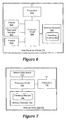
- FIGS. 2-5 illustrates flowcharts of operation and methods that can be performed by a UE in accordance with some embodiments disclosed herein;
- FIG. 6 is a block diagram of a UE that is configured according to some embodiments disclosed herein.
- FIG. 7 is a block diagram of a network node that is configured according to some embodiments disclosed herein.
- Various embodiments disclosed herein are directed to methods and apparatus that operate in conjunction with the methods and apparatuses disclosed in 3GPP ETSI TS 25.331, version 10.8.0, Release 10 (2012-07), entitled “Universal Mobile Telecommunications System (UMTS) Radio Resource Control (RRC) Protocol Specification,” which is incorporated herein by reference in its entirety.
- the invention is not limited to this particular standard or to WCDMA 3GPP third generation communication systems.
- the invention may be embodied in other types of network nodes, UEs, and communication systems, including, but not limited to, 3GPP Long Term Evolution (LTE) systems.
- LTE 3GPP Long Term Evolution
- FIG. 1 An example third generation communications system 100 is shown in FIG. 1 .
- the system 100 includes a plurality of user equipment nodes (UEs) 110 that communicate with radio transceiver base station (Node B) 120 through a radio air interface.
- the Node B 120 is controlled by a radio network controller (RNC) 130 and connected to a core network 140 .
- RNC radio network controller
- the Node B 120 and the RNC 130 are referred to herein as the “network” for convenience of reference and without limitation to the scope of the term.
- the UEs 110 of FIG. 1 may include, but are not limited to, mobile telephones (“cellular” telephones), data terminals, and/or other processing devices with wireless communication capability, such as, for example, portable computers, pocket computers, hand-held computers, laptop computers, electronic book readers, and video game consoles.
- cellular mobile telephones
- data terminals such as, for example, portable computers, pocket computers, hand-held computers, laptop computers, electronic book readers, and video game consoles.
- a UE 110 can utilize common enhanced uplink resources that are set up by the network node for transmission of data on the E-DPDCH.
- Enhanced uplink in the CELL_FACH state may also provide a seamless RRC connection setup process through which a transition from the common enhanced uplink resource (CELL_FACH state) to a dedicated enhanced uplink resource (CELL_DCH state) takes place.
- a UE 110 When a UE 110 transmits data on the E-DPDCH in the CELL_FACH state, it utilizes a common network resource. When the UE 110 needs to make use of the resource for a longer time, the Radio Network Controller (RNC) 130 can switch the UE 110 from the CELL_FACH state to the CELL_DCH state. When the UE 110 switches to the dedicated channel state, the common resource is released and the network assigns a dedicated resource to the UE 110 .
- the switch from the CELL_FACH state to the CELL_DCH state may entail a timing change, a change of uplink (UL) scrambling code, and possibly a change in a Transmission Time Interval (TTI).
- TTI Transmission Time Interval
- SIR target signal-to-interference ratio
- E-DCH Enhanced uplink Dedicated CHannel
- RB Radio Bearer
- a System Information Block contains the parameters to be used by the UEs 110 to access the network.
- SIB System Information Block
- a Release 8 UE that supports Enhanced Uplink in CELL_FACH state and Idle mode will transmit its data on the Enhanced uplink Dedicated CHannel (E-DCH) after performing the defined random access procedure.
- E-DCH Enhanced uplink Dedicated CHannel
- the network can change the SIBs at any moment.
- the network indicates occurrence of the modification to the UEs 110 by paging the UEs 110 .
- the UEs 110 respond by operating to acquire the SIB information.
- the network activates (starts broadcasting) the parameters to configure Enhanced Uplink in the CELL_FACH state and Idle mode
- UEs 110 supporting this feature evaluate a set of variables.
- the variable READY_FOR_COMMON_EDCH is used by the UE to determine whether the UE should configure Enhanced Uplink in CELL_FACH state and Idle mode.
- the UE sets the variable READY_FOR_COMMON_EDCH to a value indicating TRUE, the UE is mandated by the specification to use E-DCH to transmit its data.
- variable READY_FOR_COMMON_EDCH is set by a UE to a value indicating TRUE when the UE determines that either of the following two conditions are met:
- the UE In order to be able to transmit uplink data on an E-DCH (e.g., dedicated control channel—DCCH and/or dedicated Traffic Channel—DTCH data) while operating in the CELL_FACH state, the UE should have at least an E-RNTI (E-DCH Radio Network Temporary identity).
- E-DCH e.g., dedicated control channel—DCCH and/or dedicated Traffic Channel—DTCH data
- E-RNTI E-DCH Radio Network Temporary identity
- the network may assign an E-RNTI to the UE via RRC signaling.
- E-RNTI For example, “Cell Update Confirm” and “RB reconfiguration” are messages which may be transmitted by the network to communicate an E-RNTI to the UE.
- the radio bearer (RB) multiplexing options are updated responsive to: 1) the UE receiving the IEs “RB mapping info,” “CCCH mapping info,” “SRBI mapping info” and/or the IE “Transport format set”; 2) when transport channels, MAC-d flows, MAC-ehs reordering queues or E-DCH MAC-d flows are added or deleted; 3) when the UE performs a cell reselection or a state transition; or 4) when the UE releases a radio bearer (RB).
- the UEs 110 When Enhanced Uplink in the CELL_FACH state and Idle mode is not configured by the network, i.e. the information element (IE) “Common E-DCH system info” is not broadcast by the network, the UEs 110 do not have or keep an E-RNTI when the UEs 110 are in the CELL_FACH state.
- IE information element
- UEs 110 that are operating in the CELL_FACH state are mandated by the specification to use E-DCH to transmit their data.
- the UE needs an E-RNTI and a correct UL RB multiplexing option to be able to transmit on E-DCH.
- the UEs 110 operating in the CELL_FACH state in this situation may not have an E-RNTI and, therefore, should not always transmit data on an E-DCH. Nowhere in TS 25.331 nor the other related specifications is this situation disclosed and, furthermore, nowhere is a possible solution for this situation proposed.
- the UE 110 determines (block 202 ) whether it has an E-RNTI value available for use and, in some embodiments, whether other defined conditions are satisfied.
- the other defined conditions may include whether the UE 110 supports E-DCH transmission in CELL_FACH state and Idle mode, whether the IE “HS-DSCH common system information” has been received from the network, and/or whether the IE “Common E-DCH system info” has been received from the network.
- the UE 110 When the E-RNTI value is available for use and the other defined conditions are satisfied, the UE 110 begins transmitting (block 204 ) uplink data on the E-DCH transport channel. However, in contrast, when the UE 110 determines that the E-RNTI value is not available for use and/or the other defined conditions are not satisfied, the UE 110 continues transmitting (block 206 ) its uplink data in CELL_FACH state on the RACH transport channel.
- the UE sets (block 302 ) the variable READY_FOR_COMMON_EDCH to a value indicating TRUE, in response to all of the following conditions being determined (block 300 ) to be TRUE:
- variable READY_FOR_COMMON_EDCH is set (block 304 ) to a value indicating FALSE.
- the UE 110 determines (block 402 ) whether the variable READY_FOR_COMMON_EDCH is set to a value indicating TRUE or FALSE. When the value indicates TRUE, the UE 110 begins transmitting (block 404 ) uplink data on the E-DCH transport channel. In contrast, when the value indicates FALSE, the UE 110 continues transmitting (block 406 ) its uplink data in CELL_FACH state on the Random CHannel (RACH) transport channel.
- RACH Random CHannel
- the determination (block 300 ) of whether the conditions are satisfied may be carried out by the UE 110 responsive to the UE 110 receiving (block 400 ) parameters from the network to configure enhanced uplink in CELL_FACH state and Idle mode, although the determination (block 300 ) may instead or additionally be carried out responsive to other defined events.
- the UE 110 when the System Information Block (SIB) is changed so that the IE “Common F-DCH System Info” is broadcast by the network, the UE 110 responds to receipt (block 500 ) of the IE “Common E-DCH System Info” by determining (block 502 ) whether it has an available E-RNTI (e.g., stored in the UE). When the E-RNTI is not available, the UE 110 performs cell update operations (block 504 ). The UE 110 can thereby attempt to obtain an E-RNTI through the cell update operations in order to be more ready to begin transmitting uplink data on E-DCH when instructed.
- SIB System Information Block
- the embodiments of explained herein in the context of FIGS. 2-4 can avoid the UE entering an indeterminate state where certain conditions are satisfied under which it should being transmitting uplink data on an E-DCH but does not have an E-RNTI available to use during such transmissions. These embodiments make availability of the E-RNTI a condition precedent to any expectation that the UE will being transmitting on an E-DCH. Moreover, the embodiment explained in the context of FIG. 5 enables the UE to actively attempt to obtain an E-RNTI through cell update operations when the network broadcasts the IE “Common E-DCH system info” when the SIB changes.
- FIG. 6 is a block diagram of the user equipment node (UE) 110 of FIG. 1 that is configured according to some embodiments.
- the UE 110 includes a transceiver 610 , a processor circuit 600 , and a memory device(s) 620 containing functional modules 622 .
- the UE 110 may further include a display 630 , a user input interface 632 , and a speaker 634 .
- the transceiver 610 (e.g., WCDMA, LTE, or other cellular transceiver, Bluetooth transceiver, WiFi transceiver, WiMax transceiver, etc.) is configured to communicate with the Node B 120 or another network node of the communication system 100 or another communication system.
- the processor circuit 600 may include one or more data processing circuits, such as a general purpose and/or special purpose processor (e.g., microprocessor and/or digital signal processor).
- the processor circuit 600 is configured to execute computer program instructions from the functional modules 622 of the memory device(s) 620 , described below as a computer readable medium, to perform at least some of the operations and methods of FIGS. 1-5 described herein as being performed by a UE.
- a UE may include a transceiver and a processor coupled to the transceiver, wherein the processor is configured to receive parameters using the transceiver to configure enhanced uplink in a CELL_FACH state, to determine whether the user equipment node has an Enhanced uplink Dedicated CHannel (E-DCH) Radio Network Temporary Identifier (E-RNTI) value that is available for use, and to transmit data in the CELL_FACH state on a Random Access Channel (RACH) responsive to determining that the user equipment node does not have an E-RNTI value that is available for use.
- E-DCH Enhanced uplink Dedicated CHannel
- E-RNTI Radio Network Temporary Identifier
- FIG. 7 is a block diagram of a network node 120 / 130 (e.g., Node B 120 and/or RNC 130 ) or another network node that is configured according to some embodiments.
- the network node 120 / 130 includes a transceiver 710 , a network interface(s) 730 , a processor circuit 700 , and a memory device(s) 720 containing functional modules 722 .
- the transceiver 710 (e.g., WCDMA, LTE, or other cellular transceiver, Bluetooth transceiver, WiFi transceiver, WiMax transceiver, etc.) is configured to communicate with the UE 110 or another node of the communication system 100 or another communication system.
- the processor circuit 700 may include one or more data processing circuits, such as a general purpose and/or special purpose processor (e.g., microprocessor and/or digital signal processor).
- the processor circuit 700 is configured to execute computer program instructions from the functional modules 722 of the memory device(s) 720 , described below as a computer readable medium, to perform at least some of the operations and methods of FIGS. 1-5 described herein as being performed by the network.
- the network interface 730 communicates with other network nodes and/or the core network 140 .
- E-RNTI E-DCH Radio Network Temporary identifier
- node When a node is referred to as being “connected,” “coupled,” “responsive,” or variants thereof to another node, it can be directly connected, coupled, or responsive to the other node or intervening nodes may be present. In contrast, when an node is referred to as being “directly connected,” “directly coupled,” “directly responsive,” or variants thereof to another node, there are no intervening nodes present.
- Like numbers refer to like nodes throughout.
- “coupled,” “connected,” “responsive,” or variants thereof as used herein may include wirelessly coupled, connected, or responsive.
- the singular forms “a,” “an” and “the” are intended to include the plural forms as well, unless the context clearly indicates otherwise. Well-known functions or constructions may not be described in detail for brevity and/or clarity.
- the term “and/or” includes any and all combinations of one or more of the associated listed items.
- the terms “comprise,” “comprising,” “comprises,” “include,” “including,” “includes,” “have,” “has,” “having,” or variants thereof are open-ended, and include one or more stated features, integers, nodes, steps, components or functions but does not preclude the presence or addition of one or more other features, integers, nodes, steps, components, functions or groups thereof.
- the common abbreviation “e.g.” which derives from the Latin phrase “exempli gratia,” may be used to introduce or specify a general example or examples of a previously mentioned item, and is not intended to be limiting of such item.
- the common abbreviation “i.e.” which derives from the Latin phrase “id est,” may be used to specify a particular item from a more general recitation.
- Example embodiments are described herein with reference to block diagrams and/or flowchart illustrations of computer-implemented methods, apparatus (systems and/or devices) and/or computer program products. It is understood that a block of the block diagrams and/or flowchart illustrations, and combinations of blocks in the block diagrams and/or flowchart illustrations, can be implemented by computer program instructions that are performed by one or more computer circuits.
- These computer program instructions may be provided to a processor circuit of a general purpose computer circuit, special purpose computer circuit, and/or other programmable data processing circuit to produce a machine, such that the instructions, which execute via the processor of the computer and/or other programmable data processing apparatus, transform and control transistors, values stored in memory locations, and other hardware components within such circuitry to implement the functions/acts specified in the block diagrams and/or flowchart block or blocks, and thereby create means (functionality) and/or structure for implementing the functions/acts specified in the block diagrams and/or flowchart block(s).
- These computer program instructions may also be stored in a tangible computer-readable medium that can direct a computer or other programmable data processing apparatus to function in a particular manner, such that the instructions stored in the computer-readable medium produce an article of manufacture including instructions which implement the functions/acts specified in the block diagrams and/or flowchart block or blocks.
- a tangible, non-transitory computer-readable medium may include an electronic, magnetic, optical, electromagnetic, or semiconductor data storage system, apparatus, or device. More specific examples of the computer-readable medium would include the following: a portable computer diskette, a random access memory (RAM) circuit, a read-only memory (ROM) circuit, an erasable programmable read-only memory (EPROM or Flash memory) circuit, a portable compact disc read-only memory (CD-ROM), and a portable digital video disc read-only memory (DVD/BluRay).
- RAM random access memory
- ROM read-only memory
- EPROM or Flash memory erasable programmable read-only memory
- CD-ROM compact disc read-only memory
- DVD/BluRay portable digital video disc read-only memory
- the computer program instructions may also be loaded onto a computer and/or other programmable data processing apparatus to cause a series of operational steps to be performed on the computer and/or other programmable apparatus to produce a computer-implemented process such that the instructions which execute on the computer or other programmable apparatus provide steps for implementing the functions/acts specified in the block diagrams and/or flowchart block or blocks.
- embodiments of the present invention may be embodied in hardware and/or in software (including firmware, resident software, micro-code, etc.) that runs on a processor such as a digital signal processor, which may collectively be referred to as “circuitry,” “a module” or variants thereof.
Landscapes
- Engineering & Computer Science (AREA)
- Computer Networks & Wireless Communication (AREA)
- Signal Processing (AREA)
- Mobile Radio Communication Systems (AREA)
Priority Applications (2)
| Application Number | Priority Date | Filing Date | Title |
|---|---|---|---|
| US14/004,098 US9307570B2 (en) | 2012-08-03 | 2013-08-02 | Controlling user equipment nodes for enhanced uplink and user equipment nodes configured for enhanced uplink |
| US15/077,364 US9736881B2 (en) | 2012-08-03 | 2016-03-22 | Controlling user equipment nodes for enhanced uplink and user equipment nodes configured for enhanced uplink |
Applications Claiming Priority (3)
| Application Number | Priority Date | Filing Date | Title |
|---|---|---|---|
| US201261679230P | 2012-08-03 | 2012-08-03 | |
| PCT/SE2013/050945 WO2014021775A1 (en) | 2012-08-03 | 2013-08-02 | Controlling user equipment nodes for enhanced uplink and user equipment nodes configured for enhanced uplink |
| US14/004,098 US9307570B2 (en) | 2012-08-03 | 2013-08-02 | Controlling user equipment nodes for enhanced uplink and user equipment nodes configured for enhanced uplink |
Related Parent Applications (1)
| Application Number | Title | Priority Date | Filing Date |
|---|---|---|---|
| PCT/SE2013/050945 A-371-Of-International WO2014021775A1 (en) | 2012-08-03 | 2013-08-02 | Controlling user equipment nodes for enhanced uplink and user equipment nodes configured for enhanced uplink |
Related Child Applications (1)
| Application Number | Title | Priority Date | Filing Date |
|---|---|---|---|
| US15/077,364 Continuation US9736881B2 (en) | 2012-08-03 | 2016-03-22 | Controlling user equipment nodes for enhanced uplink and user equipment nodes configured for enhanced uplink |
Publications (2)
| Publication Number | Publication Date |
|---|---|
| US20140066080A1 US20140066080A1 (en) | 2014-03-06 |
| US9307570B2 true US9307570B2 (en) | 2016-04-05 |
Family
ID=49003972
Family Applications (2)
| Application Number | Title | Priority Date | Filing Date |
|---|---|---|---|
| US14/004,098 Expired - Fee Related US9307570B2 (en) | 2012-08-03 | 2013-08-02 | Controlling user equipment nodes for enhanced uplink and user equipment nodes configured for enhanced uplink |
| US15/077,364 Active US9736881B2 (en) | 2012-08-03 | 2016-03-22 | Controlling user equipment nodes for enhanced uplink and user equipment nodes configured for enhanced uplink |
Family Applications After (1)
| Application Number | Title | Priority Date | Filing Date |
|---|---|---|---|
| US15/077,364 Active US9736881B2 (en) | 2012-08-03 | 2016-03-22 | Controlling user equipment nodes for enhanced uplink and user equipment nodes configured for enhanced uplink |
Country Status (4)
| Country | Link |
|---|---|
| US (2) | US9307570B2 (enExample) |
| EP (1) | EP2880957B1 (enExample) |
| JP (1) | JP2015530020A (enExample) |
| WO (1) | WO2014021775A1 (enExample) |
Cited By (1)
| Publication number | Priority date | Publication date | Assignee | Title |
|---|---|---|---|---|
| US10484999B2 (en) | 2016-09-29 | 2019-11-19 | Qualcomm Incorporated | Triggers for user equipment transmissions to support uplink based mobility |
Families Citing this family (3)
| Publication number | Priority date | Publication date | Assignee | Title |
|---|---|---|---|---|
| CN104363974A (zh) * | 2013-03-20 | 2015-02-18 | 华为技术有限公司 | 用户设备冲突检测方法、用户设备和基站 |
| US10285180B2 (en) * | 2015-03-14 | 2019-05-07 | Qualcomm Incorporated | Reserved resource pool assisted access resource selection for small data transmission |
| CN108463000B (zh) * | 2017-02-17 | 2023-08-29 | 中兴通讯股份有限公司 | 一种数据传输方法及装置 |
Citations (5)
| Publication number | Priority date | Publication date | Assignee | Title |
|---|---|---|---|---|
| US20070133456A1 (en) * | 2005-03-28 | 2007-06-14 | Huawei Technologies Co., Ltd. | Method and System for Receiving Multimedia Broadcast/Multicast Service Control Information, and UE Thereof |
| WO2009058089A1 (en) | 2007-10-30 | 2009-05-07 | Telefonaktiebolaget L M Ericsson (Publ) | Fast random access for an enhanced uplink dedicated channel |
| US20090181710A1 (en) * | 2008-01-04 | 2009-07-16 | Interdigital Patent Holdings, Inc. | Method and apparatus for performing wtru state transition with enhanced rach in hspa systems |
| US20100220623A1 (en) * | 2009-03-02 | 2010-09-02 | Interdigital Patent Holdings, Inc. | Method and apparatus for extending coverage for ul transmission over e-dch in idle mode and cell_fach state |
| US20110207465A1 (en) * | 2010-02-10 | 2011-08-25 | Research In Motion Limited | Method and apparatus for state/mode transitioning |
-
2013
- 2013-08-02 US US14/004,098 patent/US9307570B2/en not_active Expired - Fee Related
- 2013-08-02 JP JP2015525404A patent/JP2015530020A/ja active Pending
- 2013-08-02 EP EP13750967.5A patent/EP2880957B1/en not_active Not-in-force
- 2013-08-02 WO PCT/SE2013/050945 patent/WO2014021775A1/en not_active Ceased
-
2016
- 2016-03-22 US US15/077,364 patent/US9736881B2/en active Active
Patent Citations (5)
| Publication number | Priority date | Publication date | Assignee | Title |
|---|---|---|---|---|
| US20070133456A1 (en) * | 2005-03-28 | 2007-06-14 | Huawei Technologies Co., Ltd. | Method and System for Receiving Multimedia Broadcast/Multicast Service Control Information, and UE Thereof |
| WO2009058089A1 (en) | 2007-10-30 | 2009-05-07 | Telefonaktiebolaget L M Ericsson (Publ) | Fast random access for an enhanced uplink dedicated channel |
| US20090181710A1 (en) * | 2008-01-04 | 2009-07-16 | Interdigital Patent Holdings, Inc. | Method and apparatus for performing wtru state transition with enhanced rach in hspa systems |
| US20100220623A1 (en) * | 2009-03-02 | 2010-09-02 | Interdigital Patent Holdings, Inc. | Method and apparatus for extending coverage for ul transmission over e-dch in idle mode and cell_fach state |
| US20110207465A1 (en) * | 2010-02-10 | 2011-08-25 | Research In Motion Limited | Method and apparatus for state/mode transitioning |
Non-Patent Citations (6)
| Title |
|---|
| 3GPP TS 25.331 V10.8.0 (Jun. 2012) "3rd Generation Partnership Project; Technical Specification Group Radio Access Network; Radio Resource Control (RRC); Protocol Specification" (Release 10). |
| 3GPP TS 25.331 V11.2.0 (Jun. 2012); ,3rd Generation Partnership Project; Technical Specification Group Radio Access Network; Radio Resource Control (RRC); Protocol Specification (Release 11), 3GPP Standard; F-06921 Sophia-Antipolis Cedex, France, Jul. 10, 2012. |
| Ericsson, ST-Ericsson "UE behavior when updating SIB5", 3GPP TSG-RAN WG2 #79, R2-123881, Qingdao, P.R. of China, Aug. 13-17, 2012. |
| International Search Report and Written Opinion Corresponding to International Application No. PCT/SE2013/050945; Date of Mailing: Nov. 12, 2013; 34 Pages. |
| International Search Report and Written Opinion Corresponding to International Application No. PCT/SE2013/050945; Date of Mailing: Nov. 13, 2013; 13 Pages. |
| Nokia Corporation, Nokia Siemens Networks, "Correction of RNTIs handling for Enhanced Uplink in CELL-FACH", 3GPP TSG-RAN WG2 Meeting #69, R2-101310, San Francisco, USA, Feb. 22-26, 2010. |
Cited By (1)
| Publication number | Priority date | Publication date | Assignee | Title |
|---|---|---|---|---|
| US10484999B2 (en) | 2016-09-29 | 2019-11-19 | Qualcomm Incorporated | Triggers for user equipment transmissions to support uplink based mobility |
Also Published As
| Publication number | Publication date |
|---|---|
| EP2880957B1 (en) | 2016-12-28 |
| US20160249403A1 (en) | 2016-08-25 |
| WO2014021775A1 (en) | 2014-02-06 |
| EP2880957A1 (en) | 2015-06-10 |
| US20140066080A1 (en) | 2014-03-06 |
| US9736881B2 (en) | 2017-08-15 |
| JP2015530020A (ja) | 2015-10-08 |
Similar Documents
| Publication | Publication Date | Title |
|---|---|---|
| US10039065B2 (en) | State transition procedure in a wireless network | |
| EP2654352B1 (en) | Method and apparatus for enabling cell reselection for wtru operating in discontinous reception | |
| US8665852B2 (en) | Method of receiving system information for a wireless communications system and related apparatus | |
| US9794936B2 (en) | Multireceiver timing advance provisioning | |
| JP6378188B2 (ja) | ユーザ機器からのセル更新メッセージを遅延させるための装置および方法 | |
| US20160081137A1 (en) | Discontinuous Transmission Method, User Equipment, and Network Side Device | |
| US20190281633A1 (en) | Method and device for transmitting random access preamble | |
| US8774121B2 (en) | Method and apparatus for transmission protocol uplink channel selection | |
| US9736881B2 (en) | Controlling user equipment nodes for enhanced uplink and user equipment nodes configured for enhanced uplink | |
| US10051655B2 (en) | Methods and apparatus | |
| US20130039237A1 (en) | Method and Apparatus for Transmission Protocol Uplink Channel Selection | |
| WO2015190986A1 (en) | Methods and arrangements for switching of states |
Legal Events
| Date | Code | Title | Description |
|---|---|---|---|
| AS | Assignment |
Owner name: TELEFONAKTIEBOLAGET L M ERICSSON (PUBL), SWEDEN Free format text: ASSIGNMENT OF ASSIGNORS INTEREST;ASSIGNORS:CURRAN, MARK;PRADAS, JOSE LUIS;SIGNING DATES FROM 20131003 TO 20131018;REEL/FRAME:032895/0453 |
|
| AS | Assignment |
Owner name: TELEFONAKTIEBOLAGET L M ERICSSON (PUBL), SWEDEN Free format text: CORRECTIVE ASSIGNMENT TO CORRECT THE PRIORITY INFORMATION PREVIOUSLY RECORDED ON REEL 032895 FRAME 0453. ASSIGNOR(S) HEREBY CONFIRMS THE PCT NO: --SE2013050945-- SHOULD BE INCLUDED AS PRIORITY;ASSIGNORS:CURRAN, MARK;PRADAS, JOSE LUIS;SIGNING DATES FROM 20131003 TO 20131018;REEL/FRAME:033073/0598 |
|
| ZAAA | Notice of allowance and fees due |
Free format text: ORIGINAL CODE: NOA |
|
| ZAAB | Notice of allowance mailed |
Free format text: ORIGINAL CODE: MN/=. |
|
| STCF | Information on status: patent grant |
Free format text: PATENTED CASE |
|
| CC | Certificate of correction | ||
| MAFP | Maintenance fee payment |
Free format text: PAYMENT OF MAINTENANCE FEE, 4TH YEAR, LARGE ENTITY (ORIGINAL EVENT CODE: M1551); ENTITY STATUS OF PATENT OWNER: LARGE ENTITY Year of fee payment: 4 |
|
| FEPP | Fee payment procedure |
Free format text: MAINTENANCE FEE REMINDER MAILED (ORIGINAL EVENT CODE: REM.); ENTITY STATUS OF PATENT OWNER: LARGE ENTITY |
|
| LAPS | Lapse for failure to pay maintenance fees |
Free format text: PATENT EXPIRED FOR FAILURE TO PAY MAINTENANCE FEES (ORIGINAL EVENT CODE: EXP.); ENTITY STATUS OF PATENT OWNER: LARGE ENTITY |
|
| STCH | Information on status: patent discontinuation |
Free format text: PATENT EXPIRED DUE TO NONPAYMENT OF MAINTENANCE FEES UNDER 37 CFR 1.362 |
|
| FP | Lapsed due to failure to pay maintenance fee |
Effective date: 20240405 |