US9238777B2 - Method for producing phosphorus-containing flame retardants - Google Patents

Method for producing phosphorus-containing flame retardants Download PDF

Info

Publication number
US9238777B2
US9238777B2 US14/633,156 US201514633156A US9238777B2 US 9238777 B2 US9238777 B2 US 9238777B2 US 201514633156 A US201514633156 A US 201514633156A US 9238777 B2 US9238777 B2 US 9238777B2
Authority
US
United States
Prior art keywords
residue
dopo
phosphinyl
guanamine
dop
Prior art date
Legal status (The legal status is an assumption and is not a legal conclusion. Google has not performed a legal analysis and makes no representation as to the accuracy of the status listed.)
Expired - Fee Related
Application number
US14/633,156
Other versions
US20150203759A1 (en
Inventor
Thomas Zich
Fritz Johann FREIDL
Bernadette Mehofer
Manfred Doring
Michael Ciesielski
Bettina BURK
Current Assignee (The listed assignees may be inaccurate. Google has not performed a legal analysis and makes no representation or warranty as to the accuracy of the list.)
Metadynea Austria GmbH
Original Assignee
Metadynea Austria GmbH
Priority date (The priority date is an assumption and is not a legal conclusion. Google has not performed a legal analysis and makes no representation as to the accuracy of the date listed.)
Filing date
Publication date
Application filed by Metadynea Austria GmbH filed Critical Metadynea Austria GmbH
Assigned to METADYNEA AUSTRIA GMBH reassignment METADYNEA AUSTRIA GMBH ASSIGNMENT OF ASSIGNORS INTEREST (SEE DOCUMENT FOR DETAILS). Assignors: ZICH, THOMAS, MR, BURK, BETTINA, MS, DORING, MANFRED, MR, CIESIELSKI, MICHAEL, MR, FREIDL, FRITZ JOHANN, MR, MEIHOFER, BERNADETTE, MS
Publication of US20150203759A1 publication Critical patent/US20150203759A1/en
Application granted granted Critical
Publication of US9238777B2 publication Critical patent/US9238777B2/en
Expired - Fee Related legal-status Critical Current
Anticipated expiration legal-status Critical

Links

Classifications

    • CCHEMISTRY; METALLURGY
    • C09DYES; PAINTS; POLISHES; NATURAL RESINS; ADHESIVES; COMPOSITIONS NOT OTHERWISE PROVIDED FOR; APPLICATIONS OF MATERIALS NOT OTHERWISE PROVIDED FOR
    • C09KMATERIALS FOR MISCELLANEOUS APPLICATIONS, NOT PROVIDED FOR ELSEWHERE
    • C09K21/00Fireproofing materials
    • C09K21/06Organic materials
    • C09K21/12Organic materials containing phosphorus
    • CCHEMISTRY; METALLURGY
    • C07ORGANIC CHEMISTRY
    • C07DHETEROCYCLIC COMPOUNDS
    • C07D251/00Heterocyclic compounds containing 1,3,5-triazine rings
    • C07D251/02Heterocyclic compounds containing 1,3,5-triazine rings not condensed with other rings
    • C07D251/12Heterocyclic compounds containing 1,3,5-triazine rings not condensed with other rings having three double bonds between ring members or between ring members and non-ring members
    • C07D251/26Heterocyclic compounds containing 1,3,5-triazine rings not condensed with other rings having three double bonds between ring members or between ring members and non-ring members with only hetero atoms directly attached to ring carbon atoms
    • C07D251/40Nitrogen atoms
    • C07D251/54Three nitrogen atoms
    • C07D251/66Derivatives of melamine in which a hetero atom is directly attached to a nitrogen atom of melamine
    • CCHEMISTRY; METALLURGY
    • C07ORGANIC CHEMISTRY
    • C07FACYCLIC, CARBOCYCLIC OR HETEROCYCLIC COMPOUNDS CONTAINING ELEMENTS OTHER THAN CARBON, HYDROGEN, HALOGEN, OXYGEN, NITROGEN, SULFUR, SELENIUM OR TELLURIUM
    • C07F9/00Compounds containing elements of Groups 5 or 15 of the Periodic Table
    • C07F9/02Phosphorus compounds
    • C07F9/28Phosphorus compounds with one or more P—C bonds
    • C07F9/38Phosphonic acids [RP(=O)(OH)2]; Thiophosphonic acids ; [RP(=X1)(X2H)2(X1, X2 are each independently O, S or Se)]
    • C07F9/44Amides thereof
    • CCHEMISTRY; METALLURGY
    • C07ORGANIC CHEMISTRY
    • C07FACYCLIC, CARBOCYCLIC OR HETEROCYCLIC COMPOUNDS CONTAINING ELEMENTS OTHER THAN CARBON, HYDROGEN, HALOGEN, OXYGEN, NITROGEN, SULFUR, SELENIUM OR TELLURIUM
    • C07F9/00Compounds containing elements of Groups 5 or 15 of the Periodic Table
    • C07F9/02Phosphorus compounds
    • C07F9/28Phosphorus compounds with one or more P—C bonds
    • C07F9/38Phosphonic acids [RP(=O)(OH)2]; Thiophosphonic acids ; [RP(=X1)(X2H)2(X1, X2 are each independently O, S or Se)]
    • C07F9/44Amides thereof
    • C07F9/4461Amides thereof the amide moiety containing a substituent or a structure which is considered as characteristic
    • C07F9/4476Amides thereof the amide moiety containing a substituent or a structure which is considered as characteristic of aromatic amines (N-C aromatic linkage)
    • CCHEMISTRY; METALLURGY
    • C07ORGANIC CHEMISTRY
    • C07FACYCLIC, CARBOCYCLIC OR HETEROCYCLIC COMPOUNDS CONTAINING ELEMENTS OTHER THAN CARBON, HYDROGEN, HALOGEN, OXYGEN, NITROGEN, SULFUR, SELENIUM OR TELLURIUM
    • C07F9/00Compounds containing elements of Groups 5 or 15 of the Periodic Table
    • C07F9/02Phosphorus compounds
    • C07F9/547Heterocyclic compounds, e.g. containing phosphorus as a ring hetero atom
    • C07F9/6515Heterocyclic compounds, e.g. containing phosphorus as a ring hetero atom having three nitrogen atoms as the only ring hetero atoms
    • C07F9/6521Six-membered rings
    • C07F9/65217
    • CCHEMISTRY; METALLURGY
    • C07ORGANIC CHEMISTRY
    • C07FACYCLIC, CARBOCYCLIC OR HETEROCYCLIC COMPOUNDS CONTAINING ELEMENTS OTHER THAN CARBON, HYDROGEN, HALOGEN, OXYGEN, NITROGEN, SULFUR, SELENIUM OR TELLURIUM
    • C07F9/00Compounds containing elements of Groups 5 or 15 of the Periodic Table
    • C07F9/02Phosphorus compounds
    • C07F9/547Heterocyclic compounds, e.g. containing phosphorus as a ring hetero atom
    • C07F9/6564Heterocyclic compounds, e.g. containing phosphorus as a ring hetero atom having phosphorus atoms, with or without nitrogen, oxygen, sulfur, selenium or tellurium atoms, as ring hetero atoms
    • C07F9/6571Heterocyclic compounds, e.g. containing phosphorus as a ring hetero atom having phosphorus atoms, with or without nitrogen, oxygen, sulfur, selenium or tellurium atoms, as ring hetero atoms having phosphorus and oxygen atoms as the only ring hetero atoms
    • C07F9/657154Cyclic esteramides of oxyacids of phosphorus

Definitions

  • the invention relates to a novel method for producing phosphorus-containing compounds which are effective as flame retardants.
  • phosphorus compounds have been known to be flame retardants.
  • DOPO 9,10-dihydro-9-oxa-10-phosphaphenanthrene-10-one or -oxide
  • Their flame retardant properties appear to be due to the release by them of phosphorus-containing radicals when heated (see, for example, Shufer et al., J. Appl. Polym. Sci. 105(2), 685-696 (2007)).
  • DPhPO diphenylphosphine oxide
  • DPhOPO diphenylphosphite
  • melamine and guanamine derivatives are among known nitrogen-containing compounds with a flame retardant effect:
  • Q′ could be, inter alia, a DOPO or DPhPO residue
  • R could be NH 2 , CH 3 or phenyl
  • i and j respectively represent 0, 1 or 2.
  • diphenylphosphoryl chloride with 1 mol of melamine and heating to about 170° C.
  • the analogous synthesis of compounds containing more than one phosphorus-containing DOPO or DPhPO group by reacting i+j mol of Q′Cl with 1 mol of melamine or guanamine was mentioned in general terms without, however, describing a specific method.
  • reaction times in Wang et al's method are very long.
  • stirring times of 16 h (for DOPO-Cl) or 10 h (for DPhPO-Cl) are necessary in order to obtain essentially complete conversion, even though temperatures of around 170° C. are employed.
  • the aim of the invention is to provide an improved method for the production of such or similar compounds by means of which these compounds can be obtained in good yields after relatively short reaction periods and essentially without any disruptive side reactions.
  • the invention accomplishes this aim by providing a method for producing compounds with the following formula (I):
  • the bound phosphinyl residue(s) is(are) oxidized by reaction with an oxidizing agent to form the corresponding phosphoryl residue(s).
  • residue R 2 is selected from —NH 2 and monovalent alkyl and aryl residues, i.e. melamine or a guanamine, is reacted with one or more of the phosphinyl chlorides DOP-Cl, DPhP-Cl and DPhOP-Cl to form one or more compounds with the following formula (III):
  • the compound(s) with formula (III) are oxidized by reaction with the oxidizing agent to form one or more compounds with formula (I).
  • the phosphinyl chlorides employed in the method of the invention have a sufficiently high reactivity to allow rapid bonding of exactly one phosphorus-containing residue to occur per amino group, but it is not sufficient to di-substitute the amino group, even when a molar excess of phosphinyl chloride is employed.
  • the phosphinyl chloride DOP-Cl used in the method of the invention for the production of DOPO derivatives is an industrial intermediate in the production of the conventional flame retardant DOPO, and thus is produced in large quantities, and hence is much cheaper and more readily available than the phosphoryl chloride DOPO-Cl which is used in Chun-Shan Wang's method.
  • the monovalent alkyl and aryl residues as options for the residues R 1 to R 3 are preferably —CH 3 or —C 6 H 5 , i.e. methyl or phenyl, since these form conventional and readily obtainable guanamines—methyl guanamine and phenyl—and also benzo-guanamine.
  • the method of the invention is, however, applicable to a broad range of substituents on the diaminotriazine nucleus, and hence the scope of protection should not be limited to these two preferred residues.
  • the phosphorus-containing intermediates obtained in the first step are largely stable to hydrolysis and thus can readily be isolated, for example by stirring into water. Furthermore, one-pot syntheses are possible for both steps. Both will be described in the exemplary embodiments below.
  • the oxidizing agent there are no particular limits as to the oxidizing agent, as long as it does not result in any unwanted side reactions of the reaction participants.
  • a peroxide is in fact used, as any excesses are easy to separate or destroy.
  • H 2 O 2 many other peroxides and hydroperoxides may be used. Even the oxidation of DOP to DOPO with ozone, which is known from the literature, is possible, but in the inventors' experiments, the results were not as good as with hydrogen peroxide or t-butyl hydroperoxide.
  • H 2 O 2 is preferred because of its greater stability and thus ease of handling.
  • the first step is preferably carried out in the presence of an acid scavenger in order to displace the reaction equilibrium towards the product side.
  • the acid scavenger is preferably 1-methylimidazole, although clearly other compounds known to the skilled person, such as ammonia, alkyl- and aryl-amines and other nitrogen compounds such as trimethylamine, pyridine, imidazole and the like, or other bases such as alkali and alkaline-earth metal compounds, for example, may also be used.
  • 1-methylimidazole has the great advantage that its hydrochloride melts at a temperature as low as 75° C.
  • the non-methylated homologue imadazolium chloride has a melting point of 158-161° C.
  • a second liquid phase which can easily be separated is formed in addition to the reaction solution.
  • Both steps are preferably carried out in an organic solvent in order to ensure the homogeneity of the reaction and heat dissipation.
  • the solvent there are no specific restrictions applying to the solvent, as long as it is chemically inert having regard to the reactions occurring therein and the starting products are soluble or at least dispersible therein.
  • the first step for the reasons given above, it should have a boiling point which is substantially above 75° C., the DOP-Cl should have a sufficiently good solubility in it, and 1-methylimidazolium chloride should not dissolve in it.
  • a relatively apolar, anhydrous solvent is preferably used, more preferably an aromatic hydrocarbon such as, for example, benzene, toluene, xylene or the like, in particular toluene.
  • an aromatic hydrocarbon such as, for example, benzene, toluene, xylene or the like, in particular toluene.
  • the same solvent is used both for reaction of the aminotriazine with the phosphinyl chloride and also for the subsequent oxidation.
  • different solvents may also be used, for example chloroform for the first step and toluene for the oxidation, etc.
  • the acid scavenger simultaneously acts as a solvent; hence in particular in this case, 1-methylimidazole acts both as an acid scavenger and as the solvent.
  • chloroform or toluene are preferred, in particular toluene because it is halogen-free.
  • the first step should preferably be carried out at a temperature in the range 100° C. to 200° C., in order to ensure short reaction times, high conversions and good yields.
  • temperatures in the range 50° C. to 100° C. have proven advantageous.
  • the invention pertains to protection of this product as well as to its use as a flame retardant.
  • the inventor shows this novel compound to have an exceptional effect as a flame retardant for plastic materials, in particular for polystyrene and epoxides.
  • DOPO 3 -mel i.e. 2,4,6-tris(9,10-dihydro-9-oxa-10-oxo-10-phosphaphenanthrene-10-ylamino)-1,3,5-triazine
  • Step 1 Provide of DOP 3 -mel, i.e. 2,4,6-tris(9,10-dihydro-9-oxa-10-phosphaphenanthrene-10-ylamino)-1,3,5-triazine
  • Step 2 Oxidation of DOP 3 -mel to Form DOPO 3 -mel
  • the (DOP) 3 -mel (72.4 g) produced in step 1 was stirred at 50° C. into 500 ml of chloroform in a 1-L three-necked flask equipped with a stirrer, integral thermometer and dropping funnel; part of it went up into solution.
  • the mixture was cooled to approximately 12° C. using a cooling bath and addition of an 11% solution of H 2 O 2 (106.5 g, 34 mol) in acetic acid ethyl ester was immediately commenced.
  • the reagent was dripped in within approximately 1.5 h, with vigorous stirring and with the temperature kept at approximately 15° C.
  • the cooling bath was removed and stirring was continued for a further 2 h.
  • the cloudy solution obtained was supplemented with anhydrous sodium sulphate in order to separate out the water which was formed during the reaction.
  • the product solution was reduced at 40° C. under a partial vacuum and a crude substance precipitated out. After cooling to approximately 0° C., it was decanted. The remaining solid was slowly heated to 230° C. under vacuum. After approximately 30 min at this temperature, cooling and comminuting the raw product obtained, it was then dissolved in 150 ml of chloroform. This solution was then dripped into 500 ml of diethyl ether with vigorous stirring, whereupon a white, granular solid precipitated out which was filtered off, washed with diethyl ether and dried at 60° C. under vacuum. In this manner, 67 g of (DOPO) 3 -mel was obtained (87.2% of theoretical yield).
  • DOPO 2 -Ph guanamine i.e. 2,4-bis(9,10-dihydro-9-oxa-10-oxo-10-phosphaphenanthrene-10-ylamino)-6-phenyl-1,3,5-triazine
  • Step 1 Provide of DOP 2 -Ph Guanamine from Phenyl Guanamine and DOP-Cl
  • 6-phenyl-1,3,5-triazine-2,4-diamine phenyl guanamine; 33.1 g, 0.177 mol, 1 eq
  • 1-methylimidazole 145 g, 1.77 mol, 10 eq
  • 91.2 g (0.389 mol, 2.2 eq) of DOP-Cl was melted at approximately 100° C. under inert conditions and placed in the dropping funnel.
  • the DOP-Cl was dripped in with vigorous stirring over a period of 1 h at 100° C., wherein a hot air blower was used to keep it liquid.
  • IR (KBr): v 206 (m, N—H), 1540 (vs, O ⁇ C—N—H), 1506, 1486, 1424 (vs, P-Ph), 1197 (m, P—O-Ph), 1103, 943, 845, 879, 764 and 746 (s, C—H bend).
  • Step 2 Oxidation of DOP 2 -Ph Guanamine to Form DOPO 2 -Ph Guanamine
  • IR (KBr): v 3179 (w, N—H), 1587 (C ⁇ C), 1538 (vs, O ⁇ C—N—H), 1493, 1454, 1417 (vs, P-Ph), 1232 (s, P ⁇ O), 1205 (s, P—O-Ph), 1119, 1088, 943, 876, 751 and 785 (s, C—H bend).
  • Step 1 Provide of DOP-mel and DOP 2 -mel
  • Step 2 Oxidation of DOP-mel and DOP 2 -mel to Form DOPO-mel and DOPO 2 -mel
  • Step 1 Provide of DPhP 2 -Ph Guanamine from Phenylguanamine and DPhP-Cl
  • Phenyl guanamine (2.38 g, 0.0127 mol, 1 eq), 1-methylimidazole (2.29 g, 0.0279 mol, 2.2 eq) as well as 40 ml of anhydrous toluene were placed in a three-necked flask filled with argon equipped with a condenser, thermometer, stirring means and a dropping funnel and heated to 80° C. 6.16 g (0.0279 mol, 2.2 eq) of diphenylphosphinyl chloride (DPHP-Cl) was slowly dripped in at this temperature, with stirring. Next, the reaction mixture, which was now in two phases, was stirred for 2 h at 90° C.
  • DPHP-Cl diphenylphosphinyl chloride
  • the upper phase was decanted under inert conditions from the viscous lower phase (1-methylimidazolium chloride) and transferred via a connecting piece into a second three-necked flask which had also been filled with argon. In this manner, a solution of DPhP 2 -Ph guanamine was obtained, which was used in the second step without further working-up.
  • Step 2 Oxidation of DPhP 2 -Ph Guanamine to Form DPhPO 2 -Ph Guanamine
  • the three-necked flask with the solution of DPhP 2 -Ph guanamine produced in step 1 was equipped with a condenser, thermometer, stirrer and a dropping funnel which had been filled with 6.86 g (0.0381 mol, 3 eq) of an 11% solution of H 2 O 2 in acetic acid ethyl ester.
  • the reaction mixture was cooled to approximately 5° C. using an ice water bath and the oxidizing agent was dripped in slowly and with vigorous stirring, with the temperature being maintained at a maximum of 15° C. After H 2 O 2 addition was complete, the cooling bath was removed and the reaction mixture was stirred for a further 15 h.
  • An epoxy novolac resin, D.E.N. 438 from Dow Chemicals with an EEW (epoxy equivalent weight) of 179 g/mol was mixed with 0.1% by weight of triethanolamine and the novel compound of the invention, DOPO 3 -mel, as the flame retardant additive—in the amount required to adjust it to the required phosphorus content in the test specimen.
  • the mixture was then maintained for 2 h at 140° C., degassed under vacuum and cooled to 90° C.
  • the pre-formulation obtained was mixed with 6 parts by weight of dicyandiamide and 2 parts by weight of fenuron, referred to 100 parts by weight of epoxy novolac resin. Curing was carried out in an aluminium cup by carefully heating to 120° C.
  • test specimens were made from it and classified in accordance with UL94 in order to characterize the flammability.
  • UL94 is a test protocol from Underwriters Laboratories which has been incorporated in its entirety into IEC/DIN EN 60695-11-10 and -20. In it, igniting flames with a power of 50 W are twice briefly applied to the test specimens, wherein a vertical test of the burn time and drips of flaming particles was assessed with the aid of a pad of cotton wool disposed below the test specimen.
  • the classification categories are “V0”, “V1” and “V2” which are explained in Table 1 below:
  • the classification “V0” thus constitutes the highest category of flame retardant and thus is the goal for flame retardant compositions.
  • Table 2 shows the results of the test for DOPO 3 -mel and for DOPO as a comparative substance.

Landscapes

  • Chemical & Material Sciences (AREA)
  • Organic Chemistry (AREA)
  • Health & Medical Sciences (AREA)
  • Life Sciences & Earth Sciences (AREA)
  • Biochemistry (AREA)
  • General Health & Medical Sciences (AREA)
  • Molecular Biology (AREA)
  • Engineering & Computer Science (AREA)
  • Materials Engineering (AREA)
  • Fireproofing Substances (AREA)

Abstract

A method for producing compounds of formula (I) in which the radical R1 is selected from —NH2, —NH2-zAz, and monovalent alkyl and aryl radicals, the radicals A are selected in each case independently of one another from the phosphoryl radicals DOPO-, DPhPO- and DPhOPO-, and the indices x, y and z, in each case independently of one another, stand for 0 or 1, wherein at least one of the indices is ≠0, by reacting, in a first step, melamine or, when R1 is an alkyl or aryl radical, the corresponding alkyl or aryl guanamine, with one or more of the corresponding phosphinyl chlorides DOP-CI, DPhP-Cl and DPhOP-CI, in order to bond one or more phosphinyl radicals to the amino groups(s) of the melamine or guanamine, and in a second step oxidizing the phosphinyl radical(s) by reaction with an oxidizing agent to give the corresponding phosphoryl radical(s).

Description

CROSS REFERENCE TO RELATED APPLICATIONS
This application is a continuation of PCT application number PCT/AT2013/050167 filed on 28 Aug. 2013, which claims priority from application number A 944/2012 filed on 29 Aug. 2012. Both applications are hereby incorporated by reference in their entireties.
BACKGROUND OF THE INVENTION
1. Field of the Invention
The invention relates to a novel method for producing phosphorus-containing compounds which are effective as flame retardants.
For a long time, phosphorus compounds have been known to be flame retardants. In recent years, they have frequently also included 9,10-dihydro-9-oxa-10-phosphaphenanthrene-10-one or -oxide (DOPO), which was described for the first time by Sanko Chemical Co Ltd in DE 20 34 887, and various derivatives thereof. Their flame retardant properties appear to be due to the release by them of phosphorus-containing radicals when heated (see, for example, Schäfer et al., J. Appl. Polym. Sci. 105(2), 685-696 (2007)).
Figure US09238777-20160119-C00001
Derivatives of diphenylphosphine oxide (DPhPO) and diphenylphosphite (DPhOPO) are also known to be phosphorus compounds with a flame retardant effect; the mode of action is similar.
Figure US09238777-20160119-C00002

On the other hand, melamine and guanamine derivatives are among known nitrogen-containing compounds with a flame retardant effect:
Figure US09238777-20160119-C00003
whereupon experiments were carried out to combine such phosphorus-containing and nitrogen-containing compounds into flame retardants. Attempts were also made to produce covalent compounds between such molecular groups.
In US 2003/120021 A1, which corresponds to U.S. Pat. No. 6,797,821 B2, and US 2005/0004339 A1 from Wang et al., curing agents for epoxy resins or epoxy resins cured therewith are described which each contain one or more DOPO or diarylphosphine oxide groups covalently bonded to nitrogen-containing molecules, including melamine, methyl and phenyl guanamine and have the following formula:
Figure US09238777-20160119-C00004
in which Q′ could be, inter alia, a DOPO or DPhPO residue, R could be NH2, CH3 or phenyl, and i and j respectively represent 0, 1 or 2. In synthesis examples 13 and 14 of both cited applications, however, only products with the above formula in which i=1 and j=0, i.e. mono-phosphorylated melamine or guanamine, were described, and in fact by reacting 1 mol of DOPO-Cl, i.e. 10-chloro-9,10-dihydro-9-oxa-10-phosphaphenanthrene-10-one, or 1 mol of DPhPO-Cl, i.e. diphenylphosphoryl chloride, with 1 mol of melamine and heating to about 170° C. The analogous synthesis of compounds containing more than one phosphorus-containing DOPO or DPhPO group by reacting i+j mol of Q′Cl with 1 mol of melamine or guanamine was mentioned in general terms without, however, describing a specific method.
During the course of their research, the Applicants have discovered that this analogous reaction of up to 4 mol of DOPOCl or DPhPOCl with 1 mol of melamine or guanamine cannot produce the desired products if i and/or j is/are equal to 2, and in particular if the melamine is only derivatized at two of its three amino groups. Because of the reactivity of the hydrogen of an amino group which has already been mono-substituted with the respective phosphorus compound, i.e. a —NHQ′ group, then in theory it is not possible to di-substitute an amino group with Q′ without protecting the hydrogens of the third amino group, since —NH2 is much more reactive than —NHQ′ as regards phosphoryl chlorides.
Furthermore, the reaction times in Wang et al's method are very long. Thus, for example, once addition of the reagents has been completed, stirring times of 16 h (for DOPO-Cl) or 10 h (for DPhPO-Cl) are necessary in order to obtain essentially complete conversion, even though temperatures of around 170° C. are employed.
Thus, the aim of the invention is to provide an improved method for the production of such or similar compounds by means of which these compounds can be obtained in good yields after relatively short reaction periods and essentially without any disruptive side reactions.
2. Description of the Related Art
The invention accomplishes this aim by providing a method for producing compounds with the following formula (I):
Figure US09238777-20160119-C00005
wherein:
    • the residue R1 is selected from —NH2, —NH2-zAz as well as monovalent alkyl and aryl residues,
    • the residues A are each selected, independently of each other, from the following phosphoryl residues DOPO-, DPhPO- and DPhOPO-:
Figure US09238777-20160119-C00006

and
    • the indices x, y and z each, independently of each other, represent 0 or 1, wherein at least one of the indices ≠0;
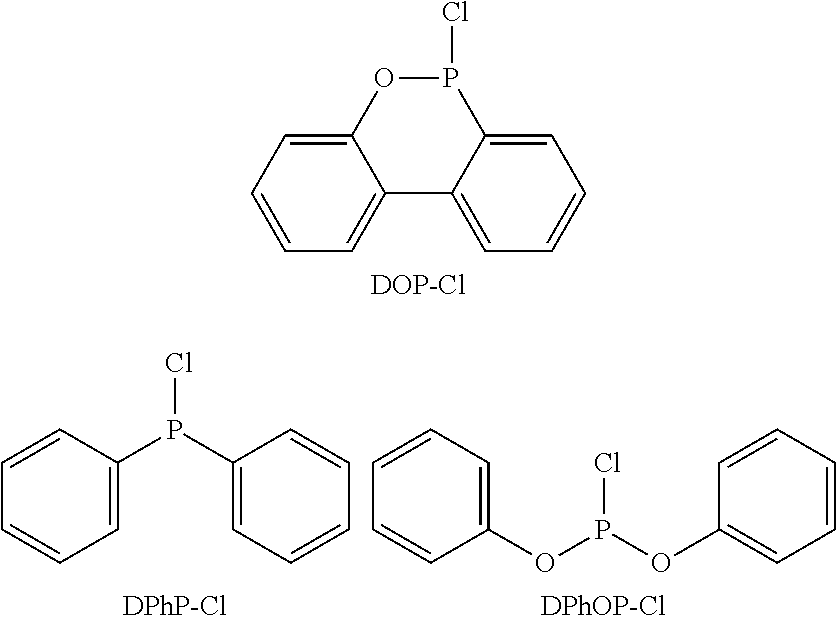
in which, in a first step, melamine or, when R1 is an alkyl or aryl residue, the corresponding alkyl or aryl guanamine is reacted with one or more of the following phosphinyl chlorides DOP-Cl, DPhP-Cl and DPhOP-Cl:
Figure US09238777-20160119-C00007
in order to bind one or more phosphinyl residue(s) to the amino group(s) of the melamine or guanamine, after which in a second step, the bound phosphinyl residue(s) is(are) oxidized by reaction with an oxidizing agent to form the corresponding phosphoryl residue(s).
More precisely, in the first step, a compound with formula (II):
Figure US09238777-20160119-C00008
wherein the residue R2 is selected from —NH2 and monovalent alkyl and aryl residues, i.e. melamine or a guanamine, is reacted with one or more of the phosphinyl chlorides DOP-Cl, DPhP-Cl and DPhOP-Cl to form one or more compounds with the following formula (III):
Figure US09238777-20160119-C00009
wherein:
    • the residue R3 is selected from —NH2, —NH2-zBz and monovalent alkyl and aryl residues;
    • the residues B, independently of each other, are selected from the following phosphinyl residues DOP-, DPhP- and DPhOP-:
Figure US09238777-20160119-C00010

and
    • the indices x, y and z are as hereinbefore defined;
wherein in the second step, the compound(s) with formula (III) are oxidized by reaction with the oxidizing agent to form one or more compounds with formula (I).
By means of this novel method, not only can compounds with formula (I) be produced in good yields and essentially without side reactions, but also, melamines can be produced which are tri-substituted with the respective phosphorus-containing residue without problems, and specific mixtures of mono-substituted and di-substituted aminotriazines can also be obtained, as will be seen in the examples below. Furthermore, the reaction times compared with Wang et al's method could be substantially reduced, which is of distinct economic advantage having regard to the high reaction temperatures employed.
Without wishing to be bound by a specific theory, it is assumed that this due to the substantially greater reactivity of phosphinyl chlorides compared with the corresponding phosphoryl chlorides. However, the near-quantitative yields for production of the desired compounds was surprising. It is actually because of the high reactivity of the phosphinyl chlorides that more side reactions should have been expected to occur—especially at the preferred high reaction temperatures of up to 200° C. This means that it was unexpected that essentially, the respective desired product would be formed exclusively containing one phosphorus-containing residue per amino group; rather, a certain—albeit smaller—fraction with two phosphorus-containing residues on one amino group would have been expected to have been obtained. However, this latter case was not observed at all. Thus, the phosphinyl chlorides employed in the method of the invention have a sufficiently high reactivity to allow rapid bonding of exactly one phosphorus-containing residue to occur per amino group, but it is not sufficient to di-substitute the amino group, even when a molar excess of phosphinyl chloride is employed.
Furthermore, the phosphinyl chloride DOP-Cl used in the method of the invention for the production of DOPO derivatives is an industrial intermediate in the production of the conventional flame retardant DOPO, and thus is produced in large quantities, and hence is much cheaper and more readily available than the phosphoryl chloride DOPO-Cl which is used in Chun-Shan Wang's method.
The monovalent alkyl and aryl residues as options for the residues R1 to R3 are preferably —CH3 or —C6H5, i.e. methyl or phenyl, since these form conventional and readily obtainable guanamines—methyl guanamine and phenyl—and also benzo-guanamine. The method of the invention is, however, applicable to a broad range of substituents on the diaminotriazine nucleus, and hence the scope of protection should not be limited to these two preferred residues.
The phosphorus-containing intermediates obtained in the first step are largely stable to hydrolysis and thus can readily be isolated, for example by stirring into water. Furthermore, one-pot syntheses are possible for both steps. Both will be described in the exemplary embodiments below.
There are no particular limits as to the oxidizing agent, as long as it does not result in any unwanted side reactions of the reaction participants. In preferred embodiments, a peroxide is in fact used, as any excesses are easy to separate or destroy. In addition to hydrogen peroxide, H2O2, many other peroxides and hydroperoxides may be used. Even the oxidation of DOP to DOPO with ozone, which is known from the literature, is possible, but in the inventors' experiments, the results were not as good as with hydrogen peroxide or t-butyl hydroperoxide. Finally, H2O2 is preferred because of its greater stability and thus ease of handling.
Since HCl is given off in the reaction between phosphinyl chloride and the aminotriazine, the first step is preferably carried out in the presence of an acid scavenger in order to displace the reaction equilibrium towards the product side. The acid scavenger is preferably 1-methylimidazole, although clearly other compounds known to the skilled person, such as ammonia, alkyl- and aryl-amines and other nitrogen compounds such as trimethylamine, pyridine, imidazole and the like, or other bases such as alkali and alkaline-earth metal compounds, for example, may also be used. 1-methylimidazole has the great advantage that its hydrochloride melts at a temperature as low as 75° C. (while, for example, the non-methylated homologue imadazolium chloride has a melting point of 158-161° C.), and thus with a suitable choice for the solvent and the reaction temperature, a second liquid phase which can easily be separated is formed in addition to the reaction solution.
Both steps are preferably carried out in an organic solvent in order to ensure the homogeneity of the reaction and heat dissipation. There are no specific restrictions applying to the solvent, as long as it is chemically inert having regard to the reactions occurring therein and the starting products are soluble or at least dispersible therein. However, in the first step, for the reasons given above, it should have a boiling point which is substantially above 75° C., the DOP-Cl should have a sufficiently good solubility in it, and 1-methylimidazolium chloride should not dissolve in it. In accordance with the present invention, then, a relatively apolar, anhydrous solvent is preferably used, more preferably an aromatic hydrocarbon such as, for example, benzene, toluene, xylene or the like, in particular toluene. Preferably, the same solvent is used both for reaction of the aminotriazine with the phosphinyl chloride and also for the subsequent oxidation. However, different solvents may also be used, for example chloroform for the first step and toluene for the oxidation, etc.
In preferred embodiments of the invention, in the first step, the acid scavenger simultaneously acts as a solvent; hence in particular in this case, 1-methylimidazole acts both as an acid scavenger and as the solvent. In the second step, chloroform or toluene are preferred, in particular toluene because it is halogen-free.
Although the invention is not limited thereto, during the course of the inventors' research, it was shown that the first step should preferably be carried out at a temperature in the range 100° C. to 200° C., in order to ensure short reaction times, high conversions and good yields. In similar manner, for the second step, temperatures in the range 50° C. to 100° C. have proven advantageous.
The scope of the invention naturally also encompasses the direct products of the method of the invention, i.e. the compounds with formula (I) which are so produced.
Since the tri-substituted melamine, i.e. 2,4,6-tris(9,10-dihydro-9-oxa-10-oxo-10-phosphaphenanthrene-10-ylamino)-1,3,5-triazine (DOPO3-mel):
Figure US09238777-20160119-C00011
in which DOPO- is the residue
Figure US09238777-20160119-C00012

constitutes a novel chemical compound, in a further aspect, the invention pertains to protection of this product as well as to its use as a flame retardant. In the first flammability tests, the inventor shows this novel compound to have an exceptional effect as a flame retardant for plastic materials, in particular for polystyrene and epoxides.
EXAMPLES
The invention will now be described in detail with the aid of the following non-limiting exemplary embodiments.
Example 1 Production of DOPO3-mel, i.e. 2,4,6-tris(9,10-dihydro-9-oxa-10-oxo-10-phosphaphenanthrene-10-ylamino)-1,3,5-triazine
Figure US09238777-20160119-C00013
Step 1—Production of DOP3-mel, i.e. 2,4,6-tris(9,10-dihydro-9-oxa-10-phosphaphenanthrene-10-ylamino)-1,3,5-triazine
Figure US09238777-20160119-C00014
12.64 g (0.10 mol) of melamine as well as 82.1 g (1.00 mol) of anhydrous 1-methylimidazole as the acid scavenger and solvent were placed in a three-necked round-bottomed flask filled with argon provided with an integral thermometer, dropping funnel, stirrer and an inert gas feed and heated to 100° C. Next, 72.4 g (0.31 mol) of DOP-Cl was melted at approximately 100° C. under inert conditions and placed in the dropping funnel. The DOP-Cl was dripped in with vigorous stirring over a period of 1 h at 100° C., with the dropping funnel being heated with a hot air blower in order to prevent the reagent from solidifying. Next, stirring was continued for approximately 15 h at 100° C. under argon, after which the viscous contents of the flask were stirred into 500 ml of water and the precipitated granular solid which formed was filtered off through a glass frit. The filter cake was then slaked 2× in 250 ml of water each time and then filtered again. Next, the substance was washed thoroughly with 200 ml of acetone and then rinsed with n-pentane. After drying in a stream of air, 72.4 g of (DOP)3-mel was obtained in a quantitative yield.
31P-NMR (101 MHz, DMSO-d6): δ 66.2; 66.1; 65.9 ppm.
1H-NMR (250 MHz, DMSO-d6): δ 8.7-8.5 (d, 3H, 3 NH—P); 8.25-8.15 (d, 6H); 7.68-7.53 (t, 6H); 7.50-7.40 (t, 3H), 7.38-7.28 (t, 3H), 7.27-7.17 (t, 3H), 7.08-6.97 ppm (m, 3H).
Step 2—Oxidation of DOP3-mel to Form DOPO3-mel
Figure US09238777-20160119-C00015
The (DOP)3-mel (72.4 g) produced in step 1 was stirred at 50° C. into 500 ml of chloroform in a 1-L three-necked flask equipped with a stirrer, integral thermometer and dropping funnel; part of it went up into solution. Next, the mixture was cooled to approximately 12° C. using a cooling bath and addition of an 11% solution of H2O2 (106.5 g, 34 mol) in acetic acid ethyl ester was immediately commenced. The reagent was dripped in within approximately 1.5 h, with vigorous stirring and with the temperature kept at approximately 15° C. Next, the cooling bath was removed and stirring was continued for a further 2 h. The cloudy solution obtained was supplemented with anhydrous sodium sulphate in order to separate out the water which was formed during the reaction. After filtering the desiccant, the product solution was reduced at 40° C. under a partial vacuum and a crude substance precipitated out. After cooling to approximately 0° C., it was decanted. The remaining solid was slowly heated to 230° C. under vacuum. After approximately 30 min at this temperature, cooling and comminuting the raw product obtained, it was then dissolved in 150 ml of chloroform. This solution was then dripped into 500 ml of diethyl ether with vigorous stirring, whereupon a white, granular solid precipitated out which was filtered off, washed with diethyl ether and dried at 60° C. under vacuum. In this manner, 67 g of (DOPO)3-mel was obtained (87.2% of theoretical yield).
31P-NMR (101 MHz, DMSO-d6): δ 6.86; 6.67; 6.30 ppm.
1H-NMR (250 MHz, DMSO-d6): δ 9.9-9.3 (3H, 3 NH—P); 8.40-8.22 (m, 3H); 8.18-8.00 (t, 6H); 7.78-7.58 (t, 3H), 7.55-7.35 (d, 6H), 7.35-7.16 ppm (m, 6H).
Elemental analysis for C39H27N6P3O6 (768.59 g/mol)
calc'd: C, 60.95; H, 3.54; N, 10.93;
found: C, 60.52; H, 3.71; N, 10.80.
Example 2 Production of DOPO2-Ph guanamine, i.e. 2,4-bis(9,10-dihydro-9-oxa-10-oxo-10-phosphaphenanthrene-10-ylamino)-6-phenyl-1,3,5-triazine
Figure US09238777-20160119-C00016
Step 1—Production of DOP2-Ph Guanamine from Phenyl Guanamine and DOP-Cl
Figure US09238777-20160119-C00017
6-phenyl-1,3,5-triazine-2,4-diamine (phenyl guanamine; 33.1 g, 0.177 mol, 1 eq) as well as 1-methylimidazole (145 g, 1.77 mol, 10 eq) were placed in a three-necked flask filled with argon and provided with a condenser, stirrer and dropping funnel. Next, 91.2 g (0.389 mol, 2.2 eq) of DOP-Cl was melted at approximately 100° C. under inert conditions and placed in the dropping funnel. The DOP-Cl was dripped in with vigorous stirring over a period of 1 h at 100° C., wherein a hot air blower was used to keep it liquid. The reaction mixture was kept at this temperature for another 2 h and then stirred into 800 ml of distilled water. The precipitated solid was filtered off and washed 3 times with water and with acetone. Next, the crude product was stirred for 2 h in 300 ml of boiling toluene. The suspension, which was still hot, was filtered and the isolated solid was washed thoroughly with toluene and finally dried in a stream of air. 97.24 g (0.1668 mol, 94.2% of theoretical yield) of (DOP)2-Ph guanamine was obtained as a white solid.
M.Pt: 276-282° C. (toluene)
31P-NMR (101 MHz, DMSO-d6): δ 67.2 ppm (d, J=19.5 Hz, 2P).
13C-NMR (63 MHz, DMSO-d6): δ 170.5 (m, 1C, Tr), 167.5 (m, 1C, Tr), 167.2 (m, 1C, Tr), 149.0 (d, J=2.4 Hz, 1C), 148.8 (d, J=2.3 Hz, 1C), 135.5 (s, 1C, Ph), 133.0 (t, J=2.2 Hz, 2C), 132.2 (s, 1C, Ph), 131.4 (s, 2C), 130.9 (d, J=49.2 Hz, 2C—P), 130.4 (m, 2C), 129.5 (s, 2C), 128.4 (s, 2C, Ph), 128.0 (s, 2C, Ph), 127.4 (d, J=13.3 Hz, 2C), 125.6 (s, 2C), 123.8 (s, 2C), 123.5 (d, J=5.7 Hz, 2C), 123.4 (s, 2C), 120.5 ppm (s, 2C).
1H-NMR (250 MHz, DMSO-d6): δ 8.97 (d, J=9.7 Hz, 2H, 2NH—P), 8.35 (d, J=6.8 Hz, 2H), 8.12 (d, J=7.7 Hz, 4H), 7.73-7.63 (m, 4H), 7.63-7.47 (m, 5H), 7.39-7.17 (m, 4H), 7.06 ppm (d, J=6.4 Hz, 2H).
IR (KBr): v 206 (m, N—H), 1540 (vs, O═C—N—H), 1506, 1486, 1424 (vs, P-Ph), 1197 (m, P—O-Ph), 1103, 943, 845, 879, 764 and 746 (s, C—H bend).
HRMS (EI) calc'd for [12C33H23N5P2O2]+: 583.1327. found: 583.1379 [M]+.
Elemental analysis for C33H23N5P2O2 (583.52 g/mol)
calc'd: C, 67.93; H, 3.97; N, 12.00; P, 10.62%;
found: C, 67.90; H, 3.93; N, 12.13; P, 10.64%.
Step 2—Oxidation of DOP2-Ph Guanamine to Form DOPO2-Ph Guanamine
Figure US09238777-20160119-C00018
11.68 g (0.0020 mol, 1 eq) of (DOP)2-Ph guanamine in 50 ml of chloroform was heated to 40° C. in a three-necked flask equipped with a condenser, stirrer, thermometer and dropping funnel. After 15 min, the mixture was cooled to 20° C. using a cooling bath. Next, 2.88 g (0.048 mol, 2.2 eq) of a 30% aqueous solution of tert-butyl hydroperoxide was slowly dripped in, with vigorous stirring. The vigorous stirring was continued for 1 hour, after which a further 2.00 g (0.033 mol, 1.5 eq) of the oxidizing agent was dripped in. After this, stirring was continued for a further 1 h at ambient temperature and finally, the mixture was filtered. The isolated solid was washed with acetone. An additional fraction of the product was obtained in which the residual solution was reduced under vacuum. The combined fractions were slaked in acetone with vigorous stirring, the suspension was filtered and the solid was dried in a stream of air. In this manner, 11.75 g (0.0019 mol, 95.0% of theoretical yield) of (DOPO)2-Ph guanamine was obtained as a white powder.
M.Pt: 267-273° C. (decomposition.)
31P-NMR (101 MHz, DMSO-d6): δ 6.8 (s, 1P), 6.7 ppm (s, 1P).
13C-NMR (63 MHz, DMSO-d6): δ 170.3 (s, 1C, Tr), 165.2 (t, J=3.5 Hz, 2C, Tr), 149.7 (d, J=7.4 Hz, 1C), 149.6 (d, J=7.5 Hz, 1C), 135.5 (d, J=7.3 Hz, 2C), 134.1 (s, 1C, Ph), 133.1 (d, J=0.9 Hz, 2C), 132.1 (s, 1C, Ph), 130.5 (s, 2C), 130.3 (m, 2C), 128.5 (d, J=15.1 Hz, 2C), 127.8 (s, 2C, Ph), 127.7 (s, 2C, Ph), 125.2 (s, 2C), 124.5 (s, 2C), 123.8 (d, J=164.3 Hz, 1C—P), 123.7 (d, J=164.3 Hz, 1C—P), 123.5 (d, J=11.5 Hz, 2C), 120.9 (d, J=12.0 Hz, 1C), 120.8 (d, J=12.2 Hz, 1C), 120.0 ppm (m, 2C).
1H-NMR (250 MHz, DMSO-d6): δ 10.39 (t, J=8.0 Hz, 2H, 2NH—P), 8.36-8.28 (m, 4H), 8.11-7.88 (m, 2H), 7.70 (t, J=7.4 Hz, 2H), 7.57-7.16 (m, 9H), 7.07-6.87 ppm (m, 4H).
IR (KBr): v 3179 (w, N—H), 1587 (C═C), 1538 (vs, O═C—N—H), 1493, 1454, 1417 (vs, P-Ph), 1232 (s, P═O), 1205 (s, P—O-Ph), 1119, 1088, 943, 876, 751 and 785 (s, C—H bend).
HRMS (EI) calc'd for [12C33H23N5P2O4]+: 615.1225. found: 615.1290 [M]+.
Elemental analysis for C33H23N5P2O4 (615.51 g/mol)
calc'd: C, 64.39; H, 3.77; N, 11.38; P, 10.06%;
found: C, 64.07; H, 3.78; N, 11.25; P, 10.16%.
Example 3 Production of DOPO-mel and DOPO2-mel Step 1—Production of DOP-mel and DOP2-mel
Figure US09238777-20160119-C00019
6.31 g (0.050 mol) of melamine as well as 50 g (approximately 0.6 mol) of anhydrous 1-methylimidazole were placed in a 250 ml three-necked round-bottomed flask filled with argon and equipped with an integral thermometer, a dropping funnel, a stirrer as well as an inert gas feed then heated to 100° C. Next, 17.6 g (0.075 mol) of DOP-Cl was melted at 100° C. under inert conditions and placed into the dropping funnel. The DOP-Cl was dripped in with vigorous stirring over 45 min at 100° C.; a hot air blower was used to keep it liquid. After the drip addition was completed, stirring was continued for 3 hours at 120° C. and then for 1 h at 145° C. The 31P NMR spectrum of the solution obtained showed that DOP-mel and (DOP)2-mel were obtained as the reaction products. This solution was used in the second step at approximately 60° C. without further working-up.
Step 2—Oxidation of DOP-mel and DOP2-mel to Form DOPO-mel and DOPO2-mel
Figure US09238777-20160119-C00020
20 g (approximately 0.08 mol) of a 37% solution of tert-butyl hydroperoxide in toluene was dripped onto the mixture of DOP-mel and (DOP)2-mel obtained in step 1 in 1-methylimidazole, at 60-65° C. over 45 min, with stirring. After the reagents had been added, the temperature was maintained at approximately 70° C. for 2 h. Next, the reaction mixture was stirred into 300 ml of water at a temperature of 50° C. After cooling, it was decanted. The substance obtained in this manner was dried for 15 h in a stream of air, comminuted in a mortar and then stirred for 20 min in 300 ml of ethanol under reflux. After cooling to approximately 50° C., it was filtered and the solid was pre-dried at 90° C. under vacuum. Finally, it was heated for approximately 10 h in a vacuum drying cabinet at 170° C. (pressure approximately 12 mbar). The 1H and 31P NMR spectra of the product showed a total quantity of about 98% of DOPO-mel and (DOP)2-mel in a molar ratio of around 1:1.
31P-NMR (101 MHz, DMSO-d6): δ 8.79 ppm (DOPO-mel); 7.60; 7.42 ppm ((DOPO)2-mel).
1H-NMR (250 MHz, DMSO-d6): δ 9.8-9.1 (NH—P); 8.15-8.03; 7.8-7.6; 7.55-7.45; 7.45-7.25; 7.25-7.2; 6.8-5.7 (NH2).
MS (ESI): 341 (DOPO-mel, M+1); 555 ((DOPO)2-mel, M+1).
Example 4 Production of DPhPO2-Ph guanamine, i.e. 2,4-bis(diphenylphosphoryl)-6-phenyl-1,3,5-triazine
Figure US09238777-20160119-C00021
Step 1—Production of DPhP2-Ph Guanamine from Phenylguanamine and DPhP-Cl
Figure US09238777-20160119-C00022
Phenyl guanamine (2.38 g, 0.0127 mol, 1 eq), 1-methylimidazole (2.29 g, 0.0279 mol, 2.2 eq) as well as 40 ml of anhydrous toluene were placed in a three-necked flask filled with argon equipped with a condenser, thermometer, stirring means and a dropping funnel and heated to 80° C. 6.16 g (0.0279 mol, 2.2 eq) of diphenylphosphinyl chloride (DPHP-Cl) was slowly dripped in at this temperature, with stirring. Next, the reaction mixture, which was now in two phases, was stirred for 2 h at 90° C. Next, the upper phase was decanted under inert conditions from the viscous lower phase (1-methylimidazolium chloride) and transferred via a connecting piece into a second three-necked flask which had also been filled with argon. In this manner, a solution of DPhP2-Ph guanamine was obtained, which was used in the second step without further working-up.
Step 2—Oxidation of DPhP2-Ph Guanamine to Form DPhPO2-Ph Guanamine
Figure US09238777-20160119-C00023
The three-necked flask with the solution of DPhP2-Ph guanamine produced in step 1 was equipped with a condenser, thermometer, stirrer and a dropping funnel which had been filled with 6.86 g (0.0381 mol, 3 eq) of an 11% solution of H2O2 in acetic acid ethyl ester. Next, the reaction mixture was cooled to approximately 5° C. using an ice water bath and the oxidizing agent was dripped in slowly and with vigorous stirring, with the temperature being maintained at a maximum of 15° C. After H2O2 addition was complete, the cooling bath was removed and the reaction mixture was stirred for a further 15 h. The precipitated solid was filtered off, washed with toluene and then stirred for 1.5 h in 50 ml of boiling toluene. Next, the hot suspension was filtered and the solid was again washed with toluene and finally dried under vacuum (20 h, 150° C.). In this manner, 5.64 g (0.0096 mol, 75.6% of theoretical yield) of DPhPO2-Ph guanamine was obtained as a white solid.
31P-NMR (101 MHz, DMSO-d6): δ 16.1 ppm.
1H-NMR (250 MHz, DMSO-d6): δ 9.89 (d, J=10.2 Hz, 2H, 2NH), 7.85 (m, 8H), 7.50 ppm (m, 14H), 7.15 ppm (m, 3H).
HRMS (EI) calc'd for [12C33H27N5P2O2]+: 586.1562. found: 586.1656 [M-H]+.
Example 5 Flame Retardant Action Measurements
An epoxy novolac resin, D.E.N. 438 from Dow Chemicals with an EEW (epoxy equivalent weight) of 179 g/mol was mixed with 0.1% by weight of triethanolamine and the novel compound of the invention, DOPO3-mel, as the flame retardant additive—in the amount required to adjust it to the required phosphorus content in the test specimen. The mixture was then maintained for 2 h at 140° C., degassed under vacuum and cooled to 90° C. The pre-formulation obtained was mixed with 6 parts by weight of dicyandiamide and 2 parts by weight of fenuron, referred to 100 parts by weight of epoxy novolac resin. Curing was carried out in an aluminium cup by carefully heating to 120° C. over 30 min, holding this temperature for 1 h, increasing the temperature to 130° C. for 1 h and then holding the temperature at 200° C. for 2 h. 70×13×4 mm test specimens were made from it and classified in accordance with UL94 in order to characterize the flammability.
UL94 is a test protocol from Underwriters Laboratories which has been incorporated in its entirety into IEC/DIN EN 60695-11-10 and -20. In it, igniting flames with a power of 50 W are twice briefly applied to the test specimens, wherein a vertical test of the burn time and drips of flaming particles was assessed with the aid of a pad of cotton wool disposed below the test specimen. The classification categories are “V0”, “V1” and “V2” which are explained in Table 1 below:
TABLE 1
UL94 CLASSIFICATION
Classification V0 V1 V2
Burn time after each ignition ≦10 s ≦30 s ≦30 s
Total burn time per set (10 ignitions) ≦50 s ≦250 s  ≦250 s 
Burn/glow time after second ignition ≦30 s ≦60 s ≦60 s
Combustion up to holder no no no
Ignition of cotton no no yes
The classification “V0” thus constitutes the highest category of flame retardant and thus is the goal for flame retardant compositions.
Table 2 below shows the results of the test for DOPO3-mel and for DOPO as a comparative substance.
TABLE 2
Flame retardant
additive Phosphorus content (wt %) UL94 classification
0.0 Not classified
Comp: DOPO 1.0 Not classified
Comp: DOPO 1.4 V1
Comp: DOPO 1.6 V0
Inv: DOPO3-mel 1.0 V1
Inv: DOPO3-mel 1.4 V0
These results clearly show the improved flame retardant action of DOPO3-mel compared with the commercially available additive DOPO. Thus, the new compound DOPO3-mel is highly suitable as a flame retardant in plastics materials.

Claims (12)

What is claimed is:
1. A method for producing a compound with the following formula (I):
Figure US09238777-20160119-C00024
wherein:
the residue R1 is selected from —NH2, —NH2-zAz as well as monovalent alkyl and aryl residues,
the residues A are each selected, independently of each other, from the following phosphoryl residues DOPO-, DPhPO- and DPhOPO-:
Figure US09238777-20160119-C00025
and
the indices x, y and z each, independently of each other, represent 0 or 1, wherein at least one of the indices ≠0;
in which, in a first step, melamine or, when R1 is an alkyl or aryl residue, the corresponding alkyl or aryl guanamine is reacted with one of the following phosphinyl chlorides DOP-Cl, DPhP-Cl and DPhOP-Cl:
Figure US09238777-20160119-C00026
in order to bind one or more phosphinyl residue(s) to the amino group(s) of the melamine or guanamine, after which in a second step, the bound phosphinyl residue(s) is(are) oxidized by reaction with an oxidizing agent to form the corresponding phosphoryl residue(s).
2. The method as claimed in claim 1, characterized in that the monovalent alkyl or aryl residue of R1 is selected from —CH3 and —C6H5.
3. The method as claimed in claim 1, characterized in that a peroxide is used as the oxidizing agent.
4. The method as claimed in claim 1, characterized in that hydrogen peroxide or t-butyl hydroperoxide is used as the oxidizing agent.
5. The method as claimed in claim 1, characterized in that the first step is carried out in the presence of an acid scavenger.
6. The method as claimed in claim 5, characterized in that the acid scavenger simultaneously functions as a solvent.
7. The method as claimed in claim 5, characterized in that 1-methylimidazole is used as the acid scavenger and solvent.
8. The method as claimed in claim 1, characterized in that the second step is carried out in an organic solvent selected from chloroform and toluene.
9. The method as claimed in claim 1, characterized in that the first step is carried out at a temperature in the range 100° C. to 200° C.
10. The method as claimed in claim 1, characterized in that the second step is carried out at a temperature in the range 50° C. to 100° C.
11. 2,4,6-tris(9,10-dihydro-9-oxa-10-oxo-10-phosphaphenanthrene-10-ylamino)-1,3,5-triazine (DOPO3-mel):
Figure US09238777-20160119-C00027
Figure US09238777-20160119-C00028
wherein DOPO- corresponds to the residue.
12. A process of making a flame retardant 2,4,6-tris(9,10-dihydro-9-oxa-10-oxo-10-phosphaphenanthrene-10-ylamino)-1,3,5-triazine comprising: first, reacting melamine with phosphinyl chloride DOP-Cl, and then, oxidizing the bound phosphinyl residue with an oxidizing agent to make said flame retardant.
US14/633,156 2012-08-29 2015-02-27 Method for producing phosphorus-containing flame retardants Expired - Fee Related US9238777B2 (en)

Applications Claiming Priority (4)

Application Number Priority Date Filing Date Title
ATA944/2012 2012-08-29
ATA9442012 2012-08-29
ATA944/2012A AT513327B1 (en) 2012-08-29 2012-08-29 Process for the preparation of phosphorus-containing compounds
PCT/AT2013/050167 WO2014032070A1 (en) 2012-08-29 2013-08-28 Method for producing phosphorus-containing flame retardants

Related Parent Applications (1)

Application Number Title Priority Date Filing Date
PCT/AT2013/050167 Continuation WO2014032070A1 (en) 2012-08-29 2013-08-28 Method for producing phosphorus-containing flame retardants

Publications (2)

Publication Number Publication Date
US20150203759A1 US20150203759A1 (en) 2015-07-23
US9238777B2 true US9238777B2 (en) 2016-01-19

Family

ID=49474164

Family Applications (1)

Application Number Title Priority Date Filing Date
US14/633,156 Expired - Fee Related US9238777B2 (en) 2012-08-29 2015-02-27 Method for producing phosphorus-containing flame retardants

Country Status (8)

Country Link
US (1) US9238777B2 (en)
EP (1) EP2890702B1 (en)
JP (1) JP2015530999A (en)
KR (1) KR20150052138A (en)
AT (1) AT513327B1 (en)
DK (1) DK2890702T3 (en)
RU (1) RU2639161C2 (en)
WO (1) WO2014032070A1 (en)

Families Citing this family (13)

* Cited by examiner, † Cited by third party
Publication number Priority date Publication date Assignee Title
CN106633052B (en) * 2015-11-04 2019-06-25 华中师范大学 Phosphaphenanthrene-triazine bifunctional oligomer and its preparation method and flame retardant application
CN105541917B (en) * 2016-01-27 2017-10-17 厦门大学 A kind of phosphorus nitrogen collaboration polyester flame-retardant agent and preparation method thereof
KR102054675B1 (en) * 2017-06-20 2019-12-11 (주)엔나노텍 flame-retardant ester polyol, the manufacturing method thereof and polyisocyanurates including the anti-flame ester polyol
TWI668228B (en) * 2018-05-21 2019-08-11 國立中興大學 Phosphorus-containing compound, manufacturing method thereof and flame-retardant thermoset
CN110938235B (en) * 2019-11-13 2021-09-17 上海力道新材料科技股份有限公司 Triazine structure-containing DOPO amino derivative flame retardant, and preparation method and application thereof
CN110982121B (en) * 2019-12-05 2021-09-28 营口理工学院 Triazinyl phosphorus-nitrogen flame retardant, and preparation method and application thereof
KR102477271B1 (en) * 2020-12-18 2022-12-13 한국신발피혁연구원 Thermosetting resin composition with high toughness and flame retardant
CN113025248B (en) * 2021-03-17 2021-11-23 东莞市德聚胶接技术有限公司 Thermosetting epoxy adhesive and preparation method thereof
JP7432282B2 (en) * 2022-02-14 2024-02-16 三光株式会社 A novel dihydroxaphosphaphenanthrene derivative having a triazine ring and exhibiting a high refractive index and its production method
CN115073522B (en) * 2022-07-20 2022-11-18 上海沪正纳米科技有限公司 Silicon-phosphorus-nitrogen-containing compound based on DOPO group and its preparation method and use
CN116496630B (en) * 2023-04-12 2024-11-05 合肥恒德昌科技有限公司 Flame-retardant silicone tube for water and gas pipe and preparation method thereof
CN116622144A (en) * 2023-05-30 2023-08-22 安徽国信电缆科技股份有限公司 A preparation process of flame-retardant power cable for urban rail transit against rodents and ants
WO2025033533A1 (en) * 2023-08-10 2025-02-13 三光株式会社 Dihydrooxaphosphaphenanthrene derivative serving as flame retardant

Citations (4)

* Cited by examiner, † Cited by third party
Publication number Priority date Publication date Assignee Title
DE2034887A1 (en) 1970-07-14 1972-01-20 Sanko Chemical Co Ltd , Kurume, Fukuoka (Japan) Phosphorylated 2-hydroxy 2,2'-dihydroxy biphenyl - derivs insecticides fungicides flame retardants antioxidants
JPH0812692A (en) 1994-06-23 1996-01-16 Asahi Chem Ind Co Ltd New nitrogen-containing organic phosphorus compound and its production
US6797821B2 (en) * 2001-09-20 2004-09-28 Chun-Shan Wang Phosphorus-containing flame-retardant hardeners, epoxy resins, advanced epoxy resins and cured epoxy resins
CN102190801A (en) 2011-03-29 2011-09-21 湖南科技大学 Preparation method for nonionic oxidized polyethylene wax emulsion using single emulsifier

Family Cites Families (3)

* Cited by examiner, † Cited by third party
Publication number Priority date Publication date Assignee Title
DE102004042833B4 (en) * 2004-09-04 2022-01-05 Chemische Fabrik Budenheim Kg Polyphosphate derivative of a 1,3,5-triazone compound, process for its preparation and its use
JP2007196631A (en) * 2006-01-30 2007-08-09 Adeka Corp Thermosensitive recording material
CN102190814B (en) * 2011-03-25 2012-11-21 武汉工程大学 Hexaphenyl phosphate ester melamine salt fire retardant and method for preparing same

Patent Citations (5)

* Cited by examiner, † Cited by third party
Publication number Priority date Publication date Assignee Title
DE2034887A1 (en) 1970-07-14 1972-01-20 Sanko Chemical Co Ltd , Kurume, Fukuoka (Japan) Phosphorylated 2-hydroxy 2,2'-dihydroxy biphenyl - derivs insecticides fungicides flame retardants antioxidants
JPH0812692A (en) 1994-06-23 1996-01-16 Asahi Chem Ind Co Ltd New nitrogen-containing organic phosphorus compound and its production
US6797821B2 (en) * 2001-09-20 2004-09-28 Chun-Shan Wang Phosphorus-containing flame-retardant hardeners, epoxy resins, advanced epoxy resins and cured epoxy resins
US20050004339A1 (en) 2001-09-20 2005-01-06 Chun-Shan Wang Phosphorus-containing flame-retardant hardeners, epoxy resins, advanced epoxy resins and cured epoxy resins
CN102190801A (en) 2011-03-29 2011-09-21 湖南科技大学 Preparation method for nonionic oxidized polyethylene wax emulsion using single emulsifier

Non-Patent Citations (2)

* Cited by examiner, † Cited by third party
Title
International Search Report PCT/AT2013/050167 issued on Dec. 11, 2013.
Schäfer et al., J. Appl. Polym. Sci 105(2) pp. 685-696 (2007).

Also Published As

Publication number Publication date
JP2015530999A (en) 2015-10-29
DK2890702T3 (en) 2016-12-19
WO2014032070A1 (en) 2014-03-06
RU2015110993A (en) 2016-10-20
KR20150052138A (en) 2015-05-13
US20150203759A1 (en) 2015-07-23
AT513327A1 (en) 2014-03-15
AT513327B1 (en) 2014-06-15
EP2890702B1 (en) 2016-08-24
EP2890702A1 (en) 2015-07-08
RU2639161C2 (en) 2017-12-20

Similar Documents

Publication Publication Date Title
US9238777B2 (en) Method for producing phosphorus-containing flame retardants
EP2557085B1 (en) Novel phosphonamidates - synthesis and flame retardant applications
TWI844555B (en) Polymer composition with phosphonate flame retardant
JP5084507B2 (en) Phosphorus-containing heptazine derivative, process for its production and use thereof
CN101376665A (en) Phosphaphenanthrene flame-retardant compound containing s-triazine structure, and preparation and use thereof
JPH09235465A (en) Low combustible polyamide molding material
US20040039085A1 (en) Acid-methylol compound reaction products for flame resistance
US20110136993A1 (en) Phosphorus-containing compounds and polymeric compositions comprising same
CN1439015A (en) Phosphorus-containing hydroquinone derivative, method for producing same, phosphorus-containing epoxy resin using same, flame-retardant epoxy resin composition, sealing material, and laminated board thereof
JP7008331B2 (en) A flame-retardant compound, lignocellulosic and wood flour chemically modified with the flame-retardant compound, and a resin composition containing them.
EP2289898B1 (en) Melamine-functional organosilicon compound and making method
US20040143081A1 (en) Novel silicon compounds and process for preparation thereof
WO2001077217A1 (en) Acid-methylol compound reaction products for flame resistance
JP2868098B2 (en) Triazine compounds
US20120292582A1 (en) Ammonium salts of 9,10-dihydro-10-hydroxy-9-oxa-10-phospha-phenanthrene-10-one
EP3526211B1 (en) Flame retardants
US3359276A (en) Phosphinic amides
US6737526B1 (en) Method for preparing melamine salt of bis-(pentaerythritol phosphate) phosphoric acid
JP2015227392A (en) Phosphorus-containing polymer
JP4635157B2 (en) Method for producing cyclotriphosphazene derivative
JP4635156B2 (en) Method for producing cyclotriphosphazene derivative
HK40069885B (en) Polymer composition comprising phosphonate flame retardant
US3435013A (en) Method for preparing polymers of phosphinic amides
JP2002363193A (en) Cyclic phosphazenes, method for producing the same, flame retardant containing the same as an active ingredient, resin composition containing the same, and molded article
US20030162934A1 (en) Phosphorus-containing epoxy monomer and hardening agent and composition thereof

Legal Events

Date Code Title Description
AS Assignment

Owner name: METADYNEA AUSTRIA GMBH, AUSTRIA

Free format text: ASSIGNMENT OF ASSIGNORS INTEREST;ASSIGNORS:ZICH, THOMAS, MR;FREIDL, FRITZ JOHANN, MR;MEIHOFER, BERNADETTE, MS;AND OTHERS;SIGNING DATES FROM 20150414 TO 20150428;REEL/FRAME:035848/0075

ZAAA Notice of allowance and fees due

Free format text: ORIGINAL CODE: NOA

ZAAB Notice of allowance mailed

Free format text: ORIGINAL CODE: MN/=.

STCF Information on status: patent grant

Free format text: PATENTED CASE

MAFP Maintenance fee payment

Free format text: PAYMENT OF MAINTENANCE FEE, 4TH YEAR, LARGE ENTITY (ORIGINAL EVENT CODE: M1551); ENTITY STATUS OF PATENT OWNER: LARGE ENTITY

Year of fee payment: 4

FEPP Fee payment procedure

Free format text: MAINTENANCE FEE REMINDER MAILED (ORIGINAL EVENT CODE: REM.); ENTITY STATUS OF PATENT OWNER: LARGE ENTITY

LAPS Lapse for failure to pay maintenance fees

Free format text: PATENT EXPIRED FOR FAILURE TO PAY MAINTENANCE FEES (ORIGINAL EVENT CODE: EXP.); ENTITY STATUS OF PATENT OWNER: LARGE ENTITY

STCH Information on status: patent discontinuation

Free format text: PATENT EXPIRED DUE TO NONPAYMENT OF MAINTENANCE FEES UNDER 37 CFR 1.362

FP Lapsed due to failure to pay maintenance fee

Effective date: 20240119