US9233319B2 - Apparatus and process for contacting liquids - Google Patents
Apparatus and process for contacting liquids Download PDFInfo
- Publication number
- US9233319B2 US9233319B2 US13/709,376 US201213709376A US9233319B2 US 9233319 B2 US9233319 B2 US 9233319B2 US 201213709376 A US201213709376 A US 201213709376A US 9233319 B2 US9233319 B2 US 9233319B2
- Authority
- US
- United States
- Prior art keywords
- liquid
- liquids
- inlet
- vessel
- distributor
- Prior art date
- Legal status (The legal status is an assumption and is not a legal conclusion. Google has not performed a legal analysis and makes no representation as to the accuracy of the status listed.)
- Expired - Fee Related, expires
Links
- 239000007788 liquid Substances 0.000 title claims abstract description 127
- 238000000034 method Methods 0.000 title claims description 9
- 230000008569 process Effects 0.000 title claims description 9
- 238000011144 upstream manufacturing Methods 0.000 claims description 6
- 229930195733 hydrocarbon Natural products 0.000 description 16
- 150000002430 hydrocarbons Chemical class 0.000 description 16
- KWYUFKZDYYNOTN-UHFFFAOYSA-M Potassium hydroxide Chemical compound [OH-].[K+] KWYUFKZDYYNOTN-UHFFFAOYSA-M 0.000 description 12
- 238000002156 mixing Methods 0.000 description 12
- 239000004215 Carbon black (E152) Substances 0.000 description 11
- 238000000605 extraction Methods 0.000 description 10
- 239000000126 substance Substances 0.000 description 10
- HEMHJVSKTPXQMS-UHFFFAOYSA-M sodium hydroxide Inorganic materials [OH-].[Na+] HEMHJVSKTPXQMS-UHFFFAOYSA-M 0.000 description 8
- 238000006243 chemical reaction Methods 0.000 description 7
- 239000000203 mixture Substances 0.000 description 7
- 238000005191 phase separation Methods 0.000 description 7
- XLYOFNOQVPJJNP-UHFFFAOYSA-N water Substances O XLYOFNOQVPJJNP-UHFFFAOYSA-N 0.000 description 7
- VLKZOEOYAKHREP-UHFFFAOYSA-N n-Hexane Chemical compound CCCCCC VLKZOEOYAKHREP-UHFFFAOYSA-N 0.000 description 6
- 238000000926 separation method Methods 0.000 description 6
- 150000003464 sulfur compounds Chemical class 0.000 description 6
- DGAQECJNVWCQMB-PUAWFVPOSA-M Ilexoside XXIX Chemical compound C[C@@H]1CC[C@@]2(CC[C@@]3(C(=CC[C@H]4[C@]3(CC[C@@H]5[C@@]4(CC[C@@H](C5(C)C)OS(=O)(=O)[O-])C)C)[C@@H]2[C@]1(C)O)C)C(=O)O[C@H]6[C@@H]([C@H]([C@@H]([C@H](O6)CO)O)O)O.[Na+] DGAQECJNVWCQMB-PUAWFVPOSA-M 0.000 description 5
- 239000012670 alkaline solution Substances 0.000 description 5
- -1 e.g. Substances 0.000 description 5
- 239000012071 phase Substances 0.000 description 5
- 239000000243 solution Substances 0.000 description 5
- QGZKDVFQNNGYKY-UHFFFAOYSA-N Ammonia Chemical compound N QGZKDVFQNNGYKY-UHFFFAOYSA-N 0.000 description 4
- 150000001875 compounds Chemical class 0.000 description 4
- 239000003915 liquefied petroleum gas Substances 0.000 description 4
- 239000007791 liquid phase Substances 0.000 description 4
- KRHYYFGTRYWZRS-UHFFFAOYSA-N Fluorane Chemical compound F KRHYYFGTRYWZRS-UHFFFAOYSA-N 0.000 description 3
- NINIDFKCEFEMDL-UHFFFAOYSA-N Sulfur Chemical compound [S] NINIDFKCEFEMDL-UHFFFAOYSA-N 0.000 description 3
- 238000004581 coalescence Methods 0.000 description 3
- 239000002904 solvent Substances 0.000 description 3
- 229910052717 sulfur Inorganic materials 0.000 description 3
- 239000011593 sulfur Substances 0.000 description 3
- QAOWNCQODCNURD-UHFFFAOYSA-N Sulfuric acid Chemical compound OS(O)(=O)=O QAOWNCQODCNURD-UHFFFAOYSA-N 0.000 description 2
- 230000029936 alkylation Effects 0.000 description 2
- 238000005804 alkylation reaction Methods 0.000 description 2
- 229910021529 ammonia Inorganic materials 0.000 description 2
- 125000004432 carbon atom Chemical group C* 0.000 description 2
- 150000001768 cations Chemical class 0.000 description 2
- 238000010276 construction Methods 0.000 description 2
- 238000013461 design Methods 0.000 description 2
- SNRUBQQJIBEYMU-UHFFFAOYSA-N dodecane Chemical compound CCCCCCCCCCCC SNRUBQQJIBEYMU-UHFFFAOYSA-N 0.000 description 2
- 238000005516 engineering process Methods 0.000 description 2
- 238000000622 liquid--liquid extraction Methods 0.000 description 2
- 239000000463 material Substances 0.000 description 2
- 238000000638 solvent extraction Methods 0.000 description 2
- NLXLAEXVIDQMFP-UHFFFAOYSA-N Ammonium chloride Substances [NH4+].[Cl-] NLXLAEXVIDQMFP-UHFFFAOYSA-N 0.000 description 1
- VHUUQVKOLVNVRT-UHFFFAOYSA-N Ammonium hydroxide Chemical compound [NH4+].[OH-] VHUUQVKOLVNVRT-UHFFFAOYSA-N 0.000 description 1
- 230000001133 acceleration Effects 0.000 description 1
- 239000002253 acid Substances 0.000 description 1
- 239000003377 acid catalyst Substances 0.000 description 1
- 230000002378 acidificating effect Effects 0.000 description 1
- 230000009471 action Effects 0.000 description 1
- 239000000853 adhesive Substances 0.000 description 1
- 230000001070 adhesive effect Effects 0.000 description 1
- 239000003513 alkali Substances 0.000 description 1
- 150000001336 alkenes Chemical class 0.000 description 1
- 150000001345 alkine derivatives Chemical class 0.000 description 1
- 235000011114 ammonium hydroxide Nutrition 0.000 description 1
- RHZUVFJBSILHOK-UHFFFAOYSA-N anthracen-1-ylmethanolate Chemical compound C1=CC=C2C=C3C(C[O-])=CC=CC3=CC2=C1 RHZUVFJBSILHOK-UHFFFAOYSA-N 0.000 description 1
- 239000003830 anthracite Substances 0.000 description 1
- 238000013459 approach Methods 0.000 description 1
- 150000004945 aromatic hydrocarbons Chemical class 0.000 description 1
- 125000003118 aryl group Chemical group 0.000 description 1
- 239000002585 base Substances 0.000 description 1
- 230000015572 biosynthetic process Effects 0.000 description 1
- 239000003245 coal Substances 0.000 description 1
- 150000001924 cycloalkanes Chemical class 0.000 description 1
- 238000006477 desulfuration reaction Methods 0.000 description 1
- 230000023556 desulfurization Effects 0.000 description 1
- 150000001993 dienes Chemical class 0.000 description 1
- 238000004945 emulsification Methods 0.000 description 1
- 239000006260 foam Substances 0.000 description 1
- 239000007789 gas Substances 0.000 description 1
- 239000003365 glass fiber Substances 0.000 description 1
- 230000005484 gravity Effects 0.000 description 1
- 229910001385 heavy metal Inorganic materials 0.000 description 1
- 229910052739 hydrogen Inorganic materials 0.000 description 1
- 239000001257 hydrogen Substances 0.000 description 1
- 125000004435 hydrogen atom Chemical class [H]* 0.000 description 1
- 229910000040 hydrogen fluoride Inorganic materials 0.000 description 1
- 230000002209 hydrophobic effect Effects 0.000 description 1
- 239000012535 impurity Substances 0.000 description 1
- 230000007246 mechanism Effects 0.000 description 1
- 229910052751 metal Inorganic materials 0.000 description 1
- 239000002184 metal Substances 0.000 description 1
- 230000004048 modification Effects 0.000 description 1
- 238000012986 modification Methods 0.000 description 1
- 238000000465 moulding Methods 0.000 description 1
- 229910017464 nitrogen compound Inorganic materials 0.000 description 1
- 150000002830 nitrogen compounds Chemical class 0.000 description 1
- 238000000746 purification Methods 0.000 description 1
- 238000007670 refining Methods 0.000 description 1
- 239000004576 sand Substances 0.000 description 1
- 229910052708 sodium Inorganic materials 0.000 description 1
- 239000011734 sodium Substances 0.000 description 1
- 229910000679 solder Inorganic materials 0.000 description 1
- 239000007787 solid Substances 0.000 description 1
- 230000007480 spreading Effects 0.000 description 1
- 229910001220 stainless steel Inorganic materials 0.000 description 1
- 239000010935 stainless steel Substances 0.000 description 1
- 230000003068 static effect Effects 0.000 description 1
- 238000012546 transfer Methods 0.000 description 1
- 238000003466 welding Methods 0.000 description 1
Images



Classifications
-
- B—PERFORMING OPERATIONS; TRANSPORTING
- B01—PHYSICAL OR CHEMICAL PROCESSES OR APPARATUS IN GENERAL
- B01D—SEPARATION
- B01D17/00—Separation of liquids, not provided for elsewhere, e.g. by thermal diffusion
- B01D17/02—Separation of non-miscible liquids
- B01D17/04—Breaking emulsions
- B01D17/045—Breaking emulsions with coalescers
-
- B—PERFORMING OPERATIONS; TRANSPORTING
- B01—PHYSICAL OR CHEMICAL PROCESSES OR APPARATUS IN GENERAL
- B01D—SEPARATION
- B01D17/00—Separation of liquids, not provided for elsewhere, e.g. by thermal diffusion
- B01D17/02—Separation of non-miscible liquids
- B01D17/0217—Separation of non-miscible liquids by centrifugal force
-
- B—PERFORMING OPERATIONS; TRANSPORTING
- B01—PHYSICAL OR CHEMICAL PROCESSES OR APPARATUS IN GENERAL
- B01F—MIXING, e.g. DISSOLVING, EMULSIFYING OR DISPERSING
- B01F25/00—Flow mixers; Mixers for falling materials, e.g. solid particles
- B01F25/10—Mixing by creating a vortex flow, e.g. by tangential introduction of flow components
-
- B01F5/0057—
Definitions
- This invention generally relates to an apparatus and process for contacting liquids.
- liquid extraction and reaction processes have been widely employed using liquid-liquid mixing in refining and chemical technologies.
- Such mixing technologies can be utilized for the desulfurization of liquid hydrocarbons, hydrogen fluoride alkylation for producing gasoline blends, and any other suitable process requiring the blending of liquids.
- the mixing of two immiscible liquids may facilitate a chemical reaction, or extract a substance, such as sulfur, from one liquid phase into the other.
- intimate mixing and contacting between immiscible phases followed by an efficient liquid-liquid phase separation is desired for accomplishing the desired reaction and/or separation.
- the liquid-liquid extractors may only perform the extraction function.
- static mixers may provide efficient mixing, but often a settling vessel is required downstream in the mixture to separate the two liquid phases. Mixing in a stirred tank can also be very efficient, but the impeller action may result in emulsification slowing separation of the two liquids afterwards.
- a further mechanism for extraction can be packed bed columns.
- Another alternative is a vertical tray column used for liquid-liquid extraction that can offer suitable efficiency due to minimum back mixing. However, sufficient space between each tray is typically required for immediate phase separation and to prevent bypassing of a tray by a solvent. Also, the tray column may have limited turndown capability and require some settling volume after the last trays for producing a fine phase separation.
- overflow weirs and downcomers can take up additional space inside the column and reduce the effective tray area.
- the tray column height can be quite long and diameter is larger than theoretical to accommodate the internals. The height of the column can make it unsuitable for modulation and substantial resources may be required to erect the column in the field and to make the required connections.
- the apparatus can include a vessel, which in turn, may include at least one wall, a first member, and a funnical frustum.
- the at least one wall can form a perimeter about an interior space.
- the first member can be positioned within the interior space and form a plurality of passageways. Each passageway may be bordered by a first side and a second side from an outer region to an interior surface of the first member.
- the funnical frustum is positioned downstream of the first member to facilitate a swirling of at least one of the first and second liquids.
- the apparatus can include a vessel, which in turn can include at least one wall and a distributor.
- the at least one wall may form a perimeter about an interior space, and the distributor can be positioned within the interior space.
- the distributor can include a substantially circular plate.
- a further embodiment may be a process for contacting first and second immiscible liquids in a vessel.
- the process can include providing the first liquid into a tube entering a head of the vessel, providing the second liquid into a shell surrounding the tube entering the head of the vessel, passing the first and second liquids to a ring-shaped member forming a plurality of passageways from an outer region to an inner surface of the ring-shaped member, passing the first and second liquids through a funnical frustum to a distributor, and passing the first and second liquids from the distributor to a coalescer positioned below.
- a liquid-liquid vortex contactor can produce a highly dispersed liquid-liquid mixture in a field of centrifugal forces inside a vortex zone to provide intimate contact between two liquid phases for facilitating a liquid-liquid reaction or extraction.
- the turbulence in the vortex can result in a very large interfacial area for chemical reaction or mass transfer, typically an attractive characteristic for liquid-liquid extraction. In one exemplary embodiment, an almost 100% of a theoretical extraction may be achieved.
- a liquid-liquid vortex contactor can be based on the rotation of two liquids.
- the tangential motion of mode of a first liquid can be used to swirl and break up a second liquid (dispersed phase).
- a second liquid dispersed phase
- the vortex contactor provides sufficient yet not excessive shear to reduce the volume required for subsequent phase separation.
- the proposed liquid-liquid mixer and contactor design can utilize a vortex. As such, a suitable design is typically desired to reduce the size and cost of liquid-liquid extractors.
- the term “stream” can include various hydrocarbon molecules, such as straight-chain, branched, or cyclic alkanes, alkenes, alkadienes, and alkynes, and optionally other substances, such as gases, e.g., hydrogen, or impurities, such as heavy metals, and sulfur and nitrogen compounds.
- the stream can also include aromatic and non-aromatic hydrocarbons.
- the hydrocarbon molecules may be abbreviated C1, C2, C3 . . . Cn where “n” represents the number of carbon atoms in the one or more hydrocarbon molecules.
- a superscript “+” or “ ⁇ ” may be used with an abbreviated one or more hydrocarbons notation, e.g., C3 + or C3 ⁇ , which is inclusive of the abbreviated one or more hydrocarbons.
- C3 + means one or more hydrocarbon molecules of three carbon atoms and/or more.
- the stream may include substances in addition to or other than one or more hydrocarbons, such as an alkaline, an acid, and/or water.
- zone can refer to an area including one or more equipment items and/or one or more sub-zones.
- Equipment items can include one or more reactors or reactor vessels, heaters, exchangers, pipes, pumps, compressors, and controllers. Additionally, an equipment item, such as a reactor, dryer, or vessel, can further include one or more zones or sub-zones.
- the term “rich” can mean an amount of generally at least about 50%, and preferably about 70%, by mole, of a compound or class of compounds in a stream. If referring to a solute in solution, e.g., one or more thiol compounds in an alkaline solution, the term “rich” may be referenced to the equilibrium concentration of the solute. As an example, about 5%, by mole, of a solute in a solvent may be considered rich if the concentration of solute at equilibrium is 10%, by mole.
- the term “substantially” can mean an amount of generally at least about 80%, preferably about 90%, and optimally about 99%, by mole, of a compound or class of compounds in a stream. If referring to a solute in solution, e.g., one or more thiol compounds in an alkaline solution, the term “substantially” may be referenced to the equilibrium concentration of the solute. As an example, about 8%, by mole, of a solute in a solvent may be considered substantial if the concentration of solute at equilibrium is 10%, by mole.
- frustum can mean a solid figure formed when a plane, which is substantially parallel to a base or a top of a cone, a pyramid, and a funnel, sections the shape.
- the sectioning plane can pass through a conical portion of the funnel and be substantially parallel to another plane perpendicular to the mouth of the funnel.
- Coupled can mean two items, directly or indirectly, joined, fastened, associated, connected, or formed integrally together either by chemical or mechanical means, by processes including stamping, molding, or welding. What is more, two items can be coupled by the use of a third component such as a mechanical fastener, e.g., a screw, a nail, a staple, or a rivet; an adhesive; or a solder.
- a mechanical fastener e.g., a screw, a nail, a staple, or a rivet
- an adhesive e.g., a solder
- the term “coalescer” can be a device containing at least one of a metal mesh, one or more vanes, one or more glass fibers, sand, and anthracite coal to facilitate separation of immiscible liquids of similar density. These components may be constructed of or coated with materials that exhibit hydrophobic-oleophilic characteristics.
- g-force can be abbreviated “g” and mean the angular acceleration imparted to a liquid and can be in units of meter per second squared (abbreviated m/s 2 ).
- m/s 2 meter per second squared
- One “g” can equal 9.8 m/s 2 .
- cross-sectional may refer to a view of only a slice or portion of a component or apparatus without depicting underlying elements.
- immiscible can describe substances of the same phase or state of matter that cannot be uniformly mixed or blended.
- immiscible mixtures can include liquids such as oil and water, or an alkali or alkaline solution, such as a water solution of sodium or potassium hydroxide, or of ammonia, and hydrocarbon.
- FIG. 1 is a perspective view of an exemplary apparatus.
- FIG. 2 is an elevational, cross-sectional view of the exemplary apparatus.
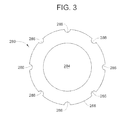
- FIG. 3 is a top, plan view of an exemplary conical frustum.
- FIG. 4 is a top, plan view of a slice of an exemplary first member.
- FIG. 5 is an enlarged view of a slice of the exemplary first member as depicted in FIG. 3 .
- the apparatus as disclosed herein can facilitate the extraction of a component from two immiscible liquids.
- one liquid is typically heavier than the other.
- the first liquid can be lighter and less dense and the second liquid may be heavier and denser.
- the first liquid can be at least one hydrocarbon, such as naphtha, hexane, dodecane, and a liquefied petroleum gas; and the second liquid can be water or an acidic or an alkaline solution thereof, such as a sodium or potassium hydroxide or an ammonia solution.
- the first liquid contains a substance to be extracted, such as one or more sulfur compounds, and/or reacted. Often, the substance is extracted from the hydrocarbon liquid into an alkaline solution.
- Examples can include contacting a liquefied petroleum gas containing one or more sulfur compounds and a solution of sodium or potassium hydroxide, or of ammonia, a liquefied petroleum gas containing one or more sulfur compounds and water, or one or more C3-C10 hydrocarbons, such as hexane, containing one or more sulfur compounds and water.
- the embodiments disclosed herein can combine liquid introduction and mixing, phase separation, and coalescing, into single integrated housing.
- the apparatus as disclosed herein can be utilized for contacting two immiscible liquids for facilitating reaction, such as alkylation, with an acid catalyst, such as hydrofluoric acid or sulfuric acid.
- an acid catalyst such as hydrofluoric acid or sulfuric acid.
- an exemplary apparatus 100 for mixing and contacting a first liquid and a second liquid with the liquids typically being immiscible can occur in a vessel 200 .
- the vessel 200 includes at least one inlet 202 , such as a first inlet 204 and a second inlet 208 , and at least one outlet 348 may include a first outlet 350 and the second outlet 354 .
- the vessel 200 can include a head 212 , a bottom 216 , and at least one wall 220 .
- the at least one wall 220 can be coupled at either end to the head 212 and the bottom 216 .
- the at least one wall 220 forms a substantially cylindrical outer surface that can be coupled to the hemispherical head 212 at one end 222 and the hemispherical bottom 216 at the other end 224 .
- Both the inlets 204 and 208 and outlets 350 and 354 can form tube-and-shell constructions.
- the first inlet 204 and the second inlet 208 can form, respectively, a shell 206 and a tube 210 configuration.
- the tube 210 is inserted into the shell 206 , which can receive a first liquid via a pipe 214 while the tube 210 can receive a second liquid via the second inlet 208 .
- the at least one outlet 348 can include the first outlet 350 and the second outlet 354 .
- a tube 352 for the first outlet 350 can be inserted into a shell 356 of the second outlet 354 .
- a pipe 364 can be coupled to the shell 356 for permitting liquid to leave the shell 356 .
- the head 212 , the at least one wall 220 , and the bottom 216 can be formed integrally together to form an inner perimeter 230 as well as an interior space 234 for housing additional components of the vessel 200 .
- the vessel 200 can include a frustum 280 , preferably conical, a first member or swirler 240 , a frustum 290 , preferably funnical, a distributor 300 , and a coalescer 340 .
- the tube 210 extends into the interior space 234 while the shell 206 can terminate at the head 212 .
- the first or hydrocarbon liquid can enter the shell 206 and fill the interior space 234 upstream of the first member 240 .
- the second or alkaline liquid may enter the tube 210 and impinge the conical frustum 280 , as depicted in FIG. 3 .
- the frustum 280 is disclosed as being conical, it should be understood that any suitable shape may be utilized, such as a splash member shaped as a disc, rectangular plate, or prism. As such, the splash member can include a variety of shapes, including the frustum 280 .
- the conical frustum 280 may have a top surface 284 and a substantially circular plate perimeter 288 forming a plurality of one or more cutouts 286 .
- the one or more cutouts 286 are depicted as crescents, the one or more cutouts can, independently, take any suitable shape, such as crescents, triangular, and/or round.
- the first and second liquids may mix and be directed to a perimeter 230 formed by the at least one wall 220 .
- the liquids can fall over the edge of the frustum 280 and enter the first member 240 .
- the perimeter 230 can be substantially circular from a plan, cross-sectional view, as depicted in FIG. 2 .
- edge of the frustum 280 is depicted as flush with the edge of the swirler 240 , in other embodiments the edge of the frustum 280 may be extended to overhang the edge of the swirler 240 , while leaving a gap between the edge of the frustum 280 and the wall 220 .
- the first member 240 can be positioned within the interior space 234 and reside downstream and positioned proximate to the conical frustum 280 .
- the first member 240 may be a separate component or formed integrally with other components, such as the at least one wall 200 .
- the first member 240 forms one or more openings 252 to allow liquids flowing off the conical frustum 280 filling a circular trough 244 to enter one or more openings 252 of the first member 240 .
- the first member 240 imparts a swirl to the first and second liquids passing from an outer region 270 to the inner surface 274 of the first member 240 .
- the first member 240 forms a plurality 250 of passageways 254 where each passageway 254 can taper narrowing in a direction from an outer region 270 to an inner surface 274 of the first member 240 .
- each passageway 254 can be defined by a first side 260 spaced apart from a second side 264 that tapers each passageway 254 to form a slot 268 .
- a swirling motion can be imparted to the first and second liquids entering the outer region 270 of the first member 240 , passing into each passageway 254 and exiting a slot 268 formed in the inner surface 274 of the first member 240 .
- first side 260 can form vanes at an angle of about 90-about 180° with respect to one another that can further taper the passageway 254 .
- each side 260 and 264 can, independently, be considered a vane.
- the tapering of the passageway 254 can facilitate accelerating and imparting a circular motion to the first and second liquids.
- the sides 260 and 264 can be formed integrally with the first member 240 , or formed as separate components and coupled together to at least partially comprise the first member 240 .
- the funnical frustum 290 can be positioned downstream from the first member 240 and receive liquid therefrom. Generally, the funnical frustum 290 can abut the perimeter 230 of the vessel 200 and direct liquid toward its center. The funnical frustum 290 can form a curvature for facilitating the formation of a vortex. The funnical frustum 290 may also collect liquids from the first member 240 . At least a portion of the curvature can resemble, in a cross-section, at least a portion of a mordell or parabolic curve. Generally, the cross-section of the funnical frustum 290 can resemble any suitable bell curve.
- the funnical frustum 290 forms an opening 294 above or upstream of the distributor 300 for providing liquid therebelow.
- the distributor 300 can be positioned below or downstream of an opening 294 formed by the funnical frustum 290 .
- the distributor 300 may form a substantially circular plate or disk shape, although any suitable shape may be utilized.
- the distributor 300 includes a substantially circular plate that receives the liquids spilling from the funnical frustum 290 .
- the surface of the distributor 300 can be smooth to facilitate a laminar flow of liquids spreading across its surface.
- the distributor 300 and funnical frustum 290 can also form a narrow passageway 298 underneath the funnical frustum 290 to reduce the velocity and laminarize the flow to aid in further phase separation.
- the liquid can flow from the interior of the substantially circular distributor 300 towards its periphery positioned proximately to the perimeter 230 of the vessel 200 . Liquid can flow over the periphery to the space downstream of the distributor 300 .
- This space can be a coalescence annulus 320 formed by the at least one wall 220 and an outer wall of the coalescer 340 .
- the coalescence annulus 320 may form a volume that can permit primary phase separation of the first and second liquids by gravity-driven settling of coalesced droplets.
- the coalescer 340 Downstream of the distributor 300 can be the coalescer 340 .
- the coalescer 340 can be any suitable material, but desirably the coalescer 340 includes a stainless steel mesh 344 , optionally coated with a hydrophobic substance.
- the coalescer 340 is constructed from any suitable media, such as mesh, nets, cartridge, foam, and/or laminarizing channels.
- the funnical frustum 290 can be positioned at predetermined distance from the first member 240 .
- the funnical frustum 290 may be positioned no more than one diameter, one-half diameter, or one-quarter diameter of the vessel 200 .
- the funnical frustum 290 can be positioned proximate or adjacent to the first member 240 .
- the outlet tube 352 can extend upwards into the interior space 234 to provide an inlet that can reside downstream of the distributor 300 .
- the tube 352 may be capped with a circular plate 370 forming an opening in the center therein at an inlet to the outlet tuber 352 .
- a first liquid can be provided within a first inlet 204 and a second liquid can be provided to the second inlet 208 .
- the first and second liquids are introduced upstream of the first member 240 .
- the first liquid can fill the interior space 234 upstream of the first member 240 .
- the second liquid impinges upon a surface 284 of the conical frustum 280 .
- the first and second liquids can at least partially mix and travel toward the perimeter 230 of the vessel 200 , and flow off the conical frustum 280 .
- the first and second liquids may fill the trough 244 and pass into the multiple openings 252 of the first member 240 and subsequently pass through each passageway 254 to exit the slot 268 past the inner surface 274 of the first member 240 .
- the contacted first and second liquids encounter the outwardly tapered sides 260 and 264 designed to accelerate the rotational motion forcing the denser second liquid toward the perimeter 230 and partially stratify the flow.
- a swirling motion can be imparted to the liquids, which can form a vortex facilitating contacting and separating of the two liquids.
- a component can be extraction into the second liquid from the first liquid.
- the partially stratified liquids can drop to the funnical frustum 290 and be directed toward the opening 294 in the center.
- the first and second liquids can pass the opening 294 and spread across the distributor 300 to its periphery.
- the liquid can form a laminar flow and aid separation of the two immiscible phases with the liquid passing close to the perimeter 230 of the vessel 200 and dropping below and toward the bottom 216 of the vessel 200 .
- the second liquid settles at the bottom 216 of the vessel 200 and exits through a shell 356 and a pipe 364 along with any extracted component.
- the second liquid is not permitted to accumulate beyond a certain level and is continually drained from the bottom 216 of the vessel 200 .
- the mixture of the two liquids can fall in the coalescence annulus 320 and then rise while passing through the coalescer 340 .
- the coalescer 340 can further facilitate separation of any second liquid present in the first liquid.
- the first liquid can exit the first outlet 352 via the first tube 350 with a relatively low amount of second liquid present, and with any undesired substances extracted to the second liquid.
- the apparatus 100 can be utilized to mix various liquids such as extracting sulfur from a hydrocarbon, such as liquefied petroleum gas into a second liquid, often an immiscible liquid such as a water solution of sodium or potassium hydroxide.
- this process can operate at any suitable pressure and/or g-force, such as no more than about 10 g, or no more than about 1 g in the vortex zone, to facilitate the mixing and/or extraction of one component in a liquid into another for sweetening or purification.
- the g-force can vary depending on the location, such as in the passageway 254 of the swirler 240 , and can exceed about 10 g.
- the second liquid is disclosed as being introduced through the tube 210 , it should be understood that the heavier liquid could be introduced directly into the first member 240 .
- the vessel 200 may only contain one of the conical frustum 280 and the funnical frustum 290 .
- the liquids are discussed being introduced to the vessel through the tube and shell construction, it should be understood that they be entered in any suitable manner, including not just through the head 212 but also through the side via the at least one wall 220 . Generally, the liquids can enter the vessel 200 at any suitable temperature and pressure.
- the first liquid can exit as a hydrocarbon product that generally includes about 1-about 10 ppm, preferably no more than about 1 ppm, by weight, of, independently, a cation such as sodium associated with the alkaline liquid, and one or more sulfur compounds.
- a cation such as sodium associated with the alkaline liquid
- sulfur compounds one or more sulfur compounds.
- several vessels can be used in series to ensure that the hydrocarbon effluent exiting the last vessel may contain no more than about 1 ppm, by weight, of, independently, the cation and one or more sulfur compounds.
Landscapes
- Chemical & Material Sciences (AREA)
- Chemical Kinetics & Catalysis (AREA)
- Physics & Mathematics (AREA)
- Thermal Sciences (AREA)
- Physical Or Chemical Processes And Apparatus (AREA)
Abstract
Description
Claims (13)
Priority Applications (1)
| Application Number | Priority Date | Filing Date | Title |
|---|---|---|---|
| US13/709,376 US9233319B2 (en) | 2012-12-10 | 2012-12-10 | Apparatus and process for contacting liquids |
Applications Claiming Priority (1)
| Application Number | Priority Date | Filing Date | Title |
|---|---|---|---|
| US13/709,376 US9233319B2 (en) | 2012-12-10 | 2012-12-10 | Apparatus and process for contacting liquids |
Publications (2)
| Publication Number | Publication Date |
|---|---|
| US20140158644A1 US20140158644A1 (en) | 2014-06-12 |
| US9233319B2 true US9233319B2 (en) | 2016-01-12 |
Family
ID=50879815
Family Applications (1)
| Application Number | Title | Priority Date | Filing Date |
|---|---|---|---|
| US13/709,376 Expired - Fee Related US9233319B2 (en) | 2012-12-10 | 2012-12-10 | Apparatus and process for contacting liquids |
Country Status (1)
| Country | Link |
|---|---|
| US (1) | US9233319B2 (en) |
Families Citing this family (1)
| Publication number | Priority date | Publication date | Assignee | Title |
|---|---|---|---|---|
| US9457294B2 (en) * | 2012-12-10 | 2016-10-04 | Uop Llc | Apparatus and process for contacting and separating liquids |
Citations (32)
| Publication number | Priority date | Publication date | Assignee | Title |
|---|---|---|---|---|
| US2659664A (en) | 1950-08-30 | 1953-11-17 | Works William Robert | Vortex ring process for liquidliquid extraction |
| US3784009A (en) | 1971-12-13 | 1974-01-08 | Univ Oklahoma State | Hydroclone for separating an immiscible heavy phase from a light phase liquid |
| US3867103A (en) | 1973-06-25 | 1975-02-18 | Universal Oil Prod Co | Alkylation apparatus |
| US4604988A (en) | 1984-03-19 | 1986-08-12 | Budra Research Ltd. | Liquid vortex gas contactor |
| US5098668A (en) | 1990-03-07 | 1992-03-24 | Mobil Oil Corporation | HF alkylation unit with acid evacuation system |
| US5405497A (en) | 1990-08-28 | 1995-04-11 | Kamyr, Inc. | Method of chemically reacting a liquid with a gas in a vortex |
| US5462639A (en) | 1994-01-12 | 1995-10-31 | Texas Instruments Incorporated | Method of treating particles |
| RU2071839C1 (en) | 1993-11-23 | 1997-01-20 | Анатолий Николаевич Балалаев | Cyclone |
| US5628901A (en) * | 1993-04-30 | 1997-05-13 | Castrol Industrial North America Inc. | Vessel for treating liquids |
| US6241809B1 (en) | 1999-09-20 | 2001-06-05 | Dan Hopkins | Apparatus and method for liquid scrubbing contaminants from a gas flow |
| US6303843B1 (en) | 1995-09-18 | 2001-10-16 | Phillips Petroleum Company | Method for removing sulfolane present in hydrocarbon |
| US6322763B1 (en) | 1998-12-15 | 2001-11-27 | Teco, Inc. | Method and apparatus for removing carbonyl sulfide from a gas stream via wet scrubbing |
| US6430937B2 (en) | 2000-03-03 | 2002-08-13 | Vai Holdings, Llc | Vortex generator to recover performance loss of a refrigeration system |
| US6464210B1 (en) | 2002-03-22 | 2002-10-15 | Agrimond, Llc | Fluid dissolution apparatus |
| US6576029B2 (en) | 2001-06-13 | 2003-06-10 | National Tank Company | System for separating an entrained liquid component from a gas stream |
| US6709500B1 (en) | 2002-02-08 | 2004-03-23 | National Tank Company | System for separating entrained liquid from a gas stream using a sloped vessel |
| EP1406731A1 (en) | 2001-07-18 | 2004-04-14 | Accentus plc | Apparatus for gas/liquid contacting |
| CN2628149Y (en) | 2003-06-24 | 2004-07-28 | 宝山钢铁股份有限公司 | Adjustable hydraulic swirler |
| US6811713B2 (en) * | 2001-06-12 | 2004-11-02 | Hydrotreat, Inc. | Method and apparatus for mixing fluids, separating fluids, and separating solids from fluids |
| US6852902B2 (en) | 2002-03-15 | 2005-02-08 | Catalytic Distillation Technologies | Method of removing entrained sulfuric acid from alkylate |
| GB2430637A (en) | 2003-05-08 | 2007-04-04 | Vetco Aibel As | An inlet device and a method of controlling the introduction of a fluid into a separator |
| US7326333B2 (en) | 2001-12-20 | 2008-02-05 | Uop Llc | Apparatus and process for extracting sulfur compounds from a hydrocarbon stream |
| US7381309B1 (en) * | 2001-12-20 | 2008-06-03 | Uop Llc | Apparatus for prewashing a hydrocarbon stream containing hydrogen sulfide |
| US20090115076A1 (en) | 2004-11-30 | 2009-05-07 | Alexey Feofilaktovich Makhotkin | Vortex Apparatus With Descending Flow Of Phases |
| US20090221863A1 (en) | 2006-12-11 | 2009-09-03 | Exxonmobil Research And Engineering Comapny | HF akylation process |
| US20090283474A1 (en) | 2008-05-13 | 2009-11-19 | Commissariat A L'energie Atomique | Device and a method for separating a suspension |
| KR100972921B1 (en) | 2009-12-02 | 2010-07-28 | 제이케이이앤씨 주식회사 | An apparatus for cleaning and deodorizing of rotation diaphragmed type vortex |
| US20100258427A1 (en) | 2009-04-08 | 2010-10-14 | Towler Gavin P | Vapor-liquid contacting apparatuses with vortex contacting stages |
| US8028975B2 (en) | 2008-11-14 | 2011-10-04 | Uop Llc | Separation vessel or part thereof, and process relating thereto |
| US20110239862A1 (en) | 2010-03-31 | 2011-10-06 | Uop Llc | Vapor-Liquid Contacting Apparatuses Having a Secondary Absorption Zone with Vortex Contacting Stages |
| US20120000827A1 (en) | 2010-06-30 | 2012-01-05 | Uop, Llc | Process for removing one or more sulfur compounds from a stream |
| US20120118818A1 (en) * | 2009-08-31 | 2012-05-17 | Carlos Alberto Capela Moraes | Hydrocyclone for the separation of fluids |
-
2012
- 2012-12-10 US US13/709,376 patent/US9233319B2/en not_active Expired - Fee Related
Patent Citations (33)
| Publication number | Priority date | Publication date | Assignee | Title |
|---|---|---|---|---|
| US2659664A (en) | 1950-08-30 | 1953-11-17 | Works William Robert | Vortex ring process for liquidliquid extraction |
| US3784009A (en) | 1971-12-13 | 1974-01-08 | Univ Oklahoma State | Hydroclone for separating an immiscible heavy phase from a light phase liquid |
| US3867103A (en) | 1973-06-25 | 1975-02-18 | Universal Oil Prod Co | Alkylation apparatus |
| US4604988A (en) | 1984-03-19 | 1986-08-12 | Budra Research Ltd. | Liquid vortex gas contactor |
| US5098668A (en) | 1990-03-07 | 1992-03-24 | Mobil Oil Corporation | HF alkylation unit with acid evacuation system |
| US5405497A (en) | 1990-08-28 | 1995-04-11 | Kamyr, Inc. | Method of chemically reacting a liquid with a gas in a vortex |
| US5628901A (en) * | 1993-04-30 | 1997-05-13 | Castrol Industrial North America Inc. | Vessel for treating liquids |
| RU2071839C1 (en) | 1993-11-23 | 1997-01-20 | Анатолий Николаевич Балалаев | Cyclone |
| US5462639A (en) | 1994-01-12 | 1995-10-31 | Texas Instruments Incorporated | Method of treating particles |
| US6303843B1 (en) | 1995-09-18 | 2001-10-16 | Phillips Petroleum Company | Method for removing sulfolane present in hydrocarbon |
| US6322763B1 (en) | 1998-12-15 | 2001-11-27 | Teco, Inc. | Method and apparatus for removing carbonyl sulfide from a gas stream via wet scrubbing |
| US6241809B1 (en) | 1999-09-20 | 2001-06-05 | Dan Hopkins | Apparatus and method for liquid scrubbing contaminants from a gas flow |
| US6430937B2 (en) | 2000-03-03 | 2002-08-13 | Vai Holdings, Llc | Vortex generator to recover performance loss of a refrigeration system |
| US6811713B2 (en) * | 2001-06-12 | 2004-11-02 | Hydrotreat, Inc. | Method and apparatus for mixing fluids, separating fluids, and separating solids from fluids |
| US6576029B2 (en) | 2001-06-13 | 2003-06-10 | National Tank Company | System for separating an entrained liquid component from a gas stream |
| EP1406731A1 (en) | 2001-07-18 | 2004-04-14 | Accentus plc | Apparatus for gas/liquid contacting |
| US7326333B2 (en) | 2001-12-20 | 2008-02-05 | Uop Llc | Apparatus and process for extracting sulfur compounds from a hydrocarbon stream |
| US7381309B1 (en) * | 2001-12-20 | 2008-06-03 | Uop Llc | Apparatus for prewashing a hydrocarbon stream containing hydrogen sulfide |
| US6709500B1 (en) | 2002-02-08 | 2004-03-23 | National Tank Company | System for separating entrained liquid from a gas stream using a sloped vessel |
| US6852902B2 (en) | 2002-03-15 | 2005-02-08 | Catalytic Distillation Technologies | Method of removing entrained sulfuric acid from alkylate |
| US7126038B2 (en) | 2002-03-15 | 2006-10-24 | Catalytic Distillation Technologies | Method of removing entrained sulfuric acid from alkylate |
| US6464210B1 (en) | 2002-03-22 | 2002-10-15 | Agrimond, Llc | Fluid dissolution apparatus |
| GB2430637A (en) | 2003-05-08 | 2007-04-04 | Vetco Aibel As | An inlet device and a method of controlling the introduction of a fluid into a separator |
| CN2628149Y (en) | 2003-06-24 | 2004-07-28 | 宝山钢铁股份有限公司 | Adjustable hydraulic swirler |
| US20090115076A1 (en) | 2004-11-30 | 2009-05-07 | Alexey Feofilaktovich Makhotkin | Vortex Apparatus With Descending Flow Of Phases |
| US20090221863A1 (en) | 2006-12-11 | 2009-09-03 | Exxonmobil Research And Engineering Comapny | HF akylation process |
| US20090283474A1 (en) | 2008-05-13 | 2009-11-19 | Commissariat A L'energie Atomique | Device and a method for separating a suspension |
| US8028975B2 (en) | 2008-11-14 | 2011-10-04 | Uop Llc | Separation vessel or part thereof, and process relating thereto |
| US20100258427A1 (en) | 2009-04-08 | 2010-10-14 | Towler Gavin P | Vapor-liquid contacting apparatuses with vortex contacting stages |
| US20120118818A1 (en) * | 2009-08-31 | 2012-05-17 | Carlos Alberto Capela Moraes | Hydrocyclone for the separation of fluids |
| KR100972921B1 (en) | 2009-12-02 | 2010-07-28 | 제이케이이앤씨 주식회사 | An apparatus for cleaning and deodorizing of rotation diaphragmed type vortex |
| US20110239862A1 (en) | 2010-03-31 | 2011-10-06 | Uop Llc | Vapor-Liquid Contacting Apparatuses Having a Secondary Absorption Zone with Vortex Contacting Stages |
| US20120000827A1 (en) | 2010-06-30 | 2012-01-05 | Uop, Llc | Process for removing one or more sulfur compounds from a stream |
Non-Patent Citations (9)
| Title |
|---|
| "LPG Recovery from End of Life Vehicles", at www.atfprofessional.co.uk/lpgrecovery.aspx, p. 1 screen page. |
| "Vortex De-Pollution System-The Leading Solution That Meets UK Legislation Requirements", at www.vortexdepollution.com/lpg.html, 2008, p. 6 screen pages. |
| Abstract of CN 1490070 Publication Date Apr. 21, 2004 by Zhang Wenfei. |
| Abstract of CN 201258914 Publication Date Jun. 17, 2009 by Luoyang Siyite Bearing Co. Ltd. |
| Abstract of CN 2573055 Publication Date Sep. 17, 2003 by Zhang Wenfei. |
| Am Ende et al, "Interfacial Area of Dispersions of Sulfuric Acid and Hydrocarbons", Industrial & Engineering Chemistry Research, Dec. 1995, vol. 34, No. 12, pp. 4343-4350. |
| Baird et al., "Liquid-Liquid Extraction Using Vortex Rings in a Batch Cell", Trans IChemE, Jul. 1992, vol. 70, No. A4, pp. 323-332. |
| Martin et al., "Tangential Flow Development for Laminar Axial Flow in an Annulus With a Rotating Inner Cylinder", Proc. R. Soc. Lond. A., May 2, 1972, vol. 328, No. 1572, pp. 123-141. |
| Weinstein et al., "Liquid-Liquid Contacting in Unbaffled, Agitated Vessels", AlChE Seventy-Fourth National Meeting New Orleans, LA, Mar. 11, 1973, Volume Paper, No. 91A, p. 40 Pages. |
Also Published As
| Publication number | Publication date |
|---|---|
| US20140158644A1 (en) | 2014-06-12 |
Similar Documents
| Publication | Publication Date | Title |
|---|---|---|
| AU2008287772B8 (en) | Contactor | |
| KR101352676B1 (en) | Vapor-liquid contacting apparatuses with vortex contacting stages | |
| EP2136897A1 (en) | Systems and methods for liquid separation | |
| CN104245075B (en) | Extraction tower and its use process | |
| CN104955538B (en) | Liquid-liquid extraction system and the technique used for it | |
| AU2012351569B2 (en) | Contact and separation column and tray | |
| US4234544A (en) | Liquid-liquid extraction apparatus | |
| US4207174A (en) | Liquid-liquid extraction apparatus and process | |
| US6824750B2 (en) | Vertical extending liquid/liquid contacting column | |
| US3960525A (en) | Oil-gas separator having defoaming structure | |
| US9233319B2 (en) | Apparatus and process for contacting liquids | |
| US9458068B2 (en) | Process and vessel for removing one or more sulfur compounds | |
| US4596283A (en) | Process for magnetically stabilizing contactor columns containing immiscible fluids | |
| RU2283679C2 (en) | Method and device for separation of two-phased mixture of two immiscible fluid components | |
| US9457294B2 (en) | Apparatus and process for contacting and separating liquids | |
| US9303214B2 (en) | Process, vessel, and apparatus for removing one or more sulfur compounds | |
| US2775542A (en) | Liquid-liquid extraction tray | |
| US9457293B2 (en) | Process and vessel for removing one or more sulfur compounds | |
| RU2633671C1 (en) | Mixer-turbulator | |
| US8813976B2 (en) | Process and apparatus for extracting | |
| RU2696705C1 (en) | Vertical separation vessel for process effluent catalysed by ionic liquid | |
| Chemtech | Liquid-Liquid separation technology | |
| WO2024108034A1 (en) | Gas-liquid separation device for an ebullated bed reactor | |
| SU1426604A1 (en) | Apparatus for heat-mass exchange apparatus | |
| SU175490A1 (en) | APPARATUS FOR IMPLEMENTATION OF CHEMICAL PROCESSES “BY THE BOILER” |
Legal Events
| Date | Code | Title | Description |
|---|---|---|---|
| AS | Assignment |
Owner name: UOP LLC, ILLINOIS Free format text: ASSIGNMENT OF ASSIGNORS INTEREST;ASSIGNORS:KUZMIN, ANDREY;SATTAR, AZIZ;DAVYDOV, LEV;SIGNING DATES FROM 20130508 TO 20130709;REEL/FRAME:030863/0160 |
|
| AS | Assignment |
Owner name: UOP LLC, ILLINOIS Free format text: ASSIGNMENT OF ASSIGNORS INTEREST;ASSIGNORS:KUZMIN, ANDREY;SATTAR, AZIZ A;DAVYDOV, LEV;SIGNING DATES FROM 20131209 TO 20131211;REEL/FRAME:032376/0737 Owner name: BORESKOV INSTITUTE OF CATALYSIS, RUSSIAN FEDERATIO Free format text: ASSIGNMENT OF ASSIGNORS INTEREST;ASSIGNORS:KUZMIN, ANDREY;SATTAR, AZIZ A;DAVYDOV, LEV;SIGNING DATES FROM 20131209 TO 20131211;REEL/FRAME:032376/0737 |
|
| ZAAA | Notice of allowance and fees due |
Free format text: ORIGINAL CODE: NOA |
|
| ZAAB | Notice of allowance mailed |
Free format text: ORIGINAL CODE: MN/=. |
|
| STCF | Information on status: patent grant |
Free format text: PATENTED CASE |
|
| MAFP | Maintenance fee payment |
Free format text: PAYMENT OF MAINTENANCE FEE, 4TH YEAR, LARGE ENTITY (ORIGINAL EVENT CODE: M1551); ENTITY STATUS OF PATENT OWNER: LARGE ENTITY Year of fee payment: 4 |
|
| FEPP | Fee payment procedure |
Free format text: MAINTENANCE FEE REMINDER MAILED (ORIGINAL EVENT CODE: REM.); ENTITY STATUS OF PATENT OWNER: LARGE ENTITY |
|
| LAPS | Lapse for failure to pay maintenance fees |
Free format text: PATENT EXPIRED FOR FAILURE TO PAY MAINTENANCE FEES (ORIGINAL EVENT CODE: EXP.); ENTITY STATUS OF PATENT OWNER: LARGE ENTITY |
|
| STCH | Information on status: patent discontinuation |
Free format text: PATENT EXPIRED DUE TO NONPAYMENT OF MAINTENANCE FEES UNDER 37 CFR 1.362 |
|
| FP | Lapsed due to failure to pay maintenance fee |
Effective date: 20240112 |