US9213971B2 - Method and system for providing information on pre-purchase and post-purchase items using RFID and computer-readable storage media storing programs for executing the method - Google Patents
Method and system for providing information on pre-purchase and post-purchase items using RFID and computer-readable storage media storing programs for executing the method Download PDFInfo
- Publication number
- US9213971B2 US9213971B2 US12/027,932 US2793208A US9213971B2 US 9213971 B2 US9213971 B2 US 9213971B2 US 2793208 A US2793208 A US 2793208A US 9213971 B2 US9213971 B2 US 9213971B2
- Authority
- US
- United States
- Prior art keywords
- item
- mobile reader
- authentication value
- purchase
- tag
- Prior art date
- Legal status (The legal status is an assumption and is not a legal conclusion. Google has not performed a legal analysis and makes no representation as to the accuracy of the status listed.)
- Active, expires
Links
Images



Classifications
-
- G—PHYSICS
- G06—COMPUTING OR CALCULATING; COUNTING
- G06K—GRAPHICAL DATA READING; PRESENTATION OF DATA; RECORD CARRIERS; HANDLING RECORD CARRIERS
- G06K7/00—Methods or arrangements for sensing record carriers, e.g. for reading patterns
- G06K7/10—Methods or arrangements for sensing record carriers, e.g. for reading patterns by electromagnetic radiation, e.g. optical sensing; by corpuscular radiation
- G06K7/10009—Methods or arrangements for sensing record carriers, e.g. for reading patterns by electromagnetic radiation, e.g. optical sensing; by corpuscular radiation sensing by radiation using wavelengths larger than 0.1 mm, e.g. radio-waves or microwaves
- G06K7/10366—Methods or arrangements for sensing record carriers, e.g. for reading patterns by electromagnetic radiation, e.g. optical sensing; by corpuscular radiation sensing by radiation using wavelengths larger than 0.1 mm, e.g. radio-waves or microwaves the interrogation device being adapted for miscellaneous applications
-
- G—PHYSICS
- G06—COMPUTING OR CALCULATING; COUNTING
- G06Q—INFORMATION AND COMMUNICATION TECHNOLOGY [ICT] SPECIALLY ADAPTED FOR ADMINISTRATIVE, COMMERCIAL, FINANCIAL, MANAGERIAL OR SUPERVISORY PURPOSES; SYSTEMS OR METHODS SPECIALLY ADAPTED FOR ADMINISTRATIVE, COMMERCIAL, FINANCIAL, MANAGERIAL OR SUPERVISORY PURPOSES, NOT OTHERWISE PROVIDED FOR
- G06Q20/00—Payment architectures, schemes or protocols
- G06Q20/30—Payment architectures, schemes or protocols characterised by the use of specific devices or networks
- G06Q20/32—Payment architectures, schemes or protocols characterised by the use of specific devices or networks using wireless devices
-
- G—PHYSICS
- G06—COMPUTING OR CALCULATING; COUNTING
- G06K—GRAPHICAL DATA READING; PRESENTATION OF DATA; RECORD CARRIERS; HANDLING RECORD CARRIERS
- G06K17/00—Methods or arrangements for effecting co-operative working between equipments covered by two or more of main groups G06K1/00 - G06K15/00, e.g. automatic card files incorporating conveying and reading operations
-
- G—PHYSICS
- G06—COMPUTING OR CALCULATING; COUNTING
- G06Q—INFORMATION AND COMMUNICATION TECHNOLOGY [ICT] SPECIALLY ADAPTED FOR ADMINISTRATIVE, COMMERCIAL, FINANCIAL, MANAGERIAL OR SUPERVISORY PURPOSES; SYSTEMS OR METHODS SPECIALLY ADAPTED FOR ADMINISTRATIVE, COMMERCIAL, FINANCIAL, MANAGERIAL OR SUPERVISORY PURPOSES, NOT OTHERWISE PROVIDED FOR
- G06Q20/00—Payment architectures, schemes or protocols
- G06Q20/04—Payment circuits
- G06Q20/045—Payment circuits using payment protocols involving tickets
-
- G—PHYSICS
- G06—COMPUTING OR CALCULATING; COUNTING
- G06Q—INFORMATION AND COMMUNICATION TECHNOLOGY [ICT] SPECIALLY ADAPTED FOR ADMINISTRATIVE, COMMERCIAL, FINANCIAL, MANAGERIAL OR SUPERVISORY PURPOSES; SYSTEMS OR METHODS SPECIALLY ADAPTED FOR ADMINISTRATIVE, COMMERCIAL, FINANCIAL, MANAGERIAL OR SUPERVISORY PURPOSES, NOT OTHERWISE PROVIDED FOR
- G06Q20/00—Payment architectures, schemes or protocols
- G06Q20/30—Payment architectures, schemes or protocols characterised by the use of specific devices or networks
- G06Q20/32—Payment architectures, schemes or protocols characterised by the use of specific devices or networks using wireless devices
- G06Q20/327—Short range or proximity payments by means of M-devices
- G06Q20/3278—RFID or NFC payments by means of M-devices
-
- G—PHYSICS
- G06—COMPUTING OR CALCULATING; COUNTING
- G06Q—INFORMATION AND COMMUNICATION TECHNOLOGY [ICT] SPECIALLY ADAPTED FOR ADMINISTRATIVE, COMMERCIAL, FINANCIAL, MANAGERIAL OR SUPERVISORY PURPOSES; SYSTEMS OR METHODS SPECIALLY ADAPTED FOR ADMINISTRATIVE, COMMERCIAL, FINANCIAL, MANAGERIAL OR SUPERVISORY PURPOSES, NOT OTHERWISE PROVIDED FOR
- G06Q20/00—Payment architectures, schemes or protocols
- G06Q20/38—Payment protocols; Details thereof
- G06Q20/382—Payment protocols; Details thereof insuring higher security of transaction
- G06Q20/3823—Payment protocols; Details thereof insuring higher security of transaction combining multiple encryption tools for a transaction
-
- G—PHYSICS
- G06—COMPUTING OR CALCULATING; COUNTING
- G06Q—INFORMATION AND COMMUNICATION TECHNOLOGY [ICT] SPECIALLY ADAPTED FOR ADMINISTRATIVE, COMMERCIAL, FINANCIAL, MANAGERIAL OR SUPERVISORY PURPOSES; SYSTEMS OR METHODS SPECIALLY ADAPTED FOR ADMINISTRATIVE, COMMERCIAL, FINANCIAL, MANAGERIAL OR SUPERVISORY PURPOSES, NOT OTHERWISE PROVIDED FOR
- G06Q30/00—Commerce
- G06Q30/02—Marketing; Price estimation or determination; Fundraising
-
- G—PHYSICS
- G07—CHECKING-DEVICES
- G07G—REGISTERING THE RECEIPT OF CASH, VALUABLES, OR TOKENS
- G07G1/00—Cash registers
- G07G1/0036—Checkout procedures
- G07G1/0045—Checkout procedures with a code reader for reading of an identifying code of the article to be registered, e.g. barcode reader or radio-frequency identity [RFID] reader
- G07G1/009—Checkout procedures with a code reader for reading of an identifying code of the article to be registered, e.g. barcode reader or radio-frequency identity [RFID] reader the reader being an RFID reader
-
- H—ELECTRICITY
- H04—ELECTRIC COMMUNICATION TECHNIQUE
- H04L—TRANSMISSION OF DIGITAL INFORMATION, e.g. TELEGRAPHIC COMMUNICATION
- H04L9/00—Cryptographic mechanisms or cryptographic arrangements for secret or secure communications; Network security protocols
- H04L9/32—Cryptographic mechanisms or cryptographic arrangements for secret or secure communications; Network security protocols including means for verifying the identity or authority of a user of the system or for message authentication, e.g. authorization, entity authentication, data integrity or data verification, non-repudiation, key authentication or verification of credentials
- H04L9/3263—Cryptographic mechanisms or cryptographic arrangements for secret or secure communications; Network security protocols including means for verifying the identity or authority of a user of the system or for message authentication, e.g. authorization, entity authentication, data integrity or data verification, non-repudiation, key authentication or verification of credentials involving certificates, e.g. public key certificate [PKC] or attribute certificate [AC]; Public key infrastructure [PKI] arrangements
-
- H—ELECTRICITY
- H04—ELECTRIC COMMUNICATION TECHNIQUE
- H04L—TRANSMISSION OF DIGITAL INFORMATION, e.g. TELEGRAPHIC COMMUNICATION
- H04L9/00—Cryptographic mechanisms or cryptographic arrangements for secret or secure communications; Network security protocols
- H04L9/32—Cryptographic mechanisms or cryptographic arrangements for secret or secure communications; Network security protocols including means for verifying the identity or authority of a user of the system or for message authentication, e.g. authorization, entity authentication, data integrity or data verification, non-repudiation, key authentication or verification of credentials
- H04L9/3271—Cryptographic mechanisms or cryptographic arrangements for secret or secure communications; Network security protocols including means for verifying the identity or authority of a user of the system or for message authentication, e.g. authorization, entity authentication, data integrity or data verification, non-repudiation, key authentication or verification of credentials using challenge-response
-
- H—ELECTRICITY
- H04—ELECTRIC COMMUNICATION TECHNIQUE
- H04W—WIRELESS COMMUNICATION NETWORKS
- H04W4/00—Services specially adapted for wireless communication networks; Facilities therefor
-
- H—ELECTRICITY
- H04—ELECTRIC COMMUNICATION TECHNIQUE
- H04L—TRANSMISSION OF DIGITAL INFORMATION, e.g. TELEGRAPHIC COMMUNICATION
- H04L2209/00—Additional information or applications relating to cryptographic mechanisms or cryptographic arrangements for secret or secure communication H04L9/00
- H04L2209/56—Financial cryptography, e.g. electronic payment or e-cash
-
- H—ELECTRICITY
- H04—ELECTRIC COMMUNICATION TECHNIQUE
- H04L—TRANSMISSION OF DIGITAL INFORMATION, e.g. TELEGRAPHIC COMMUNICATION
- H04L2209/00—Additional information or applications relating to cryptographic mechanisms or cryptographic arrangements for secret or secure communication H04L9/00
- H04L2209/80—Wireless
- H04L2209/805—Lightweight hardware, e.g. radio-frequency identification [RFID] or sensor
Definitions
- the present invention relates to a Radio Frequency Identification (RFID) system and, in particular, to a method and system for providing information on pre-purchase or post-purchase items using an RFID technology and computer readable storage media storing programs for executing the method.
- RFID Radio Frequency Identification
- Radio Frequency Identification is an automatic identification technology which relies on storing and remotely retrieving data using devices call RFID tags. Since the RFID system enables quickly reading the data from the RFID tags without physical contact it is often envisioned as a replacement for barcode identification systems. Recently, RFID system is partially used for physical distribution, traffic control, animal control, etc.
- 2D barcode system As a similar identification system, 2D barcode system is used for mobile ticketing services. However, the utilization of 2D barcode is limited in its very short recognition distance.
- an RFID reader transmits a query to an RFID tag and the RFID tag transmits its information in response to the query.
- the information received from the RFID tag is transmitted to a database.
- a service provider can simply obtain information of the tag carried by a customer and provide the customer with a customer-specific service on the basis of the information.
- the RFID tag and RFID reader communicate with each other through an insecure channel, the information is vulnerable to attackers, this may include private information such as credit information, purchase patterns, and health condition. Also, the eavesdropped information may be used for tracking the user's location in illegal ways.
- the information embedded in the tags of items on shelves should be readable by all customers mobile readers, except after being purchased.
- the conventional RFID system has a drawback in that the information embedded in the RFID tag is read by any mobile reader even after the item attached the RFID tag has been purchased, whereby the purchase item list can be eavesdropped and the purchaser can be traced by another person, resulting in infringement of customer's privacy. Also, since the electronic product code (EPC) is transferred without any security authentication process, an attacker can eavesdrop on the EPC for forgery.
- EPC electronic product code
- the present invention has been made in an effort to solve the above problems, and it is an object of the present invention to provide an RFID-based pre-purchase item information provision method that is capable of guaranteeing reliability of information on items before selling, preventing the tags from forgery, and improving computation efficiency.
- the pre-purchase item information provision method includes transmitting, if a mobile reader is detected by a local server installed in a salesroom, a certificate containing information on a location of an object information service server and an authentication value to the mobile reader; transmitting, from the mobile reader, a query requesting an item ID to a tag attached to a target item; transmitting, from the tag, item ID information generated by encrypting the item ID using the authentication value to the mobile reader; transmitting, from the mobile reader, the item ID information and the authentication value to the object information service server; and transmitting, from the object information service server, data retrieved from a database corresponding to the item ID, the data being retrieved when the authentication value exists in the database.
- a pre-purchase item information display method for a mobile reader in a radio frequency identification system includes receiving, at the mobile reader, a certificate containing information on a location of an object information service server and authentication value from a local server installed in a salesroom; requesting a tag attached to an item for an item ID embedded in the tag; receiving item ID information generated by encrypting the item ID using the authentication value from the tag; transmitting the item ID information and the authentication value to the object information service server; and receiving data corresponding to the item ID from the object information service server.
- the post-purchase item information provision method includes receiving, at a mobile reader, item keys of purchased items from an object information service server; transmitting a query containing a first random value generated by the mobile reader to a tag attached to the purchased item; receiving a first value and a second value from the tag, the first value being obtained by encrypting an item ID with a second random value generated by the tag, the second value being obtained by encrypting the second random value with the item key; extracting the second random value from the second value using the item key and extracting the item IDs from the first value using the second random value; transmitting the item ID formatted in electronic product code (EPC) among extracted item IDs to the object information service server; and receiving data corresponding to the item ID from the object information service server.
- EPC electronic product code
- the post-purchase item information provision method includes receiving, at a mobile reader, item keys of purchased items from an object information service server; transmitting a query containing a first random value to a tag attached to an item, the first random value being generated by the mobile reader; receiving a first value and a second value from the tag, the first value being obtained by encrypting the item ID with a second random value, the second value being obtained by encrypting the second random value with the item key embedded in the tag; extracting the second random value from the second value using the item key and extracting the item IDs from the first value using the second random value; transmitting the item ID formatted in electronic product code (EPC) among extracted item IDs to the object information service server; and receiving data corresponding to the item ID from the object information service server.
- EPC electronic product code
- the pre-purchase item information provision system includes a mobile reader which receives a certificate containing information on a location of an object information service server and an authentication value from a local server installed in a salesroom, transmits a query for requesting item ID to a tag attached to a specific item in response to a user command, receives item ID information generated by encrypting the item ID using the authentication value from the tag, and transmits the item ID information and the authentication value to the object information service server; a tag which receives the query from the mobile reader and transmits item ID information generated by encrypting the item ID using the authentication value; an object information service server which searches a database for the authentication value, retrieves, if the authentication value is found, data corresponding to item ID from the database, and transmits the data to the mobile reader; and a local server storing certificate containing the information of the object information service server and authentication value.
- the post-purchase item information provision system includes a tag which generates a second random value, generates a first value by encrypting an item ID with the second random value, generates a second value by encrypting the second random value with a tag key, and transmits the first and second values to a mobile reader; a mobile reader which receives item keys of purchased items from an object information service server, transmits a query containing a first random value generated by the mobile reader to a tag attached to the purchased item, extracts the second random value from the second value using the item key, and extracts the item IDs from the first value using the second random value; and an object information service server which transmits, when an item ID formatted in electronic product code (EPC) is received, data corresponding to the item ID to the mobile reader.
- EPC electronic product code
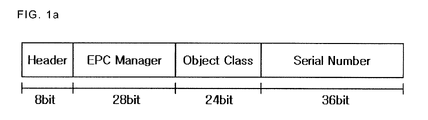
- FIG. 1 a is a diagram illustrating an electronic product code (EPC) format used in a RFID system according to an exemplary embodiment of the present invention.
- EPC electronic product code
- FIG. 1 b is a diagram illustrating a pre-purchase and post-purchase item information provision system using RFID technique according to an exemplary embodiment of the present invention
- FIG. 2 is a signaling diagram illustrating signal flows of a system for providing information on an item in a pre-purchase state according to an exemplary embodiment of the present invention
- FIG. 3 is a signaling diagram illustrating signal flows for an initial setting of a mobile reader of the system of FIG. 2 ;
- FIG. 4 is a signaling diagram illustrating signal flows of a system for providing information on an item in a post-purchase state according to an exemplary embodiment of the present invention
- FIG. 5 is a flowchart illustrating a pre-purchase item information provision method using an RFID system according to an exemplary embodiment of the present invention
- FIG. 6 is a flowchart illustrating an initial setting procedure for providing purchased item information of the item information provision method according to an exemplary embodiment of the present invention.
- FIG. 7 is a flowchart illustrating a post-purchase item information provision method using an RFID system according to an exemplary embodiment of the present invention.
- the present invention allows a customer to obtain reliable information on items before and after purchasing and guarantees customer's privacy in a mobile RFID system environment.
- the customer can check information on pre-purchase and post-purchase items. Before purchasing an item, the customer can check whether the item is an authentic one or not using an authentication certificate issued by the manufacturer. Also, the access to the information on the purchased item is restricted to only the purchaser, resulting in protection of customer's privacy.
- EPC Electronic Product Code
- Table 1 shows the definitions of the fields of the EPC.
- EPC Manager 28 bits It identifies entity such as an organization or company responsible for managing Object Class and Serial Number.
- Object Class 24 bits It identifies a class or unit of item.
- Serial Number 36 bits It identifies a unique number assigned to each item.
- Table 2 shows definitions of symbols used in the following descriptions.
- request p A signal transmitted by a mobile reader for requesting ID of a pre-purchase item in a salesroom.
- request c A signal transmitted by a mobile reader for requesting PID and KID of a post-purchase item.
- ID EPC of a tag K Key value of a tag K j Keys stored in a mobile reader r i
- a random value generated by a PRNG generator of the mobile reader r T A random value generated by a tag hK( ) Keyed hash function
- list c Authentication value list ⁇ Exclusive-OR
- NID means an encrypted ID of a pre-purchase item
- PID means an encrypted ID of a purchased item
- FIG. 1 b is a diagram illustrating a pre-purchase and post-purchase item information provision system using RFID technique according to an exemplary embodiment of the present invention.
- an RFID tag 110 receives a query from a mobile reader 120 and transmits an EPC of an item to which it is attached in response to the query.
- the RFID tag 110 includes an antenna for RF communication and a microchip for storing and processing information.
- RFID tags are classified into active RFID tags and passive RFID tags.
- Passive RFID tags require no internal power source and are only active when a reader is nearby to power them. However, the passive RFID tags are limited in terms of complicated calculations. The passive RFID tags are semi-permanent and cheap relative to the active RFID tags since no internal battery is required. In this embodiment, and EPGglobal Class 1 Generation 2 tag supporting a Pseudo Random Number Generator (PRNG) is used. The RFID tag can be configured to generate pseudo-random numbers.
- PRNG Pseudo Random Number Generator
- Active RFID tags unlike passive RFID tags, have their own internal power source, which is used to power the integrated circuits and broadcast the signals to the reader.
- the active RFID tags have relatively long radio range, however, the active RFID tags are expensive and have a short shelf life.
- the mobile RFID reader 120 can be embedded a mobile device.
- the mobile RFID reader 120 can transmit a query, detect data transmitted by the RFID tag 110 and rewrite new information on the RFID tag.
- An Object Information Service (OIS) server 130 stores content matched to the EPC of the RFID tag and provides the content in response to a request.
- OIS Object Information Service
- An Object Naming System (ONS) server 140 operates as a Domain Name Service (DNS) server such that it provides a Uniform Resource Location (URL) of the server having the EPC information.
- DNS Domain Name Service
- the mobile reader 120 Upon entering a salesroom, the mobile reader 120 receives a certificate containing location information of the OIS server 130 and an authentication value from a local server 150 . If a user requests information on a specific item on a shelf, the mobile reader 120 requests an item ID to the RFID tag 110 attached to the item. If the item ID is received from the RFID tag 110 , the mobile reader 120 transmits an encrypted item ID and authentication value to the OIS server 130 which is indicated by the location information contained in the certificate.
- the RFID tag 110 is attached to the item. If an item ID request is received from the mobile reader 120 , the RFID tag 110 encrypts the item ID with the authentication value received from the mobile reader 120 and transmits the encrypted item ID to the mobile reader 120 .
- the OIS server 130 determines whether the authentication value received from the mobile reader 120 exists in a database and, if the authentication value exists, the OIS server 130 retrieves data corresponding to the authentication value and transmits the data to the mobile reader 120 .
- the local server 150 stores the certificate containing the location information of the OIS server 130 and the authentication value.
- the RFID tag 110 is attached to an item.
- the RFID tag 110 generates a second pseudo random number and a first value by encrypting the second pseudo random number.
- the RFID tag 110 also encrypts a second value with a tag key and transmits the encryptions of the first and second values to the mobile reader 120 .
- the mobile reader 120 receives the key of the item from the OIS server 130 .
- the mobile reader 120 can use the keys received from the OIS server 130 for generating a purchased item list. If the purchased item information request is detected, the mobile reader 120 transmits a data request signal to the RFID tag 110 together with the first pseudo random number. Next, the mobile reader 120 receives the keys for storing the first and second values from the OIS server 130 , extracts the second pseudo random number form the second value using the keys, and extracts the item ID from the first value with the second pseudo random number.
- the mobile reader 120 is configured such that the mobile reader 120 transmits the ID formatted in the EPC structure among the extracted IDs to the ONS server 140 and requests data on the EPC to the OIS server 130 which is notified by using the URL and checked ID received from the ONS server 140 .
- the ONS server 140 identifies the item ID and transmits the URL of the OIS server having the data corresponding to the item ID to the mobile reader 120 .
- the OIS server 130 transmits the data corresponding to the item ID to the mobile reader 120 .
- the information on an item is provided by the mobile reader in different manners in pre-purchase state and post-purchase state.
- FIG. 2 is a signaling diagram illustrating signal flows of a system for providing information on an item in a pre-purchase state according to an exemplary embodiment of the present invention.
- the local server 250 of each salesroom stores the certificates having respective authentication values assigned to the items on shelves.
- the certificates are received from the OIS server 230 in advance.
- the mobile reader 220 receives a certificate CerTficate(C i ) containing an OIS server location information and an authentication value C i from the local server 250 .
- the mobile reader 220 transmits a query (request p , C i ) to a RFID tag 210 attached to an item for requesting the item ID.
- the RFID tag 210 If the query (request p , C i ) is detected, the RFID tag 210 generates a keyed hash function h K (C i ) and transmits an NID obtained by performing an exclusive-OR (XOR) operation on the item ID and be keyed hash h K (C i ), to the mobile reader.
- XOR exclusive-OR
- the mobile reader 220 Upon receiving the NID, the mobile reader 220 transmits the NID and C i to the OIS server 230 of which location is obtained from the certificate CerTficate (C i ).
- the mobile reader 220 displays Data T received from the OIS server 230 as the item information.
- FIG. 3 is a signaling diagram illustrating signal flows for an initial setting of a mobile reader of the system of FIG. 2 .
- the mobile reader 320 and the OIS server 330 communicate with each other through a typical secure wireless communication link.
- the customer purchasing the item receives a key K from the OIS server 330 by means of the mobile reader 320 through the secure wireless communication link.
- the key K is used for reading out the information on the purchase item.
- the customer's privacy can be protected.
- FIG. 4 is a signaling diagram illustrating signal flows of a system for providing information on an item in a post-purchase state according to an exemplary embodiment of the present invention.
- the mobile reader 420 generates a first pseudo random number r i using a Pseudo Random Number Generator (PRNG) and transmits a query (request t , r i ) for requesting data on the purchased item.
- PRNG Pseudo Random Number Generator
- the RFID tag 410 If the query (request t , r i ) is detected, the RFID tag 410 generates a keyed hash function h K (r i ) using the first pseudo random number r i and the key K. Next, the RFID tag 410 generates a second pseudo random number r T and, in turn, a PID and a KID using the r T . The PID and KID are transmitted to the mobile reader 420 .
- the mobile reader 420 extracts the second pseudo random number r T from the KID using all the keys (K j ) and, in turn, extracts the item IDs of the RFID tag 410 from the PID using the r T .
- the item IDs ones formatted in the EPC structure are transmitted to the OIS server 430 .
- An ONS server (not shown) transmits an URL of the OIS server 430 storing the data corresponding to the authentication ID, i.e. genuine item ID, to the mobile reader 420 .
- the mobile reader 420 requests the data on the EPC to the OIS server 430 identified by the URL provided by the ONS server.
- the OIS server 430 transmits the data Data T corresponding to the EPC to the mobile reader 420 .
- FIG. 5 is a flowchart illustrating a pre-purchase item information provision method using an RFID system according to an exemplary embodiment of the present invention.
- a mobile reader carried by a customer monitors so as to detect its entrance to a salesroom at step 510 . If its entrance to a sales room is detected, the mobile reader receives a certificate containing information on the location of an OIS server and an authentication value from a local server installed in the salesroom at step 520 . Before entering the salesroom, the mobile reader stays in a standby state.
- the mobile reader determines whether an item information request signal is detected at step 530 .
- the item information request signal can be generated by a button manipulation or by moving the mobile reader toward a target item having an RFID tag. If an item information request signal is detected, the mobile reader transmits a query requesting ID of the target item and receives an item ID encrypted by the authentication value from the RFID tag at step 540 and, otherwise, maintains a standby state.
- the mobile reader transmits the encrypted item ID and authentication value to the OIS server at step 550 .
- the OIS server is identified by the location information contained in the certificate.
- the OIS server Upon receiving the encrypted item ID and authentication value, the OIS server searches a database for the authentication value at step 560 .
- the OIS server retrieves data corresponding to item ID from the database and transmits the data to the mobile reader at step 570 and, otherwise, ends the procedure.
- FIG. 6 is a flowchart illustrating an initial setting procedure for providing purchased item information of the item information provision method according to an exemplary embodiment of the present invention.
- the mobile reader determines whether a specific item is purchased at step 610 . If no item is purchased, the mobile reader stays in a standby state.
- the mobile reader receives a key of the purchased item from an OIS server at step 620 . In this manner, the mobile reader collects the purchased item keys for generating a purchased item list.
- FIG. 7 is a flowchart illustrating a post-purchase item information provision method using an RFID system according to an exemplary embodiment of the present invention.
- the mobile reader monitors so as to detect a purchased item information request command at step 730 .
- the purchased item information request command is generated by a key manipulation of the user.
- the mobile reader transmits a query requesting data on the purchased item at step 740 .
- the query contains a first pseudo random number generated by the mobile reader.
- the mobile reader receives a first and second values from the RFID tag attached to the purchased item at step 750 .
- the first value is generated by encrypting the item ID using a second pseudo random number and the second value is generated by encrypting the second pseudo random number using a tag key.
- the second pseudo random number is generated by the RFID tag.
- the mobile reader Upon receiving the first and second values, the mobile reader extracts the second pseudo random number from the second value using the tag keys stored within the mobile reader and extracts the item ID from the first value using the second pseudo random number at step 760 .
- the mobile reader transmits one of the extracted item IDs which is formatted in EPC structure to the OIS server and receives the data corresponding to the item ID from the OIS server at step 770 .
- the post-purchase item information provision method includes a step in which the mobile reader displays purchased item information obtained by processing the data received from the OIS server on a screen of the mobile reader.
- the item information provision method of the present invention allows the customer to obtain information on an item using a certificate issued by the item manufacturer before and after purchase, thereby providing reliable information on the item and protecting a purchaser's privacy, efficiently.
- the item information provision method of the present invention is advantageous in providing reliable item information before purchasing it.
- a local server installed in the salesroom stores the certificates issued by the item manufacturer and the local server provides the mobile reader with the certificates.
- the mobile reader can obtain the information on the item using the authentication value (C i ) and the location information of a server having item information received from the local server, resulting in improvement of reliability of the item information
- the item information provision method of the present invention is advantageous in protection against information eavesdropping.
- the RFID tag transmits a random value obtained by encrypting the item ID (EPC) in response to a query transmitted by the mobile reader.
- EPC item ID
- the item ID is encrypted by a hash function of an authentication value so as to be transmitted in the form of NID. Since the item ID of the RFID tag is transmitted in the form of NID encrypted by a hash function of an authentication value before being purchased and in the form of PID encrypted by a random value generated by the mobile reader and a keyed hash function, it results in protection of eavesdropping on the item ID and other information.
- the item information provision method of the present invention is advantageous in protection against a purchaser's position tracking. This characteristic should be essential for an RFID system.
- the purchased item is managed by the mobile reader with a unique key received from the system. Since the RFID tag transmits different value (PID, KID) encrypted with a unique key of the RFID tag and a keyed hash function, a person who doesn't know the key cannot obtain the item ID embedded in the RFID tag, resulting in preventing the customer from being tracked.
- the code information embedded in the RFID tag is transmitted to the reader, whereby user privacy is likely to be infringed by tracking the eavesdropped code information. Also, since the conventional RFID system uses a policy server, the system security can be seriously threatened by attacks on the policy server.
- the unique code of the RFID tag is concealed by a random value such that it is difficult for a person to eavesdrop on the unique code, thereby improving user's privacy without an external server.
- the RFID system of the present invention uses an RFID reader embedded in the user's own mobile device, thereby efficiently protecting user privacy without an additional device. Also, the RFID system of the present invention allows the user to manage information on the purchased items without support of an external server, resulting in minimization of information leakage.
- the item information provision method of the present invention is advantageous in protection against forgery.
- the item ID of the purchased item can be obtained only with a tag key (K) stored within the mobile reader, thereby avoiding a third party's forgery of the item ID.
- K tag key
- an attacker eavesdrops on the information (PID or KID) between the mobile reader and the RFID tag with spoofing or retransmission attacks, it is impossible for the attacker to know the keyed hash function h K (r i ) of a random value which changes every session without the unique tag key (K), resulting in robust security of tag information.
- the MARP-based RFID system requires the proxy as an additional element and should monitor all communications between the tag and reader.
- a public key center is additionally required for managing the keys of the reader, tag, server, and proxy.
- the mobile device acts as the RFID reader such that no additional device or facility such as public center and external server is needed while efficiently protecting the user privacy and security.
- Table 3 is an efficiency comparison result between the conventional MARP-based RFID system and the RFID system of the present invention.
- I denotes an output length of a hash function or a length of the key or the ID
- H denotes a hash operation
- X denotes XOR bit operation
- E denotes a encryption operation
- D denotes a decoding operation
- V denotes a signature verification operation
- S denotes a signature operation
- M denotes a number of tags in a MARP detectable range
- N denotes a number of keys possessed by the mobile reader
- “-” denotes no consideration.
- the RFID system of the present invention is superior to the MARP-based RFID system in terms of efficiency.
- the present invention provides a computer readable storage media storing programs for executing a pre-purchase item information provision method using RFID system.
- the present invention provides a computer readable storage media storing programs for executing the post-purchase item information provision method using RFID system.
- the item information provision method of the present invention can be executed in the form of software.
- the software includes code segments for executing operations for implementing the information provision method.
- the programs and code segments can be stored in a processor-readable storage media and transmitted in the form of computer data signals carried by carrier waves.
- the computer readable storage media include all kinds of recording devices that can store data in a computer-readable format.
- the computer readable storage media include Read Only Memory (ROM), Compact Disk ROM (CD-ROM), Digital Video Disc ROM (DVD ⁇ ROM), DVD-RAM, magnetic tape, floppy disk, hard disk, and optical data storage device.
- ROM Read Only Memory
- CD-ROM Compact Disk ROM
- DVD ⁇ ROM Digital Video Disc ROM
- DVD-RAM DVD-RAM
- magnetic tape magnetic tape
- floppy disk hard disk
- optical data storage device optical data storage device.
- the computer readable storage media can be distributed in a distributed computer network and the computer readable codes are stored and executed in a distributed computing manner.
- the item information provision method and system of the present invention can guarantee reliability of information on an item in the pre-purchase state and prevent the information from being eavesdropped in both the pre-purchase and post-purchase states. Also, the item information provision method and system can prevent the tag ID from being tracked, thereby protecting a purchaser's privacy, preventing the tag from being forged, and improving computation efficiency.
Landscapes
- Engineering & Computer Science (AREA)
- Business, Economics & Management (AREA)
- Physics & Mathematics (AREA)
- General Physics & Mathematics (AREA)
- Accounting & Taxation (AREA)
- Theoretical Computer Science (AREA)
- Strategic Management (AREA)
- Computer Security & Cryptography (AREA)
- General Business, Economics & Management (AREA)
- Computer Networks & Wireless Communication (AREA)
- Finance (AREA)
- Toxicology (AREA)
- Health & Medical Sciences (AREA)
- Signal Processing (AREA)
- Development Economics (AREA)
- Electromagnetism (AREA)
- Computer Vision & Pattern Recognition (AREA)
- Artificial Intelligence (AREA)
- General Health & Medical Sciences (AREA)
- Entrepreneurship & Innovation (AREA)
- Game Theory and Decision Science (AREA)
- Economics (AREA)
- Marketing (AREA)
- Management, Administration, Business Operations System, And Electronic Commerce (AREA)
- Storage Device Security (AREA)
- Mobile Radio Communication Systems (AREA)
- Cash Registers Or Receiving Machines (AREA)
Applications Claiming Priority (2)
| Application Number | Priority Date | Filing Date | Title |
|---|---|---|---|
| KR10-2007-0020602 | 2007-02-28 | ||
| KR1020070020602A KR100805273B1 (ko) | 2007-02-28 | 2007-02-28 | 무선 식별 시스템을 이용한 진열된 물품의 정보 확인 방법,무선 식별 시스템을 이용한 구매된 물품의 정보 확인방법, 그 기록매체 및 그 시스템 |
Publications (2)
| Publication Number | Publication Date |
|---|---|
| US20080208753A1 US20080208753A1 (en) | 2008-08-28 |
| US9213971B2 true US9213971B2 (en) | 2015-12-15 |
Family
ID=39382622
Family Applications (1)
| Application Number | Title | Priority Date | Filing Date |
|---|---|---|---|
| US12/027,932 Active 2033-02-22 US9213971B2 (en) | 2007-02-28 | 2008-02-07 | Method and system for providing information on pre-purchase and post-purchase items using RFID and computer-readable storage media storing programs for executing the method |
Country Status (3)
| Country | Link |
|---|---|
| US (1) | US9213971B2 (ja) |
| JP (2) | JP5137552B2 (ja) |
| KR (1) | KR100805273B1 (ja) |
Cited By (2)
| Publication number | Priority date | Publication date | Assignee | Title |
|---|---|---|---|---|
| US11140124B2 (en) * | 2016-06-23 | 2021-10-05 | Cisco Technology, Inc. | Utilizing service tagging for encrypted flow classification |
| US11213773B2 (en) | 2017-03-06 | 2022-01-04 | Cummins Filtration Ip, Inc. | Genuine filter recognition with filter monitoring system |
Families Citing this family (25)
| Publication number | Priority date | Publication date | Assignee | Title |
|---|---|---|---|---|
| US20090072946A1 (en) * | 2007-09-14 | 2009-03-19 | Sap Ag | Collaborative product authentication |
| EP2131317A1 (en) * | 2008-06-04 | 2009-12-09 | Alcatel Lucent | Method for providing a service based on tag information and corresponding tag and tag reading device |
| US20100146273A1 (en) * | 2008-12-04 | 2010-06-10 | Electronics And Telecommunications Research Institute | Method for passive rfid security according to security mode |
| KR101210605B1 (ko) | 2008-12-04 | 2012-12-11 | 한국전자통신연구원 | 보안 모드에 따른 수동형 rfid 보안 방법 |
| US8320570B2 (en) * | 2008-12-05 | 2012-11-27 | Electronics And Telecommunications Research Institute | Apparatus and method for generating secret key |
| EP2356617A1 (de) | 2008-12-10 | 2011-08-17 | Siemens Aktiengesellschaft | Verfahren und system zum bereitstellen einer zielangabe |
| US8397281B2 (en) * | 2009-12-30 | 2013-03-12 | Symantec Corporation | Service assisted secret provisioning |
| JP5563842B2 (ja) * | 2010-02-08 | 2014-07-30 | フェリカネットワークス株式会社 | 携帯端末、情報送受信方法、サーバ装置、リーダライタ及び会員特典取得システム |
| EP2539872A1 (de) * | 2010-02-22 | 2013-01-02 | Easy Axess GmbH I.G. | System und verfahren zum elektronischen bereitstellen einer zutrittsberechtigung |
| US8608062B2 (en) * | 2010-05-20 | 2013-12-17 | Boost Technologies, Llc | Recognition and reward system and method |
| GB2519894B8 (en) * | 2010-11-25 | 2016-02-24 | Ensygnia Ltd | Handling encoded information |
| FR2970135A1 (fr) * | 2010-12-30 | 2012-07-06 | France Telecom | Procede d'authentification d'une premiere et d'une deuxieme entites aupres d'une troisieme entite |
| KR101597849B1 (ko) * | 2011-04-12 | 2016-03-08 | 엘에스산전 주식회사 | 이동단말 인증 시스템 및 방법 |
| DE102011103740A1 (de) * | 2011-05-31 | 2012-12-06 | Smartrac Ip B.V. | Verfahren und Anordnung zum Bereitstellen und Verwalten von mit RFID-Datenträgern verknüpften Informationen in einem Netzwerk |
| US8976022B2 (en) * | 2012-04-13 | 2015-03-10 | Khalid Hamad Motleb ALNAFISAH | Mobile tracking identification system, method, and computer program product |
| WO2013165175A1 (ko) * | 2012-05-01 | 2013-11-07 | 한국생산기술연구원 | 스마트 패키징 시스템을 이용한 제품정보 제공방법 |
| US10225324B2 (en) * | 2012-07-31 | 2019-03-05 | Felica Networks, Inc. | System and method for activation of application on a device using near field communication |
| WO2014058811A1 (en) * | 2012-10-08 | 2014-04-17 | Ams Steve | System and method for verification and authentication of goods and information |
| CN103745183A (zh) * | 2014-02-09 | 2014-04-23 | 朱寰 | 基于rfid的寻人系统 |
| US10528908B2 (en) * | 2014-03-12 | 2020-01-07 | Ebay Inc. | Automatic location based discovery of extended inventory |
| US20160048827A1 (en) * | 2014-08-18 | 2016-02-18 | Doorga Inc. | Method, system, and device for enabling micro-proximity location, detection and services |
| US10373222B1 (en) | 2015-02-23 | 2019-08-06 | Wells Fargo Bank, N.A. | On-demand financial assessment for testing and purchase of goods |
| EP3370197A4 (en) * | 2015-10-29 | 2019-04-17 | Nomura Research Institute, Ltd. | AGENTS SYSTEM |
| WO2019208389A1 (ja) * | 2018-04-25 | 2019-10-31 | パナソニックIpマネジメント株式会社 | 物品管理システム及び物品管理方法 |
| CN110807339B (zh) * | 2019-11-04 | 2023-04-14 | 中国石油大学(华东) | Rfid系统的丢失标签检测方法 |
Citations (7)
| Publication number | Priority date | Publication date | Assignee | Title |
|---|---|---|---|---|
| US20020026478A1 (en) * | 2000-03-14 | 2002-02-28 | Rodgers Edward B. | Method and apparatus for forming linked multi-user groups of shared software applications |
| US20020049644A1 (en) * | 2000-09-28 | 2002-04-25 | Kargman James B. | Method for simplified one-touch ordering of goods and services from a wired or wireless phone or terminal |
| US20030120745A1 (en) * | 2001-12-26 | 2003-06-26 | Hitachi, Ltd. | Information receiving system and information receiving terminal |
| US20060197651A1 (en) * | 2005-03-02 | 2006-09-07 | Samsung Electronics Co., Ltd | RFID reader and RFID tag using UHF band and action methods thereof |
| US20070106897A1 (en) * | 2005-11-07 | 2007-05-10 | Michael Kulakowski | Secure RFID authentication system |
| US7388481B1 (en) * | 2004-09-22 | 2008-06-17 | At&T Corp. | Method and apparatus for asset management in an open environment |
| US20090138710A1 (en) * | 2005-11-04 | 2009-05-28 | Nec Corporation | Message Authentication Device, Message Authentication Method, Message Authentication Program and Storage Medium therefor |
Family Cites Families (7)
| Publication number | Priority date | Publication date | Assignee | Title |
|---|---|---|---|---|
| JP2004326580A (ja) * | 2003-04-25 | 2004-11-18 | Mitsubishi Electric Corp | 認証方法および認証システム |
| JP4533102B2 (ja) * | 2003-11-21 | 2010-09-01 | キヤノン株式会社 | 情報処理装置、及び情報処理方法 |
| JP2005348306A (ja) * | 2004-06-07 | 2005-12-15 | Yokosuka Telecom Research Park:Kk | 電子タグシステム、電子タグ、電子タグリーダライタ、およびプログラム |
| TWI354206B (en) * | 2004-07-15 | 2011-12-11 | Ibm | Method for accessing information on article with a |
| JP2006072581A (ja) * | 2004-08-31 | 2006-03-16 | Sharp Corp | 共同購入システム、並びに、それに用いる共同購入サービスサーバおよび端末 |
| JP4806224B2 (ja) * | 2005-07-13 | 2011-11-02 | 富士通株式会社 | 無線タグおよびリーダライタ |
| KR100768092B1 (ko) | 2006-09-27 | 2007-10-17 | 한국전자통신연구원 | 모바일 rfid 툴킷을 이용한 사용자기반 모바일rfid 서비스 구성방법 |
-
2007
- 2007-02-28 KR KR1020070020602A patent/KR100805273B1/ko not_active Expired - Fee Related
- 2007-12-13 JP JP2007322094A patent/JP5137552B2/ja not_active Expired - Fee Related
-
2008
- 2008-02-07 US US12/027,932 patent/US9213971B2/en active Active
-
2011
- 2011-06-20 JP JP2011136439A patent/JP5401507B2/ja not_active Expired - Fee Related
Patent Citations (7)
| Publication number | Priority date | Publication date | Assignee | Title |
|---|---|---|---|---|
| US20020026478A1 (en) * | 2000-03-14 | 2002-02-28 | Rodgers Edward B. | Method and apparatus for forming linked multi-user groups of shared software applications |
| US20020049644A1 (en) * | 2000-09-28 | 2002-04-25 | Kargman James B. | Method for simplified one-touch ordering of goods and services from a wired or wireless phone or terminal |
| US20030120745A1 (en) * | 2001-12-26 | 2003-06-26 | Hitachi, Ltd. | Information receiving system and information receiving terminal |
| US7388481B1 (en) * | 2004-09-22 | 2008-06-17 | At&T Corp. | Method and apparatus for asset management in an open environment |
| US20060197651A1 (en) * | 2005-03-02 | 2006-09-07 | Samsung Electronics Co., Ltd | RFID reader and RFID tag using UHF band and action methods thereof |
| US20090138710A1 (en) * | 2005-11-04 | 2009-05-28 | Nec Corporation | Message Authentication Device, Message Authentication Method, Message Authentication Program and Storage Medium therefor |
| US20070106897A1 (en) * | 2005-11-07 | 2007-05-10 | Michael Kulakowski | Secure RFID authentication system |
Cited By (3)
| Publication number | Priority date | Publication date | Assignee | Title |
|---|---|---|---|---|
| US11140124B2 (en) * | 2016-06-23 | 2021-10-05 | Cisco Technology, Inc. | Utilizing service tagging for encrypted flow classification |
| US11711336B2 (en) | 2016-06-23 | 2023-07-25 | Cisco Technology, Inc. | Utilizing service tagging for encrypted flow classification |
| US11213773B2 (en) | 2017-03-06 | 2022-01-04 | Cummins Filtration Ip, Inc. | Genuine filter recognition with filter monitoring system |
Also Published As
| Publication number | Publication date |
|---|---|
| JP5401507B2 (ja) | 2014-01-29 |
| KR100805273B1 (ko) | 2008-02-20 |
| JP2008217761A (ja) | 2008-09-18 |
| JP2011243209A (ja) | 2011-12-01 |
| US20080208753A1 (en) | 2008-08-28 |
| JP5137552B2 (ja) | 2013-02-06 |
Similar Documents
| Publication | Publication Date | Title |
|---|---|---|
| US20080208753A1 (en) | Method and system for providing information on pre-purchase and post-purchase items using rfid and computer-readable storage media storing programs for executing the method | |
| Chen et al. | Conformation of EPC Class 1 Generation 2 standards RFID system with mutual authentication and privacy protection | |
| US9930020B2 (en) | Validation method and system for use in securing nomadic electronic transactions | |
| CA2583116C (en) | Rfid transponder information security methods systems and devices | |
| US8553888B2 (en) | Generation of communication device signatures for use in securing nomadic electronic transactions | |
| Ranasinghe et al. | Security and privacy: Modest proposals for low-cost RFID systems | |
| Sadeghi et al. | User privacy in transport systems based on RFID e-tickets | |
| Wei et al. | A mutual authentication protocol for RFID | |
| Wei et al. | A secure privacy and authentication protocol for passive RFID tags | |
| US20120102322A1 (en) | Processing of communication device signatures for use in securing nomadic electronic transactions | |
| Sabaragamu Koralalage et al. | POP method: An approach to enhance the security and privacy of RFID systems used in product lifecycle with an anonymous ownership transferring mechanism | |
| JP4388354B2 (ja) | Id自動識別システム、タグ装置、センタ装置、id自動識別方法、プログラム及び記録媒体 | |
| Rong et al. | RFID security | |
| Spruit et al. | RFID security and privacy: threats and countermeasures | |
| Kim et al. | MARP: Mobile agent for RFID privacy protection | |
| Abdolmaleky et al. | A strengthened version of a hash-based rfid server-less security scheme | |
| Park et al. | A security and privacy enhanced protection scheme for secure 900MHz UHF RFID reader on mobile phone | |
| JP2005151004A (ja) | 無線タグプライバシー保護方法、無線タグ装置、セキュリティサーバ装置、無線タグ装置用プログラムおよびセキュリティサーバ装置用プログラム | |
| Soppera et al. | Wireless identification—privacy and security | |
| Chang et al. | An improved certificate mechanism for transactions using radio frequency identification enabled mobile phone | |
| KR100741702B1 (ko) | 태그의 프라이버시 정보 관리 시스템 및 그 방법 | |
| Dimitriou | Proxy framework for enhanced RFID security and privacy | |
| Dixit et al. | Comparison of various Security Protocols in RFID | |
| Anandhi et al. | An RFID cloud authentication protocol for object tracking system in supply chain management | |
| Kardaş et al. | Providing resistance against server information leakage in RFID systems |
Legal Events
| Date | Code | Title | Description |
|---|---|---|---|
| AS | Assignment |
Owner name: KOREA UNIVERSITY INDUSTRIAL & ACADEMIC COLLABORATI Free format text: ASSIGNMENT OF ASSIGNORS INTEREST;ASSIGNORS:LEE, DONG HOON;CHOI, EUN YOUNG;KIM, IL JUNG;REEL/FRAME:020662/0613 Effective date: 20080123 |
|
| STCF | Information on status: patent grant |
Free format text: PATENTED CASE |
|
| FEPP | Fee payment procedure |
Free format text: PAYOR NUMBER ASSIGNED (ORIGINAL EVENT CODE: ASPN); ENTITY STATUS OF PATENT OWNER: SMALL ENTITY |
|
| MAFP | Maintenance fee payment |
Free format text: PAYMENT OF MAINTENANCE FEE, 4TH YR, SMALL ENTITY (ORIGINAL EVENT CODE: M2551); ENTITY STATUS OF PATENT OWNER: SMALL ENTITY Year of fee payment: 4 |
|
| MAFP | Maintenance fee payment |
Free format text: PAYMENT OF MAINTENANCE FEE, 8TH YR, SMALL ENTITY (ORIGINAL EVENT CODE: M2552); ENTITY STATUS OF PATENT OWNER: SMALL ENTITY Year of fee payment: 8 |