US9209282B2 - Method of manufacturing thin film transistor substrate and thin film transistor substrate manufactured by the method - Google Patents

Method of manufacturing thin film transistor substrate and thin film transistor substrate manufactured by the method Download PDF

Info

Publication number
US9209282B2
US9209282B2 US14/373,461 US201314373461A US9209282B2 US 9209282 B2 US9209282 B2 US 9209282B2 US 201314373461 A US201314373461 A US 201314373461A US 9209282 B2 US9209282 B2 US 9209282B2
Authority
US
United States
Prior art keywords
film
semiconductor layer
copper
oxide semiconductor
titanium
Prior art date
Legal status (The legal status is an assumption and is not a legal conclusion. Google has not performed a legal analysis and makes no representation as to the accuracy of the status listed.)
Active
Application number
US14/373,461
Other versions
US20150008429A1 (en
Inventor
Kazuatsu Ito
Hidehito Kitakado
Current Assignee (The listed assignees may be inaccurate. Google has not performed a legal analysis and makes no representation or warranty as to the accuracy of the list.)
Sharp Corp
Original Assignee
Sharp Corp
Priority date (The priority date is an assumption and is not a legal conclusion. Google has not performed a legal analysis and makes no representation as to the accuracy of the date listed.)
Filing date
Publication date
Application filed by Sharp Corp filed Critical Sharp Corp
Assigned to SHARP KABUSHIKI KAISHA reassignment SHARP KABUSHIKI KAISHA ASSIGNMENT OF ASSIGNORS INTEREST (SEE DOCUMENT FOR DETAILS). Assignors: KITAKADO, HIDEHITO, ITO, KAZUATSU
Publication of US20150008429A1 publication Critical patent/US20150008429A1/en
Application granted granted Critical
Publication of US9209282B2 publication Critical patent/US9209282B2/en
Active legal-status Critical Current
Anticipated expiration legal-status Critical

Links

Images

Classifications

    • HELECTRICITY
    • H10SEMICONDUCTOR DEVICES; ELECTRIC SOLID-STATE DEVICES NOT OTHERWISE PROVIDED FOR
    • H10DINORGANIC ELECTRIC SEMICONDUCTOR DEVICES
    • H10D99/00Subject matter not provided for in other groups of this subclass
    • H01L29/66969
    • HELECTRICITY
    • H01ELECTRIC ELEMENTS
    • H01LSEMICONDUCTOR DEVICES NOT COVERED BY CLASS H10
    • H01L21/00Processes or apparatus adapted for the manufacture or treatment of semiconductor or solid state devices or of parts thereof
    • H01L21/02Manufacture or treatment of semiconductor devices or of parts thereof
    • H01L21/02104Forming layers
    • H01L21/02365Forming inorganic semiconducting materials on a substrate
    • H01L21/02518Deposited layers
    • H01L21/02521Materials
    • H01L21/02565Oxide semiconducting materials not being Group 12/16 materials, e.g. ternary compounds
    • HELECTRICITY
    • H01ELECTRIC ELEMENTS
    • H01LSEMICONDUCTOR DEVICES NOT COVERED BY CLASS H10
    • H01L21/00Processes or apparatus adapted for the manufacture or treatment of semiconductor or solid state devices or of parts thereof
    • H01L21/02Manufacture or treatment of semiconductor devices or of parts thereof
    • H01L21/04Manufacture or treatment of semiconductor devices or of parts thereof the devices having potential barriers, e.g. a PN junction, depletion layer or carrier concentration layer
    • H01L21/34Manufacture or treatment of semiconductor devices or of parts thereof the devices having potential barriers, e.g. a PN junction, depletion layer or carrier concentration layer the devices having semiconductor bodies not provided for in groups H01L21/18, H10D48/04 and H10D48/07, with or without impurities, e.g. doping materials
    • H01L21/44Manufacture of electrodes on semiconductor bodies using processes or apparatus not provided for in groups H01L21/38 - H01L21/428
    • H01L21/441Deposition of conductive or insulating materials for electrodes
    • HELECTRICITY
    • H01ELECTRIC ELEMENTS
    • H01LSEMICONDUCTOR DEVICES NOT COVERED BY CLASS H10
    • H01L21/00Processes or apparatus adapted for the manufacture or treatment of semiconductor or solid state devices or of parts thereof
    • H01L21/02Manufacture or treatment of semiconductor devices or of parts thereof
    • H01L21/04Manufacture or treatment of semiconductor devices or of parts thereof the devices having potential barriers, e.g. a PN junction, depletion layer or carrier concentration layer
    • H01L21/34Manufacture or treatment of semiconductor devices or of parts thereof the devices having potential barriers, e.g. a PN junction, depletion layer or carrier concentration layer the devices having semiconductor bodies not provided for in groups H01L21/18, H10D48/04 and H10D48/07, with or without impurities, e.g. doping materials
    • H01L21/46Treatment of semiconductor bodies using processes or apparatus not provided for in groups H01L21/428
    • H01L21/477Thermal treatment for modifying the properties of semiconductor bodies, e.g. annealing, sintering
    • HELECTRICITY
    • H01ELECTRIC ELEMENTS
    • H01LSEMICONDUCTOR DEVICES NOT COVERED BY CLASS H10
    • H01L23/00Details of semiconductor or other solid state devices
    • H01L23/52Arrangements for conducting electric current within the device in operation from one component to another, i.e. interconnections, e.g. wires, lead frames
    • H01L23/522Arrangements for conducting electric current within the device in operation from one component to another, i.e. interconnections, e.g. wires, lead frames including external interconnections consisting of a multilayer structure of conductive and insulating layers inseparably formed on the semiconductor body
    • H01L23/532Arrangements for conducting electric current within the device in operation from one component to another, i.e. interconnections, e.g. wires, lead frames including external interconnections consisting of a multilayer structure of conductive and insulating layers inseparably formed on the semiconductor body characterised by the materials
    • H01L23/53204Conductive materials
    • H01L23/53209Conductive materials based on metals, e.g. alloys, metal silicides
    • H01L23/53228Conductive materials based on metals, e.g. alloys, metal silicides the principal metal being copper
    • H01L23/53238Additional layers associated with copper layers, e.g. adhesion, barrier, cladding layers
    • H01L27/1225
    • H01L29/45
    • H01L29/7869
    • HELECTRICITY
    • H10SEMICONDUCTOR DEVICES; ELECTRIC SOLID-STATE DEVICES NOT OTHERWISE PROVIDED FOR
    • H10DINORGANIC ELECTRIC SEMICONDUCTOR DEVICES
    • H10D30/00Field-effect transistors [FET]
    • H10D30/60Insulated-gate field-effect transistors [IGFET]
    • H10D30/67Thin-film transistors [TFT]
    • H10D30/674Thin-film transistors [TFT] characterised by the active materials
    • H10D30/6755Oxide semiconductors, e.g. zinc oxide, copper aluminium oxide or cadmium stannate
    • H10D64/011
    • HELECTRICITY
    • H10SEMICONDUCTOR DEVICES; ELECTRIC SOLID-STATE DEVICES NOT OTHERWISE PROVIDED FOR
    • H10DINORGANIC ELECTRIC SEMICONDUCTOR DEVICES
    • H10D64/00Electrodes of devices having potential barriers
    • H10D64/60Electrodes characterised by their materials
    • H10D64/62Electrodes ohmically coupled to a semiconductor
    • HELECTRICITY
    • H10SEMICONDUCTOR DEVICES; ELECTRIC SOLID-STATE DEVICES NOT OTHERWISE PROVIDED FOR
    • H10DINORGANIC ELECTRIC SEMICONDUCTOR DEVICES
    • H10D86/00Integrated devices formed in or on insulating or conducting substrates, e.g. formed in silicon-on-insulator [SOI] substrates or on stainless steel or glass substrates
    • H10D86/40Integrated devices formed in or on insulating or conducting substrates, e.g. formed in silicon-on-insulator [SOI] substrates or on stainless steel or glass substrates characterised by multiple TFTs
    • H10D86/421Integrated devices formed in or on insulating or conducting substrates, e.g. formed in silicon-on-insulator [SOI] substrates or on stainless steel or glass substrates characterised by multiple TFTs having a particular composition, shape or crystalline structure of the active layer
    • H10D86/423Integrated devices formed in or on insulating or conducting substrates, e.g. formed in silicon-on-insulator [SOI] substrates or on stainless steel or glass substrates characterised by multiple TFTs having a particular composition, shape or crystalline structure of the active layer comprising semiconductor materials not belonging to the Group IV, e.g. InGaZnO
    • HELECTRICITY
    • H10SEMICONDUCTOR DEVICES; ELECTRIC SOLID-STATE DEVICES NOT OTHERWISE PROVIDED FOR
    • H10DINORGANIC ELECTRIC SEMICONDUCTOR DEVICES
    • H10D86/00Integrated devices formed in or on insulating or conducting substrates, e.g. formed in silicon-on-insulator [SOI] substrates or on stainless steel or glass substrates
    • H10D86/40Integrated devices formed in or on insulating or conducting substrates, e.g. formed in silicon-on-insulator [SOI] substrates or on stainless steel or glass substrates characterised by multiple TFTs
    • H10D86/60Integrated devices formed in or on insulating or conducting substrates, e.g. formed in silicon-on-insulator [SOI] substrates or on stainless steel or glass substrates characterised by multiple TFTs wherein the TFTs are in active matrices
    • H10P14/3434
    • H10P95/90
    • H10W20/425
    • GPHYSICS
    • G02OPTICS
    • G02FOPTICAL DEVICES OR ARRANGEMENTS FOR THE CONTROL OF LIGHT BY MODIFICATION OF THE OPTICAL PROPERTIES OF THE MEDIA OF THE ELEMENTS INVOLVED THEREIN; NON-LINEAR OPTICS; FREQUENCY-CHANGING OF LIGHT; OPTICAL LOGIC ELEMENTS; OPTICAL ANALOGUE/DIGITAL CONVERTERS
    • G02F1/00Devices or arrangements for the control of the intensity, colour, phase, polarisation or direction of light arriving from an independent light source, e.g. switching, gating or modulating; Non-linear optics
    • G02F1/01Devices or arrangements for the control of the intensity, colour, phase, polarisation or direction of light arriving from an independent light source, e.g. switching, gating or modulating; Non-linear optics for the control of the intensity, phase, polarisation or colour 
    • G02F1/13Devices or arrangements for the control of the intensity, colour, phase, polarisation or direction of light arriving from an independent light source, e.g. switching, gating or modulating; Non-linear optics for the control of the intensity, phase, polarisation or colour  based on liquid crystals, e.g. single liquid crystal display cells
    • G02F1/133Constructional arrangements; Operation of liquid crystal cells; Circuit arrangements
    • G02F1/136Liquid crystal cells structurally associated with a semi-conducting layer or substrate, e.g. cells forming part of an integrated circuit
    • G02F1/1362Active matrix addressed cells
    • G02F1/136286Wiring, e.g. gate line, drain line
    • G02F1/136295Materials; Compositions; Manufacture processes
    • GPHYSICS
    • G02OPTICS
    • G02FOPTICAL DEVICES OR ARRANGEMENTS FOR THE CONTROL OF LIGHT BY MODIFICATION OF THE OPTICAL PROPERTIES OF THE MEDIA OF THE ELEMENTS INVOLVED THEREIN; NON-LINEAR OPTICS; FREQUENCY-CHANGING OF LIGHT; OPTICAL LOGIC ELEMENTS; OPTICAL ANALOGUE/DIGITAL CONVERTERS
    • G02F1/00Devices or arrangements for the control of the intensity, colour, phase, polarisation or direction of light arriving from an independent light source, e.g. switching, gating or modulating; Non-linear optics
    • G02F1/01Devices or arrangements for the control of the intensity, colour, phase, polarisation or direction of light arriving from an independent light source, e.g. switching, gating or modulating; Non-linear optics for the control of the intensity, phase, polarisation or colour 
    • G02F1/13Devices or arrangements for the control of the intensity, colour, phase, polarisation or direction of light arriving from an independent light source, e.g. switching, gating or modulating; Non-linear optics for the control of the intensity, phase, polarisation or colour  based on liquid crystals, e.g. single liquid crystal display cells
    • G02F1/133Constructional arrangements; Operation of liquid crystal cells; Circuit arrangements
    • G02F1/136Liquid crystal cells structurally associated with a semi-conducting layer or substrate, e.g. cells forming part of an integrated circuit
    • G02F1/1362Active matrix addressed cells
    • G02F1/1368Active matrix addressed cells in which the switching element is a three-electrode device
    • G02F2001/136295
    • H01L29/41733
    • HELECTRICITY
    • H01ELECTRIC ELEMENTS
    • H01LSEMICONDUCTOR DEVICES NOT COVERED BY CLASS H10
    • H01L2924/00Indexing scheme for arrangements or methods for connecting or disconnecting semiconductor or solid-state bodies as covered by H01L24/00
    • HELECTRICITY
    • H01ELECTRIC ELEMENTS
    • H01LSEMICONDUCTOR DEVICES NOT COVERED BY CLASS H10
    • H01L2924/00Indexing scheme for arrangements or methods for connecting or disconnecting semiconductor or solid-state bodies as covered by H01L24/00
    • H01L2924/0001Technical content checked by a classifier
    • H01L2924/0002Not covered by any one of groups H01L24/00, H01L24/00 and H01L2224/00
    • HELECTRICITY
    • H10SEMICONDUCTOR DEVICES; ELECTRIC SOLID-STATE DEVICES NOT OTHERWISE PROVIDED FOR
    • H10DINORGANIC ELECTRIC SEMICONDUCTOR DEVICES
    • H10D30/00Field-effect transistors [FET]
    • H10D30/60Insulated-gate field-effect transistors [IGFET]
    • H10D30/67Thin-film transistors [TFT]
    • H10D30/6729Thin-film transistors [TFT] characterised by the electrodes

Definitions

  • the present invention relates to methods of manufacturing thin film transistor substrates and thin film transistor substrates manufactured by the methods, and more particularly to methods of manufacturing thin film transistor substrates using passivation films and thin film transistor substrates manufactured by the methods.
  • Thin film transistor substrates are provided with, for example, thin film transistors (hereinafter also referred to as TFT) as switching elements for respective pixels which are the minimum units of images.
  • TFT thin film transistors
  • Passivation films which are insulating films for protecting TFTs, lines, etc., are formed on substrates to improve the reliability of thin film transistor substrates.
  • the passivation films are inorganic insulating films such as silicon oxide films and silicon nitride films.
  • Thin film transistor substrates generally include gate electrodes, source electrodes, and drain electrodes forming the above-described TFTs and lines. These electrodes and lines are made of copper (Cu) having low resistance and requiring low costs.
  • Cu copper
  • copper is generally less adhesive to glass substrates and insulating films such as the above-described passivation films, and thus electrodes and lines made of copper are easily removed from the glass substrates and the insulating films.
  • a thin film transistor substrate which includes electrodes and lines made of a copper alloy containing at least one selected from the group consisting of titanium (Ti), aluminum (Al), and magnesium (Mg) at a concentration ranging from 0.1 to 10 at %.
  • Patent Document 1 Convention art teaches as follows (see, e.g., Patent Document 1).
  • a source electrode, etc., made of a copper alloy containing titanium is fabricated, a film of the copper alloy is formed and then subjected to thermal treatment (e.g., at 350-450° C. for 30-120 minutes). Titanium is then diffused to the surface of the film and reacts with oxygen of air to form a titanium oxide (TiOx) film on the surface of the copper alloy.
  • TiOx titanium oxide
  • TFTs using oxide semiconductor layers (hereinafter also referred to as oxide semiconductor layers) formed by high mobility indium gallium zinc oxide (IGZO)-based oxide semiconductor films are suggested as switching elements for pixels, which are minimum units of images, on thin film transistor substrates.
  • oxide semiconductor layers hereinafter also referred to as oxide semiconductor layers
  • IGZO indium gallium zinc oxide
  • the above-described passivation films are often formed, for example, by forming inorganic insulating films by plasma chemical vapor deposition (CVD) and patterning the inorganic insulating films.
  • CVD plasma chemical vapor deposition
  • the channel regions of the oxide semiconductor layers exposed from source electrodes and drain electrodes may be damaged by plasma, thereby deteriorating TFT characteristics.
  • passivation films covering TFTs are formed, and then the oxide semiconductor layers are subjected to, for example, thermal treatment (i.e., annealing) at a temperature of 350° C. or higher for one hour or longer.
  • thermal treatment i.e., annealing
  • the adhesiveness between the electrodes made of the copper alloy and the passivation film may deteriorate in the annealing. As a result, the electrodes made of copper are easily removed from the passivation film.
  • the present invention was made in view of the problem.
  • the present invention provides a method of manufacturing a thin film transistor substrate and a thin film transistor substrate manufactured by the method, which reduces removal of electrodes made of copper from a passivation film when the passivation film is formed on the surface of a copper film.
  • a method of manufacturing a thin film transistor substrate according to the present invention includes an insulating substrate, an oxide semiconductor layer provided on the insulating substrate and having a channel region, a source electrode and a drain electrode provided on the oxide semiconductor layer to face one another with the channel region interposed therebetween, and a passivation film covering the oxide semiconductor layer, the source electrode, and the drain electrode.
  • the method includes at least a semiconductor layer forming step of forming the oxide semiconductor layer on the insulating substrate; a source/drain forming step of forming the source electrode and the drain electrode, each of which is a multilayer film of a first conductive film provided on the oxide semiconductor layer and made of titanium or molybdenum; a second conductive film provided on the first conductive film and made of copper, and a third conductive film provided on the second conductive film and made of titanium oxide; a passivation film forming step of forming the passivation film which is an inorganic insulating film on the oxide semiconductor layer, the source electrode, and the drain electrode; and an annealing step of annealing the oxide semiconductor layer.
  • the third conductive film made of titanium oxide is formed on the second conductive film made of copper on the source electrode and the drain electrode. That is, different from the above-described conventional art, the annealing after forming the passivation film is performed with the third conductive film made of titanium oxide formed on the surface of the second conductive film made of copper. The annealing is thus performed with improved adhesiveness between the source and drain electrodes, and the passivation film. As a result, removal of the source electrode and the drain electrode from the passivation film is reduced in the annealing.
  • the titanium oxide forming the third conductive film is formed by thermal treatment or plasma treatment of a titanium film formed on the second conductive film.
  • the titanium film formed on the second conductive film is subjected to the thermal treatment in the presence of oxygen, or the titanium film comes into contact with oxygen gas plasma to be oxidized, thereby forming the titanium oxide film. This improves the adhesiveness between the titanium oxide film and the passivation film to reduce removal of the films.
  • the third conductive film has a thickness ranging from 5 nm to 10 nm.
  • the protrusion of the third conductive film is removed above the channel region, for example, by performing ashing. This reduces leakage at the thin film transistor caused by the contact between, for example, the protrusion of the third conductive film and the other electrodes, lines, etc.
  • a method of manufacturing a thin film transistor substrate according to the present invention includes an insulating substrate, an oxide semiconductor layer provided on the insulating substrate and having a channel region, a source electrode and a drain electrode provided on the oxide semiconductor layer to face one another with the channel region interposed therebetween, and a passivation film covering the oxide semiconductor layer, the source electrode, and the drain electrode.
  • the method includes at least a semiconductor layer forming step of forming the oxide semiconductor layer on the insulating substrate; a metal film forming step of forming a first conductive film provided on the oxide semiconductor layer and made of titanium or molybdenum, a second conductive film provided on the first conductive film and made of copper, and a copper-titanium alloy film provided on the second conductive film and containing titanium within a range from 20 at % to 50 at %, both inclusive; a passivation film forming step of forming a passivation film which is an inorganic insulating film on the oxide semiconductor layer, the first conductive film, the second conductive film, and the copper-titanium alloy film; and a source/drain forming step of forming the source electrode and the drain electrode, each of which is a multilayer film of the first conductive film, the second conductive film, and a third conductive film including the copper-titanium alloy film and a titanium oxide film, by annealing the oxide semiconductor layer, and forming
  • the annealing rapidly diffuses the titanium in the copper-titanium alloy film to the surface of the copper-titanium alloy film to allow the titanium to react with the oxygen supplied from the passivation film, thereby forming the titanium oxide film on the surface of the copper-titanium alloy film.
  • the third conductive film including the copper-titanium alloy film and the titanium oxide film is formed.
  • the source electrode and the drain electrode are formed, each of which is the multilayer film of the first to third conductive films.
  • the titanium in the copper-titanium alloy film is diffused to the film surface by the annealing in a short time (e.g., 15 minutes).
  • the titanium oxide film is rapidly and sufficiently formed on the surface of the copper-titanium alloy film.
  • the annealing after forming the passivation film ends with the third conductive film including the titanium oxide film formed on the surface of the second conductive film made of copper.
  • the annealing ends with improved adhesiveness between the source and drain electrodes, and the passivation film. As a result, removal of the source electrode and the drain electrode from the passivation film is reduced in the annealing.
  • the copper-titanium alloy film containing titanium at a high concentration is formed independently from the second conductive film made of copper, thereby increasing the speed of forming the titanium oxide film on the surface of the titanium in the copper-titanium alloy film. This reduces an increase in the resistance of the second conductive film made of copper even if the concentration of titanium in the copper-titanium alloy film increases.
  • the oxide semiconductor layer is preferably made of metal oxide containing at least one selected from the group consisting of indium (In), gallium (Ga), aluminum (Al), copper (Cu), and zinc (Zn).
  • the oxide semiconductor layer made of the material(s) has high mobility even in an amorphous state, the on-resistance of the switching element increases.
  • the oxide semiconductor layer may be made of indium gallium zinc oxide.
  • the thin film transistor has excellent characteristics such as high mobility and low off-current.
  • the thin film transistor substrate according to the present invention is manufactured by the method of manufacturing the thin film transistor substrate according to the present invention.
  • a thin film transistor substrate is provided, which has advantages similar to those provided by the method of manufacturing the thin film transistor substrate according to the present invention.
  • the present invention reduces removal of a source electrode and a drain electrode from a passivation film in annealing.
  • FIG. 1 is a cross-sectional view of a liquid crystal display device including a thin film transistor substrate according to a first embodiment of the present invention.
  • FIG. 2 is a top view of the thin film transistor substrate according to the first embodiment of the present invention.
  • FIG. 3 is an enlarged top view of a pixel section and a terminal section of the thin film transistor substrate according to the first embodiment of the present invention.
  • FIG. 4 is a cross-sectional view taken along the line A-A of FIG. 3 .
  • FIG. 5 are cross-sectional views illustrating steps of manufacturing the thin film transistor substrate according to the first embodiment of the present invention.
  • FIG. 6 are cross-sectional views illustrating steps of manufacturing the thin film transistor substrate according to the first embodiment of the present invention.
  • FIG. 7 are cross-sectional views illustrating steps of manufacturing a counter substrate according to the first embodiment of the present invention.
  • FIG. 8 are cross-sectional views illustrating steps of manufacturing a thin film transistor substrate according to a second embodiment of the present invention.
  • FIG. 9 are cross-sectional views illustrating steps of manufacturing the thin film transistor substrate according to the second embodiment of the present invention.
  • FIG. 10 is a cross-sectional view of the thin film transistor substrate according to the second embodiment of the present invention.
  • FIG. 11 is a cross-sectional view of a thin film transistor according to a variation of the first embodiment of the present invention.
  • FIG. 12 is a cross-sectional view of a thin film transistor according to a variation of the second embodiment of the present invention.
  • FIG. 1 is a cross-sectional view of a liquid crystal display device including a thin film transistor substrate according to a first embodiment of the present invention.
  • FIG. 2 is a top view of the thin film transistor substrate according to the first embodiment of the present invention.
  • FIG. 3 is an enlarged top view of a pixel section and a terminal section of the thin film transistor substrate according to the first embodiment of the present invention.
  • FIG. 4 is a cross-sectional view taken along the line A-A of FIG. 3 .
  • a liquid crystal display device 50 includes a thin film transistor substrate 20 and a counter substrate 30 , which face one another, a liquid crystal layer 40 provided between the thin film transistor substrate 20 and the counter substrate 30 , and a sealing material 37 provided in a frame shape to adhere the thin film transistor substrate 20 to the counter substrate 30 , and enclose the liquid crystal layer 40 between the thin film transistor substrate 20 and the counter substrate 30 .
  • the inside of the sealing material 37 is defined as a display region D displaying images, while the protrusion of the thin film transistor substrate 20 beyond the counter substrate 30 is defined as a terminal region T.
  • the thin film transistor substrate 20 includes an insulating substrate 10 a , a plurality of scanning lines 11 a extending in parallel in the display region D on the insulating substrate 10 a , a plurality of auxiliary capacitive lines 11 b extending in parallel between respective pairs of the scanning lines 11 a , and a plurality of signal lines 16 a extending in parallel in the direction orthogonal to the scanning lines 11 a.
  • the thin film transistor substrate 20 includes a plurality of TFTs 5 provided at respective intersections between the scanning lines 11 a and the signal lines 16 a , that is, in the pixels, a passivation film 17 covering the TFTs 5 , and a flat film 18 covering the passivation film 17 .
  • the thin film transistor substrate 20 also includes a plurality of pixel electrodes 19 provided in a matrix on the flat film 18 and connected to the respective TFTs 5 , and an alignment film (not shown) covering the pixel electrodes 19 .
  • the scanning lines 11 a are drawn to a gate terminal region Tg of the terminal region T (see FIG. 1 ), and connected to gate terminals 19 b in the gate terminal region Tg.
  • the auxiliary capacitive lines 11 b are connected to an auxiliary capacitive terminal 19 d via an auxiliary capacitive main line 16 c and a relay line 11 d .
  • the auxiliary capacitive main line 16 c is connected to the auxiliary capacitive lines 11 b via contact holes Cc formed in a gate insulating film 12 , and connected to the relay line 11 d via a contact hole Cd formed in the gate insulating film 12 .
  • the signal lines 16 a are drawn as relay lines 11 c to a source terminal region Ts of the terminal region T (see FIG. 1 ), and connected to source terminals 19 c in the source terminal region Ts. As shown in FIG. 3 , the signal lines 16 a are connected to the relay lines 11 c via contact holes Cb formed in the gate insulating film 12 .
  • each TFT 5 includes a gate electrode 25 provided on the insulating substrate 10 a , the gate insulating film 12 provided on the gate electrode 25 to cover the gate electrode 25 , and an oxide semiconductor layer 13 provided in an insular shape on the gate insulating film 12 to overlap the gate electrode 25 and having a channel region C.
  • Each TFT 5 also includes a source electrode 32 and a drain electrode 33 provided on the oxide semiconductor layer 13 to overlap the gate electrode 25 and face one another with the channel region C interposed therebetween.
  • the gate electrode 25 is the portion of each scanning line 11 a protruding to a side.
  • the source electrode 32 is the portion of one of the signal lines 16 a protruding to a side.
  • the source electrode 32 is a multilayer film of a first conductive film 32 a , a second conductive film 32 b , and a third conductive film 32 c.
  • the drain electrode 33 is a multilayer film of a first conductive film 33 a , a second conductive film 33 b , and a third conductive film 33 c , and connected to one of the pixel electrodes 19 via a contact hole Ca formed in the multilayer film of the passivation film 17 and the flat film 18 .
  • the drain electrode 33 overlaps one of the auxiliary capacitive lines 11 b via the gate insulating film 12 to form an auxiliary capacitor.
  • the oxide semiconductor layer 13 is made of oxide semiconductor such as indium gallium zinc oxide (IGZO).
  • IGZO indium gallium zinc oxide
  • the oxide semiconductor has high mobility than amorphous silicon.
  • the TFTs using the oxide semiconductor layer operate at a higher speed than conventional TFTs using an amorphous silicon semiconductor layer.
  • the oxide semiconductor film is formed by a process more simple than those of polycrystal silicon films, and is thus applicable to devices requiring large areas.
  • a channel protection layer (i.e., an etching stopper layer) 38 for protecting the channel region C of the oxide semiconductor layer 13 is provided on the channel region C.
  • the channel protection layer 38 By providing the channel protection layer 38 , the channel region C of the oxide semiconductor layer 13 is protected from being etched, when the source electrode 32 and the drain electrode 33 are formed by patterning by etching in a source/drain forming step, which will be described later.
  • the counter substrate 30 includes an insulating substrate 10 b , a black matrix 21 provided in a lattice on the insulating substrate 10 b , and a color filter layer including a color layer 22 such as a red layer, a green layer, and a blue layer provided between lattices of the black matrix 21 .
  • the counter substrate 30 includes a common electrode 23 covering the color filter layer, photo spacers 24 provided on the common electrode 23 , and an alignment film (not shown) covering the common electrode 23 .
  • the liquid crystal layer 40 is made of a nematic liquid crystal material having electroptical characteristics.
  • liquid crystal display device 50 having the above-described structure, in each pixel, when a gate signal is sent from a gate driver (not shown) to the gate electrode 25 via the scanning line 11 a to turn on the TFT 5 , a source signal is sent from a source driver (not shown) to the source electrode 32 via the signal line 16 a . Then, a predetermined charge is written in the corresponding one of the pixel electrode 19 via the oxide semiconductor layer 13 and the drain electrode 33 .
  • liquid crystal layer 40 that is, liquid crystal capacitors of the pixels and auxiliary capacitors connected in parallel to the liquid crystal capacitors.
  • the liquid crystal display device 50 displays images by changing the alignment condition of the liquid crystal layer 40 depending on the magnitude of the voltage applied to the liquid crystal layer 40 in each pixel and adjusting the light transmittance of the liquid crystal layer 40 .
  • the source electrode 32 is formed by a multilayer film of the first conductive film 32 a provided on the insulating substrate 10 a and made of titanium or molybdenum, the second conductive film 32 b provided on the first conductive film 32 a and made of copper, and the third conductive film 32 c provided on the second conductive film 32 b and made of titanium oxide (TiOx).
  • the drain electrode 33 is formed by a multilayer film of the first conductive film 33 a provided on the insulating substrate 10 a and made of titanium or molybdenum, the second conductive film 33 b provided on the first conductive film 33 a and made of copper, and the third conductive film 33 c provided on the second conductive film 33 b and made of titanium oxide (TiOx).
  • the third conductive films 32 c and 33 c made of titanium oxide are formed on the second conductive films 32 b and 33 b made of copper.
  • annealing after forming the passivation film 17 is performed with the third conductive films 32 c and 33 c made of titanium oxide formed on the surfaces of the second conductive films 32 b and 33 b made of copper, respectively.
  • the above-described annealing is performed with improved adhesiveness between the source and drain electrodes 32 and 33 , and the passivation film 17 .
  • the removal of the source electrode 32 and the drain electrode 33 from the passivation film 17 is reduced in annealing the oxide semiconductor layer 13 .
  • FIGS. 5 and 6 are cross-sectional views illustrating steps of manufacturing the thin film transistor substrate according to the first embodiment of the present invention.
  • FIG. 7 are cross-sectional views illustrating steps of manufacturing the counter substrate according to the first embodiment of the present invention.
  • a multilayer film (with a thickness of about 150 nm) of a titanium film and an aluminum film is formed on the entire insulating substrate 10 a such as a glass substrate by sputtering. After that, the multilayer film is subjected to photolithography, wet etching, resist removal, and cleaning. As shown in FIGS. 3 and 5( a ), the gate electrodes 25 and the scanning lines 11 a are formed on the insulating substrate 10 a.
  • the metal film forming the gate electrodes 25 and the scanning lines 11 a is the multilayer film of the titanium film and the aluminum film.
  • the gate electrodes 25 may be a metal film such as an aluminum film, a tungsten film, a tantalum film, a chrome film, a titanium film, a copper film, and a molybdenum film, or an alloy film or a metal nitride film containing these metals with a thickness ranging from 50 nm to 300 nm.
  • a silicon nitride film (with a thickness ranging from about 200 nm to about 500 nm) is formed by CVD on the entire substrate formed with the gate electrodes 25 and auxiliary capacitive lines 11 b .
  • the gate insulating film 12 is formed to cover the gate electrodes 25 and the auxiliary capacitive lines 11 b.
  • the gate insulating film 12 may have a multilayer structure of two layers.
  • a silicon oxide (SiO x ) film, a silicon nitride oxide film (SiO x N y , where x>y), a silicon nitride oxide film (SiN x O y , where x>y), etc. may be used other than the above-described silicon nitride film (SiN x ).
  • the lower gate insulating film may be a silicon nitride film or a silicon nitride oxide film
  • the upper gate insulating film may be a silicon oxide film or a silicon oxynitride film
  • the silicon nitride film with a thickness ranging from 100 nm to 200 nm may be formed as the lower gate insulating film using reaction gas of SiH 4 and NH 3 .
  • the silicon oxide film with a thickness ranging from 50 nm to 100 nm may be formed as the upper gate insulating film using reaction gas of N 2 O and SiH 4 .
  • rare gas such as argon gas is preferably contained in the reaction gas to be mixed into the insulating film.
  • an oxide semiconductor film (with a thickness ranging from about 30 nm to about 100 nm) made of, for example, indium gallium zinc oxide (IGZO) is formed on the entire substrate formed with the gate insulating film 12 by sputtering.
  • IGZO indium gallium zinc oxide
  • the oxide semiconductor film is subjected to photolithography, wet etching, resist removal, and cleaning, thereby forming the oxide semiconductor layer 13 above the insulating substrate 10 a and on the surface of the gate insulating film 12 as shown in FIG. 5( c ).
  • a silicon nitride film, a silicon oxide film, and a silicon nitride oxide film are formed by plasma CVD on the entire substrate formed with the oxide semiconductor layer 13 .
  • photolithography using a resist as a mask, etching, resist removal, and cleaning are performed.
  • the channel protection layer (i.e., the etching stopper layer) 38 with a thickness ranging from about 50 to about 100 nm for protecting the channel region C of the oxide semiconductor layer 13 is formed on the channel region C as shown in FIG. 5( d ).
  • a titanium film 56 (with a thickness ranging from 5 to 100 nm) for the first conductive films 32 a and 33 a
  • a copper film 51 (with a thickness ranging from 100 to 500 nm) for the second conductive films 32 b and 33 b
  • a titanium film 52 (with a thickness ranging from 5 nm to 10 nm) for the third conductive films 32 c and 33 c are sequentially formed on the oxide semiconductor layer 13 by sputtering.
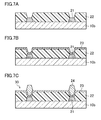
  • the titanium film 52 for the third conductive films 32 c and 33 c is subjected to thermal treatment or plasma treatment in oxidizing gas such as oxygen gas and ozone gas, thereby forming the titanium oxide film 53 being the third conductive films 32 c and 33 c on the surface of the copper film 51 as shown in FIG. 6( a ).
  • oxidizing gas such as oxygen gas and ozone gas
  • Thermal treatment may be performed, for example, in the presence of oxygen (at an oxygen concentration ranging from 20 to 100%, or may be in the air) at 300° C. for an hour.
  • the plasma treatment may be performed, for example, by allowing oxygen gas plasma (at an oxygen flow rate of 120 sccm and with electric power of 5 kw) to come into contact with the titanium surface for 30 minutes.
  • the titanium film 56 , the copper film 51 , and the titanium oxide film 53 are patterned by photolithography using the resist 55 as a photomask having a predetermined pattern.
  • wet etching e.g., nitric acid, hydrogen peroxide, and fluorine-based wet etching
  • wet etching e.g., nitric acid, hydrogen peroxide, and fluorine-based wet etching
  • the source electrode 32 which is the multilayer film of the first to third conductive films 32 a , 32 b , and 32 c
  • the drain electrode 33 which is the multilayer film of the first to third conductive films 33 a , 33 b , and 33 c , is formed.
  • the etching rate of copper forming the second conductive films 32 b and 33 b is higher than the etching rate of titanium oxide forming the third conductive films 32 c and 33 c .
  • the second conductive films 32 b and 33 b under the third conductive films 32 c and 33 c are overetched above the channel region C to allow the third conductive films 32 c and 33 c protrude.
  • the resist 55 on the source electrode 32 and the drain electrode 33 is removed by ashing.
  • the third conductive films 32 c and 33 c since the titanium film for the third conductive films 32 c and 33 c has the thickness ranging from 5 nm to 10 nm, the third conductive films 32 c and 33 c also have the thickness ranging from 5 nm to 10 nm Since the third conductive films 32 c and 33 c has the small thickness, as shown in FIG. 6( c ), the protrusions of the third conductive films 32 c and 33 c above the channel region C are removed in the above-described ashing.
  • the leakage at the TFTs 5 caused by the contact between the protrusions of the third conductive films 32 c and 33 c , and the other electrodes, lines, etc., is reduced.
  • the passivation film 17 which is an inorganic insulating film such as a silicon nitride film, is formed with a thickness of about 250 nm on the surfaces of the gate insulating film 12 and the TFTs 5 (i.e., the gate electrode 25 , the oxide semiconductor layer 13 , the source electrode 32 , and the drain electrode 33 ), for example, by plasma CVD (at a film formation temperature 230° C.).
  • the oxide semiconductor layer 13 is subjected to predetermined annealing (i.e., thermal treatment).
  • the third conductive films 32 c and 33 c made of titanium oxide are formed on the second conductive films 32 b and 33 b made of copper in the source electrode 32 and the drain electrode 33 .
  • annealing after forming the passivation film 17 is performed with the third conductive films 32 c and 33 c made of titanium oxide formed on the surfaces of the second conductive films 32 b and 33 b made of copper.
  • the annealing is performed with improved adhesiveness between the source and drain electrodes 32 and 33 , and the passivation film 17 . As a result, removal of the source electrode 32 and the drain electrode 33 from the passivation film 17 is reduced in the annealing.
  • the temperature T for the above-described annealing preferably falls within the range expressed by 230° C. ⁇ T ⁇ 450° C.
  • the time t for the above-described annealing preferably ranges from 0.5 to 4 hours (i.e., 0.5 hour ⁇ t ⁇ 4 hours). The reasons follow. If the time t is shorter than 0.5 hour, which is too short, the characteristics may greatly vary among the TFTs 5 formed on the thin film transistor substrate 20 . If the time t is 4 hours or longer, the characteristics may deteriorate in accordance with the variations in the threshold of the TFTs 5 .
  • a photosensitive organic insulating film made of photosensitive acrylic resin, etc. is applied, with a thickness ranging from about 1.0 nm to about 3.0 nm, to the entire substrate formed with the passivation film 17 by spin coating or slit coating.
  • the organic insulating film is subjected to photolithography patterning using resist as a photomask having a predetermined pattern, exposure and development, resist removal, and cleaning.
  • the flat film 18 having opening in the position corresponding to the contact hole Ca, is formed on the surface of the passivation film 17 .
  • part of the passivation film 17 is removed by dry etching using predetermined etching gas (e.g., CF 4 gas and O 2 gas) and using the flat film 18 as a mask.
  • predetermined etching gas e.g., CF 4 gas and O 2 gas
  • a transparent conductive film such as an ITO film (with a thickness ranging from about 50 nm to about 200 nm) made of, for example, indium tin oxide is formed by sputtering on the entire substrate formed with the passivation film 17 and the flat film 18 .
  • the transparent conductive film is subjected to photolithography patterning using resist as a photomask having a predetermined pattern, exposure, development, resist removal, and cleaning.
  • resist as a photomask having a predetermined pattern, exposure, development, resist removal, and cleaning.
  • the pixel electrodes 19 , the gate terminals 19 b , the source terminals 19 c , and the auxiliary capacitive terminal 19 d are formed (see FIG. 3 ).
  • the pixel electrodes 19 may be made of indium oxide or indium zinc oxide containing tungsten oxide, indium oxide or indium tin oxide containing titanium oxide, etc.
  • ITO indium tin oxide
  • IZO indium zinc oxide
  • ITO indium tin oxide
  • a conductive film made of titanium, tungsten, nickel, gold, platinum, silver, aluminum, magnesium, calcium, lithium, and an alloy of these metals may be used as a reflective metal thin film. This metal thin film may be used as the pixel electrodes 19 .
  • the thin film transistor substrate 20 shown in FIG. 4 is fabricated.
  • black colored photosensitive resin is applied to the entire substrate of the insulating substrate 10 b such as a glass substrate by spin coating or slit coating. Then, the applied film is exposed and developed to form the black matrix 21 with a thickness of about 1.0 ⁇ m, as shown in FIG. 7( a ).
  • red, green, or blue colored photosensitive resin is applied to the entire substrate formed with the black matrix 21 by spin coating or slit coating. Then, the applied film is exposed and developed to form the color layer 22 of the selected color (e.g., a red layer) with a thickness of about 2.0 ⁇ m as shown in FIG. 7( a ).
  • the selected color e.g., a red layer
  • the color layers 22 of the other two colors are formed with a thickness of about 2.0 ⁇ m.
  • a transparent conductive film such as an ITO film is deposited on the substrate formed with the color layers 22 of the colors by sputtering.
  • the common electrode 23 is formed with a thickness ranging from about 50 nm to about 200 nm.
  • photosensitive resin is applied to the entire substrate formed with the common electrode 23 by spin coating or slit coating. Then, the applied film is exposed and developed to form the photo spacers 24 with a thickness of about 4 ⁇ m as shown in FIG. 7( c ).
  • the counter substrate 30 is fabricated.
  • the applied film is baked and rubbed to form an alignment film.
  • a sealing material made of ultraviolet (UV) curing and thermosetting resin, etc. is printed in a frame shape on the surface of the counter substrate 30 with the alignment film. Then, a liquid crystal material is dropped inside the sealing material.
  • UV ultraviolet
  • the bond body is released to air pressure to apply pressure to the front and back surfaces of the bond body.
  • the bond body After the sealing material enclosed in the bond body is irradiated with UV light, the bond body is heated to cure the seal.
  • the bond body cured with the sealing material is divided by, for example, dicing to remove unnecessary portions.
  • liquid crystal display device 50 according to this embodiment is manufactured.
  • FIGS. 8-9 are cross-sectional views illustrating steps of manufacturing the thin film transistor substrate according to the second embodiment of the present invention.
  • the feature of this embodiment is that a titanium oxide film forming the above-described third conductive films 32 c and 33 c is formed by the above-described annealing step to provide source and drain electrodes 32 and 33 .
  • a gate electrode forming step, a gate insulating film forming step, a semiconductor layer forming step, and a channel protection layer forming step are performed first to manufacture the thin film transistor substrate 20 according to this embodiment.
  • a titanium film 56 (with a thickness ranging from 5 to 100 nm) for first conductive films 32 a and 33 a
  • a copper film 51 (with a thickness ranging from 100 to 500 nm) for second conductive films 32 b and 33 b are sequentially formed on an oxide semiconductor layer 13 by sputtering.
  • a copper-titanium alloy film 58 (with a thickness ranging from 5 nm to 100 nm) for the third conductive films 32 c and 33 c , which contains titanium within the range from 20 at % to 50 at %, is formed on the copper film 51 .
  • the copper-titanium alloy film 58 is used for the third conductive films 32 c and 33 c .
  • the difference in the etching rate between the copper film 51 for the second conductive films 32 b and 33 b , and the copper-titanium alloy film 58 for the third conductive films 32 c and 33 c is reduced. This efficiently reduces protrusions of the third conductive films 32 c and 33 c in wet etching, which will be described later, different from the first embodiment.
  • a copper-titanium alloy film containing titanium lower than 10 at % may be used as the metal film for the second conductive films 32 b and 33 b , thereby further reducing the difference in the etching rate between the copper-titanium alloy film for the second conductive films 32 b and 33 b and the copper-titanium alloy film 58 for the third conductive films 32 c and 33 c .
  • the titanium film 56 , the copper film 51 , and the copper-titanium alloy film 58 are subjected to wet etching (e.g., nitric acid, hydrogen peroxide, and fluorine-based wet etching) using resist having a predetermined pattern.
  • wet etching e.g., nitric acid, hydrogen peroxide, and fluorine-based wet etching
  • the passivation film 17 which is an inorganic insulating film such as a silicon nitride film is formed with a thickness of about 250 nm on the surfaces of the gate insulating film 12 , the oxide semiconductor layer 13 , the titanium film 56 , the copper film 51 , and the copper-titanium alloy film 58 , for example, by plasma CVD (at a film formation temperature of 230° C.).
  • the oxide semiconductor layer 13 is subjected to annealing described in the above-described first embodiment.
  • the copper-titanium alloy film 58 for the third conductive films 32 c and 33 c contains titanium within the range from 20 at % to 50 at %, both inclusive.
  • the annealing rapidly diffuses the titanium in the copper-titanium alloy film 58 into the surface of the copper-titanium alloy film 58 .
  • the diffused titanium reacts with the oxygen supplied from the passivation film 17 , thereby forming a titanium oxide film 59 on the surface of the copper-titanium alloy film 58 .
  • the copper-titanium alloy film 58 and the titanium oxide film 59 form the third conductive films 32 c and 33 c.
  • the multilayer film of the first to third conductive films 32 a , 32 b , and 32 c forms the source electrodes 32
  • the multilayer film of the first to third conductive films 33 a , 33 b , and 33 c forms the drain electrodes 33 .
  • the annealing diffuses the titanium of the copper-titanium alloy film 58 to the film surface in a short time (e.g., 15 minutes).
  • a short time e.g. 15 minutes.
  • the annealing after forming the passivation film 17 is performed with the third conductive films 32 c and 33 c containing titanium oxide formed on the surfaces of the second conductive films 32 b and 33 b made of copper, respectively.
  • the annealing is performed with improved adhesiveness between the source and drain electrodes 32 and 33 , and the passivation film 17 .
  • removal of the source electrode 32 and the drain electrode 33 from the passivation film 17 is reduced in the annealing.
  • the copper-titanium alloy film 58 containing titanium at a high concentration is formed independently from the second conductive films 32 b and 33 b made of copper. This increases the speed for forming the titanium oxide film 59 on the surface of the copper-titanium alloy film 58 . Even if the concentration of the titanium in the copper-titanium alloy film 58 increases, an increase in the resistance of the second conductive films 32 b and 33 b made of copper is avoided.
  • the thin film transistor substrate 20 shown in FIG. 10 is fabricated by performing the flat film forming step, the contact hole forming step, and the pixel electrode forming step described in the above-described first embodiment.
  • each TFT 5 has a bottom gate structure including the gate electrode 25 at a position closer to the insulating substrate 10 a in the oxide semiconductor layer 13 .
  • the present invention is also applicable to a TFT having a top gate structure including the gate electrode 25 at a position opposite to the insulating substrate 10 a in the oxide semiconductor layer 13 .
  • FIG. 11 illustrates a thin film transistor substrate 70 including top gate TFTs 5 applied with the source electrodes 32 and the drain electrodes 33 included in the thin film transistor substrate 20 having the bottom gate TFTs in the above-described first embodiment.
  • the thin film transistor substrate 70 includes an insulating substrate 10 a , the TFTs 5 , a passivation film 17 covering the TFTs 5 , a flat film 18 covering the passivation film 17 , a plurality of pixel electrodes 19 provided in a matrix on the flat film 18 and connected to the respective TFTs 5 , and an alignment film (not shown) covering the pixel electrodes 19 .
  • Each TFT 5 includes an oxide semiconductor layer 13 provided on the insulating substrate 10 a and having a channel region C, a gate insulating film 12 provided on the surface of the oxide semiconductor layer 13 to cover the oxide semiconductor layer 13 , a gate electrode 25 provided on the gate insulating film 12 to overlap the channel region C of the oxide semiconductor layer 13 , and an interlayer insulating film 65 provided on the gate insulating film 12 to cover the gate electrode 25 and an auxiliary capacitive line 11 b.
  • a source region 13 a and a drain region 13 b are formed, which is a pair of high concentration impurity regions, with the channel region C interposed therebetween.
  • the thin film transistor substrate 70 includes the source electrode 32 and the drain electrode 33 provided on the oxide semiconductor layer 13 to overlap the gate electrode 25 , and face one another with the channel region C interposed therebetween.
  • the source electrode 32 and the drain electrode 33 includes first conductive films 32 a and 33 a , second conductive films 32 b and 33 b , and third conductive films 32 c and 33 c , respectively. Advantages similar to those in the above-described first embodiment are obtained.
  • FIG. 12 illustrates a thin film transistor substrate 80 including top gate TFTs 5 applied with the source electrodes 32 and the drain electrodes 33 included in the thin film transistor substrate 20 having the bottom gate TFTs in the above-described second embodiment.
  • the thin film transistor substrate 80 includes an insulating substrate 10 a , the TFTs 5 , a passivation film 17 covering the TFTs 5 , a flat film 18 covering the passivation film 17 , a plurality of pixel electrodes 19 provided in a matrix on the flat film 18 and connected to the respective TFTs 5 , and an alignment film (not shown) covering the pixel electrodes 19 .
  • Each TFT 5 includes a oxide semiconductor layer 13 provided on the insulating substrate 10 a and having a channel region C, a gate insulating film 12 provided on the surface of the oxide semiconductor layer 13 to cover the oxide semiconductor layer 13 , a gate electrode 25 provided on the gate insulating film 12 to overlap the channel region C of the oxide semiconductor layer 13 , and an interlayer insulating film 65 provided on the gate insulating film 12 to cover the gate electrode 25 and an auxiliary capacitive line 11 b.
  • a source region 13 a and a drain region 13 b are formed, which is a pair of high concentration impurity regions, with the channel region C interposed therebetween.
  • the thin film transistor substrate 80 includes the source electrode 32 and the drain electrode 33 provided on the oxide semiconductor layer 13 to overlap the gate electrode 25 , and face one another with the channel region C interposed therebetween.
  • the source electrode 32 and the drain electrode 33 are formed by the multilayer film of the first conductive films 32 a and 33 a , the second conductive films 32 b and 33 b , and the third conductive films 32 c and 33 c , respectively. Advantages similar to those in the above-described second embodiment are obtained.
  • the oxide semiconductor layer 13 is made of oxide semiconductor such as indium gallium zinc oxide (IGZO), the material of the oxide semiconductor layer 13 is not limited thereto.
  • the material may be metal oxide containing at least any one of indium (In), gallium (Ga), aluminum (Al), copper (Cu), zinc (Zn), magnesium (Mg), and cadmium (Cd).
  • the oxide semiconductor layer 13 made of the material(s) has high mobility even in an amorphous state, the on-resistance of the switching elements increases. This increases the difference in the output voltage in reading data to increase the S/N ratio.
  • the oxide semiconductor layer may be made of InGaO 3 (ZnO) 5 , Mg x Zn 1-x O, Cd x Zn 1-x O, CdO, etc.
  • ZnO in an amorphous state, a polycrystal state, or a microcrystal state, that is, the mixture of the amorphous state and the polycrystal state may be used, which is added with one or more types of impurity elements of group 1 elements, group 13 elements, group 14 elements, group 15 elements, or group 17 elements, or not added with the impurities.
  • the liquid crystal display device 50 may be any of a twisted nematic (TN) type, a vertical alignment (VA) type, a multi-domain vertical alignment (MVA) type, an advanced super view (ASV) type, etc.
  • TN twisted nematic
  • VA vertical alignment
  • MVA multi-domain vertical alignment
  • ASV advanced super view
  • the display device is the liquid crystal display device including the thin film transistor substrate
  • the present invention is applicable to other display devices such as organic electro luminescence (EL) display devices, inorganic EL display devices, and electrophoresis display devices.
  • EL organic electro luminescence
  • the present invention relates to thin film transistor substrates and methods of manufacturing the substrates, and is particularly useful for thin film transistor substrates using flat films and methods of manufacturing the substrates.

Landscapes

  • Engineering & Computer Science (AREA)
  • Physics & Mathematics (AREA)
  • Condensed Matter Physics & Semiconductors (AREA)
  • General Physics & Mathematics (AREA)
  • Computer Hardware Design (AREA)
  • Microelectronics & Electronic Packaging (AREA)
  • Power Engineering (AREA)
  • Manufacturing & Machinery (AREA)
  • Thin Film Transistor (AREA)
  • Electrodes Of Semiconductors (AREA)

Abstract

The present invention includes at least a step forming a source electrode (32) and a drain electrode (33), each of which is a multilayer film of a first conductive film (32 a), (33 a) made of titanium or molybdenum, a second conductive film (32 b), (33 b) made of copper, and a third conductive film (32 c), (33 c) made of titanium oxide, a step of forming passivation film (18), which is an inorganic insulating film, on an oxide semiconductor layer (13), the source electrode (32) and drain electrode (33), and an annealing step of annealing the oxide semiconductor layer (13).

Description

TECHNICAL FIELD
The present invention relates to methods of manufacturing thin film transistor substrates and thin film transistor substrates manufactured by the methods, and more particularly to methods of manufacturing thin film transistor substrates using passivation films and thin film transistor substrates manufactured by the methods.
BACKGROUND ART
Thin film transistor substrates are provided with, for example, thin film transistors (hereinafter also referred to as TFT) as switching elements for respective pixels which are the minimum units of images.
Passivation films, which are insulating films for protecting TFTs, lines, etc., are formed on substrates to improve the reliability of thin film transistor substrates. The passivation films are inorganic insulating films such as silicon oxide films and silicon nitride films.
Thin film transistor substrates generally include gate electrodes, source electrodes, and drain electrodes forming the above-described TFTs and lines. These electrodes and lines are made of copper (Cu) having low resistance and requiring low costs.
However, copper is generally less adhesive to glass substrates and insulating films such as the above-described passivation films, and thus electrodes and lines made of copper are easily removed from the glass substrates and the insulating films.
In order to address the problem, a thin film transistor substrate is disclosed, which includes electrodes and lines made of a copper alloy containing at least one selected from the group consisting of titanium (Ti), aluminum (Al), and magnesium (Mg) at a concentration ranging from 0.1 to 10 at %.
For example, conventional art teaches as follows (see, e.g., Patent Document 1). When a source electrode, etc., made of a copper alloy containing titanium is fabricated, a film of the copper alloy is formed and then subjected to thermal treatment (e.g., at 350-450° C. for 30-120 minutes). Titanium is then diffused to the surface of the film and reacts with oxygen of air to form a titanium oxide (TiOx) film on the surface of the copper alloy. As a result, the adhesiveness with a glass substrate and an insulating film such as a passivation film improves.
CITATION LIST Patent Document
  • Patent Document 1: Japanese Unexamined Patent Publication No. 2010-65317
SUMMARY OF THE INVENTION Technical Problem
In recent years, in place of conventional thin film transistors using semiconductor layers made of amorphous silicon, TFTs using oxide semiconductor layers (hereinafter also referred to as oxide semiconductor layers) formed by high mobility indium gallium zinc oxide (IGZO)-based oxide semiconductor films are suggested as switching elements for pixels, which are minimum units of images, on thin film transistor substrates.
The above-described passivation films are often formed, for example, by forming inorganic insulating films by plasma chemical vapor deposition (CVD) and patterning the inorganic insulating films. Thus, in thin film transistor substrates using oxide semiconductor layers, the channel regions of the oxide semiconductor layers exposed from source electrodes and drain electrodes may be damaged by plasma, thereby deteriorating TFT characteristics.
In order to address the deterioration in the TFT characteristics, passivation films covering TFTs are formed, and then the oxide semiconductor layers are subjected to, for example, thermal treatment (i.e., annealing) at a temperature of 350° C. or higher for one hour or longer.
However, in the above-described conventional thin film transistor substrate, an unexpected long time (e.g., 120 minutes or longer) is needed to diffuse titanium in the copper alloy to the film surface in the above-described thermal treatment. Thus, the titanium oxide film is not sufficiently formed on the surface of the copper alloy in the above-described annealing after forming the passivation film.
The adhesiveness between the electrodes made of the copper alloy and the passivation film may deteriorate in the annealing. As a result, the electrodes made of copper are easily removed from the passivation film.
The present invention was made in view of the problem. The present invention provides a method of manufacturing a thin film transistor substrate and a thin film transistor substrate manufactured by the method, which reduces removal of electrodes made of copper from a passivation film when the passivation film is formed on the surface of a copper film.
Solution to the Problem
In order to achieve the objective, a method of manufacturing a thin film transistor substrate according to the present invention includes an insulating substrate, an oxide semiconductor layer provided on the insulating substrate and having a channel region, a source electrode and a drain electrode provided on the oxide semiconductor layer to face one another with the channel region interposed therebetween, and a passivation film covering the oxide semiconductor layer, the source electrode, and the drain electrode. The method includes at least a semiconductor layer forming step of forming the oxide semiconductor layer on the insulating substrate; a source/drain forming step of forming the source electrode and the drain electrode, each of which is a multilayer film of a first conductive film provided on the oxide semiconductor layer and made of titanium or molybdenum; a second conductive film provided on the first conductive film and made of copper, and a third conductive film provided on the second conductive film and made of titanium oxide; a passivation film forming step of forming the passivation film which is an inorganic insulating film on the oxide semiconductor layer, the source electrode, and the drain electrode; and an annealing step of annealing the oxide semiconductor layer.
With this configuration, the third conductive film made of titanium oxide is formed on the second conductive film made of copper on the source electrode and the drain electrode. That is, different from the above-described conventional art, the annealing after forming the passivation film is performed with the third conductive film made of titanium oxide formed on the surface of the second conductive film made of copper. The annealing is thus performed with improved adhesiveness between the source and drain electrodes, and the passivation film. As a result, removal of the source electrode and the drain electrode from the passivation film is reduced in the annealing.
In the method of manufacturing the thin film transistor substrate according to the present invention, in the source/drain forming step, the titanium oxide forming the third conductive film is formed by thermal treatment or plasma treatment of a titanium film formed on the second conductive film.
With this configuration, the titanium film formed on the second conductive film is subjected to the thermal treatment in the presence of oxygen, or the titanium film comes into contact with oxygen gas plasma to be oxidized, thereby forming the titanium oxide film. This improves the adhesiveness between the titanium oxide film and the passivation film to reduce removal of the films.
In the method of manufacturing the thin film transistor substrate according to the present invention, the third conductive film has a thickness ranging from 5 nm to 10 nm.
With this configuration, since the third conductive film has the small thickness, the protrusion of the third conductive film is removed above the channel region, for example, by performing ashing. This reduces leakage at the thin film transistor caused by the contact between, for example, the protrusion of the third conductive film and the other electrodes, lines, etc.
A method of manufacturing a thin film transistor substrate according to the present invention includes an insulating substrate, an oxide semiconductor layer provided on the insulating substrate and having a channel region, a source electrode and a drain electrode provided on the oxide semiconductor layer to face one another with the channel region interposed therebetween, and a passivation film covering the oxide semiconductor layer, the source electrode, and the drain electrode. The method includes at least a semiconductor layer forming step of forming the oxide semiconductor layer on the insulating substrate; a metal film forming step of forming a first conductive film provided on the oxide semiconductor layer and made of titanium or molybdenum, a second conductive film provided on the first conductive film and made of copper, and a copper-titanium alloy film provided on the second conductive film and containing titanium within a range from 20 at % to 50 at %, both inclusive; a passivation film forming step of forming a passivation film which is an inorganic insulating film on the oxide semiconductor layer, the first conductive film, the second conductive film, and the copper-titanium alloy film; and a source/drain forming step of forming the source electrode and the drain electrode, each of which is a multilayer film of the first conductive film, the second conductive film, and a third conductive film including the copper-titanium alloy film and a titanium oxide film, by annealing the oxide semiconductor layer, and forming the titanium oxide film on the surface of the copper-titanium alloy film by the annealing.
With this configuration, the annealing rapidly diffuses the titanium in the copper-titanium alloy film to the surface of the copper-titanium alloy film to allow the titanium to react with the oxygen supplied from the passivation film, thereby forming the titanium oxide film on the surface of the copper-titanium alloy film. Then, the third conductive film including the copper-titanium alloy film and the titanium oxide film is formed. As a result, the source electrode and the drain electrode are formed, each of which is the multilayer film of the first to third conductive films. Different from the above-described conventional art, the titanium in the copper-titanium alloy film is diffused to the film surface by the annealing in a short time (e.g., 15 minutes). In the annealing after forming the passivation film, the titanium oxide film is rapidly and sufficiently formed on the surface of the copper-titanium alloy film. Different from the above-described conventional art, the annealing after forming the passivation film ends with the third conductive film including the titanium oxide film formed on the surface of the second conductive film made of copper. The annealing ends with improved adhesiveness between the source and drain electrodes, and the passivation film. As a result, removal of the source electrode and the drain electrode from the passivation film is reduced in the annealing.
Different from the above-described conventional art, the copper-titanium alloy film containing titanium at a high concentration is formed independently from the second conductive film made of copper, thereby increasing the speed of forming the titanium oxide film on the surface of the titanium in the copper-titanium alloy film. This reduces an increase in the resistance of the second conductive film made of copper even if the concentration of titanium in the copper-titanium alloy film increases.
In the method of manufacturing the thin film transistor substrate according to the present invention, the oxide semiconductor layer is preferably made of metal oxide containing at least one selected from the group consisting of indium (In), gallium (Ga), aluminum (Al), copper (Cu), and zinc (Zn).
With this configuration, since the oxide semiconductor layer made of the material(s) has high mobility even in an amorphous state, the on-resistance of the switching element increases.
In the method of manufacturing the thin film transistor substrate according to the present invention, the oxide semiconductor layer may be made of indium gallium zinc oxide.
With this configuration, the thin film transistor has excellent characteristics such as high mobility and low off-current.
The thin film transistor substrate according to the present invention is manufactured by the method of manufacturing the thin film transistor substrate according to the present invention. Thus, a thin film transistor substrate is provided, which has advantages similar to those provided by the method of manufacturing the thin film transistor substrate according to the present invention.
Advantages of the Invention
The present invention reduces removal of a source electrode and a drain electrode from a passivation film in annealing.
BRIEF DESCRIPTION OF THE DRAWINGS
FIG. 1 is a cross-sectional view of a liquid crystal display device including a thin film transistor substrate according to a first embodiment of the present invention.
FIG. 2 is a top view of the thin film transistor substrate according to the first embodiment of the present invention.
FIG. 3 is an enlarged top view of a pixel section and a terminal section of the thin film transistor substrate according to the first embodiment of the present invention.
FIG. 4 is a cross-sectional view taken along the line A-A of FIG. 3.
FIG. 5 are cross-sectional views illustrating steps of manufacturing the thin film transistor substrate according to the first embodiment of the present invention.
FIG. 6 are cross-sectional views illustrating steps of manufacturing the thin film transistor substrate according to the first embodiment of the present invention.
FIG. 7 are cross-sectional views illustrating steps of manufacturing a counter substrate according to the first embodiment of the present invention.
FIG. 8 are cross-sectional views illustrating steps of manufacturing a thin film transistor substrate according to a second embodiment of the present invention.
FIG. 9 are cross-sectional views illustrating steps of manufacturing the thin film transistor substrate according to the second embodiment of the present invention.
FIG. 10 is a cross-sectional view of the thin film transistor substrate according to the second embodiment of the present invention.
FIG. 11 is a cross-sectional view of a thin film transistor according to a variation of the first embodiment of the present invention.
FIG. 12 is a cross-sectional view of a thin film transistor according to a variation of the second embodiment of the present invention.
DESCRIPTION OF EMBODIMENTS
Embodiments of the present invention will be described hereinafter in detail with reference to the drawings. The present invention is not limited to the following embodiments.
First Embodiment
FIG. 1 is a cross-sectional view of a liquid crystal display device including a thin film transistor substrate according to a first embodiment of the present invention. FIG. 2 is a top view of the thin film transistor substrate according to the first embodiment of the present invention. FIG. 3 is an enlarged top view of a pixel section and a terminal section of the thin film transistor substrate according to the first embodiment of the present invention. FIG. 4 is a cross-sectional view taken along the line A-A of FIG. 3.
As shown in FIG. 1, a liquid crystal display device 50 includes a thin film transistor substrate 20 and a counter substrate 30, which face one another, a liquid crystal layer 40 provided between the thin film transistor substrate 20 and the counter substrate 30, and a sealing material 37 provided in a frame shape to adhere the thin film transistor substrate 20 to the counter substrate 30, and enclose the liquid crystal layer 40 between the thin film transistor substrate 20 and the counter substrate 30.
As shown in FIG. 1, in the liquid crystal display device 50, the inside of the sealing material 37 is defined as a display region D displaying images, while the protrusion of the thin film transistor substrate 20 beyond the counter substrate 30 is defined as a terminal region T.
As shown in FIGS. 2, 3, and 4, the thin film transistor substrate 20 includes an insulating substrate 10 a, a plurality of scanning lines 11 a extending in parallel in the display region D on the insulating substrate 10 a, a plurality of auxiliary capacitive lines 11 b extending in parallel between respective pairs of the scanning lines 11 a, and a plurality of signal lines 16 a extending in parallel in the direction orthogonal to the scanning lines 11 a.
The thin film transistor substrate 20 includes a plurality of TFTs 5 provided at respective intersections between the scanning lines 11 a and the signal lines 16 a, that is, in the pixels, a passivation film 17 covering the TFTs 5, and a flat film 18 covering the passivation film 17. The thin film transistor substrate 20 also includes a plurality of pixel electrodes 19 provided in a matrix on the flat film 18 and connected to the respective TFTs 5, and an alignment film (not shown) covering the pixel electrodes 19.
As shown in FIGS. 2 and 3, the scanning lines 11 a are drawn to a gate terminal region Tg of the terminal region T (see FIG. 1), and connected to gate terminals 19 b in the gate terminal region Tg.
As shown in FIG. 3, the auxiliary capacitive lines 11 b are connected to an auxiliary capacitive terminal 19 d via an auxiliary capacitive main line 16 c and a relay line 11 d. The auxiliary capacitive main line 16 c is connected to the auxiliary capacitive lines 11 b via contact holes Cc formed in a gate insulating film 12, and connected to the relay line 11 d via a contact hole Cd formed in the gate insulating film 12.
As shown in FIGS. 2 and 3, the signal lines 16 a are drawn as relay lines 11 c to a source terminal region Ts of the terminal region T (see FIG. 1), and connected to source terminals 19 c in the source terminal region Ts. As shown in FIG. 3, the signal lines 16 a are connected to the relay lines 11 c via contact holes Cb formed in the gate insulating film 12.
As shown in FIGS. 3 and 4, each TFT 5 includes a gate electrode 25 provided on the insulating substrate 10 a, the gate insulating film 12 provided on the gate electrode 25 to cover the gate electrode 25, and an oxide semiconductor layer 13 provided in an insular shape on the gate insulating film 12 to overlap the gate electrode 25 and having a channel region C.
Each TFT 5 also includes a source electrode 32 and a drain electrode 33 provided on the oxide semiconductor layer 13 to overlap the gate electrode 25 and face one another with the channel region C interposed therebetween.
As shown in FIG. 3, the gate electrode 25 is the portion of each scanning line 11 a protruding to a side. As shown in FIG. 3, the source electrode 32 is the portion of one of the signal lines 16 a protruding to a side. As shown in FIG. 4, the source electrode 32 is a multilayer film of a first conductive film 32 a, a second conductive film 32 b, and a third conductive film 32 c.
As shown in FIGS. 3 and 4, the drain electrode 33 is a multilayer film of a first conductive film 33 a, a second conductive film 33 b, and a third conductive film 33 c, and connected to one of the pixel electrodes 19 via a contact hole Ca formed in the multilayer film of the passivation film 17 and the flat film 18. The drain electrode 33 overlaps one of the auxiliary capacitive lines 11 b via the gate insulating film 12 to form an auxiliary capacitor.
In this embodiment, the oxide semiconductor layer 13 is made of oxide semiconductor such as indium gallium zinc oxide (IGZO).
The oxide semiconductor has high mobility than amorphous silicon. Thus, the TFTs using the oxide semiconductor layer operate at a higher speed than conventional TFTs using an amorphous silicon semiconductor layer. Furthermore, the oxide semiconductor film is formed by a process more simple than those of polycrystal silicon films, and is thus applicable to devices requiring large areas.
In this embodiment, as shown in FIG. 4, a channel protection layer (i.e., an etching stopper layer) 38 for protecting the channel region C of the oxide semiconductor layer 13 is provided on the channel region C.
By providing the channel protection layer 38, the channel region C of the oxide semiconductor layer 13 is protected from being etched, when the source electrode 32 and the drain electrode 33 are formed by patterning by etching in a source/drain forming step, which will be described later.
As shown in FIG. 7( c), which will be described later, the counter substrate 30 includes an insulating substrate 10 b, a black matrix 21 provided in a lattice on the insulating substrate 10 b, and a color filter layer including a color layer 22 such as a red layer, a green layer, and a blue layer provided between lattices of the black matrix 21.
The counter substrate 30 includes a common electrode 23 covering the color filter layer, photo spacers 24 provided on the common electrode 23, and an alignment film (not shown) covering the common electrode 23.
The liquid crystal layer 40 is made of a nematic liquid crystal material having electroptical characteristics.
In the liquid crystal display device 50 having the above-described structure, in each pixel, when a gate signal is sent from a gate driver (not shown) to the gate electrode 25 via the scanning line 11 a to turn on the TFT 5, a source signal is sent from a source driver (not shown) to the source electrode 32 via the signal line 16 a. Then, a predetermined charge is written in the corresponding one of the pixel electrode 19 via the oxide semiconductor layer 13 and the drain electrode 33.
At this time, a potential difference occurs between the pixel electrodes 19 of the thin film transistor substrate 20 and the common electrode 23 of the counter substrate 30. As a result, a predetermined voltage is applied to the liquid crystal layer 40, that is, liquid crystal capacitors of the pixels and auxiliary capacitors connected in parallel to the liquid crystal capacitors.
The liquid crystal display device 50 displays images by changing the alignment condition of the liquid crystal layer 40 depending on the magnitude of the voltage applied to the liquid crystal layer 40 in each pixel and adjusting the light transmittance of the liquid crystal layer 40.
As shown in FIG. 4, one of the features of this embodiment is that the source electrode 32 is formed by a multilayer film of the first conductive film 32 a provided on the insulating substrate 10 a and made of titanium or molybdenum, the second conductive film 32 b provided on the first conductive film 32 a and made of copper, and the third conductive film 32 c provided on the second conductive film 32 b and made of titanium oxide (TiOx).
Similarly, as shown in FIG. 4, another feature is that the drain electrode 33 is formed by a multilayer film of the first conductive film 33 a provided on the insulating substrate 10 a and made of titanium or molybdenum, the second conductive film 33 b provided on the first conductive film 33 a and made of copper, and the third conductive film 33 c provided on the second conductive film 33 b and made of titanium oxide (TiOx).
In this embodiment, the third conductive films 32 c and 33 c made of titanium oxide are formed on the second conductive films 32 b and 33 b made of copper. Thus, different from the above-described conventional art, annealing after forming the passivation film 17 is performed with the third conductive films 32 c and 33 c made of titanium oxide formed on the surfaces of the second conductive films 32 b and 33 b made of copper, respectively.
The above-described annealing is performed with improved adhesiveness between the source and drain electrodes 32 and 33, and the passivation film 17. As a result, the removal of the source electrode 32 and the drain electrode 33 from the passivation film 17 is reduced in annealing the oxide semiconductor layer 13.
Next, an example method of manufacturing the liquid crystal display device 50 according to this embodiment will be described with reference FIGS. 5-7. FIGS. 5 and 6 are cross-sectional views illustrating steps of manufacturing the thin film transistor substrate according to the first embodiment of the present invention. FIG. 7 are cross-sectional views illustrating steps of manufacturing the counter substrate according to the first embodiment of the present invention.
First, steps of fabricating the TFTs and the thin film transistor substrate will be described.
Gate Electrode Forming Step
First, for example, a multilayer film (with a thickness of about 150 nm) of a titanium film and an aluminum film is formed on the entire insulating substrate 10 a such as a glass substrate by sputtering. After that, the multilayer film is subjected to photolithography, wet etching, resist removal, and cleaning. As shown in FIGS. 3 and 5( a), the gate electrodes 25 and the scanning lines 11 a are formed on the insulating substrate 10 a.
At the same time as the formation of the gate electrode 25 and the scanning lines 11 a, the signal lines 16 a, the auxiliary capacitive lines 11 b, and the relay lines 11 c and 11 d shown in FIGS. 3 and 5( a) are formed.
In this embodiment, an example has been described where the metal film forming the gate electrodes 25 and the scanning lines 11 a is the multilayer film of the titanium film and the aluminum film. The gate electrodes 25 may be a metal film such as an aluminum film, a tungsten film, a tantalum film, a chrome film, a titanium film, a copper film, and a molybdenum film, or an alloy film or a metal nitride film containing these metals with a thickness ranging from 50 nm to 300 nm.
Gate Insulating Film Forming Step
Next, for example, a silicon nitride film (with a thickness ranging from about 200 nm to about 500 nm) is formed by CVD on the entire substrate formed with the gate electrodes 25 and auxiliary capacitive lines 11 b. As a result, as shown in FIG. 5( b), the gate insulating film 12 is formed to cover the gate electrodes 25 and the auxiliary capacitive lines 11 b.
The gate insulating film 12 may have a multilayer structure of two layers. In this case, for example, a silicon oxide (SiOx) film, a silicon nitride oxide film (SiOxNy, where x>y), a silicon nitride oxide film (SiNxOy, where x>y), etc., may be used other than the above-described silicon nitride film (SiNx).
In view of preventing the diffusion of the impurities from the insulating substrate 10 a, the lower gate insulating film may be a silicon nitride film or a silicon nitride oxide film, while the upper gate insulating film may be a silicon oxide film or a silicon oxynitride film.
For example, the silicon nitride film with a thickness ranging from 100 nm to 200 nm may be formed as the lower gate insulating film using reaction gas of SiH4 and NH3. The silicon oxide film with a thickness ranging from 50 nm to 100 nm may be formed as the upper gate insulating film using reaction gas of N2O and SiH4.
In view of forming the dense gate insulating film 12 with little gate leakage current at a low film formation temperature, rare gas such as argon gas is preferably contained in the reaction gas to be mixed into the insulating film.
Semiconductor Layer Forming Step
After that, an oxide semiconductor film (with a thickness ranging from about 30 nm to about 100 nm) made of, for example, indium gallium zinc oxide (IGZO) is formed on the entire substrate formed with the gate insulating film 12 by sputtering.
After that, the oxide semiconductor film is subjected to photolithography, wet etching, resist removal, and cleaning, thereby forming the oxide semiconductor layer 13 above the insulating substrate 10 a and on the surface of the gate insulating film 12 as shown in FIG. 5( c).
Channel Protection Layer Forming Step
Then, for example, a silicon nitride film, a silicon oxide film, and a silicon nitride oxide film are formed by plasma CVD on the entire substrate formed with the oxide semiconductor layer 13. After that, photolithography using a resist as a mask, etching, resist removal, and cleaning are performed. As a result, the channel protection layer (i.e., the etching stopper layer) 38 with a thickness ranging from about 50 to about 100 nm for protecting the channel region C of the oxide semiconductor layer 13 is formed on the channel region C as shown in FIG. 5( d).
Source/Drain Forming Step
Next, as shown in FIG. 5( e), for example, a titanium film 56 (with a thickness ranging from 5 to 100 nm) for the first conductive films 32 a and 33 a, a copper film 51 (with a thickness ranging from 100 to 500 nm) for the second conductive films 32 b and 33 b, and a titanium film 52 (with a thickness ranging from 5 nm to 10 nm) for the third conductive films 32 c and 33 c are sequentially formed on the oxide semiconductor layer 13 by sputtering.
Then, the titanium film 52 for the third conductive films 32 c and 33 c is subjected to thermal treatment or plasma treatment in oxidizing gas such as oxygen gas and ozone gas, thereby forming the titanium oxide film 53 being the third conductive films 32 c and 33 c on the surface of the copper film 51 as shown in FIG. 6( a).
Thermal treatment may be performed, for example, in the presence of oxygen (at an oxygen concentration ranging from 20 to 100%, or may be in the air) at 300° C. for an hour.
The plasma treatment may be performed, for example, by allowing oxygen gas plasma (at an oxygen flow rate of 120 sccm and with electric power of 5 kw) to come into contact with the titanium surface for 30 minutes.
Then, as shown in FIG. 6( b), the titanium film 56, the copper film 51, and the titanium oxide film 53 are patterned by photolithography using the resist 55 as a photomask having a predetermined pattern.
Next, wet etching (e.g., nitric acid, hydrogen peroxide, and fluorine-based wet etching) is performed using the resist 55. As a result, as shown in FIG. 6( b), the source electrode 32, which is the multilayer film of the first to third conductive films 32 a, 32 b, and 32 c, is formed, and the drain electrode 33, which is the multilayer film of the first to third conductive films 33 a, 33 b, and 33 c, is formed.
In general, the etching rate of copper forming the second conductive films 32 b and 33 b is higher than the etching rate of titanium oxide forming the third conductive films 32 c and 33 c. Thus, when subjected to wet etching, as shown in FIG. 6( b), the second conductive films 32 b and 33 b under the third conductive films 32 c and 33 c are overetched above the channel region C to allow the third conductive films 32 c and 33 c protrude.
Resist Removing Step
Then, the resist 55 on the source electrode 32 and the drain electrode 33 is removed by ashing. At this time, in this embodiment, as described above, since the titanium film for the third conductive films 32 c and 33 c has the thickness ranging from 5 nm to 10 nm, the third conductive films 32 c and 33 c also have the thickness ranging from 5 nm to 10 nm Since the third conductive films 32 c and 33 c has the small thickness, as shown in FIG. 6( c), the protrusions of the third conductive films 32 c and 33 c above the channel region C are removed in the above-described ashing.
Therefore, for example, the leakage at the TFTs 5 caused by the contact between the protrusions of the third conductive films 32 c and 33 c, and the other electrodes, lines, etc., is reduced.
Passivation Film Forming Step
As shown in FIG. 6( d), the passivation film 17, which is an inorganic insulating film such as a silicon nitride film, is formed with a thickness of about 250 nm on the surfaces of the gate insulating film 12 and the TFTs 5 (i.e., the gate electrode 25, the oxide semiconductor layer 13, the source electrode 32, and the drain electrode 33), for example, by plasma CVD (at a film formation temperature 230° C.).
Annealing Step
Then, after the passivation film 17 covering the TFTs 5 is formed to reduce deterioration in the characteristic of the TFTs 5, the oxide semiconductor layer 13 is subjected to predetermined annealing (i.e., thermal treatment).
In this embodiment, as described above, the third conductive films 32 c and 33 c made of titanium oxide are formed on the second conductive films 32 b and 33 b made of copper in the source electrode 32 and the drain electrode 33. Different from the above-described conventional art, annealing after forming the passivation film 17 is performed with the third conductive films 32 c and 33 c made of titanium oxide formed on the surfaces of the second conductive films 32 b and 33 b made of copper.
Since the annealing is performed with improved adhesiveness between the source and drain electrodes 32 and 33, and the passivation film 17. As a result, removal of the source electrode 32 and the drain electrode 33 from the passivation film 17 is reduced in the annealing.
The temperature T for the above-described annealing preferably falls within the range expressed by 230° C.<T<450° C. The reasons follow. If the temperature T is 230° C. or lower, which is equal to or lower than the temperature (230° C.) in forming the passivation film 17, deterioration in the characteristics of the TFTs 5 may not be efficiently reduced. If the temperature T is 450° C. or higher, the characteristics may greatly vary among the TFTs 5 formed on the thin film transistor substrate 20.
The time t for the above-described annealing preferably ranges from 0.5 to 4 hours (i.e., 0.5 hour<t<4 hours). The reasons follow. If the time t is shorter than 0.5 hour, which is too short, the characteristics may greatly vary among the TFTs 5 formed on the thin film transistor substrate 20. If the time t is 4 hours or longer, the characteristics may deteriorate in accordance with the variations in the threshold of the TFTs 5.
Flat Film Forming Step
Next, a photosensitive organic insulating film made of photosensitive acrylic resin, etc., is applied, with a thickness ranging from about 1.0 nm to about 3.0 nm, to the entire substrate formed with the passivation film 17 by spin coating or slit coating.
Then, the organic insulating film is subjected to photolithography patterning using resist as a photomask having a predetermined pattern, exposure and development, resist removal, and cleaning. As a result, as shown in FIG. 6( e), the flat film 18 having opening in the position corresponding to the contact hole Ca, is formed on the surface of the passivation film 17.
Contact Hole Forming Step
Next, part of the passivation film 17 is removed by dry etching using predetermined etching gas (e.g., CF4 gas and O2 gas) and using the flat film 18 as a mask. As a result, as shown in FIG. 4, the contact hole Ca is formed in the passivation film 17 and the flat film 18.
Pixel Electrode Forming Step
Then, a transparent conductive film such as an ITO film (with a thickness ranging from about 50 nm to about 200 nm) made of, for example, indium tin oxide is formed by sputtering on the entire substrate formed with the passivation film 17 and the flat film 18.
After that, the transparent conductive film is subjected to photolithography patterning using resist as a photomask having a predetermined pattern, exposure, development, resist removal, and cleaning. As a result, as shown in FIG. 4, the pixel electrodes 19, the gate terminals 19 b, the source terminals 19 c, and the auxiliary capacitive terminal 19 d are formed (see FIG. 3).
Where a transmission liquid crystal display device 50 is formed, the pixel electrodes 19 may be made of indium oxide or indium zinc oxide containing tungsten oxide, indium oxide or indium tin oxide containing titanium oxide, etc.
Other than the above-described indium tin oxide (ITO), indium zinc oxide (IZO), indium tin oxide (ITSO) containing silicon oxide, etc., may be used.
Where a reflective liquid crystal display device 50 is formed, a conductive film made of titanium, tungsten, nickel, gold, platinum, silver, aluminum, magnesium, calcium, lithium, and an alloy of these metals may be used as a reflective metal thin film. This metal thin film may be used as the pixel electrodes 19.
In this manner, the thin film transistor substrate 20 shown in FIG. 4 is fabricated.
Counter Substrate Fabricating Step
First, for example, black colored photosensitive resin is applied to the entire substrate of the insulating substrate 10 b such as a glass substrate by spin coating or slit coating. Then, the applied film is exposed and developed to form the black matrix 21 with a thickness of about 1.0 μm, as shown in FIG. 7( a).
Next, for example, red, green, or blue colored photosensitive resin is applied to the entire substrate formed with the black matrix 21 by spin coating or slit coating. Then, the applied film is exposed and developed to form the color layer 22 of the selected color (e.g., a red layer) with a thickness of about 2.0 μm as shown in FIG. 7( a).
Similar steps are repeated for the other two colors. Then, the color layers 22 of the other two colors (e.g., a green layer and a blue layer) are formed with a thickness of about 2.0 μm.
Furthermore, a transparent conductive film such as an ITO film is deposited on the substrate formed with the color layers 22 of the colors by sputtering. As a result, as shown in FIG. 7( b), the common electrode 23 is formed with a thickness ranging from about 50 nm to about 200 nm.
At last, photosensitive resin is applied to the entire substrate formed with the common electrode 23 by spin coating or slit coating. Then, the applied film is exposed and developed to form the photo spacers 24 with a thickness of about 4 μm as shown in FIG. 7( c).
In this manner, the counter substrate 30 is fabricated.
Liquid Crystal Injecting Step
First, after a polyimide resin film is applied by printing, to the thin film transistor substrate 20 fabricated in the thin film transistor substrate fabricating step, and the counter substrate 30 fabricated in the counter substrate fabricating step, the applied film is baked and rubbed to form an alignment film.
Then, for example, a sealing material made of ultraviolet (UV) curing and thermosetting resin, etc., is printed in a frame shape on the surface of the counter substrate 30 with the alignment film. Then, a liquid crystal material is dropped inside the sealing material.
After the counter substrate 30 dropped with the liquid crystal material is bonded under reduced pressure to the thin film transistor substrate 20 formed with the alignment film, the bond body is released to air pressure to apply pressure to the front and back surfaces of the bond body.
After the sealing material enclosed in the bond body is irradiated with UV light, the bond body is heated to cure the seal.
At last, the bond body cured with the sealing material is divided by, for example, dicing to remove unnecessary portions.
In this manner, the liquid crystal display device 50 according to this embodiment is manufactured.
Second Embodiment
Next, a second embodiment of the present invention will be described. FIGS. 8-9 are cross-sectional views illustrating steps of manufacturing the thin film transistor substrate according to the second embodiment of the present invention.
The feature of this embodiment is that a titanium oxide film forming the above-described third conductive films 32 c and 33 c is formed by the above-described annealing step to provide source and drain electrodes 32 and 33.
More specifically, similar to FIGS. 5( a)-5(d) described in the above-described first embodiment, a gate electrode forming step, a gate insulating film forming step, a semiconductor layer forming step, and a channel protection layer forming step are performed first to manufacture the thin film transistor substrate 20 according to this embodiment.
Metal Film Forming Step
Next, as shown in FIG. 8( a), similar to the above-described first embodiment, for example, a titanium film 56 (with a thickness ranging from 5 to 100 nm) for first conductive films 32 a and 33 a, and a copper film 51 (with a thickness ranging from 100 to 500 nm) for second conductive films 32 b and 33 b are sequentially formed on an oxide semiconductor layer 13 by sputtering.
Then, as shown in FIG. 8( b), a copper-titanium alloy film 58 (with a thickness ranging from 5 nm to 100 nm) for the third conductive films 32 c and 33 c, which contains titanium within the range from 20 at % to 50 at %, is formed on the copper film 51.
In this embodiment, as described above, the copper-titanium alloy film 58 is used for the third conductive films 32 c and 33 c. As compared to the case where the third conductive films 32 c and 33 c are made of titanium oxide as in the above-described first embodiment, the difference in the etching rate between the copper film 51 for the second conductive films 32 b and 33 b, and the copper-titanium alloy film 58 for the third conductive films 32 c and 33 c is reduced. This efficiently reduces protrusions of the third conductive films 32 c and 33 c in wet etching, which will be described later, different from the first embodiment.
A copper-titanium alloy film containing titanium lower than 10 at % may be used as the metal film for the second conductive films 32 b and 33 b, thereby further reducing the difference in the etching rate between the copper-titanium alloy film for the second conductive films 32 b and 33 b and the copper-titanium alloy film 58 for the third conductive films 32 c and 33 c. This efficiently reduces protrusions of the third conductive films 32 c and 33 c in wet etching, which will be described later.
Patterning Step
Next, the titanium film 56, the copper film 51, and the copper-titanium alloy film 58 are subjected to wet etching (e.g., nitric acid, hydrogen peroxide, and fluorine-based wet etching) using resist having a predetermined pattern. As a result, as shown in FIG. 8( c), the titanium film 56, the copper film 51, and the copper-titanium alloy film 58 are patterned.
Passivation Film Forming Step
Then, as shown in FIG. 9( a), the passivation film 17 which is an inorganic insulating film such as a silicon nitride film is formed with a thickness of about 250 nm on the surfaces of the gate insulating film 12, the oxide semiconductor layer 13, the titanium film 56, the copper film 51, and the copper-titanium alloy film 58, for example, by plasma CVD (at a film formation temperature of 230° C.).
Annealing
Next, after forming the passivation film 17, the oxide semiconductor layer 13 is subjected to annealing described in the above-described first embodiment.
At this time, as described above, the copper-titanium alloy film 58 for the third conductive films 32 c and 33 c contains titanium within the range from 20 at % to 50 at %, both inclusive. Thus, the annealing rapidly diffuses the titanium in the copper-titanium alloy film 58 into the surface of the copper-titanium alloy film 58.
Then, the diffused titanium reacts with the oxygen supplied from the passivation film 17, thereby forming a titanium oxide film 59 on the surface of the copper-titanium alloy film 58. The copper-titanium alloy film 58 and the titanium oxide film 59 form the third conductive films 32 c and 33 c.
As a result, as shown in FIG. 9( b), the multilayer film of the first to third conductive films 32 a, 32 b, and 32 c forms the source electrodes 32, while the multilayer film of the first to third conductive films 33 a, 33 b, and 33 c forms the drain electrodes 33.
In this embodiment, different from the above-described conventional art, the annealing diffuses the titanium of the copper-titanium alloy film 58 to the film surface in a short time (e.g., 15 minutes). In the above-described annealing after forming the passivation film 17, the titanium oxide film 59 is rapidly and sufficiently formed on the surface of the copper-titanium alloy film 58.
Similar to the first embodiment, different from the above-described conventional art, the annealing after forming the passivation film 17 is performed with the third conductive films 32 c and 33 c containing titanium oxide formed on the surfaces of the second conductive films 32 b and 33 b made of copper, respectively.
As such, the annealing is performed with improved adhesiveness between the source and drain electrodes 32 and 33, and the passivation film 17. As a result, removal of the source electrode 32 and the drain electrode 33 from the passivation film 17 is reduced in the annealing.
Different from the above-described conventional art, the copper-titanium alloy film 58 containing titanium at a high concentration is formed independently from the second conductive films 32 b and 33 b made of copper. This increases the speed for forming the titanium oxide film 59 on the surface of the copper-titanium alloy film 58. Even if the concentration of the titanium in the copper-titanium alloy film 58 increases, an increase in the resistance of the second conductive films 32 b and 33 b made of copper is avoided.
The conditions for annealing are similar to those in the above-described first embodiment, and detailed description thereof is thus omitted.
Then, the thin film transistor substrate 20 shown in FIG. 10 is fabricated by performing the flat film forming step, the contact hole forming step, and the pixel electrode forming step described in the above-described first embodiment.
The above-described embodiment may vary as follows.
In the above described embodiment, an example has been described where each TFT 5 has a bottom gate structure including the gate electrode 25 at a position closer to the insulating substrate 10 a in the oxide semiconductor layer 13. The present invention is also applicable to a TFT having a top gate structure including the gate electrode 25 at a position opposite to the insulating substrate 10 a in the oxide semiconductor layer 13.
For example, FIG. 11 illustrates a thin film transistor substrate 70 including top gate TFTs 5 applied with the source electrodes 32 and the drain electrodes 33 included in the thin film transistor substrate 20 having the bottom gate TFTs in the above-described first embodiment.
Similar to the above-described first embodiment, the thin film transistor substrate 70 includes an insulating substrate 10 a, the TFTs 5, a passivation film 17 covering the TFTs 5, a flat film 18 covering the passivation film 17, a plurality of pixel electrodes 19 provided in a matrix on the flat film 18 and connected to the respective TFTs 5, and an alignment film (not shown) covering the pixel electrodes 19.
Each TFT 5 includes an oxide semiconductor layer 13 provided on the insulating substrate 10 a and having a channel region C, a gate insulating film 12 provided on the surface of the oxide semiconductor layer 13 to cover the oxide semiconductor layer 13, a gate electrode 25 provided on the gate insulating film 12 to overlap the channel region C of the oxide semiconductor layer 13, and an interlayer insulating film 65 provided on the gate insulating film 12 to cover the gate electrode 25 and an auxiliary capacitive line 11 b.
In the oxide semiconductor layer 13, a source region 13 a and a drain region 13 b are formed, which is a pair of high concentration impurity regions, with the channel region C interposed therebetween.
Similar to the above-described first embodiment, the thin film transistor substrate 70 includes the source electrode 32 and the drain electrode 33 provided on the oxide semiconductor layer 13 to overlap the gate electrode 25, and face one another with the channel region C interposed therebetween.
Similar to the above-described first embodiment, the source electrode 32 and the drain electrode 33 includes first conductive films 32 a and 33 a, second conductive films 32 b and 33 b, and third conductive films 32 c and 33 c, respectively. Advantages similar to those in the above-described first embodiment are obtained.
For example, FIG. 12 illustrates a thin film transistor substrate 80 including top gate TFTs 5 applied with the source electrodes 32 and the drain electrodes 33 included in the thin film transistor substrate 20 having the bottom gate TFTs in the above-described second embodiment.
Similar to the above-described second embodiment, the thin film transistor substrate 80 includes an insulating substrate 10 a, the TFTs 5, a passivation film 17 covering the TFTs 5, a flat film 18 covering the passivation film 17, a plurality of pixel electrodes 19 provided in a matrix on the flat film 18 and connected to the respective TFTs 5, and an alignment film (not shown) covering the pixel electrodes 19.
Each TFT 5 includes a oxide semiconductor layer 13 provided on the insulating substrate 10 a and having a channel region C, a gate insulating film 12 provided on the surface of the oxide semiconductor layer 13 to cover the oxide semiconductor layer 13, a gate electrode 25 provided on the gate insulating film 12 to overlap the channel region C of the oxide semiconductor layer 13, and an interlayer insulating film 65 provided on the gate insulating film 12 to cover the gate electrode 25 and an auxiliary capacitive line 11 b.
In the oxide semiconductor layer 13, a source region 13 a and a drain region 13 b are formed, which is a pair of high concentration impurity regions, with the channel region C interposed therebetween.
Similar to the above-described second embodiment, the thin film transistor substrate 80 includes the source electrode 32 and the drain electrode 33 provided on the oxide semiconductor layer 13 to overlap the gate electrode 25, and face one another with the channel region C interposed therebetween.
Similar to the above-described second embodiment, the source electrode 32 and the drain electrode 33 are formed by the multilayer film of the first conductive films 32 a and 33 a, the second conductive films 32 b and 33 b, and the third conductive films 32 c and 33 c, respectively. Advantages similar to those in the above-described second embodiment are obtained.
In the above described embodiment, while the oxide semiconductor layer 13 is made of oxide semiconductor such as indium gallium zinc oxide (IGZO), the material of the oxide semiconductor layer 13 is not limited thereto. For example, the material may be metal oxide containing at least any one of indium (In), gallium (Ga), aluminum (Al), copper (Cu), zinc (Zn), magnesium (Mg), and cadmium (Cd).
Since the oxide semiconductor layer 13 made of the material(s) has high mobility even in an amorphous state, the on-resistance of the switching elements increases. This increases the difference in the output voltage in reading data to increase the S/N ratio.
For example, other than IGZO (In—Ga—Zn—O), the oxide semiconductor layer may be made of InGaO3(ZnO)5, MgxZn1-xO, CdxZn1-xO, CdO, etc.
ZnO in an amorphous state, a polycrystal state, or a microcrystal state, that is, the mixture of the amorphous state and the polycrystal state may be used, which is added with one or more types of impurity elements of group 1 elements, group 13 elements, group 14 elements, group 15 elements, or group 17 elements, or not added with the impurities.
The liquid crystal display device 50 according to the embodiments may be any of a twisted nematic (TN) type, a vertical alignment (VA) type, a multi-domain vertical alignment (MVA) type, an advanced super view (ASV) type, etc.
In each embodiment, an example has been described where the display device is the liquid crystal display device including the thin film transistor substrate, the present invention is applicable to other display devices such as organic electro luminescence (EL) display devices, inorganic EL display devices, and electrophoresis display devices.
INDUSTRIAL APPLICABILITY
As described above, the present invention relates to thin film transistor substrates and methods of manufacturing the substrates, and is particularly useful for thin film transistor substrates using flat films and methods of manufacturing the substrates.
DESCRIPTION OF REFERENCE CHARACTERS
  • 5 Thin Film Transistor (TFT)
  • 10 a Insulating Substrate
  • 10 b Insulating Substrate
  • 11 a Scanning Line
  • 11 b Auxiliary Capacitive Line
  • 12 Gate Insulating Film
  • 13 Oxide Semiconductor Layer
  • 13 a Source Region
  • 13 b Drain Region
  • 16 a Signal Line
  • 17 Passivation Film
  • 18 Flat Film
  • 19 Pixel Electrode
  • 19 b Gate Terminal
  • 19 c Source Terminal
  • 19 d Auxiliary Capacitive Terminal
  • 20 Thin Film Transistor Substrate
  • 21 Black Matrix
  • 22 Color Layer
  • 23 Common Electrode
  • 24 Photo Spacer
  • 25 Gate Electrode
  • 30 Counter Substrate
  • 32 Source Electrode
  • 32 a First Conductive Film
  • 32 b Second Conductive Film
  • 32 c Third Conductive Film
  • 33 Drain Electrode
  • 33 a First Conductive Film
  • 33 b Second Conductive Film
  • 33 c Third Conductive Film
  • 37 Sealing Material
  • 38 Channel Protection Layer
  • 40 Liquid Crystal Layer
  • 50 Liquid Crystal Display Device
  • 51 Copper Film
  • 52 Titanium Film
  • 53 Titanium Oxide Film
  • 55 Resist
  • 56 Titanium Film
  • 58 Copper-Titanium Alloy Film
  • 59 Titanium Oxide Film
  • 65 Interlayer Insulating Film
  • 70 Thin Film Transistor Substrate
  • 80 Thin Film Transistor Substrate

Claims (5)

The invention claimed is:
1. A method of manufacturing a thin film transistor substrate including
an insulating substrate,
an oxide semiconductor layer provided on the insulating substrate and having a channel region,
a source electrode and a drain electrode provided on the oxide semiconductor layer to face one another with the channel region interposed therebetween, and
a passivation film covering the oxide semiconductor layer, the source electrode, and the drain electrode,
the method comprising at least:
a semiconductor layer forming step of forming the oxide semiconductor layer on the insulating substrate;
a metal film forming step of forming a first conductive film provided on the oxide semiconductor layer and made of titanium or molybdenum, a second conductive film provided on the first conductive film and made of copper, and a copper-titanium alloy film provided on the second conductive film and containing titanium within a range from 20 at % to 50 at %, both inclusive;
a passivation film forming step of forming a passivation film which is an inorganic insulating film on the oxide semiconductor layer, the first conductive film, the second conductive film, and the copper-titanium alloy film; and
a source/drain forming step of forming the source electrode and the drain electrode, each of which is a multilayer film of the first conductive film, the second conductive film, and a third conductive film including the copper-titanium alloy film and a titanium oxide film, by annealing the oxide semiconductor layer, and forming the titanium oxide film on the surface of the copper-titanium alloy film by the annealing.
2. The method of claim 1, wherein
the oxide semiconductor layer is made of metal oxide containing at least one selected from the group consisting of indium (In), gallium (Ga), aluminum (Al), copper (Cu), and zinc (Zn).
3. The method of claim 2, wherein
the oxide semiconductor layer is made of indium gallium zinc oxide.
4. A thin film transistor substrate manufactured by the method of claim 1.
5. A thin film transistor substrate manufactured by the method of claim 2.
US14/373,461 2012-01-23 2013-01-16 Method of manufacturing thin film transistor substrate and thin film transistor substrate manufactured by the method Active US9209282B2 (en)

Applications Claiming Priority (3)

Application Number Priority Date Filing Date Title
JP2012011157 2012-01-23
JP2012-011157 2012-01-23
PCT/JP2013/000163 WO2013111533A1 (en) 2012-01-23 2013-01-16 Thin film transistor substrate manufacturing method, and thin film transistor substrate manufactured by same

Publications (2)

Publication Number Publication Date
US20150008429A1 US20150008429A1 (en) 2015-01-08
US9209282B2 true US9209282B2 (en) 2015-12-08

Family

ID=48873267

Family Applications (1)

Application Number Title Priority Date Filing Date
US14/373,461 Active US9209282B2 (en) 2012-01-23 2013-01-16 Method of manufacturing thin film transistor substrate and thin film transistor substrate manufactured by the method

Country Status (3)

Country Link
US (1) US9209282B2 (en)
TW (1) TWI535033B (en)
WO (1) WO2013111533A1 (en)

Cited By (1)

* Cited by examiner, † Cited by third party
Publication number Priority date Publication date Assignee Title
US9911861B2 (en) * 2015-08-03 2018-03-06 Semiconductor Energy Laboratory Co., Ltd. Semiconductor device, manufacturing method of the same, and electronic device

Families Citing this family (11)

* Cited by examiner, † Cited by third party
Publication number Priority date Publication date Assignee Title
KR102169861B1 (en) * 2013-11-07 2020-10-26 엘지디스플레이 주식회사 A array substrate and method of fabricating the same
CN103744240A (en) * 2013-12-27 2014-04-23 深圳市华星光电技术有限公司 Array substrate and liquid crystal display panel using the same
CN104241394A (en) * 2014-08-29 2014-12-24 京东方科技集团股份有限公司 A kind of thin film transistor and corresponding preparation method, display substrate and display device
KR102540372B1 (en) * 2015-05-28 2023-06-05 엘지디스플레이 주식회사 Organic light emitting display device and method of manufacturing the same
CN104952887A (en) * 2015-06-26 2015-09-30 京东方科技集团股份有限公司 Array substrate and preparation method thereof as well as display device
KR102454087B1 (en) * 2015-10-27 2022-10-13 엘지디스플레이 주식회사 Thin Film Transistor Substrate
CN107403832A (en) * 2017-07-26 2017-11-28 华南理工大学 A kind of high performance thin film transistor and application thereof
CN107622974A (en) * 2017-08-28 2018-01-23 武汉华星光电半导体显示技术有限公司 The preparation method of TFT substrate and the preparation method of TFT display devices
JP2019169660A (en) * 2018-03-26 2019-10-03 三菱電機株式会社 Thin-film transistor substrate, display device, and method for manufacturing thin-film transistor substrate
JP2023172773A (en) * 2022-05-24 2023-12-06 シャープディスプレイテクノロジー株式会社 Method for manufacturing photoelectric conversion panel, photoelectric conversion panel, and X-ray panel
TWI849785B (en) 2023-03-08 2024-07-21 友達光電股份有限公司 Circuit device

Citations (7)

* Cited by examiner, † Cited by third party
Publication number Priority date Publication date Assignee Title
JPH04192527A (en) 1990-11-27 1992-07-10 Toshiba Corp Semiconductor device
JPH05211242A (en) 1992-01-14 1993-08-20 Nec Corp Semiconductor device and its manufacture
JP2010065317A (en) 2008-08-14 2010-03-25 Kobe Steel Ltd DISPLAY DEVICE, AND Cu ALLOY FILM FOR USE IN THE DISPLAY DEVICE
US20100123131A1 (en) * 2008-11-17 2010-05-20 Sony Corporation Thin film transistor and display device
US20100163867A1 (en) * 2008-12-26 2010-07-01 Shunpei Yamazaki Semiconductor device, method for manufacturing the same, and electronic device having the same
WO2010092810A1 (en) 2009-02-13 2010-08-19 株式会社アルバック Method for manufacturing transistor, transistor, and sputtering target
WO2011148537A1 (en) 2010-05-24 2011-12-01 シャープ株式会社 Thin film transistor substrate and method for producing same

Family Cites Families (5)

* Cited by examiner, † Cited by third party
Publication number Priority date Publication date Assignee Title
JP3302894B2 (en) * 1996-11-25 2002-07-15 株式会社東芝 Liquid crystal display
JP2005166757A (en) * 2003-11-28 2005-06-23 Advanced Lcd Technologies Development Center Co Ltd Wiring structure, wiring structure forming method, thin film transistor, thin film transistor forming method, and display device
JP5339830B2 (en) * 2008-09-22 2013-11-13 三菱マテリアル株式会社 Thin film transistor wiring film having excellent adhesion and sputtering target for forming this wiring film
JP5308206B2 (en) * 2009-03-27 2013-10-09 株式会社ジャパンディスプレイ Display device manufacturing method
JP2011091364A (en) * 2009-07-27 2011-05-06 Kobe Steel Ltd Wiring structure and method of manufacturing the same, as well as display apparatus with wiring structure

Patent Citations (9)

* Cited by examiner, † Cited by third party
Publication number Priority date Publication date Assignee Title
JPH04192527A (en) 1990-11-27 1992-07-10 Toshiba Corp Semiconductor device
JPH05211242A (en) 1992-01-14 1993-08-20 Nec Corp Semiconductor device and its manufacture
JP2010065317A (en) 2008-08-14 2010-03-25 Kobe Steel Ltd DISPLAY DEVICE, AND Cu ALLOY FILM FOR USE IN THE DISPLAY DEVICE
US20110147753A1 (en) 2008-08-14 2011-06-23 Kabushiki Kaisha Kobe Seiko Sho (Kobe Steel, Ltd.) Display device, copper alloy film for use therein, and copper alloy sputtering target
US20100123131A1 (en) * 2008-11-17 2010-05-20 Sony Corporation Thin film transistor and display device
US20100163867A1 (en) * 2008-12-26 2010-07-01 Shunpei Yamazaki Semiconductor device, method for manufacturing the same, and electronic device having the same
WO2010092810A1 (en) 2009-02-13 2010-08-19 株式会社アルバック Method for manufacturing transistor, transistor, and sputtering target
WO2011148537A1 (en) 2010-05-24 2011-12-01 シャープ株式会社 Thin film transistor substrate and method for producing same
EP2579237A1 (en) 2010-05-24 2013-04-10 Sharp Kabushiki Kaisha Thin film transistor substrate and method for producing same

Non-Patent Citations (1)

* Cited by examiner, † Cited by third party
Title
Official Communication issued in International Patent Application No. PCT/JP2013/000163, mailed on Feb. 26, 2013.

Cited By (2)

* Cited by examiner, † Cited by third party
Publication number Priority date Publication date Assignee Title
US9911861B2 (en) * 2015-08-03 2018-03-06 Semiconductor Energy Laboratory Co., Ltd. Semiconductor device, manufacturing method of the same, and electronic device
US10522690B2 (en) 2015-08-03 2019-12-31 Semiconductor Energy Laboratory Co., Ltd. Semiconductor device, manufacturing method of the same, and electronic device

Also Published As

Publication number Publication date
TW201336088A (en) 2013-09-01
TWI535033B (en) 2016-05-21
US20150008429A1 (en) 2015-01-08
WO2013111533A1 (en) 2013-08-01

Similar Documents

Publication Publication Date Title
US9209282B2 (en) Method of manufacturing thin film transistor substrate and thin film transistor substrate manufactured by the method
US9087749B2 (en) Active matrix substrate, and display panel
JP5133469B2 (en) Thin film transistor substrate, liquid crystal display device including the same, and method for manufacturing thin film transistor substrate
KR101325053B1 (en) Thin film transistor substrate and manufacturing method thereof
KR101363555B1 (en) Thin film transistor substrate and method of manufacturig the same
US8330916B2 (en) Liquid crystal display and method of fabricating the same to have TFT&#39;s with pixel electrodes integrally extending from one of the source/drain electrodes
US8624238B2 (en) Thin-film transistor substrate and method of fabricating the same
US9246010B2 (en) Thin film transistor substrate
KR101597312B1 (en) Thin film transistor display panel and manufacturing method thereof
US20120242923A1 (en) Thin film transistor substrate, method for manufacturing the same, and display device
CN101326644A (en) Thin film transistor and method of manufacturing the same
US20130092923A1 (en) Active matrix substrate and method for manufacturing the same
US9035390B2 (en) Thin film transistor substrate and method for producing same
US8842229B2 (en) Thin film transistor substrate, method for producing same, and display device
US20210119007A1 (en) Thin film transistor substrate, liquid crystal display device provided with same, and method for producing thin film transistor substrate
US20190243194A1 (en) Active matrix substrate and method for manufacturing same
US20200035719A1 (en) Thin-film transistor substrate, method for manufacturing thin-film transistor substrate, and display device
US20200243568A1 (en) Active matrix substrate and method for producing same
US20190198679A1 (en) Thin film transistor substrate, liquid crystal display device including same, and method for producing thin film transistor substrate
US20130208207A1 (en) Display device substrate, method for producing the same, and display device
US11043599B2 (en) Semiconductor device and method for producing same
WO2013008441A1 (en) Active matrix substrate and method for manufacturing same
JP2019062041A (en) Thin film transistor substrate and method of manufacturing the same

Legal Events

Date Code Title Description
AS Assignment

Owner name: SHARP KABUSHIKI KAISHA, JAPAN

Free format text: ASSIGNMENT OF ASSIGNORS INTEREST;ASSIGNORS:ITO, KAZUATSU;KITAKADO, HIDEHITO;SIGNING DATES FROM 20140619 TO 20140625;REEL/FRAME:033352/0345

STCF Information on status: patent grant

Free format text: PATENTED CASE

MAFP Maintenance fee payment

Free format text: PAYMENT OF MAINTENANCE FEE, 4TH YEAR, LARGE ENTITY (ORIGINAL EVENT CODE: M1551); ENTITY STATUS OF PATENT OWNER: LARGE ENTITY

Year of fee payment: 4

MAFP Maintenance fee payment

Free format text: PAYMENT OF MAINTENANCE FEE, 8TH YEAR, LARGE ENTITY (ORIGINAL EVENT CODE: M1552); ENTITY STATUS OF PATENT OWNER: LARGE ENTITY

Year of fee payment: 8