US9136554B2 - Fuel cells - Google Patents
Fuel cells Download PDFInfo
- Publication number
- US9136554B2 US9136554B2 US12/374,371 US37437107A US9136554B2 US 9136554 B2 US9136554 B2 US 9136554B2 US 37437107 A US37437107 A US 37437107A US 9136554 B2 US9136554 B2 US 9136554B2
- Authority
- US
- United States
- Prior art keywords
- fuel cell
- cell according
- cathode
- redox
- donor
- Prior art date
- Legal status (The legal status is an assumption and is not a legal conclusion. Google has not performed a legal analysis and makes no representation as to the accuracy of the status listed.)
- Expired - Fee Related, expires
Links
- 0 [1*]C([2*])([3*])N(C[4*])C[5*] Chemical compound [1*]C([2*])([3*])N(C[4*])C[5*] 0.000 description 9
- PRICLFAUAJHZLI-UHFFFAOYSA-N C1=CC=C(CN(CC2=NC=CC=C2)C(C2=NC=CC=C2)C2=NC=CC=C2)N=C1 Chemical compound C1=CC=C(CN(CC2=NC=CC=C2)C(C2=NC=CC=C2)C2=NC=CC=C2)N=C1 PRICLFAUAJHZLI-UHFFFAOYSA-N 0.000 description 2
- CVRXLMUYFMERMJ-UHFFFAOYSA-N C1=CN=C(CN(CCN(CC2=NC=CC=C2)CC2=NC=CC=C2)CC2=NC=CC=C2)C=C1 Chemical compound C1=CN=C(CN(CCN(CC2=NC=CC=C2)CC2=NC=CC=C2)CC2=NC=CC=C2)C=C1 CVRXLMUYFMERMJ-UHFFFAOYSA-N 0.000 description 2
- ROCPIINGAIULFR-UHFFFAOYSA-N C1=CN=C(CNCCNCCNCC2=NC=CC=C2)C=C1 Chemical compound C1=CN=C(CNCCNCCNCC2=NC=CC=C2)C=C1 ROCPIINGAIULFR-UHFFFAOYSA-N 0.000 description 2
- FDEBUWXFKPLTAA-UHFFFAOYSA-N CN(CCN(CC1=NC=CC=C1)CC1=NC=CC=C1)CC1=NC=CC=C1 Chemical compound CN(CCN(CC1=NC=CC=C1)CC1=NC=CC=C1)CC1=NC=CC=C1 FDEBUWXFKPLTAA-UHFFFAOYSA-N 0.000 description 2
- ZXZFOUBUWDLEQP-UHFFFAOYSA-N ClCC1=NC=CC(Cl)=C1.OCC1=NC=CC(Cl)=C1 Chemical compound ClCC1=NC=CC(Cl)=C1.OCC1=NC=CC(Cl)=C1 ZXZFOUBUWDLEQP-UHFFFAOYSA-N 0.000 description 2
- CHTUSERGBKXXFX-UHFFFAOYSA-N C.C.C.C.O.O=O Chemical compound C.C.C.C.O.O=O CHTUSERGBKXXFX-UHFFFAOYSA-N 0.000 description 1
- MOUOZFXTMGIQJO-UHFFFAOYSA-N C.C.O.O=O Chemical compound C.C.O.O=O MOUOZFXTMGIQJO-UHFFFAOYSA-N 0.000 description 1
- TXYZFAWPSYIJBK-UHFFFAOYSA-N C1=CC=C(CN(CC2=NC=CC=C2)C(C2=NC=CC=C2)C2=NC=CC=C2)N=C1.CC(C1=NC=CC=C1)(C1=NC=CC=C1)N(CC1=CC=CC=N1)CC1=NC=CC=C1 Chemical compound C1=CC=C(CN(CC2=NC=CC=C2)C(C2=NC=CC=C2)C2=NC=CC=C2)N=C1.CC(C1=NC=CC=C1)(C1=NC=CC=C1)N(CC1=CC=CC=N1)CC1=NC=CC=C1 TXYZFAWPSYIJBK-UHFFFAOYSA-N 0.000 description 1
- NFKLVXDBOCIOGP-UHFFFAOYSA-N C1=CC=C(CNCCNCCNCC2=NC=CC=C2)N=C1.NCCNCCN.O=CC1=CC=CC=N1 Chemical compound C1=CC=C(CNCCNCCNCC2=NC=CC=C2)N=C1.NCCNCCN.O=CC1=CC=CC=N1 NFKLVXDBOCIOGP-UHFFFAOYSA-N 0.000 description 1
- INZVHTOWAPXYAZ-UHFFFAOYSA-O C1=CC=C(C[NH+](CC2=NC=CC=C2)C(C2=CC=CC=N2)C2=NC=CC=C2)N=C1.CN(CC1=CC=CC=N1)(CC1=NC=CC=C1)C(C1=CC=CC=N1)C1=NC=CC=C1.F[P-](F)(F)(F)(F)F Chemical compound C1=CC=C(C[NH+](CC2=NC=CC=C2)C(C2=CC=CC=N2)C2=NC=CC=C2)N=C1.CN(CC1=CC=CC=N1)(CC1=NC=CC=C1)C(C1=CC=CC=N1)C1=NC=CC=C1.F[P-](F)(F)(F)(F)F INZVHTOWAPXYAZ-UHFFFAOYSA-O 0.000 description 1
- XFSGFAJLQUYQKK-UHFFFAOYSA-O C1=CC=C(C[NH+](CC2=NC=CC=C2)C(C2=CC=CC=N2)C2=NC=CC=C2)N=C1.F[P-](F)(F)(F)(F)F.NC(C1=CC=CC=N1)C1=NC=CC=C1 Chemical compound C1=CC=C(C[NH+](CC2=NC=CC=C2)C(C2=CC=CC=N2)C2=NC=CC=C2)N=C1.F[P-](F)(F)(F)(F)F.NC(C1=CC=CC=N1)C1=NC=CC=C1 XFSGFAJLQUYQKK-UHFFFAOYSA-O 0.000 description 1
- CQFABRAGSMCUME-UHFFFAOYSA-N C1=CN=C(CN(CCN(CC2=NC=CC=C2)CC2=NC=CC=C2)CC2=NC=CC=C2)C=C1.CN(CCN(CC1=NC=CC=C1)CC1=NC=CC=C1)CC1=NC=CC=C1 Chemical compound C1=CN=C(CN(CCN(CC2=NC=CC=C2)CC2=NC=CC=C2)CC2=NC=CC=C2)C=C1.CN(CCN(CC1=NC=CC=C1)CC1=NC=CC=C1)CC1=NC=CC=C1 CQFABRAGSMCUME-UHFFFAOYSA-N 0.000 description 1
- IZWKOTBNIORNES-UHFFFAOYSA-N CC(C1=NC=CC=C1)(C1=NC=CC=C1)N(CC1=CC=CC=N1)CC1=NC=CC=C1 Chemical compound CC(C1=NC=CC=C1)(C1=NC=CC=C1)N(CC1=CC=CC=N1)CC1=NC=CC=C1 IZWKOTBNIORNES-UHFFFAOYSA-N 0.000 description 1
- PBGZJXYAHHHGBJ-UHFFFAOYSA-N CC(c1ccccn1)(c1ncccc1)N(Cc1ccccn1)Cc1cccc(-c2nc(CN(Cc3ccccn3)C(c3ccccn3)c3ncccc3)ccc2)n1 Chemical compound CC(c1ccccn1)(c1ncccc1)N(Cc1ccccn1)Cc1cccc(-c2nc(CN(Cc3ccccn3)C(c3ccccn3)c3ncccc3)ccc2)n1 PBGZJXYAHHHGBJ-UHFFFAOYSA-N 0.000 description 1
- ZCOIIMSWVCJZGT-UHFFFAOYSA-N CC1=CC(CN(C)CCN(CC2=NC=CC(C)=C2)CC2=NC=CC(C)=C2)=NC=C1.CC1=CC(CN(CCN(CC2=NC=CC(C)=C2)CC2=NC=CC(C)=C2)CC2=NC=CC(C)=C2)=NC=C1.CCC1=CC(CN(C)CCN(CC2=NC=CC(CC)=C2)CC2=NC=CC(CC)=C2)=NC=C1 Chemical compound CC1=CC(CN(C)CCN(CC2=NC=CC(C)=C2)CC2=NC=CC(C)=C2)=NC=C1.CC1=CC(CN(CCN(CC2=NC=CC(C)=C2)CC2=NC=CC(C)=C2)CC2=NC=CC(C)=C2)=NC=C1.CCC1=CC(CN(C)CCN(CC2=NC=CC(CC)=C2)CC2=NC=CC(CC)=C2)=NC=C1 ZCOIIMSWVCJZGT-UHFFFAOYSA-N 0.000 description 1
- SHNUXESFDCPWOI-UHFFFAOYSA-N CCC1=CC(CN(CCN(CC2=NC=CC(CC)=C2)CC2=NC=CC(CC)=C2)CC2=NC=CC(CC)=C2)=NC=C1 Chemical compound CCC1=CC(CN(CCN(CC2=NC=CC(CC)=C2)CC2=NC=CC(CC)=C2)CC2=NC=CC(CC)=C2)=NC=C1 SHNUXESFDCPWOI-UHFFFAOYSA-N 0.000 description 1
- SSWGILZCOLVDJQ-UHFFFAOYSA-N CN(CCN(CC1=NC=CC(Cl)=C1)CC1=NC=CC(Cl)=C1)CC1=NC=CC(Cl)=C1 Chemical compound CN(CCN(CC1=NC=CC(Cl)=C1)CC1=NC=CC(Cl)=C1)CC1=NC=CC(Cl)=C1 SSWGILZCOLVDJQ-UHFFFAOYSA-N 0.000 description 1
- BTVMPSXEYQAXJL-UHFFFAOYSA-N CN(CCN(CC1=NC=CC(Cl)=C1)CC1=NC=CC(Cl)=C1)CC1=NC=CC(Cl)=C1.CNCCN.ClCC1=CC(Cl)=CC=N1 Chemical compound CN(CCN(CC1=NC=CC(Cl)=C1)CC1=NC=CC(Cl)=C1)CC1=NC=CC(Cl)=C1.CNCCN.ClCC1=CC(Cl)=CC=N1 BTVMPSXEYQAXJL-UHFFFAOYSA-N 0.000 description 1
- BIOICVAVFHNZGA-UHFFFAOYSA-K CN(CCN(CC1=NC=CC(S(=O)(=O)O[Na])=C1)CC1=NC=CC(S(=O)(=O)O[Na])=C1)CC1=NC=CC(S(=O)(=O)O[Na])=C1 Chemical compound CN(CCN(CC1=NC=CC(S(=O)(=O)O[Na])=C1)CC1=NC=CC(S(=O)(=O)O[Na])=C1)CC1=NC=CC(S(=O)(=O)O[Na])=C1 BIOICVAVFHNZGA-UHFFFAOYSA-K 0.000 description 1
- ISXCNZSWJGHSCF-UHFFFAOYSA-O CN(CCN(CC1=NC=CC=C1)CC1=NC=CC=C1)CC1=NC=CC=C1.CNCCN.ClCC1=CC=CC=[NH+]1.[Cl-] Chemical compound CN(CCN(CC1=NC=CC=C1)CC1=NC=CC=C1)CC1=NC=CC=C1.CNCCN.ClCC1=CC=CC=[NH+]1.[Cl-] ISXCNZSWJGHSCF-UHFFFAOYSA-O 0.000 description 1
- BPXZNVBDKJSGJI-UHFFFAOYSA-N Cl.NO.O/N=C(\C1=CC=CC=N1)C1=NC=CC=C1.O=C(C1=CC=CC=N1)C1=NC=CC=C1 Chemical compound Cl.NO.O/N=C(\C1=CC=CC=N1)C1=NC=CC=C1.O=C(C1=CC=CC=N1)C1=NC=CC=C1 BPXZNVBDKJSGJI-UHFFFAOYSA-N 0.000 description 1
- SRMLJXVDLAWYKS-UHFFFAOYSA-N ClC1=CC(CN(CCN(CC2=NC=CC(Cl)=C2)CC2=NC=CC(Cl)=C2)CC2=NC=CC(Cl)=C2)=NC=C1.ClCC1=CC(Cl)=CC=N1.NCCN Chemical compound ClC1=CC(CN(CCN(CC2=NC=CC(Cl)=C2)CC2=NC=CC(Cl)=C2)CC2=NC=CC(Cl)=C2)=NC=C1.ClCC1=CC(Cl)=CC=N1.NCCN SRMLJXVDLAWYKS-UHFFFAOYSA-N 0.000 description 1
- ZSESKDQVEAZBJX-UHFFFAOYSA-N NC(C1=CC=CC=N1)C1=NC=CC=C1.O.O/N=C(\C1=CC=CC=N1)C1=NC=CC=C1 Chemical compound NC(C1=CC=CC=N1)C1=NC=CC=C1.O.O/N=C(\C1=CC=CC=N1)C1=NC=CC=C1 ZSESKDQVEAZBJX-UHFFFAOYSA-N 0.000 description 1
- MYMOFIZGZYHOMD-UHFFFAOYSA-N O.O=O Chemical compound O.O=O MYMOFIZGZYHOMD-UHFFFAOYSA-N 0.000 description 1
Images


Classifications
-
- H—ELECTRICITY
- H01—ELECTRIC ELEMENTS
- H01M—PROCESSES OR MEANS, e.g. BATTERIES, FOR THE DIRECT CONVERSION OF CHEMICAL ENERGY INTO ELECTRICAL ENERGY
- H01M8/00—Fuel cells; Manufacture thereof
- H01M8/18—Regenerative fuel cells, e.g. redox flow batteries or secondary fuel cells
- H01M8/184—Regeneration by electrochemical means
- H01M8/188—Regeneration by electrochemical means by recharging of redox couples containing fluids; Redox flow type batteries
-
- H—ELECTRICITY
- H01—ELECTRIC ELEMENTS
- H01M—PROCESSES OR MEANS, e.g. BATTERIES, FOR THE DIRECT CONVERSION OF CHEMICAL ENERGY INTO ELECTRICAL ENERGY
- H01M8/00—Fuel cells; Manufacture thereof
- H01M8/10—Fuel cells with solid electrolytes
-
- H—ELECTRICITY
- H01—ELECTRIC ELEMENTS
- H01M—PROCESSES OR MEANS, e.g. BATTERIES, FOR THE DIRECT CONVERSION OF CHEMICAL ENERGY INTO ELECTRICAL ENERGY
- H01M8/00—Fuel cells; Manufacture thereof
- H01M8/20—Indirect fuel cells, e.g. fuel cells with redox couple being irreversible
-
- C—CHEMISTRY; METALLURGY
- C07—ORGANIC CHEMISTRY
- C07D—HETEROCYCLIC COMPOUNDS
- C07D213/00—Heterocyclic compounds containing six-membered rings, not condensed with other rings, with one nitrogen atom as the only ring hetero atom and three or more double bonds between ring members or between ring members and non-ring members
- C07D213/02—Heterocyclic compounds containing six-membered rings, not condensed with other rings, with one nitrogen atom as the only ring hetero atom and three or more double bonds between ring members or between ring members and non-ring members having three double bonds between ring members or between ring members and non-ring members
- C07D213/04—Heterocyclic compounds containing six-membered rings, not condensed with other rings, with one nitrogen atom as the only ring hetero atom and three or more double bonds between ring members or between ring members and non-ring members having three double bonds between ring members or between ring members and non-ring members having no bond between the ring nitrogen atom and a non-ring member or having only hydrogen or carbon atoms directly attached to the ring nitrogen atom
- C07D213/60—Heterocyclic compounds containing six-membered rings, not condensed with other rings, with one nitrogen atom as the only ring hetero atom and three or more double bonds between ring members or between ring members and non-ring members having three double bonds between ring members or between ring members and non-ring members having no bond between the ring nitrogen atom and a non-ring member or having only hydrogen or carbon atoms directly attached to the ring nitrogen atom with hetero atoms or with carbon atoms having three bonds to hetero atoms with at the most one bond to halogen, e.g. ester or nitrile radicals, directly attached to ring carbon atoms
- C07D213/61—Halogen atoms or nitro radicals
-
- H—ELECTRICITY
- H01—ELECTRIC ELEMENTS
- H01M—PROCESSES OR MEANS, e.g. BATTERIES, FOR THE DIRECT CONVERSION OF CHEMICAL ENERGY INTO ELECTRICAL ENERGY
- H01M4/00—Electrodes
- H01M4/86—Inert electrodes with catalytic activity, e.g. for fuel cells
- H01M4/90—Selection of catalytic material
- H01M4/9041—Metals or alloys
-
- H—ELECTRICITY
- H01—ELECTRIC ELEMENTS
- H01M—PROCESSES OR MEANS, e.g. BATTERIES, FOR THE DIRECT CONVERSION OF CHEMICAL ENERGY INTO ELECTRICAL ENERGY
- H01M8/00—Fuel cells; Manufacture thereof
- H01M8/10—Fuel cells with solid electrolytes
- H01M8/1016—Fuel cells with solid electrolytes characterised by the electrolyte material
- H01M8/1018—Polymeric electrolyte materials
- H01M8/1041—Polymer electrolyte composites, mixtures or blends
- H01M8/1053—Polymer electrolyte composites, mixtures or blends consisting of layers of polymers with at least one layer being ionically conductive
-
- H—ELECTRICITY
- H01—ELECTRIC ELEMENTS
- H01M—PROCESSES OR MEANS, e.g. BATTERIES, FOR THE DIRECT CONVERSION OF CHEMICAL ENERGY INTO ELECTRICAL ENERGY
- H01M8/00—Fuel cells; Manufacture thereof
- H01M8/18—Regenerative fuel cells, e.g. redox flow batteries or secondary fuel cells
-
- H—ELECTRICITY
- H01—ELECTRIC ELEMENTS
- H01M—PROCESSES OR MEANS, e.g. BATTERIES, FOR THE DIRECT CONVERSION OF CHEMICAL ENERGY INTO ELECTRICAL ENERGY
- H01M4/00—Electrodes
- H01M4/86—Inert electrodes with catalytic activity, e.g. for fuel cells
- H01M4/8605—Porous electrodes
-
- H—ELECTRICITY
- H01—ELECTRIC ELEMENTS
- H01M—PROCESSES OR MEANS, e.g. BATTERIES, FOR THE DIRECT CONVERSION OF CHEMICAL ENERGY INTO ELECTRICAL ENERGY
- H01M8/00—Fuel cells; Manufacture thereof
- H01M8/06—Combination of fuel cells with means for production of reactants or for treatment of residues
- H01M8/0606—Combination of fuel cells with means for production of reactants or for treatment of residues with means for production of gaseous reactants
- H01M8/0612—Combination of fuel cells with means for production of reactants or for treatment of residues with means for production of gaseous reactants from carbon-containing material
- H01M8/0618—Reforming processes, e.g. autothermal, partial oxidation or steam reforming
-
- Y—GENERAL TAGGING OF NEW TECHNOLOGICAL DEVELOPMENTS; GENERAL TAGGING OF CROSS-SECTIONAL TECHNOLOGIES SPANNING OVER SEVERAL SECTIONS OF THE IPC; TECHNICAL SUBJECTS COVERED BY FORMER USPC CROSS-REFERENCE ART COLLECTIONS [XRACs] AND DIGESTS
- Y02—TECHNOLOGIES OR APPLICATIONS FOR MITIGATION OR ADAPTATION AGAINST CLIMATE CHANGE
- Y02E—REDUCTION OF GREENHOUSE GAS [GHG] EMISSIONS, RELATED TO ENERGY GENERATION, TRANSMISSION OR DISTRIBUTION
- Y02E60/00—Enabling technologies; Technologies with a potential or indirect contribution to GHG emissions mitigation
- Y02E60/30—Hydrogen technology
- Y02E60/50—Fuel cells
-
- Y02E60/521—
-
- Y02E60/528—
-
- Y—GENERAL TAGGING OF NEW TECHNOLOGICAL DEVELOPMENTS; GENERAL TAGGING OF CROSS-SECTIONAL TECHNOLOGIES SPANNING OVER SEVERAL SECTIONS OF THE IPC; TECHNICAL SUBJECTS COVERED BY FORMER USPC CROSS-REFERENCE ART COLLECTIONS [XRACs] AND DIGESTS
- Y02—TECHNOLOGIES OR APPLICATIONS FOR MITIGATION OR ADAPTATION AGAINST CLIMATE CHANGE
- Y02P—CLIMATE CHANGE MITIGATION TECHNOLOGIES IN THE PRODUCTION OR PROCESSING OF GOODS
- Y02P20/00—Technologies relating to chemical industry
- Y02P20/50—Improvements relating to the production of bulk chemicals
- Y02P20/584—Recycling of catalysts
Definitions
- the present invention relates to fuel cells, in particular to indirect or redox fuel cells which have applications as power sources for: portable products such as portable electronics products; for transport vehicles such as automobiles, both main and auxiliary; auxiliary power for caravans and other recreational vehicles, boats etc; stationary uses such as uninterruptible power for hospitals computers etc and combined heat and power for homes and businesses.
- the invention also relates to the use of certain catalysts for use in such fuel cells.
- Fuel cells have been known for portable applications such as automotive and portable electronics technology for very many years, although it is only in recent years that fuel cells have become of serious practical consideration.
- a fuel cell is an electrochemical energy conversion device that converts fuel and oxidant into reaction product(s), producing electricity and heat in the process.
- hydrogen is used as fuel
- air or oxygen as oxidant
- the product of the reaction is water.
- the gases are fed respectively into catalysing, diffusion-type electrodes separated by a solid or liquid electrolyte which carries electrically charged particles between the two electrodes.
- the oxidant (and/or fuel in some cases) is not reacted directly at the electrode but instead reacts with the reduced form (oxidized form for fuel) of a redox couple to oxidise it, and this oxidised species is fed to the cathode (anode for fuel).
- the liquid electrolyte alkali electrolyte fuel cells have inherent disadvantages in that the electrolyte dissolves CO 2 and needs to be replaced periodically.
- Polymer electrolyte or PEM-type cells with proton-conducting solid cell membranes are acidic and avoid this problem.
- expensive noble metal electrocatalysts are often used.
- U.S. Pat. No. 3,152,013 discloses a gaseous fuel cell comprising a cation-selective permeable membrane, a gas permeable catalytic electrode and a second electrode, with the membrane being positioned between the electrodes and in electrical contact only with the gas permeable electrode.
- An aqueous catholyte is provided in contact with the second electrode and the membrane, the catholyte including an oxidant couple therein.
- Means are provided for supplying a fuel gas to the permeable electrode, and for supplying a gaseous oxidant to the catholyte for oxidising reduced oxidant material.
- the preferred catholyte and redox couple is HBr/KBr/Br 2 .
- Nitrogen oxide is disclosed as a preferred catalyst for oxygen reduction, but with the consequence that pure oxygen was required as oxidant, the use of air as oxidant requiring the venting of noxious nitrogen oxide species.
- a fuel cell which comprises regenerable anolyte and catholyte solutions.
- the anolyte solution is one which is reduced from an oxidised state to a reduced state by exposure of the anolyte solution to hydrogen.
- preferred anolyte solutions are tungstosilicic acid (H 4 SiW 12 O 40 ) or tungstophosphoric acid (H 3 PW 12 O 40 ) in the presence of a catalyst.
- the preferred catholyte solution of U.S. Pat. No. 4,396,687 is one which is re-oxidised from a reduced state to an oxidized state by direct exposure of the catholyte solution to oxygen.
- the catholyte of U.S. Pat. No. 4,396,687 includes a mediator component comprising a solution of VOSO 4 .
- the mediator functions as an electron sink which is reduced from an oxidation state of V (v) to V (IV) .
- the catholyte also includes a catalyst for regenerating the mediator to its oxidised state, (VO 2 ) 2 SO 4 .
- the catalyst present in the catholyte of U.S. Pat. No. 4,396,687 is a polyoxometallate (POM) solution, namely H 5 PMo 10 V 2 O 40 .
- WO-A-0012667 describes the use of N-donor complexes as transition metal bleach catalysts which can catalyse the oxidation of stains by air or dioxygen in aqueous solution.
- WO0029537 describes the use of transition metal complexes containing cross-bridged macropolycyclic N-donor ligands as bleach catalysts which operate in detergent compositions which are substantially free of any organic or inorganic peroxygen compounds.
- U.S. Pat. No. 5,298,343 relates to polycomponent electrocatalysts suitable for use at the cathode of electrochemical and fuel cells.
- US-A-2005/0112055 discloses a catalyst comprising a di-ruthenium-substituted polyoxometallate.
- the present invention provides a redox fuel cell comprising an anode and a cathode separated by an ion selective polymer electrolyte membrane; means for supplying a fuel to the anode region of the cell; means for supplying an oxidant to the cathode region of the cell; means for providing an electrical circuit between the anode and the cathode; a catholyte solution comprising at least one non-volatile catholyte component flowing in fluid communication with the cathode, the catholyte solution comprising a redox mediator which is at least partially reduced at the cathode in operation of the cell, and at least partially regenerated by, optionally indirect, reaction with the oxidant after such reduction at the cathode, the catholyte solution comprising a complexed multidentate N-donor ligand as said redox mediator and/or as a redox catalyst catalysing the regeneration of the said mediator.
- the catholyte may comprise the complexed multidentate N-donor ligand (the “ligand complex”) as said redox mediator, and as said redox catalyst.
- the catholyte solution may comprise one or more alternative redox mediators, and the ligand complex as redox catalyst for the said mediator(s).
- the catholyte solution may comprise the ligand complex as redox mediator and one or more alternative redox catalysts for the ligand complex mediator.
- the ligand complex can function alternatively as redox mediator and/or as redox catalyst in the catholyte solution, with or without one or more secondary redox mediator(s) and/or redox catalyst(s).
- the ligand complex functions as a redox catalyst (referred to below as “Cat”) and is at least partially oxidised in the cathode region of the cell in operation thereof, and then reduced back to its original state at the electrode in regenerative redox cycle with the redox mediator (referred to below as “Med”) in accordance with Scheme I:
- an alternative redox catalyst (referred to below as “Cat”) and is at least partially oxidised in the cathode region of the cell in operation thereof, and then reduced back to its original state at the electrode in regenerative redox cycle with the ligand complex redox mediator (referred to below as “Med”) in accordance with Scheme II:
- the ligand complex functions as both redox catalyst (referred to below as “Cat”) and as redox mediator (referred to below as “Med”) in accordance with Scheme III:
- the oxidant i.e. oxygen or any other suitable oxidant
- the resulting oxidised redox catalyst is effective at least partially to oxidise the mediator to regenerate the mediator after its reduction at the cathode.
- oxygen reduction must be efficiently catalysed.
- Conventional technologies tend to employ heterogeneous catalysts for oxygen reduction, where a catalyst such as platinum is deposited at the electrode and termed an electrocatalyst.
- the present system instead (or as well) uses homogeneous catalysis, e.g. a water-soluble catalyst for oxygen reduction.
- a catalytic system which is soluble in the catholyte solution (e.g. in aqueous solution when the catholyte solution is aqueous) but offers a similar catalytic rate of oxygen reduction at lower concentrations of catalyst, and/or operates at a higher potential.
- a catalyst which can interact with a range of different mediators and/or additional catalysts, and a mediator which can interact with a range of different catalysts and/or additional mediators without precipitation could allow access to a versatile system capable of achieving increased current densities.
- catholyte solution for use in such a redox fuel cell, the catholyte solution comprising at least one transition metal complex of a multidentate N-donor ligand as redox mediator and/or as redox catalyst.
- complexed multidentate N-donor ligands in particular can be effective redox catalysts and/or redox mediators in fuel cell operation.
- rates of catalysis on a molar basis similar to the POM system described in our co-pending United Kingdom patent application no. 0605878.8 are achievable by employing a lower relative concentration of metal centres.
- the fuel cell of the invention preferably comprises at least one such complexed ligand in the catholyte solution.
- the N-donor ligands may generally be coordinated with any suitable metal or metals, for example suitable transition metals.
- suitable transition metal ions which can form complexes include manganese (II-V), iron (I-IV), copper (I-III), cobalt (I-III), nickel (I-III), chromium (II-VII), titanium (II-IV), tungsten (IV-VI), vanadium (II-V), and molybdenum (II-VI). More preferably the transition metal should be manganese (II-V), iron (I-IV), copper (I-III) or cobalt (I-III).
- the ligands themselves may contain carbon, hydrogen, oxygen, nitrogen, sulphur, halides and/or phosphorous, for example.
- the N-donor ligand may be a polymeric or oligomeric species and hence contain any large number of nitrogen atoms capable of binding to a transition metal centre.
- the ligating species on the ligand may comprise one or more cyclic groups, one or more acyclic groups and mixtures of cyclic and acyclic groups. Cyclic groups may or may not be aromatic.
- the multidentate N-donor ligand When the multidentate N-donor ligand is a non-polymeric small molecule, it can contain up to 8 nitrogen atoms capable of coordinating to a transition metal centre and may coordinate through each or any of these nitrogen atoms.
- the multidentate N-donor ligand should contain between three and six nitrogen atoms capable of coordinating to a transition metal centre and may complex to transition metals via any or each of those three to six nitrogen atoms. More preferably the N-donor ligand should contain four, five or six nitrogen atoms capable of coordinating to a transition metal centre.
- the N-donor ligand contains five or six nitrogen atoms capable of coordinating to a transition metal centre.
- N-donor atoms at least one, but up to five, may be contained within an optionally substituted aromatic heterocycle. More preferably the aromatic heterocycle may be an optionally substituted pyridyl or pyridylmethyl ring, which may contain any number of substituent functional groups at any position/s on the ring. Such substituent functional groups include sulphate, sulphonate, sulphonic acid, phosphate, phosphonate, phosphonic acid, carboxylate, carboxylic acid and/or halides being a selection of non-limiting examples.
- the remaining N-donor atoms may exist in non-aromatic cyclic or acyclic environments, including primary, secondary and/or tertiary amine sites.
- Other atoms contained within the N-donor ligand may include carbon, hydrogen, oxygen, sulphur, phosphorous and/or halides, some of which may additionally coordinate to the metal centre.
- the or each functional group may therefore be spaced from the aromatic heterocycle by any suitable number of spacer elements, for example alkyl, alkenyl, aryl, cycloalkyl, alkaryl alkenaryl, aralkyl or aralkenyl spacer elements, in which where appropriate any hydrocarbon chain may be straight or branched.
- spacer elements for example alkyl, alkenyl, aryl, cycloalkyl, alkaryl alkenaryl, aralkyl or aralkenyl spacer elements, in which where appropriate any hydrocarbon chain may be straight or branched.
- Alkyl is preferably C 1-6 alkyl, for example C 2-6 alkyl, C 1-5 alkyl, C 2-5 alkyl, C 1-4 alkyl, C 2-4 alkyl, C 1-3 alkyl, C 2-3 alkyl, C 1-2 alkyl.
- the same C number ranges apply to alkenyl groups and to the alkyl or alkenyl parts of any aralkyl, aralkenyl, alkaryl or alkenaryl groups.
- N-donor ligand structure is given below:
- R 1 to R 5 are independently any group or atom, with from two to five, more preferably, three to five, and most preferably four of R 1 to R 5 comprising organic groups containing an N donor atom, with from one to five, more preferably three to five and most preferably four, of those N donor atoms belonging to one or more optionally substituted aromatic heterocycles.
- the or each aromatic heterocycle is an optionally substituted pyridyl or pyridylmethyl ring, which may contain any number of substituent functional groups at any position/s on the ring.
- substituent functional groups include sulphate, sulphonate, sulphonic acid.
- groups R 1 to R 5 can include carbon, hydrogen, oxygen, sulphur, phosphorous and/or halides, some of which may additionally coordinate to the metal centre.
- N4Py N,N-bis(pyridine-2-yl-methyl)-bis(pyridine-2-yl)methylamine
- MeN4Py N,N-bis(pyridine-2-yl-methyl)-1,1-bis(pyridine-2-yl)-1-aminoethane
- R 1 to R 4 are organic group/s containing an N donor atom.
- one to three of those N-donor atoms belong to an optionally substituted aromatic heterocycle.
- Most preferably, two of the N-donor atoms belong to optionally substituted aromatic heterocycles.
- the aromatic heterocycle is preferably an optionally substituted pyridyl or pyridylmethyl ring, which may contain any number of substituent functional groups at any position/s on the ring.
- substituent functional groups include sulphate, sulphonate, sulphonic acid, phosphate, phosphonate, phosphonic acid, carboxylate, carboxylic acid and/or halides as a selection of non-limiting examples.
- the remaining atoms in groups R 1 to R 4 can include carbon, hydrogen, oxygen, sulphur, phosphorous and/or halides, some of which may additionally coordinate to the metal centre.
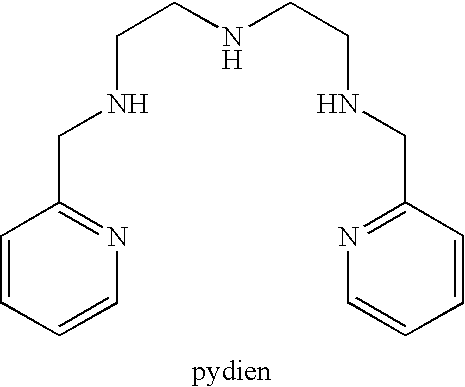
- N-donor of this type is 1,9-bis(2-pyridyl)-2,5,8-triazanonane (pydien):
- One to four, more preferably two to four and most preferably 3 of R 1 to R 4 are organic groups containing an N donor atom, with at least one, but up to four and more preferably three or four of those N-donor atoms belonging to an optionally substituted aromatic heterocycle.
- the aromatic heterocycle is an optionally substituted pyridyl or pyridylmethyl ring, which may contain any number of substituent functional groups at any position/s on the ring.
- Substituent functional groups which may be incorporated in such heterocycles include, sulphate, sulphonate, sulphonic acid, phosphate, phosphonate, phosphonic acid, carboxylate, carboxylic acid and/or halides as a selection of non-limiting examples.
- the remaining atoms in groups R 1 to R 4 can include carbon, hydrogen, oxygen, sulphur, phosphorous and/or halides, some of which may additionally coordinate to the metal centre.
- N-donors of this type are N-methyl-N,N′,N′-tris(2-pyridylmethyl)ethane-1,2-diamine (trilen) and N,N,N′,N′-tetrakis(2-pyridylmethyl_ethane-1,2-diamine (tpen):
- the complex be non-ionic in its oxidized form or, preferably, anionic.
- anionic charge can be introduced by modifying the N-donor ligand with one or more anionic charge inducing groups such as carboxylate, carboxylic acid, phosphate, phosphonate or phosphonic acid groups. Stronger acid groups such as sulphonate, sulphate or sulphonic acid could also be introduced.
- N-donor ligands of this sort are N-methyl-N,N′,N′,-tris(2-(4-sulfonato)-pyridylmethyl)ethane-1,2-diamine trisodium salt (trilen-(SO 3 Na) 3 ), N-methyl-N,N′,N′,-tris(2-(4-sulfato)-pyridylmethyl)ethane-1,2-diamine trisodium salt (trilen-(OSO 3 Na) 3 ), N-methyl-N,N′,N′-tris(2-(4-sulphonic acid)pyridylmethyl)-ethane-1,2-diamine (trilen-(SO 3 H) 3 ), N-methyl-N,N′,N′-tris(2-(4-sulphate)-pyridylmethyl)ethane-1,2-diamine (trilen-(OSO 3 H) 3 ), N-methyl-N,N′,N′
- the complete N-donor metal complex when it is to be used as a catalyst and/or mediator in a PEM cell comprising a anion exchange membrane, it will preferably be non-ionic in its reduced form, or more preferably, cationic.
- Cationic charge can be introduced to the N-donor ligand by modifying it with cationic charge inducing groups such as protonated amines or quaternary amine groups.
- the complete redox catalyst complex should be between four and eight coordinate, but more preferably six coordinate overall. Where the number of coordinating nitrogen atoms contained within the N-donor ligand is less than six, additional coordinating species are required. These species may be mono-, bi- and/or tridentate and may be either neutral or negatively charged.
- suitable coordinating species which includes H 2 O, OH ⁇ , Cl ⁇ , CH 3 OH and CH 3 CN as non-limiting examples.
- non-coordinating counter cations or anions are also present.
- suitable counter ions which includes ClO 4 ⁇ , PF 6 ⁇ , Cl ⁇ , CN ⁇ , SO 4 2 ⁇ , Na + and K + as non-limiting examples.
- Redox mediators and/or catalysts for use in conjunction with the N-donor ligand complex can be selected from a very large range of suitable materials, including ligated transition metal complexes and polyoxometallate species.
- suitable transition metals ions which can form such complexes include manganese (II-V), iron (I-IV), copper (I-III), cobalt (I-III), nickel (I-III), chromium (II-VII), titanium (II-IV), tungsten (IV-VI), vanadium (II-V) and molybdenum (II-VI).
- Ligands in such ligated transition metal complexes may be chelating such as 2,2′-bipyridine and/or 1,10-phenanthroline, or non-chelating such as chloride and/or cyanide.
- Complexes of such ligands e.g. transition metal complexes
- One preferred redox mediator comprises a modified ferrocene species and is disclosed in our co-pending application UK 0614338.2.
- a modified ferrocene species is to be used as a redox mediator in a PEM cell comprising a cation exchange membrane, it will preferably be non-ionic in its oxidized form or, more preferably, anionic.
- Anionic charge can be introduced to ferrocene by modifying it with anionic charge inducing groups such as carboxylate, carboxylic acid, phosphate, phosphonate or phosphonic acid groups. Stronger acid groups such as sulphonate, sulphate or sulphonic acid could also be introduced.
- the modified ferrocene species when it is to be used as a redox mediator in a PEM cell comprising a anion exchange membrane, it will preferably be non-ionic in its reduced form, or more preferably, cationic.
- Cationic charge can be introduced to ferrocene by modifying it with cationic charge inducing groups such as protonated amines or quaternary amine groups.
- the charge of the modified ferrocene species can be easily modified. This allows it to be tailored to the particular conditions of the cell with which it is to be used. For example, it can be tailored to the potential of the catholyte redox catalyst and the pH of the catholyte.
- the redox mediator is a modified ferrocene species, it may be represented by the formula:
- X and Y are independently selected from hydrogen and functional groups comprising halogen, hydroxy, amino, protonated amino, imino, nitro, cyano, acyl, acyloxy, sulphate, sulphonyl, sulphinyl, alkylamino, protonated alkylamino, quaternary alkylammonium, carboxy, carboxylic acid, ester, ether, amido, sulphonate, sulphonic acid, sulfonamide, phosphonyl, phosphonic acid, alkylsulphonyl, arylsulphonyl, alkoxycarbonyl, alkylsulphinyl, arylsulphinyl, alkylthio, arylthio, alkyl, alkoxy, oxyester, oxyamido, aryl, arylamino, aryloxy, heterocycloalkyl, heteroaryl, (C 2 -C 5 )alken
- At least one of X and Y are independently selected from hydrogen and functional groups comprising, halogen, hydroxy, amino, protonated amino, imino, acyl, sulphate, alkylamino, protonated alkylamino, quaternary alkylammonium, carboxy, carboxylic acid, ester, oxyester, alkoxy, sulphonyl, sulphinyl, alkylsulphonyl, sulphonic acid, sulphonamide, phosphonic acid, phosphonate, phosphate, amido, oxyamido or amino acid conjugates having the formula —CO—W—OH, where W is an amino acid and from alkyl, alkenyl, aryl, cycloalkyl, alkaryl alkenaryl, aralkyl, aralkenyl groups substituted with one or more of the aforesaid functional groups.
- At least one of X and Y are independently selected from hydrogen and functional groups comprising F, CHO, —COCH 3 , —COCH 2 CH 3 , —COCH 2 CH 2 COOH, —COOH, —(COOH) 2 , —NH 2 , NH 3 + , —N(CH 3 ) 2 , —NH(CH 3 ) 2 + , —N(CH 3 ) 3 + , —H(CH 2 CH 3 ) 2 , —NH(CH 2 CH 3 ) + , —N(CH 2 CH 3 ) 3 + , —CH 2 N(CH 3 ) 2 , CH 2 NH(CH 3 ) 2 + , —CH 2 N(CH 3 ) 3 + , —OH, —CH 2 OH, —CH(OH)CH 3 , —SO 3 ⁇ , —CH 2 SO 3 ⁇ , —CH 2 OSO 3 ⁇ , PO(OH) 2 , —OP
- each X substituent may be the same or different.
- the concentration of the redox mediator in the catholyte solution is preferably at least about 0.0001M, more preferably at least about 0.005M, and most preferably at least about 0.001M.
- the concentration of the redox catalyst in the catholyte solution is preferably at least about 0.0001M, more preferably at least about 0.005M, and most preferably at least about 0.001M.
- the ion selective PEM is a cation selective membrane which is selective in favour of protons versus other cations.
- the pH of the catholyte is preferably acidic. It preferably has a pH of below 7, more preferably below 4, even more preferably below 2 and most preferably below 1.
- the cation selective polymer electrolyte membrane may be formed from any suitable material, but preferably comprises a polymeric substrate having cation exchange capability. Suitable examples include fluororesin-type ion exchange resins and non-fluororesin-type ion exchange resins. Fluororesin-type ion exchange resins include perfluorocarboxylic acid resins, perfluorosulphonic acid resins, and the like. Perfluorocarboxylic acid resins are preferred, for example “Nafion” (Du Pont Inc.), “Flemion” (Asahi Gas Ltd), “Aciplex” (Asahi Kasei Inc), and the like.
- Non-fluororesin-type ion exchange resins include polyvinyl alcohols, polyalkylene oxides, styrene-divinylbenzene ion exchange resins, and the like, and metal salts thereof.
- Preferred non-fluororesin-type ion exchange resins include polyalkylene oxide-alkali metal salt complexes. These are obtainable by polymerizing an ethylene oxide oligomer in the presence of lithium chlorate or another alkali metal salt, for example.
- phenolsulphonic acid polystyrene sulphonic, polytrifluorostyrene sulphonic, sulphonated trifluorostyrene, sulphonated copolymers based on ⁇ , ⁇ , ⁇ trifluorostyrene monomer, radiation-grafted membranes.
- Non-fluorinated membranes include sulphonated poly(phenylquinoxalines), poly (2,6 diphenyl-4-phenylene oxide), poly(arylether sulphone), poly(2,6-diphenylenol); acid-doped polybenzimidazole, sulphonated polyimides; styrene/ethylene-butadiene/styrene triblock copolymers; partially sulphonated polyarylene ether sulphone; partially sulphonated polyether ether ketone (PEEK); and polybenzyl suphonic acid siloxane (PBSS).
- PBSS polybenzyl suphonic acid siloxane
- the ion selective PEM is an anionic selective membrane.
- anionic membranes include quaternary amine derivatives of styrene cross-linked with divinyl benzene and polymerised in the presence of finely powdered polyvinyl chloride to provide strength.
- the catholyte is preferably alkaline. It preferably has a pH above 7, more preferably above 8.
- the ion selective polymer electrolyte membrane may comprise a bi-membrane.
- the bimembrane if present will generally comprise a first cation selective membrane and a second anion selective membrane.
- the bimembrane may comprise an adjacent pairing of oppositely charge selective membranes.
- the bimembrane may comprise at least two discrete membranes which may be placed side-by-side with an optional gap there between. Preferably the size of the gap, if any, is kept to a minimum in the redox cell of the invention.
- bi-membrane may be used in the redox fuel cell of the invention to maximise the potential of the cell, by maintaining the potential due to a pH drop between the anode and catholyte solution.
- protons must be the dominant charge transfer vehicle.
- a single cation-selective membrane may not achieve this to the same extent due to the free movement of other cations from the catholyte solution in the membrane.
- the cation selective membrane may be positioned on the cathode side of the bimembrane and the anion selective membrane may be positioned on the anode side of the bimembrane.
- the cation selective membrane is adapted to allow protons to pass through the membrane from the anode side to the cathode side thereof in operation of the cell.
- the anion selective membrane is adapted substantially to prevent cationic materials other than protons from passing therethrough from the cathode side to the anode side thereof. In this case protons may pass from anode to cathode.
- the cation selective membrane is positioned on the anode side of the bimembrane and the anion selective membrane is positioned on the cathode side of the bi-membrane.
- the cation selective membrane is adapted to allow protons to pass through the membrane from the anode side to the cathode side thereof in operation of the cell.
- anions can pass from the cathode side into the interstitial space of the bimembrane, and protons will pass from the anode side. It may be desirable in this case to provide means for flushing such protons and anionic materials from the interstitial space of the bimembrane.
- Such means may comprise one or more perforations in the cation selective membrane, allowing such flushing directly through the membrane.
- means may be provided for channelling flushed materials around the cation selective membrane from the interstitial space to the cathode side of the said membrane.
- a representative example of a useful bipolar membrane, the arrangement used with the anionic-selective membrane on the anode side is that sold under the trademark Neosepta(R) BP-1, available from Tokuyama Corporation.
- the catholyte is supplied from a catholyte reservoir.
- the method of the above fourth aspect may additionally comprise the step of:
- the method of the above aspect comprises the step of:
- the cell is cyclic and the mediator and catalyst in the catholyte can be repeatedly oxidised and reduced without having to be replaced.
- An electricity loading device configured to load an electric power may also be provided in association with the fuel cell of the invention.
- the fuel cell of the invention may comprise a reformer configured to convert available fuel precursor such as LPG, LNG, gasoline or low molecular weight alcohols into a fuel gas (e.g. hydrogen) through a steam reforming reaction.
- the cell may then comprise a fuel gas supply device configured to supply the reformed fuel gas to the anode chamber.
- Preferred fuels include hydrogen; metal hydrides, for example borohydride which may act as fuel itself or as a provider of hydrogen, low molecular weight alcohols, aldehydes and carboxylic acids, sugars and biofuels as well as LPG, LNG or gasoline.
- metal hydrides for example borohydride which may act as fuel itself or as a provider of hydrogen, low molecular weight alcohols, aldehydes and carboxylic acids, sugars and biofuels as well as LPG, LNG or gasoline.
- Preferred oxidants include air, oxygen and peroxides.
- the anode in the redox fuel cell of the invention may for example be a hydrogen gas anode or a direct methanol anode; other low molecular weight alcohols such as ethanol, propanol, dipropylene glycol; ethylene glycol; also aldehydes formed from these and acid species such as formic acid, ethanoic acid etc.
- the anode may be formed from a bio-fuel cell type system where a bacterial species consumes a fuel and either produces a mediator which is oxidized at the electrode, or the bacteria themselves are adsorbed at the electrode and directly donate electrons to the anode.
- the cathode in the redox fuel cell of the invention may comprise as cathodic material carbon, gold, platinum, nickel, metal oxide species.
- cathodic materials include carbon, nickel, titanium and other metals inert in the specific catholyte and metal oxide or sulphide.
- One preferable material for the cathodes is reticulated vitreous carbon or carbon fibre based electrodes such as carbon felt.
- Another is nickel foam or mesh, or titanium foam or mesh.
- the cathodic material may be constructed from a fine dispersion of particulate cathodic material, the particulate dispersion being held together by a suitable adhesive, or by a proton conducting polymeric material.
- the cathode is designed to create maximum flow of catholyte solution to the cathode surface.
- it may consist of shaped flow regulators or a three dimensional electrode; the liquid flow may be managed in a flow-by arrangement where there is a liquid channel adjacent to the electrode, or in the case of the three dimensional electrode, where the liquid is forced to flow through the electrode.
- the surface of the electrode is also the electrocatalyst, but it may be beneficial to adhere the electrocatalyst in the form of deposited particles on the surface of the electrode.
- the redox mediator flowing in solution in the cathode chamber in operation of the cell is used in the invention with a catalyst for the reduction of oxygen in the cathode chamber, in accordance with the following (wherein Sp is the redox couple species).
- Sp is the redox couple species.
- the redox couple, and any other ancillary redox couple, utilised in the fuel cell of the invention should be non-volatile, and is preferably soluble in aqueous solvent.
- Preferred redox couples should react with the oxidant at a rate effective to generate a useful current in the electrical circuit of the fuel cell, and react with the oxidant such that water is the ultimate end product of the reaction.
- the fuel cell of the invention requires the presence of at least one redox mediator species and also a redox catalyst comprising a transition metal complex of a multidentate N-donor ligand.
- a redox catalyst comprising a transition metal complex of a multidentate N-donor ligand.
- other redox couples in the catholyte solution as ancillary redox couples.
- FIG. 1 illustrates a schematic view of the cathode compartment of a fuel cell in accordance with the present invention
- FIG. 2 shows a comparison of the catalysed and uncatalysed rates of oxidation of Fc-CH 2 NMe 2 ;
- FIG. 3 shows a comparison of the catalysed and uncatalysed rates of oxidation of Fc-CH 2 NMe 2 ;
- FIG. 4 a comparison of the catalysed and uncatalysed rates of oxidation of Fc-CH 2 NMe 2 ;
- FIG. 5 shows Fe(trilen-(SO 3 Na) 3 ) acting as a catalyst for the oxidation of 1,1′-bis(methylsulfonato)ferrocene disodium salt
- FIG. 6 shows a polarisation curve in a fuel cell according to the invention.
- FIG. 7 shows the ability of a catholyte in accordance with the invention to regenerate, assessed by monitoring the recovery of the open circuit potential of the cell whilst bubbling oxygen through the catholyte.
- FIG. 1 there is shown the cathode side of fuel cell 1 in accordance with the invention comprising a polymer electrolyte membrane 2 separating an anode (not shown) from cathode 3 .
- Cathode 3 comprises in this diagram reticulated carbon and is therefore porous. However, other cathodic materials such as platinum may be used.
- Polymer electrolyte membrane 2 comprises cation selective Nafion 112 membrane through which protons generated by the (optionally catalytic) oxidation of fuel gas (in this case hydrogen) in the anode chamber pass in operation of the cell. Electrons generated at the anode by the oxidation of fuel gas flow in an electrical circuit (not shown) and are returned to cathode 3 .
- Fuel gas in this case hydrogen
- the oxidant in this case air
- Cathode gas reaction chamber 5 the mediator reoxidation zone
- exhaust 6 through which the by-products of the fuel cell reaction (e.g. water and heat) can be discharged.
- a catholyte solution comprising the oxidised form of the redox mediator is supplied in operation of the cell from catholyte reservoir 7 into the cathode inlet channel 8 .
- the catholyte passes into reticulated carbon cathode 3 , which is situated adjacent membrane 2 .
- the redox mediator is reduced, and is then returned to cathode gas reaction chamber 5 via cathode outlet channel 9 .
- catholyte of the present invention Due to the advantageous composition of the catholyte of the present invention, reoxidation of the catalyst occurs, catalysed by the transition metal complex of a multidentate N-donor redox catalyst, which allows greater flexibility in designing catholyte systems for the fuel cell to produce for higher potential and/or a higher sustainable current than with catholytes of the prior art.
- N,N,N′,N′-Tetrakis(2-pyridylmethyl)ethane-1,2-diamine was purchased from ABCR GmbH & Co.
- the oxidation of Fc-CH 2 NMe 2 to [Fc-CH 2 NMe 2 ] + can be monitored using UV-Vis absorption spectroscopy as the oxidised product exhibits a peak at 626 nm which is not present in any of the starting materials.
- the redox potentials of a selection of iron based N-donor complexes for used in these examples were investigated.
- a standard three electrode cell was used, having (a) a 0.5 cm 2 glassy carbon electrode, (b) a reference calomel electrode (SCE) with a luggin capillary placed with the end about 2 mm away from the electrode, and (c) a platinum counter electrode. Cyclic voltammograms were recorded at 50 mV/s at room temperature. All solutions tested contained 1.0 mM of iron complex in 0.1 M glycine solution at pH 2.5, except for Fe(N4Py) which was studied in aqueous solution.
- the uncatalysed oxidation experiment was also performed under the same conditions as a control experiment. Oxygen was bubbled through 100 mL of solution containing 15 mM Fc-CH 2 NMe 2 and samples were removed at regular time intervals (measured in minutes) in order to record UV-Vis absorption profiles.
- a plot of the change in absorbance at 626 nm versus time provides a representation of the relative rates of oxidation of the ferrocene mediator in the presence of either no catalyst, 0.3 mM FeN4Py catalyst or 1.0 mM Fe(N4Py) catalyst. This is shown in FIG. 2 and indicates that catalysis is occurring in the presence of Fe(N4Py), the effect of which is increased upon increasing concentration of catalyst. This data is summarised in Table 1.
- a hexadentate N-donor ligand, N,N,N′,N′-tetrakis(2-pyridylmethyl)-ethane-1,2-diamine (tpen) (below) was complexed to iron(II) and tested as an oxygen reduction catalyst.
- 1,1′-bis(methylsulphonic acid)ferrocene is a novel material described in our co-pending application PCT/GB2007/050420 (claiming priority from GB 0614338.2) and was synthesised from 1,1′-Bis(chloromethyl)ferrocene in accordance with the following reaction scheme:
- the experiment was conducted at ⁇ 65° C. in an aqueous solution containing 0.05 M Na 2 SO 4 and 0.05 M NaHSO 4 adjusted to pH 2.5.
- a solution containing 1.0 mM of Fe(trilen) catalyst was generated in situ by combining solutions of FeSO 4 .7H 2 O and trilen.
- a catalytic experiment was conducted to monitor the ability of the iron complex of N-donor ligand N-methyl-N,N′,N′,-tris(2-(4-sulfonato)-pyridylmethyl)ethane-1,2-diamine trisodium salt (Fe(trilen-(SO 3 Na) 3 )) to bring about the oxidation of 1,1′-bis(methylsulfonato)ferrocene disodium salt, by oxygen.
- N-donor ligand N-methyl-N,N′,N′,-tris(2-(4-chloro)-pyridylmethyl)ethane-1,2-diamine was reacted with Na 2 SO 3 in an ethanol/water mixture to produce the N-donor species N-methyl-N,N′,N′,-tris(2-(4-sulfonato)-pyridylmethyl)ethane-1,2-diamine trisodium salt (trilen-(SO 3 Na) 3 ).
- a catalytic experiment was conducted using a solution containing 1.0 mM of the iron(II) complex of this sulfonated N-donor, 10 mM of mediator species 1,1′-bis(methylsulfoato)ferrocene disodium salt [Fc-(CH 2 SO 3 Na) 2 ] and 0.1 M glycine buffer at pH 2.5.
- the solution was heated to 65° C. and bubbled with oxygen.
- the reaction was monitored by UV-Vis absorption spectroscopy to measure the increase in absorption at 650 nm.
- An uncatalysed oxidation experiment was also performed under the same conditions as a control experiment.
- This data is summarised in FIG. 5 and shows that Fe(trilen-(SO 3 Na) 3 ) acts as a catalyst for the oxidation of 1,1′-bis(methylsulfonato)ferrocene disodium salt.
- a catholyte solution of the present invention was prepared and its performance assessed using a redox cathode and a hydrogen anode.
- a commercial anode was used with a platinised gas diffusion layer from E-TEK (De Nora Deutschland), 1 ⁇ 2 MEA from Ion Power Inc using a 0.125 mm Nafion® (DuPont) membrane.
- a reticulated vitreous carbon (RVC) electrode was used for the cathode.
- the catholyte solution was pumped through this electrode before passing to a reservoir from where it was recirculated. The total liquid volume was 25 cm 3 .
- the catholyte solution tested contained 10 mM 1,1′-bis(methylsulfonato)-ferrocene disodium salt and 1.0 mM Fe(trilen-(SO 3 Na) 3 ) in a buffer solution containing 0.05 M Na 2 SO 4 and 005M NaHSO 4 at pH 2.
- the catholyte was partially oxidised by bubbling oxygen through the solution at 65° C. for 30 minutes whereupon the absorbance at 650 nm was measured as 0.24. This resulting solution was flowed through the fuel cell whilst a polarisation curve was recorded. This can be seen in FIG. 6 .
- the solution was partially reduced in the fuel cell by drawing a current over a period of several minutes.
- the ability of the catholyte to regenerate was then assessed by monitoring the recovery of the open circuit potential whilst bubbling oxygen through the catholyte. This data can be seen in FIG. 7 .
Landscapes
- Chemical & Material Sciences (AREA)
- General Chemical & Material Sciences (AREA)
- Chemical Kinetics & Catalysis (AREA)
- Engineering & Computer Science (AREA)
- Electrochemistry (AREA)
- Sustainable Development (AREA)
- Sustainable Energy (AREA)
- Life Sciences & Earth Sciences (AREA)
- Manufacturing & Machinery (AREA)
- Organic Chemistry (AREA)
- Composite Materials (AREA)
- Materials Engineering (AREA)
- Inert Electrodes (AREA)
- Fuel Cell (AREA)
- Catalysts (AREA)
Abstract
Description




wherein:
X and Y are independently selected from hydrogen and functional groups comprising halogen, hydroxy, amino, protonated amino, imino, nitro, cyano, acyl, acyloxy, sulphate, sulphonyl, sulphinyl, alkylamino, protonated alkylamino, quaternary alkylammonium, carboxy, carboxylic acid, ester, ether, amido, sulphonate, sulphonic acid, sulfonamide, phosphonyl, phosphonic acid, alkylsulphonyl, arylsulphonyl, alkoxycarbonyl, alkylsulphinyl, arylsulphinyl, alkylthio, arylthio, alkyl, alkoxy, oxyester, oxyamido, aryl, arylamino, aryloxy, heterocycloalkyl, heteroaryl, (C2-C5)alkenyl, (C2-C5)alkynyl, azido phenylsulphonyloxy or amino acid conjugates having the formula —CO—W—OH, where W is an amino acid.
-
- d) passing the catholyte from the cathode to a reoxidation zone wherein the mediator is reoxidised by the catalyst reacting with the oxidant.
-
- e) passing the catholyte from the reoxidation zone to the catholyte reservoir.
O2+4Spred+4H+→2H2O+4Spox


| Catalyst | Potential vs NHE/V | ||
| Fe(N4Py) | 0.608 | ||
| Fe(MeN4Py) | 0.615 | ||
| Fe(trilen) | 0.689 | ||
| Fe(trilen-Cl3) | 0.757 | ||
| Fe(tpen) | 0.819 | ||
| Fe(tpen-Cl4) | 0.907 | ||


| TABLE 1 | ||||
| Initial Rate of | ||||
| Concentration | Mediator Oxida- | |||
| Catalyst | of Catalyst | tion/×10−6 Ms−1 | ||
| None | — | 0.13 | ||
| Fe(N4Py) | 1.0 mM | 1.4 | ||
| Fe(MeN4Py) | 1.0 mM | 0.68 | ||
| Fe(pydien) | 1.0 mM | 0.94 | ||
| Fe(trilen) | 1.0 mM | 11.3 | ||
| Fe(trilen-Cl3) | 1.0 mM | 1.5 | ||
| Fe(tpen) | 1.0 mM | 1.4 | ||


| TABLE 2 | ||
| 1.0 mM | ||
| Experiment | Uncatalysed | Fe(trilen) |
| Change in absorption at 650 nm after | 0.003 | 0.270 |
| 3 minutes | ||

Claims (32)


Applications Claiming Priority (3)
| Application Number | Priority Date | Filing Date | Title |
|---|---|---|---|
| GB0614337.4 | 2006-07-19 | ||
| GB0614337A GB0614337D0 (en) | 2006-07-19 | 2006-07-19 | Fuel Cells |
| PCT/GB2007/050421 WO2008009993A2 (en) | 2006-07-19 | 2007-07-19 | Fuel cells |
Publications (2)
| Publication Number | Publication Date |
|---|---|
| US20100112388A1 US20100112388A1 (en) | 2010-05-06 |
| US9136554B2 true US9136554B2 (en) | 2015-09-15 |
Family
ID=36998339
Family Applications (1)
| Application Number | Title | Priority Date | Filing Date |
|---|---|---|---|
| US12/374,371 Expired - Fee Related US9136554B2 (en) | 2006-07-19 | 2007-07-19 | Fuel cells |
Country Status (8)
| Country | Link |
|---|---|
| US (1) | US9136554B2 (en) |
| EP (1) | EP2041825B1 (en) |
| JP (1) | JP5234824B2 (en) |
| KR (1) | KR101425808B1 (en) |
| CN (1) | CN101517804B (en) |
| BR (1) | BRPI0714968A2 (en) |
| GB (2) | GB0614337D0 (en) |
| WO (1) | WO2008009993A2 (en) |
Families Citing this family (26)
| Publication number | Priority date | Publication date | Assignee | Title |
|---|---|---|---|---|
| GB0505087D0 (en) * | 2005-03-12 | 2005-04-20 | Acal Energy Ltd | Fuel cells |
| IN266777B (en) | 2006-03-24 | 2015-06-01 | Acal Energy Ltd | |
| GB0608079D0 (en) * | 2006-04-25 | 2006-05-31 | Acal Energy Ltd | Fuel cells |
| GB0614337D0 (en) | 2006-07-19 | 2006-08-30 | Acal Energy Ltd | Fuel Cells |
| GB0614338D0 (en) | 2006-07-19 | 2006-08-30 | Acal Energy Ltd | Fuel cells |
| JP5317256B2 (en) * | 2007-08-10 | 2013-10-16 | 独立行政法人日本原子力研究開発機構 | Extraction agent and extraction / separation method, and N, N, N ′, N ″ -tetrakis (2-methylpyridyl) ethylenediamine derivative and method for producing the same |
| GB0718349D0 (en) * | 2007-09-20 | 2007-10-31 | Acal Energy Ltd | Fuel cells |
| GB0718577D0 (en) | 2007-09-24 | 2007-10-31 | Acal Energy Ltd | Fuel cells |
| GB0801199D0 (en) * | 2008-01-23 | 2008-02-27 | Acal Energy Ltd | Fuel cells |
| GB0801195D0 (en) * | 2008-01-23 | 2008-02-27 | Acal Energy Ltd | Fuel cells |
| GB0801198D0 (en) * | 2008-01-23 | 2008-02-27 | Acal Energy Ltd | Fuel cells |
| GB0913638D0 (en) * | 2009-08-05 | 2009-09-16 | Acal Energy Ltd | Fuel cells |
| KR101638595B1 (en) * | 2010-01-29 | 2016-07-12 | 삼성전자주식회사 | Redox flow battery |
| EP2543104B1 (en) * | 2010-03-02 | 2020-04-29 | University of Chester | Fuel cells |
| KR101747862B1 (en) * | 2010-11-03 | 2017-06-16 | 삼성전자주식회사 | Redox flow battery |
| KR20140016966A (en) * | 2011-05-27 | 2014-02-10 | 중국지질대학(무한) | Hydrogen storage liquid organic material-based direct fuel cell and system for energy storage and energy supply |
| WO2013110950A1 (en) | 2012-01-25 | 2013-08-01 | Acal Energy Limited | Improved fuel cell electrolyte regenerator and separator |
| CN104054203B (en) | 2012-05-01 | 2017-03-22 | 日新电机株式会社 | storage battery |
| GB2503475A (en) * | 2012-06-27 | 2014-01-01 | Acal Energy Ltd | Fuel Cells for use at elevated temperatures and pressures |
| US20140154597A1 (en) * | 2012-12-04 | 2014-06-05 | Fahs Stagemyer Llc | Fuel Cells Based on Precise Energy Separation |
| GB2515725A (en) * | 2013-05-01 | 2015-01-07 | Acal Energy Ltd | Fuel cells |
| US9711818B2 (en) | 2014-03-14 | 2017-07-18 | Wisconsin Alumni Research Foundation | Charge transfer mediator based systems for electrocatalytic oxygen reduction |
| US10727518B2 (en) | 2017-06-12 | 2020-07-28 | Wisconsin Alumni Research Foundation | Flow-based anode for the electrocatalytic oxidation of a fuel or other reductant |
| EP3726633A1 (en) * | 2019-04-16 | 2020-10-21 | Universität Innsbruck | Redox flow battery |
| CN113862711B (en) * | 2021-11-01 | 2023-02-24 | 陕西科技大学 | Polyphenanthroline film coordinated by transition metal ions, preparation method and application thereof |
| CN117683310B (en) * | 2024-02-02 | 2024-04-30 | 国家电投集团氢能科技发展有限公司 | Composite, ion exchange membrane, and preparation method and application thereof |
Citations (73)
| Publication number | Priority date | Publication date | Assignee | Title |
|---|---|---|---|---|
| US3152013A (en) | 1960-05-17 | 1964-10-06 | Ionics | Fuel cell |
| US3279949A (en) | 1961-07-27 | 1966-10-18 | Union Carbide Corp | Fuel cell half-cell containing vanadium redox couple |
| US3294588A (en) | 1962-04-19 | 1966-12-27 | Exxon Research Engineering Co | Method of operating fuel cell with electrolyte containing quinones or dyes |
| US3360401A (en) | 1965-09-29 | 1967-12-26 | Standard Oil Co | Process for converting chemical energy into electrical energy |
| GB1176633A (en) | 1967-01-17 | 1970-01-07 | Du Pont | Fuel Cell. |
| GB1176632A (en) | 1967-01-17 | 1970-01-07 | Du Pont | Fuel Cell. |
| US3540933A (en) | 1967-07-11 | 1970-11-17 | Jan Boeke | Redox fuel cell |
| US3607420A (en) | 1969-11-17 | 1971-09-21 | Du Pont | Process of operating fuel-cell half cell with cupric-cuprous redox couple |
| US4048383A (en) | 1976-02-09 | 1977-09-13 | Battelle Memorial Institute | Combination cell |
| JPS5642970A (en) | 1979-09-14 | 1981-04-21 | Agency Of Ind Science & Technol | Redox battery |
| EP0043647A1 (en) | 1980-06-27 | 1982-01-13 | Minnesota Mining And Manufacturing Company | Energy conversion and storage process |
| US4396687A (en) | 1980-12-08 | 1983-08-02 | Ford Motor Company | Chemically regenerable redox fuel cell and method of operating the same |
| JPS6154163A (en) | 1984-08-22 | 1986-03-18 | Agency Of Ind Science & Technol | Oxyhydrogen-system fuel cell |
| JPS6215770A (en) | 1985-07-11 | 1987-01-24 | Yamaguchi Univ | Redox secondary battery |
| EP0228168A1 (en) | 1985-11-22 | 1987-07-08 | The Standard Oil Company | Improved polyoxometalate-modified carbon electrodes and uses therefor |
| WO1991013681A1 (en) | 1990-03-05 | 1991-09-19 | Catalytica, Inc. | Preparation of phosphomolybdovanadate polyoxoanions |
| EP0517217A1 (en) | 1991-06-06 | 1992-12-09 | Director-General Of The Agency Of Industrial Science And Technology | Redox battery |
| US5250158A (en) | 1990-10-15 | 1993-10-05 | Director-General, Agency Of Industrial Science And Technology | Method for producing vanadium electrolytic solution |
| JPH05295578A (en) | 1992-04-17 | 1993-11-09 | Japan Energy Corp | Production of partially oxidized aromatic compound |
| US5298343A (en) | 1992-06-19 | 1994-03-29 | Ecole Polytechnique De Montreal | Electrocatalysts for H2 /O2 fuel cells cathode |
| EP0592988A1 (en) | 1992-10-13 | 1994-04-20 | Hughes Aircraft Company | Membrane flow cell battery |
| EP0595688A1 (en) | 1992-10-21 | 1994-05-04 | Nippon Telegraph And Telephone Corporation | Temperature difference storage battery |
| US5384019A (en) * | 1993-10-29 | 1995-01-24 | E. I. Du Pont De Nemours And Company | Membrane reinforced with modified leno weave fabric |
| WO1996031912A1 (en) | 1995-04-07 | 1996-10-10 | Motorola Inc. | Polyoxometalate carbon electrodes and energy storage device made thereof |
| EP0790658A2 (en) | 1996-02-19 | 1997-08-20 | Kashima-Kita Electric Power Corporation | Redox flow cell battery with vanadium electrolyte and a polysulfone-based semipermeable membrane |
| US5660940A (en) | 1993-12-20 | 1997-08-26 | Sufucell Ab | Method for producing electric energy in a biofuel-powered fuel cell |
| US5683829A (en) | 1995-05-22 | 1997-11-04 | Sarangapani; Shantha | Redox promoters for methonol fuel cells |
| EP0878850A2 (en) | 1997-05-14 | 1998-11-18 | Canon Kabushiki Kaisha | Photovoltaic power generation apparatus |
| US5958616A (en) | 1998-02-06 | 1999-09-28 | Lynntech, Inc. | Membrane and electrode structure for methanol fuel cell |
| JPH11288727A (en) | 1998-04-02 | 1999-10-19 | Asahi Chem Ind Co Ltd | Membrane / electrode assembly for polymer electrolyte fuel cells |
| WO2000012667A1 (en) | 1998-09-01 | 2000-03-09 | Unilever Plc | Composition and method for bleaching a substrate |
| WO2000022688A2 (en) | 1998-08-19 | 2000-04-20 | Sarnoff Corporation | Enzymatic battery |
| US6054580A (en) | 1996-07-22 | 2000-04-25 | Carnegie Mellon University | Long-lived homogenous amide containing macrocyclic compounds |
| WO2000029537A1 (en) | 1998-11-13 | 2000-05-25 | The Procter & Gamble Company | Bleach compositions |
| US6270649B1 (en) | 1998-07-09 | 2001-08-07 | Michigan State University | Electrochemical methods for generation of a biological proton motive force and pyridine nucleotide cofactor regeneration |
| WO2001073881A1 (en) | 2000-03-24 | 2001-10-04 | Scientific Generics Limited | Mixed reactant fuel cells with flow through porous electrodes |
| EP1143546A1 (en) | 1999-09-27 | 2001-10-10 | Kashima-Kita Electric Power Corporation | Redox flow battery |
| US20010028977A1 (en) | 1995-05-03 | 2001-10-11 | Michael Kazacos | High energy density vanadium electrolyte solutions, methods of preparation thereof and all-vanadium redox cells and batteries containing high energy vanadium electrolyte solutions |
| US20030152823A1 (en) | 1998-06-17 | 2003-08-14 | Therasense, Inc. | Biological fuel cell and methods |
| WO2003083967A2 (en) | 2002-03-27 | 2003-10-09 | Regenesys Technologies Limited | An electrode for the reduction of polysulfide species |
| US20040028203A1 (en) | 2001-01-02 | 2004-02-12 | Wurster John H. | Telephone network control system and method |
| US20040028992A1 (en) | 2000-10-27 | 2004-02-12 | Jaouen Frederic | Cathode layer structure for a solid polymer fuel cell and fuel cell incorporating such structure |
| US20040137297A1 (en) | 2002-12-26 | 2004-07-15 | Hitoshi Matsuoka | Ion exchange membrane and production process therefor |
| GB2400974A (en) | 2002-02-14 | 2004-10-27 | Fuel Technology Ltd E | Redox flow battery |
| JP2004319292A (en) | 2003-04-17 | 2004-11-11 | Toyota Motor Corp | Cathode for fuel cell and polymer electrolyte fuel cell provided with the same |
| US20050074653A1 (en) | 2001-06-28 | 2005-04-07 | Squirrel Holdings Ltd. | Redox cell with non-selective permionic separator |
| US20050112055A1 (en) | 2003-10-15 | 2005-05-26 | Shannon Curtis G. | Di-ruthenium-substituted polyoxometalate electrocatalyst and method of oxygen generation |
| US20050244707A1 (en) | 2002-04-23 | 2005-11-03 | Maria Skyllas-Kazacos | Metal halide redox flow battery |
| WO2005112055A2 (en) | 2004-04-29 | 2005-11-24 | Bal Seal Engineering Co., Inc. | Contact assembly |
| US20060012637A1 (en) | 2004-07-16 | 2006-01-19 | Fuji Photo Film Co., Ltd. | Image forming apparatus |
| WO2006012637A2 (en) | 2004-07-29 | 2006-02-02 | Wisconsin Alumni Research Foundation | Catalytic method to remove co and utilize its energy content in co-containing streams |
| RU2004129396A (en) | 2004-10-05 | 2006-03-10 | Е.И.Дюпон де Немур энд Компани (US) | CATALYTIC MATERIAL RESISTANT TO METHANOL |
| US20060088750A1 (en) | 2004-10-22 | 2006-04-27 | Tomoki Nobuta | Proton-conducting polymer material, and solid electrolyte membrane, electrochemical cell and fuel cell therewith |
| WO2006057387A1 (en) | 2004-11-26 | 2006-06-01 | The University Of Tokyo | Biocell |
| US20060134493A1 (en) | 2004-12-22 | 2006-06-22 | Japan Atomic Energy Agency | Highly durable polymer electrolytic membrane for a fuel cell having a cross-linked structure |
| GB2424118A (en) | 2005-03-12 | 2006-09-13 | Acal Energy Ltd | Fuel Cells |
| US20060216565A1 (en) | 2005-03-28 | 2006-09-28 | Fujitsu Limited | Electrolyte composition, solid electrolyte membrane, solid polymer fuel cell and manufacturing method for solid electrolyte membrane |
| WO2006121191A1 (en) | 2005-05-10 | 2006-11-16 | Toyota Jidosha Kabushiki Kaisha | Porphyrin-based electrode catalyst |
| US20070122689A1 (en) | 2005-09-30 | 2007-05-31 | Canon Kabushiki Kaisha | Enzyme electrode, and sensor and biofuel cell using the same |
| US20070131546A1 (en) | 2005-12-09 | 2007-06-14 | Canon Kabushiki Kaisha | Enzyme electrode |
| WO2007101284A1 (en) | 2006-03-06 | 2007-09-13 | Funktionswerkstoffe Forschungs-Und Entwicklungs Gmbh | Redox flow battery and electrolyte solution for a eine redox flow battery |
| WO2007110663A2 (en) | 2006-03-24 | 2007-10-04 | Acal Energy Limited | Fuel cells |
| WO2007122431A1 (en) | 2006-04-25 | 2007-11-01 | Acal Energy Limited | Fuel cells |
| WO2008009993A2 (en) | 2006-07-19 | 2008-01-24 | Acal Energy Limited | Fuel cells |
| WO2008009992A2 (en) | 2006-07-19 | 2008-01-24 | Acal Energy Limited | Fuel cells |
| WO2009037513A1 (en) | 2007-09-20 | 2009-03-26 | Acal Energy Limited | Fuel cells |
| WO2009040577A1 (en) | 2007-09-24 | 2009-04-02 | Acal Energy Limited | Redox fuel cell |
| WO2009093080A1 (en) | 2008-01-23 | 2009-07-30 | Acal Energy Limited | Fuel cells |
| WO2009093081A1 (en) | 2008-01-23 | 2009-07-30 | Acal Energy Limited | Fuel cells |
| WO2009093082A1 (en) | 2008-01-23 | 2009-07-30 | Acal Energy Limited | Redox fuel cells |
| US20090308752A1 (en) | 2004-10-19 | 2009-12-17 | Evans Christine E | Electrochemical Pump |
| WO2010128333A1 (en) | 2009-05-07 | 2010-11-11 | Acal Energy Limited | Fuel cells |
| WO2011015875A1 (en) | 2009-08-05 | 2011-02-10 | Acal Energy Limited | Fuel cells |
Family Cites Families (9)
| Publication number | Priority date | Publication date | Assignee | Title |
|---|---|---|---|---|
| JPS61211960A (en) * | 1985-03-15 | 1986-09-20 | Mitsui Eng & Shipbuild Co Ltd | secondary battery |
| JPS6273577A (en) * | 1985-09-26 | 1987-04-04 | Babcock Hitachi Kk | Bromine-copper redox fuel cell |
| JPH01502271A (en) * | 1987-02-25 | 1989-08-10 | アクアノーティックス コーポレーション | Polyalkylamine complexes for ligand extraction and regeneration |
| JPH0628167B2 (en) * | 1987-07-06 | 1994-04-13 | 三井造船株式会社 | Secondary battery rebalancing method |
| US5054580A (en) * | 1990-09-24 | 1991-10-08 | Cheek William B | Modular walkway system |
| JP2005520304A (en) * | 2002-03-14 | 2005-07-07 | アリゾナ ボード オブ リージェンツ | Enzyme-based photoelectrochemical cell for current generation |
| GB0224799D0 (en) * | 2002-10-25 | 2002-12-04 | Amersham Plc | Improved complex compositions |
| US8859151B2 (en) * | 2003-11-05 | 2014-10-14 | St. Louis University | Immobilized enzymes in biocathodes |
| JP2005209525A (en) * | 2004-01-23 | 2005-08-04 | Tohoku Univ | Uranium redox flow battery, and electromotive force generating method |
-
2006
- 2006-07-19 GB GB0614337A patent/GB0614337D0/en not_active Ceased
-
2007
- 2007-07-19 WO PCT/GB2007/050421 patent/WO2008009993A2/en not_active Ceased
- 2007-07-19 US US12/374,371 patent/US9136554B2/en not_active Expired - Fee Related
- 2007-07-19 KR KR1020097003456A patent/KR101425808B1/en not_active Expired - Fee Related
- 2007-07-19 EP EP07766462.1A patent/EP2041825B1/en not_active Not-in-force
- 2007-07-19 JP JP2009520064A patent/JP5234824B2/en active Active
- 2007-07-19 CN CN2007800273685A patent/CN101517804B/en not_active Expired - Fee Related
- 2007-07-19 BR BRPI0714968-9A patent/BRPI0714968A2/en not_active IP Right Cessation
- 2007-07-19 GB GB0714048A patent/GB2440435B/en not_active Expired - Fee Related
Patent Citations (89)
| Publication number | Priority date | Publication date | Assignee | Title |
|---|---|---|---|---|
| US3152013A (en) | 1960-05-17 | 1964-10-06 | Ionics | Fuel cell |
| US3279949A (en) | 1961-07-27 | 1966-10-18 | Union Carbide Corp | Fuel cell half-cell containing vanadium redox couple |
| US3294588A (en) | 1962-04-19 | 1966-12-27 | Exxon Research Engineering Co | Method of operating fuel cell with electrolyte containing quinones or dyes |
| US3360401A (en) | 1965-09-29 | 1967-12-26 | Standard Oil Co | Process for converting chemical energy into electrical energy |
| GB1176633A (en) | 1967-01-17 | 1970-01-07 | Du Pont | Fuel Cell. |
| GB1176632A (en) | 1967-01-17 | 1970-01-07 | Du Pont | Fuel Cell. |
| US3540933A (en) | 1967-07-11 | 1970-11-17 | Jan Boeke | Redox fuel cell |
| US3607420A (en) | 1969-11-17 | 1971-09-21 | Du Pont | Process of operating fuel-cell half cell with cupric-cuprous redox couple |
| US4048383A (en) | 1976-02-09 | 1977-09-13 | Battelle Memorial Institute | Combination cell |
| JPS5642970A (en) | 1979-09-14 | 1981-04-21 | Agency Of Ind Science & Technol | Redox battery |
| EP0043647A1 (en) | 1980-06-27 | 1982-01-13 | Minnesota Mining And Manufacturing Company | Energy conversion and storage process |
| US4396687A (en) | 1980-12-08 | 1983-08-02 | Ford Motor Company | Chemically regenerable redox fuel cell and method of operating the same |
| JPS6154163A (en) | 1984-08-22 | 1986-03-18 | Agency Of Ind Science & Technol | Oxyhydrogen-system fuel cell |
| JPS6215770A (en) | 1985-07-11 | 1987-01-24 | Yamaguchi Univ | Redox secondary battery |
| EP0228168A1 (en) | 1985-11-22 | 1987-07-08 | The Standard Oil Company | Improved polyoxometalate-modified carbon electrodes and uses therefor |
| WO1991013681A1 (en) | 1990-03-05 | 1991-09-19 | Catalytica, Inc. | Preparation of phosphomolybdovanadate polyoxoanions |
| US5250158A (en) | 1990-10-15 | 1993-10-05 | Director-General, Agency Of Industrial Science And Technology | Method for producing vanadium electrolytic solution |
| EP0517217A1 (en) | 1991-06-06 | 1992-12-09 | Director-General Of The Agency Of Industrial Science And Technology | Redox battery |
| JPH05295578A (en) | 1992-04-17 | 1993-11-09 | Japan Energy Corp | Production of partially oxidized aromatic compound |
| US5298343A (en) | 1992-06-19 | 1994-03-29 | Ecole Polytechnique De Montreal | Electrocatalysts for H2 /O2 fuel cells cathode |
| EP0592988A1 (en) | 1992-10-13 | 1994-04-20 | Hughes Aircraft Company | Membrane flow cell battery |
| EP0595688A1 (en) | 1992-10-21 | 1994-05-04 | Nippon Telegraph And Telephone Corporation | Temperature difference storage battery |
| US5384019A (en) * | 1993-10-29 | 1995-01-24 | E. I. Du Pont De Nemours And Company | Membrane reinforced with modified leno weave fabric |
| US5660940A (en) | 1993-12-20 | 1997-08-26 | Sufucell Ab | Method for producing electric energy in a biofuel-powered fuel cell |
| WO1996031912A1 (en) | 1995-04-07 | 1996-10-10 | Motorola Inc. | Polyoxometalate carbon electrodes and energy storage device made thereof |
| US20010028977A1 (en) | 1995-05-03 | 2001-10-11 | Michael Kazacos | High energy density vanadium electrolyte solutions, methods of preparation thereof and all-vanadium redox cells and batteries containing high energy vanadium electrolyte solutions |
| US5683829A (en) | 1995-05-22 | 1997-11-04 | Sarangapani; Shantha | Redox promoters for methonol fuel cells |
| EP0790658A2 (en) | 1996-02-19 | 1997-08-20 | Kashima-Kita Electric Power Corporation | Redox flow cell battery with vanadium electrolyte and a polysulfone-based semipermeable membrane |
| US6054580A (en) | 1996-07-22 | 2000-04-25 | Carnegie Mellon University | Long-lived homogenous amide containing macrocyclic compounds |
| EP0878850A2 (en) | 1997-05-14 | 1998-11-18 | Canon Kabushiki Kaisha | Photovoltaic power generation apparatus |
| US5958616A (en) | 1998-02-06 | 1999-09-28 | Lynntech, Inc. | Membrane and electrode structure for methanol fuel cell |
| JPH11288727A (en) | 1998-04-02 | 1999-10-19 | Asahi Chem Ind Co Ltd | Membrane / electrode assembly for polymer electrolyte fuel cells |
| US20030152823A1 (en) | 1998-06-17 | 2003-08-14 | Therasense, Inc. | Biological fuel cell and methods |
| US6270649B1 (en) | 1998-07-09 | 2001-08-07 | Michigan State University | Electrochemical methods for generation of a biological proton motive force and pyridine nucleotide cofactor regeneration |
| WO2000022688A2 (en) | 1998-08-19 | 2000-04-20 | Sarnoff Corporation | Enzymatic battery |
| US20050158618A1 (en) | 1998-08-19 | 2005-07-21 | Powerzyme, Inc. | Enzymatic fuel cell |
| WO2000012667A1 (en) | 1998-09-01 | 2000-03-09 | Unilever Plc | Composition and method for bleaching a substrate |
| WO2000029537A1 (en) | 1998-11-13 | 2000-05-25 | The Procter & Gamble Company | Bleach compositions |
| EP1143546A1 (en) | 1999-09-27 | 2001-10-10 | Kashima-Kita Electric Power Corporation | Redox flow battery |
| WO2001073881A1 (en) | 2000-03-24 | 2001-10-04 | Scientific Generics Limited | Mixed reactant fuel cells with flow through porous electrodes |
| US20040028992A1 (en) | 2000-10-27 | 2004-02-12 | Jaouen Frederic | Cathode layer structure for a solid polymer fuel cell and fuel cell incorporating such structure |
| US20040028203A1 (en) | 2001-01-02 | 2004-02-12 | Wurster John H. | Telephone network control system and method |
| US20050074653A1 (en) | 2001-06-28 | 2005-04-07 | Squirrel Holdings Ltd. | Redox cell with non-selective permionic separator |
| GB2400974A (en) | 2002-02-14 | 2004-10-27 | Fuel Technology Ltd E | Redox flow battery |
| WO2003083967A2 (en) | 2002-03-27 | 2003-10-09 | Regenesys Technologies Limited | An electrode for the reduction of polysulfide species |
| US20050244707A1 (en) | 2002-04-23 | 2005-11-03 | Maria Skyllas-Kazacos | Metal halide redox flow battery |
| US20040137297A1 (en) | 2002-12-26 | 2004-07-15 | Hitoshi Matsuoka | Ion exchange membrane and production process therefor |
| JP2004319292A (en) | 2003-04-17 | 2004-11-11 | Toyota Motor Corp | Cathode for fuel cell and polymer electrolyte fuel cell provided with the same |
| US20050112055A1 (en) | 2003-10-15 | 2005-05-26 | Shannon Curtis G. | Di-ruthenium-substituted polyoxometalate electrocatalyst and method of oxygen generation |
| WO2005112055A2 (en) | 2004-04-29 | 2005-11-24 | Bal Seal Engineering Co., Inc. | Contact assembly |
| US20060012637A1 (en) | 2004-07-16 | 2006-01-19 | Fuji Photo Film Co., Ltd. | Image forming apparatus |
| WO2006012637A2 (en) | 2004-07-29 | 2006-02-02 | Wisconsin Alumni Research Foundation | Catalytic method to remove co and utilize its energy content in co-containing streams |
| US20060024539A1 (en) | 2004-07-29 | 2006-02-02 | Dumesic James A | Catalytic method to remove CO and utilize its energy content in CO-containing streams |
| RU2004129396A (en) | 2004-10-05 | 2006-03-10 | Е.И.Дюпон де Немур энд Компани (US) | CATALYTIC MATERIAL RESISTANT TO METHANOL |
| US20070078052A1 (en) | 2004-10-05 | 2007-04-05 | Grinberg Vitali A | Methanol tolerant catalyst material |
| US20090308752A1 (en) | 2004-10-19 | 2009-12-17 | Evans Christine E | Electrochemical Pump |
| US20060088750A1 (en) | 2004-10-22 | 2006-04-27 | Tomoki Nobuta | Proton-conducting polymer material, and solid electrolyte membrane, electrochemical cell and fuel cell therewith |
| WO2006057387A1 (en) | 2004-11-26 | 2006-06-01 | The University Of Tokyo | Biocell |
| US20060134493A1 (en) | 2004-12-22 | 2006-06-22 | Japan Atomic Energy Agency | Highly durable polymer electrolytic membrane for a fuel cell having a cross-linked structure |
| WO2006097438A2 (en) | 2005-03-12 | 2006-09-21 | Acal Energy Limited | Fuel cells |
| GB2424118A (en) | 2005-03-12 | 2006-09-13 | Acal Energy Ltd | Fuel Cells |
| US20080274385A1 (en) | 2005-03-12 | 2008-11-06 | Andrew Martin Creeth | Fuel Cells |
| US20060216565A1 (en) | 2005-03-28 | 2006-09-28 | Fujitsu Limited | Electrolyte composition, solid electrolyte membrane, solid polymer fuel cell and manufacturing method for solid electrolyte membrane |
| WO2006121191A1 (en) | 2005-05-10 | 2006-11-16 | Toyota Jidosha Kabushiki Kaisha | Porphyrin-based electrode catalyst |
| GB2440489A (en) | 2005-05-10 | 2008-01-30 | Toyota Motor Co Ltd | Porphyrin-based electrode catalyst |
| US20070122689A1 (en) | 2005-09-30 | 2007-05-31 | Canon Kabushiki Kaisha | Enzyme electrode, and sensor and biofuel cell using the same |
| US20070131546A1 (en) | 2005-12-09 | 2007-06-14 | Canon Kabushiki Kaisha | Enzyme electrode |
| WO2007101284A1 (en) | 2006-03-06 | 2007-09-13 | Funktionswerkstoffe Forschungs-Und Entwicklungs Gmbh | Redox flow battery and electrolyte solution for a eine redox flow battery |
| WO2007110663A2 (en) | 2006-03-24 | 2007-10-04 | Acal Energy Limited | Fuel cells |
| US20090317668A1 (en) | 2006-03-24 | 2009-12-24 | Acal Energy Limited | Fuel cells |
| WO2007122431A1 (en) | 2006-04-25 | 2007-11-01 | Acal Energy Limited | Fuel cells |
| US20090325002A1 (en) | 2006-04-25 | 2009-12-31 | Acal Energy Limited | Fuel cells |
| WO2008009993A2 (en) | 2006-07-19 | 2008-01-24 | Acal Energy Limited | Fuel cells |
| GB2440434A (en) | 2006-07-19 | 2008-01-30 | Acal Energy Ltd | Fuel Cells |
| GB2440435A (en) | 2006-07-19 | 2008-01-30 | Acal Energy Ltd | Fuel Cells |
| US20100112393A1 (en) | 2006-07-19 | 2010-05-06 | Acal Energy Limited | Fuel cells |
| WO2008009992A2 (en) | 2006-07-19 | 2008-01-24 | Acal Energy Limited | Fuel cells |
| WO2009037513A1 (en) | 2007-09-20 | 2009-03-26 | Acal Energy Limited | Fuel cells |
| US20110039170A1 (en) | 2007-09-20 | 2011-02-17 | Acal Energy Limited | Fuel cells |
| US20100297522A1 (en) | 2007-09-24 | 2010-11-25 | Acal Energy Limited | Redox fuel cell |
| WO2009040577A1 (en) | 2007-09-24 | 2009-04-02 | Acal Energy Limited | Redox fuel cell |
| WO2009093082A1 (en) | 2008-01-23 | 2009-07-30 | Acal Energy Limited | Redox fuel cells |
| WO2009093081A1 (en) | 2008-01-23 | 2009-07-30 | Acal Energy Limited | Fuel cells |
| WO2009093080A1 (en) | 2008-01-23 | 2009-07-30 | Acal Energy Limited | Fuel cells |
| US20110014532A1 (en) | 2008-01-23 | 2011-01-20 | Acal Energy Limited | Redox fuel cells |
| US20110027671A1 (en) | 2008-01-23 | 2011-02-03 | Acal Energy Limited | Fuel cells |
| US20110091746A1 (en) | 2008-01-23 | 2011-04-21 | Acal Energy Limited | Fuel cells |
| WO2010128333A1 (en) | 2009-05-07 | 2010-11-11 | Acal Energy Limited | Fuel cells |
| WO2011015875A1 (en) | 2009-08-05 | 2011-02-10 | Acal Energy Limited | Fuel cells |
Non-Patent Citations (23)
| Title |
|---|
| Alley et al., "Synthesi and Characterization of ferrocenyl-phosphonic and -arsonic acids", J. Organomet. Chem., 2001, vol. 637-639, pp. 216-229. |
| Bernal et al., "Iron(II) Complexes of Polydentate Aminopyridyl Ligands and an Exchangeable Sixth Ligand; Reactions with peroxides . . . "-, J. Chem Soc. Trans., Dalton. Trans. 1995, pp. 3667-3675. |
| Chang et al., "Synthesis and Characterization of Bis(d-2-pyridylmethanamine)ruthenium(II)", Inorg. Chem., 2003, vol. 43, pp. 1735-1742. |
| Dillon et al., "International Activities in DMFC R&D: status of technologies and potential applications", J. Power Sources, 2004, vol. 127, pp. 112-126. |
| Harris et al., "Chelating Tendencies of Pyridyl-Containing Polyamines and Oxygenation of the Cobaltous Complexes", Inorg. Chem., 1978, vol. 17, pp. 889-894. |
| Heinzel et al., "A review of the state-of-the-art of the methanol crossover in direct methanol fuel cells", J. Power Sources, 1999, vol. 84, pp. 70-74. |
| Hogarth et al., "Catalysis for Low Temperature Fuel Cells", Platinum Metal Reviews, 2002, vol. 46, pp. 146-164. |
| International Search Report for Application No. PCT/GB2007/050151, Oct. 1, 2007, pp. 5. |
| International Search Report with Written Opinion for Application No. PCT/GB2007/050420, Jan. 14, 2008, pp. 16. |
| J.G. Roelfes, "Models for Non-Heme Iron Containing Oxidation Enzymes," Jun. 4, 1972, pp. 1-154. |
| Klopstra et al., "Non-heme iron catalyts for the benzylic oxidation: a parallel ligand screening approach", Tet. Lett., 2003, vol. 44, pp. 4581-4584. |
| Knox et al., "Ferrocene Derivatives. Part VII. Some Sulphur derivatives", J. Chem. Soc., 1958, vol. 682. |
| Limoges et al., "Electrocatalyst materials for fuel cells based on the polyoxometalates [PMo(12−n)Vn040]<(3+n)->(n=0−3)", Electrochimica Acta, Elsevier Scient Publishers, Jan. 15, 2005, vol. 50, Issue 5, pp. 1169,1170,1176-1179 , Barking, GB. |
| Limoges et al., "Electrocatalyst materials for fuel cells based on the polyoxometalates [PMo(12-n)Vn040](n=0-3)", Electrochimica Acta, Elsevier Scient Publishers, Jan. 15, 2005, vol. 50, Issue 5, pp. 1169,1170,1176-1179 , Barking, GB. |
| Lubben et al., "Nonheme Iron Centers in Oxygen Activation: Characterization of an Iron(III) Hydroperoxide Intermediate", Angew, Chem. Int. Ed. Engl., 1995, vol. 34, pp. 1512-1514. |
| Preliminary Search Report for PCT/GB2006/060640, Sep. 27, 2007, pp. 9. |
| Preliminary Search Report for PCT/GB2007/050151, Sep. 30, 2008, pp. 10. |
| Reger et al., "Synthesis and structural characterization of the bitopic ferrocene-based tris(pyrazolyl)methana ligand Fe[C5H4CH2OCH2C(pz)3]2 (pz=pyrazolyl ring)", J. Chem Crystallography, 2005, vol. 35, pp. 217-225. |
| Sato et al., "Convenient Synthesis of N,N,N',N'Tetrakis(2-pyridylmethyi)-a,w-alkanediamines Using a Phase-Transfer Catalyst", Synthesis, 1992, pp. 539-540. |
| Sato et al., "Convenient Synthesis of N,N,N′,N′Tetrakis(2-pyridylmethyi)-a,w-alkanediamines Using a Phase-Transfer Catalyst", Synthesis, 1992, pp. 539-540. |
| Tamura et al., "Superoxide Dismutase Activity of Iron(III) TPEN complex and its Derivatives", Chem. Pharm. Bull, 2000, vol. 48, pp. 1514-1518. |
| V. Neburchilov, J. Martin, H. Wang, J. Zhang, "A Review of Polymer Electrolyte Membranes for Direct Methanol Fuel Cells," Journal of Power Sources, 2007, vol. 159, pp. 221-238. |
| Van Den Heuval et al., "Synthesis of a Non-Heme Template for Attaching Four Peptides: An Approach to Artificial Iron(II)-Containing Peroxides", J. Organ. Chem., 2004, vol. 69, pp. 250-262. |
Also Published As
| Publication number | Publication date |
|---|---|
| GB0714048D0 (en) | 2007-08-29 |
| WO2008009993A9 (en) | 2008-04-03 |
| EP2041825A2 (en) | 2009-04-01 |
| EP2041825B1 (en) | 2017-11-22 |
| KR101425808B1 (en) | 2014-08-01 |
| US20100112388A1 (en) | 2010-05-06 |
| CN101517804B (en) | 2013-06-26 |
| GB2440435B (en) | 2011-03-09 |
| KR20090033271A (en) | 2009-04-01 |
| JP5234824B2 (en) | 2013-07-10 |
| BRPI0714968A2 (en) | 2013-04-24 |
| JP2009544132A (en) | 2009-12-10 |
| WO2008009993A2 (en) | 2008-01-24 |
| CN101517804A (en) | 2009-08-26 |
| GB2440435A (en) | 2008-01-30 |
| WO2008009993A3 (en) | 2008-05-15 |
| GB0614337D0 (en) | 2006-08-30 |
Similar Documents
| Publication | Publication Date | Title |
|---|---|---|
| EP2041825B1 (en) | Fuel cells | |
| US8647781B2 (en) | Redox fuel cells | |
| US8951695B2 (en) | Redox fuel cell with catholyte redox mediator | |
| US8492048B2 (en) | Fuel cells | |
| US9209476B2 (en) | Fuel cells | |
| EP2238642B1 (en) | Redox fuel cells | |
| GB2467148A (en) | Redox Fuel Cells |
Legal Events
| Date | Code | Title | Description |
|---|---|---|---|
| AS | Assignment |
Owner name: ACAL ENERGY LIMITED,GREAT BRITAIN Free format text: ASSIGNMENT OF ASSIGNORS INTEREST;ASSIGNORS:KNUCKEY, KATHRYN;CREETH, ANDREW;REEL/FRAME:023765/0373 Effective date: 20091215 Owner name: ACAL ENERGY LIMITED, GREAT BRITAIN Free format text: ASSIGNMENT OF ASSIGNORS INTEREST;ASSIGNORS:KNUCKEY, KATHRYN;CREETH, ANDREW;REEL/FRAME:023765/0373 Effective date: 20091215 |
|
| STCF | Information on status: patent grant |
Free format text: PATENTED CASE |
|
| AS | Assignment |
Owner name: UNIVERSITY OF CHESTER, UNITED KINGDOM Free format text: ASSIGNMENT OF ASSIGNORS INTEREST;ASSIGNOR:ACAL ENERGY LTD;REEL/FRAME:045108/0589 Effective date: 20171116 |
|
| MAFP | Maintenance fee payment |
Free format text: PAYMENT OF MAINTENANCE FEE, 4TH YEAR, LARGE ENTITY (ORIGINAL EVENT CODE: M1551); ENTITY STATUS OF PATENT OWNER: LARGE ENTITY Year of fee payment: 4 |
|
| FEPP | Fee payment procedure |
Free format text: MAINTENANCE FEE REMINDER MAILED (ORIGINAL EVENT CODE: REM.); ENTITY STATUS OF PATENT OWNER: LARGE ENTITY |
|
| LAPS | Lapse for failure to pay maintenance fees |
Free format text: PATENT EXPIRED FOR FAILURE TO PAY MAINTENANCE FEES (ORIGINAL EVENT CODE: EXP.); ENTITY STATUS OF PATENT OWNER: LARGE ENTITY |
|
| STCH | Information on status: patent discontinuation |
Free format text: PATENT EXPIRED DUE TO NONPAYMENT OF MAINTENANCE FEES UNDER 37 CFR 1.362 |
|
| FP | Lapsed due to failure to pay maintenance fee |
Effective date: 20230915 |
|
| AS | Assignment |
Owner name: CLEAN POWER LIMITED, UNITED KINGDOM Free format text: ASSIGNMENT OF ASSIGNORS INTEREST;ASSIGNOR:UNIVERSITY OF CHESTER;REEL/FRAME:065761/0820 Effective date: 20201008 |