US9023402B2 - Method for treating a mammal by administration of a compound having the ability to release CO - Google Patents
Method for treating a mammal by administration of a compound having the ability to release CO Download PDFInfo
- Publication number
- US9023402B2 US9023402B2 US13/078,735 US201113078735A US9023402B2 US 9023402 B2 US9023402 B2 US 9023402B2 US 201113078735 A US201113078735 A US 201113078735A US 9023402 B2 US9023402 B2 US 9023402B2
- Authority
- US
- United States
- Prior art keywords
- disease
- inflammatory
- compounds
- alkyl
- aryl
- Prior art date
- Legal status (The legal status is an assumption and is not a legal conclusion. Google has not performed a legal analysis and makes no representation as to the accuracy of the status listed.)
- Expired - Lifetime
Links
- 238000000034 method Methods 0.000 title claims description 32
- 241000124008 Mammalia Species 0.000 title claims description 11
- 150000001875 compounds Chemical class 0.000 title abstract description 94
- UGFAIRIUMAVXCW-UHFFFAOYSA-N Carbon monoxide Chemical compound [O+]#[C-] UGFAIRIUMAVXCW-UHFFFAOYSA-N 0.000 claims abstract description 188
- 229910002091 carbon monoxide Inorganic materials 0.000 claims abstract description 187
- 230000002757 inflammatory effect Effects 0.000 claims abstract description 21
- 201000010099 disease Diseases 0.000 claims abstract description 19
- 208000037265 diseases, disorders, signs and symptoms Diseases 0.000 claims abstract description 19
- 238000001727 in vivo Methods 0.000 claims abstract description 14
- 201000001320 Atherosclerosis Diseases 0.000 claims abstract description 8
- 208000024827 Alzheimer disease Diseases 0.000 claims abstract description 7
- 206010039073 rheumatoid arthritis Diseases 0.000 claims abstract description 5
- 208000029078 coronary artery disease Diseases 0.000 claims abstract description 3
- 125000003118 aryl group Chemical group 0.000 claims description 24
- 125000000217 alkyl group Chemical group 0.000 claims description 23
- 235000000346 sugar Nutrition 0.000 claims description 11
- 230000006378 damage Effects 0.000 claims description 10
- 239000003937 drug carrier Substances 0.000 claims description 10
- 239000008194 pharmaceutical composition Substances 0.000 claims description 10
- 208000027418 Wounds and injury Diseases 0.000 claims description 8
- 208000014674 injury Diseases 0.000 claims description 8
- 229910052760 oxygen Inorganic materials 0.000 claims description 8
- 208000037976 chronic inflammation Diseases 0.000 claims description 7
- 208000027866 inflammatory disease Diseases 0.000 claims description 7
- 150000007942 carboxylates Chemical class 0.000 claims description 6
- 208000037893 chronic inflammatory disorder Diseases 0.000 claims description 6
- 150000004820 halides Chemical group 0.000 claims description 6
- 206010061216 Infarction Diseases 0.000 claims description 5
- 208000006673 asthma Diseases 0.000 claims description 5
- 230000007574 infarction Effects 0.000 claims description 5
- 229910052717 sulfur Inorganic materials 0.000 claims description 5
- 150000001450 anions Chemical class 0.000 claims description 3
- 108090000765 processed proteins & peptides Proteins 0.000 claims description 3
- 125000002577 pseudohalo group Chemical group 0.000 claims description 3
- 150000001540 azides Chemical class 0.000 claims description 2
- 229910052757 nitrogen Inorganic materials 0.000 claims 4
- XFXPMWWXUTWYJX-UHFFFAOYSA-N Cyanide Chemical compound N#[C-] XFXPMWWXUTWYJX-UHFFFAOYSA-N 0.000 claims 1
- ZMZDMBWJUHKJPS-UHFFFAOYSA-M Thiocyanate anion Chemical compound [S-]C#N ZMZDMBWJUHKJPS-UHFFFAOYSA-M 0.000 claims 1
- 125000002252 acyl group Chemical group 0.000 claims 1
- 150000001336 alkenes Chemical class 0.000 claims 1
- 150000001345 alkine derivatives Chemical class 0.000 claims 1
- XLJMAIOERFSOGZ-UHFFFAOYSA-M cyanate Chemical compound [O-]C#N XLJMAIOERFSOGZ-UHFFFAOYSA-M 0.000 claims 1
- 125000002485 formyl group Chemical group [H]C(*)=O 0.000 claims 1
- ZMZDMBWJUHKJPS-UHFFFAOYSA-N hydrogen thiocyanate Natural products SC#N ZMZDMBWJUHKJPS-UHFFFAOYSA-N 0.000 claims 1
- JRZJOMJEPLMPRA-UHFFFAOYSA-N olefin Natural products CCCCCCCC=C JRZJOMJEPLMPRA-UHFFFAOYSA-N 0.000 claims 1
- 239000003814 drug Substances 0.000 abstract description 45
- 229940079593 drug Drugs 0.000 abstract description 39
- BSYNRYMUTXBXSQ-UHFFFAOYSA-N Aspirin Chemical compound CC(=O)OC1=CC=CC=C1C(O)=O BSYNRYMUTXBXSQ-UHFFFAOYSA-N 0.000 abstract description 34
- 229960001138 acetylsalicylic acid Drugs 0.000 abstract description 33
- 208000006011 Stroke Diseases 0.000 abstract description 4
- 229940124599 anti-inflammatory drug Drugs 0.000 abstract description 2
- 239000013598 vector Substances 0.000 abstract description 2
- 230000001684 chronic effect Effects 0.000 abstract 1
- 230000006806 disease prevention Effects 0.000 abstract 1
- YMWUJEATGCHHMB-UHFFFAOYSA-N Dichloromethane Chemical compound ClCCl YMWUJEATGCHHMB-UHFFFAOYSA-N 0.000 description 96
- 229940021182 non-steroidal anti-inflammatory drug Drugs 0.000 description 38
- MWUXSHHQAYIFBG-UHFFFAOYSA-N Nitric oxide Chemical compound O=[N] MWUXSHHQAYIFBG-UHFFFAOYSA-N 0.000 description 37
- XEEYBQQBJWHFJM-UHFFFAOYSA-N Iron Chemical compound [Fe] XEEYBQQBJWHFJM-UHFFFAOYSA-N 0.000 description 29
- 125000002524 organometallic group Chemical group 0.000 description 28
- 150000003278 haem Chemical class 0.000 description 27
- -1 cyclopentenone prostaglandins Chemical class 0.000 description 21
- 230000006870 function Effects 0.000 description 21
- 239000003446 ligand Substances 0.000 description 21
- 210000001519 tissue Anatomy 0.000 description 21
- 239000000243 solution Substances 0.000 description 20
- 230000000694 effects Effects 0.000 description 19
- 108010018924 Heme Oxygenase-1 Proteins 0.000 description 18
- 102100028006 Heme oxygenase 1 Human genes 0.000 description 18
- 229910052742 iron Inorganic materials 0.000 description 17
- 239000000047 product Substances 0.000 description 17
- 0 *[SH](C)[Fe]12(C#N)(C=O)C[Fe]3(O)(C#N)(C=O)[SH]1CCC[SH]32.*[SH](C)[Fe]12(C#N)(C=O)[SH]3CCC[SH]1[Fe]32([H])(C#N)C=O Chemical compound *[SH](C)[Fe]12(C#N)(C=O)C[Fe]3(O)(C#N)(C=O)[SH]1CCC[SH]32.*[SH](C)[Fe]12(C#N)(C=O)[SH]3CCC[SH]1[Fe]32([H])(C#N)C=O 0.000 description 16
- 102000004190 Enzymes Human genes 0.000 description 15
- 108090000790 Enzymes Proteins 0.000 description 15
- 102100038280 Prostaglandin G/H synthase 2 Human genes 0.000 description 15
- 108050003267 Prostaglandin G/H synthase 2 Proteins 0.000 description 15
- 229940088598 enzyme Drugs 0.000 description 15
- 239000000126 substance Substances 0.000 description 15
- 230000001965 increasing effect Effects 0.000 description 14
- 230000001225 therapeutic effect Effects 0.000 description 14
- 108010003320 Carboxyhemoglobin Proteins 0.000 description 13
- 210000001772 blood platelet Anatomy 0.000 description 13
- 239000000969 carrier Substances 0.000 description 13
- 229940111134 coxibs Drugs 0.000 description 13
- 239000003255 cyclooxygenase 2 inhibitor Substances 0.000 description 13
- 239000003112 inhibitor Substances 0.000 description 13
- BPYKTIZUTYGOLE-IFADSCNNSA-N Bilirubin Chemical compound N1C(=O)C(C)=C(C=C)\C1=C\C1=C(C)C(CCC(O)=O)=C(CC2=C(C(C)=C(\C=C/3C(=C(C=C)C(=O)N\3)C)N2)CCC(O)=O)N1 BPYKTIZUTYGOLE-IFADSCNNSA-N 0.000 description 12
- WYURNTSHIVDZCO-UHFFFAOYSA-N Tetrahydrofuran Chemical compound C1CCOC1 WYURNTSHIVDZCO-UHFFFAOYSA-N 0.000 description 12
- 239000000203 mixture Substances 0.000 description 12
- 150000003180 prostaglandins Chemical class 0.000 description 12
- 108090000623 proteins and genes Proteins 0.000 description 12
- 229920000858 Cyclodextrin Polymers 0.000 description 11
- 108010054147 Hemoglobins Proteins 0.000 description 11
- 102000001554 Hemoglobins Human genes 0.000 description 11
- 241000700159 Rattus Species 0.000 description 11
- 230000003110 anti-inflammatory effect Effects 0.000 description 11
- 210000004027 cell Anatomy 0.000 description 11
- ZSWFCLXCOIISFI-UHFFFAOYSA-N endo-cyclopentadiene Natural products C1C=CC=C1 ZSWFCLXCOIISFI-UHFFFAOYSA-N 0.000 description 11
- 229910052751 metal Inorganic materials 0.000 description 11
- ZOOGRGPOEVQQDX-UUOKFMHZSA-N 3',5'-cyclic GMP Chemical compound C([C@H]1O2)OP(O)(=O)O[C@H]1[C@@H](O)[C@@H]2N1C(N=C(NC2=O)N)=C2N=C1 ZOOGRGPOEVQQDX-UUOKFMHZSA-N 0.000 description 10
- 102000004861 Phosphoric Diester Hydrolases Human genes 0.000 description 10
- 108090001050 Phosphoric Diester Hydrolases Proteins 0.000 description 10
- 230000015572 biosynthetic process Effects 0.000 description 10
- ZOOGRGPOEVQQDX-UHFFFAOYSA-N cyclic GMP Natural products O1C2COP(O)(=O)OC2C(O)C1N1C=NC2=C1NC(N)=NC2=O ZOOGRGPOEVQQDX-UHFFFAOYSA-N 0.000 description 10
- 230000002255 enzymatic effect Effects 0.000 description 10
- 230000004054 inflammatory process Effects 0.000 description 10
- 230000005764 inhibitory process Effects 0.000 description 10
- 239000002184 metal Substances 0.000 description 10
- 102000016761 Haem oxygenases Human genes 0.000 description 9
- 108050006318 Haem oxygenases Proteins 0.000 description 9
- YXFVVABEGXRONW-UHFFFAOYSA-N Toluene Chemical compound CC1=CC=CC=C1 YXFVVABEGXRONW-UHFFFAOYSA-N 0.000 description 9
- 239000002260 anti-inflammatory agent Substances 0.000 description 9
- 229940121363 anti-inflammatory agent Drugs 0.000 description 9
- 210000004369 blood Anatomy 0.000 description 9
- 239000008280 blood Substances 0.000 description 9
- 108010031102 heme oxygenase-2 Proteins 0.000 description 9
- 238000004519 manufacturing process Methods 0.000 description 9
- 238000002360 preparation method Methods 0.000 description 9
- 150000003254 radicals Chemical class 0.000 description 9
- 239000007787 solid Substances 0.000 description 9
- 231100000331 toxic Toxicity 0.000 description 9
- 230000002588 toxic effect Effects 0.000 description 9
- XLYOFNOQVPJJNP-UHFFFAOYSA-N water Substances O XLYOFNOQVPJJNP-UHFFFAOYSA-N 0.000 description 9
- 102100028008 Heme oxygenase 2 Human genes 0.000 description 8
- 206010061218 Inflammation Diseases 0.000 description 8
- 241000699670 Mus sp. Species 0.000 description 8
- 102100038277 Prostaglandin G/H synthase 1 Human genes 0.000 description 8
- 108050003243 Prostaglandin G/H synthase 1 Proteins 0.000 description 8
- 125000002915 carbonyl group Chemical group [*:2]C([*:1])=O 0.000 description 8
- 230000003902 lesion Effects 0.000 description 8
- 210000004185 liver Anatomy 0.000 description 8
- 229940094443 oxytocics prostaglandins Drugs 0.000 description 8
- 230000008569 process Effects 0.000 description 8
- 238000003786 synthesis reaction Methods 0.000 description 8
- XEKOWRVHYACXOJ-UHFFFAOYSA-N Ethyl acetate Chemical compound CCOC(C)=O XEKOWRVHYACXOJ-UHFFFAOYSA-N 0.000 description 7
- 108090000459 Prostaglandin-endoperoxide synthases Proteins 0.000 description 7
- 102000004005 Prostaglandin-endoperoxide synthases Human genes 0.000 description 7
- 230000008901 benefit Effects 0.000 description 7
- 230000006324 decarbonylation Effects 0.000 description 7
- 238000006606 decarbonylation reaction Methods 0.000 description 7
- 239000002158 endotoxin Substances 0.000 description 7
- 229910021432 inorganic complex Inorganic materials 0.000 description 7
- 230000001404 mediated effect Effects 0.000 description 7
- VLKZOEOYAKHREP-UHFFFAOYSA-N n-Hexane Chemical compound CCCCCC VLKZOEOYAKHREP-UHFFFAOYSA-N 0.000 description 7
- 239000001301 oxygen Substances 0.000 description 7
- 235000018102 proteins Nutrition 0.000 description 7
- 102000004169 proteins and genes Human genes 0.000 description 7
- 239000011541 reaction mixture Substances 0.000 description 7
- 230000002441 reversible effect Effects 0.000 description 7
- RTZKZFJDLAIYFH-UHFFFAOYSA-N Diethyl ether Chemical compound CCOCC RTZKZFJDLAIYFH-UHFFFAOYSA-N 0.000 description 6
- 241001465754 Metazoa Species 0.000 description 6
- 239000002253 acid Substances 0.000 description 6
- 230000009471 action Effects 0.000 description 6
- 230000009286 beneficial effect Effects 0.000 description 6
- 125000000058 cyclopentadienyl group Chemical group C1(=CC=CC1)* 0.000 description 6
- 238000011161 development Methods 0.000 description 6
- 230000018109 developmental process Effects 0.000 description 6
- 150000001993 dienes Chemical class 0.000 description 6
- 210000002889 endothelial cell Anatomy 0.000 description 6
- 229920006008 lipopolysaccharide Polymers 0.000 description 6
- 239000000041 non-steroidal anti-inflammatory agent Substances 0.000 description 6
- 150000003839 salts Chemical class 0.000 description 6
- HFHDHCJBZVLPGP-UHFFFAOYSA-N schardinger α-dextrin Chemical compound O1C(C(C2O)O)C(CO)OC2OC(C(C2O)O)C(CO)OC2OC(C(C2O)O)C(CO)OC2OC(C(O)C2O)C(CO)OC2OC(C(C2O)O)C(CO)OC2OC2C(O)C(O)C1OC2CO HFHDHCJBZVLPGP-UHFFFAOYSA-N 0.000 description 6
- 125000006850 spacer group Chemical group 0.000 description 6
- 239000003826 tablet Substances 0.000 description 6
- 231100000419 toxicity Toxicity 0.000 description 6
- 230000001988 toxicity Effects 0.000 description 6
- 241000282412 Homo Species 0.000 description 5
- VYPSYNLAJGMNEJ-UHFFFAOYSA-N Silicium dioxide Chemical compound O=[Si]=O VYPSYNLAJGMNEJ-UHFFFAOYSA-N 0.000 description 5
- QVGXLLKOCUKJST-UHFFFAOYSA-N atomic oxygen Chemical compound [O] QVGXLLKOCUKJST-UHFFFAOYSA-N 0.000 description 5
- RZEKVGVHFLEQIL-UHFFFAOYSA-N celecoxib Chemical compound C1=CC(C)=CC=C1C1=CC(C(F)(F)F)=NN1C1=CC=C(S(N)(=O)=O)C=C1 RZEKVGVHFLEQIL-UHFFFAOYSA-N 0.000 description 5
- 238000006243 chemical reaction Methods 0.000 description 5
- 125000001183 hydrocarbyl group Chemical group 0.000 description 5
- 210000003734 kidney Anatomy 0.000 description 5
- 125000002496 methyl group Chemical group [H]C([H])([H])* 0.000 description 5
- PXHVJJICTQNCMI-UHFFFAOYSA-N nickel Substances [Ni] PXHVJJICTQNCMI-UHFFFAOYSA-N 0.000 description 5
- 230000000144 pharmacologic effect Effects 0.000 description 5
- 239000006187 pill Substances 0.000 description 5
- 230000001681 protective effect Effects 0.000 description 5
- RZJQGNCSTQAWON-UHFFFAOYSA-N rofecoxib Chemical compound C1=CC(S(=O)(=O)C)=CC=C1C1=C(C=2C=CC=CC=2)C(=O)OC1 RZJQGNCSTQAWON-UHFFFAOYSA-N 0.000 description 5
- 208000010110 spontaneous platelet aggregation Diseases 0.000 description 5
- 125000001424 substituent group Chemical group 0.000 description 5
- 239000000725 suspension Substances 0.000 description 5
- LFQSCWFLJHTTHZ-UHFFFAOYSA-N Ethanol Chemical compound CCO LFQSCWFLJHTTHZ-UHFFFAOYSA-N 0.000 description 4
- 108010044467 Isoenzymes Proteins 0.000 description 4
- 208000004852 Lung Injury Diseases 0.000 description 4
- 208000007536 Thrombosis Diseases 0.000 description 4
- 206010069363 Traumatic lung injury Diseases 0.000 description 4
- HEDRZPFGACZZDS-MICDWDOJSA-N Trichloro(2H)methane Chemical compound [2H]C(Cl)(Cl)Cl HEDRZPFGACZZDS-MICDWDOJSA-N 0.000 description 4
- 235000001014 amino acid Nutrition 0.000 description 4
- 150000001413 amino acids Chemical class 0.000 description 4
- 230000004071 biological effect Effects 0.000 description 4
- 210000004204 blood vessel Anatomy 0.000 description 4
- 230000003197 catalytic effect Effects 0.000 description 4
- 229960000590 celecoxib Drugs 0.000 description 4
- 229910052804 chromium Inorganic materials 0.000 description 4
- 229940097362 cyclodextrins Drugs 0.000 description 4
- 150000002148 esters Chemical class 0.000 description 4
- 239000000706 filtrate Substances 0.000 description 4
- 239000007789 gas Substances 0.000 description 4
- 230000002496 gastric effect Effects 0.000 description 4
- 239000008187 granular material Substances 0.000 description 4
- 210000002216 heart Anatomy 0.000 description 4
- CGIGDMFJXJATDK-UHFFFAOYSA-N indomethacin Chemical compound CC1=C(CC(O)=O)C2=CC(OC)=CC=C2N1C(=O)C1=CC=C(Cl)C=C1 CGIGDMFJXJATDK-UHFFFAOYSA-N 0.000 description 4
- 230000007774 longterm Effects 0.000 description 4
- 231100000515 lung injury Toxicity 0.000 description 4
- 239000000463 material Substances 0.000 description 4
- 210000004379 membrane Anatomy 0.000 description 4
- 239000012528 membrane Substances 0.000 description 4
- 230000004060 metabolic process Effects 0.000 description 4
- 229910052750 molybdenum Inorganic materials 0.000 description 4
- 239000003921 oil Substances 0.000 description 4
- 230000001575 pathological effect Effects 0.000 description 4
- 239000011148 porous material Substances 0.000 description 4
- 239000000843 powder Substances 0.000 description 4
- KAQKFAOMNZTLHT-OZUDYXHBSA-N prostaglandin I2 Chemical compound O1\C(=C/CCCC(O)=O)C[C@@H]2[C@@H](/C=C/[C@@H](O)CCCCC)[C@H](O)C[C@@H]21 KAQKFAOMNZTLHT-OZUDYXHBSA-N 0.000 description 4
- 230000009257 reactivity Effects 0.000 description 4
- 230000009467 reduction Effects 0.000 description 4
- 238000011160 research Methods 0.000 description 4
- 239000002904 solvent Substances 0.000 description 4
- 230000002269 spontaneous effect Effects 0.000 description 4
- 230000004083 survival effect Effects 0.000 description 4
- 238000005160 1H NMR spectroscopy Methods 0.000 description 3
- QTBSBXVTEAMEQO-UHFFFAOYSA-N Acetic acid Chemical compound CC(O)=O QTBSBXVTEAMEQO-UHFFFAOYSA-N 0.000 description 3
- CSCPPACGZOOCGX-UHFFFAOYSA-N Acetone Chemical compound CC(C)=O CSCPPACGZOOCGX-UHFFFAOYSA-N 0.000 description 3
- 108010015742 Cytochrome P-450 Enzyme System Proteins 0.000 description 3
- 102000003849 Cytochrome P450 Human genes 0.000 description 3
- 101100296720 Dictyostelium discoideum Pde4 gene Proteins 0.000 description 3
- IAZDPXIOMUYVGZ-UHFFFAOYSA-N Dimethylsulphoxide Chemical compound CS(C)=O IAZDPXIOMUYVGZ-UHFFFAOYSA-N 0.000 description 3
- 102000008015 Hemeproteins Human genes 0.000 description 3
- 108010089792 Hemeproteins Proteins 0.000 description 3
- 206010028980 Neoplasm Diseases 0.000 description 3
- MUBZPKHOEPUJKR-UHFFFAOYSA-N Oxalic acid Chemical compound OC(=O)C(O)=O MUBZPKHOEPUJKR-UHFFFAOYSA-N 0.000 description 3
- 101100082610 Plasmodium falciparum (isolate 3D7) PDEdelta gene Proteins 0.000 description 3
- DNIAPMSPPWPWGF-UHFFFAOYSA-N Propylene glycol Chemical compound CC(O)CO DNIAPMSPPWPWGF-UHFFFAOYSA-N 0.000 description 3
- 206010037660 Pyrexia Diseases 0.000 description 3
- ZMANZCXQSJIPKH-UHFFFAOYSA-N Triethylamine Chemical compound CCN(CC)CC ZMANZCXQSJIPKH-UHFFFAOYSA-N 0.000 description 3
- 239000004480 active ingredient Substances 0.000 description 3
- 230000002411 adverse Effects 0.000 description 3
- 125000003545 alkoxy group Chemical group 0.000 description 3
- 208000007502 anemia Diseases 0.000 description 3
- 230000001754 anti-pyretic effect Effects 0.000 description 3
- 230000003190 augmentative effect Effects 0.000 description 3
- 210000004556 brain Anatomy 0.000 description 3
- 230000015556 catabolic process Effects 0.000 description 3
- 230000002950 deficient Effects 0.000 description 3
- 230000001419 dependent effect Effects 0.000 description 3
- XEYBRNLFEZDVAW-ARSRFYASSA-N dinoprostone Chemical compound CCCCC[C@H](O)\C=C\[C@H]1[C@H](O)CC(=O)[C@@H]1C\C=C/CCCC(O)=O XEYBRNLFEZDVAW-ARSRFYASSA-N 0.000 description 3
- 229960002986 dinoprostone Drugs 0.000 description 3
- 229960001123 epoprostenol Drugs 0.000 description 3
- 210000003743 erythrocyte Anatomy 0.000 description 3
- RAXXELZNTBOGNW-UHFFFAOYSA-N imidazole Natural products C1=CNC=N1 RAXXELZNTBOGNW-UHFFFAOYSA-N 0.000 description 3
- 238000000338 in vitro Methods 0.000 description 3
- 239000003701 inert diluent Substances 0.000 description 3
- 230000002401 inhibitory effect Effects 0.000 description 3
- 150000002739 metals Chemical class 0.000 description 3
- 230000004048 modification Effects 0.000 description 3
- 238000012986 modification Methods 0.000 description 3
- 210000003097 mucus Anatomy 0.000 description 3
- 150000007524 organic acids Chemical class 0.000 description 3
- 235000005985 organic acids Nutrition 0.000 description 3
- 230000003647 oxidation Effects 0.000 description 3
- 238000007254 oxidation reaction Methods 0.000 description 3
- 230000003389 potentiating effect Effects 0.000 description 3
- 230000000770 proinflammatory effect Effects 0.000 description 3
- 230000000069 prophylactic effect Effects 0.000 description 3
- XEYBRNLFEZDVAW-UHFFFAOYSA-N prostaglandin E2 Natural products CCCCCC(O)C=CC1C(O)CC(=O)C1CC=CCCCC(O)=O XEYBRNLFEZDVAW-UHFFFAOYSA-N 0.000 description 3
- 239000002599 prostaglandin synthase inhibitor Substances 0.000 description 3
- 229940127293 prostanoid Drugs 0.000 description 3
- 150000003814 prostanoids Chemical class 0.000 description 3
- 230000001105 regulatory effect Effects 0.000 description 3
- 229910052938 sodium sulfate Inorganic materials 0.000 description 3
- 238000003756 stirring Methods 0.000 description 3
- 210000002784 stomach Anatomy 0.000 description 3
- 150000008163 sugars Chemical class 0.000 description 3
- 208000024891 symptom Diseases 0.000 description 3
- 229910052723 transition metal Inorganic materials 0.000 description 3
- 238000002054 transplantation Methods 0.000 description 3
- 229910052721 tungsten Inorganic materials 0.000 description 3
- 210000004509 vascular smooth muscle cell Anatomy 0.000 description 3
- 229940087652 vioxx Drugs 0.000 description 3
- IOJUJUOXKXMJNF-UHFFFAOYSA-N 2-acetyloxybenzoic acid [3-(nitrooxymethyl)phenyl] ester Chemical compound CC(=O)OC1=CC=CC=C1C(=O)OC1=CC=CC(CO[N+]([O-])=O)=C1 IOJUJUOXKXMJNF-UHFFFAOYSA-N 0.000 description 2
- LLDZJTIZVZFNCM-UHFFFAOYSA-J 3-[18-(2-carboxyethyl)-8,13-diethyl-3,7,12,17-tetramethylporphyrin-21,24-diid-2-yl]propanoic acid;dichlorotin(2+) Chemical compound [H+].[H+].[Cl-].[Cl-].[Sn+4].[N-]1C(C=C2C(=C(C)C(=CC=3C(=C(C)C(=C4)N=3)CC)[N-]2)CCC([O-])=O)=C(CCC([O-])=O)C(C)=C1C=C1C(C)=C(CC)C4=N1 LLDZJTIZVZFNCM-UHFFFAOYSA-J 0.000 description 2
- RCNSAJSGRJSBKK-NSQVQWHSSA-N Biliverdin IX Chemical compound N1C(=O)C(C)=C(C=C)\C1=C\C1=C(C)C(CCC(O)=O)=C(\C=C/2C(=C(C)C(=C/C=3C(=C(C=C)C(=O)N=3)C)/N\2)CCC(O)=O)N1 RCNSAJSGRJSBKK-NSQVQWHSSA-N 0.000 description 2
- FADKZVDQKKCMAP-UHFFFAOYSA-N COC(C)(C=O)(C=O)(OC)OC Chemical compound COC(C)(C=O)(C=O)(OC)OC FADKZVDQKKCMAP-UHFFFAOYSA-N 0.000 description 2
- 239000004215 Carbon black (E152) Substances 0.000 description 2
- CURLTUGMZLYLDI-UHFFFAOYSA-N Carbon dioxide Chemical compound O=C=O CURLTUGMZLYLDI-UHFFFAOYSA-N 0.000 description 2
- 102000004127 Cytokines Human genes 0.000 description 2
- 108090000695 Cytokines Proteins 0.000 description 2
- OKKJLVBELUTLKV-MZCSYVLQSA-N Deuterated methanol Chemical compound [2H]OC([2H])([2H])[2H] OKKJLVBELUTLKV-MZCSYVLQSA-N 0.000 description 2
- 206010019233 Headaches Diseases 0.000 description 2
- 102100029100 Hematopoietic prostaglandin D synthase Human genes 0.000 description 2
- 108010020056 Hydrogenase Proteins 0.000 description 2
- 229910018385 Mn(CO)5 Inorganic materials 0.000 description 2
- 239000007832 Na2SO4 Substances 0.000 description 2
- 108020005497 Nuclear hormone receptor Proteins 0.000 description 2
- 108010016731 PPAR gamma Proteins 0.000 description 2
- 208000002193 Pain Diseases 0.000 description 2
- 108091000080 Phosphotransferase Proteins 0.000 description 2
- 102000012335 Plasminogen Activator Inhibitor 1 Human genes 0.000 description 2
- 108010022233 Plasminogen Activator Inhibitor 1 Proteins 0.000 description 2
- 108010029485 Protein Isoforms Proteins 0.000 description 2
- 102000001708 Protein Isoforms Human genes 0.000 description 2
- 241000283984 Rodentia Species 0.000 description 2
- 206010040047 Sepsis Diseases 0.000 description 2
- PMZURENOXWZQFD-UHFFFAOYSA-L Sodium Sulfate Chemical compound [Na+].[Na+].[O-]S([O-])(=O)=O PMZURENOXWZQFD-UHFFFAOYSA-L 0.000 description 2
- ABBQHOQBGMUPJH-UHFFFAOYSA-M Sodium salicylate Chemical compound [Na+].OC1=CC=CC=C1C([O-])=O ABBQHOQBGMUPJH-UHFFFAOYSA-M 0.000 description 2
- 206010042674 Swelling Diseases 0.000 description 2
- 210000001744 T-lymphocyte Anatomy 0.000 description 2
- NKANXQFJJICGDU-QPLCGJKRSA-N Tamoxifen Chemical compound C=1C=CC=CC=1C(/CC)=C(C=1C=CC(OCCN(C)C)=CC=1)/C1=CC=CC=C1 NKANXQFJJICGDU-QPLCGJKRSA-N 0.000 description 2
- 229940123464 Thiazolidinedione Drugs 0.000 description 2
- 238000007171 acid catalysis Methods 0.000 description 2
- 230000001154 acute effect Effects 0.000 description 2
- 150000001338 aliphatic hydrocarbons Chemical group 0.000 description 2
- 125000005365 aminothiol group Chemical group 0.000 description 2
- 230000001195 anabolic effect Effects 0.000 description 2
- 230000000202 analgesic effect Effects 0.000 description 2
- 230000000489 anti-atherogenic effect Effects 0.000 description 2
- 230000003217 anti-cancerogenic effect Effects 0.000 description 2
- 230000002785 anti-thrombosis Effects 0.000 description 2
- 239000002221 antipyretic Substances 0.000 description 2
- 238000013459 approach Methods 0.000 description 2
- YZXBAPSDXZZRGB-DOFZRALJSA-N arachidonic acid Chemical compound CCCCC\C=C/C\C=C/C\C=C/C\C=C/CCCC(O)=O YZXBAPSDXZZRGB-DOFZRALJSA-N 0.000 description 2
- 230000003143 atherosclerotic effect Effects 0.000 description 2
- 230000001580 bacterial effect Effects 0.000 description 2
- 239000003809 bile pigment Substances 0.000 description 2
- 230000033228 biological regulation Effects 0.000 description 2
- 230000017531 blood circulation Effects 0.000 description 2
- 210000000988 bone and bone Anatomy 0.000 description 2
- 201000011510 cancer Diseases 0.000 description 2
- 239000002775 capsule Substances 0.000 description 2
- 229940082638 cardiac stimulant phosphodiesterase inhibitors Drugs 0.000 description 2
- 230000001925 catabolic effect Effects 0.000 description 2
- 210000002421 cell wall Anatomy 0.000 description 2
- 210000003169 central nervous system Anatomy 0.000 description 2
- 239000003153 chemical reaction reagent Substances 0.000 description 2
- 238000004440 column chromatography Methods 0.000 description 2
- 229940125782 compound 2 Drugs 0.000 description 2
- 229940126214 compound 3 Drugs 0.000 description 2
- 238000000354 decomposition reaction Methods 0.000 description 2
- 230000003247 decreasing effect Effects 0.000 description 2
- 238000006731 degradation reaction Methods 0.000 description 2
- 231100000673 dose–response relationship Toxicity 0.000 description 2
- 238000012377 drug delivery Methods 0.000 description 2
- 239000000839 emulsion Substances 0.000 description 2
- 238000005538 encapsulation Methods 0.000 description 2
- 230000002708 enhancing effect Effects 0.000 description 2
- 125000001495 ethyl group Chemical group [H]C([H])([H])C([H])([H])* 0.000 description 2
- 238000001704 evaporation Methods 0.000 description 2
- 230000008020 evaporation Effects 0.000 description 2
- 125000000524 functional group Chemical group 0.000 description 2
- 231100000869 headache Toxicity 0.000 description 2
- 230000036541 health Effects 0.000 description 2
- BTIJJDXEELBZFS-QDUVMHSLSA-K hemin Chemical compound CC1=C(CCC(O)=O)C(C=C2C(CCC(O)=O)=C(C)\C(N2[Fe](Cl)N23)=C\4)=N\C1=C/C2=C(C)C(C=C)=C3\C=C/1C(C)=C(C=C)C/4=N\1 BTIJJDXEELBZFS-QDUVMHSLSA-K 0.000 description 2
- 229930195733 hydrocarbon Natural products 0.000 description 2
- JYGXADMDTFJGBT-VWUMJDOOSA-N hydrocortisone Chemical compound O=C1CC[C@]2(C)[C@H]3[C@@H](O)C[C@](C)([C@@](CC4)(O)C(=O)CO)[C@@H]4[C@@H]3CCC2=C1 JYGXADMDTFJGBT-VWUMJDOOSA-N 0.000 description 2
- 229960000905 indomethacin Drugs 0.000 description 2
- 239000000411 inducer Substances 0.000 description 2
- 230000001939 inductive effect Effects 0.000 description 2
- 239000003999 initiator Substances 0.000 description 2
- 230000003993 interaction Effects 0.000 description 2
- 210000000936 intestine Anatomy 0.000 description 2
- 238000001990 intravenous administration Methods 0.000 description 2
- 229940087654 iron carbonyl Drugs 0.000 description 2
- 208000028867 ischemia Diseases 0.000 description 2
- 230000000302 ischemic effect Effects 0.000 description 2
- 239000010410 layer Substances 0.000 description 2
- 150000002617 leukotrienes Chemical class 0.000 description 2
- 239000002502 liposome Substances 0.000 description 2
- 239000007788 liquid Substances 0.000 description 2
- 210000004072 lung Anatomy 0.000 description 2
- HQKMJHAJHXVSDF-UHFFFAOYSA-L magnesium stearate Chemical compound [Mg+2].CCCCCCCCCCCCCCCCCC([O-])=O.CCCCCCCCCCCCCCCCCC([O-])=O HQKMJHAJHXVSDF-UHFFFAOYSA-L 0.000 description 2
- 238000012423 maintenance Methods 0.000 description 2
- 229910052748 manganese Inorganic materials 0.000 description 2
- 238000005259 measurement Methods 0.000 description 2
- BDAGIHXWWSANSR-UHFFFAOYSA-N methanoic acid Natural products OC=O BDAGIHXWWSANSR-UHFFFAOYSA-N 0.000 description 2
- 210000004877 mucosa Anatomy 0.000 description 2
- 208000010125 myocardial infarction Diseases 0.000 description 2
- 239000002105 nanoparticle Substances 0.000 description 2
- 210000000440 neutrophil Anatomy 0.000 description 2
- 229910052759 nickel Inorganic materials 0.000 description 2
- HYWYRSMBCFDLJT-UHFFFAOYSA-N nimesulide Chemical compound CS(=O)(=O)NC1=CC=C([N+]([O-])=O)C=C1OC1=CC=CC=C1 HYWYRSMBCFDLJT-UHFFFAOYSA-N 0.000 description 2
- 229960000965 nimesulide Drugs 0.000 description 2
- 102000006255 nuclear receptors Human genes 0.000 description 2
- 108020004017 nuclear receptors Proteins 0.000 description 2
- 210000000056 organ Anatomy 0.000 description 2
- 230000001590 oxidative effect Effects 0.000 description 2
- 230000036407 pain Effects 0.000 description 2
- 210000001428 peripheral nervous system Anatomy 0.000 description 2
- 150000002978 peroxides Chemical class 0.000 description 2
- 125000001997 phenyl group Chemical group [H]C1=C([H])C([H])=C(*)C([H])=C1[H] 0.000 description 2
- 239000002571 phosphodiesterase inhibitor Substances 0.000 description 2
- 150000003904 phospholipids Chemical class 0.000 description 2
- 102000020233 phosphotransferase Human genes 0.000 description 2
- 230000004962 physiological condition Effects 0.000 description 2
- 230000035790 physiological processes and functions Effects 0.000 description 2
- 231100000572 poisoning Toxicity 0.000 description 2
- 230000000607 poisoning effect Effects 0.000 description 2
- 239000002244 precipitate Substances 0.000 description 2
- 230000002265 prevention Effects 0.000 description 2
- 229950003776 protoporphyrin Drugs 0.000 description 2
- 230000002829 reductive effect Effects 0.000 description 2
- 230000010410 reperfusion Effects 0.000 description 2
- 229910052703 rhodium Inorganic materials 0.000 description 2
- 229960000371 rofecoxib Drugs 0.000 description 2
- 229910052707 ruthenium Inorganic materials 0.000 description 2
- 239000000333 selective estrogen receptor modulator Substances 0.000 description 2
- 229940095743 selective estrogen receptor modulator Drugs 0.000 description 2
- 208000007056 sickle cell anemia Diseases 0.000 description 2
- 230000019491 signal transduction Effects 0.000 description 2
- 239000011734 sodium Substances 0.000 description 2
- 229960004025 sodium salicylate Drugs 0.000 description 2
- 239000013589 supplement Substances 0.000 description 2
- 230000008961 swelling Effects 0.000 description 2
- 229940124597 therapeutic agent Drugs 0.000 description 2
- 150000001467 thiazolidinediones Chemical class 0.000 description 2
- DSNBHJFQCNUKMA-SCKDECHMSA-N thromboxane A2 Chemical compound OC(=O)CCC\C=C/C[C@@H]1[C@@H](/C=C/[C@@H](O)CCCCC)O[C@@H]2O[C@H]1C2 DSNBHJFQCNUKMA-SCKDECHMSA-N 0.000 description 2
- 125000003944 tolyl group Chemical group 0.000 description 2
- 238000011200 topical administration Methods 0.000 description 2
- 231100000027 toxicology Toxicity 0.000 description 2
- 238000012546 transfer Methods 0.000 description 2
- 150000003624 transition metals Chemical class 0.000 description 2
- 230000032258 transport Effects 0.000 description 2
- 230000004614 tumor growth Effects 0.000 description 2
- 208000019553 vascular disease Diseases 0.000 description 2
- 230000006442 vascular tone Effects 0.000 description 2
- 239000000080 wetting agent Substances 0.000 description 2
- 125000005023 xylyl group Chemical group 0.000 description 2
- DSGKWFGEUBCEIE-UHFFFAOYSA-N (2-carbonochloridoylphenyl) acetate Chemical compound CC(=O)OC1=CC=CC=C1C(Cl)=O DSGKWFGEUBCEIE-UHFFFAOYSA-N 0.000 description 1
- MEIRRNXMZYDVDW-MQQKCMAXSA-N (2E,4E)-2,4-hexadien-1-ol Chemical compound C\C=C\C=C\CO MEIRRNXMZYDVDW-MQQKCMAXSA-N 0.000 description 1
- LOGFVTREOLYCPF-KXNHARMFSA-N (2s,3r)-2-[[(2r)-1-[(2s)-2,6-diaminohexanoyl]pyrrolidine-2-carbonyl]amino]-3-hydroxybutanoic acid Chemical compound C[C@@H](O)[C@@H](C(O)=O)NC(=O)[C@H]1CCCN1C(=O)[C@@H](N)CCCCN LOGFVTREOLYCPF-KXNHARMFSA-N 0.000 description 1
- VOXZDWNPVJITMN-ZBRFXRBCSA-N 17β-estradiol Chemical compound OC1=CC=C2[C@H]3CC[C@](C)([C@H](CC4)O)[C@@H]4[C@@H]3CCC2=C1 VOXZDWNPVJITMN-ZBRFXRBCSA-N 0.000 description 1
- YBYIRNPNPLQARY-UHFFFAOYSA-N 1H-indene Natural products C1=CC=C2CC=CC2=C1 YBYIRNPNPLQARY-UHFFFAOYSA-N 0.000 description 1
- MCSXGCZMEPXKIW-UHFFFAOYSA-N 3-hydroxy-4-[(4-methyl-2-nitrophenyl)diazenyl]-N-(3-nitrophenyl)naphthalene-2-carboxamide Chemical compound Cc1ccc(N=Nc2c(O)c(cc3ccccc23)C(=O)Nc2cccc(c2)[N+]([O-])=O)c(c1)[N+]([O-])=O MCSXGCZMEPXKIW-UHFFFAOYSA-N 0.000 description 1
- OSWFIVFLDKOXQC-UHFFFAOYSA-N 4-(3-methoxyphenyl)aniline Chemical compound COC1=CC=CC(C=2C=CC(N)=CC=2)=C1 OSWFIVFLDKOXQC-UHFFFAOYSA-N 0.000 description 1
- 208000030507 AIDS Diseases 0.000 description 1
- WEVYAHXRMPXWCK-UHFFFAOYSA-N Acetonitrile Chemical compound CC#N WEVYAHXRMPXWCK-UHFFFAOYSA-N 0.000 description 1
- 208000002874 Acne Vulgaris Diseases 0.000 description 1
- 206010067484 Adverse reaction Diseases 0.000 description 1
- GUBGYTABKSRVRQ-XLOQQCSPSA-N Alpha-Lactose Chemical compound O[C@@H]1[C@@H](O)[C@@H](O)[C@@H](CO)O[C@H]1O[C@@H]1[C@@H](CO)O[C@H](O)[C@H](O)[C@H]1O GUBGYTABKSRVRQ-XLOQQCSPSA-N 0.000 description 1
- 206010002388 Angina unstable Diseases 0.000 description 1
- 206010002556 Ankylosing Spondylitis Diseases 0.000 description 1
- 108020000948 Antisense Oligonucleotides Proteins 0.000 description 1
- 206010003211 Arteriosclerosis coronary artery Diseases 0.000 description 1
- 208000008035 Back Pain Diseases 0.000 description 1
- GWZYPXHJIZCRAJ-UHFFFAOYSA-N Biliverdin Natural products CC1=C(C=C)C(=C/C2=NC(=Cc3[nH]c(C=C/4NC(=O)C(=C4C)C=C)c(C)c3CCC(=O)O)C(=C2C)CCC(=O)O)NC1=O GWZYPXHJIZCRAJ-UHFFFAOYSA-N 0.000 description 1
- ROFVEXUMMXZLPA-UHFFFAOYSA-N Bipyridyl Chemical group N1=CC=CC=C1C1=CC=CC=N1 ROFVEXUMMXZLPA-UHFFFAOYSA-N 0.000 description 1
- 208000031872 Body Remains Diseases 0.000 description 1
- 241000283690 Bos taurus Species 0.000 description 1
- 208000026310 Breast neoplasm Diseases 0.000 description 1
- VNCZFHKKLZSRTR-UHFFFAOYSA-N CC.CC1=CC=C(C)C=C1.CCCC(=O)C1=C(OC(C)=O)C=CC=C1 Chemical compound CC.CC1=CC=C(C)C=C1.CCCC(=O)C1=C(OC(C)=O)C=CC=C1 VNCZFHKKLZSRTR-UHFFFAOYSA-N 0.000 description 1
- NUWLBYLBZOJBMH-UHFFFAOYSA-N CC.COC(C)(C=O)C=O.COC(C)(C=O)C=O.COC(C)(C=O)C=O.COC(C)(C=O)C=O Chemical compound CC.COC(C)(C=O)C=O.COC(C)(C=O)C=O.COC(C)(C=O)C=O.COC(C)(C=O)C=O NUWLBYLBZOJBMH-UHFFFAOYSA-N 0.000 description 1
- DVBGBUIBVKOCQJ-UHFFFAOYSA-N CC.COC(C)(C=O)C=O.c1ccccc1 Chemical compound CC.COC(C)(C=O)C=O.c1ccccc1 DVBGBUIBVKOCQJ-UHFFFAOYSA-N 0.000 description 1
- KSFOVUSSGSKXFI-GAQDCDSVSA-N CC1=C/2NC(\C=C3/N=C(/C=C4\N\C(=C/C5=N/C(=C\2)/C(C=C)=C5C)C(C=C)=C4C)C(C)=C3CCC(O)=O)=C1CCC(O)=O Chemical compound CC1=C/2NC(\C=C3/N=C(/C=C4\N\C(=C/C5=N/C(=C\2)/C(C=C)=C5C)C(C=C)=C4C)C(C)=C3CCC(O)=O)=C1CCC(O)=O KSFOVUSSGSKXFI-GAQDCDSVSA-N 0.000 description 1
- XQOVTNRDQYOWPC-UHFFFAOYSA-N CC1SC2(C=O)(C=O)(SCS2)S1 Chemical compound CC1SC2(C=O)(C=O)(SCS2)S1 XQOVTNRDQYOWPC-UHFFFAOYSA-N 0.000 description 1
- SWOUKTAGQJXHHO-UHFFFAOYSA-N COC1(C=O)(OC)(OC)CC(C=O)(C=O)(C=O)(C=O)C1 Chemical compound COC1(C=O)(OC)(OC)CC(C=O)(C=O)(C=O)(C=O)C1 SWOUKTAGQJXHHO-UHFFFAOYSA-N 0.000 description 1
- KAVCIWNVCDYZKA-UHFFFAOYSA-N COC12(C)(C=O)(OC)C3CCC1CCC2CC3 Chemical compound COC12(C)(C=O)(OC)C3CCC1CCC2CC3 KAVCIWNVCDYZKA-UHFFFAOYSA-N 0.000 description 1
- OHRLYEZZLNQPMD-UHFFFAOYSA-N COC12(C=O)(C=O)(SCS1)SC(C)S2 Chemical compound COC12(C=O)(C=O)(SCS1)SC(C)S2 OHRLYEZZLNQPMD-UHFFFAOYSA-N 0.000 description 1
- UXISDRGDIPBEGU-UHFFFAOYSA-N COC12(C=O)(OC)C3CCC1CCC2CC3 Chemical compound COC12(C=O)(OC)C3CCC1CCC2CC3 UXISDRGDIPBEGU-UHFFFAOYSA-N 0.000 description 1
- 229940124638 COX inhibitor Drugs 0.000 description 1
- 101100061277 Caenorhabditis elegans cpr-5 gene Proteins 0.000 description 1
- 241000282472 Canis lupus familiaris Species 0.000 description 1
- 241000283707 Capra Species 0.000 description 1
- OKTJSMMVPCPJKN-UHFFFAOYSA-N Carbon Chemical group [C] OKTJSMMVPCPJKN-UHFFFAOYSA-N 0.000 description 1
- 208000024172 Cardiovascular disease Diseases 0.000 description 1
- 102000014914 Carrier Proteins Human genes 0.000 description 1
- 108010078791 Carrier Proteins Proteins 0.000 description 1
- 108090000426 Caspase-1 Proteins 0.000 description 1
- 102100035904 Caspase-1 Human genes 0.000 description 1
- 102100035882 Catalase Human genes 0.000 description 1
- 108010053835 Catalase Proteins 0.000 description 1
- 206010008479 Chest Pain Diseases 0.000 description 1
- VEXZGXHMUGYJMC-UHFFFAOYSA-M Chloride anion Chemical compound [Cl-] VEXZGXHMUGYJMC-UHFFFAOYSA-M 0.000 description 1
- 101000862089 Clarkia lewisii Glucose-6-phosphate isomerase, cytosolic 1A Proteins 0.000 description 1
- 101710172562 Cobra venom factor Proteins 0.000 description 1
- 206010009944 Colon cancer Diseases 0.000 description 1
- 208000001333 Colorectal Neoplasms Diseases 0.000 description 1
- BZKFMUIJRXWWQK-UHFFFAOYSA-N Cyclopentenone Chemical class O=C1CCC=C1 BZKFMUIJRXWWQK-UHFFFAOYSA-N 0.000 description 1
- PMATZTZNYRCHOR-CGLBZJNRSA-N Cyclosporin A Chemical compound CC[C@@H]1NC(=O)[C@H]([C@H](O)[C@H](C)C\C=C\C)N(C)C(=O)[C@H](C(C)C)N(C)C(=O)[C@H](CC(C)C)N(C)C(=O)[C@H](CC(C)C)N(C)C(=O)[C@@H](C)NC(=O)[C@H](C)NC(=O)[C@H](CC(C)C)N(C)C(=O)[C@H](C(C)C)NC(=O)[C@H](CC(C)C)N(C)C(=O)CN(C)C1=O PMATZTZNYRCHOR-CGLBZJNRSA-N 0.000 description 1
- 229930105110 Cyclosporin A Natural products 0.000 description 1
- 108010036949 Cyclosporine Proteins 0.000 description 1
- 102100031655 Cytochrome b5 Human genes 0.000 description 1
- 102000018832 Cytochromes Human genes 0.000 description 1
- 108010052832 Cytochromes Proteins 0.000 description 1
- 108010007167 Cytochromes b5 Proteins 0.000 description 1
- 101100135868 Dictyostelium discoideum pde3 gene Proteins 0.000 description 1
- 101100407335 Dictyostelium discoideum pde7 gene Proteins 0.000 description 1
- 101100189582 Dictyostelium discoideum pdeD gene Proteins 0.000 description 1
- MYMOFIZGZYHOMD-UHFFFAOYSA-N Dioxygen Chemical compound O=O MYMOFIZGZYHOMD-UHFFFAOYSA-N 0.000 description 1
- 101100508533 Drosophila melanogaster IKKbeta gene Proteins 0.000 description 1
- 208000005171 Dysmenorrhea Diseases 0.000 description 1
- 241000196324 Embryophyta Species 0.000 description 1
- 241000283086 Equidae Species 0.000 description 1
- 102000010834 Extracellular Matrix Proteins Human genes 0.000 description 1
- 108010037362 Extracellular Matrix Proteins Proteins 0.000 description 1
- 201000006107 Familial adenomatous polyposis Diseases 0.000 description 1
- 229910017147 Fe(CO)5 Inorganic materials 0.000 description 1
- CWYNVVGOOAEACU-UHFFFAOYSA-N Fe2+ Chemical group [Fe+2] CWYNVVGOOAEACU-UHFFFAOYSA-N 0.000 description 1
- VTLYFUHAOXGGBS-UHFFFAOYSA-N Fe3+ Chemical compound [Fe+3] VTLYFUHAOXGGBS-UHFFFAOYSA-N 0.000 description 1
- 241000282326 Felis catus Species 0.000 description 1
- 102000008857 Ferritin Human genes 0.000 description 1
- 108050000784 Ferritin Proteins 0.000 description 1
- 238000008416 Ferritin Methods 0.000 description 1
- 102000003688 G-Protein-Coupled Receptors Human genes 0.000 description 1
- 108090000045 G-Protein-Coupled Receptors Proteins 0.000 description 1
- 208000018522 Gastrointestinal disease Diseases 0.000 description 1
- 206010061172 Gastrointestinal injury Diseases 0.000 description 1
- 108010070675 Glutathione transferase Proteins 0.000 description 1
- 201000005569 Gout Diseases 0.000 description 1
- 206010018910 Haemolysis Diseases 0.000 description 1
- 208000016988 Hemorrhagic Stroke Diseases 0.000 description 1
- 206010019799 Hepatitis viral Diseases 0.000 description 1
- 101000988802 Homo sapiens Hematopoietic prostaglandin D synthase Proteins 0.000 description 1
- 208000004454 Hyperalgesia Diseases 0.000 description 1
- 208000035154 Hyperesthesia Diseases 0.000 description 1
- 206010020772 Hypertension Diseases 0.000 description 1
- 208000001953 Hypotension Diseases 0.000 description 1
- 208000026350 Inborn Genetic disease Diseases 0.000 description 1
- 206010065390 Inflammatory pain Diseases 0.000 description 1
- 102000000589 Interleukin-1 Human genes 0.000 description 1
- 108010002352 Interleukin-1 Proteins 0.000 description 1
- 102000003777 Interleukin-1 beta Human genes 0.000 description 1
- 108090000193 Interleukin-1 beta Proteins 0.000 description 1
- 102000003814 Interleukin-10 Human genes 0.000 description 1
- 108090000174 Interleukin-10 Proteins 0.000 description 1
- 102000003810 Interleukin-18 Human genes 0.000 description 1
- 108090000171 Interleukin-18 Proteins 0.000 description 1
- 206010022971 Iron Deficiencies Diseases 0.000 description 1
- XUJNEKJLAYXESH-REOHCLBHSA-N L-Cysteine Chemical compound SC[C@H](N)C(O)=O XUJNEKJLAYXESH-REOHCLBHSA-N 0.000 description 1
- GUBGYTABKSRVRQ-QKKXKWKRSA-N Lactose Natural products OC[C@H]1O[C@@H](O[C@H]2[C@H](O)[C@@H](O)C(O)O[C@@H]2CO)[C@H](O)[C@@H](O)[C@H]1O GUBGYTABKSRVRQ-QKKXKWKRSA-N 0.000 description 1
- 206010024264 Lethargy Diseases 0.000 description 1
- 102000003960 Ligases Human genes 0.000 description 1
- 108090000364 Ligases Proteins 0.000 description 1
- 208000008930 Low Back Pain Diseases 0.000 description 1
- ZRVUJXDFFKFLMG-UHFFFAOYSA-N Meloxicam Chemical compound OC=1C2=CC=CC=C2S(=O)(=O)N(C)C=1C(=O)NC1=NC=C(C)S1 ZRVUJXDFFKFLMG-UHFFFAOYSA-N 0.000 description 1
- 102000018697 Membrane Proteins Human genes 0.000 description 1
- 108010052285 Membrane Proteins Proteins 0.000 description 1
- 241001529936 Murinae Species 0.000 description 1
- 241000699666 Mus <mouse, genus> Species 0.000 description 1
- 108010062374 Myoglobin Proteins 0.000 description 1
- 102100030856 Myoglobin Human genes 0.000 description 1
- 108010045510 NADPH-Ferrihemoprotein Reductase Proteins 0.000 description 1
- 102100023897 NADPH-cytochrome P450 reductase Human genes 0.000 description 1
- CMWTZPSULFXXJA-UHFFFAOYSA-N Naproxen Natural products C1=C(C(C)C(O)=O)C=CC2=CC(OC)=CC=C21 CMWTZPSULFXXJA-UHFFFAOYSA-N 0.000 description 1
- 206010028813 Nausea Diseases 0.000 description 1
- 206010028851 Necrosis Diseases 0.000 description 1
- 208000006098 Neonatal Hyperbilirubinemia Diseases 0.000 description 1
- 201000006346 Neonatal Jaundice Diseases 0.000 description 1
- 102220500397 Neutral and basic amino acid transport protein rBAT_M41T_mutation Human genes 0.000 description 1
- 102000008299 Nitric Oxide Synthase Human genes 0.000 description 1
- 108010021487 Nitric Oxide Synthase Proteins 0.000 description 1
- JCXJVPUVTGWSNB-UHFFFAOYSA-N Nitrogen dioxide Chemical compound O=[N]=O JCXJVPUVTGWSNB-UHFFFAOYSA-N 0.000 description 1
- MOMBAXHNIPLMSI-UHFFFAOYSA-N OC(C1C=CCC1)=O Chemical compound OC(C1C=CCC1)=O MOMBAXHNIPLMSI-UHFFFAOYSA-N 0.000 description 1
- 101150098694 PDE5A gene Proteins 0.000 description 1
- 108010015181 PPAR delta Proteins 0.000 description 1
- 102000000536 PPAR gamma Human genes 0.000 description 1
- 208000037273 Pathologic Processes Diseases 0.000 description 1
- 241001494479 Pecora Species 0.000 description 1
- BYPFEZZEUUWMEJ-UHFFFAOYSA-N Pentoxifylline Chemical compound O=C1N(CCCCC(=O)C)C(=O)N(C)C2=C1N(C)C=N2 BYPFEZZEUUWMEJ-UHFFFAOYSA-N 0.000 description 1
- 208000008469 Peptic Ulcer Diseases 0.000 description 1
- 102100038824 Peroxisome proliferator-activated receptor delta Human genes 0.000 description 1
- 102100038825 Peroxisome proliferator-activated receptor gamma Human genes 0.000 description 1
- 206010036030 Polyarthritis Diseases 0.000 description 1
- BVAYTJBBDODANA-UHFFFAOYSA-N Prednisolon Natural products O=C1C=CC2(C)C3CCC(C)(C(CC4)(O)C(=O)CO)C4C3CCC2=C1 BVAYTJBBDODANA-UHFFFAOYSA-N 0.000 description 1
- 102000001253 Protein Kinase Human genes 0.000 description 1
- 201000004681 Psoriasis Diseases 0.000 description 1
- 201000001263 Psoriatic Arthritis Diseases 0.000 description 1
- 208000036824 Psoriatic arthropathy Diseases 0.000 description 1
- JUJWROOIHBZHMG-UHFFFAOYSA-N Pyridine Chemical group C1=CC=NC=C1 JUJWROOIHBZHMG-UHFFFAOYSA-N 0.000 description 1
- 101001079591 Rattus norvegicus Putative heme oxygenase 3 Proteins 0.000 description 1
- 241000219061 Rheum Species 0.000 description 1
- 101001038204 Saccharomyces cerevisiae (strain ATCC 204508 / S288c) Probable glutathione-independent glyoxalase HSP32 Proteins 0.000 description 1
- 241000124033 Salix Species 0.000 description 1
- 206010040070 Septic Shock Diseases 0.000 description 1
- 229920002472 Starch Polymers 0.000 description 1
- 208000007107 Stomach Ulcer Diseases 0.000 description 1
- CZMRCDWAGMRECN-UGDNZRGBSA-N Sucrose Chemical compound O[C@H]1[C@H](O)[C@@H](CO)O[C@@]1(CO)O[C@@H]1[C@H](O)[C@@H](O)[C@H](O)[C@@H](CO)O1 CZMRCDWAGMRECN-UGDNZRGBSA-N 0.000 description 1
- 229930006000 Sucrose Natural products 0.000 description 1
- 241000282887 Suidae Species 0.000 description 1
- 206010043275 Teratogenicity Diseases 0.000 description 1
- 108090000190 Thrombin Proteins 0.000 description 1
- ATJFFYVFTNAWJD-UHFFFAOYSA-N Tin Chemical compound [Sn] ATJFFYVFTNAWJD-UHFFFAOYSA-N 0.000 description 1
- 102000004887 Transforming Growth Factor beta Human genes 0.000 description 1
- 108090001012 Transforming Growth Factor beta Proteins 0.000 description 1
- 208000032109 Transient ischaemic attack Diseases 0.000 description 1
- 102000057288 Tryptophan 2,3-dioxygenases Human genes 0.000 description 1
- 108700016257 Tryptophan 2,3-dioxygenases Proteins 0.000 description 1
- 206010054094 Tumour necrosis Diseases 0.000 description 1
- 208000025865 Ulcer Diseases 0.000 description 1
- 208000007814 Unstable Angina Diseases 0.000 description 1
- 206010046274 Upper gastrointestinal haemorrhage Diseases 0.000 description 1
- 206010047115 Vasculitis Diseases 0.000 description 1
- 206010047571 Visual impairment Diseases 0.000 description 1
- 229930003779 Vitamin B12 Natural products 0.000 description 1
- 238000010521 absorption reaction Methods 0.000 description 1
- 150000001241 acetals Chemical class 0.000 description 1
- CSCPPACGZOOCGX-WFGJKAKNSA-N acetone d6 Chemical compound [2H]C([2H])([2H])C(=O)C([2H])([2H])[2H] CSCPPACGZOOCGX-WFGJKAKNSA-N 0.000 description 1
- 150000007513 acids Chemical class 0.000 description 1
- 206010000496 acne Diseases 0.000 description 1
- 230000003213 activating effect Effects 0.000 description 1
- 230000004913 activation Effects 0.000 description 1
- 239000012190 activator Substances 0.000 description 1
- 206010000891 acute myocardial infarction Diseases 0.000 description 1
- 239000002671 adjuvant Substances 0.000 description 1
- 230000001919 adrenal effect Effects 0.000 description 1
- 230000006838 adverse reaction Effects 0.000 description 1
- 239000000443 aerosol Substances 0.000 description 1
- 230000002776 aggregation Effects 0.000 description 1
- 238000004220 aggregation Methods 0.000 description 1
- 230000032683 aging Effects 0.000 description 1
- 125000003158 alcohol group Chemical group 0.000 description 1
- 150000001299 aldehydes Chemical class 0.000 description 1
- 230000000735 allogeneic effect Effects 0.000 description 1
- 229940061720 alpha hydroxy acid Drugs 0.000 description 1
- 150000001280 alpha hydroxy acids Chemical class 0.000 description 1
- VREFGVBLTWBCJP-UHFFFAOYSA-N alprazolam Chemical compound C12=CC(Cl)=CC=C2N2C(C)=NN=C2CN=C1C1=CC=CC=C1 VREFGVBLTWBCJP-UHFFFAOYSA-N 0.000 description 1
- 150000001414 amino alcohols Chemical class 0.000 description 1
- 230000033115 angiogenesis Effects 0.000 description 1
- 125000000129 anionic group Chemical group 0.000 description 1
- 230000001760 anti-analgesic effect Effects 0.000 description 1
- 230000003070 anti-hyperalgesia Effects 0.000 description 1
- 230000000702 anti-platelet effect Effects 0.000 description 1
- 230000002869 anti-sickling effect Effects 0.000 description 1
- 239000003146 anticoagulant agent Substances 0.000 description 1
- 239000000427 antigen Substances 0.000 description 1
- 102000036639 antigens Human genes 0.000 description 1
- 108091007433 antigens Proteins 0.000 description 1
- 239000003963 antioxidant agent Substances 0.000 description 1
- 235000006708 antioxidants Nutrition 0.000 description 1
- 230000006502 antiplatelets effects Effects 0.000 description 1
- 239000000074 antisense oligonucleotide Substances 0.000 description 1
- 238000012230 antisense oligonucleotides Methods 0.000 description 1
- 239000012736 aqueous medium Substances 0.000 description 1
- 239000008346 aqueous phase Substances 0.000 description 1
- 229940114079 arachidonic acid Drugs 0.000 description 1
- 235000021342 arachidonic acid Nutrition 0.000 description 1
- 238000003491 array Methods 0.000 description 1
- 210000002565 arteriole Anatomy 0.000 description 1
- 210000001367 artery Anatomy 0.000 description 1
- 206010003246 arthritis Diseases 0.000 description 1
- 125000004104 aryloxy group Chemical group 0.000 description 1
- 239000012298 atmosphere Substances 0.000 description 1
- 125000004429 atom Chemical group 0.000 description 1
- VSRXQHXAPYXROS-UHFFFAOYSA-N azanide;cyclobutane-1,1-dicarboxylic acid;platinum(2+) Chemical compound [NH2-].[NH2-].[Pt+2].OC(=O)C1(C(O)=O)CCC1 VSRXQHXAPYXROS-UHFFFAOYSA-N 0.000 description 1
- 230000004888 barrier function Effects 0.000 description 1
- WHGYBXFWUBPSRW-FOUAGVGXSA-N beta-cyclodextrin Chemical compound OC[C@H]([C@H]([C@@H]([C@H]1O)O)O[C@H]2O[C@@H]([C@@H](O[C@H]3O[C@H](CO)[C@H]([C@@H]([C@H]3O)O)O[C@H]3O[C@H](CO)[C@H]([C@@H]([C@H]3O)O)O[C@H]3O[C@H](CO)[C@H]([C@@H]([C@H]3O)O)O[C@H]3O[C@H](CO)[C@H]([C@@H]([C@H]3O)O)O3)[C@H](O)[C@H]2O)CO)O[C@@H]1O[C@H]1[C@H](O)[C@@H](O)[C@@H]3O[C@@H]1CO WHGYBXFWUBPSRW-FOUAGVGXSA-N 0.000 description 1
- 229960002537 betamethasone Drugs 0.000 description 1
- UREBDLICKHMUKA-DVTGEIKXSA-N betamethasone Chemical compound C1CC2=CC(=O)C=C[C@]2(C)[C@]2(F)[C@@H]1[C@@H]1C[C@H](C)[C@@](C(=O)CO)(O)[C@@]1(C)C[C@@H]2O UREBDLICKHMUKA-DVTGEIKXSA-N 0.000 description 1
- QBUVFDKTZJNUPP-UHFFFAOYSA-N biliverdin-IXalpha Natural products N1C(=O)C(C)=C(C=C)C1=CC1=C(C)C(CCC(O)=O)=C(C=C2C(=C(C)C(C=C3C(=C(C=C)C(=O)N3)C)=N2)CCC(O)=O)N1 QBUVFDKTZJNUPP-UHFFFAOYSA-N 0.000 description 1
- 230000000975 bioactive effect Effects 0.000 description 1
- 239000013060 biological fluid Substances 0.000 description 1
- 230000005540 biological transmission Effects 0.000 description 1
- 230000023555 blood coagulation Effects 0.000 description 1
- 210000001185 bone marrow Anatomy 0.000 description 1
- 230000004097 bone metabolism Effects 0.000 description 1
- 239000000872 buffer Substances 0.000 description 1
- 239000006172 buffering agent Substances 0.000 description 1
- 125000000484 butyl group Chemical group [H]C([*])([H])C([H])([H])C([H])([H])C([H])([H])[H] 0.000 description 1
- UASRYODFRYWBRC-UHFFFAOYSA-N cGMP Natural products N1C(N)=NC(=O)C2=C1N(C1C3OP(O)(=O)OC3C(CO)O1)C=N2 UASRYODFRYWBRC-UHFFFAOYSA-N 0.000 description 1
- 102100029175 cGMP-specific 3',5'-cyclic phosphodiesterase Human genes 0.000 description 1
- 230000003185 calcium uptake Effects 0.000 description 1
- 125000004432 carbon atom Chemical group C* 0.000 description 1
- 229910002092 carbon dioxide Inorganic materials 0.000 description 1
- 239000001569 carbon dioxide Substances 0.000 description 1
- VPLUIUJZLFXMCF-UHFFFAOYSA-N carbon monoxide;manganese Chemical compound [Mn].[O+]#[C-].[O+]#[C-].[O+]#[C-].[O+]#[C-].[O+]#[C-] VPLUIUJZLFXMCF-UHFFFAOYSA-N 0.000 description 1
- 229960004562 carboplatin Drugs 0.000 description 1
- 125000003178 carboxy group Chemical group [H]OC(*)=O 0.000 description 1
- 150000001732 carboxylic acid derivatives Chemical class 0.000 description 1
- 150000001733 carboxylic acid esters Chemical class 0.000 description 1
- 210000004413 cardiac myocyte Anatomy 0.000 description 1
- 239000003054 catalyst Substances 0.000 description 1
- 125000002091 cationic group Chemical group 0.000 description 1
- 229940047495 celebrex Drugs 0.000 description 1
- 230000030833 cell death Effects 0.000 description 1
- 230000004663 cell proliferation Effects 0.000 description 1
- 230000001413 cellular effect Effects 0.000 description 1
- 230000033077 cellular process Effects 0.000 description 1
- 230000004098 cellular respiration Effects 0.000 description 1
- 239000003610 charcoal Substances 0.000 description 1
- 238000001311 chemical methods and process Methods 0.000 description 1
- 239000003795 chemical substances by application Substances 0.000 description 1
- 230000003399 chemotactic effect Effects 0.000 description 1
- 239000011651 chromium Substances 0.000 description 1
- 230000006020 chronic inflammation Effects 0.000 description 1
- 229960001265 ciclosporin Drugs 0.000 description 1
- 230000004087 circulation Effects 0.000 description 1
- DQLATGHUWYMOKM-UHFFFAOYSA-L cisplatin Chemical compound N[Pt](N)(Cl)Cl DQLATGHUWYMOKM-UHFFFAOYSA-L 0.000 description 1
- 229960004316 cisplatin Drugs 0.000 description 1
- 208000029664 classic familial adenomatous polyposis Diseases 0.000 description 1
- AGVAZMGAQJOSFJ-WZHZPDAFSA-M cobalt(2+);[(2r,3s,4r,5s)-5-(5,6-dimethylbenzimidazol-1-yl)-4-hydroxy-2-(hydroxymethyl)oxolan-3-yl] [(2r)-1-[3-[(1r,2r,3r,4z,7s,9z,12s,13s,14z,17s,18s,19r)-2,13,18-tris(2-amino-2-oxoethyl)-7,12,17-tris(3-amino-3-oxopropyl)-3,5,8,8,13,15,18,19-octamethyl-2 Chemical compound [Co+2].N#[C-].[N-]([C@@H]1[C@H](CC(N)=O)[C@@]2(C)CCC(=O)NC[C@@H](C)OP(O)(=O)O[C@H]3[C@H]([C@H](O[C@@H]3CO)N3C4=CC(C)=C(C)C=C4N=C3)O)\C2=C(C)/C([C@H](C\2(C)C)CCC(N)=O)=N/C/2=C\C([C@H]([C@@]/2(CC(N)=O)C)CCC(N)=O)=N\C\2=C(C)/C2=N[C@]1(C)[C@@](C)(CC(N)=O)[C@@H]2CCC(N)=O AGVAZMGAQJOSFJ-WZHZPDAFSA-M 0.000 description 1
- 206010009887 colitis Diseases 0.000 description 1
- 208000029742 colonic neoplasm Diseases 0.000 description 1
- 238000002485 combustion reaction Methods 0.000 description 1
- 230000002860 competitive effect Effects 0.000 description 1
- 230000000295 complement effect Effects 0.000 description 1
- 229940125904 compound 1 Drugs 0.000 description 1
- 235000009508 confectionery Nutrition 0.000 description 1
- 208000004209 confusion Diseases 0.000 description 1
- 230000021615 conjugation Effects 0.000 description 1
- 239000000470 constituent Substances 0.000 description 1
- 229910052802 copper Inorganic materials 0.000 description 1
- 208000026758 coronary atherosclerosis Diseases 0.000 description 1
- 210000004351 coronary vessel Anatomy 0.000 description 1
- 239000012043 crude product Substances 0.000 description 1
- 150000001913 cyanates Chemical class 0.000 description 1
- MKNXBRLZBFVUPV-UHFFFAOYSA-L cyclopenta-1,3-diene;dichlorotitanium Chemical compound Cl[Ti]Cl.C=1C=C[CH-]C=1.C=1C=C[CH-]C=1 MKNXBRLZBFVUPV-UHFFFAOYSA-L 0.000 description 1
- 229930182912 cyclosporin Natural products 0.000 description 1
- XUJNEKJLAYXESH-UHFFFAOYSA-N cysteine Natural products SCC(N)C(O)=O XUJNEKJLAYXESH-UHFFFAOYSA-N 0.000 description 1
- 235000018417 cysteine Nutrition 0.000 description 1
- 230000001120 cytoprotective effect Effects 0.000 description 1
- 230000034994 death Effects 0.000 description 1
- 230000007850 degeneration Effects 0.000 description 1
- FMGSKLZLMKYGDP-USOAJAOKSA-N dehydroepiandrosterone Chemical compound C1[C@@H](O)CC[C@]2(C)[C@H]3CC[C@](C)(C(CC4)=O)[C@@H]4[C@@H]3CC=C21 FMGSKLZLMKYGDP-USOAJAOKSA-N 0.000 description 1
- 230000002939 deleterious effect Effects 0.000 description 1
- 238000012217 deletion Methods 0.000 description 1
- 230000037430 deletion Effects 0.000 description 1
- 150000004985 diamines Chemical class 0.000 description 1
- PFBUKDPBVNJDEW-UHFFFAOYSA-N dichlorocarbene Chemical class Cl[C]Cl PFBUKDPBVNJDEW-UHFFFAOYSA-N 0.000 description 1
- 235000005911 diet Nutrition 0.000 description 1
- 230000000378 dietary effect Effects 0.000 description 1
- RGLYKWWBQGJZGM-ISLYRVAYSA-N diethylstilbestrol Chemical compound C=1C=C(O)C=CC=1C(/CC)=C(\CC)C1=CC=C(O)C=C1 RGLYKWWBQGJZGM-ISLYRVAYSA-N 0.000 description 1
- 239000003085 diluting agent Substances 0.000 description 1
- 229910001882 dioxygen Inorganic materials 0.000 description 1
- XQRLCLUYWUNEEH-UHFFFAOYSA-L diphosphonate(2-) Chemical compound [O-]P(=O)OP([O-])=O XQRLCLUYWUNEEH-UHFFFAOYSA-L 0.000 description 1
- 206010013395 disorientation Diseases 0.000 description 1
- 239000012153 distilled water Substances 0.000 description 1
- 208000002173 dizziness Diseases 0.000 description 1
- 239000002552 dosage form Substances 0.000 description 1
- 229940000406 drug candidate Drugs 0.000 description 1
- 239000013583 drug formulation Substances 0.000 description 1
- 230000002526 effect on cardiovascular system Effects 0.000 description 1
- 239000003480 eluent Substances 0.000 description 1
- 239000003995 emulsifying agent Substances 0.000 description 1
- 230000001804 emulsifying effect Effects 0.000 description 1
- 229940124642 endogenous agent Drugs 0.000 description 1
- 230000004528 endothelial cell apoptotic process Effects 0.000 description 1
- 239000002702 enteric coating Substances 0.000 description 1
- 238000009505 enteric coating Methods 0.000 description 1
- 210000003979 eosinophil Anatomy 0.000 description 1
- 229960005309 estradiol Drugs 0.000 description 1
- 229930182833 estradiol Natural products 0.000 description 1
- 239000012259 ether extract Substances 0.000 description 1
- 238000002474 experimental method Methods 0.000 description 1
- 210000002744 extracellular matrix Anatomy 0.000 description 1
- 231100001048 fetal toxicity Toxicity 0.000 description 1
- 230000020764 fibrinolysis Effects 0.000 description 1
- 238000001914 filtration Methods 0.000 description 1
- 239000000796 flavoring agent Substances 0.000 description 1
- SYTBZMRGLBWNTM-UHFFFAOYSA-N flurbiprofen Chemical compound FC1=CC(C(C(O)=O)C)=CC=C1C1=CC=CC=C1 SYTBZMRGLBWNTM-UHFFFAOYSA-N 0.000 description 1
- 229960002390 flurbiprofen Drugs 0.000 description 1
- 235000013355 food flavoring agent Nutrition 0.000 description 1
- 235000019253 formic acid Nutrition 0.000 description 1
- 239000012634 fragment Substances 0.000 description 1
- 210000000609 ganglia Anatomy 0.000 description 1
- 206010017758 gastric cancer Diseases 0.000 description 1
- 208000010749 gastric carcinoma Diseases 0.000 description 1
- 201000005917 gastric ulcer Diseases 0.000 description 1
- 231100000029 gastro-duodenal ulcer Toxicity 0.000 description 1
- 238000003209 gene knockout Methods 0.000 description 1
- 208000016361 genetic disease Diseases 0.000 description 1
- 239000003862 glucocorticoid Substances 0.000 description 1
- 150000004676 glycans Chemical class 0.000 description 1
- 230000012010 growth Effects 0.000 description 1
- RQFCJASXJCIDSX-UUOKFMHZSA-N guanosine 5'-monophosphate Chemical compound C1=2NC(N)=NC(=O)C=2N=CN1[C@@H]1O[C@H](COP(O)(O)=O)[C@@H](O)[C@H]1O RQFCJASXJCIDSX-UUOKFMHZSA-N 0.000 description 1
- 229910052736 halogen Inorganic materials 0.000 description 1
- 125000005843 halogen group Chemical group 0.000 description 1
- 150000002367 halogens Chemical class 0.000 description 1
- 230000035876 healing Effects 0.000 description 1
- 230000008821 health effect Effects 0.000 description 1
- 108010003871 heme receptor Proteins 0.000 description 1
- 229940025294 hemin Drugs 0.000 description 1
- 230000008588 hemolysis Effects 0.000 description 1
- 208000007475 hemolytic anemia Diseases 0.000 description 1
- 206010073071 hepatocellular carcinoma Diseases 0.000 description 1
- 210000003630 histaminocyte Anatomy 0.000 description 1
- 235000006486 human diet Nutrition 0.000 description 1
- 229960000890 hydrocortisone Drugs 0.000 description 1
- 230000002209 hydrophobic effect Effects 0.000 description 1
- 125000002887 hydroxy group Chemical group [H]O* 0.000 description 1
- 230000036543 hypotension Effects 0.000 description 1
- 230000028993 immune response Effects 0.000 description 1
- 238000003018 immunoassay Methods 0.000 description 1
- 238000002513 implantation Methods 0.000 description 1
- 230000001976 improved effect Effects 0.000 description 1
- 239000012535 impurity Substances 0.000 description 1
- 230000000415 inactivating effect Effects 0.000 description 1
- 230000002779 inactivation Effects 0.000 description 1
- 125000003454 indenyl group Chemical group C1(C=CC2=CC=CC=C12)* 0.000 description 1
- 230000006698 induction Effects 0.000 description 1
- 230000008595 infiltration Effects 0.000 description 1
- 238000001764 infiltration Methods 0.000 description 1
- 230000028709 inflammatory response Effects 0.000 description 1
- 238000002664 inhalation therapy Methods 0.000 description 1
- 230000000977 initiatory effect Effects 0.000 description 1
- 230000000266 injurious effect Effects 0.000 description 1
- 150000002485 inorganic esters Chemical class 0.000 description 1
- 229910052909 inorganic silicate Inorganic materials 0.000 description 1
- 201000004332 intermediate coronary syndrome Diseases 0.000 description 1
- 210000004347 intestinal mucosa Anatomy 0.000 description 1
- 230000035987 intoxication Effects 0.000 description 1
- 231100000566 intoxication Toxicity 0.000 description 1
- 238000007918 intramuscular administration Methods 0.000 description 1
- 238000010255 intramuscular injection Methods 0.000 description 1
- 239000007927 intramuscular injection Substances 0.000 description 1
- 238000011835 investigation Methods 0.000 description 1
- OKJPEAGHQZHRQV-UHFFFAOYSA-N iodoform Chemical compound IC(I)I OKJPEAGHQZHRQV-UHFFFAOYSA-N 0.000 description 1
- 150000002500 ions Chemical class 0.000 description 1
- UGKDIUIOSMUOAW-UHFFFAOYSA-N iron nickel Chemical compound [Fe].[Ni] UGKDIUIOSMUOAW-UHFFFAOYSA-N 0.000 description 1
- 159000000014 iron salts Chemical class 0.000 description 1
- JEIPFZHSYJVQDO-UHFFFAOYSA-N iron(III) oxide Inorganic materials O=[Fe]O[Fe]=O JEIPFZHSYJVQDO-UHFFFAOYSA-N 0.000 description 1
- 230000002427 irreversible effect Effects 0.000 description 1
- 230000003907 kidney function Effects 0.000 description 1
- 239000008101 lactose Substances 0.000 description 1
- VNYSSYRCGWBHLG-AMOLWHMGSA-N leukotriene B4 Chemical compound CCCCC\C=C/C[C@@H](O)\C=C\C=C\C=C/[C@@H](O)CCCC(O)=O VNYSSYRCGWBHLG-AMOLWHMGSA-N 0.000 description 1
- 150000002632 lipids Chemical class 0.000 description 1
- 239000008297 liquid dosage form Substances 0.000 description 1
- 208000019423 liver disease Diseases 0.000 description 1
- 231100000053 low toxicity Toxicity 0.000 description 1
- 239000000314 lubricant Substances 0.000 description 1
- 150000002678 macrocyclic compounds Chemical class 0.000 description 1
- 210000002540 macrophage Anatomy 0.000 description 1
- 235000019359 magnesium stearate Nutrition 0.000 description 1
- 239000011572 manganese Substances 0.000 description 1
- 230000007246 mechanism Effects 0.000 description 1
- 229960001929 meloxicam Drugs 0.000 description 1
- 239000013335 mesoporous material Substances 0.000 description 1
- 230000002503 metabolic effect Effects 0.000 description 1
- NBTOZLQBSIZIKS-UHFFFAOYSA-N methoxide Chemical compound [O-]C NBTOZLQBSIZIKS-UHFFFAOYSA-N 0.000 description 1
- 125000001160 methoxycarbonyl group Chemical group [H]C([H])([H])OC(*)=O 0.000 description 1
- OJLOPKGSLYJEMD-URPKTTJQSA-N methyl 7-[(1r,2r,3r)-3-hydroxy-2-[(1e)-4-hydroxy-4-methyloct-1-en-1-yl]-5-oxocyclopentyl]heptanoate Chemical compound CCCCC(C)(O)C\C=C\[C@H]1[C@H](O)CC(=O)[C@@H]1CCCCCCC(=O)OC OJLOPKGSLYJEMD-URPKTTJQSA-N 0.000 description 1
- TZIHFWKZFHZASV-UHFFFAOYSA-N methyl formate Chemical compound COC=O TZIHFWKZFHZASV-UHFFFAOYSA-N 0.000 description 1
- 230000008336 microcirculatory blood flow Effects 0.000 description 1
- 239000011859 microparticle Substances 0.000 description 1
- 229960005249 misoprostol Drugs 0.000 description 1
- 230000002438 mitochondrial effect Effects 0.000 description 1
- 239000011733 molybdenum Substances 0.000 description 1
- 210000001616 monocyte Anatomy 0.000 description 1
- 201000006417 multiple sclerosis Diseases 0.000 description 1
- 229960002009 naproxen Drugs 0.000 description 1
- CMWTZPSULFXXJA-VIFPVBQESA-N naproxen Chemical compound C1=C([C@H](C)C(O)=O)C=CC2=CC(OC)=CC=C21 CMWTZPSULFXXJA-VIFPVBQESA-N 0.000 description 1
- 230000008693 nausea Effects 0.000 description 1
- 230000017074 necrotic cell death Effects 0.000 description 1
- 230000006715 negative regulation of smooth muscle cell proliferation Effects 0.000 description 1
- 230000022082 negative regulation of vasoconstriction Effects 0.000 description 1
- 230000008692 neointimal formation Effects 0.000 description 1
- 210000005036 nerve Anatomy 0.000 description 1
- 210000002569 neuron Anatomy 0.000 description 1
- 239000002858 neurotransmitter agent Substances 0.000 description 1
- 230000007935 neutral effect Effects 0.000 description 1
- 150000002825 nitriles Chemical class 0.000 description 1
- 125000000449 nitro group Chemical group [O-][N+](*)=O 0.000 description 1
- 125000004433 nitrogen atom Chemical group N* 0.000 description 1
- 230000009935 nitrosation Effects 0.000 description 1
- 238000007034 nitrosation reaction Methods 0.000 description 1
- 230000001129 nonadrenergic effect Effects 0.000 description 1
- 230000002536 noncholinergic effect Effects 0.000 description 1
- 231100000252 nontoxic Toxicity 0.000 description 1
- 231100000404 nontoxic agent Toxicity 0.000 description 1
- 230000003000 nontoxic effect Effects 0.000 description 1
- 230000001473 noxious effect Effects 0.000 description 1
- 102000039446 nucleic acids Human genes 0.000 description 1
- 108020004707 nucleic acids Proteins 0.000 description 1
- 150000007523 nucleic acids Chemical class 0.000 description 1
- 239000002773 nucleotide Substances 0.000 description 1
- 125000003729 nucleotide group Chemical group 0.000 description 1
- 150000002895 organic esters Chemical class 0.000 description 1
- 239000012044 organic layer Substances 0.000 description 1
- 239000013110 organic ligand Substances 0.000 description 1
- 239000012074 organic phase Substances 0.000 description 1
- 239000003960 organic solvent Substances 0.000 description 1
- 125000001181 organosilyl group Chemical group [SiH3]* 0.000 description 1
- 201000008482 osteoarthritis Diseases 0.000 description 1
- 230000016087 ovulation Effects 0.000 description 1
- 235000006408 oxalic acid Nutrition 0.000 description 1
- 230000004792 oxidative damage Effects 0.000 description 1
- 230000008533 pain sensitivity Effects 0.000 description 1
- 239000003973 paint Substances 0.000 description 1
- 229910052763 palladium Inorganic materials 0.000 description 1
- 230000008506 pathogenesis Effects 0.000 description 1
- 230000009054 pathological process Effects 0.000 description 1
- 230000037361 pathway Effects 0.000 description 1
- 239000008188 pellet Substances 0.000 description 1
- 229960001476 pentoxifylline Drugs 0.000 description 1
- 230000035699 permeability Effects 0.000 description 1
- 108091008765 peroxisome proliferator-activated receptors β/δ Proteins 0.000 description 1
- 239000000575 pesticide Substances 0.000 description 1
- 239000012071 phase Substances 0.000 description 1
- 150000005041 phenanthrolines Chemical class 0.000 description 1
- 238000002428 photodynamic therapy Methods 0.000 description 1
- QYSPLQLAKJAUJT-UHFFFAOYSA-N piroxicam Chemical compound OC=1C2=CC=CC=C2S(=O)(=O)N(C)C=1C(=O)NC1=CC=CC=N1 QYSPLQLAKJAUJT-UHFFFAOYSA-N 0.000 description 1
- 229960002702 piroxicam Drugs 0.000 description 1
- 150000003057 platinum Chemical class 0.000 description 1
- 208000008423 pleurisy Diseases 0.000 description 1
- 231100000614 poison Toxicity 0.000 description 1
- 150000004291 polyenes Chemical class 0.000 description 1
- 229920001223 polyethylene glycol Polymers 0.000 description 1
- 229920001282 polysaccharide Polymers 0.000 description 1
- 239000005017 polysaccharide Substances 0.000 description 1
- 230000023603 positive regulation of transcription initiation, DNA-dependent Effects 0.000 description 1
- 231100000683 possible toxicity Toxicity 0.000 description 1
- 230000002980 postoperative effect Effects 0.000 description 1
- 239000002243 precursor Substances 0.000 description 1
- OIGNJSKKLXVSLS-VWUMJDOOSA-N prednisolone Chemical compound O=C1C=C[C@]2(C)[C@H]3[C@@H](O)C[C@](C)([C@@](CC4)(O)C(=O)CO)[C@@H]4[C@@H]3CCC2=C1 OIGNJSKKLXVSLS-VWUMJDOOSA-N 0.000 description 1
- 230000035935 pregnancy Effects 0.000 description 1
- 230000003449 preventive effect Effects 0.000 description 1
- 125000002924 primary amino group Chemical group [H]N([H])* 0.000 description 1
- 230000000207 pro-atherogenic effect Effects 0.000 description 1
- 230000002035 prolonged effect Effects 0.000 description 1
- 230000001737 promoting effect Effects 0.000 description 1
- 229940043274 prophylactic drug Drugs 0.000 description 1
- 125000001436 propyl group Chemical group [H]C([*])([H])C([H])([H])C([H])([H])[H] 0.000 description 1
- BHMBVRSPMRCCGG-OUTUXVNYSA-N prostaglandin D2 Chemical compound CCCCC[C@H](O)\C=C\[C@@H]1[C@@H](C\C=C/CCCC(O)=O)[C@@H](O)CC1=O BHMBVRSPMRCCGG-OUTUXVNYSA-N 0.000 description 1
- UQOQENZZLBSFKO-POPPZSFYSA-N prostaglandin J2 Chemical compound CCCCC[C@H](O)\C=C\[C@@H]1[C@@H](C\C=C/CCCC(O)=O)C=CC1=O UQOQENZZLBSFKO-POPPZSFYSA-N 0.000 description 1
- BHMBVRSPMRCCGG-UHFFFAOYSA-N prostaglandine D2 Natural products CCCCCC(O)C=CC1C(CC=CCCCC(O)=O)C(O)CC1=O BHMBVRSPMRCCGG-UHFFFAOYSA-N 0.000 description 1
- 210000002307 prostate Anatomy 0.000 description 1
- 125000006239 protecting group Chemical group 0.000 description 1
- 230000009993 protective function Effects 0.000 description 1
- 108060006633 protein kinase Proteins 0.000 description 1
- 229940126409 proton pump inhibitor Drugs 0.000 description 1
- 239000000612 proton pump inhibitor Substances 0.000 description 1
- 238000009613 pulmonary function test Methods 0.000 description 1
- 210000004879 pulmonary tissue Anatomy 0.000 description 1
- 238000000746 purification Methods 0.000 description 1
- 150000003222 pyridines Chemical class 0.000 description 1
- VMXUWOKSQNHOCA-LCYFTJDESA-N ranitidine Chemical compound [O-][N+](=O)/C=C(/NC)NCCSCC1=CC=C(CN(C)C)O1 VMXUWOKSQNHOCA-LCYFTJDESA-N 0.000 description 1
- 229960000620 ranitidine Drugs 0.000 description 1
- 239000012429 reaction media Substances 0.000 description 1
- 239000003642 reactive oxygen metabolite Substances 0.000 description 1
- 102000005962 receptors Human genes 0.000 description 1
- 108020003175 receptors Proteins 0.000 description 1
- 230000000306 recurrent effect Effects 0.000 description 1
- 210000003289 regulatory T cell Anatomy 0.000 description 1
- 230000036454 renin-angiotensin system Effects 0.000 description 1
- 208000037803 restenosis Diseases 0.000 description 1
- 238000012552 review Methods 0.000 description 1
- 229910052702 rhenium Inorganic materials 0.000 description 1
- HJORMJIFDVBMOB-UHFFFAOYSA-N rolipram Chemical compound COC1=CC=C(C2CC(=O)NC2)C=C1OC1CCCC1 HJORMJIFDVBMOB-UHFFFAOYSA-N 0.000 description 1
- 229950005741 rolipram Drugs 0.000 description 1
- YGSDEFSMJLZEOE-UHFFFAOYSA-M salicylate Chemical compound OC1=CC=CC=C1C([O-])=O YGSDEFSMJLZEOE-UHFFFAOYSA-M 0.000 description 1
- 229960001860 salicylate Drugs 0.000 description 1
- 238000005070 sampling Methods 0.000 description 1
- 230000028327 secretion Effects 0.000 description 1
- 230000035945 sensitivity Effects 0.000 description 1
- 125000003607 serino group Chemical group [H]N([H])[C@]([H])(C(=O)[*])C(O[H])([H])[H] 0.000 description 1
- 210000002966 serum Anatomy 0.000 description 1
- 239000000377 silicon dioxide Substances 0.000 description 1
- 210000003491 skin Anatomy 0.000 description 1
- 230000008591 skin barrier function Effects 0.000 description 1
- 159000000000 sodium salts Chemical class 0.000 description 1
- 235000011152 sodium sulphate Nutrition 0.000 description 1
- GGCZERPQGJTIQP-UHFFFAOYSA-N sodium;9,10-dioxoanthracene-2-sulfonic acid Chemical compound [Na+].C1=CC=C2C(=O)C3=CC(S(=O)(=O)O)=CC=C3C(=O)C2=C1 GGCZERPQGJTIQP-UHFFFAOYSA-N 0.000 description 1
- 210000004872 soft tissue Anatomy 0.000 description 1
- 239000007909 solid dosage form Substances 0.000 description 1
- 238000001228 spectrum Methods 0.000 description 1
- 210000000952 spleen Anatomy 0.000 description 1
- 239000008107 starch Substances 0.000 description 1
- 235000019698 starch Nutrition 0.000 description 1
- 150000003431 steroids Chemical class 0.000 description 1
- 230000000638 stimulation Effects 0.000 description 1
- 201000000498 stomach carcinoma Diseases 0.000 description 1
- 238000007920 subcutaneous administration Methods 0.000 description 1
- 238000010254 subcutaneous injection Methods 0.000 description 1
- 239000007929 subcutaneous injection Substances 0.000 description 1
- 238000006467 substitution reaction Methods 0.000 description 1
- 239000005720 sucrose Substances 0.000 description 1
- 239000000375 suspending agent Substances 0.000 description 1
- 230000002459 sustained effect Effects 0.000 description 1
- 238000013268 sustained release Methods 0.000 description 1
- 239000012730 sustained-release form Substances 0.000 description 1
- 230000002195 synergetic effect Effects 0.000 description 1
- 239000006188 syrup Substances 0.000 description 1
- 235000020357 syrup Nutrition 0.000 description 1
- 229960001603 tamoxifen Drugs 0.000 description 1
- 231100000211 teratogenicity Toxicity 0.000 description 1
- 238000012360 testing method Methods 0.000 description 1
- 210000001550 testis Anatomy 0.000 description 1
- YLQBMQCUIZJEEH-UHFFFAOYSA-N tetrahydrofuran Natural products C=1C=COC=1 YLQBMQCUIZJEEH-UHFFFAOYSA-N 0.000 description 1
- 238000002560 therapeutic procedure Methods 0.000 description 1
- 150000003567 thiocyanates Chemical class 0.000 description 1
- 150000007944 thiolates Chemical class 0.000 description 1
- 150000003573 thiols Chemical group 0.000 description 1
- 229960004072 thrombin Drugs 0.000 description 1
- 201000005060 thrombophlebitis Diseases 0.000 description 1
- RZWIIPASKMUIAC-VQTJNVASSA-N thromboxane Chemical compound CCCCCCCC[C@H]1OCCC[C@@H]1CCCCCCC RZWIIPASKMUIAC-VQTJNVASSA-N 0.000 description 1
- 210000001541 thymus gland Anatomy 0.000 description 1
- 208000037816 tissue injury Diseases 0.000 description 1
- 230000020192 tolerance induction in gut-associated lymphoid tissue Effects 0.000 description 1
- 231100000167 toxic agent Toxicity 0.000 description 1
- 231100000816 toxic dose Toxicity 0.000 description 1
- 239000003440 toxic substance Substances 0.000 description 1
- 238000013518 transcription Methods 0.000 description 1
- 230000035897 transcription Effects 0.000 description 1
- 230000009466 transformation Effects 0.000 description 1
- 201000010875 transient cerebral ischemia Diseases 0.000 description 1
- 230000001052 transient effect Effects 0.000 description 1
- 230000007704 transition Effects 0.000 description 1
- YNJBWRMUSHSURL-UHFFFAOYSA-N trichloroacetic acid Chemical compound OC(=O)C(Cl)(Cl)Cl YNJBWRMUSHSURL-UHFFFAOYSA-N 0.000 description 1
- GXPHKUHSUJUWKP-UHFFFAOYSA-N troglitazone Chemical compound C1CC=2C(C)=C(O)C(C)=C(C)C=2OC1(C)COC(C=C1)=CC=C1CC1SC(=O)NC1=O GXPHKUHSUJUWKP-UHFFFAOYSA-N 0.000 description 1
- 229960001641 troglitazone Drugs 0.000 description 1
- GXPHKUHSUJUWKP-NTKDMRAZSA-N troglitazone Natural products C([C@@]1(OC=2C(C)=C(C(=C(C)C=2CC1)O)C)C)OC(C=C1)=CC=C1C[C@H]1SC(=O)NC1=O GXPHKUHSUJUWKP-NTKDMRAZSA-N 0.000 description 1
- 231100000397 ulcer Toxicity 0.000 description 1
- 229910052720 vanadium Inorganic materials 0.000 description 1
- 230000002792 vascular Effects 0.000 description 1
- 230000002227 vasoactive effect Effects 0.000 description 1
- 230000024883 vasodilation Effects 0.000 description 1
- 239000003071 vasodilator agent Substances 0.000 description 1
- 201000001862 viral hepatitis Diseases 0.000 description 1
- 239000011715 vitamin B12 Substances 0.000 description 1
- 235000019163 vitamin B12 Nutrition 0.000 description 1
- 230000029663 wound healing Effects 0.000 description 1
- 230000037314 wound repair Effects 0.000 description 1
Classifications
-
- C—CHEMISTRY; METALLURGY
- C07—ORGANIC CHEMISTRY
- C07F—ACYCLIC, CARBOCYCLIC OR HETEROCYCLIC COMPOUNDS CONTAINING ELEMENTS OTHER THAN CARBON, HYDROGEN, HALOGEN, OXYGEN, NITROGEN, SULFUR, SELENIUM OR TELLURIUM
- C07F17/00—Metallocenes
-
- A—HUMAN NECESSITIES
- A61—MEDICAL OR VETERINARY SCIENCE; HYGIENE
- A61K—PREPARATIONS FOR MEDICAL, DENTAL OR TOILETRY PURPOSES
- A61K31/00—Medicinal preparations containing organic active ingredients
-
- A—HUMAN NECESSITIES
- A61—MEDICAL OR VETERINARY SCIENCE; HYGIENE
- A61K—PREPARATIONS FOR MEDICAL, DENTAL OR TOILETRY PURPOSES
- A61K31/00—Medicinal preparations containing organic active ingredients
- A61K31/28—Compounds containing heavy metals
-
- A—HUMAN NECESSITIES
- A61—MEDICAL OR VETERINARY SCIENCE; HYGIENE
- A61K—PREPARATIONS FOR MEDICAL, DENTAL OR TOILETRY PURPOSES
- A61K31/00—Medicinal preparations containing organic active ingredients
- A61K31/33—Heterocyclic compounds
- A61K31/555—Heterocyclic compounds containing heavy metals, e.g. hemin, hematin, melarsoprol
-
- A—HUMAN NECESSITIES
- A61—MEDICAL OR VETERINARY SCIENCE; HYGIENE
- A61K—PREPARATIONS FOR MEDICAL, DENTAL OR TOILETRY PURPOSES
- A61K31/00—Medicinal preparations containing organic active ingredients
- A61K31/60—Salicylic acid; Derivatives thereof
-
- A—HUMAN NECESSITIES
- A61—MEDICAL OR VETERINARY SCIENCE; HYGIENE
- A61K—PREPARATIONS FOR MEDICAL, DENTAL OR TOILETRY PURPOSES
- A61K31/00—Medicinal preparations containing organic active ingredients
- A61K31/60—Salicylic acid; Derivatives thereof
- A61K31/603—Salicylic acid; Derivatives thereof having further aromatic rings, e.g. diflunisal
-
- A—HUMAN NECESSITIES
- A61—MEDICAL OR VETERINARY SCIENCE; HYGIENE
- A61K—PREPARATIONS FOR MEDICAL, DENTAL OR TOILETRY PURPOSES
- A61K31/00—Medicinal preparations containing organic active ingredients
- A61K31/60—Salicylic acid; Derivatives thereof
- A61K31/612—Salicylic acid; Derivatives thereof having the hydroxy group in position 2 esterified, e.g. salicylsulfuric acid
- A61K31/616—Salicylic acid; Derivatives thereof having the hydroxy group in position 2 esterified, e.g. salicylsulfuric acid by carboxylic acids, e.g. acetylsalicylic acid
-
- A—HUMAN NECESSITIES
- A61—MEDICAL OR VETERINARY SCIENCE; HYGIENE
- A61K—PREPARATIONS FOR MEDICAL, DENTAL OR TOILETRY PURPOSES
- A61K31/00—Medicinal preparations containing organic active ingredients
- A61K31/695—Silicon compounds
-
- A—HUMAN NECESSITIES
- A61—MEDICAL OR VETERINARY SCIENCE; HYGIENE
- A61K—PREPARATIONS FOR MEDICAL, DENTAL OR TOILETRY PURPOSES
- A61K31/00—Medicinal preparations containing organic active ingredients
- A61K31/70—Carbohydrates; Sugars; Derivatives thereof
- A61K31/7042—Compounds having saccharide radicals and heterocyclic rings
- A61K31/7048—Compounds having saccharide radicals and heterocyclic rings having oxygen as a ring hetero atom, e.g. leucoglucosan, hesperidin, erythromycin, nystatin, digitoxin or digoxin
-
- A—HUMAN NECESSITIES
- A61—MEDICAL OR VETERINARY SCIENCE; HYGIENE
- A61K—PREPARATIONS FOR MEDICAL, DENTAL OR TOILETRY PURPOSES
- A61K31/00—Medicinal preparations containing organic active ingredients
- A61K31/70—Carbohydrates; Sugars; Derivatives thereof
- A61K31/7135—Compounds containing heavy metals
-
- A—HUMAN NECESSITIES
- A61—MEDICAL OR VETERINARY SCIENCE; HYGIENE
- A61K—PREPARATIONS FOR MEDICAL, DENTAL OR TOILETRY PURPOSES
- A61K33/00—Medicinal preparations containing inorganic active ingredients
-
- A—HUMAN NECESSITIES
- A61—MEDICAL OR VETERINARY SCIENCE; HYGIENE
- A61K—PREPARATIONS FOR MEDICAL, DENTAL OR TOILETRY PURPOSES
- A61K33/00—Medicinal preparations containing inorganic active ingredients
- A61K33/14—Alkali metal chlorides; Alkaline earth metal chlorides
-
- A—HUMAN NECESSITIES
- A61—MEDICAL OR VETERINARY SCIENCE; HYGIENE
- A61K—PREPARATIONS FOR MEDICAL, DENTAL OR TOILETRY PURPOSES
- A61K33/00—Medicinal preparations containing inorganic active ingredients
- A61K33/24—Heavy metals; Compounds thereof
- A61K33/32—Manganese; Compounds thereof
-
- A—HUMAN NECESSITIES
- A61—MEDICAL OR VETERINARY SCIENCE; HYGIENE
- A61K—PREPARATIONS FOR MEDICAL, DENTAL OR TOILETRY PURPOSES
- A61K45/00—Medicinal preparations containing active ingredients not provided for in groups A61K31/00 - A61K41/00
- A61K45/06—Mixtures of active ingredients without chemical characterisation, e.g. antiphlogistics and cardiaca
-
- A61K47/48015—
-
- A—HUMAN NECESSITIES
- A61—MEDICAL OR VETERINARY SCIENCE; HYGIENE
- A61K—PREPARATIONS FOR MEDICAL, DENTAL OR TOILETRY PURPOSES
- A61K47/00—Medicinal preparations characterised by the non-active ingredients used, e.g. carriers or inert additives; Targeting or modifying agents chemically bound to the active ingredient
- A61K47/50—Medicinal preparations characterised by the non-active ingredients used, e.g. carriers or inert additives; Targeting or modifying agents chemically bound to the active ingredient the non-active ingredient being chemically bound to the active ingredient, e.g. polymer-drug conjugates
- A61K47/51—Medicinal preparations characterised by the non-active ingredients used, e.g. carriers or inert additives; Targeting or modifying agents chemically bound to the active ingredient the non-active ingredient being chemically bound to the active ingredient, e.g. polymer-drug conjugates the non-active ingredient being a modifying agent
- A61K47/52—Medicinal preparations characterised by the non-active ingredients used, e.g. carriers or inert additives; Targeting or modifying agents chemically bound to the active ingredient the non-active ingredient being chemically bound to the active ingredient, e.g. polymer-drug conjugates the non-active ingredient being a modifying agent the modifying agent being an inorganic compound, e.g. an inorganic ion that is complexed with the active ingredient
-
- A—HUMAN NECESSITIES
- A61—MEDICAL OR VETERINARY SCIENCE; HYGIENE
- A61P—SPECIFIC THERAPEUTIC ACTIVITY OF CHEMICAL COMPOUNDS OR MEDICINAL PREPARATIONS
- A61P11/00—Drugs for disorders of the respiratory system
- A61P11/06—Antiasthmatics
-
- A—HUMAN NECESSITIES
- A61—MEDICAL OR VETERINARY SCIENCE; HYGIENE
- A61P—SPECIFIC THERAPEUTIC ACTIVITY OF CHEMICAL COMPOUNDS OR MEDICINAL PREPARATIONS
- A61P19/00—Drugs for skeletal disorders
- A61P19/02—Drugs for skeletal disorders for joint disorders, e.g. arthritis, arthrosis
-
- A—HUMAN NECESSITIES
- A61—MEDICAL OR VETERINARY SCIENCE; HYGIENE
- A61P—SPECIFIC THERAPEUTIC ACTIVITY OF CHEMICAL COMPOUNDS OR MEDICINAL PREPARATIONS
- A61P25/00—Drugs for disorders of the nervous system
- A61P25/28—Drugs for disorders of the nervous system for treating neurodegenerative disorders of the central nervous system, e.g. nootropic agents, cognition enhancers, drugs for treating Alzheimer's disease or other forms of dementia
-
- A—HUMAN NECESSITIES
- A61—MEDICAL OR VETERINARY SCIENCE; HYGIENE
- A61P—SPECIFIC THERAPEUTIC ACTIVITY OF CHEMICAL COMPOUNDS OR MEDICINAL PREPARATIONS
- A61P29/00—Non-central analgesic, antipyretic or antiinflammatory agents, e.g. antirheumatic agents; Non-steroidal antiinflammatory drugs [NSAID]
-
- A—HUMAN NECESSITIES
- A61—MEDICAL OR VETERINARY SCIENCE; HYGIENE
- A61P—SPECIFIC THERAPEUTIC ACTIVITY OF CHEMICAL COMPOUNDS OR MEDICINAL PREPARATIONS
- A61P9/00—Drugs for disorders of the cardiovascular system
-
- A—HUMAN NECESSITIES
- A61—MEDICAL OR VETERINARY SCIENCE; HYGIENE
- A61P—SPECIFIC THERAPEUTIC ACTIVITY OF CHEMICAL COMPOUNDS OR MEDICINAL PREPARATIONS
- A61P9/00—Drugs for disorders of the cardiovascular system
- A61P9/10—Drugs for disorders of the cardiovascular system for treating ischaemic or atherosclerotic diseases, e.g. antianginal drugs, coronary vasodilators, drugs for myocardial infarction, retinopathy, cerebrovascula insufficiency, renal arteriosclerosis
-
- C—CHEMISTRY; METALLURGY
- C07—ORGANIC CHEMISTRY
- C07F—ACYCLIC, CARBOCYCLIC OR HETEROCYCLIC COMPOUNDS CONTAINING ELEMENTS OTHER THAN CARBON, HYDROGEN, HALOGEN, OXYGEN, NITROGEN, SULFUR, SELENIUM OR TELLURIUM
- C07F11/00—Compounds containing elements of Groups 6 or 16 of the Periodic Table
- C07F11/005—Compounds containing elements of Groups 6 or 16 of the Periodic Table compounds without a metal-carbon linkage
-
- C—CHEMISTRY; METALLURGY
- C07—ORGANIC CHEMISTRY
- C07F—ACYCLIC, CARBOCYCLIC OR HETEROCYCLIC COMPOUNDS CONTAINING ELEMENTS OTHER THAN CARBON, HYDROGEN, HALOGEN, OXYGEN, NITROGEN, SULFUR, SELENIUM OR TELLURIUM
- C07F13/00—Compounds containing elements of Groups 7 or 17 of the Periodic Table
- C07F13/005—Compounds without a metal-carbon linkage
-
- C—CHEMISTRY; METALLURGY
- C07—ORGANIC CHEMISTRY
- C07F—ACYCLIC, CARBOCYCLIC OR HETEROCYCLIC COMPOUNDS CONTAINING ELEMENTS OTHER THAN CARBON, HYDROGEN, HALOGEN, OXYGEN, NITROGEN, SULFUR, SELENIUM OR TELLURIUM
- C07F15/00—Compounds containing elements of Groups 8, 9, 10 or 18 of the Periodic Table
- C07F15/02—Iron compounds
-
- A—HUMAN NECESSITIES
- A61—MEDICAL OR VETERINARY SCIENCE; HYGIENE
- A61K—PREPARATIONS FOR MEDICAL, DENTAL OR TOILETRY PURPOSES
- A61K2300/00—Mixtures or combinations of active ingredients, wherein at least one active ingredient is fully defined in groups A61K31/00 - A61K41/00
-
- Y10S514/824—
-
- Y10S514/825—
-
- Y10S514/826—
-
- Y10S514/879—
-
- Y10S514/886—
-
- Y10S514/887—
-
- Y10S514/894—
-
- Y10S514/903—
-
- Y10S514/921—
-
- Y10S514/929—
-
- Y10S514/95—
-
- Y10S514/958—
-
- Y10S514/959—
-
- Y10S514/964—
Definitions
- aspirin-like drugs or nonsteroidal anti-inflammatory drugs are a heterogeneous group of substances which have no uniform chemical properties but share the same therapeutic effects as well as unwanted side effects.
- NSAIDs nonsteroidal anti-inflammatory drugs
- Vane and colleagues have shown that aspirin and other NSAIDs inhibited the synthesis of prostaglandins.
- Prostaglandins serve many diverse functions throughout the body, with important roles in blood clotting, ovulation, initiation of labor, bone metabolism, nerve growth and development, wound healing, kidney function, blood vessel tone, and immune response (DuBois R. N.
- Prostaglandins are produced locally in many different tissue types and have different local actions.
- PGE2 is generally thought to be the most important pro-inflammatory prostaglandin mediating tissue swelling, fever and hyperalgesia (heightened pain sensitivity).
- other prostanoids may be equally important.
- Prostacyclin (PGI2) for example, is likely to play an important role in the development of inflammatory pain (K. R. Bley, J. C. Hunter, R. M. Eglen and J. A. M. Smith; 1998, Trends in Pharmacological Science 19, 141-147).
- Another prostanoid, thromboxane is produced by platelets and plays a crucial role in thrombotic events.
- the first enzyme in the prostaglandin synthetic pathway is fatty acid cyclooxygenase, which occurs in two forms, COX-1 and COX-2.
- COX-1 is constitutively expressed in many cells and tissues such as stomach, kidney and platelets, while COX-2 is induced at sites of injury by exogenous and endogenous inflammatory mediators.
- Aspirin acetylates serine residues in COX-1 and COX-2 thus resulting in irreversible inhibition of these enzymes.
- Other NSAIDs are reversible, competitive inhibitors of cyclooxygenases.
- aspirin and other NSAIDs are organic acids and have a high capacity to bind to proteins, they accumulate in inflamed tissues, the GI mucosa, the renal cortex, the blood and in the bone marrow.
- COX-1 in platelets can be inhibited by low doses of aspirin in the portal circulation, thereby sparing COX-1 in endothelial cells and prostacylin synthesis (Benett 2001).
- NSAIDs are the most widely used drugs in the world; about 70 million people each day take prescribed NSAIDs, and about 200 million people each day take over-the-counter NSAIDs (Smith T. G. Rheum. Dis. Clin. North Am. 1998, 24, 501-523).
- Aspirin tablets are consumed annually (Flieger K. FDA Consum. January-February 1994) and about 50 million people spend $5-10 billion on NSAIDs each year (DuBois R. N.
- NSAIDs have many indications including mild headache, menstrual pain, fever, chronic polyarthritis, psoriatic arthritis, ankylosing spondylitis, osteoarthritis, gout, inflammatory soft tissue rheumatis, low back pain, postoperative and post-traumatic inflammation, thrombophlebitis and vasculitis (Juergen Steinmeyer, 2000, Arthritis Research 2, 379-385).
- Aspirin is the most widely used inhibitor of platelet function and is the standard against which other agents are judged.
- NSAIDs are related to the inhibition of cyclooxygenases.
- Other potential targets include nuclear receptors such as peroxisome proliferator activated receptor gamma and delta (PPAR ⁇ and ⁇ ), kinases such as Ikb kinase (IKK ⁇ ), and certain phosphodiesterases such as PDE5 and 2. Interactions of NSAIDs with such target depends on the structure and dose of the compound, and may have beneficial or adverse consequences.
- NSAIDs are generally well tolerated; however, adverse reactions do occur in a small but important percentage of patients. Because of the very extensive use of NSAIDs this results in substantial morbidity and mortality.
- the most serious side effect of aspirin and related NSAIDs are gastrointestinal disorders, in particular the induction of gastroduodenal ulcers. Long term administration of aspirin also leads to a small increase in the number of hemorrhagic strokes. There is a dose dependent relationship to both complications. They can be minimized, but not eliminated, by administering the lowest effective dose of aspirin.
- the annual number of hospitalizations in the United States for serious gastrointestinal complications of NSAID use is at least 100,000 and the annual direct costs of such complications exceed U.S. $2 billion.
- NSAIDs have been developed, which selectively inhibit only the inducible cyclooxygenase, COX-2.
- the increased safety profile of selective COX-2 inhibitors is thought to be due to the fact that prostaglandins generated by COX-2 at the sites of injury cause tissue swelling, pain and inflammation, while those generated by COX-1 in the mucosa and by platelets have protective functions.
- COX-2 was shown to have not only pro- but also anti-inflammatory properties (reviewed by P. R Colville-Nash and D. W. Gilroy; 2001, BioDrugs 15,1-9).
- PGE2 crageenan induced pleurisy model in rats
- PGE2 increased the transactivation function of NFkB and thereby upregulated the expression of many inflammatory mediators.
- PGE2 production was down regulated, while the production of cyclopentenone prostaglandins was increased.
- the “late” prostaglandins which include PGD2 and its derivatives, in particular PGJ2, inhibit inflammation, at least in part by inhibiting NFkB signal transduction (A. Rossi, P.
- COX-2 mediated prostaglandin production is required for the generation of TGF ⁇ producing regulatory T cells that mediate oral tolerance to dietary antigens (for references see O. Morteau; 1999, Nature Medicine 5, 867-8).
- COX-2 inhibitors may increase the production of leukotrienes, such as leukotriene B4 (LTB4), which is one of the most potent chemotactic/inflammatory factors (K. Sugawa, T. Uz, V. Kumar and H. Manev; 2000, Jpn J Pharmacol 82, 85).
- LTB4 leukotriene B4
- COX-2 has also been reported to be involved in the regulation of the renin-angiotensin system, and to possess vasoactive anti-atherogenic properties (G. Dannhardt and W. Kiefer; 2001, European Journal of Medicinal Chemistry 36,109-126). Based on these findings, COX-2 inhibitors might be expected to delay the resolution of inflammatory lesions and to exacerbate hypertension and atherocleosis. Thus, selective COX-2 inhibition is likely not to be the final triumph of the search for improved version of sodium salicylate, which began more than 100 years ago.
- NSAIDs Another strategy to reduce the side effects of aspirin and aspirin-like drugs has been the attachment of NSAIDs with protective compounds. At least part of the toxicity of NSAIDs has been ascribed to their ability to bind to zwitterionic phospholipids, which provide the mucus gel layer with non-wettable properties. Preassociating NSAIDs with exogenous zwitterionic phospholipids prevented them from increasing the wettability of the mucus gel layer and protected rats against the injurious gastrointestinal side effects of these drugs, while enhancing their lipid permeability, anti-pyretic and anti-inflammatory activity (L. M. Lichtenberg, Z. M. Wang, J. J. Romero, C. Ulloa, J. C. Rerez, M. N. Giraud and J. C. Baretto, 1995, Nat Medicine 1, 154).
- NO-NSAIDs that are covalently derivatized with a nitric oxide (NO) releasing moiety
- This strategy which has been described in a series of patents (U.S. Pat. Nos. 5,621,100; 5,700,947; 5,861,426; 6,040,341; 6,218,417 B1; 6,218,417 B1; and 6,242,432) is based on the observation, that, NO has cytoprotective properties. In particular in the stomach, NO exhibits many of the same actions as prostaglandins, such as stimulation of mucus secretion and maintenance of mucosal blood flow.
- NO-NSAIDs did not cause any gastrointestinal injuries in animals, and exhibited anti-inflammatory and analgesic effects, which exceeded those of the parent compounds (for references see P. del Soldato, R. Sorrentino and A. Pinto; 1999, Trends I PharmacologicalScience 20, 319).
- the NO release from these compounds is a metabolic rather than a spontaneous process.
- the anti-inflammatory effects of these compounds are thought to be due in part to the inhibition of cyclooxygenases, and in part to the nitrosation and inactivation of caspase 1, an enzyme, that is required for the generation of at least two inflammation promoting cytokines, interleukin 1 and interleukin 18 (S. Fiorucci; 2001, Trends in Immunology 22, 232-235).
- Clinical studies must be undertaken to compare NO-NSAIDs and their parent drugs with regard to safety profile and therapeutic efficacy.
- nitro-aspirin is expected to retain or even surmount the prophylactic effect of aspirin in cardiovascular disease.
- One of the nitro-aspirin compounds referred to as NC4016, inhibited arachidonic acid-stimulated aggregation of platelets at a concentration of 100 ⁇ M, whereas aspirin induced the same effect at 10 ⁇ M.
- NC4016 was more efficient than aspirin in inhibiting platelet aggregation and adhesion induced by thrombin.
- the antithrombotic effect of NC4016 appears to be due at least in part to the release of NO, which results in increased cGMP levels in platelets, as well as to the inhibition of prostanoid synthesis.
- This invention aids in fulfilling these needs in the art by providing a method for preventing and/or treating a disease in a mammal, wherein said method comprises a step of administering to said mammal a compound having the capability to release carbon monoxide (CO) in vivo.
- the compound has the ability to release CO in vivo in a target site, for example in an inflammatory or pre-inflammatory site.
- the method is used for preventing and/or treating inflammatory disease or disease with a strong inflammatory component, asthma, injury, infarction, circulatory disease.
- a target site means a site where a therapeutic effect is expected by use of a compound of the invention. Such therapeutic effect can be obtained at least partly by means of the released CO as active principle.
- a compound for use in the method according to the invention is characterized in that it comprises at least one CO-releasing moiety.
- a CO-releasing moiety means a moiety having the ability to release carbon monoxide in vivo.
- moieties containing CO and include a moiety that comprises of CO.
- Other examples of CO-releasing moieties are moieties ‘capable of generating CO. CO can be released in certain conditions (e.g. oxidative conditions of a targeted pre-inflammatory or inflammatory site.)
- the CO-releasing moiety is linked to a second moiety.
- This second moiety is, for example, a drug carrier and/or a therapeutic agent such as, for instance, an anti-inflammatory agent. It may be selected depending on its known capacity to target the site/tissue in which a therapeutic effect is expected. For example, an anti-inflammatory agent can be selected for its known capacity to accumulate in an inflammatory lesion.
- Anti-inflammatory drugs which accumulate in inflamed tissues, include aspirin, indomethacin, nimesulide, vioxx, celecoxib and other nonsteroidal anti-inflammatory drugs that are organic acids.
- the CO releasing moiety may also be targeted to bones by using biphosphonates as carriers.
- the CO releasing moiety may also be targeted to any particular tissue or cell type by using proteins as carrier.
- Carrier proteins include but are not limited to antibodies which are specific for a cell surface protein or a component of the extracellular matrix.
- the compound having the ability to release carbon monoxide in vivo is a compound from one of the following classes:
- Class 1—CO containing organometallic complex Such a compound can be dissolved in physiologically compatible support.
- Class 2 CO containing organometallic complex linked to at least another pharmacologically important molecule.
- said pharmacologically important molecule is a carrier, a drug (e.g., an anti-inflammatory agent).
- the CO containing organometallic complex and the at least other pharmacologically important molecule are optionally linked by means of an appropriate spacer.
- Class 3 Supramolecule aggregates made of CO containing organometallic complexes optionally encapsulated e.g. in a cyclodextrin host and/or another appropriate inorganic or organic support.
- Class 4 CO containing inorganic complex bearing ligands, e.g., polidentate ligands, containing N and/or S donors that function as reversible CO carriers.
- the pharmacologically important molecule is a carrier, a drug, (e.g. an anti-inflammatory agent).
- the CO containing organometallic complex and the at least other pharmacologically important molecule are optionally linked by means of an appropriate spacer.
- Class 6 Organic substances that release CO either by an enzymatic process or by decarbonylation. Such a compound can be dissolved in physiologically compatible supports.
- Class 7 Organic substances that release CO either by an enzymatic process or by decarbonylation, e.g., dichloromethane optionally encapsulated either in cyclodextrin hosts and/or other appropriate inorganic or organic supports.
- This invention also provides a pharmaceutical composition, which comprises a compound of the invention having the ability to release carbon monoxide in vivo.
- the pharmaceutical composition can be used for preventing and/or treating inflammatory diseases.
- the inflammatory disease is a chronic inflammatory disease, such as rheumatoid arthritis.
- the pharmaceutical composition can be used for preventing and/or treating asthma injury, infarction, circulatory disease.
- the method for preventing and/or treating a disease in a mammal according to the invention comprises a step of administering to said mammal a pharmaceutical composition of the invention.
- the method comprises administering a pharmaceutical composition of the invention to a mammal, such as humans, and various animal species, including cats, dogs, cows, pigs, horses, sheep, and goats.
- this invention provides a method for preventing and/or treating inflammatory disease, e.g. chronic inflammatory disease, such as rheumatoid arthritis.
- the present invention describes several classes of compounds designed to release carbon monoxide (CO) in vivo.
- CO carbon monoxide
- This invention is based on recent evidence that carbon monoxide is an endogenous mediator that has anti-inflammatory and anti-thrombotic properties. Carbon monoxide has long been known to inhibit human platelet aggregation (Brune and Ullrich, 1987, Mol Pharmacol 32, 497). Within the past decade observations have accumulated which suggest that CO is an endogenous mediator of a variety of physiological processes.
- CO Carbon monoxide
- the principal advantage of CO as a mediator of therapeutic and preventive measures is its stability and limited reactivity. The biological effects of CO do not depend on the formation of intermediary, more stable mediators. The potential of CO-releasing compounds in therapeutic and prophylactic medicine will become apparent from the following brief review of the known facts about CO and of its role in physiological and pathological processes.
- heme oxygenase In the body, generation of CO requires heme oxygenase.
- the enzyme was initially found to be involved in the degradation of heme in aging red blood cells. It carries out the oxidation of the heme molecule (Fe-protoporphyrin IX) in concert with oxygen and NADPH-cytochrome P450 reductase. Heme oxygenase is induced by heme, enabling it to respond to hemolysis or tissue destruction, which releases heme from hemoglobin of erythrocytes and from mitochondrial enzymes of nucleated cells, respectively.
- the products of the catalytic degradation of heme are CO, ferric iron, and bilirubin, which is rapidly converted into biliverdin.
- heme oxygenase serves catabolic and anabolic functions within cells. In its catabolic function it downregulates cellular heme and hemoprotein levels and thereby inactivates the most effective catalyst for the formation of free radicals, the heme molecule. In its anabolic role, heme oxygenase produces bile pigments, CO, and iron, all of which are biologically active. The bile pigments bilirubin and biliverdin function as anti-oxidants. Iron regulates expression of various genes, including that of HO-1 itself, as well as transferin receptors, ferritin, and NO synthase. Most important with respect to the present invention is the third product, carbon monoxide (CO), which acts as a signal transducer.
- CO carbon monoxide
- Heme is not only the only known source of CO in the body, it is also the only known target.
- heme is bound to certain proteins, which bind oxygen at the site of the iron atom or function as components of the membrane bound electron transport system. Cellular respiration, energy generation, and chemical oxidations are dependent on these heme proteins.
- Heme proteins include hemoglobin, myoglobin, catalase, cytochrome b5, all cytochrome P450s, tryptophan pyrrolase, NO synthetase isozymes, and soluble guanylate cyciase (sGC). The latter enzyme is the best characterized mediator of the biological effects of NO and CO.
- guanosine 3′,5′-monophosphate cyclic GMP or cGMP
- cGMP in turn activates one or more protein kinases, at least some of which phosphorylate proteins that are involved in Ca++ flux.
- CO is a much weaker activator of purified sGC in vitro than NO.
- attachment of a small molecular weight compound referred to as YC-1, and possibly of an as yet unknown, endogenous cofactor dramatically increases the sensitivity of the enzyme to its activation by CO.
- Cyclic GMP is degraded and thus inactivated by several phosphodiesterases, which exhibit a tissue specific expression pattern.
- NO and CO mediated signal transduction is under the control of NO and CO generating enzymes, as well as cGMP inactivating phosphodiesterases.
- cGMP mediated effects of CO releasing compounds can be augmented by attaching such compounds to known phosphodiesterase inhibitors (see below). Because of the tissue specific expression of phosphodiesterases (PDEs), this strategy allows to target the effect of released CO to particular tissues.
- PDE3 and PDE4 isozymes are expressed in the airway, vascular smooth muscle cells, heart, liver, endothelial cells, monocytes and T cells.
- PDE4 isozymes are in addition expressed in the brain, platelets, neutrophils, eosinophils and mast cells (Conti M. and Jin L; 1999, Progr Nucleic Acid Res. Mol. Biol. 63, 1-38) and PDE7 is inducible in T cells (Li L, Yee C, and Beavo J. A.; 1999, Science 283, 848-851).
- the effect of CO may be augmented in specific cell types by the concomitant inhibition of one or a set of PDEs. A particularly strong augmenting effect can be expected if the CO-releasing moiety is attached to inhibitors of cGMP selective PDEs.
- HO-1 also known as heat shock protein 32 or HsP32
- HsP32 heat shock protein 32
- HsP32 heat shock protein 32
- HO-1 deficient mice develop an anemia associated with low serum iron levels. Iron accumulates in particular in the kidney and the liver leading to oxidative damage, tissue injury, and chronic inflammation (K. D. Poss and S. Tonegawa; 1997, Proc. Natl. Acad. Sci. USA 94, 10919-10924).
- HO-2 is constitutively expressed in all cell types, and its expression is not affected by the stimuli, which induce HO-1.
- the only known regulator of HO-2 yet identified is adrenal glucocorticoid.
- HO-2 is a hemoprotein with two putative heme regulatory motifs (HRMs) and one site being the 24-residue conserved “heme pocket” catalytic domain. Heme, in particular in its protein bound form, activates molecular oxygen and forms reactive oxygen radicals.
- HRMs putative heme regulatory motifs
- Heme in particular in its protein bound form, activates molecular oxygen and forms reactive oxygen radicals.
- HO-2 may function as a heme sensor and as such serve as a regulator of heme-responsive genes, including the gene that encodes HO-1.
- HO-2 oxygen radical generating function of HO-2 is thought to have a physiological role in sperm cells, which depend on hydroxyl radicals for function.
- HO-2 is expressed in the central and peripheral nervous system at various sites.
- the deletion of the HO-2 gene revealed an important function of HO-2 and its product, CO, in nonadrenergic, noncholinergic (NANC) transmission in myenteric ganglia.
- NANC nonadrenergic
- NANC noncholinergic
- Studies with HO inhibitors depleted cGMP levels in olfactory neurons suggested a neurotransmitter function of CO in these cells (reviewed by D. E. Baranano and S. H. Snyder; 2001, Proc. Natl. Acad. Sci. USA 98, 10996-11002).
- HO-3 transcripts are found in the spleen, liver, thymus, prostate, heart, kidney, brain and testis. This isoform has only negligible enzymatic activity. It has two putative heme binding sites and is thought to have a regulatory role in heme dependent, cellular processes.
- LPS Lipopolysaccharide
- cytokines tumor necrosis factor- a and interleukin 1- ⁇
- L. E. Otterbein F. H. Bach, J. Alam, M. Soares, H. T. Lu, M. Wysk, R. J. Davis, R. A. Flavell and A. M. K. Choi; 2000, Nature Medicine 6, 422-428.
- hemoxygenases are potential targets for drugs that are useful in a variety of pathological conditions.
- Drug candidates include compounds that induce or inhibit the expression of HO-1, and compounds that inhibit or augment the catalytic activity of hemoxygenases.
- Inhibitors of HO-1 expression or of its enzymatic activity may be useful for treating pathological conditions that are mediated at least in part by excessive amounts of either one of the three hemoxygenase products, CO, bilirubin, and iron.
- Endotoxin shock is induced by bacterial cell wall derived lipopolysaccharides (LPS, also known as endotoxin). LPS induced HO-1 generates CO, which may contribute to the reduction in vascular tone during sepsis.
- LPS bacterial cell wall derived lipopolysaccharides
- U.S. Pat. No. 5,888,982 describes strategies that aim to inhibit sepsis induced hypotension by inhibitors of HO-1 transcription, such as anti-sense oligonucleotides, and/or by inhibitors of the enzymatic activity of hemoxygenases.
- Hemoxygenase inhibitors which block the binding of heme to hemeoxygenases may also be used to reduce heme catabolism thereby preventing the release of iron and bilirubin, and increasing the rate at which heme and iron are excreted into the intestine.
- Such compounds including tin mesoporphyrin (SnMP, U.S. Pat. No.
- 4,657,902) and diidodeuteroporphyrin may be used for treating neonatal hyperbilirubinemia and other conditions associated with toxic bilirubin levels such as various forms of anemias and liver diseases.
- Hemeoxygenase inhibitors have also been proposed for the treatment of immunesuppressed patients, for example for treatment of AIDS patients (U.S. Pat. No. 6,066,333).
- Compounds that induce the expression and/or augment the enzymatic activity of hemoxygenases are useful for treating chronic inflammatory diseases, asthma, injury, atherosclerosis and infarction.
- 6,066,333 include prostaglandins of the A series, vitamin B12, hemin, hemin derivatives, and compounds that decrease nitric oxide synthesis.
- Heme-bearing microparticles have been proposed to be used for the targeted delivery of drugs to heme receptor bearing cells in the liver for the treatment of viral hepatitis and hepatoma (U.S. Pat. No. 5,891,689).
- Such compounds may induce HO-1 expression.
- Therapeutic HO-1 expression could also be achieved by gene transfer as described in U.S. Pat. No. 6,203,991.
- the above described strategies aiming to augment HO-1 activity are complicated by the fact that hemoxygenases not only generate CO, but also two potentially toxic compounds, bilirubin and iron.
- CO could be administered as a gas, for example by a pneumatic system as described in U.S. Pat. No. 5,664,563 or by local applications, for example, to stented coronary arteries or to organs before transplantation.
- Gaseous CO has been evaluated as a therapeutic agent long before its endogenous mediator function has been recognized. More than 25 years ago Beutler administered CO at a concentration of 1000-2000 p.p.m. to two sickle cell disease patients. In both patients, significant anti-sickling effects and prolongation of red cell survival was observed. Beutler did not recommend CO as a treatment for sickle cell disease, but suggested that further trials should be conducted under carefully controlled conditions (E. Beutler; 1975, Blood 46, 253-259).
- the present invention represents a novel strategy, namely, the use of compounds, which exhibit therapeutic effects fully or in part by the generation of free carbon monoxide (CO).
- CO carbon monoxide
- Carbon monoxide is generated from precursor compounds either by spontaneous release or by a metabolic process (i.e. with the involvement of one or more enzymes).
- spontaneous release means thermally, chemically, oxydatively induced release and also in some cases, such as in photodynamic therapy conditions, release by reactions induced by light.
- the release of CO from the compound is immediately assisted by donor molecules which are ubiquitous and unavoidable in the organism, from water to proteins or nucleotides.
- the term “release by metabolic process” means release with the involvement of one or more enzymes such as, for example, cytochrome P450 and glutathione S-transferase.
- the preferred embodiments of this invention are compounds comprising two components, a CO releasing moiety, and a second pharmaceutically important molecule e.g., a known drug carrier, and/or a known anti-inflammatory agent.
- a preferred class of conjugation partners for the CO-donors are nonsteroidal anti-inflammatory drugs (NSAIDs), including but not limited to aspirin. These drugs are known to accumulate in inflammatory lesions.
- CO-donors can also be attached to other anti-inflammatory agents, including but not limited to steroids and inhibitors of phosphodiesterases (PDE), in particular inhibitors of PDE4.
- CO in vivo to target tissues such as injured blood vessels or inflammatory lesions
- Diseases that can be treated by CO donors are chronic inflammatory diseases, including, but not limited to, rheumatoid arthritis, multiple sclerosis, and other diseases with a strong inflammatory component, including but not limited to stroke, Alzheimers disease, atherosclerosis, coronary atherosclerosis, transplantation associated atherosclerosis, or restenosis after coronary stent implantation.
- the compounds are useful for prevention.
- the active principle in each case is carbon monoxide (CO), which acts alone or in conjunction with those moieties of the herein disclosed compounds that remain after the release of CO.
- CO carbon monoxide
- a herein disclosed compound is modified, after administration to a mammal, into CO (product 1) and at least one other compound (product 2) which may or may not have pharmacological effects.
- product 1 CO
- product 2 compound which may or may not have pharmacological effects.
- the herein disclosed compounds give rise, after administration to a mammal, to CO and product 2 which is identical with or closely related to known drugs or compounds with known pharmacological effects.
- Product 2 may be identical with or closely related to a known drug which has anti-inflammatory effects by interacting with a nuclear receptor, or a G protein coupled receptor, or a cyclooxygenase, or a phosphodiesterase.
- Examples of product 2 are aspirin, indomethacin, nimesulide, piroxicam, flurbiprofen, meloxicam, naproxen, vioxx, celecoxib and other cyclooxygenase inhibitors.
- product 2 are compounds that are identical or closely related to cortisol, prednisolon, dexamethason, betamethasone, dehydroepiandrosterone (DHEA) or estradiol, diethylstilbestrol (DES), tamoxifen or other selective estrogen receptor modulators (SERMs), 1,25 dihroxyvitamin D, troglitazone or other thiazolidinediones (TZDs), or cyclopentenones.
- product 2 are compounds identical with or closely related to pentoxifylline, rolipram or other phosphodiesterase inhibitors. Still other examples of product 2 are alendrolate or other biphosphonates.
- CO product 1 may complement, or augment, or inhibit pharmacological effects of product 2. In some cases, CO can decrease adverse effects of product 2, which limit their therapeutic applicability when used alone, without the CO-releasing moiety. CO is generated either by spontaneous release or by metabolic process.
- CO is toxic when it reaches high levels in the environment and in the blood.
- the toxicity of CO is due to its ability to bind to the heme group of hemoglobin, the oxygen-carrying molecule in human blood.
- Hemoglobin that is associated with CO is referred to as carboxyhemoglobin or COHb.
- COHb carboxyhemoglobin
- the acute health effects of CO exposure are headache, dizziness, decreased vigilance, decreased hand-eye coordination, weakness, confusion, disorientation, lethargy, chest pain (incardica patients), nausea, and visual disturbances.
- the severity of the symptoms depends mainly on the concentration of CO and the length of exposure time. COHb saturations of 0.5% to 3% can be found in nonsmoking adults and levels of 5 to 6% have been reported in smokers and in patients with hemolytic anemias.
- the symptoms of CO poisoning are usually only seen at COHb levels above 10%.
- Common sources of toxic CO levels in the environment are exhausts of internal combustion engines, gas water heaters and gas fires that are improperly vented.
- DCM dichloromethane
- methylene chloride a dense, colorless organic solvent. It has a mild, sweet odor, and evaporates very quickly. It is widely used as a paint stripper and is also a component of certain aerosols and pesticide products and is used in the manufacture of photographic films. DCM may enter the body when it is inhaled or ingested. It is readily absorbed through body membranes (e.g. stomach, intestine and lungs) and quickly enters the blood stream. Cytochrome P-450 and gluthatione S-transferase enzymes can both metabolize DCM to carbon monoxide or carbon dioxide.
- DCM is breathed at levels above 500 ppm (500 parts per million parts air), it may cause effects much like those produced by CO poisoning.
- Extensive studies have been conducted on the toxicity, carcinogeneicity, and teratogenicity of DCM. Studies with rodents suggest that frequent exposure to DCM can cause changes in liver and kidney. However, studies of DCM exposed workers indicate that it is unlikely that DCM will cause serious liver or kidney damage in humans unless exposure is very high (Agency for Toxic Substances and Disease registry, Division of Toxicology, Atlanta, Ga., USA). Some rats and mice exposed to high concentrations of DCM throughout their lifetime developed cancer. However, DCM has not been shown to cause cancer in humans exposed at occupational levels.
- CO One active principle of all compounds described in this invention is CO, and some are related to DCM.
- the above described toxicity of CO and DCM occurs at levels that are far above the levels required to achieve therapeutic and prophylactic effects.
- the CO-releasing moieties described here are designed to release CO at specific sites in the body, such as inflamed tissues or pre-atherosclerotic lesions of arteries.
- Some of the CO-releasing moieties herein described accumulate in inflammatory lesions much like aspirin and many of the known NSAIDs.
- Others are targeted to specific tissues, e.g. bones in the case of biphosphonate derivates. Again others preferentially release CO in the presence of reactive oxygen species that are known to be generated at inflammatory sites and in atherosclerotic lesions.
- Development of the compounds described in the present invention for clinical applications will greatly benefit from the extensive work that has previously been done on CO and DCM toxicology.
- this invention provides compounds that can deliver CO in vivo to living tissues, undergoing inflammatory processes for instance.
- the present invention provides a number of different chemical systems that enable this purpose to be achieved.
- Preferred chemical systems are for example:
- Class 1—CO containing organometallic complex Such a compound can be dissolved in physiologically compatible support.
- Class 2 CO containing organometallic complex linked to at least another pharmacologically important molecule.
- said pharmacologically important molecule is a carrier, a drug (e.g., an anti-inflammatory agent).
- the CO containing organometallic complex and the at least other pharmacologically important molecule are optionally linked by means of an appropriate spacer.
- Class 3 Supramolecule aggregates made of CO containing organometallic complexes optionally encapsulated in a cyclodextrin host and/or another appropriate inorganic or organic support.
- Class 4 CO containing inorganic complexes bearing several categories of polidentate ligands containing N and/or S donors that function as reversible CO carriers.
- the pharmacologically important molecule is a carrier, a drug, (e.g. an anti-inflammatory agent).
- the CO containing organometallic complex and the at least other pharmacologically important molecule are optionally linked by means of an appropriate spacer.
- Class 6 Organic substances that release CO either by an enzymatic process or by decarbonylation, dissolved in physiologically compatible supports.
- Carbonyl containing derivatives have proven very valuable and flexible in their uses. Their stability and compatibility with physiological media has been shown to be adequate for both in vitro and in vivo applications. These observations are of great interest for medicinal chemists, who generally regarded metal carbonyls to be too toxic for biological, and in particular clinical applications.
- CO dehydrogenases carry out the oxidation of CO to CO 2 plus 2 electrons and 2 H + .
- Two of these enzymes have also been structurally characterized. They contain Cu and Ni in their active centers and involve intermediate M-CO species [H. Dobbek, L. Gremer, O. Meyer, R. Huber, in Handbook of Metalloproteins, A. Messerschmidt, R. Huber, T. Poulos, K. Wieghardt Eds. J. Wiley and Sons Ltd., 2001, p. 1136; H. Dobbek, V. Svetlitchnyi, L. Gremer, R. Huber, O. Meyer, Science, 2001, 293, 1281].
- organometallic CO derivatives may 18 electron organometallic CO derivatives are stable under physiological conditions.
- a general property of these complexes is their decomposition and accelerated CO release under light irradiation and under oxidative conditions.
- oxygen based radicals are generated in inflammatory processes and that they play a crucial role in the pathogenesis of atherosclerosis.
- organometallic carbonyl derivatives release CO in inflamed tissues and atheriosclerotic lesions. This line of thought led to the discovery of three different classes of organometallic drugs.
- This class of compounds comprises either simple 18 electron organometallic carbonyl complexes or modifications thereof designed to improve either their solubility in physiological media or their compatibility with membranes and biomolecules or tissues.
- the metals that may be used include first transition row biologically active metals (V, Cr, Mn, Fe, Co, Ni, Cu) as well as second (Mo, Ru, Rh, Pd) and third row elements (W, Re, Pt Au), that appropriately bind the CO ligand.
- Cp cyclopentadienyl ligand
- CpR(X) cyclopentadienyl ligand
- the oxidation state of the metal in most of the complexes resembles the one usually found under biological conditions thereby facilitating later metabolization, after CO release.
- Alkyl is the general name given to the radical of an aliphatic hydrocarbon chain, e.g. methyl, ethyl, etc.
- Aryl is the general name given to a radical of an aromatic ring, e.g., phenyl, tolyl, xylyl, etc.
- carboxylic, peptide or sugar derivatives can be attached to the cyclopentadienyl moiety. Examples are depicted for one Mn complex; similar derivatives can be made with compounds containing other metals, as well as for indenyl and other CpR(X) derivatives.
- Class 2 CO Containing Organometallic Complexes Linked to other Pharmacologically Important Molecules.
- This class of compounds takes advantage of the synergistic effects arising from the combination of two biologically active molecules, which both have beneficial effects. Examples for such drug-drug conjugates have been described in U.S. Pat. No. 6,051,576.
- n in the linear hydrocarbon chain is an integer more specifically 1, 2, 3,4:
- X is a general symbol for a substituent at the aromatic ring, namely, alkyl, aryl, alkoxy, aryloxl, halogen atom, thiolate;
- peptide chain represents a short chain of natural amino acids ranging from 1 to 4; by “sugars” it is meant the use of a mono-; di- or polysaccharide either protected or modified with adequate protection to increase lipophilicity and/or assure chemical stability of the drug-drug conjugate molecule, for example, with protective groups, such as esters, acetals, and silyl derivatives.
- a second group of compounds bears the bioactive molecule, e.g. aspirin, diphosphonate, bound directly to the metal, which can be achieved in several different manners as schematized below for the case of some iron and molybdenum cyclopentadienyl carbonyls, among others.
- Class 3 Encapsulated Supramolecular Aggregates made of CO Containing Organometallic Complexes.
- CO release is a potential problem inasmuch as it can be toxic at high concentrations (see above).
- a slow release of CO in the blood or in specific target tissues is desirable.
- Encapsulation within host molecules that are non-toxic is one way to achieve a sustained release of active drugs in the organism. This strategy minimizes the undesired effects that my result from abrupt increases in the concentration and/or availability of a potentially toxic drug.
- Cyclodextrins are well known hosts for many drugs and organic molecules and, recently have been applied to host organometallic molecules and enhance their delivery through physiological barriers or membranes. In this respect cyclodextrin has been found to be beneficial for increasing delivery of lipophilic drugs at the skin barriers. [T. Loftsson, M. Masson, Int. J. Pharm. 2001, 225, 15]. Cyclodextrin mediated supramolecular arrangements protect organometallic molecules for prolonged time periods and mask their reactivity, thereby increasing their selectivity towards specific reagents.
- hydrophobic part of carbonyl complexes as those exemplified under Class 1 above fit inside (3- or y-cyclodextrin, or similar structures, with the CO groups facing the reaction medium and the organic ligands buried in the cavity.
- the resulting reduction in reactivity allows for the extension of the range of therapeutic CO-release complexes to cationic and anionic ones.
- Such charged complexes are more reactive and lose CO faster that the neutral ones when unprotected.
- Liposomes and other polymeric nanoparticle aggregates are also useful carriers to target the delivery of CO-releasing organometallic complexes and the combined use of cyclodextrins with such aggregates has been considered as a very promising possibility for drug release.
- cyclodextrins with such aggregates has been considered as a very promising possibility for drug release.
- Mesoporous materials are chemically inert three dimensional molecules with infinite arrays of atoms creating channels and cavities of well defined pore size. These molecules are well suited to host organic and organometallic molecules in their pores. In the presence of biological fluids, smaller molecules undergoing acid-base and/or polar interactions with the inner walls of the pores slowly displace the included drugs, resulting in a controlled delivery of the active principle.
- Such aggregates have been prepared from M41S materials using organometallic molecules like those depicted under system 1 above. Examples include MCM-41 (linear tubes) and MCM-48 (cavities and pores)
- Class 4 CO Containing Inorganic Complexes Bearing Ligands Containing N and/or S Donors that Function as Reversible CO Carriers.
- the later type of non-hemic complexes was chosen to avoid interference with the biological heme carriers, heme metabolism, and potential toxicity of heme or heme-like molecule.
- the complexes selected bear bidentate N donors (diamines, diglyoximes) or bidentate N,S donors of biological significance, like aminothiols or cysteine.
- Ancillary ligands are N donors also of biological significance like imidazole, hystidine, and others.
- the complexes are soluble in aqueous media.
- pyridines refers to derivatives of the C 5 H 5 N ring (pyridine) bearing alkyl (R), alkoxy (OR), carboxy (C(O)OR), nitro (NO 2 ), halogen (X), substituents directly bound to the one or more positions of the C5 carbon ring, e.g. CH 3 C 5 H 4 N, O 2 NC 5 H 4 N.
- Amino-thiols refers to compounds bearing both the NH 2 (amino) and SH (thiol) functions bound to a hydrocarbon skeleton, e.g. H 2 NCH 2 CH 2 SH, 1,2-C 6 H 4 (NH 2 )(OH).
- amino acids refers to naturally occurring single amino acids coordinated in a bidentate fashion by the NH 2 and the COO functions as schematically depicted.
- Glyoximes are bidentate N donors, bearing either alkyl or aryl substituents on the hydrocarbon chain binding the two N atoms, as depicted in the first example below for a diaryl glyoxime.
- Diimines present a similar structure whereby the OH groups in the diglyoximes are replaced by alkyl or aryl groups.
- An extension of this family of ligands includes also 2,2′-bypiridines, e.g., 2,2′-dipyridyl, and phenanthrolines.
- Class 5 CO Containing Inorganic Complexes Bearing Ligands Containing N and/or S Donors that Function as Reversible CO Carriers, Modified by Linkage to other Pharmacologically Important Molecules.
- Class 6 Organic Substances that Release CO Either by an Enzymatic Process or by Decarbonylation.
- polyhalomethanes of the general form CH n X y X 1 4 ⁇ (n+y) (X and or X 1 ⁇ F, CI, Br, I) trichloroacetic acid, and its salts, organic and inorganic esters and sulfinates thereof, triaryl carboxylic acid, formic acid, oxalic acid, ⁇ -hydroxyacids and oc-ketoacids, esters and salts thereof, under acid conditions; trialkyl and trialkoxybenzaldehydes under acid catalysis; aliphatic aldehydes with radical initiators, e.g., peroxides or light.
- radical initiators e.g., peroxides or light.
- the term “salt” applies to the ionic derivative of the conjugate base of a given protonic acid, namely a carboxylate, with a main group element ion, namely Na + , K + .
- Alkyl is the general name given to the radical of an aliphatic hydrocarbon chain, e.g. methyl, ethyl, propyl, butyl, etc. The alkyl group can be branched or straight chain.
- Aryl is the general name given to a radical of an aromatic ring, e.g., phenyl, tolyl, xylyl, etc.
- the aryl group will typically have about 6 to about 10 carbon atoms.
- dichlorocarbene which, under physiological conditions, will be metabolized to CO.
- dichloromethane cytochrome P-450 has been shown to be responsible for the liberation of CO in vivo.
- the third group of compounds releases CO under acid catalysis and is sensitive to the aryl substitution pattern. Most likely this is also true for the fourth group which includes trialkyl and triaryl substituted aldehydes. Strong activating groups on the aryl ring favor CO liberation under acid conditions. More importantly, the radical initiated decomposition of aliphatic aldehydes, induced by peroxides or light, produces CO under very mild conditions.
- the value of “n”, the number of substituents (alkyl, aryl, alkoxy, aryloxy) on the aromatic ring, can vary from 0 to 5, preferably 1, 2, or 3.
- Class 7 Encapsulated Organic Substances that Release CO either by an Enzymatic Process or by Decarbonylation
- This system comprises the same molecules described under Class 6, but includes their encapsulation in host-guest supermolecules, liposomes, cyclodextrins, and other polymeric material that are able to produce nanoencapulated drug delivery vectors.
- anti-inflammatory activity can be determined by the method described by Winter et al. ( Proc. Soc. Exp. Biol. Med. 111, 544, 1962) or by Patrono et al. ⁇ Thrombosis Res. 17, 317, 1980).
- compositions useful in the practice of this invention can be formulated into pharmaceutical compositions together with pharmaceutically acceptable carriers for oral administration in solid or liquid form, or for intravenous, intramuscular, subcutaneous, transdermal, or topical administration. Carriers for oral application are preferred.
- Pharmaceutically acceptable carriers for oral administration include capsules, tablets, pills, powders, troches, and granules.
- the carrier can comprise at least one inert diluent such as sucrose, lactose or starch.
- Such carriers can also comprise, as is normal practice, additional substances other than diluents, e.g. lubricating agents such as magnesium stearate.
- the carrier can also comprise buffering agents.
- Carriers, such as tablets, pills and granules can be prepared with enteric coatings on the surfaces of the tablets, pills or granules. Alternatively, the enteric coated compounds can be pressed into tablets, pills, or granules.
- compositions can also include adjuvants, such as wetting agents, emulsifying and suspending agents, and sweetening, flavoring agents.
- Pharmaceutically acceptable carriers for topical administration include DMSO, alcohol or propylene glycol and the like that can be employed with patches or other liquid retaining material to hold the medicament in place on the skin.
- New approaches based on nanoparticles, nanoencapsulates and the like are also considered convenient for the protection of the active principle and its slow release in the organism or specific tissues.
- Pharmaceutically acceptable carriers for intravenous administration include solutions containing pharmaceutically acceptable salts or sugars.
- Pharmaceutically acceptable carriers for intramuscular or subcutaneous injection include salts, oils, or sugars.
- a compound of the present invention When used in its acid form, a compound of the present invention can be employed in the form of a pharmaceutically acceptable salt of the acid.
- Carriers such as solvents, water, buffers, alkanols, cyclodextrins and aralkanols can be used.
- Other auxiliary, non-toxic agents may be included, for example, polyethylene glycols or wetting agents.
- the pharmaceutically acceptable carriers and compounds described in the present invention are formulated into unit dosage forms for administration to the patients.
- the dosage levels of active ingredients (i.e. compounds of the present invention) in the unit dosage may be varied so as to obtain an amount of active ingredient that is effective to achieve a therapeutic effect in accordance with the desired method of administration.
- the selected dosage level therefore mainly depends upon the nature of the active ingredient, the route of administration, and the desired duration of treatment.
- the unit dosage can be such that the daily requirement for an active compound is in one dose, or divided among multiple doses for administration, e.g. two to four times per day.
- the compounds are administered orally once a day.
- the preferred dose levels will be determined in animals for representative compounds from each class. All compounds described in the present invention generate CO after administration to the body. Although CO is generated preferentially at the sites of inflammation, some of the CO generated will bind to hemoglobin in red blood cells. Thus, dose finding studies will initially be guided by measurement of carboxyhemoglobin (COHb) levels in the blood. Methods for the measurement of COHb levels in the blood are well known and are being used on a regular basis in diagnostic laboratories. In normal healthy humans COHb levels are about 0.5% in healthy nonsmokers and up to 9% in smokers. Preferred dose levels of the compounds described in the present invention are such that no significant rise in COHb levels is observed. However, in some applications a transient rise in COHb levels up to 10% may be tolerated. This level of COHb is not associated with any symptoms.
- Compounds in Classes 1 and 4 are administered in a dosage ranging between 5 and 25 mmol/day depending on the nature of the CO containing compound and its molar CO content.
- the same range of dosage of the CO containing molecule is applied for Class 3 compounds.
- the dose can vary from a lower 120 mg/day up to 10 g/day with preferred values in the range of 1 g/day for adults. These are indicative values dependent on the nature of the CO carrier molecular fragment and comply with the usual ranges for aspirin dosage.
- the dose range varies between 0.01 to 10 mmol/kg per os, with a preferred dose level of 0.1 mmol/kg.
- the same range of dosage of active principle is applied in the Class 7 compounds.
- CpS cyclopentadiene derivative 1
- Tl + salt by action of TIOC 2 H 5
- Na + salt by action of NaH
- a wide variety of Class 1 cyclopentadienyl complexes bearing sugar substituents on the ring are prepared by standard organometallic procedures as in Example 3 below.
- the sodium salt NaSC 6 H 4 C(O)OMe was prepared in the following way: to 1.66 mL of HSC 6 H 4 C(O)OMe (2.035 g; 12.097 mmol) THF (100 mL) was added. The pale yellow solution was cooled to ⁇ 10° C. and NaH (0.290 g; 95% pure, 1 equivalent) added slowly. The mixture turned into a bright yellow suspension from which a yellow solid precipitated within a few minutes. After 1 hr. the solvent was evaporated and the powder residue dried under vacuum (quantitative yield). NaSC 6 H 4 C(O)OMe (0.384 g; 2.017 mmol) was charged into a schlenk tube and THF (30 mL) added.
- the crude product was purified by column chromatography using ethyl acetate/n-hexane (1:5) as eluent. After evaporation, the trans,trans-2,4-hexadiene-1-oxi ester of the acetylsalicylic acid was obtained as an oil (0.99 g; 75% yield).
- this invention includes several embodiments to alleviate this problem.
- One embodiment is directed to a new way of administration of CO by means of compounds having ability to release CO either because they comprise CO (Classes 1,2,3, 4, and 5) or because they are able to generate CO (classes 6 and 7).
- the preferred use of these compounds (that is any compound having the ability to release CO) is as an anti-inflammatory agent.
- releasing of CO may be used for other indications.
- the new compounds include those comprising complexes linked to another pharmacologically important molecule (Classes 2 and 5).
Landscapes
- Health & Medical Sciences (AREA)
- Chemical & Material Sciences (AREA)
- Life Sciences & Earth Sciences (AREA)
- Public Health (AREA)
- Veterinary Medicine (AREA)
- Pharmacology & Pharmacy (AREA)
- General Health & Medical Sciences (AREA)
- Animal Behavior & Ethology (AREA)
- Medicinal Chemistry (AREA)
- Epidemiology (AREA)
- Organic Chemistry (AREA)
- Bioinformatics & Cheminformatics (AREA)
- Engineering & Computer Science (AREA)
- Inorganic Chemistry (AREA)
- General Chemical & Material Sciences (AREA)
- Chemical Kinetics & Catalysis (AREA)
- Nuclear Medicine, Radiotherapy & Molecular Imaging (AREA)
- Molecular Biology (AREA)
- Pulmonology (AREA)
- Rheumatology (AREA)
- Heart & Thoracic Surgery (AREA)
- Neurology (AREA)
- Neurosurgery (AREA)
- Cardiology (AREA)
- Biomedical Technology (AREA)
- Urology & Nephrology (AREA)
- Vascular Medicine (AREA)
- Pain & Pain Management (AREA)
- Psychiatry (AREA)
- Hospice & Palliative Care (AREA)
- Immunology (AREA)
- Orthopedic Medicine & Surgery (AREA)
- Physical Education & Sports Medicine (AREA)
- Pharmaceuticals Containing Other Organic And Inorganic Compounds (AREA)
- Acyclic And Carbocyclic Compounds In Medicinal Compositions (AREA)
- Medicines That Contain Protein Lipid Enzymes And Other Medicines (AREA)
Abstract
Description

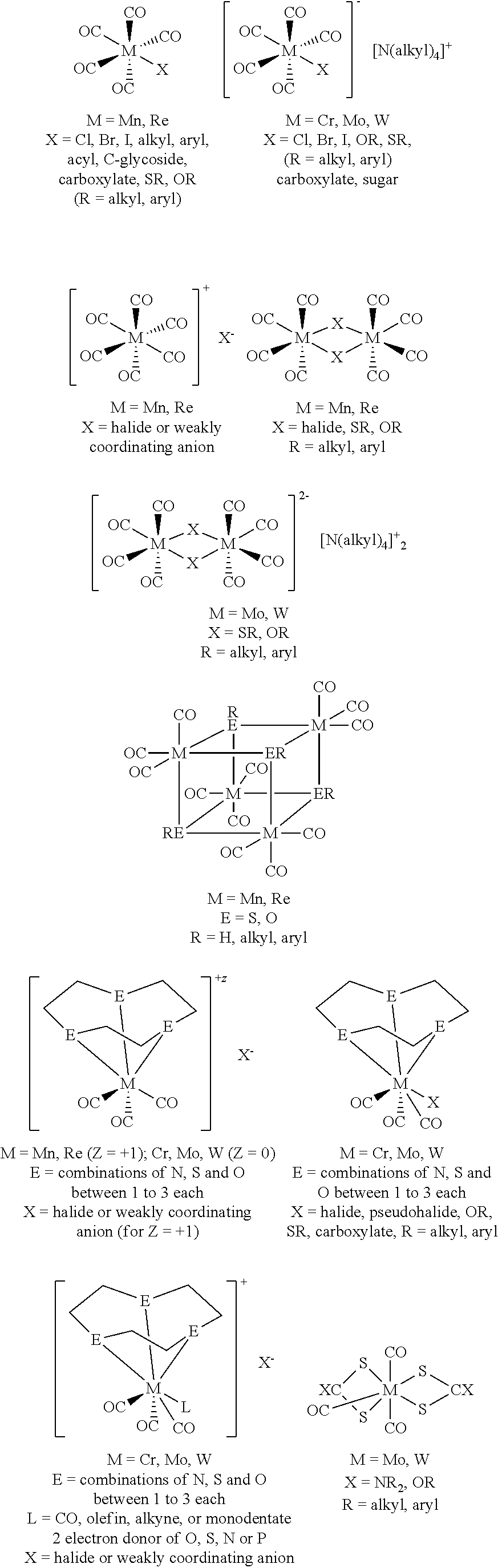


Class 2—CO Containing Organometallic Complexes Linked to other Pharmacologically Important Molecules.

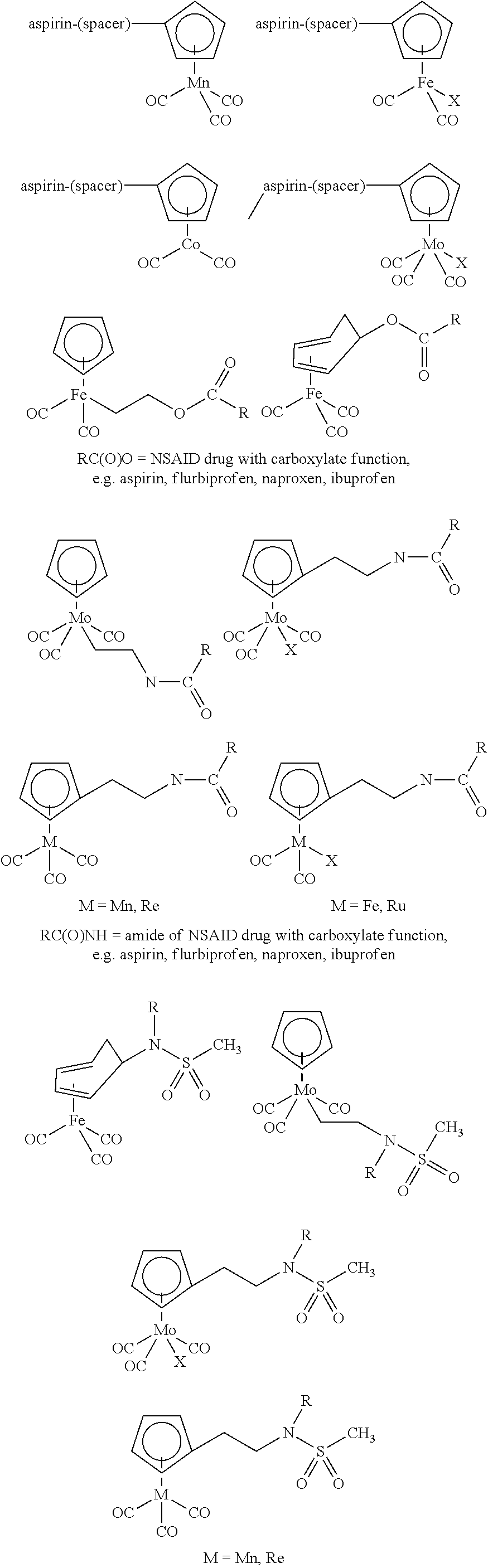


Class 3: Encapsulated Supramolecular Aggregates made of CO Containing Organometallic Complexes.


Class 5—CO Containing Inorganic Complexes Bearing Ligands Containing N and/or S Donors that Function as Reversible CO Carriers, Modified by Linkage to other Pharmacologically Important Molecules.

Class 6—Organic Substances that Release CO Either by an Enzymatic Process or by Decarbonylation.

Class 7—Encapsulated Organic Substances that Release CO either by an Enzymatic Process or by Decarbonylation


Claims (7)


Priority Applications (1)
| Application Number | Priority Date | Filing Date | Title |
|---|---|---|---|
| US13/078,735 US9023402B2 (en) | 2002-02-04 | 2011-04-01 | Method for treating a mammal by administration of a compound having the ability to release CO |
Applications Claiming Priority (5)
| Application Number | Priority Date | Filing Date | Title |
|---|---|---|---|
| US35323302P | 2002-02-04 | 2002-02-04 | |
| US10/356,738 US7011854B2 (en) | 2002-02-04 | 2003-02-03 | Method for treating a mammal by administration of a compound having the ability to release CO, compounds having the ability to release CO and pharmaceutical compositions thereof |
| US11/288,670 US20060148900A1 (en) | 2002-02-04 | 2005-11-29 | Method for treating a mammal by administration of a compound having the ability to release CO, compounds having the ability to release CO and pharmaceutical compositions thereof |
| US11/453,319 US7964220B2 (en) | 2002-02-04 | 2006-06-14 | Method for treating a mammal by administration of a compound having the ability to release CO |
| US13/078,735 US9023402B2 (en) | 2002-02-04 | 2011-04-01 | Method for treating a mammal by administration of a compound having the ability to release CO |
Related Parent Applications (1)
| Application Number | Title | Priority Date | Filing Date |
|---|---|---|---|
| US11/453,319 Continuation US7964220B2 (en) | 2002-02-04 | 2006-06-14 | Method for treating a mammal by administration of a compound having the ability to release CO |
Publications (2)
| Publication Number | Publication Date |
|---|---|
| US20110237546A1 US20110237546A1 (en) | 2011-09-29 |
| US9023402B2 true US9023402B2 (en) | 2015-05-05 |
Family
ID=27734286
Family Applications (4)
| Application Number | Title | Priority Date | Filing Date |
|---|---|---|---|
| US10/356,738 Expired - Fee Related US7011854B2 (en) | 2002-02-04 | 2003-02-03 | Method for treating a mammal by administration of a compound having the ability to release CO, compounds having the ability to release CO and pharmaceutical compositions thereof |
| US11/288,670 Abandoned US20060148900A1 (en) | 2002-02-04 | 2005-11-29 | Method for treating a mammal by administration of a compound having the ability to release CO, compounds having the ability to release CO and pharmaceutical compositions thereof |
| US11/453,319 Expired - Fee Related US7964220B2 (en) | 2002-02-04 | 2006-06-14 | Method for treating a mammal by administration of a compound having the ability to release CO |
| US13/078,735 Expired - Lifetime US9023402B2 (en) | 2002-02-04 | 2011-04-01 | Method for treating a mammal by administration of a compound having the ability to release CO |
Family Applications Before (3)
| Application Number | Title | Priority Date | Filing Date |
|---|---|---|---|
| US10/356,738 Expired - Fee Related US7011854B2 (en) | 2002-02-04 | 2003-02-03 | Method for treating a mammal by administration of a compound having the ability to release CO, compounds having the ability to release CO and pharmaceutical compositions thereof |
| US11/288,670 Abandoned US20060148900A1 (en) | 2002-02-04 | 2005-11-29 | Method for treating a mammal by administration of a compound having the ability to release CO, compounds having the ability to release CO and pharmaceutical compositions thereof |
| US11/453,319 Expired - Fee Related US7964220B2 (en) | 2002-02-04 | 2006-06-14 | Method for treating a mammal by administration of a compound having the ability to release CO |
Country Status (11)
| Country | Link |
|---|---|
| US (4) | US7011854B2 (en) |
| EP (3) | EP2319518A1 (en) |
| JP (1) | JP2005519928A (en) |
| CN (1) | CN1646140A (en) |
| AU (2) | AU2003208525B9 (en) |
| BR (1) | BR0307420A (en) |
| CA (1) | CA2475209A1 (en) |
| NZ (1) | NZ534912A (en) |
| RU (1) | RU2004126950A (en) |
| WO (1) | WO2003066067A2 (en) |
| ZA (1) | ZA200406711B (en) |
Cited By (4)
| Publication number | Priority date | Publication date | Assignee | Title |
|---|---|---|---|---|
| US9163044B2 (en) | 2011-04-19 | 2015-10-20 | Alfama, Inc. | Carbon monoxide releasing molecules and uses thereof |
| US9611286B2 (en) | 2011-07-21 | 2017-04-04 | Alfama, Inc. | Ruthenium carbon monoxide releasing molecules and uses thereof |
| US10500217B2 (en) | 2018-04-30 | 2019-12-10 | Leslie Ray Matthews, M.D., Llc | Vitamin D3, heat shock proteins, and glutathione for the treatment of chronic inflammation and chronic diseases |
| WO2021191464A1 (en) | 2020-03-27 | 2021-09-30 | Instituto de Medicina Molecular João Lobo Antunes | Use of conjugates comprising tumour-selective ligands and groups capable of releasing carbon monoxide (co), for exerting immunomodulatory effects in cancer treatment |
Families Citing this family (55)
| Publication number | Priority date | Publication date | Assignee | Title |
|---|---|---|---|---|
| US8128963B2 (en) * | 1996-09-27 | 2012-03-06 | The Trustees Of Columbia University In The City Of New York | Methods for treating ischemic disorders using carbon monoxide |
| US7678390B2 (en) * | 1999-04-01 | 2010-03-16 | Yale University | Carbon monoxide as a biomarker and therapeutic agent |
| US20040014099A1 (en) * | 2001-03-19 | 2004-01-22 | Decode Genetics Ehf. | Susceptibility gene for human stroke; methods of treatment |
| GB0111872D0 (en) * | 2001-05-15 | 2001-07-04 | Northwick Park Inst For Medica | Therapeutic agents and methods |
| US7238469B2 (en) * | 2001-06-21 | 2007-07-03 | Beth Israel Deaconess Medical Center, Inc. | Carbon monoxide improves outcomes in tissue and organ transplants and suppresses apoptosis |
| US20080026984A1 (en) * | 2002-02-04 | 2008-01-31 | Alfama - Investigacao E Desenvolvimento De Productos Farmaceuticos Lda | Methods for treating inflammatory disease by administering aldehydes and derivatives thereof |
| EP2319518A1 (en) * | 2002-02-04 | 2011-05-11 | ALFAMA-Investigacao e Desenvolvimento de Produtos Farmaceuticos Lda. | Use of CO-releasing compounds for the manufacture of a medicament for the treatment of inflammatory diseases |
| US7968605B2 (en) * | 2002-02-04 | 2011-06-28 | ALFAMA—Investigação e Desenvolvimento de Produtos Farmacêuticos, Lda. | Methods for treating inflammatory disease by administering aldehydes and derivatives thereof |
| KR20040096571A (en) * | 2002-02-13 | 2004-11-16 | 베쓰 이스라엘 디코니스 메디칼 센터 인크 | Methods of treating vascular disease |
| ES2546280T3 (en) * | 2002-04-15 | 2015-09-22 | University Of Pittsburgh - Of The Commonwealth System Of Higher Education | Carbon monoxide for use in a method to treat ileus |
| EP1499328B1 (en) * | 2002-04-15 | 2015-09-16 | University of Pittsburgh - Of the Commonwealth System of Higher Education | Methods of treating necrotizing enterocolitis |
| WO2003088748A1 (en) | 2002-04-15 | 2003-10-30 | Beth Israel Deaconess Medical Center | Use of heme oxygenase-1 and products of heme degradation |
| CA2485465A1 (en) * | 2002-05-17 | 2003-11-27 | Yale University | Methods of treating hepatitis |
| CA2487413A1 (en) * | 2002-06-05 | 2003-12-18 | Yale University | Methods of treating angiogenesis, tumor growth, and metastasis |
| AU2003283982A1 (en) * | 2002-11-07 | 2004-06-03 | University Of Pittsburgh Of The Commonwealth System Of High Education | Treatment for hemorrhagic shock |
| GB2395432B (en) * | 2002-11-20 | 2005-09-14 | Northwick Park Inst For Medica | Therapeutic delivery of carbon monoxide to extracorporeal and isolated organs |
| EP1445886B1 (en) | 2003-01-31 | 2015-05-20 | Ntt Docomo, Inc. | Multiple-output multiple-input (MIMO) communication system, MIMO receiver and MIMO receiving method |
| US20070207217A1 (en) * | 2003-02-03 | 2007-09-06 | Alfama - Investigacao E Desenvolvimento De Productos Farmaceuticos Lda | Method for treating a mammal by administration of a compound having the ability to release CO |
| CA2534415A1 (en) * | 2003-08-04 | 2005-02-17 | Northwick Park Institute For Medical Research | Therapeutic delivery of carbon monoxide |
| US7462405B2 (en) | 2003-12-05 | 2008-12-09 | Eastman Kodak Company | Organic element for electroluminescent devices |
| US20050196868A1 (en) * | 2004-03-03 | 2005-09-08 | The Charlotte-Mecklenburg Hospital Authority | Use of free hemoglobin and its surrogate markers to detect and monitor pulmonary hypertension |
| CA2560212A1 (en) * | 2004-03-18 | 2005-09-22 | Ibet-Instituto De Biologia Experimental E Tecnologica | Compositions comprising organometallic molybdenum compounds for treating cancer |
| US20070207993A1 (en) * | 2005-12-20 | 2007-09-06 | Alfama - Investigacao E Desenvolvimetno De Productos Farmaceuticos Lda | Molybdenum carbonyl complexes for treating rheumatoid arthritis and other inflammatory diseases |
| GB0601394D0 (en) * | 2006-01-24 | 2006-03-01 | Hemocorm Ltd | Therapeutic delivery of carbon monoxide |
| DE102006020492A1 (en) * | 2006-04-21 | 2007-10-25 | Novalung Gmbh | Use of acetylsalicylic acid (ASA) when using a membrane lung |
| GB0613362D0 (en) * | 2006-07-05 | 2006-08-16 | Hemocorm Ltd | Therapeutic delivery of carbon monoxide |
| WO2008069688A2 (en) * | 2006-12-06 | 2008-06-12 | Alfama - Investigação E Desenvolvimento De Produtos Farmacêuticos Lda | Methods for treating inflammatory disease by administering aldehydes and derivatives thereof |
| US20080160064A1 (en) * | 2006-12-22 | 2008-07-03 | Capelli Christopher C | Devices and methods for inhibiting fibrosis |
| RU2331441C1 (en) * | 2006-12-27 | 2008-08-20 | Институт прикладной механики УрО РАН | Hyper-gassed and hyper-osmotic antiseptic mixture |
| WO2008130261A1 (en) * | 2007-04-24 | 2008-10-30 | Alfama - Investigaçao E Desenvolvimento De Produtos Farmaceuticos Lda. | Treatment of infections by carbon monoxide |
| ATE555795T1 (en) * | 2007-07-24 | 2012-05-15 | Alfama Investigacao E Desenvolvimento De Productos Farmaceuticos Lda | PREVENTING STOMACH ULCER WITH CARBON MONOXIDE |
| EP2545064B1 (en) * | 2010-03-08 | 2020-05-06 | University of Zürich | Carbon monoxide releasing rhenium compounds for medical use |
| DE102010014412A1 (en) * | 2010-04-08 | 2012-04-19 | Friedrich-Schiller-Universität Jena | Use of dinuclear iron complexes having sulfur-containing ligands as carbon monoxide-releasing pharmacological agents e.g. for treating hypertension, cancer, tissue damage by irradiation, post-ischemic injury, atherosclerosis or sepsis |
| EP2663193B1 (en) * | 2011-01-14 | 2019-05-08 | Children's Hospital Los Angeles | Solution of carbon monoxide for treatment of disease, including sickle cell disease |
| US8927750B2 (en) | 2011-02-04 | 2015-01-06 | Universitaet Zu Koeln | Acyloxy- and phosphoryloxy-butadiene-Fe(CO)3 complexes as enzyme-triggered co-releasing molecules |
| KR101398368B1 (en) | 2011-03-16 | 2014-05-22 | 울산대학교 산학협력단 | Composition comprising carbon monoxide or carbon monoxide donor for preventing or treating menopausal syndrome |
| CN102850403B (en) * | 2012-05-29 | 2015-01-14 | 嘉兴学院 | Water-soluble iron carbonyl compound, and preparation method and application thereof |
| EP2868348A1 (en) * | 2013-11-04 | 2015-05-06 | Universität Zürich | CO-releasing compounds & formulations thereof useful for inducing mitochondrial biogenesis and tissue repair |
| CN103920456B (en) * | 2014-03-25 | 2015-12-30 | 陕西师范大学 | Based on the carbon monoxide releasable material and preparation method thereof of natural clay |
| DE102014008537A1 (en) * | 2014-06-04 | 2015-12-17 | Friedrich-Schiller-Universität Jena | Water-soluble manganese-based carbon monoxide releasing molecules, their use and processes for their preparation |
| WO2015191616A1 (en) | 2014-06-09 | 2015-12-17 | Georgia State University Research Foundation, Inc. | Carbon monoxide-releasing molecules for therapeutic applications and methods of making and using thereof |
| EP3319613B1 (en) | 2015-07-07 | 2023-02-22 | The Research Foundation for The State University of New York | Use of amine carboxyboranes as therapeutic delivery of carbon monoxide and as general drug delivery system in the presence of reactive oxygen species |
| CN107625954A (en) * | 2016-07-19 | 2018-01-26 | 上海本素医药科技有限公司 | Homopure containing carbon monoxide and its application in anti-inflammatory |
| US11420994B2 (en) | 2016-11-16 | 2022-08-23 | Georgia State University Research Foundation, Inc. | Carbon-monoxide-releasing molecules and therapeutic applications thereof |
| WO2019032879A1 (en) * | 2017-08-09 | 2019-02-14 | Georgia State University Research Foundation, Inc. | Carbon monoxide-releasing molecules triggered by physiological stimuli |
| CN113365617B (en) * | 2018-10-16 | 2025-12-23 | 乔治亚州立大学研究基金会股份有限公司 | Carbon monoxide prodrugs for medical treatment |
| CN110585215B (en) * | 2019-09-19 | 2023-06-02 | 中山大学 | New Application of Hemin and Its Compounds in Medicine |
| WO2021153197A1 (en) * | 2020-01-27 | 2021-08-05 | 学校法人同志社 | Carbon monoxide quantification method and carbon monoxide measurement kit |
| US12691140B2 (en) | 2020-09-08 | 2026-07-28 | The Brigham And Women's Hospital, Inc. | Therapeutic carbon monoxide formulations |
| WO2022109086A1 (en) * | 2020-11-18 | 2022-05-27 | Proterris, Inc. | Carbon monoxide releasing molecules and pharmaceutical compositions and uses thereof |
| CN113620983B (en) * | 2021-09-02 | 2022-05-27 | 山西大学 | Light-operated organic CO donor molecule and preparation method and application thereof |
| CN115010939B (en) * | 2022-04-22 | 2023-04-28 | 深圳先进技术研究院 | Carbonyl siderophore capable of responding to release of carbon monoxide and preparation method and application thereof |
| CN118105489A (en) * | 2024-02-05 | 2024-05-31 | 温州医科大学附属口腔医院 | Synergistic antibacterial nanoplatform based on CO and AIEgens and its preparation method and application |
| WO2025254524A1 (en) * | 2024-06-05 | 2025-12-11 | Rijksuniversiteit Groningen | Carbon monoxide releasing therapeutic compounds and methods, products and uses related thereto |
| CN119385952B (en) * | 2025-01-02 | 2025-04-04 | 合肥市第一人民医院 | Nanometer assembly capable of releasing CO automatically, preparation method and application thereof |
Citations (134)
| Publication number | Priority date | Publication date | Assignee | Title |
|---|---|---|---|---|
| US2870180A (en) | 1955-10-13 | 1959-01-20 | Ethyl Corp | Process for the preparation of hydrocarbon manganese carbonyl compounds |
| US3065250A (en) | 1960-05-13 | 1962-11-20 | Hercules Powder Co Ltd | Nitrile-metal carbonyl complexes |
| US3278570A (en) | 1961-04-11 | 1966-10-11 | Ethyl Corp | Molybdenum pentacarbonyl compounds and process for preparing same |
| GB1107510A (en) | 1964-06-15 | 1968-03-27 | Merck & Co Inc | Substituted araliphatic aldehydes and their acetals |
| GB1118728A (en) | 1966-04-28 | 1968-07-03 | James Kaye | Improvements in or relating to the shaping of thermoplastic sheeting |
| US3694232A (en) | 1970-06-04 | 1972-09-26 | Int Flavors & Fragrances Inc | Flavoring methods and compositions containing 3-phenyl pentenals |
| US3812166A (en) | 1968-09-13 | 1974-05-21 | Schering Ag | Dichloro-substituted estradiene |
| US3829504A (en) | 1970-06-04 | 1974-08-13 | Int Flavors & Fragrances Inc | Novel di-lower alkyl and lower alkylene acetals of 2-and 3-phenyl-pentenals |
| US3980583A (en) | 1974-02-19 | 1976-09-14 | Mobil Oil Corporation | Complexed metals bonded to inorganic oxides |
| US4189487A (en) | 1977-03-17 | 1980-02-19 | Josef Klosa | Use of pyridine aldehydes for the prevention and treatment of acne vulgaris |
| US4312989A (en) | 1979-08-21 | 1982-01-26 | The United States Of America As Represented By The Secretary Of The Army | Pharmacologically active amine boranes |
| US4322411A (en) | 1980-04-25 | 1982-03-30 | Burroughs Wellcome Co. | Anti-inflammatory nucleosides |
| EP0034238B1 (en) | 1979-12-21 | 1985-04-17 | Duke University | Pharmacologically active amine-carboxyboranes |
| US4535167A (en) | 1981-12-14 | 1985-08-13 | Merck & Co. Inc. | Chiral, N-protected, N-substituted α-amino acids |
| WO1985004326A1 (en) | 1984-03-23 | 1985-10-10 | Biocompatibles Ltd. | Polymeric liposomes as stable gas carriers |
| EP0076493B1 (en) | 1981-10-02 | 1986-08-06 | Dragoco Gerberding & Co. GmbH | Use of 1,1-di(c1-c6-alkyl)-2-phenyl-ethane derivatives as aroma chemicals |
| US4613621A (en) | 1981-09-18 | 1986-09-23 | Hoerrmann Wilhelm | Fatty aldehydes and acids in the treatment of neurological and inflammatory diseases |
| US4649151A (en) | 1982-09-27 | 1987-03-10 | Health Research, Inc. | Drugs comprising porphyrins |
| US4657902A (en) | 1985-03-25 | 1987-04-14 | The Rockefeller University | Therapeutic use of tin mesoporphyrin |
| US4668670A (en) | 1986-06-20 | 1987-05-26 | The Rockefeller University | Tin diiododeuteroporphyrin and therapeutic use thereof |
| US4699903A (en) | 1986-06-20 | 1987-10-13 | The Rockefeller University | Therapeutic use of tin diiododeuteroporphyrin |
| US4709083A (en) | 1986-05-19 | 1987-11-24 | The United States Of America As Represented By The Secretary Of The Army | Method of making boron analogues |
| US4792452A (en) | 1987-07-28 | 1988-12-20 | E. R. Squibb & Sons, Inc. | Controlled release formulation |
| EP0181721B1 (en) | 1984-10-25 | 1989-08-02 | Duke University | Esters of boron analogues of amino acids |
| US4910211A (en) | 1987-08-07 | 1990-03-20 | Kanebo Ltd. | Novel benzothiazole and antirheumatic agent comprising it as an active ingredient |
| US4938949A (en) | 1988-09-12 | 1990-07-03 | University Of New York | Treatment of damaged bone marrow and dosage units therefor |
| WO1991001128A1 (en) | 1989-07-25 | 1991-02-07 | Eastman Kodak Company | Skin composition to repair the efffects of photoaging |
| WO1991001301A1 (en) | 1989-07-25 | 1991-02-07 | Eastman Kodak Company | Compound and method for treating skin for acne or psoriasis |
| US5010073A (en) | 1989-10-05 | 1991-04-23 | The Rockefeller University | Use of liposomes as carriers for metalloporphyrins |
| DE4014762A1 (en) | 1990-05-05 | 1991-11-07 | Martin Prof Dr Wenzel | CONNECTIONS TO RADIATION THERAPY OR DIAGNOSTICS BY ABSORPTION FROM MOESSBAUER RADIATION |
| WO1992003402A1 (en) | 1990-08-24 | 1992-03-05 | Firmenich Sa | Polycyclic ketone compound and use thereof as perfuming ingredient |
| WO1992004905A1 (en) | 1990-09-14 | 1992-04-02 | Abraham Nader G | Method for treating eye disorders by reducing 12(r)-hydroxyeicosatetraenoic acid and 12(r)-dihydroxyeicosatrienoic acid levels |
| WO1993005795A1 (en) | 1991-09-13 | 1993-04-01 | Boron Biologicals, Inc. | Method of combatting osteoporosis and other disease states in mammalian subjects, utilizing organic boron compounds |
| US5254706A (en) | 1991-05-10 | 1993-10-19 | Boron Biologicals, Inc. | Process of making phosphite-borane compounds |
| WO1994001413A1 (en) | 1992-07-07 | 1994-01-20 | Boron Biologicals, Inc. | Boronated compounds |
| GB2271351A (en) | 1992-10-08 | 1994-04-13 | Merck Patent Gmbh | Carbocyclyl-phenyl-pyrazines and liquid crystalline media |
| US5350767A (en) | 1987-11-19 | 1994-09-27 | Aktiebolaget Draco | Derivatives of cysteine |
| WO1994022482A1 (en) | 1993-03-26 | 1994-10-13 | Biorelease Technologies, Inc. | Compositions including heme-containing proteins and methods relating thereto |
| WO1995005814A1 (en) | 1993-08-25 | 1995-03-02 | Johnson Matthey Public Limited Company | Pharmaceutical compositions comprising metal complexes |
| WO1995009831A1 (en) | 1993-10-06 | 1995-04-13 | Nicox S.A. | Nitric esters having anti-inflammatory and/or analgesic activity and process for their preparation |
| US5447939A (en) | 1994-07-25 | 1995-09-05 | Glasky; Alvin J. | Carbon monoxide dependent guanylyl cyclase modifiers and methods of use |
| HU211084B (en) | 1990-04-20 | 1995-10-30 | Brezo | Process for producing oral pharmaceutical composition of bone strengthening activity |
| GB2271385B (en) | 1992-10-10 | 1995-12-06 | Richard Charles Harden | Letter receptacle |
| WO1995035105A1 (en) | 1994-06-18 | 1995-12-28 | Lts Lohmann Therapie-Systeme Gmbh & Co. Kg | Transdermal therapeutic system with active substances constituting sources of carbon monoxide |
| WO1996003125A1 (en) | 1994-07-25 | 1996-02-08 | Glasky Alvin J | Carbon monoxide dependent guanylyl cyclase modifiers |
| WO1996009038A3 (en) | 1994-09-22 | 1996-06-13 | William Harvey Research Limite | Alteration of activity and/or levels of haem-oxygenase to control inflammation |
| US5621000A (en) | 1992-11-26 | 1997-04-15 | Nicox S.A. | Nitric esters having a pharmacological activity and process for their preparation |
| WO1997016405A1 (en) | 1995-10-31 | 1997-05-09 | Nicox S.A. | New compounds and their compositions having anti-inflammatory and anti-thrombotic activities |
| US5631284A (en) | 1993-10-06 | 1997-05-20 | University Of British Columbia | Compositions and methods for relaxing smooth muscles |
| US5664563A (en) | 1994-12-09 | 1997-09-09 | Cardiopulmonary Corporation | Pneumatic system |
| US5670664A (en) | 1995-09-08 | 1997-09-23 | University Of Maryland Biotechnology Institute | Photosensitive organic compounds that release carbon monoxide upon illumination |
| WO1997036615A1 (en) | 1996-04-01 | 1997-10-09 | President And Fellows Of Harvard College | Regulation of vascular smooth muscle cell heme oxygenase-1 |
| WO1997037644A1 (en) | 1996-04-05 | 1997-10-16 | The General Hospital Corporation | Treatment of a hemoglobinopathy |
| EP0632026B1 (en) | 1993-06-30 | 1997-11-19 | Adir Et Compagnie | Alpha amino acid derivatives, a method for their preparation and pharmaceutical preparations containing them |
| WO1998013058A1 (en) | 1996-09-27 | 1998-04-02 | The Trustees Of Columbia University In The City Of New York | Methods for treating an ischemic disorder and improving stroke outcome |
| WO1998009618A3 (en) | 1996-09-09 | 1998-05-07 | Sangstat Medical Corp | Graft survival prolongation with porphyrins |
| US5767157A (en) | 1996-01-16 | 1998-06-16 | Van Moerkerken; Arthur | Arthritic pain prevention method and compositions |
| US5801184A (en) | 1994-07-25 | 1998-09-01 | Glasky; Alvin J. | Carbon monoxide dependent guanylyl cyclase modifiers and methods of use |
| WO1998038179A1 (en) | 1997-02-26 | 1998-09-03 | Glaxo Group Limited | Reverse hydroxamate derivatives as metalloprotease inhibitors |
| US5811463A (en) | 1993-10-06 | 1998-09-22 | University Of British Columbia | Compositions and method for relaxing smooth muscles |
| WO1998048848A1 (en) | 1997-04-25 | 1998-11-05 | Mallinckrodt Inc. | Method for the preparation of facial metal tricarbonyl compounds and their use in the labelling of biologically active substrates |
| US5861426A (en) | 1994-05-10 | 1999-01-19 | Nicox S.A. | Nitro compounds of the formula A-Xi -NO2 and their compositions having anti-inflammatory, analgesic and anti-thrombotic activities |
| US5891689A (en) | 1994-04-12 | 1999-04-06 | Innovir Laboratories, Inc. | Heme-bearing microparticles for targeted delivery of drugs |
| WO1999067231A1 (en) | 1998-06-19 | 1999-12-29 | Nicox S.A. | Nitrate salts of antihypertensive medicines |
| US6025394A (en) | 1999-01-29 | 2000-02-15 | Cell Pathways, Inc. | Method for treating patients with acne by administering substituted sulfonyl indenyl acetic acids, amides and alcohols |
| US6025376A (en) | 1995-10-20 | 2000-02-15 | Schering Aktiengesellschaft | Chiral methylphenyloxazolidinones |
| US6051576A (en) | 1994-01-28 | 2000-04-18 | University Of Kentucky Research Foundation | Means to achieve sustained release of synergistic drugs by conjugation |
| WO2000021965A1 (en) | 1998-10-13 | 2000-04-20 | Brown University Research Foundation | Substituted perhalogenated phthalocyanines |
| US6066333A (en) | 1994-09-22 | 2000-05-23 | William Harvey Research Limited | Pharmaceutical control of inflammation |
| WO2000036113A2 (en) | 1998-12-17 | 2000-06-22 | Sangstat Medical Corporation | Extending graft survival by heme oxygenase-i expression induced immunomodulation |
| WO2000010613A3 (en) | 1998-08-21 | 2000-07-06 | Univ Michigan | Inhibition of smooth muscle cell migration by heme oxygenase 1 |
| WO2000056145A1 (en) | 1999-03-23 | 2000-09-28 | James Cook University | Organ arrest, protection and preservation |
| WO2000056743A1 (en) | 1999-03-19 | 2000-09-28 | Anormed Inc. | Pharmaceutical compositions comprising metal complexes |
| US6211233B1 (en) | 1997-06-19 | 2001-04-03 | Nicox S.A. | Prostaglandin pharmaceutical compositions |
| WO2001025243A1 (en) | 1999-10-05 | 2001-04-12 | Mallinckrodt Inc. | Carbon monoxide source for preparation of transition-metal-carbonyl-complexes |
| US6218417B1 (en) | 1997-06-27 | 2001-04-17 | Nicox, S.A. | Ace-inhibitor nitric salts |
| US6242432B1 (en) | 1996-11-14 | 2001-06-05 | Nicox S.A. | Antithrombotic organic nitrates |
| US6251927B1 (en) | 1999-04-20 | 2001-06-26 | Medinox, Inc. | Methods for treatment of sickle cell anemia |
| US6284752B1 (en) | 1993-08-25 | 2001-09-04 | Anormed Inc. | Pharmaceutical compositions comprising metal complexes |
| WO2000061537A3 (en) | 1999-04-13 | 2001-09-27 | Nicox Sa | Pharmaceutical compounds |
| US6331564B1 (en) | 1994-09-16 | 2001-12-18 | Ion Pharmaceuticals, Inc. | Use of triaryl methane compounds for inhibiting unwanted cellular proliferation associated with inflammatory disease |
| US6338963B1 (en) | 1994-07-25 | 2002-01-15 | Neotherapeutics, Inc. | Use of carbon monoxide dependent guanylyl cyclase modifiers to stimulate neuritogenesis |
| US6344178B1 (en) | 1997-04-25 | 2002-02-05 | Mallinckrodt Inc. | Method for the preparation of facial metal tricarbonyl compounds and their use in the labelling of biologically active substrates |
| US20020043595A1 (en) | 2000-04-05 | 2002-04-18 | Bridgers Jerry S. | Medical gas utility stand |
| US20020045611A1 (en) | 1993-08-25 | 2002-04-18 | Abrams Michael J. | Pharmaceutical compositions comprising metal complexes |
| FR2816212A1 (en) | 2000-11-03 | 2002-05-10 | Air Liquide Sante Int | Use of carbon monoxide to treat or prevent cardiovascular inflammation e.g. ischemia, reperfusion, stenosis, restenosis, and platelet aggregation |
| WO2001016359A3 (en) | 1999-08-31 | 2002-05-10 | Univ London | Screen for axon viability |
| WO2001012584A3 (en) | 1999-08-12 | 2002-08-29 | Nicox Sa | Pharmaceutical compounds |
| WO2002080923A1 (en) | 2001-04-07 | 2002-10-17 | Universitätsklinikum Charitè | Substances for use in therapy of diseases that are caused by highly proliferative cells |
| US20020155166A1 (en) | 1999-04-01 | 2002-10-24 | Yale University | Carbon monoxide as a biomarker and therapeutic agent |
| WO2002092075A2 (en) | 2001-05-15 | 2002-11-21 | Northwick Park Institute For Medical Research | Therapeutic delivery of carbon monoxide |
| US20020193363A1 (en) | 1996-02-26 | 2002-12-19 | Bridger Gary J. | Use of nitric oxide scavengers to modulate inflammation and matrix metalloproteinase activity |
| WO2002078684A3 (en) | 2001-03-30 | 2002-12-19 | Sangstat Medical Corp | Carbon monoxide generating compounds for treatment of vascular, inflammatory and immune disorders |
| US6518269B1 (en) | 2000-07-28 | 2003-02-11 | University Of Arizona Foundation | Cancer treatment |
| US20030039638A1 (en) | 2001-06-21 | 2003-02-27 | Bach Fritz H. | Carbon monoxide improves outcomes in tissue and organ transplants and suppresses apoptosis |
| WO2002092072A3 (en) | 2001-05-15 | 2003-05-01 | Nicox Sa | Drugs for the treatment of the alzheimer disease |
| US20030124157A1 (en) | 2001-11-16 | 2003-07-03 | Engles Charles R. | Compositions containing aromatic aldehydes and their use in treatments |
| US20030157154A1 (en) | 2002-01-04 | 2003-08-21 | Bryan Fuller | Compositions containing hydroxy aromatic aldehydes and their use in treatments |
| WO2003088981A1 (en) | 2002-04-15 | 2003-10-30 | University Of Pittsburgh Of The Commonwealth System Of Higher Education | Methods of treating necrotizing enterocolitis |
| US20030207786A1 (en) | 1998-10-23 | 2003-11-06 | Miracle Gregory Scot | Fragrance pro-accords and aldehyde and ketone fragrance libraries |
| US6645938B2 (en) | 2000-10-10 | 2003-11-11 | Zymogenetics, Inc. | Protection against ischemia and reperfusion injury |
| WO2003067598A3 (en) | 2002-02-06 | 2003-11-13 | Koninkl Philips Electronics Nv | Reading circuit for reading a memory cell |
| WO2003094932A1 (en) | 2002-05-09 | 2003-11-20 | Yale University | Carbon monoxide as a biomarker and therapeutic agent |
| US20030219497A1 (en) | 2002-04-15 | 2003-11-27 | Otterbein Leo E. | Methods of treating ileus |
| US20030219496A1 (en) | 2002-02-13 | 2003-11-27 | Otterbein Leo E. | Methods of treating vascular disease |
| US6673908B1 (en) | 1999-02-22 | 2004-01-06 | Nuvelo, Inc. | Tumor necrosis factor receptor 2 |
| WO2003066067A3 (en) | 2002-02-04 | 2004-02-05 | Werner Haas | Use of co-releasing compounds for the manufacture of a medicament for the treatment of inflammatory diseases |
| WO2003096977A3 (en) | 2002-05-17 | 2004-03-11 | Univ Yale | Methods of treating hepatitis |
| WO2004029033A1 (en) | 2002-09-27 | 2004-04-08 | Kao Corporation | Valerolactone compounds and perfume composition |
| GB2395431A (en) | 2002-11-20 | 2004-05-26 | Northwick Park Inst For Medica | Combination of a metal carbonyl compound and a guanylate cyclase stimulant or stabilizer for the therapeutic delivery of carbon monoxide |
| GB2395432A (en) | 2002-11-20 | 2004-05-26 | Northwick Park Inst For Medica | Therapeutic delivery of carbon monoxide using metal carbonyl complexes |
| US20040122091A1 (en) | 2000-10-11 | 2004-06-24 | Esperion Therapeutics, Inc. | Sulfoxide and bis-sulfoxide compounds and compositions for cholesterol management and related uses |
| US20040131703A1 (en) | 2002-06-21 | 2004-07-08 | Bach Fritz H. | Pharmaceutical use of nitric oxide, heme oxygenase-1 and products of heme degradation |
| WO2004043341A3 (en) | 2002-11-07 | 2004-07-15 | Univ Pittsburgh | Treatment for hemorrhagic shock |
| US20040143025A1 (en) | 2002-04-01 | 2004-07-22 | Roland Buelow | Carbon monoxide generating compunds for treatment of vascular, inflammatory and immune disorders |
| WO2003103585A3 (en) | 2002-06-05 | 2004-08-26 | Univ Yale | METHODS OF TREATING ANGIOGENESIS, TUMOR GROWTH AND METASTASES |
| US20040214900A1 (en) | 2003-04-28 | 2004-10-28 | Forbes Wayne M. | Method of treating strongyloides infections and medicaments therefor |
| WO2004080420A3 (en) | 2003-03-12 | 2004-11-25 | Maria M Mota | A method for the prevention of malaria infection of humans by hepatocyte growth factor antagonists |
| WO2005013691A1 (en) | 2003-08-04 | 2005-02-17 | Hemocorm Limited | Use of boranocarbonates for the therapeutic delivery of carbon monoxide |
| US20050048133A1 (en) | 1996-09-27 | 2005-03-03 | The Trustees Of Columbia University In The City Of New York | Methods for treating ischemic disorders using carbon monoxide |
| US20050175555A1 (en) | 2002-05-07 | 2005-08-11 | Riccardo Stradi | Polyunsaturated linear aldehydes and their derivatives with anti-radical and anti-tumoral activity |
| WO2005090400A1 (en) | 2004-03-18 | 2005-09-29 | The University Court Of The University Of Glasgow | Immunosuppressive cytokine |
| WO2006012215A1 (en) | 2004-06-24 | 2006-02-02 | Flexitral, Inc. | Novel aldehydic musks and derivatives thereof |
| US20070049640A1 (en) | 2005-08-24 | 2007-03-01 | Cumberland Pharmaceuticals, Inc. | Acetylcysteine composition and uses therefor |
| WO2007073226A1 (en) | 2005-12-20 | 2007-06-28 | Alfama - Investigação E Desenvolvimento De Produtos Farmacêuticos Lda | Method for treating a mammal by administration of a compound having the ability to release co |
| US20070207993A1 (en) | 2005-12-20 | 2007-09-06 | Alfama - Investigacao E Desenvolvimetno De Productos Farmaceuticos Lda | Molybdenum carbonyl complexes for treating rheumatoid arthritis and other inflammatory diseases |
| US20070219120A1 (en) | 2002-02-04 | 2007-09-20 | Alfama - Investigacao E Desenvolvimento De Productos Farmaceuticos Lda | Methods for treating inflammatory disease by administering aldehydes and derivatives thereof |
| WO2007085806A3 (en) | 2006-01-24 | 2007-12-27 | Hemocorm Ltd | Therapeutic delivery of carbon monoxide |
| WO2008003953A2 (en) | 2006-07-05 | 2008-01-10 | Hemocorm Limited | Therapeutic delivery of carbon monoxide |
| US20080026984A1 (en) | 2002-02-04 | 2008-01-31 | Alfama - Investigacao E Desenvolvimento De Productos Farmaceuticos Lda | Methods for treating inflammatory disease by administering aldehydes and derivatives thereof |
| WO2008069688A2 (en) | 2006-12-06 | 2008-06-12 | Alfama - Investigação E Desenvolvimento De Produtos Farmacêuticos Lda | Methods for treating inflammatory disease by administering aldehydes and derivatives thereof |
| WO2008130261A1 (en) | 2007-04-24 | 2008-10-30 | Alfama - Investigaçao E Desenvolvimento De Produtos Farmaceuticos Lda. | Treatment of infections by carbon monoxide |
| WO2009013612A1 (en) | 2007-07-24 | 2009-01-29 | Alfama - Investigação E Desenvolvimento De Produtos Farmacêuticos, Lda. | Prevention of gastric ulcery by carbon monoxide |
| US7569214B2 (en) | 2002-09-09 | 2009-08-04 | Nektar Therapeutics Al, Corporation | Method for preparing water-soluble polymer derivatives bearing a terminal carboxylic acid |
Family Cites Families (1)
| Publication number | Priority date | Publication date | Assignee | Title |
|---|---|---|---|---|
| US5621100A (en) | 1992-07-24 | 1997-04-15 | Cephalon, Inc. | K-252a derivatives for treatment of neurological disorders |
-
2003
- 2003-02-03 EP EP20100013181 patent/EP2319518A1/en not_active Withdrawn
- 2003-02-03 EP EP20080166507 patent/EP2042181A1/en not_active Withdrawn
- 2003-02-03 CN CNA03807575XA patent/CN1646140A/en active Pending
- 2003-02-03 AU AU2003208525A patent/AU2003208525B9/en not_active Ceased
- 2003-02-03 BR BR0307420A patent/BR0307420A/en not_active IP Right Cessation
- 2003-02-03 NZ NZ534912A patent/NZ534912A/en not_active IP Right Cessation
- 2003-02-03 JP JP2003565491A patent/JP2005519928A/en active Pending
- 2003-02-03 EP EP03706818A patent/EP1476168A2/en not_active Withdrawn
- 2003-02-03 WO PCT/IB2003/000932 patent/WO2003066067A2/en not_active Ceased
- 2003-02-03 US US10/356,738 patent/US7011854B2/en not_active Expired - Fee Related
- 2003-02-03 RU RU2004126950/14A patent/RU2004126950A/en not_active Application Discontinuation
- 2003-02-03 CA CA 2475209 patent/CA2475209A1/en not_active Abandoned
-
2004
- 2004-08-24 ZA ZA200406711A patent/ZA200406711B/en unknown
-
2005
- 2005-11-29 US US11/288,670 patent/US20060148900A1/en not_active Abandoned
-
2006
- 2006-06-14 US US11/453,319 patent/US7964220B2/en not_active Expired - Fee Related
-
2009
- 2009-07-02 AU AU2009202682A patent/AU2009202682A1/en not_active Abandoned
-
2011
- 2011-04-01 US US13/078,735 patent/US9023402B2/en not_active Expired - Lifetime
Patent Citations (187)
| Publication number | Priority date | Publication date | Assignee | Title |
|---|---|---|---|---|
| US2870180A (en) | 1955-10-13 | 1959-01-20 | Ethyl Corp | Process for the preparation of hydrocarbon manganese carbonyl compounds |
| US3065250A (en) | 1960-05-13 | 1962-11-20 | Hercules Powder Co Ltd | Nitrile-metal carbonyl complexes |
| US3278570A (en) | 1961-04-11 | 1966-10-11 | Ethyl Corp | Molybdenum pentacarbonyl compounds and process for preparing same |
| GB1107510A (en) | 1964-06-15 | 1968-03-27 | Merck & Co Inc | Substituted araliphatic aldehydes and their acetals |
| GB1118728A (en) | 1966-04-28 | 1968-07-03 | James Kaye | Improvements in or relating to the shaping of thermoplastic sheeting |
| US3812166A (en) | 1968-09-13 | 1974-05-21 | Schering Ag | Dichloro-substituted estradiene |
| US3694232A (en) | 1970-06-04 | 1972-09-26 | Int Flavors & Fragrances Inc | Flavoring methods and compositions containing 3-phenyl pentenals |
| US3829504A (en) | 1970-06-04 | 1974-08-13 | Int Flavors & Fragrances Inc | Novel di-lower alkyl and lower alkylene acetals of 2-and 3-phenyl-pentenals |
| US3980583A (en) | 1974-02-19 | 1976-09-14 | Mobil Oil Corporation | Complexed metals bonded to inorganic oxides |
| US4189487A (en) | 1977-03-17 | 1980-02-19 | Josef Klosa | Use of pyridine aldehydes for the prevention and treatment of acne vulgaris |
| US4312989A (en) | 1979-08-21 | 1982-01-26 | The United States Of America As Represented By The Secretary Of The Army | Pharmacologically active amine boranes |
| EP0034238B1 (en) | 1979-12-21 | 1985-04-17 | Duke University | Pharmacologically active amine-carboxyboranes |
| US4322411A (en) | 1980-04-25 | 1982-03-30 | Burroughs Wellcome Co. | Anti-inflammatory nucleosides |
| US4613621A (en) | 1981-09-18 | 1986-09-23 | Hoerrmann Wilhelm | Fatty aldehydes and acids in the treatment of neurological and inflammatory diseases |
| EP0076493B1 (en) | 1981-10-02 | 1986-08-06 | Dragoco Gerberding & Co. GmbH | Use of 1,1-di(c1-c6-alkyl)-2-phenyl-ethane derivatives as aroma chemicals |
| US4535167A (en) | 1981-12-14 | 1985-08-13 | Merck & Co. Inc. | Chiral, N-protected, N-substituted α-amino acids |
| US4649151A (en) | 1982-09-27 | 1987-03-10 | Health Research, Inc. | Drugs comprising porphyrins |
| WO1985004326A1 (en) | 1984-03-23 | 1985-10-10 | Biocompatibles Ltd. | Polymeric liposomes as stable gas carriers |
| EP0181721B1 (en) | 1984-10-25 | 1989-08-02 | Duke University | Esters of boron analogues of amino acids |
| US4657902A (en) | 1985-03-25 | 1987-04-14 | The Rockefeller University | Therapeutic use of tin mesoporphyrin |
| US4709083A (en) | 1986-05-19 | 1987-11-24 | The United States Of America As Represented By The Secretary Of The Army | Method of making boron analogues |
| US4668670A (en) | 1986-06-20 | 1987-05-26 | The Rockefeller University | Tin diiododeuteroporphyrin and therapeutic use thereof |
| US4699903A (en) | 1986-06-20 | 1987-10-13 | The Rockefeller University | Therapeutic use of tin diiododeuteroporphyrin |
| US4792452A (en) | 1987-07-28 | 1988-12-20 | E. R. Squibb & Sons, Inc. | Controlled release formulation |
| US4910211A (en) | 1987-08-07 | 1990-03-20 | Kanebo Ltd. | Novel benzothiazole and antirheumatic agent comprising it as an active ingredient |
| US5350767A (en) | 1987-11-19 | 1994-09-27 | Aktiebolaget Draco | Derivatives of cysteine |
| US4938949A (en) | 1988-09-12 | 1990-07-03 | University Of New York | Treatment of damaged bone marrow and dosage units therefor |
| WO1991001128A1 (en) | 1989-07-25 | 1991-02-07 | Eastman Kodak Company | Skin composition to repair the efffects of photoaging |
| WO1991001301A1 (en) | 1989-07-25 | 1991-02-07 | Eastman Kodak Company | Compound and method for treating skin for acne or psoriasis |
| US5086060A (en) | 1989-07-25 | 1992-02-04 | Eastman Kodak Company | Compound and method for treating skin for acne or psoriasis |
| US5010073A (en) | 1989-10-05 | 1991-04-23 | The Rockefeller University | Use of liposomes as carriers for metalloporphyrins |
| US5659027A (en) | 1989-12-20 | 1997-08-19 | University Of North Carolina | Boronated compounds |
| HU211084B (en) | 1990-04-20 | 1995-10-30 | Brezo | Process for producing oral pharmaceutical composition of bone strengthening activity |
| DE4014762A1 (en) | 1990-05-05 | 1991-11-07 | Martin Prof Dr Wenzel | CONNECTIONS TO RADIATION THERAPY OR DIAGNOSTICS BY ABSORPTION FROM MOESSBAUER RADIATION |
| WO1992003402A1 (en) | 1990-08-24 | 1992-03-05 | Firmenich Sa | Polycyclic ketone compound and use thereof as perfuming ingredient |
| WO1992004905A1 (en) | 1990-09-14 | 1992-04-02 | Abraham Nader G | Method for treating eye disorders by reducing 12(r)-hydroxyeicosatetraenoic acid and 12(r)-dihydroxyeicosatrienoic acid levels |
| US5102670A (en) | 1990-09-14 | 1992-04-07 | Abraham Nader G | Method for treating eye disorders by reducing 12(r)-hydroxyeicosatetraenoic acid and 12(r)-dihydroxyeicosatrienoic acid levels |
| US5254706A (en) | 1991-05-10 | 1993-10-19 | Boron Biologicals, Inc. | Process of making phosphite-borane compounds |
| US5312816A (en) | 1991-09-13 | 1994-05-17 | Boron Biologicals, Inc. | Method of combatting osteoporosis in mammalian subjects, utilizing organic boron compounds |
| WO1993005795A1 (en) | 1991-09-13 | 1993-04-01 | Boron Biologicals, Inc. | Method of combatting osteoporosis and other disease states in mammalian subjects, utilizing organic boron compounds |
| WO1994001413A1 (en) | 1992-07-07 | 1994-01-20 | Boron Biologicals, Inc. | Boronated compounds |
| GB2271351A (en) | 1992-10-08 | 1994-04-13 | Merck Patent Gmbh | Carbocyclyl-phenyl-pyrazines and liquid crystalline media |
| GB2271385B (en) | 1992-10-10 | 1995-12-06 | Richard Charles Harden | Letter receptacle |
| US5621000A (en) | 1992-11-26 | 1997-04-15 | Nicox S.A. | Nitric esters having a pharmacological activity and process for their preparation |
| WO1994022482A1 (en) | 1993-03-26 | 1994-10-13 | Biorelease Technologies, Inc. | Compositions including heme-containing proteins and methods relating thereto |
| EP0632026B1 (en) | 1993-06-30 | 1997-11-19 | Adir Et Compagnie | Alpha amino acid derivatives, a method for their preparation and pharmaceutical preparations containing them |
| US6284752B1 (en) | 1993-08-25 | 2001-09-04 | Anormed Inc. | Pharmaceutical compositions comprising metal complexes |
| US20020045611A1 (en) | 1993-08-25 | 2002-04-18 | Abrams Michael J. | Pharmaceutical compositions comprising metal complexes |
| US6417182B1 (en) | 1993-08-25 | 2002-07-09 | Anormed Inc. | Pharmaceutical compositions comprising metal complexes |
| WO1995005814A1 (en) | 1993-08-25 | 1995-03-02 | Johnson Matthey Public Limited Company | Pharmaceutical compositions comprising metal complexes |
| US5824673A (en) | 1993-08-25 | 1998-10-20 | Johnson Matthey Public Limted Company | Pharmaceutical compositions comprising metal complexes |
| US5811463A (en) | 1993-10-06 | 1998-09-22 | University Of British Columbia | Compositions and method for relaxing smooth muscles |
| WO1995009831A1 (en) | 1993-10-06 | 1995-04-13 | Nicox S.A. | Nitric esters having anti-inflammatory and/or analgesic activity and process for their preparation |
| WO1998029115A1 (en) | 1993-10-06 | 1998-07-09 | University Of British Columbia | Transition-metal nitrosyl compounds as smooth muscle relaxants |
| US5631284A (en) | 1993-10-06 | 1997-05-20 | University Of British Columbia | Compositions and methods for relaxing smooth muscles |
| US5700947A (en) | 1993-10-06 | 1997-12-23 | Nicox S.A. | Nitric esters having anti-inflammatory and/or analgesic activity and process for their preparation |
| US6051576A (en) | 1994-01-28 | 2000-04-18 | University Of Kentucky Research Foundation | Means to achieve sustained release of synergistic drugs by conjugation |
| US5891689A (en) | 1994-04-12 | 1999-04-06 | Innovir Laboratories, Inc. | Heme-bearing microparticles for targeted delivery of drugs |
| US5861426A (en) | 1994-05-10 | 1999-01-19 | Nicox S.A. | Nitro compounds of the formula A-Xi -NO2 and their compositions having anti-inflammatory, analgesic and anti-thrombotic activities |
| WO1995035105A1 (en) | 1994-06-18 | 1995-12-28 | Lts Lohmann Therapie-Systeme Gmbh & Co. Kg | Transdermal therapeutic system with active substances constituting sources of carbon monoxide |
| US5882674A (en) | 1994-06-18 | 1999-03-16 | Lts Lohmann Therapie-Systeme Gmbh | Transdermal therapeutic system comprising active substances representing carbon monoxide sources |
| WO1996003125A1 (en) | 1994-07-25 | 1996-02-08 | Glasky Alvin J | Carbon monoxide dependent guanylyl cyclase modifiers |
| US6338963B1 (en) | 1994-07-25 | 2002-01-15 | Neotherapeutics, Inc. | Use of carbon monoxide dependent guanylyl cyclase modifiers to stimulate neuritogenesis |
| US5801184A (en) | 1994-07-25 | 1998-09-01 | Glasky; Alvin J. | Carbon monoxide dependent guanylyl cyclase modifiers and methods of use |
| US6350752B1 (en) | 1994-07-25 | 2002-02-26 | Alvin J. Glasky | Carbon monoxide dependent guanylyl cyclase modifiers and methods of use |
| US5447939A (en) | 1994-07-25 | 1995-09-05 | Glasky; Alvin J. | Carbon monoxide dependent guanylyl cyclase modifiers and methods of use |
| US20020165242A1 (en) | 1994-07-25 | 2002-11-07 | Glasky Alvin J. | Carbon monoxide dependent guanylyl cyclase modifiers and methods of use |
| US6027936A (en) | 1994-07-25 | 2000-02-22 | Glasky; Alvin J. | Carbon monoxide dependent guanyly cyclase modifiers and methods of use |
| US6331564B1 (en) | 1994-09-16 | 2001-12-18 | Ion Pharmaceuticals, Inc. | Use of triaryl methane compounds for inhibiting unwanted cellular proliferation associated with inflammatory disease |
| WO1996009038A3 (en) | 1994-09-22 | 1996-06-13 | William Harvey Research Limite | Alteration of activity and/or levels of haem-oxygenase to control inflammation |
| US6066333A (en) | 1994-09-22 | 2000-05-23 | William Harvey Research Limited | Pharmaceutical control of inflammation |
| US5664563A (en) | 1994-12-09 | 1997-09-09 | Cardiopulmonary Corporation | Pneumatic system |
| US5670664A (en) | 1995-09-08 | 1997-09-23 | University Of Maryland Biotechnology Institute | Photosensitive organic compounds that release carbon monoxide upon illumination |
| US6025376A (en) | 1995-10-20 | 2000-02-15 | Schering Aktiengesellschaft | Chiral methylphenyloxazolidinones |
| US6040341A (en) | 1995-10-31 | 2000-03-21 | Nicox S.A. | Compounds and their compositions having anti-inflammatory and anti-thrombotic activities |
| WO1997016405A1 (en) | 1995-10-31 | 1997-05-09 | Nicox S.A. | New compounds and their compositions having anti-inflammatory and anti-thrombotic activities |
| US5767157A (en) | 1996-01-16 | 1998-06-16 | Van Moerkerken; Arthur | Arthritic pain prevention method and compositions |
| US20020193363A1 (en) | 1996-02-26 | 2002-12-19 | Bridger Gary J. | Use of nitric oxide scavengers to modulate inflammation and matrix metalloproteinase activity |
| WO1997036615A1 (en) | 1996-04-01 | 1997-10-09 | President And Fellows Of Harvard College | Regulation of vascular smooth muscle cell heme oxygenase-1 |
| US5888982A (en) | 1996-04-01 | 1999-03-30 | President And Fellows Of Harvard College | Regulation of vascular smooth muscle cell heme oxygenase-1 |
| US5885621A (en) | 1996-04-05 | 1999-03-23 | The General Hospital Corporation | Treatment of a hemoglobinopathy |
| WO1997037644A1 (en) | 1996-04-05 | 1997-10-16 | The General Hospital Corporation | Treatment of a hemoglobinopathy |
| US6060467A (en) | 1996-09-09 | 2000-05-09 | Sangstat Medical Corporation | Graft survival prolongation with porphyrins |
| US5756492A (en) | 1996-09-09 | 1998-05-26 | Sangstat Medical Corporation | Graft survival prolongation with porphyrins |
| WO1998009618A3 (en) | 1996-09-09 | 1998-05-07 | Sangstat Medical Corp | Graft survival prolongation with porphyrins |
| US20050048133A1 (en) | 1996-09-27 | 2005-03-03 | The Trustees Of Columbia University In The City Of New York | Methods for treating ischemic disorders using carbon monoxide |
| WO1998013058A1 (en) | 1996-09-27 | 1998-04-02 | The Trustees Of Columbia University In The City Of New York | Methods for treating an ischemic disorder and improving stroke outcome |
| US6242432B1 (en) | 1996-11-14 | 2001-06-05 | Nicox S.A. | Antithrombotic organic nitrates |
| WO1998038179A1 (en) | 1997-02-26 | 1998-09-03 | Glaxo Group Limited | Reverse hydroxamate derivatives as metalloprotease inhibitors |
| WO1998048848A1 (en) | 1997-04-25 | 1998-11-05 | Mallinckrodt Inc. | Method for the preparation of facial metal tricarbonyl compounds and their use in the labelling of biologically active substrates |
| US6344178B1 (en) | 1997-04-25 | 2002-02-05 | Mallinckrodt Inc. | Method for the preparation of facial metal tricarbonyl compounds and their use in the labelling of biologically active substrates |
| US6211233B1 (en) | 1997-06-19 | 2001-04-03 | Nicox S.A. | Prostaglandin pharmaceutical compositions |
| US6218417B1 (en) | 1997-06-27 | 2001-04-17 | Nicox, S.A. | Ace-inhibitor nitric salts |
| WO1999067231A1 (en) | 1998-06-19 | 1999-12-29 | Nicox S.A. | Nitrate salts of antihypertensive medicines |
| US6203991B1 (en) | 1998-08-21 | 2001-03-20 | The Regents Of The University Of Michigan | Inhibition of smooth muscle cell migration by heme oxygenase I |
| WO2000010613A3 (en) | 1998-08-21 | 2000-07-06 | Univ Michigan | Inhibition of smooth muscle cell migration by heme oxygenase 1 |
| WO2000021965A1 (en) | 1998-10-13 | 2000-04-20 | Brown University Research Foundation | Substituted perhalogenated phthalocyanines |
| US20030207786A1 (en) | 1998-10-23 | 2003-11-06 | Miracle Gregory Scot | Fragrance pro-accords and aldehyde and ketone fragrance libraries |
| WO2000036113A2 (en) | 1998-12-17 | 2000-06-22 | Sangstat Medical Corporation | Extending graft survival by heme oxygenase-i expression induced immunomodulation |
| US20040131602A1 (en) | 1998-12-17 | 2004-07-08 | Roland Buelow | Methods for enhancing graft survival by modulating heme oxygenase activity |
| US6177471B1 (en) | 1999-01-29 | 2001-01-23 | Cell Pathways, Inc. | Method for treating patients with acne by administering a CGMP-specific PDE inhibitor |
| US6025394A (en) | 1999-01-29 | 2000-02-15 | Cell Pathways, Inc. | Method for treating patients with acne by administering substituted sulfonyl indenyl acetic acids, amides and alcohols |
| US6673908B1 (en) | 1999-02-22 | 2004-01-06 | Nuvelo, Inc. | Tumor necrosis factor receptor 2 |
| WO2000056743A1 (en) | 1999-03-19 | 2000-09-28 | Anormed Inc. | Pharmaceutical compositions comprising metal complexes |
| US20020049190A1 (en) | 1999-03-19 | 2002-04-25 | Bridger Gary J. | Pharmaceutical compositions comprising metal complexes |
| WO2000056145A1 (en) | 1999-03-23 | 2000-09-28 | James Cook University | Organ arrest, protection and preservation |
| US20020155166A1 (en) | 1999-04-01 | 2002-10-24 | Yale University | Carbon monoxide as a biomarker and therapeutic agent |
| WO2000061537A3 (en) | 1999-04-13 | 2001-09-27 | Nicox Sa | Pharmaceutical compounds |
| US6251927B1 (en) | 1999-04-20 | 2001-06-26 | Medinox, Inc. | Methods for treatment of sickle cell anemia |
| WO2001012584A3 (en) | 1999-08-12 | 2002-08-29 | Nicox Sa | Pharmaceutical compounds |
| WO2001016359A3 (en) | 1999-08-31 | 2002-05-10 | Univ London | Screen for axon viability |
| US7053242B1 (en) | 1999-10-05 | 2006-05-30 | Mallinckrodt Inc. | Carbon monoxide source for preparation of transition-metal-carbonyl-complexes |
| WO2001025243A1 (en) | 1999-10-05 | 2001-04-12 | Mallinckrodt Inc. | Carbon monoxide source for preparation of transition-metal-carbonyl-complexes |
| WO2001028545A9 (en) | 1999-10-19 | 2002-08-15 | Neotherapeutics Inc | Use of carbon monoxide dependent guanylyl cyclase modifiers to stimulate neuritogenesis |
| US20020043595A1 (en) | 2000-04-05 | 2002-04-18 | Bridgers Jerry S. | Medical gas utility stand |
| US6518269B1 (en) | 2000-07-28 | 2003-02-11 | University Of Arizona Foundation | Cancer treatment |
| US6645938B2 (en) | 2000-10-10 | 2003-11-11 | Zymogenetics, Inc. | Protection against ischemia and reperfusion injury |
| US20040122091A1 (en) | 2000-10-11 | 2004-06-24 | Esperion Therapeutics, Inc. | Sulfoxide and bis-sulfoxide compounds and compositions for cholesterol management and related uses |
| FR2816212A1 (en) | 2000-11-03 | 2002-05-10 | Air Liquide Sante Int | Use of carbon monoxide to treat or prevent cardiovascular inflammation e.g. ischemia, reperfusion, stenosis, restenosis, and platelet aggregation |
| US20030068387A1 (en) | 2001-03-30 | 2003-04-10 | Roland Buelow | Carbon monoxide generating compounds for treatment of vascular, inflammatory and immune disorders |
| WO2002078684A3 (en) | 2001-03-30 | 2002-12-19 | Sangstat Medical Corp | Carbon monoxide generating compounds for treatment of vascular, inflammatory and immune disorders |
| WO2002080923A1 (en) | 2001-04-07 | 2002-10-17 | Universitätsklinikum Charitè | Substances for use in therapy of diseases that are caused by highly proliferative cells |
| WO2002092072A3 (en) | 2001-05-15 | 2003-05-01 | Nicox Sa | Drugs for the treatment of the alzheimer disease |
| US20030064114A1 (en) | 2001-05-15 | 2003-04-03 | Motterlini Roberto Angelo | Therapeutic delivery of carbon monoxide |
| US7045140B2 (en) | 2001-05-15 | 2006-05-16 | Hemocorm Limited | Therapeutic delivery of carbon monoxide |
| WO2002092075A2 (en) | 2001-05-15 | 2002-11-21 | Northwick Park Institute For Medical Research | Therapeutic delivery of carbon monoxide |
| WO2002092075A3 (en) | 2001-05-15 | 2004-01-08 | Northwick Park Inst For Medica | Therapeutic delivery of carbon monoxide |
| US20060115542A1 (en) | 2001-05-15 | 2006-06-01 | Motterlini Roberto A | Therapeutic delivery of carbon monoxide |
| US8236339B2 (en) | 2001-05-15 | 2012-08-07 | Hemocorm Limited | Therapeutic delivery of carbon monoxide |
| US20030039638A1 (en) | 2001-06-21 | 2003-02-27 | Bach Fritz H. | Carbon monoxide improves outcomes in tissue and organ transplants and suppresses apoptosis |
| WO2003000114A9 (en) | 2001-06-21 | 2004-05-21 | Beth Israel Hospital | Carbon monoxide improves outcomes in tissue and organ transplants and suppresses apoptosis |
| US20030124157A1 (en) | 2001-11-16 | 2003-07-03 | Engles Charles R. | Compositions containing aromatic aldehydes and their use in treatments |
| US20030157154A1 (en) | 2002-01-04 | 2003-08-21 | Bryan Fuller | Compositions containing hydroxy aromatic aldehydes and their use in treatments |
| US7968605B2 (en) | 2002-02-04 | 2011-06-28 | ALFAMA—Investigação e Desenvolvimento de Produtos Farmacêuticos, Lda. | Methods for treating inflammatory disease by administering aldehydes and derivatives thereof |
| US20070219120A1 (en) | 2002-02-04 | 2007-09-20 | Alfama - Investigacao E Desenvolvimento De Productos Farmaceuticos Lda | Methods for treating inflammatory disease by administering aldehydes and derivatives thereof |
| US20040067261A1 (en) | 2002-02-04 | 2004-04-08 | Werner Haas | Method for treating a mammal by administration of a compound having the ability to release CO, compounds having the ability to release CO and pharmaceutical compositions thereof |
| US7011854B2 (en) | 2002-02-04 | 2006-03-14 | Alfama-Investigacao e Desenvolvimento de Produtos Farmaceuticos Lda | Method for treating a mammal by administration of a compound having the ability to release CO, compounds having the ability to release CO and pharmaceutical compositions thereof |
| US20060148900A1 (en) | 2002-02-04 | 2006-07-06 | Alfama - Investigacao E Desenvolvimento De Produtos Farmaceuticos Lda | Method for treating a mammal by administration of a compound having the ability to release CO, compounds having the ability to release CO and pharmaceutical compositions thereof |
| US20060233890A1 (en) | 2002-02-04 | 2006-10-19 | Alfama - Investigacao E Desenvolvimento De Produtos Farmaceuticos Lda | Method for treating a mammal by administration of a compound having the ability to release CO |
| US20080026984A1 (en) | 2002-02-04 | 2008-01-31 | Alfama - Investigacao E Desenvolvimento De Productos Farmaceuticos Lda | Methods for treating inflammatory disease by administering aldehydes and derivatives thereof |
| WO2003066067A3 (en) | 2002-02-04 | 2004-02-05 | Werner Haas | Use of co-releasing compounds for the manufacture of a medicament for the treatment of inflammatory diseases |
| US7964220B2 (en) | 2002-02-04 | 2011-06-21 | ALFAMA—Investigação e Desenvolvimento de Produtos Farmacêuticos, Lda. | Method for treating a mammal by administration of a compound having the ability to release CO |
| WO2003067598A3 (en) | 2002-02-06 | 2003-11-13 | Koninkl Philips Electronics Nv | Reading circuit for reading a memory cell |
| US20030219496A1 (en) | 2002-02-13 | 2003-11-27 | Otterbein Leo E. | Methods of treating vascular disease |
| WO2003072024A3 (en) | 2002-02-13 | 2004-02-26 | Beth Israel Hospital | Methods of treating vascular disease |
| US20040143025A1 (en) | 2002-04-01 | 2004-07-22 | Roland Buelow | Carbon monoxide generating compunds for treatment of vascular, inflammatory and immune disorders |
| WO2003088923A3 (en) | 2002-04-15 | 2004-05-06 | Univ Pittsburgh | Methods of treating ileus |
| WO2003088981A1 (en) | 2002-04-15 | 2003-10-30 | University Of Pittsburgh Of The Commonwealth System Of Higher Education | Methods of treating necrotizing enterocolitis |
| US20030219497A1 (en) | 2002-04-15 | 2003-11-27 | Otterbein Leo E. | Methods of treating ileus |
| US20050175555A1 (en) | 2002-05-07 | 2005-08-11 | Riccardo Stradi | Polyunsaturated linear aldehydes and their derivatives with anti-radical and anti-tumoral activity |
| WO2003094932A1 (en) | 2002-05-09 | 2003-11-20 | Yale University | Carbon monoxide as a biomarker and therapeutic agent |
| WO2003096977A3 (en) | 2002-05-17 | 2004-03-11 | Univ Yale | Methods of treating hepatitis |
| US20040052866A1 (en) | 2002-05-17 | 2004-03-18 | Otterbein Leo E. | Methods of treating hepatitis |
| WO2003103585A3 (en) | 2002-06-05 | 2004-08-26 | Univ Yale | METHODS OF TREATING ANGIOGENESIS, TUMOR GROWTH AND METASTASES |
| US20040258772A1 (en) | 2002-06-05 | 2004-12-23 | Otterbein Leo E. | Methods of treating angiogenesis, tumor growth, and metastasis |
| US20040131703A1 (en) | 2002-06-21 | 2004-07-08 | Bach Fritz H. | Pharmaceutical use of nitric oxide, heme oxygenase-1 and products of heme degradation |
| US7569214B2 (en) | 2002-09-09 | 2009-08-04 | Nektar Therapeutics Al, Corporation | Method for preparing water-soluble polymer derivatives bearing a terminal carboxylic acid |
| WO2004029033A1 (en) | 2002-09-27 | 2004-04-08 | Kao Corporation | Valerolactone compounds and perfume composition |
| WO2004043341A3 (en) | 2002-11-07 | 2004-07-15 | Univ Pittsburgh | Treatment for hemorrhagic shock |
| US20040228930A1 (en) | 2002-11-07 | 2004-11-18 | Billiar Timothy R. | Treatment for hemorrhagic shock |
| GB2395432A (en) | 2002-11-20 | 2004-05-26 | Northwick Park Inst For Medica | Therapeutic delivery of carbon monoxide using metal carbonyl complexes |
| WO2004045598A1 (en) | 2002-11-20 | 2004-06-03 | Hemocorm Limited | Therapeutic delivery of carbon monoxide to extracorporeal and isolated organs |
| US20060147548A1 (en) | 2002-11-20 | 2006-07-06 | Motterlini Roberto A | Therapeutic delivery of carbon monoxide |
| WO2004045599A1 (en) | 2002-11-20 | 2004-06-03 | Hemocorm Limited | Therapeutic delivery of carbon monoxide |
| US7989650B2 (en) | 2002-11-20 | 2011-08-02 | Hemocorm Limited | Therapeutic delivery of carbon monoxide to extracorporeal and isolated organs |
| US20060127501A1 (en) | 2002-11-20 | 2006-06-15 | Motterlini Roberto A | Therapeutic delivery of carbon monoxide to extracorporeal and isolated organs |
| GB2395431A (en) | 2002-11-20 | 2004-05-26 | Northwick Park Inst For Medica | Combination of a metal carbonyl compound and a guanylate cyclase stimulant or stabilizer for the therapeutic delivery of carbon monoxide |
| US20070207217A1 (en) | 2003-02-03 | 2007-09-06 | Alfama - Investigacao E Desenvolvimento De Productos Farmaceuticos Lda | Method for treating a mammal by administration of a compound having the ability to release CO |
| WO2004080420A3 (en) | 2003-03-12 | 2004-11-25 | Maria M Mota | A method for the prevention of malaria infection of humans by hepatocyte growth factor antagonists |
| US20040214900A1 (en) | 2003-04-28 | 2004-10-28 | Forbes Wayne M. | Method of treating strongyloides infections and medicaments therefor |
| WO2005013691A1 (en) | 2003-08-04 | 2005-02-17 | Hemocorm Limited | Use of boranocarbonates for the therapeutic delivery of carbon monoxide |
| US20070065485A1 (en) | 2003-08-04 | 2007-03-22 | Motterlini Roberto A | Therapeutic delivery of carbon monoxide |
| WO2005090400A1 (en) | 2004-03-18 | 2005-09-29 | The University Court Of The University Of Glasgow | Immunosuppressive cytokine |
| WO2006012215A1 (en) | 2004-06-24 | 2006-02-02 | Flexitral, Inc. | Novel aldehydic musks and derivatives thereof |
| US20070049640A1 (en) | 2005-08-24 | 2007-03-01 | Cumberland Pharmaceuticals, Inc. | Acetylcysteine composition and uses therefor |
| WO2007073226A1 (en) | 2005-12-20 | 2007-06-28 | Alfama - Investigação E Desenvolvimento De Produtos Farmacêuticos Lda | Method for treating a mammal by administration of a compound having the ability to release co |
| US20070207993A1 (en) | 2005-12-20 | 2007-09-06 | Alfama - Investigacao E Desenvolvimetno De Productos Farmaceuticos Lda | Molybdenum carbonyl complexes for treating rheumatoid arthritis and other inflammatory diseases |
| US20110015263A1 (en) | 2006-01-24 | 2011-01-20 | Hemocorm Limited | Therapeutic delivery of carbon monoxide |
| WO2007085806A3 (en) | 2006-01-24 | 2007-12-27 | Hemocorm Ltd | Therapeutic delivery of carbon monoxide |
| US8389572B2 (en) | 2006-01-24 | 2013-03-05 | Hemocorm Limited | Therapeutic delivery of carbon monoxide |
| US20100105770A1 (en) | 2006-07-05 | 2010-04-29 | Roberto Angelo Motterlini | Therapeutic delivery of carbon monoxide |
| WO2008003953A2 (en) | 2006-07-05 | 2008-01-10 | Hemocorm Limited | Therapeutic delivery of carbon monoxide |
| WO2008069688A2 (en) | 2006-12-06 | 2008-06-12 | Alfama - Investigação E Desenvolvimento De Produtos Farmacêuticos Lda | Methods for treating inflammatory disease by administering aldehydes and derivatives thereof |
| WO2008130261A1 (en) | 2007-04-24 | 2008-10-30 | Alfama - Investigaçao E Desenvolvimento De Produtos Farmaceuticos Lda. | Treatment of infections by carbon monoxide |
| US20100196516A1 (en) | 2007-04-24 | 2010-08-05 | ALFAMA-Investigacao e Desenvolvimento de produtos Farmaceuticos, Lda | Treatment of infections by carbon monoxide |
| WO2009013612A1 (en) | 2007-07-24 | 2009-01-29 | Alfama - Investigação E Desenvolvimento De Produtos Farmacêuticos, Lda. | Prevention of gastric ulcery by carbon monoxide |
| US20110038955A1 (en) | 2007-07-24 | 2011-02-17 | Alfama - Investigacao E Desenvolvimento De Produtos Farmaceuticos, Lda. | Prevention of gastric ulcer by carbon monoxide |
Non-Patent Citations (323)
| Title |
|---|
| [No Author Listed] "supramolecule" IUPAC compendium of chemical terminology. 2nd Ed. 1997. Retrieved from the internet at www.iupac.org/goldbook/SO6153.pdf on May 8, 2006. |
| [No Author Listed] Biosis Chem Abstracts Database. Accession No. PREV200600414130. 2005. Otterbein et al., Cell Mol Biol (Noisy-le-grand). Oct. 3, 2005;51(5):433-40. Abstract. |
| [No Author Listed] Chemical Abstracts. 2002;137:119662. (FR2816212). |
| [No Author Listed] Chemical Abstracts. 2004;140:400075, (WO2004/043341). |
| [No Author Listed] Chemical Abstracts. 2004;141:270758. (Ryter et al.). |
| [No Author Listed] Chemical Abstracts. 2004;142:211995. (Stein et al.). |
| [No Author Listed], Solutions, emulsions, suspensions, and extractives. Remington's Pharmaceutical Science. 1985; 17th edition. Gennaro, ed. Ch. 84. p. 1511-2. |
| Abe et al., The effects of prostacyclin analog OP-41483 on normothermic liver ischemia and reperfusion injury in rats. Prostaglandins Leukot Essent Fatty Acids. Jun. 1993;48(6):417-22. |
| Abel et al., Anionic halogenopentacarbonyls of chromium, molybdenum, and tungsten. J Chem Soc. 1963:2068-70. |
| Abel et al., Carbonyl halides of manganese and some related compounds. J Chem Soc. 1959;Part 2:1501-5. |
| Abel et al., Reaction of molybdenum carbonyl with various halides: a potassium etherate salt. Chem Indust. Apr. 16, 1960;442. |
| Abraham et al., The biological significance and physiological role of heme oxygenase. Cell Physiol Biochem. 1996;6:129-68. |
| Aburaya et al., Heme oxygenase-1 protects gastric mucosal cells against non-steroidal anti-inflammatory drugs. J Biol Chem. Nov. 3, 2006;281(44):33422-32. Epub Aug. 31, 2006. |
| Adkison et al., Semicarbazone-based inhibitors of cathepsin K, are they prodrugs for aldehyde inhibitors? Bioorg Med Chem Lett. Feb. 15, 2006;16(4):978-83. Epub Nov. 15, 2005. Abstract only. |
| Akamatsu et al., Heme oxygenase-l-derived carbon monoxide protects hearts from transplant associated ischemia reperfusion injury. FASEB J. Apr. 2004;18(6):771-2. Epub Feb. 20, 2004. |
| Alberto et al., A novel organometallic aqua complex of technetium for the labeling of biomolecules: synthesis of [99mTc(OH2)3(CO)3]+ from [99mTcO4]- in aqueous solution and its reaction with a bifunctional ligand. J Am Chem Soc. 1998;120:7987-8. Epub Jul. 24, 1998. |
| Alberto et al., A novel organometallic aqua complex of technetium for the labeling of biomolecules: synthesis of [99mTc(OH2)3(CO)3]+ from [99mTcO4]− in aqueous solution and its reaction with a bifunctional ligand. J Am Chem Soc. 1998;120:7987-8. Epub Jul. 24, 1998. |
| Alberto et al., Synthesis and properties of boranocarbonate: a convenient in situ CO source for the aqueous preparation of [(99m)Tc(OH(2))3(CO)3]+. J Am Chem Soc. Apr. 4, 2001;123(13):3135-6. Epub Mar. 13, 2001. |
| Alessio et al., Carbonyl Derivatives of Chloride-Dimethyl Sulfoxide-Ruthenium(II) Complexes: Synthesis, Structural Characterization, and Reactivity of Ru(CO)x(DMSO)4-xCl2 Complexes (x=1-3). Inorg Chem. 1995;34(19):4722-34. |
| Alessio et al., Carbonyl Derivatives of Chloride-Dimethyl Sulfoxide-Ruthenium(III) Complexes: Synthesis, Crystal Structure, and Reactivity of [(DMSO)2H][trans-RuCl4(DMSO-O)(CO)] and mer,cis-RuCl3(DMSO-O)2(CO). Inorg Chem. 1995;34(19):4716-21. |
| Allanson et al., Ultraviolet a (320-400 nm) modulation of ultraviolet B (290-320 nm)-induced immune suppression is mediated by carbon monoxide. J Invest Dermatol. Mar. 3, 2005;124(3):644-50. |
| Allardyce et al., Development of organometallic (organo-transition metal) pharmaceuticals. Appl Organomet Chem. Jan. 2005;19:1-10. |
| Amersi et al., Ex vivo exposure to carbon monoxide prevents hepatic ischemia/reperfusion injury through p38 MAP kinase pathway. Hepatology. Apr. 2002;35(4):815-23. |
| Andreadis et al., Oxidative and nitrosative events in asthma. Free Radic Biol Med. Aug. 1, 2003;35(3):213-25. Review. Abstract only. |
| Angelici et al., Carboxamido carbonyl complexes of manganese(I). Inorg Chim Acta. Mar 1968;2:3-7. Abstract only. |
| Angelici, Preparation, characterization, and reactions of the cis-Dihalotetracarbonylmanganate(I) anions. Inorg Chem. Aug 1964;3(8):1099-1102. |
| Aujard et al., Tridemethylisovelleral, a potent cytotoxic agent. Bioorg Med Chem. Nov. 15, 2005;13(22):6145-50. Epub Aug. 1, 2005. Abstract only. |
| Bagul et al., Carbon monoxide protects against ischemia-reperfusion injury in an experimental model of controlled nonheartbeating donor kidney. Transplantation. Feb. 27, 2008;85(4):576-81. |
| Bani-Hani et al., Modulation of thrombin-induced neuroinflammation in BV-2 microglia by carbon monoxide-releasing molecule 3. J Pharmacol Exp Ther. Sep. 2006;318(3):1315-22. Epub Jun. 13, 2006. |
| Bannenberg et al., Therapeutic applications of the gaseous mediators carbon monoxide and hydrogen sulfide. Expert Opin Ther Pat. May 2009;19(5):663-82. Review. |
| Barkoudah et al., The permissive role of endothelial NO in CO-induced cerebrovascular dilation. Am J Physiol Heart Circ Physiol. Oct. 2004;287(4):H1459-65. Epub Jun. 10, 2004. |
| Bauer et al., Evidence for a functional link between stress response and vascular control in hepatic portal circulation. Am J Physiol. Nov. 1996;271(5 Pt 1):G929-35. |
| Bauerová et al., Role of reactive oxygen and nitrogen species in etiopathogenesis of rheumatoid arthritis. Gen Physiol Biophys. Oct. 1999;18 Spec No. 15-20. Review. Abstract only. |
| Beal, Oxidatively modified proteins in aging and disease. Free Radic Biol Med. May 1, 2002;32(9):797-803. Review. Abstract only. |
| Beaty et al., An in vitro model for the in vivo mobilization of cadmium by chelating agents using 113Cd-NMR spectroscopy. Chem Res Toxicol. Jul.-Aug. 1992;5(4):568-75. Abstract only. |
| Beck et al., Metallkomplexe mit biologisch wichtigen liganden : XVIII. Histidinato-carbonyl-komplexe von molybdän und wolfram. J Organometallic Chemistry. May 27, 1980;191(1):73-7. |
| Becker et al., Age-related changes in antibody-dependent cell-mediated cytotoxicity in mouse spleen. Isr J Med Sci. Feb. 1979;15(2):147-50. |
| Becker et al., NO-independent regulatory site of direct sGC stimulators like YC-1 and BAY 41-2272. BMC Pharmacol. 2001;1:13. Epub Dec. 28, 2001. |
| Berman et al., Sensitization and catalysis of light-induced decarbonylation of aldehydes. J Am Chem Soc. 1963;85(24):4010-4013. |
| Beutler, The effect of carbon monoxide on red cell life span in sickle cell disease. Blood. Aug. 1975;46(2):253-9. |
| Boissiere et al., Exercise and vasorelaxing effects of CO-releasing molecules in hypertensive rats. Med Sci Sports Exerc. Apr. 2006;38(4):652-9. |
| Botros et al., Interaction between endogenously produced carbon monoxide and nitric oxide in regulation of renal afferent arterioles. Am J Physiol Heart Circ Physiol. Dec. 2006;291(6):H2772-8. Epub Jul. 14, 2006. |
| Brashears et al., Effect of meat packaging technologies on the safety and spoilage-indicating characteristics of ground beef-Phase 1: safety characteristics. Jun.-Jul. 2006 National Cattleman's Beef Asscoiation. 22 pages. Available at www.fda.gov/ohrms/dockets/dockets/05p0459/05p-0459-c000009-01-vol2.pdf. |
| Brisdon et al., The preparation and charactisation of trimu-halogenohexacarbonyl-dimetallate(I) anions of manganese and rhenium. J Organometallic Chem. 1978;161:233-43. |
| Brisdon et al., The preparation and charactisation of triμ—halogenohexacarbonyl-dimetallate(I) anions of manganese and rhenium. J Organometallic Chem. 1978;161:233-43. |
| Brooks et al., The spoilage characteristics of ground beef packaged in high-oxygen and low-oxygen modified atmosphere packages. Proc. Reciprocal Meat Conference. University of Illinois at Urbana-Champaign. Jun. 18-21, 2005:61-5. |
| Brouard et al., Carbon monoxide generated by heme oxygenase 1 suppresses endothelial cell apoptosis. J Exp Med. Oct. 2, 2000;192(7):1015-25. |
| Brüne et al., Inhibition of platelet aggregation by carbon monoxide is mediated by activation of guanylate cyclase. Mol Pharmacol. Oct. 1987;32(4):497-504. |
| Bundgaard et al., Pro-drugs as delivery systems. Pharm Int. 1981;2:136-40. |
| Bundgaard et al., Pro-drugs as drug delivery systems XX. Oxazolidines as potential pro-drug types for beta-aminoalcohols, aldehydes or ketones. Intl J Pharm. Feb. 1982;10(2):165-75. Abstract only. |
| Bundgaard et al., Pro-drugs as drug delivery systems XX. Oxazolidines as potential pro-drug types for β-aminoalcohols, aldehydes or ketones. Intl J Pharm. Feb. 1982;10(2):165-75. Abstract only. |
| Burgmayer et al., Synthesis and structure of a 7-coordinate molybdenum carbonyl fluoride derivative-Et4n Mo(Co)2(S2cnet2)2f. Inorganic Chem. 1985;24:2224-30. |
| Burleson et al., The effect of dyes used to evaluate the in situ, ex-vivo, and perfused kidney. Invest Urol. Nov. 1981;19(3):165-8. Abstract only. Accession No. PREV198273058212. |
| Campbell et al., Molecular targets in immune-mediated diseases: the case of tumour necrosis factor and rheumatoid arthritis. Immunol Cell Biol. Oct. 2003;81(5):354-66. |
| Carroll et al., Ligand abstraction in the reaction of aryldiazonium ions with some iron complexes containing coordinated cysteine, maleonitriledithiol, or triarylphosphine. Can J Chem. 1974;52:1914-22. |
| Cepinskas et al., Carbon monoxide liberated from carbon monoxide-releasing molecule CORM-2 attenuates inflammation in the liver of septic mice. Am J Physiol Gastrointest Liver Physiol, Jan. 2008; 294:G184-G191. Epub Nov. 8, 2007. |
| Chakravortty et al., Inducible nitric oxide synthase and control of intracellular bacterial pathogens. Microbes Infect. Jun. 2003;5(7):621-7. Review. Abstract only. |
| Chatterjee, Water-soluble carbon monoxide-releasing molecules: helping to elucidate the vascular activity of the 'silent killer'. Br J Pharmacol. Jun. 2004;142(3):391-3. Epub May 17, 2004. |
| Chauveau et al., Gene transfer of heme oxygenase-1 and carbon monoxide delivery inhibit chronic rejection. Am J Transplant. Aug. 2002;2(7):581-92. |
| Chlopicki et al., Carbon monoxide released by CORM-3 inhibits human platelets by a mechanism independent of soluble guanylate cyclase. Cardiovasc Res. Jul. 15, 2006;71(2):393-401. Epub Mar. 22, 2006. |
| Cihonski et al., Crown ethers in inorganic chemistry-preparation and characterization of group 6 pentacarbonyl hydroxides and fluorides. Inorganic Chem. 1975;14(7):1717-20. |
| Clark et al., Cardioprotective actions by a water-soluble carbon monoxide-releasing molecule. Circ Res. Jul. 25, 2003;93(2):e2-8. Epub Jul. 3, 2003. |
| Clark et al., Heme oxygenase-1-derived bilirubin ameliorates postischemic myocardial dysfunction. Am J Physiol Heart Circ Physiol. Feb. 2000;278(2):H643-51. |
| Clark et al., Measuring left ventricular function in the normal, infarcted and CORM-3-preconditioned mouse heart using complex admittance-derived pressure volume loops. J Pharmacol Methods Toxicol. Mar.-Apr. 2009;59(2):94-9. |
| Coburn et al., Endogenous carbon monoxide production in man. J Clin Invest. Jul. 1963;42(7):1172-8. |
| Coceani et al., Carbon monoxide formation in the ductus arteriosus in the lamb: implications for the regulation of muscle tone. Br J Pharmacol. Feb. 1997;120(4):599-608. |
| Coceani, Carbon monoxide in vasoregulation: the promise and the challenge. Circ Res. Jun. 23, 2000;86(12):1184-6. Review. |
| Cohen et al., Dithiobenzoatotetracarbonylmanganese(I). Inorg Chem. 1964;3(11):1641-42. |
| Conant et al., Trimethylacetaldehyde and dimethylethylacetaldehyde. J Am Chem Soc. Apr. 1929;51(4):1246-55. |
| Cotton et al., Dimethyl- and diethyldithiocarbamate complexes of some metal carbonyl compounds. Inorg Chem. Jun. 2, 1964;3(10):1398-1402. |
| Cotton et al., X-ray molecular structures of Mn(CO)5(O2CCF3) and Mn(CO)3(C5H5N)2(O2CCF3). Inorg Chem. 1981;20(4):1287-91. |
| Coville et al., Steric measurement of substituted cyclopentadiene ligands and the synthesis and proton NMR spectral analysis of [(.eta.5-C5H4R)Fe(CO)(L)I] complexes with variable R. Organometallics. 1992;11(3):1082-90. |
| Crabtree, Immune and inflammatory responses to Helicobacter pylori infection. Scandinavian J Gastroenterology. 1996;31(s215):3-10. Abstract only. |
| De Backer et al., Mechanisms of relaxation by carbon monoxide-releasing molecule-2 in murine gastric fundus and jejunum. Eur J Pharmacol. Oct. 31, 2007;572(2-3):197-206. Epub Jun. 13, 2007. |
| De Backer et al., Role of the soluble guanylyl cyclase alpha1/alpha2 subunits in the relaxant effect of CO and CORM-2 in murine gastric fundus. Naunyn Schmiedebergs Arch Pharmacol. Nov. 2008;378(5):493-502. Epub Jun. 18, 2008. |
| De Backer et al., Water-soluble CO-releasing molecules reduce the development of postoperative ileus via modulation of MAPK/HO-1 signalling and reduction of oxidative stress. Gut. Mar. 2009;58(3):347-56. Epub Nov. 20, 2008. |
| De Backer, O. et al., "Mechanisms of relaxation by carbon monoxide-releasing molecule-2 in murine gastric fundus and jejunum," European Journal of Pharmacology, vol. 572, pp. 197-206 (2007). * |
| De Filippo et al., Inductive effect in dithiocarbanate decomposition mechanism. J Org Chem. 1973;38(3):560-3. |
| Desmard et al., A carbon monoxide-releasing molecule (CORM-3) exerts bactericidal activity against Pseudomonas aeruginosa and improves survival in an animal model of bacteraemia. FASEB J. Apr. 2009;23(4):1023-31. Epub Dec. 18, 2008. |
| Desmard et al., Carbon monoxide reduces the expression and activity of matrix metalloproteinases 1 and 2 in alveolar epithelial cells. Cell Mol Biol (Noisy-le-grand). Sep. 30, 2005;51(4):403-8. |
| Dharmaraj, Ruthenium (II) complexes containing bidentate Schiff bases and their antifungal activity. Transition Metal Chemistry. 2001; 26(1-2): 105-109. |
| Di Pascoli et al., Chronic CO levels have [corrected] a beneficial effect on vascular relaxation in diabetes. Biochem Biophys Res Commun. Feb. 17, 2006;340(3):935-43. Epub Dec. 27, 2005. Erratum in: Biochem Biophys Res Commun. Mar. 14, 2006;342(3):1003. |
| Diamantis et al., Preparation and structure of ethylenediaminetetraacetate complexes of ruthenium(II) with dinitrogen, carbon monoxide, and other pi-acceptor ligands. Inorg Chem. 1981;20:1142-50. |
| Diamantis et al., Preparation and structure of ethylenediaminetetraacetate complexes of ruthenium(II) with dinitrogen, carbon monoxide, and other π-acceptor ligands. Inorg Chem. 1981;20:1142-50. |
| Douglas et al., Preparation of some group Vi fluorometal carbonyl derivatives. J Organometal Chem. 1974;65:65-9. |
| Drew et al., Synthesis, spectral properties, and reactions of manganese and rhenium pentacarbonyl phosphine and phosphite cation derivatives and related complexes. Inorg. Chem. 1975;14(7):1579-84. |
| Dröge, Free radicals in the physiological control of cell function. Physiol Rev. Jan. 2002;82(1):47-95. Review. |
| Duchêne et al., Cyclodextrins in targeting. Application to nanoparticles. Adv Drug Deliv Rev. Mar. 1, 1999;36(1):29-40. |
| Duckers et al., Heme oxygenase-1 protects against vascular constriction and proliferation. Nat Med. Jun. 2001;7(6):693-8. |
| Durante, Heme oxygenase-1 in growth control and its clinical application to vascular disease. J Cell Physiol. Jun. 2003;195(3):373-82. Review. |
| Egli et al., Organometallic 99mTc-aquaion labels peptide to an unprecedented high specific activity. J Nucl Med. Nov. 1999;40(11):1913-7. |
| El-Kholy, Catalysis by crown ether complexes-part III effect of cation on the catalytic activity of crown ether-alkali metal halide complexes in the liquid phase oxidation of ethylbenzene. Egypt J Chem. 1979;22(1):23-8. |
| Elliott et al., Nitric oxide: a regulator of mucosal defense and injury. J Gastroenterol. Dec. 1998;33(6):792-803. Review. Abstract only. |
| Fairlamb et al., eta-pyrone iron(0)carbonyl complexes as effective CO-releasing molecules (CO-RMs). Bioorg Med Chem Lett. Feb. 15, 2006;16(4):995-8. Epub Nov. 11, 2005. |
| Fairlamb et al., η-pyrone iron(0)carbonyl complexes as effective CO-releasing molecules (CO-RMs). Bioorg Med Chem Lett. Feb. 15, 2006;16(4):995-8. Epub Nov. 11, 2005. |
| Fang, Antimicrobial reactive oxygen and nitrogen species: concepts and controversies. Nat Rev Microbiol. Oct. 2004;2(10):820-32. Review. Abstract only. |
| Feldmann et al., Anti-TNF alpha therapy of rheumatoid arthritis: what have we learned? Annu Rev Immunol. 2001;19:163-96. Review. |
| Ferrándiz et al., Treatment with a CO-releasing molecule (CORM-3) reduces joint inflammation and erosion in murine collagen-induced arthritis. Ann Rheum Dis. Sep. 2008;67(9):1211-7. Epub Dec. 6, 2007. |
| Ferrier et al., FTIR spectrometric study of geometrical isomers of dicarbonyl ferrobiscyteinate influence of the counter cation.J Molec Struct. 1995;344(3):189-93. |
| Fischer et al., Methylpyridin-Chrom(O)-Tricarbonyl. Zeitschrift Fur Naturforschung Part-B-Chemie Biochemie Biophysik Biologie Und Verwandten Gebiete. 1959;14:736-7. English translation provided. |
| Fischer et al., Uber aromatenkomplexe von metallen .37. zur aromatenkomplexebildung des pyridins mit chromhexacarbonyl. Chemische berichte-recueil. 1960;93:1156-61. English abstract provided. |
| Fischer, Crystal structure of 1,4,7,10,13-pentaoxacylcopentadecane sodium bromide, C10H20BrNaO5. Zeitschrift fur kristallographie. 1996;211:827-8. English translation provided. |
| Fiumana et al., Carbon monoxide mediates vasodilator effects of glutamate in isolated pressurized cerebral arterioles of newborn pigs. Am J Physiol Heart Circ Physiol. Apr. 2003;284(4):H1073-9. |
| Flemstrom et al., Gastroduodenal HCO3(-) transport: characteristics and proposed role in acidity regulation and mucosal protection. Am J Physiol. Mar. 1982;242(3):G183-93. |
| Foresti et al., Reviewing the use of carbon monoxide-releasing molecules (CO-RMs) in biology: implications in endotoxin-mediated vascular dysfunction. Cell Mol Biol (Noisy-le-grand). Sep. 30, 2005;51(4):409-23. |
| Foresti et al., The heme oxygenase pathway and its interaction with nitric oxide in the control of cellular homeostasis. Free Radic Res. Dec. 1999;31(6):459-75. Review. |
| Foresti et al., Vasoactive properties of CORM-3, a novel water-soluble carbon monoxide-releasing molecule. Br J Pharmacol. Jun. 2004;142(3):453-60. Epub May 17, 2004. |
| Foresti, R. et al., "Use of carbon monoxide as a therapeutic agent: promises and challenges," Intensive Care Med., vol. 36, pp. 649-658 (2008). * |
| Frangogiannis et al., The inflammatory response in myocardial infarction. Cardiovasc Res. Jan. 2002;53(1):31-47. Review. |
| Friebe et al., Sensitizing soluble guanylyl cyclase to become a highly CO-sensitive enzyme. Embo J. Dec. 16, 1996;15(24):6863-8. |
| Friebe et al., YC-1 potentiates nitric oxide- and carbon monoxide-induced cyclic GMP effects in human platelets. Mol Pharmacol. Dec. 1998;54(6):962-7. |
| Fujita et al., Paradoxical rescue from ischemic lung injury by inhaled carbon monoxide driven by derepression of fibrinolysis. Nat Med. May 2001;7(5):598-604. |
| Fukuda et al., Induction of heme oxygenase-1 (HO-1) after traumatic brain injury in the rat. Neurosci Lett. Oct. 20, 1995;199(2):127-30. |
| Furchgott et al., Endothelium-dependent and -independent vasodilation involving cyclic GMP: relaxation induced by nitric oxide, carbon monoxide and light. Blood Vessels. 1991;28(1-3):52-61. |
| Giboreau et al., Procedure for the preparation of pure dithiocarbamates. J Org Chem. 1994;59:1205-7. |
| Girolami et al., Reaction of binuclear carboxylate complexes of molybdenum, rhenium, ruthenium, and rhodium with tert-Butyl Isocyanide: metal-metal bond cleavage vs. bond retention. Inorganic Chemistry. Jul. 1981;20(7):2040-4. |
| Gordeuk et al., Carbonyl iron therapy for iron deficiency anemia. Blood. Mar. 1986;67(3):745-52. |
| Gottschaldt et al., Sugar-selective enrichment of a D-glucose-substituted ruthenium bipyridyl complex inside HepG2 cancer cells. Chembiochem. Mar. 22, 2010;11(5):649-52. Epub Feb. 15, 2010. |
| Greener et al., Now you're signaling, with gas: gasotransmitters open a window on biology and drug development. The Scientist. 2004;18(17):20-2. Epub Sep. 13, 2004. |
| Günther et al., Carbon monoxide protects pancreatic beta-cells from apoptosis and improves islet function/survival after transplantation. Diabetes. Apr. 2002;51(4):994-9. Medline Abstract. Accession No. NLM11916917. |
| Guo et al., Administration of a CO-releasing molecule at the time of reperfusion reduces infarct size in vivo. Am J Physiol Heart Circ Physiol. May 2004;286(5):H1649-53. Epub Jan. 2, 2004. |
| Haag et al., Polymer therapeutics: concepts and applications. Angew Chem Int Ed Engl. Feb. 13, 2006;45(8):1198-215. Review. Abstract only. |
| Haddleton et al., [N-Alkyl-(2-pyridyl)methanimine]copper(I) complexes: characterisation and application as catalysts for atom-transfer polymerisation. Eur J Inorg Chem. Dec. 7, 1998;1998(11):1799-1806. Abstract only. |
| Haddleton et al., Atom transfer polymerization of methyl methacrylate mediated by alkylpyridylmethanimine type ligands, copper(I) bromide, and alkyl halides in hydrocarbon solution. Macromolecules. 1999;32(7):2110-19. Abstract only. |
| Hadjigogos, The role of free radicals in the pathogenesis of rheumatoid arthritis. Panminerva Med. Mar. 2003;45(1):7-13. Review. Abstract only. |
| Hall et al., DNA interaction with metal complexes and salts of substituted boranes and hydroborates in murine and human tumor cell lines. Anticancer Drugs. Aug. 1991;2(4):389-99. |
| Hall et al., The anti-inflammatory activity of boron derivatives in rodents. Met Based Drugs. 1995;2(1):1-12. |
| Hall et al., The anti-inflammatory activity of metal complexes and salts of amine carboxyboranes. Appl Organomett Chem. 1994;8:473-80. |
| Hall et al., The hypolipidemic activity of metal complexes of amine carboxyboranes in rodents. Met Based Drugs. 1994;1(4):329-36. |
| Hancock et al., Antibody-induced transplant arteriosclerosis is prevented by graft expression of anti-oxidant and anti-apoptotic genes. Nat Med. Dec. 1998;4(12):1392-6. |
| Henricks et al., Reactive oxygen species as mediators in asthma. Pulm Pharmacol Ther. 2001;14(6):409-20. Review. Abstract only. |
| Herrick et al., Flash photolytic investigation of photinduced carbon monoxide dissociation from dinuclear manganese carbonyl compounds. Inorg Chem. 1984;23:4550-3. |
| Hieber et al., Derivate des Mangancarbonyls mit schwefelorganischen Liganden. Chemische Berichte. 1966;99(7):2312-21. English abstract provided. |
| Hitchon et al., Oxidation in rheumatoid arthritis. Arthritis Res Ther. 2004;6(6):265-78. Epub Oct. 13, 2004. Review. |
| Hogg, Free radicals in disease. Semin Reprod Endocrinol. 1998;16(4):241-8. Review. Abstract only. |
| Holmuhamedov et al., Mitochondrial ATP-sensitive K+ channels modulate cardiac mitochondrial function. Am J Physiol. Nov. 1998;275(5 Pt 2):H1567-76. |
| Hosgood et al., Application of nitric oxide and carbon monoxide in a model of renal preservation. Br J Surg. Aug. 2008;95(8):1060-7. |
| Huang et al., Photolysis of the histidine-heme-CO complex. J Am Chem Soc. Nov. 1, 1991;113:9141-4. |
| Huebers et al., Absorption of carbonyl iron. J Lab Clin Med. Nov. 1986;108(5):473-8. |
| Ignat'Ev et al., Reactivity of perfluoroakyl halides towards nucleophiles. Russ J Electrochem. Dec. 1995;31(12):1235-9. Translated from Elektrokhimiya. 1995:31(12):1337-42. |
| Jander et al., Neutralisationenanaloge reaktionen in essigaureanhybrid. Zietschrift fur anorganische chemie. 1948;255:238-52. English abstract provided. |
| Jellum et al., Quantitative determination of biologically important thiols and disulfides by gas-liquid chromatography. Analyt Biochem. 1969;31:339-47. Abstract only. |
| Johansen et al., Spectrophotometric determination of the rates of hydrolysis of aldehyde-releasing pro-drugs in aqueous solution and plasma. Intl J Pharma. Dec. 1982;13(1):89-98. Abstract only. |
| Johnson et al., Metal carbonyls as pharmaceuticals? [Ru(CO)3Cl(glycinate)], a CO-releasing molecule with an extensive aqueous solution chemistry. Dalton Trans. Apr. 21, 2007;(15):1500-8. Epub Mar. 8, 2007. |
| Johnson et al., Metal carbonyls: a new class of pharmaceuticals? Angew Chem Int Ed Engl. Aug. 18, 2003;42(32):3722-9. |
| Johnson et al., Role of endogenous carbon monoxide in central regulation of arterial pressure. Hypertension. Oct. 1997;30(4):962-7. |
| Józkowicz et al., Heme oxygenase and angiogenic activity of endothelial cells: stimulation by carbon monoxide and inhibition by tin protoporphyrin-IX. Antioxid Redox Signal. Apr. 2003;5(2):155-62. |
| Kamimura et al., The protective effect of carbon monoxide on the ischemia-induced cell death. The J Biochem. Aug. 2002;74(8):926. Japanese abstract. English translation provided. |
| Kharitonov et al., Basis of guanylate cyclase activation by carbon monoxide. Proc Natl Acad Sci U S A. Mar. 28, 1995;92(7):2568-71. |
| Kharitonov et al., Kinetics and equilibria of soluble guanylate cyclase ligation by CO: effect of YC-1. Biochemistry. Aug. 17, 1999;38(33):10699-706. |
| Krueger et al., Potential of tumor necrosis factor inhibitors in psoriasis and psoriatic arthritis. Arch Dermatol. Feb. 2004;140(2):218-25. Review. |
| Kubic et al., Metabolism of dihalomethanes to carbon monoxide. I. In vivo studies. Drug Metab Dispos. Jan.-Feb. 1974;2(1):53-7. Abstract only. |
| Kuiate et al., Composition of the essential oil from leaves and flowers of Dichrocephala integrifolia (L.) 0. Kuntze Chev. From Cameroon. Flavour and Fragrance J. Nov./Dec. 1999;14(6):419-20. Abstract only. |
| Lambert et al., O,O′-Diphenyldithiophosphatotetracarbonylmanganese(I) and related compounds. Inorg Chem. 1966;5(7):1287-9. |
| Lawton et al., Myocardial oxygen consumption in the rabbit heart after ischemia: hyperpolarized arrest with pinacidil versus depolarized hyperkalemic arrest. Circulation. Nov. 4, 1997;96(9 Suppl):II-247-52. |
| Ledger, Carbon monoxide-releasing metal carbonyls: a new class of pharmaceuticals? Drug Disc Today. Dec. 2003;8(23):1096. |
| Lee et al., Heme oxygenase-1 mediates the anti-inflammatory effect of interleukin-10 in mice. Nat Med. Mar. 2002;8(3):240-6. |
| Levrand et al., Controlled release of volatile aldehydes and ketones by reversible hydrazone formation—classical profragrances are getting dynamic. Chem. Commun. 2006;28:2965-7. Epub Apr. 3, 2006. |
| Li et al., Carbon monoxide protects PC12 cells from peroxynitrite-induced apoptotic death by preventing the depolarization of mitochondrial transmembrane potential. Biochem Biophys Res Commun. Apr. 14, 2006;342(3):984-90. Epub Feb. 20, 2006. |
| Lipmann et al., Organometallic Lewis Acids. LI. Reactivity of organometallic Lewis Acids (OC)4Re(OEt2)FBF3 and (OC)2(PPh3)2Ru(FBF3)2. Journal of Organometallic Chemistry. 1994;466(1-2):167-174. English abstract provided. |
| Loftsson et al., Cyclodextrins in topical drug formulations: theory and practice. Int J Pharm. Aug. 28, 2001;225(1-2):15-30. Review. |
| Loganson, Metal carbonyl complexes with ligands of biological origin. Russ Chem Rev. 1985;54(3):277-92. |
| Lovell et al., Biologic agents for the treatment of juvenile rheumatoid arthritis: current status. Pediatr Drugs. 2004;6(3):137-46. |
| Mahmoud et al., Potential anticancer agents. XVI. Isolation of bicyclofamesane sesquiterpenoids from Capsicodendron dinisii. J Nat Prod. May-Jun. 1980;43(3):365-71. Abstract only. |
| Mai et al., Soluble surface proteins from Helicobacter pylori activate monocytes/macrophages by lipopolysaccharide-independent mechanism. J Clin Invest. Mar. 1991;87(3):894-900. |
| Maines, Heme oxygenase: function, multiplicity, regulatory mechanisms, and clinical applications. FASEB J. Jul. 1988;2(10):2557-68. Review. |
| Maines, The heme oxygenase system: a regulator of second messenger gases. Annu Rev Pharmacol Toxicol. 1997;37:517-54. Review. |
| Marks et al.,. Does carbon monoxide have a physiological function? Trends Pharmacol Sci. May 1991;12(5):185-8. Review. |
| Martins et al., Induction of carbon monoxide in the donor reduces graft immunogenicity and chronic graft deterioration. Transplant Proc. Jan.-Feb. 2005;37(1):379-81. |
| Matsuda et al., Mediators of non-adrenergic non-cholinergic inhibitory neurotransmission in porcine jejunum. Neurogastroenterol Motil. Oct. 2004;16(5):605-12. |
| Mattes et al., Triply bridged thiobenzoato carbonyl manganates(I) and rhenates(I). The crystal and molecular structure of caesium tris(μ-thiobenzoatos(S))bis(tricarbonyl rhenate). J Organometall Chem. Sep. 25, 1979; 178(1):191-6. |
| McLaughlin et al., Potentiation of carbon monoxide-induced relaxation of rat aorta by YC-1 [3-(5′-hydroxymethyl-2′-furyl)-1-benzylindazole]. Can J Physiol Pharmacol. Apr. 2000;78(4):343-9. |
| McMillen et al., Hydrocarbon bond dissociation energies. Ann Rev Phys Chem. Oct. 1982;33:493-532. |
| Meder et al., Metallkomplexe mit biologisch wichtigen liganden, XLII [1] carbonylmetallkomplexe mit anionen von mehrfunktionellen alpha-aminosaeuren [Metal complexes with biologically important ligands], XLII [1] carbonyl metal complexes with anions of polyfunctional alpha-amino acids]. Zeitchrift fur Naturforschung;1986:1247-54. German language reference. English abstract provided. |
| Megías et al., The carbon monoxide-releasing molecule tricarbonyldichlororuthenium(II) dimer protects human osteoarthritic chondrocytes and cartilage from the catabolic actions of interleukin-1beta. J Pharmacol Exp Ther. Apr. 2008;325(1):56-61. Epub Jan. 14, 2008. |
| Miguel et al., Manganese(I) complexes with (tricyclohexylphosphonio)dithiocarboxylate as chelate and unidentate ligand. X-Ray crystal structure of fac-[Mn(CO)3{S2CP(C6H11)3}2]CIO4•H2O. J Chem Soc, Dalton Trans. 1987;12:2875-80. |
| Mikuls et al., Benefit-risk assessment of infliximab in the treatment of rheumatoid arthritis. Drug Saf. 2003;26(1):23-32. Review. Abstract only. |
| Miller et al., The pharmacological activities of the metabolites of N-[(trimethylamineboryl)-carbonyl]-L-phenylalanine methyl ester. Met Based Drugs. 1996;3(5):219-26. |
| Moncada et al., Nitric oxide: physiology, pathophysiology, and pharmacology. Pharmacol Rev. Jun. 1991;43(2):109-42. |
| Moncada et al., The discovery of nitric oxide and its role in vascular biology. Br J Pharmacol. Jan. 2006;147 Suppl 1:S193-201. |
| Moore et al., Brief inhalation of low-dose carbon monoxide protects rodents and swine from postoperative ileus. Crit Care Med. Jun. 2005;33(6):1317-26. |
| Morita et al., Carbon monoxide controls the proliferation of hypoxic vascular smooth muscle cells. J Biol Chem. Dec. 26, 1997;272(52):32804-9. |
| Morita et al., Endothelial cell expression of vasoconstrictors and growth factors is regulated by smooth muscle cell-derived carbon monoxide. J Clin Invest. Dec. 1995;96(6):2676-82. |
| Morita et al., Smooth muscle cell-derived carbon monoxide is a regulator of vascular cGMP. Proc Natl Acad Sci U S A. Feb. 28, 1995;92(5):1475-9. |
| Morse et al., Suppression of inflammatory cytokine production by carbon monoxide involves the JNK pathway and AP-1. J Biol Chem. Sep. 26, 2003;278(39):36993-8. Epub Jul. 11, 2003. |
| Motterlini et al., Bioactivity and pharmacological actions of carbon monoxide-releasing molecules. Curr Pharm Des. 2003;9(30):2525-39. |
| Motterlini et al., Carbon monoxide-releasing molecules: characterization of biochemical and vascular activities. Circ Res. Feb. 8, 2002;90(2):E17-24. |
| Motterlini et al., Chapter 16: Studies on the development of carbon-monoxide—releasing molecules: potential applications for the treatment of cardiovascular dysfunction. Ed., Rui Wang. CRC Press, New York. 2002:249-72. |
| Motterlini et al., Characterization of vasoactive effects elicited by carbon monoxide-releasing molecules. Abstracts 8th Intl Symposium on Mechanisms of Vasodilation. J Vasc Res. May 31-Jun. 3, 2001;055. |
| Motterlini et al., CORM-A1: a new pharmacologically active carbon monoxide-releasing molecule. FASEB J. Feb. 2005;19(2):284-6. Epub Nov. 19, 2004. |
| Motterlini et al., Functional and metabolic effects of propionyl-L-carnitine in the isolated perfused hypertrophied rat heart. Mol Cell Biochem. Oct. 21, 1992;116(1-2):139-45. |
| Motterlini et al., Heme oxygenase-1-derived carbon monoxide contributes to the suppression of acute hypertensive responses in vivo. Circ Res. Sep. 7, 1998;83(5):568-77. Correction included. |
| Motterlini et al., Therapeutic applications of carbon monoxide-releasing molecules. Expert Opin Investig Drugs. Nov. 2005;14(11):1305-18. Review. |
| Motterlini, Vasoactive properties of carbon monoxide-releasing molecules. Biomed Pharmacother. 2002;56(7):349-50. |
| Moya et al., Metal carbonyl complexes containing heterocyclic nitrogen ligands: Part IX. MnBr(CO)3(3,3′-R-2,2′-biquinoline) compounds. Polyhedron. Mar. 1, 2002; 21(4):439-44. Abstract only. |
| Mungrue et al., From molecules to mammals: what's NOS got to do with it? Acta Physiol Scand. Oct. 2003;179(2):123-35. Review. Abstract only. |
| Musameh et al., Improved myocardial function after cold storage with preservation solution supplemented with a carbon monoxide-releasing molecule (CORM-3). J Heart Lung Transplant. Nov. 2007;26(11):1192-8. |
| Musameh et al., Positive inotropic effects of carbon monoxide-releasing molecules (CO-RMs) in the isolated perfused rat heart. Br J Pharmacol. Dec. 2006;149(8):1104-12. Epub Oct. 23, 2006. |
| Nagai et al., Unusual CO bonding geometry in abnormal subunits of hemoglobin M Boston and hemoglobin M Saskatoon. Biochemistry. Jul. 2, 1991;30(26):6495-503. |
| Nakao et al., Carbon monoxide inhalation protects rat intestinal grafts from ischemia/reperfusion injury. Am J Pathol. Oct. 2003;163(4):1587-98. |
| Nakao et al., Protective effect of carbon monoxide in transplantation. J Cell Mol Med. Jul.-Sep. 2006;10(3):650-71. Review. |
| Nathan, Points of control in inflammation. Nature. Dec. 19-26, 2002;420(6917):846-52. Review. |
| Ndisang et al., Modulation of the immunological response of guinea pig mast cells by carbon monoxide. Immunopharmacology. Jun. 1999;43(1):65-73. |
| Neto et al., Protection of transplant-induced renal ischemia-reperfusion injury with carbon monoxide. Am J Physiol Renal Physiol. Nov. 2004;287(5):F979-89. Epub Aug. 3, 2004. |
| Nitschke et al., Properties of (trifluoromethanesulfonato)pentacarbonylmanganese(I) and—rhenium(I). Reactions in superacid solvents. Inorg Chem. 1985;24(13):1972-8. |
| Nobre et al., Antimicrobial action of carbon monoxide-releasing compounds. Antimicrob Agents Chemother. Dec. 2007;51(12):4303-7. Epub Oct. 8, 2007. |
| Nudelman et al., Prodrugs of butyric acid. Novel derivatives possessing increased aqueous solubility and potential for treating cancer and blood diseases. Eur J Med Chem. Jan. 2001;36(1):63-74. Abstract only. |
| Nudelman et al., The role of intracellularly released formaldehyde and butyric acid in the anticancer activity of acyloxyalkyl esters. J. Med. Chem. Feb. 24, 2005;48(4):1042-54. Epub Jan. 22, 2005. Abstract only. |
| Nydegger et al., New concepts in organ preservation. Transpl Immunol. May 2002;9(2-4):215-25. |
| O'Brien et al., Aldehyde sources, metabolism, molecular toxicity mechanisms, and possible effects on human health. Crit Rev Toxicol. Aug. 2005;35(7):609-62. Review. |
| Otterbein et al., Carbon monoxide has anti-inflammatory effects involving the mitogen-activated protein kinase pathway. Nat Med. Apr. 2000;6(4):422-8. |
| Otterbein et al., Carbon monoxide provides protection against hyperoxic lung injury. Am J Physiol. Apr. 1999;276(4 Pt 1):L688-94. |
| Otterbein et al., Carbon monoxide suppresses arteriosclerotic lesions associated with chronic graft rejection and with balloon injury. Nat Med. Feb. 2003;9(2):183-90. Epub Jan. 21, 2003. |
| Otterbein et al., Exogenous administration of heme oxygenase-1 by gene transfer provides protection against hyperoxia-induced lung injury. J Clin Invest. Apr. 1999;103(7):1047-54. |
| Otterbein et al., Heme oxygenase-1: unleashing the protective properties of heme. Trends Immunol. Aug. 2003;24(8):449-55. Review. |
| Otterbein, Carbon monoxide: innovative anti-inflammatory properties of an age-old gas molecule. Antioxid Redox Signal. Apr. 2002;4(2):309-19. Review. |
| Ozawa et al., Leydig cell-derived heme oxygenase-1 regulates apoptosis of premeiotic germ cells in response to stress. J Clin Invest. Feb. 2002;109(4):457-67. |
| Pae et al., Carbon monoxide produced by heme oxygenase-1 suppresses T cell proliferation via inhibition of IL-2 production. J Immunol. Apr. 15, 2004;172(8):4744-51. |
| Paintner et al., Synthesis and antimicrobial activity of tetrodecamycin partial structures. Bioorg Med Chem. Jul. 3, 2003;11(13):2823-33. Abstract only. |
| Pankey et al., Clinical relevance of bacteriostatic versus bactericidal mechanisms of action in the treatment of Gram-positive bacterial infections. Clin Infect Dis. Mar. 15, 2004;38(6):864-70. Epub Mar. 1, 2004. Review. |
| Patel et al., Preparation of (η5-cyclopentadienyl) and (η5-Methylcyclopentadienyl)Fe(CO)2Me cyclodextrin inclusion compounds and their subsequent ligand substitution reactions. Attempts at cyclodextrin mediated enantioselective ligand substitution. J Organometal Chem. 1997;547:103-112. |
| Peloso et al., Expanding the armamentarium for the spondyloarthropathies. Arthritis Res Ther. 2004;6 Suppl 2:S36-43. Epub Jun. 21, 2004. |
| Pena et al., A novel carbon monoxide-releasing molecule fully protects mice from severe malaria. Antimicrob Agents Chemother. Mar. 2012;56(3):1281-90. Epub Dec. 12, 20111. |
| Piantadosi, Biological chemistry of carbon monoxide. Antioxid Redox Signal. Apr. 2002;4(2):259-70. Review. |
| Pneumatikakis et al., Interactions of bis[μ-chloro-chlorotricarbonylruthenium(II) and poly-[μdichloro-dicarbonylruthenium (II)] with nucleotides. Inorg Chimica Acta. 1988;151:243-8. |
| Quick et al., Pentacarbonylmanganese halides. In Inorganic Syntheses, vol. 19. Duward F. Shriver., Ed. Inorganic Syntheses, Inc. 1979:158-63. |
| Rattan et al., Mechanism of internal anal sphincter relaxation by CORM-1, authentic CO, and NANC nerve stimulation. Am J Physiol Gastrointest Liver Physiol. Sep. 2004;287(3):G605-11. |
| Rehder et al., 55Mn NMR characteristics of carbonylmanganese complexes with hetero-substituted dithioformato-, thioformamido- and thioformamide ligands [1]. Inorg Chim Acta. 1983;73:243-7. Abstract only. |
| Reimann et al., Reactions of metal carbonyls. Part III. Steric and stereochemical limitations of higher substitution of manganese carbonyl bromide. J Chem Soc Dalton Trans. 1973;841-6. Abstract only. |
| Rodella et al., Carbon monoxide and biliverdin prevent endothelial cell sloughing in rats with type I diabetes. Free Radic Biol Med. Jun. 15, 2006;40(12):2198-205. Epub Mar. 20, 2006. |
| Rutkowska-Zbik et al., Theoretical density functional theory studies on interactions of small biologically active molecules with isolated heme group. J Comput Chem. Mar. 2007;28(4):825-31. |
| Ryan et al., Renal vascular responses to CORM-A1 in the mouse. Pharmacol Res. Jul. 2006;54(1):24-9. Epub Mar. 9, 2006. |
| Ryter et al., Carbon monoxide in biology and medicine. Bioessays. Mar. 2004;26(3):270-80. |
| Ryter et al., Carbon monoxide: to boldly go where NO has gone before. Sci STKE. Apr. 20, 2004;2004(230):RE6. Review. |
| Ryter et al., Heme oxygenase/carbon monoxide signaling pathways: regulation and functional significance. Mol Cell Biochem. May-Jun. 2002;234-235(1-2):249-63. Review. |
| Ryter et al., Heme oxygenase-1/carbon monoxide: from basic science to therapeutic applications. Physiol Rev. Apr. 2006;86(2):583-650. Review. |
| Sacerdoti et al., Treatment with tin prevents the development of hypertension in spontaneously hypertensive rats. Science. Jan. 20, 1989;243(4889):388-90. |
| Sacks et al., Comparative bioavailability of elemental iron powders for repair of iron deficiency anemia in rats. Studies of efficacy and toxicity of carbonyl iron. Am J Clin Nutr. Apr. 1978;31(4):566-71. |
| Salazar-Salinas et al., Molecular biosensor based on a coordinated iron complex. J Chem Phys. Mar. 14, 2009;130(10):105101. |
| Sammut et al., Carbon monoxide is a major contributor to the regulation of vascular tone in aortas expressing high levels of haeme oxygenase-1. Br J Pharmacol. Dec. 1998;125(7):1437-44. |
| Sandborn, Strategies for targeting tumour necrosis factor in IBD.Best Pract Res Clin Gastroenterol. Feb. 2003;17(1):105-17. Review. |
| Sandouka et al., Carbon monoxide-releasing molecules (CO-RMs) modulate respiration in isolated mitochondria. Cell Mol Biol (Noisy-le-grand). Sep. 30, 2005;51(4):425-32. |
| Sandouka et al., Treatment with CO-RMs during cold storage improves renal function at reperfusion. Kidney Int. Jan. 2006;69(2):239-47. |
| Santucci et al., Pentoxifylline prevents indomethacin induced acute gastric mucosal damage in rats: role of tumour necrosis factor alpha. Gut. Jul. 1994;35(7):909-15. |
| Sarady et al., Carbon monoxide protection against endotoxic shock involves reciprocal effects on iNOS in the lung and liver. FASEB J. May 2004;18(7):854-6. Epub Mar. 4, 2004. |
| Sato et al., Carbon monoxide generated by heme oxygenase-1 suppresses the rejection of mouse-to-rat cardiac transplants. J Immunol. Mar. 15, 2001;166(6):4185-94. |
| Sato et al., Heme oxygenase-1 or carbon monoxide prevents the inflammatory response associated with xenograft rejection. Acta Haematologica. 13th Symposium on Mol Biol Hematopoiesis and Treatment of Leukemia and Cancer. New York, NY. Jul. 14-18, 2000. Released Jul. 2000;103(Suppl1): Abstract 345, p. 87. |
| Sawle et al., Carbon monoxide-releasing molecules (CO-RMs) attenuate the inflammatory response elicited by lipopolysaccharide in RAW264.7 murine macrophages. Br J Pharmacol. Jul. 2005;145(6):800-10. |
| Sawle et al., Homocysteine attenuates endothelial haem oxygenase-1 induction by nitric oxide (NO) and hypoxia. FEBS Lett. Nov. 23, 2001;508(3):403-6. |
| Schmidt et al., Manganese(I) and rhenium(I) pentacarbonyl(Trifluoromethanesulfatonato) complexes. In Inorganic Syntheses, Ed. Herbert D. Kaesz. vol. 26. Inorganic Syntheses, Inc. 1989:113-17. |
| Schubert, The action of carbon monoxide on iron and cobalt complexes of cysteine. Carbon Monixide on Iron and Cobalt Cysteine Complexes. 1933;55:4563-70. |
| Severin et al., Metal complexes of biologically important ligands. LXX. Synthesis, stereochemistry and reactions of ruthenium (II) and osmium (II) complexes with .alpha.-amino carboxylates. 1994; 127(4): 615-620. English abstract provided. |
| Shapiro, Carbonyl-trapping therapeutic strategies. Am J Ther. Sep. 1998;5(5):323-53. Review. |
| Shiohira et al., Protective effect of carbon monoxide donor compounds in endotoxin-induced acute renal failure. Am J Nephrol. 2007;27(5):441-6. Epub Jul. 12, 2007. |
| Silver et al., Mossbauer studies on protoprophyrin IX iron (II) solutions containing sulphur ligands and their carbonyl adducts. Inorg Chimica Acta. 1984;9:279-83. |
| Siow et al., Heme oxygenase-carbon monoxide signalling pathway in atherosclerosis: anti-atherogenic actions of bilirubin and carbon monoxide? Cardiovasc Res. Feb. 1999;41(2):385-94. |
| Sjöstrand, Endogenous formation of carbon monoxide in man under normal and pathological conditions. Scan J Clin Lab Invest. 1949;1:201-14. |
| Skattebøl et al., Synthesis of (±)-Lineatin, an aggregation pheromone component of Trypodendron lineatum. Acta Chem Scand B. 1985;39:291-304. |
| Soares et al., Expression of heme oxygenase-1 can determine cardiac xenograft survival. Nat Med. Sep. 1998;4(9):1073-7. |
| Song et al., Carbon monoxide inhibits human airway smooth muscle cell proliferation via mitogen-activated protein kinase pathway. Am J Respir Cell Mol Biol. Nov. 2002;27(5):603-10. |
| Song et al., Carbon monoxide inhibits T lymphocyte proliferation via caspase-dependent pathway. J Immunol. Jan. 15, 2004;172(2):1220-6. |
| Spector, Review: Oxidative stress and disease. J Ocul Pharmacol Ther. Apr. 2000;16(2):193-201. Review. Abstract only. |
| Srisook et al., CO from enhanced HO activity or from CORM-2 inhibits both O2- and NO production and downregulates HO-1 expression in LPS-stimulated macrophages. Biochem Pharmacol. Jan. 12, 2006;71(3):307-18. Epub Dec. 2, 2005. |
| Srisook et al., Role of NO In enhancing the expression of HO-1 in LPS-stimulated macrophages. Methods Enzymol. 2005;396:368-77. |
| Staal et al., The syntheses and coordination properties of M(CO)3X(DAB) (M= Mn, Re; X = Cl, Br, I; DAB= 1,4-diazabutadiene). J Organometal Chem. May 1, 1979:170(2):235-45. Abstract only. |
| Stagni et al., A water-soluble carbon monoxide-releasing molecule (CORM-3) lowers intraocular pressure in rabbits. Br J Ophthalmol. Feb. 2009;93(2):254-7. Epub Oct. 31, 2008. |
| Stanford et al., Carbon monoxide inhibits endothelin-1 release by human pulmonary artery smooth muscle cells. Eur J Pharmacol. Feb. 23, 2004;486(3):349-52. |
| Stanford et al., Heme oxygenase is expressed in human pulmonary artery smooth muscle where carbon monoxide has an anti-proliferative role. Eur J Pharmacol. Jul. 25, 2003;473(2-3):135-41. |
| Stec et al., Heme oxygenase-1 induction does not improve vascular relaxation in angiotensin II hypertensive mice. Am J Hypertens. Feb. 2008;21(2):189-93. Epub Jan. 3, 2008. |
| Stein et al., Administration of a CO-releasing molecule induces late preconditioning against myocardial infarction. J Mol Cell Cardiol. Jan. 2005;38(1):127-34. Epub Dec. 8, 2004. |
| Stone et al., Soluble guanylate cyclase from bovine lung: activation with nitric oxide and carbon monoxide and spectral characterization of the ferrous and ferric states. Biochemistry. May 10, 1994;33(18):5636-40. |
| Stone et al., Synergistic activation of soluble guanylate cyclase by YC-1 and carbon monoxide: implications for the role of cleavage of the iron-histidine bond during activation by nitric oxide. Chem Biol. May 1998;5(5):255-61. |
| Suematsu et al., Carbon monoxide: an endogenous modulator of sinusoidal tone in the perfused rat liver. J Clin Invest. Nov. 1995;96(5):2431-7. |
| Sun et al., Attenuation of leukocytes sequestration by carbon monoxide-releasing molecules: liberated carbon monoxide in the liver of thermally injured mice. J Burn Care Res. Jan.-Feb. 2007;28(1):173-81. |
| Sun et al., CO-releasing molecules (CORM-2)-liberated CO attenuates leukocytes infiltration in the renal tissue of thermally injured mice. Int J Biol Sci. Jun. 16, 2008;4(3):176-83. |
| Sun et al., Preconditioning of carbon monoxide releasing molecule-derived CO attenuates LPS-induced activation of HUVEC. Int J Biol Sci. Aug. 22, 2008;4(5):270-8. |
| Sun et al., Role of CO-releasing molecules liberated CO in attenuating leukocytes sequestration and inflammatory responses in the lung of thermally injured mice. J Surg Res. May 1, 2007;139(1):128-35. Epub Feb. 9, 2007. |
| Suzuki et al., Activated platelets in ulcerative colitis enhance the production of reactive oxygen species by polymorphonuclear leukocytes. Scand J Gastroenterol. Dec. 2001;36(12):1301-6. Abstract only. |
| Szakács-Schmidt et al., Iron (II) thiolates as reversible carbon monoxide carriers. Inorg Chimica Acta. 1992;198-200:401-5. |
| Szallasi et al., Dialdehyde sesquiterpenes and other terpenoids as vanilloids. Eur J Pharmacol. Aug. 28, 1998;356(1):81-9. Abstract only. |
| Taillé et al., Mitochondrial respiratory chain and NAD(P)H oxidase are targets for the antiproliferative effect of carbon monoxide in human airway smooth muscle. J Biol Chem. Jul. 8, 2005;280(27):25350-60. Epub Apr. 29, 2005. |
| Takács et al., Synthesis and molecular structure of carbonyl derivatives of Iron (II) thiolates containing nitrogen-donor ligands. Inorg Chemica Acta. 1989;166:39-46. |
| Tamaki, Role of second messenger gases in ischemia and reperfusion injury. Low Temp Med. 2001;27(1):1-5. English abstract provided. |
| Tayem et al., Protection against cisplatin-induced nephrotoxicity by a carbon monoxide-releasing molecule. Am J Physiol Renal Physiol. Apr. 2006;290(4):F789-94. Epub Nov. 15, 2005. |
| Tenhunen et al., Microsomal heme oxygenase. Characterization of the enzyme. J Biol Chem. Dec. 10, 1969;244(23):6388-94. |
| Tilg et al., Antitumour necrosis factor therapy in Crohn's disease. Expert Opin Biol Ther. Oct. 2002;2(7):715-21. Review. Abstract only. |
| Togane et al., Protective roles of endogenous carbon monoxide in neointimal development elicited by arterial injury. Am J Physiol Heart Circ Physiol. Feb. 2000;278(2):H623-32. |
| Tomita et al., Structure and reaction of bis(L-cysteinato)dicarbonyliron(II). Inorg Nucl Chem Lett. 1968;4:715-8. |
| Treichel et al., Synthesis and reactivity of bridging thiolato-manganese carbonyl complexes, Et4N[Mn2(μ-SR)3(CO)6]. J Organometall Chem. Sep. 10, 1985;292(3):385-93. |
| Tsuburai et al., The role of heme oxygenase in pulmonary circulation. Low Temp Med. 2001;27(1):28-35. English abstract provided. |
| Urban et al., Metal complexes of biologically important ligands, LXXXVII α-amino carboxylate complexes of palladium(II), iridium(III) and ruthenium (II) from chloro-bridged ortho-metallated metal compounds and [(OC)3Ru(Cl)(μ-Cl)]2. J Organomett Chem. 1996;517:191-200. |
| Urwyler et al., Positive allosteric modulation of native and recombinant gamma-aminobutyric acid(B) receptors by 2,6-Di-tert-butyl-4-(3-hydroxy-2,2-dimethyl-propyl)-phenol (CGP7930) and its aldehyde analog CGP13501. Mol Pharmacol. Nov. 2001;60(5):963-71. |
| Van Staveren et al., Spectroscopic Properties, Electrochemistry, and Reactivity of Mo0, MoI, and MoII Complexes with the [Mo(bpa)(CO)3] Unit [bpa = bis(2-picolyl)amine] and Their Application for the Labelling of Peptides. Eur J Inorg Chem. 2002;6:1518-29. |
| Vannacci et al., Evaluation of the effects of a novel carbon monoxide releasing molecule (CORM-3) in an in vitro model of cardiovascular inflammation. 1. Histamine in allergy, inflammation, tissue growth and repair. Inflamm Res. Apr. 2006;55 Suppl 1:S05-6. |
| Vannacci et al., The effect of a carbon monoxide-releasing molecule on the immunological activation of guinea-pig mast cells and human basophils. Inflamm Res. 2004;53 Suppl 1:S09-10. |
| Varadi et al., Beneficial effects of carbon monoxide-releasing molecules on post-ischemic myocardial recovery. Life Sci. Apr. 3, 2007;80(17):1619-26. Epub Feb. 2, 2007. |
| Vera et al., Protective effect of carbon monoxide-releasing compounds in ischemia-induced acute renal failure. J Am Soc Nephrol. Apr. 2005;16(4):950-8. Epub Feb. 23, 2005. |
| Verma et al., Carbon monoxide: a putative neural messenger. Science. Jan. 15, 1993;259(5093):381-4. |
| Verona et al., Regioselectivity in the nucleophilic functionalization of xanthene complexes of Mn(CO)3. J Organelle Chem. Nov. 1, 1996;524(1-2)71-80. |
| Viswanathamurthi et al., Synthesis, characterization and biocidal studies of ruthenium (II) carbonyl complexes containing tetradentate Schiff bases. Transition Metal Chemistry. 1999; 24(6):638-641. |
| Volti et al., Carbon monoxide signaling in promoting angiogenesis in human microvessel endothelial cells. Antiox Redox Signal. May 2005;7(5-6):704-10. |
| Vreman et al., Determination of carbon monoxide (CO) in rodent tissue: effect of heme administration and environmental CO exposure. Anal Biochem. Jun. 15, 2005;341(2):280-9. Abstract only. |
| Vulapalli et al., Cardioselective overexpression of HO-1 prevents I/R-induced cardiac dysfunction and apoptosis. Am J Physiol Heart Circ Physiol. Aug. 2002;283(2):H688-94. |
| Waibel et al., Stable one-step technetium-99m labeling of His-tagged recombinant proteins with a novel Tc(I)-carbonyl complex. Nat Biotechnol. Sep. 1999;17(9):897-901. |
| Wang et al., A correlation of the visible and Soret spectra of dioxygen- and carbon monoxide-heme complexes and five-coordinate heme complexes with the spectra of oxy-, carboxy-, and deoxyhemoglobins. Biochemistry. Oct. 30, 1979;18(22):4960-77. |
| Wang et al., Carbon monoxide-induced vasorelaxation and the underlying mechanisms. Br J Pharmacol. Jul. 1997;121(5):927-34. |
| Wang et al., Preconditioning limits mitochondrial Ca(2+) during ischemia in rat hearts: role of K(ATP) channels. Am J Physiol Heart Circ Physiol. May 2001;280(5):H2321-8. |
| Wang et al., The chemical modification of KCa channels by carbon monoxide in vascular smooth muscle cells. J Biol Chem. Mar. 28, 1997;272(13):8222-6. |
| Wang, P. et al., "Syntheses and evaluation of drug-like properties of CO-releasing molecules containing ruthenium and group 6 metal," European Journal of Medicinal Chemistry, vol. 74, pp. 199-215 (2014). * |
| Weigel et al., Inhibition of DNA replication in Escherichia coli by cyanide and carbon monoxide. J Biol Chem. Nov. 10, 1975;250(21):8536-42. |
| Willis et al., Heme oxygenase: a novel target for the modulation of the inflammatory response. Nat Med. Jan. 1996;2(1):87-90. |
| Wu et al., Carbon monoxide: endogenous production, physiological functions, and pharmacological applications. Pharmacol Rev. Dec. 2005;57(4):585-630. Review. |
| Wu et al., Different mechanisms underlying the stimulation of K(Ca) channels by nitric oxide and carbon monoxide. J Clin Invest. Sep. 2002;110(5):691-700. |
| Xi et al., Carbon monoxide activates KCa channels in newborn arteriole smooth muscle cells by increasing apparent Ca2+ sensitivity of alpha-subunits. Am J Physiol Heart Circ Physiol. Feb. 2004;286(2):H610-8. Epub Oct. 16, 2003. |
| Xu et al., A facile method for synthesis of (R)-(−)- and (S)-(+)-homocitric acid lactones and related α-hydroxy dicarboxylic acids from d- or 1-malic acid. Tetrahedron Lett. May 30, 2005;46(22):3815-18. Abstract only. |
| Yachie et al., Oxidative stress causes enhanced endothelial cell injury in human heme oxygenase-1 deficiency. J Clin Invest. Jan. 1999;103(1):129-35. |
| Yan et al., Cytotoxicity of rhenium(I) alkoxo and hydroxo carbonyl complexes in murine and human tumor cells. Pharmazie. Apr. 2000;55(4):307-13. |
| Yet et al., Cardiac-specific expression of heme oxygenase-1 protects against ischemia and reperfusion injury in transgenic mice. Circ Res. Jul. 20, 2001;89(2):168-73. |
| Yet et al., Induction of heme oxygenase-1 expression in vascular smooth muscle cells. A link to endotoxic shock. J Biol Chem. Feb. 14, 1997;272(7):4295-301. |
| Zhang et al., Carbon monoxide inhibition of apoptosis during ischemia-reperfusion lung injury is dependent on the p38 mitogen-activated protein kinase pathway and involves caspase 3. J Biol Chem. Jan. 10, 2003;278(2):1248-58. Epub Oct. 23, 2002. |
| Zimmerman et al., Cerebroprotective effects of the CO-releasing molecule CORM-A1 against seizure-induced neonatal vascular injury. Am J Physiol Heart Circ Physiol. Oct. 2007;293:H2501-H2507. |
| Zuckerbraun et al., Carbon monoxide protects against the development of experimental necrotizing enterocolitis. Am J Physiol Gastrointest Liver Physiol. Sep. 2005;289(3):G607-13. Epub May 12, 2005. |
| Zuckerbraun et al., Carbon monoxide reverses established pulmonary hypertension. J Exp Med. Sep. 4, 2006;203(9):2109-19. Epub Aug. 14, 2006. |
Cited By (4)
| Publication number | Priority date | Publication date | Assignee | Title |
|---|---|---|---|---|
| US9163044B2 (en) | 2011-04-19 | 2015-10-20 | Alfama, Inc. | Carbon monoxide releasing molecules and uses thereof |
| US9611286B2 (en) | 2011-07-21 | 2017-04-04 | Alfama, Inc. | Ruthenium carbon monoxide releasing molecules and uses thereof |
| US10500217B2 (en) | 2018-04-30 | 2019-12-10 | Leslie Ray Matthews, M.D., Llc | Vitamin D3, heat shock proteins, and glutathione for the treatment of chronic inflammation and chronic diseases |
| WO2021191464A1 (en) | 2020-03-27 | 2021-09-30 | Instituto de Medicina Molecular João Lobo Antunes | Use of conjugates comprising tumour-selective ligands and groups capable of releasing carbon monoxide (co), for exerting immunomodulatory effects in cancer treatment |
Also Published As
| Publication number | Publication date |
|---|---|
| US20110237546A1 (en) | 2011-09-29 |
| JP2005519928A (en) | 2005-07-07 |
| WO2003066067A2 (en) | 2003-08-14 |
| AU2003208525B2 (en) | 2009-04-02 |
| EP2319518A1 (en) | 2011-05-11 |
| US7011854B2 (en) | 2006-03-14 |
| EP2042181A1 (en) | 2009-04-01 |
| CN1646140A (en) | 2005-07-27 |
| RU2004126950A (en) | 2005-06-27 |
| CA2475209A1 (en) | 2003-08-14 |
| NZ534912A (en) | 2007-08-31 |
| US20060233890A1 (en) | 2006-10-19 |
| US7964220B2 (en) | 2011-06-21 |
| EP1476168A2 (en) | 2004-11-17 |
| AU2003208525B9 (en) | 2009-08-27 |
| BR0307420A (en) | 2004-12-21 |
| AU2009202682A1 (en) | 2009-07-23 |
| ZA200406711B (en) | 2006-05-31 |
| WO2003066067A3 (en) | 2004-02-05 |
| US20040067261A1 (en) | 2004-04-08 |
| US20060148900A1 (en) | 2006-07-06 |
| AU2003208525A1 (en) | 2003-09-02 |
Similar Documents
| Publication | Publication Date | Title |
|---|---|---|
| US7964220B2 (en) | Method for treating a mammal by administration of a compound having the ability to release CO | |
| Ji et al. | Toward carbon monoxide–based therapeutics: critical drug delivery and developability issues | |
| Liu et al. | Ruthenium-based metal-organic framework with reactive oxygen and nitrogen species scavenging activities for alleviating inflammation diseases | |
| Liu et al. | Mineral arsenicals in traditional medicines: orpiment, realgar, and arsenolite | |
| Fiorucci et al. | Nitric Oxide—Releasing NSAIDs: A Review of Their Current Status | |
| Dombrowski et al. | Metallocenes in biochemistry, microbiology & medicine | |
| JP2002500233A (en) | Anti-cryptococcal peptides | |
| JPH11106349A (en) | Pharmacotherapeutic use of glutathione derivative | |
| Tolbatov et al. | Diruthenium (II, III) paddlewheel complexes: effects of bridging and axial ligands on anticancer properties | |
| US20070065485A1 (en) | Therapeutic delivery of carbon monoxide | |
| Hong et al. | Enhanced oral NO delivery through bioinorganic engineering of acid-sensitive prodrug into a transformer-like DNIC@ MOF microrod | |
| US20080081801A1 (en) | Porphyrin oxygen infusion for increasing concentrations in tumor tissues | |
| Balsa et al. | Advances in copper complexes in cancer treatment | |
| de Oliveira Silva | Perspectives for novel mixed diruthenium-organic drugs as metallopharmaceuticals in cancer therapy | |
| Morgant et al. | Low-temperature crystal structures of Tetrakis-μ-3, 5-diisopropylsalicylatobis-dimethylformamidodicopper (II) and Tetrakis-μ-3, 5-diisopropylsalicylatobis-diethyletheratodicopper (II) and their role in modulating polymorphonuclear leukocyte activity in overcoming seizures | |
| US20070207217A1 (en) | Method for treating a mammal by administration of a compound having the ability to release CO | |
| WO2008090081A1 (en) | Metal salophen complexes for prevention and treatment of cancer | |
| Miesel et al. | Anticarcinogenic reactivity of copper-dischiffbases with superoxide dismutase-like activity | |
| JP4972929B2 (en) | Radiosensitizer | |
| John | The Anti-Inflammatory Activities of Copper Complexes | |
| Moustatih et al. | Bifunctional antitumor compounds. Interaction of adriamycin with metallocene dichlorides | |
| Yoon et al. | Cinnamomum cassia, apoptosis, STAT3 inactivation and reactive oxygen species in cancer studies | |
| Hanck | Ascorbic acid and cancer | |
| Williams et al. | Cyclophosphamide and ifosfamide: role of uroprotective agents | |
| Lindup et al. | Phase I trial of a cisplatin-albumin complex in the treatment of cancer of the head and neck |
Legal Events
| Date | Code | Title | Description |
|---|---|---|---|
| AS | Assignment |
Owner name: ALFAMA - INVESTIGACAO E DESENVOLVIMENTO DE PRODUTO Free format text: ASSIGNMENT OF ASSIGNORS INTEREST;ASSIGNORS:HAAS, WERNER;ROMAO, CARLOS;ROYO, BEATRIZ;AND OTHERS;REEL/FRAME:026273/0599 Effective date: 20030310 |
|
| STCF | Information on status: patent grant |
Free format text: PATENTED CASE |
|
| FEPP | Fee payment procedure |
Free format text: MAINTENANCE FEE REMINDER MAILED (ORIGINAL EVENT CODE: REM.); ENTITY STATUS OF PATENT OWNER: SMALL ENTITY |
|
| FEPP | Fee payment procedure |
Free format text: SURCHARGE FOR LATE PAYMENT, SMALL ENTITY (ORIGINAL EVENT CODE: M2554); ENTITY STATUS OF PATENT OWNER: SMALL ENTITY |
|
| MAFP | Maintenance fee payment |
Free format text: PAYMENT OF MAINTENANCE FEE, 4TH YR, SMALL ENTITY (ORIGINAL EVENT CODE: M2551); ENTITY STATUS OF PATENT OWNER: SMALL ENTITY Year of fee payment: 4 |
|
| FEPP | Fee payment procedure |
Free format text: MAINTENANCE FEE REMINDER MAILED (ORIGINAL EVENT CODE: REM.); ENTITY STATUS OF PATENT OWNER: SMALL ENTITY |
|
| LAPS | Lapse for failure to pay maintenance fees |
Free format text: PATENT EXPIRED FOR FAILURE TO PAY MAINTENANCE FEES (ORIGINAL EVENT CODE: EXP.); ENTITY STATUS OF PATENT OWNER: SMALL ENTITY |
|
| STCH | Information on status: patent discontinuation |
Free format text: PATENT EXPIRED DUE TO NONPAYMENT OF MAINTENANCE FEES UNDER 37 CFR 1.362 |
|
| FP | Lapsed due to failure to pay maintenance fee |
Effective date: 20230505 |