US9011963B2 - Compositions of low sodium salt and methods of making and using - Google Patents
Compositions of low sodium salt and methods of making and using Download PDFInfo
- Publication number
- US9011963B2 US9011963B2 US14/086,560 US201314086560A US9011963B2 US 9011963 B2 US9011963 B2 US 9011963B2 US 201314086560 A US201314086560 A US 201314086560A US 9011963 B2 US9011963 B2 US 9011963B2
- Authority
- US
- United States
- Prior art keywords
- salt
- particles
- composition
- chloride
- rounded
- Prior art date
- Legal status (The legal status is an assumption and is not a legal conclusion. Google has not performed a legal analysis and makes no representation as to the accuracy of the status listed.)
- Active
Links
Images




Classifications
-
- A23L1/237—
-
- A—HUMAN NECESSITIES
- A23—FOODS OR FOODSTUFFS; TREATMENT THEREOF, NOT COVERED BY OTHER CLASSES
- A23L—FOODS, FOODSTUFFS OR NON-ALCOHOLIC BEVERAGES, NOT OTHERWISE PROVIDED FOR; PREPARATION OR TREATMENT THEREOF
- A23L27/00—Spices; Flavouring agents or condiments; Artificial sweetening agents; Table salts; Dietetic salt substitutes; Preparation or treatment thereof
- A23L27/40—Table salts; Dietetic salt substitutes
-
- Y—GENERAL TAGGING OF NEW TECHNOLOGICAL DEVELOPMENTS; GENERAL TAGGING OF CROSS-SECTIONAL TECHNOLOGIES SPANNING OVER SEVERAL SECTIONS OF THE IPC; TECHNICAL SUBJECTS COVERED BY FORMER USPC CROSS-REFERENCE ART COLLECTIONS [XRACs] AND DIGESTS
- Y10—TECHNICAL SUBJECTS COVERED BY FORMER USPC
- Y10S—TECHNICAL SUBJECTS COVERED BY FORMER USPC CROSS-REFERENCE ART COLLECTIONS [XRACs] AND DIGESTS
- Y10S426/00—Food or edible material: processes, compositions, and products
- Y10S426/806—Salt or mineral substitute
Definitions
- the present invention relates to low sodium salt compositions and methods used to make them. More particularly, the invention relates to salt compositions having rounded particles and methods of making salt compositions having rounded particles.
- Sodium chloride (NaCl) is well known. While salt imparts a desirable taste and flavor to food, too much use can result in long term adverse health risks. Because of the proliferation of salt in prepared foods and other products found in a grocery store, many people exceed the average recommended daily intake. Exceeding the recommended daily intake of sodium is a significant risk factor in developing high blood pressure and a cause or contributing factor in the rising incidence of heart disease. As such, medical professionals and governmental authorities recommend a reduction in per capita salt consumption of from about 4000 mg per day to a level of about 2300 mg or less per day.
- salt substitutes there are a variety of salt substitutes in the market.
- the classical approach to the production of salt substitutes involves combining sodium and potassium salts, or occasionally magnesium salts, in various ratios, and adding a wide variety of other modifiers (i.e., additives, flavorants, and masking agents) to this mix.
- the other additives are generally added to mask or at least partially reduce the generally metallic/bitter taste of potassium that has generally been associated with salt substitutes containing potassium and even magnesium.
- the processing techniques used to make these products include, among others, simple blending, agglomeration, extrusion cooking, and the like.
- Literature concerning reduced sodium compositions includes U.S. Patent Application Publication Nos. 2004/0047976 and 2012/0128830, U.S. Pat. No. 8,435,555, Japanese Patent Application Publication No. JP9173010, European Patent No. EP0090571, and PCT Application No. PCT/GB2010/050614, all of which are incorporated herein by reference.
- U.S. Patent Application Publication No. 2004/0047976 discloses a granulated salt composition produced by mixing sodium chloride, potassium chloride, water and a flavor enhancer and granulating the resulting mass.
- U.S. Patent Application Publication No. 2012/0128830 discloses low-sodium chloride compositions prepared by melting a mixture of sodium chloride and a non-sodium chloride and cooling the melted amalgamation to form a solid mass, which may be ground into smaller particles.
- U.S. Pat. Nos. 7,989,016; 8,197,878; and 8,329,236 disclose the use of a wet process to make potassium chloride crystals that include a carrier and an acidulant for use as a salt substitute.
- U.S. Pat. No. 8,435,555 discloses a salt product produced by mixing salt, a solvent (preferably water) and a polymeric organic material, and atomizing the mixture and evaporating the solvent.
- the resulting salt product can be in the form of hollow spheres formed from crystallites of salt.
- JP9173010 discloses food additives produced by placing sodium chloride and, e.g., potassium chloride in cavities in a ceramic plate, melting the mixture after dehydration, slowly cooling to room temperature and taking the solidified product out of the cavities of the ceramic plate to obtain the food additive having a size corresponding to the size of the cavity.
- European Patent No. EP090571 discloses flakes comprising sodium chloride and potassium chloride produced by separately grinding sodium chloride and potassium chloride to form particles having a size of less than 70 mesh. The particles are admixed and compacted into flakes.
- PCT Application No. PCT/GB2010/050614 discloses a reduced sodium composition which is produced by melting sodium chloride together with one or more sodium chloride substitutes, cooling the melt to form a solid, and grinding the solid.
- compositions that have a comparable appearance as sodium chloride, taste sufficiently salty, do not have an off flavor, and function like sodium chloride, while at the same time permitting the sodium content to be reduced in an economically feasible manner, continues to exist.
- the present embodiments are directed generally to salt compositions and methods used to make them. Some embodiments are directed to methods for preparing salt compositions that include aerosolizing a melted salt composition to form droplets, where the droplets form rounded particles. Embodiments may include solid compositions, including rounded salt particles, where the particles are formed by aerosolizing a melted salt composition.
- the salt composition is sodium chloride without additional components.
- the salt composition is a composition selected from sodium salts, potassium salts, magnesium salts, calcium salts, and combinations thereof.
- the salt may be a chloride salt, and the salt composition may include sodium chloride.
- the salt composition may further include a non-sodium chloride salt, and the non-sodium chloride salt may be selected from potassium chloride, magnesium chloride, calcium chloride, and combinations thereof.
- the salt composition further comprises from about 1 to about 5 wt % MgCl 2 .
- the melted salt composition may be produced by heating a salt composition in a furnace, and the temperature of the melted composition may be from about 650° C. to about 1000° C.
- the method may further include conveying the melted composition to at least one of a nebulizer, an ultrasonic atomizer, an electrospray atomizer, a centrifugal atomizer, and a gas atomizer.
- Further embodiments may include food products, including a food material and rounded salt particles.
- the food products may be a fried food product, a baked food product, or an extruded food product.
- the food product may also be soups, sauces, baked goods, meat products, poultry products, snack products, dairy products, and breakfast cereals.
- the food product may be heated to a temperature from about 50° C. to about 250° C. during its preparation.
- Embodiments include methods to make a food product, including combining a food material and rounded salt particles to form a food product; and treating the food product by a process selected from frying, baking, and extruding.
- inventions can provide a number of benefits. For example, they can provide improved salt compositions, and methods of making such compositions, that have reduced sodium content while at the same time having an appearance comparable to that of sodium chloride, tasting sufficiently salty, not having an off flavor, and functioning like sodium chloride.
- the methods may provide improvement in sodium reduction using potassium chloride and NaCl without a masking agent.
- each of the expressions “at least one of A, B and C,” “at least one of A, B, or C,” “one or more of A, B, and C,” “one or more of A, B, or C” and “A, B, and/or C” means A alone, B alone, C alone, A and B together, A and C together, B and C together, or A, B and C together.
- agglomeration or “dry mixture” refers to a combination or mixture of components such that the constituent components in the combination or mixture are indistinguishable from one another upon non-magnified visual inspection.
- amalgamation refers to a combination or mixture of components such that the constituent components in the combination or mixture are indistinguishable from one another upon magnified visual inspection.
- dietary supplement refers to any product that contains a “dietary ingredient” intended to supplement the diet.
- the “dietary ingredients” in these products may include: vitamins, minerals, herbs or other botanicals, amino acids, and substances such as enzymes and metabolites. Dietary supplements can also be extracts or concentrates.
- modifier(s) refers to additives used to mask the off flavors in reduced sodium compositions.
- potassium chloride and magnesium chloride are known to impart bitter, metallic, or other off flavors when used to reduce the sodium content in salt replacement compositions.
- additives are used to mask these off flavors.
- modifier(s) is used herein to include flavorants, masking agents, organic acids, and other terms used in the art to refer to additives used to alter the taste of a salt composition.
- salt unless modified by another word (i.e., reduced-salt, potassium salt, calcium salt and the like) or used itself to modify another word (i.e., salt substitute, salt composition and the like), means sodium chloride (NaCl).
- “regular” means unmodified.
- “regular” salt or NaCl means unmodified NaCl, or NaCl that has not been additionally processed by heating and/or aerosolizing.
- rounded refers to a shape having one or more rounded edges.
- a rounded shape may include a cube, rectangular, crystalline shape having rounded corners, concave shapes, or bowl shapes.
- a rounded shape may include spherical or elliptical shapes, or any shapes containing curves.
- Rounded shapes can be, but are not necessarily, regular shapes, such as a sphere.
- Rounded shapes include particle shapes formed by methods of the present invention, such as a shape formed by molten material, or droplets of molten material cooled to a hardened material in a gas. Whether a thing, such as a particle, is rounded or not is considered in the context of the scale of the thing being considered.
- a particle may be rounded because the particle is generally spherical or elliptical even though the particle is composed of crystalline material that at a smaller scale than the scale of the particle has component parts that do not have rounded edges, concave shapes, bowl shapes or any shape containing a curve.
- aerosolizing means creating particles of a material in a gas, or creating an aerosol, which is a colloid suspension of fine solid particles or liquid droplets in a gas, or a “mixture of gas and liquid particles.”
- An exemplary naturally occurring aerosol is a mist, formed when small vaporized water particles mixed with hot ambient air are cooled down and condense into a fine cloud of visible airborne water droplets.
- Aerosolizing may include atomizing, for example, using an atomizer nozzle. Aerosolizing may mean creating sprays, fogs, clouds, and/or smoke, which appear to be atomized.
- similar appearance refers to various aspects of an appearance. For instance, a “similar appearance” to salt or NaCl may mean having a similar color or transparency, or a similar particle size. Compositions may have a similar appearance without having a similar shape or surface area.
- a method for preparing a salt composition comprising aerosolizing a melted salt composition to form droplets, wherein the droplets form rounded particles.
- a method for producing a salt composition comprising melting a composition consisting essentially of chloride salts and aerosolizing the molten chloride salts to form particles.
- a method is provided for producing a salt composition comprising melting a composition comprising chloride salts and aerosolizing the molten chloride salts to form particles.
- a solid composition comprising rounded salt particles consisting essentially of chloride salts. In another embodiment, a solid composition is provided comprising rounded salt particles, wherein the particles are formed by aerosolizing a melted salt composition. In another embodiment, a particulate salt composition is provided that is formed from aerosolized molten chloride salts in the absence of a solvent. In another embodiment, a particulate salt composition is formed from aerosolized molten chloride salts in the absence of an organic material. In another embodiment, a particulate salt composition is formed from aerosolized molten chloride salts in the absence of a taste modifier.
- a food product comprising a food material and rounded salt particles produced from molten salt.
- the food product can be selected from the group consisting of a fried food product, a baked food product, and an extruded food product.
- the food product can be selected from the group consisting of soups, sauces, baked goods, meat products, poultry products, snack products, dairy products, and breakfast cereals.
- the food product can be heated to a temperature from about 50° C. to about 250° C.
- a method to make a food product comprising combining a food material and rounded salt particles produced from molten salt to form a food product; and treating the food product by a process selected from the group consisting of frying, baking, and extruding.
- the food product can be selected from soups, sauces, baked goods, meat products, poultry products, snack products, dairy products, and breakfast cereals.
- the food product can be heated to a temperature from about 50° C. to about 250° C.
- the salt can be selected from the group consisting of sodium salts, potassium salts, magnesium salts, calcium salts, and combinations thereof.
- the salts can be chloride salts.
- the salt can be sodium chloride.
- the salt can further comprise a non-sodium chloride salt.
- the non-sodium chloride salt can be selected from the group consisting of potassium chloride, magnesium chloride, calcium chloride, and combinations thereof.
- the non-sodium chloride salt is potassium chloride.
- the salt can further include from about 1 to about 5 wt % magnesium chloride.
- chloride salts comprise potassium and sodium salts, and the potassium and sodium ions are closely adjacent, uniformly distributed and intermingled in the particulate salt composition.
- the salt composition can comprise between about 1 wt % and about 100 wt % sodium chloride and between about 0 wt % and about 99 wt % potassium chloride. In an embodiment, the salt composition can include between about 30 wt % and about 70 wt % sodium chloride and between about 30 wt % and about 70 wt % potassium chloride. In an embodiment, the salt composition can include between about 45 wt % and about 55 wt % sodium chloride and between about 35 wt % and about 65 wt % potassium chloride. In an embodiment, the salt composition contains less than about 1%, 10%, 20%, 30%, 40%, 50%, 60%, 70%, 80%, 90% or 100% of sodium chloride.
- the aerosolizing can include treating the melted salt composition in at least one of a nebulizer, an ultrasonic atomizer, an electrospray atomizer, a centrifugal atomizer, and a gas atomizer.
- the melted salt composition can be produced by heating a salt in a furnace. The temperature of the melted composition can be from about 650° C. to about 1000° C.
- the rounded particles can further be sieved to isolate a particle size range.
- the rounded particles can have a diameter from about 1 micron to about 1000 microns or from about 3 microns to about 150 microns.
- the rounded particles can be ground.
- the rounded particles can be combined with at least one additive.
- the additive can be selected from the group consisting of an antioxidant, a dietary supplement, a phosphate, an anti-caking agent, a colorant, a salt enhancer, an organic acid, an amino acid, an amino acid derivative, a sugar, a sugar derivative, and combinations thereof.
- the rounded particles are semisolid particles with internal voids.
- a salt substitute can be produced from the rounded particles.
- FIG. 1 shows an exemplary nebulizer in accordance with embodiments of the present invention
- FIG. 2 shows an exemplary flow chart of processes of the present invention
- FIG. 3 shows a scanning electron microscope (SEM) image of the composition of NaCl and KCl (50/50) blends made by classical melt blend known in the art;
- FIG. 4 shows a scanning electron microscope image of NaCl
- FIG. 5 shows a scanning electron microscope image of KCl
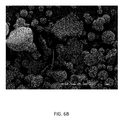
- FIGS. 6A-6D show scanning electron microscope images of a mixture of 55 wt % NaCl and 45 wt % KCl of the present invention
- FIG. 7 shows an X-ray diffraction analysis of a NaCl/KCl (65/35) raw blend composition known in the art
- FIG. 8 shows an X-ray diffraction analysis of a NaCl/KCl (50/50) composition known in the art
- FIG. 9 shows an X-ray diffraction analysis of a NaCl/KCl (55/45) composition of the present invention.
- FIG. 10 shows an X-ray diffraction analysis of a NaCl/KCl (75/25) composition of the present invention
- FIG. 11 shows an energy-dispersive X-ray spectroscopy analysis of a NaCl/KCl (55/45) composition of the present invention
- FIG. 12 shows an energy-dispersive X-ray spectroscopy analysis of Na in a NaCl/KCl (55/45) composition of the present invention
- FIG. 13 shows an energy-dispersive X-ray spectroscopy analysis of Cl in a NaCl/KCl (55/45) composition of the present invention
- FIG. 14 shows an energy-dispersive X-ray spectroscopy analysis of K in a NaCl/KCl (55/45) composition of the present invention
- FIG. 15 shows Differential Thermal Analysis (DTA) data for melting behaviors of exemplary salt samples
- FIG. 16 shows a phase diagram of NaCl/KCl
- FIGS. 17A-17B show a size distribution of a blend of 50 wt % NaCl/50 wt % KCl in accordance with the present invention in graphical form ( FIG. 17A ) and in table format ( FIG. 17B );
- FIGS. 18A-18B show a size distribution of 100% NaCl in accordance with the present invention in graphical form ( FIG. 18A ) and in table format ( FIG. 18B );
- FIGS. 19A-19C show energy dispersive x-ray images of a blend of 50 wt % NaCl/50 wt % KCl in accordance with the present invention
- FIGS. 20A-20D show scanning electron microscope images of a blend of 50 wt % NaCl and 50 wt % KCl of the present invention
- FIG. 21 shows a scanning electron microscope image of a 100% NaCl salt of the present invention where the particles have been ground to reveal the particle interior;
- FIG. 22 shows a scanning electron microscope image of a blend of 50 wt % NaCl and 50 wt % KCl of the present invention where the particles have been ground to reveal the interior of the particles;
- FIG. 23 is a flow diagram of a process of the present invention.
- the present embodiments are directed generally to salt compositions and methods used to make them.
- Various embodiments are directed to methods for preparing salt compositions that include aerosolizing a melted salt composition to form droplets, where the droplets form rounded particles.
- Further embodiments include solid compositions, including rounded salt particles, where the particles are formed by aerosolizing a melted salt composition.
- the rounded particles may be solid or hollow, but in embodiments are neither hollow nor solid, but rather possess void spaces in the center of semisolid particles. The particles may be fully enclosed, partially enclosed, or a concave shape.
- the salt compositions may include rounded particles that provide increased surface area to thereby increase the salty taste by increasing the area of the particle in contact with taste receptors, while not increasing the sodium content.
- the salt composition may not require one or more, and may exclude or be in the absence of, the usual modifiers for masking the bitterness or off-taste of non-sodium chlorides.
- resultant salt compositions that include an amalgamation of sodium chloride and one or more non-sodium chlorides, which lack the need to mask bitterness or off flavors, have been discovered.
- prior art salt compositions are primarily mixtures of components (for example, dry mixtures) and mixtures where particles of the mixtures did not have rounded shapes or homogenous component distribution. This means that the surface area of the prior art compositions in contact with taste receptors is less than that of the present invention. This variation in taste receptor activation where components are not simultaneously received, results in a combination of salty and bitter taste sensations. The combination of salty and bitter taste sensations is perceived as off flavors. Salt compositions of the prior art often include modifiers to mask the perception of off flavors.
- the salt compositions may be solid homogeneous salt products that contact taste receptors such that the components are simultaneously received, resulting in a salty taste sensation.
- This is advantageous over prior art salt compositions because prior art salt compositions are primarily mixtures of components where each component does not necessarily contact a taste receptor at the same time as the other components, thereby resulting in a combination of salty and bitter taste sensations and off flavors.
- Salt compositions of the prior art include modifiers to mask the perception of off flavors.
- compositions of the present invention such as sodium chloride, or a combination of sodium chloride and non-sodium chloride, heated to or beyond their respective melting points and aerosolized to form rounded particles lack the bitterness and off flavors associated with non-sodium chloride containing salt compositions is completely unexpected and entirely unpredictable.
- the salt compositions of the present invention that include rounded particles of sodium chloride, or sodium chloride and a non-sodium chloride, can have less sodium, but still have the same taste and a similar appearance to that of a composition that includes only regular NaCl.
- the salt composition is sodium chloride without additional components.
- the salt composition is a composition selected from sodium salts, potassium salts, magnesium salts, calcium salts, and combinations thereof.
- the salt may be a chloride salt, and the salt composition may include sodium chloride.
- the salt composition may further include a non-sodium chloride salt, and the non-sodium chloride salt may be selected from potassium chloride, magnesium chloride, calcium chloride, and combinations thereof.
- Embodiments may include salt compositions that do not have organic components (e.g., ammonium salts) due to the fact that organic components burn or decompose at temperatures exceeding 500° C. In embodiments, organic components may be added after aerosolizing the particles of the present invention.
- the salt composition further comprises from about 1 to about 5 wt % magnesium chloride.
- the salt compositions may include 100 wt % sodium chloride, or between about 1 wt % and about 100 wt % sodium chloride and between about 0 wt % and about 99 wt % non-sodium chloride salt (e.g., potassium chloride), or between about 30 wt % and about 70 wt % sodium chloride and between about 30 wt % and about 70 wt % non-sodium chloride salt (e.g., potassium chloride), or between about 35 wt % and about 55 wt % sodium chloride and between about 45 wt % and about 65 wt % non-sodium chloride salt (e.g., potassium chloride).
- the salt composition may contain less than about 1%, 10%, 20%, 30%, 40%, 50%, 60%, 70%, 80%, 90% or 99% of sodium chloride
- the salt compositions may be low sodium salt compositions.
- the compositions may contain about 10 wt % to 95 wt % lower sodium than regular salt.
- the compositions may contain about 15 wt %, 20 wt %, 25 wt %, 30 wt %, 35 wt %, 40 wt %, 45 wt %, 50 wt %, 55 wt %, 60 wt %, 65 wt %, 70 wt %, 75 wt %, 80 wt %, 85 wt %, 90 wt %, or 95 wt % lower sodium than regular salt.
- the compositions may contain about 40 wt % to about 60 wt % lower sodium than regular salt, or about 50 wt % lower sodium than regular salt.
- the salt compositions of the present invention may be combined with at least one additive.
- Additives other than inorganic salts may be added after processing the composition, because the melt temperatures will typically volatilize or decompose organic materials.
- Additives may be selected from one or more of an antioxidant, a dietary supplement, a phosphate, an anti-caking agent, a colorant, a salt enhancer, an organic acid, an amino acid, an amino acid derivative, a sugar, a sugar derivative, other ingredients typically present in table salt and salt substitute products, and combinations thereof.
- antioxidants may be added to reduce the rancidity of the salted products when cooked. Exemplary methods are discussed in U.S. Patent Publication No. 2012/0128830.
- suitable antioxidants may include rosemary extract, butylated hydroxytoluene, butylated hydroxyanisole, and tocopherols, among others.
- Phosphates may be added to tenderize the salted food product.
- Suitable phosphates may include monosodium phosphate, tetrasodium pyrophosphate, sodium hexametaphosphate, monopotassium phosphate, tetrapotassium pyrophosphate, disodium phosphate, sodium tripolyphosphate, sodium acid pyrophosphate, dipotassium phosphate, and potassium tripolyphosphate.
- Colorants may be added to give the salt compositions a distinct color. Suitable natural colorants include caramel color, turmeric, annatto, beta-carotene, paprika oleoresin, red cabbage juice, beet juice, grape skin extract, and carmine, among others. Dietary supplements may be added to support a nutritious diet.
- Suitable dietary supplements include vitamins, minerals, herbs or other botanicals, amino acids, substances such as enzymes, metabolites, and combinations thereof.
- the salt compositions of the present invention include magnesium chloride, vitamin D and calcium as dietary supplements. All types of magnesium, vitamin D and calcium are contemplated.
- Suitable anti-caking agents may be included in the salt composition of the present invention to prevent caking or the formation of lumps, or to provide a free flowing product and may include sodium hexacyanoferrate (II) (YPS), potassium hexacyanoferrate (II) tri hydrate (potassium ferrocyanide or YPP), tricalcium phosphate carbonate, magnesium carbonate, silicates, propylene glycol and silicon dioxide.
- an antioxidant used may also act as a colorant.
- the salt compositions of the present invention include magnesium chloride.
- the salt compositions of the present invention may optionally contain other ingredients typically present in table salt and salt substitute products.
- suitable ingredients include iodide sources, flavors and flavor enhancers.
- An exemplary iodide source is KI with a dextrose stabilizer.
- Exemplary flavor enhancers include monosodium glutamate (MSG), meat extracts, protein hydrolysates, amino acids, hydrolyzed vegetable protein, autolyzed yeast and mononucleotide salts.
- an antioxidant may be added in the amount of about 0.01 wt % to about 1 wt %
- a dietary supplement may be added in the amount of about 0.1 wt % to about 5 wt %
- a phosphate may be added in the amount of about 0.1 wt % to about 10 wt %
- an anti-caking agent may be added in the amount of about 0.1 wt % to about 2 wt %
- a colorant additive may be added in the amount of about 0.01 wt % to about 1 wt %
- a salt enhancer may be added in the amount of about 0.01 wt % to about 5 wt %
- an organic acid may be added in the amount of about 0.01 wt % to about 5 wt %
- an amino acid may be added in the amount of about 0.01 wt % to about 5 wt %
- an amino acid derivative may be added in the amount of about 0.01 wt % to
- the process of making the salt compositions of the present invention include aerosolizing a salt composition, such as sodium chloride, or a composition of sodium chloride and a non-sodium chloride, that is heated to or beyond their respective melting points to form droplets wherein the droplets form rounded particles.
- the process can include mixing from about 1 wt % to about 100 wt % by weight sodium chloride and from about 99 wt % to about 0 wt % by weight of a non-sodium chloride, or from about 30 wt % to about 70 wt % by weight sodium chloride and from about 70 wt % to about 30 wt % by weight of a non-sodium chloride.
- the process includes mixing about 50 wt % by weight sodium chloride and about 50 wt % by weight of a non-sodium chloride.
- sodium chloride may be mixed with non-sodium chloride, for example as a dry mix.
- the mixing of the sodium chloride and non-sodium chloride may be conducted in any suitable vessel. After the non-sodium chloride and the sodium chloride are mixed, the dry mixture is melted at a temperature at or above their respective melting points.
- sodium chloride may be the only component in the mixture. For instance, sodium chloride has a melting temperature of 801° C. and potassium chloride has a melting temperature of 770° C. Because the mixtures can have a lower melting temperature than the individual components, a temperature of about 650° C. or above can melt the combined components. Accordingly, the heating temperature may be from about 650° C.
- a suitable heating temperature is one at which the components of the mixture will melt and form a homogeneous liquid amalgamation.
- the furnace temperature is at least about 650° C., 660° C., 670° C., 680° C., 690° C., 700° C., 710° C., 720° C., 730° C., 740° C., 750° C., 760° C., 770° C., 780° C., 790° C., 800° C., 810° C., 820° C., 830° C., 840° C., 850° C., 860° C., 870° C., 880° C., 890° C., 900° C., 910° C., 920° C., 930° C., 940° C., 950° C., 960° C., 970°
- the heating temperature is at least about 800° C., 801° C., 802° C., 803° C., 804° C., 805° C., 850° C., 900° C., 910° C., 950° C., or 1000° C. In further embodiments, the heating temperature is at least about 850° C.
- the mixture can be heated to form a molten mixture of the components.
- a suitable heating time is one at which the components of the mixture will melt and form a molten liquid from the salt, or a homogeneous liquid amalgamation.
- the mixture can be heated for about 1 to about 60 minutes.
- the mixture is heated for about at least about 5, 10, 15, 20, 25, 30, 35, 40, or 45 minutes.
- the mixture is heated for about 15 minutes or for a time based on the furnace power.
- the mixture may be heated in any suitable vessel and/or oven. The time and temperature of the heating process may vary depending upon how the heat is delivered to the material.
- the heated composition which is molten or liquefied by the application of heat, is then aerosolized.
- the method may further include conveying the melted composition to be aerosolized.
- the step of aerosolizing may include treating the melted salt composition in at least one of a nebulizer, an ultrasonic atomizer, an electrospray atomizer, a centrifugal atomizer, and a gas atomizer.
- a nebulizer may be used to aerosolize the heated composition.
- Exemplary nebulizers use nitrogen, compressed air or ultrasonic power to break up medical solutions and suspensions into droplets.
- An exemplary nebulizer 100 used in embodiments of the present invention is shown in FIG. 1 .
- FIG. 1 shows a self-aspirating nebulizer. Such nebulizers are produced by Meinhard® Glass Products, for example.
- the nebulizer shown in FIG. 1 has a nebulizer tip 102 consisting of two concentric tubes, an outer tube for gas input 104 , and a capillary 106 for liquid uptake through an uptake tube 108 .
- the liquid can be pumped through the nebulizer using liquid pressurization, peristaltic pumps, syringe pumps, membrane pumps, or other pumping devices (not shown).
- the nebulizer may be constructed of any suitable material, such as stainless steel, hastelloy, palladium, platinum, etc.
- a nebulizer may also be coated with materials such as gold, palladium and platinum. Coatings are often more cost-effective than solid materials.
- Jet nebulizers are connected by tubing to a compressor that causes compressed air or nitrogen to flow at high velocity through a liquid medicine to turn it into an aerosol, which is then inhaled by the patient.
- Ultrasonic wave nebulizers may also be used. Ultrasonic wave nebulizers use an electronic oscillator to generate a high frequency ultrasonic wave, which causes the mechanical vibration of a piezoelectric element. This vibrating element is in contact with a liquid reservoir and its high frequency vibration is sufficient to produce a vapor mist.
- nebulizer Another type of nebulizer that may be used is an ultrasonic vibrating mesh technology.
- ultrasonic vibrating mesh technology a mesh/membrane with 1000-7000 laser drilled holes vibrates at the top of a liquid reservoir, and thereby pressures out a mist of droplets through the holes.
- Electronic nebulizers may be used in the present invention.
- Electronic nebulizers produce a substantially monodisperse spectrum of particles when they aerosolize a solution into particles.
- nebulizers that produce aerosols having substantially monodisperse particle sizes, as well as nebulizers that produce aerosols having polydisperse particle sizes, may be used in the present invention.
- Nebulizers used by the present invention may be included in parallel or in series, or in a showerhead assembly, for example, where the showerhead assembly includes one or more nebulizers configured to dispense a mixture as a mist with droplets.
- Advantages in processing may be achieved by methods of the present invention.
- the methods may advantageously include improvements in efficiency and shorter processing times, and/or reduction in the amount of processing steps. Further advantages may include decreased waste and reduced heating and/or cooling costs, or other processing costs.
- Other technologies known in the art, and not discussed herein, may be used for aerosolizing.
- the step of aerosolizing a melted salt composition forms droplets of the composition.
- the term “droplet” refers to portions of the melted salt composition formed during the step of aerosolizing while the portion is in liquid form. As described below, such portions will solidify to form particles.
- the droplets will have a size that depends on the apparatus for forming the aerosol and how it is operated.
- the droplet size can be between about 1 micron to about 1000 microns, or from about 1 micron to about 500 microns, or from about 1 micron to about 300 microns, or from about 5 microns to about 150 microns, or from about 10 microns to about 100 microns, or from about 10 microns to about 50 microns.
- Aerosolized particles solidify after being aerosolized to form rounded particles. In embodiments, they may solidify in the air, prior to touching a surface, or they may solidify after touching a surface.
- the aerosolized particles may be rounded particles and may be hollow or solid, and may solidify as hollow or solid particles. In embodiments, the rounded particles are sphere-like and are neither hollow nor solid, but instead are semisolid with void spaces.
- the void spaces can make up from about 5 volume percent to about 50 volume percent, and more typically from about 10 volume percent to about 20 volume percent of the total volume of the particle.
- the rounded surfaces e.g., absence or reduction of crystal faces
- collections of particles may be heterogeneous with respect to shape, size, or other attributes.
- the salt compositions may have various particle sizes. Additionally, the hollow particles may have various sizes of inner diameters and outer diameters. In embodiments, the rounded particles have an outer diameter from about 1 micron to about 1000 microns, or from about 1 micron to about 500 microns, or from about 1 micron to about 300 microns, or from about 3 microns to about 150 microns, or from about 5 microns to about 100 microns, or from about 10 microns to about 50 microns.
- the aerosolizing and solidification may produce a wide range of particle morphologies.
- the particles may be formed as aerosol particles that are formed in the free gas phase without any interaction with other particles or droplets (also called primary aerosol particles), or particles that are formed as they were subject to various transformations and interactions with other particles or droplets after being aerosolized (also called secondary aerosol particles).
- the rounded particles may be formed in a free gas phase, e.g., having enough time to assume a rounded shape (driven by surface tension) before solidifying.
- the rounded particles may also be formed in other shapes, such as drop shapes, e.g., having solidified prior to forming a wholly rounded shape.
- Particles of the salt compositions may have holes or cracks of various shapes (e.g., holes or cracks caused by overpressurization inside of particles that have solidified).
- the particles may have other surface features, such as wrinkles or fault lines (e.g., due to shrinkage from the particles cooling during the process, collision with other particles, equipment surfaces, etc.).
- the salt compositions may also include varying particle shapes resulting from the processing, such as splatters, coalesced particles, etc.
- the methods may further include isolating a particle size range, e.g., by sieving the rounded particles.
- the methods may further include grinding and/or agglomerating the rounded particles. Larger particles may be screened out by gravitational settling (e.g., in a drift tube), or by other methods, such as in a cyclone. In embodiments, the large particles that are screened out may be recycled into the aerosolizing process.
- the salt compositions may be ground or milled. In embodiments, it may be ground or milled to a salt composition's desired particle size. Any suitable grinder or mill may be used in accordance with this invention. Grinding the rounded particles may advantageously increase surface area.
- the salt compositions may have particle sizes of between about 20 mesh and about 100 mesh, or between about 35 mesh and about 100 mesh, or between about 35 mesh and about 90 mesh, or between about 35 mesh and about 80 mesh, or between about 35 mesh and about 60 mesh. It should be recognized that the particle sizes of the compositions may be selected to meet the particular end use application. “Pretzel grade” salt generally has a particle size that passes through a 35 mesh sieve, whereas “shaker grade” salt has a particle size that passes through between a 35 and a 60 mesh sieve. “Popcorn grade” salt has a particle size that passes through a 60 mesh sieve. Once ground, the salt composition may have less than about 10% of all granules, which are finer than 100 mesh. All mesh sizes are by U.S. standard sieve size.
- salt compositions of the present invention containing components in addition to salts may be prepared by several methods, including those described above. Additional methods include adding the additional components prior to heating the composition or adding the additional components after the composition has been heated, aerosolized, and/or ground.
- Additional methods include adding the additional components prior to heating the composition or adding the additional components after the composition has been heated, aerosolized, and/or ground.
- the method of preparation depends upon the additional components to be included in the salt composition. For instance, some components, such as organic components, will be destroyed by the high melting temperatures and may cause off flavors in the resultant product or not retain the properties or characteristics desired for inclusion in the salt composition. Some components, such as inorganic components, may not be altered by the high melting temperatures and may advantageously be included prior to the heating step.
- An advantage to including additional components prior to the heating step is that the additional component will be incorporated into the salt compositions.
- FIG. 2 An exemplary flow chart 200 of the process is shown in FIG. 2 .
- the process starts at step 202 , when a salt mixture is fed to a heating apparatus, e.g., a furnace.
- a heating apparatus e.g., a furnace.
- the mixture is melted.
- the mixture may include various components, and the components may be melted prior to, or after, they are combined.
- the mixture may be melted in a reservoir inside a furnace; for example, in a tube furnace at temperatures ranging up to about 1200° C.
- step 204 before or after melting the mixture, additional steps may occur, such as mixing.
- step 206 liquid particles are formed.
- the liquid particles are formed by spraying or the use of a nebulizer to aerosolize the melted composition.
- step 208 the aerosolized particles are cooled to form solidified particles.
- the particles have a homogeneous chemical composition, and the particles are amorphous or partially crystalline.
- step 210 the particles are collected. In embodiments, the particles are collected using a collection unit.
- FIG. 23 Another view of the process is illustrated in FIG. 23 .
- Salt from a salt hopper 310 is fed to a furnace 320 where the salt is melted in a liquid salt bath 330 .
- the molten liquid salt is fed to a nebulizer 340 , where it is aerosolized and allowed to cool.
- the resulting particulate salt product 350 is filtered 360 from the hot air stream 370 .
- the hot air stream 370 can be sent to a heat exchanger 380 to recover waste heat.
- the salt compositions of the present invention may be used as a salt substitute in food products, as a table salt, or in spice mixtures. Additionally, the salt compositions of the present invention can be used in commercial food manufacturing processes in order to reduce the proportion of sodium in the product while maintaining the salty taste.
- embodiments may include a food material and rounded salt composition particles.
- the food product may be a fried food product, a baked food product, or an extruded food product.
- the food product may also be selected from soups, sauces, baked goods, meat products, poultry products, snack products, dairy products, and breakfast cereals.
- Further representative food products include vegetables, fish, cheese, breads, frozen foods, canned foods and snack foods, such as potato chips, pretzels, peanuts, seeds, corn chips, tortilla chips, popcorn, crackers and bread sticks.
- the salt compositions may be applied to the foods in amounts sufficient to provide the saltiness desired.
- the food product may further include at least one additive, and the additive may be selected from an antioxidant, a dietary supplement, a phosphate, an anti-caking agent, a colorant, a salt enhancer, an organic acid, an amino acid, an amino acid derivative, a sugar, a sugar derivative, and combinations thereof.
- the food product may be heated to a temperature from about 50° C. to about 250° C.
- the food product including a food material and salt compositions of the present disclosure may be heated without imparting any significant effect on the quality or taste of the food product due to the lack of organic components.
- organic components were added to mask or reduce off-flavors (e.g., metallic/bitter tastes of potassium or magnesium).
- Prior art food products were unable to be heated after the addition of prior art salt compositions because heating the organic components in the prior art salt compositions caused the organic components to degrade, thereby causing an unsatisfactory taste or off-flavor.
- the salt compositions of the present invention may allow the heating of food products after the addition of the presently disclosed salt compositions, without losing the advantageous attributes of the present salt compositions (e.g., improved taste or reduced sodium content).
- fcc face-centered cubic
- the first atom is located at each lattice point, and the second atom is located half way between lattice points along the fcc unit cell edge.
- fcc face-centered cubic
- FIG. 6A shows a SEM image of a NaCl and KCl composition of the present invention.
- the exemplary composition of NaCl and KCl shown in FIG. 6A was made by mixing 55 wt % NaCl and 45 wt % KCl, melting the mixture to form a homogenous liquid composition, and aerosolizing the liquid mixture with a pneumatic nebulizer. The liquid aerosolized particles cooled quickly after exiting the nebulizer, prior to touching a surface.
- FIG. 6C shows a SEM image of a NaCl and KCl composition of the present invention.
- FIG. 6C shows a SEM image at 100 ⁇ magnification.
- a variety of particles shapes and sizes is apparent. For example, rounded particles, agglomerated particles, and broken particles are present.
- FIG. 6D shows a SEM image of a NaCl and KCl composition of the present invention.
- FIG. 6D shows a SEM image at 1000 ⁇ magnification.
- a piece of a broken particle is shown, along with a rounded particle.
- the rounded particle of the salt composition shows an absence of crystal faces or crystalline structure.
- the rounded particles provide advantages over prior art salt compositions.
- the increased surface area advantageously increases the amount of surface area that intercepts taste receptors, thereby increasing the salty taste without increasing the amount of sodium in the composition.
- the rounded particles may be advantageously able to withstand higher processing temperatures necessitated by the preparation of food products.
- food products combined with the salt compositions of the present invention may be able to be baked, fried, or extruded without reducing or eliminating advantageous aspects associated with the present compositions.
- composition of the present invention was analyzed using an energy-dispersive X-ray spectroscopy analysis and electron imaging.
- FIG. 11 shows an energy-dispersive X-ray spectroscopy analysis of a 55 wt % NaCl and 45 wt % KCl composition of the present invention.
- FIG. 12 , FIG. 13 , and FIG. 14 show an energy-dispersive X-ray spectroscopy analysis of Na, Cl, and K, respectively, in a 55 wt % NaCl and 45 wt % KCl composition of the present invention.
- the dots visible within the square in the picture are Na.
- the dots visible within the square in the picture are Cl.
- the dots visible within the square in the picture are K.
- FIG. 15 shows DTA curves of exemplary compositions of the present invention together with an aluminum standard.
- the melting points of the salt samples were determined to be 660° C. for a 25 wt % Na 75 wt % K sample, 654° C. for a 55 wt % Na 45 wt % K sample, and 659° C. for a 55 wt % Na 45 wt % K sample, which corresponds to the phase diagram of NaCl/KCl, as shown in FIG. 16 .
- the melting point of the aluminum standard was 660° C.
- FIGS. 17A-17B NaCl/KCl blend with 50 wt % Na/50 wt % K
- 18 A- 18 B (100% NaCl) illustrate size distributions for salt compositions in accordance with the present invention.
- the particle sizes are predominantly (about 90% or more) in the range of about 1 ⁇ l to about 1000 ⁇ , and with a major peak (about 60% or more) in the range of about 3 ⁇ to about 150 ⁇ . It is believed that the second peak (around 1000 ⁇ ) illustrated in the two graphical size distributions ( FIGS. 17A and 18A ) are due to the hygroscopic nature of the salt which results in clumping.
- FIGS. 19A-19C are energy disruptive x-ray images for blends of 50 wt % NaCl/50 wt % KCl in accordance with the present invention.
- the blend was produced in a manner analogous to Example 2.
- These images illustrate that the sodium ions and non-sodium ions (e.g., potassium ions) are well dispersed and in close proximity to each other on the particles of the present invention.
- FIG. 19A shows the location of sodium ions as light spots on the salt particles.
- FIG. 19B shows the location of potassium ions as light spots on the salt particles.
- FIG. 19C shows the location of chloride ions as light spots on the salt particles.
- compositions of the present invention contain a new kind of salt composition particle.
- the particles of the present invention are rounded and don't have a typical crystal surface (e.g., lack crystal faces).
- FIG. 20B shows a SEM image of a NaCl and KCl composition of the present invention.
- FIG. 20B shows a SEM image at 500 ⁇ magnification.
- most of the particle shapes are sphere-like.
- the exemplary salt composition predominantly includes rounded particles.
- a taste panel compared meatballs flavored with two compositions of the present invention to meatballs flavored with (1) regular table salt and (2) sodium chloride/potassium chloride fines, which are ground 50 wt %/50 wt % blend of NaCl/KCl which are melted together and then ground (without aerosolization), with a size of minus 100 mesh.
- the two compositions of the present invention are (1) 50 wt % NaCl/50 wt % KCl (NBZ5050) in accordance with the present invention, and (2) 100% NaCl composition (NBZNaCl) in accordance with the present invention.
- the results are set forth in the Table 1 below for each of five panelists as well as the sum and the average.
- the panelists ranked the samples for saltiness, flavor and overall likability.
- the panelists ranked the samples on a scale of 1 to 10, with 1 being the lowest rank and 10 being the highest rank.
- Table 1 the two compositions of the present invention compared quite favorably with regular table salt and the Classic Fines.
Landscapes
- Polymers & Plastics (AREA)
- Nutrition Science (AREA)
- Life Sciences & Earth Sciences (AREA)
- Chemical & Material Sciences (AREA)
- Engineering & Computer Science (AREA)
- Food Science & Technology (AREA)
- Health & Medical Sciences (AREA)
- Seasonings (AREA)
- Medicinal Preparation (AREA)
- Cosmetics (AREA)
- Colloid Chemistry (AREA)
- Compounds Of Alkaline-Earth Elements, Aluminum Or Rare-Earth Metals (AREA)
- Coloring Foods And Improving Nutritive Qualities (AREA)
- General Preparation And Processing Of Foods (AREA)
Abstract
Description
| TABLE 1 |
| |
| Sample | Panelist |
| 1 | |
|
Panelist 4 | |
Sum | Average |
| Saltiness |
| NBZ5050 | 4 | 9 | 8 | 7 | 7 | 35 | 7 |
| NBZNaCl | 6 | 8 | 8 | 8 | 7 | 37 | 7.4 |
| Control | 7 | 6 | 7 | 8 | 6.5 | 34.5 | 6.9 |
| Classic Fines | 4 | 4 | 6 | 6 | 6 | 26 | 5.2 |
| Flavor |
| NBZ5050 | 6 | 8 | 8 | 7 | 6 | 35 | 7 |
| NBZNaCl | 6 | 8 | 8 | 8 | 6.5 | 36.5 | 7.3 |
| Control | 7 | 7 | 7 | 8 | 5.5 | 34.5 | 6.9 |
| Classic Fines | 6 | 4 | 6 | 6 | 5.5 | 27.5 | 5.5 |
| |
| NBZ5050 |
| 5 | 8 | 8 | 7 | 6.5 | 34.5 | 6.9 | |
| NBZNaCl | 6 | 8 | 8 | 8 | 6.75 | 36.75 | 7.35 |
| Control | 7 | 7 | 7 | 8 | 6 | 35 | 7 |
| |
5 | 4 | 6 | 6 | 5.75 | 26.75 | 5.35 |
| Scale (1-10): | |||||||
| 1 = Lowest Rank - 10 = Highest Rank |
Claims (24)
Priority Applications (1)
| Application Number | Priority Date | Filing Date | Title |
|---|---|---|---|
| US14/086,560 US9011963B2 (en) | 2012-11-21 | 2013-11-21 | Compositions of low sodium salt and methods of making and using |
Applications Claiming Priority (2)
| Application Number | Priority Date | Filing Date | Title |
|---|---|---|---|
| US201261729199P | 2012-11-21 | 2012-11-21 | |
| US14/086,560 US9011963B2 (en) | 2012-11-21 | 2013-11-21 | Compositions of low sodium salt and methods of making and using |
Publications (2)
| Publication Number | Publication Date |
|---|---|
| US20140255589A1 US20140255589A1 (en) | 2014-09-11 |
| US9011963B2 true US9011963B2 (en) | 2015-04-21 |
Family
ID=50776565
Family Applications (1)
| Application Number | Title | Priority Date | Filing Date |
|---|---|---|---|
| US14/086,560 Active US9011963B2 (en) | 2012-11-21 | 2013-11-21 | Compositions of low sodium salt and methods of making and using |
Country Status (8)
| Country | Link |
|---|---|
| US (1) | US9011963B2 (en) |
| EP (1) | EP2922413A4 (en) |
| JP (1) | JP2016505246A (en) |
| AU (1) | AU2013347896B2 (en) |
| BR (1) | BR112015011764A2 (en) |
| CA (1) | CA2892130C (en) |
| MX (1) | MX366857B (en) |
| WO (1) | WO2014081968A1 (en) |
Cited By (4)
| Publication number | Priority date | Publication date | Assignee | Title |
|---|---|---|---|---|
| US9247762B1 (en) | 2014-09-09 | 2016-02-02 | S & P Ingredient Development, Llc | Salt substitute with plant tissue carrier |
| US9629384B2 (en) | 2005-09-14 | 2017-04-25 | S & P Ingredient Development, Llc | Low sodium salt composition |
| US11051539B2 (en) | 2017-09-18 | 2021-07-06 | S & P Ingredient Development, Llc | Low sodium salt substitute with potassium chloride |
| US12048776B2 (en) | 2018-11-12 | 2024-07-30 | Groupe Ppd Inc. | Porous material and process |
Families Citing this family (3)
| Publication number | Priority date | Publication date | Assignee | Title |
|---|---|---|---|---|
| WO2017123916A1 (en) * | 2016-01-13 | 2017-07-20 | Wm. Wrigley Jr. Company | Reduced salt mixtures for confections |
| ITUB20160697A1 (en) * | 2016-02-12 | 2017-08-12 | Fernando Horacio Garcia | SALT IPOSODIC SOLID AND PROCESS TO OBTAIN IT |
| US20210037865A1 (en) * | 2019-08-08 | 2021-02-11 | Salarius Ltd. | Low sodium salt composition |
Citations (38)
| Publication number | Priority date | Publication date | Assignee | Title |
|---|---|---|---|---|
| US3514296A (en) | 1967-01-16 | 1970-05-26 | Morton Int Inc | Salt substitute |
| US4293535A (en) | 1980-08-22 | 1981-10-06 | General Electric Company | Molten salt synthesis of alkaline zirconate powder |
| EP0090571A1 (en) | 1982-03-29 | 1983-10-05 | Morton Thiokol, Inc. | Flaked salt composition and process of preparing the same |
| US4473595A (en) | 1982-01-04 | 1984-09-25 | Rood Robert P | Low-sodium salt substitute |
| US5034378A (en) | 1988-12-15 | 1991-07-23 | James P. Cox | Synergistic flavor enhancement nutritional compositions and methods |
| US5447543A (en) | 1991-06-10 | 1995-09-05 | Exportadora De Sal, S.A. De C.V. | Process for crystallizing inorganic salts |
| US5562942A (en) | 1993-10-05 | 1996-10-08 | Koh; Hen-Sik | Salt compositions |
| JPH0986923A (en) | 1995-09-20 | 1997-03-31 | Akou Kasei Kk | Spherical salt particle and its production |
| JPH09173010A (en) | 1995-12-25 | 1997-07-08 | Union Material Kk | Food additive and its holding method |
| US5871803A (en) | 1997-05-30 | 1999-02-16 | Campbell Soup Company | Salt flavor enhancing compositions, food products including such compositions, and methods for preparing such products |
| US6090419A (en) | 1996-05-02 | 2000-07-18 | Mccormick & Company, Inc. | Salt compositions and method of preparation |
| WO2002035991A2 (en) | 2000-10-30 | 2002-05-10 | The Board Of Regents, The University Of Texas System | Spherical particles produced by a hot-melt extrusion/spheronization process |
| US6541050B1 (en) | 1998-11-27 | 2003-04-01 | Campbell Soup Company | Salt flavor enhancing compositions, food products including such compositions, and methods for preparing such products |
| US20040047976A1 (en) | 2000-08-14 | 2004-03-11 | Narayan Anantha Subramony | Granulation process |
| US6749835B1 (en) | 1999-08-25 | 2004-06-15 | Advanced Inhalation Research, Inc. | Formulation for spray-drying large porous particles |
| GB2396793A (en) | 2002-12-30 | 2004-07-07 | Vivotec Ltd | Salt composition |
| US6787169B1 (en) | 1999-01-27 | 2004-09-07 | Maeki Juhani | Physiological food salt product |
| US20060286378A1 (en) | 2005-05-23 | 2006-12-21 | Shivkumar Chiruvolu | Nanostructured composite particles and corresponding processes |
| US20070059428A1 (en) | 2005-09-14 | 2007-03-15 | Chigurupati Sambasiva R | Low-sodium salt composition |
| US20070207084A1 (en) | 2002-06-11 | 2007-09-06 | Zachariah Michael R | Synthesis of nanoporous particles |
| US20080003344A1 (en) | 2006-06-30 | 2008-01-03 | Michael Jensen | Seasoning and method for seasoning a food product while reducing dietary sodium intake |
| US20080003339A1 (en) | 2006-06-30 | 2008-01-03 | Clinton Johnson | Seasoning and method for seasoning a food product utilizing small particle sea salt |
| US20080008790A1 (en) | 2006-06-30 | 2008-01-10 | Michael Jensen | Seasoned food, seasoning, and method for seasoning a food product |
| US20080038411A1 (en) | 2006-06-30 | 2008-02-14 | Michael Jensen | Seasoning and method for enhancing and potentiating food flavor |
| WO2008043054A2 (en) | 2006-10-05 | 2008-04-10 | Chigurupati Sambasiva Rao | Method for producing a low sodium salt composition |
| US7402328B2 (en) | 2003-12-08 | 2008-07-22 | Ramon Efrain Vasquez | Stable sodium-free or low-sodium aqueous solution of agreeable saltiness taste |
| US7452563B2 (en) | 2005-06-20 | 2008-11-18 | Redpoint Bio Corporation | Compositions and methods for producing flavored seasonings that contain reduced quantities of common salt |
| US7455872B2 (en) | 2005-06-20 | 2008-11-25 | Redpoint Bio Corporation | Compositions and methods for producing a salty taste in foods or beverages |
| US20090041900A1 (en) | 2007-03-07 | 2009-02-12 | Juan Antonio Flores Zuniga | Low sodium salt compositions and methods of preparation and uses thereof |
| US20090169701A1 (en) | 2006-04-11 | 2009-07-02 | Jungbunzlauer Austria Ag | Salt replacement mixture with reduced nacl content |
| US20090297631A1 (en) | 2008-05-30 | 2009-12-03 | Cargill, Incorporated | Salt compositions and methods of making the same |
| WO2010119282A1 (en) | 2009-04-14 | 2010-10-21 | Kencryst Limited | Reduced sodium salt |
| US7854956B2 (en) | 2007-03-07 | 2010-12-21 | Exportadora De Sal, S.A. De C.V. | Low sodium salt compositions and methods of preparation and uses thereof |
| US20110217553A1 (en) | 2007-12-20 | 2011-09-08 | Warner Isiah M | Frozen Ionic Liquid Microparticles and Nanoparticles, and Methods for their Synthesis and Use |
| US20120114948A1 (en) | 2001-04-02 | 2012-05-10 | Danisco Us Inc. | Granule With Reduced Dust Potential |
| WO2012067673A1 (en) | 2010-11-18 | 2012-05-24 | Sambasiva Chigurupati | A novel low sodium salt composition |
| US8435555B2 (en) | 2008-05-01 | 2013-05-07 | Eminate Limited | Salt product |
| US20130243924A1 (en) | 2005-09-14 | 2013-09-19 | Pratik N. Bhandari | Low Sodium Salt Composition |
Family Cites Families (3)
| Publication number | Priority date | Publication date | Assignee | Title |
|---|---|---|---|---|
| JPS5239907B2 (en) * | 1972-08-21 | 1977-10-07 | ||
| JPH0427361A (en) * | 1990-05-21 | 1992-01-30 | Mitsubishi Materials Corp | Production of granulated salt |
| JP3650422B2 (en) * | 1994-08-03 | 2005-05-18 | パルテック株式会社 | Method for producing low bulk density fine particles of alkali metal compound |
-
2013
- 2013-11-21 WO PCT/US2013/071316 patent/WO2014081968A1/en not_active Ceased
- 2013-11-21 BR BR112015011764A patent/BR112015011764A2/en not_active Application Discontinuation
- 2013-11-21 EP EP13856749.0A patent/EP2922413A4/en not_active Withdrawn
- 2013-11-21 CA CA2892130A patent/CA2892130C/en active Active
- 2013-11-21 MX MX2015006331A patent/MX366857B/en active IP Right Grant
- 2013-11-21 US US14/086,560 patent/US9011963B2/en active Active
- 2013-11-21 AU AU2013347896A patent/AU2013347896B2/en active Active
- 2013-11-21 JP JP2015544136A patent/JP2016505246A/en active Pending
Patent Citations (52)
| Publication number | Priority date | Publication date | Assignee | Title |
|---|---|---|---|---|
| US3514296A (en) | 1967-01-16 | 1970-05-26 | Morton Int Inc | Salt substitute |
| US4293535A (en) | 1980-08-22 | 1981-10-06 | General Electric Company | Molten salt synthesis of alkaline zirconate powder |
| US4473595A (en) | 1982-01-04 | 1984-09-25 | Rood Robert P | Low-sodium salt substitute |
| EP0090571A1 (en) | 1982-03-29 | 1983-10-05 | Morton Thiokol, Inc. | Flaked salt composition and process of preparing the same |
| US5034378A (en) | 1988-12-15 | 1991-07-23 | James P. Cox | Synergistic flavor enhancement nutritional compositions and methods |
| US5447543A (en) | 1991-06-10 | 1995-09-05 | Exportadora De Sal, S.A. De C.V. | Process for crystallizing inorganic salts |
| US5562942A (en) | 1993-10-05 | 1996-10-08 | Koh; Hen-Sik | Salt compositions |
| JPH0986923A (en) | 1995-09-20 | 1997-03-31 | Akou Kasei Kk | Spherical salt particle and its production |
| JP3890512B2 (en) | 1995-09-20 | 2007-03-07 | 赤穂化成株式会社 | Spherical salt and method for producing the same |
| JPH09173010A (en) | 1995-12-25 | 1997-07-08 | Union Material Kk | Food additive and its holding method |
| US6090419A (en) | 1996-05-02 | 2000-07-18 | Mccormick & Company, Inc. | Salt compositions and method of preparation |
| US5871803A (en) | 1997-05-30 | 1999-02-16 | Campbell Soup Company | Salt flavor enhancing compositions, food products including such compositions, and methods for preparing such products |
| US6541050B1 (en) | 1998-11-27 | 2003-04-01 | Campbell Soup Company | Salt flavor enhancing compositions, food products including such compositions, and methods for preparing such products |
| US6787169B1 (en) | 1999-01-27 | 2004-09-07 | Maeki Juhani | Physiological food salt product |
| US6749835B1 (en) | 1999-08-25 | 2004-06-15 | Advanced Inhalation Research, Inc. | Formulation for spray-drying large porous particles |
| US20040047976A1 (en) | 2000-08-14 | 2004-03-11 | Narayan Anantha Subramony | Granulation process |
| WO2002035991A3 (en) | 2000-10-30 | 2002-08-01 | Univ Texas | Spherical particles produced by a hot-melt extrusion/spheronization process |
| WO2002035991A2 (en) | 2000-10-30 | 2002-05-10 | The Board Of Regents, The University Of Texas System | Spherical particles produced by a hot-melt extrusion/spheronization process |
| US20120114948A1 (en) | 2001-04-02 | 2012-05-10 | Danisco Us Inc. | Granule With Reduced Dust Potential |
| US7276224B2 (en) * | 2002-06-11 | 2007-10-02 | Regents Of The University Of Minnesota | Synthesis of nanoporous particles |
| US20070207084A1 (en) | 2002-06-11 | 2007-09-06 | Zachariah Michael R | Synthesis of nanoporous particles |
| GB2396793A (en) | 2002-12-30 | 2004-07-07 | Vivotec Ltd | Salt composition |
| US7402328B2 (en) | 2003-12-08 | 2008-07-22 | Ramon Efrain Vasquez | Stable sodium-free or low-sodium aqueous solution of agreeable saltiness taste |
| US20060286378A1 (en) | 2005-05-23 | 2006-12-21 | Shivkumar Chiruvolu | Nanostructured composite particles and corresponding processes |
| US7452563B2 (en) | 2005-06-20 | 2008-11-18 | Redpoint Bio Corporation | Compositions and methods for producing flavored seasonings that contain reduced quantities of common salt |
| US7455872B2 (en) | 2005-06-20 | 2008-11-25 | Redpoint Bio Corporation | Compositions and methods for producing a salty taste in foods or beverages |
| US20070059428A1 (en) | 2005-09-14 | 2007-03-15 | Chigurupati Sambasiva R | Low-sodium salt composition |
| US20130243924A1 (en) | 2005-09-14 | 2013-09-19 | Pratik N. Bhandari | Low Sodium Salt Composition |
| US20090117254A1 (en) | 2005-09-14 | 2009-05-07 | Sambasiva Chigurupati | Low-sodium salt composition |
| US20090169701A1 (en) | 2006-04-11 | 2009-07-02 | Jungbunzlauer Austria Ag | Salt replacement mixture with reduced nacl content |
| US20080038411A1 (en) | 2006-06-30 | 2008-02-14 | Michael Jensen | Seasoning and method for enhancing and potentiating food flavor |
| US20080008790A1 (en) | 2006-06-30 | 2008-01-10 | Michael Jensen | Seasoned food, seasoning, and method for seasoning a food product |
| US20080003339A1 (en) | 2006-06-30 | 2008-01-03 | Clinton Johnson | Seasoning and method for seasoning a food product utilizing small particle sea salt |
| US20080003344A1 (en) | 2006-06-30 | 2008-01-03 | Michael Jensen | Seasoning and method for seasoning a food product while reducing dietary sodium intake |
| WO2008043054A2 (en) | 2006-10-05 | 2008-04-10 | Chigurupati Sambasiva Rao | Method for producing a low sodium salt composition |
| US8197878B2 (en) | 2006-10-05 | 2012-06-12 | Sambasiva Rao Chigurupati | Method for producing a low sodium salt composition |
| WO2008043054A3 (en) | 2006-10-05 | 2008-11-06 | Chigurupati Sambasiva Rao | Method for producing a low sodium salt composition |
| US7989016B2 (en) | 2006-10-05 | 2011-08-02 | Sambasiva Rao Chigurupati | Method for producing a low sodium salt composition |
| US20080085360A1 (en) | 2006-10-05 | 2008-04-10 | Sambasiva Rao Chigurupati | Method for Producing a Low Sodium Salt Composition |
| US8329236B2 (en) | 2006-10-05 | 2012-12-11 | Sambasiva Rao Chigurupati | Low sodium salt composition |
| US20090041900A1 (en) | 2007-03-07 | 2009-02-12 | Juan Antonio Flores Zuniga | Low sodium salt compositions and methods of preparation and uses thereof |
| US7820225B2 (en) | 2007-03-07 | 2010-10-26 | Exportadora De Sal, S.A. De C.V. | Low sodium salt compositions and methods of preparation and uses thereof |
| US7854956B2 (en) | 2007-03-07 | 2010-12-21 | Exportadora De Sal, S.A. De C.V. | Low sodium salt compositions and methods of preparation and uses thereof |
| US20110052785A1 (en) | 2007-03-07 | 2011-03-03 | Exportadora De Sal, S.A. De C.V. | Methods of preparation of low sodium salt compositions |
| US20110217553A1 (en) | 2007-12-20 | 2011-09-08 | Warner Isiah M | Frozen Ionic Liquid Microparticles and Nanoparticles, and Methods for their Synthesis and Use |
| US8435555B2 (en) | 2008-05-01 | 2013-05-07 | Eminate Limited | Salt product |
| US20090297631A1 (en) | 2008-05-30 | 2009-12-03 | Cargill, Incorporated | Salt compositions and methods of making the same |
| US20130196049A1 (en) | 2009-04-14 | 2013-08-01 | Klinge Chemicals Ltd. | Reduced sodium salt |
| WO2010119282A1 (en) | 2009-04-14 | 2010-10-21 | Kencryst Limited | Reduced sodium salt |
| US20120128830A1 (en) | 2010-11-18 | 2012-05-24 | Sambasiva Rao Chigurupati | Novel low sodium salt composition |
| US20120128826A1 (en) | 2010-11-18 | 2012-05-24 | Sambasiva Rao Chigurupati | Novel low sodium salt composition |
| WO2012067673A1 (en) | 2010-11-18 | 2012-05-24 | Sambasiva Chigurupati | A novel low sodium salt composition |
Non-Patent Citations (18)
| Title |
|---|
| Authorized Officer, Lee W. Young, International Search Report and Written Opinion of The International Searching Authority for International Application No. PCT/US2011/031803, mailed Aug. 31, 2011, 6 pages. |
| Authorized Officer, Simin Baharlou, International Preliminary Report on Patentability for International Application No. PCT/US2011/031803, dated May 21, 2013, 5 pages. |
| Barbara Katz et al., Salt Reduction Gains Momentum, Food Technology, May 2010, pp. 25-32. |
| Christopher M. Parry et al., Monkeying Around With Taste, FoodScienceCentral.Com, May 5, 2005, 4 pages. |
| Fidel Toldra et al., Recent Patents for Sodium Reduction in Foods, Jul. 25, 2008, vol. 1, No. 1, 2009 Bentham Science Publishers Ltd., pp. 80-86. |
| Mary Ellen Kuhn, Strategies for Reducing Sodium in the U.S., Food Technology, May 2010, pp. 34-36. |
| Matsen et al., "Rates and Mechanism of Phase Changes in Binary Mixtures of Alkali Halides," J. Am. Chem. Soc., 1941, vol. 63(12), pp. 3470-3473. |
| Nathan Gray, Taste Receptors Understanding May Hold Key for Low-Cal Sweeteners: Review, FoodNavigator.Com, Mar. 3, 2011, 2 pages. |
| Pinho et al., "Solubility of NaCl, NaBr, and KCl in Water, Methanol, Ethanol, and Their Mixed Solvents," J. Chem. Eng. Data, 2005, vol. 50, pp. 29-32. |
| Rama et al., "Impact of Salt Crystal Size on In-Mouth Delivery of Sodium and Saltiness Perception from Snack Foods," J. Texture Studies, 2013, vol. 44, pp. 338-345. |
| Swientek, "SODA-LO salt microspheres," Innovative Showstoppers, Sep. 2013, vol. 67, No. 9, p. 47. |
| Thomas Hofmann, et al., Challenges in Taste Research Present Knowledge and Future Implications, American Chemical Society 2004, Nov. 11, 2003, 24 pages. |
| U.S. Appl. No. 13/668,838, filed Nov. 5, 2012, Chigurupati. |
| U.S. Appl. No. 13/971,602, filed Aug. 20, 2013, Chigurupati et al. |
| U.S. Appl. No. 14/145,647, filed Dec. 31, 2013, Chigurupati et al. |
| Understandingfoodadditives.org, Anti-Caking Agents, archive.org, Aug. 25, 2006, 2 pages. |
| USPTO Non-Final Office Action in U.S. Appl. No. 13/083,179, dated Jun. 19, 2012, 15 pages. |
| Young, International Search Report and Written Opinion for International Application No. PCT/US 13/71316, mailed Mar. 27, 2014, 10 pages. |
Cited By (4)
| Publication number | Priority date | Publication date | Assignee | Title |
|---|---|---|---|---|
| US9629384B2 (en) | 2005-09-14 | 2017-04-25 | S & P Ingredient Development, Llc | Low sodium salt composition |
| US9247762B1 (en) | 2014-09-09 | 2016-02-02 | S & P Ingredient Development, Llc | Salt substitute with plant tissue carrier |
| US11051539B2 (en) | 2017-09-18 | 2021-07-06 | S & P Ingredient Development, Llc | Low sodium salt substitute with potassium chloride |
| US12048776B2 (en) | 2018-11-12 | 2024-07-30 | Groupe Ppd Inc. | Porous material and process |
Also Published As
| Publication number | Publication date |
|---|---|
| AU2013347896B2 (en) | 2015-09-10 |
| US20140255589A1 (en) | 2014-09-11 |
| CA2892130A1 (en) | 2014-05-30 |
| EP2922413A4 (en) | 2016-07-27 |
| JP2016505246A (en) | 2016-02-25 |
| WO2014081968A1 (en) | 2014-05-30 |
| AU2013347896A1 (en) | 2015-06-04 |
| MX366857B (en) | 2019-07-26 |
| CA2892130C (en) | 2018-05-29 |
| EP2922413A1 (en) | 2015-09-30 |
| MX2015006331A (en) | 2016-03-21 |
| WO2014081968A8 (en) | 2015-01-15 |
| BR112015011764A2 (en) | 2017-07-11 |
Similar Documents
| Publication | Publication Date | Title |
|---|---|---|
| AU2013347896B2 (en) | Compositions of low sodium salt and methods of making and using | |
| US20120128830A1 (en) | Novel low sodium salt composition | |
| US20210282441A1 (en) | Process to prepare a low-sodium salt product, product obtainable thereby and the use thereof | |
| EP2671458B1 (en) | Salt product | |
| Cho et al. | Effect of spray-drying process on physical properties of sodium chloride/maltodextrin complexes | |
| JP6621988B2 (en) | Sodium bicarbonate products | |
| AU2014298262B2 (en) | Method of producing salt composition | |
| CN107373581A (en) | A kind of preparation method for being applied to the fresh spicy dip of perfume in self-heating chafing dish | |
| US20150056338A1 (en) | Salt compositions and methods of making and using | |
| CN106659214A (en) | Compositions and methods for delivering tastants | |
| JP2022543683A (en) | Improved low sodium salt composition | |
| JP4188512B2 (en) | Powder flavor composition and method for producing the same | |
| JP2008228715A (en) | Low sodium processed salt and food using the same | |
| CN104585704A (en) | Mushroom vegetable seasoning and preparation method thereof | |
| EP4672972A1 (en) | Method and apparatus for preparing flakes | |
| JPH05103628A (en) | Salt seasoning | |
| Quilaqueo Gutiérrez | Salt reduction in foods: effect of crystal microstructure on the dissolution kinetics |
Legal Events
| Date | Code | Title | Description |
|---|---|---|---|
| AS | Assignment |
Owner name: S&P INGREDIENT DEVELOPMENT, LLC, MINNESOTA Free format text: ASSIGNMENT OF ASSIGNORS INTEREST;ASSIGNORS:OSTERWALDER, NEIL;CHIGURUPATI, SAMBASIVA RAO;BHANDARI, PRATIK N.;SIGNING DATES FROM 20140120 TO 20140123;REEL/FRAME:032536/0335 |
|
| STCF | Information on status: patent grant |
Free format text: PATENTED CASE |
|
| AS | Assignment |
Owner name: COMERICA BANK, MICHIGAN Free format text: SECURITY INTEREST;ASSIGNOR:S & P INGREDIENT DEVELOPMENT, LLC;REEL/FRAME:038135/0942 Effective date: 20130619 |
|
| MAFP | Maintenance fee payment |
Free format text: PAYMENT OF MAINTENANCE FEE, 4TH YR, SMALL ENTITY (ORIGINAL EVENT CODE: M2551); ENTITY STATUS OF PATENT OWNER: SMALL ENTITY Year of fee payment: 4 |
|
| AS | Assignment |
Owner name: PROTERRA FINANCE LLC, AS COLLATERAL AGENT, MINNESOTA Free format text: SECURITY INTEREST;ASSIGNOR:S & P INGREDIENT DEVELOPMENT, LLC;REEL/FRAME:056096/0081 Effective date: 20210430 |
|
| AS | Assignment |
Owner name: S & P INGREDIENT DEVELOPMENT, LLC, MINNESOTA Free format text: RELEASE BY SECURED PARTY;ASSIGNOR:COMERICA BANK;REEL/FRAME:056129/0794 Effective date: 20210430 |
|
| AS | Assignment |
Owner name: BMO HARRIS BANK, N.A., AS ADMINISTRATIVE AGENT, ILLINOIS Free format text: SECURITY AGREEMENT;ASSIGNOR:S & P INGREDIENT DEVELOPMENT, LLC;REEL/FRAME:060204/0584 Effective date: 20220527 |
|
| AS | Assignment |
Owner name: S & P INGREDIENT DEVELOPMENT, LLC, MINNESOTA Free format text: RELEASE BY SECURED PARTY;ASSIGNOR:PROTERRA FINANCE LLC, AS COLLATERAL AGENT;REEL/FRAME:060088/0345 Effective date: 20220527 Owner name: S & P INGREDIENT DEVELOPMENT, LLC, MINNESOTA Free format text: RELEASE OF SECURITY INTEREST;ASSIGNOR:PROTERRA FINANCE LLC, AS COLLATERAL AGENT;REEL/FRAME:060088/0345 Effective date: 20220527 |
|
| MAFP | Maintenance fee payment |
Free format text: PAYMENT OF MAINTENANCE FEE, 8TH YR, SMALL ENTITY (ORIGINAL EVENT CODE: M2552); ENTITY STATUS OF PATENT OWNER: SMALL ENTITY Year of fee payment: 8 |