US8962157B2 - Electron-transporting materials - Google Patents
Electron-transporting materials Download PDFInfo
- Publication number
- US8962157B2 US8962157B2 US13/060,855 US200913060855A US8962157B2 US 8962157 B2 US8962157 B2 US 8962157B2 US 200913060855 A US200913060855 A US 200913060855A US 8962157 B2 US8962157 B2 US 8962157B2
- Authority
- US
- United States
- Prior art keywords
- group
- compound
- occurrence
- heteroaryl
- independently
- Prior art date
- Legal status (The legal status is an assumption and is not a legal conclusion. Google has not performed a legal analysis and makes no representation as to the accuracy of the status listed.)
- Active, expires
Links
- 0 *C.*C.*C.*C.C1=CC=NC=C1.C1=CC=NC=C1.CC.CC.CC1=CC=CC=C1.CC1=CC=CC=C1.[1*]C1=C([3*])C([1*])=C(C)C([1*])=C1C Chemical compound *C.*C.*C.*C.C1=CC=NC=C1.C1=CC=NC=C1.CC.CC.CC1=CC=CC=C1.CC1=CC=CC=C1.[1*]C1=C([3*])C([1*])=C(C)C([1*])=C1C 0.000 description 15
- DKKSAMUIWFEMOH-UHFFFAOYSA-N C1=CC(C2=CC=CC(C3=CN=CC(C4=CC(C5=CC(C6=CC(C7=CN=CC=C7)=CC=C6)=CN=C5)=CC(C5=CC(C6=CC(C7=CN=CC=C7)=CC=C6)=CN=C5)=C4)=C3)=C2)=CN=C1 Chemical compound C1=CC(C2=CC=CC(C3=CN=CC(C4=CC(C5=CC(C6=CC(C7=CN=CC=C7)=CC=C6)=CN=C5)=CC(C5=CC(C6=CC(C7=CN=CC=C7)=CC=C6)=CN=C5)=C4)=C3)=C2)=CN=C1 DKKSAMUIWFEMOH-UHFFFAOYSA-N 0.000 description 2
- HVBQCBUNHIGJDC-UHFFFAOYSA-N C1=CC=C(C2=CC(C3=CC(C4=CC=CC(C5=CN=CC=C5)=C4)=CC(C4=CN=CC(C5=CC(C6=CC(C7=CC(C8=CC(C9=CN=CC=C9)=CC=C8)=CC(C8=CC(C9=CC=CN=C9)=CC=C8)=C7)=CN=C6)=CC=C5)=C4)=C3)=CC=C2)C=C1 Chemical compound C1=CC=C(C2=CC(C3=CC(C4=CC=CC(C5=CN=CC=C5)=C4)=CC(C4=CN=CC(C5=CC(C6=CC(C7=CC(C8=CC(C9=CN=CC=C9)=CC=C8)=CC(C8=CC(C9=CC=CN=C9)=CC=C8)=C7)=CN=C6)=CC=C5)=C4)=C3)=CC=C2)C=C1 HVBQCBUNHIGJDC-UHFFFAOYSA-N 0.000 description 2
- DVPXMDOLYXXZHR-UHFFFAOYSA-M BrC1=CC(C2=CC=CC(C3=CN=CC=C3)=C2)=CN=C1.C1=C(B2OCCO2)C=C(B2OCCO2)C=C1B1OCCO1.C1=CC(C2=CC=CC(C3=CN=CC(C4=CC(C5=CC(C6=CC(C7=CN=CC=C7)=CC=C6)=CN=C5)=CC(C5=CC(C6=CC(C7=CN=CC=C7)=CC=C6)=CN=C5)=C4)=C3)=C2)=CN=C1.[V]I Chemical compound BrC1=CC(C2=CC=CC(C3=CN=CC=C3)=C2)=CN=C1.C1=C(B2OCCO2)C=C(B2OCCO2)C=C1B1OCCO1.C1=CC(C2=CC=CC(C3=CN=CC(C4=CC(C5=CC(C6=CC(C7=CN=CC=C7)=CC=C6)=CN=C5)=CC(C5=CC(C6=CC(C7=CN=CC=C7)=CC=C6)=CN=C5)=C4)=C3)=C2)=CN=C1.[V]I DVPXMDOLYXXZHR-UHFFFAOYSA-M 0.000 description 1
- UBFMFTKTPGQKPM-UHFFFAOYSA-N BrC1=CC(C2=CC=CN=C2)=CC=C1.CC1(C)OB(C2=CC(C3=CC=CN=C3)=CC=C2)OC1(C)C Chemical compound BrC1=CC(C2=CC=CN=C2)=CC=C1.CC1(C)OB(C2=CC(C3=CC=CN=C3)=CC=C2)OC1(C)C UBFMFTKTPGQKPM-UHFFFAOYSA-N 0.000 description 1
- FKAFRDXXCNURKM-UHFFFAOYSA-N BrC1=CC=CC(Br)=C1.BrC1=CC=CC(C2=CN=CC=C2)=C1.CC1(C)OB(C2=CC=CN=C2)OC1(C)C Chemical compound BrC1=CC=CC(Br)=C1.BrC1=CC=CC(C2=CN=CC=C2)=C1.CC1(C)OB(C2=CC=CN=C2)OC1(C)C FKAFRDXXCNURKM-UHFFFAOYSA-N 0.000 description 1
- OGSIOSXNDAJTJZ-UHFFFAOYSA-N BrC1=CN=CC(Br)=C1.BrC1=CN=CC(C2=CC(C3=CC=CN=C3)=CC=C2)=C1.CC1(C)OB(C2=CC(C3=CC=CN=C3)=CC=C2)OC1(C)C Chemical compound BrC1=CN=CC(Br)=C1.BrC1=CN=CC(C2=CC(C3=CC=CN=C3)=CC=C2)=C1.CC1(C)OB(C2=CC(C3=CC=CN=C3)=CC=C2)OC1(C)C OGSIOSXNDAJTJZ-UHFFFAOYSA-N 0.000 description 1
- WPMASSGCVZSSQK-UHFFFAOYSA-N BrC1=CN=CC(C2=CC(C3=CN=CC(Br)=C3)=CC=C2)=C1.IC1=CC=CC(I)=C1.OB(O)C1=CC(Br)=CN=C1 Chemical compound BrC1=CN=CC(C2=CC(C3=CN=CC(Br)=C3)=CC=C2)=C1.IC1=CC=CC(I)=C1.OB(O)C1=CC(Br)=CN=C1 WPMASSGCVZSSQK-UHFFFAOYSA-N 0.000 description 1
- UOKZSSGJVISTSH-UHFFFAOYSA-N BrC1=CN=CC(C2=CC=CC(C3=CN=CC(Br)=C3)=C2)=C1.C1=CN=CC(C2=CC=CC(C3=CC(C4=CN=CC(C5=CC=CC(C6=CN=CC(C7=CC(C8=CC(C9=CC=CN=C9)=CC=C8)=CC(C8=CC(C9=CC=CN=C9)=CC=C8)=C7)=C6)=C5)=C4)=CC(C4=CC(C5=CC=CN=C5)=CC=C4)=C3)=C2)=C1.CC1(C)OB(C2=CC(C3=CC(C4=CC=CN=C4)=CC=C3)=CC(C3=CC(C4=CC=CN=C4)=CC=C3)=C2)OC1(C)C.[V] Chemical compound BrC1=CN=CC(C2=CC=CC(C3=CN=CC(Br)=C3)=C2)=C1.C1=CN=CC(C2=CC=CC(C3=CC(C4=CN=CC(C5=CC=CC(C6=CN=CC(C7=CC(C8=CC(C9=CC=CN=C9)=CC=C8)=CC(C8=CC(C9=CC=CN=C9)=CC=C8)=C7)=C6)=C5)=C4)=CC(C4=CC(C5=CC=CN=C5)=CC=C4)=C3)=C2)=C1.CC1(C)OB(C2=CC(C3=CC(C4=CC=CN=C4)=CC=C3)=CC(C3=CC(C4=CC=CN=C4)=CC=C3)=C2)OC1(C)C.[V] UOKZSSGJVISTSH-UHFFFAOYSA-N 0.000 description 1
- RGWAKYJRHFYNCY-UHFFFAOYSA-N Brc1cc(-c2cccc(-c3cnccc3)c2)cnc1 Chemical compound Brc1cc(-c2cccc(-c3cnccc3)c2)cnc1 RGWAKYJRHFYNCY-UHFFFAOYSA-N 0.000 description 1
- SOSPMXMEOFGPIM-UHFFFAOYSA-N Brc1cc(Br)cnc1 Chemical compound Brc1cc(Br)cnc1 SOSPMXMEOFGPIM-UHFFFAOYSA-N 0.000 description 1
- OSGAAGQIXFEUJJ-UHFFFAOYSA-N C.CC1(C)OB(B2OC(C)(C)C(C)(C)O2)OC1(C)C.CC1(C)OB(C2=CC(C3=CC(C4=CN=CC=C4)=CC=C3)=CC(C3=CC=CC(C4=CN=CC=C4)=C3)=C2)OC1(C)C.ClC1=CC(C2=CC(C3=CN=CC=C3)=CC=C2)=CC(C2=CC=CC(C3=CN=CC=C3)=C2)=C1 Chemical compound C.CC1(C)OB(B2OC(C)(C)C(C)(C)O2)OC1(C)C.CC1(C)OB(C2=CC(C3=CC(C4=CN=CC=C4)=CC=C3)=CC(C3=CC=CC(C4=CN=CC=C4)=C3)=C2)OC1(C)C.ClC1=CC(C2=CC(C3=CN=CC=C3)=CC=C2)=CC(C2=CC=CC(C3=CN=CC=C3)=C2)=C1 OSGAAGQIXFEUJJ-UHFFFAOYSA-N 0.000 description 1
- LNLYRMXMZKJBKD-UHFFFAOYSA-N C1=CC(C2=CC=CC(C3=CN=CC(C4=CC(C5=CC(C6=CC(C7=CN=CC=C7)=CC=C6)=CN=C5)=CC(C5=CC(C6=CC(C7=CN=CC=C7)=CC=C6)=CN=C5)=C4)=C3)=C2)=CN=C1.C1=CN=CC(C2=CC=CC(C3=CC(C4=CN=CC(C5=CC=CC(C6=CC(C7=CC(C8=CC=CC(C9=CC=CN=C9)=C8)=CC(C8=CC=CC(C9=CN=CC=C9)=C8)=C7)=CN=C6)=C5)=C4)=CC(C4=CC(C5=CN=CC=C5)=CC=C4)=C3)=C2)=C1 Chemical compound C1=CC(C2=CC=CC(C3=CN=CC(C4=CC(C5=CC(C6=CC(C7=CN=CC=C7)=CC=C6)=CN=C5)=CC(C5=CC(C6=CC(C7=CN=CC=C7)=CC=C6)=CN=C5)=C4)=C3)=C2)=CN=C1.C1=CN=CC(C2=CC=CC(C3=CC(C4=CN=CC(C5=CC=CC(C6=CC(C7=CC(C8=CC=CC(C9=CC=CN=C9)=C8)=CC(C8=CC=CC(C9=CN=CC=C9)=C8)=C7)=CN=C6)=C5)=C4)=CC(C4=CC(C5=CN=CC=C5)=CC=C4)=C3)=C2)=C1 LNLYRMXMZKJBKD-UHFFFAOYSA-N 0.000 description 1
- RGLUYSDLTJTEML-UHFFFAOYSA-N C1=CC=C(C2=C(P(C3CCCCC3)C3CCCCC3)C=CC=C2)C=C1.CC(C)C1=CC(C(C)C)=C(C2=C(P(C3CCCCC3)C3CCCCC3)C=CC=C2)C(C(C)C)=C1.CC1=CC=CC=C1C1=C(P(C2CCCCC2)C2CCCCC2)C=CC=C1.CCCC[Pt](CCCC)C1=C(C2=CC=CC=C2)C=CC=C1.COC1=C(C2=C(P(C3CCCCC3)C3CCCCC3)C=CC=C2)C(C)=CC=C1 Chemical compound C1=CC=C(C2=C(P(C3CCCCC3)C3CCCCC3)C=CC=C2)C=C1.CC(C)C1=CC(C(C)C)=C(C2=C(P(C3CCCCC3)C3CCCCC3)C=CC=C2)C(C(C)C)=C1.CC1=CC=CC=C1C1=C(P(C2CCCCC2)C2CCCCC2)C=CC=C1.CCCC[Pt](CCCC)C1=C(C2=CC=CC=C2)C=CC=C1.COC1=C(C2=C(P(C3CCCCC3)C3CCCCC3)C=CC=C2)C(C)=CC=C1 RGLUYSDLTJTEML-UHFFFAOYSA-N 0.000 description 1
- HDGPXJOZNDNAKJ-UHFFFAOYSA-N CC1(C)OB(C2=CC=CC(C3=CN=CC=C3)=C2)OC1(C)C.ClC1=CC(Br)=CC(Br)=C1.ClC1=CC(C2=CC(C3=CN=CC=C3)=CC=C2)=CC(C2=CC=CC(C3=CN=CC=C3)=C2)=C1 Chemical compound CC1(C)OB(C2=CC=CC(C3=CN=CC=C3)=C2)OC1(C)C.ClC1=CC(Br)=CC(Br)=C1.ClC1=CC(C2=CC(C3=CN=CC=C3)=CC=C2)=CC(C2=CC=CC(C3=CN=CC=C3)=C2)=C1 HDGPXJOZNDNAKJ-UHFFFAOYSA-N 0.000 description 1
- KVEIJNJPKCWYQF-UHFFFAOYSA-N CC1(C)OB(c2cc(-c3cnccc3)ccc2)OC1(C)C Chemical compound CC1(C)OB(c2cc(-c3cnccc3)ccc2)OC1(C)C KVEIJNJPKCWYQF-UHFFFAOYSA-N 0.000 description 1
- JUJWROOIHBZHMG-UHFFFAOYSA-N c1ccncc1 Chemical compound c1ccncc1 JUJWROOIHBZHMG-UHFFFAOYSA-N 0.000 description 1
Classifications
-
- C—CHEMISTRY; METALLURGY
- C09—DYES; PAINTS; POLISHES; NATURAL RESINS; ADHESIVES; COMPOSITIONS NOT OTHERWISE PROVIDED FOR; APPLICATIONS OF MATERIALS NOT OTHERWISE PROVIDED FOR
- C09K—MATERIALS FOR MISCELLANEOUS APPLICATIONS, NOT PROVIDED FOR ELSEWHERE
- C09K11/00—Luminescent, e.g. electroluminescent, chemiluminescent materials
- C09K11/06—Luminescent, e.g. electroluminescent, chemiluminescent materials containing organic luminescent materials
-
- C—CHEMISTRY; METALLURGY
- C07—ORGANIC CHEMISTRY
- C07D—HETEROCYCLIC COMPOUNDS
- C07D213/00—Heterocyclic compounds containing six-membered rings, not condensed with other rings, with one nitrogen atom as the only ring hetero atom and three or more double bonds between ring members or between ring members and non-ring members
- C07D213/02—Heterocyclic compounds containing six-membered rings, not condensed with other rings, with one nitrogen atom as the only ring hetero atom and three or more double bonds between ring members or between ring members and non-ring members having three double bonds between ring members or between ring members and non-ring members
- C07D213/04—Heterocyclic compounds containing six-membered rings, not condensed with other rings, with one nitrogen atom as the only ring hetero atom and three or more double bonds between ring members or between ring members and non-ring members having three double bonds between ring members or between ring members and non-ring members having no bond between the ring nitrogen atom and a non-ring member or having only hydrogen or carbon atoms directly attached to the ring nitrogen atom
- C07D213/24—Heterocyclic compounds containing six-membered rings, not condensed with other rings, with one nitrogen atom as the only ring hetero atom and three or more double bonds between ring members or between ring members and non-ring members having three double bonds between ring members or between ring members and non-ring members having no bond between the ring nitrogen atom and a non-ring member or having only hydrogen or carbon atoms directly attached to the ring nitrogen atom with substituted hydrocarbon radicals attached to ring carbon atoms
- C07D213/44—Radicals substituted by doubly-bound oxygen, sulfur, or nitrogen atoms, or by two such atoms singly-bound to the same carbon atom
- C07D213/53—Nitrogen atoms
-
- C—CHEMISTRY; METALLURGY
- C07—ORGANIC CHEMISTRY
- C07D—HETEROCYCLIC COMPOUNDS
- C07D307/00—Heterocyclic compounds containing five-membered rings having one oxygen atom as the only ring hetero atom
- C07D307/77—Heterocyclic compounds containing five-membered rings having one oxygen atom as the only ring hetero atom ortho- or peri-condensed with carbocyclic rings or ring systems
- C07D307/78—Benzo [b] furans; Hydrogenated benzo [b] furans
-
- C—CHEMISTRY; METALLURGY
- C07—ORGANIC CHEMISTRY
- C07D—HETEROCYCLIC COMPOUNDS
- C07D471/00—Heterocyclic compounds containing nitrogen atoms as the only ring hetero atoms in the condensed system, at least one ring being a six-membered ring with one nitrogen atom, not provided for by groups C07D451/00 - C07D463/00
- C07D471/02—Heterocyclic compounds containing nitrogen atoms as the only ring hetero atoms in the condensed system, at least one ring being a six-membered ring with one nitrogen atom, not provided for by groups C07D451/00 - C07D463/00 in which the condensed system contains two hetero rings
- C07D471/04—Ortho-condensed systems
-
- C—CHEMISTRY; METALLURGY
- C07—ORGANIC CHEMISTRY
- C07F—ACYCLIC, CARBOCYCLIC OR HETEROCYCLIC COMPOUNDS CONTAINING ELEMENTS OTHER THAN CARBON, HYDROGEN, HALOGEN, OXYGEN, NITROGEN, SULFUR, SELENIUM OR TELLURIUM
- C07F13/00—Compounds containing elements of Groups 7 or 17 of the Periodic Table
-
- H01L51/0067—
-
- H01L51/5048—
-
- H—ELECTRICITY
- H05—ELECTRIC TECHNIQUES NOT OTHERWISE PROVIDED FOR
- H05B—ELECTRIC HEATING; ELECTRIC LIGHT SOURCES NOT OTHERWISE PROVIDED FOR; CIRCUIT ARRANGEMENTS FOR ELECTRIC LIGHT SOURCES, IN GENERAL
- H05B33/00—Electroluminescent light sources
- H05B33/12—Light sources with substantially two-dimensional radiating surfaces
- H05B33/14—Light sources with substantially two-dimensional radiating surfaces characterised by the chemical or physical composition or the arrangement of the electroluminescent material, or by the simultaneous addition of the electroluminescent material in or onto the light source
-
- H—ELECTRICITY
- H10—SEMICONDUCTOR DEVICES; ELECTRIC SOLID-STATE DEVICES NOT OTHERWISE PROVIDED FOR
- H10K—ORGANIC ELECTRIC SOLID-STATE DEVICES
- H10K50/00—Organic light-emitting devices
-
- H—ELECTRICITY
- H10—SEMICONDUCTOR DEVICES; ELECTRIC SOLID-STATE DEVICES NOT OTHERWISE PROVIDED FOR
- H10K—ORGANIC ELECTRIC SOLID-STATE DEVICES
- H10K50/00—Organic light-emitting devices
- H10K50/10—OLEDs or polymer light-emitting diodes [PLED]
- H10K50/14—Carrier transporting layers
-
- H—ELECTRICITY
- H10—SEMICONDUCTOR DEVICES; ELECTRIC SOLID-STATE DEVICES NOT OTHERWISE PROVIDED FOR
- H10K—ORGANIC ELECTRIC SOLID-STATE DEVICES
- H10K85/00—Organic materials used in the body or electrodes of devices covered by this subclass
- H10K85/60—Organic compounds having low molecular weight
- H10K85/649—Aromatic compounds comprising a hetero atom
- H10K85/654—Aromatic compounds comprising a hetero atom comprising only nitrogen as heteroatom
-
- C—CHEMISTRY; METALLURGY
- C09—DYES; PAINTS; POLISHES; NATURAL RESINS; ADHESIVES; COMPOSITIONS NOT OTHERWISE PROVIDED FOR; APPLICATIONS OF MATERIALS NOT OTHERWISE PROVIDED FOR
- C09K—MATERIALS FOR MISCELLANEOUS APPLICATIONS, NOT PROVIDED FOR ELSEWHERE
- C09K2211/00—Chemical nature of organic luminescent or tenebrescent compounds
- C09K2211/10—Non-macromolecular compounds
- C09K2211/1003—Carbocyclic compounds
- C09K2211/1007—Non-condensed systems
-
- C—CHEMISTRY; METALLURGY
- C09—DYES; PAINTS; POLISHES; NATURAL RESINS; ADHESIVES; COMPOSITIONS NOT OTHERWISE PROVIDED FOR; APPLICATIONS OF MATERIALS NOT OTHERWISE PROVIDED FOR
- C09K—MATERIALS FOR MISCELLANEOUS APPLICATIONS, NOT PROVIDED FOR ELSEWHERE
- C09K2211/00—Chemical nature of organic luminescent or tenebrescent compounds
- C09K2211/10—Non-macromolecular compounds
- C09K2211/1018—Heterocyclic compounds
- C09K2211/1025—Heterocyclic compounds characterised by ligands
- C09K2211/1029—Heterocyclic compounds characterised by ligands containing one nitrogen atom as the heteroatom
-
- Y—GENERAL TAGGING OF NEW TECHNOLOGICAL DEVELOPMENTS; GENERAL TAGGING OF CROSS-SECTIONAL TECHNOLOGIES SPANNING OVER SEVERAL SECTIONS OF THE IPC; TECHNICAL SUBJECTS COVERED BY FORMER USPC CROSS-REFERENCE ART COLLECTIONS [XRACs] AND DIGESTS
- Y10—TECHNICAL SUBJECTS COVERED BY FORMER USPC
- Y10S—TECHNICAL SUBJECTS COVERED BY FORMER USPC CROSS-REFERENCE ART COLLECTIONS [XRACs] AND DIGESTS
- Y10S428/00—Stock material or miscellaneous articles
- Y10S428/917—Electroluminescent
Definitions
- the invention relates generally to compounds, and particularly to compounds and optoelectronic devices using the same, as electron-transporting materials.
- Optoelectronic devices e.g. Organic Light Emitting Devices (OLEDs), which make use of thin film materials that emit light when subjected to a voltage bias, are expected to become an increasingly popular form of flat panel display technology.
- OLEDs have a wide variety of potential applications, including cell phones, personal digital assistants (PDAs), computer displays, informational displays in vehicles, television monitors, as well as light sources for general illumination. Due to their bright colors, wide viewing angle, compatibility with full motion video, broad temperature ranges, thin and conformable form factor, low power requirements and the potential for low cost manufacturing processes, OLEDs are seen as a future replacement technology for cathode ray tubes (CRTs) and liquid crystal displays (LCDs). Due to their high luminous efficiencies, OLEDs are seen as having the potential to replace incandescent, and perhaps even fluorescent, lamps for certain types of applications.
- CTRs cathode ray tubes
- LCDs liquid crystal displays
- OLEDs possess a sandwiched structure, which consists of one or more organic layers between two opposite electrodes.
- multi-layered devices usually comprise at least three layers: a hole injection/transport layer, an emissive layer and an electron transport layer (ETL).
- the hole injection/transport layer serves as an electron blocking layer and the ETL as a hole blocking layer.
- Single-layered OLEDs comprise only one layer of materials between two opposite electrodes.
- the invention relates to compounds of formula I:
- the invention relates to optoelectronic devices comprising at least one compound of formula I, particularly where the compound is present in an electron-transporting layer.
- Compounds of formula I have properties useful in optoelectronic devices, e.g., organic light emitting devices (OLEDs), and are particularly well suited for use in electron-transporting layers thereof.
- the heteroaryl may be electron-withdrawing/electron deficient and may comprise multiple aromatic rings or a plurality of non-fused aromatic rings.
- the electron-withdrawing/electron deficient heteroaryl groups may be a pyridyl group, a pyrimidyl group, a quinolyl group, an isoquinolyl group, a phenanthranyl group, a indole group, an isoindole group, a carbazolyl group, aza-carbazolyl group, a thienyl group, a benzothienyl group, a thiazolyl group, a benzothiazolyl group, or a naphthyridinyl group, thienyl, furyl, pyridazinyl, pyrazinyl, thiazolyl and oxazolyl, etc.
- Ar may be pyridyl or phenylpyridyl.
- the present invention relates to compounds of formula II and optoelectronic devices using the same:
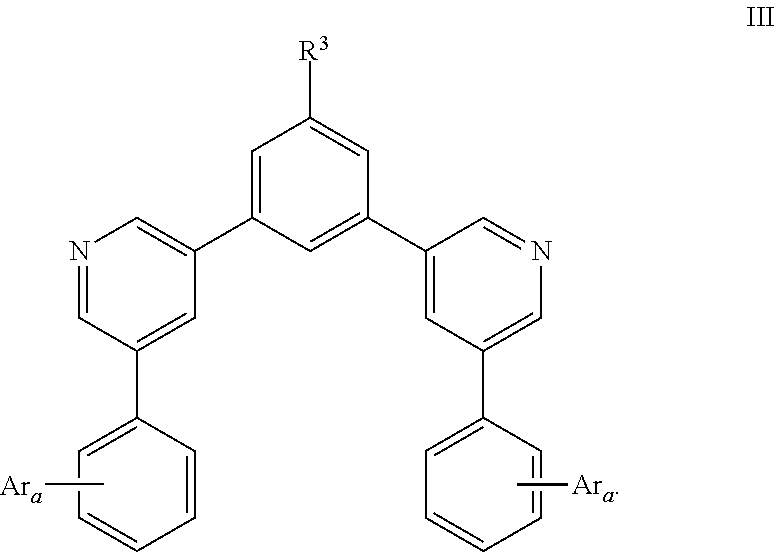
- the present invention relates to compounds of formula III and optoelectronic devices using the same:
- the present invention relates to compounds of formula IV-V and optoelectronic devices using any or any combination of them:
- the compounds of formula I to V may be prepared by employing Suzuki cross-coupling reactions.
- the general procedure for Suzuki cross-coupling reactions includes mixing an aryl halide and aryl borate (or boronic acid) in a suitable solvent, in the presence of a base and Pd catalyst. The reaction mixture is heated under an inert atmosphere for a period of time.
- Suitable solvents include but are not limited to Dioxane, THF, EtOH, toluene and mixtures thereof.
- Exemplary bases include Na 2 CO 3 , K 2 CO 3 , Cs 2 CO 3 , Potassium phosphate and hydrates thereof.
- the bases can be added to the reaction as a solid powder or as an aqueous solution.
- catalysts include Pd(PPh 3 ) 4 , or Pd(OAc) 3 , Pd(dba) 2 with the addition of a secondary ligand.
- exemplary ligands include dialkylphosphinobiphenyl ligands, such as structures VI-X shown below, in which Cy is cyclohexyl.
- An optoelectronic device typically includes in the simplest case, an anode layer and a corresponding cathode layer with an organic electroluminescent layer disposed between said anode and said cathode.
- an OLED typically includes in the simplest case, an anode layer and a corresponding cathode layer with an organic electroluminescent layer disposed between said anode and said cathode.
- a voltage bias is applied across the electrodes, electrons are injected by the cathode into the electroluminescent layer while electrons are removed from (or “holes” are “injected” into) the electroluminescent layer from the anode.
- Light emission occurs as holes combine with electrons within the electroluminescent layer to form singlet or triplet excitons, light emission occurring as singlet and/or triplet excitons decay to their ground states via radiative decay.
- Other components which may be present in an OLED in addition to the anode, cathode and light emitting material include a hole injection layer, an electron injection layer, and an electron transport layer.
- the electron transport layer need not be in direct contact with the cathode, and frequently the electron transport layer also serves as a hole blocking layer to prevent holes migrating toward the cathode.
- Additional components which may be present in an organic light-emitting device include hole transporting layers, hole transporting emission (emitting) layers and electron transporting emission (emitting) layers.
- the OLEDs comprising the organic compounds of the invention may be a fluorescent OLED comprising a singlet emitter. In another embodiment, the OLEDs comprising the organic compounds of the invention may be a phosphorescent OLED comprising at least one triplet emitter. In another embodiment, the OLEDs comprising the organic compounds of the invention comprise at least one singlet emitter and at least one triplet emitter.
- the OLEDs comprising the organic compounds of the invention may contain one or more, any or a combination of blue, yellow, orange, red phosphorescent dyes, including complexes of transition metals such as Ir, Os and Pt, In particular, electrophosphorescent and electrofluorescent metal complexes, such as those supplied by American Dye Source, Inc., Quebec, Canada may be used.
- Compounds of the formula I to V may be part of an emissive layer, or hole transporting layer or electron transporting layer, or electron injection layer of an OLED or any combination thereof.
- the organic electroluminescent layer i.e., the emissive layer
- the organic electroluminescent layer is a layer within an organic light emitting device which when in operation contains a significant concentration of both electrons and holes and provides sites for exciton formation and light emission.
- a hole injection layer is a layer in contact with the anode which promotes the injection of holes from the anode into the interior layers of the OLED; and an electron injection layer is a layer in contact with the cathode that promotes the injection of electrons from the cathode into the OLED;
- an electron transport layer is a layer which facilitates conduction of electrons from the cathode and/or the electron injection layer to a charge recombination site.
- a hole transporting layer is a layer which when the OLED is in operation facilitates conduction of holes from the anode and/or the hole injection layer to charge recombination sites and which need not be in direct contact with the anode.
- a hole transporting emission layer is a layer in which when the OLED is in operation facilitates the conduction of holes to charge recombination sites, and in which the majority of charge carriers are holes, and in which emission occurs not only through recombination with residual electrons, but also through the transfer of energy from a charge recombination zone elsewhere in the device.
- An electron transporting emission layer is a layer in which when the OLED is in operation facilitates the conduction of electrons to charge recombination sites, and in which the majority of charge carriers are electrons, and in which emission occurs not only through recombination with residual holes, but also through the transfer of energy from a charge recombination zone elsewhere in the device.
- Materials suitable for use as the anode includes materials having a bulk resistivity of preferred about 1000 ohms per square, as measured by a four-point probe technique.
- Indium tin oxide (ITO) is frequently used as the anode because it is substantially transparent to transmission and thus facilitates the escape of light emitted from electro-active organic layer.
- Other materials, which may be utilized as the anode layer include tin oxide, indium oxide, zinc oxide, indium zinc oxide, zinc indium tin oxide, antimony oxide, and mixtures thereof.
- Materials suitable for use as the cathode include general electrical conductors including, but not limited to metals and metal oxides such as ITO etc which can inject negative charge carriers (electrons) into the inner layer(s) of the OLED.
- Various metals suitable for use as the cathode include K, Li, Na, Cs, Mg, Cu, Sr, Ba, Al, Ag, Au, In, Sn, Zn, Zr, Sc, Y, elements of the lanthanide series, alloys thereof, and mixtures thereof.
- Suitable alloy materials for use as the cathode layer include Ag—Mg, Al—Li, In—Mg, Al—Ca, and Al—Au alloys,
- Layered non-alloy structures may also be employed in the cathode, such as a thin layer of a metal such as calcium, or a metal fluoride, such as LiF, covered by a thicker layer of a metal, such as aluminum or silver.
- the cathode may be composed of a single metal, and especially of aluminum metal.
- Compounds of formula I to V may be used in electron transport layers in place of, or in addition to traditional materials such as poly(9,9-dioctyl fluorene), tris(8-hydroxyquinolato)aluminium (Alq 3 ), 2,9-dimethyl-4,7-diphenyl-1,1-phenanthroline, 4,7-diphenyl-1,10-phenanthroline, 2-(4-biphenylyl)-5-(4-t-butylphenyl)-1,3,4-oxadiazole, 3-(4-biphenylyl)-4-phenyl-5-(4-t-butylphenyl)-1,2,4-triazole, 1,3,4-oxadiazole-containing polymers, 1,3,4-triazole-containing polymers, quinoxaline-containing polymers, and cyano-PPV.
- traditional materials such as poly(9,9-dioctyl fluorene), tris(8-hydroxyquino
- Materials suitable for use in hole transporting layers include 1,1-bis((di-4-tolylamino) phenyl)cyclohexane, N,N′-bis(4-methylphenyl)-N,N′-bis(4-ethylphenyl)-(1,1′-(3,3′-dimethyl)biphenyl)-4,4′-diamine, tetrakis-(3-methylphenyl)-N,N,N′,N′-2,5-phenylenediamine, phenyl-4-N,N-diphenylaminostyrene, p-(diethylamino) benzaldehyde diphenylhydrazone, triphenylamine, 1-phenyl-3-(p-(diethylamino)styryl)-5-(p-(diethylamino)phenyl)pyrazoline, 1,2-trans-bis(9H-carbazol-9-yl)cyclobutane,
- Materials suitable for use in the light emitting layer include electroluminescent polymers such as polyfluorenes, preferably poly(9,9-dioctyl fluorene) and copolymers thereof, such as poly(9,9′-dioctylfluorene-co-bis-N,N′-(4-butylphenyl)diphenylamine) (F8-TFB); poly(vinylcarbazole) and polyphenylenevinylene and their derivatives.
- the light emitting layer may include a blue, yellow, orange, green or red phosphorescent dye or metal complex, or a combination thereof.
- Materials suitable for use as the phosphorescent dye include, but are not limited to, tris(1-phenylisoquinoline) iridium (III) (red dye), tris(2-phenylpyridine) iridium (green dye) and Iridium (III) bis(2-(4,6-difluorephenyl)pyridinato-N,C2) (blue dye).
- commercially available electrofluorescent and electrophosphorescent metal complexes from ADS may also be used.
- ADS green dyes include ADS060GE, ADS061GE, ADS063GE, and ADS066GE, ADS078GE, and ADS090GE.
- ADS blue dyes include ADS064BE, ADS065BE, and ADS070BE.
- ADS red dyes include ADS067RE, ADS068RE, ADS069RE, ADS075RE, ADS076R, ADS067RE, and ADS077RE.
- Organic compounds of formula I to V may form part of the electron transport layer or electron injection layer or light emissive layer.
- the present invention relates to more efficient optoelectronic devices, e.g., ° LEDs comprising organic compounds of formula I to V.
- the OLEDs may be phosphorescent containing one or more, any or a combination of, blue, yellow, orange, green, red phosphorescent dyes.
- aromatic radical refers to an array of atoms having a valence of at least one comprising at least one aromatic group.
- the array of atoms having a valence of at least one comprising at least one aromatic group may include heteroatoms such as nitrogen, sulfur, selenium, silicon and oxygen, or may be composed exclusively of carbon and hydrogen.
- aromatic radical includes but is not limited to phenyl, pyridyl, furanyl, thienyl, naphthyl, phenylene, and biphenyl radicals.
- the aromatic radical contains at least one aromatic group.
- the aromatic radical may also include nonaromatic components.
- a benzyl group is an aromatic radical which comprises a phenyl ring (the aromatic group) and a methylene group (the nonaromatic component).
- a tetrahydronaphthyl radical is an aromatic radical comprising an aromatic group (C 61 H 3 ) fused to a nonaromatic component —(CH 2 ) 4 —.
- aromatic radical is defined herein to encompass a wide range of functional groups such as alkyl groups, alkenyl groups, alkynyl groups, haloalkyl groups, haloaromatic groups, conjugated dienyl groups, alcohol groups, ether groups, aldehydes groups, ketone groups, carboxylic acid groups, acyl groups (for example carboxylic acid derivatives such as esters and amides), amine groups, nitro groups, and the like.
- the 4-methylphenyl radical is a C 7 aromatic radical comprising a methyl group, the methyl group being a functional group which is an alkyl group.
- the 2-nitrophenyl group is a C 6 aromatic radical comprising a nitro group, the nitro group being a functional group.
- Aromatic radicals include halogenated aromatic radicals such as 4-trifluoromethylphenyl, hexafluoroisopropylidenebis(4-phen-1-yloxy) (i.e., —OPhC(CF 3 ) 2 PhO—), 4-chloromethylphen-1-yl, 3-trifluorovinyl-2-thienyl, 3-trichloromethylphen-1-yl (i.e., 3-CCl 3 Ph-), 4-(3-bromoprop-1-yl)phen-1-yl (i.e., 4-BrCH 2 CH 2 CH 2 Ph-), and the like.
- halogenated aromatic radicals such as 4-trifluoromethylphenyl, hexafluoroisopropylidenebis(4-phen-1-yloxy) (i.e., —OPhC(CF 3 ) 2 PhO—), 4-chloromethylphen-1-yl, 3-trifluorovinyl-2-thienyl, 3-trich
- aromatic radicals include 4-allyloxyphen-1-oxy, 4-aminophen-1-yl (i.e., 4H 2 NPh-), 3-aminocarbonylphen-1-yl (i.e., NH 2 COPh-), 4-benzoylphen-1-yl, dicyanomethylidenebis(4-phen-1-yloxy) (i.e., —OPhC(CN) 2 PhO—), 3-methylphen-1-yl, methylenebis(4-phen-1-yloxy) (i.e., —OPhCH 2 PhO—), 2-ethylphen-1-yl, phenylethenyl, 2-hexyl-5-furanyl, hexamethylene-1,6-bis(4-phen-1-yloxy) (i.e., —OPh(CH 2 ) 6 PhO—), 4-hydroxymethylphen-1-yl (i.e., 4-HOCH 2 Ph-), 4-mercaptomethylphen-1-yl (i.e.
- a C 3 -C 10 aromatic radical includes aromatic radicals containing at least three but no more than 10 carbon atoms.
- the aromatic radical 1-imidazolyl (C 3 H 2 N 2 —) represents a C 3 aromatic radical.
- the benzyl radical (C 7 H 7 —) represents a C 7 aromatic radical.
- cycloaliphatic radical refers to a radical having a valence of at least one, and comprising an array of atoms which is cyclic but which is not aromatic. As defined herein a “cycloaliphatic radical” does not contain an aromatic group.
- a “cycloaliphatic radical” may comprise one or more noncyclic components.
- a cyclohexylmethyl group (C 6 H 11 CH 2 —) is an cycloaliphatic radical which comprises a cyclohexyl ring (the array of atoms which is cyclic but which is not aromatic) and a methylene group (the noncyclic component).
- the cycloaliphatic radical may include heteroatoms such as nitrogen, sulfur, selenium, silicon and oxygen, or may be composed exclusively of carbon and hydrogen.
- the term “cycloaliphatic radical” is defined herein to encompass a wide range of functional groups such as alkyl groups, alkenyl groups, alkynyl groups, haloalkyl groups, conjugated dienyl groups, alcohol groups, ether groups, aldehyde groups, ketone groups, carboxylic acid groups, acyl groups (for example carboxylic acid derivatives such as esters and amides), amine groups, nitro groups, and the like.
- the 4-methylcyclopent-1-yl radical is a C 6 cycloaliphatic radical comprising a methyl group, the methyl group being a functional group which is an alkyl group.
- the 2-nitrocyclobut-1-yl radical is a C 4 cycloaliphatic radical comprising a nitro group, the nitro group being a functional group.
- a cycloaliphatic radical may comprise one or more halogen atoms which may be the same or different. Halogen atoms include, for example; fluorine, chlorine, bromine, and iodine.
- Cycloaliphatic radicals comprising one or more halogen atoms include 2-trifluoromethylcyclohex-1-yl, 4-bromodifluoromethylcyclooct-1-yl, 2-chlorodifluoromethylcyclohex-1-yl, hexafluoroisopropylidene-2,2-bis(cyclohex-4-yl) (i.e., —C 6 H 10 C(CF 3 ) 2 C 6 H 10 —), 2-chloromethylcyclohex-1-yl, 3-difluoromethylenecyclohex-1-yl, 4-trichloromethylcyclohex-1-yloxy, 4-bromodichloromethylcyclohex-1-ylthio, 2-bromoethylcyclopent-1-yl, bromopropylcyclohex-1-yloxy (e.g.
- cycloaliphatic radicals include 4-allyloxycyclohex-1-yl, 4-aminocyclohex-1-yl (i.e., H 2 C 6 H 10 —) 4-aminocarbonylcyclopent-1-yl (i.e., NH 2 COC 5 H 8 —), 4-acetyloxycyclohex-1-yl, 2,2-dicyanoisopropylidenebis(cyclohex-4-yloxy) (i.e., —OC 6 H 10 C(CN) 2 C 6 H 10 O—), 3-methylcyclcohex-1-yl, methylenebis(cyclohex-4-yloxy) (i.e., —OC 6 H 10 CH 2 C 6 H 10 o—), 1-ethylcyclobut-1-yl, cyclopropylethenyl, 3-formyl-2-terahydrofuranyl, 2-hexyl
- a C 3 -C 10 cycloaliphatic radical includes cycloaliphatic radicals containing at least three but no more than 10 carbon atoms.
- the cycloaliphatic radical 2-tetrahydrofuranyl (C 4 H 7 O—) represents a C 4 cycloaliphatic radical.
- the cyclohexylmethyl radical (C 6 H 11 CH 2 —) represents a C 7 cycloaliphatic radical.
- aliphatic radical refers to an organic radical having a valence of at least one consisting of a linear or branched array of atoms which is not cyclic. Aliphatic radicals are defined to comprise at least one carbon atom. The array of atoms comprising the aliphatic radical may include heteroatoms such as nitrogen, sulfur, silicon, selenium and oxygen or may be composed exclusively of carbon and hydrogen.
- aliphatic radical is defined herein to encompass, as part of the “linear or branched array of atoms which is not cyclic” organic radicals substituted with a wide range of functional groups such as alkyl groups, alkenyl groups, alkynyl groups, haloalkyl groups, conjugated dienyl groups, alcohol groups, ether groups, aldehyde groups, ketone groups, carboxylic acid groups, acyl groups (for example carboxylic acid derivatives such as esters and amides), amine groups, nitro groups, and the like.
- functional groups such as alkyl groups, alkenyl groups, alkynyl groups, haloalkyl groups, conjugated dienyl groups, alcohol groups, ether groups, aldehyde groups, ketone groups, carboxylic acid groups, acyl groups (for example carboxylic acid derivatives such as esters and amides), amine groups, nitro groups, and the like.
- the 4-methylpent-1-yl radical is a C 6 aliphatic radical comprising a methyl group, the methyl group being a functional group which is an alkyl group.
- the 4-nitrobut-1-yl group is a C 4 aliphatic radical comprising a nitro group, the nitro group being a functional group.
- An aliphatic radical may be a haloalkyl group which comprises one or more halogen atoms which may be the same or different. Halogen atoms include, for example; fluorine, chlorine, bromine, and iodine.
- Aliphatic radicals comprising one or more halogen atoms include the alkyl halides trifluoromethyl, bromodifluoromethyl, chlorodifluoromethyl, hexafluoroisopropylidene, chloromethyl, difluorovinylidene, trichloromethyl, bromodichloromethyl, bromoethyl, 2-bromotrimethylene (e.g. —CH 2 CHBrCH 2 —), and the like.
- aliphatic radicals include allyl, aminocarbonyl (i.e., —CONH 2 ), carbonyl, 2,2-dicyanoisopropylidene (i.e., —CH 2 C(CN) 2 CH 2 —), methyl (i.e., —CH 3 ), methylene (i.e., —CH 2 —), ethyl, ethylene, formyl (i.e., —CHO), hexyl, hexamethylene, hydroxymethyl (i.e.
- —CH 2 OH mercaptomethyl
- methylthio i.e., —SCH 3
- methylthiomethyl i.e., —CH 2 SCH 3
- methoxy, methoxycarbonyl i.e., CH 3 OCO—
- nitromethyl i.e., —CH 2 NO 2
- thiocarbonyl trimethylsilyl (i.e., (CH 3 ) 3 Si—), t-butyldimethylsilyl, 3-trimethyoxysilypropyl (i.e., (CH 3 O) 3 SiCH 2 CH 2 CH 2 —), vinyl, vinylidene, and the like.
- a C 1 -C 10 aliphatic radical contains at least one but no more than 10 carbon atoms.
- a methyl group i.e., CH—
- a decyl group CH 3 (CH 2 ) 9 —) is an example of a C 10 aliphatic radical.
- heteroaryl refers to aromatic or unsaturated rings in which one or more carbon atoms of the aromatic ring(s) are replaced by a heteroatom(s) such as nitrogen, oxygen, boron, selenium, phosphorus, silicon or sulfur.
- Heteroaryl refers to structures that may be a single aromatic ring, multiple aromatic ring(s), or one or more aromatic rings coupled to one or more non-aromatic ring(s). In structures having multiple rings, the rings can be fused together, linked covalently, or linked to a common group such as an ether, methylene or ethylene moiety.
- the common linking group may also be a carbonyl as in phenyl pyridyl ketone.
- heteroaryl rings include thiophene, pyridine, isoxazole, pyrazole, pyrrole, furan, imidazole, indole, thiazole, benzimidazole, quinoline, isoquinoline, quinoxaline, pyrimidine, pyrazine, tetrazole, triazole, benzo-fused analogues of these groups, benzopyranone, phenylpyridine, tolylpyridine, benzothienylpyridine, phenylisoquinoline, dibenzoquinozaline, fluorenylpyridine, ketopyrrole, 2-phenylbenzoxazole, 2 phenylbenzothiazole, thienylpyridine, benzothienylpyridine, 3 methoxy-2-phenylpyridine, phenylimine, pyridylnaphthalene, pyridylpyrrole, pyridylimidazole, and
- aryl is used herein to refer to an aromatic substituent which may be a single aromatic ring or multiple aromatic rings which are fused together, linked covalently, or linked to a common group such as an ether, methylene or ethylene moiety.
- the aromatic ring(s) may include phenyl, naphthyl, anthracenyl, and biphenyl, among others.
- aryls have between 1 and 200 carbon atoms, between 1 and 50 carbon atoms or between 1 and 20 carbon atoms.
- alkyl is used herein to refer to a branched or unbranched, saturated or unsaturated acyclic hydrocarbon radical. Suitable alkyl radicals include, for example, methyl, ethyl, n-propyl, i-propyl, 2-propenyl (or allyl), vinyl, n-butyl, t-butyl, i-butyl (or 2-methylpropyl), etc. In particular embodiments, alkyls have between 1 and 200 carbon atoms, between 1 and 50 carbon atoms or between 1 and 20 carbon atoms.
- cycloalkyl is used herein to refer to a saturated or unsaturated cyclic non-aromatic hydrocarbon radical having a single ring or multiple condensed rings.
- Suitable cycloalkyl radicals include, for example, cyclopentyl, cyclohexyl, cyclooctenyl, bicyclooctyl, etc.
- cycloalkyls have between 3 and 200 carbon atoms, between 3 and 51) carbon atoms or between 3 and 20 carbon atoms.
- any numerical values recited herein include all values from the lower value to the upper value in increments of one unit provided that there is a separation of at least 2 units between any lower value and any higher value.
- the amount of a component or a value of a process variable such as, for example, temperature, pressure, time and the like is, for example, from 1 to 90, preferably from 20 to 80, more preferably from 30 to 70, it is intended that values such as 15 to 85, 22 to 68, 43 to 51, 30 to 32 etc. are expressly enumerated in this specification.
- one unit is considered to be 0.0001, 0.001, 0.01 or 0.1 as appropriate.
- Examples 1-8 describe the syntheses of compounds of formula IV-V, and intermediates used in making them. All reagents were purchased from Aldrich Chemical Co., Milwaukee, Wis., USA unless otherwise specified and were used without further purification. All compounds were characterized by 1 H-NMR and found to correspond to the structures shown.
- 3-Pyridyl phenyl boronic acid pinacol ester (1.76 g, 6.26 mmol) and 1,3-dibromo pyridine (6.3 g, 31.3 mmol) were added to a 50 mL of three neck round bottom flask.
- dioxane (20 mL) and aqueous K 2 CO 3 (2 N, 10 mL were added.
- the mixture was stirred and degassed with a steam of argon for 30 minutes.
- 0.05 g of Pd(PPh 3 ) 4 was added.
- the mixture was brought to 80° C. and stirred overnight.
- reaction mixture was charged with Pd(OAc) 2 (35.4 mg, 0.150 mmol) and the mixture was heated at 60° C. for overnight. The reaction mixture was then cooled to RT (room temperature) and filtered through a filter paper. The filter cake was washed with EtOAc and the filtrate was concentrated to dryness. The residue was column chromatographed through silica gel with a Hexane/EtOAc eluent. Yield was 90%.
- 3-Pyridineboronic acid pinacol ester (8.7 g, 42.4 mmol) and 1,3-dibromo benzene (50.04 g, 212 mmol) were added to a 500 mL of three neck round bottom flask.
- dioxane 250 mL
- aqueous K 2 CO 3 (2 N, 125 mL) were added.
- the mixture was stirred and degassed with a steam of argon for 30 minutes.
- 1 g of Pd(PPh 3 ) 4 was added.
- the mixture was brought to 80° C. and stirred overnight.
- 1,3-diiodo benzene (3.3 g, 10 mmol) and 3-bromo pyridine-5-boronic acid (6 g, 30 mmol) was added to dioxane (20 mL) and aqueous K 2 CO 3 (2 N, 20 mL) was added. The mixture was stirred and degassed with a steam of argon for 15 min. Then under argon atmosphere a small amount of Pd(PPh 3 ) 4 was added. The mixture was brought to 80° C. and stirred overnight. After cooling to room temperature, the solution was filtered. Solvent was removed by roto-evaporation and residue was suspended into an equal amount of water (10 mL) and CH 2 Cl 2 (10 mL).
Landscapes
- Chemical & Material Sciences (AREA)
- Organic Chemistry (AREA)
- Engineering & Computer Science (AREA)
- Materials Engineering (AREA)
- Physics & Mathematics (AREA)
- Optics & Photonics (AREA)
- Spectroscopy & Molecular Physics (AREA)
- Pyridine Compounds (AREA)
- Electroluminescent Light Sources (AREA)
- Plural Heterocyclic Compounds (AREA)
Abstract

-
- wherein
- R1, R2 and R4 are, independently at each occurrence, H, a C1-C20 aliphatic radical, a C3-C20 aromatic radical, or a C3-C20 cycloaliphatic radical;
- R3 is H or

-
- a is, independently at each occurrence, 1 or 2;
- b is, independently at each occurrence, an integer ranging from 0-3;
- c is, independently at each occurrence, an integer ranging from 0-4;
- Ar is independently at each occurrence, H, or heteroaryl; and
- at least two of Ar are heteroaryl.
Description

-
- wherein
- R1, R2 and R4 are, independently at each occurrence, H, a C1-C20 aliphatic radical.
- a C3-C20 aromatic radical, or a C3-C20 cycloaliphatic radical;
- R3 is H or

-
- a is, independently at each occurrence, 1 or 2;
- b is, independently at each occurrence, an integer ranging from 0-3;
- c is, independently at each occurrence, an integer ranging from 0-4;
- Ar is independently at each occurrence, H, or heteroaryl; and
- at least two of Ar are heteroaryl,



Claims (21)


Applications Claiming Priority (4)
| Application Number | Priority Date | Filing Date | Title |
|---|---|---|---|
| CN200810161787.4 | 2008-09-26 | ||
| CN200810161787 | 2008-09-26 | ||
| CN200810161787.4A CN101684093A (en) | 2008-09-26 | 2008-09-26 | Electronic transmission material |
| PCT/US2009/054241 WO2010036459A1 (en) | 2008-09-26 | 2009-08-19 | Electron-transporting materials |
Publications (2)
| Publication Number | Publication Date |
|---|---|
| US20110155955A1 US20110155955A1 (en) | 2011-06-30 |
| US8962157B2 true US8962157B2 (en) | 2015-02-24 |
Family
ID=41258267
Family Applications (1)
| Application Number | Title | Priority Date | Filing Date |
|---|---|---|---|
| US13/060,855 Active 2030-10-30 US8962157B2 (en) | 2008-09-26 | 2009-08-19 | Electron-transporting materials |
Country Status (6)
| Country | Link |
|---|---|
| US (1) | US8962157B2 (en) |
| EP (1) | EP2331654B1 (en) |
| JP (1) | JP2012503657A (en) |
| KR (1) | KR101706394B1 (en) |
| CN (1) | CN101684093A (en) |
| WO (1) | WO2010036459A1 (en) |
Families Citing this family (6)
| Publication number | Priority date | Publication date | Assignee | Title |
|---|---|---|---|---|
| CN105949177B (en) | 2010-05-03 | 2019-02-01 | 默克专利有限公司 | Preparation and electronic device |
| CN102869672B (en) | 2010-05-03 | 2016-05-11 | 默克专利有限公司 | Preparation and electronic device |
| JP5837051B2 (en) * | 2010-05-03 | 2015-12-24 | メルク パテント ゲーエムベーハー | Formulations and electronic devices |
| CN103396355B (en) * | 2013-07-31 | 2016-06-22 | 华南理工大学 | A kind of be core with three pyridine radicals benzene compound and its preparation method and application |
| CN110423214A (en) * | 2018-08-07 | 2019-11-08 | 广东聚华印刷显示技术有限公司 | Electron transport material and preparation method thereof and organic electroluminescence device |
| CN114149361B (en) * | 2021-12-17 | 2024-01-26 | 长春海谱润斯科技股份有限公司 | Heterocyclic derivative and organic electroluminescent device thereof |
Citations (12)
| Publication number | Priority date | Publication date | Assignee | Title |
|---|---|---|---|---|
| JPH07325329A (en) * | 1994-06-01 | 1995-12-12 | Mitsubishi Electric Corp | Organic superlattice material, method for producing the same, and device using the material |
| JP2000186066A (en) | 1998-12-22 | 2000-07-04 | Minolta Co Ltd | New amino compound, its production and use thereof |
| JP2005068078A (en) | 2003-08-25 | 2005-03-17 | Japan Science & Technology Agency | Novel pyridine ligand having a polyphenylene group and an oxidation catalyst comprising a complex of the ligand and Pd |
| EP1555305A1 (en) | 2002-10-21 | 2005-07-20 | Idemitsu Kosan Co., Ltd. | Material for organic electroluminescence element, and organic electroluminescence element using the same |
| JP2005268199A (en) | 2003-07-31 | 2005-09-29 | Mitsubishi Chemicals Corp | Compound, charge transport material and organic electroluminescence device |
| US20060186796A1 (en) * | 2003-07-31 | 2006-08-24 | Mitsubishi Chemical Corporation | Compound, charge transporting material and organic electroluminescent element |
| US20080067922A1 (en) * | 2004-09-22 | 2008-03-20 | Ayataka Endo | Organic Electroluminescent Device |
| JP2008063232A (en) | 2006-09-04 | 2008-03-21 | Chemiprokasei Kaisha Ltd | Heteroaryl compound having novel biphenyl central skeleton and organic electroluminescence device comprising the same |
| JP2008112984A (en) | 2006-10-04 | 2008-05-15 | Mitsubishi Chemicals Corp | Charge transport material for low molecular weight coating type organic electroluminescent device, composition for organic electroluminescent device, thin film for organic electroluminescent device, and organic electroluminescent device |
| JP2008120696A (en) | 2006-11-08 | 2008-05-29 | Chemiprokasei Kaisha Ltd | Novel tripyridylphenyl derivative, electron transport material comprising the same, and organic electroluminescence device including the same |
| JP2008127326A (en) | 2006-11-20 | 2008-06-05 | Chemiprokasei Kaisha Ltd | Novel di (pyridylphenyl) derivative, electron transport material comprising the same, and organic electroluminescence device including the same |
| US20090102356A1 (en) * | 2007-10-17 | 2009-04-23 | Technical Institute Of Physics And Chemistry Of Chinese Academy Of Sciences | NOVEL ORGANIC COMPOUND HAVING ELECTRON-TRANSPORTING AND/OR HOLE-BLOCKING PERFORMANCE AND ITS USE AND OLEDs COMPRISING THE COMPOUND |
-
2008
- 2008-09-26 CN CN200810161787.4A patent/CN101684093A/en active Pending
-
2009
- 2009-08-19 WO PCT/US2009/054241 patent/WO2010036459A1/en not_active Ceased
- 2009-08-19 US US13/060,855 patent/US8962157B2/en active Active
- 2009-08-19 KR KR1020117006745A patent/KR101706394B1/en active Active
- 2009-08-19 JP JP2011529049A patent/JP2012503657A/en active Pending
- 2009-08-19 EP EP09791638.1A patent/EP2331654B1/en active Active
Patent Citations (13)
| Publication number | Priority date | Publication date | Assignee | Title |
|---|---|---|---|---|
| JPH07325329A (en) * | 1994-06-01 | 1995-12-12 | Mitsubishi Electric Corp | Organic superlattice material, method for producing the same, and device using the material |
| JP2000186066A (en) | 1998-12-22 | 2000-07-04 | Minolta Co Ltd | New amino compound, its production and use thereof |
| EP1555305A1 (en) | 2002-10-21 | 2005-07-20 | Idemitsu Kosan Co., Ltd. | Material for organic electroluminescence element, and organic electroluminescence element using the same |
| US7777043B2 (en) | 2003-07-31 | 2010-08-17 | Mitsubishi Chemical Corporation | Compound, charge transporting material and organic electroluminescent element |
| JP2005268199A (en) | 2003-07-31 | 2005-09-29 | Mitsubishi Chemicals Corp | Compound, charge transport material and organic electroluminescence device |
| US20060186796A1 (en) * | 2003-07-31 | 2006-08-24 | Mitsubishi Chemical Corporation | Compound, charge transporting material and organic electroluminescent element |
| JP2005068078A (en) | 2003-08-25 | 2005-03-17 | Japan Science & Technology Agency | Novel pyridine ligand having a polyphenylene group and an oxidation catalyst comprising a complex of the ligand and Pd |
| US20080067922A1 (en) * | 2004-09-22 | 2008-03-20 | Ayataka Endo | Organic Electroluminescent Device |
| JP2008063232A (en) | 2006-09-04 | 2008-03-21 | Chemiprokasei Kaisha Ltd | Heteroaryl compound having novel biphenyl central skeleton and organic electroluminescence device comprising the same |
| JP2008112984A (en) | 2006-10-04 | 2008-05-15 | Mitsubishi Chemicals Corp | Charge transport material for low molecular weight coating type organic electroluminescent device, composition for organic electroluminescent device, thin film for organic electroluminescent device, and organic electroluminescent device |
| JP2008120696A (en) | 2006-11-08 | 2008-05-29 | Chemiprokasei Kaisha Ltd | Novel tripyridylphenyl derivative, electron transport material comprising the same, and organic electroluminescence device including the same |
| JP2008127326A (en) | 2006-11-20 | 2008-06-05 | Chemiprokasei Kaisha Ltd | Novel di (pyridylphenyl) derivative, electron transport material comprising the same, and organic electroluminescence device including the same |
| US20090102356A1 (en) * | 2007-10-17 | 2009-04-23 | Technical Institute Of Physics And Chemistry Of Chinese Academy Of Sciences | NOVEL ORGANIC COMPOUND HAVING ELECTRON-TRANSPORTING AND/OR HOLE-BLOCKING PERFORMANCE AND ITS USE AND OLEDs COMPRISING THE COMPOUND |
Non-Patent Citations (6)
| Title |
|---|
| Meier et al., Synthesis of Oligo(para-phenylene-meta-pyridinediy1)s, 2000, Journal fuer Organishe Chemie, 342(7), STN abstract. * |
| PCT Search Report and Written Opinion, dated Nov. 18, 2009. |
| Su, Shi-Jian, et al., "Novel Four-Pyridylbenzene-Armed Biphenyls as Electron-Transport Materials for Phosphorescent OLEDs". Organic Letters, 2008, pp. 941-944, vol. 10, No. 5. |
| Unofficial English translation of CN Office Action dated Dec. 3, 2012 from corresponding Application No. 200810161787.4. |
| Unofficial English translation of CN Office Action dated Mar. 23, 2011 from corresponding Application No. 200810161787.4. |
| Unofficial English translation of JP Office Action dated Dec. 3, 2013 from corresponding Application No. 2011-529049. |
Also Published As
| Publication number | Publication date |
|---|---|
| WO2010036459A1 (en) | 2010-04-01 |
| EP2331654A1 (en) | 2011-06-15 |
| CN101684093A (en) | 2010-03-31 |
| JP2012503657A (en) | 2012-02-09 |
| US20110155955A1 (en) | 2011-06-30 |
| EP2331654B1 (en) | 2017-12-06 |
| KR101706394B1 (en) | 2017-02-13 |
| KR20110081159A (en) | 2011-07-13 |
Similar Documents
| Publication | Publication Date | Title |
|---|---|---|
| US8062768B2 (en) | Compound comprising phenyl pyridine units | |
| US8039125B2 (en) | Compound comprising phenyl pyridine units | |
| EP2499181B1 (en) | Polymer for optoelectronic device | |
| US8691399B2 (en) | Electron-transporting materials and processes for making the same | |
| US8962157B2 (en) | Electron-transporting materials | |
| US7989476B2 (en) | Electron-transporting materials and processes for making the same | |
| US8053095B2 (en) | Compound comprising phenyl pyridine units | |
| EP2324038B1 (en) | Compound comprising phenyl pyridine units | |
| US8865905B2 (en) | Organic compounds | |
| US20100270537A1 (en) | Optoelectronic devices and organic compounds used therein |
Legal Events
| Date | Code | Title | Description |
|---|---|---|---|
| AS | Assignment |
Owner name: GENERAL ELECTRIC COMPANY, NEW YORK Free format text: ASSIGNMENT OF ASSIGNORS INTEREST;ASSIGNORS:YE, QING;LIU, JIE;CHICHAK, KELLY SCOTT;AND OTHERS;SIGNING DATES FROM 20110215 TO 20110218;REEL/FRAME:025865/0640 |
|
| STCF | Information on status: patent grant |
Free format text: PATENTED CASE |
|
| CC | Certificate of correction | ||
| AS | Assignment |
Owner name: BOE TECHNOLOGY GROUP CO., LTD., CHINA Free format text: ASSIGNMENT OF ASSIGNORS INTEREST;ASSIGNOR:GENERAL ELECTRIC COMPANY;REEL/FRAME:038439/0315 Effective date: 20151222 |
|
| AS | Assignment |
Owner name: BOE TECHNOLOGY GROUP CO., LTD., CHINA Free format text: ASSIGNMENT OF ASSIGNORS INTEREST;ASSIGNOR:GENERAL ELECTRIC COMPANY;REEL/FRAME:038490/0022 Effective date: 20151222 |
|
| MAFP | Maintenance fee payment |
Free format text: PAYMENT OF MAINTENANCE FEE, 4TH YEAR, LARGE ENTITY (ORIGINAL EVENT CODE: M1551) Year of fee payment: 4 |
|
| MAFP | Maintenance fee payment |
Free format text: PAYMENT OF MAINTENANCE FEE, 8TH YEAR, LARGE ENTITY (ORIGINAL EVENT CODE: M1552); ENTITY STATUS OF PATENT OWNER: LARGE ENTITY Year of fee payment: 8 |