US8952087B2 - Method for reducing metal ion with nanosilicate platelets and dispersing metal nanoparticle and product thereof - Google Patents
Method for reducing metal ion with nanosilicate platelets and dispersing metal nanoparticle and product thereof Download PDFInfo
- Publication number
- US8952087B2 US8952087B2 US12/258,402 US25840208A US8952087B2 US 8952087 B2 US8952087 B2 US 8952087B2 US 25840208 A US25840208 A US 25840208A US 8952087 B2 US8952087 B2 US 8952087B2
- Authority
- US
- United States
- Prior art keywords
- nsp
- platelets
- solution
- nanoparticles
- nanosilicate
- Prior art date
- Legal status (The legal status is an assumption and is not a legal conclusion. Google has not performed a legal analysis and makes no representation as to the accuracy of the status listed.)
- Active, expires
Links
- 238000000034 method Methods 0.000 title claims abstract description 38
- 229910021645 metal ion Inorganic materials 0.000 title claims abstract description 14
- 239000002082 metal nanoparticle Substances 0.000 title abstract description 9
- 238000006243 chemical reaction Methods 0.000 claims abstract description 27
- 230000002829 reductive effect Effects 0.000 claims abstract description 21
- NLJMYIDDQXHKNR-UHFFFAOYSA-K sodium citrate Chemical group O.O.[Na+].[Na+].[Na+].[O-]C(=O)CC(O)(CC([O-])=O)C([O-])=O NLJMYIDDQXHKNR-UHFFFAOYSA-K 0.000 claims abstract description 9
- 229910052751 metal Inorganic materials 0.000 claims abstract description 6
- 239000002184 metal Substances 0.000 claims abstract description 6
- SQGYOTSLMSWVJD-UHFFFAOYSA-N silver(1+) nitrate Chemical compound [Ag+].[O-]N(=O)=O SQGYOTSLMSWVJD-UHFFFAOYSA-N 0.000 claims description 69
- 239000004927 clay Substances 0.000 claims description 15
- XLYOFNOQVPJJNP-UHFFFAOYSA-N water Substances O XLYOFNOQVPJJNP-UHFFFAOYSA-N 0.000 claims description 14
- BPQQTUXANYXVAA-UHFFFAOYSA-N Orthosilicate Chemical compound [O-][Si]([O-])([O-])[O-] BPQQTUXANYXVAA-UHFFFAOYSA-N 0.000 claims description 8
- 239000004990 Smectic liquid crystal Substances 0.000 claims description 8
- FOIXSVOLVBLSDH-UHFFFAOYSA-N Silver ion Chemical compound [Ag+] FOIXSVOLVBLSDH-UHFFFAOYSA-N 0.000 claims description 4
- 150000002500 ions Chemical class 0.000 claims description 4
- 239000005995 Aluminium silicate Substances 0.000 claims description 3
- 235000012211 aluminium silicate Nutrition 0.000 claims description 3
- 229960000892 attapulgite Drugs 0.000 claims description 3
- NLYAJNPCOHFWQQ-UHFFFAOYSA-N kaolin Chemical compound O.O.O=[Al]O[Si](=O)O[Si](=O)O[Al]=O NLYAJNPCOHFWQQ-UHFFFAOYSA-N 0.000 claims description 3
- 239000010445 mica Substances 0.000 claims description 3
- 229910052618 mica group Inorganic materials 0.000 claims description 3
- 238000002156 mixing Methods 0.000 claims description 3
- 229910052625 palygorskite Inorganic materials 0.000 claims description 3
- 239000011734 sodium Substances 0.000 claims description 3
- 239000000454 talc Substances 0.000 claims description 3
- 229910052623 talc Inorganic materials 0.000 claims description 3
- 239000010455 vermiculite Substances 0.000 claims description 3
- 229910052902 vermiculite Inorganic materials 0.000 claims description 3
- 235000019354 vermiculite Nutrition 0.000 claims description 3
- XLYOFNOQVPJJNP-UHFFFAOYSA-M hydroxide Chemical compound [OH-] XLYOFNOQVPJJNP-UHFFFAOYSA-M 0.000 claims 2
- 229910052709 silver Inorganic materials 0.000 abstract description 18
- 235000013855 polyvinylpyrrolidone Nutrition 0.000 abstract description 17
- 229920000036 polyvinylpyrrolidone Polymers 0.000 abstract description 17
- 239000001267 polyvinylpyrrolidone Substances 0.000 abstract description 17
- 239000004332 silver Substances 0.000 abstract description 17
- -1 silver ions Chemical class 0.000 abstract description 15
- 229920001661 Chitosan Polymers 0.000 abstract description 10
- 239000002270 dispersing agent Substances 0.000 abstract description 4
- 239000000203 mixture Substances 0.000 abstract description 4
- 239000000243 solution Substances 0.000 description 62
- 239000002105 nanoparticle Substances 0.000 description 43
- 230000000052 comparative effect Effects 0.000 description 32
- 238000001179 sorption measurement Methods 0.000 description 19
- VZSRBBMJRBPUNF-UHFFFAOYSA-N 2-(2,3-dihydro-1H-inden-2-ylamino)-N-[3-oxo-3-(2,4,6,7-tetrahydrotriazolo[4,5-c]pyridin-5-yl)propyl]pyrimidine-5-carboxamide Chemical compound C1C(CC2=CC=CC=C12)NC1=NC=C(C=N1)C(=O)NCCC(N1CC2=C(CC1)NN=N2)=O VZSRBBMJRBPUNF-UHFFFAOYSA-N 0.000 description 13
- 239000000376 reactant Substances 0.000 description 13
- 230000035484 reaction time Effects 0.000 description 13
- 238000004220 aggregation Methods 0.000 description 11
- 230000002776 aggregation Effects 0.000 description 11
- 239000000047 product Substances 0.000 description 9
- 239000003381 stabilizer Substances 0.000 description 8
- 239000000463 material Substances 0.000 description 6
- MKYBYDHXWVHEJW-UHFFFAOYSA-N N-[1-oxo-1-(2,4,6,7-tetrahydrotriazolo[4,5-c]pyridin-5-yl)propan-2-yl]-2-[[3-(trifluoromethoxy)phenyl]methylamino]pyrimidine-5-carboxamide Chemical compound O=C(C(C)NC(=O)C=1C=NC(=NC=1)NCC1=CC(=CC=C1)OC(F)(F)F)N1CC2=C(CC1)NN=N2 MKYBYDHXWVHEJW-UHFFFAOYSA-N 0.000 description 5
- BQCADISMDOOEFD-UHFFFAOYSA-N Silver Chemical group [Ag] BQCADISMDOOEFD-UHFFFAOYSA-N 0.000 description 5
- HMUNWXXNJPVALC-UHFFFAOYSA-N 1-[4-[2-(2,3-dihydro-1H-inden-2-ylamino)pyrimidin-5-yl]piperazin-1-yl]-2-(2,4,6,7-tetrahydrotriazolo[4,5-c]pyridin-5-yl)ethanone Chemical compound C1C(CC2=CC=CC=C12)NC1=NC=C(C=N1)N1CCN(CC1)C(CN1CC2=C(CC1)NN=N2)=O HMUNWXXNJPVALC-UHFFFAOYSA-N 0.000 description 4
- 239000003638 chemical reducing agent Substances 0.000 description 4
- 239000003086 colorant Substances 0.000 description 4
- 239000007788 liquid Substances 0.000 description 4
- 239000002245 particle Substances 0.000 description 4
- NIPNSKYNPDTRPC-UHFFFAOYSA-N N-[2-oxo-2-(2,4,6,7-tetrahydrotriazolo[4,5-c]pyridin-5-yl)ethyl]-2-[[3-(trifluoromethoxy)phenyl]methylamino]pyrimidine-5-carboxamide Chemical compound O=C(CNC(=O)C=1C=NC(=NC=1)NCC1=CC(=CC=C1)OC(F)(F)F)N1CC2=C(CC1)NN=N2 NIPNSKYNPDTRPC-UHFFFAOYSA-N 0.000 description 3
- AFCARXCZXQIEQB-UHFFFAOYSA-N N-[3-oxo-3-(2,4,6,7-tetrahydrotriazolo[4,5-c]pyridin-5-yl)propyl]-2-[[3-(trifluoromethoxy)phenyl]methylamino]pyrimidine-5-carboxamide Chemical compound O=C(CCNC(=O)C=1C=NC(=NC=1)NCC1=CC(=CC=C1)OC(F)(F)F)N1CC2=C(CC1)NN=N2 AFCARXCZXQIEQB-UHFFFAOYSA-N 0.000 description 3
- YXFVVABEGXRONW-UHFFFAOYSA-N Toluene Chemical compound CC1=CC=CC=C1 YXFVVABEGXRONW-UHFFFAOYSA-N 0.000 description 3
- 239000013078 crystal Substances 0.000 description 3
- 239000002244 precipitate Substances 0.000 description 3
- 238000001228 spectrum Methods 0.000 description 3
- YLZOPXRUQYQQID-UHFFFAOYSA-N 3-(2,4,6,7-tetrahydrotriazolo[4,5-c]pyridin-5-yl)-1-[4-[2-[[3-(trifluoromethoxy)phenyl]methylamino]pyrimidin-5-yl]piperazin-1-yl]propan-1-one Chemical compound N1N=NC=2CN(CCC=21)CCC(=O)N1CCN(CC1)C=1C=NC(=NC=1)NCC1=CC(=CC=C1)OC(F)(F)F YLZOPXRUQYQQID-UHFFFAOYSA-N 0.000 description 2
- 101100202502 Caenorhabditis elegans scd-2 gene Proteins 0.000 description 2
- OAKJQQAXSVQMHS-UHFFFAOYSA-N Hydrazine Chemical compound NN OAKJQQAXSVQMHS-UHFFFAOYSA-N 0.000 description 2
- 238000000445 field-emission scanning electron microscopy Methods 0.000 description 2
- 238000000053 physical method Methods 0.000 description 2
- 239000000126 substance Substances 0.000 description 2
- 239000004094 surface-active agent Substances 0.000 description 2
- LDXJRKWFNNFDSA-UHFFFAOYSA-N 2-(2,4,6,7-tetrahydrotriazolo[4,5-c]pyridin-5-yl)-1-[4-[2-[[3-(trifluoromethoxy)phenyl]methylamino]pyrimidin-5-yl]piperazin-1-yl]ethanone Chemical compound C1CN(CC2=NNN=C21)CC(=O)N3CCN(CC3)C4=CN=C(N=C4)NCC5=CC(=CC=C5)OC(F)(F)F LDXJRKWFNNFDSA-UHFFFAOYSA-N 0.000 description 1
- DEXFNLNNUZKHNO-UHFFFAOYSA-N 6-[3-[4-[2-(2,3-dihydro-1H-inden-2-ylamino)pyrimidin-5-yl]piperidin-1-yl]-3-oxopropyl]-3H-1,3-benzoxazol-2-one Chemical compound C1C(CC2=CC=CC=C12)NC1=NC=C(C=N1)C1CCN(CC1)C(CCC1=CC2=C(NC(O2)=O)C=C1)=O DEXFNLNNUZKHNO-UHFFFAOYSA-N 0.000 description 1
- CPELXLSAUQHCOX-UHFFFAOYSA-M Bromide Chemical compound [Br-] CPELXLSAUQHCOX-UHFFFAOYSA-M 0.000 description 1
- UVTQCOUVBMODTI-UHFFFAOYSA-N C1CNCCC1N2C=C(C=N2)C3=CC4=C(NC=C4CC5=CC=CC=C5)N=C3 Chemical compound C1CNCCC1N2C=C(C=N2)C3=CC4=C(NC=C4CC5=CC=CC=C5)N=C3 UVTQCOUVBMODTI-UHFFFAOYSA-N 0.000 description 1
- VEXZGXHMUGYJMC-UHFFFAOYSA-M Chloride anion Chemical compound [Cl-] VEXZGXHMUGYJMC-UHFFFAOYSA-M 0.000 description 1
- LFQSCWFLJHTTHZ-UHFFFAOYSA-N Ethanol Chemical compound CCO LFQSCWFLJHTTHZ-UHFFFAOYSA-N 0.000 description 1
- WQZGKKKJIJFFOK-GASJEMHNSA-N Glucose Natural products OC[C@H]1OC(O)[C@H](O)[C@@H](O)[C@@H]1O WQZGKKKJIJFFOK-GASJEMHNSA-N 0.000 description 1
- 229910002651 NO3 Inorganic materials 0.000 description 1
- NHNBFGGVMKEFGY-UHFFFAOYSA-N Nitrate Chemical compound [O-][N+]([O-])=O NHNBFGGVMKEFGY-UHFFFAOYSA-N 0.000 description 1
- 229910021607 Silver chloride Inorganic materials 0.000 description 1
- DBMJMQXJHONAFJ-UHFFFAOYSA-M Sodium laurylsulphate Chemical compound [Na+].CCCCCCCCCCCCOS([O-])(=O)=O DBMJMQXJHONAFJ-UHFFFAOYSA-M 0.000 description 1
- FHKPLLOSJHHKNU-INIZCTEOSA-N [(3S)-3-[8-(1-ethyl-5-methylpyrazol-4-yl)-9-methylpurin-6-yl]oxypyrrolidin-1-yl]-(oxan-4-yl)methanone Chemical compound C(C)N1N=CC(=C1C)C=1N(C2=NC=NC(=C2N=1)O[C@@H]1CN(CC1)C(=O)C1CCOCC1)C FHKPLLOSJHHKNU-INIZCTEOSA-N 0.000 description 1
- YKTSYUJCYHOUJP-UHFFFAOYSA-N [O--].[Al+3].[Al+3].[O-][Si]([O-])([O-])[O-] Chemical compound [O--].[Al+3].[Al+3].[O-][Si]([O-])([O-])[O-] YKTSYUJCYHOUJP-UHFFFAOYSA-N 0.000 description 1
- 238000004458 analytical method Methods 0.000 description 1
- 230000000845 anti-microbial effect Effects 0.000 description 1
- 239000007864 aqueous solution Substances 0.000 description 1
- 239000000440 bentonite Substances 0.000 description 1
- 229910000278 bentonite Inorganic materials 0.000 description 1
- SVPXDRXYRYOSEX-UHFFFAOYSA-N bentoquatam Chemical compound O.O=[Si]=O.O=[Al]O[Al]=O SVPXDRXYRYOSEX-UHFFFAOYSA-N 0.000 description 1
- WQZGKKKJIJFFOK-VFUOTHLCSA-N beta-D-glucose Chemical compound OC[C@H]1O[C@@H](O)[C@H](O)[C@@H](O)[C@@H]1O WQZGKKKJIJFFOK-VFUOTHLCSA-N 0.000 description 1
- GWOWVOYJLHSRJJ-UHFFFAOYSA-L cadmium stearate Chemical compound [Cd+2].CCCCCCCCCCCCCCCCCC([O-])=O.CCCCCCCCCCCCCCCCCC([O-])=O GWOWVOYJLHSRJJ-UHFFFAOYSA-L 0.000 description 1
- 239000003054 catalyst Substances 0.000 description 1
- 230000003197 catalytic effect Effects 0.000 description 1
- 239000004020 conductor Substances 0.000 description 1
- 229910052802 copper Inorganic materials 0.000 description 1
- 238000002425 crystallisation Methods 0.000 description 1
- 230000008025 crystallization Effects 0.000 description 1
- 239000000412 dendrimer Substances 0.000 description 1
- 229920000736 dendritic polymer Polymers 0.000 description 1
- GUJOJGAPFQRJSV-UHFFFAOYSA-N dialuminum;dioxosilane;oxygen(2-);hydrate Chemical compound O.[O-2].[O-2].[O-2].[Al+3].[Al+3].O=[Si]=O.O=[Si]=O.O=[Si]=O.O=[Si]=O GUJOJGAPFQRJSV-UHFFFAOYSA-N 0.000 description 1
- 239000006185 dispersion Substances 0.000 description 1
- 239000003814 drug Substances 0.000 description 1
- 239000008103 glucose Substances 0.000 description 1
- 235000001727 glucose Nutrition 0.000 description 1
- 229910052737 gold Inorganic materials 0.000 description 1
- 229910052742 iron Inorganic materials 0.000 description 1
- 229940094522 laponite Drugs 0.000 description 1
- XCOBTUNSZUJCDH-UHFFFAOYSA-B lithium magnesium sodium silicate Chemical compound [Li+].[Li+].[OH-].[OH-].[OH-].[OH-].[OH-].[OH-].[OH-].[OH-].[OH-].[OH-].[OH-].[OH-].[Na+].[Na+].[Mg+2].[Mg+2].[Mg+2].[Mg+2].[Mg+2].[Mg+2].[Mg+2].[Mg+2].[Mg+2].[Mg+2].[Mg+2].[Mg+2].[Mg+2].[Mg+2].[Mg+2].[Mg+2].O1[Si](O2)([O-])O[Si]3([O-])O[Si]1([O-])O[Si]2([O-])O3.O1[Si](O2)([O-])O[Si]3([O-])O[Si]1([O-])O[Si]2([O-])O3.O1[Si](O2)([O-])O[Si]3([O-])O[Si]1([O-])O[Si]2([O-])O3.O1[Si](O2)([O-])O[Si]3([O-])O[Si]1([O-])O[Si]2([O-])O3.O1[Si](O2)([O-])O[Si]3([O-])O[Si]1([O-])O[Si]2([O-])O3.O1[Si](O2)([O-])O[Si]3([O-])O[Si]1([O-])O[Si]2([O-])O3 XCOBTUNSZUJCDH-UHFFFAOYSA-B 0.000 description 1
- 238000004519 manufacturing process Methods 0.000 description 1
- WSFSSNUMVMOOMR-NJFSPNSNSA-N methanone Chemical compound O=[14CH2] WSFSSNUMVMOOMR-NJFSPNSNSA-N 0.000 description 1
- 239000002114 nanocomposite Substances 0.000 description 1
- 239000003960 organic solvent Substances 0.000 description 1
- 229920000642 polymer Polymers 0.000 description 1
- 238000006479 redox reaction Methods 0.000 description 1
- ADZWSOLPGZMUMY-UHFFFAOYSA-M silver bromide Chemical compound [Ag]Br ADZWSOLPGZMUMY-UHFFFAOYSA-M 0.000 description 1
- HKZLPVFGJNLROG-UHFFFAOYSA-M silver monochloride Chemical compound [Cl-].[Ag+] HKZLPVFGJNLROG-UHFFFAOYSA-M 0.000 description 1
- 238000005245 sintering Methods 0.000 description 1
- 239000012279 sodium borohydride Substances 0.000 description 1
- 229910000033 sodium borohydride Inorganic materials 0.000 description 1
- 239000001509 sodium citrate Substances 0.000 description 1
- 235000011083 sodium citrates Nutrition 0.000 description 1
- 235000019333 sodium laurylsulphate Nutrition 0.000 description 1
- JBJWASZNUJCEKT-UHFFFAOYSA-M sodium;hydroxide;hydrate Chemical compound O.[OH-].[Na+] JBJWASZNUJCEKT-UHFFFAOYSA-M 0.000 description 1
- 230000001954 sterilising effect Effects 0.000 description 1
- 239000010409 thin film Substances 0.000 description 1
- 238000002211 ultraviolet spectrum Methods 0.000 description 1
- 238000009834 vaporization Methods 0.000 description 1
- 230000008016 vaporization Effects 0.000 description 1
Images




Classifications
-
- B—PERFORMING OPERATIONS; TRANSPORTING
- B22—CASTING; POWDER METALLURGY
- B22F—WORKING METALLIC POWDER; MANUFACTURE OF ARTICLES FROM METALLIC POWDER; MAKING METALLIC POWDER; APPARATUS OR DEVICES SPECIALLY ADAPTED FOR METALLIC POWDER
- B22F9/00—Making metallic powder or suspensions thereof
- B22F9/16—Making metallic powder or suspensions thereof using chemical processes
- B22F9/18—Making metallic powder or suspensions thereof using chemical processes with reduction of metal compounds
- B22F9/24—Making metallic powder or suspensions thereof using chemical processes with reduction of metal compounds starting from liquid metal compounds, e.g. solutions
-
- B22F1/0022—
-
- B22F1/0059—
-
- B—PERFORMING OPERATIONS; TRANSPORTING
- B22—CASTING; POWDER METALLURGY
- B22F—WORKING METALLIC POWDER; MANUFACTURE OF ARTICLES FROM METALLIC POWDER; MAKING METALLIC POWDER; APPARATUS OR DEVICES SPECIALLY ADAPTED FOR METALLIC POWDER
- B22F1/00—Metallic powder; Treatment of metallic powder, e.g. to facilitate working or to improve properties
- B22F1/05—Metallic powder characterised by the size or surface area of the particles
- B22F1/054—Nanosized particles
- B22F1/0545—Dispersions or suspensions of nanosized particles
-
- B—PERFORMING OPERATIONS; TRANSPORTING
- B82—NANOTECHNOLOGY
- B82Y—SPECIFIC USES OR APPLICATIONS OF NANOSTRUCTURES; MEASUREMENT OR ANALYSIS OF NANOSTRUCTURES; MANUFACTURE OR TREATMENT OF NANOSTRUCTURES
- B82Y30/00—Nanotechnology for materials or surface science, e.g. nanocomposites
-
- B—PERFORMING OPERATIONS; TRANSPORTING
- B22—CASTING; POWDER METALLURGY
- B22F—WORKING METALLIC POWDER; MANUFACTURE OF ARTICLES FROM METALLIC POWDER; MAKING METALLIC POWDER; APPARATUS OR DEVICES SPECIALLY ADAPTED FOR METALLIC POWDER
- B22F2999/00—Aspects linked to processes or compositions used in powder metallurgy
Definitions
- the present invention relates to a method for reducing metal ions with nanosilicate platelets (NSP), particularly for producing an aqueous solution of stably dispersed reduced metal nanoparticles.
- NSP nanosilicate platelets
- This method and the metal nanoparticles are suitable as nano-composite materials and biomedical materials, for example, electrical devices, catalysts, conductors, biosensor, pharmaceutical and polymers.
- the present invention also relates to the product obtained by the above method, namely stably dispersed metal nanoparticles including Ag nanoparticles and Cu nanoparticles.
- the nanosilicate platelets in a water solution can strongly adsorb metal ions and thus precipitate. For example, a black precipitate will be immediately generated after adding AgNO 3 into a water solution of the nanosilicate platelets. Such reaction is vigorous and will result in quick aggregation.
- the physical method usually demands expensive equipment for highly-vacuum vaporization or e-beam.
- the chemical method uses reducers to reduce the silver ions as atoms and then a stabilizer is used to control the size of the particles.
- the general reducers include NaBH 4 , formaldehyde, alcohol, hydrazine (H 2 N—NH 2 ); and the stabilizers include sodium citrate, glucose, sodium dodecyl sulfate, polyvinyl pyrrolidone (PVP), dendrimer, etc.
- the nanosilicate platelets are provided for the purpose of reducing metal ion with a proper stabilizer to obtain nanoparticles.
- the major object of the present invention is to provide a method for reducing metal ions with nanosilicate platelets (NSP) to produce a solution of stably dispersed metal nanoparticles.
- NSP nanosilicate platelets
- Another object of the present invention is to provide a method for reducing silver ions with nanosilicate platelets to produce a solution of stably dispersed Ag nanoparticles.
- the method of the present invention includes at least one step of: mixing an organic dispersant, nanosilicate platelets and a metal ionic solution to perform a reductive reaction, wherein the organic dispersant is selected from the group consisting of tri-sodium citrate dihydrate (SCD), chitosan and polyvinyl pyrrolidone (PVP).
- SCD tri-sodium citrate dihydrate
- PVP polyvinyl pyrrolidone
- the above nanosilicate platelets are preferably exfoliated smectic silicate clay, for example, synthetic fluoric mica, K10, Na + -MMT, SWN, bentonite, laponite, kaolin, LDH, talc, attapulgite clay and vermiculite.
- the smectic silicate clay can be in the form of layers or sheets or platelets.
- the above metal ion can be Ag, Au, Cu or Fe, wherein Ag is preferred.
- the metal ionic solution can be a water solution of nitrate, chloride or bromide of the metal ions, wherein the water solution of AgNO 3 , AgCl or AgBr is preferred.
- the above SCD solution is first mixed with the metal ionic solution, and then added into the NSP solution.
- the weight ratio of NSP/metal ion is preferably about 1/0.2 ⁇ 1/4, and the equivalent ratio of NSP/SCD is preferably about 1/1.1 ⁇ 1/21.5.
- the weight ratio of NSP/metal ion is preferably about 1/0.2 ⁇ 1/1, and the equivalent ratio of NSP/SCD is preferably about 1/1.1 ⁇ 1/10.
- the above NSP solution also can be first mixed with the chitosan solution or the PVP solution, and then added into the metal ionic solution.
- the weight ratio of NSP/metal ion is about 1/0.1 ⁇ 1/9, and meanwhile the weight ratio of NSP/chitosan is about 1/0.01 ⁇ 1/5.
- the weight ratio of NSP/metal ion is preferably about 1/0.1 ⁇ 1/2, and meanwhile the weight ratio of NSP/PVP is about 1/0.01 ⁇ 1/5.
- the above reductive reaction is preferably performed at about 60 ⁇ 100° C., and/or for 1 ⁇ 4 hours.
- the present invention is able to produce a solution of stably dispersed metal nanoparticles, particularly Ag nanoparticles.
- FIG. 1 shows the basic structure and features of the nanosilicate platelets
- FIG. 2 shows UV adsorption spectrum of the Ag nanoparticles, nanosilicate platelets and clay (MMT);
- FIG. 3A and FIG. 3B show the TEM pictures of nanosilicate platelets adsorbed with Ag nanoparticles
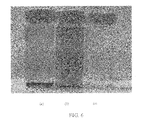
- FIG. 4 shows the AFM pictures (a, b), 3D picture (c) and schematic view (d) of nano-disks;
- FIG. 5 shows UV adsorption spectrum of the Ag nanoparticles sampled with time
- FIG. 6 shows the solutions of silver ions reduced with NSP (0.1 wt. %)
- FIG. 7 shows the solutions of silver ions reduced with NSP (0.5 wt. %)
- FIG. 8 shows the sintered Ag nanoparticles
- FIG. 9 shows the FE-SEM pictures of sintered Ag nanoparticles
- FIG. 10 shows the TEM pictures of nanosilicate platelets and Ag nanoparticles
- Examples 1-1 ⁇ 1-5 use SCD as a stabilizer and the results are compared with those of Comparative Examples 1-1 ⁇ 1-7;
- Examples 2-1 ⁇ 2-9 use chitosan as a stabilizer and the results are compared with those of Comparative Examples 2-1 ⁇ 2-2; and
- Examples 3-1 ⁇ 3-8 use PVP as a stabilizer and the results are compared with those of Comparative Examples 3-1 ⁇ 3-2.
- the SCD solution 38.8 mM, 1.6 ml
- the AgNO 3 solution (1 mM, 20 ml) and mixed well.
- the mixture solution is then slowly added into the NSP solution (0.1 wt. %, 16.67 g), so that the weight ratio of NSP/AgNO 3 is 1/0.2.
- the resultant solution is heated in a water bath at about 60° C. for about 1 ⁇ 2 hours, and then the initially transparent solution becomes golden.
- Example 1-1 Repeat the procedures of Example 1-1, but the concentrations and equivalent ratios of the reactants and reaction time are changed as listed in Table 1.
- the UV adsorption wavelength of the Ag nanoparticles is measured and listed in Table 1.
- the reaction solution becomes yellow.
- Example 1-1 Repeat the procedures of Example 1-1, but the concentrations and equivalent ratios of the reactants and reaction time are changed as listed in Table 1.
- the UV adsorption wavelength of the Ag nanoparticles is measured and listed in Table 1.
- the reaction solution becomes yellow.
- Example 1-1 Repeat the procedures of Example 1-1, but the concentrations and equivalent ratios of the reactants and reaction time are changed as listed in Table 1.
- the UV adsorption wavelength of the Ag nanoparticles is measured and listed in Table 1.
- the reaction solution becomes yellow-green and the upper liquid becomes yellow after a few days.
- Example 1-1 Repeat the procedures of Example 1-1, but the concentrations and equivalent ratios of the reactants and reaction time are changed as listed in Table 1.
- the UV adsorption wavelength of the Ag nanoparticles is measured and listed in Table 1.
- the reaction solution becomes yellow.
- Example 1-1 Repeat the procedures of Example 1-1, but the concentrations and equivalent ratios of the reactants and reaction time are changed as listed in Table 1.
- the UV adsorption wavelength of the Ag nanoparticles is measured and listed in Table 1.
- the reaction solution is still transparent.
- Example 1-1 Repeat the procedures of Example 1-1, but the concentrations and equivalent ratios of the reactants and reaction time are changed as listed in Table 1.
- the UV adsorption wavelength of the Ag nanoparticles is measured and listed in Table 1.
- the reaction solution becomes yellow but the upper liquid becomes transparent.
- Example 1-1 Repeat the procedures of Example 1-1, but the concentrations and equivalent ratios of the reactants and reaction time are changed as listed in Table 1.
- the UV adsorption wavelength of the Ag nanoparticles is measured and listed in Table 1.
- the gray reaction solution becomes gray-yellow, then dark green and then black.
- the upper liquid becomes transparent after a few hours.
- Example 1-1 Repeat the procedures of Example 1-1, but the concentrations and equivalent ratios of the reactants and reaction time are changed as listed in Table 1.
- the UV adsorption wavelength of the Ag nanoparticles is measured and listed in Table 1. Aggregation occurs immediately and the upper liquid becomes transparent.
- Example/ Initial Color of the UV adsorption Comparative NSP Weight ratio of Reaction solution after wavelength Example (wt. %) NSP/AgNO 3 /SCD time (hr.) reaction (nm)
- Example 1-1 0.1 1/0.2/1.1 1 ⁇ 2 Golden 416
- Example 1-2 1/2/10.7 2 ⁇ 3 Yellow 430
- Example 1-3 1/4/21.5 2 ⁇ 3 Yellow 427 Comparative 1/10/53.7 2 ⁇ 3 Transparent —
- Example 1-1 Example 1-4 0.5 1/0.2/1.1 1 ⁇ 2 Yellow 415 Comparative 1/2/10.7 1 ⁇ 2 Transparent —
- Example 1-3 aggregation Comparative 1/10/53.7 2 ⁇ 3 Transparent —
- Example 1-5 1.0 1/1/1.1 2 ⁇ 3 Yellow 406 Comparative 1/10/10.7 2 ⁇ 3 Transparent —
- Example 1-5 aggregation Comparative 1/20/21.5 2 ⁇ 3 Transparent —
- Example 1-6
- the NSP solution (5 wt. %, 2 g) is added into the chitosan solution (5 wt. %, 0.02 g), and then water (28 g) is added therein and mixed well.
- the mixture solution is slowly added into the AgNO 3 solution (0.1 wt. %, 10 g), so that the weight ratio of NSP/AgNO 3 /chitosan is 1/0.1/0.01.
- the solution changes from an initially creamy color to a brown color after it is heated in a water bath at 80 ⁇ 90° C.
- Example 2-1 Repeat the procedures of Example 2-1, but the concentrations and equivalent ratios of the reactants and reaction time are changed as listed in Table 2. The colors of the solution after reaction and the UV adsorption wavelength of the Ag nanoparticles are measured and listed in Table 2.
- Example 2-1 Repeat the procedures of Example 2-1, but the concentrations and equivalent ratios of the reactants and reaction time are changed as listed in Table 2.
- the colors of the solutions after reaction and the UV adsorption wavelengths of the Ag nanoparticles are measured and listed in Table 2.
- the transparent reaction solution in Comparative Example 2-1 is still in creamy color, whereas the solution in Comparative Example 2-2 becomes red-brown.
- Example/ UV adsorption Comparative Final NSP weight ratio of Color of the solution wavelength Example (wt. %) NSP/AgNO 3 /Chitosan after reaction (nm)
- Example 2-1 0.2 1/0.1/0.01 Yellow-brown 420
- Example 2-2 1/0.1/1.0 Yellow 410 Comparative 1/0.2/5 Creamy —
- Example 2-1 Example 2-3 1/0.4/5 Yellow 415 Comparative 1/0.5/0.05 Red-brown —
- Example 2-5 1/1/5 Yellow 415 Example 2-6 1/2/1 Dark 430 yellow-brown
- the NSP solution (5 wt. %, 20 g) is added into the PVP solution (0.1 g), and then water (10 g) is added therein and mixed well.
- the mixture solution is slowly added into the AgNO 3 solution (1 wt. %, 10 g), so that the weight ratio of NSP/AgNO 3 /PVP is 1/0.1/0.1. After it is heated in a water bath at about 80 ⁇ 90° C. for 2 ⁇ 3 hours, the reactant solution becomes yellow-brown.
- Example 3-1 Repeat the procedures of Example 3-1, but the concentrations and equivalent ratios of the reactants and reaction time are changed as listed in Table 3. The colors of the solutions after reaction and the UV adsorption wavelengths of the Ag nanoparticles are measured and listed in Table 3.
- Example 3-1 Repeat the procedures of Example 3-1, but the concentrations and equivalent ratios of the reactants and reaction time are changed as listed in Table 3. The colors of the solutions after reaction and the UV adsorption wavelengths of the Ag nanoparticles are measured and listed in Table 3.
- Example/ Final Color of the UV Comparative NSP Weight ratio of solution after wavelength Example (wt. %) NSP/AgNO 3 /PVP reaction (nm) Comparative 0.2 1/0.1/0.01 Brown — Example 3-1 Comparative 1/0.02/0.1 Yellow-brown — Example 3-2 Example 3-1 1/0.1/0.1 Yellow-brown 415 Example 3-2 1/0.2/0.1 Dark 450 yellow-brown Example 3-3 1/0.3/0.1 Dark 470 yellow-brown Example 3-4 1/0.2/0.2 Dark 440 yellow-brown Example 3-5 1/0.2/1 Dark 440 yellow-brown Example 3-6 1/0.4/5 Yellow-brown 460 Example 3-7 1/1/5 Yellow-brown 450 Example 3-8 1/2/5 Dark 450 yellow-brown
- FIG. 2 shows the UV spectrum of Ag nanoparticles of Example 1-4 and Comparative Examples 1-8 ⁇ 1-11, wherein the Ag nanoparticles of Examples 1-1 are transparent and yellow in the water solution.
- the adsorption wavelength on UV is observed at 400 nm.
- FIG. 3A and FIG. 3B show the TEM pictures of the Ag nanoparticles produced in Example 1-4, which are uniformly adsorbed on the nanosilicate platelets and have a diameter about 20 nm. This shows that the silver ions are first adsorbed on surfaces of the nanosilicate platelets, and then reduced to silver atoms through the redox reaction.
- FIG. 4 shows the AFM pictures of the Ag nanoparticles produced in Examples 1-4, which have a special disk-like structure.
- (a) and (b) are AFM pictures
- (c) is a 3D view
- (d) is a schematic view.
- the Ag nanoparticles are adsorbed around the nanosilicate platelets with a size about 20 nm. That is, the silver ions can be effectively reduced by the nanosilicate platelets having high charge density and the reduced nanoparticles can be fixed or uniformly dispersed around the nanosilicate platelets without aggregation.
- FIG. 6 shows the solutions of silver ions reduced with NSP (0.1 wt. %).
- the reason is that NSP is a weak reducer and hardly effective in a low concentration.
- FIG. 7 shows the solutions of silver ions reduced with NSP (0.5 wt. %).
- FIG. 8 shows the Ag nanoparticles of Example 2-9 which is sintered at 100° C. and 150° C.
- FIG. 9 shows the FE-SEM pictures thereof.
- (a) shows the silver atoms with an average diameter about 20 nm when sintered at 100° C.; and (b) shows the silver atoms melt as larger particles at 150° C.
- the Ag nanoparticles have special surface characteristics and thermal properties different from the larger particles, for example, a lower sintering temperature. Such result further implies that silver wires made from the Ag nanoparticles of the present invention will have lower electric resistance.
- reaction of the present invention can be performed with materials of higher concentrations, a smaller-scale plant will be enough, or more production can be achieved when operated in the same conditions. Certainly, a highly-concentrated solution of Ag nanoparticles can be prepared.
- FIG. 10 shows the TEM pictures of nanosilicate platelets and Ag nanoparticles of Examples 3-1 ⁇ 3-8, in which the Ag nanoparticles have a small size less than 20 nm and can be dried as a thin film.
- the silicate platelets have particular characteristics in crystallization and adsorbing the Ag nanoparticles, crystals thereof are more apparent. That is, new rod-like materials can be developed from the Ag nanoparticles.
- the nanosilicate platelets are used to reduce silver ions instead of traditional reducers.
- the Ag nanoparticles can not attract to each other and are dispersed in a nano-scale.
- the dispersion of Ag nanoparticles is stable enough and can be transferred to an organic solvent, and therefore applications thereof will be wide.
- the Ag nanoparticles will exhibit better antimicrobial, sterilizing, and catalytic abilities, and are suitable for fields of biology, medicine, material, chemistry, etc.
Landscapes
- Chemical & Material Sciences (AREA)
- Engineering & Computer Science (AREA)
- Nanotechnology (AREA)
- Composite Materials (AREA)
- Physics & Mathematics (AREA)
- Condensed Matter Physics & Semiconductors (AREA)
- General Physics & Mathematics (AREA)
- Materials Engineering (AREA)
- Crystallography & Structural Chemistry (AREA)
- Chemical Kinetics & Catalysis (AREA)
- General Chemical & Material Sciences (AREA)
- Inorganic Chemistry (AREA)
- Dispersion Chemistry (AREA)
- Manufacture Of Metal Powder And Suspensions Thereof (AREA)
- Powder Metallurgy (AREA)
Abstract
Description
- 1. In recent years, the inventor(s) of the present invention have developed many processes and products for modifying clay and nanosilicate platelets (NSP), for example, those disclosed in U.S. Pat. Nos. 7,125,916, 7,094,815, and 7,022,299 or Publication Nos.: US 2006-0287413-A1 and US 2006-0063876A1. In addition, a series of polymeric surfactants used for modifying smectic clay are obtained. By adding the surfactants, the clay can be directly exfoliated through ionic exchanging reactions, then the exfoliated clay is extracted with NaOH water/toluene biphase solution to obtain pure nanosilicate platelets. The nanosilicate platelets have a high aspect ratio (on average, 100×100×1 nm3), high specific surface area (700˜800 m2/g) and strong charges (ca. 20,000 ions/platelet), and generally there are about 4×10¹⁶ platelets per gram thereof.
FIG. 1 shows the basic structure of the silicate platelets. With the above characteristics, surface charges of the nanosilicate platelets vary with pH, that is, negative when above the isoelectric point (IEP, pH 6.4) and positive when below the IEP. Aggregation occurs when the surface charges are positive.
- 1. Nanosilicate platelets: prepared according to the methods disclosed in U.S. Pat. Nos. 7,125,916, 7,094,815, and 7,022,299or Publication Nos.: US 2006-0287413-A1 and US 2006-0063876A1.
- 2. Sodium montmorillonite: Na+-MMT, smectic aluminum silicate clay, product of Nancor Co.
- 3. AgNO3:Mw=169.87, product of J.T. Baker, Inc.
- 4. Tri-sodium citrate dihydrate (SCD): product of Aldrich Chemical Co.
- 5. Chitosan: product of Shin Era Technology Co., LTD.
- 6. Polyvinyl pyrrolidone (PVP): Mw=10,000, product of Sigma.
| TABLE 1 | |||||
| Example/ | Initial | Color of the | UV adsorption | ||
| Comparative | NSP | Weight ratio of | Reaction | solution after | wavelength |
| Example | (wt. %) | NSP/AgNO3/SCD | time (hr.) | reaction | (nm) |
| Example 1-1 | 0.1 | 1/0.2/1.1 | 1~2 | Golden | 416 |
| Example 1-2 | 1/2/10.7 | 2~3 | Yellow | 430 | |
| Example 1-3 | 1/4/21.5 | 2~3 | Yellow | 427 | |
| Comparative | 1/10/53.7 | 2~3 | Transparent | — | |
| Example 1-1 | |||||
| Example 1-4 | 0.5 | 1/0.2/1.1 | 1~2 | Yellow | 415 |
| Comparative | 1/2/10.7 | 1~2 | Transparent | — | |
| Example 1-2 | aggregation | ||||
| Comparative | 1/4/21.5 | 2~3 | Transparent | — | |
| Example 1-3 | aggregation | ||||
| Comparative | 1/10/53.7 | 2~3 | Transparent | — | |
| Example 1-4 | aggregation | ||||
| Example 1-5 | 1.0 | 1/1/1.1 | 2~3 | Yellow | 406 |
| Comparative | 1/10/10.7 | 2~3 | Transparent | — | |
| Example 1-5 | aggregation | ||||
| Comparative | 1/20/21.5 | 2~3 | Transparent | — | |
| Example 1-6 | aggregation | ||||
| Comparative | 1/50/53.7 | 2~3 | Transparent | — | |
| Example 1-7 | aggregation | ||||
| Comparative | 0 | — | 2~3 | Transparent | — |
| Example 1-8 | |||||
| Comparative | MMT | — | 2~3 | Earth | — |
| Example 1-9 | |||||
| Comparative | MMT | No SCD | 2~3 | Earth | — |
| Example 1-10 | |||||
| Comparative | 0.5 | No SCD | 2~3 | Transparent | — |
| Example 1-11 | aggregation | ||||
| TABLE 2 | ||||
| Example/ | UV adsorption | |||
| Comparative | Final NSP | weight ratio of | Color of the solution | wavelength |
| Example | (wt. %) | NSP/AgNO3/Chitosan | after reaction | (nm) |
| Example 2-1 | 0.2 | 1/0.1/0.01 | Yellow-brown | 420 |
| Example 2-2 | 1/0.1/1.0 | Yellow | 410 | |
| |
1/0.2/5 | Creamy | — | |
| Example 2-1 | ||||
| Example 2-3 | 1/0.4/5 | Yellow | 415 | |
| |
1/0.5/0.05 | Red-brown | — | |
| Example 2-2 | ||||
| Example 2-4 | 1/1/1 | Yellow-brown | 420 | |
| Example 2-5 | 1/1/5 | Yellow | 415 | |
| Example 2-6 | 1/2/1 | Dark | 430 | |
| yellow-brown | ||||
| Example 2-7 | 1/2/5 | Dark Yellow | 415 | |
| Example 2-8 | 1/4/5 | Dark brown | 460 | |
| Example 2-9 | 1/9/5 | Dark gray-green | 475 | |
| TABLE 3 | ||||
| Example/ | Final | Color of the | UV | |
| Comparative | NSP | Weight ratio of | solution after | wavelength |
| Example | (wt. %) | NSP/AgNO3/PVP | reaction | (nm) |
| Comparative | 0.2 | 1/0.1/0.01 | Brown | — |
| Example 3-1 | ||||
| |
1/0.02/0.1 | Yellow-brown | — | |
| Example 3-2 | ||||
| Example 3-1 | 1/0.1/0.1 | Yellow-brown | 415 | |
| Example 3-2 | 1/0.2/0.1 | Dark | 450 | |
| yellow-brown | ||||
| Example 3-3 | 1/0.3/0.1 | Dark | 470 | |
| yellow-brown | ||||
| Example 3-4 | 1/0.2/0.2 | Dark | 440 | |
| yellow-brown | ||||
| Example 3-5 | 1/0.2/1 | Dark | 440 | |
| yellow-brown | ||||
| Example 3-6 | 1/0.4/5 | Yellow-brown | 460 | |
| Example 3-7 | 1/1/5 | Yellow-brown | 450 | |
| Example 3-8 | 1/2/5 | Dark | 450 | |
| yellow-brown | ||||
Claims (9)
Applications Claiming Priority (3)
| Application Number | Priority Date | Filing Date | Title |
|---|---|---|---|
| TW096146926 | 2007-12-07 | ||
| TW096146926A TW200924878A (en) | 2007-12-07 | 2007-12-07 | Method of reducing metallic ion using nano silicate platelet and steadily dispersing nano metallic particle and the product |
| TW96146926A | 2007-12-07 |
Publications (2)
| Publication Number | Publication Date |
|---|---|
| US20090149592A1 US20090149592A1 (en) | 2009-06-11 |
| US8952087B2 true US8952087B2 (en) | 2015-02-10 |
Family
ID=40722311
Family Applications (1)
| Application Number | Title | Priority Date | Filing Date |
|---|---|---|---|
| US12/258,402 Active 2032-02-22 US8952087B2 (en) | 2007-12-07 | 2008-10-25 | Method for reducing metal ion with nanosilicate platelets and dispersing metal nanoparticle and product thereof |
Country Status (2)
| Country | Link |
|---|---|
| US (1) | US8952087B2 (en) |
| TW (1) | TW200924878A (en) |
Families Citing this family (8)
| Publication number | Priority date | Publication date | Assignee | Title |
|---|---|---|---|---|
| TWI490932B (en) * | 2011-10-06 | 2015-07-01 | 馗鼎奈米科技股份有限公司 | Method for manufacturing electrically conductive interconnection structure |
| TW201328732A (en) * | 2012-01-04 | 2013-07-16 | A T P Co Ltd | Hydrophilic antibacterial film |
| CN104815990B (en) * | 2015-04-20 | 2017-05-03 | 西安理工大学 | Method for preparing nanometer sliver colloid with liquid phase reduction method |
| ES2859619T3 (en) * | 2017-03-03 | 2021-10-04 | Laboratorio Jaer S A | Solid materials of phyllosilicates and copper with biocidal activity |
| CN107764816B (en) * | 2017-10-09 | 2019-12-24 | 中国石油大学(华东) | Preparation method of nano-gold immobilized beads and its application in thiram detection |
| CN107804854B (en) * | 2017-11-27 | 2020-03-17 | 中国科学院兰州化学物理研究所盱眙凹土应用技术研发中心 | Method for preparing copper silicate nanotube by using low-grade attapulgite clay |
| CN110436471B (en) * | 2019-09-06 | 2022-10-28 | 中国科学院兰州化学物理研究所 | Method for preparing white dimension-mixed nano silicon material by using red attapulgite clay |
| CN112980016B (en) * | 2021-02-08 | 2022-05-24 | 宁波工程学院 | Preparation method of water-soluble chitosan noble metal nano composite material |
Citations (1)
| Publication number | Priority date | Publication date | Assignee | Title |
|---|---|---|---|---|
| US7022299B2 (en) * | 2002-10-15 | 2006-04-04 | National Chung-Hsing University | Exfoliative clay and derivative thereof and method for producing the same |
-
2007
- 2007-12-07 TW TW096146926A patent/TW200924878A/en not_active IP Right Cessation
-
2008
- 2008-10-25 US US12/258,402 patent/US8952087B2/en active Active
Patent Citations (1)
| Publication number | Priority date | Publication date | Assignee | Title |
|---|---|---|---|---|
| US7022299B2 (en) * | 2002-10-15 | 2006-04-04 | National Chung-Hsing University | Exfoliative clay and derivative thereof and method for producing the same |
Non-Patent Citations (3)
| Title |
|---|
| Doering et al., Single-Molecule and single-nanoparticle SERS: Examining the roles of surface active sitres and chemical enhancement, J. Phys. Chem.B 2002,106,311-317. * |
| Gao et al. ,Deposition of silver nanoparticles on montmorillonite platelets by chemical plating, Journal of materials Science 37 (2002) 5083-5087. * |
| Huang et al. , Preparation and characterization of metal-chitosan nanocomposites , Colloids and Surface B: Biointerfaces 39 (2004) 31-37. * |
Also Published As
| Publication number | Publication date |
|---|---|
| TW200924878A (en) | 2009-06-16 |
| TWI365171B (en) | 2012-06-01 |
| US20090149592A1 (en) | 2009-06-11 |
Similar Documents
| Publication | Publication Date | Title |
|---|---|---|
| US20090149592A1 (en) | Method for reducing metal ion with nanosilicate platelets and dispersing metal nanoparticle and product thereof | |
| Fahad et al. | Recent progress in the synthesis of silver nanowires and their role as conducting materials | |
| Liu et al. | Preparation of high-stable silver nanoparticle dispersion by using sodium alginate as a stabilizer under gamma radiation | |
| Smetana et al. | Biocidal activity of nanocrystalline silver powders and particles | |
| Cruces et al. | Copper/silver bimetallic nanoparticles supported on aluminosilicate geomaterials as antibacterial agents | |
| JP5543021B2 (en) | Preparation method of core-shell magnetic alloy nanoparticles | |
| Vanitha et al. | Physiochemical charge stabilization of silver nanoparticles and its antibacterial applications | |
| Xi et al. | Selected-control synthesis of PbO2 submicrometer-sized hollow spheres and Pb3O4 microtubes | |
| TW200811055A (en) | Nanoparticles, methods of making, and applications using same | |
| JP2009155674A (en) | Method for producing metal nanoparticles | |
| Bhosale et al. | Flower‐like superstructures: Structural features, applications and future perspectives | |
| CN105642909B (en) | A kind of synthetic method of nanoparticles | |
| JP2006089786A (en) | Method for producing metallic nano-particle dispersed in polar solvent | |
| KR101423563B1 (en) | Sythesis of metal and metal oxide nanocrystals and nanoplate using polyethylenimine as a reducing agent and stabilizer | |
| KR101842763B1 (en) | preparation method of copper nano-structures | |
| Jin et al. | AgPd nanocages sandwiched between a MXene nanosheet and PDA layer for photothermally improved catalytic activity and antibacterial properties | |
| Liu et al. | Biopolymer-assisted construction and gas-sensing study of uniform solid and hollow ZnSn (OH) 6 spheres | |
| Kuo et al. | Rational design of robust Cu@ Ag core-shell nanowires for wearable electronics applications | |
| Cheng et al. | Synthesis of bismuth micro-and nanospheres by a simple refluxing method | |
| Jiang et al. | Antibacterial activity and mechanism of Ag2Cu2O3 mixed-metal oxide | |
| Kang et al. | Surfactant-assisted electrochemical method for dendritic silver nanocrystals with advanced structure | |
| Yang et al. | Facile synthesis of self-assembled mesoporous CuO nanospheres and hollow Cu 2 O microspheres with excellent adsorption performance | |
| KR20050088675A (en) | Manufacturing of nano-metal powder in aqueous media | |
| TWI403358B (en) | Method for dispersing metallic nanoparticle and composite thereof | |
| Youssef et al. | Graphene-based nanocomposites: Synthesis, characterizations, and their agri-food applications |
Legal Events
| Date | Code | Title | Description |
|---|---|---|---|
| AS | Assignment |
Owner name: NATIONAL TAIWAN UNIVERSITY, TAIWAN Free format text: ASSIGNMENT OF ASSIGNORS INTEREST;ASSIGNORS:LIN, JIANG-JEN;LIAO, YI-LIN;CHU, CHIEN-CHIA;AND OTHERS;REEL/FRAME:021736/0896 Effective date: 20081020 |
|
| STCF | Information on status: patent grant |
Free format text: PATENTED CASE |
|
| MAFP | Maintenance fee payment |
Free format text: PAYMENT OF MAINTENANCE FEE, 4TH YR, SMALL ENTITY (ORIGINAL EVENT CODE: M2551) Year of fee payment: 4 |
|
| MAFP | Maintenance fee payment |
Free format text: PAYMENT OF MAINTENANCE FEE, 8TH YR, SMALL ENTITY (ORIGINAL EVENT CODE: M2552); ENTITY STATUS OF PATENT OWNER: SMALL ENTITY Year of fee payment: 8 |