US8901019B2 - Very low CTE slope doped silica-titania glass - Google Patents
Very low CTE slope doped silica-titania glass Download PDFInfo
- Publication number
- US8901019B2 US8901019B2 US13/835,039 US201313835039A US8901019B2 US 8901019 B2 US8901019 B2 US 8901019B2 US 201313835039 A US201313835039 A US 201313835039A US 8901019 B2 US8901019 B2 US 8901019B2
- Authority
- US
- United States
- Prior art keywords
- glass
- titania
- doped silica
- less
- glass according
- Prior art date
- Legal status (The legal status is an assumption and is not a legal conclusion. Google has not performed a legal analysis and makes no representation as to the accuracy of the status listed.)
- Expired - Fee Related
Links
Images



Classifications
-
- G—PHYSICS
- G03—PHOTOGRAPHY; CINEMATOGRAPHY; ANALOGOUS TECHNIQUES USING WAVES OTHER THAN OPTICAL WAVES; ELECTROGRAPHY; HOLOGRAPHY
- G03F—PHOTOMECHANICAL PRODUCTION OF TEXTURED OR PATTERNED SURFACES, e.g. FOR PRINTING, FOR PROCESSING OF SEMICONDUCTOR DEVICES; MATERIALS THEREFOR; ORIGINALS THEREFOR; APPARATUS SPECIALLY ADAPTED THEREFOR
- G03F1/00—Originals for photomechanical production of textured or patterned surfaces, e.g., masks, photo-masks, reticles; Mask blanks or pellicles therefor; Containers specially adapted therefor; Preparation thereof
- G03F1/22—Masks or mask blanks for imaging by radiation of 100nm or shorter wavelength, e.g. X-ray masks, extreme ultraviolet [EUV] masks; Preparation thereof
-
- C—CHEMISTRY; METALLURGY
- C03—GLASS; MINERAL OR SLAG WOOL
- C03B—MANUFACTURE, SHAPING, OR SUPPLEMENTARY PROCESSES
- C03B19/00—Other methods of shaping glass
- C03B19/12—Other methods of shaping glass by liquid-phase reaction processes
-
- C—CHEMISTRY; METALLURGY
- C03—GLASS; MINERAL OR SLAG WOOL
- C03B—MANUFACTURE, SHAPING, OR SUPPLEMENTARY PROCESSES
- C03B19/00—Other methods of shaping glass
- C03B19/14—Other methods of shaping glass by gas- or vapour- phase reaction processes
- C03B19/1453—Thermal after-treatment of the shaped article, e.g. dehydrating, consolidating, sintering
- C03B19/1461—Thermal after-treatment of the shaped article, e.g. dehydrating, consolidating, sintering for doping the shaped article with flourine
-
- C—CHEMISTRY; METALLURGY
- C03—GLASS; MINERAL OR SLAG WOOL
- C03C—CHEMICAL COMPOSITION OF GLASSES, GLAZES OR VITREOUS ENAMELS; SURFACE TREATMENT OF GLASS; SURFACE TREATMENT OF FIBRES OR FILAMENTS MADE FROM GLASS, MINERALS OR SLAGS; JOINING GLASS TO GLASS OR OTHER MATERIALS
- C03C3/00—Glass compositions
- C03C3/04—Glass compositions containing silica
- C03C3/06—Glass compositions containing silica with more than 90% silica by weight, e.g. quartz
-
- C—CHEMISTRY; METALLURGY
- C03—GLASS; MINERAL OR SLAG WOOL
- C03C—CHEMICAL COMPOSITION OF GLASSES, GLAZES OR VITREOUS ENAMELS; SURFACE TREATMENT OF GLASS; SURFACE TREATMENT OF FIBRES OR FILAMENTS MADE FROM GLASS, MINERALS OR SLAGS; JOINING GLASS TO GLASS OR OTHER MATERIALS
- C03C4/00—Compositions for glass with special properties
- C03C4/0085—Compositions for glass with special properties for UV-transmitting glass
-
- C—CHEMISTRY; METALLURGY
- C03—GLASS; MINERAL OR SLAG WOOL
- C03B—MANUFACTURE, SHAPING, OR SUPPLEMENTARY PROCESSES
- C03B2201/00—Type of glass produced
- C03B2201/06—Doped silica-based glasses
- C03B2201/07—Impurity concentration specified
- C03B2201/075—Hydroxyl ion (OH)
-
- C—CHEMISTRY; METALLURGY
- C03—GLASS; MINERAL OR SLAG WOOL
- C03B—MANUFACTURE, SHAPING, OR SUPPLEMENTARY PROCESSES
- C03B2201/00—Type of glass produced
- C03B2201/06—Doped silica-based glasses
- C03B2201/08—Doped silica-based glasses doped with boron or fluorine or other refractive index decreasing dopant
- C03B2201/12—Doped silica-based glasses doped with boron or fluorine or other refractive index decreasing dopant doped with fluorine
-
- C—CHEMISTRY; METALLURGY
- C03—GLASS; MINERAL OR SLAG WOOL
- C03B—MANUFACTURE, SHAPING, OR SUPPLEMENTARY PROCESSES
- C03B2201/00—Type of glass produced
- C03B2201/06—Doped silica-based glasses
- C03B2201/20—Doped silica-based glasses doped with non-metals other than boron or fluorine
-
- C—CHEMISTRY; METALLURGY
- C03—GLASS; MINERAL OR SLAG WOOL
- C03B—MANUFACTURE, SHAPING, OR SUPPLEMENTARY PROCESSES
- C03B2201/00—Type of glass produced
- C03B2201/06—Doped silica-based glasses
- C03B2201/20—Doped silica-based glasses doped with non-metals other than boron or fluorine
- C03B2201/23—Doped silica-based glasses doped with non-metals other than boron or fluorine doped with hydroxyl groups
-
- C—CHEMISTRY; METALLURGY
- C03—GLASS; MINERAL OR SLAG WOOL
- C03B—MANUFACTURE, SHAPING, OR SUPPLEMENTARY PROCESSES
- C03B2201/00—Type of glass produced
- C03B2201/06—Doped silica-based glasses
- C03B2201/30—Doped silica-based glasses doped with metals, e.g. Ga, Sn, Sb, Pb or Bi
- C03B2201/32—Doped silica-based glasses doped with metals, e.g. Ga, Sn, Sb, Pb or Bi doped with aluminium
-
- C—CHEMISTRY; METALLURGY
- C03—GLASS; MINERAL OR SLAG WOOL
- C03B—MANUFACTURE, SHAPING, OR SUPPLEMENTARY PROCESSES
- C03B2201/00—Type of glass produced
- C03B2201/06—Doped silica-based glasses
- C03B2201/30—Doped silica-based glasses doped with metals, e.g. Ga, Sn, Sb, Pb or Bi
- C03B2201/40—Doped silica-based glasses doped with metals, e.g. Ga, Sn, Sb, Pb or Bi doped with transition metals other than rare earth metals, e.g. Zr, Nb, Ta or Zn
-
- C—CHEMISTRY; METALLURGY
- C03—GLASS; MINERAL OR SLAG WOOL
- C03B—MANUFACTURE, SHAPING, OR SUPPLEMENTARY PROCESSES
- C03B2201/00—Type of glass produced
- C03B2201/06—Doped silica-based glasses
- C03B2201/30—Doped silica-based glasses doped with metals, e.g. Ga, Sn, Sb, Pb or Bi
- C03B2201/40—Doped silica-based glasses doped with metals, e.g. Ga, Sn, Sb, Pb or Bi doped with transition metals other than rare earth metals, e.g. Zr, Nb, Ta or Zn
- C03B2201/42—Doped silica-based glasses doped with metals, e.g. Ga, Sn, Sb, Pb or Bi doped with transition metals other than rare earth metals, e.g. Zr, Nb, Ta or Zn doped with titanium
-
- C—CHEMISTRY; METALLURGY
- C03—GLASS; MINERAL OR SLAG WOOL
- C03C—CHEMICAL COMPOSITION OF GLASSES, GLAZES OR VITREOUS ENAMELS; SURFACE TREATMENT OF GLASS; SURFACE TREATMENT OF FIBRES OR FILAMENTS MADE FROM GLASS, MINERALS OR SLAGS; JOINING GLASS TO GLASS OR OTHER MATERIALS
- C03C2201/00—Glass compositions
- C03C2201/06—Doped silica-based glasses
- C03C2201/08—Doped silica-based glasses containing boron or halide
- C03C2201/12—Doped silica-based glasses containing boron or halide containing fluorine
-
- C—CHEMISTRY; METALLURGY
- C03—GLASS; MINERAL OR SLAG WOOL
- C03C—CHEMICAL COMPOSITION OF GLASSES, GLAZES OR VITREOUS ENAMELS; SURFACE TREATMENT OF GLASS; SURFACE TREATMENT OF FIBRES OR FILAMENTS MADE FROM GLASS, MINERALS OR SLAGS; JOINING GLASS TO GLASS OR OTHER MATERIALS
- C03C2201/00—Glass compositions
- C03C2201/06—Doped silica-based glasses
- C03C2201/20—Doped silica-based glasses containing non-metals other than boron or halide
- C03C2201/23—Doped silica-based glasses containing non-metals other than boron or halide containing hydroxyl groups
-
- C—CHEMISTRY; METALLURGY
- C03—GLASS; MINERAL OR SLAG WOOL
- C03C—CHEMICAL COMPOSITION OF GLASSES, GLAZES OR VITREOUS ENAMELS; SURFACE TREATMENT OF GLASS; SURFACE TREATMENT OF FIBRES OR FILAMENTS MADE FROM GLASS, MINERALS OR SLAGS; JOINING GLASS TO GLASS OR OTHER MATERIALS
- C03C2201/00—Glass compositions
- C03C2201/06—Doped silica-based glasses
- C03C2201/30—Doped silica-based glasses containing metals
- C03C2201/32—Doped silica-based glasses containing metals containing aluminium
-
- C—CHEMISTRY; METALLURGY
- C03—GLASS; MINERAL OR SLAG WOOL
- C03C—CHEMICAL COMPOSITION OF GLASSES, GLAZES OR VITREOUS ENAMELS; SURFACE TREATMENT OF GLASS; SURFACE TREATMENT OF FIBRES OR FILAMENTS MADE FROM GLASS, MINERALS OR SLAGS; JOINING GLASS TO GLASS OR OTHER MATERIALS
- C03C2201/00—Glass compositions
- C03C2201/06—Doped silica-based glasses
- C03C2201/30—Doped silica-based glasses containing metals
- C03C2201/40—Doped silica-based glasses containing metals containing transition metals other than rare earth metals, e.g. Zr, Nb, Ta or Zn
-
- C—CHEMISTRY; METALLURGY
- C03—GLASS; MINERAL OR SLAG WOOL
- C03C—CHEMICAL COMPOSITION OF GLASSES, GLAZES OR VITREOUS ENAMELS; SURFACE TREATMENT OF GLASS; SURFACE TREATMENT OF FIBRES OR FILAMENTS MADE FROM GLASS, MINERALS OR SLAGS; JOINING GLASS TO GLASS OR OTHER MATERIALS
- C03C2201/00—Glass compositions
- C03C2201/06—Doped silica-based glasses
- C03C2201/30—Doped silica-based glasses containing metals
- C03C2201/40—Doped silica-based glasses containing metals containing transition metals other than rare earth metals, e.g. Zr, Nb, Ta or Zn
- C03C2201/42—Doped silica-based glasses containing metals containing transition metals other than rare earth metals, e.g. Zr, Nb, Ta or Zn containing titanium
-
- C—CHEMISTRY; METALLURGY
- C03—GLASS; MINERAL OR SLAG WOOL
- C03C—CHEMICAL COMPOSITION OF GLASSES, GLAZES OR VITREOUS ENAMELS; SURFACE TREATMENT OF GLASS; SURFACE TREATMENT OF FIBRES OR FILAMENTS MADE FROM GLASS, MINERALS OR SLAGS; JOINING GLASS TO GLASS OR OTHER MATERIALS
- C03C2203/00—Production processes
- C03C2203/40—Gas-phase processes
- C03C2203/42—Gas-phase processes using silicon halides as starting materials
- C03C2203/44—Gas-phase processes using silicon halides as starting materials chlorine containing
-
- C—CHEMISTRY; METALLURGY
- C03—GLASS; MINERAL OR SLAG WOOL
- C03C—CHEMICAL COMPOSITION OF GLASSES, GLAZES OR VITREOUS ENAMELS; SURFACE TREATMENT OF GLASS; SURFACE TREATMENT OF FIBRES OR FILAMENTS MADE FROM GLASS, MINERALS OR SLAGS; JOINING GLASS TO GLASS OR OTHER MATERIALS
- C03C2203/00—Production processes
- C03C2203/50—After-treatment
- C03C2203/52—Heat-treatment
- C03C2203/54—Heat-treatment in a dopant containing atmosphere
Definitions
- This disclosure is directed to a silica-titania glass doped with halogens and metal oxides having a very low CTE slope and a method for making such glass.
- EUVL Extreme Ultra-Violet Lithography
- MPU Micro Processing Unit
- DRAM Dynamic Random Access Memory
- the EUVL scanners which are used to produce these Integrated Chips are presently being produced in small numbers to demonstrate this new technology.
- Optics, particularly reflective optics, are an important part of these scanners.
- Low thermal expansion glass for example ULE® glass (Corning Incorporated) is currently being used for making the projection optics systems.
- ULE® Glass Core Incorporated
- the major advantages of a low thermal expansion glass such as ULE® Glass are polishability to the required finish, its CTE (coefficient of thermal expansion or expansivity) control, and its dimensional stability.
- the specifications are becoming more stringent for the newer optics systems.
- the specifications for the materials used in the optics systems are required to meet tighter and tighter requirements.
- the present disclosure is directed to a material that can meet these tighter requirements.
- the material disclosed herein has an expansivity slope, that is significantly improved over that of the materials presently available.
- the present disclosure is directed to a doped silica-titania glass D-SiO 2 —TiO 2 , herein also called DST glass, having an expansivity (or CTE) slope that is significantly improved over the expansivity slope of the presently available binary silica-titania glass SiO 2 —TiO 2 with the dopants being halogens and one or more oxides of Al, Nb and Ta.
- DST glass the improvement in the glass' expansivity slope exceeds the improvements that are possible by adjustment of the annealing cycle alone and/or allows for the same improvement in expansivity slope to be obtained via faster annealing cycles which greatly reduces costs. This is accomplished via a combination of both structural and compositional changes.
- the DST glass has a halogen, for example fluorine, F, and one or more of the oxides of Al, Ta and Nb, added to a titania doped silica glass system.
- the DST glass contains 0.1 wt. % to 5 wt. % fluorine, 50 ppm-wt. to 6 wt. % of oxides of Al, Ta and Nb, 3 wt. % to 10 wt. % TiO 2 and the remainder SiO 2 .
- the DST glass contains 0.2 wt. % to 3 wt. % F, 50 ppm-wt. to 6 wt.
- the DST glass contains 1 wt. % to 2 wt. % F, 50 ppm-wt. to 6 wt. % of oxides of Al, Ta and Nb, 5 wt. % to 8 wt. % TiO 2 and the remainder SiO 2 .
- the OH concentration in the DST glass is less than 100 ppm. In another embodiment the OH concentration is less than 50 ppm. In a further embodiment the OH concentration is less than 30 ppm. In an additional embodiment the OH concentration is less than 20 ppm.
- the annealing cycle is controlled to yield the desired glass structure(s). It has been found that while annealing alone can provide a structural improvement leading to an expansivity slope reduction of up to 40% for a silica-titania glass that does not contain fluorine, the addition of dopants, in an amount in the range disclosed herein, provides for structural improvements that can lead to a CTE slope reduction in excess of 70%.
- the DST glass of this disclosure has an expansivity slope at 20° C. of less than 1 ppb/K 2 . In an embodiment the DST glass' expansivity slope at 20° C. is less than 0.8 ppb/K 2 . In another embodiment the DST glass' expansivity slope at 20° C. is less than 0.6 ppb/K 2 .
- the annealing cycle is controlled in such a manner that it would yield the desired homogeneity of the fictive temperature of the DST glass.
- This aspect is particularly important due to the presence of the dopants whose concentration distribution could be non-uniform.
- the halogens especially, affect the fictive temperature significantly and any non-uniformity in their distribution could cause large variations in properties and render the glass useless.
- the DST glass has a fictive temperature, T f , of less than 875° C. In an embodiment the DST glass has a fictive temperature of less than 825° C. In another embodiment the DST glass has a fictive temperature of less than 775° C.
- This DST glass disclosed herein is not process limited. That is, the DST glass can be made by different manufacturing processes, for example, sol-gel, soot blank, soot pressing, overhead vapor deposition, the direct process, the indirect process, plasma process and other processes known in the art.
- the DST glass has two crossover temperatures, Tzc (temperature at which the CTE of the glass is zero, also called herein a Tzc point) within the normal operational range for the glass when used in lithographic processes, including processes using the 13.5 nm wavelength radiation.
- Tzc temperature at which the CTE of the glass is zero
- the two T zc 's are in the range of 0° C. to 150° C.
- the two T zc 's are in the range of 20° C. to 100° C.
- the two Tzc values are in the range of 20° C. to 80° C.
- the two T zc s are in the range of 10° C. to 60° C. or even 10 to 40° C.
- the DST glass has a crossover temperature (Tzc) in the range of 0° C. to 100° C. in combination with an expansivity slope which substantially equals zero within this temperature range.
- the DST glass has a strain point of less than 900° C. In another embodiment the strain point is less than 850° C. In a further embodiment the strain point is less than 810° C.
- the DST glass has a viscosity that is significantly reduced over that of the ordinary binary silica-titania glass SiO 2 —TiO 2 .
- the ordinary binary silica-titania glass has a Anneal Point of 1001° C. and Strain Point of 892° C., whereas the DST glass has Anneal Point and Strain Point of 885° C. and 770° C.
- the T f varies less than ⁇ 10° C. within an entire part. In another embodiment the T f variation is less than ⁇ 5° C. within an entire part. In a further embodiment the T f variation is less than ⁇ 2° C. within an entire part. In one embodiment the Tzc variation is less than ⁇ 5° C. within an entire part. In another embodiment the Tzc variation is less than ⁇ 3° C. within an entire part. In an additional embodiment the Tzc variation is less than ⁇ 2° C. within an entire part. The variation in these average values in the entire part satisfy the above limits. It should be noted that this requires both good control of composition as well as tight control of the annealing process. Both will be needed to be within the scope of this invention.
- an article or part made of the DST glass has an MSFR (Mid Spatial Frequency Roughness) of less than 0.2 nm. In another embodiment the MSFR is less than 0.15 nm. In a further embodiment the MSFR is than 0.12 nm rms.
- MSFR Mobile Spatial Frequency Roughness
- the peak CTE within the two crossover temperatures does not exceed 30 ppb/K and has a slope of zero ppb/K 2 within the two cross over temperatures. In another embodiment peak CTE within the two crossover temperatures do not exceed 20 ppb/K. In a further embodiment the peak CTE within two crossover temperatures is less than 15 ppb/K. In an additional embodiment the peak CTE within the two crossover temperatures is less than 10 ppb/K.
- the DST glass of this disclosure can be used to make photo mask blanks or as projection optics mirror substrates.
- the DST glass can also be used to make smaller blanks which can then be used to form the critical zone of a mirror blank of a projection optics system in a EUVL stepper.
- Halogen doping can be achieved during consolidation of a regular titania-silica OVD blank.
- shapes made by either soot-pressing or sol-gel method can be doped with the halogen while consolidating them.
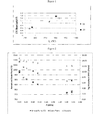
- FIG. 1 is a graph of CTE vs. T f illustrating the effect of F-dopant addition (in this example the halogen is fluorine, wt. %), represented by diamonds 10 , on the CTE slope of a silica-titania glass. Silica-titania glass without the added dopant is represented by the square 20 .
- FIG. 2 is a graph of the Anneal and Strain Points (left vertical axis) and the Log of the Viscosity (right vertical axis) versus dopant addition (in this example the halogen is fluorine, wt. %) for silica-titania glasses containing 0 wt. % up to 1.6 wt. % dopants.
- FIG. 3 is a graph of expansivity versus temperature for (a) a silica-titania glass without dopants and (b) a doped silica-titania glass after a fast annealing cycle and a slow annealing cycle as described herein.
- FIG. 4 is a graph of expansivity versus temperature illustrating the expansivity behavior between 20° C. and 100° C. for different doped SiO 2 —TiO 2 glasses which differ only in TiO 2 concentration in order to yield different values of Tzc 1 .
- FIG. 5 is a graph of expansivity versus temperature for doped silica-titania glasses that differ only in titania content, each glass having been annealed to have the same fictive temperature T f of 730° C.
- the base glass is a silica-titania glass.
- a dopant is added to the base glass to make a low expansion glass according to this disclosure the composition of the resulting glass is given as wt. % or ppm-wt. of the added dopant, wt. % TiO 2 and the remainder being wt. % SiO 2 .
- CTE max the maximum CTE
- CTE min the minimum CTE
- FIG. 6 is Curve 52 of FIG. 5 with CTE max and CTE min indicated.
- CTE max is 3.8 ppb/K and CTE min is ⁇ 2 ppb/K.
- Silica-titania glass with reduced expansivity is an important requirement for the projection optics mirror blanks as well as photomask blanks for EUVL steppers.
- the DST glass described herein has a reduced CTE slope (the slope is a measurement of the instantaneous change in CTE (ppb/K) versus temperature (in K)) which will allow EUVL stepper makers to use higher source power because of the materials described herein offering improved thermal/dimensional stability.
- the DST glass described herein will also enable EUVL users to achieve much higher resolution.
- the DST glass described herein can be used in small quantities for the critical zone of projection optics mirror which will help lower the cost of large projection optics mirrors which can have a diameter in the range of 10 cm to 60 cm.
- the use of inserts in the critical zone of EUVL systems elements is disclosed in commonly owned U.S.
- the tuning of a silica-titania glass and/or a doped glass for optimal performance in a specified application depends in the details of the operating conditions in which the glass will be used.
- the combination of adjustments in TiO 2 concentration and the fictive temperature T f enables the adjustment of crossover points Tzc 1 and Tzc 2 , and also the expansivity maximum to optimize performance in each application.
- Tzc 1 can be adjusted by manipulation of TiO 2 concentration alone. Slow annealing can be used to lower the expansivity slope and bring Tzc 2 lower.
- This disclosure describes a doped titania-silica glass containing up to 5 wt. % halogens and 50 ppm-wt. to 6 wt. % one or more oxides of Al, Ta and Nb.
- the halogen doping was done during the consolidation step of the glass process. Halogen doping during the consolidation enables the making of an initial oxide doped soot blank by different methods, for example:
- the fluorine containing gas can be F 2 , CF 4 , SF 4 , SiF 4 or other volatile fluorine compounds mixed with a carrier gas, for example air.
- a carrier gas for example air.
- compounds such as CF 4 and SF 4 are used as the fluorinating agent oxygen is present in the carrier gas in order to convert the non-fluorine portion of the fluorinating agent (C, Si or S) to a volatile species, for example CO 2 , SiO or SO 2 , which is swept out of the system by the carrier gas.
- the carrier gas can also be an inert gas, for example nitrogen, helium or argon, However, when these are used as the carrier gas for CF 4 , SiF 4 and SF 4 oxygen should be present as indicated above.
- Halogens in addition to doping the glass, can dehydrate the glass. That is, the halogen will reduce the number of hydroxyl groups, OH, that may be present in the glass. Dehydration can also be done using a mixture of chlorine and fluorine, or sequentially by first dehydrating using chlorine and then using a fluorine containing species such as those described above to fluorine dope the glass.
- the consolidation temperature will depend on the method of soot blank preparation and can vary from 1300° C. for a OVD process to 1670° C. for other processes such as soot pressing and sol-gel.
- the DST glass was annealed by heating to a temperature in the range of 1000° C. to 1100° C. for a time in the range of 0.5 hour to 2 hours.
- the annealing temperature was 1050° C. and the holding time at the annealing temperature was 1 hour.
- the glass was cooled from the annealing temperature, for example 1050° C., to 700° C. at the rate of 3° C. per hour, and then cooled from 700° C. to room temperature naturally; natural cooling being to turn off the heat source and allowing the glass to cool to room temperature at the cooling rate of the furnace.
- Titania doped silica soot particles were made by flame hydrolysis using TiCl 4 and SiCl 4 , and the soot was deposited on a bait rod in a lathe using the OVD process for more than 10 hours.
- the resulting soot blank was then consolidated in a muffle furnace as follows:
- Titania doped silica soot particles were made by flame hydrolysis of TiCl 4 and SiCl 4 and the soot was deposited on a bait rod in a lathe using the OVD process for about 16.5 hours.
- the soot blank thus made was 5992 g in mass with a density of 0.42 g/cc and a diameter of 135.7 mm.
- the soot blank was then consolidated in a muffle furnace as follows:
- the resulting blank was bluish gray in color due to the presence of TiO 2 crystallites.
- Discs 15 mm in diameter were cut from the consolidated blank and were heated to 1670° C. for 1 hour to dissolve the crystallites and obtain a clear glass. These discs were then annealed by heating them to 1050° C. for 1 hour followed by cooling to 700° C. at either (a) 3° C./hour (slow anneal cycle) or (b) 30° C./hour (fast anneal cycle) rate to achieve two different fictive temperatures which were 870° C. and 918° C., respectively.
- the sandwich seal samples are approximately of the size 1.5′′ ⁇ 1′′ ⁇ 1 ⁇ 8′′ (38 mm ⁇ 25.4 mm ⁇ 3.2 mm). Stress on the center piece (the meat of the sandwich) exerted by the two experimental pieces (the bread pieces of the sandwich) was measured as the sandwich is heated from ⁇ 100° C. to +125° C. from which the difference in the CTE slope between the experimental material and the Code 7973 ULE glass, whose CTE slope is known, is extracted.
- the samples with a T f of 870° C. has a CTE slope of less than 1.2 ppb/K 2 at 20° C. and the samples with a T f of 918° C. had an average CTE slope of less than 1.5 ppb/K 2 at 20° C.
- FIG. 1 illustrates the effect of fluorine addition to a silica-titania glass on the CTE slope of the resulting DST glass as compared to the CTE slope of a binary silica-titania glass without added fluorine.
- the DST glass is represented by diamonds 10 and the binary silica-titania glass without fluorine is represented by square 20 .
- the fluorine addition decreases the viscosity of the glass and thereby decreases the fictive temperature of the glass.
- Fictive temperature reduction is the prime driver for CTE slope reduction in silica-titania glass. However, while it has been found that fluorine addition does reduce the CTE slope, that reduction is greater than that which would be expected from the fictive temperature reduction alone.
- FIG. 2 is a graph illustrating the effect of fluorine addition on the Anneal and Strain Points (left vertical axis) and the Viscosity (right vertical axis) of silica-titania glasses containing from 0 wt. % F up to 1.6 wt. % F.
- the graph shows the anneal and strains points decreasing at substantially the same rate as the fluorine content increases, and that the viscosity of the glass is also reduced with increasing fluorine content.
- FIG. 3 is a graph of expansivity versus temperature for (1) silica-titania glass without fluorine and (2) a fluorine doped silica-titania glass after a fast annealing cycle and a slow annealing cycle as described herein. All the glasses in FIG. 3 have the same first crossover temperature Tzc 1 of 20° C. which is accomplished by adjusting the wt. % TiO 2 in the glass. The F content in the DST glasses is 1.5 wt. % as indicated in Table 1.
- the FIG. 3 shows the behavior of each glass after undergoing two different annealing cycles a fast annealing cycle in which the cooling rate is 30° C./hour and a slow annealing cycle in which the cooling rate is 3° C./hour. TiO 2 and F values are in wt. % ⁇ CTE is in ppb/K over the temperature range 0° C. to 150° C.
- FIG. 3 Numeral Glass/anneal cycle TiO 2 (Wt. %) F (Wt. %) 30 ULE, fast anneal 7.4 0 32 ULE, slow anneal 7.4 0 34 DST, fast anneal 7.5 1.5 36 DST, slow anneal 7.5 1.5
- the numeral 30 curve which represents ULE glass after the fast anneal, has a maximum expansivity (black dot ⁇ ) of ⁇ 70 ppb/K, a first crossover temperature Tzc 1 at 20° C. and a second zero crossover temperature Tzc 2 at T>300° C.
- the numeral 32 curve which represents a ULE glass after the slow anneal, has a maximum expansivity (black dot ⁇ ) of ⁇ 50 ppb/K, a first crossover temperature Tzc 1 of 20° C. and second crossover temperature Tzc 2 of approximately 230° C.
- the second crossover temperature Tzc 2 for the glasses of curves 30 and 32 is off the scale to the right in FIG. 3 .
- the numeral 34 curve which represents the DST glass after annealing at 30° C./hour, has maximum expansivity (black dot ⁇ ) of approximately 12 ppb/K and a first crossover temperature Tzc 1 of 20° C. and a second crossover temperature Tzc 2 of approximately 100° C.
- the numeral 36 curve which represents the DST glass after the slow anneal, has a maximum expansivity (black dot ⁇ ) of approximately 6 ppb/K, a first crossover temperature Tzc 1 of 20° C. and second crossover temperature of approximately 65° C.
- FIG. 4 is a graph of expansivity versus temperature illustrating the expansivity behavior between 20° C. and 100° C. of four different doped SiO 2 —TiO 2 glasses which differ only in TiO 2 concentration in order to yield different values of Tzc 1 .
- the titania value for each curve is given in Table 2A.
- the halogen content in each sample is 1.5 wt. % and all four samples have been annealed to the same T f of approximately 780° C. using the fast anneal cycle.
- Table 2B gives the ⁇ CTE value for all for curves over two temperature ranges. Within the temperature range of 20-100° C. shown in the graph, the glass 44 with Tzc 1 of 30° C. has a ⁇ CTE of 11 and provides a Tzc 2 of ⁇ 87° C.
- FIG. 4 Numeral TiO 2 (Wt. %) F (Wt. %) Tzc1 (° C.) Tzc2 (° C.) 40 8.4 1.5 20 ⁇ 105 42 8.5 1.5 25 ⁇ 94 44 8.6 1.5 30 ⁇ 87 46 8.7 1.5 35 80
- FIG. 5 is a graph of expansivity versus temperature in the range of 20° C. to 60° C. for four different doped silica-titania glass that differ only in titania content.
- the halogen content of each glass is 1.5 wt. % and each glass has been annealed using the slow anneal cycle to have the same fictive temperature T f of 730° C.
- FIG. 5 Numeral TiO 2 (Wt. %) Tzc1 (° C.) Tzc2 (° C.) 50 ⁇ 8.8 20 ⁇ 70 52 ⁇ 8.9 25 ⁇ 62 54 ⁇ 9.0 30 55 56 ⁇ 9.1 35 50
- Numeral ⁇ CTE CTE max CTE min ⁇ CTE CTE max CTE min 50 5.4 5.4 0 3.4 5.4 2 52 5.8 3.8 ⁇ 2 3.8 3.8 0 54 4.3 0.8 ⁇ 3.5 2.6 0.8 ⁇ 1.8 56 4.7 .2 ⁇ 4.5 2.5 .2 ⁇ 2.3
- All CTE values are in ppb/K properties are obtained by slowly annealing the glass to a lower T f of approximately 730° C. using a slow anneal process, thus bringing Tzc 2 within the temperature range of interest, that is a Tzc 2 of less than or substantially equal to 60° C.
- the glass made according to the present disclosure can be used to make photo mask blanks or as projection optics mirror substrates; and it can also be used to make smaller blanks which can then be used to form the critical zone of a mirror blank of a projection optics system in a EUVL stepper.
- Halogen doping can be achieved during consolidation of a regular titania-silica OVD blank.
- doped silica-titania glass and glass shapes can be made using either soot-pressing or sol-gel methods in which halogen doping us carried out during a drying, heating or consolidation step.
Landscapes
- Chemical & Material Sciences (AREA)
- Engineering & Computer Science (AREA)
- Materials Engineering (AREA)
- Chemical Kinetics & Catalysis (AREA)
- Organic Chemistry (AREA)
- Manufacturing & Machinery (AREA)
- Physics & Mathematics (AREA)
- General Chemical & Material Sciences (AREA)
- Geochemistry & Mineralogy (AREA)
- Life Sciences & Earth Sciences (AREA)
- Thermal Sciences (AREA)
- General Physics & Mathematics (AREA)
- Glass Compositions (AREA)
- Glass Melting And Manufacturing (AREA)
Priority Applications (4)
| Application Number | Priority Date | Filing Date | Title |
|---|---|---|---|
| US13/835,039 US8901019B2 (en) | 2012-11-30 | 2013-03-15 | Very low CTE slope doped silica-titania glass |
| JP2015545421A JP6291505B2 (ja) | 2012-11-30 | 2013-11-27 | 非常に低いcte勾配のドープされたシリカ−チタニアガラス |
| PCT/US2013/072146 WO2014085529A1 (en) | 2012-11-30 | 2013-11-27 | Very low cte slope doped silica-titania glass |
| EP13803404.6A EP2925686A1 (en) | 2012-11-30 | 2013-11-27 | Very low cte slope doped silica-titania glass |
Applications Claiming Priority (2)
| Application Number | Priority Date | Filing Date | Title |
|---|---|---|---|
| US201261731621P | 2012-11-30 | 2012-11-30 | |
| US13/835,039 US8901019B2 (en) | 2012-11-30 | 2013-03-15 | Very low CTE slope doped silica-titania glass |
Publications (2)
| Publication Number | Publication Date |
|---|---|
| US20140155246A1 US20140155246A1 (en) | 2014-06-05 |
| US8901019B2 true US8901019B2 (en) | 2014-12-02 |
Family
ID=50826009
Family Applications (1)
| Application Number | Title | Priority Date | Filing Date |
|---|---|---|---|
| US13/835,039 Expired - Fee Related US8901019B2 (en) | 2012-11-30 | 2013-03-15 | Very low CTE slope doped silica-titania glass |
Country Status (4)
| Country | Link |
|---|---|
| US (1) | US8901019B2 (OSRAM) |
| EP (1) | EP2925686A1 (OSRAM) |
| JP (1) | JP6291505B2 (OSRAM) |
| WO (1) | WO2014085529A1 (OSRAM) |
Cited By (5)
| Publication number | Priority date | Publication date | Assignee | Title |
|---|---|---|---|---|
| US20160085145A1 (en) * | 2014-09-24 | 2016-03-24 | Heraeus Quarzglas Gmbh & Co. Kg | Method for producing a blank of fluorine-doped and titanium-doped glass having a high silicic-acid content and a blank produced according to the method |
| US10017413B2 (en) | 2014-11-26 | 2018-07-10 | Corning Incorporated | Doped silica-titania glass having low expansivity and methods of making the same |
| US10427974B2 (en) | 2015-03-26 | 2019-10-01 | Corning Incorporated | Glass composite for use in extreme ultra violet lithography |
| US10581115B2 (en) | 2016-12-21 | 2020-03-03 | Corning Incorporated | Electrolyte for a solid-state battery |
| US11270724B1 (en) * | 2021-03-04 | 2022-03-08 | Western Digital Technologies, Inc. | Glass substrates for heat assisted magnetic recording (HAMR) and methods and apparatus for use with the glass substrates |
Families Citing this family (9)
| Publication number | Priority date | Publication date | Assignee | Title |
|---|---|---|---|---|
| US9505649B2 (en) | 2013-09-13 | 2016-11-29 | Corning Incorporated | Ultralow expansion glass |
| DE102013112396B3 (de) * | 2013-11-12 | 2014-11-13 | Heraeus Quarzglas Gmbh & Co. Kg | Verfahren zur Herstellung eines Rohlings aus Titan- und Fluor-dotiertem, hochkieselsäurehaltigem Glas |
| US9382150B2 (en) | 2014-03-14 | 2016-07-05 | Corning Incorporated | Boron-doped titania-silica glass having very low CTE slope |
| US9580350B2 (en) | 2014-11-19 | 2017-02-28 | Corning Incorporated | High hydroxyl TiO2-SiO2 glass |
| EP3224211B1 (en) * | 2014-11-26 | 2021-05-05 | Corning Incorporated | Method for making halogen doped optical element |
| US9611169B2 (en) * | 2014-12-12 | 2017-04-04 | Corning Incorporated | Doped ultra-low expansion glass and methods for making the same |
| US9822030B2 (en) | 2015-02-13 | 2017-11-21 | Corning Incorporated | Ultralow expansion titania-silica glass |
| US9932261B2 (en) * | 2015-11-23 | 2018-04-03 | Corning Incorporated | Doped ultra-low expansion glass and methods for annealing the same |
| US10464840B2 (en) * | 2016-10-05 | 2019-11-05 | Corning Incorporated | Near infrared shielding and laser-resistant window |
Citations (20)
| Publication number | Priority date | Publication date | Assignee | Title |
|---|---|---|---|---|
| US20040250573A1 (en) | 2003-04-26 | 2004-12-16 | Hrabanus Hack | Flame hydrolysis process for the manufacture of glass bodies of doped silica glass |
| US20050153824A1 (en) | 2003-12-18 | 2005-07-14 | Jochen Alkemper | Fluorine-doped silicate glass and use thereof |
| US20060179879A1 (en) * | 2004-12-29 | 2006-08-17 | Ellison Adam J G | Adjusting expansivity in doped silica glasses |
| US20080004169A1 (en) * | 2006-06-28 | 2008-01-03 | Adam James Ellison | Ultra low expansion glass and methods for making |
| US7429546B2 (en) | 2003-04-03 | 2008-09-30 | Asahi Glass Company, Limited | Silica glass containing TiO2 and process for its production |
| US20090143213A1 (en) | 2007-11-30 | 2009-06-04 | Kenneth Edward Hrdina | Low expansion glass material having low expansivity gradient |
| WO2009116690A1 (en) | 2008-03-21 | 2009-09-24 | Asahi Glass Company, Limited. | Tio2-containing silica glass |
| US20100179047A1 (en) | 2009-01-13 | 2010-07-15 | Asahi Glass Co., Ltd. | Optical member comprising tio2-containing silica glass |
| US20100261597A1 (en) | 2007-12-27 | 2010-10-14 | Asahi Glass Company Limited | Tio2-containing silica glass |
| US20100323873A1 (en) | 2008-02-09 | 2010-12-23 | Asahi Glass Company, Limited | Tio2-containing silica glass and optical member for lithography using the same |
| US20110034787A1 (en) | 2009-08-04 | 2011-02-10 | Sysmex Corporation | Device for Interstitial Fluid Extraction, Production Process Thereof and Analyzing Process of Interstitial Fluid Using the Device |
| US20110048075A1 (en) | 2009-08-31 | 2011-03-03 | Carlos Duran | TUNING Tzc BY THE ANNEALING OF ULTRA LOW EXPANSION GLASS |
| US7935648B2 (en) * | 2007-06-06 | 2011-05-03 | Shin-Etsu Chemical Co., Ltd. | Titania-doped quartz glass for nanoimprint molds |
| WO2011078414A2 (en) | 2009-12-25 | 2011-06-30 | Asahi Glass Company, Limited. | Substrate for euvl optical member |
| US20110207592A1 (en) | 2010-02-25 | 2011-08-25 | Carlos Duran | Low Expansivity, High Transmission Titania Doped Silica Glass |
| US20110207593A1 (en) | 2010-02-25 | 2011-08-25 | Carlos Duran | Expansivity in Low Expansion Silica-Titania Glasses |
| US8012653B2 (en) | 2008-08-01 | 2011-09-06 | Asahi Glass Company, Limited | Substrate for EUV mask blanks |
| US20120121857A1 (en) | 2009-05-13 | 2012-05-17 | Asahi Glass Company, Limited | Method for producing tio2-sio2 glass body, method for heat-treating tio2-sio2 glass body, tio2-sio2 glass body, and optical base for euvl |
| US20130047669A1 (en) | 2011-08-31 | 2013-02-28 | Sezhian Annamalai | Method of making a silica-titania glass having a ternary doped critical zone |
| US20130052391A1 (en) | 2011-08-31 | 2013-02-28 | Sezhian Annamalai | Binary silica-titania glass articles having a ternary doped silica-titania critical zone |
Family Cites Families (1)
| Publication number | Priority date | Publication date | Assignee | Title |
|---|---|---|---|---|
| JP5428323B2 (ja) * | 2007-12-27 | 2014-02-26 | 旭硝子株式会社 | TiO2を含有するシリカガラス |
-
2013
- 2013-03-15 US US13/835,039 patent/US8901019B2/en not_active Expired - Fee Related
- 2013-11-27 JP JP2015545421A patent/JP6291505B2/ja not_active Expired - Fee Related
- 2013-11-27 WO PCT/US2013/072146 patent/WO2014085529A1/en not_active Ceased
- 2013-11-27 EP EP13803404.6A patent/EP2925686A1/en not_active Withdrawn
Patent Citations (25)
| Publication number | Priority date | Publication date | Assignee | Title |
|---|---|---|---|---|
| US7429546B2 (en) | 2003-04-03 | 2008-09-30 | Asahi Glass Company, Limited | Silica glass containing TiO2 and process for its production |
| US8329604B2 (en) | 2003-04-03 | 2012-12-11 | Asahi Glass Company, Limited | Silica glass containing TiO2 and process for its production |
| US7538052B2 (en) | 2003-04-03 | 2009-05-26 | Asahi Glass Company, Limited | Silica glass containing TiO2 and process for its production |
| US20040250573A1 (en) | 2003-04-26 | 2004-12-16 | Hrabanus Hack | Flame hydrolysis process for the manufacture of glass bodies of doped silica glass |
| US20050153824A1 (en) | 2003-12-18 | 2005-07-14 | Jochen Alkemper | Fluorine-doped silicate glass and use thereof |
| US20060179879A1 (en) * | 2004-12-29 | 2006-08-17 | Ellison Adam J G | Adjusting expansivity in doped silica glasses |
| US20080004169A1 (en) * | 2006-06-28 | 2008-01-03 | Adam James Ellison | Ultra low expansion glass and methods for making |
| US7935648B2 (en) * | 2007-06-06 | 2011-05-03 | Shin-Etsu Chemical Co., Ltd. | Titania-doped quartz glass for nanoimprint molds |
| US20090143213A1 (en) | 2007-11-30 | 2009-06-04 | Kenneth Edward Hrdina | Low expansion glass material having low expansivity gradient |
| US7989378B2 (en) | 2007-12-27 | 2011-08-02 | Asahi Glass Company, Limited | TiO2-containing silica glass |
| US20100261597A1 (en) | 2007-12-27 | 2010-10-14 | Asahi Glass Company Limited | Tio2-containing silica glass |
| US20100323873A1 (en) | 2008-02-09 | 2010-12-23 | Asahi Glass Company, Limited | Tio2-containing silica glass and optical member for lithography using the same |
| US7998892B2 (en) | 2008-02-29 | 2011-08-16 | Asahi Glass Company, Limited | TiO2-containing silica glass and optical member for lithography using the same |
| WO2009116690A1 (en) | 2008-03-21 | 2009-09-24 | Asahi Glass Company, Limited. | Tio2-containing silica glass |
| US8012653B2 (en) | 2008-08-01 | 2011-09-06 | Asahi Glass Company, Limited | Substrate for EUV mask blanks |
| US20100179047A1 (en) | 2009-01-13 | 2010-07-15 | Asahi Glass Co., Ltd. | Optical member comprising tio2-containing silica glass |
| US20120121857A1 (en) | 2009-05-13 | 2012-05-17 | Asahi Glass Company, Limited | Method for producing tio2-sio2 glass body, method for heat-treating tio2-sio2 glass body, tio2-sio2 glass body, and optical base for euvl |
| US20110034787A1 (en) | 2009-08-04 | 2011-02-10 | Sysmex Corporation | Device for Interstitial Fluid Extraction, Production Process Thereof and Analyzing Process of Interstitial Fluid Using the Device |
| US20110048075A1 (en) | 2009-08-31 | 2011-03-03 | Carlos Duran | TUNING Tzc BY THE ANNEALING OF ULTRA LOW EXPANSION GLASS |
| US20120264584A1 (en) | 2009-12-25 | 2012-10-18 | Asahi Glass Company, Limited | Substrate for euvl optical member |
| WO2011078414A2 (en) | 2009-12-25 | 2011-06-30 | Asahi Glass Company, Limited. | Substrate for euvl optical member |
| US20110207593A1 (en) | 2010-02-25 | 2011-08-25 | Carlos Duran | Expansivity in Low Expansion Silica-Titania Glasses |
| US20110207592A1 (en) | 2010-02-25 | 2011-08-25 | Carlos Duran | Low Expansivity, High Transmission Titania Doped Silica Glass |
| US20130047669A1 (en) | 2011-08-31 | 2013-02-28 | Sezhian Annamalai | Method of making a silica-titania glass having a ternary doped critical zone |
| US20130052391A1 (en) | 2011-08-31 | 2013-02-28 | Sezhian Annamalai | Binary silica-titania glass articles having a ternary doped silica-titania critical zone |
Cited By (9)
| Publication number | Priority date | Publication date | Assignee | Title |
|---|---|---|---|---|
| US20160085145A1 (en) * | 2014-09-24 | 2016-03-24 | Heraeus Quarzglas Gmbh & Co. Kg | Method for producing a blank of fluorine-doped and titanium-doped glass having a high silicic-acid content and a blank produced according to the method |
| US9568818B2 (en) * | 2014-09-24 | 2017-02-14 | Heraeus Quarzglas Gmbh & Co. Kg | Method for producing a blank of fluorine-doped and titanium-doped glass having a high silicic-acid content and a blank produced according to the method |
| US11411245B2 (en) | 2014-10-16 | 2022-08-09 | Corning Incorporated | Electrolyte for a solid-state battery |
| US10017413B2 (en) | 2014-11-26 | 2018-07-10 | Corning Incorporated | Doped silica-titania glass having low expansivity and methods of making the same |
| US10427974B2 (en) | 2015-03-26 | 2019-10-01 | Corning Incorporated | Glass composite for use in extreme ultra violet lithography |
| US10581115B2 (en) | 2016-12-21 | 2020-03-03 | Corning Incorporated | Electrolyte for a solid-state battery |
| US12021189B2 (en) | 2016-12-21 | 2024-06-25 | Corning Incorporated | Cathode for a solid-state battery |
| US12183881B2 (en) | 2016-12-21 | 2024-12-31 | Corning Incorporated | Doped-zirconia ceramic ribbon |
| US11270724B1 (en) * | 2021-03-04 | 2022-03-08 | Western Digital Technologies, Inc. | Glass substrates for heat assisted magnetic recording (HAMR) and methods and apparatus for use with the glass substrates |
Also Published As
| Publication number | Publication date |
|---|---|
| EP2925686A1 (en) | 2015-10-07 |
| US20140155246A1 (en) | 2014-06-05 |
| WO2014085529A1 (en) | 2014-06-05 |
| JP2016502495A (ja) | 2016-01-28 |
| JP6291505B2 (ja) | 2018-03-14 |
Similar Documents
| Publication | Publication Date | Title |
|---|---|---|
| US8901019B2 (en) | Very low CTE slope doped silica-titania glass | |
| EP2178804B1 (en) | Method of making fused silica having low oh and od levels | |
| US9580350B2 (en) | High hydroxyl TiO2-SiO2 glass | |
| JP5202959B2 (ja) | 高屈折率均一性溶融シリカガラスおよびその製造方法 | |
| US9382150B2 (en) | Boron-doped titania-silica glass having very low CTE slope | |
| EP3222592B1 (en) | Ultralow expansion glass | |
| JP2005104820A (ja) | TiO2を含有するシリカガラスおよびその製造方法 | |
| US9611169B2 (en) | Doped ultra-low expansion glass and methods for making the same | |
| TWI651277B (zh) | 製造用於euv微影術之高矽酸含量的氟與鈦摻雜玻璃底板的方法及由該方法製造之底板 | |
| EP3256429B1 (en) | Ultralow expansion titania-silica glass | |
| JP2016534959A (ja) | Euv照射下で膨張しないeuvリソグラフィ用ミラーブランク | |
| EP3380441B1 (en) | Doped ultra-low expansion glass and methods for annealing the same | |
| JP2011168489A (ja) | TiO2を含有するシリカガラスおよびその製造法 |
Legal Events
| Date | Code | Title | Description |
|---|---|---|---|
| AS | Assignment |
Owner name: CORNING INCORPORATED, NEW YORK Free format text: ASSIGNMENT OF ASSIGNORS INTEREST;ASSIGNORS:ANNAMALAI, SEZHIAN;DURAN, CARLOS ALBERTO;REEL/FRAME:030264/0848 Effective date: 20130410 |
|
| AS | Assignment |
Owner name: CORNING INCORPORATED, NEW YORK Free format text: CORRECTIVE ASSIGNMENT TO CORRECT THE ASSIGNOR TO ADD KENNETH EDWARD HRDINA PREVIOUSLY RECORDED ON REEL 030264 FRAME 0848. ASSIGNOR(S) HEREBY CONFIRMS THE ADDITION OF KENNETH EDWARD HRDINA AS NOTED ON THE ASSIGNMENT DOCUMENT;ASSIGNORS:ANNAMALAI, SEZHIAN;DURAN, CARLOS ALBERTO;HRDINA, KENNETH EDWARD;REEL/FRAME:030304/0018 Effective date: 20130410 |
|
| STCF | Information on status: patent grant |
Free format text: PATENTED CASE |
|
| CC | Certificate of correction | ||
| MAFP | Maintenance fee payment |
Free format text: PAYMENT OF MAINTENANCE FEE, 4TH YEAR, LARGE ENTITY (ORIGINAL EVENT CODE: M1551) Year of fee payment: 4 |
|
| FEPP | Fee payment procedure |
Free format text: MAINTENANCE FEE REMINDER MAILED (ORIGINAL EVENT CODE: REM.); ENTITY STATUS OF PATENT OWNER: LARGE ENTITY |
|
| LAPS | Lapse for failure to pay maintenance fees |
Free format text: PATENT EXPIRED FOR FAILURE TO PAY MAINTENANCE FEES (ORIGINAL EVENT CODE: EXP.); ENTITY STATUS OF PATENT OWNER: LARGE ENTITY |
|
| STCH | Information on status: patent discontinuation |
Free format text: PATENT EXPIRED DUE TO NONPAYMENT OF MAINTENANCE FEES UNDER 37 CFR 1.362 |
|
| FP | Lapsed due to failure to pay maintenance fee |
Effective date: 20221202 |