US8894808B2 - Method and apparatus for preparing fold lines - Google Patents
Method and apparatus for preparing fold lines Download PDFInfo
- Publication number
- US8894808B2 US8894808B2 US13/125,107 US200913125107A US8894808B2 US 8894808 B2 US8894808 B2 US 8894808B2 US 200913125107 A US200913125107 A US 200913125107A US 8894808 B2 US8894808 B2 US 8894808B2
- Authority
- US
- United States
- Prior art keywords
- laminate
- area
- heating
- fold
- ply
- Prior art date
- Legal status (The legal status is an assumption and is not a legal conclusion. Google has not performed a legal analysis and makes no representation as to the accuracy of the status listed.)
- Expired - Fee Related, expires
Links
- 238000000034 method Methods 0.000 title claims abstract description 26
- 238000010438 heat treatment Methods 0.000 claims abstract description 28
- 239000000463 material Substances 0.000 claims abstract description 20
- 230000032798 delamination Effects 0.000 claims abstract description 13
- 230000015572 biosynthetic process Effects 0.000 claims abstract description 12
- 239000002648 laminated material Substances 0.000 claims abstract description 5
- 230000007423 decrease Effects 0.000 claims description 13
- 239000000835 fiber Substances 0.000 claims description 8
- 238000007669 thermal treatment Methods 0.000 claims description 7
- 230000003247 decreasing effect Effects 0.000 claims description 5
- 238000002360 preparation method Methods 0.000 claims description 5
- 230000002441 reversible effect Effects 0.000 claims description 5
- 239000011796 hollow space material Substances 0.000 claims description 4
- 238000001704 evaporation Methods 0.000 claims description 3
- 230000008020 evaporation Effects 0.000 claims description 2
- 230000036961 partial effect Effects 0.000 abstract description 5
- 230000009467 reduction Effects 0.000 abstract description 3
- 230000008569 process Effects 0.000 description 6
- 239000002131 composite material Substances 0.000 description 5
- 238000004519 manufacturing process Methods 0.000 description 5
- 239000011248 coating agent Substances 0.000 description 4
- 238000000576 coating method Methods 0.000 description 4
- 238000010586 diagram Methods 0.000 description 4
- 230000002829 reductive effect Effects 0.000 description 4
- XLYOFNOQVPJJNP-UHFFFAOYSA-N water Chemical compound O XLYOFNOQVPJJNP-UHFFFAOYSA-N 0.000 description 4
- 239000004698 Polyethylene Substances 0.000 description 3
- 238000005452 bending Methods 0.000 description 3
- -1 polyethylene Polymers 0.000 description 3
- 229920000573 polyethylene Polymers 0.000 description 3
- 238000011084 recovery Methods 0.000 description 3
- 238000006073 displacement reaction Methods 0.000 description 2
- 230000000694 effects Effects 0.000 description 2
- 239000004033 plastic Substances 0.000 description 2
- 229920003023 plastic Polymers 0.000 description 2
- 239000002904 solvent Substances 0.000 description 2
- 230000009471 action Effects 0.000 description 1
- 230000004913 activation Effects 0.000 description 1
- 230000004888 barrier function Effects 0.000 description 1
- 230000008859 change Effects 0.000 description 1
- 238000007796 conventional method Methods 0.000 description 1
- 230000001419 dependent effect Effects 0.000 description 1
- 238000011143 downstream manufacturing Methods 0.000 description 1
- 239000002657 fibrous material Substances 0.000 description 1
- 230000006872 improvement Effects 0.000 description 1
- 238000002844 melting Methods 0.000 description 1
- 230000008018 melting Effects 0.000 description 1
- 238000004806 packaging method and process Methods 0.000 description 1
- 238000003825 pressing Methods 0.000 description 1
- 238000007789 sealing Methods 0.000 description 1
- 238000000926 separation method Methods 0.000 description 1
- 238000010008 shearing Methods 0.000 description 1
- 230000003068 static effect Effects 0.000 description 1
Images


Classifications
-
- B—PERFORMING OPERATIONS; TRANSPORTING
- B31—MAKING ARTICLES OF PAPER, CARDBOARD OR MATERIAL WORKED IN A MANNER ANALOGOUS TO PAPER; WORKING PAPER, CARDBOARD OR MATERIAL WORKED IN A MANNER ANALOGOUS TO PAPER
- B31F—MECHANICAL WORKING OR DEFORMATION OF PAPER, CARDBOARD OR MATERIAL WORKED IN A MANNER ANALOGOUS TO PAPER
- B31F1/00—Mechanical deformation without removing material, e.g. in combination with laminating
- B31F1/0003—Shaping by bending, folding, twisting, straightening, flattening or rim-rolling; Shaping by bending, folding or rim-rolling combined with joining; Apparatus therefor
- B31F1/0006—Bending or folding; Folding edges combined with joining; Reinforcing edges during the folding thereof
- B31F1/0009—Bending or folding; Folding edges combined with joining; Reinforcing edges during the folding thereof of plates, sheets or webs
- B31F1/0012—Bending or folding; Folding edges combined with joining; Reinforcing edges during the folding thereof of plates, sheets or webs combined with making folding lines
-
- B31B1/26—
-
- B—PERFORMING OPERATIONS; TRANSPORTING
- B31—MAKING ARTICLES OF PAPER, CARDBOARD OR MATERIAL WORKED IN A MANNER ANALOGOUS TO PAPER; WORKING PAPER, CARDBOARD OR MATERIAL WORKED IN A MANNER ANALOGOUS TO PAPER
- B31B—MAKING CONTAINERS OF PAPER, CARDBOARD OR MATERIAL WORKED IN A MANNER ANALOGOUS TO PAPER
- B31B50/00—Making rigid or semi-rigid containers, e.g. boxes or cartons
- B31B50/25—Surface scoring
-
- B31B2201/26—
-
- B—PERFORMING OPERATIONS; TRANSPORTING
- B31—MAKING ARTICLES OF PAPER, CARDBOARD OR MATERIAL WORKED IN A MANNER ANALOGOUS TO PAPER; WORKING PAPER, CARDBOARD OR MATERIAL WORKED IN A MANNER ANALOGOUS TO PAPER
- B31B—MAKING CONTAINERS OF PAPER, CARDBOARD OR MATERIAL WORKED IN A MANNER ANALOGOUS TO PAPER
- B31B50/00—Making rigid or semi-rigid containers, e.g. boxes or cartons
- B31B50/26—Folding sheets, blanks or webs
-
- Y—GENERAL TAGGING OF NEW TECHNOLOGICAL DEVELOPMENTS; GENERAL TAGGING OF CROSS-SECTIONAL TECHNOLOGIES SPANNING OVER SEVERAL SECTIONS OF THE IPC; TECHNICAL SUBJECTS COVERED BY FORMER USPC CROSS-REFERENCE ART COLLECTIONS [XRACs] AND DIGESTS
- Y10—TECHNICAL SUBJECTS COVERED BY FORMER USPC
- Y10T—TECHNICAL SUBJECTS COVERED BY FORMER US CLASSIFICATION
- Y10T156/00—Adhesive bonding and miscellaneous chemical manufacture
- Y10T156/10—Methods of surface bonding and/or assembly therefor
- Y10T156/1002—Methods of surface bonding and/or assembly therefor with permanent bending or reshaping or surface deformation of self sustaining lamina
- Y10T156/1043—Subsequent to assembly
- Y10T156/1049—Folding only
-
- Y—GENERAL TAGGING OF NEW TECHNOLOGICAL DEVELOPMENTS; GENERAL TAGGING OF CROSS-SECTIONAL TECHNOLOGIES SPANNING OVER SEVERAL SECTIONS OF THE IPC; TECHNICAL SUBJECTS COVERED BY FORMER USPC CROSS-REFERENCE ART COLLECTIONS [XRACs] AND DIGESTS
- Y10—TECHNICAL SUBJECTS COVERED BY FORMER USPC
- Y10T—TECHNICAL SUBJECTS COVERED BY FORMER US CLASSIFICATION
- Y10T156/00—Adhesive bonding and miscellaneous chemical manufacture
- Y10T156/11—Methods of delaminating, per se; i.e., separating at bonding face
- Y10T156/1153—Temperature change for delamination [e.g., heating during delaminating, etc.]
Definitions
- the invention pertains to a method for preparing fold lines in laminated materials based on cardboard for the production of containers.
- the invention also pertains to an apparatus for preparing fold lines in laminated materials based on cardboard for the production of containers.
- the invention also pertains to fiber composites with thermally activatable solvents in conjunction with a vapor barrier to prevent the escape of the solvent.
- the goal of the present invention is to improve a method of the type described above in such a way that a locally specifiable decrease in the shear fracture stress promotes local delamination within this zone and thus supports the formation of the fold joint.
- This goal is achieved according to the invention in that at least one area intended for the preparation of a fold line is subjected to heat in such a way that bonds within the laminate are partially and temporarily broken, which thus promotes the at least partial delamination of the material in this area.
- Another goal of the present invention is to design an apparatus of the type indicated above in such a way that the formation of a fold joint is supported in a specifiable manner.
- a heating device is arranged adjacent to a guide device for the laminate to be provided with the fold line, the heating power of the device being sufficient in at least a certain area to break the bonds within the laminate in a specifiable manner in the area of the fold line.
- the idea specifically is to promote local delamination within the affected zone by bringing about a local, predetermined decrease in the shear fracture stress, which thus supports the formation of the fold joint.
- Another of the key ideas is to treat the area in question with heat in such a way that the bonds within the laminate are partially and temporarily broken, which thus promotes the formation of the fold joint.
- “Delamination” is to be understood here in particular as the separation of individual layers within the laminate from each other.
- the inventive breaking of bonds within at least a certain area of the material where the fold line is to be formed supports the formation of the desired fold joint.
- a reversible decrease in both stiffness and strength is produced, which promotes local delamination under the effects of external mechanical load.
- the idea specifically is to conduct the thermal treatment of the laminate dynamically according to the thermoshock principle, because in this way it is possible to take into account the heat equalization processes in the composite cardboard material.
- the thermally assisted folding of the laminate makes it possible to achieve a series of advantages.
- the leak-tightness of the package is improved, because, in contrast to the conventional method of preparing fold lines by scoring, the damage to the material can be significantly reduced.
- the inventive method also makes it possible to avoid geometric limitations with respect to the scorable area.
- the laminate undergoes a process of plastification and then re-elastification, the material stresses which are present in the coating are relaxed, which leads to even further improvement in the leak-tightness of the package. It is also possible to achieve an increase in the stiffness of the edges of the package. The reduction in the damage to the material mentioned above with respect to the leak-tightness of the package also leads to an increase in the stability of the package.
- Thermal preparation of the fold lines makes it possible to obtain larger process windows for downstream processing steps. It is to be observed in general that the recovery time of the material is increased and the recovery moment is decreased. This means that, for example, the pressing time during a downstream sealing operation can be reduced.
- the hot-air activation head used to form the bottom of the package can also be used to prepare the fold lines.
- Thermal fold line preparation also makes it possible to produce packages with a large number of additional shapes. In particular, it is possible to realize a wide variety of different fold pattern geometries.
- the material can be folded without damage, and the formation of the fold joint is thus supported.
- Forming a fold joint containing a hollow space contributes to an increase in stability.
- a reversible decrease in stiffness is produced by the thermal treatment.
- the heating is conducted dynamically by the thermoshock principle. This has the effect of minimizing the thermodynamic equalization processes. It is also possible to generate a temperature profile in the thickness direction of the package material.
- a completely reversible decrease in stiffness can be achieved by heating the laminate to a temperature of no more than 100° C. in the heating area.
- Evaporation of the residual moisture from the cardboard can be achieved by heating the laminate to a temperature of 110-120° C. in the heating area.
- the laminate be heated to a temperature above 120° C. in the heating area.
- the strength in the area of the fold line is decreased by evaporating at least some of the residual moisture from the Laminate by means of a temperature treatment.
- the water vapor thus formed can be used to split the fiber bonds in the laminate.
- the idea specifically is to separate the layers of the laminate from each other at least in certain areas by means of the delamination treatment.
- the method can be accomplished by using a hot air nozzle to apply the thermal treatment.
- mechanical scoring is also carried out in the area of the fold line in addition to the thermal treatment.
- heating device as a microwave generator also makes it possible to evaporate residual moisture.
- the heating device is also possible to design the heating device as an IR emitter, as a laser, or as a thermal contact heater.
- FIG. 1 shows a partial cross-sectional diagram of a laminate with the associated heating device
- FIG. 2 shows the laminate according to FIG. 1 after the start of the folding process, the heated area being clearly marked out
- FIG. 3 shows the laminate according to FIGS. 1 and 2 after a continuation of the folding operation and after the beginning of the delamination of a certain area;
- FIG. 4 shows the laminate according to FIGS. 1-3 after the end of the folding operation and the formation of the fold joint
- FIG. 5 shows a schematic diagram of the formation of a fold joint
- FIG. 6 shows the fold joint according to FIG. 5 after continuation of the folding operation
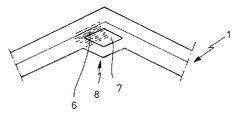
- FIG. 7 shows the fold joint according to FIGS. 5 and 6 in the state of maximum folding.
- a laminate 1 consists of layers 2 , which can themselves be formed out of one or more plies 3 .
- a heating device 5 is positioned adjacent to a surface 4 of the laminate 1 .
- the heating device 5 is designed to introduce thermal energy into the laminate 1 .
- the heating device 5 can be designed as, for example, a hot-air nozzle, a microwave source, an IR emitter, a laser, or a thermal contact heater. The idea specifically is to move the laminate 1 relative to the heating device 5 during the performance of the heating operation.
- the laminate 1 has already been bent slightly.
- the heating area 6 is sketched in FIG. 3 shows the laminate 1 after continuation of the bending operation.
- the heating area 6 i.e., in the area surrounding the heating area 6 , partial delamination has occurred, which leads to the formation of a hollow space 7 .
- FIG. 4 shows the laminate 1 after further continuation of the folding operation.
- a fold joint 8 has thus been created, which forms the boundaries of the hollow space 7 .
- the formation of the fold joint 8 can be effectively controlled by adjusting the degree to which the laminate is heated by the heating device 5 .
- a laminate 1 in the form of a cardboard composite is heated to a temperature below 110° C., a reversible decrease in stiffness is produced.
- the residual moisture in the cardboard begins to evaporate but without the vapor pressure having a chance to equalize.
- the laminate 1 is usually provided with a polyethylene coating, and this coating is at least partially melted. This results in a decrease in the stiffness of the laminate 1 .
- some of the fiber bonds of the cardboard are broken, as a result of which the stiffness also decreases slightly.
- the melting of the polyethylene coating also leads to a decrease in the effective material thickness and thus to a decrease in the resulting cross section of the bending beam. As a result, the static resistance moment to bending is reduced, so that, again, a decrease in stiffness is obtained.
- the re-elasticizing of the polyethylene in its deformed state counteracts the recovery forces of the cardboard. The packaging produced by the folding is thus stabilized.
- Heating the laminate 1 to a temperature above 120° C. promotes the process of thermal delamination.
- the residual moisture in the cardboard is converted to vapor at such a temperature, so that the partial pressure of the water vapor supports the splitting of the cardboard fiber bonds.
- the layers 2 of the cardboard material are made up of individual plies 3 , the number of bonds among the individual material fibers between the individual plies 3 is smaller than the number of bonds within a ply 3 .
- the flexural moment required to form the fold joint 8 is decreased.
- New fiber bonds are usually formed after the water vapor has cooled and condensed.
- thermofolding to produce a package with flat ends and/or a gable shape makes it easy to fold the narrow sides symmetrically.
- FIG. 5 shows a schematic diagram of a predetermined fold state.
- FIG. 6 shows the fold joint 8 according to FIG. 5 at a higher degree of folding
- FIG. 7 shows the fold joint 8 after it has been folded by nearly the maximum amount.
- the lengths of the four sides of the fold joint 8 shown here remain essentially the same; only the angles between the individual sides change.
Landscapes
- Engineering & Computer Science (AREA)
- Mechanical Engineering (AREA)
- Making Paper Articles (AREA)
- Paper (AREA)
- Shaping Of Tube Ends By Bending Or Straightening (AREA)
- Laminated Bodies (AREA)
Abstract
Description
Claims (11)
Applications Claiming Priority (4)
| Application Number | Priority Date | Filing Date | Title |
|---|---|---|---|
| DE102008053784 | 2008-10-20 | ||
| DE102008053784A DE102008053784A1 (en) | 2008-10-20 | 2008-10-20 | Method and device for preparing fold lines |
| DE102008053784.5 | 2008-10-20 | ||
| PCT/DE2009/001337 WO2010045909A1 (en) | 2008-10-20 | 2009-09-18 | Method and apparatus for preparing fold lines |
Publications (2)
| Publication Number | Publication Date |
|---|---|
| US20120071312A1 US20120071312A1 (en) | 2012-03-22 |
| US8894808B2 true US8894808B2 (en) | 2014-11-25 |
Family
ID=41460964
Family Applications (1)
| Application Number | Title | Priority Date | Filing Date |
|---|---|---|---|
| US13/125,107 Expired - Fee Related US8894808B2 (en) | 2008-10-20 | 2009-09-18 | Method and apparatus for preparing fold lines |
Country Status (7)
| Country | Link |
|---|---|
| US (1) | US8894808B2 (en) |
| EP (1) | EP2342072A1 (en) |
| CN (1) | CN102216067B (en) |
| BR (1) | BRPI0919728A2 (en) |
| DE (1) | DE102008053784A1 (en) |
| EA (1) | EA020689B1 (en) |
| WO (1) | WO2010045909A1 (en) |
Cited By (1)
| Publication number | Priority date | Publication date | Assignee | Title |
|---|---|---|---|---|
| US20140155239A1 (en) * | 2012-11-30 | 2014-06-05 | Graphic Packaging International, Inc. | Heat-Assisted Carton Formation |
Families Citing this family (1)
| Publication number | Priority date | Publication date | Assignee | Title |
|---|---|---|---|---|
| DE102013006309B4 (en) * | 2013-04-12 | 2015-10-22 | Roba Services Gmbh | Packaging system comprising a cardboard structure |
Citations (8)
| Publication number | Priority date | Publication date | Assignee | Title |
|---|---|---|---|---|
| US2256263A (en) | 1940-10-10 | 1941-09-16 | Continental Can Co | Method of and apparatus for forming paper container bodies |
| US2647666A (en) * | 1949-06-18 | 1953-08-04 | Max H Friedler | Garment hanger construction |
| US3800677A (en) | 1971-05-03 | 1974-04-02 | Xepex Ind Inc | Apparatus for forming carton |
| GB1402871A (en) * | 1971-07-09 | 1975-08-13 | Mo Och Domsjoe Ab | Machine for producing rimmed packaging units |
| JPS6036134A (en) * | 1983-08-08 | 1985-02-25 | Toyoda Danball Kogyo Kk | Manufacture of corrugated cardboard fold-molding material made of thermoplastic resin |
| US4979932A (en) * | 1989-03-02 | 1990-12-25 | International Paper Box Machine Co., Inc. | Apparatus and method for sealing box blanks |
| US5580097A (en) * | 1993-08-31 | 1996-12-03 | Bindomatic Ab | Cover and method and device for manufacturing the same |
| US5716473A (en) | 1993-07-02 | 1998-02-10 | International Paper | Method of making a semi-rigid cereal carton |
Family Cites Families (5)
| Publication number | Priority date | Publication date | Assignee | Title |
|---|---|---|---|---|
| US3274047A (en) * | 1963-04-01 | 1966-09-20 | Union Carbide Corp | Locally deformed and locally delaminated scores and the method and apparatus for making same |
| US4064206A (en) * | 1975-09-17 | 1977-12-20 | Seufert Kunststoffverpackung G | Process for forming flexible fold lines in thermoplastic sheets |
| SE0002430L (en) * | 2000-06-28 | 2001-11-26 | Tetra Laval Holdings & Finance | Ways of reducing stress when folding material |
| JP4480364B2 (en) * | 2003-08-12 | 2010-06-16 | レンゴー株式会社 | Method for producing ruled-lined molded body by hot pressing |
| CN1244445C (en) * | 2004-03-25 | 2006-03-08 | 党敬义 | Method for intensifying paper product |
-
2008
- 2008-10-20 DE DE102008053784A patent/DE102008053784A1/en not_active Withdrawn
-
2009
- 2009-09-18 BR BRPI0919728A patent/BRPI0919728A2/en not_active IP Right Cessation
- 2009-09-18 CN CN200980146050.8A patent/CN102216067B/en not_active Expired - Fee Related
- 2009-09-18 US US13/125,107 patent/US8894808B2/en not_active Expired - Fee Related
- 2009-09-18 EP EP09743839A patent/EP2342072A1/en not_active Withdrawn
- 2009-09-18 EA EA201170584A patent/EA020689B1/en not_active IP Right Cessation
- 2009-09-18 WO PCT/DE2009/001337 patent/WO2010045909A1/en not_active Ceased
Patent Citations (8)
| Publication number | Priority date | Publication date | Assignee | Title |
|---|---|---|---|---|
| US2256263A (en) | 1940-10-10 | 1941-09-16 | Continental Can Co | Method of and apparatus for forming paper container bodies |
| US2647666A (en) * | 1949-06-18 | 1953-08-04 | Max H Friedler | Garment hanger construction |
| US3800677A (en) | 1971-05-03 | 1974-04-02 | Xepex Ind Inc | Apparatus for forming carton |
| GB1402871A (en) * | 1971-07-09 | 1975-08-13 | Mo Och Domsjoe Ab | Machine for producing rimmed packaging units |
| JPS6036134A (en) * | 1983-08-08 | 1985-02-25 | Toyoda Danball Kogyo Kk | Manufacture of corrugated cardboard fold-molding material made of thermoplastic resin |
| US4979932A (en) * | 1989-03-02 | 1990-12-25 | International Paper Box Machine Co., Inc. | Apparatus and method for sealing box blanks |
| US5716473A (en) | 1993-07-02 | 1998-02-10 | International Paper | Method of making a semi-rigid cereal carton |
| US5580097A (en) * | 1993-08-31 | 1996-12-03 | Bindomatic Ab | Cover and method and device for manufacturing the same |
Cited By (3)
| Publication number | Priority date | Publication date | Assignee | Title |
|---|---|---|---|---|
| US20140155239A1 (en) * | 2012-11-30 | 2014-06-05 | Graphic Packaging International, Inc. | Heat-Assisted Carton Formation |
| US10786965B2 (en) * | 2012-11-30 | 2020-09-29 | Graphic Packaging International, Llc | Heat-assisted carton formation |
| US11364700B2 (en) | 2012-11-30 | 2022-06-21 | Graphic Packaging International, Llc | Heat-assisted carton formation |
Also Published As
| Publication number | Publication date |
|---|---|
| US20120071312A1 (en) | 2012-03-22 |
| WO2010045909A1 (en) | 2010-04-29 |
| EA201170584A1 (en) | 2012-09-28 |
| BRPI0919728A2 (en) | 2015-12-08 |
| CN102216067A (en) | 2011-10-12 |
| EP2342072A1 (en) | 2011-07-13 |
| CN102216067B (en) | 2015-02-25 |
| EA020689B1 (en) | 2015-01-30 |
| DE102008053784A1 (en) | 2010-04-22 |
Similar Documents
| Publication | Publication Date | Title |
|---|---|---|
| CN113059275B (en) | Method for producing shaped wrapping sheets | |
| US20070262129A1 (en) | Method for forming a container with corrugated wall and rolled lip | |
| US11548238B2 (en) | Method for forming a tube and a method and a packaging machine for forming a package | |
| KR20130103520A (en) | Process of expediting activation of heat-expandable adhesives/coatings used in making packaging substrates | |
| RU2673511C2 (en) | Method and device for making composite material | |
| US20180370162A1 (en) | Method for manufacturing a semifinished product or a part made of metal and fiber composite | |
| JP5161432B2 (en) | Method for forming composite material structural member | |
| US20120071312A1 (en) | Method and apparatus for preparing fold lines | |
| EP2890557A1 (en) | Laser scoring of metal/polymer structures | |
| JP6535320B2 (en) | Method and apparatus for producing a scored intermediate product, and articles and components using the same | |
| US20130341385A1 (en) | Fin seal container and method | |
| EP1318950B1 (en) | A method of reducing stresses in the folding of material | |
| JP2007030171A (en) | Method and apparatus for manufacturing corrugate cardboard | |
| WO2017154871A1 (en) | Filament nonwaven fabric having wrinkles and method for manufacturing same | |
| JP2013043684A (en) | Paper container | |
| US20160297139A1 (en) | Method for processing of packaging laminate and device performing the method | |
| JP2016102286A5 (en) | ||
| RU2007121695A (en) | METHOD FOR PREPARING PREPARATIONS FROM PACKAGING LAMINATE, AND ALSO MADE BY SUCH PREPARATION AND PACKAGING CONTAINER | |
| KR20190109794A (en) | Pouch producing method using a conventional pouch producing apparatus and a pouch having a vapor discharging structure manufactured by the method | |
| KR20220126126A (en) | Adhesive material laminating structure and method for manufacturing the same | |
| KR102559742B1 (en) | Method of preparing eco-friendly tray for packaging goods | |
| SU1301894A1 (en) | Method of producing moisture-proof corrugated board | |
| DK156208B (en) | PROCEDURE FOR PREPARING A TOP LOCK ON A FOLDING CARTON | |
| TH58827A (en) | A puffy sheet material with a three-dimensional relief. |
Legal Events
| Date | Code | Title | Description |
|---|---|---|---|
| AS | Assignment |
Owner name: SIG TECHNOLOGY AG, SWITZERLAND Free format text: ASSIGNMENT OF ASSIGNORS INTEREST;ASSIGNORS:SEICHE, WERNER;SCHNEIDER, TOMA;BERGER, JORG;SIGNING DATES FROM 20110418 TO 20110504;REEL/FRAME:027307/0961 |
|
| FEPP | Fee payment procedure |
Free format text: MAINTENANCE FEE REMINDER MAILED (ORIGINAL EVENT CODE: REM.) |
|
| LAPS | Lapse for failure to pay maintenance fees |
Free format text: PATENT EXPIRED FOR FAILURE TO PAY MAINTENANCE FEES (ORIGINAL EVENT CODE: EXP.); ENTITY STATUS OF PATENT OWNER: LARGE ENTITY |
|
| STCH | Information on status: patent discontinuation |
Free format text: PATENT EXPIRED DUE TO NONPAYMENT OF MAINTENANCE FEES UNDER 37 CFR 1.362 |
|
| FP | Lapsed due to failure to pay maintenance fee |
Effective date: 20181125 |