US8877390B2 - Redox shuttles for lithium ion batteries - Google Patents
Redox shuttles for lithium ion batteries Download PDFInfo
- Publication number
- US8877390B2 US8877390B2 US13/113,499 US201113113499A US8877390B2 US 8877390 B2 US8877390 B2 US 8877390B2 US 201113113499 A US201113113499 A US 201113113499A US 8877390 B2 US8877390 B2 US 8877390B2
- Authority
- US
- United States
- Prior art keywords
- electrolyte
- och
- vinyl
- butyl
- tert
- Prior art date
- Legal status (The legal status is an assumption and is not a legal conclusion. Google has not performed a legal analysis and makes no representation as to the accuracy of the status listed.)
- Active, expires
Links
Images


Classifications
-
- H—ELECTRICITY
- H01—ELECTRIC ELEMENTS
- H01M—PROCESSES OR MEANS, e.g. BATTERIES, FOR THE DIRECT CONVERSION OF CHEMICAL ENERGY INTO ELECTRICAL ENERGY
- H01M10/00—Secondary cells; Manufacture thereof
- H01M10/42—Methods or arrangements for servicing or maintenance of secondary cells or secondary half-cells
- H01M10/4235—Safety or regulating additives or arrangements in electrodes, separators or electrolyte
-
- H—ELECTRICITY
- H01—ELECTRIC ELEMENTS
- H01G—CAPACITORS; CAPACITORS, RECTIFIERS, DETECTORS, SWITCHING DEVICES, LIGHT-SENSITIVE OR TEMPERATURE-SENSITIVE DEVICES OF THE ELECTROLYTIC TYPE
- H01G11/00—Hybrid capacitors, i.e. capacitors having different positive and negative electrodes; Electric double-layer [EDL] capacitors; Processes for the manufacture thereof or of parts thereof
- H01G11/54—Electrolytes
- H01G11/58—Liquid electrolytes
- H01G11/64—Liquid electrolytes characterised by additives
-
- H01G9/038—
-
- H—ELECTRICITY
- H01—ELECTRIC ELEMENTS
- H01M—PROCESSES OR MEANS, e.g. BATTERIES, FOR THE DIRECT CONVERSION OF CHEMICAL ENERGY INTO ELECTRICAL ENERGY
- H01M10/00—Secondary cells; Manufacture thereof
- H01M10/05—Accumulators with non-aqueous electrolyte
- H01M10/052—Li-accumulators
-
- H—ELECTRICITY
- H01—ELECTRIC ELEMENTS
- H01M—PROCESSES OR MEANS, e.g. BATTERIES, FOR THE DIRECT CONVERSION OF CHEMICAL ENERGY INTO ELECTRICAL ENERGY
- H01M10/00—Secondary cells; Manufacture thereof
- H01M10/05—Accumulators with non-aqueous electrolyte
- H01M10/052—Li-accumulators
- H01M10/0525—Rocking-chair batteries, i.e. batteries with lithium insertion or intercalation in both electrodes; Lithium-ion batteries
-
- H—ELECTRICITY
- H01—ELECTRIC ELEMENTS
- H01M—PROCESSES OR MEANS, e.g. BATTERIES, FOR THE DIRECT CONVERSION OF CHEMICAL ENERGY INTO ELECTRICAL ENERGY
- H01M10/00—Secondary cells; Manufacture thereof
- H01M10/05—Accumulators with non-aqueous electrolyte
- H01M10/056—Accumulators with non-aqueous electrolyte characterised by the materials used as electrolytes, e.g. mixed inorganic/organic electrolytes
- H01M10/0564—Accumulators with non-aqueous electrolyte characterised by the materials used as electrolytes, e.g. mixed inorganic/organic electrolytes the electrolyte being constituted of organic materials only
- H01M10/0566—Liquid materials
- H01M10/0567—Liquid materials characterised by the additives
-
- H—ELECTRICITY
- H01—ELECTRIC ELEMENTS
- H01M—PROCESSES OR MEANS, e.g. BATTERIES, FOR THE DIRECT CONVERSION OF CHEMICAL ENERGY INTO ELECTRICAL ENERGY
- H01M10/00—Secondary cells; Manufacture thereof
- H01M10/05—Accumulators with non-aqueous electrolyte
- H01M10/056—Accumulators with non-aqueous electrolyte characterised by the materials used as electrolytes, e.g. mixed inorganic/organic electrolytes
- H01M10/0564—Accumulators with non-aqueous electrolyte characterised by the materials used as electrolytes, e.g. mixed inorganic/organic electrolytes the electrolyte being constituted of organic materials only
- H01M10/0566—Liquid materials
- H01M10/0568—Liquid materials characterised by the solutes
-
- H—ELECTRICITY
- H01—ELECTRIC ELEMENTS
- H01M—PROCESSES OR MEANS, e.g. BATTERIES, FOR THE DIRECT CONVERSION OF CHEMICAL ENERGY INTO ELECTRICAL ENERGY
- H01M10/00—Secondary cells; Manufacture thereof
- H01M10/05—Accumulators with non-aqueous electrolyte
- H01M10/056—Accumulators with non-aqueous electrolyte characterised by the materials used as electrolytes, e.g. mixed inorganic/organic electrolytes
- H01M10/0564—Accumulators with non-aqueous electrolyte characterised by the materials used as electrolytes, e.g. mixed inorganic/organic electrolytes the electrolyte being constituted of organic materials only
- H01M10/0566—Liquid materials
- H01M10/0569—Liquid materials characterised by the solvents
-
- H—ELECTRICITY
- H01—ELECTRIC ELEMENTS
- H01M—PROCESSES OR MEANS, e.g. BATTERIES, FOR THE DIRECT CONVERSION OF CHEMICAL ENERGY INTO ELECTRICAL ENERGY
- H01M2300/00—Electrolytes
- H01M2300/0017—Non-aqueous electrolytes
- H01M2300/0025—Organic electrolyte
-
- H—ELECTRICITY
- H01—ELECTRIC ELEMENTS
- H01M—PROCESSES OR MEANS, e.g. BATTERIES, FOR THE DIRECT CONVERSION OF CHEMICAL ENERGY INTO ELECTRICAL ENERGY
- H01M2300/00—Electrolytes
- H01M2300/0017—Non-aqueous electrolytes
- H01M2300/0025—Organic electrolyte
- H01M2300/0028—Organic electrolyte characterised by the solvent
-
- Y—GENERAL TAGGING OF NEW TECHNOLOGICAL DEVELOPMENTS; GENERAL TAGGING OF CROSS-SECTIONAL TECHNOLOGIES SPANNING OVER SEVERAL SECTIONS OF THE IPC; TECHNICAL SUBJECTS COVERED BY FORMER USPC CROSS-REFERENCE ART COLLECTIONS [XRACs] AND DIGESTS
- Y02—TECHNOLOGIES OR APPLICATIONS FOR MITIGATION OR ADAPTATION AGAINST CLIMATE CHANGE
- Y02E—REDUCTION OF GREENHOUSE GAS [GHG] EMISSIONS, RELATED TO ENERGY GENERATION, TRANSMISSION OR DISTRIBUTION
- Y02E60/00—Enabling technologies; Technologies with a potential or indirect contribution to GHG emissions mitigation
- Y02E60/10—Energy storage using batteries
-
- Y02E60/122—
-
- Y—GENERAL TAGGING OF NEW TECHNOLOGICAL DEVELOPMENTS; GENERAL TAGGING OF CROSS-SECTIONAL TECHNOLOGIES SPANNING OVER SEVERAL SECTIONS OF THE IPC; TECHNICAL SUBJECTS COVERED BY FORMER USPC CROSS-REFERENCE ART COLLECTIONS [XRACs] AND DIGESTS
- Y02—TECHNOLOGIES OR APPLICATIONS FOR MITIGATION OR ADAPTATION AGAINST CLIMATE CHANGE
- Y02E—REDUCTION OF GREENHOUSE GAS [GHG] EMISSIONS, RELATED TO ENERGY GENERATION, TRANSMISSION OR DISTRIBUTION
- Y02E60/00—Enabling technologies; Technologies with a potential or indirect contribution to GHG emissions mitigation
- Y02E60/13—Energy storage using capacitors
-
- Y—GENERAL TAGGING OF NEW TECHNOLOGICAL DEVELOPMENTS; GENERAL TAGGING OF CROSS-SECTIONAL TECHNOLOGIES SPANNING OVER SEVERAL SECTIONS OF THE IPC; TECHNICAL SUBJECTS COVERED BY FORMER USPC CROSS-REFERENCE ART COLLECTIONS [XRACs] AND DIGESTS
- Y02—TECHNOLOGIES OR APPLICATIONS FOR MITIGATION OR ADAPTATION AGAINST CLIMATE CHANGE
- Y02T—CLIMATE CHANGE MITIGATION TECHNOLOGIES RELATED TO TRANSPORTATION
- Y02T10/00—Road transport of goods or passengers
- Y02T10/60—Other road transportation technologies with climate change mitigation effect
- Y02T10/70—Energy storage systems for electromobility, e.g. batteries
Definitions
- the present technology relates generally to the electrolyte redox shuttle compounds carried in the non-aqueous electrolyte providing intrinsic overcharge protection capability for lithium ion batteries, electrical double-layer capacitors and other electrochemical devices.
- Lithium ion batteries were first commercialized in 1990, and soon thereafter drew tremendous attention from academic and industry interests due to the advantages such as high energy density and rapid charge/discharge capabilities in comparison to state of the battery technology at the time.
- lithium ion battery technology has become the most popular power source for portable electronic devices.
- lithium ion batteries have found application in hybrid electric vehicles (HEV) and plug-in hybrid electric vehicles (PHEV).
- HEV hybrid electric vehicles
- PHEV plug-in hybrid electric vehicles
- safety of lithium batteries continues to plague the technology.
- secondary lithium-ion batteries are known to exhibit problems in shorting of the battery, elevated operating temperatures and overcharge, which can lead to dangerous situations such as overheating, fire, and explosion of the battery.
- Overcharge occurs when electricity flow is forced through a cell when its capacity is already full. This is one of the most common factors that could lead to serious safety issues of lithium-ion batteries. Due to the manufacture processes, there is always a “weakest cell” in a battery pack (i.e. the cell with the lowest charging capability in a multi-cell battery pack). During charging, the weakest cell will reach full capacity prior to the other cells, but because the overall voltage of the battery is not high, the full capacity cell with not trigger the voltage monitor of the charger to read “full.” As a result, the weakest cell is put into an overcharge situation.
- redox shuttle compounds A number of redox shuttle compounds are known. Generally, the redox shuttle molecule can be reversibly oxidized and reduced at a defined potential slightly higher than the end-of-charge potential of the positive electrode. This mechanism can protect the cell from overcharge by locking the potential of the positive electrode at the oxidation potential of the shuttle molecules.
- the first property is that it should have a reversible oxidation potential that is appropriate for the cathode material with which it is to be used. This means that the oxidation potential of the redox shuttle should be between 0.3V and 0.5V volts higher than the end-of-charge potential of the cathode. This will ensure that redox shuttle is accessed only overcharge potentials.
- the second property is that the redox shuttle should be electrochemically stabile or reversible. The stability and reversibility of the redox shuttle will determine how much overcharge protection is provided.
- the third property is that the redox shuttle is to have sufficient solubility in the electrolyte system in order to have an effective amount of the redox shuttle available.
- R 8 , R 9 , R 10 , and R 11 are each independently selected from H, F, Cl, Br, CN, NO 2 , alkyl, haloalkyl, and alkoxy groups; X and Y are each independently O, S, N, or P; and Z′ is a linkage between X and Y. In some embodiments, X and Y are O. In some embodiments, at least two of R 8 , R 9 , R 10 , and R 11 are a tertiary alkyl group. In some embodiments, at least two of R 8 , R 9 , R 10 , and R 11 are tert-butyl groups.
- Z′ is CH 2 , CH 2 CH 2 , CH 2 CH 2 CH 2 , CH 2 CH 2 CH 2 CH 2 , CH 2 CH 2 CH 2 CH 2 , CH 2 CH 2 CH 2 CH 2 CH 2 , CH(CH 3 )CH 2 , CH(CH 3 )(CH 2 )CH 2 , CH(CH 3 )CH(CH 3 ), CHCH, CCl 2 , CBr 2 , CF 2 , CH(Cl)CH(Cl), CH(Br)CH(Br), CH(F)CH(F), CH 2 (CF 2 )CH 2 , CH 2 N(Me)CH 2 , CH 2 OCH 2 CH 2 OCH 2 , CH 2 CH 2 OCH 2 OCH 2 CH 2 ; CH 2 CH 2 OCH 2 CH 2 OCH 2 , or CH 2 CH 2 OCH 2 CH 2 OCH 2 CH 2 .
- R 8 and R 10 are tert-butyl; R 9 and R 11 are each independently H, F, Cl, Br, CN, NO 2 , alkyl, haloalkyl, or alkoxy groups; X and Y are O; and Z′ is CH 2 , CH 2 CH 2 , or CHCH. In some embodiments, R 8 and R 10 are tert-butyl; R 9 and R 11 are each independently H, F, Cl, or Br; X and Y are O; and Z′ is CH 2 or CHCH.
- the compound of Formula IVA is 5,7-di-tert-butyl-2,3-dibromo-1,4-benzodioxin; 5,7-di-tert-butyl-1,4-benzodioxin; or 4,6-di-tert-butyl-1,3-benzodioxole.
- an electrolyte including an alkali metal salt; a polar aprotic solvent; and a redox shuttle, where the redox shuttle is any of compounds of Formula IVA, or IVB described above generally, or specifically, and where the electrolyte solution is substantially non-aqueous.
- the redox shuttle has a redox potential of from 3 V to 5 V in the electrolyte.
- the redox shuttle is present in the electrolyte from 0.0005 wt % to 50 wt %.
- the redox shuttle is present in the electrolyte from 2 wt % to 10 wt %.
- the electrolyte also includes an electrode stabilizing compound that can be reduced or polymerized on the surface of a negative electrode to form a passivation film on the surface of negative electrode. In other embodiments, the electrolyte also includes an electrode stabilizing compound that can be oxidized or polymerized on the surface of positive electrode to form a passivation film on the surface of the positive electrode. In some embodiments, the electrode stabilizing compound is present from 0.001 wt % to 8 wt %.
- the alkali metal salt is other than Li[B(C 2 O 4 ) 2 ] or Li[BF 2 (C 2 O 4 )], and the electrolyte further includes an electrode stabilizing compound that is Li[B(C 2 O 4 ) 2 ] or Li[BF 2 (C 2 O 4 )]. In some embodiments, the electrode stabilizing compound is present from 0.001 wt % to 8 wt %.
- an electrochemical device including a cathode; an anode; and an electrolyte including an alkali metal salt, a polar aprotic solvent, and a redox shuttle that is compound as described above, where the electrolyte solution is substantially non-aqueous.
- the device is a lithium secondary battery; the cathode is a lithium metal oxide cathode; the anode is a carbon, a lithium metal anode, or a lithium alloy; and the anode and cathode are separated from each other by a porous separator.
- the cathode includes a spinel, a olivine, a carbon-coated olivine, LiFePO 4 , LiCoO 2 , LiNiO 2 , LiNi 1 ⁇ x CO y Met z O 2 , LiMn 0.5 Ni 0.5 O 2 , LiMn 0.3 Co 0.3 Ni 0.3 O 2 , LiMn 2 O 4 , LiFeO 2 , LiMet 0.5 Mn 1.5 O 4 , Li 1+x′ Ni ⁇ Mn ⁇ Co ⁇ Met′ ⁇ O 2 ⁇ z′ , F z′ , Nasicon, A n′ B 2 (XO 4 ) 3 , vanadium oxide, or mixtures of any two or more thereof, where Met is Al, Mg, Ti, B, Ga, Si, Mn, or Co; Met′ is Mg, Zn, Al, Ga, B, Zr, or Ti; A is Li, Ag, Cu, Na, Mn, Fe, Co, Ni, Cu, and Zn;
- the cathode includes a surface coating of a metal oxide on particles of the cathode.
- the metal oxide includes ZrO 2 , TiO 2 , ZnO 2 , WO 3 , Al 2 O 3 , MgO, SiO 2 , SnO 2 AlPO 4 , or Al(OH) 3 .
- the anode includes graphite, amorphous carbon, Li 4 Ti 5 O 12 , tin alloys, silicon alloys, intermetallic compounds, or lithium metal.
- an electrochemical device including a spinel, olivine, or carbon-coated olivine cathode; a graphite or amorphous carbon anode; and a substantially non-aqueous electrolyte including an alkali metal salt that is Li[BF 2 (C 2 O 4 )] or Li[B(C 2 O 4 ) 2 ], a polar aprotic solvent that is ethyl acetate; propyl acetate; ethylene carbonate; propylene carbonate; dimethyl carbonate; diethyl carbonate; ethyl methyl carbonate; dimethyl ether; or ⁇ -butyrolactone; a redox shuttle that is any of the compounds of Formulas IVA or IVB as described above; and an electrode stabilizing compound that is pyridazine; vinyl pyridazine; quinoline; vinyl quinoline; pyridine; vinyl pyridine; indole; vinyl indole; triethanolamine; 1,3
- a method of preparing an electrolyte includes combining an alkali metal salt; a polar aprotic solvent; and a compound of any of Formulas IVA, or IVB, as described above.
- FIG. 1 are cyclic voltammogram of 4,6-di-tert-butyl-1,3-benzodioxole (10 mM) in 1.2 M LiPF 6 in EC/EMC (3:7 by weight) using a three electrode system (Pt working Electrode, Li counter electrode and Li reference electrode), as described in Example 14.
- FIG. 2 are cyclic voltammogram of 5,7-di-tert-butyl-1,4-benzodioxin (10 mM) in 1.2 M LiPF 6 in EC/EMC (3:7 by weight) using a three electrode system (Pt working Electrode, Li counter electrode and Li reference electrode), as described in Example 14.
- FIG. 3 is a series of voltage profiles for a LTO/LiFePO 4 cells containing 2.3 wt % 5,7-di-tert-butyl-1,4-benzodioxin in 1.2M LiPF 6 in EC/EMC (3:7 by weight) during the course of 0 h to 3100 h at a charging rate of C/2, and overcharge is 100%.
- FIG. 4 is a capacity retention profile for a LTO/LiFePO 4 cells containing 2.3 wt % 5,7-di-tert-butyl-1,4-benzodioxin in 1.2M LiPF 6 in EC/EMC (3:7 by weight) during the course of 0 h to 3100 h, at a charging rate of C/2, and overcharge is 100%.
- FIG. 5 are cyclic voltammograms of 5,7-di-tert-butyl-2,3-dibromo-1,4-benzodioxin in 1.2 M LiPF 6 in EC/EMC (3:7 by weight) using a three electrode system (Pt working Electrode, Li counter electrode and Li reference electrode), as described in Example 14.
- compounds are provided.
- the compounds have at least one aromatic ring and one or two fused heterocylic ring(s) on the aromatic ring.
- Such compounds may be employed in a variety of applications.
- the compounds are redox shuttles that are capable of providing overcharge protection to an electrochemical cell and which exhibit sufficient solubility in carbonate-based electrolytes to allow for dissolution of the compounds at acceptable levels.
- the compound is of Formula IVA or IVB.
- R 8 , R 9 , R 10 , and R 11 are each independently selected from H, F, Cl, Br, CN, NO 2 , alkyl, haloalkyl, and alkoxy groups;
- X and Y are each independently selected from the following heteroatoms: O, S, N, P; and Z′ is a linkage between two hetero atoms.
- X and Y are O.
- at least two of R 8 , R 9 , R 10 , and R 11 are a tertiary group such as a tert-butyl group.
- Z′ is CH 2 , CH 2 CH 2 , CH 2 CH 2 CH 2 , CH 2 CH 2 CH 2 CH 2 , CH 2 CH 2 CH 2 CH 2 , CH 2 CH 2 CH 2 CH 2 CH 2 , CH(CH 3 )CH 2 , CH(CH 3 )(CH 2 )CH 2 , CH(CH 3 )CH(CH 3 ), CHCH, CCl 2 , CBr 2 , CF 2 , CH(Cl)CH(Cl), CH(Br)CH(Br), CH(F)CH(F), CH 2 (CF 2 )CH 2 , CH 2 N(Me)CH 2 , CH 2 OCH 2 CH 2 OCH 2 , CH 2 CH 2 OCH 2 OCH 2 CH 2 ; CH 2 CH 2 OCH 2 CH 2 OCH 2 , or CH 2 CH 2 OCH 2 CH 2 OCH 2 CH 2 .
- R 8 and R 10 are tert-butyl; R 9 and R 11 are each independently H, F, Cl, Br, CN, NO 2 , alkyl, haloalkyl, or alkoxy groups; X and Y are O; and Z′ is CH 2 , CH 2 CH 2 , or CHCH. According to other embodiments, R 8 and R 10 are tert-butyl; R 9 and R 11 are each independently H, F, Cl, or Br; X and Y are O; and Z′ is CH 2 or CHCH.
- the compound of Formula IVA is 5,7-di-tert-butyl-2,3-dibromo-1,4-benzodioxin; 5,7-di-tert-butyl-1,4-benzodioxin; or 4,6-di-tert-butyl-1,3-benzodioxole.
- the above compounds are employed as redox shuttles in an electrolyte.
- the redox shuttle is a compound of Formula IVA or IVB, as described above.
- the redox shuttle is a compound of Formula IVA, as described above.
- the redox shuttle is a compound of Formula IVB, as described above.
- the compounds of Formula IVA and IVB have good compatibility with carbonate-based electrolytes. Such electrolytes, employing the compounds as redox shuttles, provide overcharge protection to lithium-ion batteries.
- the redox shuttle is a compound of Formula IVA or IVB.
- R 8 , R 9 , R 10 , and R 11 are each independently selected from H, F, Cl, Br, CN, NO 2 , alkyl, haloalkyl, and alkoxy groups;
- X and Y are each independently selected from the following heteroatoms: O, S, N, P; and Z′ is a linkage between two hetero atoms.
- X and Y are O.
- at least two of R 8 , R 9 , R 10 , and R 11 are a tertiary group such as a tert-butyl group.
- Z′ is CH 2 , CH 2 CH 2 , CH 2 CH 2 CH 2 , CH 2 CH 2 CH 2 CH 2 , CH 2 CH 2 CH 2 CH 2 , CH 2 CH 2 CH 2 CH 2 CH 2 , CH(CH 3 )CH 2 , CH(CH 3 )(CH 2 )CH 2 , CH(CH 3 )CH(CH 3 ), CHCH, CCl 2 , CBr 2 , CF 2 , CH(Cl)CH(Cl), CH(Br)CH(Br), CH(F)CH(F), CH 2 (CF 2 )CH 2 , CH 2 N(Me)CH 2 , CH 2 OCH 2 CH 2 OCH 2 , CH 2 CH 2 OCH 2 OCH 2 CH 2 ; CH 2 CH 2 OCH 2 CH 2 OCH 2 , or CH 2 CH 2 OCH 2 CH 2 OCH 2 CH 2 .
- R 8 and R 10 are tert-butyl; R 9 and R 11 are each independently H, F, Cl, Br, CN, NO 2 , alkyl, haloalkyl, or alkoxy groups; X and Y are O; and Z′ is CH 2 , CH 2 CH 2 , or CHCH. According to other embodiments, R 8 and R 10 are tert-butyl; R 9 and R 11 are each independently H, F, Cl, or Br; X and Y are O; and Z′ is CH 2 or CHCH.
- the redox shuttle of Formula IVA is 5,7-di-tert-butyl-2,3-dibromo-1,4-benzodioxin; 5,7-di-tert-butyl-1,4-benzodioxin; or 4,6-di-tert-butyl-1,3-benzodioxole.
- the redox shuttles operate in an electrochemical range defined by the characteristics of the positive electrode and which can provide over-discharge protection in series-connected cells.
- a negative electrode having a larger irreversible first cycle capacity loss than that of the positive electrode is employed, so that if a cell is driven into reversal. the potential of the negative electrode is driven above that of the positive electrode. During over-discharge, the potential of the negative electrode therefore increases.
- the shuttle limits the negative electrode potential to a value slightly above that of the positive electrode maximum normal operating potential and prevents the negative electrode from reaching even higher and more destructive potentials.
- a negative electrode current collector whose lithium alloying potential is below the negative electrode minimum normal operating potential is also employed.
- the resulting battery chemically limits or eliminates cell damage due to repeated over-discharge even though the negative electrode in a weak cell may be driven to a value more positive than the positive electrode potential.
- redox shuttles may be employed in lithium-ion batteries. Suitable redox shuttles have an electrochemical potential above (e.g., slightly above) the positive electrode's maximum normal operating potential. Thus, according to some embodiments, redox shuttles in the electrolytes, have a redox potential from 3.5 V to 5.0 V. In other embodiments, the redox shuttles have a redox potential from 3.6 V to 4.6 V.
- the redox shuttle selection may be guided in part by the positive electrode selection.
- the shuttle may have a redox potential from 0.3 V to 0.6 V above the positive electrode's maximum normal operating potential, e.g., from 3.7 to 4.7 V vs. Li/Li + , from 3.7 V to 4.4 V vs. Li/Li + , from 3.7 V to 4.2 V vs. Li/Li + , or from 3.7 V to 4.0 V vs. Li/Li + above the positive electrode's maximum normal operating potential.
- LiFePO 4 positive electrodes have a recharge plateau of around 3.45 V vs.
- Li/Li + and redox shuttles for use with such electrodes may have a redox potential from 3.75 V to about 4.05 V vs. Li/Li + .
- LiMnPO 4 and LiMn 2 O 4 electrodes have a recharge plateau around 4.1 V vs. Li/Li +
- redox shuttles for use with such electrodes may have a redox potential from 4.4 V to 4.7 V vs. Li/Li + .
- a first shuttle operative at 3.8V and a second shuttle operative at 3.9V may both be employed in a single cell. If after many charge/discharge cycles the first shuttle degrades and loses its effectiveness, the second shuttle (which would not meanwhile have been oxidized to form its radical cation while the first shuttle was operative) could take over and provide a further (albeit higher potential) margin of safety against overcharge or over-discharge damage.
- the electrolyte in addition to the redox shuttle, includes a polar aprotic solvent, and a lithium metal salt.
- the electrolytes are substantially non-aqueous.
- substantially non-aqueous means that the electrolytes do not contain water, or if water is present, it is only present at trace levels. For example, where the water is present at trace levels it is present at less than 20 ppm.
- Suitable polar aprotic solvents include liquids and gels capable of solubilizing sufficient quantities of the lithium salt and the redox shuttle so that a suitable quantity of charge can be transported from the positive electrode to negative electrode.
- the solvents can be used over a wide temperature range, e.g., from ⁇ 30° C. to 70° C. without freezing or boiling, and are stable in the electrochemical range within which the cell electrodes and shuttle operate.
- Suitable solvents include dimethyl carbonate; ethyl methyl carbonate; diethyl carbonate; methyl propyl carbonate; ethyl propyl carbonate; dipropyl carbonate; bis(trifluoroethyl) carbonate; bis(pentafluoropropyl) carbonate; trifluoroethyl methyl carbonate; pentafluoroethyl methyl carbonate; heptafluoropropyl methyl carbonate; perfluorobutyl methyl carbonate; trifluoroethyl ethyl carbonate; pentafluoroethyl ethyl carbonate; heptafluoropropyl ethyl carbonate; perfluorobutyl ethyl carbonate; fluorinated oligomers; dimethoxyethane; triglyme; dimethylvinylene carbonate; tetraethyleneglycol; dimethyl ether; polyethylene glycols
- the redox shuttles have suitable solubility in carbonate-based electrolyte solvents and gels.
- the redox shuttles may be prepared in carbonate-based electrolytes, such as, 1.2M LiPF 6 in EC/EMC 3/7 (i.e. an mixture of 3 parts ethylene carbonate and 7 parts ethylmethylcarbonate), or 1.2M LiPF 6 in EC/DEC 5/5 (i.e. a 1:1 mixture of ethylene carbonate and diethylcarbonate).
- electrolytes may be prepared with a redox shuttle at a concentration of from 0.005 wt % to 50 wt %, or from 0.1 wt % to 30 wt %. In other embodiments, the electrolytes may be prepared with a redox shuttle at a concentration of from 2% to 10%.
- Suitable lithium salts that may be used in the electrolytes, include, but are not limited to, Li[B(C 2 O 4 ) 2 ]; Li[BF 2 (C 2 O 4 )]; LiClO 4 ; LiBF 4 ; LiAsF 6 ; LiSbF 6 ; LiBr, LiPF 6 ; Li[CF 3 SO 3 ]; Li[N(CF 3 SO 2 ) 2 ]; Li[C(CF 3 SO 2 ) 3 ]; Li[B(C 6 F 5 ) 4 ]; Li[B(C 6 H 5 ) 4 ]; Li[N(SO 2 CF 3 ) 2 ]; Li[N(SO 2 CF 2 CF 3 ) 2 ]; LiN(SO 2 C 2 F 5 ) 2 ; Li[BF 3 C 2 F 5 ]; and Li[PF 3 (CF 2 CF 3 ) 3 ]; and lithium alkyl fluorophosphates.
- the electrolytes may include other compounds to enhance the performance of the electrolyte when used in an electrochemical cell.
- the electrolytes may also include an electrode stabilizing compound to protect the electrodes from degradation.
- electrode stabilizing compounds are described by co-pending U.S. patent application Ser. Nos. 10/857,365 and 11/279,120. Such electrode stabilizing compounds can be reduced or polymerized on the surface of a negative electrode to form a passivation film on the surface of the negative electrode.
- electrolytes can include an electrode stabilizing compound that can be oxidized or polymerized on the surface of the positive electrode to form a passivation film on the surface of the positive electrode.
- the electrolytes further include mixtures of the two types of electrode stabilizing compounds. The compounds are typically present at a concentration of from 0.001 wt % to 8 wt %.
- the electrode stabilizing compound is a substituted or unsubstituted linear, branched or cyclic hydrocarbon including at least one oxygen atom and at least one aryl, alkenyl or alkynyl group.
- Passivating films may be formed from a substituted aryl compound or a substituted or unsubstituted heteroaryl compound where the compound includes at least one oxygen atom. Alternatively, a combination of two compounds may be used.
- one compound is selective for forming a passivating film on the cathode to prevent leaching of metal ions and the other compound can be selective for passivating the anode surface to prevent or lessen the reduction of metal ions at the anode.
- Representative electrode stabilizing compounds include 1,2-divinyl furoate, 1,3-butadiene carbonate, 1-vinylazetidin-2-one, 1-vinylaziridin-2-one, 1-vinylpiperidin-2-one, 1 vinylpyrrolidin-2-one, 2,4-divinyl-1,3-dioxane, 2 amino-3 vinylcyclohexanone, 2-amino-3-vinylcyclopropanone, 2 amino-4-vinylcyclobutanone, 2-amino-5-vinylcyclopentanone, 2-aryloxy-cyclopropanone, 2-vinyl-[1,2]oxazetidine, 2 vinylaminocyclohexanol, 2-vinylaminocyclopropanone, 2 vinyloxetane, 2-vinyloxy-cyclopropanone, 3-(N-vinylamino)cyclohexanone, 3,5-divinyl furoate, 3-vinylazetidin-2-one,
- the electrode stabilizing compound may be a cyclotriphosphazene that is substituted with F, alkyloxy, alkenyloxy, aryloxy, methoxy, allyloxy groups, or combinations thereof.
- the compound may be a (divinyl)-(methoxy)(trifluoro)cyclotriphosphazene, (trivinyl)(difluoro)(methoxy)cyclotriphosphazene, (vinyl)(methoxy)(tetrafluoro)cyclotriphosphazene, (aryloxy)(tetrafluoro)(methoxy)-cyclotriphosphazene, (diaryloxy)(trifluoro)(methoxy)cyclotriphosphazene compounds, or a mixture of two or more such compounds.
- the electrode stabilizing compound is vinyl ethylene carbonate, vinyl carbonate, or 1,2-diphenyl ether, or a mixture of any two or more such compounds.
- Other representative electrode stabilizing compounds may include compounds with phenyl, naphthyl, anthracenyl, pyrrolyl, oxazolyl, furanyl, indolyl, carbazolyl, imidazolyl, or thiophenyl groups.
- electrode stabilizing compounds may be aryloxpyrrole, aryloxy ethylene sulfate, aryloxy pyrazine, aryloxy-carbazole trivinylphosphate, aryloxy-ethyl-2-furoate, aryloxy-o-terphenyl, aryloxy-pyridazine, butyl-aryloxy-ether, divinyl diphenyl ether, (tetrahydro-furan-2-yl)-vinylamine, divinyl methoxybipyridine, methoxy-4-vinylbiphenyl, vinyl methoxy carbazole, vinyl methoxy piperidine, vinyl methoxypyrazine, vinyl methyl carbonate-allylanisole, vinyl pyridazine, 1-divinylimidazole, 3-vinyltetrahydrofuran, divinyl furan, divinyl methoxy furan, divinylpyrazine, vinyl methoxy imidazo
- electrode stabilizing additives include substituted or unsubstituted spirocyclic hydrocarbons containing at least one oxygen atom and at least one alkenyl or alkynyl group.
- stabilizing compounds include those having Formula V:
- Formula V include, but are not limited to, 3,9 divinyl-2,4,8,10-tetraoxaspiro[5.5]undecane, 3,9-divinyl-2,4,8-trioxaspiro[5.5]undecane, 3,9-divinyl-2,4-dioxaspiro[5.5]undecane, 3,9-diethylidene-2,4,8,10-tetraoxaspiro[5.5]undecane, 3,9 diethylidene-2,4,8-trioxaspiro[5.5]undecane, 3,9-diethylidene-2,4-dioxaspiro[5.5]undecane, 3,9-dimethylene-2,4,8,10-tetraoxaspiro[5.5]undecane, 3,9-divinyl-1,5,7,11-tetraoxaspiro[5.5]undecane, 3,9 dimethylene-1,5,7,11-
- the electrode stabilizing compound is an anion receptor.
- the anion receptor is a Lewis acid.
- the anion receptor is a borane, a boronate, a borate, a borole, or a mixture of any two or more such compounds.
- the anion receptor is a compound of the Formula VI:
- each R 17 , R 18 , and R 19 are independently halogen, alkyl, aryl, halogen-substituted alkyl, halogen-substituted aryl, or OR 17 ; or any two of R 17 , R 18 , and R 19 , together with the atoms to which they are attached, form a heterocyclic ring having 5-9 members, and R 17 is at each occurrence independently alkyl, aryl, halogen-substituted alkyl, or halogen-substituted aryl.
- the anion receptors include, but not limited to, tri(propyl)borate, tris(1,1,1,3,3,3-hexafluoro-propan-2-yl)borate, tris(1,1,1,3,3,3-hexafluoro-2-phenyl-propan-2-yl)borate, tris(1,1,1,3,3,3-hexafluoro-2-(trifluoromethyl)propan-2-yl)borate, triphenyl borate, tris(4-fluorophenyl)borate, tris(2,4-difluorophenyl)borate, tris(2,3,5,6-tetrafluorophenyl)borate, tris(pentafluorophenyl)borate, tris(3-(trifluoromethyl)phenyl)borate, tris(3,5-bis(trifluoromethyl)phenyl)borate, tris(pentafluorophenyl)borane, or
- Further suitable compounds include 2-(2,4-difluorophenyl)-4-fluoro-1,3,2-benzodioxaborole, 2-(3-trifluoromethyl phenyl)-4-fluoro-1,3,2-benzodioxaborole, 2,5-bis(trifluoromethyl)phenyl-4-fluoro-1,3,2-benzodioxaborole, 2-(4-fluorophenyl)-tetrafluoro-1,3,2-benzodioxaborole, 2-(2,4-difluorophenyl)-tetrafluoro-1,3,2-benzodioxaborole, 2-(pentafluorophenyl)-tetrafluoro-1,3,2-benzodioxaborole, 2-(2-trifluoromethyl phenyl)-tetrafluoro-1,3,2-benzodioxaborole, 2,5-bis(trifluoromethyl phenyl)-t
- the electrolyte includes as an electrolyte compound, Li 2 B 12 X 12 ⁇ n′ H n , Li 2 B 10 X 10 ⁇ n′ , H n′ , or a mixture of two or more of such compounds.
- electrolyte compounds may be present from 0.001 wt % to 15 wt %.
- X is OH, OCH 3 , F, Cl, Br, or I
- n is an integer from 0 to 12
- n′ is an integer from 0 to 10.
- the electrolyte further includes a gel.
- Such electrolytes include a polar aprotic solvent; a lithium salt; a redox shuttle; a crosslinking agent; monofunctional monomeric compound; and at least one radical reaction initiator.
- the gel electrolyte can also include other electrode stabilization compounds and other electrolyte compounds. Suitable crosslinking agents may be represented by Formula VII:
- R 20 , R 21 , R 22 , and R 23 are each independently hydrogen, a substituted or unsubstituted alkyl group having from 1 to 12 carbon atoms, or a substituted or unsubstituted alkenyl group having from 2 to 12 carbon atoms; and where X′ is a hydrogen, methyl, or ethyl group, and n′′′ is an integer from 1 to 15.
- Monofunctional monomeric compounds may be used for the control of the crosslinking density of the gel electrolyte. Suitable monofunctional monomeric compounds include those of Formula VIII:
- R 24 is an alkyl group having from 1 to 12 carbon atoms
- R 25 and R 26 are each independently a hydrogen, a substituted or unsubstituted alkyl group having from 1 to 12 carbon atoms, or a substituted or unsubstituted alkenyl group having from 2 to 12 carbon atoms
- X′ is hydrogen, methyl or ethyl group
- q′′ is an integer from 1 to 20.
- Crosslinking agents and monofunctional monomeric compounds provide a physical framework, or gel, after crosslinking to host the polar aprotic solvent. Variation of the amount of the crosslinking agent and monofunctional monomeric compound in the gel may impact the conductivity of the gel electrolyte, due to changes in viscosity. Lower viscosity gels are prepared with higher concentrations of monofunctional monomeric compound, as compared to the concentration of monofunctional monomeric compound used for higher viscosity gels. Without being bound by theory, higher viscosity gels may be expected to have lower electrochemical conductivity, while lower viscosity gels may be expected to have higher electrochemical conductivity. However, other electrochemical properties of the gel electrolyte, or an electrochemical cell prepared with the gel electrolyte, such as oxidation potential and reduction potential, are not expected to be impacted.
- monofunctional monomeric compounds may be polymerized by thermal and photo initiation.
- Representative thermal initiators include, but are not limited to, an azo compound, a peroxide compound, bismaleimide, or a mixture of any two or more thereof.
- an azo compound is azoisobutyronitrile.
- a peroxide compound is benzoylperoxide.
- Photoinitiators include, but are not limited to, 1-hydroxyl-phenyl-ketone, benzophenone, 2-hydroxyl-2-methyl-1-phenyl-propanone, 2-hydroxyl-1-[4-(2-hydroxy)phenyl]-2-methyl-1-propanone, methylbenzoylformate, oxy-phenyl-acetic acid 2-[2-oxo-2-phenyl-acetoxy-ethoxy]-ethyl ester, oxy-phenyl-acetic 2-[2-hydroxy-ethoxy]-ethyl ester, ⁇ , ⁇ -dimethoxy- ⁇ -phenylacetophenone, 2-benzyl-2-(dimethylamino)-1-[4-(4-morpholinyl)phenyl]-1-propanone, diphenyl (2,4,6-trimethylthio)phenyl)-phosphine oxide, phosphine oxide, phenyl bis(2,4,6-trimethyl benzoyl), bis( ⁇ 5 -2
- a battery including a plurality of series-connected rechargeable lithium ion cells.
- each cell includes a negative electrode; a negative electrode current collector; a positive electrode; a positive electrode current collector; and an electrolyte as described above including the polar, aprotic solvent, the lithium salt, and the redox shuttle.
- the negative electrode has a larger irreversible first cycle capacity loss than that of the positive electrode, because the redox shuttle has an electrochemical potential above the positive electrode maximum normal operating potential, and the negative current collector has a lithium alloying potential below the negative electrode minimum normal operating potential.
- the electrode balance is adjusted (by using a larger capacity negative electrode than positive electrode) so that the redox shuttle can provide overcharge protection as well.
- negative electrodes may be employed in lithium-ion batteries.
- Representative negative electrodes include Li 4 Ti 5 O 12 ; the lithium alloy compositions described in U.S. Pat. Nos. 6,203,944; 6,255,017; 6,436,578; 6,664,004; and 6,699,336; U.S. Patent Application Publication Nos.
- graphitic carbons e.g., those having a spacing between (002) crystallographic planes, d 002 , of 3.45 ⁇ >d 002 >3.354 ⁇ and existing in forms such as powders, flakes, fibers or spheres (e.g., mesocarbon microbeads (MCMB)); other materials that will be familiar to those skilled in the art; and combinations thereof.
- MCMB mesocarbon microbeads
- the positive electrode will normally remain at an elevated potential during over-discharge. Its current collector will be held near the same elevated potential and will not be susceptible to lithium capture during recharging or dissolution during over-discharging. Accordingly, there are fewer constraints on selection of the positive electrode current collector.
- Representative positive electrode current collectors include aluminum, stainless steels (e.g., 300 series and 400 series stainless steels), titanium, tantalum, niobium, INCONEL alloys, combinations thereof and other materials that will be familiar to those skilled in the art. A variety of positive electrodes may be employed in lithium-ion batteries in conjunction with the redox shuttles.
- Representative positive electrodes include LiFePO 4 , LiMnPO 4 , LiMn 2 O 4 , LiCoPO 4 , and LiCoO 2 ; lithium transition metal oxides as disclosed in U.S. Pat. Nos. 5,858,324; 5,900,385; 6,143,268; 6,680,145; 6,964,828; 7,078,128; and 7,211,237; U.S. Patent Application Publication Nos. 2003/0027048; 2004/0121234; 2004/0 179993; and 2006/045144.
- the negative or positive electrode may contain additives such as will be familiar to those skilled in the art, e.g., carbon black for negative electrodes, and carbon black, flake graphite and the like for positive electrodes.
- the negative and positive electrode capacities may optionally be selected to provide an excess negative electrode capacity. This enables the redox shuttle to provide overcharge protection. Ten percent to twenty percent excess negative electrode capacity is recommended. Lesser or greater excess negative electrode capacities may be employed if desired.
- an electrical device including an electrical load (e.g., an electronic circuit, motor, illumination source or heat source) and the above-described battery.
- an electrical load e.g., an electronic circuit, motor, illumination source or heat source
- Exemplary embodiments of the recited device can be made without electronic over-discharge (and optionally without electronic overcharge) protection circuitry.
- spinel refers to manganese-based spinel such as, e.g., Li 1+x Mn 2 ⁇ z Met y O 4 ⁇ m X n , wherein Met is Al, Mg, Ti, B, Ga, Si, Ni, or Co; X is S or F; and wherein 0 ⁇ x ⁇ 0.3, 0 ⁇ y ⁇ 0.5, 0 ⁇ z ⁇ 0.5, 0 ⁇ m ⁇ 0.5 and 0 ⁇ n ⁇ 0.5.
- olivine refers to iron-based olivine such as, e.g., LiFe 1 ⁇ z Met′′ y PO 4 ⁇ m X n , wherein Met′′ is Al, Mg, Ti, B, Ga, Si, Ni, Mn or Co; X is S or F; and wherein 0 ⁇ x ⁇ 0.3, 0 ⁇ y ⁇ 0.5, 0 ⁇ z ⁇ 0.5, 0 ⁇ m ⁇ 0.5 and 0 ⁇ n ⁇ 0.5.
- Alkyl groups include straight chain and branched alkyl groups having from 1 to about 20 carbon atoms, and typically from 1 to 12 carbons or, in some embodiments, from 1 to 8 carbon atoms.
- alkyl groups include cycloalkyl groups as defined below. Examples of straight chain alkyl groups include methyl, ethyl, n-propyl, n-butyl, n-pentyl, n-hexyl, n-heptyl, and n-octyl groups. Examples of branched alkyl groups include, but are not limited to, isopropyl, sec-butyl, t-butyl, neopentyl, and isopentyl groups.
- haloalkyl is an alkyl group having one or more halo groups. In some embodiments, haloalkyl refers to a per-haloalkyl group.
- Cycloalkyl groups are cyclic alkyl groups such as, but not limited to, cyclopropyl, cyclobutyl, cyclopentyl, cyclohexyl, cycloheptyl, and cyclooctyl groups.
- the cycloalkyl group has 3 to 8 ring members, whereas in other embodiments the number of ring carbon atoms range from 3 to 5, 6, or 7.
- Cycloalkyl groups further include polycyclic cycloalkyl groups such as, but not limited to, norbornyl, adamantyl, bornyl, camphenyl, isocamphenyl, and carenyl groups, and fused rings such as, but not limited to, decalinyl, and the like. Cycloalkyl groups also include rings that are substituted with straight or branched chain alkyl groups as defined above.
- Representative substituted cycloalkyl groups may be mono-substituted or substituted more than once, such as, but not limited to: 2,2-; 2,3-; 2,4-; 2,5-; or 2,6-disubstituted cyclohexyl groups or mono-, di-, or tri-substituted norbornyl or cycloheptyl groups, which may be substituted with, for example, alkyl, alkoxy, amino, thio, hydroxy, cyano, and/or halo groups.
- Alkenyl groups are straight chain, branched or cyclic alkyl groups having 2 to about 20 carbon atoms, and further including at least one double bond. In some embodiments alkenyl groups have from 1 to 12 carbons, or, typically, from 1 to 8 carbon atoms. Alkenyl groups include, for instance, vinyl, propenyl, 2-butenyl, 3-butenyl, isobutenyl, cyclohexenyl, cyclopentenyl, cyclohexadienyl, butadienyl, pentadienyl, and hexadienyl groups among others. Alkenyl groups may be substituted similarly to alkyl groups. Divalent alkenyl groups, i.e., alkenyl groups with two points of attachment, include, but are not limited to, CH—CH ⁇ CH 2 , C ⁇ CH 2 , or C ⁇ CHCH 3 .
- Alkynyl groups are straight chain or branched alkyl groups having 2 to about 20 carbon atoms, and further including at least one triple bond. In some embodiments alkynyl groups have from 1 to 12 carbons, or, typically, from 1 to 8 carbon atoms. Exemplary alkynyl groups include, but are not limited to, ethynyl, propynyl, and butynyl groups. Alkynyl groups may be substituted similarly to alkyl groups. Divalent alkynyl groups, i.e., alkynyl groups with two points of attachment, include but are not limited to CH—C ⁇ CH.
- FIG. 1 are cyclic voltammograms of 4,6-di-tert-butyl-1,3-benzodioxole (10 mM) in 1.2 M LiPF 6 in EC/EMC (3:7 by weight) using a three electrode system (Pt working Electrode, Li counter electrode and Li reference electrode) at different scan rates.
- the high reversibility illustrates its use as a redox shuttle for overcharge protection of lithium-ion batteries.
- FIG. 2 are cyclic voltammograms of 5,7-di-tert-butyl-1,4-benzodioxin (10 mM) in 1.2 M LiPF 6 in EC/EMC (3:7 by weight) using a three electrode system (Pt working Electrode, Li counter electrode and Li reference electrode) at different scan rates.
- FIG. 3 illustrates voltage profiles of LTO/LiFePO 4 cells containing 2.3 wt % 5,7-di-tert-butyl-1,4-benzodioxin in 1.2M LiPF 6 in EC/EMC (3:7 by weight) during the course of 0-1240 h.
- the charging rate was C/10 and overcharge is 100%.
- the redox shuttle compound shows excellent overcharge protection performance in conventional carbonate-based electrolyte.
- FIG. 4 illustrates capacity retention profiles of LTO/LiFePO 4 cells containing 2.3 wt % 5,7-di-tert-butyl-1,4-benzodioxin in 1.2M LiPF 6 in EC/EMC (3:7 by weight) during the course of 0-1240 h.
- the charging rate is C/10 and overcharge is 100%. After about 45 overcharge cycles, the capacity retention does not show obvious decrease.
- FIG. 5 illustrates cyclic voltammograms of 5,7-di-tert-butyl-2,3-dibromo-1,4-benzodioxin in 1.2 M LiPF 6 in EC/EMC (3:7 by weight) using a three electrode system (Pt working Electrode, Li counter electrode and Li reference electrode) at different scan rates.
Landscapes
- Chemical & Material Sciences (AREA)
- Engineering & Computer Science (AREA)
- Chemical Kinetics & Catalysis (AREA)
- Electrochemistry (AREA)
- Manufacturing & Machinery (AREA)
- General Chemical & Material Sciences (AREA)
- Physics & Mathematics (AREA)
- Condensed Matter Physics & Semiconductors (AREA)
- General Physics & Mathematics (AREA)
- Inorganic Chemistry (AREA)
- Power Engineering (AREA)
- Microelectronics & Electronic Packaging (AREA)
- Materials Engineering (AREA)
- Secondary Cells (AREA)
Abstract

where, R8, R9, R10, and R11 are each independently selected from H, F, Cl, Br, CN, NO2, alkyl, haloalkyl, and alkoxy groups; X and Y are each independently O, S, N, or P; and Z′ is a linkage between X and Y. Such compounds may be used as redox shuttles in electrolytes for use in electrochemical cells, batteries and electronic devices.
Description

In the compounds of Formula IVA or IVB, R8, R9, R10, and R11 are each independently selected from H, F, Cl, Br, CN, NO2, alkyl, haloalkyl, and alkoxy groups; X and Y are each independently O, S, N, or P; and Z′ is a linkage between X and Y. In some embodiments, X and Y are O. In some embodiments, at least two of R8, R9, R10, and R11 are a tertiary alkyl group. In some embodiments, at least two of R8, R9, R10, and R11 are tert-butyl groups. In some embodiments, Z′ is CH2, CH2CH2, CH2CH2CH2, CH2CH2CH2CH2, CH2CH2CH2CH2CH2, CH2CH2CH2CH2CH2CH2, CH(CH3)CH2, CH(CH3)(CH2)CH2, CH(CH3)CH(CH3), CHCH, CCl2, CBr2, CF2, CH(Cl)CH(Cl), CH(Br)CH(Br), CH(F)CH(F), CH2(CF2)CH2, CH2N(Me)CH2, CH2OCH2CH2OCH2, CH2CH2OCH2OCH2CH2; CH2CH2OCH2CH2OCH2, or CH2CH2OCH2CH2OCH2CH2. In some embodiments, R8 and R10 are tert-butyl; R9 and R11 are each independently H, F, Cl, Br, CN, NO2, alkyl, haloalkyl, or alkoxy groups; X and Y are O; and Z′ is CH2, CH2CH2, or CHCH. In some embodiments, R8 and R10 are tert-butyl; R9 and R11 are each independently H, F, Cl, or Br; X and Y are O; and Z′ is CH2 or CHCH. In some embodiments, the compound of Formula IVA is 5,7-di-tert-butyl-2,3-dibromo-1,4-benzodioxin; 5,7-di-tert-butyl-1,4-benzodioxin; or 4,6-di-tert-butyl-1,3-benzodioxole.

In the compounds of Formula IVA and IVB, R8, R9, R10, and R11 are each independently selected from H, F, Cl, Br, CN, NO2, alkyl, haloalkyl, and alkoxy groups; X and Y are each independently selected from the following heteroatoms: O, S, N, P; and Z′ is a linkage between two hetero atoms. In some embodiments, X and Y are O. According to some embodiments, at least two of R8, R9, R10, and R11 are a tertiary group such as a tert-butyl group. In some embodiments, Z′ is CH2, CH2CH2, CH2CH2CH2, CH2CH2CH2CH2, CH2CH2CH2CH2CH2, CH2CH2CH2CH2CH2CH2, CH(CH3)CH2, CH(CH3)(CH2)CH2, CH(CH3)CH(CH3), CHCH, CCl2, CBr2, CF2, CH(Cl)CH(Cl), CH(Br)CH(Br), CH(F)CH(F), CH2(CF2)CH2, CH2N(Me)CH2, CH2OCH2CH2OCH2, CH2CH2OCH2OCH2CH2; CH2CH2OCH2CH2OCH2, or CH2CH2OCH2CH2OCH2CH2. According to other embodiments, R8 and R10 are tert-butyl; R9 and R11 are each independently H, F, Cl, Br, CN, NO2, alkyl, haloalkyl, or alkoxy groups; X and Y are O; and Z′ is CH2, CH2CH2, or CHCH. According to other embodiments, R8 and R10 are tert-butyl; R9 and R11 are each independently H, F, Cl, or Br; X and Y are O; and Z′ is CH2 or CHCH. In some embodiments, the compound of Formula IVA is 5,7-di-tert-butyl-2,3-dibromo-1,4-benzodioxin; 5,7-di-tert-butyl-1,4-benzodioxin; or 4,6-di-tert-butyl-1,3-benzodioxole.

In the redox shuttles of Formula IVA and IVB, R8, R9, R10, and R11 are each independently selected from H, F, Cl, Br, CN, NO2, alkyl, haloalkyl, and alkoxy groups; X and Y are each independently selected from the following heteroatoms: O, S, N, P; and Z′ is a linkage between two hetero atoms. In some embodiments, X and Y are O. According to some embodiments, at least two of R8, R9, R10, and R11 are a tertiary group such as a tert-butyl group. In some embodiments, Z′ is CH2, CH2CH2, CH2CH2CH2, CH2CH2CH2CH2, CH2CH2CH2CH2CH2, CH2CH2CH2CH2CH2CH2, CH(CH3)CH2, CH(CH3)(CH2)CH2, CH(CH3)CH(CH3), CHCH, CCl2, CBr2, CF2, CH(Cl)CH(Cl), CH(Br)CH(Br), CH(F)CH(F), CH2(CF2)CH2, CH2N(Me)CH2, CH2OCH2CH2OCH2, CH2CH2OCH2OCH2CH2; CH2CH2OCH2CH2OCH2, or CH2CH2OCH2CH2OCH2CH2. According to other embodiments, R8 and R10 are tert-butyl; R9 and R11 are each independently H, F, Cl, Br, CN, NO2, alkyl, haloalkyl, or alkoxy groups; X and Y are O; and Z′ is CH2, CH2CH2, or CHCH. According to other embodiments, R8 and R10 are tert-butyl; R9 and R11 are each independently H, F, Cl, or Br; X and Y are O; and Z′ is CH2 or CHCH. In some embodiments, the redox shuttle of Formula IVA is 5,7-di-tert-butyl-2,3-dibromo-1,4-benzodioxin; 5,7-di-tert-butyl-1,4-benzodioxin; or 4,6-di-tert-butyl-1,3-benzodioxole.

where: D1, D2, D3, and D4 are independently O or CR22R23; provided that D1 is not O when G1 is O, D2 is not O when G2 is O, D3 is not O when G3 is O, and D4 is not O when G4 is O; G1, G2, G3, and G4 are independently O or CR22R23; provided that G1 is not O when D1 is O, G2 is not O when D2 is O, G3 is not O when D3 is O, and G4 is not O when D4 is O; R20 and R21 are independently a substituted or unsubstituted divalent alkenyl or alkynyl group; R22 and R23 at each occurrence are independently H, F, Cl, a substituted or an unsubstituted alkyl, alkenyl, or alkynyl group.
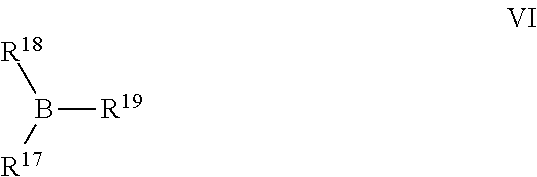
where, each R17, R18, and R19 are independently halogen, alkyl, aryl, halogen-substituted alkyl, halogen-substituted aryl, or OR17; or any two of R17, R18, and R19, together with the atoms to which they are attached, form a heterocyclic ring having 5-9 members, and R17 is at each occurrence independently alkyl, aryl, halogen-substituted alkyl, or halogen-substituted aryl.

where R20, R21, R22, and R23 are each independently hydrogen, a substituted or unsubstituted alkyl group having from 1 to 12 carbon atoms, or a substituted or unsubstituted alkenyl group having from 2 to 12 carbon atoms; and where X′ is a hydrogen, methyl, or ethyl group, and n′″ is an integer from 1 to 15. Monofunctional monomeric compounds may be used for the control of the crosslinking density of the gel electrolyte. Suitable monofunctional monomeric compounds include those of Formula VIII:

where R24 is an alkyl group having from 1 to 12 carbon atoms; R25 and R26 are each independently a hydrogen, a substituted or unsubstituted alkyl group having from 1 to 12 carbon atoms, or a substituted or unsubstituted alkenyl group having from 2 to 12 carbon atoms; X′ is hydrogen, methyl or ethyl group; and q″ is an integer from 1 to 20.


Claims (18)


Priority Applications (2)
| Application Number | Priority Date | Filing Date | Title |
|---|---|---|---|
| US13/113,499 US8877390B2 (en) | 2010-05-25 | 2011-05-23 | Redox shuttles for lithium ion batteries |
| US14/519,347 US9293789B2 (en) | 2010-05-25 | 2014-10-21 | Redox shuttles for lithium ion batteries |
Applications Claiming Priority (2)
| Application Number | Priority Date | Filing Date | Title |
|---|---|---|---|
| US34804710P | 2010-05-25 | 2010-05-25 | |
| US13/113,499 US8877390B2 (en) | 2010-05-25 | 2011-05-23 | Redox shuttles for lithium ion batteries |
Related Child Applications (1)
| Application Number | Title | Priority Date | Filing Date |
|---|---|---|---|
| US14/519,347 Continuation US9293789B2 (en) | 2010-05-25 | 2014-10-21 | Redox shuttles for lithium ion batteries |
Publications (2)
| Publication Number | Publication Date |
|---|---|
| US20110294017A1 US20110294017A1 (en) | 2011-12-01 |
| US8877390B2 true US8877390B2 (en) | 2014-11-04 |
Family
ID=45022403
Family Applications (2)
| Application Number | Title | Priority Date | Filing Date |
|---|---|---|---|
| US13/113,499 Active 2033-06-24 US8877390B2 (en) | 2010-05-25 | 2011-05-23 | Redox shuttles for lithium ion batteries |
| US14/519,347 Active US9293789B2 (en) | 2010-05-25 | 2014-10-21 | Redox shuttles for lithium ion batteries |
Family Applications After (1)
| Application Number | Title | Priority Date | Filing Date |
|---|---|---|---|
| US14/519,347 Active US9293789B2 (en) | 2010-05-25 | 2014-10-21 | Redox shuttles for lithium ion batteries |
Country Status (1)
| Country | Link |
|---|---|
| US (2) | US8877390B2 (en) |
Families Citing this family (15)
| Publication number | Priority date | Publication date | Assignee | Title |
|---|---|---|---|---|
| US8692509B2 (en) * | 2011-06-23 | 2014-04-08 | Black & Decker Inc. | Charge control scheme for use in power tools |
| US9966625B2 (en) * | 2012-02-28 | 2018-05-08 | Uchicago Argonne, Llc | Organic non-aqueous cation-based redox flow batteries |
| US9300000B2 (en) * | 2012-02-28 | 2016-03-29 | Uchicago Argonne, Llc | Organic non-aqueous cation-based redox flow batteries |
| US9203112B2 (en) | 2012-04-26 | 2015-12-01 | Uchicago Argonne, Llc | Redox shuttles having an aromatic ring fused to a 1,1,4,4-tetrasubstituted cyclohexane ring |
| WO2014090877A1 (en) | 2012-12-12 | 2014-06-19 | Rockwood Lithium GmbH | (hetero)aromatic iso(thio)cyanates as redox shuttle additives for electrochemical cells |
| US9005822B2 (en) | 2013-03-06 | 2015-04-14 | Uchicago Argonne, Llc | Functional electrolyte for lithium-ion batteries |
| FR3013512B1 (en) | 2013-11-20 | 2021-04-23 | Commissariat Energie Atomique | LI-ION BATTERY ELECTROLYTE ADDITIVE |
| US10008743B2 (en) * | 2014-02-03 | 2018-06-26 | Uchicago Argonne, Llc | High voltage redox shuttles, method for making high voltage redox shuttles |
| CN105655640B (en) * | 2016-03-28 | 2018-11-02 | 宁德新能源科技有限公司 | A kind of nonaqueous electrolytic solution and the lithium ion battery containing the electrolyte |
| US10892525B2 (en) | 2016-06-29 | 2021-01-12 | University Of Kentucky Research Foundation | Rechargeable batteries including high-voltage cathode and redox shuttle conferring overcharge protection |
| US10374239B2 (en) | 2016-12-29 | 2019-08-06 | Uchicago Argonne, Llc | Aqueous pyridinium cation-based redox flow batteries |
| JP6744239B2 (en) * | 2017-02-22 | 2020-08-19 | トヨタ自動車株式会社 | Non-aqueous secondary battery treatment method |
| US10553890B2 (en) | 2017-06-23 | 2020-02-04 | Uchicago Argonne, Llc | Aqueous redox flow batteries |
| US10424805B2 (en) | 2017-08-15 | 2019-09-24 | Uchicago Argonne, Llc | Benzothiophene-based redox molecules for flow battery |
| US11271237B2 (en) | 2019-07-29 | 2022-03-08 | Uchicago Argonne, Llc | Organic redox molecules for flow batteries |
Citations (42)
| Publication number | Priority date | Publication date | Assignee | Title |
|---|---|---|---|---|
| JPH06338347A (en) | 1993-05-31 | 1994-12-06 | Sony Corp | Non-aqueous electrolyte secondary battery |
| JPH07302614A (en) | 1994-03-07 | 1995-11-14 | Sony Corp | Non-aqueous electrolyte secondary battery |
| US5526599A (en) | 1994-01-21 | 1996-06-18 | Roussel; Daniel | Manually operable display device |
| US5709968A (en) | 1995-05-26 | 1998-01-20 | Sony Corporation | Non-aqueous electrolyte secondary battery |
| US5763119A (en) | 1995-04-28 | 1998-06-09 | Sony Corporation | Non-aqueous electrolyte secondary cell having shuttle agent |
| US5858324A (en) | 1997-04-17 | 1999-01-12 | Minnesota Mining And Manufacturing Company | Lithium based compounds useful as electrodes and method for preparing same |
| US5858573A (en) | 1996-08-23 | 1999-01-12 | Eic Laboratories, Inc. | Chemical overcharge protection of lithium and lithium-ion secondary batteries |
| US5882812A (en) | 1997-01-14 | 1999-03-16 | Polyplus Battery Company, Inc. | Overcharge protection systems for rechargeable batteries |
| US5900385A (en) | 1997-10-15 | 1999-05-04 | Minnesota Mining And Manufacturing Company | Nickel--containing compounds useful as electrodes and method for preparing same |
| US6004698A (en) | 1997-08-21 | 1999-12-21 | The United States Of America As Represented By The United States Department Of Energy | Solid polymer electrolyte electrochemical storage cell containing a redox shuttle additive for overcharge protection |
| JP2000058117A (en) | 1998-07-31 | 2000-02-25 | Sanyo Electric Co Ltd | Non-aqueous secondary battery |
| US6045952A (en) | 1998-03-23 | 2000-04-04 | The United States Of America As Represented By The United States Department Of Energy | Electrochemical storage cell containing a substituted anisole or di-anisole redox shuttle additive for overcharge protection and suitable for use in liquid organic and solid polymer electrolytes |
| US6143268A (en) | 1997-10-14 | 2000-11-07 | 3M Innovative Properties Company | Hydrocarbon treatment of carbonaceous materials |
| US6203944B1 (en) | 1998-03-26 | 2001-03-20 | 3M Innovative Properties Company | Electrode for a lithium battery |
| WO2001029920A1 (en) | 1999-10-18 | 2001-04-26 | The Regents Of The University Of California | Shutdown and redox shuttle additives for batteries |
| US6255017B1 (en) | 1998-07-10 | 2001-07-03 | 3M Innovative Properties Co. | Electrode material and compositions including same |
| US6387571B1 (en) | 1997-08-15 | 2002-05-14 | Accentus Plc | Electrolyte for a rechargeable cell |
| JP2002260730A (en) | 2001-03-02 | 2002-09-13 | Sony Corp | Non-aqueous electrolyte lithium secondary battery |
| US6503662B1 (en) | 1999-09-30 | 2003-01-07 | Ube Industries, Ltd. | Non-aqueous electrolyte and lithium secondary battery using the same |
| US20030027048A1 (en) | 2001-04-27 | 2003-02-06 | 3M Innovative Properties Company | Cathode compositions for lithium-ion batteries |
| US20030211390A1 (en) | 2000-12-22 | 2003-11-13 | Dahn Jeffrey R. | Grain boundary materials as electrodes for lithium ion cells |
| US6664004B2 (en) | 2000-01-13 | 2003-12-16 | 3M Innovative Properties Company | Electrode compositions having improved cycling behavior |
| US6680145B2 (en) | 2001-08-07 | 2004-01-20 | 3M Innovative Properties Company | Lithium-ion batteries |
| JP2004063112A (en) | 2002-07-25 | 2004-02-26 | Asahi Denso Co Ltd | Switch for handlebar |
| US6699336B2 (en) | 2000-01-13 | 2004-03-02 | 3M Innovative Properties Company | Amorphous electrode compositions |
| US20040121239A1 (en) | 2001-01-24 | 2004-06-24 | Koji Abe | Nonaqueous electrolytic solution and lithium secondary batteries |
| US20040121234A1 (en) | 2002-12-23 | 2004-06-24 | 3M Innovative Properties Company | Cathode composition for rechargeable lithium battery |
| JP2004234948A (en) | 2003-01-29 | 2004-08-19 | Mitsubishi Chemicals Corp | Electrolyte for lithium secondary battery and lithium secondary battery |
| US20040179993A1 (en) | 2003-03-14 | 2004-09-16 | 3M Innovative Properties Company | Method of producing lithium ion cathode materials |
| JP2004349132A (en) | 2003-05-22 | 2004-12-09 | Mitsubishi Chemicals Corp | Non-aqueous electrolyte and non-aqueous electrolyte secondary battery using the same |
| US20050019670A1 (en) | 2003-07-17 | 2005-01-27 | Khalil Amine | Long life lithium batteries with stabilized electrodes |
| US20050031957A1 (en) | 2003-08-08 | 2005-02-10 | 3M Innovative Properties Company | Multi-phase, silicon-containing electrode for a lithium-ion battery |
| US20050221196A1 (en) | 2004-04-01 | 2005-10-06 | Dahn Jeffrey R | Redox shuttle for rechargeable lithium-ion cell |
| US20060046144A1 (en) | 2004-09-01 | 2006-03-02 | 3M Innovative Properties Company | Anode composition for lithium ion battery |
| US20060045144A1 (en) | 2004-09-01 | 2006-03-02 | Nlight Photonics Corporation | Diode laser array beam homogenizer |
| US20060199080A1 (en) * | 2005-03-02 | 2006-09-07 | The University Of Chicago | Novel redox shuttles for overcharge protection of lithium batteries |
| US20060263695A1 (en) | 2005-05-17 | 2006-11-23 | Dahn Jeffrey R | N-oxide redox shuttles for rechargeable lithium-ion cell |
| US20070072085A1 (en) | 2005-09-26 | 2007-03-29 | Zonghai Chen | Overcharge protection for electrochemical cells |
| US7211237B2 (en) | 2003-11-26 | 2007-05-01 | 3M Innovative Properties Company | Solid state synthesis of lithium ion battery cathode material |
| US20080318124A1 (en) * | 2007-06-20 | 2008-12-25 | Sony Corporation | Battery |
| US7507503B2 (en) | 2004-12-16 | 2009-03-24 | U Chicago Argonne Llc | Long life lithium batteries with stabilized electrodes |
| US20090286162A1 (en) | 2008-02-12 | 2009-11-19 | 3M Innovative Properties Company | Redox shuttles for high voltage cathodes |
-
2011
- 2011-05-23 US US13/113,499 patent/US8877390B2/en active Active
-
2014
- 2014-10-21 US US14/519,347 patent/US9293789B2/en active Active
Patent Citations (47)
| Publication number | Priority date | Publication date | Assignee | Title |
|---|---|---|---|---|
| JPH06338347A (en) | 1993-05-31 | 1994-12-06 | Sony Corp | Non-aqueous electrolyte secondary battery |
| US5526599A (en) | 1994-01-21 | 1996-06-18 | Roussel; Daniel | Manually operable display device |
| JPH07302614A (en) | 1994-03-07 | 1995-11-14 | Sony Corp | Non-aqueous electrolyte secondary battery |
| US5763119A (en) | 1995-04-28 | 1998-06-09 | Sony Corporation | Non-aqueous electrolyte secondary cell having shuttle agent |
| US5709968A (en) | 1995-05-26 | 1998-01-20 | Sony Corporation | Non-aqueous electrolyte secondary battery |
| US5858573A (en) | 1996-08-23 | 1999-01-12 | Eic Laboratories, Inc. | Chemical overcharge protection of lithium and lithium-ion secondary batteries |
| US5882812A (en) | 1997-01-14 | 1999-03-16 | Polyplus Battery Company, Inc. | Overcharge protection systems for rechargeable batteries |
| US5858324A (en) | 1997-04-17 | 1999-01-12 | Minnesota Mining And Manufacturing Company | Lithium based compounds useful as electrodes and method for preparing same |
| US6387571B1 (en) | 1997-08-15 | 2002-05-14 | Accentus Plc | Electrolyte for a rechargeable cell |
| US6004698A (en) | 1997-08-21 | 1999-12-21 | The United States Of America As Represented By The United States Department Of Energy | Solid polymer electrolyte electrochemical storage cell containing a redox shuttle additive for overcharge protection |
| US6143268A (en) | 1997-10-14 | 2000-11-07 | 3M Innovative Properties Company | Hydrocarbon treatment of carbonaceous materials |
| US5900385A (en) | 1997-10-15 | 1999-05-04 | Minnesota Mining And Manufacturing Company | Nickel--containing compounds useful as electrodes and method for preparing same |
| US6045952A (en) | 1998-03-23 | 2000-04-04 | The United States Of America As Represented By The United States Department Of Energy | Electrochemical storage cell containing a substituted anisole or di-anisole redox shuttle additive for overcharge protection and suitable for use in liquid organic and solid polymer electrolytes |
| US6203944B1 (en) | 1998-03-26 | 2001-03-20 | 3M Innovative Properties Company | Electrode for a lithium battery |
| US6436578B2 (en) | 1998-03-26 | 2002-08-20 | 3M Innovative Properties Company | Electrode compositions with high coulombic efficiencies |
| US6255017B1 (en) | 1998-07-10 | 2001-07-03 | 3M Innovative Properties Co. | Electrode material and compositions including same |
| JP2000058117A (en) | 1998-07-31 | 2000-02-25 | Sanyo Electric Co Ltd | Non-aqueous secondary battery |
| US6503662B1 (en) | 1999-09-30 | 2003-01-07 | Ube Industries, Ltd. | Non-aqueous electrolyte and lithium secondary battery using the same |
| WO2001029920A1 (en) | 1999-10-18 | 2001-04-26 | The Regents Of The University Of California | Shutdown and redox shuttle additives for batteries |
| US6664004B2 (en) | 2000-01-13 | 2003-12-16 | 3M Innovative Properties Company | Electrode compositions having improved cycling behavior |
| US6699336B2 (en) | 2000-01-13 | 2004-03-02 | 3M Innovative Properties Company | Amorphous electrode compositions |
| US20040131936A1 (en) | 2000-01-13 | 2004-07-08 | 3M Innovative Properties Company, A Delaware Corporation | Amorphous electrode compositions |
| US20030211390A1 (en) | 2000-12-22 | 2003-11-13 | Dahn Jeffrey R. | Grain boundary materials as electrodes for lithium ion cells |
| US20040121239A1 (en) | 2001-01-24 | 2004-06-24 | Koji Abe | Nonaqueous electrolytic solution and lithium secondary batteries |
| JP2002260730A (en) | 2001-03-02 | 2002-09-13 | Sony Corp | Non-aqueous electrolyte lithium secondary battery |
| US7078128B2 (en) | 2001-04-27 | 2006-07-18 | 3M Innovative Properties Company | Cathode compositions for lithium-ion batteries |
| US6964828B2 (en) | 2001-04-27 | 2005-11-15 | 3M Innovative Properties Company | Cathode compositions for lithium-ion batteries |
| US20030027048A1 (en) | 2001-04-27 | 2003-02-06 | 3M Innovative Properties Company | Cathode compositions for lithium-ion batteries |
| US6680145B2 (en) | 2001-08-07 | 2004-01-20 | 3M Innovative Properties Company | Lithium-ion batteries |
| JP2004063112A (en) | 2002-07-25 | 2004-02-26 | Asahi Denso Co Ltd | Switch for handlebar |
| US20040121234A1 (en) | 2002-12-23 | 2004-06-24 | 3M Innovative Properties Company | Cathode composition for rechargeable lithium battery |
| JP2004234948A (en) | 2003-01-29 | 2004-08-19 | Mitsubishi Chemicals Corp | Electrolyte for lithium secondary battery and lithium secondary battery |
| US20040179993A1 (en) | 2003-03-14 | 2004-09-16 | 3M Innovative Properties Company | Method of producing lithium ion cathode materials |
| JP2004349132A (en) | 2003-05-22 | 2004-12-09 | Mitsubishi Chemicals Corp | Non-aqueous electrolyte and non-aqueous electrolyte secondary battery using the same |
| US20050019670A1 (en) | 2003-07-17 | 2005-01-27 | Khalil Amine | Long life lithium batteries with stabilized electrodes |
| US7968235B2 (en) | 2003-07-17 | 2011-06-28 | Uchicago Argonne Llc | Long life lithium batteries with stabilized electrodes |
| US20050031957A1 (en) | 2003-08-08 | 2005-02-10 | 3M Innovative Properties Company | Multi-phase, silicon-containing electrode for a lithium-ion battery |
| US7211237B2 (en) | 2003-11-26 | 2007-05-01 | 3M Innovative Properties Company | Solid state synthesis of lithium ion battery cathode material |
| US20050221196A1 (en) | 2004-04-01 | 2005-10-06 | Dahn Jeffrey R | Redox shuttle for rechargeable lithium-ion cell |
| US20060046144A1 (en) | 2004-09-01 | 2006-03-02 | 3M Innovative Properties Company | Anode composition for lithium ion battery |
| US20060045144A1 (en) | 2004-09-01 | 2006-03-02 | Nlight Photonics Corporation | Diode laser array beam homogenizer |
| US7507503B2 (en) | 2004-12-16 | 2009-03-24 | U Chicago Argonne Llc | Long life lithium batteries with stabilized electrodes |
| US20060199080A1 (en) * | 2005-03-02 | 2006-09-07 | The University Of Chicago | Novel redox shuttles for overcharge protection of lithium batteries |
| US20060263695A1 (en) | 2005-05-17 | 2006-11-23 | Dahn Jeffrey R | N-oxide redox shuttles for rechargeable lithium-ion cell |
| US20070072085A1 (en) | 2005-09-26 | 2007-03-29 | Zonghai Chen | Overcharge protection for electrochemical cells |
| US20080318124A1 (en) * | 2007-06-20 | 2008-12-25 | Sony Corporation | Battery |
| US20090286162A1 (en) | 2008-02-12 | 2009-11-19 | 3M Innovative Properties Company | Redox shuttles for high voltage cathodes |
Non-Patent Citations (5)
| Title |
|---|
| Chen, J. et al., "Chemical Overcharge and Overdischarge Protection for Lithium-Ion Batteries," Electrochemical and Solid-State Letters, 8 (1), pp. A59-A62, (2005), published by the Electrochemical Society, Inc. |
| Chen, Z. et al., "Bifunctional Electrolyte Additive for Lithium-Ion Batteries", Electrochemistry Communications, 9, (2007), pp. 703-707. |
| Chen, Z. et al., "Redox Shuttles for Safer Lithium-Ion Batteries", Electrochimica Acta 54 (2009) pp. 5605-5613. |
| Chen, Z. et al., "Understanding the Stability of Aromatic Redox Shuttles for Overcharge Protection of Lithium-Ion Cells," Journal of Electrochemical Society, 153, 2006, A2215-A2219. |
| Moshurchak, L.M. et al., "High-Potential Redox Shuttle for Use in Lithium-Ion Batteries", Journal of the Electrochemical Society, 156, (4), (2009), pp. A309-A312. |
Also Published As
| Publication number | Publication date |
|---|---|
| US20150037691A1 (en) | 2015-02-05 |
| US9293789B2 (en) | 2016-03-22 |
| US20110294017A1 (en) | 2011-12-01 |
Similar Documents
| Publication | Publication Date | Title |
|---|---|---|
| US9293789B2 (en) | Redox shuttles for lithium ion batteries | |
| US8609287B2 (en) | Polyether-functionalized redox shuttle additives for lithium ion batteries | |
| US9093722B2 (en) | Functionalized ionic liquid electrolytes for lithium ion batteries | |
| US8968940B2 (en) | Redox shuttles for high voltage cathodes | |
| US8283074B2 (en) | Electrolyte salts for nonaqueous electrolytes | |
| US8178246B2 (en) | Nonaqueous electrolyte solution, nonaqueous electrolyte secondary cell, and carbonate compounds | |
| CA3005799C (en) | Silane functionalized ionic liquids | |
| EP4106070A1 (en) | Phosphorus-containing electrolytes | |
| KR101766568B1 (en) | Nonaqueous electrolyte solution for batteries, novel compound, polymer electrolyte, and lithium secondary battery | |
| WO2009133899A1 (en) | Secondary cell nonaqueous electrolyte and secondary cell | |
| US9203112B2 (en) | Redox shuttles having an aromatic ring fused to a 1,1,4,4-tetrasubstituted cyclohexane ring | |
| CN116711120A (en) | Nonaqueous electrolyte, nonaqueous electrolyte battery, and compound | |
| WO2024034522A1 (en) | Additive for non-aqueous electrolytic solution, non-aqueous electrolytic solution, and power storage device | |
| US10978741B2 (en) | Non-aqueous electrolytes for electrochemical cells | |
| WO2022158399A1 (en) | Non-aqueous electrolyte, non-aqueous electrolyte battery, and compound | |
| CN104810564B (en) | One kind overcharges protectant redox shuttle as lithium ion battery | |
| CN111066191A (en) | Additive for nonaqueous electrolyte solution, and electricity storage device | |
| KR20210107060A (en) | Modified Ionic Liquids Containing Boron | |
| KR20250142331A (en) | Non-aqueous electrolytes, non-aqueous electrolyte batteries and compounds |
Legal Events
| Date | Code | Title | Description |
|---|---|---|---|
| AS | Assignment |
Owner name: UCHICAGO ARGONNE, LLC, ILLINOIS Free format text: ASSIGNMENT OF ASSIGNORS INTEREST;ASSIGNORS:WANG, WEI;ZHANG, ZHENGCHENG;AMINE, KHALIL;REEL/FRAME:026940/0092 Effective date: 20110708 |
|
| AS | Assignment |
Owner name: ENERGY, UNITED STATES DEPARTMENT OF, DISTRICT OF C Free format text: CONFIRMATORY LICENSE;ASSIGNOR:UCHICAGO ARGONNE, LLC;REEL/FRAME:027882/0831 Effective date: 20110921 |
|
| STCF | Information on status: patent grant |
Free format text: PATENTED CASE |
|
| FEPP | Fee payment procedure |
Free format text: SURCHARGE FOR LATE PAYMENT, SMALL ENTITY (ORIGINAL EVENT CODE: M2554) |
|
| MAFP | Maintenance fee payment |
Free format text: PAYMENT OF MAINTENANCE FEE, 4TH YR, SMALL ENTITY (ORIGINAL EVENT CODE: M2551) Year of fee payment: 4 |
|
| MAFP | Maintenance fee payment |
Free format text: PAYMENT OF MAINTENANCE FEE, 8TH YR, SMALL ENTITY (ORIGINAL EVENT CODE: M2552); ENTITY STATUS OF PATENT OWNER: SMALL ENTITY Year of fee payment: 8 |
|
| FEPP | Fee payment procedure |
Free format text: MAINTENANCE FEE REMINDER MAILED (ORIGINAL EVENT CODE: REM.); ENTITY STATUS OF PATENT OWNER: SMALL ENTITY |