US8853559B2 - Insulation circuit board, and power semiconductor device or inverter module using the same - Google Patents

Insulation circuit board, and power semiconductor device or inverter module using the same Download PDF

Info

Publication number
US8853559B2
US8853559B2 US13/388,450 US201013388450A US8853559B2 US 8853559 B2 US8853559 B2 US 8853559B2 US 201013388450 A US201013388450 A US 201013388450A US 8853559 B2 US8853559 B2 US 8853559B2
Authority
US
United States
Prior art keywords
wiring pattern
wiring patterns
circuit board
insulation layer
insulation
Prior art date
Legal status (The legal status is an assumption and is not a legal conclusion. Google has not performed a legal analysis and makes no representation as to the accuracy of the status listed.)
Active, expires
Application number
US13/388,450
Other versions
US20120127684A1 (en
Inventor
Hironori Matsumoto
Jumpei Kusukawa
Current Assignee (The listed assignees may be inaccurate. Google has not performed a legal analysis and makes no representation or warranty as to the accuracy of the list.)
Hitachi Ltd
Original Assignee
Hitachi Ltd
Priority date (The priority date is an assumption and is not a legal conclusion. Google has not performed a legal analysis and makes no representation as to the accuracy of the date listed.)
Filing date
Publication date
Application filed by Hitachi Ltd filed Critical Hitachi Ltd
Assigned to HITACHI, LTD. reassignment HITACHI, LTD. ASSIGNMENT OF ASSIGNORS INTEREST (SEE DOCUMENT FOR DETAILS). Assignors: KUSUKAWA, JUMPEI, MATSUMOTO, HIRONORI
Publication of US20120127684A1 publication Critical patent/US20120127684A1/en
Application granted granted Critical
Publication of US8853559B2 publication Critical patent/US8853559B2/en
Active legal-status Critical Current
Adjusted expiration legal-status Critical

Links

Images

Classifications

    • HELECTRICITY
    • H05ELECTRIC TECHNIQUES NOT OTHERWISE PROVIDED FOR
    • H05KPRINTED CIRCUITS; CASINGS OR CONSTRUCTIONAL DETAILS OF ELECTRIC APPARATUS; MANUFACTURE OF ASSEMBLAGES OF ELECTRICAL COMPONENTS
    • H05K1/00Printed circuits
    • H05K1/02Details
    • H05K1/03Use of materials for the substrate
    • H05K1/05Insulated conductive substrates, e.g. insulated metal substrate
    • H05K1/056Insulated conductive substrates, e.g. insulated metal substrate the metal substrate being covered by an organic insulating layer
    • HELECTRICITY
    • H01ELECTRIC ELEMENTS
    • H01LSEMICONDUCTOR DEVICES NOT COVERED BY CLASS H10
    • H01L23/00Details of semiconductor or other solid state devices
    • H01L23/12Mountings, e.g. non-detachable insulating substrates
    • H01L23/14Mountings, e.g. non-detachable insulating substrates characterised by the material or its electrical properties
    • H01L23/142Metallic substrates having insulating layers
    • HELECTRICITY
    • H01ELECTRIC ELEMENTS
    • H01LSEMICONDUCTOR DEVICES NOT COVERED BY CLASS H10
    • H01L23/00Details of semiconductor or other solid state devices
    • H01L23/58Structural electrical arrangements for semiconductor devices not otherwise provided for, e.g. in combination with batteries
    • H01L23/62Protection against overvoltage, e.g. fuses, shunts
    • HELECTRICITY
    • H01ELECTRIC ELEMENTS
    • H01LSEMICONDUCTOR DEVICES NOT COVERED BY CLASS H10
    • H01L23/00Details of semiconductor or other solid state devices
    • H01L23/58Structural electrical arrangements for semiconductor devices not otherwise provided for, e.g. in combination with batteries
    • H01L23/64Impedance arrangements
    • H01L23/647Resistive arrangements
    • HELECTRICITY
    • H01ELECTRIC ELEMENTS
    • H01LSEMICONDUCTOR DEVICES NOT COVERED BY CLASS H10
    • H01L25/00Assemblies consisting of a plurality of semiconductor or other solid state devices
    • H01L25/03Assemblies consisting of a plurality of semiconductor or other solid state devices all the devices being of a type provided for in a single subclass of subclasses H10B, H10D, H10F, H10H, H10K or H10N, e.g. assemblies of rectifier diodes
    • H01L25/04Assemblies consisting of a plurality of semiconductor or other solid state devices all the devices being of a type provided for in a single subclass of subclasses H10B, H10D, H10F, H10H, H10K or H10N, e.g. assemblies of rectifier diodes the devices not having separate containers
    • H01L25/07Assemblies consisting of a plurality of semiconductor or other solid state devices all the devices being of a type provided for in a single subclass of subclasses H10B, H10D, H10F, H10H, H10K or H10N, e.g. assemblies of rectifier diodes the devices not having separate containers the devices being of a type provided for in group subclass H10D
    • H01L25/072Assemblies consisting of a plurality of semiconductor or other solid state devices all the devices being of a type provided for in a single subclass of subclasses H10B, H10D, H10F, H10H, H10K or H10N, e.g. assemblies of rectifier diodes the devices not having separate containers the devices being of a type provided for in group subclass H10D the devices being arranged next to each other
    • HELECTRICITY
    • H01ELECTRIC ELEMENTS
    • H01LSEMICONDUCTOR DEVICES NOT COVERED BY CLASS H10
    • H01L25/00Assemblies consisting of a plurality of semiconductor or other solid state devices
    • H01L25/18Assemblies consisting of a plurality of semiconductor or other solid state devices the devices being of the types provided for in two or more different main groups of the same subclass of H10B, H10D, H10F, H10H, H10K or H10N
    • HELECTRICITY
    • H05ELECTRIC TECHNIQUES NOT OTHERWISE PROVIDED FOR
    • H05KPRINTED CIRCUITS; CASINGS OR CONSTRUCTIONAL DETAILS OF ELECTRIC APPARATUS; MANUFACTURE OF ASSEMBLAGES OF ELECTRICAL COMPONENTS
    • H05K1/00Printed circuits
    • H05K1/02Details
    • H05K1/0213Electrical arrangements not otherwise provided for
    • H05K1/0254High voltage adaptations; Electrical insulation details; Overvoltage or electrostatic discharge protection ; Arrangements for regulating voltages or for using plural voltages
    • H05K1/0257Overvoltage protection
    • HELECTRICITY
    • H05ELECTRIC TECHNIQUES NOT OTHERWISE PROVIDED FOR
    • H05KPRINTED CIRCUITS; CASINGS OR CONSTRUCTIONAL DETAILS OF ELECTRIC APPARATUS; MANUFACTURE OF ASSEMBLAGES OF ELECTRICAL COMPONENTS
    • H05K1/00Printed circuits
    • H05K1/02Details
    • H05K1/03Use of materials for the substrate
    • H05K1/05Insulated conductive substrates, e.g. insulated metal substrate
    • H05K1/053Insulated conductive substrates, e.g. insulated metal substrate the metal substrate being covered by an inorganic insulating layer
    • H10W42/80
    • H10W44/401
    • H10W70/6875
    • H10W90/00
    • HELECTRICITY
    • H01ELECTRIC ELEMENTS
    • H01LSEMICONDUCTOR DEVICES NOT COVERED BY CLASS H10
    • H01L23/00Details of semiconductor or other solid state devices
    • H01L23/48Arrangements for conducting electric current to or from the solid state body in operation, e.g. leads, terminal arrangements ; Selection of materials therefor
    • H01L23/488Arrangements for conducting electric current to or from the solid state body in operation, e.g. leads, terminal arrangements ; Selection of materials therefor consisting of soldered or bonded constructions
    • H01L23/498Leads, i.e. metallisations or lead-frames on insulating substrates, e.g. chip carriers
    • H01L23/49838Geometry or layout
    • H01L23/49844Geometry or layout for individual devices of subclass H10D
    • HELECTRICITY
    • H01ELECTRIC ELEMENTS
    • H01LSEMICONDUCTOR DEVICES NOT COVERED BY CLASS H10
    • H01L2924/00Indexing scheme for arrangements or methods for connecting or disconnecting semiconductor or solid-state bodies as covered by H01L24/00
    • H01L2924/095Indexing scheme for arrangements or methods for connecting or disconnecting semiconductor or solid-state bodies as covered by H01L24/00 with a principal constituent of the material being a combination of two or more materials provided in the groups H01L2924/013 - H01L2924/0715
    • H01L2924/097Glass-ceramics, e.g. devitrified glass
    • H01L2924/09701Low temperature co-fired ceramic [LTCC]
    • HELECTRICITY
    • H01ELECTRIC ELEMENTS
    • H01LSEMICONDUCTOR DEVICES NOT COVERED BY CLASS H10
    • H01L2924/00Indexing scheme for arrangements or methods for connecting or disconnecting semiconductor or solid-state bodies as covered by H01L24/00
    • H01L2924/10Details of semiconductor or other solid state devices to be connected
    • H01L2924/11Device type
    • H01L2924/12Passive devices, e.g. 2 terminal devices
    • H01L2924/1204Optical Diode
    • H01L2924/12044OLED
    • HELECTRICITY
    • H02GENERATION; CONVERSION OR DISTRIBUTION OF ELECTRIC POWER
    • H02MAPPARATUS FOR CONVERSION BETWEEN AC AND AC, BETWEEN AC AND DC, OR BETWEEN DC AND DC, AND FOR USE WITH MAINS OR SIMILAR POWER SUPPLY SYSTEMS; CONVERSION OF DC OR AC INPUT POWER INTO SURGE OUTPUT POWER; CONTROL OR REGULATION THEREOF
    • H02M7/00Conversion of AC power input into DC power output; Conversion of DC power input into AC power output
    • H02M7/003Constructional details, e.g. physical layout, assembly, wiring or busbar connections
    • HELECTRICITY
    • H05ELECTRIC TECHNIQUES NOT OTHERWISE PROVIDED FOR
    • H05KPRINTED CIRCUITS; CASINGS OR CONSTRUCTIONAL DETAILS OF ELECTRIC APPARATUS; MANUFACTURE OF ASSEMBLAGES OF ELECTRICAL COMPONENTS
    • H05K1/00Printed circuits
    • H05K1/02Details
    • H05K1/0201Thermal arrangements, e.g. for cooling, heating or preventing overheating
    • H05K1/0203Cooling of mounted components
    • H05K1/0204Cooling of mounted components using means for thermal conduction connection in the thickness direction of the substrate
    • HELECTRICITY
    • H05ELECTRIC TECHNIQUES NOT OTHERWISE PROVIDED FOR
    • H05KPRINTED CIRCUITS; CASINGS OR CONSTRUCTIONAL DETAILS OF ELECTRIC APPARATUS; MANUFACTURE OF ASSEMBLAGES OF ELECTRICAL COMPONENTS
    • H05K1/00Printed circuits
    • H05K1/02Details
    • H05K1/0213Electrical arrangements not otherwise provided for
    • H05K1/0254High voltage adaptations; Electrical insulation details; Overvoltage or electrostatic discharge protection ; Arrangements for regulating voltages or for using plural voltages
    • H05K1/0256Electrical insulation details, e.g. around high voltage areas
    • HELECTRICITY
    • H05ELECTRIC TECHNIQUES NOT OTHERWISE PROVIDED FOR
    • H05KPRINTED CIRCUITS; CASINGS OR CONSTRUCTIONAL DETAILS OF ELECTRIC APPARATUS; MANUFACTURE OF ASSEMBLAGES OF ELECTRICAL COMPONENTS
    • H05K1/00Printed circuits
    • H05K1/02Details
    • H05K1/0213Electrical arrangements not otherwise provided for
    • H05K1/0254High voltage adaptations; Electrical insulation details; Overvoltage or electrostatic discharge protection ; Arrangements for regulating voltages or for using plural voltages
    • H05K1/0262Arrangements for regulating voltages or for using plural voltages
    • HELECTRICITY
    • H05ELECTRIC TECHNIQUES NOT OTHERWISE PROVIDED FOR
    • H05KPRINTED CIRCUITS; CASINGS OR CONSTRUCTIONAL DETAILS OF ELECTRIC APPARATUS; MANUFACTURE OF ASSEMBLAGES OF ELECTRICAL COMPONENTS
    • H05K2201/00Indexing scheme relating to printed circuits covered by H05K1/00
    • H05K2201/01Dielectrics
    • H05K2201/0137Materials
    • H05K2201/0154Polyimide
    • HELECTRICITY
    • H05ELECTRIC TECHNIQUES NOT OTHERWISE PROVIDED FOR
    • H05KPRINTED CIRCUITS; CASINGS OR CONSTRUCTIONAL DETAILS OF ELECTRIC APPARATUS; MANUFACTURE OF ASSEMBLAGES OF ELECTRICAL COMPONENTS
    • H05K2201/00Indexing scheme relating to printed circuits covered by H05K1/00
    • H05K2201/01Dielectrics
    • H05K2201/0137Materials
    • H05K2201/0162Silicon containing polymer, e.g. silicone
    • HELECTRICITY
    • H05ELECTRIC TECHNIQUES NOT OTHERWISE PROVIDED FOR
    • H05KPRINTED CIRCUITS; CASINGS OR CONSTRUCTIONAL DETAILS OF ELECTRIC APPARATUS; MANUFACTURE OF ASSEMBLAGES OF ELECTRICAL COMPONENTS
    • H05K2201/00Indexing scheme relating to printed circuits covered by H05K1/00
    • H05K2201/02Fillers; Particles; Fibers; Reinforcement materials
    • H05K2201/0203Fillers and particles
    • H05K2201/0206Materials
    • H05K2201/0209Inorganic, non-metallic particles
    • HELECTRICITY
    • H05ELECTRIC TECHNIQUES NOT OTHERWISE PROVIDED FOR
    • H05KPRINTED CIRCUITS; CASINGS OR CONSTRUCTIONAL DETAILS OF ELECTRIC APPARATUS; MANUFACTURE OF ASSEMBLAGES OF ELECTRICAL COMPONENTS
    • H05K2201/00Indexing scheme relating to printed circuits covered by H05K1/00
    • H05K2201/07Electric details
    • H05K2201/0753Insulation
    • H05K2201/0761Insulation resistance, e.g. of the surface of the PCB between the conductors
    • HELECTRICITY
    • H05ELECTRIC TECHNIQUES NOT OTHERWISE PROVIDED FOR
    • H05KPRINTED CIRCUITS; CASINGS OR CONSTRUCTIONAL DETAILS OF ELECTRIC APPARATUS; MANUFACTURE OF ASSEMBLAGES OF ELECTRICAL COMPONENTS
    • H05K2201/00Indexing scheme relating to printed circuits covered by H05K1/00
    • H05K2201/09Shape and layout
    • H05K2201/09209Shape and layout details of conductors
    • H05K2201/09654Shape and layout details of conductors covering at least two types of conductors provided for in H05K2201/09218 - H05K2201/095
    • H05K2201/09781Dummy conductors, i.e. not used for normal transport of current; Dummy electrodes of components
    • HELECTRICITY
    • H05ELECTRIC TECHNIQUES NOT OTHERWISE PROVIDED FOR
    • H05KPRINTED CIRCUITS; CASINGS OR CONSTRUCTIONAL DETAILS OF ELECTRIC APPARATUS; MANUFACTURE OF ASSEMBLAGES OF ELECTRICAL COMPONENTS
    • H05K2201/00Indexing scheme relating to printed circuits covered by H05K1/00
    • H05K2201/10Details of components or other objects attached to or integrated in a printed circuit board
    • H05K2201/10007Types of components
    • H05K2201/10022Non-printed resistor
    • H10W70/658

Definitions

  • the invention relates to a high-voltage insulation circuit board which is used in an electric power apparatus such as an electric power converter or the like such as power semiconductor device, inverter module, or the like and to a power semiconductor device or inverter module using such an insulation circuit board.
  • a ceramic board having excellent heat radiation performance and heat resistance is a main stream.
  • a shift to a resin board in which a high radiation insulation resin is used for an insulation layer is increasing year by year.
  • a plurality of semiconductor elements and passive elements are arranged on the wiring patterns 3 on the insulation circuit board.
  • a high power switching element such as an insulated-gate bipolar transistor (IGBT) or the like is used as a power semiconductor device for electric power conversion or an inverter module in recent years, there is a problem of an excessive heat generation.
  • an inorganic filler is filled into the resin of the insulation layer 2 at a high density or a thickness of insulation layer 2 is made thin, thereby improving the thermal conductivity of the insulation layer 2 .
  • an insulation circuit board in which an alumina filler of 70 Vol % or more was mixed into the insulation resin which is in contact with the metal base substrate 1 has also been developed, and high thermal conductivity which reaches 10 W/mk has been realized.
  • an insulation circuit board using the insulation layer 2 having a layer thickness of about 200 ⁇ mt or having the smallest layer thickness of about 100 ⁇ mt has been developed.
  • a high voltage associated with the realization of the recent high power is always applied to such an insulation circuit board, such a problem that a dielectric breakdown occurs for a short time can occur.
  • FIG. 3 In the wiring pattern 3 to which the high voltage is applied, the generation of partial discharging 4 that is caused by electric field concentration at end sections of the wiring pattern 3 is a main cause. Particularly, in the case of an AC voltage in which a polarity of the applied voltage changes continuously, the discharge occurs continuously, so that the insulation layer 2 is deteriorated, a dendritic discharge deterioration trace called a tree 5 is formed, and a dielectric breakdown occurs soon.
  • the insulation circuit board is characterized in that the insulation layer which is in contact with the metal base substrate and the wiring patterns is one of a resin mainly consisting of an epoxy resin, a resin mainly consisting of a polyimide resin, a resin mainly consisting of a silicone resin, a resin mainly consisting of an acrylic resin, and a resin mainly consisting of an urethane resin or a resin consisting of a denatured material or mixture of those resins.
  • the insulation circuit board is characterized in that an inorganic filler which is dispersed into the insulation layer which is in contact with the metal base substrate and the wiring patterns is one of Al 2 O 3 (alumina), SiO 2 (silica), AlN (aluminum nitride), BN (boron nitride), ZnO (zinc oxide), SiC (silicon carbide), Si 3 N 4 (silicon nitride), and MgO (magnesium oxide), a filler adapted to improve heat radiation performance and insulation performance in a manner similar to those compounds, or a mixture of two or more kinds of those compounds.
  • an inorganic filler which is dispersed into the insulation layer which is in contact with the metal base substrate and the wiring patterns is one of Al 2 O 3 (alumina), SiO 2 (silica), AlN (aluminum nitride), BN (boron nitride), ZnO (zinc oxide), SiC (silicon carbide), Si 3 N 4 (silicon nitride
  • the insulation circuit board is characterized in that the insulation layer which is in contact with the metal base substrate and the wiring patterns is one of ceramic materials each mainly consisting of Al 2 O 3 (alumina), ZrO 2 (zirconia), AlN (aluminum nitride), or BN (boron nitride), a ceramic material which has characteristics similar to those of those ceramic materials, whose fundamental component consists of a metal oxide, and which is burned and solidified by a heat treatment of a high temperature, or an inorganic material consisting of a denatured material or mixture obtained by mixing a glass component into the ceramic material.
  • ceramic materials each mainly consisting of Al 2 O 3 (alumina), ZrO 2 (zirconia), AlN (aluminum nitride), or BN (boron nitride)
  • a ceramic material which has characteristics similar to those of those ceramic materials, whose fundamental component consists of a metal oxide, and which is burned and solidified by a heat treatment of a high temperature
  • the insulation circuit board is characterized in that in order to provide the electric potential in the range of the potential difference between the adjacent wiring patterns, a resistor is arranged between the two adjacent wiring patterns where the electric potential difference exists.
  • the insulation circuit board is characterized in that the electric potential in the range of the potential difference between the adjacent wiring patterns is provided from a circuit for forming the electric potential by a portion other than a portion on the insulation circuit board.
  • a power semiconductor device comprising: a metal base substrate; wiring patterns which are formed onto at least one of surfaces of the metal base substrate through an insulation layer; and semiconductor elements connected to the wiring patterns, characterized in that between two adjacent wiring patterns in which an electric potential difference exists among the wiring patterns, at least one or more wiring patterns or conductors which are in contact with the insulation layer and have an electric potential in a range of the electric potential difference between the adjacent wiring patterns are arranged.
  • the power semiconductor device is characterized in that the two adjacent wiring patterns are an input potential wiring pattern and a ground potential wiring pattern.
  • the power semiconductor device is characterized in that the two adjacent wiring patterns are output wiring patterns of a three-phase alternating current connected to the semiconductor elements.
  • the electric field concentration at the end sections of the wiring pattern to which a high voltage is applied is reduced and partial-discharge-resistant characteristics are improved. Therefore, even in high-density mounted wirings in which a distance between the wiring patterns is small, the insulation circuit board having the high insulation reliability can be realized by low costs. Providing of the power semiconductor device or inverter module using the insulation circuit board and having the high insulation reliability can be realized.
  • FIG. 1 Cross sectional view of an insulation circuit board and wiring patterns for describing an embodiment of the invention.
  • FIG. 2 Cross sectional view for explaining conventional insulation circuit board and wiring patterns.
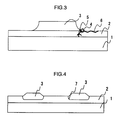
  • FIG. 3 Enlarged cross sectional view of the conventional insulation circuit board and wiring pattern and it is a cross sectional view for explaining sharp shapes of end sections of the wiring pattern, electric field concentration at the end sections of the wiring pattern, a tree deterioration, and a creeping discharge.
  • FIG. 4 Cross sectional view of an insulation circuit board and wiring patterns for describing shapes of end sections of the wiring patterns in JP-A-2001-057409.
  • FIG. 5 Plan view of the insulation circuit board for describing plan shapes of the wiring patterns of the invention.
  • FIG. 6 Cross sectional view of an insulation circuit board and wiring patterns showing an embodiment of the invention and it is a diagram for explaining the wiring patterns having an intermediate electric potential.
  • FIG. 7 Perspective view showing the embodiment of the invention and for explaining passive elements to form the intermediate electric potential and a connecting method.
  • FIG. 8 Plan view of the insulation circuit board at the time when the invention is applied to an inverter circuit board for driving a motor.
  • FIG. 9 Circuit diagram for explaining a circuit construction of the inverter for driving the motor.
  • FIG. 10 Cross sectional analysis model view of the insulation circuit board and the wiring patterns using the embodiment of the invention.
  • FIG. 11 Cross sectional analysis model view of an insulation circuit board and wiring patterns according to another embodiment of the invention.
  • FIG. 12 Cross sectional analysis model view of an insulation circuit board and wiring patterns according to still another embodiment of the invention.
  • FIG. 13 Cross sectional analysis model view of an insulation circuit board and wiring patterns according to further another embodiment of the invention.
  • FIG. 14 Cross sectional analysis model view of conventional insulation circuit board and wiring patterns.
  • FIGS. 1 and 6 are cross sectional view of an insulation circuit board according to an embodiment of the invention.
  • the embodiment illustrated in FIG. 6 has such a construction that in FIG. 2 showing a conventional embodiment, between adjacent wiring patterns 31 and 33 which are away from each other by the distance R 1 between the wiring patterns, a new wiring pattern 32 is arranged at a position of a distance R 2 between the wiring patterns corresponding to an equal distance from each of the wiring patterns 31 and 33 .
  • Other constructions are similar to those shown in FIG. 2 unless otherwise specified in particular.
  • the embodiment of FIG. 6 differs largely from the conventional embodiment with respect to a point that the wiring pattern 32 arranged between the adjacent wiring patterns 31 and 33 in FIG. 2 is voltage-divided by two resistors 8 and has an intermediate electric potential of an electric potential difference between the wiring patterns 31 and 33 .
  • the wiring pattern 31 on the high potential side in FIG. 2 has an electric potential of 1 kV and the wiring pattern 33 on the low potential side has an electric potential of 0V
  • an electric potential of the wiring pattern 32 in FIG. 6 is equal to 500V and a potential difference between the wiring patterns 31 and 32 or between the wiring patterns 32 and 33 is equal to 500V.
  • the potential difference between the adjacent wiring patterns 31 and 33 in the embodiment denotes a potential difference at a certain time point in the case where an electric potential which is applied to the wiring pattern 3 time-sequentially changes and the potential difference between the adjacent wiring patterns 31 and 33 changes. Therefore, even if the potential difference between the adjacent wiring patterns 31 and 33 is not high at a certain time point, in the case where the potential difference between the adjacent wiring patterns 31 and 33 is large at a different time point, such a case is incorporated in the adjacent wiring patterns 31 and 33 .
  • a potential difference between the wiring pattern 31 on the high potential side and the wiring pattern 32 and a potential difference between the wiring pattern 32 and the wiring pattern 33 on the low potential side are equal to 350V or less. It is a value which is obtained from a Paschen's law. According to the Paschen's law, it is mentioned that a lowest value of the potential difference at the time of occurrence of a spark discharge in the air at an ordinary temperature in the case of presuming a parallel electric field is equal to about 350V.
  • a potential difference between the adjacent wiring patterns 32 or conductors is equal to 350V or less.
  • the filler such as a sealing resin or the like
  • the electric field concentration at the end sections of the wiring pattern 31 on the high potential side is lightened, thereby raising a partial discharging voltage.
  • the partial-discharge-resistant performance of the insulation circuit board in FIG. 2 can be improved.
  • the wiring pattern 32 which is newly arranged has a material and a shape similar to those of the adjacent wiring patterns 31 and 33 . Therefore, the embodiment according to the invention can be easily realized by the conventional insulation circuit construction and forming method of the wiring patterns 3 . The insulation performance of the insulation circuit board can be improved by low costs.
  • the wiring pattern 32 or conductor has a wiring pattern length R 4 or conductor length which is equal to or longer than an orientation length R 3 of the wiring patterns 31 and 33 showing the high potential difference.
  • the wiring patterns 31 and 32 on the insulation circuit board by a chip resistor 81 it is sufficient to connect the wiring patterns 31 and 32 on the insulation circuit board by a chip resistor 81 and to connect the wiring patterns 32 and 33 on the insulation circuit board by a chip resistor 81 .
  • the chip resistor 81 a small article whose vertical and lateral sizes are equal to 1 mm or less is also commercially available and it can be also easily mounted even in the wiring patterns 3 for high-density mounting to which applying of the invention thereto is assumed.
  • the density of the wiring patterns 3 on the insulation circuit board is high and an element, for example, the chip resistor or the like to form the potential difference between the wiring patterns 31 and 33 showing the high potential difference cannot be mounted to the wiring patterns 3 on the insulation circuit board, it is sufficient to form an electric potential for the wiring pattern 32 by a portion other than the portion on the insulation circuit board.
  • a bus bar wiring for supplying a power source to the insulation circuit board, a terminal portion of a capacitor for the power source, or the like corresponds to such a portion. It is sufficient to supply an input voltage including the intermediate electric potential formed there to the insulation circuit board.
  • the intermediate electric potential can be easily obtained even in the insulation circuit board on which the wiring patterns are formed at a high density and the elements are mounted without a gap.
  • FIG. 8 shows an embodiment in the case where the invention is applied to a power semiconductor device or inverter module having an inverter circuit board of a motor control system.
  • an inverter of three-phase outputs using six switching elements 9 is used.
  • a DC current from a converter is input through a smoothing capacitor and is converted into a 3-phase alternating current by the switching element 9 , thereby rotating the motor.
  • a wiring construction shown in FIG. 8 here is obtained by presuming an inverter for a high output and six IGBT switching elements 9 A to 9 F and six free wheeling diodes 10 A to 10 F are mounted.
  • the wiring patterns which provide the highest potential difference are the wiring patterns between the input and the ground and an output portion of the three-phase AC. Therefore, wiring patterns 32 A, 32 B, and 32 C showing the intermediate electric potential are respectively arranged into them, thereby reducing the electric field concentration at the end sections of wiring patterns 31 A, 31 B, 31 C, and 31 D on the high potential side.
  • the six wiring patterns 3 on the left side in FIG. 8 are wiring patterns 11 A to 11 F for a gate signal for controlling the IGBT switching elements 9 A to 9 F, generally, since a gate signal voltage is small, the wiring pattern 32 to lighten the electric field concentration is not arranged.
  • Wiring patterns 33 A to 33 D on the low potential side may be used in place of the wiring patterns 31 A to 33 D on the high potential side.
  • the power semiconductor device or inverter module using the high-density mounting wirings in which the distance between the wiring patterns is small the power semiconductor device or inverter module having the high insulation reliability can be realized at low costs.
  • FIG. 10 is a cross sectional model view for analyzing the insulation circuit board according to the embodiment of the invention.
  • the epoxy resin (dielectric constant: 4 ) insulation layer 2 having a thickness of 2.0 mmt is formed on the metal base substrate 1 having a thickness of 2.0 mmt and an electrolytic copper foil having a thickness of 0.1 mmt is further adhered onto the insulation layer 2 .
  • the wiring patterns 31 and 33 formed by the chemical etching and the wiring pattern 32 according to the invention are formed onto the copper foil.
  • An inclination angle of the side surface of each of the wiring patterns 31 , 32 , and 33 is equal to 60°.
  • the wiring patterns 31 and 33 are away from each other by the distance R 1 between the wiring patterns.
  • the wiring pattern 32 is arranged at the position of the distance R 2 between the wiring patterns corresponding to the equal distance from each of the wiring patterns 31 and 33 .
  • Electric potentials of the wiring patterns 31 , 32 , and 33 are equal to 900V, 450V, and 0V, respectively.
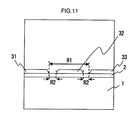
  • FIG. 11 is a cross sectional model view for analyzing the insulation circuit board according another embodiment of the invention.
  • the epoxy resin (dielectric constant: 4 ) insulation layer 2 having a thickness of 0.2 mmt is formed on the metal base substrate 1 having a thickness of 2.0 mmt and an electrolytic copper foil having a thickness of 0.1 mmt is further adhered onto the insulation layer 2 .
  • the wiring patterns 31 and 33 formed by the chemical etching and the wiring pattern 32 according to the invention are formed onto the copper foil.
  • An inclination angle of the side surface of each of the wiring patterns 31 , 32 , and 33 is equal to 60°.
  • the wiring patterns 31 and 33 are away from each other by the distance R 1 between the wiring patterns.
  • the wiring pattern 32 is arranged at the position of the distance R 2 between the wiring patterns corresponding to the equal distance from each of the wiring patterns 31 and 33 .
  • Electric potentials of the wiring patterns 31 , 32 , and 33 are equal to 900V, 450V, and 0V, respectively.
  • FIG. 12 is a cross sectional model view for analyzing the insulation circuit board according another embodiment of the invention.
  • the epoxy resin (dielectric constant: 4 ) insulation layer 2 having a thickness of 0.2 mmt is formed on the metal base substrate 1 having a thickness of 2.0 mmt and an electrolytic copper foil having a thickness of 0.1 mmt is further adhered onto the insulation layer 2 .
  • the wiring patterns 31 and 33 formed by the chemical etching and the wiring patterns 32 A and 32 B according to the invention are formed onto the copper foil.
  • An inclination angle of the side surface of each of the wiring patterns 31 , 33 , 32 A, and 32 B is equal to 60°.
  • the wiring patterns 31 and 33 are away from each other by the distance R 1 between the wiring patterns.
  • the wiring patterns 32 A and 32 B are arranged at the positions of the distance R 2 between the wiring patterns corresponding to the equal distance from each of the wiring patterns 31 and 33 .
  • Electric potentials of the wiring patterns 31 , 32 A, 32 B, and 33 are equal to 900V, 600V, 300V, and 0V, respectively.
  • FIG. 13 is a cross sectional model view for analyzing the insulation circuit board according another embodiment of the invention.
  • the epoxy resin (dielectric constant: 4 ) insulation layer 2 having a thickness of 0.2 mmt is formed on the metal base substrate 1 having a thickness of 2.0 mmt and an electrolytic copper foil having a thickness of 0.1 mmt is further adhered onto the insulation layer 2 .
  • the wiring patterns 31 and 33 formed by the chemical etching and the wiring patterns 32 B and 32 A according to the invention are formed onto the copper foil.
  • An inclination angle of the side surface of each of the wiring patterns 31 , 33 , 32 B, and 32 A is equal to 60°.
  • the wiring patterns 31 and 33 are away from each other by the distance R 1 between the wiring patterns.
  • FIG. 14 is a cross sectional model view for analysis which simulates the insulation circuit board by the conventional wiring patterns 3 .
  • the epoxy resin (dielectric constant: 4 ) insulation layer 2 having a thickness of 0.2 mmt is formed on the metal base substrate 1 having a thickness of 2.0 mmt and an electrolytic copper foil having a thickness of 0.1 mmt is further adhered onto the insulation layer 2 .
  • the wiring patterns 31 and 33 formed by the chemical etching are formed onto the copper foil.
  • An inclination angle of the side surface of each of the wiring patterns 31 and 33 is equal to 60°.
  • the wiring patterns 31 and 33 are away from each other by the distance R 1 between the wiring patterns. Further, electric potentials of the wiring patterns 31 and 33 are equal to 900V and 0V, respectively.
  • the effect of the invention can be sufficiently obtained.
  • the effect of the invention increases larger.
  • the effect of the invention is smaller than that in the embodiment of FIG. 12 . Therefore, by arranging a larger number of wiring patterns 32 between the wiring patterns 31 and 33 showing the high potential difference and by sequentially decreasing the electric potentials of the wiring patterns 32 in the direction from the wiring pattern 31 on the high potential side toward the wiring pattern 33 on the low potential side, the effect of the invention can be obtained larger.
  • FIG. 12 (distance R1 between R2 between the wiring patterns/pattern widths the wiring patterns FIG. 11 of the wiring patterns 32A and 32B) 0.25 mm 92.78% 89.34% (1.5 mm/0.375 mm) 89.25% (2.0 mm/0.625 mm) 0.5 mm 97.02% 95.83% (2.0 mm/0.25 mm)
  • the distance R 2 between the wiring patterns is equal to 0.25 mm, even if the distance R 1 between the wiring patterns differs, an almost equal reducing effect is obtained. Therefore, when the distance R 2 between the wiring patterns is constant, the effect of the invention does not depend on the pattern widths of the wiring patterns 32 A and 32 B.
  • the width of the wiring pattern 32 is further decreased and a larger number of wiring patterns 32 in which the electric potentials decrease sequentially in the direction from the high-potential wiring pattern 31 toward the low-potential wiring pattern 33 are arranged between the wiring patterns 31 and 33 showing the high potential difference, so that the effect of the invention can be obtained larger.

Landscapes

  • Engineering & Computer Science (AREA)
  • Microelectronics & Electronic Packaging (AREA)
  • Chemical & Material Sciences (AREA)
  • Inorganic Chemistry (AREA)
  • Structure Of Printed Boards (AREA)
  • Power Engineering (AREA)
  • Physics & Mathematics (AREA)
  • Condensed Matter Physics & Semiconductors (AREA)
  • General Physics & Mathematics (AREA)
  • Computer Hardware Design (AREA)

Abstract

The invention relates to a high-voltage insulation circuit board which is used in an electric power apparatus such as an electric power converter or the like such as power semiconductor device, inverter module, or the like and provides an insulation circuit board in which electric field concentration at the end sections of a wiring pattern is reduced, partial discharging is suppressed, and a reliability is high. According to the invention, there is provided an insulation circuit board having: a metal base substrate; and wiring patterns which are formed onto at least one of the surfaces of the metal base substrate through an insulation layer, characterized in that between two adjacent wiring patterns in which an electric potential difference exists among the wiring patterns, at least one or more wiring patterns or conductors which are in contact with the insulation layer and have an electric potential in a range of the electric potential difference between the adjacent wiring patterns are arranged. According to the invention, the electric field concentration at the end sections of the wiring pattern to which a high voltage is applied is reduced and partial-discharge-resistant characteristics are improved.

Description

INCORPORATION BY REFERENCE
The present application claims priority from Japanese Patent Application JP2009-225903 filed on Sep. 30, 2009, the content of which is hereby incorporated by reference into this application.
TECHNICAL FIELD
The invention relates to a high-voltage insulation circuit board which is used in an electric power apparatus such as an electric power converter or the like such as power semiconductor device, inverter module, or the like and to a power semiconductor device or inverter module using such an insulation circuit board.
BACKGROUND ART
Hitherto, as an insulation circuit board for an electronic apparatus which is subjected to a severe temperature environment such as a vehicle-mounting environment or the like, a ceramic board having excellent heat radiation performance and heat resistance is a main stream. However, in association with a demand for low costs of the electronic apparatus, a shift to a resin board in which a high radiation insulation resin is used for an insulation layer is increasing year by year.
As shown in FIG. 2, the insulation circuit board by the resin insulation layer (hereinbelow, referred to as an insulation circuit board) is constructed in such a manner that a metal foil such as a copper foil or the like which was coarse-processed is adhered to one or both of the surfaces of a metal base substrate 1 such as aluminum, copper, iron, or the like through an insulation layer 2 whose thermal conductivity has been improved such as a high thermal conductive resin or the like having excellent heat radiation performance, and thereafter, wiring patterns 3 are formed by a chemical etching or the like so as to be away from each other by a distance R1 between the wiring patterns. For example, in the case of a power semiconductor device or inverter module, a plurality of semiconductor elements and passive elements are arranged on the wiring patterns 3 on the insulation circuit board. However, since a high power switching element such as an insulated-gate bipolar transistor (IGBT) or the like is used as a power semiconductor device for electric power conversion or an inverter module in recent years, there is a problem of an excessive heat generation. At present, in order to efficiently propagate the generated heat to the metal base substrate 1, an inorganic filler is filled into the resin of the insulation layer 2 at a high density or a thickness of insulation layer 2 is made thin, thereby improving the thermal conductivity of the insulation layer 2. As for the former method of filling the filler into the resin of the insulation layer 2 at the high density, an insulation circuit board in which an alumina filler of 70 Vol % or more was mixed into the insulation resin which is in contact with the metal base substrate 1 has also been developed, and high thermal conductivity which reaches 10 W/mk has been realized. As for the latter method of making the thickness of insulation layer 2 thin, an insulation circuit board using the insulation layer 2 having a layer thickness of about 200 μmt or having the smallest layer thickness of about 100 μmt has been developed. However, if a high voltage associated with the realization of the recent high power is always applied to such an insulation circuit board, such a problem that a dielectric breakdown occurs for a short time can occur.
The dielectric breakdown mentioned above will now be described by using FIG. 3. As shown in FIG. 3, in the wiring pattern 3 to which the high voltage is applied, the generation of partial discharging 4 that is caused by electric field concentration at end sections of the wiring pattern 3 is a main cause. Particularly, in the case of an AC voltage in which a polarity of the applied voltage changes continuously, the discharge occurs continuously, so that the insulation layer 2 is deteriorated, a dendritic discharge deterioration trace called a tree 5 is formed, and a dielectric breakdown occurs soon. Also in the case where the wiring patterns 3 are closely formed due to the high density of mounted parts, a dendritic discharge path (creeping discharge 6) is formed along the surface of an insulation material by the partial discharging 4 and a dielectric breakdown occurs. At present, the wiring pattern 3 which is formed by the chemical etching or the like from a viewpoint of priority of costs generally has such a shape that a side surface portion of the wiring pattern 3 becomes an arc. It has such a shape that the side surface portion of the wiring pattern 3, in more detail, the side surface portion of the wiring pattern 3 which is in contact with a creeping portion of the insulation layer 2 is sharply pointed. There is consequently such a problem that an electric field is concentrated on the end sections of the wiring pattern 3 and the partial discharging 4 occurs easily at this portion as a starting point. In order to lighten the electric field concentration at the end sections of the wiring pattern 3, it is effective to round the sharp shape of the end section of the wiring pattern 3. In [Patent Literature 1], by forming the wiring pattern 3 into a concave portion 7 of the insulation layer 2 in which peripheral end sections are curved as shown in FIG. 4, the end section of the wiring pattern 3 has a round shape. Further, in [Patent Literature 2], a method of fusing and smoothing the end section of the wiring pattern 3 by a pre-discharge, a laser, or the like has been proposed.
CITATION LIST Patent Literature
  • Patent Literature 1 JP-A-2001-057409
  • Patent Literature 2 JP-A-2001-177054
SUMMARY OF INVENTION Technical Problem
However, according to the Patent Literature 1, since the concave portion 7 is formed in the insulation layer 2, a pre-process is necessary and in the case of comparing with the forming method of the wiring pattern 3 in the related art, costs rise. Also, according to the Patent Literature 2, since it is necessary to work the shape of the end section of the wiring pattern 3 by the discharge, laser, or the like, costs rise similarly. Further, according to the Patent Literature 2, there are such many problems that since it can be applied only to a ceramic substrate, an applying range is limited, since a solder wettability due to an increase in substrate temperature at the time of fusing deteriorates, fine processing techniques such as a proper processing time and the like are necessary, and the like. On the other hand, it is an object of the invention to provide an insulation circuit board in which the electric field concentration at the end sections of the wiring pattern 3 is reduced, the partial discharging 4 is suppressed, and the reliability is high although the existing insulation circuit board and forming method of the wiring pattern 3 by the chemical etching are used. It is a further object of the invention to provide a power semiconductor device or inverter module having a high insulation reliability by using the insulation circuit board using the wiring pattern 3.
Solution to Problem
To accomplish the above objects, according to the invention, there is provided an insulation circuit board comprising: a metal base substrate; and wiring patterns which are formed onto at least one of surfaces of the metal base substrate through an insulation layer, characterized in that between two adjacent wiring patterns in which an electric potential difference exists among the wiring patterns, at least one or more wiring patterns or conductors which are in contact with the insulation layer and have an electric potential in a range of the electric potential difference between the adjacent wiring patterns are arranged.
Further, according to the invention, the insulation circuit board is characterized in that the insulation layer which is in contact with the metal base substrate and the wiring patterns is one of a resin mainly consisting of an epoxy resin, a resin mainly consisting of a polyimide resin, a resin mainly consisting of a silicone resin, a resin mainly consisting of an acrylic resin, and a resin mainly consisting of an urethane resin or a resin consisting of a denatured material or mixture of those resins.
Further, according to the invention, the insulation circuit board is characterized in that an inorganic filler which is dispersed into the insulation layer which is in contact with the metal base substrate and the wiring patterns is one of Al2O3 (alumina), SiO2 (silica), AlN (aluminum nitride), BN (boron nitride), ZnO (zinc oxide), SiC (silicon carbide), Si3N4 (silicon nitride), and MgO (magnesium oxide), a filler adapted to improve heat radiation performance and insulation performance in a manner similar to those compounds, or a mixture of two or more kinds of those compounds.
Further, according to the invention, the insulation circuit board is characterized in that the insulation layer which is in contact with the metal base substrate and the wiring patterns is one of ceramic materials each mainly consisting of Al2O3 (alumina), ZrO2 (zirconia), AlN (aluminum nitride), or BN (boron nitride), a ceramic material which has characteristics similar to those of those ceramic materials, whose fundamental component consists of a metal oxide, and which is burned and solidified by a heat treatment of a high temperature, or an inorganic material consisting of a denatured material or mixture obtained by mixing a glass component into the ceramic material.
Further, according to the invention, the insulation circuit board is characterized in that in order to provide the electric potential in the range of the potential difference between the adjacent wiring patterns, a resistor is arranged between the two adjacent wiring patterns where the electric potential difference exists.
Further, according to the invention, the insulation circuit board is characterized in that the electric potential in the range of the potential difference between the adjacent wiring patterns is provided from a circuit for forming the electric potential by a portion other than a portion on the insulation circuit board.
Further, it is an object of the invention to provide a power semiconductor device or inverter module characterized in that the foregoing insulation circuit board is used, circuit parts including semiconductor elements connected to the wiring patterns are mounted, and the wiring patterns are arranged.
To accomplish the above object, according to the invention, there is provided a power semiconductor device comprising: a metal base substrate; wiring patterns which are formed onto at least one of surfaces of the metal base substrate through an insulation layer; and semiconductor elements connected to the wiring patterns, characterized in that between two adjacent wiring patterns in which an electric potential difference exists among the wiring patterns, at least one or more wiring patterns or conductors which are in contact with the insulation layer and have an electric potential in a range of the electric potential difference between the adjacent wiring patterns are arranged.
Further, according to the invention, the power semiconductor device is characterized in that the two adjacent wiring patterns are an input potential wiring pattern and a ground potential wiring pattern.
Further, according to the invention, the power semiconductor device is characterized in that the two adjacent wiring patterns are output wiring patterns of a three-phase alternating current connected to the semiconductor elements.
Further, it is an object of the invention to provide an inverter module having the foregoing power semiconductor device.
Advantageous Effects of Invention
According to the invention, while using the conventional insulation circuit board construction and wiring pattern forming method, the electric field concentration at the end sections of the wiring pattern to which a high voltage is applied is reduced and partial-discharge-resistant characteristics are improved. Therefore, even in high-density mounted wirings in which a distance between the wiring patterns is small, the insulation circuit board having the high insulation reliability can be realized by low costs. Providing of the power semiconductor device or inverter module using the insulation circuit board and having the high insulation reliability can be realized.
Other objects, features, and advantages of the present invention will be apparent from the following description of the embodiments of the invention with reference to the accompanying drawings.
BRIEF DESCRIPTION OF DRAWINGS
FIG. 1 Cross sectional view of an insulation circuit board and wiring patterns for describing an embodiment of the invention.
FIG. 2 Cross sectional view for explaining conventional insulation circuit board and wiring patterns.
FIG. 3 Enlarged cross sectional view of the conventional insulation circuit board and wiring pattern and it is a cross sectional view for explaining sharp shapes of end sections of the wiring pattern, electric field concentration at the end sections of the wiring pattern, a tree deterioration, and a creeping discharge.
FIG. 4 Cross sectional view of an insulation circuit board and wiring patterns for describing shapes of end sections of the wiring patterns in JP-A-2001-057409.
FIG. 5 Plan view of the insulation circuit board for describing plan shapes of the wiring patterns of the invention.
FIG. 6 Cross sectional view of an insulation circuit board and wiring patterns showing an embodiment of the invention and it is a diagram for explaining the wiring patterns having an intermediate electric potential.
FIG. 7 Perspective view showing the embodiment of the invention and for explaining passive elements to form the intermediate electric potential and a connecting method.
FIG. 8 Plan view of the insulation circuit board at the time when the invention is applied to an inverter circuit board for driving a motor.
FIG. 9 Circuit diagram for explaining a circuit construction of the inverter for driving the motor.
FIG. 10 Cross sectional analysis model view of the insulation circuit board and the wiring patterns using the embodiment of the invention.
FIG. 11 Cross sectional analysis model view of an insulation circuit board and wiring patterns according to another embodiment of the invention.
FIG. 12 Cross sectional analysis model view of an insulation circuit board and wiring patterns according to still another embodiment of the invention.
FIG. 13 Cross sectional analysis model view of an insulation circuit board and wiring patterns according to further another embodiment of the invention.
FIG. 14 Cross sectional analysis model view of conventional insulation circuit board and wiring patterns.
FIG. 15 Cross sectional analysis model view of other conventional insulation circuit board and wiring patterns.
DESCRIPTION OF EMBODIMENTS
Embodiments of the invention will be described hereinbelow by using the drawings.
The drawings which are used in the following description are schematic diagrams and it should be noted that a relation between a thickness and plane dimensions, ratios among the thicknesses of respective layers, and the like differ from those of an actual circuit board. Therefore, specific thicknesses and dimensions should be judged in consideration of the following description. Naturally, portions whose dimensional relations and ratios differ are also included in the respective drawings.
First Embodiment
Each of FIGS. 1 and 6 is a cross sectional view of an insulation circuit board according to an embodiment of the invention. The embodiment illustrated in FIG. 6 has such a construction that in FIG. 2 showing a conventional embodiment, between adjacent wiring patterns 31 and 33 which are away from each other by the distance R1 between the wiring patterns, a new wiring pattern 32 is arranged at a position of a distance R2 between the wiring patterns corresponding to an equal distance from each of the wiring patterns 31 and 33. Other constructions are similar to those shown in FIG. 2 unless otherwise specified in particular.
The embodiment of FIG. 6 differs largely from the conventional embodiment with respect to a point that the wiring pattern 32 arranged between the adjacent wiring patterns 31 and 33 in FIG. 2 is voltage-divided by two resistors 8 and has an intermediate electric potential of an electric potential difference between the wiring patterns 31 and 33. For example, if the wiring pattern 31 on the high potential side in FIG. 2 has an electric potential of 1 kV and the wiring pattern 33 on the low potential side has an electric potential of 0V, an electric potential of the wiring pattern 32 in FIG. 6 is equal to 500V and a potential difference between the wiring patterns 31 and 32 or between the wiring patterns 32 and 33 is equal to 500V.
The potential difference between the adjacent wiring patterns 31 and 33 in the embodiment denotes a potential difference at a certain time point in the case where an electric potential which is applied to the wiring pattern 3 time-sequentially changes and the potential difference between the adjacent wiring patterns 31 and 33 changes. Therefore, even if the potential difference between the adjacent wiring patterns 31 and 33 is not high at a certain time point, in the case where the potential difference between the adjacent wiring patterns 31 and 33 is large at a different time point, such a case is incorporated in the adjacent wiring patterns 31 and 33.
In the invention, in the case where one or more wiring patterns 32 or conductors having an electric potential in a range of the potential difference between the adjacent wiring patterns 31 and 33 showing the high potential difference is/are arranged, it is desirable that a potential difference between the wiring pattern 31 on the high potential side and the wiring pattern 32 and a potential difference between the wiring pattern 32 and the wiring pattern 33 on the low potential side are equal to 350V or less. It is a value which is obtained from a Paschen's law. According to the Paschen's law, it is mentioned that a lowest value of the potential difference at the time of occurrence of a spark discharge in the air at an ordinary temperature in the case of presuming a parallel electric field is equal to about 350V. Therefore, this is because when a space other than the insulation layer 2 which is in contact with the wiring patterns 31, 32, and 33 was filled with a filler such as a sealing resin or the like, even if a void or the like occurred, so long as the potential difference between the wiring patterns 3 is equal to 350V or less, no discharge occurs in the void.
In the invention, if two or more wiring patterns 32 or conductors are arranged, it is desirable that a potential difference between the adjacent wiring patterns 32 or conductors is equal to 350V or less. Thus, this is because from the Paschen's law mentioned above, when the space other than the insulation layer 2 which is in contact with the wiring patterns 32 or conductors was filled with the filler such as a sealing resin or the like, even if the void or the like occurred, so long as the potential difference between the wiring patterns 32 or conductors is equal to 350V or less, no discharge occurs in the void.
Thus, according to the embodiment, since the potential difference between the adjacent wiring patterns 3 decreases, when the voltage is applied, the electric field concentration at the end sections of the wiring pattern 31 on the high potential side is lightened, thereby raising a partial discharging voltage. The partial-discharge-resistant performance of the insulation circuit board in FIG. 2 can be improved.
The wiring pattern 32 which is newly arranged has a material and a shape similar to those of the adjacent wiring patterns 31 and 33. Therefore, the embodiment according to the invention can be easily realized by the conventional insulation circuit construction and forming method of the wiring patterns 3. The insulation performance of the insulation circuit board can be improved by low costs.
As shown in FIG. 5, it is desirable that the wiring pattern 32 or conductor has a wiring pattern length R4 or conductor length which is equal to or longer than an orientation length R3 of the wiring patterns 31 and 33 showing the high potential difference.
Further, in order to realize the embodiment of the invention shown in FIG. 6, for example, as shown in FIG. 7, it is sufficient to connect the wiring patterns 31 and 32 on the insulation circuit board by a chip resistor 81 and to connect the wiring patterns 32 and 33 on the insulation circuit board by a chip resistor 81. As for the chip resistor 81, a small article whose vertical and lateral sizes are equal to 1 mm or less is also commercially available and it can be also easily mounted even in the wiring patterns 3 for high-density mounting to which applying of the invention thereto is assumed.
In the case where the density of the wiring patterns 3 on the insulation circuit board is high and an element, for example, the chip resistor or the like to form the potential difference between the wiring patterns 31 and 33 showing the high potential difference cannot be mounted to the wiring patterns 3 on the insulation circuit board, it is sufficient to form an electric potential for the wiring pattern 32 by a portion other than the portion on the insulation circuit board. For this purpose, for example, a bus bar wiring for supplying a power source to the insulation circuit board, a terminal portion of a capacitor for the power source, or the like corresponds to such a portion. It is sufficient to supply an input voltage including the intermediate electric potential formed there to the insulation circuit board.
Thus, the intermediate electric potential can be easily obtained even in the insulation circuit board on which the wiring patterns are formed at a high density and the elements are mounted without a gap.
Second Embodiment
FIG. 8 shows an embodiment in the case where the invention is applied to a power semiconductor device or inverter module having an inverter circuit board of a motor control system.
In an outline of the inverter circuit of the motor control system, generally, as shown in a circuit diagram of FIG. 9, an inverter of three-phase outputs using six switching elements 9 is used. According to the inverter for the motor control, a DC current from a converter is input through a smoothing capacitor and is converted into a 3-phase alternating current by the switching element 9, thereby rotating the motor. A wiring construction shown in FIG. 8 here is obtained by presuming an inverter for a high output and six IGBT switching elements 9A to 9F and six free wheeling diodes 10A to 10F are mounted.
Among the wiring patterns 3 shown in FIG. 8 here, the wiring patterns which provide the highest potential difference are the wiring patterns between the input and the ground and an output portion of the three-phase AC. Therefore, wiring patterns 32A, 32B, and 32C showing the intermediate electric potential are respectively arranged into them, thereby reducing the electric field concentration at the end sections of wiring patterns 31A, 31B, 31C, and 31D on the high potential side. Although the six wiring patterns 3 on the left side in FIG. 8 are wiring patterns 11A to 11F for a gate signal for controlling the IGBT switching elements 9A to 9F, generally, since a gate signal voltage is small, the wiring pattern 32 to lighten the electric field concentration is not arranged. Wiring patterns 33A to 33D on the low potential side may be used in place of the wiring patterns 31A to 33D on the high potential side.
According to the embodiment, even in the power semiconductor device or inverter module using the high-density mounting wirings in which the distance between the wiring patterns is small, the power semiconductor device or inverter module having the high insulation reliability can be realized at low costs.
Third Embodiment Electric Field Simulation
In order to verify an effect of the invention hereinbelow, analysis models are formed for the embodiments of the invention and comparative examples and local electric fields at the end sections of the high-potential wiring pattern 31 are derived by simulation.
FIG. 10 is a cross sectional model view for analyzing the insulation circuit board according to the embodiment of the invention.
The epoxy resin (dielectric constant: 4) insulation layer 2 having a thickness of 2.0 mmt is formed on the metal base substrate 1 having a thickness of 2.0 mmt and an electrolytic copper foil having a thickness of 0.1 mmt is further adhered onto the insulation layer 2. After that, the wiring patterns 31 and 33 formed by the chemical etching and the wiring pattern 32 according to the invention are formed onto the copper foil. An inclination angle of the side surface of each of the wiring patterns 31, 32, and 33 is equal to 60°. The wiring patterns 31 and 33 are away from each other by the distance R1 between the wiring patterns. Further, the wiring pattern 32 is arranged at the position of the distance R2 between the wiring patterns corresponding to the equal distance from each of the wiring patterns 31 and 33. Electric potentials of the wiring patterns 31, 32, and 33 are equal to 900V, 450V, and 0V, respectively.
Fourth Embodiment
FIG. 11 is a cross sectional model view for analyzing the insulation circuit board according another embodiment of the invention.
The epoxy resin (dielectric constant: 4) insulation layer 2 having a thickness of 0.2 mmt is formed on the metal base substrate 1 having a thickness of 2.0 mmt and an electrolytic copper foil having a thickness of 0.1 mmt is further adhered onto the insulation layer 2. After that, the wiring patterns 31 and 33 formed by the chemical etching and the wiring pattern 32 according to the invention are formed onto the copper foil. An inclination angle of the side surface of each of the wiring patterns 31, 32, and 33 is equal to 60°. The wiring patterns 31 and 33 are away from each other by the distance R1 between the wiring patterns. Further, the wiring pattern 32 is arranged at the position of the distance R2 between the wiring patterns corresponding to the equal distance from each of the wiring patterns 31 and 33. Electric potentials of the wiring patterns 31, 32, and 33 are equal to 900V, 450V, and 0V, respectively.
Fifth Embodiment
FIG. 12 is a cross sectional model view for analyzing the insulation circuit board according another embodiment of the invention.
The epoxy resin (dielectric constant: 4) insulation layer 2 having a thickness of 0.2 mmt is formed on the metal base substrate 1 having a thickness of 2.0 mmt and an electrolytic copper foil having a thickness of 0.1 mmt is further adhered onto the insulation layer 2. After that, the wiring patterns 31 and 33 formed by the chemical etching and the wiring patterns 32A and 32B according to the invention are formed onto the copper foil. An inclination angle of the side surface of each of the wiring patterns 31, 33, 32A, and 32B is equal to 60°. The wiring patterns 31 and 33 are away from each other by the distance R1 between the wiring patterns. Further, the wiring patterns 32A and 32B are arranged at the positions of the distance R2 between the wiring patterns corresponding to the equal distance from each of the wiring patterns 31 and 33. Electric potentials of the wiring patterns 31, 32A, 32B, and 33 are equal to 900V, 600V, 300V, and 0V, respectively.
Sixth Embodiment
FIG. 13 is a cross sectional model view for analyzing the insulation circuit board according another embodiment of the invention.
The epoxy resin (dielectric constant: 4) insulation layer 2 having a thickness of 0.2 mmt is formed on the metal base substrate 1 having a thickness of 2.0 mmt and an electrolytic copper foil having a thickness of 0.1 mmt is further adhered onto the insulation layer 2. After that, the wiring patterns 31 and 33 formed by the chemical etching and the wiring patterns 32B and 32A according to the invention are formed onto the copper foil. An inclination angle of the side surface of each of the wiring patterns 31, 33, 32B, and 32A is equal to 60°. The wiring patterns 31 and 33 are away from each other by the distance R1 between the wiring patterns. Further, the wiring patterns 32B and 32A are arranged at the positions of the distance R2 between the wiring patterns corresponding to the equal distance from each of the wiring patterns 31 and 33. Electric potentials of the wiring patterns 31, 32A, 32B and 33 are equal to 900V, 600V, 300V, and 0V, respectively.
Comparative Example 1
FIG. 14 is a cross sectional model view for analysis which simulates the insulation circuit board by the conventional wiring patterns 3.
The epoxy resin (dielectric constant: 4) insulation layer 2 having a thickness of 2.0 mmt is formed on the metal base substrate 1 having a thickness of 2.0 mmt and an electrolytic copper foil having a thickness of 0.1 mmt is further adhered onto the insulation layer 2. After that, the wiring patterns 31 and 33 formed by the chemical etching are formed onto the copper foil. An inclination angle of the side surface of each of the wiring patterns 31 and 33 is equal to 60°. The wiring patterns 31 and 33 are away from each other by the distance R1 between the wiring patterns. Further, electric potentials of the wiring patterns 31 and 33 are equal to 900V and 0V, respectively.
Comparative Example 2
FIG. 15 is a cross sectional model view for analysis which simulates another insulation circuit board by the conventional wiring patterns 3.
The epoxy resin (dielectric constant: 4) insulation layer 2 having a thickness of 0.2 mmt is formed on the metal base substrate 1 having a thickness of 2.0 mmt and an electrolytic copper foil having a thickness of 0.1 mmt is further adhered onto the insulation layer 2. After that, the wiring patterns 31 and 33 formed by the chemical etching are formed onto the copper foil. An inclination angle of the side surface of each of the wiring patterns 31 and 33 is equal to 60°. The wiring patterns 31 and 33 are away from each other by the distance R1 between the wiring patterns. Further, electric potentials of the wiring patterns 31 and 33 are equal to 900V and 0V, respectively.
(Simulation Result 1)
To the analysis model of the embodiment shown in FIG. 10 using the wiring pattern construction on the insulation circuit board according to the invention and the analysis model of Comparative Example 1 shown in FIG. 14 which simulates the wiring pattern construction on the conventional insulation circuit board, an analysis in the case where a pattern width of the wiring pattern 32 is fixed to 0.5 mm, the distance R1 between the wiring patterns is changed to 1.0 mm, 1.5 mm, and 2.0 mm is performed.
TABLE 1 shows local electric field ratios of the end sections of the wiring pattern 31 on the high potential side in the embodiment shown in FIG. 10 to the local electric fields at the end sections of the wiring pattern 31 on the high potential side which are calculated in Comparative Example 1 when the distance R1 between the wiring patterns is respectively equal to 1.0 mm, 1.5 mm, and 2.0 mm. The embodiment shown in FIG. 10 and Comparative Example 1 relate to the analysis models in which the thickness of insulation layer 2 is equal to a thick value of 2.0 mmt. This is because it is intended to eliminate an influence of the metal base substrate 1 to the local electric fields at the end sections of the wiring pattern 31 on the high potential side by sufficiently providing the distance between the wiring pattern 31 on the high potential side and the metal base substrate 1. That is, according to the embodiment shown in FIG. 10 and Comparative Example 1, a contribution of the wiring pattern 33 or the wiring patterns 32 and 33 to the local electric fields at the end sections of the wiring pattern 31 on the high potential side is large. Therefore, TABLE 1 shows results in which the effects owing to the invention were solely evaluated.
As shown in TABLE 1, the local electric fields at the end sections of the wiring pattern 31 on the high potential side in the embodiment shown in FIG. 10 is lower than the local electric fields at the end sections of the wiring pattern 31 on the high potential side in Comparative Example 1 irrespective of the distance R1 between the wiring patterns. Therefore, by arranging the wiring pattern 32 according to the invention between the wiring patterns 31 and 33 showing the high potential difference, the reducing effect of the local electric fields at the end sections of the wiring pattern 31 on the high potential side is obtained.
TABLE 1
Distance R1 between the
wiring patterns Comparative Example 1 FIG. 6
1.0 mm 100.00% 96.46%
1.5 mm 100.00% 97.43%
2.0 mm 100.00% 97.37%

(Simulation Result 2)
To the analysis models of the embodiments shown in FIGS. 11, 12, and 13 using the wiring pattern construction on the insulation circuit board according to the invention and the analysis model of Comparative Example 2 shown in FIG. 15 which simulates the wiring pattern construction on the conventional insulation circuit board, an analysis in the case where pattern widths of the wiring patterns 32, 32A, and 32B are fixed to 0.5 mm, the distance R1 between the wiring patterns is changed to 1.0 mm, 1.5 mm, and 2.0 mm is performed.
TABLE 2 shows local electric field ratios of the end sections of the wiring pattern 31 on the high potential side in Comparative Example 2 and the embodiments of FIGS. 11, 12, and 13 to the local electric fields at the end sections of the wiring pattern 31 on the high potential side in Comparative Example 2 when the distance R1 between the wiring patterns is set to 1.0 mm. In Comparative Example 2 and the embodiments of FIGS. 11, 12, and 13, the thickness of insulation layer 2 is set to a thin value of 0.2 mmt and is close to the thickness of insulation layer 2 of the actual insulation circuit board. Therefore, TABLE 2 shows results in which the effects owing to the invention were evaluated to the model that is closer to the actual insulation circuit board construction. A numerical value in parentheses in the results of the embodiments of FIGS. 11, 12, and 13 indicates the distance R2 between the wiring patterns.
TABLE 2
Distance
R1 between FIG. 11 (distance
the wiring Comparative R2 between FIG. 12 FIG. 13
patterns Example 2 the wiring patterns) (R2) (R2)
1.0 mm 100.00%  92.8% (0.25 mm)
1.5 mm 100.02% 97.05% (0.5 mm) 84.11% 92.89%
(0.17 mm) (0.17 mm)
2.0 mm 100.02% 98.05% (0.75 mm) 92.73% 95.83%
(0.33 mm) (0.33 mm)
As shown in TABLE 2, in Comparative Example 2, the local electric fields at the end sections of the wiring pattern 31 on the high potential side is not changed even if the distance R1 between the wiring patterns differs. This means that the local electric fields at the end sections of the wiring pattern 31 on the high potential side is strongly influenced by the metal base substrate 1 which is closely arranged and an influence by the wiring pattern 33 on the low potential side is small. On the other hand, in the embodiments of FIGS. 11, 12, and 13, the local electric fields at the end sections of the wiring pattern 31 on the high potential side in Comparative Example 2 is reduced, respectively. Therefore, even in the local electric fields at the end sections of the wiring pattern 31 on the high potential side which is strongly influenced by the metal base substrate 1, the effect of the invention can be sufficiently obtained. Particularly, the smaller the distance R1 between the wiring patterns is, the larger the effect is. As shown in the results of the embodiments of FIGS. 12 and 13, by arranging a larger number of wiring patterns 32 between the wiring patterns 31 and 33 showing the high potential difference, the effect of the invention increases larger. On the other hand, according to the embodiment of FIG. 13 in which the arranging order of the wiring patterns 32A and 32B is reversed from that in the embodiment of FIG. 12, although the local electric fields at the end sections of the wiring pattern 31 on the high potential side in Comparative Example 2 is reduced, the effect of the invention is smaller than that in the embodiment of FIG. 12. Therefore, by arranging a larger number of wiring patterns 32 between the wiring patterns 31 and 33 showing the high potential difference and by sequentially decreasing the electric potentials of the wiring patterns 32 in the direction from the wiring pattern 31 on the high potential side toward the wiring pattern 33 on the low potential side, the effect of the invention can be obtained larger.
(Simulation Result 3)
To evaluate the influence which is exerted on the reducing effect of the local electric fields at the end sections of the wiring pattern 31 on the high potential side according to the invention by the distance R2 between the wiring patterns, an analysis in the case where the distance R2 between the wiring patterns in the embodiments of FIGS. 11 and 12 is fixed to 0.25 mm and 0.5 mm and the pattern widths of the wiring patterns 32, 32A, and 32B are properly changed is performed.
TABLE 3 shows local electric field ratios of the end sections of the wiring pattern 31 on the high potential side in the embodiments of FIGS. 11 and 12 to the local electric fields at the end sections of the wiring pattern 31 on the high potential side in Comparative Example 2 (the distance R1 between the wiring patterns is equal to 2.0 mm) calculated in the simulation result 2. Numerical values in parentheses in the embodiment of FIG. 12 indicate the distance R1 between the wiring patterns and the pattern widths of the wiring patterns 32A and 32B.
TABLE 3
Distance FIG. 12 (distance R1 between
R2 between the wiring patterns/pattern widths
the wiring patterns FIG. 11 of the wiring patterns 32A and 32B)
0.25 mm 92.78% 89.34% (1.5 mm/0.375 mm)
89.25% (2.0 mm/0.625 mm)
 0.5 mm 97.02% 95.83% (2.0 mm/0.25 mm)
As shown in TABLE 3, in the embodiments of FIGS. 11 and 12, the smaller the distance R2 between the wiring patterns is, the more the local electric fields at the end sections of the wiring pattern 31 on the high potential side is reduced. Therefore, by arranging the wiring pattern 32 according to the invention between the wiring patterns 31 and 33 showing the high potential difference at a distance position where it is closer to the wiring patterns 31 and 33, the effect of the invention is largely obtained. In the embodiment of FIG. 12 when the distance R2 between the wiring patterns is equal to 0.25 mm, even if the distance R1 between the wiring patterns differs, an almost equal reducing effect is obtained. Therefore, when the distance R2 between the wiring patterns is constant, the effect of the invention does not depend on the pattern widths of the wiring patterns 32A and 32B. Therefore, the width of the wiring pattern 32 is further decreased and a larger number of wiring patterns 32 in which the electric potentials decrease sequentially in the direction from the high-potential wiring pattern 31 toward the low-potential wiring pattern 33 are arranged between the wiring patterns 31 and 33 showing the high potential difference, so that the effect of the invention can be obtained larger.
Although the embodiments have been mentioned above, the invention is not limited to them but it will be obvious to a person with ordinary skill in the art that various changes and modifications are possible within the spirit of the invention and the scope of annexed claims.
REFERENCE SIGNS LIST
 1. Metal base substrate
 2. Insulation layer
 3. Wiring pattern
 4. Partial discharging
 5. Tree deterioration
 6. Creeping discharge
 7. Concave portion of insulation layer
 8. Resistor
81. Chip resistor
 9. Switching element/IGBT switching element
10. Free wheeling diode
11. Wiring pattern for gate signal
R1. Distance between the wiring patterns 31-33
R2. Distance between the wiring patterns 31-32, 31-32A, 31A-32B,
32B-33, and 32-33
R3. Orientation length of the wiring patterns 31 and 33
R4. Length of the wiring pattern 32

Claims (12)

The invention claimed is:
1. An insulation circuit board comprising:
a metal base substrate;
an insulation layer;
a first wiring pattern which is formed onto at least one surface of the metal base substrate through the insulation layer;
a second wiring pattern which is formed onto at least one surface of the metal base substrate through the insulation layer, and
a third wiring pattern which is in contact with the insulation layer, at least a portion of the third wiring pattern located between the first wiring pattern and the second wiring pattern where the distance between the first wiring pattern and second wiring pattern is closest, and the third wiring pattern configured not to be coupled to an electric ground potential and configured to divide a voltage between the first wiring pattern and the second wiring pattern,
wherein an electric potential difference exists between the first wiring pattern and the second wiring pattern, and
wherein the third wiring pattern has an electric potential in a range of the electric potential difference between the first wiring pattern and the second wiring pattern.
2. The insulation circuit board according to claim 1, characterized in that
the insulation layer which is in contact with the metal base substrate and the first wiring pattern, second wiring pattern and third wiring pattern comprises at least one selected from the group consisting of a resin mainly consisting of an epoxy resin, a resin mainly consisting of a polyimide resin, a resin mainly consisting of a silicone resin, a resin mainly consisting of an acrylic resin, a resin mainly consisting of an urethane resin and a resin consisting of a denatured material or mixture of those resins.
3. The insulation circuit board according to claim 2, characterized in that
the insulation layer comprises at least one selected from the group consisting of Al2O3 (alumina), SiO2 (silica), AlN (aluminum nitride), BN (boron nitride), ZnO (zinc oxide), SiC (silicon carbide), Si3N4 (silicon nitride), MgO (magnesium oxide), and a filler adapted to improve heat radiation performance and insulation performance in a manner similar to those compounds.
4. The insulation circuit board according to claim 1, characterized in that
the insulation layer which is in contact with the metal base substrate and the first wiring pattern, second wiring pattern and third wiring pattern comprises at least one selected from the group consisting of a ceramic material mainly consisting of Al2O3 (alumina), ZrO2 (zirconia), AlN (aluminum nitride), or BN (boron nitride), a ceramic material which has characteristics similar to those of the ceramic materials, whose fundamental component consists of a metal oxide, and which is burned and solidified by a heat treatment of a high temperature, and an inorganic material consisting of a denatured material or mixture obtained by mixing a glass component into a ceramic material.
5. The insulation circuit board according to claim 1, characterized in that
in order to provide the electric potential in the range of the potential difference between the first wiring pattern and the second wiring pattern, a resistor is arranged between the first wiring pattern and the second wiring pattern where the electric potential difference exists.
6. A power semiconductor device or inverter module characterized in that one of the insulation circuit boards according to claim 1 is used, circuit parts including semiconductor elements connected to the first wiring pattern and second wiring pattern are mounted, and the first wiring pattern, second wiring pattern and third wiring pattern are arranged.
7. The insulation circuit board according to claim 1, wherein the electric potential difference between the first wiring pattern and the second wiring pattern is less than or equal to 350V.
8. A power semiconductor device comprising:
a metal base substrate;
an insulation layer;
a first wiring pattern which is formed onto at least one surface of the metal base substrate through the insulation layer;
a second wiring pattern which is formed onto at least one surface of the metal base substrate through the insulation layer; and
a plurality of semiconductor elements connected to the first wiring pattern and second wiring pattern; and
a third wiring pattern which is in contact with the insulation layer, at least a portion of the third wiring pattern located between the first wiring pattern and the second wiring pattern, and the third wiring pattern not connected to a semiconductor device of the plurality of semiconductor devices,
wherein an electric potential difference exists between the first wiring pattern and the second wiring pattern and the third wiring pattern has an electric potential in a range of the electric potential difference between the first wiring pattern and the second wiring pattern.
9. The power semiconductor device according to claim 8, characterized in that
the first wiring pattern and the second wiring pattern are an input potential wiring pattern and a ground potential wiring pattern.
10. The power semiconductor device according to claim 8, characterized in that
the first wiring pattern and the second wiring pattern are output wiring patterns of a three-phase alternating current connected to the semiconductor elements.
11. An inverter module characterized by having one power semiconductor device according to claim 8.
12. The power semiconductor device according to claim 8, wherein the electric potential difference between the first wiring pattern and the second wiring pattern is less than or equal to 350V.
US13/388,450 2009-09-30 2010-02-24 Insulation circuit board, and power semiconductor device or inverter module using the same Active 2030-10-30 US8853559B2 (en)

Applications Claiming Priority (3)

Application Number Priority Date Filing Date Title
JP2009-225903 2009-09-30
JP2009225903A JP5542399B2 (en) 2009-09-30 2009-09-30 Insulated circuit board and power semiconductor device or inverter module using the same
PCT/JP2010/052847 WO2011040054A1 (en) 2009-09-30 2010-02-24 Insulation circuit board, and power semiconductor device or inverter module using the same

Publications (2)

Publication Number Publication Date
US20120127684A1 US20120127684A1 (en) 2012-05-24
US8853559B2 true US8853559B2 (en) 2014-10-07

Family

ID=43825893

Family Applications (1)

Application Number Title Priority Date Filing Date
US13/388,450 Active 2030-10-30 US8853559B2 (en) 2009-09-30 2010-02-24 Insulation circuit board, and power semiconductor device or inverter module using the same

Country Status (5)

Country Link
US (1) US8853559B2 (en)
EP (1) EP2485254A4 (en)
JP (1) JP5542399B2 (en)
CN (1) CN102473688B (en)
WO (1) WO2011040054A1 (en)

Cited By (1)

* Cited by examiner, † Cited by third party
Publication number Priority date Publication date Assignee Title
US12301127B2 (en) 2021-06-16 2025-05-13 Fuji Electric Co., Ltd. Semiconductor module

Families Citing this family (29)

* Cited by examiner, † Cited by third party
Publication number Priority date Publication date Assignee Title
AU2010284313B2 (en) 2009-08-17 2016-01-28 Histosonics, Inc. Disposable acoustic coupling medium container
CA2770706C (en) 2009-08-26 2017-06-20 Charles A. Cain Devices and methods for using controlled bubble cloud cavitation in fractionating urinary stones
AU2010289769B2 (en) 2009-08-26 2016-06-30 Histosonics, Inc. Micromanipulator control arm for therapeutic and imaging ultrasound transducers
FR2975528B1 (en) 2011-05-17 2014-02-28 Alstom Transport Sa DEVICE FOR ELECTRICALLY INSULATING A CONDUCTIVE PLAN HAVING A FIRST ELECTRICAL POTENTIAL IN RELATION TO A SECOND POTENTIAL, COMPRISING MEANS FOR REDUCING THE ELECTROSTATIC FIELD VALUE AT A POINT OF THE PERIPHERAL EDGE OF THE CONDUCTIVE PLANE
JP5895387B2 (en) * 2011-07-21 2016-03-30 住友電気工業株式会社 Substrate holder for heating semiconductor substrate
KR101262588B1 (en) 2011-07-28 2013-05-08 엘지이노텍 주식회사 Epoxy resin compound and radiant heat circuit board using the same
US9144694B2 (en) 2011-08-10 2015-09-29 The Regents Of The University Of Michigan Lesion generation through bone using histotripsy therapy without aberration correction
US9049783B2 (en) * 2012-04-13 2015-06-02 Histosonics, Inc. Systems and methods for obtaining large creepage isolation on printed circuit boards
JP2015516233A (en) 2012-04-30 2015-06-11 ザ リージェンツ オブ ザ ユニバーシティ オブ ミシガン Ultrasonic transducer manufacturing using rapid prototyping method
WO2014055906A1 (en) 2012-10-05 2014-04-10 The Regents Of The University Of Michigan Bubble-induced color doppler feedback during histotripsy
CN103050470B (en) * 2012-12-26 2016-08-10 美的集团股份有限公司 SPM and preparation method thereof
MX369950B (en) 2013-07-03 2019-11-27 Histosonics Inc Histotripsy excitation sequences optimized for bubble cloud formation using shock scattering.
US11432900B2 (en) 2013-07-03 2022-09-06 Histosonics, Inc. Articulating arm limiter for cavitational ultrasound therapy system
WO2015027164A1 (en) 2013-08-22 2015-02-26 The Regents Of The University Of Michigan Histotripsy using very short ultrasound pulses
JP6421463B2 (en) * 2014-06-02 2018-11-14 日本電産リード株式会社 Substrate inspection apparatus and substrate inspection method
US11135454B2 (en) 2015-06-24 2021-10-05 The Regents Of The University Of Michigan Histotripsy therapy systems and methods for the treatment of brain tissue
DE102015221688A1 (en) * 2015-11-05 2017-05-11 Osram Gmbh Method for reducing conductor spacing in electronic printed circuit boards and electronic printed circuit board with reduced distances between printed conductors
EP3401957B1 (en) * 2017-05-12 2021-06-30 Infineon Technologies AG Power semiconductor module arrangement and method for producing the same
CN118474986A (en) * 2017-11-29 2024-08-09 大日本印刷株式会社 Wiring board and method for manufacturing wiring board
JP2022510654A (en) 2018-11-28 2022-01-27 ヒストソニックス,インコーポレーテッド Tissue disruption system and method
JP7325747B2 (en) * 2019-02-07 2023-08-15 積水化学工業株式会社 semiconductor equipment
US11813485B2 (en) 2020-01-28 2023-11-14 The Regents Of The University Of Michigan Systems and methods for histotripsy immunosensitization
BR112022025722A2 (en) 2020-06-18 2023-03-07 Histosonics Inc ACOUSTIC COUPLING SYSTEMS AND METHODS AND PATIENT WITH HISTOTRIPSY
US20230275010A1 (en) * 2020-07-06 2023-08-31 Amosense Co., Ltd Power module
EP4204084A4 (en) 2020-08-27 2024-10-09 The Regents Of The University Of Michigan Ultrasound transducer with transmit-receive capability for histotripsy
JP7795863B2 (en) 2021-02-17 2026-01-08 富士電機株式会社 Semiconductor device and method for manufacturing the same
EP4608504A1 (en) 2022-10-28 2025-09-03 Histosonics, Inc. Histotripsy systems and methods
WO2024221001A2 (en) 2023-04-20 2024-10-24 Histosonics, Inc. Histotripsy systems and associated methods including user interfaces and workflows for treatment planning and therapy
WO2025012219A1 (en) * 2023-07-10 2025-01-16 Aalborg Universitet Power module with reduced triple point maximum electric field

Citations (6)

* Cited by examiner, † Cited by third party
Publication number Priority date Publication date Assignee Title
US5384683A (en) * 1991-11-07 1995-01-24 Kabushiki Kaisha Toshiba Intelligent power device module
JP2000252597A (en) 1999-02-25 2000-09-14 Sanyo Electric Co Ltd Printed-wiring board
JP2001057409A (en) 1999-08-17 2001-02-27 Hitachi Ltd Semiconductor device
JP2001177054A (en) 1999-12-20 2001-06-29 Hitachi Ltd Insulated circuit board and power semiconductor device using the same
JP2003303940A (en) 2002-04-12 2003-10-24 Hitachi Ltd Insulated circuit board and semiconductor device
JP2009065017A (en) 2007-09-07 2009-03-26 Fuji Electric Device Technology Co Ltd Signal transmission device

Family Cites Families (7)

* Cited by examiner, † Cited by third party
Publication number Priority date Publication date Assignee Title
US5420455A (en) * 1994-03-31 1995-05-30 International Business Machines Corp. Array fuse damage protection devices and fabrication method
JPH1154658A (en) * 1997-07-30 1999-02-26 Hitachi Ltd Semiconductor device, method of manufacturing the same, and frame structure
JP2001156408A (en) * 1999-11-30 2001-06-08 Fujitsu Ltd Printed circuit board and wiring forming method
JP4955263B2 (en) * 2004-12-15 2012-06-20 イビデン株式会社 Printed wiring board
JP2007329387A (en) * 2006-06-09 2007-12-20 Mitsubishi Electric Corp Semiconductor device
US7598823B2 (en) * 2007-03-08 2009-10-06 Tennrich International Corp. High-speed digital transmission signal line for providing a desired dynamic resistance
JP5326313B2 (en) 2008-03-21 2013-10-30 ニプロ株式会社 Thrombus capture catheter

Patent Citations (7)

* Cited by examiner, † Cited by third party
Publication number Priority date Publication date Assignee Title
US5384683A (en) * 1991-11-07 1995-01-24 Kabushiki Kaisha Toshiba Intelligent power device module
JP2000252597A (en) 1999-02-25 2000-09-14 Sanyo Electric Co Ltd Printed-wiring board
JP2001057409A (en) 1999-08-17 2001-02-27 Hitachi Ltd Semiconductor device
JP2001177054A (en) 1999-12-20 2001-06-29 Hitachi Ltd Insulated circuit board and power semiconductor device using the same
US6504110B1 (en) 1999-12-20 2003-01-07 Hitachi, Ltd. Insulating circuit board and power semiconductor apparatus employing the same
JP2003303940A (en) 2002-04-12 2003-10-24 Hitachi Ltd Insulated circuit board and semiconductor device
JP2009065017A (en) 2007-09-07 2009-03-26 Fuji Electric Device Technology Co Ltd Signal transmission device

Cited By (1)

* Cited by examiner, † Cited by third party
Publication number Priority date Publication date Assignee Title
US12301127B2 (en) 2021-06-16 2025-05-13 Fuji Electric Co., Ltd. Semiconductor module

Also Published As

Publication number Publication date
EP2485254A4 (en) 2017-11-29
JP2011077224A (en) 2011-04-14
CN102473688A (en) 2012-05-23
US20120127684A1 (en) 2012-05-24
EP2485254A1 (en) 2012-08-08
WO2011040054A1 (en) 2011-04-07
JP5542399B2 (en) 2014-07-09
CN102473688B (en) 2015-07-01

Similar Documents

Publication Publication Date Title
US8853559B2 (en) Insulation circuit board, and power semiconductor device or inverter module using the same
US10727145B2 (en) Semiconducter device with filler to suppress generation of air bubbles and electric power converter
US11069621B2 (en) Semiconductor device
US8659920B2 (en) Switching device provided with a flowing restriction element
US9893646B2 (en) System for a low profile, low inductance power switching module
JP5258721B2 (en) Inverter device
US11398448B2 (en) Semiconductor module
US20180175853A1 (en) Power Modules Having an Integrated Clamp Circuit and Process Thereof
CN103779339A (en) Power semiconductor module
JP2001135788A (en) Semiconductor module and inverter device using the same
US11031313B2 (en) Semiconductor device
CN115917742A (en) Semiconductor device
US11373988B2 (en) Semiconductor device
US11997834B2 (en) Control apparatus for operating an electric drive for a vehicle having first and second power modules with a cooler therebetween and related method
US20250309023A1 (en) Semiconductor module
US10607916B2 (en) Substrate for semiconductor devices
US20240023299A1 (en) Semiconductor apparatus
US20160113112A1 (en) Semiconductor device
Meisser et al. Connector-less SiC power modules with integrated shunt—Low-profile design for low inductance and low cost
US10186607B2 (en) Power semiconductor device including a semiconductor switching element
US10079212B2 (en) Semiconductor device having solder groove
WO2013105456A1 (en) Circuit board and electronic device
US20250259968A1 (en) Semiconductor module and vehicle
US20210066257A1 (en) Electronic device package structure
CN104064543A (en) Semiconductor device

Legal Events

Date Code Title Description
AS Assignment

Owner name: HITACHI, LTD., JAPAN

Free format text: ASSIGNMENT OF ASSIGNORS INTEREST;ASSIGNORS:MATSUMOTO, HIRONORI;KUSUKAWA, JUMPEI;REEL/FRAME:027638/0482

Effective date: 20111215

STCF Information on status: patent grant

Free format text: PATENTED CASE

MAFP Maintenance fee payment

Free format text: PAYMENT OF MAINTENANCE FEE, 4TH YEAR, LARGE ENTITY (ORIGINAL EVENT CODE: M1551)

Year of fee payment: 4

MAFP Maintenance fee payment

Free format text: PAYMENT OF MAINTENANCE FEE, 8TH YEAR, LARGE ENTITY (ORIGINAL EVENT CODE: M1552); ENTITY STATUS OF PATENT OWNER: LARGE ENTITY

Year of fee payment: 8