US11031313B2 - Semiconductor device - Google Patents

Semiconductor device Download PDF

Info

Publication number
US11031313B2
US11031313B2 US16/732,584 US202016732584A US11031313B2 US 11031313 B2 US11031313 B2 US 11031313B2 US 202016732584 A US202016732584 A US 202016732584A US 11031313 B2 US11031313 B2 US 11031313B2
Authority
US
United States
Prior art keywords
semiconductor device
opening
semiconductor
type
mounting board
Prior art date
Legal status (The legal status is an assumption and is not a legal conclusion. Google has not performed a legal analysis and makes no representation as to the accuracy of the status listed.)
Active
Application number
US16/732,584
Other versions
US20200411404A1 (en
Inventor
Takuya Shiraishi
Current Assignee (The listed assignees may be inaccurate. Google has not performed a legal analysis and makes no representation or warranty as to the accuracy of the list.)
Mitsubishi Electric Corp
Original Assignee
Mitsubishi Electric Corp
Priority date (The priority date is an assumption and is not a legal conclusion. Google has not performed a legal analysis and makes no representation as to the accuracy of the date listed.)
Filing date
Publication date
Application filed by Mitsubishi Electric Corp filed Critical Mitsubishi Electric Corp
Assigned to MITSUBISHI ELECTRIC CORPORATION reassignment MITSUBISHI ELECTRIC CORPORATION ASSIGNMENT OF ASSIGNORS INTEREST (SEE DOCUMENT FOR DETAILS). Assignors: SHIRAISHI, TAKUYA
Publication of US20200411404A1 publication Critical patent/US20200411404A1/en
Application granted granted Critical
Publication of US11031313B2 publication Critical patent/US11031313B2/en
Active legal-status Critical Current
Anticipated expiration legal-status Critical

Links

Images

Classifications

    • HELECTRICITY
    • H01ELECTRIC ELEMENTS
    • H01LSEMICONDUCTOR DEVICES NOT COVERED BY CLASS H10
    • H01L23/00Details of semiconductor or other solid state devices
    • H01L23/12Mountings, e.g. non-detachable insulating substrates
    • H01L23/13Mountings, e.g. non-detachable insulating substrates characterised by the shape
    • HELECTRICITY
    • H01ELECTRIC ELEMENTS
    • H01LSEMICONDUCTOR DEVICES NOT COVERED BY CLASS H10
    • H01L23/00Details of semiconductor or other solid state devices
    • H01L23/34Arrangements for cooling, heating, ventilating or temperature compensation ; Temperature sensing arrangements
    • H01L23/36Selection of materials, or shaping, to facilitate cooling or heating, e.g. heatsinks
    • H01L23/367Cooling facilitated by shape of device
    • HELECTRICITY
    • H01ELECTRIC ELEMENTS
    • H01LSEMICONDUCTOR DEVICES NOT COVERED BY CLASS H10
    • H01L23/00Details of semiconductor or other solid state devices
    • H01L23/34Arrangements for cooling, heating, ventilating or temperature compensation ; Temperature sensing arrangements
    • H01L23/36Selection of materials, or shaping, to facilitate cooling or heating, e.g. heatsinks
    • H01L23/367Cooling facilitated by shape of device
    • H01L23/3672Foil-like cooling fins or heat sinks
    • HELECTRICITY
    • H01ELECTRIC ELEMENTS
    • H01LSEMICONDUCTOR DEVICES NOT COVERED BY CLASS H10
    • H01L23/00Details of semiconductor or other solid state devices
    • H01L23/34Arrangements for cooling, heating, ventilating or temperature compensation ; Temperature sensing arrangements
    • H01L23/40Mountings or securing means for detachable cooling or heating arrangements ; fixed by friction, plugs or springs
    • H01L23/4006Mountings or securing means for detachable cooling or heating arrangements ; fixed by friction, plugs or springs with bolts or screws
    • HELECTRICITY
    • H01ELECTRIC ELEMENTS
    • H01LSEMICONDUCTOR DEVICES NOT COVERED BY CLASS H10
    • H01L23/00Details of semiconductor or other solid state devices
    • H01L23/544Marks applied to semiconductor devices or parts, e.g. registration marks, alignment structures, wafer maps
    • HELECTRICITY
    • H01ELECTRIC ELEMENTS
    • H01LSEMICONDUCTOR DEVICES NOT COVERED BY CLASS H10
    • H01L24/00Arrangements for connecting or disconnecting semiconductor or solid-state bodies; Methods or apparatus related thereto
    • H01L24/01Means for bonding being attached to, or being formed on, the surface to be connected, e.g. chip-to-package, die-attach, "first-level" interconnects; Manufacturing methods related thereto
    • H01L24/42Wire connectors; Manufacturing methods related thereto
    • H01L24/44Structure, shape, material or disposition of the wire connectors prior to the connecting process
    • H01L24/45Structure, shape, material or disposition of the wire connectors prior to the connecting process of an individual wire connector
    • HELECTRICITY
    • H01ELECTRIC ELEMENTS
    • H01LSEMICONDUCTOR DEVICES NOT COVERED BY CLASS H10
    • H01L23/00Details of semiconductor or other solid state devices
    • H01L23/34Arrangements for cooling, heating, ventilating or temperature compensation ; Temperature sensing arrangements
    • H01L23/40Mountings or securing means for detachable cooling or heating arrangements ; fixed by friction, plugs or springs
    • H01L23/4006Mountings or securing means for detachable cooling or heating arrangements ; fixed by friction, plugs or springs with bolts or screws
    • H01L2023/4075Mechanical elements
    • H01L2023/4087Mounting accessories, interposers, clamping or screwing parts
    • HELECTRICITY
    • H01ELECTRIC ELEMENTS
    • H01LSEMICONDUCTOR DEVICES NOT COVERED BY CLASS H10
    • H01L2224/00Indexing scheme for arrangements for connecting or disconnecting semiconductor or solid-state bodies and methods related thereto as covered by H01L24/00
    • H01L2224/01Means for bonding being attached to, or being formed on, the surface to be connected, e.g. chip-to-package, die-attach, "first-level" interconnects; Manufacturing methods related thereto
    • H01L2224/42Wire connectors; Manufacturing methods related thereto
    • H01L2224/44Structure, shape, material or disposition of the wire connectors prior to the connecting process
    • H01L2224/45Structure, shape, material or disposition of the wire connectors prior to the connecting process of an individual wire connector
    • H01L2224/45001Core members of the connector
    • H01L2224/45099Material
    • H01L2224/451Material with a principal constituent of the material being a metal or a metalloid, e.g. boron (B), silicon (Si), germanium (Ge), arsenic (As), antimony (Sb), tellurium (Te) and polonium (Po), and alloys thereof
    • H01L2224/45117Material with a principal constituent of the material being a metal or a metalloid, e.g. boron (B), silicon (Si), germanium (Ge), arsenic (As), antimony (Sb), tellurium (Te) and polonium (Po), and alloys thereof the principal constituent melting at a temperature of greater than or equal to 400°C and less than 950°C
    • H01L2224/45124Aluminium (Al) as principal constituent
    • HELECTRICITY
    • H01ELECTRIC ELEMENTS
    • H01LSEMICONDUCTOR DEVICES NOT COVERED BY CLASS H10
    • H01L2224/00Indexing scheme for arrangements for connecting or disconnecting semiconductor or solid-state bodies and methods related thereto as covered by H01L24/00
    • H01L2224/01Means for bonding being attached to, or being formed on, the surface to be connected, e.g. chip-to-package, die-attach, "first-level" interconnects; Manufacturing methods related thereto
    • H01L2224/42Wire connectors; Manufacturing methods related thereto
    • H01L2224/47Structure, shape, material or disposition of the wire connectors after the connecting process
    • H01L2224/48Structure, shape, material or disposition of the wire connectors after the connecting process of an individual wire connector
    • H01L2224/481Disposition
    • H01L2224/48135Connecting between different semiconductor or solid-state bodies, i.e. chip-to-chip
    • H01L2224/48137Connecting between different semiconductor or solid-state bodies, i.e. chip-to-chip the bodies being arranged next to each other, e.g. on a common substrate
    • HELECTRICITY
    • H01ELECTRIC ELEMENTS
    • H01LSEMICONDUCTOR DEVICES NOT COVERED BY CLASS H10
    • H01L2224/00Indexing scheme for arrangements for connecting or disconnecting semiconductor or solid-state bodies and methods related thereto as covered by H01L24/00
    • H01L2224/01Means for bonding being attached to, or being formed on, the surface to be connected, e.g. chip-to-package, die-attach, "first-level" interconnects; Manufacturing methods related thereto
    • H01L2224/42Wire connectors; Manufacturing methods related thereto
    • H01L2224/47Structure, shape, material or disposition of the wire connectors after the connecting process
    • H01L2224/48Structure, shape, material or disposition of the wire connectors after the connecting process of an individual wire connector
    • H01L2224/481Disposition
    • H01L2224/48151Connecting between a semiconductor or solid-state body and an item not being a semiconductor or solid-state body, e.g. chip-to-substrate, chip-to-passive
    • H01L2224/48221Connecting between a semiconductor or solid-state body and an item not being a semiconductor or solid-state body, e.g. chip-to-substrate, chip-to-passive the body and the item being stacked
    • H01L2224/48245Connecting between a semiconductor or solid-state body and an item not being a semiconductor or solid-state body, e.g. chip-to-substrate, chip-to-passive the body and the item being stacked the item being metallic
    • HELECTRICITY
    • H01ELECTRIC ELEMENTS
    • H01LSEMICONDUCTOR DEVICES NOT COVERED BY CLASS H10
    • H01L2224/00Indexing scheme for arrangements for connecting or disconnecting semiconductor or solid-state bodies and methods related thereto as covered by H01L24/00
    • H01L2224/01Means for bonding being attached to, or being formed on, the surface to be connected, e.g. chip-to-package, die-attach, "first-level" interconnects; Manufacturing methods related thereto
    • H01L2224/42Wire connectors; Manufacturing methods related thereto
    • H01L2224/47Structure, shape, material or disposition of the wire connectors after the connecting process
    • H01L2224/49Structure, shape, material or disposition of the wire connectors after the connecting process of a plurality of wire connectors
    • H01L2224/491Disposition
    • H01L2224/49105Connecting at different heights
    • H01L2224/49109Connecting at different heights outside the semiconductor or solid-state body

Definitions

  • the present invention relates to a semiconductor device.
  • a mold name is printed on a mold surface (for example, see JP S62-014737 U).
  • a heat radiation fin having a size larger than a module size is mounted on a surface opposite to a mold surface which has been subjected to terminal bending. Therefore, a product model name is printed on the mold surface which has been subjected to terminal bending.
  • a dedicated opening may be provided in the mounting board so that the product model name is visually recognized, but this increases the processing cost. Furthermore, since a place at which the product model name is printed varies according to each module, it is necessary to perform design of an opening for each module, which has caused a problem that the production efficiency deteriorates. Furthermore, since it is impossible to provide a wiring pattern in the opening, there has also been a problem that the degree of freedom in design deteriorates.
  • the present invention has been made to solve the above-described problems, and has an object to provide a semiconductor device capable of identifying a product without deteriorating production efficiency and degree of freedom in design.
  • a semiconductor device includes: a semiconductor module including a module main body having first and second main surfaces which are opposite to each other, and a terminal protruding from a side surface of the module main body and bent toward the first main surface; a mounting board placed on the first main surface side and connected to the terminal; a heat radiation fin placed on the second main surface side; and a screw fitting a fitting portion of the module main body from the first main surface side to the heat radiation fin, wherein the mounting board is provided with an opening at a portion facing the fitting portion, and a type of a product is printed on the first main surface and exposed from the opening of the mounting board.
  • the type of the product is exposed from the opening of the mounting board. Therefore, the type can be visually recognized without removing the mounting board. Furthermore, since the opening is originally provided to screw the semiconductor module to the heat radiation fin, it is not necessary to provide the mounting board with a dedicated opening only for visually recognizing the product model name. Therefore, the product can be identified without deteriorating the production efficiency and the degree of freedom in design.
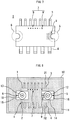
  • FIG. 1 is a top view illustrating a semiconductor module according to a first embodiment.
  • FIG. 2 is a perspective view illustrating an aspect of fabrication of the semiconductor device according to the first embodiment.
  • FIG. 3 is a top view illustrating the semiconductor device according to the first embodiment.
  • FIG. 4 is a cross-sectional view taken along a line I-II in FIG. 3 .
  • FIG. 5 is a top view illustrating a semiconductor device according to a second embodiment.
  • FIG. 6 is a top view illustrating a semiconductor device according to a third embodiment.
  • FIG. 7 is a top view illustrating a semiconductor module according to a fourth embodiment.
  • FIG. 8 is a top view illustrating a semiconductor device according to the fourth embodiment.
  • FIG. 9 is a top view illustrating a semiconductor device according to a fifth embodiment.
  • FIG. 10 is a top view illustrating a semiconductor module according to a sixth embodiment.
  • FIG. 11 is a top view illustrating a semiconductor device according to the sixth embodiment.
  • FIG. 12 is a top view illustrating a semiconductor device according to a seventh embodiment.
  • FIG. 13 is a circuit diagram of the semiconductor device according to the seventh embodiment.
  • FIG. 14 is a top view illustrating a semiconductor module according to an eighth embodiment.
  • FIG. 15 is a top view illustrating a semiconductor device according to the eighth embodiment.
  • FIG. 16 is a top view illustrating a semiconductor device according to a ninth embodiment.
  • FIG. 1 is a top view illustrating a semiconductor module according to a first embodiment.
  • the semiconductor module 1 has a transfer mold structure including a module main body 2 , and terminals 3 and 4 protruding from side surfaces of the module main body 2 which are opposite to each other.
  • the module main body 2 has first and second main surfaces which are opposite to each other.
  • the first main surface is on this side of the drawing.
  • the terminals 3 and 4 are bent toward the first main surface.
  • Fitting portions 5 and 6 are provided at both ends in a longitudinal direction of the module main body 2 from which the terminals 3 and 4 do not project.
  • the fitting portions 5 and 6 are provided with arc-shaped notches which allow screws to pass therethrough. A circular hole through which a screw passes may be provided instead of the notch.
  • a product model name 7 is printed on the first main surface of the module main body 2 .
  • the product model name 7 consists of a series name 8 and a type 9.
  • the type 9 is indicated by characters, letters, or symbols, and represents information that cannot be identified from the outer shape of the semiconductor module 1 , for example, a rated current value.
  • the series name is “*****”, and the type is “B”. “B” which is the type 9 is also printed in the vicinity of the notch of the fitting portion 5 .
  • FIG. 2 is a perspective view illustrating an aspect of fabrication of the semiconductor device according to the first embodiment.
  • a mounting board 10 is placed on the first main surface side of the module main body 2 , and connected to the terminals 3 and 4 .
  • a heat radiation fin 11 is placed on the second main surface side of the module main body 2 .
  • Screws 12 and 13 fit the fitting portions 5 and 6 of the module main body 2 from the first main surface side to the heat radiation fin 11 .
  • the screws 12 and 13 are passed through the notches of the fitting portions 5 and 6 of the semiconductor module 1 via washers 14 and 15 , and inserted into screw holes 16 and 17 of the radiation fin 11 .
  • the mounting board 10 is provided with openings 18 and 19 at portions facing the fitting portions 5 and 6 .
  • the screws 12 and 13 can be tightened at the openings 18 and 19 by a screwdriver or the like.
  • FIG. 3 is a top view illustrating the semiconductor device according to the first embodiment.
  • FIG. 4 is a cross-sectional view taken along a line I-II in FIG. 3 .
  • This semiconductor device is an inverter system including the semiconductor module 1 , the mounting board 10 , and the heat radiation fin 11 .
  • a conductor 20 , an insulating sheet 21 , and a conductor 22 are laminated inside the semiconductor module 1 .
  • Semiconductor chips 23 and 24 are mounted on the conductor 22 .
  • a semiconductor chip 25 is mounted on the terminal 3 .
  • the semiconductor chip 23 is an IGBT
  • the semiconductor chip 24 is an FWD
  • the semiconductor chip 25 is a drive IC.
  • the semiconductor chips 23 and 24 are connected to each other by an Al wire 26 .
  • the semiconductor chip 24 is connected to the terminal 4 by an Al wire 27 .
  • the semiconductor chip 25 is connected to the semiconductor chip 23 by an Al wire 28 , and connected to the terminal 3 by an Al wire 29 .
  • Parts of the terminals 3 and 4 , the semiconductor chips 23 to 25 , and the Al wires 26 to 29 are sealed with sealing resin 30 , thereby configuring the module main body 2 .
  • the mounting board 10 is placed on an upper surface side of the module main body 2 where the terminals 3 and 4 are bent.
  • the tips of the terminals 3 and 4 are inserted into through holes 31 and 32 of the mounting board 10 and connected to wirings of the mounting board 10 by soldering or the like.
  • the heat radiation fin 11 is in contact with a lower surface of the module main body 2 and radiates heat generated in the semiconductor chips 23 and 24 .
  • the products having the series name “*****” have the same outer shape, but have a plurality of types, the products cannot be identified unless the printed type 9 is visually recognized.
  • the type 9 of a product is exposed from the opening 18 of the mounting board 10 . Therefore, the type 9 can be visually recognized without removing the mounting board 10 .
  • the opening 18 is originally provided to screw the semiconductor module 1 to the heat radiation fin 11 , it is not necessary to provide the mounting board 10 with a dedicated opening only for visually recognizing the product model name 7 . Therefore, the product can be identified without deteriorating the production efficiency and the degree of freedom in design.
  • the screws 12 and 13 fit the semiconductor module 1 via the washers 14 and 15 .
  • the diameters of the washers 14 and 15 are equal to 7 mm as standard.
  • the type 9 is printed outside the washers 14 and 15 . As a result, the type 9 can be visually recognized without removing the screws 12 and 13 and the washers 14 and 15 . Note that screwing may be performed without use of the washers 14 and 15 .
  • FIG. 5 is a top view illustrating a semiconductor device according to a second embodiment.
  • a circle is printed as the type 9.
  • Such a symbol is more easily analogized than a character even when only a part of the symbol is visually recognizable. Accordingly, a product can be identified when at least a part of the type 9 is printed outside the washers 14 and 15 .
  • FIG. 6 is a top view illustrating a semiconductor device according to a third embodiment.
  • the type 9 is printed on each of both the fitting portions 5 and 6 , and exposed from at least one of the openings 18 and 19 . Since the type 9 can be visually recognized through only one of the openings 18 and 19 , the identification of the product is enhanced as compared with the second embodiment.
  • FIG. 7 is a top view illustrating a semiconductor module according to a fourth embodiment.
  • FIG. 8 is a top view illustrating a semiconductor device according to the fourth embodiment.
  • the type 9 is a set of horizontal lines in which a plurality of lines extending along a longitudinal direction of a module main body 2 are arranged in parallel to one another, and is printed along the arc of the notch of the fitting portion 5 .
  • the number of the horizontal lines is set according to a product specification, for example, a current rating. For example, one line is set as 1 A rating, and two lines are set as 5 A rating. Even when only a part of the type 9 is visually recognizable because the type 9 is hidden by the washer 14 , the number of horizontal lines is more easily recognizable than the shape of a character or the like.
  • FIG. 9 is a top view illustrating a semiconductor device according to a fifth embodiment.
  • the type 9 is a set of horizontal lines, and is printed on both of the fitting portions 5 and 6 . A part of the type 9 is exposed from at least one of the openings 18 and 19 . Since the type 9 can be visually recognized through only one of the openings 18 and 19 , the product identification is enhanced as compared with the fourth embodiment.
  • FIG. 10 is a top view illustrating a semiconductor module according to a sixth embodiment.
  • FIG. 11 is a top view illustrating a semiconductor device according to the sixth embodiment.
  • the horizontal lines of the types 9 printed on both the fitting portions 5 and 6 extend so as to be connected to each other.
  • the mounting board 10 is provided with an opening 33 at a portion other than the portions corresponding to the fitting portions 5 and 6 .
  • the horizontal lines of the types 9 extend to the opening 33 and are exposed from the opening 33 . Accordingly, since the type 9 can be visually recognized from the opening other than the screw-fastening openings 18 and 19 , the product identification is enhanced as compared with the fifth embodiment.
  • the opening 33 can be provided at any position above the horizontal lines, the degree of freedom in design of the wiring pattern of the mounting board 10 is enhanced.
  • FIG. 12 is a top view illustrating a semiconductor device according to a seventh embodiment.
  • FIG. 13 is a circuit diagram of the semiconductor device according to the seventh embodiment.
  • the terminal 3 includes a V UFB terminal 3 a and a V VFB terminal 3 b which are different in potential from each other.
  • the terminal 4 includes a U terminal 4 a and a V terminal 4 b which are different in potential from each other.
  • a V UFB wiring 34 , a V VFB wiring 35 , a U wiring 36 , and a V wiring 37 are provided to the mounting board 10 , and are connected to the V UFB terminal 3 a , the V VFB terminal 3 b , the U terminal 4 a , and the V terminal 4 b , respectively.
  • a capacitor 38 is connected between the V UFB wiring 34 and the U wiring 36 .
  • a capacitor 39 is connected between the V VFB wiring 35 and the V wiring 37 .
  • the opening 33 is provided in the mounting board 10 between the adjacent V UFB wiring 34 and V VFB wiring 35 and between the U wiring 36 and the V wiring 37 .
  • the opening 33 separates wirings having high voltages and different potentials from each other to ensure a creeping distance.
  • the horizontal lines of the type 9 extend to the opening 33 and are exposed from the opening 33 . As a result, the type 9 can be visually recognized from the opening other than the screw-fastening openings 18 and 19 , so that the product identification is enhanced as compared with the fifth embodiment.
  • FIG. 14 is a top view illustrating a semiconductor module according to an eighth embodiment.
  • FIG. 15 is a top view illustrating a semiconductor device according to the eighth embodiment.
  • the type 9 is a set of radial lines in which a plurality of lines spread radially, and is printed along the arc of the notch of the fitting portion 5 .
  • the number of radial lines is set according to a product specification, for example, a current rating. For example, one line is set as 1 A rating, and two lines are set as 5 A rating. Even when only a part of the type 9 is visually recognizable because the type 9 is hidden by the washer 14 , the number of the radial lines is more easily recognizable than the shape of a character or the like.
  • the distance between the lines is reduced as the module is miniaturized or the number of the lines is increased, and thus recognizability is deteriorated.
  • the radial lines spread radially around the notch of the fitting portion 5 , the distance between the lines increases at the ends of the radial lines, thereby enhancing the recognizability.
  • FIG. 16 is a top view illustrating a semiconductor device according to a ninth embodiment.
  • the type 9 is a set of radial lines, and printed on each of both the fitting portions 5 and 6 . A part of the type 9 is exposed from at least one of the openings 18 and 19 . Since the type 9 can be visually recognized through only one of the openings 18 and 19 , the product identification is enhanced as compared with the eighth embodiment.
  • the semiconductor chips 23 and 24 are not limited to chips formed of silicon, but instead may be formed of a wide-bandgap semiconductor having a bandgap wider than that of silicon.
  • the wide-bandgap semiconductor is, for example, a silicon carbide, a gallium-nitride-based material, or diamond.
  • a semiconductor chip formed of such a wide-bandgap semiconductor has a high voltage resistance and a high allowable current density, and thus can be miniaturized. The use of such a miniaturized semiconductor chip enables the miniaturization and high integration of the semiconductor device in which the semiconductor chip is incorporated.
  • both the semiconductor chips 23 and 24 are desirably formed of a wide-bandgap semiconductor. However, only one of the semiconductor chips 23 and 24 may be formed of a wide-bandgap semiconductor. Also in this case, the advantageous effects described in this embodiment can be obtained.

Landscapes

  • Engineering & Computer Science (AREA)
  • Computer Hardware Design (AREA)
  • Microelectronics & Electronic Packaging (AREA)
  • Power Engineering (AREA)
  • Physics & Mathematics (AREA)
  • Condensed Matter Physics & Semiconductors (AREA)
  • General Physics & Mathematics (AREA)
  • Chemical & Material Sciences (AREA)
  • Materials Engineering (AREA)
  • Cooling Or The Like Of Semiconductors Or Solid State Devices (AREA)

Abstract

A semiconductor device includes: a semiconductor module including a module main body having first and second main surfaces which are opposite to each other, and a terminal protruding from a side surface of the module main body and bent toward the first main surface; a mounting board placed on the first main surface side and connected to the terminal; a heat radiation fin placed on the second main surface side; and a screw fitting a fitting portion of the module main body from the first main surface side to the heat radiation fin, wherein the mounting board is provided with an opening at a portion facing the fitting portion, and a type of a product is printed on the first main surface and exposed from the opening of the mounting board.

Description

BACKGROUND OF THE INVENTION Field
The present invention relates to a semiconductor device.
Background
With respect to a semiconductor module having a transfer mold structure, a mold name is printed on a mold surface (for example, see JP S62-014737 U). With respect to a power module, in order to improve the heat radiation of a power chip, a heat radiation fin having a size larger than a module size is mounted on a surface opposite to a mold surface which has been subjected to terminal bending. Therefore, a product model name is printed on the mold surface which has been subjected to terminal bending.
SUMMARY
Since a mounting board is mounted on the mold surface which has been subjected to terminal bending, it is necessary to remove the mounting board in order to confirm the model name after the mounting board has been mounted. A dedicated opening may be provided in the mounting board so that the product model name is visually recognized, but this increases the processing cost. Furthermore, since a place at which the product model name is printed varies according to each module, it is necessary to perform design of an opening for each module, which has caused a problem that the production efficiency deteriorates. Furthermore, since it is impossible to provide a wiring pattern in the opening, there has also been a problem that the degree of freedom in design deteriorates.
The present invention has been made to solve the above-described problems, and has an object to provide a semiconductor device capable of identifying a product without deteriorating production efficiency and degree of freedom in design.
A semiconductor device according to the present invention includes: a semiconductor module including a module main body having first and second main surfaces which are opposite to each other, and a terminal protruding from a side surface of the module main body and bent toward the first main surface; a mounting board placed on the first main surface side and connected to the terminal; a heat radiation fin placed on the second main surface side; and a screw fitting a fitting portion of the module main body from the first main surface side to the heat radiation fin, wherein the mounting board is provided with an opening at a portion facing the fitting portion, and a type of a product is printed on the first main surface and exposed from the opening of the mounting board.
In the present invention, the type of the product is exposed from the opening of the mounting board. Therefore, the type can be visually recognized without removing the mounting board. Furthermore, since the opening is originally provided to screw the semiconductor module to the heat radiation fin, it is not necessary to provide the mounting board with a dedicated opening only for visually recognizing the product model name. Therefore, the product can be identified without deteriorating the production efficiency and the degree of freedom in design.
Other and further objects, features and advantages of the invention will appear more fully from the following description.
BRIEF DESCRIPTION OF DRAWINGS
FIG. 1 is a top view illustrating a semiconductor module according to a first embodiment.
FIG. 2 is a perspective view illustrating an aspect of fabrication of the semiconductor device according to the first embodiment.
FIG. 3 is a top view illustrating the semiconductor device according to the first embodiment.
FIG. 4 is a cross-sectional view taken along a line I-II in FIG. 3.
FIG. 5 is a top view illustrating a semiconductor device according to a second embodiment.
FIG. 6 is a top view illustrating a semiconductor device according to a third embodiment.
FIG. 7 is a top view illustrating a semiconductor module according to a fourth embodiment.
FIG. 8 is a top view illustrating a semiconductor device according to the fourth embodiment.
FIG. 9 is a top view illustrating a semiconductor device according to a fifth embodiment.
FIG. 10 is a top view illustrating a semiconductor module according to a sixth embodiment.
FIG. 11 is a top view illustrating a semiconductor device according to the sixth embodiment.
FIG. 12 is a top view illustrating a semiconductor device according to a seventh embodiment.
FIG. 13 is a circuit diagram of the semiconductor device according to the seventh embodiment.
FIG. 14 is a top view illustrating a semiconductor module according to an eighth embodiment.
FIG. 15 is a top view illustrating a semiconductor device according to the eighth embodiment.
FIG. 16 is a top view illustrating a semiconductor device according to a ninth embodiment.
DESCRIPTION OF EMBODIMENTS
A semiconductor device according to the embodiments of the present invention will be described with reference to the drawings. The same components will be denoted by the same symbols, and the repeated description thereof may be omitted.
First Embodiment
FIG. 1 is a top view illustrating a semiconductor module according to a first embodiment. The semiconductor module 1 has a transfer mold structure including a module main body 2, and terminals 3 and 4 protruding from side surfaces of the module main body 2 which are opposite to each other. The module main body 2 has first and second main surfaces which are opposite to each other. The first main surface is on this side of the drawing. The terminals 3 and 4 are bent toward the first main surface. Fitting portions 5 and 6 are provided at both ends in a longitudinal direction of the module main body 2 from which the terminals 3 and 4 do not project. The fitting portions 5 and 6 are provided with arc-shaped notches which allow screws to pass therethrough. A circular hole through which a screw passes may be provided instead of the notch.
A product model name 7 is printed on the first main surface of the module main body 2. The product model name 7 consists of a series name 8 and a type 9. The type 9 is indicated by characters, letters, or symbols, and represents information that cannot be identified from the outer shape of the semiconductor module 1, for example, a rated current value. Here, the series name is “*****”, and the type is “B”. “B” which is the type 9 is also printed in the vicinity of the notch of the fitting portion 5.
FIG. 2 is a perspective view illustrating an aspect of fabrication of the semiconductor device according to the first embodiment. A mounting board 10 is placed on the first main surface side of the module main body 2, and connected to the terminals 3 and 4. A heat radiation fin 11 is placed on the second main surface side of the module main body 2. Screws 12 and 13 fit the fitting portions 5 and 6 of the module main body 2 from the first main surface side to the heat radiation fin 11. The screws 12 and 13 are passed through the notches of the fitting portions 5 and 6 of the semiconductor module 1 via washers 14 and 15, and inserted into screw holes 16 and 17 of the radiation fin 11. The mounting board 10 is provided with openings 18 and 19 at portions facing the fitting portions 5 and 6. The screws 12 and 13 can be tightened at the openings 18 and 19 by a screwdriver or the like.
FIG. 3 is a top view illustrating the semiconductor device according to the first embodiment. FIG. 4 is a cross-sectional view taken along a line I-II in FIG. 3. This semiconductor device is an inverter system including the semiconductor module 1, the mounting board 10, and the heat radiation fin 11.
A conductor 20, an insulating sheet 21, and a conductor 22 are laminated inside the semiconductor module 1. Semiconductor chips 23 and 24 are mounted on the conductor 22. A semiconductor chip 25 is mounted on the terminal 3. The semiconductor chip 23 is an IGBT, the semiconductor chip 24 is an FWD, and the semiconductor chip 25 is a drive IC. The semiconductor chips 23 and 24 are connected to each other by an Al wire 26. The semiconductor chip 24 is connected to the terminal 4 by an Al wire 27. The semiconductor chip 25 is connected to the semiconductor chip 23 by an Al wire 28, and connected to the terminal 3 by an Al wire 29. Parts of the terminals 3 and 4, the semiconductor chips 23 to 25, and the Al wires 26 to 29 are sealed with sealing resin 30, thereby configuring the module main body 2.
The mounting board 10 is placed on an upper surface side of the module main body 2 where the terminals 3 and 4 are bent. The tips of the terminals 3 and 4 are inserted into through holes 31 and 32 of the mounting board 10 and connected to wirings of the mounting board 10 by soldering or the like. The heat radiation fin 11 is in contact with a lower surface of the module main body 2 and radiates heat generated in the semiconductor chips 23 and 24.
When products having the series name “*****” have the same outer shape, but have a plurality of types, the products cannot be identified unless the printed type 9 is visually recognized. On the other hand, in the present embodiment, the type 9 of a product is exposed from the opening 18 of the mounting board 10. Therefore, the type 9 can be visually recognized without removing the mounting board 10. Furthermore, since the opening 18 is originally provided to screw the semiconductor module 1 to the heat radiation fin 11, it is not necessary to provide the mounting board 10 with a dedicated opening only for visually recognizing the product model name 7. Therefore, the product can be identified without deteriorating the production efficiency and the degree of freedom in design.
In order to avoid stress from concentrating on the semiconductor module 1 due to screw tightening, the screws 12 and 13 fit the semiconductor module 1 via the washers 14 and 15. When screws 12 and 13 of M3 size are used, the diameters of the washers 14 and 15 are equal to 7 mm as standard. The type 9 is printed outside the washers 14 and 15. As a result, the type 9 can be visually recognized without removing the screws 12 and 13 and the washers 14 and 15. Note that screwing may be performed without use of the washers 14 and 15.
Second Embodiment
FIG. 5 is a top view illustrating a semiconductor device according to a second embodiment. A circle is printed as the type 9. Such a symbol is more easily analogized than a character even when only a part of the symbol is visually recognizable. Accordingly, a product can be identified when at least a part of the type 9 is printed outside the washers 14 and 15.
Third Embodiment
FIG. 6 is a top view illustrating a semiconductor device according to a third embodiment. The type 9 is printed on each of both the fitting portions 5 and 6, and exposed from at least one of the openings 18 and 19. Since the type 9 can be visually recognized through only one of the openings 18 and 19, the identification of the product is enhanced as compared with the second embodiment.
Fourth Embodiment
FIG. 7 is a top view illustrating a semiconductor module according to a fourth embodiment. FIG. 8 is a top view illustrating a semiconductor device according to the fourth embodiment. The type 9 is a set of horizontal lines in which a plurality of lines extending along a longitudinal direction of a module main body 2 are arranged in parallel to one another, and is printed along the arc of the notch of the fitting portion 5. The number of the horizontal lines is set according to a product specification, for example, a current rating. For example, one line is set as 1A rating, and two lines are set as 5A rating. Even when only a part of the type 9 is visually recognizable because the type 9 is hidden by the washer 14, the number of horizontal lines is more easily recognizable than the shape of a character or the like.
Fifth Embodiment
FIG. 9 is a top view illustrating a semiconductor device according to a fifth embodiment. The type 9 is a set of horizontal lines, and is printed on both of the fitting portions 5 and 6. A part of the type 9 is exposed from at least one of the openings 18 and 19. Since the type 9 can be visually recognized through only one of the openings 18 and 19, the product identification is enhanced as compared with the fourth embodiment.
Sixth Embodiment
FIG. 10 is a top view illustrating a semiconductor module according to a sixth embodiment. FIG. 11 is a top view illustrating a semiconductor device according to the sixth embodiment. The horizontal lines of the types 9 printed on both the fitting portions 5 and 6 extend so as to be connected to each other. The mounting board 10 is provided with an opening 33 at a portion other than the portions corresponding to the fitting portions 5 and 6. The horizontal lines of the types 9 extend to the opening 33 and are exposed from the opening 33. Accordingly, since the type 9 can be visually recognized from the opening other than the screw- fastening openings 18 and 19, the product identification is enhanced as compared with the fifth embodiment. In addition, since the opening 33 can be provided at any position above the horizontal lines, the degree of freedom in design of the wiring pattern of the mounting board 10 is enhanced.
Seventh Embodiment
FIG. 12 is a top view illustrating a semiconductor device according to a seventh embodiment. FIG. 13 is a circuit diagram of the semiconductor device according to the seventh embodiment. The terminal 3 includes a VUFB terminal 3 a and a VVFB terminal 3 b which are different in potential from each other. The terminal 4 includes a U terminal 4 a and a V terminal 4 b which are different in potential from each other. A VUFB wiring 34, a VVFB wiring 35, a U wiring 36, and a V wiring 37 are provided to the mounting board 10, and are connected to the VUFB terminal 3 a, the VVFB terminal 3 b, the U terminal 4 a, and the V terminal 4 b, respectively. A capacitor 38 is connected between the VUFB wiring 34 and the U wiring 36. A capacitor 39 is connected between the VVFB wiring 35 and the V wiring 37. The opening 33 is provided in the mounting board 10 between the adjacent VUFB wiring 34 and VVFB wiring 35 and between the U wiring 36 and the V wiring 37. The opening 33 separates wirings having high voltages and different potentials from each other to ensure a creeping distance. The horizontal lines of the type 9 extend to the opening 33 and are exposed from the opening 33. As a result, the type 9 can be visually recognized from the opening other than the screw- fastening openings 18 and 19, so that the product identification is enhanced as compared with the fifth embodiment.
Eighth Embodiment
FIG. 14 is a top view illustrating a semiconductor module according to an eighth embodiment. FIG. 15 is a top view illustrating a semiconductor device according to the eighth embodiment. The type 9 is a set of radial lines in which a plurality of lines spread radially, and is printed along the arc of the notch of the fitting portion 5. The number of radial lines is set according to a product specification, for example, a current rating. For example, one line is set as 1A rating, and two lines are set as 5A rating. Even when only a part of the type 9 is visually recognizable because the type 9 is hidden by the washer 14, the number of the radial lines is more easily recognizable than the shape of a character or the like. In the case of the horizontal lines, the distance between the lines is reduced as the module is miniaturized or the number of the lines is increased, and thus recognizability is deteriorated. On the other hand, since the radial lines spread radially around the notch of the fitting portion 5, the distance between the lines increases at the ends of the radial lines, thereby enhancing the recognizability.
Ninth Embodiment
FIG. 16 is a top view illustrating a semiconductor device according to a ninth embodiment. The type 9 is a set of radial lines, and printed on each of both the fitting portions 5 and 6. A part of the type 9 is exposed from at least one of the openings 18 and 19. Since the type 9 can be visually recognized through only one of the openings 18 and 19, the product identification is enhanced as compared with the eighth embodiment.
The semiconductor chips 23 and 24 are not limited to chips formed of silicon, but instead may be formed of a wide-bandgap semiconductor having a bandgap wider than that of silicon. The wide-bandgap semiconductor is, for example, a silicon carbide, a gallium-nitride-based material, or diamond. A semiconductor chip formed of such a wide-bandgap semiconductor has a high voltage resistance and a high allowable current density, and thus can be miniaturized. The use of such a miniaturized semiconductor chip enables the miniaturization and high integration of the semiconductor device in which the semiconductor chip is incorporated. Further, since the semiconductor chip has a high heat resistance, a radiation fin of a heatsink can be miniaturized and a water-cooled part can be air-cooled, which leads to further miniaturization of the semiconductor device. Further, since the semiconductor chip has a low power loss and a high efficiency, a highly efficient semiconductor device can be achieved. Both the semiconductor chips 23 and 24 are desirably formed of a wide-bandgap semiconductor. However, only one of the semiconductor chips 23 and 24 may be formed of a wide-bandgap semiconductor. Also in this case, the advantageous effects described in this embodiment can be obtained.
Obviously many modifications and variations of the present invention are possible in the light of the above teachings. It is therefore to be understood that within the scope of the appended claims the invention may be practiced otherwise than as specifically described.
The entire disclosure of Japanese Patent Application No. 2019-120457, filed on Jun. 27, 2019 including specification, claims, drawings and summary, on which the Convention priority of the present application is based, is incorporated herein by reference in its entirety.

Claims (20)

The invention claimed is:
1. A semiconductor device comprising:
a semiconductor module including a module main body having first and second main surfaces which are opposite to each other, and a terminal protruding from a side surface of the module main body and bent toward the first main surface side;
a mounting board placed on the first main surface side and connected to the terminal;
a heat radiation fin placed on the second main surface side; and
a screw fitting a fitting portion of the module main body from the first main surface side to the heat radiation fin,
wherein the mounting board is provided with an opening at a portion facing the fitting portion, and
a type of a product is printed on the first main surface and exposed from the opening of the mounting board.
2. The semiconductor device according to claim 1, wherein the screw fits the semiconductor module via a washer, and
at least part of the type is printed outside the washer.
3. The semiconductor device according to claim 1, wherein the fitting portion includes first and second fitting portions,
the opening includes first and second openings provided at portions corresponding to the first and second fitting portions respectively, and
the type is printed on each of both the first and second fitting portions and exposed from at least one of the first and second openings.
4. The semiconductor device according to claim 2, wherein the fitting portion includes first and second fitting portions,
the opening includes first and second openings provided at portions corresponding to the first and second fitting portions respectively, and
the type is printed on each of both the first and second fitting portions and exposed from at least one of the first and second openings.
5. The semiconductor device according to claim 1, wherein the type is horizontal lines, and a number of the horizontal lines is set according to a product specification.
6. The semiconductor device according to claim 5, wherein a third opening is provided at a portion of the mounting board other than a portion corresponding to the fitting portion, and
the horizontal line extends to the third opening and is exposed from the third opening.
7. The semiconductor device according to claim 6, wherein the terminal includes first and second terminals which are different in potential from each other,
the mounting board includes first and second wirings connected to the first and second terminals respectively, and
the third opening is provided between the first wiring and the second wiring.
8. The semiconductor device according to claim 2, wherein the type is horizontal lines, and a number of the horizontal lines is set according to a product specification.
9. The semiconductor device according to claim 8, wherein a third opening is provided at a portion of the mounting board other than a portion corresponding to the fitting portion, and
the horizontal line extends to the third opening and is exposed from the third opening.
10. The semiconductor device according to claim 9, wherein the terminal includes first and second terminals which are different in potential from each other,
the mounting board includes first and second wirings connected to the first and second terminals respectively, and
the third opening is provided between the first wiring and the second wiring.
11. The semiconductor device according to claim 3, wherein the type is horizontal lines, and a number of the horizontal lines is set according to a product specification.
12. The semiconductor device according to claim 11, wherein a third opening is provided at a portion of the mounting board other than a portion corresponding to the fitting portion, and
the horizontal line extends to the third opening and is exposed from the third opening.
13. The semiconductor device according to claim 12, wherein the terminal includes first and second terminals which are different in potential from each other,
the mounting board includes first and second wirings connected to the first and second terminals respectively, and
the third opening is provided between the first wiring and the second wiring.
14. The semiconductor device according to claim 1, wherein the type is radial lines, and a number of the radial lines is set according to a product specification.
15. The semiconductor device according to claim 2, wherein the type is radial lines, and a number of the radial lines is set according to a product specification.
16. The semiconductor device according to claim 3, wherein the type is radial lines, and a number of the radial lines is set according to a product specification.
17. The semiconductor device according to claim 1, wherein the semiconductor module includes a semiconductor chip formed of a wide-bandgap semiconductor.
18. The semiconductor device according to claim 2, wherein the semiconductor module includes a semiconductor chip formed of a wide-bandgap semiconductor.
19. The semiconductor device according to claim 3, wherein the semiconductor module includes a semiconductor chip formed of a wide-bandgap semiconductor.
20. The semiconductor device according to claim 4, wherein the semiconductor module includes a semiconductor chip formed of a wide-bandgap semiconductor.
US16/732,584 2019-06-27 2020-01-02 Semiconductor device Active US11031313B2 (en)

Applications Claiming Priority (3)

Application Number Priority Date Filing Date Title
JP2019120457A JP7088129B2 (en) 2019-06-27 2019-06-27 Semiconductor device
JP2019-120457 2019-06-27
JPJP2019-120457 2019-06-27

Publications (2)

Publication Number Publication Date
US20200411404A1 US20200411404A1 (en) 2020-12-31
US11031313B2 true US11031313B2 (en) 2021-06-08

Family

ID=73747785

Family Applications (1)

Application Number Title Priority Date Filing Date
US16/732,584 Active US11031313B2 (en) 2019-06-27 2020-01-02 Semiconductor device

Country Status (4)

Country Link
US (1) US11031313B2 (en)
JP (1) JP7088129B2 (en)
CN (1) CN112151456B (en)
DE (1) DE102020116361B4 (en)

Families Citing this family (5)

* Cited by examiner, † Cited by third party
Publication number Priority date Publication date Assignee Title
JP7615015B2 (en) * 2021-12-07 2025-01-16 三菱電機株式会社 Semiconductor Device
JP1727400S (en) * 2022-01-28 2022-10-14 semiconductor device
JP1727398S (en) * 2022-01-28 2022-10-14 semiconductor element
EP4614563A1 (en) * 2022-11-17 2025-09-10 Hisense Home Appliances Group Co., Ltd. Power module assembly and electronic device comprising same
JP2024115420A (en) 2023-02-14 2024-08-26 三菱電機株式会社 Semiconductor module and semiconductor device

Citations (5)

* Cited by examiner, † Cited by third party
Publication number Priority date Publication date Assignee Title
JPS6214737U (en) 1985-07-12 1987-01-29
US20050093123A1 (en) * 2003-10-31 2005-05-05 Mitsubishi Denki Kabushiki Kaisha Power semiconductor device and power semiconductor module
US20100244237A1 (en) * 2009-03-26 2010-09-30 Mitsubishi Electric Corporation Semiconductor device and method for manufacturing the same
US20180182719A1 (en) * 2016-12-28 2018-06-28 Renesas Electronics Corporation Semiconductor device
US20190157177A1 (en) * 2017-11-22 2019-05-23 Mitsubishi Electric Corporation Semiconductor device

Family Cites Families (10)

* Cited by examiner, † Cited by third party
Publication number Priority date Publication date Assignee Title
JPS6016547U (en) * 1983-07-08 1985-02-04 松下電器産業株式会社 3-terminal semiconductor device mounting device
FR2773941B1 (en) 1998-01-19 2000-04-21 Ferraz DI-PHASIC EXCHANGER FOR AT LEAST ONE ELECTRONIC POWER COMPONENT
JP2003086740A (en) * 2001-09-07 2003-03-20 Mitsubishi Electric Corp Semiconductor device and manufacturing method thereof
JP2010161114A (en) * 2009-01-06 2010-07-22 Shin Etsu Handotai Co Ltd Process of fabricating semiconductor device
DE102010022562A1 (en) * 2010-06-02 2011-12-08 Vincotech Holdings S.à.r.l. An electrical power module and method for connecting an electrical power module to a circuit board and a heat sink
JP5062542B2 (en) 2011-05-20 2012-10-31 株式会社安川電機 Motor control device
JP6510310B2 (en) * 2014-05-12 2019-05-08 ローム株式会社 Semiconductor device
US10269681B2 (en) * 2015-04-08 2019-04-23 Mitsubishi Electric Corporation Semiconductor device and manufacturing method of semiconductor device
CN205488092U (en) * 2016-03-09 2016-08-17 西安后羿半导体科技有限公司 Power device packaging structure
US10893610B2 (en) 2017-04-03 2021-01-12 Mitsubishi Electric Cornoration Switching device driving unit

Patent Citations (5)

* Cited by examiner, † Cited by third party
Publication number Priority date Publication date Assignee Title
JPS6214737U (en) 1985-07-12 1987-01-29
US20050093123A1 (en) * 2003-10-31 2005-05-05 Mitsubishi Denki Kabushiki Kaisha Power semiconductor device and power semiconductor module
US20100244237A1 (en) * 2009-03-26 2010-09-30 Mitsubishi Electric Corporation Semiconductor device and method for manufacturing the same
US20180182719A1 (en) * 2016-12-28 2018-06-28 Renesas Electronics Corporation Semiconductor device
US20190157177A1 (en) * 2017-11-22 2019-05-23 Mitsubishi Electric Corporation Semiconductor device

Also Published As

Publication number Publication date
CN112151456A (en) 2020-12-29
DE102020116361B4 (en) 2022-12-01
DE102020116361A1 (en) 2020-12-31
CN112151456B (en) 2023-10-17
JP2021007119A (en) 2021-01-21
JP7088129B2 (en) 2022-06-21
US20200411404A1 (en) 2020-12-31

Similar Documents

Publication Publication Date Title
US11031313B2 (en) Semiconductor device
US10134718B2 (en) Power semiconductor module
CN105874596A (en) Semiconductor module
KR20080008218A (en) Power semiconductor device
CN109817590B (en) Semiconductor device
US10177080B2 (en) Molded intelligent power module
US20080191340A1 (en) Power Semiconductor Module And Method For Its Manufacture
KR20150140600A (en) Power semiconductor device
EP3098843A1 (en) Package assembly
US20180174987A1 (en) Semiconductor device
KR0157670B1 (en) Semiconductor module device
US6282077B1 (en) Ceramic capacitor mounting structure
US10622287B2 (en) Semiconductor package
US20150270208A1 (en) Power semiconductor device
US9485865B2 (en) Substrate spacing member and inverter device
CN111066145B (en) Semiconductor device
US20240023299A1 (en) Semiconductor apparatus
US20190053384A1 (en) Substrate, electric compressor, and air conditioner
US20230078823A1 (en) Semiconductor device
US20230307332A1 (en) Power Semiconductor Module and Method for Producing a Power Semiconductor Module
KR100344225B1 (en) Moisture prevention apparatus of power semiconductor module
CN111755402A (en) semiconductor device
US20240274544A1 (en) Semiconductor module and semiconductor device
US20230215787A1 (en) Semiconductor device
CN118216079B (en) Bus positioning structure and electrical equipment

Legal Events

Date Code Title Description
AS Assignment

Owner name: MITSUBISHI ELECTRIC CORPORATION, JAPAN

Free format text: ASSIGNMENT OF ASSIGNORS INTEREST;ASSIGNOR:SHIRAISHI, TAKUYA;REEL/FRAME:051400/0489

Effective date: 20191126

FEPP Fee payment procedure

Free format text: ENTITY STATUS SET TO UNDISCOUNTED (ORIGINAL EVENT CODE: BIG.); ENTITY STATUS OF PATENT OWNER: LARGE ENTITY

STPP Information on status: patent application and granting procedure in general

Free format text: NOTICE OF ALLOWANCE MAILED -- APPLICATION RECEIVED IN OFFICE OF PUBLICATIONS

STPP Information on status: patent application and granting procedure in general

Free format text: PUBLICATIONS -- ISSUE FEE PAYMENT RECEIVED

STPP Information on status: patent application and granting procedure in general

Free format text: PUBLICATIONS -- ISSUE FEE PAYMENT VERIFIED

STCF Information on status: patent grant

Free format text: PATENTED CASE

MAFP Maintenance fee payment

Free format text: PAYMENT OF MAINTENANCE FEE, 4TH YEAR, LARGE ENTITY (ORIGINAL EVENT CODE: M1551); ENTITY STATUS OF PATENT OWNER: LARGE ENTITY

Year of fee payment: 4