US8828984B2 - Gold(III) complexes containing N-heterocyclic carbene ligand, synthesis, and their applications in cancer treatment and thiol detection - Google Patents
Gold(III) complexes containing N-heterocyclic carbene ligand, synthesis, and their applications in cancer treatment and thiol detection Download PDFInfo
- Publication number
- US8828984B2 US8828984B2 US14/078,742 US201314078742A US8828984B2 US 8828984 B2 US8828984 B2 US 8828984B2 US 201314078742 A US201314078742 A US 201314078742A US 8828984 B2 US8828984 B2 US 8828984B2
- Authority
- US
- United States
- Prior art keywords
- iii
- nitrogen atom
- composition
- cancer
- electron pairs
- Prior art date
- Legal status (The legal status is an assumption and is not a legal conclusion. Google has not performed a legal analysis and makes no representation as to the accuracy of the status listed.)
- Active
Links
- CWNHIRCWNQMGEU-XOHWUJONSA-N CC(C)(C)/C=C\C=C/C(C)(C)C Chemical compound CC(C)(C)/C=C\C=C/C(C)(C)C CWNHIRCWNQMGEU-XOHWUJONSA-N 0.000 description 16
- 0 Cl[Au](Cl)(Cl)(Cl)[K].[1*]C1=[Y]([3*])N2C(=C1[10*])C1=CC([9*])=CC3=N1[Au]2(C1N([5*])C([7*])=C([8*])N1[6*])N1C3=C([11*])C([2*])=[Y]1[4*].[1*]C1=[Y]([3*])N2C(=C1[10*])C1=CC([9*])=CC3=N1[Au]2(Cl)N1C3=C([11*])C([2*])=[Y]1[4*].[1*]C1=[Y]([3*])NC(C2=CC([9*])=CC(C3=C([11*])C([2*])=[Y]([4*])N3)=N2)=C1[10*].[5*]N1C([7*])=C([8*])N([6*])C1[Ag][W] Chemical compound Cl[Au](Cl)(Cl)(Cl)[K].[1*]C1=[Y]([3*])N2C(=C1[10*])C1=CC([9*])=CC3=N1[Au]2(C1N([5*])C([7*])=C([8*])N1[6*])N1C3=C([11*])C([2*])=[Y]1[4*].[1*]C1=[Y]([3*])N2C(=C1[10*])C1=CC([9*])=CC3=N1[Au]2(Cl)N1C3=C([11*])C([2*])=[Y]1[4*].[1*]C1=[Y]([3*])NC(C2=CC([9*])=CC(C3=C([11*])C([2*])=[Y]([4*])N3)=N2)=C1[10*].[5*]N1C([7*])=C([8*])N([6*])C1[Ag][W] 0.000 description 9
- MOPPMHFMGBRKMQ-UHFFFAOYSA-K C.C.CCCCBr.CCCCN1C=CN(C)C1[Ag]Br.CCCC[N+]1=CN(C)C=C1.CCO.CN1C=CN(CCC[PH](C2=CC=CC=C2)(C2=CC=CC=C2)C2=CC=CC=C2)C1[Au]12N3C=CN=C3C3=CC=CC(=N31)C1=NC=CN12.CN1C=CN=C1.Cl[Au]12N3C=CN=C3C3=CC=CC(=N31)C1=NC=CN12.O=[Ag][Ag].[Br-] Chemical compound C.C.CCCCBr.CCCCN1C=CN(C)C1[Ag]Br.CCCC[N+]1=CN(C)C=C1.CCO.CN1C=CN(CCC[PH](C2=CC=CC=C2)(C2=CC=CC=C2)C2=CC=CC=C2)C1[Au]12N3C=CN=C3C3=CC=CC(=N31)C1=NC=CN12.CN1C=CN=C1.Cl[Au]12N3C=CN=C3C3=CC=CC(=N31)C1=NC=CN12.O=[Ag][Ag].[Br-] MOPPMHFMGBRKMQ-UHFFFAOYSA-K 0.000 description 1
- PDBRVOCRCUWUHM-UHFFFAOYSA-I C1=CC(C2=NC3=C(C=CC=C3)N2)=NC(C2=NC3=C(C=CC=C3)N2)=C1.Cl[Au](Cl)(Cl)(Cl)[K].Cl[Au]12N3C(=NC4=C3C=CC=C4)C3=CC=CC(=N31)C1=NC3=C(C=CC=C3)N12 Chemical compound C1=CC(C2=NC3=C(C=CC=C3)N2)=NC(C2=NC3=C(C=CC=C3)N2)=C1.Cl[Au](Cl)(Cl)(Cl)[K].Cl[Au]12N3C(=NC4=C3C=CC=C4)C3=CC=CC(=N31)C1=NC3=C(C=CC=C3)N12 PDBRVOCRCUWUHM-UHFFFAOYSA-I 0.000 description 1
- SQEZOKODWUBAHY-UHFFFAOYSA-I C1=CC(C2=NC=CN2)=NC(C2=NC=CN2)=C1.Cl[Au](Cl)(Cl)(Cl)[K].Cl[Au]12N3C=CN=C3C3=CC=CC(=N31)C1=NC=CN12 Chemical compound C1=CC(C2=NC=CN2)=NC(C2=NC=CN2)=C1.Cl[Au](Cl)(Cl)(Cl)[K].Cl[Au]12N3C=CN=C3C3=CC=CC(=N31)C1=NC=CN12 SQEZOKODWUBAHY-UHFFFAOYSA-I 0.000 description 1
- MLOLFWUERGCMKU-UHFFFAOYSA-K CCCCCCCCCCCCCCCCN1C=CN(C)C1[Ag]Br.CCCCCCCCCCCCCCCCN1C=CN(C)C1[Au]12N3C=CN=C3C3=CC=CC(=N31)C1=NC=CN12.Cl[Au]12N3C=CN=C3C3=CC=CC(=N31)C1=NC=CN12.O=S(=O)([O-])C(F)(F)F Chemical compound CCCCCCCCCCCCCCCCN1C=CN(C)C1[Ag]Br.CCCCCCCCCCCCCCCCN1C=CN(C)C1[Au]12N3C=CN=C3C3=CC=CC(=N31)C1=NC=CN12.Cl[Au]12N3C=CN=C3C3=CC=CC(=N31)C1=NC=CN12.O=S(=O)([O-])C(F)(F)F MLOLFWUERGCMKU-UHFFFAOYSA-K 0.000 description 1
- GZCFBVINCMOAKD-UHFFFAOYSA-K CCCCCCCCCCCCCCCCN1C=CN(C)C1[Ag]Br.CCCCCCCCCCCCCCCCN1C=CN(C)C1[Au]12N3N=CC=C3C3=CC=CC(=N31)C1=CC=NN12.Cl[Au]12N3N=CC=C3C3=CC=CC(=N31)C1=CC=NN12.O=S(=O)([O-])C(F)(F)F Chemical compound CCCCCCCCCCCCCCCCN1C=CN(C)C1[Ag]Br.CCCCCCCCCCCCCCCCN1C=CN(C)C1[Au]12N3N=CC=C3C3=CC=CC(=N31)C1=CC=NN12.Cl[Au]12N3N=CC=C3C3=CC=CC(=N31)C1=CC=NN12.O=S(=O)([O-])C(F)(F)F GZCFBVINCMOAKD-UHFFFAOYSA-K 0.000 description 1
- NWVCMMSDLQHSEA-UHFFFAOYSA-K CCCCCCCCCCN1C=CN(C)C1[Ag]Br.CCCCCCCCCCN1C=CN(C)C1[Au]12N3C=CN=C3C3=CC=CC(=N31)C1=NC=CN12.Cl[Au]12N3C=CN=C3C3=CC=CC(=N31)C1=NC=CN12.O=S(=O)([O-])C(F)(F)F Chemical compound CCCCCCCCCCN1C=CN(C)C1[Ag]Br.CCCCCCCCCCN1C=CN(C)C1[Au]12N3C=CN=C3C3=CC=CC(=N31)C1=NC=CN12.Cl[Au]12N3C=CN=C3C3=CC=CC(=N31)C1=NC=CN12.O=S(=O)([O-])C(F)(F)F NWVCMMSDLQHSEA-UHFFFAOYSA-K 0.000 description 1
- KVFNFURLWHPDLH-UHFFFAOYSA-K CCCCCCCCN1C=CN(C)C1[Ag]Br.CCCCCCCCN1C=CN(C)C1[Au]12N3C=CN=C3C3=CC=CC(=N31)C1=NC=CN12.Cl[Au]12N3C=CN=C3C3=CC=CC(=N31)C1=NC=CN12.O=S(=O)([O-])C(F)(F)F Chemical compound CCCCCCCCN1C=CN(C)C1[Ag]Br.CCCCCCCCN1C=CN(C)C1[Au]12N3C=CN=C3C3=CC=CC(=N31)C1=NC=CN12.Cl[Au]12N3C=CN=C3C3=CC=CC(=N31)C1=NC=CN12.O=S(=O)([O-])C(F)(F)F KVFNFURLWHPDLH-UHFFFAOYSA-K 0.000 description 1
- BPZVQAGNMSWTTE-UHFFFAOYSA-K CCCCCCN1C=CN(CCCCCC)C1[Ag]Br.CCCCCCN1C=CN(CCCCCC)C1[Au]12N3C4=C(C=CC=C4)/N=C\3C3=CC=CC(=N31)/C1=N/C3=C(C=CC=C3)N12.Cl[Au]12N3C4=C(C=CC=C4)/N=C\3C3=CC=CC(=N31)/C1=N/C3=C(C=CC=C3)N12.O=S(=O)([O-])C(F)(F)F Chemical compound CCCCCCN1C=CN(CCCCCC)C1[Ag]Br.CCCCCCN1C=CN(CCCCCC)C1[Au]12N3C4=C(C=CC=C4)/N=C\3C3=CC=CC(=N31)/C1=N/C3=C(C=CC=C3)N12.Cl[Au]12N3C4=C(C=CC=C4)/N=C\3C3=CC=CC(=N31)/C1=N/C3=C(C=CC=C3)N12.O=S(=O)([O-])C(F)(F)F BPZVQAGNMSWTTE-UHFFFAOYSA-K 0.000 description 1
- LWPDRBJHUXORJR-UHFFFAOYSA-K CCCCCCN1C=CN(CCCCCC)C1[Ag]Br.CCCCCCN1C=CN(CCCCCC)C1[Au]12N3C=CN=C3C3=CC=CC(=N31)C1=NC=CN12.Cl[Au]12N3C=CN=C3C3=CC=CC(=N31)C1=NC=CN12.O=S(=O)([O-])C(F)(F)F Chemical compound CCCCCCN1C=CN(CCCCCC)C1[Ag]Br.CCCCCCN1C=CN(CCCCCC)C1[Au]12N3C=CN=C3C3=CC=CC(=N31)C1=NC=CN12.Cl[Au]12N3C=CN=C3C3=CC=CC(=N31)C1=NC=CN12.O=S(=O)([O-])C(F)(F)F LWPDRBJHUXORJR-UHFFFAOYSA-K 0.000 description 1
- INSYIOOPIHJQOS-UHFFFAOYSA-K CCCCN1C=CN(C)C1[Ag]Br.CCCCN1C=CN(C)C1[Au]12N3C=CN=C3C3=CC=CC(=N31)C1=NC=CN12.Cl[Au]12N3C=CN=C3C3=CC=CC(=N31)C1=NC=CN12.O=S(=O)([O-])C(F)(F)F Chemical compound CCCCN1C=CN(C)C1[Ag]Br.CCCCN1C=CN(C)C1[Au]12N3C=CN=C3C3=CC=CC(=N31)C1=NC=CN12.Cl[Au]12N3C=CN=C3C3=CC=CC(=N31)C1=NC=CN12.O=S(=O)([O-])C(F)(F)F INSYIOOPIHJQOS-UHFFFAOYSA-K 0.000 description 1
- ISVCZAJQHIZCBG-UHFFFAOYSA-K CCCCN1C=CN(C)C1[Ag]Br.CCCCN1C=CN(C)C1[Au]12N3N=CC=C3C3=CC=CC(=N31)C1=CC=NN12.Cl[Au]12N3N=CC=C3C3=CC=CC(=N31)C1=CC=NN12.O=S(=O)([O-])C(F)(F)F Chemical compound CCCCN1C=CN(C)C1[Ag]Br.CCCCN1C=CN(C)C1[Au]12N3N=CC=C3C3=CC=CC(=N31)C1=CC=NN12.Cl[Au]12N3N=CC=C3C3=CC=CC(=N31)C1=CC=NN12.O=S(=O)([O-])C(F)(F)F ISVCZAJQHIZCBG-UHFFFAOYSA-K 0.000 description 1
- KIERPZDPZJZEGK-UHFFFAOYSA-K CCCCN1C=CN(CCCC)C1[Ag]Br.CCCCN1C=CN(CCCC)C1[Au]12N3C4=C(C=CC=C4)/N=C\3C3=CC=CC(=N31)/C1=N/C3=C(C=CC=C3)N12.Cl[Au]12N3C4=C(C=CC=C4)/N=C\3C3=CC=CC(=N31)/C1=N/C3=C(C=CC=C3)N12.O=S(=O)([O-])C(F)(F)F Chemical compound CCCCN1C=CN(CCCC)C1[Ag]Br.CCCCN1C=CN(CCCC)C1[Au]12N3C4=C(C=CC=C4)/N=C\3C3=CC=CC(=N31)/C1=N/C3=C(C=CC=C3)N12.Cl[Au]12N3C4=C(C=CC=C4)/N=C\3C3=CC=CC(=N31)/C1=N/C3=C(C=CC=C3)N12.O=S(=O)([O-])C(F)(F)F KIERPZDPZJZEGK-UHFFFAOYSA-K 0.000 description 1
- XTOHIRNKMKQDFR-UHFFFAOYSA-K CCCCN1C=CN(CCCC)C1[Ag]Br.CCCCN1C=CN(CCCC)C1[Au]12N3C=CN=C3C3=CC=CC(=N31)C1=NC=CN12.Cl[Au]12N3C=CN=C3C3=CC=CC(=N31)C1=NC=CN12.O=S(=O)([O-])C(F)(F)F Chemical compound CCCCN1C=CN(CCCC)C1[Ag]Br.CCCCN1C=CN(CCCC)C1[Au]12N3C=CN=C3C3=CC=CC(=N31)C1=NC=CN12.Cl[Au]12N3C=CN=C3C3=CC=CC(=N31)C1=NC=CN12.O=S(=O)([O-])C(F)(F)F XTOHIRNKMKQDFR-UHFFFAOYSA-K 0.000 description 1
- DMGWQCUKYHMIPC-UHFFFAOYSA-N CN1C2=C(C=CC=C2)/N=C\1C1=CC=CC(/C2=N/C3=C(C=CC=C3)N2C)=N1.CN1C=CN=C1C1=CC=CC(C2=NC=CN2C)=N1.CN1N=CC=C1C1=CC=CC(C2=CC=NN2C)=N1 Chemical compound CN1C2=C(C=CC=C2)/N=C\1C1=CC=CC(/C2=N/C3=C(C=CC=C3)N2C)=N1.CN1C=CN=C1C1=CC=CC(C2=NC=CN2C)=N1.CN1N=CC=C1C1=CC=CC(C2=CC=NN2C)=N1 DMGWQCUKYHMIPC-UHFFFAOYSA-N 0.000 description 1
- IJACGJNHDLXBBA-UHFFFAOYSA-K CN1C2=C(C=CC=C2)N(C)C1[Ag]I.CN1C2=C(C=CC=C2)N(C)C1[Au]12N3N=CC=C3C3=CC=CC(=N31)C1=CC=NN12.Cl[Au]12N3N=CC=C3C3=CC=CC(=N31)C1=CC=NN12.O=S(=O)([O-])C(F)(F)F Chemical compound CN1C2=C(C=CC=C2)N(C)C1[Ag]I.CN1C2=C(C=CC=C2)N(C)C1[Au]12N3N=CC=C3C3=CC=CC(=N31)C1=CC=NN12.Cl[Au]12N3N=CC=C3C3=CC=CC(=N31)C1=CC=NN12.O=S(=O)([O-])C(F)(F)F IJACGJNHDLXBBA-UHFFFAOYSA-K 0.000 description 1
- YPWDYTVWJWORCB-UHFFFAOYSA-K CN1C=CN(C)C1[Ag]I.CN1C=CN(C)C1[Au]12N3C4=C(C=CC=C4)/N=C\3C3=CC=CC(=N31)/C1=N/C3=C(C=CC=C3)N12.Cl[Au]12N3C4=C(C=CC=C4)/N=C\3C3=CC=CC(=N31)/C1=N/C3=C(C=CC=C3)N12.O=S(=O)([O-])C(F)(F)F Chemical compound CN1C=CN(C)C1[Ag]I.CN1C=CN(C)C1[Au]12N3C4=C(C=CC=C4)/N=C\3C3=CC=CC(=N31)/C1=N/C3=C(C=CC=C3)N12.Cl[Au]12N3C4=C(C=CC=C4)/N=C\3C3=CC=CC(=N31)/C1=N/C3=C(C=CC=C3)N12.O=S(=O)([O-])C(F)(F)F YPWDYTVWJWORCB-UHFFFAOYSA-K 0.000 description 1
- IAJPXSNROKMTSY-UHFFFAOYSA-K CN1C=CN(C)C1[Ag]I.CN1C=CN(C)C1[Au]12N3C=CN=C3C3=CC=CC(=N31)C1=NC=CN12.Cl[Au]12N3C=CN=C3C3=CC=CC(=N31)C1=NC=CN12.O=S(=O)([O-])C(F)(F)F Chemical compound CN1C=CN(C)C1[Ag]I.CN1C=CN(C)C1[Au]12N3C=CN=C3C3=CC=CC(=N31)C1=NC=CN12.Cl[Au]12N3C=CN=C3C3=CC=CC(=N31)C1=NC=CN12.O=S(=O)([O-])C(F)(F)F IAJPXSNROKMTSY-UHFFFAOYSA-K 0.000 description 1
- VDZOQMBNHZKQTF-UHFFFAOYSA-K CN1C=CN(C)C1[Ag]I.CN1C=CN(C)C1[Au]12N3N=CC=C3C3=CC=CC(=N31)C1=CC=NN12.Cl[Au]12N3N=CC=C3C3=CC=CC(=N31)C1=CC=NN12.O=S(=O)([O-])C(F)(F)F Chemical compound CN1C=CN(C)C1[Ag]I.CN1C=CN(C)C1[Au]12N3N=CC=C3C3=CC=CC(=N31)C1=CC=NN12.Cl[Au]12N3N=CC=C3C3=CC=CC(=N31)C1=CC=NN12.O=S(=O)([O-])C(F)(F)F VDZOQMBNHZKQTF-UHFFFAOYSA-K 0.000 description 1
Images




Classifications
-
- G—PHYSICS
- G01—MEASURING; TESTING
- G01N—INVESTIGATING OR ANALYSING MATERIALS BY DETERMINING THEIR CHEMICAL OR PHYSICAL PROPERTIES
- G01N33/00—Investigating or analysing materials by specific methods not covered by groups G01N1/00 - G01N31/00
- G01N33/48—Biological material, e.g. blood, urine; Haemocytometers
- G01N33/50—Chemical analysis of biological material, e.g. blood, urine; Testing involving biospecific ligand binding methods; Immunological testing
- G01N33/5005—Chemical analysis of biological material, e.g. blood, urine; Testing involving biospecific ligand binding methods; Immunological testing involving human or animal cells
- G01N33/5091—Chemical analysis of biological material, e.g. blood, urine; Testing involving biospecific ligand binding methods; Immunological testing involving human or animal cells for testing the pathological state of an organism
-
- A—HUMAN NECESSITIES
- A61—MEDICAL OR VETERINARY SCIENCE; HYGIENE
- A61K—PREPARATIONS FOR MEDICAL, DENTAL OR TOILETRY PURPOSES
- A61K31/00—Medicinal preparations containing organic active ingredients
- A61K31/33—Heterocyclic compounds
- A61K31/555—Heterocyclic compounds containing heavy metals, e.g. hemin, hematin, melarsoprol
-
- A—HUMAN NECESSITIES
- A61—MEDICAL OR VETERINARY SCIENCE; HYGIENE
- A61K—PREPARATIONS FOR MEDICAL, DENTAL OR TOILETRY PURPOSES
- A61K33/00—Medicinal preparations containing inorganic active ingredients
- A61K33/24—Heavy metals; Compounds thereof
- A61K33/242—Gold; Compounds thereof
-
- A—HUMAN NECESSITIES
- A61—MEDICAL OR VETERINARY SCIENCE; HYGIENE
- A61K—PREPARATIONS FOR MEDICAL, DENTAL OR TOILETRY PURPOSES
- A61K33/00—Medicinal preparations containing inorganic active ingredients
- A61K33/24—Heavy metals; Compounds thereof
- A61K33/243—Platinum; Compounds thereof
-
- A—HUMAN NECESSITIES
- A61—MEDICAL OR VETERINARY SCIENCE; HYGIENE
- A61P—SPECIFIC THERAPEUTIC ACTIVITY OF CHEMICAL COMPOUNDS OR MEDICINAL PREPARATIONS
- A61P35/00—Antineoplastic agents
-
- C—CHEMISTRY; METALLURGY
- C07—ORGANIC CHEMISTRY
- C07F—ACYCLIC, CARBOCYCLIC OR HETEROCYCLIC COMPOUNDS CONTAINING ELEMENTS OTHER THAN CARBON, HYDROGEN, HALOGEN, OXYGEN, NITROGEN, SULFUR, SELENIUM OR TELLURIUM
- C07F1/00—Compounds containing elements of Groups 1 or 11 of the Periodic Table
- C07F1/12—Gold compounds
-
- G—PHYSICS
- G01—MEASURING; TESTING
- G01N—INVESTIGATING OR ANALYSING MATERIALS BY DETERMINING THEIR CHEMICAL OR PHYSICAL PROPERTIES
- G01N33/00—Investigating or analysing materials by specific methods not covered by groups G01N1/00 - G01N31/00
- G01N33/48—Biological material, e.g. blood, urine; Haemocytometers
- G01N33/50—Chemical analysis of biological material, e.g. blood, urine; Testing involving biospecific ligand binding methods; Immunological testing
- G01N33/58—Chemical analysis of biological material, e.g. blood, urine; Testing involving biospecific ligand binding methods; Immunological testing involving labelled substances
- G01N33/582—Chemical analysis of biological material, e.g. blood, urine; Testing involving biospecific ligand binding methods; Immunological testing involving labelled substances with fluorescent label
Definitions
- Described herein are gold(III) complexes containing N-heterocyclic carbene ligand, a method of synthesis of the gold(III) complexes containing N-heterocyclic carbene ligand, methods of treating and preventing cancer or tumor using the gold(III) complexes containing N-heterocyclic carbene ligand and a method of detecting thiols using the gold(III) complexes containing N-heterocyclic carbene ligand. Also described are therapeutic and prophylactic compositions containing a purified gold(III) complexes containing N-heterocyclic carbene ligand. In certain embodiments, the methods of treating and preventing cancer or tumor are in combination with other cancer or tumor treatment. In certain embodiments, the cancer or tumor treatment is chemotherapy, radiation therapy, gene therapy, surgery or a combination thereof.
- Fluorescent thiol-sensitive probes have spurred increasing interests especially in biological area, as the cellular thiol level is linked with a great many diseases like cancer, AIDS (Acquired immune deficiency syndrome) and so forth [Yoon, J., Chem. Soc. Rev. 2010, 39, 2120-2135; Touchberg, L. A. et al. Proc. Natl. Acad. Sci. U.S.A. 1997, 94, 1967-1972].
- Soft metals and metals with tunable redox potentials should be a good starting point to design thiol probes.
- Gold(III) complexes are always unstable under physiological conditions and will be reduced to Au(I) or even Au(0) by physiological thiols.
- Au(III) is usually 4-coordinated but Au(I) is usually 2-coordinated
- reduction of Au(III) to Au(I) is accompanied by the release of coordinated ligand(s).
- the ligand is highly fluorescent, intraligand emission would be quenched due to the presence of low energy Au(III) 5d x2-y2 orbital.
- the fluorescent ligand(s) will be released and switch on the emission.
- N-heterocyclic carbene (NHC) ligand(s) is able to stabilize Au(I) against reduction to Au(0) and/or demetalation under physiological conditions.
- H 2 BPB 2,6-bis(1H-benzo[d]imidazol-2-yl)pyridine
- H 2 IPI 2,6-di(1H-imidazol-2-yl)pyridine
- H 2 PPP 2,6-di(1H-pyrazol-5-yl)pyridine
- the gold(III) complexes containing multi-dentate N ⁇ N ⁇ N ligand and NHC moiety provide dual anti-cancer and fluorescent switch-on properties.
- Described herein is a method of synthesis of novel Au(III)-NHC complexes, a composition comprising Au(III)-NHC complexes and methods of using the Au(III)-NHC complexes in cancer/tumor treatment and prevention and a method of detecting thiol.
- the method of treatment and prevention is in combination with one or more cancer/tumor therapies.
- a method to synthesize cyclometalated N ⁇ N ⁇ N—Au—Cl where N ⁇ N ⁇ N refers to deprotonated 2,6-bis(1H-benzo[d]imidazol-2-yl)pyridine (BPB), 2,6-di(1H-imidazol-2-yl)pyridine (IPI), or 2,6-di(1H-pyrazol-5-yl)pyridine) (PPP), and N ⁇ N ⁇ N—Au—NHC contains two steps:
- R 1 , R 2 , R 7 , R 8 are each independently selected from the group —H, and R 3 , R 4 , R 10 , R 11 are each dependently selected from an electron pair or —H; or each pair of R 1 and R 3 , R 2 and R 4 , R 7 and R 8 , R 1 and R 10 , R 2 and R 11 is independently joined together to form
- R 5 , R 6 , R 9 are each independently selected from a —H, —CH 3 , —C 4 H 9 , —C 6 H 13 , —C 8 H 17 , —C 10 H 21 , —C 16 H 33 , —C 3 H 6 PPh 3 + ;
- Base refers to an alkali; non-limiting examples of an alkali include NaOAc, NaOH, KOAc, Na 2 CO 3 ;
- n is an integer ranging from +1 to +2;
- y is equal to the absolute value of n/b
- X is selected from a carbon or a nitrogen atom
- Y is selected from a carbon or a nitrogen atom
- AgZ is a soluble silver(I) salt
- a silver(I) salt include silver triflate, silver nitrate, silver hexafluorophosphate
- W is selected from Br, I, or Cl.
- provided herein is a method for cancer or tumor treatment and prevention resulting in induction of cell death, inhibition of cellular proliferation, inhibition of thioredoxin reductase or inhibition of in vivo tumor growth.
- a method comprising administering to a subject in need thereof a composition comprising an effective amount of a Au(III)-NHC complex.
- the Au(III)-NHC complexes is a gold(III) complex described herein represented by the structural formulae of I, derivatives thereof; or a pharmaceutically acceptable salt, solvate, or hydrate thereof, wherein,
- R 1 , R 2 , R 7 , R 8 are each independently selected from the group —H, and R 3 , R 4 , R 10 , R 11 are each dependently selected from an electron pair or —H; or each pair of R 1 and R 3 , R 2 and R 4 , R 7 and R 8 , R 1 and R 10 , R 2 and R 11 is independently joined together to form
- R 5 , R 6 , R 9 are each independently selected from a —H, —CH 3 , —C 4 H 9 , —C 6 H 13 , —C 8 H 17 , —C 10 H 21 , —C 16 H 33 , —C 3 H 6 PPh 3 + ;
- n is an integer ranging from +1 to +2;
- y is equal to the absolute value of n/b
- X is selected from a carbon or a nitrogen atom
- Y is selected from a carbon or a nitrogen atom
- a method for detecting thiol-containing compounds such as, but not limited to, cysteine (Cys), glutathione (GSH), dithiothreitol (DTT), comprise an effective amount of the Au(III)-NHC complexes, depending on the fluorescence changes at proper wavelength.
- the Au(III)-NHC complex is a gold(III) complex described herein can be represented by the structural formula of I, or an acceptable salt thereof, wherein,
- R 1 , R 2 , R 7 , R 8 are each independently selected from the group —H, and R 3 , R 4 , R 10 , R 11 are each dependently selected from an electron pair or —H; or each pair of R 1 and R 3 , R 2 and R 4 , R 7 and R 8 , R 1 and R 10 , R 2 and R 11 is independently joined together to form
- R 5 , R 6 , R 9 are each independently selected from a —H, —CH 3 , —C 4 H 9 , —C 6 H 13 , —C 8 H 17 , —C 10 H 21 , —C 16 H 33 , —C 3 H 6 PPh 3 + ;
- n is an integer ranging from +1 to +2;
- y is equal to the absolute value of n/b
- X is selected from a carbon or a nitrogen atom
- Y is selected from a carbon or a nitrogen atom.
- the Au(III)-NHC complexes are stable in air and aqueous solutions like phosphate-buffered saline (PBS) conditions. They are very sensitive to physiological thiols and can be reduced to generate the anti-cancer active Au(I)-NHC complexes which are relatively inert to excel thiols, and the reduction process is also accompanied with the release of highly fluorescent ligand.
- the Au(III)-NHC complexes display similar anti-cancer or anti-tumor activity to the clinically used cisplatin and can inhibit the tumor growth of mice bearing HeLa xenograft.
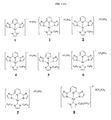
- FIGS. 1 (A) and (B) show Chemical structures of the Au(III)-NHC complexes.
- FIGS. 2(A) and (B) show Crystal structure of 1 (A) and 9 (B)
- FIGS. 3 (A)-(C) show A) ESI-MS analysis of the mixture of 1 and GSH.
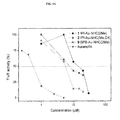
- FIGS. 4 (A)-(C) show A) Cell based TrxR activity for 1 (IPI-Au-NHC(2Me)), 2 (IPI-Au-NHC(Me, C4)) and 9 (BPB-Au-NHC(2Me)) after treating for 1 h.
- FIGS. 5 (A)-(D) show In vivo tumor inhibition effect: A). Graphic representation of tumor volume changes after treating mice bearing HeLa xenograft with 3 mg/kg of 5 or solvent; B) Body weight changes after treating mice bearing HeLa xenograft with 3 mg/kg of 5 or solvent; C) & D) Photos of mouse tumors in different groups.
- Novel gold(III) [or Au(III) or Au 3+ ] complexes containing N-heterocyclic carbene ligand (NHC) novel gold(III) [or Au(III) or Au 3+ ] complexes containing N-heterocyclic carbene ligand (NHC)
- composition comprising novel gold(III) [or Au(III) or Au 3+ ] complexes containing N-heterocyclic carbene ligand (NHC)
- methods of treating and preventing cancer or tumor in a subject and a method of detecting thiol.
- a method of treating or preventing cancer/tumor comprising administering a pharmaceutical composition comprising at least one of the Au(III)-NHC complexes in an effective amount for anti-cancer or anti-tumor activity.
- anti-cancer or anti-tumor activities includes, but are not limited to, the induction of cell death, inhibition of cellular proliferation, inhibition of thioredoxin reductase and/or poisoning of thioredoxin reductase, and inhibition of in vivo tumor growth.
- a method of detecting thiol which comprises detecting thiol containing compounds using at least one of the Au(III)-NHC complexes.
- Au(III)-NHC complexes refer to a molecule of a gold(III) ion connected to a tridentate ligand and N-heterocyclic carbene ligand.
- gold(III) [or Au(III) or Au 3+ ] complexes containing N-heterocyclic carbene ligand (NHC) is represented by structural formula I, derivatives thereof; or a pharmaceutically acceptable salt, solvate, or hydrate thereof.
- R 1 , R 2 , R 7 , R 8 are each independently selected from the group —H, and R 3 , R 4 , R 10 , R 11 are each dependently selected from an electron pair or —H; or each pair of R 1 and R 3 , R 2 and R 4 , R 7 and R 8 , R 1 and R 10 , R 2 and R 11 is independently joined together to form
- R 5 , R 6 , R 9 are each independently selected from a —H, —CH 3 , —C 4 H 9 , —C 6 H 13 , —C 8 H 17 , —C 10 H 21 , —C 16 H 33 , —C 3 H 6 PPh 3 + ;
- n is an integer ranging from +1 to +2;
- y is equal to the absolute value of n/b
- X is selected from a carbon or a nitrogen atom
- Y is selected from a carbon or a nitrogen atom
- tridentate ligand refers to a di-anionic substituted/non-substituted 2,6-bis(1H-benzo[d]imidazol-2-yl)pyridine (H 2 BPB) and its analogue 2,6-di(1H-imidazol-2-yl)pyridine (H 2 IPI), 2,6-di(1H-pyrazol-5-yl)pyridine (H 2 PPP) ligand.
- H 2 BPB di-anionic substituted/non-substituted 2,6-bis(1H-benzo[d]imidazol-2-yl)pyridine
- IPI 2,6-di(1H-pyrazol-5-yl)pyridine
- PPP 2,6-di(1H-pyrazol-5-yl)pyridine
- N-heterocyclic carbene refers to a ligand having one of the following chemical structures:
- R 5 , R 6 are each independently selected from a —CH 3 , —C 4 H 9 , —C 6 H 13 , —C 8 H 17 , —C 10 H 21 , —C 16 H 33 , —C 3 H 6 PPh 3 +
- R 7 , R 8 are each independently selected from the group consisting of —H; or the pair R 7 , R 8 is joined together to form
- the di-anionic N ⁇ N ⁇ N ligand can form a non-neutral complex with the gold(III) ion.
- the net positive charge on the gold(III) can be greater than the absolute net negative charge of the N ⁇ N ⁇ N ligand.
- acceptable salt includes salts formed from the charged Au(III)-NHC complex and counter-anion(s).
- counter-anion refers to an ion associated with a positively charged Au(III)-NHC complex.
- Non-limiting examples of counter-ions include halogens such as fluoride (F ⁇ ), chloride (Cl ⁇ ), bromide (Br ⁇ ), iodide (I ⁇ ); sulfate (SO 4 2 ⁇ ); phosphate (PO 4 3 ⁇ ); trifluoromethanesulfonate (triflate, ⁇ OTf or CF 3 SO 3 ⁇ ); acetate ( ⁇ OAc); nitrate (NO 3 ⁇ ); perchlorate (ClO 4 ⁇ ); hexafluorophosphate (PF 6 ⁇ ) and hexafluoroacetylacetonate ([CF 3 C(O)CHC(O)CF 3 ] ⁇ ).
- the invention relates to the synthesis of novel gold(III) [or Au(III) or Au 3+ ] bearing N-heterocyclic carbene ligand.
- the invention in another embodiment, relates to a pharmaceutical composition for cancer treatment by inhibition of the proliferation of cancer cells in vitro comprising an effective amount of one or more of the Au(III)-NHC complexes.
- the invention relates to a pharmaceutical for cancer treatment by inhibition or poisoning of thioredoxin reductase comprising an effective amount of one or more of the Au(III)-NHC complexes.
- the invention in another embodiment, relates to a pharmaceutical composition for cancer treatment by the inhibition of tumor growth in vivo comprising an effective amount of one or more of the Au(III)-NHC complexes.
- the invention relates to fluorescent detecting thiol-containing compounds such as cysteine (Cys), glutathione (GSH), dithiothreitol (DTT), and the application in cellular thiol imaging, comprising an effective amount of a Au(III)-NHC complex.
- cysteine Cys
- GSH glutathione
- DTT dithiothreitol
- the Au(III)-NHC complexes of this invention can be represented by one or more of structural formula I, derivatives thereof; or a pharmaceutically acceptable salt, solvate, or hydrate thereof.
- R 1 , R 2 , R 7 , R 8 are each independently selected from the group —H, and R 3 , R 4 , R 10 , R 11 are each dependently selected from an electron pair or —H; or each pair of R 1 and R 3 , R 2 and R 4 , R 7 and R 8 , R 1 and R 10 , R 2 and R 11 is independently joined together to form
- R 5 , R 6 , R 9 are each independently selected from a —H, —CH 3 , —C 4 H 9 , —C 6 H 13 , —C 8 H 17 , —C 10 H 21 , —C 16 H 33 , —C 3 H 6 PPh 3 + ;
- n is an integer ranging from +1 to +2;
- y is equal to the absolute value of n/b
- X is selected from a carbon or a nitrogen atom
- Y is selected from a carbon or a nitrogen atom.
- the invention relates to a pharmaceutical composition for treating or preventing cancer/tumor.
- the treatment and prevention comprises induction of cell death, inhibition of cellular proliferation, inhibition of thioredoxin reductase and/or poisoning of thioredoxin reductase, and the inhibition of tumor growth in vivo.
- the method comprises administering an effective amount of the Au(III)-NHC complexes to a subject.
- the method comprises detecting physiological thiol-containing compounds, including but are not limited to, cysteine (Cys), glutathione (GSH), dithiothreitol (DTT), with an effective amount of the Au(III)-NHC complexes,
- thiol is detected by fluorescence changes at proper wavelength.
- the Au(III)-NHC complex has a formula I, derivatives thereof; or a pharmaceutically acceptable salt, solvate, or hydrate thereof, wherein,
- X is a nitrogen atom
- Y is a carbon atom
- R 10 , R 11 are each lone electron pairs
- R 1 , R 2 , R 3 , R 4 , R 7 , R 8 , R 9 are each —H;
- R 5 , R 6 are each —CH 3 ;
- n +1
- the treatment or prevention comprises induction of cell death, inhibition of cellular proliferation, inhibition of thioredoxin reductase and/or poisoning of thioredoxin reductase, and the inhibition of tumor growth in vivo.
- the method comprises administering to a subject an effective amount of the Au(III)-NHC complexes.
- the method detects physiological thiol-containing compounds which includes, but not limited to, cysteine (Cys), glutathione (GSH), dithiothreitol (DTT), with an effective amount of the Au(III)-NHC complexes.
- the detection comprises fluorescence changes at proper wavelength.
- the Au(III)-NHC complex has a formula I, derivatives thereof; or a pharmaceutically acceptable salt, solvate, or hydrate thereof, wherein,
- X is a nitrogen atom
- Y is a carbon atom
- R 10 , R 11 are each lone electron pairs
- R 1 , R 2 , R 3 , R 4 , R 7 , R 8 , R 9 are each —H;
- R 5 is —CH 3 ;
- R 6 is —C 4 H 9 ;
- n +1
- yA b is CF 3 SO 3 ⁇ .
- a pharmaceutical composition for treatment or prevention of cancer/tumor includes for example, induction of cell death, inhibition of cellular proliferation, inhibition of thioredoxin reductase and/or poisoning of thioredoxin reductase, and the inhibition of tumor growth in vivo.
- the method comprises administering an effective amount of the Au(III)-NHC complexes to a subject.
- the method comprises detecting physiological thiol-containing compounds including, but not limited to, cysteine (Cys), glutathione (GSH), dithiothreitol (DTT), with an effective amount of the Au(III)-NHC complexes.
- the detection comprises fluorescence changes at proper wavelength.
- the Au(III)-NHC complex has a formula I, derivatives thereof; or a pharmaceutically acceptable salt, solvate, or hydrate thereof, wherein,
- X is a nitrogen atom
- Y is a carbon atom
- R 10 , R 11 are each lone electron pairs
- R 1 , R 2 , R 3 , R 4 , R 7 , R 8 , R 9 are each —H;
- R 5 is —CH 3 ;
- R 6 is —C 8 H 17 ;
- n +1
- yA b is CF 3 SO 3 ⁇ .
- the treatment and prevention comprises induction of cell death, inhibition of cellular proliferation, inhibition of thioredoxin reductase and/or poisoning of thioredoxin reductase, and the inhibition of tumor growth in vivo.
- the method comprises administering to a subject an effective amount of the Au(III)-NHC complexes.
- the method comprises detecting physiological thiol-containing compounds including, but not limited to, cysteine (Cys), glutathione (GSH), dithiothreitol (DTT), with an effective amount of the Au(III)-NHC complexes.
- the detection comprises fluorescence changes at proper wavelength.
- the Au(III)-NHC complex has a formula I, derivatives thereof; or a pharmaceutically acceptable salt, solvate, or hydrate thereof, wherein,
- X is a nitrogen atom
- Y is a carbon atom
- R 10 , R 11 are each lone electron pairs
- R 1 , R 2 , R 3 , R 4 , R 7 , R 8 , R 9 are each —H;
- R 5 is —CH 3 ;
- R 6 is —C 10 H 21 ;
- n +1
- yA b is CF 3 SO 3 ⁇ .
- a pharmaceutical composition for treatment and prevention of cancer/tumor comprises induction of cell death, inhibition of cellular proliferation, inhibition of thioredoxin reductase and/or poisoning of thioredoxin reductase, and the inhibition of tumor growth in vivo.
- the method comprises administering to a subject an effective amount of the Au(III)-NHC complexes.
- the method comprises detecting physiological thiol-containing compounds including, but are not limited to, cysteine (Cys), glutathione (GSH), dithiothreitol (DTT), with an effective amount of the Au(III)-NHC complexes.
- the method comprises fluorescence changes at proper wavelength.
- the Au(III)-NHC complex has a formula I, derivatives thereof; or a pharmaceutically acceptable salt, solvate, or hydrate thereof, wherein,
- X is a nitrogen atom
- Y is a carbon atom
- R 10 , R 11 are each lone electron pairs
- R 1 , R 2 , R 3 , R 4 , R 7 , R 8 , R 9 are each —H;
- R 5 is —CH 3 ;
- R 6 is —C 16 H 33 ;
- n +1
- yA b is CF 3 SO 3 ⁇ .
- the method comprises induction of cell death, inhibition of cellular proliferation, inhibition of thioredoxin reductase and/or poisoning of thioredoxin reductase, and the inhibition of tumor growth in vivo.
- the method comprises administering to a subject an effective amount of the Au(III)-NHC complexes.
- the method comprises detecting physiological thiol-containing compounds including, but are not limited to, cysteine (Cys), glutathione (GSH), dithiothreitol (DTT), with an effective amount of the Au(III)-NHC complexes.
- the method comprises fluorescence changes at proper wavelength.
- the Au(III)-NHC complex has a formula I, derivatives thereof; or a pharmaceutically acceptable salt, solvate, or hydrate thereof, wherein,
- X is a nitrogen atom
- Y is a carbon atom
- R 10 , R 11 are each lone electron pairs
- R 1 , R 2 , R 3 , R 4 , R 7 , R 8 , R 9 are each —H;
- R 5 , R 6 are each —C 4 H 9 ;
- n +1
- yA b is CF 3 SO 3 ⁇ .
- the method comprises induction of cell death, inhibition of cellular proliferation, inhibition of thioredoxin reductase and/or poisoning of thioredoxin reductase, and the inhibition of tumor growth in vivo.
- the method comprises administering to a subject an effective amount of the Au(III)-NHC complexes.
- the method comprises detecting physiological thiol-containing compounds including, but are not limited to, cysteine (Cys), glutathione (GSH), dithiothreitol (DTT), with an effective amount of the Au(III)-NHC complexes.
- the method comprises detecting fluorescence changes at proper wavelength.
- the Au(III)-NHC complex has a formula I, derivatives thereof; or a pharmaceutically acceptable salt, solvate, or hydrate thereof, wherein,
- X is a nitrogen atom
- Y is a carbon atom
- R 10 , R 11 are each lone electron pairs
- R 1 , R 2 , R 3 , R 4 , R 7 , R 8 , R 9 are each —H;
- R 5 , R 6 are each —C 6 H 13 ;
- n +1
- yA b is CF 3 SO 3 ⁇ .
- the method comprises induction of cell death, inhibition of cellular proliferation, inhibition of thioredoxin reductase and/or poisoning of thioredoxin reductase, and the inhibition of tumor growth in vivo.
- the method comprises administering to a subject an effective amount of the Au(III)-NHC complexes.
- the method comprises detecting physiological thiol-containing compounds including, but not limited to, cysteine (Cys), glutathione (GSH), dithiothreitol (DTT), with an effective amount of the Au(III)-NHC complexes.
- the method comprises detecting fluorescence changes at proper wavelength.
- the Au(III)-NHC complex has a formula I, derivatives thereof; or a pharmaceutically acceptable salt, solvate, or hydrate thereof, wherein,
- X is a nitrogen atom
- Y is a carbon atom
- R 10 , R 11 are each lone electron pairs
- R 1 , R 2 , R 3 , R 4 , R 7 , R 8 , R 9 are each —H;
- R 5 is —CH 3 ;
- R 6 is —C 3 H 6 PPh 3 + ;
- n +2
- yA b is 2CF 3 SO 3 ⁇ .
- the method comprises induction of cell death, inhibition of cellular proliferation, inhibition of thioredoxin reductase and/or poisoning of thioredoxin reductase, and the inhibition of tumor growth in vivo.
- the method comprises administering to a subject an effective amount of the Au(III)-NHC complexes.
- the method comprises detecting physiological thiol-containing compounds including, but are not limited to, cysteine (Cys), glutathione (GSH), dithiothreitol (DTT), with an effective amount of the Au(III)-NHC complexes.
- the method comprises detecting fluorescence changes at proper wavelength.
- the Au(III)-NHC complex has a formula I, derivatives thereof; or a pharmaceutically acceptable salt, solvate, or hydrate thereof, wherein,
- X is a nitrogen atom
- Y is a carbon atom
- R 7 , R 8 , R 9 are each —H;
- R 10 , R 11 are each lone electron pairs
- R 5 , R 6 are each —CH 3 ;
- n +1
- yA b is CF 3 SO 3 ⁇ .
- the method comprises induction of cell death, inhibition of cellular proliferation, inhibition of thioredoxin reductase and/or poisoning of thioredoxin reductase, and the inhibition of tumor growth in vivo.
- the method comprises administering to a subject an effective amount of the Au(III)-NHC complexes.
- the method comprises detecting physiological thiol-containing compounds including, but not limited to, cysteine (Cys), glutathione (GSH), dithiothreitol (DTT), with an effective amount of the Au(III)-NHC complexes.
- the method comprises detecting fluorescence changes at proper wavelength.
- the Au(III)-NHC complex has a formula I, derivatives thereof; or a pharmaceutically acceptable salt, solvate, or hydrate thereof, wherein,
- X is a nitrogen atom
- Y is a carbon atom
- R 7 , R 8 , R 9 are each —H;
- R 10 , R 11 are each lone electron pairs
- R 5 , R 6 are each —C 4 H 9 ;
- n +1
- yA b is CF 3 SO 3 ⁇ .
- the method comprises induction of cell death, inhibition of cellular proliferation, inhibition of thioredoxin reductase and/or poisoning of thioredoxin reductase, and the inhibition of tumor growth in vivo.
- the method comprises administering to a subject an effective amount of the Au(III)-NHC complexes.
- the method comprises detecting physiological thiol-containing compounds including, but not limited to, cysteine (Cys), glutathione (GSH), dithiothreitol (DTT), with an effective amount of the Au(III)-NHC complexes.
- the method comprises detecting fluorescence changes at proper wavelength.
- the Au(III)-NHC complex has a formula I, derivatives thereof; or a pharmaceutically acceptable salt, solvate, or hydrate thereof, wherein,
- X is a nitrogen atom
- Y is a carbon atom
- R 7 , R 8 , R 9 are each —H;
- R 10 , R 11 are each lone electron pairs
- R 5 , R 6 are each —C 6 H 13 ;
- n +1
- yA b is CF 3 SO 3 ⁇ .
- the method comprises induction of cell death, inhibition of cellular proliferation, inhibition of thioredoxin reductase and/or poisoning of thioredoxin reductase, and the inhibition of tumor growth in vivo.
- the method comprises administering to a subject an effective amount of the Au(III)-NHC complexes.
- the method comprises detecting physiological thiol-containing compounds including, but not limited to, cysteine (Cys), glutathione (GSH), dithiothreitol (DTT), with an effective amount of the Au(III)-NHC complexes.
- the method comprises detecting fluorescence changes at proper wavelength.
- the Au(III)-NHC complex has a formula I, derivatives thereof; or a pharmaceutically acceptable salt, solvate, or hydrate thereof, wherein,
- X is a carbon atom
- Y is a nitrogen atom
- R 3 , R 4 are each lone electron pairs
- R 1 , R 2 , R 7 , R 8 , R 9 , R 10 , R 11 are each —H;
- R 5 , R 6 are each —CH 3 ;
- n +1
- yA b is CF 3 SO 3 ⁇ .
- the method comprises induction of cell death, inhibition of cellular proliferation, inhibition of thioredoxin reductase and/or poisoning of thioredoxin reductase, and the inhibition of tumor growth in vivo.
- the method comprises administration to a subject an effective amount of the Au(III)-NHC complexes.
- the method comprises detecting physiological thiol-containing compounds including, but not limited to, cysteine (Cys), glutathione (GSH), dithiothreitol (DTT), with an effective amount of the Au(III)-NHC complexes.
- the method comprises detecting fluorescence changes at proper wavelength.
- the Au(III)-NHC complex has a formula I, derivatives thereof; or a pharmaceutically acceptable salt, solvate, or hydrate thereof, wherein,
- X is a carbon atom
- Y is a nitrogen atom
- R 3 , R 4 are each lone electron pairs
- R 1 , R 2 , R 7 , R 8 , R 9 , R 10 , R 11 are each —H;
- R 5 is —CH 3 ;
- R 6 is —C 4 14 9 ;
- n +1
- yA b is CF 3 SO 3 ⁇ .
- the method comprises induction of cell death, inhibition of cellular proliferation, inhibition of thioredoxin reductase and/or poisoning of thioredoxin reductase, and the inhibition of tumor growth in vivo.
- the method comprises administering to a subject an effective amount of the Au(III)-NHC complexes.
- the method comprises detecting physiological thiol-containing compounds including, but not limited to, cysteine (Cys), glutathione (GSH), dithiothreitol (DTT), with an effective amount of the Au(III)-NHC complexes.
- the method comprises detecting fluorescence changes at proper wavelength.
- the Au(III)-NHC complex has a formula I, derivatives thereof; or a pharmaceutically acceptable salt, solvate, or hydrate thereof, wherein,
- X is a carbon atom
- Y is a nitrogen atom
- R 3 , R 4 are each lone electron pairs
- R 1 , R 2 , R 7 , R 8 , R 9 , R 10 , R 11 are each —H;
- R 5 is —CH 3 ;
- R 6 is —C 16 14 33 ;
- n +1
- the method comprises induction of cell death, inhibition of cellular proliferation, inhibition of thioredoxin reductase and/or poisoning of thioredoxin reductase, and the inhibition of tumor growth in vivo.
- the method comprises administering to a subject an effective amount of the Au(III)-NHC complexes.
- the method comprises detecting physiological thiol-containing compounds including, but not limited to, cysteine (Cys), glutathione (GSH), dithiothreitol (DTT), with an effective amount of the Au(III)-NHC complexes.
- the method comprises detecting fluorescence changes at proper wavelength.
- the Au(III)-NHC complex has a formula I, derivatives thereof; or a pharmaceutically acceptable salt, solvate, or hydrate thereof, wherein,
- X is a carbon atom
- Y is a nitrogen atom
- R 3 , R 4 are each lone electron pairs
- R 1 , R 2 , R 9 , R 10 , R 11 are each —H;
- R 5 , R 6 are each —CH 3 ;
- n +1
- the gold(III) complexes containing N-heterocyclic carbene ligand provided herein can be administered to a patient in the conventional form of preparations, such as injections and suspensions.
- Suitable formulations can be prepared by methods commonly employed using conventional, organic or inorganic additives, such as an excipient selected from fillers or diluents, binders, disintegrants, lubricants, flavoring agents, preservatives, stabilizers, suspending agents, dispersing agents, surfactants, antioxidants or solubilizers.
- Excipients that may be selected are known to those skilled in the art and include, but are not limited to fillers or diluents (e.g., sucrose, starch, mannitol, sorbitol, lactose, glucose, cellulose, talc, calcium phosphate or calcium carbonate and the like), a binder (e.g., cellulose, carboxymethylcellulose, methylcellulose, hydroxymethylcellulose, hydroxypropylmethylcellulose, polypropylpyrrolidone, polyvinylpyrrolidone, gelatin, gum arabic, polyethyleneglycol or starch and the like), a disintegrants (e.g., sodium starch glycolate, croscarmellose sodium and the like), a lubricant (e.g., magnesium stearate, light anhydrous silicic acid, talc or sodium lauryl sulfate and the like), a flavoring agent (e.g., citric acid, or menthol and the like), a
- compositions comprising an effective amount of gold(III) complexes containing N-heterocyclic carbene ligand provided herein and a pharmaceutically acceptable carrier or vehicle, wherein a pharmaceutically acceptable carrier or vehicle can comprise an excipient, diluent, or a mixture thereof.
- the composition is a pharmaceutical composition.
- compositions can be formulated to contain a daily dose, or a convenient fraction of a daily dose, in a dosage unit.
- the composition is prepared according to known methods in pharmaceutical chemistry.
- Capsules can be prepared by mixing the gold (III) complexes containing N-heterocyclic carbene ligand provided herein with a suitable carrier or diluent and filling the proper amount of the mixture in capsules.
- Solid tumor cancers that can be treated by the methods provided herein include, but are not limited to, sarcomas, carcinomas, and lymphomas.
- cancers that can be treated in accordance with the methods described include, but are not limited to, cancer of the breast, liver, neuroblastoma, head, neck, eye, mouth, throat, esophagus, esophagus, chest, bone, lung, kidney, colon, rectum or other gastrointestinal tract organs, stomach, spleen, skeletal muscle, subcutaneous tissue, prostate, breast, ovaries, testicles or other reproductive organs, skin, thyroid, blood, lymph nodes, kidney, liver, pancreas, and brain or central nervous system.
- the methods for treating cancer provided herein inhibit, reduce, diminish, arrest, or stabilize a tumor associated with the cancer. In other embodiments, the methods for treating cancer provided herein inhibit, reduce, diminish, arrest, or stabilize the blood flow, metabolism, or edema in a tumor associated with the cancer or one or more symptoms thereof. In specific embodiments, the methods for treating cancer provided herein cause the regression of a tumor, tumor blood flow, tumor metabolism, or peritumor edema, and/or one or more symptoms associated with the cancer.
- the methods for treating cancer provided herein maintain the size of the tumor so that it does not increase, or so that it increases by less than the increase of a tumor after administration of a standard therapy as measured by conventional methods available to one of skill in the art, such as digital rectal exam, ultrasound (e.g., transrectal ultrasound), CT Scan, MRI, dynamic contrast-enhanced MRI, or PET Scan.
- the methods for treating cancer provided herein decrease tumor size.
- the methods for treating cancer provided herein reduce the formation of a tumor.
- the methods for treating cancer provided herein eradicate, remove, or control primary, regional and/or metastatic tumors associated with the cancer.
- the methods for treating cancer provided herein decrease the number or size of metastases associated with the cancer.
- the methods for treating cancer provided herein reduce the tumor size (e.g., volume or diameter) in a subject by at least about 5%, 10%, 15%, 20%, 25%, 30%, 35%, 40%, 45%, 50%, 55%, 60%, 65%, 80%, 85%, 90%, 95%, 99%, or 100%, relative to tumor size (e.g., volume or diameter) prior to administration of gold(III) complexes containing N-heterocyclic carbene ligand as assessed by methods well known in the art, e.g., CT Scan, MRI, DCE-MRI, or PET Scan.
- the methods for treating cancer provided herein reduce the tumor volume or tumor size (e.g., diameter) in a subject by an amount in the range of about 5% to 20%, 10% to 20%, 10% to 30%, 15% to 40%, 15% to 50%, 20% to 30%, 20% to 40%, 20% to 50%, 30% to 60%, 30% to 70%, 30% to 80%, 30% to 90%, 30% to 95%, 30% to 99%, 30% to 100%, or any range in between, relative to tumor size (e.g., diameter) in a subject prior to administration of gold(III) complexes containing N-heterocyclic carbene ligand as assessed by methods well known in the art, e.g., CT Scan, MRI, DCE-MRI, or PET Scan.
- the methods for treating cancer provided herein reduce the tumor perfusion in a subject by at least about 5%, 10%, 15%, 20%, 25%, 30%, 35%, 40%, 45%, 50%, 55%, 60%, 65%, 80%, 85%, 90%, 95%, 99%, or 100%, relative to tumor perfusion prior to administration of gold(III) complexes containing N-heterocyclic carbine ligand as assessed by methods well known in the art, e.g., MRI, DCE-MRI, or PET Scan.
- the methods for treating cancer provided herein reduce the tumor perfusion in a subject by an amount in the range of about 5% to 20%, 10% to 20%, 10% to 30%, 15% to 40%, 15% to 50%, 20% to 30%, 20% to 40%, 20% to 50%, 30% to 60%, 30% to 70%, 30% to 80%, 30% to 90%, 30% to 95%, 30% to 99%, 30% to 100%, or any range in between, relative to tumor perfusion prior to administration of gold(III) complexes containing N-heterocyclic carbene ligand, as assessed by methods well known in the art, e.g., MRI, DCE-MRI, or PET Scan.
- the methods for treating cancer provided herein inhibit or decrease tumor metabolism in a subject as assessed by methods well known in the art, e.g., PET scanning.
- the methods for treating cancer provided herein inhibit or decrease tumor metabolism in a subject by at least about 5%, 10%, 15%, 20%, 25%, 30%, 35%, 40%, 45%, 50%, 55%, 60%, 65%, 80%, 85%, 90%, 95%, or 100%, relative to tumor metabolism prior to administration of gold(III) complexes containing N-heterocyclic carbene ligand, as assessed by methods well known in the art, e.g., PET scanning.
- the methods for treating cancer provided herein inhibit or decrease tumor metabolism in a subject in the range of about 5% to 20%, 10% to 20%, 10% to 30%, 15% to 40%, 15% to 50%, 20% to 30%, 20% to 40%, 20% to 50%, 30% to 60%, 30% to 70%, 30% to 80%, 30% to 90%, 30% to 95%, 30% to 99%, 30% to 100%, or any range in between, relative to tumor metabolism prior to administration of gold(III) complexes containing N-heterocyclic carbene ligand, as assessed by methods well known in the art, e.g., PET scan.
- a subject treated for cancer in accordance with the methods provided herein is a human who has or is diagnosed with cancer. In other embodiments, a subject treated for cancer in accordance with the methods provided herein is a human predisposed or susceptible to cancer. In some embodiments, a subject treated for cancer in accordance with the methods provided herein is a human at risk of developing cancer.
- a subject treated for cancer in accordance with the methods provided herein is a human infant. In another embodiment, a subject treated for cancer in accordance with the methods provided herein is a human toddler. In another embodiment, a subject treated for cancer in accordance with the methods provided herein is a human child. In another embodiment, a subject treated for cancer in accordance with the methods provided herein is a human adult. In another embodiment, a subject treated for cancer in accordance with the methods provided herein is a middle-aged human. In another embodiment, a subject treated for cancer in accordance with the methods provided herein is an elderly human.
- a subject treated for cancer in accordance with the methods provided herein has a cancer that metastasized to other areas of the body, such as the bones, lung and liver. In certain embodiments, a subject treated for cancer in accordance with the methods provided herein is in remission from the cancer. In some embodiments, a subject treated for cancer in accordance with the methods provided herein that has a recurrence of the cancer. In certain embodiments, a subject treated in accordance with the methods provided herein is experiencing recurrence of one or more tumors associated with cancer.
- a subject treated for cancer in accordance with the methods provided herein is a human that is about 1 to about 5 years old, about 5 to 10 years old, about 10 to about 18 years old, about 18 to about 30 years old, about 25 to about 35 years old, about 35 to about 45 years old, about 40 to about 55 years old, about 50 to about 65 years old, about 60 to about 75 years old, about 70 to about 85 years old, about 80 to about 90 years old, about 90 to about 95 years old or about 95 to about 100 years old, or any age in between.
- a subject treated for cancer in accordance with the methods provided herein is a human that is 18 years old or older.
- a subject treated for cancer in accordance with the methods provided herein is a human child that is between the age of 1 year old to 18 years old. In a certain embodiment, a subject treated for cancer in accordance with the methods provided herein is a human that is between the age of 12 years old and 18 years old. In a certain embodiment, the subject is a male human. In another embodiment, the subject is a female human. In one embodiment, the subject is a female human that is not pregnant or is not breastfeeding. In one embodiment, the subject is a female that is pregnant or will/might become pregnant, or is breast feeding.
- a subject treated for cancer in accordance with the methods provided herein is administered gold(III) complexes containing N-heterocyclic carbene ligand or a pharmaceutical composition thereof, or a combination therapy before any adverse effects or intolerance to therapies other than the gold(III) complexes containing N-heterocyclic carbene ligand develops.
- a subject treated for cancer in accordance with the methods provided herein is a refractory patient.
- a refractory patient is a patient refractory to a standard therapy (e.g., surgery, radiation, anti-androgen therapy and/or drug therapy such as chemotherapy).
- a patient with cancer is refractory to a therapy when the cancer has not significantly been eradicated and/or the one or more symptoms have not been significantly alleviated.
- the determination of whether a patient is refractory can be made either in vivo or in vitro by any method known in the art for assaying the effectiveness of a treatment of cancer, using art-accepted meanings of “refractory” in such a context.
- a patient with cancer is refractory when one or more tumors associated with cancer, have not decreased or have increased.
- a patient with cancer is refractory when one or more tumors metastasize and/or spread to another organ.
- a subject treated for cancer accordance with the methods provided herein is a human that has proven refractory to therapies other than treatment with gold(III) complexes containing N-heterocyclic carbene ligand, but is no longer on these therapies.
- a subject treated for cancer in accordance with the methods provided herein is a human already receiving one or more conventional anti-cancer therapies, such as surgery, drug therapy such as chemotherapy, anti-androgen therapy or radiation.
- conventional anti-cancer therapies such as surgery, drug therapy such as chemotherapy, anti-androgen therapy or radiation.
- these patients are refractory patients, patients who are too young for conventional therapies, and patients with recurring tumors despite treatment with existing therapies.
- a method for treating cancer presented herein involves the administration of a unit dosage of gold(III) complexes containing N-heterocyclic carbene ligand thereof.
- the dosage may be administered as often as determined effective (e.g., once, twice or three times per day, every other day, once or twice per week, biweekly or monthly).
- a method for treating cancer presented herein involves the administration to a subject in need thereof of a unit dose of gold(III) complexes containing N-heterocyclic carbene ligand that can be determined by one skilled in the art.
- a unit dose of gold(III) complexes containing N-heterocyclic carbene ligand or a pharmaceutical composition thereof is administered to a subject once per day, twice per day, three times per day; once, twice or three times every other day (i.e., on alternate days); once, twice or three times every two days; once, twice or three times every three days; once, twice or three times every four days; once, twice or three times every five days; once, twice, or three times once a week, biweekly or monthly, and the dosage may be administered orally.
- combination therapies for the treatment of cancer which involve the administration of gold(III) complexes containing N-heterocyclic carbene ligand in combination with one or more additional therapies to a subject in need thereof.
- combination therapies for the treatment of cancer which involve the administration of an effective amount of gold(III) complexes containing N-heterocyclic carbene ligand in combination with an effective amount of another therapy to a subject in need thereof.
- the term “in combination,” refers, in the context of the administration of gold(III) complexes containing N-heterocyclic carbene ligand, to the administration of gold(III) complexes containing N-heterocyclic carbene ligand prior to, concurrently with, or subsequent to the administration of one or more additional therapies (e.g., agents, surgery, or radiation) for use in treating cancer.
- additional therapies e.g., agents, surgery, or radiation
- the use of the term “in combination” does not restrict the order in which gold(III) complexes containing N-heterocyclic carbene ligand and one or more additional therapies are administered to a subject.
- the interval of time between the administration of gold(III) complexes containing N-heterocyclic carbene ligand and the administration of one or more additional therapies may be about 1-5 minutes, 1-30 minutes, 30 minutes to 60 minutes, 1 hour, 1-2 hours, 2-6 hours, 2-12 hours, 12-24 hours, 1-2 days, 2 days, 3 days, 4 days, 5 days, 6 days, 7 days, 1 week, 2 weeks, 3 weeks, 4 weeks, 5 weeks, 6 weeks, 7 weeks, 8 weeks, 9 weeks, 10 weeks, 15 weeks, 20 weeks, 26 weeks, 52 weeks, 11-15 weeks, 15-20 weeks, 20-30 weeks, 30-40 weeks, 40-50 weeks, 1 month, 2 months, 3 months, 4 months 5 months, 6 months, 7 months, 8 months, 9 months, 10 months, 11 months, 12 months, 1 year, 2 years, or any period of time in between.
- gold(III) complexes containing N-heterocyclic carbene ligand and one or more additional therapies are administered less than 1 day, 1 week, 2 weeks, 3 weeks, 4 weeks, one month, 2 months, 3 months, 6 months, 1 year, 2 years, or 5 years apart.
- the combination therapies provided herein involve administering gold(III) complexes containing N-heterocyclic carbene ligand daily, and administering one or more additional therapies once a week, once every 2 weeks, once every 3 weeks, once every 4 weeks, once every month, once every 2 months (e.g., approximately 8 weeks), once every 3 months (e.g., approximately 12 weeks), or once every 4 months (e.g., approximately 16 weeks).
- gold(III) complexes containing N-heterocyclic carbene ligand and one or more additional therapies are cyclically administered to a subject.
- Cycling therapy involves the administration of gold(III) complexes containing N-heterocyclic carbene ligand for a period of time, followed by the administration of one or more additional therapies for a period of time, and repeating this sequential administration.
- cycling therapy may also include a period of rest where gold(III) complexes containing N-heterocyclic carbene ligand or the additional therapy is not administered for a period of time (e.g., 2 days, 3 days, 4 days, 5 days, 6 days, 7 days, 1 week, 2 weeks, 3 weeks, 4 weeks, 5 weeks, 10 weeks, 20 weeks, 1 month, 2 months, 3 months, 4 months, 5 months, 6 months, 7 months, 8 months, 9 months, 10 months, 11 months, 12 months, 2 years, or 3 years).
- the number of cycles administered is from 1 to 12 cycles, from 2 to 10 cycles, or from 2 to 8 cycles.
- the methods for treating cancer provided herein comprise administering gold(III) complexes containing N-heterocyclic carbene ligand as a single agent for a period of time prior to administering the gold(III) complexes containing N-heterocyclic carbene ligand in combination with an additional therapy. In certain embodiments, the methods for treating cancer provided herein comprise administering an additional therapy alone for a period of time prior to administering gold(III) complexes containing N-heterocyclic carbene ligand in combination with the additional therapy.
- the administration of gold(III) complexes containing N-heterocyclic carbene ligand and one or more additional therapies in accordance with the methods presented herein have an additive effect relative the administration of gold(III) complexes containing N-heterocyclic carbene ligand or said one or more additional therapies alone.
- the administration of gold(III) complexes containing N-heterocyclic carbene ligand and one or more additional therapies in accordance with the methods presented herein have a synergistic effect relative to the administration of the Compound or said one or more additional therapies alone.
- the term “synergistic,” refers to the effect of the administration of gold(III) complexes containing N-heterocyclic carbene ligand in combination with one or more additional therapies (e.g., agents), which combination is more effective than the additive effects of any two or more single therapies (e.g., agents).
- a synergistic effect of a combination therapy permits the use of lower dosages (e.g., sub-optimal doses) of gold(III) complexes containing N-heterocyclic carbene ligand or an additional therapy and/or less frequent administration of gold(III) complexes containing N-heterocyclic carbene ligand or an additional therapy to a subject.
- the ability to utilize lower dosages of gold(III) complexes containing N-heterocyclic carbene ligand or of an additional therapy and/or to administer gold(III) complexes containing N-heterocyclic carbene ligand or said additional therapy less frequently reduces the toxicity associated with the administration of gold(III) complexes containing N-heterocyclic carbene ligand or of said additional therapy, respectively, to a subject without reducing the efficacy of gold(III) complexes containing N-heterocyclic carbene ligand or of said additional therapy, respectively, in the treatment of cancer.
- a synergistic effect results in improved efficacy of gold(III) complexes containing N-heterocyclic carbene ligand and each of said additional therapies in treating cancer.
- a synergistic effect of a combination of gold(III) complexes containing N-heterocyclic carbene ligand and one or more additional therapies avoids or reduces adverse or unwanted side effects associated with the use of any single therapy.
- the combination of gold(III) complexes containing N-heterocyclic carbene ligand and one or more additional therapies can be administered to a subject in the same pharmaceutical composition.
- gold(III) complexes containing N-heterocyclic carbene ligand and one or more additional therapies can be administered concurrently to a subject in separate pharmaceutical compositions.
- Gold(III) complexes containing N-heterocyclic carbene ligand and one or more additional therapies can be administered sequentially to a subject in separate pharmaceutical compositions.
- Gold(III) complexes containing N-heterocyclic carbene ligand and one or more additional therapies may also be administered to a subject by the same or different routes of administration.
- the combination therapies provided herein involve administering to a subject to in need thereof gold(III) complexes containing N-heterocyclic carbene ligand in combination with conventional, or known, therapies for treating cancer.
- Other therapies for cancer or a condition associated therewith are aimed at controlling or relieving one or more symptoms.
- the combination therapies provided herein involve administering to a subject to in need thereof a pain reliever, or other therapies aimed at alleviating or controlling one or more symptoms associated with or a condition associated therewith.
- a hormonal agent e.g., aromatase inhibitor, selective estrogen receptor modulator (SERM), and estrogen receptor antagonist
- chemotherapeutic agent e.g., microtubule dissembly blocker, antimetabolite, topisomerase inhibitor, and DNA crosslinker or damaging agent
- anti-angiogenic agent e.g., VEGF antagonist
- Non-limiting examples of hormonal agents that may be used in combination with gold(III) complexes containing N-heterocyclic carbene ligand include aromatase inhibitors, SERMs, and estrogen receptor antagonists.
- Hormonal agents that are aromatase inhibitors may be steroidal or nonsteroidal.
- Non-limiting examples of nonsteroidal hormonal agents include letrozole, anastrozole, aminoglutethimide, fadrozole, and vorozole.
- Non-limiting examples of steroidal hormonal agents include aromasin (exemestane), formestane, and testolactone.
- Non-limiting examples of hormonal agents that are SERMs include tamoxifen (branded/marketed as Nolvadex®), afimoxifene, arzoxifene, avalycoxifene, clomifene, femarelle, lasofoxifene, ormeloxifene, raloxifene, and toremifene.
- Non-limiting examples of hormonal agents that are estrogen receptor antagonists include fulvestrant.
- Other hormonal agents include but are not limited to abiraterone and lonaprisan.
- Non-limiting examples of chemotherapeutic agents that may be used in combination with gold(III) complexes containing N-heterocyclic carbene ligand include microtubule disassembly blocker, antimetabolite, topisomerase inhibitor, and DNA crosslinker or damaging agent.
- Chemotherapeutic agents that are microtubule dissemby blockers include, but are not limited to, taxenes (e.g., paclitaxel (branded/marketed as TAXOL®), docetaxel, abraxane, larotaxel, ortataxel, and tesetaxel); epothilones (e.g., ixabepilone); and vinca alkaloids (e.g., vinorelbine, vinblastine, vindesine, and vincristine (branded/marketed as ONCOVIN®)).
- taxenes e.g., paclitaxel (branded/marketed as TAXOL®), docetaxel, abraxane, larotaxel, ortataxel, and tesetaxel
- epothilones e.g., ixabepilone
- vinca alkaloids e.g., vinorelbine, vinblastine, vindesine, and vincri
- Chemotherapeutic agents that are antimetabolites include, but are not limited to, folate anitmetabolites (e.g., methotrexate, aminopterin, pemetrexed, raltitrexed); purine antimetabolites (e.g., cladribine, clofarabine, fludarabine, mercaptopurine, pentostatin, thioguanine); pyrimidine antimetabolites (e.g., 5-fluorouracil, capcitabine, gemcitabine (GEMZAR®), cytarabine, decitabine, floxuridine, tegafur); and deoxyribonucleotide antimetabolites (e.g., hydroxyurea).
- folate anitmetabolites e.g., methotrexate, aminopterin, pemetrexed, raltitrexed
- purine antimetabolites e.g., cladribine, clofarabine, fludarabine, mercapto
- Chemotherapeutic agents that are topoisomerase inhibitors include, but are not limited to, class I (camptotheca) topoisomerase inhibitors (e.g., topotecan (branded/marketed as HYCAMTIN®) irinotecan, rubitecan, and belotecan); class II (podophyllum) topoisomerase inhibitors (e.g., etoposide or VP-16, and teniposide); anthracyclines (e.g., doxorubicin, epirubicin, Doxil, aclarubicin, amrubicin, daunorubicin, idarubicin, pirarubicin, valrubicin, and zorubicin); and anthracenediones (e.g., mitoxantrone, and pixantrone).
- class I camptotheca
- topotecan branded/marketed as HYCAMTIN®
- irinotecan ir
- Chemotherapeutic agents that are DNA crosslinkers include, but are not limited to, alkylating agents (e.g., cyclophosphamide, mechlorethamine, ifosfamide (branded/marketed as IFEX®), trofosfamide, chlorambucil, melphalan, prednimustine, bendamustine, uramustine, estramustine, carmustine (branded/marketed as BiCNU®), lomustine, semustine, fotemustine, nimustine, ranimustine, streptozocin, busulfan, mannosulfan, treosulfan, carboquone, N,N′N′-triethylenethiophosphoramide, triaziquone, triethylenemelamine); alkylating-like agents (e.g., carboplatin (branded/marketed as PARAPLATIN®), cisplatin, oxaliplatin, nedaplatin, triplatin tetranit
- Non-limiting examples of other therapies that may be administered to a subject in combination with gold(III) complexes containing N-heterocyclic carbene ligand include:
- statin such as lovostatin (e.g., branded/marketed as) MEVACOR®);
- sirolimus which is also known as Rapamycin (e.g., branded/marketed as RAPAMUNE®), temsirolimus (e.g., branded/marketed as TORISEL®), evorolimus (e.g., branded/marketed as) AFINITOR®), and deforolimus;
- Rapamycin e.g., branded/marketed as RAPAMUNE®
- temsirolimus e.g., branded/marketed as TORISEL®
- evorolimus e.g., branded/marketed as) AFINITOR®
- a farnesyltransferase inhibitor agent such as tipifarnib
- an antifibrotic agent such as pirfenidone
- a pegylated interferon such as PEG-interferon alfa-2b;
- a CNS stimulant such as methylphenidate (branded/marketed as RITALIN®);
- a HER-2 antagonist such as anti-HER-2 antibody (e.g., trastuzumab) and kinase inhibitor (e.g., lapatinib);
- an IGF-1 antagonist such as an anti-IGF-1 antibody (e.g., AVE1642 and IMC-A11) or an IGF-1 kinase inhibitor;
- EGFR/HER-1 antagonist such as an anti-EGFR antibody (e.g., cetuximab, panitumamab) or EGFR kinase inhibitor (e.g., erlotinib; gefitinib);
- an anti-EGFR antibody e.g., cetuximab, panitumamab
- EGFR kinase inhibitor e.g., erlotinib; gefitinib
- SRC antagonist such as bosutinib
- CDK cyclin dependent kinase
- proteasome inhibitor such as bortezomib
- phosphodiesterase inhibitor such as anagrelide
- inosine monophosphate dehydrogenase inhibitor such as tiazofurine
- lipoxygenase inhibitor such as masoprocol
- retinoid receptor antagonist such as tretinoin or alitretinoin
- immune modulator such as lenalidomide, pomalidomide, or thalidomide
- kinase e.g., tyrosine kinase
- kinase inhibitor such as imatinib, dasatinib, erlotinib, nilotinib, gefitinib, sorafenib, sunitinib, lapatinib, or TG100801;
- non-steroidal anti-inflammatory agent such as celecoxib (branded/marketed as CELEBREX®);
- G-CSF human granulocyte colony-stimulating factor
- filgrastim branded/marketed as NEUPOGEN®
- integrin antagonist such as an integrin ⁇ 5 ⁇ 1-antagonist (e.g., JSM6427);
- nuclear factor kappa beta (NF- ⁇ ) antagonist such as OT-551, which is also an anti-oxidant;
- hedgehog inhibitor such as CUR61414, cyclopamine, GDC-0449, and anti-hedgehog antibody
- HDAC histone deacetylase inhibitor
- SAHA also known as vorinostat (branded/marketed as ZOLINZA)
- retinoid such as isotretinoin (e.g., branded/marketed as ACCUTANE®);
- HGF/SF hepatocyte growth factor/scatter factor
- AMG 102 hepatocyte growth factor/scatter factor
- anti-diabetic such as rosaiglitazone (e.g., branded/marketed as AVANDIA®);
- antimalarial and amebicidal drug such as chloroquine (e.g., branded/marketed as ARALEN®);
- platelet-derived growth factor receptor inhibitor such as SU-101
- receptor tyrosine kinase inhibitorsof Flk-1/KDR/VEGFR2, FGFR1 and PDGFR beta such as SU5416 and SU6668;
- anti-inflammatory agent such as sulfasalazine (e.g., branded/marketed as AZULFIDINE®); and
- Example 1 illustrates the synthesis and characterization of the gold(III) complexes bearing N-heterocyclic carbene complexes.
- PPP-Au—Cl was synthesized similar to a reported procedure [Acta Cryst. (2010). E66,m64].
- 1-Methyl-3-(3-(triphenylphosphonio)propyl)-1H-imidazol-3-ium bromide was synthesized by refluxing the mixture of 1-methyl-1H-imidazole and (3-bromopropyl)triphenylphosphonium bromide (1:1) in ethanol for 12 h; after cooling down, the solvent was removed and the crude product was washed with ethyl acetate. Then the white product was treated with silver (I) oxide in CH 2 Cl 2 for 12 h, and the crude Ag—NHC product was filtered and washed with CH 2 Cl 2 and then with diethyl ether, and was used for the next step directly. The procedure for the synthesis of 3 is similar to that for 1.
- Example 2 describes the in vitro cytotoxicity, which is indicative of the induction of cell death and/or inhibition of cellular proliferation of cancer cells, of the Au(III)-NHC complexes on cervical epithelioid carcinoma, hepatocellular carcinoma, leukemia, nasopharyngeal carcinoma, breast carcinoma, melanoma, and lung carcinoma.
- the cytotoxic properties of 1-11 were determined toward some established human cancer cell lines including hepatocellular carcinoma (HepG2), cervical epithelioid carcinoma (HeLa), lung carcinoma (NCI-H460), breast cancer (MCF-7), melanoma (B 16) and nasopharyngeal carcinoma (SUNE1).
- the IC50 values dose required to inhibit 50% cellular growth for 72 h
- All the Au(III)-NHC complexes exhibit promising cytotoxicity toward these cell lines with IC 50 values range of 2 to 75 ⁇ M. In terms of the IC 50 values, they display similar cytotoxic properties compared to the reference complexes cisplatin.
- Example 3 describes the result of studies showing that complex 9 would induce apoptosis in HeLa cancer cells through inhibition of TrxR activity.
- TrxR Thioredoxin reductase
- Electrospray ionization-mass spectrometry (ESI-MS) analysis and 1 H NMR experiment shows that the Au(III)-NHC complexes can quantitatively react with GSH with 1:3 molar ratio; two equivalent of GSH was oxidized to form GSSG and the remaining one equivalent of GSH was bound to Au(I) (see details in FIG. 3 ).
- Au(I)-NHC complexes are well-known thioredoxin reductase (TrxR) inhibitor, thus they may inhibit the cellular TrxR activity.
- the Au(III)-NHC complexes can induce apoptosis of cancer cells, probably caused by the inhibition of TrxR activity ( FIG. 4 c ).
- Example 4 describes the in vivo tumor inhibition effects of mice bearing HeLa xenograft by complex 5.
- mice Female BALB/cAnN-nu (Nude), 5-7 weeks old, were purchased from the Charles River Laboratories (Wilmington, Mass.) and cared for according to the guidelines of the Laboratory Animal Unit of the University of Hong Kong (HKU). All animal experiments were conducted under the guidelines approved by the Committee on the Use of Live Animals in Teaching and Research of HKU.
- HKU Laboratory Animal Unit of the University of Hong Kong
- To establish the HeLa xenograft model 4 ⁇ 10 6 HeLa cells suspended in 100 ⁇ l of PBS were inoculated into the back flanks of female BALB/cAnN-nu (Nude) mice by subcutaneous injection. When the tumor volumes reached about 50 mm 3 (4 days after tumor inoculation), the mice were randomly divided into different treatment groups (3 mg/kg of 5 or solvent control).
- Inhibition percentage [1 ⁇ ( V ⁇ V 0 )/( V′ ⁇ V 0 ′)] ⁇ 100%
- V and V′ are the tumor volumes of 5 treatment and solvent control, respectively.
- V 0 and V 0 ′ are the initial tumor volumes of the 5 treatment and solvent control, respectively.
- Results shows that after the treatment by 3 mg/kg of 5, significant reduction in tumor volume was found after 11 (p ⁇ 0.05) and 14 (p ⁇ 0.01) days, with tumor inhibition up to 60% and 76%, respectively ( FIG. 5 a, c d ). No mouse death or mouse body weight loss was found ( FIG. 5 b ). The slight increase of body weight of mice in the solvent control group might be due to faster growth of the tumors in this group of nude mice.
- the dosage of the Au(III)-NHC complex is a sufficient amount to inhibit tumor growth and may be dependent on the type of cancer and location of the cancer. This amount may be about 0.1 mg/kg to about 50 mg/kg for mice and humans. Direct intratumoral injection of the Au(III)-NHC complex is preferred.
- Many pharmaceutical dosage forms are available for administering the Au(III)-NHC complexes.
- pharmaceutical dosage forms suitable for injection or infusion include sterile aqueous solutions or dispersions or sterile powders comprising the Au(III)-NHC complexes which are adapted for facile preparation of sterile injectable or infusible solutions or dispersions are utilized. In all cases, the dosage form should be sterile, fluid and stable under the conditions of manufacture and storage.
- the liquid carrier or vehicle can be a solvent or liquid dispersion medium comprising, for example, water, ethanol, a polyol, vegetable oil, nontoxic glyceryl esters and suitable mixtures thereof.
- Example 5 describes the result of fluorescence changes of 9 towards different analysts and the application for cellular thiol detection and cell imaging.
- Fluorescence microscopic examination 9 HeLa cells (1 ⁇ 10 5 cells) were seeded in a one chamber slide (Nalgene; Nunc) with culture medium (2 mLwell ⁇ 1 ) and incubated at 37° C. in a humidified atmosphere of 5% CO 2 /95% air for 24 h. After treating with 9 (20 ⁇ M, 1 mL) for 10 min, cells were directly exposed for fluorescent imaging without removing the old medium. The bright-field and fluorescent images (ex: 340 nm) were examined in Axiovert 200 (Carl Zeiss) and in an Axio Vision Rel. 4.5 imaging system (Carl Zeiss).
Landscapes
- Health & Medical Sciences (AREA)
- Life Sciences & Earth Sciences (AREA)
- Chemical & Material Sciences (AREA)
- Engineering & Computer Science (AREA)
- General Health & Medical Sciences (AREA)
- Medicinal Chemistry (AREA)
- Immunology (AREA)
- Urology & Nephrology (AREA)
- Hematology (AREA)
- Molecular Biology (AREA)
- Biomedical Technology (AREA)
- Animal Behavior & Ethology (AREA)
- Public Health (AREA)
- Pharmacology & Pharmacy (AREA)
- Veterinary Medicine (AREA)
- Epidemiology (AREA)
- Organic Chemistry (AREA)
- Biochemistry (AREA)
- Physics & Mathematics (AREA)
- General Physics & Mathematics (AREA)
- Pathology (AREA)
- Food Science & Technology (AREA)
- Microbiology (AREA)
- Cell Biology (AREA)
- Biotechnology (AREA)
- Analytical Chemistry (AREA)
- Inorganic Chemistry (AREA)
- Tropical Medicine & Parasitology (AREA)
- Physiology (AREA)
- General Chemical & Material Sciences (AREA)
- Nuclear Medicine, Radiotherapy & Molecular Imaging (AREA)
- Chemical Kinetics & Catalysis (AREA)
- Pharmaceuticals Containing Other Organic And Inorganic Compounds (AREA)
- Medicines That Contain Protein Lipid Enzymes And Other Medicines (AREA)
- Medicines Containing Antibodies Or Antigens For Use As Internal Diagnostic Agents (AREA)
- Plural Heterocyclic Compounds (AREA)
Priority Applications (1)
| Application Number | Priority Date | Filing Date | Title |
|---|---|---|---|
| US14/078,742 US8828984B2 (en) | 2012-11-19 | 2013-11-13 | Gold(III) complexes containing N-heterocyclic carbene ligand, synthesis, and their applications in cancer treatment and thiol detection |
Applications Claiming Priority (2)
| Application Number | Priority Date | Filing Date | Title |
|---|---|---|---|
| US201261728039P | 2012-11-19 | 2012-11-19 | |
| US14/078,742 US8828984B2 (en) | 2012-11-19 | 2013-11-13 | Gold(III) complexes containing N-heterocyclic carbene ligand, synthesis, and their applications in cancer treatment and thiol detection |
Publications (2)
| Publication Number | Publication Date |
|---|---|
| US20140142080A1 US20140142080A1 (en) | 2014-05-22 |
| US8828984B2 true US8828984B2 (en) | 2014-09-09 |
Family
ID=50728505
Family Applications (1)
| Application Number | Title | Priority Date | Filing Date |
|---|---|---|---|
| US14/078,742 Active US8828984B2 (en) | 2012-11-19 | 2013-11-13 | Gold(III) complexes containing N-heterocyclic carbene ligand, synthesis, and their applications in cancer treatment and thiol detection |
Country Status (4)
| Country | Link |
|---|---|
| US (1) | US8828984B2 (de) |
| EP (1) | EP2920186B1 (de) |
| CN (1) | CN105683201B (de) |
| WO (1) | WO2014075394A1 (de) |
Cited By (4)
| Publication number | Priority date | Publication date | Assignee | Title |
|---|---|---|---|---|
| EP3154541A1 (de) | 2014-06-11 | 2017-04-19 | Board of Regents, The University of Texas System | Texaphyrin-pt-(iv)-konjugate und zusammensetzungen zur verwendung bei der überwindung der platinresistenz |
| WO2019008013A1 (en) | 2017-07-04 | 2019-01-10 | Szczepaniak Stanislaw | WATER SOLUBLE GOLD (III) COMPLEXES, PROCESSES FOR THE PRODUCTION OF WATER SOLUBLE GOLD (III) COMPLEXES AND USE THEREOF |
| WO2020076106A1 (ko) * | 2018-10-10 | 2020-04-16 | 한국생명공학연구원 | 카벤 화합물, 카벤-금속나노입자 복합체 및 이의 제조방법 |
| WO2022036292A1 (en) | 2020-08-14 | 2022-02-17 | Board Of Regents, The University Of Texas System | Texaphyrin derivatives for manganese chemotherapy, photoacoustic imaging, and photothermal therapy |
Families Citing this family (8)
| Publication number | Priority date | Publication date | Assignee | Title |
|---|---|---|---|---|
| WO2016004324A1 (en) | 2014-07-02 | 2016-01-07 | University Of Florida Research Foundation, Inc. | Aptamer conjugates with n-heterocyclic carbene metal complexes for targeted drug delivery |
| CN104730019B (zh) * | 2015-04-08 | 2017-04-19 | 安徽中烟工业有限责任公司 | 一种体外评价卷烟及烟草安全性的方法 |
| EP3130595B1 (de) * | 2015-08-13 | 2018-10-17 | Samsung Electronics Co., Ltd. | Organometallische verbindung, organische lichtemittierende vorrichtung mit der organometallischen verbindung und diagnosezusammensetzung mit der organometallischen verbindung |
| US20170047532A1 (en) | 2015-08-13 | 2017-02-16 | Samsung Electronics Co., Ltd. | Organometallic compound, organic light-emitting device including the organometallic compound, and diagnosis composition including the organometallic compound |
| US10507213B2 (en) | 2017-10-26 | 2019-12-17 | King Fahd University Of Petroleum And Minerals | Method for treating cancer using a selenourea-coordinated gold(I)-carbene complex |
| CN107684628B (zh) * | 2017-11-14 | 2020-05-22 | 中国医学科学院生物医学工程研究所 | 用于巯基检测的氟-19磁共振造影探针的制备方法与应用 |
| US11286271B2 (en) * | 2018-07-31 | 2022-03-29 | The University Of Hong Kong | Iridium (III) complexes containing N-heterocyclic carbene ligand, synthesis, and their use thereof in cancer treatment |
| CN112409415B (zh) * | 2019-08-20 | 2024-12-20 | 华中师范大学 | 环金属化双炔铂(ii)配合物及其制备方法和应用 |
Citations (1)
| Publication number | Priority date | Publication date | Assignee | Title |
|---|---|---|---|---|
| US20130193428A1 (en) * | 2004-10-29 | 2013-08-01 | The University Of Hong Kong | Luminescent gold(iii) compounds for organic light-emitting devices and their preparation |
Family Cites Families (3)
| Publication number | Priority date | Publication date | Assignee | Title |
|---|---|---|---|---|
| US7572912B2 (en) * | 2004-10-29 | 2009-08-11 | University Of Hong Kong | Luminescent gold (III) compounds, their preparation, and light-emitting devices containing same |
| WO2011050574A1 (en) | 2009-10-28 | 2011-05-05 | The University Of Hong Kong | Pharmaceutical composition containing cyclometalated n-heterocyclic carbene complexes for cancer treatment |
| DE102011001007A1 (de) * | 2011-03-01 | 2012-09-06 | Sensient Imaging Technologies Gmbh | Neue Platin(II)komplexe als Triplett-Emitter für OLED Anwendungen |
-
2013
- 2013-11-13 US US14/078,742 patent/US8828984B2/en active Active
- 2013-11-15 CN CN201380060393.9A patent/CN105683201B/zh active Active
- 2013-11-15 WO PCT/CN2013/001397 patent/WO2014075394A1/en not_active Ceased
- 2013-11-15 EP EP13854442.4A patent/EP2920186B1/de active Active
Patent Citations (1)
| Publication number | Priority date | Publication date | Assignee | Title |
|---|---|---|---|---|
| US20130193428A1 (en) * | 2004-10-29 | 2013-08-01 | The University Of Hong Kong | Luminescent gold(iii) compounds for organic light-emitting devices and their preparation |
Non-Patent Citations (9)
Cited By (9)
| Publication number | Priority date | Publication date | Assignee | Title |
|---|---|---|---|---|
| EP3154541A1 (de) | 2014-06-11 | 2017-04-19 | Board of Regents, The University of Texas System | Texaphyrin-pt-(iv)-konjugate und zusammensetzungen zur verwendung bei der überwindung der platinresistenz |
| US10406167B2 (en) | 2014-06-11 | 2019-09-10 | Board Of Regents, The University Of Texas System | Texaphyrin-Pt(IV) conjugates and compositions for use in overcoming platinum resistance |
| US11389459B2 (en) | 2014-06-11 | 2022-07-19 | Board Of Regents, The University Of Texas System | Texaphyrin-Pt(IV) conjugates and compositions for use in overcoming platinum resistance |
| US12472187B2 (en) | 2014-06-11 | 2025-11-18 | Board Of Regents, The University Of Texas System | Texaphyrin-Pt(IV) conjugates and compositions for use in overcoming platinum resistance |
| WO2019008013A1 (en) | 2017-07-04 | 2019-01-10 | Szczepaniak Stanislaw | WATER SOLUBLE GOLD (III) COMPLEXES, PROCESSES FOR THE PRODUCTION OF WATER SOLUBLE GOLD (III) COMPLEXES AND USE THEREOF |
| WO2020076106A1 (ko) * | 2018-10-10 | 2020-04-16 | 한국생명공학연구원 | 카벤 화합물, 카벤-금속나노입자 복합체 및 이의 제조방법 |
| KR20200040688A (ko) * | 2018-10-10 | 2020-04-20 | 한국생명공학연구원 | 카벤 화합물, 카벤-금속나노입자 복합체 및 이의 제조방법 |
| US12372519B2 (en) | 2018-10-10 | 2025-07-29 | Korea Research Institute Of Bioscience And Biotechnology | Carbene compound, carbene-metal nanoparticle complex and preparation method thereof |
| WO2022036292A1 (en) | 2020-08-14 | 2022-02-17 | Board Of Regents, The University Of Texas System | Texaphyrin derivatives for manganese chemotherapy, photoacoustic imaging, and photothermal therapy |
Also Published As
| Publication number | Publication date |
|---|---|
| EP2920186B1 (de) | 2018-06-27 |
| WO2014075394A1 (en) | 2014-05-22 |
| EP2920186A4 (de) | 2016-04-20 |
| US20140142080A1 (en) | 2014-05-22 |
| EP2920186A1 (de) | 2015-09-23 |
| CN105683201A (zh) | 2016-06-15 |
| CN105683201B (zh) | 2018-02-06 |
Similar Documents
| Publication | Publication Date | Title |
|---|---|---|
| EP2920186B1 (de) | Neuartige gold(iii)komplexe mit n-heterocyclischen carbenliganden, synthese und deren anwendungen in der krebstherapie und beim nachweis von thiol | |
| US9238659B2 (en) | Method of using binuclear gold (I) compounds for cancer treatment | |
| ES2705342T3 (es) | Co-cristales de (S)-N-metil-8-(1-((2'-metil-[4,5'-bipirimidin]-6-il)amino)propan-2-il)quinolin-4-carboxamida y derivados deuterados de la misma como inhibidores de DNA-PK | |
| US10166246B2 (en) | TGR5 agonist complexes for treating diabetes and cancer | |
| WO2022072783A1 (en) | Bicyclic dione compounds as inhibitors of kras | |
| KR20080098490A (ko) | 티로신 키나제 억제제 및 이의 용도 | |
| CN109819649B (zh) | 氨基嘌呤化合物的固体形式及其使用方法 | |
| KR20130027536A (ko) | 브루톤 티로신 키나제 억제제 | |
| US9682082B2 (en) | Combinations of AKT and MEK inhibitor compounds, and methods of use | |
| KR20210003780A (ko) | Axl 키나제 억제제 및 그의 용도 | |
| WO2024109935A1 (zh) | 芦竹碱-铂(iv)配合物及其制备方法和抗肿瘤用途 | |
| JP2022508935A (ja) | がん治療における免疫モジュレーションのための組合せ | |
| US11286271B2 (en) | Iridium (III) complexes containing N-heterocyclic carbene ligand, synthesis, and their use thereof in cancer treatment | |
| CN104662022A (zh) | 治疗实体瘤的手段和方法 | |
| TWI883805B (zh) | 磷酸肌醇3激酶(pi3k)抑制劑之結晶形式 | |
| US10577387B1 (en) | Platinum (II) complexes containing N-heterocyclic carbene ligand and pincer ligands, synthesis, and their applications in cancer treatment | |
| US12594338B2 (en) | Cisplatin analogue with potent anti-cancer effects and synthesis thereof | |
| US11142539B2 (en) | Phosphinogold(I) complexes and methods of treating cancer | |
| CN119119131B (zh) | 一种基于Lamp2介导的能够逆转胶质瘤进展的萘酰亚胺-铂(IV)配合物及其应用 | |
| US11548891B1 (en) | Quaternary ammonium salts of phenanthroindolizidine and phenanthroquinolizidine alkaloids as hypoxia-targeted anticancer agents | |
| Sang | Hafnium-Based Metal-Phenolic Networks for Combinational Cancer Radio-Immunotherapy | |
| HK40060200A (en) | Crystalline forms of a phosphoinositide 3-kinase (pi3k) inhibitor | |
| HK40005273A (en) | Combinations for the treatment of cancer |
Legal Events
| Date | Code | Title | Description |
|---|---|---|---|
| AS | Assignment |
Owner name: THE UNIVERSITY OF HONG KONG, CHINA Free format text: ASSIGNMENT OF ASSIGNORS INTEREST;ASSIGNORS:CHE, CHI MING;ZOU, TAOTAO;REEL/FRAME:032185/0466 Effective date: 20131211 |
|
| STCF | Information on status: patent grant |
Free format text: PATENTED CASE |
|
| CC | Certificate of correction | ||
| MAFP | Maintenance fee payment |
Free format text: PAYMENT OF MAINTENANCE FEE, 4TH YR, SMALL ENTITY (ORIGINAL EVENT CODE: M2551) Year of fee payment: 4 |
|
| MAFP | Maintenance fee payment |
Free format text: PAYMENT OF MAINTENANCE FEE, 8TH YR, SMALL ENTITY (ORIGINAL EVENT CODE: M2552); ENTITY STATUS OF PATENT OWNER: SMALL ENTITY Year of fee payment: 8 |
|
| MAFP | Maintenance fee payment |
Free format text: PAYMENT OF MAINTENANCE FEE, 12TH YR, SMALL ENTITY (ORIGINAL EVENT CODE: M2553); ENTITY STATUS OF PATENT OWNER: SMALL ENTITY Year of fee payment: 12 |