US8822513B2 - Compounds for treatment of cancer - Google Patents
Compounds for treatment of cancer Download PDFInfo
- Publication number
- US8822513B2 US8822513B2 US13/216,927 US201113216927A US8822513B2 US 8822513 B2 US8822513 B2 US 8822513B2 US 201113216927 A US201113216927 A US 201113216927A US 8822513 B2 US8822513 B2 US 8822513B2
- Authority
- US
- United States
- Prior art keywords
- compound
- cancer
- another embodiment
- alkyl
- haloalkyl
- Prior art date
- Legal status (The legal status is an assumption and is not a legal conclusion. Google has not performed a legal analysis and makes no representation as to the accuracy of the status listed.)
- Active, expires
Links
- 0 C*C1=NC(C(c(cc2OC)cc(OC)c2OC)=O)=C*1 Chemical compound C*C1=NC(C(c(cc2OC)cc(OC)c2OC)=O)=C*1 0.000 description 89
- IKYKXYXXULRQHL-UHFFFAOYSA-N COC1=CC(C(=O)C2=CSC(C3=CC=CC=C3)=N2)=CC(OC)=C1OCC1=CC=CC=C1 Chemical compound COC1=CC(C(=O)C2=CSC(C3=CC=CC=C3)=N2)=CC(OC)=C1OCC1=CC=CC=C1 IKYKXYXXULRQHL-UHFFFAOYSA-N 0.000 description 5
- BHGPVXXMPOSJJF-UHFFFAOYSA-N *.CCC1=NC(C(=O)C2=CC(C)=C(OC)C(OC)=C2)=CC1 Chemical compound *.CCC1=NC(C(=O)C2=CC(C)=C(OC)C(OC)=C2)=CC1 BHGPVXXMPOSJJF-UHFFFAOYSA-N 0.000 description 4
- XDODKXXXAHTIRD-UHFFFAOYSA-N COC1=CC(C(=O)C2=CNC(C3=CC=C(Cl)C=C3)=N2)=CC(OC)=C1OC Chemical compound COC1=CC(C(=O)C2=CNC(C3=CC=C(Cl)C=C3)=N2)=CC(OC)=C1OC XDODKXXXAHTIRD-UHFFFAOYSA-N 0.000 description 4
- WQGVHOVEXMOLOK-UHFFFAOYSA-N COC1=CC(C(=O)C2=CNC(C3=CNC4=C3C=CC=C4)=N2)=CC(OC)=C1OC Chemical compound COC1=CC(C(=O)C2=CNC(C3=CNC4=C3C=CC=C4)=N2)=CC(OC)=C1OC WQGVHOVEXMOLOK-UHFFFAOYSA-N 0.000 description 4
- GAOMBAVCZGDFDQ-UHFFFAOYSA-N FC1=CC=C(C2=CC=C3C=CN=C(C4=CC=C(F)C=C4)C3=C2)C=C1 Chemical compound FC1=CC=C(C2=CC=C3C=CN=C(C4=CC=C(F)C=C4)C3=C2)C=C1 GAOMBAVCZGDFDQ-UHFFFAOYSA-N 0.000 description 4
- ZHUYACLFHSAFJZ-UHFFFAOYSA-N CC1=CC=C(C2=NC(C(=O)C3=CC=C(F)C=C3)=CS2)C=C1 Chemical compound CC1=CC=C(C2=NC(C(=O)C3=CC=C(F)C=C3)=CS2)C=C1 ZHUYACLFHSAFJZ-UHFFFAOYSA-N 0.000 description 3
- CLQQQULQJMNPRO-UHFFFAOYSA-N COC1=CC(C(=O)C2=CSC(C3=CC=CC=C3)=N2)=CC(OC)=C1O Chemical compound COC1=CC(C(=O)C2=CSC(C3=CC=CC=C3)=N2)=CC(OC)=C1O CLQQQULQJMNPRO-UHFFFAOYSA-N 0.000 description 3
- AAWDHYKCWFAESQ-UHFFFAOYSA-N COC1=CC(C(=O)C2=CSC(C3=CC=CC=C3)=N2)=CC(OC)=C1OCCN1C(=O)C2=CC=CC=C2C1=O Chemical compound COC1=CC(C(=O)C2=CSC(C3=CC=CC=C3)=N2)=CC(OC)=C1OCCN1C(=O)C2=CC=CC=C2C1=O AAWDHYKCWFAESQ-UHFFFAOYSA-N 0.000 description 3
- VJMAMMACEDMNLP-UHFFFAOYSA-N O=C(C1=CC=C(F)C=C1)C1=CSC(C2=CC=C(F)C=C2)=N1 Chemical compound O=C(C1=CC=C(F)C=C1)C1=CSC(C2=CC=C(F)C=C2)=N1 VJMAMMACEDMNLP-UHFFFAOYSA-N 0.000 description 3
- BLWKKZCZDLZURL-UHFFFAOYSA-N O=C(C1=CC=C2NC=CC2=C1)C1=CSC(C2=CC3=C(C=CC=C3)N2)=N1 Chemical compound O=C(C1=CC=C2NC=CC2=C1)C1=CSC(C2=CC3=C(C=CC=C3)N2)=N1 BLWKKZCZDLZURL-UHFFFAOYSA-N 0.000 description 3
- YEPWJOWWLZOUHU-UHFFFAOYSA-N O=C(C1=CSC(C2=CC3=C(C=CC=C3)N2)=N1)C1=CC2=C(C=CC=C2)N1 Chemical compound O=C(C1=CSC(C2=CC3=C(C=CC=C3)N2)=N1)C1=CC2=C(C=CC=C2)N1 YEPWJOWWLZOUHU-UHFFFAOYSA-N 0.000 description 3
- BRSPTVODXUREPX-UHFFFAOYSA-N O=C(C1=CSC(C2=CC=CC=C2)=N1)C1=C(F)C(F)=C(F)C(F)=C1F Chemical compound O=C(C1=CSC(C2=CC=CC=C2)=N1)C1=C(F)C(F)=C(F)C(F)=C1F BRSPTVODXUREPX-UHFFFAOYSA-N 0.000 description 3
- WAVOBZRSEGDQFL-UHFFFAOYSA-N O=C(c1c[nH]c(-c(cc2)ccc2Cl)n1)c(cc1)ccc1F Chemical compound O=C(c1c[nH]c(-c(cc2)ccc2Cl)n1)c(cc1)ccc1F WAVOBZRSEGDQFL-UHFFFAOYSA-N 0.000 description 3
- VKUIRTLQRQJMFS-UHFFFAOYSA-N [C-]#[N+]N=C(C1=CC(OC)=C(O)C(OC)=C1)C1=CSC(C2=CC=CC=C2)=N1 Chemical compound [C-]#[N+]N=C(C1=CC(OC)=C(O)C(OC)=C1)C1=CSC(C2=CC=CC=C2)=N1 VKUIRTLQRQJMFS-UHFFFAOYSA-N 0.000 description 3
- PKQZNJPRNBCUDC-UHFFFAOYSA-N CC(C)C1=CC(C(C)C)=NC=N1 Chemical compound CC(C)C1=CC(C(C)C)=NC=N1 PKQZNJPRNBCUDC-UHFFFAOYSA-N 0.000 description 2
- PJSJVTZSFIRYIZ-UHFFFAOYSA-N CC(C)C1=CC(C(C)C)=NN1 Chemical compound CC(C)C1=CC(C(C)C)=NN1 PJSJVTZSFIRYIZ-UHFFFAOYSA-N 0.000 description 2
- CAYLNHONZGDSMG-UHFFFAOYSA-N CC(C)C1=CC(C(C)C)=NO1 Chemical compound CC(C)C1=CC(C(C)C)=NO1 CAYLNHONZGDSMG-UHFFFAOYSA-N 0.000 description 2
- SPPWGCYEYAMHDT-UHFFFAOYSA-N CC(C)C1=CC=C(C(C)C)C=C1 Chemical compound CC(C)C1=CC=C(C(C)C)C=C1 SPPWGCYEYAMHDT-UHFFFAOYSA-N 0.000 description 2
- PWASUEZHTHQKPC-UHFFFAOYSA-N CC(C)C1=CC=C(C(C)C)O1 Chemical compound CC(C)C1=CC=C(C(C)C)O1 PWASUEZHTHQKPC-UHFFFAOYSA-N 0.000 description 2
- UNEATYXSUBPPKP-UHFFFAOYSA-N CC(C)C1=CC=CC(C(C)C)=C1 Chemical compound CC(C)C1=CC=CC(C(C)C)=C1 UNEATYXSUBPPKP-UHFFFAOYSA-N 0.000 description 2
- LFMMVPZBLJZNGE-UHFFFAOYSA-N CC(C)C1=CC=CC(C(C)C)=N1 Chemical compound CC(C)C1=CC=CC(C(C)C)=N1 LFMMVPZBLJZNGE-UHFFFAOYSA-N 0.000 description 2
- PHAPWDCPWSDEHB-UHFFFAOYSA-N CC(C)C1=CN=C(C(C)C)S1 Chemical compound CC(C)C1=CN=C(C(C)C)S1 PHAPWDCPWSDEHB-UHFFFAOYSA-N 0.000 description 2
- QFPAPEJLOIJUAI-UHFFFAOYSA-N CC(C)C1=COC(C(C)C)=N1 Chemical compound CC(C)C1=COC(C(C)C)=N1 QFPAPEJLOIJUAI-UHFFFAOYSA-N 0.000 description 2
- DYVZSMLRTPVVHP-UHFFFAOYSA-N CC(C)C1=CSC(C(C)C)=C1 Chemical compound CC(C)C1=CSC(C(C)C)=C1 DYVZSMLRTPVVHP-UHFFFAOYSA-N 0.000 description 2
- WYZYZIGWXOYISR-UHFFFAOYSA-N CC(C)C1=CSC(C(C)C)=N1 Chemical compound CC(C)C1=CSC(C(C)C)=N1 WYZYZIGWXOYISR-UHFFFAOYSA-N 0.000 description 2
- FSVCKELTLCGQHU-UHFFFAOYSA-N CC(C)C1=NC(C(C)C)CO1 Chemical compound CC(C)C1=NC(C(C)C)CO1 FSVCKELTLCGQHU-UHFFFAOYSA-N 0.000 description 2
- CSMIWXJAUXGQCX-UHFFFAOYSA-N CC(C)C1CCN(C(C)C)CC1 Chemical compound CC(C)C1CCN(C(C)C)CC1 CSMIWXJAUXGQCX-UHFFFAOYSA-N 0.000 description 2
- JSGDIFYNMXPQHN-UHFFFAOYSA-N CC1=CC=C(C2=NC(C(=O)C3=CC=C(F)C=C3)=CN2C(=O)C2=CC=C(F)C=C2)C=C1 Chemical compound CC1=CC=C(C2=NC(C(=O)C3=CC=C(F)C=C3)=CN2C(=O)C2=CC=C(F)C=C2)C=C1 JSGDIFYNMXPQHN-UHFFFAOYSA-N 0.000 description 2
- QWHAZPYSYKAQDV-UHFFFAOYSA-N COC1=CC(C(=O)C2=CC(C3=CC(OC)=C(OC)C(OC)=C3)=CC=C2)=CC(OC)=C1OC Chemical compound COC1=CC(C(=O)C2=CC(C3=CC(OC)=C(OC)C(OC)=C3)=CC=C2)=CC(OC)=C1OC QWHAZPYSYKAQDV-UHFFFAOYSA-N 0.000 description 2
- JMORISOOSICENP-UHFFFAOYSA-N COC1=CC(C(=O)C2=CC(C3=CC=CC=C3)=NN2)=CC(OC)=C1OC Chemical compound COC1=CC(C(=O)C2=CC(C3=CC=CC=C3)=NN2)=CC(OC)=C1OC JMORISOOSICENP-UHFFFAOYSA-N 0.000 description 2
- PMDCTFZUVLGFIW-UHFFFAOYSA-N COC1=CC(C(=O)C2=CC=C(C3=CC=CC=C3)C=C2)=CC(OC)=C1OC Chemical compound COC1=CC(C(=O)C2=CC=C(C3=CC=CC=C3)C=C2)=CC(OC)=C1OC PMDCTFZUVLGFIW-UHFFFAOYSA-N 0.000 description 2
- LECXEVGUVZBXQJ-UHFFFAOYSA-N COC1=CC(C(=O)C2=CN=C(C3=CC=CC=C3)S2)=CC(OC)=C1OC Chemical compound COC1=CC(C(=O)C2=CN=C(C3=CC=CC=C3)S2)=CC(OC)=C1OC LECXEVGUVZBXQJ-UHFFFAOYSA-N 0.000 description 2
- NQHVDNDKHQBFKP-UHFFFAOYSA-N COC1=CC(C(=O)C2=CNC(C3=CC=C(C)C=C3)=N2)=CC(OC)=C1OC Chemical compound COC1=CC(C(=O)C2=CNC(C3=CC=C(C)C=C3)=N2)=CC(OC)=C1OC NQHVDNDKHQBFKP-UHFFFAOYSA-N 0.000 description 2
- IUIADLQVWFOCEE-UHFFFAOYSA-N COC1=CC(C(=O)C2=CNC(C3=CNC4=CC=CC=C43)=N2)=CC(OC)=C1C Chemical compound COC1=CC(C(=O)C2=CNC(C3=CNC4=CC=CC=C43)=N2)=CC(OC)=C1C IUIADLQVWFOCEE-UHFFFAOYSA-N 0.000 description 2
- YSZWUFPOMPOSSS-UHFFFAOYSA-N COC1=CC(C(=O)C2=COC(C3=CC=CC=C3)=N2)=CC(OC)=C1OC Chemical compound COC1=CC(C(=O)C2=COC(C3=CC=CC=C3)=N2)=CC(OC)=C1OC YSZWUFPOMPOSSS-UHFFFAOYSA-N 0.000 description 2
- OZVQTPZSBXLFRT-UHFFFAOYSA-N COC1=CC(C(=O)C2=CSC(C3=CC=C(N)C=C3)=N2)=CC(OC)=C1OC Chemical compound COC1=CC(C(=O)C2=CSC(C3=CC=C(N)C=C3)=N2)=CC(OC)=C1OC OZVQTPZSBXLFRT-UHFFFAOYSA-N 0.000 description 2
- WZEMDWPKLKAUOH-UHFFFAOYSA-N COC1=CC(C(=O)C2=CSC(C3=CC=CC=C3)=N2)=CC(OC)=C1OC Chemical compound COC1=CC(C(=O)C2=CSC(C3=CC=CC=C3)=N2)=CC(OC)=C1OC WZEMDWPKLKAUOH-UHFFFAOYSA-N 0.000 description 2
- PHXAIBQTRIRDKQ-UHFFFAOYSA-N COC1=CC(C(=O)C2=CSC(C3=CC=CC=C3)=N2)=CC(OC)=C1OC(=O)C(F)(F)F Chemical compound COC1=CC(C(=O)C2=CSC(C3=CC=CC=C3)=N2)=CC(OC)=C1OC(=O)C(F)(F)F PHXAIBQTRIRDKQ-UHFFFAOYSA-N 0.000 description 2
- YCUOZZGIIZKEDB-UHFFFAOYSA-N COC1=CC(C(=O)C2=CSC(C3=CC=CC=C3)=N2)=CC(OC)=C1OC(=O)CCl Chemical compound COC1=CC(C(=O)C2=CSC(C3=CC=CC=C3)=N2)=CC(OC)=C1OC(=O)CCl YCUOZZGIIZKEDB-UHFFFAOYSA-N 0.000 description 2
- GMFZHRIKXBZXPE-UHFFFAOYSA-N COC1=CC(C(=O)C2=CSC(C3=CC=CS3)=N2)=CC(OC)=C1OC Chemical compound COC1=CC(C(=O)C2=CSC(C3=CC=CS3)=N2)=CC(OC)=C1OC GMFZHRIKXBZXPE-UHFFFAOYSA-N 0.000 description 2
- SBYGIRBAISIYNA-UHFFFAOYSA-N COC1=CC(C(=O)C2=CSC(NC3=CC4=C(C=C3)NC=C4)=N2)=CC(OC)=C1C Chemical compound COC1=CC(C(=O)C2=CSC(NC3=CC4=C(C=C3)NC=C4)=N2)=CC(OC)=C1C SBYGIRBAISIYNA-UHFFFAOYSA-N 0.000 description 2
- VJUVHIPCKHGTKR-UHFFFAOYSA-N COC1=CC(C2=NC(C(=O)C3=CC=C(F)C=C3)=CN2C(=O)C2=CC=C(F)C=C2)=CC(OC)=C1OC Chemical compound COC1=CC(C2=NC(C(=O)C3=CC=C(F)C=C3)=CN2C(=O)C2=CC=C(F)C=C2)=CC(OC)=C1OC VJUVHIPCKHGTKR-UHFFFAOYSA-N 0.000 description 2
- OEWTYOHGRQUCJV-UHFFFAOYSA-N COC1=CC([Y]C2=CC=CC(C3=CC=CC=C3)=C2)=CC(OC)=C1OC Chemical compound COC1=CC([Y]C2=CC=CC(C3=CC=CC=C3)=C2)=CC(OC)=C1OC OEWTYOHGRQUCJV-UHFFFAOYSA-N 0.000 description 2
- BXFFLCSJLBGXRJ-UHFFFAOYSA-N COC1=CC=C(C(=O)N2=C(C3=CC=C(F)C=C3)NC=C2)C=C1 Chemical compound COC1=CC=C(C(=O)N2=C(C3=CC=C(F)C=C3)NC=C2)C=C1 BXFFLCSJLBGXRJ-UHFFFAOYSA-N 0.000 description 2
- UBNDLTGUNHOOJE-UHFFFAOYSA-N FC1=CC=C(C2=CC3=C(C=CN=C3C3=CC4=C(C=CC=C4)N3)C=C2)C=C1 Chemical compound FC1=CC=C(C2=CC3=C(C=CN=C3C3=CC4=C(C=CC=C4)N3)C=C2)C=C1 UBNDLTGUNHOOJE-UHFFFAOYSA-N 0.000 description 2
- BDRRKZGOTAURLX-UHFFFAOYSA-N O=C(C1=CC(O)=C(O)C(O)=C1)C1=CSC(C2=CC=CC=C2)=N1 Chemical compound O=C(C1=CC(O)=C(O)C(O)=C1)C1=CSC(C2=CC=CC=C2)=N1 BDRRKZGOTAURLX-UHFFFAOYSA-N 0.000 description 2
- WHYIZXSEJFUFSE-UHFFFAOYSA-N O=C(C1=CC=C(F)C=C1)C1=CSC(C2=CC=CC=C2)=N1 Chemical compound O=C(C1=CC=C(F)C=C1)C1=CSC(C2=CC=CC=C2)=N1 WHYIZXSEJFUFSE-UHFFFAOYSA-N 0.000 description 2
- WORKOZOWLXUNOB-UHFFFAOYSA-N O=C(C1=CC=C(F)C=C1)N1CCC(C2=CC=CC=C2)CC1 Chemical compound O=C(C1=CC=C(F)C=C1)N1CCC(C2=CC=CC=C2)CC1 WORKOZOWLXUNOB-UHFFFAOYSA-N 0.000 description 2
- KQZTVNQZJUANIM-UHFFFAOYSA-N O=C(C1=CC=C(OC(F)(F)F)C=C1)C1=CSC(C2=CC=CC=C2)=N1 Chemical compound O=C(C1=CC=C(OC(F)(F)F)C=C1)C1=CSC(C2=CC=CC=C2)=N1 KQZTVNQZJUANIM-UHFFFAOYSA-N 0.000 description 2
- APWNNOLSVVEPPB-UHFFFAOYSA-N O=C(C1=CC=C2OCOC2=C1)N1CCC(C2=CC=CC=C2)CC1 Chemical compound O=C(C1=CC=C2OCOC2=C1)N1CCC(C2=CC=CC=C2)CC1 APWNNOLSVVEPPB-UHFFFAOYSA-N 0.000 description 2
- UXKZFAURIGDEDE-UHFFFAOYSA-N O=C(C1=CSC(C2=CC(F)=C(F)C(F)=C2)=N1)C1=C(F)C(F)=C(F)C(F)=C1F Chemical compound O=C(C1=CSC(C2=CC(F)=C(F)C(F)=C2)=N1)C1=C(F)C(F)=C(F)C(F)=C1F UXKZFAURIGDEDE-UHFFFAOYSA-N 0.000 description 2
- QISMUTJPZQTNBX-UHFFFAOYSA-N O=S(=O)(C1=CC=C(F)C=C1)N1CCC2=CC=C(Br)C=C2C1 Chemical compound O=S(=O)(C1=CC=C(F)C=C1)N1CCC2=CC=C(Br)C=C2C1 QISMUTJPZQTNBX-UHFFFAOYSA-N 0.000 description 2
- YBNSLTUOKUHTHY-UHFFFAOYSA-N O=S(=O)(C1=CC=C(F)C=C1)N1CCCC2=CC=C(C3=CC=C4NC=CC4=C3)C=C21 Chemical compound O=S(=O)(C1=CC=C(F)C=C1)N1CCCC2=CC=C(C3=CC=C4NC=CC4=C3)C=C21 YBNSLTUOKUHTHY-UHFFFAOYSA-N 0.000 description 2
- YGLHTUYRRMGMTD-UHFFFAOYSA-N O=S(=O)(C1=CC=CC=C1)N1C=CN=C1C1=CC=CC=C1 Chemical compound O=S(=O)(C1=CC=CC=C1)N1C=CN=C1C1=CC=CC=C1 YGLHTUYRRMGMTD-UHFFFAOYSA-N 0.000 description 2
- JQKBUAIJQSKTJV-ZRLBSURWSA-N *.C.C.C.COC1=CC(C(=O)C2=CSC(C)=N2)=CC(OC)=C1OC.[2H]N.[2H]N.[2H]N.[C-3]P.[CH2-]PP Chemical compound *.C.C.C.COC1=CC(C(=O)C2=CSC(C)=N2)=CC(OC)=C1OC.[2H]N.[2H]N.[2H]N.[C-3]P.[CH2-]PP JQKBUAIJQSKTJV-ZRLBSURWSA-N 0.000 description 1
- PFVZZMXGKWWMOF-UHFFFAOYSA-N *.C.CCB[Y]C Chemical compound *.C.CCB[Y]C PFVZZMXGKWWMOF-UHFFFAOYSA-N 0.000 description 1
- MZBMFEBOICUVLB-UHFFFAOYSA-N B.C.CC1=CC=CC=C1.COC1=CC(C(C)=O)=CC(OC)=C1OC.[C-3]P.[CH2-]PP Chemical compound B.C.CC1=CC=CC=C1.COC1=CC(C(C)=O)=CC(OC)=C1OC.[C-3]P.[CH2-]PP MZBMFEBOICUVLB-UHFFFAOYSA-N 0.000 description 1
- NHGFWVIGTGYUHW-UHFFFAOYSA-N BrC1=CC=C2CCCNC2=C1.FC1=CC=C(CN2CCCC3=CC=C(Br)C=C32)C=C1.FC1=CC=C(CN2CCCC3=CC=C(C4=CC5=C(C=C4)NC=C5)C=C32)C=C1 Chemical compound BrC1=CC=C2CCCNC2=C1.FC1=CC=C(CN2CCCC3=CC=C(Br)C=C32)C=C1.FC1=CC=C(CN2CCCC3=CC=C(C4=CC5=C(C=C4)NC=C5)C=C32)C=C1 NHGFWVIGTGYUHW-UHFFFAOYSA-N 0.000 description 1
- AYSGKHPUJPZOPI-UHFFFAOYSA-N BrC1=CC=C2CCNCC2=C1.O=S(=O)(C1=CC=C(F)C=C1)N1CCC2=CC=C(Br)C=C2C1.O=S(=O)(C1=CC=C(F)C=C1)N1CCC2=CC=C(C3=CC4=C(C=C3)NC=C4)C=C2C1 Chemical compound BrC1=CC=C2CCNCC2=C1.O=S(=O)(C1=CC=C(F)C=C1)N1CCC2=CC=C(Br)C=C2C1.O=S(=O)(C1=CC=C(F)C=C1)N1CCC2=CC=C(C3=CC4=C(C=C3)NC=C4)C=C2C1 AYSGKHPUJPZOPI-UHFFFAOYSA-N 0.000 description 1
- RNKAQTRBMMXLEH-YIKVAAQNSA-N C.C.C.C.C.C.C.C.C.C.C.C.C.C.C.C.C.C.C.C.C.C.C.C.C.C.C.C.C.C.C.C.C.C.C.C.C.C.C.C.C.C.C.C.C.C.C.C.C.C.C.C.C.C.C.C=C.C=C.C=C(C)C.C=CC#N.C=CC#N.C=NC#N.C=NN.C=NN.C=NO.C=NO.C=NOC.C=NOC.C=O.CO.COC1=CC(CC2=CSC(C3=CC=CC=C3)=N2)=CC(OC)=C1OC.COC1=CC(CC2=CSC(C3=CC=CC=C3)=N2)=CC(OC)=C1OC.C[W].C[W].N=C=O.N=C=O.N[SH](=O)=O.O=S.O=S=O.S.[2H]N.[2H]N.[2H]N.[2H]N.[2H]N.[2H]N.[C-3]P.[C-3]P.[CH2-]PP.[CH2-]PP Chemical compound C.C.C.C.C.C.C.C.C.C.C.C.C.C.C.C.C.C.C.C.C.C.C.C.C.C.C.C.C.C.C.C.C.C.C.C.C.C.C.C.C.C.C.C.C.C.C.C.C.C.C.C.C.C.C.C=C.C=C.C=C(C)C.C=CC#N.C=CC#N.C=NC#N.C=NN.C=NN.C=NO.C=NO.C=NOC.C=NOC.C=O.CO.COC1=CC(CC2=CSC(C3=CC=CC=C3)=N2)=CC(OC)=C1OC.COC1=CC(CC2=CSC(C3=CC=CC=C3)=N2)=CC(OC)=C1OC.C[W].C[W].N=C=O.N=C=O.N[SH](=O)=O.O=S.O=S=O.S.[2H]N.[2H]N.[2H]N.[2H]N.[2H]N.[2H]N.[C-3]P.[C-3]P.[CH2-]PP.[CH2-]PP RNKAQTRBMMXLEH-YIKVAAQNSA-N 0.000 description 1
- XXQDDDGAJXNIRF-UHFFFAOYSA-N C.COC1=CC(C(=O)C2=CNC(NC3=CC=CC=C3)=N2)=CC(OC)=C1OC Chemical compound C.COC1=CC(C(=O)C2=CNC(NC3=CC=CC=C3)=N2)=CC(OC)=C1OC XXQDDDGAJXNIRF-UHFFFAOYSA-N 0.000 description 1
- YLQZBOHJGRJPFA-AVJHTXDLSA-N C/N=C(/C1=CC(OC)=C(OC)C(OC)=C1)C1=CSC(C2=CC=CC=C2)=N1.CO/N=C(\C1=CC(OC)=C(OC)C(OC)=C1)C1=CSC(C2=CC=CC=C2)=N1 Chemical compound C/N=C(/C1=CC(OC)=C(OC)C(OC)=C1)C1=CSC(C2=CC=CC=C2)=N1.CO/N=C(\C1=CC(OC)=C(OC)C(OC)=C1)C1=CSC(C2=CC=CC=C2)=N1 YLQZBOHJGRJPFA-AVJHTXDLSA-N 0.000 description 1
- SUPAXFXVDHCZAJ-UHFFFAOYSA-N C1=CC2=C(C=C(C3=CC4=C(C=C3)NC=C4)C=C2)C(C2=CC3=C(C=C2)NC=C3)=N1 Chemical compound C1=CC2=C(C=C(C3=CC4=C(C=C3)NC=C4)C=C2)C(C2=CC3=C(C=C2)NC=C3)=N1 SUPAXFXVDHCZAJ-UHFFFAOYSA-N 0.000 description 1
- DBGVFWSJJRWFSD-UHFFFAOYSA-N C1=CC2=C(C=C1)NC(C1=CC3=C(C=CN=C3C3=CC4=C(C=C3)NC=C4)C=C1)=C2 Chemical compound C1=CC2=C(C=C1)NC(C1=CC3=C(C=CN=C3C3=CC4=C(C=C3)NC=C4)C=C1)=C2 DBGVFWSJJRWFSD-UHFFFAOYSA-N 0.000 description 1
- GOZWUYUDJPPBRL-UHFFFAOYSA-N C1=CC2=C(C=C1)NC(C1=CC3=C(C=CN=C3C3=CC4=C(C=CC=C4)N3)C=C1)=C2 Chemical compound C1=CC2=C(C=C1)NC(C1=CC3=C(C=CN=C3C3=CC4=C(C=CC=C4)N3)C=C1)=C2 GOZWUYUDJPPBRL-UHFFFAOYSA-N 0.000 description 1
- WVLRYAREJPJDLO-UHFFFAOYSA-N C1=CC2=CC=C(C3=CC4=C(C=C3)NC=C4)C=C2C(C2=CC3=C(C=C2)NC=C3)=N1.ClC1=NC=CC2=CC=C(Br)C=C21.OB(O)C1=CC2=C(C=C1)NC=C2 Chemical compound C1=CC2=CC=C(C3=CC4=C(C=C3)NC=C4)C=C2C(C2=CC3=C(C=C2)NC=C3)=N1.ClC1=NC=CC2=CC=C(Br)C=C21.OB(O)C1=CC2=C(C=C1)NC=C2 WVLRYAREJPJDLO-UHFFFAOYSA-N 0.000 description 1
- RBRNTOZYYSIHLN-UHFFFAOYSA-N C1=CC=C(NC2=NC=CN2)C=C1.C1=CC=C(NC2=NC=CN2C(C2=CC=CC=C2)(C2=CC=CC=C2)C2=CC=CC=C2)C=C1.CCO.CCOC(CN)OCC.CCOC(CN=C=N)OCC.CCOC(CNC(=N)NC1=CC=CC=C1)OCC.CCOCC.COC1=CC(C(=O)C2=CN(C(C3=CC=CC=C3)(C3=CC=CC=C3)C3=CC=CC=C3)C(NC3=CC=CC=C3)=N2)=CC(OC)=C1OC.COC1=CC(C(=O)Cl)=CC(OC)=C1OC.CS(=O)(=O)O.Cl.Cl.N#CBr.NC1=CC=CC=C1.[Li]C(C)(C)C Chemical compound C1=CC=C(NC2=NC=CN2)C=C1.C1=CC=C(NC2=NC=CN2C(C2=CC=CC=C2)(C2=CC=CC=C2)C2=CC=CC=C2)C=C1.CCO.CCOC(CN)OCC.CCOC(CN=C=N)OCC.CCOC(CNC(=N)NC1=CC=CC=C1)OCC.CCOCC.COC1=CC(C(=O)C2=CN(C(C3=CC=CC=C3)(C3=CC=CC=C3)C3=CC=CC=C3)C(NC3=CC=CC=C3)=N2)=CC(OC)=C1OC.COC1=CC(C(=O)Cl)=CC(OC)=C1OC.CS(=O)(=O)O.Cl.Cl.N#CBr.NC1=CC=CC=C1.[Li]C(C)(C)C RBRNTOZYYSIHLN-UHFFFAOYSA-N 0.000 description 1
- MTEZGSJZJQPYON-UHFFFAOYSA-N C1=CC=C2C=NC=CC2=C1.C1=CC=C2NC=CC2=C1.CC(C)C.CC(C)C.CC(C)C.CC(C)C.CC(C)C1=CC(C(C)C)=NN1 Chemical compound C1=CC=C2C=NC=CC2=C1.C1=CC=C2NC=CC2=C1.CC(C)C.CC(C)C.CC(C)C.CC(C)C.CC(C)C1=CC(C(C)C)=NN1 MTEZGSJZJQPYON-UHFFFAOYSA-N 0.000 description 1
- NLMFHEWAPFNKTF-UHFFFAOYSA-N C1=CC=C2C=NC=CC2=C1.CC(C)C.CC(C)C Chemical compound C1=CC=C2C=NC=CC2=C1.CC(C)C.CC(C)C NLMFHEWAPFNKTF-UHFFFAOYSA-N 0.000 description 1
- HMBXBIZLJIERCJ-UHFFFAOYSA-N C1=CC=C2NC=CC2=C1.CC(C)C.CC(C)C Chemical compound C1=CC=C2NC=CC2=C1.CC(C)C.CC(C)C HMBXBIZLJIERCJ-UHFFFAOYSA-N 0.000 description 1
- MFKJIFKGIUGNBG-UHFFFAOYSA-N CC(C)C1=CC(C(C)C)=NC=N1.CC(C)C1=CC(C(C)C)=NO1.CC(C)C1=CC=C(C(C)C)C=C1.CC(C)C1=CC=C(C(C)C)O1.CC(C)C1=CC=CC(C(C)C)=C1.CC(C)C1=CC=CC(C(C)C)=N1.CC(C)C1=CN=C(C(C)C)S1.CC(C)C1=CNC(C(C)C)=N1.CC(C)C1=COC(C(C)C)=N1.CC(C)C1=CSC(C(C)C)=C1.CC(C)C1=CSC(C(C)C)=N1.CC(C)C1=NC(C(C)C)CO1.CC(C)C1CCCN(C(C)C)C1.CC(C)C1CCN(C(C)C)CC1.CC(C)C1COC(C(C)C)N1.CC(C)C1CSC(C(C)C)N1 Chemical compound CC(C)C1=CC(C(C)C)=NC=N1.CC(C)C1=CC(C(C)C)=NO1.CC(C)C1=CC=C(C(C)C)C=C1.CC(C)C1=CC=C(C(C)C)O1.CC(C)C1=CC=CC(C(C)C)=C1.CC(C)C1=CC=CC(C(C)C)=N1.CC(C)C1=CN=C(C(C)C)S1.CC(C)C1=CNC(C(C)C)=N1.CC(C)C1=COC(C(C)C)=N1.CC(C)C1=CSC(C(C)C)=C1.CC(C)C1=CSC(C(C)C)=N1.CC(C)C1=NC(C(C)C)CO1.CC(C)C1CCCN(C(C)C)C1.CC(C)C1CCN(C(C)C)CC1.CC(C)C1COC(C(C)C)N1.CC(C)C1CSC(C(C)C)N1 MFKJIFKGIUGNBG-UHFFFAOYSA-N 0.000 description 1
- LBVLQBYXKBTHJA-UHFFFAOYSA-N CC(C)C1=CC2=C(C=C1)NC=C2 Chemical compound CC(C)C1=CC2=C(C=C1)NC=C2 LBVLQBYXKBTHJA-UHFFFAOYSA-N 0.000 description 1
- XZISOEPNTDOUEA-UHFFFAOYSA-N CC(C)C1=CC=C(F)C=C1 Chemical compound CC(C)C1=CC=C(F)C=C1 XZISOEPNTDOUEA-UHFFFAOYSA-N 0.000 description 1
- UOFLOXMPBFMHHV-UHFFFAOYSA-N CC(C)C1=CN=C(C(C)C)N1.CC(C)C1=CNC(C(C)C)=N1 Chemical compound CC(C)C1=CN=C(C(C)C)N1.CC(C)C1=CNC(C(C)C)=N1 UOFLOXMPBFMHHV-UHFFFAOYSA-N 0.000 description 1
- XIODJABKYXBISG-UHFFFAOYSA-N CC(C)C1=CNC(C(C)C)=N1 Chemical compound CC(C)C1=CNC(C(C)C)=N1 XIODJABKYXBISG-UHFFFAOYSA-N 0.000 description 1
- UFPRQEHUSNYXJV-UHFFFAOYSA-N CC(C)C1CCCN(C(C)C)C1 Chemical compound CC(C)C1CCCN(C(C)C)C1 UFPRQEHUSNYXJV-UHFFFAOYSA-N 0.000 description 1
- RXIMXXCRLBFIQI-UHFFFAOYSA-N CC(C)C1COC(C(C)C)N1 Chemical compound CC(C)C1COC(C(C)C)N1 RXIMXXCRLBFIQI-UHFFFAOYSA-N 0.000 description 1
- PYLPEKGQNNMGQR-UHFFFAOYSA-N CC(C)C1CSC(C(C)C)N1 Chemical compound CC(C)C1CSC(C(C)C)N1 PYLPEKGQNNMGQR-UHFFFAOYSA-N 0.000 description 1
- YXDIADKATFVEBU-UHFFFAOYSA-N CC1=CC=C(C(=O)C2=CN(S(=O)(=O)C3=CC=CC=C3)C(C3=CC=C(C)C=C3)=N2)C=C1 Chemical compound CC1=CC=C(C(=O)C2=CN(S(=O)(=O)C3=CC=CC=C3)C(C3=CC=C(C)C=C3)=N2)C=C1 YXDIADKATFVEBU-UHFFFAOYSA-N 0.000 description 1
- GNQDLJKMZZLYKE-UHFFFAOYSA-N CC1=CC=C(C(=O)C2=CN(S(=O)(=O)C3=CC=CC=C3)C(C3=CC=C(Cl)C=C3)=N2)C=C1 Chemical compound CC1=CC=C(C(=O)C2=CN(S(=O)(=O)C3=CC=CC=C3)C(C3=CC=C(Cl)C=C3)=N2)C=C1 GNQDLJKMZZLYKE-UHFFFAOYSA-N 0.000 description 1
- MEVPFDGLTVPOMB-UHFFFAOYSA-N CC1=CC=C(C(=O)C2=CNC(C3=CC=C(CO)C=C3)=N2)C=C1 Chemical compound CC1=CC=C(C(=O)C2=CNC(C3=CC=C(CO)C=C3)=N2)C=C1 MEVPFDGLTVPOMB-UHFFFAOYSA-N 0.000 description 1
- IBDLMWHXEMEEJD-UHFFFAOYSA-N CC1=CC=C(C(=O)C2=CNC(C3=CC=C(Cl)C=C3)=N2)C=C1 Chemical compound CC1=CC=C(C(=O)C2=CNC(C3=CC=C(Cl)C=C3)=N2)C=C1 IBDLMWHXEMEEJD-UHFFFAOYSA-N 0.000 description 1
- VNWLVXSCJZITSY-UHFFFAOYSA-N CC1=CC=C(C2=NC(C(=O)C3=CC=C(F)C=C3)=CN2)C=C1 Chemical compound CC1=CC=C(C2=NC(C(=O)C3=CC=C(F)C=C3)=CN2)C=C1 VNWLVXSCJZITSY-UHFFFAOYSA-N 0.000 description 1
- HLUPJGJEGIBEQU-UHFFFAOYSA-N CCC1OCC(C(C)C)N1 Chemical compound CCC1OCC(C(C)C)N1 HLUPJGJEGIBEQU-UHFFFAOYSA-N 0.000 description 1
- XXPRQCYDJUWZIH-FRTJZJSMSA-N COC1=C(C)C=C(/C=C/C2=CSC(C3=CC=CC=C3)=N2)C=C1C.COC1=CC(/C=C\C2=CSC(C3=CC=CC=C3)=N2)=CC(C)=C1C Chemical compound COC1=C(C)C=C(/C=C/C2=CSC(C3=CC=CC=C3)=N2)C=C1C.COC1=CC(/C=C\C2=CSC(C3=CC=CC=C3)=N2)=CC(C)=C1C XXPRQCYDJUWZIH-FRTJZJSMSA-N 0.000 description 1
- TVMCMPMXGXOWJI-MDZDMXLPSA-N COC1=C(OC)C(C)=CC(/C=C/C2=CSC(C3=CC=CC=C3)=N2)=C1 Chemical compound COC1=C(OC)C(C)=CC(/C=C/C2=CSC(C3=CC=CC=C3)=N2)=C1 TVMCMPMXGXOWJI-MDZDMXLPSA-N 0.000 description 1
- FEODXZRPOIMAJW-UHFFFAOYSA-N COC1=C(OC)C(C)=CC(C2=CSC(C3=CC=CC=C3)=N2)=C1 Chemical compound COC1=C(OC)C(C)=CC(C2=CSC(C3=CC=CC=C3)=N2)=C1 FEODXZRPOIMAJW-UHFFFAOYSA-N 0.000 description 1
- GCLRKEMFGIHDDS-LHFXORJBSA-N COC1=CC(/C(=C\C#N)C2=CSC(C3=CC=CC=C3)=N2)=CC(OC)=C1OC.[C-]#[N+]/C=C(/C1=CC(OC)=C(OC)C(OC)=C1)C1=CSC(C2=CC=CC=C2)=N1 Chemical compound COC1=CC(/C(=C\C#N)C2=CSC(C3=CC=CC=C3)=N2)=CC(OC)=C1OC.[C-]#[N+]/C=C(/C1=CC(OC)=C(OC)C(OC)=C1)C1=CSC(C2=CC=CC=C2)=N1 GCLRKEMFGIHDDS-LHFXORJBSA-N 0.000 description 1
- NCHOBWHNBOMDBT-FNKAQDQLSA-N COC1=CC(/C(=N/N)C2=CSC(C3=CC=CC=C3)=N2)=CC(OC)=C1OC.COC1=CC(/C(=N\N)C2=CSC(C3=CC=CC=C3)=N2)=CC(OC)=C1OC Chemical compound COC1=CC(/C(=N/N)C2=CSC(C3=CC=CC=C3)=N2)=CC(OC)=C1OC.COC1=CC(/C(=N\N)C2=CSC(C3=CC=CC=C3)=N2)=CC(OC)=C1OC NCHOBWHNBOMDBT-FNKAQDQLSA-N 0.000 description 1
- ILHJZYIZQCBKSF-IBYCYJSWSA-N COC1=CC(/C(=N/O)C2=CSC(C3=CC=CC=C3)=N2)=CC(OC)=C1OC.COC1=CC(/C(=N\O)C2=CSC(C3=CC=CC=C3)=N2)=CC(OC)=C1OC Chemical compound COC1=CC(/C(=N/O)C2=CSC(C3=CC=CC=C3)=N2)=CC(OC)=C1OC.COC1=CC(/C(=N\O)C2=CSC(C3=CC=CC=C3)=N2)=CC(OC)=C1OC ILHJZYIZQCBKSF-IBYCYJSWSA-N 0.000 description 1
- BCWIHSARKIYLLK-IHWYPQMZSA-N COC1=CC(/C=C\C2=CC(O)=C(CO)C=C2)=CC(CO)=C1CO Chemical compound COC1=CC(/C=C\C2=CC(O)=C(CO)C=C2)=CC(CO)=C1CO BCWIHSARKIYLLK-IHWYPQMZSA-N 0.000 description 1
- TVMCMPMXGXOWJI-KTKRTIGZSA-N COC1=CC(/C=C\C2=CSC(C3=CC=CC=C3)=N2)=CC(C)=C1OC Chemical compound COC1=CC(/C=C\C2=CSC(C3=CC=CC=C3)=N2)=CC(C)=C1OC TVMCMPMXGXOWJI-KTKRTIGZSA-N 0.000 description 1
- KHGPTPLQUIRUJC-UHFFFAOYSA-N COC1=CC(C(=O)C2=CC=C(C3=CC=CC=C3)O2)=CC(OC)=C1OC Chemical compound COC1=CC(C(=O)C2=CC=C(C3=CC=CC=C3)O2)=CC(OC)=C1OC KHGPTPLQUIRUJC-UHFFFAOYSA-N 0.000 description 1
- HKSVXDSYUBFUSV-UHFFFAOYSA-N COC1=CC(C(=O)C2=CC=CC(C3=CC4=C(C=C3)NC=C4)=C2)=CC(CO)=C1CO Chemical compound COC1=CC(C(=O)C2=CC=CC(C3=CC4=C(C=C3)NC=C4)=C2)=CC(CO)=C1CO HKSVXDSYUBFUSV-UHFFFAOYSA-N 0.000 description 1
- ZZSWGUZVEZYACC-UHFFFAOYSA-N COC1=CC(C(=O)C2=CC=CC(C3=CC=CC=C3)=C2)=CC(OC)=C1OC Chemical compound COC1=CC(C(=O)C2=CC=CC(C3=CC=CC=C3)=C2)=CC(OC)=C1OC ZZSWGUZVEZYACC-UHFFFAOYSA-N 0.000 description 1
- RWOAXYCFOQVYLQ-UHFFFAOYSA-N COC1=CC(C(=O)C2=CC=CC(C3=CC=CC=C3)=N2)=CC(OC)=C1OC Chemical compound COC1=CC(C(=O)C2=CC=CC(C3=CC=CC=C3)=N2)=CC(OC)=C1OC RWOAXYCFOQVYLQ-UHFFFAOYSA-N 0.000 description 1
- PSWJALVONQBOOM-UHFFFAOYSA-N COC1=CC(C(=O)C2=CC=CC(CC3=CC4=C(C=CC=C4)N3)=C2)=CC(CO)=C1CO Chemical compound COC1=CC(C(=O)C2=CC=CC(CC3=CC4=C(C=CC=C4)N3)=C2)=CC(CO)=C1CO PSWJALVONQBOOM-UHFFFAOYSA-N 0.000 description 1
- YUYGPAFBFUORPN-UHFFFAOYSA-N COC1=CC(C(=O)C2=CC=NC(C3=CC4=C(C=CC=C4)N3)=C2)=CC(CO)=C1CO Chemical compound COC1=CC(C(=O)C2=CC=NC(C3=CC4=C(C=CC=C4)N3)=C2)=CC(CO)=C1CO YUYGPAFBFUORPN-UHFFFAOYSA-N 0.000 description 1
- WETDEHXSPSBHGO-UHFFFAOYSA-N COC1=CC(C(=O)C2=CCC(C3=CC4=C(C=CC=C4)N3)=N2)=CC(CO)=C1CO Chemical compound COC1=CC(C(=O)C2=CCC(C3=CC4=C(C=CC=C4)N3)=N2)=CC(CO)=C1CO WETDEHXSPSBHGO-UHFFFAOYSA-N 0.000 description 1
- SVRDOVBACTZJRN-UHFFFAOYSA-N COC1=CC(C(=O)C2=CCC(C3=CNC4=C3/C=C\C=C/4)=N2)=CC(CO)=C1CO Chemical compound COC1=CC(C(=O)C2=CCC(C3=CNC4=C3/C=C\C=C/4)=N2)=CC(CO)=C1CO SVRDOVBACTZJRN-UHFFFAOYSA-N 0.000 description 1
- GPXBFILDUZJQND-UHFFFAOYSA-N COC1=CC(C(=O)C2=CN(CC3=CC=CC=C3)C(C3=CC=C(C)C=C3)=N2)=CC(OC)=C1OC Chemical compound COC1=CC(C(=O)C2=CN(CC3=CC=CC=C3)C(C3=CC=C(C)C=C3)=N2)=CC(OC)=C1OC GPXBFILDUZJQND-UHFFFAOYSA-N 0.000 description 1
- QCWXMOIWOWXDSX-UHFFFAOYSA-N COC1=CC(C(=O)C2=CN(S(=O)(=O)C3=CC=CC=C3)C(C3=CC4=C(C=C3)N(S(=O)(=O)C3=CC=CC=C3)C(C(=O)C3=CC(OC)=C(OC)C(OC)=C3)=C4)=N2)=CC(OC)=C1OC Chemical compound COC1=CC(C(=O)C2=CN(S(=O)(=O)C3=CC=CC=C3)C(C3=CC4=C(C=C3)N(S(=O)(=O)C3=CC=CC=C3)C(C(=O)C3=CC(OC)=C(OC)C(OC)=C3)=C4)=N2)=CC(OC)=C1OC QCWXMOIWOWXDSX-UHFFFAOYSA-N 0.000 description 1
- CNLHLLYLZUNOHU-UHFFFAOYSA-N COC1=CC(C(=O)C2=CNC(C)=N2)=CC(OC)=C1OC Chemical compound COC1=CC(C(=O)C2=CNC(C)=N2)=CC(OC)=C1OC CNLHLLYLZUNOHU-UHFFFAOYSA-N 0.000 description 1
- ZDBOOIXAFWKXSK-UHFFFAOYSA-N COC1=CC(C(=O)C2=CNC(C3=CC4=C(C=C3)N/C(C(=O)C3=CC(OC)=C(OC)C(OC)=C3)=C\4)=N2)=CC(OC)=C1OC Chemical compound COC1=CC(C(=O)C2=CNC(C3=CC4=C(C=C3)N/C(C(=O)C3=CC(OC)=C(OC)C(OC)=C3)=C\4)=N2)=CC(OC)=C1OC ZDBOOIXAFWKXSK-UHFFFAOYSA-N 0.000 description 1
- FBWVNAORISNBOM-UHFFFAOYSA-N COC1=CC(C(=O)C2=CNC(C3=CC4=C(C=CC=C4)N3S(=O)(=O)C3=CC=CC=C3)=N2)=CC(OC)=C1OC Chemical compound COC1=CC(C(=O)C2=CNC(C3=CC4=C(C=CC=C4)N3S(=O)(=O)C3=CC=CC=C3)=N2)=CC(OC)=C1OC FBWVNAORISNBOM-UHFFFAOYSA-N 0.000 description 1
- HRYJJMQDEVGSAQ-UHFFFAOYSA-N COC1=CC(C(=O)C2=CNC(C3=CC=C(Br)C=C3)=N2)=CC(OC)=C1OC Chemical compound COC1=CC(C(=O)C2=CNC(C3=CC=C(Br)C=C3)=N2)=CC(OC)=C1OC HRYJJMQDEVGSAQ-UHFFFAOYSA-N 0.000 description 1
- RDTQGLKPLPILTN-UHFFFAOYSA-N COC1=CC(C(=O)C2=CSC(C3=CC4=C(C=CC=C4)N3)=N2)=CC(OC)=C1OC Chemical compound COC1=CC(C(=O)C2=CSC(C3=CC4=C(C=CC=C4)N3)=N2)=CC(OC)=C1OC RDTQGLKPLPILTN-UHFFFAOYSA-N 0.000 description 1
- RPGCIQKGZPONRM-UHFFFAOYSA-N COC1=CC(C(=O)C2=CSC(C3=CC=C(CC#N)C=C3)=N2)=CC(OC)=C1OC Chemical compound COC1=CC(C(=O)C2=CSC(C3=CC=C(CC#N)C=C3)=N2)=CC(OC)=C1OC RPGCIQKGZPONRM-UHFFFAOYSA-N 0.000 description 1
- XELRLFXVPVDZJC-UHFFFAOYSA-N COC1=CC(C(=O)C2=CSC(C3=CC=C(CN(C)C)C=C3)=N2)=CC(OC)=C1OC.Cl Chemical compound COC1=CC(C(=O)C2=CSC(C3=CC=C(CN(C)C)C=C3)=N2)=CC(OC)=C1OC.Cl XELRLFXVPVDZJC-UHFFFAOYSA-N 0.000 description 1
- CFLPDZRSXVQYOV-UHFFFAOYSA-N COC1=CC(C(=O)C2=CSC(C3=CC=C(CN)C=C3)=N2)=CC(OC)=C1OC.Cl Chemical compound COC1=CC(C(=O)C2=CSC(C3=CC=C(CN)C=C3)=N2)=CC(OC)=C1OC.Cl CFLPDZRSXVQYOV-UHFFFAOYSA-N 0.000 description 1
- SADKQIBPWHAUDE-UHFFFAOYSA-N COC1=CC(C(=O)C2=CSC(C3=CC=C(N(C)C)C=C3)=N2)=CC(OC)=C1OC Chemical compound COC1=CC(C(=O)C2=CSC(C3=CC=C(N(C)C)C=C3)=N2)=CC(OC)=C1OC SADKQIBPWHAUDE-UHFFFAOYSA-N 0.000 description 1
- JJGLJEHMDMEMGA-UHFFFAOYSA-N COC1=CC(C(=O)C2=CSC(C3=CC=C(O)C=C3)=N2)=CC(OC)=C1OC Chemical compound COC1=CC(C(=O)C2=CSC(C3=CC=C(O)C=C3)=N2)=CC(OC)=C1OC JJGLJEHMDMEMGA-UHFFFAOYSA-N 0.000 description 1
- AXJOZZUCODVBKN-UHFFFAOYSA-N COC1=CC(C(=O)C2=CSC(C3=CC=C4N/C=C\C4=C3)=N2)=CC(OC)=C1OC Chemical compound COC1=CC(C(=O)C2=CSC(C3=CC=C4N/C=C\C4=C3)=N2)=CC(OC)=C1OC AXJOZZUCODVBKN-UHFFFAOYSA-N 0.000 description 1
- ZSUYKHQZKAIVLH-UHFFFAOYSA-N COC1=CC(C(=O)C2=CSC(C3=CC=CC=C3)=C2)=CC(C)=C1C Chemical compound COC1=CC(C(=O)C2=CSC(C3=CC=CC=C3)=C2)=CC(C)=C1C ZSUYKHQZKAIVLH-UHFFFAOYSA-N 0.000 description 1
- WHLQZLCGRFIWEF-UHFFFAOYSA-N COC1=CC(C(=O)C2=CSC(C3=CC=CC=C3)=C2)=CC(OC)=C1C Chemical compound COC1=CC(C(=O)C2=CSC(C3=CC=CC=C3)=C2)=CC(OC)=C1C WHLQZLCGRFIWEF-UHFFFAOYSA-N 0.000 description 1
- AAIPMAGMQIIKMP-UHFFFAOYSA-N COC1=CC(C(=O)C2=CSC(N(Cl)C3=CC=C(C)C=C3)=N2)=CC(OC)=C1OC.COC1=CC(C(=O)C2=CSC(N(Cl)C3=CC=C(F)C=C3)=N2)=CC(OC)=C1OC Chemical compound COC1=CC(C(=O)C2=CSC(N(Cl)C3=CC=C(C)C=C3)=N2)=CC(OC)=C1OC.COC1=CC(C(=O)C2=CSC(N(Cl)C3=CC=C(F)C=C3)=N2)=CC(OC)=C1OC AAIPMAGMQIIKMP-UHFFFAOYSA-N 0.000 description 1
- MGSBAAQKSDFXJV-UHFFFAOYSA-N COC1=CC(C(=O)C2=CSC(N(Cl)C3=CC=CC=C3)=N2)=CC(OC)=C1OC.COC1=CC(C(=O)C2=CSC(NC3=CC=C(C)C=C3)=N2)=CC(OC)=C1OC.COC1=CC(C(=O)C2=CSC(NC3=CC=C(Cl)C=C3)=N2)=CC(OC)=C1OC.COC1=CC(C(=O)C2=CSC(NC3=CC=C(F)C=C3)=N2)=CC(OC)=C1OC.COC1=CC(C(=O)C2=CSC(NC3=CC=CC=C3)=N2)=CC(OC)=C1OC Chemical compound COC1=CC(C(=O)C2=CSC(N(Cl)C3=CC=CC=C3)=N2)=CC(OC)=C1OC.COC1=CC(C(=O)C2=CSC(NC3=CC=C(C)C=C3)=N2)=CC(OC)=C1OC.COC1=CC(C(=O)C2=CSC(NC3=CC=C(Cl)C=C3)=N2)=CC(OC)=C1OC.COC1=CC(C(=O)C2=CSC(NC3=CC=C(F)C=C3)=N2)=CC(OC)=C1OC.COC1=CC(C(=O)C2=CSC(NC3=CC=CC=C3)=N2)=CC(OC)=C1OC MGSBAAQKSDFXJV-UHFFFAOYSA-N 0.000 description 1
- RIDUONOBJNZKQH-UHFFFAOYSA-N COC1=CC(C(=O)C2=CSC(NC3=CC=C4CC=CC4=C3)=N2)=CC(CO)=C1CO Chemical compound COC1=CC(C(=O)C2=CSC(NC3=CC=C4CC=CC4=C3)=N2)=CC(CO)=C1CO RIDUONOBJNZKQH-UHFFFAOYSA-N 0.000 description 1
- YZJSIEIAAPSBBN-UHFFFAOYSA-N COC1=CC(C(=O)C2=CSC(NC3=CC=C4NC=CC4=C3)=N2)=CC(OC)=C1OC Chemical compound COC1=CC(C(=O)C2=CSC(NC3=CC=C4NC=CC4=C3)=N2)=CC(OC)=C1OC YZJSIEIAAPSBBN-UHFFFAOYSA-N 0.000 description 1
- AEMGTDUUJPNDKV-UHFFFAOYSA-N COC1=CC(C(=O)C2=CSC(NC3=CCC4NC=CC4=C3)=N2)=CC(OC)=C1OC Chemical compound COC1=CC(C(=O)C2=CSC(NC3=CCC4NC=CC4=C3)=N2)=CC(OC)=C1OC AEMGTDUUJPNDKV-UHFFFAOYSA-N 0.000 description 1
- WORHRNDUVHXVIQ-UHFFFAOYSA-N COC1=CC(C(=O)C2=NC=NC(C3=CC=CC=C3)=C2)=CC(OC)=C1OC Chemical compound COC1=CC(C(=O)C2=NC=NC(C3=CC=CC=C3)=C2)=CC(OC)=C1OC WORHRNDUVHXVIQ-UHFFFAOYSA-N 0.000 description 1
- FHAYTMOYZAXSDQ-UHFFFAOYSA-N COC1=CC(C(=O)C2=NOC(C3=CC=CC=C3)=C2)=CC(OC)=C1OC Chemical compound COC1=CC(C(=O)C2=NOC(C3=CC=CC=C3)=C2)=CC(OC)=C1OC FHAYTMOYZAXSDQ-UHFFFAOYSA-N 0.000 description 1
- VPYPIYYUHVKRLH-UHFFFAOYSA-N COC1=CC(C(=O)C2COC(C3=CC=CC=C3)=N2)=CC(OC)=C1OC Chemical compound COC1=CC(C(=O)C2COC(C3=CC=CC=C3)=N2)=CC(OC)=C1OC VPYPIYYUHVKRLH-UHFFFAOYSA-N 0.000 description 1
- BWGUAFQHWCJOMN-UHFFFAOYSA-N COC1=CC(C(=O)N2CCC(C3=CC=CC=C3)CC2)=CC(C)=C1C Chemical compound COC1=CC(C(=O)N2CCC(C3=CC=CC=C3)CC2)=CC(C)=C1C BWGUAFQHWCJOMN-UHFFFAOYSA-N 0.000 description 1
- WUDJJNIROAYBQR-UHFFFAOYSA-N COC1=CC(C(=O)N2CCC(C3=CC=CC=C3)CC2)=CC(OC)=C1OC Chemical compound COC1=CC(C(=O)N2CCC(C3=CC=CC=C3)CC2)=CC(OC)=C1OC WUDJJNIROAYBQR-UHFFFAOYSA-N 0.000 description 1
- VFOHYJPLAOIWAF-UHFFFAOYSA-N COC1=CC(C(=O)NC2=CSC(C3=CC=CC=C3)=N2)=CC(C)=C1OC Chemical compound COC1=CC(C(=O)NC2=CSC(C3=CC=CC=C3)=N2)=CC(C)=C1OC VFOHYJPLAOIWAF-UHFFFAOYSA-N 0.000 description 1
- XIOOVVMKKXFKKP-UHFFFAOYSA-N COC1=CC(C(C)C)=CC(CO)=C1OC Chemical compound COC1=CC(C(C)C)=CC(CO)=C1OC XIOOVVMKKXFKKP-UHFFFAOYSA-N 0.000 description 1
- YJVMIYSKZAWOJO-UHFFFAOYSA-N COC1=CC(C(C2=CSC(C3=CC=CC=C3)=N2)=C(C)C)=CC(OC)=C1OC Chemical compound COC1=CC(C(C2=CSC(C3=CC=CC=C3)=N2)=C(C)C)=CC(OC)=C1OC YJVMIYSKZAWOJO-UHFFFAOYSA-N 0.000 description 1
- HVNPJYMFHZEFHQ-UHFFFAOYSA-N COC1=CC(C(O)C2=CSC(C3=CC=CC=C3)=N2)=CC(OC)=C1OC Chemical compound COC1=CC(C(O)C2=CSC(C3=CC=CC=C3)=N2)=CC(OC)=C1OC HVNPJYMFHZEFHQ-UHFFFAOYSA-N 0.000 description 1
- OJXZEZPQZUALBY-UHFFFAOYSA-N COC1=CC(C2=CC=CC(CO)=C2)=CC(OC)=C1OC Chemical compound COC1=CC(C2=CC=CC(CO)=C2)=CC(OC)=C1OC OJXZEZPQZUALBY-UHFFFAOYSA-N 0.000 description 1
- UDMLJGMZRLRKMY-UHFFFAOYSA-N COC1=CC(C2=NC=CC3=C2C=C(C2=CC4=C(C=C2)NC=C4)C=C3)=CC(CO)=C1OC Chemical compound COC1=CC(C2=NC=CC3=C2C=C(C2=CC4=C(C=C2)NC=C4)C=C3)=CC(CO)=C1OC UDMLJGMZRLRKMY-UHFFFAOYSA-N 0.000 description 1
- SFFILZSEFHMJMD-UHFFFAOYSA-N COC1=CC(C2=NC=CC3=C2C=C(C2=CC4=C(C=CC=C4)N2)C=C3)=CC(CO)=C1OC Chemical compound COC1=CC(C2=NC=CC3=C2C=C(C2=CC4=C(C=CC=C4)N2)C=C3)=CC(CO)=C1OC SFFILZSEFHMJMD-UHFFFAOYSA-N 0.000 description 1
- LZKRMGQZIDSSJO-UHFFFAOYSA-N COC1=CC(NC(=O)C2=CSC(C3=CC=CC=C3)=N2)=CC(C)=C1OC Chemical compound COC1=CC(NC(=O)C2=CSC(C3=CC=CC=C3)=N2)=CC(C)=C1OC LZKRMGQZIDSSJO-UHFFFAOYSA-N 0.000 description 1
- AVFSRICXVSEBQF-UHFFFAOYSA-N COC1=CC(NS(=O)(=O)C2=CC=CC(C3=CC=CC=C3)=C2)=CC(OC)=C1OC Chemical compound COC1=CC(NS(=O)(=O)C2=CC=CC(C3=CC=CC=C3)=C2)=CC(OC)=C1OC AVFSRICXVSEBQF-UHFFFAOYSA-N 0.000 description 1
- WCJIOVZLVCBRTO-UHFFFAOYSA-N COC1=CC(S(=O)(=O)C2=CC=CC(C3=CC=CC=C3)=C2)=CC(OC)=C1OC.COC1=CC(S(=O)C2=CC=CC(C3=CC=CC=C3)=C2)=CC(OC)=C1OC.COC1=CC(SC2=CC=CC(C3=CC=CC=C3)=C2)=CC(OC)=C1OC Chemical compound COC1=CC(S(=O)(=O)C2=CC=CC(C3=CC=CC=C3)=C2)=CC(OC)=C1OC.COC1=CC(S(=O)C2=CC=CC(C3=CC=CC=C3)=C2)=CC(OC)=C1OC.COC1=CC(SC2=CC=CC(C3=CC=CC=C3)=C2)=CC(OC)=C1OC WCJIOVZLVCBRTO-UHFFFAOYSA-N 0.000 description 1
- VIJDDEPDNAQSJF-UHFFFAOYSA-N COC1=CC=C(C(=O)N2C=CN=C2C2=CC=C(F)C=C2)C=C1 Chemical compound COC1=CC=C(C(=O)N2C=CN=C2C2=CC=C(F)C=C2)C=C1 VIJDDEPDNAQSJF-UHFFFAOYSA-N 0.000 description 1
- AIUGYYVUDSAVQH-UHFFFAOYSA-N COC1=CC=C(CNC2=CC=CN=C2NC2=CC=C(O)C=C2)C=C1 Chemical compound COC1=CC=C(CNC2=CC=CN=C2NC2=CC=C(O)C=C2)C=C1 AIUGYYVUDSAVQH-UHFFFAOYSA-N 0.000 description 1
- AKQRYLRLIVHVAC-UHFFFAOYSA-N COC1=CC=C(S(=O)(=O)N2C=C(C(=O)C3=CC=C(F)C=C3)N=C2C2=CC=C(N(C)C)C=C2)C=C1 Chemical compound COC1=CC=C(S(=O)(=O)N2C=C(C(=O)C3=CC=C(F)C=C3)N=C2C2=CC=C(N(C)C)C=C2)C=C1 AKQRYLRLIVHVAC-UHFFFAOYSA-N 0.000 description 1
- URCVCIZFVQDVPM-UHFFFAOYSA-N COC1=CC=C(S(=O)(=O)NC2=C(NC3=CC=C(O)C=C3)N=CC=C2)C=C1 Chemical compound COC1=CC=C(S(=O)(=O)NC2=C(NC3=CC=C(O)C=C3)N=CC=C2)C=C1 URCVCIZFVQDVPM-UHFFFAOYSA-N 0.000 description 1
- WZUGLFFSHMWWBG-KTKRTIGZSA-N COc(cc(/C=C\c1c[s]c(-c2ccccc2)n1)cc1OC)c1OC Chemical compound COc(cc(/C=C\c1c[s]c(-c2ccccc2)n1)cc1OC)c1OC WZUGLFFSHMWWBG-KTKRTIGZSA-N 0.000 description 1
- QXJSUYCJUPBOBP-UHFFFAOYSA-N COc(cc(Cc1c[nH]c(-c2ccccc2)n1)cc1C=O)c1OC Chemical compound COc(cc(Cc1c[nH]c(-c2ccccc2)n1)cc1C=O)c1OC QXJSUYCJUPBOBP-UHFFFAOYSA-N 0.000 description 1
- RCMUDRGNWXWSMH-UHFFFAOYSA-N COc(cc(cc1OC)C(c2c[s]c(-c3ccccc3)c2)=O)c1OC Chemical compound COc(cc(cc1OC)C(c2c[s]c(-c3ccccc3)c2)=O)c1OC RCMUDRGNWXWSMH-UHFFFAOYSA-N 0.000 description 1
- RAWHSQZNFRSJTF-UHFFFAOYSA-N ClC1=NC=CC2=CC=C(Br)C=C21.ClC1=NC=CC2=CC=C(C3=CC4=C(C=C3)NC=C4)C=C21.OB(O)C1=CC2=C(C=C1)NC=C2 Chemical compound ClC1=NC=CC2=CC=C(Br)C=C21.ClC1=NC=CC2=CC=C(C3=CC4=C(C=C3)NC=C4)C=C21.OB(O)C1=CC2=C(C=C1)NC=C2 RAWHSQZNFRSJTF-UHFFFAOYSA-N 0.000 description 1
- LAPQBEYUISBSAT-UHFFFAOYSA-N ClC1=NC=CC2=CC=C(C3=CC4=C(C=C3)NC=C4)C=C21.FC1=CC=C(C2=NC=CC3=CC=C(C4=CC5=C(C=C4)NC=C5)C=C32)C=C1.OB(O)C1=CC=C(F)C=C1 Chemical compound ClC1=NC=CC2=CC=C(C3=CC4=C(C=C3)NC=C4)C=C21.FC1=CC=C(C2=NC=CC3=CC=C(C4=CC5=C(C=C4)NC=C5)C=C32)C=C1.OB(O)C1=CC=C(F)C=C1 LAPQBEYUISBSAT-UHFFFAOYSA-N 0.000 description 1
- CFNSUPWRBJSHTB-UHFFFAOYSA-N FC1=CC=C(C2=NC=CC3=C2C=C(C2=CC4=C(C=C2)NC=C4)C=C3)C=C1 Chemical compound FC1=CC=C(C2=NC=CC3=C2C=C(C2=CC4=C(C=C2)NC=C4)C=C3)C=C1 CFNSUPWRBJSHTB-UHFFFAOYSA-N 0.000 description 1
- PKHCYQWUFNGPKO-UHFFFAOYSA-N FC1=CC=C(C2=NC=CC3=C2C=C(C2=CC4=C(C=CC=C4)N2)C=C3)C=C1 Chemical compound FC1=CC=C(C2=NC=CC3=C2C=C(C2=CC4=C(C=CC=C4)N2)C=C3)C=C1 PKHCYQWUFNGPKO-UHFFFAOYSA-N 0.000 description 1
- WULHQHVSZQVSJV-UHFFFAOYSA-N FC1=CC=C(C2=NC=CC3=C2C=C(NC2=CC4=C(C=C2)N/C=C\4)C=C3)C=C1 Chemical compound FC1=CC=C(C2=NC=CC3=C2C=C(NC2=CC4=C(C=C2)N/C=C\4)C=C3)C=C1 WULHQHVSZQVSJV-UHFFFAOYSA-N 0.000 description 1
- HLJVNHRTJWDPQX-UHFFFAOYSA-N O=S(=O)(C1=CC=C(F)C=C1)N1CCC2=CC=C(C3=CC4=C(C=C3)NC=C4)C=C2C1 Chemical compound O=S(=O)(C1=CC=C(F)C=C1)N1CCC2=CC=C(C3=CC4=C(C=C3)NC=C4)C=C2C1 HLJVNHRTJWDPQX-UHFFFAOYSA-N 0.000 description 1
- GEKFXQKKKGTAOP-UHFFFAOYSA-N O=S(=O)(C1=CC=C(F)C=C1)N1CCCC2=CC=C(Br)C=C21 Chemical compound O=S(=O)(C1=CC=C(F)C=C1)N1CCCC2=CC=C(Br)C=C21 GEKFXQKKKGTAOP-UHFFFAOYSA-N 0.000 description 1
- MDGTYEHXIFRSCP-UHFFFAOYSA-N [C-]#[N+]N=C(C1=CC(OC)=C(OC)C(OC)=C1)C1=CSC(C2=CC=CC=C2)=N1 Chemical compound [C-]#[N+]N=C(C1=CC(OC)=C(OC)C(OC)=C1)C1=CSC(C2=CC=CC=C2)=N1 MDGTYEHXIFRSCP-UHFFFAOYSA-N 0.000 description 1
- IJUHEXJKCYUBLJ-ZNZVHNPLSA-N [H]C12C(OC(=O)C3=CC=CC=C3)[C@]3(O)CC4(OC(=O)C(O)C(NC(=O)C5=CC=CC=C5)C5=CC=CC=C5)C(C)=C([C@@H](C)C(=O)[C@]1(C)[C@@H](O)C[C@H]1OC[C@]12OC(C)=O)[C@]43C Chemical compound [H]C12C(OC(=O)C3=CC=CC=C3)[C@]3(O)CC4(OC(=O)C(O)C(NC(=O)C5=CC=CC=C5)C5=CC=CC=C5)C(C)=C([C@@H](C)C(=O)[C@]1(C)[C@@H](O)C[C@H]1OC[C@]12OC(C)=O)[C@]43C IJUHEXJKCYUBLJ-ZNZVHNPLSA-N 0.000 description 1
- AOJJSUZBOXZQNB-TZSSRYMLSA-N [H][C@]1(O[C@H]2C[C@H](N)[C@H](O)[C@H](C)O2)C[C@](O)(C(=O)CO)CC2=C(O)C3=C(C(=O)C4=C(OC)C=CC=C4C3=O)C(O)=C21 Chemical compound [H][C@]1(O[C@H]2C[C@H](N)[C@H](O)[C@H](C)O2)C[C@](O)(C(=O)CO)CC2=C(O)C3=C(C(=O)C4=C(OC)C=CC=C4C3=O)C(O)=C21 AOJJSUZBOXZQNB-TZSSRYMLSA-N 0.000 description 1
Images


Classifications
-
- A—HUMAN NECESSITIES
- A61—MEDICAL OR VETERINARY SCIENCE; HYGIENE
- A61K—PREPARATIONS FOR MEDICAL, DENTAL OR TOILETRY PURPOSES
- A61K31/00—Medicinal preparations containing organic active ingredients
- A61K31/33—Heterocyclic compounds
- A61K31/395—Heterocyclic compounds having nitrogen as a ring hetero atom, e.g. guanethidine or rifamycins
- A61K31/41—Heterocyclic compounds having nitrogen as a ring hetero atom, e.g. guanethidine or rifamycins having five-membered rings with two or more ring hetero atoms, at least one of which being nitrogen, e.g. tetrazole
- A61K31/425—Thiazoles
-
- A—HUMAN NECESSITIES
- A61—MEDICAL OR VETERINARY SCIENCE; HYGIENE
- A61K—PREPARATIONS FOR MEDICAL, DENTAL OR TOILETRY PURPOSES
- A61K45/00—Medicinal preparations containing active ingredients not provided for in groups A61K31/00 - A61K41/00
- A61K45/06—Mixtures of active ingredients without chemical characterisation, e.g. antiphlogistics and cardiaca
-
- A—HUMAN NECESSITIES
- A61—MEDICAL OR VETERINARY SCIENCE; HYGIENE
- A61P—SPECIFIC THERAPEUTIC ACTIVITY OF CHEMICAL COMPOUNDS OR MEDICINAL PREPARATIONS
- A61P35/00—Antineoplastic agents
-
- A—HUMAN NECESSITIES
- A61—MEDICAL OR VETERINARY SCIENCE; HYGIENE
- A61P—SPECIFIC THERAPEUTIC ACTIVITY OF CHEMICAL COMPOUNDS OR MEDICINAL PREPARATIONS
- A61P35/00—Antineoplastic agents
- A61P35/02—Antineoplastic agents specific for leukemia
-
- C—CHEMISTRY; METALLURGY
- C07—ORGANIC CHEMISTRY
- C07D—HETEROCYCLIC COMPOUNDS
- C07D263/00—Heterocyclic compounds containing 1,3-oxazole or hydrogenated 1,3-oxazole rings
- C07D263/02—Heterocyclic compounds containing 1,3-oxazole or hydrogenated 1,3-oxazole rings not condensed with other rings
- C07D263/30—Heterocyclic compounds containing 1,3-oxazole or hydrogenated 1,3-oxazole rings not condensed with other rings having two or three double bonds between ring members or between ring members and non-ring members
- C07D263/32—Heterocyclic compounds containing 1,3-oxazole or hydrogenated 1,3-oxazole rings not condensed with other rings having two or three double bonds between ring members or between ring members and non-ring members with only hydrogen atoms, hydrocarbon or substituted hydrocarbon radicals, directly attached to ring carbon atoms
-
- C—CHEMISTRY; METALLURGY
- C07—ORGANIC CHEMISTRY
- C07D—HETEROCYCLIC COMPOUNDS
- C07D277/00—Heterocyclic compounds containing 1,3-thiazole or hydrogenated 1,3-thiazole rings
- C07D277/02—Heterocyclic compounds containing 1,3-thiazole or hydrogenated 1,3-thiazole rings not condensed with other rings
- C07D277/20—Heterocyclic compounds containing 1,3-thiazole or hydrogenated 1,3-thiazole rings not condensed with other rings having two or three double bonds between ring members or between ring members and non-ring members
- C07D277/22—Heterocyclic compounds containing 1,3-thiazole or hydrogenated 1,3-thiazole rings not condensed with other rings having two or three double bonds between ring members or between ring members and non-ring members with only hydrogen atoms, hydrocarbon or substituted hydrocarbon radicals, directly attached to ring carbon atoms
- C07D277/24—Radicals substituted by oxygen atoms
-
- C—CHEMISTRY; METALLURGY
- C07—ORGANIC CHEMISTRY
- C07D—HETEROCYCLIC COMPOUNDS
- C07D277/00—Heterocyclic compounds containing 1,3-thiazole or hydrogenated 1,3-thiazole rings
- C07D277/02—Heterocyclic compounds containing 1,3-thiazole or hydrogenated 1,3-thiazole rings not condensed with other rings
- C07D277/20—Heterocyclic compounds containing 1,3-thiazole or hydrogenated 1,3-thiazole rings not condensed with other rings having two or three double bonds between ring members or between ring members and non-ring members
- C07D277/22—Heterocyclic compounds containing 1,3-thiazole or hydrogenated 1,3-thiazole rings not condensed with other rings having two or three double bonds between ring members or between ring members and non-ring members with only hydrogen atoms, hydrocarbon or substituted hydrocarbon radicals, directly attached to ring carbon atoms
- C07D277/28—Radicals substituted by nitrogen atoms
-
- C—CHEMISTRY; METALLURGY
- C07—ORGANIC CHEMISTRY
- C07D—HETEROCYCLIC COMPOUNDS
- C07D277/00—Heterocyclic compounds containing 1,3-thiazole or hydrogenated 1,3-thiazole rings
- C07D277/02—Heterocyclic compounds containing 1,3-thiazole or hydrogenated 1,3-thiazole rings not condensed with other rings
- C07D277/20—Heterocyclic compounds containing 1,3-thiazole or hydrogenated 1,3-thiazole rings not condensed with other rings having two or three double bonds between ring members or between ring members and non-ring members
- C07D277/32—Heterocyclic compounds containing 1,3-thiazole or hydrogenated 1,3-thiazole rings not condensed with other rings having two or three double bonds between ring members or between ring members and non-ring members with hetero atoms or with carbon atoms having three bonds to hetero atoms with at the most one bond to halogen, e.g. ester or nitrile radicals, directly attached to ring carbon atoms
- C07D277/56—Carbon atoms having three bonds to hetero atoms with at the most one bond to halogen
-
- C—CHEMISTRY; METALLURGY
- C07—ORGANIC CHEMISTRY
- C07D—HETEROCYCLIC COMPOUNDS
- C07D417/00—Heterocyclic compounds containing two or more hetero rings, at least one ring having nitrogen and sulfur atoms as the only ring hetero atoms, not provided for by group C07D415/00
- C07D417/02—Heterocyclic compounds containing two or more hetero rings, at least one ring having nitrogen and sulfur atoms as the only ring hetero atoms, not provided for by group C07D415/00 containing two hetero rings
- C07D417/04—Heterocyclic compounds containing two or more hetero rings, at least one ring having nitrogen and sulfur atoms as the only ring hetero atoms, not provided for by group C07D415/00 containing two hetero rings directly linked by a ring-member-to-ring-member bond
Definitions
- the present invention relates to novel compounds having anti-cancer activity, methods of making these compounds, and their use for treating cancer, treating drug-resistant tumors, drug-resistant cancer, metastatic cancer, metastatic melanoma, drug resistant melanoma, prostate cancer and drug resistant prostate cancer.
- Cancer is the second most common cause of death in the United States, exceeded only by heart disease. In the United States, cancer accounts for 1 of every 4 deaths. The 5-year relative survival rate for all cancer patients diagnosed in 1996-2003 is 66%, up from 50% in 1975-1977 ( Cancer Facts & Figures American Cancer Society: Atlanta, Ga. (2008)). This improvement in survival reflects progress in diagnosing at an earlier stage and improvements in treatment. Discovering highly effective anticancer agents with low toxicity is a primary goal of cancer research.
- Microtubules are cytoskeletal filaments consisting of ⁇ -tubulin heterodimers and are involved in a wide range of cellular functions, including shape maintenance, vesicle transport, cell motility, and division.
- Tubulin is the major structural component of the microtubules and a well verified target for a variety of highly successful anti-cancer drugs.
- Compounds that are able to interfere with microtubule-tubulin equilibrium in cells are effective in the treatment of cancers.
- Anticancer drugs like taxol and vinblastine that are able to interfere with microtubule-tubulin equilibrium in cells are extensively used in cancer chemotherapy. There are three major classes of antimitotic agents.
- Microtubule-stabilizing agents which bind to fully formed microtubules and prevent the depolymerization of tubulin subunits, are represented by taxanes and epothilones.
- the other two classes of agents are microtubule-destabilizing agents, which bind to tubulin dimers and inhibit their polymerization into microtubules.
- Vina alkaloids such as vinblastine bind to the vinca site and represent one of these classes.
- Colchicine and colchicine-site binders interact at a distinct site on tubulin and define the third class of antimitotic agents.
- colchicine binding agents like combretastatin A-4 (CA-4) and ABT-751 ( FIG. 19 ), are now under clinical investigation as potential new chemotherapeutic agents (Luo, Y.; Hradil, V. P.; Frost, D. J.; Rosenberg, S. H.; Gordon, G. B.; Morgan, S. J.; Gagne, G. D.; Cox, B. F.; Tahir, S. K.; Fox, G.
- ABT-751 “A novel tubulin-binding agent, decreases tumor perfusion and disrupts tumor vasculature”.
- MDR multidrug resistance
- ABSC ATP binding cassette
- P-glycoproteins are important members of the ABC superfamily. P-gp prevents the intracellular accumulation of many cancer drugs by increasing their efflux out of cancer cells, as well as contributing to hepatic, renal, or intestinal clearance pathways. Attempts to co-administer P-gp modulators or inhibitors to increase cellular availability by blocking the actions of P-gp have met with limited success (Gottesman, M. M.; Pastan, I., “The multidrug transporter, a double-edged sword”. J Biol Chem 1988, 263(25), 12163-6.; Fisher, G. A.; Sikic, B. I., “Clinical studies with modulators of multidrug resistance”. Hematology/Oncology Clinics of North America 1995, 9(2), 363-82).
- colchicine-binding agents Compared to compounds binding the paclitaxel- or vinca alkaloid binding site, colchicine-binding agents usually exhibit relatively simple structures. Thus providing a better opportunity for oral bioavailability via structural optimization to improve solubility and pharmacokinetic (PK) parameters. In addition, many of these drugs appear to circumvent P-gp-mediated MDR. Therefore, these novel colchicine binding site targeted compounds hold great promise as therapeutic agents, particularly since they have improved aqueous solubility and overcome P-gp mediated MDR.
- Prostate cancer is one of the most frequently diagnosed noncutaneous cancers among men in the US and is the second most common cause of cancer deaths with over 180,000 new cases and almost 29,000 deaths expected this year.
- Patients with advanced prostate cancer undergo androgen deprivation therapy (ADT), typically either by luteinizing hormone releasing hormone (LHRH) agonists or by bilateral orchiectomy.
- Androgen deprivation therapy not only reduces testosterone, but estrogen levels are also lower since estrogen is derived from the aromatization of testosterone, which levels are depleted by ADT.
- Androgen deprivation therapy-induced estrogen deficiency causes significant side effects which include hot flushes, gynecomastia and mastalgia, bone loss, decreases in bone quality and strength, osteoporosis and life-threatening fractures, adverse lipid changes and higher cardiovascular disease and myocardial infarction, and depression and other mood changes.
- Leuprolide acetate is a synthetic nonapeptide analog of naturally occurring gonadotropin-releasing hormone (GnRH or LHRH). Leuprolide acetate is an LHRH superagonist that eventually suppresses LH secretion by the pituitary. Leuprolide acetate acts as a potent inhibitor of gonadotropin secretion, resulting in suppression of ovarian and testicular steroidogenesis.
- leuprolide acetate In humans, administration of leuprolide acetate results in an initial increase in circulating levels of luteinizing hormone (LH) and follicle stimulating hormone (FSH), leading to a transient increase in levels of the gonadal steroids (testosterone and dihydrotestosterone in males, and estrone and estradiol in premenopausal females).
- LH luteinizing hormone
- FSH follicle stimulating hormone
- continuous administration of leuprolide acetate results in decreased levels of LH and FSH.
- testosterone is reduced to castrate levels (below 50 ng/dL).
- premenopausal females estrogens are reduced to postmenopausal levels.
- Testosterone is a known stimulus for cancerous cells of the prostate. Suppressing testosterone secretion or inhibiting the actions of testosterone is thus a necessary component of prostate cancer therapy.
- Leuprolide acetate can be used for LH suppression, which is the reduction and lowering of
- Malignant melanoma is the most dangerous form of skin cancer, accounting for about 75% of skin cancer deaths.
- the incidence of melanoma is rising steadily in Western populations. The number of cases has doubled in the past 20 years. Around 160,000 new cases of melanoma are diagnosed worldwide each year, and it is more frequent in males and Caucasians. According to a WHO Report, about 48,000 melanoma-related deaths occur worldwide per year.
- Metastatic melanoma has a very poor prognosis, with a median survival rate of 6 months and a 5-year survival rate of less than 5%.
- dacarbazine (DTIC) is the only FDA-approved drug for metastatic melanoma. However, it provides only less than 5% of complete remission in patients. In recent years, great efforts have been attempted in fighting metastatic melanoma.
- Melanoma cells have low levels of spontaneous apoptosis in vivo compared with other tumor cell types, and they are relatively resistant to drug-induced apoptosis in vitro.
- the natural role of melanocytes is to protect inner organs from UV light, a potent DNA damaging agent. Therefore, it is not surprising that melanoma cells may have special DNA damage repair systems and enhanced survival properties.
- recent studies showed that, during melanoma progression, it acquired complex genetic alterations that led to hyperactivation of efflux pumps, detoxification enzymes, and a multifactorial alteration of survival and apoptotic pathways. All these have been proposed to mediate the multidrug-resistant (MDR) phenotype of melanoma. With the rapidly rising incidence of this disease and the high resistance to current therapeutic agents, developing more effective drugs for advanced melanoma and other cancer types that can effectively circumvent MDR will provide significant benefits to cancer patients.
- MDR multidrug-resistant
- this invention is directed to a compound represented by the structure of formula XI:
- i is an integer between 0-5;
- this invention is directed to a compound represented by the structure of formula VIII:
- this invention is directed to a compound represented by the structure of formula XI(b):
- this invention is directed to a compound represented by the structure of formula XI(c):
- this invention is directed to a compound represented by the structure of formula XI(e):
- this invention is directed to the following compounds: (2-(phenylamino)thiazol-4-yl)(3,4,5-trimethoxyphenyl)methanone (5a), (2-(p-tolylamino)thiazol-4-yl)(3,4,5-trimethoxyphenyl)methanone (5b), (2-(p-fluorophenylamino)thiazol-4-yl)(3,4,5-trimethoxyphenyl)methanone (5c), (2-(4-chlorophenylamino)thiazol-4-yl)(3,4,5-trimethoxyphenyl)methanone (5d), (2-(phenylamino)-1H-imidazol-4-yl)(3,4,5-trimethoxyphenyl)methanone (5e), 2-(1H-indol-3-yl)-1H-imidazol-4-yl)(3,4,5-trimethoxyphenyl)methanone (17ya); and (2-(1H-ind
- the compound of this invention is its isomer, pharmaceutically acceptable salt, pharmaceutical product, tautomer, hydrate, N-oxide, or combinations thereof.
- this invention is directed to a pharmaceutical composition
- a pharmaceutical composition comprising a compound of this invention and a pharmaceutically acceptable carrier.
- this invention is directed to a method of (a) treating, suppressing, reducing the severity, reducing the risk, or inhibiting cancer; (b) treating a drug resistant tumor or tumors; and (c) destroying a cancerous cell comprising administering a compound of this invention.
- the cancer is selected from the group consisting of prostate cancer, breast cancer, ovarian cancer, skin cancer, melanoma, lung cancer, colon cancer, leukemia, renal cancer, CNS cancer, and combinations thereof.
- FIG. 1 depicts the synthesis of the diverse B-ring template: oxazole.
- Reagents and conditions (a) MeOH, CH 3 COCl, 83%; (b) Benzimidic acid ethyl ester, CH 2 Cl 2 , Et 3 N, 96%; (c) LiOH, MeOH, H 2 O, 65%; (d) EDCI, HOBt, NMM, CH 3 OCH 3 NH.HCl, 61%; (e) 3,4,5-trimethoxyphenylmagnesium bromide, THF, 48%-71%; (f) CBrCl 3 , DBU, CH 2 Cl 2 , 56%.
- FIG. 2 depicts the synthesis of the diverse B-ring templates.
- Reagents and conditions (a) EDCI, HOBt, NMM, CH 3 OCH 3 NH.HCl, CH 2 Cl 2 , 51-95%; (b) 3,4,5-trimethoxyphenyl-magnesium bromide, THF, 48-78%; (c) LAH, ⁇ 78° C., THF, 85%; (d) Dess-Martin reagent, CH 2 Cl 2 , 81%; (e) EDCI, HOBt, NMM, 3,4,5-trimethoxybenzoic acid, CH 2 Cl 2 , 58%.
- FIG. 3 depicts the synthetic scheme of compounds of this invention.
- FIG. 4 depicts the synthetic scheme of compounds of this invention.
- Reagents and conditions (a) bromine, EtOH; (b) benzothioamide, EtOH, reflux; (c) EDCI, HOBt, NMM, HNCH 3 OCH 3 , CH 2 Cl 2 ; (d) CBrCl 3 , DBU, CH 2 Cl 2 ; (e) LAH, THF; (f) 5-(bromomethyl)-1,2,3-trimethoxybenzene, Ph 3 P, THF; (g) n-BuLi, THF; (h) (1) HCl, H 2 O; (2) NaNO 2 , H 2 O, 0° C.; (i) ethyl potassium xanthate; (j) KOH/EtOH; (k) H 2 O, HCl; (l) 5-iodo-1,2,3-trimethoxybenzene, CuI, t-BuONa; (m) 2 equiv or 1 equi
- FIG. 5 depicts the synthetic scheme of compounds of this invention.
- Reagents and conditions (a) L-cysteine, EtOH, 65° C.; (b) EDCI, HOBt, NMM, HNCH 3 OCH 3 , CH 2 Cl 2 ; (c) TBDMSCl, imidazole, TI-IF; (d) 3,4,5-trimethoxyphenylbromide, BuLi, THF; (e) TBAF, THF; (f) SOCl 2 , Et 2 O; (g) NH 3 , MeOH; (h) POCl 3 ; (i) PhSO 2 Cl, Bu 4 NHSO 4 , toluene, 50% NaOH; (j) 1 N NaOH, EtOH, reflux; (k) Boc 2 O, 1N NaOH, 1,4-dioxane; (l) CBrCl 3 , DBU, CH 2 Cl 2 ; (m) 4 N HCl in 1,4-dioxane;
- FIG. 6 depicts the synthetic scheme of compounds of this invention. Reagents and conditions: (a) EtOH, 65° C.; (b) NaOH, C 2 H 5 OH, refluxing; (c) EDCI, HOBt, NMM, HNCH 3 OCH 3 , CH 2 Cl 2 ; (d) 3,4,5-trimethoxyphenylbromide, BuLi, THF; (e) 2 N HCl in 1,4-dioxane.
- FIG. 7 depicts a synthetic scheme for the preparation of Aryl-Benzoyl-Imidazole (ABI) compounds of this invention.
- Reagents and conditions (a) t-BuOH, I 2 , ethylenediamine, K 2 CO 3 , reflux; (b) PhI (OAc) 2 , K 2 CO 3 , DMSO; (c) DBU, CBrCl 3 , DMF; (d) NaH, PhSO 2 Cl, THF, 0° C.-RT; (e) t-BuLi, substituted benzoyl chloride, THF, ⁇ 78° C.; (f) Bu 4 NF, THF, RT.
- FIG. 8 depicts a synthetic scheme for the preparation of Aryl-Benzoyl-Imidazole (ABI) compounds of this invention.
- Reagents and conditions (a) NH 4 OH, oxalaldehyde, ethanol, RT; (b) NaH, PhSO 2 Cl, THF, 0° C.-RT; (c) t-BuLi, substituted benzoyl chloride, THF, ⁇ 78° C.; (d) Bu 4 NF, THF, RT; (e) BBr 3 , CH 2 Cl 2 ; (f) c-HCl, AcOH, reflux.
- FIG. 9 depicts a synthetic scheme for the preparation of Aryl-Benzoyl-Imidazole (ABI) compounds of this invention.
- Reagents and conditions (a) NaH, substituted benzoyl chloride, THF.
- FIG. 10 depicts the synthetic scheme of compounds 12dc, 12fc, 12daa, 12dab, 12cba.
- FIG. 11 depicts the synthetic scheme of compounds 11gaa, 12la.
- FIG. 12 depicts the synthetic scheme of compound 15xaa and 12xa.
- FIG. 13 depicts synthetic scheme of 17ya.
- FIG. 14 depicts synthetic scheme of 12fa.
- FIG. 15 depicts a synthetic scheme of compound 55.
- FIG. 16 depicts a synthetic scheme of isoquinoline and quinoline based compounds.
- FIG. 16A depicts the synthetic scheme of isoquinoline derivatives. Reagents and conditions: a) arylboronic acid (1 equiv.), Pd(PPh 3 ) 4 (0.01 equiv.), K 2 CO 3 , H 2 O, DMF, 5 h; b) arylboronic acid (2.4 equiv.), Pd(PPh 3 ) 4 (0.04 equiv.), K 2 CO 3 , H 2 O, DMF, 16 h; c) arylboronic acid (1.2 equiv.), Pd(PPh 3 ) 4 (0.04 equiv.), K 2 CO 3 , H 2 O, DMF, 16 h.
- FIG. 16B depicts the synthetic scheme of compounds 41 and 44. Reagents and conditions: a) p-fluorobenzenesulfonyl chloride, pyridine, pyridine, 80° C., 3 h; b) 5-indoleboronic acid (1.2 equiv.), Pd(PPh 3 ) 4 (0.02 equiv.), K 2 CO 3 , H 2 O, DMF, 16 h.
- FIG. 16C depicts the synthetic scheme of isoquinoline derivative 6d.
- FIG. 16D depicts the synthetic scheme of isoquinoline derivative 6c.
- FIG. 16E depicts the synthetic scheme of isoquinoline derivative 6b.
- FIG. 17 depicts a standard solubility curve for ABI compound 12ga (dissolved in acetonitrile).
- X-axis is the amount of compound and y-axis is the m/z peak area.
- FIG. 18 depicts the measured aqueous solubility for anti-tubulin compounds 1h, 1c, 66a, 2r-HCl, 5a, and 5c.
- FIG. 19 depicts the structures of colchicine-binding site tubulin inhibitors.
- FIG. 20 depicts the ability of anti-tubulin compounds 1h, 1c, 2j, 66a and 5a to inhibit tubulin polymerization in vitro ( FIG. 20 a ) and 5c ( FIG. 20 b ), and the 5Hc binding to colchicine site ( FIG. 20 c ).
- FIG. 21 depicts dose-response curves of 2-aryl-4-benzoyl-imidazole compounds (ABIs) compared with other anticancer drugs and compounds on multidrug resistant melanoma cell line (MDR cell) and the matched sensitive parent cell line (Normal Melanoma cell).
- MDR cell multidrug resistant melanoma cell line
- Normal Melanoma cell the matched sensitive parent cell line
- P-gp P-glycoprotein
- the overlapping two curves of each ABI compound indicate that the ABI compounds were not substrates for P-gp and overcame multidrug resistance.
- FIG. 22 presents the effect of ABI compounds on tubulin polymerization in vitro.
- Tubulin 0.4 mg/assay
- 10 ⁇ M ABI compounds vehicle control, 5% DMSO
- Absorbance at 340 nm was monitored at 37° C. every minute for 15 min and demonstrated that ABI compounds 12da, 12 db, and 12cb inhibited tubulin polymerization in vitro.
- FIG. 23 depicts B16-F1 melanoma colony formation assay in soft agar which showed that ABI compounds inhibited colony formation in a concentration-dependent manner.
- FIG. 23A depicts representative pictures of control and each tested compound (12cb, 12da, and 12M) at 100 nM. The diameter of each well was 35 mm.
- FIG. 23B depicts a quantified representation of assay results for each tested compound (12cb, 12da, and 12fb). P value was calculated comparing with control using Student's t test by GraphPad Prism software. Columns, means of three replicates; bars, SD.
- FIG. 24 depicts in vivo study of ABI compounds.
- FIG. 24A depicts the in vivo activity of 12cb against B16-F1 melanoma tumors in C57/BL mice.
- FIG. 24B depicts the in vivo activity of 12fb against B 16-F1 melanoma in C57BL/6 mice and SHO nude mice. Results showed that 12fb inhibited melanoma tumor growth in a dose-dependent manner.
- C57BL/J6 mice bearing B16-F1 melanoma allograft (n 5 per group). Each mouse received 0.5 ⁇ 10 6 cells by s.c. injection into the flank. 30 ⁇ L i.p. daily treatments were started when tumor size reached ⁇ 100 mm 3 .
- FIG. 24A depicts the in vivo activity of 12cb against B16-F1 melanoma tumors in C57/BL mice.
- FIG. 24B depicts the in vivo activity of 12fb against B 16-
- 24C depicts the in vivo activity of 12fb against an A375 human melanoma xenograft.
- SHO nude mice bearing an A375 human melanoma xenograft (n 5 per group). Each mouse received 2.5 ⁇ 10 6 cells by s.c. injection into the flank. 30 ⁇ L i.p. daily treatments were started when the tumor size reached ⁇ 150 mm 3 .
- Control vehicle solution only; points, means; bars, SD.
- DTIC (5-(3,3,-dimethyl-1-triazenyl)-imidazole-4-carboxamide, dacarbazine.
- FIG. 25 depicts a competitive colchicine binding assay.
- FIG. 25A depicts a [ 3 H]-colchicine competition-binding scintillation proximity assay which showed that 12cb competitively bound to tubulin colchicine binding site.
- FIG. 25B depicts representative graphs of cell cycle analysis using flow cytometry which showed that ABI compounds (examples shown for 12da and 12fb) arrested A375 cells in the G2/M phase after 24 h incubation. The effect and potency were similar to those of colchicine.
- FIG. 25C shows quantified graphic depictions of cell cycle analysis. All tested compounds (examples shown for 12cb, 12da, and 12M) arrested A375 cells in the G2/M phase in a dose-dependent manner.
- FIG. 25 D depicts a cell cycle analysis using flow cytometry of A375 cells after being incubated with 12cb, 12da, and 12fb at different concentrations for 24 h.
- Colchicine arrested most cells in the G2/M phase starting from 50 nM.
- 12cb, 12da, and 12fb also arrested most cells in the G2/M phase starting from 200, 50, and 200 nM respectively.
- FIG. 26 depicts the effect of 17ya and 55 on tubulin polymerization.
- Compounds 17ya and 55 bind to colchicine-binding site on tubulin, and inhibit tubulin polymerization.
- FIG. 26B effect on tubulin polymerization. Tubulin (0.4 mg) was exposed to test compounds (5 ⁇ M). Colchicine was used as positive control.
- FIG. 27 depicts in vivo anticancer efficacy.
- FIG. 27B Nude mice bearing PC-31TxR tumors were treated with docetaxel (i.v., 10 or 20 mg/kg) on day 1 and 9, compound 17ya treatments (p.o., 6.7 mg/kg
- FIG. 28 depicts that compounds 1h, 2k, and 21 inhibit tubulin polymerization via binding to the colchicine binding site on tubulin.
- FIG. 28A Structures of 1h (—H), 2k (—F), and 2l (—OH).
- FIG. 28B Effect of the compounds on tubulin polymerization. Tubulin (0.4 mg) was exposed to compounds 1h, 2k, and 2l (10 ⁇ M). Absorbance at 340 nm was monitored every min for 15 min.
- FIG. 29 depicts that compounds 1h, 2k and 2l arrested cells into G2/M phase and induced apoptosis.
- FIG. 29A Representative graphs of cell cycle analysis after compounds treatment for 24 h on PC-3 and A375 cells.
- FIG. 29B The changes in G2/M proportion induced by 1h, 2k, and 21 in PC-3 and A375 cells after 24 h treatment.
- FIG. 30 depicts pharmacokinetic studies of 1h, 2k and 21 administered i.p. in mice and rats.
- FIG. 31 presents in vivo anti-cancer efficacy (administered i.p.) and neurotoxicity of SMART compounds in mice.
- FIG. 32 depicts molecular modeling of ABI compounds that target tubulin in the colchicine binding site.
- FIGS. 32A and 32B depict molecular modeling of compound 12cb and 11cb, respectively.
- FIG. 33 depicts microscopic images of immunofluorescence-labeled microtubules in WM-164 melanoma cells, which showed microtubule modality was dramatically changed after compound treatment for 18 h. This provides visual proof that ABI compounds target tubulin and disrupt functional microtubule formation.
- FIG. 34 depicts the efficacy and tolerability of 6b and 6c in xenograft models after i.p. injection.
- FIG. 34A PC-3 xenografts were treated with vehicle (qd), 6b (40 mg/kg, qd), or 6c (40 mg/kg, qd) for 3 weeks. Dosing vehicles were composed of 20% Captex200 in Tween80. The tumor volumes (mm 3 ) were plotted against time and are the means ⁇ SD from eight animals. The tumor volumes were shown in left panel and body weights were shown in right panel.
- FIG. 34B The liver size (g) of each nude mouse was measured after 3 weeks treatment.
- FIG. 34C The number of white blood cells was counted in whole blood collected from animal after 3 weeks treatment.
- FIG. 35 Compound 17ya showed potent endothelial cell growth inhibition.
- Cell growth inhibition of doxorubicin ( FIG. 35A ) and compound 17ya ( FIG. 35B ) was investigated in several cell lines by SRB study.
- the definitions HUVEC-active and HUVEC-inactive represent growth factor-supplemented and growth factor-deprived endothelial cell cultures, respectively.
- FIG. 36 Disruption of preformed capillary by 17ya.
- HUVEC cells loaded on Matrigel were allowed to make tube for 16 h and the test compound was treated to the preformed tubes.
- the number of tubes (A, B, and C) and nodes (D, E, and F) were counted up to 25 h after drug treatment.
- Panels A and D are conditions in the presence of CA4, panels B and E are conditions in the presence of doxorubicin and panels C and F are conditions in the presence of 17ya.
- FIG. 37 Inhibition of the endothelial capillary formation and disruption of preformed capillaries. Inhibition of capillary formation ( ⁇ ) and disruption of preformed capillary ( ⁇ ) were compared in vitro study using HUVEC cells after 15 h CA4 (A and D), DOX (B and E), and 17ya (C and F) treatment. Arrow shows the IC 50 value of each compound in HUVEC cell growth inhibition.
- FIG. 38 17ya and 55 increased the permeability of endothelial cell monolayers.
- Confluent HUVEC monolayers were exposed to test compound.
- this invention is directed to a compound of formula (I)
- a and C are each independently substituted or unsubstituted single-, fused- or multiple-ring aryl or (hetero)cyclic ring systems; substituted or unsubstituted, saturated or unsaturated N-heterocycles; substituted or unsubstituted, saturated or unsaturated S-heterocycles; substituted or unsubstituted, saturated or unsaturated O-heterocycles; substituted or unsubstituted, saturated or unsaturated cyclic hydrocarbons; or substituted or unsubstituted, saturated or unsaturated mixed heterocycles;
- B is
- R 10 and R 11 are independently hydrogen, O-alkyl, O-haloalkyl, F, Cl, Br, I, haloalkyl, CF 3 , CN, —CH 2 CN, NH 2 , hydroxyl, —(CH 2 ) i NHCH 3 , —(CH 2 ) i NH 2 , —(CH 2 ) i N(CH 3 ) 2 , —OC(O)CF 3 , C 1 -C 5 linear or branched alkyl, haloalkyl, alkylamino, aminoalkyl, —OCH 2 Ph, —NHCO-alkyl, COOH, —C(O)Ph, C(O)O-alkyl, C(O)H, —C(O)NH 2 or NO 2 ; X is a bond, NH, C 1 to C 5 hydrocarbon, O, or S; Y is a bond, —C ⁇ O, —C ⁇ S, —C
- B of formula I is a thiazole ring then X is not a bond.
- a in compound of Formula I is indolyl. In another embodiment A is 2-indolyl. In another embodiment A is phenyl. In another embodiment A is pyridyl. In another embodiment A is naphthyl. In another embodiment A is isoquinoline. In another embodiment, C in compound of Formula I is indolyl. In another embodiment C is 2-indolyl. In another embodiment C is 5-indolyl. In another embodiment, B in compound of Formula I is thiazole. In another embodiment, B in compound of Formula I is thiazole; Y is CO and X is a bond.
- Non limiting examples of compound of formula I are selected from: (2-(1H-Indol-2-yl)thiazol-4-yl)(1H-indol-2-yl)methanone (8) and (2-(1H-indol-2-yl)thiazol-4-yl)(1H-indol-5-yl)methanone (21).
- this invention is directed to a compound of formula (Ia)
- A is substituted or unsubstituted single-, fused- or multiple-ring, aryl or (hetero)cyclic ring systems; substituted or unsubstituted, saturated or unsaturated N-heterocycles; substituted or unsubstituted, saturated or unsaturated S-heterocycles; substituted or unsubstituted, saturated or unsaturated O-heterocycles; substituted or unsubstituted, saturated or unsaturated cyclic hydrocarbons; or substituted or unsubstituted, saturated or unsaturated mixed heterocycles; B is
- B of formula Ia is a thiazole ring then X is not a bond.
- this invention is directed to a compound of formula (II):
- B of formula II is a thiazole ring then X is not a bond.
- this invention is directed to a compound of formula (III)
- B of formula III is a thiazole ring then X is not a bond.
- this invention is directed to a compound of formula (IV)
- ring A is an indolyl
- B is
- B of formula IV is a thiazole ring then X is not a bond.
- the indolyl of ring A of formula IV is attached to one of its 1-7 positions to X or direct to B if X is a bond (i.e. nothing).
- this invention is directed to a compound of formula IV(a)
- B of formula IVa is a thiazole ring then X is not a bond.
- this invention is directed to a compound of formula (V)
- B of formula V is not a thiazole
- B of formula V is not an oxazole. In another embodiment, B of formula V is not an oxazoline. In another embodiment, B of formula V is not an imidazole. In another embodiment, B of formula V is not a thiazole, oxazole, oxazoline or imidazole.
- this invention is directed to the following compounds:
- this invention is directed to a compound of formula (VI)
- R 4 , R 5 and R 6 are independently hydrogen, O-alkyl, O-haloalkyl, F, Cl, Br, I, haloalkyl, CF 3 , CN, —CH 2 CN, NH 2 , hydroxyl, —(CH 2 ) i NHCH 3 , —(CH 2 ) i NH 2 , —(CH 2 ) i N(CH 3 ) 2 , —OC(O)CF 3 , C 1 -C 5 linear or branched alkyl, haloalkyl, alkylamino, aminoalkyl, —OCH 2 Ph, —NHCO-alkyl, COOH, —C(O)Ph, C(O)O-alkyl, C(O)H, —C(O)NH 2 or NO 2 ; and Y is a bond or C ⁇ O, —C ⁇ S, —C ⁇ N—NH 2 , —C ⁇ N—OH, —CH—CH
- this invention is directed to the following compounds:
- this invention is directed to compound 3a:
- this invention is directed to compound 3b:
- this invention is directed to a compound of formula (VII)
- Y is a bond or C ⁇ O, —C ⁇ S, —C ⁇ N—NH 2 , —C ⁇ N—OH, —CH—OH, —C ⁇ CH—CN, —C ⁇ N—CN, —CH ⁇ CH—, C ⁇ C(CH 3 ) 2 , —C ⁇ N-OMe, —(C ⁇ O)—NH, —NH—(C ⁇ O), —(C ⁇ O)—O, —O—(C ⁇ O), —(CH 2 ) 1-5 —(C ⁇ O), (C ⁇ O)—(CH 2 ) 1-5 , —(SO 2 )—NH—, —NH—(SO 2 )—, SO 2 , SO or S; or its pharmaceutically acceptable salt, hydrate, polymorph, metabolite, tautomer or isomer.
- this invention is directed to the following compounds:
- this invention is directed to a compound of formula (VIII)
- R 4 , R 5 and R 6 are independently hydrogen, O-alkyl, O-haloalkyl, F, Cl, Br, I, haloalkyl, CF 3 , CN, —CH 2 CN, NH 2 , hydroxyl, —(CH 2 ) i NHCH 3 , —(CH 2 ) i NH 2 , —(CH 2 ) i N(CH 3 ) 2 , —OC(O)CF 3 , C 1 -C 5 linear or branched alkyl, haloalkyl, alkylamino, aminoalkyl, —OCH 2 Ph, —NHCO-alkyl, COOH, —C(O)Ph, C(O)O-alkyl, C(O)H, —C(O)NH 2 or NO 2 ; Q is S, O or NH; i is an integer between 0-5; and n is an integer between 1-3; or its pharmaceutically acceptable salt, hydrate, poly
- this invention is directed to the following compounds:
- this invention is directed to a compound of formula (IX)
- R 4 and R 5 are independently hydrogen, O-alkyl, O-haloalkyl, F, Cl, Br, I, haloalkyl, CF 3 , CN, —CH 2 CN, NH 2 , hydroxyl, —(CH 2 ) i NH 3 , —(CH 2 ) i NH 2 , —(CH 2 ) i N(CH 3 ) 2 , —OC(O)CF 3 , C 1 -C 5 linear or branched alkyl, haloalkyl, alkylamino, aminoalkyl, —OCH 2 Ph, —NHCO-alkyl, COOH, —C(O)Ph, C(O)O-alkyl, C(O)H, —(O)NH 2 or NO 2 ;
- A′ is halogen; substituted or unsubstituted single-, fused- or multiple-ring, aryl or (hetero)cyclic ring systems; substituted or
- a compound of Formula IX is represented by the structures of the following compounds:
- A′ of formula IX is a halogen. In one embodiment A′ of formula IX is a phenyl. In another embodiment A′ of formula IX is substituted phenyl. In another embodiment the substitution of A′ is halogen. In another embodiment the substitution is 4-F. In another embodiment the substitution is 3,4,5-(OCH 3 ) 3 . In another embodiment, A′ of formula IX is substituted or unsubstituted 5-indolyl. In another embodiment, A′ of formula IX is substituted or unsubstituted 2-indolyl. In another embodiment, A′ of formula IX is substituted or unsubstituted 3-indolyl. In another embodiment, compounds of formula IX are presented in FIG. 16A .
- this invention is directed to a compound of formula (IXa)
- R 4 and R 5 are independently hydrogen, O-alkyl, O-haloalkyl, F, Cl, Br, I, haloalkyl, CF 3 , CN, —CH 2 CN, NH 2 , hydroxyl, —(CH 2 ) i NHCH 3 , —(CH 2 ) i NH 2 , —(CH 2 ) i N(CH 3 ) 2 , —OC(O)CF 3 , C 1 -C 5 linear or branched alkyl, haloalkyl, alkylamino, aminoalkyl, —OCH 2 Ph, —NHCO-alkyl, COOH, —C(O)Ph, C(O)O-alkyl, C(O)H, —(O)NH 2 or NO 2 ;
- A′ is halogen; substituted or unsubstituted single-, fused- or multiple-ring, aryl or (hetero)cyclic ring systems; substituted
- A′ of formula IXa is a halogen.
- A′ of formula IXa is a phenyl.
- A′ of formula IXa is substituted phenyl.
- the substitution of A′ is halogen.
- the substitution is 4-F.
- the substitution is 3,4,5-(OCH 3 ) 3 .
- A′ of formula IXa is substituted or unsubstituted 5-indolyl.
- A′ of formula IXa is substituted or unsubstituted 2-indolyl.
- A′ of formula IXa is substituted or unsubstituted 3-indolyl.
- a compound of formula IXa is 1-chloro-7-(4-fluorophenyl)isoquinoline. In another embodiment, a compound of formula IXa is 7-(4-fluorophenyl)-1-(1H-indol-5-yl)isoquinoline. In another embodiment, a compound of formula IXa is 7-(4-fluorophenyl)-1-(3,4,5-trimethoxyphenyl)isoquinoline. In another embodiment, a compound of formula IXa is 1,7-bis(4-fluorophenyl)isoquinoline (40). In another embodiment, a compound of formula IXa is 1,7-bis(3,4,5-trimethoxyphenyl)isoquinoline.
- a compound of formula IXa is 1-(4-fluorophenyl)-7-(3,4,5-trimethoxyphenyl)isoquinoline. In another embodiment, a compound of formula IXa is 1-(1H-indol-5-yl)-7-(3,4,5-trimethoxyphenyl)isoquinoline. In another embodiment, a compound of formula IXa is 1-chloro-7-(3,4,5-trimethoxyphenyl)isoquinoline.
- this invention is directed to a compound represented by the structure of formula XI:
- X is a bond, NH or S; Q is O, NH or S; and A is substituted or unsubstituted single-, fused- or multiple-ring aryl or (hetero)cyclic ring systems; substituted or unsubstituted, saturated or unsaturated N-heterocycles; substituted or unsubstituted, saturated or unsaturated S-heterocycles; substituted or unsubstituted, saturated or unsaturated O-heterocycles; substituted or unsubstituted, saturated or unsaturated cyclic hydrocarbons; or substituted or unsubstituted, saturated or unsaturated mixed heterocycles; wherein said A ring is optionally substituted by 1-5 1-5 substituents which are independently O-alkyl, O-haloalkyl, F, Cl, Br, I, haloalkyl, CF 3 , CN, —CH 2 CN, NH 2 , hydroxyl, —(CH 2 )
- a of compound of Formula XI is Ph. In another embodiment, A of compound of Formula XI is substituted Ph. In another embodiment, the substitution is 4-F. In another embodiment, the substitution is 4-Me. In another embodiment, Q of compound of Formula XI is S. In another embodiment, X of compound of Formula XI is NH.
- Non limiting examples of compounds of Formula XI are selected from: (2-(phenylamino)thiazol-4-yl)(3,4,5-trimethoxyphenyl)methanone (5a), (2-(p-tolylamino)thiazol-4-yl)(3,4,5-trimethoxyphenyl)methanone (5b), (2-(p-fluorophenylamino)thiazol-4-yl)(3,4,5-trimethoxyphenyl)methanone (5c), (2-(4-chlorophenylamino)thiazol-4-yl)(3,4,5-trimethoxyphenyl)methanone (5d), (2-(phenylamino)-1H-imidazol-4-yl)(3,4,5-trimethoxyphenyl)methanone (5e), (2-(phenylamino)thiazol-4-yl)(3,4,5-trimethoxyphenyl)methanone hydrochloride salt (5Ha), (2-(p-toly
- this invention is directed to a compound represented by the structure of formula XI(a):
- R 4 and R 5 are independently hydrogen, O-alkyl, O-haloalkyl, F, Cl, Br, I, haloalkyl, CF 3 , CN, —CH 2 CN, NH 2 , hydroxyl, —(CH 2 ) i NHCH 3 , —(CH 2 ) i NH 2 , —(CH 2 ) i N(CH 3 ) 2 , —OC(O)CF 3 , C 1 -C 5 linear or branched alkyl, haloalkyl, alkylamino, aminoalkyl, —OCH 2 Ph, —NHCO-alkyl, COOH, —C(O)Ph, C(O)O-alkyl, C(O)H, —C(O)NH 2 or NO 2 ; i is an integer from 0-5; and n is an integer between 1-4; or its pharmaceutically acceptable salt, hydrate, polymorph, metabolite, tautomer or is
- this invention is directed to a compound represented by the structure of formula XI(b):
- R 4 and R 5 are independently hydrogen, O-alkyl, O-haloalkyl, F, Cl, Br, I, haloalkyl, CF 3 , CN, —CH 2 CN, NH 2 , hydroxyl, —(CH 2 ) i NHCH 3 , —(CH 2 ) i NH 2 , —(CH 2 ) i N(CH 3 ) 2 , —OC(O)CF 3 , C 1 -C 5 linear or branched alkyl, haloalkyl, alkylamino, aminoalkyl, —OCH 2 Ph, —NHCO-alkyl, COOH, —C(O)Ph, C(O)O-alkyl, C(O)H, —C(O)NH 2 or NO 2 ; i is an integer from 0-5; and n is an integer between 1-4; or its pharmaceutically acceptable salt, hydrate, polymorph, metabolite, tautomer or is
- this invention is directed to a compound represented by the structure of formula XI(c):
- R 4 and R 5 are independently hydrogen, O-alkyl, O-haloalkyl, F, Cl, Br, I, haloalkyl, CF 3 , CN, —CH 2 CN, NH 2 , hydroxyl, —(CH 2 ) i NHCH 3 , —(CH 2 ) i NH 2 , —(CH 2 ) i N(CH 3 ) 2 , —OC(O)CF 3 , C 1 -C 5 linear or branched alkyl, haloalkyl, alkylamino, aminoalkyl, —OCH 2 Ph, —NHCO-alkyl, COOH, —C(O)Ph, C(O)O-alkyl, C(O)H, —C(O)NH 2 or NO 2 ; i is an integer from 0-5; and n is an integer between 1-4; or its pharmaceutically acceptable salt, hydrate, polymorph, metabolite, tautomer or is
- this invention is directed to a compound represented by the structure of formula XI(d):
- R 4 and R 5 are independently hydrogen, O-alkyl, O-haloalkyl, F, Cl, Br, I, haloalkyl, CF 3 , CN, —CH 2 CN, NH 2 , hydroxyl, —(CH 2 ) i NHCH 3 , —(CH 2 ) i NH 2 , —(CH 2 ) i N(CH 3 ) 2 , —OC(O)CF 3 , C 1 -C 5 linear or branched alkyl, haloalkyl, alkylamino, aminoalkyl, —OCH 2 Ph, —NHCO-alkyl, COOH, —C(O)Ph, C(O)O-alkyl, C(O)H, —C(O)NH 2 or NO 2 ; i is an integer from 0-5; and n is an integer between 1-4; or its pharmaceutically acceptable salt, hydrate, polymorph, metabolite, tautomer or is
- this invention is directed to a compound represented by the structure of formula XI(e):
- R 4 and R 5 are independently hydrogen, O-alkyl, O-haloalkyl, F, Cl, Br, I, haloalkyl, CF 3 , CN, —CH 2 CN, NH 2 , hydroxyl, —(CH 2 ) i NHCH 3 , —(CH 2 ) i NH 2 , —(CH 2 ) i N(CH 3 ) 2 , —OC(O)CF 3 , C 1 -C 5 linear or branched alkyl, haloalkyl, alkylamino, aminoalkyl, —OCH 2 Ph, —NHCO-alkyl, COOH, —C(O)Ph, C(O)O-alkyl, C(O)H, —C(O)NH 2 or NO 2 ; i is an integer from 0-5; and n is an integer between 1-4; or its pharmaceutically acceptable salt, hydrate, polymorph, metabolite, tautomer or is
- a compound of formula XI is represented by the structure of compound 55:
- a compound of formula XI is represented by the structure of compound 17ya:
- this invention provides a compound represented by the following structures:
- the A, A′ and/or C groups of formula I, I(a), IV, IX, IX(a) and XI are independently substituted and unsubstituted furanyl, indolyl, pyridinyl, phenyl, biphenyl, triphenyl, diphenylmethane, adamantane-yl, fluorene-yl, and other heterocyclic analogs such as, e.g., pyrrolyl, pyrazolyl, imidazolyl, pyridinyl, pyrimidinyl, pyrazinyl, pyridazinyl, triazinyl, tetrazinyl, pyrrolizinyl, indolyl, isoquinolinyl, quinolinyl, isoquinolinyl, benzimidazolyl, indazolyl, quinolizinyl, cinnolinyl, quinalolinyl, phthal
- the A, A′ and/or C groups is substituted and unsubstituted phenyl. In another embodiment, the A, A′ and/or C groups is phenyl substituted by Cl, F or methyl. In one embodiment, the A, A′ and/or C groups is substituted and unsubstituted isoquinolinyl. In one embodiment, the A, A′ and/or C groups include substituted and unsubstituted indolyl groups; most preferably, substituted and unsubstituted 3-indolyl and 5-indolyl.
- the A, A′ and/or C groups of formula I, I(a), IV, IX, IX(a) and XI can be substituted or unsubstituted.
- the exemplary groups recited in the preceding paragraph are unsubstituted, it should be appreciated by those of skill in the art that these groups can be substituted by one or more, two or more, three or more, and even up to five substituents (other than hydrogen).
- the most preferred A, A′ and/or C groups are substituted by 3,4,5-trimethoxyphenyl.
- the A, A′ and/or C groups are substituted by alkoxy.
- the A, A′ and/or C groups are substituted by methoxy.
- the A, A′ and/or C groups are substituted by alkyl.
- the A, A′ and/or C groups are substituted by methyl.
- the A, A′ and/or C groups are substituted by halogen.
- the A, A′ and/or C groups are substituted by F.
- the A, A′ and/or C groups are substituted by Cl.
- the A, A′ and/or C rings are substituted by Br.
- substituents of these A, A′ and/or C groups of formula I, I(a), IV, IX, IX(a) and XI are independently selected from the group of hydrogen (e.g., no substitution at a particular position), hydroxyl, an aliphatic straight- or branched-chain C 1 to C 10 hydrocarbon, alkoxy, haloalkoxy, aryloxy, nitro, cyano, alkyl-CN, halo (e.g., F, Cl, Br, I), haloalkyl, dihaloalkyl, trihaloalkyl, COOH, C(O)Ph, C(O)-alkyl, C(O)O-alkyl, C(O)H, C(O)NH 2 , —OC(O)CF 3 , OCH 2 Ph, amino, aminoalkyl, alkylamino, mesylamino, dialkylamino, arylamino, amido, NHC(O)-alkyl,
- the B group of formula I, I(a), II, III, IV, IVa and V is selected from substituted or unsubstituted-thiazole, thiazolidine, oxazole, oxazoline, oxazolidine, benzene, pyrimidine, imidazole, pyridine, furan, thiophene, isoxazole, piperidine, pyrazole, indole and isoquinoline, wherein said B ring is linked via any two positions of the ring to X and Y or directly to the A and/or C rings.
- B group of formula I, I(a), II, III, IV, IVa and V is unsubstituted. In another embodiment the B group of formula I, I(a), II, III, IV, IVa and V is:
- B group of formula I, I(a), II, III, IV, IVa and V is substituted.
- B group of formula I, I(a), II, III, IV, IVa and V is:
- R 10 and R 11 are independently hydrogen, O-alkyl, O-haloalkyl, F, Cl, Br, I, haloalkyl, CF 3 , CN, —CH 2 CN, NH 2 , hydroxyl, —(CH 2 ) i NHCH 3 , —(CH 2 ) i NH 2 , —(CH 2 ) i N(CH 3 ) 2 , —OC(O)CF 3 , C 1 -C 5 linear or branched alkyl, haloalkyl, alkylamino, aminoalkyl, —OCH 2 Ph, —NHCO-alkyl, COOH, —C(O)Ph, C(O)O-alkyl, C(O)H, —C(O)NH 2 or NO 2 .
- the B group of formula I, I(a), II, III, IV, IVa and V is substituted by R 10 and R 11 .
- R 10 and R 11 are both hydrogens.
- R 10 and R 11 are independently O-alkyl.
- R 10 and R 11 are independently O-haloalkyl.
- R 10 and R 11 are independently F.
- R 10 and R 11 are independently Cl.
- R 10 and R 11 are independently Br.
- R 10 and R 11 are independently I.
- R 10 and R 11 are independently haloalkyl.
- R 10 and R 11 are independently CF 3 .
- R 10 and R 11 are independently CN.
- R 10 and R 11 are independently —CH 2 CN. In another embodiment, R 10 and R 11 are independently NH 2 . In another embodiment, R 10 and R 11 are independently hydroxyl. In another embodiment, R 10 and R 11 are independently —(CH 2 ) i NHCH 3 . In another embodiment, R 10 and R 11 are independently —(CH 2 ) i NH 2 . In another embodiment, R 10 and R 11 are independently —(CH 2 ) i N(CH 3 ) 2 . In another embodiment, R 10 and R 11 are independently —OC(O)CF 3 . In another embodiment, R 10 and R 11 are independently C 1 -C 5 linear or branched alkyl.
- R 10 and R 11 are independently C 1 -C 5 linear or branched haloalkyl. In another embodiment, R 10 and R 11 are independently C 1 -C 5 linear or branched alkylamino. In another embodiment, R 10 and R 11 are independently C 1 -C 5 linear or branched aminoalkyl. In another embodiment, R 10 and R 11 are independently —OCH 2 Ph. In another embodiment, R 10 and R 11 are independently —NHCO-alkyl. In another embodiment, R 10 and R 11 are independently COOH. In another embodiment, R 10 and R 11 are independently —C(O)Ph. In another embodiment, R 10 and R 11 are independently C(O)O-alkyl. In another embodiment, R 10 and R 11 are independently C(O)H. In another embodiment, R 10 and R 11 are independently —C(O)NH 2 . In another embodiment, R 10 and R 11 are independently NO 2 .
- R 10 and R 11 are independently H and l is 1.
- R 10 and R 11 are independently O-alkyl.
- R 10 and R 11 are independently O-haloalkyl.
- R 10 and R 11 are independently F.
- R 10 and R 11 are independently Cl.
- R 10 and R 11 are independently Br.
- R 10 and R 11 are independently I.
- R 10 and R 11 are independently haloalkyl.
- R 10 and R 11 are independently CF 3 .
- R 10 and R 11 are independently CN.
- R 10 and R 11 are independently —CH 2 CN.
- R 10 and R 11 are independently NH 2 .
- R 10 and R 11 are independently hydroxyl. In another embodiment, R 10 and R 11 are independently —(CH 2 ) i NHCH 3 . In another embodiment, R 10 and R 11 are independently —(CH 2 ) i NH 2 . In another embodiment, R 10 and R 11 are independently —(CH 2 ) i N(CH 3 ) 2 . In another embodiment, R 10 and R 11 , are independently —OC(O)CF 3 . In another embodiment, R 10 and R 11 are independently C 1 -C 5 linear or branched alkyl. In another embodiment, R 10 and R 11 are independently C 1 -C 5 linear or branched haloalkyl.
- R 10 and R 11 are independently C 1 -C 5 linear or branched alkylamino. In another embodiment, R 10 and R 11 , are independently C 1 -C 5 linear or branched aminoalkyl. In another embodiment, R 10 and R 11 are independently —OCH 2 Ph. In another embodiment, R 10 and R 11 are independently —NHCO-alkyl. In another embodiment, R 10 and R 11 are independently COOH. In another embodiment, R 10 and R 11 are independently —C(O)Ph. In another embodiment, R 10 and R 11 are independently C(O)O-alkyl. In another embodiment, R 10 and R 11 are independently C(O)H. In another embodiment, R 10 and R 11 are independently —C(O)NH 2 . In another embodiment, R 10 and R 11 are independently NO 2 .
- R 10 and R 11 are independently H and l is 1.
- R 10 and R 11 are independently O-alkyl.
- R 10 and R 11 are independently O-haloalkyl.
- R 10 and R 11 are independently F.
- R 10 and R 11 are independently Cl.
- R 10 and R 11 are independently Br.
- R 10 and R 11 are independently I.
- R 10 and R 11 are independently haloalkyl.
- R 10 and R 11 are independently CF 3 .
- R 10 and R 11 are independently CN.
- R 10 and R 11 are independently —CH 2 CN.
- R 10 and R 11 are independently NH 2 .
- R 10 and R 11 are independently hydroxyl. In another embodiment, R 10 and R 11 are independently —(CH 2 ) i NHCH 3 . In another embodiment, R 10 and R 11 are independently —(CH 2 ) i NH 2 . In another embodiment, R 10 and R 11 are independently —(CH 2 ) i N(CH 3 ) 2 . In another embodiment, R 10 and R 11 are independently —OC(O)CF 3 . In another embodiment, R 10 and R 11 are independently C 1 -C 5 linear or branched alkyl. In another embodiment, R 10 and R 11 are independently C 1 -C 5 linear or branched haloalkyl.
- R 10 and R 11 are independently C 1 -C 5 linear or branched alkylamino. In another embodiment, R 10 and R 11 are independently C 1 -C 5 linear or branched aminoalkyl. In another embodiment, R 10 and R 11 are independently —OCH 2 Ph. In another embodiment, R 10 and R 11 are independently —NHCO-alkyl. In another embodiment, R 10 and R 11 are independently COOH. In another embodiment, R 10 and R 11 are independently —C(O)Ph. In another embodiment, R 10 and R 11 are independently C(O)O-alkyl. In another embodiment, R 10 and R 11 are independently C(O)H. In another embodiment, R 10 and R 11 are independently —C(O)NH 2 . In another embodiment, R 10 and R 11 are independently NO 2 .
- R 10 and R 11 are independently H and l is 1.
- R 10 and R 11 are independently O-alkyl.
- R 10 and R 11 are independently O-haloalkyl.
- R 10 and R 11 are independently F.
- R 10 and R 11 are independently Cl.
- R 10 and R 11 are independently Br.
- R 10 and R 11 are independently I.
- R 10 and R 11 are independently haloalkyl.
- R 10 and R 11 are independently CF 3 .
- R 10 and R 11 are independently CN.
- R 10 and R 11 are independently —CH 2 CN.
- R 10 and R 11 are independently NH 2 .
- R 10 and R 11 are independently hydroxyl. In another embodiment, R 10 and R 11 are independently —(CH 2 ) i NHCH 3 . In another embodiment, R 10 and R 11 are independently —(CH 2 ) i NH 2 . In another embodiment, R 10 and R 11 are independently —(CH 2 ) i N(CH 3 ) 2 . In another embodiment, R 10 and R 11 , are independently —OC(O)CF 3 . In another embodiment, R 10 and R 11 are independently C 1 -C 5 linear or branched alkyl. In another embodiment, R 10 and R 11 are independently C 1 -C 5 linear or branched haloalkyl.
- R 10 and R 11 are independently C 1 -C 5 linear or branched alkylamino. In another embodiment, R 10 and R 11 are independently C 1 -C 5 linear or branched aminoalkyl. In another embodiment, R 10 and R 11 are independently —OCH 2 Ph. In another embodiment, R 10 and R 11 are independently —NHCO-alkyl. In another embodiment, R 10 and R 11 are independently COOH. In another embodiment, R 10 and R 11 are independently —C(O)Ph. In another embodiment, R 10 and R 11 are independently C(O)O-alkyl. In another embodiment, R 10 and R 11 are independently C(O)H. In another embodiment, R 10 and R 11 are independently —C(O)NH 2 . In another embodiment, R 10 and R 11 are independently NO 2 .
- the X bridge of formula I, Ia, II, III, IV, IVa and XI is a bond.
- the X bridge is NH.
- the X bridge is C 1 to C 5 hydrocarbon.
- the X bridge is CH 2 .
- the X bridge is —CH 2 —CH 2 —.
- the X bridge is O.
- the X bridge is S.
- the Y bridge of formula I, Ia, II, III, IV, IVa, VI, and VII is C ⁇ O.
- the Y bridge is C ⁇ S.
- the Y bridge is C ⁇ N(NH 2 )—.
- the Y bridge is —C ⁇ NOH.
- the Y bridge is —CH—OH.
- the Y bridge is —C ⁇ CH—(CN).
- the Y bridge is —C ⁇ N(CN).
- the Y bridge is —C ⁇ C(CH 3 ) 2 .
- the Y bridge is —C ⁇ N-OMe.
- the Y bridge is —(C ⁇ O)NH—.
- the Y bridge is —NH(C ⁇ O)—. In another embodiment, the Y bridge is —(C ⁇ O)—O. In another embodiment, the Y bridge is —O—(C ⁇ O). In another embodiment, the Y bridge is —(CH 2 ) 1-5 —(C ⁇ O). In another embodiment, the Y bridge is —(C ⁇ O)—(CH 2 ) 1-5 . In another embodiment, the Y bridge is S. In another embodiment, the Y bridge is SO. In another embodiment, the Y bridge is SO 2 . In another embodiment, the Y bridge is —CH ⁇ CH—. In another embodiment, the Y bridge is —(SO 2 )—NH—. In another embodiment, the Y bridge is —NH—(SO 2 )—.
- R 1 , R 2 , R 3 , R 4 , R 5 and R 6 of formula Ia, H, III, IV, IV(a), V, VI, VIII, IX, IX(a), XI(a), XI(b), XI(c), XI(d) and XI(e) are independently hydrogen.
- R 1 , R 2 , R 3 , R 4 , R 5 and R 6 are independently O-alkyl.
- R 1 , R 2 , R 3 , R 4 , R 5 and R 6 are independently O-haloalkyl.
- R 1 , R 2 , R 3 , R 4 , R 5 and R 6 are independently F.
- R 1 , R 2 , R 3 , R 4 , R 5 and R 6 are independently Cl. In another embodiment, R 1 , R 2 , R 3 , R 4 , R 5 and R 6 are independently Br. In another embodiment, R 1 , R 2 , R 3 , R 4 , R 5 and R 6 are independently I. In another embodiment, R 1 , R 2 , R 3 , R 4 , R 5 and R 6 are independently haloalkyl. In another embodiment, R 1 , R 2 , R 3 , R 4 , R 5 and R 6 are independently CF 3 . In another embodiment, R 1 , R 2 , R 3 , R 4 , R 5 and R 6 are independently CN.
- R 1 , R 2 , R 3 , R 4 , R 5 and R 6 are independently —CH 2 CN. In another embodiment, R 1 , R 2 , R 3 , R 4 , R 5 and R 6 are independently NH 2 . In another embodiment, R 1 , R 2 , R 3 , R 4 , R 5 and R 6 are independently hydroxyl. In another embodiment, R 1 , R 2 , R 3 , R 4 , R 5 and R 6 are independently —(CH 2 ) i NHCH 3 . In another embodiment, R 1 , R 2 , R 3 , R 4 , R 5 and R 6 are independently —(CH 2 ) i NH 2 .
- R 1 , R 2 , R 3 , R 4 , R 5 and R 6 are independently —(CH 2 ) 1 N(CH 3 ) 2 . In another embodiment, R 1 , R 2 , R 3 , R 4 , R 5 and R 6 are independently —OC(O)CF 3 . In another embodiment, R 1 , R 2 , R 3 , R 4 , R 5 and R 6 are independently C 1 -C 5 linear or branched alkyl. In another embodiment, R 1 , R 2 , R 3 , R 4 , R 5 and R 6 are independently haloalkyl. In another embodiment, R 1 , R 2 , R 3 , R 4 , R 5 and R 6 are independently alkylamino.
- R 1 , R 2 , R 3 , R 4 , R 5 and R 6 are independently aminoalkyl. In another embodiment, R 1 , R 2 , R 3 , R 4 , R 5 and R 6 are independently —OCH 2 Ph. In another embodiment, R 1 , R 2 , R 3 , R 4 , R 5 and R 6 are independently —NHCO-alkyl. In another embodiment, R 1 , R 2 , R 3 , R 4 , R 5 and R 6 are independently COOH. In another embodiment, R 1 , R 2 , R 3 , R 4 , R 5 and R 6 are independently —C(O)Ph.
- R 1 , R 2 , R 3 , R 4 , R 5 and R 6 are independently C(O)O-alkyl. In another embodiment, R 1 , R 2 , R 3 , R 4 , R 5 and R 6 are independently C(O)H. In another embodiment, R 1 , R 2 , R 3 , R 4 , R 5 and R 6 are independently —C(O)NH 2 . In another embodiment, R 1 , R 2 , R 3 , R 4 , R 5 and R 6 are independently NO 2 .
- this invention is directed to a compound of formula XII:
- P and Q are independently H or
- W is C ⁇ O, C ⁇ S, SO 2 or S ⁇ O; wherein at least one of Q or P is not hydrogen;
- R 1 and R 4 are independently H, O-alkyl, I, Br, Cl, F, alkyl, haloalkyl, aminoalkyl, OCH 2 Ph, OH, CN, NO 2 , —NHCO-alkyl, COOH, —(CH 2 ) i NHCH 3 , —(CH 2 ) i NH 2 , —(CH 2 ) i N(CH 3 ) 2 ; C(O)O-alkyl or C(O)H; wherein at least one of R 1 and R 4 is not hydrogen;
- R 2 and R 5 are independently H, O-alkyl, I, Br, Cl, F, alkyl, haloalkyl, aminoalkyl, OCH 2 Ph, OH, CN, NO 2 , —NHCO-alkyl, COOH, C(O)O-alkyl or
- this invention is directed to a compound of formula XIII:
- R 1 and R 4 are independently H, O-alkyl, I, Br, Cl, F, alkyl, haloalkyl, aminoalkyl, OCH 2 Ph, OH, CN, NO 2 , —NHCO-alkyl, haloalkyl, aminoalkyl, —(CH 2 ) i NHCH 3 , —(CH 2 ) i NH 2 , —(CH 2 ) i N(CH 3 ) 2 ; COOH, C(O)O-alkyl or C(O)H; wherein at least one of R 1 and R 4 is not hydrogen; R 2 and R 5 are independently H, O-alkyl, I, Br, Cl, F, alkyl, haloalkyl, aminoalkyl, —(CH 2 ) i NHCH 3 , —(CH 2 ) i NH 2 , —(CH 2 ) i N(CH 3 ) 2 ; OCH 2 Ph,
- this invention is directed to a compound of formula XIV:
- R 1 and R 4 are independently H, O-alkyl, I, Br, Cl, F, alkyl, haloalkyl, aminoalkyl, —(CH 2 ) i NHCH 3 , —(CH 2 ) i NH 2 , —(CH 2 ) i N(CH 3 ) 2 , OCH 2 Ph, OH, CN, NO 2 , —NHCO-alkyl, COOH, C(O)O-alkyl or C(O)H; wherein at least one of R 1 and R 4 is not hydrogen;
- R 2 and R 5 are independently H, O-alkyl, I, Br, Cl, F, alkyl, haloalkyl, aminoalkyl, OCH 2 Ph, OH, CN, NO 2 , —NHCO-alkyl, COOH, C(O)O-alkyl or C(O)H;
- m is an integer between 1-4; i is an integer between 0-5; and n is an
- R 1 of compound of formula XII, XIII and XIV is OCH 3 . In another embodiment, R 1 of compound of formula XII, XIII and XIV is 4-F. In another embodiment, R 1 of compound of formula XII, XIII and XIV is OCH 3 and m is 3. In another embodiment, R 4 of compound of formula XII, XIII and XIV is 4-F. In another embodiment, R 4 of compound of formula XII, XIII and XIV is OCH 3 . In another embodiment, R 4 of compound of formula XIV is CH 3 . In another embodiment, R 4 of compound of formula XII, XIII and XIV is 4-Cl.
- R 4 of compound of formula XII, XIII and XIV is 4-N(Me) 2 .
- R 4 of compound of formula XII, XIII and XIV is OBn.
- R 4 of compound of formula XII, XIII and XIV is 4-Br.
- R 4 of compound of formula XII, XIII and XIV is 4-CF 3 .
- Non limiting examples of compounds of formula XIV are selected from: (2-phenyl-1H-imidazol-4-yl)(3,4,5-trimethoxyphenyl)methanone (12aa), (4-fluorophenyl)(2-phenyl-1H-imidazol-4-yl)methanone (12af), (2-(4-fluorophenyl)-1H-imidazol-4-yl)(3,4,5-trimethoxyphenyl)methanone (12ba), (2-(4-methoxyphenyl)-1H-imidazol-4-yl)(3,4,5-trimethoxyphenyl)methanone (12ca), (4-fluorophenyl)(2-(4-methoxyphenyl)-1H-imidazol-4-yl)methanone (12cb), (2-(p-tolyl)-1H-imidazol-4-yl)(3,4,5-trimethoxyphenyl)methanone (12da), (4-fluoroph
- this invention is directed to a compound of formula XIVa:
- R 1 and R 4 are independently H, O-alkyl, I, Br, Cl, F, alkyl, haloalkyl, aminoalkyl, —(CH 2 ) i NHCH 3 , —(CH 2 ) i NH 2 , —(CH 2 ) i N(CH 3 ) 2 , OCH 2 Ph, OH, CN, NO 2 , —NHCO-alkyl, COOH, C(O)O-alkyl or C(O)H; wherein at least one of R 1 and R 4 is not hydrogen;
- R 2 and R 5 are independently H, O-alkyl, I, Br, Cl, F, alkyl, haloalkyl, aminoalkyl, —(CH 2 ) i NHCH 3 , —(CH 2 ) i NH 2 , —(CH 2 ) i N(CH 3 ) 2 , OCH 2 Ph, OH, CN, NO 2 , —NHCO-alky
- R 9 of compound of formula XIVa is CH 3 . In another embodiment, R 9 of compound of formula XIVa is CH 2 Ph. In another embodiment, R 9 of compound of formula XIVa is (SO 2 )Ph. In another embodiment, R 9 of compound of formula XIVa is (SO 2 )-Ph-OCH 3 . In another embodiment, R 9 of compound of formula XIVa is H. In another embodiment, R 4 of compound of formula XIVa is H. In another embodiment, R 4 of compound of formula XIVa is CH 3 . In another embodiment, R 4 of compound of formula XIVa is OCH 3 .
- R 4 of compound of formula XIVa is OH: In another embodiment, R 4 of compound of formula XIVa is 4-Cl. In another embodiment, R 4 of compound of formula XIVa is 4-N(Me) 2 . In another embodiment, R 4 of compound of formula XIVa is OBn. In another embodiment, R 1 of compound of formula XIVa is OCH 3 ; m is 3 and R 2 is H. In another embodiment, R 1 of compound of formula XIVa is F; m is 1 and R 2 is H.
- Non limiting examples of compounds of formula XIVa are selected from: (4-fluorophenyl)(2-phenyl-1-(phenylsulfonyl)-1H-imidazol-4-yl)methanone (11af), (4-fluorophenyl)(2-(4-methoxyphenyl)-1-(phenylsulfonyl)-1H-imidazol-4-yl)methanone (11cb), (4-fluorophenyl)(1-(phenylsulfonyl)-2-(p-tolyl)-1H-imidazol-4-yl)methanone (11db), (2-(4-chlorophenyl)-1-(phenylsulfonyl)-1H-imidazol-4-yl)(4-fluorophenyl)methanone (11fb), (2-(4-(dimethylamino)phenyl)-1-(phenylsulfonyl)
- this invention is directed to a compound of formula XV:
- R 4 and R 5 are independently H, O-alkyl, I, Br, Cl, F, alkyl, haloalkyl, aminoalkyl, —(CH 2 ) i NHCH 3 , —(CH 2 ) i NH 2 , —(CH 2 ) i N(CH 3 ) 2 , OCH 2 Ph, OH, CN, NO 2 , —NHCO-alkyl, COOH, C(O)O-alkyl or C(O)H; i is an integer between 0-5; and n is an integer between is 1-4; or its pharmaceutically acceptable salt, hydrate, polymorph, metabolite, tautomer or isomer.
- R 4 of compound of formula XV is H. In another embodiment, R 4 of compound of formula XV is F. In another embodiment, R 4 of compound of formula XV is Cl. In another embodiment, R 4 of compound of formula XV is Br. In another embodiment, R 4 of compound of formula XV is I. In another embodiment, R 4 of compound of formula XV is N(Me) 2 . In another embodiment, R 4 of compound of formula XV is OBn. In another embodiment, R 4 of compound of formula XV is OCH 3 . In another embodiment, R 4 of compound of formula XV is CH 3 . In another embodiment, R 4 of compound of formula XV is CF 3 .
- Non limiting examples of compounds of formula XV are selected from: (2-phenyl-1H-imidazol-4-yl)(3,4,5-trimethoxyphenyl)methanone (12aa), (2-(4-fluorophenyl)-1H-imidazol-4-yl)(3,4,5-trimethoxyphenyl)methanone (12ba), (2-(4-methoxyphenyl)-1H-imidazol-4-yl)(3,4,5-trimethoxyphenyl)methanone (12ca), (2-(p-tolyl)-1H-imidazol-4-yl)(3,4,5-trimethoxyphenyl)methanone (12da), (3,4,5-trimethoxyphenyl)(2-(3,4,5-trimethoxyphenyl)-1H-imidazol-4-yl)methanone (12ea), (2-(4-chlorophenyl)-1H-imidazol-4-yl)(3,4,5-trimethoxyphen
- this invention is directed to a compound of formula XVI:
- R 4 and R 5 are independently H, O-alkyl, I, Br, Cl, F, alkyl, haloalkyl, aminoalkyl, —(CH 2 ) i NHCH 3 , —(CH 2 ) i NH 2 , —(CH 2 ) i N(CH 3 ) 2 , OCH 2 Ph, OH, CN, NO 2 , —NHCO-alkyl, COOH, C(O)O-alkyl or C(O)H;
- R 3 is I, Br, Cl, or F; i is an integer between 0-5; and n is an integer between 1-4; or its pharmaceutically acceptable salt, hydrate, polymorph, metabolite, tautomer or isomer.
- R 3 of compound of formula XVI is halogen.
- R 3 is F.
- R 3 is Cl.
- R 3 is Br.
- R 3 is I.
- R 4 is H.
- R 4 is OCH 3 .
- R 4 is OCH 3 ;
- n is 3 and R 5 is H.
- R 4 is CH 3 .
- R 4 is F.
- R 4 is Cl.
- R 4 is Br.
- R 4 is I.
- R 4 is N(Me) 2 .
- R 4 is OBn.
- R 3 is F;
- R 5 is hydrogen; n is 1 and R 4 is 4-OCH 3 .
- R 3 is F; R 5 is hydrogen; n is 1 and
- R 4 is 4-CH 3 .
- Non limiting examples of compounds of formula XVI are selected from: (4-fluorophenyl)(2-phenyl-1H-imidazol-4-yl)methanone (12af), (4-fluorophenyl)(2-(4-methoxyphenyl)-1H-imidazol-4-yl)methanone (12cb), (4-fluorophenyl)(2-(p-tolyl)-1H-imidazol-4-yl)methanone (12 db), 4-fluorophenyl)(2-(3,4,5-trimethoxyphenyl)-1H-imidazol-4-yl)methanone (12eb), (2-(4-chlorophenyl)-1H-imidazol-4-yl)(4-fluorophenyl)methanone (12fb), (2-(4-(dimethylamino)phenyl)-1H-imidazol-4-yl)(4-fluorophenyl)methanone (12gb),
- this invention is directed to a compound of formula XVII:
- R 4 is H, O-alkyl, I, Br, Cl, F, alkyl, haloalkyl, aminoalkyl, OCH 2 Ph, OH, CN, NO 2 , —NHCO-alkyl, COOH, C(O)O-alkyl or C(O)H;
- R 1 and R 2 are independently H, O-alkyl, I, Br, Cl, F, alkyl, haloalkyl, aminoalkyl, OCH 2 Ph, OH, CN, NO 2 , —NHCO-alkyl, COOH, C(O)O-alkyl or C(O)H; and m is an integer between 1-4; or its pharmaceutically acceptable salt, hydrate, polymorph, metabolite, tautomer or isomer.
- R 4 of compound of formula XVII is halogen. In another embodiment, R 4 is F. In another embodiment, R 4 is Cl. In another embodiment R 4 is Br. In another embodiment R 4 is I. In another embodiment, R 4 is OCH 3 . In another embodiment, R 4 is CH 3 . In another embodiment, R 4 is N(Me) 2 . In another embodiment, R 4 is CF 3 . In another embodiment, R 4 is OH. In another embodiment, R 4 is OBn. In another embodiment, R 1 of compound of formula XVII is halogen. In another embodiment, R 1 of compound of formula XVII is F. In another embodiment, R 1 of compound of formula XVII is Cl.
- R 1 of compound of formula XVII is Br. In another embodiment, R 1 of compound of formula XVII is I. In another embodiment, R 1 of compound of formula XVII is OCH 3 . In another embodiment, R 1 of compound of formula XVII is OCH 3 , m is 3 and R 2 is H. In another embodiment, R 1 of compound of formula XVII is F, m is 1 and R 2 is H. In another embodiment, R 4 is F; R 2 is hydrogen; n is 3 and R 1 is OCH 3 . In another embodiment, R 4 is OCH 3 ; R 2 is hydrogen; n is 3 and R 1 is OCH 3 .
- R 4 is CH 3 ; R 2 is hydrogen; n is 3 and R 1 is OCH 3 .
- R 4 is Cl; R 2 is hydrogen; n is 3 and R 1 is OCH 3 .
- R 4 is N(Me) 2 ; R 2 is hydrogen; n is 3 and R 1 is OCH 3 .
- R 4 of compound of formula XVII is halogen, R 1 is H and R 2 is halogen.
- R 4 of compound of formula XVII is halogen, R 1 is halogen and R 2 is H.
- R 4 of compound of formula XVII is alkoxy, R 1 is halogen and R 2 is H.
- R 4 of compound of formula XVII is methoxy
- R 1 is halogen
- R 2 is H.
- Non limiting examples of compounds of formula XVII are selected from: (2-(4-fluorophenyl)-1H-imidazol-4-yl)(3,4,5-trimethoxyphenyl)methanone (12ba), (2-(4-methoxyphenyl)-1H-imidazol-4-yl)(3,4,5-trimethoxyphenyl)methanone (12ca), (4-fluorophenyl)(2-(4-methoxyphenyl)-1H-imidazol-4-yl)methanone (12cb), (2-(p-tolyl)-1H-imidazol-4-yl)(3,4,5-trimethoxyphenyl)methanone (12da), (4-fluorophenyl)(2-(p-tolyl)-1H-imidazol-4-yl)methanone (12 db), (4-Hy
- this invention is directed to a compound of formula XVIII:
- W is C ⁇ O, C ⁇ S, SO 2 or S ⁇ O;
- R 4 and R 7 are independently H, O-alkyl, I, Br, Cl, F, alkyl, haloalkyl, aminoalkyl, —(CH 2 ) i NHCH 3 , —(CH 2 ) i NH 2 , —(CH 2 ) i N(CH 3 ) 2 , OCH 2 Ph, OH, CN, NO 2 , —NHCO-alkyl, COOH, C(O)O-alkyl or C(O)H;
- R 5 and R 8 are independently H, O-alkyl, I, Br, Cl, F, alkyl, haloalkyl, aminoalkyl, —(CH 2 ) i NHCH 3 , —(CH 2 ) i NH 2 , —(CH 2 ) i N(CH 3 ) 2 , OCH 2 Ph, OH, CN, NO 2 , —NH
- W of compound of formula XVIII is C ⁇ O. In another embodiment, W of compound of formula XVIII is SO 2 . In another embodiment, R 4 of compound of formula XVIII is H. In another embodiment, R 4 of compound of formula XVIII is NO 2 . In another embodiment, R 4 of compound of formula XVIII is OBn. In another embodiment, R 7 of compound of formula XVIII is H. In another embodiment, R 7 of compound of formula XVIII is OCH 3 . In another embodiment, R 7 of compound of formula XVIII is OCH 3 and q is 3.
- Non limiting examples of compounds of formula XVII are selected from: (4-methoxyphenyl)(2-phenyl-1H-imidazol-1-yl)methanone (12aba), (2-phenyl-1H-imidazol-1-yl)(3,4,5-trimethoxyphenyl)methanone (12aaa), 2-phenyl-1-(phenylsulfonyl)-1H-imidazole (10a), 2-(4-nitrophenyl)-1-(phenylsulfonyl)-1H-imidazole (10 ⁇ ), 2-(4-(benzyloxy)phenyl)-1-(phenylsulfonyl)-1H-imidazole (10j).
- this invention is directed to a compound of formula XIX:
- W is C ⁇ O, C ⁇ S, SO 2 ; S ⁇ O;
- R 1 , R 4 and R 7 are independently H, O-alkyl, I, Br, Cl, F, alkyl, haloalkyl, aminoalkyl, —(CH 2 ) i NHCH 3 , —(CH 2 ) i NH 2 , —(CH 2 ) i N(CH 3 ) 2 , OCH 2 Ph, OH, CN, NO 2 , —NHCO-alkyl, COOH, C(O)O-alkyl or C(O)H;
- R 2 , R 5 and R 8 are independently H, O-alkyl, I, Br, Cl, F, alkyl, haloalkyl, aminoalkyl, —(CH 2 ) i NHCH 3 , —(CH 2 ) i NH 2 , —(CH 2 ) i N(CH 3 ) 2 , OCH 2 Ph, OH,
- R 1 , R 4 and R 7 of formula XIX are independently H. In another embodiment, R 1 , R 4 and R 7 of formula XIX are independently O-alkyl. In another embodiment, R 1 , R 4 and R 7 of formula XIX are independently halogen. In another embodiment, R 1 , R 4 and R 7 of formula XIX are independently CN. In another embodiment, R 1 , R 4 and R 7 of formula XIX are independently OH. In another embodiment, R 1 , R 4 and R 7 of formula XIX are independently alkyl. In another embodiment, R 1 , R 4 and R 7 of formula XIX are independently OCH 2 Ph.
- R 2 , R 5 and R 8 of formula XIX are independently H. In another embodiment, R 2 , R 5 and R 8 of formula XIX are independently O-alkyl. In another embodiment, R 2 , R 5 and R 8 of formula XIX are independently halogen. In another embodiment, R 2 , R 5 and R 8 of formula XIX are independently CN. In another embodiment, R 2 , R 5 and R 8 of formula XIX are independently OH. In another embodiment, R 2 , R 5 and R 8 of formula XIX are independently alkyl. In another embodiment, R 2 , R 5 and R 8 of formula XIX are independently OCH 2 Ph.
- R 5 , R 2 and R 8 of formula XIX are H, R 4 is 4-N(Me) 2 , R 1 is OCH 3 , m is 3 and R 7 is OCH 3 .
- R 5 , R 2 , R 7 and R 8 of formula XIX are H, R 4 is 4-Br, R 1 is OCH 3 , and m is 3.
- W is SO 2 .
- W is C ⁇ O.
- W is C ⁇ S.
- Non limiting examples of compounds of formula XIX are selected from: (2-(4-(dimethylamino)phenyl)-1-(4-methoxyphenyl)sulfonyl)-1H-imidazol-4-yl)(3,4,5-trimethoxyphenyl)methanone (11gaa); (2-(4-bromophenyl)-1-(phenylsulfonyl)-1H-imidazol-4-yl)(3,4,5-trimethoxyphenyl)methanone (11la), (4-fluorophenyl)(2-(4-methoxyphenyl)-1-(phenylsulfonyl)-1H-imidazol-4-yl)methanone (11cb), (2-(4-chlorophenyl)-1-(phenylsulfonyl)-1H-imidazol-4-yl)(4-fluorophenyl)methanone (
- this invention is directed to a compound of formula XX:
- R 4 is H, O-alkyl, I, Br, Cl, F, alkyl, haloalkyl, aminoalkyl, —(CH 2 ) i NHCH 3 , —(CH 2 ) i NH 2 , —(CH 2 ) i N(CH 3 ) 2 , OCH 2 Ph, OH, CN, NO 2 , —NHCO-alkyl, COOH, C(O)O-alkyl or C(O)H; and i is an integer between 0-5; or its pharmaceutically acceptable salt, hydrate, polymorph, metabolite, tautomer or isomer.
- R 4 of compound of formula XX is H. In another embodiment, R 4 of compound of formula XX is halogen. In another embodiment, R 4 is F. In another embodiment, R 4 is Cl. In another embodiment R 4 is Br. In another embodiment R 4 is I. In another embodiment, R 4 is alkyl. In another embodiment, R 4 is methyl.
- Non limiting examples of compounds of formula XX are selected from: (2-phenyl-1H-imidazol-4-yl)(3,4,5-trimethoxyphenyl)methanone (12aa), (2-(4-fluorophenyl)-1H-imidazol-4-yl)(3,4,5-trimethoxyphenyl)methanone (12ba), (2-(4-methoxyphenyl)-1H-imidazol-4-yl)(3,4,5-trimethoxyphenyl)methanone (12ca), (2-(p-tolyl)-1H-imidazol-4-yl)(3,4,5-trimethoxyphenyl)methanone (12da), (2-(4-chlorophenyl)-1H-imidazol-4-yl)(3,4,5-trimethoxyphenyl)methanone (12fa), (2-(4-(dimethylamino)phenyl)-1H-imidazol-4-yl)(3,4,5-trime
- this invention is directed to a compound of formula XXI:
- A is indolyl;
- Q is NH, O or S;
- R 1 and R 2 are independently H, O-alkyl, I, Br, Cl, F, alkyl, haloalkyl, aminoalkyl, —(CH 2 ) i NHCH 3 , —(CH 2 ) i NH 2 , —(CH 2 ) i N(CH 3 ) 2 , OCH 2 Ph, OH, CN, NO 2 , —NHCO-alkyl, COOH, C(O)O-alkyl or C(O)H; and wherein said A is optionally substituted by substituted or unsubstituted O-alkyl, O-haloalkyl, F, Cl, Br, I, haloalkyl, CF 3 , CN, —CH 2 CN, NH 2 , hydroxyl, —(CH 2 ) i NHCH 3 , —(CH 2 ) i NH 2 , —
- R 1 of compound of formula XXI is OCH 3 ; m is 3 and R 2 is hydrogen. In another embodiment, R 1 is F; m is 1 and R 2 is hydrogen.
- Q of formula XXI is O. In another embodiment Q of formula XXI is NH. In another embodiment, Q of formula XXI is S.
- a ring of compound of formula XXI is substituted 5-indolyl.
- the substitution is —(C ⁇ O)-Aryl.
- the aryl is 3,4,5-(OCH 3 ) 3 -Ph.
- a ring of compound of formula XXI is 3-indolyl. In another embodiment, A ring of compound of formula XXI is 5-indolyl. In another embodiment, A ring of compound of formula XXI is 2-indolyl.
- Non limiting examples of compounds of formula XXI are selected from: (5-(4-(3,4,5-trimethoxybenzoyl)-1H-imidazol-2-yl)-1H-indol-2-yl)(3,4,5-trimethoxyphenyl)methanone (15xaa); (1-(phenylsulfonyl)-2-(1-(phenylsulfonyl)-2-(3,4,5-trimethoxybenzoyl)-1H-indol-5-yl)-1H-imidazol-4-yl)(3,4,5-trimethoxyphenyl)methanone (16xaa); 2-(1H-indol-3-yl)-1H-imidazol-4-yl)(3,4,5-trimethoxyphenyl)methanone (17ya); (2-(1H-indol-2-yl)thiazol-4-yl)(3,4,5-trimethoxyphenyl)methanone (62a); and
- this invention is directed to a compound of formula XXIa:
- W is C ⁇ O, C ⁇ S, SO 2 , S ⁇ O;
- A is indolyl;
- R 1 and R 2 are independently H, O-alkyl, I, Br, Cl, F, alkyl, haloalkyl, aminoalkyl, —(CH 2 ) i NHCH 3 , —(CH 2 ) i NH 2 , —(CH 2 ) i N(CH 3 ) 2 , OCH 2 Ph, OH, CN, NO 2 , —NHCO-alkyl, COOH, C(O)O-alkyl or C(O)H;
- R 7 and R 8 are independently H, O-alkyl, I, Br, Cl, F, alkyl, haloalkyl, aminoalkyl, —(CH 2 ) i NHCH 3 , —(CH 2 ) i NH 2 , —(CH 2 ) i N(CH 3 ) 2 , OCH 2 Ph, OH
- R 1 of compound of formula XXIa is OCH 3 ; m is 3 and R 2 is hydrogen. In another embodiment, R 1 is F; m is 1 and R 2 is hydrogen. In another embodiment, A ring of compound of formula XXIa is substituted 5-indolyl. In another embodiment, A ring of compound of formula XXIa is 3-indolyl.
- Non limiting examples of compounds of formula XXIa are selected from: (1-(phenylsulfonyl)-2-(1-(phenylsulfonyl)-2-(3,4,5-trimethoxybenzoyl)-1H-indol-5-yl)-1H-imidazol-4-yl)(3,4,5-trimethoxyphenyl)methanone (16xaa); (1-(phenylsulfonyl)-2-(1-(phenylsulfonyl)-1H-indol-3-yl)-1H-imidazol-4-yl)(3,4,5-trimethoxyphenyl)methanone (17yaa).
- this invention is directed to a compound of formula XXII:
- A is indolyl; wherein said A is optionally substituted by substituted or unsubstituted O-alkyl, O-haloalkyl, F, Cl, Br, I, haloalkyl, CF 3 , CN, —CH 2 CN, NH 2 , hydroxyl, —(CH 2 ) i NHCH 3 , —(CH 2 ) i NH 2 , —(CH 2 ) i N(CH 3 ) 2 , —OC(O)CF 3 , substituted or unsubstituted —SO 2 -aryl, substituted or unsubstituted C 1 -C 5 linear or branched alkyl, substituted or unsubstituted haloalkyl, substituted or unsubstituted alkylamino, substituted or unsubstituted aminoalkyl, —OCH 2 Ph, substituted or unsubstituted —NHCO-alkyl, COOH, substituted
- a ring of compound of formula XXII is substituted 5-indolyl.
- the substitution is —(C ⁇ O)-Aryl.
- the aryl is 3,4,5-(OCH 3 ) 3 -Ph.
- a ring of compound of formula XXII is 3-indolyl.
- Non limiting examples of compounds of formula XXII are selected from: (5-(4-(3,4,5-trimethoxybenzoyl)-1H-imidazol-2-yl)-1H-indol-2-yl)(3,4,5-trimethoxyphenyl)methanone (15xaa); (2-(1H-indol-3-yl)-1H-imidazol-4-yl)(3,4,5-trimethoxyphenyl)methanone (17va),
- Q of compound of formula XII is H and P is
- P of compound of formula XII is H and Q is
- Q is SO 2 -Ph.
- Q of compound of formula XII is H and P
- W is C ⁇ O.
- W of compound of formula XII, XVIII, XIX, or XXIa is C ⁇ O.
- W of compound of formula XII, XVIII, XIX, or XXIa is SO 2 .
- W of compound of formula XII, XVIII, XIX, or XXIa is C ⁇ S.
- W of compound of formula XII, XVIII, XIX, or XXIa is S ⁇ O.
- Z of compound of formula XIII is oxygen. In another embodiment, Z of compound of formula XIII is sulfur.
- R 5 of compound of formula XII-XVI, XVIII, or XIX is hydrogen, n is 1 and R 4 is in the para position.
- R 4 of compound of formula XII-XX is alkyl. In another embodiment, R 4 of compound of formula XII-XX is H. In another embodiment, R 4 of compound of formula XII-XX is methyl (CH 3 ). In another embodiment, R 4 of compound of formula XII-XX is O-alkyl. In another embodiment, R 4 of compound of formula XII-XX is OCH 3 . In another embodiment, R 4 of compound of formula XII-XX is I. In another embodiment, R 4 of compound of formula XII-XX is Br. In another embodiment, R 4 of compound of formula XII-XX is F.
- R 4 of compound of formula XII-XX is Cl. In another embodiment, R 4 of compound of formula XII-XX is N(Me) 2 . In another embodiment, R 4 of compound of formula XII-XX is OBn. In another embodiment, R 4 of compound of formula XII-XX is OH. In another embodiment, R 4 of compound of formula XII-XX is CF 3 .
- R 2 of compound of formula XII, XIII, XIV, XIVa, XVII, XIX, XXI or XXIa is hydrogen; R 1 is OCH 3 and m is 3.
- R 2 of compound of formula XII, XIII, XIV, XIVa, XVII, XIX, XXI or XXIa is hydrogen; m is 1 and R 1 is in the para position.
- R 2 of compound of formula XII, XIII, XIV, XIVa, XVII, XIX, XXI or XXIa is hydrogen; m is 1 and R 1 is I.
- R 2 of compound of formula XII, XIII, XIV, XIVa, XVII, XIX, XXI or XXIa is hydrogen; m is 1 and R 1 is Br.
- R 2 of compound of formula XII, XIII, XIV, XIVa, XVII, XIX, XXI or XXIa is hydrogen; m is 1 and R 1 is F.
- R 2 of compound of formula XII, XIII, XIV, XIVa, XVII, XIX, XXI or XXIa is hydrogen; m is 1 and R 1 is Cl.
- R 1 of compound of formula XII, XIII, XIV, XIVa, XVII, XIX, XXI or XXIa is I. In another embodiment, R 1 of compound of formula XII, XIII, XIV, XIVa, XVII, XIX, XXI or XXIa is Br. In another embodiment, R 1 of compound of formula XII, XIII, XIV, XIVa, XVII, XIX, XXI or XXIa is Cl. In another embodiment, R 1 of compound of formula XII, XIII, XIV, XIVa, XVII, XIX, XXI or XXIa is F.
- Non-limiting examples of compounds of formula XII-XVII and XX-XXII are selected from (2-phenyl-1H-imidazol-4-yl)(3,4,5-trimethoxyphenyl)methanone (12aa); (4-methoxyphenyl)(2-phenyl-1H-imidazol-4-yl)methanone (12ab); (3-methoxyphenyl)(2-phenyl-1H-imidazol-4-yl)methanone (12ac); (3,5-dimethoxyphenyl)(2-phenyl-1H-imidazol-4-yl)methanone (12ad); (3,4-dimethoxyphenyl)(2-phenyl-1H-imidazol-4-yl)methanone (12ae); (4-fluorophenyl)(2-phenyl-1H-imidazol-4-yl)methanone (12af); (3-fluorophenyl)(2-phenyl-1H-imid
- P of compound of formula XII is
- R 4 and R 5 of compounds of formula XIII-XVI are hydrogens.
- Nonlimiting examples of compounds of formula XIII-XVI wherein R 4 and R 5 are hydrogens are selected from (2-phenyl-1H-imidazol-4-yl)(3,4,5-trimethoxyphenyl)methanone (12aa); (4-methoxyphenyl)(2-phenyl-1H-imidazol-4-yl)methanone (12ab); (3-methoxyphenyl)(2-phenyl-1H-imidazol-4-yl)methanone (12ac); (3,5-dimethoxyphenyl)(2-phenyl-1H-imidazol-4-yl)methanone (12ad); (3,4-dimethoxyphenyl)(2-phenyl-1H-imidazol-4-yl)methanone (12ae); (4-fluorophenyl)(2-phenyl-1H-imidazol-4-yl)methanone (12af
- P of compound of formula XII is H and Q is
- W is C ⁇ O.
- W of compound of formula XVIII is C ⁇ O
- Non-limiting examples of compound of formula XVIII wherein W is C ⁇ O are selected from (4-methoxyphenyl)(2-phenyl-1H-imidazol-1-yl)methanone (12aba) and (2-phenyl-1H-imidazol-1-yl)(3,4,5-trimethoxyphenyl)methanone (12aaa).
- W of compound of formula XVIII is SO 2 .
- Non-limiting examples of compound of formula XVIII wherein W is SO 2 are selected from 2-phenyl-1-(phenylsulfonyl)-1H-imidazole (10a); 2-(4-nitrophenyl)-1-(phenylsulfonyl)-1H-imidazole (10 ⁇ ) and 2-(4-(benzyloxy)phenyl)-1-(phenylsulfonyl)-1H-imidazole (10j).
- single-, fused- or multiple-ring, aryl or (hetero)cyclic ring systems can be any such ring, including but not limited to phenyl, biphenyl, triphenyl, naphthyl, cycloalkyl, cycloalkenyl, cyclodienyl, fluorene, adamantane, etc.
- “Saturated or unsaturated N-heterocycles” can be any such N-containing heterocycle, including but not limited to aza- and diaza-cycloalkyls such as aziridinyl, azetidinyl, diazatidinyl, pyrrolidinyl, piperidinyl, piperazinyl, and azocanyl, pyrrolyl, pyrazolyl, imidazolyl, pyridinyl, pyrimidinyl, pyrazinyl, pyridazinyl, triazinyl, tetrazinyl, pyrrolizinyl, indolyl, quinolinyl, isoquinolinyl, benzimidazolyl, indazolyl, quinolizinyl, cinnolinyl, quinololinyl, phthalazinyl, naphthyridinyl, quinoxalinyl, etc.
- “Saturated or unsaturated O-Heterocycles” can be any such O-containing heterocycle including but not limited to oxiranyl, oxetanyl, tetrahydrofuranyl, tetrahydropyranyl, dioxanyl, furanyl, pyrylium, benzofuranyl, benzodioxolyl, etc.
- “Saturated or unsaturated S-heterocycles” can be any such S-containing heterocycle, including but not limited to thiranyl, thietanyl, tetrahydrothiophene-yl, dithiolanyl, tetrahydrothiopyranyl, thiophene-yl, thiepinyl, thianaphthenyl, etc.
- “Saturated or unsaturated mixed heterocycles” can be any heterocycle containing two or more S—, N—, or O-heteroatoms, including but not limited to oxathiolanyl, morpholinyl, thioxanyl, thiazolyl, isothiazolyl, thiadiazolyl, oxazolyl, isoxazolyl, oxadiaziolyl, etc.
- aliphatic straight- or branched-chain hydrocarbon refers to both alkylene groups that contain a single carbon and up to a defined upper limit, as well as alkenyl groups and alkynyl groups that contain two carbons up to the upper limit, whether the carbons are present in a single chain or a branched chain.
- a hydrocarbon can include up to about 30 carbons, or up to about 20 hydrocarbons, or up to about 10 hydrocarbons.
- Alkenyl and alkynyl groups can be mono-unsaturated or polyunsaturated.
- an alkyl includes C 1 -C 6 carbons.
- an alkyl includes C 1 -C 8 carbons.
- an alkyl includes C 1 -C 10 carbons.
- an alkyl is a C 1 -C 12 carbons.
- an alkyl is a C 1 -C 5 carbons.
- alkyl can be any straight- or branched-chain alkyl group containing up to about 30 carbons unless otherwise specified.
- an alkyl includes C 1 -C 6 carbons.
- an alkyl includes C 1 -C 8 carbons.
- an alkyl includes C 1 -C 10 carbons.
- an alkyl is a C 1 -C 12 carbons.
- an alkyl is a C 1 -C 20 carbons.
- cyclic alkyl group has 3-8 carbons.
- branched alkyl is an alkyl substituted by alkyl side chains of 1 to 5 carbons.
- the alkyl group can be a sole substituent or it can be a component of a larger substituent, such as in an alkoxy, haloalkyl, arylalkyl, alkylamino, dialkylamino, alkylamido, alkylurea, etc.
- Preferred alkyl groups are methyl, ethyl, and propyl, and thus halomethyl, dihalomethyl, trihalomethyl, haloethyl, dihaloethyl, trihaloethyl, halopropyl, dihalopropyl, trihalopropyl, methoxy, ethoxy, propoxy, arylmethyl, arylethyl, arylpropyl, methylamino, ethylamino, propylamino, dimethylamino, diethylamino, methylamido, acetamido, propylamido, halomethylamido, haloethylamido, halopropylamido, methyl-urea, ethyl-urea, propyl-urea, etc.
- aryl refers to any aromatic ring that is directly bonded to another group.
- the aryl group can be a sole substituent, or the aryl group can be a component of a larger substituent, such as in an arylalkyl, arylamino, arylamido, etc.
- Exemplary aryl groups include, without limitation, phenyl, tolyl, xylyl, furanyl, naphthyl, pyridinyl, pyrimidinyl, pyridazinyl, pyrazinyl, triazinyl, thiazolyl, oxazolyl, isooxazolyl, pyrazolyl, imidazolyl, thiophene-yl, pyrrolyl, phenylmethyl, phenylethyl, phenylamino, phenylamido, etc.
- aminoalkyl refers to an amine group substituted by an alkyl group as defined above.
- Aminoalkyl refers to monoalkylamine, dialkylamine or trialkylamine.
- Nonlimiting examples of aminoalkyl groups are —N(Me) 2 , —NHMe, —NH 3 .
- haloalkyl group refers, in another embodiment, to an alkyl group as defined above, which is substituted by one or more halogen atoms, e.g. by F, Cl, Br or I.
- haloalkyl groups are CF 3 , CF 2 CF 3 , CH 2 CF 3 .
- this invention provides a compound of this invention or its isomer, metabolite, pharmaceutically acceptable salt, pharmaceutical product, tautomer, hydrate, N-oxide, polymorph, or crystal or combinations thereof.
- this invention provides an isomer of the compound of this invention.
- this invention provides a metabolite of the compound of this invention.
- this invention provides a pharmaceutically acceptable salt of the compound of this invention.
- this invention provides a pharmaceutical product of the compound of this invention.
- this invention provides a tautomer of the compound of this invention.
- this invention provides a hydrate of the compound of this invention.
- this invention provides an N-oxide of the compound of this invention.
- this invention provides a polymorph of the compound of this invention. In another embodiment, this invention provides a crystal of the compound of this invention. In another embodiment, this invention provides composition comprising a compound of this invention, as described herein, or, in another embodiment, a combination of an isomer, metabolite, pharmaceutically acceptable salt, pharmaceutical product, tautomer, hydrate, N-oxide, polymorph, or crystal of the compound of this invention.
- the term “isomer” includes, but is not limited to, optical isomers and analogs, structural isomers and analogs, conformational isomers and analogs, and the like.
- the compounds of this invention are the pure (E)-isomers. In another embodiment, the compounds of this invention are the pure (Z)-isomers. In another embodiment, the compounds of this invention are a mixture of the (E) and the (Z) isomers. In one embodiment, the compounds of this invention are the pure (R)-isomers. In another embodiment, the compounds of this invention are the pure (S)-isomers. In another embodiment, the compounds of this invention are a mixture of the (R) and the (S) isomers.
- the compounds of the present invention can also be present in the form of a racemic mixture, containing substantially equivalent amounts of stereoisomers.
- the compounds of the present invention can be prepared or otherwise isolated, using known procedures, to obtain a stereoisomer substantially free of its corresponding stereoisomer (i.e., substantially pure).
- substantially pure it is intended that a stereoisomer is at least about 95% pure, more preferably at least about 98% pure, most preferably at least about 99% pure.
- Compounds of the present invention can also be in the form of a hydrate, which means that the compound further includes a stoichiometric or non-stoichiometric amount of water bound by non-covalent intermolecular forces.
- Compounds of the present invention may exist in the form of one or more of the possible tautomers and depending on the particular conditions it may be possible to separate some or all of the tautomers into individual and distinct entities. It is to be understood that all of the possible tautomers, including all additional enol and keto tautomers and/or isomers are hereby covered. For example the following tautomers, but not limited to these, are included.
- the invention includes “pharmaceutically acceptable salts” of the compounds of this invention, which may be produced, by reaction of a compound of this invention with an acid or base. Certain compounds, particularly those possessing acid or basic groups, can also be in the form of a salt, preferably a pharmaceutically acceptable salt.
- pharmaceutically acceptable salt refers to those salts that retain the biological effectiveness and properties of the free bases or free acids, which are not biologically or otherwise undesirable.
- the salts are formed with inorganic acids such as hydrochloric acid, hydrobromic acid, sulfuric acid, nitric acid, phosphoric acid and the like, and organic acids such as acetic acid, propionic acid, glycolic acid, pyruvic acid, oxylic acid, maleic acid, malonic acid, succinic acid, fumaric acid, tartaric acid, citric acid, benzoic acid, cinnamic acid, mandelic acid, methanesulfonic acid, ethanesulfonic acid, p-toluenesulfonic acid, salicylic acid, N-acetylcysteine and the like.
- Other salts are known to those of skill in the art and can readily be adapted for use in accordance with the present invention.
- Suitable pharmaceutically-acceptable salts of amines of compounds the compounds of this invention may be prepared from an inorganic acid or from an organic acid.
- examples of inorganic salts of amines are bisulfates, borates, bromides, chlorides, hemisulfates, hydrobromates, hydrochlorates, 2-hydroxyethylsulfonates (hydroxyethanesulfonates), iodates, iodides, isothionates, nitrates, persulfates, phosphate, sulfates, sulfamates, sulfanilates, sulfonic acids (alkylsulfonates, arylsulfonates, halogen substituted alkylsulfonates, halogen substituted arylsulfonates), sulfonates and thiocyanates.
- examples of organic salts of amines may be selected from aliphatic, cycloaliphatic, aromatic, araliphatic, heterocyclic, carboxylic and sulfonic classes of organic acids, examples of which are acetates, arginines, aspartates, ascorbates, adipates, anthranilates, algenates, alkane carboxylates, substituted alkane carboxylates, alginates, benzenesulfonates, benzoates, bisulfates, butyrates, bicarbonates, bitartrates, citrates, camphorates, camphorsulfonates, cyclohexylsulfamates, cyclopentanepropionates, calcium edetates, camsylates, carbonates, clavulanates, cinnamates, dicarboxylates, digluconates, dodecylsulfonates, dihydrochlorides, decanoates, enanth
- examples of inorganic salts of carboxylic acids or hydroxyls may be selected from ammonium, alkali metals to include lithium, sodium, potassium, cesium; alkaline earth metals to include calcium, magnesium, aluminium; zinc, barium, cholines, quaternary ammoniums.
- examples of organic salts of carboxylic acids or hydroxyl may be selected from arginine, organic amines to include aliphatic organic amines, alicyclic organic amines, aromatic organic amines, benzathines, t-butylamines, benethamines (N-benzylphenethylamine), dicyclohexylamines, dimethylamines, diethanolamines, ethanolamines, ethylenediamines, hydrabamines, imidazoles, lysines, methyl amines, meglamines, N-methyl-D-glucamines, N,N′-dibenzylethylenediamines, nicotinamides, organic amines, ornithines, pyridines, picolies, piperazines, procain, tris(hydroxymethyl)methylamines, triethylamines, triethanolamines, trimethylamines, tromethamines and ureas.
- the salts may be formed by conventional means, such as by reacting the free base or free acid form of the product with one or more equivalents of the appropriate acid or base in a solvent or medium in which the salt is insoluble or in a solvent such as water, which is removed in vacuo or by freeze drying or by exchanging the ions of a existing salt for another ion or suitable ion-exchange resin.
- this invention provides a process for the preparation of the compounds of this invention.
- the aryl-imidazole is prepared by reacting an appropriately substituted benzaldehyde with ethylenediamine to construct the imidazoline ring, followed by oxidation of the imidazoline by an oxidizing agent to the corresponding imidazole.
- the oxidizing agent is diacetoxyiodobenzene, bromotrichloromethane and 1,8-diazabicyclo[5.4.0]undec-7-ene (DBU), carbon-O 2 system or palladium-carbon system.
- the aryl-imidazole is prepared by reacting an appropriately substituted benzaldehyde with ethylene diamine in the presence of iodine and potassium carbonate in order to construct the imidazoline ring, followed by oxidation of the imidazoline ring catalyzed by diacetoxyiodobenzene, bromotrichloromethane and 1,8-diazabicyclo[5.4.0]undec-7-ene (DBU), carbon-O 2 system or palladium-carbon system to the corresponding imidazole.
- DBU 1,8-diazabicyclo[5.4.0]undec-7-ene
- the aryl-imidazole is prepared by reacting an appropriately substituted benzaldehyde with ethylene diamine in the presence of iodine and potassium carbonate in order to construct the imidazoline ring, followed by oxidation of the imidazoline ring catalyzed by diacetoxyiodobenzene to the corresponding imidazole.
- the aryl-imidazole is prepared by reacting an appropriately substituted benzaldehyde with ethylene diamine in the presence of iodine and potassium carbonate in order to construct the imidazoline ring, followed by oxidation of the imidazoline ring catalyzed by bromotrichloromethane and 1,8-diazabicyclo[5.4.0]undec-7-ene (DBU) to the corresponding imidazole.
- the aryl-imidazole is prepared by reacting the appropriate benzaldehyde in ethanol with oxalaldehyde and ammonia hydroxide to construct the imidazole ring system.
- an aryl-benzoyl-imidazole compound of this invention is prepared by protecting the aryl-imidazole followed by coupling with an appropriately substituted benzoyl chloride, followed by removing the protecting group.
- the protecting group is a phenyl sulfonyl group, phthalimide, di-tert-butyl dicarbonate (Boc), fluorenylmethyloxycarbonyl (Fmoc), benzyloxycarbonyl (Cbz), or monomethoxytrityl (MMT).
- the aryl-imidazole is protected with phenyl sulfonyl to yield the N-sulfonyl protected aryl-imidazole.
- the protected aryl-imidazole compound is prepared by reacting the aryl-imidazole with phenylsulfonyl chloride and sodium hydride in THF.
- the protected aryl-imidazole is prepared according to FIGS. 7 and 8 .
- the protected aryl-imidazole is coupled with an appropriately substituted benzoyl chloride to obtain a protected aryl-benzoyl imidazole.
- aryl-imidazole is coupled with an appropriately substituted benzoyl chloride in the presence of tert-butyl lithium to obtain aryl-phenylsulfonyl (2-aryl-1-(phenylsulfonyl)-1H-imidazol-4-yl)methanone.
- the (2-aryl-1-(phenylsulfonyl)-1H-imidazol-4-yl)methanone is prepared according to FIGS. 7 and 8 steps e and c, respectively.
- an aryl-benzoyl-imidazole is prepared by removing the protecting group of the aryl-benzoyl-imidazole.
- the removal of the protecting group depends on the protecting group used and can be removed by known conditions which are known in the art.
- the phenyl sulfonyl protecting group is removed by tetrabutylammonium fluoride in THF.
- phenylsulfonyl is removed according to FIGS. 7 and 8 .
- compounds of formula I, Ia, II, III, V and XI are prepared according to FIG. 1 .
- compounds of formula I, Ia, II, III, V, VI, VII and XI are prepared according to FIG. 2 .
- compounds of formula I, Ia, II, III, V and VI are prepared according to FIG. 3 .
- compounds of formula I, Ia, II, III, V and VI are prepared according to FIG. 4 .
- compounds of formula I, Ia, II, III, IV, IVa, V, VI and XI are prepared according to FIG. 5 .
- compounds of formula I, Ia, II, III, VIII and XI are prepared according to FIG. 6 .
- compounds of formula XII and XVIII are prepared according to FIG. 9 .
- compounds of formula XII, XIII, XIV, XIVa, XV, XVI, XVII, XIX and XX are prepared according to FIG. 10 .
- compounds of formula XIVa and XIX are prepared according to FIG. 11 .
- compounds of formula I, Ia, IV, IVa, XI, XXI, XXIa and XXII are prepared according to FIG. 12 .
- compounds of formula I, Ia, IV, IVa, XI, XIb, XXI, XXIa and XXII are prepared according to FIG. 13 .
- compounds of formula I, Ia, II, III, V, XI, XII, XIII, XIV, XV, XVII, XIX and XX are prepared according to FIG. 14 .
- compounds of formula I, Ia, II, IV, IVa, XI and XIc are prepared according to FIG. 15 .
- compounds of formula IX and IXa are prepared according to FIG. 16 .
- compositions including a pharmaceutically acceptable carrier and a compound according to the aspects of the present invention.
- the pharmaceutical composition can contain one or more of the above-identified compounds of the present invention.
- the pharmaceutical composition of the present invention will include a compound of the present invention or its pharmaceutically acceptable salt, as well as a pharmaceutically acceptable carrier.
- pharmaceutically acceptable carrier refers to any suitable adjuvants, carriers, excipients, or stabilizers, and can be in solid or liquid form such as, tablets, capsules, powders, solutions, suspensions, or emulsions.
- the composition will contain from about 0.01 to 99 percent, preferably from about 20 to 75 percent of active compound(s), together with the adjuvants, carriers and/or excipients. While individual needs may vary, determination of optimal ranges of effective amounts of each component is within the skill of the art.
- Typical dosages comprise about 0.01 to about 100 mg/kg body wt.
- the preferred dosages comprise about 0.1 to about 100 mg/kg body wt.
- the most preferred dosages comprise about 1 to about 100 mg/kg body wt.
- Treatment regimen for the administration of the compounds of the present invention can also be determined readily by those with ordinary skill in art. That is, the frequency of administration and size of the dose can be established by routine optimization, preferably while minimizing any side effects.
- the solid unit dosage forms can be of the conventional type.
- the solid form can be a capsule and the like, such as an ordinary gelatin type containing the compounds of the present invention and a carrier, for example, lubricants and inert fillers such as, lactose, sucrose, or cornstarch.
- these compounds are tabulated with conventional tablet bases such as lactose, sucrose, or cornstarch in combination with binders like acacia, cornstarch, or gelatin, disintegrating agents, such as cornstarch, potato starch, or alginic acid, and a lubricant, like stearic acid or magnesium stearate.
- the tablets, capsules, and the like can also contain a binder such as gum tragacanth, acacia, corn starch, or gelatin; excipients such as dicalcium phosphate; a disintegrating agent such as corn starch, potato starch, alginic acid; a lubricant such as magnesium stearate; and a sweetening agent such as sucrose, lactose, or saccharin.
- a binder such as gum tragacanth, acacia, corn starch, or gelatin
- excipients such as dicalcium phosphate
- a disintegrating agent such as corn starch, potato starch, alginic acid
- a lubricant such as magnesium stearate
- a sweetening agent such as sucrose, lactose, or saccharin.
- a liquid carrier such as a fatty oil.
- tablets can be coated with shellac, sugar, or both.
- a syrup can contain, in addition to active ingredient, sucrose as a sweetening agent, methyl and propylparabens as preservatives, a dye, and flavoring such as cherry or orange flavor.
- these active compounds can be incorporated with excipients and used in the form of tablets, capsules, elixirs, suspensions, syrups, and the like.
- Such compositions and preparations should contain at least 0.1% of active compound.
- the percentage of the compound in these compositions can, of course, be varied and can conveniently be between about 2% to about 60% of the weight of the unit.
- the amount of active compound in such therapeutically useful compositions is such that a suitable dosage will be obtained.
- Preferred compositions according to the present invention are prepared so that an oral dosage unit contains between about 1 mg and 800 mg of active compound.
- the active compounds of the present invention may be orally administered, for example, with an inert diluent, or with an assimilable edible carrier, or they can be enclosed in hard or soft shell capsules, or they can be compressed into tablets, or they can be incorporated directly with the food of the diet.
- the pharmaceutical forms suitable for injectable use include sterile aqueous solutions or dispersions and sterile powders for the extemporaneous preparation of sterile injectable solutions or dispersions.
- the form should be sterile and should be fluid to the extent that easy syringability exists. It should be stable under the conditions of manufacture and storage and should be preserved against the contaminating action of microorganisms, such as bacteria and fungi.
- the carrier can be a solvent or dispersion medium containing, for example, water, ethanol, polyol (e.g., glycerol, propylene glycol, and liquid polyethylene glycol), suitable mixtures thereof, and vegetable oils.
- the compounds or pharmaceutical compositions of the present invention may also be administered in injectable dosages by solution or suspension of these materials in a physiologically acceptable diluent with a pharmaceutical adjuvant, carrier or excipient.
- a pharmaceutical adjuvant, carrier or excipient include, but are not limited to, sterile liquids, such as water and oils, with or without the addition of a surfactant and other pharmaceutically and physiologically acceptable components.
- Illustrative oils are those of petroleum, animal, vegetable, or synthetic origin, for example, peanut oil, soybean oil, or mineral oil.
- water, saline, aqueous dextrose and related sugar solution, and glycols, such as propylene glycol or polyethylene glycol, are preferred liquid carriers, particularly for injectable solutions.
- active compounds may also be administered parenterally.
- Solutions or suspensions of these active compounds can be prepared in water suitably mixed with a surfactant such as hydroxypropylcellulose.
- Dispersions can also be prepared in glycerol, liquid polyethylene glycols, and mixtures thereof in oils.
- Illustrative oils are those of petroleum, animal, vegetable, or synthetic origin, for example, peanut oil, soybean oil, or mineral oil.
- water, saline, aqueous dextrose and related sugar solution, and glycols such as, propylene glycol or polyethylene glycol, are preferred liquid carriers, particularly for injectable solutions. Under ordinary conditions of storage and use, these preparations contain a preservative to prevent the growth of microorganisms.
- the compounds of the present invention in solution or suspension may be packaged in a pressurized aerosol container together with suitable propellants, for example, hydrocarbon propellants like propane, butane, or isobutane with conventional adjuvants.
- suitable propellants for example, hydrocarbon propellants like propane, butane, or isobutane with conventional adjuvants.
- the materials of the present invention also may be administered in a non-pressurized form such as in a nebulizer or atomizer.
- the compounds of this invention are administered in combination with an anti-cancer agent.
- the anti-cancer agent is a monoclonal antibody.
- the monoclonal antibodies are used for diagnosis, monitoring, or treatment of cancer.
- monoclonal antibodies react against specific antigens on cancer cells.
- the monoclonal antibody acts as a cancer cell receptor antagonist.
- monoclonal antibodies enhance the patient's immune response.
- monoclonal antibodies act against cell growth factors, thus blocking cancer cell growth.
- anti-cancer monoclonal antibodies are conjugated or linked to anticancer drugs, radioisotopes, other biologic response modifiers, other toxins, or a combination thereof.
- anti-cancer monoclonal antibodies are conjugated or linked to a compound of this invention as described hereinabove.
- Yet another aspect of the present invention relates to a method of treating cancer that includes selecting a subject in need of treatment for cancer, and administering to the subject a pharmaceutical composition comprising a compound according to the first aspect of the present invention and a pharmaceutically acceptable carrier under conditions effective to treat cancer.
- administering can be accomplished in any manner effective for delivering the compounds or the pharmaceutical compositions to the cancer cells or precancerous cells.
- exemplary modes of administration include, without limitation, administering the compounds or compositions orally, topically, transdermally, parenterally, subcutaneously, intravenously, intramuscularly, intraperitoneally, by intranasal instillation, by intracavitary or intravesical instillation, intraocularly, intraarterially, intralesionally, or by application to mucous membranes, such as, that of the nose, throat, and bronchial tubes.
- the invention provides compounds and compositions, including any embodiment described herein, for use in any of the methods of this invention.
- use of a compound of this invention or a composition comprising the same will have utility in inhibiting, suppressing, enhancing or stimulating a desired response in a subject, as will be understood by one skilled in the art.
- the compositions may further comprise additional active ingredients, whose activity is useful for the particular application for which the compound of this invention is being administered.
- this invention is directed to a method of treating, suppressing, reducing the severity, reducing the risk of developing or inhibiting cancer comprising administering a compound of this invention to a subject suffering from cancer under conditions effective to treat the cancer.
- P-gp P-glycoprotein
- this invention provides methods for: a) treating, suppressing, reducing the severity, reducing the risk, or inhibiting drug resistant tumors; b) treating, suppressing, reducing the severity, reducing the risk, or inhibiting metastatic cancer; c) treating, suppressing, reducing the severity, reducing the risk, or inhibiting drug resistant cancer; d) treating, suppressing, reducing the severity, reducing the risk, or inhibiting a drug resistant cancer wherein the cancer is melanoma; e) a method of treating, suppressing, reducing the severity, reducing the risk, or inhibiting a drug resistant cancer wherein the cancer is prostate cancer; f) a method of treating, suppressing, reducing the severity, reducing the risk, or inhibiting metastatic melanoma; g) a method of treating, suppressing, reducing the severity, reducing the risk, or inhibiting prostate cancer; h) treating, suppressing, reducing the severity, reducing the risk, or inhibiting cancer in a subject, wherein the subject has been
- the compounds of the present invention are useful in the treatment, reducing the severity, reducing the risk, or inhibition of cancer, metastatic cancer, drug resistant tumors, drug resistant cancer and various forms of cancer.
- the cancer is prostate cancer, breast cancer, ovarian cancer, skin cancer (e.g., melanoma), lung cancer, colon cancer, leukemia, lymphoma, head and neck, pancreatic, esophageal, renal cancer or CNS cancer (e.g., glioma, glioblastoma). Treatment of these different cancers is supported by the Examples herein.
- Preferred compounds of the present invention are selectively disruptive to cancer cells, causing ablation of cancer cells but preferably not normal cells. Significantly, harm to normal cells is minimized because the cancer cells are susceptible to disruption at much lower concentrations of the compounds of the present invention.
- this invention provides for the use of a compound as herein described, or its isomer, metabolite, pharmaceutically acceptable salt, pharmaceutical product, tautomer, polymorph, crystal, N-oxide, hydrate or any combination thereof, for treating, suppressing, reducing the severity, reducing the risk, or inhibiting cancer in a subject.
- the cancer is adrenocortical carcinoma, anal cancer, bladder cancer, brain tumor, brain stem tumor, breast cancer, glioma, cerebellar astrocytoma, cerebral astrocytoma, ependymoma, medulloblastoma, supratentorial primitive neuroectodermal, pineal tumors, hypothalamic glioma, breast cancer, carcinoid tumor, carcinoma, cervical cancer, colon cancer, central nervous system (CNS) cancer, endometrial cancer, esophageal cancer, extrahepatic bile duct cancer, Ewing's family of tumors (Pnet), extracranial germ cell tumor, eye cancer, intraocular melanoma, gallbladder cancer, gastric cancer, germ cell tumor, extragonadal, gestational trophoblastic tumor, head and neck cancer, hypopharyngeal cancer, islet cell carcinoma, laryngeal cancer, leukemia, acute lymphoblastic, leukemia, oral cavity
- this invention provides for the use of a compound as herein described, or its isomer, metabolite, pharmaceutically acceptable salt, pharmaceutical product, tautomer, polymorph, crystal, N-oxide, hydrate or any combination thereof, for treating, suppressing, reducing the severity, reducing the risk, or inhibiting a metastatic cancer in a subject.
- the cancer is adrenocortical carcinoma, anal cancer, bladder cancer, brain tumor, brain stem tumor, breast cancer, glioma, cerebellar astrocytoma, cerebral astrocytoma, ependymoma, medulloblastoma, supratentorial primitive neuroectodermal, pineal tumors, hypothalamic glioma, breast cancer, carcinoid tumor, carcinoma, cervical cancer, colon cancer, central nervous system (CNS) cancer, endometrial cancer, esophageal cancer, extrahepatic bile duct cancer, Ewing's family of tumors (Pnet), extracranial germ cell tumor, eye cancer, intraocular melanoma, gallbladder cancer, gastric cancer, germ cell tumor, extragonadal, gestational trophoblastic tumor, head and neck cancer, hypopharyngeal cancer, islet cell carcinoma, laryngeal cancer, leukemia, acute lymphoblastic, leukemia, oral cavity
- this invention provides for the use of a compound as herein described, or its isomer, metabolite, pharmaceutically acceptable salt, pharmaceutical product, tautomer, polymorph, crystal, N-oxide, hydrate or any combination thereof, for treating, suppressing, reducing the severity, reducing the risk, or inhibiting a drug-resistant cancer or resistant cancer in a subject.
- the cancer is adrenocortical carcinoma, anal cancer, bladder cancer, brain tumor, brain stem tumor, breast cancer, glioma, cerebellar astrocytoma, cerebral astrocytoma, ependymoma, medulloblastoma, supratentorial primitive neuroectodermal, pineal tumors, hypothalamic glioma, breast cancer, carcinoid tumor, carcinoma, cervical cancer, colon cancer, central nervous system (CNS) cancer, endometrial cancer, esophageal cancer, extrahepatic bile duct cancer, Ewing's family of tumors (Pnet), extracranial germ cell tumor, eye cancer, intraocular melanoma, gallbladder cancer, gastric cancer, germ cell tumor, extragonadal, gestational trophoblastic tumor, head and neck cancer, hypopharyngeal cancer, islet cell carcinoma, laryngeal cancer, leukemia, acute lymphoblastic, leukemia, oral cavity
- metastatic cancer refers to a cancer that spread (metastasized) from its original site to another area of the body. Virtually all cancers have the potential to spread. Whether metastases develop depends on the complex interaction of many tumor cell factors, including the type of cancer, the degree of maturity (differentiation) of the tumor cells, the location and how long the cancer has been present, as well as other incompletely understood factors. Metastases spread in three ways—by local extension from the tumor to the surrounding tissues, through the bloodstream to distant sites or through the lymphatic system to neighboring or distant lymph nodes. Each kind of cancer may have a typical route of spread. The tumor is called by the primary site (ex. breast cancer that has spread to the brain is called metastatic breast cancer to the brain).
- “drug-resistant cancer” refers to cancer cells that acquire resistance to chemotherapy. Cancer cells can acquire resistance to chemotherapy by a range of mechanisms, including the mutation or overexpression of the drug target, inactivation of the drug, or elimination of the drug from the cell. Tumors that recur after an initial response to chemotherapy may be resistant to multiple drugs (they are multidrug resistant). In the conventional view of drug resistance, one or several cells in the tumor population acquire genetic changes that confer drug resistance. Accordingly, the reasons for drug resistance, inter alfa, are: a) some of the cells that are not killed by the chemotherapy mutate (change) and become resistant to the drug. Once they multiply, there may be more resistant cells than cells that are sensitive to the chemotherapy; b) Gene amplification.
- a cancer cell may produce hundreds of copies of a particular gene. This gene triggers an overproduction of protein that renders the anticancer drug ineffective; c) cancer cells may pump the drug out of the cell as fast as it is going in using a molecule called p-glycoprotein; d) cancer cells may stop taking in the drugs because the protein that transports the drug across the cell wall stops working; e) the cancer cells may learn how to repair the DNA breaks caused by some anti-cancer drugs; f) cancer cells may develop a mechanism that inactivates the drug.
- P-gp P-glycoprotein
- This protein is a clinically important transporter protein belonging to the ATP-binding cassette family of cell membrane transporters.
- resistant cancer refers to drug-resistant cancer as described herein above. In another embodiment “resistant cancer” refers to cancer cells that acquire resistance to any treatment such as chemotherapy, radiotherapy or biological therapy.
- this invention is directed to treating, suppressing, reducing the severity, reducing the risk, or inhibiting cancer in a subject, wherein the subject has been previously treated with chemotherapy, radiotherapy or biological therapy.
- “Chemotherapy” refers to chemical treatment for cancer such as drugs that kill cancer cells directly. Such drugs are referred as “anti-cancer” drugs or “antineoplastics.”
- Today's therapy uses more than 100 drugs to treat cancer. To cure a specific cancer. Chemotherapy is used to control tumor growth when cure is not possible; to shrink tumors before surgery or radiation therapy; to relieve symptoms (such as pain); and to destroy microscopic cancer cells that may be present after the known tumor is removed by surgery (called adjuvant therapy). Adjuvant therapy is given to prevent a possible cancer reoccurrence.
- Radiotherapy refers to high energy x-rays and similar rays (such as electrons) to treat disease. Many people with cancer will have radiotherapy as part of their treatment. This can be given either as external radiotherapy from outside the body using x-rays or from within the body as internal radiotherapy. Radiotherapy works by destroying the cancer cells in the treated area. Although normal cells can also be damaged by the radiotherapy, they can usually repair themselves. Radiotherapy treatment can cure some cancers and can also reduce the chance of a cancer coming back after surgery. It may be used to reduce cancer symptoms.
- Bio therapy refers to substances that occur naturally in the body to destroy cancer cells. There are several types of treatment including: monoclonal antibodies, cancer growth inhibitors, vaccines and gene therapy. Biological therapy is also known as immunotherapy.
- this invention provides a method of treating a subject suffering from prostate cancer, metastatic prostate cancer, resistant prostate cancer or drug-resistant prostate cancer comprising the step of administering to said subject a compound of this invention, or its isomer, metabolite, pharmaceutically acceptable salt, pharmaceutical product, tautomer, hydrate, N-oxide, polymorph, crystal or any combination thereof, or a composition comprising the same in an amount effective to treat prostate cancer in the subject.
- the compound is compound 12 db.
- the compound is compound 11cb.
- the compound is compound 11fb.
- the compound is compound 12da.
- the compound is compound 12fa.
- the compound is compound 12fb.
- the compound is compound 12cb.
- the compound is compound 55.
- the compound is compound 6b.
- the compound is compound 17ya.
- this invention provides a method for suppressing, reducing the severity, reducing the risk, delaying the progression, or inhibiting prostate cancer, metastatic prostate cancer, resistant prostate cancer or drug-resistant prostate cancer in a subject, comprising administering to the subject a compound of this invention and/or its isomer, metabolite, pharmaceutically acceptable salt, pharmaceutical product, tautomer, hydrate, N-oxide, polymorph, crystal or any combination thereof or a composition comprising the same.
- the compound is compound 12 db.
- the compound is compound 11cb.
- the compound is compound 11fb.
- the compound is compound 12da.
- the compound is compound 12fa.
- the compound is compound 12fb.
- the compound is compound 12cb.
- the compound is compound 55.
- the compound is compound 6b.
- the compound is compound 17ya.
- this invention provides a method of treating a subject suffering from breast cancer, metastatic breast cancer, resistant breast cancer or drug-resistant breast cancer comprising the step of administering to said subject a compound of this invention, or its isomer, metabolite, pharmaceutically acceptable salt, pharmaceutical product, tautomer, hydrate, N-oxide, polymorph, crystal or any combination thereof, or a composition comprising the same.
- the subject is a male or female.
- the compound is compound 12 db.
- the compound is compound 11cb.
- the compound is compound 11fb.
- the compound is compound 12da.
- the compound is compound 12fa.
- the compound is compound 12fb.
- the compound is compound 12cb.
- the compound is compound 55.
- the compound is compound 6b.
- the compound is compound 17ya.
- this invention provides a method of suppressing, reducing the severity, reducing the risk, delaying the progression, or inhibiting breast cancer, metastatic breast cancer, resistant breast cancer or drug-resistant breast cancer in a subject comprising the step of administering to said subject a compound of this invention or its isomer, metabolite, pharmaceutically acceptable salt, pharmaceutical product, tautomer, hydrate, N-oxide, polymorph, crystal or any combination thereof, or a composition comprising the same.
- the subject is a male or female.
- the compound is compound 12db.
- the compound is compound 11cb.
- the compound is compound 11fb.
- the compound is compound 12da.
- the compound is compound 12fa.
- the compound is compound 12fb.
- the compound is compound 12cb.
- the compound is compound 55.
- the compound is compound 6b.
- the compound is compound 17ya.
- this invention provides for the use of a compound as herein described, or its isomer, metabolite, pharmaceutically acceptable salt, pharmaceutical product, tautomer, hydrate, N-oxide, polymorph, crystal or any combination thereof, for treating, suppressing, reducing the severity, reducing the risk, delaying the progression, or inhibiting ovarian cancer, metastatic ovarian cancer, resistant ovarian cancer or drug-resistant ovarian cancer in a subject.
- the compound is compound 12 db.
- the compound is compound 11cb.
- the compound is compound 11fb.
- the compound is compound 12da.
- the compound is compound 12fa.
- the compound is compound 12fb.
- the compound is compound 12cb.
- the compound is compound 55.
- the compound is compound 6b.
- the compound is compound 17ya.
- this invention provides a method for treating, suppressing, reducing the severity, reducing the risk or inhibiting melanoma, metastatic melanoma, resistant melanoma or drug-resistant melanoma in a subject, comprising administering to the subject a compound of this invention and/or its isomer, metabolite, pharmaceutically acceptable salt, pharmaceutical product, tautomer, hydrate, N-oxide, polymorph, crystal or any combination thereof.
- the compound is compound 12db.
- the compound is compound 11cb.
- the compound is compound 11fb.
- the compound is compound 12da.
- the compound is compound 12fa.
- the compound is compound 12fb.
- the compound is compound 12cb.
- the compound is compound 55.
- the compound is compound 6b.
- the compound is compound 17ya.
- this invention provides for the use of a compound as herein described, or isomer, metabolite, pharmaceutically acceptable salt, pharmaceutical product, tautomer, hydrate, N-oxide, polymorph, crystal or any combination thereof, for treating, suppressing, reducing the severity, reducing the risk, delaying the progression, or inhibiting lung cancer, metastatic lung cancer, resistant lung cancer or drug-resistant lung cancer.
- the compound is compound 12db.
- the compound is compound 11cb.
- the compound is compound 11fb.
- the compound is compound 12da.
- the compound is compound 12fa.
- the compound is compound 12fb.
- the compound is compound 12cb.
- the compound is compound 55.
- the compound is compound 6b.
- the compound is compound 17ya.
- this invention provides for the use of a compound as herein described, or isomer, metabolite, pharmaceutically acceptable salt, pharmaceutical product, tautomer, hydrate, N-oxide, polymorph, crystal any combination thereof, for treating, suppressing, reducing the severity, reducing the risk, delaying the progression, or inhibiting non-small cell lung cancer, metastatic small cell lung cancer, resistant small cell lung cancer or drug-resistant small cell lung cancer.
- the compound is compound 12db.
- the compound is compound 11cb.
- the compound is compound 11fb.
- the compound is compound 12da.
- the compound is compound 12fa.
- the compound is compound 12fb.
- the compound is compound 12cb.
- the compound is compound 55.
- the compound is compound 6b.
- the compound is compound 17ya.
- this invention provides for the use of a compound as herein described, or isomer, metabolite, pharmaceutically acceptable salt, pharmaceutical product, tautomer, hydrate, N-oxide, polymorph, crystal any combination thereof, for treating, suppressing, reducing the severity, reducing the risk, delaying the progression, or inhibiting colon cancer, metastatic colon cancer, resistant colon cancer or drug-resistant colon cancer.
- the compound is compound 12 db.
- the compound is compound 11cb.
- the compound is compound 11fb.
- the compound is compound 12da.
- the compound is compound 12fa.
- the compound is compound 12fb.
- the compound is compound 12cb.
- the compound is compound 55.
- the compound is compound 6b.
- the compound is compound 17ya.
- this invention provides for the use of a compound as herein described, or isomer, metabolite, pharmaceutically acceptable salt, pharmaceutical product, tautomer, hydrate, N-oxide, polymorph, crystal any combination thereof, for treating, suppressing, reducing the severity, reducing the risk, delaying the progression, or inhibiting of leukemia, metastatic leukemia, resistant leukemia or drug-resistant leukemia.
- the compound is compound 12 db.
- the compound is compound 11cb.
- the compound is compound 11fb.
- the compound is compound 12da.
- the compound is compound 12fa.
- the compound is compound 12fb.
- the compound is compound 12cb.
- the compound is compound 55.
- the compound is compound 6b.
- the compound is compound 17ya.
- this invention provides for the use of a compound as herein described, or isomer, metabolite, pharmaceutically acceptable salt, pharmaceutical product, tautomer, hydrate, N-oxide, polymorph, crystal any combination thereof, for treating, suppressing, reducing the severity, reducing the risk, delaying the progression, or inhibiting lymphoma, metastatic lymphoma, lymphoma or drug-resistant lymphoma.
- the compound is compound 12db.
- the compound is compound 11cb.
- the compound is compound 11fb.
- the compound is compound 12da.
- the compound is compound 12fa.
- the compound is compound 12fb.
- the compound is compound 12cb.
- the compound is compound 55.
- the compound is compound 6b.
- the compound is compound 17ya.
- this invention provides for the use of a compound as herein described, or isomer, metabolite, pharmaceutically acceptable salt, pharmaceutical product, tautomer, hydrate, N-oxide, polymorph, crystal any combination thereof, for treating, suppressing, reducing the severity, reducing the risk, delaying the progression, or inhibiting head and neck cancer, metastatic head and neck cancer, resistant head and neck cancer or drug-resistant head and neck cancer.
- the compound is compound 12 db.
- the compound is compound 11cb.
- the compound is compound 11fb.
- the compound is compound 12da.
- the compound is compound 12fa.
- the compound is compound 12fb.
- the compound is compound 12cb.
- the compound is compound 55.
- the compound is compound 6b.
- the compound is compound 17ya.
- this invention provides for the use of a compound as herein described, or isomer, metabolite, pharmaceutically acceptable salt, pharmaceutical product, tautomer, hydrate, N-oxide, polymorph, crystal any combination thereof, for treating, suppressing, reducing the severity, reducing the risk, delaying the progression, or inhibiting of pancreatic cancer, metastatic pancreatic cancer, resistant pancreatic cancer or drug-resistant pancreatic cancer.
- the compound is compound 12 db.
- the compound is compound 11cb.
- the compound is compound 11fb.
- the compound is compound 12da.
- the compound is compound 12fa.
- the compound is compound 12fb.
- the compound is compound 12cb.
- the compound is compound 55.
- the compound is compound 6b.
- the compound is compound 17ya.
- this invention provides for the use of a compound as herein described, or isomer, metabolite, pharmaceutically acceptable salt, pharmaceutical product, tautomer, hydrate, N-oxide, polymorph, crystal any combination thereof, for treating, suppressing, reducing the severity, reducing the risk, delaying the progression, or inhibiting esophageal cancer, metastatic esophageal cancer, resistant esophageal cancer or drug-resistant esophageal cancer.
- the compound is compound 12 db.
- the compound is compound 11cb.
- the compound is compound 11fb.
- the compound is compound 12da.
- the compound is compound 12fa.
- the compound is compound 12fb.
- the compound is compound 12cb.
- the compound is compound 55.
- the compound is compound 6b.
- the compound is compound 17ya.
- this invention provides for the use of a compound as herein described, or isomer, metabolite, pharmaceutically acceptable salt, pharmaceutical product, tautomer, hydrate, N-oxide, polymorph, crystal any combination thereof, for treating, suppressing, reducing the severity, reducing the risk, delaying the progression, or inhibiting renal cancer, metastatic renal cancer, resistant renal cancer or drug-resistant renal cancer.
- the compound is compound 12 db.
- the compound is compound 11cb.
- the compound is compound 11fb.
- the compound is compound 12da.
- the compound is compound 12fa.
- the compound is compound 12fb.
- the compound is compound 12cb.
- the compound is compound 55.
- the compound is compound 6b.
- the compound is compound 17ya.
- this invention provides for the use of a compound as herein described, or isomer, metabolite, pharmaceutically acceptable salt, pharmaceutical product, tautomer, hydrate, N-oxide, polymorph, crystal any combination thereof, for treating, suppressing, reducing the severity, reducing the risk, delaying the progression, or inhibiting CNS cancer, metastatic CNS cancer, resistant CNS cancer or drug-resistant CNS cancer.
- the compound is compound 12 db.
- the compound is compound 11cb.
- the compound is compound 11fb.
- the compound is compound 12da.
- the compound is compound 12fa.
- the compound is compound 12fb.
- the compound is compound 12cb.
- the compound is compound 55.
- the compound is compound 6b.
- the compound is compound 17ya.
- this invention provides for the use of a compound as herein described, or its isomer, metabolite, pharmaceutically acceptable salt, pharmaceutical product, tautomer, polymorph, crystal, N-oxide, hydrate or any combination thereof, for treating, suppressing, reducing the severity, reducing the risk, or inhibiting a drug resistant cancerous tumor or tumors in a subject.
- the cancer is adrenocortical carcinoma, anal cancer, bladder cancer, brain tumor, brain stem tumor, breast cancer, glioma, cerebellar astrocytoma, cerebral astrocytoma, ependymoma, medulloblastoma, supratentorial primitive neuroectodermal, pineal tumors, hypothalamic glioma, breast cancer, carcinoid tumor, carcinoma, cervical cancer, colon cancer, central nervous system (CNS) cancer, endometrial cancer, esophageal cancer, extrahepatic bile duct cancer, Ewing's family of tumors (Pnet), extracranial germ cell tumor, eye cancer, intraocular melanoma, gallbladder cancer, gastric cancer, germ cell tumor, extragonadal, gestational trophoblastic tumor, head and neck cancer, hypopharyngeal cancer, islet cell carcinoma, laryngeal cancer, leukemia, acute lymphoblastic, leukemia, oral cavity
- the compound is compound 12 db. In another embodiment, the compound is compound 11cb. In another embodiment, the compound is compound 11fb. In another embodiment, the compound is compound 12da. In another embodiment, the compound is compound 12fa. In another embodiment, the compound is compound 12fb. In another embodiment, the compound is compound 12cb. In another embodiment, the compound is compound 55. In another embodiment, the compound is compound 6b. In another embodiment, the compound is compound 17ya.
- the tumor is prostate cancer tumor. In another embodiment, the tumor is ovarian cancer tumor. In another embodiment, the tumor is a melanoma tumor. In another embodiment, the tumor is a multidrug resistant (MDR) melanoma tumor.
- MDR multidrug resistant
- this invention is directed to a method of destroying a cancerous cell comprising: providing a compound of this invention and contacting the cancerous cell with the compound under conditions effective to destroy the contacted cancerous cell.
- the cells to be destroyed can be located either in vivo or ex vivo (i.e., in culture).
- the compound is compound 12 db.
- the compound is compound 11cb.
- the compound is compound fb.
- the compound is compound 12da.
- the compound is compound 12fa.
- the compound is compound 12fb.
- the compound is compound 12cb.
- the compound is compound 55.
- the compound is compound 6b.
- the compound is compound 17ya.
- the cancer is selected from the group consisting of prostate cancer, breast cancer, ovarian cancer, skin cancer, melanoma, lung cancer, colon cancer, leukemia, renal cancer, CNS cancer, and combinations thereof.
- a still further aspect of the present invention relates to a method of treating or preventing a cancerous condition that includes: providing a compound of the present invention and then administering an effective amount of the compound to a patient in a manner effective to treat or prevent a cancerous condition.
- the patient to be treated is characterized by the presence of a precancerous condition, and the administering of the compound is effective to prevent development of the precancerous condition into the cancerous condition. This can occur by destroying the precancerous cell prior to or concurrent with its further development into a cancerous state.
- the patient to be treated is characterized by the presence of a cancerous condition, and the administering of the compound is effective either to cause regression of the cancerous condition or to inhibit growth of the cancerous condition, i.e., stopping its growth altogether or reducing its rate of growth.
- This preferably occurs by destroying cancer cells, regardless of their location in the patient body. That is, whether the cancer cells are located at a primary tumor site or whether the cancer cells have metastasized and created secondary tumors within the patient body.
- subject or patient refers to any mammalian patient, including without limitation, humans and other primates, dogs, cats, horses, cows, sheep, pigs, rats, mice, and other rodents.
- the subject is male.
- the subject is female.
- the methods as described herein may be useful for treating either males or females.
- administering can be accomplished in any manner effective for delivering the compounds or the pharmaceutical compositions to the cancer cells or precancerous cells.
- exemplary modes of administration include, without limitation, administering the compounds or compositions orally, topically, transdermally, parenterally, subcutaneously, intravenously, intramuscularly, intraperitoneally, by intranasal instillation, by intracavitary or intravesical instillation, intraocularly, intraarterially, intralesionally, or by application to mucous membranes, such as, that of the nose, throat, and bronchial tubes.
- the compounds of the present invention are useful in the treatment or prevention of various forms of cancer, particularly prostate cancer, breast cancer, ovarian, skin cancer (e.g., melanoma), lung cancer, colon cancer, leukemia, renal cancer, and CNS cancer (e.g., glioma, glioblastoma). Treatment of these different cancers is supported by the Examples herein. Moreover, based upon their believed mode of action as tubulin inhibitors, it is believed that other forms of cancer will likewise be treatable or preventable upon administration of the compounds or compositions of the present invention to a patient. Preferred compounds of the present invention are selectively disruptive to cancer cells, causing ablation of cancer cells but preferably not normal cells. Significantly, harm to normal cells is minimized because the cancer cells are susceptible to disruption at much lower concentrations of the compounds of the present invention.
- the compounds of the present invention are useful in the treatment, reducing the severity, reducing the risk, or inhibition of cancer, metastatic cancer, resistant cancer or drug-resistant cancer.
- the cancer is prostate cancer, breast cancer, ovarian, skin cancer (e.g., melanoma), lung cancer, colon cancer, leukemia, lymphoma, head and neck, pancreatic, esophageal, renal cancer or CNS cancer. Treatment of these different cancers is supported by the Examples herein. Moreover, based upon their believed mode of action as tubulin inhibitors, it is believed that other forms of cancer will likewise be treatable or preventable upon administration of the compounds or compositions of the present invention to a patient.
- Preferred compounds of the present invention are selectively disruptive to cancer cells, causing ablation of cancer cells but preferably not normal cells. Significantly, harm to normal cells is minimized because the cancer cells are susceptible to disruption at much lower concentrations of the compounds of the present invention.
- the compound is compound 12 db.
- the compound is compound 11cb.
- the compound is compound 11fb.
- the compound is compound 12da.
- the compound is compound 12fa.
- the compound is compound 12fb.
- the compound is compound 12cb.
- the compound is compound 55.
- the compound is compound 6b.
- the compound is compound 17ya.
- subject or patient refers to any mammalian patient, including without limitation, humans and other primates, dogs, cats, horses, cows, sheep, pigs, rats, mice, and other rodents. In some embodiments, while the methods as described herein may be useful for treating either males or females.
- the compound is administered in combination with an anticancer agent by administering the compounds as herein described, alone or in combination with other agents.
- the pharmaceutical composition can also contain, or can be administered in conjunction with, other therapeutic agents or treatment regimen presently known or hereafter developed for the treatment of various types of cancer.
- other therapeutic agents or treatment regimen include, without limitation, radiation therapy, immunotherapy, chemotherapy, surgical intervention, and combinations thereof.
- NMR spectra were obtained on a Bruker AX 300 (Billerica, Mass.) spectrometer or Varian Inova-500 (Vernon Hills, Ill.) spectrometer. Chemical shifts are reported as parts per million (ppm) relative to TMS in CDCl 3 . Mass spectral data was collected on a Bruker ESQUIRE electrospray/ion trap instrument in positive and negative ion modes. Elemental analyses were performed by Atlantic Microlab Inc.
- All prostate cancer and ovarian cancer cell lines were cultured in RPMI 1640, supplemented with 10% fetal bovine serum (FBS).
- FBS fetal bovine serum
- Melanoma cells were cultured in DMEM, supplemented with 5% FBS, 1% antibiotic/antimycotic mixture (Sigma-Aldrich, Inc., St. Louis, Mo., USA) and bovine insulin (5 ⁇ g/mL; Sigma-Aldrich).
- the cytotoxic potential of the anti-tubulin compounds was evaluated using the sulforhodamine B (SRB) assay after 96 h of treatment.
- SRB sulforhodamine B
- PBS phosphate buffered saline
- Compound 1h was administered intravenously (i.v.) into the jugular vein catheters at a dose of 2.5 mg/kg (in DMSO/PEG300, 2/8), whereas 5Ha and 5Hc were dosed at 5 mg/kg (in DMSO/PEG300, 1/9).
- An equal volume of heparinized saline was injected to replace the removed blood, and blood samples (250 ⁇ L) were collected via the jugular vein catheters at 10, 20, 30 min, and 1, 2, 4, 8, 12, 24 h.
- Compounds 1h, 5Ha and 5Hc were given (p.o.) by oral gavage at 10 mg/kg (in Tween80/DMSO/H 2 O, 2/1/7).
- Plasma samples were prepared by centrifuging the blood samples at 8,000 g for 5 min. All plasma samples were stored immediately at ⁇ 80° C. until analyzed.
- Mobile phase A was used at 15% from 0 to 1 min followed by a linearly programmed gradient to 100% of mobile phase B within 6 min, 100% of mobile phase B was maintained for 0.5 min before a quick ramp to 15% mobile phase A. Mobile phase A was continued for another 12 min towards the end of analysis.
- Bovine brain tubulin (0.4 mg, >97% pure) (Cytoskeleton, Denver, Colo.) was mixed with 10 ⁇ M of the test compounds and incubated in 100 ⁇ L of general tubulin buffer (80 mM PIPES, 2.0 mM MgCl 2 , 0.5 mM EGTA, and 1 mM GTP) at pH 6.9.
- the absorbance of wavelength at 340 nm was monitored every 1 min for 20 min by the SYNERGY 4 Microplate Reader (Bio-Tek Instruments, Winooski, Vt.).
- the spectrophotometer was set at 37° C. for tubulin polymerization.
- a triple-quadruple mass spectrometer, API Qtrap 4000TM (Applied Biosystems/MDS SCIEX, Concord, Ontario, Canada), operating with a TurboIonSpray source was used.
- the spraying needle voltage was set at 5 kV for positive mode.
- Curtain gas was set at 10; Gas 1 and gas 2 were set 50.
- the compounds of this invention were prepared according to FIGS. 1-17 .
- B ring variant compounds were synthesized according to FIGS. 1 and 2 .
- B ring variants (1a-1d, 1k) were obtained from their corresponding acids (37a-37d, 37k).
- Compound 1f with thiophene in B ring position can not be separated from the mixture of if and a Grignard reagent coupling by-product 3,4,5,3′,4′,5′-hexamethoxybiphenyl using flash column.
- an alternative method was used to prepare 1f: Weinreb amide 38f was converted into its corresponding aldehyde which was further reacted with 3,4,5-trimethoxyphenylmagnesium bromide to afford the alcohol 40f, which can be easily separated from 3,4,5,3′,4′,5′-hexamethoxybiphenyl using flash column chromatography.
- Oxidation with pyridinium dichromate (PDC) or DMSO did not afford if from secondary alcohol 40f with good yields. But using Dess-Martin periodinane reagent as oxidant successfully formed the desired ketone compound 1f. 1e and 1i were prepared from alcohols 40e and 40i using a similar method. Compound 1g was obtained via a coupling reaction from piperidine 41g and 3,4,5-trimethoxybenzoic acid.
- the compounds of this invention possess different Y linkers. Such compounds, with different Y linkers, were synthesized according to FIGS. 3 and 4 .
- Acrylonitriles 2c-trans,cis were obtained from Wittig reaction of 1h with diethyl cyanomethylphosphonate.
- Cyanoimine 2j was prepared using the procedure as by described by Cuccia (Cuccia, S. J.; Fleming, L. B.; France, D. J., A novel and efficient synthesis of 4-phenyl-2-chloropyrimidines from acetophenone cyanoimines. Synthetic Communications 2002, 32, (19), 3011-3018, incorporated herein by reference in its entirely).
- the carbonyl group in compound 1h was also reduced to a secondary alcohol 2b or converted to an alkene (2a) as illustrated in FIG. 3 .
- N-((4-hydroxy-3,5-dimethoxyphenyl)(2-phenylthiazol-4-yl)methylene)cyanamide (32) was obtained as a by-product from synthesis of 2j.
- Triphenylphosphine (3.41 g, 13 mmol) was added to a solution of 5-(bromomethyl)-1,2,3-trimethoxybenzene (2.61 g, 10 mmol) in dry THF (30 mL). The mixture was refluxed with stirring for 6 h. The resulting white solid was filtered and washed with ether/hexane to afford the product 3,4,5-trimethoxybenzyltriphenylphosphonium bromide in 96.4% yield.
- the compounds of this invention possess different substituted or unsubstituted A rings such as phenyl or indolyl. Such compounds were synthesized according to FIGS. 5 and 6 .
- Compound 62a was separated as a pure thiazole compound after reaction with 3,4,5-trimethoxphenyllithium without the need for further oxidation.
- Compound 66a was obtained by removing the phenylsulfonyl protecting groups in hot NaOH ethanol solution. para-OH and NH 2 on the A ring of 2l and 2r were obtained by similar Grignard reactions from the Weinreb amides 58a and 68a.
- Compound 2r was further converted to the HCl salt (2r-HCl) and the HCl salt of monomethyl amine 2s-HCl using NaH/MeI conditions and dimethylamine 2u under HCHO/NaBH 3 CN conditions.
- N-Aryl thiourea (0.01 mol) and ethyl bromopyruvate (0.011 mol) were dissolved in 3 mL ethanol and held at reflux for 2 h.
- the reaction was cooled, the crystalline ethyl 2-(substituted phenylamino) thiazole-4-carboxylate were collected by filtration and washed with ethanol. Refluxing the mixture of ethyl esters with the NaOH-ethanol solution gave final compounds 73a-d which were used directly in the next steps.
- N-Methoxy-N-methyl-2-(arylamino)thiazole-4-carboxamides were synthesized using the same method as used for 38d (see Example 1, FIG. 2 ).
- Trityl chloride (2.79 g, 10 mmol) was added to an ice-cooled solution of phenyl amino imidazole (c) (1.59 g, 10 mmol) and triethylamine (1.01 g, 10 mmol) in methylene dichloride (50 mL). The reaction mixture was allowed to warm to RT and stirred overnight. The mixture was diluted with methylene dichloride, washed successively with H 2 O, saturated NaHCO 3 , brine and dried with MgSO 4 . Filtration and evaporation of the solvent followed by chromatography separation gave the product (d).
- Method B (essential for only 9c; FIG. 7 ): To a solution of 2-aryl-4,5-dihydro-1H-imidazole 14c (50 mmol) in DMF (70 mL) was added DBU (55 mmol) and CBrCl 3 (55 mmol). The reaction mixture was stirred overnight and a saturated NaHCO 3 (aqueous) solution was added followed by extraction with dichloromethane. The organic layer was dried over magnesium sulfate and concentrated. The residue was subjected to flash column chromatography (chloroform:methanol 50:1) to yield a white solid. Yield: 7%.
- Method C essential for 9a, 9d-j, 9p; FIG. 8 : To a solution of appropriate benzaldehyde (8a, 8d-j, 8p) (100 mmol) in ethanol (350 mL) at 0° C. was added a solution of 40% oxalaldehyde in water (12.8 mL, 110 mmol) and a solution of 29% ammonium hydroxide in water (1000 mmol, 140 mL). After stirring for 2-3 days at RT, the reaction mixture was concentrated and the residue was subjected to flash column chromatography with dichloromethane as eluent to yield the titled compound as a yellow powder. Yield: 20%-40%.
- the substituted benzaldehyde compounds 8(l, g) were converted to compounds 9(l, g) in the presence of ammonium hydroxide and glyoxal to construct the imidazole scaffold.
- the imidazole rings of compounds 9(l, g) were protected by an appropriate phenylsulfonyl group followed by coupling with 3,4,5-trimethoxybenzoyl chloride to achieve compound 11(la,gaa). Treatment of 11la with tert-butylammoniumfluoride to remove the protecting group afforded 12la.
- 15xaa The synthesis of 15xaa is outlined in FIG. 12 .
- This route was originally designed for the synthesis of 12xa, but the nonselectivity of the benzoylation at the indole-2 and imidazole-4 positions resulted in the formation of 15xaa, which is a closely related but bulkier analog of 11xaa.
- the indole-5-carboxaldehyde 8x was protected by a phenylsulfonyl group on the indole NH to afford intermediate 8xa.
- 8xa was reacted with glyoxal and ammonium hydroxide to generate the 2-aryl-imidazole 9xa.
Landscapes
- Chemical & Material Sciences (AREA)
- Organic Chemistry (AREA)
- Health & Medical Sciences (AREA)
- Veterinary Medicine (AREA)
- General Health & Medical Sciences (AREA)
- Medicinal Chemistry (AREA)
- Public Health (AREA)
- Pharmacology & Pharmacy (AREA)
- Life Sciences & Earth Sciences (AREA)
- Animal Behavior & Ethology (AREA)
- Epidemiology (AREA)
- General Chemical & Material Sciences (AREA)
- Nuclear Medicine, Radiotherapy & Molecular Imaging (AREA)
- Chemical Kinetics & Catalysis (AREA)
- Hematology (AREA)
- Oncology (AREA)
- Pharmaceuticals Containing Other Organic And Inorganic Compounds (AREA)
Abstract
Description

-
- X is a bond, NH or S;
- Q is O, NH or S; and
- A is substituted or unsubstituted single-, fused- or multiple-ring, aryl or (hetero)cyclic ring systems; substituted or unsubstituted, saturated or unsaturated N-heterocycles; substituted or unsubstituted, saturated or unsaturated S-heterocycles; substituted or unsubstituted, saturated or unsaturated O-heterocycles; substituted or unsubstituted, saturated or unsaturated cyclic hydrocarbons; or substituted or unsubstituted or saturated or unsaturated mixed heterocycles;
- wherein said A ring is optionally substituted by 1-5 substituents which are independently O-alkyl, O-haloalkyl, F, Cl, Br, I, haloalkyl, CF3, CN, —CH2CN, NH2, hydroxyl, —(CH2)iNHCH3, —(CH2)iNH2, —(CH2)iN(CH3)2, —OC(O)CF3, C1-C5 linear or branched alkyl, haloalkyl, alkylamino, aminoalkyl, —OCH2Ph, —NHCO-alkyl, COOH, —C(O)Ph, C(O)O-alkyl, C(O)H, —C(O)NH2 or NO2; and

-
- R4, R5 and R6 are independently hydrogen, O-alkyl, O-haloalkyl, F, Cl, Br, I, haloalkyl, CF3, CN, —CH2CN, NH2, hydroxyl, —(CH2)iNHCH3, —(CH2)iNH2, —(CH2)iN(CH3)2, —OC(O)CF3, C1-C5 linear or branched alkyl, haloalkyl, alkylamino, aminoalkyl, —OCH2Ph, —NHCO-alkyl, COOH, —C(O)Ph, C(O)O-alkyl, C(O)H, —C(O)NH2 or NO2;
- Q is S, O or NH;
- i is an integer between 0-5; and
- n is an integer between 1-3.

-
- wherein R4 and R5 are independently hydrogen, O-alkyl, O-haloalkyl, F, Cl, Br, I, haloalkyl, CF3, CN, —CH2CN, NH2, hydroxyl, —(CH2)iNHCH3, —(CH2)iNH2, —(CH2)iN(CH3)2, —OC(O)CF3, C1-C5 linear or branched alkyl, haloalkyl, alkylamino, aminoalkyl, —OCH2Ph, —NHCO-alkyl, COOH, —C(O)Ph, C(O)O-alkyl, C(O)H, —C(O)NH2 or NO2;
- i is an integer from 0-5; and
- n is an integer between 1-4.

-
- wherein R4 and R5 are independently hydrogen, O-alkyl, O-haloalkyl, F, Cl, Br, I, haloalkyl, CF3, CN, —CH2CN, NH2, hydroxyl, —(CH2)iNHCH3, —(CH2)iNH2, —(CH2)iN(CH3)2, —OC(O)CF3, C1-C5 linear or branched alkyl, haloalkyl, alkylamino, aminoalkyl, —OCH2Ph, —NHCO-alkyl, COOH, —C(O)Ph, C(O)O-alkyl, C(O)H, —C(O)NH2 or NO2;
- i is an integer from 0-5; and
- n is an integer between 1-4.

-
- wherein R4 and R5 are independently hydrogen, O-alkyl, O-haloalkyl, F, Cl, Br, I, haloalkyl, CF3, CN, —CH2CN, NH2, hydroxyl, —(CH2)iNHCH3, —(CH2)iNH2, —(CH2)iN(CH3)2, —OC(O)CF3, C1-C5 linear or branched alkyl, haloalkyl, alkylamino, aminoalkyl, —OCH2Ph, —NHCO-alkyl, COOH, —C(O)Ph, C(O)O-alkyl, C(O)H, —C(O)NH2 or NO2;
- i is an integer from 0-5; and
- n is an integer between 1-4.

wherein
A and C are each independently substituted or unsubstituted single-, fused- or multiple-ring aryl or (hetero)cyclic ring systems; substituted or unsubstituted, saturated or unsaturated N-heterocycles; substituted or unsubstituted, saturated or unsaturated S-heterocycles; substituted or unsubstituted, saturated or unsaturated O-heterocycles; substituted or unsubstituted, saturated or unsaturated cyclic hydrocarbons; or substituted or unsubstituted, saturated or unsaturated mixed heterocycles;
B is


R10 and R11 are independently hydrogen, O-alkyl, O-haloalkyl, F, Cl, Br, I, haloalkyl, CF3, CN, —CH2CN, NH2, hydroxyl, —(CH2)iNHCH3, —(CH2)iNH2, —(CH2)iN(CH3)2, —OC(O)CF3, C1-C5 linear or branched alkyl, haloalkyl, alkylamino, aminoalkyl, —OCH2Ph, —NHCO-alkyl, COOH, —C(O)Ph, C(O)O-alkyl, C(O)H, —C(O)NH2 or NO2;
X is a bond, NH, C1 to C5 hydrocarbon, O, or S;
Y is a bond, —C═O, —C═S, —C═N—NH2, —C═N—OH, —CH—OH, —C═CH—CN, —C═N—CN, —CH═CH—, —C═C(CH3)2, —C═N—OMe, —(C═O)—NH, —NH—(C═O), —(C═O)—O, —O—(C═O), —(CH2)1-5—(C═O), (C═O)—(CH2)1-5, —(SO2)—NH—, —NH—(SO2)—, SO2, SO or S;
wherein said A and C rings are optionally substituted by 1-5 substituents which are independently O-alkyl, O-haloalkyl, F, Cl, Br, I, haloalkyl, CF3, CN, —CH2CN, NH2, hydroxyl, —(CH2)iNHCH3, —(CH2)iNH2, —(CH2)iN(CH3)2, —OC(O)CF3, C1-C5 linear or branched alkyl, haloalkyl, alkylamino, aminoalkyl, —OCH2Ph, —NHCO-alkyl, COOH, —C(O)Ph, C(O)O-alkyl, C(O)H, —C(O)NH2 or NO2;
i is an integer between 0-5;
l in an integer between 1-2;
wherein
if B is a benzene ring, a thiophene ring, a furan ring or an indole ring then X is not a bond or CH2, and A is not indole;
if B is indole then X is not 0; and
or its pharmaceutically acceptable salt, hydrate, polymorph, metabolite, tautomer or isomer.
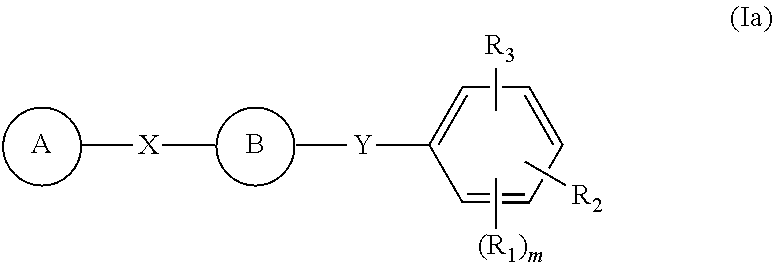
wherein
A is substituted or unsubstituted single-, fused- or multiple-ring, aryl or (hetero)cyclic ring systems; substituted or unsubstituted, saturated or unsaturated N-heterocycles; substituted or unsubstituted, saturated or unsaturated S-heterocycles; substituted or unsubstituted, saturated or unsaturated O-heterocycles; substituted or unsubstituted, saturated or unsaturated cyclic hydrocarbons; or substituted or unsubstituted, saturated or unsaturated mixed heterocycles;
B is


R1, R2 and R3 are independently hydrogen, O-alkyl, O-haloalkyl, F, Cl, Br, I, haloalkyl, CF3, CN, —CH2CN, NH2, hydroxyl, —(CH2)iNHCH3, —(CH2)iNH2, —(CH2)iN(CH3)2, —OC(O)CF3, C1-C5 linear or branched alkyl, haloalkyl, alkylamino, aminoalkyl, —OCH2Ph, —NHCO-alkyl, COOH, —C(O)Ph, C(O)O-alkyl, C(O)H, —C(O)NH2 or NO2;
R10 and R11 are independently hydrogen, O-alkyl, O-haloalkyl, F, Cl, Br, I, haloalkyl, CF3, CN, —CH2CN, NH2, hydroxyl, —(CH2)iNHCH3, —(CH2)iNH2, —(CH2)iN(CH3)2, —OC(O)CF3, C1-C5 linear or branched alkyl, haloalkyl, alkylamino, aminoalkyl, —OCH2Ph, —NHCO-alkyl, COOH, —C(O)Ph, C(O)O-alkyl, C(O)H, —C(O)NH2 or NO2;
X is a bond, NH, C1 to C5 hydrocarbon, O, or S;
Y is a bond, —C═O, —C═S, —C═N—NH2, —C═N—OH, —CH—OH, —C═CH—CN, —C═N—CN, —CH═CH—, —C═C(CH3)2, —C═N—OMe, —(C═O)—NH, —NH—(C═O), —(C═O)—O, —O—(C═O), —(CH2)1-5—(C═O), (C═O)—(CH2)1-5, —(SO2)—NH—, —NH—(SO2)—, SO2, SO or S;
wherein said A ring is optionally substituted by 1-5 substituents which are independently O-alkyl, O-haloalkyl, F, Cl, Br, I, haloalkyl, CF3, CN, —CH2CN, NH2, hydroxyl, —(CH2)iNHCH3, —(CH2)iNH2, —(CH2)iN(CH3)2, —OC(O)CF3, C1-C5 linear or branched alkyl, haloalkyl, alkylamino, aminoalkyl, —OCH2Ph, —NHCO-alkyl, COOH, —C(O)Ph, C(O)O-alkyl, C(O)H, —C(O)NH2 or NO2;
i is an integer between 0-5;
l is an integer between 1-2;
m is an integer between 1-3;
wherein
if B is a benzene ring, a thiophene ring, a furan ring or an indole ring then X is not a bond or CH2 and A is not indole;
if B is indole then X is not O;
or its pharmaceutically acceptable salt, hydrate, polymorph, metabolite, tautomer or isomer.

wherein


R1, R2, R3, R4, R5 and R6 are independently hydrogen, O-alkyl, O-haloalkyl, F, Cl, Br, I, haloalkyl, CF3, CN, —CH2CN, NH2, hydroxyl, —(CH2)iNHCH3, —(CH2)iNH2, —(CH2)iN(CH3)2, —OC(O)CF3, C1-C5 linear or branched alkyl, haloalkyl, alkylamino, aminoalkyl, —OCH2Ph, —NHCO-alkyl, COOH, —C(O)Ph, C(O)O-alkyl, C(O)H, —C(O)NH2 or NO2;
R10 and R11 are independently hydrogen, O-alkyl, O-haloalkyl, F, Cl, Br, I, haloalkyl, CF3, CN, —CH2CN, NH2, hydroxyl, —(CH2)iNHCH3, —(CH2)iNH2, —(CH2)iN(CH3)2, —OC(O)CF3, C1-C5 linear or branched alkyl, haloalkyl, alkylamino, aminoalkyl, —OCH2Ph, —NHCO-alkyl, COOH, —C(O)Ph, C(O)O-alkyl, C(O)H, —C(O)NH2 or NO2;
X is a bond, NH, C1 to C5 hydrocarbon, O, or S;
Y is a bond, —C═O, —C═S, —C═N—NH2, —C═N—OH, —CH—OH, —C═CH—CN, —C═N—CN, —CH═CH—, C═C(CH3)2, —C═N-OMe, —(C═O)—NH, —NH—(C═O), —(C═O)—O, —O—(C═O), —(CH2)1-5—(C═O), (C═O)—(CH2)1-5, —NH—(SO2)—, SO2, SO or S;
i is an integer between 0-5;
l is an integer between 1-2;
n is an integer between 1-3; and
m is an integer between 1-3;
wherein
if B is indole then X is not 0;
or its pharmaceutically acceptable salt, hydrate, polymorph, metabolite, tautomer or isomer.

wherein
B is


R4, R5 and R6 are independently hydrogen, O-alkyl, O-haloalkyl, F, Cl, Br, I, haloalkyl, CF3, CN, —CH2CN, NH2, hydroxyl, —(CH2)iNHCH3, —(CH2)iNH2, —(CH2)iN(CH3)2, —OC(O)CF3, C1-C5 linear or branched alkyl, haloalkyl, alkylamino, aminoalkyl, —OCH2Ph, —NHCO-alkyl, COOH, —C(O)Ph, C(O)O-alkyl, C(O)H, —C(O)NH2 or NO2; and
R10 and R11 are independently hydrogen, O-alkyl, O-haloalkyl, F, Cl, Br, I, haloalkyl, CF3, CN, —CH2CN, NH2, hydroxyl, —(CH2)iNHCH3, —(CH2)iNH2, —(CH2)iN(CH3)2, —OC(O)CF3, C1-C5 linear or branched alkyl, haloalkyl, alkylamino, aminoalkyl, —OCH2Ph, —NHCO-alkyl, COOH, —C(O)Ph, C(O)O-alkyl, C(O)H, —C(O)NH2 or NO2;
X is a bond, NH, C1 to C5 hydrocarbon, O, or S;
Y is a bond, —C═O, —C═S, —C═N—NH2, —C═N—OH, —CH—OH, —C═CH—CN, —C═N—CN, —CH═CH—, C═C(CH3)2, —C═N-OMe, —(C═O)—NH, —NH—(C═O), —(C═O)—O, —O—(C═O), —(CH2)1-5—(C═O), (C═O)—(CH2)1-5, —(SO2)—NH—, —NH—(SO2)—, SO2, SO or S;
i is an integer between 0-5;
l is an integer between 1-2; and
n is an integer between 1-3;
wherein
if B is indole then X is not 0; or its pharmaceutically acceptable salt, hydrate, polymorph, metabolite, tautomer or isomer.

wherein ring A is an indolyl;
B is


R1 and R2 are independently hydrogen, O-alkyl, O-haloalkyl, F, Cl, Br, I, haloalkyl, CF3, CN, —CH2CN, NH2, hydroxyl, —(CH2)iNHCH3, —(CH2)iNH2, —(CH2)iN(CH3)2, —OC(O)CF3, C1-C5 linear or branched alkyl, haloalkyl, alkylamino, aminoalkyl, —OCH2Ph, —NHCO-alkyl, COOH, —C(O)Ph, C(O)O-alkyl, C(O)H, —C(O)NH2 or NO2;
R10 and R11 are independently hydrogen, O-alkyl, O-haloalkyl, F, Cl, Br, I, haloalkyl, CF3, CN, —CH2CN, NH2, hydroxyl, —(CH2)iNHCH3, —(CH2)iNH2, —(CH2)iN(CH3)2, —OC(O)CF3, C1-C5 linear or branched alkyl, haloalkyl, alkylamino, aminoalkyl, —OCH2Ph, —NHCO-alkyl, COOH, —C(O)Ph, C(O)O-alkyl, C(O)H, —C(O)NH2 or NO2;
X is a bond, NH, C1 to C5 hydrocarbon, O, or S;
Y is a bond, C═O, —C═S, —C═N—NH2, —C═N—OH, —CH—OH, —C═CH—CN, —C═N—CN, —CH═CH—, C═C(CH3)2, —C═N-OMe, —(C═O)—NH, —NH—(C═O), —(C═O)—O, —O—(C═O), —(CH2)1-5—(C═O), (C═O)—(CH2)1-5, —(SO2)—NH—, —NH—(SO2)—, SO2, SO or S;
wherein said A is optionally substituted by O-alkyl, O-haloalkyl, F, Cl, Br, I, haloalkyl, CF3, CN, —CH2CN, NH2, hydroxyl, —(CH2)iNHCH3, —(CH2)iNH2, —(CH2)iN(CH3)2, —OC(O)CF3, C1-C5 linear or branched alkyl, haloalkyl, alkylamino, aminoalkyl, —OCH2Ph, —NHCO-alkyl, COON, —C(O)Ph, C(O)O-alkyl, C(O)H, —C(O)NH2 or NO2; and
i is an integer between 0-5;
l is an integer between 1-2; and
m is an integer between 1-4;
wherein
if B is a benzene ring, a thiophene ring, a furan ring or an indole ring then X is not a bond or CH2;
or its pharmaceutically acceptable salt, hydrate, polymorph, metabolite, tautomer or isomer.

B is


R1, R2, R4 and R5 are independently hydrogen, O-alkyl, O-haloalkyl, F, Cl, Br, I, haloalkyl, CF3, CN, —CH2CN, NH2, hydroxyl, —(CH2)iNHCH3, —(CH2)iNH2, —(CH2)iN(CH3)2, —OC(O)CF3, C1-C5 linear or branched alkyl, haloalkyl, alkylamino, aminoalkyl, —OCH2Ph, —NHCO-alkyl, COOH, —C(O)Ph, C(O)O-alkyl, C(O)H, —C(O)NH2 or NO2; and
R10 and R11 are independently hydrogen, O-alkyl, O-haloalkyl, F, Cl, Br, I, haloalkyl, CF3, CN, —CH2CN, NH2, hydroxyl, —(CH2)iNHCH3, —(CH2)iNH2, —(CH2)iN(CH3)2, —OC(O)CF3, C1-C5 linear or branched alkyl, haloalkyl, alkylamino, aminoalkyl, —OCH2Ph, —NHCO-alkyl, COOH, —C(O)Ph, C(O)O-alkyl, C(O)H, —C(O)NH2 or NO2;
X is a bond, NH, C1 to C5 hydrocarbon, O, or S;
Y is a bond or C═O, —C═S, —C═N—NH2, —C═N—OH, —CH—OH, —C═CH—CN, —C═N—CN, —CH═CH—, C═C(CH3)2, —C═N-OMe, —(C═O)—NH, —NH—(C═O), —(C═O)—O, —O—(C═O), —(CH2)1-5—(C═O), (C═O)—(CH2)1-5, —(SO2)—NH—, —NH—(SO2)—, SO2, SO or S;
i is an integer between 0-5;
l is an integer between 1-2;
n is an integer between 1-2; and
m is an integer between 1-4;
wherein
if B is a benzene ring, a thiophene ring, a furan ring or an indole ring then X is not a bond or CH2;
or its pharmaceutically acceptable salt, hydrate, polymorph, metabolite, tautomer or isomer.

B is


R4, R5 and R6 are independently hydrogen, O-alkyl, O-haloalkyl, F, Cl, Br, I, haloalkyl, CF3, CN, —CH2CN, NH2, hydroxyl, —(CH2)iNHCH3, —(CH2)iNH2, —(CH2)iN(CH3)2, —OC(O)CF3, C1-C5 linear or branched alkyl, haloalkyl, alkylamino, aminoalkyl, —OCH2Ph, —NHCO-alkyl, COOH, —C(O)Ph, C(O)O-alkyl, C(O)H, —C(O)NH2 or NO2;
R10 and R11 are independently hydrogen, O-alkyl, O-haloalkyl, F, Cl, Br, I, haloalkyl, CF3, CN, —CH2CN, NH2, hydroxyl, —(CH2)iNHCH3, —(CH2)iNH2, —(CH2)IN(CH3)2, —OC(O)CF3, C1-C5 linear or branched alkyl, haloalkyl, alkylamino, aminoalkyl, —OCH2Ph, —NHCO-alkyl, COOH, —C(O)Ph, C(O)O-alkyl, C(O)H, —C(O)NH2 or NO2;
i is an integer between 1-5;
l is an integer between 1-2; and
n is an integer between 1-3;
or its pharmaceutically acceptable salt, hydrate, polymorph, metabolite, tautomer or isomer.
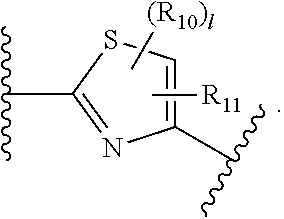
In another embodiment, B of formula V is not an oxazole. In another embodiment, B of formula V is not an oxazoline. In another embodiment, B of formula V is not an imidazole. In another embodiment, B of formula V is not a thiazole, oxazole, oxazoline or imidazole.
| Formula V | |
 |
|
| R4, R5 | |||
| Compound | B | and |
|
| 1a |
 |
H | |
| 1b |
 |
|
|
| 1c |
 |
H | |
| 1d |
 |
H | |
| 1e |
 |
 |
H |
| 1f |
 |
 |
|
| 1g |
 |
 |
|
| 1h |
 |
H | |
| 1i |
 |
H | |
| 1k |
 |
 |
H |
| 1l |
 |
 |
|
| 35a |
 |
 |
|
| 36a |
 |
 |
H |

wherein
R4, R5 and R6 are independently hydrogen, O-alkyl, O-haloalkyl, F, Cl, Br, I, haloalkyl, CF3, CN, —CH2CN, NH2, hydroxyl, —(CH2)iNHCH3, —(CH2)iNH2, —(CH2)iN(CH3)2, —OC(O)CF3, C1-C5 linear or branched alkyl, haloalkyl, alkylamino, aminoalkyl, —OCH2Ph, —NHCO-alkyl, COOH, —C(O)Ph, C(O)O-alkyl, C(O)H, —C(O)NH2 or NO2; and
Y is a bond or C═O, —C═S, —C═N—NH2, —C═N—OH, —CH—OH, —C═CH—CN, —C═N—CN, —CH═CH—, C═C(CH3)2, —C═N-OMe, —(C═O)—NH, —NH—(C═O), —(C═O)—O, —O—(C═O), —(CH2)1-5—(C═O), (C═O)—(CH2)1-5, —(SO2)—NH—, —NH—(SO2)—, SO2, SO or S;
n is an integer between 1-3; and
i is an integer from 1-5;
or its pharmaceutically acceptable salt, hydrate, polymorph, metabolite, tautomer or isomer.
| Formula VI | |
 |
|
| R4, R5 | ||
| Compound | Y | and R6 |
| 1h | —C═O | H |
| 2a | —C═C(CH3)2 | H |
| 2b | —CH—OH | H |
| 2c | —C═CH—CN | H |
| (cis and trans) | ||
| 2d | —C═N—NH2 | H |
| (cis and trans) | ||
| 2e | —C═N—OH | H |
| (cis and trans) | ||
| 2f | —C═N—OMe | H |
| (cis and trans) | ||
| 2g | —(C═O)—NH— | H |
| 2h | —NH—(C═O)— | H |
| 2i | nothing | H |
| 2j | —C═N—CN | H |
| (cis and trans) | ||
| 2k | C═O | R4 = R6 = H |
| R5 = p-F | ||
| 2l | C═O | R4 = R6 = H |
| R5 = p-OH | ||
| 2m | C═O | R4 = R6 = H |
| R5 = p-CH3 | ||
| 2n | C═O | R4 = R6 = H |
| R5 = p-CH2 —CN | ||
| 2o | C═O | R4 = R6 = H |
| R5 = p-N(CH3)2 | ||
| 2p | C═O | R4 = m-F; |
| R5 = p-F; | ||
| R6 = m-F; | ||
| n = 1 | ||
| 2q | C═O | R4 = R6 = H |
| R5 = | ||
| p-CH2—(C═O)NH2 | ||
| 2r | C═O | R4 = R6 = H |
| R5 = p-CH2NH2 | ||
| 2s | C═O | R4 = R6 = H |
| R5 = p-CH2NH—CH3 | ||
| 2t | C═O | R4 = m-OMe; |
| R5 = p-OMe; | ||
| R6 = m-OMe; | ||
| n = 1 | ||
| 2u | C═O | R4 = R6 = H |
| R5 = p-CH2NMe2 | ||


wherein
Y is a bond or C═O, —C═S, —C═N—NH2, —C═N—OH, —CH—OH, —C═CH—CN, —C═N—CN, —CH═CH—, C═C(CH3)2, —C═N-OMe, —(C═O)—NH, —NH—(C═O), —(C═O)—O, —O—(C═O), —(CH2)1-5—(C═O), (C═O)—(CH2)1-5, —(SO2)—NH—, —NH—(SO2)—, SO2, SO or S;
or its pharmaceutically acceptable salt, hydrate, polymorph, metabolite, tautomer or isomer.
| Formula VII | Compound | Y |
 |
|
S SO2 SO —(SO2)—NH— |

wherein
R4, R5 and R6 are independently hydrogen, O-alkyl, O-haloalkyl, F, Cl, Br, I, haloalkyl, CF3, CN, —CH2CN, NH2, hydroxyl, —(CH2)iNHCH3, —(CH2)iNH2, —(CH2)iN(CH3)2, —OC(O)CF3, C1-C5 linear or branched alkyl, haloalkyl, alkylamino, aminoalkyl, —OCH2Ph, —NHCO-alkyl, COOH, —C(O)Ph, C(O)O-alkyl, C(O)H, —C(O)NH2 or NO2;
Q is S, O or NH;
i is an integer between 0-5; and
n is an integer between 1-3;
or its pharmaceutically acceptable salt, hydrate, polymorph, metabolite, tautomer or isomer.
| Formula VIII | Compound | R4 | R5 | R6 | Q |
 |
|
H n = 1 H n = 1 H n = 1 H n = 1 H n = 1 | H p-CH3 p-F p-Cl H | H H H H H | S S S S N |

wherein
R4 and R5 are independently hydrogen, O-alkyl, O-haloalkyl, F, Cl, Br, I, haloalkyl, CF3, CN, —CH2CN, NH2, hydroxyl, —(CH2)iNH3, —(CH2)iNH2, —(CH2)iN(CH3)2, —OC(O)CF3, C1-C5 linear or branched alkyl, haloalkyl, alkylamino, aminoalkyl, —OCH2Ph, —NHCO-alkyl, COOH, —C(O)Ph, C(O)O-alkyl, C(O)H, —(O)NH2 or NO2;
A′ is halogen; substituted or unsubstituted single-, fused- or multiple-ring, aryl or (hetero)cyclic ring systems; substituted or unsubstituted, saturated or unsaturated N-heterocycles; substituted or unsubstituted, saturated or unsaturated S-heterocycles; substituted or unsubstituted, saturated or unsaturated O-heterocycles; substituted or unsubstituted, saturated or unsaturated cyclic hydrocarbons; or substituted or unsubstituted, saturated or unsaturated mixed heterocycles; wherein said A′ ring is optionally substituted by 1-5 substituents which are independently O-alkyl, O-haloalkyl, F, Cl, Br, I, haloalkyl, CF3, CN, —CH2CN, NH2, hydroxyl, —(CH2)iNHCH3, —(CH2)iNH2, —(CH2)iN(CH3)2, —OC(O)CF3, C1-C5 linear or branched alkyl, haloalkyl, alkylamino, aminoalkyl, —OCH2Ph, —NHCO-alkyl, COOH, —C(O)Ph, C(O)O-alkyl, C(O)H, —C(O)NH2 or NO2;
i is an integer between 1-5; and
n is an integer between 1-3;
or its pharmaceutically acceptable salt, hydrate, polymorph, metabolite, tautomer or isomer.
| Formula IX | Compound | A′ | R4, R5 |
 |
6a |
 |
|
| 6b |
 |
|
|
| 6c |
 |
|
|
| 6d | Cl | H | |

wherein
R4 and R5 are independently hydrogen, O-alkyl, O-haloalkyl, F, Cl, Br, I, haloalkyl, CF3, CN, —CH2CN, NH2, hydroxyl, —(CH2)iNHCH3, —(CH2)iNH2, —(CH2)iN(CH3)2, —OC(O)CF3, C1-C5 linear or branched alkyl, haloalkyl, alkylamino, aminoalkyl, —OCH2Ph, —NHCO-alkyl, COOH, —C(O)Ph, C(O)O-alkyl, C(O)H, —(O)NH2 or NO2;
A′ is halogen; substituted or unsubstituted single-, fused- or multiple-ring, aryl or (hetero)cyclic ring systems; substituted or unsubstituted, saturated or unsaturated N-heterocycles; substituted or unsubstituted, saturated or unsaturated S-heterocycles; substituted or unsubstituted, saturated or unsaturated O-heterocycles; substituted or unsubstituted, saturated or unsaturated cyclic hydrocarbons; or substituted or unsubstituted, saturated or unsaturated mixed heterocycles; wherein said A′ ring is optionally substituted by 1-5 substituents which are independently O-alkyl, O-haloalkyl, F, Cl, Br, I, haloalkyl, CF3, CN, —CH2CN, NH2, hydroxyl, —(CH2)iNHCH3, —(CH2)iNH2, —(CH2)iNCH3)2, —OC(O)CF3, C1-C5 linear or branched alkyl, haloalkyl, alkylamino, aminoalkyl, —OCH2Ph, —NHCO-alkyl, COOH, —C(O)Ph, C(O)O-alkyl, C(O)H, —C(O)NH2 or NO2;
i is an integer between 1-5; and
n is an integer between 1-3;
or its pharmaceutically acceptable salt, hydrate, polymorph, metabolite, tautomer or isomer.
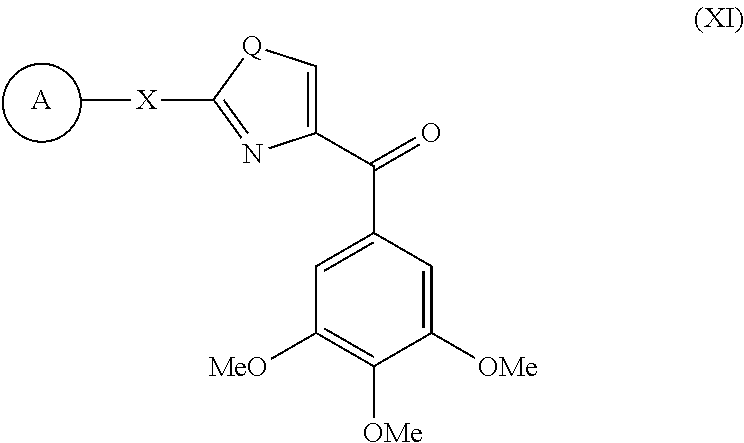
wherein
X is a bond, NH or S;
Q is O, NH or S; and
A is substituted or unsubstituted single-, fused- or multiple-ring aryl or (hetero)cyclic ring systems; substituted or unsubstituted, saturated or unsaturated N-heterocycles; substituted or unsubstituted, saturated or unsaturated S-heterocycles; substituted or unsubstituted, saturated or unsaturated O-heterocycles; substituted or unsubstituted, saturated or unsaturated cyclic hydrocarbons; or substituted or unsubstituted, saturated or unsaturated mixed heterocycles;
wherein said A ring is optionally substituted by 1-5 1-5 substituents which are independently O-alkyl, O-haloalkyl, F, Cl, Br, I, haloalkyl, CF3, CN, —CH2CN, NH2, hydroxyl, —(CH2)iNHCH3, —(CH2)iNH2, —(CH2)iN(CH3)2, —OC(O)CF3, C1-C5 linear or branched alkyl, haloalkyl, alkylamino, aminoalkyl, —OCH2Ph, —NHCO-alkyl, COOH, —C(O)Ph, C(O)O-alkyl, C(O)H, —C(O)NH2 or NO2; and
i is an integer from 0-5;
or its pharmaceutically acceptable salt, hydrate, polymorph, metabolite, tautomer or isomer.
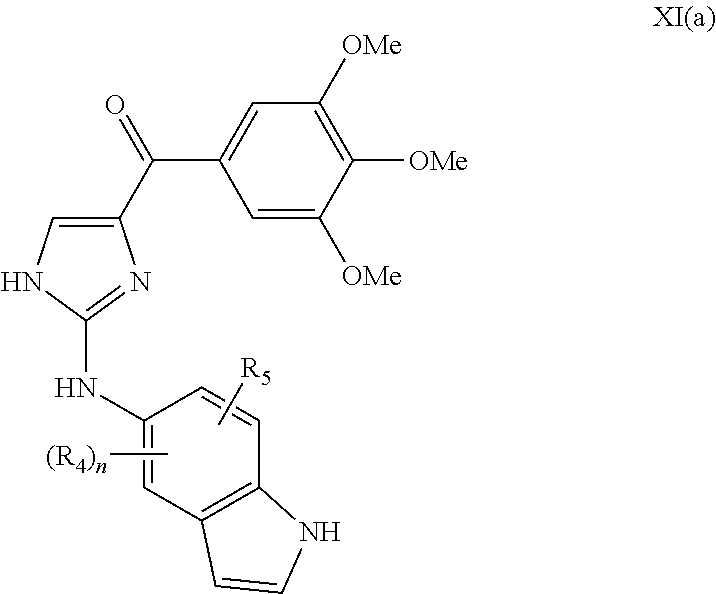
wherein R4 and R5 are independently hydrogen, O-alkyl, O-haloalkyl, F, Cl, Br, I, haloalkyl, CF3, CN, —CH2CN, NH2, hydroxyl, —(CH2)iNHCH3, —(CH2)iNH2, —(CH2)iN(CH3)2, —OC(O)CF3, C1-C5 linear or branched alkyl, haloalkyl, alkylamino, aminoalkyl, —OCH2Ph, —NHCO-alkyl, COOH, —C(O)Ph, C(O)O-alkyl, C(O)H, —C(O)NH2 or NO2;
i is an integer from 0-5; and
n is an integer between 1-4;
or its pharmaceutically acceptable salt, hydrate, polymorph, metabolite, tautomer or isomer.

wherein R4 and R5 are independently hydrogen, O-alkyl, O-haloalkyl, F, Cl, Br, I, haloalkyl, CF3, CN, —CH2CN, NH2, hydroxyl, —(CH2)iNHCH3, —(CH2)iNH2, —(CH2)iN(CH3)2, —OC(O)CF3, C1-C5 linear or branched alkyl, haloalkyl, alkylamino, aminoalkyl, —OCH2Ph, —NHCO-alkyl, COOH, —C(O)Ph, C(O)O-alkyl, C(O)H, —C(O)NH2 or NO2;
i is an integer from 0-5; and
n is an integer between 1-4;
or its pharmaceutically acceptable salt, hydrate, polymorph, metabolite, tautomer or isomer.

wherein R4 and R5 are independently hydrogen, O-alkyl, O-haloalkyl, F, Cl, Br, I, haloalkyl, CF3, CN, —CH2CN, NH2, hydroxyl, —(CH2)iNHCH3, —(CH2)iNH2, —(CH2)iN(CH3)2, —OC(O)CF3, C1-C5 linear or branched alkyl, haloalkyl, alkylamino, aminoalkyl, —OCH2Ph, —NHCO-alkyl, COOH, —C(O)Ph, C(O)O-alkyl, C(O)H, —C(O)NH2 or NO2;
i is an integer from 0-5; and
n is an integer between 1-4;
or its pharmaceutically acceptable salt, hydrate, polymorph, metabolite, tautomer or isomer.

wherein R4 and R5 are independently hydrogen, O-alkyl, O-haloalkyl, F, Cl, Br, I, haloalkyl, CF3, CN, —CH2CN, NH2, hydroxyl, —(CH2)iNHCH3, —(CH2)iNH2, —(CH2)iN(CH3)2, —OC(O)CF3, C1-C5 linear or branched alkyl, haloalkyl, alkylamino, aminoalkyl, —OCH2Ph, —NHCO-alkyl, COOH, —C(O)Ph, C(O)O-alkyl, C(O)H, —C(O)NH2 or NO2;
i is an integer from 0-5; and
n is an integer between 1-4;
or its pharmaceutically acceptable salt, hydrate, polymorph, metabolite, tautomer or isomer.

wherein R4 and R5 are independently hydrogen, O-alkyl, O-haloalkyl, F, Cl, Br, I, haloalkyl, CF3, CN, —CH2CN, NH2, hydroxyl, —(CH2)iNHCH3, —(CH2)iNH2, —(CH2)iN(CH3)2, —OC(O)CF3, C1-C5 linear or branched alkyl, haloalkyl, alkylamino, aminoalkyl, —OCH2Ph, —NHCO-alkyl, COOH, —C(O)Ph, C(O)O-alkyl, C(O)H, —C(O)NH2 or NO2;
i is an integer from 0-5; and
n is an integer between 1-4;
or its pharmaceutically acceptable salt, hydrate, polymorph, metabolite, tautomer or isomer.


| | structure | |
| 8 |
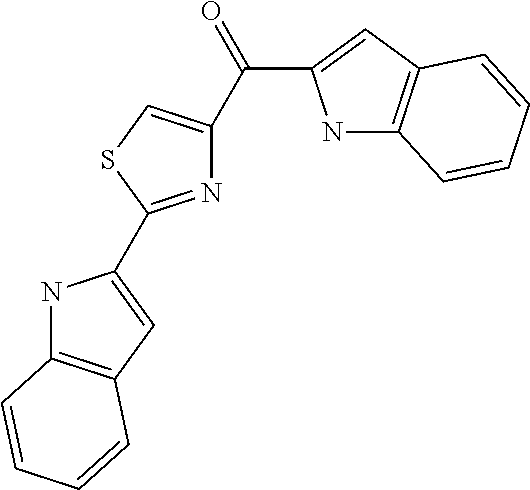 |
| 9 |
 |
| 10 |
 |
| 11 |
 |
| 12 |
 |
| 13 |
 |
| 14 |
 |
| 16 |
 |
| 17 |
 |
| 18 |
 |
| 19 |
 |
| 20 |
 |
| 21 |
 |
| 22 |
 |
| 23 |
 |
| 24 |
 |
| 25 |
 |
| 26 |
 |
| 27 |
 |
| 28 |
 |
| 29 |
 |
| 30 |
 |
| 32 |
 |
| 33 |
 |
| 34 |
 |
| 35 |
 |
| 40 |
 |
| 41 |
 |
| 42 |
 |
| 43 |
 |
| 44 |
 |
| 45 |
 |
| 46 |
 |
| 47 |
 |
| 48 |
 |
| 49 |
 |
| 50 |
 |
| 51 |
 |
| 52 |
 |
| 53 |
 |
| 54 |
 |


wherein R10 and R11 are independently hydrogen, O-alkyl, O-haloalkyl, F, Cl, Br, I, haloalkyl, CF3, CN, —CH2CN, NH2, hydroxyl, —(CH2)iNHCH3, —(CH2)iNH2, —(CH2)iN(CH3)2, —OC(O)CF3, C1-C5 linear or branched alkyl, haloalkyl, alkylamino, aminoalkyl, —OCH2Ph, —NHCO-alkyl, COOH, —C(O)Ph, C(O)O-alkyl, C(O)H, —C(O)NH2 or NO2.

In another embodiment the B group is

In another embodiment the B group is

In another embodiment the B group is

In another embodiment the B group is

In another embodiment the B group is

In another embodiment the B group is

In another embodiment the B group is

In another embodiment the B group is

In another embodiment the B group is

In another embodiment the B group is

In another embodiment the B group is

In another embodiment the B group is

In another embodiment the B group is

In another embodiment the B group is

In another embodiment the B group is
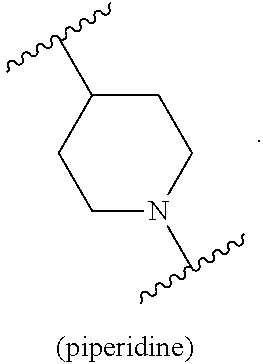
In another embodiment the B group is

In another embodiment the B group is

In another embodiment the B group is


wherein R10 and R11 are independently H and l is 1. In another embodiment, R10 and R11 are independently O-alkyl. In another embodiment, R10 and R11 are independently O-haloalkyl. In another embodiment, R10 and R11 are independently F. In another embodiment, R10 and R11 are independently Cl. In another embodiment, R10 and R11 are independently Br. In another embodiment, R10 and R11 are independently I. In another embodiment, R10 and R11 are independently haloalkyl. In another embodiment, R10 and R11 are independently CF3. In another embodiment, R10 and R11 are independently CN. In another embodiment, R10 and R11 are independently —CH2CN. In another embodiment, R10 and R11 are independently NH2. In another embodiment, R10 and R11 are independently hydroxyl. In another embodiment, R10 and R11 are independently —(CH2)iNHCH3. In another embodiment, R10 and R11 are independently —(CH2)iNH2. In another embodiment, R10 and R11 are independently —(CH2)iN(CH3)2. In another embodiment, R10 and R11, are independently —OC(O)CF3. In another embodiment, R10 and R11 are independently C1-C5 linear or branched alkyl. In another embodiment, R10 and R11 are independently C1-C5 linear or branched haloalkyl. In another embodiment, R10 and R11 are independently C1-C5 linear or branched alkylamino. In another embodiment, R10 and R11, are independently C1-C5 linear or branched aminoalkyl. In another embodiment, R10 and R11 are independently —OCH2Ph. In another embodiment, R10 and R11 are independently —NHCO-alkyl. In another embodiment, R10 and R11 are independently COOH. In another embodiment, R10 and R11 are independently —C(O)Ph. In another embodiment, R10 and R11 are independently C(O)O-alkyl. In another embodiment, R10 and R11 are independently C(O)H. In another embodiment, R10 and R11 are independently —C(O)NH2. In another embodiment, R10 and R11 are independently NO2.

wherein R10 and R11 are independently H and l is 1. In another embodiment, R10 and R11 are independently O-alkyl. In another embodiment, R10 and R11 are independently O-haloalkyl. In another embodiment, R10 and R11 are independently F. In another embodiment, R10 and R11 are independently Cl. In another embodiment, R10 and R11 are independently Br. In another embodiment, R10 and R11 are independently I. In another embodiment, R10 and R11 are independently haloalkyl. In another embodiment, R10 and R11 are independently CF3. In another embodiment, R10 and R11 are independently CN. In another embodiment, R10 and R11 are independently —CH2CN. In another embodiment, R10 and R11 are independently NH2. In another embodiment, R10 and R11 are independently hydroxyl. In another embodiment, R10 and R11 are independently —(CH2)iNHCH3. In another embodiment, R10 and R11 are independently —(CH2)iNH2. In another embodiment, R10 and R11 are independently —(CH2)iN(CH3)2. In another embodiment, R10 and R11 are independently —OC(O)CF3. In another embodiment, R10 and R11 are independently C1-C5 linear or branched alkyl. In another embodiment, R10 and R11 are independently C1-C5 linear or branched haloalkyl. In another embodiment, R10 and R11 are independently C1-C5 linear or branched alkylamino. In another embodiment, R10 and R11 are independently C1-C5 linear or branched aminoalkyl. In another embodiment, R10 and R11 are independently —OCH2Ph. In another embodiment, R10 and R11 are independently —NHCO-alkyl. In another embodiment, R10 and R11 are independently COOH. In another embodiment, R10 and R11 are independently —C(O)Ph. In another embodiment, R10 and R11 are independently C(O)O-alkyl. In another embodiment, R10 and R11 are independently C(O)H. In another embodiment, R10 and R11 are independently —C(O)NH2. In another embodiment, R10 and R11 are independently NO2.

wherein R10 and R11 are independently H and l is 1. In another embodiment, R10 and R11 are independently O-alkyl. In another embodiment, R10 and R11 are independently O-haloalkyl. In another embodiment, R10 and R11 are independently F. In another embodiment, R10 and R11 are independently Cl. In another embodiment, R10 and R11 are independently Br. In another embodiment, R10 and R11 are independently I. In another embodiment, R10 and R11 are independently haloalkyl. In another embodiment, R10 and R11 are independently CF3. In another embodiment, R10 and R11 are independently CN. In another embodiment, R10 and R11 are independently —CH2CN. In another embodiment, R10 and R11 are independently NH2. In another embodiment, R10 and R11 are independently hydroxyl. In another embodiment, R10 and R11 are independently —(CH2)iNHCH3. In another embodiment, R10 and R11 are independently —(CH2)iNH2. In another embodiment, R10 and R11 are independently —(CH2)iN(CH3)2. In another embodiment, R10 and R11, are independently —OC(O)CF3. In another embodiment, R10 and R11 are independently C1-C5 linear or branched alkyl. In another embodiment, R10 and R11 are independently C1-C5 linear or branched haloalkyl. In another embodiment, R10 and R11 are independently C1-C5 linear or branched alkylamino. In another embodiment, R10 and R11 are independently C1-C5 linear or branched aminoalkyl. In another embodiment, R10 and R11 are independently —OCH2Ph. In another embodiment, R10 and R11 are independently —NHCO-alkyl. In another embodiment, R10 and R11 are independently COOH. In another embodiment, R10 and R11 are independently —C(O)Ph. In another embodiment, R10 and R11 are independently C(O)O-alkyl. In another embodiment, R10 and R11 are independently C(O)H. In another embodiment, R10 and R11 are independently —C(O)NH2. In another embodiment, R10 and R11 are independently NO2.

wherein,
P and Q are independently H or

W is C═O, C═S, SO2 or S═O;
wherein at least one of Q or P is not hydrogen;
R1 and R4 are independently H, O-alkyl, I, Br, Cl, F, alkyl, haloalkyl, aminoalkyl, OCH2Ph, OH, CN, NO2, —NHCO-alkyl, COOH, —(CH2)iNHCH3, —(CH2)iNH2, —(CH2)iN(CH3)2; C(O)O-alkyl or C(O)H; wherein at least one of R1 and R4 is not hydrogen;
R2 and R5 are independently H, O-alkyl, I, Br, Cl, F, alkyl, haloalkyl, aminoalkyl, OCH2Ph, OH, CN, NO2, —NHCO-alkyl, COOH, C(O)O-alkyl or C(O)H;
m is an integer between 1-4;
i is an integer between 0-5; and
n is an integer between 1-4;
or its pharmaceutically acceptable salt, hydrate, polymorph, metabolite, tautomer or isomer.

wherein
Z is O or S;
R1 and R4 are independently H, O-alkyl, I, Br, Cl, F, alkyl, haloalkyl, aminoalkyl, OCH2Ph, OH, CN, NO2, —NHCO-alkyl, haloalkyl, aminoalkyl, —(CH2)iNHCH3, —(CH2)iNH2, —(CH2)iN(CH3)2; COOH, C(O)O-alkyl or C(O)H; wherein at least one of R1 and R4 is not hydrogen;
R2 and R5 are independently H, O-alkyl, I, Br, Cl, F, alkyl, haloalkyl, aminoalkyl, —(CH2)iNHCH3, —(CH2)iNH2, —(CH2)iN(CH3)2; OCH2Ph, OH, CN, NO2, —NHCO-alkyl, COOH, C(O)O-alkyl or C(O)H;
m is an integer between 1-4;
i is an integer between 0-5; and
n is an integer between 1-4;
or its pharmaceutically acceptable salt, hydrate, polymorph, metabolite, tautomer or isomer.

wherein R1 and R4 are independently H, O-alkyl, I, Br, Cl, F, alkyl, haloalkyl, aminoalkyl, —(CH2)iNHCH3, —(CH2)iNH2, —(CH2)iN(CH3)2, OCH2Ph, OH, CN, NO2, —NHCO-alkyl, COOH, C(O)O-alkyl or C(O)H; wherein at least one of R1 and R4 is not hydrogen;
R2 and R5 are independently H, O-alkyl, I, Br, Cl, F, alkyl, haloalkyl, aminoalkyl, OCH2Ph, OH, CN, NO2, —NHCO-alkyl, COOH, C(O)O-alkyl or C(O)H;
m is an integer between 1-4;
i is an integer between 0-5; and
n is an integer between 1-4;
or its pharmaceutically acceptable salt, hydrate, polymorph, metabolite, tautomer or isomer.

wherein R1 and R4 are independently H, O-alkyl, I, Br, Cl, F, alkyl, haloalkyl, aminoalkyl, —(CH2)iNHCH3, —(CH2)iNH2, —(CH2)iN(CH3)2, OCH2Ph, OH, CN, NO2, —NHCO-alkyl, COOH, C(O)O-alkyl or C(O)H; wherein at least one of R1 and R4 is not hydrogen;
R2 and R5 are independently H, O-alkyl, I, Br, Cl, F, alkyl, haloalkyl, aminoalkyl, —(CH2)iNHCH3, —(CH2)iNH2, —(CH2)iN(CH3)2, OCH2Ph, OH, CN, NO2, —NHCO-alkyl, COOH, C(O)O-alkyl or C(O)H;
R9 is H, linear or branched, substituted or unsubstituted alkyl, substituted or unsubstituted aryl, CH2Ph, substituted berizyl, haloalkyl, aminoalkyl, OCH2Ph, substituted or unsubstituted SO2-Aryl, substituted or unsubstituted —(C═O)-Aryl or OH;
wherein substitutions are independently selected from the group of hydrogen (e.g., no substitution at a particular position), hydroxyl, an aliphatic straight- or branched-chain C1 to C10 hydrocarbon, alkoxy, haloalkoxy, aryloxy, nitro, cyano, alkyl-CN, halo (e.g., F, Cl, Br, I), haloalkyl, dihaloalkyl, dihaloalkyl, COOH, C(O)Ph, C(O)-alkyl, C(O)O-alkyl, C(O)H, C(O)NH2, —OC(O)CF3, OCH2Ph, amino, aminoalkyl, alkylamino, mesylamino, dialkylamino, arylamino, amido, NHC(O)-alkyl, urea, alkyl-urea, alkylamido (e.g., acetamide), haloalkylamido, arylamido, aryl, and C5 to C7 cycloalkyl, arylalkyl, and combinations thereof;
m is an integer between 1-4;
i is an integer between 0-5; and
n is an integer between 1-4;
or its pharmaceutically acceptable salt, hydrate, polymorph, metabolite, tautomer or isomer.

wherein R4 and R5 are independently H, O-alkyl, I, Br, Cl, F, alkyl, haloalkyl, aminoalkyl, —(CH2)iNHCH3, —(CH2)iNH2, —(CH2)iN(CH3)2, OCH2Ph, OH, CN, NO2, —NHCO-alkyl, COOH, C(O)O-alkyl or C(O)H;
i is an integer between 0-5; and
n is an integer between is 1-4;
or its pharmaceutically acceptable salt, hydrate, polymorph, metabolite, tautomer or isomer.

wherein R4 and R5 are independently H, O-alkyl, I, Br, Cl, F, alkyl, haloalkyl, aminoalkyl, —(CH2)iNHCH3, —(CH2)iNH2, —(CH2)iN(CH3)2, OCH2Ph, OH, CN, NO2, —NHCO-alkyl, COOH, C(O)O-alkyl or C(O)H;
R3 is I, Br, Cl, or F;
i is an integer between 0-5; and
n is an integer between 1-4;
or its pharmaceutically acceptable salt, hydrate, polymorph, metabolite, tautomer or isomer.

wherein R4 is H, O-alkyl, I, Br, Cl, F, alkyl, haloalkyl, aminoalkyl, OCH2Ph, OH, CN, NO2, —NHCO-alkyl, COOH, C(O)O-alkyl or C(O)H;
wherein R1 and R2 are independently H, O-alkyl, I, Br, Cl, F, alkyl, haloalkyl, aminoalkyl, OCH2Ph, OH, CN, NO2, —NHCO-alkyl, COOH, C(O)O-alkyl or C(O)H;
and
m is an integer between 1-4;
or its pharmaceutically acceptable salt, hydrate, polymorph, metabolite, tautomer or isomer.
In one embodiment, R4 of compound of formula XVII is halogen. In another embodiment, R4 is F. In another embodiment, R4 is Cl. In another embodiment R4 is Br. In another embodiment R4 is I. In another embodiment, R4 is OCH3. In another embodiment, R4 is CH3. In another embodiment, R4 is N(Me)2. In another embodiment, R4 is CF3. In another embodiment, R4 is OH. In another embodiment, R4 is OBn. In another embodiment, R1 of compound of formula XVII is halogen. In another embodiment, R1 of compound of formula XVII is F. In another embodiment, R1 of compound of formula XVII is Cl. In another embodiment, R1 of compound of formula XVII is Br. In another embodiment, R1 of compound of formula XVII is I. In another embodiment, R1 of compound of formula XVII is OCH3. In another embodiment, R1 of compound of formula XVII is OCH3, m is 3 and R2 is H. In another embodiment, R1 of compound of formula XVII is F, m is 1 and R2 is H. In another embodiment, R4 is F; R2 is hydrogen; n is 3 and R1 is OCH3. In another embodiment, R4 is OCH3; R2 is hydrogen; n is 3 and R1 is OCH3. In another embodiment, R4 is CH3; R2 is hydrogen; n is 3 and R1 is OCH3. In another embodiment, R4 is Cl; R2 is hydrogen; n is 3 and R1 is OCH3. In another embodiment, R4 is N(Me)2; R2 is hydrogen; n is 3 and R1 is OCH3. In one embodiment, R4 of compound of formula XVII is halogen, R1 is H and R2 is halogen. In one embodiment, R4 of compound of formula XVII is halogen, R1 is halogen and R2 is H. In one embodiment, R4 of compound of formula XVII is alkoxy, R1 is halogen and R2 is H. In one embodiment, R4 of compound of formula XVII is methoxy, R1 is halogen and R2 is H. Non limiting examples of compounds of formula XVII are selected from: (2-(4-fluorophenyl)-1H-imidazol-4-yl)(3,4,5-trimethoxyphenyl)methanone (12ba), (2-(4-methoxyphenyl)-1H-imidazol-4-yl)(3,4,5-trimethoxyphenyl)methanone (12ca), (4-fluorophenyl)(2-(4-methoxyphenyl)-1H-imidazol-4-yl)methanone (12cb), (2-(p-tolyl)-1H-imidazol-4-yl)(3,4,5-trimethoxyphenyl)methanone (12da), (4-fluorophenyl)(2-(p-tolyl)-1H-imidazol-4-yl)methanone (12 db), (4-Hydroxy-3,5-dimethoxyphenyl)(2-(p-tolyl)-1H-imidazol-4-yl)methanone (12dc), (2-(4-chlorophenyl)-1H-imidazol-4-yl)(3,4,5-trimethoxyphenyl)methanone (12fa), (2-(4-chlorophenyl)-1H-imidazol-4-yl)(4-fluorophenyl)methanone (12fb), (2-(4-chlorophenyl)-1H-imidazol-4-yl)(3,4,5-trihydroxyphenyl)methanone (13fa), (2-(4-(dimethylamino)phenyl)-1H-imidazol-4-yl)(3,4,5-trimethoxyphenyl)methanone (12ga), (2-(4-(dimethylamino)phenyl)-1H-imidazol-4-yl)(4-fluorophenyl)methanone (12gb), (2-(4-(benzyloxy)phenyl)-1H-imidazol-4-yl)(4-fluorophenyl)methanone (12jb), (2-(4-hydroxyphenyl)-1H-imidazol-4-yl)(3,4,5-trimethoxyphenyl)methanone (12ka), (2-(4-bromophenyl)-1H-imidazol-4-yl)(3,4,5-trimethoxyphenyl)methanone (12la), (2-(4-(trifluoromethyl)phenyl)-1H-imidazol-4-yl)(3,4,5-trimethoxyphenyl)methanone (12pa).


wherein
W is C═O, C═S, SO2 or S═O;
R4 and R7 are independently H, O-alkyl, I, Br, Cl, F, alkyl, haloalkyl, aminoalkyl, —(CH2)iNHCH3, —(CH2)iNH2, —(CH2)iN(CH3)2, OCH2Ph, OH, CN, NO2, —NHCO-alkyl, COOH, C(O)O-alkyl or C(O)H;
R5 and R8 are independently H, O-alkyl, I, Br, Cl, F, alkyl, haloalkyl, aminoalkyl, —(CH2)iNHCH3, —(CH2)iNH2, —(CH2)iN(CH3)2, OCH2Ph, OH, CN, NO2, —NHCO-alkyl, COOH, C(O)O-alkyl or C(O)H;
n is an integer between 1-4;
i is an integer between 0-5; and
q is an integer between 1-4;
or its pharmaceutically acceptable salt, hydrate, polymorph, metabolite, tautomer or isomer.

wherein
W is C═O, C═S, SO2; S═O;
R1, R4 and R7 are independently H, O-alkyl, I, Br, Cl, F, alkyl, haloalkyl, aminoalkyl, —(CH2)iNHCH3, —(CH2)iNH2, —(CH2)iN(CH3)2, OCH2Ph, OH, CN, NO2, —NHCO-alkyl, COOH, C(O)O-alkyl or C(O)H;
R2, R5 and R8 are independently H, O-alkyl, I, Br, Cl, F, alkyl, haloalkyl, aminoalkyl, —(CH2)iNHCH3, —(CH2)iNH2, —(CH2)iN(CH3)2, OCH2Ph, OH, CN, NO2, —NHCO-alkyl, COOH, C(O)O-alkyl or C(O)H;
m is an integer between 1-4;
n is an integer between 1-4;
i is an integer between 0-5; and
q is 1-4;
or its pharmaceutically acceptable salt, hydrate, polymorph, metabolite, tautomer or isomer.


wherein
R4 is H, O-alkyl, I, Br, Cl, F, alkyl, haloalkyl, aminoalkyl, —(CH2)iNHCH3, —(CH2)iNH2, —(CH2)iN(CH3)2, OCH2Ph, OH, CN, NO2, —NHCO-alkyl, COOH, C(O)O-alkyl or C(O)H; and
i is an integer between 0-5;
or its pharmaceutically acceptable salt, hydrate, polymorph, metabolite, tautomer or isomer.


wherein
A is indolyl;
Q is NH, O or S;
R1 and R2 are independently H, O-alkyl, I, Br, Cl, F, alkyl, haloalkyl, aminoalkyl, —(CH2)iNHCH3, —(CH2)iNH2, —(CH2)iN(CH3)2, OCH2Ph, OH, CN, NO2, —NHCO-alkyl, COOH, C(O)O-alkyl or C(O)H; and
wherein said A is optionally substituted by substituted or unsubstituted O-alkyl, O-haloalkyl, F, Cl, Br, I, haloalkyl, CF3, CN, —CH2CN, NH2, hydroxyl, —(CH2)iNHCH3, —(CH2)iNH2, —(CH2)iN(CH3)2, —OC(O)CF3, substituted or unsubstituted —SO2-aryl, substituted or unsubstituted C1-C5 linear or branched alkyl, substituted or unsubstituted haloalkyl, substituted or unsubstituted alkylamino, substituted or unsubstituted aminoalkyl, —OCH2Ph, substituted or unsubstituted —NHCO-alkyl, COOH, substituted or unsubstituted —C(O)Ph, substituted or unsubstituted C(O)O-alkyl, C(O)H, —C(O)NH2, NO2 or combination thereof;
i is an integer between 0-5; and
m is an integer between 1-4;
or its pharmaceutically acceptable salt, hydrate, polymorph, metabolite, tautomer o′ r isomer.

wherein
W is C═O, C═S, SO2, S═O;
A is indolyl;
R1 and R2 are independently H, O-alkyl, I, Br, Cl, F, alkyl, haloalkyl, aminoalkyl, —(CH2)iNHCH3, —(CH2)iNH2, —(CH2)iN(CH3)2, OCH2Ph, OH, CN, NO2, —NHCO-alkyl, COOH, C(O)O-alkyl or C(O)H;
R7 and R8 are independently H, O-alkyl, I, Br, Cl, F, alkyl, haloalkyl, aminoalkyl, —(CH2)iNHCH3, —(CH2)iNH2, —(CH2)iN(CH3)2, OCH2Ph, OH, CN, NO2, —NHCO-alkyl, COOH, C(O)O-alkyl or C(O)H;
wherein said A is optionally substituted by substituted or unsubstituted O-alkyl, O-haloalkyl, F, Cl, Br, I, haloalkyl, CF3, CN, —CH2CN, NH2, hydroxyl, —(CH2)iNHCH3, —(CH2)iNH2, —(CH2)iN(CH3)2, —OC(O)CF3, substituted or unsubstituted —SO2-aryl, substituted or unsubstituted C1-C5 linear or branched alkyl, substituted or unsubstituted haloalkyl, substituted or unsubstituted alkylamino, substituted or unsubstituted aminoalkyl, —OCH2Ph, substituted or unsubstituted —NHCO-alkyl, COOH, substituted or unsubstituted —C(O)Ph, substituted or unsubstituted C(O)O-alkyl, C(O)H, —C(O)NH2, NO2 or combination thereof;
i is an integer between 0-5; and
m is an integer between 1-4;
q is an integer between 1-4;
or its pharmaceutically acceptable salt, hydrate, polymorph, metabolite, tautomer or isomer.

wherein
A is indolyl;
wherein said A is optionally substituted by substituted or unsubstituted O-alkyl, O-haloalkyl, F, Cl, Br, I, haloalkyl, CF3, CN, —CH2CN, NH2, hydroxyl, —(CH2)iNHCH3, —(CH2)iNH2, —(CH2)iN(CH3)2, —OC(O)CF3, substituted or unsubstituted —SO2-aryl, substituted or unsubstituted C1-C5 linear or branched alkyl, substituted or unsubstituted haloalkyl, substituted or unsubstituted alkylamino, substituted or unsubstituted aminoalkyl, —OCH2Ph, substituted or unsubstituted —NHCO-alkyl, COOH, substituted or unsubstituted —C(O)Ph, substituted or unsubstituted C(O)O-alkyl, C(O)H, —C(O)NH2, NO2 or combination thereof;
i is an integer between 0-5;
or its pharmaceutically acceptable salt, hydrate, polymorph, metabolite, tautomer or isomer.
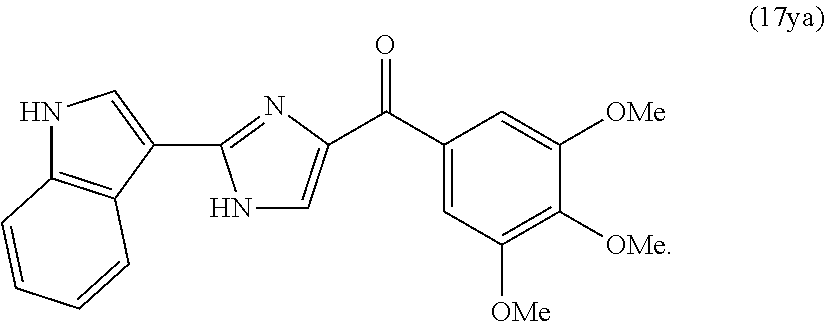

In another embodiment, P of compound of formula XII is H and Q is

In another embodiment, P of compound of formula XII is

and Q is SO2-Ph. In one embodiment. Q of compound of formula XII is H and P

is wherein W is C═O. In another embodiment W of compound of formula XII, XVIII, XIX, or XXIa is C═O. In another embodiment, W of compound of formula XII, XVIII, XIX, or XXIa is SO2. In another embodiment, W of compound of formula XII, XVIII, XIX, or XXIa is C═S. In another embodiment, W of compound of formula XII, XVIII, XIX, or XXIa is S═O.

wherein W is C═O, Non-limiting examples of compounds of formula XII-XVII and XX-XXII are selected from (2-phenyl-1H-imidazol-4-yl)(3,4,5-trimethoxyphenyl)methanone (12aa); (4-methoxyphenyl)(2-phenyl-1H-imidazol-4-yl)methanone (12ab); (3-methoxyphenyl)(2-phenyl-1H-imidazol-4-yl)methanone (12ac); (3,5-dimethoxyphenyl)(2-phenyl-1H-imidazol-4-yl)methanone (12ad); (3,4-dimethoxyphenyl)(2-phenyl-1H-imidazol-4-yl)methanone (12ae); (4-fluorophenyl)(2-phenyl-1H-imidazol-4-yl)methanone (12af); (3-fluorophenyl)(2-phenyl-1H-imidazol-4-yl)methanone (12ag); (2-phenyl-1H-imidazol-4-yl)(p-tolyl)methanone (12ah); (2-phenyl-1H-imidazol-4-yl)(m-tolyl)methanone (12ai); (2-(4-fluorophenyl)-1H-imidazol-4-yl)(3,4,5-trimethoxyphenyl)methanone (12ba); (2-(4-methoxyphenyl)-1H-imidazol-4-yl)(3,4,5-trimethoxyphenyl)methanone (12ca); (4-fluorophenyl)(2-(4-methoxyphenyl)-1H-imidazol-4-yl)methanone (12cb); (2-(p-tolyl)-1H-imidazol-4-yl)(3,4,5-trimethoxyphenyl)methanone (12da); (4-fluorophenyl)(2-(ptolyl)-1H-imidazol-4-yl)methanone (12 db); (4-fluorophenyl)(2-(p-tolyl)-1H-imidazol-4-yl)methanone hydrochloride (12 db-HCl); (4-hydroxy-3,5-dimethoxyphenyl)(2-(p-tolyl)-1H-imidazol-4-yl)methanone (12dc); (3,4,5-trimethoxyphenyl)(2-(3,4,5-trimethoxyphenyl)-1H-imidazol-4-yl)methanone (12ea); (4-fluorophenyl)(2-(3,4,5-trimethoxyphenyl)-1H-imidazol-4-yl)methanone (12eb); (2-(4-chlorophenyl)-1H-imidazol-4-yl)(3,4,5-trimethoxyphenyl)methanone (12fa); (2-(4-chlorophenyl)-1H-imidazol-4-yl)(4-fluorophenyl)methanone (12fb); (2-(4-chlorophenyl)-1H-imidazol-4-yl)(4-hydroxy-3,5-dimethoxyphenyl)methanone (12fc); (2-(4-(dimethylamino)phenyl)-1H-imidazol-4-yl)(3,4,5-trimethoxyphenyl)methanone (12ga); (2-(4-(dimethylamino)phenyl)-1H-imidazol-4-yl)(4-fluorophenyl)methanone (12gb); (2-(3,4-dimethoxyphenyl)-1H-imidazol-4-yl)(3,4,5-trimethoxyphenyl)methanone (12ha); (2-(3,4-dimethoxyphenyl)-1H-imidazol-4-yl)(4-fluorophenyl)methanone (12hb); (2-(2-(trifluoromethyl)phenyl)-1H-imidazol-4-yl)(3,4,5-trimethoxyphenyl)methanone (12la); (4-fluorophenyl)(2-(2-(trifluoromethyl)phenyl)-1H-imidazol-4-yl)methanone (12ib); (2-(4-(benzyloxy)phenyl)-1H-imidazol-4-yl)(3,4,5-trimethoxyphenyl)methanone (12ja); (2-(4-(benzyloxy)phenyl)-1H-imidazol-4-yl)(4-fluorophenyl)methanone (12jb); (2-(4-hydroxyphenyl)-1H-imidazol-4-yl)(3,4,5-trimethoxyphenyl)methanone (12ka); (2-(4-(hydroxyphenyl)-1H-imidazol-4-yl)(4-fluorophenyl)methanone (12 kb); (2-(4-bromophenyl)-1H-imidazol-4-yl)(3,4,5-trimethoxyphenyl)methanone (12la); (2-(4-(trifluoromethyl)phenyl)-1H-imidazol-4-yl)(3,4,5-trimethoxyphenyl)methanone (12pa); (3,4,5-trihydroxyphenyl)(2-(3,4,5-trihydroxyphenyl)-1H-imidazol-4-yl)methanone (13ea); (2-(4-chlorophenyl)-1H-imidazol-4-yl)(3,4,5-trihydroxyphenyl)methanone (13fa); and 2-(3,4-dihydroxyphenyl)-1H-imidazol-4-yl)(3,4,5-trihydroxyphenyl)methanone (13ha).

and Q is SO2-Ph. Non-limiting examples of compound of formula XII wherein P of compound of formula XII is

and Q is SO2-Ph are selected from (4-methoxyphenyl)(2-phenyl-1-(phenylsulfonyl)-1H-imidazol-4-yl)methanone (11ab); (3-methoxyphenyl)(2-phenyl-1-(phenylsulfonyl)-1H-imidazol-4-yl)methanone (11ac); (2-phenyl-1-(phenylsulfonyl)-1H-imidazol-4-yl)(p-tolyl)methanone (11ah); (4-fluorophenyl)(2-phenyl-1-(phenylsulfonyl)-1H-imidazol-4-yl)methanone (11af); (3-fluorophenyl)(2-phenyl-1-(phenylsulfonyl)-1H-imidazol-4-yl)methanone (11ag); (4-fluorophenyl)(2-(4-methoxyphenyl)-1-(phenylsulfonyl)-1H-imidazol-4-yl)methanone (11cb); (1-(phenylsulfonyl)-2-(p-tolyl)-1H-imidazol-4-yl)(3,4,5-trimethoxyphenyl)methanone (11da); (4-fluorophenyl)(1-(phenylsulfonyl)-2-(p-tolyl)-1H-imidazol-4-yl)methanone (11db); (1-(phenylsulfonyl)-2-(3,4,5-trimethoxyphenyl)-1H-imidazol-4-yl)(3,4,5-trimethoxyphenyl)methanone (11ea); (4-fluorophenyl)(1-(phenylsulfonyl)-2-(3,4,5-trimethoxyphenyl)-1H-imidazol-4-yl)methanone (11eb); (2-(4-chlorophenyl)-1-(phenylsulfonyl)-1H-imidazol-4-yl)(4-fluorophenyl)methanone (11fb); (2-(4-(dimethylamino)phenyl)-1-(phenylsulfonyl)-1H-imidazol-4-yl)(3,4,5-trimethoxyphenyl)methanone (11ga); (2-(4-(dimethylamino)phenyl)-1-(phenylsulfonyl)-1H-imidazol-4-yl)(4-fluorophenyl)methanone (11gb); (2-(3,4-dimethoxyphenyl)-1-(phenylsulfonyl)-1H-imidazol-4-yl)(3,4,5-trimethoxyphenyl)methanone (11ha); (2-(3,4-dimethoxyphenyl)-1-(phenylsulfonyl)-1H-imidazol-4-yl)(4-fluorophenyl)methanone (11hb); (1-(phenylsulfonyl)-2-(2-(trifluoromethyl)phenyl)-1H-imidazol-4-yl)(3,4,5-trimethoxyphenyl)methanone (11ia); (1-(phenylsulfonyl)-2-(2-(trifluoromethyl)phenyl)-1H-imidazol-4-yl)(4-fluorophenyl)methanone (nib); and (2-(4-(benzyloxy)phenyl)-1-(phenylsulfonyl)-1H-imidazol-4-yl)(4-fluorophenyl)methanone (11jb); (2-(4-bromophenyl)-1-(phenylsulfonyl)-1H-imidazol-4-yl)(3,4,5-trimethoxyphenyl)methanone (11la); (1-(phenylsulfonyl)-2-(4-(trifluoromethyl)phenyl)-1H-imidazol-4-yl)(3,4,5-trimethoxyphenyl)methanone (11pa).

In another embodiment W is C═O. In another embodiment, W of compound of formula XVIII is C═O, Non-limiting examples of compound of formula XVIII wherein W is C═O are selected from (4-methoxyphenyl)(2-phenyl-1H-imidazol-1-yl)methanone (12aba) and (2-phenyl-1H-imidazol-1-yl)(3,4,5-trimethoxyphenyl)methanone (12aaa).
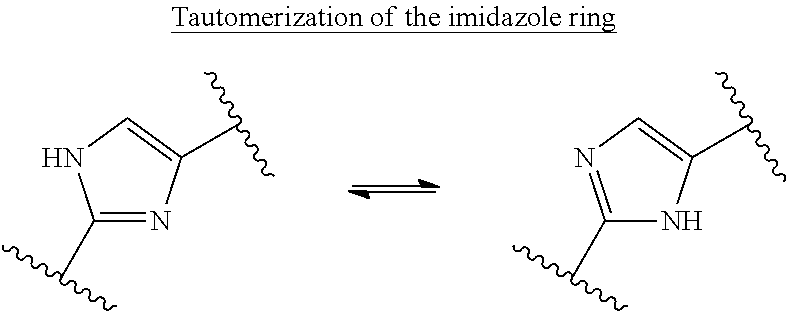


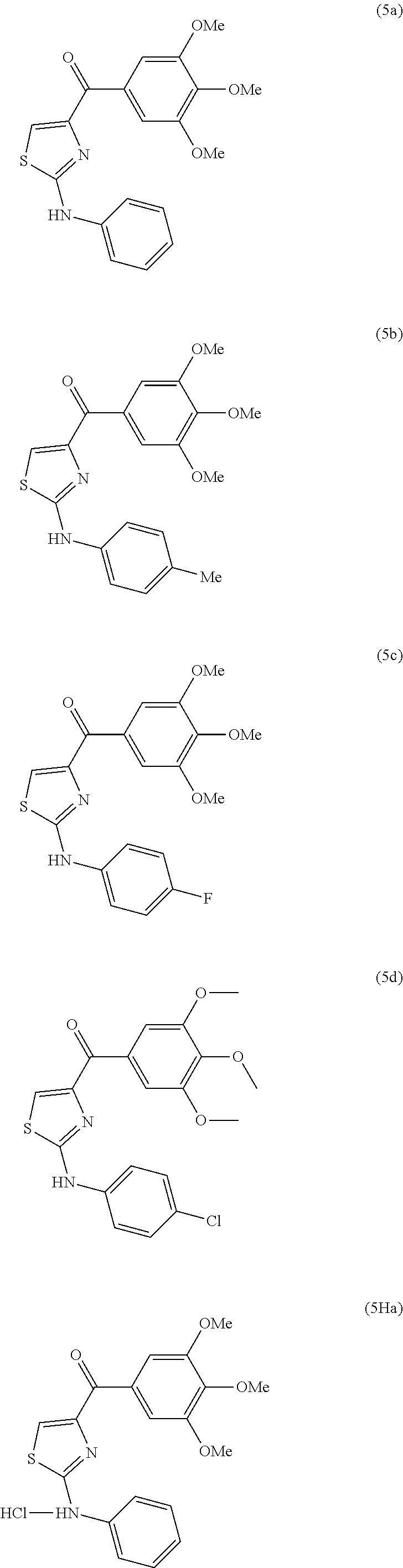


R1═CH3 (12dc)
R1═Cl (12fc)

R1=Me; R2=Bn; R3=3,4,5-(OMe)3 (12daa)
R1=Me; R2═CH3; R3=3,4,5-(OMe)3 (12dab)
R1═OMe; R2═CH3; R3═F (12cba)

R1═N(Me)2; R2=(4-OMe)PhSO2 (11gaa)
R1=Br; R2═H (12la)


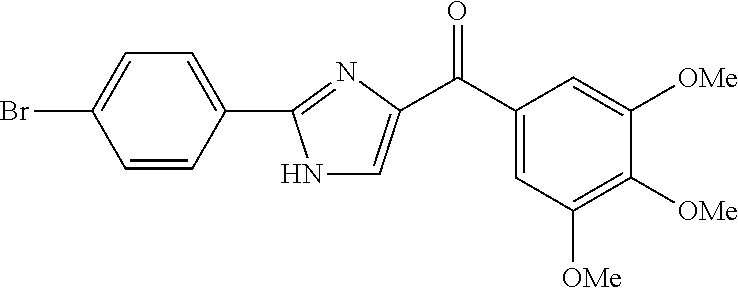


| Compound | Physicochemical Cheracterization |
| 2-phenyl-1H-imidazole (9a) | Yield: 36.8%. 1H NMR (500 MHz, DMSO- |
| d6) δ 12.52 (br, 1 H), 7.95 (d, J = 7.0 Hz, 2 H), | |
| 7.44 (t, J = 7.5 Hz, 2 H), 7.34 (t, J = 7.0 Hz, | |
| 1H), 7.25-7.27. m, 1 H), 7.04-7.07. m, 1 H). | |
| MS (ESI): calculated for C9H8N2, 144.1, found | |
| 167.1 [M + Na]+. | |
| 2-(4-fluorophenyl)-1H-imidazole (9b) | Yield: 56.5%. 1H NMR (300 MHz, DMSO- |
| d6) δ 12.46 (br, 1 H), 7.94-7.99 (m, 2 H), | |
| 7.24-7.30 (m, 2 H), 7.00-7.03 (m, 2 H). MS (ESI): | |
| calculated for C9H7FN2, 162.1, found 163 [M + H]+, | |
| 160.6 [M − H]−. | |
| 2-(4-methoxyphenyl)-1H-imidazole (9c) | Yield: 22.2%. 1H NMR (500 MHz, CDCl3) δ |
| 7.80 (d, J = 10.0 Hz, 2 H), 7.15 (s, 2 H), | |
| 3.86 (s, 3 H). MS (ESI): calculated for C10H10N2O, | |
| 174.1, found 175 [M + H]+, 172.8 [M − H]−. | |
| 2-(p-tolyl)-1H-imidazole (9d) | Yield: 36.1%. 1H NMR (500 MHz, CDCl3) δ |
| 7.64 (d, J = 7.5 Hz, 2 H), 7.16 (d, J = 7.5 Hz, 2 | |
| H), 7.12 (s, 1 H), 7.02 (s, 1 H). MS (ESI): | |
| calculated for C10H10N2, 158.1, found | |
| 159.0 [M + H]+, 156.8 [M − H]−. | |
| 2-(3,4,5-trimethoxyphenyl)-1H-imidazole (9e) | Yield: 26.0%. 1H NMR (500 MHz, CDCl3) δ |
| 7.26 (s, 2 H), 7.08 (d, J = 1.5 Hz, 2 H), 3.86 (s, | |
| 3 H), 3.82 (s, 6 H). MS (ESI): calculated for | |
| C12H14N2O3, 234.1, found 234.9 [M + H]+. | |
| 2-(4-chlorophenyl)-1H-imidazole (9f) | Yield: 19.8%. 1H NMR (500 MHz, DMSO- |
| d6) δ 13.60 (br, 1 H), 7.94 (d, J = 8.5 Hz, 2 H), | |
| 7.51 (d, J = 8.0 Hz, 2 H), 7.27 (s, 1 H), 7.03 (s, | |
| 1 H). MS (ESI): calculated for C9H7ClN2, | |
| 178.0, found 178.9 [M + H]+. | |
| 4-(1H-imidazol-2-yl)-N,N-dimethylaniline (9g) | Yield: 16.5%. 1H NMR (300 MHz, CDCl3) δ |
| 7.70 (dd, J = 7.0 Hz, 2.0 Hz, 2 H), 7.10 (s, 2 | |
| H), 6.75 (dd, J = 9.0 Hz, 2.0 Hz, 2 H), 3.02 (s, | |
| 6 H). MS (ESI): calculated for C11H13N3, | |
| 187.1, found 187.9 [M + H]+, 185.8 [M − H]−. | |
| 2-(3,4-dimethoxyphenyl)-1H-imidazole (9h) | Yield: 22.0%. 1H NMR (500 MHz, CDCl3) δ |
| 7.52 (d, J = 1.5 Hz, 1 H), 7.27-7.28 (m, 1 H), | |
| 7.14 (s, 2 H), 6.88 (d, J = 8.0 Hz, 1 H), 3.91 (s, | |
| 3 H), 3.87 (s, 3 H). MS (ESI): calculated for | |
| C11H12N2O2, 204.1, found 205.1 [M + H]+, | |
| 202.8 [M − H]−. | |
| 2-(2-(trifluoromethyl)phenyl)-1H-imidazole | Yield: 25.5%. 1H NMR (500 MHz, DMSO-d6) |
| (9i) | δ 12.31 (br, 1 H), 7.84 (d, J = 8.0 Hz, 1 H), |
| 7.76 (t, J = 8.0 Hz, 1 H), 7.65 (t, J = 7.5 Hz, 1 H), | |
| 7.16 (br, 2 H). MS (ESI): calculated for | |
| C10H7F3N2, 212.1, found 212.9 [M + H]+, | |
| 210.7 [M − H]−. | |
| 2-(4-(benzyloxy)phenyl)-1H-imidazole (9j) | Yield: 12.1%. 1H NMR (500 MHz, CDCl3) δ |
| 7.77 (d, J = 8.5 Hz, 2 H), 7.36-7.47 (m, 5 H), | |
| 7.10-7.18 (m, 2 H), 7.06 (d, J = 9.0 Hz, 2 H), | |
| 5.13 (s, 2 H). MS (ESI): calculated for | |
| C16H14N2O, 250.1, found 251.1 [M + H]+, | |
| 248.8 [M − H]−. | |
| 2-(4-Bromophenyl)-1H-imidazole (9l) | Yield: 19.5%. 1H NMR (300 MHz, CDCl3) δ |
| 12.59 (s, 1 H), 7.87 (d, J = 8.1 Hz, 2 H), 7.64 (d, | |
| J = 8.1 Hz, 1 H), 7.27 (s, 1 H), 7.04 (s, 1 H). MS | |
| (ESI) calcd for C9H7BrN2 222.0, found | |
| 222.8 [M + H]+. | |
| 2-(4-(Trifluoromethyl)phenyl)-1H-imidazole | Yield: 26.2%; 1H NMR (500 MHz, CDCl3) δ |
| (9p) | 8.03 (d, J = 8.0 Hz, 2 H), 7.66 (d, J = 8.0 Hz, 2 |
| H), 7.25 (s, 2 H). MS (ESI) calcd for C10H7F3N2 | |
| 212.1, found 213.1 [M + H]+. | |
| 2-(4-nitrophenyl)-1H-imidazole (9x) | Yield: 53.7%. 1H NMR (500 MHz, DMSO-d6) |
| δ 12.97 (br, 1 H), 8.32 (d, J = 9.0 Hz, 2 H), | |
| 8.17 (d, J = 9.0 Hz, 2 H), 7.42 (s, 1 H), 7.17 (s, 1H). | |
| MS (ESI): calculated for C9H7N3O2, 189.1, | |
| found 189.9 [M + H]+, 187.8 [M − H]−. | |
| 2-phenyl-1-(phenylsulfonyl)-1H-imidazole | Yield: 50.3%. 1H NMR (500 MHz, CDCl3) δ |
| (10a) | 7.64-7.67. (m, 1 H), 7.56 (t, J = 9.0 Hz, 1 H), |
| 7.32-7.48 (m, 9 H), 7.12-7.16 (m, 1 H). MS | |
| (ESI): calculated for C15H12N2O2S, 284.1, found | |
| 307.1 [M + Na]+. | |
| 2-(4-fluorophenyl)-1-(phenylsulfonyl)-1H- | Yield: 56.9%. 1H NMR (500 MHz, CDCl3) δ |
| imidazole (10b) | 7.66 (d, J = 2.0 Hz, 1 H), 7.58 (t, J = 10.0 Hz, 1 |
| H), 7.36-7.42 (m, 6 H), 7.12 (d, J = 2.0 Hz, 1 | |
| H), 7.06 (t, J = 10.0 Hz, 2 H). MS (ESI): | |
| calculated for C15H11FN2O2S, 302.1, found | |
| 300.8 [M − H]−. | |
| 2-(4-methoxyphenyl)-1-(phenylsulfonyl)-1H- | Yield: 40.9%. 1H NMR (500 MHz, CDCl3) δ |
| imidazole (10c) | 7.62 (d, J = 5.0 Hz, 1 H), 7.56 (tt, J = 15.0 Hz, |
| 5.0 Hz, 1 H), 7.32-7.43 (m, 6 H), 7.10 (d, J = 5.0 Hz, | |
| 1 H), 6.88 (dt, J = 16.0 Hz, 6.0 Hz, 2 H), | |
| 3.87 (s, 3 H). MS (ESI): calculated for | |
| C16H14N2O3S, 314.1, found 337.1 [M + Na]+, | |
| 312.9 [M − H]−. | |
| 1-(phenylsulfonyl)-2-(p-tolyl)-1H-imidazole | Yield: 46.6%. 1H NMR (500 MHz, CDCl3) δ |
| (10d) | 7.63 (d, J = 1.0 Hz, 1 H), 7.55 (t, J = 8.0 Hz, 1 |
| H), 7.42 (d, J = 8.0 Hz, 2 H), 7.35 (t, J = 7.5 Hz, | |
| 2 H), 7.27-7.29 (m, 2 H), 7.16 (d, J = 7.5 Hz, 2 | |
| H), 7.10 (s, 1 H), 2.41 (s, 3 H). MS (ESI): | |
| calculated for C16H14N2O2S, 298.1, found | |
| 321.1 [M + Na]+. | |
| 1-(phenylsulfonyl)-2-(3,4,5- | Yield: 55.7%. 1H NMR (500 MHz, CDCl3) δ |
| trimethoxyphenyl)-1H-imidazole (10e) | 7.68 (d, J = 1.5 Hz, 1 H), 7.55 (t, J = 7.0 Hz, 1 |
| H), 7.42 (d, J = 7.5 Hz, 2 H), 7.35 (t, J = 8.5 Hz, | |
| 2 H), 7.11 (d, J = 1.5 Hz, 2 H), 6.60 (s, 1 H), | |
| 3.90 (s, 3 H), 3.79 (s, 6 H). MS (ESI): calculated | |
| for C18H18N2O5S, 374.1, found 397.1 [M + Na]+. | |
| 2-(4-chlorophenyl)-1-(phenylsulfonyl)-1H- | Yield: 54.9%. 1H NMR (500 MHz, CDCl3) δ |
| imidazole (10f) | 7.65 (d, J = 2.0 Hz, 1 H), 7.58 (t, J = 7.5 Hz, 1 |
| H), 7.43 (d, J = 8.5 Hz, 2 H), 7.38 (t, J = 8.0 Hz, | |
| 2 H), 7.34-7.36 (m, 4 H), 7.12 (d, J = 1.5 Hz, 1 | |
| H). MS (ESI): calculated for C15H11ClN2O2S, | |
| 318.0, found 341.0 [M + Na]+. | |
| N,N-dimethyl-4-(1-(phenylsulfonyl)-1H- | Yield: 48.3%. 1H NMR (300 MHz, CDCl3) δ |
| imidazol-2-yl) aniline (10g) | 7.59 (d, J = 2.0 Hz, 1 H), 7.55 (t, J = 8.0 Hz, 1 |
| H), 7.45 (d, J = 7.5 Hz, 2 H), 7.28-7.38 (m, 4 | |
| H), 7.07 (d, J = 2.0 Hz, 1 H), 6.68 (d, J = 8.5 Hz, | |
| 2 H), 3.04 (s, 3 H). MS (ESI): calculated for | |
| C17H17N3O2S, 327.10, found 350.0 [M + Na]+, | |
| 325.9 [M − H]−. | |
| 4-(1-((4-Methoxyphenyl)sulfonyl)-1H- | Yield: 61.5%. 1H NMR (500 MHz, CDCl3) δ |
| imidazol-2-yl)-N,N-dimethylaniline (10gb) | 7.58 (d, J = 1.5 Hz, 1 H), 7.36 (t, J = 8.43 Hz, |
| 4 H), 7.03-7.09 (m, 1 H), 6.80 (d, J = 9.0 Hz, | |
| 2 H), 6.69 (d, J = 8.8 Hz, 2 H), 3.84 (s, 3 H), | |
| 3.05 (s, 6 H). MS (ESI): calculated for | |
| C17H17N3O2S, 327.1, found 358.2 [M + Na]+. | |
| 2-(3,4-dimethoxyphenyl)-1-(phenylsulfonyl)- | Yield: 60.3%. 1H NMR (500 MHz, CDCl3) δ |
| 1H-imidazole (10h) | 7.64 (d, J = 7.0 Hz, 1 H), 7.55 (t, J = 7.5 Hz, 1 |
| H), 7.40 (dd, J = 8.5 Hz, 1.5 Hz, 2 H), 7.35 (t, J = 8.0 Hz, | |
| 2H), 7.09 (d, J = 2.0 Hz, 1 H), | |
| 7.02 (dd, J = 8.0 Hz, 2.0 Hz, 1 H), 6.89 (d, J = 1.5 Hz, | |
| 1 H), 6.86 (d, J = 8.0 Hz, 1 H), 3.95 (s, 3 | |
| H), 3.81 (s, 3 H). MS (ESI): calculated for | |
| C17H16N2O4S, 344.10, found 367.0 [M + Na]+. | |
| 1-(phenylsulfonyl)-2-(2- | Yield: 58.6%. 1H NMR (500 MHz, CDCl3) δ |
| (trifluoromethyl)phenyl)-1H-imidazole (10i) | 7.64-7.67 (m, 2 H), 7.61-7.63 (m, 3 H), |
| 7.40-7.46 (m, 5 H), 7.16 (d, J = 1.5 Hz, 1 H). MS | |
| (ESI): calculated for C16H11F3N2O2S, 352.10, | |
| found 353.1 [M + H]+. | |
| 2-(4-(benzyloxy)phenyl)-1-(phenylsulfonyl)- | Yield: 62.0%; mp 102-104° C. 1H NMR (500 MHz, |
| 1H-imidazole (10j) | CDCl3) δ 7.56 (d, J = 1.0 Hz, 1 H), |
| 7.46 (t, J = 8.0 Hz, 1 H), 7.20-7.40 (m, 11 H), | |
| 7.03 (d, J = 1.0 Hz, 1H), 6.89 (t, J = 8.0 Hz, 2 H), | |
| 5.08 (s, 2 H). MS (ESI): calculated for | |
| C22H18N2O3S, 390.10, found 413.1 [M + Na]+. | |
| HPLC2: tR 18.22 min, purity 95.9%. | |
| 2-(4-Bromophenyl)-1-(phenylsulfonyl)-1H- | Yield: 61.2%. 1H NMR (500 MHz, CDCl3) δ |
| imidazole (10la) | 7.71 (d, J = 2.0 Hz, 1 H), 7.64 (t, J = 7.0 Hz, 1 |
| H), 7.57 (d, J = 9.0 Hz, 2 H), 7.49 (d, J = 7.0 Hz, | |
| 2 H), 7.45 (t, J = 9.0 Hz, 2 H), 7.34 (d, J = 8.5 Hz, | |
| 2 H), 7.18 (d, J = 1.5 Hz, 1 H). MS | |
| (ESI) calcd for C15H11BrN2O2S 362.0, found | |
| 363.0 [M + H]+. | |
| 1-(Phenylsulfonyl)-2-(4- | Yield: 36.7%; 1H NMR (500 MHz, CDCl3) δ |
| (trifluoromethyl)phenyl)-1H-imidazole (10p) | 7.75 (d, J = 2.0 Hz, 1 H), 7.69 (d, J = 8.0 Hz, 2 |
| H), 7.65 (t, J = 8.0 Hz, 1 H), 7.60 (d, J = 8.0 Hz, | |
| 2 H), 7.48 (d, J = 7.5 Hz, 2 H), 7.43 (t, J = 8.0 Hz, | |
| 2 H), 7.22 (d, J = 2.0 Hz, 1 H). MS (ESI) | |
| calcd for C16H11F3N2O2S 352.1, found 553.1 [M + H]+. | |
| 2-(4-nitrophenyl)-1-(phenylsulfonyl)-1H- | Yield: 50%; mp 145-147° C. 1H NMR (500 MHz, |
| imidazole (10x) | DMSO-d6) δ 8.28 (d, J = 8.5 Hz, 2 H), |
| 8.03 (d, J = 1.5 Hz, 1 H), 7.78 (t, J = 7.5 Hz, 1 | |
| H), 7.64-7.68 (m, 4H), 7.60 (t, J = 8.0 Hz, 2 H), | |
| 7.30 (d, J = 1.5 Hz, 1 H). MS (ESI): calculated | |
| for C15H11N3O4S, 329.10, found 352.0 [M + Na]+, | |
| 327.9 [M − H]−. HPLC2: tR 14.87 min, | |
| purity 98.8%. | |
| (4-methoxyphenyl)(2-phenyl-1- | Yield: 26.3%; mp 118-120° C. 1H NMR (500 MHz, |
| (phenylsulfonyl)-1H-imidazol-4-yl)methanone | DMSO-d6) δ 8.37 (d, J = 1.0 Hz, 1 H), |
| (11ab) | 8.15-8.18 (m, 2 H), 8.12 (d, J = 9.0 Hz, 2 H), |
| 7.56-7.64 (m, 5 H), 7.46-7.50 (m, 3 H), 7.16 (d, | |
| J = 8.0 Hz, 2 H), 3.90 (s, 3 H). MS (ESI): | |
| calculated for C23H18N2O4S, 418.10, found | |
| 419.1 [M + H]+. HPLC2: tR 17.72 min, purity | |
| 95.7%. | |
| (3-methoxyphenyl)(2-phenyl-1- | Yield: 31.2%; mp 136-138° C. 1H NMR (500 MHz, |
| (phenylsulfonyl)-1H-imidazol-4-yl)methanone | CDCl3) δ 8.35 (s, 1 H), 7.86 (d, J = 8.0 Hz, |
| (11ac) | 1 H), 7.72 (s, 1 H), 7.60 (t, J = 7.5 Hz, 1 H), |
| 7.51 (t, J = 7.5 Hz, 1 H), 7.35-7.42 (m, 9H), | |
| 7.14 (dd, J = 8.0 Hz, 2.0 Hz, 1 H), 3.88 (s, 3 H). | |
| MS (ESI): calculated for C23H18N2O4S, 418.10, | |
| found 419.1 [M + H]+. HPLC2: tR 17.72 min, | |
| purity 95.7%. | |
| (2-phenyl-1-(phenylsulfonyl)-1H-imidazol-4- | Yield: 28.9%; mp 108-110° C. 1H NMR (500 MHz, |
| yl)(p-tolyl)methanone (11ah) | CDCl3) δ 8.00 (d, J = 7.5 Hz, 2 H), |
| 7.98 (q, J = 8.0 Hz, 1.5 Hz, 2 H), 7.91 (d, J = 8.0 Hz, | |
| 1 H), 7.81 (s, 1 H), 7.44-7.48 (m, 3 H), | |
| 7.35-7.40 (m, 2 H), 7.30 (t, J = 8.0 Hz, 2 H), 7.20 (s, | |
| 2 H), 2.42 (s, 3 H). MS (ESI): calculated for | |
| C23H18N2O3S, 402.10, found 403.1 [M + H]+. | |
| HPLC2: tR 16.06 min, purity 96.2%. | |
| (4-fluorophenyl)(2-phenyl-1-(phenylsulfonyl)- | Yield: 25.4%; mp 114-116° C. 1H NMR (500 MHz, |
| 1H-imidazol-4-yl)methanone(11af) | CDCl3) δ 8.10 (q, J = 3.5 Hz, 5.5 Hz, 2 |
| H), 7.88 (d, J = 7.5 Hz, 2 H), 7.67 (t, J = 7.5 Hz, | |
| 1 H), 7.48-7.54 (m, 3 H), 7.38-7.41 (m, 5 H), | |
| 7.24 (t, J = 8.5 Hz, 2 H). MS (ESI): calculated | |
| for C22H15FN2O3S, 406.10, found 429.1 [M + Na]+. | |
| HPLC2: tR 15.43 min, purity 96.1%. | |
| (3-fluorophenyl)(2-phenyl-1-(phenylsulfonyl)- | Yield: 18.3%; mp 102-104° C. 1H NMR (500 MHz, |
| 1H-imidazol-4-yl)methanone(11ag) | CDCl3) δ 8.14 (d, J = 7.5 Hz, 1 H), |
| 7.76-7.87 (m, 3 H), 7.74 (d, J = 9.0 Hz, 1 H), | |
| 7.37-7.57 (m, 10 H), 7.38-7.41 (m, 5 H), 7.24 (t, J = 8.5 Hz, | |
| 2 H). MS (ESI): calculated for | |
| C22H15FN2O3S, 406.10, found 429.1 [M + Na]+. | |
| HPLC2: tR 15.75 min, purity 96.5%. | |
| (4-fluorophenyl)(2-(4-methoxyphenyl)-1- | Yield: 23.5%; mp 135-137° C. 1H NMR (500 MHz, |
| (phenylsulfonyl)-1H-imidazol-4-yl)methanone | CDCl3) δ 8.00 (d, J = 5.5 Hz, 2 H), |
| (11cb) | 7.74-7.76 (m, 2 H), 7.54-7.58 (m, 1 H), 7.40 (d, J = 7.0 Hz, |
| 2 H), 7.28-7.30 (m, 3 H), 7.14-7.16 (m, | |
| 2 H), 6.80-6.82 (m, 2 H), 3.80 (s, 3 H). MS | |
| (ESI): calculated for C23H17FN2O4S, 436.10, | |
| found 459.0 [M + Na]+, 434.9 [M − H]−. | |
| HPLC2: tR 16.53 min, Purity 96.1%. | |
| (1-(phenylsulfonyl)-2-(p-tolyl)-1H-imidazol- | Yield: 33.8%; 1H NMR (500 MHz, CDCl3) δ |
| 4-yl)(3,4,5-trimethoxyphenyl)methanone | 8.00 (d, J = 8.0 Hz, 2 H), 7.70 (t, J = 7.5 Hz, 1 |
| (11da) | H), 7.55 (t, J = 8.0 Hz, 2 H), 7.44 (s, 2 H), |
| 7.34 (s, 2H), 7.31 (d, J = 8.0 Hz, 2 H), 7.21 (d, J = 8.0 Hz, | |
| 2 H), 4.00 (s, 3 H), 3.98 (s, 6 H). MS | |
| (ESI): calculated for C26H24N2O6S, 492.14, | |
| found 515.2 [M + Na]+. | |
| (4-fluorophenyl)(1-(phenylsulfonyl)-2-(p- | Yield: 18.6%; mp 142-144° C. 1H NMR (500 MHz, |
| tolyl)-1H-imidazol-4-yl)methanone (11db) | CDCl3) δ 8.07 (q, J = 8.5 Hz, 5.5 Hz, 2 |
| H), 7.88 (d, J = 7.5 Hz, 2 H), 7.64 (t, J = 8.0 Hz, | |
| 1 H), 7.49 (d, J = 8.0 Hz, 2 H), 7.38 (s, 1H), | |
| 7.30 (d, J = 8.0 Hz, 2 H), 7.18-7.24 (m, 4 H), | |
| 2.43 (s, 3 H). MS (ESI): calculated for | |
| C23H17FN2O3S, 420.10, found 443.0 [M + Na]+, | |
| 418.9 [M − H]−. HPLC2: tR 17.28 min, purity | |
| 97.3%. | |
| (1-(phenylsulfonyl)-2-(3,4,5- | Yield: 21.1%; mp 135-137° C. 1H NMR (500 MHz, |
| trimethoxyphenyl)-1H-imidazol-4-yl)(3,4,5- | CDCl3) δ 7.91 (d, J = 8.0 Hz, 2 H), 7.65 (t, |
| trimethoxyphenyl)methanone (11ea) | J = 7.5 Hz, 1 H), 7.51 (t, J = 8.0 Hz, 2 H), |
| 7.44 (s, 1 H), 7.34 (s, 2 H), 6.60 (s, 2 H), 3.98 (s, 3 | |
| H), 3.96 (s, 6 H), 3.91 (s, 3 H), 3.73 (s, 6 H). | |
| MS (ESI): calculated for C28H28N2O9S, 568.2, | |
| found 569.2 [M + H]+. HPLC1: tR 17.86 min, | |
| purity 98.9%. | |
| (4-fluorophenyl)(1-(phenylsulfonyl)-2-(3,4,5- | Yield: 18.8%; mp 135-137° C. 1H NMR (500 MHz, |
| trimethoxyphenyl)-1H-imidazol-4- | CDCl3) δ 8.11 (q, J = 5.5 Hz, 3.0 Hz, 1 |
| yl)methanone (11eb) | H), 8.00-8.03 (m, 1 H), 7.82 (d, J = 7.5 Hz, 1 |
| H), 7.78 (s, 1 H), 7.64 (t, J = 7.0 Hz, 1 H), | |
| 7.48 (t, J = 8.0 Hz, 1 H), 7.42 (s, 1 H), 7.21-7.26 (m, | |
| 4 H), 6.62 (s, 1 H), 3.98 (s, 3 H), 3.96 (s, 6 H), | |
| 3.93 (s, 3 H). MS (ESI): calculated for | |
| C25H21FN2O6S, 496.10, found 497.1 [M + H]+. | |
| HPLC2: tR 15.26 min, purity 98%. | |
| (2-(4-chlorophenyl)-1-(phenylsulfonyl)-1H- | Yield: 36.8%; mp 153-155° C. 1H NMR (500 MHz, |
| imidazol-4-yl)(4-fluorophenyl)methanone | CDCl3) δ 8.06 (q, J = 5.5 Hz, 3.0 Hz, 2 H), |
| (11fb) | 7.89 (d, J = 7.5 Hz, 2 H), 7.68 (t, J = 8.0 Hz, 1 |
| H), 7.52 (t, J = 8.0 Hz, 2 H), 7.34-7.38 (m, 5H), | |
| 7.23 (t, J = 8.5 Hz, 2 H). MS (ESI): calculated | |
| for C22H14ClFN2O3S, 440.0, found 463.0 [M + Na]+. | |
| HPLC2: tR 17.72 min, purity 97.38%. | |
| (2-(4-(dimethylamino)phenyl)-1- | Yield: 32.2%; mp 157-159° C. 1H NMR (500 MHz, |
| (phenylsulfonyl)-1H-imidazol-4-yl)(3,4,5- | CDCl3) δ 7.89 (d, J = 8.0 Hz, 2 H), 7.62 (t, |
| trimethoxyphenyl)methanone (11ga) | J = 7.5 Hz, 1 H), 7.48 (t, J = 8.0 Hz, 2 H), |
| 7.43 (s, 1 H), 7.32 (d, J = 8.5 Hz, 2 H), 7.30 (s, 2H), | |
| 6.62 (d, J = 9.0 Hz, 2 H), 3.97 (s, 3 H), 3.95 (s, 6 | |
| H), 3.05 (s, 6 H). MS (ESI): calculated for | |
| C27H27N3O6S, 521.2, found 544.1 [M + Na]+, | |
| 519.8 [M − H]−. HPLC2: tR 16.00 min, purity | |
| 97.9%. | |
| (2-(4-(dimethylamino)phenyl)-1- | Yield: 38.5%; mp 125-127° C. 1H NMR (500 MHz, |
| (phenylsulfonyl)-1H-imidazol-4-yl)(4- | CDCl3) δ 8.04 (q, J = 5.5 Hz, 3.5 Hz, 2 H), |
| fluorophenyl)methanone (11gb) | 7.80 (d, J = 7.5 Hz, 2 H), 7.61 (t, J = 8.0 Hz, 1 |
| H), 7.45 (t, J = 8.0 Hz, 2 H), 7.39 (s, 1 H), | |
| 7.35 (d, J = 9.0 Hz, 2 H), 7.21 (t, J = 8.5 Hz, 2 H), | |
| 6.62 (d, J = 9.0 Hz, 2 H), 3.05 (s, 6 H). MS | |
| (ESI): calculated for C24H20FN3O3S, 449.10, | |
| found 472.1 [M + Na]+, 447.9 [M − H]−. | |
| HPLC2: tR 16.85 min, purity 96.5%. | |
| (2-(3,4-dimethoxyphenyl)-1-(phenylsulfonyl)- | Yield: 28.6%; mp 136-138° C. 1H NMR (300 MHz, |
| 1H-imidazol-4-yl)(3,4,5- | CDCl3) δ 7.92 (dd, J = 8.5 Hz, 1.5 Hz, 2 |
| trimethoxyphenyl)methanone (11ha) | H), 7.66 (t, J = 7.5 Hz, 2 H), 7.51 (t, J = 7.5 Hz, 2 |
| H), 7.43 (s, 1 H), 7.33 (s, 2 H), 7.02 (dd, J = 8.0 Hz, | |
| 2.0 Hz, 1 H), 6.91 (d, J = 2.0 Hz, 1 H), | |
| 6.86 (d, J = 8.5 Hz, 1 H), 3.98 (s, 3 H), 3.96 (s, 9 H), | |
| 3.77 (s, 3 H). MS (ESI): calculated for | |
| C27H26N2O8S, 538.10, found 561.1 [M + Na]+, | |
| 536.8 [M − H]−. HPLC2: tR 14.67 min, purity | |
| 98.2%. | |
| (2-(3,4-dimethoxyphenyl)-1-(phenylsulfonyl)- | Yield: 31.9%; mp 144-145° C. 1H NMR (300 MHz, |
| 1H-imidazol-4-yl)(4-fluorophenyl)methanone | CDCl3) δ 8.09 (q, J = 5.5 Hz, 3.5 Hz, 2 |
| (11hb) | H), 7.81 (d, J = 8.0 Hz, 2 H), 7.62 (t, J = 7.5 Hz, |
| 2 H), 7.48 (t, J = 7.5 Hz, 2 H), 7.40 (s, 1 | |
| H), 7.21-7.25 (m, 2 H), 7.04 (dd, J = 8.0 Hz, | |
| 2.0 Hz, 1 H), 6.92 (d, J = 2.0 Hz, 1 H), 6.86 (d, | |
| J = 8.5 Hz, 1 H), 3.96 (s, 3 H), 3.79 (s, 6 H). | |
| MS (ESI): calculated for C24H19FN2O5S, | |
| 466.10, found 489.1 [M + Na]+, 464.8 [M − H]−. | |
| HPLC2: tR 15.52 min, purity 97.4%. | |
| (1-(phenylsulfonyl)-2-(2- | Yield: 25.0%; mp 155-157° C. 1H NMR (500 MHz, |
| (trifluoromethyl)phenyl)-1H-imidazol-4- | DMSO-d6) δ 7.91 (d, J = 8.0 Hz, 1 H), |
| yl)(3,4,5-trimethoxyphenyl)methanone (11ia) | 7.84 (q, J = 7.5 Hz, 5.0 Hz, 2 H), 7.77-7.80 (m, 2 |
| H), 7.75 (s, 2 H), 7.66 (t, J = 8.0 Hz, 2 H), | |
| 7.56 (d, J = 7.5 Hz, 1 H), 7.18 (s, 2 H), 3.87 (s, 6 H), | |
| 3.81 (s, 3 H). MS (ESI): calculated for | |
| C26H21F3N2O6S, 546.10, found 569.0 [M + Na]+. | |
| HPLC2: tR 16.16 min, purity 98.9%. | |
| (1-(phenylsulfonyl)-2-(2- | Yield: 25.0%; mp 151-153° C. 1H NMR (500 MHz, |
| (trifluoromethyl)phenyl)-1H-imidazol-4-yl)(4- | CDCl3) δ 8.03 (q, J = 5.5 Hz, 3.0 Hz, 2 |
| fluorophenyl)methanone (11ib) | H), 7.90 (d, J = 8.0 Hz, 2 H), 7.80 (d, J = 8.0 Hz, |
| 1 H), 7.69 (q, J = 7.0 Hz, 6.5 Hz, 2 H), 7.61 (t, J = 8.0 Hz, | |
| 1 H), 7.52 (t, J = 8.0 Hz, 2 H), | |
| 7.34-7.36 (m, 2 H), 7.23 (t, J = 8.5 Hz, 2 H). MS | |
| (ESI): calculated for C23H14F4N2O3S, 474.10, | |
| found 497.0 [M + Na]+. HPLC2: tR 16.80 min, | |
| purity 98.2%. | |
| (2-(4-(benzyloxy)phenyl)-1-(phenylsulfonyl)- | Yield: 22.3.0%; mp 149-151° C. 1H NMR |
| 1H-imidazol-4-yl)(4-fluorophenyl)methanone | (500 MHz, CDCl3) δ 8.09 (q, J = 5.5 Hz, 3.5 Hz, |
| (11jb) | 2 H), 7.82 (d, J = 7.5 Hz, 2 H), 7.63 (t, 7.5 Hz, 1 |
| H), 7.36-7.50 (m, 10 H), 7.25 (t, J = 8.5 Hz, 2 H), | |
| 6.98 (d, J = 8.0 Hz, 2 H), 5.17 (s, 2 H). MS | |
| (ESI): calculated for C29H21FN2O4S, 512.10, | |
| found 535.0 [M + Na]+. HPLC2: tR 18.35 min, | |
| purity 95.1%. | |
| (2-(4-bromophenyl)-1-(phenylsulfonyl)-1H- | Yield: 32.6% 1H NMR (500 MHz, CDCl3) δ |
| imidazol-4-yl)(3,4,5- | 8.06 (d, J = 8.0 Hz, 2 H), 7.88 (d, J = 8.5 Hz, 1 |
| trimethoxyphenyl)methanone (11la) | H), 7.77 (t, J = 7.0 Hz, 1 H), 7.54-7.63 (m, 4 |
| H), 7.31-7.36 (m, 4 H), 4.04 (s, 3 H), 4.01 (s, 6 | |
| H). MS (ESI) calcd for C25H21BrN2O6S 556.0, | |
| found 557.0 [M + H]+. | |
| (1-(phenylsulfonyl)-2-(4- | Yield: 36.7%; 1H NMR (500 MHz, CDCl3) δ |
| (trifluoromethyl)phenyl)-1H-imidazol-4- | 8.06 (d, J = 7.5 Hz, 2 H), 7.78 (t, J = 8.0 Hz, 1 |
| yl)(3,4,5-trimethoxyphenyl)methanone (11pa) | H), 7.72 (d, J = 8.0 Hz, 2 H), 7.62 (d, J = 8.0 Hz, |
| 2 H), 7.59 (d, J = 8.0 Hz, 2 H), 7.50 (s, 1 | |
| H), 7.37 (s, 2 H), 4.04 (s, 3 H), 4.02 (s, 6 H). | |
| MS (ESI) calcd for C26H21F3N2O6S 546.1, | |
| found 547.1 [M + H]+. | |
| (2-(4-(dimethylamino)phenyl)-1-((4- | Yield: 34.1%; mp 147-149° C. 1H NMR (500 MHz, |
| methoxyphenyl)sulfonyl)-1H-imidazol-4- | CDCl3) δ 8.07 (q, J = 8.5 Hz, 5.5 Hz, 2 |
| yl)(3,4,5-trimethoxyphenyl)methanone | H), 7.78 (d, J = 9.0 Hz, 2 H), 7.41 (d, J = 8.5 Hz, |
| (11gaa) | 2 H), 7.39 (s, 1 H), 7.23 (t, J = 8.5 Hz, 2 |
| H), 6.91 (d, J = 9.0 Hz, 2 H), 6.68 (d, J = 9.0 Hz, | |
| 2 H), 3.89 (s, 3 H), 3.08 (s, 3 H). MS | |
| (ESI) calcd for C28H29N3O7S 551.2, found | |
| 573.1 [M + Na]+. HPLC2: tR 18.6 min, purity | |
| 96.9%. | |
| (2-phenyl-1H-imidazol-4-yl)(3,4,5- | Yield: 10.1%; mp 227-229° C. 1H NMR (500 MHz, |
| trimethoxyphenyl)methanone (12aa) | CDCl3) δ 8.0-8.03 (m, 2 H), 7.83 (s, 1 H), |
| 7.34-7.38 (m, 3 H), 7.21 (s, 2 H), 3.90 (s, 3 H), | |
| 3.84 (s, 6 H). MS (ESI): calculated for | |
| C19H18N2O, 338.1, found 337.1 [M − H]−. | |
| HPLC2: tR14.19 min, purity 96.3%. | |
| (4-methoxyphenyl)(2-phenyl-1H-imidazol-4- | Yield: 16.6%; mp 179-181° C. 1H NMR (500 MHz, |
| yl)methanone (12ab) | CDCl3) δ 11.1 (br, 1 H), 8.07-8.10 (m, 2 |
| H), 8.04 (d, J = 8.5 Hz, 2 H), 7.84 (d, J = 1.0 Hz, | |
| 1 H), 7.49-7.51 (m, 3 H), 7.07 (d, J = 9.0 Hz, | |
| 2 H), 3.95 (s, 3 H). MS (ESI): calculated for | |
| C17H14N2O2, 278.10, found 279.0 [M + H]+. | |
| HPLC1: tR 15.14 min, purity >99%. | |
| (3-methoxyphenyl)(2-phenyl-1H-imidazol-4- | Yield: 22.5%; mp 160-162° C. 1H NMR (500 MHz, |
| yl)methanone (12ac) | CDCl3) δ 11.2 (br, 1 H), 8.10-8.12 (m, 2 |
| H), 7.87 (d, J = 1.0 Hz, 1 H), 7.61 (d, J = 7.5 Hz, | |
| 1 H), 7.48-7.52 (m, 5 H), 7.21 (dd, J = 2.5 Hz, | |
| 8.5 Hz, 1 H), 3.91 (s, 3 H). MS (ESI): | |
| calculated for C17H14N2O2, 278.10, found 279.0 | |
| [M + H]+. HPLC2: tR 15.07 min, purity >99%. | |
| (3,5-dimethoxyphenyl)(2-phenyl-1H- | Yield: 26.2%; mp 168-170° C. 1H NMR (500 MHz, |
| imidazol-4-yl)methanone (12ad) | CDCl3) δ 8.04-8.06 (m, 2 H), 7.88 (s, 1 |
| H), 7.50-7.52 (m, 3 H), 7.15 (d, J = 2.0 Hz, 2 | |
| H), 6.75 (t, J = 1.0 Hz, 1 H), 3.89 (s, 6 H). MS | |
| (ESI): calculated for C18H16N2O3, 308.10, found | |
| 331.1 [M + Na]+, 306.9 [M − H]−. HPLC2: tR | |
| 15.59 min, purity >99%. | |
| (3,4-dimethoxyphenyl)(2-phenyl-1H- | Yield: 18.6%; mp 162-164° C. 1H NMR (500 MHz, |
| imidazol-4-yl)methanone (12ae) | CDCl3) δ 10.9 (br, 1 H), 8.05 (dd, J = 1.5 Hz, |
| 8.0 Hz, 2 H), 7.86 (d, J = 1.5 Hz, 1 H), | |
| 7.74 (dd, J = 2.0 Hz, 8.5 Hz, 1 H), 7.56 (d, J = 2.0 Hz, | |
| 1 H), 7.50-7.52 (m, 3 H), 7.04 (d, J = 8.5 Hz, | |
| 1 H), 4.03 (s, 3 H), 3.99 (s, 3 H). MS (ESI): | |
| calculated for C18H16N2O3, 308.10, found 331.1 | |
| [M + Na]+, 306.9 [M − H]−. HPLC2: tR 13.54 min, | |
| purity >99%. | |
| (4-fluorophenyl)(2-phenyl-1H-imidazol-4- | Yield: 30.2%; mp 231-233° C. 1H NMR (500 MHz, |
| yl)methanone (12af) | CDCl3) δ 10.6 (br, 1 H), 8.02-8.05 (m, 4 |
| H), 7.81 (d, J = 1.0 Hz, 1 H), 7.51-7.54 (m, 3 | |
| H), 7.27 (t, J = 8.5 Hz, 2 H). MS (ESI): | |
| calculated for C16H11FN2O, 266.10, found | |
| 267.0 [M + H]+, 264.8 [M − H]−. HPLC1: tR 15.37 min, | |
| purity 98.9%. | |
| (3-fluorophenyl)(2-phenyl-1H-imidazol-4- | Yield: 23.4%; mp 212-214° C. 1H NMR (500 MHz, |
| yl)methanone (12ag) | CDCl3) δ 8.05 (dd, J = 1.5 Hz, 7.5 Hz, 2 |
| H), 7.86 (s, 1 H), 7.84 (d, J = 7.0 Hz, 1 H), | |
| 7.74 (d, J = 8.5 Hz, 1 H), 7.52-7.58 (m, 4 H), | |
| 7.37 (dt, J = 2.0 Hz, 6.0 Hz, 1 H). MS (ESI): | |
| calculated for C16H11FN2O, 266.10, found | |
| 267.0 [M + H]+, 264.8 [M − H]−. HPLC1: tR 15.29 min, | |
| purity >99%. | |
| (2-phenyl-1H-imidazol-4-yl)(p- | Yield: 15.6%; mp 225-227° C. 1H NMR (500 MHz, |
| tolyl)methanone (12ah) | CDCl3) δ 11.1 (br, 1 H), 8.08 (d, J = 7.5 Hz, |
| 2 H), 7.93 (d, J = 9.0 Hz, 2 H), 7.84 (s, 1 H), | |
| 7.48-7.52 (m, 3 H), 7.38 (d, J = 10.0 Hz, 2 H), | |
| 2.50 (s, 3 H). MS (ESI): calculated for | |
| C17H14N2O, 262.10, found 263.0 [M + H]+. | |
| 260.8 [M − H]−. HPLC2: tR 15.86 min, purity | |
| 98.7%. | |
| (2-phenyl-1H-imidazol-4-yl)(m- | Yield: 20.5%; mp 168-169° C. 1H NMR (500 MHz, |
| tolyl)methanone (12ai) | CDCl3) δ 11.0 (br, 1 H), 8.09-8.11 (m, 2 |
| H), 7.84 (d, J = 1.5 Hz, 1 H), 7.81-7.82 (m, 2 | |
| H), 7.47-7.52 (m, 5 H), 2.50 (s, 3 H). MS (ESI): | |
| calculated for C17H14N2O, 262.10, found | |
| 285.0 [M + Na]+, 260.8 [M − H]−. HPLC2: tR 15.89 min, | |
| purity >99%. | |
| (2-(4-fluorophenyl)-1H-imidazol-4-yl)(3,4,5- | Yield: 12.2%. mp 176-178° C. 1H NMR (500 MHz, |
| trimethoxyphenyl)methanone (12ba) | CDCl3) δ 10.72 (br, 1 H), 8.02 (q, J = 5.0 Hz, |
| 2 H), 7.84 (s, 1 H), 7.19 (t, J = 10.0 Hz, 2 | |
| H), 4.00 (s, 6 H), 3.97 (s, 3 H). MS (ESI): | |
| calculated for C19H17FN2O4, 356.10, found | |
| 379.1 [M + Na]+, 354.9 [M − H]−. HPLC1: tR | |
| 17.23 min, purity >99% | |
| (2-(4-methoxyphenyl)-1H-imidazol-4- | Yield: 10.2%; mp 220-222° C. 1H NMR (300 MHz, |
| yl)(3,4,5-trimethoxyphenyl)methanone (12ca) | CDCl3) δ 10.24 (br, 1 H), 7.93 (d, J = 14.5 Hz, |
| 2 H), 7.81 (s, 1 H), 7.24 (s, 2 H), | |
| 7.03 (d, J = 14.5 Hz, 2 H), 3.97 (s, 3 H), 3.95 (s, 6 | |
| H), 3.90 (s, 3 H). MS (ESI): calculated for | |
| C20H20N2O5, 368.10, found 391.0 [M + Na]+, | |
| 367.0 [M − H]−. HPLC2: tR 14.46 min, purity | |
| 98.4%. | |
| (4-fluorophenyl)(2-(4-methoxyphenyl)-1H- | Yield: 15.2%; mp 245-247° C. 1H NMR (500 MHz, |
| imidazol-4-yl)methanone (12cb) | CDCl3) δ 10.20 (br, 1 H), 7.93-7.96 (m, 2 |
| H), 7.85 (d, J = 5.0 Hz, 2 H), 7.68 (s, 1 H), | |
| 7.15-7.17 (m, 2 H), 6.95 (d, J = 6.0 Hz, 2 H), 3.82 (s, | |
| 3 H). MS (ESI): calculated for C17H13FN2O2, | |
| 296.10, found 319.1 [M + Na]+, 294.9 [M − H]−. | |
| HPLC2: tR 15.40 min, purity 98.8%. | |
| (2-(p-tolyl)-1H-imidazol-4-yl)(3,4,5- | Yield: 48.5%; mp 201-203° C. 1H NMR (500 MHz, |
| trimethoxyphenyl)methanone (12da) | CDCl3) δ 10.40 (br, 1 H), 7.88 (d, J = 8.0 Hz, |
| 2 H), 7.82 (s, 1 H), 7.31 (d, J = 8.0 Hz, 2 | |
| H), 7.24 (s, 2 H), 3.96 (s, 3 H), 3.94 (s, 6 H), | |
| 2.43 (s, 3 H). MS (ESI): calculated for | |
| C20H20N2O4, 352.10, found 375.2 [M + Na]+. | |
| HPLC2: tR 15.45 min, purity 97.4%. | |
| (4-fluorophenyl)(2-(p-tolyl)-1H-imidazol-4- | Yield: 56.3%; mp 229-231° C. 1H NMR (500 MHz, |
| yl)methanone (12db) | CDCl3) δ 10.50 (br, 1 H), 7.99-8.02 (m, 2 |
| H), 7.88 (d, J = 8.0 Hz, 2 H), 7.60 (d, J = 1.0 Hz, | |
| 1 H), 7.30 (d, J = 8.0 Hz, 2 H), 7.23 (t, J = 9.0 Hz, | |
| 2 H), 2.43 (s, 3 H). MS (ESI): calculated | |
| for C17H13FN2O, 280.10, found 281.0 [M + H]+. | |
| 278.9 [M − H]−. HPLC2: tR 16.31 min, purity >99%. | |
| (4-hydroxy-3,5-dimethoxyphenyl)(2-(p-tolyl)- | Yield: 56.8%; mp 220-222° C. 1H NMR (500 MHz, |
| 1H-imidazol-4-yl)methanone (12dc) | CDCl3) δ 8.02 (d, J = 8.0 Hz, 2H), |
| 7.91 (s, 1H), 7.39 (s, 2H), 7.28 (d, J = 7.5 Hz, | |
| 2H), 4.00 (s, 6H), 2.44 (s, 3H). MS (ESI) calcd | |
| for C19H18FN2O4 338.1, found 339.1 [M + H]+. | |
| HPLC1: tR 3.91 min, purity >99%. | |
| (3,4,5-trimethoxyphenyl)(2-(3,4,5- | Yield: 86.8%; mp 196-198° C. 1H NMR (500 MHz, |
| trimethoxyphenyl)-1H-imidazol-4- | DMSO-d6) δ 13.3 (br, 0.47 H), 13.50 (br, |
| yl)methanone (12ea) | 0.52 H), 8.19 (s, 0.49 H), 7.90 (s, 1 H), 7.83 (s, |
| 0.5 H), 7.59 (s, 1 H), 7.40 (s, 1 H), 7.18 (s, 1 H), | |
| 3.89 (s, 6 H), 3.86 (s, 6 H), 3.77 (s, 3 H), 3.72 (s, | |
| 3 H). MS (ESI): calculated for C22H24N2O7, | |
| 428.2, found 451.1[M + Na]+, 426.9 [M − H]−. | |
| HPLC2: tR 14.49 min, purity >99%. | |
| (4-fluorophenyl)(2-(3,4,5-trimethoxyphenyl)- | Yield: 90.2%; mp 153-155° C. 1H NMR (500 MHz, |
| 1H-imidazol-4-yl)methanone (12eb) | CDCl3) δ 10.42 (br, 1 H), 8.00 (q, J = 5.5 Hz, |
| 3.0 Hz, 2 H), 7.76 (s, 1 H), 7.23 (t, J = 8.5 Hz, | |
| 2 H), 7.19 (s, 2 H), 3.94 (s, 3 H), 3.92 (s, 3 | |
| H). MS (ESI): calculated for C19H17FN2O4, | |
| 356.1, found 379.0 [M + Na]+, 354.9 [M − H]−. | |
| HPLC2: tR 15.31 min, purity >99%. | |
| (2-(4-chlorophenyl)-1H-imidazol-4-yl)(3,4,5- | Yield: 36.9%; mp 193-195° C. 1H NMR (500 MHz, |
| trimethoxyphenyl)methanone (12fa) | CDCl3) δ 10.75 (br, 1 H), 7.96 (d, J = 8.5 Hz, |
| 2 H), 7.83 (s, 1 H), 7.47 (d, J = 9.0 Hz, 2 | |
| H), 7.23 (s, 2 H), 3.97 (s, 3 H), 3.94 (s, 6 H), | |
| 2.43 (s, 3 H). MS (ESI): calculated for | |
| C19H17ClN2O4, 372.1, found 395.1 [M + Na]+, | |
| 370.9 [M − H]−. HPLC2: tR 16.36 min, purity >99%. | |
| (2-(4-chlorophenyl)-1H-imidazol-4-yl)(4- | Yield: 83.7%; mp 232-234° C. 1H NMR (500 MHz, |
| fluorophenyl)methanone (12fb) | CDCl3) δ 10.78 (br, 1 H), 8.00 (q, J = 5.5 Hz, |
| 3.0 Hz, 2 H), 7.96 (d, J = 9.0 Hz, 2 H), | |
| 7.78 (s, 1 H), 7.47 (d, J = 8.0 Hz, 2 H), 7.24 (t, J = 8.5 Hz, | |
| 2 H). MS (ESI): calculated for | |
| C16H10ClFN2O, 300.1, found 323.0 [M + Na]+, | |
| 298.8 [M − H]−. HPLC2: tR 17.08 min, purity >99%. | |
| (2-(4-chlorophenyl)-1H-imidazol-4-yl)(4- | Yield: 80.2%; mp 216-218° C. 1H NMR (500 MHz, |
| hydroxy-3,5-dimethoxyphenyl)methanone | CD3OD) δ 8.06 (d, J = 8.5 Hz, 2 H), |
| (12fc) | 7.99 (s, 1 H), 7.61 (d, J = 8.0 Hz, 2 H), 7.52 (s, 2 H), |
| 4.01 (s, 6 H). MS (ESI) calcd for C18H15ClN2O4 | |
| 358.1, found 359.1 [M + H]+. HPLC2: tR 4.12 min, | |
| purity >99%. | |
| (2-(4-(dimethylamino)phenyl)-1H-imidazol-4- | Yield: 91.2%; mp 195-197° C. 1H NMR (500 MHz, |
| yl)(3,4,5-trimethoxyphenyl)methanone (12ga) | CDCl3) δ 10.39 (br, 1 H), 7.87 (d, J = 8.5 Hz, |
| 2 H), 7.80 (s, 1 H), 7.23 (s, 2 H), 6.75 (d, J = 9.0 Hz, | |
| 2 H), 3.95 (s, 3 H), 3.94 (s, 6 H), 3.05 (s, | |
| 6 H). MS (ESI): calculated for C21H23N3O4, | |
| 381.2, found 404.2 [M + Na]+, 380.0 [M − H]−. | |
| HPLC2: tR 15.20 min, purity 95.8%. | |
| (2-(4-(dimethylamino)phenyl)-1H-imidazol-4- | Yield: 86.7%; mp 278-280° C. 1H NMR (500 MHz, |
| yl)(4-fluorophenyl)methanone (12gb) | CDCl3) δ 10.21 (br, 1 H), 7.98 (q, J = 5.0 Hz, |
| 3.5 Hz, 2 H), 7.84 (d, J = 8.5 Hz, 2 H), | |
| 7.72 (s, 1 H), 7.20 (t, J = 8.5 Hz, 2 H), 6.76 (t, J = 9.0 Hz, | |
| 2 H), 3.06 (s, 6 H). MS (ESI): calculated for | |
| C18H16FN3O, 309.1, found 332.1 [M + Na]+, | |
| 307.9 [M − H]−. HPLC2: tR 16.06 min, purity | |
| 95.6%. | |
| (2-(3,4-dimethoxyphenyl)-1H-imidazol-4- | Yield: 85.0%; mp 100-102° C. 1H NMR (500 MHz, |
| yl)(3,4,5-trimethoxyphenyl)methanone (12ha) | CDCl3) δ 10.19 (br, 1 H), 7.81 (s, 1 H), |
| 7.58 (d, J = 1.5 Hz, 1 H), 7.48 (d, J = 8.0 Hz, 1 | |
| H), 7.25 (s, 2 H), 6.97 (d, J = 8.5 Hz, 1 H), | |
| 4.00 (s, 3 H), 3.96 (s, 6 H), 3.95 (s, 6 H). MS (ESI): | |
| calculated for C21H22N2O6, 398.2, found | |
| 399.1 [M + H]+, 397.0 [M − H]−. HPLC2: tR 13.73 min, | |
| purity >99%. | |
| (2-(3,4-dimethoxyphenyl)-1H-imidazol-4- | Yield: 78.3%; mp 174-176° C. 1H NMR (500 MHz, |
| yl)(4-fluorophenyl)methanone (12hb) | CDCl3) δ 8.02 (t, J = 9.0 Hz, 2 H), |
| 7.75 (s, 1 H), 7.57 (s, 1 H), 7.48 (d, J = 8.5 Hz, 1 H), | |
| 7.23 (t, J = 8.5 Hz, 2 H), 6.95 (d, J = 8.5 Hz, 1 | |
| H), 3.99 (s, 3 H), 3.96 (s, 3 H). MS (ESI): | |
| calculated for C18H15FN2O3, 326.1, found | |
| 349.0 [M + Na]+, 324.9 [M − H]−. HPLC2: tR 14.65 min, | |
| purity >99%. | |
| (2-(2-(trifluoromethyl)phenyl)-1H-imidazol-4- | Yield: 83.8%; mp 75-77° C. 1H NMR (500 MHz, |
| yl)(3,4,5-trimethoxyphenyl)methanone (12ia) | CDCl3) δ 10.37 (br, 1 H), 8.00-8.02 (m, 1 |
| H), 7.87 (s, 1 H), 7.82-7.85 (m, 1 H), | |
| 7.69-7.74 (m, 1 H), 7.62-7.66 (m, 1 H), 7.25 (s, 2 H), | |
| 3.99 (s, 3 H), 3.98 (s, 6 H). MS (ESI): calculated for | |
| C20H17F3N2O4, 406.1, found 429.1 [M + Na]+, | |
| 405.0 [M − H]−. HPLC2: tR 13.98 min, purity >99%. | |
| (4-fluorophenyl)(2-(2- | Yield: 91.1%; mp 152-154° C. 1H NMR (500 MHz, |
| (trifluoromethyl)phenyl)-1H-imidazol-4- | CDCl3) δ 8.12-8.14 (m, 2 H), 7.97 (d, J = 7.5 Hz, |
| yl)methanone (12ib) | 1 H), 7.82-7.85 (m, 2 H), 7.69 (t, J = 7.5 Hz, |
| 1 H), 7.61 (t, J = 8.0 Hz, 1 H), 7.22 (t, J = 9.0 Hz, | |
| 2 H). MS (ESI): calculated for | |
| C17H10F4N2O, 334.1, found 357.1 [M + Na]+, | |
| 332.9 [M − H]−. HPLC2: tR 15.10 min, purity >99%. | |
| (2-(4-(benzyloxy)phenyl)-1H-imidazol-4- | Yield: 16.5%; mp 191-193° C. 1H NMR (500 MHz, |
| yl)(3,4,5-trimethoxyphenyl)methanone (12ja) | CDCl3) δ 10.22 (br, 1 H), 7.93 (d, J = 9.0 Hz, |
| 2 H), 7.81 (s, 1 H), 7.37-7.47 (m, 5 H), | |
| 7.24 (s, 2 H), 7.11 (d, J = 8.5 Hz, 2 H), 5.16 (s, 2 H), | |
| 3.97 (s, 3 H), 3.95 (s, 6 H). MS (ESI): calculated | |
| for C26H24N2O5, 444.2, found 467.1 [M + Na]+, | |
| 442.9 [M − H]−. HPLC2: tR 17.36 min, purity | |
| 95.5%. | |
| (2-(4-(benzyloxy)phenyl)-1H-imidazol-4- | Yield: 84.7%; mp 212-214° C. 1H NMR (300 MHz, |
| yl)(4-fluorophenyl)methanone (12jb) | CDCl3) δ 10.28 (br, 1 H), 799-8.04 (m, 2 |
| H), 7.92-7.95 (m, 2 H), 7.76 (d, J = 1.5 Hz, 1 | |
| H), 7.38-7.48 (m, 5 H), 7.20-7.25 (m, 2 H), | |
| 7.09-7.12 (m, 2 H), 5.16 (s, 2 H). MS (ESI): | |
| calculated for C23H17FN2O2, 372.1, found | |
| 395.1 [M + Na]+. HPLC2: tR 17.97 min, purity 97.8%. | |
| (2-(4-hydroxyphenyl)-1H-imidazol-4- | Yield: 72.3%. mp 191-193° C. 1H NMR (500 MHz, |
| yl)(3,4,5-trimethoxyphenyl)methanone (12ka) | CD3OD) δ 8.31 (s, 1 H), 7.90 (d, J = 8.5 Hz, |
| 2 H), 7.31 (s, 2 H), 7.05 (s, 2 H), 3.95 (s, 6 | |
| H), 3.88 (s, 3 H). MS (ESI): calculated for | |
| C19H18N2O5, 354.1, found 355.1 [M + H]+, | |
| 352.9 [M − H]−. HPLC2: tR 12.25 min, purity | |
| 98.7%. | |
| (2-(4-(hydroxyphenyl)-1H-imidazol-4-yl)(4- | Yield: 89.0%; mp 276-278° C. 1H NMR (500 MHz, |
| fluorophenyl)methanone (12kb) | CDCl3) δ 8.31 (s, 1 H), 8.13 (q, J = 5.5 Hz, |
| 3.0 Hz, 2 H), 7.93 (d, J = 8.5 Hz, 2 H), | |
| 7.38 (t, J = 8.5 Hz, 2 H), 7.07 (d, J = 8.5 Hz, 2 H). | |
| MS (ESI): calculated for C16H11FN2O2, 282.1, | |
| found 283.0 [M + H]+, 280.9 [M − H]−. HPLC2: | |
| tR 13.46 min, purity 97.65%. | |
| (2-(4-bromophenyl)-1H-imidazol-4-yl)(3,4,5- | Yield: 25.6%; mp 190-192° C. 1H NMR (500 MHz, |
| trimethoxyphenyl)methanone (12la) | CDCl3) δ 7.99 (d, J = 8.5 Hz, 2 H), |
| 7.92 (s, 1 H), 7.70 (d, J = 8.5 Hz, 2 H), 7.32 (s, 2 | |
| H), 4.03 (s, 3 H), 4.00 (s, 6 H). MS (ESI) calcd | |
| for C19H17BrN2O4 416.0, found 417.0 [M + H]+. | |
| HPLC2: tR 4.24 min, purity 98.8%. | |
| (2-(4-(trifluoromethyl)phenyl)-1H-imidazol-4- | Yield: 85.3%; mp 195-196° C. 1H NMR (500 MHz, |
| yl)(3,4,5-trimethoxyphenyl)methanone (12pa) | CDCl3) δ 8.22 (d, J = 8.5 Hz, 2 H), |
| 7.96 (s, 1 H), 7.83 (d, J = 8.5 Hz, 2 H), 7.34 (s, 2 H), | |
| 4.04 (s, 3 H), 4.00 (s, 6 H). MS (ESI) calcd for | |
| C20H17F3N2O4 406.1, found 407.1 [M + H]+, | |
| HPLC2: tR 18.00 min, purity >99%. | |
| (2-phenyl-1H-imidazol-1-yl)(3,4,5- | Yield: 39.8%; mp 113-115° C. 1H NMR (500 MHz, |
| trimethoxyphenyl)methanone (12aaa) | CDCl3) δ 7.53 (q, J = 5.0 Hz, 3.0 Hz, 2 |
| H), 7.41 (d, J = 1.0 Hz, 1 H), 7.33-7.35 (m, 3 | |
| H), 7.23 (d, J = 1.0 Hz, 1 H), 7.03 (s, 2 H), | |
| 3.93 (s, 3 H), 3.85 (s, 6 H). MS (ESI): calculated for | |
| C19H18N2O4, 338.1, found 339.1 [M + H]+. | |
| HPLC2: tR 13.8 min, purity 95.6%. | |
| (4-methoxyphenyl)(2-phenyl-1H-imidazol-1- | Yield: 56.3%; mp 68-70° C. 1H NMR (500 MHz, |
| yl)methanone (12aba) | CDCl3) δ 7.78 (d, J = 9.0 Hz, 2 H), |
| 7.54-7.56 (m, 2 H), 7.32-7.34 (m, 4 H), 7.21 (d, J = 1.0 Hz, | |
| 1 H), 6.93 (d, J = 8.5 Hz, 2 H), 3.90 (s, 3 | |
| H). MS (ESI): calculated for C17H14N2O2, 278.1, | |
| found 301.0 [M + Na]+, 276.8 [M − H]−. HPLC2: | |
| tR 14.72 min, purity 95.7%. | |
| (4-fluorophenyl)(2-(p-tolyl)-1H-imidazol-4- | Yield: 95%; mp 115-117° C. 1H NMR (500 MHz, |
| yl)methanone HCl salt (12db-HCl) | DMSO-d6) δ 8.20-8.23 (m, 2 H), 8.18 (s, |
| 1 H), 8.04 (d, J = 6.5 Hz, 2 H), 7.42 (t, J = 8.0 Hz, | |
| 2 H), 7.37 (d, J = 7.0 Hz, 2 H), 2.38 (s, 3 | |
| H). MS (ESI): calculated for C17H14FClN2O, | |
| 316.1, found 281.0 [M − HCl + H]+. HPLC2: tR | |
| 17.16 min, purity >99%. | |
| (4-fluorophenyl)(2-(4-methoxyphenyl)-1- | Yield: 90.2%; mp 148-150° C. 1H NMR (500 MHz, |
| methyl-1H-imidazol-4-yl)methanone (12cba) | CDCl3) δ 8.45 (q, J = 8.5 Hz, 5.5 Hz, 2 |
| H), 7.79 (s, 1 H), 7.63 (d, J = 8.5 Hz, 2 H), | |
| 7.16 (t, J. = 8.5 Hz, 2 H), 7.03 (d, J = 9.0 Hz, 2 | |
| H), 3.89 (s, 3 H), 3.82 (s, 3 H). MS (ESI) calcd | |
| for C18H15 FN2O2 310.1, found 311.0 [M + H]+. | |
| HPLC2: tR 4.01 min, purity 97.6%. | |
| (1-benzyl-2-(p-tolyl)-1H-imidazol-4-yl)(3,4,5- | Yield: 92.8%; mp 135-137° C. 1H NMR (500 MHz, |
| trimethoxyphenyl)methanone (12daa) | CDCl3) δ 7.81 (s, 1 H), 7.80 (d, J = 6.5 Hz, |
| 2 H), 7.58 (d, J = 8.0 Hz, 2 H), | |
| 7.41-7.45 (m, 3 H), 7.31-7.33 (m, 2 H), 7.20 (d, J = 7.0 Hz, | |
| 2 H), 5.33 (s, 2 H), 3.99 (s, 3 H), 3.98 (s, 6 | |
| H), 2.47 (s, 3 H). MS (ESI) calcd for | |
| C27H26N2O4 442.2, found 443.1 [M + Na]+. | |
| HPLC1: tR 4.28 min, purity >99%. | |
| (1-methyl-2-(p-tolyl)-1H-imidazol-4-yl)(3,4,5- | Yield: 87.4%; mp 110-112° C. 1H NMR (500 MHz, |
| trimethoxyphenyl)methanone (12dab) | CDCl3) δ 7.87 (s, 2 H), 7.86 (d, J = 8.0 Hz, |
| 1 H), 7.65 (d, J = 10 Hz, 2 H), 7.37 (d, J = 10 Hz, | |
| 2 H), 4.01 (s, 6 H), 4.00 (s, 3 H), | |
| 3.90 (s, 3 H). MS (ESI) calcd for C21H22N2O4 | |
| 366.2, found 367.2 [M + H]+. HPLC1: tR 4.23 min, | |
| purity >99%. | |
| (2-(4-(dimethylamino)phenyl)-1-((4- | Yield: 34.1%; mp 147-149° C. 1H NMR |
| methoxyphenyl)sulfonyl)-1H-imidazol-4- | (CDCl3, 500 MHz) δ 8.07 (q, J = 8.5 Hz, 5.5 Hz, |
| yl)(4-fluorophenyl)methanone (12gba) | 2 H), 7.78 (d, J = 9.0 Hz, 2 H), 7.41 (d, J = 8.5 Hz, |
| 2 H), 7.39 (s, 1 H), 7.23 (t, J = 8.5 Hz, 2 | |
| H), 6.91 (d, J = 9.0 Hz, 2 H), 6.68 (d, J = 9.0 Hz, | |
| 2 H), 3.89 (s, 3 H), 3.08 (s, 3 H). MS (ESI) | |
| calcd for C25H22FN3O4S 479.1, found 502.1 [M + Na]+. | |
| HPLC2: tR 18.6 min, purity 96.9%. | |
| (3,4,5-trihydroxyphenyl)(2-(3,4,5- | Yield: 66.1%. mp 294-296° C. 1H NMR (500 MHz, |
| trihydroxyphenyl)-1H-imidazol-4- | CD3OD) δ 8.07 (s, 1 H), 7.07 (s, 2 H), |
| yl)methanone (13ea) | 7.02 (s, 2 H). MS (ESI): calculated for |
| C16H12N2O7, 344.1, found 345.0 [M + H]+, | |
| 342.9 [M − H]−. HPLC2: tR 3.62 min, purity 97.9%. | |
| (2-(4-chlorophenyl)-1H-imidazol-4-yl)(3,4,5- | Yield: 79.3%; mp >300° C. 1H NMR (500 MHz, |
| trihydroxyphenyl)methanone (13fa) | CD3OD) δ 8.02 (d, J = 8.5 Hz, 2 H), |
| 7.77 (s, 1 H), 7.54 (d, J = 8.5 Hz, 2 H), 7.14 (s, 2 H). | |
| MS (ESI): calculated for C16H11ClN2O4, 330.0, | |
| found 331.1 [M + Na]+, 328.9 [M − H]−. | |
| HPLC2: tR 11.9 min, purity 95.6%. | |
| (2-(3,4-dihydroxyphenyl)-1H-imidazol-4- | Yield: 62.2%; mp >300° C. 1H NMR (500 MHz, |
| yl)(3,4,5-trihydroxyphenyl)methanone (13ha) | CD3OD) δ 8.11 (s, 1 H), 7.46 (d, J = 2.0 Hz, |
| 1 H), 7.42 (dd, J = 8.5 Hz, 2.0 Hz, 1 H), | |
| 7.10 (s, 2 H), 7.02 (d, J = 8.5 Hz, 1 H). MS | |
| (ESI): calculated for C16H12N2O6, 328.1, found | |
| 329.0 [M + H]+, 326.9 [M − H]−. HPLC2: tR | |
| 3.64 min, purity 97.9%. | |
| 2-(4-nitrophenyl)-4,5-dihydro-1H-imidazole | Yield: 70.3%. 1H NMR (500 MHz, CDCl3) δ |
| (14x) | 8.30 (d, J = 9.0 Hz, 2 H), 7.98 (d, J = 8.5 Hz, 2 |
| H), 3.88-3.95 (m, 4 H). MS (ESI): calculated for | |
| C9H9N3O2, 191.10, found 191.9 [M + H]+, | |
| 189.7 [M − H]−. | |
| 2-(4-fluorophenyl)-4,5-dihydro-1H-imidazole | Yield: 60.2%. 1H NMR (500 MHz, CDCl3) δ |
| (14b) | 7.80 (q, J = 7.0 Hz, 2 H), 7.11 (d, J = 10.0 Hz, 2 |
| H), 3.82 (br, 4 H). MS (ESI): calculated for | |
| C9H9FN2, 164.10, found 165 [M + H]+. | |
| 2-(4-methoxyphenyl)-4,5-dihydro-1H- | Yield: 56.9%. 1H NMR (500 MHz, CDCl3) δ |
| imidazole (14c) | 7.84 (d, J = 8.5 Hz, 2 H), 6.94 (d, J = 9.0 Hz, 2 |
| H), 3.87 (s, 3 H), 3.85 (br, 4 H). MS (ESI): | |
| calculated for C10N12N2O, 176.10, found | |
| 177.0 [M + H]+. | |


| TABLE 1 |
| SAR of B ring Optimizing Compounds |
 |
| TABLE 2 |
 |
| *ND = Not Determined |
| TABLE 3 |
| Antiproliferative Activity of Modified Compounds with Improved Aqueous Solubility |
 |
| *ND = Not determined |
| TABLE 4 |
| Pharmacokinetic Parameters for Compounds Tested in vivo. |
| 1h | 2r | 5Ha | 5Hc |
| Route | IV | PO | IV | PO | IV | PO | | PO |
| N | ||||||||
| a | 4 | 3 | 3 | 3 | 3 | 3 | 3 | 3 |
| Dose(mg/kg) | 2.5 | 10 | 2.5 | 4 | 5 | 10 | 5 | 10 |
| CLb(mL/min/kg) | 7.7 ± 1.0 | — | 22 ± 13 | — | 17 ± 3 | — | 13 ± 2 | — |
| Vssc(L/kg) | 4.9 ± 1.9 | — | 0.33 ± 0.25 | — | 1.4 ± 0.2 | — | 1.4 ± 0.2 | — |
| AUCd(min * mg/mL) | 279 ± 53 | 37 ± 20 | 139 ± 77 | 0.4 | 296 ± 46 | 65 ± 20 | 381 ± 65 | 160 ± 13 |
| Cmax e(ng/mL) | 3816 ± 509 | 212 | 3.2 ± 1.6 | 3794 ± 1580 | 4198 ± 438 | 814 ± 255 | 3349 ± 686 | 1262 ± 362 |
| Ff(%) | 3.3 | 0.2 | 11 | 21 |
| aNumbers of rats. | ||||
| bSystemic clearance. | ||||
| cVolume of distribution following intravenous dosing. | ||||
| dArea under the curve following intravenous dosing, integrated drug concentration with respect to time and integrated drug concentration with respect to time following oral dosing. | ||||
| eMaximum plasma concentration following intravenous dosing. | ||||
| fPercent oral bioavailability. | ||||
| TABLE 5A |
| Antiproliferative Activity of Selected Compounds |
| against P-gp over-expressed MDR cell lines. |
| IC50 (nM) | Resistance |
| Compound | OVCAR-8 | NCI/ADR- | factor | |
| 1c | 33 ± 3 | 13 ± 0.8 | 0.4 |
| 2j | 34 ± 2 | 14 ± 1 | 0.4 |
| |
10 ± 3 | 4 ± 2 | 0.4 |
| 2r | 26 ± 2 | 11 ± 2 | 0.4 |
| 5a | 46 ± 6 | 27 | 0.6 |
| 5b | 28 | 21 | 0.8 |
| 5c | 44 ± 3 | 25 ± 6 | 0.6 |
| 1h | 35 ± 2 | 13 ± 1 | 0.4 |
| paclitaxel* | 4.7 ± 0.1 | 6263 ± 634 | 1333 |
| vinblastine | 3.9 ± 0.1 | 582 ± 57 | 149 |
| |
17 ± 1 | 1113 ± 79 | 65 |
| TABLE 5B |
| Antiproliferative activity of selected phenyl-amino thiazole compounds |
| IC50 ± SEM (nM) |
| R | B16- | A375 | DU | 145 | PC-3 | LNCaP | PPC-1 | |
| 5a | H | 65 ± 12 | 45 ± 8 | 70 ± 4 | 57 ± 3 | 51 ± 1 | 54 ± 1 | |
| 5Hb | 4-CH3 | ND* | |
35 ± 1 | 38 ± 2 | 35 ± 1 | 36 ± 1 | |
| 5c | 4-F | ND | ND | 63 ± 1 | 43 ± 1 | 41 ± 1 | 37 ± 1 | |
| 5d | 4- | ND | 25 ± 7 | 73 ± 1 | 33 ± 1 | 45 ± 1 | 36 ± 1 | |
| 1h | — | 55 ± 5 | 28 ± 5 | 71 ± 4 | 21 ± 1 | 28 ± 4 | 43 ± 5 | |
| ABT-751 | — | 2127 ± 351 | 1111 ± 108 | 839 ± 719 | 786 ± 89 | 658 ± 117 | 701 ± 307 | |
| TABLE 5C | |
| IC50 ± SEM (nM) | |
| Table 5C. | B16- | A375 | DU | 145 | PC-3 | LNCaP | PPC-1 |
| 5a | 65 ± 12 | 45 ± 8 | 70 ± 4 | 57 ± 3 | 51 ± 1 | 54 ± 1 | |
| | ND | ND | 35 ± 1 | 38 ± 2 | 35 ± 1 | 36 ± 1 | |
| 5c | ND | ND | 63 ± 1 | 43 ± 1 | 41 ± 1 | 37 ± 1 | |
| | ND | 25 ± 7 | 73 ± 1 | 33 ± 1 | 45 ± 1 | 36 ± 1 | |
| 1h | 55 ± 5 | 28 ± 5 | 71 ± 4 | 21 ± 1 | 28 ± 4 | 43 ± 5 | |
| ABT-751 | 2127 ± 351 | 1111 ± 108 | 839 ± 719 | 786 ± 89 | 658 ± 117 | 701 ± 307 | |
| d | ND | ND | >1000 | >1000 | >1000 | >1000 | |
| e | ND | ND | >1000 | >1000 | >1000 | >1000 | |
| 5e | ND | ND | >1000 | >1000 | >1000 | >1000 | |
| 55 | ND | ND | 24 ± 6 | 12 ± 1 | 13 ± 1 | 15 ± 1 | |
| | ND | ND | 11 ± 1 | 5 ± 2 | 8 ± 2 | 8 ± 1 | |
| TABLE 6 |
| IC50 ± SEM (nM) |
| MES- | MES- | NCI/ADR- | |||||||||
| ID | LNCaP | PC-3 | |
PPC-1 | A375 | B16-F1 | WM164 | SA | SA/Dx5 | OVCAR-8 | RES |
| Paclitaxel | 1.7 | 4.8 | 5.1 | 2.3 | 12 | 17 | 2.7 | 6.6 | 4.7 | 6263 | |
| Vinblastine | 1.1 | 2.1 | 1.8 | 1.1 | 1 | 4.7 | 1.4 | 16 | 3.9 | 582 | |
| |
16 | 11 | 10 | 20 | 20 | 29 | 8.4 | 22 | 17 | 1113 | |
| |
101 | 101 | 140 | 84 | 100 | 245 | 220 | ||||
| |
6 | 13 | 12 | 8 | 33 | 43 | 11 | 19 | 34 | 12 | |
| 2m | 19 | 8.7 | 6.9 | 6.2 | 11 | 21 | |||||
| |
101 | 131 | 143 | 99 | 210 | 290 | |||||
| 2o | 65 | 73 | 121 | 73 | 38 | 42 | |||||
| 2p | >10000 | 2385 | 1899 | 1079 | 2200 | 16560 | |||||
| 2q | >10000 | >10000 | >10000 | >10000 | >20000 | >20000 | |||||
| 5c-HCl | 53 | 53 | 70 | 43 | |||||||
| 6d | 703 | 908 | 1637 | 929 | |||||||
| *ND: not determined | |||||||||||
| TABLE 6A |
| IC50 (nM) |
| OVCAR- | NCI/AD | |||||||||||
| Structure | ID | LNCaP | PC-3 | |
PPC-1 | A375 | B16-F1 | WM164 | MES-SA | MES-SA/Dx5 | 8 | R-RES |
 |
8 | 346 | 704 | 580 | 230 | 318 | 570 | 404 | ||||
 |
9 | ~10000 | ~10000 | ~10000 | ~10000 | |||||||
 |
10 | 658 | 786 | 839 | 701 | 1111 | 2127 | 661 | ||||
 |
11 | >10000 | >10000 | ~10000 | ~10000 | 3470 | 4900 | 4700 | ||||
 |
12 | >10000 | >10000 | >10000 | >10000 | >10000 | >10000 | |||||
 |
13 | >10000 | >10000 | >10000 | >10000 | >10000 | >10000 | >10000 | ||||
 |
14 | >10000 | >10000 | >10000 | >10000 | >10000 | >10000 | |||||
 |
16 | >10000 | >10000 | >10000 | >10000 | 15200 | 6900 | |||||
 |
17 | 2100 | 1900 | 2600 | 1300 | 4300 | 9800 | |||||
 |
18 | ~10000 | ~10000 | ~10000 | ~10000 | |||||||
 |
19 | >20000 | >20000 | >20000 | >20000 | >20000 | >20000 | |||||
 |
20 | 1452 | >10000 | 642 | 633 | 2300 | 3100 | 1300 | ||||
 |
21 | 314 | 403 | 435 | 216 | 383 | 924 | 408 | ||||
 |
22 | >20000 | >20000 | >20000 | >20000 | >20000 | >20000 | |||||
 |
23 | ~10000 | ~10000 | ~10000 | ~10000 | |||||||
 |
24 | >10000 | >10000 | >10000 | >10000 | >10000 | >10000 | >10000 | ||||
 |
25 | 48 | 44 | 24 | 13 | 20 | 38 | |||||
 |
26 | 23 | 16 | 16 | 15 | 11 | 14 | |||||
 |
29 | 1788 | >10000 | >10000 | >10000 | >10000 | >10000 | |||||
 |
30 | >10000 | >10000 | >10000 | >10000 | >10000 | >10000 | |||||
 |
32 | 1664 | 2291 | 4601 | 1170 | 2700 | >10000 | 2600 | ||||
 |
33 | >2000 | >2000 | >2000 | >2000 | 9800 | >20000 | |||||
 |
34 | >10000 | >10000 | >10000 | >10000 | >10000 | >10000 | >10000 | ||||
 |
35 | 1500 | 40100 | 21900 | 15000 | |||||||
 |
39 | 4300 | 32500 | 16800 | 21400 | |||||||
 |
40 | 13400 | 19600 | 18400 | 6200 | |||||||
 |
41 | 15750 | 18170 | 17040 | >20000 | |||||||
 |
42 | 43590 | 23790 | 24880 | >20000 | |||||||
| 43 | 12690 | 14720 | 17210 | >20000 | ||||||||
 |
17 ya | 12 | 10 | 17 | 21 | 17.35 | 32.94 | 12.08 | ||||
 |
17 yaa | 233.7 | 148.3 | 592.1 | 208.9 | 481.2 | 537.7 | 467.6 | ||||
 |
15 xaa | 1068 | 2628 | 5917 | 4575 | 1800 | 1390 | 1700 | ||||
 |
16 xaa | >10000 | >10000 | >10000 | >10000 | >10000 | >10000 | >10000 | ||||
| TABLE 7 |
| Anticancer efficacy of isoquinoline compounds in different cancer cell |
| lines and MDR cell lines mediated by P-glycoprotein |
| IC50 (nM) |
| | 6b | 6c | Vinblastine | Docetaxel | ||
| LNCaP | 80.6 ± 17.1 | 98.1 ± 17.9 | 38.3 ± 9.7 | 3.4 ± 0.9 | 4.7 ± 1.3 | |
| PC-3 | 64.4 ± 12.2 | 71.8 ± 9.1 | 25.6 ± 8.3 | 1.4 ± 0.3 | 6.3 ± 0.4 | |
| DU-145 | 91.7 ± 10.2 | 113.4 ± 21.4 | 46.6 ± 13.8 | 2.6 ± 1.0 | 5.2 ± 1.0 | |
| PPC-1 | 60.6 ± 3.4 | 47.9 ± 10.0 | 27.7 ± 4.5 | 1.1 ± 0.4 | 2.7 ± 1.0 | |
| P-gp | ||||||
| MES-SA | 78.2 ± 1.8 | 129.8 ± 38.0 | 35.6 ± 2.8 | 2.3 ± 0.8 | 5.9 ± 1.1 | |
| MES-SA/DX5 | 119.4 ± 0.4 | 177.8 ± 32.8 | 59.2 ± 0.1 | 45.7 ± 5.3 | 76.4 ± 8.7 | |
| Resistance factor | 1.5 | 1.4 | 1.7 | 20 | 13 | |
| NOTE: | ||||||
| P-gp is over-expressed in MES-SA/DX5. The resistance factor (RF) was calculated as the ratio of IC50 values for the resistant cell subline to that of the parental cell line. All experiments were performed at least in three replicates. | ||||||
| TABLE 8 |
| |
| G2M phase arrest EC50 (nM) | ||||
| 6a | 53.4 | |||
| 6b | 91.9 | |||
| 6c | 23.3 | |||
| TABLE 9 |
| Summary of half lives (phase I pathway) of 6a, |
| 6b, and 6c in mouse, rat, hamster, rabbit, guinea |
| pig, dog, monkey, and human liver microsomes. |
| T ½ (min) |
| | 6b | 6c | |||
| Mouse | 3.4 | 10 | 13 | ||
| |
12 | 9 | 14 | ||
| |
6 | 11 | 20 | ||
| |
17 | 16 | 16 | ||
| |
15 | 15 | 8 | ||
| Dog | 13 | 30 | 29 | ||
| |
16 | 13 | 9 | ||
| Human | 32 | 40 | 47 | ||
| TABLE 10 |
| Summary of pharmacokinetic properties of |
| | 6b | 6c | |||
 |
 |
 |
|||
| MW | 410.5 | 359.4 | 338.4 | ||
| |
5 mg/kg | 51 | 14 | 30 |
| (mL*min−1kg−1) | ||||
| IV Vd (L*kg−1) | 5 mg/kg | 2.3 | 1.1 | 1.8 |
| IP Cmax (ng/mL) | 5 mg/kg | 678.4 | 1500 | 1100 |
| |
5 mg/kg | 59 | 218 | 55 |
| (min*μg/mL) | ||||
| IP Bioavailability | Fip % | 60 | 60 | 33 |
| PO Cmax (ng/mL) | 5 mg/kg | 6.7 | 50 | 50 |
| |
5 mg/ |
5 | 7 | 4 |
| (min*μg/mL) | ||||
| PO Bioavailability | Fpo % | 5 | 2.1 | 2.7 |
| TABLE 11 |
| In vitro growth inhibitory effects of compounds without A ring substitutions. |
| IC50 (nM) |
| Structure | ID | R | A375 | B16-F1 | WM164 | LNCaP | PC-3 | |
PPC-1 |
 |
12aa 12ab 12ac 12ad 12ae 12af 12ag 12ah 12ai | 3,4,5-(OMe)3 4-OMe 3- |
160 >10000 >10000 2800 >10000 580 >10000 >10000 >10000 | 120 >10000 >10000 5400 >10000 930 >10000 >10000 >10000 | 10 >10000 >10000 2100 >10000 630 >10000 >10000 >10000 | 152 >10000 >10000 3611 >10000 613 >10000 >10000 >10000 | 288 >10000 >10000 3274 >10000 2197 >10000 >10000 >10000 | 196 >10000 >10000 2590 >10000 846 >10000 >10000 >10000 | 133 >10000 >10000 2129 >10000 575 >10000 >10000 >10000 |
 |
12aba 12aaa | 4- |
>10000 >10000 | >10000 >10000 | >10000 >10000 | >10000 >10000 | >10000 >10000 | >10000 >10000 | >10000 >10000 |
 |
10a 10x 10j | H 4-NO2 4-OBn | >10000 >10000 >10000 | >10000 >10000 >10000 | >10000 >10000 >10000 | >10000 >10000 >10000 | >10000 >10000 >10000 | >10000 >10000 >10000 | >10000 >10000 >10000 |
| TABLE 12 |
| In vitro growth inhibitory effects of compounds with substitutions on A ring. |
| IC50 ± SEM (nM) |
| OV- | NCl/ | |||||||||||
| CAR- | ADR- | |||||||||||
| ID | R1 | R2 | A375 | B16-F1 | WM164 | LNCaP | PC-3 | |
PPC-1 | 8 | RES | |
 |
12ba 12ca 12cb 12da 12db 12db- HCl 12dc 12ea | 4-F 4-OMe 4-OMe 4-Me 4-Me 4-Me 3,4,5- (OMe)3 | 3,4,5- (OMe)3 3,4,5- (OMe)3 4-F 3,4,5- (OMe)3 4-F 3,5- (OMe)2- 4-OH 3,4,5- (OMe)3 | 205 ± 19 30 ± 5 31 ± 5 9 ± 2 143 ± 13 108 ± 11 105 4800 | 320 ± 41 108 ± 12 63 ± 7 46 ± 5 222 ± 10 297 ± 23 387 >10000 | 73 ± 8 31 ± 4 28 ± 3 8 ± 2 156 ± 19 112 ± 9 123 >10000 | 98 ± 2 31 ± 1 28 ± 2 12 ± 1 45 ± 2 ND 134 >10000 | 169 ± 12 45 ± 1 31 ± 2 9 ± 0.4 66 ± 3 ND 127 >10000 | 132 ± 24 48 ± 0.5 41 ± 38 15 ± 0.5 78 ± 5 ND 174 >10000 | 81 ± 1 34 ± 0.3 29 ± 1 11 ± 0.1 54 ± 1 ND 110 >10000 | ||
| 12eb | 3,4,5- | 4-F | >10000 | >10000 | >10000 | >10000 | >10000 | >10000 | >10000 | |||
| (OMe)3 | ||||||||||||
| 12fa | 4-Cl | 3,4,5- | 43 ± 5 | 168 ± 14 | 26 ± 3 | 24 ± 1 | 35 ± 1 | 36 ± 0.4 | 26 ± 0.2 | 47 | 19 | |
| (OMe)3 | ||||||||||||
| 12fb | 4-Cl | 4-F | 52 ± 4 | 73 ± 6 | 74 ± 9 | 49 ± 2 | 81 ± 2 | 65 ± 1 | 52 ± 1 | |||
| 13fa | 4-Cl | 3,4,5- | 3900 | 1810 | 2100 | 10000 | 10000 | 10000 | >10000 | |||
| (OH)3 | ||||||||||||
| 12ga | 4-N(Me)2 | 3,4,5- | 82 ± 9 | 361 ± 29 | 80 ± 11 | 58 ± 2 | 92 ± 4 | 95 ± 1 | 67 ± 0.7 | |||
| (OMe)3 | ||||||||||||
| 12gb | 4-N(Me)2 | 4-F | 56 ± 7 | 129 ± 11 | 62 ± 8 | 57 ± 6 | 81 ± 3 | 72 ± 0.4 | 45 ± 0.3 | |||
| 12ha | 3,4- | 3,4,5- | 113 ± 14 | 1400 ± 200 | 191 ± 18 | 121 ± 10 | 203 ± 7 | 168 ± 15 | 117 ± 1 | |||
| (OMe)2 | (OMe)3 | |||||||||||
| 12hb | 3,4- | 4-F | 10000 | 4210 | 1400 | 2533 | 10000 | 10000 | 2172 ± 48 | |||
| (OMe)2 | ||||||||||||
| 12ia | 2-CF3 | 3,4,5- | >10000 | >10000 | >10000 | >10000 | >10000 | >10000 | >10000 | |||
| (OMe)3 | ||||||||||||
| 12ib | 2-CF3 | 4-F | >10000 | >10000 | >10000 | >10000 | >10000 | >10000 | >10000 | |||
| 13ea | 3,4,5- | 3,4,5- | >10000 | >10000 | >10000 | >10000 | >10000 | >10000 | >10000 | |||
| (OH)3 | (OH)3 | |||||||||||
| 12ja | 4-OBn | 3,4,5- | 5200 | 10000 | 5500 | 2786 | 10000 | 10000 | 2844 | |||
| (OMe)3 | ||||||||||||
| 12jb | 4-OBn | 4-F | 93 ± 8 | 117 ± 16 | 90 ± 12 | 44 ± 7 | 79 ± 0.4 | 60 ± 3 | 43 ± 0.2 | |||
| 12ka | 4-OH | 3,4,5- | 1600 | 2400 | 1800 | ND | ND | ND | ND | |||
| (OMe)3 | ||||||||||||
| 12kb | 4-OH | 4-F | 10000 | >10000 | >10000 | >10000 | >10000 | >10000 | >10000 | |||
| 12kc | 4-OH | 3-OH, | 10000 | 5600 | 6400 | |||||||
| 4,5- | ||||||||||||
| (OMe)2 | ||||||||||||
| 12la | 4-Br | 3,4,5- | 32 | 74 | 36 | 34 | 36 | 49 | 33 | |||
| (OMe)3 | ||||||||||||
| 12pa | 4-CF3 | 3,4,5- | 163.1 | 468.7 | 175 | 134 | 127 | 174 | 110 | |||
| (OMe)3 | ||||||||||||
| 13ha | 3,4- | 3,4,5- | >10000 | >10000 | >10000 | ND | ND | ND | ND | |||
| (OH)2 | (OH)3 | |||||||||||
| Col- | 20 ± 3 | 29 ± 5 | ND | 16 ± 4 | 11 ± 1 | 10 ± 2 | 20 ± 1 | |||||
| chicine | ||||||||||||
| ND - not determined | ||||||||||||
| TABLE 13 |
| In vitro growth inhibitory effects of compounds with protection on B ring. |
| IC50 ± SEM (nM) |
| Structure | ID | R1 | R2 | R3 | A375 | B16-F1 | WM164 | LNCaP | PC-3 | |
PPC-1 |
 |
11ab 11ac 11ah 11af 11ag 11cb 11db 11ea 11eb 11f b 11ga 11gb 11ha 11hb 11ia 11ib 11jb 12dab 12cba 12daa 12gba | H H H H H 4-OMe 4-Me 3,4,5-(OMe)3 3,4,5-(OMe)3 4-Cl 4-N(Me)2 4-N(Me)2 3,4-(OMe)2 3,4-(OMe)2 2-CF3 2-CF3 4-OBn 4-Me 4-OMe 4-Me 4-N(Me)2 | 4-OMe 3-OMe 4-Me 4-F 3-F 4-F 4-F 3,4,5-(OMe)3 4-F 4-F 3,4,5-(OMe)3 4-F 3,4,5-(OMe)3 4-F 3,4,5-(OMe)3 4-F 4-F 3,4,5-(OMe)3 4-F 3,4,5-(OMe)3 4-F | SO2Ph SO2Ph SO2Ph SO2Ph SO2Ph SO2Ph SO2Ph SO2Ph SO2Ph SO2Ph SO2Ph SO2Ph SO2Ph SO2Ph SO2Ph SO2Ph SO2Ph Me Me CH2Ph SO2PhOMe | >10000 >10000 >10000 630 ± 72 >10000 36 ± 5 113 ± 14 >10000 3840 88 ± 9 162 ± 13 55 ± 7 192 ± 15 960 ± 59 >10000 >10000 64 ± 7 32 >10000 ~100 | >10000 >10000 >10000 946 ± 86 >10000 71 ± 8 287 ± 31 >10000 >10000 107 ± 12 1200 ± 19 242 ± 26 970 ± 68 2000 ± 400 >10000 >10000 110 ± 15 134 >10000 ~100 | >10000 >10000 >10000 596 ± 61 >10000 43 ± 6 107 ± 14 >10000 >10000 70 ± 6 308 ± 32 56 ± 4 139 ± 15 1400 ± 30 >10000 >10000 48 ± 5 40 >10000 ~100 | >10000 >10000 >10000 573 >10000 31 ± 2 55 ± 3 >10000 >10000 48 ± 1 62 ± 2 56 ± 6 114 ± 6 1915 ± 77 >10000 >10000 35 ± 1 32 >10000 683.2 73.2 | >10000 >10000 >10000 2233 >10000 33 ± 2 80 ± 1 >10000 >10000 76 ± 2 93 ± 6 83 ± 3 197 ± 9 10000 >10000 >10000 75 ± 0.5 46 >10000 465.8 44.14 | >10000 >10000 >10000 846 >10000 52 ± 3 80 ± 1 >10000 >10000 64 ± 1 99 ± 2 74 ± 0.5 144 ± 29 3312 >10000 >10000 58 ± 1 36 >10000 1501 129.4 | >10000 >10000 >10000 575 >10000 32 ± 0.7 57 ± 1 >10000 >10000 54 ± 1 72 ± 0.4 48 ± 0.3 117 ± 2 1441 ± 49 >10000 >10000 38 ± 0.2 28 >10000 777.9 63.4 |
| TABLE 14A |
| In vitro growth inhibitory effects of the ABI compounds in comparison to other |
| anticancer drugs on multidrug-resistant melanoma cell line (MDR cell) and the matching |
| sensitive parent cell line (Normal Melanoma cell). |
| IC50 ± SEM (nM) (n = 3) |
| Tubulin | MDA- | MDA-MB- | |||||
| Compound | WM- | binding | MB- | 435/ | Resistance | ||
| ID | A375 | B16-F1 | 164 | (μm) | 435 | LCC6MDR1 | index* |
| 12da | 9 ± 2 | 46 ± 5 | 8 ± 2 | 0.2 ± 0.1 | 5 ± 1 | 15 ± 2 | 3.0 |
| 12fb | 52 ± 4 | 73 ± 6 | 74 ± 9 | 3.9 ± 2.1 | 41 ± 2 | 38 ± 2 | 0.9 |
| 12cb | 31 ± 5 | 63 ± 7 | 28 ± 3 | 3.4 ± 1.5 | 24 ± 2 | 30 ± 4 | 1.3 |
| 11cb | 36 ± 5 | 71 ± 8 | 43 ± 6 | ND | 38 ± 3 | 30 ± 2 | 0.8 |
| 11fb | 88 ± 9 | 107 ± 12 | 74 ± 8 | ND | 50 ± 6 | 35 ± 3 | 0.7 |
| Paclitaxel | 12 ± 3 | 17 ± 2 | 18 ± 3 | N/A | 4 ± 1 | 277 ± 41 | 69.3 |
| Vinblastine | 1.1 ± 0.2 | 4.7 ± 0.7 | 0.6 ± 0.1 | ND | 0.4 ± 0.1 | 11 ± 1 | 27.5 |
| Colchicine | 20 ± 3 | 29 ± 5 | 10 ± 2 | 1.8 ± 0.5 | 10 ± 1 | 658 ± 50 | 65.8 |
| Bortezomib | 8 ± 1 | 24 ± 2 | 8 ± 1 | ND | ND | ND | ND |
| ABT-751 | 1111 ± 108 | 2127 ± 351 | 661 ± 56 | ND | ND | ND | ND |
| *Resistance indexes were calculated by dividing IC50 values on multidrug-resistant cell line MDA-MB-435/LCC6MDR1 by IC50 values on the matching sensitive parental cell line MDA-MB-435. | |||||||
| Abbreviations: | |||||||
| N/A, value not available; | |||||||
| ND, not determined. | |||||||
| TABLE 14B |
| Anticancer efficacy and colchicine site binding affinity of ABIs in different cancer |
| and MDR cell lines with different resistance mechanisms. ABIs showed excellent potency against |
| all tested melanoma cell lines including highly metastatic and multidrug resistant cell lines. High |
| binding affinity of ABIs to the colchicine binding site in tubulin confirmed their target inside |
| cells. |
| IC50 ± SEM (nmol/L) (n = 3) |
| 12cb | 12da | 12fb | Paclitaxel | Vinblastine | Colchicine | ABT-751 | SN-38 | |
| A375 | 31 ± 5 | 9 ± 2 | 52 ± 4 | 12 ± 3 | 1 ± 0.1 | 20 ± 3 | 685 ± 108 | ND |
| A375MA2 | 44 ± 5 | 8 ± 1 | 55 ± 4 | 8 ± 1 | 1 ± 0.2 | 18 ± 2 | 265 ± 36 | ND |
| B16-F1 | 63 ± 7 | 46 ± 5 | 73 ± 6 | 17 ± 2 | 5 ± 1 | 29 ± 5 | 2127 ± 351 | ND |
| WM-164 | 28 ± 3 | 8 ± 2 | 74 ± 9 | 18 ± 3 | 0.6 ± 0.1 | 10 ± 2 | 661 ± 56 | ND |
| MDR1 | ||||||||
| MDA-MB- | 24 ± 2 | 5 ± 1 | 41 ± 2 | 4 ± 1 | 0.4 ± 0.1 | 10 ± 1 | 417 ± 23 | ND |
| 435* | ||||||||
| MDA-MB- | 30 ± 4 | 11 ± 2 | 38 ± 2 | 277 ± 4 | 11 ± 1 | 658 ± 50 | 577 ± 31 | ND |
| 435/LCC6MDR1 | (1) | (2) | (1) | (69) | (28) | (66) | (1) | |
| OVCAR-8* | 25 ± 2 | 11 ± 1 | 45 ± 2 | 10 ± 0.2 | 2 ± 0.1 | 12 ± 1 | 785 ± 17 | 2 ± 0.2 |
| NCI/ADR- | 13 ± 1 | 5 ± 0.1 | 20 ± 6 | 5109 ± 170 | 570 ± 84 | 737 ± 51 | 864 ± 42 | 10 ± 1 |
| RES | (0.5) | (0.5) | (0.4) | (511) | (285) | (61) | (1) | (5) |
| MRP | ||||||||
| HEK293- | 12 ± 2 | 9 ± 1 | 54 ± 0.3 | 9 ± 0.3 | 5 ± 0.1 | 3 ± 0.4 | 645 ± 153 | 3 ± 0.4 |
| pcDNA3.1* | ||||||||
| HEK293- | 16 ± 2 | 8 ± 1 | 33 ± 7 | 30 ± 3 | 24 ± 1 | 5 ± 0.1 | 717 ± 28 | 9 ± 0.04 |
| MRP1 | (1) | (0.9) | (0.6) | (3) | (5) | (2) | (1) | (3) |
| HEK293- | 14 ± 4 | 8 ± 0.3 | 39 ± 12 | 37 ± 2 | 28 ± 2 | 3 ± 0.3 | 747 ± 7 | 7 ± 0.1 |
| MRP2 | (1) | (0.9) | (0.7) | (4) | (6) | (1) | (1) | (2) |
| BCRP | ||||||||
| HEK293- | 17 ± 1 | 8 ± 1 | 23 ± 3 | 50 ± 1 | 25 ± 1 | 5 ± 0.1 | 653 ± 72 | 123 ± 28 |
| 482R2 | (1) | (0.9) | (0.4) | (6) | (5) | (2) | (1) | (41) |
| Tubulin binding | 3 ± 1 | 0.2 ± 0.1 | 4 ± 1 | N/A | ND | 2 ± 1 | 3.1++ | ND |
| (μM)+ | ||||||||
| Notes: | ||||||||
| *parental cell line to drug resistant cell subline; | ||||||||
| MDR1 were overexpressed in MDA-MB-435/LCC6MDR1 and NCI/ADR-RES; | ||||||||
| MRP1, MRP2 and BCRP were overexpressed in HEK293-MRP1, HEK293-MRP2, and HEK293-482R2. | ||||||||
| The resistance indexes (numbers in the parenthesis) were calculated by dividing IC50 values on the resistant cell subline by that of the matching parental cell line. | ||||||||
| +IC50 for tubulin binding was calculated from [3H]colchicine competition-binding scintillation proximity assay. | ||||||||
| ++binding affinity reported in the literature for ABT-751. | ||||||||
| Abbreviations: | ||||||||
| N/A, not applicable since they bind to tubulin at different sites. | ||||||||
| TABLE 15 |
| Cytotoxicity data of 17ya and 55. |
| Cytotoxicity [IC50 values, mean ± SD nM] |
| 17yaa | 55 | Paclitaxel | |||
| Cell line | Type |  |
 |
 |
|
| PC-3 | Prostate | 5.2 ± 0.2 | 16 ± 1.5 | 0.6 ± 0.05 | |
| PC-3/TxR | Prostate | 2.1 ± 0.1 (0.4) | 6.7 ± 0.5 (0.4) | 51 ± 2.3 (85) | |
| | Prostate | 12 ± 0.1 | 27 ± 0.6 | 1.7 ± 0.2 | |
| Du-145 | |
17 ± 0.2 | 38 ± 0.6 | 5.1 ± 0.1 | |
| PPC-1 | |
21 ± 0.1 | 36 ± 0.4 | 2.3 ± 0.8 | |
| | Glioma | 10 ± 1.6 | 22 ± 3.0 | NR | |
| IC50 values (mean ± SD) were determined after 96 h treatment (N = 3). Paclitaxel was used as a positive control. Data in parentheses indicated resistance factor when compared IC50 values in PC-3 and PC-3/TxR. | |||||
| NR, Not Reported. | |||||
| TABLE 16A |
| Drug-like properties of |
| permeability, solubility, and potential drug-drug interactions were |
| evaluated. Each value represents the mean from duplicate studies. |
| positive | ||||
| controls | ||||
| Measurment | Units | 17ya | 55 | (mean) |
| Metabolic stability | |||||
| half-life in human liver | min | >60 | 28 | Verapamil | |
| microsomes | (12) | ||||
| Permeability | |||||
| Papp(A→B) in CaCO-2 |
10−6 cm/s | 36 | 99 | Propranolol | |
| (19) | |||||
| Aqueous solubility | μg/mL | >75 | 19 | 1 h | |
| (1.1) | |||||
| Drug-drug interactions | |||||
| IC50 value in | μM | 20 | 5.5 | Ketoconazole | |
| (substrate: Testosterone) | (0.02) | ||||
| IC50 value in Cyp2D6 | μM | >50 | 34 | Quinindine | |
| (substrate: Dextromethorphan) | (0.1) | ||||
| IC50 value in Cyp2C19 | μM | 6.6 | 5.3 | Ticlopidine | |
| (substrate: (S)-mephenytoin) | (0.37) | ||||
| IC50 value in | μM | 17 | 4.9 | Sulfaphenazole | |
| (substrate: Diclofenac) | (0.5) | ||||
| IC50 value in Cyp1A2 | μM | 9.2 | 8.1 | Furafylline | |
| (substrate: Phenacetin) | (2.2) | ||||
| TABLE 16B |
| Summary of drug-like and pharmacokinetic properties of 17ya, 12fa, 55, and 1h. |
| 17ya | 12fa | ||
 |
 |
|||
| Molecular weight | 377 | 372 | ||
| IC50 in PC3 (nM) | |
10 | 35 | |
| Half-life in HLM (Phase I) | min | ~80 | 44 | |
| Half-life in HLM (Phase I + II) | min | ~90 | NA | |
| Solubility | μg/mL | >75 | 12 | |
| RatPK_IV5mgk_Cl | mL/min/ |
16 | ||
| RatPK_IV5mgk_V | L/kg | 1.9 | ||
| RatPK_PO10mgk_Cmax | ng/mL | 1109 | ||
| RatPK_PO10mgk_AUC | min*μg/mL | 218 | ||
| | % F | 35 | ||
| MousePK_IV10mgk_Cl | mL/min/kg | 61 | ||
| MousePK_IV10mgk_V | L/ |
4 | ||
| MousePK_PO20mgk_Cmax | ng/mL | 2592 | ||
| MousePK_PO20mgk_AUC | min*μg/ |
201 | ||
| MousePK_Bioavailability | % F | 62 | ||
| 55 | 1h | |||
 |
 |
|||
| Molecular weight | 409 | 355 | ||
| IC50 in PC3 (nM) | nM | 28 | 21 | |
| Half-life in HLM (Phase I) | |
30 | 17 | |
| Half-life in HLM (Phase I + II) | |
43 | 17 | |
| Solubility | μg/mL | 19 | 1 | |
| RatPK_IV5mgk_Cl | mL/min/kg | 7.7 (2.5 mpk) | ||
| RatPK_IV5mgk_V | L/kg | 4.9 (2.5 mpk) | ||
| RatPK_PO10mgk_Cmax | ng/mL | 212 | ||
| RatPK_PO10mgk_AUC | min*μg/mL | 37 | ||
| RatPK_Bioavailability | % F | 3.3 | ||
| MousePK_IV10mgk_Cl | mL/min/ |
130 | ||
| MousePK_IV10mgk_V | L/kg | 4.9 | ||
| MousePK_PO20mgk_Cmax | ng/mL | NA | ||
| MousePK_PO20mgk_AUC | min*μg/mL | NA | ||
| MousePK_Bioavailability | % F | NA | ||
| TABLE 17 |
| Pharmacokinetic studies of compounds 17ya and 55 in mice, rats, |
| and dogs. |
| 17ya | 55 |
| IV | PO | IV | PO | |
| Mouse PK | ||||
| (N = 3) | ||||
| Dose, mg/kg | 10 | 20 | 10 | 20 |
| Clearance, | 19 | NR | 40 | NR |
| mL/min/kg | ||||
| Vss, L/kg | 2.9 | NR | 1.3 | NR |
| t1/2, min | 101 | 339 | 46 | 126 |
| AUC, min * | 540 | 384 | 249 | 171 |
| μg/mL | ||||
| Cmax, ng/mL | 4800 | 1560 | 7739 | 1253 |
| F, % | 36% | 34% | ||
| Rat PK | ||||
| (N = 3) | ||||
| Dose, mg/kg | 5 | 10 | 5 | 10 |
| Clearance, | 9.5 ± 2.3 | NR | 10 ± 1.4 | NR |
| mL/min/kg | ||||
| Vss, L/kg | 1.8 ± 0.2 | NR | 1.0 ± 0.1 | NR |
| t1/2, min | 139 ± 24 | 206 ± 12 | 73 ± 5.0 | 350 ± 214 |
| AUC, min * | 553 ± 143 | 233 ± 134 | 509 ± 73 | 246 ± 163 |
| μg/mL | ||||
| Cmax, ng/mL | 3672 ± 519 | 999 ± 445 | 4609 ± 55 | 757 ± 520 |
| F, % | 21% | 24% | ||
| Dog PK | ||||
| (N = 4) | ||||
| Dose, mg/kg | 2 | 5 | 2 | 5 |
| Clearance, | 109 ± 29 | NR | 15 ± 3.2 | NR |
| mL/min/kg | ||||
| Vss, L/kg | 94 ± 95 | NR | 0.9 ± 0.2 | NR |
| t1/2, min | 2757 ± 1573 | 1695 ± 439 | 82 ± 15 | 191 ± 9.0 |
| AUC, min * | 18.5 ± 4.7 | 23.1 ± 11.3 | 141 ± 30 | 128 ± 154 |
| μg/mL | ||||
| Cmax, ng/mL | 400 ± 118 | 210 ± 133 | 2552 ± 576 | 862 ± 1010 |
| F, % | 50% | 36% | ||
| TABLE 18 |
| Antitumor activity of compounds 17ya and 55 versus concomitantly evaluated |
| docetaxel in vivo. |
| Body | Tumor size | |||||
| Dosing | End | Number | weight (g) | (mm3) |
| Schedule | point | End/Start | Start | End | Start | End | TGI (%) | |
| PC-3 xenograft | ||||||||
| Vehicle_IV | day 1and 9 | day 19 | 6/6 | 30 ± 2 | 32 ± 4 | 271 ± 83 | 875 ± 292 | — |
| Docetaxel_IV_10mpk | day 1and 9 | day 19 | 5/5 | 29 ± 2 | 24 ± 2 | 247 ± 49 | 341 ± 101 | 84 |
| Docetaxel_IV_20mpk | day 1and 9 | day 19 | 5/5 | 28 ± 3 | 24 ± 3 | 243 ± 68 | 172 ± 62 | >100 |
| PC-3/TxR xenograft | ||||||||
| Vehicle_IV | day 1and 9 | day 19 | 5/5 | 33 ± 1 | 26 ± 5 | 171 ± 57 | 2061 ± 858 | — |
| Docetaxel_IV_10mpk | day 1and 9 | day 19 | 4/4 | 31 ± 2 | 25 ± 2 | 143 ± 20 | 1774 ± 183 | 14 |
| Docetaxel_IV_20mpk | day 1and 9 | day 19 | 4/4 | 30 ± 1 | 25 ± 4 | 170 ± 86 | 999 ± 905 | 56 |
| 17ya_PO_6.7mpk | qd × 5/w | day 19 | 4/4 | 33 ± 3 | 34 ± 3 | 172 ± 69 | 126 ± 100 | >100 |
| Vehicle_PO | b.i.d × 5/w | day 26 | 6/7 | 30 ± 2 | 25 ± 2 | 156 ± 30 | 2591 ± 1423 | — |
| 55_PO_10mpk | b.i.d × 5/w | day 26 | 7/7 | 29 ± 2 | 26 ± 3 | 143 ± 44 | 1152 ± 433 | 59 |
| 55_PO_30mpk | b.i.d × 5/w | day 26 | 7/7 | 29 ± 3 | 30 ± 2 | 134 ± 34 | 101 ± 19 | >100 |
| 17ya_PO_3.3mpka | qd × 5/w | day 26 | 7/7 | 29 ± 2 | 30 ± 2 | 139 ± 44 | 214 ± 172 | 97 |
| Vehicle_PO | q2d × 3/w | day 29 | 5/5 | 24 ± 2 | 21 ± 1 | 299 ± 40 | 1521 ± 580 | — |
| 17ya_PO_10mpk | q2d × 3/w | day 29 | 5/5 | 24 ± 2 | 28 ± 2 | 294 ± 156 | 237 ± 103 | >100 |
| Dosing schedule: qd × 5/w = one administration given on five consecutive days per week; b.i.d. × 5/w = two administrations given on five consecutive days per week; or q2d × 3/w = every other day administration or three times a week. | ||||||||
| aDose schedule was two administrations given on four consecutive days of the first week, and dose schedule was changed (because of toxicity) to one administration given on five consecutive days per week for the second to fourth week. | ||||||||
| TABLE 19 |
| Brain-Blood Barrier (BBB) studies of compounds 17ya and 55. Brain and plasma |
| concentrations were determined in nude mice at 1 and 4 h after administration of |
| docetaxel (IP, 10 mpk), 17ya (PO, 20 mpk), and 55 (PO, 20 mpk). Each value |
| represents the mean ± SD from 3 nude mice. |
| Docetaxel | 17ya | 55 |
| |
1 |
4 |
1 |
4 |
1 |
4 hr |
| Brain (ng/mL) | 33 ± 14 | 20 ± 9 | 124 ± 108 | 49 ± 32 | 180 ± 44 | 73 ± 18 |
| Plasma (ng/mL) | 768 ± 92 | 345 ± 94 | 2058 ± 1252 | 570 ± 438 | 1669 ± 867 | 380 ± 32 |
| Brain/plasma (%) | 4.4 ± 2.0 | 6.0 ± 2.9 | 5.4 ± 1.9 | 8.9 ± 1.7 | 14 ± 7.9 | 19 ± 3.1 |
| TABLE 20 | |||||
| Half life in | |||||
| Half life in | Half life in | Half life in | Half life in | Monkey | |
| Com- | Human liver | Mouse liver | Rat liver | Dog liver | liver |
| pound | microsome | microsome | microsome | microsome | microsome |
| ID | (min) | (min) | (min) | (min) | (min) |
| 1h | 17 | <5 | 31 | 19 | <5 |
| 2e-cis | 35 | ||||
| 2i | 32 | ||||
| |
10 | 9 | 32 | 16 | <5 |
| |
20 | 11 | 49 | 30 | 8 |
| 6a | 32 | 3.43 | 12 | 13 | 16 |
| |
40 | 10 | 9 | 30 | 13 |
| 6c | 47 | 13 | 14 | 29 | 9 |
| 7d | 24 | 37 | 42 | 29 | 15 |
| 12da | 23 | 8 | 28 | 17 | |
| 12fa | 56 | 23 | 46 | 26 | |
| 12fb | 37 | ||||
| |
21 | <5 | 12 | 46 | |
| TABLE 21 |
| In vitro efficacy of compounds on prostate, melanoma and drug resistant cell lines (n = 3, |
| mean ± SE). Paciltaxel, vinblastine, and colchicine were used as positive controls as previously |
| reported. |
| IC50 ± SEM (uM) |
| Cell line | Cell type | SMART-H | SMART-F | SMART-OH | Paclitaxel | Vinblastine | Colchicine | |
| LNCaP | Prostate | 28 ± 4a | 6 ± 1a | 103 ± 9 | 1.7 ± 0.2 | 1.1 ± 0.1 | 16 ± 4 | |
| PC-3 | | 21 ± 1a | 13 ± 1a | 87 ± 5 | 4.8 ± 0.3 | 2.1 ± 0.2 | 11 ± 1 | |
| Du-145 | Prostate | 71 ± 4a | 12 ± 1a | 116 ± 14 | 5.1 ± 0.1 | 1.8 ± 1.1 | 10 ± 2 | |
| PPC-1 | | 43 ± 5a | 8 ± 1a | 76 ± 2 | 2.3 ± 0.8 | 1.1 ± 0.4 | 20 ± 1 | |
| B16- | Melanoma | 55 ± 5a | 43 ± 21a | 113 ± 6 | 17 ± 2 | 4.7 ± 0.7 | 29 ± 5 | |
| A375 | Melanoma | 28 ± 5a | 33 ± 14a | 93 ± 11 | 12 ± 3 | 1.1 ± 0.2 | 20 ± 3 | |
| OVCAR-8 | | 35 ± 2 | 34 ± 3 | 110 ± 8 | 4.7 ± 0.1 | 3.9 ± 0.1 | 17 ± 1 | |
| NCI/ADR-RES | Ovarian | 13 ± 1 | 12 ± 1 | 45 ± 5 | 6263 ± 634 | 582 ± 57 | 1113 ± 79 | |
| Resistance Factor | 0.4 | 0.4 | 0.4 | 1333 | 149 | 65 |
| SMART-H in Table 21 is 1h; | ||||||
| SMART-F in Table 21 is 2k; and | ||||||
| SMART-OH in Table 21 is 2l. | ||||||
SMARTs Inhibit Microtubule Polymerization by Binding to the Colchicine Binding Site on Tubulin.
| TABLE 22 |
| Pharmacokinetic parameters of SMART compounds. SMARTs were |
| administrated 15 mg/kg and 2.5 mg/kg i.v. in mice and rats, respectively. |
| In vivo, pharmacokinetic parameters of SMART compounds |
| Species | Parameter | Unit | SMART-H | SMART-F, | SMART-OH |
| Mice | AUC | hr * μg/mL | 1.9 | 2.1 | 2.6 |
| t1/2 | min | 140 | 141 | 740 | |
| Vss | L/kg | 4.9 | 6.6 | 16.5 | |
| CL | mL/min/ |
130 | 112 | 90 | |
| Rats | AUC | hr * μg/mL | 5.8 | 1.6 | NA |
| t1/2 | min | 1431 | 2410 | NA | |
| Vss | L/kg | 7.6 | 34 | NA | |
| CL | mL/min/ |
6 | 11 | NA | |
| NA, not available | |||||
| SMART-H in Table 22 is 1h; | |||||
| SMART-F in Table 22 is 2k; and | |||||
| SMART-OH in Table 22 is 2l. | |||||
| TABLE 23 |
| In vivo efficacy of SMART compounds (administered i.p.) on prostate |
| (PC-3), melanoma (A375). % T/C, T-C value, and log cell kill are |
| summarized. The doubling time of melanoma xenograft was 4.6 d. |
| Vinblastine was used as the positive control. % T/C ≦ 42% is considered |
| to be moderately active by National Cancer Institute criteria. |
| Median | ||||||
| time to | Total | |||||
| Dosage | Xenograft | % | reach | T-C | log cell | |
| Compound | (mg/kg) | model | T/ |
600 mm3 | (days) | kill |
| | NA | Prostate | 100 | 19 days | NA | NA | |
| Vinblastine | 0.5 | |
29 | NA | NA | NA | |
| SMART- |
5 | |
29 | NA | NA | NA | |
| SMART- |
15 | |
4 | NA | NA | NA | |
| SMART- |
5 | |
21 | NA | NA | NA | |
| SMART- |
15 | Prostate | 24 | NA | NA | NA | |
| SMART- |
50 | Prostate | 34 | NA | NA | NA | |
| | NA | Melanoma | 100 | 18 days | NA | NA | |
| SMART- |
20 | |
30 | 28 |
10 | 0.7 | |
| SMART- |
15 | Melanoma | 28 | 29 |
11 | 0.7 | |
| NA, not available. | |||||||
| SMART-H in Table 23 is 1h; | |||||||
| SMART-F in Table 23 is 2k; and | |||||||
| SMART-OH in Table 23 is 2l. | |||||||
| TABLE 24 |
| Endothelial cell growth inhibition of 17ya and 55. N = 3 |
| | Doxorubicin | 17ya | 55 | ||
 |
 |
 |
 |
||
| PC3 | 3.2 | 397.0 | 7.8 | 23.3 |
| T47D | 6.0 | 352.8 | 18.0 | 37.4 |
| HUVEC | 1.2 | 273.6 | 2.8 | 9.7 |
| Selectivity | 7.6 | 1.4 | 4.6 | 3.1 |
| ratio*, | ||||
| cancer | ||||
| cells/ | ||||
| HUVEC | ||||
| *To obtain the selectivity ratio between cancer cells and HUVEC cells, the mean IC50 (nM) values of test compounds in PC3 and T47D cells were used. | ||||
Claims (36)


Priority Applications (8)
| Application Number | Priority Date | Filing Date | Title |
|---|---|---|---|
| US13/216,927 US8822513B2 (en) | 2010-03-01 | 2011-08-24 | Compounds for treatment of cancer |
| US13/676,650 US9447049B2 (en) | 2010-03-01 | 2012-11-14 | Compounds for treatment of cancer |
| US14/049,950 US9029408B2 (en) | 2008-06-16 | 2013-10-09 | Compounds for treatment of cancer |
| US14/692,597 US10301285B2 (en) | 2008-06-16 | 2015-04-21 | Compounds for treatment of cancer |
| US15/270,359 US11465987B2 (en) | 2010-03-01 | 2016-09-20 | Compounds for treatment of cancer |
| US16/281,291 US11084811B2 (en) | 2010-03-01 | 2019-02-21 | Compounds for treatment of cancer |
| US17/370,201 US12187720B2 (en) | 2010-03-01 | 2021-07-08 | Compounds for treatment of cancer |
| US18/885,325 US20250188072A1 (en) | 2010-03-01 | 2024-09-13 | Compounds for treatment of cancer |
Applications Claiming Priority (5)
| Application Number | Priority Date | Filing Date | Title |
|---|---|---|---|
| US30936010P | 2010-03-01 | 2010-03-01 | |
| US31579010P | 2010-03-19 | 2010-03-19 | |
| US37667510P | 2010-08-24 | 2010-08-24 | |
| US12/981,233 US9334242B2 (en) | 2008-06-16 | 2010-12-29 | Compounds for treatment of cancer |
| US13/216,927 US8822513B2 (en) | 2010-03-01 | 2011-08-24 | Compounds for treatment of cancer |
Related Parent Applications (1)
| Application Number | Title | Priority Date | Filing Date |
|---|---|---|---|
| US12/981,233 Continuation-In-Part US9334242B2 (en) | 2008-06-16 | 2010-12-29 | Compounds for treatment of cancer |
Related Child Applications (1)
| Application Number | Title | Priority Date | Filing Date |
|---|---|---|---|
| US13/676,650 Continuation-In-Part US9447049B2 (en) | 2008-06-16 | 2012-11-14 | Compounds for treatment of cancer |
Publications (2)
| Publication Number | Publication Date |
|---|---|
| US20120071524A1 US20120071524A1 (en) | 2012-03-22 |
| US8822513B2 true US8822513B2 (en) | 2014-09-02 |
Family
ID=45818295
Family Applications (1)
| Application Number | Title | Priority Date | Filing Date |
|---|---|---|---|
| US13/216,927 Active 2031-05-27 US8822513B2 (en) | 2008-06-16 | 2011-08-24 | Compounds for treatment of cancer |
Country Status (1)
| Country | Link |
|---|---|
| US (1) | US8822513B2 (en) |
Cited By (15)
| Publication number | Priority date | Publication date | Assignee | Title |
|---|---|---|---|---|
| US20160015688A1 (en) * | 2013-03-05 | 2016-01-21 | University Of Tennessee Research Foundation | Compounds for treatment of cancer |
| US9670172B2 (en) | 2013-08-28 | 2017-06-06 | Medivation Technologies, Inc. | Heterocyclic compounds and methods of use |
| US9981915B2 (en) | 2014-05-06 | 2018-05-29 | University Of Tennessee Research Foundation | Compounds for treatment of cancer |
| US10183015B2 (en) | 2015-03-04 | 2019-01-22 | Medivation Technologies Llc | Heterocyclic compounds and methods of use |
| US10189826B2 (en) | 2015-03-04 | 2019-01-29 | Medivation Technologies Llc | Heterocyclic compounds and methods of use |
| US20190389841A1 (en) * | 2018-05-15 | 2019-12-26 | University Of Tennessee Research Foundation | Compounds for treatment of triple negative breast cancer and ovarian cancer |
| US10894797B2 (en) | 2018-09-18 | 2021-01-19 | Nikang Therapeutics, Inc. | Fused tricyclic ring derivatives as SRC homology-2 phosphatase inhibitors |
| US11084811B2 (en) | 2010-03-01 | 2021-08-10 | Oncternal Therapeutics, Inc. | Compounds for treatment of cancer |
| US11465987B2 (en) | 2010-03-01 | 2022-10-11 | Oncternal Therapeutics, Inc. | Compounds for treatment of cancer |
| US12098146B2 (en) | 2019-01-24 | 2024-09-24 | Janssen Pharmaceutica Nv | Compounds and uses thereof |
| US12180221B2 (en) | 2018-03-23 | 2024-12-31 | Janssen Pharmaceutica Nv | Compounds and uses thereof |
| US12215102B2 (en) | 2023-02-28 | 2025-02-04 | Reglagene, Inc. | Compositions and methods for making and using small molecules for tubulin-targeted therapy in the treatment of cancers and related conditions |
| US12268687B2 (en) | 2019-11-13 | 2025-04-08 | Janssen Pharmaceutica Nv | Compounds and uses thereof |
| US12404242B2 (en) | 2021-12-17 | 2025-09-02 | Reglagene, Inc. | Compositions and methods for making and using small molecules in the treatment of cancer |
| US12433880B2 (en) | 2017-01-06 | 2025-10-07 | Janssen Pharmaceutica Nv | Methods for the treatment of neurological disorders |
Families Citing this family (23)
| Publication number | Priority date | Publication date | Assignee | Title |
|---|---|---|---|---|
| US8563573B2 (en) | 2007-11-02 | 2013-10-22 | Vertex Pharmaceuticals Incorporated | Azaindole derivatives as CFTR modulators |
| US9029408B2 (en) * | 2008-06-16 | 2015-05-12 | Gtx, Inc. | Compounds for treatment of cancer |
| UA105005C2 (en) | 2008-06-16 | 2014-04-10 | Юніверсіті Оф Теннессі Рісерч Фаундейшн | Compounds for the treatment of cancer |
| CA2791738C (en) | 2010-03-01 | 2020-06-09 | Gtx, Inc. | Aryl imidazolyl compounds for the treatment of cancer |
| US8802868B2 (en) | 2010-03-25 | 2014-08-12 | Vertex Pharmaceuticals Incorporated | Solid forms of (R)-1(2,2-difluorobenzo[D][1,3]dioxo1-5-yl)-N-(1-(2,3-dihydroxypropyl-6-fluoro-2-(1-hydroxy-2-methylpropan2-yl)-1H-Indol-5-yl)-Cyclopropanecarboxamide |
| RU2569678C2 (en) | 2010-04-22 | 2015-11-27 | Вертекс Фармасьютикалз Инкорпорейтед | Method for producing cycloalkylcarboxamido-indole compounds |
| EP2545964A1 (en) | 2011-07-13 | 2013-01-16 | Phenex Pharmaceuticals AG | Novel FXR (NR1H4) binding and activity modulating compounds |
| JP6130383B2 (en) | 2011-09-30 | 2017-05-17 | エンドゥ ファーマシューティカルズ,インコーポレイティド | Pyridine derivatives |
| KR101823488B1 (en) | 2013-10-14 | 2018-01-30 | 에자이 알앤드디 매니지먼트 가부시키가이샤 | Selectively substituted quinoline compounds |
| ES2670550T3 (en) | 2013-10-14 | 2018-05-30 | Eisai R&D Management Co., Ltd. | Selectively substituted quinoline derivatives |
| PL3925607T5 (en) | 2014-04-15 | 2026-06-01 | Vertex Pharmaceuticals Incorporated | Pharmaceutical compositions for the treatment of cystic fibrosis transmembrane conductance regulator mediated diseases |
| CN103980248B (en) * | 2014-05-10 | 2015-11-18 | 浙江大学 | 3,5-bis-substituted-4-amino thiophene-2-formaldehyde compound and preparation method thereof |
| WO2017123826A1 (en) | 2016-01-14 | 2017-07-20 | Beth Israel Deaconess Medical Center, Inc. | Mast-cell modulators and uses thereof |
| WO2017210545A1 (en) | 2016-06-02 | 2017-12-07 | Cadent Therapeutics, Inc. | Potassium channel modulators |
| NZ748641A (en) | 2016-06-13 | 2020-04-24 | Gilead Sciences Inc | Fxr (nr1h4) modulating compounds |
| CA2968836C (en) | 2016-06-13 | 2025-09-02 | Gilead Sciences, Inc. | Fxr (nr1h4) modulating compounds |
| EP3571193B1 (en) | 2017-01-23 | 2021-12-01 | Cadent Therapeutics, Inc. | Potassium channel modulators |
| ES2982801T3 (en) | 2017-03-28 | 2024-10-17 | Gilead Sciences Inc | Therapeutic combinations for the treatment of liver diseases |
| MX2020012292A (en) * | 2018-05-15 | 2021-03-29 | Univ Tennessee Res Found | Compounds for treatment of pancreatic cancer. |
| MX2021004647A (en) | 2018-10-22 | 2021-08-16 | Novartis Ag | CRYSTALLINE FORMS OF POTASSIUM CHANNELS MODULATORS. |
| KR102692309B1 (en) | 2019-01-15 | 2024-08-07 | 길리애드 사이언시즈, 인코포레이티드 | FXR (NR1H4) coordination compound |
| WO2020172075A1 (en) | 2019-02-19 | 2020-08-27 | Gilead Sciences, Inc. | Solid forms of fxr agonists |
| JP2025513455A (en) | 2022-04-22 | 2025-04-24 | バーテックス ファーマシューティカルズ インコーポレイテッド | Heteroaryl compounds for the treatment of pain - Patents.com |
Citations (53)
| Publication number | Priority date | Publication date | Assignee | Title |
|---|---|---|---|---|
| EP0279681A2 (en) | 1987-02-20 | 1988-08-24 | Yamanouchi Pharmaceutical Co. Ltd. | Saturated heterocyclic carboxamide derivatives |
| EP0499987A1 (en) | 1991-02-20 | 1992-08-26 | Abbott Laboratories | Platelet activating factor antagonists |
| EP0513387A1 (en) | 1990-11-30 | 1992-11-19 | Otsuka Pharmaceutical Co., Ltd. | Active oxygen inhibitor |
| EP0549364A1 (en) | 1991-12-27 | 1993-06-30 | Sankyo Company Limited | Pyridylthiazolidinecarboxylic acid amide derivatives, their preparation and their therapeutic uses |
| RU2139283C1 (en) | 1994-12-15 | 1999-10-10 | Санкио Компани Лимитед | Derivative of thiazolidinone showing collateral-dilatating activity of vessel, pharmaceutical composition containing on said for treatment and prophylaxis of stenocardia and method of synthesis of indicated thiazolidinone derivatives |
| RU2141956C1 (en) | 1995-03-02 | 1999-11-27 | Санкио Компани Лимитед | Optically active thiazolidinone derivative, methods of preparation thereof, composition for prophylactics and treatment of angina pectoris, method of dilation of collateral vessels in the course of treatment or prophylactics of angina pectoris, and method for treatment and prophylactics of ulcerative disease |
| WO2001017992A1 (en) | 1999-09-09 | 2001-03-15 | Merck & Co., Inc. | Inhibitors of prenyl-protein transferase |
| JP2001240593A (en) | 1999-10-12 | 2001-09-04 | Japan Tobacco Inc | Remedy for hypertriglyceride-mia and antiadipositacs |
| WO2002085899A1 (en) | 2001-04-19 | 2002-10-31 | Vertex Pharmaceuticals Incorporated | Heterocyclyldicarbamides as caspase inhibitors |
| WO2003016338A1 (en) | 2001-08-15 | 2003-02-27 | Parker Hughes Institute | Crystal structure of the btk kinase domain |
| WO2003027085A2 (en) | 2001-09-26 | 2003-04-03 | Bayer Pharmaceuticals Corporation | 3-pyridyl or 4-isoquinolinyl thiazoles as c17,20 lyase inhibitors |
| WO2003027076A2 (en) | 2001-09-21 | 2003-04-03 | Solvay Pharmaceuticals B.V. | 1h-imidazole derivatives having cb1 agonistic, cb1 partial agonistic or cb1- antagonistic activity |
| WO2003037332A1 (en) | 2001-10-12 | 2003-05-08 | Bayer Pharmaceuticals Corporation | Phenyl substituted 5-membered nitrogen containing heterocycles for the treatment of obesity |
| WO2003040107A1 (en) | 2001-09-24 | 2003-05-15 | Bayer Pharmaceuticals Corporation | Imidazole-4-carboxamide derivatives, preparation and use thereof for treatment of obesity |
| US20030144329A1 (en) | 2001-11-15 | 2003-07-31 | Magnus Pfahl | N-substituted heterocycles for the treatment of hypercholesteremia, dyslipidemia and other metabolic disorders; cancer, and other diseases |
| WO2003090680A2 (en) | 2002-04-23 | 2003-11-06 | Axys Pharmaceuticals, Inc. | Novel phenyl derivatives as inducers of apoptosis |
| US20030225102A1 (en) | 2002-04-08 | 2003-12-04 | Torrent Pharmaceuticals Ltd. | Novel compounds and therapeutic uses thereof |
| US6706717B2 (en) | 2000-12-21 | 2004-03-16 | Bristol-Myers Squibb Company | Thiazolyl inhibitors of Tec family tyrosine kinases |
| WO2004052280A2 (en) | 2002-12-10 | 2004-06-24 | Imclone Systems Incorporated | Anti-angiogenic compounds and their use in cancer treatment |
| US20040267017A1 (en) | 2001-09-26 | 2004-12-30 | Bierer Donald E | 3-pyridyl or 4-isoquinolinyl thiazoles as c17, 20 lyase inhibitors |
| WO2005009940A1 (en) | 2003-07-24 | 2005-02-03 | Leo Pharma A/S | Novel aminobenzophenone compounds |
| EP1535906A1 (en) | 2002-08-19 | 2005-06-01 | Ono Pharmaceutical Co., Ltd. | Nitrogen-containing compounds |
| WO2005049591A1 (en) | 2003-11-18 | 2005-06-02 | University Of Tennessee Research Foundation | Thiazolidinone amides, thiazolidine carboxylic acid amides, methods of making, and uses thereof |
| US20050131014A1 (en) | 2003-12-12 | 2005-06-16 | Wyeth | Quinolines useful in treating cardiovascular disease |
| WO2005086902A2 (en) | 2004-03-08 | 2005-09-22 | Wyeth | Ion channel modulators |
| US20050256170A1 (en) | 2004-02-12 | 2005-11-17 | Oxford Alexander W | EP2 receptor agonists |
| US20060014740A1 (en) | 2003-11-18 | 2006-01-19 | Miller Duane D | Analogs exhibiting inhibition of cell proliferation, methods of making, and uses thereof |
| WO2006018188A2 (en) | 2004-08-17 | 2006-02-23 | F. Hoffmann-La Roche Ag | Substituted hydantoins |
| US20060041006A1 (en) | 2004-05-06 | 2006-02-23 | Ibrahim Prabha N | PDE4B inhibitors and uses therefor |
| EP1637529A1 (en) | 2004-09-20 | 2006-03-22 | 4Sc Ag | Novel piperidin-4-yl-thiazole-carboxamide analogues as inhibitors of T-cell proliferation and uses thereof |
| WO2006063585A1 (en) | 2004-12-13 | 2006-06-22 | Leo Pharma A/S | Triazole substituted aminobenzophenone compounds |
| WO2006076706A1 (en) | 2005-01-14 | 2006-07-20 | Millennium Pharmaceuticals, Inc. | Cinnamide and hydrocinnamide derivatives with raf-kinase inhibitory activity |
| US20060211603A1 (en) | 2004-08-18 | 2006-09-21 | Vicuron Pharmaceuticals Inc. | Ramoplanin derivatives possessing antibacterial activity |
| WO2006127587A1 (en) | 2005-05-20 | 2006-11-30 | Vertex Pharmaceuticals Incorporated | Pyrrolopyridines useful as inhibitors of protein kinase |
| WO2007016979A2 (en) | 2005-07-29 | 2007-02-15 | 4Sc Ag | NOVEL HETEROCYCLIC NF-κB INHIBITORS |
| WO2007042546A1 (en) | 2005-10-14 | 2007-04-19 | Neurosearch A/S | Imidazole derivatives for the treatment of anxiety and related diseases |
| WO2007058338A2 (en) | 2005-11-15 | 2007-05-24 | Otsuka Pharmaceutical Co., Ltd. | Oxazole compound and pharmaceutical composition |
| US20070167622A1 (en) | 2006-01-18 | 2007-07-19 | Paul Gillespie | Thiazoles as inhibitors of 11B-hydroxysteroid dehydrogenase |
| EP1832585A1 (en) | 2006-03-10 | 2007-09-12 | ORIDIS BIOMED Forschungs- und Entwicklungs GmbH | Thiazole-piperidine derivatives for treatment of hyperproliferative diseases |
| EP1834954A1 (en) | 2006-03-15 | 2007-09-19 | 4Sc Ag | Thiazoles as NF-kB Inhibitors (proteasome inhibitors) |
| WO2007115805A2 (en) | 2006-04-05 | 2007-10-18 | European Molecular Biology Laboratory (Embl) | Aurora kinase inhibitors |
| WO2008006873A1 (en) | 2006-07-13 | 2008-01-17 | Bayer Cropscience Sa | Fungicide hydroximoyl-tetrazole derivatives |
| WO2008019357A2 (en) | 2006-08-07 | 2008-02-14 | Ironwood Pharmaceuticals, Inc. | Indole compounds |
| WO2008023720A1 (en) | 2006-08-23 | 2008-02-28 | Astellas Pharma Inc. | Urea compound or salt thereof |
| WO2008030448A1 (en) | 2006-09-07 | 2008-03-13 | Millennium Pharmaceuticals, Inc. | Phenethylamide derivatives with kinase inhibitory activity |
| WO2008036067A2 (en) | 2005-07-19 | 2008-03-27 | The University Of Tennessee Research Foundation | Thiazolidinone amides, thiazolidine carboxylic acid amides, and serine amides, including polyamine conjugates thereof, as selective anti-cancer agents |
| WO2008038955A1 (en) | 2006-09-27 | 2008-04-03 | Chong Kun Dang Pharmaceutical Corp. | Benzophenone derivatives useful for inhibiting formation of microtubule |
| WO2008079277A1 (en) | 2006-12-22 | 2008-07-03 | Millennium Pharmaceuticals, Inc. | Certain pyrazoline derivatives with kinase inhibitory activity |
| US20080255213A1 (en) | 2007-04-14 | 2008-10-16 | University Of Tennessee Research Foundation | Thiazolidinone amides, thiazolidine carboxylic acid amides, and serine amides, including polyamine conjugates thereof, as selective anti-cancer agents |
| EP2050749A1 (en) | 2006-08-08 | 2009-04-22 | Chugai Seiyaku Kabushiki Kaisha | Pyrimidine derivative as pi3k inhibitor and use thereof |
| WO2009070645A1 (en) | 2007-11-29 | 2009-06-04 | The Ohio University Research Foundation | Indoles, derivatives, and analogs thereof and uses thereof |
| US20090326020A1 (en) | 2008-06-16 | 2009-12-31 | University Of Tennessee Research Foundation | Compounds for treatment of cancer |
| WO2011109059A1 (en) | 2010-03-01 | 2011-09-09 | Gtx, Inc. | Compounds for treatment of cancer |
-
2011
- 2011-08-24 US US13/216,927 patent/US8822513B2/en active Active
Patent Citations (65)
| Publication number | Priority date | Publication date | Assignee | Title |
|---|---|---|---|---|
| US4987132A (en) | 1987-02-20 | 1991-01-22 | Yamanouchi Pharmaceutical Co., Ltd. | Saturated heterocyclic carboxamide derivatives |
| EP0279681A2 (en) | 1987-02-20 | 1988-08-24 | Yamanouchi Pharmaceutical Co. Ltd. | Saturated heterocyclic carboxamide derivatives |
| US6080764A (en) | 1990-11-30 | 2000-06-27 | Otsuka Pharmaceutical Co., Ltd. | Superoxide radical inhibitor |
| EP0513387A1 (en) | 1990-11-30 | 1992-11-19 | Otsuka Pharmaceutical Co., Ltd. | Active oxygen inhibitor |
| EP0499987A1 (en) | 1991-02-20 | 1992-08-26 | Abbott Laboratories | Platelet activating factor antagonists |
| WO1992014732A1 (en) | 1991-02-20 | 1992-09-03 | Abbott Laboratories | Indoles useful as platelet activating factor antagonists |
| EP0549364A1 (en) | 1991-12-27 | 1993-06-30 | Sankyo Company Limited | Pyridylthiazolidinecarboxylic acid amide derivatives, their preparation and their therapeutic uses |
| RU2139283C1 (en) | 1994-12-15 | 1999-10-10 | Санкио Компани Лимитед | Derivative of thiazolidinone showing collateral-dilatating activity of vessel, pharmaceutical composition containing on said for treatment and prophylaxis of stenocardia and method of synthesis of indicated thiazolidinone derivatives |
| RU2141956C1 (en) | 1995-03-02 | 1999-11-27 | Санкио Компани Лимитед | Optically active thiazolidinone derivative, methods of preparation thereof, composition for prophylactics and treatment of angina pectoris, method of dilation of collateral vessels in the course of treatment or prophylactics of angina pectoris, and method for treatment and prophylactics of ulcerative disease |
| WO2001017992A1 (en) | 1999-09-09 | 2001-03-15 | Merck & Co., Inc. | Inhibitors of prenyl-protein transferase |
| JP2001240593A (en) | 1999-10-12 | 2001-09-04 | Japan Tobacco Inc | Remedy for hypertriglyceride-mia and antiadipositacs |
| US6706717B2 (en) | 2000-12-21 | 2004-03-16 | Bristol-Myers Squibb Company | Thiazolyl inhibitors of Tec family tyrosine kinases |
| WO2002085899A1 (en) | 2001-04-19 | 2002-10-31 | Vertex Pharmaceuticals Incorporated | Heterocyclyldicarbamides as caspase inhibitors |
| WO2003016338A1 (en) | 2001-08-15 | 2003-02-27 | Parker Hughes Institute | Crystal structure of the btk kinase domain |
| WO2003027076A2 (en) | 2001-09-21 | 2003-04-03 | Solvay Pharmaceuticals B.V. | 1h-imidazole derivatives having cb1 agonistic, cb1 partial agonistic or cb1- antagonistic activity |
| WO2003040107A1 (en) | 2001-09-24 | 2003-05-15 | Bayer Pharmaceuticals Corporation | Imidazole-4-carboxamide derivatives, preparation and use thereof for treatment of obesity |
| US20040267017A1 (en) | 2001-09-26 | 2004-12-30 | Bierer Donald E | 3-pyridyl or 4-isoquinolinyl thiazoles as c17, 20 lyase inhibitors |
| WO2003027085A2 (en) | 2001-09-26 | 2003-04-03 | Bayer Pharmaceuticals Corporation | 3-pyridyl or 4-isoquinolinyl thiazoles as c17,20 lyase inhibitors |
| WO2003037332A1 (en) | 2001-10-12 | 2003-05-08 | Bayer Pharmaceuticals Corporation | Phenyl substituted 5-membered nitrogen containing heterocycles for the treatment of obesity |
| US20030144329A1 (en) | 2001-11-15 | 2003-07-31 | Magnus Pfahl | N-substituted heterocycles for the treatment of hypercholesteremia, dyslipidemia and other metabolic disorders; cancer, and other diseases |
| US20030225102A1 (en) | 2002-04-08 | 2003-12-04 | Torrent Pharmaceuticals Ltd. | Novel compounds and therapeutic uses thereof |
| WO2003090680A2 (en) | 2002-04-23 | 2003-11-06 | Axys Pharmaceuticals, Inc. | Novel phenyl derivatives as inducers of apoptosis |
| EP1535906A1 (en) | 2002-08-19 | 2005-06-01 | Ono Pharmaceutical Co., Ltd. | Nitrogen-containing compounds |
| WO2004052280A2 (en) | 2002-12-10 | 2004-06-24 | Imclone Systems Incorporated | Anti-angiogenic compounds and their use in cancer treatment |
| WO2005009940A1 (en) | 2003-07-24 | 2005-02-03 | Leo Pharma A/S | Novel aminobenzophenone compounds |
| US20070155807A1 (en) | 2003-11-18 | 2007-07-05 | University Of Tennessee Research Foundation | Thiazolidinone amides, thiazolidine carboxylic acid amides, and serine amides, including polyamine conjugates thereof, as selective anti-cancer agents |
| WO2005049591A1 (en) | 2003-11-18 | 2005-06-02 | University Of Tennessee Research Foundation | Thiazolidinone amides, thiazolidine carboxylic acid amides, methods of making, and uses thereof |
| US20060014740A1 (en) | 2003-11-18 | 2006-01-19 | Miller Duane D | Analogs exhibiting inhibition of cell proliferation, methods of making, and uses thereof |
| US20090143446A1 (en) | 2003-11-18 | 2009-06-04 | University Of Tennessee Research Foundation | Thiazolidinone amides, thiazolidine carboxylic acid amides, methods of making, and uses thereof |
| US20060040998A1 (en) | 2003-11-18 | 2006-02-23 | Miller Duane D | Thiazolidinone amides, thiazolidine carboxylic acid amides, methods of making, and uses thereof |
| US7307093B2 (en) | 2003-11-18 | 2007-12-11 | The University Of Tennessee Research Foundation | Thiazolidinone amides, thiazolidine carboxylic acid amides, methods of making, and uses thereof |
| US20050131014A1 (en) | 2003-12-12 | 2005-06-16 | Wyeth | Quinolines useful in treating cardiovascular disease |
| US20050256170A1 (en) | 2004-02-12 | 2005-11-17 | Oxford Alexander W | EP2 receptor agonists |
| WO2005086902A2 (en) | 2004-03-08 | 2005-09-22 | Wyeth | Ion channel modulators |
| US20060041006A1 (en) | 2004-05-06 | 2006-02-23 | Ibrahim Prabha N | PDE4B inhibitors and uses therefor |
| WO2006078287A2 (en) | 2004-05-06 | 2006-07-27 | Plexxikon, Inc. | Pde4b inhibitors and uses therefor |
| WO2006018188A2 (en) | 2004-08-17 | 2006-02-23 | F. Hoffmann-La Roche Ag | Substituted hydantoins |
| US20060211603A1 (en) | 2004-08-18 | 2006-09-21 | Vicuron Pharmaceuticals Inc. | Ramoplanin derivatives possessing antibacterial activity |
| EP1637529A1 (en) | 2004-09-20 | 2006-03-22 | 4Sc Ag | Novel piperidin-4-yl-thiazole-carboxamide analogues as inhibitors of T-cell proliferation and uses thereof |
| WO2006063585A1 (en) | 2004-12-13 | 2006-06-22 | Leo Pharma A/S | Triazole substituted aminobenzophenone compounds |
| WO2006076706A1 (en) | 2005-01-14 | 2006-07-20 | Millennium Pharmaceuticals, Inc. | Cinnamide and hydrocinnamide derivatives with raf-kinase inhibitory activity |
| WO2006127587A1 (en) | 2005-05-20 | 2006-11-30 | Vertex Pharmaceuticals Incorporated | Pyrrolopyridines useful as inhibitors of protein kinase |
| WO2008036067A2 (en) | 2005-07-19 | 2008-03-27 | The University Of Tennessee Research Foundation | Thiazolidinone amides, thiazolidine carboxylic acid amides, and serine amides, including polyamine conjugates thereof, as selective anti-cancer agents |
| WO2007016979A2 (en) | 2005-07-29 | 2007-02-15 | 4Sc Ag | NOVEL HETEROCYCLIC NF-κB INHIBITORS |
| WO2007042546A1 (en) | 2005-10-14 | 2007-04-19 | Neurosearch A/S | Imidazole derivatives for the treatment of anxiety and related diseases |
| WO2007058338A2 (en) | 2005-11-15 | 2007-05-24 | Otsuka Pharmaceutical Co., Ltd. | Oxazole compound and pharmaceutical composition |
| US20070167622A1 (en) | 2006-01-18 | 2007-07-19 | Paul Gillespie | Thiazoles as inhibitors of 11B-hydroxysteroid dehydrogenase |
| EP1832585A1 (en) | 2006-03-10 | 2007-09-12 | ORIDIS BIOMED Forschungs- und Entwicklungs GmbH | Thiazole-piperidine derivatives for treatment of hyperproliferative diseases |
| WO2007104558A1 (en) | 2006-03-15 | 2007-09-20 | 4Sc Ag | Thiazoles as nf-kb inhibitors (proteasome inhibitors) |
| EP1834954A1 (en) | 2006-03-15 | 2007-09-19 | 4Sc Ag | Thiazoles as NF-kB Inhibitors (proteasome inhibitors) |
| WO2007115805A2 (en) | 2006-04-05 | 2007-10-18 | European Molecular Biology Laboratory (Embl) | Aurora kinase inhibitors |
| WO2008006873A1 (en) | 2006-07-13 | 2008-01-17 | Bayer Cropscience Sa | Fungicide hydroximoyl-tetrazole derivatives |
| WO2008019357A2 (en) | 2006-08-07 | 2008-02-14 | Ironwood Pharmaceuticals, Inc. | Indole compounds |
| EP2050749A1 (en) | 2006-08-08 | 2009-04-22 | Chugai Seiyaku Kabushiki Kaisha | Pyrimidine derivative as pi3k inhibitor and use thereof |
| EP2065369A1 (en) | 2006-08-23 | 2009-06-03 | Astellas Pharma Inc. | Urea compound or salt thereof |
| WO2008023720A1 (en) | 2006-08-23 | 2008-02-28 | Astellas Pharma Inc. | Urea compound or salt thereof |
| WO2008030448A1 (en) | 2006-09-07 | 2008-03-13 | Millennium Pharmaceuticals, Inc. | Phenethylamide derivatives with kinase inhibitory activity |
| WO2008038955A1 (en) | 2006-09-27 | 2008-04-03 | Chong Kun Dang Pharmaceutical Corp. | Benzophenone derivatives useful for inhibiting formation of microtubule |
| US20090275575A1 (en) | 2006-09-27 | 2009-11-05 | Chong Kun Dang Pharmaceutical Corp. | Benzophenone derivatives useful for inhibiting formation of microtubule |
| WO2008079277A1 (en) | 2006-12-22 | 2008-07-03 | Millennium Pharmaceuticals, Inc. | Certain pyrazoline derivatives with kinase inhibitory activity |
| WO2008128179A1 (en) | 2007-04-14 | 2008-10-23 | The University Of Tennessee Research Foundation | Thiazolidinone amides, thiazolidine carboxylic acid amides, and serine amides, including polyamine conjugates thereof, as selective anti-cancer agents |
| US20080255213A1 (en) | 2007-04-14 | 2008-10-16 | University Of Tennessee Research Foundation | Thiazolidinone amides, thiazolidine carboxylic acid amides, and serine amides, including polyamine conjugates thereof, as selective anti-cancer agents |
| WO2009070645A1 (en) | 2007-11-29 | 2009-06-04 | The Ohio University Research Foundation | Indoles, derivatives, and analogs thereof and uses thereof |
| US20090326020A1 (en) | 2008-06-16 | 2009-12-31 | University Of Tennessee Research Foundation | Compounds for treatment of cancer |
| WO2011109059A1 (en) | 2010-03-01 | 2011-09-09 | Gtx, Inc. | Compounds for treatment of cancer |
Non-Patent Citations (72)
| Title |
|---|
| Aitken et al., J. Chem. Res. 2:76 (1998). |
| Anderson et al., "Design, synthesis, antineoplastic activity, and chemical properties of bis(carbamate) derivatives of 4,5-bis(hydroxymethyl)imidazole" J. Med. Chem. 32(1), 119-127, 1989. |
| Bergeron et al., "Desazadesmethyldesferrethiocin analogues as orally effective iron chelators", J. Med. Chem. 42:95-108, 1999. |
| Bergeron et al., "Partition-variant desferrithiocin analogues: organ targeting and increased iron clearance" J. Med. Chem, vol. 48, pp. 821-831. |
| Bergeron, "Evaluation of Desferrethiocin and its synthetic analogs as orally effective iron chelators", J. Med. Chem. 34:2072-8, 1991. |
| Byrn et al., Solid-State Chemistry of Drugs, 2nd, Chapter 11: Hydrates and Solvates, 233-247 (1999). |
| Chen et al., "Synthesis and Antiproliferative Activity of Imidazole and Imidazoline Analogs for Melanoma," Bioorg. Med. Chem. Lett. 18(11 ):3183-3187 (2008). |
| Cuccia (Cuccia, S. J.; Fleming, L. B.; France, D. J., A novel and efficient synthesis of 4-phenyl-2-chloropyrimidine from acetophenone cyanoimines. Synthetic Communications 2002, 32, (19), 3011-3018. |
| Deswal, S. et al.: 'Quantitative structure activity relationship studies of aryl heterocycle-based thrombin inhibitors' European Journal of Medicinal Chemistry vol. 41, 2006, pp. 1339-1346, XP024993923. |
| Dothager et al., "Synthesis and identification of small molecules that potently induce apoptosis in melanoma cells through G1 cell cycle arrest", J. Am. Chem. Soc. 127:8686-8696, 2005. |
| Fisher, G. A.; Sikic, B. I., Clinical studies with modulators of multidrug resistance. Hematology/oncology clinics of North America 1995, 9, (2), 363-82. |
| Giordano et al., New Strategy for Racemization of 2-Amino-1, 3-propanediols, Key Intermediates for the Synthesis of Antibiotic Drugs, Tetrahedron Letters, vol. 29, No. 43, 1988, pp. 5561-5564. |
| Goncalves, A.; Braguer, D.; Kamath, K.; Martello, L.; Briand, C.; Horwitz, S.; Wilson, L.; Jordan, M. A., Resistance to Taxol in lung cancer cells associated with increased microtubule dynamics. Proc Natl Acad Sci U S A 2001, 98, (20), 11737-42. |
| Gottesman, M. M.; Pastan, I., The multidrug transporter, a double-edged sword. J Biol Chem 1988, 263, (25), 12163-6. |
| Green, H.; Rosenberg, P.; Soderkvist, P.; Horvath, G.; Peterson, C., "beta-Tubulin mutations in ovarian cancer using single strand conformation analysis-risk of false positive results from paraffin embedded tissues". Cancer letters 2006, 236, (1), 148-54. |
| Gududuru et al., "SAR Studies of 2-Arylthiazolidine-4-Carboxylic Acid Amides: A Novel Class of Cytotoxic Agents for Prostate Cancer," Bioorg. Med. Chem. Lett. 15:4010-4013 (2005). |
| Gududuru et al., "Synthesis and Antiproliferactive Activity of 2-Aryl-4-Oxo-Thiazolidin-3-YI-Amides for Prostate Cancer," Bioorg. Med. Chem. Lett. 14:5289-5293 (2004). |
| Gududuruetal., "Discovery of 2-Arylthiazolidine-4-Carboxylic Acid Amides as a New Class of Cytotoxic Agents for Prostate Cancer," J. Med. Chem. 48:2584-2588 (2005). |
| Guo et al., Expression and Function of Lysophosphatidic Acid LPA1 Receptor in Prostate Cancer Cells, Endocrinology, 2006, vol. 147, pp. 4883-4892. |
| Hennenfent, K. L.; Govindan, R., "Novel formulations of taxanes: a review. Old wine in a new bottle?" Ann Oncol 2006, 17, (5), 735-49. |
| Holmes et al., "Reagents for Combinatorial Organic Synthesis: Development of a New o-Nitrobenzyl Photolabile Linker for Solid Phase Syntheses," J. Org. Chem. 60:2318-2319 (1995). |
| Hsu et al., Optically active derivatives of imidazolines. alpha-Adrenergic blocking properties J. Med. Chem., 1980, vol. 23(11), pp. 1232-1235. |
| International Search Report for International Application No. PCT/US09/47572 dated Jun. 9, 2010. |
| Jesberger et al., Synthesis, 2003, 1929-1958. |
| Jikken Kagaku Kouza 15 (Course of Experimental Chemistry 15), 5th edition-Synthesis of organic compounds III-Aldehydes, ketones and quinines, pp. 241-251, Maruzen Publishing Co. Ltd., Nov. 30, 2003. |
| Jikken Kagaku Kouza 21 (Course of Experimental Chemistry 21), 4th edition-Synthesis of organic compounds III-Aldehydes, ketones and quinines, pp. 241-251, Maruzen Publishing Co. Ltd., Feb. 5, 1991. |
| Kiselyov, A.; Balakin, K. V.; Tkachenko, S. E.; Savchuk, N.; Ivachtchenko, A. V., Recent progress in discovery and development of antimitotic agents. Anticancer Agents Med Chem 2007, 7, (2), 189-208. |
| Kue et al., Essential Role for G Proteins in Prostate Cancer Cell Growth and Signaling, J. Urol., 2002, vol. 164, pp. 2162-2167. |
| Lange, U.E.W. et al: 'Orally active thrombin inhibitors. Part 2: Optimization of the P2-moiety' Bioorganic & Medicinal Chemistry Letters vol. 16, 2006, pp. 2648-2653, XP025106813. |
| Leslie, E. M.; Deeley, R. G.; Cole, S. P. C., "Multidrug resistance proteins: role of P-glycoprotein, MRP1, MRP2, and BCRP (ABCG2) in tissue defense". Toxicology and Applied Pharmacology 2005, 204, (3), 216-237. |
| Li et al., "Structure-Activity Relationship Studies of Arythiazolidine Amides as Selective Cytotoxic Agents for Melanoma," Anticancer Research 27:883-888 (2007). |
| Li et al., "Synthesis and Antiproliferative Activity of Thiazolidine Analogs for Melanoma," Bioorg. Med. Chem. Lett. 17:4113-4117(2007). |
| Li, C. M.; Lu, Y.; Narayanan, R.; Miller, D. D.; Dalton, J. T., Drug Metabolism and Pharmacokinetics of 4-Substituted Methoxybenzoyl-Aryl-Thiazoles (SMART). Drug Metab Dispos. 38:2032 (2010). |
| Llauger, L.; He, H.; Kim, J.; Aguirre, J.; Rosen, N.; Peters, U.; Davies, P.; Chiosis, G., Evaluation of 8-arylsulfanyl, 8-arylsulfoxyl, and 8-arylsulfonyl adenine derivatives as inhibitors of the heat shock protein 90. J Med Chem 2005, 48, (8), 2892-905. |
| Lu et al., Synthesis and Biological Evaluation of 2-Arylthiazolidine-4-Caboxylic Acid Amides for Melanoma and Prostate Cancer, Abstracts of Papers, 234th ACS National Meeting, Boston, MA, United Staes, Aug. 19-23, 2007, MEDI-304. |
| Lu, Y.; Wang, Z.; Li, C. M.; Chen, J.; Dalton, J. T.; Li, W.; Miller, D. D., Synthesis, in vitro structure-activity relationship, and in vivo studies of 2-arylthiazolidine-4-carboxylic acid amides as anticancer agents. Bioorg Med Chem 2010, 18, (2), 477-95. |
| Lu, Y.; Zhao, W.; Li, C.-M. L.; Chen, J.; Dalton, J. T.; Li, W.; Miller, D. D., Discovery of 4-substituted methoxybenzoyl-aryl-thiazole as novel anticancer agents: synthesis, biological evaluation, and structure-activity relationships. J Med Chem 2009, 52, (6), 1701-1711. |
| Luo, Y.; Hradil, V. P.; Frost, D. J.; Rosenberg, S. H.; Gordon, G. B.; Morgan, S. J.; Gagne, G. D.; Cox, B. F.; Tahir, S. K.; Fox, G. B., ABT-751, "a novel tubulin-binding agent, decreases tumor perfusion and disrupts tumor vasculature". Anticancer Drugs 2009, 20, (6), 483-92. |
| Mahboobi et al., "Synthesis of naturally occurring pyrazine and imidazole alkaloids from Botryllus leachi", Monatshefte fur Chemie, vol. 135, No. 3, 2004, pp. 333-342. |
| Mahboobi et al., Synthesis of Naturally Occurring Pyrazine and Imidazole Alkaloids from Botryllus Leachi, Monatshefte Fuer Chemie, vol. 135, No. 3, 2004, pp. 333-342. |
| Margolis et al., "Addition of colchicine-tubulin complex to microtubule ends: the mechanism of substroichiometric colchicine poisoning", Proc. Natl. Acad. Sci. 74:3466-3470, 1977. |
| Mauer, A. M.; Cohen, E. E.; Ma, P. C.; Kozloff, M. F.; Schwartzberg, L.; Coates, A. I.; Qian, J.; Hagey, A. E.; Gordon, G. B., "A phase II study of ABT-751 in patients with advanced non-small cell lung cancer". J Thorac Oncol 2008, 3, (6), 631-6. |
| Meyer et al., Tetrahedron: Asymmetry, 2003, vol. 14, pp. 2229-2238. |
| Mickisch, G. H.; Licht, T.; Merlino, G. T.; Gottesman, M. M.; Pastan, I., Chemotherapy and chemosensitization of transgenic mice which express the human multidrug resistance gene in bone marrow: efficacy, potency, and toxicity. Cancer Res 1991, 51, (19), 5417-24. |
| Miller, D. D. Tricyclic norephedrine analogs. Isomeric 9-hydroxy-10-amino-1,2,3,4,4a,9,10,10a-(trans-4a,10a)octahydrophenanthrenes. 1969. |
| Monzo, M.; Rosell, R.; Sanchez, J. J.; Lee, J. S.; O'Brate, A.; Gonzalez-Larriba, J. L.; Alberola, V.; Lorenzo, J. C.; Nunez, L.; Ro, J. Y.; Martin, C., Paclitaxel resistance in non-small-cell lung cancer associated with betatubulin gene mutations. J Clin Oncol 1999, 17, (6), 1786-93. |
| Morissette et al., Adv. Drug Delivery Rev. 2004, 56, 275-300. |
| Nahm et al., "N-methoxy-N-methylamides as effective acylating agents", Tetrahedron Letters, 22:3815-3818, 1981. |
| Pletnev, A. A.; Tian, Q.; Larock, R. C., Carbopalladation of nitriles: synthesis of 2,3-diarylindenones and polycyclic aromatic ketones by the Pd-catalyzed annulation of alkynes and bicyclic alkenes by 2-iodoarenenitriles. J Org Chem 2002, 67, (26), 9276-87. |
| Qi et al., Lysophosphatidic Acid Stimulates Phospholipase D Activity and Cell Proliferation in PC-3 Human Prostate Cancer Cells, J. Cell, Physiol, 1998, vol. 174, pp. 261-272. |
| Raj et al., Guanosine Phosphate Binding Protein Coupled Receptors in Prostate Cancer: A Review, J. Urol., 2002, vol. 167, pp. 1458-1463. |
| Riedrich et al., "Peptide-embedded heterocycles by mild single and multiple Aza-Wittig ring closures" Angewandte Chemie, International Edition, 2007, vol. 46(15), pp. 2701-2703. |
| Rouhi, A.M. Chem. & Eng. News, Feb. 24, 2003, 81(8), 32-35. |
| Roy et al., Thiazole and Oxazole Peptides: biosynthesis and molecular machinery, Natural Product Reports, 1999, vol. 16, pp. 249-263; p. 249 scheme1. |
| Rubinstein et al., "Comparison of in vitro anticancer drug-screening data generated with a tetrazolium assay versus a protein assay against a diverse panel of human tumor cell lines", J. Natl. Cancer Inst. 82:1113-1118, 1990. |
| Rustin, G. J.; Shreeves, G.; Nathan, P. D.; Gaya, A.; Ganesan, T. S.; Wang, D.; Boxall, J.; Poupard, L.; Chaplin, D. J.; Stratford, M. R.; Balkissoon, J.; Zweifel, M., "A Phase lb trial of CA4P (combretastatin A-4 phosphate), carboplatin, and paclitaxel in patients with advanced cancer". Br J Cancer 2010, 102, (9), 1355-60.). |
| Sheppard et al., 3-(2-(3-Pyridinyl) thiazolidin-4-oyl) indoles, a Novel Series of Platelet Activating Factor Antagonists, Journal of Medicinal Chemistry, vol. 37, No. 13, 1997. |
| Staas, D.D.: 'Discovery of potent, selective 4-fluoroproline-based thrombin inhibitors with improved metabolic stability' Biorganic & Medicinal Chemistry vol. 14, 2006, pp. 6900-6916, XP025133602. |
| Stenhagen et al. Studies of Hydrocarbons Structurally Related to Phthiocerol, Journal Biological Chemistry, 1950, vol. 183, pp. 223-229; p. 224. |
| STN Search Report: Pavlova et al Khimiko-Farmatsevticheskii Zhurnal, 20(9), 1083-1088 (1986) (abstract only). |
| Supplementary European Search Report for European Application No. 10847161.6 dated Jul. 2, 2013. |
| ten Tije, A. J.; Verweij, J.; Loos, W. J.; Sparreboom, A., "Pharmacological effects of formulation vehicles: implications for cancer chemotherapy". Clin Pharmacokinet 2003, 42, (7), 665-85. |
| Terasawa et al., "Cytotoxic activity of 5-benzoylimidazole and related compounds against human oral tumor cell lines", Anticancer Research, International Institute of Anticancer Research, vol. 21, 2001, pp. 1081-1086. |
| Tucker et al. "Structure-activity relationships of acyloxyamidine cytomegalovirus DNA polymerase inhibitors", Bioorganic and Medicinal Chemistry, vol. 8 No. 3, 2000, pp. 601-615. |
| Tucker et al., Structure-Activity Relationships of Acyloxyamidine Cytomegalovirus DNA Polymerase Inhibitors, Bioorganic & Medical Chemistry, vol. 8, No. 3, 2000, pp. 601-615. |
| U.S. Appl. No. 12/981,233, filed Dec. 2010, Lu et al. * |
| U.S. Appl. No. 13/676,650, filed Nov. 2012, Li et al. * |
| Wang, Y.; Cabral, F., "Paclitaxel resistance in cells with reduced beta-tubulin". Biochimica et Biophysica Acta, Molecular Cell Research 2005, 1744, (2), 245-255. |
| Williams et al., "Studies of mild dehydrogenations in heterocyclic systems", Tetrahedron Letters, 38:331-334, 1997. |
| Yoshino, H.; Ueda, N.; Niijima, J.; Sugumi, H.; Kotake, Y.; Koyanagi, N.; Yoshimatsu, K.; Asada, M.; Watanabe, T.; Nagasu, T.; et al., Novel sulfonamides as potential, systemically active antitumor agents. J Med Chem 1992, 35, (13), 2496-7. |
| Young, M.B. et al: 'Discovery and Evaluation of potent P1 Aryl Heterocycle-Based Thrombin Inhibitors' Journal of Medicinal Chemistry vol. 47, No. 12, 2004, pp. 2995-3008, XP003026047. |
| Zamri et al., "An improved stereocontrolled synthesis of pyochelin, siderophore of pseudomonas aeruginosa and burkholderia cepacia ", Tetrahedron 56:249-256, 2000. |
Cited By (22)
| Publication number | Priority date | Publication date | Assignee | Title |
|---|---|---|---|---|
| US11084811B2 (en) | 2010-03-01 | 2021-08-10 | Oncternal Therapeutics, Inc. | Compounds for treatment of cancer |
| US12187720B2 (en) | 2010-03-01 | 2025-01-07 | University Of Tennessee Research Foundation | Compounds for treatment of cancer |
| US11465987B2 (en) | 2010-03-01 | 2022-10-11 | Oncternal Therapeutics, Inc. | Compounds for treatment of cancer |
| US10022356B2 (en) * | 2013-03-05 | 2018-07-17 | University Of Tennessee Research Foundation | Compounds for treatment of cancer |
| US20160015688A1 (en) * | 2013-03-05 | 2016-01-21 | University Of Tennessee Research Foundation | Compounds for treatment of cancer |
| US9670172B2 (en) | 2013-08-28 | 2017-06-06 | Medivation Technologies, Inc. | Heterocyclic compounds and methods of use |
| US9981915B2 (en) | 2014-05-06 | 2018-05-29 | University Of Tennessee Research Foundation | Compounds for treatment of cancer |
| US10155728B2 (en) | 2014-05-06 | 2018-12-18 | Gtx Inc. | Compounds for treatment of cancer |
| US10183015B2 (en) | 2015-03-04 | 2019-01-22 | Medivation Technologies Llc | Heterocyclic compounds and methods of use |
| US10189826B2 (en) | 2015-03-04 | 2019-01-29 | Medivation Technologies Llc | Heterocyclic compounds and methods of use |
| US12433880B2 (en) | 2017-01-06 | 2025-10-07 | Janssen Pharmaceutica Nv | Methods for the treatment of neurological disorders |
| US12180221B2 (en) | 2018-03-23 | 2024-12-31 | Janssen Pharmaceutica Nv | Compounds and uses thereof |
| US20190389841A1 (en) * | 2018-05-15 | 2019-12-26 | University Of Tennessee Research Foundation | Compounds for treatment of triple negative breast cancer and ovarian cancer |
| US11518772B2 (en) | 2018-09-18 | 2022-12-06 | Nikang Therapeutics, Inc. | Fused tricyclic ring derivatives as Src homology-2 phosphate inhibitors |
| US11034705B2 (en) | 2018-09-18 | 2021-06-15 | Nikang Therapeutics, Inc. | Fused tricyclic ring derivatives as Src homology-2 phosphate inhibitors |
| US11459340B2 (en) | 2018-09-18 | 2022-10-04 | Nikang Therapeutics, Inc. | Tri-substituted heteroaryl derivatives as Src homology-2 phosphatase inhibitors |
| US12264167B2 (en) | 2018-09-18 | 2025-04-01 | Nikang Therapeutics, Inc. | Fused tricyclic ring derivatives as SRC homology-2 phosphate inhibitors |
| US10894797B2 (en) | 2018-09-18 | 2021-01-19 | Nikang Therapeutics, Inc. | Fused tricyclic ring derivatives as SRC homology-2 phosphatase inhibitors |
| US12098146B2 (en) | 2019-01-24 | 2024-09-24 | Janssen Pharmaceutica Nv | Compounds and uses thereof |
| US12268687B2 (en) | 2019-11-13 | 2025-04-08 | Janssen Pharmaceutica Nv | Compounds and uses thereof |
| US12404242B2 (en) | 2021-12-17 | 2025-09-02 | Reglagene, Inc. | Compositions and methods for making and using small molecules in the treatment of cancer |
| US12215102B2 (en) | 2023-02-28 | 2025-02-04 | Reglagene, Inc. | Compositions and methods for making and using small molecules for tubulin-targeted therapy in the treatment of cancers and related conditions |
Also Published As
| Publication number | Publication date |
|---|---|
| US20120071524A1 (en) | 2012-03-22 |
Similar Documents
| Publication | Publication Date | Title |
|---|---|---|
| US11465987B2 (en) | Compounds for treatment of cancer | |
| US9334242B2 (en) | Compounds for treatment of cancer | |
| US20120071524A1 (en) | Compounds for treatment of cancer | |
| EP2608671B1 (en) | Compounds for treatment of cancer | |
| US12187720B2 (en) | Compounds for treatment of cancer | |
| AU2015227531B2 (en) | Compounds for treatment of cancer | |
| AU2015202828B2 (en) | Compounds for treatment of cancer | |
| HK1180965A (en) | Compounds for treatment of cancer | |
| HK1180965B (en) | Compounds for treatment of cancer | |
| HK1229689A1 (en) | Compounds for treatment of cancer | |
| HK1228297A1 (en) | Compounds for treatment of cancer |
Legal Events
| Date | Code | Title | Description |
|---|---|---|---|
| AS | Assignment |
Owner name: GTX, INC., TENNESSEE Free format text: ASSIGNMENT OF ASSIGNORS INTEREST;ASSIGNORS:DALTON, JAMES T.;LI, CHIEN-MING;AHN, SUNJOO;REEL/FRAME:027238/0840 Effective date: 20111018 Owner name: UNIVERSITY OF TENNESSEE RESEARCH FOUNDATION, TENNE Free format text: ASSIGNMENT OF ASSIGNORS INTEREST;ASSIGNORS:MILLER, DUANE D.;LU, YAN;WANG, ZHAO;AND OTHERS;SIGNING DATES FROM 20111018 TO 20111104;REEL/FRAME:027238/0953 |
|
| STCF | Information on status: patent grant |
Free format text: PATENTED CASE |
|
| MAFP | Maintenance fee payment |
Free format text: PAYMENT OF MAINTENANCE FEE, 4TH YR, SMALL ENTITY (ORIGINAL EVENT CODE: M2551) Year of fee payment: 4 |
|
| AS | Assignment |
Owner name: ONCTERNAL THERAPEUTICS, INC, CALIFORNIA Free format text: CHANGE OF NAME;ASSIGNOR:GTX, INC;REEL/FRAME:052184/0092 Effective date: 20190607 |
|
| MAFP | Maintenance fee payment |
Free format text: PAYMENT OF MAINTENANCE FEE, 8TH YR, SMALL ENTITY (ORIGINAL EVENT CODE: M2552); ENTITY STATUS OF PATENT OWNER: SMALL ENTITY Year of fee payment: 8 |
|
| MAFP | Maintenance fee payment |
Free format text: PAYMENT OF MAINTENANCE FEE, 12TH YR, SMALL ENTITY (ORIGINAL EVENT CODE: M2553); ENTITY STATUS OF PATENT OWNER: SMALL ENTITY Year of fee payment: 12 |