US8821654B2 - Pt metal modified γ-Ni+γ′-Ni3Al alloy compositions for high temperature degradation resistant structural alloys - Google Patents
Pt metal modified γ-Ni+γ′-Ni3Al alloy compositions for high temperature degradation resistant structural alloys Download PDFInfo
- Publication number
- US8821654B2 US8821654B2 US12/173,683 US17368308A US8821654B2 US 8821654 B2 US8821654 B2 US 8821654B2 US 17368308 A US17368308 A US 17368308A US 8821654 B2 US8821654 B2 US 8821654B2
- Authority
- US
- United States
- Prior art keywords
- alloy
- alloys
- combinations
- group
- phase
- Prior art date
- Legal status (The legal status is an assumption and is not a legal conclusion. Google has not performed a legal analysis and makes no representation as to the accuracy of the status listed.)
- Expired - Fee Related, expires
Links
Images




Classifications
-
- C—CHEMISTRY; METALLURGY
- C22—METALLURGY; FERROUS OR NON-FERROUS ALLOYS; TREATMENT OF ALLOYS OR NON-FERROUS METALS
- C22C—ALLOYS
- C22C19/00—Alloys based on nickel or cobalt
- C22C19/03—Alloys based on nickel or cobalt based on nickel
-
- C—CHEMISTRY; METALLURGY
- C22—METALLURGY; FERROUS OR NON-FERROUS ALLOYS; TREATMENT OF ALLOYS OR NON-FERROUS METALS
- C22C—ALLOYS
- C22C19/00—Alloys based on nickel or cobalt
- C22C19/03—Alloys based on nickel or cobalt based on nickel
- C22C19/05—Alloys based on nickel or cobalt based on nickel with chromium
-
- C—CHEMISTRY; METALLURGY
- C22—METALLURGY; FERROUS OR NON-FERROUS ALLOYS; TREATMENT OF ALLOYS OR NON-FERROUS METALS
- C22F—CHANGING THE PHYSICAL STRUCTURE OF NON-FERROUS METALS AND NON-FERROUS ALLOYS
- C22F1/00—Changing the physical structure of non-ferrous metals or alloys by heat treatment or by hot or cold working
- C22F1/10—Changing the physical structure of non-ferrous metals or alloys by heat treatment or by hot or cold working of nickel or cobalt or alloys based thereon
Definitions
- This invention relates to Ni—Al—Pt—Hf alloy compositions for high-strength, high temperature and oxidation resistant structural metal alloys.
- Aerospace systems as well as components for gas turbine and rocket engines, routinely require high temperature surface stability during service.
- Commercially available nickel-based superalloys with controlled microstructures which rely on the formation of a continuous and adherent thermally grown oxide (TGO) scale of ⁇ -Al 2 O 3 for extended resistance to degradation, may be used for high-strength thermal protection components.
- TGO thermally grown oxide
- most commercial Ni-based superalloys were developed more for high-temperature strength than for oxidation resistance.
- the present disclosure is based in part on the finding that addition of up to about 20 at % of strengthening elements can be added without substantially altering the ⁇ ′-Ni 3 Al+ ⁇ -Ni phase stability.
- Suitable strengthening elements in this context include, for example, Cr, Si, Co, Mo, Re, Ta, W and the like.
- the resultant strengthened alloy compositions form highly adherent, slow-growing TGO scales during both isothermal and cyclic oxidation at high temperatures up to at least about 1150-1200° C.
- the present disclosure is also based on the finding that controlling the Al content of certain ⁇ ′-Ni 3 Al+ ⁇ -Ni alloy compositions to below about 16 at % renders them heat treatable.
- this disclosure is directed to an alloy including 5 at % ⁇ Al ⁇ 16 at %, about 0.05 at % to 1 at % of a reactive element selected from the group consisting of Hf, Y, La, Ce, Zr, and combinations thereof, and Ni, wherein the alloy composition has a predominately ⁇ -Ni+ ⁇ ′-Ni 3 Al phase constitution.
- this disclosure is directed to a bulk alloy including about 13 at % Al to about 15 at % Al, about 0.05 at % to about 0.5 at % Hf, about 2.5 at % to about 5 at % of a Pt-group metal selected from Pt, Ir and combinations thereof, and Ni, wherein the alloy has a predominately ⁇ -Ni+ ⁇ ′-Ni 3 Al phase constitution.
- this disclosure is directed to a method for making an alloy composition
- a method for making an alloy composition including providing a bulk alloy including about 5 at % to about 16 at % Al, about 0.05 at % to about 1.5 at % of a reactive metal selected from the group consisting of Hf, Y, La, Ce, Zr, and combinations thereof, up to about 20 at % of a Pt group metal selected from the group consisting of Pt, Pd, Ir, Rh, Ru, and combinations thereof, and Ni, wherein the alloy has a predominately ⁇ -Ni+ ⁇ ′-Ni 3 Al phase constitution; heating the bulk alloy to a temperature sufficient to substantially dissolve the ⁇ ′-Ni 3 Al phase and form a ⁇ -Ni phase; and quenching the bulk alloy at a temperature sufficient to precipitate the ⁇ ′-Ni 3 Al phase within a ⁇ -Ni matrix.
- the alloy compositions may be particularly useful as high-temperature components that require both strength and oxidation resistance, such as thermal protection systems used in space re-entry and hypersonic aero systems, as well as for components used in gas turbine and rocket engines.
- the alloy compositions may be provided in such forms as, for example, bulk alloys, cast shapes, foils, claddings, or overlay-type coatings for metallic parts.
- the alloy compositions have excellent properties such as high-temperature strength and environmental resistance. Unlike conventional superalloys, the alloys described in this disclosure do not require a separate coating to enhance oxidation resistance at high temperatures.
- FIG. 1 is a portion of a 1100° C. Ni—Al—Pt phase diagram showing an embodiment of the Pt metal modified ⁇ -Ni+ ⁇ ′′-Ni 3 Al alloy compositions.
- FIG. 2 is a series of cross-sectional images of selected alloys of Example 1.
- FIG. 2 is a comparison of the as-heat-treated and thermally aged microstructures of Ni-15Al-0.1Hf base alloys containing 2.5Pt, 2.5Ir or 2.5Pt+2.5Ir addition and with and without further addition of 5Cr.
- the thermally aged alloys were heat treated at 1000° C. for 100 hours.
- FIG. 3A is a plot showing weight change of the alloys of Example 1 after substantially isothermal exposure at 1000° C. for 100 hours in still air.
- the weight gain for a Ni-50Al-15Pt alloy is included for reference to the oxidation behavior of a Pt-modified ⁇ 3-NiAl system.
- FIG. 3B is a series of cross-sectional images of selected alloys of Example 1 after substantially isothermal exposure at 1000° C. for 100 hours in still air.
- FIGS. 4A-4B are plots showing the cyclic oxidation weight-change kinetics at 1150° C. in air of various alloys of Example 1.
- the kinetics for a Ni-50Al-15Pt alloy are included for reference to the oxidation behavior of a Pt-modified ⁇ 3-NiAl system.
- FIG. 4C is a series of cross-sectional images of alloys of Example 1 after 500 1 hour oxidation cycles at 1150° C. in air.
- FIG. 5 is a plot showing the effect of Pt on the cyclic oxidation kinetics of selected ⁇ - ⁇ ′ alloys.
- FIG. 6 is a plot and a series of cross-sectional images showing the effect of Hf content on the oxidation resistance of ⁇ - ⁇ ′ alloys.
- FIG. 7 shows a series of cross-sectional images of a heat-treatable ⁇ + ⁇ ′ alloy.
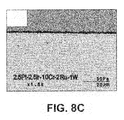
- FIGS. 8A-8C are SEM cross-sectional images of modified Ni-13Al-0.1Hf-based alloys after 100 hours isothermal oxidation at 1000° C. in air.
- FIG. 9 is a SEM cross-sectional image of Ni-13Al-10Cr-2.5Pt-2.5Ir-2Ru-1W-2Ta-1Re-0.25Ti-0.1Hf based alloys after 100 hours isothermal oxidation at 1000° C. in air.
- FIGS. 10A-10B are plots of the cyclic oxidation kinetics at 1000° C. in air of precious group metal (PGM: Pt and/or Ir)-modified ⁇ + ⁇ ′ alloys with 13 at % Al and 0.1 at % Hf, with FIG. 10A showing 2.5Pt and FIG. 10B showing 2.5Pt-2.5Ir.
- PGM precious group metal
- FIG. 11 is a plot of the cyclic oxidation kinetics at 1000° C. in air of Ni-13Al-2.5Pt-2.5Ir-7.5Cr-based alloys.
- the present disclosure is directed to an alloy composition that includes 5 at % ⁇ Al ⁇ 16 at % Al, about 0.05 at % to 1 at % of a reactive element such as Hf, Y, La, Ce, Zr and combinations thereof, and Ni, and has a phase constitution that is predominately or solely ⁇ -Ni+ ⁇ ′-Ni 3 Al.
- the alloy further includes up to about 20 at % of a Pt-group metal such as Pt, Pd, Ir, Rh and combinations thereof.
- the alloy includes up to about 20 at % of an additional strengthening element such as Cr and/or Si, and may also include refractory element such as such as Mo, Ta, Re, W, Ru, Ti and combinations thereof.
- all at % values specified for all elements in this application are nominal, and may vary by as much as +1-2 at %.
- Controlling the amount of Al in the alloy composition has a significant impact on the heat treatability of the composition.
- the Al content in the alloy should be maintained in the range of 5 at % ⁇ Al ⁇ 16 at %, or about 9 at % to about 15 at %, or about 9 at % to about 14 at %, or about 9 at % to about 13 at %, or 13 at % ⁇ Al ⁇ 15 at %.
- the addition of reactive elements such as Hf, Y, La, Ce and Zr, and combinations thereof, may tend to stabilize the ⁇ ′ phase in the alloy composition. Therefore, if sufficient reactive metal is added to the composition, the resulting phase constitution may be predominately ⁇ ′ or solely ⁇ ′.
- the reactive elements Hf, Y, La, Ce and Zr, and combinations thereof, are preferably present in the alloy at about 0.05 at % to about 1 at %. To provide excellent heat treatability, the reactive element is more preferably present at about 0.05 at % to 0.5 at %, and even more preferably at about 0.05 at % to about 0.1 at %.
- the ⁇ -Ni+ ⁇ ′-Ni 3 Al alloy composition preferably also includes at least one Pt-group metal (PGM) such as, for example, Pt, Pd, Ir, Rh or combinations thereof.
- PGM Pt-group metal
- Pt and Ir are preferred Pt-group metals, and Pt is particularly preferred.
- the total concentration of Pt-group metals in the alloy composition is preferably less than about 20 at %, more preferably less than about 10 at %, even more preferably less than about 5 at %, and most preferably about 2.5 at % to about 5 at %. If the Pt-group metals are selected from Pt and Ir, the Pt-group metals are most preferably present in the alloy composition at about 2.5 at % Pt and about 2.5 at % Ir, with a total of about 5 at %.
- the ⁇ -Ni+ ⁇ ′-Ni 3 Al alloy composition may optionally further include up to about 20 at % of strengthening elements such as Cr and/or Si to enhance certain alloy properties such as, for example, strength and corrosion resistance.
- the Cr is preferably present in the alloy composition at about 5 at % to about 8 at %.
- the alloy composition may optionally include up to about 3 at % Si, more preferably about 0.2 at %.
- the ⁇ -Ni+ ⁇ ′-Ni 3 Al alloy composition may also optionally include a refractory element or elements for conferring additional alloy strengthening.
- Refractory elements in this application refer to metals with high melting points such as Mo, Ta, Re, W, Ru, Ti and combinations thereof.
- the refractory metals may be present in the alloy composition at any concentration as long as the ⁇ + ⁇ ′ phase constitution in the composition predominates, but typically are present at up to about 5 at % to about 10 at %, more preferably about 8 at %. It has been found that these refractory elements enhance alloy properties such as creep strength, while properties such as corrosion resistance and high temperature resistance are retained.
- Preferred refractory elements include W, Ta, Mo and Ti.
- the alloy composition may further optionally include up to 1 at % of C, B, N and combinations thereof.
- FIG. 1 a portion of a phase diagram of a preferred embodiment of an alloy composition is shown in which the Pt-group metal is Pt.
- the Al concentration in the Ni—Al—Pt phase diagram is selected with respect to the concentrations of Ni and Pt such that the alloy falls within the shaded region A between the ⁇ -Ni and the ⁇ ′-Ni 3 Al phase fields.
- a particularly preferred heat treatable alloy includes about 9 at % Al to about 14 at % Al and about 0.1 at % to about 0.3 at % Hf and the remainder Ni. These alloys may optionally include about 10 at % Cr. Typical examples (at %) include: Ni-13Al-0.1Hf, Ni-13Al-5Cr-0.1Hf, and Ni-13Al-10Cr-0.1Hf.
- the heat treatable alloy preferably includes about 9 at % to about 13 at % Al, about 0.1 at % to about 0.3 at % Hf, about 2.5 at % to about 16 at % Pt, and Ni.
- the Pt-group metal containing alloys may further optionally include about 5 at % to about 10 at % Cr. Examples (at %) include Ni-13Al-5Pt-0.1Hf, Ni-13Al-16Pt-0.1Hf, Ni-13Al-5Pt-8Cr-0.1Hf and Ni-15Al-16.0Pt-5Cr-0.3Hf.
- the alloys may be prepared by techniques such as, for example, argon-arc melting pieces of high-purity Ni, Al, Pt-group metals, reactive and/or strengthening metals, as well as optional refractory metals and combinations thereof.
- the alloys are typically cast using conventional processes and exist in bulk form, which in this application refers to free-standing cast shapes that nominally have substantially the same composition throughout.
- the cast shapes may be made into a wide variety of structural materials, including foils, sheets, bars, and cladding, and are particularly well suited for structural applications or for protecting an underlying substrate against high temperatures.
- the term cladding refers to two alloys in contact, with a diffusive bond between them.
- the alloys may even be applied as a coating on a substrate using, for example, thermal spraying techniques such as plasma-arc spraying and high-velocity oxygen-fuel spraying or physical vapor deposition methods including magnetron sputtering or electron beam-based processes.
- thermal spraying techniques such as plasma-arc spraying and high-velocity oxygen-fuel spraying or physical vapor deposition methods including magnetron sputtering or electron beam-based processes.
- the ⁇ -Ni+ ⁇ ′-Ni 3 Al bulk alloys described in this application grow a highly adherent ⁇ -Al 2 O 3 scale layer during both isothermal and cyclic oxidation at high temperatures up to about 1150-1200° C.
- the cast shape may be thermally treated to obtain a desired microstructure and further enhance the properties of the material for a particular application.
- a wide variety of thermal treatment processes may be used to tailor the microstructure of the bulk alloy for a particular application.
- Suitable thermal treatments include the precipitation heat treatment processes exemplified below, which has at least a solution treatment step, a quenching step and an aging step.
- this application is not limited to such a thermal treatment process, and a wide variety of processes may be used to tailor the microstructure of the bulk alloy for a particular application.
- the cast shape with constituent metals selected to have a predominately ⁇ -Ni+ ⁇ ′-Ni 3 Al phase structure is first thermally heated to or above a temperature sufficient to substantially dissolve the ⁇ ′-Ni 3 Al phase and form a single ⁇ -Ni phase.
- This solution treatment step is typically performed by thermally heating the cast shape in pre-heated furnace from room temperature to a temperature of about 1200 to about 1300° C. for about 0.5 to about 6 hours.
- the solution treatment step is followed by a first quenching step in which the temperature of the cast shape is quickly returned to room temperature, typically by quenching in water.
- a first quenching step in which the temperature of the cast shape is quickly returned to room temperature, typically by quenching in water.
- the ⁇ ′-Ni 3 Al phase precipitates to form a phase assemblage with ⁇ ′-Ni 3 Al precipitates distributed in a ⁇ -Ni matrix.
- the cast shape is again thermally treated for a longer period of time at a lower temperature than used in the solution treatment step described above to substantially uniformly distribute the ⁇ ′-Ni 3 Al precipitates, as well as any reactive, strengthening or refractory elements present in the composition, within the ⁇ -Ni matrix.
- This aging step is typically performed by inserting the cast shape into a pre-heated furnace and heating from room temperature to a temperature of about 800 to about 1000° C. for about 1 to about 24 hours.
- the aging step is followed by a second quenching step in which the temperature of the cast shape is quickly returned to room temperature, typically by quenching in water.
- the cast shape may be processed for a particular application, such as, for example, by rolling into a heat-protective foil.
- foils with a thickness of about 1 mm or less can provide substantial thermal and corrosion protection for an underlying substrate, and are quite lightweight.
- concentrations of the constituent elements and the precipitation heat treatment conditions may be selected to provide a cast shape with the compositions described above, as well as a desired microstructure for a particular application.
- Preferred alloys have a microstructure with a phase constitution of about 30 volume % (vol %) to about 70 vol %, or about 30 vol % to about 60 mvol %, of ⁇ ′-Ni 3 Al precipitates distributed substantially uniformly in a ⁇ -Ni matrix.
- the samples were annealed at 1200° C. for 6 hours, followed by thermal treatment at 1150° C. for 48 hours in flowing Ar.
- the samples were first placed in a pre-heated furnace and thermally treated at 1300° C. for 1 hour, then rapidly quenched in water to reduce the temperature of the samples to room temperature.
- FIG. 2 compares the as-heat-treated microstructures of the Ni-15Al-0.1Hf base alloys containing 2.5Pt, 2.5Ir or 2.5Pt+2.5Ir addition and with and without further addition of 5Cr ( FIG. 2A ) to the microstructures resulting after a further 100 hours exposure at 1000° C.
- the Cr-containing alloys apparently underwent a significant amount of ⁇ ′ coarsening.
- Example 1 The samples from Example 1 were then oxidized in air at 1000° C. for 100 hours, and the measured weight change results (due to oxygen uptake) are shown in FIG. 3A .
- FIG. 3A shows the significant benefit of Cr addition to the oxidation resistance of each.
- the weight gain of the Ni-15Al-2.5Ir-0.1Hf alloy was reduced by more than a factor of six by the addition of 5 Cr.
- the weight gain of this alloys is seen in FIG. 3A to be comparable to that of a Pt-modified ⁇ -NiAl alloy.
- FIG. 3B Cross-sectional photographs of the FIG. 3A samples are shown in FIG. 3B , where the samples without Cr exhibited thick oxidation, likely a Ni-rich oxide and an alumina oxide.
- the samples with Cr had a considerably thinner (more slow-growing) scale of Al 2 O 3 , which indicates that Cr alters the behavior of the system at elevated temperatures in such a way that it facilitates the preferential formation and growth of a primarily Al 2 O 3 scale (i.e., helps prevent the formation of the fast-growing, Ni-rich oxide shown in FIG. 3B for the samples without Cr).
- Example 1 The samples from Example 1 were then oxidized at 1150° C. under thermal cycles, and the results are shown in FIGS. 4A-4C .
- FIG. 4A shows the highly beneficial effect of 5 at. % Cr addition on the 1150° C. cyclic oxidation kinetics of the three precious-metal (PM; which as used herein refers to Pt, Ir and combinations thereof) modified Ni-15Al-0.1Hf base alloys reported in the previous section.
- PM precious-metal
- FIG. 4C shows the reduced oxide scale thickness in conjunction with the development of a protective single oxide layer that results from the addition of 5% Cr to the chosen alloys during 500 one-hour cycles to 1150° C. in air.
- the micrographs illustrate that the formation of internal hafnium oxides is reduced by the addition of 5% Cr, particularly for the alloys that contain Pt.
- FIG. 5 shows that the addition of Pt to non-heat treatable ⁇ + ⁇ ′ alloys increases oxide scale adhesion during 500 1-hr cycles to 1150° C. in air.
- the two alloys without Pt suffer from significant scale spallation after a few hundred cycles.
- FIG. 6 shows that there is a preferred amount of Hf to be added to heat-treatable Ni-15Al-10Pt-5Cr alloys to minimize isothermal oxidation at 1150° C. for 100 hr in air.
- a higher level of Hf e.g., about 0.4%) promotes significant formation of hafnium oxide phases beneath the growing aluminum oxide scale, which causes a higher weight gain.
- reducing the level of Hf i.e., about 0.1%) helps limit the formation of hafnium oxide, constraining it to near the growing aluminum oxide scale/substrate interface.
- FIG. 7 shows a fully solutionized (i.e., single-phase gamma structure) microstructure (left) for a heat-treatable gamma+gamma prime alloy heat treated and homogenized at 1250° C. for 1 hour and then quenched in water. Subsequently, this single-phase structure has heat treated at 1000° C. in air for 1 hour and quenched in water to retain the two-phase structure that developed at 1000° C. (right).
- the ⁇ ′ phase that precipitated coherently within the ⁇ matrix is illustrated by the lighter-gray platelet-shaped grains in the darker-gray regions.
- FIG. 8A The oxidation behavior of PGM-modified ⁇ + ⁇ ′ alloys with 13 at % Al and 0.1 at % Hf were assessed under both isothermal and cyclic conditions at 1000® C. in air.
- Cross-sectional SEM images of selected alloys after 100 hour isothermal oxidation are shown in FIG. 8A .
- the oxide scale which formed depends on the alloy composition. For example, a multi-layered scale forms on the Ni-13Al-2.5Pt-2.5Ir-7.5Cr-2Ru-2W-0.1Hf alloy, while an exclusive Al 2 O 3 scale forms on Ni-13Al-2.5Pt-7.5Cr-2Ru-1W-0.1Hf ( FIG. 8A ).
- an exclusive Al 2 O 3 layer forms on most alloys containing 10 at % Cr and less than 10 at % refractory element additions ( FIGS. 8B and 8C ).
- An example of an even higher alloyed 10 at % Cr system (compared to those shown in FIG. 1 ) forming an exclusive Al 2 O 3 is shown in FIG. 9 .
- FIGS. 10A-10B and 11 show the cyclic oxidation kinetics of various PGM modified ⁇ + ⁇ ′ alloys with 13 at % Al and 0.1 at % Hf.
- each cycle consists of 1 hr at 1000° C. followed by 30 minutes at ⁇ 75° C. All alloys except those containing ⁇ 2.5Pt-5Cr-1Re-2Ru-2W and ⁇ 2.5Pt-2.5Ir-5Cr-1Re-2Ru-1W underwent a relatively large initial weight gains followed by significantly slower weight-gain kinetics. Both of these alloys eventually underwent weight loss due to oxide scale spallation. These data indicate that the level of Cr, more than any other element, has a significant effect on the oxidation kinetics.
- alloys containing 5 at % Cr showed a weight gain typically above about 1.2 mg/cm 2 after 500 cycles, alloys containing 7.5 at % Cr had weight gain variations from 0.3 to 1.1 mg/cm 2 depending on composition, and finally alloys containing 10 at % Cr showed a weight gain below 0.4 mg/cm 2 .
Landscapes
- Chemical & Material Sciences (AREA)
- Engineering & Computer Science (AREA)
- Materials Engineering (AREA)
- Mechanical Engineering (AREA)
- Metallurgy (AREA)
- Organic Chemistry (AREA)
- Physics & Mathematics (AREA)
- Thermal Sciences (AREA)
- Crystallography & Structural Chemistry (AREA)
- Turbine Rotor Nozzle Sealing (AREA)
- Adornments (AREA)
- Powder Metallurgy (AREA)
Abstract
Description
- Ni-15Al-2.5Pt-0.1Hf
- Ni-15Al-2.5Pt-5Cr-0.1Hf
- Ni-15Al-2.5Ir-0.1Hf
- Ni-15Al-2.5Ir-5Cr-0.1Hf
- Ni-15Al-2.5Pt-2.5Ir-0.1Hf
- Ni-15Al-2.5Pt-2.5Ir-5Cr-0.1Hf
Claims (14)
Priority Applications (1)
| Application Number | Priority Date | Filing Date | Title |
|---|---|---|---|
| US12/173,683 US8821654B2 (en) | 2008-07-15 | 2008-07-15 | Pt metal modified γ-Ni+γ′-Ni3Al alloy compositions for high temperature degradation resistant structural alloys |
Applications Claiming Priority (1)
| Application Number | Priority Date | Filing Date | Title |
|---|---|---|---|
| US12/173,683 US8821654B2 (en) | 2008-07-15 | 2008-07-15 | Pt metal modified γ-Ni+γ′-Ni3Al alloy compositions for high temperature degradation resistant structural alloys |
Publications (2)
| Publication Number | Publication Date |
|---|---|
| US20100012235A1 US20100012235A1 (en) | 2010-01-21 |
| US8821654B2 true US8821654B2 (en) | 2014-09-02 |
Family
ID=41529244
Family Applications (1)
| Application Number | Title | Priority Date | Filing Date |
|---|---|---|---|
| US12/173,683 Expired - Fee Related US8821654B2 (en) | 2008-07-15 | 2008-07-15 | Pt metal modified γ-Ni+γ′-Ni3Al alloy compositions for high temperature degradation resistant structural alloys |
Country Status (1)
| Country | Link |
|---|---|
| US (1) | US8821654B2 (en) |
Families Citing this family (8)
| Publication number | Priority date | Publication date | Assignee | Title |
|---|---|---|---|---|
| US7273662B2 (en) * | 2003-05-16 | 2007-09-25 | Iowa State University Research Foundation, Inc. | High-temperature coatings with Pt metal modified γ-Ni+γ′-Ni3Al alloy compositions |
| ATE433502T1 (en) * | 2004-08-18 | 2009-06-15 | Univ Iowa State Res Found Inc | HIGH TEMPERATURE COATINGS AND SOLID ALLOYS MADE OF -NI+ '-NI3AL ALLOYS MODIFIED WITH ONE FROM THE PT GROUP AND HAVING HIGH TEMPERATURE CORROSION RESISTANCE |
| US7531217B2 (en) * | 2004-12-15 | 2009-05-12 | Iowa State University Research Foundation, Inc. | Methods for making high-temperature coatings having Pt metal modified γ-Ni +γ′-Ni3Al alloy compositions and a reactive element |
| FR2974581B1 (en) * | 2011-04-29 | 2013-05-31 | Snecma | PIECE COMPRISING A COATING ON A METAL SUBSTRATE IN SUPERALLIAGE, THE COATING COMPRISING A METAL SUB-LAYER |
| US8858873B2 (en) * | 2012-11-13 | 2014-10-14 | Honeywell International Inc. | Nickel-based superalloys for use on turbine blades |
| JP5721189B2 (en) | 2013-03-12 | 2015-05-20 | 株式会社 東北テクノアーチ | Heat-resistant Ni-based alloy and method for producing the same |
| US10933469B2 (en) | 2018-09-10 | 2021-03-02 | Honeywell International Inc. | Method of forming an abrasive nickel-based alloy on a turbine blade tip |
| US20230011769A1 (en) * | 2019-12-27 | 2023-01-12 | Kubota Corporation | Ni-BASED ALLOY, HEAT-RESISTANT AND CORROSION-RESISTANT COMPONENT, AND HEAT TREATMENT FURNACE COMPONENT |
Citations (50)
| Publication number | Priority date | Publication date | Assignee | Title |
|---|---|---|---|---|
| US3754902A (en) * | 1968-06-05 | 1973-08-28 | United Aircraft Corp | Nickel base superalloy resistant to oxidation erosion |
| US3918139A (en) | 1974-07-10 | 1975-11-11 | United Technologies Corp | MCrAlY type coating alloy |
| US3933483A (en) | 1972-07-14 | 1976-01-20 | Kabushiki Kaisha Toyota Chuo Kenkyusho | Silicon-containing nickel-aluminum-molybdenum heat resisting alloy |
| US3976436A (en) | 1975-02-13 | 1976-08-24 | General Electric Company | Metal of improved environmental resistance |
| US4019900A (en) | 1976-04-01 | 1977-04-26 | Olin Corporation | High strength oxidation resistant nickel base alloys |
| US4123594A (en) | 1977-09-22 | 1978-10-31 | General Electric Company | Metallic coated article of improved environmental resistance |
| US4123595A (en) | 1977-09-22 | 1978-10-31 | General Electric Company | Metallic coated article |
| DE2908151A1 (en) | 1978-03-03 | 1979-10-18 | Johnson Matthey Co Ltd | ALLOY CONTAINING PLATING GROUP METALS |
| US4339509A (en) | 1979-05-29 | 1982-07-13 | Howmet Turbine Components Corporation | Superalloy coating composition with oxidation and/or sulfidation resistance |
| US4346137A (en) | 1979-12-19 | 1982-08-24 | United Technologies Corporation | High temperature fatigue oxidation resistant coating on superalloy substrate |
| JPS5837144A (en) | 1981-08-28 | 1983-03-04 | Hitachi Ltd | Member having corrosion resistant coating layer |
| JPS5873761A (en) | 1974-11-07 | 1983-05-04 | ゼネラル・エレクトリツク・コンパニ− | Powder composition for metal coating formation having high heat resistance |
| US4392894A (en) | 1980-08-11 | 1983-07-12 | United Technologies Corporation | Superalloy properties through stress modified gamma prime morphology |
| US4737205A (en) * | 1974-07-08 | 1988-04-12 | Johnson Matthey & Co., Limited | Platinum group metal-containing alloy |
| US4743514A (en) | 1983-06-29 | 1988-05-10 | Allied-Signal Inc. | Oxidation resistant protective coating system for gas turbine components, and process for preparation of coated components |
| US4758480A (en) | 1987-12-22 | 1988-07-19 | United Technologies Corporation | Substrate tailored coatings |
| CA1251059A (en) | 1985-06-10 | 1989-03-14 | United Technologies Corporation | Advanced high strength single crystal superalloy compositions |
| JPH04358037A (en) | 1991-03-27 | 1992-12-11 | Sumitomo Metal Ind Ltd | Nickel-base heat resisting alloy |
| JPH0533091A (en) | 1991-03-26 | 1993-02-09 | Sumitomo Metal Ind Ltd | Nickel base heat resistant alloy |
| US5240491A (en) | 1991-07-08 | 1993-08-31 | General Electric Company | Alloy powder mixture for brazing of superalloy articles |
| EP0652299A1 (en) | 1993-11-08 | 1995-05-10 | ROLLS-ROYCE plc | Coating composition having good corrosion and oxidation resistance |
| US5435861A (en) | 1992-02-05 | 1995-07-25 | Office National D'etudes Et De Recherches Aerospatiales | Nickel-based monocrystalline superalloy with improved oxidation resistance and method of production |
| JPH07247803A (en) | 1994-03-14 | 1995-09-26 | Toshiba Corp | Turbine blade manufacturing method |
| US5514482A (en) | 1984-04-25 | 1996-05-07 | Alliedsignal Inc. | Thermal barrier coating system for superalloy components |
| EP0718420A1 (en) | 1994-12-24 | 1996-06-26 | Rolls Royce Plc | A method of applying a thermal barrier coating to a superalloy article and a thermal barrier coating |
| US5763107A (en) | 1994-12-24 | 1998-06-09 | Rolls-Royce Plc | Thermal barrier coating for a superalloy article |
| US5942337A (en) | 1996-06-19 | 1999-08-24 | Rolls-Royce, Plc | Thermal barrier coating for a superalloy article and a method of application thereof |
| EP1111192A1 (en) | 1999-12-20 | 2001-06-27 | United Technologies Corporation | Articles provided with corrosion resistant coatings |
| EP1111091A1 (en) | 1999-12-21 | 2001-06-27 | United Technologies Corporation | Method of forming an active-element containing aluminide as stand alone coating and as bond coat and coated article |
| WO2001075192A2 (en) | 2000-04-04 | 2001-10-11 | Honeywell International Inc. | Thermal barrier coating having a thin, high strength bond coat |
| US6306524B1 (en) | 1999-03-24 | 2001-10-23 | General Electric Company | Diffusion barrier layer |
| US20020009611A1 (en) | 1998-12-30 | 2002-01-24 | Ramgopal Darolia | Graded reactive element containing aluminide coatings for improved high temperature performance and method for producing |
| US20020132132A1 (en) | 2000-12-12 | 2002-09-19 | Sudhangshu Bose | Method of forming an active-element containing aluminide as stand alone coating and as bond coat and coated article |
| US20020187336A1 (en) | 2001-05-25 | 2002-12-12 | Khan Abdus S. | Bond or overlay MCrAIY-coating |
| JP2003049231A (en) | 2001-05-30 | 2003-02-21 | National Institute For Materials Science | Ni-based single crystal superalloy |
| US6554920B1 (en) | 2001-11-20 | 2003-04-29 | General Electric Company | High-temperature alloy and articles made therefrom |
| EP1321541A2 (en) | 2001-12-20 | 2003-06-25 | General Electric Company | Nickel aluminide coating and coating systems formed therewith |
| EP1327702A1 (en) | 2002-01-10 | 2003-07-16 | ALSTOM (Switzerland) Ltd | Mcraiy bond coating and method of depositing said mcraiy bond coating |
| US20040229075A1 (en) | 2003-05-16 | 2004-11-18 | Brian Gleeson | High-temperature coatings with Pt metal modified gamma-Ni + gamma'-Ni3Al alloy compositions |
| US20060093752A1 (en) | 2004-10-29 | 2006-05-04 | General Electric Company | Methods for depositing gamma-prime nickel aluminide coatings |
| US20060093851A1 (en) | 2004-10-29 | 2006-05-04 | General Electric Company | Superalloy article having a gamma-prime nickel aluminide coating |
| US20060093801A1 (en) | 2004-10-29 | 2006-05-04 | General Electric Company | Coating systems containing beta phase and gamma-prime phase nickel aluminide |
| US20060093850A1 (en) | 2004-10-29 | 2006-05-04 | General Electric Company | Coating systems containing gamma-prime nickel aluminide coating |
| US20060127695A1 (en) | 2004-12-15 | 2006-06-15 | Brian Gleeson | Methods for making high-temperature coatings having Pt metal modified gamma-Ni + gamma'-Ni3Al alloy compositions and a reactive element |
| US20060210825A1 (en) | 2004-08-18 | 2006-09-21 | Iowa State University | High-temperature coatings and bulk alloys with Pt metal modified gamma-Ni + gamma'-Ni3Al alloys having hot-corrosion resistance |
| US20060292390A1 (en) | 2004-07-16 | 2006-12-28 | Mtu Aero Engines Gmbh | Protective coating for application to a substrate and method for manufacturing a protective coating |
| US20070071996A1 (en) | 2005-09-26 | 2007-03-29 | General Electric Company | Gamma prime phase-containing nickel aluminide coating |
| US20070071995A1 (en) | 2005-09-26 | 2007-03-29 | General Electric Company | Gamma prime phase-containing nickel aluminide coating |
| US7229701B2 (en) | 2004-08-26 | 2007-06-12 | Honeywell International, Inc. | Chromium and active elements modified platinum aluminide coatings |
| US7316850B2 (en) | 2004-03-02 | 2008-01-08 | Honeywell International Inc. | Modified MCrAlY coatings on turbine blade tips with improved durability |
-
2008
- 2008-07-15 US US12/173,683 patent/US8821654B2/en not_active Expired - Fee Related
Patent Citations (67)
| Publication number | Priority date | Publication date | Assignee | Title |
|---|---|---|---|---|
| US3754902A (en) * | 1968-06-05 | 1973-08-28 | United Aircraft Corp | Nickel base superalloy resistant to oxidation erosion |
| US3933483A (en) | 1972-07-14 | 1976-01-20 | Kabushiki Kaisha Toyota Chuo Kenkyusho | Silicon-containing nickel-aluminum-molybdenum heat resisting alloy |
| US4737205A (en) * | 1974-07-08 | 1988-04-12 | Johnson Matthey & Co., Limited | Platinum group metal-containing alloy |
| US3918139A (en) | 1974-07-10 | 1975-11-11 | United Technologies Corp | MCrAlY type coating alloy |
| JPS5873761A (en) | 1974-11-07 | 1983-05-04 | ゼネラル・エレクトリツク・コンパニ− | Powder composition for metal coating formation having high heat resistance |
| US3976436A (en) | 1975-02-13 | 1976-08-24 | General Electric Company | Metal of improved environmental resistance |
| US4019900A (en) | 1976-04-01 | 1977-04-26 | Olin Corporation | High strength oxidation resistant nickel base alloys |
| US4123595A (en) | 1977-09-22 | 1978-10-31 | General Electric Company | Metallic coated article |
| US4123594A (en) | 1977-09-22 | 1978-10-31 | General Electric Company | Metallic coated article of improved environmental resistance |
| DE2908151A1 (en) | 1978-03-03 | 1979-10-18 | Johnson Matthey Co Ltd | ALLOY CONTAINING PLATING GROUP METALS |
| GB2029857A (en) | 1978-03-03 | 1980-03-26 | Restall J E | Nickel-based high-temperature alloy containing platinum group metal |
| US4339509A (en) | 1979-05-29 | 1982-07-13 | Howmet Turbine Components Corporation | Superalloy coating composition with oxidation and/or sulfidation resistance |
| US4346137A (en) | 1979-12-19 | 1982-08-24 | United Technologies Corporation | High temperature fatigue oxidation resistant coating on superalloy substrate |
| US4392894A (en) | 1980-08-11 | 1983-07-12 | United Technologies Corporation | Superalloy properties through stress modified gamma prime morphology |
| JPS5837144A (en) | 1981-08-28 | 1983-03-04 | Hitachi Ltd | Member having corrosion resistant coating layer |
| US4743514A (en) | 1983-06-29 | 1988-05-10 | Allied-Signal Inc. | Oxidation resistant protective coating system for gas turbine components, and process for preparation of coated components |
| US5514482A (en) | 1984-04-25 | 1996-05-07 | Alliedsignal Inc. | Thermal barrier coating system for superalloy components |
| CA1251059A (en) | 1985-06-10 | 1989-03-14 | United Technologies Corporation | Advanced high strength single crystal superalloy compositions |
| US4758480A (en) | 1987-12-22 | 1988-07-19 | United Technologies Corporation | Substrate tailored coatings |
| JPH0533091A (en) | 1991-03-26 | 1993-02-09 | Sumitomo Metal Ind Ltd | Nickel base heat resistant alloy |
| JPH04358037A (en) | 1991-03-27 | 1992-12-11 | Sumitomo Metal Ind Ltd | Nickel-base heat resisting alloy |
| US5240491A (en) | 1991-07-08 | 1993-08-31 | General Electric Company | Alloy powder mixture for brazing of superalloy articles |
| US5435861A (en) | 1992-02-05 | 1995-07-25 | Office National D'etudes Et De Recherches Aerospatiales | Nickel-based monocrystalline superalloy with improved oxidation resistance and method of production |
| EP0652299A1 (en) | 1993-11-08 | 1995-05-10 | ROLLS-ROYCE plc | Coating composition having good corrosion and oxidation resistance |
| JPH07247803A (en) | 1994-03-14 | 1995-09-26 | Toshiba Corp | Turbine blade manufacturing method |
| EP0718420A1 (en) | 1994-12-24 | 1996-06-26 | Rolls Royce Plc | A method of applying a thermal barrier coating to a superalloy article and a thermal barrier coating |
| JPH08225959A (en) | 1994-12-24 | 1996-09-03 | Rolls Royce Plc | Method of coating thermal barrier coating on superalloy article and thermal barrier coating |
| US5667663A (en) | 1994-12-24 | 1997-09-16 | Chromalloy United Kingdom Limited | Method of applying a thermal barrier coating to a superalloy article and a thermal barrier coating |
| US5763107A (en) | 1994-12-24 | 1998-06-09 | Rolls-Royce Plc | Thermal barrier coating for a superalloy article |
| US5981091A (en) | 1994-12-24 | 1999-11-09 | Rolls-Royce Plc | Article including thermal barrier coated superalloy substrate |
| US5942337A (en) | 1996-06-19 | 1999-08-24 | Rolls-Royce, Plc | Thermal barrier coating for a superalloy article and a method of application thereof |
| US20020009611A1 (en) | 1998-12-30 | 2002-01-24 | Ramgopal Darolia | Graded reactive element containing aluminide coatings for improved high temperature performance and method for producing |
| US6436473B2 (en) | 1998-12-30 | 2002-08-20 | General Electric Company | Graded reactive element containing aluminide coatings for improved high temperature performance and method for producing |
| US6306524B1 (en) | 1999-03-24 | 2001-10-23 | General Electric Company | Diffusion barrier layer |
| EP1111192A1 (en) | 1999-12-20 | 2001-06-27 | United Technologies Corporation | Articles provided with corrosion resistant coatings |
| EP1111091A1 (en) | 1999-12-21 | 2001-06-27 | United Technologies Corporation | Method of forming an active-element containing aluminide as stand alone coating and as bond coat and coated article |
| US6585878B2 (en) | 2000-04-04 | 2003-07-01 | Honeywell International, Inc. | Thermal barrier coating having a thin, high strength bond coat |
| WO2001075192A2 (en) | 2000-04-04 | 2001-10-11 | Honeywell International Inc. | Thermal barrier coating having a thin, high strength bond coat |
| US6485844B1 (en) | 2000-04-04 | 2002-11-26 | Honeywell International, Inc. | Thermal barrier coating having a thin, high strength bond coat |
| WO2001075192A3 (en) | 2000-04-04 | 2002-03-21 | Honeywell Int Inc | Thermal barrier coating having a thin, high strength bond coat |
| US20020132132A1 (en) | 2000-12-12 | 2002-09-19 | Sudhangshu Bose | Method of forming an active-element containing aluminide as stand alone coating and as bond coat and coated article |
| US20020187336A1 (en) | 2001-05-25 | 2002-12-12 | Khan Abdus S. | Bond or overlay MCrAIY-coating |
| JP2003049231A (en) | 2001-05-30 | 2003-02-21 | National Institute For Materials Science | Ni-based single crystal superalloy |
| US6554920B1 (en) | 2001-11-20 | 2003-04-29 | General Electric Company | High-temperature alloy and articles made therefrom |
| EP1321541A2 (en) | 2001-12-20 | 2003-06-25 | General Electric Company | Nickel aluminide coating and coating systems formed therewith |
| EP1327702A1 (en) | 2002-01-10 | 2003-07-16 | ALSTOM (Switzerland) Ltd | Mcraiy bond coating and method of depositing said mcraiy bond coating |
| US20050003227A1 (en) | 2002-01-10 | 2005-01-06 | Alstom Technology Ltd | MCrAIY bond coating and method of depositing said MCrAIY bond coating |
| US20040229075A1 (en) | 2003-05-16 | 2004-11-18 | Brian Gleeson | High-temperature coatings with Pt metal modified gamma-Ni + gamma'-Ni3Al alloy compositions |
| WO2004104243A2 (en) | 2003-05-16 | 2004-12-02 | Iowa State University Research Foundation, Inc. | High-temperature coatings with pt metal modifed ϝ-ni+ϝ’-ni3a1 alloy compositions |
| US20080038582A1 (en) | 2003-05-16 | 2008-02-14 | Iowa State University Research Foundation, Inc. | High-temperature coatings with pt metal modified y-Ni+y'-Ni3Al alloy compositions |
| US7273662B2 (en) | 2003-05-16 | 2007-09-25 | Iowa State University Research Foundation, Inc. | High-temperature coatings with Pt metal modified γ-Ni+γ′-Ni3Al alloy compositions |
| US7316850B2 (en) | 2004-03-02 | 2008-01-08 | Honeywell International Inc. | Modified MCrAlY coatings on turbine blade tips with improved durability |
| US20060292390A1 (en) | 2004-07-16 | 2006-12-28 | Mtu Aero Engines Gmbh | Protective coating for application to a substrate and method for manufacturing a protective coating |
| WO2007008227A2 (en) | 2004-08-18 | 2007-01-18 | Iowa State University Research Foundation, Inc. | HIGH-TEMPERATURE COATINGS AND BULK ALLOYS WITH PT METAL MODIFIED Ϝ-Ni+Ϝ'-Ni3Al ALLOYS HAVING HOT-CORROSION RESISTANCE |
| WO2007008227A3 (en) | 2004-08-18 | 2007-03-15 | Univ Iowa State Res Found Inc | HIGH-TEMPERATURE COATINGS AND BULK ALLOYS WITH PT METAL MODIFIED Ϝ-Ni+Ϝ'-Ni3Al ALLOYS HAVING HOT-CORROSION RESISTANCE |
| US20060210825A1 (en) | 2004-08-18 | 2006-09-21 | Iowa State University | High-temperature coatings and bulk alloys with Pt metal modified gamma-Ni + gamma'-Ni3Al alloys having hot-corrosion resistance |
| US7229701B2 (en) | 2004-08-26 | 2007-06-12 | Honeywell International, Inc. | Chromium and active elements modified platinum aluminide coatings |
| US20060093801A1 (en) | 2004-10-29 | 2006-05-04 | General Electric Company | Coating systems containing beta phase and gamma-prime phase nickel aluminide |
| US20060093850A1 (en) | 2004-10-29 | 2006-05-04 | General Electric Company | Coating systems containing gamma-prime nickel aluminide coating |
| US7264888B2 (en) | 2004-10-29 | 2007-09-04 | General Electric Company | Coating systems containing gamma-prime nickel aluminide coating |
| US20060093851A1 (en) | 2004-10-29 | 2006-05-04 | General Electric Company | Superalloy article having a gamma-prime nickel aluminide coating |
| US20060093752A1 (en) | 2004-10-29 | 2006-05-04 | General Electric Company | Methods for depositing gamma-prime nickel aluminide coatings |
| US20060127695A1 (en) | 2004-12-15 | 2006-06-15 | Brian Gleeson | Methods for making high-temperature coatings having Pt metal modified gamma-Ni + gamma'-Ni3Al alloy compositions and a reactive element |
| WO2006076130A2 (en) | 2004-12-15 | 2006-07-20 | Iowa State University Research Foundation, Inc. | METHODS FOR MAKING HIGH-TEMPERATURE COATINGS HAVING PT METAL MODIFIED Ϝ-Ni + Ϝ’-Ni3 AL ALLOY COMPOSITIONS AND A REACTIVE ELEMENT |
| US7531217B2 (en) | 2004-12-15 | 2009-05-12 | Iowa State University Research Foundation, Inc. | Methods for making high-temperature coatings having Pt metal modified γ-Ni +γ′-Ni3Al alloy compositions and a reactive element |
| US20070071996A1 (en) | 2005-09-26 | 2007-03-29 | General Electric Company | Gamma prime phase-containing nickel aluminide coating |
| US20070071995A1 (en) | 2005-09-26 | 2007-03-29 | General Electric Company | Gamma prime phase-containing nickel aluminide coating |
Non-Patent Citations (62)
| Title |
|---|
| B. A. Pint et al., "Grain Boundary Segregation of Cation Dopants in alpha-Al2O3 Scales", Journal of Electrochem. Soc.,vol. 145, No. 6, Jun. 1998, pp. 1819-1829. |
| B. A. Pint et al., "Grain Boundary Segregation of Cation Dopants in α-Al2O3 Scales", Journal of Electrochem. Soc.,vol. 145, No. 6, Jun. 1998, pp. 1819-1829. |
| Chen et al., "Degradation of the platinum aluminide coating on CMSX4 at 1100° C.", Surface & Coatings Technology, pp. 69-77, (1997), XP-002416853. |
| Communication of a notice of opposition from the European Patent Office for counterpart EP patent No. 1784517 dated Nov. 10, 2009 (1 page). |
| Communication pursuant to Article 96(2) EPC dated Jun. 11, 2007 for EP application No. 05 858 389.9 from the European Patent Office, (3 pages). |
| Communication pursuant to Article 96(2) EPC dated Oct. 12, 2007 for EP application No. 05 857 130.8 from the European Patent Office, (3 pages). |
| Communication pursuant to Article 96(2) EPC, dated Jan. 17, 2008, for EP application No. 05 858 389.9 from the European Patent Office, (3 pages). |
| Final Office Action dated Oct. 22, 2009 for U.S. Appl. No. 11/206,663, (19 pages). |
| First Office Action (Non-Final Notice of Reasons for Rejection) for Japanese application No. 2006-532957 dated Jan. 14, 2010 in Japanese with an English translation, (7 pages). |
| Goebel et al., "Interdiffusion between the platinum-modified aluminide coating RT 22 and nickel-based single-crystal superalloys at 1000 and 1200° C.", Materials at High Temperatures, vol. 12, No. 4, pp. 301-309, (1994), XP009077277. |
| International Preliminary Examination Report from PCT Application Serial No. PCT/US05/029493, mailed Jun. 21, 2007, 7 pages. |
| International Preliminary Examination Report on Patentability for PCT Application Serial No. PCT/US05/045927 mailed Apr. 4, 2007 (28 pages). |
| International Preliminary Report on Patentability from patent application No. PCT/US2004/014740, mailed, Dec. 1, 2005, (7 pages). |
| J.A. Haynes, B.A. Pint, W.D. Porter and I.G. Wright, "Comparison of thermal expansion and oxidation behavior of various high-temperature coating materials and superalloys," Materials at High Temperatures, vol. 21, No. 2, pp. 87-94 (2004). |
| Japanese Office Action (in Japanese) dated Jun. 30, 2009 and Appendix translated into English for Japanese patent application No. 2007-547002 (6 pages). |
| Leyens et al., "R&D Status and Needs for Improved EB-PVD Thermal Barrier Coating Performance," Mat. Res. Soc. Symp. Proc., 2001, vol. 645E, pp. M10.1.1-M10.1.12. |
| Murakami et al., "Distribution of Platinum Group Metal in Ni-Base Single-Crystal Superalloys", Superalloys Proceedings International Symposium Superalloys, Sep. 17, 2000, pp. 747-756; XP009057026. |
| N. Vialas and D. Monceau, "Effect of Pt and Al content on the long-term, high temperature oxidation behavior and interdiffusion of a Pt-modified aluminide coating deposited on Ni-base superalloys", Surface & Coatings Technology, 201, (2006) pp. 3846-3851. |
| Office Action dated Jan. 28, 2009 for U.S. Appl. No. 11/206,663, (20 pages). |
| Office Action dated Jan. 8, 2010 for U.S. Appl. No. 11/893,576, (9 pages). |
| Office Action dated Jun. 25, 2008 for U.S. Appl. No. 11/012,873, (9 pages). |
| Office Action dated Mar. 19, 2008, for U.S. Appl. No. 11/206,663, (18 pages). |
| Office Action dated Sep. 12, 2008, for U.S. Appl. No. 11/206,663, (20 pages). |
| Office Action dated Sep. 7, 2007 for U.S. Appl. No. 11/012,873, (13 pages). |
| Office Action for Australian Patent Application No. 2005324336, from IP Australia, dated Dec. 19, 2008, (2 pages). |
| Office Action from U.S. Appl. No. 11/206,663, dated Apr. 27, 2010, 19 pp. |
| Office Action from U.S. Appl. No. 11/206,663, dated Nov. 24, 2010, 17 pp. |
| Office Action from U.S. Appl. No. 11/893,576, dated Jul. 22, 2010, 19 pp. |
| Office Action from U.S. Appl. No. 12/183,709, dated Apr. 26, 2012, 11 pp. |
| Office Action from U.S. Appl. No. 13/032,668, dated Aug. 19, 2011, 22 pp. |
| Office Action from U.S. Appl. No. 13/032,700, dated Dec. 21, 2011, 31 pp. |
| Office Action from U.S. Appl. No. 13/225,175, dated Dec. 20, 2011, 22 pp. |
| Office Action, dated Aug. 19, 2009, for Canadian application No. 2,597,898 from the Canadian Patent Office, (4 pages). |
| Office Action, dated Jan. 26, 2009, for Canadian application No. 2,525,320 from the Canadian Patent Office, (3 pages). |
| Opposition filed by Siemens AG with the European Patent Office dated Oct. 30, 2009 for EP patent No. 1784517 along with the English translation of the Opposition (17 Pages). |
| PCT International Search Report and PCT Written Opinion from PCT Application No. PCT/US05/045927, mailed Jul. 19, 2007, (11 pages). |
| PCT International Search Report and PCT Written Opinion from PCT Application No. PCT/US2004/014740, mailed Mar. 2, 2005 (9 pages). |
| PCT International Search Report and PCT Written Opinion from PCT Application No. PCT/US2005/029493, mailed Feb. 8, 2007, (12 pages). |
| PCT Notification of Transmittal of the International Search Report and Written Opinion of the International Searching Authority, or the Declaration from PCT Application No. PCT/US2009/052415, mailed Mar. 2, 2010 (14 pages). |
| Peggy Y. Hou, "Impurity Effects on Alumina Scale Growth", Journal of Am. Ceram. Soc., vol. 86, No. 4, 2003, pp. 660-668. |
| Peters et al., "EB-PVD Thermal Barrier Coatings for Aeroengines and Gas Turbines," Advanced Engineering Materials, 2001, 3(4):193-204. |
| Reid et al., "Microstructural Transformations in Platinum Aluminide Coated CMSX-4 Superalloy", Materials Science Forum vols. 461-464, pp. 343-350, (2004), XP009077214. |
| Roger C. Reed, "The Superalloys Fundamentals and Applications", Cambridge University Press, 2006, (7 pages). |
| S. Hayashi et al., "Interdiffusion Behavior of Pt-Modified gamma-Ni+gamma'-Ni3Al Alloys Coupled to Ni-Al-Based Alloys", Metallurgical and Materials Transactions A, vol. 36A Jul. 2005, pp. 1769-1775. |
| S. Hayashi et al., "Interdiffusion Behavior of Pt-Modified γ-Ni+γ′-Ni3Al Alloys Coupled to Ni—Al-Based Alloys", Metallurgical and Materials Transactions A, vol. 36A Jul. 2005, pp. 1769-1775. |
| Translated Office Action for Mexican Patent Application No. MX/a/2007/007096, from the Mexican Patent Office, dated Nov. 22, 2009, (3 pages). |
| Tresa M. Pollock et al., "Nickel-Based Superalloys for Advanced Turbine Engines: Chemistry, Microstructure, and Properties", Journal of Propulsion and Power, vol. 22, No. 2, Mar.-Apr. 2006, pp. 361-377. |
| U.S. Appl. No. 11/744,401, filed May 4, 2007, (Continuation of U.S. Appl. No. 10/439,649). |
| U.S. Appl. No. 11/744,433, filed May 4, 2007, (Continuation of U.S. Appl. No. 11/206,663). |
| U.S. Appl. No. 11/744,453, filed May 4, 2007, (Continuation of U.S. Appl. No. 11/206,663). |
| U.S. Appl. No. 11/744,622, filed May 4, 2007, (Continuation of U.S. Appl. No. 10/439,649). |
| U.S. Appl. No. 11/744,633, filed May 4, 2007, (Continuation of U.S. Appl. No. 11/012,873). |
| U.S. Appl. No. 11/744,634, filed May 4, 2007, (Continuation of U.S. Appl. No. 10/439,649). |
| U.S. Appl. No. 11/744,653, filed May 4, 2007, (Continuation of U.S. Appl. No. 11/206,663). |
| U.S. Appl. No. 11/744,658, filed May 4, 2007, (Continuation of U.S. Appl. No. 11/206,663). |
| U.S. Appl. No. 11/744,675, filed May 4, 2007, (Continuation of U.S. Appl. No. 10/439,649). |
| U.S. Appl. No. 12/183,709, filed Jul. 31, 2008, entitled "gamma'-Ni3Al Matrix Phase Ni-Based Alloy and Coating Compositions Modified by Reactive Element Co-Additions and Si". |
| U.S. Appl. No. 12/183,709, filed Jul. 31, 2008, entitled "γ′-Ni3Al Matrix Phase Ni-Based Alloy and Coating Compositions Modified by Reactive Element Co-Additions and Si". |
| U.S. Appl. No. 13/226,835, by Brian Gleeson, filed Sep. 7, 2011. |
| U.S. Appl. No. 13/226,916, by Brian Gleeson, filed Sep. 7, 2011. |
| V.K. Tolpygo and D.R. Clarke, "Microstructural study of the theta-alpha transformation in alumina scales formed on nickel-aluminides," Materials at High Temperatures, vol. 17, No. 1, pp. 59-70 (2000). |
| Wright et al., "Mechanisms governing the performance of thermal barrier coatings," Current Opinion in Solid State and Materials Science, vol. 4, 1999, pp. 255-265. |
Also Published As
| Publication number | Publication date |
|---|---|
| US20100012235A1 (en) | 2010-01-21 |
Similar Documents
| Publication | Publication Date | Title |
|---|---|---|
| US8821654B2 (en) | Pt metal modified γ-Ni+γ′-Ni3Al alloy compositions for high temperature degradation resistant structural alloys | |
| US11371120B2 (en) | Cobalt-nickel base alloy and method of making an article therefrom | |
| Cao et al. | Precipitation-hardened high-entropy alloys for high-temperature applications: A critical review | |
| US8334056B2 (en) | High-temperature coatings with Pt metal modified γ-Ni + γ′-Ni3Al alloy compositions | |
| US9034247B2 (en) | Alumina-forming cobalt-nickel base alloy and method of making an article therefrom | |
| JP2599263B2 (en) | Nickeloo iron aluminide alloy capable of high temperature processing | |
| JP3939362B2 (en) | High temperature protective coating | |
| EP2333121B1 (en) | Method for the production of a low sulfur nickel base substrate alloy and overlay coating system | |
| US20080070061A1 (en) | High-temperature coatings and bulk alloys with pt metal modified gamma-ni +gamma'-ni3al alloys having hot-corrosion resistance | |
| EP2145969A1 (en) | Economic oxidation and fatigue resistant metallic coating | |
| WO2000075398A1 (en) | Coating composition for high temperature protection | |
| JP3145091B2 (en) | Fatigue crack resistant nickel-base superalloy | |
| JP2982172B2 (en) | Heat treatment method for high strength aluminum alloy material | |
| JP4222540B2 (en) | Nickel-based single crystal superalloy, manufacturing method thereof, and gas turbine high-temperature component | |
| JP2005298973A (en) | Nickel based superalloy, composition, article and gas turbine engine blade | |
| US20100028712A1 (en) | y'-Ni3Al MATRIX PHASE Ni-BASED ALLOY AND COATING COMPOSITIONS MODIFIED BY REACTIVE ELEMENT CO-ADDITIONS AND Si | |
| JP2002097537A (en) | Co-Ni base heat-resistant alloy and method for producing the same | |
| JP3556701B2 (en) | Heat treatment method of precipitation strengthened nickel base superalloy material |
Legal Events
| Date | Code | Title | Description |
|---|---|---|---|
| AS | Assignment |
Owner name: IOWA STATE UNIVERSITY RESEARCH FOUNDATION, INC.,IO Free format text: ASSIGNMENT OF ASSIGNORS INTEREST;ASSIGNORS:GLEESON, BRIAN M.;SORDELET, DANIEL J.;SIGNING DATES FROM 20080917 TO 20081121;REEL/FRAME:021980/0450 Owner name: IOWA STATE UNIVERSITY RESEARCH FOUNDATION, INC., I Free format text: ASSIGNMENT OF ASSIGNORS INTEREST;ASSIGNORS:GLEESON, BRIAN M.;SORDELET, DANIEL J.;SIGNING DATES FROM 20080917 TO 20081121;REEL/FRAME:021980/0450 |
|
| AS | Assignment |
Owner name: NAVY, UNITED STATES OF AMERICA, THE, AS REPRESENTE Free format text: CONFIRMATORY LICENSE;ASSIGNOR:IOWA STATE UNIVERSITY;REEL/FRAME:022487/0503 Effective date: 20080814 |
|
| FEPP | Fee payment procedure |
Free format text: PAYOR NUMBER ASSIGNED (ORIGINAL EVENT CODE: ASPN); ENTITY STATUS OF PATENT OWNER: SMALL ENTITY |
|
| STCF | Information on status: patent grant |
Free format text: PATENTED CASE |
|
| MAFP | Maintenance fee payment |
Free format text: PAYMENT OF MAINTENANCE FEE, 4TH YR, SMALL ENTITY (ORIGINAL EVENT CODE: M2551) Year of fee payment: 4 |
|
| FEPP | Fee payment procedure |
Free format text: MAINTENANCE FEE REMINDER MAILED (ORIGINAL EVENT CODE: REM.); ENTITY STATUS OF PATENT OWNER: SMALL ENTITY |
|
| LAPS | Lapse for failure to pay maintenance fees |
Free format text: PATENT EXPIRED FOR FAILURE TO PAY MAINTENANCE FEES (ORIGINAL EVENT CODE: EXP.); ENTITY STATUS OF PATENT OWNER: SMALL ENTITY |
|
| STCH | Information on status: patent discontinuation |
Free format text: PATENT EXPIRED DUE TO NONPAYMENT OF MAINTENANCE FEES UNDER 37 CFR 1.362 |
|
| FP | Lapsed due to failure to pay maintenance fee |
Effective date: 20220902 |