US8779150B2 - Processes for the manufacture of propane-1-sulfonic acid {3-[5-(4-chloro-phenyl)-1 H-pyrrolo[2,3-b]pyridine-3-carbonyl]-2,4-difluoro-phenyl}-amide - Google Patents
Processes for the manufacture of propane-1-sulfonic acid {3-[5-(4-chloro-phenyl)-1 H-pyrrolo[2,3-b]pyridine-3-carbonyl]-2,4-difluoro-phenyl}-amide Download PDFInfo
- Publication number
- US8779150B2 US8779150B2 US13/183,694 US201113183694A US8779150B2 US 8779150 B2 US8779150 B2 US 8779150B2 US 201113183694 A US201113183694 A US 201113183694A US 8779150 B2 US8779150 B2 US 8779150B2
- Authority
- US
- United States
- Prior art keywords
- compound
- formula
- phenyl
- reaction
- give
- Prior art date
- Legal status (The legal status is an assumption and is not a legal conclusion. Google has not performed a legal analysis and makes no representation as to the accuracy of the status listed.)
- Active, expires
Links
- 0 *C1=CN=C2NC=CC2=C1 Chemical compound *C1=CN=C2NC=CC2=C1 0.000 description 35
- PWIRESFIOYUZRD-UHFFFAOYSA-N CCCS(=O)(=O)CC1=C(F)C(C(=O)O)=C(F)C=C1 Chemical compound CCCS(=O)(=O)CC1=C(F)C(C(=O)O)=C(F)C=C1 PWIRESFIOYUZRD-UHFFFAOYSA-N 0.000 description 5
- AIRHBAXIGSQPNX-UHFFFAOYSA-N ClC1=CC=C(C2=CN=C3NC=CC3=C2)C=C1 Chemical compound ClC1=CC=C(C2=CN=C3NC=CC3=C2)C=C1 AIRHBAXIGSQPNX-UHFFFAOYSA-N 0.000 description 5
- GPXBXXGIAQBQNI-UHFFFAOYSA-N CCCS(=O)(=O)NC1=C(F)C(C(=O)C2=CNC3=C2C=C(C2=CC=C(Cl)C=C2)C=N3)=C(F)C=C1 Chemical compound CCCS(=O)(=O)NC1=C(F)C(C(=O)C2=CNC3=C2C=C(C2=CC=C(Cl)C=C2)C=N3)=C(F)C=C1 GPXBXXGIAQBQNI-UHFFFAOYSA-N 0.000 description 4
- MWWATHDPGQKSAR-UHFFFAOYSA-N C#CC Chemical compound C#CC MWWATHDPGQKSAR-UHFFFAOYSA-N 0.000 description 3
- MIVFXEJYAQVXMK-UHFFFAOYSA-N CC1=CC(C2=CC=C(Cl)C=C2)=CN=C1C Chemical compound CC1=CC(C2=CC=C(Cl)C=C2)=CN=C1C MIVFXEJYAQVXMK-UHFFFAOYSA-N 0.000 description 3
- NPDACUSDTOMAMK-UHFFFAOYSA-N CC1=CC=C(Cl)C=C1 Chemical compound CC1=CC=C(Cl)C=C1 NPDACUSDTOMAMK-UHFFFAOYSA-N 0.000 description 3
- HCGSTFDDYVKRJO-UHFFFAOYSA-N CC1=NC=C(C2=CC=C(Cl)C=C2)C=C1 Chemical compound CC1=NC=C(C2=CC=C(Cl)C=C2)C=C1 HCGSTFDDYVKRJO-UHFFFAOYSA-N 0.000 description 3
- RTAWCKGXCGSFJI-UHFFFAOYSA-N CCCS(Nc(ccc(F)c1C(O)=O)c1F)(=O)=O Chemical compound CCCS(Nc(ccc(F)c1C(O)=O)c1F)(=O)=O RTAWCKGXCGSFJI-UHFFFAOYSA-N 0.000 description 3
- WGOLHUGPTDEKCF-UHFFFAOYSA-N NC1=NC=C(Br)C=C1 Chemical compound NC1=NC=C(Br)C=C1 WGOLHUGPTDEKCF-UHFFFAOYSA-N 0.000 description 3
- AMCDRPSMVPPGLY-UHFFFAOYSA-N B1OC2=CC=CC=C2O1.C.CCOC=CB1OC2=CC=CC=C2O1.[H]C#CC Chemical compound B1OC2=CC=CC=C2O1.C.CCOC=CB1OC2=CC=CC=C2O1.[H]C#CC AMCDRPSMVPPGLY-UHFFFAOYSA-N 0.000 description 1
- KKUVYQVPTZURTD-UHFFFAOYSA-N BrC1=CN=C2NC=CC2=C1.C.C.C.C#CC1=CC(Br)=CN=C1N.C#C[Si](C)(C)C.C[Si](C)(C)C#CC1=CC(Br)=CN=C1N.NC1=NC=C(Br)C=C1Br Chemical compound BrC1=CN=C2NC=CC2=C1.C.C.C.C#CC1=CC(Br)=CN=C1N.C#C[Si](C)(C)C.C[Si](C)(C)C#CC1=CC(Br)=CN=C1N.NC1=NC=C(Br)C=C1Br KKUVYQVPTZURTD-UHFFFAOYSA-N 0.000 description 1
- MGMFNDCXZWTXGY-VEJUJZGPSA-N BrC1=CN=C2NC=CC2=C1.C.C.C.CCO/C=C/B1OC(C)(C)C(C)(C)O1.CCO/C=C/C1=CC(Br)=CN=C1N.NC1=NC=C(Br)C=C1I Chemical compound BrC1=CN=C2NC=CC2=C1.C.C.C.CCO/C=C/B1OC(C)(C)C(C)(C)O1.CCO/C=C/C1=CC(Br)=CN=C1N.NC1=NC=C(Br)C=C1I MGMFNDCXZWTXGY-VEJUJZGPSA-N 0.000 description 1
- HWOVWDGAIHDFJG-UHFFFAOYSA-N C.C.C.C.C#CC1=CC(C2=CC=C(Cl)C=C2)=CN=C1N.C#C[Si](C)(C)C.C[Si](C)(C)C#CC1=CC(C2=CC=C(Cl)C=C2)=CN=C1N.ClC1=CC=C(C2=CN=C3NC=CC3=C2)C=C1.F.NC1=NC=C(C2=CC=C(Cl)C=C2)C=C1Br Chemical compound C.C.C.C.C#CC1=CC(C2=CC=C(Cl)C=C2)=CN=C1N.C#C[Si](C)(C)C.C[Si](C)(C)C#CC1=CC(C2=CC=C(Cl)C=C2)=CN=C1N.ClC1=CC=C(C2=CN=C3NC=CC3=C2)C=C1.F.NC1=NC=C(C2=CC=C(Cl)C=C2)C=C1Br HWOVWDGAIHDFJG-UHFFFAOYSA-N 0.000 description 1
- RDETYWXEWUOFAM-PMVUXROASA-N C.C.C.C.C.C.C.C#C[Si](C)(C)C.CC1=CC(C2=CC=C(Cl)C=C2)=CN=C1N.CCCS(=O)(=O)CC1=C(F)C(C(=O)C2=CNC3=C2C=C(C2=CC=C(Cl)C=C2)C=N3)=C(F)C=C1.CCCS(=O)(=O)CC1=C(F)C(C(=O)O)=C(F)C=C1.CCO/C=C/B1OC(C)(C)C(C)(C)O1.ClC1=CC=C(C2=CN=C3NC=CC3=C2)C=C1.NC1=NC=C(Br)C=C1.NC1=NC=C(C2=CC=C(Cl)C=C2)C=C1.OB(O)C1=CC=C(Cl)C=C1 Chemical compound C.C.C.C.C.C.C.C#C[Si](C)(C)C.CC1=CC(C2=CC=C(Cl)C=C2)=CN=C1N.CCCS(=O)(=O)CC1=C(F)C(C(=O)C2=CNC3=C2C=C(C2=CC=C(Cl)C=C2)C=N3)=C(F)C=C1.CCCS(=O)(=O)CC1=C(F)C(C(=O)O)=C(F)C=C1.CCO/C=C/B1OC(C)(C)C(C)(C)O1.ClC1=CC=C(C2=CN=C3NC=CC3=C2)C=C1.NC1=NC=C(Br)C=C1.NC1=NC=C(C2=CC=C(Cl)C=C2)C=C1.OB(O)C1=CC=C(Cl)C=C1 RDETYWXEWUOFAM-PMVUXROASA-N 0.000 description 1
- ADURXRRZBKMLBG-XLGRHMICSA-N C.C.C.C.CC1=CC(C2=CC=C(Cl)C=C2)=CN=C1N.CCO/C=C/B1OC(C)(C)C(C)(C)O1.CCO/C=C/C1=CC(C2=CC=C(Cl)C=C2)=CN=C1N.ClC1=CC=C(C2=CN=C3NC=CC3=C2)C=C1 Chemical compound C.C.C.C.CC1=CC(C2=CC=C(Cl)C=C2)=CN=C1N.CCO/C=C/B1OC(C)(C)C(C)(C)O1.CCO/C=C/C1=CC(C2=CC=C(Cl)C=C2)=CN=C1N.ClC1=CC=C(C2=CN=C3NC=CC3=C2)C=C1 ADURXRRZBKMLBG-XLGRHMICSA-N 0.000 description 1
- ZIPZTQIEUBUCHB-MRNRQEKCSA-N C.C.C.CC1(C)OBOC1(C)C.CCO/C=C/B1OC(C)(C)C(C)(C)O1.[H]C#CC Chemical compound C.C.C.CC1(C)OBOC1(C)C.CCO/C=C/B1OC(C)(C)C(C)(C)O1.[H]C#CC ZIPZTQIEUBUCHB-MRNRQEKCSA-N 0.000 description 1
- FWGSGLYJVLVJOH-UHFFFAOYSA-N C.C.C.CC1=CC(C2=CC=C(Cl)C=C2)=CN=C1N.NC1=NC=C(C2=CC=C(Cl)C=C2)C=C1 Chemical compound C.C.C.CC1=CC(C2=CC=C(Cl)C=C2)=CN=C1N.NC1=NC=C(C2=CC=C(Cl)C=C2)C=C1 FWGSGLYJVLVJOH-UHFFFAOYSA-N 0.000 description 1
- NAJQZPXLOZZPAQ-UHFFFAOYSA-N C.C.C=COCC.CC1(C)OBOC1(C)C.CCOC=CB1OC(C)(C)C(C)(C)O1 Chemical compound C.C.C=COCC.CC1(C)OBOC1(C)C.CCOC=CB1OC(C)(C)C(C)(C)O1 NAJQZPXLOZZPAQ-UHFFFAOYSA-N 0.000 description 1
- PTBUXIUTQKWDLH-UHFFFAOYSA-N C.C.CCOC=CB1OC2=CC=CC=C2O1.ClC1=CC=C(C2=CN=C3NC=CC3=C2)C=C1.NC1=NC=C(C2=CC=C(Cl)C=C2)C=C1I Chemical compound C.C.CCOC=CB1OC2=CC=CC=C2O1.ClC1=CC=C(C2=CN=C3NC=CC3=C2)C=C1.NC1=NC=C(C2=CC=C(Cl)C=C2)C=C1I PTBUXIUTQKWDLH-UHFFFAOYSA-N 0.000 description 1
- FEWIQFBYBPITSN-UHFFFAOYSA-N C.C.NC1=NC=C(Br)C=C1.NC1=NC=C(Br)C=C1I Chemical compound C.C.NC1=NC=C(Br)C=C1.NC1=NC=C(Br)C=C1I FEWIQFBYBPITSN-UHFFFAOYSA-N 0.000 description 1
- KLBXSGNRPIMWSP-UHFFFAOYSA-N C.CCCS(=O)(=O)CC1=C(F)C(C(=O)C2=CNC3=C2C=C(C2=CC=C(Cl)C=C2)C=N3)=C(F)C=C1.CCCS(=O)(=O)CC1=C(F)C(C(=O)O)=C(F)C=C1.ClC1=CC=C(C2=CN=C3NC=CC3=C2)C=C1 Chemical compound C.CCCS(=O)(=O)CC1=C(F)C(C(=O)C2=CNC3=C2C=C(C2=CC=C(Cl)C=C2)C=N3)=C(F)C=C1.CCCS(=O)(=O)CC1=C(F)C(C(=O)O)=C(F)C=C1.ClC1=CC=C(C2=CN=C3NC=CC3=C2)C=C1 KLBXSGNRPIMWSP-UHFFFAOYSA-N 0.000 description 1
- ZKRSVPXOVOSCKR-UHFFFAOYSA-N C.NC1=NC=C(Br)C=C1.NC1=NC=C(C2=CC=C(Cl)C=C2)C=C1.OB(O)C1=CC=C(Cl)C=C1 Chemical compound C.NC1=NC=C(Br)C=C1.NC1=NC=C(C2=CC=C(Cl)C=C2)C=C1.OB(O)C1=CC=C(Cl)C=C1 ZKRSVPXOVOSCKR-UHFFFAOYSA-N 0.000 description 1
- COPMASWDWLENMV-VOTSOKGWSA-N C/C=C/B1OC(C)(C)C(C)(C)O1 Chemical compound C/C=C/B1OC(C)(C)C(C)(C)O1 COPMASWDWLENMV-VOTSOKGWSA-N 0.000 description 1
- ZSHZTZSSRLTSTQ-NSCUHMNNSA-N C/C=C/C1=C(N)N=CC(C2=CC=C(Cl)C=C2)=C1 Chemical compound C/C=C/C1=C(N)N=CC(C2=CC=C(Cl)C=C2)=C1 ZSHZTZSSRLTSTQ-NSCUHMNNSA-N 0.000 description 1
Classifications
-
- B—PERFORMING OPERATIONS; TRANSPORTING
- B01—PHYSICAL OR CHEMICAL PROCESSES OR APPARATUS IN GENERAL
- B01J—CHEMICAL OR PHYSICAL PROCESSES, e.g. CATALYSIS OR COLLOID CHEMISTRY; THEIR RELEVANT APPARATUS
- B01J23/00—Catalysts comprising metals or metal oxides or hydroxides, not provided for in group B01J21/00
- B01J23/38—Catalysts comprising metals or metal oxides or hydroxides, not provided for in group B01J21/00 of noble metals
- B01J23/40—Catalysts comprising metals or metal oxides or hydroxides, not provided for in group B01J21/00 of noble metals of the platinum group metals
- B01J23/44—Palladium
-
- C—CHEMISTRY; METALLURGY
- C07—ORGANIC CHEMISTRY
- C07D—HETEROCYCLIC COMPOUNDS
- C07D471/00—Heterocyclic compounds containing nitrogen atoms as the only ring hetero atoms in the condensed system, at least one ring being a six-membered ring with one nitrogen atom, not provided for by groups C07D451/00 - C07D463/00
- C07D471/02—Heterocyclic compounds containing nitrogen atoms as the only ring hetero atoms in the condensed system, at least one ring being a six-membered ring with one nitrogen atom, not provided for by groups C07D451/00 - C07D463/00 in which the condensed system contains two hetero rings
- C07D471/04—Ortho-condensed systems
-
- C—CHEMISTRY; METALLURGY
- C07—ORGANIC CHEMISTRY
- C07D—HETEROCYCLIC COMPOUNDS
- C07D213/00—Heterocyclic compounds containing six-membered rings, not condensed with other rings, with one nitrogen atom as the only ring hetero atom and three or more double bonds between ring members or between ring members and non-ring members
- C07D213/02—Heterocyclic compounds containing six-membered rings, not condensed with other rings, with one nitrogen atom as the only ring hetero atom and three or more double bonds between ring members or between ring members and non-ring members having three double bonds between ring members or between ring members and non-ring members
- C07D213/04—Heterocyclic compounds containing six-membered rings, not condensed with other rings, with one nitrogen atom as the only ring hetero atom and three or more double bonds between ring members or between ring members and non-ring members having three double bonds between ring members or between ring members and non-ring members having no bond between the ring nitrogen atom and a non-ring member or having only hydrogen or carbon atoms directly attached to the ring nitrogen atom
- C07D213/60—Heterocyclic compounds containing six-membered rings, not condensed with other rings, with one nitrogen atom as the only ring hetero atom and three or more double bonds between ring members or between ring members and non-ring members having three double bonds between ring members or between ring members and non-ring members having no bond between the ring nitrogen atom and a non-ring member or having only hydrogen or carbon atoms directly attached to the ring nitrogen atom with hetero atoms or with carbon atoms having three bonds to hetero atoms with at the most one bond to halogen, e.g. ester or nitrile radicals, directly attached to ring carbon atoms
- C07D213/72—Nitrogen atoms
- C07D213/73—Unsubstituted amino or imino radicals
-
- C—CHEMISTRY; METALLURGY
- C07—ORGANIC CHEMISTRY
- C07D—HETEROCYCLIC COMPOUNDS
- C07D213/00—Heterocyclic compounds containing six-membered rings, not condensed with other rings, with one nitrogen atom as the only ring hetero atom and three or more double bonds between ring members or between ring members and non-ring members
- C07D213/02—Heterocyclic compounds containing six-membered rings, not condensed with other rings, with one nitrogen atom as the only ring hetero atom and three or more double bonds between ring members or between ring members and non-ring members having three double bonds between ring members or between ring members and non-ring members
- C07D213/04—Heterocyclic compounds containing six-membered rings, not condensed with other rings, with one nitrogen atom as the only ring hetero atom and three or more double bonds between ring members or between ring members and non-ring members having three double bonds between ring members or between ring members and non-ring members having no bond between the ring nitrogen atom and a non-ring member or having only hydrogen or carbon atoms directly attached to the ring nitrogen atom
- C07D213/60—Heterocyclic compounds containing six-membered rings, not condensed with other rings, with one nitrogen atom as the only ring hetero atom and three or more double bonds between ring members or between ring members and non-ring members having three double bonds between ring members or between ring members and non-ring members having no bond between the ring nitrogen atom and a non-ring member or having only hydrogen or carbon atoms directly attached to the ring nitrogen atom with hetero atoms or with carbon atoms having three bonds to hetero atoms with at the most one bond to halogen, e.g. ester or nitrile radicals, directly attached to ring carbon atoms
- C07D213/72—Nitrogen atoms
- C07D213/74—Amino or imino radicals substituted by hydrocarbon or substituted hydrocarbon radicals
-
- C—CHEMISTRY; METALLURGY
- C07—ORGANIC CHEMISTRY
- C07D—HETEROCYCLIC COMPOUNDS
- C07D213/00—Heterocyclic compounds containing six-membered rings, not condensed with other rings, with one nitrogen atom as the only ring hetero atom and three or more double bonds between ring members or between ring members and non-ring members
- C07D213/02—Heterocyclic compounds containing six-membered rings, not condensed with other rings, with one nitrogen atom as the only ring hetero atom and three or more double bonds between ring members or between ring members and non-ring members having three double bonds between ring members or between ring members and non-ring members
- C07D213/04—Heterocyclic compounds containing six-membered rings, not condensed with other rings, with one nitrogen atom as the only ring hetero atom and three or more double bonds between ring members or between ring members and non-ring members having three double bonds between ring members or between ring members and non-ring members having no bond between the ring nitrogen atom and a non-ring member or having only hydrogen or carbon atoms directly attached to the ring nitrogen atom
- C07D213/60—Heterocyclic compounds containing six-membered rings, not condensed with other rings, with one nitrogen atom as the only ring hetero atom and three or more double bonds between ring members or between ring members and non-ring members having three double bonds between ring members or between ring members and non-ring members having no bond between the ring nitrogen atom and a non-ring member or having only hydrogen or carbon atoms directly attached to the ring nitrogen atom with hetero atoms or with carbon atoms having three bonds to hetero atoms with at the most one bond to halogen, e.g. ester or nitrile radicals, directly attached to ring carbon atoms
- C07D213/72—Nitrogen atoms
- C07D213/75—Amino or imino radicals, acylated by carboxylic or carbonic acids, or by sulfur or nitrogen analogues thereof, e.g. carbamates
-
- C—CHEMISTRY; METALLURGY
- C07—ORGANIC CHEMISTRY
- C07F—ACYCLIC, CARBOCYCLIC OR HETEROCYCLIC COMPOUNDS CONTAINING ELEMENTS OTHER THAN CARBON, HYDROGEN, HALOGEN, OXYGEN, NITROGEN, SULFUR, SELENIUM OR TELLURIUM
- C07F5/00—Compounds containing elements of Groups 3 or 13 of the Periodic Table
- C07F5/02—Boron compounds
- C07F5/04—Esters of boric acids
-
- C—CHEMISTRY; METALLURGY
- C07—ORGANIC CHEMISTRY
- C07F—ACYCLIC, CARBOCYCLIC OR HETEROCYCLIC COMPOUNDS CONTAINING ELEMENTS OTHER THAN CARBON, HYDROGEN, HALOGEN, OXYGEN, NITROGEN, SULFUR, SELENIUM OR TELLURIUM
- C07F7/00—Compounds containing elements of Groups 4 or 14 of the Periodic Table
- C07F7/02—Silicon compounds
- C07F7/08—Compounds having one or more C—Si linkages
- C07F7/0803—Compounds with Si-C or Si-Si linkages
- C07F7/081—Compounds with Si-C or Si-Si linkages comprising at least one atom selected from the elements N, O, halogen, S, Se or Te
- C07F7/0812—Compounds with Si-C or Si-Si linkages comprising at least one atom selected from the elements N, O, halogen, S, Se or Te comprising a heterocyclic ring
Definitions
- the present invention is related to alternative synthesis routes to obtain the compound Propane-1-sulfonic acid ⁇ 3-[5-(4-chloro-phenyl)-1H-pyrrolo[2,3-b]pyridine-3-carbonyl]-2,4-difluoro-phenyl ⁇ -amide (formula 1).
- the present invention discloses alternative reactions to obtain compound 1.
- the reactions and processes disclosed herein use few reaction steps, and lead to good overall yield of compound 1, inter alia due to few separation steps and work-up procedures.
- the processes disclosed herein can be carried out with relatively small amounts of starting material and may therefore be safer for use in large scale production, interesting from a cost perspective and environmentally friendly.
- the present invention provides novel synthesis methods to obtain key intermediates used in the manufacture of the compound of formula 1.
- One group of said key intermediates involves 5-substituted-7-azaindoles.
- Another group of key intermediates involves pinacol vinylboronates.
- the present invention relates in part to a process for the manufacture of the compound of formula 1,
- the present invention also relates to a process for the manufacture of a compound of formula A,
- the present invention further relates to a process for the manufacture of the compound of formula D
- the present invention further relates to a compound of formula F
- the present invention provides a process for the manufacture of the compound of formula 1,
- the present invention provides a process for the manufacture of the compound of formula 1, comprising two Suzuki-Miyaura reactions followed by a Friedel-Crafts acylation.
- the present invention provides a process for the manufacture of the compound of formula 1, comprising one Suzuki-Miyaura reaction followed by a Sonogashira reaction, further followed by a Friedel-Crafts acylation.
- the first Suzuki-Miyaura reaction in each of the processes as described above is followed by a halogenation reaction, in particular a reaction step for introducing a halogen atom, preferably iodo or bromo, into the corresponding intermediate.
- a halogenation reaction in particular a reaction step for introducing a halogen atom, preferably iodo or bromo, into the corresponding intermediate.
- step b) said compound of formula 5 according to step b) is further reacted in the presence of a palladium catalyst and a base, which can both be the same or different as under step a), and the compound of formula D
- reaction step b) prior to the reaction step c-1) as mentioned above is carried out in the presence of NBS to give the compound of formula 5, wherein X is bromo (5b).
- reaction steps a) and b) are as described herein before;
- N-iodosuccinimide N-iodosuccinimide
- N-bromosuccinimide N-bromosuccinimide
- the reaction partners and conditions of the above-mentioned Suzuki-Miyaura-, Sonogashira- and Friedel Crafts reactions are generally known to the person of skill in the art of synthetic organic chemistry and are inter alia described or referred to in common textbooks of Organic Chemistry. If not explicitly otherwise stated, the above described preferred reaction conditions to obtain the compound of formula 1 can be summarized, but not limited, according to the following general reaction scheme 1.
- the key reaction step according to the present invention namely the reactions from compound 5 to 8, can be accomplished either via the reaction with a compound D, preferably the compound 6 (Suzuki-Miyaura Route) or via the reaction with compound 7 (Sonogashira Route):
- the reaction partner of the first Suzuki-Miyaura reaction is 4-chlorophenylboronic acid (3).
- the reaction partner of the second Suzuki-Miyaura reaction is a vinyl ether boronate of formula (D), such as catechol vinylboronate or pinacol vinylboronate (1-ethoxyethene-2-boronic acid pinacol ester, 6), with the pinacol vinylboronate being especially preferred. If not explicitly otherwise stated the compounds (D) or (6) are present as mixtures of their E/Z isomers.
- the reaction is carried out in the presence of palladium (Pd) catalysts, more preferably, PdCl 2 (dppf)CH 2 Cl 2 , Pd(OAc) 2 and the like.
- Pd palladium
- PdCl 2 (dppf)CH 2 Cl 2 Pd(OAc) 2
- both Suzuki-Miyaura reactions take place under basic conditions (pH-values above 7) in organic solvents or mixtures of organic solvents with water.
- Preferred bases according to the present invention are organic bases or alkali metal bases, more particularly N(CH 2 CH 3 ) 3 , Na 2 CO 3 , LiOH and the like.
- Preferred organic solvents are toluene, dimethylformamide (DMF) or mixtures of dioxane and water.
- the compound of formula (8) is obtained by cyclization-reaction in the presence of an acid.
- Suitable acids are well known to the person of skill in the art and encompass organic and inorganic or mineral acids.
- Preferred acids according to the present invention are HCl, H 2 SO 4 , HNO 3 , CF 3 COOH and the like; with HCl being especially preferred.
- the preferred reaction partner in the Sonogashira reaction is ethynyltrimethylsilane (7).
- the reaction is preferably carried out in the presence of Pd(PPh 3 ) 2 Cl 2 and CuI in toluene .
- Strong bases in N-methyl-2-pyrrolidone (NMP) subsequently used in the reaction to obtain the compound of formula (8) are bases with a higher strength than those used in the Suzuki-Miyaura reactions together with the palladium catalysts as described before.
- strong bases are preferably alkali metal alcoholates and the like.
- KOtBu used in N-methyl-2-pyrrolidone (NMP).
- room temperature means the ambient temperature of the place where the reaction is carried out without any additional heating or cooling. According to the present invention, room temperature is preferably between 18 and 26° C., more preferably 20 to 24° C.
- —(C1-C6)alkyl as used herein means a linear or branched, saturated hydrocarbon containing from one to six carbon-atoms, preferably from 2 to 4 carbon-atoms.
- the most preferred —(C1-C6)alkyl group according to the present invention is ethyl.
- halogenation reaction is a reaction of the product of the first Suzuki-Miyaura reaction with a “halogenating reagent” selected from either N-iodosuccinimide (NIS) to introduce one iodo-atom or others (e.g. I 2 ); or N-bromosuccinimide (NBS) to introduce one bromo-atom in said product of the first Suzuki-Miyaura reaction.
- NIS N-iodosuccinimide
- NBS N-bromosuccinimide
- One of the key features in the synthesis route towards the formula 1 according to the present invention is the new and improved method to obtain the compound of formula 8. Due to these improvements, the above described synthesis routes provide for the first time a process for the manufacture of the compound of formula 1 which is faster, cheaper and safer than the previously described processes.
- a further embodiment of the present invention is to provide a process for the manufacture of a compound of formula A,
- —(C1-C6)alkyl as used herein means a linear or branched, saturated hydrocarbon containing from one to six carbon-atoms, preferably from 2 to 4 carbon-atoms.
- the most preferred —(C1-C6)alkyl group according to the present invention is ethyl.
- amino-protecting groups means any protecting group known to the person of skill in the art of organic chemistry to protect an amino group against reactions.
- Preferred amino protecting groups according to the present invention are benzyl, trifluoroacetyl and acetyl.
- Preferred palladium catalysts and bases as used in the process to obtain the compounds of formula A are the same as described above in connection with the reactions according to scheme 1.
- the reaction step b) which leads to a compound of formula E as described above is preferably carried out in the presence of PdCl 2 (dppf)CH 2 Cl 2 as Palladium catalyst, and LiOH as base.
- the reaction step b) which leads to a compound of formula F as described above is preferably carried out in the presence of Pd(PPh 3 ) 2 Cl 2 , CuI and tetramethylguanidine (TMG).
- strong bases means bases with a higher strength than those used in the Suzuki-Miyaura reactions together with the palladium catalysts as described above.
- strong bases means alkali metal alcoholates and the like.
- An especially preferred strong base according to the present invention is KOtBu, which is preferably used in N-methyl-2-pyrrolidone (NMP).
- acids as used herein means organic- and inorganic or mineral acids.
- Preferred acids according to the present invention are HCl, H 2 SO 4 , HNO 3 , CF 3 COOH and the like; with HCl being especially preferred.
- N-bromosuccinimide N-bromosuccinimide
- N-iodosuccinimide N-iodosuccinimide
- sodiumperiodate I 2 /NaIO 4
- amino-protecting groups amino-protecting groups
- N-bromosuccinimide N-bromosuccinimide
- N-iodosuccinimide N-iodosuccinimide
- sodiumperiodate I 2 /NaIO 4
- amino-protecting groups amino-protecting groups
- R is —Br
- X is —I
- Y 1 and Y 2 are both hydrogen.
- the above described improved synthesis of the compounds of formula A, and subsequently also of the compound of formula 1 is in particular based on the use of vinylboronates in the corresponding Suzuki-Miyaura reactions which lead to the compounds of formula A, in particular the 5—Br-7-azaindole and the 5-(4-Cl-phenyl)-7-azaindole.
- the use of vinylboronates and their preparation is generally known in the art.
- Catechol vinylether boronate (the compound of formula D, wherein R 1 to R 4 together with the carbon-atoms to which they are attached form a phenyl ring) can be prepared according to the procedure described in Satoh, M.; Miyaura, N,; Suzuki, A.; Synthesis 1987, 373 and according to the following reaction scheme 2:
- Pinacol vinylether boronate (the compound of formula D, wherein R 1 to R 4 are all methyl) can be prepared according to the reaction scheme 3 below.
- Vinylether boronates have also been prepared using dehydrogenative borylation of alkenes.
- This reaction consists of a catalytic hydroboration of an alkene with a monohydrido borane, followed by the elimination of hydrogen.
- Rhodium, titanium and ruthenium catalysts are often used in this type of reaction.
- a main issue with these catalysts is that many are also efficient hydrogenation catalysts and therefore competing hydrogenation and hydroboration can occur under the reaction conditions.
- the above described process for the manufacture of the compounds of formula D is carried out in the presence of Pd(OAc) 2 , Pd 2 (dba) 3 , Pd(NO 3 ) 2 , Pd/C (5%), PdCl 2 , Rh(OAc) 2 or RuCl 3 .
- the above described process for the manufacture of the compounds of formula D is carried out in the presence of 0.05 to 0.5 mol % Pd(OAc) 2 at room temperature.
- room temperature means the ambient temperature of the place where the reaction is carried out without any additional heating or cooling. According to the present invention, room temperature is preferably between 18 and 26° C., more preferably 20 to 24° C.
- 2-Amino-5-(4-chlorophenyl)-pyridine (4) was converted to the aminopyridine iodide (5a) and the aminopyridine bromide (5b). Iodination of (4) using iodine and AgSO 4 gave only 75% conversion after 3 days at room temperature. Better results were obtained with NIS/TFA.
- the pyridine bromide could be prepared using NBS.
- N-iodosuccinimide N-iodosuccinimide (NIS, 1.1 equiv) in DMF. After stirring for 2.5 h at 80° C., the reaction was complete. After aqueous workup, the product 5a was isolated in 98% yield. MS (Turbo Spray): 331 (100%), 205 (42%), 122 (19%).
- a suspension of sulfonamide acid (9) (1.2 eq.) in CH 2 Cl 2 was treated at room temperature with cat. amount of DMF (0.11 eq.).
- a solution of oxalylchloride (1.30 eq.) in CH 2 Cl 2 was added and the reaction mixture was stirred for 2 h, whereby the corresponding acid chloride was formed.
- a suspension of aluminium chloride (AlCl 3 , 4 eq.) in CH 2 Cl 2 was treated at 0° C. with a solution of Cl-phenyl azaindole (8) in CH 2 Cl 2 .
- To the reaction mixture was subsequently added at room temperature the freshly prepared (above described) acid chloride.
- Pinacolborane (10) and 4.1 equivalents of ethyl vinylether are stirred at room temperature in the presence of 0.05 mol % Pd(OAc) 2 until reaction completion (20 h). The mixture is then concentrated and the product distilled under vacuum to afford pinacol vinylboronate (6) as a colorless liquid in 83% yield.
- the product consists of a mixture of E/Z isomers (ratio ca. 2:1). MS (Turbo Spray): 199 (M+H + , 100%), 216 (M+NH 4 + ).
Landscapes
- Chemical & Material Sciences (AREA)
- Organic Chemistry (AREA)
- Engineering & Computer Science (AREA)
- Materials Engineering (AREA)
- Chemical Kinetics & Catalysis (AREA)
- Low-Molecular Organic Synthesis Reactions Using Catalysts (AREA)
- Organic Low-Molecular-Weight Compounds And Preparation Thereof (AREA)
- Nitrogen Condensed Heterocyclic Rings (AREA)
- Pyridine Compounds (AREA)
Abstract

as well as intermediates and novel synthesis routes for key intermediates used in those processes.
Description


comprising at least one Suzuki-Miyaura reaction followed by a Friedel-Crafts acylation.


wherein
- R1, R2, R3 and R4 are all methyl, or together with the carbon atoms to which they are attached form a phenyl ring; and
- R5 is —(C1-C6)alkyl or benzyl.

wherein
- R is phenyl, which is unsubstituted or once or several times substituted by halogen, or —Br;
- R5 is —(C1-C6)alkyl or benzyl; and
- Y1 and Y2 are each independently selected from the group consisting of benzyl, trifluoroacetyl, acetyl, and hydrogen.

wherein
- R is phenyl, which is unsubstituted or once or several times substituted by halogen, or —Br; and
- Y1 and Y2 are each independently selected from the group consisting of benzyl, trifluoroacetyl, acetyl, and hydrogen.

comprising at least one Suzuki-Miyaura reaction followed by a Friedel-Crafts acylation.

is reacted in the presence of a palladium catalyst, a base and the compound of formula 3 (1st Suzuki-Miyaura reaction)
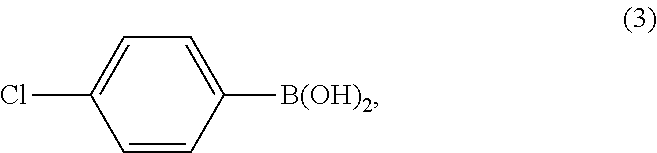
to give the compound of formula 4


wherein X is I (5a) or Br (5b); and
- said compound of formula 5 is further reacted in the presence of either

to give the compound of formula 8

and

to give the compound of formula 1, wherein
- R1, R2, R3 and R4 are all methyl, or together with the carbon atoms to which they are attached form a phenyl ring; and
- R5 is —(C1-C6)alkyl or benzyl.
- steps a) and b) are as described above; and

followed by treatment with an acid to give the compound of formula 8

and


is reacted in the presence of PdCl2(dppf)CH2Cl2, Pd(OAc)2, Na2CO3 and the compound of formula 3

to give the compound of formula 4


wherein X is —I (5a) or —Br (5b);

and subsequently treated with HCI to give the compound of formula 8

and

In the presence of (COCl)2 and AlCl3, to give the compound of formula 1.

followed by the reaction with a strong base, to give the compound of formula 8

and


is reacted in the presence of PdCl2(dppf)CH2Cl2, Pd(OAc)2, Na2CO3 and the compound of formula 3

to give the compound of formula 4


wherein X is —I (5a) or —Br (5b);
- c-2) said compound of formula 5 is further reacted in the presence of Pd(PPh3)2Cl2, CuI, tetramethylguanidine (TMG) and the compound of formula 7,

followed by the reaction with KOtBu in NMP, to give the compound of formula 8

and


said process being characterized in that
- a) a compound of formula B

is reacted in the presence of a halogenation reagent, optionally followed by the introduction of amino-protecting groups, to give a compound of formula C

- b) said compound of formula C is further reacted in the presence of a palladium catalyst, a base and a compound of the formula D or 7

to give the compound of formula E or F, respectively

and
- R is phenyl, which is unsubstituted or once or several times substituted by halogen, or —Br;
- R1, R2, R3 and R4 are all methyl, or together with the carbon atoms to which they are attached form a phenyl ring;
- R5 is —(C1-C6)alkyl or benzyl;
- X is —Br or —I; and
- Y1 and Y2 are each independently selected from the group consisting of benzyl, trifluoroacetyl, acetyl, and hydrogen.

said process being characterized in that
- a) a compound of formula B

is reacted in the presence of N-bromosuccinimide (NBS) or N-iodosuccinimide (NIS) or sodiumperiodate in combination with iodine (I2/NaIO4), optionally followed by the introduction of amino-protecting groups, to give a compound of formula C

- b) said compound of formula C is further reacted in the presence of PdCl2(dppf)CH2Cl2, LiOH and a compound of the formula D

to give the compound of formula E

and
- R is phenyl, which is unsubstituted or once or several times substituted by halogen, or —Br;
- R1, R2, R3 and R4 are all methyl, or together with the carbon atoms to which they are attached form a phenyl ring;
- R5 is —(C1-C6)alkyl or benzyl;
- X is —Br or —I; and
- Y1 and Y2 are each independently selected from the group consisting of benzyl, trifluoroacetyl, acetyl, and hydrogen.
- R is —Br, and all remaining substituents are as defined above.
- R is —Br;
- R1 to R4 are all methyl;
- R5 is ethyl;
- X is —I; and
- Y1 and Y2 are both hydrogen.
- R is 4-Cl-phenyl, and all remaining substituents are as defined above.
- R is 4-Cl-phenyl;
- R1 to R4 are all methyl;
- R5 is ethyl;
- X is —Br; and
- Y1 and Y2 are both hydrogen.

said process being characterized in that
- a) a compound of formula B

is reacted in the presence of N-bromosuccinimide (NBS) or N-iodosuccinimide (NIS) or sodiumperiodate in combination with iodine (I2/NaIO4), optionally followed by the introduction of amino-protecting groups, to give a compound of formula C

- b) said compound of formula C is further reacted in the presence of Pd(PPh3)2Cl2, CuI, tetramethylguanidine and the compound of the formula 7

to give a compound of formula F

and
- R is phenyl, which is unsubstituted or once or several times substituted by halogen, or —Br;
- X is —Br or —I; and
- Y1 and Y2 are independently selected from the group consisting of benzyl, trifluoroacetyl, acetyl, and hydrogen.
- the reaction step a) is carried out in the presence of N-iodosuccinimide (NIS) and trifluoracetic acid;
- the reaction step b) is carried out in the presence of Pd(PPh3)2Cl2, CuI, tetramethylguanidine and the compound of formula 7 in toluene;
- the reaction step c-2) is carried out in the presence of KOtBu in N-methyl-2-pyrrolidon; and


wherein the compound of formula G

is reacted with a compound of formula H

in the presence of a palladium, rhodium or ruthenium -catalyst to give a compound of formula D, wherein
- R1, R2, R3 and R4 are all methyl, or together with the carbon atoms to which they are attached form a phenyl ring; and
- R5 is —(C1-C6)alkyl or benzyl.
- R1, R2, R3 and R4 are all methyl; and
- R5 is ethyl.


I-a) Cyclization of the Iodide (5a):


a) NIS Procedure:


Claims (6)


Priority Applications (2)
| Application Number | Priority Date | Filing Date | Title |
|---|---|---|---|
| US14/296,316 US9150594B2 (en) | 2010-07-21 | 2014-06-04 | Processes for the manufacture of propane-1-sulfonic acid {3-[5-(4-chloro-phenyl)-1H-pyrrolo[2,3-b]pyridine-3-carbonyl]-2,4-difluoro-phenyl}-amide |
| US14/838,197 US9556172B2 (en) | 2010-07-21 | 2015-08-27 | Processes for the manufacture of propane-1-sulfonic acid (3-[5-(4-chloro-phenyl)-1H-pyrrolo[2,3-b]pyridine-3-carbonyl]-2,4-difluoro-phenyl)-amide |
Applications Claiming Priority (3)
| Application Number | Priority Date | Filing Date | Title |
|---|---|---|---|
| EP10170266 | 2010-07-21 | ||
| EP10170266 | 2010-07-21 | ||
| EP10170266.0 | 2010-07-21 |
Related Child Applications (1)
| Application Number | Title | Priority Date | Filing Date |
|---|---|---|---|
| US14/296,316 Continuation US9150594B2 (en) | 2010-07-21 | 2014-06-04 | Processes for the manufacture of propane-1-sulfonic acid {3-[5-(4-chloro-phenyl)-1H-pyrrolo[2,3-b]pyridine-3-carbonyl]-2,4-difluoro-phenyl}-amide |
Publications (2)
| Publication Number | Publication Date |
|---|---|
| US20120022258A1 US20120022258A1 (en) | 2012-01-26 |
| US8779150B2 true US8779150B2 (en) | 2014-07-15 |
Family
ID=44532792
Family Applications (3)
| Application Number | Title | Priority Date | Filing Date |
|---|---|---|---|
| US13/183,694 Active 2032-01-12 US8779150B2 (en) | 2010-07-21 | 2011-07-15 | Processes for the manufacture of propane-1-sulfonic acid {3-[5-(4-chloro-phenyl)-1 H-pyrrolo[2,3-b]pyridine-3-carbonyl]-2,4-difluoro-phenyl}-amide |
| US14/296,316 Active US9150594B2 (en) | 2010-07-21 | 2014-06-04 | Processes for the manufacture of propane-1-sulfonic acid {3-[5-(4-chloro-phenyl)-1H-pyrrolo[2,3-b]pyridine-3-carbonyl]-2,4-difluoro-phenyl}-amide |
| US14/838,197 Active US9556172B2 (en) | 2010-07-21 | 2015-08-27 | Processes for the manufacture of propane-1-sulfonic acid (3-[5-(4-chloro-phenyl)-1H-pyrrolo[2,3-b]pyridine-3-carbonyl]-2,4-difluoro-phenyl)-amide |
Family Applications After (2)
| Application Number | Title | Priority Date | Filing Date |
|---|---|---|---|
| US14/296,316 Active US9150594B2 (en) | 2010-07-21 | 2014-06-04 | Processes for the manufacture of propane-1-sulfonic acid {3-[5-(4-chloro-phenyl)-1H-pyrrolo[2,3-b]pyridine-3-carbonyl]-2,4-difluoro-phenyl}-amide |
| US14/838,197 Active US9556172B2 (en) | 2010-07-21 | 2015-08-27 | Processes for the manufacture of propane-1-sulfonic acid (3-[5-(4-chloro-phenyl)-1H-pyrrolo[2,3-b]pyridine-3-carbonyl]-2,4-difluoro-phenyl)-amide |
Country Status (14)
| Country | Link |
|---|---|
| US (3) | US8779150B2 (en) |
| EP (1) | EP2595958B1 (en) |
| JP (1) | JP5738992B2 (en) |
| KR (1) | KR101501856B1 (en) |
| CN (1) | CN103153956B (en) |
| BR (1) | BR112013001111A2 (en) |
| CA (1) | CA2804739A1 (en) |
| DK (1) | DK2595958T3 (en) |
| ES (1) | ES2538996T3 (en) |
| HU (1) | HUE025022T2 (en) |
| MX (1) | MX2013000708A (en) |
| PL (1) | PL2595958T3 (en) |
| SI (1) | SI2595958T1 (en) |
| WO (1) | WO2012010538A2 (en) |
Cited By (1)
| Publication number | Priority date | Publication date | Assignee | Title |
|---|---|---|---|---|
| US9150594B2 (en) | 2010-07-21 | 2015-10-06 | Hoffmann-La Roche Inc. | Processes for the manufacture of propane-1-sulfonic acid {3-[5-(4-chloro-phenyl)-1H-pyrrolo[2,3-b]pyridine-3-carbonyl]-2,4-difluoro-phenyl}-amide |
Families Citing this family (11)
| Publication number | Priority date | Publication date | Assignee | Title |
|---|---|---|---|---|
| US8329724B2 (en) | 2009-08-03 | 2012-12-11 | Hoffmann-La Roche Inc. | Process for the manufacture of pharmaceutically active compounds |
| JP2013526538A (en) * | 2010-05-12 | 2013-06-24 | バーテックス ファーマシューティカルズ インコーポレイテッド | Compounds useful as ATR kinase inhibitors |
| PE20141360A1 (en) * | 2011-02-07 | 2014-10-13 | Plexxikon Inc | COMPOUNDS AND METHODS FOR THE MODULATION OF KINASES AND INDICATIONS FOR THEM. |
| US9216170B2 (en) | 2012-03-19 | 2015-12-22 | Hoffmann-La Roche Inc. | Combination therapy for proliferative disorders |
| CN104387384A (en) * | 2014-10-30 | 2015-03-04 | 上海蘅茂生物科技有限公司 | Synthetic process of 5-bromo-7-azaindole |
| CN104761491B (en) * | 2015-03-31 | 2018-08-21 | 山东友帮生化科技有限公司 | The synthetic method of the iodo- 5- bromopyridines of 2- amino -3- |
| CZ2015250A3 (en) | 2015-04-14 | 2016-10-26 | Zentiva, K.S. | Vemurafenib amorphous forms |
| JP6911062B2 (en) * | 2016-07-01 | 2021-07-28 | フェルミオン オサケ ユキチュア | New manufacturing method for vemurafenib |
| WO2018015307A1 (en) | 2016-07-18 | 2018-01-25 | Janssen Pharmaceutica Nv | Tau pet imaging ligands |
| US11040027B2 (en) | 2017-01-17 | 2021-06-22 | Heparegenix Gmbh | Protein kinase inhibitors for promoting liver regeneration or reducing or preventing hepatocyte death |
| CN116693449A (en) | 2022-03-04 | 2023-09-05 | 上海致根医药科技有限公司 | Compounds useful as TYK2 inhibitors, preparation method and application thereof in medicine |
Citations (8)
| Publication number | Priority date | Publication date | Assignee | Title |
|---|---|---|---|---|
| WO1998058935A1 (en) | 1997-06-20 | 1998-12-30 | Commonwealth Scientific And Industrial Research Organisation | Alkene borates and a process for covalently coupling organic compounds |
| US6476045B2 (en) | 2000-07-13 | 2002-11-05 | Merck Sharp & Dohme Ltd. | Azaindole derivatives and their use as therapeutic agents |
| WO2006015123A1 (en) | 2004-07-27 | 2006-02-09 | Sgx Pharmaceuticals, Inc. | Pyrrolo-pyridine kinase modulators |
| US20060183758A1 (en) * | 2005-02-17 | 2006-08-17 | Cb Research And Development, Inc. | Method for synthesis of AZA-annelated pyrroles, thiophenes, and furans |
| WO2007002325A1 (en) | 2005-06-22 | 2007-01-04 | Plexxikon, Inc. | Pyrrolo[2,3-b] pyridine derivatives as protein kinase inhibitors |
| WO2009016460A2 (en) | 2007-08-01 | 2009-02-05 | Pfizer Inc. | Pyrazole compounds and their use as raf inhibitors |
| US7504509B2 (en) | 2003-12-19 | 2009-03-17 | Plexxikon, Inc. | Compounds and methods for development of Ret modulators |
| US8329724B2 (en) | 2009-08-03 | 2012-12-11 | Hoffmann-La Roche Inc. | Process for the manufacture of pharmaceutically active compounds |
Family Cites Families (4)
| Publication number | Priority date | Publication date | Assignee | Title |
|---|---|---|---|---|
| ES2364340T3 (en) | 2004-03-30 | 2011-08-31 | Vertex Pharmaceuticals Incorporated | USEFUL AZAINDOLS AS JAK INHIBITORS AND OTHER PROTEIN KINASES. |
| CN101027302B (en) * | 2004-07-27 | 2011-05-11 | Sgx药物公司 | Pyrrolo-pyridine kinase modulators |
| PT1863818E (en) * | 2005-03-23 | 2010-04-09 | Hoffmann La Roche | Acetylenyl-pyrazolo-pvrimidine derivatives as mglur2 antagonists |
| US8779150B2 (en) | 2010-07-21 | 2014-07-15 | Hoffmann-La Roche Inc. | Processes for the manufacture of propane-1-sulfonic acid {3-[5-(4-chloro-phenyl)-1 H-pyrrolo[2,3-b]pyridine-3-carbonyl]-2,4-difluoro-phenyl}-amide |
-
2011
- 2011-07-15 US US13/183,694 patent/US8779150B2/en active Active
- 2011-07-18 MX MX2013000708A patent/MX2013000708A/en active IP Right Grant
- 2011-07-18 SI SI201130506T patent/SI2595958T1/en unknown
- 2011-07-18 EP EP20110735858 patent/EP2595958B1/en active Active
- 2011-07-18 WO PCT/EP2011/062207 patent/WO2012010538A2/en not_active Ceased
- 2011-07-18 JP JP2013520097A patent/JP5738992B2/en active Active
- 2011-07-18 HU HUE11735858A patent/HUE025022T2/en unknown
- 2011-07-18 BR BR112013001111A patent/BR112013001111A2/en not_active IP Right Cessation
- 2011-07-18 ES ES11735858.0T patent/ES2538996T3/en active Active
- 2011-07-18 PL PL11735858T patent/PL2595958T3/en unknown
- 2011-07-18 KR KR1020137004227A patent/KR101501856B1/en not_active Expired - Fee Related
- 2011-07-18 DK DK11735858.0T patent/DK2595958T3/en active
- 2011-07-18 CA CA2804739A patent/CA2804739A1/en not_active Abandoned
- 2011-07-18 CN CN201180035703.2A patent/CN103153956B/en active Active
-
2014
- 2014-06-04 US US14/296,316 patent/US9150594B2/en active Active
-
2015
- 2015-08-27 US US14/838,197 patent/US9556172B2/en active Active
Patent Citations (12)
| Publication number | Priority date | Publication date | Assignee | Title |
|---|---|---|---|---|
| WO1998058935A1 (en) | 1997-06-20 | 1998-12-30 | Commonwealth Scientific And Industrial Research Organisation | Alkene borates and a process for covalently coupling organic compounds |
| US6476045B2 (en) | 2000-07-13 | 2002-11-05 | Merck Sharp & Dohme Ltd. | Azaindole derivatives and their use as therapeutic agents |
| US7504509B2 (en) | 2003-12-19 | 2009-03-17 | Plexxikon, Inc. | Compounds and methods for development of Ret modulators |
| WO2006015123A1 (en) | 2004-07-27 | 2006-02-09 | Sgx Pharmaceuticals, Inc. | Pyrrolo-pyridine kinase modulators |
| US7361763B2 (en) * | 2004-07-27 | 2008-04-22 | Sgx Pharmaceuticals, Inc. | Pyrrolo-pyridine kinase modulators |
| US20060183758A1 (en) * | 2005-02-17 | 2006-08-17 | Cb Research And Development, Inc. | Method for synthesis of AZA-annelated pyrroles, thiophenes, and furans |
| WO2007002325A1 (en) | 2005-06-22 | 2007-01-04 | Plexxikon, Inc. | Pyrrolo[2,3-b] pyridine derivatives as protein kinase inhibitors |
| WO2007002433A1 (en) | 2005-06-22 | 2007-01-04 | Plexxikon, Inc. | Pyrrolo [2, 3-b] pyridine derivatives as protein kinase inhibitors |
| WO2009016460A2 (en) | 2007-08-01 | 2009-02-05 | Pfizer Inc. | Pyrazole compounds and their use as raf inhibitors |
| US8329724B2 (en) | 2009-08-03 | 2012-12-11 | Hoffmann-La Roche Inc. | Process for the manufacture of pharmaceutically active compounds |
| US20130005761A1 (en) | 2009-08-03 | 2013-01-03 | Stefan Hildbrand | Process for the manufacture of pharmaceutically active compounds |
| US8530661B2 (en) | 2009-08-03 | 2013-09-10 | Hoffmann-La Roche, Inc. | Process for the manufacture of pharmaceutically active compounds |
Non-Patent Citations (8)
| Title |
|---|
| (International Search Report for PCT/EP2010/061079 Feb. 17, 2011). |
| (International Search Report for PCT/EP2011/062207 Nov. 29, 2011). |
| Kumar, V. et al., Journal of Organic Chemistry (XP000578238), 57(25):6995-6998 (Dec. 4, 1992). |
| Pillard, C. et al., Synthesis (XP002630167), 13:2049-2054 (May 2008). |
| Satoh et al., "Synthesis":373 ( 1987). |
| Whelligan "Two-Step Synthesis of Aza- and Diazaindoles from Chloroamino-N-heterocycles Using Ethoxyvinylborolane" J. Org. Chem. 2010, 75, 11-15, published online Dec. 1, 2009. * |
| Written Opinion of the International Searching Authority mailed on Dec. 17, 2012 for PCT Patent Application No. PCT/EP2011/062207 filed on Jul. 18, 2011, ten pages. |
| Zhao, S-B et al., Organometallics (XP002630313), 29(4):998-1003 (Jan. 1, 2009). |
Cited By (2)
| Publication number | Priority date | Publication date | Assignee | Title |
|---|---|---|---|---|
| US9150594B2 (en) | 2010-07-21 | 2015-10-06 | Hoffmann-La Roche Inc. | Processes for the manufacture of propane-1-sulfonic acid {3-[5-(4-chloro-phenyl)-1H-pyrrolo[2,3-b]pyridine-3-carbonyl]-2,4-difluoro-phenyl}-amide |
| US9556172B2 (en) | 2010-07-21 | 2017-01-31 | Hoffman La-Roche Inc. | Processes for the manufacture of propane-1-sulfonic acid (3-[5-(4-chloro-phenyl)-1H-pyrrolo[2,3-b]pyridine-3-carbonyl]-2,4-difluoro-phenyl)-amide |
Also Published As
| Publication number | Publication date |
|---|---|
| WO2012010538A3 (en) | 2013-02-21 |
| CN103153956B (en) | 2015-05-27 |
| WO2012010538A2 (en) | 2012-01-26 |
| PL2595958T3 (en) | 2015-10-30 |
| JP5738992B2 (en) | 2015-06-24 |
| KR101501856B1 (en) | 2015-03-11 |
| MX2013000708A (en) | 2013-02-27 |
| RU2013105102A (en) | 2014-08-27 |
| EP2595958A2 (en) | 2013-05-29 |
| US9556172B2 (en) | 2017-01-31 |
| KR20130041230A (en) | 2013-04-24 |
| DK2595958T3 (en) | 2015-05-18 |
| CN103153956A (en) | 2013-06-12 |
| CA2804739A1 (en) | 2012-01-26 |
| HUE025022T2 (en) | 2016-05-30 |
| US20160083378A1 (en) | 2016-03-24 |
| US20140288308A1 (en) | 2014-09-25 |
| SI2595958T1 (en) | 2015-07-31 |
| ES2538996T3 (en) | 2015-06-25 |
| HK1181387A1 (en) | 2013-11-08 |
| US9150594B2 (en) | 2015-10-06 |
| US20120022258A1 (en) | 2012-01-26 |
| EP2595958B1 (en) | 2015-04-29 |
| BR112013001111A2 (en) | 2016-05-24 |
| JP2013537521A (en) | 2013-10-03 |
Similar Documents
| Publication | Publication Date | Title |
|---|---|---|
| US9150594B2 (en) | Processes for the manufacture of propane-1-sulfonic acid {3-[5-(4-chloro-phenyl)-1H-pyrrolo[2,3-b]pyridine-3-carbonyl]-2,4-difluoro-phenyl}-amide | |
| US11098064B2 (en) | Process for the preparation of 6-(2-hydroxy-2-methylpropoxy)-4-(6-(6-((6-methoxypyridin-3-yl)methyl)-3,6-diazabicyclo[3.1.1]heptan-3-yl)pyridin-3-yl)pyrazolo[1,5-a]pyridine-3-carbontrile | |
| US20110028511A1 (en) | Process for the manufacture of pharmaceutically active compounds | |
| US7687631B2 (en) | Synthesis of diethyl{[5-(3-fluorophenyl)-pyridine-2yl]methyl}phosphonate | |
| US9359366B2 (en) | Intermediate of Ticagrelor and preparation method therefor, and preparation method for Ticagrelor | |
| US20250289781A1 (en) | Trifluoromethanesulfonylating agent composition and method for producing trifluoromethanesulfonyloxy compound or trifluoromethanesulfonyl compound | |
| WO2004009553A1 (en) | Process for producing 5-(2'-pyridyl)-2-pyridone derivative | |
| WO2011004389A2 (en) | An improved process for the preparation of elvitegravir | |
| US20080293947A1 (en) | Method of Preparation for Imidazolepyridines | |
| US9447099B2 (en) | Methods for the preparation of 5-[2-[7 (trifluoromethyl)-5-[4-(trifluoromethyl)phenyl]pyrazolo [1,5-A]pyrimidin-3-yl[ethynyl]-2-pyridinamine | |
| RU2575478C2 (en) | NOVEL METHODS OF PRODUCING PROPANE-1-SULPHONIC ACID {3-[5-(4-CHLORO-PHENYL)-1H-PYRROLO[2,3-b]PYRIDINE-3-CARBONYL]-2,4-DIFLUORO-PHENYL}-AMIDE | |
| US10287287B2 (en) | Process development of a pyridine-containing NK-1 receptor antagonist | |
| JP6664170B2 (en) | Method for producing aminohydroxypyridine compound | |
| HK1181387B (en) | Novel processes for the manufacture of propane-1-sulfonic acid {3-[5-(4-chloro-phenyl)-1h-pyrrolo[2,3-b] pyridine-3-carbonyl]-2,4-difluoro-phenyl}-amide | |
| US11306093B2 (en) | Process for preparation of 2-(6-nitropyridin-3-yl)-9H-dipyrido[2,3-b;3′,4′-d]pyrrole | |
| US20070293678A1 (en) | Process For The Preparation Of 6, 8-Subs Tituted '1, 7 Naphthpyridin Derivatives By Reacting The 8-Halo-'1, 7 Naphthpyrid In-Derivate With An Organic Boronic Acid Derivatives And Intermadiates Of This Process | |
| US20250145574A1 (en) | Fluoroisoquinoline compound and production method thereof | |
| JPS61155385A (en) | Novel pyrrolo-pyridine derivative and manufacture | |
| CN119768406A (en) | Process for the preparation of substituted pyrrolopyrimidines and intermediates | |
| JP4263427B2 (en) | Halogeno-4-dihydroxymethylpyridine, process for producing the same and process for producing halogeno-4-pyridinecarbaldehyde using the same | |
| IE900133L (en) | Process for the manufacture of anilinofumarate via¹chloromaleate or chlorofumarate or mixtures thereof | |
| Hosseinzadeh et al. | Efficient Sonogashira Coupling Reaction Catalyzed by Copper (I) Iodide in the Presence of KF/Al2O3 | |
| WO2008142542A2 (en) | Processes for preparing benzofuro [3, 2-c] pyridine- 9-carbaldehyde derivatives as novel intermediates for the synthesis of pde iv inhibitors | |
| JPH01272556A (en) | 4-allyl-2,6-diethylaniline and production thereof |
Legal Events
| Date | Code | Title | Description |
|---|---|---|---|
| AS | Assignment |
Owner name: F. HOFFMANN-LA ROCHE AG, SWITZERLAND Free format text: ASSIGNMENT OF ASSIGNORS INTEREST;ASSIGNOR:RADINOV, ROUMEN NIKOLAEV;REEL/FRAME:028170/0274 Effective date: 20110630 Owner name: F. HOFFMANN-LA ROCHE AG, SWITZERLAND Free format text: ASSIGNMENT OF ASSIGNORS INTEREST;ASSIGNORS:MOORLAG, HENDRIK;WALDMEIER, PIUS;REEL/FRAME:028169/0596 Effective date: 20110616 Owner name: F. HOFFMANN-LA ROCHE AG, SWITZERLAND Free format text: ASSIGNMENT OF ASSIGNORS INTEREST;ASSIGNOR:REN, YI;REEL/FRAME:028170/0359 Effective date: 20110621 Owner name: F. HOFFMANN-LA ROCHE AG, SWITZERLAND Free format text: ASSIGNMENT OF ASSIGNORS INTEREST;ASSIGNOR:BRUMSTED, COREY JAMES;REEL/FRAME:028170/0355 Effective date: 20110625 Owner name: HOFFMANN-LA ROCHE INC., NEW JERSEY Free format text: ASSIGNMENT OF ASSIGNORS INTEREST;ASSIGNOR:F. HOFFMANN-LA ROCHE AG;REEL/FRAME:028344/0516 Effective date: 20110803 |
|
| FEPP | Fee payment procedure |
Free format text: PAYOR NUMBER ASSIGNED (ORIGINAL EVENT CODE: ASPN); ENTITY STATUS OF PATENT OWNER: LARGE ENTITY |
|
| STCF | Information on status: patent grant |
Free format text: PATENTED CASE |
|
| CC | Certificate of correction | ||
| MAFP | Maintenance fee payment |
Free format text: PAYMENT OF MAINTENANCE FEE, 4TH YEAR, LARGE ENTITY (ORIGINAL EVENT CODE: M1551) Year of fee payment: 4 |
|
| MAFP | Maintenance fee payment |
Free format text: PAYMENT OF MAINTENANCE FEE, 8TH YEAR, LARGE ENTITY (ORIGINAL EVENT CODE: M1552); ENTITY STATUS OF PATENT OWNER: LARGE ENTITY Year of fee payment: 8 |
|
| MAFP | Maintenance fee payment |
Free format text: PAYMENT OF MAINTENANCE FEE, 12TH YEAR, LARGE ENTITY (ORIGINAL EVENT CODE: M1553); ENTITY STATUS OF PATENT OWNER: LARGE ENTITY Year of fee payment: 12 |