US8776440B2 - Sash limiter apparatus and method - Google Patents
Sash limiter apparatus and method Download PDFInfo
- Publication number
- US8776440B2 US8776440B2 US13/328,776 US201113328776A US8776440B2 US 8776440 B2 US8776440 B2 US 8776440B2 US 201113328776 A US201113328776 A US 201113328776A US 8776440 B2 US8776440 B2 US 8776440B2
- Authority
- US
- United States
- Prior art keywords
- rocker
- sash
- base
- slot
- pin
- Prior art date
- Legal status (The legal status is an assumption and is not a legal conclusion. Google has not performed a legal analysis and makes no representation as to the accuracy of the status listed.)
- Active
Links
Images






Classifications
-
- E—FIXED CONSTRUCTIONS
- E05—LOCKS; KEYS; WINDOW OR DOOR FITTINGS; SAFES
- E05B—LOCKS; ACCESSORIES THEREFOR; HANDCUFFS
- E05B65/00—Locks or fastenings for special use
- E05B65/08—Locks or fastenings for special use for sliding wings
- E05B65/0835—Locks or fastenings for special use for sliding wings the bolts pivoting about an axis parallel to the wings
-
- E—FIXED CONSTRUCTIONS
- E05—LOCKS; KEYS; WINDOW OR DOOR FITTINGS; SAFES
- E05C—BOLTS OR FASTENING DEVICES FOR WINGS, SPECIALLY FOR DOORS OR WINDOWS
- E05C17/00—Devices for holding wings open; Devices for limiting opening of wings or for holding wings open by a movable member extending between frame and wing; Braking devices, stops or buffers, combined therewith
- E05C17/60—Devices for holding wings open; Devices for limiting opening of wings or for holding wings open by a movable member extending between frame and wing; Braking devices, stops or buffers, combined therewith holding sliding wings open
-
- E—FIXED CONSTRUCTIONS
- E05—LOCKS; KEYS; WINDOW OR DOOR FITTINGS; SAFES
- E05C—BOLTS OR FASTENING DEVICES FOR WINGS, SPECIALLY FOR DOORS OR WINDOWS
- E05C3/00—Fastening devices with bolts moving pivotally or rotatively
- E05C3/02—Fastening devices with bolts moving pivotally or rotatively without latching action
-
- E—FIXED CONSTRUCTIONS
- E05—LOCKS; KEYS; WINDOW OR DOOR FITTINGS; SAFES
- E05B—LOCKS; ACCESSORIES THEREFOR; HANDCUFFS
- E05B63/00—Locks or fastenings with special structural characteristics
- E05B63/0052—Locks mounted on the "frame" cooperating with means on the "wing"
-
- Y—GENERAL TAGGING OF NEW TECHNOLOGICAL DEVELOPMENTS; GENERAL TAGGING OF CROSS-SECTIONAL TECHNOLOGIES SPANNING OVER SEVERAL SECTIONS OF THE IPC; TECHNICAL SUBJECTS COVERED BY FORMER USPC CROSS-REFERENCE ART COLLECTIONS [XRACs] AND DIGESTS
- Y10—TECHNICAL SUBJECTS COVERED BY FORMER USPC
- Y10T—TECHNICAL SUBJECTS COVERED BY FORMER US CLASSIFICATION
- Y10T292/00—Closure fasteners
- Y10T292/65—Braces
Definitions
- FIGS. 1A and 1B illustrate a perspective view and a side view, respectively, of an example of a sash limiter in a first position.
- FIGS. 2A and 2B illustrate a perspective view and a side view, respectively, of an example of a sash limiter in a second position.
- FIGS. 3A-3D illustrate a front view, a back view, a side view, and a cross-sectional view taken along line 3 D- 3 D of FIG. 3B , respectively, of an example of a base of a sash limiter.
- FIGS. 4A and 4B illustrate a front view and a side view, respectively, of an example of a rocker of a sash limiter.
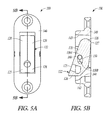
- FIGS. 5A and 5B illustrate a front view and a cross-sectional view taken along line 5 B- 5 B of FIG. 5A , respectively, of an example of a sash limiter in a first position.
- FIGS. 6A and 6B illustrate a front view and a cross-sectional view taken along line 6 B- 6 B of FIG. 6A , respectively, of an example of a sash limiter in a second position.
- FIGS. 7A and 7B illustrate a front view and a cross-sectional view taken along line 7 B- 7 B of FIG. 7A , respectively, of an example of a sash limiter in an intermediate position.
- FIGS. 8A-8D illustrate a top view, a bottom view, a cross-sectional view taken along line 8 C- 8 C of FIG. 8A , and a side view, respectively, of an example of a strike plate of a sash limiter.
- FIG. 9 illustrates a front view of examples of sash limiters attached to a window sash.
- FIG. 10 illustrates a side view of an example of a sash limiter, in a first position, attached to a window.
- FIG. 11 illustrates a side view of an example of a sash limiter, in an intermediate position, attached to a window.
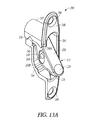
- FIG. 12 illustrates an exploded perspective of an example of a sash limiter.
- FIGS. 13A-13D illustrate a partially cutaway perspective view, a partially cutaway side view, a side view, and a front view, respectively, of an example of a sash limiter in a first position.
- FIGS. 14A-14D illustrate a partially cutaway perspective view, a partially cutaway side view, a side view, and a front view, respectively, of an example of a sash limiter in a second position.
- FIG. 15 illustrates an exploded perspective of an example of a sash limiter
- FIGS. 16A-16D illustrate a partially cutaway perspective view, a partially cutaway side view, a side view, and a front view, respectively, of an example of a sash limiter in a first position.
- FIGS. 17A-17D illustrate a partially cutaway perspective view, a partially cutaway side view, a side view, and a front view, respectively, of an example of a sash limiter in a second position.
- the sash limiter 100 is configured to be used with a window 10 including a frame 12 and a first sash 14 movable within the frame 12 .
- the first sash 14 is movable within the frame 12 in a first direction A and a second direction B, the second direction B being substantially opposite the first direction A.
- the direction A is an opening direction of the window 10 and direction B is a closing direction of the window 10 .
- the window 10 includes a second sash 16 .
- the second sash 16 is also movable within the frame 12 in the first and second directions A, B.
- the sash limiter 100 described herein can be used in other types of windows, such as, for instance, casement windows.
- casement windows such as, for instance, casement windows.
- the sash limiter 100 described herein can be used in a window with a single movable sash. It is noted that the sash limiter 100 need not be limited to use with windows and can be further used with doors, sliding doors, swinging doors, patio doors, freezer doors, refrigerator doors, cabinet doors, skylights, roof hatch, roof access doors, and the like. In various examples, the sash limiter 100 can be used to selectively inhibit the opening of doors, sliding doors, swinging doors, patio doors, freezer doors, cabinet doors, skylights, roof hatches, roof access doors, and the like.
- the sash limiter 100 is attached to a portion of the window 10 . In various examples, as shown in FIGS. 9-11 , the sash limiter 100 is attached to the second sash 16 . In other examples, the sash limiter 100 can be attached to other portions of the window provided the sash limiter 100 can function to limit opening of the window, as described herein.
- the sash limiter 100 includes a rocker 120 and abuse 140 .
- the rocker 120 is selectively pivotable with respect to the base 140 between a first position 122 (e.g., a first abutting position shown in FIGS.
- the rocker 120 is pivotably coupled to the base 140 with a pin 160 .
- the sash limiter 100 need not include a base, in that the rocker 120 can be attached directly to a portion of the window 10 .
- the rocker 120 can be pivotably attached directly to the second sash 16 .
- the rocker 120 can be disposed within a channel or other hollowed out portion of the second sash 16 or other portion of the window 110 .
- the rocker 120 can be pivotably engaged within the channel or other hollowed out portion of the second sash 16 or other portion of the window 10 using a pin.
- the rocker 120 and the base 140 can be formed from die cast zinc.
- the pin 160 can be formed from stainless steel.
- other materials can be used for the components of the sash limiter 100 , provided the sash limiter 100 is capable of functioning as described herein.
- the base 140 includes a ramp 142 (e.g., a rocker ramp) disposed proximate a bottom end of the base 140 .
- the ramp 142 in various examples, is configured to interact with the rocker 120 , as will be described in greater detail below, to facilitate movement of the rocker 120 from the second position 124 (the second resetting position shown in FIGS. 2A and 2B ) to the first position 122 (the first abutting position shown in FIGS. 1A and 1B ).
- the base 140 in an example, includes a landing 144 at a first end of the ramp 142 configured to retain the rocker 120 in the second position 124 .
- the landing 144 includes a substantially flat surface configured to frictionally retain the rocker 120 in the second position 124 .
- the landing 144 includes a pitch.
- the landing 144 can include a ledge, a ridge, and/or other structure to assist in retaining the rocker 120 in the second position 124 .
- the ramp 142 and/or the landing 144 is static with respect to the base 140 . That is, the ramp 142 and/or the landing 144 is fixed with respect to the base 140 such that the ramp 142 and/or the landing 144 does not move with respect to the base 140 .
- the ramp 142 and/or the landing 144 is integrally formed with the base 140 .
- the landing 144 e.g., the ledge and the like
- the landing 144 is positioned at an elevated end of the ramp 142 , for instance near an upper end of the ramp 142 .
- the base 140 includes one or more holes 146 to retain the pin 160 therein for pivotably engaging the rocker 120 .
- the base includes two holes 146 with one hole 146 disposed through each of two side walls 141 of the base 140 .
- the holes 146 are disposed substantially along a horizontal center line of the base 140 .
- the holes 146 are disposed above or below the horizontal center line of the base 140 .
- the base 140 includes one or more fastener holes 148 configured to accept a fastener for engagement with the portion of the window 10 .
- other methods of attachment are contemplated, such as use of an adhesive, for instance.
- the rocker 120 includes an abutment feature 126 .
- the abutment feature 126 is adjacent a first end of the rocker.
- the abutment feature 126 projects outwardly from the base 140 when the rocker 120 is in the first position 122 (e.g., a first abutting position with the abutment feature 126 away from the base 140 ).
- the abutment feature 126 includes a surface configured to abut the first sash 14 to inhibit (e.g., arrest) movement of the first sash 14 past the sash limiter 100 with the rocker 120 in the first position 122 .
- the rocker 120 includes a reset feature 128 .
- the reset feature 128 is adjacent a second end of the rocker (e.g., opposed to the first end of the rocker).
- the reset feature 128 projects outwardly from the base 140 when the rocker 120 is in the second position 124 (e.g., a second resetting position with the reset feature 128 away from the base 140 ).
- the reset feature 128 in an example, is configured to contact a portion of the first sash 14 in order to reset the rocker 120 from the second position 124 to the first position 122 .
- the rocker 120 includes a pivot hole 130 through the rocker 120 .
- the pivot hole 130 is configured to accept the pin 160 therethrough to pivotably engage the rocker 120 with the base 140 .
- the pivot hole 130 is shaped like a substantially oblong slot to enable sliding motion (e.g., translational movement, such as by surface to surface sliding, between a rolling surface on one or more of the pin 160 or the slot and the like) between the rocker 120 and the base 140 in addition to allowing pivotable motion of the rocker 120 with respect to the base 140 .
- the slot shaped pivot hole 130 includes first and second slot ends and a slot track therebetween, to form an oblong shape with the first and second slot ends at either end of the slot.
- the pin 160 is configured for sliding movement along the slot track, for instance from the first slot end to the second slot end or some portion therebetween.
- first slot end 130 B is near the first end of the rocker having the abutment feature 126 and the second slot end 130 A is near the second end of the rocker having the reset feature 128 .
- the slot track 131 is the elongate portion of the slot extending between the first and second slot ends 130 A, B (one or both of the sides of the slot).
- the rocker 120 is configured to slide and pivot along the ramp 142 and/or the landing 144 between the first and second positions 122 , 124 .
- the rocker 120 is able to move along the ramp 142 and rest on the landing 144 , as described further below.
- the rocker 120 follows a contour of the landing 144 and the ramp 142 through pivoting and sliding of the slot-shaped pivot hole 130 along the pin 160 with movement of the rocker 120 between the first and second positions 122 , 124 .
- the pin 160 is positioned within the slot shaped pivot hole 130 near the second slot end 130 A (e.g., near to the second end of the rocker 120 having the reset feature) where the rocker 120 is in the first abutting position.
- the pin 160 is positioned within the slot shaped pivot hole 130 near the first slot end 130 B (e.g., near to the first end of the rocker 120 having the abutment feature) where the rocker 120 is in the second resetting position.
- the pivot hole 130 is substantially centrally located within the rocker 120 .
- the pivot hole 130 is positioned off-center in the rocker 120 so the rocker 120 naturally pivots and/or slides into the first position 122 .
- the first position 122 can be considered a default position.
- the rocker 120 in this example, is biased to the first position 122 .
- the rocker 120 in an example, includes an actuation surface 125 configured to be pressed by a user in order to selectively place the rocker 120 into the second position 124 .
- the actuation surface 125 is disposed below the pivot hole 130 of the rocker 120 .
- the rocker 120 of the sash limiter 100 can be seen in the first position 122 .
- the rocker 120 in some examples, in the first position 122 includes the abutment feature 126 of the rocker 120 disposed within a path of the first sash 14 ( FIG. 10 ).
- the abutment feature 126 is configured to abut a contact portion 15 of the first sash 14 and inhibit movement (e.g., arrest further movement) in the first direction A of the contact portion 15 of the first sash 14 past the abutment feature 126 .
- the rocker 120 in the first position 122 is disposed within the base 140 with the abutment feature 126 extending outwardly from the base 140 .
- the rocker 120 hangs on the pin 160 in the first position 122 with the pin 160 disposed at a top end 130 A of the pivot hole 130 .
- the rocker 120 is substantially biased in the first position 122 by gravity.
- a portion of a back surface 127 of the rocker 120 abuts a surface (either the portion of the window 10 to which the sash limiter 100 is mounted or a back surface of the base 140 of the sash limiter 100 ).
- the portion of the back surface 127 is an upper portion of the back surface 127 , such as a portion of the back surface 127 disposed above the pivot hole 130 .
- a force be applied to the abutment feature 126 for instance, an upward force from the first sash 14 contacting the abutment feature 126 ) would tend to cause upward movement of the rocker 120 as the pivot hole 130 of the rocker 120 moves upwardly with respect to the pin 160 , as well as pivoting about the pin 160 in a clockwise direction in FIG. 5B .
- a top wall 143 of the base 140 in an example, is configured to contact and constrain upward motion of the rocker 120 and the surface (again, either the portion of the window 10 to which the sash limiter 100 is mounted or a back surface of the base 140 of the sash limiter 100 ) is configured to constrain pivoting motion of the rocker 120 .
- the sash limiter 100 in the first position 122 in various examples, is configured to contact the contact portion 15 of the sash 14 if the sash is moved in the direction A.
- the rocker 120 is configured to inhibit motion of the sash 14 past the abutment feature 126 of the rocker 120 (e.g., the rocker 120 arrests further movement of the sash past the abutment feature).
- the rocker 120 of the sash limiter 100 can be set to the first position 122 to inhibit opening of the sash 14 pasta certain point to guard against someone (for instance, a small child) opening the window 10 .
- the rocker 120 of the sash limiter 100 can be seen in the second position 124 .
- the rocker 120 in the second position 124 includes the abutment feature 126 disposed out of the path of the first sash 14 .
- the abutment feature 126 is rotated so that the abutment feature 126 is disposed at least partially within the base 140 .
- the rocker 120 is retained in the second position 124 by the landing 144 at the first end of the ramp 142 .
- the rocker 120 rests on the landing 144 at the first end of the ramp 142 of the base 140 with the rocker 120 in the second position 124 .
- the rocker 120 is frictionally retained by the landing 144 .
- the user can apply a force (with a finger, for instance) on the actuation surface 125 to move the rocker 120 from the first position 122 to the second position 124 .
- the user can apply a force directed inwardly with respect to the base 140 to slide the rocker 120 up the ramp 142 to be retained by the landing 144 .
- Such motion pivots the rocker 120 with respect to the base 140 and causes the rocker to ride up on the pin 160 so that the pin 160 is disposed closer to a bottom end 130 B of the pivot hole 130 .
- the reset feature 128 of the rocker 120 in the second position 124 extends outwardly from the base 140 and into the path of the first sash 14 .
- the reset feature 128 of the rocker 120 is disposed above the pivot hole 130 to facilitate pivoting around the pin 160 when contacted by the first sash 14 .
- the rocker 120 in the second position 124 is configured to allow the contact portion 15 of the first sash 14 to move in the first direction A past the abutment feature 126 (for instance, disposed within the base 140 and outside of the path of the first sash 14 ).
- the rocker 120 of the sash limiter 100 can be set to the second position 124 to allow the window 10 to open past the sash limiter 100 , for instance, to allow someone to exit through the window 10 to egress the building in an emergency.
- the ramp 142 of the base 140 is configured to facilitate the rocker 120 to return to the first position 122 with movement of the contact portion 15 of the first sash 14 past the abutment feature 126 in the second direction B, will be described in more detail below.
- movement of the first sash 14 in the direction A causes the first sash 14 to contact the reset feature 128 of the rocker 120 in the second position 124 .
- Contact with the reset feature 128 causes pivoting of the rocker 120 in a clockwise direction with respect to FIG. 6B .
- such pivoting of the rocker 120 causes the rocker 120 to slide or otherwise move off of the landing 144 and at least partially along the ramp 142 to an intermediate position 123 , as described below.
- the rocker 120 of the sash limiter 100 can be seen in the intermediate position 123 .
- the rocker 120 is placed in the intermediate position 123 with contact of the first sash 14 with the reset portion 128 and causes the rocker 120 to slide off of the landing 144 and at least partially along the ramp 142 .
- the rocker 120 in the intermediate position 123 is substantially flush with the side walls 141 of the base 140 .
- the rocker 120 in the intermediate position 123 hangs on the pin 160 with the pin 160 disposed at the top 130 A of the pivot hole 130 .
- the weighting and/or the shape of the rocker 120 are such that, if unconstrained, the rocker 120 would pivot to the first position 122 .
- the rocker 120 remains in the intermediate position 123 so long as an object (for instance, the first sash 14 ) remains in contact with the rocker 120 .
- the rocker 120 is configured to remain in the intermediate position 123 as long as an object (for instance, the first sash 14 ) remains in contact with a portion of the rocker 120 substantially at or below the pin 160 disposed within the pivot hole 130 of the rocker 120 .
- the rocker 120 is free to pivot about the pin 160 in a clockwise direction in FIG. 7B to the first position 122 .
- the first sash 14 is moved in the direction A so that a top of the first sash 14 passes by the abutment feature 126 of the rocker 120 disposed in the first position 122 and contacts the reset feature 128 to move the rocker 120 from the first position 122 to the intermediate position 123 .
- the first sash 14 can be moved further in the direction A, for instance to open the first sash 14 further and/or fully.
- the rocker 120 can be configured to pivot into the first position 122 .
- the rocker 120 can be configured to pivot to the first position 122 . If the first sash 14 is then moved in the direction B, the rocker 120 can be configured to pivot from the first position 122 to the intermediate position 123 with contact of rocker 120 by the first sash 14 , thereby allowing the first sash 14 to pass by the rocker 120 in the direction B (to close the window 10 , for instance).
- the rocker 120 can be configured to pivot to the first position 122 , thereby automatically resetting the rocker 120 to the first position 122 to enable the sash limiter 100 to inhibit opening of the first sash 14 beyond the sash limiter 100 to reduce the likelihood that a window 10 will be left in a condition capable of opening fully, which, in turn, reduces the likelihood that a person (for instance, a small child) will be able to open the window 10 .
- the rocker 120 of the sash limiter 100 With automatic resetting of the rocker 120 to the first position 122 , the user need not remember to reset the rocker 120 of the sash limiter 100 back to the first position 122 alter opening the window 10 lay. Instead, the rocker 120 of the sash limiter 100 resets itself and removes the user from a resetting operation. The user simply closes the window 10 to cause the rocker 120 of the sash limiter 100 to automatically reset to the first position 122 to inhibit opening of the window 10 past a certain point.
- the contact portion 15 of the first sash 14 can include a strike plate 180 configured to contact the abutment feature 126 with the rocker 120 in the first position 122 ( FIG. 10 ).
- the strike plate 180 is configured to protect the first sash 14 from damage from abutting the abutment feature 126 .
- the strike plate 180 is sized and shaped to cover an area of the first sash 14 that can be contacted by the abutment feature 126 with the rocker 120 in the first position 122 .
- the strike plate 180 is substantially rectangular in shape.
- the strike plate is substantially L-shaped, for instance, to fit around a corner of a portion of the window 10 .
- the strike plate is not limited to rectangular or L-shaped configurations and can include other shapes provided the strike plate is capable of functioning as described herein.
- the strike plate 180 in an example, includes a hole 182 configured to accept a fastener (such as a screw, nail, bolt, or the like) therethrough for fastening of the strike plate 180 to the first sash 14 (or any other portion of the window 10 that is selectively contacted by the rocker 120 ).
- the strike plate 180 can be attached to the window in other ways, including, for instance, using an adhesive.
- the strike plate 180 includes one or more grip features 184 .
- the one or more grip features 184 can be configured to grip with the portion of the window 10 to which the strike plate 180 is engaged to inhibit rotation of the strike plate 180 with respect to the portion of the window 10 (for instance, rotation about a fastener disposed through the hole 182 and engaging the strike plate 180 to the portion of the window 10 ).
- the one or more grip features 184 include pointed projections extending from a bottom surface of the strike plate 180 , the one or more grip features 184 configured to sink slightly into the portion of the window 10 in order to inhibit movement (for instance, rotation about the fastener) of the strike plate 180 once attached to the portion of the window 10 .
- the strike plate 180 includes two grip features 184 .
- the strike plate 180 can include more or fewer than two grip features. In this way, the one or more grip features 184 help maintain the strike plate 180 in the proper position to protect the portion of the window 10 from potential damage resulting from contact with the abutment feature 126 of the rocker 120 .
- the strike plate 180 can be formed from die cast zinc. In other examples, other materials can be used for the strike plate 180 , provided the strike plate 180 is capable of functioning as described herein.
- more than one sash limiter 1100 are used to selectively inhibit movement of the first sash 14 .
- two sash limiters 100 are attached to a portion of the window 10 to selectively inhibit movement of the first sash 14 .
- the sash limiters 100 are attached to the second sash 16 .
- Use of more than one sash limiter 100 also provides a redundant system in that if one sash limiter 100 fails, there is at least one other sash limiter 100 to selectively inhibit movement of the first sash 14 . Furthermore, having more than one sash limiter 100 requires the user to perform more than one action (for instance, positioning two or more sash limiters 100 in the second position 124 ) in order to open a window 10 fully, thereby reducing the likelihood that a small child can operate the sash limiters 100 .
- placement of the one or more sash limiters 100 with respect to the window 10 can determine the amount that the window 10 can be opened before being constrained by the one or more sash limiters 100 .
- placement of the one or more sash limiters 100 on the second sash 16 at a location spaced a distance from the top of the first sash 14 (with the window 10 in a closed position) allows relative movement between the first and second sashes 14 , 16 by that distance. That is, with the second sash 16 in the closed position and the one or more sash limiters 100 including rockers 120 in the first position 122 , the first sash 14 can be opened a distance X ( FIG.
- the distance X is configured to reduce the likelihood that a small child can pass through a gap between the first sash 14 and the frame 12 with the one or more sash limiters 100 including rockers 120 in the first position 122 .
- the distance X is configured to be four inches. In other examples, the distance X can be configured to be less than four inches. In still further examples, the distance X can be configured to be more than four inches. In some examples, the distance is configured to be adjustable by an adult user, for instance, by repositioning the one or more sash limiters 100 on the window 10 .
- the first sash 14 is movable within the frame 12 of the window 10 in the first direction A (for instance, an opening direction) and the second direction B (for instance, a closing direction).
- the second direction B is substantially opposite the first direction A.
- the window 10 further includes the second sash 16 movable within the frame 12 of the window 10 .
- at least one sash limiter 100 is attached to the window 10 for selectively inhibiting movement of the first sash 14 .
- the at least one sash limiter 100 is attached to the second sash 16 .
- the window 10 includes more than one sash limiter 100 .
- the window 10 includes two sash limiters 100 .
- the method includes selectively placing the rocker 120 of the at least one sash limiter 100 in the first position 122 with respect to the base 140 of the sash limiter 100 .
- the method includes selectively placing the rocker 120 of each of two sash limiters 100 in the first position 122 .
- the rocker 120 in the first position 122 includes the abutment feature 126 of the rocker 120 disposed within a path of the first sash 14 .
- the abutment feature 126 is configured to abut the contact portion 15 of the first sash 14 and inhibit movement in the first direction A of the contact portion 15 of the first sash 14 past the abutment feature 126 , as shown in FIG. 10 .
- the first position 122 is a default position of the rocker 120 . Stated another way, the rocker 120 , in these examples, is biased to the first position 122 .
- the method includes selectively placing the rocker 120 of the at least one sash limiter 100 in the second position 124 with respect to the base 140 of the at least one sash limiter 100 .
- selectively placing the rocker 120 of the at least one sash limiter 100 in the second position 124 includes applying a force on the rocker 120 to pivot the rocker 120 to rest on the landing 144 at the first end of the ramp 142 of the base 140 .
- the rocker 120 in the second position 124 includes the abutment feature 126 disposed out of the path of the first sash 14 .
- the rocker 120 in the second position 124 is configured to allow the contact portion 15 of the first sash 14 to move in the first direction A past the abutment feature 126 .
- the base 140 includes the ramp 142 configured to cause the rocker 120 to return to the first position 122 with movement of the contact portion 15 of the first sash 14 past the abutment feature 126 in the second direction B.
- the method includes automatically returning the rocker 120 to the first position 122 .
- movement in the first direction A of the contact portion 15 of the first sash 14 past and in contact with the reset feature 128 of the rocker 120 pivots the rocker 120 off of the landing 144 and allows the rocker 120 to slide along the ramp 142 to the intermediate position 123 .
- movement of the first sash 14 out of contact with the rocker 120 of the at least one sash limiter 100 allows the rocker 100 to pivot to the first position 122 .
- movement of the first sash 14 out of contact with a lower portion of the rocker 120 of the at least one sash limiter 100 allows the rocker 120 to pivot to the first position 122 .
- further movement of the first sash 14 past the abutment feature 126 in the second direction B allows the rocker 120 to pivot to the first position 122 , thereby automatically resetting the sash limiter 100 to the first position 122 and inhibiting uninterrupted movement of the first sash 14 in the direction A.
- selectively placing the rocker 120 of the at least one sash limiter 100 in the first position 122 allows the first sash 14 to be moved between a closed position and an intermediate position ( FIG. 10 ) in which the contact portion 15 of the first sash 14 contacts the abutment feature 126 of the rocker 120 .
- selectively placing the rocker 120 of the sash limiter 100 in the second position 124 allows the first sash 14 to be moved in the first direction A beyond the intermediate position ( FIG. 11 ).
- the sash limiter 200 is configured to be used in a manner similar to that described above with respect to the sash limiter 100 with a window 10 including a frame 12 and a first sash 14 movable within the frame 12 ( FIGS. 9-11 ).
- the first sash 14 is movable within the frame 12 in a first direction A and a second direction B, the second direction B being substantially opposite the first direction A.
- the direction A is an opening direction of the window 10 and direction B is a closing direction of the window 10 .
- the window 10 includes a second sash 16 .
- the second sash 16 is also movable within the frame 12 in the first and second directions A, B.
- the sash limiter 200 described herein can be used in other types of windows, such as, for instance, casement windows.
- casement windows such as, for instance, casement windows.
- the sash limiter 200 described herein can be used in a window with a single movable sash. It is noted that the sash limiter 200 need not be limited to use with windows and can be further used with doors, sliding doors, swinging doors, patio doors, freezer doors, refrigerator doors, cabinet doors, skylights, roof hatch, roof access doors, and the like. In various examples, the sash limiter 200 can be used to selectively inhibit the opening of doors, sliding doors, swinging doors, patio doors, freezer doors, cabinet doors, skylights, roof hatches, roof access doors, and the like.
- the sash limiter 200 is attached to a portion of the window 10 . In various examples, for instance, similar to that which is shown in FIGS. 9-11 , the sash limiter 200 is attached to the second sash 16 . In other examples, the sash limiter 200 can be attached to other portions of the window provided the sash limiter 200 can function to limit opening of the window, as described herein.
- the sash limiter 200 includes a rocker 220 and a base 240 . In an example, the rocker 220 is selectively pivotable with respect to the base 240 between a first position 222 ( FIGS. 13A-13D ) and a second position 224 ( FIGS. 14A-14D ).
- the rocker 220 is pivotably coupled to the base 240 with a pin 260 .
- the base 240 is at least partially recessed within the second sash 16 of the window 10 .
- a portion of the second sash 16 can be removed to form a hole, channel, groove, or the like sized and shaped to accept at least a portion of the base 240 therein.
- the base 240 is configured to be partially recessed within the portion of the window 10 .
- the base 240 is configured to be fully recessed within the window 10 , such that the base 240 is flush with or disposed below a surface of the window within which the base 240 is disposed.
- the sash limiter 200 need not include a base, in that the rocker 220 can be attached directly to a portion of the window 10 .
- the rocker 220 can be pivotably attached directly to the second sash 16 .
- the rocker 220 can be disposed within a channel or other hollowed out portion of the second sash 16 or other portion of the window 10 .
- the rocker 220 can be pivotably engaged within the channel or other hollowed out portion of the second sash 16 or other portion of the window 10 using a pin.
- the rocker 220 and the base 240 can be formed from die cast zinc.
- the pin 260 can be formed from stainless steel.
- other materials can be used for the components of the sash limiter 200 , provided the sash limiter 200 is capable of functioning as described herein.
- the base 240 includes a ledge 244 disposed proximate a bottom end of the base 240 .
- the ledge 244 in various examples, is configured to interact with the rocker 220 , as wilt be described in greater detail below, to retain the rocker 220 in the second position 224 .
- the ledge 244 is configured to frictionally retain and/or mechanically engage the rocker 220 in the second position 224 .
- the ledge 244 includes a ridge and/or other structure to at least assist in retaining the rocker 220 in the second position 224 .
- the rocker 220 includes an engagement feature 232 configured to engage with the ledge 244 of the base 240 .
- the engagement feature 232 includes a detent-like configuration sized and shaped to selectively engage with the ledge 244 to selectively retain the rocker 220 in the second position 224 .
- the ledge 244 includes a detent feature (e.g., a first detent feature) configured to selectively engage with the engagement feature 232 of the rocker 220 to retain the rocker 220 in the second position 224 .
- the engagement feature 232 is a second detent feature included in a detent assembly of the engagement feature 232 and the slot shaped pivot hole 230 and the pin 260 , described below.
- the slot shaped pivot hole 230 and the pin 260 cooperate to facilitate up and down movement of the engagement feature 232 for positioning against the ledge 244 (e.g., the first detent feature).
- the ledge 244 is static with respect to the base 240 . That is, the ledge 244 is fixed with respect to the base 240 such that the ledge 244 does not move with respect to the base 240 .
- the ledge 244 is integrally formed with the base 240 .
- the base 240 includes one or more holes 246 to retain the pin 260 therein for pivotably engaging the rocker 220 .
- the base includes two holes 246 with one hole 246 disposed through each of two side walls 241 of the base 240 .
- the holes 246 are disposed substantially along a horizontal center line of the base 240 .
- the holes 246 are disposed above or below the horizontal center line of the base 240 .
- the base 240 includes one or more fastener holes 248 configured to accept a fastener for engagement with the portion of the window 10 .
- other methods of attachment are contemplated, such as use of an adhesive, for instance.
- the rocker 220 includes an abutment feature 226 .
- the abutment feature 226 projects outwardly from the base 240 when the rocker 220 is in the first position 222 (e.g., a first abutting position with the abutment feature 226 positioned away from the base 240 ).
- the abutment feature 226 includes a surface configured to abut the first sash 14 to inhibit movement of the first sash 14 past the sash limiter 200 with the rocker 220 in the first position 222 .
- the rocker 220 includes a reset feature 228 (for instance, a reset surface).
- the reset feature 228 projects outwardly from the base 240 when the rocker 220 is in the second position 224 (e.g., a second resetting position with the abutment feature reset feature 228 positioned away from the base 240 ).
- the reset feature 228 in an example, is configured to contact a portion of the first sash 14 in order to reset the rocker 220 from the second position 224 to the first position 227 .
- the rocker 220 includes a pivot hole 230 through the rocker 220 .
- the pivot hole 230 is configured to accept the pin 260 therethrough to pivotably engage the rocker 220 with the base 240 .
- the pivot hole 230 is shaped like a substantially oblong slot to enable sliding motion (e.g., translational movement, such as by surface on surface sliding, engaging a roller on the pin 260 with the slot surface and the like) between the rocker 220 and the base 240 in addition to allowing pivotable motion of the rocker 220 with respect to the base 240 .
- the pin 260 is configured for sliding movement along a slot track of the slot shaped pivot hole 230 , for instance from a first slot end (to the second slot end or some portion therebetween.
- the rocker 220 is configured to slide and pivot out of or into engagement with the ledge 244 between the first and second positions 222 , 224 .
- the rocker 220 is able to slide up and over the ledge 244 while pivoting in order to be retained by the ledge 244 in the second position 224 or disengage from the ledge 244 to return to the first position 222 , as described further below.
- the rocker 220 follows a contour of the ledge 244 through pivoting and sliding of the slot-shaped pivot hole 230 along the pin 260 with movement of the rocker 220 between the first and second positions 222 , 224 .
- the pin 260 is positioned within the slot shaped pivot hole 230 near the second slot end 230 A (e.g., near to the second end of the rocker 220 having the reset feature where the rocker 220 is in the first abutting position 222 .
- the pin 260 is positioned within the slot shaped pivot hole 230 near the first slot end 23013 (e.g., near to the first end of the rocker 220 having the abutment feature) where the rocker 120 is in the second resetting position 224 .
- the slot track 231 is the elongate portion of the slot extending between the first and second slot ends 230 A, B (e.g., one or both sides of the slot).
- the pivot hole 230 is substantially centrally located within the rocker 220 .
- the pivot hole 230 is positioned off-center in the rocker 220 so the rocker 220 naturally pivots and/or slides into the first position 222 , according to gravity, spring bias, and the like. In this way, the first position 222 can be considered a default position.
- the rocker 220 in this example, is biased to the first position 222 .
- the rocker 220 in an example, includes an actuation surface 225 configured be pressed by a user in order to selectively place the rocker 220 into the second position 224 .
- the actuation surface 225 is disposed below the pivot hole 230 of the rocker 220 .
- the rocker 220 of the sash limiter 200 can be seen in the first position 222 .
- the rocker 220 in some examples, in the first position 222 includes the abutment feature 226 (e.g., a catch, surface, projection, and the like) of the rocker 220 disposed within a path of the first sash 14 ( FIG. 10 ).
- the abutment feature 226 is configured to abut a contact portion 15 of the first sash 14 and inhibit movement in the first direction A of the contact portion 15 of the first sash 14 past the abutment feature 226 .
- the contact portion 15 includes a strike plate similar to the examples of strike plates described above.
- the strike plate is configured to protect the first sash from damage from abutting the abutment feature 226 .
- the rocker 220 in the first position 222 is disposed within the base 240 with the abutment feature 226 extending outwardly from the base 240 .
- the rocker 220 hangs on the pin 260 in the first position 222 with the pin 260 disposed at or proximate atop end 230 A (e.g., a second slot end) of the pivot hole 230 .
- the rocker 220 is substantially biased into the first position 222 by gravity.
- a back surface 236 of the rocker 220 abuts a surface 245 of the base 240 of the sash limiter 200 .
- the back surface 236 is disposed above the pivot hole 230 .
- a force be applied to the abutment feature 226 for instance, an upward force from the first sash 14 contacting the abutment feature 226
- such a force would tend to cause upward movement of the rocker 220 as the pivot hole 230 of the rocker 220 moves upwardly with respect to the pin 260 , as well as pivoting about the pin 260 in a counterclockwise direction in FIG. 13B .
- a top wall 247 of the base 240 is configured to contact and constrain upward motion of the rocker 220 and the surface 245 of the base 240 of the sash limiter 200 and/or is configured to constrain pivoting motion of the rocker 220 .
- the sash limiter 200 in the first position 222 in various examples, is configured to contact the contact portion 15 of the window 10 if the window 10 is moved in the direction A. That is, the rocker 220 is configured to inhibit motion of the window 10 past the abutment feature 226 of the rocker 220 through affirmative engagement between the abutment feature 226 and the contact portion 15 of the window 10 and between the back surface 236 of the rocker 220 and the surface 245 of the base 240 . In this way, the rocker 220 of the sash limiter 200 can be set to the first position 222 to inhibit opening of the window 10 past a certain point to guard against someone (for instance, a small child) opening the window 10 .
- the sash limiter 200 includes a rotation-limiting feature configured to limit rotation of the rocker 220 within the base 240 .
- the base 240 includes a tab 243 configured to selectively contact the rocker 220 to limit rotation of the rocker 220 with respect to the base 240 .
- the tab 243 is configured to abut the rocker 220 to inhibit over-rotation of the rocker 220 with respect to the base 240 .
- the rocker 220 includes a groove 234 (e.g., a tab groove) located on the rocker 220 such that first and second surfaces 234 A, 234 B can come into contact with the tab 243 with rotation of the rocker 220 , and, with the tab 243 abutting the first surface 234 A of the groove 234 ( FIG. 13B ), rotation of the rocker 220 is inhibited in one direction, and, with the tab 243 abutting the second surface 234 B of the groove 234 ( FIG. 14B ), rotation of the rocker 220 is inhibited in the other direction.
- a groove 234 e.g., a tab groove
- the tab 243 of the base 240 can inhibit over-rotation of the rocker 220 (e.g., the tab 243 and the tab groove 234 cooperate to constrain rotation of the rocker), such as rotating back to the second position 224 with closing of the window 10 , rather than rotating back to the first position 222 .
- the rocker 220 could have the tendency to be knocked back into engagement with the ledge 244 and return to the second (non-stopping or non-engaging) position 224 with the sash 14 .
- the tab 243 inhibits over-rotation of the rocker 220 and re-engagement of the rocker 220 in the second position 224 in situations such as relatively hard closing of the window 10 , the tab 243 does not inhibit placement of the rocker 220 in the second position under normal circumstances, such as a user placing the rocker 220 in the second position 224 in order to allow the user to open the window 10 past the one or more sash limiters 200 .
- the relative positioning of the tab 243 with respect to the groove 234 is such that it allows rotation of the rocker 220 into the second position 224 under normal circumstances but does not allow rotation of the rocker 220 beyond the second position 224 , thereby decreasing the likelihood of the rocker 220 settling back into the second position 224 after hard closing of the window 10 .
- the rocker 220 of the sash limiter 200 can be seen in the second position 224 .
- the rocker 220 in the second position 224 includes the abutment feature 226 disposed out of the path of the first sash 14 .
- the abutment feature 226 is rotated so that the abutment feature 226 is disposed at least partially within the base 240 .
- the rocker 220 is retained in the second position 224 by the ledge 244 .
- the rocker 220 rests on the ledge 244 with the rocker 220 in the second position 224 .
- the rocker 220 is frictionally retained by the ledge 244 .
- the engagement feature 232 of the rocker 220 is configured to engage with the ledge 244 of the base 240 .
- the engagement feature 232 includes a detent-like configuration sized and shaped to engage with the ledge 244 to selectively retain the rocker 220 in the second position 224 .
- the ledge 244 e.g., a detent feature
- the user can apply a force (with a finger, for instance) on the actuation surface 225 to move the rocker 220 from the first position 222 to the second position 224 .
- the user can apply a force directed inwardly with respect to the base 240 to move the rocker 220 into engagement with the ledge 244 .
- Such motion pivots the rocker 220 with respect to the base 240 and causes the rocker 220 to ride up on the pin 260 so that the pin 260 is disposed closer to a bottom end 230 B (e.g., first slot end) of the pivot hole 230 .
- the reset feature 228 of the rocker 220 in the second position 224 extends outwardly from the base 240 and into the path of the first sash 14 .
- the reset feature 228 of the rocker 220 is disposed above the pivot hole 230 to facilitate pivoting around the pin 260 when contacted by the first sash 14 .
- the rocker 220 in the second position 224 is configured to allow the contact portion 15 of the first sash 14 to move in the first direction A past the abutment feature 226 (for instance, disposed within the base 240 and outside of the path of the first sash 14 ).
- the rocker 220 of the sash limiter 200 can be set to the second position 224 to allow the window 10 to open past the sash limiter 200 , for instance, to allow someone to exit through the window 10 to egress the building in an emergency.
- movement of the first sash 14 in the direction A causes the first sash 14 to contact the reset feature 228 of the rocker 220 in the second position 224 .
- Contact with the reset feature 228 causes pivoting of the rocker 220 in a counterclockwise direction with respect to FIG. 14B .
- such pivoting of the rocker 220 causes the rocker 220 to disengage, slid, or otherwise move off of the ledge 244 to an intermediate position, as described below.
- the rocker 220 is placed in the intermediate position with contact of the first sash 14 with the reset portion 228 and causes the rocker 220 to slide or otherwise move off of the ledge 244 .
- the rocker 220 in the intermediate position is substantially flush with or recessed from edges of the side walls 241 of the base 240 .
- the weighting and/or the shape of the rocker 220 are such that, if unconstrained, the rocker 220 would pivot to the first position 222 from the intermediate position.
- the rocker 220 remains in the intermediate position so long as an object (for instance, the first sash 14 ) remains in contact with the rocker 220 .
- the rocker 220 is configured to remain in the intermediate position as long as an object (for instance, the first sash 14 ) remains in contact with a portion of the rocker 220 substantially at or below the pin 260 disposed within the pivot hole 230 of the rocker 220 . If the object is no longer in contact with the portion of the rocker 220 (in the intermediate position) or the object is in contact with a portion of the rocker 220 (in the intermediate position) above the pin 260 , the rocker 220 is free to pivot about pin 260 in a counterclockwise direction in FIG. 14B to the first position 222 .
- the sash limiter 200 works in a similar manner to that described above with respect to the sash limiter 100 . That is, if the first sash is moved in an opening direction (corresponding to the direction A of FIG. 11 ) so that a top of the first sash passes by the abutment feature 226 of the rocker 220 disposed in the first position 222 and contacts the reset feature 228 to move the rocker 220 from the first position 222 to the intermediate position. At this point, the first sash can be moved further in the opening direction, for instance to open the first sash further and/or fully.
- the rocker 220 can be configured to pivot into the first position 222 . If the first sash is moved in the opening direction out of contact with the rocker 220 , the rocker 220 can be configured to pivot to the first position 222 . If the first sash is then moved in a closing direction (corresponding to the direction B of FIG.
- the rocker 220 can be configured to pivot from the first position 222 to the intermediate position with contact of rocker 220 by the first sash, thereby allowing the first sash to pass by the rocker 220 in the closing direction (to close the window, for instance).
- the rocker 220 is configured to pivot to the first position 222 , thereby automatically resetting the rocker 220 to the first position 222 to enable the sash limiter 200 to inhibit opening of the first sash beyond the sash limiter 200 to reduce the likelihood that a window will be left in a condition capable of opening fully, which, in turn, reduces the likelihood that a person (for instance, a small child) will be able to open the window.
- the rocker 220 of the sash limiter 200 With automatic resetting of the rocker 220 to the first position 222 , the user need not remember to reset the rocker 220 of the sash limiter 200 back to the first position 222 after opening the window fully. Instead, the rocker 220 of the sash limiter 200 resets itself and removes the user from a resetting operation. The user simply closes the window to cause the rocker 220 of the sash limiter 200 to automatically reset to the first position 222 to inhibit opening of the window past a certain point (for instance, four inches).
- the rocker 220 could have the tendency to be knocked back into engagement with the ledge 244 and return to the second (non-engaging) position 224 , rather than returning to the first (engaging) position 222 .
- the position of the tab 243 e.g.
- the tab 243 while the tab 243 inhibits over-rotation of the rocker 220 and re-engagement of the rocker 220 in the second position 224 in situations such as relatively hard closing of the window, the tab 243 does not inhibit placement of the rocker 220 in the second position under normal circumstances, such as the user placing the rocker 220 in the second position 224 in order to allow the user to open the window 10 past the one or more sash limiters 200 .
- more than one sash limiter 200 are used to selectively inhibit movement of the first sash.
- two sash limiters 200 are attached to a portion of the window to selectively inhibit movement of the first sash.
- the sash limiters 200 are attached to the second sash.
- Use of more than one sash limiter 200 also provides a redundant system in that if one sash limiter 200 fails, there is at least one other sash limiter 200 to selectively inhibit movement of the first sash. Furthermore, having more than one sash limiter 200 requires the user to perform more than one action (for instance, positioning two or more sash limiters 200 in the second position 224 ) in order to open a window fully, thereby reducing the likelihood that a small child can operate the sash limiters 200 .
- placement of the one or more sash limiters 200 with respect to the window can determine the amount that the window can be opened before being constrained by the one or more sash limiters 200 .
- placement of the one or more sash limiters 200 on the second sash at a location spaced a distance from the top of the first sash (with the window in a closed position) allows relative movement between the first and second sashes by that distance. That is, with the second sash in the closed position and the one or more sash limiters 200 including rockers 220 in the first position 222 , the first sash can be opened a distance (corresponding to the distance X of FIG.
- the distance is configured to reduce the likelihood that a small child can pass through a gap between the sash and the frame with the one or more sash limiters 200 including rockers 220 in the first position 222 .
- the distance is configured to be four inches. In other examples, the distance can be configured to be less than four inches. In still further examples, the distance can be configured to be more than four inches. In some examples, the distance is configured to be adjustable by an adult user, for instance, by repositioning the one or more sash limiters 200 on the window.
- the sash limiter 300 is configured to be used in a manner similar to that described above with respect to the sash limiter 100 with a window 10 including a frame 12 and a first sash 14 movable within the frame 12 ( FIGS. 9-11 ).
- the first sash 14 is movable within the frame 12 in a first direction A and a second direction B, the second direction B being substantially opposite the first direction A.
- the direction A is an opening direction of the window 10 and direction B is a closing direction of the window 10 .
- the window 10 includes a second sash 16 .
- the second sash 16 is also movable within the frame 12 in the first and second directions A, B.
- the sash limiter 300 described herein can be used in other types of windows, such as, for instance, easement windows.
- the sash limiter 300 described herein can be used in a window with a single movable sash. It is noted that the sash limiter 300 need not be limited to use with windows and can be further used with doors, sliding doors, swinging doors, patio doors, freezer doors, refrigerator doors, cabinet doors, skylights, roof hatch, roof access doors, and the like. In various examples, the sash limiter 300 can be used to selectively inhibit the opening of doors, sliding doors, swinging doors, patio doors, freezer doors, cabinet doors, skylights, roof hatches, roof access doors, and the like.
- the sash limiter 300 is attached to a portion of the window 10 . In various examples, for instance, similar to that which is shown in FIGS. 9-11 , the sash limiter 300 is attached to the second sash 16 . In other examples, the sash limiter 300 can be attached to other portions of the window provided the sash limiter 300 can function to limit opening of the window, as described herein.
- the sash limiter 300 includes a rocker 320 and a base 340 . In an example, the rocker 320 is selectively pivotable with respect to the base 340 between a first position 322 ( FIGS. 16A-16D ) and a second position 324 ( FIGS. 17A-17D ).
- the rocker 320 is pivotably coupled to the base 340 with a pin 360 .
- the base 340 is at least partially recessed within the second sash 16 of the window 10 .
- a portion of the second sash 16 can be removed to form a hole, channel, groove, or the like sized and shaped to accept at least a portion of the base 340 therein.
- the base 340 is configured to be partially recessed within the portion of the window 10 .
- the base 340 is configured to be fully recessed within the window 10 , such that the base 340 is flush with or disposed below a surface of the window within which the base 340 is disposed.
- the sash limiter 300 need not include a base, in that the rocker 320 can be attached directly to a portion of the window 10 .
- the rocker 320 can be pivotably attached directly to the second sash 16 .
- the rocker 320 can be disposed within a channel or other hollowed out portion of the second sash 16 or other portion of the window 10 .
- the rocker 320 can be pivotably engaged within the channel or other hollowed out portion of the second sash 16 or other portion of the window 10 using a pin.
- the rocker 320 and the base 340 can be formed from die cast zinc.
- the pin 360 can be formed from stainless steel.
- other materials can be used for the components of the sash limiter 300 , provided the sash limiter 300 is capable of functioning as described herein.
- the base 340 includes a ledge 344 disposed proximate a bottom end of the base 340 .
- the ledge 344 in various examples, is configured to interact with the rocker 320 , as will be described in greater detail below, to retain the rocker 320 in the second position 324 .
- the ledge 344 is configured to frictionally retain and/or mechanically engage the rocker 320 in the second position 324 .
- the ledge 344 includes a ridge and/or other structure to at least assist in retaining the rocker 320 in the second position 324 .
- the rocker 320 includes an engagement feature 332 (for instance, a recess and surfaces of the recess) configured to engage with the ledge 344 of the base 340 .
- the engagement feature 332 includes a detent-like configuration sized and shaped to selectively engage with the ledge 344 (for instance, the ledge 344 being the detent and the engagement feature 332 including a recess) to selectively retain the rocker 320 in the second position 324 .
- the ledge 344 includes a detent feature configured to selectively engage with the engagement feature 332 of the rocker 320 to retain the rocker 320 in the second position 324 .
- the ledge 344 is static with respect to the base 340 . That is, the ledge 344 is fixed with respect to the base 340 such that the ledge 344 does not move with respect to the base 340 .
- the ledge 344 is integrally formed with the base 340 .
- the base 340 includes one or more holes 346 to retain the pin 360 therein for pivotably engaging the rocker 320 .
- the base includes two holes 346 with one hole 346 disposed through each of two side walls 341 of the base 340 .
- the holes 346 are disposed substantially along a horizontal center line of the base 340 .
- the holes 346 are disposed above or below the horizontal center line of the base 340 .
- the base 340 includes one or more fastener holes 348 configured to accept a fastener for engagement with the portion of the window 10 .
- other methods of attachment are contemplated, such as use of an adhesive, for instance.
- the rocker 320 includes an abutment feature 326 .
- the abutment feature 326 projects outwardly from the base 340 when the rocker 320 is in the first position 322 .
- the abutment feature 326 includes a surface configured to abut the first sash 14 to inhibit movement of the first sash 14 past the sash limiter 300 with the rocker 320 in the first position 322 .
- the rocker 320 includes a reset feature 328 .
- the reset feature 328 projects outwardly from the base 340 when the rocker 320 is in the second position 324 .
- the reset feature 328 in an example, is configured to contact a portion of the first sash 14 in order to reset the rocker 320 from the second position 324 to the first position 322 .
- the rocker 320 includes a pivot hole 330 through the rocker 320 .
- the pivot hole 330 is configured to accept the pin 360 therethrough to pivotably engage the rocker 320 with the base 340 .
- the pivot hole 330 is shaped like a substantially oblong slot to enable sliding motion between the rocker 320 and the base 340 in addition to allowing pivotable motion of the rocker 320 with respect to the base 340 .
- the slot shaped pivot hole 330 includes first and second slot ends and a slot track therebetween, to form an oblong shape with the first and second slot ends at either end of the slot.
- the rocker 320 is configured to slide and pivot out of or into engagement with the ledge 344 between the first and second positions 322 , 324 .
- the rocker 320 is able to slide up and over the ledge 344 while pivoting in order to be retained by the ledge 344 in the second position 324 or disengage from the ledge 344 to return to the first position 322 , as described father below. That is, the rocker 320 follows a contour of the ledge 344 through pivoting and sliding of the slot-shaped pivot hole 330 along the pin 360 with movement of the rocker 320 between the first and second positions 322 , 324 .
- the pivot hole 330 is substantially centrally located within the rocker 320 .
- the pivot hole 330 is positioned off-center in the rocker 320 so the rocker 320 naturally pivots and/or slides into the first position 322 (e.g., the first abutting position). In this way, the first position 322 can be considered a default position.
- the rocker 320 in this example, is biased to the first position 322 because of gravity.
- the rocker 320 in an example, includes an actuation surface 325 configured to be pressed by a user in order to selectively place the rocker 320 into the second position 324 (e.g., the second abutting position). In an example, the actuation surface 325 is disposed below the pivot hole 330 of the rocker 320 .
- the rocker 320 of the sash limiter 300 can be seen in the first position 322 .
- the rocker 320 in some examples, in the first position 322 includes the abutment feature 326 of the rocker 320 disposed within a path of the first sash 14 ( FIG. 10 ).
- the abutment feature 326 is configured to abut a contact portion 15 of the first sash 14 and inhibit movement in the first direction A of the contact portion 15 of the first sash 14 past the abutment feature 326 .
- the contact portion 15 includes a strike plate similar to the examples of strike plates described above.
- the strike plate is configured to protect the first sash from damage from abutting the abutment feature 326 .
- the rocker 320 in the first position 322 is disposed within the base 340 with the abutment feature 326 extending outwardly from the base 340 .
- the rocker 320 hangs on the pin 360 in the first position 322 with the pin 360 disposed at or proximate a top end 330 A of the pivot hole 330 .
- the rocker 320 is substantially biased in the first position 322 by gravity.
- a back surface 336 of the rocker 320 abuts a surface 345 of the base 340 of the sash limiter 300 .
- the back surface 336 is disposed above the pivot hole 330 .
- a top wall 343 of the base 340 in an example, is configured to contact and constrain upward motion of the rocker 320 and the surface 345 of the base 340 of the sash limiter 300 and/or is configured to constrain pivoting motion of the rocker 320 .
- the sash limiter 300 in the first position 322 is configured to contact the contact portion 15 of the window 10 if the window 10 is moved in the direction A. That is, the rocker 320 is configured to inhibit motion of the window 10 past the abutment feature 326 of the rocker 320 . In this way, the rocker 320 of the sash limiter 300 can be set to the first position 322 to inhibit opening of the window 10 past a certain point to guard against someone (for instance, a small child) opening the window 10 .
- the sash limiter 300 includes a rotation-limiting feature configured to limit rotation of the rocker 320 within the base 340 .
- the sash limiter 300 includes a biasing element, such as a spring 370 (elastomeric element and the like), configured to limit rotation of the rocker 320 with respect to the base 340 .
- the spring 370 is configured to urge the rocker 320 to the first position 322 .
- the spring 370 is disposed between the rocker 320 and the base 340 .
- the spring 370 is disposed around a portion of the pin 360 .
- the spring 370 is disposed at least partially within a channel 338 of the rocker 320 .
- the spring 370 is a torsion spring.
- the spring 370 in further examples, includes a first leg 370 A and a second leg 370 B, wherein the first leg 370 A abuts a portion of the rocker 320 and the second leg 370 B abuts a portion of the base 340 , such that movement of the rocker to the second position 324 compresses the spring 370 and increases the potential energy stored within the spring 370 . Release of the potential energy of the spring 370 transitioning the kinetic energy at least assists in moving the rocker 320 back to the first position 322 from the second position 324 .
- the rocker 320 is moved out of engagement with the ledge 344 and the potential energy of the spring 370 (or other biasing element) can assist moving the rocker 320 to the intermediate position. Then, as the sash 14 is moved in the direction B past the sash limiter 300 , the spring 370 can further assist in moving the rocker 320 into the first position 322 . In other examples, the spring 370 can inhibit over-rotation of the rocker 320 , such as rotating back to the second position 324 with closing of the window 10 , rather than rotating back to the first position 322 .
- the rocker 320 could have the tendency to be knocked back into engagement with the ledge 344 and return to the second position 324 .
- the interaction of the spring 370 with the rocker 320 inhibits the over-rotation of the rocker 320 to inhibit re-engagement of the rocker 320 in the second position 324 during closing of the window 10 .
- the spring 370 while the spring 370 inhibits over-rotation of the rocker 320 and re-engagement of the rocker 320 in the second position 324 in situations such as relatively hard closing of the window 10 , the spring 370 does not inhibit placement of the rocker 320 in the second position under normal circumstances, such as a user placing the rocker 320 in the second position 324 in order to allow the user to open the window 10 past the one or more sash limiters 300 .
- the spring 370 is configured to assist in moving the rocker 320 to the first position 322 once the rocker 320 is moved out of engagement with the ledge 344 , but is not strong enough to disengage the rocker 320 from the ledge 344 by itself.
- the rocker 320 of the sash limiter 300 can be seen in the second position 324 .
- the rocker 320 in the second position 324 includes the abutment feature 326 disposed out of the path of the first sash 14 .
- the abutment feature 326 is rotated so that the abutment feature 326 is disposed at least partially within the base 340 .
- the rocker 320 is retained in the second position 324 by the ledge 344 .
- the rocker 320 rests on the ledge 344 with the rocker 320 in the second position 324 .
- the rocker 320 is frictionally retained by the ledge 344 .
- the engagement feature 332 of the rocker 320 is configured to engage with the ledge 344 of the base 340 .
- the engagement feature 332 includes a detent-like configuration sized and shaped to engage with the ledge 344 to selectively retain the rocker 320 in the second position 324 .
- the ledge 344 includes a detent feature configured to selectively engage with the engagement feature 332 of the rocker 320 to retain the rocker 320 in the second position 324 .
- the user can apply a force (with a finger, for instance) on the actuation surface 325 to move the rocker 320 from the first position 322 to the second position 324 .
- the user can apply a force directed inwardly with respect to the base 340 to move the rocker 320 into engagement with the ledge 344 .
- Such motion pivots the rocker 320 with respect to the base 340 and causes the rocker 320 to ride up on the pin 360 so that the pin 360 is disposed closer to a bottom end 330 B of the pivot hole 330 .
- the reset feature 328 of the rocker 320 in the second position 324 extends outwardly from the base 340 and into the path of the first sash 14 .
- the reset feature 328 of the rocker 320 is disposed above the pivot hole 330 to facilitate pivoting around the pin 360 when contacted by the first sash 14 .
- the rocker 320 in the second position 324 is configured to allow the contact portion 15 of the first sash 14 to move in the first direction A past the abutment feature 326 (for instance, disposed within the base 340 and outside of the path of the first sash 14 ).
- the rocker 320 of the sash limiter 300 can be set to the second position 324 to allow the window 10 to open past the sash limiter 300 , for instance, to allow someone to exit through the window 10 to egress the building in an emergency.
- movement of the first sash 14 in the direction A causes the first sash 14 to contact the reset feature 328 of the rocker 320 in the second position 324 .
- Contact with the reset feature 328 causes pivoting of the rocker 320 in a counterclockwise direction with respect to FIG. 17B .
- such pivoting of the rocker 320 causes the rocker 320 to disengage, slide, or otherwise move off of the ledge 344 to an intermediate position, as described below.
- the rocker 320 is placed in the intermediate position with contact of the first sash 14 with the reset portion 328 and causes the rocker 320 to slide or otherwise move off of the ledge 344 .
- the rocker 320 in the intermediate position is substantially flush with or recessed from the side walls 341 of the base 340 .
- the weighting and/or the shape of the rocker 320 are such that, if unconstrained, the rocker 320 would pivot to the first position 322 from the intermediate position.
- the rocker 320 remains in the intermediate position so tong as an object (for instance, the first sash 14 ) remains in contact with the rocker 320 .
- the rocker 320 is configured to remain in the intermediate position as long as an object (for instance, the first sash 14 ) remains in contact with a portion of the rocker 320 substantially at or below the pin 360 disposed within the pivot hole 330 of the rocker 320 . If the object is no longer in contact with the portion of the rocker 320 or the object is in contact with a portion of the rocker 320 above the pin 360 , the rocker 320 is free to pivot about the pin 360 in a counterclockwise direction in FIG. 17B to the first position 322 .
- an object for instance, the first sash 14
- the sash limiter 300 works in a similar manner to that described above with respect to the sash limiter 100 . That is, if the first sash is moved in an opening direction (corresponding to the direction A of FIG. 11 ) so that a top of the first sash passes by the abutment feature 326 of the rocker 320 disposed in the first position 322 and contacts the reset feature 328 to move the rocker 320 from the first position 322 to the intermediate position. At this point, the first sash can be moved further in the opening direction, for instance to open the first sash further and/or fully.
- the rocker 320 can be configured to pivot into the first position 322 . If the first sash is moved in the opening direction out of contact with the rocker 320 , the rocker 320 can be configured to pivot to the first position 322 . If the first sash is then moved in a closing direction (corresponding to the direction B of FIG.
- the rocker 320 can be configured to pivot from the first position 322 to the intermediate position with contact of rocker 320 by the first sash, thereby allowing the first sash to pass by the rocker 320 in the closing direction (to close the window, for instance).
- the rocker 320 is configured to pivot to the first position 322 , thereby automatically resetting the rocker 320 to the first position 322 to enable the sash limiter 300 to inhibit opening of the first sash beyond the sash limiter 300 to reduce the likelihood that a window will be left in a condition capable of opening fully, which, in turn, reduces the likelihood that a person (for instance, a small child) will be able to open the window.
- the rocker 320 of the sash limiter 300 With automatic resetting of the rocker 320 to the first position 322 , the user need not remember to reset the rocker 320 of the sash limiter 300 back to the first position 322 after opening the window fully. Instead, the rocker 320 of the sash limiter 300 resets itself and removes the user from a resetting operation. The user simply closes the window to cause the rocker 320 of the sash limiter 300 to automatically reset to the first position 322 to inhibit opening of the window past a certain point (for instance, four inches).
- the rocker 320 could have the tendency to be knocked back into engagement with the ledge 344 and return to the second (non-engaging) position 324 , rather than returning to the first (engaging) position 322 .
- the interaction of the spring 370 with the rocker 320 inhibits the over-rotation of the rocker 320 to inhibit re-engagement of the rocker 320 in the second position 324 during closing of the window and instead assists in moving the rocker 320 to the first position 322 .
- the spring 370 while the spring 370 inhibits over-rotation of the rocker 320 and re-engagement of the rocker 320 in the second position 324 in situations such as relatively hard closing of the window, the spring 370 does not inhibit placement of the rocker 320 in the second position under normal circumstances, such as the user placing the rocker 320 in the second position 324 in order to allow the user to open the window 10 past the one or more sash limiters 300 .
- more than one sash limiter 300 are used to selectively inhibit movement of the first sash.
- two sash limiters 300 are attached to a portion of the window to selectively inhibit movement of the first sash.
- the sash limiters 300 are attached to the second sash.
- Use of more than one sash limiter 300 also provides a redundant system in that if one sash limiter 300 fails, there is at least one other sash limiter 300 to selectively inhibit movement of the first sash. Furthermore, having more than one sash limiter 300 requires the user to perform more than one action (for instance, positioning two or more sash limiters 300 in the second position 324 ) in order to open a window fully, thereby reducing the likelihood that a small child can operate the sash limiters 300 .
- placement of the one or more sash limiters 300 with respect to the window can determine the amount that the window can be opened before being constrained by the one or more sash limiters 300 .
- placement of the one or more sash limiters 300 on the second sash at a location spaced a distance from the top of the first sash (with the window in a closed position) allows relative movement between the first and second sashes by that distance. That is, with the second sash in the closed position and the one or more sash limiters 300 including rockers 320 in the first position 322 , the first sash can be opened a distance (corresponding to the distance X of FIG.
- the distance is configured to reduce the likelihood that a small child can pass through a gap between the sash and the frame with the one or more sash limiters 300 including rockers 320 in the first position 322 .
- the distance is configured to be four inches. In other examples, the distance can be configured to be less than four inches. In still further examples, the distance can be configured to be more than four inches. In some examples, the distance is configured to be adjustable by an adult user, for instance, by repositioning the one or more sash limiters 300 on the window.
- various aspects described above with respect to one of the sash limiters 100 , 200 , 300 can be used interchangeably between any and all of the example sash limiters 100 , 200 , 300 . That is, even though a particular feature is described and/or shown only with respect to one of the example sash limiters 100 , 200 , 300 , this is not intended to be limiting. As such, in various examples, one or more features of one or more of the sash limiters 100 , 200 , 300 can be used in combination, even if such a combination is not explicitly described herein.
- the various examples of the sash limiters 100 , 200 , 300 and methods thereof described above allow for a user to selectively limit or inhibit a window 10 from fully opening. Such a feature is believed to be advantageous for many reasons. For instance, limiting or inhibiting opening of the window 10 more than a certain distance can reduce if not eliminate the likelihood that a person (for instance, a small child) could fall out of the window 10 .
- the sash limiters 100 , 200 , 300 and methods thereof are further advantageous in that they selectively allow the window 10 to open for instance, for egress from a house, building, or other structure in an emergency.
- the sash limiters 100 , 200 , 300 and methods thereof are further advantageous in that they allow for the sash limiter 100 , 200 , 300 to automatically return to the first position 122 , 222 , 322 after being positioned in the second position 124 , 224 , 324 to open the window 10 beyond the sash limiter 100 , 200 , 300 .
- Such a feature is advantageous in that it reduces the likelihood that a window 10 will be left in a condition capable of opening fully. That is, the user need not remember to reset the sash limiter 100 , 200 , 300 back to the first position 122 , 222 , 322 after opening the window 10 fully.
- the sash limiter 100 , 200 , 300 resets itself and removes the user from a resetting operation.
- the sash limiter 100 , 200 , 300 can be used to selectively inhibit the opening of Objects other than windows, such as, for instance, doors, sliding doors, swinging doors, patio doors, freezer doors, cabinet doors, skylights, roof hatches, roof access doors, and the like. These advantages are not intended to be limiting. As such, additional advantages of the various example sash limiters 100 , 200 , 300 and methods described herein, including additional advantages described above, are contemplated.
Landscapes
- Engineering & Computer Science (AREA)
- Mechanical Engineering (AREA)
- Wing Frames And Configurations (AREA)
Abstract
Description
Claims (27)
Priority Applications (1)
| Application Number | Priority Date | Filing Date | Title |
|---|---|---|---|
| US13/328,776 US8776440B2 (en) | 2010-12-17 | 2011-12-16 | Sash limiter apparatus and method |
Applications Claiming Priority (3)
| Application Number | Priority Date | Filing Date | Title |
|---|---|---|---|
| US201061424343P | 2010-12-17 | 2010-12-17 | |
| US201161486813P | 2011-05-17 | 2011-05-17 | |
| US13/328,776 US8776440B2 (en) | 2010-12-17 | 2011-12-16 | Sash limiter apparatus and method |
Publications (2)
| Publication Number | Publication Date |
|---|---|
| US20120167475A1 US20120167475A1 (en) | 2012-07-05 |
| US8776440B2 true US8776440B2 (en) | 2014-07-15 |
Family
ID=46379475
Family Applications (1)
| Application Number | Title | Priority Date | Filing Date |
|---|---|---|---|
| US13/328,776 Active US8776440B2 (en) | 2010-12-17 | 2011-12-16 | Sash limiter apparatus and method |
Country Status (1)
| Country | Link |
|---|---|
| US (1) | US8776440B2 (en) |
Cited By (7)
| Publication number | Priority date | Publication date | Assignee | Title |
|---|---|---|---|---|
| US20150015000A1 (en) * | 2008-06-19 | 2015-01-15 | Mighton Products Limited | Sash window restrictor |
| US20150275556A1 (en) * | 2014-03-27 | 2015-10-01 | Marvin Lumber And Cedar Company, D/B/A Marvin Windows And Doors | Window opening control device for horizontal and vertical sliding windows |
| US20180209186A1 (en) * | 2017-01-20 | 2018-07-26 | Pella Corporation | Window opening control systems and methods |
| US20210025197A1 (en) * | 2018-03-23 | 2021-01-28 | Pella Corporation | Sliding door foot bolt |
| US11156024B1 (en) * | 2019-11-12 | 2021-10-26 | Barry G. Lawrence | Window opening control device |
| US12359487B1 (en) * | 2022-11-16 | 2025-07-15 | Andersen Corporation | Window opening control device assemblies and methods |
| US12618273B1 (en) * | 2023-10-09 | 2026-05-05 | Andersen Corporation | Protected window opening control device assemblies and methods |
Families Citing this family (9)
| Publication number | Priority date | Publication date | Assignee | Title |
|---|---|---|---|---|
| CA2755576A1 (en) | 2010-10-22 | 2012-04-22 | Amesbury Group, Inc. | Window opening limit devices and method of use |
| US20120124911A1 (en) * | 2010-11-19 | 2012-05-24 | Bruce Hagemeyer | Surface-mounted window opening limit device and method of use |
| US8806809B1 (en) * | 2013-03-14 | 2014-08-19 | Barry G. Lawrence | Window vent stop and method |
| US9435149B1 (en) * | 2013-09-27 | 2016-09-06 | Rodon Limited Partnership | Vent stop for window sashes |
| US11180942B1 (en) | 2019-11-15 | 2021-11-23 | Barry G. Lawrence | Removable window vent stop |
| US11692380B2 (en) | 2019-11-25 | 2023-07-04 | Amesbury Group, Inc. | Window sash lock and tilt mechanism |
| GB2597803B (en) * | 2020-08-07 | 2024-11-20 | Andersen Jesper | A child lock for a sliding window or door |
| US11859435B2 (en) * | 2021-10-08 | 2024-01-02 | Leonardo Stabile | Sliding sash assemblies |
| CN120476241A (en) * | 2022-12-16 | 2025-08-12 | 夸利塔斯制造业股份有限公司 | Roller shutter cam locking slats |
Citations (25)
| Publication number | Priority date | Publication date | Assignee | Title |
|---|---|---|---|---|
| US551181A (en) * | 1895-12-10 | Sash-lock | ||
| US756453A (en) | 1903-12-23 | 1904-04-05 | P & F Corbin | Sash-bolt. |
| US976777A (en) * | 1909-11-10 | 1910-11-22 | John F Peterson | Gravity sash-lock. |
| US1261274A (en) * | 1917-09-05 | 1918-04-02 | Richard Newsam | Window-latch. |
| US1724637A (en) | 1927-08-31 | 1929-08-13 | Roy H Bergstrom | Sash latch |
| US4095827A (en) * | 1976-12-23 | 1978-06-20 | Truth Incorporated | Window lock |
| GB2046107A (en) | 1979-03-30 | 1980-11-12 | Keiheisha Kk | Flying disc and projector therefor |
| US5248174A (en) * | 1992-11-20 | 1993-09-28 | Ashland Products, Inc. | Security lock for sash window |
| US5536052A (en) | 1994-10-04 | 1996-07-16 | Ro-Mai Industries, Inc. | Sash lock with improved tumbler |
| US5575116A (en) * | 1995-06-06 | 1996-11-19 | Certainteed Corporation | Window vent stop |
| US5806900A (en) | 1996-11-05 | 1998-09-15 | Ashland Products, Inc. | Stop for a slidable window |
| WO1999046464A2 (en) | 1998-03-09 | 1999-09-16 | Southco, Inc. | Latch |
| US6000735A (en) | 1998-11-06 | 1999-12-14 | Jormac Products, Inc. | Automatic child-resistant sliding door lock |
| US6021603A (en) | 1998-04-07 | 2000-02-08 | Ashland Products, Inc. | Tilt-latch with bolt stop |
| US6364375B1 (en) * | 2000-02-15 | 2002-04-02 | Ashland Products, Inc. | Apparatus for securing sash window |
| US20030167694A1 (en) * | 2001-12-17 | 2003-09-11 | Liang Luke K. | Window vent stop |
| GB2410058A (en) | 2004-01-15 | 2005-07-20 | Nifco Inc | Door latch with damped bolt return |
| US7093392B2 (en) | 2004-11-30 | 2006-08-22 | Mighton Products, Limited | Spring balance adjustment |
| US20070222233A1 (en) | 2006-03-24 | 2007-09-27 | Luke Liang | Night latch |
| US7296831B2 (en) | 2003-09-03 | 2007-11-20 | Paul Generowicz | Window lock keeper |
| USD581247S1 (en) | 2007-03-23 | 2008-11-25 | Mighton Products Limited | Window lock |
| WO2009072839A1 (en) | 2007-12-05 | 2009-06-11 | General Rotor Co., Ltd. | Locking device for a window |
| US7588271B1 (en) * | 2006-09-15 | 2009-09-15 | Lawrence Barry G | Window security lock |
| GB2461079A (en) | 2008-06-19 | 2009-12-23 | Mighton Products Ltd | Sash window restrictor having a protruding member and retaining mechanism |
| US20120144752A1 (en) * | 2010-10-22 | 2012-06-14 | Steve Piltingsrud | Window opening limit devices and method of use |
-
2011
- 2011-12-16 US US13/328,776 patent/US8776440B2/en active Active
Patent Citations (32)
| Publication number | Priority date | Publication date | Assignee | Title |
|---|---|---|---|---|
| US551181A (en) * | 1895-12-10 | Sash-lock | ||
| US756453A (en) | 1903-12-23 | 1904-04-05 | P & F Corbin | Sash-bolt. |
| US976777A (en) * | 1909-11-10 | 1910-11-22 | John F Peterson | Gravity sash-lock. |
| US1261274A (en) * | 1917-09-05 | 1918-04-02 | Richard Newsam | Window-latch. |
| US1724637A (en) | 1927-08-31 | 1929-08-13 | Roy H Bergstrom | Sash latch |
| US4095827A (en) * | 1976-12-23 | 1978-06-20 | Truth Incorporated | Window lock |
| GB2046107A (en) | 1979-03-30 | 1980-11-12 | Keiheisha Kk | Flying disc and projector therefor |
| US5248174A (en) * | 1992-11-20 | 1993-09-28 | Ashland Products, Inc. | Security lock for sash window |
| US5536052A (en) | 1994-10-04 | 1996-07-16 | Ro-Mai Industries, Inc. | Sash lock with improved tumbler |
| US5575116A (en) * | 1995-06-06 | 1996-11-19 | Certainteed Corporation | Window vent stop |
| US5806900A (en) | 1996-11-05 | 1998-09-15 | Ashland Products, Inc. | Stop for a slidable window |
| WO1999046464A2 (en) | 1998-03-09 | 1999-09-16 | Southco, Inc. | Latch |
| US6021603A (en) | 1998-04-07 | 2000-02-08 | Ashland Products, Inc. | Tilt-latch with bolt stop |
| US6000735A (en) | 1998-11-06 | 1999-12-14 | Jormac Products, Inc. | Automatic child-resistant sliding door lock |
| US6364375B1 (en) * | 2000-02-15 | 2002-04-02 | Ashland Products, Inc. | Apparatus for securing sash window |
| US6572158B2 (en) * | 2000-02-15 | 2003-06-03 | Ashland Products, Inc. | Apparatus for securing sash window |
| US20030167694A1 (en) * | 2001-12-17 | 2003-09-11 | Liang Luke K. | Window vent stop |
| US7296831B2 (en) | 2003-09-03 | 2007-11-20 | Paul Generowicz | Window lock keeper |
| US20100019513A1 (en) | 2003-09-03 | 2010-01-28 | Paul Generowicz | Window lock keeper |
| GB2410058A (en) | 2004-01-15 | 2005-07-20 | Nifco Inc | Door latch with damped bolt return |
| US7093392B2 (en) | 2004-11-30 | 2006-08-22 | Mighton Products, Limited | Spring balance adjustment |
| US20070222233A1 (en) | 2006-03-24 | 2007-09-27 | Luke Liang | Night latch |
| US7600796B2 (en) * | 2006-03-24 | 2009-10-13 | Vision Industries Group | Night latch |
| US7588271B1 (en) * | 2006-09-15 | 2009-09-15 | Lawrence Barry G | Window security lock |
| USD581247S1 (en) | 2007-03-23 | 2008-11-25 | Mighton Products Limited | Window lock |
| WO2009072839A1 (en) | 2007-12-05 | 2009-06-11 | General Rotor Co., Ltd. | Locking device for a window |
| GB2461079A (en) | 2008-06-19 | 2009-12-23 | Mighton Products Ltd | Sash window restrictor having a protruding member and retaining mechanism |
| WO2009153564A1 (en) | 2008-06-19 | 2009-12-23 | Mighton Products Limited | Sash window restrictor |
| WO2009153562A1 (en) | 2008-06-19 | 2009-12-23 | Mighton Products Limited | Sash window restrictor |
| GB2461108A (en) | 2008-06-19 | 2009-12-23 | Mighton Products Ltd | Sash window restrictor having a protruding member and retaining latch |
| US20110113695A1 (en) | 2008-06-19 | 2011-05-19 | Mighton Products Limited | Sash window restrictor |
| US20120144752A1 (en) * | 2010-10-22 | 2012-06-14 | Steve Piltingsrud | Window opening limit devices and method of use |
Cited By (13)
| Publication number | Priority date | Publication date | Assignee | Title |
|---|---|---|---|---|
| US11136797B2 (en) | 2008-06-19 | 2021-10-05 | Mighton Products Limited | Sash window restrictor |
| US9816300B2 (en) * | 2008-06-19 | 2017-11-14 | Mighton Products Limited | Sash window restrictor |
| US20150015000A1 (en) * | 2008-06-19 | 2015-01-15 | Mighton Products Limited | Sash window restrictor |
| US20150275556A1 (en) * | 2014-03-27 | 2015-10-01 | Marvin Lumber And Cedar Company, D/B/A Marvin Windows And Doors | Window opening control device for horizontal and vertical sliding windows |
| US9404288B2 (en) * | 2014-03-27 | 2016-08-02 | Marvin Lumber And Cedar Company | Window opening control device for horizontal and vertical sliding windows |
| US20180209186A1 (en) * | 2017-01-20 | 2018-07-26 | Pella Corporation | Window opening control systems and methods |
| US11454055B2 (en) * | 2017-01-20 | 2022-09-27 | Pella Corporation | Window opening control systems and methods |
| US20210025197A1 (en) * | 2018-03-23 | 2021-01-28 | Pella Corporation | Sliding door foot bolt |
| US11993956B2 (en) * | 2018-03-23 | 2024-05-28 | Pella Corporation | Sliding door foot bolt |
| US12252905B2 (en) | 2018-03-23 | 2025-03-18 | Pella Corporation | Sliding door foot bolt |
| US11156024B1 (en) * | 2019-11-12 | 2021-10-26 | Barry G. Lawrence | Window opening control device |
| US12359487B1 (en) * | 2022-11-16 | 2025-07-15 | Andersen Corporation | Window opening control device assemblies and methods |
| US12618273B1 (en) * | 2023-10-09 | 2026-05-05 | Andersen Corporation | Protected window opening control device assemblies and methods |
Also Published As
| Publication number | Publication date |
|---|---|
| US20120167475A1 (en) | 2012-07-05 |
Similar Documents
| Publication | Publication Date | Title |
|---|---|---|
| US20120167475A1 (en) | Sash limiter apparatus and method | |
| US10890016B2 (en) | Sliding entry door with integrated vent and latch | |
| US10815707B2 (en) | Window opening limit devices and method of use | |
| AU2009261737B2 (en) | Sash window restrictor | |
| US6317929B1 (en) | Window hinge | |
| CA2978275C (en) | Foot operated pet gate | |
| US9404288B2 (en) | Window opening control device for horizontal and vertical sliding windows | |
| CN101835951B (en) | Door safety mechanism | |
| US20060175028A1 (en) | Gate | |
| US20130020813A1 (en) | Door latch assembly with movable lock plate | |
| US20170298664A1 (en) | Casement Window Opening Control Device | |
| KR20200134365A (en) | Airtight apparatus for check rails of window | |
| KR20190099873A (en) | Stopper for insect screen and window having the same | |
| GB2510926A (en) | Improvements to friction stay hinges | |
| US4552395A (en) | Collapsible wedge for sliding doors and windows | |
| US8424245B1 (en) | Window construction utilizing sash spacer assemblies | |
| JP4192074B2 (en) | Ventilation stay for inward windows | |
| CN101012720A (en) | Aluminum window detent position limiter | |
| KR20100136153A (en) | Security window frame | |
| CN112824634A (en) | Adjustable shutter device | |
| US5662363A (en) | Window latching mechanism | |
| JPH0327189Y2 (en) | ||
| US56786A (en) | Improvement in sash-fastenings | |
| GB2529891A (en) | LTH Sliding sash catch | |
| US20180258678A1 (en) | Reversible ventilation slide inhibitor |
Legal Events
| Date | Code | Title | Description |
|---|---|---|---|
| AS | Assignment |
Owner name: MARVIN LUMBER AND CEDAR COMPANY, D/B/A MARVIN WIND Free format text: ASSIGNMENT OF ASSIGNORS INTEREST;ASSIGNORS:SOPKOWIAK, JOHN;LUND, DAVID;SIGNING DATES FROM 20111223 TO 20111230;REEL/FRAME:028807/0001 |
|
| FEPP | Fee payment procedure |
Free format text: PAYOR NUMBER ASSIGNED (ORIGINAL EVENT CODE: ASPN); ENTITY STATUS OF PATENT OWNER: LARGE ENTITY |
|
| STCF | Information on status: patent grant |
Free format text: PATENTED CASE |
|
| CC | Certificate of correction | ||
| MAFP | Maintenance fee payment |
Free format text: PAYMENT OF MAINTENANCE FEE, 4TH YEAR, LARGE ENTITY (ORIGINAL EVENT CODE: M1551) Year of fee payment: 4 |
|
| AS | Assignment |
Owner name: MARVIN LUMBER AND CEDAR COMPANY, LLC, MINNESOTA Free format text: CHANGE OF NAME;ASSIGNOR:MARVIN LUMBER AND CEDAR COMPANY;REEL/FRAME:053158/0592 Effective date: 20181228 |
|
| MAFP | Maintenance fee payment |
Free format text: PAYMENT OF MAINTENANCE FEE, 8TH YEAR, LARGE ENTITY (ORIGINAL EVENT CODE: M1552); ENTITY STATUS OF PATENT OWNER: LARGE ENTITY Year of fee payment: 8 |
|
| MAFP | Maintenance fee payment |
Free format text: PAYMENT OF MAINTENANCE FEE, 12TH YEAR, LARGE ENTITY (ORIGINAL EVENT CODE: M1553); ENTITY STATUS OF PATENT OWNER: LARGE ENTITY Year of fee payment: 12 |