US8766243B2 - Heterocycle-containing asymmetric aromatic compound, compound for organic thin film transistor, and organic thin film transistor using the same - Google Patents
Heterocycle-containing asymmetric aromatic compound, compound for organic thin film transistor, and organic thin film transistor using the same Download PDFInfo
- Publication number
- US8766243B2 US8766243B2 US13/508,034 US201013508034A US8766243B2 US 8766243 B2 US8766243 B2 US 8766243B2 US 201013508034 A US201013508034 A US 201013508034A US 8766243 B2 US8766243 B2 US 8766243B2
- Authority
- US
- United States
- Prior art keywords
- group
- carbon atoms
- compound
- thin film
- film transistor
- Prior art date
- Legal status (The legal status is an assumption and is not a legal conclusion. Google has not performed a legal analysis and makes no representation as to the accuracy of the status listed.)
- Expired - Fee Related, expires
Links
- 0 [1*]C1=C([14*])C2=C(C([3*])=C1[2*])C1=C(C([12*])=C2[13*])C2=C(C([5*])=C1[4*])C([6*])=C1C([7*])=C([8*])C([9*])=C([10*])C1=C2[11*] Chemical compound [1*]C1=C([14*])C2=C(C([3*])=C1[2*])C1=C(C([12*])=C2[13*])C2=C(C([5*])=C1[4*])C([6*])=C1C([7*])=C([8*])C([9*])=C([10*])C1=C2[11*] 0.000 description 44
- GBROPGWFBFCKAG-UHFFFAOYSA-N C1=CC2=C(C=C1)C1=C(C=C2)C2=C(C=C1)C1=C(C=CC=C1)C=C2 Chemical compound C1=CC2=C(C=C1)C1=C(C=C2)C2=C(C=C1)C1=C(C=CC=C1)C=C2 GBROPGWFBFCKAG-UHFFFAOYSA-N 0.000 description 4
- SLIUAWYAILUBJU-UHFFFAOYSA-N C1=CC=C2C=C3C=C4C=C5C=CC=CC5=CC4=CC3=CC2=C1 Chemical compound C1=CC=C2C=C3C=C4C=C5C=CC=CC5=CC4=CC3=CC2=C1 SLIUAWYAILUBJU-UHFFFAOYSA-N 0.000 description 4
- GOJSHWANSZSDDA-UHFFFAOYSA-N B.BrC1=CC2=CC3=CC=CC=C3C=C2C=C1.C1=CC=C2C=C3C(=CC2=C1)C=CC1=C3C=CC2=C1C=CS2.C1CCOC1.CC=CC1=C(C2=CC3=CC4=CC=CC=C4C=C3C=C2)C=CS1.COC1=C(C2=CC3=CC4=CC=CC=C4C=C3C=C2)C=CS1.COC1=C(OBO)C=CS1.CS(=O)(=O)O.ClCCl Chemical compound B.BrC1=CC2=CC3=CC=CC=C3C=C2C=C1.C1=CC=C2C=C3C(=CC2=C1)C=CC1=C3C=CC2=C1C=CS2.C1CCOC1.CC=CC1=C(C2=CC3=CC4=CC=CC=C4C=C3C=C2)C=CS1.COC1=C(C2=CC3=CC4=CC=CC=C4C=C3C=C2)C=CS1.COC1=C(OBO)C=CS1.CS(=O)(=O)O.ClCCl GOJSHWANSZSDDA-UHFFFAOYSA-N 0.000 description 1
- RQQUBGPGWVRLLQ-NORTUUNFSA-N B=NS.BrC1=CC2=C(C=C1)SC=C2.C.C1CCOC1.C1CCOC1.C1CCOC1.CCCCCCCCC1=CC2=C(C=C1)S/C(C1=CC3=CC4=CC=CC=C4C=C3C=C1)=C\2.CCCCCCCCC1=CC2=C(C=C1)S/C(C1=CC3=CC=CC=C3C=C1Br)=C\2.CCCCCCCCC1=CC2=C(C=C1)S/C(C1=CC3=CC=CC=C3C=C1C=COC)=C\2.CCCCCCCCC1=CC2=C(C=C1)S/C(C1=CC3=CC=CC=C3C=C1C=O)=C\2.CCCCCCCCC1=CC2=C(C=C1)SC(Br)=C2.CCCCCCCCC1=CC2=C(C=C1)SC=C2.CS(=O)(=O)O.ClCCl.[2H]CF Chemical compound B=NS.BrC1=CC2=C(C=C1)SC=C2.C.C1CCOC1.C1CCOC1.C1CCOC1.CCCCCCCCC1=CC2=C(C=C1)S/C(C1=CC3=CC4=CC=CC=C4C=C3C=C1)=C\2.CCCCCCCCC1=CC2=C(C=C1)S/C(C1=CC3=CC=CC=C3C=C1Br)=C\2.CCCCCCCCC1=CC2=C(C=C1)S/C(C1=CC3=CC=CC=C3C=C1C=COC)=C\2.CCCCCCCCC1=CC2=C(C=C1)S/C(C1=CC3=CC=CC=C3C=C1C=O)=C\2.CCCCCCCCC1=CC2=C(C=C1)SC(Br)=C2.CCCCCCCCC1=CC2=C(C=C1)SC=C2.CS(=O)(=O)O.ClCCl.[2H]CF RQQUBGPGWVRLLQ-NORTUUNFSA-N 0.000 description 1
- RKSKTGABQKPSAF-UHFFFAOYSA-N BBB(B(B)B)B(B(B)B)B(B(B)B)B(B)B.BrC1=CC2=CC=CC=C2C=C1.BrC1=CC=C2SC=CC2=C1.C1CCOC1.C1CCOC1.C1CCOC1.C1CCOC1.CCCCCCCCC1=CC2=C(C=CC(C3=CC4=C(C=CC=C4)C=C3Br)=C2)S1.CCCCCCCCC1=CC2=C(C=CC(C3=CC4=C(C=CC=C4)C=C3C=COC)=C2)S1.CCCCCCCCC1=CC2=C(C=CC(C3=CC4=C(C=CC=C4)C=C3C=O)=C2)S1.CCCCCCCCC1=CC2=C(C=CC3=C2C=CC2=C3C=C3C=CC=CC3=C2)S1.CCCCCCCCC1=CC2=CC(Br)=CC=C2S1.CS(=O)(=O)O.ClCCl.OB(O)C1=CC2=CC=CC=C2C=C1Br Chemical compound BBB(B(B)B)B(B(B)B)B(B(B)B)B(B)B.BrC1=CC2=CC=CC=C2C=C1.BrC1=CC=C2SC=CC2=C1.C1CCOC1.C1CCOC1.C1CCOC1.C1CCOC1.CCCCCCCCC1=CC2=C(C=CC(C3=CC4=C(C=CC=C4)C=C3Br)=C2)S1.CCCCCCCCC1=CC2=C(C=CC(C3=CC4=C(C=CC=C4)C=C3C=COC)=C2)S1.CCCCCCCCC1=CC2=C(C=CC(C3=CC4=C(C=CC=C4)C=C3C=O)=C2)S1.CCCCCCCCC1=CC2=C(C=CC3=C2C=CC2=C3C=C3C=CC=CC3=C2)S1.CCCCCCCCC1=CC2=CC(Br)=CC=C2S1.CS(=O)(=O)O.ClCCl.OB(O)C1=CC2=CC=CC=C2C=C1Br RKSKTGABQKPSAF-UHFFFAOYSA-N 0.000 description 1
- QEKKPJWJCLCLAI-FTJKOXCESA-N BrB(Br)Br.C.CCCCCC/C=C/C1=CC(C=O)=C(O)C=C1.CCCCCC/C=C/C1=CC(C=O)=C(OC)C=C1.CCCCCC/C=C/C1=CC(C=O)=C(OS(=O)(=O)C(F)(F)F)C=C1.COC1=C(C=O)C=C(Br)C=C1 Chemical compound BrB(Br)Br.C.CCCCCC/C=C/C1=CC(C=O)=C(O)C=C1.CCCCCC/C=C/C1=CC(C=O)=C(OC)C=C1.CCCCCC/C=C/C1=CC(C=O)=C(OS(=O)(=O)C(F)(F)F)C=C1.COC1=C(C=O)C=C(Br)C=C1 QEKKPJWJCLCLAI-FTJKOXCESA-N 0.000 description 1
- YRYQRIRUZBODRN-UHFFFAOYSA-N BrC(Br)C1=CC2=C(C=CC3=C2C=CC2=CC4=CC=CC=C4C=C23)C1.BrCC1=CC2=C(C=CC3=C2C=CC2=CC4=CC=CC=C4C=C23)C1.BrCCCCCC1=CC2=C(C=CC3=C2C=CC2=CC4=CC=CC=C4C=C23)C1.CCCCCCCCC1=CC=C(C#CC2=CC=C3C=C4C(=CC3=C2)C=CC2=C4C=CC3=C2C=CC3)C=C1.CCCCCCCCCCC1=CC=C(C#CC2=CC=C3C=C4C(=CC3=C2)C=CC2=C4C=CC3=C2C=CC3)C=C1.CCCCCCCCCCCCC1=CC=C(C#CC2=CC=C3C=C4C(=CC3=C2)C=CC2=C4C=CC3=C2C=CC3)C=C1.COC1=CC2=C(C=CC3=C2C=CC2=CC4=CC=CC=C4C=C23)C1 Chemical compound BrC(Br)C1=CC2=C(C=CC3=C2C=CC2=CC4=CC=CC=C4C=C23)C1.BrCC1=CC2=C(C=CC3=C2C=CC2=CC4=CC=CC=C4C=C23)C1.BrCCCCCC1=CC2=C(C=CC3=C2C=CC2=CC4=CC=CC=C4C=C23)C1.CCCCCCCCC1=CC=C(C#CC2=CC=C3C=C4C(=CC3=C2)C=CC2=C4C=CC3=C2C=CC3)C=C1.CCCCCCCCCCC1=CC=C(C#CC2=CC=C3C=C4C(=CC3=C2)C=CC2=C4C=CC3=C2C=CC3)C=C1.CCCCCCCCCCCCC1=CC=C(C#CC2=CC=C3C=C4C(=CC3=C2)C=CC2=C4C=CC3=C2C=CC3)C=C1.COC1=CC2=C(C=CC3=C2C=CC2=CC4=CC=CC=C4C=C23)C1 YRYQRIRUZBODRN-UHFFFAOYSA-N 0.000 description 1
- DCZKUJCNSXOUGD-UHFFFAOYSA-N BrC(Br)C1=CC2=C(C=CC3=C2C=CC2=CC4=CC=CC=C4C=C23)O1.BrCC1=CC2=C(C=CC3=C2C=CC2=CC4=CC=CC=C4C=C23)O1.BrCCCCCC1=CC2=C(C=CC3=C2C=CC2=CC4=CC=CC=C4C=C23)O1.CCCCCCCCC1=CC=C(C#CC2=CC=C3C=C4C(=CC3=C2)C=CC2=C4C=CC3=C2C=CO3)C=C1.CCCCCCCCCCC1=CC=C(C#CC2=CC=C3C=C4C(=CC3=C2)C=CC2=C4C=CC3=C2C=CO3)C=C1.CCCCCCCCCCCCC1=CC=C(C#CC2=CC=C3C=C4C(=CC3=C2)C=CC2=C4C=CC3=C2C=CO3)C=C1.COC1=CC2=C(C=CC3=C2C=CC2=CC4=CC=CC=C4C=C23)O1 Chemical compound BrC(Br)C1=CC2=C(C=CC3=C2C=CC2=CC4=CC=CC=C4C=C23)O1.BrCC1=CC2=C(C=CC3=C2C=CC2=CC4=CC=CC=C4C=C23)O1.BrCCCCCC1=CC2=C(C=CC3=C2C=CC2=CC4=CC=CC=C4C=C23)O1.CCCCCCCCC1=CC=C(C#CC2=CC=C3C=C4C(=CC3=C2)C=CC2=C4C=CC3=C2C=CO3)C=C1.CCCCCCCCCCC1=CC=C(C#CC2=CC=C3C=C4C(=CC3=C2)C=CC2=C4C=CC3=C2C=CO3)C=C1.CCCCCCCCCCCCC1=CC=C(C#CC2=CC=C3C=C4C(=CC3=C2)C=CC2=C4C=CC3=C2C=CO3)C=C1.COC1=CC2=C(C=CC3=C2C=CC2=CC4=CC=CC=C4C=C23)O1 DCZKUJCNSXOUGD-UHFFFAOYSA-N 0.000 description 1
- URSCKNAXKBOORX-UHFFFAOYSA-N BrC(Br)C1=CC2=C(C=CC3=C2C=CC2=CC4=CC=CC=C4C=C23)S1.BrCC1=CC2=C(C=CC3=C2C=CC2=CC4=CC=CC=C4C=C23)S1.BrCCCCCC1=CC2=C(C=CC3=C2C=CC2=CC4=CC=CC=C4C=C23)S1.CCCCCCCCC1=CC=C(C#CC2=CC=C3C=C4C(=CC3=C2)C=CC2=C4C=CC3=C2C=CS3)C=C1.CCCCCCCCCCC1=CC=C(C#CC2=CC=C3C=C4C(=CC3=C2)C=CC2=C4C=CC3=C2C=CS3)C=C1.CCCCCCCCCCCCC1=CC=C(C#CC2=CC=C3C=C4C(=CC3=C2)C=CC2=C4C=CC3=C2C=CS3)C=C1.COC1=CC2=C(C=CC3=C2C=CC2=CC4=CC=CC=C4C=C23)S1 Chemical compound BrC(Br)C1=CC2=C(C=CC3=C2C=CC2=CC4=CC=CC=C4C=C23)S1.BrCC1=CC2=C(C=CC3=C2C=CC2=CC4=CC=CC=C4C=C23)S1.BrCCCCCC1=CC2=C(C=CC3=C2C=CC2=CC4=CC=CC=C4C=C23)S1.CCCCCCCCC1=CC=C(C#CC2=CC=C3C=C4C(=CC3=C2)C=CC2=C4C=CC3=C2C=CS3)C=C1.CCCCCCCCCCC1=CC=C(C#CC2=CC=C3C=C4C(=CC3=C2)C=CC2=C4C=CC3=C2C=CS3)C=C1.CCCCCCCCCCCCC1=CC=C(C#CC2=CC=C3C=C4C(=CC3=C2)C=CC2=C4C=CC3=C2C=CS3)C=C1.COC1=CC2=C(C=CC3=C2C=CC2=CC4=CC=CC=C4C=C23)S1 URSCKNAXKBOORX-UHFFFAOYSA-N 0.000 description 1
- MOINYXWYABXQKV-UHFFFAOYSA-N BrC1=CC2=C(C=C1)C1=C(C=CC3=CC4=CC=CC=C4C=C31)O2.CC1=CC2=C(C=C1)C1=C(C=CC3=CC4=CC=CC=C4C=C31)O2.CCC1=CC2=C(C=C1)C1=C(C=CC3=CC4=CC=CC=C4C=C31)O2.ClC1=CC2=C(C=C1)C1=C(C=CC3=CC4=CC=CC=C4C=C31)O2.FC1=CC2=C(C=C1)C1=C(C=CC3=CC4=CC=CC=C4C=C31)O2.IC1=CC2=C(C=C1)C1=C(C=CC3=CC4=CC=CC=C4C=C31)O2 Chemical compound BrC1=CC2=C(C=C1)C1=C(C=CC3=CC4=CC=CC=C4C=C31)O2.CC1=CC2=C(C=C1)C1=C(C=CC3=CC4=CC=CC=C4C=C31)O2.CCC1=CC2=C(C=C1)C1=C(C=CC3=CC4=CC=CC=C4C=C31)O2.ClC1=CC2=C(C=C1)C1=C(C=CC3=CC4=CC=CC=C4C=C31)O2.FC1=CC2=C(C=C1)C1=C(C=CC3=CC4=CC=CC=C4C=C31)O2.IC1=CC2=C(C=C1)C1=C(C=CC3=CC4=CC=CC=C4C=C31)O2 MOINYXWYABXQKV-UHFFFAOYSA-N 0.000 description 1
- UFETXXXHMOSVQP-UHFFFAOYSA-N BrC1=CC2=C(C=C1)C1=C(C=CC3=CC4=CC=CC=C4C=C31)S2.CC1=CC2=C(C=C1)C1=C(C=CC3=CC4=CC=CC=C4C=C31)S2.CCC1=CC2=C(C=C1)C1=C(C=CC3=CC4=CC=CC=C4C=C31)S2.ClC1=CC2=C(C=C1)C1=C(C=CC3=CC4=CC=CC=C4C=C31)S2.FC1=CC2=C(C=C1)C1=C(C=CC3=CC4=CC=CC=C4C=C31)S2.IC1=CC2=C(C=C1)C1=C(C=CC3=CC4=CC=CC=C4C=C31)S2 Chemical compound BrC1=CC2=C(C=C1)C1=C(C=CC3=CC4=CC=CC=C4C=C31)S2.CC1=CC2=C(C=C1)C1=C(C=CC3=CC4=CC=CC=C4C=C31)S2.CCC1=CC2=C(C=C1)C1=C(C=CC3=CC4=CC=CC=C4C=C31)S2.ClC1=CC2=C(C=C1)C1=C(C=CC3=CC4=CC=CC=C4C=C31)S2.FC1=CC2=C(C=C1)C1=C(C=CC3=CC4=CC=CC=C4C=C31)S2.IC1=CC2=C(C=C1)C1=C(C=CC3=CC4=CC=CC=C4C=C31)S2 UFETXXXHMOSVQP-UHFFFAOYSA-N 0.000 description 1
- MZBWGOKEOCMVCV-UHFFFAOYSA-N BrC1=CC2=C(C=C1)C=C1C=CC=CC1=C2.C.CC(C)(C)O[K].CC1(C)OB(C2=CC3=C(C=C2)C=C2C=CC=CC2=C3)OC1(C)C.CC=CC1=CC(Cl)=CC=C1C1=CC2=C(C=C1)C=C1C=CC=CC1=C2.CCCCCCCCC1=CC2=C(C=C1)C1=C(/C=C\2)C2=C(C=C1)C=C1C=CC=CC1=C2.CCOC.COC1=CC(Cl)=CC=C1Br.COC1=CC(Cl)=CC=C1C1=CC2=C(C=C1)C=C1C=CC=CC1=C2.CS(=O)(=O)O.ClC1=CC2=C(C=C1)C1=C(/C=C\2)C2=C(C=C1)C=C1C=CC=CC1=C2.[Cl-] Chemical compound BrC1=CC2=C(C=C1)C=C1C=CC=CC1=C2.C.CC(C)(C)O[K].CC1(C)OB(C2=CC3=C(C=C2)C=C2C=CC=CC2=C3)OC1(C)C.CC=CC1=CC(Cl)=CC=C1C1=CC2=C(C=C1)C=C1C=CC=CC1=C2.CCCCCCCCC1=CC2=C(C=C1)C1=C(/C=C\2)C2=C(C=C1)C=C1C=CC=CC1=C2.CCOC.COC1=CC(Cl)=CC=C1Br.COC1=CC(Cl)=CC=C1C1=CC2=C(C=C1)C=C1C=CC=CC1=C2.CS(=O)(=O)O.ClC1=CC2=C(C=C1)C1=C(/C=C\2)C2=C(C=C1)C=C1C=CC=CC1=C2.[Cl-] MZBWGOKEOCMVCV-UHFFFAOYSA-N 0.000 description 1
- VXWHSXJVGSSIMR-UHFFFAOYSA-N BrC1=CC2=C(C=C1)CC1=C2C=CC2=CC3=CC=CC=C3C=C21.CC1=CC2=C(C=C1)CC1=C2C=CC2=CC3=CC=CC=C3C=C21.CCC1=CC2=C(C=C1)CC1=C2C=CC2=CC3=CC=CC=C3C=C21.CCCC1=CC2=C(C=C1)CC1=C2C=CC2=CC3=CC=CC=C3C=C21.CCCCC1=CC2=C(C=C1)CC1=C2C=CC2=CC3=CC=CC=C3C=C21.CCCCCC1=CC2=C(C=C1)CC1=C2C=CC2=CC3=CC=CC=C3C=C21.ClC1=CC2=C(C=C1)CC1=C2C=CC2=CC3=CC=CC=C3C=C21.FC1=CC2=C(C=C1)CC1=C2C=CC2=CC3=CC=CC=C3C=C21.IC1=CC2=C(C=C1)CC1=C2C=CC2=CC3=CC=CC=C3C=C21 Chemical compound BrC1=CC2=C(C=C1)CC1=C2C=CC2=CC3=CC=CC=C3C=C21.CC1=CC2=C(C=C1)CC1=C2C=CC2=CC3=CC=CC=C3C=C21.CCC1=CC2=C(C=C1)CC1=C2C=CC2=CC3=CC=CC=C3C=C21.CCCC1=CC2=C(C=C1)CC1=C2C=CC2=CC3=CC=CC=C3C=C21.CCCCC1=CC2=C(C=C1)CC1=C2C=CC2=CC3=CC=CC=C3C=C21.CCCCCC1=CC2=C(C=C1)CC1=C2C=CC2=CC3=CC=CC=C3C=C21.ClC1=CC2=C(C=C1)CC1=C2C=CC2=CC3=CC=CC=C3C=C21.FC1=CC2=C(C=C1)CC1=C2C=CC2=CC3=CC=CC=C3C=C21.IC1=CC2=C(C=C1)CC1=C2C=CC2=CC3=CC=CC=C3C=C21 VXWHSXJVGSSIMR-UHFFFAOYSA-N 0.000 description 1
- WWPFTRFBNGYPBD-UHFFFAOYSA-N BrC1=CC2=C(C=C1)OC1=C2C=CC2=CC3=CC=CC=C3C=C21.CC1=CC2=C(C=C1)OC1=C2C=CC2=CC3=CC=CC=C3C=C21.CCC1=CC2=C(C=C1)OC1=C2C=CC2=CC3=CC=CC=C3C=C21.CCCC1=CC2=C(C=C1)OC1=C2C=CC2=CC3=CC=CC=C3C=C21.CCCCC1=CC2=C(C=C1)OC1=C2C=CC2=CC3=CC=CC=C3C=C21.CCCCCC1=CC2=C(C=C1)OC1=C2C=CC2=CC3=CC=CC=C3C=C21.ClC1=CC2=C(C=C1)OC1=C2C=CC2=CC3=CC=CC=C3C=C21.FC1=CC2=C(C=C1)OC1=C2C=CC2=CC3=CC=CC=C3C=C21.IC1=CC2=C(C=C1)OC1=C2C=CC2=CC3=CC=CC=C3C=C21 Chemical compound BrC1=CC2=C(C=C1)OC1=C2C=CC2=CC3=CC=CC=C3C=C21.CC1=CC2=C(C=C1)OC1=C2C=CC2=CC3=CC=CC=C3C=C21.CCC1=CC2=C(C=C1)OC1=C2C=CC2=CC3=CC=CC=C3C=C21.CCCC1=CC2=C(C=C1)OC1=C2C=CC2=CC3=CC=CC=C3C=C21.CCCCC1=CC2=C(C=C1)OC1=C2C=CC2=CC3=CC=CC=C3C=C21.CCCCCC1=CC2=C(C=C1)OC1=C2C=CC2=CC3=CC=CC=C3C=C21.ClC1=CC2=C(C=C1)OC1=C2C=CC2=CC3=CC=CC=C3C=C21.FC1=CC2=C(C=C1)OC1=C2C=CC2=CC3=CC=CC=C3C=C21.IC1=CC2=C(C=C1)OC1=C2C=CC2=CC3=CC=CC=C3C=C21 WWPFTRFBNGYPBD-UHFFFAOYSA-N 0.000 description 1
- JCSPROGTABEEFB-UHFFFAOYSA-N BrC1=CC2=C(C=C1)SC1=C2C=CC2=CC3=CC=CC=C3C=C21.CC1=CC2=C(C=C1)SC1=C2C=CC2=CC3=CC=CC=C3C=C21.CCC1=CC2=C(C=C1)SC1=C2C=CC2=CC3=CC=CC=C3C=C21.CCCC1=CC2=C(C=C1)SC1=C2C=CC2=CC3=CC=CC=C3C=C21.CCCCC1=CC2=C(C=C1)SC1=C2C=CC2=CC3=CC=CC=C3C=C21.CCCCCC1=CC2=C(C=C1)SC1=C2C=CC2=CC3=CC=CC=C3C=C21.ClC1=CC2=C(C=C1)SC1=C2C=CC2=CC3=CC=CC=C3C=C21.FC1=CC2=C(C=C1)SC1=C2C=CC2=CC3=CC=CC=C3C=C21.IC1=CC2=C(C=C1)SC1=C2C=CC2=CC3=CC=CC=C3C=C21 Chemical compound BrC1=CC2=C(C=C1)SC1=C2C=CC2=CC3=CC=CC=C3C=C21.CC1=CC2=C(C=C1)SC1=C2C=CC2=CC3=CC=CC=C3C=C21.CCC1=CC2=C(C=C1)SC1=C2C=CC2=CC3=CC=CC=C3C=C21.CCCC1=CC2=C(C=C1)SC1=C2C=CC2=CC3=CC=CC=C3C=C21.CCCCC1=CC2=C(C=C1)SC1=C2C=CC2=CC3=CC=CC=C3C=C21.CCCCCC1=CC2=C(C=C1)SC1=C2C=CC2=CC3=CC=CC=C3C=C21.ClC1=CC2=C(C=C1)SC1=C2C=CC2=CC3=CC=CC=C3C=C21.FC1=CC2=C(C=C1)SC1=C2C=CC2=CC3=CC=CC=C3C=C21.IC1=CC2=C(C=C1)SC1=C2C=CC2=CC3=CC=CC=C3C=C21 JCSPROGTABEEFB-UHFFFAOYSA-N 0.000 description 1
- YBQBMKNIGSPPSJ-UHFFFAOYSA-N BrC1=CC2=C(C=CC3=C2C=CC2=CC4=CC=CC=C4C=C23)C1.BrC1=CC=C2C=C3C(=CC2=C1)C=CC1=C3C=CC2=C1C=CC2.C1=CC=C2C=C3C(=CC2=C1)C=CC1=C3C=CC2=C1C=CC2.ClC1=CC2=C(C=CC3=C2C=CC2=CC4=CC=CC=C4C=C23)C1.ClC1=CC=C2C=C3C(=CC2=C1)C=CC1=C3C=CC2=C1C=CC2.FC1=CC2=C(C=CC3=C2C=CC2=CC4=CC=CC=C4C=C23)C1.FC1=CC=C2C=C3C(=CC2=C1)C=CC1=C3C=CC2=C1C=CC2.IC1=CC2=C(C=CC3=C2C=CC2=CC4=CC=CC=C4C=C23)C1.IC1=CC=C2C=C3C(=CC2=C1)C=CC1=C3C=CC2=C1C=CC2 Chemical compound BrC1=CC2=C(C=CC3=C2C=CC2=CC4=CC=CC=C4C=C23)C1.BrC1=CC=C2C=C3C(=CC2=C1)C=CC1=C3C=CC2=C1C=CC2.C1=CC=C2C=C3C(=CC2=C1)C=CC1=C3C=CC2=C1C=CC2.ClC1=CC2=C(C=CC3=C2C=CC2=CC4=CC=CC=C4C=C23)C1.ClC1=CC=C2C=C3C(=CC2=C1)C=CC1=C3C=CC2=C1C=CC2.FC1=CC2=C(C=CC3=C2C=CC2=CC4=CC=CC=C4C=C23)C1.FC1=CC=C2C=C3C(=CC2=C1)C=CC1=C3C=CC2=C1C=CC2.IC1=CC2=C(C=CC3=C2C=CC2=CC4=CC=CC=C4C=C23)C1.IC1=CC=C2C=C3C(=CC2=C1)C=CC1=C3C=CC2=C1C=CC2 YBQBMKNIGSPPSJ-UHFFFAOYSA-N 0.000 description 1
- IQPONMQQSVSWCN-UHFFFAOYSA-N BrC1=CC2=C(C=CC3=C2C=CC2=CC4=CC=CC=C4C=C23)O1.BrC1=CC=C2C=C3C(=CC2=C1)C=CC1=C3C=CC2=C1C=CO2.C1=CC=C2C=C3C(=CC2=C1)C=CC1=C3C=CC2=C1C=CO2.ClC1=CC2=C(C=CC3=C2C=CC2=CC4=CC=CC=C4C=C23)O1.ClC1=CC=C2C=C3C(=CC2=C1)C=CC1=C3C=CC2=C1C=CO2.FC1=CC2=C(C=CC3=C2C=CC2=CC4=CC=CC=C4C=C23)O1.FC1=CC=C2C=C3C(=CC2=C1)C=CC1=C3C=CC2=C1C=CO2.IC1=CC2=C(C=CC3=C2C=CC2=CC4=CC=CC=C4C=C23)O1.IC1=CC=C2C=C3C(=CC2=C1)C=CC1=C3C=CC2=C1C=CO2 Chemical compound BrC1=CC2=C(C=CC3=C2C=CC2=CC4=CC=CC=C4C=C23)O1.BrC1=CC=C2C=C3C(=CC2=C1)C=CC1=C3C=CC2=C1C=CO2.C1=CC=C2C=C3C(=CC2=C1)C=CC1=C3C=CC2=C1C=CO2.ClC1=CC2=C(C=CC3=C2C=CC2=CC4=CC=CC=C4C=C23)O1.ClC1=CC=C2C=C3C(=CC2=C1)C=CC1=C3C=CC2=C1C=CO2.FC1=CC2=C(C=CC3=C2C=CC2=CC4=CC=CC=C4C=C23)O1.FC1=CC=C2C=C3C(=CC2=C1)C=CC1=C3C=CC2=C1C=CO2.IC1=CC2=C(C=CC3=C2C=CC2=CC4=CC=CC=C4C=C23)O1.IC1=CC=C2C=C3C(=CC2=C1)C=CC1=C3C=CC2=C1C=CO2 IQPONMQQSVSWCN-UHFFFAOYSA-N 0.000 description 1
- CQCWYHIELAIELL-UHFFFAOYSA-N BrC1=CC2=C(C=CC3=C2C=CC2=CC4=CC=CC=C4C=C23)S1.BrC1=CC=C2C=C3C(=CC2=C1)C=CC1=C3C=CC2=C1C=CS2.C1=CC=C2C=C3C(=CC2=C1)C=CC1=C3C=CC2=C1C=CS2.CC1=CC2=C(C=CC3=C2C=CC2=CC4=CC=CC=C4C=C23)S1.ClC1=CC2=C(C=CC3=C2C=CC2=CC4=CC=CC=C4C=C23)S1.ClC1=CC=C2C=C3C(=CC2=C1)C=CC1=C3C=CC2=C1C=CS2.FC1=CC2=C(C=CC3=C2C=CC2=CC4=CC=CC=C4C=C23)S1.FC1=CC=C2C=C3C(=CC2=C1)C=CC1=C3C=CC2=C1C=CS2.IC1=CC2=C(C=CC3=C2C=CC2=CC4=CC=CC=C4C=C23)S1.IC1=CC=C2C=C3C(=CC2=C1)C=CC1=C3C=CC2=C1C=CS2 Chemical compound BrC1=CC2=C(C=CC3=C2C=CC2=CC4=CC=CC=C4C=C23)S1.BrC1=CC=C2C=C3C(=CC2=C1)C=CC1=C3C=CC2=C1C=CS2.C1=CC=C2C=C3C(=CC2=C1)C=CC1=C3C=CC2=C1C=CS2.CC1=CC2=C(C=CC3=C2C=CC2=CC4=CC=CC=C4C=C23)S1.ClC1=CC2=C(C=CC3=C2C=CC2=CC4=CC=CC=C4C=C23)S1.ClC1=CC=C2C=C3C(=CC2=C1)C=CC1=C3C=CC2=C1C=CS2.FC1=CC2=C(C=CC3=C2C=CC2=CC4=CC=CC=C4C=C23)S1.FC1=CC=C2C=C3C(=CC2=C1)C=CC1=C3C=CC2=C1C=CS2.IC1=CC2=C(C=CC3=C2C=CC2=CC4=CC=CC=C4C=C23)S1.IC1=CC=C2C=C3C(=CC2=C1)C=CC1=C3C=CC2=C1C=CS2 CQCWYHIELAIELL-UHFFFAOYSA-N 0.000 description 1
- ATBUFZGUMIXORO-UHFFFAOYSA-N BrC1=CC2=C(C=CC=C2)C=C1C1=CC2=C(C=C1)CC=C2.BrC1=CC=C2CC=CC2=C1.C1=CC2=CC3=C(C=C2C=C1)C1=C(C=C3)C2=C(C=C1)CC=C2.CC1=CC2=C(C=CC=C2)C=C1Br.COC=CC1=CC2=C(C=CC=C2)C=C1C1=CC2=C(C=C1)CC=C2.O=CC1=CC2=C(C=CC=C2)C=C1C1=CC2=C(C=C1)CC=C2 Chemical compound BrC1=CC2=C(C=CC=C2)C=C1C1=CC2=C(C=C1)CC=C2.BrC1=CC=C2CC=CC2=C1.C1=CC2=CC3=C(C=C2C=C1)C1=C(C=C3)C2=C(C=C1)CC=C2.CC1=CC2=C(C=CC=C2)C=C1Br.COC=CC1=CC2=C(C=CC=C2)C=C1C1=CC2=C(C=C1)CC=C2.O=CC1=CC2=C(C=CC=C2)C=C1C1=CC2=C(C=C1)CC=C2 ATBUFZGUMIXORO-UHFFFAOYSA-N 0.000 description 1
- IXWNAHZHFQZTJE-UHFFFAOYSA-N BrC1=CC2=C(O1)C1=C(C=C2)C2=CC3=CC=CC=C3C=C2C=C1.BrC1=CC=C2C=C3C(=CC2=C1)C=CC1=C3C=CC2=C1OC=C2.C1=CC=C2C=C3C(=CC2=C1)C=CC1=C3C=CC2=C1OC=C2.ClC1=CC2=C(O1)C1=C(C=C2)C2=CC3=CC=CC=C3C=C2C=C1.ClC1=CC=C2C=C3C(=CC2=C1)C=CC1=C3C=CC2=C1OC=C2.FC1=CC2=C(O1)C1=C(C=C2)C2=CC3=CC=CC=C3C=C2C=C1.FC1=CC=C2C=C3C(=CC2=C1)C=CC1=C3C=CC2=C1OC=C2.IC1=CC2=C(O1)C1=C(C=C2)C2=CC3=CC=CC=C3C=C2C=C1.IC1=CC=C2C=C3C(=CC2=C1)C=CC1=C3C=CC2=C1OC=C2 Chemical compound BrC1=CC2=C(O1)C1=C(C=C2)C2=CC3=CC=CC=C3C=C2C=C1.BrC1=CC=C2C=C3C(=CC2=C1)C=CC1=C3C=CC2=C1OC=C2.C1=CC=C2C=C3C(=CC2=C1)C=CC1=C3C=CC2=C1OC=C2.ClC1=CC2=C(O1)C1=C(C=C2)C2=CC3=CC=CC=C3C=C2C=C1.ClC1=CC=C2C=C3C(=CC2=C1)C=CC1=C3C=CC2=C1OC=C2.FC1=CC2=C(O1)C1=C(C=C2)C2=CC3=CC=CC=C3C=C2C=C1.FC1=CC=C2C=C3C(=CC2=C1)C=CC1=C3C=CC2=C1OC=C2.IC1=CC2=C(O1)C1=C(C=C2)C2=CC3=CC=CC=C3C=C2C=C1.IC1=CC=C2C=C3C(=CC2=C1)C=CC1=C3C=CC2=C1OC=C2 IXWNAHZHFQZTJE-UHFFFAOYSA-N 0.000 description 1
- FGSNPWLTLXKSAA-UHFFFAOYSA-N BrC1=CC2=C(S1)C1=C(C=C2)C2=CC3=CC=CC=C3C=C2C=C1.BrC1=CC=C2C=C3C(=CC2=C1)C=CC1=C3C=CC2=C1SC=C2.C1=CC=C2C=C3C(=CC2=C1)C=CC1=C3C=CC2=C1SC=C2.ClC1=CC2=C(S1)C1=C(C=C2)C2=CC3=CC=CC=C3C=C2C=C1.ClC1=CC=C2C=C3C(=CC2=C1)C=CC1=C3C=CC2=C1SC=C2.FC1=CC2=C(S1)C1=C(C=C2)C2=CC3=CC=CC=C3C=C2C=C1.FC1=CC=C2C=C3C(=CC2=C1)C=CC1=C3C=CC2=C1SC=C2.IC1=CC2=C(S1)C1=C(C=C2)C2=CC3=CC=CC=C3C=C2C=C1.IC1=CC=C2C=C3C(=CC2=C1)C=CC1=C3C=CC2=C1SC=C2 Chemical compound BrC1=CC2=C(S1)C1=C(C=C2)C2=CC3=CC=CC=C3C=C2C=C1.BrC1=CC=C2C=C3C(=CC2=C1)C=CC1=C3C=CC2=C1SC=C2.C1=CC=C2C=C3C(=CC2=C1)C=CC1=C3C=CC2=C1SC=C2.ClC1=CC2=C(S1)C1=C(C=C2)C2=CC3=CC=CC=C3C=C2C=C1.ClC1=CC=C2C=C3C(=CC2=C1)C=CC1=C3C=CC2=C1SC=C2.FC1=CC2=C(S1)C1=C(C=C2)C2=CC3=CC=CC=C3C=C2C=C1.FC1=CC=C2C=C3C(=CC2=C1)C=CC1=C3C=CC2=C1SC=C2.IC1=CC2=C(S1)C1=C(C=C2)C2=CC3=CC=CC=C3C=C2C=C1.IC1=CC=C2C=C3C(=CC2=C1)C=CC1=C3C=CC2=C1SC=C2 FGSNPWLTLXKSAA-UHFFFAOYSA-N 0.000 description 1
- LTVRLDBQXJPDKT-UHFFFAOYSA-N BrC1=CC2=CC3=CC=CC=C3C=C2C=C1.C1=CC=C2C=C3C(=CC2=C1)C=CC1=C3C=CC2=C1C=CC2.CC=CC1=C(C2=CC3=CC4=CC=CC=C4C=C3C=C2)C=CC1.COC1=C(C2=CC3=CC4=CC=CC=C4C=C3C=C2)C=CC1 Chemical compound BrC1=CC2=CC3=CC=CC=C3C=C2C=C1.C1=CC=C2C=C3C(=CC2=C1)C=CC1=C3C=CC2=C1C=CC2.CC=CC1=C(C2=CC3=CC4=CC=CC=C4C=C3C=C2)C=CC1.COC1=C(C2=CC3=CC4=CC=CC=C4C=C3C=C2)C=CC1 LTVRLDBQXJPDKT-UHFFFAOYSA-N 0.000 description 1
- CTCMBEABNQZRLV-UHFFFAOYSA-N BrC1=CC=C2C(=C1)C=CC1=C2C=CC2=C1C1=C(C=CC=C1)C2.CC1=CC=C2C(=C1)C=CC1=C2C=CC2=C1C1=C(C=CC=C1)C2.CCC1=CC=C2C(=C1)C=CC1=C2C=CC2=C1C1=C(C=CC=C1)C2.CCCC1=CC=C2C(=C1)C=CC1=C2C=CC2=C1C1=C(C=CC=C1)C2.CCCCC1=CC=C2C(=C1)C=CC1=C2C=CC2=C1C1=C(C=CC=C1)C2.CCCCCC1=CC=C2C(=C1)C=CC1=C2C=CC2=C1C1=C(C=CC=C1)C2.ClC1=CC=C2C(=C1)C=CC1=C2C=CC2=C1C1=C(C=CC=C1)C2.IC1=CC=C2C(=C1)C=CC1=C2C=CC2=C1C1=C(C=CC=C1)C2 Chemical compound BrC1=CC=C2C(=C1)C=CC1=C2C=CC2=C1C1=C(C=CC=C1)C2.CC1=CC=C2C(=C1)C=CC1=C2C=CC2=C1C1=C(C=CC=C1)C2.CCC1=CC=C2C(=C1)C=CC1=C2C=CC2=C1C1=C(C=CC=C1)C2.CCCC1=CC=C2C(=C1)C=CC1=C2C=CC2=C1C1=C(C=CC=C1)C2.CCCCC1=CC=C2C(=C1)C=CC1=C2C=CC2=C1C1=C(C=CC=C1)C2.CCCCCC1=CC=C2C(=C1)C=CC1=C2C=CC2=C1C1=C(C=CC=C1)C2.ClC1=CC=C2C(=C1)C=CC1=C2C=CC2=C1C1=C(C=CC=C1)C2.IC1=CC=C2C(=C1)C=CC1=C2C=CC2=C1C1=C(C=CC=C1)C2 CTCMBEABNQZRLV-UHFFFAOYSA-N 0.000 description 1
- YLLGZFLNFUYUAA-UHFFFAOYSA-N BrC1=CC=C2C(=C1)C=CC1=C2C=CC2=C1C1=C(C=CC=C1)O2.CC1=CC=C2C(=C1)C=CC1=C2C=CC2=C1C1=C(C=CC=C1)O2.CCC1=CC=C2C(=C1)C=CC1=C2C=CC2=C1C1=C(C=CC=C1)O2.CCCC1=CC=C2C(=C1)C=CC1=C2C=CC2=C1C1=C(C=CC=C1)O2.CCCCC1=CC=C2C(=C1)C=CC1=C2C=CC2=C1C1=C(C=CC=C1)O2.CCCCCC1=CC=C2C(=C1)C=CC1=C2C=CC2=C1C1=C(C=CC=C1)O2.ClC1=CC=C2C(=C1)C=CC1=C2C=CC2=C1C1=C(C=CC=C1)O2.IC1=CC=C2C(=C1)C=CC1=C2C=CC2=C1C1=C(C=CC=C1)O2 Chemical compound BrC1=CC=C2C(=C1)C=CC1=C2C=CC2=C1C1=C(C=CC=C1)O2.CC1=CC=C2C(=C1)C=CC1=C2C=CC2=C1C1=C(C=CC=C1)O2.CCC1=CC=C2C(=C1)C=CC1=C2C=CC2=C1C1=C(C=CC=C1)O2.CCCC1=CC=C2C(=C1)C=CC1=C2C=CC2=C1C1=C(C=CC=C1)O2.CCCCC1=CC=C2C(=C1)C=CC1=C2C=CC2=C1C1=C(C=CC=C1)O2.CCCCCC1=CC=C2C(=C1)C=CC1=C2C=CC2=C1C1=C(C=CC=C1)O2.ClC1=CC=C2C(=C1)C=CC1=C2C=CC2=C1C1=C(C=CC=C1)O2.IC1=CC=C2C(=C1)C=CC1=C2C=CC2=C1C1=C(C=CC=C1)O2 YLLGZFLNFUYUAA-UHFFFAOYSA-N 0.000 description 1
- BVEVJLYZHYJZDA-UHFFFAOYSA-N BrC1=CC=C2C(=C1)C=CC1=C2C=CC2=C1C1=C(C=CC=C1)S2.CCC1=CC=C2C(=C1)C=CC1=C2C=CC2=C1C1=C(C=CC=C1)S2.CCCC1=CC=C2C(=C1)C=CC1=C2C=CC2=C1C1=C(C=CC=C1)S2.CCCCC1=CC=C2C(=C1)C=CC1=C2C=CC2=C1C1=C(C=CC=C1)S2.CCCCCC1=CC=C2C(=C1)C=CC1=C2C=CC2=C1C1=C(C=CC=C1)S2.ClC1=CC=C2C(=C1)C=CC1=C2C=CC2=C1C1=C(C=CC=C1)S2.FC1=CC=C2C(=C1)C=CC1=C2C=CC2=C1C1=C(C=CC=C1)S2.IC1=CC=C2C(=C1)C=CC1=C2C=CC2=C1C1=C(C=CC=C1)S2 Chemical compound BrC1=CC=C2C(=C1)C=CC1=C2C=CC2=C1C1=C(C=CC=C1)S2.CCC1=CC=C2C(=C1)C=CC1=C2C=CC2=C1C1=C(C=CC=C1)S2.CCCC1=CC=C2C(=C1)C=CC1=C2C=CC2=C1C1=C(C=CC=C1)S2.CCCCC1=CC=C2C(=C1)C=CC1=C2C=CC2=C1C1=C(C=CC=C1)S2.CCCCCC1=CC=C2C(=C1)C=CC1=C2C=CC2=C1C1=C(C=CC=C1)S2.ClC1=CC=C2C(=C1)C=CC1=C2C=CC2=C1C1=C(C=CC=C1)S2.FC1=CC=C2C(=C1)C=CC1=C2C=CC2=C1C1=C(C=CC=C1)S2.IC1=CC=C2C(=C1)C=CC1=C2C=CC2=C1C1=C(C=CC=C1)S2 BVEVJLYZHYJZDA-UHFFFAOYSA-N 0.000 description 1
- ZDKFYLLYEDQQKQ-UHFFFAOYSA-N BrC1=CC=C2C(=C1)C=CC1=C2C=CC2=C1OC1=C2C=CC=C1.CCC1=CC=C2C(=C1)C=CC1=C2C=CC2=C1OC1=C2C=CC=C1.CCCC1=CC=C2C(=C1)C=CC1=C2C=CC2=C1OC1=C2C=CC=C1.CCCCC1=CC=C2C(=C1)C=CC1=C2C=CC2=C1OC1=C2C=CC=C1.CCCCCC1=CC=C2C(=C1)C=CC1=C2C=CC2=C1OC1=C2C=CC=C1.IC1=CC=C2C(=C1)C=CC1=C2C=CC2=C1OC1=C2C=CC=C1 Chemical compound BrC1=CC=C2C(=C1)C=CC1=C2C=CC2=C1OC1=C2C=CC=C1.CCC1=CC=C2C(=C1)C=CC1=C2C=CC2=C1OC1=C2C=CC=C1.CCCC1=CC=C2C(=C1)C=CC1=C2C=CC2=C1OC1=C2C=CC=C1.CCCCC1=CC=C2C(=C1)C=CC1=C2C=CC2=C1OC1=C2C=CC=C1.CCCCCC1=CC=C2C(=C1)C=CC1=C2C=CC2=C1OC1=C2C=CC=C1.IC1=CC=C2C(=C1)C=CC1=C2C=CC2=C1OC1=C2C=CC=C1 ZDKFYLLYEDQQKQ-UHFFFAOYSA-N 0.000 description 1
- GCLXYIVEDQYAFU-UHFFFAOYSA-N BrC1=CC=C2C(=C1)C=CC1=C2C=CC2=C1SC1=C2C=CC=C1.CC1=CC=C2C(=C1)C=CC1=C2C=CC2=C1SC1=C2C=CC=C1.CCC1=CC=C2C(=C1)C=CC1=C2C=CC2=C1SC1=C2C=CC=C1.CCCC1=CC=C2C(=C1)C=CC1=C2C=CC2=C1SC1=C2C=CC=C1.CCCCC1=CC=C2C(=C1)C=CC1=C2C=CC2=C1SC1=C2C=CC=C1.CCCCCC1=CC=C2C(=C1)C=CC1=C2C=CC2=C1SC1=C2C=CC=C1.IC1=CC=C2C(=C1)C=CC1=C2C=CC2=C1SC1=C2C=CC=C1 Chemical compound BrC1=CC=C2C(=C1)C=CC1=C2C=CC2=C1SC1=C2C=CC=C1.CC1=CC=C2C(=C1)C=CC1=C2C=CC2=C1SC1=C2C=CC=C1.CCC1=CC=C2C(=C1)C=CC1=C2C=CC2=C1SC1=C2C=CC=C1.CCCC1=CC=C2C(=C1)C=CC1=C2C=CC2=C1SC1=C2C=CC=C1.CCCCC1=CC=C2C(=C1)C=CC1=C2C=CC2=C1SC1=C2C=CC=C1.CCCCCC1=CC=C2C(=C1)C=CC1=C2C=CC2=C1SC1=C2C=CC=C1.IC1=CC=C2C(=C1)C=CC1=C2C=CC2=C1SC1=C2C=CC=C1 GCLXYIVEDQYAFU-UHFFFAOYSA-N 0.000 description 1
- CSJWKUXFWISTMO-UHFFFAOYSA-N C#CC#CC#CC#CC#CC#CC#CC#CC#CC#CC#CC#CC#CC#CC#CC#CC#CC#CC#CC#CC#CC#CC#CC#CC#CC#CC#CC#CC#CC#CC#CC#CC#CC#CC#CC#CC#CC#CC#CC#CC#CC#CC#CC#CC#CC#CC#CC#CC#CC#CC#CC#CC#CC#CC#CC#CC#CC#CC#CC#CC#CC#CC#CC#CC#CC#CC#CC#CC#CC#CC#CC#CC#C.C1CCOC1.C1CCOC1.CC=C/C1=C(\C2=CC3=C(C=C2)C=C(CCCCCCCC)C=C3)SC2=CC=CC=C21.CCCCCCCCC1=CC2=C(C=C1)C1=C/C=C3\C4=CC=CC=C4S\C3=C\1C=C2.CCCCCCCCC1=CC2=C(C=C1)C=C(/C1=C(\OC)C3=CC=CC=C3S1)C=C2.CCCCCCCCC1=CC2=C(C=C1)C=C(/C1=C/C3=CC=CC=C3S1)C=C2.CCCCCCCCC1=CC2=CC=C(Br)C=C2C=C1.CS(=O)(=O)O.ClCCl.OB(O)C1=CC2=CC=CC=C2S1 Chemical compound C#CC#CC#CC#CC#CC#CC#CC#CC#CC#CC#CC#CC#CC#CC#CC#CC#CC#CC#CC#CC#CC#CC#CC#CC#CC#CC#CC#CC#CC#CC#CC#CC#CC#CC#CC#CC#CC#CC#CC#CC#CC#CC#CC#CC#CC#CC#CC#CC#CC#CC#CC#CC#CC#CC#CC#CC#CC#CC#CC#CC#CC#CC#CC#CC#CC#CC#CC#CC#CC#CC#CC#CC#C.C1CCOC1.C1CCOC1.CC=C/C1=C(\C2=CC3=C(C=C2)C=C(CCCCCCCC)C=C3)SC2=CC=CC=C21.CCCCCCCCC1=CC2=C(C=C1)C1=C/C=C3\C4=CC=CC=C4S\C3=C\1C=C2.CCCCCCCCC1=CC2=C(C=C1)C=C(/C1=C(\OC)C3=CC=CC=C3S1)C=C2.CCCCCCCCC1=CC2=C(C=C1)C=C(/C1=C/C3=CC=CC=C3S1)C=C2.CCCCCCCCC1=CC2=CC=C(Br)C=C2C=C1.CS(=O)(=O)O.ClCCl.OB(O)C1=CC2=CC=CC=C2S1 CSJWKUXFWISTMO-UHFFFAOYSA-N 0.000 description 1
- HAGBYBXULXVWEE-UHFFFAOYSA-N C#CC#CC#CC#CC#CC#CC#CC#CC#CC#CC#CC#CC#CC#CC#CC#CC#CC#CC#CC#CC#CC#CC#CC#CC#CC#CC#CC#CC#CC#CC#CC#CC#CC#CC#CC#CC#CC#CC#CC#CC#CC#CC#CC#CC#CC#CC#CC#CC#CC#CC#CC#CC#CC#CC#CC#CC#CC#CC#CC#CC#CC#CC#CC#CC#CC#CC#CC#CC#CC#CC#CC#CC#CC#CC#CC#CC#CC#CC#CC#CC#CC#CC#CC#CC#CC#CC#CC#CC#CC#CC#CC#CC#CC#CC#CC.C1CCOC1.CC=C/C1=C(\C2=CC3=C(C=C2)C=C(CCCCCCCC)C=C3)OC2=CC=CC=C21.CCCCCCCCC1=CC2=C(C=C1)C1=C/C=C3\C4=CC=CC=C4O\C3=C\1C=C2.CCCCCCCCC1=CC2=C(C=C1)C=C(/C1=C(\OC)C3=CC=CC=C3O1)C=C2.CCCCCCCCC1=CC2=C(C=C1)C=C(/C1=C/C3=CC=CC=C3O1)C=C2.CCCCCCCCC1=CC2=CC=C(Br)C=C2C=C1.CS(=O)(=O)O.ClCCl.ClCCl.OB(O)C1=CC2=CC=CC=C2O1 Chemical compound C#CC#CC#CC#CC#CC#CC#CC#CC#CC#CC#CC#CC#CC#CC#CC#CC#CC#CC#CC#CC#CC#CC#CC#CC#CC#CC#CC#CC#CC#CC#CC#CC#CC#CC#CC#CC#CC#CC#CC#CC#CC#CC#CC#CC#CC#CC#CC#CC#CC#CC#CC#CC#CC#CC#CC#CC#CC#CC#CC#CC#CC#CC#CC#CC#CC#CC#CC#CC#CC#CC#CC#CC#CC#CC#CC#CC#CC#CC#CC#CC#CC#CC#CC#CC#CC#CC#CC#CC#CC#CC#CC#CC#CC#CC#CC.C1CCOC1.CC=C/C1=C(\C2=CC3=C(C=C2)C=C(CCCCCCCC)C=C3)OC2=CC=CC=C21.CCCCCCCCC1=CC2=C(C=C1)C1=C/C=C3\C4=CC=CC=C4O\C3=C\1C=C2.CCCCCCCCC1=CC2=C(C=C1)C=C(/C1=C(\OC)C3=CC=CC=C3O1)C=C2.CCCCCCCCC1=CC2=C(C=C1)C=C(/C1=C/C3=CC=CC=C3O1)C=C2.CCCCCCCCC1=CC2=CC=C(Br)C=C2C=C1.CS(=O)(=O)O.ClCCl.ClCCl.OB(O)C1=CC2=CC=CC=C2O1 HAGBYBXULXVWEE-UHFFFAOYSA-N 0.000 description 1
- LSPZAIIBGHVLAT-XJVCMPLCSA-N C#CC1=CC2=C(C=CC3=C2C=CC2=CC4=CC=CC=C4C=C23)C1.C#CC1=CC=C2C=C3C(=CC2=C1)C=CC1=C3C=CC2=C1C=C(C#C)C2.C1=CC=C(/C=C/C2=CC=C3C=C4C(=CC3=C2)C=CC2=C4C=CC3=C2C=CC3)C=C1.CC#CC#CC1=CC2=C(C=CC3=C2C=CC2=CC4=CC=CC=C4C=C23)C1.CC#CC1=CC=C2C=C3C(=CC2=C1)C=CC1=C3C=CC2=C1C=CC2.CCCCCCCCC1=CC=C(C#CC2=CC3=C(C=CC4=C3C=CC3=CC5=CC=CC=C5C=C34)C2)C=C1.CCCCCCCCCCC#CC1=CC2=C(C=CC3=C2C=CC2=CC4=CC=CC=C4C=C23)C1.CCCCCCCCCCCCC1=CC=C(C#CC2=CC3=C(C=CC4=C3C=CC3=CC5=CC=CC=C5C=C34)C2)C=C1.[HH] Chemical compound C#CC1=CC2=C(C=CC3=C2C=CC2=CC4=CC=CC=C4C=C23)C1.C#CC1=CC=C2C=C3C(=CC2=C1)C=CC1=C3C=CC2=C1C=C(C#C)C2.C1=CC=C(/C=C/C2=CC=C3C=C4C(=CC3=C2)C=CC2=C4C=CC3=C2C=CC3)C=C1.CC#CC#CC1=CC2=C(C=CC3=C2C=CC2=CC4=CC=CC=C4C=C23)C1.CC#CC1=CC=C2C=C3C(=CC2=C1)C=CC1=C3C=CC2=C1C=CC2.CCCCCCCCC1=CC=C(C#CC2=CC3=C(C=CC4=C3C=CC3=CC5=CC=CC=C5C=C34)C2)C=C1.CCCCCCCCCCC#CC1=CC2=C(C=CC3=C2C=CC2=CC4=CC=CC=C4C=C23)C1.CCCCCCCCCCCCC1=CC=C(C#CC2=CC3=C(C=CC4=C3C=CC3=CC5=CC=CC=C5C=C34)C2)C=C1.[HH] LSPZAIIBGHVLAT-XJVCMPLCSA-N 0.000 description 1
- IBYWAMQLDQNHGM-YPTJUSQUSA-N C#CC1=CC2=C(C=CC3=C2C=CC2=CC4=CC=CC=C4C=C23)O1.C#CC1=CC=C2C=C3C(=CC2=C1)C=CC1=C3C=CC2=C1C=C(C#C)O2.C1=CC=C(/C=C/C2=CC=C3C=C4C(=CC3=C2)C=CC2=C4C=CC3=C2C=CO3)C=C1.CC#CC#CC1=CC2=C(C=CC3=C2C=CC2=CC4=CC=CC=C4C=C23)O1.CC#CC1=CC=C2C=C3C(=CC2=C1)C=CC1=C3C=CC2=C1C=CO2.CCCCCCCCC1=CC=C(C#CC2=CC3=C(C=CC4=C3C=CC3=CC5=CC=CC=C5C=C34)O2)C=C1.CCCCCCCCCCC#CC1=CC2=C(C=CC3=C2C=CC2=CC4=CC=CC=C4C=C23)O1.CCCCCCCCCCCCC1=CC=C(C#CC2=CC3=C(C=CC4=C3C=CC3=CC5=CC=CC=C5C=C34)O2)C=C1.[HH] Chemical compound C#CC1=CC2=C(C=CC3=C2C=CC2=CC4=CC=CC=C4C=C23)O1.C#CC1=CC=C2C=C3C(=CC2=C1)C=CC1=C3C=CC2=C1C=C(C#C)O2.C1=CC=C(/C=C/C2=CC=C3C=C4C(=CC3=C2)C=CC2=C4C=CC3=C2C=CO3)C=C1.CC#CC#CC1=CC2=C(C=CC3=C2C=CC2=CC4=CC=CC=C4C=C23)O1.CC#CC1=CC=C2C=C3C(=CC2=C1)C=CC1=C3C=CC2=C1C=CO2.CCCCCCCCC1=CC=C(C#CC2=CC3=C(C=CC4=C3C=CC3=CC5=CC=CC=C5C=C34)O2)C=C1.CCCCCCCCCCC#CC1=CC2=C(C=CC3=C2C=CC2=CC4=CC=CC=C4C=C23)O1.CCCCCCCCCCCCC1=CC=C(C#CC2=CC3=C(C=CC4=C3C=CC3=CC5=CC=CC=C5C=C34)O2)C=C1.[HH] IBYWAMQLDQNHGM-YPTJUSQUSA-N 0.000 description 1
- VAOAGKLVLZXBPO-YPTJUSQUSA-N C#CC1=CC2=C(C=CC3=C2C=CC2=CC4=CC=CC=C4C=C23)S1.C#CC1=CC=C2C=C3C(=CC2=C1)C=CC1=C3C=CC2=C1C=C(C#C)S2.C1=CC=C(/C=C/C2=CC=C3C=C4C(=CC3=C2)C=CC2=C4C=CC3=C2C=CS3)C=C1.CC#CC#CC1=CC2=C(C=CC3=C2C=CC2=CC4=CC=CC=C4C=C23)S1.CC#CC1=CC=C2C=C3C(=CC2=C1)C=CC1=C3C=CC2=C1C=CS2.CCCCCCCCC1=CC=C(C#CC2=CC3=C(C=CC4=C3C=CC3=CC5=CC=CC=C5C=C34)S2)C=C1.CCCCCCCCCCC#CC1=CC2=C(C=CC3=C2C=CC2=CC4=CC=CC=C4C=C23)S1.CCCCCCCCCCCCC1=CC=C(C#CC2=CC3=C(C=CC4=C3C=CC3=CC5=CC=CC=C5C=C34)S2)C=C1.[HH] Chemical compound C#CC1=CC2=C(C=CC3=C2C=CC2=CC4=CC=CC=C4C=C23)S1.C#CC1=CC=C2C=C3C(=CC2=C1)C=CC1=C3C=CC2=C1C=C(C#C)S2.C1=CC=C(/C=C/C2=CC=C3C=C4C(=CC3=C2)C=CC2=C4C=CC3=C2C=CS3)C=C1.CC#CC#CC1=CC2=C(C=CC3=C2C=CC2=CC4=CC=CC=C4C=C23)S1.CC#CC1=CC=C2C=C3C(=CC2=C1)C=CC1=C3C=CC2=C1C=CS2.CCCCCCCCC1=CC=C(C#CC2=CC3=C(C=CC4=C3C=CC3=CC5=CC=CC=C5C=C34)S2)C=C1.CCCCCCCCCCC#CC1=CC2=C(C=CC3=C2C=CC2=CC4=CC=CC=C4C=C23)S1.CCCCCCCCCCCCC1=CC=C(C#CC2=CC3=C(C=CC4=C3C=CC3=CC5=CC=CC=C5C=C34)S2)C=C1.[HH] VAOAGKLVLZXBPO-YPTJUSQUSA-N 0.000 description 1
- LQWOJDTVMKENFJ-UHFFFAOYSA-N C(#CC1=CC2=C(C=C1)C1=C(O2)C2=C(C=C1)C1=CC=CC=C1C=C2)C1=CC=CC=C1.CC1=CC2=C(C=C1)C1=C(O2)C2=C(C=C1)C1=CC=CC=C1C=C2.CC1=CC2=C(C=C1)C1=C(O2)C2=C(C=C1)C1=CC=CC=C1C=C2.CC1=CC2=C(C=C1)C1=C(O2)C2=C(C=C1)C1=CC=CC=C1C=C2.CC1=CC2=C(C=C1)C1=C(O2)C2=C(C=C1)C1=CC=CC=C1C=C2.CC1=CC2=C(C=C1)C1=C(O2)C2=C(C=C1)C1=CC=CC=C1C=C2 Chemical compound C(#CC1=CC2=C(C=C1)C1=C(O2)C2=C(C=C1)C1=CC=CC=C1C=C2)C1=CC=CC=C1.CC1=CC2=C(C=C1)C1=C(O2)C2=C(C=C1)C1=CC=CC=C1C=C2.CC1=CC2=C(C=C1)C1=C(O2)C2=C(C=C1)C1=CC=CC=C1C=C2.CC1=CC2=C(C=C1)C1=C(O2)C2=C(C=C1)C1=CC=CC=C1C=C2.CC1=CC2=C(C=C1)C1=C(O2)C2=C(C=C1)C1=CC=CC=C1C=C2.CC1=CC2=C(C=C1)C1=C(O2)C2=C(C=C1)C1=CC=CC=C1C=C2 LQWOJDTVMKENFJ-UHFFFAOYSA-N 0.000 description 1
- OUHOIZKWVKYQEN-QIBTWEAXSA-N C(#CC1=CC2=C(C=C1)C1=C(S2)C2=C(C=C1)C1=CC=CC=C1C=C2)C1=CC=CC=C1.CC1=CC2=C(C=C1)C1=C(S2)C2=C(C=C1)C1=CC=CC=C1C=C2.CC1=CC2=C(C=C1)C1=C(S2)C2=C(C=C1)C1=CC=CC=C1C=C2.CC1=CC2=C(C=C1)C1=C(S2)C2=C(C=C1)C1=CC=CC=C1C=C2.CCC/C=C/C1=CC2=C(C=C1)C1=C(S2)C2=C(C=C1)C1=CC=CC=C1C=C2.CCCCCCCCCCCCC1=CC=C(C#CC2=CC3=C(C=C2)C2=C(S3)C3=C(C=C2)C2=CC=CC=C2C=C3)C=C1 Chemical compound C(#CC1=CC2=C(C=C1)C1=C(S2)C2=C(C=C1)C1=CC=CC=C1C=C2)C1=CC=CC=C1.CC1=CC2=C(C=C1)C1=C(S2)C2=C(C=C1)C1=CC=CC=C1C=C2.CC1=CC2=C(C=C1)C1=C(S2)C2=C(C=C1)C1=CC=CC=C1C=C2.CC1=CC2=C(C=C1)C1=C(S2)C2=C(C=C1)C1=CC=CC=C1C=C2.CCC/C=C/C1=CC2=C(C=C1)C1=C(S2)C2=C(C=C1)C1=CC=CC=C1C=C2.CCCCCCCCCCCCC1=CC=C(C#CC2=CC3=C(C=C2)C2=C(S3)C3=C(C=C2)C2=CC=CC=C2C=C3)C=C1 OUHOIZKWVKYQEN-QIBTWEAXSA-N 0.000 description 1
- XARKNJRQYXATLB-JOFSIDEOSA-N C(#CC1=CC2=C(C=C1)CC1=C2C=CC2=CC3=CC=CC=C3C=C21)C1=CC=CC=C1.C1=CC=C(/C=C/C2=CC3=C(C=C2)CC2=C3C=CC3=CC4=CC=CC=C4C=C32)C=C1.C=CC1=CC2=C(C=C1)CC1=C2C=CC2=CC3=CC=CC=C3C=C21.CC1=CC=C(C#CC2=CC3=C(C=C2)CC2=C3C=CC3=CC4=CC=CC=C4C=C32)C=C1.CC1=CC=C(C#CC2=CC3=C(C=C2)CC2=C3C=CC3=CC4=CC=CC=C4C=C32)C=C1.CC1=CC=C(C#CC2=CC3=C(C=C2)CC2=C3C=CC3=CC4=CC=CC=C4C=C32)C=C1.CCC/C=C/C1=CC2=C(C=C1)CC1=C2C=CC2=CC3=CC=CC=C3C=C21.COC1=CC2=C(C=C1)CC1=C2C=CC2=CC3=CC=CC=C3C=C21.COC1=CC2=C(C=C1)CC1=C2C=CC2=CC3=CC=CC=C3C=C21 Chemical compound C(#CC1=CC2=C(C=C1)CC1=C2C=CC2=CC3=CC=CC=C3C=C21)C1=CC=CC=C1.C1=CC=C(/C=C/C2=CC3=C(C=C2)CC2=C3C=CC3=CC4=CC=CC=C4C=C32)C=C1.C=CC1=CC2=C(C=C1)CC1=C2C=CC2=CC3=CC=CC=C3C=C21.CC1=CC=C(C#CC2=CC3=C(C=C2)CC2=C3C=CC3=CC4=CC=CC=C4C=C32)C=C1.CC1=CC=C(C#CC2=CC3=C(C=C2)CC2=C3C=CC3=CC4=CC=CC=C4C=C32)C=C1.CC1=CC=C(C#CC2=CC3=C(C=C2)CC2=C3C=CC3=CC4=CC=CC=C4C=C32)C=C1.CCC/C=C/C1=CC2=C(C=C1)CC1=C2C=CC2=CC3=CC=CC=C3C=C21.COC1=CC2=C(C=C1)CC1=C2C=CC2=CC3=CC=CC=C3C=C21.COC1=CC2=C(C=C1)CC1=C2C=CC2=CC3=CC=CC=C3C=C21 XARKNJRQYXATLB-JOFSIDEOSA-N 0.000 description 1
- NZBKEPWRSRIAKQ-JOFSIDEOSA-N C(#CC1=CC2=C(C=C1)OC1=C2C=CC2=CC3=CC=CC=C3C=C21)C1=CC=CC=C1.C1=CC=C(/C=C/C2=CC3=C(C=C2)OC2=C3C=CC3=CC4=CC=CC=C4C=C32)C=C1.C=CC1=CC2=C(C=C1)OC1=C2C=CC2=CC3=CC=CC=C3C=C21.CC1=CC=C(C#CC2=CC3=C(C=C2)OC2=C3C=CC3=CC4=CC=CC=C4C=C32)C=C1.CC1=CC=C(C#CC2=CC3=C(C=C2)OC2=C3C=CC3=CC4=CC=CC=C4C=C32)C=C1.CC1=CC=C(C#CC2=CC3=C(C=C2)OC2=C3C=CC3=CC4=CC=CC=C4C=C32)C=C1.CCC/C=C/C1=CC2=C(C=C1)OC1=C2C=CC2=CC3=CC=CC=C3C=C21.COC1=CC2=C(C=C1)OC1=C2C=CC2=CC3=CC=CC=C3C=C21.COC1=CC2=C(C=C1)OC1=C2C=CC2=CC3=CC=CC=C3C=C21 Chemical compound C(#CC1=CC2=C(C=C1)OC1=C2C=CC2=CC3=CC=CC=C3C=C21)C1=CC=CC=C1.C1=CC=C(/C=C/C2=CC3=C(C=C2)OC2=C3C=CC3=CC4=CC=CC=C4C=C32)C=C1.C=CC1=CC2=C(C=C1)OC1=C2C=CC2=CC3=CC=CC=C3C=C21.CC1=CC=C(C#CC2=CC3=C(C=C2)OC2=C3C=CC3=CC4=CC=CC=C4C=C32)C=C1.CC1=CC=C(C#CC2=CC3=C(C=C2)OC2=C3C=CC3=CC4=CC=CC=C4C=C32)C=C1.CC1=CC=C(C#CC2=CC3=C(C=C2)OC2=C3C=CC3=CC4=CC=CC=C4C=C32)C=C1.CCC/C=C/C1=CC2=C(C=C1)OC1=C2C=CC2=CC3=CC=CC=C3C=C21.COC1=CC2=C(C=C1)OC1=C2C=CC2=CC3=CC=CC=C3C=C21.COC1=CC2=C(C=C1)OC1=C2C=CC2=CC3=CC=CC=C3C=C21 NZBKEPWRSRIAKQ-JOFSIDEOSA-N 0.000 description 1
- CVXCBXCVIKRQDI-MZMVPDLCSA-N C(#CC1=CC2=C(C=C1)SC1=C2C=CC2=CC3=CC=CC=C3C=C21)C1=CC=CC=C1.C1=CC=C(/C=C/C2=CC3=C(C=C2)SC2=C3C=CC3=CC4=CC=CC=C4C=C32)C=C1.C=CC1=CC2=C(C=C1)SC1=C2C=CC2=CC3=CC=CC=C3C=C21.CC1=CC=C(C#CC2=CC3=C(C=C2)SC2=C3C=CC3=CC4=CC=CC=C4C=C32)C=C1.CC1=CC=C(C#CC2=CC3=C(C=C2)SC2=C3C=CC3=CC4=CC=CC=C4C=C32)C=C1.CC1=CC=C(C#CC2=CC3=C(C=C2)SC2=C3C=CC3=CC4=CC=CC=C4C=C32)C=C1.CCC/C=C/C1=CC2=C(C=C1)SC1=C2C=CC2=CC3=CC=CC=C3C=C21.COC1=CC2=C(C=C1)SC1=C2C=CC2=CC3=CC=CC=C3C=C21 Chemical compound C(#CC1=CC2=C(C=C1)SC1=C2C=CC2=CC3=CC=CC=C3C=C21)C1=CC=CC=C1.C1=CC=C(/C=C/C2=CC3=C(C=C2)SC2=C3C=CC3=CC4=CC=CC=C4C=C32)C=C1.C=CC1=CC2=C(C=C1)SC1=C2C=CC2=CC3=CC=CC=C3C=C21.CC1=CC=C(C#CC2=CC3=C(C=C2)SC2=C3C=CC3=CC4=CC=CC=C4C=C32)C=C1.CC1=CC=C(C#CC2=CC3=C(C=C2)SC2=C3C=CC3=CC4=CC=CC=C4C=C32)C=C1.CC1=CC=C(C#CC2=CC3=C(C=C2)SC2=C3C=CC3=CC4=CC=CC=C4C=C32)C=C1.CCC/C=C/C1=CC2=C(C=C1)SC1=C2C=CC2=CC3=CC=CC=C3C=C21.COC1=CC2=C(C=C1)SC1=C2C=CC2=CC3=CC=CC=C3C=C21 CVXCBXCVIKRQDI-MZMVPDLCSA-N 0.000 description 1
- FHBLBCKFUYSISB-PASLWXPJSA-N C(#CC1=CC2=C(O1)C1=C(C=C2)C2=CC3=CC=CC=C3C=C2C=C1)C1=CC=CC=C1.C1=CC=C(/C=C/C2=CC3=C(O2)C2=C(C=C3)C3=CC4=CC=CC=C4C=C3C=C2)C=C1.C=CC1=CC2=C(O1)C1=C(C=C2)C2=CC3=CC=CC=C3C=C2C=C1.CC1=CC=C(C#CC2=CC3=C(O2)C2=C(C=C3)C3=CC4=CC=CC=C4C=C3C=C2)C=C1.CC1=CC=C(C#CC2=CC3=C(O2)C2=C(C=C3)C3=CC4=CC=CC=C4C=C3C=C2)C=C1.CCC/C=C/C1=CC2=C(O1)C1=C(C=C2)C2=CC3=CC=CC=C3C=C2C=C1.CCCCCC1=CC=C2C=C3C(=CC2=C1)C=CC1=C3C=CC2=C1OC=C2.CCCCCCCCC1=CC=C2C=C3C(=CC2=C1)C=CC1=C3C=CC2=C1OC=C2.CCCCCCCCCCCCC1=CC=C2C=C3C(=CC2=C1)C=CC1=C3C=CC2=C1OC=C2 Chemical compound C(#CC1=CC2=C(O1)C1=C(C=C2)C2=CC3=CC=CC=C3C=C2C=C1)C1=CC=CC=C1.C1=CC=C(/C=C/C2=CC3=C(O2)C2=C(C=C3)C3=CC4=CC=CC=C4C=C3C=C2)C=C1.C=CC1=CC2=C(O1)C1=C(C=C2)C2=CC3=CC=CC=C3C=C2C=C1.CC1=CC=C(C#CC2=CC3=C(O2)C2=C(C=C3)C3=CC4=CC=CC=C4C=C3C=C2)C=C1.CC1=CC=C(C#CC2=CC3=C(O2)C2=C(C=C3)C3=CC4=CC=CC=C4C=C3C=C2)C=C1.CCC/C=C/C1=CC2=C(O1)C1=C(C=C2)C2=CC3=CC=CC=C3C=C2C=C1.CCCCCC1=CC=C2C=C3C(=CC2=C1)C=CC1=C3C=CC2=C1OC=C2.CCCCCCCCC1=CC=C2C=C3C(=CC2=C1)C=CC1=C3C=CC2=C1OC=C2.CCCCCCCCCCCCC1=CC=C2C=C3C(=CC2=C1)C=CC1=C3C=CC2=C1OC=C2 FHBLBCKFUYSISB-PASLWXPJSA-N 0.000 description 1
- PKRGWQOZKQNJKZ-PASLWXPJSA-N C(#CC1=CC2=C(S1)C1=C(C=C2)C2=CC3=CC=CC=C3C=C2C=C1)C1=CC=CC=C1.C1=CC=C(/C=C/C2=CC3=C(S2)C2=C(C=C3)C3=CC4=CC=CC=C4C=C3C=C2)C=C1.C=CC1=CC2=C(S1)C1=C(C=C2)C2=CC3=CC=CC=C3C=C2C=C1.CC1=CC=C(C#CC2=CC3=C(S2)C2=C(C=C3)C3=CC4=CC=CC=C4C=C3C=C2)C=C1.CC1=CC=C(C#CC2=CC3=C(S2)C2=C(C=C3)C3=CC4=CC=CC=C4C=C3C=C2)C=C1.CCC/C=C/C1=CC2=C(S1)C1=C(C=C2)C2=CC3=CC=CC=C3C=C2C=C1.CCCCCC1=CC=C2C=C3C(=CC2=C1)C=CC1=C3C=CC2=C1SC=C2.CCCCCCCCC1=CC=C2C=C3C(=CC2=C1)C=CC1=C3C=CC2=C1SC=C2.CCCCCCCCCCCCC1=CC=C2C=C3C(=CC2=C1)C=CC1=C3C=CC2=C1SC=C2 Chemical compound C(#CC1=CC2=C(S1)C1=C(C=C2)C2=CC3=CC=CC=C3C=C2C=C1)C1=CC=CC=C1.C1=CC=C(/C=C/C2=CC3=C(S2)C2=C(C=C3)C3=CC4=CC=CC=C4C=C3C=C2)C=C1.C=CC1=CC2=C(S1)C1=C(C=C2)C2=CC3=CC=CC=C3C=C2C=C1.CC1=CC=C(C#CC2=CC3=C(S2)C2=C(C=C3)C3=CC4=CC=CC=C4C=C3C=C2)C=C1.CC1=CC=C(C#CC2=CC3=C(S2)C2=C(C=C3)C3=CC4=CC=CC=C4C=C3C=C2)C=C1.CCC/C=C/C1=CC2=C(S1)C1=C(C=C2)C2=CC3=CC=CC=C3C=C2C=C1.CCCCCC1=CC=C2C=C3C(=CC2=C1)C=CC1=C3C=CC2=C1SC=C2.CCCCCCCCC1=CC=C2C=C3C(=CC2=C1)C=CC1=C3C=CC2=C1SC=C2.CCCCCCCCCCCCC1=CC=C2C=C3C(=CC2=C1)C=CC1=C3C=CC2=C1SC=C2 PKRGWQOZKQNJKZ-PASLWXPJSA-N 0.000 description 1
- AYTKVMWKSLSCNK-UHFFFAOYSA-N C(#CC1=CC=C2C(=C1)C=CC1=C2C=CC2=C1C1=C(C=CC=C1)O2)C1=CC=CC=C1.CC1=CC2=C(C=C1)C1=C(C=CC3=C1C=CC1=CC=CC=C13)O2.CC1=CC2=C(C=C1)C1=C(C=CC3=C1C=CC1=CC=CC=C13)O2.CC1=CC2=C(C=C1)C1=C(C=CC3=C1C=CC1=CC=CC=C13)O2.CC1=CC2=C(C=C1)C1=C(C=CC3=C1C=CC1=CC=CC=C13)O2.CC1=CC2=C(C=C1)C1=C(C=CC3=C1C=CC1=CC=CC=C13)O2.CC1=CC2=C(C=C1)C1=C(C=CC3=C1C=CC1=CC=CC=C13)O2 Chemical compound C(#CC1=CC=C2C(=C1)C=CC1=C2C=CC2=C1C1=C(C=CC=C1)O2)C1=CC=CC=C1.CC1=CC2=C(C=C1)C1=C(C=CC3=C1C=CC1=CC=CC=C13)O2.CC1=CC2=C(C=C1)C1=C(C=CC3=C1C=CC1=CC=CC=C13)O2.CC1=CC2=C(C=C1)C1=C(C=CC3=C1C=CC1=CC=CC=C13)O2.CC1=CC2=C(C=C1)C1=C(C=CC3=C1C=CC1=CC=CC=C13)O2.CC1=CC2=C(C=C1)C1=C(C=CC3=C1C=CC1=CC=CC=C13)O2.CC1=CC2=C(C=C1)C1=C(C=CC3=C1C=CC1=CC=CC=C13)O2 AYTKVMWKSLSCNK-UHFFFAOYSA-N 0.000 description 1
- PBQGMOZYRZEIIG-UHFFFAOYSA-N C(#CC1=CC=C2C(=C1)C=CC1=C2C=CC2=C1C1=C(C=CC=C1)S2)C1=CC=CC=C1.CC1=CC2=C(C=C1)C1=C(C=CC3=C1C=CC1=CC=CC=C13)S2.CC1=CC2=C(C=C1)C1=C(C=CC3=C1C=CC1=CC=CC=C13)S2.CC1=CC2=C(C=C1)C1=C(C=CC3=C1C=CC1=CC=CC=C13)S2.CC1=CC2=C(C=C1)C1=C(C=CC3=C1C=CC1=CC=CC=C13)S2.CC1=CC2=C(C=C1)C1=C(C=CC3=C1C=CC1=CC=CC=C13)S2.CC1=CC2=C(C=C1)C1=C(C=CC3=C1C=CC1=CC=CC=C13)S2 Chemical compound C(#CC1=CC=C2C(=C1)C=CC1=C2C=CC2=C1C1=C(C=CC=C1)S2)C1=CC=CC=C1.CC1=CC2=C(C=C1)C1=C(C=CC3=C1C=CC1=CC=CC=C13)S2.CC1=CC2=C(C=C1)C1=C(C=CC3=C1C=CC1=CC=CC=C13)S2.CC1=CC2=C(C=C1)C1=C(C=CC3=C1C=CC1=CC=CC=C13)S2.CC1=CC2=C(C=C1)C1=C(C=CC3=C1C=CC1=CC=CC=C13)S2.CC1=CC2=C(C=C1)C1=C(C=CC3=C1C=CC1=CC=CC=C13)S2.CC1=CC2=C(C=C1)C1=C(C=CC3=C1C=CC1=CC=CC=C13)S2 PBQGMOZYRZEIIG-UHFFFAOYSA-N 0.000 description 1
- FMCGRUNUPDIDTA-UHFFFAOYSA-N C.C.C1=CC=C(N(C2=CC=CC=C2)C2=CC3=C(C=CC4=C3C=CC3=CC5=CC=CC=C5C=C34)C2)C=C1.C1=CC=C2C=C3C(=CC2=C1)C=CC1=C3C=CC2=C1C=C(N1CCCC1)C2.CC1=CC=C(C2=CC3=C(C=CC4=C3C=CC3=CC5=CC=CC=C5C=C34)C2)S1.CCCS(=O)(=O)C1=CC2=C(C=CC3=C2C=CC2=CC4=CC=CC=C4C=C23)C1.CN(C)C1=CC2=C(C=CC3=C2C=CC2=CC4=CC=CC=C4C=C23)C1.CNC1=CC2=C(C=CC3=C2C=CC2=CC4=CC=CC=C4C=C23)C1.COC1=CC=C2C=C3C(=CC2=C1)C=CC1=C3C=CC2=C1C=CC2.NC1=CC2=C(C=CC3=C2C=CC2=CC4=CC=CC=C4C=C23)C1 Chemical compound C.C.C1=CC=C(N(C2=CC=CC=C2)C2=CC3=C(C=CC4=C3C=CC3=CC5=CC=CC=C5C=C34)C2)C=C1.C1=CC=C2C=C3C(=CC2=C1)C=CC1=C3C=CC2=C1C=C(N1CCCC1)C2.CC1=CC=C(C2=CC3=C(C=CC4=C3C=CC3=CC5=CC=CC=C5C=C34)C2)S1.CCCS(=O)(=O)C1=CC2=C(C=CC3=C2C=CC2=CC4=CC=CC=C4C=C23)C1.CN(C)C1=CC2=C(C=CC3=C2C=CC2=CC4=CC=CC=C4C=C23)C1.CNC1=CC2=C(C=CC3=C2C=CC2=CC4=CC=CC=C4C=C23)C1.COC1=CC=C2C=C3C(=CC2=C1)C=CC1=C3C=CC2=C1C=CC2.NC1=CC2=C(C=CC3=C2C=CC2=CC4=CC=CC=C4C=C23)C1 FMCGRUNUPDIDTA-UHFFFAOYSA-N 0.000 description 1
- GPKMJMGBEHORIT-UHFFFAOYSA-N C.C.C1=CC=C(N(C2=CC=CC=C2)C2=CC3=C(C=CC4=C3C=CC3=CC5=CC=CC=C5C=C34)O2)C=C1.C1=CC=C2C=C3C(=CC2=C1)C=CC1=C3C=CC2=C1C=C(N1CCCC1)O2.CC1=CC=C(C2=CC3=C(C=CC4=C3C=CC3=CC5=CC=CC=C5C=C34)O2)S1.CCCS(=O)(=O)C1=CC2=C(C=CC3=C2C=CC2=CC4=CC=CC=C4C=C23)O1.CN(C)C1=CC2=C(C=CC3=C2C=CC2=CC4=CC=CC=C4C=C23)O1.CNC1=CC2=C(C=CC3=C2C=CC2=CC4=CC=CC=C4C=C23)O1.COC1=CC=C2C=C3C(=CC2=C1)C=CC1=C3C=CC2=C1C=CO2.NC1=CC2=C(C=CC3=C2C=CC2=CC4=CC=CC=C4C=C23)O1 Chemical compound C.C.C1=CC=C(N(C2=CC=CC=C2)C2=CC3=C(C=CC4=C3C=CC3=CC5=CC=CC=C5C=C34)O2)C=C1.C1=CC=C2C=C3C(=CC2=C1)C=CC1=C3C=CC2=C1C=C(N1CCCC1)O2.CC1=CC=C(C2=CC3=C(C=CC4=C3C=CC3=CC5=CC=CC=C5C=C34)O2)S1.CCCS(=O)(=O)C1=CC2=C(C=CC3=C2C=CC2=CC4=CC=CC=C4C=C23)O1.CN(C)C1=CC2=C(C=CC3=C2C=CC2=CC4=CC=CC=C4C=C23)O1.CNC1=CC2=C(C=CC3=C2C=CC2=CC4=CC=CC=C4C=C23)O1.COC1=CC=C2C=C3C(=CC2=C1)C=CC1=C3C=CC2=C1C=CO2.NC1=CC2=C(C=CC3=C2C=CC2=CC4=CC=CC=C4C=C23)O1 GPKMJMGBEHORIT-UHFFFAOYSA-N 0.000 description 1
- XJTMHCFVUCVJLS-UHFFFAOYSA-N C.C.C1=CC=C(N(C2=CC=CC=C2)C2=CC3=C(C=CC4=C3C=CC3=CC5=CC=CC=C5C=C34)S2)C=C1.C1=CC=C2C=C3C(=CC2=C1)C=CC1=C3C=CC2=C1C=C(N1CCCC1)S2.CC1=CC=C(C2=CC3=C(C=CC4=C3C=CC3=CC5=CC=CC=C5C=C34)S2)S1.CCCS(=O)(=O)C1=CC2=C(C=CC3=C2C=CC2=CC4=CC=CC=C4C=C23)S1.CN(C)C1=CC2=C(C=CC3=C2C=CC2=CC4=CC=CC=C4C=C23)S1.CNC1=CC2=C(C=CC3=C2C=CC2=CC4=CC=CC=C4C=C23)S1.COC1=CC=C2C=C3C(=CC2=C1)C=CC1=C3C=CC2=C1C=CS2.NC1=CC2=C(C=CC3=C2C=CC2=CC4=CC=CC=C4C=C23)S1 Chemical compound C.C.C1=CC=C(N(C2=CC=CC=C2)C2=CC3=C(C=CC4=C3C=CC3=CC5=CC=CC=C5C=C34)S2)C=C1.C1=CC=C2C=C3C(=CC2=C1)C=CC1=C3C=CC2=C1C=C(N1CCCC1)S2.CC1=CC=C(C2=CC3=C(C=CC4=C3C=CC3=CC5=CC=CC=C5C=C34)S2)S1.CCCS(=O)(=O)C1=CC2=C(C=CC3=C2C=CC2=CC4=CC=CC=C4C=C23)S1.CN(C)C1=CC2=C(C=CC3=C2C=CC2=CC4=CC=CC=C4C=C23)S1.CNC1=CC2=C(C=CC3=C2C=CC2=CC4=CC=CC=C4C=C23)S1.COC1=CC=C2C=C3C(=CC2=C1)C=CC1=C3C=CC2=C1C=CS2.NC1=CC2=C(C=CC3=C2C=CC2=CC4=CC=CC=C4C=C23)S1 XJTMHCFVUCVJLS-UHFFFAOYSA-N 0.000 description 1
- FHLXNGJHYCFDAC-SBIUYSCLSA-N C.C/C=C/C1=CC2=C(C=CC3=C2C=CC2=CC4=CC=CC=C4C=C23)C1.C=CC1=CC2=C(C=CC3=C2C=CC2=CC4=CC=CC=C4C=C23)C1.CC/C=C/C1=CC2=C(C=CC3=C2C=CC2=CC4=CC=CC=C4C=C23)C1.CC1=CC2=C(C(C)=C(C)N2C)C2=C1C1=CC3=CC=CC=C3C=C1C=C2.CC1=CC=C2C=C3C(=CC2=C1)C=CC1=C3C(C)=CC2=C1C=C(C)N2C.CC1=CC=C2C=C3C(=CC2=C1)C=CC1=C3C=C(C)C2=C1C=C(C)N2C.CC1=CC=C2C=C3C=CC4=C(C(C)=CC5=C4C=CN5)C3=CC2=C1.CCC/C=C/C1=CC2=C(C=CC3=C2C=CC2=CC4=CC=CC=C4C=C23)C1 Chemical compound C.C/C=C/C1=CC2=C(C=CC3=C2C=CC2=CC4=CC=CC=C4C=C23)C1.C=CC1=CC2=C(C=CC3=C2C=CC2=CC4=CC=CC=C4C=C23)C1.CC/C=C/C1=CC2=C(C=CC3=C2C=CC2=CC4=CC=CC=C4C=C23)C1.CC1=CC2=C(C(C)=C(C)N2C)C2=C1C1=CC3=CC=CC=C3C=C1C=C2.CC1=CC=C2C=C3C(=CC2=C1)C=CC1=C3C(C)=CC2=C1C=C(C)N2C.CC1=CC=C2C=C3C(=CC2=C1)C=CC1=C3C=C(C)C2=C1C=C(C)N2C.CC1=CC=C2C=C3C=CC4=C(C(C)=CC5=C4C=CN5)C3=CC2=C1.CCC/C=C/C1=CC2=C(C=CC3=C2C=CC2=CC4=CC=CC=C4C=C23)C1 FHLXNGJHYCFDAC-SBIUYSCLSA-N 0.000 description 1
- XJXGXTTZQDYQEI-DVWLDEOMSA-N C/C=C/C1=CC2=C(C=CC3=C2C=CC2=CC4=CC=CC=C4C=C23)O1.CC/C=C/C1=CC2=C(C=CC3=C2C=CC2=CC4=CC=CC=C4C=C23)O1.CCC/C=C/C1=CC2=C(C=CC3=C2C=CC2=CC4=CC=CC=C4C=C23)O1 Chemical compound C/C=C/C1=CC2=C(C=CC3=C2C=CC2=CC4=CC=CC=C4C=C23)O1.CC/C=C/C1=CC2=C(C=CC3=C2C=CC2=CC4=CC=CC=C4C=C23)O1.CCC/C=C/C1=CC2=C(C=CC3=C2C=CC2=CC4=CC=CC=C4C=C23)O1 XJXGXTTZQDYQEI-DVWLDEOMSA-N 0.000 description 1
- KREQXOUYKFEVOH-DVWLDEOMSA-N C/C=C/C1=CC2=C(C=CC3=C2C=CC2=CC4=CC=CC=C4C=C23)S1.CC/C=C/C1=CC2=C(C=CC3=C2C=CC2=CC4=CC=CC=C4C=C23)S1.CCC/C=C/C1=CC2=C(C=CC3=C2C=CC2=CC4=CC=CC=C4C=C23)S1 Chemical compound C/C=C/C1=CC2=C(C=CC3=C2C=CC2=CC4=CC=CC=C4C=C23)S1.CC/C=C/C1=CC2=C(C=CC3=C2C=CC2=CC4=CC=CC=C4C=C23)S1.CCC/C=C/C1=CC2=C(C=CC3=C2C=CC2=CC4=CC=CC=C4C=C23)S1 KREQXOUYKFEVOH-DVWLDEOMSA-N 0.000 description 1
- OSEBVRVWRJBJDQ-WJHGUYGVSA-N C/C=C/C1=CC=C2C(=C1)C=CC1=C2C=CC2=C1C1=C(C=CC=C1)O2.C1=CC=C(C2=CC=C3C(=C2)C=CC2=C3C=CC3=C2C2=C(C=CC=C2)O3)C=C1.CCCCCCCCCCCCC1=CC=C(C#CC2=CC=C3C(=C2)C=CC2=C3C=CC3=C2C2=C(C=CC=C2)O3)C=C1.CCCCCOC1=CC=C2C(=C1)C=CC1=C2C=CC2=C1C1=C(C=CC=C1)O2.COC1=CC=C2C(=C1)C=CC1=C2C=CC2=C1C1=C(C=CC=C1)O2.COC1=CC=C2C(=C1)C=CC1=C2C=CC2=C1C1=C(C=CC=C1)O2.FC1=CC=C2C(=C1)C=CC1=C2C=CC2=C1C1=C(C=CC=C1)C2 Chemical compound C/C=C/C1=CC=C2C(=C1)C=CC1=C2C=CC2=C1C1=C(C=CC=C1)O2.C1=CC=C(C2=CC=C3C(=C2)C=CC2=C3C=CC3=C2C2=C(C=CC=C2)O3)C=C1.CCCCCCCCCCCCC1=CC=C(C#CC2=CC=C3C(=C2)C=CC2=C3C=CC3=C2C2=C(C=CC=C2)O3)C=C1.CCCCCOC1=CC=C2C(=C1)C=CC1=C2C=CC2=C1C1=C(C=CC=C1)O2.COC1=CC=C2C(=C1)C=CC1=C2C=CC2=C1C1=C(C=CC=C1)O2.COC1=CC=C2C(=C1)C=CC1=C2C=CC2=C1C1=C(C=CC=C1)O2.FC1=CC=C2C(=C1)C=CC1=C2C=CC2=C1C1=C(C=CC=C1)C2 OSEBVRVWRJBJDQ-WJHGUYGVSA-N 0.000 description 1
- MMPFZTCGSVQQDD-WJHGUYGVSA-N C/C=C/C1=CC=C2C(=C1)C=CC1=C2C=CC2=C1C1=C(C=CC=C1)S2.C1=CC=C(C2=CC=C3C(=C2)C=CC2=C3C=CC3=C2C2=C(C=CC=C2)S3)C=C1.CCCCCCCCCCCCC1=CC=C(C#CC2=CC=C3C(=C2)C=CC2=C3C=CC3=C2C2=C(C=CC=C2)S3)C=C1.CCCCCOC1=CC=C2C(=C1)C=CC1=C2C=CC2=C1C1=C(C=CC=C1)S2.COC1=CC=C2C(=C1)C=CC1=C2C=CC2=C1C1=C(C=CC=C1)S2.COC1=CC=C2C(=C1)C=CC1=C2C=CC2=C1C1=C(C=CC=C1)S2.FC1=CC=C2C(=C1)C=CC1=C2C=CC2=C1C1=C(C=CC=C1)O2 Chemical compound C/C=C/C1=CC=C2C(=C1)C=CC1=C2C=CC2=C1C1=C(C=CC=C1)S2.C1=CC=C(C2=CC=C3C(=C2)C=CC2=C3C=CC3=C2C2=C(C=CC=C2)S3)C=C1.CCCCCCCCCCCCC1=CC=C(C#CC2=CC=C3C(=C2)C=CC2=C3C=CC3=C2C2=C(C=CC=C2)S3)C=C1.CCCCCOC1=CC=C2C(=C1)C=CC1=C2C=CC2=C1C1=C(C=CC=C1)S2.COC1=CC=C2C(=C1)C=CC1=C2C=CC2=C1C1=C(C=CC=C1)S2.COC1=CC=C2C(=C1)C=CC1=C2C=CC2=C1C1=C(C=CC=C1)S2.FC1=CC=C2C(=C1)C=CC1=C2C=CC2=C1C1=C(C=CC=C1)O2 MMPFZTCGSVQQDD-WJHGUYGVSA-N 0.000 description 1
- KKCDCPQNDHAHHF-QLESLULSSA-N C/C=C/C1=CC=C2C=C3C(=CC2=C1)C=CC1=C3C=CC2=C1C=CC2.C1=CC=C(/C=C/C2=CC3=C(C=CC4=C3C=CC3=CC5=CC=CC=C5C=C34)C2)C=C1.C=CC1=CC=C2C=C3C(=CC2=C1)C=CC1=C3C=CC2=C1C=CC2.CC1=CC=C(/C=C/C2=CC3=C(C=CC4=C3C=CC3=CC5=CC=CC=C5C=C34)C2)C=C1.CC1=CC=C(/C=C/C2=CC3=C(C=CC4=C3C=CC3=CC5=CC=CC=C5C=C34)C2)C=C1.CC1=CC=CC(/C=C/C2=CC3=C(C=CC4=C3C=CC3=CC5=CC=CC=C5C=C34)C2)=C1.CC1=CC=CC(/C=C/C2=CC3=C(C=CC4=C3C=CC3=CC5=CC=CC=C5C=C34)C2)=C1.CCCCCC1=CC=C(/C=C/C2=CC3=C(C=CC4=C3C=CC3=CC5=CC=CC=C5C=C34)C2)C=C1.CCCCCC1=CC=CC(/C=C/C2=CC3=C(C=CC4=C3C=CC3=CC5=CC=CC=C5C=C34)C2)=C1 Chemical compound C/C=C/C1=CC=C2C=C3C(=CC2=C1)C=CC1=C3C=CC2=C1C=CC2.C1=CC=C(/C=C/C2=CC3=C(C=CC4=C3C=CC3=CC5=CC=CC=C5C=C34)C2)C=C1.C=CC1=CC=C2C=C3C(=CC2=C1)C=CC1=C3C=CC2=C1C=CC2.CC1=CC=C(/C=C/C2=CC3=C(C=CC4=C3C=CC3=CC5=CC=CC=C5C=C34)C2)C=C1.CC1=CC=C(/C=C/C2=CC3=C(C=CC4=C3C=CC3=CC5=CC=CC=C5C=C34)C2)C=C1.CC1=CC=CC(/C=C/C2=CC3=C(C=CC4=C3C=CC3=CC5=CC=CC=C5C=C34)C2)=C1.CC1=CC=CC(/C=C/C2=CC3=C(C=CC4=C3C=CC3=CC5=CC=CC=C5C=C34)C2)=C1.CCCCCC1=CC=C(/C=C/C2=CC3=C(C=CC4=C3C=CC3=CC5=CC=CC=C5C=C34)C2)C=C1.CCCCCC1=CC=CC(/C=C/C2=CC3=C(C=CC4=C3C=CC3=CC5=CC=CC=C5C=C34)C2)=C1 KKCDCPQNDHAHHF-QLESLULSSA-N 0.000 description 1
- GOWLSAVGCKAOAF-JCCLJYIDSA-N C/C=C/C1=CC=C2C=C3C(=CC2=C1)C=CC1=C3C=CC2=C1C=CO2.C1=CC=C(/C=C/C2=CC3=C(C=CC4=C3C=CC3=CC5=CC=CC=C5C=C34)O2)C=C1.C=CC1=CC=C2C=C3C(=CC2=C1)C=CC1=C3C=CC2=C1C=CO2.CC1=CC=C(/C=C/C2=CC3=C(C=CC4=C3C=CC3=CC5=CC=CC=C5C=C34)O2)C=C1.CC1=CC=C(/C=C/C2=CC3=C(C=CC4=C3C=CC3=CC5=CC=CC=C5C=C34)O2)C=C1.CC1=CC=CC(/C=C/C2=CC3=C(C=CC4=C3C=CC3=CC5=CC=CC=C5C=C34)O2)=C1.CC1=CC=CC(/C=C/C2=CC3=C(C=CC4=C3C=CC3=CC5=CC=CC=C5C=C34)O2)=C1.CCCCCC1=CC=C(/C=C/C2=CC3=C(C=CC4=C3C=CC3=CC5=CC=CC=C5C=C34)O2)C=C1.CCCCCC1=CC=CC(/C=C/C2=CC3=C(C=CC4=C3C=CC3=CC5=CC=CC=C5C=C34)O2)=C1 Chemical compound C/C=C/C1=CC=C2C=C3C(=CC2=C1)C=CC1=C3C=CC2=C1C=CO2.C1=CC=C(/C=C/C2=CC3=C(C=CC4=C3C=CC3=CC5=CC=CC=C5C=C34)O2)C=C1.C=CC1=CC=C2C=C3C(=CC2=C1)C=CC1=C3C=CC2=C1C=CO2.CC1=CC=C(/C=C/C2=CC3=C(C=CC4=C3C=CC3=CC5=CC=CC=C5C=C34)O2)C=C1.CC1=CC=C(/C=C/C2=CC3=C(C=CC4=C3C=CC3=CC5=CC=CC=C5C=C34)O2)C=C1.CC1=CC=CC(/C=C/C2=CC3=C(C=CC4=C3C=CC3=CC5=CC=CC=C5C=C34)O2)=C1.CC1=CC=CC(/C=C/C2=CC3=C(C=CC4=C3C=CC3=CC5=CC=CC=C5C=C34)O2)=C1.CCCCCC1=CC=C(/C=C/C2=CC3=C(C=CC4=C3C=CC3=CC5=CC=CC=C5C=C34)O2)C=C1.CCCCCC1=CC=CC(/C=C/C2=CC3=C(C=CC4=C3C=CC3=CC5=CC=CC=C5C=C34)O2)=C1 GOWLSAVGCKAOAF-JCCLJYIDSA-N 0.000 description 1
- MVBYFKALBMGVPF-JCCLJYIDSA-N C/C=C/C1=CC=C2C=C3C(=CC2=C1)C=CC1=C3C=CC2=C1C=CS2.C1=CC=C(/C=C/C2=CC3=C(C=CC4=C3C=CC3=CC5=CC=CC=C5C=C34)S2)C=C1.C=CC1=CC=C2C=C3C(=CC2=C1)C=CC1=C3C=CC2=C1C=CS2.CC1=CC=C(/C=C/C2=CC3=C(C=CC4=C3C=CC3=CC5=CC=CC=C5C=C34)S2)C=C1.CC1=CC=C(/C=C/C2=CC3=C(C=CC4=C3C=CC3=CC5=CC=CC=C5C=C34)S2)C=C1.CC1=CC=CC(/C=C/C2=CC3=C(C=CC4=C3C=CC3=CC5=CC=CC=C5C=C34)S2)=C1.CC1=CC=CC(/C=C/C2=CC3=C(C=CC4=C3C=CC3=CC5=CC=CC=C5C=C34)S2)=C1.CCCCCC1=CC=C(/C=C/C2=CC3=C(C=CC4=C3C=CC3=CC5=CC=CC=C5C=C34)S2)C=C1.CCCCCC1=CC=CC(/C=C/C2=CC3=C(C=CC4=C3C=CC3=CC5=CC=CC=C5C=C34)S2)=C1 Chemical compound C/C=C/C1=CC=C2C=C3C(=CC2=C1)C=CC1=C3C=CC2=C1C=CS2.C1=CC=C(/C=C/C2=CC3=C(C=CC4=C3C=CC3=CC5=CC=CC=C5C=C34)S2)C=C1.C=CC1=CC=C2C=C3C(=CC2=C1)C=CC1=C3C=CC2=C1C=CS2.CC1=CC=C(/C=C/C2=CC3=C(C=CC4=C3C=CC3=CC5=CC=CC=C5C=C34)S2)C=C1.CC1=CC=C(/C=C/C2=CC3=C(C=CC4=C3C=CC3=CC5=CC=CC=C5C=C34)S2)C=C1.CC1=CC=CC(/C=C/C2=CC3=C(C=CC4=C3C=CC3=CC5=CC=CC=C5C=C34)S2)=C1.CC1=CC=CC(/C=C/C2=CC3=C(C=CC4=C3C=CC3=CC5=CC=CC=C5C=C34)S2)=C1.CCCCCC1=CC=C(/C=C/C2=CC3=C(C=CC4=C3C=CC3=CC5=CC=CC=C5C=C34)S2)C=C1.CCCCCC1=CC=CC(/C=C/C2=CC3=C(C=CC4=C3C=CC3=CC5=CC=CC=C5C=C34)S2)=C1 MVBYFKALBMGVPF-JCCLJYIDSA-N 0.000 description 1
- HDOBDMIJAKNJBA-XSUGEOELSA-N C1=CC2=CC3=C(C=C2C=C1)C1=C(C=C3)C2=C(C=C1)C=C(N1CCCC1)C=C2.C1=CC=C(N(C2=CC=CC=C2)C2=CC3=C(C=C2)C2=C(C=C3)C3=C(C=C2)C=C2C=CC=CC2=C3)C=C1.CC(C)C[Si](C#CC1=CC2=C(C=C1)C1=C(C=C2)C2=C(C=C1)C=C1C=CC=CC1=C2)(CC(C)C)CC(C)C.CC(C)C[Si](CC(C)C)(CC(C)C)C1=CC2=C(C=C1)C1=C(C=C2)C2=C(C=C1)C=C1C=CC=CC1=C2.CCCCCC/C=C/C1=CC=C2C(=C1)C=CC1=C2C=CC2=CC3=C(C=CC=C3)C=C21.CCCCCCC#CC1=CCC2C(=C1)C=CC1=C2C=CC2=CC3=C(C=CC=C3)C=C21.CCCCCCCC1=CC2=C(C=C1)C1=C(C=C2)C2=C(C=C1)C=C1C=CC=CC1=C2.CCCCCCN(CCCCCC)C1=CC2=C(C=C1)C1=C(C=C2)C2=C(C=C1)C=C1C=CC=CC1=C2.CCC[Si](C#CC1=CC2=C(C=C1)C1=C(C=C2)C2=C(C=C1)C=C1C=CC=CC1=C2)(CCC)CCC.CCC[Si](CCC)(CCC)C1=CC2=C(C=C1)C1=C(C=C2)C2=C(C=C1)C=C1C=CC=CC1=C2.CN(C)C1=CC2=C(C=C1)C1=C(C=C2)C2=C(C=C1)C=C1C=CC=CC1=C2 Chemical compound C1=CC2=CC3=C(C=C2C=C1)C1=C(C=C3)C2=C(C=C1)C=C(N1CCCC1)C=C2.C1=CC=C(N(C2=CC=CC=C2)C2=CC3=C(C=C2)C2=C(C=C3)C3=C(C=C2)C=C2C=CC=CC2=C3)C=C1.CC(C)C[Si](C#CC1=CC2=C(C=C1)C1=C(C=C2)C2=C(C=C1)C=C1C=CC=CC1=C2)(CC(C)C)CC(C)C.CC(C)C[Si](CC(C)C)(CC(C)C)C1=CC2=C(C=C1)C1=C(C=C2)C2=C(C=C1)C=C1C=CC=CC1=C2.CCCCCC/C=C/C1=CC=C2C(=C1)C=CC1=C2C=CC2=CC3=C(C=CC=C3)C=C21.CCCCCCC#CC1=CCC2C(=C1)C=CC1=C2C=CC2=CC3=C(C=CC=C3)C=C21.CCCCCCCC1=CC2=C(C=C1)C1=C(C=C2)C2=C(C=C1)C=C1C=CC=CC1=C2.CCCCCCN(CCCCCC)C1=CC2=C(C=C1)C1=C(C=C2)C2=C(C=C1)C=C1C=CC=CC1=C2.CCC[Si](C#CC1=CC2=C(C=C1)C1=C(C=C2)C2=C(C=C1)C=C1C=CC=CC1=C2)(CCC)CCC.CCC[Si](CCC)(CCC)C1=CC2=C(C=C1)C1=C(C=C2)C2=C(C=C1)C=C1C=CC=CC1=C2.CN(C)C1=CC2=C(C=C1)C1=C(C=C2)C2=C(C=C1)C=C1C=CC=CC1=C2 HDOBDMIJAKNJBA-XSUGEOELSA-N 0.000 description 1
- SXFLALWXAOGXGN-SHTCHMKESA-N C1=CC=C(C2=CC=C3C(=C2)C=CC2=C3C=CC3=C2OC2=C3C=CC=C2)C=C1.CCC/C=C/C1=CC2=C(C=C1)C1=C(O2)C2=C(C=C1)C1=CC=CC=C1C=C2.CCCCCCCCCCCCC1=CC=C(C#CC2=CC3=C(C=C2)C2=C(O3)C3=C(C=C2)C2=CC=CC=C2C=C3)C=C1.CCCCCOC1=CC2=C(C=C1)C1=C(O2)C2=C(C=C1)C1=CC=CC=C1C=C2.COC1=CC2=C(C=C1)C1=C(O2)C2=C(C=C1)C1=CC=CC=C1C=C2.COC1=CC2=C(C=C1)C1=C(O2)C2=C(C=C1)C1=CC=CC=C1C=C2 Chemical compound C1=CC=C(C2=CC=C3C(=C2)C=CC2=C3C=CC3=C2OC2=C3C=CC=C2)C=C1.CCC/C=C/C1=CC2=C(C=C1)C1=C(O2)C2=C(C=C1)C1=CC=CC=C1C=C2.CCCCCCCCCCCCC1=CC=C(C#CC2=CC3=C(C=C2)C2=C(O3)C3=C(C=C2)C2=CC=CC=C2C=C3)C=C1.CCCCCOC1=CC2=C(C=C1)C1=C(O2)C2=C(C=C1)C1=CC=CC=C1C=C2.COC1=CC2=C(C=C1)C1=C(O2)C2=C(C=C1)C1=CC=CC=C1C=C2.COC1=CC2=C(C=C1)C1=C(O2)C2=C(C=C1)C1=CC=CC=C1C=C2 SXFLALWXAOGXGN-SHTCHMKESA-N 0.000 description 1
- JAZMKTGFOKVZDB-UHFFFAOYSA-N C1=CC=C(C2=CC=C3C(=C2)C=CC2=C3C=CC3=C2SC2=C3C=CC=C2)C=C1.CCCCCOC1=CC2=C(C=C1)C1=C(S2)C2=C(C=C1)C1=CC=CC=C1C=C2.COC1=CC2=C(C=C1)C1=C(S2)C2=C(C=C1)C1=CC=CC=C1C=C2.COC1=CC2=C(C=C1)C1=C(S2)C2=C(C=C1)C1=CC=CC=C1C=C2.ClC1=CC=C2C(=C1)C=CC1=C2C=CC2=C1OC1=C2C=CC=C1.FC1=CC=C2C(=C1)C=CC1=C2C=CC2=C1OC1=C2C=CC=C1 Chemical compound C1=CC=C(C2=CC=C3C(=C2)C=CC2=C3C=CC3=C2SC2=C3C=CC=C2)C=C1.CCCCCOC1=CC2=C(C=C1)C1=C(S2)C2=C(C=C1)C1=CC=CC=C1C=C2.COC1=CC2=C(C=C1)C1=C(S2)C2=C(C=C1)C1=CC=CC=C1C=C2.COC1=CC2=C(C=C1)C1=C(S2)C2=C(C=C1)C1=CC=CC=C1C=C2.ClC1=CC=C2C(=C1)C=CC1=C2C=CC2=C1OC1=C2C=CC=C1.FC1=CC=C2C(=C1)C=CC1=C2C=CC2=C1OC1=C2C=CC=C1 JAZMKTGFOKVZDB-UHFFFAOYSA-N 0.000 description 1
- XBJQMWOIEZQTHU-UHFFFAOYSA-N C1=CC=C(N(C2=CC=CC=C2)C2=CC3=C(C=C2)CC2=C3C=CC3=CC4=CC=CC=C4C=C32)C=C1.CC(C)[Si](C#CC1=CC2=C(C=C1)CC1=C2C=CC2=CC3=CC=CC=C3C=C21)(C(C)C)C(C)C.CC1=CC2=C(C=C1)CC1=C2C=CC2=CC3=CC(C)=C(C)C=C3C=C21.CC1=CC=C(C2=CC3=C(C=C2)CC2=C3C=CC3=CC4=CC=CC=C4C=C32)S1.CN(C)C1=CC2=C(C=C1)CC1=C2C=CC2=CC3=CC=CC=C3C=C21.C[Si](C)(C)C1=CC2=C(C=C1)CC1=C2C=CC2=CC3=CC=CC=C3C=C21 Chemical compound C1=CC=C(N(C2=CC=CC=C2)C2=CC3=C(C=C2)CC2=C3C=CC3=CC4=CC=CC=C4C=C32)C=C1.CC(C)[Si](C#CC1=CC2=C(C=C1)CC1=C2C=CC2=CC3=CC=CC=C3C=C21)(C(C)C)C(C)C.CC1=CC2=C(C=C1)CC1=C2C=CC2=CC3=CC(C)=C(C)C=C3C=C21.CC1=CC=C(C2=CC3=C(C=C2)CC2=C3C=CC3=CC4=CC=CC=C4C=C32)S1.CN(C)C1=CC2=C(C=C1)CC1=C2C=CC2=CC3=CC=CC=C3C=C21.C[Si](C)(C)C1=CC2=C(C=C1)CC1=C2C=CC2=CC3=CC=CC=C3C=C21 XBJQMWOIEZQTHU-UHFFFAOYSA-N 0.000 description 1
- WNEWBOBTOWAEGE-UHFFFAOYSA-N C1=CC=C(N(C2=CC=CC=C2)C2=CC3=C(C=C2)OC2=C3C=CC3=CC4=CC=CC=C4C=C32)C=C1.CC(C)[Si](C#CC1=CC2=C(C=C1)OC1=C2C=CC2=CC3=CC=CC=C3C=C21)(C(C)C)C(C)C.CC1=CC2=C(C=C1)OC1=C2C=CC2=CC3=CC(C)=C(C)C=C3C=C21.CC1=CC=C(C2=CC3=C(C=C2)OC2=C3C=CC3=CC4=CC=CC=C4C=C32)S1.CN(C)C1=CC2=C(C=C1)OC1=C2C=CC2=CC3=CC=CC=C3C=C21.C[Si](C)(C)C1=CC2=C(C=C1)OC1=C2C=CC2=CC3=CC=CC=C3C=C21 Chemical compound C1=CC=C(N(C2=CC=CC=C2)C2=CC3=C(C=C2)OC2=C3C=CC3=CC4=CC=CC=C4C=C32)C=C1.CC(C)[Si](C#CC1=CC2=C(C=C1)OC1=C2C=CC2=CC3=CC=CC=C3C=C21)(C(C)C)C(C)C.CC1=CC2=C(C=C1)OC1=C2C=CC2=CC3=CC(C)=C(C)C=C3C=C21.CC1=CC=C(C2=CC3=C(C=C2)OC2=C3C=CC3=CC4=CC=CC=C4C=C32)S1.CN(C)C1=CC2=C(C=C1)OC1=C2C=CC2=CC3=CC=CC=C3C=C21.C[Si](C)(C)C1=CC2=C(C=C1)OC1=C2C=CC2=CC3=CC=CC=C3C=C21 WNEWBOBTOWAEGE-UHFFFAOYSA-N 0.000 description 1
- KTQRRTMCFKSLJK-UHFFFAOYSA-N C1=CC=C(N(C2=CC=CC=C2)C2=CC3=C(C=C2)SC2=C3C=CC3=CC4=CC=CC=C4C=C32)C=C1.CC(C)[Si](C#CC1=CC2=C(C=C1)SC1=C2C=CC2=CC3=CC=CC=C3C=C21)(C(C)C)C(C)C.CC1=CC2=C(C=C1)SC1=C2C=CC2=CC3=CC(C)=C(C)C=C3C=C21.CC1=CC=C(C2=CC3=C(C=C2)SC2=C3C=CC3=CC4=CC=CC=C4C=C32)S1.CN(C)C1=CC2=C(C=C1)SC1=C2C=CC2=CC3=CC=CC=C3C=C21.C[Si](C)(C)C1=CC2=C(C=C1)SC1=C2C=CC2=CC3=CC=CC=C3C=C21 Chemical compound C1=CC=C(N(C2=CC=CC=C2)C2=CC3=C(C=C2)SC2=C3C=CC3=CC4=CC=CC=C4C=C32)C=C1.CC(C)[Si](C#CC1=CC2=C(C=C1)SC1=C2C=CC2=CC3=CC=CC=C3C=C21)(C(C)C)C(C)C.CC1=CC2=C(C=C1)SC1=C2C=CC2=CC3=CC(C)=C(C)C=C3C=C21.CC1=CC=C(C2=CC3=C(C=C2)SC2=C3C=CC3=CC4=CC=CC=C4C=C32)S1.CN(C)C1=CC2=C(C=C1)SC1=C2C=CC2=CC3=CC=CC=C3C=C21.C[Si](C)(C)C1=CC2=C(C=C1)SC1=C2C=CC2=CC3=CC=CC=C3C=C21 KTQRRTMCFKSLJK-UHFFFAOYSA-N 0.000 description 1
- CRMGPBYGCFAEPN-UHFFFAOYSA-N C1=CC=C(N(C2=CC=CC=C2)C2=CC3=C(O2)C2=C(C=C3)C3=CC4=CC=CC=C4C=C3C=C2)C=C1.CC(C)[Si](C#CC1=CC2=C(O1)C1=C(C=C2)C2=CC3=CC=CC=C3C=C2C=C1)(C(C)C)C(C)C.CC1=C(C)C=C2C=C3C(=CC2=C1)C=CC1=C3C=CC2=C1OC=C2.CC1=CC=C(C#CC2=CC3=C(O2)C2=C(C=C3)C3=CC4=CC=CC=C4C=C3C=C2)C=C1.CC1=CC=C(C2=CC3=C(O2)C2=C(C=C3)C3=CC4=CC=CC=C4C=C3C=C2)S1.CN(C)C1=CC2=C(O1)C1=C(C=C2)C2=CC3=CC=CC=C3C=C2C=C1.COC1=CC2=C(O1)C1=C(C=C2)C2=CC3=CC=CC=C3C=C2C=C1.COC1=CC2=C(O1)C1=C(C=C2)C2=CC3=CC=CC=C3C=C2C=C1.C[Si](C)(C)C1=CC2=C(O1)C1=C(C=C2)C2=CC3=CC=CC=C3C=C2C=C1 Chemical compound C1=CC=C(N(C2=CC=CC=C2)C2=CC3=C(O2)C2=C(C=C3)C3=CC4=CC=CC=C4C=C3C=C2)C=C1.CC(C)[Si](C#CC1=CC2=C(O1)C1=C(C=C2)C2=CC3=CC=CC=C3C=C2C=C1)(C(C)C)C(C)C.CC1=C(C)C=C2C=C3C(=CC2=C1)C=CC1=C3C=CC2=C1OC=C2.CC1=CC=C(C#CC2=CC3=C(O2)C2=C(C=C3)C3=CC4=CC=CC=C4C=C3C=C2)C=C1.CC1=CC=C(C2=CC3=C(O2)C2=C(C=C3)C3=CC4=CC=CC=C4C=C3C=C2)S1.CN(C)C1=CC2=C(O1)C1=C(C=C2)C2=CC3=CC=CC=C3C=C2C=C1.COC1=CC2=C(O1)C1=C(C=C2)C2=CC3=CC=CC=C3C=C2C=C1.COC1=CC2=C(O1)C1=C(C=C2)C2=CC3=CC=CC=C3C=C2C=C1.C[Si](C)(C)C1=CC2=C(O1)C1=C(C=C2)C2=CC3=CC=CC=C3C=C2C=C1 CRMGPBYGCFAEPN-UHFFFAOYSA-N 0.000 description 1
- BVFIWLYNBHFPRK-UHFFFAOYSA-N C1=CC=C(N(C2=CC=CC=C2)C2=CC3=C(S2)C2=C(C=C3)C3=CC4=CC=CC=C4C=C3C=C2)C=C1.CC(C)[Si](C#CC1=CC2=C(S1)C1=C(C=C2)C2=CC3=CC=CC=C3C=C2C=C1)(C(C)C)C(C)C.CC1=C(C)C=C2C=C3C(=CC2=C1)C=CC1=C3C=CC2=C1SC=C2.CC1=CC=C(C#CC2=CC3=C(S2)C2=C(C=C3)C3=CC4=CC=CC=C4C=C3C=C2)C=C1.CC1=CC=C(C2=CC3=C(S2)C2=C(C=C3)C3=CC4=CC=CC=C4C=C3C=C2)S1.CN(C)C1=CC2=C(S1)C1=C(C=C2)C2=CC3=CC=CC=C3C=C2C=C1.COC1=CC2=C(S1)C1=C(C=C2)C2=CC3=CC=CC=C3C=C2C=C1.COC1=CC2=C(S1)C1=C(C=C2)C2=CC3=CC=CC=C3C=C2C=C1.C[Si](C)(C)C1=CC2=C(S1)C1=C(C=C2)C2=CC3=CC=CC=C3C=C2C=C1 Chemical compound C1=CC=C(N(C2=CC=CC=C2)C2=CC3=C(S2)C2=C(C=C3)C3=CC4=CC=CC=C4C=C3C=C2)C=C1.CC(C)[Si](C#CC1=CC2=C(S1)C1=C(C=C2)C2=CC3=CC=CC=C3C=C2C=C1)(C(C)C)C(C)C.CC1=C(C)C=C2C=C3C(=CC2=C1)C=CC1=C3C=CC2=C1SC=C2.CC1=CC=C(C#CC2=CC3=C(S2)C2=C(C=C3)C3=CC4=CC=CC=C4C=C3C=C2)C=C1.CC1=CC=C(C2=CC3=C(S2)C2=C(C=C3)C3=CC4=CC=CC=C4C=C3C=C2)S1.CN(C)C1=CC2=C(S1)C1=C(C=C2)C2=CC3=CC=CC=C3C=C2C=C1.COC1=CC2=C(S1)C1=C(C=C2)C2=CC3=CC=CC=C3C=C2C=C1.COC1=CC2=C(S1)C1=C(C=C2)C2=CC3=CC=CC=C3C=C2C=C1.C[Si](C)(C)C1=CC2=C(S1)C1=C(C=C2)C2=CC3=CC=CC=C3C=C2C=C1 BVFIWLYNBHFPRK-UHFFFAOYSA-N 0.000 description 1
- MWPLVEDNUUSJAV-UHFFFAOYSA-N C1=CC=C2C=C3C=CC=CC3=CC2=C1 Chemical compound C1=CC=C2C=C3C=CC=CC3=CC2=C1 MWPLVEDNUUSJAV-UHFFFAOYSA-N 0.000 description 1
- SGCHTCCDAVZXON-UHFFFAOYSA-N C1CCOC1.CC#CC#CC#CC#CC#CC#CC#CC#CC#CC#CC#CC#CC#CC#CC#CC#CC#CC#CC#CC#CC#CC#CC#CC#CC#CC#CC#CC.CC=CC1=C(C2=CC=C3C=C(CCCCCCCC)C=CC3=C2)C2=C(C=CC=C2)O1.CCCCCCCCC1=CC2=CC=C(B(O)O)C=C2C=C1.CCCCCCCCC1=CC2=CC=C(C3=C(OC)OC4=C3C=CC=C4)C=C2C=C1.CCCCCCCCC1=CC2=CC=C3C(=C2C=C1)C=CC1=C3C2=C(C=CC=C2)O1.COC1=C(Br)C2=CC=CC=C2O1.CS(=O)(=O)O.ClCCl Chemical compound C1CCOC1.CC#CC#CC#CC#CC#CC#CC#CC#CC#CC#CC#CC#CC#CC#CC#CC#CC#CC#CC#CC#CC#CC#CC#CC#CC#CC#CC#CC.CC=CC1=C(C2=CC=C3C=C(CCCCCCCC)C=CC3=C2)C2=C(C=CC=C2)O1.CCCCCCCCC1=CC2=CC=C(B(O)O)C=C2C=C1.CCCCCCCCC1=CC2=CC=C(C3=C(OC)OC4=C3C=CC=C4)C=C2C=C1.CCCCCCCCC1=CC2=CC=C3C(=C2C=C1)C=CC1=C3C2=C(C=CC=C2)O1.COC1=C(Br)C2=CC=CC=C2O1.CS(=O)(=O)O.ClCCl SGCHTCCDAVZXON-UHFFFAOYSA-N 0.000 description 1
- DKOSZGTVCWWPLQ-MDJQDCPASA-N C=CC1=CC2=C(C3=C(C=C2)C2=CC4=CC=CC=C4C=C2C=C3)N1C.CC1=CC=C(C#CC2=CC3=C(C4=C(C=C3)C3=CC5=CC=CC=C5C=C3C=C4)N2C)C=C1.CC1=CC=C(C#CC2=CC3=C(C4=C(C=C3)C3=CC5=CC=CC=C5C=C3C=C4)N2C)C=C1.CCC/C=C/C1=CC2=C(C3=C(C=C2)C2=CC4=CC=CC=C4C=C2C=C3)N1C.CCCCCC1=CC=C2C=C3C(=CC2=C1)C=CC1=C3C=CC2=C1N(C)C=C2.CCCCCCCCC1=CC=C2C=C3C(=CC2=C1)C=CC1=C3C=CC2=C1N(C)C=C2.CCCCCCCCCCCCC1=CC=C2C=C3C(=CC2=C1)C=CC1=C3C=CC2=C1N(C)C=C2.CN1C(/C=C/C2=CC=CC=C2)=CC2=C1C1=C(C=C2)C2=CC3=CC=CC=C3C=C2C=C1.CN1C(C#CC2=CC=CC=C2)=CC2=C1C1=C(C=C2)C2=CC3=CC=CC=C3C=C2C=C1 Chemical compound C=CC1=CC2=C(C3=C(C=C2)C2=CC4=CC=CC=C4C=C2C=C3)N1C.CC1=CC=C(C#CC2=CC3=C(C4=C(C=C3)C3=CC5=CC=CC=C5C=C3C=C4)N2C)C=C1.CC1=CC=C(C#CC2=CC3=C(C4=C(C=C3)C3=CC5=CC=CC=C5C=C3C=C4)N2C)C=C1.CCC/C=C/C1=CC2=C(C3=C(C=C2)C2=CC4=CC=CC=C4C=C2C=C3)N1C.CCCCCC1=CC=C2C=C3C(=CC2=C1)C=CC1=C3C=CC2=C1N(C)C=C2.CCCCCCCCC1=CC=C2C=C3C(=CC2=C1)C=CC1=C3C=CC2=C1N(C)C=C2.CCCCCCCCCCCCC1=CC=C2C=C3C(=CC2=C1)C=CC1=C3C=CC2=C1N(C)C=C2.CN1C(/C=C/C2=CC=CC=C2)=CC2=C1C1=C(C=C2)C2=CC3=CC=CC=C3C=C2C=C1.CN1C(C#CC2=CC=CC=C2)=CC2=C1C1=C(C=C2)C2=CC3=CC=CC=C3C=C2C=C1 DKOSZGTVCWWPLQ-MDJQDCPASA-N 0.000 description 1
- OGERRJZGOBZILR-UHFFFAOYSA-N C=CC1=CC2=C(C=CC3=C2C=CC2=CC4=CC=CC=C4C=C23)O1.CC1=CC2=C(C(C)=C(C)O2)C2=C1C1=CC3=CC=CC=C3C=C1C=C2.CC1=CC2=C(O1)C(C)=CC1=C2C=CC2=CC3=CC=CC=C3C=C21.CC1=CC=C2C=C3C(=CC2=C1)C=CC1=C3C(C)=CC2=C1C=C(C)O2.CC1=CC=C2C=C3C(=CC2=C1)C=CC1=C3C=C(C)C2=C1C=C(C)O2.CC1=CC=C2C=C3C(=CC2=C1)C=CC1=C3C=CC2=C1C=C(C)O2.CC1=CC=C2C=C3C(=CC2=C1)C=CC1=C3C=CC2=C1C=C(C)O2.CC1=CC=C2C=C3C(=CC2=C1)C=CC1=C3C=CC2=C1C=C(C)O2.CC1=CC=C2C=C3C=CC4=C(C(C)=CC5=C4C=CO5)C3=CC2=C1 Chemical compound C=CC1=CC2=C(C=CC3=C2C=CC2=CC4=CC=CC=C4C=C23)O1.CC1=CC2=C(C(C)=C(C)O2)C2=C1C1=CC3=CC=CC=C3C=C1C=C2.CC1=CC2=C(O1)C(C)=CC1=C2C=CC2=CC3=CC=CC=C3C=C21.CC1=CC=C2C=C3C(=CC2=C1)C=CC1=C3C(C)=CC2=C1C=C(C)O2.CC1=CC=C2C=C3C(=CC2=C1)C=CC1=C3C=C(C)C2=C1C=C(C)O2.CC1=CC=C2C=C3C(=CC2=C1)C=CC1=C3C=CC2=C1C=C(C)O2.CC1=CC=C2C=C3C(=CC2=C1)C=CC1=C3C=CC2=C1C=C(C)O2.CC1=CC=C2C=C3C(=CC2=C1)C=CC1=C3C=CC2=C1C=C(C)O2.CC1=CC=C2C=C3C=CC4=C(C(C)=CC5=C4C=CO5)C3=CC2=C1 OGERRJZGOBZILR-UHFFFAOYSA-N 0.000 description 1
- GOBNVZMFBFKXBI-UHFFFAOYSA-N C=CC1=CC2=C(C=CC3=C2C=CC2=CC4=CC=CC=C4C=C23)S1.CC1=CC2=C(C(C)=C(C)S2)C2=C1C1=CC3=CC=CC=C3C=C1C=C2.CC1=CC2=C(S1)C(C)=CC1=C2C=CC2=CC3=CC=CC=C3C=C21.CC1=CC=C2C=C3C(=CC2=C1)C=CC1=C3C(C)=CC2=C1C=C(C)S2.CC1=CC=C2C=C3C(=CC2=C1)C=CC1=C3C=C(C)C2=C1C=C(C)S2.CC1=CC=C2C=C3C(=CC2=C1)C=CC1=C3C=CC2=C1C=C(C)S2.CC1=CC=C2C=C3C(=CC2=C1)C=CC1=C3C=CC2=C1C=C(C)S2.CC1=CC=C2C=C3C(=CC2=C1)C=CC1=C3C=CC2=C1C=C(C)S2.CC1=CC=C2C=C3C=CC4=C(C(C)=CC5=C4C=CS5)C3=CC2=C1 Chemical compound C=CC1=CC2=C(C=CC3=C2C=CC2=CC4=CC=CC=C4C=C23)S1.CC1=CC2=C(C(C)=C(C)S2)C2=C1C1=CC3=CC=CC=C3C=C1C=C2.CC1=CC2=C(S1)C(C)=CC1=C2C=CC2=CC3=CC=CC=C3C=C21.CC1=CC=C2C=C3C(=CC2=C1)C=CC1=C3C(C)=CC2=C1C=C(C)S2.CC1=CC=C2C=C3C(=CC2=C1)C=CC1=C3C=C(C)C2=C1C=C(C)S2.CC1=CC=C2C=C3C(=CC2=C1)C=CC1=C3C=CC2=C1C=C(C)S2.CC1=CC=C2C=C3C(=CC2=C1)C=CC1=C3C=CC2=C1C=C(C)S2.CC1=CC=C2C=C3C(=CC2=C1)C=CC1=C3C=CC2=C1C=C(C)S2.CC1=CC=C2C=C3C=CC4=C(C(C)=CC5=C4C=CS5)C3=CC2=C1 GOBNVZMFBFKXBI-UHFFFAOYSA-N 0.000 description 1
- NFRXGBZNMQOSMZ-UHFFFAOYSA-N CC(C)[Si](C#CC1=CC2=C(C3=C(C=C2)C2=CC4=CC=CC=C4C=C2C=C3)N1C)(C(C)C)C(C)C.CC1=C(C)C=C2C=C3C(=CC2=C1)C=CC1=C3C=CC2=C1N(C)C=C2.CC1=CC=C(C#CC2=CC3=C(C4=C(C=C3)C3=CC5=CC=CC=C5C=C3C=C4)N2C)C=C1.CC1=CC=C(C2=CC3=C(C4=C(C=C3)C3=CC5=CC=CC=C5C=C3C=C4)N2C)S1.CN(C)C1=CC2=C(C3=C(C=C2)C2=CC4=CC=CC=C4C=C2C=C3)N1C.CN1C(N(C2=CC=CC=C2)C2=CC=CC=C2)=CC2=C1C1=C(C=C2)C2=CC3=CC=CC=C3C=C2C=C1.CN1C([Si](C)(C)C)=CC2=C1C1=C(C=C2)C2=CC3=CC=CC=C3C=C2C=C1.COC1=CC2=C(C3=C(C=C2)C2=CC4=CC=CC=C4C=C2C=C3)N1C.COC1=CC2=C(C3=C(C=C2)C2=CC4=CC=CC=C4C=C2C=C3)N1C Chemical compound CC(C)[Si](C#CC1=CC2=C(C3=C(C=C2)C2=CC4=CC=CC=C4C=C2C=C3)N1C)(C(C)C)C(C)C.CC1=C(C)C=C2C=C3C(=CC2=C1)C=CC1=C3C=CC2=C1N(C)C=C2.CC1=CC=C(C#CC2=CC3=C(C4=C(C=C3)C3=CC5=CC=CC=C5C=C3C=C4)N2C)C=C1.CC1=CC=C(C2=CC3=C(C4=C(C=C3)C3=CC5=CC=CC=C5C=C3C=C4)N2C)S1.CN(C)C1=CC2=C(C3=C(C=C2)C2=CC4=CC=CC=C4C=C2C=C3)N1C.CN1C(N(C2=CC=CC=C2)C2=CC=CC=C2)=CC2=C1C1=C(C=C2)C2=CC3=CC=CC=C3C=C2C=C1.CN1C([Si](C)(C)C)=CC2=C1C1=C(C=C2)C2=CC3=CC=CC=C3C=C2C=C1.COC1=CC2=C(C3=C(C=C2)C2=CC4=CC=CC=C4C=C2C=C3)N1C.COC1=CC2=C(C3=C(C=C2)C2=CC4=CC=CC=C4C=C2C=C3)N1C NFRXGBZNMQOSMZ-UHFFFAOYSA-N 0.000 description 1
- IYPUEVDQCWDDQK-UHFFFAOYSA-N CC(C)[Si](C#CC1=CC2=C(C=CC3=C2C=CC2=CC4=CC=CC=C4C=C23)C1)(C(C)C)C(C)C.CC(C)[Si](C#CC1=CC=C2C=C3C(=CC2=C1)C=CC1=C3C=CC2=C1C=CC2)(C(C)C)C(C)C.C[SiH](C)CC#CC1=CC=C2C=C3C(=CC2=C1)C=CC1=C3C=CC2=C1C=CC2.C[SiH](C)CC1=CC=C2C=C3C(=CC2=C1)C=CC1=C3C=CC2=C1C=CC2.[C-]#[N+]C1=CC=C2C=C3C(=CC2=C1)C=CC1=C3C=CC2=C1C=CC2 Chemical compound CC(C)[Si](C#CC1=CC2=C(C=CC3=C2C=CC2=CC4=CC=CC=C4C=C23)C1)(C(C)C)C(C)C.CC(C)[Si](C#CC1=CC=C2C=C3C(=CC2=C1)C=CC1=C3C=CC2=C1C=CC2)(C(C)C)C(C)C.C[SiH](C)CC#CC1=CC=C2C=C3C(=CC2=C1)C=CC1=C3C=CC2=C1C=CC2.C[SiH](C)CC1=CC=C2C=C3C(=CC2=C1)C=CC1=C3C=CC2=C1C=CC2.[C-]#[N+]C1=CC=C2C=C3C(=CC2=C1)C=CC1=C3C=CC2=C1C=CC2 IYPUEVDQCWDDQK-UHFFFAOYSA-N 0.000 description 1
- AVXZFEXPEJKTEF-UHFFFAOYSA-N CC(C)[Si](C#CC1=CC2=C(C=CC3=C2C=CC2=CC4=CC=CC=C4C=C23)O1)(C(C)C)C(C)C.CC(C)[Si](C#CC1=CC=C2C=C3C(=CC2=C1)C=CC1=C3C=CC2=C1C=CO2)(C(C)C)C(C)C.C[SiH](C)CC#CC1=CC=C2C=C3C(=CC2=C1)C=CC1=C3C=CC2=C1C=CO2.C[SiH](C)CC1=CC=C2C=C3C(=CC2=C1)C=CC1=C3C=CC2=C1C=CO2.[C-]#[N+]C1=CC=C2C=C3C(=CC2=C1)C=CC1=C3C=CC2=C1C=CO2 Chemical compound CC(C)[Si](C#CC1=CC2=C(C=CC3=C2C=CC2=CC4=CC=CC=C4C=C23)O1)(C(C)C)C(C)C.CC(C)[Si](C#CC1=CC=C2C=C3C(=CC2=C1)C=CC1=C3C=CC2=C1C=CO2)(C(C)C)C(C)C.C[SiH](C)CC#CC1=CC=C2C=C3C(=CC2=C1)C=CC1=C3C=CC2=C1C=CO2.C[SiH](C)CC1=CC=C2C=C3C(=CC2=C1)C=CC1=C3C=CC2=C1C=CO2.[C-]#[N+]C1=CC=C2C=C3C(=CC2=C1)C=CC1=C3C=CC2=C1C=CO2 AVXZFEXPEJKTEF-UHFFFAOYSA-N 0.000 description 1
- POSDDVVVFRMUNK-UHFFFAOYSA-N CC(C)[Si](C#CC1=CC2=C(C=CC3=C2C=CC2=CC4=CC=CC=C4C=C23)S1)(C(C)C)C(C)C.CC(C)[Si](C#CC1=CC=C2C=C3C(=CC2=C1)C=CC1=C3C=CC2=C1C=CS2)(C(C)C)C(C)C.C[SiH](C)CC#CC1=CC=C2C=C3C(=CC2=C1)C=CC1=C3C=CC2=C1C=CS2.C[SiH](C)CC1=CC=C2C=C3C(=CC2=C1)C=CC1=C3C=CC2=C1C=CS2.[C-]#[N+]C1=CC=C2C=C3C(=CC2=C1)C=CC1=C3C=CC2=C1C=CS2 Chemical compound CC(C)[Si](C#CC1=CC2=C(C=CC3=C2C=CC2=CC4=CC=CC=C4C=C23)S1)(C(C)C)C(C)C.CC(C)[Si](C#CC1=CC=C2C=C3C(=CC2=C1)C=CC1=C3C=CC2=C1C=CS2)(C(C)C)C(C)C.C[SiH](C)CC#CC1=CC=C2C=C3C(=CC2=C1)C=CC1=C3C=CC2=C1C=CS2.C[SiH](C)CC1=CC=C2C=C3C(=CC2=C1)C=CC1=C3C=CC2=C1C=CS2.[C-]#[N+]C1=CC=C2C=C3C(=CC2=C1)C=CC1=C3C=CC2=C1C=CS2 POSDDVVVFRMUNK-UHFFFAOYSA-N 0.000 description 1
- TZQVXJZPNPQZRL-UHFFFAOYSA-N CC1=CC2=C(C3=C(C=C2)C2=CC4=CC=CC=C4C=C2C=C3)N1C.CC1=CC2=C(C3=C(C=C2)C2=CC4=CC=CC=C4C=C2C=C3)N1C.CC1=CC2=C(C3=C(C=C2)C2=CC4=CC=CC=C4C=C2C=C3)N1C.CC1=CC2=C(C3=C(C=C2)C2=CC4=CC=CC=C4C=C2C=C3)N1C.CC1=CC2=C(C3=C(C=C2)C2=CC4=CC=CC=C4C=C2C=C3)N1C.CC1=CC2=C(C3=C(C=C2)C2=CC4=CC=CC=C4C=C2C=C3)N1C.CC1=CC2=C(C3=C(C=C2)C2=CC4=CC=CC=C4C=C2C=C3)N1C.CC1=CC2=C(C3=C(C=C2)C2=CC4=CC=CC=C4C=C2C=C3)N1C.CC1=CC2=C(C3=C(C=C2)C2=CC4=CC=CC=C4C=C2C=C3)N1C Chemical compound CC1=CC2=C(C3=C(C=C2)C2=CC4=CC=CC=C4C=C2C=C3)N1C.CC1=CC2=C(C3=C(C=C2)C2=CC4=CC=CC=C4C=C2C=C3)N1C.CC1=CC2=C(C3=C(C=C2)C2=CC4=CC=CC=C4C=C2C=C3)N1C.CC1=CC2=C(C3=C(C=C2)C2=CC4=CC=CC=C4C=C2C=C3)N1C.CC1=CC2=C(C3=C(C=C2)C2=CC4=CC=CC=C4C=C2C=C3)N1C.CC1=CC2=C(C3=C(C=C2)C2=CC4=CC=CC=C4C=C2C=C3)N1C.CC1=CC2=C(C3=C(C=C2)C2=CC4=CC=CC=C4C=C2C=C3)N1C.CC1=CC2=C(C3=C(C=C2)C2=CC4=CC=CC=C4C=C2C=C3)N1C.CC1=CC2=C(C3=C(C=C2)C2=CC4=CC=CC=C4C=C2C=C3)N1C TZQVXJZPNPQZRL-UHFFFAOYSA-N 0.000 description 1
- CAVUMQWEHNFMRM-UHFFFAOYSA-N CC1=CC2=C(C3=C(C=C2)C2=CC4=CC=CC=C4C=C2C=C3)N1C.CC1=CC2=C(C3=C(C=C2)C2=CC4=CC=CC=C4C=C2C=C3)N1C.CC1=CC2=C(C3=C(C=C2)C2=CC4=CC=CC=C4C=C2C=C3)N1C.CC1=CC2=C(C3=C(C=C2)C2=CC4=CC=CC=C4C=C2C=C3)N1C.CC1=CC2=C(C3=C(C=C2)C2=CC4=CC=CC=C4C=C2C=C3)N1C.CCC1=CC2=C(C3=C(C=C2)C2=CC4=CC=CC=C4C=C2C=C3)N1C.CCCC1=CC2=C(C3=C(C=C2)C2=CC4=CC=CC=C4C=C2C=C3)N1C.CCCCC1=CC2=C(C3=C(C=C2)C2=CC4=CC=CC=C4C=C2C=C3)N1C.CCCCCC1=CC2=C(C3=C(C=C2)C2=CC4=CC=CC=C4C=C2C=C3)N1C Chemical compound CC1=CC2=C(C3=C(C=C2)C2=CC4=CC=CC=C4C=C2C=C3)N1C.CC1=CC2=C(C3=C(C=C2)C2=CC4=CC=CC=C4C=C2C=C3)N1C.CC1=CC2=C(C3=C(C=C2)C2=CC4=CC=CC=C4C=C2C=C3)N1C.CC1=CC2=C(C3=C(C=C2)C2=CC4=CC=CC=C4C=C2C=C3)N1C.CC1=CC2=C(C3=C(C=C2)C2=CC4=CC=CC=C4C=C2C=C3)N1C.CCC1=CC2=C(C3=C(C=C2)C2=CC4=CC=CC=C4C=C2C=C3)N1C.CCCC1=CC2=C(C3=C(C=C2)C2=CC4=CC=CC=C4C=C2C=C3)N1C.CCCCC1=CC2=C(C3=C(C=C2)C2=CC4=CC=CC=C4C=C2C=C3)N1C.CCCCCC1=CC2=C(C3=C(C=C2)C2=CC4=CC=CC=C4C=C2C=C3)N1C CAVUMQWEHNFMRM-UHFFFAOYSA-N 0.000 description 1
- OVQGNPYHXXXDSP-UHFFFAOYSA-N CC1=CC2=C(C=C1)C1=C(C2)C2=CC3=CC=CC=C3C=C2C=C1.CC1=CC2=C(C=C1)C1=C(C2)C2=CC3=CC=CC=C3C=C2C=C1.CC1=CC=C2C=C3C(=CC2=C1)C=CC1=C3CC2=C1C=CC(C)=C2.CC1=CC=C2C=C3C(=CC2=C1)C=CC1=C3CC2=C1C=CC(C)=C2.CCCC1=CC2=C(C=C1)C1=C(C2)C2=CC3=CC=CC=C3C=C2C=C1.CCCCCC1=CC2=C(C=C1)C1=C(C2)C2=CC3=CC=CC=C3C=C2C=C1 Chemical compound CC1=CC2=C(C=C1)C1=C(C2)C2=CC3=CC=CC=C3C=C2C=C1.CC1=CC2=C(C=C1)C1=C(C2)C2=CC3=CC=CC=C3C=C2C=C1.CC1=CC=C2C=C3C(=CC2=C1)C=CC1=C3CC2=C1C=CC(C)=C2.CC1=CC=C2C=C3C(=CC2=C1)C=CC1=C3CC2=C1C=CC(C)=C2.CCCC1=CC2=C(C=C1)C1=C(C2)C2=CC3=CC=CC=C3C=C2C=C1.CCCCCC1=CC2=C(C=C1)C1=C(C2)C2=CC3=CC=CC=C3C=C2C=C1 OVQGNPYHXXXDSP-UHFFFAOYSA-N 0.000 description 1
- VEOKTEXEFZDCDW-UHFFFAOYSA-N CC1=CC2=C(C=C1)C1=C(C2)C2=CC3=CC=CC=C3C=C2C=C1.CC1=CC2=C(C=C1)CC1=C2C=CC2=CC3=CC=CC=C3C=C21.CC1=CC2=C(C=C1)CC1=C2C=CC2=CC3=CC=CC=C3C=C21.CC1=CC2=C(C=C1)CC1=C2C=CC2=CC3=CC=CC=C3C=C21.CC1=CC2=C(C=C1)CC1=C2C=CC2=CC3=CC=CC=C3C=C21.CC1=CC2=C(C=C1)CC1=C2C=CC2=CC3=CC=CC=C3C=C21.CCC1=CC2=C(C=C1)C1=C(C2)C2=CC3=CC=CC=C3C=C2C=C1 Chemical compound CC1=CC2=C(C=C1)C1=C(C2)C2=CC3=CC=CC=C3C=C2C=C1.CC1=CC2=C(C=C1)CC1=C2C=CC2=CC3=CC=CC=C3C=C21.CC1=CC2=C(C=C1)CC1=C2C=CC2=CC3=CC=CC=C3C=C21.CC1=CC2=C(C=C1)CC1=C2C=CC2=CC3=CC=CC=C3C=C21.CC1=CC2=C(C=C1)CC1=C2C=CC2=CC3=CC=CC=C3C=C21.CC1=CC2=C(C=C1)CC1=C2C=CC2=CC3=CC=CC=C3C=C21.CCC1=CC2=C(C=C1)C1=C(C2)C2=CC3=CC=CC=C3C=C2C=C1 VEOKTEXEFZDCDW-UHFFFAOYSA-N 0.000 description 1
- CPBBXKOYSGKNGW-UHFFFAOYSA-N CC1=CC2=C(C=C1)C1=C(C3=C(C=C1)C1=CC=CC=C1C=C3)N2C.CC1=CC2=C(C=C1)C1=C(C3=C(C=C1)C1=CC=CC=C1C=C3)N2C.CC1=CC2=C(C=C1)C1=C(C3=C(C=C1)C1=CC=CC=C1C=C3)N2C.CC1=CC2=C(C=C1)C1=C(C3=C(C=C1)C1=CC=CC=C1C=C3)N2C.CC1=CC2=C(C=C1)C1=C(C3=C(C=C1)C1=CC=CC=C1C=C3)N2C.CC1=CC2=C(C=C1)C1=C(C3=C(C=C1)C1=CC=CC=C1C=C3)N2C Chemical compound CC1=CC2=C(C=C1)C1=C(C3=C(C=C1)C1=CC=CC=C1C=C3)N2C.CC1=CC2=C(C=C1)C1=C(C3=C(C=C1)C1=CC=CC=C1C=C3)N2C.CC1=CC2=C(C=C1)C1=C(C3=C(C=C1)C1=CC=CC=C1C=C3)N2C.CC1=CC2=C(C=C1)C1=C(C3=C(C=C1)C1=CC=CC=C1C=C3)N2C.CC1=CC2=C(C=C1)C1=C(C3=C(C=C1)C1=CC=CC=C1C=C3)N2C.CC1=CC2=C(C=C1)C1=C(C3=C(C=C1)C1=CC=CC=C1C=C3)N2C CPBBXKOYSGKNGW-UHFFFAOYSA-N 0.000 description 1
- BWGDLBLMNDJRAD-UHFFFAOYSA-N CC1=CC2=C(C=C1)C1=C(C3=C(C=C1)C1=CC=CC=C1C=C3)N2C.CC1=CC2=C(C=C1)C1=C(C3=C(C=C1)C1=CC=CC=C1C=C3)N2C.CC1=CC2=C(C=C1)C1=C(C3=C(C=C1)C1=CC=CC=C1C=C3)N2C.CC1=CC2=C(C=C1)C1=C(C3=C(C=C1)C1=CC=CC=C1C=C3)N2C.CC1=CC2=C(C=C1)C1=C(C3=C(C=C1)C1=CC=CC=C1C=C3)N2C.CN1C2=C(C=CC(C#CC3=CC=CC=C3)=C2)C2=C1C1=C(C=C2)C2=CC=CC=C2C=C1 Chemical compound CC1=CC2=C(C=C1)C1=C(C3=C(C=C1)C1=CC=CC=C1C=C3)N2C.CC1=CC2=C(C=C1)C1=C(C3=C(C=C1)C1=CC=CC=C1C=C3)N2C.CC1=CC2=C(C=C1)C1=C(C3=C(C=C1)C1=CC=CC=C1C=C3)N2C.CC1=CC2=C(C=C1)C1=C(C3=C(C=C1)C1=CC=CC=C1C=C3)N2C.CC1=CC2=C(C=C1)C1=C(C3=C(C=C1)C1=CC=CC=C1C=C3)N2C.CN1C2=C(C=CC(C#CC3=CC=CC=C3)=C2)C2=C1C1=C(C=C2)C2=CC=CC=C2C=C1 BWGDLBLMNDJRAD-UHFFFAOYSA-N 0.000 description 1
- AHKDNGDVXUOYKA-UHFFFAOYSA-N CC1=CC2=C(C=C1)C1=C(C3=C(C=C1)C1=CC=CC=C1C=C3)N2C.CC1=CC2=C(C=C1)C1=C(C3=C(C=C1)C1=CC=CC=C1C=C3)N2C.CC1=CC=C2C(=C1)C=CC1=C2C=CC2=C1N(C)C1=C2C=CC=C1.CCC1=CC2=C(C=C1)C1=C(C3=C(C=C1)C1=CC=CC=C1C=C3)N2C.CCCC1=CC2=C(C=C1)C1=C(C3=C(C=C1)C1=CC=CC=C1C=C3)N2C.CCCCC1=CC2=C(C=C1)C1=C(C3=C(C=C1)C1=CC=CC=C1C=C3)N2C.CCCCCC1=CC2=C(C=C1)C1=C(C3=C(C=C1)C1=CC=CC=C1C=C3)N2C Chemical compound CC1=CC2=C(C=C1)C1=C(C3=C(C=C1)C1=CC=CC=C1C=C3)N2C.CC1=CC2=C(C=C1)C1=C(C3=C(C=C1)C1=CC=CC=C1C=C3)N2C.CC1=CC=C2C(=C1)C=CC1=C2C=CC2=C1N(C)C1=C2C=CC=C1.CCC1=CC2=C(C=C1)C1=C(C3=C(C=C1)C1=CC=CC=C1C=C3)N2C.CCCC1=CC2=C(C=C1)C1=C(C3=C(C=C1)C1=CC=CC=C1C=C3)N2C.CCCCC1=CC2=C(C=C1)C1=C(C3=C(C=C1)C1=CC=CC=C1C=C3)N2C.CCCCCC1=CC2=C(C=C1)C1=C(C3=C(C=C1)C1=CC=CC=C1C=C3)N2C AHKDNGDVXUOYKA-UHFFFAOYSA-N 0.000 description 1
- OFVDPSCDYIGOSC-UHFFFAOYSA-N CC1=CC2=C(C=C1)C1=C(C=CC3=C1C=CC1=CC=CC=C13)C2.CC1=CC2=C(C=C1)C1=C(C=CC3=C1C=CC1=CC=CC=C13)C2.CC1=CC2=C(C=C1)C1=C(C=CC3=C1C=CC1=CC=CC=C13)C2.CC1=CC2=C(C=C1)C1=C(C=CC3=C1C=CC1=CC=CC=C13)C2.CC1=CC2=C(C=C1)C1=C(C=CC3=C1C=CC1=CC=CC=C13)C2.CCCCCC1=CC2=C(C=C1)C1=C(C=CC3=C1C=CC1=CC=CC=C13)C2.ClC1=CC=C2C(=C1)C=CC1=C2C=CC2=C1SC1=C2C=CC=C1.FC1=CC=C2C(=C1)C=CC1=C2C=CC2=C1SC1=C2C=CC=C1 Chemical compound CC1=CC2=C(C=C1)C1=C(C=CC3=C1C=CC1=CC=CC=C13)C2.CC1=CC2=C(C=C1)C1=C(C=CC3=C1C=CC1=CC=CC=C13)C2.CC1=CC2=C(C=C1)C1=C(C=CC3=C1C=CC1=CC=CC=C13)C2.CC1=CC2=C(C=C1)C1=C(C=CC3=C1C=CC1=CC=CC=C13)C2.CC1=CC2=C(C=C1)C1=C(C=CC3=C1C=CC1=CC=CC=C13)C2.CCCCCC1=CC2=C(C=C1)C1=C(C=CC3=C1C=CC1=CC=CC=C13)C2.ClC1=CC=C2C(=C1)C=CC1=C2C=CC2=C1SC1=C2C=CC=C1.FC1=CC=C2C(=C1)C=CC1=C2C=CC2=C1SC1=C2C=CC=C1 OFVDPSCDYIGOSC-UHFFFAOYSA-N 0.000 description 1
- HBWXHNCVTXHRNE-UHFFFAOYSA-N CC1=CC2=C(C=C1)C1=C(C=CC3=C1C=CC1=CC=CC=C13)O2.CC1=CC2=C(C=C1)C1=C(C=CC3=C1C=CC1=CC=CC=C13)O2.CC1=CC2=C(C=C1)C1=C(C=CC3=C1C=CC1=CC=CC=C13)O2.CC1=CC2=C(C=C1)C1=C(C=CC3=C1C=CC1=CC=CC=C13)O2.CC1=CC2=C(C=C1)C1=C(C=CC3=C1C=CC1=CC=CC=C13)O2.CC1=CC2=C(C=C1)C1=C(C=CC3=C1C=CC1=CC=CC=C13)O2.CC1=CC2=C(C=C1)C1=C(C=CC3=C1C=CC1=CC=CC=C13)O2.CCCCCC1=CC2=C(C=C1)C1=C(C=CC3=C1C=CC1=CC=CC=C13)O2 Chemical compound CC1=CC2=C(C=C1)C1=C(C=CC3=C1C=CC1=CC=CC=C13)O2.CC1=CC2=C(C=C1)C1=C(C=CC3=C1C=CC1=CC=CC=C13)O2.CC1=CC2=C(C=C1)C1=C(C=CC3=C1C=CC1=CC=CC=C13)O2.CC1=CC2=C(C=C1)C1=C(C=CC3=C1C=CC1=CC=CC=C13)O2.CC1=CC2=C(C=C1)C1=C(C=CC3=C1C=CC1=CC=CC=C13)O2.CC1=CC2=C(C=C1)C1=C(C=CC3=C1C=CC1=CC=CC=C13)O2.CC1=CC2=C(C=C1)C1=C(C=CC3=C1C=CC1=CC=CC=C13)O2.CCCCCC1=CC2=C(C=C1)C1=C(C=CC3=C1C=CC1=CC=CC=C13)O2 HBWXHNCVTXHRNE-UHFFFAOYSA-N 0.000 description 1
- CZRDADOCPHLIDB-UHFFFAOYSA-N CC1=CC2=C(C=C1)C1=C(C=CC3=C1C=CC1=CC=CC=C13)S2.CC1=CC2=C(C=C1)C1=C(C=CC3=C1C=CC1=CC=CC=C13)S2.CC1=CC2=C(C=C1)C1=C(C=CC3=C1C=CC1=CC=CC=C13)S2.CC1=CC2=C(C=C1)C1=C(C=CC3=C1C=CC1=CC=CC=C13)S2.CC1=CC2=C(C=C1)C1=C(C=CC3=C1C=CC1=CC=CC=C13)S2.CC1=CC2=C(C=C1)C1=C(C=CC3=C1C=CC1=CC=CC=C13)S2.CC1=CC2=C(C=C1)C1=C(C=CC3=C1C=CC1=CC=CC=C13)S2.CCCCCC1=CC2=C(C=C1)C1=C(C=CC3=C1C=CC1=CC=CC=C13)S2 Chemical compound CC1=CC2=C(C=C1)C1=C(C=CC3=C1C=CC1=CC=CC=C13)S2.CC1=CC2=C(C=C1)C1=C(C=CC3=C1C=CC1=CC=CC=C13)S2.CC1=CC2=C(C=C1)C1=C(C=CC3=C1C=CC1=CC=CC=C13)S2.CC1=CC2=C(C=C1)C1=C(C=CC3=C1C=CC1=CC=CC=C13)S2.CC1=CC2=C(C=C1)C1=C(C=CC3=C1C=CC1=CC=CC=C13)S2.CC1=CC2=C(C=C1)C1=C(C=CC3=C1C=CC1=CC=CC=C13)S2.CC1=CC2=C(C=C1)C1=C(C=CC3=C1C=CC1=CC=CC=C13)S2.CCCCCC1=CC2=C(C=C1)C1=C(C=CC3=C1C=CC1=CC=CC=C13)S2 CZRDADOCPHLIDB-UHFFFAOYSA-N 0.000 description 1
- KUZHEOLTFIDRHU-UHFFFAOYSA-N CC1=CC2=C(C=C1)C1=C(C=CC3=CC4=CC=CC=C4C=C31)N2C.CC1=CC2=C(C=C1)C1=C(C=CC3=CC4=CC=CC=C4C=C31)N2C.CC1=CC2=C(C=C1)C1=C(C=CC3=CC4=CC=CC=C4C=C31)N2C.CC1=CC2=C(C=C1)C1=C(C=CC3=CC4=CC=CC=C4C=C31)N2C.CC1=CC2=C(C=C1)C1=C(C=CC3=CC4=CC=CC=C4C=C31)N2C.CC1=CC2=C(C=C1)C1=C(C=CC3=CC4=CC=CC=C4C=C31)N2C Chemical compound CC1=CC2=C(C=C1)C1=C(C=CC3=CC4=CC=CC=C4C=C31)N2C.CC1=CC2=C(C=C1)C1=C(C=CC3=CC4=CC=CC=C4C=C31)N2C.CC1=CC2=C(C=C1)C1=C(C=CC3=CC4=CC=CC=C4C=C31)N2C.CC1=CC2=C(C=C1)C1=C(C=CC3=CC4=CC=CC=C4C=C31)N2C.CC1=CC2=C(C=C1)C1=C(C=CC3=CC4=CC=CC=C4C=C31)N2C.CC1=CC2=C(C=C1)C1=C(C=CC3=CC4=CC=CC=C4C=C31)N2C KUZHEOLTFIDRHU-UHFFFAOYSA-N 0.000 description 1
- WDHNNXRUPZWGAH-UHFFFAOYSA-N CC1=CC2=C(C=C1)C1=C(C=CC3=CC4=CC=CC=C4C=C31)N2C.CC1=CC2=C(C=C1)C1=C(C=CC3=CC4=CC=CC=C4C=C31)N2C.CC1=CC2=C(C=C1)C1=C(C=CC3=CC4=CC=CC=C4C=C31)N2C.CC1=CC2=C(C=C1)C1=C(C=CC3=CC4=CC=CC=C4C=C31)N2C.CC1=CC=CC2=C1N(C)C1=C2C2=CC3=CC=CC=C3C=C2C=C1.CCC1=CC=CC2=C1N(C)C1=C2C2=CC3=CC=CC=C3C=C2C=C1 Chemical compound CC1=CC2=C(C=C1)C1=C(C=CC3=CC4=CC=CC=C4C=C31)N2C.CC1=CC2=C(C=C1)C1=C(C=CC3=CC4=CC=CC=C4C=C31)N2C.CC1=CC2=C(C=C1)C1=C(C=CC3=CC4=CC=CC=C4C=C31)N2C.CC1=CC2=C(C=C1)C1=C(C=CC3=CC4=CC=CC=C4C=C31)N2C.CC1=CC=CC2=C1N(C)C1=C2C2=CC3=CC=CC=C3C=C2C=C1.CCC1=CC=CC2=C1N(C)C1=C2C2=CC3=CC=CC=C3C=C2C=C1 WDHNNXRUPZWGAH-UHFFFAOYSA-N 0.000 description 1
- OVUDKVGFBGKKAM-UHFFFAOYSA-N CC1=CC2=C(C=C1)C1=C(C=CC3=CC4=CC=CC=C4C=C31)N2C.CC1=CC2=C(C=C1)C1=C(C=CC3=CC4=CC=CC=C4C=C31)N2C.CC1=CC2=C(C=C1)C1=C(C=CC3=CC4=CC=CC=C4C=C31)N2C.CCCC1=CC2=C(C=C1)C1=C(C=CC3=CC4=CC=CC=C4C=C31)N2C.CCCCC1=CC2=C(C=C1)C1=C(C=CC3=CC4=CC=CC=C4C=C31)N2C.CCCCCC1=CC2=C(C=C1)C1=C(C=CC3=CC4=CC=CC=C4C=C31)N2C Chemical compound CC1=CC2=C(C=C1)C1=C(C=CC3=CC4=CC=CC=C4C=C31)N2C.CC1=CC2=C(C=C1)C1=C(C=CC3=CC4=CC=CC=C4C=C31)N2C.CC1=CC2=C(C=C1)C1=C(C=CC3=CC4=CC=CC=C4C=C31)N2C.CCCC1=CC2=C(C=C1)C1=C(C=CC3=CC4=CC=CC=C4C=C31)N2C.CCCCC1=CC2=C(C=C1)C1=C(C=CC3=CC4=CC=CC=C4C=C31)N2C.CCCCCC1=CC2=C(C=C1)C1=C(C=CC3=CC4=CC=CC=C4C=C31)N2C OVUDKVGFBGKKAM-UHFFFAOYSA-N 0.000 description 1
- KZANQHZFAYFKRP-UHFFFAOYSA-N CC1=CC2=C(C=C1)C1=C(C=CC3=CC4=CC=CC=C4C=C31)N2C.CCC1=CC2=C(C=C1)C1=C(C=CC3=CC4=CC=CC=C4C=C31)N2C.CN1C2=C(C=CC(Br)=C2)C2=C1C=CC1=CC3=CC=CC=C3C=C12.CN1C2=C(C=CC(Cl)=C2)C2=C1C=CC1=CC3=CC=CC=C3C=C12.CN1C2=C(C=CC(F)=C2)C2=C1C=CC1=CC3=CC=CC=C3C=C12.CN1C2=C(C=CC(I)=C2)C2=C1C=CC1=CC3=CC=CC=C3C=C12 Chemical compound CC1=CC2=C(C=C1)C1=C(C=CC3=CC4=CC=CC=C4C=C31)N2C.CCC1=CC2=C(C=C1)C1=C(C=CC3=CC4=CC=CC=C4C=C31)N2C.CN1C2=C(C=CC(Br)=C2)C2=C1C=CC1=CC3=CC=CC=C3C=C12.CN1C2=C(C=CC(Cl)=C2)C2=C1C=CC1=CC3=CC=CC=C3C=C12.CN1C2=C(C=CC(F)=C2)C2=C1C=CC1=CC3=CC=CC=C3C=C12.CN1C2=C(C=CC(I)=C2)C2=C1C=CC1=CC3=CC=CC=C3C=C12 KZANQHZFAYFKRP-UHFFFAOYSA-N 0.000 description 1
- NXEGSJQRIZKUKC-UHFFFAOYSA-N CC1=CC2=C(C=C1)C1=C(C=CC3=CC4=CC=CC=C4C=C31)O2.CC1=CC2=C(C=C1)C1=C(C=CC3=CC4=CC=CC=C4C=C31)O2.CC1=CC2=C(C=C1)C1=C(C=CC3=CC4=CC=CC=C4C=C31)O2.CC1=CC2=C(C=C1)C1=C(C=CC3=CC4=CC=CC=C4C=C31)O2.CC1=CC2=C(C=C1)C1=C(C=CC3=CC4=CC=CC=C4C=C31)O2.CC1=CC2=C(C=C1)C1=C(C=CC3=CC4=CC=CC=C4C=C31)O2 Chemical compound CC1=CC2=C(C=C1)C1=C(C=CC3=CC4=CC=CC=C4C=C31)O2.CC1=CC2=C(C=C1)C1=C(C=CC3=CC4=CC=CC=C4C=C31)O2.CC1=CC2=C(C=C1)C1=C(C=CC3=CC4=CC=CC=C4C=C31)O2.CC1=CC2=C(C=C1)C1=C(C=CC3=CC4=CC=CC=C4C=C31)O2.CC1=CC2=C(C=C1)C1=C(C=CC3=CC4=CC=CC=C4C=C31)O2.CC1=CC2=C(C=C1)C1=C(C=CC3=CC4=CC=CC=C4C=C31)O2 NXEGSJQRIZKUKC-UHFFFAOYSA-N 0.000 description 1
- REGODHPCQQIMAL-UHFFFAOYSA-N CC1=CC2=C(C=C1)C1=C(C=CC3=CC4=CC=CC=C4C=C31)O2.CC1=CC2=C(C=C1)C1=C(C=CC3=CC4=CC=CC=C4C=C31)O2.CC1=CC2=C(C=C1)C1=C(C=CC3=CC4=CC=CC=C4C=C31)O2.CC1=CC2=C(C=C1)C1=C(C=CC3=CC4=CC=CC=C4C=C31)O2.CC1=CC=CC2=C1OC1=C2C2=CC3=CC=CC=C3C=C2C=C1.CCC1=CC=CC2=C1OC1=C2C2=CC3=CC=CC=C3C=C2C=C1 Chemical compound CC1=CC2=C(C=C1)C1=C(C=CC3=CC4=CC=CC=C4C=C31)O2.CC1=CC2=C(C=C1)C1=C(C=CC3=CC4=CC=CC=C4C=C31)O2.CC1=CC2=C(C=C1)C1=C(C=CC3=CC4=CC=CC=C4C=C31)O2.CC1=CC2=C(C=C1)C1=C(C=CC3=CC4=CC=CC=C4C=C31)O2.CC1=CC=CC2=C1OC1=C2C2=CC3=CC=CC=C3C=C2C=C1.CCC1=CC=CC2=C1OC1=C2C2=CC3=CC=CC=C3C=C2C=C1 REGODHPCQQIMAL-UHFFFAOYSA-N 0.000 description 1
- DPTTWEFJAFLDQS-UHFFFAOYSA-N CC1=CC2=C(C=C1)C1=C(C=CC3=CC4=CC=CC=C4C=C31)O2.CC1=CC2=C(C=C1)C1=C(C=CC3=CC4=CC=CC=C4C=C31)O2.CC1=CC2=C(C=C1)C1=C(C=CC3=CC4=CC=CC=C4C=C31)O2.CCCC1=CC2=C(C=C1)C1=C(C=CC3=CC4=CC=CC=C4C=C31)O2.CCCCC1=CC2=C(C=C1)C1=C(C=CC3=CC4=CC=CC=C4C=C31)O2.CCCCCC1=CC2=C(C=C1)C1=C(C=CC3=CC4=CC=CC=C4C=C31)O2 Chemical compound CC1=CC2=C(C=C1)C1=C(C=CC3=CC4=CC=CC=C4C=C31)O2.CC1=CC2=C(C=C1)C1=C(C=CC3=CC4=CC=CC=C4C=C31)O2.CC1=CC2=C(C=C1)C1=C(C=CC3=CC4=CC=CC=C4C=C31)O2.CCCC1=CC2=C(C=C1)C1=C(C=CC3=CC4=CC=CC=C4C=C31)O2.CCCCC1=CC2=C(C=C1)C1=C(C=CC3=CC4=CC=CC=C4C=C31)O2.CCCCCC1=CC2=C(C=C1)C1=C(C=CC3=CC4=CC=CC=C4C=C31)O2 DPTTWEFJAFLDQS-UHFFFAOYSA-N 0.000 description 1
- BXBXALCIYPSEKF-UHFFFAOYSA-N CC1=CC2=C(C=C1)C1=C(C=CC3=CC4=CC=CC=C4C=C31)S2.CC1=CC2=C(C=C1)C1=C(C=CC3=CC4=CC=CC=C4C=C31)S2.CC1=CC2=C(C=C1)C1=C(C=CC3=CC4=CC=CC=C4C=C31)S2.CC1=CC2=C(C=C1)C1=C(C=CC3=CC4=CC=CC=C4C=C31)S2.CC1=CC2=C(C=C1)C1=C(C=CC3=CC4=CC=CC=C4C=C31)S2.CC1=CC2=C(C=C1)C1=C(C=CC3=CC4=CC=CC=C4C=C31)S2 Chemical compound CC1=CC2=C(C=C1)C1=C(C=CC3=CC4=CC=CC=C4C=C31)S2.CC1=CC2=C(C=C1)C1=C(C=CC3=CC4=CC=CC=C4C=C31)S2.CC1=CC2=C(C=C1)C1=C(C=CC3=CC4=CC=CC=C4C=C31)S2.CC1=CC2=C(C=C1)C1=C(C=CC3=CC4=CC=CC=C4C=C31)S2.CC1=CC2=C(C=C1)C1=C(C=CC3=CC4=CC=CC=C4C=C31)S2.CC1=CC2=C(C=C1)C1=C(C=CC3=CC4=CC=CC=C4C=C31)S2 BXBXALCIYPSEKF-UHFFFAOYSA-N 0.000 description 1
- RDKPYIFWGQPQHI-UHFFFAOYSA-N CC1=CC2=C(C=C1)C1=C(C=CC3=CC4=CC=CC=C4C=C31)S2.CC1=CC2=C(C=C1)C1=C(C=CC3=CC4=CC=CC=C4C=C31)S2.CC1=CC2=C(C=C1)C1=C(C=CC3=CC4=CC=CC=C4C=C31)S2.CC1=CC2=C(C=C1)C1=C(C=CC3=CC4=CC=CC=C4C=C31)S2.CC1=CC=CC2=C1SC1=C2C2=CC3=CC=CC=C3C=C2C=C1.CCC1=CC=CC2=C1SC1=C2C2=CC3=CC=CC=C3C=C2C=C1 Chemical compound CC1=CC2=C(C=C1)C1=C(C=CC3=CC4=CC=CC=C4C=C31)S2.CC1=CC2=C(C=C1)C1=C(C=CC3=CC4=CC=CC=C4C=C31)S2.CC1=CC2=C(C=C1)C1=C(C=CC3=CC4=CC=CC=C4C=C31)S2.CC1=CC2=C(C=C1)C1=C(C=CC3=CC4=CC=CC=C4C=C31)S2.CC1=CC=CC2=C1SC1=C2C2=CC3=CC=CC=C3C=C2C=C1.CCC1=CC=CC2=C1SC1=C2C2=CC3=CC=CC=C3C=C2C=C1 RDKPYIFWGQPQHI-UHFFFAOYSA-N 0.000 description 1
- APRJRROFIPSPFO-UHFFFAOYSA-N CC1=CC2=C(C=C1)C1=C(C=CC3=CC4=CC=CC=C4C=C31)S2.CC1=CC2=C(C=C1)C1=C(C=CC3=CC4=CC=CC=C4C=C31)S2.CC1=CC2=C(C=C1)C1=C(C=CC3=CC4=CC=CC=C4C=C31)S2.CCCC1=CC2=C(C=C1)C1=C(C=CC3=CC4=CC=CC=C4C=C31)S2.CCCCC1=CC2=C(C=C1)C1=C(C=CC3=CC4=CC=CC=C4C=C31)S2.CCCCCC1=CC2=C(C=C1)C1=C(C=CC3=CC4=CC=CC=C4C=C31)S2 Chemical compound CC1=CC2=C(C=C1)C1=C(C=CC3=CC4=CC=CC=C4C=C31)S2.CC1=CC2=C(C=C1)C1=C(C=CC3=CC4=CC=CC=C4C=C31)S2.CC1=CC2=C(C=C1)C1=C(C=CC3=CC4=CC=CC=C4C=C31)S2.CCCC1=CC2=C(C=C1)C1=C(C=CC3=CC4=CC=CC=C4C=C31)S2.CCCCC1=CC2=C(C=C1)C1=C(C=CC3=CC4=CC=CC=C4C=C31)S2.CCCCCC1=CC2=C(C=C1)C1=C(C=CC3=CC4=CC=CC=C4C=C31)S2 APRJRROFIPSPFO-UHFFFAOYSA-N 0.000 description 1
- JLKZZGQNRNFMPU-UHFFFAOYSA-N CC1=CC2=C(C=C1)C1=C(O2)C2=C(C=C1)C1=CC=CC=C1C=C2.CC1=CC2=C(C=C1)C1=C(O2)C2=C(C=C1)C1=CC=CC=C1C=C2.CC1=CC2=C(C=C1)C1=C(O2)C2=C(C=C1)C1=CC=CC=C1C=C2.CC1=CC2=C(C=C1)C1=C(O2)C2=C(C=C1)C1=CC=CC=C1C=C2.CC1=CC2=C(C=C1)C1=C(O2)C2=C(C=C1)C1=CC=CC=C1C=C2.CC1=CC2=C(C=C1)C1=C(O2)C2=C(C=C1)C1=CC=CC=C1C=C2 Chemical compound CC1=CC2=C(C=C1)C1=C(O2)C2=C(C=C1)C1=CC=CC=C1C=C2.CC1=CC2=C(C=C1)C1=C(O2)C2=C(C=C1)C1=CC=CC=C1C=C2.CC1=CC2=C(C=C1)C1=C(O2)C2=C(C=C1)C1=CC=CC=C1C=C2.CC1=CC2=C(C=C1)C1=C(O2)C2=C(C=C1)C1=CC=CC=C1C=C2.CC1=CC2=C(C=C1)C1=C(O2)C2=C(C=C1)C1=CC=CC=C1C=C2.CC1=CC2=C(C=C1)C1=C(O2)C2=C(C=C1)C1=CC=CC=C1C=C2 JLKZZGQNRNFMPU-UHFFFAOYSA-N 0.000 description 1
- YUKNOGRVNUIEEL-UHFFFAOYSA-N CC1=CC2=C(C=C1)C1=C(O2)C2=C(C=C1)C1=CC=CC=C1C=C2.CC1=CC2=C(C=C1)C1=C(O2)C2=C(C=C1)C1=CC=CC=C1C=C2.CCC1=CC2=C(C=C1)C1=C(O2)C2=C(C=C1)C1=CC=CC=C1C=C2.CCCC1=CC2=C(C=C1)C1=C(O2)C2=C(C=C1)C1=CC=CC=C1C=C2.CCCCC1=CC2=C(C=C1)C1=C(O2)C2=C(C=C1)C1=CC=CC=C1C=C2.CCCCCC1=CC2=C(C=C1)C1=C(O2)C2=C(C=C1)C1=CC=CC=C1C=C2 Chemical compound CC1=CC2=C(C=C1)C1=C(O2)C2=C(C=C1)C1=CC=CC=C1C=C2.CC1=CC2=C(C=C1)C1=C(O2)C2=C(C=C1)C1=CC=CC=C1C=C2.CCC1=CC2=C(C=C1)C1=C(O2)C2=C(C=C1)C1=CC=CC=C1C=C2.CCCC1=CC2=C(C=C1)C1=C(O2)C2=C(C=C1)C1=CC=CC=C1C=C2.CCCCC1=CC2=C(C=C1)C1=C(O2)C2=C(C=C1)C1=CC=CC=C1C=C2.CCCCCC1=CC2=C(C=C1)C1=C(O2)C2=C(C=C1)C1=CC=CC=C1C=C2 YUKNOGRVNUIEEL-UHFFFAOYSA-N 0.000 description 1
- WYXNFWLTDCXXSE-UHFFFAOYSA-N CC1=CC2=C(C=C1)C1=C(O2)C2=CC3=CC=CC=C3C=C2C=C1.CC1=CC2=C(C=C1)C1=C(O2)C2=CC3=CC=CC=C3C=C2C=C1.CC1=CC=C2C=C3C(=CC2=C1)C=CC1=C3OC2=C1C=CC(C)=C2.CC1=CC=C2C=C3C(=CC2=C1)C=CC1=C3OC2=C1C=CC(C)=C2.CCCC1=CC2=C(C=C1)C1=C(O2)C2=CC3=CC=CC=C3C=C2C=C1.CCCCCC1=CC2=C(C=C1)C1=C(O2)C2=CC3=CC=CC=C3C=C2C=C1 Chemical compound CC1=CC2=C(C=C1)C1=C(O2)C2=CC3=CC=CC=C3C=C2C=C1.CC1=CC2=C(C=C1)C1=C(O2)C2=CC3=CC=CC=C3C=C2C=C1.CC1=CC=C2C=C3C(=CC2=C1)C=CC1=C3OC2=C1C=CC(C)=C2.CC1=CC=C2C=C3C(=CC2=C1)C=CC1=C3OC2=C1C=CC(C)=C2.CCCC1=CC2=C(C=C1)C1=C(O2)C2=CC3=CC=CC=C3C=C2C=C1.CCCCCC1=CC2=C(C=C1)C1=C(O2)C2=CC3=CC=CC=C3C=C2C=C1 WYXNFWLTDCXXSE-UHFFFAOYSA-N 0.000 description 1
- DYBCKFFWAOIMOT-UHFFFAOYSA-N CC1=CC2=C(C=C1)C1=C(O2)C2=CC3=CC=CC=C3C=C2C=C1.CC1=CC2=C(C=C1)OC1=C2C=CC2=CC3=CC=CC=C3C=C21.CC1=CC2=C(C=C1)OC1=C2C=CC2=CC3=CC=CC=C3C=C21.CC1=CC2=C(C=C1)OC1=C2C=CC2=CC3=CC=CC=C3C=C21.CC1=CC2=C(C=C1)OC1=C2C=CC2=CC3=CC=CC=C3C=C21.CC1=CC2=C(C=C1)OC1=C2C=CC2=CC3=CC=CC=C3C=C21.CCC1=CC2=C(C=C1)C1=C(O2)C2=CC3=CC=CC=C3C=C2C=C1 Chemical compound CC1=CC2=C(C=C1)C1=C(O2)C2=CC3=CC=CC=C3C=C2C=C1.CC1=CC2=C(C=C1)OC1=C2C=CC2=CC3=CC=CC=C3C=C21.CC1=CC2=C(C=C1)OC1=C2C=CC2=CC3=CC=CC=C3C=C21.CC1=CC2=C(C=C1)OC1=C2C=CC2=CC3=CC=CC=C3C=C21.CC1=CC2=C(C=C1)OC1=C2C=CC2=CC3=CC=CC=C3C=C21.CC1=CC2=C(C=C1)OC1=C2C=CC2=CC3=CC=CC=C3C=C21.CCC1=CC2=C(C=C1)C1=C(O2)C2=CC3=CC=CC=C3C=C2C=C1 DYBCKFFWAOIMOT-UHFFFAOYSA-N 0.000 description 1
- ADNKUTBBKUCJHA-UHFFFAOYSA-N CC1=CC2=C(C=C1)C1=C(S2)C2=C(C=C1)C1=CC=CC=C1C=C2.CC1=CC2=C(C=C1)C1=C(S2)C2=C(C=C1)C1=CC=CC=C1C=C2.CC1=CC2=C(C=C1)C1=C(S2)C2=C(C=C1)C1=CC=CC=C1C=C2.CC1=CC2=C(C=C1)C1=C(S2)C2=C(C=C1)C1=CC=CC=C1C=C2.CC1=CC2=C(C=C1)C1=C(S2)C2=C(C=C1)C1=CC=CC=C1C=C2.CC1=CC2=C(C=C1)C1=C(S2)C2=C(C=C1)C1=CC=CC=C1C=C2 Chemical compound CC1=CC2=C(C=C1)C1=C(S2)C2=C(C=C1)C1=CC=CC=C1C=C2.CC1=CC2=C(C=C1)C1=C(S2)C2=C(C=C1)C1=CC=CC=C1C=C2.CC1=CC2=C(C=C1)C1=C(S2)C2=C(C=C1)C1=CC=CC=C1C=C2.CC1=CC2=C(C=C1)C1=C(S2)C2=C(C=C1)C1=CC=CC=C1C=C2.CC1=CC2=C(C=C1)C1=C(S2)C2=C(C=C1)C1=CC=CC=C1C=C2.CC1=CC2=C(C=C1)C1=C(S2)C2=C(C=C1)C1=CC=CC=C1C=C2 ADNKUTBBKUCJHA-UHFFFAOYSA-N 0.000 description 1
- RPIDPJQASOEBHK-UHFFFAOYSA-N CC1=CC2=C(C=C1)C1=C(S2)C2=C(C=C1)C1=CC=CC=C1C=C2.CC1=CC2=C(C=C1)C1=C(S2)C2=C(C=C1)C1=CC=CC=C1C=C2.CC1=CC2=C(C=C1)C1=C(S2)C2=C(C=C1)C1=CC=CC=C1C=C2.CC1=CC2=C(C=C1)C1=C(S2)C2=C(C=C1)C1=CC=CC=C1C=C2.CCCCC1=CC2=C(C=C1)C1=C(S2)C2=C(C=C1)C1=CC=CC=C1C=C2.CCCCCC1=CC2=C(C=C1)C1=C(S2)C2=C(C=C1)C1=CC=CC=C1C=C2 Chemical compound CC1=CC2=C(C=C1)C1=C(S2)C2=C(C=C1)C1=CC=CC=C1C=C2.CC1=CC2=C(C=C1)C1=C(S2)C2=C(C=C1)C1=CC=CC=C1C=C2.CC1=CC2=C(C=C1)C1=C(S2)C2=C(C=C1)C1=CC=CC=C1C=C2.CC1=CC2=C(C=C1)C1=C(S2)C2=C(C=C1)C1=CC=CC=C1C=C2.CCCCC1=CC2=C(C=C1)C1=C(S2)C2=C(C=C1)C1=CC=CC=C1C=C2.CCCCCC1=CC2=C(C=C1)C1=C(S2)C2=C(C=C1)C1=CC=CC=C1C=C2 RPIDPJQASOEBHK-UHFFFAOYSA-N 0.000 description 1
- ZWDRSBNDVOIUON-UHFFFAOYSA-N CC1=CC2=C(C=C1)C1=C(S2)C2=CC3=CC=CC=C3C=C2C=C1.CC1=CC2=C(C=C1)C1=C(S2)C2=CC3=CC=CC=C3C=C2C=C1.CC1=CC=C2C=C3C(=CC2=C1)C=CC1=C3SC2=C1C=CC(C)=C2.CC1=CC=C2C=C3C(=CC2=C1)C=CC1=C3SC2=C1C=CC(C)=C2.CCCC1=CC2=C(C=C1)C1=C(S2)C2=CC3=CC=CC=C3C=C2C=C1.CCCCCC1=CC2=C(C=C1)C1=C(S2)C2=CC3=CC=CC=C3C=C2C=C1 Chemical compound CC1=CC2=C(C=C1)C1=C(S2)C2=CC3=CC=CC=C3C=C2C=C1.CC1=CC2=C(C=C1)C1=C(S2)C2=CC3=CC=CC=C3C=C2C=C1.CC1=CC=C2C=C3C(=CC2=C1)C=CC1=C3SC2=C1C=CC(C)=C2.CC1=CC=C2C=C3C(=CC2=C1)C=CC1=C3SC2=C1C=CC(C)=C2.CCCC1=CC2=C(C=C1)C1=C(S2)C2=CC3=CC=CC=C3C=C2C=C1.CCCCCC1=CC2=C(C=C1)C1=C(S2)C2=CC3=CC=CC=C3C=C2C=C1 ZWDRSBNDVOIUON-UHFFFAOYSA-N 0.000 description 1
- PPGTUVFTCYERIW-UHFFFAOYSA-N CC1=CC2=C(C=C1)C1=C(S2)C2=CC3=CC=CC=C3C=C2C=C1.CC1=CC2=C(C=C1)SC1=C2C=CC2=CC3=CC=CC=C3C=C21.CC1=CC2=C(C=C1)SC1=C2C=CC2=CC3=CC=CC=C3C=C21.CC1=CC2=C(C=C1)SC1=C2C=CC2=CC3=CC=CC=C3C=C21.CC1=CC2=C(C=C1)SC1=C2C=CC2=CC3=CC=CC=C3C=C21.CC1=CC2=C(C=C1)SC1=C2C=CC2=CC3=CC=CC=C3C=C21.CC1=CC2=C(C=C1)SC1=C2C=CC2=CC3=CC=CC=C3C=C21 Chemical compound CC1=CC2=C(C=C1)C1=C(S2)C2=CC3=CC=CC=C3C=C2C=C1.CC1=CC2=C(C=C1)SC1=C2C=CC2=CC3=CC=CC=C3C=C21.CC1=CC2=C(C=C1)SC1=C2C=CC2=CC3=CC=CC=C3C=C21.CC1=CC2=C(C=C1)SC1=C2C=CC2=CC3=CC=CC=C3C=C21.CC1=CC2=C(C=C1)SC1=C2C=CC2=CC3=CC=CC=C3C=C21.CC1=CC2=C(C=C1)SC1=C2C=CC2=CC3=CC=CC=C3C=C21.CC1=CC2=C(C=C1)SC1=C2C=CC2=CC3=CC=CC=C3C=C21 PPGTUVFTCYERIW-UHFFFAOYSA-N 0.000 description 1
- FDSHCUPNASIRFK-UHFFFAOYSA-N CC1=CC2=C(C=C1)CC1=C2C=CC2=CC3=CC=CC=C3C=C21.CC1=CC2=C(C=C1)CC1=C2C=CC2=CC3=CC=CC=C3C=C21.CC1=CC2=C(C=C1)CC1=C2C=CC2=CC3=CC=CC=C3C=C21.CC1=CC2=C(C=C1)CC1=C2C=CC2=CC3=CC=CC=C3C=C21.CC1=CC2=C(C=C1)CC1=C2C=CC2=CC3=CC=CC=C3C=C21.CC1=CC2=C(C=C1)CC1=C2C=CC2=CC3=CC=CC=C3C=C21.CC1=CC2=C(C=C1)CC1=C2C=CC2=CC3=CC=CC=C3C=C21.CC1=CC2=C(C=C1)CC1=C2C=CC2=CC3=CC=CC=C3C=C21 Chemical compound CC1=CC2=C(C=C1)CC1=C2C=CC2=CC3=CC=CC=C3C=C21.CC1=CC2=C(C=C1)CC1=C2C=CC2=CC3=CC=CC=C3C=C21.CC1=CC2=C(C=C1)CC1=C2C=CC2=CC3=CC=CC=C3C=C21.CC1=CC2=C(C=C1)CC1=C2C=CC2=CC3=CC=CC=C3C=C21.CC1=CC2=C(C=C1)CC1=C2C=CC2=CC3=CC=CC=C3C=C21.CC1=CC2=C(C=C1)CC1=C2C=CC2=CC3=CC=CC=C3C=C21.CC1=CC2=C(C=C1)CC1=C2C=CC2=CC3=CC=CC=C3C=C21.CC1=CC2=C(C=C1)CC1=C2C=CC2=CC3=CC=CC=C3C=C21 FDSHCUPNASIRFK-UHFFFAOYSA-N 0.000 description 1
- WWZBXYDNZOCIIW-UHFFFAOYSA-N CC1=CC2=C(C=C1)OC1=C2C=CC2=CC3=CC=CC=C3C=C21.CC1=CC2=C(C=C1)OC1=C2C=CC2=CC3=CC=CC=C3C=C21.CC1=CC2=C(C=C1)OC1=C2C=CC2=CC3=CC=CC=C3C=C21.CC1=CC2=C(C=C1)OC1=C2C=CC2=CC3=CC=CC=C3C=C21.CC1=CC2=C(C=C1)OC1=C2C=CC2=CC3=CC=CC=C3C=C21.CC1=CC2=C(C=C1)OC1=C2C=CC2=CC3=CC=CC=C3C=C21.CC1=CC2=C(C=C1)OC1=C2C=CC2=CC3=CC=CC=C3C=C21.CC1=CC2=C(C=C1)OC1=C2C=CC2=CC3=CC=CC=C3C=C21 Chemical compound CC1=CC2=C(C=C1)OC1=C2C=CC2=CC3=CC=CC=C3C=C21.CC1=CC2=C(C=C1)OC1=C2C=CC2=CC3=CC=CC=C3C=C21.CC1=CC2=C(C=C1)OC1=C2C=CC2=CC3=CC=CC=C3C=C21.CC1=CC2=C(C=C1)OC1=C2C=CC2=CC3=CC=CC=C3C=C21.CC1=CC2=C(C=C1)OC1=C2C=CC2=CC3=CC=CC=C3C=C21.CC1=CC2=C(C=C1)OC1=C2C=CC2=CC3=CC=CC=C3C=C21.CC1=CC2=C(C=C1)OC1=C2C=CC2=CC3=CC=CC=C3C=C21.CC1=CC2=C(C=C1)OC1=C2C=CC2=CC3=CC=CC=C3C=C21 WWZBXYDNZOCIIW-UHFFFAOYSA-N 0.000 description 1
- ZWKFDYGHNWOCFM-UHFFFAOYSA-N CC1=CC2=C(C=C1)SC1=C2C=CC2=CC3=CC=CC=C3C=C21.CC1=CC2=C(C=C1)SC1=C2C=CC2=CC3=CC=CC=C3C=C21.CC1=CC2=C(C=C1)SC1=C2C=CC2=CC3=CC=CC=C3C=C21.CC1=CC2=C(C=C1)SC1=C2C=CC2=CC3=CC=CC=C3C=C21.CC1=CC2=C(C=C1)SC1=C2C=CC2=CC3=CC=CC=C3C=C21.CC1=CC2=C(C=C1)SC1=C2C=CC2=CC3=CC=CC=C3C=C21.CC1=CC2=C(C=C1)SC1=C2C=CC2=CC3=CC=CC=C3C=C21.CC1=CC2=C(C=C1)SC1=C2C=CC2=CC3=CC=CC=C3C=C21 Chemical compound CC1=CC2=C(C=C1)SC1=C2C=CC2=CC3=CC=CC=C3C=C21.CC1=CC2=C(C=C1)SC1=C2C=CC2=CC3=CC=CC=C3C=C21.CC1=CC2=C(C=C1)SC1=C2C=CC2=CC3=CC=CC=C3C=C21.CC1=CC2=C(C=C1)SC1=C2C=CC2=CC3=CC=CC=C3C=C21.CC1=CC2=C(C=C1)SC1=C2C=CC2=CC3=CC=CC=C3C=C21.CC1=CC2=C(C=C1)SC1=C2C=CC2=CC3=CC=CC=C3C=C21.CC1=CC2=C(C=C1)SC1=C2C=CC2=CC3=CC=CC=C3C=C21.CC1=CC2=C(C=C1)SC1=C2C=CC2=CC3=CC=CC=C3C=C21 ZWKFDYGHNWOCFM-UHFFFAOYSA-N 0.000 description 1
- SMONZXHDPAKHPX-UHFFFAOYSA-N CC1=CC2=C(C=CC3=C2C=CC2=CC4=CC=CC=C4C=C23)C1.CC1=CC2=C(C=CC3=C2C=CC2=CC4=CC=CC=C4C=C23)C1.CC1=CC2=C(C=CC3=C2C=CC2=CC4=CC=CC=C4C=C23)C1.CC1=CC2=C(C=CC3=C2C=CC2=CC4=CC=CC=C4C=C23)C1.CC1=CC2=C(C=CC3=C2C=CC2=CC4=CC=CC=C4C=C23)C1.CC1=CC2=C(C=CC3=C2C=CC2=CC4=CC=CC=C4C=C23)C1.CC1=CC2=C(C=CC3=C2C=CC2=CC4=CC=CC=C4C=C23)C1.CCCCCCCCCCCCC1=CC2=C(C=CC3=C2C=CC2=CC4=CC=CC=C4C=C23)C1 Chemical compound CC1=CC2=C(C=CC3=C2C=CC2=CC4=CC=CC=C4C=C23)C1.CC1=CC2=C(C=CC3=C2C=CC2=CC4=CC=CC=C4C=C23)C1.CC1=CC2=C(C=CC3=C2C=CC2=CC4=CC=CC=C4C=C23)C1.CC1=CC2=C(C=CC3=C2C=CC2=CC4=CC=CC=C4C=C23)C1.CC1=CC2=C(C=CC3=C2C=CC2=CC4=CC=CC=C4C=C23)C1.CC1=CC2=C(C=CC3=C2C=CC2=CC4=CC=CC=C4C=C23)C1.CC1=CC2=C(C=CC3=C2C=CC2=CC4=CC=CC=C4C=C23)C1.CCCCCCCCCCCCC1=CC2=C(C=CC3=C2C=CC2=CC4=CC=CC=C4C=C23)C1 SMONZXHDPAKHPX-UHFFFAOYSA-N 0.000 description 1
- IDYQOIOCGPREFB-UHFFFAOYSA-N CC1=CC2=C(C=CC3=C2C=CC2=CC4=CC=CC=C4C=C23)C1.CC1=CC2=C(C=CC3=C2C=CC2=CC4=CC=CC=C4C=C23)C1.CC1=CC2=C(C=CC3=C2C=CC2=CC4=CC=CC=C4C=C23)C1.CC1=CC2=C(C=CC3=C2C=CC2=CC4=CC=CC=C4C=C23)C1.CC1=CC2=C(C=CC3=C2C=CC2=CC4=CC=CC=C4C=C23)C1.CCC1=CC2=C(C=CC3=C2C=CC2=CC4=CC=CC=C4C=C23)C1.CCCC1=CC2=C(C=CC3=C2C=CC2=CC4=CC=CC=C4C=C23)C1.CCCCC1=CC2=C(C=CC3=C2C=CC2=CC4=CC=CC=C4C=C23)C1.CCCCCC1=CC2=C(C=CC3=C2C=CC2=CC4=CC=CC=C4C=C23)C1 Chemical compound CC1=CC2=C(C=CC3=C2C=CC2=CC4=CC=CC=C4C=C23)C1.CC1=CC2=C(C=CC3=C2C=CC2=CC4=CC=CC=C4C=C23)C1.CC1=CC2=C(C=CC3=C2C=CC2=CC4=CC=CC=C4C=C23)C1.CC1=CC2=C(C=CC3=C2C=CC2=CC4=CC=CC=C4C=C23)C1.CC1=CC2=C(C=CC3=C2C=CC2=CC4=CC=CC=C4C=C23)C1.CCC1=CC2=C(C=CC3=C2C=CC2=CC4=CC=CC=C4C=C23)C1.CCCC1=CC2=C(C=CC3=C2C=CC2=CC4=CC=CC=C4C=C23)C1.CCCCC1=CC2=C(C=CC3=C2C=CC2=CC4=CC=CC=C4C=C23)C1.CCCCCC1=CC2=C(C=CC3=C2C=CC2=CC4=CC=CC=C4C=C23)C1 IDYQOIOCGPREFB-UHFFFAOYSA-N 0.000 description 1
- SZSSWCWULOPYFP-UHFFFAOYSA-N CC1=CC2=C(C=CC3=C2C=CC2=CC4=CC=CC=C4C=C23)C1.CC1=CC=C2C=C3C(=CC2=C1)C=CC1=C3C=CC2=C1C=CC2.CCC1=CC=C2C=C3C(=CC2=C1)C=CC1=C3C=CC2=C1C=CC2.CCCC1=CC=C2C=C3C(=CC2=C1)C=CC1=C3C=CC2=C1C=CC2.CCCCC1=CC=C2C=C3C(=CC2=C1)C=CC1=C3C=CC2=C1C=CC2 Chemical compound CC1=CC2=C(C=CC3=C2C=CC2=CC4=CC=CC=C4C=C23)C1.CC1=CC=C2C=C3C(=CC2=C1)C=CC1=C3C=CC2=C1C=CC2.CCC1=CC=C2C=C3C(=CC2=C1)C=CC1=C3C=CC2=C1C=CC2.CCCC1=CC=C2C=C3C(=CC2=C1)C=CC1=C3C=CC2=C1C=CC2.CCCCC1=CC=C2C=C3C(=CC2=C1)C=CC1=C3C=CC2=C1C=CC2 SZSSWCWULOPYFP-UHFFFAOYSA-N 0.000 description 1
- DANPFXDTPJTCBM-UHFFFAOYSA-N CC1=CC2=C(C=CC3=C2C=CC2=CC4=CC=CC=C4C=C23)O1 Chemical compound CC1=CC2=C(C=CC3=C2C=CC2=CC4=CC=CC=C4C=C23)O1 DANPFXDTPJTCBM-UHFFFAOYSA-N 0.000 description 1
- YIEBKBJOGZQNJG-UHFFFAOYSA-N CC1=CC2=C(C=CC3=C2C=CC2=CC4=CC=CC=C4C=C23)O1.CC1=CC2=C(C=CC3=C2C=CC2=CC4=CC=CC=C4C=C23)O1.CC1=CC2=C(C=CC3=C2C=CC2=CC4=CC=CC=C4C=C23)O1.CC1=CC2=C(C=CC3=C2C=CC2=CC4=CC=CC=C4C=C23)O1.CC1=CC2=C(C=CC3=C2C=CC2=CC4=CC=CC=C4C=C23)O1.CC1=CC2=C(C=CC3=C2C=CC2=CC4=CC=CC=C4C=C23)O1.CC1=CC=C2C=C3C(=CC2=C1)C=CC1=C3C=CC2=C1C=CO2.CCC1=CC=C2C=C3C(=CC2=C1)C=CC1=C3C=CC2=C1C=CO2.CCCC1=CC=C2C=C3C(=CC2=C1)C=CC1=C3C=CC2=C1C=CO2.CCCCCCCCCCCCC1=CC2=C(C=CC3=C2C=CC2=CC4=CC=CC=C4C=C23)O1 Chemical compound CC1=CC2=C(C=CC3=C2C=CC2=CC4=CC=CC=C4C=C23)O1.CC1=CC2=C(C=CC3=C2C=CC2=CC4=CC=CC=C4C=C23)O1.CC1=CC2=C(C=CC3=C2C=CC2=CC4=CC=CC=C4C=C23)O1.CC1=CC2=C(C=CC3=C2C=CC2=CC4=CC=CC=C4C=C23)O1.CC1=CC2=C(C=CC3=C2C=CC2=CC4=CC=CC=C4C=C23)O1.CC1=CC2=C(C=CC3=C2C=CC2=CC4=CC=CC=C4C=C23)O1.CC1=CC=C2C=C3C(=CC2=C1)C=CC1=C3C=CC2=C1C=CO2.CCC1=CC=C2C=C3C(=CC2=C1)C=CC1=C3C=CC2=C1C=CO2.CCCC1=CC=C2C=C3C(=CC2=C1)C=CC1=C3C=CC2=C1C=CO2.CCCCCCCCCCCCC1=CC2=C(C=CC3=C2C=CC2=CC4=CC=CC=C4C=C23)O1 YIEBKBJOGZQNJG-UHFFFAOYSA-N 0.000 description 1
- JRYXAUCMDXMUST-UHFFFAOYSA-N CC1=CC2=C(C=CC3=C2C=CC2=CC4=CC=CC=C4C=C23)O1.CC1=CC2=C(C=CC3=C2C=CC2=CC4=CC=CC=C4C=C23)O1.CC1=CC2=C(C=CC3=C2C=CC2=CC4=CC=CC=C4C=C23)O1.CC1=CC2=C(C=CC3=C2C=CC2=CC4=CC=CC=C4C=C23)O1.CC1=CC2=C(C=CC3=C2C=CC2=CC4=CC=CC=C4C=C23)O1.CC1=CC2=C(C=CC3=C2C=CC2=CC4=CC=CC=C4C=C23)O1.CCC1=CC2=C(C=CC3=C2C=CC2=CC4=CC=CC=C4C=C23)O1.CCCC1=CC2=C(C=CC3=C2C=CC2=CC4=CC=CC=C4C=C23)O1.CCCCC1=CC2=C(C=CC3=C2C=CC2=CC4=CC=CC=C4C=C23)O1.CCCCCC1=CC2=C(C=CC3=C2C=CC2=CC4=CC=CC=C4C=C23)O1 Chemical compound CC1=CC2=C(C=CC3=C2C=CC2=CC4=CC=CC=C4C=C23)O1.CC1=CC2=C(C=CC3=C2C=CC2=CC4=CC=CC=C4C=C23)O1.CC1=CC2=C(C=CC3=C2C=CC2=CC4=CC=CC=C4C=C23)O1.CC1=CC2=C(C=CC3=C2C=CC2=CC4=CC=CC=C4C=C23)O1.CC1=CC2=C(C=CC3=C2C=CC2=CC4=CC=CC=C4C=C23)O1.CC1=CC2=C(C=CC3=C2C=CC2=CC4=CC=CC=C4C=C23)O1.CCC1=CC2=C(C=CC3=C2C=CC2=CC4=CC=CC=C4C=C23)O1.CCCC1=CC2=C(C=CC3=C2C=CC2=CC4=CC=CC=C4C=C23)O1.CCCCC1=CC2=C(C=CC3=C2C=CC2=CC4=CC=CC=C4C=C23)O1.CCCCCC1=CC2=C(C=CC3=C2C=CC2=CC4=CC=CC=C4C=C23)O1 JRYXAUCMDXMUST-UHFFFAOYSA-N 0.000 description 1
- ONUUTBIGYQXJHK-UHFFFAOYSA-N CC1=CC2=C(C=CC3=C2C=CC2=CC4=CC=CC=C4C=C23)S1.CC1=CC2=C(C=CC3=C2C=CC2=CC4=CC=CC=C4C=C23)S1.CC1=CC2=C(C=CC3=C2C=CC2=CC4=CC=CC=C4C=C23)S1.CC1=CC2=C(C=CC3=C2C=CC2=CC4=CC=CC=C4C=C23)S1.CC1=CC2=C(C=CC3=C2C=CC2=CC4=CC=CC=C4C=C23)S1.CC1=CC2=C(C=CC3=C2C=CC2=CC4=CC=CC=C4C=C23)S1.CC1=CC=C2C=C3C(=CC2=C1)C=CC1=C3C=CC2=C1C=CS2.CCC1=CC=C2C=C3C(=CC2=C1)C=CC1=C3C=CC2=C1C=CS2.CCCC1=CC=C2C=C3C(=CC2=C1)C=CC1=C3C=CC2=C1C=CS2.CCCCCCCCCCCCC1=CC2=C(C=CC3=C2C=CC2=CC4=CC=CC=C4C=C23)S1 Chemical compound CC1=CC2=C(C=CC3=C2C=CC2=CC4=CC=CC=C4C=C23)S1.CC1=CC2=C(C=CC3=C2C=CC2=CC4=CC=CC=C4C=C23)S1.CC1=CC2=C(C=CC3=C2C=CC2=CC4=CC=CC=C4C=C23)S1.CC1=CC2=C(C=CC3=C2C=CC2=CC4=CC=CC=C4C=C23)S1.CC1=CC2=C(C=CC3=C2C=CC2=CC4=CC=CC=C4C=C23)S1.CC1=CC2=C(C=CC3=C2C=CC2=CC4=CC=CC=C4C=C23)S1.CC1=CC=C2C=C3C(=CC2=C1)C=CC1=C3C=CC2=C1C=CS2.CCC1=CC=C2C=C3C(=CC2=C1)C=CC1=C3C=CC2=C1C=CS2.CCCC1=CC=C2C=C3C(=CC2=C1)C=CC1=C3C=CC2=C1C=CS2.CCCCCCCCCCCCC1=CC2=C(C=CC3=C2C=CC2=CC4=CC=CC=C4C=C23)S1 ONUUTBIGYQXJHK-UHFFFAOYSA-N 0.000 description 1
- IOOAYSHGUZCLEJ-UHFFFAOYSA-N CC1=CC2=C(C=CC3=C2C=CC2=CC4=CC=CC=C4C=C23)S1.CC1=CC2=C(C=CC3=C2C=CC2=CC4=CC=CC=C4C=C23)S1.CC1=CC2=C(C=CC3=C2C=CC2=CC4=CC=CC=C4C=C23)S1.CC1=CC2=C(C=CC3=C2C=CC2=CC4=CC=CC=C4C=C23)S1.CC1=CC2=C(C=CC3=C2C=CC2=CC4=CC=CC=C4C=C23)S1.CC1=CC2=C(C=CC3=C2C=CC2=CC4=CC=CC=C4C=C23)S1.CCC1=CC2=C(C=CC3=C2C=CC2=CC4=CC=CC=C4C=C23)S1.CCCC1=CC2=C(C=CC3=C2C=CC2=CC4=CC=CC=C4C=C23)S1.CCCCC1=CC2=C(C=CC3=C2C=CC2=CC4=CC=CC=C4C=C23)S1.CCCCCC1=CC2=C(C=CC3=C2C=CC2=CC4=CC=CC=C4C=C23)S1 Chemical compound CC1=CC2=C(C=CC3=C2C=CC2=CC4=CC=CC=C4C=C23)S1.CC1=CC2=C(C=CC3=C2C=CC2=CC4=CC=CC=C4C=C23)S1.CC1=CC2=C(C=CC3=C2C=CC2=CC4=CC=CC=C4C=C23)S1.CC1=CC2=C(C=CC3=C2C=CC2=CC4=CC=CC=C4C=C23)S1.CC1=CC2=C(C=CC3=C2C=CC2=CC4=CC=CC=C4C=C23)S1.CC1=CC2=C(C=CC3=C2C=CC2=CC4=CC=CC=C4C=C23)S1.CCC1=CC2=C(C=CC3=C2C=CC2=CC4=CC=CC=C4C=C23)S1.CCCC1=CC2=C(C=CC3=C2C=CC2=CC4=CC=CC=C4C=C23)S1.CCCCC1=CC2=C(C=CC3=C2C=CC2=CC4=CC=CC=C4C=C23)S1.CCCCCC1=CC2=C(C=CC3=C2C=CC2=CC4=CC=CC=C4C=C23)S1 IOOAYSHGUZCLEJ-UHFFFAOYSA-N 0.000 description 1
- SCIFLNHIYMMGMI-UHFFFAOYSA-N CC1=CC2=C(C=CC3=CC4=CC=CC=C4C=C32)C2=C1N(C)C(C)=C2.CC1=CC=C2C=C3C(=CC2=C1)C=CC1=C3C=CC2=C1C=C(C)C2.CC1=CC=C2C=C3C(=CC2=C1)C=CC1=C3C=CC2=C1C=C(C)C2.CC1=CC=C2C=C3C(=CC2=C1)C=CC1=C3C=CC2=C1C=C(C)C2.CC1=CC=C2C=C3C(=CC2=C1)C=CC1=C3C=CC2=C1C=C(C)C2.CC1=CC=C2C=C3C(=CC2=C1)C=CC1=C3C=CC2=C1C=C(C)C2.CC1=CC=C2C=C3C(=CC2=C1)C=CC1=C3C=CC2=C1C=C(C)C2.CC1=CC=C2C=C3C(=CC2=C1)C=CC1=C3C=CC2=C1C=C(C)C2 Chemical compound CC1=CC2=C(C=CC3=CC4=CC=CC=C4C=C32)C2=C1N(C)C(C)=C2.CC1=CC=C2C=C3C(=CC2=C1)C=CC1=C3C=CC2=C1C=C(C)C2.CC1=CC=C2C=C3C(=CC2=C1)C=CC1=C3C=CC2=C1C=C(C)C2.CC1=CC=C2C=C3C(=CC2=C1)C=CC1=C3C=CC2=C1C=C(C)C2.CC1=CC=C2C=C3C(=CC2=C1)C=CC1=C3C=CC2=C1C=C(C)C2.CC1=CC=C2C=C3C(=CC2=C1)C=CC1=C3C=CC2=C1C=C(C)C2.CC1=CC=C2C=C3C(=CC2=C1)C=CC1=C3C=CC2=C1C=C(C)C2.CC1=CC=C2C=C3C(=CC2=C1)C=CC1=C3C=CC2=C1C=C(C)C2 SCIFLNHIYMMGMI-UHFFFAOYSA-N 0.000 description 1
- LWPJPTILCPMGNM-UHFFFAOYSA-N CC1=CC2=C(O1)C1=C(C=C2)C2=CC3=CC=CC=C3C=C2C=C1.CC1=CC2=C(O1)C1=C(C=C2)C2=CC3=CC=CC=C3C=C2C=C1.CC1=CC2=C(O1)C1=C(C=C2)C2=CC3=CC=CC=C3C=C2C=C1.CC1=CC2=C(O1)C1=C(C=C2)C2=CC3=CC=CC=C3C=C2C=C1.CC1=CC2=C(O1)C1=C(C=C2)C2=CC3=CC=CC=C3C=C2C=C1.CC1=CC2=C(O1)C1=C(C=C2)C2=CC3=CC=CC=C3C=C2C=C1.CC1=CC2=C(O1)C1=C(C=C2)C2=CC3=CC=CC=C3C=C2C=C1.CC1=CC2=C(O1)C1=C(C=C2)C2=CC3=CC=CC=C3C=C2C=C1.CC1=CC2=C(O1)C1=C(C=C2)C2=CC3=CC=CC=C3C=C2C=C1 Chemical compound CC1=CC2=C(O1)C1=C(C=C2)C2=CC3=CC=CC=C3C=C2C=C1.CC1=CC2=C(O1)C1=C(C=C2)C2=CC3=CC=CC=C3C=C2C=C1.CC1=CC2=C(O1)C1=C(C=C2)C2=CC3=CC=CC=C3C=C2C=C1.CC1=CC2=C(O1)C1=C(C=C2)C2=CC3=CC=CC=C3C=C2C=C1.CC1=CC2=C(O1)C1=C(C=C2)C2=CC3=CC=CC=C3C=C2C=C1.CC1=CC2=C(O1)C1=C(C=C2)C2=CC3=CC=CC=C3C=C2C=C1.CC1=CC2=C(O1)C1=C(C=C2)C2=CC3=CC=CC=C3C=C2C=C1.CC1=CC2=C(O1)C1=C(C=C2)C2=CC3=CC=CC=C3C=C2C=C1.CC1=CC2=C(O1)C1=C(C=C2)C2=CC3=CC=CC=C3C=C2C=C1 LWPJPTILCPMGNM-UHFFFAOYSA-N 0.000 description 1
- YNTLORRJBXDITG-UHFFFAOYSA-N CC1=CC2=C(O1)C1=C(C=C2)C2=CC3=CC=CC=C3C=C2C=C1.CC1=CC2=C(O1)C1=C(C=C2)C2=CC3=CC=CC=C3C=C2C=C1.CC1=CC2=C(O1)C1=C(C=C2)C2=CC3=CC=CC=C3C=C2C=C1.CC1=CC2=C(O1)C1=C(C=C2)C2=CC3=CC=CC=C3C=C2C=C1.CC1=CC2=C(O1)C1=C(C=C2)C2=CC3=CC=CC=C3C=C2C=C1.CCC1=CC2=C(O1)C1=C(C=C2)C2=CC3=CC=CC=C3C=C2C=C1.CCCC1=CC2=C(O1)C1=C(C=C2)C2=CC3=CC=CC=C3C=C2C=C1.CCCCC1=CC2=C(O1)C1=C(C=C2)C2=CC3=CC=CC=C3C=C2C=C1.CCCCCC1=CC2=C(O1)C1=C(C=C2)C2=CC3=CC=CC=C3C=C2C=C1 Chemical compound CC1=CC2=C(O1)C1=C(C=C2)C2=CC3=CC=CC=C3C=C2C=C1.CC1=CC2=C(O1)C1=C(C=C2)C2=CC3=CC=CC=C3C=C2C=C1.CC1=CC2=C(O1)C1=C(C=C2)C2=CC3=CC=CC=C3C=C2C=C1.CC1=CC2=C(O1)C1=C(C=C2)C2=CC3=CC=CC=C3C=C2C=C1.CC1=CC2=C(O1)C1=C(C=C2)C2=CC3=CC=CC=C3C=C2C=C1.CCC1=CC2=C(O1)C1=C(C=C2)C2=CC3=CC=CC=C3C=C2C=C1.CCCC1=CC2=C(O1)C1=C(C=C2)C2=CC3=CC=CC=C3C=C2C=C1.CCCCC1=CC2=C(O1)C1=C(C=C2)C2=CC3=CC=CC=C3C=C2C=C1.CCCCCC1=CC2=C(O1)C1=C(C=C2)C2=CC3=CC=CC=C3C=C2C=C1 YNTLORRJBXDITG-UHFFFAOYSA-N 0.000 description 1
- SBYQNHDNRIQVIW-UHFFFAOYSA-N CC1=CC2=C(S1)C1=C(C=C2)C2=CC3=CC=CC=C3C=C2C=C1.CC1=CC2=C(S1)C1=C(C=C2)C2=CC3=CC=CC=C3C=C2C=C1.CC1=CC2=C(S1)C1=C(C=C2)C2=CC3=CC=CC=C3C=C2C=C1.CC1=CC2=C(S1)C1=C(C=C2)C2=CC3=CC=CC=C3C=C2C=C1.CC1=CC2=C(S1)C1=C(C=C2)C2=CC3=CC=CC=C3C=C2C=C1.CC1=CC2=C(S1)C1=C(C=C2)C2=CC3=CC=CC=C3C=C2C=C1.CC1=CC2=C(S1)C1=C(C=C2)C2=CC3=CC=CC=C3C=C2C=C1.CC1=CC2=C(S1)C1=C(C=C2)C2=CC3=CC=CC=C3C=C2C=C1.CC1=CC2=C(S1)C1=C(C=C2)C2=CC3=CC=CC=C3C=C2C=C1 Chemical compound CC1=CC2=C(S1)C1=C(C=C2)C2=CC3=CC=CC=C3C=C2C=C1.CC1=CC2=C(S1)C1=C(C=C2)C2=CC3=CC=CC=C3C=C2C=C1.CC1=CC2=C(S1)C1=C(C=C2)C2=CC3=CC=CC=C3C=C2C=C1.CC1=CC2=C(S1)C1=C(C=C2)C2=CC3=CC=CC=C3C=C2C=C1.CC1=CC2=C(S1)C1=C(C=C2)C2=CC3=CC=CC=C3C=C2C=C1.CC1=CC2=C(S1)C1=C(C=C2)C2=CC3=CC=CC=C3C=C2C=C1.CC1=CC2=C(S1)C1=C(C=C2)C2=CC3=CC=CC=C3C=C2C=C1.CC1=CC2=C(S1)C1=C(C=C2)C2=CC3=CC=CC=C3C=C2C=C1.CC1=CC2=C(S1)C1=C(C=C2)C2=CC3=CC=CC=C3C=C2C=C1 SBYQNHDNRIQVIW-UHFFFAOYSA-N 0.000 description 1
- CQLHUKCMSKWNHL-UHFFFAOYSA-N CC1=CC2=C(S1)C1=C(C=C2)C2=CC3=CC=CC=C3C=C2C=C1.CC1=CC2=C(S1)C1=C(C=C2)C2=CC3=CC=CC=C3C=C2C=C1.CC1=CC2=C(S1)C1=C(C=C2)C2=CC3=CC=CC=C3C=C2C=C1.CC1=CC2=C(S1)C1=C(C=C2)C2=CC3=CC=CC=C3C=C2C=C1.CC1=CC2=C(S1)C1=C(C=C2)C2=CC3=CC=CC=C3C=C2C=C1.CCC1=CC2=C(S1)C1=C(C=C2)C2=CC3=CC=CC=C3C=C2C=C1.CCCC1=CC2=C(S1)C1=C(C=C2)C2=CC3=CC=CC=C3C=C2C=C1.CCCCC1=CC2=C(S1)C1=C(C=C2)C2=CC3=CC=CC=C3C=C2C=C1.CCCCCC1=CC2=C(S1)C1=C(C=C2)C2=CC3=CC=CC=C3C=C2C=C1 Chemical compound CC1=CC2=C(S1)C1=C(C=C2)C2=CC3=CC=CC=C3C=C2C=C1.CC1=CC2=C(S1)C1=C(C=C2)C2=CC3=CC=CC=C3C=C2C=C1.CC1=CC2=C(S1)C1=C(C=C2)C2=CC3=CC=CC=C3C=C2C=C1.CC1=CC2=C(S1)C1=C(C=C2)C2=CC3=CC=CC=C3C=C2C=C1.CC1=CC2=C(S1)C1=C(C=C2)C2=CC3=CC=CC=C3C=C2C=C1.CCC1=CC2=C(S1)C1=C(C=C2)C2=CC3=CC=CC=C3C=C2C=C1.CCCC1=CC2=C(S1)C1=C(C=C2)C2=CC3=CC=CC=C3C=C2C=C1.CCCCC1=CC2=C(S1)C1=C(C=C2)C2=CC3=CC=CC=C3C=C2C=C1.CCCCCC1=CC2=C(S1)C1=C(C=C2)C2=CC3=CC=CC=C3C=C2C=C1 CQLHUKCMSKWNHL-UHFFFAOYSA-N 0.000 description 1
- VOGVYGSTBFAOKW-UHFFFAOYSA-N CC1=CC=C(S(=O)(=O)C2=CC3=C(C=C2)C2=C(C=C3)C3=C(C=C2)C=C2C=CC=CC2=C3)C=C1.CCC1=CC2=C(C=C1)C1=C(C=C2)C2=C(C=C1)C=C1C=CC=CC1=C2.CCCCCCCCCOC1=CC2=C(C=C1)C1=C(C=C2)C2=C(C=C1)C=C1C=CC=CC1=C2.CCCCCCCCOC1=CC2=C(C=C1)C1=C(C=C2)C2=C(C=C1)C=C1C=CC=CC1=C2.CCCCCCCOC1=CC2=C(C=C1)C1=C(C=C2)C2=C(C=C1)C=C1C=CC=CC1=C2.CCCCCCOC1=CC2=C(C=C1)C1=C(C=C2)C2=C(C=C1)C=C1C=CC=CC1=C2.CCCCCOC1=CC2=C(C=C1)C1=C(C=C2)C2=C(C=C1)C=C1C=CC=CC1=C2.CCCCOC1=CC2=C(C=C1)C1=C(C=C2)C2=C(C=C1)C=C1C=CC=CC1=C2.CCCOC1=CC2=C(C=C1)C1=C(C=C2)C2=C(C=C1)C=C1C=CC=CC1=C2.CCOC1=CC2=C(C=C1)C1=C(C=C2)C2=C(C=C1)C=C1C=CC=CC1=C2.COC1=CC2=C(C=C1)C1=C(C=C2)C2=C(C=C1)C=C1C=CC=CC1=C2.CS(=O)(=O)C1=CC2=C(C=C1)C1=C(C=C2)C2=C(C=C1)C=C1C=CC=CC1=C2.FC(F)(F)C1=CC2=C(C=C1)C1=C(C=C2)C2=C(C=C1)C=C1C=CC=CC1=C2.FC1=CC2=C(C=C1)C1=C(C=C2)C2=C(C=C1)C=C1C=CC=CC1=C2 Chemical compound CC1=CC=C(S(=O)(=O)C2=CC3=C(C=C2)C2=C(C=C3)C3=C(C=C2)C=C2C=CC=CC2=C3)C=C1.CCC1=CC2=C(C=C1)C1=C(C=C2)C2=C(C=C1)C=C1C=CC=CC1=C2.CCCCCCCCCOC1=CC2=C(C=C1)C1=C(C=C2)C2=C(C=C1)C=C1C=CC=CC1=C2.CCCCCCCCOC1=CC2=C(C=C1)C1=C(C=C2)C2=C(C=C1)C=C1C=CC=CC1=C2.CCCCCCCOC1=CC2=C(C=C1)C1=C(C=C2)C2=C(C=C1)C=C1C=CC=CC1=C2.CCCCCCOC1=CC2=C(C=C1)C1=C(C=C2)C2=C(C=C1)C=C1C=CC=CC1=C2.CCCCCOC1=CC2=C(C=C1)C1=C(C=C2)C2=C(C=C1)C=C1C=CC=CC1=C2.CCCCOC1=CC2=C(C=C1)C1=C(C=C2)C2=C(C=C1)C=C1C=CC=CC1=C2.CCCOC1=CC2=C(C=C1)C1=C(C=C2)C2=C(C=C1)C=C1C=CC=CC1=C2.CCOC1=CC2=C(C=C1)C1=C(C=C2)C2=C(C=C1)C=C1C=CC=CC1=C2.COC1=CC2=C(C=C1)C1=C(C=C2)C2=C(C=C1)C=C1C=CC=CC1=C2.CS(=O)(=O)C1=CC2=C(C=C1)C1=C(C=C2)C2=C(C=C1)C=C1C=CC=CC1=C2.FC(F)(F)C1=CC2=C(C=C1)C1=C(C=C2)C2=C(C=C1)C=C1C=CC=CC1=C2.FC1=CC2=C(C=C1)C1=C(C=C2)C2=C(C=C1)C=C1C=CC=CC1=C2 VOGVYGSTBFAOKW-UHFFFAOYSA-N 0.000 description 1
- IKGIEGSNEJBJRT-UHFFFAOYSA-N CC1=CC=C2C(=C1)C=CC1=C2/C=C\C2=C1C1=C(C=CC=C1)O2.CC1=CC=C2C(=C1)C=CC1=C2C=CC2=C1C1=C(C=CC=C1)O2.CC1=CC=C2C(=C1)C=CC1=C2C=CC2=C1C1=C(C=CC=C1)O2.CC1=CC=C2C(=C1)C=CC1=C2C=CC2=C1C1=C(C=CC=C1)O2.CC1=CC=C2C(=C1)C=CC1=C2C=CC2=C1C1=C(C=CC=C1)O2.CC1=CC=C2C(=C1)C=CC1=C2C=CC2=C1C1=C(C=CC=C1)O2.CC1=CC=C2C(=C1)C=CC1=C2C=CC2=C1C1=C(C=CC=C1)O2.CC1=CC=C2C(=C1)C=CC1=C2C=CC2=C1C1=C(C=CC=C1)O2 Chemical compound CC1=CC=C2C(=C1)C=CC1=C2/C=C\C2=C1C1=C(C=CC=C1)O2.CC1=CC=C2C(=C1)C=CC1=C2C=CC2=C1C1=C(C=CC=C1)O2.CC1=CC=C2C(=C1)C=CC1=C2C=CC2=C1C1=C(C=CC=C1)O2.CC1=CC=C2C(=C1)C=CC1=C2C=CC2=C1C1=C(C=CC=C1)O2.CC1=CC=C2C(=C1)C=CC1=C2C=CC2=C1C1=C(C=CC=C1)O2.CC1=CC=C2C(=C1)C=CC1=C2C=CC2=C1C1=C(C=CC=C1)O2.CC1=CC=C2C(=C1)C=CC1=C2C=CC2=C1C1=C(C=CC=C1)O2.CC1=CC=C2C(=C1)C=CC1=C2C=CC2=C1C1=C(C=CC=C1)O2 IKGIEGSNEJBJRT-UHFFFAOYSA-N 0.000 description 1
- WWVIIIUJLMFYPL-UHFFFAOYSA-N CC1=CC=C2C(=C1)C=CC1=C2C=CC2=C1C1=C(C=CC=C1)C2.CC1=CC=C2C(=C1)C=CC1=C2C=CC2=C1C1=C(C=CC=C1)C2.CC1=CC=C2C(=C1)C=CC1=C2C=CC2=C1C1=C(C=CC=C1)C2.CC1=CC=C2C(=C1)C=CC1=C2C=CC2=C1C1=C(C=CC=C1)C2.CC1=CC=C2C(=C1)C=CC1=C2C=CC2=C1C1=C(C=CC=C1)C2.CC1=CC=C2C(=C1)C=CC1=C2C=CC2=C1C1=C(C=CC=C1)C2.CC1=CC=C2C(=C1)C=CC1=C2C=CC2=C1C1=C(C=CC=C1)C2.CC1=CC=C2C=C(C3=CCC4=C3C=CC=C4)C=CC2=C1 Chemical compound CC1=CC=C2C(=C1)C=CC1=C2C=CC2=C1C1=C(C=CC=C1)C2.CC1=CC=C2C(=C1)C=CC1=C2C=CC2=C1C1=C(C=CC=C1)C2.CC1=CC=C2C(=C1)C=CC1=C2C=CC2=C1C1=C(C=CC=C1)C2.CC1=CC=C2C(=C1)C=CC1=C2C=CC2=C1C1=C(C=CC=C1)C2.CC1=CC=C2C(=C1)C=CC1=C2C=CC2=C1C1=C(C=CC=C1)C2.CC1=CC=C2C(=C1)C=CC1=C2C=CC2=C1C1=C(C=CC=C1)C2.CC1=CC=C2C(=C1)C=CC1=C2C=CC2=C1C1=C(C=CC=C1)C2.CC1=CC=C2C=C(C3=CCC4=C3C=CC=C4)C=CC2=C1 WWVIIIUJLMFYPL-UHFFFAOYSA-N 0.000 description 1
- FUYBAIQKNHHVDY-UHFFFAOYSA-N CC1=CC=C2C(=C1)C=CC1=C2C=CC2=C1C1=C(C=CC=C1)C2.CC1=CC=C2C(=C1)C=CC1=C2C=CC2=C1C1=C(C=CC=C1)C2.CC1=CC=C2C(=C1)C=CC1=C2C=CC2=C1C1=C(C=CC=C1)C2.CC1=CC=C2C(=C1)C=CC1=C2C=CC2=C1C1=C(C=CC=C1)C2.CCC1=CC2=C(C=C1)C1=C(C=CC3=C1C=CC1=CC=CC=C13)C2.CCCC1=CC2=C(C=C1)C1=C(C=CC3=C1C=CC1=CC=CC=C13)C2.CCCCC1=CC2=C(C=C1)C1=C(C=CC3=C1C=CC1=CC=CC=C13)C2 Chemical compound CC1=CC=C2C(=C1)C=CC1=C2C=CC2=C1C1=C(C=CC=C1)C2.CC1=CC=C2C(=C1)C=CC1=C2C=CC2=C1C1=C(C=CC=C1)C2.CC1=CC=C2C(=C1)C=CC1=C2C=CC2=C1C1=C(C=CC=C1)C2.CC1=CC=C2C(=C1)C=CC1=C2C=CC2=C1C1=C(C=CC=C1)C2.CCC1=CC2=C(C=C1)C1=C(C=CC3=C1C=CC1=CC=CC=C13)C2.CCCC1=CC2=C(C=C1)C1=C(C=CC3=C1C=CC1=CC=CC=C13)C2.CCCCC1=CC2=C(C=C1)C1=C(C=CC3=C1C=CC1=CC=CC=C13)C2 FUYBAIQKNHHVDY-UHFFFAOYSA-N 0.000 description 1
- IIERDWMDMUVQFU-UHFFFAOYSA-N CC1=CC=C2C(=C1)C=CC1=C2C=CC2=C1C1=C(C=CC=C1)O2.CC1=CC=C2C(=C1)C=CC1=C2C=CC2=C1C1=C(C=CC=C1)O2.CC1=CC=C2C(=C1)C=CC1=C2C=CC2=C1C1=C(C=CC=C1)O2.CC1=CC=C2C(=C1)C=CC1=C2C=CC2=C1C1=C(C=CC=C1)O2.CCC1=CC2=C(C=C1)C1=C(C=CC3=C1C=CC1=CC=CC=C13)O2.CCCC1=CC2=C(C=C1)C1=C(C=CC3=C1C=CC1=CC=CC=C13)O2.CCCCC1=CC2=C(C=C1)C1=C(C=CC3=C1C=CC1=CC=CC=C13)O2 Chemical compound CC1=CC=C2C(=C1)C=CC1=C2C=CC2=C1C1=C(C=CC=C1)O2.CC1=CC=C2C(=C1)C=CC1=C2C=CC2=C1C1=C(C=CC=C1)O2.CC1=CC=C2C(=C1)C=CC1=C2C=CC2=C1C1=C(C=CC=C1)O2.CC1=CC=C2C(=C1)C=CC1=C2C=CC2=C1C1=C(C=CC=C1)O2.CCC1=CC2=C(C=C1)C1=C(C=CC3=C1C=CC1=CC=CC=C13)O2.CCCC1=CC2=C(C=C1)C1=C(C=CC3=C1C=CC1=CC=CC=C13)O2.CCCCC1=CC2=C(C=C1)C1=C(C=CC3=C1C=CC1=CC=CC=C13)O2 IIERDWMDMUVQFU-UHFFFAOYSA-N 0.000 description 1
- OFGBWXGPUDJWDO-UHFFFAOYSA-N CC1=CC=C2C(=C1)C=CC1=C2C=CC2=C1C1=C(C=CC=C1)S2.CC1=CC=C2C(=C1)C=CC1=C2C=CC2=C1C1=C(C=CC=C1)S2.CC1=CC=C2C(=C1)C=CC1=C2C=CC2=C1C1=C(C=CC=C1)S2.CC1=CC=C2C(=C1)C=CC1=C2C=CC2=C1C1=C(C=CC=C1)S2.CC1=CC=C2C(=C1)C=CC1=C2C=CC2=C1C1=C(C=CC=C1)S2.CC1=CC=C2C(=C1)C=CC1=C2C=CC2=C1C1=C(C=CC=C1)S2.CC1=CC=C2C(=C1)C=CC1=C2C=CC2=C1C1=C(C=CC=C1)S2.CC1=CC=C2C(=C1)C=CC1=C2C=CC2=C1C1=C(C=CC=C1)S2 Chemical compound CC1=CC=C2C(=C1)C=CC1=C2C=CC2=C1C1=C(C=CC=C1)S2.CC1=CC=C2C(=C1)C=CC1=C2C=CC2=C1C1=C(C=CC=C1)S2.CC1=CC=C2C(=C1)C=CC1=C2C=CC2=C1C1=C(C=CC=C1)S2.CC1=CC=C2C(=C1)C=CC1=C2C=CC2=C1C1=C(C=CC=C1)S2.CC1=CC=C2C(=C1)C=CC1=C2C=CC2=C1C1=C(C=CC=C1)S2.CC1=CC=C2C(=C1)C=CC1=C2C=CC2=C1C1=C(C=CC=C1)S2.CC1=CC=C2C(=C1)C=CC1=C2C=CC2=C1C1=C(C=CC=C1)S2.CC1=CC=C2C(=C1)C=CC1=C2C=CC2=C1C1=C(C=CC=C1)S2 OFGBWXGPUDJWDO-UHFFFAOYSA-N 0.000 description 1
- GGWTZILKHXNFPW-UHFFFAOYSA-N CC1=CC=C2C(=C1)C=CC1=C2C=CC2=C1C1=C(C=CC=C1)S2.CC1=CC=C2C(=C1)C=CC1=C2C=CC2=C1C1=C(C=CC=C1)S2.CC1=CC=C2C(=C1)C=CC1=C2C=CC2=C1C1=C(C=CC=C1)S2.CC1=CC=C2C(=C1)C=CC1=C2C=CC2=C1C1=C(C=CC=C1)S2.CC1=CC=C2C(=C1)C=CC1=C2C=CC2=C1C1=C(C=CC=C1)S2.CCC1=CC2=C(C=C1)C1=C(C=CC3=C1C=CC1=CC=CC=C13)S2.CCCC1=CC2=C(C=C1)C1=C(C=CC3=C1C=CC1=CC=CC=C13)S2.CCCCC1=CC2=C(C=C1)C1=C(C=CC3=C1C=CC1=CC=CC=C13)S2 Chemical compound CC1=CC=C2C(=C1)C=CC1=C2C=CC2=C1C1=C(C=CC=C1)S2.CC1=CC=C2C(=C1)C=CC1=C2C=CC2=C1C1=C(C=CC=C1)S2.CC1=CC=C2C(=C1)C=CC1=C2C=CC2=C1C1=C(C=CC=C1)S2.CC1=CC=C2C(=C1)C=CC1=C2C=CC2=C1C1=C(C=CC=C1)S2.CC1=CC=C2C(=C1)C=CC1=C2C=CC2=C1C1=C(C=CC=C1)S2.CCC1=CC2=C(C=C1)C1=C(C=CC3=C1C=CC1=CC=CC=C13)S2.CCCC1=CC2=C(C=C1)C1=C(C=CC3=C1C=CC1=CC=CC=C13)S2.CCCCC1=CC2=C(C=C1)C1=C(C=CC3=C1C=CC1=CC=CC=C13)S2 GGWTZILKHXNFPW-UHFFFAOYSA-N 0.000 description 1
- UPIXBBNORNJYCR-UHFFFAOYSA-N CC1=CC=C2C(=C1)C=CC1=C2C=CC2=C1N(C)C1=C2C=CC=C1.CC1=CC=C2C(=C1)C=CC1=C2C=CC2=C1N(C)C1=C2C=CC=C1.CC1=CC=C2C(=C1)C=CC1=C2C=CC2=C1N(C)C1=C2C=CC=C1.CC1=CC=C2C(=C1)C=CC1=C2C=CC2=C1N(C)C1=C2C=CC=C1.CC1=CC=C2C(=C1)C=CC1=C2C=CC2=C1N(C)C1=C2C=CC=C1.CC1=CC=C2C(=C1)C=CC1=C2C=CC2=C1N(C)C1=C2C=CC=C1.CC1=CC=C2C(=C1)C=CC1=C2C=CC2=C1N(C)C1=C2C=CC=C1 Chemical compound CC1=CC=C2C(=C1)C=CC1=C2C=CC2=C1N(C)C1=C2C=CC=C1.CC1=CC=C2C(=C1)C=CC1=C2C=CC2=C1N(C)C1=C2C=CC=C1.CC1=CC=C2C(=C1)C=CC1=C2C=CC2=C1N(C)C1=C2C=CC=C1.CC1=CC=C2C(=C1)C=CC1=C2C=CC2=C1N(C)C1=C2C=CC=C1.CC1=CC=C2C(=C1)C=CC1=C2C=CC2=C1N(C)C1=C2C=CC=C1.CC1=CC=C2C(=C1)C=CC1=C2C=CC2=C1N(C)C1=C2C=CC=C1.CC1=CC=C2C(=C1)C=CC1=C2C=CC2=C1N(C)C1=C2C=CC=C1 UPIXBBNORNJYCR-UHFFFAOYSA-N 0.000 description 1
- NISSELQUGIWZCR-UHFFFAOYSA-N CC1=CC=C2C(=C1)C=CC1=C2C=CC2=C1N(C)C1=C2C=CC=C1.CC1=CC=C2C(=C1)C=CC1=C2C=CC2=C1N(C)C1=C2C=CC=C1.CC1=CC=C2C(=C1)C=CC1=C2C=CC2=C1N(C)C1=C2C=CC=C1.CC1=CC=C2C(=C1)C=CC1=C2C=CC2=C1N(C)C1=C2C=CC=C1.CC1=CC=C2C(=C1)C=CC1=C2C=CC2=C1N(C)C1=C2C=CC=C1.CCCCC1=CC=C2C(=C1)C=CC1=C2C=CC2=C1N(C)C1=C2C=CC=C1.CCCCCC1=CC=C2C(=C1)C=CC1=C2C=CC2=C1N(C)C1=C2C=CC=C1 Chemical compound CC1=CC=C2C(=C1)C=CC1=C2C=CC2=C1N(C)C1=C2C=CC=C1.CC1=CC=C2C(=C1)C=CC1=C2C=CC2=C1N(C)C1=C2C=CC=C1.CC1=CC=C2C(=C1)C=CC1=C2C=CC2=C1N(C)C1=C2C=CC=C1.CC1=CC=C2C(=C1)C=CC1=C2C=CC2=C1N(C)C1=C2C=CC=C1.CC1=CC=C2C(=C1)C=CC1=C2C=CC2=C1N(C)C1=C2C=CC=C1.CCCCC1=CC=C2C(=C1)C=CC1=C2C=CC2=C1N(C)C1=C2C=CC=C1.CCCCCC1=CC=C2C(=C1)C=CC1=C2C=CC2=C1N(C)C1=C2C=CC=C1 NISSELQUGIWZCR-UHFFFAOYSA-N 0.000 description 1
- NVUXEHBCJVKONM-UHFFFAOYSA-N CC1=CC=C2C(=C1)C=CC1=C2C=CC2=C1OC1=C2C=CC=C1.CC1=CC=C2C(=C1)C=CC1=C2C=CC2=C1OC1=C2C=CC=C1.CC1=CC=C2C(=C1)C=CC1=C2C=CC2=C1OC1=C2C=CC=C1.CC1=CC=C2C(=C1)C=CC1=C2C=CC2=C1OC1=C2C=CC=C1.CC1=CC=C2C(=C1)C=CC1=C2C=CC2=C1OC1=C2C=CC=C1.CC1=CC=C2C(=C1)C=CC1=C2C=CC2=C1OC1=C2C=CC=C1 Chemical compound CC1=CC=C2C(=C1)C=CC1=C2C=CC2=C1OC1=C2C=CC=C1.CC1=CC=C2C(=C1)C=CC1=C2C=CC2=C1OC1=C2C=CC=C1.CC1=CC=C2C(=C1)C=CC1=C2C=CC2=C1OC1=C2C=CC=C1.CC1=CC=C2C(=C1)C=CC1=C2C=CC2=C1OC1=C2C=CC=C1.CC1=CC=C2C(=C1)C=CC1=C2C=CC2=C1OC1=C2C=CC=C1.CC1=CC=C2C(=C1)C=CC1=C2C=CC2=C1OC1=C2C=CC=C1 NVUXEHBCJVKONM-UHFFFAOYSA-N 0.000 description 1
- PITDDKHXCDZTKQ-UHFFFAOYSA-N CC1=CC=C2C(=C1)C=CC1=C2C=CC2=C1OC1=C2C=CC=C1.CC1=CC=C2C(=C1)C=CC1=C2C=CC2=C1OC1=C2C=CC=C1.CC1=CC=C2C(=C1)C=CC1=C2C=CC2=C1OC1=C2C=CC=C1.CC1=CC=C2C(=C1)C=CC1=C2C=CC2=C1OC1=C2C=CC=C1.CC1=CC=C2C(=C1)C=CC1=C2C=CC2=C1OC1=C2C=CC=C1.CC1=CC=C2C(=C1)C=CC1=C2C=CC2=C1OC1=C2C=CC=C1.CC1=CC=C2C(=C1)C=CC1=C2C=CC2=C1OC1=C2C=CC=C1 Chemical compound CC1=CC=C2C(=C1)C=CC1=C2C=CC2=C1OC1=C2C=CC=C1.CC1=CC=C2C(=C1)C=CC1=C2C=CC2=C1OC1=C2C=CC=C1.CC1=CC=C2C(=C1)C=CC1=C2C=CC2=C1OC1=C2C=CC=C1.CC1=CC=C2C(=C1)C=CC1=C2C=CC2=C1OC1=C2C=CC=C1.CC1=CC=C2C(=C1)C=CC1=C2C=CC2=C1OC1=C2C=CC=C1.CC1=CC=C2C(=C1)C=CC1=C2C=CC2=C1OC1=C2C=CC=C1.CC1=CC=C2C(=C1)C=CC1=C2C=CC2=C1OC1=C2C=CC=C1 PITDDKHXCDZTKQ-UHFFFAOYSA-N 0.000 description 1
- ZRMVDHGLJABVBS-UHFFFAOYSA-N CC1=CC=C2C(=C1)C=CC1=C2C=CC2=C1SC1=C2C=CC=C1.CC1=CC=C2C(=C1)C=CC1=C2C=CC2=C1SC1=C2C=CC=C1.CC1=CC=C2C(=C1)C=CC1=C2C=CC2=C1SC1=C2C=CC=C1.CC1=CC=C2C(=C1)C=CC1=C2C=CC2=C1SC1=C2C=CC=C1.CC1=CC=C2C(=C1)C=CC1=C2C=CC2=C1SC1=C2C=CC=C1.CC1=CC=C2C(=C1)C=CC1=C2C=CC2=C1SC1=C2C=CC=C1.CC1=CC=C2C(=C1)C=CC1=C2C=CC2=C1SC1=C2C=CC=C1 Chemical compound CC1=CC=C2C(=C1)C=CC1=C2C=CC2=C1SC1=C2C=CC=C1.CC1=CC=C2C(=C1)C=CC1=C2C=CC2=C1SC1=C2C=CC=C1.CC1=CC=C2C(=C1)C=CC1=C2C=CC2=C1SC1=C2C=CC=C1.CC1=CC=C2C(=C1)C=CC1=C2C=CC2=C1SC1=C2C=CC=C1.CC1=CC=C2C(=C1)C=CC1=C2C=CC2=C1SC1=C2C=CC=C1.CC1=CC=C2C(=C1)C=CC1=C2C=CC2=C1SC1=C2C=CC=C1.CC1=CC=C2C(=C1)C=CC1=C2C=CC2=C1SC1=C2C=CC=C1 ZRMVDHGLJABVBS-UHFFFAOYSA-N 0.000 description 1
- VNWFLCYKVPGTRX-UHFFFAOYSA-N CC1=CC=C2C(=C1)C=CC1=C2C=CC2=C1SC1=C2C=CC=C1.CC1=CC=C2C(=C1)C=CC1=C2C=CC2=C1SC1=C2C=CC=C1.CC1=CC=C2C(=C1)C=CC1=C2C=CC2=C1SC1=C2C=CC=C1.CC1=CC=C2C(=C1)C=CC1=C2C=CC2=C1SC1=C2C=CC=C1.CC1=CC=C2C(=C1)C=CC1=C2C=CC2=C1SC1=C2C=CC=C1.CCC1=CC2=C(C=C1)C1=C(S2)C2=C(C=C1)C1=CC=CC=C1C=C2.CCCC1=CC2=C(C=C1)C1=C(S2)C2=C(C=C1)C1=CC=CC=C1C=C2 Chemical compound CC1=CC=C2C(=C1)C=CC1=C2C=CC2=C1SC1=C2C=CC=C1.CC1=CC=C2C(=C1)C=CC1=C2C=CC2=C1SC1=C2C=CC=C1.CC1=CC=C2C(=C1)C=CC1=C2C=CC2=C1SC1=C2C=CC=C1.CC1=CC=C2C(=C1)C=CC1=C2C=CC2=C1SC1=C2C=CC=C1.CC1=CC=C2C(=C1)C=CC1=C2C=CC2=C1SC1=C2C=CC=C1.CCC1=CC2=C(C=C1)C1=C(S2)C2=C(C=C1)C1=CC=CC=C1C=C2.CCCC1=CC2=C(C=C1)C1=C(S2)C2=C(C=C1)C1=CC=CC=C1C=C2 VNWFLCYKVPGTRX-UHFFFAOYSA-N 0.000 description 1
- YDMKNSUDCGOZMA-UHFFFAOYSA-N CC1=CC=C2C=C3C(=CC2=C1)C=CC1=C3C=CC2=C1C=C(C)C2.CC1=CC=C2C=C3C(=CC2=C1)C=CC1=C3C=CC2=C1C=C(C)C2.CC1=CC=C2C=C3C(=CC2=C1)C=CC1=C3C=CC2=C1C=C(C)C2.CC1=CC=C2C=C3C(=CC2=C1)C=CC1=C3C=CC2=C1C=C(C)C2.CC1=CC=C2C=C3C(=CC2=C1)C=CC1=C3C=CC2=C1C=C(C)C2.CC1=CC=C2C=C3C(=CC2=C1)C=CC1=C3C=CC2=C1C=C(C)C2.CCCCC1=CC=C2C=C3C(=CC2=C1)C=CC1=C3C=CC2=C1C=C(CCCC)C2.CCCCCC1=CC=C2C=C3C(=CC2=C1)C=CC1=C3C=CC2=C1C=C(CCCCC)C2 Chemical compound CC1=CC=C2C=C3C(=CC2=C1)C=CC1=C3C=CC2=C1C=C(C)C2.CC1=CC=C2C=C3C(=CC2=C1)C=CC1=C3C=CC2=C1C=C(C)C2.CC1=CC=C2C=C3C(=CC2=C1)C=CC1=C3C=CC2=C1C=C(C)C2.CC1=CC=C2C=C3C(=CC2=C1)C=CC1=C3C=CC2=C1C=C(C)C2.CC1=CC=C2C=C3C(=CC2=C1)C=CC1=C3C=CC2=C1C=C(C)C2.CC1=CC=C2C=C3C(=CC2=C1)C=CC1=C3C=CC2=C1C=C(C)C2.CCCCC1=CC=C2C=C3C(=CC2=C1)C=CC1=C3C=CC2=C1C=C(CCCC)C2.CCCCCC1=CC=C2C=C3C(=CC2=C1)C=CC1=C3C=CC2=C1C=C(CCCCC)C2 YDMKNSUDCGOZMA-UHFFFAOYSA-N 0.000 description 1
- HLVHSGMXULVHOE-UHFFFAOYSA-N CC1=CC=C2C=C3C(=CC2=C1)C=CC1=C3C=CC2=C1C=C(C)C2.CC1=CC=C2C=C3C=CC4=C(C=CC5=C4C=CC5)C3=CC2=C1.CC1=CC=C2C=C3C=CC4=C(C=CC5=C4C=CC5)C3=CC2=C1.CC1=CC=C2C=C3C=CC4=C(C=CC5=C4C=CC5)C3=CC2=C1.CC1=CC=C2C=C3C=CC4=C(C=CC5=C4C=CC5)C3=CC2=C1.CC1=CC=C2C=C3C=CC4=C(C=CC5=C4C=CC5)C3=CC2=C1.CCC1=CC=C2C=C3C(=CC2=C1)C=CC1=C3C=CC2=C1C=C(CC)C2.CCCC1=CC=C2C=C3C(=CC2=C1)C=CC1=C3C=CC2=C1C=C(CCC)C2 Chemical compound CC1=CC=C2C=C3C(=CC2=C1)C=CC1=C3C=CC2=C1C=C(C)C2.CC1=CC=C2C=C3C=CC4=C(C=CC5=C4C=CC5)C3=CC2=C1.CC1=CC=C2C=C3C=CC4=C(C=CC5=C4C=CC5)C3=CC2=C1.CC1=CC=C2C=C3C=CC4=C(C=CC5=C4C=CC5)C3=CC2=C1.CC1=CC=C2C=C3C=CC4=C(C=CC5=C4C=CC5)C3=CC2=C1.CC1=CC=C2C=C3C=CC4=C(C=CC5=C4C=CC5)C3=CC2=C1.CCC1=CC=C2C=C3C(=CC2=C1)C=CC1=C3C=CC2=C1C=C(CC)C2.CCCC1=CC=C2C=C3C(=CC2=C1)C=CC1=C3C=CC2=C1C=C(CCC)C2 HLVHSGMXULVHOE-UHFFFAOYSA-N 0.000 description 1
- USXJHGCQPCKNOT-UHFFFAOYSA-N CC1=CC=C2C=C3C(=CC2=C1)C=CC1=C3C=CC2=C1C=C(C)O2.CC1=CC=C2C=C3C(=CC2=C1)C=CC1=C3C=CC2=C1C=C(C)O2.CC1=CC=C2C=C3C(=CC2=C1)C=CC1=C3C=CC2=C1C=C(C)O2.CC1=CC=C2C=C3C(=CC2=C1)C=CC1=C3C=CC2=C1C=C(C)O2.CC1=CC=C2C=C3C(=CC2=C1)C=CC1=C3C=CC2=C1C=C(C)O2.CC1=CC=C2C=C3C(=CC2=C1)C=CC1=C3C=CC2=C1C=C(C)O2.CC1=CC=C2C=C3C(=CC2=C1)C=CC1=C3C=CC2=C1C=C(C)O2.CC1=CC=C2C=C3C(=CC2=C1)C=CC1=C3C=CC2=C1C=C(C)O2.CC1=CC=C2C=C3C(=CC2=C1)C=CC1=C3C=CC2=C1C=C(C)O2 Chemical compound CC1=CC=C2C=C3C(=CC2=C1)C=CC1=C3C=CC2=C1C=C(C)O2.CC1=CC=C2C=C3C(=CC2=C1)C=CC1=C3C=CC2=C1C=C(C)O2.CC1=CC=C2C=C3C(=CC2=C1)C=CC1=C3C=CC2=C1C=C(C)O2.CC1=CC=C2C=C3C(=CC2=C1)C=CC1=C3C=CC2=C1C=C(C)O2.CC1=CC=C2C=C3C(=CC2=C1)C=CC1=C3C=CC2=C1C=C(C)O2.CC1=CC=C2C=C3C(=CC2=C1)C=CC1=C3C=CC2=C1C=C(C)O2.CC1=CC=C2C=C3C(=CC2=C1)C=CC1=C3C=CC2=C1C=C(C)O2.CC1=CC=C2C=C3C(=CC2=C1)C=CC1=C3C=CC2=C1C=C(C)O2.CC1=CC=C2C=C3C(=CC2=C1)C=CC1=C3C=CC2=C1C=C(C)O2 USXJHGCQPCKNOT-UHFFFAOYSA-N 0.000 description 1
- GKLNWVYSNNUVSO-UHFFFAOYSA-N CC1=CC=C2C=C3C(=CC2=C1)C=CC1=C3C=CC2=C1C=C(C)O2.CC1=CC=C2C=C3C(=CC2=C1)C=CC1=C3C=CC2=C1C=C(C)O2.CC1=CC=C2C=C3C=CC4=C(C=CC5=C4C=CO5)C3=CC2=C1.CC1=CC=C2C=C3C=CC4=C(C=CC5=C4C=CO5)C3=CC2=C1.CC1=CC=C2C=C3C=CC4=C(C=CC5=C4C=CO5)C3=CC2=C1.CCC1=CC=C2C=C3C(=CC2=C1)C=CC1=C3C=CC2=C1C=C(CC)O2.CCCC1=CC=C2C=C3C(=CC2=C1)C=CC1=C3C=CC2=C1C=C(CCC)O2.CCCCC1=CC=C2C=C3C(=CC2=C1)C=CC1=C3C=CC2=C1C=C(CCCC)O2.CCCCCC1=CC=C2C=C3C(=CC2=C1)C=CC1=C3C=CC2=C1C=C(CCCCC)O2 Chemical compound CC1=CC=C2C=C3C(=CC2=C1)C=CC1=C3C=CC2=C1C=C(C)O2.CC1=CC=C2C=C3C(=CC2=C1)C=CC1=C3C=CC2=C1C=C(C)O2.CC1=CC=C2C=C3C=CC4=C(C=CC5=C4C=CO5)C3=CC2=C1.CC1=CC=C2C=C3C=CC4=C(C=CC5=C4C=CO5)C3=CC2=C1.CC1=CC=C2C=C3C=CC4=C(C=CC5=C4C=CO5)C3=CC2=C1.CCC1=CC=C2C=C3C(=CC2=C1)C=CC1=C3C=CC2=C1C=C(CC)O2.CCCC1=CC=C2C=C3C(=CC2=C1)C=CC1=C3C=CC2=C1C=C(CCC)O2.CCCCC1=CC=C2C=C3C(=CC2=C1)C=CC1=C3C=CC2=C1C=C(CCCC)O2.CCCCCC1=CC=C2C=C3C(=CC2=C1)C=CC1=C3C=CC2=C1C=C(CCCCC)O2 GKLNWVYSNNUVSO-UHFFFAOYSA-N 0.000 description 1
- RSMFZEAYZNHIKQ-UHFFFAOYSA-N CC1=CC=C2C=C3C(=CC2=C1)C=CC1=C3C=CC2=C1C=C(C)S2.CC1=CC=C2C=C3C(=CC2=C1)C=CC1=C3C=CC2=C1C=C(C)S2.CC1=CC=C2C=C3C(=CC2=C1)C=CC1=C3C=CC2=C1C=C(C)S2.CC1=CC=C2C=C3C(=CC2=C1)C=CC1=C3C=CC2=C1C=C(C)S2.CC1=CC=C2C=C3C(=CC2=C1)C=CC1=C3C=CC2=C1C=C(C)S2.CC1=CC=C2C=C3C(=CC2=C1)C=CC1=C3C=CC2=C1C=C(C)S2.CC1=CC=C2C=C3C(=CC2=C1)C=CC1=C3C=CC2=C1C=C(C)S2.CC1=CC=C2C=C3C(=CC2=C1)C=CC1=C3C=CC2=C1C=C(C)S2.CC1=CC=C2C=C3C(=CC2=C1)C=CC1=C3C=CC2=C1C=C(C)S2 Chemical compound CC1=CC=C2C=C3C(=CC2=C1)C=CC1=C3C=CC2=C1C=C(C)S2.CC1=CC=C2C=C3C(=CC2=C1)C=CC1=C3C=CC2=C1C=C(C)S2.CC1=CC=C2C=C3C(=CC2=C1)C=CC1=C3C=CC2=C1C=C(C)S2.CC1=CC=C2C=C3C(=CC2=C1)C=CC1=C3C=CC2=C1C=C(C)S2.CC1=CC=C2C=C3C(=CC2=C1)C=CC1=C3C=CC2=C1C=C(C)S2.CC1=CC=C2C=C3C(=CC2=C1)C=CC1=C3C=CC2=C1C=C(C)S2.CC1=CC=C2C=C3C(=CC2=C1)C=CC1=C3C=CC2=C1C=C(C)S2.CC1=CC=C2C=C3C(=CC2=C1)C=CC1=C3C=CC2=C1C=C(C)S2.CC1=CC=C2C=C3C(=CC2=C1)C=CC1=C3C=CC2=C1C=C(C)S2 RSMFZEAYZNHIKQ-UHFFFAOYSA-N 0.000 description 1
- AWEVNPOSIOAPTQ-UHFFFAOYSA-N CC1=CC=C2C=C3C(=CC2=C1)C=CC1=C3C=CC2=C1C=C(C)S2.CC1=CC=C2C=C3C(=CC2=C1)C=CC1=C3C=CC2=C1C=C(C)S2.CC1=CC=C2C=C3C=CC4=C(C=CC5=C4C=CS5)C3=CC2=C1.CC1=CC=C2C=C3C=CC4=C(C=CC5=C4C=CS5)C3=CC2=C1.CC1=CC=C2C=C3C=CC4=C(C=CC5=C4C=CS5)C3=CC2=C1.CCC1=CC=C2C=C3C(=CC2=C1)C=CC1=C3C=CC2=C1C=C(CC)S2.CCCC1=CC=C2C=C3C(=CC2=C1)C=CC1=C3C=CC2=C1C=C(CCC)S2.CCCCC1=CC=C2C=C3C(=CC2=C1)C=CC1=C3C=CC2=C1C=C(CCCC)S2.CCCCCC1=CC=C2C=C3C(=CC2=C1)C=CC1=C3C=CC2=C1C=C(CCCCC)S2 Chemical compound CC1=CC=C2C=C3C(=CC2=C1)C=CC1=C3C=CC2=C1C=C(C)S2.CC1=CC=C2C=C3C(=CC2=C1)C=CC1=C3C=CC2=C1C=C(C)S2.CC1=CC=C2C=C3C=CC4=C(C=CC5=C4C=CS5)C3=CC2=C1.CC1=CC=C2C=C3C=CC4=C(C=CC5=C4C=CS5)C3=CC2=C1.CC1=CC=C2C=C3C=CC4=C(C=CC5=C4C=CS5)C3=CC2=C1.CCC1=CC=C2C=C3C(=CC2=C1)C=CC1=C3C=CC2=C1C=C(CC)S2.CCCC1=CC=C2C=C3C(=CC2=C1)C=CC1=C3C=CC2=C1C=C(CCC)S2.CCCCC1=CC=C2C=C3C(=CC2=C1)C=CC1=C3C=CC2=C1C=C(CCCC)S2.CCCCCC1=CC=C2C=C3C(=CC2=C1)C=CC1=C3C=CC2=C1C=C(CCCCC)S2 AWEVNPOSIOAPTQ-UHFFFAOYSA-N 0.000 description 1
- JRFAUCFIXNSFKC-UHFFFAOYSA-N CC1=CC=C2C=C3C(=CC2=C1)C=CC1=C3C=CC2=C1C=CC2.CC1=CC=C2C=C3C(=CC2=C1)C=CC1=C3C=CC2=C1C=CC2.CC1=CC=C2C=C3C(=CC2=C1)C=CC1=C3C=CC2=C1C=CC2.CC1=CC=C2C=C3C(=CC2=C1)C=CC1=C3C=CC2=C1C=CC2.CC1=CC=C2C=C3C(=CC2=C1)C=CC1=C3C=CC2=C1C=CC2.CC1=CC=C2C=C3C(=CC2=C1)C=CC1=C3C=CC2=C1C=CC2.CC1=CC=C2C=C3C(=CC2=C1)C=CC1=C3C=CC2=C1C=CC2.CC1=CC=C2C=C3C(=CC2=C1)C=CC1=C3C=CC2=C1C=CC2.CCCCCC1=CC=C2C=C3C(=CC2=C1)C=CC1=C3C=CC2=C1C=CC2 Chemical compound CC1=CC=C2C=C3C(=CC2=C1)C=CC1=C3C=CC2=C1C=CC2.CC1=CC=C2C=C3C(=CC2=C1)C=CC1=C3C=CC2=C1C=CC2.CC1=CC=C2C=C3C(=CC2=C1)C=CC1=C3C=CC2=C1C=CC2.CC1=CC=C2C=C3C(=CC2=C1)C=CC1=C3C=CC2=C1C=CC2.CC1=CC=C2C=C3C(=CC2=C1)C=CC1=C3C=CC2=C1C=CC2.CC1=CC=C2C=C3C(=CC2=C1)C=CC1=C3C=CC2=C1C=CC2.CC1=CC=C2C=C3C(=CC2=C1)C=CC1=C3C=CC2=C1C=CC2.CC1=CC=C2C=C3C(=CC2=C1)C=CC1=C3C=CC2=C1C=CC2.CCCCCC1=CC=C2C=C3C(=CC2=C1)C=CC1=C3C=CC2=C1C=CC2 JRFAUCFIXNSFKC-UHFFFAOYSA-N 0.000 description 1
- SONYVSBTVRAJKD-UHFFFAOYSA-N CC1=CC=C2C=C3C(=CC2=C1)C=CC1=C3C=CC2=C1C=CC2.CC1=CC=C2C=C3C(=CC2=C1)C=CC1=C3C=CC2=C1C=CC2.CC1=CC=C2C=C3C(=CC2=C1)C=CC1=C3C=CC2=C1C=CC2.CC1=CC=C2C=C3C(=CC2=C1)C=CC1=C3C=CC2=C1C=CC2.CC1=CC=C2C=C3C(=CC2=C1)C=CC1=C3C=CC2=C1C=CC2.CC1=CC=C2C=C3C=CC4=C(C=CC5=C4C=CC5)C3=CC2=C1.CCC1=CC=C2C=C3C=CC4=C(C=CC5=C4C=CC5)C3=CC2=C1.CCCC1=CC=C2C=C3C=CC4=C(C=CC5=C4C=CC5)C3=CC2=C1.CCCCC1=CC=C2C=C3C=CC4=C(C=CC5=C4C=CC5)C3=CC2=C1 Chemical compound CC1=CC=C2C=C3C(=CC2=C1)C=CC1=C3C=CC2=C1C=CC2.CC1=CC=C2C=C3C(=CC2=C1)C=CC1=C3C=CC2=C1C=CC2.CC1=CC=C2C=C3C(=CC2=C1)C=CC1=C3C=CC2=C1C=CC2.CC1=CC=C2C=C3C(=CC2=C1)C=CC1=C3C=CC2=C1C=CC2.CC1=CC=C2C=C3C(=CC2=C1)C=CC1=C3C=CC2=C1C=CC2.CC1=CC=C2C=C3C=CC4=C(C=CC5=C4C=CC5)C3=CC2=C1.CCC1=CC=C2C=C3C=CC4=C(C=CC5=C4C=CC5)C3=CC2=C1.CCCC1=CC=C2C=C3C=CC4=C(C=CC5=C4C=CC5)C3=CC2=C1.CCCCC1=CC=C2C=C3C=CC4=C(C=CC5=C4C=CC5)C3=CC2=C1 SONYVSBTVRAJKD-UHFFFAOYSA-N 0.000 description 1
- FSKSHXDMYLHGGW-UHFFFAOYSA-N CC1=CC=C2C=C3C(=CC2=C1)C=CC1=C3C=CC2=C1C=CO2.CC1=CC=C2C=C3C(=CC2=C1)C=CC1=C3C=CC2=C1C=CO2.CC1=CC=C2C=C3C(=CC2=C1)C=CC1=C3C=CC2=C1C=CO2.CC1=CC=C2C=C3C(=CC2=C1)C=CC1=C3C=CC2=C1C=CO2.CC1=CC=C2C=C3C(=CC2=C1)C=CC1=C3C=CC2=C1C=CO2 Chemical compound CC1=CC=C2C=C3C(=CC2=C1)C=CC1=C3C=CC2=C1C=CO2.CC1=CC=C2C=C3C(=CC2=C1)C=CC1=C3C=CC2=C1C=CO2.CC1=CC=C2C=C3C(=CC2=C1)C=CC1=C3C=CC2=C1C=CO2.CC1=CC=C2C=C3C(=CC2=C1)C=CC1=C3C=CC2=C1C=CO2.CC1=CC=C2C=C3C(=CC2=C1)C=CC1=C3C=CC2=C1C=CO2 FSKSHXDMYLHGGW-UHFFFAOYSA-N 0.000 description 1
- AWAZHMCXYLELCY-UHFFFAOYSA-N CC1=CC=C2C=C3C(=CC2=C1)C=CC1=C3C=CC2=C1C=CO2.CC1=CC=C2C=C3C(=CC2=C1)C=CC1=C3C=CC2=C1C=CO2.CC1=CC=C2C=C3C(=CC2=C1)C=CC1=C3C=CC2=C1C=CO2.CC1=CC=C2C=C3C(=CC2=C1)C=CC1=C3C=CC2=C1C=CO2.CC1=CC=C2C=C3C(=CC2=C1)C=CC1=C3C=CC2=C1C=CO2.CC1=CC=C2C=C3C(=CC2=C1)C=CC1=C3C=CC2=C1C=CO2.CC1=CC=C2C=C3C(=CC2=C1)C=CC1=C3C=CC2=C1C=CO2.CC1=CC=C2C=C3C(=CC2=C1)C=CC1=C3C=CC2=C1C=CO2.CCCCC1=CC=C2C=C3C(=CC2=C1)C=CC1=C3C=CC2=C1C=CO2.CCCCCC1=CC=C2C=C3C(=CC2=C1)C=CC1=C3C=CC2=C1C=CO2 Chemical compound CC1=CC=C2C=C3C(=CC2=C1)C=CC1=C3C=CC2=C1C=CO2.CC1=CC=C2C=C3C(=CC2=C1)C=CC1=C3C=CC2=C1C=CO2.CC1=CC=C2C=C3C(=CC2=C1)C=CC1=C3C=CC2=C1C=CO2.CC1=CC=C2C=C3C(=CC2=C1)C=CC1=C3C=CC2=C1C=CO2.CC1=CC=C2C=C3C(=CC2=C1)C=CC1=C3C=CC2=C1C=CO2.CC1=CC=C2C=C3C(=CC2=C1)C=CC1=C3C=CC2=C1C=CO2.CC1=CC=C2C=C3C(=CC2=C1)C=CC1=C3C=CC2=C1C=CO2.CC1=CC=C2C=C3C(=CC2=C1)C=CC1=C3C=CC2=C1C=CO2.CCCCC1=CC=C2C=C3C(=CC2=C1)C=CC1=C3C=CC2=C1C=CO2.CCCCCC1=CC=C2C=C3C(=CC2=C1)C=CC1=C3C=CC2=C1C=CO2 AWAZHMCXYLELCY-UHFFFAOYSA-N 0.000 description 1
- ZWVUCGMSOGFWFN-UHFFFAOYSA-N CC1=CC=C2C=C3C(=CC2=C1)C=CC1=C3C=CC2=C1C=CS2.CC1=CC=C2C=C3C(=CC2=C1)C=CC1=C3C=CC2=C1C=CS2.CC1=CC=C2C=C3C(=CC2=C1)C=CC1=C3C=CC2=C1C=CS2.CC1=CC=C2C=C3C(=CC2=C1)C=CC1=C3C=CC2=C1C=CS2.CC1=CC=C2C=C3C(=CC2=C1)C=CC1=C3C=CC2=C1C=CS2.CC1=CC=C2C=C3C(=CC2=C1)C=CC1=C3C=CC2=C1C=CS2.CC1=CC=C2C=C3C(=CC2=C1)C=CC1=C3C=CC2=C1C=CS2.CC1=CC=C2C=C3C(=CC2=C1)C=CC1=C3C=CC2=C1C=CS2.CCCCC1=CC=C2C=C3C(=CC2=C1)C=CC1=C3C=CC2=C1C=CS2.CCCCCC1=CC=C2C=C3C(=CC2=C1)C=CC1=C3C=CC2=C1C=CS2 Chemical compound CC1=CC=C2C=C3C(=CC2=C1)C=CC1=C3C=CC2=C1C=CS2.CC1=CC=C2C=C3C(=CC2=C1)C=CC1=C3C=CC2=C1C=CS2.CC1=CC=C2C=C3C(=CC2=C1)C=CC1=C3C=CC2=C1C=CS2.CC1=CC=C2C=C3C(=CC2=C1)C=CC1=C3C=CC2=C1C=CS2.CC1=CC=C2C=C3C(=CC2=C1)C=CC1=C3C=CC2=C1C=CS2.CC1=CC=C2C=C3C(=CC2=C1)C=CC1=C3C=CC2=C1C=CS2.CC1=CC=C2C=C3C(=CC2=C1)C=CC1=C3C=CC2=C1C=CS2.CC1=CC=C2C=C3C(=CC2=C1)C=CC1=C3C=CC2=C1C=CS2.CCCCC1=CC=C2C=C3C(=CC2=C1)C=CC1=C3C=CC2=C1C=CS2.CCCCCC1=CC=C2C=C3C(=CC2=C1)C=CC1=C3C=CC2=C1C=CS2 ZWVUCGMSOGFWFN-UHFFFAOYSA-N 0.000 description 1
- JPXHMJKNXBOWHZ-UHFFFAOYSA-N CC1=CC=C2C=C3C(=CC2=C1)C=CC1=C3C=CC2=C1C=CS2.CC1=CC=C2C=C3C(=CC2=C1)C=CC1=C3C=CC2=C1C=CS2.CC1=CC=C2C=C3C(=CC2=C1)C=CC1=C3C=CC2=C1C=CS2.CC1=CC=C2C=C3C(=CC2=C1)C=CC1=C3C=CC2=C1C=CS2.CC1=CC=C2C=C3C(=CC2=C1)C=CC1=C3C=CC2=C1C=CS2.CC1=CC=C2C=C3C=CC4=C(C=CC5=C4C=CS5)C3=CC2=C1.CCC1=CC=C2C=C3C=CC4=C(C=CC5=C4C=CS5)C3=CC2=C1.CCCC1=CC=C2C=C3C=CC4=C(C=CC5=C4C=CS5)C3=CC2=C1.CCCCC1=CC=C2C=C3C=CC4=C(C=CC5=C4C=CS5)C3=CC2=C1.CCCCCC1=CC=C2C=C3C=CC4=C(C=CC5=C4C=CS5)C3=CC2=C1 Chemical compound CC1=CC=C2C=C3C(=CC2=C1)C=CC1=C3C=CC2=C1C=CS2.CC1=CC=C2C=C3C(=CC2=C1)C=CC1=C3C=CC2=C1C=CS2.CC1=CC=C2C=C3C(=CC2=C1)C=CC1=C3C=CC2=C1C=CS2.CC1=CC=C2C=C3C(=CC2=C1)C=CC1=C3C=CC2=C1C=CS2.CC1=CC=C2C=C3C(=CC2=C1)C=CC1=C3C=CC2=C1C=CS2.CC1=CC=C2C=C3C=CC4=C(C=CC5=C4C=CS5)C3=CC2=C1.CCC1=CC=C2C=C3C=CC4=C(C=CC5=C4C=CS5)C3=CC2=C1.CCCC1=CC=C2C=C3C=CC4=C(C=CC5=C4C=CS5)C3=CC2=C1.CCCCC1=CC=C2C=C3C=CC4=C(C=CC5=C4C=CS5)C3=CC2=C1.CCCCCC1=CC=C2C=C3C=CC4=C(C=CC5=C4C=CS5)C3=CC2=C1 JPXHMJKNXBOWHZ-UHFFFAOYSA-N 0.000 description 1
- NVBHUUKDDHOKRE-UHFFFAOYSA-N CC1=CC=C2C=C3C=CC4=C(C=CC5=C4C=CC5)C3=CC2=C1.CC1=CC=C2C=C3C=CC4=C(C=CC5=C4C=CC5)C3=CC2=C1.CC1=CC=C2C=C3C=CC4=C(C=CC5=C4C=CC5)C3=CC2=C1.CC1=CC=C2C=C3C=CC4=C(C=CC5=C4C=CC5)C3=CC2=C1.CC1=CC=C2C=C3C=CC4=C(C=CC5=C4C=CC5)C3=CC2=C1.CC1=CC=C2C=C3C=CC4=C(C=CC5=C4C=CC5)C3=CC2=C1.CC1=CC=C2C=C3C=CC4=C(C=CC5=C4C=CC5)C3=CC2=C1.CC1=CC=C2C=C3C=CC4=C(C=CC5=C4C=CC5)C3=CC2=C1.CCCCCC1=CC=C2C=C3C=CC4=C(C=CC5=C4C=CC5)C3=CC2=C1 Chemical compound CC1=CC=C2C=C3C=CC4=C(C=CC5=C4C=CC5)C3=CC2=C1.CC1=CC=C2C=C3C=CC4=C(C=CC5=C4C=CC5)C3=CC2=C1.CC1=CC=C2C=C3C=CC4=C(C=CC5=C4C=CC5)C3=CC2=C1.CC1=CC=C2C=C3C=CC4=C(C=CC5=C4C=CC5)C3=CC2=C1.CC1=CC=C2C=C3C=CC4=C(C=CC5=C4C=CC5)C3=CC2=C1.CC1=CC=C2C=C3C=CC4=C(C=CC5=C4C=CC5)C3=CC2=C1.CC1=CC=C2C=C3C=CC4=C(C=CC5=C4C=CC5)C3=CC2=C1.CC1=CC=C2C=C3C=CC4=C(C=CC5=C4C=CC5)C3=CC2=C1.CCCCCC1=CC=C2C=C3C=CC4=C(C=CC5=C4C=CC5)C3=CC2=C1 NVBHUUKDDHOKRE-UHFFFAOYSA-N 0.000 description 1
- SUSLTWYGPRNHGI-UHFFFAOYSA-N CC1=CC=C2C=C3C=CC4=C(C=CC5=C4C=CS5)C3=CC2=C1.CC1=CC=C2C=C3C=CC4=C(C=CC5=C4C=CS5)C3=CC2=C1.CC1=CC=C2C=C3C=CC4=C(C=CC5=C4C=CS5)C3=CC2=C1.CC1=CC=C2C=C3C=CC4=C(C=CC5=C4C=CS5)C3=CC2=C1.CC1=CC=C2C=C3C=CC4=C(C=CC5=C4C=CS5)C3=CC2=C1.CC1=CC=C2C=C3C=CC4=C(C=CC5=C4C=CS5)C3=CC2=C1.CC1=CC=C2C=C3C=CC4=C(C=CC5=C4C=CS5)C3=CC2=C1.CC1=CC=C2C=C3C=CC4=C(C=CC5=C4C=CS5)C3=CC2=C1.CC1=CC=C2C=C3C=CC4=C(C=CC5=C4C=CS5)C3=CC2=C1.CC1=CC=C2C=C3C=CC4=C(C=CC5=C4C=CS5)C3=CC2=C1 Chemical compound CC1=CC=C2C=C3C=CC4=C(C=CC5=C4C=CS5)C3=CC2=C1.CC1=CC=C2C=C3C=CC4=C(C=CC5=C4C=CS5)C3=CC2=C1.CC1=CC=C2C=C3C=CC4=C(C=CC5=C4C=CS5)C3=CC2=C1.CC1=CC=C2C=C3C=CC4=C(C=CC5=C4C=CS5)C3=CC2=C1.CC1=CC=C2C=C3C=CC4=C(C=CC5=C4C=CS5)C3=CC2=C1.CC1=CC=C2C=C3C=CC4=C(C=CC5=C4C=CS5)C3=CC2=C1.CC1=CC=C2C=C3C=CC4=C(C=CC5=C4C=CS5)C3=CC2=C1.CC1=CC=C2C=C3C=CC4=C(C=CC5=C4C=CS5)C3=CC2=C1.CC1=CC=C2C=C3C=CC4=C(C=CC5=C4C=CS5)C3=CC2=C1.CC1=CC=C2C=C3C=CC4=C(C=CC5=C4C=CS5)C3=CC2=C1 SUSLTWYGPRNHGI-UHFFFAOYSA-N 0.000 description 1
- ZJFWFDSTHVWQAY-UHFFFAOYSA-N CC1=CC=CC2=C1N(C)C1=C2C2=CC3=CC=CC=C3C=C2C=C1.CC1=CC=CC2=C1N(C)C1=C2C2=CC3=CC=CC=C3C=C2C=C1.CC1=CC=CC2=C1N(C)C1=C2C2=CC3=CC=CC=C3C=C2C=C1.CCCC1=CC=CC2=C1N(C)C1=C2C2=CC3=CC=CC=C3C=C2C=C1.CCCCC1=CC=CC2=C1N(C)C1=C2C2=CC3=CC=CC=C3C=C2C=C1.CCCCCC1=CC=CC2=C1N(C)C1=C2C2=CC3=CC=CC=C3C=C2C=C1 Chemical compound CC1=CC=CC2=C1N(C)C1=C2C2=CC3=CC=CC=C3C=C2C=C1.CC1=CC=CC2=C1N(C)C1=C2C2=CC3=CC=CC=C3C=C2C=C1.CC1=CC=CC2=C1N(C)C1=C2C2=CC3=CC=CC=C3C=C2C=C1.CCCC1=CC=CC2=C1N(C)C1=C2C2=CC3=CC=CC=C3C=C2C=C1.CCCCC1=CC=CC2=C1N(C)C1=C2C2=CC3=CC=CC=C3C=C2C=C1.CCCCCC1=CC=CC2=C1N(C)C1=C2C2=CC3=CC=CC=C3C=C2C=C1 ZJFWFDSTHVWQAY-UHFFFAOYSA-N 0.000 description 1
- LWROEIYTEXPCDB-UHFFFAOYSA-N CC1=CC=CC2=C1OC1=C2C2=CC3=CC=CC=C3C=C2C=C1.CC1=CC=CC2=C1OC1=C2C2=CC3=CC=CC=C3C=C2C=C1.CC1=CC=CC2=C1OC1=C2C2=CC3=CC=CC=C3C=C2C=C1.CCCC1=CC=CC2=C1OC1=C2C2=CC3=CC=CC=C3C=C2C=C1.CCCCC1=CC=CC2=C1OC1=C2C2=CC3=CC=CC=C3C=C2C=C1.CCCCCC1=CC=CC2=C1OC1=C2C2=CC3=CC=CC=C3C=C2C=C1 Chemical compound CC1=CC=CC2=C1OC1=C2C2=CC3=CC=CC=C3C=C2C=C1.CC1=CC=CC2=C1OC1=C2C2=CC3=CC=CC=C3C=C2C=C1.CC1=CC=CC2=C1OC1=C2C2=CC3=CC=CC=C3C=C2C=C1.CCCC1=CC=CC2=C1OC1=C2C2=CC3=CC=CC=C3C=C2C=C1.CCCCC1=CC=CC2=C1OC1=C2C2=CC3=CC=CC=C3C=C2C=C1.CCCCCC1=CC=CC2=C1OC1=C2C2=CC3=CC=CC=C3C=C2C=C1 LWROEIYTEXPCDB-UHFFFAOYSA-N 0.000 description 1
- XAQQKXFNVPSOME-UHFFFAOYSA-N CC1=CC=CC2=C1SC1=C2C2=CC3=CC=CC=C3C=C2C=C1.CC1=CC=CC2=C1SC1=C2C2=CC3=CC=CC=C3C=C2C=C1.CC1=CC=CC2=C1SC1=C2C2=CC3=CC=CC=C3C=C2C=C1.CCCC1=CC=CC2=C1SC1=C2C2=CC3=CC=CC=C3C=C2C=C1.CCCCC1=CC=CC2=C1SC1=C2C2=CC3=CC=CC=C3C=C2C=C1.CCCCCC1=CC=CC2=C1SC1=C2C2=CC3=CC=CC=C3C=C2C=C1 Chemical compound CC1=CC=CC2=C1SC1=C2C2=CC3=CC=CC=C3C=C2C=C1.CC1=CC=CC2=C1SC1=C2C2=CC3=CC=CC=C3C=C2C=C1.CC1=CC=CC2=C1SC1=C2C2=CC3=CC=CC=C3C=C2C=C1.CCCC1=CC=CC2=C1SC1=C2C2=CC3=CC=CC=C3C=C2C=C1.CCCCC1=CC=CC2=C1SC1=C2C2=CC3=CC=CC=C3C=C2C=C1.CCCCCC1=CC=CC2=C1SC1=C2C2=CC3=CC=CC=C3C=C2C=C1 XAQQKXFNVPSOME-UHFFFAOYSA-N 0.000 description 1
- HXORIKISGNEBCS-VFBFDYAXSA-N CCC/C=C/C1=CC2=C(C=C1)C1=C(C3=C(C=C1)C1=CC=CC=C1C=C3)N2C.CCCCCCCCCCCCC1=CC=C(C#CC2=CC3=C(C=C2)C2=C(C4=C(C=C2)C2=CC=CC=C2C=C4)N3C)C=C1.CCCCCOC1=CC2=C(C=C1)C1=C(C3=C(C=C1)C1=CC=CC=C1C=C3)N2C.CN1C2=C(C=CC=C2)C2=C1C1=C(C=C2)C2=CC=C(C3=CC=CC=C3)C=C2C=C1.COC1=CC2=C(C=C1)C1=C(C3=C(C=C1)C1=CC=CC=C1C=C3)N2C.COC1=CC2=C(C=C1)C1=C(C3=C(C=C1)C1=CC=CC=C1C=C3)N2C Chemical compound CCC/C=C/C1=CC2=C(C=C1)C1=C(C3=C(C=C1)C1=CC=CC=C1C=C3)N2C.CCCCCCCCCCCCC1=CC=C(C#CC2=CC3=C(C=C2)C2=C(C4=C(C=C2)C2=CC=CC=C2C=C4)N3C)C=C1.CCCCCOC1=CC2=C(C=C1)C1=C(C3=C(C=C1)C1=CC=CC=C1C=C3)N2C.CN1C2=C(C=CC=C2)C2=C1C1=C(C=C2)C2=CC=C(C3=CC=CC=C3)C=C2C=C1.COC1=CC2=C(C=C1)C1=C(C3=C(C=C1)C1=CC=CC=C1C=C3)N2C.COC1=CC2=C(C=C1)C1=C(C3=C(C=C1)C1=CC=CC=C1C=C3)N2C HXORIKISGNEBCS-VFBFDYAXSA-N 0.000 description 1
- BWNUDRNMCVEFKI-UHFFFAOYSA-N CCC1=CC2=C(C=C1)C1=C(C=C2)C2=C(C=C1)C=C1C=CC=CC1=C2.CCCC1=CC2=C(C=C1)C1=C(C=C2)C2=C(C=C1)C=C1C=CC=CC1=C2.CCCCC1=CC2=C(C=C1)C1=C(C=C2)C2=C(C=C1)C=C1C=CC=CC1=C2.CCCCCC1=CC2=C(C=C1)C1=C(C=C2)C2=C(C=C1)C=C1C=CC=CC1=C2.CCCCCCC1=CC2=C(C=C1)C1=C(C=C2)C2=C(C=C1)C=C1C=CC=CC1=C2.CCCCCCCC1=CC2=C(C=C1)C1=C(C=C2)C2=C(C=C1)C=C1C=CC=CC1=C2.CCCCCCCCC1=CC2=C(C=C1)C1=C(C=C2)C2=C(C=C1)C=C1C=CC=CC1=C2.CCCCCCCCCC1=CC2=C(C=C1)C1=C(C=C2)C2=C(C=C1)C=C1C=CC=CC1=C2.CCCCCCCCCCC1=CC2=C(C=C1)C1=C(C=C2)C2=C(C=C1)C=C1C=CC=CC1=C2.CCCCCCCCCCCC1=CC2=C(C=C1)C1=C(C=C2)C2=C(C=C1)C=C1C=CC=CC1=C2.CCCCCCCCCCCCC1=CC2=C(C=C1)C1=C(C=C2)C2=C(C=C1)C=C1C=CC=CC1=C2.CCCCCCCCCCCCCC1=CC2=C(C=C1)C1=C(C=C2)C2=C(C=C1)C=C1C=CC=CC1=C2.CCCCCCCCCCCCCCC1=CC2=C(C=C1)C1=C(C=C2)C2=C(C=C1)C=C1C=CC=CC1=C2.CCCCCCCCCCCCCCC1=CC2=C(C=C1)C1=C(C=C2)C2=C(C=C1)C=C1C=CC=CC1=C2.CCCCCCCCCCCCCCCC1=CC2=C(C=C1)C1=C(C=C2)C2=C(C=C1)C=C1C=CC=CC1=C2 Chemical compound CCC1=CC2=C(C=C1)C1=C(C=C2)C2=C(C=C1)C=C1C=CC=CC1=C2.CCCC1=CC2=C(C=C1)C1=C(C=C2)C2=C(C=C1)C=C1C=CC=CC1=C2.CCCCC1=CC2=C(C=C1)C1=C(C=C2)C2=C(C=C1)C=C1C=CC=CC1=C2.CCCCCC1=CC2=C(C=C1)C1=C(C=C2)C2=C(C=C1)C=C1C=CC=CC1=C2.CCCCCCC1=CC2=C(C=C1)C1=C(C=C2)C2=C(C=C1)C=C1C=CC=CC1=C2.CCCCCCCC1=CC2=C(C=C1)C1=C(C=C2)C2=C(C=C1)C=C1C=CC=CC1=C2.CCCCCCCCC1=CC2=C(C=C1)C1=C(C=C2)C2=C(C=C1)C=C1C=CC=CC1=C2.CCCCCCCCCC1=CC2=C(C=C1)C1=C(C=C2)C2=C(C=C1)C=C1C=CC=CC1=C2.CCCCCCCCCCC1=CC2=C(C=C1)C1=C(C=C2)C2=C(C=C1)C=C1C=CC=CC1=C2.CCCCCCCCCCCC1=CC2=C(C=C1)C1=C(C=C2)C2=C(C=C1)C=C1C=CC=CC1=C2.CCCCCCCCCCCCC1=CC2=C(C=C1)C1=C(C=C2)C2=C(C=C1)C=C1C=CC=CC1=C2.CCCCCCCCCCCCCC1=CC2=C(C=C1)C1=C(C=C2)C2=C(C=C1)C=C1C=CC=CC1=C2.CCCCCCCCCCCCCCC1=CC2=C(C=C1)C1=C(C=C2)C2=C(C=C1)C=C1C=CC=CC1=C2.CCCCCCCCCCCCCCC1=CC2=C(C=C1)C1=C(C=C2)C2=C(C=C1)C=C1C=CC=CC1=C2.CCCCCCCCCCCCCCCC1=CC2=C(C=C1)C1=C(C=C2)C2=C(C=C1)C=C1C=CC=CC1=C2 BWNUDRNMCVEFKI-UHFFFAOYSA-N 0.000 description 1
- XWHLPROWUBWZBG-UHFFFAOYSA-N CCC1=CC=C2C(=C1)C=CC1=C2C=CC2=C1N(C)C1=C2C=CC=C1.CCCC1=CC=C2C(=C1)C=CC1=C2C=CC2=C1N(C)C1=C2C=CC=C1.CN1C2=C(C=CC=C2)C2=C1C1=C(C=C2)C2=CC=C(Br)C=C2C=C1.CN1C2=C(C=CC=C2)C2=C1C1=C(C=C2)C2=CC=C(Cl)C=C2C=C1.CN1C2=C(C=CC=C2)C2=C1C1=C(C=C2)C2=CC=C(F)C=C2C=C1.CN1C2=C(C=CC=C2)C2=C1C1=C(C=C2)C2=CC=C(I)C=C2C=C1 Chemical compound CCC1=CC=C2C(=C1)C=CC1=C2C=CC2=C1N(C)C1=C2C=CC=C1.CCCC1=CC=C2C(=C1)C=CC1=C2C=CC2=C1N(C)C1=C2C=CC=C1.CN1C2=C(C=CC=C2)C2=C1C1=C(C=C2)C2=CC=C(Br)C=C2C=C1.CN1C2=C(C=CC=C2)C2=C1C1=C(C=C2)C2=CC=C(Cl)C=C2C=C1.CN1C2=C(C=CC=C2)C2=C1C1=C(C=C2)C2=CC=C(F)C=C2C=C1.CN1C2=C(C=CC=C2)C2=C1C1=C(C=C2)C2=CC=C(I)C=C2C=C1 XWHLPROWUBWZBG-UHFFFAOYSA-N 0.000 description 1
- KFUJULGGGDAAAG-UHFFFAOYSA-N CCCCCCC#CC1=CC(C=O)=C(OC)C=C1.COC1=C(C=O)C=C(Br)C=C1 Chemical compound CCCCCCC#CC1=CC(C=O)=C(OC)C=C1.COC1=C(C=O)C=C(Br)C=C1 KFUJULGGGDAAAG-UHFFFAOYSA-N 0.000 description 1
- LEAQADPHZHZQRR-UHFFFAOYSA-N CCCCCOC1=CC2=C(C=CC3=C2C=CC2=CC4=CC=CC=C4C=C23)C1.CCCCCOC1=CC=C2C=C3C(=CC2=C1)C=CC1=C3C=CC2=C1C=CC2.COC1=C(OC)C2=C(C=CC3=C2C=CC2=CC4=CC=CC=C4C=C23)C1.COC1=CC2=C(C=CC3=C2C=CC2=CC4=CC=CC=C4C=C23)C1.COC1=CC2=C(C=CC3=C2C=CC2=CC4=CC=CC=C4C=C23)C1.COC1=CC=C2C=C3C(=CC2=C1)C=CC1=C3C=CC2=C1C=CC2.COC1=CC=C2C=C3C(=CC2=C1)C=CC1=C3C=CC2=C1C=CC2.OCC1=C(CO)C=C2C=C3C(=CC2=C1)C=CC1=C3C=CC2=C1C=CC2 Chemical compound CCCCCOC1=CC2=C(C=CC3=C2C=CC2=CC4=CC=CC=C4C=C23)C1.CCCCCOC1=CC=C2C=C3C(=CC2=C1)C=CC1=C3C=CC2=C1C=CC2.COC1=C(OC)C2=C(C=CC3=C2C=CC2=CC4=CC=CC=C4C=C23)C1.COC1=CC2=C(C=CC3=C2C=CC2=CC4=CC=CC=C4C=C23)C1.COC1=CC2=C(C=CC3=C2C=CC2=CC4=CC=CC=C4C=C23)C1.COC1=CC=C2C=C3C(=CC2=C1)C=CC1=C3C=CC2=C1C=CC2.COC1=CC=C2C=C3C(=CC2=C1)C=CC1=C3C=CC2=C1C=CC2.OCC1=C(CO)C=C2C=C3C(=CC2=C1)C=CC1=C3C=CC2=C1C=CC2 LEAQADPHZHZQRR-UHFFFAOYSA-N 0.000 description 1
- CWFLWJIEZLXCTC-UHFFFAOYSA-N CCCCCOC1=CC2=C(C=CC3=C2C=CC2=CC4=CC=CC=C4C=C23)O1.CCCCCOC1=CC=C2C=C3C(=CC2=C1)C=CC1=C3C=CC2=C1C=CO2.COC1=C(OC)C2=C(C=CC3=C2C=CC2=CC4=CC=CC=C4C=C23)O1.COC1=CC2=C(C=CC3=C2C=CC2=CC4=CC=CC=C4C=C23)O1.COC1=CC2=C(C=CC3=C2C=CC2=CC4=CC=CC=C4C=C23)O1.COC1=CC=C2C=C3C(=CC2=C1)C=CC1=C3C=CC2=C1C=CO2.COC1=CC=C2C=C3C(=CC2=C1)C=CC1=C3C=CC2=C1C=CO2.OCC1=C(CO)C=C2C=C3C(=CC2=C1)C=CC1=C3C=CC2=C1C=CO2 Chemical compound CCCCCOC1=CC2=C(C=CC3=C2C=CC2=CC4=CC=CC=C4C=C23)O1.CCCCCOC1=CC=C2C=C3C(=CC2=C1)C=CC1=C3C=CC2=C1C=CO2.COC1=C(OC)C2=C(C=CC3=C2C=CC2=CC4=CC=CC=C4C=C23)O1.COC1=CC2=C(C=CC3=C2C=CC2=CC4=CC=CC=C4C=C23)O1.COC1=CC2=C(C=CC3=C2C=CC2=CC4=CC=CC=C4C=C23)O1.COC1=CC=C2C=C3C(=CC2=C1)C=CC1=C3C=CC2=C1C=CO2.COC1=CC=C2C=C3C(=CC2=C1)C=CC1=C3C=CC2=C1C=CO2.OCC1=C(CO)C=C2C=C3C(=CC2=C1)C=CC1=C3C=CC2=C1C=CO2 CWFLWJIEZLXCTC-UHFFFAOYSA-N 0.000 description 1
- SYTXIICHGYDIHM-UHFFFAOYSA-N CCCCCOC1=CC2=C(C=CC3=C2C=CC2=CC4=CC=CC=C4C=C23)S1.CCCCCOC1=CC=C2C=C3C(=CC2=C1)C=CC1=C3C=CC2=C1C=CS2.COC1=C(OC)C2=C(C=CC3=C2C=CC2=CC4=CC=CC=C4C=C23)S1.COC1=CC2=C(C=CC3=C2C=CC2=CC4=CC=CC=C4C=C23)S1.COC1=CC2=C(C=CC3=C2C=CC2=CC4=CC=CC=C4C=C23)S1.COC1=CC=C2C=C3C(=CC2=C1)C=CC1=C3C=CC2=C1C=CS2.COC1=CC=C2C=C3C(=CC2=C1)C=CC1=C3C=CC2=C1C=CS2.OCC1=C(CO)C=C2C=C3C(=CC2=C1)C=CC1=C3C=CC2=C1C=CS2 Chemical compound CCCCCOC1=CC2=C(C=CC3=C2C=CC2=CC4=CC=CC=C4C=C23)S1.CCCCCOC1=CC=C2C=C3C(=CC2=C1)C=CC1=C3C=CC2=C1C=CS2.COC1=C(OC)C2=C(C=CC3=C2C=CC2=CC4=CC=CC=C4C=C23)S1.COC1=CC2=C(C=CC3=C2C=CC2=CC4=CC=CC=C4C=C23)S1.COC1=CC2=C(C=CC3=C2C=CC2=CC4=CC=CC=C4C=C23)S1.COC1=CC=C2C=C3C(=CC2=C1)C=CC1=C3C=CC2=C1C=CS2.COC1=CC=C2C=C3C(=CC2=C1)C=CC1=C3C=CC2=C1C=CS2.OCC1=C(CO)C=C2C=C3C(=CC2=C1)C=CC1=C3C=CC2=C1C=CS2 SYTXIICHGYDIHM-UHFFFAOYSA-N 0.000 description 1
- GMSJTAMLSUPGPH-UHFFFAOYSA-N CN1C(Br)=CC2=C1C1=C(C=C2)C2=CC3=CC=CC=C3C=C2C=C1.CN1C(Cl)=CC2=C1C1=C(C=C2)C2=CC3=CC=CC=C3C=C2C=C1.CN1C(F)=CC2=C1C1=C(C=C2)C2=CC3=CC=CC=C3C=C2C=C1.CN1C(I)=CC2=C1C1=C(C=C2)C2=CC3=CC=CC=C3C=C2C=C1.CN1C=CC2=C1C1=C(C=C2)C2=CC3=CC=C(Br)C=C3C=C2C=C1.CN1C=CC2=C1C1=C(C=C2)C2=CC3=CC=C(Cl)C=C3C=C2C=C1.CN1C=CC2=C1C1=C(C=C2)C2=CC3=CC=C(F)C=C3C=C2C=C1.CN1C=CC2=C1C1=C(C=C2)C2=CC3=CC=C(I)C=C3C=C2C=C1.CN1C=CC2=C1C1=C(C=C2)C2=CC3=CC=CC=C3C=C2C=C1 Chemical compound CN1C(Br)=CC2=C1C1=C(C=C2)C2=CC3=CC=CC=C3C=C2C=C1.CN1C(Cl)=CC2=C1C1=C(C=C2)C2=CC3=CC=CC=C3C=C2C=C1.CN1C(F)=CC2=C1C1=C(C=C2)C2=CC3=CC=CC=C3C=C2C=C1.CN1C(I)=CC2=C1C1=C(C=C2)C2=CC3=CC=CC=C3C=C2C=C1.CN1C=CC2=C1C1=C(C=C2)C2=CC3=CC=C(Br)C=C3C=C2C=C1.CN1C=CC2=C1C1=C(C=C2)C2=CC3=CC=C(Cl)C=C3C=C2C=C1.CN1C=CC2=C1C1=C(C=C2)C2=CC3=CC=C(F)C=C3C=C2C=C1.CN1C=CC2=C1C1=C(C=C2)C2=CC3=CC=C(I)C=C3C=C2C=C1.CN1C=CC2=C1C1=C(C=C2)C2=CC3=CC=CC=C3C=C2C=C1 GMSJTAMLSUPGPH-UHFFFAOYSA-N 0.000 description 1
- GPAPNSRUVMCEHN-UHFFFAOYSA-N COC1=CC2=C(C=C1)SC1=C2C=CC2=CC3=CC=CC=C3C=C21 Chemical compound COC1=CC2=C(C=C1)SC1=C2C=CC2=CC3=CC=CC=C3C=C21 GPAPNSRUVMCEHN-UHFFFAOYSA-N 0.000 description 1
- IJIBRSFAXRFPPN-UHFFFAOYSA-N COc(c(C=O)c1)ccc1Br Chemical compound COc(c(C=O)c1)ccc1Br IJIBRSFAXRFPPN-UHFFFAOYSA-N 0.000 description 1
- HEWGTYKTKFTFSZ-UHFFFAOYSA-N NOc1ccc2[s]c(c3cc4ccccc4cc3cc3)c3c2c1 Chemical compound NOc1ccc2[s]c(c3cc4ccccc4cc3cc3)c3c2c1 HEWGTYKTKFTFSZ-UHFFFAOYSA-N 0.000 description 1
- YTHGCAKHTVBDDJ-UHFFFAOYSA-N Nc1cc(cc(ccc2c3CCC[IH]CC2)c3c2)c2cc1N Chemical compound Nc1cc(cc(ccc2c3CCC[IH]CC2)c3c2)c2cc1N YTHGCAKHTVBDDJ-UHFFFAOYSA-N 0.000 description 1
Images


Classifications
-
- H—ELECTRICITY
- H10—SEMICONDUCTOR DEVICES; ELECTRIC SOLID-STATE DEVICES NOT OTHERWISE PROVIDED FOR
- H10K—ORGANIC ELECTRIC SOLID-STATE DEVICES
- H10K85/00—Organic materials used in the body or electrodes of devices covered by this subclass
- H10K85/60—Organic compounds having low molecular weight
- H10K85/615—Polycyclic condensed aromatic hydrocarbons, e.g. anthracene
- H10K85/623—Polycyclic condensed aromatic hydrocarbons, e.g. anthracene containing five rings, e.g. pentacene
-
- C—CHEMISTRY; METALLURGY
- C07—ORGANIC CHEMISTRY
- C07C—ACYCLIC OR CARBOCYCLIC COMPOUNDS
- C07C15/00—Cyclic hydrocarbons containing only six-membered aromatic rings as cyclic parts
- C07C15/20—Polycyclic condensed hydrocarbons
-
- C—CHEMISTRY; METALLURGY
- C07—ORGANIC CHEMISTRY
- C07D—HETEROCYCLIC COMPOUNDS
- C07D207/00—Heterocyclic compounds containing five-membered rings not condensed with other rings, with one nitrogen atom as the only ring hetero atom
- C07D207/02—Heterocyclic compounds containing five-membered rings not condensed with other rings, with one nitrogen atom as the only ring hetero atom with only hydrogen or carbon atoms directly attached to the ring nitrogen atom
- C07D207/04—Heterocyclic compounds containing five-membered rings not condensed with other rings, with one nitrogen atom as the only ring hetero atom with only hydrogen or carbon atoms directly attached to the ring nitrogen atom having no double bonds between ring members or between ring members and non-ring members
- C07D207/06—Heterocyclic compounds containing five-membered rings not condensed with other rings, with one nitrogen atom as the only ring hetero atom with only hydrogen or carbon atoms directly attached to the ring nitrogen atom having no double bonds between ring members or between ring members and non-ring members with radicals, containing only hydrogen and carbon atoms, attached to ring carbon atoms
-
- C—CHEMISTRY; METALLURGY
- C07—ORGANIC CHEMISTRY
- C07D—HETEROCYCLIC COMPOUNDS
- C07D209/00—Heterocyclic compounds containing five-membered rings, condensed with other rings, with one nitrogen atom as the only ring hetero atom
- C07D209/56—Ring systems containing three or more rings
-
- C—CHEMISTRY; METALLURGY
- C07—ORGANIC CHEMISTRY
- C07D—HETEROCYCLIC COMPOUNDS
- C07D295/00—Heterocyclic compounds containing polymethylene-imine rings with at least five ring members, 3-azabicyclo [3.2.2] nonane, piperazine, morpholine or thiomorpholine rings, having only hydrogen atoms directly attached to the ring carbon atoms
- C07D295/02—Heterocyclic compounds containing polymethylene-imine rings with at least five ring members, 3-azabicyclo [3.2.2] nonane, piperazine, morpholine or thiomorpholine rings, having only hydrogen atoms directly attached to the ring carbon atoms containing only hydrogen and carbon atoms in addition to the ring hetero elements
- C07D295/027—Heterocyclic compounds containing polymethylene-imine rings with at least five ring members, 3-azabicyclo [3.2.2] nonane, piperazine, morpholine or thiomorpholine rings, having only hydrogen atoms directly attached to the ring carbon atoms containing only hydrogen and carbon atoms in addition to the ring hetero elements containing only one hetero ring
- C07D295/033—Heterocyclic compounds containing polymethylene-imine rings with at least five ring members, 3-azabicyclo [3.2.2] nonane, piperazine, morpholine or thiomorpholine rings, having only hydrogen atoms directly attached to the ring carbon atoms containing only hydrogen and carbon atoms in addition to the ring hetero elements containing only one hetero ring with the ring nitrogen atoms directly attached to carbocyclic rings
-
- C—CHEMISTRY; METALLURGY
- C07—ORGANIC CHEMISTRY
- C07D—HETEROCYCLIC COMPOUNDS
- C07D307/00—Heterocyclic compounds containing five-membered rings having one oxygen atom as the only ring hetero atom
- C07D307/77—Heterocyclic compounds containing five-membered rings having one oxygen atom as the only ring hetero atom ortho- or peri-condensed with carbocyclic rings or ring systems
-
- C—CHEMISTRY; METALLURGY
- C07—ORGANIC CHEMISTRY
- C07D—HETEROCYCLIC COMPOUNDS
- C07D333/00—Heterocyclic compounds containing five-membered rings having one sulfur atom as the only ring hetero atom
- C07D333/50—Heterocyclic compounds containing five-membered rings having one sulfur atom as the only ring hetero atom condensed with carbocyclic rings or ring systems
-
- C—CHEMISTRY; METALLURGY
- C07—ORGANIC CHEMISTRY
- C07D—HETEROCYCLIC COMPOUNDS
- C07D409/00—Heterocyclic compounds containing two or more hetero rings, at least one ring having sulfur atoms as the only ring hetero atoms
- C07D409/02—Heterocyclic compounds containing two or more hetero rings, at least one ring having sulfur atoms as the only ring hetero atoms containing two hetero rings
- C07D409/04—Heterocyclic compounds containing two or more hetero rings, at least one ring having sulfur atoms as the only ring hetero atoms containing two hetero rings directly linked by a ring-member-to-ring-member bond
-
- H—ELECTRICITY
- H10—SEMICONDUCTOR DEVICES; ELECTRIC SOLID-STATE DEVICES NOT OTHERWISE PROVIDED FOR
- H10K—ORGANIC ELECTRIC SOLID-STATE DEVICES
- H10K85/00—Organic materials used in the body or electrodes of devices covered by this subclass
- H10K85/60—Organic compounds having low molecular weight
- H10K85/649—Aromatic compounds comprising a hetero atom
- H10K85/657—Polycyclic condensed heteroaromatic hydrocarbons
- H10K85/6572—Polycyclic condensed heteroaromatic hydrocarbons comprising only nitrogen in the heteroaromatic polycondensed ring system, e.g. phenanthroline or carbazole
-
- H—ELECTRICITY
- H10—SEMICONDUCTOR DEVICES; ELECTRIC SOLID-STATE DEVICES NOT OTHERWISE PROVIDED FOR
- H10K—ORGANIC ELECTRIC SOLID-STATE DEVICES
- H10K85/00—Organic materials used in the body or electrodes of devices covered by this subclass
- H10K85/60—Organic compounds having low molecular weight
- H10K85/649—Aromatic compounds comprising a hetero atom
- H10K85/657—Polycyclic condensed heteroaromatic hydrocarbons
- H10K85/6574—Polycyclic condensed heteroaromatic hydrocarbons comprising only oxygen in the heteroaromatic polycondensed ring system, e.g. cumarine dyes
-
- H—ELECTRICITY
- H10—SEMICONDUCTOR DEVICES; ELECTRIC SOLID-STATE DEVICES NOT OTHERWISE PROVIDED FOR
- H10K—ORGANIC ELECTRIC SOLID-STATE DEVICES
- H10K85/00—Organic materials used in the body or electrodes of devices covered by this subclass
- H10K85/60—Organic compounds having low molecular weight
- H10K85/649—Aromatic compounds comprising a hetero atom
- H10K85/657—Polycyclic condensed heteroaromatic hydrocarbons
- H10K85/6576—Polycyclic condensed heteroaromatic hydrocarbons comprising only sulfur in the heteroaromatic polycondensed ring system, e.g. benzothiophene
-
- C—CHEMISTRY; METALLURGY
- C07—ORGANIC CHEMISTRY
- C07C—ACYCLIC OR CARBOCYCLIC COMPOUNDS
- C07C2603/00—Systems containing at least three condensed rings
- C07C2603/02—Ortho- or ortho- and peri-condensed systems
- C07C2603/52—Ortho- or ortho- and peri-condensed systems containing five condensed rings
-
- H—ELECTRICITY
- H10—SEMICONDUCTOR DEVICES; ELECTRIC SOLID-STATE DEVICES NOT OTHERWISE PROVIDED FOR
- H10K—ORGANIC ELECTRIC SOLID-STATE DEVICES
- H10K10/00—Organic devices specially adapted for rectifying, amplifying, oscillating or switching; Organic capacitors or resistors having potential barriers
- H10K10/40—Organic transistors
- H10K10/46—Field-effect transistors, e.g. organic thin-film transistors [OTFT]
- H10K10/462—Insulated gate field-effect transistors [IGFETs]
- H10K10/464—Lateral top-gate IGFETs comprising only a single gate
-
- H—ELECTRICITY
- H10—SEMICONDUCTOR DEVICES; ELECTRIC SOLID-STATE DEVICES NOT OTHERWISE PROVIDED FOR
- H10K—ORGANIC ELECTRIC SOLID-STATE DEVICES
- H10K10/00—Organic devices specially adapted for rectifying, amplifying, oscillating or switching; Organic capacitors or resistors having potential barriers
- H10K10/40—Organic transistors
- H10K10/46—Field-effect transistors, e.g. organic thin-film transistors [OTFT]
- H10K10/462—Insulated gate field-effect transistors [IGFETs]
- H10K10/466—Lateral bottom-gate IGFETs comprising only a single gate
-
- H—ELECTRICITY
- H10—SEMICONDUCTOR DEVICES; ELECTRIC SOLID-STATE DEVICES NOT OTHERWISE PROVIDED FOR
- H10K—ORGANIC ELECTRIC SOLID-STATE DEVICES
- H10K85/00—Organic materials used in the body or electrodes of devices covered by this subclass
- H10K85/40—Organosilicon compounds, e.g. TIPS pentacene
Definitions
- the invention relates to a compound for an organic thin film transistor and an organic thin film transistor using the same. More particularly, the invention relates to a compound for an organic thin film transistor to which a coating process can be applied and an organic thin film transistor using it in an organic semiconductor layer. Further, the invention relates to a heterocyclic asymmetric aromatic compound, a compound for an organic thin film transistor and an organic thin film transistor using the same. More particularly, the invention relates to a compound for an organic thin film transistor which is a heterocyclic asymmetric aromatic compound to which a coating process can be applied and has excellent oxidization stability, and an organic thin film transistor using it in an organic semiconductor layer. The invention relates to a novel heterocyclic asymmetric aromatic compound, a compound for an organic thin film transistor to which a coating process can be applied and an organic thin film transistor using it in an organic semiconductor layer.
- a thin film transistor (hereinafter often abbreviated as TFT) has been widely used as a switching device for a display for a liquid crystal display device or the like.
- a representative TFT has a configuration in which a gate electrode, an insulator layer and a semiconductor layer are stacked in this sequence on a substrate, and has, on the semiconductor layer, a source electrode and a drain electrode being formed with a predetermined interval there between.
- the organic semiconductor layer constitutes a channel part, and an on-off operation is conducted by controlling electric current between the source electrode and the drain electrode by a voltage applied to the gate electrode.
- this TFT was fabricated by using amorphous or polycrystalline silicon.
- a CVD (chemical vapor deposition) apparatus used for fabrication of a TFT using silicon is very expensive, and an increase in size of a display or the like using a TFT had a problem that the production cost increased significantly.
- a lightweight plastic substrate or the like could not be used.
- plastic substrates or the like which were excellent in formativeness or flexibility could not be used.
- a TFT using an organic substance instead of amorphous or polycrystalline silicon has been proposed.
- a vacuum vapor deposition method, a wet coating method or the like are known. According to these methods, it is possible to realize an increase in size of a device while suppressing an increase in the production cost, and is also possible to allow the process temperature which is required at the time of film formation to be relatively low. Accordingly, in such an organic TFT, there are advantages that only small restrictions are imposed on the type of materials used for a substrate. Therefore, its practical use has been expected and research reports have been actively made.
- a polymer such as a conjugated polymer or thiophene, metal phthalocyanine compounds, and fused aromatic hydrocarbons such as pentacene or the like have been used singly or in the form of a mixture with other compounds.
- NTCDA 1,4,5,8-naphthalenetetracarboxylic dianhydride
- TCNNQD 11,11,12,12-tetracyanonaphtho-2,6-quinodimethane
- NTCDI 1,4,5,8-naphthalene tetracarboxylic diimide
- fluorinated phthalocyanine fluorinated phthalocyanine
- an organic electroluminescence (EL) device As the device which uses semiconductors as in the case of an organic TFT, an organic electroluminescence (EL) device is known.
- EL organic electroluminescence
- an organic EL device in general, electric charges are forced to inject into a super thin film of 10 nm or less by applying a strong electric field of 10 5 V/cm or more across the film thickness direction.
- organic materials itself used in an organic TFT are required to have further conductivity than in an organic EL devices.
- the on-off ratio as referred to here means a value which is obtained by dividing a current flow between source and drain electrodes when a gate voltage is applied (ON) by a current flow between source and drain electrodes when a gate voltage is not applied (OFF).
- the on-current is normally means a current value at the time when the current flowing between source and drain electrodes is saturated (saturation current) after increasing the gate voltage.
- Pentacene is known as a typical material for an organic TFT.
- An organic TFT which uses pentacene in an organic semiconductor layer is fabricated in Patent Documents 1 and 2. Since pentacene has a disadvantage that the stability in the atmosphere is low, although it shows a very high mobility immediately after the device fabrication, mobility will be lowered with the passage of time.
- Non-Patent Document 1 proposes a picene ([5]phenacene) and Patent Document 3 proposes [5]-[11]phenacene.
- these compounds had a disadvantage that they had a low solubility in common organic solvents, and hence could not be applied to a wet coating process.
- Patent Document 4 discloses an organic thin film transistor which is produced by a wet coating process and is provided with an organic semiconductor layer comprising a heterocyclic fused aromatic compound. Patent Document 4 states that this compound has excellent storage stability. However, in this document, the organic TFT for which the storage stability was evaluated were produced by the vacuum deposition method, and for organic TFTs which were produced by a wet coating process, evaluation of storage stability was not made.
- Patent Document 5 discloses a 5-membered fused ring structure in which thiophene rings are arranged on the both ends of a phenanthrene skeleton or a fused ring structure with 5 or more rings in which thiophene rings are arranged on one or both ends of a chrysene skeleton.
- thiophene rings are arranged on the both ends of a phenanthrene skeleton or a fused ring structure with 5 or more rings in which thiophene rings are arranged on one or both ends of a chrysene skeleton.
- An object of the invention is to provide a compound for an organic thin film transistor to which a wet coating process can be applied and is excellent stability against oxidization.
- An object of the invention is to provide an organic thin film transistor which has excellent transistor properties.
- the following compound for an organic thin film transistor, or the like are provided.
- R 1 to R 14 are independently a hydrogen atom, a halogen atom, an alkyl group having 2 to 30 carbon atoms, an alkenyl group having 3 to 30 carbon atoms, an alkynyl group having 2 to 30 carbon atoms, a haloalkyl group having 1 to 30 carbon atoms, an alkoxy group having 1 to 30 carbon atoms, a haloalkoxy group having 1 to 30 carbon atoms, an alkylthio group having 1 to 30 carbon atoms, a haloalkylthio group having 1 to 30 carbon atoms, an alkylamino group having 1 to 30 carbon atoms, a dialkylamino group having 2 to 60 carbon atoms, an arylamino group having 6 to 60 carbon atoms, an alkylsulfonyl group having 1 to 30 carbon atoms, a haloalkylsulfonyl group having 1 to 30 carbon atoms, an aromatic hydrocarbon group having 6 to
- the two alkyl groups of the dialkylamino group having 2 to 60 carbon atoms may combine with each other to form a cyclic structure containing a nitrogen atom;
- R 1 to R 14 are independently a hydrogen atom, a halogen atom, an alkyl group having 1 to 30 carbon atoms, an alkenyl group having 2 to 30 carbon atoms, an alkynyl group having 2 to 30 carbon atoms, a haloalkyl group having 1 to 30 carbon atoms, an alkoxy group having 1 to 30 carbon atoms, a haloalkoxy group having 1 to 30 carbon atoms, an alkylthio group having 1 to 30 carbon atoms, a haloalkylthio group having 1 to 30 carbon atoms, an alkylamino group having 1 to 30 carbon atoms, a dialkylamino group having 2 to 60 carbon atoms, an arylamino group having 6 to 60 carbon atoms, an alkylsulfonyl group having 1 to 30 carbon atoms, a haloalkylsulfonyl group having 1 to 30 carbon atoms, an aromatic hydrocarbon group having 6 to
- the two alkyl groups of the dialkylamino group having 2 to 60 carbon atoms may combine with each other to form a cyclic structure containing a nitrogen atom;
- a compound for an organic thin film transistor represented by the following formula (A-2):
- R 1 , R 2 , R 7 , R 8 , R 9 , R 19 and R 14 are the same as R 1 , R 2 , R 7 , R 8 , R 9 , R 19 and R 14 in the formula (A-1).
- An organic thin film transistor comprising the compound for an organic thin film transistor according to 3 or 4.
- An organic thin film transistor comprising at least three terminals of a gate electrode, a source electrode and a drain electrode, an insulating layer and an organic semiconductor layer, on a substrate, current flowing between the source electrode and the drain electrode being controlled by applying a voltage to the gate electrode, the organic semiconductor layer comprising the compound for an organic thin film transistor according to 3 or 4.
- An apparatus comprising the organic thin film transistor according to 5 or 6.
- R 1 to R 4 are independently a hydrogen atom, a halogen atom, an alkyl group having 1 to 30 carbon atoms, an alkenyl group having 2 to 30 carbon atoms, an alkynyl group having 2 to 30 carbon atoms, a haloalkyl group having 1 to 30 carbon atoms, an alkoxy group having 1 to 30 carbon atoms, a haloalkoxy group having 1 to 30 carbon atoms, an alkylthio group having 1 to 30 carbon atoms, a haloalkylthio group having 1 to 30 carbon atoms, an alkylamino group having 1 to 30 carbon atoms, a dialkylamino group having 2 to 60 carbon atoms, an arylamino group having 6 to 60 carbon atoms, an alkylsulfonyl group having 1 to 30 carbon atoms, a haloalkylsulfonyl group having 1 to 30 carbon atoms, an aromatic hydrocarbon group having 6 to
- the two alkyl groups of the above-mentioned dialkylamino group having 2 to 60 carbon atoms may combine with each other to form a ring structure containing a nitrogen atom;
- the ring Ar 1 is a fused ring which is represented by any of the following formulas (B-2) to (B-5):
- X 1 is —S—, —O—, or —N(R 21 )—;
- R 5 to R 21 are independently a hydrogen atom, a halogen atom, an alkyl group having 1 to 30 carbon atoms, an alkenyl group having 2 to 30 carbon atoms, an alkynyl group having 2 to 30 carbon atoms, a haloalkyl group having 1 to 30 carbon atoms, an alkoxy group having 1 to 30 carbon atoms, a haloalkoxy group having 1 to 30 carbon atoms, an alkylthio group having 1 to 30 carbon atoms, a haloalkylthio group having 1 to 30 carbon atoms, an alkylamino group having 1 to 30 carbon atoms, a dialkylamino group having 2 to 60 carbon atoms, an arylamino group having 6 to 60 carbon atoms, an alkylsulfonyl group having 1 to 30 carbon atoms, a haloalkylsulfonyl group having 1 to 30 carbon atoms, an aromatic hydrocarbon group having 6 to 60
- the two alkyl groups of the dialkylamino group having 2 to 60 carbon atoms may combine with each other to form a ring structure containing a nitrogen atom;
- R 22 and R 23 are independently a hydrogen atom, a halogen atom, an alkyl group having 1 to 30 carbon atoms, an alkenyl group having 2 to 30 carbon atoms, an alkynyl group having 2 to 30 carbon atoms, a haloalkyl group having 1 to 30 carbon atoms, an alkoxy group having 1 to 30 carbon atoms, a haloalkoxy group having 1 to 30 carbon atoms, an alkylthio group having 1 to 30 carbon atoms, a haloalkylthio group having 1 to 30 carbon atoms, an alkylamino group having 1 to 30 carbon atoms, a dialkylamino group having 2 to 60 carbon atoms, an arylamino group having 6 to 60 carbon atoms, an alkylsulfonyl group having 1 to 30 carbon atoms, a haloalkylsulfonyl group having 1 to 30 carbon atoms, an aromatic hydrocarbon group having 6 to
- the two alkyl groups of the dialkylamino group having 2 to 60 carbon atoms may combine with each other to form a ring structure containing a nitrogen atom;
- the ring Ar 2 is a fused ring represented by any of the following formulas (B-7) to (B-10):
- X 2 is —S—, —O—, or —N(R 32 )—;
- R 24 to R 32 are independently a hydrogen atom, a halogen atom, an alkyl group having 1 to 30 carbon atoms, an alkenyl group having 2 to 30 carbon atoms, an alkynyl group having 2 to 30 carbon atoms, a haloalkyl group having 1 to 30 carbon atoms, an alkoxy group having 1 to 30 carbon atoms, a haloalkoxy group having 1 to 30 carbon atoms, an alkylthio group having 1 to 30 carbon atoms, a haloalkylthio group having 1 to 30 carbon atoms, an alkylamino group having 1 to 30 carbon atoms, a dialkylamino group having 2 to 60 carbon atoms, an arylamino group having 6 to 60 carbon atoms, an alkylsulfonyl group having 1 to 30 carbon atoms, a haloalkylsulfonyl group having 1 to 30 carbon atoms, an aromatic hydrocarbon group having 6 to 60
- the two alkyl groups of the dialkylamino group having 2 to 60 carbon atoms may combine with each other to form a ring structure containing a nitrogen atom;
- R 1 to R 4 are independently a hydrogen atom, a halogen atom, an alkyl group having 1 to 30 carbon atoms, an alkenyl group having 2 to 30 carbon atoms, an alkynyl group having 2 to 30 carbon atoms, a haloalkyl group having 1 to 30 carbon atoms, an alkoxy group having 1 to 30 carbon atoms, a haloalkoxy group having 1 to 30 carbon atoms, an alkylthio group having 1 to 30 carbon atoms, a haloalkylthio group having 1 to 30 carbon atoms, an alkylamino group having 1 to 30 carbon atoms, a dialkylamino group having 2 to 60 carbon atoms, an arylamino group having 6 to 60 carbon atoms, an alkylsulfonyl group having 1 to 30 carbon atoms, a haloalkylsulfonyl group having 1 to 30 carbon atoms, an aromatic hydrocarbon group having 6 to
- the two alkyl groups of the dialkylamino group having 2 to 60 carbon atoms may combine with each other to form a ring structure containing a nitrogen atom;
- the ring Ar 1 is a fused ring which is represented by any of the following formulas (B-2) to (B-5):
- X 1 is —S—, —O—, or —N(R 21 )—;
- R 5 to R 21 are independently a hydrogen atom, a halogen atom, an alkyl group having 1 to 30 carbon atoms, an alkenyl group having 2 to 30 carbon atoms, an alkynyl group having 2 to 30 carbon atoms, a haloalkyl group having 1 to 30 carbon atoms, an alkoxy group having 1 to 30 carbon atoms, a haloalkoxy group having 1 to 30 carbon atoms, an alkylthio group having 1 to 30 carbon atoms, a haloalkylthio group having 1 to 30 carbon atoms, an alkylamino group having 1 to 30 carbon atoms, a dialkylamino group having 2 to 60 carbon atoms, an arylamino group having 6 to 60 carbon atoms, an alkylsulfonyl group having 1 to 30 carbon atoms, a haloalkylsulfonyl group having 1 to 30 carbon atoms, an aromatic hydrocarbon group having 6 to 60
- the two alkyl groups of the dialkylamino group having 2 to 60 carbon atoms may combine with each other to form a ring structure containing a nitrogen atom;
- a compound for an organic thin film transistor according to 10 which is represented by the following formula (B-6):
- R 22 and R 23 are independently a hydrogen atom, a halogen atom, an alkyl group having 1 to 30 carbon atoms, an alkenyl group having 2 to 30 carbon atoms, an alkynyl group having 2 to 30 carbon atoms, a haloalkyl group having 1 to 30 carbon atoms, an alkoxy group having 1 to 30 carbon atoms, a haloalkoxy group having 1 to 30 carbon atoms, an alkylthio group having 1 to 30 carbon atoms, a haloalkylthio group having 1 to 30 carbon atoms, an alkylamino group having 1 to 30 carbon atoms, a dialkylamino group having 2 to 60 carbon atoms, an arylamino group having 6 to 60 carbon atoms, an alkylsulfonyl group having 1 to 30 carbon atoms, a haloalkylsulfonyl group having 1 to 30 carbon atoms, an aromatic hydrocarbon group having 6 to
- the two alkyl groups of the dialkylamino group having 2 to 60 carbon atoms may combine with each other to form a ring structure containing a nitrogen atom;
- the ring Ar 2 is a fused ring represented by any of the following formulas (B-7) to (B-10):
- X 2 is —S—, —O—, or —N(R 32 )—;
- R 24 to R 32 are independently a hydrogen atom, a halogen atom, an alkyl group having 1 to 30 carbon atoms, an alkenyl group having 2 to 30 carbon atoms, an alkynyl group having 2 to 30 carbon atoms, a haloalkyl group having 1 to 30 carbon atoms, an alkoxy group having 1 to 30 carbon atoms, a haloalkoxy group having 1 to 30 carbon atoms, an alkylthio group having 1 to 30 carbon atoms, a haloalkylthio group having 1 to 30 carbon atoms, an alkylamino group having 1 to 30 carbon atoms, a dialkylamino group having 2 to 60 carbon atoms, an arylamino group having 6 to 60 carbon atoms, an alkylsulfonyl group having 1 to 30 carbon atoms, a haloalkylsulfonyl group having 1 to 30 carbon atoms, an aromatic hydrocarbon group having 6 to 60
- the two alkyl groups of the above-mentioned dialkylamino group having 2 to 60 carbon atoms may combine with each other to form a ring structure containing a nitrogen atom;
- An organic thin film transistor comprising the compound for an organic thin film transistor according to 10 or 11.
- An organic thin film transistor comprising at least three terminals of a gate electrode, a source electrode and a drain electrode, an insulating layer and an organic semiconductor layer, on a substrate, current flowing between the source electrode and the drain electrode being controlled by applying a voltage to the gate electrode, the organic semiconductor layer comprising the compound for an organic thin film transistor according to 10 or 11. 14.
- An apparatus comprising the organic thin film transistor according to 12 or 13.
- R 1 to R 8 are independently a hydrogen atom, a halogen atom, an alkyl group having 2 to 30 carbon atoms, an alkenyl group having 2 to 30 carbon atoms, an alkynyl group having 2 to 30 carbon atoms, a haloalkyl group having 1 to 30 carbon atoms, an alkoxy group having 2 to 30 carbon atoms, a haloalkoxy group having 1 to 30 carbon atoms, an alkylthio group having 2 to 30 carbon atoms, a haloalkylthio group having 1 to 30 carbon atoms, an alkylamino group having 1 to 30 carbon atoms, a dialkylamino group having 2 to 60 carbon atoms, an arylamino group having 6 to 60 carbon atoms, an alkylsulfonyl group having 1 to 30 carbon atoms, a haloalkylsulfonyl group having 1 to 30 carbon atoms, an aromatic hydrocarbon group having 6 to
- the two alkyl groups of the dialkylamino group having 2 to 60 carbon atoms may combine with each other to form a ring structure containing a nitrogen atoms;
- X is —S—, —O—, or —N(R 13 )—;
- R 9 to R 13 are independently a hydrogen atom, a halogen atom, an alkyl group having 2 to 30 carbon atoms (R 13 may be a methyl group), an alkenyl group having 2 to 30 carbon atoms, an alkynyl group having 2 to 30 carbon atoms, a haloalkyl group having 1 to 30 carbon atoms, an alkoxy group having 2 to 30 carbon atoms, a haloalkoxy group having 1 to 30 carbon atoms, an alkylthio group having 1 to 30 carbon atoms, a haloalkylthio group having 1 to 30 carbon atoms, an alkylamino group having 1 to 30 carbon atoms, a dialkylamino group having 2 to 60 carbon atoms, an arylamino group having 6 to 60 carbon atoms, an alkylsulfonyl group having 1 to 30 carbon atoms, a haloalkylsulfonyl group having 1 to 30 carbon atoms
- the two alkyl groups of the dialkylamino group having 2 to 60 carbon atoms may combine with each other to form a ring structure containing a nitrogen atom;
- R 1 to R 12 is a group other than hydrogen.
- the compound according to 16 or 17 which is a compound for an organic thin film transistor.
- An organic thin film transistor which comprises the compound according to 18.
- An organic thin film transistor comprising at least three terminals of a gate electrode, a source electrode and a drain electrode, an insulating layer and an organic semiconductor layer, on a substrate, current flowing between the source electrode and the drain electrode being controlled by applying a voltage to the gate electrode, the organic semiconductor layer comprising the compound according to 18. 21.
- An apparatus comprising the organic thin film transistor according to 19 or 20.
- FIG. 1 is a view showing one embodiment of the thin film transistor of the invention
- FIG. 2 is a view showing another embodiment of the thin film transistor of the invention.
- FIG. 3 is a view showing another embodiment of the thin film transistor of the invention.
- FIG. 4 is a view showing another embodiment of the thin film transistor of the invention.
- FIG. 5 is a view showing another embodiment of the thin film transistor of the invention.
- FIG. 6 is a view showing another embodiment of the thin film transistor of the invention.
- the compound for an organic thin film transistor according to a first embodiment of the invention is a compound represented by the following formula (A-1).
- R 1 to R 14 are independently a hydrogen atom, a halogen atom, an alkyl group having 1 to 30 carbon atoms, an alkenyl group having 2 to 30 carbon atoms, an alkynyl group having 2 to 30 carbon atoms, a haloalkyl group having 1 to 30 carbon atoms, an alkoxy group having 1 to 30 carbon atoms, a haloalkoxy group having 1 to 30 carbon atoms, an alkylthio group having 1 to 30 carbon atoms, a haloalkylthio group having 1 to 30 carbon atoms, an alkylamino group having 1 to 30 carbon atoms, a dialkylamino group having 2 to 60 carbon atoms, an arylamino group having 6 to 60 carbon atoms, an alkylsulfonyl group having 1 to 30 carbon atoms, a haloalkylsulfonyl group having 1 to 30 carbon atoms, an aromatic hydrocarbon group having 6 to
- the two alkyl groups of the dialkylamino group having 2 to 60 carbon atoms may combine with each other to form a cyclic structure containing a nitrogen atom;
- the compound for an organic thin film transistor represented by the formula (A-1) (hereinafter may be referred to as a first compound of the invention) can provide a high mobility when used as a material for an organic thin film transistor due to enhanced intermolecular interaction by expanding the ⁇ -conjugated system. Further, by causing the structure to be asymmetric and/or introducing a substituent, the compound of the invention can have improved solubility in an organic solvent.
- the compound of the invention has a phenacene structure in which some of the benzene rings are arranged in a zig-zag manner, and hence has excellent stability against oxidization.
- R 1 to R 14 be a group selected from an alkenyl group having 3 to 30 carbon atoms, an alkynyl group having 2 to 30 carbon atoms, a halolalkyl group having 1 to 30 carbon atoms, a haloalkoxy group having 1 to 30 carbon atoms, an alkylthio group having 1 to 30 carbon atoms, a haloalkylthio group having 1 to 30 carbon atoms, an alkylamino group having 1 to 30 carbon atoms, a dialkylamino group having 2 to 60 carbon atoms, an arylamino group having 6 to 60 carbon atoms, an alkylsulfonyl group having 1 to 30 carbon atoms, a haloalkylsulfonyl group having 1 to 30 carbon atoms, an alkylsilyl group having 3 to 20 carbon atoms, an alkylsilyl group having 5 to 60 carbon atom
- the first compound of the invention is preferably a compound for an organic thin film transistor represented by the following formula (A-2). Due to the structure represented by the formula (A-2), the first compound has a strong intermolecular interaction, whereby a high mobility can be expected.
- R 1 , R 2 , R 7 , R 8 , R 9 , R 19 and R 14 are the same as R 1 , R 2 , R 7 , R 8 , R 9 , R 70 and R 14 in the formula (A-1).
- R 1 is preferably an alkyl group having 1 to 30 carbon atoms, an alkenyl group having 2 to 30 carbon atoms, an alkynyl group having 2 to 30 carbon atoms, a haloalkyl group having 1 to 30 carbon atoms, a haloalkoxy group having 1 to 30 carbon atoms, an alkylthio group having 1 to 30 carbon atoms, a haloalkylthio group having 1 to 30 carbon atoms, an alkylamino group having 1 to 30 carbon atoms, a dialkylamino group having 2 to 60 carbon atoms, an arylamino group having 6 to 60 carbon atoms, an alkylsulfonyl group having 1 to 30 carbon atoms, a haloalkylsulfonyl group having 1 to 30 carbon atoms, an aromatic hydrocarbon group having 6 to 60 carbon atoms, an aromatic heterocyclic group having 3 to 60 carbon atoms, an
- the alkyl group having 1 to 30 carbon atoms represented by R 1 to R 14 is preferably an alkyl group having 2 to 30 carbon atoms. Examples thereof include methyl, ethyl, propy, isopropyl, n-butyl, s-butyl, isobutyl, t-butyl, n-pentyl, n-hexyl, n-heptyl, n-octyl, n-nonyl, n-decyl, n-undecyl, n-dodecyl, n-tridecyl, n-tetradecyl, n-pentadecyl, n-hexadecyl, n-heptadecyl, and n-octadecyl.
- a straight-chain alkyl group is preferable.
- a straight-chain alkyl group having 3 to 18 carbon atoms is preferable, with a straight-chain alkyl group having 5 to 12 carbon atoms being particularly preferable.
- an organic thin film transistor using the same may have insufficient heat resistance.
- the alkenyl group having 2 to 30 carbon atoms represented by R 1 to R 14 is preferably an alkenyl group having 3 to 30 carbon atoms. Examples thereof include ethenyl, propenyl, butenyl, pentenyl, pentadienyl, hexenyl, hexadienyl, heptenyl, octenyl, octadienyl, 2-ethylhexenyl and deceny.
- alkynyl group having 2 to 30 carbon atoms represented by R 1 to R 14 include ethynyl, propynyl, 2-phenylethynyl, n-butynyl, n-pentynyl, n-hexynyl, n-heptynyl and n-octynyl can be given.
- haloalkyl group having 1 to 30 carbon atoms represented by R 1 to R 14 a chloromethyl group, a 1-chloroethyl group, a 2-chloroethyl group, a 2-chloroisobutyl group, a 1,2-dichloroethyl group, a 1,3-dichloroisopropyl group, a 2,3-dichloro-t-butyl group, a 1,2,3-trichloropropyl group, a bromomethyl group, a 1-bromoethyl group, a 2-bromoethyl group, a 2-bromoisobutyl group, a 1,2-dibromoethyl group, a 1,3-dibromoisopropyl group, a 2,3-dibromo-t-butyl group, a 1,2,3-tribromopropyl group, an iodomethyl group, a 1-iod
- the alkoxy group having 1 to 30 carbon atoms represented by R 1 to R 14 is a group represented by —OX 1 , and the examples of X 1 include the same groups as exemplified in the above-mentioned alkyl group.
- the haloalkoxy group having 1 to 30 carbon atoms represented by R 1 to R 14 is a group represented by —OX 2 , and the examples of X 2 include the same groups as those exemplified in the above-mentioned haloalkyl group.
- the alkylthio group having 1 to 30 carbon atoms represented by R 1 to R 14 is a group represented by —SX 1 , and the examples of X 1 include the same groups as exemplified in the above-mentioned alkyl group.
- the haloalkylthio group having 1 to 30 carbon atoms represented by R 1 to R 14 is a group represented by —SX 2 , and the examples of X 2 include the same groups as those exemplified in the above-mentioned haloalkyl group.
- the alkylamino group having 1 to 30 carbon atoms represented by R 1 to R 14 is a group represented by —NHX 1
- a dialkylamino group is a group represented by —NX 1 X 3
- the examples of X 1 and X 3 include the same groups as those exemplified by the above-mentioned alkyl group.
- the alkyl groups of the dialkylamino group having 2 to 60 carbon atoms represented by R 1 to R 14 may combine with each other to form a ring structure containing a nitrogen atom. Examples of the ring structure include pyrrolidine, piperidine, or the like.
- arylamino group having 6 to 60 carbon atoms represented by R 1 to R 14 it suffices that at least one of the substituent(s) bonding to the amino group be an aryl group.
- Specific examples thereof include phenylamino, methylphenylamino, diphenylamino, di-p-tolylamino, di-m-tolylamino, phenyl-m-tolylamino, phenyl-1-naphthylamino, phenyl-2-naphthylamino, phenyl(sec-butylphenyl)amino, phenyl-t-butylamino, bis(4-methoxyphenyl)amino, and phenyl-4-carbazolylphenylamino.
- the alkylsulfonyl group having 1 to 30 carbon atoms represented by R 1 to R 14 is a group represented by —SO 2 X 1 and the examples of X 1 include the same groups as exemplified in the above-mentioned alkyl group.
- the haloalkylsulfonyl group having 1 to 30 carbon atoms represented by R 1 to R 14 is a group represented by —SO 2 X 2 and the examples of X 2 include the same groups as those exemplified in the above-mentioned haloalkyl group.
- aromatic hydrocarbon group having 6 to 60 carbon atoms represented by R 1 to R 14 a phenyl group, a naphthyl group, an anthryl group, a phenanthryl group, a fluorenyl group, a perylenyl group, a tetracenyl group, a pentacenyl group, or the like can be given, for example.
- aromatic heterocyclic group having 3 to 60 carbon atoms represented by R 1 to R 14 As the aromatic heterocyclic group having 3 to 60 carbon atoms represented by R 1 to R 14 , a dithienophenyl group, a benzofuranyl group, a benzothiophenyl group, a quinolynyl group, a carbazolyl group, a dibenzofuranyl group, a dibenzothiophenyl group, a benzothiazonyl group or the like can be given, for example.
- the alkylsilyl group having 3 to 20 carbon atoms represented by R 1 to R 14 is a group represented by —SiX 1 X 2 X 3 and the examples of X 1 , X 2 and X 3 include the same groups as exemplified in the above-mentioned alkyl group.
- alkylsilylethyl group having 5 to 60 carbon atoms represented by R 1 to R 14 a trimethylsilylethynyl group, a triethylsilylethynyl group, a triisopropylsilylethynyl, group, a tert-butylsilylethynyl or the like can be given.
- an alkyl group, an alkenyl group and an alkynyl group are preferable since both the mobility and the solubility are expected to be improved.
- An alkyl group is particularly preferable.
- an arylalkyl group having 7 to 60 carbon atoms is preferable.
- the aromatic hydrocarbon group and the alkyl group constituting the arylalkyl group the above-mentioned groups can be given.
- the first compound of the invention can be synthesized by the following synthesis route, for example.
- halogenated aromatic compound as the starting material A is metalized or boronated to synthesize the intermediate B.
- the reaction used in the step 1 Miyaura-Ishiyama borylation, borylation using n-butyllithium and trimethoxyboran, stannylation using n-butyllithium and tin tributyltin chloride, a conversion reaction to an organozinc reagent using tert-butyllithium and zinc chloride or the like can be given.
- Miyaura-Ishiyama borylation is preferable due to a preferable yield and a high solubility of a produced compound.
- Step 2 is a step in which the intermediate B and a benzaldehyde derivative are connected to synthesize the intermediate C.
- Suzuki-Miyaura coupling, Stille coupling, Negishi coupling or the like can be given. Of these, in respect of a good yield, Suzuki-Miyaura coupling is preferable.
- Step 3 is a step in which a formyl group is converted to methyl enol ether by using a Wittig reagent to synthesize the intermediate D.
- a formyl group is converted to methyl enol ether by using a Wittig reagent to synthesize the intermediate D.
- a Wittig reagent As the reagent which can be used in the step 3, (methoxymethyl)triphenylphosphonium chloride can be given.
- Step 4 is a step in which a cyclization reaction is conducted using an acid to synthesize the intermediate E.
- various Lews acids, protonic acids can be used.
- Use of methanesulfonic acid is preferable since it attains a good yield.
- Step 5 is a step in which a substituent is introduced into the intermediate E to synthesize the final product F.
- Suzuki-Miyaura coupling, Stille coupling, Negishi coupling, Hiyama coupling, Kumada coupling, Mizoroki-Heck coupling or the like can be used. Of these, it is preferable to use Kumada coupling since it can attain a good yield.
- the compound according to the second aspect of the invention is a compound (heterocyclic asymmetric aromatic compound) represented by the following formula (B-1):
- R 1 to R 4 are independently a hydrogen atom, a halogen atom, an alkyl group having 1 to 30 carbon atoms, an alkenyl group having 2 to 30 carbon atoms, an alkynyl group having 2 to 30 carbon atoms, a haloalkyl group having 1 to 30 carbon atoms, an alkoxy group having 1 to 30 carbon atoms, a haloalkoxy group having 1 to 30 carbon atoms, an alkylthio group having 1 to 30 carbon atoms, a haloalkylthio group having 1 to 30 carbon atoms, an alkylamino group having 1 to 30 carbon atoms, a dialkylamino group having 2 to 60 carbon atoms, an arylamino group having 6 to 60 carbon atoms, an alkylsulfonyl group having 1 to 30 carbon atoms, a haloalkylsulfonyl group having 1 to 30 carbon atoms, an aromatic hydrocarbon group having 6 to
- the two alkyl groups of the above-mentioned dialkylamino group having 2 to 60 carbon atoms may combine with each other to form a ring structure containing a nitrogen atom;
- the ring Ar 1 is a fused ring which is represented by any of the following formulas (B-2) to (B-5):
- X 1 is —S—, —O—, or —N(R 21 )—;
- R 5 to R 21 are independently a hydrogen atom, a halogen atom, an alkyl group having 1 to 30 carbon atoms, an alkenyl group having 2 to 30 carbon atoms, an alkynyl group having 2 to 30 carbon atoms, a haloalkyl group having 1 to 30 carbon atoms, an alkoxy group having 1 to 30 carbon atoms, a haloalkoxy group having 1 to 30 carbon atoms, an alkylthio group having 1 to 30 carbon atoms, a haloalkylthio group having 1 to 30 carbon atoms, an alkylamino group having 1 to 30 carbon atoms, a dialkylamino group having 2 to 60 carbon atoms, an arylamino group having 6 to 60 carbon atoms, an alkylsulfonyl group having 1 to 30 carbon atoms, a haloalkylsulfonyl group having 1 to 30 carbon atoms, an aromatic hydrocarbon group having 6 to 60
- the two alkyl groups of the dialkylamino group having 2 to 60 carbon atoms may combine with each other to form a ring structure containing a nitrogen atom;
- the compound represented by the formula (B-1) when used as the material for an organic thin film transistor, intermolecular interaction is enhanced by the extension of the ⁇ -electron conjugated system in the entire compound or between molecules and the heavy atom effect of the hetero atom, and hence a higher mobility can be obtained.
- the second compound of the invention by causing the structure thereof to be asymmetric and/or by introducing a substituent, solubility in an organic solvent can be improved.
- the ring Ar 1 is preferably a fused ring represented by the formula (B-2), (B-3) or (B-4). It is more preferred that the ring Ar 1 be a fused ring represented by the formula (B-2) or (B-4).
- the second compound of the invention is preferably a compound represented by the following formula (B-6):
- R 22 and R 23 are independently a hydrogen atom, a halogen atom, an alkyl group having 1 to 30 carbon atoms, an alkenyl group having 2 to 30 carbon atoms, an alkynyl group having 2 to 30 carbon atoms, a haloalkyl group having 1 to 30 carbon atoms, an alkoxy group having 1 to 30 carbon atoms, a haloalkoxy group having 1 to 30 carbon atoms, an alkylthio group having 1 to 30 carbon atoms, a haloalkylthio group having 1 to 30 carbon atoms, an alkylamino group having 1 to 30 carbon atoms, a dialkylamino group having 2 to 60 carbon atoms, an arylamino group having 6 to 60 carbon atoms, an alkylsulfonyl group having 1 to 30 carbon atoms, a haloalkylsulfonyl group having 1 to 30 carbon atoms, an aromatic hydrocarbon group having 6 to
- the two alkyl groups of the above-mentioned dialkylamino group having 2 to 60 carbon atoms may combine with each other to form a ring structure containing a nitrogen atom;
- the ring Ar 2 is a fused ring represented by any of the following formulas (B-7) to (B-10):
- X 2 is —S—, —O—, or —N(R 32 )—;
- R 24 to R 32 are independently a hydrogen atom, a halogen atom, an alkyl group having 1 to 30 carbon atoms, an alkenyl group having 2 to 30 carbon atoms, an alkynyl group having 2 to 30 carbon atoms, a haloalkyl group having 1 to 30 carbon atoms, an alkoxy group having 1 to 30 carbon atoms, a haloalkoxy group having 1 to 30 carbon atoms, an alkylthio group having 1 to 30 carbon atoms, a haloalkylthio group having 1 to 30 carbon atoms, an alkylamino group having 1 to 30 carbon atoms, a dialkylamino group having 2 to 60 carbon atoms, an arylamino group having 6 to 60 carbon atoms, an alkylsulfonyl group having 1 to 30 carbon atoms, a haloalkylsulfonyl group having 1 to 30 carbon atoms, an aromatic hydrocarbon group having 6 to 60
- the two alkyl groups of the above-mentioned dialkylamino group having 2 to 60 carbon atoms may combine with each other to form a ring structure containing a nitrogen atom;
- the compound represented by the formula (B-6) is a compound represented by the formula (B-1) in which R 1 , R 4 , R 5 , R 6 , R 9 , R 10 , R 13 , R 16 , R 17 and R 20 are hydrogen atoms and shows a strong intermolecular interaction. Therefore, when used in an organic thin film transistor, a high mobility can be expected.
- the ring Ar 2 is preferably a fused ring represented by the formula (B-7), (B-8) or (B-9) in respect of mobility, solubility and stability to oxidization. It is more preferred that the ring Ar 2 be a fused ring represented by the formula (B-7) or (B-9).
- the position numbers of the anthracene skeleton are as follows.
- X 1 and X 2 are preferably —S—.
- the reason therefor is that hetero atoms (O, N and S) have an interaction called the heavy atom effect, and of these hetero atoms, S has a strong interaction.
- R 21 and R 32 are preferably a substituent other than a hydrogen atom.
- R 21 and R 32 are more preferably an alkyl group having 1 to 30 carbon atoms, further preferably an alkyl group having 1 to 6 carbon atoms, with a methyl group being particularly preferable. If R 21 and R 32 are a substituent other than a hydrogen atom, a high mobility can be expected.
- R 1 , R 4 , R 5 , R 6 , R 9 , R 10 , R 13 , R 16 , R 17 and R 20 be a hydrogen atom.
- one of R 2 and R 3 , one of R 7 and R 8 , one of R 11 and R 12 , one of R 19 and R 20 , one of R 22 and R 23 , one of R 24 and R 25 , one of R 26 and R 27 , one of R 28 and R 29 and one of R 30 and R 31 be a hydrogen atoms in respect of easiness of the synthesis of the compound of the invention.
- adjacent groups are both substituents other than a hydrogen atom, a non-bulky substituent such as a short-chain alkyl group is preferable.
- halogen atom represented by R 1 to R 32 a fluorine atom, a chlorine atom, a bromine atom and an iodine atom can be given.
- the bonding position thereof is preferably one of R 2 and R 3 , one of R 7 and R 8 , one of R 11 and R 12 , one of R 19 and R 20 , one of R 22 and R 23 , one of R 24 and R 25 , one of R 26 and R 27 and one of R 28 and R 29 and one of R 30 and R 31 .
- alkyl groups in respect of mobility and solubility, an alkyl group having 1 to 20 carbon atoms is preferable, with an alkyl group having 1 to 10 carbon atoms being more preferable.
- R 2 and R 3 and R 7 and R 8 be respectively a short-chain alkyl group such as an alkyl group having 1 to 5 carbon atoms since the compound of the invention can be synthesized easily.
- an ethenyl group, a propenyl group, a butenyl group, a pentenyl group, a pentadienyl group, a hexenyl group, a hexadienyl group, a heptenyl group, an octenyl group, an octadienyl group, a 2-ethylhexenyl group and a decenyl group can be given.
- An alkenyl group having 2 to 10 carbon atoms is preferable.
- the bonding position thereof is preferably one of R 2 and R 3 , one of Wand R 8 , one of R 11 and R 12 , one of R 19 and R 20 , one of R 22 and R 23 , one of R 24 and R 25 , one of R 26 , R 27 and one of R 28 and R 29 and one of R 30 and R 31 .
- substituent to be added to an alkenyl group a phenyl group and/or a phenyl group substituted by an alkyl group can be given. In this case, it is preferred that the substituent be added to the terminal of the straight-chain alkenyl group. Further, as the alkyl group to be added to the alkenyl group, a straight-chain alkyl group is preferable.
- alkynyl group having 2 to 30 carbon atoms represented by R 1 to R 32 an ethynyl group, a propinyl group, a 2-phenylethynyl group, an n-butynyl group, an n-pentynyl group, an n-hexynyl group, an n-heptyny group, an n-octynyl group, an n-undecynyl group and an n-dodecynyl group can be given.
- An alkynyl group having 2 to 12 carbon atoms is preferable.
- the triple bond of the alkynyl group be bonded to the aromatic ring or the heterocyclic ring of the compound of the invention not through an alkylene group.
- substituent to be added to the alkynyl group a phenyl group and/or a phenyl group which is substituted by an alkyl group can be given. In this case, it is preferred that the substituent be added to the terminal of the straight-chain alkynyl group. Moreover, as the alkyl group to be added to the alkynyl group, a straight-chain alkyl group is preferable.
- a trialkylsilyl group can be given.
- a short-chain alkyl group such as a methyl group, an ethyl group and an isopropyl group is preferable.
- haloalkyl group having 1 to 30 carbon atoms represented by R 1 to R 32 include a chloromethyl group, a 1-chloroethyl group, a 2-chloroethyl group, a 2-chloroisobutyl group, a 1,2-dichloroethyl group, a 1,3-dichloroisopropyl group, a 2,3-dichloro-t-butyl group, a 1,2,3-trichloropropyl group, a bromomethyl group, a 1-bromoethyl group, a 2-bormoethyl group, a 2-bromoisobutyl group, a 1,2-dibromoethyl group, a 1,3-dibromoisopropyl group, a 2,3-dibromo-t-butyl group, a 1,2,3-tribromopropyl group, an iodomethyl group, a 1-io
- the alkoxy group having 1 to 30 carbon atoms represented by R 1 to R 32 is a group represented by —OY 1
- the examples of Y 1 include the same groups as those exemplified in the above-mentioned alkyl group.
- the haloalkoxy group having 1 to 30 carbon atoms represented by R 1 to R 32 is a group represented by —OY 2
- the examples of Y 2 include the same groups as those exemplified in the above-mentioned haloalkyl group.
- the alkylthio group having 1 to 30 carbon atoms represented by R 1 to R 32 is a group represented by —SY 1 , and the examples of Y 1 include the same groups as those exemplified in the above-mentioned alkyl group.
- the haloalkylthio group having 1 to 30 carbon atoms represented by R 1 to R 32 is a group represented by —SY 2 , and the examples of Y 2 include the same groups as those exemplified in the above-mentioned haloalkyl group.
- the alkylamino group having 1 to 30 carbon atoms represented by R 1 to R 32 is a group represented by —NHY 1 , and is preferably an alkylamino group having 1 to 10 carbon atoms.
- the dialkylamino group having 2 to 60 carbon atoms represented by R 1 to R 32 is a group represented by —NY 1 Y 3 , and is preferably a dialkylamino group in which the alkyl groups are respectively an alkyl group having 1 to 10 carbon atoms.
- the examples of Y 1 and Y 3 include the same groups as those exemplified in the above-mentioned alkyl group.
- the alkyl groups of the dialkylamino group having 2 to 60 carbon atoms may combine with each other to form a ring structure containing a nitrogen atom.
- Examples of the ring structure include pyrrolidine, piperidine, or the like.
- R 7 in the formula (B-2), R 12 in the formula (B-3), R 14 or R 15 in the formula (B-4), R 18 or R 19 in the formula (B-5), R 24 in the formula (B-7), R 27 in the formula (B-8), R 28 or R 29 in the formula (B-9) and R 30 or R 31 in the formula (B-10) be an alkylamino group or a dialkylamino group.
- arylamino group having 6 to 60 carbon atoms represented by R 1 to R 32 it suffices that at least one of the substituents bonding to the amino group be an aryl group.
- Specific examples include a phenylamino group, a methyl phenylamino group, a diphenylamino group, a di-p-tolylamino group, a di-m-tolylamino group, a phenyl-m-tolyl amino group, a phenyl-1-naphthyl amino group, a phenyl-2-naphthylamino group, a phenyl(sec-butylphenyl)amino group, a phenyl-t-butyl amino group; a bis(4-methoxyphenyl)amino group, and a phenyl-4-carbazolylphenylamino group.
- R 7 in the formula (B-2), R 12 in the formula (B-3), R 14 or R 15 in the formula (B-4), R 18 or R 19 in the formula (B-5), R 24 in the formula (B-7), R 27 in the formula (B-8), R 28 or R 29 in the formula (B-9), and R 30 or R 31 in the formula (B-10) be an arylamino group.
- the alkylsulfonyl group having 1 to 30 carbon atoms represented by R 1 to R 32 is a group represented by —SO 2 Y 1 .
- the examples of Y 1 include the same groups as those exemplified in the above-mentioned alkyl group.
- the haloalkylsulfonyl group having 1 to 30 carbon atoms represented by R 1 to R 32 is a group represented by —SO 2 Y 2 .
- the examples of Y 2 include the same groups as exemplified in the above-mentioned haloalkyl group.
- aromatic hydrocarbon group having 6 to 60 carbon atoms represented by R 1 to R 32 a phenyl group, a naphthyl group, an anthryl group, a phenanthryl group, a fluorenyl group, a perylenyl group, a tetracenyl group and a pentacenyl group or the like can be given.
- aromatic heterocyclic group having 3 to 60 carbon atoms represented by R 1 to R 32 a thiophenyl group, a dithienophenyl group, a benzofuranyl group, a benzothiophenyl group, a quinolyl group, a carbazolyl group, a dibenzofuranyl group, a dibenzothiophenyl group, a benzothiadiazonyl group or the like can be given.
- R 7 in the formula (B-2), R 12 in the formula (B-3), R 14 or R 15 in the formula (B-4), R 18 or R 19 in the formula (B-5), R 24 in the formula (B-7), R 27 in the formula (B-8), R 28 or R 29 in the formula (B-9) and R 39 or R 31 in the formula (B-10) be an aromatic heterocyclic group.
- the alkylsilyl group having 3 to 20 carbon atoms represented by R 1 to R 32 is a group represented by —SiY 1 Y 2 Y 3 .
- the examples of Y 1 , Y 2 and Y 3 the alkyl group include the same groups as those exemplified in the above-mentioned alkyl group.
- As the alkyl group a short-chain alkyl group such as a methyl group, an ethyl group and an isopropyl group is preferable.
- alkylsilylethynyl group having 5 to 60 carbon atoms represented by R 1 to R 32 a trimethylsilylethynyl group, a triethylsilylethynyl group, a triisopropylsilylethynyl group, a tert-butyldimethylsilylethynyl group or the like can be given.
- R 1 to R 32 be independently a hydrogen atom, a halogen atom, an alkyl group having 1 to 30 carbon atoms, an alkenyl group having 2 to 30 carbon atoms, an alkynyl group having 2 to 30 carbon atoms, a haloalkyl group having 1 to 30 carbon atoms, an alkoxy group having 1 to 30 carbon atoms, an alkylamino group having 1 to 30 carbon atoms, a dialkylamino group having 2 to 60 carbon atoms, an arylamino group having 6 to 60 carbon atoms, an aromatic heterocyclic group having 3 to 60 carbon atoms, an alkylsilyl group having 3 to 20 carbon atoms or a cyano group.
- the substituent is an alkyl group, improvement in solubility and mobility can be expected.
- the second compound of the invention can be produced by the following synthesis route (Synthesis method I, Synthesis method II and Synthesis method III).
- a halogenated benzoheterocyclic compound as the starting material A and 3-bromonaphthalene in which the 2 nd position thereof is metalized or boronized are connected to synthesize the intermediate B.
- Suzuki-Miyaura coupling, Stille coupling, Negishi coupling, Hiyama coupling or the like can be given. Of these, Suzuki-Miyaura coupling is preferable since a preferable yield can be attained.
- the starting material A a commercially available product can be used, or synthesis can be conducted with reference to the following reports.
- the intermediate B is formylated to produce the intermediate C.
- a Stille carbonylation reaction a formylation reaction using BuLi/DMF or Mg/DMF or the like can be given. Of these, a formylation reaction using BuLi/DMF is preferable due to easiness in handling.
- a formyl group is converted to methyl enol ether by using a Wittig reagent to produce the intermediate D.
- a Wittig reagent As the reagent used in the step 3, (methoxymethyl)triphenylphosphonium chloride can be given.
- a cyclization reaction by using an acid is conducted to produce a final product E.
- various Lews acids and protonic acids can be used. It is preferable to use a methanesulfonic acid since it attains a good yield.
- a halogenated aryl as the starting material F is connected to a metalized compound or a boron compound containing a heterocycle to synthesize the intermediate G.
- Suzuki-Miyaura coupling, Stifle coupling, Negishi coupling, Hiyama coupling or the like can be given. Of these, Suzuki-Miyaura coupling is preferable since it attains a good yield.
- a formyl group is converted to methylenolether by using a Wittig reagent to produce the intermediate H.
- a Wittig reagent As the reagent used in the step 6, (methoxymethyl)triphenylphosphonium chloride can be given.
- step 7 a cyclization reaction by using an acid is conducted to produce the final product I, where various Lews acids and protic acids can be used. It is preferable to use a methanesulfonic acid since it attains a good yield.
- a substituent is introduced into a halogenated benzoheterocyclic compound as the starting material J to synthesize the intermediate K.
- Suzuki-Miyaura coupling, Stille coupling, Hiyama coupling, Negishi coupling or the like can be given. Of these, Suzuki-Miyaura coupling is preferable since it attains a good yield.
- an intermediate K is brominated to synthesize the intermediate L.
- N-bromosuccinimide, BuLi/Br 2 and the like can be given. Of these, it is preferable to use N-bromosuccinimide due to easiness in handling.
- step 10 3-bromonaphthalene of which the 2 nd position thereof is metalized or boronized is bonded to the intermediate M.
- Suzuki-Miyaura coupling, Stille coupling, Negishi coupling, Hiyamai coupling or the like can be given.
- Suzuki-Miyaura coupling is preferable since it attains a good yield.
- the intermediate M is formylated to synthesize the intermediate N.
- a Stille carbonylation reaction a formylation reaction using BuLi/DMF or Mg/DMF or the like can be given. Of these, a formylation reaction using BuLi/DMF is preferable due to easiness in handling.
- a formyl group is converted to methyl enol ether by using a Wittig reagent to produce the intermediate O.
- a Wittig reagent As the reagent used in the step 12, (methoxymethyl)triphenylphosphonium chloride can be given.
- a cyclization reaction by using an acid is conducted to produce a final product P.
- various Lews acids and protic acids can be used. It is preferable to use a methanesulfonic acid since it attains a good yield.
- the compound according to the third aspect of the invention is represented by the following formula (C-1) or (C-2).
- R 1 to R 8 are independently a hydrogen atom, a halogen atom, an alkyl group having 2 to 30 carbon atoms, an alkenyl group having 2 to 30 carbon atoms, an alkynyl group having 2 to 30 carbon atoms, a haloalkyl group having 1 to 30 carbon atoms, an alkoxy group having 2 to 30 carbon atoms, a haloalkoxy group having 1 to 30 carbon atoms, an alkylthio group having 2 to 30 carbon atoms, a haloalkylthio group having 1 to 30 carbon atoms, an alkylamino group having 1 to 30 carbon atoms, a dialkylamino group having 2 to 60 carbon atoms, an arylamino group having 6 to 60 carbon atoms, an alkylsulfonyl group having 1 to 30 carbon atoms, a haloalkylsulfonyl group having 1 to 30 carbon atoms, an aromatic hydrocarbon group having 6 to
- the two alkyl groups of the above-mentioned dialkylamino group having 2 to 60 carbon atoms may combine with each other to form a ring structure containing a nitrogen atom;
- X is —S—, —O—, or —N(R 13 )—;
- R 9 to R 13 are independently a hydrogen atom, a halogen atom, an alkyl group having 2 to 30 carbon atoms, an alkenyl group having 2 to 30 carbon atoms, an alkynyl group having 2 to 30 carbon atoms, a haloalkyl group having 1 to 30 carbon atoms, an alkoxy group having 2 to 30 carbon atoms, a haloalkoxy group having 1 to 30 carbon atoms, an alkylthio group having 1 to 30 carbon atoms, a haloalkylthio group having 1 to 30 carbon atoms, an alkylamino group having 1 to 30 carbon atoms, a dialkylamino group having 2 to 60 carbon atoms, an arylamino group having 6 to 60 carbon atoms, an alkylsulfonyl group having 1 to 30 carbon atoms, a haloalkylsulfonyl group having 1 to 30 carbon atoms, an aromatic hydrocarbon group having 6 to 60
- the two alkyl groups of the above-mentioned dialkylamino group having 2 to 60 carbon atoms may combine with each other to form a ring structure containing a nitrogen atom;
- R 13 may be a methyl group;
- R 1 to R 12 is a group other than hydrogen.
- the compound represented by the formulas (C-1) and (C-2) when used as the material for an organic thin film transistor, intermolecular interaction is enhanced by the extension of the ⁇ -electron conjugated system in the entire compound or between molecules and the heavy atom effect of the hetero atom, a higher mobility can be obtained.
- solubility in an organic solvent can be, improved.
- the third compound of the invention is preferably a compound represented by the following formula (C-3) or (C-4):
- R 4 , R 5 , R 10 and R 11 are the same as those in the formulas (C-1) and (C-2). At least one of R 4 , R 5 , R 19 and R 11 is a group other than hydrogen.
- the compound represented by the formula (C-3) or (C-4) is a compound represented by the formula (C-1) or (C-2) in which R 1 to R 3 , R 6 to R 9 and R 12 are hydrogen atoms.
- This compound has a strong intermolecular action, and hence a high mobility can be expected when used in an organic thin film transistor.
- one of R 4 and R 5 and one of R 10 and R 11 be hydrogen atoms, since the third compound of the invention can be synthesized easily.
- X is preferably —S—.
- the reason therefor is that hetero atoms (O, N and S) have an interaction called the heavy atom effect, and of these hetero atoms, S has a strong interaction.
- R 13 is preferably a substituent other than a hydrogen atom.
- R 13 is more preferably an alkyl group having 1 to 30 carbon atoms, further preferably an alkyl group having 1 to 6 carbon atoms, with a methyl group being particularly preferable. If R 13 is a substituent other than a hydrogen atom, a high mobility can be expected. Unlike the case of R 1 to R 12 , R 13 may be a methyl group.
- halogen atom represented by R 1 to R 13 a fluorine atom, a chlorine atom, a bromine atom and an iodine atom can be given.
- the bonding position thereof is preferably one of R 4 and R 5 and one of R 10 and R 11 .
- an ethyl group, a propyl group, an isopropyl group, an n-butyl group, an s-butyl group, an isobutyl group, a t-butyl group, an n-pentyl group, an n-hexyl group, an n-heptyl group, an n-octyl group, an n-nonyl group, an n-decyl group, an n-undecyl group, an n-dodecyl group, an n-tridecyl group, an n-tetradecyl group, an n-pentadecyl group, an n-hexadecyl group, an n-heptadecyl group and an n-octadecyl group can be given.
- a straight-chain alkyl group is preferable.
- a straight-chain alkyl group having 3 to 18 carbon atoms is preferable, with a straight-chain alkyl group having 5 to 12 carbon atoms being particularly preferable.
- heat resistance may be insufficient when used in an organic thin film transistor.
- R 13 may be a methyl group.
- adjacent groups such as R 4 and R 5 and R 10 and R 11 are both alkyl groups, it is preferred that the adjacent groups be respectively a short-chain alkyl group such as an alkyl group having 1 to 5 carbon atoms since the synthesis of the third compound of the invention can be synthesized easily.
- alkenyl group having 2 to 30 carbon atoms represented by R 1 to R 13 a vinyl group, a propenyl group, a butenyl group, a pentenyl group, a pentadienyl group, a hexenyl group, a hexadienyl group, a heptenyl group, an octenyl group, an octadienyl group, a 2-ethylhexenyl group and a decenyl group can be given.
- An alkenyl group having 2 to 10 carbon atoms is preferable.
- the alkenyl group may be a group having two or more double bonds. However, an alkenyl group having one double bond is preferable in respect of easiness in synthesis of an intended product.
- the bonding position thereof is preferably one of R 4 and R 5 and one of R 10 and R 11 .
- an ethynyl group, a propinyl group, a 2-phenylethynyl group, an n-butynyl group, an n-pentynyl group, an n-hexynyl group, an n-heptyny group, an n-octynyl group, an n-undecynyl group and an n-dedecynyl group can be given.
- An alkynyl group having 2 to 12 carbon atoms is preferable.
- the triple bond of the alkynyl group be bonded to the aromatic ring or the heterocyclic ring constituting the third compound of the invention represented by the formulas (C-1) to (C-4) not though an alkylene group.
- the bonding position of the alkynyl group is preferably one of R 4 and R 5 and one of R 10 and R 11 .
- a phenyl group and/or a phenyl group which is substituted by an alkyl group can be given.
- the alkyl group in this case, the above-mentioned alkyl group having 2 to 30 carbon atoms can be given.
- the alkyl group may be a methyl group. The preferable range is also the same.
- haloalkyl group having 1 to 30 carbon atoms represented by R 1 to R 13 a chloromethyl group, a 1-chloroethyl group, a 2-chloroethyl group, a 2-chloroisobutyl group, a 1,2-dichloroethyl group, a 1,3-dichloroisopropyl group, a 2,3-dichloro-t-butyl group, a 1,2,3-trichloropropyl group, a bromomethyl group, a 1-bromoethyl group, a 2-bromoethyl group, a 2-bromoisobutyl group, a 1,2-dibromoethyl group, a 1,3-dibromoisopropyl group, a 2,3-dibromo-t-butyl group, a 1,2,3-tribromopropyl group, an iodomethyl group, a 1-i
- the alkoxy group having 2 to 30 carbon atoms represented by R 1 to R 13 is a group represented by —OY 1
- the examples of Y 1 include the same groups as exemplified in the above-mentioned alkyl group.
- the haloalkoxy group having 1 to 30 carbon atoms represented by R 1 to R 13 is a group represented by —OY 2
- the examples of Y 2 include the same groups as those exemplified in the above-mentioned haloalkyl group.
- the alkylthio group having 2 to 30 carbon atoms represented by R 1 to R 5 is a group represented by —SY 1 , and the examples of Y 1 include the same groups as exemplified in the above-mentioned alkyl group.
- the alkylthio group having 1 to 30 carbon atoms represented by R 9 to R 13 is a group represented by —SY 1 , and the examples of Y 1 include the same groups as exemplified in the above-mentioned alkyl group and a methyl group.
- the haloalkylthio group having 1 to 30 carbon atoms represented by R 1 to R 13 is a group represented by —SY 2 , and the examples of Y 2 include the same groups as those exemplified in the above-mentioned haloalkyl group.
- the alkylamino group having 1 to 30 carbon atoms represented by R 1 to R 13 is a group represented by —NHY 1 , and is preferably an alkylamino group having 1 to 10 carbon atoms.
- the dialkylamino group having 2 to 60 carbon atoms represented by R 1 to R 13 is a group represented by —NY 1 Y 3 , and is preferably a dialkylamino group in which the alkyl groups are respectively an alkyl group having 1 to 10 carbon atoms.
- the examples of Y 1 and Y 3 include the same groups as exemplified in the above-mentioned alkyl group and a methyl group.
- the alkyl groups of the dialkylamino group having 2 to 60 carbon atoms may combine with each other to form a ring structure containing a nitrogen atom.
- Examples of the ring structure include pyrrolidine, piperidine, or the like.
- the bonding position of the alkylamino group or the dialkylamino group is preferably one of R 4 and R 5 and one of R 19 and R 11 .
- arylamino group having 6 to 60 carbon atoms represented by R 1 to R 13 it suffices that at least one of the substituent(s) bonding to the amino group be an aryl group.
- Specific examples include a phenylamino group, a methylphenylamino group, a diphenylamino group, a di-p-tolylamino group, a di-m-tolylamino group, a phenyl-m-tolylamino group, a phenyl-1-naphthylamino group, a phenyl-2-naphthylamino group, a phenyl(sec-butylphenyl)amino group, a phenyl-t-butylamino group, a bis(4-methoxyphenyl)amino group, and a phenyl-4-carbazolylphenylamino group.
- the bonding position of the arylamino group is preferably one of R 4 and R 5 and one of R 19 and R 11 .
- the alkylsulfonyl group having 1 to 30 carbon atoms represented by R 1 to R 13 is a group represented by —SO 2 Y 1 , and the examples of Y 1 include the same groups as those mentioned in the alkyl group and a methyl group.
- the haloalkylsulfonyl group having 1 to 30 carbon atoms represented by R 1 to R 13 is a group represented by —SO 2 Y 2 , and the examples of Y 2 include the same groups as those mentioned in the haloalkyl group.
- aromatic hydrocarbon group having 6 to 60 carbon atoms represented by R 1 to R 13 a phenyl group, a naphthyl group, an anthryl group, a phenanthryl group, a fluorenyl group, a perylenyl group, a tetracenyl group and a pentacenyl group or the like can be given.
- the bonding position of the aromatic hydrocarbon group is preferably one of R 4 and R 5 and one of R 19 and R 11 .
- aromatic heterocyclic ring having 3 to 60 carbon atoms represented by R 1 to R 13 a thiophenyl group, a dithienophenyl group, a benzofuranyl group, a benzothiophenyl group, a quinolyl group, a carbazolyl group, a dibenzofuranyl group, a dibenzothiophenyl group, a benzothiazonyl group or the like can be given.
- the bonding position of the aromatic heterocyclic group is preferably one of R 4 and R 5 and one of R 10 and R 11 .
- the alkylsilyl group having 3 to 20 carbon atoms represented by R 1 to R 13 is a group represented by —SiY 1 Y 2 Y 3 .
- Y 1 , Y 2 and Y 3 the same groups as those mentioned in the above-mentioned alkyl group and a methyl group can be given.
- the alkyl group a short-chain alkyl group such as a methyl group, an ethyl group and an isopropyl group is preferable.
- alkylsilylethynyl group having 5 to 60 carbon atoms represented by R 1 to R 13 a trimethylsilylethynyl group, a triethylsilylethynyl group, a triisopropylsilylethynyl group, a tert-butyldimethylsilylethynyl group or the like can be given.
- R 9 to R 13 may be a cyano group.
- R 1 to R 13 be independently a hydrogen atom, a halogen atom, an alkyl group having 2 to 30 carbon atoms, an alkenyl group having 2 to 30 carbon atoms, an alkynyl group having 2 to 30 carbon atoms or an alkoxy group having 2 to 30 carbon atoms.
- the substituent is an alkyl group, improvement in solubility and mobility can be expected.
- These third compounds can provide a high mobility when used as a material for an organic thin film transistor due to enhanced intermolecular interaction by expanding the ⁇ -conjugated system and by the heavy metal effect of hetero atoms. Further, by allowing the structure to be asymmetric and/or introducing a substituent, the compound of the invention can have improved solubility.
- the compound of the invention has a phenacene-like structure in which some of the benzene rings are arranged in a zig-zag manner, and hence has excellent stability to oxidization.
- the third compound of the invention can be synthesized by the following synthesis method A or B, for example.
- a derivative of a benzoheterocyclic compound of which the 2 nd position is boronated or metalized as the starting material is bonded to a naphthalene derivative to synthesize the intermediate A.
- Suzuki-Miyaura coupling, Stille coupling, Negishi coupling, Hiyama coupling or the like can be given. Of these, Suzuki-Miyaura coupling is preferable since it can attain a preferable yield.
- the starting materials can be commercially available or be synthesized in any known method.
- the intermediate A is formylated to produce the intermediate B.
- a formylation reaction using BuLi/DMF a Friedel-Crafts reaction using CH 2 ClOMe or the like can be given. Of these, a formylation reaction using BuLi/DMF is preferable due to easiness in handling.
- a formyl group is converted to methyl enol ether by using a Wittig reagent to synthesize the intermediate C.
- a Wittig reagent As the reagent used in the step 3, (methoxymethyl)triphenylphosphonium chloride can be given.
- step 4 a cyclization reaction by using an acid is conducted to produce the final product D where, various Lews acids and protonic acids can be used. It is preferable to use a methanesulfonic acid since it attains a good yield.
- step 5 3-bromo-2-formylbenzoheterocyclic compound is connected to a naphthalene derivative of which the 2 nd position is boronated or metalized to synthesize the intermediate E.
- Suzuki-Miyaura coupling, Stille coupling, Hiyama coupling or the like can be given. Of these, Suzuki-Miyaura coupling is preferable since it can attain a preferable yield.
- the starting material a commercially-available product can be used or synthesis can be conducted by a known method.
- a formyl group is converted to methyl enol ether by using a Wittig reagent to synthesize the intermediate F.
- a Wittig reagent As the reagent which can be used in the step 6, (methoxymethyl)triphenylphosphonium chloride can be given.
- step 7 a cyclization reaction using an acid to synthesize the final product G where, various Lews acids, protonic acids can be used.
- Use of methanesulfonic acid is preferable since it attains a good yield.
- the field effect mobility or the on/off ratio can be enhanced by using a material having a high purity. Therefore, according to need, it is desired that the first, second and third compounds of the invention thus produced (hereinafter these compounds may be comprehensively referred to as the compound of the invention) can be purified by techniques such as column chromatography, recrystallization, distillation, sublimation or the like. Preferably, by using these purification methods repeatedly or by combining a some of these methods, the purity of the compound of the invention is improved. Further, it is desired that the sublimation should be repeated at least twice or more as the final step of the purification. By using these techniques, it is preferable to allow the compound to have a purity of 90% or more. By allowing the purity to be further preferably 95% or more and particularly preferably 98.5% or more, the field effect mobility or the on-off ratio of an organic thin film transistor can be enhanced, and at the same time, performance intrinsic to the material can be brought out.
- the compound of the invention is a material for an organic thin film transistor which can be preferably used in an organic thin film transistor.
- the compound of the invention can be particularly preferably used in an organic semiconductor layer of an organic thin film transistor.
- the compound of the invention has a high solubility in an organic solvent, and hence, an applying process can be extended to various methods when producing an organic thin film transistor. Further, since the compound of the invention has excellent stability against oxidization, in an organic thin film transistor using the compound of the invention, the deterioration with time of the transistor properties thereof can be suppressed.
- the solvent for the compound of the invention aromatic solvents such as toluene and xylene; a halogenated solvents such as dichloromethane, chloroform and chlorobenzene, ether solvents such as diethylether, tetrahydrofuran, dimethoxyethane and anisol; hydrocarbon solvents such as hexane and heptane; lactams such as N-methylpyrrolidone, or the like can be given. Further, these solvents may be mixed in an arbitral amount ratio. In an applying wet process, it is preferable to select a solvent which enables a preferable film property such as flatness.
- the concentration of the compound of the invention is preferably 0.05 to 2.0 wt %.
- the device configuration of the organic thin film transistor of the invention is explained as follows.
- the organic thin film transistor of the invention has a configuration in which it comprises, on a substrate, at least three terminals of a gate electrode, a source electrode and a drain electrode, an insulator layer and an organic semiconductor layer, and current flowing between the source electrode and the drain electrode is controlled by applying a voltage to the gate electrode. It is preferred that the organic semiconductor layer of the organic thin film transistor of the invention contain the compound of the invention.
- FIGS. 1 to 4 are typical drawings each showing one example of the device configuration of the organic thin film transistor of the invention.
- a source electrode 11 and a drain electrode 12 are provided which are formed such that they are opposed with a predetermined distance there between. Further, an organic semiconductor layer 13 is formed so as to cover the source electrode 11 , the drain electrode 12 and the gap there between. Further, an insulator layer 14 is stacked thereon. A gate electrode 15 is formed on the insulator layer 14 and above the gap between the source electrode 11 and the drain electrode 12 .
- the gate electrode 15 and the insulator layer 14 are provided in this sequence.
- a pair of the source electrode 11 and the drain electrode 12 is provided which are formed with a predetermined distance there between.
- the organic semiconductor layer 13 is formed thereon.
- the organic semiconductor layer 13 constitutes a channel region. The on-off operation is conducted by controlling current flowing between the source electrode 11 and the drain electrode 12 with a voltage applied to the gate electrode 15 .
- the gate electrode 15 , the insulator layer 14 and the organic semiconductor layer 13 are provided in this sequence.
- a pair of the source electrode 11 and the drain electrode 12 is provided which are formed with a predetermined distance there between.
- the organic semiconductor layer 13 is provided on the substrate 10 .
- a pair of the source electrode 11 and the drain electrode 12 is provided which are formed with a predetermined distance there between. Further, the insulator layer 14 and the gate electrode 15 are provided in this sequence.
- the organic thin film transistor of the invention has a field effect transistor structure. As mentioned above, there are some configurations different in the position of the electrodes, the stacking order of the layers or the like.
- the organic thin film transistor has an organic semiconductor layer (organic compound layer), a source electrode and a drain electrode which are formed such that they are opposed with a predetermined distance there between, and a gate electrode which is formed with a predetermined distance from the source electrode and the drain electrode. Current flowing between the source electrode and the drain electrode is controlled by applying a voltage to the gate electrode.
- the distance between the source electrode and the drain electrode is determined according to the application in which the organic thin film transistor of the invention is used, but it is normally 0.1 ⁇ m to 1 mm, preferably 1 ⁇ m to 100 ⁇ m, and further preferably 5 ⁇ m to 100 ⁇ m.
- the configuration of the organic thin film transistor of the invention is not restricted to the configuration as mentioned above as long as the on-off operation is conducted by controlling current flowing between the source electrode and the drain electrode with an applied voltage to the gate electrode.
- the device configuration like the top and bottom contact type organic thin film transistor (see FIG. 5 ) proposed by Yoshida et al. of the National Institute of the Advanced Industrial Science and Technology in 27a-M-3 (March, 2002) of the preprints of the 49 th Japanese Journal Applied Physics or a vertical organic thin film transistor (see FIG. 6 ) proposed by Kudo et al. of Chiba University in page 1440 of the Journals of the Institute of Electrical Engineers of Japan 118-A (1998).
- FIG. 6 each constitutional element of the organic thin film transistor is explained.
- the organic semiconductor layer in the organic thin film transistor of the invention preferably comprises the compound for an organic thin film transistor of the invention.
- the organic semiconductor layer may comprise the compound of the invention singly or in combination of two or more. Further, the organic semiconductor layer may contain a known semiconductor such as pentacene and a thiophene oligomer as long as the object of the invention can be attained. It may be a thin film comprising a mixture of a plurality of compounds or a stacked body.
- the film thickness of the organic semiconductor layer is not particularly restricted, it is normally 0.5 nm to 1 ⁇ m, and preferably 2 nm to 250 nm.
- the method for forming the organic semiconductor layer is not particularly restricted and it can be formed by a known method.
- printing or coating method such as the molecular beam epitaxy method (the MBE method), the vacuum vapor deposition method, the chemical vapor deposition, the dipping method of a solution in which a material is dissolved in a solvent, the spin coating method, the casting method, the bar coat method, the roll coat method, and the ink-jet method, baking, electro-polymerization, self-assembly from a solution, and combination thereof.
- the field effect mobility can be improved by improving the crystallinity of the organic semiconductor layer, in order to obtain a high performance device, it is preferable to be annealed after film formation irrespective of the film formation method. It is preferable to be annealed at a temperature of 50 to 200° C., further preferably 70 to 200° C.
- the annealing time is preferable 10 minutes to 12 hours, with 1 to 10 hours being further preferable.
- the substrate in the organic thin film transistor of the invention has a function of supporting the structure of the organic thin film transistor.
- the material for the substrate in addition to glass, inorganic compounds such as metal oxides or nitrides, plastic films (PET, PES, PC) or a metal substrate or a composite or a stacked body of these or the like can be used. Further, if the structure of the organic thin film transistor can be fully supported by other constitutional elements than the substrate, the substrate may not be used.
- silicon (Si) wafer may frequently be used. However, it is possible to use Si itself as the substrate which also functions as the gate electrode. Further, it is possible to oxidize the surface of Si to form SiO 2 to use it as an insulating layer. In this case, a layer of a metal such as Au may be formed on the Si substrate which also functions as the gate electrode as the electrode for connecting a lead wire.
- the method for forming the electrode deposition, electron beam deposition, sputtering, the atmospheric plasma method, ion plating, chemical vapor deposition, electrodeposition, electroless plating, spin coating, printing or ink jet or the like can be given. Further, as the method of patterning which is conducted according to need, a method in which a conductive thin film formed by the above-mentioned method is formed into electrodes by a known photolithographic method or a lift-off method, a method in which the conductive thin film formed by the above-mentioned method is heat-transferred to metal foil such as aluminum or copper, and then a resist is formed by the ink jet method or the like, followed by etching.
- the film thickness of the thus formed electrode is not particularly restricted as long as it passes electric current.
- the film thickness is preferably 0.2 nm to 10 ⁇ m, further preferably 4 nm to 300 nm.
- a drop in voltage does is not caused by an increase in resistance due to a small film thickness.
- film thickness range since it is not too large, film formation does not take time, and hence, stacking of layers can be conducted smoothly without causing steps when a protective layer, an organic semiconductor layer or other layers are stacked.
- the other method for forming the source electrode, the drain electrode and the gate electrode it is possible to form by using a fluidic electrode material such as a solution, a paste, ink, a dispersion liquid or the like, each containing the above-mentioned conductive material.
- a fluidic electrode material such as a solution, a paste, ink, a dispersion liquid or the like, each containing the above-mentioned conductive material.
- a method in which a fluidic electrode material containing a conductive polymer or metal fine particles containing platinum, gold, silver or copper is used is preferable.
- a solvent or a dispersion medium in order to suppress damage on an organic semiconductor, a solvent or a dispersion medium containing 60 mass % or more, preferably 90 mass % or more of water is preferable.
- a dispersion containing metal fine particles a known conductive paste or the like can be used, for example. Normally, a dispersion containing metal fine particles having a particle size of 0.5 nm to 50 nm or 1 nm to 10 nm is preferable.
- metal fine particles platinum, gold, silver, nickel, chromium, copper, iron, tin, lead antimony, tantalum, indium, palladium, tellurium, rhenium, iridium, aluminum, ruthenium, germanium, molybdenum, tungsten, zinc, or the like can be used. It is preferable to form electrodes using a dispersion in which these metal fine particles are dispersed in a dispersion medium such as water or an arbitral organic solvent by using a dispersion stabilizer formed mainly of an organic material.
- a dispersion medium such as water or an arbitral organic solvent
- a physical forming method such as the gas evaporation method, the sputtering method and the metal vapor synthesis method or a chemical forming method such as the colloidal method and the co-precipitation method, in which metal ions are reduced in a liquid phase to form metal fine particles.
- a dispersion of metal fine particles produced by the colloidal method disclosed in JP-A-H11-76800, JP-A-H11-80647, JP-A-H11-319538, JP-A-2000-239853 or the gas evaporation method disclosed in JP-A-2001-254185, JP-A-2001-53028, JP-A-2001-35255, JP-A-2000-124157 and JP-A-2000-123634.
- the electrode may be formed by directly performing patterning according to the ink-jet method by using the above-mentioned dispersion containing fine metal particles, or may be formed from a coating film by lithography, laser ablation or the like. Further, it is possible to use a method for patterning according to the printing method such as relief printing, intaglio printing, planographic printing or screen printing.
- the electrode is shaped, and the solvent is dried. Thereafter, according to need, the electrode is heated along with the shape thereof at a temperature of 100° C. to 300° C., preferably 150° C. to 200° C., whereby fine metal particles are thermally bonded, thus making it possible to form an electrode pattern having an intended shape.
- the gate electrode, the source electrode and the drain electrode it is also preferable to use known conductive polymers of which the conductivity is improved by doping or the like as the material.
- a complex of polyaniline, polypyrrole, polythiophene, polyethylene dioxythiophene (PEDOT) and polystyrene sulfonic acid can be preferably used. These materials can reduce contact resistance between the source electrode and the drain electrodes, and the organic semiconductor layer.
- patterning may be performed according to the inkjet method, and the electrode may be formed from the coating film by lithography, laser ablation, or the like. Further, it is possible to use a method for patterning according to the printing method such as relief printing, intaglio printing, planographic printing or screen printing.
- the material for forming the source electrode and the drain electrode of the above-mentioned materials, materials having a low electric resistance in a surface being in contact with the organic semiconductor layer, are preferable. That is, this electric resistance corresponds to a field effect mobility when an electric-current control device is manufactured, and, in order to obtain a high mobility, resistance is required to be as small as possible. Generally, this depends on the magnitude relationship between the work function of electrode materials and the energy level of the organic semiconductor layer.
- a is the work function (W) of materials for the electrodes
- b is the ionization potential (Ip) of the organic semiconductor layer
- c is the electron affinity (Af) of the organic semiconductor layer.
- W work function
- Ip ionization potential
- Af electron affinity
- the relationship b ⁇ a ⁇ 1.5 eV (formula (I)) be satisfied, further preferably b ⁇ a ⁇ 1.0 eV. If this relationship is kept in the relationship with the organic semiconductor layer, a high-performance device can be obtained. It is preferable to select as large a work function as possible especially for the work function of the electrode materials. It is preferred that the work function of the electrode material be 4.0 eV or more, further preferably 4.2 eV or more.
- the value of the work function of the metal may be selected from the list of effective metals having a work function of 4.0 eV or more stated in Chemistry Manual Basic Edition II, page 493 (Revised third edition, edited by Chemical Society of Japan, issued by Maruzen Co., Ltd., 1983).
- Examples of such metals having a large work function include Ag (4.26, 4.52, 4.64, 4.74 eV), Al (4.06, 4.24, 4.41 eV), Au (5.1, 5.37, 5.47 eV), Be (4.98 eV), Bi (4.34 eV), Cd (4.08 eV), Co (5.0 eV), Cu (4.65 eV), Fe (4.5, 4.67, 4.81 eV), Ga (4.3 eV), Hg (4.4 eV), Ir (5.42, 5.76 eV), Mn (4.1 eV), Mo (4.53, 4.55, 4.95 eV), Nb (4.02, 4.36, 4.87 eV), Ni (5.04, 5.22, 5.35 eV), Os (5.93 eV), Pb (4.25 eV), Pt (5.64 eV), Pd (5.55 eV), Re (4.72 eV), Ru (4.71 eV), Sb (4.55, 4.7 eV), Sn (4.42
- noble metals Au, Cu, Pt
- other transition metals Ni, Co, Os, Fe, Ga, Ir, Mn, Mo, Pd, Re, Ru, V and W
- metals ITO
- conductive polymers such as polyanilline and PEDOT:PSS and carbon are preferable. No particular restrictions are imposed on the electrode materials as long as the work function satisfies the formula (I) even if the material contains one or more kinds of the above-mentioned substances having a large work function.
- a ⁇ c ⁇ 1.5 eV (formula (II)) be satisfied, further preferably a ⁇ c ⁇ 1.0 eV. If this relationship is kept, in the relationship with the organic semiconductor layer, a high-performance device can be obtained. It is preferable to select as small a work function as possible especially for the work function of the electrode material. It is preferable to select a work function of the electrode material of 4.3 eV or less, further preferably 3.7 eV or less.
- Specific examples include Ag (4.26 eV), Al (4.06, 4.28 eV), Ba (2.52 eV), Ca (2.9 eV), Ce (2.9 eV), Cs (1.95 eV), Er (2.97 eV), Eu (2.5 eV), Gd (3.1 eV), Hf (3.9 eV), In (4.09 eV), K (2.28 eV), La (3.5 eV), Li (2.93 eV), Mg (3.66 eV), Na (2.36 eV), Nd (3.2 eV), Rb (4.25 eV), Sc (3.5 eV), Sm (2.7 eV), Ta (4.0, 4.15 eV), Y (3.1 eV), Yb (2.6 eV), and Zn (3.63 eV).
- preferred metals are Ba, Ca, Cs, Er, Eu, Gd, Hf, K, La, Li, Mg, Na, Nd, Rb, Y, Yb, and Zn
- the electrode material No particular restrictions are imposed on the electrode material as long as the work function thereof satisfies the formula (II) even if the material contains one or a plurality of the above-mentioned substances having a small work function.
- metals having a small work function easily deteriorate when they are brought into contact with moisture or oxygen in the atmosphere, and hence, it is preferable to coat these small-work-function metals with metals, such as Ag or Au, which are stable in the air, if necessary.
- the film thickness necessary for coating is 10 nm or more, and metals can be more surely protected from oxygen and water in proportion to an increase in film thickness. However, in practical use, it is preferable to set the film thickness to be 1 ⁇ m or less from the viewpoint of productivity enhancement or the like.
- a buffer layer may be provided between the organic semiconductor layer and the source and drain electrodes in order to improve carrier-injection efficiency, for example.
- the buffer layer for an n-type organic thin film transistor, compounds having an alkaline metal, or alkaline earth metal ionic bonds such as LiF, Li 2 O, CsF, Na 2 CO 3 , KCl, Mg F 2 , or CaCO 3 used for a cathode of an organic EL device are preferable.
- a compound, such as Alq 3 which is used as an electron-injecting layer or as an electron-transporting layer in an organic EL device may be inserted as the buffer layer.
- FeCl 3 a cyano compound such as, TCNQ, F 4 -TCNQ and HAT, CFx
- metal oxides other than oxides of alkaline metals and alkaline earth metals such as GeO 2 , MoO 3 , V 2 O 5 , VO 2 , V 2 O 3 , MnO, Mn 3 O 4 , ZrO 2 , WO 3 , TiO 2 , In 2 O 3 , ZnO, NiO, HfO 2 , Ta 2 O 5 , ReO 3 , and PbO 2 , or an inorganic compound such as ZnS or ZnSe.
- this buffer layer may be made of an amine-based compound, such as TPD or NPD, or a compound, such as CuPc, which is used as a hole-injecting layer or as a hole-transporting layer in an organic EL device. Further, two or more of the above-mentioned compounds may preferably be used in combination.
- the buffer layer has the effect of lowering a threshold voltage by lowering the injection barrier of carriers and the effect of driving the transistor at a low voltage.
- the buffer layer exhibits the effect of low voltage driving for the compounds of the invention.
- the buffer layer be present as a thin film between the electrodes and the organic semiconductor layer, and the thickness thereof is 0.1 nm to 30 nm, and, preferably 0.3 nm to 20 nm.
- materials used for an insulator layer in the organic thin film transistor of the invention are not limited to materials used for an insulator layer in the organic thin film transistor of the invention as long as these materials have electric insulating properties and can be formed as thin films. It is possible to use materials, such as metallic oxides (including oxides of silicon), metal nitrides (including nitrides of silicon), polymers, or organic low molecules, whose electrical resistivity is 10 ⁇ cm or more at room temperature. Especially, an inorganic oxide film having a high relative dielectric constant is preferable.
- inorganic oxides include silicon oxide, aluminum oxide, tantalum oxide, titanium oxide, tin oxide, vanadium oxide, barium strontium titanate, barium zirconate titanate, lead zirconate titanate, lead lanthanum titanate, strontium titanate, barium titanate, lanthanum oxide, fluorine oxide, magnesium oxide, bismuth oxide, bismuth titanate, niobium oxide, strontium bismuth titanate, strontium bismuth tantalate, tantalum pentoxide, bismuth tantalate niobate, trioxide yttrium, and combinations of these compounds. Silicon oxide, aluminum oxide, tantalum oxide and titanium oxide are preferable.
- inorganic nitrides such as silicon nitride (Si 3 N 4 , SixNy (x, y>0)) and aluminum nitride, can be preferably used.
- the insulator layer may be made of a precursor containing a metal alkoxide.
- the substrate is covered with a solution of the precursor, and is subjected to a chemical solution process including a heat treatment, and, as a result, an insulator layer is formed.
- the metals forming the metal alkoxide are selected from transition metals, lanthanides or main group elements. Specific examples of such metals include barium (Ba), strontium (Sr), titanium (Ti), bismuth (Bi), tantalum (Ta), zirconium (Zr), iron (Fe), nickel (Ni), manganese (Mn), lead (Pb), lanthanum (La), lithium (Li), sodium (Na), potassium (K), rubidium (Rb), cesium (Cs), francium (Fr), beryllium (Be), magnesium (Mg), calcium (Ca), niobium (Nb), thallium (T1), mercury (Hg), copper (Cu), cobalt (Co), rhodium (Rh), scandium (Sc) and yttrium (Y).
- alkoxides forming the metal alkoxide include those derived from alcohols including methanol, ethanol, propanol, isopropanol, butanol and isobutanol, and those derived from alkoxy alcohols including methoxyethanol, ethoxyethanol, propoxyethanol, butoxyethanol, pentoxyethanol, heptoxyethanol, methoxypropanol, ethoxypropanol, propoxypropanol, butoxypropanol, pentoxypropanol and heptoxypropanol.
- the insulator layer is made of the above-mentioned materials, polarization tends to occur easily in the insulator layer, and the threshold voltage of transistor operation can be reduced.
- Examples of materials for the insulator layer using organic compounds include polyimide, polyamide, polyester, polyacrylate, a photo-curable resin such as a photoradical polymerization resin and a photocationic polymerization resin, a copolymer containing acrylonitrile components, polyvinylphenol, polyvinylalcohol, novolac resin and cyanoethylpullulan.
- polymer materials having a high dielectric constant such as pullulan can be used.
- a particularly suitable organic compound material or polymer material for the insulator layer is a material having water repellency.
- the use of a material having such water repellency makes it possible to control interaction between the insulator layer and the organic semiconductor layer, and makes it possible to enhance the crystallinity of the organic semiconductor layer by utilizing cohesive properties intrinsic to an organic semiconductor, whereby device performance can be improved.
- a polyparaxylylene derivative described in Yasuda et al., Jpn. J. Appl. Phys. Vol. 42 (2003) pp. 6614-6618 or a compound described in Janos Veres et al., Chem. Mater., Vol. 16 (2004) pp. 4543-4555 can be mentioned as an example of the organic compound.
- the use of the above-mentioned organic compound as the material for the insulator layer is an effective method, since it makes it possible to form a film while lessening damage exerted on the organic semiconductor layer.
- the insulator layer may be a mixed layer in which the above-mentioned inorganic or organic compound materials are used in combination, and may be a stacked layer composed of these materials.
- device performance can also be controlled by mixing or stacking a material having a high dielectric constant and a material having water repellency, according to need.
- the insulator layer may be formed of an anodic oxidized film, or this anodic oxidized film may be used as a part of the structure of the insulator layer.
- the anodic oxidized film is subjected to a sealing process.
- the anodic oxidized film is formed by anodizing a metal, which can be anodized, by a known method. Aluminum or tantalum can be mentioned as a metal which can be anodized. No particular restrictions are imposed on the anodizing method, and a known method can be used.
- An oxidized film is formed by performing an anodizing process.
- any type of solution can be used as the electrolytic solution used for the anodizing process as long as a porous oxidized film can be formed.
- sulfuric acid, phosphoric acid, oxalic acid, chromic acid, boric acid, sulfamic acid, benzenesulfonic acid, or a mixed acid produced by combining two or more kinds of the above-mentioned acids, or salts of the above-mentioned acids are used.
- Anodizing process conditions cannot be absolutely specified because they variously change depending on an electrolytic solution to be used.
- appropriate conditions are an electrolyte concentration of 1 to 80 mass %, an electrolyte temperature of 5 to 70° C., an electric current density of 0.5 to 60 A/cm 2 , a voltage of 1 to 100 volts, and an electrolysis time of 10 seconds to 5 minutes.
- a preferred anodizing process is to use an aqueous solution of sulfuric acid, phosphoric acid or boric acid as the electrolytic solution and to perform the process by using direct current. Alternating current can also be used instead of direct current.
- the concentration of these acids is 5 to 45 mass %, and the electrolytic process is performed for 20 to 250 seconds under the conditions of an electrolyte temperature of 20 to 50° C. and an electric current density of 0.5 to 20 A/cm 2 .
- the thickness of the insulator layer As for the thickness of the insulator layer, if the thickness is small, an effective voltage to be applied to the organic semiconductor will be increased, and hence, the driving voltage and threshold voltage of the device itself can be lowered. However, since current leakage between the source electrode and the gate electrode is increased if the thickness is too small, an appropriate film thickness is required to be selected. Normally, the thickness of the insulator layer is 10 nm to 5 ⁇ m, and, preferably 50 nm to 2 ⁇ m, and more preferably 100 nm to 1 ⁇ m.
- An arbitrary orientation process may be applied between the insulator layer and the organic semiconductor layer.
- a preferred example thereof is a method of applying a water-repellent process or the like to the surface of the insulator layer to reduce the interaction between the insulator layer and the organic semiconductor layer, thereby improving the crystallinity of the organic semiconductor layer.
- a silylating coupling agent such as hexamethyldisilazane, octadecyltrichlorosilane and trichloromethylsilazane, or a material for a self-assembled oriented film such as alkanephosphoric acid, alkanesulfonic acid and alkanecarboxylic acid is brought into contact with the surface of the insulating film in the liquid phase state or the vapor phase state to form a self-assembled film, followed by an appropriate dry process.
- a method is also preferable in which a film made of, for example, polyimide is formed on the surface of the insulating film as in case of the orientation of liquid crystals, and the surface of the film is subjected to a rubbing process.
- Examples of methods employed for forming the insulator layer include dry processes, e.g., the vacuum vapor deposition method, the molecular beam epitaxial growth method, the ion cluster beam method, the low energy ion beam method, the ion plating method, the CVD method, the sputtering method and the atmospheric-pressure plasma method disclosed in JP-A-H11-61406, JP-A-H11-133205, JP-A-2000-121804, JP-A-2000-147209 and JP-A-2000-185362, and wet processes, e.g., the coating method, such as the spray coating method, the spin coating method, the blade coating method, the dip coating method, the casting method, the roll coating method, the bar coating method and the die coating method, and the patterning method such as printing and ink-jetting.
- the coating method such as the spray coating method, the spin coating method, the blade coating method, the dip coating method, the casting method, the roll coating method, the bar coating method and the die coating method,
- An adequate process may be used in accordance with materials.
- a method of applying and drying a liquid obtained by dispersing fine particles of an inorganic oxide into an arbitrary organic solvent or water by using a dispersion assisting agent, such as a surfactant, as necessary, or the so-called sol-gel method in which an oxide precursor, for example, an alkoxide solution, is applied and dried, are used.
- steps subsequent to the step of organic semiconductor layer formation are performed while completely avoiding contact with the atmosphere, and, immediately before the step of organic semiconductor layer formation, a surface on which the organic semiconductor layer is stacked is purified and activated by, for example, ultraviolet light irradiation, ultraviolet light/ozone irradiation, oxygen plasma, argon plasma or the like, and then the organic semiconductor layer is stacked thereon.
- a surface on which the organic semiconductor layer is stacked is purified and activated by, for example, ultraviolet light irradiation, ultraviolet light/ozone irradiation, oxygen plasma, argon plasma or the like, and then the organic semiconductor layer is stacked thereon.
- a gas barrier layer may be formed on the entire or part of the outer peripheral surface of the organic transistor device, for example, taking into consideration an influence exerted on the organic semiconductor layer by oxygen or water contained in the atmosphere.
- Materials normally used in this field can be used for forming the gas barrier layer. Examples of such materials include polyvinyl alcohol, an ethylene-vinyl alcohol copolymer, polyvinyl chloride, polyvinylidene chloride and polychlorotrifluoroethylene.
- inorganic substances having insulation properties exemplified regarding the above-mentioned insulator layer can also be used.
- the organic thin film transistor which can emit light by using current flowing between the source electrode and the drain electrode, and of which light emission is controlled by applying a voltage to the gate electrode. That is, the organic thin film transistor can be used as a light-emitting device (organic EL device). Since the transistor for controlling light emission and the light-emitting device can be integrated, cost can be reduced by increasing the aperture ratio of a display and by simplifying the manufacturing process, and as a result, a practically great advantage can be brought about.
- the organic thin film transistor When the organic thin film transistor is used as an organic light-emitting transistor, a hole is required to be injected from one of the source electrode and the drain electrode whereas an electron is required to be injected from the remaining electrode, and the following conditions are satisfied to improve light-emission performance.
- the organic thin film light-emitting transistor it is preferred that at least one of the source electrode and the drain electrode serve as a hole-injecting electrode.
- the hole-injecting electrode means an electrode containing a material having a work function of 4.2 eV or more as mentioned above.
- the organic thin film light-emitting transistor it is preferred that at least one of the source electrode and the drain electrode be an electron-injecting electrode.
- An organic thin film light-emitting transistor in which one of the electrodes is a hole-injecting electrode and the other is an electron-injecting electrode is further preferable.
- the electron-injecting electrode means an electrode containing a material having a work function of 4.3 eV or less as mentioned above.
- a hole-injecting layer be inserted between at least one of the source and drain electrodes and the organic semiconductor layer.
- an amine-based material which is used as a hole-injecting material or a hole-transporting material in an organic EL device, can be used in the hole-injecting layer.
- an electron-injecting layer be inserted between at least one of the source electrode and the drain electrode, and the organic semiconductor layer. It is further preferred that a hole-injecting layer be between one of the electrodes and the organic semiconductor layer, and an electron-injecting layer be between the remaining electrode and the organic semiconductor layer. As in the case of the hole, an electron-injecting material used in an organic EL device can be used in the electron-injecting layer.
- An apparatus using the organic thin film transistor of the invention may be an apparatus which uses the organic thin film transistor of the invention.
- Examples thereof include a circuit, a personal computer, a display, a mobile phone and electric paper.
- the intermediate A1 was identified by 1 H-NHR (400 MHz, CDCl 3 ). The results are given below.
- intermediate A1 (3.6 g, 12 mmol), 2-bromo-5-chlorobenzaldehyde (2.4 g, 11 mmol) and tetrakis(triphenylphosphine)palladium(0) (0.38 g, 0.33 mmol) were placed, and dissolved in dimethoxyethane (40 mL).
- 20 mL of an aqueous solution of sodium carbonate (3.8 g, 36 mmol) was added to the reaction solution, and the resulting mixture was heated under reflux for 11 hours. After completion of the reaction, water was added. The solid obtained was filtered and washed with water and methanol. The resulting crude product was purified by column chromatography, whereby intermediate A2 was obtained (3.4 g, yield 98%).
- the intermediate A2 was identified by 1 H-NHR (400 MHz, CDCl 3 ). The results are shown below.
- the intermediate A3 was identified by 1 H-NHR (400 MHz, CDCl 3 ). The results are shown below. Here, for calculation of a value of integral, one unit of hydrogen in Z isomer was taken 1H.
- intermediate A3 (3.8 g, 11 mmol) was dissolved in anhydrous dichloromethane (160 mL). The reaction mixture was cooled in an ice bath. To this was added drop-wise methanesulfonic acid (0.7 mL, 11 mmol), and the resulting mixture was stirred at 5° C. for an hour and then at room, temperature for 8 hours. After completion of the reaction, the resulting solution was concentrated. Methanol was added thereto, and then the resulting solids were filtered, whereby intermediate A4 was obtained (2.8 g, yield 81%).
- the intermediate A4 was identified by 1 H-NHR (400 MHz, CDCl 3 ). The results are shown below.
- the compound (A8) was identified by 1 H-NHR (400 MHz, CDCl 3 ). The results are shown below.
- the compound (A8) was dissolved at room temperature in toluene at the concentration of 1 wt % or more.
- the compound (A8) was dissolved in tetrahydrofuran, and the resulting solution was left under fluorescent lights for 40 minutes. HPLC purities before and after light irradiation were measured. The evaluation was described as follows:
- a decrease in purity is 1% or less: “ ⁇ ”
- a decrease in purity is 1% or more: “X”
- a glass substrate was subjected to ultrasonic cleaning in neutral detergent, pure water, acetone and ethanol, each for 30 minutes. After that, gold (Au) was deposited with a thickness of 40 nm by sputtering to form a gate electrode. Subsequently, this substrate was mounted in the film-formation part of heating CVD apparatus.
- a 250 mg of polyparaxylene derivative [polyparaxylene chloride (Parylene)] (product name; diX-C, manufactured by DAISAN KASEI CO., LTD.) as a precursor material for an insulating layer was put in a petri dish and set in the evaporation part.
- the heating CVD apparatus was vacuumed using a vacuum pump to reduce the pressure to 5 Pa.
- the evaporation part was heated to 180° C.
- the polymerizing part was heated to 680° C., and then the both parts were left for 2 hours.
- a 1 ⁇ m-thick insulating layer was formed on the gate electrode.
- the compound (A8) was dissolved in chloroform to obtain a 0.5 wt % solution.
- organic semiconductor layer was formed onto the above-prepared insulating layer by spin coater (1H-D7; produced by MIKASA CO., LTD.)
- the resulting substrate was dried at 80° C. in a nitrogen atmosphere to remove remaining solvent.
- a source electrode and a drain electrode which were not in contact with each other, were formed so that the interval (channel length: L) was 75 ⁇ m.
- the width between the source electrode and the drain electrode was 5 mm, whereby an organic thin film transistor was produced.
- V G A gate voltage (V G ) of ⁇ 70V was applied to the gate electrode in the organic thin film transistor obtained, thereby to lead to p-type driving.
- Compound (A12) was synthesized in the same manner as in Example 1, except that dodecylmagnesium bromide was used instead of octylmagnesium bromide in the synthesis of compound (A8).
- the compound (A12) was identified by 1 H-NHR (400 MHz, CDCl 3 ). The results are shown below.
- Example 12 For the compound (A12) obtained, the solubility and stability to oxidization were evaluated in the same manner as in Example 1. An organic thin film transistor was produced and evaluated in the same manner as in Example 1, except that the compound (A12) was used instead of the compound (A8). The results are shown in Table 1.
- the compound (A12) was dissolved at room temperature in toluene at the concentration of 0.4 wt % or more.
- intermediate A5 (1.0 g, 3.8 mmol) was dissolved in dichloromethane (10 mL).
- dichloromethane 10 mL
- a 1M dichloromethane solution of boron tribromide (5.0 ml, 5.0 mmol) was added at 0° C., and the resulting solution was stirred for an hour.
- water was added.
- the solvent was removed under reduced pressure.
- the resulting crude product was purified by column chromatography, whereby intermediate A6 was obtained (0.38 g, yield 40%).
- Example 1 For the compound (A40) obtained, the solubility and stability to oxidization were evaluated in the same manner as in Example 1. An organic thin film transistor was produced and evaluated in the same manner as in Example 1, except that the compound (A40) was used instead of the compound (A8). The results are shown in Table 1.
- the compound (A40) was dissolved at room temperature in toluene at the concentration of 0.4 wt % or more.
- Example 1 For the compound (A41) obtained, the solubility and stability to oxidization were evaluated in the same manner as in Example 1. An organic thin film transistor was produced and evaluated in the same manner as in Example 1, except that the compound (A41) was used instead of the compound (A8). The results are shown in Table 1.
- the compound (A41) was dissolved at room temperature in toluene at the concentration of 0.4 wt % or more.
- intermediate A2 (1.2 g, 3.8 mmol) was dissolved in anhydrous dichloromethane (60 mL).
- the reaction solution was cooled in an ice bath. Methanesulfonic acid was added dropwise thereto slowly, and the resulting mixture was stirred at 5° C. for an hour and then at room temperature for 8 hours. After completion of the reaction, the resulting solution was concentrated. Methanol was added thereto, and then the resulting solid was filtered, whereby compound (B1) (0.6 g, yield 65%) was obtained.
- the compound (B1) was identified by 1 H-NHR (400 MHz, CDCl 3 ). The results are shown below.
- the compound (B1) was dissolved in tetrahydrofuran, and the resulting solution was left under fluorescent lights for 40 minutes. HPLC purities before and after light irradiation were measured. The evaluation was made as below:
- a decrease in purity is less than 1%: ⁇ (having stability to oxidization)
- a decrease in purity is 1% or more: X (having no stability to oxidization)
- a glass substrate was subjected to ultrasonic cleaning in neutral detergent, pure water, acetone and ethanol, each for 30 minutes. After that, gold (Au) was deposited with a thickness of 40 nm by sputtering to form a gate electrode. Subsequently, this substrate was mounted in the film-formation part of heating CVD apparatus.
- a 250 mg of polyparaxylene derivative [polyparaxylene chloride (Parylene)] (diX-C, manufactured by DAISAN KASEI CO., LTD.) as a precursor material for an insulating layer was put in a petri dish and set in the evaporation part.
- the heating CVD apparatus was vacuumed using a vacuum pump to reduce the pressure to 5 Pa.
- the evaporation part is heated to 180° C.
- the polymerizing part is heated to 680° C.
- the both parts are left for 2 hours.
- a 1 ⁇ m-thick insulating layer was formed on the gate electrode.
- the compound (B1) was dissolved in chloroform to obtain a 0.5 wt % chloroform solution.
- organic semiconductor layer was formed onto the above-prepared insulating layer by spin coater (1H-D7; produced by MIKASA CO., LTD.)
- the resulting substrate was dried at 80° C. in a nitrogen atmosphere to remove remaining solvent.
- V G A gate voltage (V G ) of ⁇ 70V was applied to the gate electrode in the organic thin film transistor obtained, thereby to lead to p-type driving.
- intermediate B1 (21.0 g, 64.6 mmol, 1.6 eq.), intermediate B2 (10.0 g, 39.9 mmol) and tetrakis(triphenylphosphine) palladium (0) (1.00 g, 0.865 mmol, 2 mol %) were dissolved in dimethoxyethane (200 mL).
- dimethoxyethane 200 mL
- a 2M aqueous sodium carbonate solution (12.6 g/H 2 O 100 mL, 119 mmol, 3.0 eq.) was added, and the resultant was heated under reflux for 6 hours.
- intermediate B3 (8.4 g, 19 mmol) was dissolved in anhydrous THF (180 mL) and anhydrous toluene (100 mL). After the reaction solution was cooled to ⁇ 60° C., a 1.6M n-butyllithium/hexane solution (18 mL, 28 mmol, 1.5 eq.) was added, followed by stirring for an hour. Then anhydrous DMF (2.9 mL, 38 mmol, 2.0 eq.) was added, the mixture was heated to room temperature and stirred for a day. Water and toluene were added. An organic phase was extracted with toluene, and dried over sodium sulfate. The resulting crude product was purified by column chromatography, whereby intermediate B4 was obtained (4.1 g, yield 55%).
- intermediate B5 (4.3 g, 10 mmol) was dissolved in anhydrous dichloromethane (200 mL). The reaction solution was cooled in an ice bath. Methanesulfonic acid (2 drops) was added thereto slowly, and the resulting mixture was stirred in an ice bath for a day. After completion of the reaction, water was added. An organic phase was extracted with dichloromethane and dried over sodium sulfate. The resulting crude product was purified by column chromatography, whereby intermediate (B17) was obtained (1.2 g, yield 31%).
- the intermediate (B17) was identified by 1 H-NHR (400 MHz, CDCl 3 ). The results are shown below.
- Example 5 For the compound (B17) obtained, the solubility and stability to oxidization were evaluated in the same manner as in Example 5.
- An organic thin film transistor was produced by using application process and evaluated in the same manner as in Example 5, except that the compound (B17) was used instead of the compound (B1). The results are shown in Table 2.
- intermediate C1 (4.1 g, 16 mmol) was dissolved in anhydrous DMF (80 mL). To this reaction solution, N-bromosuccinimide (3.8 g, 21 mmol, 1.3 eq.) was added. The resultant solution was stirred at room temperature for one day. After completion of the reaction, water and ethyl acetate were added, and an organic phase was extracted with ethyl acetate and dried with sodium sulfate. The resulting crude product was purified by column chromatography, whereby intermediate C2 was obtained (5.0 g, yield 100%).
- intermediate C3 5.0 g, 15 mmol
- 3-bromonapthalene-2-ylborinic acid 3.9 g, 15 mmol
- tetrakis(triphenylphosphine) palladium (0) 1.0 g, 0.87 mmol, 6 mol %
- dimethoxyethane 100 mL
- a 2M aqueous sodium carbonate solution 5.0 g/H 2 O, 50 mL, 47 mmol, 3.1 eq.
- Example 5 For the compound (B552) obtained, the solubility and stability to oxidization were evaluated in the same manner as in Example 5.
- An organic thin film transistor was produced by using application process and evaluated in the same manner as in Example 5, except that the compound (B552) was used instead of the compound (B1). The results are shown in Table 2.
- the compound (C56) was identified by 1 H-NHR (400 MHz, CDCl 3 ).
- HX110 manufactured by JEOL Ltd.
- the compound (C56) was dissolved in tetrahydrofuran, and the resulting solution was left under fluorescent lights for 40 minutes. HPLC purities before and after light irradiation were measured. The evaluation was conducted as follows:
- a decrease in purity is less than 1%: “ ⁇ ” (having stability to oxidation)
- a decrease in purity is 1% or more: “X” (having no stability to oxidation)
- a glass substrate was subjected to ultrasonic cleaning for 30 minutes each with a neutral detergent, pure water, acetone and ethanol. Then, gold (Au) was formed into a film of 40 nm by sputtering, thereby to form a gate electrode. Subsequently, this substrate was installed on the film-forming part of a thermal CVD apparatus. 250 mg of a polyparaxylene derivative [polyparaxylene chloride (Parylene)] (trade name: diX-C; manufactured by Daisan KASEI CO., LTD.) as a material for an insulator layer was placed in a petri dish and installed in the evaporation part of the raw material.
- Parylene polyparaxylene derivative
- diX-C manufactured by Daisan KASEI CO., LTD.
- the evaporation part was heated to 180° C. and a polymerization part was heated to 680° C., and the material was allowed to stand for 2 hours, whereby an insulator layer with a thickness of 1 ⁇ m was formed on the gate electrode.
- the compound (C56) was dissolved in chloroform to obtain a 0.5 wt % chloroform solution.
- organic semiconductor layer was formed onto the above-prepared substrate by means of a spin coater (1H-D7; manufactured by Mikasa Co., Ltd.) on which the gate electrode and the insulating layer had been formed and dried at 80° C.
- I D is source-drain current
- W is a channel width
- L is a channel length
- C is an electric capacitance per unit area of the gate insulator layer
- V T is a gate threshold voltage
- V G is a gate voltage.
- intermediate B1 (3.0 g, 8.6 mmol) was dissolved in anhydrous THF (35 mL). After the reaction solution was cooled at ⁇ 78° C., a 1.67M n-butyllithium/hexane solution (5.7 mL, 9.5 mmol, 1.1 eq.) was added. The resultant mixture was allowed to warm to room temperature, followed by stirring for an hour. The reaction solution was cooled in an ice bath, and anhydrous DMF (1.0 mL, 12 mmol, 1.5 eq.) was added, the mixture was stirred for a day. Water was added. An organic phase was extracted with toluene, and dried over magnesium sulfate. The resulting crude product was purified by column chromatography, whereby intermediate B2 was obtained (0.6 g, yield 17%).
- the intermediate (C146) was identified by 1 H-NHR (400 MHz, CDCl 3 ).
- the solid (1.06 g) of prepared compound (C146) was sublimed at 240° C./19 Pa under 1.0 ccm nitrogen flow, whereby a white crystal (1.01 g) of the compound (C146) was obtained.
- the compound (C191) was identified by 1 H-NHR (400 MHz, CDCl 3 ).
- Example 8 For the compound (C191) obtained, the solubility and stability to oxidization were evaluated in the same manner as in Example 8. Further, an organic thin film transistor was produced and evaluated by a coating process in the same manner as in Example 8, except that the compound (C191) was used instead of the compound (C56). The results are shown in Table 3.
- the compound of the invention can be applied to a wet coating process, and enables an organic thin film transistor which has stability against oxidation to be obtained. Further, the organic thin film transistor of the invention can be used in an electronic device for a display such as an electronic device for a thin film display, a wearable electronic device such as plastic IC cards or information tags, medical devices such as a bio-sensor or a measurement apparatus.
Landscapes
- Chemical & Material Sciences (AREA)
- Organic Chemistry (AREA)
- Physics & Mathematics (AREA)
- Spectroscopy & Molecular Physics (AREA)
- Engineering & Computer Science (AREA)
- Materials Engineering (AREA)
- Thin Film Transistor (AREA)
- Furan Compounds (AREA)
- Organic Low-Molecular-Weight Compounds And Preparation Thereof (AREA)
Abstract

Description
- Patent Document 1: JP-A-H05-55568
- Patent Document 2: JP-A-2001-94107
- Patent Document 3: JP-A-2009-218333
- Patent Document 4: JP-A-2009-267140
- Patent Document 5: JP-A-2010-177637
- H. Okamoto et al., Journal of the American Chemical Society, vol. 130, page 10470, 2008

wherein R1 to R14 are independently a hydrogen atom, a halogen atom, an alkyl group having 2 to 30 carbon atoms, an alkenyl group having 3 to 30 carbon atoms, an alkynyl group having 2 to 30 carbon atoms, a haloalkyl group having 1 to 30 carbon atoms, an alkoxy group having 1 to 30 carbon atoms, a haloalkoxy group having 1 to 30 carbon atoms, an alkylthio group having 1 to 30 carbon atoms, a haloalkylthio group having 1 to 30 carbon atoms, an alkylamino group having 1 to 30 carbon atoms, a dialkylamino group having 2 to 60 carbon atoms, an arylamino group having 6 to 60 carbon atoms, an alkylsulfonyl group having 1 to 30 carbon atoms, a haloalkylsulfonyl group having 1 to 30 carbon atoms, an aromatic hydrocarbon group having 6 to 60 carbon atoms, an aromatic heterocyclic group having 3 to 60 carbon atoms, an alkylsilyl group having 3 to 20 carbon atoms, an alkylsilylethynyl group having 5 to 60 carbon atoms or a cyano group, which groups further may have one or more substituents; and
3. A compound for an organic thin film transistor represented by the following formula (A-1):

wherein R1 to R14 are independently a hydrogen atom, a halogen atom, an alkyl group having 1 to 30 carbon atoms, an alkenyl group having 2 to 30 carbon atoms, an alkynyl group having 2 to 30 carbon atoms, a haloalkyl group having 1 to 30 carbon atoms, an alkoxy group having 1 to 30 carbon atoms, a haloalkoxy group having 1 to 30 carbon atoms, an alkylthio group having 1 to 30 carbon atoms, a haloalkylthio group having 1 to 30 carbon atoms, an alkylamino group having 1 to 30 carbon atoms, a dialkylamino group having 2 to 60 carbon atoms, an arylamino group having 6 to 60 carbon atoms, an alkylsulfonyl group having 1 to 30 carbon atoms, a haloalkylsulfonyl group having 1 to 30 carbon atoms, an aromatic hydrocarbon group having 6 to 60 carbon atoms, an aromatic heterocyclic group having 3 to 60 carbon atoms, an alkylsilyl group having 3 to 20 carbon atoms, an alkylsilylethynyl group having 5 to 60 carbon atoms or a cyano group, which groups further may have one or more substituents; and

wherein R1, R2, R7, R8, R9, R19 and R14 are the same as R1, R2, R7, R8, R9, R19 and R14 in the formula (A-1).
5. An organic thin film transistor comprising the compound for an organic thin film transistor according to 3 or 4.
6. An organic thin film transistor comprising at least three terminals of a gate electrode, a source electrode and a drain electrode, an insulating layer and an organic semiconductor layer, on a substrate, current flowing between the source electrode and the drain electrode being controlled by applying a voltage to the gate electrode, the organic semiconductor layer comprising the compound for an organic thin film transistor according to 3 or 4.
7. An apparatus comprising the organic thin film transistor according to 5 or 6.
8. A compound represented by the following formula (B-1):

wherein R1 to R4 are independently a hydrogen atom, a halogen atom, an alkyl group having 1 to 30 carbon atoms, an alkenyl group having 2 to 30 carbon atoms, an alkynyl group having 2 to 30 carbon atoms, a haloalkyl group having 1 to 30 carbon atoms, an alkoxy group having 1 to 30 carbon atoms, a haloalkoxy group having 1 to 30 carbon atoms, an alkylthio group having 1 to 30 carbon atoms, a haloalkylthio group having 1 to 30 carbon atoms, an alkylamino group having 1 to 30 carbon atoms, a dialkylamino group having 2 to 60 carbon atoms, an arylamino group having 6 to 60 carbon atoms, an alkylsulfonyl group having 1 to 30 carbon atoms, a haloalkylsulfonyl group having 1 to 30 carbon atoms, an aromatic hydrocarbon group having 6 to 60 carbon atoms, an aromatic heterocyclic group having 3 to 60 carbon atoms, an alkylsilyl group having 3 to 20 carbon atoms, an alkylsilylethynyl group having 5 to 60 carbon atoms or a cyano group, which groups may further have one or more substituents;
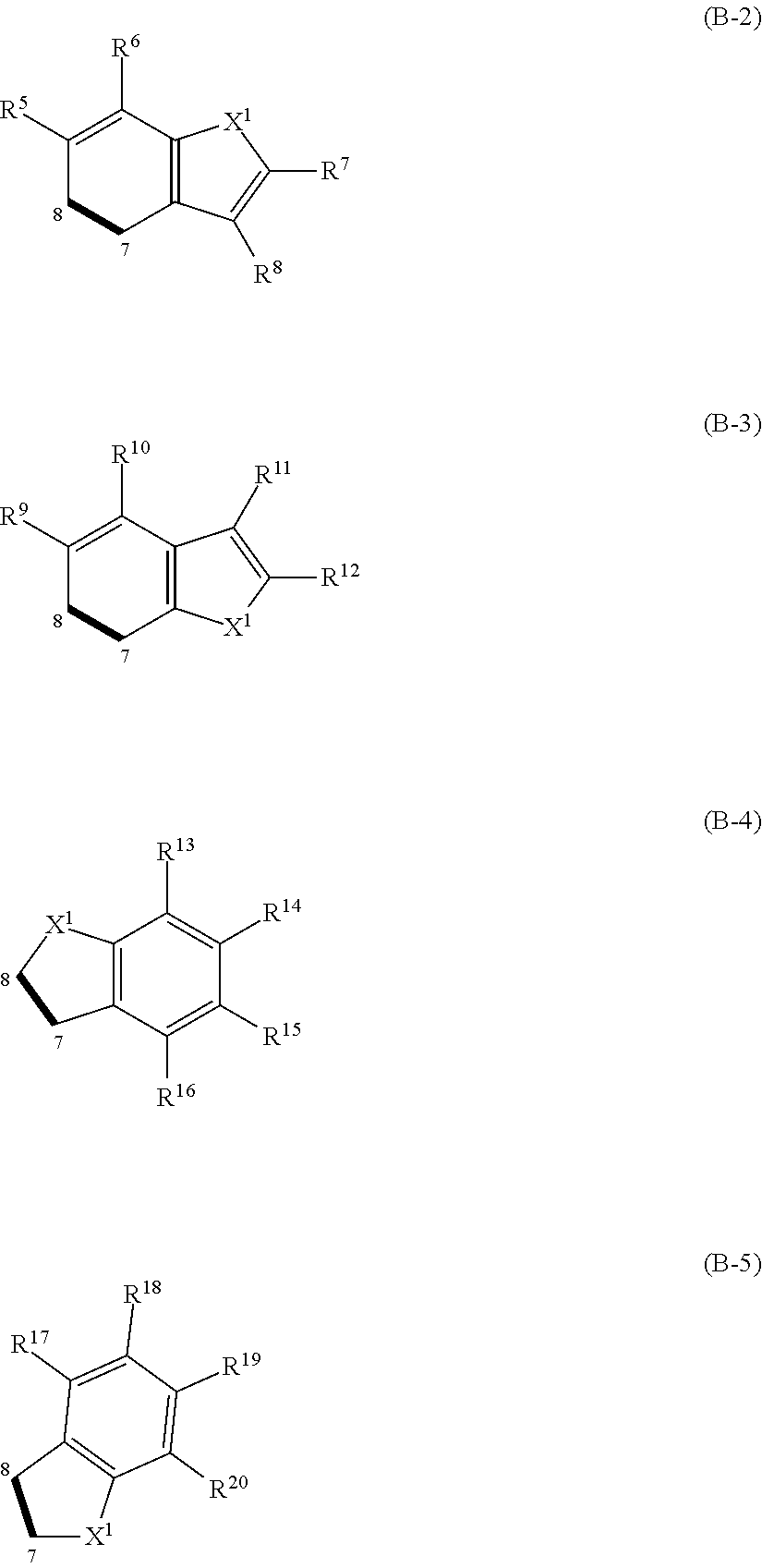
wherein the numerals 7 and 8 in a bold line respectively correspond to the 7th and 8th positions of the anthracene skeleton of the compound represented by the formula (B-1):

wherein R22 and R23 are independently a hydrogen atom, a halogen atom,
an alkyl group having 1 to 30 carbon atoms, an alkenyl group having 2 to 30 carbon atoms, an alkynyl group having 2 to 30 carbon atoms, a haloalkyl group having 1 to 30 carbon atoms, an alkoxy group having 1 to 30 carbon atoms, a haloalkoxy group having 1 to 30 carbon atoms, an alkylthio group having 1 to 30 carbon atoms, a haloalkylthio group having 1 to 30 carbon atoms, an alkylamino group having 1 to 30 carbon atoms, a dialkylamino group having 2 to 60 carbon atoms, an arylamino group having 6 to 60 carbon atoms, an alkylsulfonyl group having 1 to 30 carbon atoms, a haloalkylsulfonyl group having 1 to 30 carbon atoms, an aromatic hydrocarbon group having 6 to 60 carbon atoms, an aromatic heterocyclic group having 3 to 60 carbon atoms, an alkylsilyl group having 3 to 20 carbon atoms, an alkylsilylacetylene group having 5 to 60 carbon atoms or a cyano group, which groups may further have one or more substituents;

wherein the numerals 7 and 8 in a bold line respectively correspond to the 7th and 8th positions of the anthracene skeleton of the compound represented by the formula (B-6):

wherein R1 to R4 are independently a hydrogen atom, a halogen atom, an alkyl group having 1 to 30 carbon atoms, an alkenyl group having 2 to 30 carbon atoms, an alkynyl group having 2 to 30 carbon atoms, a haloalkyl group having 1 to 30 carbon atoms, an alkoxy group having 1 to 30 carbon atoms, a haloalkoxy group having 1 to 30 carbon atoms, an alkylthio group having 1 to 30 carbon atoms, a haloalkylthio group having 1 to 30 carbon atoms, an alkylamino group having 1 to 30 carbon atoms, a dialkylamino group having 2 to 60 carbon atoms, an arylamino group having 6 to 60 carbon atoms, an alkylsulfonyl group having 1 to 30 carbon atoms, a haloalkylsulfonyl group having 1 to 30 carbon atoms, an aromatic hydrocarbon group having 6 to 60 carbon atoms, an aromatic heterocyclic group having 3 to 60 carbon atoms, an alkylsilyl group having 3 to 20 carbon atoms, an alkylsilylethynyl group having 5 to 60 carbon atoms or a cyano group, which groups may further have one or more substituents;

wherein the numerals 7 and 8 in a bold line respectively correspond to the 7th and 8th positions of the anthracene skeleton of the compound represented by the formula (B-1):

wherein R22 and R23 are independently a hydrogen atom, a halogen atom,
an alkyl group having 1 to 30 carbon atoms, an alkenyl group having 2 to 30 carbon atoms, an alkynyl group having 2 to 30 carbon atoms, a haloalkyl group having 1 to 30 carbon atoms, an alkoxy group having 1 to 30 carbon atoms, a haloalkoxy group having 1 to 30 carbon atoms, an alkylthio group having 1 to 30 carbon atoms, a haloalkylthio group having 1 to 30 carbon atoms, an alkylamino group having 1 to 30 carbon atoms, a dialkylamino group having 2 to 60 carbon atoms, an arylamino group having 6 to 60 carbon atoms, an alkylsulfonyl group having 1 to 30 carbon atoms, a haloalkylsulfonyl group having 1 to 30 carbon atoms, an aromatic hydrocarbon group having 6 to 60 carbon atoms, an aromatic heterocyclic group having 3 to 60 carbon atoms, an alkylsilyl group having 3 to 20 carbon atoms, an alkylsilylacetylene group having 5 to 60 carbon atoms or a cyano group, which groups may further have one or more substituents;

wherein the numerals 7 and 8 in a bold line respectively correspond to the 7th and 8th positions of the anthracene skeleton of the compound represented by the formula (B-6):
14. An apparatus comprising the organic thin film transistor according to 12 or 13.
15. A method for producing an organic thin film transistor wherein an organic semiconductor layer is formed by applying the compound for an organic thin film transistor according to 10 or 11.
16. A compound represented by the following formula (C-1) or (C-2):

wherein R1 to R8 are independently a hydrogen atom, a halogen atom, an alkyl group having 2 to 30 carbon atoms, an alkenyl group having 2 to 30 carbon atoms, an alkynyl group having 2 to 30 carbon atoms, a haloalkyl group having 1 to 30 carbon atoms, an alkoxy group having 2 to 30 carbon atoms, a haloalkoxy group having 1 to 30 carbon atoms, an alkylthio group having 2 to 30 carbon atoms, a haloalkylthio group having 1 to 30 carbon atoms, an alkylamino group having 1 to 30 carbon atoms, a dialkylamino group having 2 to 60 carbon atoms, an arylamino group having 6 to 60 carbon atoms, an alkylsulfonyl group having 1 to 30 carbon atoms, a haloalkylsulfonyl group having 1 to 30 carbon atoms, an aromatic hydrocarbon group having 6 to 60 carbon atoms, an aromatic heterocyclic group having 3 to 60 carbon atoms, an alkylsilyl group having 3 to 20 carbon atoms or an alkylsilylethynyl group having 5 to 60 carbon atoms, which groups may further have one or more substituents;

wherein X, R4, R5, R19 and R11 are the same as those in the formulas (C-1) and (C-2); and at least one of R4, R5, R19 and R11 is a group other than hydrogen.
18. The compound according to 16 or 17 which is a compound for an organic thin film transistor.
19. An organic thin film transistor which comprises the compound according to 18.
20. An organic thin film transistor comprising at least three terminals of a gate electrode, a source electrode and a drain electrode, an insulating layer and an organic semiconductor layer, on a substrate, current flowing between the source electrode and the drain electrode being controlled by applying a voltage to the gate electrode, the organic semiconductor layer comprising the compound according to 18.
21. An apparatus comprising the organic thin film transistor according to 19 or 20.

wherein R1 to R14 are independently a hydrogen atom, a halogen atom, an alkyl group having 1 to 30 carbon atoms, an alkenyl group having 2 to 30 carbon atoms, an alkynyl group having 2 to 30 carbon atoms, a haloalkyl group having 1 to 30 carbon atoms, an alkoxy group having 1 to 30 carbon atoms, a haloalkoxy group having 1 to 30 carbon atoms, an alkylthio group having 1 to 30 carbon atoms, a haloalkylthio group having 1 to 30 carbon atoms, an alkylamino group having 1 to 30 carbon atoms, a dialkylamino group having 2 to 60 carbon atoms, an arylamino group having 6 to 60 carbon atoms, an alkylsulfonyl group having 1 to 30 carbon atoms, a haloalkylsulfonyl group having 1 to 30 carbon atoms, an aromatic hydrocarbon group having 6 to 60 carbon atoms, an aromatic heterocyclic group having 3 to 60 carbon atoms, an alkylsilyl group having 3 to 20 carbon atoms, an alkylsilylethynyl group having 5 to 60 carbon atoms or a cyano group, which groups further may have one or more substituents; and

wherein R1, R2, R7, R8, R9, R19 and R14 are the same as R1, R2, R7, R8, R9, R70 and R14 in the formula (A-1).


(R is a substituent and X is a halogen atom)

wherein R1 to R4 are independently a hydrogen atom, a halogen atom, an alkyl group having 1 to 30 carbon atoms, an alkenyl group having 2 to 30 carbon atoms, an alkynyl group having 2 to 30 carbon atoms, a haloalkyl group having 1 to 30 carbon atoms, an alkoxy group having 1 to 30 carbon atoms, a haloalkoxy group having 1 to 30 carbon atoms, an alkylthio group having 1 to 30 carbon atoms, a haloalkylthio group having 1 to 30 carbon atoms, an alkylamino group having 1 to 30 carbon atoms, a dialkylamino group having 2 to 60 carbon atoms, an arylamino group having 6 to 60 carbon atoms, an alkylsulfonyl group having 1 to 30 carbon atoms, a haloalkylsulfonyl group having 1 to 30 carbon atoms, an aromatic hydrocarbon group having 6 to 60 carbon atoms, an aromatic heterocyclic group having 3 to 60 carbon atoms, an alkylsilyl group having 3 to 20 carbon atoms, an alkylsilylethynyl group having 5 to 60 carbon atoms or a cyano group, which groups may further have one or more substituents;

wherein the numerals 7 and 8 in a bold line respectively correspond to the 7th and 8th positions of the anthracene skeleton of the compound represented by the formula (B-1):

wherein R22 and R23 are independently a hydrogen atom, a halogen atom,
an alkyl group having 1 to 30 carbon atoms, an alkenyl group having 2 to 30 carbon atoms, an alkynyl group having 2 to 30 carbon atoms, a haloalkyl group having 1 to 30 carbon atoms, an alkoxy group having 1 to 30 carbon atoms, a haloalkoxy group having 1 to 30 carbon atoms, an alkylthio group having 1 to 30 carbon atoms, a haloalkylthio group having 1 to 30 carbon atoms, an alkylamino group having 1 to 30 carbon atoms, a dialkylamino group having 2 to 60 carbon atoms, an arylamino group having 6 to 60 carbon atoms, an alkylsulfonyl group having 1 to 30 carbon atoms, a haloalkylsulfonyl group having 1 to 30 carbon atoms, an aromatic hydrocarbon group having 6 to 60 carbon atoms, an aromatic heterocyclic group having 3 to 60 carbon atoms, an alkylsilyl group having 3 to 20 carbon atoms, an alkylsilylacetylene group having 5 to 60 carbon atoms or a cyano group, which groups may further have one or more substituents;

wherein the numerals 7 and 8 in a bold line respectively correspond to the 7th and 8th positions of the anthracene skeleton of the compound represented by the formula (B-6):


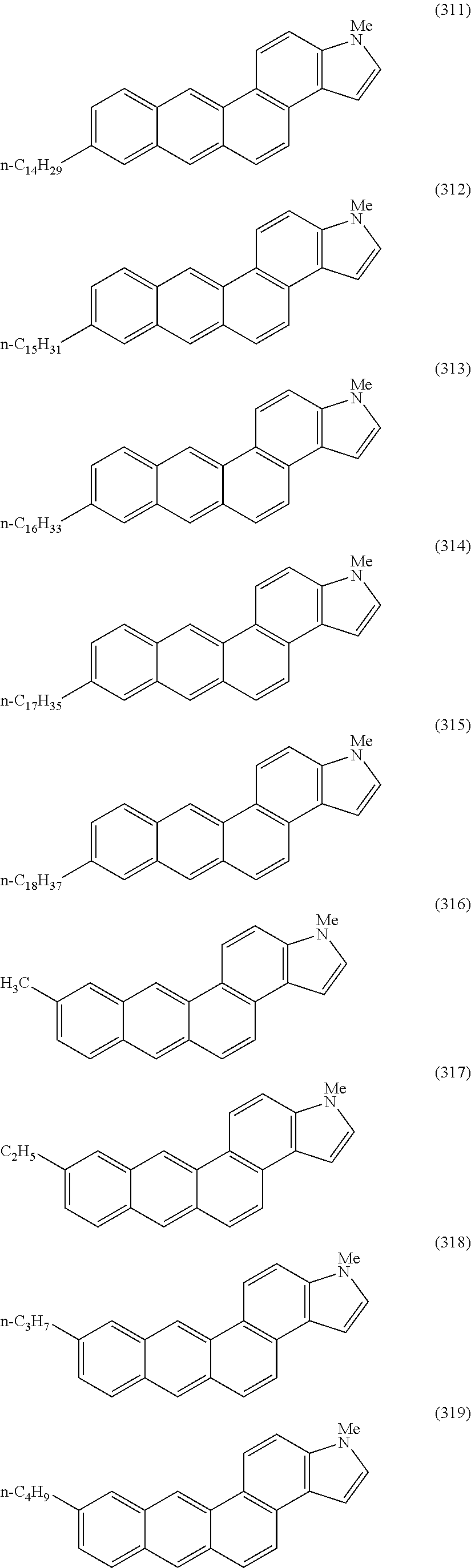


(X is the same as X1 and X2 in the second compound of the invention)
- J. Med. Chem. 2006 4374-4383.
- ELI LILLY AND COMPANY; WO2006/107784; (2006); (A1)


wherein R1 to R8 are independently a hydrogen atom, a halogen atom, an alkyl group having 2 to 30 carbon atoms, an alkenyl group having 2 to 30 carbon atoms, an alkynyl group having 2 to 30 carbon atoms, a haloalkyl group having 1 to 30 carbon atoms, an alkoxy group having 2 to 30 carbon atoms, a haloalkoxy group having 1 to 30 carbon atoms, an alkylthio group having 2 to 30 carbon atoms, a haloalkylthio group having 1 to 30 carbon atoms, an alkylamino group having 1 to 30 carbon atoms, a dialkylamino group having 2 to 60 carbon atoms, an arylamino group having 6 to 60 carbon atoms, an alkylsulfonyl group having 1 to 30 carbon atoms, a haloalkylsulfonyl group having 1 to 30 carbon atoms, an aromatic hydrocarbon group having 6 to 60 carbon atoms, an aromatic heterocyclic group having 3 to 60 carbon atoms, an alkylsilyl group having 3 to 20 carbon atoms or an alkylsilylethynyl group having 5 to 60 carbon atoms, which groups may further have one or more substituents;

wherein X, R4, R5, R10 and R11 are the same as those in the formulas (C-1) and (C-2). At least one of R4, R5, R19 and R11 is a group other than hydrogen.


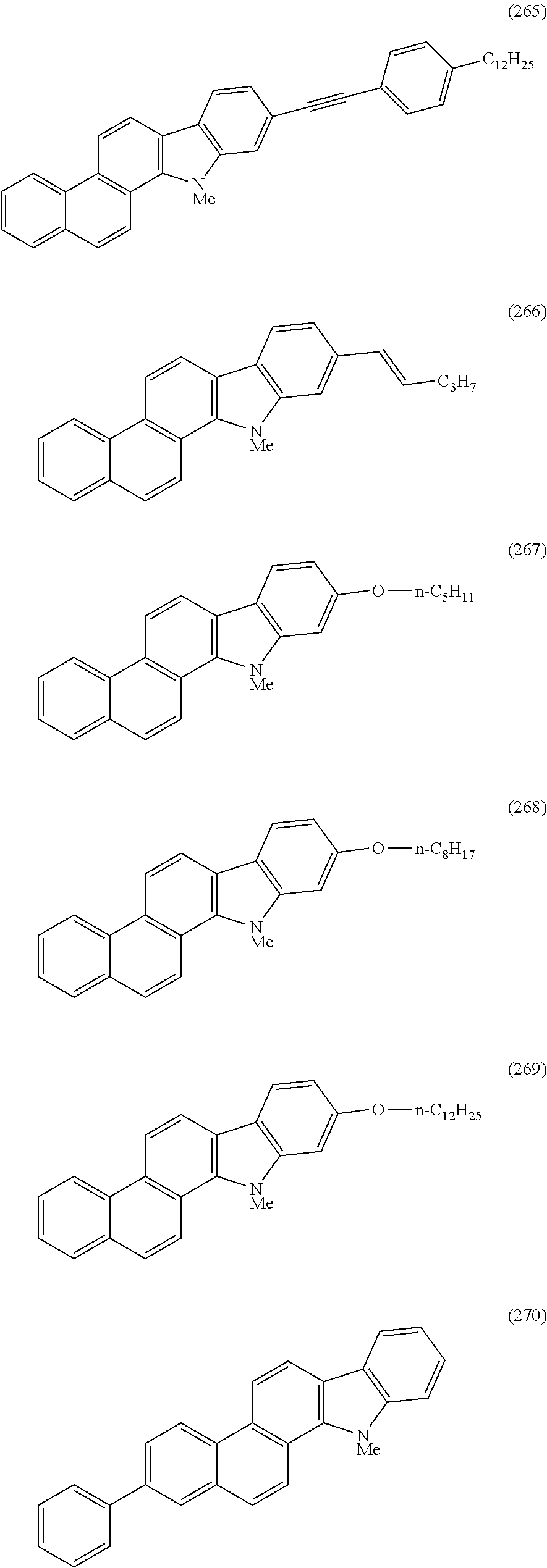

(X is the same groups as those in the above-mentioned formula (C-1); R is the same groups as R1 in the formula (C-1) or the like; M is a boronic acid or the like and Me is a methyl group)

(X is the same groups as those in the above-mentioned formula (C-1); R is the same groups as R1 in the formula (C-1) or the like; M is a boronic acid or the like and Me is a methyl group)

[Synthesis of Intermediate A1]

[Synthesis of Intermediate A5]

[Synthesis of Intermediate A8]


| TABLE 1 | ||||||
| Field | ||||||
| Organic | Stability | Type of | effect | |||
| semiconductor | Solu- | to oxidi- | tran- | mobility | ||
| layer | bility | zation | sistor | [cm2/Vs] | ||
| Example 1 | Compound (A8) | ∘ | ∘ | p | 1.1 × 100 |
| Example 2 | Compound (A12) | ∘ | ∘ | p | 6.6 × 10⁻⁵ |
| Com. | Pentacene | x | x | — | — |
| Ex. 1 | |||||
| Com. | Picene | x | — | — | — |
| Ex. 2 | |||||
| Example 3 | Compound (A40) | ∘ | ∘ | p | 5.3 × 10⁻¹ |
| Example 4 | Compound (A41) | ∘ | ∘ | p | 2.1 × 10⁻¹ |

[Synthesis of Intermediate A1]

[Synthesis of Intermediate B1]

[Synthesis of Intermediate C1]


| TABLE 2 | ||||||
| Field | ||||||
| Organic | Stability | Type of | effect | |||
| semiconductor | Solu- | to oxidi- | tran- | mobility | ||
| layer | bility | zation | sistor | [cm2/Vs] | ||
| Example 5 | Compound (B1) | ∘ | ∘ | p | 1.1 × 10⁻³ |
| Example 6 | Compound (B17) | ∘ | ∘ | p | 4.1 × 10⁻¹ |
| Example 7 | Compound (B552) | ∘ | ∘ | p | 1.9 × 10⁻⁴ |
| Com. | Pentacene (A) | x | x | — | — |
| Ex. 3 | |||||
| Com. | Picene (B) | x | — | — | — |
| |
|||||

[Synthesis of Intermediate A1]
I D=(W/2L)·Cμ·(V G −V T)2

[Synthesis of Intermediate B1]

[Synthesis of Intermediate C1]


| TABLE 3 | |||||||
| Organic | Field effect | ||||||
| semiconductor | Solubility | Solubility | Stability to | Type of | mobility | ||
| layer | (hexane) | (toluene) | oxidization | transistor | (cm2/Vs) | ||
| Example 8 | Compound (C56) | ∘ | ∘ | ∘ | p | 1.5 × 10⁻² |
| Example 9 | Compound (C146) | ∘ | ∘ | ∘ | p | 2.0 × 10⁻¹ |
| Example 10 | Compound (C191) | ∘ | ∘ | ∘ | p | 1.5 × 10⁻² |
| Com. Ex. 5 | Pentacene (A) | x | x | x | — | — |
| Com. Ex. 6 | Picene (B) | x | x | — | — | — |
Claims (24)


Applications Claiming Priority (7)
| Application Number | Priority Date | Filing Date | Title |
|---|---|---|---|
| JP2009-254004 | 2009-11-05 | ||
| JP2009254004 | 2009-11-05 | ||
| JP2010-152256 | 2010-07-02 | ||
| JP2010152256 | 2010-07-02 | ||
| JP2010211824 | 2010-09-22 | ||
| JP2010-211824 | 2010-09-22 | ||
| PCT/JP2010/006455 WO2011055529A1 (en) | 2009-11-05 | 2010-11-02 | Heterocycle-containing asymmetric aromatic compound, compound for organic thin film transistor, and organic thin film transistor using same |
Publications (2)
| Publication Number | Publication Date |
|---|---|
| US20120273768A1 US20120273768A1 (en) | 2012-11-01 |
| US8766243B2 true US8766243B2 (en) | 2014-07-01 |
Family
ID=43969772
Family Applications (1)
| Application Number | Title | Priority Date | Filing Date |
|---|---|---|---|
| US13/508,034 Expired - Fee Related US8766243B2 (en) | 2009-11-05 | 2010-11-02 | Heterocycle-containing asymmetric aromatic compound, compound for organic thin film transistor, and organic thin film transistor using the same |
Country Status (5)
| Country | Link |
|---|---|
| US (1) | US8766243B2 (en) |
| JP (1) | JPWO2011055529A1 (en) |
| CN (1) | CN102712558B (en) |
| TW (1) | TW201124365A (en) |
| WO (1) | WO2011055529A1 (en) |
Cited By (1)
| Publication number | Priority date | Publication date | Assignee | Title |
|---|---|---|---|---|
| US20190112417A1 (en) * | 2016-03-29 | 2019-04-18 | The University Of Tokyo | Novel organic polymer and method for producing same |
Families Citing this family (17)
| Publication number | Priority date | Publication date | Assignee | Title |
|---|---|---|---|---|
| JP2013048191A (en) * | 2011-08-29 | 2013-03-07 | Mitsubishi Electric Corp | Wide band-gap semiconductor device |
| KR20130042901A (en) * | 2011-10-19 | 2013-04-29 | 삼성디스플레이 주식회사 | A condensed-cyclic compound and an organic light emitting diode comprising the same |
| JP5867583B2 (en) * | 2012-02-22 | 2016-02-24 | Jnc株式会社 | Novel chalcogen-containing organic compounds and uses thereof |
| US8901547B2 (en) * | 2012-08-25 | 2014-12-02 | Polyera Corporation | Stacked structure organic light-emitting transistors |
| CN103776856B (en) * | 2012-10-24 | 2016-12-21 | 国家纳米科学中心 | The characterizing method of a kind of organic molecule monocrystal material and application thereof |
| CN104638105B (en) * | 2013-11-08 | 2018-01-23 | 北京鼎材科技有限公司 | A kind of OTFT and preparation method thereof |
| CN104638106B (en) * | 2013-11-08 | 2017-12-05 | 北京鼎材科技有限公司 | A kind of OTFT and preparation method thereof |
| JP2015122437A (en) * | 2013-12-24 | 2015-07-02 | 富士フイルム株式会社 | Organic membrane transistor, organic semiconductor membrane and organic semiconductor material |
| TWI694068B (en) * | 2015-10-13 | 2020-05-21 | 日商捷恩智股份有限公司 | Liquid crystal compound with benzothiophene, liquid crystal composition and liquid crystal display element |
| CN108264456A (en) * | 2016-12-30 | 2018-07-10 | 湖北尚赛光电材料有限公司 | The synthetic method and its synthetic intermediate that 2,8- dibromos are bent |
| CN108059583A (en) * | 2018-01-19 | 2018-05-22 | 李现伟 | A kind of biphenyl compound and its application in 1- bromine pyrenes are prepared |
| CN108059582A (en) * | 2018-01-19 | 2018-05-22 | 李现伟 | A kind of biphenyl compound and its application in 1,3,6,8- tetrabromo pyrenes are prepared |
| EP3845525B1 (en) * | 2018-08-31 | 2022-08-03 | The University of Tokyo | Chalcogen-containing organic compound, organic semiconductor material, organic semiconductor film, and organic field-effect transistor |
| KR102397179B1 (en) * | 2018-12-21 | 2022-05-11 | 삼성에스디아이 주식회사 | Hardmask composition, hardmask layer and method of forming patterns |
| DE102019113696A1 (en) * | 2019-05-22 | 2020-11-26 | Universität des Saarlandes | Solid-state energy converter, heating / cooling device with such an energy converter as well as method for operating a heating / cooling device |
| CN112979402A (en) * | 2021-03-12 | 2021-06-18 | 西安瑞联新材料股份有限公司 | Industrial production method of benzo [ a ] anthracene |
| WO2024039917A2 (en) * | 2022-03-02 | 2024-02-22 | University Of Kentucky Research Foundation | End-substituted (hetero)acenes with pairwise coupling in crystalline form for pure spin polarization and optical readout |
Citations (7)
| Publication number | Priority date | Publication date | Assignee | Title |
|---|---|---|---|---|
| JPS5036452A (en) | 1973-06-27 | 1975-04-05 | ||
| JPH0555568A (en) | 1991-08-28 | 1993-03-05 | Asahi Chem Ind Co Ltd | Organic thin film transistor |
| JP2001094107A (en) | 1999-09-20 | 2001-04-06 | Hitachi Ltd | Organic semiconductor device and liquid crystal display |
| CN101523631A (en) | 2006-10-12 | 2009-09-02 | 出光兴产株式会社 | Organic thin film transistor element and organic thin film light emitting transistor |
| JP2009218333A (en) | 2008-03-10 | 2009-09-24 | Mitsui Chemicals Inc | Organic transistor |
| JP2009267140A (en) | 2008-04-25 | 2009-11-12 | Mitsui Chemicals Inc | Organic transistor |
| JP2010177637A (en) | 2009-02-02 | 2010-08-12 | Mitsui Chemicals Inc | Organic transistor |
Family Cites Families (1)
| Publication number | Priority date | Publication date | Assignee | Title |
|---|---|---|---|---|
| US4022956A (en) * | 1973-06-27 | 1977-05-10 | Xerox Corporation | Polymers of benzanthracene as active matrix materials |
-
2010
- 2010-11-02 JP JP2011539285A patent/JPWO2011055529A1/en active Pending
- 2010-11-02 CN CN201080060537.7A patent/CN102712558B/en not_active Expired - Fee Related
- 2010-11-02 US US13/508,034 patent/US8766243B2/en not_active Expired - Fee Related
- 2010-11-02 WO PCT/JP2010/006455 patent/WO2011055529A1/en not_active Ceased
- 2010-11-05 TW TW099138218A patent/TW201124365A/en unknown
Patent Citations (9)
| Publication number | Priority date | Publication date | Assignee | Title |
|---|---|---|---|---|
| JPS5036452A (en) | 1973-06-27 | 1975-04-05 | ||
| US3896184A (en) | 1973-06-27 | 1975-07-22 | Xerox Corp | Polymers of benzanthracene as active matrix materials |
| JPH0555568A (en) | 1991-08-28 | 1993-03-05 | Asahi Chem Ind Co Ltd | Organic thin film transistor |
| JP2001094107A (en) | 1999-09-20 | 2001-04-06 | Hitachi Ltd | Organic semiconductor device and liquid crystal display |
| CN101523631A (en) | 2006-10-12 | 2009-09-02 | 出光兴产株式会社 | Organic thin film transistor element and organic thin film light emitting transistor |
| US20100012929A1 (en) | 2006-10-12 | 2010-01-21 | Yuki Nakano | Organic thin film transistor device and organic thin film light-emitting transistor |
| JP2009218333A (en) | 2008-03-10 | 2009-09-24 | Mitsui Chemicals Inc | Organic transistor |
| JP2009267140A (en) | 2008-04-25 | 2009-11-12 | Mitsui Chemicals Inc | Organic transistor |
| JP2010177637A (en) | 2009-02-02 | 2010-08-12 | Mitsui Chemicals Inc | Organic transistor |
Non-Patent Citations (15)
| Title |
|---|
| Carruthers, et al. "The Constituents of High-boiling Petroleum Distillates. Part VIII. Identification of 1,2,3,4-Tetrahydro-2,2,9-trimethylpicene in an American Crude Oil", Journal of the Chemical Society, published on Jan. 1964, pp. 724-729. |
| E. Clar et al., "Kekule Structures and the Benzylic Coupling of omicron-Dimethyl-Derivatives", Tetrahedron, 1971, pp. 5943-5951, vol. 27. |
| E. Clar et al., "Kekule Structures and the Benzylic Coupling of ο-Dimethyl-Derivatives", Tetrahedron, 1971, pp. 5943-5951, vol. 27. |
| Gerhard Becker et al., "Gas chromatograph-atomic emission detection for quantification of polycyclic aromatic sulfur heterocycles", Analytica Chimica Acta 376, 1998, pp. 265-272. |
| Guillen, et al. "Polycyclic Aromatic Hydrocarbons and Olive Pomace Oil", Journal of Agricultural and Food Chemistry, 2004, vol. 52, pp. 2123-2132. |
| Hideki Okamoto et al., "Air-assisted High-performance Field-effect Transistor with Thin Films of Picene", Journal of the American Chemical Society, Aug. 13, 2008, pp. 10470-10471, vol. 130. |
| International Search Report mailed Feb. 8, 2011 in corresponding application No. PCT/JP2010/006455. |
| J.N. Chatterjea et al., Syntheses of Furano Compounds: Part XLII-Cook-Schoental Cyclization of Some Substituted Benzo[b]furans & Benzo[b]phenanthro[I,2-d]furans, Indian Journal of Chemistry Section B, 17B(4), 1979, pp. 329-332. |
| Kaitei So et al., Journal of the Chemical Society (Kagaku Gakuho),1982, vol. 40, stage 6, pp. 481-487. |
| Kazuhiro Maruyama et al., "Facile Photochemical Synthesis of Polycyclic Aromatic compounds", The Journal of Organic Chemistry, 1980, pp. 1424-1428, vol. 45. |
| Liansheng, et al. "Partition Coefficients of PAHs and Di-Region Theory", Acta Scientiae Circumstantiae, Jun. 1987, vol. 7, No. 2, pp. 240-244. |
| Office Action in CN Appln. No: 201080060537.7 dated Dec. 27, 2013. |
| Subodh Kumar, "Synthesis of trans-3, 4-dihydroxy-3, 4-dihydrophenanthro[3,2-b]-[1]benzothiophene, a potentially carcinogenic metabolite of sulfur heterocycle phenanthro[3,2-b][1]benzothiophene", Journal of the Chemical Society, Perkin Transactions 1, 2001, pp. 1018-1023, No. 9. |
| Tetsuo Otsuki et al., "Novel Photochemical Synthesis of 5-Arylbenzo[b]chrysene Derivatives", Yuki Gosei Kagaku Kyokaishi, 1978, pp. 318-321, vol. 36, No. 4. |
| Written Opinion mailed Feb. 8, 2011 in corresponding application No. PCT/JP2010/006455. |
Cited By (1)
| Publication number | Priority date | Publication date | Assignee | Title |
|---|---|---|---|---|
| US20190112417A1 (en) * | 2016-03-29 | 2019-04-18 | The University Of Tokyo | Novel organic polymer and method for producing same |
Also Published As
| Publication number | Publication date |
|---|---|
| WO2011055529A1 (en) | 2011-05-12 |
| US20120273768A1 (en) | 2012-11-01 |
| TW201124365A (en) | 2011-07-16 |
| CN102712558A (en) | 2012-10-03 |
| CN102712558B (en) | 2014-11-19 |
| JPWO2011055529A1 (en) | 2013-03-28 |
Similar Documents
| Publication | Publication Date | Title |
|---|---|---|
| US8766243B2 (en) | Heterocycle-containing asymmetric aromatic compound, compound for organic thin film transistor, and organic thin film transistor using the same | |
| US8785915B2 (en) | Compound for organic thin film transistor and organic thin film transistor using the same | |
| US8575599B2 (en) | Compound for organic thin film transistor and organic thin film transistor using the same | |
| US8217389B2 (en) | Organic thin film transistor device and organic thin film light-emitting transistor | |
| US8946688B2 (en) | Polycyclic ring-fused compound and organic thin film transistor utilizing the same | |
| US8963128B2 (en) | Compound for organic thin film transistor and organic thin film transistor using the same | |
| US8022401B2 (en) | Organic thin film transistor and organic thin film light-emitting transistor | |
| US20100243993A1 (en) | Organic thin film transistor and organic thin film light-emitting transistor | |
| US8901540B2 (en) | Fused ring compounds useful in organic thin-film transistors | |
| JP5677306B2 (en) | Organic thin film transistor | |
| JPWO2008069061A1 (en) | Organic thin film transistor and organic thin film light emitting transistor | |
| US8203139B2 (en) | Organic thin film transistor and organic thin film light-emitting transistor using an organic semiconductor layer having an aromatic hydrocarbon group or an aromatic heterocyclic group in the center thereof | |
| US8330147B2 (en) | Organic thin film transistor and organic thin film light emitting transistor having organic semiconductor compound with divalent aromatic hydrocarbon group and divalent aromatic heterocyclic group | |
| JP5329404B2 (en) | Organic thin film transistor and organic thin film light emitting transistor | |
| US8148720B2 (en) | Organic thin film transistor and organic thin film light-emitting transistor |
Legal Events
| Date | Code | Title | Description |
|---|---|---|---|
| AS | Assignment |
Owner name: IDEMITSU KOSAN CO., LTD., JAPAN Free format text: ASSIGNMENT OF ASSIGNORS INTEREST;ASSIGNORS:IKEDA, YOICHI;SAITO, MASATOSHI;IKEDA, HIDETSUGU;AND OTHERS;SIGNING DATES FROM 20120425 TO 20120508;REEL/FRAME:028509/0168 |
|
| AS | Assignment |
Owner name: IDEMITSU KOSAN CO., LTD., JAPAN Free format text: CORRECTIVE ASSIGNMENT TO CORRECT THE NAME OF THE SIXTH (6TH) CONVEYING PARTY. PREVIOUSLY RECORDED ON REEL 028509 FRAME 0168. ASSIGNOR(S) HEREBY CONFIRMS THE PATENT ASSIGNMENT.;ASSIGNORS:IKEDA, YOICHI;SAITO, MASATOSHI;IKEDA, HIDETSUGU;AND OTHERS;SIGNING DATES FROM 20120425 TO 20120508;REEL/FRAME:032895/0611 |
|
| STCF | Information on status: patent grant |
Free format text: PATENTED CASE |
|
| FEPP | Fee payment procedure |
Free format text: PAYOR NUMBER ASSIGNED (ORIGINAL EVENT CODE: ASPN); ENTITY STATUS OF PATENT OWNER: LARGE ENTITY |
|
| MAFP | Maintenance fee payment |
Free format text: PAYMENT OF MAINTENANCE FEE, 4TH YEAR, LARGE ENTITY (ORIGINAL EVENT CODE: M1551) Year of fee payment: 4 |
|
| FEPP | Fee payment procedure |
Free format text: MAINTENANCE FEE REMINDER MAILED (ORIGINAL EVENT CODE: REM.); ENTITY STATUS OF PATENT OWNER: LARGE ENTITY |
|
| LAPS | Lapse for failure to pay maintenance fees |
Free format text: PATENT EXPIRED FOR FAILURE TO PAY MAINTENANCE FEES (ORIGINAL EVENT CODE: EXP.); ENTITY STATUS OF PATENT OWNER: LARGE ENTITY |
|
| STCH | Information on status: patent discontinuation |
Free format text: PATENT EXPIRED DUE TO NONPAYMENT OF MAINTENANCE FEES UNDER 37 CFR 1.362 |
|
| FP | Lapsed due to failure to pay maintenance fee |
Effective date: 20220701 |