US8640014B2 - Soft bit metric generation - Google Patents
Soft bit metric generation Download PDFInfo
- Publication number
- US8640014B2 US8640014B2 US13/413,905 US201213413905A US8640014B2 US 8640014 B2 US8640014 B2 US 8640014B2 US 201213413905 A US201213413905 A US 201213413905A US 8640014 B2 US8640014 B2 US 8640014B2
- Authority
- US
- United States
- Prior art keywords
- terms
- reliability
- dominant terms
- dominant
- computer program
- Prior art date
- Legal status (The legal status is an assumption and is not a legal conclusion. Google has not performed a legal analysis and makes no representation as to the accuracy of the status listed.)
- Active, expires
Links
Images

Classifications
-
- H—ELECTRICITY
- H04—ELECTRIC COMMUNICATION TECHNIQUE
- H04L—TRANSMISSION OF DIGITAL INFORMATION, e.g. TELEGRAPHIC COMMUNICATION
- H04L25/00—Baseband systems
- H04L25/02—Details ; arrangements for supplying electrical power along data transmission lines
- H04L25/06—DC level restoring means; Bias distortion correction ; Decision circuits providing symbol by symbol detection
- H04L25/067—DC level restoring means; Bias distortion correction ; Decision circuits providing symbol by symbol detection providing soft decisions, i.e. decisions together with an estimate of reliability
Definitions
- Quadrature Phase Shift Keying QPSK
- DE-QPSK Differentially Encoded QPSK
- QAM 16 Quadrature Amplitude Modulation
- 64 QAM QPSK is a form of phase shift keying in which two bits are contemporaneously modulated by selecting one of four possible carrier phase shifts (0, ⁇ /2, ⁇ , and 3 ⁇ /2).
- QAM is a modulation technique for conveying either two analog message signals or two digital bit streams by changing the amplitudes of two carrier waves using Amplitude Shift Keying (ASK) or Amplitude Modulation (AM).
- a differential decoding operation is implemented at the receiver to recover the transmitted information.
- a “soft decision” decoder uses soft bit metric information to decode data that has been encoded with an error correcting code.
- the soft bit metric information indicates the reliability of each input data point, and is used to generate a better estimate of the original data than a hard decision decoder would when the data is corrupted by noise.
- soft bit metric information may be computational costly to generate.
- a method comprises: from an expression of reliability of encoded bits associated with a higher order modulation scheme, the expression including a plurality of terms, selecting dominant terms from the plurality of terms; and calculating reliability of the encoded bits based on the selected dominant terms.
- an apparatus comprises: circuitry which selects dominant terms from an expression of reliability of encoded bits associated with a higher order modulation scheme; and circuitry which calculates reliability of the encoded bits based on the selected dominant terms.
- a computer program stored on a non-transitory computer-readable medium comprises: logic for selecting dominant terms from an expression of reliability of encoded bits associated with a higher order modulation scheme; and logic for calculating reliability of the encoded bits based on the selected dominant terms.
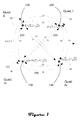
- FIG. 1 illustrates differential encoding
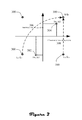
- FIG. 2 illustrates an example transition
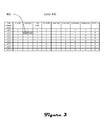
- FIG. 3 illustrates a table of possible approximations for correction term c as a function of ⁇ a
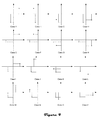
- FIG. 4 illustrates an analysis of the most likely and second most likely transitions over cases A through P, assuming (x 1 , y 1 ) is always in the third quadrant, and (x 2 , y 2 ) is moving from 1 st quadrant to 4 th quadrant in each row.
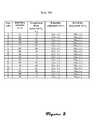
- FIG. 5 illustrates a reliability assignment table
- FIG. 6 illustrates a block diagram of circuitry for soft bit metric generation.
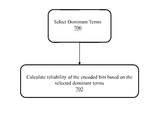
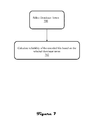
- FIG. 7 is a flow diagram of a method for soft bit metric generation.
- FIG. 1 illustrates differential encoding.
- Symbols 100 represent DE-QPSK outputs from a differential encoder at rotational positions labeled as (I,Q). Transitions (0°, 90° CW, 90° CCW, 180°) between outputted symbol positions are indicative of input bits denoted as b, b 2 .
- Soft Decision Encoding/Decoding is used to enhance the accuracy of the receiver, e.g., where the transmitted symbols are distorted by memory-less additive noise and previous and future values of C t do not provide extra information about the bits.
- a soft decision decoder operates in response to inputted “soft metrics” which represent the reliability of each encoded bit. If C t-1 and C t denote distorted DE-QPSK symbols at the channel output at time instants t ⁇ 1 and t, respectively, these two symbols can be used to generate the soft metrics for two encoded bits denoted by b 1,t and b 2,t .
- the Logarithmic-Likelihood Ratio (LLR) is used for the purposes of this description, but it should be understood that soft metrics can take various other forms which might be utilized.
- the general equation for the LLR of b 1,t is:
- Equation 1 Equation 1
- LLR logarithmic likelihood ratio
- the dominant terms in equations 4 and 5 can be selected as, for example, those terms for which the signs of the x and y components match those of channel outputs of the channel outputs.
- dots 300 represent the transmitted DE-QPSK symbols denoted by (I i-1 , Q i-1 ).
- Dot 302 represents a corresponding noisy channel output received at time instant i ⁇ 1.
- dot 304 denotes a corresponding noisy channel output at time instant i.
- the G operation computes the joint reliability of two reliability values, which can be either in-phase components (x 1 , x 2 ) or quadrature components (y 1 , y 2 ).
- the G operation between (x 1 , x 2 ) is assigned to b 2 as the reliability information because the flip of b 2 is the most likely event. Conversely, the G operation between (y 1 , y 2 ) is assigned to b 1 as the reliability information.
- the correction term for the G operation is obtained from a look-up table based on scaling and the signal to noise ratio estimate, e.g., Table 400 ( FIG. 4 ), where c(a,b) is expressed as a function of ⁇ a
- FIG. 4 illustrates an analysis of the most likely and second most likely transitions over cases A through P, assuming (x 1 , y 1 ) is always in the third quadrant, and (x 2 , y 2 ) is moving from 1 st quadrant to 4 th quadrant in each row.
- x 1 has the smallest magnitude for cases A to D.
- y 1 has the smallest magnitude for cases E to H.
- y 2 has the smallest magnitude in the first quadrant for case I, and cases J to L show rotation by 90, 180 and 270 degrees.
- x 2 has the smallest magnitude in the first quadrant for case I, and cases N to P show rotation by 90, 180 and 270 degrees.
- Cases A through P combined cover all relative magnitude possibilities with (x 1 , y 1 ) in the 3 rd quadrant.
- four of the cases namely A, C, E and G
- the G operation between (x 1 , x 2 ) shall have the G operation between (x 1 , x 2 ) assigned to b 2 and the G operation between (y 1 , y 2 ) assigned to b 1 as indicated by Table 500 .
- the G operation between (x 1 , x 2 ) should be assigned to b 1 and the G operation between (y 1 , y 2 ) should be assigned to b 2 .
- the cases where (x 1 , y 1 ) is in the third quadrant are described above, all other cases with (x 1 , y 1 ) in other quadrants will also be analyzed.
- FIG. 6 is a block diagram of circuitry for soft bit metric generation.
- the G operation is performed separately on x (x 1 , x 2 ) and y (y 1 , y 2 ) components for all cases in table 500 ( FIG. 5 ) using G operation blocks 602 , 604 .
- G operation assignment to b 1 or b 2 is determined by the case index. Consequently, x and y components are applied to G operation blocks 602 , 604 separately.
- a “Case Logic” block 606 determines if the output of two G operations should be swapped by logic 608 , 610 based on the case index as described in table 500 ( FIG. 5 ).
- FIG. 7 is a flow diagram of a method for soft bit metric generation.
- the method includes selecting the dominant terms in a reliability calculation such as the logarithmic likelihood ratio (LLR) as indicated by step 700 .
- LLR logarithmic likelihood ratio
- the dominant terms in equations 4 and 5 can be selected as, for example, those terms for which the signs of the x and y components match those of channel outputs of the channel outputs.
- Reliability of the encoded bits is then calculated based on the selected terms as indicated by step 702 .
- Values for the above-mentioned dominant terms can be estimated by either the joint reliability of two consecutive samples of the in-phase component (x 1 ,x 2 ) or by the joint reliability of two consecutive samples of the quadrature components (y 1 ,y 2 ).
Landscapes
- Engineering & Computer Science (AREA)
- Power Engineering (AREA)
- Computer Networks & Wireless Communication (AREA)
- Signal Processing (AREA)
- Error Detection And Correction (AREA)
- Digital Transmission Methods That Use Modulated Carrier Waves (AREA)
Abstract
Description
Similarly, the general LLR equation for b2,t can be written as
P(Ii-1Qi-1,IiQi|Ci-1,Ci) represents the probability of transitioning from Ii-1Qi-1 to IiQi given channel outputs Ct-1 and Ct. Transitions on the numerator of
Also, llr(b2,t) can be written as
Although values of
G(a,b)=min(|a|,|b|)−c(a,b), (equation 6)
where c(a, b) is a correction term. In the illustrated example the G operation between (x1, x2) is assigned to b2 as the reliability information because the flip of b2 is the most likely event. Conversely, the G operation between (y1, y2) is assigned to b1 as the reliability information.
g=(d 1 ⊕e 1)⊕(f·
where
and where ⊕; denotes logical XOR and AND operations, respectively. A line drawn above the expression denotes logical NOT. The hard decision
c 1=(d 1 ⊕d 2)⊕((d 1 ⊕e 1)·(
c 2=(e 1 ⊕e 2)⊕((d 1 ⊕e 1)·(
where llr(b1) and llr(b2) values are signed by C1 and c2 (Cn=1 indicates a positive number).
Claims (21)
Priority Applications (1)
| Application Number | Priority Date | Filing Date | Title |
|---|---|---|---|
| US13/413,905 US8640014B2 (en) | 2011-03-07 | 2012-03-07 | Soft bit metric generation |
Applications Claiming Priority (2)
| Application Number | Priority Date | Filing Date | Title |
|---|---|---|---|
| US201161449822P | 2011-03-07 | 2011-03-07 | |
| US13/413,905 US8640014B2 (en) | 2011-03-07 | 2012-03-07 | Soft bit metric generation |
Publications (2)
| Publication Number | Publication Date |
|---|---|
| US20120230379A1 US20120230379A1 (en) | 2012-09-13 |
| US8640014B2 true US8640014B2 (en) | 2014-01-28 |
Family
ID=46795558
Family Applications (1)
| Application Number | Title | Priority Date | Filing Date |
|---|---|---|---|
| US13/413,905 Active 2032-07-25 US8640014B2 (en) | 2011-03-07 | 2012-03-07 | Soft bit metric generation |
Country Status (2)
| Country | Link |
|---|---|
| US (1) | US8640014B2 (en) |
| WO (1) | WO2012122249A2 (en) |
Families Citing this family (1)
| Publication number | Priority date | Publication date | Assignee | Title |
|---|---|---|---|---|
| US9843414B2 (en) * | 2014-07-01 | 2017-12-12 | Utah State University | Low complexity error correction |
Citations (5)
| Publication number | Priority date | Publication date | Assignee | Title |
|---|---|---|---|---|
| US5805977A (en) * | 1996-04-01 | 1998-09-08 | Motorola, Inc. | Method and apparatus for controlling transmissions in a two-way selective call communication system |
| US5930272A (en) * | 1997-06-10 | 1999-07-27 | Efficient Channel Coding, Inc. | Block decoding with soft output information |
| US6697441B1 (en) | 2000-06-06 | 2004-02-24 | Ericsson Inc. | Baseband processors and methods and systems for decoding a received signal having a transmitter or channel induced coupling between bits |
| US20060126761A1 (en) | 2002-11-22 | 2006-06-15 | Bo Bernhardsson | Calculation of soft decision values using reliability information of the amplitude |
| US7623602B2 (en) * | 2005-11-15 | 2009-11-24 | Tensorcomm, Inc. | Iterative interference canceller for wireless multiple-access systems employing closed loop transmit diversity |
-
2012
- 2012-03-07 US US13/413,905 patent/US8640014B2/en active Active
- 2012-03-07 WO PCT/US2012/028038 patent/WO2012122249A2/en not_active Ceased
Patent Citations (5)
| Publication number | Priority date | Publication date | Assignee | Title |
|---|---|---|---|---|
| US5805977A (en) * | 1996-04-01 | 1998-09-08 | Motorola, Inc. | Method and apparatus for controlling transmissions in a two-way selective call communication system |
| US5930272A (en) * | 1997-06-10 | 1999-07-27 | Efficient Channel Coding, Inc. | Block decoding with soft output information |
| US6697441B1 (en) | 2000-06-06 | 2004-02-24 | Ericsson Inc. | Baseband processors and methods and systems for decoding a received signal having a transmitter or channel induced coupling between bits |
| US20060126761A1 (en) | 2002-11-22 | 2006-06-15 | Bo Bernhardsson | Calculation of soft decision values using reliability information of the amplitude |
| US7623602B2 (en) * | 2005-11-15 | 2009-11-24 | Tensorcomm, Inc. | Iterative interference canceller for wireless multiple-access systems employing closed loop transmit diversity |
Also Published As
| Publication number | Publication date |
|---|---|
| WO2012122249A3 (en) | 2014-04-17 |
| WO2012122249A2 (en) | 2012-09-13 |
| US20120230379A1 (en) | 2012-09-13 |
Similar Documents
| Publication | Publication Date | Title |
|---|---|---|
| EP3113436B1 (en) | Soft decision value generation apparatus and soft decision value generation method | |
| CN100588193C (en) | Method and apparatus for calculating the log-likelihood ratio of decoding in a receiver for a mobile communication system | |
| CA2425499C (en) | Demodulation apparatus and method in a communication system employing 16-ary qam | |
| KR102021314B1 (en) | Apparatus and method for soft-decision demodulating in Non-square Quadrature Amplitude Modulation | |
| US8023578B2 (en) | Two-stage low-complexity max-log bit-level LLR calculator and method | |
| ES2362759A1 (en) | Method and digital communication device for calculating soft information for received QAM symbols | |
| CN106031115B (en) | Apparatus and method for generating likelihood | |
| JP5287711B2 (en) | Demodulation method | |
| US8116406B2 (en) | Apparatus and method for generating soft bit metric and M-ary QAM receiving system using the same | |
| US7142610B1 (en) | M-Ary quadrature amplitude modulation (QAM) bit-boundary turbo coded system | |
| US7142611B2 (en) | M-Ary phase shift keying (PSK) bit-boundary turbo coded system | |
| US8640014B2 (en) | Soft bit metric generation | |
| EP0507444A2 (en) | Data transmission apparatus with error computer and maximal likelihood calculator | |
| US7072426B2 (en) | Demodulation apparatus and method in a communication system employing 8-ary PSK modulation | |
| KR100706618B1 (en) | Soft Decision Demapping Method Suitable for Higher-order Modulation for Iterative Decoder and Its Error Correction Device | |
| KR20110137282A (en) | Soft bit generation system and method | |
| JP5444038B2 (en) | Receiver | |
| US8806306B2 (en) | Generation of soft bit metrics for differentially encoded quadrature phase shift keying (QPSK) | |
| JP3643348B2 (en) | Decoding device and decoding method | |
| JPS5881356A (en) | Error control system | |
| JP2015041850A (en) | Soft decision value generation device and receiver | |
| JP2009253849A (en) | Receiving device | |
| JPH02159126A (en) | Data demodulation system | |
| KR20090063957A (en) | Method and apparatus for dividing received symbol signal modulated by phase shift method into bit information using bit symmetric gray code |
Legal Events
| Date | Code | Title | Description |
|---|---|---|---|
| AS | Assignment |
Owner name: ACACIA COMMUNICATION INCORPORATED, MASSACHUSETTS Free format text: ASSIGNMENT OF ASSIGNORS INTEREST;ASSIGNORS:RASMUSSEN, CHRISTIAN;AYDINLIK, MEHMET;REEL/FRAME:028246/0381 Effective date: 20120508 |
|
| STCF | Information on status: patent grant |
Free format text: PATENTED CASE |
|
| FPAY | Fee payment |
Year of fee payment: 4 |
|
| FEPP | Fee payment procedure |
Free format text: ENTITY STATUS SET TO UNDISCOUNTED (ORIGINAL EVENT CODE: BIG.); ENTITY STATUS OF PATENT OWNER: LARGE ENTITY |
|
| MAFP | Maintenance fee payment |
Free format text: PAYMENT OF MAINTENANCE FEE, 8TH YEAR, LARGE ENTITY (ORIGINAL EVENT CODE: M1552); ENTITY STATUS OF PATENT OWNER: LARGE ENTITY Year of fee payment: 8 |
|
| AS | Assignment |
Owner name: ACACIA TECHNOLOGY, INC., CALIFORNIA Free format text: ASSIGNMENT OF ASSIGNORS INTEREST;ASSIGNOR:ACACIA COMMUNICATIONS, INC.;REEL/FRAME:066832/0659 Effective date: 20230712 |
|
| MAFP | Maintenance fee payment |
Free format text: PAYMENT OF MAINTENANCE FEE, 12TH YEAR, LARGE ENTITY (ORIGINAL EVENT CODE: M1553); ENTITY STATUS OF PATENT OWNER: LARGE ENTITY Year of fee payment: 12 |