US8623520B2 - Fused aromatic derivative and organic electroluminescence device using the same - Google Patents
Fused aromatic derivative and organic electroluminescence device using the same Download PDFInfo
- Publication number
- US8623520B2 US8623520B2 US12/743,815 US74381508A US8623520B2 US 8623520 B2 US8623520 B2 US 8623520B2 US 74381508 A US74381508 A US 74381508A US 8623520 B2 US8623520 B2 US 8623520B2
- Authority
- US
- United States
- Prior art keywords
- group
- substituted
- unsubstituted
- carbon atoms
- fused aromatic
- Prior art date
- Legal status (The legal status is an assumption and is not a legal conclusion. Google has not performed a legal analysis and makes no representation as to the accuracy of the status listed.)
- Active, expires
Links
- 0 CC.CN(C)C1=CC=C(*C2=CC=C(N(C)C3=CC=C(C4=CC=CC=C4)C=C3)C=C2)C=C1 Chemical compound CC.CN(C)C1=CC=C(*C2=CC=C(N(C)C3=CC=C(C4=CC=CC=C4)C=C3)C=C2)C=C1 0.000 description 7
- MIBUYYGTPSJOBZ-UHFFFAOYSA-N C1=CC2=C3C=CC=CC3=C3/C=C\C=C/C3=C2C=C1.C1=CC2=CC3=C(C=CC=C3)C=C2C=C1.CC.CC.CC.CCC Chemical compound C1=CC2=C3C=CC=CC3=C3/C=C\C=C/C3=C2C=C1.C1=CC2=CC3=C(C=CC=C3)C=C2C=C1.CC.CC.CC.CCC MIBUYYGTPSJOBZ-UHFFFAOYSA-N 0.000 description 6
- FMZDWLUEGVKKQF-UHFFFAOYSA-N C1=CC2=C3C=CC=CC3=C3/C=C\C=C/C3=C2C=C1.CC.CC.CC.CC.CC1=C2C=CC=CC2=C(C2=CC=CC=C2)C2=C1C=CC=C2 Chemical compound C1=CC2=C3C=CC=CC3=C3/C=C\C=C/C3=C2C=C1.CC.CC.CC.CC.CC1=C2C=CC=CC2=C(C2=CC=CC=C2)C2=C1C=CC=C2 FMZDWLUEGVKKQF-UHFFFAOYSA-N 0.000 description 3
- XDDCJZBEWKDDDY-UHFFFAOYSA-N C1=CC2=C3C=CC=CC3=C3C=CC=CC3=C2C=C1.C1=CC=CC=C1.CC.CC.CC.CC.CC.CC.CC1=C2C=CC=CC2=C(C2=CC=CC=C2)C2=C1C=CC=C2 Chemical compound C1=CC2=C3C=CC=CC3=C3C=CC=CC3=C2C=C1.C1=CC=CC=C1.CC.CC.CC.CC.CC.CC.CC1=C2C=CC=CC2=C(C2=CC=CC=C2)C2=C1C=CC=C2 XDDCJZBEWKDDDY-UHFFFAOYSA-N 0.000 description 3
- PHFWNZCKQXBQPY-UHFFFAOYSA-N C1=CC2=C3C=CC=CC3=C3C=CC=CC3=C2C=C1.C1=CC=CC=C1.CC.CC.CC.CC.CC1=C2C=CC=CC2=C(C)C2=C1C=CC=C2 Chemical compound C1=CC2=C3C=CC=CC3=C3C=CC=CC3=C2C=C1.C1=CC=CC=C1.CC.CC.CC.CC.CC1=C2C=CC=CC2=C(C)C2=C1C=CC=C2 PHFWNZCKQXBQPY-UHFFFAOYSA-N 0.000 description 3
- RKDDCTVJKYEZHH-UHFFFAOYSA-N C1=CC2=C3C=CC=CC3=C3/C=C\C=C/C3=C2C=C1.CC.CC.CC1=C2C=CC=CC2=C(C)C2=C1C=CC=C2 Chemical compound C1=CC2=C3C=CC=CC3=C3/C=C\C=C/C3=C2C=C1.CC.CC.CC1=C2C=CC=CC2=C(C)C2=C1C=CC=C2 RKDDCTVJKYEZHH-UHFFFAOYSA-N 0.000 description 2
- LIVLEZPWGOHETM-UHFFFAOYSA-N C1=CC=C(N(C2=CC=CC=C2)C2=CC=C3C(=C2)C(C2=CC=C4C=CC=CC4=C2)=C2C=CC(N(C4=CC=CC=C4)C4=CC=CC=C4)=CC2=C3C2=CC=C3C=CC=CC3=C2)C=C1 Chemical compound C1=CC=C(N(C2=CC=CC=C2)C2=CC=C3C(=C2)C(C2=CC=C4C=CC=CC4=C2)=C2C=CC(N(C4=CC=CC=C4)C4=CC=CC=C4)=CC2=C3C2=CC=C3C=CC=CC3=C2)C=C1 LIVLEZPWGOHETM-UHFFFAOYSA-N 0.000 description 2
- GETQZCLCWQTVFV-UHFFFAOYSA-N CN(C)C Chemical compound CN(C)C GETQZCLCWQTVFV-UHFFFAOYSA-N 0.000 description 2
- SLWVPBUKISSWGH-IDEIXCOCSA-N B=NS.BrC1=C2C=CC=CC2=C(Br)C2=C1C=CC(C1=CC=C3C(=C1)C1=C(C=CC=C1)C1=C3C=CC=C1)=C2.BrC1=CC2=CC3=CC=CC=C3C=C2C=C1.C1=CC2=CC3=C(C=C(C4=CC=C5C(=C4)C4=C(C=CC=C4)C4=C5C=CC=C4)C=C3)C=C2C=C1.C1=CC2=CC=C(C3=C4C=CC=CC4=C(C4=CC5=C(C=CC=C5)C=C4)C4=C3C=CC(C3=CC=C5C(=C3)C3=C(C=CC=C3)C3=C5C=CC=C3)=C4)C=C2C=C1.CC1(C)OB(C2=CC3=C4C=CC=CC4=C4C=CC=CC4=C3C=C2)OC1(C)C.OB(O)C1=CC2=CC=CC=C2C=C1.[2H]CF Chemical compound B=NS.BrC1=C2C=CC=CC2=C(Br)C2=C1C=CC(C1=CC=C3C(=C1)C1=C(C=CC=C1)C1=C3C=CC=C1)=C2.BrC1=CC2=CC3=CC=CC=C3C=C2C=C1.C1=CC2=CC3=C(C=C(C4=CC=C5C(=C4)C4=C(C=CC=C4)C4=C5C=CC=C4)C=C3)C=C2C=C1.C1=CC2=CC=C(C3=C4C=CC=CC4=C(C4=CC5=C(C=CC=C5)C=C4)C4=C3C=CC(C3=CC=C5C(=C3)C3=C(C=CC=C3)C3=C5C=CC=C3)=C4)C=C2C=C1.CC1(C)OB(C2=CC3=C4C=CC=CC4=C4C=CC=CC4=C3C=C2)OC1(C)C.OB(O)C1=CC2=CC=CC=C2C=C1.[2H]CF SLWVPBUKISSWGH-IDEIXCOCSA-N 0.000 description 1
- MVCBSUWJFNVURO-IDEIXCOCSA-N B=NS.BrC1=C2C=CC=CC2=C(Br)C2=C1C=CC(C1=CC=C3C(=C1)C1=C(C=CC=C1)C1=C3C=CC=C1)=C2.BrC1=CC2=CC3=CC=CC=C3C=C2C=C1.C1=CC2=CC3=C(C=C(C4=CC=C5C(=C4)C4=C(C=CC=C4)C4=C5C=CC=C4)C=C3)C=C2C=C1.C1=CC2=CC=CC(C3=CC(C4=C5C=CC=CC5=C(C5=CC(C6=CC=CC7=C6C=CC=C7)=CC=C5)C5=C4C=CC(C4=CC=C6C(=C4)C4=C(C=CC=C4)C4=C6C=CC=C4)=C5)=CC=C3)=C2C=C1.CC1(C)OB(C2=CC3=C4C=CC=CC4=C4C=CC=CC4=C3C=C2)OC1(C)C.OB(O)C1=CC(C2=C3/C=C\C=C/C3=CC=C2)=CC=C1.[2H]CF Chemical compound B=NS.BrC1=C2C=CC=CC2=C(Br)C2=C1C=CC(C1=CC=C3C(=C1)C1=C(C=CC=C1)C1=C3C=CC=C1)=C2.BrC1=CC2=CC3=CC=CC=C3C=C2C=C1.C1=CC2=CC3=C(C=C(C4=CC=C5C(=C4)C4=C(C=CC=C4)C4=C5C=CC=C4)C=C3)C=C2C=C1.C1=CC2=CC=CC(C3=CC(C4=C5C=CC=CC5=C(C5=CC(C6=CC=CC7=C6C=CC=C7)=CC=C5)C5=C4C=CC(C4=CC=C6C(=C4)C4=C(C=CC=C4)C4=C6C=CC=C4)=C5)=CC=C3)=C2C=C1.CC1(C)OB(C2=CC3=C4C=CC=CC4=C4C=CC=CC4=C3C=C2)OC1(C)C.OB(O)C1=CC(C2=C3/C=C\C=C/C3=CC=C2)=CC=C1.[2H]CF MVCBSUWJFNVURO-IDEIXCOCSA-N 0.000 description 1
- XZUCTOHMVZEZQF-BGZKWZGPSA-K BrB(Br)Br.COC1=CC(Br)=CC=C1.COC1=CC=C2C(=C1)C1=C(C=CC=C1)C1=C2C=CC=C1.COC1=CC=CC(C2=C(C3=CC=CC=C3)C=CC=C2)=C1.ClCCl.ClCCl.Cl[Fe](Cl)Cl.O=S(=O)(OS(=O)(=O)C(F)(F)F)C(F)(F)F.OB(O)C1=C(C2=CC=CC=C2)C=CC=C1.OC1=CC=C2C(=C1)C1=C(C=CC=C1)C1=C2C=CC=C1.[3H]FOC1=CC=C2C(=C1)C1=C(C=CC=C1)C1=C2C=CC=C1 Chemical compound BrB(Br)Br.COC1=CC(Br)=CC=C1.COC1=CC=C2C(=C1)C1=C(C=CC=C1)C1=C2C=CC=C1.COC1=CC=CC(C2=C(C3=CC=CC=C3)C=CC=C2)=C1.ClCCl.ClCCl.Cl[Fe](Cl)Cl.O=S(=O)(OS(=O)(=O)C(F)(F)F)C(F)(F)F.OB(O)C1=C(C2=CC=CC=C2)C=CC=C1.OC1=CC=C2C(=C1)C1=C(C=CC=C1)C1=C2C=CC=C1.[3H]FOC1=CC=C2C(=C1)C1=C(C=CC=C1)C1=C2C=CC=C1 XZUCTOHMVZEZQF-BGZKWZGPSA-K 0.000 description 1
- WEGKBJDYBPTRJC-UHFFFAOYSA-N BrC1=CC(C2=CC3=C(C=C2)C2=C(C=CC=C2)C2=C3C=CC=C2)=CC=C1.BrC1=CC(I)=CC=C1.CC1(C)OB(B2OC(C)(C)C(C)(C)O2)OC1(C)C.CC1(C)OB(C2=CC3=C(C=C2)C2=C(C=CC=C2)C2=C3C=CC=C2)OC1(C)C.O=S(=O)(OC1=CC2=C(C=C1)C1=C(C=CC=C1)C1=C2C=CC=C1)C(F)(F)F Chemical compound BrC1=CC(C2=CC3=C(C=C2)C2=C(C=CC=C2)C2=C3C=CC=C2)=CC=C1.BrC1=CC(I)=CC=C1.CC1(C)OB(B2OC(C)(C)C(C)(C)O2)OC1(C)C.CC1(C)OB(C2=CC3=C(C=C2)C2=C(C=CC=C2)C2=C3C=CC=C2)OC1(C)C.O=S(=O)(OC1=CC2=C(C=C1)C1=C(C=CC=C1)C1=C2C=CC=C1)C(F)(F)F WEGKBJDYBPTRJC-UHFFFAOYSA-N 0.000 description 1
- ZDZPASPPGVVUPM-UHFFFAOYSA-N BrC1=CC=C(C2=C/C3=C(\C=C/2)C2=C(C=CC=C2)C2=C3C=CC=C2)C=C1.C1=CC(C2=CC3=C(C=CC=C3)C=C2)=CC(C2=C3C=CC=CC3=C(C3=CC=C(C4=CC5=C(C=C4)C4=C(C=CC=C4)C4=C5C=CC=C4)C=C3)C3=C2C=CC=C3)=C1.OB(O)C1=C2C=CC=CC2=C(C2=CC=CC(C3=CC4=C(C=CC=C4)C=C3)=C2)C2=C1C=CC=C2 Chemical compound BrC1=CC=C(C2=C/C3=C(\C=C/2)C2=C(C=CC=C2)C2=C3C=CC=C2)C=C1.C1=CC(C2=CC3=C(C=CC=C3)C=C2)=CC(C2=C3C=CC=CC3=C(C3=CC=C(C4=CC5=C(C=C4)C4=C(C=CC=C4)C4=C5C=CC=C4)C=C3)C3=C2C=CC=C3)=C1.OB(O)C1=C2C=CC=CC2=C(C2=CC=CC(C3=CC4=C(C=CC=C4)C=C3)=C2)C2=C1C=CC=C2 ZDZPASPPGVVUPM-UHFFFAOYSA-N 0.000 description 1
- IFDGTKGFEOINEL-UHFFFAOYSA-N BrC1=CC=CC(C2=C/C3=C(\C=C/2)C2=C(C=CC=C2)C2=C3C=CC=C2)=C1.C1=CC(C2=C3C=CC=CC3=C(C3=CC=C(C4=CC=CC5=C4C=CC=C5)C=C3)C3=C2C=CC=C3)=CC(C2=CC3=C(C=C2)C2=C(C=CC=C2)C2=C3C=CC=C2)=C1.OB(O)C1=C2C=CC=CC2=C(C2=CC=C(C3=CC=CC4=C3C=CC=C4)C=C2)C2=C1C=CC=C2 Chemical compound BrC1=CC=CC(C2=C/C3=C(\C=C/2)C2=C(C=CC=C2)C2=C3C=CC=C2)=C1.C1=CC(C2=C3C=CC=CC3=C(C3=CC=C(C4=CC=CC5=C4C=CC=C5)C=C3)C3=C2C=CC=C3)=CC(C2=CC3=C(C=C2)C2=C(C=CC=C2)C2=C3C=CC=C2)=C1.OB(O)C1=C2C=CC=CC2=C(C2=CC=C(C3=CC=CC4=C3C=CC=C4)C=C2)C2=C1C=CC=C2 IFDGTKGFEOINEL-UHFFFAOYSA-N 0.000 description 1
- URTWXTNDDQPGAI-UHFFFAOYSA-N BrC1=CC=CC(C2=C/C3=C(\C=C/2)C2=C(C=CC=C2)C2=C3C=CC=C2)=C1.C1=CC(C2=CC3=C(C=CC=C3)C=C2)=CC(C2=C3C=CC=CC3=C(C3=CC(C4=CC5=C(C=C4)C4=C(C=CC=C4)C4=C5C=CC=C4)=CC=C3)C3=C2C=CC=C3)=C1.OB(O)C1=C2C=CC=CC2=C(C2=CC=CC(C3=CC4=C(C=CC=C4)C=C3)=C2)C2=C1C=CC=C2 Chemical compound BrC1=CC=CC(C2=C/C3=C(\C=C/2)C2=C(C=CC=C2)C2=C3C=CC=C2)=C1.C1=CC(C2=CC3=C(C=CC=C3)C=C2)=CC(C2=C3C=CC=CC3=C(C3=CC(C4=CC5=C(C=C4)C4=C(C=CC=C4)C4=C5C=CC=C4)=CC=C3)C3=C2C=CC=C3)=C1.OB(O)C1=C2C=CC=CC2=C(C2=CC=CC(C3=CC4=C(C=CC=C4)C=C3)=C2)C2=C1C=CC=C2 URTWXTNDDQPGAI-UHFFFAOYSA-N 0.000 description 1
- NEBFKYOEPGGPMZ-UHFFFAOYSA-N BrC1=CC=CC(C2=C/C3=C(\C=C/2)C2=C(C=CC=C2)C2=C3C=CC=C2)=C1.C1=CC2=CC=C(C3=C4C=CC=CC4=C(C4=CC(C5=CC6=C(C=C5)C5=C(C=CC=C5)C5=C6C=CC=C5)=CC=C4)C4=C3C=CC=C4)C=C2C=C1.OB(O)C1=C2C=CC=CC2=C(C2=CC=C3C=CC=CC3=C2)C2=C1C=CC=C2 Chemical compound BrC1=CC=CC(C2=C/C3=C(\C=C/2)C2=C(C=CC=C2)C2=C3C=CC=C2)=C1.C1=CC2=CC=C(C3=C4C=CC=CC4=C(C4=CC(C5=CC6=C(C=C5)C5=C(C=CC=C5)C5=C6C=CC=C5)=CC=C4)C4=C3C=CC=C4)C=C2C=C1.OB(O)C1=C2C=CC=CC2=C(C2=CC=C3C=CC=CC3=C2)C2=C1C=CC=C2 NEBFKYOEPGGPMZ-UHFFFAOYSA-N 0.000 description 1
- QCEOSYBXVSOSET-UHFFFAOYSA-N C.C.CNC(C)COC Chemical compound C.C.CNC(C)COC QCEOSYBXVSOSET-UHFFFAOYSA-N 0.000 description 1
- GSGBHRRGFHUCLI-UHFFFAOYSA-N C1=CC(C2=C3C=CC=CC3=C(C3=CC=C(C4=CC=C5OC6=C(C=CC=C6)C5=C4)C=C3)C3=C2C=CC=C3)=CC(C2=CC=C3C(=C2)C2=C(C=CC=C2)C2=C3C=CC=C2)=C1.C1=CC(C2=CC3=C(C=CC=C3)C=C2)=CC(C2=C3C=CC=CC3=C(C3=CC(C4=CC=C5C(=C4)C4=C(C=CC=C4)C4=C5C=CC=C4)=CC=C3)C3=C2C=CC=C3)=C1.C1=CC2=CC=C(C3=CC=C(C4=C5C=CC=CC5=C(C5=CC(C6=CC=C7C(=C6)C6=C(C=CC=C6)C6=C7C=CC=C6)=CC=C5)C5=C4C=CC=C5)C=C3)C=C2C=C1.C1=CC2=CC=CC(C3=CC(C4=C5C=CC=CC5=C(C5=CC(C6=CC=C7C(=C6)C6=C(C=CC=C6)C6=C7C=CC=C6)=CC=C5)C5=C4C=CC=C5)=CC=C3)=C2C=C1 Chemical compound C1=CC(C2=C3C=CC=CC3=C(C3=CC=C(C4=CC=C5OC6=C(C=CC=C6)C5=C4)C=C3)C3=C2C=CC=C3)=CC(C2=CC=C3C(=C2)C2=C(C=CC=C2)C2=C3C=CC=C2)=C1.C1=CC(C2=CC3=C(C=CC=C3)C=C2)=CC(C2=C3C=CC=CC3=C(C3=CC(C4=CC=C5C(=C4)C4=C(C=CC=C4)C4=C5C=CC=C4)=CC=C3)C3=C2C=CC=C3)=C1.C1=CC2=CC=C(C3=CC=C(C4=C5C=CC=CC5=C(C5=CC(C6=CC=C7C(=C6)C6=C(C=CC=C6)C6=C7C=CC=C6)=CC=C5)C5=C4C=CC=C5)C=C3)C=C2C=C1.C1=CC2=CC=CC(C3=CC(C4=C5C=CC=CC5=C(C5=CC(C6=CC=C7C(=C6)C6=C(C=CC=C6)C6=C7C=CC=C6)=CC=C5)C5=C4C=CC=C5)=CC=C3)=C2C=C1 GSGBHRRGFHUCLI-UHFFFAOYSA-N 0.000 description 1
- PBIDARPWGQHMDU-UHFFFAOYSA-N C1=CC(C2=C3C=CC=CC3=C(C3=CC=C(C4=CC=CC5=C4C=CC=C5)C=C3)C3=C2C=CC=C3)=CC(C2=CC=C3C(=C2)C2=C(C=CC=C2)C2=C3C=CC=C2)=C1.C1=CC(C2=C3C=CC=CC3=C(C3=CC=CC4=C3C=CC=C4)C3=C2C=CC=C3)=CC(C2=CC=C3C(=C2)C2=C(C=CC=C2)C2=C3C=CC=C2)=C1.C1=CC2=C(C=C1)C(C1=C3C=CC=CC3=C(C3=CC=C(C4=CC5=C(C=C4)C4=C(C=CC=C4)C4=C5C=CC=C4)C=C3)C3=C1C=CC=C3)=CC=C2.C1=CC2=CC=C(C3=C4C=CC=CC4=C(C4=CC(C5=CC=C6C(=C5)C5=C(C=CC=C5)C5=C6C=CC=C5)=CC=C4)C4=C3C=CC=C4)C=C2C=C1 Chemical compound C1=CC(C2=C3C=CC=CC3=C(C3=CC=C(C4=CC=CC5=C4C=CC=C5)C=C3)C3=C2C=CC=C3)=CC(C2=CC=C3C(=C2)C2=C(C=CC=C2)C2=C3C=CC=C2)=C1.C1=CC(C2=C3C=CC=CC3=C(C3=CC=CC4=C3C=CC=C4)C3=C2C=CC=C3)=CC(C2=CC=C3C(=C2)C2=C(C=CC=C2)C2=C3C=CC=C2)=C1.C1=CC2=C(C=C1)C(C1=C3C=CC=CC3=C(C3=CC=C(C4=CC5=C(C=C4)C4=C(C=CC=C4)C4=C5C=CC=C4)C=C3)C3=C1C=CC=C3)=CC=C2.C1=CC2=CC=C(C3=C4C=CC=CC4=C(C4=CC(C5=CC=C6C(=C5)C5=C(C=CC=C5)C5=C6C=CC=C5)=CC=C4)C4=C3C=CC=C4)C=C2C=C1 PBIDARPWGQHMDU-UHFFFAOYSA-N 0.000 description 1
- KCRPNGBTYAVSNS-UHFFFAOYSA-N C1=CC(C2=C3C=CC=CC3=C3C=CC=CC3=C2)=CC(C2=C3C=CC=CC3=C(C3=CC4=C(C=C3)C3=C(C=CC=C3)C3=C4C=CC=C3)C3=C2C=CC=C3)=C1.C1=CC(C2=CC3=C(C=C2)OC2=C3C=CC=C2)=CC(C2=C3C=CC=CC3=C(C3=CC4=C(C=C3)C3=C(C=CC=C3)C3=C4C=CC=C3)C3=C2C=CC=C3)=C1.C1=CC2=C(C=C1)C1=C(C=CC=C1)C(C1=CC=C(C3=C4C=CC=CC4=C(C4=CC5=C(C=C4)C4=C(C=CC=C4)C4=C5C=CC=C4)C4=C3C=CC=C4)C=C1)=C2.C1=CC2=C(C=C1)C1=CC(C3=CC=C(C4=C5C=CC=CC5=C(C5=CC6=C(C=C5)C5=C(C=CC=C5)C5=C6C=CC=C5)C5=C4C=CC=C5)C=C3)=CC=C1O2.C1=CC2=CC=C(C3=C4C=CC=CC4=C(C4=CC=C(C5=CC6=C(C=C5)C5=C(C=CC=C5)C5=C6C=CC=C5)C=C4)C4=C3C=CC=C4)C=C2C=C1 Chemical compound C1=CC(C2=C3C=CC=CC3=C3C=CC=CC3=C2)=CC(C2=C3C=CC=CC3=C(C3=CC4=C(C=C3)C3=C(C=CC=C3)C3=C4C=CC=C3)C3=C2C=CC=C3)=C1.C1=CC(C2=CC3=C(C=C2)OC2=C3C=CC=C2)=CC(C2=C3C=CC=CC3=C(C3=CC4=C(C=C3)C3=C(C=CC=C3)C3=C4C=CC=C3)C3=C2C=CC=C3)=C1.C1=CC2=C(C=C1)C1=C(C=CC=C1)C(C1=CC=C(C3=C4C=CC=CC4=C(C4=CC5=C(C=C4)C4=C(C=CC=C4)C4=C5C=CC=C4)C4=C3C=CC=C4)C=C1)=C2.C1=CC2=C(C=C1)C1=CC(C3=CC=C(C4=C5C=CC=CC5=C(C5=CC6=C(C=C5)C5=C(C=CC=C5)C5=C6C=CC=C5)C5=C4C=CC=C5)C=C3)=CC=C1O2.C1=CC2=CC=C(C3=C4C=CC=CC4=C(C4=CC=C(C5=CC6=C(C=C5)C5=C(C=CC=C5)C5=C6C=CC=C5)C=C4)C4=C3C=CC=C4)C=C2C=C1 KCRPNGBTYAVSNS-UHFFFAOYSA-N 0.000 description 1
- MDXROVRJNUCIFZ-UHFFFAOYSA-N C1=CC(C2=CC3=C(C=C2)C2=C(C=CC=C2)C2=C3C=CC=C2)=CC(C2=C3C=CC=CC3=C(C3=CC(C4=CC=C5C(=C4)C4=C(C=CC=C4)C4=C5C=CC=C4)=CC=C3)C3=C2C=CC=C3)=C1.C1=CC2=CC=C(C3=C4C=CC=CC4=C(C4=CC(C5=CC=C6C(=C5)C5=C(C=CC=C5)C5=C6C=CC=C5)=CC(C5=CC6=C(C=CC=C6)C=C5)=C4)C4=C3C=CC=C4)C=C2C=C1.C1=CC=C(C2=CC(C3=C4C=CC=CC4=C(C4=CC=C5C=CC=CC5=C4)C4=C3C=CC=C4)=CC(C3=CC=C4C(=C3)C3=C(C=CC=C3)C3=C4C=CC=C3)=C2)C=C1 Chemical compound C1=CC(C2=CC3=C(C=C2)C2=C(C=CC=C2)C2=C3C=CC=C2)=CC(C2=C3C=CC=CC3=C(C3=CC(C4=CC=C5C(=C4)C4=C(C=CC=C4)C4=C5C=CC=C4)=CC=C3)C3=C2C=CC=C3)=C1.C1=CC2=CC=C(C3=C4C=CC=CC4=C(C4=CC(C5=CC=C6C(=C5)C5=C(C=CC=C5)C5=C6C=CC=C5)=CC(C5=CC6=C(C=CC=C6)C=C5)=C4)C4=C3C=CC=C4)C=C2C=C1.C1=CC=C(C2=CC(C3=C4C=CC=CC4=C(C4=CC=C5C=CC=CC5=C4)C4=C3C=CC=C4)=CC(C3=CC=C4C(=C3)C3=C(C=CC=C3)C3=C4C=CC=C3)=C2)C=C1 MDXROVRJNUCIFZ-UHFFFAOYSA-N 0.000 description 1
- MUFUHWAAQIIAPE-UHFFFAOYSA-N C1=CC(C2=CC3=C(C=C2)OC2=C3C=CC=C2)=CC(C2=C3C=CC=CC3=C(C3=CC(C4=CC=C5C(=C4)C4=C(C=CC=C4)C4=C5C=CC=C4)=CC=C3)C3=C2C=CC=C3)=C1.C1=CC(C2=CC3=C(C=CC=C3)C=C2)=CC(C2=C3C=CC=CC3=C(C3=CC=C(C4=CC5=C(C=C4)C4=C(C=CC=C4)C4=C5C=CC=C4)C=C3)C3=C2C=CC=C3)=C1.C1=CC2=C(C=C1)C(C1=CC=C(C3=C4C=CC=CC4=C(C4=CC=C(C5=CC6=C(C=C5)C5=C(C=CC=C5)C5=C6C=CC=C5)C=C4)C4=C3C=CC=C4)C=C1)=CC=C2.C1=CC2=CC=C(C3=CC=C(C4=C5C=CC=CC5=C(C5=CC=C(C6=CC7=C(C=C6)C6=C(C=CC=C6)C6=C7C=CC=C6)C=C5)C5=C4C=CC=C5)C=C3)C=C2C=C1.C1=CC2=CC=CC(C3=CC(C4=C5C=CC=CC5=C(C5=CC=C(C6=CC7=C(C=C6)C6=C(C=CC=C6)C6=C7C=CC=C6)C=C5)C5=C4C=CC=C5)=CC=C3)=C2C=C1 Chemical compound C1=CC(C2=CC3=C(C=C2)OC2=C3C=CC=C2)=CC(C2=C3C=CC=CC3=C(C3=CC(C4=CC=C5C(=C4)C4=C(C=CC=C4)C4=C5C=CC=C4)=CC=C3)C3=C2C=CC=C3)=C1.C1=CC(C2=CC3=C(C=CC=C3)C=C2)=CC(C2=C3C=CC=CC3=C(C3=CC=C(C4=CC5=C(C=C4)C4=C(C=CC=C4)C4=C5C=CC=C4)C=C3)C3=C2C=CC=C3)=C1.C1=CC2=C(C=C1)C(C1=CC=C(C3=C4C=CC=CC4=C(C4=CC=C(C5=CC6=C(C=C5)C5=C(C=CC=C5)C5=C6C=CC=C5)C=C4)C4=C3C=CC=C4)C=C1)=CC=C2.C1=CC2=CC=C(C3=CC=C(C4=C5C=CC=CC5=C(C5=CC=C(C6=CC7=C(C=C6)C6=C(C=CC=C6)C6=C7C=CC=C6)C=C5)C5=C4C=CC=C5)C=C3)C=C2C=C1.C1=CC2=CC=CC(C3=CC(C4=C5C=CC=CC5=C(C5=CC=C(C6=CC7=C(C=C6)C6=C(C=CC=C6)C6=C7C=CC=C6)C=C5)C5=C4C=CC=C5)=CC=C3)=C2C=C1 MUFUHWAAQIIAPE-UHFFFAOYSA-N 0.000 description 1
- ZXPCIHJOXAXTHA-UHFFFAOYSA-N C1=CC(C2=CC3=C(C=C2)OC2=C3C=CC=C2)=CC(C2=C3C=CC=CC3=C(C3=CC=C(C4=CC5=C(C=C4)C4=C(C=CC=C4)C4=C5C=CC=C4)C=C3)C3=C2C=CC=C3)=C1.C1=CC(C2=CC3=C(C=CC=C3)C3=C2C=CC=C3)=CC(C2=C3C=CC=CC3=C(C3=CC=C(C4=CC5=C(C=C4)C4=C(C=CC=C4)C4=C5C=CC=C4)C=C3)C3=C2C=CC=C3)=C1.C1=CC2=CC(C3=CC=C(C4=C5C=CC=CC5=C(C5=CC=C(C6=CC7=C(C=C6)C6=C(C=CC=C6)C6=C7C=CC=C6)C=C5)C5=C4C=CC=C5)C=C3)=C3C=CC=CC3=C2C=C1.C1=CC=C(C2=CC3=C(C=C2)C(C2=CC=CC(C4=CC5=C(C=CC=C5)C=C4)=C2)=C2C=CC=CC2=C3C2=CC=C(C3=CC4=C(C=C3)C3=C(C=CC=C3)C3=C4C=CC=C3)C=C2)C=C1 Chemical compound C1=CC(C2=CC3=C(C=C2)OC2=C3C=CC=C2)=CC(C2=C3C=CC=CC3=C(C3=CC=C(C4=CC5=C(C=C4)C4=C(C=CC=C4)C4=C5C=CC=C4)C=C3)C3=C2C=CC=C3)=C1.C1=CC(C2=CC3=C(C=CC=C3)C3=C2C=CC=C3)=CC(C2=C3C=CC=CC3=C(C3=CC=C(C4=CC5=C(C=C4)C4=C(C=CC=C4)C4=C5C=CC=C4)C=C3)C3=C2C=CC=C3)=C1.C1=CC2=CC(C3=CC=C(C4=C5C=CC=CC5=C(C5=CC=C(C6=CC7=C(C=C6)C6=C(C=CC=C6)C6=C7C=CC=C6)C=C5)C5=C4C=CC=C5)C=C3)=C3C=CC=CC3=C2C=C1.C1=CC=C(C2=CC3=C(C=C2)C(C2=CC=CC(C4=CC5=C(C=CC=C5)C=C4)=C2)=C2C=CC=CC2=C3C2=CC=C(C3=CC4=C(C=C3)C3=C(C=CC=C3)C3=C4C=CC=C3)C=C2)C=C1 ZXPCIHJOXAXTHA-UHFFFAOYSA-N 0.000 description 1
- NVDQZZJCLJNSAS-UHFFFAOYSA-N C1=CC(C2=CC3=C(C=CC=C3)C=C2)=CC(C2=C3C=CC=CC3=C(C3=CC4=C(C=C3)C3=C(C=CC=C3)C3=C4C=CC=C3)C3=C2C=CC=C3)=C1.C1=CC2=C(C=C1)C(C1=CC=C(C3=C4C=CC=CC4=C(C4=CC5=C(C=C4)C4=C(C=CC=C4)C4=C5C=CC=C4)C4=C3C=CC=C4)C=C1)=CC=C2.C1=CC2=CC=C(C3=CC=C(C4=C5C=CC=CC5=C(C5=CC6=C(C=C5)C5=C(C=CC=C5)C5=C6C=CC=C5)C5=C4C=CC=C5)C=C3)C=C2C=C1.C1=CC2=CC=CC(C3=CC(C4=C5C=CC=CC5=C(C5=CC6=C(C=C5)C5=C(C=CC=C5)C5=C6C=CC=C5)C5=C4C=CC=C5)=CC=C3)=C2C=C1.C1=CC=C(C2=CC(C3=C4C=CC=CC4=C(C4=CC5=C(C=C4)C4=C(C=CC=C4)C4=C5C=CC=C4)C4=C3C=CC=C4)=CC=C2)C=C1.C1=CC=C(C2=CC=C(C3=C4C=CC=CC4=C(C4=CC5=C(C=C4)C4=C(C=CC=C4)C4=C5C=CC=C4)C4=C3C=CC=C4)C=C2)C=C1 Chemical compound C1=CC(C2=CC3=C(C=CC=C3)C=C2)=CC(C2=C3C=CC=CC3=C(C3=CC4=C(C=C3)C3=C(C=CC=C3)C3=C4C=CC=C3)C3=C2C=CC=C3)=C1.C1=CC2=C(C=C1)C(C1=CC=C(C3=C4C=CC=CC4=C(C4=CC5=C(C=C4)C4=C(C=CC=C4)C4=C5C=CC=C4)C4=C3C=CC=C4)C=C1)=CC=C2.C1=CC2=CC=C(C3=CC=C(C4=C5C=CC=CC5=C(C5=CC6=C(C=C5)C5=C(C=CC=C5)C5=C6C=CC=C5)C5=C4C=CC=C5)C=C3)C=C2C=C1.C1=CC2=CC=CC(C3=CC(C4=C5C=CC=CC5=C(C5=CC6=C(C=C5)C5=C(C=CC=C5)C5=C6C=CC=C5)C5=C4C=CC=C5)=CC=C3)=C2C=C1.C1=CC=C(C2=CC(C3=C4C=CC=CC4=C(C4=CC5=C(C=C4)C4=C(C=CC=C4)C4=C5C=CC=C4)C4=C3C=CC=C4)=CC=C2)C=C1.C1=CC=C(C2=CC=C(C3=C4C=CC=CC4=C(C4=CC5=C(C=C4)C4=C(C=CC=C4)C4=C5C=CC=C4)C4=C3C=CC=C4)C=C2)C=C1 NVDQZZJCLJNSAS-UHFFFAOYSA-N 0.000 description 1
- TXQUJXKYMSGIES-UHFFFAOYSA-N C1=CC(C2=CC3=C(C=CC=C3)C=C2)=CC(C2=C3C=CC=CC3=C(C3=CC4=C(C=C3)C3=C(C=CC=C3)C3=C4C=CC=C3)C3=C2C=CC=C3)=C1.O=S(=O)(OC1=CC2=C(C=C1)C1=C(C=CC=C1)C1=C2C=CC=C1)C(F)(F)F.OB(O)C1=C2C=CC=CC2=C(C2=CC=CC(C3=CC4=C(C=CC=C4)C=C3)=C2)C2=C1C=CC=C2 Chemical compound C1=CC(C2=CC3=C(C=CC=C3)C=C2)=CC(C2=C3C=CC=CC3=C(C3=CC4=C(C=C3)C3=C(C=CC=C3)C3=C4C=CC=C3)C3=C2C=CC=C3)=C1.O=S(=O)(OC1=CC2=C(C=C1)C1=C(C=CC=C1)C1=C2C=CC=C1)C(F)(F)F.OB(O)C1=C2C=CC=CC2=C(C2=CC=CC(C3=CC4=C(C=CC=C4)C=C3)=C2)C2=C1C=CC=C2 TXQUJXKYMSGIES-UHFFFAOYSA-N 0.000 description 1
- BHVQBHRRAKKKAP-UHFFFAOYSA-N C1=CC(C2=CC3=C(C=CC=C3)C=C2)=CC(C2=C3C=CC=CC3=C(C3=CC=C(C4=CC5=C(C=C4)C4=C(C=CC=C4)C4=C5C=CC=C4)C=C3)C3=C2C=CC(C2=CC4=C(C=CC=C4)C=C2)=C3)=C1.C1=CC2=C(C=C1)C1=C(C=CC=C1)C1=CC(C3=C4C=CC=CC4=C(C4=C5C=CC=CC5=C(C5=CC6=C(C=C5)C5=C(C=CC=C5)C5=C6C=CC=C5)C5=C4C=CC=C5)C4=C3C=CC=C4)=CC=C12.C1=CC2=CC=C(C3=C4C=CC=CC4=C(C4=C5C=CC=CC5=C(C5=CC6=C(C=C5)C5=C(C=CC=C5)C5=C6C=CC=C5)C5=C4C=CC=C5)C4=C3C=CC=C4)C=C2C=C1.C1=CC=C(C2=C3C=CC=CC3=C(C3=CC=C(C4=C5C=CC=CC5=C(C5=CC6=C(C=C5)C5=C(C=CC=C5)C5=C6C=CC=C5)C5=C4C=CC=C5)C=C3)C3=C2C=CC=C3)C=C1 Chemical compound C1=CC(C2=CC3=C(C=CC=C3)C=C2)=CC(C2=C3C=CC=CC3=C(C3=CC=C(C4=CC5=C(C=C4)C4=C(C=CC=C4)C4=C5C=CC=C4)C=C3)C3=C2C=CC(C2=CC4=C(C=CC=C4)C=C2)=C3)=C1.C1=CC2=C(C=C1)C1=C(C=CC=C1)C1=CC(C3=C4C=CC=CC4=C(C4=C5C=CC=CC5=C(C5=CC6=C(C=C5)C5=C(C=CC=C5)C5=C6C=CC=C5)C5=C4C=CC=C5)C4=C3C=CC=C4)=CC=C12.C1=CC2=CC=C(C3=C4C=CC=CC4=C(C4=C5C=CC=CC5=C(C5=CC6=C(C=C5)C5=C(C=CC=C5)C5=C6C=CC=C5)C5=C4C=CC=C5)C4=C3C=CC=C4)C=C2C=C1.C1=CC=C(C2=C3C=CC=CC3=C(C3=CC=C(C4=C5C=CC=CC5=C(C5=CC6=C(C=C5)C5=C(C=CC=C5)C5=C6C=CC=C5)C5=C4C=CC=C5)C=C3)C3=C2C=CC=C3)C=C1 BHVQBHRRAKKKAP-UHFFFAOYSA-N 0.000 description 1
- DOXQZDPKIYSFQF-UHFFFAOYSA-N C1=CC2=C(C=C1)C(C1=C3C=CC=CC3=C(C3=CC=C4C(=C3)C3=C(C=CC=C3)C3=C4C=CC=C3)C3=C1C=CC=C3)=CC=C2.C1=CC2=C(C=C1)C1=C(C=CC=C1)C1=CC(C3=C4C=CC=CC4=C(C4=CC=C5C(=C4)C4=C(C=CC=C4)C4=C5C=CC=C4)C4=C3C=CC=C4)=CC=C12.C1=CC2=CC(C3=C4C=CC=CC4=C(C4=CC=C5C(=C4)C4=C(C=CC=C4)C4=C5C=CC=C4)C4=C3C=CC=C4)=C3C=CC=CC3=C2C=C1.C1=CC2=CC=C(C3=C4C=CC=CC4=C(C4=CC=C5C(=C4)C4=C(C=CC=C4)C4=C5C=CC=C4)C4=C3C=CC=C4)C=C2C=C1.C1=CC=C(C2=CC3=CC=C(C4=C5C=CC=CC5=C(C5=CC=C6C(=C5)C5=C(C=CC=C5)C5=C6C=CC=C5)C5=C4C=CC=C5)C=C3C=C2)C=C1 Chemical compound C1=CC2=C(C=C1)C(C1=C3C=CC=CC3=C(C3=CC=C4C(=C3)C3=C(C=CC=C3)C3=C4C=CC=C3)C3=C1C=CC=C3)=CC=C2.C1=CC2=C(C=C1)C1=C(C=CC=C1)C1=CC(C3=C4C=CC=CC4=C(C4=CC=C5C(=C4)C4=C(C=CC=C4)C4=C5C=CC=C4)C4=C3C=CC=C4)=CC=C12.C1=CC2=CC(C3=C4C=CC=CC4=C(C4=CC=C5C(=C4)C4=C(C=CC=C4)C4=C5C=CC=C4)C4=C3C=CC=C4)=C3C=CC=CC3=C2C=C1.C1=CC2=CC=C(C3=C4C=CC=CC4=C(C4=CC=C5C(=C4)C4=C(C=CC=C4)C4=C5C=CC=C4)C4=C3C=CC=C4)C=C2C=C1.C1=CC=C(C2=CC3=CC=C(C4=C5C=CC=CC5=C(C5=CC=C6C(=C5)C5=C(C=CC=C5)C5=C6C=CC=C5)C5=C4C=CC=C5)C=C3C=C2)C=C1 DOXQZDPKIYSFQF-UHFFFAOYSA-N 0.000 description 1
- KGQPFOVRVAZQMU-UHFFFAOYSA-N C1=CC2=C(C=C1)C(C1=CC3=CC=C(C4=C5C=CC=CC5=C(C5=CC=C6C(=C5)C5=C(C=CC=C5)C5=C6C=CC=C5)C5=C4C=CC=C5)C=C3C=C1)=CC=C2.C1=CC2=C(C=C1)C1=C(O2)C(C2=C3C=CC=CC3=C(C3=CC=C4C(=C3)C3=C(C=CC=C3)C3=C4C=CC=C3)C3=C2C=CC=C3)=CC=C1.C1=CC2=C(C=C1)C1=CC(C3=C4C=CC=CC4=C(C4=CC=C5C(=C4)C4=C(C=CC=C4)C4=C5C=CC=C4)C4=C3C=CC=C4)=CC=C1O2.C1=CC2=CC=C(C3=CC4=CC=C(C5=C6C=CC=CC6=C(C6=CC=C7C(=C6)C6=C(C=CC=C6)C6=C7C=CC=C6)C6=C5C=CC=C6)C=C4C=C3)C=C2C=C1.C1=CC2=CC=C(C3=CC=C(C4=C5C=CC=CC5=C(C5=CC=C6C(=C5)C5=C(C=CC=C5)C5=C6C=CC=C5)C5=C4C=CC=C5)C4=C3C=CC=C4)C=C2C=C1 Chemical compound C1=CC2=C(C=C1)C(C1=CC3=CC=C(C4=C5C=CC=CC5=C(C5=CC=C6C(=C5)C5=C(C=CC=C5)C5=C6C=CC=C5)C5=C4C=CC=C5)C=C3C=C1)=CC=C2.C1=CC2=C(C=C1)C1=C(O2)C(C2=C3C=CC=CC3=C(C3=CC=C4C(=C3)C3=C(C=CC=C3)C3=C4C=CC=C3)C3=C2C=CC=C3)=CC=C1.C1=CC2=C(C=C1)C1=CC(C3=C4C=CC=CC4=C(C4=CC=C5C(=C4)C4=C(C=CC=C4)C4=C5C=CC=C4)C4=C3C=CC=C4)=CC=C1O2.C1=CC2=CC=C(C3=CC4=CC=C(C5=C6C=CC=CC6=C(C6=CC=C7C(=C6)C6=C(C=CC=C6)C6=C7C=CC=C6)C6=C5C=CC=C6)C=C4C=C3)C=C2C=C1.C1=CC2=CC=C(C3=CC=C(C4=C5C=CC=CC5=C(C5=CC=C6C(=C5)C5=C(C=CC=C5)C5=C6C=CC=C5)C5=C4C=CC=C5)C4=C3C=CC=C4)C=C2C=C1 KGQPFOVRVAZQMU-UHFFFAOYSA-N 0.000 description 1
- CRYVUKOTGPTUER-UHFFFAOYSA-N C1=CC2=C(C=C1)C(C1=CC=C(C3=C4C=CC=CC4=C(C4=CC5=C(C=C4)C4=C(C=CC=C4)C4=C5C=CC=C4)C4=C3C=CC=C4)C=C1)=CC=C2.O=S(=O)(OC1=CC2=C(C=C1)C1=C(C=CC=C1)C1=C2C=CC=C1)C(F)(F)F.OB(O)C1=C2C=CC=CC2=C(C2=CC=C(C3=CC=CC4=C3C=CC=C4)C=C2)C2=C1C=CC=C2 Chemical compound C1=CC2=C(C=C1)C(C1=CC=C(C3=C4C=CC=CC4=C(C4=CC5=C(C=C4)C4=C(C=CC=C4)C4=C5C=CC=C4)C4=C3C=CC=C4)C=C1)=CC=C2.O=S(=O)(OC1=CC2=C(C=C1)C1=C(C=CC=C1)C1=C2C=CC=C1)C(F)(F)F.OB(O)C1=C2C=CC=CC2=C(C2=CC=C(C3=CC=CC4=C3C=CC=C4)C=C2)C2=C1C=CC=C2 CRYVUKOTGPTUER-UHFFFAOYSA-N 0.000 description 1
- QEUDAPMYNHNJJR-UHFFFAOYSA-N C1=CC2=C(C=C1)C1=C(C=C(C3=C4C=CC=CC4=C(C4=CC=C(N5C6=C(C=CC=C6)C6=C5C=CC=C6)C=C4)C4=C3C=CC=C4)C=C1)C1=C2C=CC=C1.C1=CC2=C(C=C1)C1=C(C=CC=C1)C1=CC(C3=CC=C(C4=C5C=CC=CC5=C(C5=CC=C(C6=CC7=C(C=C6)C6=C(C=CC=C6)C6=C7C=CC=C6)C=C5)C5=C4C=CC=C5)C=C3)=CC=C12.C1=CC2=CC=CC(C3=NC(C4=C5C=CC=CC5=C(C5=CC6=C(C=C5)C5=C(C=CC=C5)C5=C6C=CC=C5)C5=C4C=CC=C5)=CC=C3)=C2C=C1.C1=CC=C(C2=CC=C(C3=CC=C(C4=C5C=CC=CC5=C(C5=CC6=C(C=C5)C5=C(C=CC=C5)C5=C6C=CC=C5)C5=C4C=CC=C5)C=C3)S2)C=C1.C1=CC=C(N2C3=CC=C(C4=C5C=CC=CC5=C(C5=CC6=C(C=C5)C5=C(C=CC=C5)C5=C6C=CC=C5)C5=C4C=CC=C5)C=C3C3=C2C=CC=C3)C=C1 Chemical compound C1=CC2=C(C=C1)C1=C(C=C(C3=C4C=CC=CC4=C(C4=CC=C(N5C6=C(C=CC=C6)C6=C5C=CC=C6)C=C4)C4=C3C=CC=C4)C=C1)C1=C2C=CC=C1.C1=CC2=C(C=C1)C1=C(C=CC=C1)C1=CC(C3=CC=C(C4=C5C=CC=CC5=C(C5=CC=C(C6=CC7=C(C=C6)C6=C(C=CC=C6)C6=C7C=CC=C6)C=C5)C5=C4C=CC=C5)C=C3)=CC=C12.C1=CC2=CC=CC(C3=NC(C4=C5C=CC=CC5=C(C5=CC6=C(C=C5)C5=C(C=CC=C5)C5=C6C=CC=C5)C5=C4C=CC=C5)=CC=C3)=C2C=C1.C1=CC=C(C2=CC=C(C3=CC=C(C4=C5C=CC=CC5=C(C5=CC6=C(C=C5)C5=C(C=CC=C5)C5=C6C=CC=C5)C5=C4C=CC=C5)C=C3)S2)C=C1.C1=CC=C(N2C3=CC=C(C4=C5C=CC=CC5=C(C5=CC6=C(C=C5)C5=C(C=CC=C5)C5=C6C=CC=C5)C5=C4C=CC=C5)C=C3C3=C2C=CC=C3)C=C1 QEUDAPMYNHNJJR-UHFFFAOYSA-N 0.000 description 1
- VJBCHUMMIHCCFJ-UHFFFAOYSA-N C1=CC2=C(C=C1)C1=C(C=CC=C1)C1=CC(C3=C4C=CC=CC4=C(C4=C5C=CC=CC5=C(C5=C6C=CC=CC6=C(C6=CC7=C(C=C6)C6=C(C=CC=C6)C6=C7C=CC=C6)C6=C5C=CC=C6)C5=C4C=CC=C5)C4=C3C=CC=C4)=CC=C12.C1=CC2=C(C=C1)C1=C(C=CC=C1)C1=CC(C3=C4C=CC=CC4=C(C4=CC=C(C5=C6C=CC=CC6=C(C6=CC7=C(C=C6)C6=C(C=CC=C6)C6=C7C=CC=C6)C6=C5C=CC=C6)C=C4)C4=C3C=CC=C4)=CC=C12.C1=CC2=CC=C(C3=C4C=CC=CC4=C(C4=CC=C(C5=C6C=CC=CC6=C(C6=CC7=C(C=C6)C6=C(C=CC=C6)C6=C7C=CC=C6)C6=C5C=CC=C6)C=C4)C4=C3C=CC=C4)C=C2C=C1.C1=CC=C(C2=C3C=CC=CC3=C(C3=C4C=CC=CC4=C(C4=CC5=C(C=C4)C4=C(C=CC=C4)C4=C5C=CC=C4)C4=C3C=CC=C4)C3=C2C=CC=C3)C=C1.C1=CC=C(C2=CC=CC=C2C2=C3C=CC=CC3=C(C3=C4C=CC=CC4=C(C4=CC5=C(C=C4)C4=C(C=CC=C4)C4=C5C=CC=C4)C4=C3C=CC=C4)C3=C2C=CC=C3)C=C1 Chemical compound C1=CC2=C(C=C1)C1=C(C=CC=C1)C1=CC(C3=C4C=CC=CC4=C(C4=C5C=CC=CC5=C(C5=C6C=CC=CC6=C(C6=CC7=C(C=C6)C6=C(C=CC=C6)C6=C7C=CC=C6)C6=C5C=CC=C6)C5=C4C=CC=C5)C4=C3C=CC=C4)=CC=C12.C1=CC2=C(C=C1)C1=C(C=CC=C1)C1=CC(C3=C4C=CC=CC4=C(C4=CC=C(C5=C6C=CC=CC6=C(C6=CC7=C(C=C6)C6=C(C=CC=C6)C6=C7C=CC=C6)C6=C5C=CC=C6)C=C4)C4=C3C=CC=C4)=CC=C12.C1=CC2=CC=C(C3=C4C=CC=CC4=C(C4=CC=C(C5=C6C=CC=CC6=C(C6=CC7=C(C=C6)C6=C(C=CC=C6)C6=C7C=CC=C6)C6=C5C=CC=C6)C=C4)C4=C3C=CC=C4)C=C2C=C1.C1=CC=C(C2=C3C=CC=CC3=C(C3=C4C=CC=CC4=C(C4=CC5=C(C=C4)C4=C(C=CC=C4)C4=C5C=CC=C4)C4=C3C=CC=C4)C3=C2C=CC=C3)C=C1.C1=CC=C(C2=CC=CC=C2C2=C3C=CC=CC3=C(C3=C4C=CC=CC4=C(C4=CC5=C(C=C4)C4=C(C=CC=C4)C4=C5C=CC=C4)C4=C3C=CC=C4)C3=C2C=CC=C3)C=C1 VJBCHUMMIHCCFJ-UHFFFAOYSA-N 0.000 description 1
- YIACLHCQYAIJKA-UHFFFAOYSA-N C1=CC2=C(C=C1)C1=C(C=CC=C1)C1=CC(C3=CC=C(C4=C5C=CC=CC5=C(C5=C6C=CC=CC6=C(C6=CC=C(C7=CC8=C(C=C7)C7=C(C=CC=C7)C7=C8C=CC=C7)C=C6)C6=C5C=CC=C6)C5=C4C=CC=C5)C=C3)=CC=C12.C1=CC=C(C2=CC(C3=C4C=CC=CC4=C(/C4=C5\C=CC=C\C5=C(/C5=CC6=C(C=C5)C5=C(C=CC=C5)C5=C6C=CC=C5)C5=C4C=CC=C5)C4=C3C=CC=C4)=CC=C2)C=C1.C1=CC=C(C2=CC3=C(C=C2)C(C2=CC=C4C=CC=CC4=C2)=C2C=CC=CC2=C3C2=CC3=C(C=C2)C2=C(C=CC=C2)C2=C3C=CC=C2)C=C1.C1=CC=C(C2=CC=C(C3=C4C=CC=CC4=C(/C4=C5\C=CC=C\C5=C(/C5=CC6=C(C=C5)C5=C(C=CC=C5)C5=C6C=CC=C5)C5=C4C=CC=C5)C4=C3C=CC=C4)C=C2)C=C1 Chemical compound C1=CC2=C(C=C1)C1=C(C=CC=C1)C1=CC(C3=CC=C(C4=C5C=CC=CC5=C(C5=C6C=CC=CC6=C(C6=CC=C(C7=CC8=C(C=C7)C7=C(C=CC=C7)C7=C8C=CC=C7)C=C6)C6=C5C=CC=C6)C5=C4C=CC=C5)C=C3)=CC=C12.C1=CC=C(C2=CC(C3=C4C=CC=CC4=C(/C4=C5\C=CC=C\C5=C(/C5=CC6=C(C=C5)C5=C(C=CC=C5)C5=C6C=CC=C5)C5=C4C=CC=C5)C4=C3C=CC=C4)=CC=C2)C=C1.C1=CC=C(C2=CC3=C(C=C2)C(C2=CC=C4C=CC=CC4=C2)=C2C=CC=CC2=C3C2=CC3=C(C=C2)C2=C(C=CC=C2)C2=C3C=CC=C2)C=C1.C1=CC=C(C2=CC=C(C3=C4C=CC=CC4=C(/C4=C5\C=CC=C\C5=C(/C5=CC6=C(C=C5)C5=C(C=CC=C5)C5=C6C=CC=C5)C5=C4C=CC=C5)C4=C3C=CC=C4)C=C2)C=C1 YIACLHCQYAIJKA-UHFFFAOYSA-N 0.000 description 1
- VNEGCEMPJDPJHA-UHFFFAOYSA-K C1=CC2=C3C(=C1)O[Al]14(OC5=CC=CC6=C5N1=CC=C6)(OC1=CC=CC5=C1/N4=C\C=C/5)N3=CC=C2.C1=CC=C(C(C2=CC=CC=C2)C2=CC=C(N(C3=CC=CC=C3)C3=CC=C(C4=CC=C(N(C5=CC=CC=C5)C5=CC=C(N(C6=CC=CC=C6)C6=CC=CC=C6)C=C5)C=C4)C=C3)C=C2)C=C1.C1=CC=C(N(C2=CC=C(C3=CC=C(N(C4=CC=CC=C4)C4=C5/C=C\C=C/C5=CC=C4)C=C3)C=C2)C2=CC=CC3=C2C=CC=C3)C=C1.CC1=CC=C(N(C2=CC=C(C)C=C2)C2=CC3=C(C=C(N(C4=CC=C(C)C=C4)C4=CC=C(C)C=C4)C4=C3C=CC=C4)C3=C2C=CC=C3)C=C1 Chemical compound C1=CC2=C3C(=C1)O[Al]14(OC5=CC=CC6=C5N1=CC=C6)(OC1=CC=CC5=C1/N4=C\C=C/5)N3=CC=C2.C1=CC=C(C(C2=CC=CC=C2)C2=CC=C(N(C3=CC=CC=C3)C3=CC=C(C4=CC=C(N(C5=CC=CC=C5)C5=CC=C(N(C6=CC=CC=C6)C6=CC=CC=C6)C=C5)C=C4)C=C3)C=C2)C=C1.C1=CC=C(N(C2=CC=C(C3=CC=C(N(C4=CC=CC=C4)C4=C5/C=C\C=C/C5=CC=C4)C=C3)C=C2)C2=CC=CC3=C2C=CC=C3)C=C1.CC1=CC=C(N(C2=CC=C(C)C=C2)C2=CC3=C(C=C(N(C4=CC=C(C)C=C4)C4=CC=C(C)C=C4)C4=C3C=CC=C4)C3=C2C=CC=C3)C=C1 VNEGCEMPJDPJHA-UHFFFAOYSA-K 0.000 description 1
- GTNKBRUBLCGQHW-UHFFFAOYSA-N C1=CC2=CC(C3=C4C=CC=CC4=C(C4=CC5=C(C=CC=C5)C5=C4C=CC=C5)C4=C3C=C(C3=CC=C5C(=C3)C3=C(C=CC=C3)C3=C5C=CC=C3)C=C4)=C3C=CC=CC3=C2C=C1.C1=CC2=CC=C(C3=C4C=CC=CC4=C(C4=CC5=C(C=CC=C5)C=C4)C4=C3C=CC(C3=CC=C5C(=C3)C3=C(C=CC=C3)C3=C5C=CC=C3)=C4)C=C2C=C1.C1=CC2=CC=C(C3=CC=CC(C4=C5C=CC=CC5=C(C5=CC=CC(C6=CC7=C(C=CC=C7)C=C6)=C5)C5=C4C=C(C4=CC=C6C(=C4)C4=C(C=CC=C4)C4=C6C=CC=C4)C=C5)=C3)C=C2C=C1.C1=CC2=CC=CC(C3=C4C=CC=CC4=C(C4=CC=CC5=C4C=CC=C5)C4=C3C=C(C3=CC=C5C(=C3)C3=C(C=CC=C3)C3=C5C=CC=C3)C=C4)=C2C=C1.C1=CC2=CC=CC(C3=CC=C(C4=C5C=CC=CC5=C(C5=CC=C(C6=CC=CC7=C6C=CC=C7)C=C5)C5=C4C=C(C4=CC=C6C(=C4)C4=C(C=CC=C4)C4=C6C=CC=C4)C=C5)C=C3)=C2C=C1 Chemical compound C1=CC2=CC(C3=C4C=CC=CC4=C(C4=CC5=C(C=CC=C5)C5=C4C=CC=C5)C4=C3C=C(C3=CC=C5C(=C3)C3=C(C=CC=C3)C3=C5C=CC=C3)C=C4)=C3C=CC=CC3=C2C=C1.C1=CC2=CC=C(C3=C4C=CC=CC4=C(C4=CC5=C(C=CC=C5)C=C4)C4=C3C=CC(C3=CC=C5C(=C3)C3=C(C=CC=C3)C3=C5C=CC=C3)=C4)C=C2C=C1.C1=CC2=CC=C(C3=CC=CC(C4=C5C=CC=CC5=C(C5=CC=CC(C6=CC7=C(C=CC=C7)C=C6)=C5)C5=C4C=C(C4=CC=C6C(=C4)C4=C(C=CC=C4)C4=C6C=CC=C4)C=C5)=C3)C=C2C=C1.C1=CC2=CC=CC(C3=C4C=CC=CC4=C(C4=CC=CC5=C4C=CC=C5)C4=C3C=C(C3=CC=C5C(=C3)C3=C(C=CC=C3)C3=C5C=CC=C3)C=C4)=C2C=C1.C1=CC2=CC=CC(C3=CC=C(C4=C5C=CC=CC5=C(C5=CC=C(C6=CC=CC7=C6C=CC=C7)C=C5)C5=C4C=C(C4=CC=C6C(=C4)C4=C(C=CC=C4)C4=C6C=CC=C4)C=C5)C=C3)=C2C=C1 GTNKBRUBLCGQHW-UHFFFAOYSA-N 0.000 description 1
- GMRQBXVUSKDBAM-UHFFFAOYSA-N C1=CC2=CC=C(C3=C4C=C(C5=CC6=C(C=CC=C6)C=C5)C=CC4=C(C4=CC5=C(C=C4)C4=C(C=CC=C4)C4=C5C=CC=C4)C4=C3C=CC(C3=CC5=C(C=CC=C5)C=C3)=C4)C=C2C=C1.C1=CC2=CC=C(C3=C4C=CC=CC4=C(C4=CC5=C(C=C4)C4=C(C=CC=C4)C4=C5C=CC=C4)C4=C3C=CC(C3=CC5=C(C=CC=C5)C=C3)=C4)C=C2C=C1.C1=CC=C(C2=CC3=C(C=C2)C(C2=CC=C4C(=C2)C2=C(C=CC=C2)C2=C4C=CC=C2)=C2C=CC=CC2=C3C2=CC=C(C3=C4C=CC=CC4=CC=C3)C=C2)C=C1.C1=CC=C(C2=CC3=C(C=C2)C(C2=CC=C4C=CC=CC4=C2)=C2C=C(C4=CC=CC=C4)C=CC2=C3C2=CC3=C(C=C2)C2=C(C=CC=C2)C2=C3C=CC=C2)C=C1 Chemical compound C1=CC2=CC=C(C3=C4C=C(C5=CC6=C(C=CC=C6)C=C5)C=CC4=C(C4=CC5=C(C=C4)C4=C(C=CC=C4)C4=C5C=CC=C4)C4=C3C=CC(C3=CC5=C(C=CC=C5)C=C3)=C4)C=C2C=C1.C1=CC2=CC=C(C3=C4C=CC=CC4=C(C4=CC5=C(C=C4)C4=C(C=CC=C4)C4=C5C=CC=C4)C4=C3C=CC(C3=CC5=C(C=CC=C5)C=C3)=C4)C=C2C=C1.C1=CC=C(C2=CC3=C(C=C2)C(C2=CC=C4C(=C2)C2=C(C=CC=C2)C2=C4C=CC=C2)=C2C=CC=CC2=C3C2=CC=C(C3=C4C=CC=CC4=CC=C3)C=C2)C=C1.C1=CC=C(C2=CC3=C(C=C2)C(C2=CC=C4C=CC=CC4=C2)=C2C=C(C4=CC=CC=C4)C=CC2=C3C2=CC3=C(C=C2)C2=C(C=CC=C2)C2=C3C=CC=C2)C=C1 GMRQBXVUSKDBAM-UHFFFAOYSA-N 0.000 description 1
- DFHUNPKRDZBEKG-UHFFFAOYSA-N C1=CC2=CC=C(C3=C4C=C(C5=CC=C6C(=C5)C5=C(C=CC=C5)C5=C6C=CC=C5)C=CC4=C(C4=CC5=C(C=CC=C5)C=C4)C4=C3C=CC(C3=CC=C5C(=C3)C3=C(C=CC=C3)C3=C5C=CC=C3)=C4)C=C2C=C1.C1=CC2=CC=CC(C3=CC(C4=C5C=CC=CC5=C(C5=CC(C6=CC=CC7=C6C=CC=C7)=CC=C5)C5=C4C=CC(C4=CC=C6C(=C4)C4=C(C=CC=C4)C4=C6C=CC=C4)=C5)=CC=C3)=C2C=C1 Chemical compound C1=CC2=CC=C(C3=C4C=C(C5=CC=C6C(=C5)C5=C(C=CC=C5)C5=C6C=CC=C5)C=CC4=C(C4=CC5=C(C=CC=C5)C=C4)C4=C3C=CC(C3=CC=C5C(=C3)C3=C(C=CC=C3)C3=C5C=CC=C3)=C4)C=C2C=C1.C1=CC2=CC=CC(C3=CC(C4=C5C=CC=CC5=C(C5=CC(C6=CC=CC7=C6C=CC=C7)=CC=C5)C5=C4C=CC(C4=CC=C6C(=C4)C4=C(C=CC=C4)C4=C6C=CC=C4)=C5)=CC=C3)=C2C=C1 DFHUNPKRDZBEKG-UHFFFAOYSA-N 0.000 description 1
- VCPUZXKLSJRPRR-UHFFFAOYSA-N C1=CC2=CC=C(C3=C4C=CC=CC4=C(C4=CC5=C(C=C4)C4=C(C=CC=C4)C4=C5C=CC=C4)C4=C3C=CC=C4)C=C2C=C1.O=S(=O)(OC1=CC2=C(C=C1)C1=C(C=CC=C1)C1=C2C=CC=C1)C(F)(F)F.OB(O)C1=C2C=CC=CC2=C(C2=CC=C3C=CC=CC3=C2)C2=C1C=CC=C2 Chemical compound C1=CC2=CC=C(C3=C4C=CC=CC4=C(C4=CC5=C(C=C4)C4=C(C=CC=C4)C4=C5C=CC=C4)C4=C3C=CC=C4)C=C2C=C1.O=S(=O)(OC1=CC2=C(C=C1)C1=C(C=CC=C1)C1=C2C=CC=C1)C(F)(F)F.OB(O)C1=C2C=CC=CC2=C(C2=CC=C3C=CC=CC3=C2)C2=C1C=CC=C2 VCPUZXKLSJRPRR-UHFFFAOYSA-N 0.000 description 1
- VIZUPBYFLORCRA-UHFFFAOYSA-N C1=CC2=CC=C(C3=C4C=CC=CC4=C(C4=CC5=C(C=CC=C5)C=C4)C4=C3C=CC=C4)C=C2C=C1 Chemical compound C1=CC2=CC=C(C3=C4C=CC=CC4=C(C4=CC5=C(C=CC=C5)C=C4)C4=C3C=CC=C4)C=C2C=C1 VIZUPBYFLORCRA-UHFFFAOYSA-N 0.000 description 1
- CEKUEDNLZZWQFM-UHFFFAOYSA-N C1=CC2=CC=C(C3=CC=C(C4=C5C=CC=CC5=C(C5=CC6=C(C=C5)C5=C(C=CC=C5)C5=C6C=CC=C5)C5=C4C=CC=C5)C=C3)C=C2C=C1.O=S(=O)(OC1=CC2=C(C=C1)C1=C(C=CC=C1)C1=C2C=CC=C1)C(F)(F)F.OB(O)C1=C2C=CC=CC2=C(C2=CC=C(C3=CC=C4C=CC=CC4=C3)C=C2)C2=C1C=CC=C2 Chemical compound C1=CC2=CC=C(C3=CC=C(C4=C5C=CC=CC5=C(C5=CC6=C(C=C5)C5=C(C=CC=C5)C5=C6C=CC=C5)C5=C4C=CC=C5)C=C3)C=C2C=C1.O=S(=O)(OC1=CC2=C(C=C1)C1=C(C=CC=C1)C1=C2C=CC=C1)C(F)(F)F.OB(O)C1=C2C=CC=CC2=C(C2=CC=C(C3=CC=C4C=CC=CC4=C3)C=C2)C2=C1C=CC=C2 CEKUEDNLZZWQFM-UHFFFAOYSA-N 0.000 description 1
- MNUZOYIPQATRFE-UHFFFAOYSA-N C1=CC2=CC=CC(C3=CC(C4=C5C=CC=CC5=C(C5=CC6=C(C=C5)C5=C(C=CC=C5)C5=C6C=CC=C5)C5=C4C=CC=C5)=CC=C3)=C2C=C1.O=S(=O)(OC1=CC2=C(C=C1)C1=C(C=CC=C1)C1=C2C=CC=C1)C(F)(F)F.OB(O)C1=C2C=CC=CC2=C(C2=CC=CC(C3=C4C=CC=CC4=CC=C3)=C2)C2=C1C=CC=C2 Chemical compound C1=CC2=CC=CC(C3=CC(C4=C5C=CC=CC5=C(C5=CC6=C(C=C5)C5=C(C=CC=C5)C5=C6C=CC=C5)C5=C4C=CC=C5)=CC=C3)=C2C=C1.O=S(=O)(OC1=CC2=C(C=C1)C1=C(C=CC=C1)C1=C2C=CC=C1)C(F)(F)F.OB(O)C1=C2C=CC=CC2=C(C2=CC=CC(C3=C4C=CC=CC4=CC=C3)=C2)C2=C1C=CC=C2 MNUZOYIPQATRFE-UHFFFAOYSA-N 0.000 description 1
- AAYALHFDVANNBF-UHFFFAOYSA-N C1=CC=C(C2=C3C=CC=CC3=C(C3=CC=CC=C3)C3=CC=CC=C32)C=C1.CC.CC.CC1=CC=C2C(=C1)CC1=C2/C=C\C(C)=C/1 Chemical compound C1=CC=C(C2=C3C=CC=CC3=C(C3=CC=CC=C3)C3=CC=CC=C32)C=C1.CC.CC.CC1=CC=C2C(=C1)CC1=C2/C=C\C(C)=C/1 AAYALHFDVANNBF-UHFFFAOYSA-N 0.000 description 1
- YTQLYTHQSSXESE-UHFFFAOYSA-N C1=CC=C(C2=CC(N(C3=CC=CC=C3)C3=CC=CC=C3)=C3C=CC4=C(C5=CC=CC=C5)C=C(N(C5=CC=CC=C5)C5=CC=CC=C5)C5=C4C3=C2/C=C\5)C=C1 Chemical compound C1=CC=C(C2=CC(N(C3=CC=CC=C3)C3=CC=CC=C3)=C3C=CC4=C(C5=CC=CC=C5)C=C(N(C5=CC=CC=C5)C5=CC=CC=C5)C5=C4C3=C2/C=C\5)C=C1 YTQLYTHQSSXESE-UHFFFAOYSA-N 0.000 description 1
- SFPSVQQDZKFRNV-UHFFFAOYSA-N C1=CC=C(C2=CC3=C(C=C2)C(C2=CC=C(C4=CC=C5C(=C4)C4=C(C=CC=C4)C4=C5C=CC=C4)C=C2)=C2C=C(C4=CC=CC=C4)C=CC2=C3C2=CC=C(C3=CC4=C(C=C3)C3=C(C=CC=C3)C3=C4C=CC=C3)C=C2)C=C1.C1=CC=C(C2=CC3=C(C=C2)C(C2=CC=C(C4=CC=C5C(=C4)C4=C(C=CC=C4)C4=C5C=CC=C4)C=C2)=C2C=CC=CC2=C3C2=CC=C(C3=CC4=C(C=C3)C3=C(C=CC=C3)C3=C4C=CC=C3)C=C2)C=C1.CC(C)(C)C1=CC2=C(C=C1)C(C1=CC=C3C=CC=CC3=C1)=C1C=C(C(C)(C)C)C=CC1=C2C1=CC2=C(C=C1)C1=C(C=CC=C1)C1=C2C=CC=C1.C[Si](C)(C)C1=CC2=C(C=C1)C(C1=CC=C3C=CC=CC3=C1)=C1C=C([Si](C)(C)C)C=CC1=C2C1=CC2=C(C=C1)C1=C(C=CC=C1)C1=C2C=CC=C1 Chemical compound C1=CC=C(C2=CC3=C(C=C2)C(C2=CC=C(C4=CC=C5C(=C4)C4=C(C=CC=C4)C4=C5C=CC=C4)C=C2)=C2C=C(C4=CC=CC=C4)C=CC2=C3C2=CC=C(C3=CC4=C(C=C3)C3=C(C=CC=C3)C3=C4C=CC=C3)C=C2)C=C1.C1=CC=C(C2=CC3=C(C=C2)C(C2=CC=C(C4=CC=C5C(=C4)C4=C(C=CC=C4)C4=C5C=CC=C4)C=C2)=C2C=CC=CC2=C3C2=CC=C(C3=CC4=C(C=C3)C3=C(C=CC=C3)C3=C4C=CC=C3)C=C2)C=C1.CC(C)(C)C1=CC2=C(C=C1)C(C1=CC=C3C=CC=CC3=C1)=C1C=C(C(C)(C)C)C=CC1=C2C1=CC2=C(C=C1)C1=C(C=CC=C1)C1=C2C=CC=C1.C[Si](C)(C)C1=CC2=C(C=C1)C(C1=CC=C3C=CC=CC3=C1)=C1C=C([Si](C)(C)C)C=CC1=C2C1=CC2=C(C=C1)C1=C(C=CC=C1)C1=C2C=CC=C1 SFPSVQQDZKFRNV-UHFFFAOYSA-N 0.000 description 1
- MGIRQRSITHCIRV-UHFFFAOYSA-N C1=CC=C(C2=CC3=C(C=C2)C(C2=CC=C4C(=C2)C2=C(C=CC=C2)C2=C4C=CC=C2)=C2C=C(C4=CC=CC=C4)C=CC2=C3C2=CC3=C(C=C2)C2=C(C=CC=C2)C2=C3C=CC=C2)C=C1 Chemical compound C1=CC=C(C2=CC3=C(C=C2)C(C2=CC=C4C(=C2)C2=C(C=CC=C2)C2=C4C=CC=C2)=C2C=C(C4=CC=CC=C4)C=CC2=C3C2=CC3=C(C=C2)C2=C(C=CC=C2)C2=C3C=CC=C2)C=C1 MGIRQRSITHCIRV-UHFFFAOYSA-N 0.000 description 1
- BLFYVWGNANEYAJ-UHFFFAOYSA-N C1=CC=C(C2=CC=C(C3=NN=C(C4=CC=C(C5=CC=C(C6=NN=C(C7=CC=C(C8=CC=CC=C8)C=C7)O6)C=C5)C=C4)O3)C=C2)C=C1.C1=CC=C(C2=CC=C(C3=NN=C(C4=CC=C(OC5=CC=C(C6=NN=C(C7=CC=C(C8=CC=CC=C8)C=C7)O6)C=C5)C=C4)O3)C=C2)C=C1.CC(C)(C)C1=CC=C(C2=CC=C(C3=NN=C(C4=CC=C(C5=CC=C(C6=NN=C(C7=CC=C(C8=CC=C(C(C)(C)C)C=C8)C=C7)O6)C=C5)C=C4)O3)C=C2)C=C1.CC(C)(C)C1=CC=C(C2=CC=C(C3=NN=C(C4=CC=CC=C4)O3)C=C2)C=C1.CC1=CC(C2=CC(C)=C(C3=NN=C(C4=C5C=CC=CC5=CC=C4)O3)C=C2)=CC=C1C1=NN=C(C2=C3C=CC=CC3=CC=C2)O1 Chemical compound C1=CC=C(C2=CC=C(C3=NN=C(C4=CC=C(C5=CC=C(C6=NN=C(C7=CC=C(C8=CC=CC=C8)C=C7)O6)C=C5)C=C4)O3)C=C2)C=C1.C1=CC=C(C2=CC=C(C3=NN=C(C4=CC=C(OC5=CC=C(C6=NN=C(C7=CC=C(C8=CC=CC=C8)C=C7)O6)C=C5)C=C4)O3)C=C2)C=C1.CC(C)(C)C1=CC=C(C2=CC=C(C3=NN=C(C4=CC=C(C5=CC=C(C6=NN=C(C7=CC=C(C8=CC=C(C(C)(C)C)C=C8)C=C7)O6)C=C5)C=C4)O3)C=C2)C=C1.CC(C)(C)C1=CC=C(C2=CC=C(C3=NN=C(C4=CC=CC=C4)O3)C=C2)C=C1.CC1=CC(C2=CC(C)=C(C3=NN=C(C4=C5C=CC=CC5=CC=C4)O3)C=C2)=CC=C1C1=NN=C(C2=C3C=CC=CC3=CC=C2)O1 BLFYVWGNANEYAJ-UHFFFAOYSA-N 0.000 description 1
- YPAFXRXQIDJINC-UHFFFAOYSA-N CC.CC.CC1=CC=CC=C1 Chemical compound CC.CC.CC1=CC=CC=C1 YPAFXRXQIDJINC-UHFFFAOYSA-N 0.000 description 1
- YKWYGLUQOOKYNG-UHFFFAOYSA-N CC.CC.CC1=CC=CCC1 Chemical compound CC.CC.CC1=CC=CCC1 YKWYGLUQOOKYNG-UHFFFAOYSA-N 0.000 description 1
- YVSMRTOGMKSFCA-UHFFFAOYSA-N CC1=NN=C(C)O1.CC1=NN=C(CC2=NN=C(C)O2)O1.CC1=NN=C(COCC2=NN=C(C)O2)O1 Chemical compound CC1=NN=C(C)O1.CC1=NN=C(CC2=NN=C(C)O2)O1.CC1=NN=C(COCC2=NN=C(C)O2)O1 YVSMRTOGMKSFCA-UHFFFAOYSA-N 0.000 description 1
- VMGSQCIDWAUGLQ-UHFFFAOYSA-N CN(C)CCN(CCN(C)C)CCN(C)C Chemical compound CN(C)CCN(CCN(C)C)CCN(C)C VMGSQCIDWAUGLQ-UHFFFAOYSA-N 0.000 description 1
- JTQYNHXBFQRKDN-UHFFFAOYSA-N COC1=CC([Si](C)(C)C)=C(OS(=O)(=O)C(F)(F)F)C=C1.COC1=CC2=C(C=C1)C1=C(C=CC=C1)C1=C2C=CC=C1.IC1=C(C2=CC=CC=C2)C=CC=C1 Chemical compound COC1=CC([Si](C)(C)C)=C(OS(=O)(=O)C(F)(F)F)C=C1.COC1=CC2=C(C=C1)C1=C(C=CC=C1)C1=C2C=CC=C1.IC1=C(C2=CC=CC=C2)C=CC=C1 JTQYNHXBFQRKDN-UHFFFAOYSA-N 0.000 description 1
- XCZXGTMEAKBVPV-UHFFFAOYSA-N C[Ga](C)C Chemical compound C[Ga](C)C XCZXGTMEAKBVPV-UHFFFAOYSA-N 0.000 description 1
Images


Classifications
-
- H—ELECTRICITY
- H10—SEMICONDUCTOR DEVICES; ELECTRIC SOLID-STATE DEVICES NOT OTHERWISE PROVIDED FOR
- H10K—ORGANIC ELECTRIC SOLID-STATE DEVICES
- H10K85/00—Organic materials used in the body or electrodes of devices covered by this subclass
- H10K85/60—Organic compounds having low molecular weight
- H10K85/615—Polycyclic condensed aromatic hydrocarbons, e.g. anthracene
- H10K85/626—Polycyclic condensed aromatic hydrocarbons, e.g. anthracene containing more than one polycyclic condensed aromatic rings, e.g. bis-anthracene
-
- C—CHEMISTRY; METALLURGY
- C07—ORGANIC CHEMISTRY
- C07C—ACYCLIC OR CARBOCYCLIC COMPOUNDS
- C07C15/00—Cyclic hydrocarbons containing only six-membered aromatic rings as cyclic parts
- C07C15/20—Polycyclic condensed hydrocarbons
- C07C15/38—Polycyclic condensed hydrocarbons containing four rings
-
- C—CHEMISTRY; METALLURGY
- C07—ORGANIC CHEMISTRY
- C07F—ACYCLIC, CARBOCYCLIC OR HETEROCYCLIC COMPOUNDS CONTAINING ELEMENTS OTHER THAN CARBON, HYDROGEN, HALOGEN, OXYGEN, NITROGEN, SULFUR, SELENIUM OR TELLURIUM
- C07F7/00—Compounds containing elements of Groups 4 or 14 of the Periodic Table
- C07F7/02—Silicon compounds
- C07F7/08—Compounds having one or more C—Si linkages
- C07F7/0803—Compounds with Si-C or Si-Si linkages
- C07F7/0805—Compounds with Si-C or Si-Si linkages comprising only Si, C or H atoms
-
- C—CHEMISTRY; METALLURGY
- C09—DYES; PAINTS; POLISHES; NATURAL RESINS; ADHESIVES; COMPOSITIONS NOT OTHERWISE PROVIDED FOR; APPLICATIONS OF MATERIALS NOT OTHERWISE PROVIDED FOR
- C09B—ORGANIC DYES OR CLOSELY-RELATED COMPOUNDS FOR PRODUCING DYES, e.g. PIGMENTS; MORDANTS; LAKES
- C09B1/00—Dyes with anthracene nucleus not condensed with any other ring
-
- C—CHEMISTRY; METALLURGY
- C09—DYES; PAINTS; POLISHES; NATURAL RESINS; ADHESIVES; COMPOSITIONS NOT OTHERWISE PROVIDED FOR; APPLICATIONS OF MATERIALS NOT OTHERWISE PROVIDED FOR
- C09B—ORGANIC DYES OR CLOSELY-RELATED COMPOUNDS FOR PRODUCING DYES, e.g. PIGMENTS; MORDANTS; LAKES
- C09B57/00—Other synthetic dyes of known constitution
-
- C—CHEMISTRY; METALLURGY
- C09—DYES; PAINTS; POLISHES; NATURAL RESINS; ADHESIVES; COMPOSITIONS NOT OTHERWISE PROVIDED FOR; APPLICATIONS OF MATERIALS NOT OTHERWISE PROVIDED FOR
- C09B—ORGANIC DYES OR CLOSELY-RELATED COMPOUNDS FOR PRODUCING DYES, e.g. PIGMENTS; MORDANTS; LAKES
- C09B57/00—Other synthetic dyes of known constitution
- C09B57/001—Pyrene dyes
-
- C—CHEMISTRY; METALLURGY
- C09—DYES; PAINTS; POLISHES; NATURAL RESINS; ADHESIVES; COMPOSITIONS NOT OTHERWISE PROVIDED FOR; APPLICATIONS OF MATERIALS NOT OTHERWISE PROVIDED FOR
- C09K—MATERIALS FOR MISCELLANEOUS APPLICATIONS, NOT PROVIDED FOR ELSEWHERE
- C09K11/00—Luminescent materials, e.g. electroluminescent or chemiluminescent
- C09K11/06—Luminescent materials, e.g. electroluminescent or chemiluminescent containing organic luminescent materials
-
- H—ELECTRICITY
- H05—ELECTRIC TECHNIQUES NOT OTHERWISE PROVIDED FOR
- H05B—ELECTRIC HEATING; ELECTRIC LIGHT SOURCES NOT OTHERWISE PROVIDED FOR; CIRCUIT ARRANGEMENTS FOR ELECTRIC LIGHT SOURCES, IN GENERAL
- H05B33/00—Electroluminescent light sources
- H05B33/12—Light sources with substantially two-dimensional [2D] radiating surfaces
- H05B33/20—Light sources with substantially two-dimensional [2D] radiating surfaces characterised by the chemical or physical composition or the arrangement of the material in which the electroluminescent material is embedded
-
- H—ELECTRICITY
- H10—SEMICONDUCTOR DEVICES; ELECTRIC SOLID-STATE DEVICES NOT OTHERWISE PROVIDED FOR
- H10K—ORGANIC ELECTRIC SOLID-STATE DEVICES
- H10K50/00—Organic light-emitting devices
- H10K50/10—OLEDs or polymer light-emitting diodes [PLED]
- H10K50/11—OLEDs or polymer light-emitting diodes [PLED] characterised by the electroluminescent [EL] layers
-
- H—ELECTRICITY
- H10—SEMICONDUCTOR DEVICES; ELECTRIC SOLID-STATE DEVICES NOT OTHERWISE PROVIDED FOR
- H10K—ORGANIC ELECTRIC SOLID-STATE DEVICES
- H10K50/00—Organic light-emitting devices
- H10K50/10—OLEDs or polymer light-emitting diodes [PLED]
- H10K50/11—OLEDs or polymer light-emitting diodes [PLED] characterised by the electroluminescent [EL] layers
- H10K50/12—OLEDs or polymer light-emitting diodes [PLED] characterised by the electroluminescent [EL] layers comprising dopants
-
- H—ELECTRICITY
- H10—SEMICONDUCTOR DEVICES; ELECTRIC SOLID-STATE DEVICES NOT OTHERWISE PROVIDED FOR
- H10K—ORGANIC ELECTRIC SOLID-STATE DEVICES
- H10K85/00—Organic materials used in the body or electrodes of devices covered by this subclass
- H10K85/60—Organic compounds having low molecular weight
- H10K85/615—Polycyclic condensed aromatic hydrocarbons, e.g. anthracene
- H10K85/622—Polycyclic condensed aromatic hydrocarbons, e.g. anthracene containing four rings, e.g. pyrene
-
- H—ELECTRICITY
- H10—SEMICONDUCTOR DEVICES; ELECTRIC SOLID-STATE DEVICES NOT OTHERWISE PROVIDED FOR
- H10K—ORGANIC ELECTRIC SOLID-STATE DEVICES
- H10K85/00—Organic materials used in the body or electrodes of devices covered by this subclass
- H10K85/60—Organic compounds having low molecular weight
- H10K85/631—Amine compounds having at least two aryl rest on at least one amine-nitrogen atom, e.g. triphenylamine
- H10K85/633—Amine compounds having at least two aryl rest on at least one amine-nitrogen atom, e.g. triphenylamine comprising polycyclic condensed aromatic hydrocarbons as substituents on the nitrogen atom
-
- C—CHEMISTRY; METALLURGY
- C07—ORGANIC CHEMISTRY
- C07C—ACYCLIC OR CARBOCYCLIC COMPOUNDS
- C07C2603/00—Systems containing at least three condensed rings
- C07C2603/02—Ortho- or ortho- and peri-condensed systems
- C07C2603/04—Ortho- or ortho- and peri-condensed systems containing three rings
- C07C2603/22—Ortho- or ortho- and peri-condensed systems containing three rings containing only six-membered rings
- C07C2603/24—Anthracenes; Hydrogenated anthracenes
-
- C—CHEMISTRY; METALLURGY
- C07—ORGANIC CHEMISTRY
- C07C—ACYCLIC OR CARBOCYCLIC COMPOUNDS
- C07C2603/00—Systems containing at least three condensed rings
- C07C2603/02—Ortho- or ortho- and peri-condensed systems
- C07C2603/04—Ortho- or ortho- and peri-condensed systems containing three rings
- C07C2603/22—Ortho- or ortho- and peri-condensed systems containing three rings containing only six-membered rings
- C07C2603/26—Phenanthrenes; Hydrogenated phenanthrenes
-
- C—CHEMISTRY; METALLURGY
- C07—ORGANIC CHEMISTRY
- C07C—ACYCLIC OR CARBOCYCLIC COMPOUNDS
- C07C2603/00—Systems containing at least three condensed rings
- C07C2603/02—Ortho- or ortho- and peri-condensed systems
- C07C2603/40—Ortho- or ortho- and peri-condensed systems containing four condensed rings
- C07C2603/42—Ortho- or ortho- and peri-condensed systems containing four condensed rings containing only six-membered rings
-
- C—CHEMISTRY; METALLURGY
- C09—DYES; PAINTS; POLISHES; NATURAL RESINS; ADHESIVES; COMPOSITIONS NOT OTHERWISE PROVIDED FOR; APPLICATIONS OF MATERIALS NOT OTHERWISE PROVIDED FOR
- C09K—MATERIALS FOR MISCELLANEOUS APPLICATIONS, NOT PROVIDED FOR ELSEWHERE
- C09K2211/00—Chemical nature of organic luminescent or tenebrescent compounds
- C09K2211/10—Non-macromolecular compounds
- C09K2211/1003—Carbocyclic compounds
- C09K2211/1011—Condensed systems
-
- H—ELECTRICITY
- H10—SEMICONDUCTOR DEVICES; ELECTRIC SOLID-STATE DEVICES NOT OTHERWISE PROVIDED FOR
- H10K—ORGANIC ELECTRIC SOLID-STATE DEVICES
- H10K2101/00—Properties of the organic materials covered by group H10K85/00
- H10K2101/10—Triplet emission
Definitions
- the invention relates to a novel fused aromatic derivative which is useful as a material for an organic electroluminescence device, and an organic electroluminescence device using the same.
- An organic electroluminescence device (hereinafter the term “electroluminescence” is often abbreviated as “EL”) is a self-emission device utilizing the principle that an emission material emits light by the recombination energy of holes injected from an anode and electrons injected from a cathode when an electric field is impressed.
- An organic EL device has made a remarkable progress.
- an organic EL device has characteristics such as low voltage driving, high luminance, variety in emission wavelength, high response and capability of fabricating a thin and lightweight emitting device, its application to a wide range of fields is expected.
- Emission materials used in an organic EL device have conventionally been studied actively since they influence largely the color of light emitted by a device or on emission life.
- a chelate complex such as tris(8-quinolinolato)aluminum complex, a coumarin derivative, a tetraphenylbutadiene derivative, a bisstyrylarylene derivative and an oxadiazole derivative are known.
- emission in a visible range from blue to red can be obtained.
- An organic EL device using polyphenylene vinylene (PPV) as a conjugated polymer is known.
- PPV polyphenylene vinylene
- this device PPV is applied and formed into a single film and this device is confirmed to emit light.
- Patent Document 1 an anthracene derivative is used as a material for an organic EL device.
- Patent Document 2 a compound having a triphenyl group is used as a material for an organic EL device.
- an aminoanthryl derivative is used as a material for an organic EL device.
- An object of the invention is to provide an organic material which is suitable for use as a material for an organic EL device.
- the inventor(s) have found that a specific fused aromatic derivative having an anthracene structure and a triphenylene structure is effective for prolonging the lifetime, increasing the efficiency and lowering the voltage of an organic EL device.
- the invention has been made on this finding.
- Embodiment 1 A fused aromatic derivative shown by the following formula (1):
- R a and R b are independently a hydrogen atom or a substituent
- R a s or R b s may be independently the same or different, and adjacent substituents R a s may form a ring,
- L 1 is a single bond, or a substituted or unsubstituted divalent linking group
- Ar 1 is a substituted or unsubstituted aryl group having 6 to 50 carbon atoms that form a ring (hereinafter referred to as “ring carbon atoms”) or a substituted or unsubstituted heteroaryl group having 5 to 50 atoms that form a ring (hereinafter referred to as “ring atoms”),
- L 1 is a single bond and at least one of R a s is not a hydrogen, Ar 1 is not a triphenylenyl group, and
- Embodiment 2 The fused aromatic derivative according to Embodiment 1, which is shown by the following formula (1):
- R a and R b are independently a hydrogen atom or a substituent
- R a s or R b s may be independently the same or different, and adjacent substituents R a s may form a ring,
- L 1 is a single bond or a substituted or unsubstituted divalent linking group
- Ar 1 is a substituted or unsubstituted aryl group having 6 to 50 ring carbon atoms or a substituted or unsubstituted heteroaryl group having 5 to 50 ring atoms,
- Ar 1 is not a triphenylenyl group
- Embodiment 3 The fused aromatic derivative according to Embodiment 1 or 2, which is shown by the following formula (2):
- R a , R b , p and q are the same as in the formula (1), and
- Ar 2 is a substituted or unsubstituted aryl group having 6 to 50 ring carbon atoms
- Ar 2 is not a triphenylenyl group.
- Embodiment 4 The fused aromatic derivative according to Embodiment 3, wherein in the formula (2), Ar 2 is a substituted or unsubstituted fused aromatic ring having 10 to 20 ring carbon atoms.
- Embodiment 5 The fused aromatic derivative according to Embodiment 1 or 2, which is shown by the following formula (3):
- R a , R b , p and q are the same as in the formula (1),
- R c is a hydrogen atom or substituent
- r is an integer of 1 to 4, and when r is two or more, R c s may be the same or different, and
- Ar 3 is a substituted or unsubstituted aryl group having 6 to 50 ring carbon atoms or a substituted or unsubstituted heteroaryl group having 5 to 50 ring atoms.
- Embodiment 6 The fused aromatic derivative according to Embodiment 5, wherein in the formula (3), Ar 3 is a substituted or unsubstituted fused aromatic ring having 10 to 20 ring carbon atoms.
- Embodiment 7 The fused aromatic derivative according to Embodiment 1 or 2, which is shown by the following formula (4):
- R a , R b , p and q are the same as in the formula (1),
- R c and R d are independently a hydrogen atom or a substituent
- r and s are independently an integer of 1 to 4, and when r or s is two or more, R c s or R d s are independently the same or different, and
- Ar 4 is a substituted or unsubstituted aryl group having 6 to 50 ring carbon atoms or a substituted or unsubstituted heteroaryl group having 5 to 50 ring atoms.
- Embodiment 8 The fused aromatic derivative according to Embodiment 7, wherein in the formula (4), Ar 4 is a substituted or unsubstituted fused aromatic ring having 10 to 20 ring carbon atoms.
- Embodiment 9 The fused aromatic derivative according to Embodiment 1 or 2, which is shown by the following formula (5):
- R a , R b , p and q are the same as in the formula (1),
- R d is a hydrogen atom or a substituent
- R d s an integer of 1 to 4, and when s is two or more, R d s may be the same or different, and
- Ar 5 is a substituted or unsubstituted fused aromatic group having 10 to 50 ring carbon atoms.
- Embodiment 10 The fused aromatic derivative according to Embodiment 9, wherein in the formula (5), Ar 5 is a substituted or unsubstituted naphthyl group.
- Embodiment 11 A material for an organic electroluminescence device comprising the fused aromatic derivative according to any one of Embodiments 1 to 10.
- Embodiment 12 The material for an organic electroluminescence derivative according to Embodiment 11, which is an emitting material.
- Embodiment 13 An organic electroluminescence device comprising:
- one or more organic thin film layers comprising an emitting layer between the anode and the cathode
- organic thin film layers comprises the fused aromatic derivative according to any one of Embodiments 1 to 10.
- Embodiment 14 The organic electroluminescence device according to Embodiment 13, wherein the emitting layer comprises the fused aromatic derivative.
- Embodiment 15 The organic electroluminescence device according to Embodiment 14, wherein the emitting layer comprises the fused aromatic derivative as a host material.
- Embodiment 16 The organic electroluminescence device according to any one of Embodiments 13 to 15, wherein the emitting layer further comprises at least one of a fluorescent dopant and a phosphorescent dopant.
- Embodiment 17 The organic electroluminescence device according to Embodiment 16, wherein the fluorescent dopant is an arylamine compound.
- Embodiment 18 The organic electroluminescence device according to Embodiment 16, wherein the fluorescent dopant is a styrylamine compound.
- the organic EL device using the fused aromatic derivative of the invention has a long lifetime and a high efficiency, and is capable of being driven at a low voltage.
- FIG. 1 is a schematic cross-sectional view of the organic EL device according to one embodiment of the invention.
- the fused aromatic ring derivative of the invention is a compound shown by the following formula (1):
- R a and R b are independently a hydrogen atom or a substituent
- R a s or R b s may be independently the same or different, and adjacent substituents R a s may form a ring,
- L 1 is a single bond or a substituted or unsubstituted divalent linking group
- Ar 1 is a substituted or unsubstituted aryl group having 6 to 50 ring carbon atoms or a substituted or unsubstituted heteroaryl group having 5 to 50 ring atoms,
- L 1 is a single bond and at least one of R a s is not a hydrogen atom, Ar 1 is not a triphenylenyl group, and
- the fused aromatic derivative of the invention is preferably a compound shown by the following formula (1):
- R a and R b are independently a hydrogen atom or a substituent
- R a s or R b s may be independently the same or different and further adjacent substituents R a s may form a ring,
- L 1 is a single bond or a substituted or unsubstituted divalent linking group
- Ar 1 is a substituted or unsubstituted aryl group having 6 to 50 ring carbon atoms or a substituted or unsubstituted heteroaryl group having 5 to 50 ring atoms,
- Ar 1 is not a triphenylenyl group
- L 1 can bond to any position of 10 bonding positions which the anthracene ring has and to any position of 12 bonding positions which the triphenylene ring has.
- R a , R b and Ar 1 can bond to any position other than the bonding positions of L1.
- R a and R b examples include an alkyl group (one having preferably 1 to 20, more preferably 1 to 12 and particularly preferably 1 to 8 carbon atoms, the specific examples of which include methyl, ethyl, isopropyl, t-butyl, n-octyl, n-decyl, n-hexadecyl, cyclopropyl, cyclopentyl and cyclohexyl), an alkenyl group (one having preferably 2 to 20, more preferably 2 to 12 and particularly preferably 2 to 8 carbon atoms, the specific examples of which include vinyl, allyl, 2-butenyl and 3-pentenyl), an alkynyl group (one having preferably 2 to 20, more preferably 2 to 12 and particularly preferably 2 to 8 carbon atoms, the specific examples of which include propynyl and 3-pentynyl), a substituted or unsubstituted aryl group (one having preferably 6 to
- an alkyl group, an alkenyl group, an aryl group, a carbazolyl group, a dibenzofuranyl group, a dibenzothiopheynl group, a carbazolylaryl group, a dibenzofuranylaryl group and a dibenzothiophenylaryl group are preferable.
- Examples of the substituted or unsubstituted divalent linking group indicated by L 1 include a substituted or unsubstituted arylene having 6 to 50 ring carbon atoms.
- divalent groups can be mentioned which correspond to groups obtained by eliminating one hydrogen atom from the following aryl groups:
- a phenyl group 1-naphthyl group, 2-naphthyl group, 1-anthryl group, 2-anthryl group, 9-anthryl group, 1-phenanthryl group, 2-phenanthryl group, 3-phenanthryl group, 4-phenanthryl group, 9-phenanthryl group, 1-naphthacenyl group, 2-naphthacenyl group, 9-naphthacenyl group, 1-pyrenyl group, 2-pyrenyl group, 4-pyrenyl group, 2-biphenylyl group, 3-biphenylyl group, 4-biphenylyl group, p-terphenyl-4-yl group, p-terphenyl-3-yl group, p-terphenyl-2-yl group, m-terphenyl-4-yl group, m-terphenyl-3-yl group, m-terphenyl-2-yl group, o-tolyl group,
- a substituted or unsubstituted phenylene group particularly a phenylene group is preferable.
- L 1 may be a divalent group formed by combination of two or more of the above-mentioned arylene groups or single bonds.
- Ar 1 may be an aryl group having 6 to 50 ring carbon atoms which is substituted by a substituted or unsubstituted aryl group having 6 to 50 ring carbon atoms or a substituted or unsubstituted heteroaryl group having 5 to 50 ring atoms as mentioned below.
- aryl-substituted phenyl groups such as a naphthyl-substituted phenyl group and a phenanthryl-substituted phenyl group
- aryl-substituted naphthyl groups such as a phenyl-substituted naphthyl group and a binaphthyl group
- dibenzofuranyl-substituted phenyl group examples include aryl-substituted phenyl groups such as a naphthyl-substituted phenyl group and a phenanthryl-substituted phenyl group
- dibenzofuranyl-substituted phenyl group such as a naphthyl-substituted phenyl group and a phenanthryl-substituted phenyl group
- dibenzofuranyl-substituted phenyl group such as
- R c is a hydrogen atom or a substituent
- r is an integer of 1 to 4, and when r is two or more, R c s may be the same or different, and
- Ar 3 is a substituted or unsubstituted aryl group having 6 to 50 ring carbon atoms.
- Examples of a substituted or unsubstituted aryl group having 6 to 50 ring carbon atoms which is indicated by Ar 3 are the same as the examples for Ar 1 in the above-mentioned formula (1).
- Examples of substituents which is indicated by R c are the same as the examples for R a in the above-mentioned formula (1).
- Examples of the substituted or unsubstituted heteroaryl group having 5 to 50 ring atoms indicated by Ar 1 include a 1-pyrrolyl group, 2-pyrrolyl group, 3-pyrrolyl group, pyrazinyl group, 2-pyridinyl group, 3-pyridinyl group, 4-pyridinyl group, 1-indolyl group, 2-indolyl group, 3-indolyl group, 4-indolyl group, 5-indolyl group, 6-indolyl group, 7-indolyl group, 1-isoindolyl group, 2-isoindolyl group, 3-isoindolyl group, 4-isoindolyl group, 5-isoindolyl group, 6-isoindolyl group, 7-isoindolyl group, 2-furyl group, 3-furyl group, 2-benzofuranyl group, 3-benzofuranyl group, 4-benzofuranyl group, 5-benzofurany
- R a s is an integer of 1 to 8 and q is an integer of 1 to 11.
- R b s may be the same or different.
- Adjacent R a s may form a saturated or unsaturated ring.
- a compound where L 1 is a single bond, at least one of R a s is not a hydrogen atom and Ar 1 is a triphenylenyl group is not included in the fused aromatic derivative of the invention.
- Substituents of L 1 and Ar 1 , and R a and R b contain no amino group.
- the fused aromatic derivative of the invention is preferably a compound shown by the following formula (2):
- R a , R b , p and q are the same as in the formula (1), and
- Ar 2 is a substituted or unsubstituted aryl group having 6 to 50 ring carbon atoms
- Ar 2 is not triphenylenyl.
- Examples of the substituted or unsubstituted aryl group having 6 to 50 ring carbon atoms which is indicated by Ar 2 are the same as the examples of Ar 1 in the above-mentioned formula (1).
- a compound where Ar 2 is a substituted or unsubstituted fused aromatic ring having 10 to 20 ring carbon atoms is particularly preferable.
- Specific examples thereof include a 1-naphthyl group, a 2-naphthyl group, a 9-anthracenyl group, a 2-phenanthryl group and a 3-phenanthryl group.
- R a , R b , p and q are the same as in the above formula (1),
- R c is a hydrogen atom or a substituent
- r is an integer of 1 to 4, and when r is two or more, R c s may be the same or different, and
- Ar 3 is a substituted or unsubstituted aryl group having 6 to 50 ring carbon atoms or a substituted or unsubstituted heteroaryl group having 5 to 50 ring atoms.
- Examples of the substituted or unsubstituted aryl group having 6 to 50 ring carbon atoms and the substituted or unsubstituted heteroaryl group having 5 to 50 ring atoms which is indicated by Ar 3 are the same as the examples of Ar 1 in the above-mentioned formula (1).
- Examples of the substituent indicated by R c are the same as the examples of R a in the above-mentioned formula (1).
- a compound where Ar 3 is a substituted or unsubstituted fused aromatic ring having 10 to 20 ring carbon atoms is particularly preferable. Specific examples thereof are the same as in the formula (2).
- R a , R b , p and q are the same as in the above formula (1),
- R c and R d are independently a hydrogen atom or a substituent
- r and s are independently an integer of 1 to 4, and when r or s is two or more, R c s or R d s may be independently the same or different, and
- Ar 4 is a substituted or unsubstituted aryl group having 6 to 50 ring carbon atoms or a substituted or unsubstituted heteroaryl group having 5 to 50 ring atoms.
- Examples of the substituted or unsubstituted aryl group having 6 to 50 ring carbon atoms and the substituted or unsubstituted heteroaryl group having 5 to 50 ring atoms which is indicated by Ar 4 are the same as the examples of Ar 1 in the above-mentioned formula (1).
- Examples of the substituents which are indicated by R c and R d are the same as the examples of R a in the above-mentioned formula (1).
- a compound where Ar 4 is a substituted or unsubstituted fused aromatic ring having 10 to 20 ring carbon atoms is particularly preferable. Specific examples thereof are the same as in the formula (2).
- R a , R b , p and q are the same as in the formula (1),
- R d is a hydrogen atom or a substituent
- R d s an integer of 1 to 4, and when s is two or more, R d s may be the same or different, and
- Ar 5 is a substituted or unsubstituted fused aromatic group having 10 to 50 ring carbon atoms.
- Examples of the substituted or unsubstituted fused aromatic group having 10 to 50 ring carbon atoms which is indicated by Ar 5 include a 1-naphthyl group, a 2-naphthyl group, a 1-anthryl group, a 2-anthryl group, a 9-anthryl group, a 1-phenanthryl group, a 2-phenanthryl group, a 3-phenanthryl group, a 4-phenanthryl group, a 9-phenanthryl group, a 1-naphthacenyl group, a 2-naphthacenyl group, a 9-naphthacenyl group, a 1-pyrenyl group, a 2-prenyl group, a 4-pyrenyl group, a 3-methyl-2-naphthyl group, a 4-methyl-1-naphthyl group and a 4-methyl-1-anthryl group.
- a substituted or unsubstituted naphthyl group is particularly preferable.
- the same groups as R a in the formula (1) may be mentioned. Among them, a 1-naphthyl group and a 2-naphthyl group are preferable.
- the fused aromatic derivative of the invention can be synthesized by cyclization of ortho-terphenyl derivative. The synthesis will be specifically explained in examples.
- the fused aromatic derivative of the invention (hereinafter often referred to as the compound of the invention) is suitably used for a material for an organic EL device, particularly as the emitting material.
- the material for an organic EL device of the invention comprises the fused aromatic derivative, or consists essentially of the fused aromatic derivative of the invention.
- the organic EL device of the invention comprises an anode, a cathode and one or more organic thin layers comprising an emitting layer between the anode and the cathode, and at least one of the organic thin layers comprise the above-mentioned compound of the invention.
- the representative examples of the configuration of the organic EL device of the invention are, however, not limited to the above. Of these, the configuration (8) is preferable.
- This organic EL device comprises an anode 10 , a cathode 20 , and a hole-injecting layer 30 , a hole-transporting layer 32 , an emitting layer 34 and an electron-injecting layer 36 between the anode and the cathode.
- the hole-injecting layer 30 , the hole-transporting layer 32 , the emitting layer 34 and the electron-injecting layer 36 correspond to the plurality of organic thin film layers. At least one of these organic thin film layers 30 , 32 , 34 and 36 comprises the compound of the invention.
- the compound of the invention may be used in any of the above-mentioned organic thin film layers, it is preferred that the compound of the invention be used in the emitting layer. In each of the organic thin film layers, the compound of the invention may be used either singly or in mixture with other compounds. In the device of the invention, it is preferred that the emitting layer contain the compound of the invention as a host material and contain at least, one of a fluorescent dopant and a phosphorescent dopant.
- the emitting layer consist essentially of the compound of the invention and the above-mentioned dopant.
- the content of the compound of the invention in the organic thin film layers is preferably 30 to 100 mol %.
- the organic EL device is normally formed on a substrate.
- the substrate supports the organic EL device. It is preferable to use a smooth substrate. If light is outcoupled through the substrate, it is preferred that the substrate be a transparent substrate with a transmission to visible rays with a wavelength of 400 to 700 nm of 50% or more.
- a glass plate, a synthetic resin plate or the like are preferably used as such transparent substrate.
- the glass plate include plates of soda-lime glass, barium/strontium-containing glass, lead glass, aluminosilicate glass, borosilicate glass, barium borosilicate glass, quartz, or the like.
- the synthetic resin plates include plates of a polycarbonate resin, an acrylic resin, a polyethylene terephthalate resin, a polyether sulfide resin, a polysulfone resin, or the like.
- the anode injects holes to the hole-injecting layer, the hole-transporting layer or the emitting layer and has a work function of 4.5 eV or more.
- the anode material include indium tin oxide (ITO), a mixture of indium oxide and zinc oxide (IZO), a mixture of ITO and cerium oxide (ITCO), a mixture of IZO and cerium oxide (IZCO), a mixture of indium oxide and cerium oxide (ICO), a mixture of zinc oxide and aluminum oxide (AZO), tin oxide (NESA), gold, silver, platinum and copper.
- the anode can be formed from these electrode materials by a vapor deposition method, a sputtering method or the like.
- the transmittance of the anode to the emission is preferably more than 10%.
- the sheet resistance of the anode is preferably several hundred ⁇ / ⁇ or less.
- the film thickness of the anode which varies depending upon the material thereof, is usually from 10 nm to 1 ⁇ m, preferably from 10 to 200 nm.
- the emitting layer has the following functions.
- Injection function function of allowing injection of holes from the anode or hole-injecting layer and injection of electrons from the cathode or electron-injecting layer upon application of an electric field
- Transporting function function of moving injected carriers (electrons and holes) due to the force of an electric field
- the emitting layer As the method of forming the emitting layer, a known method such as deposition, spin coating, or an LB method may be applied. It is preferable that the emitting layer be a molecular deposition film.
- the molecular deposition film is a film formed by deposition of a material compound in a gas phase, or by solidification of a material compound in the form of a solution or in a liquid phase.
- the molecular deposition film can be usually distinguished from a thin film (molecular accumulation film) formed using the LB method by the difference in aggregation structure or higher order structure or the difference in function due to the difference in structure.
- the emitting layer may also be formed by dissolving a binder such as a resin and a material compound in a solvent to obtain a solution, and forming a thin film from the solution by spin coating or the like.
- the emitting layer contain the emitting material of the invention as a host and contain at least one of a phosphorescent dopant and a fluorescent dopant.
- An emitting layer containing these dopants may be stacked on an emitting layer containing the compound of the invention.
- a phosphorescent dopant is a compound that can emit light from triplet excitons.
- the dopant is not limited so long as it can emit light from triplet excitons, but it is preferably a metal complex containing at least one metal selected from the group of Ir, Ru, Pd, Pt, Os and Re.
- a porphyrin metal complex or an ortho-metalated metal complex is preferable.
- the phosphorescent compounds can be used individually or as a combination of two or more kinds.
- porphyrin metal complex As a porphyrin metal complex, a porphyrin platinum complex is preferable.
- ligands forming an ortho-metalated metal complex.
- Preferable ligands include compounds having a phenylpyridine skeleton, a bipyridyl skeleton or a phenanthroline skeleton, 2-phenylpyridine, 7,8-benzoquinoline, 2-(2-thienyl)pyridine, 2-(1-naphthyl)pyridine and 2-phenylquinoline derivatives. These ligands may have a substituent, if necessary.
- Ligands to which fluorides, e.g. a trifluoromethyl group, being introduced as a substituent are particularly preferable as a blue dopant.
- auxiliary ligand preferred are ligands other than the above-mentioned ligands, such as acetylacetonate and picric acid may be contained.
- metal complexes examples include tris(2-phenylpiridine)iridium, tris(2-phenylpiridine)ruthenium, tris(2-phenylpiridine)palladium, bis(2-phenylpiridine)platinum, tris(2-phenylpiridine)osmium, tris(2-phenylpiridine)rhenium, octaethyl platinum porphyrin, octaphenyl platinum porphyrin, octaethyl palladium porphyrin and octaphenyl palladium porphyrin.
- an appropriate complex can be selected depending on the required emitting color, device performance and a host compound used.
- the content of a phosphorescent dopant in an emitting layer is not limited and can be properly selected according to purposes; for example, it is 0.1 to 70 mass %, preferably 1 to 30 mass %.
- emission may be weak and the advantages thereof may not be sufficiently obtained.
- concentration quenching may significantly proceed, thereby degrading the device performance.
- the fluorescent dopant it is preferable to select a compound from amine-based compounds, aromatic compounds, chelate complexes such as tris(8-quinolilate)aluminum complexes, coumarin derivatives, tetraphenylbutadiene derivatives, bisstyrylarylene derivatives, oxadiazole derivatives or the like, taking into consideration required emission colors.
- styrylamine compounds, styryldiamine compounds, arylamine compounds and aryldiamine compounds are further preferable.
- Fused polycyclic aromatic compounds which are not an amine compound are also preferable.
- These fluorescent dopants may be used singly or in combination of two or more.
- the content of a fluorescent dopant in the emitting layer is not particularly limited and can be appropriately selected according to purposes; for example, it is 0.1 to 70 mass %, preferably 1 to 30 mass %.
- styrylamine compound and the styryldiamine compound those shown by the following formula (A) are preferable.
- Ar 101 is a group with a valence of p corresponding to a phenyl group, a naphthyl group, a biphenyl group, a terphenyl group, a stilbenzyl group or a distyrylaryl group
- Ar 102 and Ar 103 are independently an aromatic hydrocarbon group having 6 to 20 carbon atoms
- Ar 101 , Ar 102 and Ar 103 may be substituted, one of Ar 101 to Ar 103 is substituted by a styryl group, further preferably, at least one of Ar 102 and Ar 103 is substituted by a styryl group
- p is an integer of 1 to 4, preferably an integer of 1 to 2.
- aromatic hydrocarbon group having 6 to 20 carbon atoms a phenyl group, a naphthyl group, an anthranyl group, a phenanthryl group, a terphenyl group or the like can be given.
- arylamine compound and the aryldiamine compound those shown by the following formula (B) are preferable.
- a 111 is a substituted or unsubstituted aromatic group with a valence of q having 5 to 40 ring carbon atoms
- Ar 112 and Ar 113 are independently a substituted or unsubstituted aryl group having 5 to 40 ring carbon atoms
- q is an integer of 1 to 4, preferably an integer of 1 to 2.
- Examples of the aryl group having 5 to 40 ring carbon atoms include a phenyl group, a naphthyl group, an anthranyl group, a phenanthryl group, a pyrenyl group, a coronyl group, a biphenyl group, a terphenyl group, a pyrrolyl group, a furanyl group, a thiophenyl group, a benzothiophenyl group, an oxadiazolyl group, a diphenylanthranyl group, an indolyl group, a carbazolyl group, a pyridyl group, a benzoquinolyl group, a fluoranthenyl group, an acenaphthofluoranthenyl group, a stilbene group, a perylenyl group, a chrysenyl group, a picenyl group, a triphenylenyl group, a
- Ar 111 the above-mentioned q-valent group is preferable.
- Ar 111 is a divalent group
- groups shown by the following formulas (C) and (D) are preferable.
- a group shown by the formula (D) is more preferable.
- Preferred substituents for the above-mentioned aryl group include an alkyl group having 1 to 6 carbon atoms (ethyl, methyl, i-propyl, n-propyl, s-butyl, t-butyl, pentyl, hexyl, cyclopentyl, cyclohexyl, or the like); an alkoxy group having 1 to 6 carbon atoms (ethoxy, methoxy, i-propoxy, n-propoxy, s-buthoxy, t-buthoxy, penthoxy, hexyloxy, cyclopentoxy, cyclohexyloxy, or the like); an aryl group having 5 to 40 ring carbon atoms; an amino group substituted with an aryl group having 5 to 40 ring carbon atoms; an ester group with an aryl group having 5 to 40 ring carbon atoms; an ester group with an alkyl group having 1 to 6 carbon atoms;
- the emitting layer may contain hole-transporting materials, electron-transporting materials and polymer binders, if necessary.
- the thickness of an emitting layer is preferably from 5 to 50 nm, more preferably from 7 to 50 nm and most preferably from 10 to 50 nm. When it is less than 5 nm, the formation of an emitting layer and the adjustment of chromaticity may become difficult. When it exceeds 50 nm, the driving voltage may increase.
- the hole-transporting layer and the hole-injecting layer are layers which help the injection of holes into the emitting layer so as to transport holes to an emitting region, and have a large hole mobility and normally have such a small ionization energy as 5.5 eV or less.
- a material which transports holes to the emitting layer at a lower electrical field is preferable, and the hole mobility thereof is preferably 10 ⁇ 4 cm 2 N ⁇ second or more when an electric field of, e.g., 10 4 to 10 6 V/cm is applied.
- the material for the hole-injecting layer and the hole-transporting layer can be arbitrarily selected from materials which have been widely used as a hole-transporting material of photoconductive materials and known materials used in a hole-injecting layer and a hole-transporting layer of organic EL devices.
- an aromatic amine derivative shown by the following formula can be used, for example.
- Ar 211 to Ar 213 and Ar 221 to Ar 223 are independently a substituted or unsubstituted aryl group having 6 to 50 ring carbon atoms or a substituted or unsubstituted heteroaryl group having 5 to 50 ring atoms
- Ar 203 to Ar 208 are independently a substituted or unsubstituted arylene group having 6 to 50 ring carbon atoms or a substituted or unsubstituted heteroarylene group having 5 to 50 ring atoms
- a to c and p to r are independently an integer of 0 to 3
- Ar 203 and Ar 204 , Ar 205 and Ar 206 , or Ar 207 and Ar 208 may be bonded to each other to form a saturated or unsaturated ring.
- Examples of the substituted or unsubstituted aryl group having 6 to 50 ring carbon atoms or the substituted or unsubstituted heteroaryl group having 5 to 50 ring atoms are the same as the examples of Ar 1 in the above-mentioned formula (1).
- the compound shown by the following formula can be used in the hole-injecting layer and the hole-transporting layer.
- Ar 231 to Ar 234 are independently a substituted or unsubstituted aryl group having 6 to 50 ring carbon atoms, or a substituted or unsubstituted heteroaryl group having 5 to 50 ring atoms
- L is a linking group, which is a single bond, a substituted or unsubstituted arylene group having 6 to 50 ring carbon atoms or a substituted or unsubstituted heteroarylene group having 5 to 50 ring atoms
- x is an integer of 0 to 5
- Ar 232 and Ar 233 may be bonded to each other to form a saturated or unsaturated ring.
- substituted or unsubstituted aryl group having 6 to 50 ring carbon atoms and substituted or unsubstituted heteroaryl group having 5 to 50 ring atoms the same as those exemplified for Ar 1 in the above-mentioned formula (1) can be given.
- a triazole derivative, an oxadiazole derivative, an imidazole derivative, a polyarylalkane derivative, a pyrazoline derivative, a pyrazolone derivative, a phenylenediamine derivative, an arylamine derivative, an amino-substituted chalkone derivative, an oxazole derivative, a styrylanthracene derivative, a fluorenone derivative, a hydrazone derivative, a stilbene derivative, a silazane derivative, an aniline-based copolymer, and conductive high-molecular oligomers (in particular, a thiophene oligomer) can be given.
- the material for the hole-injecting layer and the hole-transporting layer although the above-mentioned materials can be used, it is preferable to use a porphyrin compound, an aromatic tertiary amine compound and a styrylamine compound. It is particularly preferable to use an aromatic tertiary amine compound.
- NPD 4,4′-bis(N-(1-naphthyl)-N-phenylamino)biphenyl
- MTDATA 4,4′,4′′-tris(N-(3-methylphenyl)-N-phenylamino)triphenylamine
- R 201 to R 206 are independently a substituted or unsubstituted alkyl group, a substituted or unsubstituted aryl group, a substituted or unsubstituted aralkyl group, a substituted or unsubstituted heterocyclic group, and R 201 and R 202 , R 203 and R 204 , R 205 and R 206 , R 201 and R 206 , R 202 and R 203 , or R 204 and R 205 may form a fused ring.
- R 211 to R 216 are substituents; preferably they are independently an electron-attracting group such as a cyano group, a nitro group, a sulfonyl group, a carbonyl group, a trifluoromethyl group and a halogen.
- an inorganic compound such as p-type Si and p-type SiC can also be used as a material for the hole-injecting layer and the hole-transporting layer.
- the hole-injecting layer and the hole-transporting layer can be formed from the above-mentioned compounds by a known method such as vapor vacuum deposition, spin coating, casting or LB technique.
- the film thickness of the hole-injecting layer and the hole-transporting layer is not particularly limited, and is usually from 5 nm to 5 ⁇ m.
- the hole-injecting layer and the hole-transporting layer may be a single layer made of one or two or more of the above-mentioned materials, or may be of, a structure in which hole-injecting layers and hole-transporting layers made of different compounds are stacked.
- the organic semiconductor layer is a layer for helping the injection of holes or electrons into the emitting layer, and is preferably a layer having an electric conductivity of 10 ⁇ 10 S/cm or more.
- electroconductive oligomers such as thiophene-containing oligomers or arylamine-containing oligomers and electroconductive dendrimers such as arylamine-containing dendrimers may be used.
- the electron-injecting layer and the electron-transporting layer are layers which assist injection of electrons into the emitting layer and transport electrons to the emitting region, and exhibit a high electron mobility.
- the adhesion-improving layer is a kind of the electron-injecting layer which is made of a material exhibiting particularly good adhesion to the cathode.
- the thickness of the electron-transporting layer is arbitrarily selected in the range of 5 nm to 5 ⁇ m.
- the electron mobility be 10 ⁇ 5 cm 2 /Vs or more at an applied electric field of 10 4 to 10 6 V/cm in order to prevent an increase in voltage.
- the material used in the electron-injecting layer and the electron-transporting layer is preferably a metal complex of 8-hydroxyquinoline or a derivative thereof, or an oxadiazole derivative.
- the metal complex of 8-hydroxyquinoline or derivative thereof include metal chelate oxynoid compounds containing a chelate of oxine (generally, 8-quinolinol or 8-hydroxyquinoline), e.g. tris(8-quinolinolato)aluminum.
- an electron-transporting compound shown by the following formula can be given.
- Ar 301 , Ar 302 , Ar 303 , Ar 305 , Ar 306 and Ar 309 are independently a substituted or unsubstituted aryl group
- Ar 304 , Ar 307 and Ar 308 are independently a substituted or unsubstituted arylene group.
- aryl group a phenyl group, a biphenyl group, an anthranyl group, a perylenyl group, and a pyrenyl group can be given.
- arylene group a phenylene group, a naphthylene group, a biphenylene group, an anthranylene group, a perylenylene group, a pyrenylene group, and the like can be given.
- substituent an alkyl group having 1 to 10 carbon atoms, an alkoxy group having 1 to 10 carbon atoms, a cyano group, and the like can be given.
- the electron-transporting compound is preferably one from which a thin film can be formed.
- the compounds represented by the following formulas (E) to (J) may be used.
- Ar 311 is a substituted or unsubstituted aryl group having 6 to 60 ring carbon atoms or a substituted or unsubstituted heteroaryl group having 3 to 60 ring atoms
- Ar 311′ is an arylene group having 6 to 60 ring carbon atoms or a substituted or unsubstituted heteroarylene group having 3 to 60 ring atoms
- Ar 312 is a hydrogen atom, a substituted or unsubstituted aryl group having 6 to 60 ring carbon atoms, a substituted or unsubstituted heteroaryl group having 3 to 60 ring atoms, a substituted or unsubstituted alkyl group having 1 to 20 carbon atoms, or a substituted or unsubstituted alkoxy group having 1 to 20 carbon atoms, provided that one of Ar 311 and Ar 312 is a substituted or unsubstituted fused ring group having 10 to 60 ring carbon atoms or a
- L 311 , L 312 and L 313 are independently a single bond, a substituted or unsubstituted arylene group having 6 to 60 ring carbon atoms, a substituted or unsubstituted heteroarylene group having 3 to 60 ring atoms, or a substituted or unsubstituted fluorenylene group,
- R and R 311 are independently a hydrogen atom, a substituted or unsubstituted aryl group having 6 to 60 ring carbon atoms, a substituted or unsubstituted heteroaryl group having 3 to 60 ring atoms, a substituted or unsubstituted alkyl group having 1 to 20 carbon atoms, or a substituted or unsubstituted alkoxy group having 1 to 20 carbon atoms,
- n is an integer of 0 to 5
- HAr-L 314 -Ar 321 —Ar 322 Nitrogen-containing heterocyclic derivatives shown by the formula (G): wherein HAr is a nitrogen-containing heterocyclic ring having 3 to 40 carbon atoms, which may have a substituent, L 314 is a single bond, an arylene group having 6 to 60 carbon atoms, which may have a substituent, an heteroarylene group having 3 to 60 atoms, which may have a substituent, or a fluorenylene group which may have a substituent, Ar 321 is a divalent aromatic hydrocarbon group having 6 to 60 carbon atoms, which may have a substituent, and Ar 322 is an aryl group having 6 to 60 carbon atoms, which may have a substituent or a heteroaryl group
- R 321 to R 328 and Z 322 are independently a hydrogen atom, a saturated or unsaturated hydrocarbon group, an aromatic hydrocarbon group, a heterocyclic group, a substituted amino group, a substituted boryl group, an alkoxy group, or an aryloxy group
- X 302 , Y 302 , and Z 321 are independently a saturated or unsaturated hydrocarbon group, an aromatic hydrocarbon group, a heterocyclic group, a substituted amino group, an alkoxy group, or an aryloxy group
- Z 321 and Z 322 may be bonded to form a fused ring
- n is an integer of 1 to 3, provided that when n or (3 ⁇ n) is two or more, R 321 to R 328 , X 302 , Y 302 , Z 322 and Z 321 may be the same or different, provided that compounds where n is 1, X 302 , Y 302 , and R 322 are methyl groups
- rings A 301 and A 302 are independently a 6-membered aryl ring structure which may have a substituent and they are fused to each other.
- the metal complexes have the strong nature of an n-type semiconductor and large ability of injecting electrons. Further, the energy generated at the time of forming a complex is small so that a metal is then strongly bonded to ligands in the complex formed and the fluorescent quantum efficiency becomes large as the emitting material.
- substituents for the rings A 301 and A 302 forming the ligand of the formula (K) include halogen atoms such as chlorine, bromine, iodine, and fluorine, substituted or unsubstituted alkyl groups such as a methyl group, ethyl group, propyl group, butyl group, sec-butyl group, tert-butyl group, pentyl group, hexyl group, heptyl group, octyl group, stearyl group, and trichloromethyl group, substituted or unsubstituted aryl groups such as a phenyl group, naphthyl group, biphenyl group, anthranyl group, phenanthryl group, fluorenyl group, pyrenyl group, 3-methylphenyl group, 3-methoxyphenyl group, 3-fluorophenyl group, 3-trichloromethylphenyl group, 3-trifluor
- a preferred embodiment of the organic EL device is a device containing a reducing dopant in an electron-transferring region or in an interfacial region between a cathode and an organic layer.
- the reducing dopant is defined as a substance which can reduce an electron-transferring compound. Accordingly, various substances which have given reducing properties can be used.
- At least one substance can be preferably used which is selected from the group consisting of alkali metals, alkaline earth metals, rare earth metals, alkali metal oxides, alkali metal halides, alkaline earth metal oxides, alkaline earth metal halides, rare earth metal oxides, rare earth metal halides, alkali metal carbonates, alkaline earth metal carbonates, rare earth metal carbonates, alkali metal organic complexes, alkaline earth metal organic complexes, and rare earth metal organic complexes.
- the preferred reducing dopants include at least one alkali metal selected from the group consisting of Na (work function: 2.36 eV), K (work function: 2.28 eV), Rb (work function: 2.16 eV) and Cs (work function: 1.95 eV), and at least one alkaline earth metal selected from the group consisting of Ca (work function: 2.9 eV), Sr (work function: 2.0 to 2.5 eV), and Ba (work function: 2.52 eV). Metals having a work function of 2.9 eV or less are particularly preferred.
- a more preferable reducing dopant is at least one alkali metal selected from the group consisting of K, Rb and Cs. Even more preferable is Rb or Cs.
- Cs are particularly high in reducing ability.
- the addition of a relatively small amount thereof to an electron-injecting zone improves the luminance of the organic EL device and make the lifetime thereof long.
- a reducing agent having a work function of 2.9 eV or less combinations of two or more alkali metals are preferable, particularly combinations including Cs, such as Cs and Na, Cs and K, Cs and Rb, or Cs, Na and K are preferable.
- the combination containing Cs makes it possible to exhibit the reducing ability efficiently.
- the luminance of the organic EL device can be improved and the lifetime thereof can be made long by the addition thereof to its electron-injecting zone.
- An electron-injecting layer made of an insulator or a semiconductor may further be provided between a cathode and an organic layer.
- a current leakage can be effectively prevented and electron-injecting properties can be improved.
- the electron-injecting layer is an insulating thin film, more uniformed thin film can be formed whereby pixel defects such as a dark spot are decreased.
- At least one metal compound selected from the group consisting of alkali metal calcogenides, alkaline earth metal calcogenides, halides of alkali metals and halides of alkaline earth metals can be preferably used.
- the electron-injecting layer is formed of the alkali metal calcogenide or the like, the injection of electrons can be preferably further improved.
- alkali metal calcogenides include Li 2 O, K 2 O, Na 2 S, Na 2 Se and Na 2 O and preferable alkaline earth metal calcogenides include CaO, BaO, SrO, BeO, BaS and CaSe.
- Preferable halides of alkali metals include LiF, NaF, KF, CsF, LiCl, KCl and NaCl.
- Preferable halides of alkaline earth metals include fluorides such as CaF 2 , BaF 2 , SrF 2 , MgF 2 and BeF 2 and the other halides corresponding to the fluorides.
- Semiconductors forming an electron-injecting layer include one or combinations of two or more of oxides, nitrides, and oxidized nitrides containing at least one element of Ba, Ca, Sr, Yb, Al, Ga, In, Li, Na, Cd, Mg, Si, Ta, Sb and Zn.
- An inorganic compound forming an electron-injecting layer is preferably a microcrystalline or amorphous insulating thin film.
- an electrode substance made of a metal, an alloy or an electroconductive compound, or a mixture thereof which has a small work function (for example, 4 eV or less).
- the electrode substance include sodium, sodium-potassium alloy, magnesium, lithium, cesium, magnesium/silver alloy, aluminum/aluminum oxide, Al/Li 2 O, Al/LiO, Al/LiF, aluminum/lithium alloy, indium, and rare earth metals.
- the cathode is formed from these electrode materials by vapor deposition, sputtering or the like.
- the transmittance of the cathode In the case where emission from the emitting layer is outcoupled through the cathode, it is preferred to make the transmittance of the cathode to the emission larger than 10%.
- the sheet resistance of the cathode is preferably several hundreds ⁇ / ⁇ or less, and the film thickness thereof is usually from 10 nm to 1 ⁇ m, preferably from 50 to 200 nm.
- the organic EL device pixel defects based on leakage or a short circuit are easily generated since an electric field is applied to the super thin film. In order to prevent this, it is preferred to insert an insulating thin layer between the pair of electrodes.
- Examples of the material used in the insulating layer include aluminum oxide, lithium fluoride, lithium oxide, cesium fluoride, cesium oxide, magnesium oxide, magnesium fluoride, calcium oxide, calcium fluoride, aluminum nitride, titanium oxide, silicon oxide, germanium oxide, silicon nitride, boron nitride, molybdenum oxide, ruthenium oxide, and vanadium oxide. A mixture or laminate thereof may be used.
- the method for fabricating the organic EL device it can be fabricated by forming necessary layers sequentially from the anode using the materials and the method as mentioned above, and finally forming the cathode.
- the organic EL device can be fabricated in the order reverse to the above, i.e., the order from the cathode to the anode.
- an example of the fabrication of the organic EL device will be described below which has a structure wherein the following are successively formed on a transparent substrate: anode/hole-injecting layer/emitting layer/electron-injecting layer/cathode.
- a thin film formed of an anode material is formed on a transparent substrate by vapor deposition or sputtering to form an anode.
- the hole-injecting layer can be formed by vacuum deposition, spin coating, casting, LB technique, or some other method. Vacuum deposition is preferred since a homogenous film is easily obtained and pinholes are not easily generated. In the case where the hole-injecting layer is formed by vacuum deposition, conditions for the deposition vary depending upon a compound used (a material for the hole-injecting layer), a desired structure of the hole-injecting layer, and others.
- the conditions are preferably selected from the following: deposition source temperature of 50 to 450° C., vacuum degree of 10 ⁇ 7 to 10 ⁇ 3 Torr, vapor deposition rate of 0.01 to 50 nm/second, and substrate temperature of ⁇ 50 to 300° C.
- an emitting layer is formed on the hole-injecting layer.
- the emitting layer can also be formed by making a luminescent material into a thin film by vacuum vapor deposition, sputtering, spin coating, casting or some other method. Vacuum vapor deposition is preferred since a homogenous film is easily obtained and pinholes are not easily generated.
- conditions for the deposition which vary depending on a compound used, can be generally selected from conditions similar to those for the hole-injecting layer.
- an electron-injecting layer is formed on the emitting layer.
- the layer is preferably formed by vacuum vapor deposition because a homogenous film is required. Conditions for the deposition can be selected from conditions similar to those for the hole-injecting layer and the emitting layer.
- the cathode is stacked thereon to obtain an organic EL device.
- the cathode can be formed by vapor deposition or sputtering. However, vapor vacuum deposition is preferred in order to protect underlying organic layers from being damaged when the cathode film is formed.
- the formation from the anode to the cathode is continuously carried out, using only one vacuuming operation.
- the method for forming each of the layers in the organic EL device is not particularly limited.
- An organic thin film layer containing the compound of the invention can be formed by a known method such as vacuum vapor deposition, molecular beam epitaxy (MBE), or an applying coating method using a solution in which the compound is dissolved in a solvent, such as dipping, spin coating, casting, bar coating, or roll coating.
- MBE molecular beam epitaxy
- Triphenylenyl trifluoromethane sulfonate (intermediate A) was synthesized by the following reaction.
- a glass substrate of 25 mm by 75 mm by 1.1 mm thick with an ITO transparent electrode (anode) (GEOMATEC CO., LTD.) was subjected to ultrasonic cleaning with isopropyl alcohol for 5 minutes, and then cleaned with ultraviolet rays and ozone for 30 minutes.
- the cleaned glass substrate with transparent electrode lines was mounted in a substrate holder of a vacuum vapor deposition apparatus. First, a 60 nm-thick film of the following compound A-1 was formed on the surface where the transparent electrode lines were formed so as to cover the transparent electrode.
- A-1 film a 20 nm-thick film of the following compound A-2 was formed on the A-1 film.
- a 40 nm-thick film was formed on the A-2 film using Compound 1 of the invention and a styrylamine derivative D-1 in a film thickness ratio of 40:2, to obtain a blue-light emitting layer.
- a 20 nm-thick film was formed as an electron transporting layer using the following compound Alq by deposition, followed by formation of a 1 nm-thick LiF film.
- a 150 nm-thick metal Al film was formed on the LiF film by deposition to form a metal cathode, whereby an organic EL device was obtained.
- organic EL devices were fabricated in the same manner as in Example 10 except that Compounds 2 to 9 were used in place of Compound 1.
- An organic EL device was fabricated in the same manner as in Example 10 except that the following compound (B) was used in place of Compound 1.
- An organic EL device was fabricated in the same manner as in Example 10 except that the following compound (C) was used in place of Compound 1.
- An organic EL device was fabricated in the same manner as in Example 10 except that a 40 nm-thick film was formed as a blue-color emitting layer using Compound 10 of the invention and Compound D-2 having the following structure in a film thickness ratio of 40:2.
- An organic EL device was fabricated in the same manner as in Example 10 except that a 40 nm-thick film was formed as a blue-color emitting layer using Compound 11 of the invention and Compound D-2 in a film thickness ratio of 40:2.
- An organic EL device was fabricated in the same manner as in Example 21 except that Compound D-3 having the following structure was used in place of Compound D-2.
- An organic EL device was fabricated in the same manner as in Example 22 except that Compound D-3 was used in place of Compound D-2.
- An organic EL device was fabricated in the same manner as in Comparative Example 1 except that Compound D-2 was used in place of Compound D-1.
- the fused aromatic ring derivative of the invention is preferable as a material for an organic EL device, in particular, as an emitting material.
- the organic EL device of the invention can be suitably used as a light source such as a planar emitting body and backlight of a display, a display part of a portable phone, a PDA, a car navigator, or an instrument panel of an automobile, an illuminator, and the like.
Landscapes
- Chemical & Material Sciences (AREA)
- Organic Chemistry (AREA)
- Engineering & Computer Science (AREA)
- Materials Engineering (AREA)
- Physics & Mathematics (AREA)
- Spectroscopy & Molecular Physics (AREA)
- Optics & Photonics (AREA)
- Electroluminescent Light Sources (AREA)
- Organic Low-Molecular-Weight Compounds And Preparation Thereof (AREA)
- Furan Compounds (AREA)
Abstract

wherein Ra and Rb are independently a hydrogen atom or a substituent, p is an integer of 1 to 8 and q is an integer of 1 to 11, and when p and q are two or more, Ras and Rbs may be independently the same or different, and adjacent substituents Ras may form a ring, L1 is a single bond or a substituted or unsubstituted divalent linking group, and Ar1 is a substituted or unsubstituted aryl group having 6 to 50 ring carbon atoms or a substituted or unsubstituted heteroaryl group having 5 to 50 ring atoms, provided that when L1 is a single bond and at least one of Ras is not a hydrogen atom, Ar1 is not a triphenylenyl group, and provided that substituents of L1 and Ar1, and Ra and Rb contain no amino group.
Description
- [Patent Document 1] JP-A-2004-59535
- [Patent Document 2] JP-A-2004-139957
- [Patent Document 3] JP-A-2006-151844


in the formula (1),

in the formula (1),

wherein

in the formula (2),


in the formula (5),


wherein Ar101 is a group with a valence of p corresponding to a phenyl group, a naphthyl group, a biphenyl group, a terphenyl group, a stilbenzyl group or a distyrylaryl group, Ar102 and Ar103 are independently an aromatic hydrocarbon group having 6 to 20 carbon atoms, Ar101, Ar102 and Ar103 may be substituted, one of Ar101 to Ar103 is substituted by a styryl group, further preferably, at least one of Ar102 and Ar103 is substituted by a styryl group, and p is an integer of 1 to 4, preferably an integer of 1 to 2.

wherein A111 is a substituted or unsubstituted aromatic group with a valence of q having 5 to 40 ring carbon atoms, Ar112 and Ar113 are independently a substituted or unsubstituted aryl group having 5 to 40 ring carbon atoms, and q is an integer of 1 to 4, preferably an integer of 1 to 2.

(in the formula (C), r is an integer of 1 to 3)

wherein Ar211 to Ar213 and Ar221 to Ar223 are independently a substituted or unsubstituted aryl group having 6 to 50 ring carbon atoms or a substituted or unsubstituted heteroaryl group having 5 to 50 ring atoms, Ar203 to Ar208 are independently a substituted or unsubstituted arylene group having 6 to 50 ring carbon atoms or a substituted or unsubstituted heteroarylene group having 5 to 50 ring atoms, a to c and p to r are independently an integer of 0 to 3, and Ar203 and Ar204, Ar205 and Ar206, or Ar207 and Ar208 may be bonded to each other to form a saturated or unsaturated ring.

wherein Ar231 to Ar234 are independently a substituted or unsubstituted aryl group having 6 to 50 ring carbon atoms, or a substituted or unsubstituted heteroaryl group having 5 to 50 ring atoms, L is a linking group, which is a single bond, a substituted or unsubstituted arylene group having 6 to 50 ring carbon atoms or a substituted or unsubstituted heteroarylene group having 5 to 50 ring atoms, x is an integer of 0 to 5, and Ar232 and Ar233 may be bonded to each other to form a saturated or unsaturated ring.


wherein R211 to R216 are substituents; preferably they are independently an electron-attracting group such as a cyano group, a nitro group, a sulfonyl group, a carbonyl group, a trifluoromethyl group and a halogen.

wherein Ar301, Ar302, Ar303, Ar305, Ar306 and Ar309 are independently a substituted or unsubstituted aryl group, and Ar304, Ar307 and Ar308 are independently a substituted or unsubstituted arylene group.

(Me is methyl and tBu is t-butyl.)

Nitrogen-containing heterocyclic derivatives shown by the formulas (E) and (F):
wherein Ar311 to Ar313 are independently a nitrogen atom or a carbon atom,
HAr-L314-Ar321—Ar322 (G)
Nitrogen-containing heterocyclic derivatives shown by the formula (G):
wherein HAr is a nitrogen-containing heterocyclic ring having 3 to 40 carbon atoms, which may have a substituent, L314 is a single bond, an arylene group having 6 to 60 carbon atoms, which may have a substituent, an heteroarylene group having 3 to 60 atoms, which may have a substituent, or a fluorenylene group which may have a substituent, Ar321 is a divalent aromatic hydrocarbon group having 6 to 60 carbon atoms, which may have a substituent, and Ar322 is an aryl group having 6 to 60 carbon atoms, which may have a substituent or a heteroaryl group having 3 to 60 atoms, which may have a substituent.

Silacyclopentadiene derivatives shown by the formula (H) wherein X301 and Y301 are independently a saturated or unsaturated hydrocarbon group having 1 to 6 carbon atoms, an alkoxy group, an alkenyloxy group, an alkynyloxy group, a hydroxyl group, a substituted or unsubstituted aryl group, or a substituted or unsubstituted hetero ring, or X and Y are bonded to form a saturated or unsaturated ring, and R301 to R304 are independently hydrogen, halogen, an alkyl group, an alkoxy group, an aryloxy group, a perfluoroalkyl group, a perfluoroalkoxy group, an amino group, an alkylcarbonyl group, an arylcarbonyl group, an alkoxycarbonyl group, an aryloxycarbonyl group, an azo group, an alkylcarbonyloxy group, an arylcarbonyloxy group, an alkoxycarbonyloxy group, an aryloxycarbonyloxy group, a sulfinyl group, a sulfonyl group, a sulfanyl group, a silyl group, a carbamoyl group, an aryl group, a heterocyclic group, an alkenyl group, an alkynyl group, a nitro group, a formyl group, a nitroso group, a formyloxy group, an isocyano group, a cyanate group, an isocyanate group, a thiocyanate group, an isothiocyanate group, or a cyano group. These groups may be substituted and adjacent groups may form a substituted or unsubstituted fused ring.

Borane derivatives shown by the formula (1) wherein R321 to R328 and Z322 are independently a hydrogen atom, a saturated or unsaturated hydrocarbon group, an aromatic hydrocarbon group, a heterocyclic group, a substituted amino group, a substituted boryl group, an alkoxy group, or an aryloxy group, X302, Y302, and Z321 are independently a saturated or unsaturated hydrocarbon group, an aromatic hydrocarbon group, a heterocyclic group, a substituted amino group, an alkoxy group, or an aryloxy group, Z321 and Z322 may be bonded to form a fused ring, and n is an integer of 1 to 3, provided that when n or (3−n) is two or more, R321 to R328, X302, Y302, Z322 and Z321 may be the same or different, provided that compounds where n is 1, X302, Y302, and R322 are methyl groups, and R328 is a hydrogen atom or a substituted boryl group, and compounds where n is 3 and Z321 is a methyl group are excluded.

Gallium complexes shown by the formula (J) wherein Q301 and Q302 are independently ligands represented by the following formula (K) and L315 is a halogen atom, a substituted or unsubstituted alkyl group, a substituted or unsubstituted cycloalkyl group, a substituted or unsubstituted aryl group, a substituted or unsubstituted heterocyclic group, —OR (R is a hydrogen atom, a substituted or unsubstituted alkyl group, a substituted or unsubstituted cycloalkyl group, a substituted or unsubstituted aryl group, or a substituted or unsubstituted heterocyclic group) or a ligand represented by —O—Ga-Q303(Q304) wherein Q303 and Q304 are the same as Q301 and Q302.

wherein rings A301 and A302 are independently a 6-membered aryl ring structure which may have a substituent and they are fused to each other.
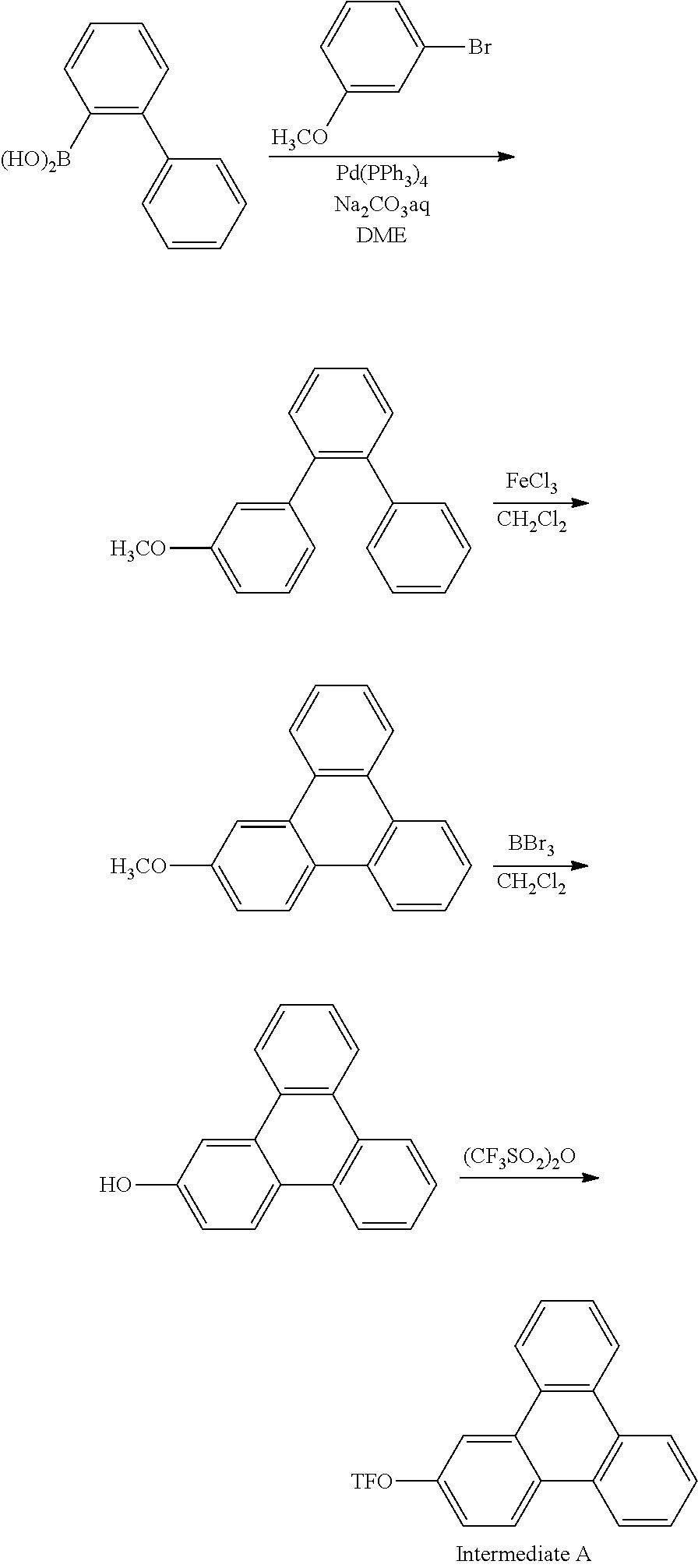


| TABLE 1 | |||||
| Luminous | |||||
| efficiency | |||||
| Host | Dopant | (cd/A) | Half life | ||
| Ex. 10 | Compound 1 | D-1 | 6.5 | 8000 | ||
| Ex. 11 | Compound 2 | D-1 | 6.5 | 8000 | ||
| Ex. 12 | Compound 3 | D-1 | 6.5 | 8000 | ||
| Ex. 13 | Compound 4 | D-1 | 6.5 | 8000 | ||
| Ex. 14 | Compound 5 | D-1 | 6.5 | 8000 | ||
| Ex. 15 | Compound 6 | D-1 | 6.5 | 8000 | ||
| Ex. 16 | Compound 7 | D-1 | 6.7 | 7000 | ||
| Ex. 17 | Compound 8 | D-1 | 6.7 | 7000 | ||
| Ex. 18 | Compound 9 | D-1 | 6.7 | 7000 | ||
| Comp. | Compound (B) | D-1 | 6.0 | 4000 | ||
| Ex. 1 | ||||||
| Comp. | Compound (C) | D-1 | 4.2 | 2000 | ||
| Ex. 2 | ||||||


| TABLE 2 | |||||||
| Luminous | |||||||
| Voltage | efficiency | Emission | |||||
| Host | Dopant | (V) | (cd/A) | color | Half life | ||
| Ex. 21 | Compound 10 | D-2 | 6.4 | 22 | Green | 30000 |
| Ex. 22 | Compound 11 | D-2 | 6.5 | 22 | Green | 30000 |
| Ex. 23 | Compound 10 | D-3 | 6.5 | 21 | Green | 50000 |
| Ex. 24 | Compound 11 | D-3 | 6.5 | 21 | Green | 50000 |
| Comp. Ex. 3 | Compound (B) | D-2 | 7.0 | 17 | Green | 10000 |
Claims (14)


Applications Claiming Priority (3)
| Application Number | Priority Date | Filing Date | Title |
|---|---|---|---|
| JP2007301837 | 2007-11-21 | ||
| JP2007-301837 | 2007-11-21 | ||
| PCT/JP2008/070882 WO2009066641A1 (en) | 2007-11-21 | 2008-11-17 | Fused aromatic derivative and organic electroluminescent device using the same |
Related Parent Applications (1)
| Application Number | Title | Priority Date | Filing Date |
|---|---|---|---|
| PCT/JP2008/070882 A-371-Of-International WO2009066641A1 (en) | 2007-11-21 | 2008-11-17 | Fused aromatic derivative and organic electroluminescent device using the same |
Related Child Applications (1)
| Application Number | Title | Priority Date | Filing Date |
|---|---|---|---|
| US14/065,096 Continuation US10153450B2 (en) | 2007-11-21 | 2013-10-28 | Fused aromatic derivative and organic electroluminescence device using the same |
Publications (2)
| Publication Number | Publication Date |
|---|---|
| US20100295030A1 US20100295030A1 (en) | 2010-11-25 |
| US8623520B2 true US8623520B2 (en) | 2014-01-07 |
Family
ID=40667463
Family Applications (2)
| Application Number | Title | Priority Date | Filing Date |
|---|---|---|---|
| US12/743,815 Active 2029-11-08 US8623520B2 (en) | 2007-11-21 | 2008-11-17 | Fused aromatic derivative and organic electroluminescence device using the same |
| US14/065,096 Active 2029-11-03 US10153450B2 (en) | 2007-11-21 | 2013-10-28 | Fused aromatic derivative and organic electroluminescence device using the same |
Family Applications After (1)
| Application Number | Title | Priority Date | Filing Date |
|---|---|---|---|
| US14/065,096 Active 2029-11-03 US10153450B2 (en) | 2007-11-21 | 2013-10-28 | Fused aromatic derivative and organic electroluminescence device using the same |
Country Status (6)
| Country | Link |
|---|---|
| US (2) | US8623520B2 (en) |
| EP (1) | EP2213641B1 (en) |
| JP (1) | JP5399920B2 (en) |
| KR (1) | KR101477844B1 (en) |
| TW (1) | TW200927880A (en) |
| WO (1) | WO2009066641A1 (en) |
Cited By (1)
| Publication number | Priority date | Publication date | Assignee | Title |
|---|---|---|---|---|
| US20140061628A1 (en) * | 2007-11-21 | 2014-03-06 | Idemitsu Kosan Co., Ltd. | Fused aromatic derivative and organic electroluminescence device using the same |
Families Citing this family (25)
| Publication number | Priority date | Publication date | Assignee | Title |
|---|---|---|---|---|
| JP5378397B2 (en) * | 2007-11-22 | 2013-12-25 | グレイセル・ディスプレイ・インコーポレーテッド | Highly efficient blue electroluminescent compound and display device using the same |
| KR101121703B1 (en) | 2007-12-28 | 2012-03-13 | 이데미쓰 고산 가부시키가이샤 | Aromatic amine derivative and organic electroluminescent device using the same |
| JP5490095B2 (en) * | 2008-04-11 | 2014-05-14 | ボード・オブ・リージェンツ・オブ・ザ・ユニバーシティ・オブ・テキサス・システム | Method and apparatus for amplifying electrochemiluminescence by nanoparticles |
| WO2009137002A2 (en) | 2008-05-08 | 2009-11-12 | Board Of Regents Of The University Of Texas System | Luminescent nanostructured materials for use in electrogenerated chemiluminescence |
| KR20110043625A (en) * | 2008-07-28 | 2011-04-27 | 이데미쓰 고산 가부시키가이샤 | Organic light emitting medium and organic EL element |
| WO2010013675A1 (en) * | 2008-07-28 | 2010-02-04 | 出光興産株式会社 | Organic light-emitting medium and organic el element |
| EP2423206B1 (en) | 2009-04-24 | 2014-01-08 | Idemitsu Kosan Co., Ltd. | Aromatic amine derivative, and organic electroluminescent element comprising same |
| DE102009053191A1 (en) * | 2009-11-06 | 2011-05-12 | Merck Patent Gmbh | Materials for electronic devices |
| KR101358494B1 (en) | 2009-12-16 | 2014-02-05 | 이데미쓰 고산 가부시키가이샤 | Aromatic amine derivative, and organic electroluminescent element comprising same |
| TWI397516B (en) * | 2010-02-03 | 2013-06-01 | Nat Univ Tsing Hua | Triphenylene based aromatic compounds and oleds utilizing the same |
| US8288015B2 (en) * | 2010-04-18 | 2012-10-16 | National Tsing Hua University | Triphenylene based aromatic compounds and OLEDs utilizing the same |
| US8968887B2 (en) * | 2010-04-28 | 2015-03-03 | Universal Display Corporation | Triphenylene-benzofuran/benzothiophene/benzoselenophene compounds with substituents joining to form fused rings |
| CN102241620B (en) * | 2010-05-14 | 2013-07-17 | 国立清华大学 | Aromatic compounds containing benzo[9,10]phenanthrenyl and organic light-emitting diodes using them |
| JP5778407B2 (en) * | 2010-07-29 | 2015-09-16 | ユー・ディー・シー アイルランド リミテッド | Organic electroluminescent device and charge transport material |
| JP5973762B2 (en) * | 2011-03-31 | 2016-08-23 | ユー・ディー・シー アイルランド リミテッド | Charge transport material, organic electroluminescent element, and light emitting device, display device or illumination device using the element |
| KR101535824B1 (en) * | 2011-12-16 | 2015-07-13 | 엘지디스플레이 주식회사 | Organic Light Emitting Device |
| KR101433822B1 (en) | 2013-06-17 | 2014-08-27 | 삼성디스플레이 주식회사 | Organic light emitting diode device |
| KR102326623B1 (en) * | 2014-03-18 | 2021-11-16 | 메르크 파텐트 게엠베하 | Organic electroluminescent device |
| US9902687B2 (en) | 2014-09-19 | 2018-02-27 | Idemitsu Kosan Co., Ltd. | Compound |
| KR102563713B1 (en) | 2017-04-26 | 2023-08-07 | 오티아이 루미오닉스 인크. | Methods of patterning the coating of a surface and apparatus comprising the patterned coating |
| US11751415B2 (en) | 2018-02-02 | 2023-09-05 | Oti Lumionics Inc. | Materials for forming a nucleation-inhibiting coating and devices incorporating same |
| KR20250160226A (en) | 2019-03-07 | 2025-11-11 | 오티아이 루미오닉스 인크. | Materials for forming a nucleation-inhibiting coating and devices incorporating same |
| JP7555600B2 (en) | 2019-04-18 | 2024-09-25 | オーティーアイ ルミオニクス インコーポレーテッド | Materials for forming nucleation-inhibiting coatings and devices incorporating same - Patents.com |
| JP7576337B2 (en) | 2019-05-08 | 2024-11-01 | オーティーアイ ルミオニクス インコーポレーテッド | Materials for forming nucleation-inhibiting coatings and devices incorporating same - Patents.com |
| US11985841B2 (en) | 2020-12-07 | 2024-05-14 | Oti Lumionics Inc. | Patterning a conductive deposited layer using a nucleation inhibiting coating and an underlying metallic coating |
Citations (15)
| Publication number | Priority date | Publication date | Assignee | Title |
|---|---|---|---|---|
| EP0847228A2 (en) | 1996-12-09 | 1998-06-10 | Toyo Ink Manufacturing Co., Ltd. | Material for organoelectroluminescence device and use thereof |
| JP2003109765A (en) | 2001-09-28 | 2003-04-11 | Canon Inc | Organic light emitting device |
| JP2004059535A (en) | 2002-07-31 | 2004-02-26 | Idemitsu Kosan Co Ltd | Anthracene derivative, light emitting material for organic electroluminescent device, and organic electroluminescent device |
| WO2004018587A1 (en) | 2002-08-23 | 2004-03-04 | Idemitsu Kosan Co., Ltd. | Organic electroluminescence device and anthracene derivative |
| US20040076852A1 (en) | 2002-10-16 | 2004-04-22 | National Tsing Hua University | Aromatic compounds and organic light emitting diodes |
| JP2005041843A (en) | 2003-07-25 | 2005-02-17 | Mitsui Chemicals Inc | Asymmetric substituted anthracene compound and organic electroluminescent element containing the same |
| WO2006003842A1 (en) | 2004-07-02 | 2006-01-12 | Chisso Corporation | Luminescent material and organic electroluminescent device utilizing the same |
| JP2006151844A (en) | 2004-11-26 | 2006-06-15 | Canon Inc | Aminoanthryl derivative-substituted compound and organic light-emitting device |
| US20060204783A1 (en) * | 2005-03-10 | 2006-09-14 | Conley Scott R | Organic electroluminescent device |
| KR20070102243A (en) | 2006-04-14 | 2007-10-18 | 주식회사 이엘엠 | Triphenylene derivative and organic light emitting diode using same |
| US20070252522A1 (en) * | 2005-11-30 | 2007-11-01 | Eastman Kodak Company | Electroluminescent device including an anthracene derivative |
| US20080182129A1 (en) * | 2007-01-30 | 2008-07-31 | Klubek Kevin P | Oleds having high efficiency and excellent lifetime |
| WO2009066809A1 (en) | 2007-11-22 | 2009-05-28 | Gracel Display Inc. | Blue electroluminescent compounds with high efficiency and display device using the same |
| WO2009099133A1 (en) | 2008-02-08 | 2009-08-13 | Toyo Ink Mfg. Co., Ltd. | Compound having carbazolyl group and use thereof |
| EP2108689A2 (en) | 2008-04-02 | 2009-10-14 | Gracel Display Inc. | Novel organic electroluminescent compounds and organic electroluminescent device using the same |
Family Cites Families (10)
| Publication number | Priority date | Publication date | Assignee | Title |
|---|---|---|---|---|
| WO2001021729A1 (en) * | 1999-09-21 | 2001-03-29 | Idemitsu Kosan Co., Ltd. | Organic electroluminescence and organic luminous medium |
| JP2004002351A (en) * | 2002-03-27 | 2004-01-08 | Tdk Corp | Organic EL device |
| JP4170655B2 (en) * | 2002-04-17 | 2008-10-22 | 出光興産株式会社 | Novel aromatic compound and organic electroluminescence device using the same |
| TWI314947B (en) * | 2002-04-24 | 2009-09-21 | Eastman Kodak Compan | Organic light emitting diode devices with improved operational stability |
| JP4035482B2 (en) * | 2003-06-27 | 2008-01-23 | キヤノン株式会社 | Substituted anthryl derivative and organic light emitting device using the same |
| US20060286405A1 (en) * | 2005-06-17 | 2006-12-21 | Eastman Kodak Company | Organic element for low voltage electroluminescent devices |
| JP4726584B2 (en) * | 2005-09-15 | 2011-07-20 | 三井化学株式会社 | Aromatic compound and organic electroluminescent device containing the aromatic compound |
| JP4979247B2 (en) * | 2006-03-08 | 2012-07-18 | 三井化学株式会社 | Anthracene compound and organic electroluminescence device containing the compound |
| KR100857025B1 (en) * | 2006-05-22 | 2008-09-05 | (주)그라쎌 | High performance blue light emitting compound and display device containing the same |
| JP5399920B2 (en) * | 2007-11-21 | 2014-01-29 | 出光興産株式会社 | Condensed aromatic derivative and organic electroluminescence device using the same |
-
2008
- 2008-11-17 JP JP2009542548A patent/JP5399920B2/en not_active Expired - Fee Related
- 2008-11-17 US US12/743,815 patent/US8623520B2/en active Active
- 2008-11-17 WO PCT/JP2008/070882 patent/WO2009066641A1/en not_active Ceased
- 2008-11-17 EP EP08851689.3A patent/EP2213641B1/en not_active Not-in-force
- 2008-11-17 KR KR1020107011034A patent/KR101477844B1/en active Active
- 2008-11-20 TW TW097144854A patent/TW200927880A/en unknown
-
2013
- 2013-10-28 US US14/065,096 patent/US10153450B2/en active Active
Patent Citations (24)
| Publication number | Priority date | Publication date | Assignee | Title |
|---|---|---|---|---|
| EP0847228A2 (en) | 1996-12-09 | 1998-06-10 | Toyo Ink Manufacturing Co., Ltd. | Material for organoelectroluminescence device and use thereof |
| JP2003109765A (en) | 2001-09-28 | 2003-04-11 | Canon Inc | Organic light emitting device |
| JP2004059535A (en) | 2002-07-31 | 2004-02-26 | Idemitsu Kosan Co Ltd | Anthracene derivative, light emitting material for organic electroluminescent device, and organic electroluminescent device |
| WO2004018587A1 (en) | 2002-08-23 | 2004-03-04 | Idemitsu Kosan Co., Ltd. | Organic electroluminescence device and anthracene derivative |
| US20110034744A1 (en) | 2002-08-23 | 2011-02-10 | Idemitsu Kosan Co., Ltd. | Organic electroluminescence device and anthracene derivative |
| EP1553154A1 (en) | 2002-08-23 | 2005-07-13 | Idemitsu Kosan Co., Ltd. | Organic electroluminescence device and anthracene derivative |
| US20120235561A1 (en) | 2002-08-23 | 2012-09-20 | Idemitsu Kosan Co., Ltd. | Organic electroluminescence device and anthracene derivative |
| US20060043858A1 (en) | 2002-08-23 | 2006-03-02 | Idemitsu Kosan Co., Ltd. | Organic electroluminescence device and anthracene derivative |
| US20040076852A1 (en) | 2002-10-16 | 2004-04-22 | National Tsing Hua University | Aromatic compounds and organic light emitting diodes |
| JP2004139957A (en) | 2002-10-16 | 2004-05-13 | National Tsinghua Univ | Organic light emitting diode |
| US6861163B2 (en) | 2002-10-16 | 2005-03-01 | National Tsing Hua University | Aromatic compounds and organic light emitting diodes |
| JP2005041843A (en) | 2003-07-25 | 2005-02-17 | Mitsui Chemicals Inc | Asymmetric substituted anthracene compound and organic electroluminescent element containing the same |
| WO2006003842A1 (en) | 2004-07-02 | 2006-01-12 | Chisso Corporation | Luminescent material and organic electroluminescent device utilizing the same |
| US20100025661A1 (en) | 2004-07-02 | 2010-02-04 | Guofang Wang | Luminescent material and organic electroluminescent device using the same |
| JP2006151844A (en) | 2004-11-26 | 2006-06-15 | Canon Inc | Aminoanthryl derivative-substituted compound and organic light-emitting device |
| US20060204783A1 (en) * | 2005-03-10 | 2006-09-14 | Conley Scott R | Organic electroluminescent device |
| US20070252522A1 (en) * | 2005-11-30 | 2007-11-01 | Eastman Kodak Company | Electroluminescent device including an anthracene derivative |
| KR20070102243A (en) | 2006-04-14 | 2007-10-18 | 주식회사 이엘엠 | Triphenylene derivative and organic light emitting diode using same |
| WO2008094399A1 (en) | 2007-01-30 | 2008-08-07 | Eastman Kodak Company | Oleds having high efficiency and excellent lifetime |
| US20080182129A1 (en) * | 2007-01-30 | 2008-07-31 | Klubek Kevin P | Oleds having high efficiency and excellent lifetime |
| WO2009066809A1 (en) | 2007-11-22 | 2009-05-28 | Gracel Display Inc. | Blue electroluminescent compounds with high efficiency and display device using the same |
| US20110054228A1 (en) * | 2007-11-22 | 2011-03-03 | Gracel Display Inc. | Blue electroluminescent compounds with high efficiency and display device using the same |
| WO2009099133A1 (en) | 2008-02-08 | 2009-08-13 | Toyo Ink Mfg. Co., Ltd. | Compound having carbazolyl group and use thereof |
| EP2108689A2 (en) | 2008-04-02 | 2009-10-14 | Gracel Display Inc. | Novel organic electroluminescent compounds and organic electroluminescent device using the same |
Non-Patent Citations (3)
| Title |
|---|
| Communication (Supplementary European Search Report) in EP Appln No. 08 85 1689 dated Dec. 28, 2010. |
| Communication Pursuant to Article 94(3)EPC EP Application No. 08 851 689.3 dated Jun. 27, 2013. |
| Office Action Japanese Patent Application No. 2009-542548 dated Jul. 9, 2013. |
Cited By (2)
| Publication number | Priority date | Publication date | Assignee | Title |
|---|---|---|---|---|
| US20140061628A1 (en) * | 2007-11-21 | 2014-03-06 | Idemitsu Kosan Co., Ltd. | Fused aromatic derivative and organic electroluminescence device using the same |
| US10153450B2 (en) * | 2007-11-21 | 2018-12-11 | Idemitsu Kosan Co., Ltd. | Fused aromatic derivative and organic electroluminescence device using the same |
Also Published As
| Publication number | Publication date |
|---|---|
| US20140061628A1 (en) | 2014-03-06 |
| US20100295030A1 (en) | 2010-11-25 |
| EP2213641B1 (en) | 2018-05-16 |
| KR20100090269A (en) | 2010-08-13 |
| EP2213641A4 (en) | 2011-01-26 |
| US10153450B2 (en) | 2018-12-11 |
| JP5399920B2 (en) | 2014-01-29 |
| TW200927880A (en) | 2009-07-01 |
| EP2213641A1 (en) | 2010-08-04 |
| JPWO2009066641A1 (en) | 2011-04-07 |
| KR101477844B1 (en) | 2014-12-30 |
| WO2009066641A1 (en) | 2009-05-28 |
Similar Documents
| Publication | Publication Date | Title |
|---|---|---|
| US10153450B2 (en) | Fused aromatic derivative and organic electroluminescence device using the same | |
| US9614159B2 (en) | Benzophenanthrene derivative and organic electroluminescence device employing the same | |
| US8222637B2 (en) | Benzochrysene derivative and organic electroluminescence device using the same | |
| US8221907B2 (en) | Chrysene derivative and organic electroluminescent device using the same | |
| US8253129B2 (en) | Benzochrysene derivative and an organic electroluminescence device using the same | |
| US8367222B2 (en) | Organic electroluminescent device | |
| US8900724B2 (en) | Monobenzochrysene derivative, a material for an organic electroluminescence device containing the same, and an organic electroluminescence device using the material | |
| US8501329B2 (en) | Benzanthracene compound and organic electroluminescent device using the same | |
| JPWO2009154207A1 (en) | Anthracene derivative and organic electroluminescence device using the same | |
| US8563969B2 (en) | Benzanthracene compound and organic electroluminescence device using the same | |
| WO2009133917A1 (en) | Anthracene derivative and organic electroluminescent element using the same | |
| WO2009142230A1 (en) | Anthracene derivative and organic electroluminescent device using the same |
Legal Events
| Date | Code | Title | Description |
|---|---|---|---|
| AS | Assignment |
Owner name: IDEMITSU KOSAN CO., LTD., JAPAN Free format text: ASSIGNMENT OF ASSIGNORS INTEREST;ASSIGNOR:KAWAMURA, MASAHIRO;REEL/FRAME:024743/0837 Effective date: 20100617 |
|
| STCF | Information on status: patent grant |
Free format text: PATENTED CASE |
|
| FEPP | Fee payment procedure |
Free format text: PAYOR NUMBER ASSIGNED (ORIGINAL EVENT CODE: ASPN); ENTITY STATUS OF PATENT OWNER: LARGE ENTITY |
|
| FPAY | Fee payment |
Year of fee payment: 4 |
|
| MAFP | Maintenance fee payment |
Free format text: PAYMENT OF MAINTENANCE FEE, 8TH YEAR, LARGE ENTITY (ORIGINAL EVENT CODE: M1552); ENTITY STATUS OF PATENT OWNER: LARGE ENTITY Year of fee payment: 8 |
|
| MAFP | Maintenance fee payment |
Free format text: PAYMENT OF MAINTENANCE FEE, 12TH YEAR, LARGE ENTITY (ORIGINAL EVENT CODE: M1553); ENTITY STATUS OF PATENT OWNER: LARGE ENTITY Year of fee payment: 12 |