US8608961B2 - Method for affinity chromatography of antithrombin III - Google Patents
Method for affinity chromatography of antithrombin III Download PDFInfo
- Publication number
- US8608961B2 US8608961B2 US12/020,787 US2078708A US8608961B2 US 8608961 B2 US8608961 B2 US 8608961B2 US 2078708 A US2078708 A US 2078708A US 8608961 B2 US8608961 B2 US 8608961B2
- Authority
- US
- United States
- Prior art keywords
- atiii
- affinity
- species
- column
- protein
- Prior art date
- Legal status (The legal status is an assumption and is not a legal conclusion. Google has not performed a legal analysis and makes no representation as to the accuracy of the status listed.)
- Active, expires
Links
Images


Classifications
-
- B—PERFORMING OPERATIONS; TRANSPORTING
- B01—PHYSICAL OR CHEMICAL PROCESSES OR APPARATUS IN GENERAL
- B01D—SEPARATION
- B01D15/00—Separating processes involving the treatment of liquids with solid sorbents; Apparatus therefor
- B01D15/08—Selective adsorption, e.g. chromatography
- B01D15/26—Selective adsorption, e.g. chromatography characterised by the separation mechanism
- B01D15/38—Selective adsorption, e.g. chromatography characterised by the separation mechanism involving specific interaction not covered by one or more of groups B01D15/265 and B01D15/30 - B01D15/36, e.g. affinity, ligand exchange or chiral chromatography
-
- B—PERFORMING OPERATIONS; TRANSPORTING
- B01—PHYSICAL OR CHEMICAL PROCESSES OR APPARATUS IN GENERAL
- B01J—CHEMICAL OR PHYSICAL PROCESSES, e.g. CATALYSIS OR COLLOID CHEMISTRY; THEIR RELEVANT APPARATUS
- B01J20/00—Solid sorbent compositions or filter aid compositions; Sorbents for chromatography; Processes for preparing, regenerating or reactivating thereof
- B01J20/30—Processes for preparing, regenerating, or reactivating
- B01J20/32—Impregnating or coating ; Solid sorbent compositions obtained from processes involving impregnating or coating
- B01J20/3231—Impregnating or coating ; Solid sorbent compositions obtained from processes involving impregnating or coating characterised by the coating or impregnating layer
- B01J20/3242—Layers with a functional group, e.g. an affinity material, a ligand, a reactant or a complexing group
- B01J20/3268—Macromolecular compounds
- B01J20/3272—Polymers obtained by reactions otherwise than involving only carbon to carbon unsaturated bonds
- B01J20/3274—Proteins, nucleic acids, polysaccharides, antibodies or antigens
-
- B—PERFORMING OPERATIONS; TRANSPORTING
- B01—PHYSICAL OR CHEMICAL PROCESSES OR APPARATUS IN GENERAL
- B01D—SEPARATION
- B01D15/00—Separating processes involving the treatment of liquids with solid sorbents; Apparatus therefor
- B01D15/08—Selective adsorption, e.g. chromatography
- B01D15/26—Selective adsorption, e.g. chromatography characterised by the separation mechanism
- B01D15/38—Selective adsorption, e.g. chromatography characterised by the separation mechanism involving specific interaction not covered by one or more of groups B01D15/265 and B01D15/30 - B01D15/36, e.g. affinity, ligand exchange or chiral chromatography
- B01D15/3804—Affinity chromatography
- B01D15/3823—Affinity chromatography of other types, e.g. avidin, streptavidin or biotin
-
- B—PERFORMING OPERATIONS; TRANSPORTING
- B01—PHYSICAL OR CHEMICAL PROCESSES OR APPARATUS IN GENERAL
- B01J—CHEMICAL OR PHYSICAL PROCESSES, e.g. CATALYSIS OR COLLOID CHEMISTRY; THEIR RELEVANT APPARATUS
- B01J20/00—Solid sorbent compositions or filter aid compositions; Sorbents for chromatography; Processes for preparing, regenerating or reactivating thereof
- B01J20/22—Solid sorbent compositions or filter aid compositions; Sorbents for chromatography; Processes for preparing, regenerating or reactivating thereof comprising organic material
-
- B—PERFORMING OPERATIONS; TRANSPORTING
- B01—PHYSICAL OR CHEMICAL PROCESSES OR APPARATUS IN GENERAL
- B01J—CHEMICAL OR PHYSICAL PROCESSES, e.g. CATALYSIS OR COLLOID CHEMISTRY; THEIR RELEVANT APPARATUS
- B01J20/00—Solid sorbent compositions or filter aid compositions; Sorbents for chromatography; Processes for preparing, regenerating or reactivating thereof
- B01J20/28—Solid sorbent compositions or filter aid compositions; Sorbents for chromatography; Processes for preparing, regenerating or reactivating thereof characterised by their form or physical properties
-
- B—PERFORMING OPERATIONS; TRANSPORTING
- B01—PHYSICAL OR CHEMICAL PROCESSES OR APPARATUS IN GENERAL
- B01J—CHEMICAL OR PHYSICAL PROCESSES, e.g. CATALYSIS OR COLLOID CHEMISTRY; THEIR RELEVANT APPARATUS
- B01J20/00—Solid sorbent compositions or filter aid compositions; Sorbents for chromatography; Processes for preparing, regenerating or reactivating thereof
- B01J20/281—Sorbents specially adapted for preparative, analytical or investigative chromatography
- B01J20/286—Phases chemically bonded to a substrate, e.g. to silica or to polymers
-
- B—PERFORMING OPERATIONS; TRANSPORTING
- B01—PHYSICAL OR CHEMICAL PROCESSES OR APPARATUS IN GENERAL
- B01J—CHEMICAL OR PHYSICAL PROCESSES, e.g. CATALYSIS OR COLLOID CHEMISTRY; THEIR RELEVANT APPARATUS
- B01J20/00—Solid sorbent compositions or filter aid compositions; Sorbents for chromatography; Processes for preparing, regenerating or reactivating thereof
- B01J20/30—Processes for preparing, regenerating, or reactivating
- B01J20/32—Impregnating or coating ; Solid sorbent compositions obtained from processes involving impregnating or coating
- B01J20/3231—Impregnating or coating ; Solid sorbent compositions obtained from processes involving impregnating or coating characterised by the coating or impregnating layer
- B01J20/3242—Layers with a functional group, e.g. an affinity material, a ligand, a reactant or a complexing group
Definitions
- the present invention relates to an affinity chromatography column comprising the ATIII protein bound to a solid support.
- Heparins which are mixtures of sulfated mucopolysaccharides of animal origin, are biologically active agents of the glycosaminoglycan family that have particularly useful anticoagulant properties. They are constituted of sulfated linear polysaccharide chains that are very heterogeneous by virtue of their sizes. The average weight of heparins is approximately 15 000 Da (origin: porcine mucus).
- LMWHs Low-molecular-weight heparins
- VLMWHs very low-molecular-weight heparins
- Antithrombin III (ATIII) (Chandra et al., 1983 , Proc. Natl. Acad. Sci. U.S.A., 80: 1845-1848) is a specific serpin which has a weak inhibitory activity on serine proteases controlling clotting. This action is clearly increased in the presence of heparin which binds and activates ATIII. In particular, the binding to heparin brings about a set of conformational changes in the protein culminating in the adoption of a conformation highly favorable to interaction with the target serine proteases. When ATIII is in the activated conformation, the interaction with the molecule of heparin or derivative which initiated the conformational change is clearly strengthened.
- heparin and ATIII The interaction between heparin and ATIII is due to a specific pentasaccharide sequence. Now, only one-third of the polysaccharide strands have the specific sequences allowing a stable interaction with ATIII. Heparin preparations and derivatives are therefore heterogeneous with regard to the affinity for ATIII. It is important to be able to enrich a population of oligosaccharides in species having affinity for ATIII, such an enrichment being capable of significantly increasing the anticoagulation activity of this population.
- ATIII is grafted, in the presence of acetylated heparin, onto CNBr-activated Sepharose B resin.
- the purpose of using heparin is to prevent any grafting at the level of the heparin-binding site of ATIII.
- the heparin used for binding ATIII is an acetylated heparin, so as to avoid the risk of competition with the hexamine NH 2 residues.
- the acetylation of heparin is reflected by a considerable decrease in its affinity and therefore in its protective capacity with respect to the binding site, hence a decrease in the number of ATIII molecules capable of binding the species having affinity.
- the present invention is directed to an affinity chromatography column comprising the antithrombin III (ATIII) protein bound to a solid support, characterized in that:
- FIG. 1 Chromatogram of a separation of enoxaparin on ATIII affinity chromatography.
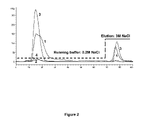
- FIG. 2 Chromatogram of a separation of Enoxaparine® on ATIII affinity chromatography.
- Curve 3 is the injection of LMWH onto column 1 (Enoxaparine® protection), curve 2 the injection of buffer onto column 1 (Enoxaparine® protection), curve 1 the injection of LMWH onto column 2 (heparin protection), curve 4 the injection of buffer onto column 2 (heparin protection).
- unmodified LMWH is intended to mean an LMWH which has not undergone a chemical or enzymatic modification after preparation and, in particular, which is not acetylated.
- LMWH rich in active species is intended to mean an LMWH rich in oligosaccharides having affinity for ATIII.
- resin is intended to mean, according to the invention, a chemically inert macromolecular support onto which ATIII is grafted.
- supports comprise, inter alia, and in a nonlimiting manner, agarose beads, polyacrylamide-agarose beads, porous glass beads, polyvinyl beads or polymethacrylate beads, onto which ATIII is grafted according to the manufacturers' indications or methods well known to those skilled in the art, including in particular grafting methods with cyanogen bromide and with hydrazine. It is clearly understood that preactivated resins may also be used.
- the resin used is Sepharose and the grafting technique used is that of cyanogen bromide grafting.
- the affinity chromatography column according to the invention has a double advantage.
- the low concentration of ATIII allows interactions with the species having affinity without steric hindrance between them. This property of the invention is particularly advantageous when the intention is to separate species of large size.
- the ratio between the amounts of ATIII-binding sites present in LMWH and of ATIII molecules is between approximately 5 and approximately 15. More specifically, the subject of the invention is an affinity chromatography column as defined above, characterized in that this ratio is approximately 10.
- a subject of the invention is most particularly an affinity chromatography column, characterized in that enoxaparin is used as LMWH for protecting the ATIII binding site.
- the invention also has the advantage of allowing better accessibility to ATIII by adjusting the concentration of protein that can be grafted onto the resin.
- a subject of the invention is an affinity chromatography column, characterized in that the ATIII/resin ratio is between approximately 0.5 and approximately 1.5 mg of protein per ml of resin.
- the ATIII/resin ratio is between approximately 0.5 and approximately 1.5 mg of protein per ml of resin.
- this corresponds to a range of approximately 1.75 mg to 5.25 mg of protein per g of dry resin (according to the supplier's data, 1 g of dry resin gives approximately 3.5 ml of resin after hydration).
- the affinity chromatography column according to the invention has a greater capacity and a greater selectivity than the columns described in the prior art.
- species having affinity for ATIII is intended to mean any molecule capable of binding specifically to ATIII. For example, it may be desired to enrich a population of heparin oligosaccharides in species having affinity. It may also be advantageous, for example, to increase the titer of a solution of polyclonal antibodies against ATIII.
- the affinity chromatography column according to the invention may thus be used for purifying species having affinity for ATIII from a mixture.
- a subject of the invention is thus also a method for purifying species having affinity for ATIII in a sample comprising species having affinity and not having affinity for ATIII, said method comprising:
- the species having affinity that are purified by means of the method according to the invention are oligosaccharides constituting heparins and their derivatives.
- the elution of the various species may, for example, be followed by measuring the absorbance for various fractions using a spectrophotometer.
- the wavelength used will be suitable for the nature of the purified species. For example, if oligosaccharides are purified, the length used will be 232 nm; if proteins are purified, it will be 280 nm.
- composition of the elution fractions may then be analyzed according to methods well known to those skilled in the art.
- the fractions analyzed comprise oligosaccharides
- those skilled in the art may use the analytical methods described in the prior art: for example and in a nonlimiting manner, capillary electrophoresis, MALDI-TOF mass spectrophotometry, high performance liquid chromatography.
- a biological assay such as the factor Xa inhibition assay.
- the solution is mixed in a 1:2 ratio with CNBr-activated Sepharose B resin (Sigma) prepared according to the manufacturer's indications, and is then gently stirred overnight in the cold. The whole is subsequently transferred into the blocking buffer (volume to volume) and is stirred for 16 h.
- CNBr-activated Sepharose B resin Sigma
- the resin is poured into a thermostatted XK16 column (Amersham) equipped with 2 pistons. After decanting, it is washed 4 to 5 times by alternating between blocking buffer and washing buffer.
- the behavior of the species having affinity is followed with a diode array UV detector (HP 1100) by measuring the absorbance of the fractions at 232 nm. As shown in FIG. 1 , the species having affinity are specifically retained on the column and are eluted only in the presence of 3M NaCl.
- the difference in amount used in the protection is justified by the difference in average molecular mass (a ratio of approximately 3.4).
- the separation of the various polysaccharide species is followed with a diode array UV detector (HP 1100) by measuring the absorbance of the fractions at 232 nm.
- % species retained area of the elution peak/(area of the peak of the species not retained+area of the peak of the species retained).
- selectivity defines herein the ability of the resins to distinguish, during separation, the polysaccharide species having affinity from those not having affinity.
- the fractions having affinity and not having affinity after several injections of 427 ⁇ g of LMWH were combined and analyzed by CTA-SAX HPLC (MOURIER et al., 2004 , Anal. Biochem., 332: 299-313).
- the fraction having affinity that is obtained is pure and complete, in that it does not contain any species not having affinity and in that it exhibits all the hexasaccharides having affinity.
- the fraction not having affinity is, in a complementary manner, completely depleted of species having affinity.
- That of the fraction having affinity is equal to 818 ⁇ 10 IU/mg; for comparison, the activity of the hexasaccharide ⁇ UA-(1 ⁇ 4) ⁇ -GlcNAc(6S)-(1 ⁇ 4) ⁇ -GlcA-(1 ⁇ 4) ⁇ -GlcNS(NS,3,6S)-(1 ⁇ 4) ⁇ -IdA2S-(1 ⁇ 4) ⁇ -GlcNS(NS,6S) is approximately 650-700 IU/mg. On the other hand, it was completely impossible to detect an anti-Xa activity in the fractions not having affinity.
- the fraction having affinity is not as pure as that obtained with column 1 (protection: enoxaparin).
- the presence of hexasaccharides not having affinity is in fact observed, in particular the presence of highly sulfated hexasaccharides such as ⁇ UA2S-(1 ⁇ 4) ⁇ -GlcNS(NS,6S)-(1 ⁇ 4) ⁇ -IdA2S-(1 ⁇ 4) ⁇ -GlcNS(NS,6S)-(1 ⁇ 4) ⁇ -IdA2S-(1 ⁇ 4) ⁇ -GlcNS(NS,6S) or ⁇ UA2S-(1 ⁇ 4) ⁇ -GlcNS(NS,6S)-(1 ⁇ 4) ⁇ -IdA2S-(1 ⁇ 4) ⁇ -GlcNS(NS,6S)-(1 ⁇ 4) ⁇ -GlcA-(1 ⁇ 4) ⁇ -GlcNS(NS,6S), in a not insignificant amount.
- species having affinity are found in the fraction not having affinity, in particular the predominant species having affinity: ⁇ UA-(1 ⁇ 4) ⁇ -GlcNAc(6S)-(1 ⁇ 4) ⁇ -GlcA-(1 ⁇ 4) ⁇ -GlcNS(NS,3,6S)-(1 ⁇ 4) ⁇ -IdA2S-(1 ⁇ 4) ⁇ -GlcNS(NS,6S).
- the titers of the anti-Xa activities of the fractions having affinity and not having affinity confirm the structural analyses.
- the fractions having affinity exhibit an anti-Xa activity which is only 565 ⁇ 45 IU/mg.
- a not insignificant residual activity of approximately 15 IU/mg is found in the fraction not having affinity. This activity is a reflection of the residual species having affinity that are in the fraction not having affinity, demonstrated during the structural analysis.
Landscapes
- Chemical & Material Sciences (AREA)
- Analytical Chemistry (AREA)
- Chemical Kinetics & Catalysis (AREA)
- Organic Chemistry (AREA)
- Molecular Biology (AREA)
- Biochemistry (AREA)
- General Health & Medical Sciences (AREA)
- Health & Medical Sciences (AREA)
- Life Sciences & Earth Sciences (AREA)
- Peptides Or Proteins (AREA)
- Medicines Containing Material From Animals Or Micro-Organisms (AREA)
- Polysaccharides And Polysaccharide Derivatives (AREA)
- Pharmaceuticals Containing Other Organic And Inorganic Compounds (AREA)
- Solid-Sorbent Or Filter-Aiding Compositions (AREA)
- Compounds Of Unknown Constitution (AREA)
- Medicines That Contain Protein Lipid Enzymes And Other Medicines (AREA)
- Treatment Of Liquids With Adsorbents In General (AREA)
- Investigating Or Analysing Biological Materials (AREA)
Abstract
-
- a. the ATIII protein is the wild-type protein or a variant thereof,
- b. the ATIII protein has been first activated by incubation with an unmodified low-molecular-weight heparin (LMWH) rich in active species, and
- c. the ATIII protein is covalently bound to a resin in a ratio of less than approximately 2 mg of protein per ml of hydrated resin.
The invention is also directed to the use of the aforesaid column for purifying species having an affinity for ATIII in a sample comprising species having affinity and not having affinity for ATIII.
Description
-
- a. the ATIII protein is the wild-type protein or a variant thereof,
- b. the ATIII protein has been first activated by incubation with an unmodified low-molecular-weight heparin (LMWH) rich in active species, and
- c. the ATIII protein is covalently bound to a resin in a ratio of less than approximately 2 mg of protein per ml of hydrated resin.
The use of the aforesaid column is especially useful as it has higher and more selective affinity with respect to the species having a desired affinity thereto, and facilitates the separation of species of large size. Thus, the invention is also directed to the use of the aforesaid column for purifying species having an affinity for ATIII in a sample comprising species having affinity and not having affinity for ATIII.
-
- a. introducing said sample into the affinity chromatography column for the ATIII protein, said column being first equilibrated in an appropriate saline buffer;
- b. washing the species not specifically retained from said column with an appropriate saline washing buffer, and
- c. eluting the species specifically retained from said column using an appropriate saline eluting buffer.
-
- Column 1: Protection during grafting with 40 mg of enoxaparin
- Column 2: Protection during grafting with 120 mg of heparin.
% species retained=area of the elution peak/(area of the peak of the species not retained+area of the peak of the species retained).
Claims (7)
Applications Claiming Priority (3)
| Application Number | Priority Date | Filing Date | Title |
|---|---|---|---|
| FR0507986A FR2889078B1 (en) | 2005-07-27 | 2005-07-27 | NOVEL CHROMATOGRAPHY METHOD OF AFFINITY OF ANTITHROMBIN III |
| FR0507986 | 2005-07-27 | ||
| PCT/FR2006/001820 WO2007012754A1 (en) | 2005-07-27 | 2006-07-26 | Method for affinity chromatography of antithrombin iii |
Related Parent Applications (1)
| Application Number | Title | Priority Date | Filing Date |
|---|---|---|---|
| PCT/FR2006/001820 Continuation WO2007012754A1 (en) | 2005-07-27 | 2006-07-26 | Method for affinity chromatography of antithrombin iii |
Publications (2)
| Publication Number | Publication Date |
|---|---|
| US20080188650A1 US20080188650A1 (en) | 2008-08-07 |
| US8608961B2 true US8608961B2 (en) | 2013-12-17 |
Family
ID=35892408
Family Applications (1)
| Application Number | Title | Priority Date | Filing Date |
|---|---|---|---|
| US12/020,787 Active 2027-06-21 US8608961B2 (en) | 2005-07-27 | 2008-01-28 | Method for affinity chromatography of antithrombin III |
Country Status (20)
| Country | Link |
|---|---|
| US (1) | US8608961B2 (en) |
| EP (1) | EP1909938B1 (en) |
| JP (1) | JP4931923B2 (en) |
| KR (1) | KR101261662B1 (en) |
| CN (1) | CN101262919B (en) |
| AT (1) | ATE494051T1 (en) |
| AU (1) | AU2006273918B2 (en) |
| BR (1) | BRPI0614669A2 (en) |
| CA (1) | CA2616132A1 (en) |
| CY (1) | CY1118533T1 (en) |
| DE (1) | DE602006019437D1 (en) |
| DK (1) | DK1909938T3 (en) |
| ES (1) | ES2357220T3 (en) |
| FR (1) | FR2889078B1 (en) |
| IL (1) | IL188412A (en) |
| PL (1) | PL1909938T3 (en) |
| PT (1) | PT1909938E (en) |
| RU (1) | RU2411982C2 (en) |
| SI (1) | SI1909938T1 (en) |
| WO (1) | WO2007012754A1 (en) |
Families Citing this family (3)
| Publication number | Priority date | Publication date | Assignee | Title |
|---|---|---|---|---|
| FR2889078B1 (en) | 2005-07-27 | 2007-11-02 | Aventis Pharma Sa | NOVEL CHROMATOGRAPHY METHOD OF AFFINITY OF ANTITHROMBIN III |
| AR085961A1 (en) | 2011-04-11 | 2013-11-06 | Sanofi Sa | POLISACARIDS THAT HAVE TWO SITES OF UNION TO ANTHROMBIN III, METHOD TO PREPARE THEM AND PHARMACEUTICAL COMPOSITIONS THAT CONTAIN THEM |
| CN114958963B (en) * | 2022-07-29 | 2023-09-05 | 深圳传世生物医疗有限公司 | Anticoagulation medicine detection kit acting on thrombin and application thereof |
Citations (3)
| Publication number | Priority date | Publication date | Assignee | Title |
|---|---|---|---|---|
| US4415631A (en) | 1980-06-27 | 1983-11-15 | Akzo | Porous inorganic support material coated with an organic stationary phase, for use in chromatography, and process for its preparation |
| US6582603B1 (en) | 1997-10-23 | 2003-06-24 | Fujimori Kogyo Co., Ltd. | Method for purifying thrombin substrate and/or inhibitors or method for eliminating the same |
| WO2007012754A1 (en) | 2005-07-27 | 2007-02-01 | Aventis Pharma S.A. | Method for affinity chromatography of antithrombin iii |
Family Cites Families (6)
| Publication number | Priority date | Publication date | Assignee | Title |
|---|---|---|---|---|
| US658263A (en) * | 1900-03-29 | 1900-09-18 | David A Houser | Wheel-plow. |
| DE3170001D1 (en) * | 1980-09-30 | 1985-05-23 | Bayer Ag | Method for the production of an antithrombin-heparin complex and pharmaceutical compositions containing the complex |
| SU1708400A1 (en) * | 1988-06-06 | 1992-01-30 | Таджикский государственный университет им.В.И.Ленина | Method of producing sorbent for hemosorption |
| US5744457A (en) * | 1995-03-31 | 1998-04-28 | Hamilton Civic Hospitals Research Development Inc. | Compositions and methods for inhibiting thrombogenesis |
| FR2811992B1 (en) * | 2000-07-21 | 2003-07-04 | Aventis Pharma Sa | MIXTURES OF HEPARIN-DERIVED POLYSACCHARIDES, THEIR PREPARATION AND THE PHARMACEUTICAL COMPOSITIONS CONTAINING THEM |
| JP2005013156A (en) * | 2003-06-27 | 2005-01-20 | Fujimori Kogyo Co Ltd | Immobilized material and method for regenerating the same |
-
2005
- 2005-07-27 FR FR0507986A patent/FR2889078B1/en not_active Expired - Lifetime
-
2006
- 2006-07-26 DK DK06794219.3T patent/DK1909938T3/en active
- 2006-07-26 CA CA002616132A patent/CA2616132A1/en not_active Abandoned
- 2006-07-26 CN CN200680027225XA patent/CN101262919B/en active Active
- 2006-07-26 RU RU2008107317/05A patent/RU2411982C2/en not_active IP Right Cessation
- 2006-07-26 SI SI200630953T patent/SI1909938T1/en unknown
- 2006-07-26 AT AT06794219T patent/ATE494051T1/en active
- 2006-07-26 JP JP2008523413A patent/JP4931923B2/en not_active Expired - Fee Related
- 2006-07-26 PL PL06794219T patent/PL1909938T3/en unknown
- 2006-07-26 DE DE602006019437T patent/DE602006019437D1/en active Active
- 2006-07-26 AU AU2006273918A patent/AU2006273918B2/en not_active Ceased
- 2006-07-26 BR BRPI0614669-4A patent/BRPI0614669A2/en not_active IP Right Cessation
- 2006-07-26 WO PCT/FR2006/001820 patent/WO2007012754A1/en not_active Ceased
- 2006-07-26 ES ES06794219T patent/ES2357220T3/en active Active
- 2006-07-26 PT PT06794219T patent/PT1909938E/en unknown
- 2006-07-26 EP EP06794219A patent/EP1909938B1/en active Active
-
2007
- 2007-12-25 IL IL188412A patent/IL188412A/en not_active IP Right Cessation
-
2008
- 2008-01-25 KR KR1020087002050A patent/KR101261662B1/en not_active Expired - Fee Related
- 2008-01-28 US US12/020,787 patent/US8608961B2/en active Active
-
2011
- 2011-03-03 CY CY20111100249T patent/CY1118533T1/en unknown
Patent Citations (3)
| Publication number | Priority date | Publication date | Assignee | Title |
|---|---|---|---|---|
| US4415631A (en) | 1980-06-27 | 1983-11-15 | Akzo | Porous inorganic support material coated with an organic stationary phase, for use in chromatography, and process for its preparation |
| US6582603B1 (en) | 1997-10-23 | 2003-06-24 | Fujimori Kogyo Co., Ltd. | Method for purifying thrombin substrate and/or inhibitors or method for eliminating the same |
| WO2007012754A1 (en) | 2005-07-27 | 2007-02-01 | Aventis Pharma S.A. | Method for affinity chromatography of antithrombin iii |
Non-Patent Citations (5)
| Title |
|---|
| Bjorklund et al. Characterisation of silica-based heparin affinity sorbents from equilibrium binding studies on plasma fractions containing thromin. Journal of Chromatography A. vol. 762 (1997) p. 113-133. * |
| Goncharova, et al., Preparation of sorbent for haemo:sorption SU 1708400 Patent Abstract, 30, Jan. 1992. |
| Hook, et al., Anticoagulant activity of heparin: Separation of high-activity and low-activity heparin species by affinity chromatography on immobilized antithrombin, Febs Letters, vol. 66, Issue 1, Jul. 1, 1976, pp. 90-93. |
| Hosokawa, et al., JP 2005-013156 Patent Abstract, Dec. 5, 2003. |
| Onoue et al. Novel approach for preparation of heparins specific to factor Xa using affinity chromatography coupled with synthetic antithrombin III-related peptides. Peptides. vol. 24 (2003) p. 821-826. * |
Also Published As
| Publication number | Publication date |
|---|---|
| CN101262919B (en) | 2011-07-27 |
| CN101262919A (en) | 2008-09-10 |
| CA2616132A1 (en) | 2007-02-01 |
| RU2008107317A (en) | 2009-09-10 |
| JP2009503483A (en) | 2009-01-29 |
| AU2006273918B2 (en) | 2011-04-07 |
| US20080188650A1 (en) | 2008-08-07 |
| ES2357220T3 (en) | 2011-04-20 |
| HK1124278A1 (en) | 2009-07-10 |
| CY1118533T1 (en) | 2017-07-12 |
| PL1909938T3 (en) | 2011-06-30 |
| DE602006019437D1 (en) | 2011-02-17 |
| KR20080031320A (en) | 2008-04-08 |
| KR101261662B1 (en) | 2013-05-06 |
| BRPI0614669A2 (en) | 2011-04-12 |
| RU2411982C2 (en) | 2011-02-20 |
| DK1909938T3 (en) | 2011-04-26 |
| AU2006273918A1 (en) | 2007-02-01 |
| SI1909938T1 (en) | 2011-04-29 |
| FR2889078A1 (en) | 2007-02-02 |
| IL188412A0 (en) | 2008-12-29 |
| WO2007012754A1 (en) | 2007-02-01 |
| PT1909938E (en) | 2011-03-03 |
| ATE494051T1 (en) | 2011-01-15 |
| EP1909938A1 (en) | 2008-04-16 |
| IL188412A (en) | 2013-07-31 |
| FR2889078B1 (en) | 2007-11-02 |
| EP1909938B1 (en) | 2011-01-05 |
| JP4931923B2 (en) | 2012-05-16 |
Similar Documents
| Publication | Publication Date | Title |
|---|---|---|
| RU2457214C2 (en) | Method for chromatography in weak distribution mode | |
| Teng et al. | A strategy for the generation of biomimetic ligands for affinity chromatography. Combinatorial synthesis and biological evaluation of an IgG binding ligand | |
| JP4831697B2 (en) | Purification method | |
| AU2016219569B2 (en) | Novel affinity chromatography media for removal of anti-A and/or anti-B antibodies | |
| Karlsson et al. | Ion exchange chromatography | |
| Naik et al. | Performance of hexamer peptide ligands for affinity purification of immunoglobulin G from commercial cell culture media | |
| JP2007525412A (en) | Antibody purification by protein A and ion exchange chromatography | |
| KR20070072510A (en) | Affinity- and Ion-Exchange Chromatography for Antibody Purification | |
| US8445427B2 (en) | Endotoxin adsorbent, and method for removing endotoxin using the same | |
| US20080188650A1 (en) | Method for affinity chromatography of antithrombin iii | |
| Yu et al. | Potential inhibitors of chemokine function: analysis of noncovalent complexes of CC chemokine and small polyanionic molecules by ESI FT-ICR mass spectrometry | |
| Shi et al. | Affinity chromatography of trypsin using chitosan as ligand support | |
| Senczuk et al. | Hydrophobic interaction chromatography in dual salt system increases protein binding capacity | |
| Ingraham | Hydrophobic interaction chromatography of proteins | |
| Subramanian et al. | Surface modification of chitosan for selective surface–protein interaction | |
| EP0501309A1 (en) | Packings combining protein to a support via a spacer | |
| MX2008001248A (en) | Method for affinity chromatography of antithrombin iii | |
| HK1124278B (en) | Method for affinity chromatography of antithrombin iii | |
| Kang et al. | Effects of ionic strength and pH on endotoxin removal efficiency and protein recovery in an affinity chromatography | |
| BRPI0614669B1 (en) | ANTITROMBIN AFFINITY III CHROMATOGRAPHY METHOD | |
| Carlson et al. | Behavior of antithrombin III isoforms on immobilized heparins. Evidence that the isoforms bind to different numbers of low-affinity heparin sites. | |
| Wehr et al. | Use of size exclusion chromatography in biopharmaceutical development | |
| US20080029455A1 (en) | Separation Methods | |
| Chevanne et al. | Heparin binding peptides co‐purify with glycosaminoglycans from human plasma | |
| Sinniger et al. | Immobilization of dermatan sulphate on a silica matrix and its possible use as an affinity chromatography support for heparin cofactor II purification |
Legal Events
| Date | Code | Title | Description |
|---|---|---|---|
| AS | Assignment |
Owner name: AVENTIS PHARMA S.A.., FRANCE Free format text: ASSIGNMENT OF ASSIGNORS INTEREST;ASSIGNORS:MOURIER, PIERRE;PERRET, GERALD;REEL/FRAME:020937/0779;SIGNING DATES FROM 20080225 TO 20080305 Owner name: AVENTIS PHARMA S.A.., FRANCE Free format text: ASSIGNMENT OF ASSIGNORS INTEREST;ASSIGNORS:MOURIER, PIERRE;PERRET, GERALD;SIGNING DATES FROM 20080225 TO 20080305;REEL/FRAME:020937/0779 |
|
| STCF | Information on status: patent grant |
Free format text: PATENTED CASE |
|
| FPAY | Fee payment |
Year of fee payment: 4 |
|
| MAFP | Maintenance fee payment |
Free format text: PAYMENT OF MAINTENANCE FEE, 8TH YEAR, LARGE ENTITY (ORIGINAL EVENT CODE: M1552); ENTITY STATUS OF PATENT OWNER: LARGE ENTITY Year of fee payment: 8 |
|
| AS | Assignment |
Owner name: SANOFI MATURE IP, FRANCE Free format text: ASSIGNMENT OF ASSIGNORS INTEREST;ASSIGNOR:AVENTIS PHARMA SARL;REEL/FRAME:065088/0066 Effective date: 20181130 |
|
| MAFP | Maintenance fee payment |
Free format text: PAYMENT OF MAINTENANCE FEE, 12TH YEAR, LARGE ENTITY (ORIGINAL EVENT CODE: M1553); ENTITY STATUS OF PATENT OWNER: LARGE ENTITY Year of fee payment: 12 |