US8577121B2 - Forged seal imprint inspection method and recording medium - Google Patents
Forged seal imprint inspection method and recording medium Download PDFInfo
- Publication number
- US8577121B2 US8577121B2 US12/957,358 US95735810A US8577121B2 US 8577121 B2 US8577121 B2 US 8577121B2 US 95735810 A US95735810 A US 95735810A US 8577121 B2 US8577121 B2 US 8577121B2
- Authority
- US
- United States
- Prior art keywords
- seal
- seal imprint
- imprint
- compared
- imprints
- Prior art date
- Legal status (The legal status is an assumption and is not a legal conclusion. Google has not performed a legal analysis and makes no representation as to the accuracy of the status listed.)
- Active, expires
Links
Images




Classifications
-
- G—PHYSICS
- G09—EDUCATION; CRYPTOGRAPHY; DISPLAY; ADVERTISING; SEALS
- G09F—DISPLAYING; ADVERTISING; SIGNS; LABELS OR NAME-PLATES; SEALS
- G09F3/00—Labels, tag tickets, or similar identification or indication means; Seals; Postage or like stamps
- G09F3/02—Forms or constructions
- G09F3/03—Forms or constructions of security seals
-
- G—PHYSICS
- G06—COMPUTING OR CALCULATING; COUNTING
- G06V—IMAGE OR VIDEO RECOGNITION OR UNDERSTANDING
- G06V10/00—Arrangements for image or video recognition or understanding
- G06V10/70—Arrangements for image or video recognition or understanding using pattern recognition or machine learning
- G06V10/74—Image or video pattern matching; Proximity measures in feature spaces
- G06V10/75—Organisation of the matching processes, e.g. simultaneous or sequential comparisons of image or video features; Coarse-fine approaches, e.g. multi-scale approaches; using context analysis; Selection of dictionaries
- G06V10/751—Comparing pixel values or logical combinations thereof, or feature values having positional relevance, e.g. template matching
- G06V10/7515—Shifting the patterns to accommodate for positional errors
Definitions
- the present invention relates to a forged seal imprint inspection method for inspecting whether a seal imprint on a document or the like is forged, and more particularly, a forged seal imprint inspection method for calculating characteristic values of a compared seal imprint on a document or the like to provide objective data for determining whether the compared seal imprint is forged and a recording medium.
- a seal has a seal face with a name of a person, a company or an organization engraved thereon and a seal imprint is a mark formed by putting red stamping ink on the seal face of the seal and pressing the seal on paper.
- Seals originated in Mesopotamia and they were made using stone, clay, bone, shells, etc. and used to indicate possessions of their owners. The seals have been used from Zhou dynasty in china. In Korea, seals of the period of Nacklang were excavated in the area near Daedong-gang and seals of Silla dynasty were discovered in Anapji. Presently, the seals are widely used as an identification means in Korea, Japan and China and used as a document acceptance confirmation means in the West. Since the seals are used for important transactions and identification, seal forgery is increasing.
- a seal imprint is scanned and printed on a film, and this print is attached onto a photoactive compound (PAC), printed and dissolved with a solvent to make a copy seal.
- PAC photoactive compound
- This method is a kind of computer aided manufacturing (CAM) and scans a copied seal using a scanner. Then, the method inputs a scanned image to a computer, sets a material having the same size as the copied seal in the seal engraving machine, adjust the size of the material to the copied seal and inputs a command to the computer. Then, a drill or a laser connected to the computer engraves the material according to the input command.
- CAM computer aided manufacturing
- a superimpose inspection method is widely used as a fake seal imprint detecting technique.
- the superimpose inspection method compares and observes fine scratches, concave portions and convex portions of a genuine seal imprint and a compared seal imprint using a device such as a microscope or magnifies a genuine seal imprint and a compared seal imprint under the same condition, superimposes the compared seal imprint on the genuine seal imprint and observes the seal imprints.
- a photographic method using a negative film was widely used in the past, an image processing apparatus such as VSC5000 has been used these days.
- a method of manually tracing a compared seal imprint for comparison of contours and a method of extracting a contour through photographing have been used.
- the manual tracing may have a problem in the reproducibility of the process and the contour extraction requires a dedicated optical apparatus or a high-level photographic technique and a long working time. It is difficult for these methods to precisely observe seal imprints due to interference of letters, a depth difference in stamping ink, etc. Furthermore, the above methods inspect seal imprints with the human eye, and thus there is a difference between ordinary people and experts. Even the experts have to inspect seal imprints according to subjective judgment so that the experts may present different judgment results.
- the present invention has been made in view of the above-mentioned problems occurring in the prior art, and it is a primary object of the present invention to provide a forged seal imprint inspection method for generating a reference seal imprint using an original seal, comparing the reference seal imprint with a compared seal imprint so as to calculate characteristic values and generating object data used to determine whether the compared seal imprint is forged from the characteristic values and a recording medium.
- a forged seal imprint inspection method comprising the steps of generating a reference seal imprint from a genuine seal and generating comparative seal imprints from the genuine seal; comparing the comparative seal imprints with the reference seal imprint to calculate characteristic values of the comparative seal imprints and comparing a compared seal imprint with the reference seal imprint to calculate characteristic values of the compared seal imprint; and comparing the characteristic values obtained by comparing the comparative seal imprints with the reference seal imprint with the characteristic values obtained by comparing the compared seal imprint with the reference seal imprint.
- the position and angle of the reference seal imprint are matched with the position and angle of each comparative seal imprint, the characteristic values of the comparative seal imprint with respect to the reference seal imprint are calculated, the position and angle of the reference seal imprint are matched with the position and angle of the compared seal imprint, and the characteristic values of the compared seal imprint with respect to the reference seal imprint are calculated.
- the characteristic values include packing rates with respect to the reference seal imprint, the packing rates of the comparative seal imprints seal imprint are calculated according to
- n(A) represents the area of a seal region of the reference seal imprint
- n(B) represents the area of a seal region of each comparative seal imprint
- n(B out ) represents the area of a portion of the seal region of each comparative seal imprint, which is not included in the seal region of the reference seal imprint
- the packing rate of the compared seal imprint is calculated according to
- n(A) represents the area of the seal region of the reference seal imprint
- n(B) represents the area of a seal region of the compared seal imprint
- n(B out ) represents the area of a portion of the seal region of the compared seal imprint, which is not included in the seal region of the reference seal imprint.
- the characteristic values include error rates with respect to the reference seal imprint, the error rates of the comparative seal imprints are calculated according to
- n(B out ) represents the area of a portion of the seal region of each comparative seal imprint, which is not included in the seal region of the reference seal imprint
- n(B) represents the area of the seal region of each comparative seal imprint
- n(B out ) represents the area of a portion of the seal region of the compared seal imprint, which is not included in the seal region of the reference seal imprint
- n(B) represents the area of the seal region of the compared seal imprint
- the characteristic values include packing rates and error rates with respect to the reference seal imprint, the packing rates of the comparative seal imprints seal imprint are calculated according to
- n(A) represents the area of a seal region of the reference seal imprint
- n(B) represents the area of a seal region of each comparative seal imprint
- n(B out ) represents the area of a second portion of the seal region of each comparative seal imprint
- n(A) represents the area of the seal region of the reference seal imprint
- n(B) represents the area of a seal region of the compared seal imprint
- n(B out ) represents the area of a second portion of the seal region of the compared seal imprint
- n(B out ) represents the area of a portion of the seal region of each comparative seal imprint, which is not included in the seal region of the reference seal imprint
- n(B) represents the area of the seal region of each comparative seal imprint
- n(B out ) represents the area of a portion of the seal region of the compared seal imprint, which is not included in the seal region of the reference seal imprint
- n(B) represents the area of the seal region of the compared seal imprint
- a forged seal imprint inspection method comprising the steps of generating multiple preparatory seal imprints from a genuine seal; separating each preparatory seal imprint into regions and performing registration on seal regions of the multiple preparatory seal imprints to generate a reference seal imprint; receiving a compared seal imprint to be inspected and separating the compared seal imprint into regions; performing registration on seal regions of the reference seal imprint and the compared seal imprint; and calculating characteristic values of the compared seal imprint with respect to the reference seal imprint.
- the registration step obtains shift and rotation parameters by which a matching pixel count becomes a maximum value, and the shift and rotation parameters are calculated according to
- the registration step calculates the area of an overlap portion of the seal regions of the reference seal imprint and the compared seal imprint and matches the position and angle of the reference seal imprint with the position and angle of the compared seal imprint.
- the characteristic values include a packing rate with respect to the reference seal imprint, and the packing rate of the compared seal imprint is calculated according to
- n(A) represents the area of the seal region of the reference seal imprint
- n(B) represents the area of a seal region of the compared seal imprint
- n(B out ) represents the area of a portion of the seal region of the compared seal imprint, which is not included in the seal region of the reference seal imprint.
- the characteristic values include an error rate with respect to the reference seal imprint, and the error rate of the compared seal imprint is calculated according to
- n(B out ) represents the area of a portion of the seal region of the compared seal imprint, which is not included in the seal region of the reference seal imprint
- n(B) represents the area of the seal region of the compared seal imprint
- the characteristic values include packing rates and error rates with respect to the reference seal imprint, the packing rate of the compared seal imprint is calculated according to
- n(A) represents the area of the seal region of the reference seal imprint
- n(B) represents the area of a seal region of the compared seal imprint
- n(B out ) represents the area of a portion of the seal region of the compared seal imprint, which is not included in the seal region of the reference seal imprint
- the error rate of the compared seal imprint is calculated according to
- n(B out ) represents the area of a portion of the seal region of the compared seal imprint, which is not included in the seal region of the reference seal imprint
- n(B) represents the area of the seal region of the compared seal imprint
- the packing rate is reflected in the error rate and the error rate in which the packing rate is reflected is calculated according to
- a computer readable recording medium recording a program executing a function of generating multiple preparatory seal imprint from a genuine seal and separating each preparatory seal imprint into regions, a function of performing registration on seal regions of the preparatory seal imprints and calculating the average of pixels corresponding to the seal regions to generate a reference seal imprint, a function of receiving a compared seal imprint to be inspected and separating the compared seal imprint into regions, and a function of comparing the compared seal imprint with the reference seal imprint to calculate an error rate representing a difference between the reference seal imprint and the compared seal imprint and a packing rate representing seal intensity and inspecting whether the compared seal imprint is forged.
- the error rate is calculated according to according to
- n(A) represents the area of the reference seal imprint
- n(B out ) represents the area of a portion of the compared seal imprint, which is not included in the reference seal imprint
- ⁇ 1 ⁇ ⁇ when the compared seal imprint is compared with the reference seal imprint.
- a forged seal imprint inspection method comprising the steps of calculating the average and standard deviation of corrected error rates ( ⁇ 1 ), error rates ( ⁇ )/packing rates ( ⁇ ), of multiple preparatory seal imprints with respect to a reference seal imprint to generate a normal distribution curve; and calculating a corrected error rate ( ⁇ 1 ), error rate ( ⁇ )/packing rate ( ⁇ ), of a compared seal imprint with respect to the reference seal imprint and representing the corrected error rate of the compared seal imprint on the normal distribution curve of the preparatory seal imprints.
- the forged seal imprint inspection method can provide object data used to determine whether a compared seal imprint on a document is stamped by a genuine seal. Furthermore, the forged seal imprint inspection method can provide a standard for detecting a forged seal imprint stamped by a forged seal made by zinc plate etching or resin plate etching and a forged seal imprint stamped by a forged seal made by computer copy. Accordingly, an objective basis upon which to determine whether a seal imprint on a document is forged in civil cases and/or criminal cases can be provided to prevent errors generated in inspection using naked eyes or a microscope.
- FIG. 1 illustrates a seal imprint comparing method according to the present invention
- FIG. 2 illustrates a reference seal imprint generating step shown in FIG. 1 ;
- FIG. 3 illustrates exemplary preparatory seal imprints stamped by a genuine seal in order to generate a reference seal imprint
- FIG. 4 illustrates an exemplary reference seal imprint generated from the preparatory seal imprints shown in FIG. 3 ;
- FIG. 5 illustrates exemplary comparative seal imprints stamped by the genuine seal
- FIG. 6 illustrates an operation of comparing a comparative seal imprint with the reference seal imprint
- FIG. 7 illustrates an operation of matching the position and angle of the reference seal imprint with the position and angle of the comparative seal imprint according to an embodiment of the present invention
- FIG. 8 roughly illustrates the reference seal imprint and a comparative seal imprint in order to explain the operation of matching the position and angle of the reference seal imprint with the position and angle of the comparative seal imprint according to an embodiment of the present invention
- FIG. 9 illustrates an exemplary reference seal imprint for explaining the operation of matching the position and angle of the reference seal imprint with the position and angle of the comparative seal imprint according to another embodiment of the present invention
- FIG. 10 illustrates an exemplary reference seal imprint for explaining the operation of matching the position and angle of the reference seal imprint with the position and angle of the comparative seal imprint according to another embodiment of the present invention
- FIG. 11 illustrates an operation of matching the position and angle of the reference seal imprint with the position and angle of the comparative seal imprint according to another embodiment of the present invention
- FIG. 12 illustrates a seal imprint obtained by deleting a portion of the reference seal imprint shown in FIG. 4 , which corresponds to a portion “( )” of a comparative seal imprint;
- FIG. 13 illustrates a seal imprint obtained by deleting a portion “( )” of one of the comparative seal imprints shown in FIG. 5 ;
- FIG. 14 is a schematic diagram for explaining an operation of calculating characteristic values of the reference seal imprint and a comparative seal imprint
- FIG. 15 illustrates an operation of comparing the reference seal imprint with a compared seal imprint
- FIG. 16 illustrates an operation of matching the position and angle of the reference seal imprint with the position and angle of the compared seal imprint according to an embodiment of the present invention
- FIG. 17 illustrates an operation of matching the position and angle of the reference seal imprint with the position and angle of the compared seal imprint according to another embodiment of the present invention
- FIG. 18 is a graph showing characteristic values of comparative seal imprints and a compared seal imprint with respect to the reference seal imprint
- FIG. 19 illustrates a forged seal imprint inspection method according to another embodiment of the present invention.
- FIG. 20 is a flowchart showing a forged seal imprint inspection method according to another embodiment of the present invention.
- FIG. 21 is a view for explaining an operation of separating a region of a compared seal imprint or a reference seal imprint
- FIG. 22 illustrates seal regions of the reference seal imprint and the compared seal imprint
- FIG. 23 illustrates a registration state of the reference seal imprint and the compared seal imprint
- FIG. 24 illustrates examples of suitable seal imprints and an unsuitable seal imprint
- FIG. 25 is a flowchart showing an operation of whether a compared seal imprint is forged in the forged seal imprint inspection method according to the present invention.
- FIG. 26 illustrates four genuine seal imprints used for experiments
- FIGS. 27 , 28 and 29 are scatter plots of packing rates and error rates of the four genuine seal imprints shown in FIG. 26 and forged seal imprints (compared seal imprints);
- FIG. 30 is a scatter plot of packing rates and error rates of the four genuine seal imprints shown in FIG. 26 and forged seal imprints (compared seal imprints);
- FIG. 31 is a scatter plot of packing rates and error rates of the four genuine seal imprints shown in FIG. 26 and forged seal imprints (compared seal imprints);
- FIGS. 32 , 33 , 34 and 35 illustrate distributions of normalized error rates with respect to the four genuine seal imprints shown in FIG. 26 .
- a conventional forged seal imprint inspection method checks whether a seal imprint on a document is stamped by a genuine seal. Accordingly, an operation of checking whether a seal print on a document is stamped by a genuine seal will be described.
- An example of a compared seal imprint may include an image obtained by scanning a seal imprint on a document.
- the genuine seal includes not only a registered seal but also a stamp used to imprint a mark on documents or envelopes of mail matters to confirm dates.
- Stamping ink which will be described below includes ink coated on stamps as well as red stamping ink adhering to genuine seals.
- a seal region means a portion to which ink adheres in a seal imprint.
- the forged seal imprint inspection method includes a step ST- 101 of generating seal imprints, a step ST- 121 of comparing the seal imprints generated in step ST- 101 to calculate characteristic values, and a step ST- 150 of comparing the characteristic values.
- the step ST- 101 includes a reference seal imprint generating step ST- 110 and a comparative seal imprint generating step ST 120 .
- the reference seal imprint generating step ST- 110 may stamp a genuine seal on blank paper multiple times in a step ST- 111 and scans the seal imprints to generate a plurality of preparatory seal imprints 110 a , 110 b and 110 c .
- FIG. 3 illustrates the preparatory seal imprints 110 a , 110 b and 110 c obtained by stamping the genuine seal on blank paper three times and scanning the seal imprints.
- the average of the preparatory seal imprints 110 a , 110 b and 110 c is calculated in a step ST- 113 and a seal imprint having the average is set as a reference seal imprint 110 , as shown in FIG. 4 .
- the average corresponds to the average of colors (RGB) of pixels forming the preparatory seal imprints 110 a , 110 b and 110 c .
- the reference seal imprint 110 used to check whether a compared seal imprint is forged can be obtained if two preparatory seal imprints are generated, that is, when the genuine seal is stamped more than twice.
- the comparative seal imprint generating step ST- 120 may stamp the genuine seal on blank paper more than once, preferably, multiple times, and scan the seal imprints so as to generate comparative seal imprints 121 , 123 , 125 and 127 , as show in FIG. 5 .
- the comparative seal imprints 121 , 123 , 125 and 127 are compared with the reference seal imprint 110 to calculate characteristic values so as to generate a reference value for detecting a forged seal imprint.
- FIG. 5 shows the four comparative seal imprints 121 , 123 , 125 and 127 , the present invention is not limited thereto and at least one comparative seal imprint may be generated.
- the genuine seal may be stamped on paper on which a letter “( )” is printed multiple times and the genuine seal imprints may be scanned to generate the comparative seal imprints 121 , 123 , 125 and 127 including “( )”.
- the aforementioned preparatory seal imprints and comparative seal imprints may be generated by stamping the genuine seal on blank paper multiple times and scanning the genuine seal imprints or by stamping the genuine seal on blank paper multiple times and photographing the genuine seal imprints.
- a compared seal imprint is a seal imprint to be inspected and may be generated by scanning or photographing a seal imprint.
- the comparative seal imprints may not be additionally generated and the preparatory seal imprints used to generate the reference seal imprint may be used as comparative seal imprints to calculate characteristic values.
- the comparative seal imprints 121 , 123 , 125 and 127 are compared with the reference seal imprint 110 to calculate characteristic values in a step S- 130 and a compared seal imprint is compared with the reference seal imprint 110 to calculate characteristic values in a step ST- 140 .
- the seal regions of the comparative seal imprints are respectively compared with the seal region of the reference seal imprint 110 to calculate the characteristic values and the seal region of the compared seal imprint is compared with the seal region of the reference seal imprint 110 to calculate the characteristic values.
- the step ST- 130 of comparing the comparative seal imprints with the reference seal imprint to calculate the characteristic values includes a step (registration step) ST- 131 of matching the positions and angles of the comparative seal imprints with the position and angle of the reference seal imprint before the characteristic values are calculated in step ST- 135 .
- An operation of matching the position and angle of the comparative seal imprint 121 with the position and angle of the reference seal imprint 110 will now be explained.
- the comparative seal imprint 121 is superimposed on the reference seal imprint 110 , as shown in FIG. 8 , and the area of an overlap portion of the seal region 111 of the reference seal imprint 110 , shown in FIG.
- the area of an overlap portion of the seal region 111 of the reference seal imprint 110 and the seal region 1211 of the comparative seal imprint 121 is calculated while rotating the reference seal imprint 110 and the comparative seal imprint 121 with respect to each other in a step ST- 131 a to calculate the angle at which the area of the overlap portion becomes maximum. In this manner, the positions and angles of the reference seal imprint 110 and the comparative seal imprint 121 are matched with each other.
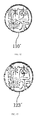
- the angles of the reference seal imprint 110 and the comparative seal imprint 121 may be matched with each other by deriving the centers of rotation of the reference seal imprint 110 and the comparative seal imprint 121 from the contours of the reference seal imprint 110 and the comparative seal imprint 121 and matching the centers of rotation centers of the reference seal imprint 110 and the comparative seal imprint 121 with each other.
- the step ST- 131 b is executed and then the step ST- 131 a is performed in the current embodiment of the present invention, the step ST- 131 a may be carried out before the step ST- 131 b . Otherwise, the steps ST- 131 a and ST- 131 b may be alternately repeated to find the vertical and horizontal points and angle at which the area of the overlap portion becomes maximum.
- the above operation of finding the angle and horizontal and vertical points at which the area of the overlap portion becomes maximum is performed on the other comparative seal imprints 123 , 125 and 127 .
- FIGS. 9 , 10 and 11 are views for explaining an alternative method of detecting the angle and horizontal and vertical positions at which the area of an overlap portion of the seal regions of the reference seal imprint and a comparative seal imprint according to an embodiment of the present invention.
- Points that can be reference points of the seal region of the reference seal imprint 110 are selected, as shown in FIG. 9 , and reference points of the comparative seal imprint 123 , which correspond to the reference points of the reference seal imprint 110 , are selected, as shown FIG. 10 , in a step ST- 131 - 1 .
- x 0 and y 0 represent horizontal and vertical position differences and ⁇ represents rotational displacement.
- the aforementioned equations may be applied to the coordinates of other reference points (for example, B 1 , C 1 , D 1 , B 2 , C 2 and D 2 ) to calculate x 0 , y 0 and ⁇ according to the least square method, rotate the comparative seal imprint 123 at the same angle as that of the reference seal imprint 110 and control horizontal and vertical shifts of the comparative seal imprint 123 .
- a compared seal imprint includes a letter “( )”, for example, and a comparative seal imprint also includes “( )”, in order to correspond to the compared seal imprint, the portion corresponding to “( )” is removed from the comparative seal imprint 123 ′, as shown in FIG. 13 . That is, the color of pixels corresponding to “( )” is changed to the color of a blank portion 1213 of the comparative seal imprint, shown in FIG. 5 . Furthermore, the color of pixels of a portion of the reference seal imprint, which corresponds to “( )” of the comparative seal imprint, is changed to the color of the blank portion, as shown in FIG. 12 .
- the portion “( )” may be deleted by extracting a seal region imprinted by stamping ink.
- stamping ink For example, when the seal imprint is formed using red stamping ink, a range capable of extracting only a red seal region is given to the seal imprint, and only pixels having R values of greater than 200, for example, are left and other pixels are changed to the color of the blank portion.
- the color of the pixels corresponding to the letter “( )” of the comparative seal imprint is changed to the color of the blank portion of the comparative seal imprint if the comparative seal imprint includes the letter “( )” and the color of the pixels of the portion of the reference seal imprint, which correspond to “( )” of the comparative seal imprint, is also changed to the color of the blank portion in ST- 133 , and characteristic values of the comparative seal imprint with respect to the reference seal imprint are calculated in step ST- 135 .
- FIG. 14 is a view for explaining characteristic values and illustrates an overlapping state of the reference seal imprint 110 shown in FIG. 4 and the comparative seal imprint 121 shown in FIG. 5 after the positions and angles of the reference seal imprint 110 and the comparative seal imprint 121 are matched with each other.
- reference numeral 111 represents the seal region of the reference seal imprint 110
- 1211 a represents a first portion of the seal region 1211 of the comparative seal imprint 121 , which belongs to the seal region 111 of the reference seal imprint 110
- 1211 b represents a second portion of the seal region 1211 of the comparative seal imprint 121 , which does not belong to the seal region of the reference seal imprint 110 .
- a packing rate ⁇ or an error rate ⁇ of the comparative seal imprint with respect to the reference seal region is used as a characteristic value of the forged seal imprint inspection method. Both the packing rate ⁇ and the error rate ⁇ may be used as characteristic values of the forged seal imprint inspection method.
- the packing rate ⁇ and the error rate ⁇ of the comparative seal imprint 121 are explained with reference to FIGS. 5 and 14 .
- the packing rate ⁇ of the comparative seal imprint 121 with respect to the reference seal imprint 110 is calculated according to Equation 1.
- n(A) represents the area of the seal region of the reference seal imprint 110
- n(B) represents the area of the seal region of the comparative seal imprint 121
- n(B out ) represents the area of the second portion of the comparative seal imprint 121 , which is not included in the seal region of the reference seal imprint.
- the packing rate ⁇ calculated by Equation 1 is greater than 0 and smaller than 1.
- the sameness of the reference seal imprint and the comparative seal imprint decreases as the packing rate ⁇ becomes close to 0 and the sameness of the reference seal imprint and the comparative seal imprint increases as the packing rate ⁇ becomes close to 1.
- the packing rate ⁇ of the comparative seal imprint with respect to the reference seal imprint is smaller than 1 due to the state of stamping ink used to stamp the genuine seal.
- the packing rate ⁇ of the comparative seal imprint 121 may be calculated according to Equation 1 using n(B in ) instead of n(B).
- the error rate ⁇ of the comparative seal imprint 121 is a value obtained by dividing the area of the second portion 1211 b of the comparative seal imprint 121 by the area of the seal region 1211 of the comparative seal imprint 121 and multiplying 100 by the division result to be expressed as a percent.
- the error rate ⁇ may be represented by Equation 2.
- n(B out ) represents the area of the second portion 1211 b of the comparative seal imprint 121 and n(B) represents the area of the seal region 1211 of the comparative seal imprint 121 .
- the error rate ⁇ of the comparative seal imprint 121 may be calculated using the area of the seal region 111 of the reference seal imprint 110 , n(A), instead of n(B) or n(B in ).
- the sameness of the reference seal imprint 110 and the comparative seal imprint 121 becomes high as the error rate ⁇ decreases and the sameness becomes low as the error rate ⁇ increases.
- the step ST- 140 of calculating the characteristic value of a compared seal imprint with respect to the reference seal imprint includes a step ST- 141 of matching the position and angle of the reference seal imprint with the position and angle of the compared seal imprint and a step ST- 145 of calculating the characteristic value of the compared seal imprint with respect to the reference seal imprint, as shown in FIGS. 1 and 15 .
- a method of matching the position and angle of the reference seal imprint with the position and angle of the compared seal imprint according to an embodiment of the present invention, shown in FIG. 16 includes a step ST- 141 a of rotating the reference seal imprint and the compared seal imprint with respect to each other, as shown in FIGS. 7 and 8 , and a step ST- 141 b of shifting the reference seal imprint and the compared seal imprint in the vertical and horizontal directions.
- a method of matching the position and angle of the reference seal imprint with the position and angle of the compared seal imprint according to another embodiment of the present invention, shown in FIG. 17 includes a step ST- 141 - 1 of setting reference points in the reference seal imprint and the compared seal imprint, as shown in FIGS.
- step ST- 141 - 2 of shifting the positions and angles of the reference seal imprint and the compared seal imprint using the reference points.
- the operation of matching the position and angle of the reference seal imprint with the position and angle of the compared seal imprint corresponds to the operation of matching the position and angle of the reference seal imprint with the position and angle of the comparative seal imprint so that detailed explanation thereof is omitted.
- the compared seal imprint includes a letter “( )”
- the reference seal imprint and the compared seal imprint are binarized
- the color of pixels corresponding to “( )” of the compared seal imprint is changed to the color of a blank region of the compared seal imprint
- the color of pixels of the reference seal imprint, which corresponds to “( )” of the compared seal imprint is also changed to the color of the blank region in step ST- 143 .
- the present invention is not limited to the binarization and the letter “( )” of the compared seal imprint may be removed without using binarization.
- the characteristic value of the compared seal imprint with respect to the reference seal imprint is calculated in a step ST- 145 .
- the packing rate ⁇ or the error rate ⁇ of the compared seal imprint with respect to the reference seal imprint is used as the characteristic value. Otherwise, both the packing rate ⁇ and the error rate ⁇ of the compared seal imprint may be used as characteristic values of the compared seal imprint.
- n(A) represents the area of the seal region of the reference seal imprint
- n(B) represents the area of the seal region of the compared seal imprint
- n(B out ) denotes the area of a second portion of the seal region of the compared seal imprint, which does not belong to the seal region of the reference seal imprint.
- the calculated packing rate ⁇ is greater than 0 and smaller than 1.
- the sameness of the reference seal imprint and the compared seal imprint is low when the calculated packing rate ⁇ is close to 0 and the sameness is high when the calculated packing rate ⁇ is close to 1.
- n(B in ) is the area of a first section of the seal region of the compared seal imprint, which belongs to the seal region of the reference seal imprint
- the packing rate ⁇ of the compared seal imprint is calculated using n(B in ) instead of n(B).
- the error rate ⁇ of the compared seal imprint is a value obtained by dividing the area of the second section of the compared seal imprint by the area of the seal region of the compared seal imprint and multiplying 100 by the division result to be expressed by a percent. That is, the error rate ⁇ is calculated by Equation 2. The sameness of the reference seal imprint and the compared seal imprint becomes high as the error rate ⁇ decreases and the sameness becomes low as the error rate ⁇ increases.
- the first portion n(B in ) of the compared seal imprint represents a portion of the seal region of the compared seal imprint, which belongs to the seal region of the reference seal imprint
- the second portion of the compared seal imprint represents a portion of the seal region of the compared seal imprint, which does not belong to the seal region of the reference seal imprint.
- the characteristic value of the comparative seal imprint with respect to the reference seal imprint is compared with the characteristic value of the compared seal region with respect to the reference seal imprint in a step ST- 150 to provide objective data used to determine whether the compared seal imprint is forged.
- FIG. 18 is a graph showing results of experiments of generating reference seal imprints and comparative seal imprints from a genuine seal and comparing the comparative seal imprints with compared seal imprints stamped by seals forged through zinc plate etching, resin plate etching and computer copy.
- first forged seal imprint group first forged seal imprint group
- second forged seal imprint group second compared seal imprint group
- third forged seal imprint group third forged seal imprint group
- the characteristic values of the comparative seal imprints with respect to the reference seal imprints were calculated according to the above method, the characteristic values of the compared seal imprints with respect to the reference seal imprints were calculated according to the above method, and the calculated characteristic values were shown on the graph having the vertical axis representing the error rate ⁇ and the horizontal axis representing the packing rate ⁇ .
- the packing rates ⁇ of the compared seal imprints with respect to the reference seal imprints were distributed in the range of 0.28 to 0.98 according to stamping conditions such as the state and quantity of stamping ink, the error rates ⁇ were smaller than 10% irrespective of the stamping conditions, and the error rate ⁇ decreased as the packing rate ⁇ decreased.
- stamping conditions such as the state and quantity of stamping ink
- the error rates ⁇ were smaller than 10% irrespective of the stamping conditions
- the error rate ⁇ decreased as the packing rate ⁇ decreased.
- the reference line 200 can be used as an objective basis for determining whether a compared seal imprint is forged by checking whether the packing rate ⁇ and the error rate ⁇ of the compared seal imprint are located above the reference line 200 or below the reference line 200 .
- the error rate ⁇ may be corrected using the packing rate ⁇ as represented by Equation 6. If the characteristic values are shown on the graph having the horizontal axis representing the error rate ⁇ 1 corrected by Equation 6, the reference line 200 may be parallel with the horizontal axis representing the corrected error rate ⁇ 1 .
- a compared seal imprint may be determined to be a genuine seal imprint when the characteristic value of the compared seal imprint is located on the left of the reference line 200 and determined to be a forged seal imprint when the characteristic value is located on the right of the reference line 200 .
- a forged seal imprint may be inspected only by comparing a compared seal imprint with the reference seal imprint without comparing a comparative seal imprint with the reference seal imprint.
- the genuine seal is stamped multiple times to generate the reference seal imprint in the step ST- 110 and the error rate ⁇ and the packing rate ⁇ of the compared seal imprint are calculated and shown on the graph as shown in FIG. 18 , it is possible to confirm whether the compared seal imprint is forged. Furthermore, even when the error rate ⁇ and the packing rate ⁇ of the compared seal imprint are shown on the graph having the vertical axis representing the packing rate ⁇ and the horizontal axis representing the error rate ⁇ , it is possible to confirm whether the compared seal imprint is forged.
- the step of matching the position and angle of the compared seal imprint with the position and angle of the reference seal imprint the step of changing the color of the portion “( )” of the compared seal imprint to the color of the the blank portion of the compared seal imprint when the compared seal imprint includes the portion “( )” and changing the color of a portion of the reference seal imprint, which corresponds to the portion “( )” of the compared seal imprint
- the step of calculating the error rate ⁇ and/or the packing rate ⁇ of the compared seal imprint with respect to the reference seal imprint correspond to the aforementioned steps of the operation of comparing the comparative seal imprint with the reference seal imprint so that explanations thereof are omitted.
- FIG. 20 is a flowchart showing the forged seal imprint inspection method according to another embodiment of the present invention.
- the forged seal imprint inspection method includes a step ST- 200 of generating at least one preparatory seal imprint, preferably, more than two preparatory seal imprints, from a genuine seal, a step ST- 210 of separating each preparatory seal imprint into regions, a step ST- 230 of performing registration on seal regions of the preparatory seal imprints to generate a reference seal imprint, a step ST- 240 of separating a seal imprint to be inspected into regions to generate a compared seal imprint, a step ST 290 of matching a seal region of the reference seal imprint with a seal region of the compared seal imprint, and a step ST- 300 of calculating characteristic values of the reference seal imprint and the compared seal imprint through the matching step.
- the forged seal imprint inspection method uses the error rate ⁇ that represents a degree of difference between the reference seal imprint and the compared seal imprint and the packing rate ⁇ that represents the intensity of stamped ink of the compared seal imprint or the intensity of seal and reflects the packing rate ⁇ in the error rate ⁇ to determine inspect whether the compared seal imprint is forged so as to improve the determination accuracy.
- At least one preparatory seal imprint preferably, a plurality of preparatory seal imprints 110 a , 110 b and 110 c shown in FIG. 3 , are generated from the genuine seal in the step ST- 200 . That is, the genuine seal may be stamped on blank paper multiple times and the seal imprints are scanned or photographed to generate the plural preparatory seal imprints.
- Each preparatory seal imprint is separated into regions in the step ST- 210 . Specifically, the preparatory seal imprint is separated into a seal region, a letter region and a background region.
- the preparatory seal imprint may be separated into the seal region and the background region because the preparatory seal imprint may be generated by stamping the genuine seal on blank paper and thus the preparatory seal imprint does not include a letter region.
- the compared seal imprint to be inspected may be formed on paper on which letters are written, and thus the compared seal imprint is separated into the seal region, the letter region and the background region. Of course, the compared seal imprint may not include the letter region when the compared seal imprint is formed on blank paper.
- FIG. 21 is a view for explaining the step of separating the compared seal imprint or the reference seal imprint.
- FIG. 21 shows the step of separating the compared seal imprint
- the preparatory seal imprint can be separated through the same operation.
- the seal region is separated as a red component and the letter region is separated as a green component based on the fact that stamping ink is red (blue in the case of stamping ink for stamps) for the purpose of separating the reference seal imprint and the compared seal imprint.
- a threshold value is determined through Otus algorithm (method using between-class covariance) using a statistical method of global histogram.
- Otus algorithm sets a middle value in two histograms when it is difficult to set a threshold value for some numerical values so as to determine the threshold value relatively accurately.
- the Otus algorithm is known so that detailed explanation thereof is omitted.
- the seal region of the input image (compared seal imprint) corresponding to the left image of FIG. 21 may have an intensity difference greater than that of the background region or the letter region because the seal region may be in red (or blue).
- a reference point point having a large distribution difference
- values greater than the reference point are set as the seal region. Since the seal region is in red (or blue), a red intensity value of pixels corresponding to the seal region is large and a green intensity value of the pixels is small. Pixels corresponding to the background region are generally in white, and thus the red and green intensity values of the pixels corresponding to the background region are close to 0.
- pixels having red and green intensity values higher than a predetermined value are processed as red (seal region) to separate only the seal region.
- the letter region is also separated.
- the seal region, the background region and the letter region are separated using an intensity difference between red and green components in the current embodiment of the present invention, it is possible to apply different color components to separate the respective regions of the compared seal imprint through the aforementioned operation in the case of stamping ink in colors other than red.
- only the seal region can be separated with stability for various paper sheets and stamping ink using a difference between the red and green components.
- step ST- 230 registration is performed on only the seal regions of the preparatory compared imprints, separated in the step ST- 210 , in step ST- 220 to generate a reference seal imprint in step ST- 230 .
- rotating angles and displacements of the preparatory seal imprints are adjusted to find a point at which the area of an overlap portion of the seal regions of the preparatory seal imprints becomes maximum and the average of pixels corresponding to the point is calculated so as to generate a reference seal imprint.
- two preparatory seal imprints from which seal regions have been separated are superimposed, one of the preparatory seal imprint is fixed, the other is shifted in horizontal and vertical directions to find a point at which the area of an overlap portion of the seal regions of the two preparatory seal imprints becomes maximum, and the other preparatory seal imprint is rotated while the one preparatory seal imprint is fixed to the point to find a point at which the area of an overlap portion of the seal regions of the two preparatory seal imprints becomes maximum.
- the average of pixels of the two preparatory seal imprints at the point is calculated and a reference seal imprint composed of pixels having the average is generated.
- FIG. 4 illustrates the reference seal imprint generated from the preparatory seal imprints shown in FIG. 3 .
- This reference seal imprint is compared with a compared seal imprint to inspect whether the compared seal imprint is forged through the above-described operation.
- step ST- 240 a seal imprint on a document, which will be inspected, is scanned or photographed to generate a compared seal imprint.
- the compared seal imprint is separated into regions, as described above. Since a seal imprint on a document is generally provided as a compared seal imprint, the compared seal imprint may include a seal region, a letter region and a background region.
- the step ST- 250 of separating the compared seal imprint has been explained above with reference to FIG. 21 so that detailed explanation thereof is omitted.
- a portion of the reference seal imprint which corresponds to the letter region of the compared seal imprint, is removed to cancel an error in a step ST- 260 .
- the portion of the reference seal imprint, which corresponds to the letter region of the compared seal imprint, is removed through the same operation as the aforementioned region separating operation.
- the present invention extracts a letter portion superimposed on a seal portion from the compared seal imprint and removes the letter portion to generate a reference seal imprint in the step of separating the compared seal region into regions to thereby eliminate the influence of the letter.
- FIG. 22 is a schematic diagram showing seal regions of the reference seal imprint and the compared seal imprint. Registration of the seal regions of the reference seal imprint and the compared seal imprint can be performed as described above. However, the registration may be executed by obtaining shift and rotation parameters as follows.
- Optimized registration between the reference seal imprint A and the compared seal imprint B can be achieved by obtaining shift and rotation parameters by which a matching pixel count (MPC) becomes a maximum value according to Equation 5.
- MPC matching pixel count
- the shift and rotation parameters are obtained while rotating the reference seal imprint and the compared seal imprint by 0.25° and shifting the reference seal imprint and the compared seal imprint by one pixel on X and Y axes.
- Characteristic values are calculated through the optimized registration between the reference seal imprint and the compared seal imprint according to Equation 5 so as to inspect whether the compared seal imprint is forged in a step ST- 300 .
- the characteristic values include the error rate ⁇ representing a difference between the reference seal imprint and the compared seal imprint and the packing rate ⁇ representing seal intensity.
- an operation of calculating the characteristic values may includes a step ST- 310 of calculating the error rate, a step ST- 320 of calculating the packing rate, and a step ST- 330 of reflecting the packing rate in the error rate and comparing the compared seal imprint with the reference seal imprint.
- the error rate is a ratio of the area B_out of a portion of the seal region of the compared seal imprint, which is not included in the seal region of the reference seal imprint, to the area n(B) of the seal region of the compared seal imprint and the area n(A) of the seal region of the reference seal imprint and may be represented by Equation 2.
- FIG. 23 shows a seal imprint “A”.
- A represents the area of a seal region of a reference seal imprint
- B represents the area of a seal region of a compared seal imprint
- B_out represents the area of a portion of the seal region of the compared seal imprint, which is out of the reference seal imprint.
- n(B out ) corresponds to the area of a second portion of the compared seal imprint.
- the error rate of the compared seal imprint may be calculated by substituting n(B) with n(A) or n(B in ) (here, n(A) is the area of the seal region of the reference seal imprint and n(B in ) is the area of a portion of the seal region of the compared seal imprint, which belongs to the seal region of the reference seal imprint).
- the packing rate is calculated and the error rate in which the packing rate is reflected is used to inspect the compared seal imprint is forged so as to correct the error rate varied with seals.
- the packing rate is a factor for determining whether the compared seal imprint is packed and is represented by Equation 3.
- Equation 3 n(A) is the area of the seal region of the reference seal imprint, n(B) is the area of the seal region of the compared seal imprint, and n(B out ) is the area of a portion of the seal region of the compared seal imprint, which does not belong to the seal region of the reference seal imprint.
- the packing rate of the compared seal imprint may be calculated by substituting n(B) with n(A) or n(B in ) (here, n(B in ) is the area of a portion of the seal region of the compared seal imprint, which belongs to the seal region of the reference seal imprint).
- the error rate may be corrected by reflecting the packing rate in the error rate, as represented by Equation 6.
- the sameness of the compared seal imprint and the reference seal imprint becomes high as the corrected error rate ⁇ 1 decreases and the sameness becomes low as the corrected error rate ⁇ 1 increases.
- the sameness of the compared seal imprint and the reference seal imprint is low when the packing rate is close to 0 and the sameness is high when the packing rate is close to 1.
- FIG. 24 illustrates examples of suitable seal imprints and an unsuitable seal imprint.
- a method of checking whether the compared seal imprint is unsuitable is explained.
- the packing rate of the compared seal imprint is low if insufficient stamping ink adheres to the compared seal imprint and the number of portions B_out increases if stamping ink excessively adheres to the compared seal imprint when the input seal imprint is generated using the genuine seal.
- the number of portions B_out may increase due to an error, and thus it is required to determine whether the portion B_out is caused by forgery or excessive stamping ink.
- the present invention determines whether B_out is caused by forgery or excessive stamping ink based on the fact that B_out of a forged seal imprint maintains the stroke of the forged seal imprint to some degree while B_out caused by excessive stamping ink has a certain shape. Since the registration step ST- 290 is globally performed, perspective distortion of a seal imprint according to photographing during an seal imprint acquisition operation may be generated or a seal imprint having a partially matched portion, such as a copied or CAM forged seal imprint, may be generated. In this case, when registration is locally performed on the largest portion B_out, the number of portions B_out is decreased.
- the compared seal imprint is determined to be unsuitable in the step ST- 280 , forgery inspection is impossible, and thus it can be determined whether excessive stamping ink adhesion is caused by forgery through local magnification and registration.
- FIG. 26 illustrates four genuine seals used for experiments and FIGS. 27 through 35 are graphs showing experimental results obtained by generating preparatory seal imprints and a reference seal imprint from the genuine seals and comparing seal imprints generated using seals forged through zinc plate etching, resin plate etching and computer copy with the reference seal imprint.
- FIGS. 27 through 35 are graphs showing experimental results obtained by generating preparatory seal imprints and a reference seal imprint from the genuine seals and comparing seal imprints generated using seals forged through zinc plate etching, resin plate etching and computer copy with the reference seal imprint.
- “ ⁇ ” represents a scatter plot of the packing rates and the error rates of the preparatory seal imprints, generated by stamping the genuine seal multiple times, with respect to the reference seal imprint generated from the preparatory seal imprints
- “ ⁇ ” represents a scatter plot of the packing rate and error rate of a compared seal imprint, generated by stamping a seal forged by zinc plate etching, with respect to the reference seal imprint
- “ ⁇ ” represents a scatter plot of the packing rate and error rate of a compared seal imprint, generated by stamping a seal forged by resin plate etching, with respect to the reference seal imprint
- “ ⁇ ” represents a scatter plot of the packing rate and error rate of a compared seal imprint, generated by stamping a seal forged by computer copy, with respect to the reference seal imprint.
- FIGS. 27 , 28 and 29 illustrate scatter plots of the packing rates and the error rates of the genuine seal imprints shown in FIG. 26 and forged seal imprints obtained by the seals forged by zinc plate etching, resin plate etching and computer copy.
- the vertical axis represents the error rate ( ⁇ ) and the horizontal axis represents the packing rate ( ⁇ ).
- the packing rates of the preparatory seal imprints are distributed in the range of 0.9 to 1.0, the error rates thereof are lower than 10%, and the error rates decrease as the packing rates decrease.
- a reference line on which it can be inspected whether a compared seal imprint is forged is generated. More specifically, when the straight line extended from the point corresponding to the error rate of 0% and the packing rate of 0 to the point corresponding to an error rate higher than 0% and the packing rate of 1 is set as the reference line, it is possible to determine that a compared seal imprint is forged when the compared seal imprint is located above the reference line and determine that the compared seal imprint is not forged when the compared seal imprint is located below the reference line.
- a reference line is set on a graph having the horizontal axis representing the error rate and the vertical axis representing the packing rate through the aforementioned method, it is possible to determine that a compared seal imprint is forged when the compared seal imprint is located on the right of the reference line and determine that the compared seal imprint is not forged when the compared seal imprint is located on the left of the reference line.
- FIGS. 30 and 31 are scatter plots of the packing rates and the error rates of the four genuine seal imprints (reference seal imprints) shown in FIG. 26 and forged seal imprints (compared seal imprints).
- the horizontal axis of each graph represents an error rate corrected with the packing rate.
- the error rate may be varied according to complexity of strokes of the seal imprint. That is, when a distance between stokes of a seal is narrow, the error rate may increase because stamping ink adhere to a recess of the seal. Furthermore, when stokes of a seal are not engraved with accuracy, the error rate may increase. Accordingly, the error rate may be normalized according to Equation 7 in consideration of the complexity of strokes of the reference seal imprint to generate a determination standard irrespective of seal type.
- l s , n(A)s, l, n(B) and c respectively represent the length of the contour of a seal region of the reference seal imprint, the area of the seal region of the reference seal imprint, the length of the contour of a seal region of a compared seal imprint, the area of the seal region of the compared seal imprint, and a complexity constant (for example, 1.4).
- FIGS. 32 , 33 , 34 and 35 show normal distribution curves obtained by performing Chi test on the packing rates and error rates of the preparatory seal imprints obtained by stamping the four genuine seals shown in FIG. 26 at a significance level of 5%.
- the preparatory seal imprints are generated from the genuine seals and the normal distribution curves are obtained from the averages and standard deviations of the packing rates and error rates, it is possible to confirm the position of a compared seal imprint on the normal distribution curves so as to determine whether the compared seal imprint is forged.
- the genuine seals are stamped multiple times to generate the preparatory seal imprints, the normal distribution curves are generated using the averages and standard deviations of the error rates ( ⁇ ) and the packing rates ( ⁇ ) of the preparatory seal imprints, and the position of the corrected error rate of the compared seal imprint is checked.
- the error rates of the preparatory seal imprints are calculated according to Equation 2 and the packing rates of the preparatory seal imprints are calculated according to Equation 1.
- n(A) represents the area of the seal region of the reference seal imprint
- n(B) represents the area of the seal region of each preparatory seal imprint
- FIG. 32 illustrates frequency distribution of the error rates/packing rates of compared seal imprints with respect to the reference seal imprint. Referring to FIG. 32 , only one of compared seal imprints obtained by a seal forged by zinc plate etching is included in 99% genuine seal imprint.
- FIGS. 33 , 34 and 35 illustrate frequency distributions of the error rates/packing rates of the second, third and fourth seal imprints shown in FIG. 26 . Referring to FIGS. 33 , 34 and 35 , almost all forged seal imprints are not included in 99%.
- the forged seal imprint inspection method according to the present invention may be embodied as a computer readable program and stored in recording media (such as CD-ROM, RAM, ROM, memory cards, hard discs, optical magnetic discs, etc.).
- recording media such as CD-ROM, RAM, ROM, memory cards, hard discs, optical magnetic discs, etc.
- the present invention can provide objective data for determining whether a compared seal imprint on a document is forged.
Landscapes
- Engineering & Computer Science (AREA)
- Theoretical Computer Science (AREA)
- Computer Vision & Pattern Recognition (AREA)
- General Physics & Mathematics (AREA)
- Physics & Mathematics (AREA)
- Computing Systems (AREA)
- Evolutionary Computation (AREA)
- General Health & Medical Sciences (AREA)
- Medical Informatics (AREA)
- Software Systems (AREA)
- Databases & Information Systems (AREA)
- Artificial Intelligence (AREA)
- Health & Medical Sciences (AREA)
- Multimedia (AREA)
- Computer Security & Cryptography (AREA)
- Collating Specific Patterns (AREA)
- Photosensitive Polymer And Photoresist Processing (AREA)
- Image Processing (AREA)
Abstract
Description
where n(A) represents the area of a seal region of the reference seal imprint, n(B) represents the area of a seal region of each comparative seal imprint, and n(Bout) represents the area of a portion of the seal region of each comparative seal imprint, which is not included in the seal region of the reference seal imprint, and the packing rate of the compared seal imprint is calculated according to
where n(A) represents the area of the seal region of the reference seal imprint, n(B) represents the area of a seal region of the compared seal imprint, and n(Bout) represents the area of a portion of the seal region of the compared seal imprint, which is not included in the seal region of the reference seal imprint.
where n(Bout) represents the area of a portion of the seal region of each comparative seal imprint, which is not included in the seal region of the reference seal imprint, and n(B) represents the area of the seal region of each comparative seal imprint, and the error rate of the compared seal imprint is calculated according to
where n(Bout) represents the area of a portion of the seal region of the compared seal imprint, which is not included in the seal region of the reference seal imprint, and n(B) represents the area of the seal region of the compared seal imprint.
where n(A) represents the area of a seal region of the reference seal imprint, n(B) represents the area of a seal region of each comparative seal imprint, and n(Bout) represents the area of a second portion of the seal region of each comparative seal imprint, the packing rate of the compared seal imprint is calculated according to
where n(A) represents the area of the seal region of the reference seal imprint, n(B) represents the area of a seal region of the compared seal imprint, and n(Bout) represents the area of a second portion of the seal region of the compared seal imprint, the error rates of the comparative seal imprints are calculated according to
where n(Bout) represents the area of a portion of the seal region of each comparative seal imprint, which is not included in the seal region of the reference seal imprint, and n(B) represents the area of the seal region of each comparative seal imprint, and the error rate of the compared seal imprint is calculated according to
where n(Bout) represents the area of a portion of the seal region of the compared seal imprint, which is not included in the seal region of the reference seal imprint, and n(B) represents the area of the seal region of the compared seal imprint.
where n(A) represents the area of the seal region of the reference seal imprint, n(B) represents the area of a seal region of the compared seal imprint, and n(Bout) represents the area of a portion of the seal region of the compared seal imprint, which is not included in the seal region of the reference seal imprint.
where n(Bout) represents the area of a portion of the seal region of the compared seal imprint, which is not included in the seal region of the reference seal imprint, and n(B) represents the area of the seal region of the compared seal imprint.
where n(A) represents the area of the seal region of the reference seal imprint, n(B) represents the area of a seal region of the compared seal imprint, and n(Bout) represents the area of a portion of the seal region of the compared seal imprint, which is not included in the seal region of the reference seal imprint, and the error rate of the compared seal imprint is calculated according to
where n(Bout) represents the area of a portion of the seal region of the compared seal imprint, which is not included in the seal region of the reference seal imprint, and n(B) represents the area of the seal region of the compared seal imprint.
the packing rate is calculated according to
where n(A) represents the area of the reference seal imprint and n(Bout) represents the area of a portion of the compared seal imprint, which is not included in the reference seal imprint, the packing rate is reflected in the error rate according to
when the compared seal imprint is compared with the reference seal imprint.


x′=x 0+cos(θ)x−sin(θ)y
y′=y 0+sin(θ)x−cos(θ)y


A=a (x,y) Ca (z,y)εReference seal imprint B,a (x,y)=1
B=b (x,y) Cb (x,y)εCompared seal imprint, b (x,y)=1
B -out =b -out(x,y) Cb -out(x,y) εB,a (x,y)≠1 [Equation 4]
Claims (9)
Applications Claiming Priority (4)
| Application Number | Priority Date | Filing Date | Title |
|---|---|---|---|
| KR1020100023786A KR101080069B1 (en) | 2010-03-17 | 2010-03-17 | Method Judging The Forged Sealing and Recording media |
| KR10-2010-0023786 | 2010-03-17 | ||
| KR10-2010-0037066 | 2010-04-21 | ||
| KR1020100037066A KR101140331B1 (en) | 2010-04-21 | 2010-04-21 | Method Testing The Forged Sealing and Recording media |
Publications (2)
| Publication Number | Publication Date |
|---|---|
| US20110231131A1 US20110231131A1 (en) | 2011-09-22 |
| US8577121B2 true US8577121B2 (en) | 2013-11-05 |
Family
ID=44602164
Family Applications (1)
| Application Number | Title | Priority Date | Filing Date |
|---|---|---|---|
| US12/957,358 Active 2032-02-15 US8577121B2 (en) | 2010-03-17 | 2010-11-30 | Forged seal imprint inspection method and recording medium |
Country Status (3)
| Country | Link |
|---|---|
| US (1) | US8577121B2 (en) |
| JP (1) | JP5435431B2 (en) |
| CN (1) | CN102194125B (en) |
Families Citing this family (6)
| Publication number | Priority date | Publication date | Assignee | Title |
|---|---|---|---|---|
| JP5435431B2 (en) * | 2010-03-17 | 2014-03-05 | リパブリック オブ コリア(ナショナル インスティチュート オブ サイエンティフィック インヴェスティゲーション ディレクター ミニストリ オブ パブリック アドミニストレーション アンド セキュリティ) | Forged imprint inspection method and recording medium |
| CN103105385B (en) * | 2013-01-29 | 2015-01-28 | 沈阳博兴亚达科技有限公司 | Method for spectral fluorescence detection and three-dimensional rotating microscope testing of sequence of crossed writings and seal stamps |
| JP6255233B2 (en) * | 2013-11-29 | 2017-12-27 | 株式会社日本総合研究所 | Imprint management system |
| JP6970835B2 (en) | 2018-09-28 | 2021-11-24 | 株式会社Pfu | Image processing device, control method and control program |
| CN110412034B (en) * | 2019-08-09 | 2021-12-21 | 上海佰恩智电子科技有限公司 | Device for identifying authenticity of seal |
| TWI739387B (en) * | 2020-04-10 | 2021-09-11 | 彰化商業銀行股份有限公司 | Seal identification system and method thereof |
Citations (7)
| Publication number | Priority date | Publication date | Assignee | Title |
|---|---|---|---|---|
| US5159646A (en) * | 1990-01-29 | 1992-10-27 | Ezel, Inc. | Method and system for verifying a seal against a stored image |
| US5164997A (en) * | 1990-01-30 | 1992-11-17 | Ezel, Inc. | Method and apparatus for aligning images using pixels of closed contours |
| KR19990041478A (en) | 1997-11-21 | 1999-06-15 | 전주범 | Forging tensile identification method |
| US6351550B1 (en) * | 1997-09-17 | 2002-02-26 | Fujitsu Limited | Seal imprint verifying apparatus |
| US6987868B1 (en) * | 1998-11-27 | 2006-01-17 | Nittetsu Mining Co., Ltd. | Genuine/counterfeit discriminating method, genuine/counterfeit discrimination object, and genuine/counterfeit discriminating device |
| US20100023758A1 (en) * | 2008-07-23 | 2010-01-28 | Shocky Han | Document authentication using electronic signature |
| US20110231131A1 (en) * | 2010-03-17 | 2011-09-22 | Lee Joong | Forged seal imprint inspection method and recording medium |
Family Cites Families (8)
| Publication number | Priority date | Publication date | Assignee | Title |
|---|---|---|---|---|
| CN1087461C (en) * | 1996-10-04 | 2002-07-10 | 星友科技股份有限公司 | Seal automatic contrast recognition system |
| JP2000030059A (en) * | 1998-07-08 | 2000-01-28 | Oki Electric Ind Co Ltd | Method and device for assisting collation of seal impression |
| JP2001076137A (en) * | 1999-09-02 | 2001-03-23 | Oki Electric Ind Co Ltd | Method for collating seal impression |
| CN1482560A (en) * | 2002-09-11 | 2004-03-17 | 辉 刘 | Network seal authentication system |
| JP2005011179A (en) * | 2003-06-20 | 2005-01-13 | Hitachi Ltd | Multiple seal registration method and device, seal verification method and device, cash handling system |
| JP4486351B2 (en) * | 2003-11-28 | 2010-06-23 | 富士通株式会社 | Seal verification device, seal verification method and seal verification program |
| KR20050104458A (en) * | 2004-04-28 | 2005-11-03 | 김진우 | Portable device to distinguish seals |
| JP4575060B2 (en) * | 2004-07-23 | 2010-11-04 | 株式会社山武 | Fingerprint registration method and fingerprint registration apparatus |
-
2010
- 2010-11-19 JP JP2010258940A patent/JP5435431B2/en active Active
- 2010-11-25 CN CN201010576485.0A patent/CN102194125B/en active Active
- 2010-11-30 US US12/957,358 patent/US8577121B2/en active Active
Patent Citations (8)
| Publication number | Priority date | Publication date | Assignee | Title |
|---|---|---|---|---|
| US5159646A (en) * | 1990-01-29 | 1992-10-27 | Ezel, Inc. | Method and system for verifying a seal against a stored image |
| US5490225A (en) * | 1990-01-29 | 1996-02-06 | Ezel Inc. | Method and system for comparing two images by making an initial rough judgement |
| US5164997A (en) * | 1990-01-30 | 1992-11-17 | Ezel, Inc. | Method and apparatus for aligning images using pixels of closed contours |
| US6351550B1 (en) * | 1997-09-17 | 2002-02-26 | Fujitsu Limited | Seal imprint verifying apparatus |
| KR19990041478A (en) | 1997-11-21 | 1999-06-15 | 전주범 | Forging tensile identification method |
| US6987868B1 (en) * | 1998-11-27 | 2006-01-17 | Nittetsu Mining Co., Ltd. | Genuine/counterfeit discriminating method, genuine/counterfeit discrimination object, and genuine/counterfeit discriminating device |
| US20100023758A1 (en) * | 2008-07-23 | 2010-01-28 | Shocky Han | Document authentication using electronic signature |
| US20110231131A1 (en) * | 2010-03-17 | 2011-09-22 | Lee Joong | Forged seal imprint inspection method and recording medium |
Non-Patent Citations (1)
| Title |
|---|
| English Language Abstract of KR 10-1999-0041478 A. |
Also Published As
| Publication number | Publication date |
|---|---|
| CN102194125B (en) | 2015-02-11 |
| CN102194125A (en) | 2011-09-21 |
| JP5435431B2 (en) | 2014-03-05 |
| US20110231131A1 (en) | 2011-09-22 |
| JP2011198347A (en) | 2011-10-06 |
Similar Documents
| Publication | Publication Date | Title |
|---|---|---|
| US8577121B2 (en) | Forged seal imprint inspection method and recording medium | |
| JP5616958B2 (en) | Method for banknote detector device and banknote detector device | |
| CN101529481B (en) | A Method of Controlling the Quality of Printed Documents Based on Pattern Matching | |
| CN109409158B (en) | Anti-counterfeiting method based on two-dimensional code edge roughness | |
| WO2019197628A1 (en) | Method and system for optical product authentication | |
| EP4171051B1 (en) | Collation device, program, and collation method | |
| KR101140331B1 (en) | Method Testing The Forged Sealing and Recording media | |
| CN1898555B (en) | Substrate inspection device | |
| KR101080065B1 (en) | Method Judging The Forged Sealing | |
| KR101080069B1 (en) | Method Judging The Forged Sealing and Recording media | |
| Lee et al. | Forged seal detection based on the seal overlay metric | |
| US20240281960A1 (en) | Debris determination method | |
| CN107481391A (en) | The detection method and device of bank note scribble | |
| US12220933B2 (en) | Method for printing and identifying authentication marks by means of an amplitude-modulated raster print | |
| JP7794093B2 (en) | Authenticity determination device and program | |
| CN115908319B (en) | A method and device for detecting micro-code reflection based on grayscale histogram discreteness | |
| KR20230139449A (en) | A recognizing method of assembled stamp using image feature analysis | |
| TWM622217U (en) | Stamp verification testing equipment | |
| JP2988401B2 (en) | Stamp recognition device | |
| US11941901B2 (en) | Smartphone or tablet comprising a device for generating a digital identifier of a copy, including at least one print image of a printed product produced in a production system, and method for using this device | |
| JP3766904B2 (en) | Line dimension measuring device | |
| AU2016100492A4 (en) | A method and system for identifying and measuring a defect that reduces transparency in a substrate for a security document | |
| JP7838433B2 (en) | Authenticity determination device and program | |
| JPH07329394A (en) | Printed matter and its printing deviation detection device | |
| CN121962159A (en) | Packaging box printing quality detection method and system based on image analysis |
Legal Events
| Date | Code | Title | Description |
|---|---|---|---|
| AS | Assignment |
Owner name: REPUBLIC OF KOREA (NATIONAL FORENSIC SERVICE DIREC Free format text: ASSIGNMENT OF ASSIGNORS INTEREST;ASSIGNORS:LEE, JOONG;LEE, YOUNG SU;KIM, JUN SUK;AND OTHERS;REEL/FRAME:025537/0882 Effective date: 20101220 |
|
| STCF | Information on status: patent grant |
Free format text: PATENTED CASE |
|
| FPAY | Fee payment |
Year of fee payment: 4 |
|
| MAFP | Maintenance fee payment |
Free format text: PAYMENT OF MAINTENANCE FEE, 8TH YEAR, LARGE ENTITY (ORIGINAL EVENT CODE: M1552); ENTITY STATUS OF PATENT OWNER: LARGE ENTITY Year of fee payment: 8 |
|
| MAFP | Maintenance fee payment |
Free format text: PAYMENT OF MAINTENANCE FEE, 12TH YEAR, LARGE ENTITY (ORIGINAL EVENT CODE: M1553); ENTITY STATUS OF PATENT OWNER: LARGE ENTITY Year of fee payment: 12 |