US8552396B2 - Distributive, non-destructive real-time system and method for snowpack monitoring - Google Patents

Distributive, non-destructive real-time system and method for snowpack monitoring Download PDF

Info

Publication number
US8552396B2
US8552396B2 US12/566,797 US56679709A US8552396B2 US 8552396 B2 US8552396 B2 US 8552396B2 US 56679709 A US56679709 A US 56679709A US 8552396 B2 US8552396 B2 US 8552396B2
Authority
US
United States
Prior art keywords
mote
snowpack
snow
connectable
detector
Prior art date
Legal status (The legal status is an assumption and is not a legal conclusion. Google has not performed a legal analysis and makes no representation as to the accuracy of the status listed.)
Expired - Fee Related, expires
Application number
US12/566,797
Other versions
US20110073771A1 (en
Inventor
Jeff Frolik
Christian Skalka
Current Assignee (The listed assignees may be inaccurate. Google has not performed a legal analysis and makes no representation or warranty as to the accuracy of the list.)
University of Vermont
Original Assignee
University of Vermont
Priority date (The priority date is an assumption and is not a legal conclusion. Google has not performed a legal analysis and makes no representation as to the accuracy of the date listed.)
Filing date
Publication date
Application filed by University of Vermont filed Critical University of Vermont
Priority to US12/566,797 priority Critical patent/US8552396B2/en
Publication of US20110073771A1 publication Critical patent/US20110073771A1/en
Assigned to THE UNIVERSITY OF VERMONT AND STATE AGRICULTURAL COLLEGE reassignment THE UNIVERSITY OF VERMONT AND STATE AGRICULTURAL COLLEGE ASSIGNMENT OF ASSIGNORS INTEREST (SEE DOCUMENT FOR DETAILS). Assignors: FROLIK, JEFF, SKALKA, CHRISTIAN
Application granted granted Critical
Publication of US8552396B2 publication Critical patent/US8552396B2/en
Expired - Fee Related legal-status Critical Current
Adjusted expiration legal-status Critical

Links

Images

Classifications

    • GPHYSICS
    • G01MEASURING; TESTING
    • G01VGEOPHYSICS; GRAVITATIONAL MEASUREMENTS; DETECTING MASSES OR OBJECTS; TAGS
    • G01V5/00Prospecting or detecting by the use of ionising radiation, e.g. of natural or induced radioactivity
    • G01V5/02Prospecting or detecting by the use of ionising radiation, e.g. of natural or induced radioactivity specially adapted for surface logging, e.g. from aircraft
    • GPHYSICS
    • G01MEASURING; TESTING
    • G01WMETEOROLOGY
    • G01W1/00Meteorology
    • G01W1/14Rainfall or precipitation gauges
    • YGENERAL TAGGING OF NEW TECHNOLOGICAL DEVELOPMENTS; GENERAL TAGGING OF CROSS-SECTIONAL TECHNOLOGIES SPANNING OVER SEVERAL SECTIONS OF THE IPC; TECHNICAL SUBJECTS COVERED BY FORMER USPC CROSS-REFERENCE ART COLLECTIONS [XRACs] AND DIGESTS
    • Y02TECHNOLOGIES OR APPLICATIONS FOR MITIGATION OR ADAPTATION AGAINST CLIMATE CHANGE
    • Y02ATECHNOLOGIES FOR ADAPTATION TO CLIMATE CHANGE
    • Y02A90/00Technologies having an indirect contribution to adaptation to climate change
    • Y02A90/10Information and communication technologies [ICT] supporting adaptation to climate change, e.g. for weather forecasting or climate simulation

Definitions

  • snow pillows are made large, approximately 50 to 100 square feet on average, and thus contain up to several hundred gallons of liquid, typically antifreeze. This means that snow pillows can only be installed in large, flat areas to accommodate their size, and near roads or well-established trails for transporting the apparatus.
  • Large plate-style snow load sensors with multiple load nodes and associated analytic techniques to correct for snow bridging have been proposed to supplant snow pillows, but this technology is not yet extensively used in practice. The upshot of this is that in addition to inaccuracies due to snow bridging, predominant ground-based SWE measurement technologies do not provide effective resolution at the basin scale, due to their expense and difficulty of deployment.
  • an apparatus for determining snow-water equivalence for snow pack monitoring includes a wireless mote having a processor; random access memory (RAM); flash memory; and a communicator for wirelessly communicating.
  • the apparatus also includes a gamma ray detector for measuring ambient gamma ray attenuation due to snowpack water content.
  • the invention is also directed towards a method for distributive snowpack monitoring.
  • the method includes determining a snow water equivalent data package, which includes: measuring in situ snowpack temperature data at a first location; determining if the measured in situ snowpack temperature data exceeds a predetermined temperature threshold; measuring in situ snowpack height data at the first location; and determining if the measured in situ snowpack height data exceeds a predetermined height threshold. If either threshold is exceeded the method measures snowpack in situ microwave attenuation at the first location and determines if the measured snowpack in situ microwave attenuation exceeds a predetermined microwave attenuation threshold. If the microwave attenuation threshold is exceeded the method measures the snowpack in situ gamma ray attenuation at the first location.
  • an apparatus for determining snow-water equivalence for snow pack monitoring includes a wireless mote having: a processor; random access memory (RAM); flash memory unit(s); and a communicator for wirelessly communicating.
  • the wireless mote also includes a program storage device readable by the mote, tangibly embodying a program of instructions executable by the mote to perform a method for collecting sensor data, managing power requirements, wireless transmitting sensor data, and receiving control data.
  • FIG. 1 is pictorial illustration of one embodiment of the present non-destructive real-time system SWE measurement apparatus in accordance with an embodiment of the present invention
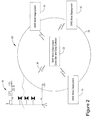
  • FIG. 2 pictorial illustration of a distributive wireless sensor network, non-destructive real-time system in accordance with the invention shown in FIG. 1 ;
  • FIG. 3 is a graph showing gamma absorption due to a snowpack as a function of SWE in accordance with the invention shown in FIG. 1 ;
  • FIG. 4 is a graph showing microwave attenuation due to a snowpack at different frequencies as a function of SWE in accordance with the invention shown in FIG. 1 ;
  • FIG. 5 is a flow chart illustrating one method for power conservation for the invention shown in FIG. 1 ;
  • FIG. 1 there is shown a SWE mote based computational and communications platform 10 that enables instrumentation of environments with greater temporal and spatial resolutions than are presently possible in a relatively non-intrusive manner. It will be appreciated that the SWE platform 10 shown in FIG. 1 may be more broadly deployed for a wide range of environmental monitoring applications.
  • the term “mote device” or “mote” typically indicates a autonomous or semi-autonomous computing, communication, actuating, and/or sensing device as described in the mote literature (e.g., Intel Corporation's, or Crossbow Inc.'s mote literature).
  • Certain embodiments of the mote device(s) 104 can be fabricated to be relatively small (typically less than several inches in dimension, often a fraction of an inch). Certain embodiments of mote systems(s) 10 can also be relatively inexpensive to produce, and can be designed to stand up to relatively harsh and/or external environments.
  • mote systems(s) 10 can provide a wide variety of parameter sensing and/or actuating functionalities.
  • Such parameter sensing may be controlled (and/or light or display devices actuated) using computer-based sensing, electro-mechanical sensing, magnetic sensing, and/or other sensing techniques.
  • Certain embodiments of mote device(s) and networks can be located at remote, hostile, external, or inaccessible location(s); and can be wirelessly networked.
  • Motes 104 can be programmed with control algorithms for auxiliary circuitry managing activation of sources and sensors, to ensure that energy is expended in an efficient manner, and to dynamically adapt deployments to environmental conditions.
  • FIG. 1 there is shown a pictorial illustration of one embodiment of the present non-destructive real-time system SWE measurement apparatus 10 in accordance with an embodiment of the present invention.
  • a programmable mote device 104 equipped with processor 104 A, RAM 104 B and Flash memory 104 C.
  • mote 104 can be augmented with external memory 104 D.
  • Motes also have a communication device 102 capable of approximately 100 meter communication range, and can support a variety of data retrieval techniques.
  • communication device 102 may be any suitable communication device which supports other data acquisition and/or system control.
  • the mote system ( FIG. 1 , item 10 ) establishes a standard protocol connection, for example, but not limited to, a TCP/IP connection with another mote system. (See FIG. 2 ).
  • This standard protocol allows an easy interface to data storage and visualization applications at the sink.
  • this TCP/IP connection serves as an actuation channel, for controlling the deployment remotely at the sink, for example to modify sampling rates for power management.
  • the mote network nodes (motes) 10 communicate with each other via their radio frequency (RF) antennas 102 (communicators), each with ⁇ 100 M range, forming an on-site network 20 .
  • RF radio frequency
  • All the mote nodes 10 communicate their data to a distinguished node or data collector designated as the “gateway” 22 that buffers data on external storage (not shown) and can communicate data long distance to a remote location (i.e. the lab, or ultimate data sink).
  • Communication options include radio modems and cell modems. Cell modem technology is particularly appealing since communication range is effectively unlimited for deployments in cell phone reception areas. Using any suitable modem or communication device at the deployment site and at the data sink communicating via GPRS.
  • the SWE measurement apparatus (SWEMA) 10 also includes a support structure 118 B, which may be any suitable support structure.
  • the support structure 118 B supports: mote device 104 ; microwave source 106 A; optionally, a solar cell 107 for recharging SWEMA 10 power source, typically, but not limited to, one or more batteries (not shown); ultrasonic transducer 108 for measuring snow height, ambient air temperature device 110 , and gamma ray detector 112 A.
  • SWEMA 10 includes a vertical support structure 118 A.
  • the vertical support structure 118 A supports microwave detectors 116 A, 116 B, and 1160 .
  • Vertical support structure 118 A also supports snowpack temperature devices 110 A, 110 B. It will be understood any suitable number of temperature devices may be used. It will be appreciated that the vertical support structure 118 A may be any suitable calibrated or un-calibrated support structure.
  • SWEMA 10 includes anchoring system 114 .
  • anchoring system 114 may be any suitable terrain adapted anchoring system.
  • base support 118 C included with SWEMA 10 is base support 118 C. It will be understood that any suitable base support may be used and that natural ground cover may be used as base support 118 C.
  • Base support 118 C supports a second microwave detector 106 B and a second gamma ray detector 112 B. It will be understood that the microwave sources 106 A, 106 B and microwave detectors 116 A, 1168 , and 116 C, may be any suitable microwave source and respective microwave detector.
  • the mote device 104 can be considered a small processor-driven device that can be configured to perform a variety of functions.
  • Many embodiments of mote device(s) 104 can include a power source, which can be configured to provide power or energy to the mote during its normal operations.
  • Certain embodiments of mote systems(s) 10 as described in this disclosure for example, can be configured to sense a variety of parameters, actuate a variety of other devices such as (but not limited to) turn on or off a power relay (See FIG. 7 ).
  • a gamma ray attenuation detector 112 A, 112 E apparatus connectable to the deployed mote station.
  • a gamma ray attenuation detector 112 A, 112 B such as, but not limited to, a Cadmium Zinc Telluride (CZT) gamma ray detector may be used to measure water attenuation of ambient or background radiation.
  • FIG. 4 shows measured water attenuation of gamma energy using all energies between 100 keV to 300 keV.
  • FIG. 1 and also FIG. 4 there is shown the susceptibility of microwave radiation to snowpack accumulation having significant water content.
  • the horizontal scale of FIG. 4 is in days and the vertical scale is in relative attenuation in dB.
  • any suitable microwave band or bands such as a dual-band system (2.4 GHz and 5.1 GHz) may used in which signal strength is monitored at various heights.
  • attenuation rates are expected to be 20-100 dB/m in these bands depending on snow properties, however measurements with large dynamic range, at various heights and at different frequencies, can be used to solve for SWE and as well as snow structure.
  • FIG. 1 and also FIG. 4 there is shown the susceptibility of microwave radiation to snowpack accumulation having significant water content.
  • the horizontal scale of FIG. 4 is in days and the vertical scale is in relative attenuation in dB.
  • any suitable microwave band or bands such as a dual-band system (2.4 GHz and 5.1 GHz) may be used in which signal strength is monitored at various heights.
  • FIG. 1 there is shown a microwave testing arrangement consisting of a microwave source 106 B placed on the ground support 112 B, a microwave source attached to support 118 B and at least three microwave detectors 116 A, 116 B, and 116 C attached to support 118 A.
  • the microwave sources are operating at 2.4 GHz and at 5.1 GHz).
  • FIG. 4 illustrates that attenuation in both the 2.4 GHz and 5.1 GHz bands are susceptible to winter precipitation high in water content (e.g., from ice storms).
  • data muling is defined as a site visitor carries a mule mote 22 with a program that automatically downloads data via a communications link 24 to the mule 22 when the mule mote 22 is in radio transceiver range of the deployed mote system 10 .
  • This data retrieval option exploits native features of WSNs that are designed to dynamically integrate new mote nodes into their network 26 . Since the weight of a mote is negligible, this approach allows more frequent site visits.
  • the mule mote 22 can be hand carried or affixed to a suitable remote controlled platform such as but not limited to unmanned aerial drones or remote terrain vehicles (not shown).
  • the data muling option described herein can be used in practice for SWE measurements without data loss. For example, measurement data from approximately 1-hour sampling intervals over a month is suitably sized for on-mote flash memory.
  • the mote 10 may be suitably augmented with flash memory ( FIG. 1 , 104 D). It will be further appreciated that the invention's low cost features of the individual stations 10 allow more stations 10 to be deployed to obtain better spatial resolution; and wireless networking 20 allow multiple sites in a given area to cooperate in routing data to a single gateway 22 for communication to the sink. Such an area can be any suitable number of acres, yielding an efficient technique for fine-grained monitoring at the basin scale.
  • the mule mote or gateway node 22 can be augmented with on-site massive flash memory storage (2 GB) for buffering an entire season's worth of data, as a backup in case remote reporting via cell or radio modem fails or is not possible.
  • data can also be mirrored within the WSN 20 , meaning that mode deployments 10 can cooperate to data synchronize and log data redundantly to mitigate volatility of individual mote deployments.
  • FIG. 5 shows a flow chart illustrating one method for power conservation for the invention shown in FIG. 1 .
  • gamma ray detection device(s) 112 A, 112 B such as the CZT device
  • the CZT device is the most accurate in terms of SWE measurements and least susceptible to inclusions in the snowpack (e.g., ice lenses, air/water pockets).
  • a feature of the invention employs a multi-parameter, multi-tiered, adaptive sampling method as shown in FIG. 5 to optimize a balance of measurement accuracy and energy usage.
  • the sampling of a particular sensor is conditional on previous and current values found on other sensors.
  • the sensors having the least energy draw i.e., ultrasound
  • the ultrasonic depth sensor 106 A would be capable of capturing a new snow event.
  • the ‘best’ SWE i.e., CZT
  • temperature sensors FIG. 1. 110A , 110 B
  • FIG. 5 , 64 within the snow pack may be utilized to detect melt conditions 66 . That is, these simple and low energy modalities can run at higher sampling intervals and be used to trigger subsequent sensors that would provide new information (See FIG. 5 ).
  • the invention will trigger a microwave measurement ( FIG. 5 , 202 ) (cost of ⁇ 50 mA).
  • a microwave measurement FIG. 5 , 202
  • cost of ⁇ 50 mA For example, should a snow fall be detected via depth change (cost of ⁇ 5 mA) the invention will trigger a microwave measurement ( FIG. 5 , 202 ) (cost of ⁇ 50 mA). Should the snow fall be very dry (i.e., little water content) there will be very little variation in signal strength ( FIG. 5 , 602 ) However, snow events high in water content will show significant changes in microwave signal strength. Such measurements will then be used to trigger a CZT or gamma ray measurement (cost of ⁇ 500 mA) ( FIG. 5 , 606 ). Sampling rates, change thresholds (e.g., temperature, height, attenuation) may be correlated with available power.
  • change thresholds e.g., temperature, height, attenuation
  • sampling rates may be higher and/or thresholds lower if more power is available, e.g., batteries are fully charged. It will be appreciated that this multi-tiered, event-driven approach can be readily implemented upon resource-constrained motes running TinyOS.
  • FIG. 1 and also to FIG. 6 there is shown a circuit schematic illustrating one circuit 700 for power conservation for the invention shown in FIG. 1 .
  • dual DC-DC buck converters 701 , 718 are used.
  • the buck converters 701 , 718 convert the 12 VDCsource down to 3.3 VDC, schematically represented as power source 710 , to power the mote 703 and the Ultrasonic depth sensor, and 5 VDC to power the load cell.
  • the converters may be any suitable converters and that the load cell may be any suitable load. If the SWEMA 10 is programmed to take readings from the sensors hourly then there is substantial time between readings when the sensors are not in use.
  • a digital trigger on a mote can be provide a signal to switch 707 a relay 708 A, 709 A.
  • Switching the relay 708 A, 709 A powers down the 12-to-5V buck converter 716 when the load cell 718 is not required to be in use.
  • Another relay 704 A, 705 A also allows the Ultrasonic Load 706 to be powered down by creating an open circuit. It will be appreciated that powering down the 12 to 5V buck converter 716 and turning off the Ultrasonic sensor load 706 , conserves otherwise wasted power which is important when dealing with a remote systems and limited battery life.
  • any suitable energy optional energy harvesting devices may be used (e.g., photovoltaic technology) (e.g., FIG. 1 , 107 ) to extend battery life.

Landscapes

  • Life Sciences & Earth Sciences (AREA)
  • Physics & Mathematics (AREA)
  • Engineering & Computer Science (AREA)
  • Environmental & Geological Engineering (AREA)
  • Aviation & Aerospace Engineering (AREA)
  • Biodiversity & Conservation Biology (AREA)
  • Ecology (AREA)
  • Environmental Sciences (AREA)
  • Atmospheric Sciences (AREA)
  • Hydrology & Water Resources (AREA)
  • High Energy & Nuclear Physics (AREA)
  • General Life Sciences & Earth Sciences (AREA)
  • General Physics & Mathematics (AREA)
  • Geophysics (AREA)
  • Arrangements For Transmission Of Measured Signals (AREA)

Abstract

A ground-based system that provides quasi real-time measurement and collection of snow-water equivalent (SWE) data in remote settings is provided. The disclosed invention is significantly less expensive and easier to deploy than current methods and less susceptible to terrain and snow bridging effects. Embodiments of the invention include remote data recovery solutions. Compared to current infrastructure using existing SWE technology, the disclosed invention allows more SWE sites to be installed for similar cost and effort, in a greater variety of terrain; thus, enabling data collection at improved spatial resolutions. The invention integrates a novel computational architecture with new sensor technologies. The invention's computational architecture is based on wireless sensor networks, comprised of programmable, low-cost, low-powered nodes capable of sophisticated sensor control and remote data communication. The invention also includes measuring attenuation of electromagnetic radiation, an approach that is immune to snow bridging and significantly reduces sensor footprints.

Description

CROSS-REFERENCE TO RELATED APPLICATIONS
The present application is related to, claims the earliest available effective filing date(s) from (e.g., claims earliest available priority dates for other than provisional patent applications; claims benefits under 35 USC §119(e) for provisional patent applications), and incorporates by reference in its entirety all subject matter of the following listed application(s) (the “Related Applications”) to the extent such subject matter is not inconsistent herewith; the present application also claims the earliest available effective filing date(s) from, and also incorporates by reference in its entirety all subject matter of any and all parent, grandparent, great-grandparent, etc. applications of the Related Application(s) to the extent such subject matter is not inconsistent herewith.
    • 1. U.S. provisional patent application 61/208,654, entitled “DISTRIBUTIVE, NON-DESTRUCTIVE REAL-TIME SYSTEM AND METHOD FOR SNOWPACK MONITORING”, naming Jeff L. Frolik and Christian E. Skalka as inventors, filed 26 Feb. 2009.
REFERENCE TO U.S. GOVERNMENT INTEREST
“The U.S. Government has a paid-up license in this invention and the right in limited circumstances to require the patent owner to license others on reasonable terms as provided for by the terms of Vermont Space Grant NNG05GH16H awarded by NASA.”
BACKGROUND
1. Field of Use
These teachings relate generally to a system and method for snow pack monitoring and more particularly to a ground based system that provides real time measurement and collection of snow-water equivalent (SWE) data in remote settings.
2. Description of Prior Art (Background)
The importance of snow water equivalence (SWE) estimation and snowpack studies to science and society is well known. For example, snowpack studies are critical to water planning for agriculture, recreation, cities, military, etc. The importance of snowpack data is emphasized by the fact that SWE data is so fundamental to so many interests that NOAA publishes daily global SWE composites online. As suggested in the literature most snow studies are motivated by the need to estimate basin-wide runoff to provide operational forecasting for snow-affected industries or rivers subject to flooding, or to improve climate forecasting. These applications require knowledge about the spatial distribution of SWE over large spatial scales, often in basins characterized by complex terrain and heterogeneous land cover. Prior research has demonstrated that SWE exhibits extreme variability in space. This variability is a result of influences of and interactions between meteorology (wind speed and direction, radiation), topography (elevation gradients, slope and aspect), and vegetation cover. In temperate landscapes, forest vegetation exerts important controls on snow distribution through its role in intercepting snow, attenuating wind, and altering radiation at the snow surface. Therefore, to obtain accurate SWE profiles of topographically complex areas, especially mountainous terrain, good temporal and spatial resolution is needed, with techniques that are robust to the effects of vegetation cover.
While several approaches exist for measuring and quantitatively characterizing the spatial distribution of SWE, including manual surveys and airborne sensors, continuous, automated ground-based techniques allow for better spatial resolution, more frequent measurement, and are not affected by tree canopies. Emerging approaches exploit various technologies, including gamma ray detection and acoustics, but these are largely still in the development phase and have not been deployed remotely as continuous, unmanned stations. The most prevalent ground-based, continuous method of SWE measurement makes use of snow pillows, which measures now mass by measuring loads on liquid-filled bags (the pillow). In particular, the SNOTEL network run by the NRCS (Natural Resources Conservation Service) relies heavily on snow pillow technology. However, this method is susceptible to the phenomena of snow bridging (a gap forming between the snowpack and the ground). To mitigate (i.e., average out) the snow bridging effect, snow pillows are made large, approximately 50 to 100 square feet on average, and thus contain up to several hundred gallons of liquid, typically antifreeze. This means that snow pillows can only be installed in large, flat areas to accommodate their size, and near roads or well-established trails for transporting the apparatus. Large plate-style snow load sensors with multiple load nodes and associated analytic techniques to correct for snow bridging have been proposed to supplant snow pillows, but this technology is not yet extensively used in practice. The upshot of this is that in addition to inaccuracies due to snow bridging, predominant ground-based SWE measurement technologies do not provide effective resolution at the basin scale, due to their expense and difficulty of deployment.
In the SNOTEL network this is exacerbated by the general reliance on traditional data logging platforms such as the Campbell Scientific CR1000, which are heavy, expensive, and power hungry. Indeed, most long-term continuously monitoring snow stations are located in clearings, representing a biased measurement of SWE. Thus, developing a system to cost effectively collect data to improve the spatial and temporal resolution of SWE monitoring would have important impacts on both the scientific study of snow and social infrastructures dependent on snow. Furthermore, a system that is compact and portable would have the advantage of being deployable in variety of settings including those presently not observable with remote sensing technologies (e.g., snow packs under forest canopies or on sloped terrain). A low cost SWE data collection system would allow more data points to be measured, further improving spatial resolution, and would bring this technology to a broader user base.
In light of the above, there exists a need for a relatively inexpensive and easily deployable sensor platform that can be wirelessly networked, remotely accessed, and is robust to harsh winter environments.
There is also a need for a novel SWE measurement instrument suite and control algorithms suitable for integration with a relatively inexpensive and easily deployable sensor platform that can be wirelessly networked, remotely accessed, and is robust to harsh winter environments.
BRIEF SUMMARY
The foregoing and other problems are overcome, and other advantages are realized, in accordance with the presently preferred embodiments of these teachings.
In accordance with one embodiment of the present invention an apparatus for determining snow-water equivalence for snow pack monitoring is provided. The apparatus includes a wireless mote having a processor; random access memory (RAM); flash memory; and a communicator for wirelessly communicating. The apparatus also includes a gamma ray detector for measuring ambient gamma ray attenuation due to snowpack water content.
The invention is also directed towards a method for distributive snowpack monitoring. The method includes determining a snow water equivalent data package, which includes: measuring in situ snowpack temperature data at a first location; determining if the measured in situ snowpack temperature data exceeds a predetermined temperature threshold; measuring in situ snowpack height data at the first location; and determining if the measured in situ snowpack height data exceeds a predetermined height threshold. If either threshold is exceeded the method measures snowpack in situ microwave attenuation at the first location and determines if the measured snowpack in situ microwave attenuation exceeds a predetermined microwave attenuation threshold. If the microwave attenuation threshold is exceeded the method measures the snowpack in situ gamma ray attenuation at the first location.
In accordance with another embodiment of the present invention an apparatus for determining snow-water equivalence for snow pack monitoring is provided. The apparatus includes a wireless mote having: a processor; random access memory (RAM); flash memory unit(s); and a communicator for wirelessly communicating. The wireless mote also includes a program storage device readable by the mote, tangibly embodying a program of instructions executable by the mote to perform a method for collecting sensor data, managing power requirements, wireless transmitting sensor data, and receiving control data. The apparatus sensors include: at least one gamma ray detector for measuring ambient gamma ray attenuation; a 2.4 GHz microwave source; a 2.4 GHz microwave detector paired with the 2.4 GHz microwave source; a 5.1 GHz microwave source; and a 5.1 GHz microwave detector paired with the 5.1 GHz microwave source.
BRIEF DESCRIPTION OF THE DRAWINGS
The subject matter which is regarded as the invention is particularly pointed out and distinctly claimed in the claims at the conclusion of the specification. The foregoing and other objects, features, and advantages of the invention are apparent from the following detailed description taken in conjunction with the accompanying drawings in which:
FIG. 1 is pictorial illustration of one embodiment of the present non-destructive real-time system SWE measurement apparatus in accordance with an embodiment of the present invention;
FIG. 2 pictorial illustration of a distributive wireless sensor network, non-destructive real-time system in accordance with the invention shown in FIG. 1;
FIG. 3 is a graph showing gamma absorption due to a snowpack as a function of SWE in accordance with the invention shown in FIG. 1;
FIG. 4 is a graph showing microwave attenuation due to a snowpack at different frequencies as a function of SWE in accordance with the invention shown in FIG. 1;
FIG. 5 is a flow chart illustrating one method for power conservation for the invention shown in FIG. 1; and
FIG. 6 is a circuit schematic illustrating one circuit for power conservation for the invention shown in FIG. 1.
DETAILED DESCRIPTION
Referring now to FIG. 1 there is shown a SWE mote based computational and communications platform 10 that enables instrumentation of environments with greater temporal and spatial resolutions than are presently possible in a relatively non-intrusive manner. It will be appreciated that the SWE platform 10 shown in FIG. 1 may be more broadly deployed for a wide range of environmental monitoring applications.
As used in this disclosure, the term “mote device” or “mote” (FIG. 1, item 104) typically indicates a autonomous or semi-autonomous computing, communication, actuating, and/or sensing device as described in the mote literature (e.g., Intel Corporation's, or Crossbow Inc.'s mote literature).
Certain embodiments of the mote device(s) 104 can be fabricated to be relatively small (typically less than several inches in dimension, often a fraction of an inch). Certain embodiments of mote systems(s) 10 can also be relatively inexpensive to produce, and can be designed to stand up to relatively harsh and/or external environments.
Many embodiments of mote systems(s) 10, or simply “motes”, as described in this disclosure can provide a wide variety of parameter sensing and/or actuating functionalities. Such parameter sensing may be controlled (and/or light or display devices actuated) using computer-based sensing, electro-mechanical sensing, magnetic sensing, and/or other sensing techniques. Certain embodiments of mote device(s) and networks can be located at remote, hostile, external, or inaccessible location(s); and can be wirelessly networked.
Motes 104 can be programmed with control algorithms for auxiliary circuitry managing activation of sources and sensors, to ensure that energy is expended in an efficient manner, and to dynamically adapt deployments to environmental conditions.
Still referring to FIG. 1 there is shown a pictorial illustration of one embodiment of the present non-destructive real-time system SWE measurement apparatus 10 in accordance with an embodiment of the present invention. In FIG. 1 there is shown a programmable mote device 104, equipped with processor 104A, RAM 104B and Flash memory 104C. Optionally, mote 104 can be augmented with external memory 104D. Motes also have a communication device 102 capable of approximately 100 meter communication range, and can support a variety of data retrieval techniques.
It will be appreciated that the invention advantageously incorporates motes 104 to eliminate the wiring burdens and heavy enclosures often required of traditional data logging mechanisms, and significantly reduces power requirements. As shown in FIG. 1, communication device 102 may be any suitable communication device which supports other data acquisition and/or system control. The mote system (FIG. 1, item 10) establishes a standard protocol connection, for example, but not limited to, a TCP/IP connection with another mote system. (See FIG. 2). This standard protocol allows an easy interface to data storage and visualization applications at the sink. Furthermore, this TCP/IP connection serves as an actuation channel, for controlling the deployment remotely at the sink, for example to modify sampling rates for power management.
Still referring to FIG. 1 and FIG. 2, the mote network nodes (motes) 10 communicate with each other via their radio frequency (RF) antennas 102 (communicators), each with ˜100 M range, forming an on-site network 20. It will be appreciated that any suitable mote communication protocol may be used. All the mote nodes 10 communicate their data to a distinguished node or data collector designated as the “gateway” 22 that buffers data on external storage (not shown) and can communicate data long distance to a remote location (i.e. the lab, or ultimate data sink). Communication options include radio modems and cell modems. Cell modem technology is particularly appealing since communication range is effectively unlimited for deployments in cell phone reception areas. Using any suitable modem or communication device at the deployment site and at the data sink communicating via GPRS.
Still referring to FIG. 1, the SWE measurement apparatus (SWEMA) 10 also includes a support structure 118B, which may be any suitable support structure. The support structure 118B supports: mote device 104; microwave source 106A; optionally, a solar cell 107 for recharging SWEMA 10 power source, typically, but not limited to, one or more batteries (not shown); ultrasonic transducer 108 for measuring snow height, ambient air temperature device 110, and gamma ray detector 112A.
Still referring to FIG. 1, SWEMA 10 includes a vertical support structure 118A. The vertical support structure 118A supports microwave detectors 116A, 116B, and 1160. Vertical support structure 118A also supports snowpack temperature devices 110A, 110B. It will be understood any suitable number of temperature devices may be used. It will be appreciated that the vertical support structure 118A may be any suitable calibrated or un-calibrated support structure.
SWEMA 10, as shown in FIG. 1, includes anchoring system 114. It will be understood that anchoring system 114 may be any suitable terrain adapted anchoring system.
Optionally, included with SWEMA 10 is base support 118C. It will be understood that any suitable base support may be used and that natural ground cover may be used as base support 118C. Base support 118C supports a second microwave detector 106B and a second gamma ray detector 112B. It will be understood that the microwave sources 106A, 106B and microwave detectors 116A, 1168, and 116C, may be any suitable microwave source and respective microwave detector.
It will be understood that all measurement devices, sensors, electronic devices, and power sources shown in FIG. 1 are connected, or connectable, to mote device 104.
In general, the mote device 104 can be considered a small processor-driven device that can be configured to perform a variety of functions. Many embodiments of mote device(s) 104 can include a power source, which can be configured to provide power or energy to the mote during its normal operations. Certain embodiments of mote systems(s) 10, as described in this disclosure for example, can be configured to sense a variety of parameters, actuate a variety of other devices such as (but not limited to) turn on or off a power relay (See FIG. 7).
Still referring to FIG. 1 and also FIG. 3, there is shown a gamma ray attenuation detector 112A, 112E apparatus connectable to the deployed mote station. It will be appreciated that a gamma ray attenuation detector 112A, 112B, such as, but not limited to, a Cadmium Zinc Telluride (CZT) gamma ray detector may be used to measure water attenuation of ambient or background radiation. FIG. 4 shows measured water attenuation of gamma energy using all energies between 100 keV to 300 keV.
Still referring to FIG. 1 and also FIG. 4, there is shown the susceptibility of microwave radiation to snowpack accumulation having significant water content. The horizontal scale of FIG. 4 is in days and the vertical scale is in relative attenuation in dB. It will be understood that any suitable microwave band or bands, such as a dual-band system (2.4 GHz and 5.1 GHz) may used in which signal strength is monitored at various heights. In general attenuation rates are expected to be 20-100 dB/m in these bands depending on snow properties, however measurements with large dynamic range, at various heights and at different frequencies, can be used to solve for SWE and as well as snow structure. Still referring to FIG. 1 there is shown a microwave testing arrangement consisting of a microwave source 106B placed on the ground support 112B, a microwave source attached to support 118B and at least three microwave detectors 116A, 116B, and 116C attached to support 118A. The microwave sources are operating at 2.4 GHz and at 5.1 GHz). FIG. 4 illustrates that attenuation in both the 2.4 GHz and 5.1 GHz bands are susceptible to winter precipitation high in water content (e.g., from ice storms).
Data retrieval. Referring to FIG. 2 there is shown a pictorial illustration of a distributive wireless sensor network (WSN) 20, non-destructive real-time system in accordance with the invention shown in FIG. 1. As noted earlier, a mote-based platform as described herein supports a variety of data acquisition and retrieval techniques. The simplest is data logging, and subsequent retrieval over Ethernet connection with a laptop carried to the deployment site. However, off-the-shelf motes typically have only 1 MB flash memory available for data logging, which is generally not sufficient for a full season of SWE operation. It will be appreciated therefore, that the current invention employs a lightweight data muting option 22.
Still referring to FIG. 2, for purposes of this disclosure data muling is defined as a site visitor carries a mule mote 22 with a program that automatically downloads data via a communications link 24 to the mule 22 when the mule mote 22 is in radio transceiver range of the deployed mote system 10. This data retrieval option exploits native features of WSNs that are designed to dynamically integrate new mote nodes into their network 26. Since the weight of a mote is negligible, this approach allows more frequent site visits. It will be understood that the mule mote 22 can be hand carried or affixed to a suitable remote controlled platform such as but not limited to unmanned aerial drones or remote terrain vehicles (not shown). It will be appreciated that the data muling option described herein can be used in practice for SWE measurements without data loss. For example, measurement data from approximately 1-hour sampling intervals over a month is suitably sized for on-mote flash memory.
Still referring to FIG. 1, it should be appreciated that the mote 10 may be suitably augmented with flash memory (FIG. 1, 104D). It will be further appreciated that the invention's low cost features of the individual stations 10 allow more stations 10 to be deployed to obtain better spatial resolution; and wireless networking 20 allow multiple sites in a given area to cooperate in routing data to a single gateway 22 for communication to the sink. Such an area can be any suitable number of acres, yielding an efficient technique for fine-grained monitoring at the basin scale.
Still referring to FIG. 2, it will also be appreciated that the mule mote or gateway node 22 can be augmented with on-site massive flash memory storage (2 GB) for buffering an entire season's worth of data, as a backup in case remote reporting via cell or radio modem fails or is not possible.
Still referring to FIG. 1 and FIG. 2, data can also be mirrored within the WSN 20, meaning that mode deployments 10 can cooperate to data synchronize and log data redundantly to mitigate volatility of individual mote deployments.
Still referring to FIG. 1 and FIG. 5, where FIG. 5 shows a flow chart illustrating one method for power conservation for the invention shown in FIG. 1. It will be appreciated that gamma ray detection device(s) 112A,112B, such as the CZT device, is the most accurate in terms of SWE measurements and least susceptible to inclusions in the snowpack (e.g., ice lenses, air/water pockets). However, as noted, due to the gamma ray detection device power requirements it is not, in terms of power consumption, feasible for this device to be utilized continually, therefore, a feature of the invention employs a multi-parameter, multi-tiered, adaptive sampling method as shown in FIG. 5 to optimize a balance of measurement accuracy and energy usage. The sampling of a particular sensor is conditional on previous and current values found on other sensors. In the present invention, the sensors having the least energy draw (i.e., ultrasound) are the least accurate in determining SWE (i.e., only snow pack depth is measured). However, the ultrasonic depth sensor 106A would be capable of capturing a new snow event. Conversely, the ‘best’ SWE (i.e., CZT) also requires a relatively large amount of energy. Also, temperature sensors (FIG. 1. 110A, 110B) (FIG. 5, 64) within the snow pack may be utilized to detect melt conditions 66. That is, these simple and low energy modalities can run at higher sampling intervals and be used to trigger subsequent sensors that would provide new information (See FIG. 5). For example, should a snow fall be detected via depth change (cost of ˜5 mA) the invention will trigger a microwave measurement (FIG. 5, 202) (cost of ˜50 mA). Should the snow fall be very dry (i.e., little water content) there will be very little variation in signal strength (FIG. 5, 602) However, snow events high in water content will show significant changes in microwave signal strength. Such measurements will then be used to trigger a CZT or gamma ray measurement (cost of ˜500 mA) (FIG. 5, 606). Sampling rates, change thresholds (e.g., temperature, height, attenuation) may be correlated with available power. In other words, sampling rates may be higher and/or thresholds lower if more power is available, e.g., batteries are fully charged. It will be appreciated that this multi-tiered, event-driven approach can be readily implemented upon resource-constrained motes running TinyOS.
Still referring to FIG. 1 and also to FIG. 6 there is shown a circuit schematic illustrating one circuit 700 for power conservation for the invention shown in FIG. 1. To efficiently regulate the power source to the required voltage levels for each component of the system, dual DC- DC buck converters 701, 718 are used. The buck converters 701, 718 convert the 12 VDCsource down to 3.3 VDC, schematically represented as power source 710, to power the mote 703 and the Ultrasonic depth sensor, and 5 VDC to power the load cell. It will be appreciated that the converters may be any suitable converters and that the load cell may be any suitable load. If the SWEMA 10 is programmed to take readings from the sensors hourly then there is substantial time between readings when the sensors are not in use. By utilizing the output pins on the mote 104 I/O, a digital trigger on a mote can be provide a signal to switch 707 a relay 708A,709A. Switching the relay 708A,709A powers down the 12-to-5V buck converter 716 when the load cell 718 is not required to be in use. Another relay 704A, 705A also allows the Ultrasonic Load 706 to be powered down by creating an open circuit. It will be appreciated that powering down the 12 to 5V buck converter 716 and turning off the Ultrasonic sensor load 706, conserves otherwise wasted power which is important when dealing with a remote systems and limited battery life. It will be appreciated that any suitable energy optional energy harvesting devices may be used (e.g., photovoltaic technology) (e.g., FIG. 1, 107) to extend battery life.
It should be understood that the foregoing description is only illustrative of the invention. Thus, various alternatives and modifications can be devised by those skilled in the art without departing from the invention. Accordingly, the present invention is intended to embrace all such alternatives, modifications and variances that fall within the scope of the appended claims.

Claims (11)

What is claimed is:
1. An apparatus for determining snow-water equivalence for snow pack monitoring, the apparatus comprising:
at least one wireless mote, wherein the wireless mote comprises:
at least one processor;
at least one random access memory (RAM);
at least one flash memory unit;
a communicator for wirelessly communicating;
at least one gamma ray detector for measuring ambient gamma ray attenuation due to snowpack water content, wherein the at least one gamma ray detector is connectable to the wireless mote.
2. The apparatus as in claim 1 further comprising:
at least one microwave source; and
at least one microwave detector paired with the at least one microwave source, wherein the at least one microwave source and the at least one microwave detector are connectable to the at least one wireless mote.
3. The apparatus as in claim 2 wherein the at least one microwave source comprises:
at least one 2.4 GHz microwave source;
at least one 2.4 GHz microwave detector;
at least one 5.1 GHz microwave source; and
at least one 5.1 GHz microwave detector.
4. The apparatus as in claim 1, further comprising at least one ultrasonic transducer for measuring snowpack height, wherein the at least one ultrasonic transducer is connectable to the at least one wireless mote.
5. The apparatus as in claim 1, further comprising at least one snowpack temperature device, wherein the at least one snowpack temperature device is connectable to the at least one wireless mote.
6. The apparatus as in claim 1, further comprising a photovoltaic energy converter, wherein the photovoltaic energy converter is connectable to the at least one wireless mote.
7. An apparatus for determining snow-water equivalence for snow pack monitoring, the apparatus comprising:
at least one wireless mote, wherein the wireless mote comprises:
at least one processor;
at least one random access memory (RAM);
at least one flash memory unit;
a communicator for wirelessly communicating;
a program storage device readable by the mote, tangibly embodying a
program of instructions executable by the mote to perform a method for collecting sensor data, managing power requirements, wireless transmitting sensor data, receiving control data;
at least one gamma ray detector for measuring ambient gamma ray attenuation due to snowpack water content, wherein the at least one gamma ray detector is connectable to the wireless mote,
a 2.4 GHz microwave source:
a 2.4 GHz microwave detector paired with the 2.4 GHz microwave source, wherein the a 2.4 GHz microwave source and the 2.4 GHz microwave detector are connectable to the at least one wireless mote:
a 5.1 GHz microwave source; and
a 5.1 GHz microwave detector paired with the 5.1 GHz microwave source, wherein the a 5.1 GHz microwave source and the 5.1 GHz microwave detector are connectable to the at least one wireless mote.
8. The apparatus as in claim 7 wherein the at least one gamma ray detector comprises a cadmium zinc telluride (CZT) gamma ray detector.
9. The apparatus as in claim 7, further comprising an ultrasonic transducer for measuring snowpack height, wherein the ultrasonic transducer is connectable to the at least one wireless mote.
10. The apparatus as in claim 7 further comprising at least one snowpack temperature gauge.
11. The apparatus as in claim 7 further comprising at least one solar cell connectable to the wireless mote.
US12/566,797 2009-02-26 2009-09-25 Distributive, non-destructive real-time system and method for snowpack monitoring Expired - Fee Related US8552396B2 (en)

Priority Applications (1)

Application Number Priority Date Filing Date Title
US12/566,797 US8552396B2 (en) 2009-02-26 2009-09-25 Distributive, non-destructive real-time system and method for snowpack monitoring

Applications Claiming Priority (2)

Application Number Priority Date Filing Date Title
US20865409P 2009-02-26 2009-02-26
US12/566,797 US8552396B2 (en) 2009-02-26 2009-09-25 Distributive, non-destructive real-time system and method for snowpack monitoring

Publications (2)

Publication Number Publication Date
US20110073771A1 US20110073771A1 (en) 2011-03-31
US8552396B2 true US8552396B2 (en) 2013-10-08

Family

ID=43779252

Family Applications (1)

Application Number Title Priority Date Filing Date
US12/566,797 Expired - Fee Related US8552396B2 (en) 2009-02-26 2009-09-25 Distributive, non-destructive real-time system and method for snowpack monitoring

Country Status (1)

Country Link
US (1) US8552396B2 (en)

Cited By (4)

* Cited by examiner, † Cited by third party
Publication number Priority date Publication date Assignee Title
US10969521B2 (en) 2017-10-26 2021-04-06 2KR Systems, LLC Flexible networked array for measuring snow water equivalent (SWE) and system network for providing environmental monitoring services using the same
US11022721B2 (en) * 2018-06-15 2021-06-01 Wisys Technology Foundation, Inc. Spatially diverse snowpack sensing system
US11086315B2 (en) 2017-10-26 2021-08-10 2KR Systems, LLC Building rooftop intelligence gathering, decision-support and snow load removal system for protecting buildings from excessive snow load conditions, and automated methods for carrying out the same
US11782167B2 (en) 2020-11-03 2023-10-10 2KR Systems, LLC Methods of and systems, networks and devices for remotely detecting and monitoring the displacement, deflection and/or distortion of stationary and mobile systems using GNSS-based technologies

Families Citing this family (5)

* Cited by examiner, † Cited by third party
Publication number Priority date Publication date Assignee Title
CZ306905B6 (en) * 2013-06-11 2017-09-06 Česká zemědělská univerzita v Praze A method of determining the snow water content in a snow layer and a device for implementing this method
CN111950156B (en) * 2020-08-17 2024-04-09 清华大学 Snow water equivalent determination method, device, computer equipment and storage medium
IT202100015287A1 (en) * 2021-06-11 2022-12-11 Finapp S R L SYSTEM AND PROCEDURE FOR DETERMINING THE EQUIVALENT WATER CONTENT OF THE SNOWPACK
NO347617B1 (en) * 2022-10-12 2024-01-29 Zygizo As System and method for monitoring a snowpack, and use of the system
WO2025170622A1 (en) * 2024-02-09 2025-08-14 Applied Research Team, Inc. Method and system for improved snow water equivalent estimates

Citations (7)

* Cited by examiner, † Cited by third party
Publication number Priority date Publication date Assignee Title
US5594250A (en) * 1995-04-03 1997-01-14 Condreva; Kenneth J. Method for detecting water equivalent of snow using secondary cosmic gamma radiation
US20050189494A1 (en) * 2004-02-25 2005-09-01 Conwell Richard L. Small field-of-view detector head ("SPECT") attenuation correction system
US6957593B1 (en) * 2001-12-31 2005-10-25 Burns Ian F Devices, systems, and methods for analyzing snow stability
US20080164407A1 (en) * 2007-01-10 2008-07-10 Yves Choquette Apparatus and method for monitoring snow water equivalent and soil moisture content using natural gamma radiation
US7408463B2 (en) * 2005-09-30 2008-08-05 Intel Corporation Radio frequency identification tag
US20080184827A1 (en) * 2007-02-02 2008-08-07 The Board Of Regents Of The Nevada System Of Higher Ed. On Behalf Of The Desert Research Inst. Monitoring probes and methods of use
US8057233B2 (en) * 2005-03-24 2011-11-15 Smalti Technology Limited Manipulable interactive devices

Patent Citations (7)

* Cited by examiner, † Cited by third party
Publication number Priority date Publication date Assignee Title
US5594250A (en) * 1995-04-03 1997-01-14 Condreva; Kenneth J. Method for detecting water equivalent of snow using secondary cosmic gamma radiation
US6957593B1 (en) * 2001-12-31 2005-10-25 Burns Ian F Devices, systems, and methods for analyzing snow stability
US20050189494A1 (en) * 2004-02-25 2005-09-01 Conwell Richard L. Small field-of-view detector head ("SPECT") attenuation correction system
US8057233B2 (en) * 2005-03-24 2011-11-15 Smalti Technology Limited Manipulable interactive devices
US7408463B2 (en) * 2005-09-30 2008-08-05 Intel Corporation Radio frequency identification tag
US20080164407A1 (en) * 2007-01-10 2008-07-10 Yves Choquette Apparatus and method for monitoring snow water equivalent and soil moisture content using natural gamma radiation
US20080184827A1 (en) * 2007-02-02 2008-08-07 The Board Of Regents Of The Nevada System Of Higher Ed. On Behalf Of The Desert Research Inst. Monitoring probes and methods of use

Non-Patent Citations (2)

* Cited by examiner, † Cited by third party
Title
Abe et al. "Experimental study of microwave transmission in snowpack," IEEE vol. 28 No. 5, Sep. 1990, pp. 915-921. *
Skalka et al. "A distributed in situ measurement system for snow water equivalence," Whistler 2008 International Snow Science Workshop, Sep. 21-27, 2008, pp. 821-828. *

Cited By (5)

* Cited by examiner, † Cited by third party
Publication number Priority date Publication date Assignee Title
US10969521B2 (en) 2017-10-26 2021-04-06 2KR Systems, LLC Flexible networked array for measuring snow water equivalent (SWE) and system network for providing environmental monitoring services using the same
US11086315B2 (en) 2017-10-26 2021-08-10 2KR Systems, LLC Building rooftop intelligence gathering, decision-support and snow load removal system for protecting buildings from excessive snow load conditions, and automated methods for carrying out the same
US12265387B2 (en) 2017-10-26 2025-04-01 2KR Systems, LLC Building rooftop intelligence gathering and decision-support system and methods of augmented-reality supported building inspection
US11022721B2 (en) * 2018-06-15 2021-06-01 Wisys Technology Foundation, Inc. Spatially diverse snowpack sensing system
US11782167B2 (en) 2020-11-03 2023-10-10 2KR Systems, LLC Methods of and systems, networks and devices for remotely detecting and monitoring the displacement, deflection and/or distortion of stationary and mobile systems using GNSS-based technologies

Also Published As

Publication number Publication date
US20110073771A1 (en) 2011-03-31

Similar Documents

Publication Publication Date Title
US8552396B2 (en) Distributive, non-destructive real-time system and method for snowpack monitoring
Kurata et al. Internet-enabled wireless structural monitoring systems: development and permanent deployment at the New Carquinez Suspension Bridge
Demetillo et al. A system for monitoring water quality in a large aquatic area using wireless sensor network technology
JP4262129B2 (en) Weather forecasting system
Larson et al. Can we measure snow depth with GPS receivers?
Bernardes et al. Prototyping low-cost automatic weather stations for natural disaster monitoring
Messer et al. Environmental sensor networks using existing wireless communication systems for rainfall and wind velocity measurements
Chritin et al. FlowCapt: a new acoustic sensor to measure snowdrift and wind velocity for avalanche forecasting
US20170140645A1 (en) Traffic monitoring system
US20150177415A1 (en) Method and Apparatus For Forecasting Solar Radiation And Solar Power Production Using Synthetic Irradiance Imaging
US10499573B1 (en) Wireless soil profile monitoring apparatus and methods
Green et al. Path-averaged surface fluxes determined from infrared and microwave scintillometers
Chen et al. Next-generation soil moisture sensor web: High-density in situ observation over NB-IoT
US10228340B2 (en) Wireless soil profile monitoring apparatus and methods
Warnakulasooriya et al. Generic IoT framework for environmental sensing researches: Portable IoT enabled weather station
CN107135465A (en) Measure the network system of Fuel loads
KR20200077325A (en) The Easy Installation Type Inundation Monitoring System
KR20200077326A (en) The Bollard Type Inundation Monitoring System
Parvez et al. A novel design and implementation of electronic weather station and weather data transmission system using GSM network
CN203337181U (en) Road quality inspection system employing Internet of Things
Ahire et al. IoT based real-time monitoring of meteorological data: A review
Heunecke et al. Landslide monitoring using low cost GNSS equipment n experiences from two alpine testing sites
US10969521B2 (en) Flexible networked array for measuring snow water equivalent (SWE) and system network for providing environmental monitoring services using the same
Doesken et al. The challenge of snow measurements
Zarkadas et al. Rain attenuation in 5G wireless broadband backhaul link and develop (IoT) rainfall monitoring system

Legal Events

Date Code Title Description
AS Assignment

Owner name: THE UNIVERSITY OF VERMONT AND STATE AGRICULTURAL C

Free format text: ASSIGNMENT OF ASSIGNORS INTEREST;ASSIGNORS:FROLIK, JEFF;SKALKA, CHRISTIAN;REEL/FRAME:030986/0711

Effective date: 20130729

STCF Information on status: patent grant

Free format text: PATENTED CASE

FPAY Fee payment

Year of fee payment: 4

FEPP Fee payment procedure

Free format text: MAINTENANCE FEE REMINDER MAILED (ORIGINAL EVENT CODE: REM.); ENTITY STATUS OF PATENT OWNER: SMALL ENTITY

LAPS Lapse for failure to pay maintenance fees

Free format text: PATENT EXPIRED FOR FAILURE TO PAY MAINTENANCE FEES (ORIGINAL EVENT CODE: EXP.); ENTITY STATUS OF PATENT OWNER: SMALL ENTITY

STCH Information on status: patent discontinuation

Free format text: PATENT EXPIRED DUE TO NONPAYMENT OF MAINTENANCE FEES UNDER 37 CFR 1.362

FP Lapsed due to failure to pay maintenance fee

Effective date: 20211008