US8530550B2 - Crosslinkable rubber composition - Google Patents
Crosslinkable rubber composition Download PDFInfo
- Publication number
- US8530550B2 US8530550B2 US13/151,023 US201113151023A US8530550B2 US 8530550 B2 US8530550 B2 US 8530550B2 US 201113151023 A US201113151023 A US 201113151023A US 8530550 B2 US8530550 B2 US 8530550B2
- Authority
- US
- United States
- Prior art keywords
- norbornene
- weight
- rubber composition
- parts
- component
- Prior art date
- Legal status (The legal status is an assumption and is not a legal conclusion. Google has not performed a legal analysis and makes no representation as to the accuracy of the status listed.)
- Active, expires
Links
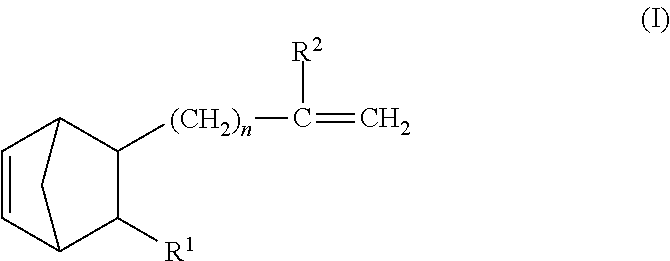
- 0 [1*]C1C2C=CC(C2)C1CC([2*])=C Chemical compound [1*]C1C2C=CC(C2)C1CC([2*])=C 0.000 description 20
- JJSXMKLTFRNFRV-UHFFFAOYSA-N [H][Si](C)(C)O[Si]([H])(C)O[Si]([H])(C)O[Si](OC)(C1=CC=CC=C1)C1=CC=CC=C1 Chemical compound [H][Si](C)(C)O[Si]([H])(C)O[Si]([H])(C)O[Si](OC)(C1=CC=CC=C1)C1=CC=CC=C1 JJSXMKLTFRNFRV-UHFFFAOYSA-N 0.000 description 1
- TUYPDBPBRLAGNC-UHFFFAOYSA-N [H][Si](C)(O[Si](C)(C)C)O[Si]([H])(C)O[Si]([H])(C)O[Si]([H])(C)O[Si]([H])(C)O[Si]([H])(C)O[Si](O[Si](O[Si](C)(C)C)(C1=CC=CC=C1)C1=CC=CC=C1)(C1=CC=CC=C1)C1=CC=CC=C1 Chemical compound [H][Si](C)(O[Si](C)(C)C)O[Si]([H])(C)O[Si]([H])(C)O[Si]([H])(C)O[Si]([H])(C)O[Si]([H])(C)O[Si](O[Si](O[Si](C)(C)C)(C1=CC=CC=C1)C1=CC=CC=C1)(C1=CC=CC=C1)C1=CC=CC=C1 TUYPDBPBRLAGNC-UHFFFAOYSA-N 0.000 description 1
- PIVIUOXTZCQVDZ-UHFFFAOYSA-N [H][Si]1(C)CCCCO[Si](C)(C)O[Si]([H])(C)O[Si]([H])(C)O1 Chemical compound [H][Si]1(C)CCCCO[Si](C)(C)O[Si]([H])(C)O[Si]([H])(C)O1 PIVIUOXTZCQVDZ-UHFFFAOYSA-N 0.000 description 1
- BZFNLAFEDQCILV-UHFFFAOYSA-N [H][Si]1(C)CCCCO[Si](C)(CC(C)C2=CC=CC=C2)O[Si]([H])(C)O[Si]([H])(C)O1 Chemical compound [H][Si]1(C)CCCCO[Si](C)(CC(C)C2=CC=CC=C2)O[Si]([H])(C)O[Si]([H])(C)O1 BZFNLAFEDQCILV-UHFFFAOYSA-N 0.000 description 1
- CWWVQZYSXUXWES-UHFFFAOYSA-N [H][Si]1(C)CCCCO[Si](C)(CC[Si](OC)(OC)OC)O[Si]([H])(C)O[Si]([H])(C)O1 Chemical compound [H][Si]1(C)CCCCO[Si](C)(CC[Si](OC)(OC)OC)O[Si]([H])(C)O[Si]([H])(C)O1 CWWVQZYSXUXWES-UHFFFAOYSA-N 0.000 description 1
- TXFYNHDAJFRXRT-UHFFFAOYSA-N [H][Si]1(C)CCCCO[Si]([H])(C)O[Si]([H])(C)O[Si]([H])(C)O1 Chemical compound [H][Si]1(C)CCCCO[Si]([H])(C)O[Si]([H])(C)O[Si]([H])(C)O1 TXFYNHDAJFRXRT-UHFFFAOYSA-N 0.000 description 1
- WAKINBKINYAVDV-UHFFFAOYSA-N [H][Si]1(C)CCCCO[Si]([H])(C)O[Si]([H])(C)O[Si]([H])(C)O[Si]([H])(C)O1 Chemical compound [H][Si]1(C)CCCCO[Si]([H])(C)O[Si]([H])(C)O[Si]([H])(C)O[Si]([H])(C)O1 WAKINBKINYAVDV-UHFFFAOYSA-N 0.000 description 1
Classifications
-
- C—CHEMISTRY; METALLURGY
- C08—ORGANIC MACROMOLECULAR COMPOUNDS; THEIR PREPARATION OR CHEMICAL WORKING-UP; COMPOSITIONS BASED THEREON
- C08L—COMPOSITIONS OF MACROMOLECULAR COMPOUNDS
- C08L23/00—Compositions of homopolymers or copolymers of unsaturated aliphatic hydrocarbons having only one carbon-to-carbon double bond; Compositions of derivatives of such polymers
- C08L23/02—Compositions of homopolymers or copolymers of unsaturated aliphatic hydrocarbons having only one carbon-to-carbon double bond; Compositions of derivatives of such polymers not modified by chemical after-treatment
- C08L23/16—Ethylene-propylene or ethylene-propylene-diene copolymers
-
- C—CHEMISTRY; METALLURGY
- C08—ORGANIC MACROMOLECULAR COMPOUNDS; THEIR PREPARATION OR CHEMICAL WORKING-UP; COMPOSITIONS BASED THEREON
- C08K—Use of inorganic or non-macromolecular organic substances as compounding ingredients
- C08K3/00—Use of inorganic substances as compounding ingredients
- C08K3/02—Elements
- C08K3/08—Metals
-
- C—CHEMISTRY; METALLURGY
- C08—ORGANIC MACROMOLECULAR COMPOUNDS; THEIR PREPARATION OR CHEMICAL WORKING-UP; COMPOSITIONS BASED THEREON
- C08K—Use of inorganic or non-macromolecular organic substances as compounding ingredients
- C08K3/00—Use of inorganic substances as compounding ingredients
- C08K3/34—Silicon-containing compounds
- C08K3/36—Silica
-
- C—CHEMISTRY; METALLURGY
- C08—ORGANIC MACROMOLECULAR COMPOUNDS; THEIR PREPARATION OR CHEMICAL WORKING-UP; COMPOSITIONS BASED THEREON
- C08L—COMPOSITIONS OF MACROMOLECULAR COMPOUNDS
- C08L83/00—Compositions of macromolecular compounds obtained by reactions forming in the main chain of the macromolecule a linkage containing silicon with or without sulfur, nitrogen, oxygen or carbon only; Compositions of derivatives of such polymers
- C08L83/04—Polysiloxanes
-
- C—CHEMISTRY; METALLURGY
- C08—ORGANIC MACROMOLECULAR COMPOUNDS; THEIR PREPARATION OR CHEMICAL WORKING-UP; COMPOSITIONS BASED THEREON
- C08G—MACROMOLECULAR COMPOUNDS OBTAINED OTHERWISE THAN BY REACTIONS ONLY INVOLVING UNSATURATED CARBON-TO-CARBON BONDS
- C08G77/00—Macromolecular compounds obtained by reactions forming a linkage containing silicon with or without sulfur, nitrogen, oxygen or carbon in the main chain of the macromolecule
- C08G77/04—Polysiloxanes
- C08G77/12—Polysiloxanes containing silicon bound to hydrogen
-
- C—CHEMISTRY; METALLURGY
- C08—ORGANIC MACROMOLECULAR COMPOUNDS; THEIR PREPARATION OR CHEMICAL WORKING-UP; COMPOSITIONS BASED THEREON
- C08L—COMPOSITIONS OF MACROMOLECULAR COMPOUNDS
- C08L2312/00—Crosslinking
Definitions
- the present invention relates to a crosslinkable rubber composition, more particularly to a material which is suitable for molding such as liquid injection molding, transfer molding and compression molding, due to its high crosslinking rate, excellent mold release properties, and long pot life after mixing, and which is suitable for thin film formation such as extrusion and calendaring, due to its being insusceptible to hindrance of cure in the air.
- the crosslinkable rubber composition is suitable for automotive use, for example, weather strip, various hoses such as radiator hose and brake hose, rubber vibration insulator such as engine mount, seals such as radiator seal and piston seal, cups such as cylinder cup, and various diaphragms, O-rings, etc.
- the crosslinkable rubber composition is suited to electrical insulation use such as wire joint, terminating parts, etc.
- the crosslinkable rubber composition is also suitable for OA equipment roller use such as electrically chargeable roller, transfer roller, developing roller and paper feeding roller, and for industrial roll use such as ironmaking roll, paper-making roll and printing wire roll.
- the crosslinkable rubber composition is suited to use as domestic rubber products such as rain apparel, rubber band, shoes and boots, rubber gloves, golf ball and diving gears.
- the crosslinkable rubber composition is suitable for application to water barrier sheets in civil engineering, seals in fuel cells, etc.
- Ethylene- ⁇ -olefin-nonconjugated polyene random copolymers such as EPDM, in general, are excellent in weatherability, heat resistance, and ozone resistance, and are widely used to make automotive industrial parts, industrial rubber products, electrical insulating material, civil engineering and construction material, rubberized fabric, etc.
- Patent Document 1 JP-A 4-185687 discloses a composition which contains a compound having at least one alkenyl group in the molecule thereof, a compound having at least two hydrosilyl groups in the molecule thereof, and a hydrosilylating catalyst. This composition, however, is insufficient in curability, and its compression set property is also unsatisfactory.
- Patent Document 2 JP-A 2001-31802 discloses a composition which contains an alkenyl group-containing compound having a specific structure, a compound having at least two hydrosilyl groups in the molecule thereof, and a hydrosilylating catalyst.
- the SiH compound used in Examples has a demerit in that the rubber compound after mixing has a very short pot life at room temperature, so that the workability (handleability) and shelf stability are poor. Therefore, the composition is unsuitable for ordinary rubber forming processes.
- Patent Document 3 JP-A 2001-279027 discloses an alkenyl group-containing compound having a specific structure and a cyclic polysiloxane having at least two SiH groups in one molecule thereof.
- the SiH compound used in Examples is only a polysiloxane having four SiH groups in one molecule thereof, and the composition is unsatisfactory in rubber properties.
- Patent Document 4 JP-A 2008-156574 discloses a method in which an alkenyl group-containing compound having a specific structure and a compound having two SiH groups and three SiH groups at terminal ends of the molecule thereof are used in combination.
- This material is disadvantageous in that it is difficult to regulate the pot life at room temperature, the workability (handleability) and shelf stability are poor, and the material is unsuited to various forming or molding processes.
- the present invention has been made in consideration of the above-mentioned circumstances. Accordingly, it is an object of the present invention to provide a crosslinkable rubber composition which has a long pot life, is excellent in workability (handleability) and shelf stability, has a good formability, and gives cured rubber products with excellent physical properties.
- the present inventors made intensive and extensive investigations. As a result of their investigations, they have found out that when an ethylene- ⁇ -olefin-nonconjugated polyene random copolymer rubber in which the nonconjugated polyene has at least one terminal vinyl group-containing norbornene compound represented by the general formula (I) or (II) is mixed with an organopolysiloxane having an SiH group in a side chain of the molecule thereof, there is obtained a rubber composition which is good in formability, has a long pot life, is excellent in workability (handleability) and shelf stability, and shows excellent rubber properties when cured. Based on the finding, they have completed the present invention.
- crosslinkable rubber composition including, as essential components:
- a crosslinkable rubber composition comprising as essential components:
- n is an integer of 0 to 10
- R 1 is hydrogen atom or an alkyl group of 1 to 10 carbon atoms
- R 2 is hydrogen atom or an alkyl group of 1 to 5 carbon atoms
- R 3 is hydrogen atom or an alkyl group of 1 to 10 carbon atoms, and which has a viscosity of not less than 10 Pa ⁇ s and less than 1,000 Pa ⁇ s at 25° C. under a shear rate of 10 s ⁇ 1 :
- R 4 is an unsubstituted or substituted monovalent hydrocarbon group of 1 to 20 carbon atoms
- component (B) is an organopolysiloxane which has three Si-bonded hydrogen atoms per molecule in side chains of siloxane represented by the following formula:
- the curing reaction retarder of component (E) is a compound having a OH group and an alkynyl group in one molecule thereof, which promises a longer pot life.
- the rubber composition according to the present invention has a long pot life and a good formability, and gives cured rubber products with excellent rubber properties.
- Component (A) contains a structural unit derived from ethylene, a structural unit derived from an ⁇ -olefin having 3 to 20 carbon atoms, and a structural unit derived from at least one nonconjugated polyene.
- the first essential component [component (A)] of the rubber composition according to the present invention is an ethylene- ⁇ -olefin-nonconjugated polyene random copolymer rubber in which at least one norbornene compound represented by the following general formula (I) or (II) is contained as a building block:
- n is an integer of 0 to 10
- R 1 is a hydrogen atom or an alkyl group having 1 to 10 carbon atoms
- R 2 is a hydrogen atom or an alkyl group having 1 to 5 carbon atoms
- R 3 is a hydrogen atom or an alkyl group having 1 to 10 carbon atoms.
- ⁇ -olefin the structural unit derived from the ⁇ -olefin having 3 to 20 carbon atoms (hereafter referred also to simply as “ ⁇ -olefin”) imparts pliability (low crystallinity) to component (A).
- the number of carbon atoms in the ⁇ -olefin is preferably in the range of 3 to 8, from the viewpoint of raw material cost, mechanical properties of the copolymer in the present invention, and rubber elasticity of formed products obtained from the composition containing the copolymer.
- Examples of such an ⁇ -olefin include propylene, 1-butene, 1-pentene, 1-hexene, 4-methyl-1-pentene, 1-heptene, 1-octene, 1-decene, 1-dodecene, 1-tetradecene, 1-hexadecene, and 1-eicosene, among which preferred are propylene, 1-butene, 1-hexene and 1-octene.
- the ⁇ -olefins may be used either singly or in combination of two or more of them.
- the proportion of the structural unit derived from the ⁇ -olefin based on the whole structural units of the copolymer in the present invention can be measured by known methods; for example, the proportion can be determined by measurement of 1 H-NMR spectrum.
- the structural unit derived from the nonconjugated polyene imparts crosslinking reactivity to the copolymer rubber (A).
- the nonconjugated polyene is not particularly limited insofar as it has at least two double bonds (ordinarily, not more than four double bonds) and the double bonds are not conjugated. From the viewpoint of cost, however, the nonconjugated polyene is preferably a nonconjugated diene having 5 to 20 carbon atoms, more preferably a nonconjugated diene having 5 to 15 carbon atoms.
- nonconjugated diene examples include cyclic nonconjugated dienes such as 5-ethylidene-2-norbornene (ENB), dicyclopendadiene, 5-vinyl-2-norbornene (VNB), norbornadiene and methyltetrahydroindene, and chain nonconjugated dienes such as 1,4-hexadiene and 7-methyl-1,6-octadiene.
- ENB 5-ethylidene-2-norbornene
- VNB 5-vinyl-2-norbornene
- norbornadiene and methyltetrahydroindene norbornadiene and methyltetrahydroindene
- chain nonconjugated dienes such as 1,4-hexadiene and 7-methyl-1,6-octadiene.
- nonconjugated dienes preferred for use are 5-ethylidene-2-norbornene (ENB), dicyclopentadiene and 5-vinyl-2-norbornene (VNB), of which particularly preferred is 5-ethylidene-2-norbornene (ENB).
- ENB 5-ethylidene-2-norbornene
- VNB 5-vinyl-2-norbornene
- the nonconjugated polyenes may be used either singly or in combination of two or more of them.
- the proportion of the structural unit derived from the nonconjugated polyene based on the whole structural units of the copolymer in the present invention can be measured by known methods; for example, the proportion can be determined by measurement of 1 H-NMR spectrum.
- component (A) can be obtained by subjecting ethylene, the ⁇ -olefin and the nonconjugated polyene to random copolymerization in the presence of a catalyst containing a vanadium catalyst and an organoaluminum catalyst as main ingredients.
- a catalyst containing a vanadium catalyst and an organoaluminum catalyst as main ingredients.
- examples of the vanadium catalyst include VOCl 3 and VO(OC 2 H 5 ) 3
- examples of the organoaluminum catalyst include triethylaluminum and diethylaluminum ethoxide.
- the random copolymerization of ethylene, the ⁇ -olefin and the nonconjugated polyene is carried out at a polymerization temperature of 30 to 60° C., desirably 30 to 50° C., a polymerization pressure of 4 to 12 kgf/cm 2 , particularly 5 to 8 kgf/cm 2 , and a molar ratio of the nonconjugated polyene to ethylene (nonconjugated polyene/ethylene) in the range of 0.01 to 0.2.
- the copolymerization is preferably performed in a hydrocarbon medium.
- nonconjugated polyene component put to copolymerization such nonconjugated polyenes as mentioned below can be jointly used, in addition to the at least one norbornene compound represented by the above-mentioned general formula (I) or (II), within a range such as not to be detrimental to the purpose of the present invention.
- nonconjugated polyenes which can be jointly used here include 5-methylene-2-norbornene, 5-(2-propenyl)-2-norbornene, 5-(3-butenyl)-2-norbornene, 5-(1-methyl-2-propenyl)-2-norbornene, 5-(4-pentenyl)-2-norbornene, 5-(1-methyl-3-butenyl)-2-norbornene, 5-(5-hexenyl)-2-norbornene, 5-(1-methyl-4-pentenyl)-2-norbornene, 5-(2,3-dimethyl-3-butenyl)-2-norbornene, 5-(2-ethyl-3-butenyl)-2-norbornene, 5-(6-heptenyl)-2-norbornene, 5-(3-methyl-5-hexenyl)-2-norbornene, 5-(3,4-dimethyl-4-penteny
- nonconjugated polyenes preferred are 5-methylene-2-norbornene, 5-(2-propenyl)-2-norbornene, 5-(3-butenyl)-2-norbornene, 5-(4-pentenyl)-2-norbornene, 5-(5-hexenyl)-2-norbornene, 5-(6-heptenyl)-2-norbornene, and 5-(7-octenyl)-2-norbornene.
- Component (A) preferably contains (a) the ethylene unit and (b) the ⁇ -olefin unit in a molar ratio [(a)/(b)] in the range of 40/60 to 95/5, preferably 50/50 to 90/10, more preferably 55/45 to 85/15, and particularly preferably 60/40 to 80/20.
- the nonconjugated polyene is preferably blended in such a proportion that the content of the alkenyl group (terminal vinyl group) derived from the nonconjugated polyene in the ethylene- ⁇ -olefin-nonconjugated polyene random copolymer rubber upon copolymerization will be 0.0001 to 0.002 mol/g, particularly 0.0002 to 0.001 mol/g. If the alkenyl group (terminal vinyl group) content is too low, it may be impossible to obtain a crosslinked rubber product with sufficient rubber properties. On the other hand, if the alkenyl group (terminal vinyl group) content is too high, a hard and brittle rubber may result.
- the alkenyl group content can be determined through calculation based on measurement of 1 H-NMR spectrum, for example.
- the iodine value of component (A) is in the range of 0.5 to 50 (g/100 g), preferably 0.8 to 40 (g/100 g), more preferably 1 to 30 (g/100 g), and particularly preferably 1.5 to 25 (g/100 g).
- the iodine value is less than 0.5 (g/100 g), the degree of crosslinking would be low, leading to unsatisfactory rubber properties. If the iodine value exceeds 50 (g/100 g), on the other hand, fluidity would be worsened, resulting in a problem concerning processability.
- the iodine value can be measured according to JIS K0070.
- the viscosity of component (A) its viscosity at 25° C. under a shear rate of 10 s ⁇ 1 is not less than 10 Pa ⁇ s and less than 1,000 Pa ⁇ s, preferably in the range of 20 to 800 Pa ⁇ s, more preferably 50 to 500 Pa ⁇ s, and most preferably 70 to 150 Pa ⁇ s. If the viscosity is less than 10 Pa ⁇ s, the polymer chains would be too short to obtain satisfactory rubber properties. If the viscosity is not less than 1,000 Pa ⁇ s, on the other hand, forming (molding) of the rubber composition may be difficult to achieve, or the rubber processing apparatus needed would be too large to secure economy.
- the apparatus for measurement of the viscosity may be any one of such a type that viscosity under a shear rate of 10 can be measured.
- the viscosity of non-Newtonian fluids such as the present rubber composition can be measured by a rheometer type viscometer which is generally called a rotational viscometer and in which the rotating speed can be varied as required.
- the SiH group-containing compound of component (B) is a compound which reacts with the ethylene- ⁇ -olefin-nonconjugated polyene random copolymer rubber of component (A) and which acts as a crosslinking agent. It is essential for the SiH group-containing compound to have a divalent siloxane unit represented by the following formula (namely, monoorganomonohydrogensiloxane units) in side chains of the organopolysiloxane molecule and to have three Si-bonded hydrogen atoms (SiH groups) per one molecule (namely, to have only three monoorganomonohydrogensiloxane units as SiH group-containing siloxane units in one molecule):
- R 4 is an unsubstituted or substituted monovalent hydrocarbon group having 1 to 20 carbon atoms.
- R 4 is an unsubstituted or substituted monovalent hydrocarbon group having 1 to 10 carbon atoms.
- Examples of such a compound include:
- groups R 4 are, identical or different, unsubstituted or substituted monovalent hydrocarbon groups having 1 to 20, particularly 1 to 10 carbon atoms, and p is an integer of 1 to 20);
- groups R 4 are identical or different, an unsubstituted or substituted monovalent hydrocarbon groups having 1 to 20, particularly 1 to 10 carbon atoms, and m is an integer of 1 to 20, particularly an integer of 1 to 10).
- Examples of the monovalent hydrocarbon group as R 4 above include C 1-20 ones, preferably C 1-10 ones.
- Specific examples of the monovalent hydrocarbon group as R 4 include: alkyl groups such as methyl, ethyl, propyl, isopropyl, butyl, isobutyl, tert-butyl, pentyl, cyclopentyl, hexyl, cyclohexyl, octyl, decyl, etc.; alkenyl groups such as vinyl, allyl, propenyl, butenyl, hexenyl, cyclohexenyl, etc.; aryl groups such as phenyl, tolyl, etc.; aralkyl groups such as benzyl, phenylethyl, phenylpropyl, etc.; and groups derived from these groups by replacing at least one hydrogen atom thereof by a halogen atom, a cyano group, or a trialk
- organopolysiloxane examples include the following:
- organopolysiloxanes of component (B) preferred are cyclic siloxanes.
- the amount of component (B) blended in the rubber composition is in the range of 0.1 to 50 parts by weight, preferably 0.5 to 30 parts by weight, more preferably 1.0 to 20 parts by weight, per 100 parts by weight of component (A). If the amount of component (B) blended is too small, a rubber with insufficient crosslinking would result. If the amount of component (B) is too large, on the other hand, a hard and brittle rubber may result.
- an organohydrogenpolysiloxane which has at least one monofunctional siloxane unit namely, a diorgano(mono)hydrogensiloxy group
- a compound (organohydrogenpolysiloxane) having two or at least four SiH groups in its molecule may be blended in the rubber composition.
- the proportion of the amount of the SiH group-containing compound other than component (B) in relation to the amount of the compound having three SiH groups of component (B) is preferably so set that the molar ratio of the Si-bonded hydrogen atoms (SiH groups) in the SiH group-containing compound other than component (B) to the SiH groups in both component (B) and the SiH group-containing compound other than component (B) will be not more than 0.5.
- the reinforcing filler powder of component (C) is a material which is added for the purpose of enhancing rubber properties of the cured product, and may be any one such as carbon black, fumed silica, precipitated silica, diatomaceous earth, fumed titanium oxide, etc. Besides, the reinforcing filler used here may be one whose surfaces have been treated to be hydrophobic.
- preferred examples of the surface treating agent for imparting hydrophobic nature include: reactive silanes such as alkylchlorosilane, alkylsilazane, alkoxysilane, etc.; siloxane oligomers having a silanol group or an alkoxysilyl group; low-molecular-weight dialkylcyclosiloxanes, etc; titanates; and various fatty acids.
- the surface treatment may be carried out by a method in which the powder of component (C) is independently treated in advance, or a method in which the surface treatment is effected by mixing component (C) with the treating agent with or without heating at the time of blending thereof with component (A), or a combination of the two methods.
- the blending of the reinforcing filler is conducted in an arbitrary manner. Normally, however, the amount of the reinforcing filler blended, based on 100 parts by weight of component (A), is not more than 100 parts by weight (0 to 100 parts by weight), preferably 5 to 80 parts by weight, more preferably 10 to 60 parts by weight. If the amount of the reinforcing filler exceeds 100 parts by weight, blending may be difficult to achieve or forming (molding) of the resultant rubber composition may be difficult to carry out.
- the curing reaction catalyst of component (D) is a catalyst for an addition reaction between the alkenyl group of component (A) and the Si-bonded hydrogen atom in the organohydrogenpolysiloxane of component (B).
- the curing reaction catalyst is preferably a platinum group metal catalyst, and, as the catalyst, there can be used those ones conventionally known as catalysts for addition reaction curing type silicone rubber compositions.
- the catalyst which can be used examples include platinum catalysts such as particulate platinum metal, platinic chloride, chloroplatinic acid, an alcohol solution of chloroplatinic acid hexahydrate, a chloroplatinic acid-olefin complex, platinum bisacetoacetate, etc., palladium catalysts, rhodium catalysts, and so on, adsorbed on a support such as silica, alumina or silica gel.
- platinum catalysts such as particulate platinum metal, platinic chloride, chloroplatinic acid, an alcohol solution of chloroplatinic acid hexahydrate, a chloroplatinic acid-olefin complex, platinum bisacetoacetate, etc.
- palladium catalysts palladium catalysts, rhodium catalysts, and so on
- the amount of the catalyst added may be arbitrarily selected within such a range that the addition reaction can be accelerated.
- the catalyst is used in an amount, in terms of the amount of metal, in the range of from 1 ppm to 1 weight % based on the total weight of component (A) and component (B).
- a suitable amount of the catalyst here is in the range of 5 to 100 ppm. If the amount is less than 1 ppm, the addition reaction would not be accelerated sufficiently, and curing would be insufficient. Use of the catalyst in an amount in excess of 1 weight % yields little additional effect on reactivity, and is uneconomical.
- the curing reaction retarder of component (E) is a component for controlling the rate of the crosslinking reaction promoted by the curing reaction catalyst of component (D), and is indispensable for carrying out various rubber forming or molding processes such as injection molding, compression molding, etc.
- curing reaction retarder examples include benzotriazole, ethynyl group-containing alcohols (compounds having at least one OH group and at least one alkynyl group in one molecule thereof), acrylonitrile, amide compounds (for example, N,N-diallylacetamide, N,N-diallylbenzamide, N,N,N′,N′-tetraallyl-o-phthalic acid diamide, N,N,N′,N′-tetraallyl-m-phthalic acid diamide, N,N,N′,N′-tetraallyl-p-phthalic acid diamide), sulfur compounds, amine compounds, tin compounds, tetramethyltetravinylcyclotetrasiloxane, organic peroxides such as hydroperoxide, etc.
- ethynyl group-containing alcohols such as ethynylcyclohexanol.
- the amount of the curing reaction retarder blended, based on 100 parts by weight of component (A), is in the range of 0.001 to 5 parts by weight, preferably 0.01 to 3 parts by weight, and more preferably 0.05 to 1 part by weight. If the amount is less than 0.001 part by weight, the reaction-controlling effect produced thereby would be insufficient. Use of the curing reaction retarder in an amount in excess of 5 parts by weight, on the other hand, not only makes the reaction proceed too slow but also is uneconomical.
- additives as inorganic filler, softener, antioxidant, processing aid, vulcanization accelerator, foaming agent, colorant, dispersing agent, heat resistance improver, flame-retardant, etc. may be blended into the rubber composition, according to the intended use of the crosslinked product of the composition and within such ranges as not to be detrimental to the purpose of the present invention.
- the softener those commonly used for rubbers can be used.
- the softener which can be used include petroleum softeners such as process oil, lubricating oil, paraffin, liquid paraffin, petroleum asphalt, Vaseline, etc., coal tar softeners such as coal tar, coal tar pitch, etc., fatty oil softeners such as castor oil, linseed oil, rape oil, coconut oil, etc., waxes such as tall oil, beeswax, carnauba wax, lanolin, etc., fatty acids and fatty acid salts such as ricinoleic acid, palmitic acid, barium stearate, calcium stearate, zinc laurate, etc., and petroleum resins.
- the petroleum softeners and particularly preferable is process oil.
- the amount of the softener to be blended is appropriately selected according to the intended use of the crosslinked product.
- antioxidants examples include those based on amine, hindered phenol, or sulfur. Particularly, hindered phenol antioxidants are preferable, since they do not hinder the curing reaction. Specific examples of such an antioxidant include 1,1,3-tris-(2-methyl-4-hydroxy-5-t-butylphenyl)butane, 4,4′-butylidenebis-(3-methyl-6-t-butylphenol), 7-octadecyl-3-(4′-hydroxy-3′,5′-di-t-butylphenyl) propionate, tetrakis-[methylene-3-(3′,5′-di-t-butyl-4′-hydroxyphenyl)-propionato]methane, pentaerythritol tetrakis[3-(3,5-di-t-butyl-4-hydroxyphenyl)-propionate], triethylene glycol-bis[3-(3-t-butyl-5-methyl-4-hydroxy-pheny
- the silicone rubber composition according to the present invention can be prepared by mixing the above-described components.
- the viscosity of the silicone rubber composition measured at room temperature (25° C.) under a shear rate of 10 s ⁇ 1 , is preferably in the range of 50 to 1,500 Pa ⁇ s, more preferably 100 to 1,200 Pa ⁇ s, and further preferably 200 to 1,000 Pa ⁇ s. If the viscosity is below 50 Pa ⁇ s, trapping of air into the composition is liable to occur at the time of molding, with the result of formation of voids in the molded product, or too high a fluidity of the composition may lead to easy formation of burrs. If the viscosity exceeds 1,500 Pa ⁇ s, the high viscosity may make it difficult to cause the composition to flow into a mold.
- the curing rate of the rubber composition is not particularly limited, and the rubber composition may range from those curing at room temperature to those curing at high temperatures.
- T10 is in the range of 5 to 120 seconds, more preferably 10 to 80 seconds. If T10 is less than five seconds, such a problem as scorch may occur or the pot life at room temperature may be extremely short. If T10 exceeds 120 seconds, curing is too slow, which is uneconomical.
- a forming and curing method for the silicone rubber composition there can be used ordinary methods such as injection molding, transfer molding, compression molding, casting, coating, etc.
- liquid injection molding is preferably adopted.
- a heating treatment condition of heating at 100 to 230° C. for three seconds to 30 minutes, preferably at 120 to 180° C. for about five seconds to 15 minutes, may be adopted.
- postcure (secondary curing) may further be carried out at 80 to 180° C. for 10 minutes to 24 hours, for the purpose of bringing the reaction to completion, removal of volatile components, or the like.
- Viscosity was measured at 25° C. under shear rate of 0.01 to 20 s ⁇ 1 by use of a precision rotational viscometer, RotoVisco RV1, made by Haake (the viscosity under a shear rate of 10 s ⁇ 1 was described).
- NMR nuclear magnetic resonance
- the amount of alkenyl group was determined by calculating the double bond content (mol %) of the nonconjugated polyene from the compositional ratios of ethylene, the ⁇ -olefin and the nonconjugated polyene which were obtained from the 1 H spectrum measurement.
- Hardness HA was measured according to JIS K6253.
- a tensile test was carried out at a measurement temperature of 23° C. and a rate of pulling of 500 mm/min according to JIS K6251, to measure tensile strength TB and elongation EB at rupture of a crosslinked sheet.
- the viscosity at 25° C. of the resulting curable composition was measured, to be 384 Pa ⁇ s under a shear rate of 10 s ⁇ 1 .
- the value of T10 (the time required for reaching a 10%-torque value, with the MAX torque at three minutes measurement being taken as 100%) at 130° C. was 24 seconds.
- the time taken for the curable composition to be cured at 25° C. is 18 days; thus, the curable composition was found to have a sufficient pot life and be excellent in workability and shelf stability.
- the curable composition was put to press cure at 150° C., and further to postcure in an oven at 150° C. for an hour, to obtain a 2 mm-thick rubber sheet. Rubber properties of the rubber sheet are shown in Table 1 below.
- organohydrogenpolysiloxane C represented by the following formula:
- the curable composition had a viscosity of 612 Pa ⁇ s (10 s ⁇ 1 /25° C.) and a T10 at 130° C. of 18 seconds.
- the time required for the curable composition to be cured at 25° C. is six days; thus, the curable composition was found to have a sufficient pot life.
- the curable composition was cured in the same manner as in Example 1, to obtain a rubber sheet, of which the rubber properties are shown in Table 1.
- organohydrogenpolysiloxane E represented by the following formula: (C 6 H 5 ) 2 Si[OSiH(CH 3 ) 2 ] 2 0.2 part by weight of a 1 weight %-toluene solution of chloroplatinic acid (Pt content: 0.5 weight %), and 0.10 part by weight of ethynylhexanol, was blended in a planetary mixer for 10 minutes, to obtain a curable composition.
- the curable composition had a viscosity of 389 Pa ⁇ s (10 s ⁇ 1 /25° C.) and a T10 at 130° C. of 29 seconds.
- the time required for the curable composition to be cured at 25° C. was 26 days.
- the composition was cured in the same manner as in Example 1, to obtain a rubber sheet, of which the rubber properties are shown in Table 1.
- a curable composition was obtained in the same manner as in Example 1, except that 5.95 parts by weight of organohydrogenpolysiloxane A was replaced by 5.49 parts by weight of organohydrogenpolysiloxane F represented by the following formula: C 6 H 5 Si[OSiH(CH 3 ) 2 ] 3 .
- the curable composition thus obtained had a viscosity of 397 Pa ⁇ s (10 s ⁇ 1 /25° C.) and a T10 at 130° C. of 14 seconds.
- the curable composition was left to stand at 25° C. in order to check the pot life at room temperature, the composition was cured after three hours.
- the curable composition was found to have a short pot life and be poor in workability and shelf stability.
- the composition was cured in the same manner as in Example 1, to obtain a rubber sheet, of which the rubber properties are shown in Table 1.
- a curable composition was obtained in the same manner as in Example 2, except that 6.50 parts by weight of organohydrogenpolysiloxane B was replaced by 3.04 parts by weight of organohydrogenpolysiloxane G represented by the is following formula:
- the curable composition thus obtained had a viscosity of 624 Pas (10 s ⁇ 1 /25° C.) and a T10 at 130° C. of 19 seconds.
- the time required for the composition to be cured at 25° C. was six days.
- the composition was cured in the same manner as in Example 1, to obtain a rubber sheet, of which the rubber properties are shown in Table 1.
- the cured rubber product was found to be poorer than that obtained in Example 2 in rubber properties such as tensile strength and elongation.
- a curable composition was obtained in the same manner as in Example 3, except that 4.52 parts by weight of organohydrogenpolysiloxane D was replaced by 7.22 parts by weight of organohydrogenpolysiloxane H represented by the following formula:
- the curable composition thus obtained had a viscosity of 402 Pa ⁇ s (10 s ⁇ 1 /25° C.) and a T10 at 130° C. of 33 seconds.
- the time required for the composition to be cured at 25° C. was 29 days.
- the composition was cured in the same manner as in Example 1, to obtain a rubber sheet, of which the rubber properties are shown in Table 1.
- the cured rubber product was found to be poorer than that obtained in Example 3 in rubber properties such as tensile strength and elongation.
Landscapes
- Chemical & Material Sciences (AREA)
- Health & Medical Sciences (AREA)
- Chemical Kinetics & Catalysis (AREA)
- Medicinal Chemistry (AREA)
- Polymers & Plastics (AREA)
- Organic Chemistry (AREA)
- Compositions Of Macromolecular Compounds (AREA)
- Addition Polymer Or Copolymer, Post-Treatments, Or Chemical Modifications (AREA)
Abstract
-
- (A) an ethylene-α-olefin-nonconjugated polyene random copolymer rubber in which the nonconjugated polyene has a terminal vinyl group-containing norbornene compound represented by the following general formula (1) or (II),

wherein n is an integer of 0 to 10, R1 is H or an alkyl group, and R2 is H or an alkyl group,

wherein R3 is H or an alkyl group, and which has a viscosity of not less than 10 Pa·s and less than 1,000 Pa·s at 25° C. under a shear rate of 10 s−1;
-
- (B) an organopolysiloxane which has three repeating units of siloxane represented by the following formula and which has three Si-bonded hydrogen atoms per molecule,

wherein R4 is a monovalent hydrocarbon group;
-
- (C) a reinforcing filler;
- (D) a curing catalyst; and
- (E) a curing reaction retarder.
Description

wherein n is an integer of 0 to 10, R1 is hydrogen atom or an alkyl group of 1 to 10 carbon atoms, and R2 is hydrogen atom or an alkyl group of 1 to 5 carbon atoms,

wherein R3 is hydrogen atom or an alkyl group of 1 to 10 carbon atoms, and which has a viscosity of not less than 10 Pa·s and less than 1,000 Pa·s at 25° C. under a shear rate of 10 s−1:

wherein R4 is an unsubstituted or substituted monovalent hydrocarbon group of 1 to 20 carbon atoms;

wherein R4 is, identical or different, an unsubstituted or substituted monovalent hydrocarbon groups of 1 to 20 carbon atoms, and m is an integer of 1 to 20.
[3] The crosslinkable rubber composition according to [1] or [2], wherein the curing reaction retarder of component (E) is a compound which has an OH group and an alkynyl group in one molecule thereof.

(where n is an integer of 0 to 10, R1 is a hydrogen atom or an alkyl group having 1 to 10 carbon atoms, and R2 is a hydrogen atom or an alkyl group having 1 to 5 carbon atoms),

(where R3 is a hydrogen atom or an alkyl group having 1 to 10 carbon atoms).

where R4 is an unsubstituted or substituted monovalent hydrocarbon group having 1 to 20 carbon atoms. Preferably, R4 is an unsubstituted or substituted monovalent hydrocarbon group having 1 to 10 carbon atoms.

(where groups R4 are, identical or different, unsubstituted or substituted monovalent hydrocarbon groups having 1 to 20, particularly 1 to 10 carbon atoms, and p is an integer of 1 to 20); and

(where groups R4 are identical or different, an unsubstituted or substituted monovalent hydrocarbon groups having 1 to 20, particularly 1 to 10 carbon atoms, and m is an integer of 1 to 20, particularly an integer of 1 to 10).

-
- R═CH3—, C2H5—, C3H7—, C4H9—, C5H11—, C6H13—, C6H5—, C6H5CH2CH2—, C6H5CH(CH3)CH2—, (CH3O)3SiCH2CH2—, (CH3O)3SiCH2CH2CH2—, (C2HSO)3SiCH2CH2—, (C2H5O)3SiCH2CH2CH2—


0.15 part by weight of a 1 weight %-toluene solution of chloroplatinic acid (Pt content: 0.5 weight %), and 0.05 part by weight of ethynylhexanol, and blending was further continued for five minutes.

1.3 parts by weight of organohydrogenpolysiloxane C represented by the following formula:

0.2 part by weight of a 1 weight % toluene solution of chloroplatinic acid (Pt content: 0.5 weight %), and 0.05 part by weight of ethynylhexanol, was blended in a planetary mixer for 10 minutes, to obtain a curable composition.

2.19 parts by weight of organohydrogenpolysiloxane E represented by the following formula:
(C6H5)2Si[OSiH(CH3)2]2
0.2 part by weight of a 1 weight %-toluene solution of chloroplatinic acid (Pt content: 0.5 weight %), and 0.10 part by weight of ethynylhexanol, was blended in a planetary mixer for 10 minutes, to obtain a curable composition.
C6H5Si[OSiH(CH3)2]3.


| TABLE 1 | |||
| Example | Comparative Example | ||
| 1 | 2 | 3 | 1 | 2 | 3 | ||
| Hardness (type A) | 42 | 50 | 36 | 43 | 55 | 45 |
| Tensile strength (MPa) | 2.9 | 4.6 | 3.0 | 2.8 | 2.9 | 2.1 |
| Elongation (%) | 180 | 220 | 230 | 170 | 150 | 130 |
Claims (18)




Applications Claiming Priority (2)
| Application Number | Priority Date | Filing Date | Title |
|---|---|---|---|
| JP2010126799 | 2010-06-02 | ||
| JP2010-126799 | 2010-06-02 |
Publications (2)
| Publication Number | Publication Date |
|---|---|
| US20110301278A1 US20110301278A1 (en) | 2011-12-08 |
| US8530550B2 true US8530550B2 (en) | 2013-09-10 |
Family
ID=44118125
Family Applications (1)
| Application Number | Title | Priority Date | Filing Date |
|---|---|---|---|
| US13/151,023 Active 2031-08-12 US8530550B2 (en) | 2010-06-02 | 2011-06-01 | Crosslinkable rubber composition |
Country Status (3)
| Country | Link |
|---|---|
| US (1) | US8530550B2 (en) |
| EP (1) | EP2392617B1 (en) |
| JP (1) | JP5765055B2 (en) |
Cited By (3)
| Publication number | Priority date | Publication date | Assignee | Title |
|---|---|---|---|---|
| EP3572461A4 (en) * | 2017-01-17 | 2020-07-15 | Amaderus Holdings Co., Ltd. | Polyolefin rubber composition |
| US20230138702A1 (en) * | 2021-10-29 | 2023-05-04 | Lion Copolymer Geismar, Llc | Ethylene propylene diene monomer (epdm) and vinyl norbornene diene (vnb) copolymers and methods of making same |
| US12391779B2 (en) * | 2021-10-29 | 2025-08-19 | Lion Copolymers Holdings, LLC | Ethylene propylene diene monomer (EPDM) and nonconjugated diene copolymers and methods for making same |
Families Citing this family (6)
| Publication number | Priority date | Publication date | Assignee | Title |
|---|---|---|---|---|
| CN104854185B (en) * | 2012-12-19 | 2017-10-17 | 陶氏环球技术有限责任公司 | The polymerizable composition, polymerizable composition based on elastomer with amorphous silica filler |
| JP6000162B2 (en) * | 2013-02-22 | 2016-09-28 | 三井化学株式会社 | Rubber bonded body, method for producing the same, and adhesive |
| JP6364614B2 (en) * | 2014-05-09 | 2018-08-01 | パナソニックIpマネジメント株式会社 | High thermal radiation resin composition |
| JP6295972B2 (en) * | 2015-02-02 | 2018-03-20 | 信越化学工業株式会社 | Addition-curable EPDM rubber composition |
| JP6914662B2 (en) * | 2017-01-27 | 2021-08-04 | 三井化学株式会社 | Anti-vibration rubber compositions and anti-vibration rubber products |
| TW202344596A (en) * | 2022-01-12 | 2023-11-16 | 日商三井化學股份有限公司 | Copolymer compositions, foamed molded articles, cross-linked molded articles and their manufacturing methods |
Citations (6)
| Publication number | Priority date | Publication date | Assignee | Title |
|---|---|---|---|---|
| JPH04185687A (en) | 1990-11-21 | 1992-07-02 | Kanegafuchi Chem Ind Co Ltd | Adhesive composition |
| JP2001031802A (en) | 1999-07-23 | 2001-02-06 | Mitsui Chemicals Inc | Crosslinkable rubber composition and use thereof |
| EP1088855A1 (en) | 1999-03-16 | 2001-04-04 | Mitsui Chemicals, Inc. | Crosslinkable rubber composition and use thereof |
| JP2001279027A (en) | 2000-03-30 | 2001-10-10 | Mitsui Chemicals Inc | Crosslinkable rubber composition and use thereof |
| EP1293534A1 (en) | 2000-06-20 | 2003-03-19 | Mitsui Chemicals, Inc. | Crosslinkable rubber compositions and use thereof |
| JP2008156574A (en) | 2006-12-26 | 2008-07-10 | Nok Corp | Rubber composition and use thereof |
Family Cites Families (5)
| Publication number | Priority date | Publication date | Assignee | Title |
|---|---|---|---|---|
| KR880010065A (en) * | 1987-02-16 | 1988-10-06 | 아사쿠라 다쯔오 | Rubber compositions, crosslinkable rubber compositions and oil seals and rubber hoses prepared therefrom |
| KR100612642B1 (en) * | 1998-03-03 | 2006-08-14 | 다우 코닝 코포레이션 | Thermoplastic Silicone Elastomer |
| JP2001031815A (en) * | 1999-07-23 | 2001-02-06 | Shin Etsu Chem Co Ltd | Rubber composition for building gaskets and building gaskets |
| JP4786216B2 (en) * | 2005-04-05 | 2011-10-05 | 三井化学株式会社 | Crosslinkable polymer composition and use thereof |
| JP2008138013A (en) * | 2006-11-07 | 2008-06-19 | Mitsui Chemicals Inc | Low volatile rubber composition |
-
2011
- 2011-05-25 JP JP2011116410A patent/JP5765055B2/en active Active
- 2011-06-01 EP EP11168411.4A patent/EP2392617B1/en active Active
- 2011-06-01 US US13/151,023 patent/US8530550B2/en active Active
Patent Citations (7)
| Publication number | Priority date | Publication date | Assignee | Title |
|---|---|---|---|---|
| JPH04185687A (en) | 1990-11-21 | 1992-07-02 | Kanegafuchi Chem Ind Co Ltd | Adhesive composition |
| EP1088855A1 (en) | 1999-03-16 | 2001-04-04 | Mitsui Chemicals, Inc. | Crosslinkable rubber composition and use thereof |
| US7208548B2 (en) | 1999-03-16 | 2007-04-24 | Mitsui Chemicals, Inc. | Crosslinkable rubber compositions and uses thereof |
| JP2001031802A (en) | 1999-07-23 | 2001-02-06 | Mitsui Chemicals Inc | Crosslinkable rubber composition and use thereof |
| JP2001279027A (en) | 2000-03-30 | 2001-10-10 | Mitsui Chemicals Inc | Crosslinkable rubber composition and use thereof |
| EP1293534A1 (en) | 2000-06-20 | 2003-03-19 | Mitsui Chemicals, Inc. | Crosslinkable rubber compositions and use thereof |
| JP2008156574A (en) | 2006-12-26 | 2008-07-10 | Nok Corp | Rubber composition and use thereof |
Non-Patent Citations (1)
| Title |
|---|
| European Search Report issued Jul. 25, 2011, in European Patent Application No. 11168411.4. |
Cited By (4)
| Publication number | Priority date | Publication date | Assignee | Title |
|---|---|---|---|---|
| EP3572461A4 (en) * | 2017-01-17 | 2020-07-15 | Amaderus Holdings Co., Ltd. | Polyolefin rubber composition |
| US20230138702A1 (en) * | 2021-10-29 | 2023-05-04 | Lion Copolymer Geismar, Llc | Ethylene propylene diene monomer (epdm) and vinyl norbornene diene (vnb) copolymers and methods of making same |
| US12049554B2 (en) * | 2021-10-29 | 2024-07-30 | Lion Copolymers Geismar, Llc | Ethylene propylene diene monomer (EPDM) and vinyl norbornene diene (VNB) copolymers and methods of making same |
| US12391779B2 (en) * | 2021-10-29 | 2025-08-19 | Lion Copolymers Holdings, LLC | Ethylene propylene diene monomer (EPDM) and nonconjugated diene copolymers and methods for making same |
Also Published As
| Publication number | Publication date |
|---|---|
| EP2392617B1 (en) | 2013-08-21 |
| JP5765055B2 (en) | 2015-08-19 |
| EP2392617A1 (en) | 2011-12-07 |
| US20110301278A1 (en) | 2011-12-08 |
| JP2012012574A (en) | 2012-01-19 |
Similar Documents
| Publication | Publication Date | Title |
|---|---|---|
| EP2392617B1 (en) | Crosslinkable rubber composition | |
| JP5729131B2 (en) | Crosslinkable rubber composition | |
| JP5089005B2 (en) | Crosslinkable rubber composition and use thereof | |
| CN1366012A (en) | Adhesive for silicone rubber | |
| TW201713716A (en) | Addition-curable silicone rubber composition and cured product | |
| EP3431552A1 (en) | Addition-curable silicone rubber composition and cured product | |
| KR20110085968A (en) | Use of polyorganosiloxanes in rubber processing and vulcanization | |
| US6114449A (en) | Curable rubber composition | |
| KR950009161B1 (en) | Organopolysiloxane Compositions and Cured Products thereof | |
| JP5754240B2 (en) | Crosslinkable rubber composition | |
| EP4006093B1 (en) | One-pack type curable silicone gel composition and cured silicone gel | |
| JP3901599B2 (en) | Polyolefin composition, cross-linked product, cross-linking material, and method for producing cross-linked product | |
| JP4343870B2 (en) | Ethylene / α-olefin / non-conjugated polyene copolymer, copolymer composition and use thereof | |
| JP5799764B2 (en) | Crosslinkable rubber composition | |
| JP2002146133A (en) | Olefinic thermoplastic elastomer composition and molded article comprising the composition | |
| CN111918928B (en) | Silicone gel composition, cured product thereof, and power module | |
| JP2002030185A (en) | Crosslinkable rubber composition and its use | |
| CN116075551A (en) | Curable silicone gel composition and cured silicone gel | |
| JP3633766B2 (en) | Curable composition | |
| EP3802690B1 (en) | Multi-vinyl cyclic siloxane enhanced ethylene/alpha-olefin/diene interpolymer based compositions | |
| JP2001031808A (en) | Crosslinkable rubber composition for electric and electronic parts and use thereof | |
| JP2002275318A (en) | Thermoplastic olefin elastomer composition and molded item comprising the same | |
| JP2005336291A (en) | Rubber composition for sealing electric/electronic part | |
| JP2001031814A (en) | Crosslinkable rubber compositions for vibration damping rubber and glass run and their uses | |
| KR102916025B1 (en) | Novel elastic copolymer and its preparation method |
Legal Events
| Date | Code | Title | Description |
|---|---|---|---|
| AS | Assignment |
Owner name: MITSUI CHEMICALS, INC., JAPAN Free format text: ASSIGNMENT OF ASSIGNORS INTEREST;ASSIGNORS:SANNOMIYA, AKIRA;IIDA, KENJI;MEGURIYA, NORIYUKI;AND OTHERS;SIGNING DATES FROM 20110630 TO 20110726;REEL/FRAME:026710/0336 Owner name: SHIN-ETSU CHEMICAL CO., LTD., JAPAN Free format text: ASSIGNMENT OF ASSIGNORS INTEREST;ASSIGNORS:SANNOMIYA, AKIRA;IIDA, KENJI;MEGURIYA, NORIYUKI;AND OTHERS;SIGNING DATES FROM 20110630 TO 20110726;REEL/FRAME:026710/0336 |
|
| STCF | Information on status: patent grant |
Free format text: PATENTED CASE |
|
| CC | Certificate of correction | ||
| FPAY | Fee payment |
Year of fee payment: 4 |
|
| MAFP | Maintenance fee payment |
Free format text: PAYMENT OF MAINTENANCE FEE, 8TH YEAR, LARGE ENTITY (ORIGINAL EVENT CODE: M1552); ENTITY STATUS OF PATENT OWNER: LARGE ENTITY Year of fee payment: 8 |
|
| MAFP | Maintenance fee payment |
Free format text: PAYMENT OF MAINTENANCE FEE, 12TH YEAR, LARGE ENTITY (ORIGINAL EVENT CODE: M1553); ENTITY STATUS OF PATENT OWNER: LARGE ENTITY Year of fee payment: 12 |