US8511186B2 - Engine starter - Google Patents

Engine starter Download PDF

Info

Publication number
US8511186B2
US8511186B2 US12/448,203 US44820307A US8511186B2 US 8511186 B2 US8511186 B2 US 8511186B2 US 44820307 A US44820307 A US 44820307A US 8511186 B2 US8511186 B2 US 8511186B2
Authority
US
United States
Prior art keywords
clutch
drive shaft
roller
phase
engine
Prior art date
Legal status (The legal status is an assumption and is not a legal conclusion. Google has not performed a legal analysis and makes no representation as to the accuracy of the status listed.)
Expired - Fee Related
Application number
US12/448,203
Other versions
US20100294078A1 (en
Inventor
Hitoshi Ono
Tomohiko Ikemori
Shigeyuki Enkaku
Chihiro Horikoshi
Shinya Saito
Shigehiro Kanbe
Current Assignee (The listed assignees may be inaccurate. Google has not performed a legal analysis and makes no representation or warranty as to the accuracy of the list.)
Mitsuba Corp
Original Assignee
Mitsuba Corp
Priority date (The priority date is an assumption and is not a legal conclusion. Google has not performed a legal analysis and makes no representation as to the accuracy of the date listed.)
Filing date
Publication date
Priority claimed from JP2006348819A external-priority patent/JP5022698B2/en
Priority claimed from JP2006348820A external-priority patent/JP5022699B2/en
Application filed by Mitsuba Corp filed Critical Mitsuba Corp
Assigned to MITSUBA CORPORATION reassignment MITSUBA CORPORATION ASSIGNMENT OF ASSIGNORS INTEREST (SEE DOCUMENT FOR DETAILS). Assignors: ENKAKU, SHIGEYUKI, HORIKOSHI, CHIHIRO, IKEMORI, TOMOHIKO, KANBE, SHIGEHIRO, ONO, HITOSHI, SAITO, SHINYA
Publication of US20100294078A1 publication Critical patent/US20100294078A1/en
Application granted granted Critical
Publication of US8511186B2 publication Critical patent/US8511186B2/en
Expired - Fee Related legal-status Critical Current
Anticipated expiration legal-status Critical

Links

Images

Classifications

    • CCHEMISTRY; METALLURGY
    • C23COATING METALLIC MATERIAL; COATING MATERIAL WITH METALLIC MATERIAL; CHEMICAL SURFACE TREATMENT; DIFFUSION TREATMENT OF METALLIC MATERIAL; COATING BY VACUUM EVAPORATION, BY SPUTTERING, BY ION IMPLANTATION OR BY CHEMICAL VAPOUR DEPOSITION, IN GENERAL; INHIBITING CORROSION OF METALLIC MATERIAL OR INCRUSTATION IN GENERAL
    • C23CCOATING METALLIC MATERIAL; COATING MATERIAL WITH METALLIC MATERIAL; SURFACE TREATMENT OF METALLIC MATERIAL BY DIFFUSION INTO THE SURFACE, BY CHEMICAL CONVERSION OR SUBSTITUTION; COATING BY VACUUM EVAPORATION, BY SPUTTERING, BY ION IMPLANTATION OR BY CHEMICAL VAPOUR DEPOSITION, IN GENERAL
    • C23C8/00Solid state diffusion of only non-metal elements into metallic material surfaces; Chemical surface treatment of metallic material by reaction of the surface with a reactive gas, leaving reaction products of surface material in the coating, e.g. conversion coatings, passivation of metals
    • C23C8/06Solid state diffusion of only non-metal elements into metallic material surfaces; Chemical surface treatment of metallic material by reaction of the surface with a reactive gas, leaving reaction products of surface material in the coating, e.g. conversion coatings, passivation of metals using gases
    • C23C8/08Solid state diffusion of only non-metal elements into metallic material surfaces; Chemical surface treatment of metallic material by reaction of the surface with a reactive gas, leaving reaction products of surface material in the coating, e.g. conversion coatings, passivation of metals using gases only one element being applied
    • C23C8/24Nitriding
    • C23C8/26Nitriding of ferrous surfaces
    • CCHEMISTRY; METALLURGY
    • C23COATING METALLIC MATERIAL; COATING MATERIAL WITH METALLIC MATERIAL; CHEMICAL SURFACE TREATMENT; DIFFUSION TREATMENT OF METALLIC MATERIAL; COATING BY VACUUM EVAPORATION, BY SPUTTERING, BY ION IMPLANTATION OR BY CHEMICAL VAPOUR DEPOSITION, IN GENERAL; INHIBITING CORROSION OF METALLIC MATERIAL OR INCRUSTATION IN GENERAL
    • C23CCOATING METALLIC MATERIAL; COATING MATERIAL WITH METALLIC MATERIAL; SURFACE TREATMENT OF METALLIC MATERIAL BY DIFFUSION INTO THE SURFACE, BY CHEMICAL CONVERSION OR SUBSTITUTION; COATING BY VACUUM EVAPORATION, BY SPUTTERING, BY ION IMPLANTATION OR BY CHEMICAL VAPOUR DEPOSITION, IN GENERAL
    • C23C8/00Solid state diffusion of only non-metal elements into metallic material surfaces; Chemical surface treatment of metallic material by reaction of the surface with a reactive gas, leaving reaction products of surface material in the coating, e.g. conversion coatings, passivation of metals
    • C23C8/40Solid state diffusion of only non-metal elements into metallic material surfaces; Chemical surface treatment of metallic material by reaction of the surface with a reactive gas, leaving reaction products of surface material in the coating, e.g. conversion coatings, passivation of metals using liquids, e.g. salt baths, liquid suspensions
    • C23C8/42Solid state diffusion of only non-metal elements into metallic material surfaces; Chemical surface treatment of metallic material by reaction of the surface with a reactive gas, leaving reaction products of surface material in the coating, e.g. conversion coatings, passivation of metals using liquids, e.g. salt baths, liquid suspensions only one element being applied
    • C23C8/48Nitriding
    • C23C8/50Nitriding of ferrous surfaces
    • FMECHANICAL ENGINEERING; LIGHTING; HEATING; WEAPONS; BLASTING
    • F02COMBUSTION ENGINES; HOT-GAS OR COMBUSTION-PRODUCT ENGINE PLANTS
    • F02NSTARTING OF COMBUSTION ENGINES; STARTING AIDS FOR SUCH ENGINES, NOT OTHERWISE PROVIDED FOR
    • F02N15/00Other power-operated starting apparatus; Component parts, details, or accessories, not provided for in, or of interest apart from groups F02N5/00 - F02N13/00
    • F02N15/02Gearing between starting-engines and started engines; Engagement or disengagement thereof
    • F02N15/022Gearing between starting-engines and started engines; Engagement or disengagement thereof the starter comprising an intermediate clutch
    • F02N15/023Gearing between starting-engines and started engines; Engagement or disengagement thereof the starter comprising an intermediate clutch of the overrunning type
    • FMECHANICAL ENGINEERING; LIGHTING; HEATING; WEAPONS; BLASTING
    • F16ENGINEERING ELEMENTS AND UNITS; GENERAL MEASURES FOR PRODUCING AND MAINTAINING EFFECTIVE FUNCTIONING OF MACHINES OR INSTALLATIONS; THERMAL INSULATION IN GENERAL
    • F16DCOUPLINGS FOR TRANSMITTING ROTATION; CLUTCHES; BRAKES
    • F16D41/00Freewheels or freewheel clutches
    • F16D41/06Freewheels or freewheel clutches with intermediate wedging coupling members between an inner and an outer surface
    • F16D41/064Freewheels or freewheel clutches with intermediate wedging coupling members between an inner and an outer surface the intermediate members wedging by rolling and having a circular cross-section, e.g. balls
    • FMECHANICAL ENGINEERING; LIGHTING; HEATING; WEAPONS; BLASTING
    • F16ENGINEERING ELEMENTS AND UNITS; GENERAL MEASURES FOR PRODUCING AND MAINTAINING EFFECTIVE FUNCTIONING OF MACHINES OR INSTALLATIONS; THERMAL INSULATION IN GENERAL
    • F16DCOUPLINGS FOR TRANSMITTING ROTATION; CLUTCHES; BRAKES
    • F16D41/00Freewheels or freewheel clutches
    • F16D41/06Freewheels or freewheel clutches with intermediate wedging coupling members between an inner and an outer surface
    • F16D41/064Freewheels or freewheel clutches with intermediate wedging coupling members between an inner and an outer surface the intermediate members wedging by rolling and having a circular cross-section, e.g. balls
    • F16D41/066Freewheels or freewheel clutches with intermediate wedging coupling members between an inner and an outer surface the intermediate members wedging by rolling and having a circular cross-section, e.g. balls all members having the same size and only one of the two surfaces being cylindrical
    • FMECHANICAL ENGINEERING; LIGHTING; HEATING; WEAPONS; BLASTING
    • F16ENGINEERING ELEMENTS AND UNITS; GENERAL MEASURES FOR PRODUCING AND MAINTAINING EFFECTIVE FUNCTIONING OF MACHINES OR INSTALLATIONS; THERMAL INSULATION IN GENERAL
    • F16DCOUPLINGS FOR TRANSMITTING ROTATION; CLUTCHES; BRAKES
    • F16D2300/00Special features for couplings or clutches
    • F16D2300/10Surface characteristics; Details related to material surfaces
    • YGENERAL TAGGING OF NEW TECHNOLOGICAL DEVELOPMENTS; GENERAL TAGGING OF CROSS-SECTIONAL TECHNOLOGIES SPANNING OVER SEVERAL SECTIONS OF THE IPC; TECHNICAL SUBJECTS COVERED BY FORMER USPC CROSS-REFERENCE ART COLLECTIONS [XRACs] AND DIGESTS
    • Y10TECHNICAL SUBJECTS COVERED BY FORMER USPC
    • Y10TTECHNICAL SUBJECTS COVERED BY FORMER US CLASSIFICATION
    • Y10T74/00Machine element or mechanism
    • Y10T74/13Machine starters
    • Y10T74/131Automatic
    • Y10T74/134Clutch connection

Definitions

  • the present disclosure relates to an engine starter.
  • a motor (electric motor) M of an engine starter 1 uses a general-purpose brush-type DC motor.
  • a base end of a motor shaft 2 is axially and rotatably supported on an end cover 3 a that closes a base end side opening of a cylindrical yoke 3 .
  • a commutator 4 is integrally fitted onto a tip end of the motor shaft 2 .
  • To an outer periphery of the commutator 4 in a tip end side opening of the yoke 3 , a ring-shaped holder stay 5 is mounted.
  • Reference numeral 6 denotes a bottomed cylindrical case (see FIG. 1 ).
  • the case 6 forms a reduction gear D that is disposed to a tip end side of the motor M, that is, adjacent to the holder stay 5 .
  • a tip end 2 a of the motor shaft 2 is installed.
  • a base end of a drive shaft 7 is also disposed in the case 6 so as to rotatably fit onto the motor shaft tip end 2 a .
  • a plurality of planet gears 8 are also concentrically disposed with respect to the motor shaft tip end 2 a so as to engage with the motor shaft tip end 2 a and rotate circumferentially inside the case 6 according to the rotation of the motor shaft 2 .
  • a ring-shaped support plate 9 is also installed in the case 6 so as to be integrated with the planet gears 8 via a support shaft 9 a .
  • a circumferential rotation of the planet gears 8 is interlocked with and joined to the drive shaft 7 .
  • a driving force of the motor M is thus transmitted to the drive shaft (pinion shaft) 7 in a reduced speed manner.
  • a unidirectional rotation clutch system C is disposed on a tip end of the drive shaft 7 (see FIG. 1 ).
  • a clutch outer 10 of the clutch system C is formed of a stepped cylinder.
  • the clutch outer 10 is fit onto the drive shaft 7 such that a helical spline 10 a that is formed on an inner peripheral surface of a small-diameter cylinder is engaged with a helical spline 7 a that is engraved in an outer peripheral surface of the tip end of the drive shaft 7 .
  • a clutch inner 12 is joined that includes a pinion gear 11 that is formed on a tip end outer periphery and engages with a ring gear 11 a on an engine side. The clutch inner 12 moves axially and integrally with the clutch outer 10 .
  • Reference numeral 13 denotes a clutch roller to be interposed between the clutch outer 10 and the clutch inner 12 (see FIGS. 1 , 2 , 3 A, and 3 B).
  • Reference numeral 14 denotes a spring that urges the clutch roller 13 toward a side of a clutch outer wall.
  • the clutch roller 13 is housed in a roller chamber 10 g that is recessed in an inner peripheral surface of the clutch outer 10 .
  • an opposing distance is larger between the clutch inner 12 and the clutch outer 10 at a rotation side end 10 b of a clockwise side so as to allow the clutch roller 13 to freely rotate.
  • the opposing distance is narrower toward an engagement side end 10 c of a counterclockwise side.
  • the clutch roller 13 is positioned at an intermediate position between ends 10 b and 10 c because of an urging force of the spring 14 .
  • a driving force is not transmitted.
  • the clutch outer 10 rotates clockwise, as shown by an arrow in FIG. 2
  • the clutch roller 13 moves to an engagement side end 10 c , which is shown in FIG. 3B .
  • An engaged state is thus set; and a rotating force of the clutch outer 10 is transmitted to the clutch inner 12 via the clutch roller 13 .
  • an engine starts.
  • the ring gear 11 a on a side of the engine may abnormally rotate while the engine starts because of some defective actuation, such as a defective ignition in the engine.
  • a torque also may impact the drive shaft 7 from the pinion gear 11 because of the abnormal rotation of the ring gear 11 a .
  • a load from the engine side that exceeds a normal torque load affects the clutch system C.
  • the clutch roller 13 then reaches the engagement side end 10 c as shown in FIG. 3B . If the torque impact is so large that the abnormal load exceeds a maximum normal force of the clutch roller 13 , then the clutch roller 13 slips while engaging with the clutch inner 12 .
  • a high temperature state then occurs because of a frictional heat caused by the slipping.
  • a softened portion 13 a of the clutch roller 13 is generated, as shown in FIGS. 4A and 4B . Being subjected to shearing stress, such softened composition plastically flows. A drawn portion 13 b is then formed (see FIG. 4A ). If the drawn portion 13 b exceeds a ductility limit of the material, then a breakage (exfoliation) 13 c occurs. The clutch roller 13 then deforms (see FIG. 4B ).
  • the disclosure according to a first exemplary aspect provides an engine starter that includes a motor that includes a drive shaft that rotates in response to a motor driving force; and a unidirectional rotation clutch system that is helical-splined to the drive shaft, the clutch system being structured such that the motor driving force can be transmitted while an engine driving force cannot be transmitted when an engine starts.
  • the clutch system includes a clutch inner; a clutch outer; a clutch roller that is interposed between the clutch outer and the clutch inner; and a spring that urges the clutch roller.
  • a soft nitriding treatment is applied to a surface of the clutch roller or surfaces of the clutch outer and the clutch inner, the soft nitriding treatment being gas soft nitriding.
  • the disclosure according to a second exemplary aspect provides the engine starter according to the first exemplary aspect, wherein the gas soft nitriding is formed on the surface of the clutch roller.
  • the disclosure according to a third exemplary aspect provides the engine starter according to the first or second exemplary aspect, wherein a clutch roller contacting surface of the clutch inner extends long in an axial direction.
  • the disclosure according to a fourth exemplary aspect provides an engine starter that includes a motor that includes a drive shaft that rotates in response to a motor driving force; and a unidirectional rotation clutch system that is helical-splined to the drive shaft, the clutch system being structured such that the motor driving force can be transmitted while an engine driving force cannot be transmitted when an engine starts.
  • the clutch system includes a clutch inner; a clutch outer; a clutch roller that is interposed between the clutch outer and the clutch inner; and a spring that urges the clutch roller.
  • a soft nitriding treatment is applied to a surface of the clutch roller or surfaces of the clutch outer and the clutch inner, the soft nitriding treatment being tufftriding.
  • the disclosure according to a fifth exemplary aspect provides the engine starter according to the fourth exemplary aspect, wherein the tufftriding is formed on the surface of the clutch roller.
  • the disclosure according to a sixth exemplary aspect provides the engine starter according to the fourth or fifth exemplary aspect, wherein a clutch roller contacting surface of the clutch inner extends long in an axial direction.
  • one of the sliding contact surfaces between the clutch roller and the clutch outer and the clutch inner that come into sliding contact with the clutch roller includes a mixed phase of ⁇ (Fe 2+3 N)(epsilon) and Fe 3 C; and a diffused phase of ⁇ ′(Fe 4 N)(gamma prime) inside the mixed phase.
  • the sliding contacting surface can be stabilized as being a heterogeneous contact. Abrasion and fatigue resistance is thus excellent. Durability can also be improved against the excessive load from the engine side.
  • the gas soft nitriding can be formed on the clutch roller, an easy compound film formation can be achieved.
  • the clutch roller can come into contact with circumferential surfaces that are not chamfered or drafted. Local contacting with the clutch roller can thus be prevented. As a result, a uniform force can be applied, and the clutch life can also last longer.
  • one of the sliding contact surfaces between the clutch roller and the clutch outer and the clutch inner that come into sliding contact with the clutch roller includes a mixed phase of ⁇ (Fe 2+3 N)(epsilon) and Fe 3 C; and a diffused phase of ⁇ ′(Fe 4 N)(gamma prime) inside the mixed phase.
  • the sliding contacting surface can be stabilized as being a heterogeneous contact. Abrasion and fatigue resistance is thus excellent. Durability can also be improved against the excessive load from the engine side.
  • the tufftriding can be formed on the clutch roller, an easy compound film formation can be achieved.
  • the clutch roller because the contacting surface of the clutch roller with the clutch inner is axially long, even if an end face of the clutch inner is chamfered or a bottom surface of the clutch outer is drafted, the clutch roller can come into contact with circumferential surfaces that are not chamfered or drafted. Local contacting with the clutch roller can thus be prevented. As a result, a uniform force can be applied, and the clutch life can also last longer.
  • FIG. 1 is a partial sectional front view of an engine starter
  • FIG. 2 is a sectional view of a clutch system
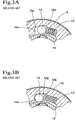
  • FIG. 3A is a main portion enlarged sectional view of the clutch system at a time of cranking
  • FIG. 3B is a main portion enlarged sectional view of the clutch system at a time of torque limiter actuation
  • FIGS. 4A and 4B are explanatory views showing a mechanism of deformation of a clutch roller.
  • FIG. 5A is an explanatory view showing a mechanism of friction between irons
  • FIG. 5B is an explanatory view showing a mechanism of friction between irons and nitrided-irons.
  • a measure is formulated in order to prevent the deformation of the clutch roller by (1) reducing heating values; and (2) increasing strength against thermal softening.
  • a friction between the clutch inner 12 and the clutch roller 13 is a friction of metals (irons).
  • grease lubricant or clutch grease
  • the clutch inner 12 and the clutch roller 13 directly contact with each other and slide as shown in FIG. 5A .
  • electron migration then occurs.
  • the sliding portions adhere to each other between the clutch inner 12 and the clutch roller 13 .
  • a force that separates the sliding portions is thus a frictional force. In other words, a measure for reducing such friction coefficient is to prevent the electron migration.
  • An effective proposal includes a chemically stable substance being on the sliding and contacting surfaces.
  • a stable compound film can thus be formed on one of the sliding surfaces of the clutch system C, in which the clutch roller 13 comes into sliding contact with both the clutch outer 10 and the clutch inner 12 .
  • the sliding portions of both the clutch outer 10 and the clutch inner 12 can be reduced in friction resistance as shown in FIG. 5B .
  • the compound film may instead be formed on both surfaces of the clutch outer 10 and the clutch inner 12 , which ultimately reduces the friction resistance as coming into sliding contact with the clutch roller 13 .
  • a circumferential surface 12 a of the clutch inner 12 extends toward a side of the motor M in an axial direction.
  • An extending end of the circumferential surface 12 a is fit and incorporated in an attaching portion 10 f that is recessed in a bottom surface 10 e of the clutch outer 10 .
  • the clutch roller 13 comes into contact with the circumferential surface 12 a of the clutch inner 12 . Even if a clutch inner end face is chamfered or the clutch outer bottom surface 10 e is drafted, the clutch roller 13 comes into contact with a circumferential surface that includes no chamfered or drafted portions. Local contacts with the clutch roller 13 do not occur, and a uniform force is also applied. As a result, a longer lifetime of the clutch can be achieved.
  • nitrogen can be used because of its firm bonding with iron.
  • the compound film can thus be easily formed by nitriding.
  • gas soft nitriding is exemplified.
  • the clutch roller 13 is made of a bearing steel (for example, SUJ 2 ), and its surface is nitrided by gas nitriding. Carbon nitride is formed on the surface by a method via steps of adding 30 to 50 percent of ammonia (NH 3 ) gas into a carbonaceous gas or nitrogen gas atmosphere, heating and holding for 30 minutes to 5 hours in an atmosphere with a temperature of 550 to 600 degrees Celsius, and penetrating and diffusing nitrogen and carbon together. By this method, a nitride phase with 0.7 to 0.8mm is formed on the surface of the clutch roller 13 .
  • NH 3 ammonia
  • nitride phase formed on the surface is a mixed phase (hereinafter, referred to as “external phase”) of ⁇ (Fe 2+3 N) and Fe 3 C with a thickness of approximately 14 ⁇ m (micrometers) that contains iron as a main component.
  • external phase As a diffused phase, formed inside the external phase is a ⁇ ′(Fe 4 N) phase (hereinafter, referred to as “internal phase”) with a thickness of approximately 4 ⁇ m.
  • Hardness of the surface is slightly changed to Hv 700-800 from Hv 760 before being nitrided.
  • tissue changes under thermal influences can be observed in surface layers of the blank clutch roller.
  • the surface layers are then plastically deformed and exfoliated.
  • Several tens of micrometers of the exfoliation can also be observed.
  • the samples 1 and 2 on the other hand, although external phases completely decay because of abrasions, the internal phases mostly last without being exfoliated. Thermal influences can also hardly be observed on those clutch rollers in themselves, which can continuously be used.
  • the samples 1 and 2 being observed further, the internal phases remain thicker in the sample 2 than in the sample 1.
  • the clutch roller 13 that is nitrided without being quenched is thus excellent in durability.
  • a clutch roller 13 is made of a bearing steel (for example, SUJ 2 ) and nitrided by tufftriding (salt bath soft nitriding). Carbon nitride is formed on a surface of the clutch roller 13 by a method via steps of adding potassium cyanide or potassium carbonate into a titanium crucible so as to be molten, blowing air into the crucible, heating for 30 to 240 minutes with a temperature of approximately 570 degrees Celsius, and cooling by oil or water after the heating. By this method, a nitride phase with 0.7 to 0.8mm is formed on the surface of the clutch roller 13 .
  • a nitride phase with 0.7 to 0.8mm is formed on the surface of the clutch roller 13 .
  • a mixed phase hereinafter, referred to as “external phase” of ⁇ (Fe 2+3 N) and Fe 3 C, containing iron as a main component, with a thickness of approximately 14 ⁇ m (micrometers).
  • a diffused phase formed inside the external phase is a ⁇ ′(Fe 4 N) phase (hereinafter, referred to as “internal phase”) with a thickness of approximately 4 ⁇ m.
  • Hardness of the surface is slightly changed to Hv 670 from Hv 760 before being nitrided.
  • tissue changes under thermal influences can be observed in surface layers of the blank clutch roller.
  • the surface layers are then plastically deformed and exfoliated.
  • Several tens of micrometers of the exfoliation can also be observed.
  • the samples 3 and 4 on the other hand, although external phases completely decay because of abrasions, the internal phases mostly last without being exfoliated. Thermal influences can also hardly be observed on those clutch rollers in themselves, which can continuously be used.
  • the samples 3 and 4 being observed further, the internal phases remain thicker in the sample 4 than in the sample 3.
  • the clutch roller 13 that is nitrided without being quenched is thus excellent in durability.
  • the present invention is useful for an engine starter for starting an engine (internal combustion) installed in a vehicle.
  • One of the sliding contact surfaces between the clutch roller, and the clutch outer and the clutch inner that come into sliding contact with the clutch roller can be stabilized as being a heterogeneous contact. Abrasion and fatigue resistance is thus excellent. Durability can also be improved against the excessive load from the engine side.

Landscapes

  • Engineering & Computer Science (AREA)
  • Chemical & Material Sciences (AREA)
  • Mechanical Engineering (AREA)
  • General Engineering & Computer Science (AREA)
  • Chemical Kinetics & Catalysis (AREA)
  • Materials Engineering (AREA)
  • Metallurgy (AREA)
  • Organic Chemistry (AREA)
  • Combustion & Propulsion (AREA)
  • Pulleys (AREA)
  • Solid-Phase Diffusion Into Metallic Material Surfaces (AREA)
  • Rolling Contact Bearings (AREA)

Abstract

Excellent durability can be achieved by reducing thermal influences of the excessive load from the engine side for a clutch roller (13) in a unidirectional rotation clutch system that is helical-splined to a drive shaft that rotates in response to a driving force of a motor and structured such that the motor driving force can be transmitted while an engine driving force cannot be transmitted when an engine stars, wherein a compound film composed of an external mixed phase and an internal diffused phase is formed on the clutch roller (13) subjected to nitriding by tufftriding with nitrogen being penetrating and diffusing.

Description

CROSS-REFERENCE TO RELATED APPLICATIONS
This application is the U.S. National Phase of PCT/JP2007/001450, filed Dec. 21, 2007, which claims priority from Japanese Patent Application No. 2006-348819, filed Dec. 26, 2006 and Japanese Patent Application No. 2006-348820, filed Dec. 26, 2006, the entire disclosure of which is incorporated herein by reference hereto.
BACKGROUND
The present disclosure relates to an engine starter.
There exists an engine starter that is constructed as shown in FIGS. 1, 2, 3A, and 3B. A motor (electric motor) M of an engine starter 1 uses a general-purpose brush-type DC motor. A base end of a motor shaft 2 is axially and rotatably supported on an end cover 3 a that closes a base end side opening of a cylindrical yoke 3. A commutator 4 is integrally fitted onto a tip end of the motor shaft 2. To an outer periphery of the commutator 4, in a tip end side opening of the yoke 3, a ring-shaped holder stay 5 is mounted.
Reference numeral 6 denotes a bottomed cylindrical case (see FIG. 1). The case 6 forms a reduction gear D that is disposed to a tip end side of the motor M, that is, adjacent to the holder stay 5. In the case 6, a tip end 2 a of the motor shaft 2 is installed. A base end of a drive shaft 7 is also disposed in the case 6 so as to rotatably fit onto the motor shaft tip end 2 a. In the case 6, a plurality of planet gears 8 are also concentrically disposed with respect to the motor shaft tip end 2 a so as to engage with the motor shaft tip end 2 a and rotate circumferentially inside the case 6 according to the rotation of the motor shaft 2. A ring-shaped support plate 9 is also installed in the case 6 so as to be integrated with the planet gears 8 via a support shaft 9 a. By fitting an inner peripheral surface of the support plate 9 integrally onto the drive shaft 7, a circumferential rotation of the planet gears 8 is interlocked with and joined to the drive shaft 7. A driving force of the motor M is thus transmitted to the drive shaft (pinion shaft) 7 in a reduced speed manner.
A unidirectional rotation clutch system C is disposed on a tip end of the drive shaft 7 (see FIG. 1). A clutch outer 10 of the clutch system C is formed of a stepped cylinder. The clutch outer 10 is fit onto the drive shaft 7 such that a helical spline 10 a that is formed on an inner peripheral surface of a small-diameter cylinder is engaged with a helical spline 7 a that is engraved in an outer peripheral surface of the tip end of the drive shaft 7. When relative rotation occurs between the drive shaft 7 and the clutch outer 10 in a predetermined rotating direction from a side of the drive shaft 7, the clutch outer 10 rotatively moves along the helical spline 7 a of the drive shaft 7 and then moves to an active position on a tip end side (a position shown in a lower half of FIG. 1) from an inactive position (a position shown in an upper half of FIG. 1) on the base end side of the drive shaft 7. To an inside of a large-diameter cylinder on a tip end side of the clutch outer 10, a clutch inner 12 is joined that includes a pinion gear 11 that is formed on a tip end outer periphery and engages with a ring gear 11 a on an engine side. The clutch inner 12 moves axially and integrally with the clutch outer 10.
Reference numeral 13 denotes a clutch roller to be interposed between the clutch outer 10 and the clutch inner 12 (see FIGS. 1, 2, 3A, and 3B). Reference numeral 14 denotes a spring that urges the clutch roller 13 toward a side of a clutch outer wall. The clutch roller 13 is housed in a roller chamber 10 g that is recessed in an inner peripheral surface of the clutch outer 10. In the roller chamber 10 g, as shown in FIG. 2 and FIGS. 3A and 3B, an opposing distance is larger between the clutch inner 12 and the clutch outer 10 at a rotation side end 10 b of a clockwise side so as to allow the clutch roller 13 to freely rotate. The opposing distance is narrower toward an engagement side end 10 c of a counterclockwise side. When the motor M is halted, as shown in FIG. 2 and FIG. 3A, the clutch roller 13 is positioned at an intermediate position between ends 10 b and 10 c because of an urging force of the spring 14. In this state, because the clutch roller 13 does not engage with the clutch outer 10 and the clutch inner 12, a driving force is not transmitted. When the clutch outer 10 rotates clockwise, as shown by an arrow in FIG. 2, in response to driving of the motor M, then the clutch roller 13 moves to an engagement side end 10 c, which is shown in FIG. 3B. An engaged state is thus set; and a rotating force of the clutch outer 10 is transmitted to the clutch inner 12 via the clutch roller 13. As a result, an engine starts.
When the engine starts, an overrun occurs such that rotation of the clutch inner 12 is faster than that of the clutch outer 10. As shown in FIG. 3A, the clutch inner 12 then rotates counterclockwise (an arrow direction) relatively to the clutch outer 10. The clutch roller 13 then moves toward the rotation side end 10 b and freely rotates. This clutch unit thus functions as a one-way clutch unit that prevents the engine driving force from being transmitted to a side of the clutch outer 10 from the clutch inner 12 (see Japanese Published Examined Utility Model Application No. S59-26107 and Japanese Published Unexamined Utility Model Application No. H05-42675, for example).
SUMMARY
However, the ring gear 11 a on a side of the engine may abnormally rotate while the engine starts because of some defective actuation, such as a defective ignition in the engine. A torque also may impact the drive shaft 7 from the pinion gear 11 because of the abnormal rotation of the ring gear 11 a. In such a case, a load from the engine side that exceeds a normal torque load affects the clutch system C. The clutch roller 13 then reaches the engagement side end 10 c as shown in FIG. 3B. If the torque impact is so large that the abnormal load exceeds a maximum normal force of the clutch roller 13, then the clutch roller 13 slips while engaging with the clutch inner 12. A high temperature state then occurs because of a frictional heat caused by the slipping. As a result, a softened portion 13 a of the clutch roller 13 is generated, as shown in FIGS. 4A and 4B. Being subjected to shearing stress, such softened composition plastically flows. A drawn portion 13 b is then formed (see FIG. 4A). If the drawn portion 13 b exceeds a ductility limit of the material, then a breakage (exfoliation) 13 c occurs. The clutch roller 13 then deforms (see FIG. 4B).
If the clutch roller 13 deforms, an engagement allowance (overlapping allowance) of the clutch roller 13 cannot be secured at the time when the engine starts. The clutch system C then idles, and as a result, the engine cannot smoothly start. The present disclosure solves the problems and is able to achieve various advantages.
The disclosure according to a first exemplary aspect provides an engine starter that includes a motor that includes a drive shaft that rotates in response to a motor driving force; and a unidirectional rotation clutch system that is helical-splined to the drive shaft, the clutch system being structured such that the motor driving force can be transmitted while an engine driving force cannot be transmitted when an engine starts. The clutch system includes a clutch inner; a clutch outer; a clutch roller that is interposed between the clutch outer and the clutch inner; and a spring that urges the clutch roller. A soft nitriding treatment is applied to a surface of the clutch roller or surfaces of the clutch outer and the clutch inner, the soft nitriding treatment being gas soft nitriding.
The disclosure according to a second exemplary aspect provides the engine starter according to the first exemplary aspect, wherein the gas soft nitriding is formed on the surface of the clutch roller.
The disclosure according to a third exemplary aspect provides the engine starter according to the first or second exemplary aspect, wherein a clutch roller contacting surface of the clutch inner extends long in an axial direction.
The disclosure according to a fourth exemplary aspect provides an engine starter that includes a motor that includes a drive shaft that rotates in response to a motor driving force; and a unidirectional rotation clutch system that is helical-splined to the drive shaft, the clutch system being structured such that the motor driving force can be transmitted while an engine driving force cannot be transmitted when an engine starts. The clutch system includes a clutch inner; a clutch outer; a clutch roller that is interposed between the clutch outer and the clutch inner; and a spring that urges the clutch roller. A soft nitriding treatment is applied to a surface of the clutch roller or surfaces of the clutch outer and the clutch inner, the soft nitriding treatment being tufftriding.
The disclosure according to a fifth exemplary aspect provides the engine starter according to the fourth exemplary aspect, wherein the tufftriding is formed on the surface of the clutch roller.
The disclosure according to a sixth exemplary aspect provides the engine starter according to the fourth or fifth exemplary aspect, wherein a clutch roller contacting surface of the clutch inner extends long in an axial direction.
According to the first exemplary aspect, one of the sliding contact surfaces between the clutch roller and the clutch outer and the clutch inner that come into sliding contact with the clutch roller includes a mixed phase of ε(Fe2+3N)(epsilon) and Fe3C; and a diffused phase of γ′(Fe4N)(gamma prime) inside the mixed phase. As a result, the sliding contacting surface can be stabilized as being a heterogeneous contact. Abrasion and fatigue resistance is thus excellent. Durability can also be improved against the excessive load from the engine side.
According to the second exemplary aspect, because the gas soft nitriding can be formed on the clutch roller, an easy compound film formation can be achieved.
According to the third exemplary aspect, because the contacting surface of the clutch roller with the clutch inner is axially long, even if an end face of the clutch inner is chamfered or a bottom surface of the clutch outer is drafted, the clutch roller can come into contact with circumferential surfaces that are not chamfered or drafted. Local contacting with the clutch roller can thus be prevented. As a result, a uniform force can be applied, and the clutch life can also last longer.
According to the fourth exemplary aspect, one of the sliding contact surfaces between the clutch roller and the clutch outer and the clutch inner that come into sliding contact with the clutch roller includes a mixed phase of ε(Fe2+3N)(epsilon) and Fe3C; and a diffused phase of γ′(Fe4N)(gamma prime) inside the mixed phase. As a result, the sliding contacting surface can be stabilized as being a heterogeneous contact. Abrasion and fatigue resistance is thus excellent. Durability can also be improved against the excessive load from the engine side.
According to the fifth exemplary aspect, because the tufftriding can be formed on the clutch roller, an easy compound film formation can be achieved.
According to the sixth exemplary aspect, because the contacting surface of the clutch roller with the clutch inner is axially long, even if an end face of the clutch inner is chamfered or a bottom surface of the clutch outer is drafted, the clutch roller can come into contact with circumferential surfaces that are not chamfered or drafted. Local contacting with the clutch roller can thus be prevented. As a result, a uniform force can be applied, and the clutch life can also last longer.
BRIEF DESCRIPTION OF THE DRAWINGS
Various embodiments of the disclosure will be described with reference to the drawings, wherein:
FIG. 1 is a partial sectional front view of an engine starter;
FIG. 2 is a sectional view of a clutch system;
FIG. 3A is a main portion enlarged sectional view of the clutch system at a time of cranking, and FIG. 3B is a main portion enlarged sectional view of the clutch system at a time of torque limiter actuation;
FIGS. 4A and 4B are explanatory views showing a mechanism of deformation of a clutch roller; and
FIG. 5A is an explanatory view showing a mechanism of friction between irons, and FIG. 5B is an explanatory view showing a mechanism of friction between irons and nitrided-irons.
DETAILED DESCRIPTION OF EMBODIMENTS
Focusing on the fact that the deformation of the clutch roller 13 has been caused by heating, a measure is formulated in order to prevent the deformation of the clutch roller by (1) reducing heating values; and (2) increasing strength against thermal softening.
First, a heating value is examined. The heating value Q is as follows:
Q=μPV
wherein μ represents a friction coefficient; P represents load; and V represents velocity. Reduction in contact surface pressure and friction coefficient are thus to be achieved. As being about the mechanical, however, the former is provisionally excluded from the present development theme. The reduction in friction resistance will thus be examined herein.
A friction between the clutch inner 12 and the clutch roller 13 is a friction of metals (irons). As a normal condition, grease (lubricant or clutch grease) is interposed at a space 15 between the clutch inner 12 and the clutch roller 13. However, when a load is imposed, the clutch inner 12 and the clutch roller 13 directly contact with each other and slide as shown in FIG. 5A. At sliding portions, electron migration then occurs. As a result, the sliding portions adhere to each other between the clutch inner 12 and the clutch roller 13. A force that separates the sliding portions is thus a frictional force. In other words, a measure for reducing such friction coefficient is to prevent the electron migration.
An effective proposal includes a chemically stable substance being on the sliding and contacting surfaces. A stable compound film can thus be formed on one of the sliding surfaces of the clutch system C, in which the clutch roller 13 comes into sliding contact with both the clutch outer 10 and the clutch inner 12. By simply forming a compound film on the surface of the clutch roller 13, the sliding portions of both the clutch outer 10 and the clutch inner 12 can be reduced in friction resistance as shown in FIG. 5B. The compound film may instead be formed on both surfaces of the clutch outer 10 and the clutch inner 12, which ultimately reduces the friction resistance as coming into sliding contact with the clutch roller 13.
A circumferential surface 12 a of the clutch inner 12 (see FIG. 1), with which the clutch roller 13 comes into contact, extends toward a side of the motor M in an axial direction. An extending end of the circumferential surface 12 a is fit and incorporated in an attaching portion 10 f that is recessed in a bottom surface 10 e of the clutch outer 10. The clutch roller 13 comes into contact with the circumferential surface 12 a of the clutch inner 12. Even if a clutch inner end face is chamfered or the clutch outer bottom surface 10 e is drafted, the clutch roller 13 comes into contact with a circumferential surface that includes no chamfered or drafted portions. Local contacts with the clutch roller 13 do not occur, and a uniform force is also applied. As a result, a longer lifetime of the clutch can be achieved.
When such a compound film is formed, nitrogen can be used because of its firm bonding with iron. The compound film can thus be easily formed by nitriding. As such nitriding, gas soft nitriding is exemplified.
According to a first embodiment, the clutch roller 13 is made of a bearing steel (for example, SUJ2), and its surface is nitrided by gas nitriding. Carbon nitride is formed on the surface by a method via steps of adding 30 to 50 percent of ammonia (NH3) gas into a carbonaceous gas or nitrogen gas atmosphere, heating and holding for 30 minutes to 5 hours in an atmosphere with a temperature of 550 to 600 degrees Celsius, and penetrating and diffusing nitrogen and carbon together. By this method, a nitride phase with 0.7 to 0.8mm is formed on the surface of the clutch roller 13. As the nitride phase, formed on the surface is a mixed phase (hereinafter, referred to as “external phase”) of ε(Fe2+3N) and Fe3C with a thickness of approximately 14 μm (micrometers) that contains iron as a main component. As a diffused phase, formed inside the external phase is a ν′(Fe4N) phase (hereinafter, referred to as “internal phase”) with a thickness of approximately 4 μm. Hardness of the surface is slightly changed to Hv 700-800 from Hv 760 before being nitrided.
Actual machine tests are repeated 20 times with the clutch roller 13 thus gas-nitrided. For the actual machine tests, two different samples of the clutch roller 13 are used: a clutch roller that is nitrided after being quenched (sample 1) and a clutch roller that is nitrided without being quenched (sample 2). In addition, as a blank, a clutch roller that is just quenched is also used for the tests.
According to the test results, tissue changes under thermal influences can be observed in surface layers of the blank clutch roller. The surface layers are then plastically deformed and exfoliated. Several tens of micrometers of the exfoliation can also be observed. As for the samples 1 and 2, on the other hand, although external phases completely decay because of abrasions, the internal phases mostly last without being exfoliated. Thermal influences can also hardly be observed on those clutch rollers in themselves, which can continuously be used. In addition, the samples 1 and 2 being observed further, the internal phases remain thicker in the sample 2 than in the sample 1. The clutch roller 13 that is nitrided without being quenched is thus excellent in durability.
According to a second embodiment, a clutch roller 13 is made of a bearing steel (for example, SUJ2) and nitrided by tufftriding (salt bath soft nitriding). Carbon nitride is formed on a surface of the clutch roller 13 by a method via steps of adding potassium cyanide or potassium carbonate into a titanium crucible so as to be molten, blowing air into the crucible, heating for 30 to 240 minutes with a temperature of approximately 570 degrees Celsius, and cooling by oil or water after the heating. By this method, a nitride phase with 0.7 to 0.8mm is formed on the surface of the clutch roller 13. By this method, a nitride phase with 0.7 to 0.8mm is formed on the surface of the clutch roller 13. As the nitride phase, formed on the surface side is a mixed phase (hereinafter, referred to as “external phase”) of ε(Fe2+3N) and Fe3C, containing iron as a main component, with a thickness of approximately 14 μm (micrometers). As a diffused phase, formed inside the external phase is a ν′(Fe4N) phase (hereinafter, referred to as “internal phase”) with a thickness of approximately 4 νm. Hardness of the surface is slightly changed to Hv 670 from Hv 760 before being nitrided.
Actual machine tests are repeated 20 times with the clutch roller 13 thus gas-nitrided. For the actual machine tests, two different samples of the clutch roller 13 are used: a clutch roller that is nitrided after being quenched (sample 3) and a clutch roller that is nitrided without being quenched (sample 4). In addition, as a blank, a clutch roller that is just quenched is also used for the tests.
According to the test results, tissue changes under thermal influences can be observed in surface layers of the blank clutch roller. The surface layers are then plastically deformed and exfoliated. Several tens of micrometers of the exfoliation can also be observed. As for the samples 3 and 4, on the other hand, although external phases completely decay because of abrasions, the internal phases mostly last without being exfoliated. Thermal influences can also hardly be observed on those clutch rollers in themselves, which can continuously be used. In addition, the samples 3 and 4 being observed further, the internal phases remain thicker in the sample 4 than in the sample 3. The clutch roller 13 that is nitrided without being quenched is thus excellent in durability.
The present invention is useful for an engine starter for starting an engine (internal combustion) installed in a vehicle. One of the sliding contact surfaces between the clutch roller, and the clutch outer and the clutch inner that come into sliding contact with the clutch roller can be stabilized as being a heterogeneous contact. Abrasion and fatigue resistance is thus excellent. Durability can also be improved against the excessive load from the engine side.

Claims (4)

What is claimed is:
1. An engine starter, comprising:
a motor that includes a motor shaft that rotates in response to a motor driving force;
a reduction mechanism to engage with the motor shaft and transmit a driving force to a drive shaft;
a unidirectional rotation clutch system that is helical-splined to the drive shaft, the clutch system being movable from an inactive position on a base end side of the drive shaft to an active position on a tip end side of the drive shaft when relative rotation occurs in a predetermined rotating direction from a side of the drive shaft, and further being structured such that the motor driving force can be transmitted while an engine driving force cannot be transmitted when an engine starts; and
a pinion gear that connects with the clutch system and engages with a ring gear on a side of the engine, wherein:
the clutch system comprises:
a clutch inner;
a clutch outer;
a clutch roller that is interposed between the clutch outer and the clutch inner; and
a spring that urges the clutch roller,
the clutch roller slips while engaging with the clutch inner when a torque impacts the drive shaft from the side of the engine,
the clutch roller is made of bearing steel, and
a gas soft nitriding treatment is applied to a surface of the clutch roller such that an external phase and an internal phase are formed on the surface of the bearing steel, wherein the gas soft nitriding treatment is not applied to a surface of the clutch inner and the gas soft nitriding treatment is not applied to a surface of the clutch outer, so that a nitride phase is formed, where a mixed phase of Fe2+3N and Fe3C is formed on the surface as the external phase and a diffused phase of Fe4N is formed inside the external phase as the internal phase.
2. The engine starter according to claim 1, wherein a clutch roller contacting surface of the clutch inner extends long in an axial direction.
3. An engine starter, comprising:
a motor that includes a drive shaft that rotates in response to a motor driving force; and
a unidirectional rotation clutch system that is helical-splined to the drive shaft, the clutch system being movable from an inactive position on a base end side of the drive shaft to an active position on a tip end side of the drive shaft when relative rotation occurs in a predetermined rotating direction from a side of the drive shaft, and further being structured such that the motor driving force can be transmitted while an engine driving force cannot be transmitted when an engine starts, wherein:
the clutch system comprises:
a clutch inner;
a clutch outer;
a clutch roller that is interposed between the clutch outer and the clutch inner; and
a spring that urges the clutch roller,
the clutch roller slips while engaging with the clutch inner when a torque impacts the drive shaft from a side of the engine,
the clutch roller is made of bearing steel, and
a salt bath soft nitriding treatment is applied to a surface of the clutch roller such that an external phase and an internal phase are formed on the surface of the bearing steel, wherein the salt bath soft nitriding treatment is not applied to a surface of the clutch inner and the salt bath soft nitriding treatment is not applied to a surface of the clutch outer, so that a nitride phase is formed, where a mixed phase of Fe2 +3N and Fe3C is formed on the surface as the external phase and a diffused phase of Fe4N is formed inside the external phase as the internal phase.
4. The engine starter according to claim 3, wherein a clutch roller contacting surface of the clutch inner extends long in an axial direction.
US12/448,203 2006-12-26 2007-12-21 Engine starter Expired - Fee Related US8511186B2 (en)

Applications Claiming Priority (5)

Application Number Priority Date Filing Date Title
JP2006348819A JP5022698B2 (en) 2006-12-26 2006-12-26 Engine starter
JP2006348820A JP5022699B2 (en) 2006-12-26 2006-12-26 Engine starter
JP2006-348819 2006-12-26
JP2006-348820 2006-12-26
PCT/JP2007/001450 WO2008078412A1 (en) 2006-12-26 2007-12-21 Engine starter apparatus

Publications (2)

Publication Number Publication Date
US20100294078A1 US20100294078A1 (en) 2010-11-25
US8511186B2 true US8511186B2 (en) 2013-08-20

Family

ID=39562207

Family Applications (1)

Application Number Title Priority Date Filing Date
US12/448,203 Expired - Fee Related US8511186B2 (en) 2006-12-26 2007-12-21 Engine starter

Country Status (3)

Country Link
US (1) US8511186B2 (en)
EP (1) EP2113655A4 (en)
WO (1) WO2008078412A1 (en)

Cited By (2)

* Cited by examiner, † Cited by third party
Publication number Priority date Publication date Assignee Title
US20130061716A1 (en) * 2010-06-01 2013-03-14 Motoaki Kamimura Vehicular starter ring gear
US20150114783A1 (en) * 2013-10-24 2015-04-30 Borgwarner Inc. Freewheel and freewheel arrangement

Families Citing this family (6)

* Cited by examiner, † Cited by third party
Publication number Priority date Publication date Assignee Title
DE112006003545B4 (en) * 2005-12-28 2018-05-17 Mitsuba Corp. Engine starter
US8511186B2 (en) * 2006-12-26 2013-08-20 Mitsuba Corporation Engine starter
DE102009001562A1 (en) * 2009-03-16 2010-09-23 Robert Bosch Gmbh Starter for an internal combustion engine
JP5965268B2 (en) * 2011-11-29 2016-08-03 株式会社ミツバ Starter
JP6136390B2 (en) * 2013-03-12 2017-05-31 株式会社ジェイテクト One-way clutch and one-way clutch unit for wind power generator
US20160341169A1 (en) * 2015-05-20 2016-11-24 Schaeffler Technologies AG & Co. KG Reversible starter motor

Citations (12)

* Cited by examiner, † Cited by third party
Publication number Priority date Publication date Assignee Title
US3022204A (en) * 1961-03-20 1962-02-20 Kolene Corp Process for nitriding metals
JPS5926107Y2 (en) 1979-12-28 1984-07-30 三菱電機株式会社 overrunning clutch
US4986140A (en) * 1988-12-02 1991-01-22 Mitsubishi Denki Kabushiki Kaisha Dray torque relationship of a undirectional clutch in an engine stater motor
JPH04185921A (en) 1990-11-21 1992-07-02 Hitachi Ltd Roller clutch for starter
JP2000346077A (en) 1999-06-04 2000-12-12 Nsk Ltd Shock absorbing rolling bearing
US6315455B1 (en) * 1999-04-01 2001-11-13 Nsk Ltd. Rolling bearing
US20020170425A1 (en) * 2001-05-21 2002-11-21 Tomoji Tarutani Shoe for swash plate type compressor and method of producing the same
JP2004076823A (en) 2002-08-13 2004-03-11 Nsk Ltd Rolling device
WO2006043579A1 (en) 2004-10-20 2006-04-27 Mitsuba Corporation Starter motor with idle gear
US7370741B2 (en) * 2002-01-21 2008-05-13 Nsk Ltd. Engine start roller clutch-housed type rotation transmission device
US20090145263A1 (en) * 2005-12-28 2009-06-11 Mitsuba Corporation Engine starter
US20100294078A1 (en) * 2006-12-26 2010-11-25 Mitsuba Corporation Engine starter

Family Cites Families (4)

* Cited by examiner, † Cited by third party
Publication number Priority date Publication date Assignee Title
US4958712A (en) * 1987-06-29 1990-09-25 Taiho Kogyo Co. Ltd. Wet clutch device
JPH0542675U (en) 1991-11-12 1993-06-11 三菱電機株式会社 Starter motor with intermediate gear
JPH11344052A (en) * 1998-04-02 1999-12-14 Koyo Seiko Co Ltd One-way clutch
JP4247568B2 (en) * 2001-01-24 2009-04-02 株式会社ジェイテクト Driving force transmission device

Patent Citations (12)

* Cited by examiner, † Cited by third party
Publication number Priority date Publication date Assignee Title
US3022204A (en) * 1961-03-20 1962-02-20 Kolene Corp Process for nitriding metals
JPS5926107Y2 (en) 1979-12-28 1984-07-30 三菱電機株式会社 overrunning clutch
US4986140A (en) * 1988-12-02 1991-01-22 Mitsubishi Denki Kabushiki Kaisha Dray torque relationship of a undirectional clutch in an engine stater motor
JPH04185921A (en) 1990-11-21 1992-07-02 Hitachi Ltd Roller clutch for starter
US6315455B1 (en) * 1999-04-01 2001-11-13 Nsk Ltd. Rolling bearing
JP2000346077A (en) 1999-06-04 2000-12-12 Nsk Ltd Shock absorbing rolling bearing
US20020170425A1 (en) * 2001-05-21 2002-11-21 Tomoji Tarutani Shoe for swash plate type compressor and method of producing the same
US7370741B2 (en) * 2002-01-21 2008-05-13 Nsk Ltd. Engine start roller clutch-housed type rotation transmission device
JP2004076823A (en) 2002-08-13 2004-03-11 Nsk Ltd Rolling device
WO2006043579A1 (en) 2004-10-20 2006-04-27 Mitsuba Corporation Starter motor with idle gear
US20090145263A1 (en) * 2005-12-28 2009-06-11 Mitsuba Corporation Engine starter
US20100294078A1 (en) * 2006-12-26 2010-11-25 Mitsuba Corporation Engine starter

Non-Patent Citations (2)

* Cited by examiner, † Cited by third party
Title
Darbellay, Jerome; "Gas Nitriding: An Industrial Perspective"; Mar. 22, 2006; http://coursenotes.mcmaster.ca/701-702-Seminars/2005-2006/701-JeromeDarbellay-March-2006.pdf. *
Darbellay, Jerome; "Gas Nitriding: An Industrial Perspective"; Mar. 22, 2006; http://coursenotes.mcmaster.ca/701-702—Seminars/2005-2006/701—JeromeDarbellay—March—2006.pdf. *

Cited By (3)

* Cited by examiner, † Cited by third party
Publication number Priority date Publication date Assignee Title
US20130061716A1 (en) * 2010-06-01 2013-03-14 Motoaki Kamimura Vehicular starter ring gear
US20150114783A1 (en) * 2013-10-24 2015-04-30 Borgwarner Inc. Freewheel and freewheel arrangement
US9624989B2 (en) * 2013-10-24 2017-04-18 Borgwarner Inc. Freewheel and freewheel arrangement

Also Published As

Publication number Publication date
EP2113655A1 (en) 2009-11-04
US20100294078A1 (en) 2010-11-25
WO2008078412A1 (en) 2008-07-03
EP2113655A4 (en) 2011-07-20

Similar Documents

Publication Publication Date Title
US8511186B2 (en) Engine starter
US8967003B2 (en) Engine starter
US6488135B1 (en) Rotation transmitting device incorporating one-way clutch
JP4247683B2 (en) Planetary gear mechanism reduction starter
US20060144175A1 (en) Engine starter equipped with torque absorber
US9200609B2 (en) Torque transmission mechanism
US8522631B2 (en) Engine starter mechanism using one way clutch
JP5022698B2 (en) Engine starter
JP2003214528A (en) One-way clutch integrated rotation transmission device for starter motor
US20150013848A1 (en) Method for Manufacturing A Torque Transmission Mechanism
JP5022699B2 (en) Engine starter
US20150014119A1 (en) Torque Transmission Mechanism
JP4330023B2 (en) Engine starter
JP2005240930A (en) Pulley unit with one-way clutch
JP2001116052A (en) Synthetic resin gear
EP2824319A1 (en) Torque transmission mechanism
EP2824317A1 (en) Torque transmission mechanism
US7584831B2 (en) One-way clutch
JP2006097713A (en) One-way clutch
JP2006161827A (en) Pulley unit with one-way clutch
EP2824350A1 (en) Torque transmission mechanism
JP2010007505A (en) Torque transmission device for starting engine
EP2824316A1 (en) Torque transmission mechanism
JP2003176866A (en) Pulley unit with one-way clutch
JP2005172089A (en) Pulley device with built-in clutch

Legal Events

Date Code Title Description
AS Assignment

Owner name: MITSUBA CORPORATION, JAPAN

Free format text: ASSIGNMENT OF ASSIGNORS INTEREST;ASSIGNORS:ONO, HITOSHI;IKEMORI, TOMOHIKO;ENKAKU, SHIGEYUKI;AND OTHERS;REEL/FRAME:022838/0147

Effective date: 20090611

STCF Information on status: patent grant

Free format text: PATENTED CASE

FPAY Fee payment

Year of fee payment: 4

MAFP Maintenance fee payment

Free format text: PAYMENT OF MAINTENANCE FEE, 8TH YEAR, LARGE ENTITY (ORIGINAL EVENT CODE: M1552); ENTITY STATUS OF PATENT OWNER: LARGE ENTITY

Year of fee payment: 8

FEPP Fee payment procedure

Free format text: MAINTENANCE FEE REMINDER MAILED (ORIGINAL EVENT CODE: REM.); ENTITY STATUS OF PATENT OWNER: LARGE ENTITY

LAPS Lapse for failure to pay maintenance fees

Free format text: PATENT EXPIRED FOR FAILURE TO PAY MAINTENANCE FEES (ORIGINAL EVENT CODE: EXP.); ENTITY STATUS OF PATENT OWNER: LARGE ENTITY

STCH Information on status: patent discontinuation

Free format text: PATENT EXPIRED DUE TO NONPAYMENT OF MAINTENANCE FEES UNDER 37 CFR 1.362

FP Lapsed due to failure to pay maintenance fee

Effective date: 20250820