US8330372B2 - Slow wave structures using twisted waveguides for charged particle applications - Google Patents
Slow wave structures using twisted waveguides for charged particle applications Download PDFInfo
- Publication number
- US8330372B2 US8330372B2 US12/784,571 US78457110A US8330372B2 US 8330372 B2 US8330372 B2 US 8330372B2 US 78457110 A US78457110 A US 78457110A US 8330372 B2 US8330372 B2 US 8330372B2
- Authority
- US
- United States
- Prior art keywords
- central axis
- helical
- channel
- waveguide
- waveguide structure
- Prior art date
- Legal status (The legal status is an assumption and is not a legal conclusion. Google has not performed a legal analysis and makes no representation as to the accuracy of the status listed.)
- Active, expires
Links
Images




Classifications
-
- H—ELECTRICITY
- H01—ELECTRIC ELEMENTS
- H01P—WAVEGUIDES; RESONATORS, LINES, OR OTHER DEVICES OF THE WAVEGUIDE TYPE
- H01P9/00—Delay lines of the waveguide type
-
- H—ELECTRICITY
- H01—ELECTRIC ELEMENTS
- H01P—WAVEGUIDES; RESONATORS, LINES, OR OTHER DEVICES OF THE WAVEGUIDE TYPE
- H01P3/00—Waveguides; Transmission lines of the waveguide type
- H01P3/12—Hollow waveguides
Definitions
- This invention relates to the field of slow wave structures for charged particle applications. More particularly, this invention relates to twisted waveguide structures.
- Radio-frequency (RF) waveguides are used in various applications involving interactions between RF fields and particle beams.
- One important use of waveguide structures in science and industrial applications is charged particle acceleration.
- RF resonant cavities are constructed to develop very high electric fields in the gap where the gap field is matched to the speed of the particles. Since the speed of the charged particles is almost equal to or slower than the speed of light, a “slow wave” structure is needed.
- a regular straight hollow waveguide supports only a “fast wave” whose phase velocity is greater than the speed of light.
- Prior slow-wave structures used in accelerating cavity applications have been constructed as multi-cell, disk-loaded structures having corrugations along the beam-axis. These structures generally consist of many small, individually-machined parts which are assembled using expensive welding or brazing processes. Since each cell in the structure must resonate at a specified frequency, each cell must be individually tuned, which is also an expensive and time-consuming process.
- a rapidly twisted waveguide structure having a certain cross-section and helical pitch that supports electromagnetic wave propagation at a phase velocity equal to or slower than the speed of light in free space.
- Preferred embodiments provide an electromagnetic waveguide structure comprising a waveguide body in which channels are defined by the body.
- One or more helical channels are disposed about a central axis, and a substantially linear central axial channel disposed along the central axis, where central portions of the one or more helical channels merge with the linear central axial channel.
- the one or more helical channels are operable to support electromagnetic wave propagation in at least one propagation mode and the central axial channel is operable to conduct a charged particle beam through the waveguide structure.
- the helical channels are disposed at a substantially equiangular spacing around the central axis in a plane transverse to the central axis.
- the channels may have a substantially elliptically-shaped cross-section or a cross-section shaped as a section of a circle in the plane transverse to the central axis.
- a straight waveguide section is attached to one or both ends of the central axial channel.
- a power coupler which is aligned substantially perpendicular to the central axis may be connected to this straight waveguide section.
- a rectangular waveguide section is attached at opposing ends of the central axial channel.
- This rectangular waveguide section may contain a phase-shifter, a power coupler, or a higher-order mode damper.
- FIG. 1A depicts a perspective view of a twisted waveguide structure according to a first embodiment
- FIG. 1B depicts a transverse cross-section view, taken along line A-A, of the twisted waveguide structure according to the first embodiment
- FIG. 1C depicts a longitudinal cross-section view, taken along line B-B, of the twisted waveguide structure according to the first embodiment
- FIG. 2A depicts a perspective view of a twisted waveguide structure according to a second embodiment
- FIG. 2B depicts a longitudinal cross-section view, taken along line C-C, of the twisted waveguide structure according to the second embodiment
- FIG. 3 depicts another perspective view of a twisted waveguide structure according to the second embodiment
- FIG. 4A depicts a transverse cross-section view of the twisted waveguide structure according to the second embodiment
- FIG. 4B depicts a perspective longitudinal cross-section view of the twisted waveguide structure according to the second embodiment
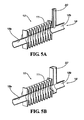
- FIG. 5A depicts a perspective longitudinal cross-section view of a twisted waveguide structure with a coaxial power coupling according to an embodiment of the invention
- FIG. 5B depicts a perspective longitudinal cross-section view of a twisted waveguide structure with a rectangular waveguide power coupling according to an embodiment of the invention
- FIG. 6A depicts a perspective view of a non-twisted waveguide connected at each end of a twisted waveguide structure according to an embodiment of the invention
- FIG. 6B depicts a perspective longitudinal cross-section view, taken along line D-D, of a non-twisted waveguide connected at each end of a twisted waveguide structure according to an embodiment of the invention
- FIG. 6C depicts a perspective longitudinal cross-section view of a non-twisted waveguide connected at each end of a twisted waveguide structure according to an embodiment of the invention
- FIGS. 7A and 7B depict partial transverse views of symmetrically twisted waveguide structures according to an embodiment of the invention.
- FIG. 7C depicts a partial longitudinal cross-section view of a symmetrically twisted waveguide structure according to an embodiment of the invention.
- FIGS. 8A and 8B depict partial transverse views of asymmetrically twisted waveguide structures according to an embodiment of the invention.
- FIG. 8C depicts a partial longitudinal cross-section view of an asymmetrically twisted waveguide structure according to an embodiment of the invention.
- FIG. 9 depicts a perspective view of a twisted waveguide structure having a rectangular transverse cross-section according to an embodiment of the invention.
- FIG. 10 depicts predicted dispersion curves for twisted waveguide structures having various twist rates compared to the free-space propagation.
- FIGS. 1A , 1 B and 1 C depict various views of a first embodiment of a twisted waveguide structure 10 .
- a waveguide body 11 defines two opposing helical channels 12 a - 12 b ( FIGS. 1A , 1 B) which merge along the central axis of the structure to form a central axial channel 16 .
- the channels 12 a - 12 b are nearly elliptically shaped in a direction transverse to the central axis.
- the channels 12 a - 12 b are separated by opposing lobe structures 14 a - 14 b .
- FIG. 1A , 1 B and 1 C depict various views of a first embodiment of a twisted waveguide structure 10 .
- a waveguide body 11 defines two opposing helical channels 12 a - 12 b ( FIGS. 1A , 1 B) which merge along the central axis of the structure to form a central axial channel 16 .
- the channels 12 a - 12 b
- the structure 10 forms a corrugated pattern of grooves and ridges in the longitudinal cross-section.
- the pitch of this corrugated pattern may be characterized by a pitch angle ⁇ as shown in FIG. 1C or by a pitch rate expressed in revolutions per meter (R/m) for example.
- a twisting waveguide such as the helical structures described herein, effectively increases the path length of propagation of the electromagnetic wave energy traveling through the structure. Increased volume of the space occupied by the electromagnetic wave energy also results in increased propagation delay.
- the central axial channel 16 remains open as a circular aperture along the longitudinal axis through which the particle beam may pass.
- the speed of the electromagnetic wave propagation is determined at least in part by the cross sectional shape and twist rate (pitch) of the structure.
- the straight line 24 represents a limit at which the speed of the transverse electromagnetic (TEM) wave propagation equals the speed of light in free space.
- TEM transverse electromagnetic
- the curves crossing the TEM limit 24 represent various pitch rates, p, expressed in revolutions per meter (R/m) ranging from 67.3 R/m to 337 R/m, where the wave propagation is faster than the speed of light on the left side of the TEM limit 24 (with slow twist) and slower than the speed of light on the right side of the TEM limit 24 (with faster twist).
- the curve for a straight waveguide 25 stays on the left side of the line 24 .
- the simulation results indicate how the pitch of the waveguide twist affects the speed of wave propagation in the twisted guide.
- the lowest order Transverse Magnetic (TM) mode is the most efficient mode for particle acceleration.
- the TM-modes in a twisted waveguide structure are more accurately described as “TM-like-modes” as they are not true TM-modes in the conventional mathematical coordinate system.
- the longitudinal component of the electric field of the TM-like-mode wave in the central axial channel 16 is very similar to that of a true TM-mode wave, and this TM-like-mode wave can accelerate particles at a velocity that is matched to the wave propagation.
- the specific accelerating mode electric field is almost the strongest near the center of the structure.
- the larger triangles near the center of the axial channel 16 in the field strength representations in FIGS. 1C and 2B show this.
- the quality factor, Q of the structure determines the strength of the accelerating field.
- Computer simulations and laboratory measurements have confirmed that the accelerating field strength in a twisted waveguide is comparable to the field strength in a conventional structure.
- the resonant RF frequency of the structure 10 is determined by characteristics of the overall structure (i.e., channel dimensions and pitch), the resonant frequency can be tuned with a tuning mechanism that can change the volume by slightly moving the wall at the end of the structure. It is also possible to use a tuning/phase-shifting device disposed external to the structure 10 and in communication with an inlet/outlet. For example, as shown in FIGS. 6A , 6 B, and 6 C, a rectangular waveguide 22 can be integrated with the structure 10 . An RF phase-shifter can be disposed in the waveguide 22 to adjust the overall resonant frequency of the structure 10 . Power couplers and higher-order mode (HOM) dampers 23 ( FIG.
- HOM higher-order mode
- FIGS. 6A-6C can also be disposed in the waveguide 22 .
- the embodiments of FIGS. 6A-6C include straight circular waveguide sections 18 a - 18 b at each end of the waveguide body 11 .
- the embodiment of FIG. 6C includes an additional waveguide connection 26 at the bottom of the straight waveguide section 22 .
- FIGS. 5A and 5B depict an embodiment of a twisted waveguide structure 10 incorporating a power coupler 20 which may be either a coaxial type ( FIG. 5A ) or rectangular type ( FIG. 5B ) directly connected transverse to the central axis of the waveguide body 11 .
- Twisted waveguide structures generally fall into two categories: symmetrically twisted structures and asymmetrically twisted structures.
- waveguides having an even number of lobe structures such as two lobe structures 14 a - 14 b ( FIG. 7A ) or four lobe structures 14 a , 14 b , 14 c , 14 d ( FIG. 7B ), have a vertically symmetrical longitudinal cross section ( FIG. 7C ).
- waveguides having an odd number of lobe structures such as one lobe structure 14 a ( FIG. 8A ) or three lobe structures 14 a - 14 c ( FIG. 8B ), have a vertically asymmetrical longitudinal cross section (as shown in FIG. 8C ).
- FIGS. 2A , 2 B, 3 , 4 A and 4 B depict various views of a second embodiment of a twisted waveguide structure 10 .
- the waveguide body 11 FIGS. 2A , 2 B, 3 , 4 A
- the waveguide body 11 also includes two opposing helical channels 12 a ( FIGS. 2A , 3 , 4 A, 4 B) and 12 b ( FIGS. 2A , 3 , 4 A) which merge along the axis of the structure to form a central axial channel 16 .
- FIGS. 2A , 2 B, 3 , 4 A depict various views of a second embodiment of a twisted waveguide structure 10 .
- the waveguide body 11 FIGS. 2A , 2 B, 3 , 4 A
- 12 b FIGS. 2A , 3 , 4 A
- the channels 12 a - 12 b are shaped as sections of a circle which are separated by opposing lobe structures 14 a - 14 b .
- the structure 10 forms a corrugated pattern of grooves and ridges in the longitudinal cross-section, the longitudinal pitch of which may be characterized by the pitch angle ⁇ .
- the first embodiment may provide better particle beam quality, whereas the second may provide higher electrical efficiency.
- FIG. 9 depicts an alternative embodiment of a twisted waveguide structure 10 wherein the waveguide body 10 comprises a single channel having a rectangular transverse cross-section.
- the twisted waveguide structures described herein are particularly suited to formation by extrusion molding. However, these structures could also be formed by injection molding or casting for example. Materials such as ferrous and nonferrous metals and their alloys, or reinforced plastics, composites and the like with metal plated inner surface may be used to form the waveguide body 11 . Thus, production costs, fabrication times, and fine tuning of these structures are significantly less than doing the same with the corrugated structures manufactured by welding or brazing individual components.
Landscapes
- Waveguide Aerials (AREA)
Abstract
Description
-
- Since there is no variation in the shape of the transversal cross-section along the axis of the structure, inexpensive mechanical fabrication processes can be used to form the structure, such as extrusion, casting or molding;
- Since the field and frequency of the resonant mode depend on the whole structure rather than on dimensional tolerances of individual cells, no tuning of individual cells is needed;
- Twisted waveguide structures can be used in both normal conducting systems and superconducting systems;
- The overall operating frequency of the RF field may be varied with a tuning/phase shifting device located outside the resonant waveguide structure; and
- Higher-order modes (HOMs) that are harmful for accelerating particles can be easily damped outside the structure.
Claims (12)
Priority Applications (1)
| Application Number | Priority Date | Filing Date | Title |
|---|---|---|---|
| US12/784,571 US8330372B2 (en) | 2010-05-21 | 2010-05-21 | Slow wave structures using twisted waveguides for charged particle applications |
Applications Claiming Priority (1)
| Application Number | Priority Date | Filing Date | Title |
|---|---|---|---|
| US12/784,571 US8330372B2 (en) | 2010-05-21 | 2010-05-21 | Slow wave structures using twisted waveguides for charged particle applications |
Publications (2)
| Publication Number | Publication Date |
|---|---|
| US20110285479A1 US20110285479A1 (en) | 2011-11-24 |
| US8330372B2 true US8330372B2 (en) | 2012-12-11 |
Family
ID=44972028
Family Applications (1)
| Application Number | Title | Priority Date | Filing Date |
|---|---|---|---|
| US12/784,571 Active 2031-07-30 US8330372B2 (en) | 2010-05-21 | 2010-05-21 | Slow wave structures using twisted waveguides for charged particle applications |
Country Status (1)
| Country | Link |
|---|---|
| US (1) | US8330372B2 (en) |
Cited By (4)
| Publication number | Priority date | Publication date | Assignee | Title |
|---|---|---|---|---|
| CN106257745A (en) * | 2016-08-29 | 2016-12-28 | 成都赛纳为特科技有限公司 | A kind of twisted waveguide combination type tiltedly turns round coupling rectangular folded waveguide |
| CN108682607A (en) * | 2018-05-03 | 2018-10-19 | 电子科技大学 | A kind of U-shaped micro-strip slow-wave structure of corrugated casing |
| US11202362B1 (en) * | 2018-02-15 | 2021-12-14 | Christopher Mark Rey | Superconducting resonant frequency cavities, related components, and fabrication methods thereof |
| US11211676B2 (en) * | 2019-10-09 | 2021-12-28 | Com Dev Ltd. | Multi-resonator filters |
Families Citing this family (13)
| Publication number | Priority date | Publication date | Assignee | Title |
|---|---|---|---|---|
| CN106329050A (en) * | 2016-08-29 | 2017-01-11 | 成都赛纳为特科技有限公司 | Twisted waveguide-combined quasi-plane folded waveguide |
| CN106159403A (en) * | 2016-08-29 | 2016-11-23 | 成都赛纳为特科技有限公司 | A kind of twisted waveguide combination type tiltedly turns round the double ridge rectangle folded waveguide of coupling |
| CN106252811A (en) * | 2016-08-29 | 2016-12-21 | 成都赛纳为特科技有限公司 | A kind of twisted waveguide combination type tiltedly turns round coupling folded waveguide |
| CN106252812A (en) * | 2016-08-29 | 2016-12-21 | 成都赛纳为特科技有限公司 | A kind of twisted waveguide separate type tiltedly turns round coupling folded waveguide |
| CN106207356A (en) * | 2016-08-29 | 2016-12-07 | 成都赛纳为特科技有限公司 | A kind of twisted waveguide separate type tiltedly turns round the double ridge rectangle folded waveguide of coupling |
| CN106159400A (en) * | 2016-08-29 | 2016-11-23 | 成都赛纳为特科技有限公司 | A kind of twisted waveguide separate type directrix plane folded waveguide |
| CN106207358A (en) * | 2016-08-29 | 2016-12-07 | 成都赛纳为特科技有限公司 | A kind of twisted waveguide separate type tiltedly turns round the single ridge rectangle folded waveguide of coupling |
| CN106252809A (en) * | 2016-08-29 | 2016-12-21 | 成都赛纳为特科技有限公司 | A kind of twisted waveguide separate type tiltedly turns round coupling rectangular folded waveguide |
| CN106159402A (en) * | 2016-08-29 | 2016-11-23 | 成都赛纳为特科技有限公司 | A kind of twisted waveguide combination type tiltedly turns round the single ridge rectangle folded waveguide of coupling |
| CN106207357A (en) * | 2016-08-29 | 2016-12-07 | 成都赛纳为特科技有限公司 | A kind of twisted waveguide separate type directrix plane ridge waveguide folded waveguide |
| CN111029709B (en) * | 2019-12-30 | 2021-05-28 | 南京驰韵科技发展有限公司 | Preparation process of 90-degree ultrathin rotary twisted waveguide |
| GB202006503D0 (en) * | 2020-05-01 | 2020-06-17 | Elekta ltd | Waveguide for a liner accelerator |
| CN114530358B (en) * | 2022-02-22 | 2023-04-18 | 电子科技大学 | Coaxial single-electron-beam multi-channel helix traveling wave tube |
Citations (3)
| Publication number | Priority date | Publication date | Assignee | Title |
|---|---|---|---|---|
| US2541843A (en) * | 1947-07-18 | 1951-02-13 | Philco Corp | Electronic tube of the traveling wave type |
| US4710736A (en) * | 1983-07-05 | 1987-12-01 | Stidwell Alan G | Flexible waveguides with 45° corrugations to allow bending and twisting of waveguides |
| US7190860B2 (en) | 2005-04-26 | 2007-03-13 | Harris Corporation | Spiral waveguide slow wave resonator structure |
-
2010
- 2010-05-21 US US12/784,571 patent/US8330372B2/en active Active
Patent Citations (3)
| Publication number | Priority date | Publication date | Assignee | Title |
|---|---|---|---|---|
| US2541843A (en) * | 1947-07-18 | 1951-02-13 | Philco Corp | Electronic tube of the traveling wave type |
| US4710736A (en) * | 1983-07-05 | 1987-12-01 | Stidwell Alan G | Flexible waveguides with 45° corrugations to allow bending and twisting of waveguides |
| US7190860B2 (en) | 2005-04-26 | 2007-03-13 | Harris Corporation | Spiral waveguide slow wave resonator structure |
Non-Patent Citations (1)
| Title |
|---|
| Zhong Shi-Cai, Microwave Tuning of Disk-Loaded Waveguide for BEPC, 1987, 802-803, IEEE, Institute of High Energy Physics, Beijing, PRC. |
Cited By (4)
| Publication number | Priority date | Publication date | Assignee | Title |
|---|---|---|---|---|
| CN106257745A (en) * | 2016-08-29 | 2016-12-28 | 成都赛纳为特科技有限公司 | A kind of twisted waveguide combination type tiltedly turns round coupling rectangular folded waveguide |
| US11202362B1 (en) * | 2018-02-15 | 2021-12-14 | Christopher Mark Rey | Superconducting resonant frequency cavities, related components, and fabrication methods thereof |
| CN108682607A (en) * | 2018-05-03 | 2018-10-19 | 电子科技大学 | A kind of U-shaped micro-strip slow-wave structure of corrugated casing |
| US11211676B2 (en) * | 2019-10-09 | 2021-12-28 | Com Dev Ltd. | Multi-resonator filters |
Also Published As
| Publication number | Publication date |
|---|---|
| US20110285479A1 (en) | 2011-11-24 |
Similar Documents
| Publication | Publication Date | Title |
|---|---|---|
| US20110285479A1 (en) | Slow wave structures using twisted waveguides for charged particle applications | |
| KR101983333B1 (en) | Vacuum electron device drift tube | |
| Jensen | RF cavity design | |
| US20080068112A1 (en) | Rod-loaded radiofrequency cavities and couplers | |
| CN101673866A (en) | Curved channel waveguide slow-wave line | |
| US8232749B1 (en) | Dual slot resonance coupling for accelerators | |
| US8941446B2 (en) | Ferrite circulator with integrated E-plane transition | |
| CN105932373A (en) | High-power overmode microwave elbow with controllable polarization | |
| KR20170009588A (en) | Horn antenna apparatus | |
| JP5071859B2 (en) | Right / left-handed composite waveguide and manufacturing method thereof | |
| EP1158594B1 (en) | Generator of circularly polarized wave | |
| CN1620737A (en) | Hollow waveguide directional coupler | |
| CN107196022B (en) | A multi-frequency controllable mode converter for edge-hole disk-loaded waveguide | |
| CN119314459A (en) | A method for dynamically tunable acoustic multi-channel selective transmission based on inhomogeneous Mie resonance metamaterials | |
| Simakov et al. | Optimizing the configuration of a superconducting photonic band gap accelerator cavity to increase the maximum achievable gradients | |
| Li et al. | Numerical studies on electron cyclotron resonance heating and optimization in the CN-H1 stellarator | |
| Zhang et al. | Compact circular waveguide TM02‐TE11 mode converter | |
| JP6714956B2 (en) | Right-handed/left-handed composite waveguide, manufacturing method of right-handed/left-handed composite waveguide, and high-frequency circuit | |
| CN114566773B (en) | Circular waveguide TM01-TE01 mode converter loaded by spiral grating groove | |
| Kang | Twisted waveguide accelerating structure | |
| Awida et al. | Building Twisted Waveguide Accelerating Structures | |
| Chipengo et al. | Dispersion Engineering for Slow‐Wave Structure Design | |
| CN206834305U (en) | A kind of controllable mode converter of edge hole disk-loaded waveguide multifrequency | |
| Smirnova | Novel photonic band gap structures for accelerator applications | |
| Fan et al. | Simulations for the advanced photonic band gap accelerating structure |
Legal Events
| Date | Code | Title | Description |
|---|---|---|---|
| AS | Assignment |
Owner name: UT-BATTELLE, LLC, TENNESSEE Free format text: ASSIGNMENT OF ASSIGNORS INTEREST;ASSIGNOR:KANG, YOON W.;REEL/FRAME:024671/0821 Effective date: 20100629 Owner name: UNIVERSITY OF TENNESSEE RESEARCH FOUNDATION, TENNE Free format text: ASSIGNMENT OF ASSIGNORS INTEREST;ASSIGNORS:FATHY, ALY E.;WILSON, JOSHUA L.;SIGNING DATES FROM 20100601 TO 20100702;REEL/FRAME:024671/0794 |
|
| AS | Assignment |
Owner name: U.S. DEPARTMENT OF ENERGY, DISTRICT OF COLUMBIA Free format text: CONFIRMATORY LICENSE;ASSIGNOR:BATTELLE MEMORIAL INSTITUTE, PACIFIC NORTHWEST DIVISION;REEL/FRAME:024832/0508 Effective date: 20100625 |
|
| STCF | Information on status: patent grant |
Free format text: PATENTED CASE |
|
| FPAY | Fee payment |
Year of fee payment: 4 |
|
| MAFP | Maintenance fee payment |
Free format text: PAYMENT OF MAINTENANCE FEE, 8TH YR, SMALL ENTITY (ORIGINAL EVENT CODE: M2552); ENTITY STATUS OF PATENT OWNER: SMALL ENTITY Year of fee payment: 8 |
|
| MAFP | Maintenance fee payment |
Free format text: PAYMENT OF MAINTENANCE FEE, 12TH YR, SMALL ENTITY (ORIGINAL EVENT CODE: M2553); ENTITY STATUS OF PATENT OWNER: SMALL ENTITY Year of fee payment: 12 |