US8216024B2 - Spectacle lens edging method - Google Patents
Spectacle lens edging method Download PDFInfo
- Publication number
- US8216024B2 US8216024B2 US12/531,487 US53148708A US8216024B2 US 8216024 B2 US8216024 B2 US 8216024B2 US 53148708 A US53148708 A US 53148708A US 8216024 B2 US8216024 B2 US 8216024B2
- Authority
- US
- United States
- Prior art keywords
- lens
- processing
- processing target
- group
- axial deviation
- Prior art date
- Legal status (The legal status is an assumption and is not a legal conclusion. Google has not performed a legal analysis and makes no representation as to the accuracy of the status listed.)
- Expired - Fee Related, expires
Links
Images


Classifications
-
- B—PERFORMING OPERATIONS; TRANSPORTING
- B24—GRINDING; POLISHING
- B24B—MACHINES, DEVICES, OR PROCESSES FOR GRINDING OR POLISHING; DRESSING OR CONDITIONING OF ABRADING SURFACES; FEEDING OF GRINDING, POLISHING, OR LAPPING AGENTS
- B24B9/00—Machines or devices designed for grinding edges or bevels on work or for removing burrs; Accessories therefor
- B24B9/02—Machines or devices designed for grinding edges or bevels on work or for removing burrs; Accessories therefor characterised by a special design with respect to properties of materials specific to articles to be ground
- B24B9/06—Machines or devices designed for grinding edges or bevels on work or for removing burrs; Accessories therefor characterised by a special design with respect to properties of materials specific to articles to be ground of non-metallic inorganic material, e.g. stone, ceramics, porcelain
- B24B9/08—Machines or devices designed for grinding edges or bevels on work or for removing burrs; Accessories therefor characterised by a special design with respect to properties of materials specific to articles to be ground of non-metallic inorganic material, e.g. stone, ceramics, porcelain of glass
- B24B9/14—Machines or devices designed for grinding edges or bevels on work or for removing burrs; Accessories therefor characterised by a special design with respect to properties of materials specific to articles to be ground of non-metallic inorganic material, e.g. stone, ceramics, porcelain of glass of optical work, e.g. lenses, prisms
-
- B—PERFORMING OPERATIONS; TRANSPORTING
- B24—GRINDING; POLISHING
- B24B—MACHINES, DEVICES, OR PROCESSES FOR GRINDING OR POLISHING; DRESSING OR CONDITIONING OF ABRADING SURFACES; FEEDING OF GRINDING, POLISHING, OR LAPPING AGENTS
- B24B49/00—Measuring or gauging equipment for controlling the feed movement of the grinding tool or work; Arrangements of indicating or measuring equipment, e.g. for indicating the start of the grinding operation
- B24B49/12—Measuring or gauging equipment for controlling the feed movement of the grinding tool or work; Arrangements of indicating or measuring equipment, e.g. for indicating the start of the grinding operation involving optical means
-
- B—PERFORMING OPERATIONS; TRANSPORTING
- B24—GRINDING; POLISHING
- B24B—MACHINES, DEVICES, OR PROCESSES FOR GRINDING OR POLISHING; DRESSING OR CONDITIONING OF ABRADING SURFACES; FEEDING OF GRINDING, POLISHING, OR LAPPING AGENTS
- B24B51/00—Arrangements for automatic control of a series of individual steps in grinding a workpiece
-
- B—PERFORMING OPERATIONS; TRANSPORTING
- B24—GRINDING; POLISHING
- B24B—MACHINES, DEVICES, OR PROCESSES FOR GRINDING OR POLISHING; DRESSING OR CONDITIONING OF ABRADING SURFACES; FEEDING OF GRINDING, POLISHING, OR LAPPING AGENTS
- B24B9/00—Machines or devices designed for grinding edges or bevels on work or for removing burrs; Accessories therefor
- B24B9/02—Machines or devices designed for grinding edges or bevels on work or for removing burrs; Accessories therefor characterised by a special design with respect to properties of materials specific to articles to be ground
- B24B9/06—Machines or devices designed for grinding edges or bevels on work or for removing burrs; Accessories therefor characterised by a special design with respect to properties of materials specific to articles to be ground of non-metallic inorganic material, e.g. stone, ceramics, porcelain
- B24B9/08—Machines or devices designed for grinding edges or bevels on work or for removing burrs; Accessories therefor characterised by a special design with respect to properties of materials specific to articles to be ground of non-metallic inorganic material, e.g. stone, ceramics, porcelain of glass
- B24B9/14—Machines or devices designed for grinding edges or bevels on work or for removing burrs; Accessories therefor characterised by a special design with respect to properties of materials specific to articles to be ground of non-metallic inorganic material, e.g. stone, ceramics, porcelain of glass of optical work, e.g. lenses, prisms
- B24B9/146—Accessories, e.g. lens mounting devices
Definitions
- the present invention relates to a spectacle lens edging method.
- a spectacle lens having an edged lens shape complying with the frame shape of a spectacle frame by grinding the circumferential surface of an unprocessed round lens (to be also referred to as an uncut lens or a processing target lens hereinafter), if the lens is held with a weak force, the processing resistance applied by a grinding stone may cause axial deviation of the lens. More specifically, the processing center position of the actual lens may deviate from the lens rotating shaft.
- an unprocessed round lens to be also referred to as an uncut lens or a processing target lens hereinafter
- the axial deviation of the lens appears in a direction (radial direction) perpendicular to the processing center position when the lens does not have a cylinder axis, and includes deviation in the direction perpendicular to the processing center position and deviation in the rotational direction with respect to the processing center position when the lens has a cylinder axis.
- various methods have been proposed such as increasing the lens holding force, or employing an edging apparatus, an edging method, and an adhesive tape as described in Japanese Patent Laid-Open Nos. 2003-300138, 11-333684, 11-333685, 2002-182011, and 2004-122302.
- the lens processing method and processing apparatus described in Japanese Patent Laid-Open No. 2003-300138 improve the processing accuracy of the circumferential surface of a lens without requiring in advance the design data of the lens to be finished.
- the processing target lens is roughly processed based on the lens frame shape data of a spectacle frame or shape data that can comply with a spectacle, and thereafter the shape of the lens is measured. Then, the lens is finished to a shape complying with the shape of the spectacle frame or a shape complying with the spectacle based on the rough processing shape data obtained by the measurement.
- the spectacle lens processing apparatus described in Japanese Patent Laid-Open No. 11-333684 processes a lens highly accurately by preventing axial deviation, breaking of the lens, and coat cracking.
- this spectacle lens processing apparatus includes a first lens chuck shaft on which a processing target lens is mounted through a fixing cup, a second lens chuck shaft which is arranged coaxially with the first lens chuck shaft and on which a lens retaining member to retain the processing target lens is attached, a rotational deviation detection means for detecting the deviations of the rotation angles of the lens chuck shafts, and a process control means which processes the processing target lens based on the detection result obtained by the rotational deviation detection means.
- the spectacle lens processing apparatus described in Japanese Patent Laid-Open No. 11-333685 allows processing a processing target lens under appropriate conditions in accordance with the shape of the lens under processing.
- an encoder provided to a servo motor detects the travel amount (the shaft-to-shaft distance between a lens chuck shaft and the rotating shaft of a grinding wheel) of a carriage.
- An obtained detection signal is sent to a controller.
- the controller measures the during-processing shape corresponding to the rotation angle of the lens from an input signal.
- the processing pressure (the preset value of the rotary torque) is changed to correspond to the during-processing shape.
- the process is started after decreasing the processing pressure by lowering the carriage. As the distance to the processing end decreases, the processing pressure is increased gradually. When the processing pressure is changed depending on a lens processing diameter in this manner, axial deviation can be suppressed, and highly accurate processing can be performed.
- a double-coated adhesive tape or a coating film is formed between a processing target lens and a lens holding means, so that slipping is prevented.
- a spectacle lens edging method comprising the steps of holding a processing target lens by lens holding means, mounting the lens holding means on a lens rotating shaft together with the processing target lens, and processing a circumferential surface of the processing target lens using a processing tool by primary processing and secondary processing, the step of holding the processing target lens by the lens holding means further comprising the steps of holding the processing target lens such that a center of the lens holding means coincides with a processing center of the processing target lens, and displaying an axial deviation measuring mark on one optical surface of the processing target lens so as to coincide with a reference position mark displayed on the lens holding means, and the method further comprising the step of correcting axial deviation of the processing target lens after primary processing.
- FIG. 1 is a schematic perspective view of an edging apparatus employed in a spectacle lens edging method according to the present invention
- FIG. 5A is a view showing a state in which the lens holder is mounted on the processing target lens
- FIG. 5C is a view showing rotation angle deviation
- FIG. 7 is a flowchart of edging
- FIG. 8 is a flowchart of edging according to another embodiment of the present invention.
- the processing target lens 2 is mounted on the lens rotating shaft 4 through a lens holding means.
- the first lens rotating shaft moving mechanism 5 moves the lens rotating shaft 4 in an axial direction (X direction).
- the second lens rotating shaft moving mechanism 6 similarly moves the lens rotating shaft 4 in a horizontal direction (Y direction) perpendicular to the axis.
- the processing tool 7 edges the processing target lens 2 .
- the controller controls the entire apparatus.
- the lens shape measurement unit 9 measures optical surfaces 2 a and 2 b of the processing target lens 2 .
- the upper surface of the housing 3 is provided with an operation panel (not shown) including a display and various types of operation buttons to input lens information on the processing target lens 2 , information on a spectacle frame, processing conditions, and the like.
- the lowermost hard coat film layer 65 is formed to enhance the hardness of the spectacle lens itself and improve the resistance to marring.
- an organic substance such as a silicon-based resin is used.
- the hard coat film layer 65 is formed by applying a silicon-based resin made of a solvent by dipping or spin coating and curing the applied resin by heating in a heating furnace. This method of forming the hard coat film layer 65 is conventionally known well.
- the inorganic substance used in the hybrid layer of the present invention must include silicon dioxide and can include at least one member selected from the group consisting of aluminum oxide, titanium oxide, zirconium oxide, tantalum oxide, yttrium oxide, and niobium oxide. When using a plurality of inorganic substances, they may be mixed physically. Alternatively, the inorganic substance can be a composite oxide, e.g., silicon dioxide (SiO 2 ) or aluminum monoxide (Al 2 O 3 ). Among them, silicon dioxide alone and at least one type of inorganic oxide selected from the group consisting of silicon dioxide and aluminum oxide are preferable.
- Specific examples of the compound represented by general formula (a) include trimethylsilanol, tetramethylsilane, diethylsilane, dimethylethoxysilane, hydroxymethyltrimethylsilane, methoxytrimethylsilane, dimethoxydimethylsilane, methyltrimethoxysilane, mercaptomethyltrimethoxysilane, tetramethoxysilane, mercaptomethyltrimethylsilane, aminomethyltrimethylsilane, dimethyl(dimethylamino)silane, ethynyltrimethylsilane, diacetoxymethylsilane, allyldimethylsilane, trimethylvinylsilane, methoxydimethylvinylsilane, acetoxytrimethylsilane, trimethoxyvinylsilane, diethylmethylsilane, ethyltrimethylsilane, ethoxytrimethylsilane, diethoxymethylsi
- Specific examples of the compound represented by general formula (b) include 1,1,3,3-tetramethyldisilazane, hexamethyldisilazane, and 1,3-divinyl-1,1,3,3-tetramethyldisilazane.
- Specific examples of the compound represented by general formula (c) include hexamethylcyclotrisiloxane, hexaethylcyclotrisiloxane, 1,3,5,7-tetramethylcyclotetrasiloxane, and octamethylcyclotetrasiloxane.
- R 9 represents hydrogen or a hydrocarbon group which has 1 to 10 carbon atoms and may contain oxygen
- R 10 represents a divalent hydrocarbon group which has 1 to 7 carbon atoms and may contain oxygen
- X 9 to X 12 each independently represent hydrogen, a hydrocarbon group having 1 to 10 carbon atoms, or an organic group containing hydrogen and carbon having 1 to 10 carbon atoms as indispensable components and at least one of oxygen and nitrogen as an indispensable component.
- Specific examples of the compound represented by general formula (f) include neopentyl glycol diglycidyl ether, glycerol diglycidyl ether, glycerol triglycidyl ether, propylene glycol diglycidyl ether, tripropylene glycol diglycidyl ether, polypropylene glycol diglycidyl ether, 1,6-hexanediol diglycidyl ether, ethylene glycol diglycidyl ether, diethylene glycol diglycidyl ether, and polyethylene glycol diglycidyl ether.
- general formula (g) examples include ethylene, propylene, vinyl chloride, vinyl fluoride, acrylamide, vinylpyrrolidone, vinylcarbazole, methyl methacrylate, ethyl methacrylate, benzyl methacrylate, n-butyl methacrylate, isobutyl methacrylate, dimethyl amino ethyl methacrylate, methacrylic acid, glycidyl methacrylate, vinyl acetate, and styrene.
- the number average molecular weights of these compounds represented by general formulas (e) to (g) fall within the range of preferably 28 to 4,000 and most preferably 140 to 360 in consideration of control of organic components in hybrid films and the strengths of the films themselves.
- the above physical properties of the films can achieve the target physical properties.
- the material and formation method of the water-repellent film layer 67 preferably employ a method described in Japanese Patent Laid-Open No. 2004-122238.
- the organosilicon compound containing the fluorine-substituted alkyl group diluted with a solvent is set in a reduced pressure.
- the process from the start of heating to the deposition is preferably finished within 90 sec and preferably 10 sec in the temperature range equal to or higher than the deposition start temperature of this organosilicon compound and not exceeding its decomposition temperature.
- a method which achieves this deposition time range is preferably a method which irradiates the organosilicon compound with an electron beam.
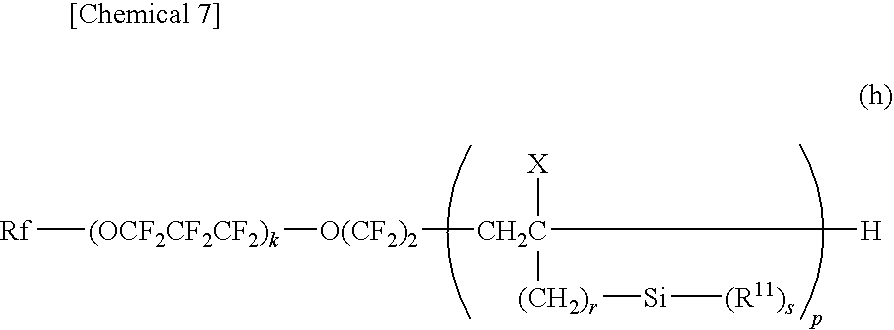
- RF represents a straight chain perfluoroalkyl group having 1 to 16 carbon atoms
- X represents hydrogen or a lower alkyl group having 1 to 5 carbon atoms
- R 11 represents a hydrolyzable group
- k is an integer of 1 to 50
- r is an integer of 0 to 2
- p is an integer of 1 to 10.
- q is an integer of 1 or more.
- the compound represented by unit formula (i) include n-CF 3 CH 2 CH 2 Si (NH 2 ) 3 ; n-trifluoro(1,1,2,2-tetrahydro)propylsilazane, n-C 3 F 7 CH 2 CH 2 Si (NH 2 ) 3 ; n-heptafluoro(1,1,2,2-tetrahydro)pentylsilazane, n-C 4 F 9 CH 2 CH 2 Si (NH 2 ) 3 ; n-nonafluoro(1,1,2,2-tetrahydro)hexylsilazane, n-C 6 F 13 CH 2 CH 2 Si 2 (NH 2 ) 3 ; n-trideofluoro(1,1,2,2-tetrahydro)octylsilazane, and n-C 8 F 17 CH 2 CH 2 Si(NH 2 ) 3 ; n-heptadecafluoro(1,1,2,2-tetrahydro)dec
- the perfluoropolyether not containing silicon preferably employs a compound consisting of a unit having the following structural formula: —(R 12 O)— (j)
- R 12 represents a perfluoroalkylene group having 1 to 3 carbon atoms. The average molecular weight falls within the range of 1,000 to 10,000 and more preferably 2,000 to 10,000.
- R represents a perfluoroalkylene group having 1 to 3 carbon atoms, and its specific examples include groups such as CF 2 , CF 2 —CF 2 , CF 2 CF 2 CF 2 , and CF(CF 2 )CF 2 .
- These perfluoropolyethers are liquid at normal temperature and called fluorine oils.
- the resultant structure is dipped in a dipping material containing a solvent and perfluoropolyether-polysiloxane copolymer modified silane represented by general formula (III) to form the second water-repellent layer, thereby forming a water-repellent film layer 67 made from the two layers.
- a dipping material containing a solvent and perfluoropolyether-polysiloxane copolymer modified silane represented by general formula (III) to form the second water-repellent layer, thereby forming a water-repellent film layer 67 made from the two layers.
- Rf represents a divalent group which includes a unit represented by formula —(C k F 2k O)— (wherein k is an integer of 1 to 6) and has an unbranched straight chain perfluoropolyalkylene ether structure.
- R independently represents a monovalent hydrocarbon group having 1 to 8 carbon atoms.
- X independently represents a hydrolyzable group or halogen atom, n and n′ each represent an integer of 0 to 2, m and m′ each represent an integer of 1 to 5, and a and b each represent 2 or 3.
- R′ represents an organic group and R′′ represents an alkyl group.
- Rg represents a divalent group which includes a repeating unit represented by formula —(C j F 2j O)— (wherein j is an integer of 1 to 5) and has an unbranched straight chain perfluoropolyalkylene ether structure.
- the repeating unit count is 30 to 60. Different j repeating units may be simultaneously included.
- R 1 represents the same or different alkyl groups or phenyl groups having 1 to 4 carbon atoms, w is 30 to 100, and a, b, and c each independently represent an integer of 1 to 5.
- R 2 represents an alkyl group or phenyl group having 1 to 4 carbon atoms, X 1 represents a hydrolyzable group, d is 2 or 3, and y is an integer of 1 to 5.
- the Rf group is a divalent group which includes a unit represented by formula —(C k F 2k O)— (wherein k is an integer of 1 to 6 and preferably 1 to 4, and the sequence of CkF 2k O in general formula (I) is random) and has an unbranched straight chain perfluoropolyalkylene ether structure. Note that when both n and n′ in general formula (I) are zero, the terminal of the Rf group bonded to the oxygen atom (O) in general formula (I) is not an oxygen atom:
- Examples of X as the halogen atom include a chlorine atom, bromine atom, and iodine atom.
- the methoxy group, ethoxy group, isopropenoxy group, and chlorine atom are most preferable.
- n and n′ each represent an integer of 0 to 2 and preferably 1, and may be the same or different
- m and m′ each represent an integer of 1 to 5, preferably 3, and may be the same or different.
- a and b each represent 2 or 3 and preferably 3 in view of hydrolysis, condensation reactivity, and bonding property.
- the molecular weight of the organosilicon compound containing the fluorine-substituted alkyl group represented by general formula (I) is not particularly limited, but its number average molecular weight appropriately falls within the range of 500 to 20,000 and preferably 1,000 to 10,000 in view of stability and handling.
- organosilicon compound containing the fluorine-substituted alkyl group represented by structural formula (I) are as follows, but are not limited to the exemplified compounds.
- the compound represented by general formula (I) can be used singly or in a combination of two or more compounds.
- the organosilicon compound containing the fluorine-substituted alkyl group and its partial hydrolyzed condensate can be combined and used.
- perfluoropolyether-polysiloxane copolymer modified silane represented by general formula (III) can be combined and used with the compound represented by general formula (I).
- the organosilicon compound containing the fluorine-substituted alkyl group represented by general formula (I) is preferably diluted with a solvent.
- a solvent to be used include a fluorine-modified aliphatic hydrocarbon solvent (e.g., perfluoroheptane or perfluorooctane), a fluorine-modified aromatic hydrocarbon solvent (e.g., 1,3-di(trifluoromethyl)benzene or trifluoromethylbenzene), a fluorine-modified ether solvent (e.g., methylperfluorobutyl ether or perfluoro(2-butyltetrahydrofurane), a fluorine-modified alkylamine solvent (e.g., perfluorotributylamine or perfluorotripentylamine), a hydrocarbon solvent (e.g., petroleum benzene, mineral spirits, toluene, or xylene), a ketone
- solvents can be used singly or in a combination of two or more solvents.
- a fluorine-modified solvent is preferable in view of the dissolvability and wettability of modified silane.
- the most preferable solvent include 1,3-di(trifluoromethyl)benzene, perfluoro(2-butyltetrahydrofurane), and perfluorotributylamine.
- silane compound selected from the general formulas (II-1), (II-2), and (II-3) comprises the following: R′—Si(OR′′) 3 General formula (II-1) Si(OR′′) 4 General formula (II-2) SiO(OR′′) 3 Si(OR′′) 3 General formula (II-3)
- R′ represents an organic group.
- R′ include an alkyl group (e.g., a methyl group, ethyl group, or propyl group) having 1 to 50 carbon atoms (preferably 1 to 10 carbon atoms), an epoxyethyl group, a glycidyl group, and an amino group. These groups may be substituted.
- R′′ represents an alkyl group (e.g., a methyl group, ethyl group, or propyl group) having 1 to 48 carbon atoms and is preferably a methyl group or ethyl group.
- silane compounds represented by general formulas (II-1) to (II-3) include structural formulas (C 2 H 5 O) 3 SiC 3 H 6 NH 2 , (CH 3 O) 3 SiC 3 H 6 NH 2 , (C 2 H 5 O) 4 Si, and (C 2 H 5 O) 3 Si—O—Si(OC 2 H 5 ) 3 .
- the silane compound is not limited to the above examples.
- silane compounds represented by general formulas (II-1) to (II-3) can be used singly or in a combination of two or more silane compounds.
- the silane compound preferably contains the compound represented by general formula (II-1) singly or in an amount larger than those of other components.
- the Rg group is a divalent group which includes repeating unit represented by formula —(C j F 2j O)— (wherein j is an integer of 1 to 5 and preferably 1 to 3, and the sequence of C j F 2j O in general formula (III) is random) and has an unbranched straight chain perfuluoropolyalkylene ether structure.
- the repeating unit count is 30 to 60 (preferably 30 to 50). Different j repetition counts may be simultaneously included:
- Rg represents a divalent straight chain perfluoropolyether group and include perfluoropolyether groups having a variety of chain lengths.
- Rg preferably represents a divalent straight chain perfluoropolyether having a perfluoropolyether having about 1 to 5 carbon atoms as the repeating unit.
- this divalent straight chain perfluoropolyether are as follows: —CF 2 CF 2 O(CF 2 CFCF 2 O) k CF 2 CF 2 — —CF 2 (OC 2 F 4 ) p —(OCF 2 ) q — wherein k, p, and q each represent an integer of 1 or more, and k and p+q preferably fall within the range of 30 to 60.
- the perfluoropolyether molecular structure is not limited to the exemplified structures.
- R 1 represents an alkyl group (e.g., a methyl group, ethyl group, propyl group, or butyl group) or phenyl group having 1 to 4 carbon atoms.
- the alkyl groups or phenyl groups may be the same or different.
- w is 30 to 100 and preferably 30 to 60
- a, b, and c each independently represent an integer of 1 to 5 and preferably 1 to 3.
- R 2 represents an alkyl group (e.g., a methyl group, ethyl group, propyl group, or butyl group) or phenyl group having 1 to 4 carbon atoms.
- X 1 represents a hydrolyzable group.
- X 1 include an alkoxy group such as a methoxy group, ethoxy group, propoxy group, or butoxy group; an alkoxyalkoxy group such as a methoxymethoxy group, methoxyethoxy group, or ethoxyethoxy group; alkenyloxy group such as an allyloxy group or isopropenoxy group; an acyloxy group such as an acetoxy group, propionyloxy group, butylcarbonyloxy group, or benzoyloxy group; a ketoxime group such as a dimethylketoxime group, methylethylketoxime group, diethylketoxime group, cyclopentanoxime group, or cyclohexanoxime group; an amino group such as an N-methylamino group, N-ethylamino group, N-propylamino group, N-butylamino group, N,N-
- d is 2 or 3 and preferably 3 in consideration of hydrolysis, condensation reactivity, and film bonding property
- y is an integer of 1 to 5 and preferably 1 to 3.
- the compounds represented by general formula (III) can be used singly or in a combination of two or more compounds.
- the material of the plastic base member used in the present invention is not limited to a specific material.
- the plastic base member include a methyl methacrylate homopolymer, a copolymer formed from methyl methacrylate and at least another monomer, a homopolymer made from diethylene glycol bisallylcarbonate, a copolymer formed from diethylene glycol bis(allyl carbonate) and at least another monomer, a sulfur-containing copolymer, a halogen copolymer, and a polymer using as a material a compound including polycarbonate, polystyrene, polyvinyl chloride, unsaturated polyester, polyethylene terephtalate, polyurethane, polythiourethane, or epithio group.
- Examples of the compound having the epithio group include chain organic compounds such as bis( ⁇ -epithiopropylthio)metane, 1,2-bis( ⁇ -epithiopropylthio)ethane, 1,3-bis( ⁇ -epithiopropylthio)propane, 1-2-( ⁇ -epithiopropylthio)propane, 1-( ⁇ -epithiopropylthio)-2-( ⁇ -epithiopropylthio)propane, 1,4-bis( ⁇ -epithiopropylthio)butane, 1,3-bis( ⁇ -epithiopropylthio)butane, 1-( ⁇ -epithiopropylthio)-3-( ⁇ -epithiopropylthiomethyl)butane, 1,5-bis( ⁇ -epithiopropylthio)pentane, 1-( ⁇ -epithiopropylthio)-4-(
- Examples of the compound having the epithio group also include branched organic compounds and compounds obtained by substituting at least one hydrogen of the episulfide group of each of these compounds with a methyl group.
- Specific examples of the branched organic compounds include tetrakis( ⁇ -epithiopropylthiomethyl)methane, 1,1,1-tris( ⁇ -epithiopropylthiomethyl)propane, 1,5-bis( ⁇ -epithiopropylthio)-2-( ⁇ -epithiopropylthiomethyl)-3-thiapentane, 1,5-bis( ⁇ -epithiopropylthio)-2,4-bis( ⁇ -epithiopropylthiomethyl)-3-thiopentane, 1-( ⁇ -epithiopropylthio)-2,2-bis( ⁇ -epithiopropylthiomethyl)-4-thiahexane, 1,5,6-tris( ⁇ -epithio
- Examples of the compound having the epithio group further include alicyclic organic compounds and compounds obtained by substituting at least one hydrogen of the episulfide group of each of these compounds with a methyl group, and aromatic organic compounds and compounds obtained by substituting at least one hydrogen of the episulfide group of each of these compounds with a methyl group.
- alicyclic organic compound examples include 1,3- and 1,4-bis( ⁇ -epithiopropylthio)cyclohexane, 1,3- and 1,4-bis( ⁇ -epithiopropylthiomethyl)cyclohexane, bis[4-( ⁇ -epithiopropylthio)cyclohexyl]methane, 2,2-bis[4-( ⁇ -epithiopropylthio)cyclohexyl]propane, bis[4-( ⁇ -epithiopropylthio)cyclohexyl]sulfide, 2,5-bis( ⁇ -epithiopropylthiomethyl)-1,4-dithiane, and 2,5-bis( ⁇ -epithiopropylthioethylthiomethyl)-1,4-dithiane.
- aromatic organic compound examples include 1,3- and 1,4-bis( ⁇ -epithiopropylthio)benzene, 1,3- and 1,4-bis( ⁇ -epithiopropylthiomethyl)benzene, bis[4-( ⁇ -epithiopropylthio)phenyl]methane, 2,2-bis[4-( ⁇ -epithiopropylthio)phenyl]propane, bis[4-( ⁇ -epithiopropylthio)phenyl]sulfide, bis[4-( ⁇ -epithiopropylthio)phenyl)sulfone, and 4,4′-bis( ⁇ -epithiopropylthio)biphenyl.
- the lens rotating shaft 4 includes first and second lens rotating shafts 4 A and 4 B arranged horizontally such that their axes coincide with each other, and is disposed in a lens holding unit 15 .
- the lens holding unit 15 has a pair of supports 15 a and 15 b opposing each other in the horizontal direction (X direction) of the apparatus.
- One support 15 a axially, rotatably supports the first lens rotating shaft 4 A, and the other support 15 b axially supports the second lens rotating shaft 4 B to be rotatable and movable in the axial direction.
- a lens holder 16 and lens retainer 17 constituting the lens holding means for the processing target lens 2 are detachably attached to the opposing distal ends of the first and second lens rotating shafts 4 A and 4 B, respectively.
- a lens rotating shaft driving motor 18 is fixed to the other support 15 b of the lens holding unit 15 .
- the rotation of the driving motor 18 is transmitted to the first and second lens rotating shafts 4 A and 4 B through a rotation transmitting means 19 such as a pulley or toothed belt. Therefore, the first and second lens rotating shafts 4 A and 4 B are synchronously driven.
- a reversible pulse motor with a variable rotation speed is used as the lens rotating shaft driving motor 18 .
- a driving motor (not shown) which moves the second lens rotating shaft 4 B forward/backward with respect to the first lens rotating shaft 4 A is built in the other support 15 b of the lens holding unit 15 .
- the first lens rotating shaft moving mechanism 5 includes a pair of front and rear X-axis linear guides 31 , an X-direction table 32 , and an X-direction table driving motor 33 .
- the X-axis linear guides 31 are set on a bottom plate 30 of the housing 3 to be parallel to each other and are long in the X direction.
- the X-direction table 32 is movable in the X direction along the X-axis linear guides 31 .
- the X-direction table driving motor 33 moves the X-direction table 32 along the X-axis linear guides 31 .
- the second lens rotating shaft moving mechanism 6 includes a pair of left and right Y-axis linear guides 35 , a Y-direction table 36 , a Y-direction table driving motor 37 , and the lens holding unit 15 .
- the Y-axis linear guides 35 are set on the upper surface of the X-direction table 32 to be parallel to each other and extend in the Y direction.
- the Y-direction table 36 is movable in the Y direction along the Y-axis linear guides 35 .
- the Y-direction table driving motor 37 moves the Y-direction table 36 along the Y-axis linear guides 35 .
- the lens holding unit 15 is set on the Y-direction table 36 .
- the operation of the lens rotating shaft 4 includes movements in three directions, i.e., rotation about the axis, movement in the horizontal direction (X direction) perpendicular to the axis, and movement in the back-and-forth direction (Y direction).
- the controller numerically controls the movements in the three directions based on the shape processing data on the processing target lens 2 .
- the processing tool 7 As the processing tool 7 which grinds a circumferential surface 2 c of the processing target lens 2 , a grinding stone such as a cylindrical diamond wheel as shown in FIG. 2 is employed and attached to a processing tool rotating shaft 40 of the rotational drive mechanism 8 .
- the processing tool 7 includes a primary processing (rough processing) grinding wheel 7 A and secondary processing (finishing) grinding wheel 7 B.
- a beveling groove 41 formed of an axi-symmetric V-shaped annular groove is formed in the outer circumferential surface of the secondary processing grinding wheel 7 B.
- the rotational drive mechanism 8 of the processing tool 7 includes a frame 44 , the processing tool rotating shaft 40 , an inverter type processing tool driving motor 45 , and a rotation transmitting mechanism 46 such as a pulley or toothed belt.
- the frame 44 is set on the bottom plate 30 of the housing 3 .
- the processing tool rotating shaft 40 is cantilevered at the upper end of the frame 44 .
- the processing tool driving motor 45 rotates the processing tool rotating shaft 40 .
- the rotation transmitting mechanism 46 transmits the rotation of the processing tool driving motor 45 to the processing tool rotating shaft 40 .
- the processing tool rotating shaft 40 is parallel to the lens rotating shaft 4 and located in front of it.
- the lens shape measurement unit 9 includes a pair of left and right measurement elements 50 A and 50 B, a driving motor (not shown), and an arithmetic processing unit (not shown).
- the measurement elements 50 A and 50 B are disposed to oppose each other and trace the optical surfaces 2 a and 2 b of the processing target lens 2 .
- the driving motor moves the measurement elements 50 A and 50 B to be close to and separate from each other.
- the arithmetic processing unit calculates the positions of the optical surfaces 2 a and 2 b and those of the two edges of each of the circumferential surface 2 c and circumferential surfaces 2 d and 2 e , i.e., convex peripheral edges 51 A, 52 A, and 53 A and concave peripheral edges 51 B, 52 B, and 53 B, of the processing target lens 2 from the traces of the measurement elements 50 A and 50 B, and measures shape information on the processing target lens 2 .
- reference numeral 2 c denotes the circumferential surface of the processing target lens 2 before edging; 2 d , the circumferential surface after primary processing; and 2 d , the circumferential surface after secondary processing.
- the chamfering mechanism 10 chamfers the edge portions 53 A and 53 B of the processing target lens 2 after secondary processing, and includes a pair of left and right chamfering tools 60 , a chamfering driving motor 61 , and a rotation transmitting mechanism 62 such as a pulley or belt.
- the chamfering driving motor 61 drives the chamfering tools 60 .
- the rotation transmitting mechanism 62 transmits the rotation of the chamfering driving motor 61 to the chamfering tools 60 .
- grinding tools such as diamond wheels are employed.
- the optician as the order placing side transmits information on a spectacle lens needed by the manufacturer to the lens manufacturer's factory as the manufacturing side in an online manner (step S 1 ).
- the optician sends to the factory various types of information such as the material and prescription values of the lens, the specified processing values of the lens, spectacle frame information, layout information which specifies the eye point position, the bevel mode, the bevel position, and the bevel shape that are necessary for the lens manufacture.
- the spectacle frame information includes 3-dimensional lens frame shape data, approximate curved surface definition data, a frame PD (or DBL), an optical axis angle, and the circumferential length.
- This request for manufacturing the spectacle lens from the optician to the factory is effective particularly when, e.g., requesting the manufacture of a lens having a water-repellent film layer (because primary processing by the optician is difficult if a water-repellent film layer is formed on the lens).
- processing shape data At the factory, upon acquiring various types of information necessary for the manufacture of the spectacle lens from the optician, processing shape data, edged lens shape information, layout information, processing designation information and the like are created based on the acquired information, and input to the edging apparatus 1 (step S 2 ).
- the lens holder 16 includes a metal shaft portion 70 and a holding cup 71 which is integrally molded with the shaft portion 70 and made of an elastic material.
- the holding cup 71 includes a shaft portion 71 A fixed to the shaft portion 70 and a lens holding portion 71 B integrally provided to the distal end face of the shaft portion 71 A.
- the lens holding portion 71 B forms a rectangular plate.
- the front surface of the lens holding portion 71 B forms a lens holding surface 72 .
- the lens holding surface 72 forms a concave surface with a radius of curvature almost equal to that of the convex optical surface 2 a of the lens 2 .
- a leap tape 73 is adhered to the lens holding surface 72 .
- the leap tape 73 may be adhered to the convex optical surface 2 a by urging.
- the lens holder 16 is attached to the processing target lens 2 such that its center O coincides with a processing center position 21 serving as the rotation center of the processing target lens 2 when processing the processing target lens 2 , as shown in FIG. 5A .
- the lens includes a cylinder axis
- the lens holder 16 is attached to the lens by setting the cylinder axis at a predetermined angle.
- the processing center position 21 of the processing target lens 2 coincides with a frame center B of the spectacle frame, or an optical center C of the processing target lens 2 .
- the operator displays two axial deviation measuring marks 81 a and 81 b ( FIGS. 5A to 5C ) on the convex optical surface 2 a of the processing target lens 2 (step S 4 ).
- Two reference position marks 80 a and 80 b are displayed on the lens holder 16 in advance, and the axial deviation measuring marks 81 a and 81 b are displayed to coincide with the marks 80 a and 80 b .
- the reference position marks 80 a and 80 b of the lens holder 16 include two perpendicular straight lines extending through the center O and are displayed on the rear surface of the lens holding portion 71 B.
- the reference position marks 80 a and 80 b are displayed on the lens holder 16 in advance before the processing target lens 2 is held.
- the reference position marks 80 a and 80 b and axial deviation measuring marks 81 a and 81 b may be simultaneously displayed on the lens holder 16 and processing target lens 2 after the processing target lens 2 is held.
- the axial deviation measuring marks 81 a and 81 b of the processing target lens 2 include two perpendicular straight lines extending through the processing center position 21 . After the lens holder 16 holds the lens 2 , the axial deviation measuring marks 81 a and 81 b are displayed using an appropriate ink such that they form straight lines continuous with the reference position marks 80 a and 80 b .
- the marks 81 a and 81 b have different line widths.
- One mark 81 a has a larger line width than that of the other mark 81 b.
- the processing target lens 2 is mounted on the lens rotating shaft 4 (step S 5 ).
- the lens holder 16 which holds the processing target lens 2 is mounted on the first lens rotating shaft 4 A.
- the lens holder 16 can be mounted by fitting the shaft portion 70 in a recess formed in the distal end face of the first lens rotating shaft 4 A.
- the second lens rotating shaft 4 B is moved forward to urge the lens retainer 17 attached to the distal end of the lens rotating shaft against the concave optical surface 2 b of the processing target lens 2 through an elastic member 85 ( FIG. 2 ).
- the lens holder 16 and lens retainer 17 sandwich and hold the processing center positions 21 of the convex and concave optical surfaces 2 a and 2 b of the processing target lens 2 , thus completely mounting the lens on the lens rotating shaft 4 .
- the lens rotating shaft 4 is rotated at a low speed, and the circumferential surface 2 c of the processing target lens 2 undergoes primary processing by the processing tool 7 based on the processing shape data (step S 6 ).
- the primary processing grinding wheel 7 A grinds the circumferential surface 2 c to form the processing target lens 2 into a primary shape.
- the primary shape of the processing target lens 2 obtained by primary processing is either a circle larger than a circle inscribed by the edged lens shape 2 A ( FIGS. 5A to 5C ) that complies with the frame shape of the spectacle frame, or an edged shape similar to the edged lens shape 2 A and larger than it by the processing margin of secondary processing.
- a circle 88 larger than the circle inscribed by the edged lens shape 2 A is a circle having a radius (e.g., 50 mm) equal to or slightly larger than a value obtained by adding the processing margin of secondary processing to a maximum radius R ( FIG. 5B ) of the edged lens shape 2 A.
- step S 7 When primary processing of the processing target lens 2 is ended, the operator removes it from the lens rotating shaft 4 and measures its axial deviation (step S 7 ). Assume that the processing target lens 2 has a water-repellent film layer. If the processing target lens 2 undergoes primary processing while it is held by a lens holding force almost equal to that for a general lens, as the processing resistance is large, axial deviation occurs easily. If secondary processing is performed with the axial deviation uncorrected, the lens becomes defective.
- the lens holder 16 is removed from the first lens rotating shaft 4 A, and whether axial deviation exists or not is checked from the reference position marks 80 a and 80 b and axial deviation measuring marks 81 a and 81 b.
- FIG. 5B shows a case in which, as the result of primary processing, the processing center position 21 axially deviates from the center O of the lens holder 16 by ⁇ X 1 in the X direction and by ⁇ Y 1 in the Y direction and the rotation angle axially deviates counterclockwise by ⁇ 1 with respect to the reference position mark 80 a .
- FIG. 5C shows a case in which the processing center position 21 does not axially deviate with respect to the center O of the lens holder 16 and only the rotation angle axially deviates counterclockwise by ⁇ 2 with respect to the reference position mark 80 a.
- the deviation amounts X 1 and Y 1 in the X and Y directions of the processing center position 21 with respect to the center O of the lens holder 16 , and the rotation angle ⁇ 1 or ⁇ 2 are measured.
- the deviation amounts of the processing center position 21 in the X and Y directions are ⁇ 0.5 mm or more, or if the rotation angle is ⁇ 5° or more, it is determined that the processing center position 21 axially deviates. Otherwise, it is determined that axial deviation does not exist.
- the allowable values of the axial deviation amounts and rotation angle differ depending on the type and dioptric power of the lens. For example, when the target lens is a single-vision lens having a cylinder axis, if the deviation of the rotation angle described above is ⁇ 2° or less, the specifications of the spectacle lens may be satisfied. The tolerance is accordingly selected appropriately.
- This axial deviation measurement is performed by the operator visually, or by known image processing. When image processing is employed, it is advantageous because the deviation amount can be measured more accurately than by visual measurement. Correction of processing shape data by means of image processing will further be described later.
- step S 9 the processing target lens 2 is mounted on the lens rotating shaft 4 again in accordance with the same procedure as in step S 5 described above.
- the secondary shape of the processing target lens 2 by secondary processing is an edged lens shape that complies with the edged lens shape 2 A of the spectacle frame, or an edged lens shape slightly larger than this.
- the edged lens shape slightly larger than that of the spectacle frame is aimed at reserving, based on the order from the optician, a processing margin necessary when the optician performs finishing.
- the secondary shape of the processing target lens by secondary processing is calculated in advance in the same manner as the primary shape and input to the controller as processing shape data.
- This embodiment employs the grinding wheel 7 B having the beveling groove 41 , because it is aimed at the manufacture of a spectacle lens to be mounted on a general rimmed spectacle frame.
- the circumferential surface of the processing target lens 2 may be edged by exchanging the grinding wheel 7 B for a grinding wheel for a rimless spectacle frame or nylol frame.
- the processing target lens 2 is removed from the lens rotating shaft 4 , and its axial deviation is measured (step S 11 ).
- the axial deviation is determined in accordance with whether or not the reference position marks 80 a and 80 b deviate from the axial deviation measuring marks 81 a and 81 b in the same manner as in step S 7 described above.
- the processing target lens 2 which has undergone primary processing and thus has a small diameter is to be processed. Therefore, even if the lens has a low processing resistance and is formed with a water-repellent film layer, axial deviation rarely occurs, or can be suppressed within the predetermined allowable value range. Thus, highly accurate processing can be performed.
- the operator visually confirms that the axial deviation measuring marks 81 a and 81 b do not deviate from the reference position marks 80 a and 80 b , it can guarantee that the processing target lens 2 is free from axial deviation.
- chamfering is performed (step S 12 ).
- Chamfering is performed by rotating the processing target lens 2 together with the lens rotating shaft 4 and urging the chamfering tools 60 against the edge portions 53 A and 53 B of the circumferential surface 2 e .
- the chamfering trace data of the chamfering tools 60 which are used as the control data of the chamfering tools 60 during chamfering are calculated based on position data of the edge portions 53 A and 53 B of the circumferential surface 2 e of the processing target lens 2 which are calculated after secondary processing.
- the processing target lens 2 is removed from the lens rotating shaft 4 , and optical performance and appearance test is performed (step S 13 ).
- a processing target lens 2 determined as an acceptable product is packaged as a spectacle lens and delivered to the optician who placed the order (step S 14 ).
- the optician Upon reception of the spectacle lens from the factory, the optician tests its optical performance and appearance. When the optician determines that the spectacle lens is appropriate, if the spectacle lens has an edged lens shape complying with the frame shape of the spectacle frame selected by the user, the optician fits the lens in the spectacle frame and delivers the spectacle frame to the user. If the spectacle lens has an edged lens shape slightly larger than the frame shape of the spectacle frame, the optician finishes the lens so as to comply with the frame shape of the spectacle lens and fits it in the spectacle frame, and delivers the spectacle frame to the user. In finishing by the optician, since the shape of the lens itself is small and accordingly the processing resistance is low, even if the lens is formed with a water-repellent film layer, the lens rarely deviates axially.
- the step of correcting the axial deviation of the processing target lens includes the axial deviation measuring step of removing the processing target lens from the lens rotating shaft together with the lens holding means after primary processing and measuring the axial deviation of the processing target lens from the reference position mark and the axial deviation measuring mark, the axial deviation correcting step of correcting the axial deviation of the processing target lens which is measured by the axial deviation measuring step by holding one optical surface of the processing target lens with the lens holding means again such that the axial deviation measuring mark coincides with the reference position mark, and the step of mounting the lens holding means on the lens rotating shaft again together with the processing target lens.
- the lens can be processed without causing axial deviation, in the same manner as a general lens.
- this embodiment allows axial deviation of the processing target lens 2 in primary processing. If the processing target lens 2 axially deviates due to primary processing, the amount and direction of the axial deviation are measured, and the axial deviation is corrected by holding the processing target lens 2 again by the lens holder 16 .
- the axial deviation of the processing target lens 2 is corrected in this manner in secondary processing, since the shape of the lens itself in secondary processing is small, even when the lens has a water-repellent film layer, the axial deviation amount can be suppressed within the allowable value range without holding the lens with a particularly large lens holding force.
- the processing target lens 2 is a highly lubricant lens or an uncut lens having a large diameter in primary processing, no particular axial deviation preventive countermeasure is needed in the primary processing step.
- Such a lens can be processed highly accurately without causing axial deviation in the same manner as a general lens, even if the lens is not held with a particularly large lens holding force.
- FIG. 8 is a flowchart showing another embodiment of the present invention.
- This embodiment is different from the embodiment described above in terms of how axial deviation is corrected. More specifically, according to the measurement and correction of axial deviation in this embodiment (step S 27 ), axial deviation is measured by image processing, and the processing shape data itself of an edging apparatus 1 is corrected.
- a line sensor 90 When measuring axial deviation by image processing, a line sensor 90 is arranged on a straight line extending through a center O of a lens holder 16 , as shown in FIG. 9 . At least two reference position marks 80 a and 80 b and axial deviation measuring marks 81 a and 81 b having different line widths are displayed on the lens holder 16 and a processing target lens 2 in advance to coincide with each other. When the marks 80 a and 80 b and 81 a and 81 b have different line widths, the layout of the optical center (C) on the processing target lens 2 in the mounted state can be discriminated in the vertical and horizontal directions and the like.
- the processing target lens 2 is removed from a lens rotating shaft 4 together with the lens holder 16 , and the line sensor 90 obtains the images of the reference position marks 80 a and 80 b and axial deviation measuring marks 81 a and 81 b .
- the coordinate values of the reference position marks 80 a and 80 b and axial deviation measuring marks 81 a and 81 b are read by rotating the processing target lens 2 in the direction of the arrow. If the marks deviate, the deviation amounts are calculated; if do not, the processing target lens 2 is mounted on the lens rotating shaft 4 again and undergoes secondary processing.
- the reference position is determined on the center O of the lens holder 16 of a case in which the marks do not deviate.
- the reference position is determined on a position where straight lines extending from the two reference position marks 80 a and 80 b of the lens holder 16 intersect.
- the coordinate values of a point 21 ′ where the straight lines extending from the axial deviation measuring marks 81 a and 81 b on the processing target lens 2 intersect are calculated, and the processing center position on the processing target lens 2 resulted from the axial deviation is specified (to be referred to as the processing center position 21 ′ hereinafter).
- the distance and direction to the processing center position 21 ′ with reference to the center O of the lens holder 16 are calculated and determined as a correction value A (X, Y).
- the processing center position of the edging apparatus 1 expressed by the correction value A is determined as the processing center 21 ′ on the processing target lens 2 deviating from the center O of the lens holder 16 .
- angles formed by the respective axial deviation measuring marks 81 a and 81 b and reference position marks 80 a and 80 b are calculated and determined as a correction value B.
- the processing center of the processing shape data is corrected based on the correction value A and correction value B, and secondary processing is performed.
- Steps S 21 to S 26 and steps S 28 to S 33 are completely the same as steps S 1 to S 6 and steps S 9 to S 14 shown in FIG. 7 , and a repetitive description thereof will be omitted.
- the step of correcting the axial deviation of the processing target lens comprises the step of removing the processing target lens from the lens rotating shaft together with the lens holding means after primary processing, measuring the axial deviation of the processing target lens from the reference position mark and the axial deviation measuring mark, and correcting the processing shape data.
- the processing target lens is processed based on the processing shape data corrected by the processing shape data correcting step. That is, the processing shape data itself is corrected in accordance with the measured axial deviation amount and its direction. Therefore, even when the processing target lens axially deviates from the lens holding means, the lens need not be removed from the lens holding means and held again by it, and can undergo secondary processing in the axially deviating state. As a result, the step of holding the lens again by the lens holding means to correct axial deviation is not needed, and the time needed for lens edging can be shortened.
- the primary shape of the processing target lens processed by the primary processing step is either one of a circle larger than a circle inscribed by the edged lens shape that complies with the frame shape of the spectacle frame and an edged shape similar to this edged lens shape and larger than this.
- the secondary shape of the processing target lens processed by the secondary processing step is either one of an edged lens shape that complies with the frame shape of the spectacle frame and an edged lens shape slightly larger than that.
- the axial deviation measuring step can be performed by either one of image processing and visual measurement.
- the reference position mark can be displayed either before holding the processing target lens or simultaneously with displaying the axial deviation measuring mark on the unprocessed lens.
- the processing target lens is delivered to the optician after it undergoes secondary processing into an edged lens shape complying with the frame shape of the spectacle frame selected by the user, or into an edged lens shape slightly larger than the frame shape.
- a processing target lens having a primary shape, which has undergone only primary processing may be delivered. In this case, if the lens has axial deviation, the optician is informed of the axial deviation amount and its direction in addition to the processing center position 21 ′.
- the optician finishes the processing target lens into a shape complying with the frame shape of the spectacle frame by holding the processing center position 21 , and fits the processed lens into the spectacle frame, thus completing a spectacle.
- the edging method according to the present invention is usefully employed in edging a spectacle lens.
Landscapes
- Engineering & Computer Science (AREA)
- Mechanical Engineering (AREA)
- Chemical & Material Sciences (AREA)
- Ceramic Engineering (AREA)
- Inorganic Chemistry (AREA)
- Eyeglasses (AREA)
- Grinding And Polishing Of Tertiary Curved Surfaces And Surfaces With Complex Shapes (AREA)
Abstract
Description


CX9X10═CX11X12 (g)
| First layer | 0.005 λ to 1.25 λ | 1.41 to 1.50 | ||
| Second layer | 0.005 λ to 0.10 λ | 2.00 to 2.35 | ||
| Third layer | 0.005 λ to 1.25 λ | 1.41 to 1.50 | ||
| Fourth layer | 0.05 λ to 0.45 λ | 2.00 to 2.35 | ||
| Fifth layer | 0.005 λ to 0.15 λ | 1.41 to 1.50 | ||
| Sixth layer | 0.05 λ to 0.45 λ | 2.00 to 2.35 | ||
| Seventh layer | 0.2 λ to 0.29 λ | 1.41 to 1.50 | ||
CqF2 q+1CH2CH2Si(NH2)3 (i)
—(R12O)— (j)
In formula (j), R12 represents a perfluoroalkylene group having 1 to 3 carbon atoms. The average molecular weight falls within the range of 1,000 to 10,000 and more preferably 2,000 to 10,000. R represents a perfluoroalkylene group having 1 to 3 carbon atoms, and its specific examples include groups such as CF2, CF2—CF2, CF2CF2CF2, and CF(CF2)CF2. These perfluoropolyethers are liquid at normal temperature and called fluorine oils.

R′—Si(OR″)3 General formula (II-1)
Si(OR″)4 General formula (II-2)
SiO(OR″)3Si(OR″)3 General formula (II-3)

—CF2CF2O(CF2CF2CF2O)rCF2CF2—
—CF2(OC2F4)s—(OCF2)t—
wherein r, s, and t each represent an integer of 1 or more. More specifically, r, s, and t each fall within the range of 1 to 50 and more preferably 10 to 40. Note the perfluoropolyether molecular structure is not limited to the exemplified structures.
(CH3O)3SiCH2CH2CH2OCH2CF2CF2O(CF2CF2CF2O)1CF2CF2CH2OCH2CH2—CHSi(OCH3)3
(CH3O)2CH3SiCH2CH2CH2OCH2CF2CF2O(CF2CF2CF2O)1CF2CF2CH2OCH2CH2—CH2SiCH3(OCH3)2(CH3O)3SiCH2CH2CH2OCH2CF2(OC2F4)p(OCF2)qOCF2—CH2OCH2CH2CH2Si(OCH3)3
(CH3O)2CH3SiCH2CH2CH2OCH2CH2CF2(OC2F4)p(OCF2)qOCF2CH2OCH2CH2—CH2SiCH3(OCH3)2
(CH3O)3SiCH2CH2CH2OCH2CH2CF2(OC2F4)p(OCF2)qOCF2CH2CH2OCH2CH2—CH2Si(OCH3)3
(C2H5O)3SiCH2CH2CH2OCH2CH2CF2(OC2F4)p(OCF2)qOCF2CH2OCH2CH2CH2—Si(OC2H5)3
R′—Si(OR″)3 General formula (II-1)
Si(OR″)4 General formula (II-2)
SiO(OR″)3Si(OR″)3 General formula (II-3)

—CF2CF2O(CF2CFCF2O)kCF2CF2—
—CF2(OC2F4)p—(OCF2)q—
wherein k, p, and q each represent an integer of 1 or more, and k and p+q preferably fall within the range of 30 to 60. Note the perfluoropolyether molecular structure is not limited to the exemplified structures.
Claims (4)
Applications Claiming Priority (3)
| Application Number | Priority Date | Filing Date | Title |
|---|---|---|---|
| JP2007-069047 | 2007-03-16 | ||
| JP2007069047 | 2007-03-16 | ||
| PCT/JP2008/054914 WO2008114781A1 (en) | 2007-03-16 | 2008-03-17 | Method for edging lens of glasses |
Publications (2)
| Publication Number | Publication Date |
|---|---|
| US20100105293A1 US20100105293A1 (en) | 2010-04-29 |
| US8216024B2 true US8216024B2 (en) | 2012-07-10 |
Family
ID=39765888
Family Applications (1)
| Application Number | Title | Priority Date | Filing Date |
|---|---|---|---|
| US12/531,487 Expired - Fee Related US8216024B2 (en) | 2007-03-16 | 2008-03-17 | Spectacle lens edging method |
Country Status (4)
| Country | Link |
|---|---|
| US (1) | US8216024B2 (en) |
| EP (1) | EP2138269A4 (en) |
| JP (1) | JP4988823B2 (en) |
| WO (1) | WO2008114781A1 (en) |
Cited By (1)
| Publication number | Priority date | Publication date | Assignee | Title |
|---|---|---|---|---|
| US20140302749A1 (en) * | 2011-12-08 | 2014-10-09 | Hoya Corporation | Edging system of spectacle lens, method for manufacturing spectacle lens, and lens edger |
Families Citing this family (11)
| Publication number | Priority date | Publication date | Assignee | Title |
|---|---|---|---|---|
| EP1762337A4 (en) * | 2004-06-30 | 2009-11-25 | Hoya Corp | Method of manufacturing spectacle lens |
| WO2010001662A1 (en) * | 2008-07-02 | 2010-01-07 | 東海光学 株式会社 | Method of producing precursor lens for globular lens |
| JP5302029B2 (en) * | 2009-02-04 | 2013-10-02 | 株式会社ニデック | Eyeglass lens processing equipment |
| JP5469476B2 (en) * | 2010-02-15 | 2014-04-16 | 株式会社ニデック | Eyeglass lens processing equipment |
| JP5578549B2 (en) * | 2010-03-31 | 2014-08-27 | 株式会社ニデック | Eyeglass lens processing equipment |
| KR101394231B1 (en) * | 2012-09-27 | 2014-05-15 | 주식회사 휴비츠 | Method for processing eyeglass lens |
| JP2014233788A (en) * | 2013-05-31 | 2014-12-15 | 株式会社ニデック | Spectacle lens processing device and spectacle lens vertical direction detection program |
| KR101778504B1 (en) * | 2015-02-23 | 2017-09-14 | 주식회사 휴비츠 | Method of automatic calibration the lens processing machine |
| DE102018204948A1 (en) * | 2018-03-29 | 2019-10-02 | Rodenstock Gmbh | Method for fixing a raw-edged finished spectacle lens and device therefor |
| CN113352181A (en) * | 2021-06-22 | 2021-09-07 | 超丰微纳科技(宁波)有限公司 | Technology for eliminating pits of photosensitive resin lens |
| DE102023204686A1 (en) * | 2023-05-19 | 2024-11-21 | Rodenstock Gmbh | Method and device for processing at least one spectacle lens |
Citations (16)
| Publication number | Priority date | Publication date | Assignee | Title |
|---|---|---|---|---|
| US5347762A (en) * | 1992-02-04 | 1994-09-20 | Nidek Co., Ltd. | Lens periphery processing apparatus, method for obtaining processing data, and lens periphery processing method |
| JPH11333685A (en) | 1998-05-29 | 1999-12-07 | Nidek Co Ltd | Spectacle lens machining device |
| JPH11333684A (en) | 1998-05-29 | 1999-12-07 | Nidek Co Ltd | Spectacle lens machining device |
| JP2000015549A (en) | 1998-06-30 | 2000-01-18 | Nidek Co Ltd | Spectacle lens machining device |
| JP2002182011A (en) | 2000-12-12 | 2002-06-26 | Asahi Optical Co Ltd | Lens manufacturing method |
| JP2003300138A (en) | 2002-04-08 | 2003-10-21 | Hoya Corp | Method and device for processing lens, and spectacle lens |
| US20030220056A1 (en) * | 2002-04-08 | 2003-11-27 | Hoya Corporation | Apparatus for processing a lens |
| US20030227690A1 (en) * | 2002-04-08 | 2003-12-11 | Hoya Corporation | Method for deciding a bevel curve, method for determining a locus of a bevel, method for processing a lens and apparatus for processing a lens |
| JP2004122238A (en) | 2002-08-05 | 2004-04-22 | Sola Optical Japan Kk | Shaft slippage preventing kit for use in shaping lens for glasses and lens shaping method for glasses using the same |
| JP2004122302A (en) | 2002-10-03 | 2004-04-22 | Vision Megane:Kk | Processing method for lens |
| JP2004276221A (en) | 2003-03-19 | 2004-10-07 | Nidek Co Ltd | Spectacle lens machining device |
| JP2006239782A (en) | 2005-02-28 | 2006-09-14 | Nidek Co Ltd | Spectacle lens machining device |
| JP2006305702A (en) | 2005-04-28 | 2006-11-09 | Nidek Co Ltd | Spectacle lens periphery machining device |
| JP2006330677A (en) | 2005-04-27 | 2006-12-07 | Hoya Corp | Eyeglass lens cutting method and eyeglass lens |
| JP2006334701A (en) | 2005-05-31 | 2006-12-14 | Nidek Co Ltd | Spectacle lens machining device |
| US20100112915A1 (en) * | 2007-03-26 | 2010-05-06 | Satoshi Annaka | Lens holder |
Family Cites Families (1)
| Publication number | Priority date | Publication date | Assignee | Title |
|---|---|---|---|---|
| FR2889319B1 (en) * | 2005-07-26 | 2007-08-24 | Essilor Int | METHOD OF DISTRACTING AN OPHTHALMIC LENS WITH REACQUISITION OF AN INITIAL CENTERING REFERENTIAL |
-
2008
- 2008-03-17 JP JP2009505218A patent/JP4988823B2/en not_active Expired - Fee Related
- 2008-03-17 EP EP08722308.7A patent/EP2138269A4/en not_active Withdrawn
- 2008-03-17 WO PCT/JP2008/054914 patent/WO2008114781A1/en not_active Ceased
- 2008-03-17 US US12/531,487 patent/US8216024B2/en not_active Expired - Fee Related
Patent Citations (17)
| Publication number | Priority date | Publication date | Assignee | Title |
|---|---|---|---|---|
| US5347762A (en) * | 1992-02-04 | 1994-09-20 | Nidek Co., Ltd. | Lens periphery processing apparatus, method for obtaining processing data, and lens periphery processing method |
| USRE35898E (en) * | 1992-02-04 | 1998-09-15 | Nidek Co., Ltd. | Lens periphery processing apparatus, method for obtaining processing data, and lens periphery processing method |
| JPH11333685A (en) | 1998-05-29 | 1999-12-07 | Nidek Co Ltd | Spectacle lens machining device |
| JPH11333684A (en) | 1998-05-29 | 1999-12-07 | Nidek Co Ltd | Spectacle lens machining device |
| JP2000015549A (en) | 1998-06-30 | 2000-01-18 | Nidek Co Ltd | Spectacle lens machining device |
| JP2002182011A (en) | 2000-12-12 | 2002-06-26 | Asahi Optical Co Ltd | Lens manufacturing method |
| US20030227690A1 (en) * | 2002-04-08 | 2003-12-11 | Hoya Corporation | Method for deciding a bevel curve, method for determining a locus of a bevel, method for processing a lens and apparatus for processing a lens |
| US20030220056A1 (en) * | 2002-04-08 | 2003-11-27 | Hoya Corporation | Apparatus for processing a lens |
| JP2003300138A (en) | 2002-04-08 | 2003-10-21 | Hoya Corp | Method and device for processing lens, and spectacle lens |
| JP2004122238A (en) | 2002-08-05 | 2004-04-22 | Sola Optical Japan Kk | Shaft slippage preventing kit for use in shaping lens for glasses and lens shaping method for glasses using the same |
| JP2004122302A (en) | 2002-10-03 | 2004-04-22 | Vision Megane:Kk | Processing method for lens |
| JP2004276221A (en) | 2003-03-19 | 2004-10-07 | Nidek Co Ltd | Spectacle lens machining device |
| JP2006239782A (en) | 2005-02-28 | 2006-09-14 | Nidek Co Ltd | Spectacle lens machining device |
| JP2006330677A (en) | 2005-04-27 | 2006-12-07 | Hoya Corp | Eyeglass lens cutting method and eyeglass lens |
| JP2006305702A (en) | 2005-04-28 | 2006-11-09 | Nidek Co Ltd | Spectacle lens periphery machining device |
| JP2006334701A (en) | 2005-05-31 | 2006-12-14 | Nidek Co Ltd | Spectacle lens machining device |
| US20100112915A1 (en) * | 2007-03-26 | 2010-05-06 | Satoshi Annaka | Lens holder |
Cited By (2)
| Publication number | Priority date | Publication date | Assignee | Title |
|---|---|---|---|---|
| US20140302749A1 (en) * | 2011-12-08 | 2014-10-09 | Hoya Corporation | Edging system of spectacle lens, method for manufacturing spectacle lens, and lens edger |
| US9205526B2 (en) * | 2011-12-08 | 2015-12-08 | Hoya Corporation | Edging system of spectacle lens, method for manufacturing spectacle lens, and lens edger |
Also Published As
| Publication number | Publication date |
|---|---|
| WO2008114781A1 (en) | 2008-09-25 |
| JPWO2008114781A1 (en) | 2010-07-08 |
| EP2138269A1 (en) | 2009-12-30 |
| US20100105293A1 (en) | 2010-04-29 |
| JP4988823B2 (en) | 2012-08-01 |
| EP2138269A4 (en) | 2013-09-18 |
Similar Documents
| Publication | Publication Date | Title |
|---|---|---|
| US20100105293A1 (en) | Spectacle lens edging method | |
| EP2140971B1 (en) | Lens holder | |
| US11061171B2 (en) | Method for improving the edging of an optical article by providing a temporary layer of an organic matter | |
| US9481602B2 (en) | Method for preparing the surface of a lens including an anti-soiling coating for edging the same | |
| JP7210285B2 (en) | Composition for forming hard coat layer, spectacle lens | |
| US8950861B2 (en) | Eyeglass lens and method of manufacturing the same | |
| JP6257897B2 (en) | Optical article and manufacturing method thereof | |
| JP4220232B2 (en) | Optical member having antireflection film | |
| JP5302029B2 (en) | Eyeglass lens processing equipment | |
| CN104871073B (en) | Edgeable ophthalmic lens comprising a hydrophobic bilayer and a temporary metal fluoride layer | |
| US20150361279A1 (en) | Method for the Production of an Optical Article with Improved Anti-Fouling Properties | |
| US20180231689A1 (en) | Item Having Optimized Adhesive Properties and Comprising a Silicon Organic Layer | |
| US20210001579A1 (en) | Method for manufacturing spectacle lenses according to a prescription | |
| JP6788617B2 (en) | Eyeglass lenses | |
| JP2008152085A (en) | Spectacle lens manufacturing method, spectacle lens film forming apparatus, and spectacle lens | |
| US10732324B2 (en) | Method for laminating an interference coating comprising an organic/inorganic layer, and item thus obtained | |
| US10754069B2 (en) | Ophthalmic lens having different anti-fouling properties on each of the two surfaces thereof and manufacturing methods | |
| JP5192164B2 (en) | Lens holder | |
| JP4654233B2 (en) | Optical member having antireflection film | |
| JP4593949B2 (en) | Manufacturing method of optical member | |
| KR20140131685A (en) | Method and apparatus for processing eyeglass lens |
Legal Events
| Date | Code | Title | Description |
|---|---|---|---|
| AS | Assignment |
Owner name: HOYA CORPORATION,JAPAN Free format text: ASSIGNMENT OF ASSIGNORS INTEREST;ASSIGNORS:HAMANAKA, AKIRA;DAIMARU, TAKASHI;TERAI, RYO;REEL/FRAME:023241/0909 Effective date: 20090828 Owner name: HOYA CORPORATION, JAPAN Free format text: ASSIGNMENT OF ASSIGNORS INTEREST;ASSIGNORS:HAMANAKA, AKIRA;DAIMARU, TAKASHI;TERAI, RYO;REEL/FRAME:023241/0909 Effective date: 20090828 |
|
| STCF | Information on status: patent grant |
Free format text: PATENTED CASE |
|
| FEPP | Fee payment procedure |
Free format text: PAYOR NUMBER ASSIGNED (ORIGINAL EVENT CODE: ASPN); ENTITY STATUS OF PATENT OWNER: LARGE ENTITY |
|
| FPAY | Fee payment |
Year of fee payment: 4 |
|
| FEPP | Fee payment procedure |
Free format text: MAINTENANCE FEE REMINDER MAILED (ORIGINAL EVENT CODE: REM.); ENTITY STATUS OF PATENT OWNER: LARGE ENTITY |
|
| LAPS | Lapse for failure to pay maintenance fees |
Free format text: PATENT EXPIRED FOR FAILURE TO PAY MAINTENANCE FEES (ORIGINAL EVENT CODE: EXP.); ENTITY STATUS OF PATENT OWNER: LARGE ENTITY |
|
| STCH | Information on status: patent discontinuation |
Free format text: PATENT EXPIRED DUE TO NONPAYMENT OF MAINTENANCE FEES UNDER 37 CFR 1.362 |
|
| FP | Lapsed due to failure to pay maintenance fee |
Effective date: 20200710 |