US8173142B2 - Pharmaceutical compositions of drugs and neutralized acidic polymers - Google Patents
Pharmaceutical compositions of drugs and neutralized acidic polymers Download PDFInfo
- Publication number
- US8173142B2 US8173142B2 US11/422,133 US42213306A US8173142B2 US 8173142 B2 US8173142 B2 US 8173142B2 US 42213306 A US42213306 A US 42213306A US 8173142 B2 US8173142 B2 US 8173142B2
- Authority
- US
- United States
- Prior art keywords
- phenyl
- amino
- methyl
- trifluoro
- propanol
- Prior art date
- Legal status (The legal status is an assumption and is not a legal conclusion. Google has not performed a legal analysis and makes no representation as to the accuracy of the status listed.)
- Expired - Fee Related, expires
Links
- 0 C*c1c(**)c(**)nc(C)c1C Chemical compound C*c1c(**)c(**)nc(C)c1C 0.000 description 16
- VQQOPAXNKUTKSM-UHFFFAOYSA-N CC(=O)N(C)C1CC(C)N(C)C2=C(C)C(C)=C(C)C(C)=C21 Chemical compound CC(=O)N(C)C1CC(C)N(C)C2=C(C)C(C)=C(C)C(C)=C21 VQQOPAXNKUTKSM-UHFFFAOYSA-N 0.000 description 4
- CTSKOPYGCJEHFL-UHFFFAOYSA-N CC.CC.FC(F)(F)C1=CC2=C(C=CC=C2)O1.FC1(F)OC2=C(C=CC=C2)O1 Chemical compound CC.CC.FC(F)(F)C1=CC2=C(C=CC=C2)O1.FC1(F)OC2=C(C=CC=C2)O1 CTSKOPYGCJEHFL-UHFFFAOYSA-N 0.000 description 3
- LFURNOQUNVHWHY-UHFFFAOYSA-N CC1=NC(C)=C(C)C(C)=C1C Chemical compound CC1=NC(C)=C(C)C(C)=C1C LFURNOQUNVHWHY-UHFFFAOYSA-N 0.000 description 3
- XRVWXZIFENSBCC-UHFFFAOYSA-N C.C1CCC2CCCCC2C1.CC.CC1(C)CC1.CCC.CCCCC.O=C1CCCCC1 Chemical compound C.C1CCC2CCCCC2C1.CC.CC1(C)CC1.CCC.CCCCC.O=C1CCCCC1 XRVWXZIFENSBCC-UHFFFAOYSA-N 0.000 description 2
- CRSOQBOWXPBRES-UHFFFAOYSA-N CC(C)(C)C Chemical compound CC(C)(C)C CRSOQBOWXPBRES-UHFFFAOYSA-N 0.000 description 2
- IJDNQMDRQITEOD-UHFFFAOYSA-N CCCC Chemical compound CCCC IJDNQMDRQITEOD-UHFFFAOYSA-N 0.000 description 2
- NNPPMTNAJDCUHE-UHFFFAOYSA-N [H]C(C)(C)C Chemical compound [H]C(C)(C)C NNPPMTNAJDCUHE-UHFFFAOYSA-N 0.000 description 2
- LIKUQZSILKZAHB-UHFFFAOYSA-N C#CC.[H]C(C)=NO Chemical compound C#CC.[H]C(C)=NO LIKUQZSILKZAHB-UHFFFAOYSA-N 0.000 description 1
- WKJTZVPIVGWPLC-UHFFFAOYSA-N C.C.C.C.C.CC(C)(C)C.CCC.CCCCC Chemical compound C.C.C.C.C.CC(C)(C)C.CCC.CCCCC WKJTZVPIVGWPLC-UHFFFAOYSA-N 0.000 description 1
- TWRVSWCEBJWGDE-UHFFFAOYSA-N C.C.CC(C)(C)C.CCC.CCCC Chemical compound C.C.CC(C)(C)C.CCC.CCCC TWRVSWCEBJWGDE-UHFFFAOYSA-N 0.000 description 1
- XJMVLALARUYOEA-UHFFFAOYSA-N C.C.CC(C)(C)C.CCC.CCCCC Chemical compound C.C.CC(C)(C)C.CCC.CCCCC XJMVLALARUYOEA-UHFFFAOYSA-N 0.000 description 1
- XOPRSTWOGUTQQP-UHFFFAOYSA-N C.C.CC(C)(C)C.CCOCC Chemical compound C.C.CC(C)(C)C.CCOCC XOPRSTWOGUTQQP-UHFFFAOYSA-N 0.000 description 1
- UCWCPASKUVMORE-UHFFFAOYSA-N C.C.CC.CC(C)(C)C Chemical compound C.C.CC.CC(C)(C)C UCWCPASKUVMORE-UHFFFAOYSA-N 0.000 description 1
- FSLRINZOYWVNCH-UHFFFAOYSA-M C.C1CCC2CCCCC2C1.CC.CC1(C)CC1.CCC.C[IH][V][W]C1[W][V]I1[Y][V]I.O=C1CCCCC1 Chemical compound C.C1CCC2CCCCC2C1.CC.CC1(C)CC1.CCC.C[IH][V][W]C1[W][V]I1[Y][V]I.O=C1CCCCC1 FSLRINZOYWVNCH-UHFFFAOYSA-M 0.000 description 1
- BGXUMYNPOOAOHC-UHFFFAOYSA-N C.CC1=C(C)C(C)=C(C)C(C)=C1C.CC1C(C)C(C)C(C)C(C)C(C)C(C)C1C Chemical compound C.CC1=C(C)C(C)=C(C)C(C)=C1C.CC1C(C)C(C)C(C)C(C)C(C)C(C)C1C BGXUMYNPOOAOHC-UHFFFAOYSA-N 0.000 description 1
- GYCMBHHDWRMZGG-UHFFFAOYSA-N C=C(C)C#N Chemical compound C=C(C)C#N GYCMBHHDWRMZGG-UHFFFAOYSA-N 0.000 description 1
- ITKBWZPRAFZVNW-UHFFFAOYSA-N C=C(C)SC Chemical compound C=C(C)SC ITKBWZPRAFZVNW-UHFFFAOYSA-N 0.000 description 1
- QYFMYMIHRAQDQY-UHFFFAOYSA-N CC(=O)C(N)=S.CC(N)=S.CCSC(=O)N(C)C Chemical compound CC(=O)C(N)=S.CC(N)=S.CCSC(=O)N(C)C QYFMYMIHRAQDQY-UHFFFAOYSA-N 0.000 description 1
- CHDWBBIHQOAERM-UHFFFAOYSA-N CC(=O)P(C)(C)=O Chemical compound CC(=O)P(C)(C)=O CHDWBBIHQOAERM-UHFFFAOYSA-N 0.000 description 1
- CSCPPACGZOOCGX-UHFFFAOYSA-N CC(C)=O Chemical compound CC(C)=O CSCPPACGZOOCGX-UHFFFAOYSA-N 0.000 description 1
- CNVCXNZVXKLABV-UHFFFAOYSA-N CC.CC.CC1=CC2=C(/C=C\C=C/2)O1.FC1(F)OC2=C(C=CC=C2)O1 Chemical compound CC.CC.CC1=CC2=C(/C=C\C=C/2)O1.FC1(F)OC2=C(C=CC=C2)O1 CNVCXNZVXKLABV-UHFFFAOYSA-N 0.000 description 1
- JXSPSYQRVPVERF-UHFFFAOYSA-N CC.CC.CC1=CC=CC2=C1C(C)=C(C)C(C)=N2 Chemical compound CC.CC.CC1=CC=CC2=C1C(C)=C(C)C(C)=N2 JXSPSYQRVPVERF-UHFFFAOYSA-N 0.000 description 1
- IZKSWOCHQNAKQJ-UHFFFAOYSA-N CC1=C(C)C(C)=C(C(C)C)C(C)=C1C.CC1=C(C)C(C)=C(C(C)C)C(C)=C1C Chemical compound CC1=C(C)C(C)=C(C(C)C)C(C)=C1C.CC1=C(C)C(C)=C(C(C)C)C(C)=C1C IZKSWOCHQNAKQJ-UHFFFAOYSA-N 0.000 description 1
- WLCONZLCZCAEFJ-UHFFFAOYSA-N CC1=C(C)C(C)=C2C(=C1C)C(N(C)C)CC(C)N2C Chemical compound CC1=C(C)C(C)=C2C(=C1C)C(N(C)C)CC(C)N2C WLCONZLCZCAEFJ-UHFFFAOYSA-N 0.000 description 1
- BEZDDPMMPIDMGJ-UHFFFAOYSA-N CC1=CC(C)=C(C)C(C)=C1C Chemical compound CC1=CC(C)=C(C)C(C)=C1C BEZDDPMMPIDMGJ-UHFFFAOYSA-N 0.000 description 1
- OLHTUBJRPJSFJU-UHFFFAOYSA-N CC1=CCC2(CC1)OCCO2 Chemical compound CC1=CCC2(CC1)OCCO2 OLHTUBJRPJSFJU-UHFFFAOYSA-N 0.000 description 1
- LPZFPHRTKOOKLX-UHFFFAOYSA-N CC1=NN=C(C)N1C Chemical compound CC1=NN=C(C)N1C LPZFPHRTKOOKLX-UHFFFAOYSA-N 0.000 description 1
- VQCUZYIJPPLCNK-UHFFFAOYSA-N CC=O.CCC Chemical compound CC=O.CCC VQCUZYIJPPLCNK-UHFFFAOYSA-N 0.000 description 1
- FQKMVDXMTKTWIL-UHFFFAOYSA-N CCC(C)(C)C(C)N(C(C)C)C(C)C Chemical compound CCC(C)(C)C(C)N(C(C)C)C(C)C FQKMVDXMTKTWIL-UHFFFAOYSA-N 0.000 description 1
- KWLUWDZILZSUTF-UHFFFAOYSA-N CCC(C)(C)C(C)N(C(C)C1=C(C)C(C)=C(C)C(C)=C1C)C(C)C1=C(C)C(C)=C(C)C(C)=C1C Chemical compound CCC(C)(C)C(C)N(C(C)C1=C(C)C(C)=C(C)C(C)=C1C)C(C)C1=C(C)C(C)=C(C)C(C)=C1C KWLUWDZILZSUTF-UHFFFAOYSA-N 0.000 description 1
- JKFCDFTZZYUOKO-UHFFFAOYSA-N CCC(C)(C)CN(C(C)C1=C(C)C(C)=C(C)C(C)=C1C)C(C)C1=C(C)C(C)=C(C)C(C)=C1C Chemical compound CCC(C)(C)CN(C(C)C1=C(C)C(C)=C(C)C(C)=C1C)C(C)C1=C(C)C(C)=C(C)C(C)=C1C JKFCDFTZZYUOKO-UHFFFAOYSA-N 0.000 description 1
- DAZXVJBJRMWXJP-UHFFFAOYSA-N CCN(C)C Chemical compound CCN(C)C DAZXVJBJRMWXJP-UHFFFAOYSA-N 0.000 description 1
- OKUBNZQHKNWXGJ-UHFFFAOYSA-N CCNC1=C(SC)C(C)=C(C)C(C)=C1C Chemical compound CCNC1=C(SC)C(C)=C(C)C(C)=C1C OKUBNZQHKNWXGJ-UHFFFAOYSA-N 0.000 description 1
- VPNCITAAFMVUKG-UHFFFAOYSA-N CCSC(=S)N(C)C Chemical compound CCSC(=S)N(C)C VPNCITAAFMVUKG-UHFFFAOYSA-N 0.000 description 1
- GETQZCLCWQTVFV-UHFFFAOYSA-N CN(C)C Chemical compound CN(C)C GETQZCLCWQTVFV-UHFFFAOYSA-N 0.000 description 1
- GPASKFIFXOCRNP-UHFFFAOYSA-N CN=C(C)C Chemical compound CN=C(C)C GPASKFIFXOCRNP-UHFFFAOYSA-N 0.000 description 1
- MGJKQDOBUOMPEZ-UHFFFAOYSA-N CNC(=O)NC Chemical compound CNC(=O)NC MGJKQDOBUOMPEZ-UHFFFAOYSA-N 0.000 description 1
- OHLUUHNLEMFGTQ-UHFFFAOYSA-N CNC(C)=O Chemical compound CNC(C)=O OHLUUHNLEMFGTQ-UHFFFAOYSA-N 0.000 description 1
- HHVIBTZHLRERCL-UHFFFAOYSA-N CS(C)(=O)=O Chemical compound CS(C)(=O)=O HHVIBTZHLRERCL-UHFFFAOYSA-N 0.000 description 1
- IAZDPXIOMUYVGZ-UHFFFAOYSA-N CS(C)=O Chemical compound CS(C)=O IAZDPXIOMUYVGZ-UHFFFAOYSA-N 0.000 description 1
- OATSQCXMYKYFQO-UHFFFAOYSA-N CSC(C)=O Chemical compound CSC(C)=O OATSQCXMYKYFQO-UHFFFAOYSA-N 0.000 description 1
- ROSSIHMZZJOVOU-UHFFFAOYSA-N CSC(C)C Chemical compound CSC(C)C ROSSIHMZZJOVOU-UHFFFAOYSA-N 0.000 description 1
- JBYSEOLDGYHBLQ-SWTKWGOOSA-I I[V](I)I.[2H]C1=C(C)C=C(C)C([IH][V]([3H])(I)I)=C1C Chemical compound I[V](I)I.[2H]C1=C(C)C=C(C)C([IH][V]([3H])(I)I)=C1C JBYSEOLDGYHBLQ-SWTKWGOOSA-I 0.000 description 1
- DIUNPAGDHQVYAG-FCHARDOESA-N [2H][V][IH]C1=C(C)C(C)=C(C)N=C1C Chemical compound [2H][V][IH]C1=C(C)C(C)=C(C)N=C1C DIUNPAGDHQVYAG-FCHARDOESA-N 0.000 description 1
- YNCZSRVHGYASSK-UHFFFAOYSA-N [W][V][IH]CC[IH][V][W] Chemical compound [W][V][IH]CC[IH][V][W] YNCZSRVHGYASSK-UHFFFAOYSA-N 0.000 description 1
Classifications
-
- A—HUMAN NECESSITIES
- A61—MEDICAL OR VETERINARY SCIENCE; HYGIENE
- A61K—PREPARATIONS FOR MEDICAL, DENTAL OR TOILETRY PURPOSES
- A61K47/00—Medicinal preparations characterised by the non-active ingredients used, e.g. carriers or inert additives; Targeting or modifying agents chemically bound to the active ingredient
- A61K47/30—Macromolecular organic or inorganic compounds, e.g. inorganic polyphosphates
-
- A—HUMAN NECESSITIES
- A61—MEDICAL OR VETERINARY SCIENCE; HYGIENE
- A61K—PREPARATIONS FOR MEDICAL, DENTAL OR TOILETRY PURPOSES
- A61K9/00—Medicinal preparations characterised by special physical form
- A61K9/14—Particulate form, e.g. powders, Processes for size reducing of pure drugs or the resulting products, Pure drug nanoparticles
- A61K9/16—Agglomerates; Granulates; Microbeadlets ; Microspheres; Pellets; Solid products obtained by spray drying, spray freeze drying, spray congealing,(multiple) emulsion solvent evaporation or extraction
- A61K9/1605—Excipients; Inactive ingredients
- A61K9/1611—Inorganic compounds
-
- A—HUMAN NECESSITIES
- A61—MEDICAL OR VETERINARY SCIENCE; HYGIENE
- A61K—PREPARATIONS FOR MEDICAL, DENTAL OR TOILETRY PURPOSES
- A61K31/00—Medicinal preparations containing organic active ingredients
-
- A—HUMAN NECESSITIES
- A61—MEDICAL OR VETERINARY SCIENCE; HYGIENE
- A61K—PREPARATIONS FOR MEDICAL, DENTAL OR TOILETRY PURPOSES
- A61K31/00—Medicinal preparations containing organic active ingredients
- A61K31/33—Heterocyclic compounds
- A61K31/395—Heterocyclic compounds having nitrogen as a ring hetero atom, e.g. guanethidine or rifamycins
- A61K31/40—Heterocyclic compounds having nitrogen as a ring hetero atom, e.g. guanethidine or rifamycins having five-membered rings with one nitrogen as the only ring hetero atom, e.g. sulpiride, succinimide, tolmetin, buflomedil
- A61K31/403—Heterocyclic compounds having nitrogen as a ring hetero atom, e.g. guanethidine or rifamycins having five-membered rings with one nitrogen as the only ring hetero atom, e.g. sulpiride, succinimide, tolmetin, buflomedil condensed with carbocyclic rings, e.g. carbazole
- A61K31/404—Indoles, e.g. pindolol
-
- A—HUMAN NECESSITIES
- A61—MEDICAL OR VETERINARY SCIENCE; HYGIENE
- A61K—PREPARATIONS FOR MEDICAL, DENTAL OR TOILETRY PURPOSES
- A61K31/00—Medicinal preparations containing organic active ingredients
- A61K31/33—Heterocyclic compounds
- A61K31/395—Heterocyclic compounds having nitrogen as a ring hetero atom, e.g. guanethidine or rifamycins
- A61K31/40—Heterocyclic compounds having nitrogen as a ring hetero atom, e.g. guanethidine or rifamycins having five-membered rings with one nitrogen as the only ring hetero atom, e.g. sulpiride, succinimide, tolmetin, buflomedil
- A61K31/403—Heterocyclic compounds having nitrogen as a ring hetero atom, e.g. guanethidine or rifamycins having five-membered rings with one nitrogen as the only ring hetero atom, e.g. sulpiride, succinimide, tolmetin, buflomedil condensed with carbocyclic rings, e.g. carbazole
- A61K31/404—Indoles, e.g. pindolol
- A61K31/405—Indole-alkanecarboxylic acids; Derivatives thereof, e.g. tryptophan, indomethacin
-
- A—HUMAN NECESSITIES
- A61—MEDICAL OR VETERINARY SCIENCE; HYGIENE
- A61K—PREPARATIONS FOR MEDICAL, DENTAL OR TOILETRY PURPOSES
- A61K31/00—Medicinal preparations containing organic active ingredients
- A61K31/33—Heterocyclic compounds
- A61K31/395—Heterocyclic compounds having nitrogen as a ring hetero atom, e.g. guanethidine or rifamycins
- A61K31/435—Heterocyclic compounds having nitrogen as a ring hetero atom, e.g. guanethidine or rifamycins having six-membered rings with one nitrogen as the only ring hetero atom
- A61K31/44—Non condensed pyridines; Hydrogenated derivatives thereof
- A61K31/4427—Non condensed pyridines; Hydrogenated derivatives thereof containing further heterocyclic ring systems
- A61K31/4439—Non condensed pyridines; Hydrogenated derivatives thereof containing further heterocyclic ring systems containing a five-membered ring with nitrogen as a ring hetero atom, e.g. omeprazole
-
- A—HUMAN NECESSITIES
- A61—MEDICAL OR VETERINARY SCIENCE; HYGIENE
- A61K—PREPARATIONS FOR MEDICAL, DENTAL OR TOILETRY PURPOSES
- A61K31/00—Medicinal preparations containing organic active ingredients
- A61K31/33—Heterocyclic compounds
- A61K31/395—Heterocyclic compounds having nitrogen as a ring hetero atom, e.g. guanethidine or rifamycins
- A61K31/435—Heterocyclic compounds having nitrogen as a ring hetero atom, e.g. guanethidine or rifamycins having six-membered rings with one nitrogen as the only ring hetero atom
- A61K31/47—Quinolines; Isoquinolines
- A61K31/4706—4-Aminoquinolines; 8-Aminoquinolines, e.g. chloroquine, primaquine
-
- A—HUMAN NECESSITIES
- A61—MEDICAL OR VETERINARY SCIENCE; HYGIENE
- A61K—PREPARATIONS FOR MEDICAL, DENTAL OR TOILETRY PURPOSES
- A61K31/00—Medicinal preparations containing organic active ingredients
- A61K31/33—Heterocyclic compounds
- A61K31/395—Heterocyclic compounds having nitrogen as a ring hetero atom, e.g. guanethidine or rifamycins
- A61K31/435—Heterocyclic compounds having nitrogen as a ring hetero atom, e.g. guanethidine or rifamycins having six-membered rings with one nitrogen as the only ring hetero atom
- A61K31/47—Quinolines; Isoquinolines
- A61K31/4738—Quinolines; Isoquinolines ortho- or peri-condensed with heterocyclic ring systems
- A61K31/4745—Quinolines; Isoquinolines ortho- or peri-condensed with heterocyclic ring systems condensed with ring systems having nitrogen as a ring hetero atom, e.g. phenantrolines
-
- A—HUMAN NECESSITIES
- A61—MEDICAL OR VETERINARY SCIENCE; HYGIENE
- A61K—PREPARATIONS FOR MEDICAL, DENTAL OR TOILETRY PURPOSES
- A61K31/00—Medicinal preparations containing organic active ingredients
- A61K31/33—Heterocyclic compounds
- A61K31/395—Heterocyclic compounds having nitrogen as a ring hetero atom, e.g. guanethidine or rifamycins
- A61K31/495—Heterocyclic compounds having nitrogen as a ring hetero atom, e.g. guanethidine or rifamycins having six-membered rings with two or more nitrogen atoms as the only ring heteroatoms, e.g. piperazine or tetrazines
- A61K31/496—Non-condensed piperazines containing further heterocyclic rings, e.g. rifampin, thiothixene or sparfloxacin
-
- A—HUMAN NECESSITIES
- A61—MEDICAL OR VETERINARY SCIENCE; HYGIENE
- A61K—PREPARATIONS FOR MEDICAL, DENTAL OR TOILETRY PURPOSES
- A61K31/00—Medicinal preparations containing organic active ingredients
- A61K31/33—Heterocyclic compounds
- A61K31/395—Heterocyclic compounds having nitrogen as a ring hetero atom, e.g. guanethidine or rifamycins
- A61K31/495—Heterocyclic compounds having nitrogen as a ring hetero atom, e.g. guanethidine or rifamycins having six-membered rings with two or more nitrogen atoms as the only ring heteroatoms, e.g. piperazine or tetrazines
- A61K31/498—Pyrazines or piperazines ortho- and peri-condensed with carbocyclic ring systems, e.g. quinoxaline, phenazine
-
- A—HUMAN NECESSITIES
- A61—MEDICAL OR VETERINARY SCIENCE; HYGIENE
- A61K—PREPARATIONS FOR MEDICAL, DENTAL OR TOILETRY PURPOSES
- A61K31/00—Medicinal preparations containing organic active ingredients
- A61K31/70—Carbohydrates; Sugars; Derivatives thereof
- A61K31/7024—Esters of saccharides
-
- A—HUMAN NECESSITIES
- A61—MEDICAL OR VETERINARY SCIENCE; HYGIENE
- A61K—PREPARATIONS FOR MEDICAL, DENTAL OR TOILETRY PURPOSES
- A61K31/00—Medicinal preparations containing organic active ingredients
- A61K31/70—Carbohydrates; Sugars; Derivatives thereof
- A61K31/715—Polysaccharides, i.e. having more than five saccharide radicals attached to each other by glycosidic linkages; Derivatives thereof, e.g. ethers, esters
- A61K31/716—Glucans
- A61K31/717—Celluloses
-
- A—HUMAN NECESSITIES
- A61—MEDICAL OR VETERINARY SCIENCE; HYGIENE
- A61K—PREPARATIONS FOR MEDICAL, DENTAL OR TOILETRY PURPOSES
- A61K9/00—Medicinal preparations characterised by special physical form
- A61K9/14—Particulate form, e.g. powders, Processes for size reducing of pure drugs or the resulting products, Pure drug nanoparticles
- A61K9/141—Intimate drug-carrier mixtures characterised by the carrier, e.g. ordered mixtures, adsorbates, solid solutions, eutectica, co-dried, co-solubilised, co-kneaded, co-milled, co-ground products, co-precipitates, co-evaporates, co-extrudates, co-melts; Drug nanoparticles with adsorbed surface modifiers
- A61K9/143—Intimate drug-carrier mixtures characterised by the carrier, e.g. ordered mixtures, adsorbates, solid solutions, eutectica, co-dried, co-solubilised, co-kneaded, co-milled, co-ground products, co-precipitates, co-evaporates, co-extrudates, co-melts; Drug nanoparticles with adsorbed surface modifiers with inorganic compounds
-
- A—HUMAN NECESSITIES
- A61—MEDICAL OR VETERINARY SCIENCE; HYGIENE
- A61K—PREPARATIONS FOR MEDICAL, DENTAL OR TOILETRY PURPOSES
- A61K9/00—Medicinal preparations characterised by special physical form
- A61K9/14—Particulate form, e.g. powders, Processes for size reducing of pure drugs or the resulting products, Pure drug nanoparticles
- A61K9/16—Agglomerates; Granulates; Microbeadlets ; Microspheres; Pellets; Solid products obtained by spray drying, spray freeze drying, spray congealing,(multiple) emulsion solvent evaporation or extraction
- A61K9/1605—Excipients; Inactive ingredients
- A61K9/1629—Organic macromolecular compounds
- A61K9/1652—Polysaccharides, e.g. alginate, cellulose derivatives; Cyclodextrin
-
- A—HUMAN NECESSITIES
- A61—MEDICAL OR VETERINARY SCIENCE; HYGIENE
- A61P—SPECIFIC THERAPEUTIC ACTIVITY OF CHEMICAL COMPOUNDS OR MEDICINAL PREPARATIONS
- A61P3/00—Drugs for disorders of the metabolism
- A61P3/06—Antihyperlipidemics
-
- A—HUMAN NECESSITIES
- A61—MEDICAL OR VETERINARY SCIENCE; HYGIENE
- A61P—SPECIFIC THERAPEUTIC ACTIVITY OF CHEMICAL COMPOUNDS OR MEDICINAL PREPARATIONS
- A61P43/00—Drugs for specific purposes, not provided for in groups A61P1/00-A61P41/00
-
- A—HUMAN NECESSITIES
- A61—MEDICAL OR VETERINARY SCIENCE; HYGIENE
- A61K—PREPARATIONS FOR MEDICAL, DENTAL OR TOILETRY PURPOSES
- A61K9/00—Medicinal preparations characterised by special physical form
- A61K9/14—Particulate form, e.g. powders, Processes for size reducing of pure drugs or the resulting products, Pure drug nanoparticles
- A61K9/141—Intimate drug-carrier mixtures characterised by the carrier, e.g. ordered mixtures, adsorbates, solid solutions, eutectica, co-dried, co-solubilised, co-kneaded, co-milled, co-ground products, co-precipitates, co-evaporates, co-extrudates, co-melts; Drug nanoparticles with adsorbed surface modifiers
- A61K9/145—Intimate drug-carrier mixtures characterised by the carrier, e.g. ordered mixtures, adsorbates, solid solutions, eutectica, co-dried, co-solubilised, co-kneaded, co-milled, co-ground products, co-precipitates, co-evaporates, co-extrudates, co-melts; Drug nanoparticles with adsorbed surface modifiers with organic compounds
-
- A—HUMAN NECESSITIES
- A61—MEDICAL OR VETERINARY SCIENCE; HYGIENE
- A61K—PREPARATIONS FOR MEDICAL, DENTAL OR TOILETRY PURPOSES
- A61K9/00—Medicinal preparations characterised by special physical form
- A61K9/14—Particulate form, e.g. powders, Processes for size reducing of pure drugs or the resulting products, Pure drug nanoparticles
- A61K9/141—Intimate drug-carrier mixtures characterised by the carrier, e.g. ordered mixtures, adsorbates, solid solutions, eutectica, co-dried, co-solubilised, co-kneaded, co-milled, co-ground products, co-precipitates, co-evaporates, co-extrudates, co-melts; Drug nanoparticles with adsorbed surface modifiers
- A61K9/146—Intimate drug-carrier mixtures characterised by the carrier, e.g. ordered mixtures, adsorbates, solid solutions, eutectica, co-dried, co-solubilised, co-kneaded, co-milled, co-ground products, co-precipitates, co-evaporates, co-extrudates, co-melts; Drug nanoparticles with adsorbed surface modifiers with organic macromolecular compounds
Definitions
- This invention relates to pharmaceutical compositions of drugs and neutralized acidic polymers that provide improved chemical and physical properties.
- Forming a dispersion of a drug and polymer may enhance drug concentration in a use environment.
- Curatolo, et al., EP 0 901 786 A2 disclose forming pharmaceutical spray dried amorphous dispersions of sparingly soluble drugs and the polymer hydroxypropyl methyl cellulose acetate succinate.
- the spray dried dispersions disclosed in Curatolo et al. provide superior aqueous concentration relative to dispersions formed from other methods and relative to the crystalline drug alone.
- amorphous drug may separate from the dispersion polymer, either as a drug-enriched amorphous phase or as a crystalline phase, thereby decreasing the concentration enhancement provided by the dispersion.
- the inventors have also found that for some drugs, the drugs are not chemically stable within some dispersion polymers.
- the inventors have observed that for dispersions containing certain drugs and acidic polymers, the drug chemically degrades in the dispersion over time, resulting in a loss of potency and an increase in unwanted impurities.
- Hodges et al. U.S. Pat. No. 5,225,202 disclose an enteric coated composition which includes a medicament which is sensitive to a low pH environment of less than 3.
- the composition has an enteric coating formed of neutralized hydroxypropylmethyl cellulose acetate phthalate, plasticizer and anti-adherent.
- compositions of low-solubility drugs and polymers that have improved physical stability, chemical stability, and/or improved concentration enhancement and bioavailability.
- the present invention provides, in one aspect, pharmaceutical compositions comprising a mixture of a low-solubility drug in a solubility-improved form and a neutralized acidic enteric polymer, wherein said composition provides enhanced concentration of said low-solubility drug in a use environment relative to a control composition, wherein said control composition comprises an equivalent quantity of said low-solubility drug and is free from a concentration-enhancing polymer.
- the mixture is a solid amorphous dispersion of said low-solubility drug and said neutralized acidic enteric polymer.
- the degree of neutralization of said neutralized acidic enteric polymer is at least 0.1, preferably at least 0.5, more preferably at least 0.9, more preferably about 1.
- the neutralized acidic enteric polymer comprises a counterion selected from the group consisting of sodium, potassium, calcium, magnesium, aluminum, ammonium, iron, and amine.
- the neutralized acidic enteric polymer comprises a blend of polymers.
- the neutralized acidic enteric polymer is cellulosic, preferably selected from the group consisting of hydroxypropyl methyl cellulose acetate succinate, hydroxypropyl methyl cellulose succinate, hydroxypropyl cellulose acetate succinate, hydroxyethyl methyl cellulose succinate, hydroxyethyl cellulose acetate succinate, hydroxypropyl methyl cellulose phthalate, hydroxyethyl methyl cellulose acetate succinate, hydroxyethyl methyl cellulose acetate succinate, hydroxyethyl methyl cellulose acetate phthalate, cellulose acetate phthalate, methyl cellulose acetate phthalate, ethyl cellulose acetate phthalate, hydroxypropyl cellulose acetate phthalate, hydroxypropyl methyl cellulose acetate phthalate, hydroxypropyl methyl cellulose acetate phthalate, hydroxypropyl methyl cellulose acetate phthalate, hydroxypropy
- the neutralized acidic enteric polymer is selected from the group consisting of hydroxypropyl methyl cellulose acetate succinate, cellulose acetate phthalate, cellulose acetate trimellitate, hydroxypropyl methyl cellulose phthalate, and carboxymethyl ethyl cellulose.
- the neutralized acidic enteric polymer is a neutralized form of a polymer selected from the group consisting of carboxylic acid functionalized vinyl polymers, carboxylic acid functionalized polymethacrylates, and carboxylic acid functionalized polyacrylates.
- the neutralized acidic enteric polymer has a glass transition temperature of at least 40° C.
- the neutralized acidic enteric polymer is ionically crosslinked, preferably the neutralized acidic enteric polymer is ionically crosslinked with a multivalent cationic species.
- the multivalent cationic species is selected from the group consisting of calcium, magnesium, aluminum, iron (II), iron (III), and a diamine.
- the composition further comprises a base.
- the base is selected from the group consisting of sodium hydroxide, potassium hydroxide, calcium hydroxide, magnesium hydroxide, aluminum hydroxide, ammonia, ammonium hydroxide, ammonium acetate, sodium acetate, potassium acetate, calcium acetate, magnesium acetate, sodium citrate, trisodium phosphate, disodium phosphate, ethylene diamine, monoethanol amine, diethanol amine, triethanolamine, potassium citrate, sodium carbonate, sodium bicarbonate, sodium acetate, amine-functional polyacrylates, and sodium polyacrylic acid.
- the base comprises at least 5 wt % of said composition.
- the drug has a solubility in aqueous solution in the absence of said polymer of less than 1 mg/ml, preferably less than 0.1 mg/ml, at any pH of from about 1 to about 8.
- the drug has a dose-to-aqueous-solubility ratio of at least 10 ml.
- the low-solubility drug is acid-sensitive.
- the acid-sensitive drug has at least one functional group selected from the group consisting of sulfonyl ureas, hydroxamic acids, hydroxy amides, carbamates, acetals, hydroxy ureas, esters, and amides.
- the acid-sensitive drug is selected from the group consisting of quinoxaline-2-carboxylic acid [4(R)-carbamoyl-1(S)-3-fluorobenzyl-2(S),7-dihydroxy-7-methyl-octyl]amide; quinoxaline-2-carboxylic acid [1-benzyl-4-(4,4-difluoro-1-hydroxy-cyclohexyl)-2-hydroxy-4-hydroxycarbamoyl-butyl]-amide; (+)-N- ⁇ 3-[3-(4-fluorophenoxy)phenyl]-2-cyclopenten-1-yl ⁇ -N-hydroxyurea; omeprazole; etoposide; famotidine; erythromycin; quinapril; lansoprazole; and progabide.
- quinoxaline-2-carboxylic acid [4(R)-carbamoyl-1(S)-3-fluorobenzyl-2(S),7-
- the composition provides improved chemical stability of said drug relative to a second control composition, wherein said second control composition comprises a dispersion of an equivalent quantity of said low-solubility drug and an unneutralized form of said neutralized acidic enteric polymer.
- the composition provides a relative degree of improvement in stability for said drug of at least 1.25, preferably at least 3, more preferably at least 10, when stored at 40° C. and 75% relative humidity.
- the maximum concentration of said drug in said use environment is at least 1.25-fold that of said control composition.
- the neutralized acidic enteric polymer is present in a sufficient amount so that said composition provides in said use environment an area under the concentration versus time curve for any period of at least 90 minutes between the time of introduction into the use environment and about 270 minutes following introduction to said use environment that is at least 1.25-fold, preferably at least 2-fold, that of said control composition.
- the neutralized acidic enteric polymer is present in a sufficient amount so that said composition provides a relative bioavailability that is at least 1.25 relative to said control composition.
- the composition further comprises a second concentration-enhancing polymer.
- the present invention relates to pharmaceutical compositions comprising a solid amorphous dispersion of an acid-sensitive drug and a neutralized acidic dispersion polymer, wherein said composition provides improved chemical stability of said drug relative to a control composition comprised of a dispersion of an equivalent quantity of said drug and an unneutralized form of said acidic polymer.
- the degree of neutralization of said neutralized acidic polymer is at least 0.1, more preferably at least 0.5, more preferably at least 0.9, more preferably at least 1.
- the neutralized acidic dispersion polymer has a counterion selected from the group consisting of sodium, potassium, calcium, magnesium, aluminum, ammonium, iron, and amine.
- the neutralized acidic dispersion polymer comprises a blend of polymers.
- the neutralized acidic dispersion polymer is cellulosic.
- neutralized acidic dispersion polymer is a neutralized form of a polymer selected from the group consisting of hydroxypropyl methyl cellulose acetate succinate, hydroxypropyl methyl cellulose succinate, hydroxypropyl cellulose acetate succinate, hydroxyethyl methyl cellulose succinate, hydroxyethyl cellulose acetate succinate, hydroxypropyl methyl cellulose phthalate, hydroxyethyl methyl cellulose acetate succinate, hydroxyethyl methyl cellulose acetate phthalate, cellulose acetate phthalate, methyl cellulose acetate phthalate, ethyl cellulose acetate phthalate, hydroxypropyl cellulose acetate phthalate, hydroxypropyl methyl cellulose acetate phthalate, hydroxypropyl cellulose acetate phthalate, hydroxypropyl methyl cellulose acetate phthalate,
- the neutralized acidic polymer is a neutralized form of a polymer selected from the group consisting of hydroxy propyl methyl cellulose acetate succinate, cellulose acetate phthalate, cellulose acetate trimellitate, hydroxypropyl methyl cellulose phthalate, carboxymethyl cellulose, carboxymethyl ethyl cellulose.
- the neutralized acidic dispersion polymer is a neutralized form of a polymer selected from the group consisting of carboxylic acid functionalized vinyl polymers, carboxylic acid functionalized polymethacrylates, and carboxylic acid functionalized polyacrylates.
- the neutralized acidic dispersion polymer has a glass transition temperature of at least 40° C.
- the composition further comprises a base.
- the composition comprises a physical mixture of said dispersion and said base.
- the base is selected from the group consisting of sodium hydroxide, potassium hydroxide, calcium hydroxide, magnesium hydroxide, aluminum hydroxide, ammonia, ammonium hydroxide, ammonium acetate, sodium acetate, potassium acetate, calcium acetate, magnesium acetate, sodium citrate, trisodium phosphate, disodium phosphate, ethylene diamine, monoethanol amine, diethanol amine, triethanolamine, potassium citrate, sodium carbonate, sodium bicarbonate, sodium acetate, amine-functional polyacrylates, and sodium polyacrylic acid.
- the dispersion has a pH greater than 5.
- the acid-sensitive drug has a solubility in aqueous solution in the absence of said neutralized acidic polymer of less than 1 mg/ml, preferably less than 0.1 mg/ml, at any pH of from about 1 to about 8.
- the acid-sensitive drug has a dose-to-aqueous-solubility ratio of at least 10 ml.
- the acid-sensitive drug has at least one functional group selected from the group consisting of sulfonyl ureas, hydroxamic acids, hydroxy amides, carbamates, acetals, hydroxy ureas, esters, and amides.
- the acid-sensitive drug is selected from the group consisting of quinoxaline-2-carboxylic acid [4(R)-carbamoyl-1(S)-3-fluorobenzyl-2(S),7-dihydroxy-7-methyl-octyl]amide; quinoxaline-2-carboxylic acid [1-benzyl-4-(4,4-difluoro-1-hydroxy-cyclohexyl)-2-hydroxy-4-hydroxycarbamoyl-butyl]-amide; (+)-N- ⁇ 3-[3-(4-fluorophenoxy)phenyl]-2-cyclopenten-1-yl ⁇ -N-hydroxyurea; omeprazole; etoposide; famotidine; erythromycin; quinapril; lansoprazole; and progabide.
- quinoxaline-2-carboxylic acid [4(R)-carbamoyl-1(S)-3-fluorobenzyl-2(S),7-
- the composition provides a relative degree of improvement for said drug of at least 1.25, preferably at least 3, more preferably at least 10, when stored at 40° C. and 75% relative humidity.
- the neutralized acidic polymer is concentration-enhancing and present in a sufficient amount to provide a maximum concentration of said acid-sensitive drug in a use environment that is at least 1.25-fold that of a second control composition, said second control composition comprising an equivalent quantity of said acid-sensitive drug but free from a concentration-enhancing polymer.
- the neutralized acidic polymer is concentration-enhancing and is present in a sufficient amount so that said composition provides in a use environment an area under the concentration versus time curve for any period of at least 90 minutes between the time of introduction into the use environment and about 270 minutes following introduction to the use environment that is at least 1.25-fold, preferably at least 2-fold, that of a control composition, said second control composition comprising an equivalent quantity of said acid-sensitive drug and free from a concentration-enhancing polymer.
- the neutralized acidic polymer is concentration-enhancing and is present in an amount so that said dispersion provides a relative bioavailability that is at least 1.25 relative to a second control composition, said second control composition comprising an equivalent quantity of said acid-sensitive drug and free from a concentration-enhancing polymer.
- the composition further comprises a second polymer, said second polymer being concentration-enhancing.
- the present invention relates to methods for treating a condition in an animal comprising administering to an animal in need of such treatment a therapeutic amount of the above-described compositions.
- the present invention relates to methods for forming a solid pharmaceutical composition, comprising the steps of: (a) neutralizing an acidic enteric polymer to form a neutralized acidic enteric polymer; and (b) combining a low-solubility drug with said neutralized acidic enteric polymer, said neutralized acidic enteric polymer being present in a sufficient amount in said composition so as to be concentration-enhancing.
- step (a) further comprises the steps of (1) dissolving said acidic enteric polymer in a solvent to form a solution and (2) adding a base to said solution.
- the low-solubility drug and said acidic enteric polymer are both dissolved in a common solvent to form a solution.
- the method further comprises the step of adding a base to said solution.
- the solvent is removed from said solution forming a solid amorphous dispersion.
- the acidic enteric polymer is neutralized prior to being combined with said drug.
- the acidic enteric polymer is combined with said drug prior to neutralizing said acidic enteric polymer.
- the drug and said neutralized acidic enteric polymer are combined to form a solid amorphous dispersion.
- the drug at least partially neutralizes said polymer.
- the fifth aspect of the present invention relates to methods for forming a pharmaceutical composition, comprising the steps of: (a) neutralizing an acidic polymer to form a neutralized acidic polymer; and (b) forming a solid amorphous dispersion of an acid-sensitive drug and said neutralized acidic polymer, said dispersion providing improved chemical stability relative to a control composition comprised of an equivalent quantity of said acid-sensitive drug and the unneutralized form of said neutralized acidic polymer.
- the acidic polymer is neutralized prior to being combined with said acid-sensitive drug.
- the acidic polymer and said drug are combined prior to neutralizing said acidic polymer.
- the present invention relates to methods for forming a pharmaceutical composition, comprising the steps of: (a) forming a solid amorphous dispersion of an acid-sensitive drug and an acidic polymer; and (b) neutralizing said acidic polymer after forming said dispersion.
- the acidic polymer is neutralized by combining said dispersion with a base.
- neutralized acidic enteric polymers provide several advantages over conventional unneutralized acidic enteric polymers.
- Compositions of neutralized acidic enteric polymers and drugs tend to be more physically and chemically stable than unneutralized polymers.
- the compositions may provide improved uniformity of drug potency and concentration enhancement when administered to a use environment after being stored under typical ambient storage conditions.
- neutralized acidic enteric polymers also may provide greater concentration enhancement and faster dissolution. This may lead to improved bioavailability of the low-solubility drug.
- acidic dispersion polymers are preferred for use with low-solubility drugs because such polymers often provide greater concentration enhancement than that provided by non-acidic polymers.
- the inventors have recognized that a problem with forming dispersions of acid-sensitive drugs is that for some dispersions, the drug does not remain chemically stable in the dispersion over time.
- acid-sensitive drugs dispersed in an acidic polymer such as hydroxypropyl methyl cellulose acetate succinate or cellulose acetate phthalate, both of which have carboxylic acid functional groups, have a tendency to chemically degrade over time. It is believed that the presence of acidic ionic groups on the acidic polymer either catalyze degradation of the drug or react directly with the drug. Such reactions may occur due to the acidic environment induced by the presence of the carboxylic acid groups (for example, a high hydrogen ion activity) or by direct interaction of the drug and the carboxylic acid groups.
- the present invention is able to realize the advantages of forming dispersions of low-solubility, acid-sensitive drugs by improving the chemical stability of the acid-sensitive drug in the dispersion, while retaining the superior concentration enhancement provided by the use of acidic dispersion polymers.
- use environment may refer to either the in vivo environment of the gastrointestinal (GI) tract of an animal, particularly a human, or the in vitro environment of a test solution, such as phosphate buffered saline (PBS) or model fasted duodenal (MFD) solution.
- GI gastrointestinal
- test solution such as phosphate buffered saline (PBS) or model fasted duodenal (MFD) solution.
- compositions of the present invention may be dosed in a variety of dosage forms, including both immediate release and controlled release dosage forms, the latter including both delayed and sustained release forms.
- the composition may include blends of polymers.
- compositions of the present invention comprise mixtures of a drug and a neutralized acidic polymer.
- the present invention finds utility anytime it is desired to improve the aqueous concentration of a low-solubility drug, and finds particular utility when the drug is acid-sensitive.
- the composition comprises a mixture of a low-solubility drug and a neutralized acidic enteric polymer.
- Compositions formed from neutralized acidic enteric polymers provide improved physical and/or chemical drug stability, concentration-enhancement and dissolution properties relative to the unneutralized form of the acidic enteric polymer.
- the invention will find utility for any low-solubility drug and/or composition which may benefit from improved physical or chemical stability, improved concentration enhancement, and/or improved dissolution.
- the drug and neutralized acidic enteric polymer may be mixed in any conventional fashion so as to achieve a relatively uniform mixture.
- the drug and polymer may exist in drug-rich and polymer-rich domains, may exist together as a homogeneous solid solution or in some state in between.
- the mixture may be formed by any conventional method, such as by blending, milling, or granulating.
- a preferred mixture is a molecular dispersion.
- a composition comprises a dispersion of an acid-sensitive drug and a neutralized acidic polymer.
- Dispersions of the present invention formed from neutralized acidic polymers improve the chemical stability of acid-sensitive drugs relative to dispersions of the same drug in the unneutralized acidic form of the polymer.
- the dispersions of the second embodiment simultaneously provide enhanced chemical stability and enhanced drug concentration in a use environment and, in turn, enhanced bioavailability.
- the dispersions may be used to prevent degradation of the drug due to interactions with dispersion polymers, other acidic dispersion species, or other acidic excipients present in the composition.
- Suitable drugs particularly acid-sensitive drugs, acidic polymers and methods for making the various compositions of low-solubility drug and acidic polymer are discussed in more detail below.
- the term “drug” is conventional, denoting a compound having beneficial prophylactic and/or therapeutic properties when administered to an animal, especially humans.
- the drug is a “low-solubility drug,” meaning that the drug may be either “substantially water-insoluble,” which means that the drug has a minimum aqueous solubility at physiologically relevant pH (e.g., pH 1-8) of less than 0.01 mg/mL, “sparingly water-soluble,” that is, has an aqueous solubility up to about 1 to 2 mg/mL, or even low to moderate aqueous-solubility, having an aqueous-solubility from about 1 mg/mL to as high as about 20 to 40 mg/mL.
- the drug has a dose-to-aqueous solubility ratio greater than 10 mL, and more typically greater than 100 mL, where the drug solubility (mg/mL) is the minimum value observed in any physiologically relevant aqueous solution (e.g., those with pH values between 1 and 8) including USP simulated gastric and intestinal buffers, and the dose is in mg.
- the dose-to-aqueous-solubility-ratio may be determined by simply dividing the dose (in mg) by the aqueous solubility (in mg/mL).
- the drug must be formulated in a manner so as to be capable of providing an initially enhanced drug concentration that is greater than the equilibrium concentration of the drug in the use environment (i.e., a super-saturated drug concentration). It is believed that the polymers of the present invention do not have the ability to enhance the solubility of the drug in the use environment. Instead, the polymers inhibit or retard the rate at which the initially enhanced concentration of drug decreases to the equilibrium concentration of drug.
- the drug may be formulated as a solid amorphous dispersion of drug and polymer such that the dispersion provides an initial concentration of drug in the use environment that is greater than the equilibrium concentration of drug in the use environment.
- the drug may be formulated in a solubility-improved form.
- Solubility-improved forms include crystal and highly soluble salt forms of the drug, high-energy crystalline forms of the drug (such as polymorphs), amorphous drug, a mixture of the drug and a solubilizing agent, and drug predissolved in a solution. Examples of such solubility-improved forms are more fully described in commonly assigned pending patent application titled Pharmaceutical Compositions Providing Enhanced Drug Concentrations, Ser. No. 09/742,785, filed Dec. 20, 2000, which claims priority to provisional patent application Ser. No. 60/171,841, filed Dec. 23, 1999, the disclosure of which is incorporated by reference.
- the drug may be a basic drug which dissolves readily in gastric solution. Upon entering intestinal solution, a drug concentration that exceeds the equilibrium concentration of drug in the intestinal solution may be temporarily achieved.
- basic drugs are disclosed in commonly assigned pending patent application Ser. No. 09/495,438, filed Jan. 31, 2000, which claims priority to provisional patent application Ser. No. 60/119,283, filed Feb. 9, 1999, the relevant disclosure of which is herein incorporated by reference.
- Preferred classes of drugs include, but are not limited to, antihypertensives, antianxiety agents, anticlotting agents, anticonvulsants, blood glucose-lowering agents, decongestants, antihistamines, antitussives, antineoplastics, beta blockers, anti-inflammatories, antipsychotic agents, cognitive enhancers, cholesterol-reducing agents, antiobesity agents, autoimmune disorder agents, anti-impotence agents, antibacterial and antifungal agents, hypnotic agents, anti-Parkinsonism agents, anti-Alzheimer's disease agents, antibiotics, anti-depressants, antiviral agents, anti-artheriosclerotic agents, glycogen phosphorylase inhibitors, and cholesterol ester transfer protein inhibitors.
- antihypertensives include prazosin, nifedipine, amlodipine besylate, trimazosin and doxazosin; specific examples of a blood glucose-lowering agent are glipizide and chlorpropamide; a specific example of an anti-impotence agent is sildenafil and sildenafil citrate; specific examples of antineoplastics include chlorambucil, lomustine and echinomycin; a specific example of an imidazole-type antineoplastic is tubulazole; a specific example of an anti-hypercholesterolemic is atorvastatin calcium; specific examples of anxiolytics include hydroxyzine hydrochloride and doxepin hydrochloride; specific examples of anti-inflammatory agents include beta
- the invention is not limited by any particular structure or group of CETP inhibitors. Rather, the invention has general applicability to CETP inhibitors as a class, the class tending to be composed of compounds having low solubility.
- Compounds which may be the subject of the invention may be found in a number of patents and published applications, including DE 19741400 A1; DE 19741399 A1; WO 9914215 A1; WO 9914174; DE 19709125 A1; DE 19704244 A1; DE 19704243 A1; EP 818448 A1; WO 9804528 A2; DE 19627431 A1; DE 19627430 A1; DE 19627419 A1; EP 796846 A1; DE 19832159; DE 818197; DE 19741051; WO 9941237 A1; WO 9914204 A1; WO 9835937 A1; JP 11049743; WO 200018721; WO 200018723; WO 200018724; WO 200017164; WO 200017165; WO
- the invention is useful for CETP inhibitors that have sufficiently low aqueous solubility, low bioavailability or slow rate of absorption such that it is desirable to increase their concentration in an aqueous environment of use. Therefore, anytime one finds it desirable to raise the aqueous concentration of the CETP inhibitor in a use environment, the invention will find utility.
- the CETP inhibitor is “substantially water-insoluble” which means that the CETP inhibitor has a minimum aqueous solubility of less than about 0.01 mg/mL (or 10 ⁇ g/ml) at any physiologically relevant pH (e.g., pH 1-8) and at about 22° C.
- compositions of the present invention find greater utility as the solubility of the CETP inhibitors decreases, and thus are preferred for CETP inhibitors with solubilities less than about 2 ⁇ g/mL, and even more preferred for CETP inhibitors with solubilities less than about 0.5 ⁇ g/mL.
- Many CETP inhibitors have even lower solubilities (some even less than 0.1 ⁇ g/mL), and require dramatic concentration enhancement to be sufficiently bioavailable upon oral dosing for effective plasma concentrations to be reached at practical doses.
- the CETP inhibitor has a dose-to-aqueous solubility ratio greater than about 100 mL, where the solubility (mg/mL) is the minimum value observed in any physiologically relevant aqueous solution (e.g., those with pH values from 1 to 8) including USP simulated gastric and intestinal buffers, and dose is in mg.
- Compositions of the present invention find greater utility as the solubility of the CETP inhibitor decreases and the dose increases.
- the compositions are preferred as the dose-to-solubility ratio increases, and thus are preferred for dose-to-solubility ratios greater than 1000 mL, and more preferred for dose-to-solubility ratios greater than about 5000 ml.
- the dose-to-solubility ratio may be determined by dividing the dose (in mg) by the aqueous solubility (in mg/ml).
- CETP inhibitors are particularly difficult because their aqueous solubility is usually extremely low, typically being less than 2 ⁇ g/ml, often being less than 0.1 ⁇ g/ml. Such low solubilities are a direct consequence of the particular structural characteristics of species that bind to CETP and thus act as CETP inhibitors. This low solubility is primarily due to the hydrophobic nature of CETP inhibitors.
- Clog P defined as the base 10 logarithm of the ratio of the drug solubility in octanol to the drug solubility in water, is a widely accepted measure of hydrophobicity. In general, Clog P values for CETP inhibitors are greater than 4 and are often greater than 5 to 7.
- CETP inhibitors as a class pose a particular challenge for oral delivery.
- Achieving therapeutic drug levels in the blood by oral dosing of practical quantities of drug generally requires a large enhancement in drug concentrations in the gastrointestinal fluid and a resulting large enhancement in bioavailability.
- Such enhancements in drug concentration in gastrointestsinal fluid typically need to be at least about 10-fold and often at least about 50-fold or even at least about 200-fold to achieve desired blood levels.
- the dispersions of the present invention have proven to have the required large enhancements in drug concentration and bioavailability.
- the relative degree of enhancement in aqueous concentration and bioavailability generally improves for CETP inhibitors as solubility decreases and hydrophobocity increases.
- the inventors have recognized a subclass of these CETP inhibitors that are essentially aqueous insoluble, highly hydrophobic, and are characterized by a set of physical properties. This subclass exhibits dramatic enhancements in aqueous concentration and bioavailability when formulated using the compositions of the present invention.
- the first property of this subclass of essentially insoluble, hydrophobic CETP inhibitors is extremely low aqueous solubility.
- extremely low aqueous solubility is meant that the minimum aqueous solubility at physiologically relevant pH (pH of 1 to 8) is less than about 10 ⁇ g/ml and preferably less than about 1 ⁇ g/ml.
- a second property is a very high does-to-solubility ratio. Extremely low solubility often leads to poor or slow absorption of the drug from the fluid of the gastrointestinal tract, when the drug is dosed orally in a conventional manner. For extremely low solubility drugs, poor absorption generally becomes progressively more difficult as the dose (mass of drug given orally) increases. Thus, a second property of this subclass of essentially insoluble, hydrophobic CETP inhibitors is a very high dose (in mg) to solubility (in mg/ml) ratio (ml). By “very high dose-to-solubility ratio” is meant that the dose-to-solubility ratio has a value of at least 1000 ml, and preferably at least 5,000 ml, and more preferably at least 10,000 ml.
- a third property of this subclass of essentially insoluble, hydrophobic CETP inhibitors is that they are extremely hydrophobic.
- extremely hydrophobic is meant that the Clog P value of the drug, has a value of at least 4.0, preferably a value of at least 5.0, and more preferably a value of at least 5.5.
- a fourth property of this subclass of essentially insoluble CETP inhibitors is that they have a low melting point.
- drugs of this subclass will have a melting point of about 150° C. or less, and preferably about 140° C. or less.
- CETP inhibitors of this subclass typically have very low absolute bioavailabilities. Specifically, the absolute bioavailibility of drugs in this subclass when dosed orally in their undispersed state is less than about 10% and more often less than about 5%.
- CETP inhibitors one class of CETP inhibitors that finds utility with the present invention consists of oxy substituted 4-carboxyamino-2-methyl-1,2,3,4-tetrahydroquinolines having the Formula I
- R I is hydrogen, Y I , W I —X I , W I —Y I ; wherein W I is a carbonyl, thiocarbonyl, sulfinyl or sulfonyl;
- X I is —O—Y I , —S—Y I , —N(H)—Y I or —N—(Y I ) 2 ;
- Y I for each occurrence is independently Z I or a fully saturated, partially unsaturated or fully unsaturated one to ten membered straight or branched carbon chain wherein the carbons, other than the connecting carbon, may optionally be replaced with one or two heteroatoms selected independently from oxygen, sulfur and nitrogen and said carbon is optionally mono-, di- or tri-substituted independently with halo, said carbon is optionally mono-substituted with hydroxy, said carbon is optionally mono-substituted with oxo, said sulfur is optionally mono- or di-substituted with oxo, said nitrogen is optionally mono-, or di-substituted with oxo, and said carbon chain is optionally mono-substituted with Z I ;
- Z I is a partially saturated, fully saturated or fully unsaturated three to eight membered ring optionally having one to four heteroatoms selected independently from oxygen, sulfur and nitrogen, or, a bicyclic ring consisting of two fused partially saturated, fully saturated or fully unsaturated three to six membered rings, taken independently, optionally having one to four heteroatoms selected independently from nitrogen, sulfur and oxygen;
- Z I substituent is optionally mono-, di- or tri-substituted independently with halo, (C 2 -C 6 )alkenyl, (C 1 -C 6 )alkyl, hydroxy, (C 1 -C 6 )alkoxy, (C 1 -C 4 )alkylthio, amino, nitro, cyano, oxo, carboxyl, (C 1 -C 6 )alkyloxycarbonyl, mono-N- or di-N,N—(C 1 -C 6 )alkylamino wherein said (C 1 -C 6 )alkyl substituent is optionally mono-, di- or tri-substituted independently with halo, hydroxy, (C 1 -C 6 )alkoxy, (C 1 -C 4 )alkylthio, amino, nitro, cyano, oxo, carboxyl, (C 1 -C 6 )alkyloxycarbonyl, mono-N
- Q I is a fully saturated, partially unsaturated or fully unsaturated one to six membered straight or branched carbon chain wherein the carbons, other than the connecting carbon, may optionally be replaced with one heteroatom selected from oxygen, sulfur and nitrogen and said carbon is optionally mono-, di- or tri-substituted independently with halo, said carbon is optionally mono-substituted with hydroxy, said carbon is optionally mono-substituted with oxo, said sulfur is optionally mono- or di-substituted with oxo, said nitrogen is optionally mono-, or di-substituted with oxo, and said carbon chain is optionally mono-substituted with V I ;
- V I is a partially saturated, fully saturated or fully unsaturated three to eight membered ring optionally having one to four heteroatoms selected independently from oxygen, sulfur and nitrogen, or a bicyclic ring consisting of two fused partially saturated, fully saturated or fully unsaturated three to six membered rings, taken independently, optionally having one to four heteroatoms selected independently from nitrogen, sulfur and oxygen;
- V I substituent is optionally mono-, di-, tri-, or tetra-substituted independently with halo, (C 1 -C 6 )alkyl, (C 2 -C 6 )alkenyl, hydroxy, (C 1 -C 6 )alkoxy, (C 1 -C 4 )alkylthio, amino, nitro, cyano, oxo, carbamoyl, mono-N- or di-N,N—(C 1 -C 6 )alkylcarbamoyl, carboxyl, (C 1 -C 6 )alkyloxycarbonyl, mono-N- or di-N,N—(C 1 -C 6 )alkylamino wherein said (C 1 -C 6 )alkyl or (C 2 -C 6 )alkenyl substituent is optionally mono-, di- or tri-substituted independently with hydroxy, (C 1 -C 6 )alkoxy,
- Q I-1 is a fully saturated, partially unsaturated or fully unsaturated one to six membered straight or branched carbon chain wherein the carbons, other than the connecting carbon, may optionally be replaced with one heteroatom selected from oxygen, sulfur and nitrogen and said carbon is optionally mono-, di- or tri-substituted independently with halo, said carbon is optionally mono-substituted with hydroxy, said carbon is optionally mono-substituted with oxo, said sulfur is optionally mono- or di-substituted with oxo, said nitrogen is optionally mono-, or di-substituted with oxo, and said carbon chain is optionally mono-substituted with V I-1 ;
- V I-1 is a partially saturated, fully saturated or fully unsaturated three to six membered ring optionally having one to two heteroatoms selected independently from oxygen, sulfur and nitrogen;
- V I-1 substituent is optionally mono-, di-, tri-, or tetra-substituted independently with halo, (C 1 -C 6 )alkyl, (C 1 -C 6 )alkoxy, amino, nitro, cyano, (C 1 -C 6 )alkyloxycarbonyl, mono-N- or di-N,N—(C 1 -C 6 )alkylamino wherein said (C 1 -C 6 )alkyl substituent is optionally mono-substituted with oxo, said (C 1 -C 6 )alkyl substituent is also optionally substituted with from one to nine fluorines;
- R I-3 must contain V I or R I-4 must contain V I-1 ; and R I-5 , R I-6 , R I-7 and R I-8 are each independently hydrogen, hydroxy or oxy wherein said oxy is substituted with T I or a partially saturated, fully saturated or fully unsaturated one to twelve membered straight or branched carbon chain wherein the carbons, other than the connecting carbon, may optionally be replaced with one or two heteroatoms selected independently from oxygen, sulfur and nitrogen and said carbon is optionally mono-, di- or tri-substituted independently with halo, said carbon is optionally mono-substituted with hydroxy, said carbon is optionally mono-substituted with oxo, said sulfur is optionally mono- or di-substituted with oxo, said nitrogen is optionally mono- or di-substituted with oxo, and said carbon chain is optionally mono-substituted with T I ;
- T I is a partially saturated, fully saturated or fully unsaturated three to eight membered ring optionally having one to four heteroatoms selected independently from oxygen, sulfur and nitrogen, or a bicyclic ring consisting of two fused partially saturated, fully saturated or fully unsaturated three to six membered rings, taken independently, optionally having one to four heteroatoms selected independently from nitrogen, sulfur and oxygen;
- T I substituent is optionally mono-, di- or tri-substituted independently with halo, (C 1 -C 6 )alkyl, (C 2 -C 6 )alkenyl, hydroxy, (C 1 -C 6 )alkoxy, (C 1 -C 4 )alkylthio, amino, nitro, cyano, oxo, carboxy, (C 1 -C 6 )alkyloxycarbonyl, mono-N- or di-N,N—(C 1 -C 6 )alkylamino wherein said (C 1 -C 6 )alkyl substituent is optionally mono-, di- or tri-substituted independently with hydroxy, (C 1 -C 6 )alkoxy, (C 1 -C 4 )alkylthio, amino, nitro, cyano, oxo, carboxy, (C 1 -C 6 )alkyloxycarbonyl, mono-N- or di-N,N,
- the CETP inhibitor is selected from one of the following compounds of Formula I:
- R II-1 is hydrogen, Y II , W II —X II , W II —Y II ; wherein W II is a carbonyl, thiocarbonyl, sulfinyl or sulfonyl;
- X II is —O—Y II , —S—Y II , —N(H)—Y II or —N—(Y II ) 2 ;
- Y II for each occurrence is independently Z II or a fully saturated, partially unsaturated or fully unsaturated one to ten membered straight or branched carbon chain wherein the carbons, other than the connecting carbon, may optionally be replaced with one or two heteroatoms selected independently from oxygen, sulfur and nitrogen and said carbon is optionally mono-, di- or tri-substituted independently with halo, said carbon is optionally mono-substituted with hydroxy, said carbon is optionally mono-substituted with oxo, said sulfur is optionally mono- or di-substituted with oxo, said nitrogen is optionally mono-, or di-substituted with oxo, and said carbon chain is optionally mono-substituted with Z II ;
- Z II is a partially saturated, fully saturated or fully unsaturated three to twelve membered ring optionally having one to four heteroatoms selected independently from oxygen, sulfur and nitrogen, or a bicyclic ring consisting of two fused partially saturated, fully saturated or fully unsaturated three to six membered rings, taken independently, optionally having one to four heteroatoms selected independently from nitrogen, sulfur and oxygen;
- Z II substituent is optionally mono-, di- or tri-substituted independently with halo, (C 2 -C 6 )alkenyl, (C 1 -C 6 )alkyl, hydroxy, (C 1 -C 6 )alkoxy, (C 1 -C 4 )alkylthio, amino, nitro, cyano, oxo, carboxy, (C 1 -C 6 )alkyloxycarbonyl, mono-N- or di-N,N—(C 1 -C 6 )alkylamino wherein said (C 1 -C 6 )alkyl substituent is optionally mono-, di- or tri-substituted independently with halo, hydroxy, (C 1 -C 6 )alkoxy, (C 1 -C 4 )alkylthio, amino, nitro, cyano, oxo, carboxy, (C 1 -C 6 )alkyloxycarbonyl, mono-N- or
- Q II is a fully saturated, partially unsaturated or fully unsaturated one to six membered straight or branched carbon chain wherein the carbons, other than the connecting carbon, may optionally be replaced with one heteroatom selected from oxygen, sulfur and nitrogen and said carbon is optionally mono-, di- or tri-substituted independently with halo, said carbon is optionally mono-substituted with hydroxy, said carbon is optionally mono-substituted with oxo, said sulfur is optionally mono- or di-substituted with oxo, said nitrogen is optionally mono- or di-substituted with oxo, and said carbon chain is optionally mono-substituted with V II ;
- V II is a partially saturated, fully saturated or fully unsaturated three to twelve membered ring optionally having one to four heteroatoms selected independently from oxygen, sulfur and nitrogen, or, a bicyclic ring consisting of two fused partially saturated, fully saturated or fully unsaturated three to six membered rings, taken independently, optionally having one to four heteroatoms selected independently from nitrogen, sulfur and oxygen;
- V II substituent is optionally mono-, di-, tri-, or tetra-substituted independently with halo, (C 1 -C 6 )alkyl, (C 2 -C 6 )alkenyl, hydroxy, (C 1 -C 6 )alkoxy, (C 1 -C 4 )alkylthio, amino, nitro, cyano, oxo, carboxamoyl, mono-N- or di-N,N—(C 1 -C 6 )alkylcarboxamoyl, carboxy, (C 1 -C 6 )alkyloxycarbonyl, mono-N- or di-N,N—(C 1 -C 6 )alkylamino wherein said (C 1 -C 6 )alkyl or (C 2 -C 6 )alkenyl substituent is optionally mono-, di- or tri-substituted independently with hydroxy, (C 1 -C 6 )alkoxy,
- R II-4 is Q II-1 or V II-1
- Q II-1 a fully saturated, partially unsaturated or fully unsaturated one to six membered straight or branched carbon chain wherein the carbons, other than the connecting carbon, may optionally be replaced with one heteroatom selected from oxygen, sulfur and nitrogen and said carbon is optionally mono-, di- or tri-substituted independently with halo, said carbon is optionally mono-substituted with hydroxy, said carbon is optionally mono-substituted with oxo, said sulfur is optionally mono- or di-substituted with oxo, said nitrogen is optionally mono- or di-substituted with oxo, and said carbon chain is optionally mono-substituted with V II-1 ;
- V II-1 is a partially saturated, fully saturated or fully unsaturated three to six membered ring optionally having one to two heteroatoms selected independently from oxygen, sulfur and nitrogen;
- V II-1 substituent is optionally mono-, di-, tri-, or tetra-substituted independently with halo, (C 1 -C 6 )alkyl, (C 1 -C 6 )alkoxy, amino, nitro, cyano, (C 1 -C 6 )alkyloxycarbonyl, mono-N- or di-N,N—(C 1 -C 6 )alkylamino wherein said (C 1 -C 6 )alkyl substituent is optionally mono-substituted with oxo, said (C 1 -C 6 )alkyl substituent is optionally substituted with from one to nine fluorines;
- R II-3 must contain V II or R II-4 must contain V II-1 ;
- R II-5 , R II-6 , R II-7 and R II-8 are each independently hydrogen, a bond, nitro or halo wherein said bond is substituted with T II or a partially saturated, fully saturated or fully unsaturated (C 1 -C 12 ) straight or branched carbon chain wherein carbon may optionally be replaced with one or two heteroatoms selected independently from oxygen, sulfur and nitrogen wherein said carbon atoms are optionally mono-, di- or tri-substituted independently with halo, said carbon is optionally mono-substituted with hydroxy, said carbon is optionally mono-substituted with oxo, said sulfur is optionally mono- or di-substituted with oxo, said nitrogen is optionally mono- or di-substituted with oxo, and said carbon is optionally mono-substituted with T II ;
- T II is a partially saturated, fully saturated or fully unsaturated three to twelve membered ring optionally having one to four heteroatoms selected independently from oxygen, sulfur and nitrogen, or, a bicyclic ring consisting of two fused partially saturated, fully saturated or fully unsaturated three to six membered rings, taken independently, optionally having one to four heteroatoms selected independently from nitrogen, sulfur and oxygen;
- T II substituent is optionally mono-, di- or tri-substituted independently with halo, (C 1 -C 6 )alkyl, (C 2 -C 6 )alkenyl, hydroxy, (C 1 -C 6 )alkoxy, (C 1 -C 4 )alkylthio, amino, nitro, cyano, oxo, carboxy, (C 1 -C 6 )alkyloxycarbonyl, mono-N- or di-N,N—(C 1 -C 6 )alkylamino wherein said (C 1 -C 6 )alkyl substituent is optionally mono-, di- or tri-substituted independently with hydroxy, (C 1 -C 6 )alkoxy, (C 1 -C 4 )alkylthio, amino, nitro, cyano, oxo, carboxy, (C 1 -C 6 )alkyloxycarbonyl, mono-N- or di-N,N,
- substituents R II-5 , R II-6 , R II-7 and R II-8 is not hydrogen and is not linked to the quinoline moiety through oxy.
- the CETP inhibitor is selected from one of the following compounds of Formula II:
- R III-1 is hydrogen, Y III , W III —X III , W III —Y III ; wherein W III is a carbonyl, thiocarbonyl, sulfinyl or sulfonyl;
- X III is —O—Y III , —S—Y III , —N(H)—Y III or —N—(Y III ) 2 ;
- Y III for each occurrence is independently Z III or a fully saturated, partially unsaturated or fully unsaturated one to ten membered straight or branched carbon chain wherein the carbons, other than the connecting carbon, may optionally be replaced with one or two heteroatoms selected independently from oxygen, sulfur and nitrogen and said carbon is optionally mono-, di- or tri-substituted independently with halo, said carbon is optionally mono-substituted with hydroxy, said carbon is optionally mono-substituted with oxo, said sulfur is optionally mono- or di-substituted with oxo, said nitrogen is optionally mono-, or di-substituted with oxo, and said carbon chain is optionally mono-substituted with Z III ;
- Z III is a partially saturated, fully saturated or fully unsaturated three to twelve membered ring optionally having one to four heteroatoms selected independently from oxygen, sulfur and nitrogen, or a bicyclic ring consisting of two fused partially saturated, fully saturated or fully unsaturated three to six membered rings, taken independently, optionally having one to four heteroatoms selected independently from nitrogen, sulfur and oxygen;
- Z III substituent is optionally mono-, di- or tri-substituted independently with halo, (C 2 -C 6 )alkenyl, (C 1 -C 6 )alkyl, hydroxy, (C 1 -C 6 )alkoxy, (C 1 -C 4 )alkylthio, amino, nitro, cyano, oxo, carboxy, (C 1 -C 6 )alkyloxycarbonyl, mono-N- or di-N,N—(C 1 -C 6 )alkylamino wherein said (C 1 -C 6 )alkyl substituent is optionally mono-, di- or tri-substituted independently with halo, hydroxy, (C 1 -C 6 )alkoxy, (C 1 -C 4 )alkylthio, amino, nitro, cyano, oxo, carboxy, (C 1 -C 6 )alkyloxycarbonyl, mono-N- or
- R III-3 is hydrogen or Q III ;
- Q III is a fully saturated, partially unsaturated or fully unsaturated one to six membered straight or branched carbon chain wherein the carbons, other than the connecting carbon, may optionally be replaced with one heteroatom selected from oxygen, sulfur and nitrogen and said carbon is optionally mono-, di- or tri-substituted independently with halo, said carbon is optionally mono-substituted with hydroxy, said carbon is optionally mono-substituted with oxo, said sulfur is optionally mono- or di-substituted with oxo, said nitrogen is optionally mono- or di-substituted with oxo, and said carbon chain is optionally mono-substituted with V III ;
- V III is a partially saturated, fully saturated or fully unsaturated three to twelve membered ring optionally having one to four heteroatoms selected independently from oxygen, sulfur and nitrogen, or a bicyclic ring consisting of two fused partially saturated, fully saturated or fully unsaturated three to six membered rings, taken independently, optionally having one to four heteroatoms selected independently from nitrogen, sulfur and oxygen;
- V III substituent is optionally mono-, di-, tri-, or tetra-substituted independently with halo, (C 1 -C 6 )alkyl, (C 2 -C 6 )alkenyl, hydroxy, (C 1 -C 6 )alkoxy, (C 1 -C 4 )alkylthio, amino, nitro, cyano, oxo, carboxamoyl, mono-N- or di-N,N—(C 1 -C 6 )alkylcarboxamoyl, carboxy, (C 1 -C 6 )alkyloxycarbonyl, mono-N- or di-N,N—(C 1 -C 6 )alkylamino wherein said (C 1 -C 6 )alkyl or (C 2 -C 6 )alkenyl substituent is optionally mono-, di- or tri-substituted independently with hydroxy, (C 1 -C 6 )alkoxy,
- R III-4 is C III-1 or V III-1 ;
- Q III-1 a fully saturated, partially unsaturated or fully unsaturated one to six membered straight or branched carbon chain wherein the carbons, other than the connecting carbon, may optionally be replaced with one heteroatom selected from oxygen, sulfur and nitrogen and said carbon is optionally mono-, di- or tri-substituted independently with halo, said carbon is optionally mono-substituted with hydroxy, said carbon is optionally mono-substituted with oxo, said sulfur is optionally mono- or di-substituted with oxo, said nitrogen is optionally mono- or di-substituted with oxo, and said carbon chain is optionally mono-substituted with V III-1 ;
- V III-1 is a partially saturated, fully saturated or fully unsaturated three to six membered ring optionally having one to two heteroatoms selected independently from oxygen, sulfur and nitrogen;
- V III-1 substituent is optionally mono-, di-, tri-, or tetra-substituted independently with halo, (C 1 -C 6 )alkyl, (C 1 -C 6 )alkoxy, amino, nitro, cyano, (C 1 -C 6 )alkyloxycarbonyl, mono-N- or di-N,N—(C 1 -C 6 )alkylamino wherein said (C 1 -C 6 )alkyl substituent is optionally mono-substituted with oxo, said (C 1 -C 6 )alkyl substituent optionally having from one to nine fluorines;
- R III-3 must contain V III or R III-4 must contain V III-1 ;
- R III-5 and R III-6 , or R III-6 and R III-7 , and/or R III-7 and R III-8 are taken together and form at least one four to eight membered ring that is partially saturated or fully unsaturated optionally having one to three heteroatoms independently selected from nitrogen, sulfur and oxygen;
- R III-5 and R III-6 , or R III-6 and R III-7 , and/or R III-7 and R III-8 are optionally mono-, di- or tri-substituted independently with halo, (C 1 -C 6 )alkyl, (C 1 -C 4 )alkylsulfonyl, (C 2 -C 6 )alkenyl, hydroxy, (C 1 -C 6 )alkoxy, (C 1 -C 4 )alkylthio, amino, nitro, cyano, oxo, carboxy, (C 1 -C 6 )alkyloxycarbonyl, mono-N- or di-N,N—(C 1 -C 6 )alkylamino wherein said (C 1 -C 6 )alkyl substituent is optionally mono-, di- or tri-substituted independently with hydroxy, (C 1 -C 6 )alkoxy, (C 1 -C 4 )
- R III-5 , R III-6 , R III-7 and/or R III-8 are each independently hydrogen, halo, (C 1 -C 6 )alkoxy or (C 1 -C 6 )alkyl, said (C 1 -C 6 )alkyl optionally having from one to nine fluorines.
- the CETP inhibitor is selected from one of the following compounds of Formula II:
- R IV-1 is hydrogen, Y IV , W IV —X IV or W IV —Y IV ; wherein W IV is a carbonyl, thiocarbonyl, sulfinyl or sulfonyl;
- X IV is —O—Y IV , —S—Y IV , —N(H)—Y IV or —N—(Y IV ) 2 ;
- Y IV for each occurrence is independently Z IV or a fully saturated, partially unsaturated or fully unsaturated one to ten membered straight or branched carbon chain
- the carbons, other than the connecting carbon may optionally be replaced with one or two heteroatoms selected independently from oxygen, sulfur and nitrogen and said carbon is optionally mono-, di- or tri-substituted independently with halo, said carbon is optionally mono-substituted with hydroxy, said carbon is optionally mono-substituted with oxo, said sulfur is optionally mono- or di-substituted with oxo, said nitrogen is optionally mono-, or di-substituted with oxo, and said carbon chain is optionally mono-substituted with Z IV ;
- Z IV is a partially saturated, fully saturated or fully unsaturated three to eight membered ring optionally having one to four heteroatoms selected independently from oxygen, sulfur and nitrogen, or a bicyclic ring consisting of two fused partially saturated, fully saturated or fully unsaturated three to six membered rings, taken independently, optionally having one to four heteroatoms selected independently from nitrogen, sulfur and oxygen;
- Z IV substituent is optionally mono-, di- or tri-substituted independently with halo, (C 2 -C 6 )alkenyl, (C 1 -C 6 )alkyl, hydroxy, (C 1 -C 6 )alkoxy, (C 1 -C 4 )alkylthio, amino, nitro, cyano, oxo, carboxy, (C 1 -C 6 )alkyloxycarbonyl, mono-N- or di-N,N—(C 1 -C 6 )alkylamino wherein said (C 1 -C 6 )alkyl substituent is optionally mono-, di- or tri-substituted independently with halo, hydroxy, (C 1 -C 6 )alkoxy, (C 1 -C 4 )alkylthio, amino, nitro, cyano, oxo, carboxy, (C 1 -C 6 )alkyloxycarbonyl, mono-N- or
- R IV-2 is a partially saturated, fully saturated or fully unsaturated one to six membered straight or branched carbon chain wherein the carbons, other than the connecting carbon, may optionally be replaced with one or two heteroatoms selected independently from oxygen, sulfur and nitrogen wherein said carbon atoms are optionally mono-, di- or tri-substituted independently with halo, said carbon is optionally mono-substituted with oxo, said carbon is optionally mono-substituted with hydroxy, said sulfur is optionally mono- or di-substituted with oxo, said nitrogen is optionally mono- or di-substituted with oxo; or said R IV-2 is a partially saturated, fully saturated or fully unsaturated three to seven membered ring optionally having one to two heteroatoms selected independently from oxygen, sulfur and nitrogen, wherein said R IV-2 ring is optionally attached through (C 1 -C 4 )alkyl;
- R IV-2 ring is optionally mono-, di- or tri-substituted independently with halo, (C 2 -C 6 )alkenyl, (C 1 -C 6 )alkyl, hydroxy, (C 1 -C 6 )alkoxy, (C 1 -C 4 )alkylthio, amino, nitro, cyano, oxo, carboxy, (C 1 -C 6 )alkyloxycarbonyl, mono-N- or di-N,N—(C 1 -C 6 )alkylamino wherein said (C 1 -C 6 )alkyl substituent is optionally mono-, di- or tri-substituted independently with halo, hydroxy, (C 1 -C 6 )alkoxy, (C 1 -C 4 )alkylthio, oxo or (C 1 -C 6 )alkyloxycarbonyl; with the proviso that R IV-2 is not methyl; R IV
- Q IV is a fully saturated, partially unsaturated or fully unsaturated one to six membered straight or branched carbon chain wherein the carbons other than the connecting carbon, may optionally be replaced with one heteroatom selected from oxygen, sulfur and nitrogen and said carbon is optionally mono-, di- or tri-substituted independently with halo, said carbon is optionally mono-substituted with hydroxy, said carbon is optionally mono-substituted with oxo, said sulfur is optionally mono- or di-substituted with oxo, said nitrogen is optionally mono- or di-substituted with oxo, and said carbon chain is optionally mono-substituted with V IV ;
- V IV is a partially saturated, fully saturated or fully unsaturated three to eight membered ring optionally having one to four heteroatoms selected independently from oxygen, sulfur and nitrogen, or a bicyclic ring consisting of two fused partially saturated, fully saturated or fully unsaturated three to six membered rings, taken independently, optionally having one to four heteroatoms selected independently from nitrogen, sulfur and oxygen;
- V IV substituent is optionally mono-, di-, tri-, or tetra-substituted independently with halo, (C 1 -C 6 )alkyl, (C 2 -C 6 )alkenyl, hydroxy, (C 1 -C 6 )alkoxy, (C 1 -C 4 )alkylthio, amino, nitro, cyano, oxo, carboxamoyl, mono-N- or di-N,N—(C 1 -C 6 )alkylcarboxamoyl, carboxy, (C 1 -C 6 )alkyloxycarbonyl, mono-N- or di-N,N—(C 1 -C 6 )alkylamino wherein said (C 1 -C 6 )alkyl or (C 2 -C 6 )alkenyl substituent is optionally mono-, di- or tri-substituted independently with hydroxy, (C 1 -C 6 )alkoxy,
- Q IV-1 a fully saturated, partially unsaturated or fully unsaturated one to six membered straight or branched carbon chain wherein the carbons, other than the connecting carbon, may optionally be replaced with one heteroatom selected from oxygen, sulfur and nitrogen and said carbon is optionally mono-, di- or tri-substituted independently with halo, said carbon is optionally mono-substituted with hydroxy, said carbon is optionally mono-substituted with oxo, said sulfur is optionally mono- or di-substituted with oxo, said nitrogen is optionally mono- or di-substituted with oxo, and said carbon chain is optionally mono-substituted with V IV-1 ;
- V IV-1 is a partially saturated, fully saturated or fully unsaturated three to six membered ring optionally having one to two heteroatoms selected independently from oxygen, sulfur and nitrogen;
- V IV-1 substituent is optionally mono-, di-, tri-, or tetra-substituted independently with halo, (C 1 -C 6 )alkyl, (C 1 -C 6 )alkoxy, amino, nitro, cyano, (C 1 -C 6 )alkyloxycarbonyl, mono-N- or di-N,N—(C 1 -C 6 )alkylamino wherein said (C 1 -C 6 )alkyl substituent is optionally mono-substituted with oxo, said (C 1 -C 6 )alkyl substituent is also optionally substituted with from one to nine fluorines;
- R IV-3 must contain V IV or R IV-4 must contain V IV-1 ;
- R IV-5 , R IV-6 , R IV-7 and R IV-6 are each independently hydrogen, a bond, nitro or halo wherein said bond is substituted with T IV or a partially saturated, fully saturated or fully unsaturated (C 1 -C 12 ) straight or branched carbon chain wherein carbon, may optionally be replaced with one or two heteroatoms selected independently from oxygen, sulfur and nitrogen wherein said carbon atoms are optionally mono-, di- or tri-substituted independently with halo, said carbon is optionally mono-substituted with hydroxy, said carbon is optionally mono-substituted with oxo, said sulfur is optionally mono- or di-substituted with oxo, said nitrogen is optionally mono- or di-substituted with oxo, and said carbon is optionally mono-substituted with T IV ;
- T IV is a partially saturated, fully saturated or fully unsaturated three to eight membered ring optionally having one to four heteroatoms selected independently from oxygen, sulfur and nitrogen, or, a bicyclic ring consisting of two fused partially saturated, fully saturated or fully unsaturated three to six membered rings, taken independently, optionally having one to four heteroatoms selected independently from nitrogen, sulfur and oxygen;
- T IV substituent is optionally mono-, di- or tri-substituted independently with halo, (C 1 -C 6 )alkyl, (C 2 -C 6 )alkenyl, hydroxy, (C 1 -C 6 )alkoxy, (C 1 -C 4 )alkylthio, amino, nitro, cyano, oxo, carboxy, (C 1 -C 6 )alkyloxycarbonyl, mono-N- or di-N,N—(C 1 -C 6 )alkylamino wherein said (C 1 -C 6 )alkyl substituent is optionally mono-, di- or tri-substituted independently with hydroxy, (C 1 -C 6 )alkoxy, (C 1 -C 4 )alkylthio, amino, nitro, cyano, oxo, carboxy, (C 1 -C 6 )alkyloxycarbonyl, mono-N- or di-N,N,
- R IV-5 and R IV-6 , or R IV-6 and R IV-7 , and/or R IV-7 and R IV-8 may also be taken together and can form at least one four to eight membered ring that is partially saturated or fully unsaturated optionally having one to three heteroatoms independently selected from nitrogen, sulfur and oxygen;
- R IV-5 and R IV-6 , or R IV-6 and R IV-7 , and/or R IV-7 and R IV-8 are optionally mono-, di- or tri-substituted independently with halo, (C 1 -C 6 )alkyl, (C 1 -C 4 )alkylsulfonyl, (C 2 -C 6 )alkenyl, hydroxy, (C 1 -C 6 )alkoxy, (C 1 -C 4 )alkylthio, amino, nitro, cyano, oxo, carboxy, (C 1 -C 6 )alkyloxycarbonyl, mono-N- or di-N,N—(C 1 -C 6 )alkylamino wherein said (C 1 -C 6 )alkyl substituent is optionally mono-, di- or tri-substituted independently with hydroxy, (C 1 -C 6 )alkoxy, (C 1 -C 4 )
- the CETP inhibitor is selected from one of the following compounds of Formula IV:
- R V-1 is Y V , W V —X V or W V —Y V ;
- W V is a carbonyl, thiocarbonyl, sulfinyl or sulfonyl
- X V is —O—Y V , —S—Y V , —N(H)—Y V or —N—(Y V ) 2 ;
- Y V for each occurrence is independently Z V or a fully saturated, partially unsaturated or fully unsaturated one to ten membered straight or branched carbon chain wherein the carbons, other than the connecting carbon, may optionally be replaced with one or two heteroatoms selected independently from oxygen, sulfur and nitrogen and said carbon is optionally mono-, di- or tri-substituted independently with halo, said carbon is optionally mono-substituted with hydroxy, said carbon is optionally mono-substituted with oxo, said sulfur is optionally mono- or di-substituted with oxo, said nitrogen is optionally mono-, or di-substituted with oxo, and said carbon chain is optionally mono-substituted with Z V ;
- Z V is a partially saturated, fully saturated or fully unsaturated three to eight membered ring optionally having one to four heteroatoms selected independently from oxygen, sulfur and nitrogen, or a bicyclic ring consisting of two fused partially saturated, fully saturated or fully unsaturated three to six membered rings, taken independently, optionally having one to four heteroatoms selected independently from nitrogen, sulfur and oxygen;
- Z V substituent is optionally mono-, di- or tri-substituted independently with halo, (C 2 -C 6 )alkenyl, (C 1 -C 6 )alkyl, hydroxy, (C 1 -C 6 )alkoxy, (C 1 -C 4 )alkylthio, amino, nitro, cyano, oxo, carboxy, (C 1 -C 6 )alkyloxycarbonyl, mono-N- or di-N,N—(C 1 -C 6 )alkylamino wherein said (C 1 -C 6 )alkyl substituent is optionally mono-, di- or tri-substituted independently with halo, hydroxy, (C 1 -C 6 )alkoxy, (C 1 -C 4 )alkylthio, amino, nitro, cyano, oxo, carboxy, (C 1 -C 6 )alkyloxycarbonyl, mono-N- or
- R V-2 is a partially saturated, fully saturated or fully unsaturated one to six membered straight or branched carbon chain wherein the carbons, other than the connecting carbon, may optionally be replaced with one or two heteroatoms selected independently from oxygen, sulfur and nitrogen wherein said carbon atoms are optionally mono-, di- or tri-substituted independently with halo, said carbon is optionally mono-substituted with oxo, said carbon is optionally mono-substituted with hydroxy, said sulfur is optionally mono- or di-substituted with oxo, said nitrogen is optionally mono- or di-substituted with oxo; or said R V-2 is a partially saturated, fully saturated or fully unsaturated three to seven membered ring optionally having one to two heteroatoms selected independently from oxygen, sulfur and nitrogen, wherein said R V-2 ring is optionally attached through (C 1 -C 4 )alkyl;
- R V-2 ring is optionally mono-, di- or tri-substituted independently with halo, (C 2 -C 6 )alkenyl, (C 1 -C 6 )alkyl, hydroxy, (C 1 -C 6 )alkoxy, (C 1 -C 4 )alkylthio, amino, nitro, cyano, oxo, carboxy, (C 1 -C 6 )alkyloxycarbonyl, mono-N- or di-N,N—(C 1 -C 6 )alkylamino wherein said (C 1 -C 6 )alkyl substituent is optionally mono-, di- or tri-substituted independently with halo, hydroxy, (C 1 -C 6 )alkoxy, (C 1 -C 4 )alkylthio, oxo or (C 1 -C 6 )alkyloxycarbonyl;
- R V-3 is hydrogen or Q V ;
- Q V is a fully saturated, partially unsaturated or fully unsaturated one to six membered straight or branched carbon chain wherein the carbons, other than the connecting carbon, may optionally be replaced with one heteroatom selected from oxygen, sulfur and nitrogen and said carbon is optionally mono-, di- or tri-substituted independently with halo, said carbon is optionally mono-substituted with hydroxy, said carbon is optionally mono-substituted with oxo, said sulfur is optionally mono- or di-substituted with oxo, said nitrogen is optionally mono-, or di-substituted with oxo, and said carbon chain is optionally mono-substituted with V V ;
- V V is a partially saturated, fully saturated or fully unsaturated three to eight membered ring optionally having one to four heteroatoms selected independently from oxygen, sulfur and nitrogen, or a bicyclic ring consisting of two fused partially saturated, fully saturated or fully unsaturated three to six membered rings, taken independently, optionally having one to four heteroatoms selected independently from nitrogen, sulfur and oxygen;
- V V substituent is optionally mono-, di-, tri-, or tetra-substituted independently with halo, (C 1 -C 6 )alkyl, (C 2 -C 6 )alkenyl, hydroxy, (C 1 -C 6 )alkoxy, (C 1 -C 4 )alkylthio, amino, nitro, cyano, oxo, carboxamoyl, mono-N- or di-N,N—(C 1 -C 6 )alkylcarboxamoyl, carboxy, (C 1 -C 6 )alkyloxycarbonyl, mono-N- or di-N,N—(C 1 -C 6 )alkylamino wherein said (C 1 -C 6 )alkyl or (C 2 -C 6 )alkenyl substituent is optionally mono-, di- or tri-substituted independently with hydroxy, (C 1 -C 6 )alkoxy,
- R V-4 is cyano, formyl, W V-1 Q V-1 , W V-1 V V-1 , (C 1 -C 4 )alkyleneV V-1 or V V-2 ;
- W V-1 is carbonyl, thiocarbonyl, SO or SO 2 ,
- Q V-1 a fully saturated, partially unsaturated or fully unsaturated one to six membered straight or branched carbon chain wherein the carbons may optionally be replaced with one heteroatom selected from oxygen, sulfur and nitrogen and said carbon is optionally mono-, di- or tri-substituted independently with halo, said carbon is optionally mono-substituted with hydroxy, said carbon is optionally mono-substituted with oxo, said sulfur is optionally mono- or di-substituted with oxo, said nitrogen is optionally mono-, or di-substituted with oxo, and said carbon chain is optionally mono-substituted with V V-1 ;
- V V-1 is a partially saturated, fully saturated or fully unsaturated three to six membered ring optionally having one to two heteroatoms selected independently from oxygen, sulfur and nitrogen, or a bicyclic ring consisting of two fused partially saturated, fully saturated or fully unsaturated three to six membered rings, taken independently, optionally having one to four heteroatoms selected independently from nitrogen, sulfur and oxygen;
- V V-1 substituent is optionally mono-, di-, tri-, or tetra-substituted independently with halo, (C 1 -C 6 )alkyl, (C 1 -C 6 )alkoxy, hydroxy, oxo, amino, nitro, cyano, (C 1 -C 6 )alkyloxycarbonyl, mono-N- or di-N,N—(C 1 -C 6 )alkylamino wherein said (C 1 -C 6 )alkyl substituent is optionally mono-substituted with oxo, said (C 1 -C 6 )alkyl substituent is also optionally substituted with from one to nine fluorines;
- V V-2 is a partially saturated, fully saturated or fully unsaturated five to seven membered ring containing one to four heteroatoms selected independently from oxygen, sulfur and nitrogen;
- V V-2 substituent is optionally mono-, di- or tri-substituted independently with halo, (C 1 -C 2 )alkyl, (C 1 -C 2 )alkoxy, hydroxy, or oxo wherein said (C 1 -C 2 )alkyl optionally has from one to five fluorines; and
- R V-4 does not include oxycarbonyl linked directly to the C 4 nitrogen;
- R V-3 must contain V V or R V-4 must contain V V-1 ;
- R V-5 , R V-6 , R V-7 and R V-4 are independently hydrogen, a bond, nitro or halo wherein said bond is substituted with T V or a partially saturated, fully saturated or fully unsaturated (C 1 -C 12 ) straight or branched carbon chain wherein carbon may optionally be replaced with one or two heteroatoms selected independently from oxygen, sulfur and nitrogen, wherein said carbon atoms are optionally mono-, di- or tri-substituted independently with halo, said carbon is optionally mono-substituted with hydroxy, said carbon is optionally mono-substituted with oxo, said sulfur is optionally mono- or di-substituted with oxo, said nitrogen is optionally mono- or di-substituted with oxo, and said carbon chain is optionally mono-substituted with T V ;
- T V is a partially saturated, fully saturated or fully unsaturated three to twelve membered ring optionally having one to four heteroatoms selected independently from oxygen, sulfur and nitrogen, or a bicyclic ring consisting of two fused partially saturated, fully saturated or fully unsaturated three to six membered rings, taken independently, optionally having one to four heteroatoms selected independently from nitrogen, sulfur and oxygen;
- T V substituent is optionally mono-, di- or tri-substituted independently with halo, (C 1 -C 6 )alkyl, (C 2 -C 6 )alkenyl, hydroxy, (C 1 -C 6 )alkoxy, (C 1 -C 4 )alkylthio, amino, nitro, cyano, oxo, carboxy, (C 1 -C 6 )alkyloxycarbonyl, mono-N- or di-N,N—(C 1 -C 6 )alkylamino wherein said (C 1 -C 6 )alkyl substituent is optionally mono-, di- or tri-substituted independently with hydroxy, (C 1 -C 6 )alkoxy, (C 1 -C 4 )alkylthio, amino, nitro, cyano, oxo, carboxy, (C 1 -C 6 )alkyloxycarbonyl, mono-N- or di-N,N,
- R V-5 and R V-6 , or R V-6 and R V-7 , and/or R V-7 and R V-8 may also be taken together and can form at least one ring that is a partially saturated or fully unsaturated four to eight membered ring optionally having one to three heteroatoms independently selected from nitrogen, sulfur and oxygen;
- rings formed by R V-5 and R V-6 , or R V-6 and R V-7 , and/or R V-7 and R V-8 are optionally mono-, di- or tri-substituted independently with halo, (C 1 -C 6 )alkyl, (C 1 -C 4 )alkylsulfonyl, (C 2 -C 6 )alkenyl, hydroxy, (C 1 -C 6 )alkoxy, (C 1 -C 4 )alkylthio, amino, nitro, cyano, oxo, carboxy, (C 1 -C 6 )alkyloxycarbonyl, mono-N- or di-N,N—(C 1 -C 6 )alkylamino wherein said (C 1 -C 6 )alkyl substituent is optionally mono-, di- or tri-substituted independently with hydroxy, (C 1 -C 6 )alkoxy, (C 1 -C 4 )alkyl
- the CETP inhibitor is selected from one of the following compounds of Formula V:
- a VI denotes an aryl containing 6 to 10 carbon atoms, which is optionally substituted with up to five identical or different substituents in the form of a halogen, nitro, hydroxyl, trifluoromethyl, trifluoromethoxy or a straight-chain or branched alkyl, acyl, hydroxyalkyl or alkoxy containing up to 7 carbon atoms each, or in the form of a group according to the formula —BNR VI-3 R VI-4 , wherein
- R VI-3 and R VI-4 are identical or different and denote a hydrogen, phenyl or a straight-chain or branched alkyl containing up to 6 carbon atoms,
- D VI denotes an aryl containing 6 to 10 carbon atoms, which is optionally substituted with a phenyl, nitro, halogen, trifluoromethyl or trifluoromethoxy, or a radical according to the formula R VI-5 -L VI -,
- R VI-5 , R VI-6 and R VI-9 denote, independently from one another, a cycloalkyl containing 3 to 6 carbon atoms, or an aryl containing 6 to 10 carbon atom or a 5- to 7-membered, optionally benzo-condensed, saturated or unsaturated, mono-, bi- or tricyclic heterocycle containing up to 4 heteroatoms from the series of S, N and/or O, wherein the rings are optionally substituted, in the case of the nitrogen-containing rings also via the N function, with up to five identical or different substituents in the form of a halogen, trifluoromethyl, nitro, hydroxyl, cyano, carboxyl, trifluoromethoxy, a straight-chain or branched acyl, alkyl, alkylthio, alkylalkoxy, alkoxy or alkoxycarbonyl containing up to 6 carbon atoms each, an aryl or trifluoromethyl-substituted aryl containing 6
- R VI-10 , R VI-11 and R VI-12 denote, independently from one another, an aryl containing 6 to 10 carbon atoms, which is in turn substituted with up to two identical or different substituents in the form of a phenyl, halogen or a straight-chain or branched alkyl containing up to 6 carbon atoms,
- R VI-13 and R VI-14 are identical or different and have the meaning of R VI-3 and R VI-4 given above, or
- R VI-5 and/or R VI-6 denote a radical according to the formula
- R VI-7 denotes a hydrogen or halogen
- R VI-8 denotes a hydrogen, halogen, azido, trifluoromethyl, hydroxyl, trifluoromethoxy, a straight-chain or branched alkoxy or alkyl containing up to 6 carbon atoms each, or a radical according to the formula —NR VI-15 R VI-16 , wherein
- R VI-15 and R VI-16 are identical or different and have the meaning of R VI-3 and R VI-4 given above, or
- R VI-7 and R VI-8 together form a radical according to the formula ⁇ O or ⁇ NR VI-17 , wherein
- R VI-17 denotes a hydrogen or a straight-chain or branched alkyl, alkoxy or acyl containing up to 6 carbon atoms each,
- L VI denotes a straight-chain or branched alkylene or alkenylene chain containing up to 8 carbon atoms each, which are optionally substituted with up to two hydroxyl groups,
- T VI and X VI are identical or different and denote a straight-chain or branched alkylene chain containing up to 8 carbon atoms, or
- T VI or X VI denotes a bond
- V VI denotes an oxygen or sulfur atom or an BNR VI-18 group, wherein
- R VI-18 denotes a hydrogen or a straight-chain or branched alkyl containing up to 6 carbon atoms or a phenyl
- E VI denotes a cycloalkyl containing 3 to 8 carbon atoms, or a straight-chain or branched alkyl containing up to 8 carbon atoms, which is optionally substituted with a cycloalkyl containing 3 to 8 carbon atoms or a hydroxyl, or a phenyl, which is optionally substituted with a halogen or trifluoromethyl,
- R VI-1 and R VI-2 together form a straight-chain or branched alkylene chain containing up to 7 carbon atoms, which must be substituted with a carbonyl group and/or a radical according to the formula
- a and b are identical or different and denote a number equaling 1, 2 or 3,
- R VI-19 denotes a hydrogen atom, a cycloalkyl containing 3 to 7 carbon atoms, a straight-chain or branched silylalkyl containing up to 8 carbon atoms, or a straight-chain or branched alkyl containing up to 8 carbon atoms, which is optionally substituted with a hydroxyl, a straight-chain or a branched alkoxy containing up to 6 carbon atoms or a phenyl, which may in turn be substituted with a halogen, nitro, trifluoromethyl, trifluoromethoxy or phenyl or tetrazole-substituted phenyl, and an alkyl that is optionally substituted with a group according to the formula BOR VI-22 , wherein
- R VI-22 denotes a straight-chain or branched acyl containing up to 4 carbon atoms or benzyl, or
- R VI-19 denotes a straight-chain or branched acyl containing up to 20 carbon atoms or benzoyl, which is optionally substituted with a halogen, trifluoromethyl, nitro or trifluoromethoxy, or a straight-chain or branched fluoroacyl containing up to 8 carbon atoms,
- R VI-20 and R VI-21 are identical or different and denote a hydrogen, phenyl or a straight-chain or branched alkyl containing up to 6 carbon atoms, or
- R VI-20 and R VI-21 together form a 3- to 6-membered carbocyclic ring, and a the carbocyclic rings formed are optionally substituted, optionally also geminally, with up to six identical or different substituents in the form of trifluoromethyl, hydroxyl, nitrile, halogen, carboxyl, nitro, azido, cyano, cycloalkyl or cycloalkyloxy containing 3 to 7 carbon atoms each, a straight-chain or branched alkoxycarbonyl, alkoxy or alkylthio containing up to 6 carbon atoms each, or a straight-chain or branched alkyl containing up to 6 carbon atoms, which is in turn substituted with up to two identical or different substituents in the form of a hydroxyl, benzyloxy, trifluoromethyl, benzoyl, a straight-chain or branched alkoxy, oxyacyl or carboxyl containing up to 4 carbon atoms each and
- c is a number equaling 1, 2, 3 or 4,
- d is a number equaling 0 or 1
- R VI-23 and R VI-24 are identical or different and denote a hydrogen, cycloalkyl containing 3 to 6 carbon atoms, a straight-chain or branched alkyl containing up to 6 carbon atoms, benzyl or phenyl, which is optionally substituted with up to two identical or different substituents in the form of halogen, trifluoromethyl, cyano, phenyl or nitro, and/or the carbocyclic rings formed are optionally substituted with a spiro-linked radical according to the formula
- W VI denotes either an oxygen atom or a sulfur atom
- e is a number equaling 1, 2, 3, 4, 5, 6 or 7,
- f is a number equaling 1 or 2
- R VI-25 , R VI-26 , R VI-27 , R VI-28 , R VI-29 , R VI-30 and R VI-31 are identical or different and denote a hydrogen, trifluoromethyl, phenyl, halogen or a straight-chain or branched alkyl or alkoxy containing up to 6 carbon atoms each, or
- R VI-25 and R VI-26 or R VI-27 and R VI-28 each together denote a straight-chain or branched alkyl chain containing up to 6 carbon atoms or
- R VI-25 and R VI-26 or R VI-27 and R VI-28 each together form a radical according to the formula
- g is a number equaling 1, 2, 3, 4, 5, 6 or 7,
- R VI-32 and R VI-33 together form a 3- to 7-membered heterocycle, which contains an oxygen or sulfur atom or a group according to the formula SO, SO 2 or BNR VI-34 , wherein
- R VI-34 denotes a hydrogen atom, a phenyl, benzyl, or a straight-chain or branched alkyl containing up to 4 carbon atoms, and salts and N oxides thereof, with the exception of 5(6H)-quinolones, 3-benzoyl-7,8-dihydro-2,7,7-trimethyl-4-phenyl.
- the CETP inhibitor is selected from one of the following compounds of Formula VI:
- R VII-2 and R VII-6 are independently selected from the group consisting of hydrogen, hydroxy, alkyl, fluorinated alkyl, fluorinated aralkyl, chlorofluorinated alkyl, cycloalkyl, heterocyclyl, aryl, heteroaryl, alkoxy, alkoxyalkyl, and alkoxycarbonyl; provided that at least one of R VII-2 and R VII-6 is fluorinated alkyl, chlorofluorinated alkyl or alkoxyalkyl;
- R VII-3 is selected from the group consisting of hydroxy, amido, arylcarbonyl, heteroarylcarbonyl, hydroxymethyl
- R VII-7 is selected from the group consisting of hydrogen, alkyl and cyanoalkyl
- R VII-15a is selected from the group consisting of hydroxy, hydrogen, halogen, alkylthio, alkenylthio, alkynylthio, arylthio, heteroarylthio, heterocyclylthio, alkoxy, alkenoxy, alkynoxy, aryloxy, heteroaryloxy and heterocyclyloxy, and
- R VII-16a is selected from the group consisting of alkyl, haloalkyl, alkenyl, haloalkenyl, alkynyl, haloalkynyl, aryl, heteroaryl, and heterocyclyl, arylalkoxy, trialkylsilyloxy;
- R VII-4 is selected from the group consisting of hydrogen, hydroxy, halogen, alkyl, alkenyl, alkynyl, cycloalkyl, cycloalkenyl, haloalkyl, haloalkenyl, haloalkynyl, aryl, heteroaryl, heterocyclyl, cycloalkylalkyl, cycloalkenylalkyl, aralkyl, heteroarylalkyl, heterocyclylalkyl, cycloalkylalkenyl, cycloalkenylalkenyl, aralkenyl, hetereoarylalkenyl, heterocyclylalkenyl, alkoxy, alkenoxy, alkynoxy, aryloxy, heteroaryloxy, heterocyclyloxy, alkanoyloxy, alkenoyloxy, alkynoyloxy, aryloyloxy, heteroaroyloxy, heterocyclyloyloxy,
- R VII-5 is selected from the group consisting of hydrogen, hydroxy, halogen, alkyl, alkenyl, alkynyl, cycloalkyl, cycloalkenyl, haloalkyl, haloalkenyl, haloalkynyl, aryl, heteroaryl, heterocyclyl, alkoxy, alkenoxy, alkynoxy, aryloxy, heteroaryloxy, heterocyclyloxy, alkylcarbonyloxyalkyl, alkenylcarbonyloxyalkyl, alkynylcarbonyloxyalkyl, arylcarbonyloxyalkyl, heteroarylcarbonyloxyalkyl, heterocyclylcarbonyloxyalkyl, cycloalkylalkyl, cycloalkenylalkyl, aralkyl, heteroarylalkyl, heterocyclylalkyl, cycloalkylalkenyl, cycloalkenylalkenyl, aral
- R VII-15b is selected from the group consisting of hydroxy, hydrogen, halogen, alkylthio, alkenylthio, alkynylthio, arylthio, heteroarylthio, heterocyclylthio, alkoxy, alkenoxy, alkynoxy, aryloxy, heteroaryloxy, heterocyclyloxy, aroyloxy, and alkylsulfonyloxy, and
- R VII-16b is selected form the group consisting of alkyl, alkenyl, alkynyl, aryl, heteroaryl, heterocyclyl, arylalkoxy, and trialkylsilyloxy;
- R VII-17 and R VII-18 are independently selected from the group consisting of alkyl, cycloalkyl, alkenyl, alkynyl, aryl, heteroaryl and heterocyclyl;
- R VII-19 is selected from the group consisting of alkyl, cycloalkyl, alkenyl, alkynyl, aryl, heteroaryl, heterocyclyl, —SR VII-20 , —OR VII-21 , and BR VII-22 CO 2 R VII-23 , wherein
- R VII-20 is selected from the group consisting of alkyl, alkenyl, alkynyl, aryl, heteroaryl, heterocyclyl, aminoalkyl, aminoalkenyl, aminoalkynyl, aminoaryl, aminoheteroaryl, aminoheterocyclyl, alkylheteroarylamino, arylheteroarylamino,
- R VII-21 is selected from the group consisting of alkyl, alkenyl, alkynyl, aryl, heteroaryl, and heterocyclyl,
- R VII-22 is selected from the group consisting of alkylene or arylene
- R VII-23 is selected from the group consisting of alkyl, alkenyl, alkynyl, aryl, heteroaryl, and heterocyclyl;
- R VI-24 is selected from the group consisting of hydrogen, alkyl, cycloalkyl, alkenyl, alkynyl, aryl, heteroaryl, heterocyclyl, aralkyl, aralkenyl, and aralkynyl;
- R VII-25 is heterocyclylidenyl
- R VII-26 and R VII-27 are independently selected from the group consisting of hydrogen, alkyl, cycloalkyl, alkenyl, alkynyl, aryl, heteroaryl, and heterocyclyl;
- R VII-28 and R VII-29 are independently selected from the group consisting of hydrogen, alkyl, cycloalkyl, alkenyl, alkynyl, aryl, heteroaryl, and heterocyclyl;
- R VI-30 and R VII-31 are independently alkoxy, alkenoxy, alkynoxy, aryloxy, heteroaryloxy, and heterocyclyloxy;
- R VII-32 and R VII-33 are independently selected from the group consisting of hydrogen, alkyl, cycloalkyl, alkenyl, alkynyl, aryl, heteroaryl, and heterocyclyl;
- R VII-36 is selected from the group consisting of alkyl, alkenyl, aryl, heteroaryl and heterocyclyl;
- R VII-37 and R VII-38 are independently selected from the group consisting of hydrogen, alkyl, cycloalkyl, alkenyl, alkynyl, aryl, heteroaryl, and heterocyclyl;
- R VII-39 is selected from the group consisting of hydrogen, alkoxy, alkenoxy, alkynoxy, aryloxy, heteroaryloxy, heterocyclyloxy, alkylthio, alkenylthio, alkynylthio, arylthio, heteroarylthio and heterocyclylthio, and
- R VII-40 is selected from the group consisting of haloalkyl, haloalkenyl, haloalkynyl, haloaryl, haloheteroaryl, haloheterocyclyl, cycloalkyl, cycloalkenyl, heterocyclylalkoxy, heterocyclylalkenoxy, heterocyclylalkynoxy, alkylthio, alkenylthio, alkynylthio, arylthio, heteroarylthio and heterocyclylthio; —N ⁇ R VI-41 ,
- R VI-41 is heterocyclylidenyl
- R VII-42 is selected from the group consisting of hydrogen, alkyl, alkenyl, alkynyl, aryl, heteroaryl, and heterocyclyl, and
- R VII-43 is selected from the group consisting of hydrogen, alkyl, alkenyl, alkynyl, aryl, heteroaryl, heterocyclyl, cycloalkyl, cycloalkenyl, haloalkyl, haloalkenyl, haloalkynyl, haloaryl, haloheteroaryl, and haloheterocyclyl;
- R VII-44 is selected from the group consisting of hydrogen, alkyl, cycloalkyl, alkenyl, alkynyl, aryl, heteroaryl and heterocyclyl; —N ⁇ S ⁇ O; —N ⁇ C ⁇ S; —N ⁇ C ⁇ O; —N 3 ; —SR VII-45
- R VII-45 is selected from the group consisting of hydrogen, alkyl, alkenyl, alkynyl, aryl, heteroaryl, heterocyclyl, haloalkyl, haloalkenyl, haloalkynyl, haloaryl, haloheteroaryl, haloheterocyclyl, heterocyclyl, cycloalkylalkyl, cycloalkenylalkyl, aralkyl, heteroarylalkyl, heterocyclylalkyl, cycloalkylalkenyl, cycloalkenylalkenyl, aralkenyl, heteroarylalkenyl, heterocyclylalkenyl, alkylthioalkyl, alkenylthioalkyl, alkynylthioalkyl, arylthioalkyl, heteroarylthioalkyl, heterocyclylthioalkyl, alkylthioalkenyl,
- R VII-46 is selected from the group consisting of alkyl, alkenyl, alkynyl, aryl, heteroaryl and heterocyclyl, and
- R VII-47 is selected from the group consisting of hydrogen, alkyl, alkenyl, alkynyl, aryl, heteroaryl and heterocyclyl;
- R VII-48 is selected from the group consisting of hydrogen, alkyl, cycloalkyl, alkenyl, alkynyl, aryl, heteroaryl and heterocyclyl, and
- R VII-49 is selected from the group consisting of alkoxy, alkenoxy, alkynoxy, aryloxy, heteroaryloxy, heterocyclyloxy, haloalkyl, haloalkenyl, haloalkynyl, haloaryl, haloheteroaryl and haloheterocyclyl;
- R VII-50 is selected from the group consisting of hydrogen, alkyl, cycloalkyl, alkenyl, alkynyl, aryl, heteroaryl, heterocyclyl, alkoxy, alkenoxy, alkynoxy, aryloxy, heteroaryloxy and heterocyclyloxy;
- R VII-51 is selected from the group consisting of alkyl, alkenyl, alkynyl, aryl, heteroaryl, heterocyclyl, haloalkyl, haloalkenyl, haloalkynyl, haloaryl, haloheteroaryl and haloheterocyclyl; and
- R VII-53 is selected from the group consisting of alkyl, alkenyl, alkynyl, aryl, heteroaryl and heterocyclyl;
- R VII-5 is selected from the group consisting of heterocyclylalkyl and heterocyclylalkenyl, the heterocyclyl radical of the corresponding heterocyclylalkyl or heterocyclylalkenyl is other than ⁇ -lactone;
- R VII-4 is aryl, heteroaryl or heterocyclyl, and one of R VII-2 and R VII-6 is trifluoromethyl, then the other of R VII-2 and R VI-6 is difluoromethyl.
- the CETP inhibitor of Formula VII is dimethyl 5,5-dithiobis[2-difluoromethyl-4-(2-methylpropyl)-6-(trifluoromethyl)-3-pyridine-carboxylate].
- a VIII stands for aryl with 6 to 10 carbon atoms, which is optionally substituted up to 3 times in an identical manner or differently by halogen, hydroxy, trifluoromethyl, trifluoromethoxy, or by straight-chain or branched alkyl, acyl, or alkoxy with up to 7 carbon atoms each, or by a group of the formula —NR VIII-1 R VIII-2 , wherein
- R VIII-1 and R VIII-2 are identical or different and denote hydrogen, phenyl, or straight-chain or branched alkyl with up to 6 carbon atoms,
- D VIII stands for straight-chain or branched alkyl with up to 8 carbon atoms, which is substituted by hydroxy
- E VIII and L VIII are either identical or different and stand for straight-chain or branched alkyl with up to 8 carbon atoms, which is optionally substituted by cycloalkyl with 3 to 8 carbon atoms, or stands for cycloalkyl with 3 to 8 carbon atoms, or
- L VIII in this case stands for aryl with 6 to 10 carbon atoms, which is optionally substituted up to 3 times in an identical manner or differently by halogen, hydroxy, trifluoromethyl, trifluoromethoxy, or by straight-chain or branched alkyl, acyl, or alkoxy with up to 7 carbon atoms each, or by a group of the formula —NR VIII-3 R VIII-4 , wherein
- R VIII-3 and R VIII-4 are identical or different and have the meaning given above for R VIII-1 and R VIII-2 , or
- E VIII stands for straight-chain or branched alkyl with up to 8 carbon atoms, or stands for aryl with 6 to 10 carbon atoms, which is optionally substituted up to 3 times in an identical manner or differently by halogen, hydroxy, trifluoromethyl, trifluoromethoxy, or by straight-chain or branched alkyl, acyl, or alkoxy with up to 7 carbon atoms each, or by a group of the formula —NR VIII-5 R VIII-6 , wherein
- R VIII-5 and R VIII-6 are identical or different and have the meaning given above for R VIII-1 and R VIII-2 , and
- L VIII in this case stands for straight-chain or branched alkoxy with up to 8 carbon atoms or for cycloalkyloxy with 3 to 8 carbon atoms,
- T VIII stands for a radical of the formula
- R VIII-7 and R VIII-8 are identical or different and denote cycloalkyl with 3 to 8 carbon atoms, or aryl with 6 to 10 carbon atoms, or denote a 5- to 7-member aromatic, optionally benzo-condensed, heterocyclic compound with up to 3 heteroatoms from the series S, N and/or O, which are optionally substituted up to 3 times in an identical manner or differently by trifluoromethyl, trifluoromethoxy, halogen, hydroxy, carboxyl, by straight-chain or branched alkyl, acyl, alkoxy, or alkoxycarbonyl with up to 6 carbon atoms each, or by phenyl, phenoxy, or thiophenyl, which can in turn be substituted by halogen, trifluoromethyl, or trifluoromethoxy, and/or the rings are substituted by a group of the formula —NR VIII-11 R VIII-12 , wherein
- R VIII-11 and R VIII-12 are identical or different and have the meaning given above for R VIII-1 and R VIII-2 ,
- X VIII denotes a straight or branched alkyl chain or alkenyl chain with 2 to 10 carbon atoms each, which are optionally substituted up to 2 times by hydroxy,
- R VIII-9 denotes hydrogen
- R VIII-10 denotes hydrogen, halogen, azido, trifluoromethyl, hydroxy, mercapto, trifluoromethoxy, straight-chain or branched alkoxy with up to 5 carbon atoms, or a radical of the formula —NR VIII-13 R VIII-14 , wherein
- R VIII-13 and R VIII-14 are identical or different and have the meaning given above for R VIII-1 and R VIII-2 , or
- R VIII-9 and R VIII-10 form a carbonyl group together with the carbon atom.
- R IX-1 is selected from higher alkyl, higher alkenyl, higher alkynyl, aryl, aralkyl, aryloxyalkyl, alkoxyalkyl, alkylthioalkyl, arylthioalkyl, and cycloalkylalkyl;
- R IX-2 is selected from aryl, heteroaryl, cycloalkyl, and cycloalkenyl, wherein R IX-2 is optionally substituted at a substitutable position with one or more radicals independently selected from alkyl, haloalkyl, alkylthio, alkylsulfinyl, alkylsulfonyl, alkoxy, halo, aryloxy, aralkyloxy, aryl, aralkyl, aminosulfonyl, amino, monoalkylamino and dialkylamino; and
- R IX-3 is selected from hydrido, —SH and halo; provided R IX-2 cannot be phenyl or 4-methylphenyl when R IX-1 is higher alkyl and when R IX-3 is BSH.
- the CETP inhibitor is selected from the following compounds of Formula IX:
- a X represents cycloalkyl with 3 to 8 carbon atoms or a 5 to 7-membered, saturated, partially saturated or unsaturated, optionally benzo-condensed heterocyclic ring containing up to 3 heteroatoms from the series comprising S, N and/or O, that in case of a saturated heterocyclic ring is bonded to a nitrogen function, optionally bridged over it, and in which the aromatic systems mentioned above are optionally substituted up to 5-times in an identical or different substituents in the form of halogen, nitro, hydroxy, trifluoromethyl, trifluoromethoxy or by a straight-chain or branched alkyl, acyl, hydroxyalkyl or alkoxy each having up to 7 carbon atoms or by a group of the formula BNR X-3 R X-4 ,
- R X-3 and R X-4 are identical or different and denote hydrogen, phenyl or straight-chain or branched alkyl having up to 6 carbon atoms, or
- a X represents a radical of the formula
- D X represents an aryl having 6 to 10 carbon atoms, that is optionally substituted by phenyl, nitro, halogen, trifluormethyl or trifluormethoxy, or it represents a radical of the formula
- R X-5 , R X-6 and R X-9 independently of one another denote cycloalkyl having 3 to 6 carbon atoms, or an aryl having 6 to 10 carbon atoms or a 5- to 7-membered aromatic, optionally benzo-condensed saturated or unsaturated, mono-, bi-, or tricyclic heterocyclic ring from the series consisting of S, N and/or O, in which the rings are substituted, optionally, in case of the nitrogen containing aromatic rings via the N function, with up to 5 identical or different substituents in the form of halogen, trifluoromethyl, nitro, hydroxy, cyano, carbonyl, trifluoromethoxy, straight straight-chain or branched acyl, alkyl, alkylthio, alkylalkoxy, alkoxy, or alkoxycarbonyl each having up to 6 carbon atoms, by aryl or trifluoromethyl-substituted aryl each having 6 to 10 carbon atoms or by
- R X-10 , R X-11 and R X-12 independently from each other denote aryl having 6 to 10 carbon atoms, which is in turn substituted with up to 2 identical or different substituents in the form of phenyl, halogen or a straight-chain or branched alkyl having up to 6 carbon atoms,
- R X-13 and R X-14 are identical or different and have the meaning of R X-3 and R X-4 indicated above, or
- R X-5 and/or R X-6 denote a radical of the formula
- R X-7 denotes hydrogen or halogen
- R X-8 denotes hydrogen, halogen, azido, trifluoromethyl, hydroxy, trifluoromethoxy, straight-chain or branched alkoxy or alkyl having up to 6 carbon atoms or a radical of the formula BNR X-15 R X-16 , in which
- R X-15 and R X-16 are identical or different and have the meaning of R X-3 and R X-4 indicated above, or
- R X-7 and R X-8 together form a radical of the formula ⁇ O or ⁇ NR X-17 ,
- R X-17 denotes hydrogen or straight chain or branched alkyl, alkoxy or acyl having up to 6 carbon atoms,
- L X denotes a straight chain or branched alkylene or alkenylene chain having up to 8 carbon atoms, that are optionally substituted with up to 2 hydroxy groups,
- T X and X X are identical or different and denote a straight chain or branched alkylene chain with up to 8 carbon atoms or
- T X or X X denotes a bond
- V X represents an oxygen or sulfur atom or an BNR X-18 — group, in which
- R X-18 denotes hydrogen or straight chain or branched alkyl with up to 6 carbon atoms or phenyl
- E X represents cycloalkyl with 3 to 8 carbon atoms, or straight chain or branched alkyl with up to 8 carbon atoms, that is optionally substituted by cycloalkyl with 3 to 8 carbon atoms or hydroxy, or represents a phenyl, that is optionally substituted by halogen or trifluoromethyl,
- R X-1 and R X-2 together form a straight-chain or branched alkylene chain with up to 7 carbon atoms, that must be substituted by carbonyl group and/or by a radical with the formula
- R X-19 denotes hydrogen, cycloalkyl with 3 up to 7 carbon atoms, straight chain or branched silylalkyl with up to 8 carbon atoms or straight chain or branched alkyl with up to 8 carbon atoms, that are optionally substituted by hydroxyl, straight chain or branched alkoxy with up to 6 carbon atoms or by phenyl, which in turn might be substituted by halogen, nitro, trifluormethyl, trifluoromethoxy or by phenyl or by tetrazole-substituted phenyl, and alkyl, optionally be substituted by a group with the formula BOR X-22 ,
- R X-22 denotes a straight chain or branched acyl with up to 4 carbon atoms or benzyl, or
- R X-19 denotes straight chain or branched acyl with up to 20 carbon atoms or benzoyl, that is optionally substituted by halogen, trifluoromethyl, nitro or trifluoromethoxy, or it denotes straight chain or branched fluoroacyl with up to 8 carbon atoms and 9 fluorine atoms,
- R X-20 and R X-21 are identical or different and denote hydrogen, phenyl or straight chain or branched alkyl with up to 6 carbon atoms,
- R X-20 and R X-21 together form a 3- to 6-membered carbocyclic ring, and the carbocyclic rings formed are optionally substituted, optionally also geminally, with up to six identical or different substituents in the form of triflouromethyl, hydroxy, nitrile, halogen, carboxyl, nitro, azido, cyano, cycloalkyl or cycloalkyloxy with 3 to 7 carbon atoms each, by straight chain or branched alkoxycarbonyl, alkoxy or alkylthio with up to 6 carbon atoms each or by straight chain or branched alkyl with up to 6 carbon atoms, which in turn is substituted with up to 2 identically or differently by hydroxyl, benzyloxy, trifluoromethyl, benzoyl, straight chain or branched alkoxy, oxyacyl or carbonyl with up to 4 carbon atoms each and/or phenyl, which may in turn be substituted with a hal
- c denotes a number equaling 1, 2, 3, or 4,
- d denotes a number equaling 0 or 1
- R X-23 and R X-24 are identical or different and denote hydrogen, cycloalkyl with 3 to 6 carbon atoms, straight chain or branched alkyl with up to 6 carbon atoms, benzyl or phenyl, that is optionally substituted with up to 2 identically or differently by halogen, trifluoromethyl, cyano, phenyl or nitro, and/or the formed carbocyclic rings are substituted optionally by a spiro-linked radical with the formula
- W X denotes either an oxygen or a sulfur atom
- Y X and Y X together form a 2 to 6 membered straight chain or branched alkylene chain
- e denotes a number equaling 1, 2, 3, 4, 5, 6, or 7,
- f denotes a number equaling 1 or 2
- R X-25 , R X-26 , R X-27 , R X-28 , R X-29 , R X-30 and R X-31 are identical or different and denote hydrogen, trifluoromethyl, phenyl, halogen or straight chain or branched alkyl or alkoxy with up to 6 carbon atoms each,
- R X-25 and R X-26 or R X-27 and R X-28 respectively form together a straight chain or branched alkyl chain with up to 6 carbon atoms
- R X-25 and R X-26 or R X-27 and R X-28 each together form a radical with the formula
- g denotes a number equaling 1, 2, 3, 4, 5, 6, or 7,
- R X-32 and R X-33 form together a 3- to 7-membered heterocycle, which contains an oxygen or sulfur atom or a group with the formula SO, SO 2 or —NR X-34 , in which
- R X-34 denotes hydrogen, phenyl, benzyl or straight or branched alkyl with up to 4 carbon atoms.
- the CETP inhibitor is selected from the following compounds of Formula X:
- a XI stands for cycloalkyl with 3 to 8 carbon atoms, or stands for aryl with 6 to 10 carbon atoms, or stands for a 5- to 7-membered, saturated, partially unsaturated or unsaturated, possibly benzocondensated, heterocycle with up to 4 heteroatoms from the series S, N and/or O, where aryl and the heterocyclic ring systems mentioned above are substituted up to 5-fold, identical or different, by cyano, halogen, nitro, carboxyl, hydroxy, trifluoromethyl, trifluoro-methoxy, or by straight-chain or branched alkyl, acyl, hydroxyalkyl, alkylthio, alkoxycarbonyl, oxyalkoxycarbonyl or alkoxy each with up to 7 carbon atoms, or by a group of the formula —NR XI-3 R XI-4 , in which
- R XI-3 and R XI-4 are identical or different and denote hydrogen, phenyl, or straight-chain or branched alkyl with up to 6 carbon atoms
- R XI-5 , R XI-6 and R XI-9 independent of each other, denote cycloalkyl with 3 to 6 carbon atoms, or denote aryl with 6 to 10 carbon atoms, or denote a 5- to 7-membered, possibly benzocondensated, saturated or unsaturated, mono-, bi- or tricyclic heterocycle with up to 4 heteroatoms of the series S, N and/or O, where the cycles are possibly substituted C in the case of the nitrogen-containing rings also via the N-function C up to 5-fold, identical or different, by halogen, trifluoromethyl.
- R XI-10 , R XI-11 and R XI-12 independent of each other, denote aryl with 6 to 10 carbon atoms, which itself is substituted up to 2-fold, identical or different, by phenyl, halogen. or by straight-chain or branched alkyl with up to 6 carbon atoms,
- R XI-13 and R XI-14 are identical or different and have the meaning given above for R XI-3 and R XI-4 ,
- R XI-5 and/or R XI-6 denote a radical of the formula
- R XI-7 denotes hydrogen, halogen or methyl
- R XI-8 denotes hydrogen, halogen, azido, trifluoromethyl, hydroxy, trifluoromethoxy, straight-chain or branched alkoxy or alkyl with up to 6 carbon atoms each, or a radical of the formula —NR XI-15 R XI-16 ,
- R XI-15 and R XI-16 are identical or different and have the meaning given above for R XI-3 and R XI-4 , or
- R XI-7 and R XI-8 together form a radical of the formula ⁇ O or ⁇ NR XI-17 , in which
- R XI-17 denotes hydrogen or straight-chain or branched alkyl, alkoxy or acyl with up to 6 carbon atoms each,
- L XI denotes a straight-chain or branched alkylene- or alkenylene chain with up to 8 carbon atoms each, which is possibly substituted up to 2-fold by hydroxy
- T XI and X XI are identical or different and denote a straight-chain or branched alkylene chain with up to 8 carbon atoms,
- T XI and X XI denotes a bond
- V XI stands for an oxygen- or sulfur atom or for an —NR XI-18 group
- R XI-18 denotes hydrogen or straight-chain or branched alkyl with up to 6 carbon atoms, or phenyl,
- E XI stands for cycloalkyl with 3 to 8 carbon atoms, or stands for straight-chain or branched alkyl with up to 8 carbon atoms, which is possibly substituted by cycloalkyl with 3 to 8 carbon atoms or hydroxy, or stands for phenyl, which is possibly substituted by halogen or trifluoromethyl,
- R XI-1 and R XI-2 together form a straight-chain or branched alkylene chain with up to 7 carbon atoms, which must be substituted by a carbonyl group and/or by a radical of the formula
- a and b are identical or different and denote a number 1, 2 or 3
- R XI-19 denotes hydrogen, cycloalkyl with 3 to 7 carbon atoms, straight-chain or branched silylalkyl with up to 8 carbon atoms, or straight-chain or branched alkyl with up to 8 carbon atoms, which is possibly substituted by hydroxy, straight-chain or branched alkoxy with up to 6 carbon atoms, or by phenyl, which itself can be substituted by halogen, nitro, trifluoromethyl, trifluoromethoxy or by phenyl substituted by phenyl or tetrazol, and alkyl is possibly substituted by a group of the formula —OR XI-22 ,
- R XI-22 denotes straight-chain or branched acyl with up to 4 carbon atoms, or benzyl, or
- R XI-19 denotes straight-chain or branched acyl with up to 20 carbon atoms or benzoyl, which is possibly substituted by halogen, trifluoromethyl, nitro or trifluoromethoxy, or denotes straight-chain or branched fluoroacyl with up to 8 carbon atoms and 9 fluorine atoms,
- R XI-20 and R XI-21 are identical or different, denoting hydrogen, phenyl or straight-chain or branched alkyl with up to 6 carbon atoms,
- R XI-20 and R XI-21 together form a 3- to 6-membered carbocycle, and, possibly also geminally, the alkylene chain formed by R XI-1 and R XI-2 , is possibly substituted up to 6-fold, identical or different, by trifluoromethyl, hydroxy, nitrile, halogen, carboxyl, nitro, azido, cyano, cycloalkyl or cycloalkyloxy with 3 to 7 carbon atoms each, by straight-chain or branched alkoxycarbonyl, alkoxy or alkoxythio with up to 6 carbon atoms each, or by straight-chain or branched alkyl with up to 6 carbon atoms, which itself is substituted up to 2-fold,
- c denotes a number 1, 2, 3 or 4,
- d denotes a number 0 or 1
- R XI-23 and R XI-24 are identical or different and denote hydrogen, cycloalkyl with 3 to 6 carbon atoms, straight-chain or branched alkyl with up to 6 carbon atoms, benzyl or phenyl, which is possibly substituted up to 2-fold.
- W XI denotes either an oxygen or a sulfur atom
- Y XI and Y′ XI together form a 2- to 6-membered straight-chain or branched alkylene chain
- e is a number 1, 2, 3, 4, 5, 6 or 7,
- f denotes a number 1 or 2
- R XI-25 , R XI-26 , R XI-27 , R XI-28 , R XI-29 , R XI-30 and R XI-31 are identical or different and denote hydrogen, trifluoromethyl, phenyl, halogen, or straight-chain or branched alkyl or alkoxy with up to 6 carbon atoms each,
- R XI-25 and R XI-26 or R XI-27 and R XI-28 together form a straight-chain or branched alkyl chain with up to 6 carbon atoms,
- g is a number 1, 2, 3, 4, 5, 6 or 7,
- R XI-32 and R XI-33 together form a 3- to 7-membered heterocycle that contains an oxygen- or sulfur atom or a group of the formula SO, SO 2 or —NR XI-34 ,
- R XI-34 denotes hydrogen, phenyl, benzyl, or straight-chain or branched alkyl with up to 4 carbon atoms.
- a XII and E XII are identical or different and stand for aryl with 6 to 10 carbon atoms which is possibly substituted, up to 5-fold identical or different, by halogen, hydroxy, trifluoromethyl, trifluoromethoxy, nitro or by straight-chain or branched alkyl, acyl, hydroxy alkyl or alkoxy with up to 7 carbon atoms each, or by a group of the formula —NR XII-1 R XII-2 ,
- R XII-1 and R XII-2 are identical or different and are meant to be hydrogen, phenyl or straight-chain or branched alkyl with up to 6 carbon atoms,
- D XII stands for straight-chain or branched alkyl with up to 8 carbon atoms, which is substituted by hydroxy
- L XII stands for cycloalkyl with 3 to 8 carbon atoms or for straight-chain or branched alkyl with up to 8 carbon atoms, which is possibly substituted by cycloalkyl with 3 to 8 carbon atoms, or by hydroxy,
- T XII stands for a radical of the formula R XII-3 —X XII — or
- R XII-3 and R XII-4 are identical or different and are meant to be cycloalkyl with 3 to 8 carbon atoms, or aryl with 6 to 10 carbon atoms, or a 5- to 7-membered aromatic, possibly benzocondensated heterocycle with up to 3 heteroatoms from the series S, N and/or O, which are possibly substituted. up to 3-fold identical or different, by trifluoromethyl, trifluoromethoxy, halogen, hydroxy, carboxyl, nitro, by straight-chain or branched alkyl, acyl, alkoxy or alkoxycarbonyl with up to 6 carbon atoms each.
- R XII-7 and R XII-8 are identical or different and have the meaning of R XII-1 and R XII-2 given above,
- X XII is a straight-chain or branched alkyl or alkenyl with 2 to 10 carbon atoms each, possibly substituted up to 2-fold by hydroxy or halogen,
- R XII-5 stands for hydrogen
- R XII-6 means to be hydrogen, halogen, mercapto, azido, trifluoromethyl, hydroxy, trifluoromethoxy, straight-chain or branched alkoxy with up to 5 carbon atoms, or a radical of the formula BNR XII-9 R XII-10 ,
- R XII-9 and R XII-10 are identical or different and have the meaning of R XII-1 and R XII-2 given above, or
- R XII-5 and R XII-6 together with the carbon atom, form a carbonyl group.
- the CETP inhibitor is selected from the following compounds of Formula XII:
- R XIII is a straight chain or branched C 1-10 alkyl; straight chain or branched C 2-10 alkenyl; halogenated C 1-4 lower alkyl; C 3-10 cycloalkyl that may be substituted; C 5-8 cycloalkenyl that may be substituted; C 3-10 cycloalkyl C 1-10 alkyl that may be substituted; aryl that may be substituted; aralkyl that may be substituted; or a 5- or 6-membered heterocyclic group having 1 to 3 nitrogen atoms, oxygen atoms or sulfur atoms that may be substituted,
- X XIII-1 , X XIII-2 , X XIII-3 , X XIII-4 may be the same or different and are a hydrogen atom; halogen atom; C 1-4 lower alkyl; halogenated C 1-4 lower alkyl; C 1-4 lower alkoxy; cyano group; nitro group; acyl; or aryl, respectively;
- Y XIII is —CO—; or BSO 2 —;
- Z XIII is a hydrogen atom; or mercapto protective group.
- the CETP inhibitor is selected from the following compounds of Formula XIIII:
- n XIV is an integer selected from 0 through 5;
- R XIV-1 is selected from the group consisting of haloalkyl, haloalkenyl, haloalkoxyalkyl, and haloalkenyloxyalkyl;
- X XIV is selected from the group consisting of O, H, F, S, S(O), NH, N(OH), N(alkyl), and N(alkoxy);
- R XIV-16 is selected from the group consisting of hydrido, alkyl, alkenyl, alkynyl, aryl, aralkyl, aryloxyalkyl, alkoxyalkyl, alkenyloxyalkyl, alkylthioalkyl, arylthioalkyl, aralkoxyalkyl, heteroaralkoxyalkyl, alkylsulfinylalkyl, alkylsulfonylalkyl, cycloalkyl, cycloalkylalkyl,
- cycloalkylalkenyl cycloalkenyl, cycloalkenylalkyl, haloalkyl, haloalkenyl, halocycloalkyl, halocycloalkenyl, haloalkoxyalkyl, haloalkenyloxyalkyl, halocycloalkoxyalkyl, halocycloalkenyloxyalkyl, perhaloaryl, perhaloaralkyl,
- D XIV-1 , D XIV-2 , J XIV-1 , J XIV-2 and K XIV-1 are independently selected from the group consisting of C, N, O, S and a covalent bond with the provisos that no more than one of D XIV-1 , D XIV-2 , J XIV-1 , J XIV-2 and K XIV-1 is a covalent bond, no more than one of D XIV-1 , D XIV-2 , J XIV-1 , J XIV-2 and K XIV-1 is O, no more than one of D XIV-1 , D XIV-2 , J XIV-1 , J XIV-2 and K XIV-1 is S, one of D XIV-1 , D XIV-2 , J XIV-1 , J XIV-2 and K XIV-1 must be a covalent bond when two of D XIV-1 , D XIV-2 , J XIV-1 , J XIV
- D XIV-3 , D XIV-4 , J XIV-3 , J XIV-4 and K XIV-2 are independently selected from the group consisting of C, N, O, S and a covalent bond with the provisos that no more than one of D XIV-3 , D XIV-4 , J XIV-3 , J XIV-4 and K XIV-2 is a covalent bond, no more than one of D XIV-3 , D XIV-4 , J XIV-3 , J XIV-4 and K XIV-2 is O, no more than one of D XIV-3 , D XIV-4 , J XIV-3 , J XIV-4 and K XIV-2 is S, one of D XIV-3 , D XIV-4 , J XIV-3 , J XIV-4 and K XIV-2 must be a covalent bond when two of D XIV-3 , D XIV-4 , J XIV-3 , J XIV
- R XIV-2 is independently selected from the group consisting of hydrido, hydroxy, hydroxyalkyl, amino, aminoalkyl, alkylamino, dialkylamino, alkyl, alkenyl, alkynyl, aryl, aralkyl, aralkoxyalkyl, aryloxyalkyl, alkoxyalkyl, heteroaryloxyalkyl, alkenyloxyalkyl, alkylthioalkyl, aralkylthioalkyl, arylthioalkyl, cycloalkyl, cycloalkylalkyl, cycloalkylalkenyl, cycloalkenyl, cycloalkenylalkyl, haloalkyl, haloalkenyl, halocycloalkyl, halocycloalkenyl, haloalkoxy, aloalkoxyalkyl, haloalkenyloxyalkyl, hal
- R XIV-2 and R XIV-3 are taken together to form a linear spacer moiety selected from the group consisting of a covalent single bond and a moiety having from 1 through 6 contiguous atoms to form a ring selected from the group consisting of a cycloalkyl having from 3 through 8 contiguous members, a cycloalkenyl having from 5 through 8 contiguous members, and a heterocyclyl having from 4 through 8 contiguous members;
- R XIV-3 is selected from the group consisting of hydrido, hydroxy, halo, cyano, aryloxy, hydroxyalkyl, amino, alkylamino, dialkylamino, acyl, sulfhydryl, acylamido, alkoxy, alkylthio, arylthio, alkyl, alkenyl, alkynyl, aryl,
- aralkyl aryloxyalkyl, alkoxyalkyl, heteroarylthio, aralkylthio, aralkoxyalkyl, alkylsulfinylalkyl, alkylsulfonylalkyl, aroyl, heteroaroyl, aralkylthioalkyl,
- heteroaralkylthioalkyl heteroaryloxyalkyl, heteroaryloxyalkyl, alkenyloxyalkyl, alkylthioalkyl, arylthioalkyl, cycloalkyl, cycloalkylalkyl, cycloalkylalkenyl, cycloalkenyl, cycloalkenylalkyl, haloalkyl, haloalkenyl, halocycloalkyl, halocycloalkenyl, haloalkoxy, haloalkoxyalkyl, haloalkenyloxyalkyl, halocycloalkoxy, halocycloalkoxyalkyl, halocycloalkenyloxyalkyl, perhaloaryl, perhaloaralkyl, perhaloaryloxyalkyl, heteroaryl, heteroarylthioalkyl, monocarboalkoxyalkyl, dicarboalkoxyalky
- Y XIV is selected from a group consisting of a covalent single bond, (C(R XIV-14 ) 2 ) qXIV wherein qXIV is an integer selected from 1 and 2 and (CH(R XIV-14 )) gXIV —W XIV-4 CH(R XIV-14 )) pXIV wherein gXIV and pXIV are integers independently selected from 0 and 1;
- R XIV-14 is independently selected from the group consisting of hydrido, hydroxy, halo, cyano, aryloxy, amino, alkylamino, dialkylamino, hydroxyalkyl, acyl, aroyl, heteroaroyl, heteroaryloxyalkyl, sulfhydryl, acylamido, alkoxy, alkylthio, arylthio, alkyl, alkenyl, alkynyl, aryl, aralkyl, aryloxyalkyl, aralkoxyalkylalkoxy, alkylsulfinylalkyl, alkylsulfonylalkyl, aralkylthioalkyl, heteroaralkoxythioalkyl, alkoxyalkyl, heteroaryloxyalkyl, alkenyloxyalkyl, alkylthioalkyl, arylthioalkyl, cycloalkyl, cycloal
- R XIV-14 and R XIV-14 when bonded to the different atoms, are taken together to form a group selected from the group consisting of a covalent bond, alkylene, haloalkylene, and a spacer selected from a group consisting of a moiety having a chain length of 2 to 5 atoms connected to form a ring selected from the group of a saturated cycloalkyl having from 5 through 8 contiguous members, a cycloalkenyl having from 5 through 8 contiguous members, and a heterocyclyl having from 5 through 8 contiguous members;
- R XIV-14 and R XIV-14 when bonded to the same atom are taken together to form a group selected from the group consisting of oxo, thiono, alkylene, haloalkylene, and a spacer selected from the group consisting of a moiety having a chain length of 3 to 7 atoms connected to form a ring selected from the group consisting of a cycloalkyl having from 4 through 8 contiguous members, a cycloalkenyl having from 4 through 8 contiguous members, and a heterocyclyl having from 4 through 8 contiguous members;
- W XIV is selected from the group consisting of O, C(O), C(S), C(O)N(R XIV-14 ), C(S)N(R XIV-14 ), (R XIV-14 )NC(O), (R XIV-14 )NC(S), S, S(O), S(O) 2 , S(O) 2 N(R XIV-14 ), (R XIV-14 )NS(O) 2 , and N(R XIV-14 ) with the proviso that R XIV-14 is selected from other than halo and cyano;
- Z XIV is independently selected from a group consisting of a covalent single bond, (C(R XIV-15 ) 2 ) qXIV-2 wherein qXIV-2 is an integer selected from 1 and 2, (CH(R XIV-15 )) jXIV —W—(CH(R XIV-15 )) kXIV wherein jXIV and kXIV are integers independently selected from 0 and 1 with the proviso that, when Z XIV is a covalent single bond, an R XIV-15 substituent is not attached to Z XIV ;
- R XIV-15 is independently selected, when Z XIV is (C(R XIV-15 ) 2 ) qXIV wherein qXIV is an integer selected from 1 and 2, from the group consisting of hydrido, hydroxy, halo, cyano, aryloxy, amino, alkylamino, dialkylamino, hydroxyalkyl, acyl, aroyl, heteroaroyl, heteroaryloxyalkyl, sulfhydryl, acylamido, alkoxy, alkylthio, arylthio, alkyl, alkenyl, alkynyl, aryl, aralkyl, aryloxyalkyl, aralkoxyalkyl, alkylsulfinylalkyl, alkylsulfonylalkyl, aralkylthioalkyl, heteroaralkylthioalkyl, alkoxyalkyl, heteroaryloxyalkyl, alkeny
- heteroarylsulfonyl heteroarylsulfonyl, heteroarylsulfinylalkyl, aralkylsulfinylalkyl, aralkylsulfonylalkyl, carboxy, carboxyalkyl, carboalkoxy, carboxamide, carboxamidoalkyl, carboaralkoxy, dialkoxyphosphono, diaralkoxyphosphono, dialkoxyphosphonoalkyl, diaralkoxyphosphonoalkyl, a spacer selected from a moiety having a chain length of 3 to 6 atoms connected to the point of bonding selected from the group consisting of R XIV-4 and R XIV-8 to form a ring selected from the group consisting of a cycloalkenyl ring having from 5 through 8 contiguous members and a heterocyclyl ring having from 5 through 8 contiguous members, and a spacer selected from a moiety having a chain length of 2 to 5
- R XIV-15 and R XIV-15 when bonded to the different atoms, are taken together to form a group selected from the group consisting of a covalent bond, alkylene, haloalkylene, and a spacer selected from a group consisting of a moiety having a chain length of 2 to 5 atoms connected to form a ring selected from the group of a saturated cycloalkyl having from 5 through 8 contiguous members, a cycloalkenyl having from 5 through 8 contiguous members, and a heterocyclyl having from 5 through 8 contiguous members;
- R XIV-15 and R XIV-15 when bonded to the same atom are taken together to form a group selected from the group consisting of oxo, thiono, alkylene, haloalkylene, and a spacer selected from the group consisting of a moiety having a chain length of 3 to 7 atoms connected to form a ring selected from the group consisting of a cycloalkyl having from 4 through 8 contiguous members, a cycloalkenyl having from 4 through 8 contiguous members, and a heterocyclyl having from 4 through 8 contiguous members;
- R XIV-15 is independently selected, when Z XIV is (CH(R XIV-15 )) jXIV —W—(CH(R XIV-15 )) kXIV wherein jXIV and kXIV are integers independently selected from 0 and 1, from the group consisting of hydrido, halo, cyano, aryloxy, carboxyl, acyl, aroyl, heteroaroyl, hydroxyalkyl, heteroaryloxyalkyl, acylamido, alkoxy, alkylthio, arylthio, alkyl, alkenyl, alkynyl, aryl, aralkyl, aryloxyalkyl, alkoxyalkyl, heteroaryloxyalkyl, aralkoxyalkyl, heteroaralkoxyalkyl, alkylsulfonylalkyl, alkylsulfinylalkyl, alkenyloxyalkyl, alkylthi
- R XIV-4 , R XIV-5 , R XIV-6 , R XIV-7 , R XIV-8 , R XIV-9 , R XIV-10 , R XIV-11 , R XIV-12 , and R XIV-13 are independently selected from the group consisting of perhaloaryloxy, alkanoylalkyl, alkanoylalkoxy, alkanoyloxy, N-aryl-N-alkylamino, heterocyclylalkoxy, heterocyclylthio, hydroxyalkoxy, carboxamidoalkoxy, alkoxycarbonylalkoxy, alkoxycarbonylalkenyloxy, aralkanoylalkoxy, aralkenoyl, N-alkylcarboxamido, N-haloalkylcarboxamido, N-cycloalkylcarboxamido, N-arylcarboxamidoalkoxy, cycloalkylcarbonyl,
- R XIV-4 and R XIV-5 , R XIV-5 and R XIV-6 , R XIV-6 and R XIV-7 , R XIV-7 and R XIV-8 , R XIV-8 and R XIV-9 , R XIV-9 and R XIV-10 , R XIV-10 and R XIV-11 , R XIV-11 and R XIV-12 , and R XIV-12 and R XIV-13 are independently selected to form spacer pairs wherein a spacer pair is taken together to form a linear moiety having from 3 through 6 contiguous atoms connecting the points of bonding of said spacer pair members to form a ring selected from the group consisting of a cycloalkenyl ring having 5 through 8 contiguous members, a partially saturated heterocyclyl ring having 5 through 8 contiguous members, a heteroaryl ring having 5 through 6 contiguous members, and an aryl with the provisos that no more than one of the group consisting of
- R XIV-4 and R XIV-9 , R XIV-4 and R XIV-13 , R XIV-8 and R XIV-9 , and R XIV-8 and R XIV-13 are independently selected to form a spacer pair wherein said spacer pair is taken together to form a linear moiety wherein said linear moiety forms a ring selected from the group consisting of a partially saturated heterocyclyl ring having from 5 through 8 contiguous members and a heteroaryl ring having from 5 through 6 contiguous members with the proviso that no more than one of the group consisting of spacer pairs R XIV-4 and R XIV-9 , R XIV-4 and R XIV-13 , R XIV-8 and R XIV-9 , and R XIV-8 and R XIV-13 is used at the same time.
- the CETP inhibitor is selected from the following compounds of Formula XIV:
- n XV is an integer selected from 1 through 2;
- a XV and Q XV are independently selected from the group consisting of —CH 2 (CR XV-37 R XV-38 ) vXV —(CR XV-33 R XV-34 ) uXV -T XV -(CR XV-35 R XV-36 ) wXV- H.
- a XV and Q XV must be AQ-1 and that one of A XV and Q XV must be selected from the group consisting of AQ-2 and —CH 2 (CR XV-37 R XV-38 ) vXV —(CR XV-33 R XV-34 ) uxv -T XV -(CR XV-35 R XV-36 ) wXV —H;
- T XV is selected from the group consisting of a single covalent bond, O, S, S(O), S(O) 2 , C(R XV-33 )—C(R XV-35 ), and
- vXV is an integer selected from 0 through 1 with the proviso that vXV is 1 when any one of R XV-33 , R XV-34 , R XV-35 , and R XV-36 is aryl or heteroaryl;
- uXV and wXV are integers independently selected from 0 through 6;
- a XV-1 is C(R XV-30 );
- D XV-1 , D XV-2 , J XV-1 , J XV-2 , and K XV-1 are independently selected from the group consisting of C, N, O, S and a covalent bond with the provisos that no more than one of D XV-1 , D XV-2 , J XV-1 , J XV-2 , and K XV-1 is a covalent bond, no more than one of D XV-1 , D XV-2 , J XV-1 , J XV-2 , and K XV-1 is O, no more than one of D XV-1 , D XV-2 , J XV-1 , J XV-2 , and K XV-1 is S, one of D XV-1 , D XV-2 , J XV-1 , J XV-1 , and K XV-2 must be a covalent bond when two of D XV-1 , D XV-2 , J
- B XV-1 , B XV-2 , D XV-3 , D XV-4 , J XV-3 , J XV-4 , and K XV-2 are independently selected from the group consisting of C, C(R XV-30 ), N, O, S and a covalent bond with the provisos that no more than 5 of B XV-1 , B XV-2 , D XV-3 , D XV-4 , J XV-3 , J XV-4 , and K XV-2 are a covalent bond, no more than two of B XV-1 , B XV-2 , D XV-3 , D XV-4 , J XV-3 , J XV-4 , and K XV-2 are O, no more than two of B XV-1 , B XV-2 , D XV-3 , D XV-4 , J XV-3 , J XV-4 , and K XV
- B XV-1 and D XV-3 , D XV-3 and J XV-3 , J XV-3 and K XV-2 , K XV-2 and J XV-4 , J XV-4 and D XV-4 , and D XV-4 and B XV-2 are independently selected to form an in-ring spacer pair wherein said spacer pair is selected from the group consisting of C(R XV-33 ) ⁇ C(R XV-35 ) and N ⁇ N with the provisos that AQ-2 must be a ring of at least five contiguous members, that no more than two of the group of said spacer pairs are simultaneously C(R XV-33 ) ⁇ C(R XV-35 ) and that no more than one of the group of said spacer pairs can be N ⁇ N unless the other spacer pairs are other than C(R XV-33 ) ⁇ C(R XV-35 ), O, N, and S;
- R XV-1 is selected from the group consisting of haloalkyl and haloalkoxymethyl
- R XV-2 is selected from the group consisting of hydrido, aryl, alkyl, alkenyl, haloalkyl, haloalkoxy, haloalkoxyalkyl, perhaloaryl, perhaloaralkyl, perhaloaryloxyalkyl and heteroaryl;
- R XV-3 is selected from the group consisting of hydrido, aryl, alkyl, alkenyl, haloalkyl, and haloalkoxyalkyl;
- Y XV is selected from the group consisting of a covalent single bond, (CH 2 ) q wherein q is an integer selected from 1 through 2 and (CH 2 ) j —O—(CH 2 ) k wherein j and k are integers independently selected from 0 through 1;
- Z XV is selected from the group consisting of covalent single bond, (CH 2 ) q wherein q is an integer selected from 1 through 2, and (CH 2 ) j —O—(CH 2 ) k wherein j and k are integers independently selected from 0 through 1;
- R XV-4 , R XV-8 , R XV-9 and R XV-13 are independently selected from the group consisting of hydrido, halo, haloalkyl, and alkyl;
- R XV-30 is selected from the group consisting of hydrido, alkoxy, alkoxyalkyl, halo, haloalkyl, alkylamino, alkylthio, alkylthioalkyl, alkyl, alkenyl, haloalkoxy, and haloalkoxyalkyl with the proviso that R XV-30 is selected to maintain the tetravalent nature of carbon, trivalent nature of nitrogen, the divalent nature of sulfur, and the divalent nature of oxygen;
- R XV-30 when bonded to A XV-1 , is taken together to form an intra-ring linear spacer connecting the A XV-1 -carbon at the point of attachment of R XV-30 to the point of bonding of a group selected from the group consisting of R XV-10 , R XV-11 , R XV-12 , R XV-31 , and R XV-32 wherein said intra-ring linear spacer is selected from the group consisting of a covalent single bond and a spacer moiety having from 1 through 6 contiguous atoms to form a ring selected from the group consisting of a cycloalkyl having from 3 through 10 contiguous members, a cycloalkenyl having from 5 through 10 contiguous members, and a heterocyclyl having from 5 through 10 contiguous members;
- R XV-30 when bonded to A XV-1 , is taken together to form an intra-ring branched spacer connecting the A XV-1 -carbon at the point of attachment of R XV-30 to the points of bonding of each member of any one of substituent pairs selected from the group consisting of substituent pairs R XV-10 and R XV-11 , R XV-10 and R XV-31 , R XV-10 and R XV-32 , R XV-10 and R XV-12 , R XV-11 and R XV-31 , R XV-11 and R XV-32 , R XV-11 and R XV-12 , R XV-31 and R XV-32 , R XV-31 and R XV-32 , R XV-31 and R XV-12 and R XV-32 and R XV-31 and R XV-12 and R XV-32 and R XV-12 and wherein said intra-ring
- R XV-4 , R XV-5 , R XV-6 , R XV-7 , R XV-8 , R XV-9 , R XV-10 , R XV-11 , R XV-12 , R XV-13 , R XV-31 , R XV-32 , R XV-33 , R XV-34 , R XV-35 , and R XV-36 are independently selected from the group consisting of hydrido, carboxy, heteroaralkylthio, heteroaralkoxy, cycloalkylamino, acylalkyl, acylalkoxy, aroylalkoxy, heterocyclyloxy, aralkylaryl, aralkyl, aralkenyl, aralkynyl, heterocyclyl, perhaloaralkyl, aralkylsulfonyl, aralkylsulfonylalkyl,
- halocycloalkoxyalkyl halocycloalkenyloxy, halocycloalkenyloxyalkyl, hydroxy, amino, thio, nitro, lower alkylamino, alkylthio, alkylthioalkyl, arylamino, aralkylamino, arylthio, arylthioalkyl, heteroaralkoxyalkyl, alkylsulfinyl, alkylsulfinylalkyl, arylsulfinylalkyl, arylsulfonylalkyl, heteroarylsulfinylalkyl, heteroarylsulfonylalkyl, alkylsulfonyl, alkylsulfonylalkyl, haloalkylsulfinylalkyl, haloalkylsulfonylalkyl, alkylsulfonamido, alkylaminos
- R XV-9 , R XV-10 , R XV-11 , R XV-12 , R XV-13 , R XV-31 , and R XV-32 are independently selected to be oxo with the provisos that B XV-1 , B XV-2 , D XV-3 , D XV-4 , J XV-3 , J XV-4 , and K XV-2 are independently selected from the group consisting of C and S, no more than two of R XV-9 , R XV-10 , R XV-11 , R XV-12 , R XV-13 , R XV-31 , and R XV-32 are simultaneously oxo, and that R XV-9 , R XV-10 , R XV-11 , R XV-12 , R XV-13 , R XV-31 , and R XV-32 are each independently selected to maintain the tetravalent nature
- R XV-4 and R XV-5 , R XV-5 and R XV-6 , R XV-6 and R XV-7 , R XV-7 and R XV-8 , R XV-9 and R XV-10 , R XV-10 and R XV-11 , R XV-11 and R XV-31 , R XV-31 and R XV-32 , R XV-32 and R XV-12 , and R XV-12 and R XV-13 are independently selected to form spacer pairs wherein a spacer pair is taken together to form a linear moiety having from 3 through 6 contiguous atoms connecting the points of bonding of said spacer pair members to form a ring selected from the group consisting of a cycloalkenyl ring having 5 through 8 contiguous members, a partially saturated heterocyclyl ring having 5 through 8 contiguous members, a heteroaryl ring having 5 through 6 contiguous members, and an aryl
- R XV-37 and R XV-38 are independently selected from the group consisting of hydrido, alkoxy, alkoxyalkyl, hydroxy, amino, thio, halo, haloalkyl, alkylamino, alkylthio, alkylthioalkyl, cyano, alkyl, alkenyl, haloalkoxy, and haloalkoxyalkyl.
- the CETP inhibitor is selected from the following compounds of Formula XV:
- n XVI is an integer selected from 1 through 4;
- X XVI is oxy
- R XVI-1 is selected from the group consisting of haloalkyl, haloalkenyl, haloalkoxymethyl, and haloalkenyloxymethyl with the proviso that R XVI-1 has a
- R XVI-16 is selected from the group consisting of hydrido, alkyl, acyl, aroyl, heteroaroyl, trialkylsilyl, and a spacer selected from the group consisting of a covalent single bond and a linear spacer moiety having a chain length of 1 to 4 atoms linked to the point of bonding of any aromatic substituent selected from the group consisting of R XVI-4 , R XVI-8 , R XVI-9 , and R XVI-13 to form a heterocyclyl ring having from 5 through 10 contiguous members;
- D XVI-1 , D XVI-2 , J XVI-1 , J XVI-2 and K XVI-1 are independently selected from the group consisting of C, N, O, S and covalent bond with the provisos that no more than one of D XVI-1 , D XVI-2 , J XVI-1 , J XVI-2 and K XVI-1 is a covalent bond, no more than one D XVI-1 , D XVI-2 , J XVI-1 , J XVI-2 and K XVI-1 is be O, no more than one of D XVI-1 .
- D XVI-2 , J XVI-1 , J XVI-2 and K XVI-1 is S
- one of D XVI-1 , D XVI-2 , J XVI-1 , J XVI-2 and K XVI-1 must be a covalent bond when two of D XVI-1 , D XVI-2 , J XVI-1 , J XVI-2 and K XVI-1 are O and S, and no more than four of D XVI-1 , D XVI-2 , J XVI-1 , J XVI-2 and K XVI-1 is N;
- D XVI-3 , D XVI-4 , J XVI-3 , J XVI-4 and K XVI-2 are independently selected from the group consisting of C, N, O, S and covalent bond with the provisos that no more than one is a covalent bond, no more than one of D XVI-3 , D XVI-4 , J XVI-3 , J XVI-4 and K XVI-2 is O, no more than one of D XVI-3 , D XVI-4 , J XVI-3 , J XVI-4 and K XVI-2 is S, no more than two of D XVI-3 , D XVI-4 , J XVI-3 , J XVI-4 and K XVI-2 is O and S, one of D XVI-3 , D XVI-4 , J XVI-3 , J XVI-4 and K XVI-2 must be a covalent bond when two of D XVI-3 , D XVI-4 , J XVI
- R XVI-2 is selected from the group consisting of hydrido, aryl, aralkyl, alkyl, alkenyl, alkenyloxyalkyl, haloalkyl, haloalkenyl, halocycloalkyl, haloalkoxy, haloalkoxyalkyl, haloalkenyloxyalkyl, halocycloalkoxy, halocycloalkoxyalkyl, perhaloaryl, perhaloaralkyl, perhaloaryloxyalkyl, heteroaryl, dicyanoalkyl, and carboalkoxycyanoalkyl, with the proviso that R XVI-2 has a lower Cahn-Ingold-Prelog system ranking than both R XVI-1 , and (CHR XVI-3 ) n —N(A XVI )Q XVI ;
- R XVI-3 is selected from the group consisting of hydrido, hydroxy, cyano, aryl, aralkyl, acyl, alkoxy, alkyl, alkenyl, alkoxyalkyl, heteroaryl, alkenyloxyalkyl, haloalkyl, haloalkenyl, haloalkoxy, haloalkoxyalkyl, haloalkenyloxyalkyl, monocyanoalkyl, dicyanoalkyl, carboxamide, and carboxamidoalkyl, with the provisos that (CHR XVI-3 ) n —N(A XVI )Q XVI has a lower Cahn-Ingold-Prelog stereochemical system ranking than R XVI-1 and a higher Cahn-Ingold-Prelog stereochemical system ranking than R XVI-2 ;
- Y XVI is selected from a group consisting of a covalent single bond, (C(R XVI-4 ) 2 ) q wherein q is an integer selected from 1 and 2 and (CH(R XVI-14 )) g —W XVI-4 CH(R XVI-14 )) p wherein g and p are integers independently selected from 0 and 1;
- R XVI-14 is selected from the group consisting of hydrido, hydroxy, cyano, hydroxyalkyl, acyl, alkoxy, alkyl, alkenyl, alkynyl, alkoxyalkyl, haloalkyl, haloalkenyl, haloalkoxy, haloalkoxyalkyl, haloalkenyloxyalkyl, monocarboalkoxyalkyl, monocyanoalkyl, dicyanoalkyl, carboalkoxycyanoalkyl, carboalkoxy, carboxamide, and carboxamidoalkyl;
- Z XVI is selected from a group consisting of a covalent single bond, (C(R XVI-15 ) 2 ) q , wherein q is an integer selected from 1 and 2, and (CH(R XVI-15 )) j —W XVI —(CH(R XVI-15 )) k wherein j and k are integers independently selected from 0 and 1;
- W XVI is selected from the group consisting of O, C(O), C(S), C(O)N(R XVI-14 ), C(S)N(R XVI-14 ), (R XVI-14 )NC(O), (R XVI-14 )NC(S), S, S(O), S(O) 2 , S(O) 2 N(R XVI-14 ), (R XVI-14 )NS(O) 2 , and N(R XVI-14 ) with the proviso that R XVI-14 is other than cyano;
- R XVI-15 is selected, from the group consisting of hydrido, cyano, hydroxyalkyl, acyl, alkoxy, alkyl, alkenyl, alkynyl, alkoxyalkyl, haloalkyl, haloalkenyl, haloalkoxy, haloalkoxyalkyl, haloalkenyloxyalkyl, monocarboalkoxyalkyl, monocyanoalkyl, dicyanoalkyl, carboalkoxycyanoalkyl, carboalkoxy, carboxamide, and carboxamidoalkyl;
- R XVI-4 , R XVI-5 , R XVI-6 , R XVI-7 , R XVI-8 , R XVI-9 , R XVI-10 , R XVI-11 , R XVI-12 , and R XVI-13 are independently selected from the group consisting of hydrido, carboxy, heteroaralkylthio, heteroaralkoxy, cycloalkylamino, acylalkyl, acylalkoxy, aroylalkoxy, heterocyclyloxy, aralkylaryl, aralkyl, aralkenyl, aralkynyl, heterocyclyl, perhaloaralkyl, aralkylsulfonyl, aralkylsulfonylalkyl, aralkylsulfinyl, aralkylsulfinylalkyl, halocycloalkyl, halocycloalkenyl, cyclo
- R XVI-4 and R XVI-5 , R XVI-5 and R XVI-6 , R XVI-6 and R XVI-7 , R XVI-7 and R XVI-8 , R XVI-9 and R XVI-10 , R XVI-10 and R XVI-11 , R XVI-11 and R XVI-12 , and R XVI-12 and R XIV-13 are independently selected to form spacer pairs wherein a spacer pair is taken together to form a linear moiety having from 3 through 6 contiguous atoms connecting the points of bonding of said spacer pair members to form a ring selected from the group consisting of a cycloalkenyl ring having 5 through 8 contiguous members, a partially saturated heterocyclyl ring having 5 through 8 contiguous members, a heteroaryl ring having 5 through 6 contiguous members, and an aryl with the provisos that no more than one of the group consisting of spacer pairs R XVI-4 and R XVI
- R XVI-4 and R XVI-9 , R XVI-4 and R XVI-13 , R XVI-8 and R XVI-9 , and R XVI-8 and R XVI-13 is independently selected to form a spacer pair wherein said spacer pair is taken together to form a linear moiety wherein said linear moiety forms a ring selected from the group consisting of a partially saturated heterocyclyl ring having from 5 through 8 contiguous members and a heteroaryl ring having from 5 through 6 contiguous members with the proviso that no more than one of the group consisting of spacer pairs R XVI-4 and R XVI-9 , R XVI-4 and R XVI-13 , R XVI-8 and R XVI-9 , and R XVI-8 and R XVI-13 is used at the same time.
- the CETP inhibitor is selected from the following compounds of Formula XVI:
- a XVII denotes an aryl containing 6 to 10 carbon atoms, which is optionally substituted with up to five identical or different substituents in the form of a halogen, nitro, hydroxyl, trifluoromethyl, trifluoromethoxy or a straight-chain or branched alkyl, acyl, hydroxyalkyl or alkoxy containing up to 7 carbon atoms each, or in the form of a group according to the formula —NR XVII-4 R XVII-5 , wherein
- R XVII-4 and R XVII-5 are identical or different and denote a hydrogen, phenyl or a straight-chain or branched alkyl containing up to 6 carbon atoms,
- D XVII denotes an aryl containing 6 to 10 carbon atoms, which is optionally substituted with a phenyl, nitro, halogen, trifluoromethyl or trifluoromethoxy, or a radical according to the formula
- R XVII-6 , R XVII-7 , R XVII-10 denote, independently from one another, a cycloalkyl containing 3 to 6 carbon atoms, or an aryl containing 6 to 10 carbon atom or a 5- to 7-membered, optionally benzo-condensed, saturated or unsaturated, mono-, bi- or tricyclic heterocycle containing up to 4 heteroatoms from the series of S, N and/or O, wherein the rings are optionally substituted, in the case of the nitrogen-containing rings also via the N function, with up to five identical or different substituents in the form of a halogen, trifluoromethyl, nitro, hydroxyl, cyano, carboxyl, trifluoromethoxy, a straight-chain or branched acyl, alkyl, alkylthio, alkylalkoxy, alkoxy or alkoxycarbonyl containing up to 6 carbon atoms each, an aryl or trifluoromethyl-sub
- R XVII-11 , R XVII-12 , and R XVII-13 denote, independently from one another, an aryl containing 6 to 10 carbon atoms, which is in turn substituted with up to two identical or different substituents in the form of a phenyl, halogen or a straight-chain or branched alkyl containing up to 6 carbon atoms,
- R XVII-14 and R XVII-15 are identical or different and have the meaning of R XVII-4 and R XVII-5 given above, or
- R XVII-6 and/or R XVII-7 denote a radical according to the formula
- R XVII-8 denotes a hydrogen or halogen
- R XVII-9 denotes a hydrogen, halogen, azido, trifluoromethyl, hydroxyl, trifluoromethoxy, a straight-chain or branched alkoxy or alkyl containing up to 6 carbon atoms each, or a radical according to the formula NR XVII-16 R XVII-17 ;
- R XVII-16 and R XVII-17 are identical or different and have the meaning of R XVII-4 and R XVII-5 above; or
- R XVII-8 and R XVII-9 together form a radical according to the formula ⁇ O or ⁇ NR XVII-18 ;
- R XVII-18 denotes a hydrogen or a straight-chain or branched alkyl, alkoxy or acyl containing up to 6 carbon atoms each;
- L XVII denotes a straight-chain or branched alkylene or alkenylene chain containing up to 8 carbon atoms each, which are optionally substituted with up to two hydroxyl groups;
- T XVII and X XVII are identical or different and denote a straight-chain or branched alkylene chain containing up to 8 carbon atoms; or
- T XVII and X XVII denotes a bond
- V XVII denotes an oxygen or sulfur atom or —NR XVII-19 ;
- R XVII-19 denotes a hydrogen or a straight-chain or branched alkyl containing up to 6 carbon atoms or a phenyl;
- E XVII denotes a cycloalkyl containing 3 to 8 carbon atoms, or a straight-chain or branched alkyl containing up to 8 carbon atoms, which is optionally substituted with a cycloalkyl containing 3 to 8 carbon atoms or a hydroxyl, or a phenyl, which is optionally substituted with a halogen or trifluoromethyl;
- R XVII-1 and R XVII-2 are identical or different and denote a cycloalkyl containing 3 to 8 carbon atoms, hydrogen, nitro, halogen, trifluoromethyl, trifluoromethoxy, carboxy, hydroxy, cyano, a straight-chain or branched acyl, alkoxycarbonyl or alkoxy with up to 6 carbon atoms, or NR XVII-20 R XVII-21 ;
- R XVII-20 and R XVII-21 are identical or different and denote hydrogen, phenyl, or a straight-chain or branched alkyl with up to 6 carbon atoms; and or
- R XVII-1 and/or R XVII-2 are straight-chain or branched alkyl with up to 6 carbon atoms, optionally substituted with halogen, trifluoromethoxy, hydroxy, or a straight-chain or branched alkoxy with up to 4 carbon atoms, aryl containing 6-10 carbon atoms optionally substituted with up to five of the same or different substituents selected from halogen, cyano, hydroxy, trifluoromethyl, trifluoromethoxy, nitro, straight-chain or branched alkyl, acyl, hydroxyalkyl, alkoxy with up to 7 carbon atoms and NR XVII-22 R XVII-23;
- R XVII-22 and R XVII-23 are identical or different and denote hydrogen, phenyl or a straight-chain or branched alkyl up to 6 carbon atoms; and/or
- R XVII-3 denotes hydrogen, a straight-chain or branched acyl with up to 20 carbon atoms, a benzoyl optionally substituted with halogen, trifluoromethyl, nitro or trifluoromethoxy, a straight-chained or branched fluoroacyl with up to 8 carbon atoms and 7 fluoro atoms, a cycloalkyl with 3 to 7 carbon atoms, a straight chained or branched alkyl with up to 8 carbon atoms optionally substituted with hydroxyl, a straight-chained or branched alkoxy with up to 6 carbon atoms optionally substituted with phenyl which may in turn be substituted with halogen, nitro, trifluoromethyl, trifluoromethoxy, or phenyl or a tetrazol substituted phenyl, and/or an alkyl that is optionally substituted with a group according to the formula —OR XVII-24 ;
- R XVII-24 is a straight-chained or branched acyl with up to 4 carbon atoms or benzyl.
- a XVIII denotes a phenyl optionally substituted with up to two identical or different substituents in the form of halogen, trifluoromethyl or a straight-chain or branched alkyl or alkoxy containing up to three carbon atoms;
- R XVIII-5 and R XVIII-6 are taken together to form ⁇ O; or
- R XVIII-5 denotes hydrogen and R XVIII-6 denotes halogen or hydrogen;
- R XVIII-5 and R XVIII-6 denote hydrogen
- R XVIII-7 and R XVIII-8 are identical or different and denote phenyl, naphthyl, benzothiazolyl, quinolinyl, pyrimidyl or pyridyl with up to four identical or different substituents in the form of halogen, trifluoromethyl, nitro, cyano, trifluoromethoxy, —SO 2 —CH 3 or NR XVIII-9 R XVIII-10 ;
- R XVIII-9 and R XVIII-10 are identical or different and denote hydrogen or a straight-chained or branched alkyl of up to three carbon atoms;
- E XVIII denotes a cycloalkyl of from three to six carbon atoms or a straight-chained or branched alkyl of up to eight carbon atoms;
- R XVIII-1 denotes hydroxy
- R XVIII-2 denotes hydrogen or methyl
- R XVIII-3 and R XVIII-4 are identical or different and denote straight-chained or branched alkyl of up to three carbon atoms; or
- the present invention is particularly useful for acid-sensitive drugs which chemically react with acidic species, or are otherwise unstable in the presence of acidic species, including acidic dispersion polymers.
- Acid-sensitive drugs often have as part of their molecular structure functional groups which are reactive under acidic conditions, such as sulfonyl ureas, hydroxamic acids, hydroxy amides, carbamates, acetals, hydroxy ureas, esters, and amides. Drugs which include such functional groups may be prone to reactions such as hydrolysis, lactonization, or transesterification in the presence of acidic species.
- Acid-sensitive drugs may be identified experimentally by determining whether the drug chemically reacts or degrades when dispersed in an acidic polymer.
- the term “acid-sensitive drug” refers to a drug which, when dispersed in a “control acidic dispersion,” degrades when stored under controlled aging conditions either for long storage times at ambient storage conditions or for short storage times under elevated temperature and relative humidity conditions.
- the “control acidic dispersion” used to determine whether a drug is acid-sensitive is a dispersion of the drug and an unneutralized acidic polymer as described below.
- Another test to determine whether a drug is an acid-sensitive drug as used herein is to administer the drug to an acidic aqueous solution and plot drug purity or potency versus time.
- the acidic solution should have a pH of from 14.
- Drugs which are acid sensitive are those for which the drug degrades (as evidenced by a decrease in drug purity or potency) by at least 1% within 24 hours of administration of the drug to the acidic solution.
- the drug degrades by 1% in the 6-24 hour time period, then the drug is “slightly acid-sensitive.” If the drug degrades by 1% in the 1 hour time period, then the drug is “moderately acid-sensitive.” If the drug degrades by 1% in less than 1 hour, then the drug is “highly acid-sensitive.”
- the present invention finds particular utility for drugs which are slightly acid-sensitive, moderately acid-sensitive and highly acid-sensitive.
- acid-sensitive drugs examples include (+)-N- ⁇ 3-[3-(4-fluorophenoxy)phenyl]-2-cyclopenten-1-yl ⁇ -N-hydroxyurea; omeprazole; etoposide; famotidine; erythromycin; quinapril; lansoprazole; progabide; as well as CCR1 inhibitors such as quinoxaline-2-carboxylic acid [4(R)-carbamoyl-1(S)-3-fluorobenzyl-2(S),7-dihydroxy-7-methyl-octyl]amide and quinoxaline-2-carboxylic acid [1-benzyl-4-(4,4-difluoro-1-hydroxy-cyclohexyl)-2-hydroxy-4-hydroxycarbamoyl-butyl]-amide.
- the invention is useful for improving the intrinsic dissolution rate of compounds selected from the following.
- the intrinsic dissolution rate is defined as the rate of dissolution of a pure pharmaceutical active ingredient when conditions such as surface area, agitation-stirring speed, pH and ionic-strength of the dissolution medium are kept constant.
- Intrinsic dissolution rate is further defined as being measured in water at 37° C. using a USP II dissolution apparatus equipped with a Wood's apparatus (Wood, J H; Syarto, J E and Letterman, H: J. Pharm. Sci. 54 (1965), 1068) with a stirring speed of 50 rpm.
- the intrinsic dissolution rate is defined in terms of mg of drug dissolved per minute from a unit surface area, therefore, the intrinsic dissolution rate is referred to in units of mg/min ⁇ cm 2 .
- compositions and methods of the invention are particularly useful for compounds with an intrinsic dissolution rate of preferably less than 0.1 mg/min ⁇ cm 2 and more preferably with less than 0.05 mg/min cm 2 .
- CCR1 inhibitors one class of CCR1 inhibitors that finds utility with the present invention consists of dihydroxyhexanoic acid derivatives having the Formula CCR1-I
- R 1 is (C 2 -C 9 )heteroaryl optionally substituted with one, two or three substituents independently selected from the group consisting of hydrogen, halo, cyano, (C 1 -C 6 )alkyl optionally substituted with one, two or three fluorine atoms, hydroxy, hydroxy-(C 1 -C 6 )alkyl, (C 1 -C 6 )alkoxy, (C 1 -C 6 )alkoxy(C 1 -C 6 )alkyl, HO—(C ⁇ O)—, (C 1 -C 6 )alkyl-O—(C ⁇ O)—, HO—(C ⁇ O)—(C 1 -C 6 )alkyl, (C 1 -C 6 )alkyl-O—(C ⁇ O)—(C 1 -C 6 )alkyl, (C 1 -C 6 )alkyl-O—(C ⁇ O)—(C 1 -C 6 )alky
- R 2 is phenyl-(CH 2 ) m —, naphthyl-(CH 2 ) m —, (C 3 -C 10 )cycloalkyl-(CH 2 ) m —, (C 1 -C 6 )alkyl or (C 2 -C 9 )heteroaryl-(CH 2 ) m —, wherein each of said phenyl, naphthyl, (C 3 -C 10 )cycloalkyl or (C 2 -C 9 )heteroaryl moieties of said phenyl-(CH 2 ) m —, naphthyl-(CH 2 ) m —, (C 3 -C 10 )cycloalkyl-(CH 2 ) m — or (C 2 -C 9 )heteroaryl-(CH 2 ) m — groups may optionally be substituted with one, two, or three substituents independently selected from the group consisting of hydrogen
- R 3 is hydrogen, (C 1 -C 10 )alkyl, (C 3 -C 10 )cycloalkyl-(CH 2 ) n —, (C 2 -C 9 )heterocycloalkyl-(CH 2 ) n —, (C 2 -C 9 )heteroaryl-(CH 2 ) n — or aryl-(CH 2 ) n —; wherein n is an interger from zero to six;
- R 3 (C 1 -C 10 )alkyl group may optionally be substituted with one or more substituents, (preferably from one to three substituents) independently selected from hydrogen, halo, CN, (C 1 -C 6 )alkyl, hydroxy, hydroxy-(C 1 -C 6 )alkyl, (C 1 -C 6 )alkoxy, (C 1 -C 6 )alkoxy(C 1 -C 6 )alkyl, HO—(C ⁇ O)—, (C 1 -C 6 )alkyl-O—(C ⁇ O)—, HO—(C ⁇ O)—(C 1 -C 6 )alkyl, (C 1 -C 6 )alkyl-O—(C ⁇ O)—(C 1 -C 6 )alkyl, (C 1 -C 6 )alkyl-O—(C ⁇ O)—(C 1 -C 6 )alkyl, (C 1 -C 6 )alky
- (C 3 -C 10 )cycloalkyl moiety of said R 3 (C 3 -C 10 )cycloalkyl-(CH 2 ) n — group may optionally be substituted by one to three substitutents independently selected from the group consisting of hydrogen, halo, CN, (C 1 -C 6 )alkyl, hydroxy, hydroxy-(C 1 -C 6 )alkyl, (C 1 -C 6 )alkoxy, (C 1 -C 6 )alkoxy(C 1 -C 6 )alkyl, HO—(C ⁇ O)—, (C 1 -C 6 )alkyl-O—(C ⁇ O)—, HO—(C ⁇ O)—(C 1 -C 6 )alkyl, (C 1 -C 6 )alkyl-O—(C ⁇ O)—(C 1 -C 6 )alkyl, (C 1 -C 6 )alkyl-O—(C ⁇ O)
- the (C 2 -C 9 )heterocycloalkyl moiety of said R 3 (C 2 -C 9 )heterocycloalkyl-(CH 2 ) n — group may contain from one to three heteroatoms independently selected from nitrogen, sulfur, oxygen, >S( ⁇ O), >SO 2 or >NR 6 , wherein said (C 2 -C 9 )heterocycloalkyl moiety of said (C 2 -C 9 )heterocycloalkyl-(CH 2 ) n — group may optionally be substituted on any of the ring carbon atoms capable of forming an additional bond (preferably one to three substitutents per ring) with a substituent independently selected from the group consisting of hydrogen, halo, CN, (C 1 -C 6 )alkyl, hydroxy, hydroxy-(C 1 -C 6 )alkyl, (C 1 -C 6 )alkoxy, (C 1 -C 6 )alkoxy(
- the (C 2 -C 9 )heteroaryl moiety of said R 3 (C 2 -C 9 )heteroaryl-(CH 2 ) n — group may contain from one to three heteroatoms independently selected from nitrogen, sulfur or oxygen, wherein said (C 2 -C 9 )heteroaryl moiety of said (C 2 -C 9 )heteroaryl-(CH 2 ) n — group may optionally be substituted on any of the ring carbon atoms capable of forming an additional bond (preferably one to three substitutents per ring) with a substituent selected from the group consisting of hydrogen, halo, CN, (C 1 -C 6 )alkyl, hydroxy, hydroxy-(C 1 -C 6 )alkyl, (C 1 -C 6 )alkoxy, (C 1 -C 6 )alkoxy(C 1 -C 6 )alkyl, HO—(C ⁇ O)—, (C 1 -C
- aryl moiety of said R 3 aryl-(CH 2 ) n — group is optionally substituted phenyl or naphthyl, wherein said phenyl and naphthyl may optionally be substituted with from one to three substituents independently selected from the group consisting of hydrogen, halo, CN, (C 1 -C 6 )alkyl, hydroxy, hydroxy-(C 1 -C 6 )alkyl, (C 1 -C 6 )alkoxy, (C 1 -C 6 )alkoxy(C 1 -C 6 )alkyl, HO—(C ⁇ O)—, (C 1 -C 6 )alkyl-O—(C ⁇ O)—, HO—(C ⁇ O)—(C 1 -C 6 )alkyl, (C 1 -C 6 )alkyl-O—(C ⁇ O)—C 1 -C 6 )alkyl, (C 1 -C 6 )alkyl-O
- any of the carbon atoms of said five membered carbocyclic ring may optionally be substituted with a substituent selected from the group consisting of hydrogen, halo, CN, (C 1 -C 6 )alkyl, hydroxy, hydroxy-(C 1 -C 6 )alkyl, (C 1 -C 6 )alkoxy, (C 1 -C 6 )alkoxy(C 1 -C 6 )alkyl, HO—(C ⁇ O)—, (C 1 -C 6 )alkyl-O—(C ⁇ O)—, HO—(C ⁇ O)—(C 1 -C 6 )alkyl, (C 1 -C 6 )alkyl-O—(C ⁇ O)—(C 1 -C 6 )alkyl, (C 1 -C 6 )alkyl-O—(C ⁇ O)—(C 1 -C 6 )alkyl, (C 1 -C 6 )alkyl-(C ⁇
- R 4 is hydrogen, (C 1 -C 6 )alkyl, hydroxy, (C 1 -C 6 )alkoxy, hydroxy(C 1 -C 6 )alkyl, (C 1 -C 6 )alkoxy(C ⁇ O)—, (C 3 -C 10 )cycloalkyl-(CH 2 ) q —, (C 2 -C 9 )heterocycloalkyl-(CH 2 ) q —, (C 2 -C 9 )heteroaryl-(CH 2 ) q —, phenyl-(CH 2 ) q —, or naphthyl-(CH 2 ) q —; wherein said (C 2 -C 9 )heterocycloalkyl, (C 2 -C 9 )heteroaryl, phenyl and naphthyl groups may be optionally substituted with one or two substituents from the group consisting of hydrogen, halo, cyano
- R 5 is hydrogen, (C 1 -C 6 )alkyl or amino; or R 4 and R 5 together with the nitrogen atom to which they are attached form a (C 2 -C 9 )heterocycloalkyl group optionally substituted with one or two substituents selected from the group consisting of hydrogen, halo, cyano, (C 1 -C 6 )alkyl, hydroxy, hydroxy-(C 1 -C 6 )alkyl, (C 1 -C 6 )alkoxy, (C 1 -C 5 )alkoxy(C 1 -C 6 )alkyl, HO—(C ⁇ O)—, (C 1 -C 6 )alkyl-O—(C ⁇ O)—, HO—(C ⁇ O)—(C 1 -C 6 )alkyl, (C 1 -C 6 )alkyl-O—(C ⁇ O)—(C 1 -C 6 )alkyl, (C 1 -C 6 )al
- R 6 is hydrogen, (C 1 -C 8 )alkyl, (C 1 -C 6 )alkoxy-(CH 2 ) g —, (C 1 -C 6 )alkoxy(C ⁇ O)—(CH 2 ) g —, (C 1 -C 6 )alkyl-(SO 2 )—(CH 2 ) g —, (C 6 -C 10 )aryloxy-(CH 2 ) g —, (C 6 -C 10 )aryloxy(C ⁇ O)—(CH 2 ) g —, or (C 6 -C 10 )aryl-(SO 2 )—(CH 2 ) g —;
- g is an integer from zero to four;
- n is an integer from zero to four;
- n is an interger from zero to six;
- R 4 or R 5 when one of R 4 or R 5 is hydrogen, and the other of R 4 or R 5 is (C 1 -C 6 )alkyl;
- R 2 is (C 3 -C 10 )cycloalkyl or isopropyl and
- R 3 is (C 3 -C 5 )alkyl, phenyl, methylvinyl, dimethylvinyl, halovinyl, hydroxy(C 1 -C 3 )alkyl or amino(C 1 -C 4 )alkyl then R 1 must be other than indol-5-yl, 6-azaindol-2-yl, 2,3-dichloro-pyrrol-5-yl, 4-hydroxyquinolin-3-yl, 2-hydroxyquinoxalin-3-yl, 6-azaindolin-3-yl, or optionally substituted indol-2 or 3-yl; and the pharmaceutically acceptable salts of such compounds.
- alkyl and alkenyl groups referred to herein, as well as the alkyl moieties of other groups referred to herein may be linear or branched, and they may also be cyclic (e.g., cyclopropyl, cyclobutyl, cyclopentyl, cyclohexyl or cycloheptyl) or be linear or branched and contain cyclic moieties.
- alkyl and alkoxy groups may be substituted with one, two or three halogen and/or hydroxy atoms, preferably fluorine atoms.
- halogen includes fluorine, chlorine, bromine, and iodine.
- (C 3 -C 10 )cycloalkyl when used herein refers to cycloalkyl groups containing zero to two levels of unsaturation such as cyclopropyl, cyclobutyl, cyclopentyl, cyclopentenyl, cyclohexyl, cyclohexenyl, 1,3-cyclohexadiene, cycloheptyl, cycloheptenyl, bicyclo[3.2.1]octane, norbornanyl, and the like.
- (C 2 -C 9 )heterocycloalkyl when used herein refers to pyrrolidinyl, tetrahydrofuranyl, dihydrofuranyl, tetrahydropyranyl, pyranyl, thiopyranyl, aziridinyl, oxiranyl, methylenedioxyl, chromenyl, isoxazolidinyl, 1,3-oxazolidin-3-yl, isothiazolidinyl, 1,3-thiazolidin-3-yl, 1,2-pyrazolidin-2-yl, 1,3-pyrazolidin-1-yl, piperidinyl, thiomorpholinyl, 1,2-tetrahydrothiazin-2-yl, 1,3-tetrahydrothiazin-3-yl, tetrahydrothiadiazinyl, morpholinyl, 1,2-tetrahydrodiazin-2-yl, 1,3-tetrahydrodiazin-1-yl, t
- (C 2 -C 9 )heteroaryl when used herein refers to furyl, thienyl, thiazolyl, pyrazolyl, isothiazolyl, oxazolyl, isoxazolyl, pyrrolyl, triazolyl, tetrazolyl, imidazolyl, 1,3,5-oxadiazolyl, 1,2,4-oxadiazolyl, 1,2,3-oxadiazolyl, 1,3,5-thiadiazolyl, 1,2,3-thiadiazolyl, 1,2,4-thiadiazolyl, pyridyl, pyrimidyl, pyrazinyl, pyridazinyl, 1,2,4-triazinyl, 1,2,3-triazinyl, 1,3,5-triazinyl, pyrazolo[3,4-b]pyridinyl, cinnolinyl, pteridinyl, purinyl, 6,7-d
- Aryl when used herein refers to phenyl or naphthyl.
- Protected amino refers to an amine group with one of the hydrogen atoms replaced with a protecting group (P). Any suitable protecting group may be used for amine protection. Suitable protecting groups include carbobenzyloxy, t-butoxy carbonyl (BOC) or 9-fluorenyl-methylenoxy carbonyl.
- the CCR1 inhibitor is selected from one of the following compounds of Formula CCR1-I:
- the CCR1 compound has a formula Ia-1:
- R 7 is hydroxy, (C 1 -C 6 )alkyl, or phenyl wherein the phenyl group unsubstituted or substituted with one, two, or three (C 1 -C 6 )alkyl, hydroxy, or halogen groups;
- R 8 is hydroxy or halogen
- R 9 is phenyl, naphthyl, (C 3 -C 10 )cycloalkyl, (C 1 -C 6 )alkyl or (C 2 -C 9 )heteroaryl, wherein each of said phenyl, naphthyl, (C 3 -C 10 )cycloalkyl or (C 2 -C 9 )heteroaryl groups may be unsubstituted or substituted with one, two, or three substituents independently selected from the group consisting of halogen, cyano, and (C 1 -C 6 )alkyl;
- P is a protecting group
- X is hydroxy or halogen
- q 0, 1, 2, 3, or 4.
- a compound of the formula (VI-1) is reduced with a reducing agent under heat to form a compound of the formula (VId-1).
- the reducing agent is aluminum triisopropoxide and isopropanol.
- the temperature is maintained above room temperature, more preferably between about 60° C. and about 82° C.
- the product alcohol can be isolated by either cooling the reaction mixture to room temperature, diluting with more isopropanol and collecting the crystalline material or by cooling the reaction to room temperature and adding 1 N HCL and water and collecting the crystalline material.
- Step 2 of scheme 1 includes reacting a compound of the formula R 7 —SO 2 —X and a compound of the formula (VId-1) in the presence of a base to form the compound of the formula (VIe-1).
- a base Any amine base is suitable, including pyridine, triethylamine, N-methylmayholine, and diisoyropylethylamine.
- R 7 —SO2-R 8 is p-toluenesulfonic acid, methanesulfonic acid, sulfuric acid, or methanesulfonyl chloride.
- the conversion of hydroxy dioxane (VId-1) to dioxane oxazolidinone (VIe-1) can be achieved by treatment of the hydroxy dioxane (VId-1) with methanesulfonyl chloride and triethylamine in tetrahydrofuran solution and heating the mixture to cause the cyclization of the mesylate formed in situ to the oxazolidinone.
- a compound of the formula (VIf-1) may be formed by heating the compound of the formula (VIe-1).
- the reaction may proceed by dissolving compound VIe-1 in a solvent such as pyridine or N-methyl imidazole and heating the mixture for several hours at temperature from about 50° C. to about 100° C.; preferably at about 80° C.
- the mesylate (VIf-1) may be recovered by extraction into an organic solvent such as ethyl acetate and removal of the amine solvents by extraction of the solution with aqueous acid.
- Step 4 of scheme 1 depicts reacting hydroxylamine hydrochloride, a compound of the formula R 7 —SO 2 —X, and a compound of the formula (VIf-1) to form a compound of the formula (VIg-1).
- R 7 —SO2-X is p-toluenesulfonic acid, methanesulfonic acid, sulfuric acid, or methanesulfonyl chloride.
- the reaction may occur in a solvent, such as methanol.
- the reaction occurs in methanol with tosic acid at reflux for 8 to 24 hours.
- the resulting nitrile oxazolidinone contains a small amount of the corresponding ethyl ester which is not removed since it also is converted to the desired lactone in subsequent steps.
- Step 5 of scheme 1 includes a) hydrolyzing a compound of the formula (VIg-1) with an aqueous solution in the presence of a base, b) protecting the amine group of the compound so formed, and c) cyclizing the compound so formed with heat and an acid catalyst.
- the compound VIg-1 is hydrolyzed with sodium hydroxide. The pH is adjusted to approximately 10 and tetrahydrofuran and BOC dicarbonate are added. This provides the protected hydroxy acid, which may be heated in 10% acetic acid and toluene to provide the protected amine lactone (V-1).
- the compound of formula (V-1) may also be produced according to scheme 2.
- a compound of the formula (VI-1) may be reacted with ozone to for a compound of the formula (VIa-1).
- the compound VI-1 may be present in a solvent, such as ethyl acetate, and the ozone introduced through sparging at a temperature below room temperature, preferably at about ⁇ 15° C., until the starting dioxane ketone is substantially reacted. Any excess ozone may be removed by bubbling nitrogen through the solution.
- the resulting crude ketone ester mixture may be isolated after treatment with aqueous sodium bisulfite to remove any hydroperoxides.
- the compound of the formula (VIa-1) may be formed by reacting hypochlorous acid and a compound of the formula (VI-1). Such an oxidation reaction typically produces chlorinated forms of the compound VIa-1 as side products in addition o the compound VIa-1.
- This oxidation reaction proceeds by mixing the compound VI-1 in solvent, such as acetic acid and/or acetone, and adding sodium hypochlorite, while keeping the mixture at a low temperature, preferably at or below about 0° C.
- the compounds formed from the hypochlorous acid oxidation reaction may optionally be hydrogenated by reaction with hydrogen in the presence of a catalyst.
- the hydrogenation may include introducing the products from the hypochlorous acid oxidation reaction into a solvent system of tetrahydrofuran and water, followed by addition of a Pd/C catalyst.
- the resulting mixture is subjected to hydrogen above atmospheric pressure and temperature. In one embodiment, the pressure is about 80 pounds per square inch and the temperature is maintained from about 60° C. to about 70° C. until the reaction is substantially complete.
- the compound of the formula (VIb-1) may be formed by reacting a silyating agent and a compound of the formula (VIa-1) and reacting the compound so formed with a reducing agent.
- the reducing agent is N-selectride.
- the silyating agent is 1,1,1,3,3,3-hexamethyl-disilazane.
- the reduction reaction may occur at temperatures below about 0° C., preferably below about ⁇ 20° C., more preferably below about ⁇ 50° C.
- the reducing agent may be present in slight excess.
- step 3 of scheme 2 the compound of the formula (V-1) is formed by heating a compound of the formula (VIb-1) in the presence of an acid catalyst, such as acetic acid.
- an acid catalyst such as acetic acid.
- the cyclization reaction occurs by introducing the compound VIb-1 into a solvent mixture, such as toluene and 10% acetic acid, at the solvent reflux temperature for 8 to 16 hours. This provides the desired lactone as a crystalline solid after work up.
- One method of making the compound of the formula (VI-1) is by reacting a compound of the formula (VII-1)
- the mixture further comprises methyl magnesium chloride and/or methyl magnesium bromide in a solvent. Any exotherm formed from the reaction may be controlled by the rate of addition of the bromide.
- the compound of the formula (VII-1) may be formed by coupling N,O-dimethylhydroxylamine hydrochloride and a compound of the formula (VIII-1)
- This coupling reaction may be performed by mixed anhydride procedure.
- compound VIII-1 is combined with methylene chloride and N-methylmorpholine is added followed by isobutyl chloroformate.
- a slurry of N,O-dimethylhydroxylamine hydrochloride is treated with N-methylmorpholine.
- the two reaction mixtures are combined and then quenched with a solution of citric acid in water.
- This procedure preferably operates at a temperature below about 20° C., more preferably below about 0° C.
- the compound of the formula (IVa1-1) may be formed by reacting 4-halo-2-methyl-2-butene and a compound of the formula (V-1) in the presence of a base.
- a base include lithium dialkyl amides such as lithium N-isopropyl-N-cyclohexylamide, lithium bis(trimethylsilyl)amide, lithium di-isopropylamide, and potassium hydride.
- Suitable solvents include aprotic polar solvents such as ethers (such as tetrahydrofuran, glyme or dioxane), benzene, or toluene, preferably tetrahydrofuran.
- alkylation of the lactone (V-1) is accomplished by reacting the lactone (V-1) with lithium bis(trimethylsilyl)amide and dimethylallyl bromide in tetrahydrofuran at a temperature from about ⁇ 78° C. to about ⁇ 50° C. Reaction times range from several hours or if an additive such as dimethyl imidazolidinone is present, the reaction may be complete in minutes.
- a compound of the formula (IIIa1-1) is formed by reacting a compound of the formula (IVa1-1) with phosphoric acid.
- this reaction occurs in any suitable solvent, such as non-alcoholic solvents.
- suitable solvents include tetrahydrofuran and dichloroethane.
- the reaction may take place at any suitable temperature, preferably from about ⁇ 25° C. to about 120° C., more preferably from about 15° C. to about 40° C.
- Reaction time is dependent on temperature and batch size, amount other factors, but typically reaction time is from about 2 hours to about 14 hours.
- Step 2 of scheme 4 depicts coupling a compound IIIa1-1 with a compound having the formula R 1 —CO—X to form a compound having the formula (IIa1-1).
- This coupling reaction is generally conducted at a temperature from about ⁇ 30° C. to about 80° C., preferably from about 0° C. to about 25° C.
- the coupling reaction may occur with a coupling reagent that activates the acid functionality.
- Exemplary coupling reagents include dicyclohexylcarbodiimide/hydroxybenzotriazole (DCC/HBT), N-3-dimethylaminopropyl-N′-ethylcarbodiimide (EDC/HBT), 2-ethyoxy-1-ethoxycarbonyl-1,2-dihydroquinoline (EEDQ), carbonyl diimidazole (CDI), and diethylphosphorylcyanide.
- the coupling is conducted in an inert solvent, preferably an aprotic solvent, such as tetrahydrofuran, acetonitirile, dichloromethane, chloroform, or N,N-dimethylformamide.
- an aprotic solvent such as tetrahydrofuran, acetonitirile, dichloromethane, chloroform, or N,N-dimethylformamide.
- One preferred solvent is tetrahydrofuran.
- quinoxaline acid is combined with CDI in anhydrous tetrahydrofuran and heated to provide the acyl imidazole.
- Compound IIIa1-1 is added to the acyl imidazole at room temperature to form the compound IIa1-1.
- Step 3 of scheme 4 includes reacting the compound of formula IIa1-1 with an amine having a formula NHR 4 R 5 to form a compound of the formula (Ia-1).
- the amine is ammonia either anhydrous in an organic solvent or as an aqueous solution of ammonium hydroxide added to a polar solvent at a temperature from about ⁇ 10° C. to about 35° C., preferably at about 30° C.
- Suitable solvents include, alcohols, such as methanol, ethanol, or butanols; ethers such as tetrahydrofuran, glyme or dioxane; or a mixture thereof, including aqueous mixtures.
- the solvent is methanol.
- the compound IIa1-1 is dissolved in methanol which has been saturated with ammonia gas.
- the compound IIa1-1 in methanol is treated with ammonium hydroxide in tetrahydrofuran at room temperature.
- Scheme 5 represents an alternative method to form compounds of formula Ia-1 from compounds of formula IVa1-1.
- step 1 of scheme 5 a compound of the formula (IVa1-1) is reacted with a compound of the formula R 9 —SO 2 —X to form a compound of the formula (IVa2-1).
- Any suitable acidic deprotection reaction may be performed.
- an excess of p-toluenesulfonic acid hydrate in ethyl acetate is introduced to the compound IVa1-1 at room temperature.
- Suitable solvents include ethyl acetate, alcohols, tetrahydrofuran, and mixtures thereof.
- the reaction may proceed at ambient or elevated temperatures. Typically, the reaction is substantially complete within two and twelve hours.
- the resulting compound IVa2-1 may be crystallized and separated from the reaction mixture, and may be further purified to remove impurities by recrystallization from hot ethyl acetate.
- the compound IVa2-1 may be coupled with a compound having the formula R 1 —CO—X to form a compound of the formula (IIIa2-1).
- This coupling reaction is generally conducted at a temperature from about ⁇ 30° C. to about 80° C., preferably from about 0° C. to about 25° C.
- the coupling reaction may occur with a coupling reagent that activates the acid functionality.
- Exemplary coupling reagents include dicyclohexylcarbodiimide/hydroxybenzotriazole (DCC/HBT), N-3-dimethylaminopropyl-N′-ethylcarbodiimide (EDC/HBT), 2-ethyoxy-1-ethoxycarbonyl-1,2-dihydroquinoline (EEDQ), carbonyl diimidazole (CDI)/dimethylaminopyridine (DMAP), and diethylphosphorylcyanide.
- the coupling is conducted in an inert solvent, preferably an aprotic solvent, such as acetonitirile, dichloromethane, chloroform, or N,N-dimethylformamide.
- an aprotic solvent such as acetonitirile, dichloromethane, chloroform, or N,N-dimethylformamide.
- One preferred solvent is methylene chloride.
- quinoxaline acid is combined with methylene chloride, oxalyl chloride and a catalytic amount of N,N-dimethylformamide to form an acid chloride complex.
- the compound IVa2-1 is added to the acid chloride complex followed by triethylamine at a temperature from about 0° C. to about 25° C. to form the compound IIIa2-1.
- Step 3 of scheme 5 includes reacting a compound IIa2-1 with trifluoroacetic acid to produce a compound of the formula (IIa2-1).
- the hydration with trifluoroacetic acid occurs in methylene chloride solution at room temperature. The hydration may take several hours to complete at room temperature. A catalytic amount of sulfuric acid can be added to the reaction solution to increase the rate of reaction.
- Step 4 of scheme 5 includes reacting the compound of formula IIa2-1 with an amine having a formula NHR 4 R 5 to form a compound of the formula (Ia-1).
- the amine is ammonia either anhydrous in an organic solvent or as an aqueous solution of ammonium hydroxide added to a polar solvent at a temperature from about ⁇ 10° C. to about 35° C., preferably at about 30° C.
- Suitable solvents include, alcohols, such as methanol, ethanol, or butanols; ethers such as tetrahydrofuran, glyme or dioxane; or a mixture thereof, including aqueous mixtures.
- the solvent is methanol.
- the compound IIa2-1 is dissolved in methanol which has been saturated with ammonia gas.
- the compound IIa2-1 in methanol is treated with ammonium hydroxide in tetrahydrofuran at room temperature.
- Polymers suitable for use in the compositions of the present invention should be pharmaceutically acceptable, and have at least some solubility in aqueous solution at physiologically relevant pHs (e.g. 1-8).
- the polymer should have an aqueous-solubility of at least 0.1 mg/mL over at least a portion of the pH range of 1-8.
- the polymer is “concentration-enhancing” as described in more detail below.
- polymer is intended to include blends of polymers in addition to a single species of polymer.
- acidic polymer any polymer that possesses a significant number of acidic moieties. In general, a significant number of acidic moieties would be greater than or equal to about 0.1 milliequivalents of acidic moieties per gram of polymer.
- Acidic moieties include any functional groups that are sufficiently acidic that, in contact with or dissolved in water, can at least partially donate a hydrogen cation to water and thus increase the hydrogen-ion concentration. This definition includes any functional group or “substituent,” as it is termed when the functional group is covalently attached to a polymer, that has a pK a of less than about 10.
- the term pK a is used in its traditional form, the pK a being the negative logarithm of the acid ionization constant.
- the pK a will be influenced by such factors as solvent, temperature, water content, and ionic strength of the media or matrix in which the acid resides. Unless otherwise noted, the pK a is assumed to be measured in distilled water at 25° C. Since in general, the more acidic the polymer the more useful the invention, the invention is preferred for polymers with functional groups with pK a s of less than about 7, and even more preferred with pK a s of less than about 6.
- Exemplary classes of functional groups that are included in the above description include carboxylic acids, thiocarboxylic acids, phosphates, phenolic groups, and sulfonates. Such functional groups may make up the primary structure of the polymer such as for polyacrylic acid, but more generally are covalently attached to the backbone of the parent polymer and thus are termed “substituents.”
- neutralized acidic polymer any acidic polymer for which a significant fraction of the “acidic moieties” or “acidic substituents” have been “neutralized”; that is, exist in their deprotonated form.
- the “degree of neutralization,” a, of a polymer substituted with monoprotic acids (such as carboxylic acids) is defined as the fraction of the acidic moieties on the polymer that have been neutralized; that is, deprotonated by a base.
- the degree to which the acidic moieties on the polymer are neutralized by the base is dependent on (1) the ratio of the number of milliequivalents of base per gram of polymer divided by the number of milliequivalents of acidic moieties per gram of polymer and (2) the relative pK a s of the base and the acidic polymer.
- the pK a of the base is much higher than the pK a of the acidic moieties of the acidic polymer (that is, the ratio of the pK a of the base to the pK a of the polymer ⁇ 2), then each milliequivalent of base will approximately neutralize one milliequivalent of acid.
- the base is the sodium salt of an aliphatic carboxylic acid, such as sodium propionate, and the acidic groups on the polymer are aliphatic carboxylic acids, such as succinate
- more base must be added to achieve the same extent of neutralization.
- E base E polymer ⁇ 1 + 10 10 pKa , Base - pKa , Polymer pKa , Base - pKa , Polymer where E base is the number of milliequivalents of base per gram of polymer, E polymer is the number of milliequivalents of acidic moieties (of the polymer) per gram of polymer, and pK a ,Base and pK a ,polymer are the pK a values of the base and polymer, respectively. It should be noted that if the calculated value of a from this equation is greater than 1, the degree of neutralization can be considered essentially 1, meaning that essentially all of the acidic moieties on the polymer have been neutralized.
- the degree of neutralization may be measured experimentally.
- the degree of neutralization may be determined experimentally through spectroscopic analysis or thermal methods such as differential scanning calorimetry (DSC).
- DSC differential scanning calorimetry
- conversion of an acidic cellulosic polymer such as HPMCAS to the sodium or calcium salt form will lead to a measurable increase in the glass transition temperature (“T g ”) of the polymer alone or drug/polymer dispersion.
- T g glass transition temperature
- the change in physical characteristic such as glass transition temperature may be used to determine the degree of neutralization.
- ⁇ must be at least about 0.001 (or 0.1%), preferably about 0.01 (1%) and more preferably at least about 0.1 (10%).
- ⁇ is preferably at least 0.5 (meaning that at least 50% of the acidic moieties have been neutralized) and is more preferably at least 0.9 (meaning that at least 90% of the acidic moieties have been neutralized).
- ⁇ is approximately equal to 1.0.
- ⁇ is approximately equal to 1.0, as this minimizes the presence of both acid and base.
- An alternate method involves using excess weak base (pK a of the base being roughly equal to the pK a of the polymer's acidic moieties) such that ⁇ is about 1.0. The advantage of using a weak base is that even the presence of excess base does not cause the dispersion to become overly basic.
- Yet another alternative method for determining whether a significant fraction of the acidic moieties have been neutralized is, in the case of a dispersion comprising an acid-sensitive drug, to disperse the acid-sensitive drug in the neutralized acidic polymer and compare the chemical stability of the drug in the dispersion with the chemical stability of the same drug in a control composition comprised of the same quantity of drug dispersed in the acidic polymer (unneutralized form).
- a significant fraction of the acidic moieties of the acidic polymer have been neutralized if the acid-sensitive drug degrades more slowly when dispersed in the neutralized acidic polymer relative to the rate it degrades in the control acidic polymer.
- Neutralized acidic polymers may be either cellulosic or non-cellulosic.
- a preferred class of acidic polymers consists of cellulosic polymers with at least one ester- and/or ether-linked acidic substituent in which the polymer has a degree of substitution of at least 0.02 for the acidic substituent.
- ether-linked substituents are recited prior to “cellulose” as the moiety attached to the ether group; for example, “ethylbenzoic acid cellulose” has ethoxybenzoic acid substituents that are ether-linked via the ethoxy group.
- ester-linked substituents are recited after “cellulose” as the carboxylate; for example, “cellulose acetate phthalate” has acetate and phthalate moieties ester-linked to the polymer.
- Such polymers include at least one acidic substituent, which may be either ether-linked or ester-linked.
- one carboxylic acid group is ester linked to a hydroxyl group on the polymer backbone and the remaining carboxylic acid group or groups remain as carboxylic acid groups for the “acidic polymer.”
- phthalate groups for cellulose acetate phthalate are substantially ester-linked to the hydroxyl groups of the cellulose via one carboxylate group while the second carboxylate group for each phthalate remains unreacted.
- a polymer name such as “cellulose acetate phthalate” refers to any of the family of cellulosic polymers that have acetate and phthalate groups attached via ester linkages to a significant fraction of the cellulosic polymer's hydroxyl groups.
- the degree of substitution of each substituent group can range from 0.02 to 2.9 as long as the other criteria of the polymer are met. More typically, the degree of substitution for each substituent is from about 0.1 to 2.0.
- “Degree of substitution” refers to the average number of the three hydroxyls per saccharide repeat unit on the cellulose chain that have been substituted.
- the phthalate degree of substitution is 3. Also included within each polymer family type are cellulosic polymers that have additional substituents added in relatively small amounts that do not substantially alter the performance of the polymer.
- Exemplary acidic, ether-linked ionizable substituents include: carboxylic acids, such as carboxymethoxy (commonly referred to as carboxymethyl), carboxyethoxy (commonly referred to as carboxyethyl), carboxypropoxy (commonly referred to as carboxypropyl), and carboxyphenoxy (commonly referred to as carboxyphenyl), salicylic acid (attached to the cellulosic polymer via the phenolic hydroxyl), alkoxybenzoic acids such as ethoxybenzoic acid or propoxybenzoic acid, the various isomers of alkoxyphthalic acid such as ethoxyphthalic acid and ethoxyisophthalic acid, the various isomers of alkoxynicotinic acid such as ethoxynicotinic acid, and the various isomers of picolinic acid such as ethoxypicolinic acid, etc.; thiocarboxylic acids, such as thioacetic acid;
- ester-linked ionizable substituents include: carboxylic acids, such as succinate, citrate, phthalate, terephthalate, isophthalate, trimellitate, and the various isomers of pyridinedicarboxylic acid, etc.; thiocarboxylic acids, such as thiosuccinate; substituted phenoxy groups, such as amino salicylic acid; phosphates, such as acetyl phosphate; and sulfonates, such as acetyl sulfonate.
- carboxylic acids such as succinate, citrate, phthalate, terephthalate, isophthalate, trimellitate, and the various isomers of pyridinedicarboxylic acid, etc.
- thiocarboxylic acids such as thiosuccinate
- substituted phenoxy groups such as amino salicylic acid
- phosphates such as acetyl phosphate
- sulfonates such as acetyl
- aromatic-substituted polymers to also have the requisite aqueous solubility, it is also desirable that sufficient hydrophilic groups such as hydroxypropyl or carboxylic acid functional groups be attached to the polymer to render the polymer aqueous soluble at least at pH values where any ionizable groups are ionized.
- the aromatic group may itself be ionizable, such as phthalate or trimellitate substituents.
- Exemplary acidic cellulosic polymers include such polymers as carboxyethyl cellulose, carboxymethyl cellulose, carboxymethyl ethyl cellulose, cellulose succinate, cellulose acetate succinate, hydroxyethyl cellulose succinate, hydroxyethyl cellulose acetate succinate, hydroxyethyl methyl cellulose succinate, hydroxyethyl methyl cellulose acetate succinate, hydroxypropyl cellulose succinate, hydroxypropyl cellulose acetate succinate, hydroxypropyl methyl cellulose acetate succinate, hydroxypropyl methyl cellulose succinate, hydroxypropyl methyl cellulose succinate, hydroxypropyl methyl cellulose succinate, cellulose phthalate, cellulose acetate phthalate, methyl cellulose acetate phthalate, ethyl cellulose acetate phthalate, cellulose propionate phthalate, hydroxyethyl methyl cellulose acetate phthalate, hydroxypropyl
- the acidic polymer may be non-cellulosic.
- exemplary acidic non-cellulosic polymers include carboxylic acid-functionalized vinyl polymers, such as the carboxylic acid functionalized polymethacrylates and carboxylic acid functionalized polyacrylates such as the EUDRAGITS® manufactured by Rohm Tech, Inc., of Malden, Mass.; and carboxylic acid functionalized starches such as starch glycolate.
- the neutralized form of these acidic polymers often provide several advantages relative to the unneutralized form.
- the neutralized form of the acidic polymer i.e., the salt form of the polymer
- the drug tends to have a higher glass transition temperature relative to the acidic form of the polymer.
- T g glass-transition temperature
- the T g of the amorphous state of the drug be at least 40° C. and preferably at least 60° C.
- the dispersion polymer have a T g of at least 40° C., preferably at least 70° C. and more preferably greater than 100° C.
- Exemplary high T g polymers include neutralized forms of hydroxypropyl methyl cellulose acetate succinate, hydroxypropyl methyl cellulose phthalate, cellulose acetate phthalate, cellulose acetate trimellitate, and other cellulosics that have alkylate or aromatic substituents or both alkylate and aromatic substituents.
- dispersions formed from neutralized acidic polymers which have a higher T g relative to the unneutralized form, tend to be more physically stable.
- the neutralized form of the acidic polymer comprises a multivalent cationic species such as Ca 2+ , Mg 2+ , Al 3+ , Fe 2+ , Fe 3+ , or a diamine, such as ethylene diamine
- the cationic species may interact with two or more neutralized acidic moieties on more than one polymer chain, resulting in an ionic crosslink between the polymer chains.
- An acidic polymer may be considered “ionically crosslinked” if the number of milliequivalents of multivalent cationic species per gram of polymer is at least 5%, preferably at least 10% the number of milliequivalents of acidic moieties (of the polymer) per gram of polymer.
- an acidic polymer may be considered “ionically crosslinked” if sufficient multivalent cationic species are present such that the neutralized acidic polymer has a higher T g than the same polymer containing essentially no multivalent cationic species.
- Drug mobility in dispersions formed from such ionically crosslinked polymers is particularly low relative to dispersions formed from the acidic form of the same polymers.
- Such ionically crosslinked polymers may be formed by neutralization of the acidic polymer using any base where the cationic counterion of the base is divalent.
- calcium hydroxide, magnesium acetate or ethylene diamine may be added to an acidic polymer such as cellulose acetate phthalate or hydroxypropyl methyl cellulose acetate succinate to form a neutralized, ionically crosslinked, acidic cellulosic polymer.
- acidic polymer such as cellulose acetate phthalate or hydroxypropyl methyl cellulose acetate succinate
- Low drug mobility in such polymers may be indicated by high T g values or, more typically, a decrease in the magnitude of the heat capacity increase in the vicinity of the T g or, in some cases, the absence of any apparent T g when the dispersion is subjected to differential thermal analysis.
- T g calcium hydroxide
- an acid-sensitive drug dispersed in this polymer is more chemically and physically stable than when it is dispersed in a non-ionically crosslinked neutralized acidic polymer.
- the neutralized form of the acidic polymer also tends to improve concentration enhancement relative to the unneutralized acidic form of the polymer.
- the present inventors have found that for neutralized acidic polymers, such as hydroxypropyl methyl cellulose acetate succinate, the neutralized form of the acidic polymer can, for some drugs, provide superior concentration enhancement.
- the neutralized form of the acidic polymers tend to provide more rapid dissolution of the dispersion. Thus, when the dispersion of the drug and polymer are introduced into the use environment, the dispersion dissolves more rapidly relative to a dispersion of the drug and unneutralized acidic polymer.
- the neutralized form of the acidic polymer tends to be less reactive than the acidic polymer.
- the selection of a neutralized acidic enteric polymer also minimizes reactions of the polymer with other excipients.
- Neutralized enteric polymers are an especially preferred class of neutralized acidic polymers.
- enteric polymers typically have a higher T g relative to non-enteric polymers, and those are capable of forming compositions having improved physical stability.
- enteric polymers often result in greater drug concentration relative to non-enteric polymers.
- enteric polymer is meant a polymer which has an aqueous solubility that is higher at neutral pH (pH ⁇ 6.5) than at low pH (pH ⁇ 5.5).
- enteric polymers are relatively insoluble at low pH, typically a pH of less than about 5.5, but at least partially soluble at a pH of greater than about 6.5.
- Exemplary acidic cellulosic enteric polymers have both (1) an acidic substituent such as succinate, phthalate, trimellitate or carboxyalkyl (such as carboxymethyl) and (2) a hydrophobic substituent such as an alkyl or aryl ether (e.g., methyl or ethyl) or an alkyl or aryl ester (e.g., acetate, propionate, butyrate or benzoate).
- an acidic substituent such as succinate, phthalate, trimellitate or carboxyalkyl (such as carboxymethyl)
- a hydrophobic substituent such as an alkyl or aryl ether (e.g., methyl or ethyl) or an alkyl or aryl ester (e.g., acetate, propionate, butyrate or benzoate).
- the amount or degree of substitution (“d.s.”) of each substituent must be at the appropriate level. For example, if the acetate level of a polymer such as HPMCAS is too low (typically a d.s. value of about 0.1 or less), then the polymer will be soluble even at low pH. In contrast, if the acetate level is too high (typically a d.s. value of about 0.4 or more when the succinate level is about 0.1 to 0.4) then the polymer may be insoluble at even high pH (pH ⁇ 6.5).
- Exemplary cellulosic acidic enteric polymers include hydroxypropyl methyl cellulose acetate succinate, hydroxypropyl methyl cellulose succinate, hydroxypropyl cellulose acetate succinate, hydroxyethyl methyl cellulose succinate, hydroxyethyl cellulose acetate succinate, hydroxypropyl methyl cellulose phthalate, hydroxyethyl methyl cellulose acetate succinate, hydroxyethyl methyl cellulose acetate succinate, hydroxyethyl methyl cellulose acetate phthalate, carboxymethyl methyl cellulose, carboxymethyl ethyl cellulose, cellulose acetate phthalate, methyl cellulose acetate phthalate, ethyl cellulose acetate phthalate, hydroxypropyl cellulose acetate phthalate, hydroxypropyl methyl cellulose acetate phthalate, hydroxypropyl methyl cellulose acetate phthalate, hydroxypropyl methyl cellulose acetate
- Non-cellulosic acidic enteric polymers suitable for use with the present invention comprises ionizable non-cellulosic polymers.
- exemplary non-cellulosic acidic enteric polymers include: carboxylic acid-functionalized vinyl polymers, such as the carboxylic acid functionalized polymethacrylates and carboxylic acid functionalized polyacrylates such as the EUDRAGITS® manufactured by Rohm Tech Inc., of Malden, Mass.; and acidic proteins.
- the neutralized acidic polymers of the present invention are also “concentration-enhancing,” meaning that the polymers improve the concentration of the low-solubility drug in a use environment, and thereby preferably improve bioavailability of the drug.
- a preferred class of concentration-enhancing polymers comprises polymers that are “amphiphilic” in nature, meaning that the polymer has hydrophobic and hydrophilic portions.
- the hydrophobic portion may comprise groups such as aliphatic or aromatic hydrocarbon groups.
- the hydrophilic portion may comprise either ionizable or non-ionizable groups that are capable of hydrogen bonding such as hydroxyls, carboxylic acids, or esters. It is believed that such amphiphilic polymers act to retard crystallization or precipitation of the drug. Such polymers may thus act to decrease the rate at which the drug falls from the maximum drug concentration (MDC) to the equilibrium concentration of drug.
- MDC maximum drug concentration
- concentration-enhancing means that the polymer is present in a sufficient amount in the composition so as to improve the concentration of the drug in a use environment relative to a control composition free from the concentration-enhancing polymer.
- a “use environment” can be either the in vivo environment of the GI tract, subdermal, intranasal, buccal, intrathecal, ocular, intraaural, subcutaneous spaces, vaginal tract, arterial and venous blood vessels, pulmonary tract or intramuscular tissue of an animal, such as a mammal and particularly a human, or the in vitro environment of a test solution, such as phosphate buffered saline (PSB) or a Model Fasted Duodenal (MFD) solution.
- PSB phosphate buffered saline
- MFD Model Fasted Duodenal
- Concentration enhancement may be determined through either in vitro dissolution tests or through in vivo tests. It has been determined that enhanced drug concentration in in vitro dissolution tests in Model Fasted Duodenal (MFD) solution or Phosphate Buffered Saline (PBS) is a good indicator of in vivo performance and bioavailability.
- An appropriate PBS solution is an aqueous solution comprising 20 mM sodium phosphate (Na 2 HPO 4 ), 47 mM potassium phosphate (KH 2 PO 4 ), 87 mM NaCl, and 0.2 mM KCl, adjusted to pH 6.5 with NaOH.
- An appropriate MFD solution is the same PBS solution wherein additionally is present 7.3 mM sodium taurocholic acid and 1.4 mM of 1-palmitoyl-2-oleyl-sn-glycero-3-phosphocholine.
- a composition containing a concentration-enhancing polymer may be dissolution-tested by adding it to MFD or PBS solution and agitating to promote dissolution.
- a composition containing a concentration-enhancing polymer of the present invention provides an MDC that is at least 1.25-fold the MDC provided by a control composition.
- a composition of the present invention containing a concentration-enhancing polymer provides an MDC of at least 125 ⁇ g/mL.
- the MDC of drug achieved with the compositions of the present invention are at least 2-fold, even more preferably at least 3-fold, and, most preferably at least 10-fold that provided by the control composition.
- the control composition is conventionally the undispersed drug alone (e.g., typically, the crystalline drug alone in its most thermodynamically stable crystalline form, or in cases where a crystalline form of the drug is unknown, the control may be the amorphous drug alone) or the drug plus a weight of inert diluent equivalent to the weight of polymer in the test composition (by inert is meant not concentration-enhancing).
- the control composition is comprised of a mixture of a dispersion and additional concentration-enhancing polymer
- the control composition is the dispersion alone without any additional concentration-enhancing polymer.
- compositions containing concentration-enhancing polymers of the present invention provide in an aqueous use environment a concentration versus time Area Under The Curve (AUC), for any period of at least 90 minutes between the time of introduction into the use environment and about 270 minutes following introduction to the use environment that is at least 1.25-fold the AUC provided by an appropriate control composition. More preferably, the AUC achieved with the compositions of the present invention are at least 2-fold and more preferably at least 3-fold that of a control composition.
- AUC concentration versus time Area Under The Curve
- compositions of the present invention containing concentration-enhancing polymers when dosed orally to a human or other animal, provide an AUC in drug concentration in the blood plasma or serum that is at least 1.25-fold that observed when an appropriate control composition is dosed.
- the blood AUC is at least 2-fold, more preferably at least 3-fold, that of an appropriate control composition.
- the compositions of the present invention can be evaluated in either an in vitro or in vivo test, or both.
- test composition e.g., the dispersion of the low-solubility drug and neutralized acidic polymer
- test composition e.g., the dispersion of the low-solubility drug and neutralized acidic polymer
- test medium such that if all of the drug dissolved, the theoretical concentration of drug would exceed the equilibrium concentration of the drug by a factor of at least 2
- concentration of dissolved drug is typically measured as a function of time by sampling the test medium and plotting drug concentration in the test medium vs. time so that the MDC and/or AUC can be ascertained.
- the amount of test composition used is an amount such that if all of the drug dissolved the drug concentration would be at least 2-fold to 100-fold that of the solubility of the drug.
- the amount of test composition used is an amount such that if all of the drug dissolved the drug concentration would be at least 2-fold to 100-fold that of the solubility of the drug.
- test solution is either filtered or centrifuged.
- Dissolved drug is typically taken as that material that either passes a syringe micro filter or, alternatively, the material that remains in the supernatant following centrifugation. Filtration can be conducted using any filter with a pore size rating in the 0.2 to 2.0 ⁇ g range. In particular, a 13 mm, 0.45 ⁇ m polyvinylidine difluoride syringe filter sold by Scientific Resources under the trademark TITAN® may be used. Centrifugation is typically carried out in a polypropylene microcentrifuge tube by centrifuging at 13,000 G for 60 seconds.
- dissolved drug encompasses not only monomeric solvated drug molecules but also a wide range of species such as polymer/drug assemblies that have micron or submicron dimensions such as drug aggregates, aggregates of mixtures of polymer and drug, micelles, polymeric micelles, colloidal particles or nanocrystals, polymer/drug complexes, and other such drug-containing species that are present in the filtrate or supernatant in the specified dissolution test.
- the concentration-enhancing polymer results in improved bioavailability.
- Relative bioavailability of the drug in the compositions of the present invention can be tested in vivo in animals or humans using conventional methods for making such a determination.
- An in vivo test such as a crossover study, may be used to determine whether a composition provides an enhanced relative bioavailability compared with a control.
- a “test composition” of drug and concentration-enhancing polymer is dosed to half a group of test subjects and, after an appropriate washout period (e.g., one week) the same subjects are dosed with a “control composition” that comprises an equivalent quantity of drug as the “test composition.” The other half of the group is dosed with the control composition first, followed by the test composition.
- the relative bioavailability is measured as the concentration in the blood (serum or plasma) versus time area under the curve (AUC) determined for the test group divided by the AUC in the blood provided by the control composition.
- AUC time area under the curve
- this test/control ratio is determined for each subject, and then the ratios are averaged over all subjects in the study.
- In vivo determinations of AUC can be made by plotting the serum or plasma concentration of drug along the ordinate (y-axis) against time along the abscissa (x-axis).
- the values for AUC represent a number of values taken from all of the subjects in a patient test population averaged over the entire test population.
- a preferred embodiment of the invention is one in which the relative bioavailability of the test composition is at least 1.25 relative to a control composition as described above. (That is, the AUC in the blood provided by the test composition is at least 1.25-fold the AUC provided by the control composition.)
- An even more preferred embodiment of the invention is one in which the relative bioavailability of the test composition is at least 2, more preferably at least 3 relative to a control composition of the drug but with no polymer present, as described above.
- the determination of AUCs is a well-known procedure and is described, for example, in Welling, “Pharmacokinetics Processes and Mathematics,” ACS Monograph 185 (1986).
- the enhancement in drug concentration or relative bioavailability that is observed increases as the drug:polymer ratio decreases from a value of about 1 (50 wt % drug) to a value of about 0.11 (10 wt % drug).
- the drug:polymer ratio that yields optimum results varies from drug to drug and is best determined in in vitro dissolution tests and/or in vivo bioavailability tests.
- the amount of polymer that can be used in a dosage form is often limited by the total mass requirements of the dosage form. For example, when oral dosing to a human is desired, at low drug-to-polymer ratios the total mass of drug and polymer may be unacceptably large for delivery of the desired dose in a single tablet or capsule.
- the resulting compositions provide improved chemical stability of the drug. That is, the acid-sensitive drug, when dispersed in a neutralized acidic polymer, degrades less over time under controlled storage conditions than when dispersed in the unneutralized acidic polymer.
- drug degradation may be measured using any conventional method for measuring the purity or potency of drug in a pharmaceutical composition.
- the amount of active drug present in a dispersion may be initially measured using high-performance liquid chromatography (HPLC) or other analytical techniques well known in the art.
- HPLC high-performance liquid chromatography
- the amount of drug initially present may be calculated from the amount of drug present in the dispersion formulation.
- the potency of the dispersion is then measured after storage at controlled temperature and humidity conditions for an appropriate period of time. A decrease in potency indicates that a chemical reaction has occurred, leading to a decrease in the amount of active drug present in the dispersion, and is an indication of poor chemical stability.
- An alternative method used to evaluate chemical stability is to analyze the rate of increase in the amount of drug degradant(s) in the dispersion, which would indicate reaction of the drug.
- An HPLC or other analytical technique may be used to determine the concentration of drug degradant(s) in a dispersion.
- the amount of the degradant(s) is measured before and after storage under controlled storage conditions.
- the amount of increase in the drug degradant(s) may be used to determine the amount of decrease in percent “purity of the drug.”
- the “percent drug purity” is defined as 100 times the total amount of drug present divided by the total amount of drug initially present. Thus, percent drug purity may be calculated by the formula
- “percent drug purity” may be calculated by assuming that the “total amount of drug initially present,” given in wt %, is equal to 100 wt % minus the wt % of total initial impurities, and that “total amount of drug present” is equal to 100 wt % minus the wt % of total impurities after storage, that is, at some later time. This method is equivalent to calculating “percent drug purity” by the formula:
- the rate at which drug degradation occurs is generally dependent on the storage conditions.
- the drug when formulated as a composition of the present invention, should be stable at ambient temperature and humidity conditions (e.g., relative humidities of 20% to 60%) for long periods of time, such as months or years.
- the storage conditions may employ elevated temperature and/or humidity to simulate longer storage times at ambient conditions.
- the storage time may vary from a few days to weeks or months, depending on the reactivity of the drug and the storage conditions.
- a “degree of degradation” of drug following storage may be determined by subtracting the final drug percent purity (either determined by measuring the decrease in drug present or an increase in the amount of drug degradants present) from the initial percent purity. For example, for a dispersion initially containing 100 mg drug, and no measurable impurities it would have an initial percent purity of 100 wt %. If, after storage, the amount of drug in the dispersion decreases to 95 mg, the final percent purity would be 95 wt % and the “degree of degradation” is 5 wt % (100 wt %-95 wt %). Alternatively, if 100 mg of drug substance were found to initially have 1 mg of impurities present, it would have an initial “percent purity” of 99 wt %.
- the final percent purity would be 94 wt % and the “degree of degradation” would be 5 wt % (99 wt %-94 wt %).
- “degree of degradation” can be determined by subtracting the amount of one or more specific drug degradants initially present from the amount of that specific degradant present after storage. Such a measure is useful where there are several drug degradants, of which only one (or a few) is of concern. The degree of degradation may be calculated on the basis of only those degradants that are of concern, rather than all of the degradants. For example, if a drug initially contained a specific degradant at a concentration of 1 wt % and after storage the concentration of that degradant was 6 wt %, the degree of degradation would be 5 wt % (6 wt %-1 wt %).
- the dispersions of the present invention exhibit improved chemical stability relative to a control composition comprised of an equivalent quantity of acid-sensitive drug dispersed in the unneutralized form of the acidic polymer.
- the “unneutralized form” of the acidic polymer means that the degree of neutralization is less than 0.001.
- the control composition is comprised of an equivalent amount of drug dispersed in hydroxypropyl methyl cellulose acetate succinate in which essentially none of the succinate groups are neutralized.
- a relative degree of improvement in chemical stability may be determined by taking the ratio of the degree of degradation of the drug in a control dispersion and the degree of degradation of the drug in a test dispersion of the present invention under the same storage conditions for the same storage time period.
- the test dispersion is simply the dispersion of acid-sensitive drug, neutralized form of the acidic polymer, and optional additional excipients of the present invention.
- the control dispersion is the same as the test dispersion with the exception that the acidic polymer in the unneutralized form replaces the neutralized acidic polymer of the test dispersion.
- the relative degree of improvement is 50 wt %/1 wt %, or 50.
- the relative degree of improvement is at least 1.25.
- the drug is particularly acid-sensitive, larger relative degrees of improvement may be necessary in order for the chemical stability of the dispersion to be pharmaceutically acceptable.
- the invention provides greater chemical stability when the relative degree of improvement is at least about 2, preferably at least about 5, and even more preferably at least 10. In fact, some dispersions may achieve a relative degree of improvement greater than 100.
- the particular storage conditions and time of storage may be chosen as convenient depending on the degree of acid-sensitivity of the drug, the particular acidic polymer used in the control dispersion, and the ratio of drug to polymer in the dispersion. Where the drug is particularly acid-sensitive, or where the dispersion has a low ratio of drug to polymer, then shorter storage time periods may be used. Where the rate of drug degradation is linear, the relative degree of improvement will be independent of the storage time. However, where the rate of drug degradation is non-linear under controlled storage conditions, the stability test used to compare the test dispersion with the control dispersion is preferably chosen such that the degree of degradation is sufficiently large that it may be accurately measured.
- the time period is chosen so as to observe a degree of degradation of at least 0.1 wt % to 0.2 wt %. However, the time period is not so long that the ratio of drug to polymer changes substantially. Typically, the time period is such that the observed degree of degradation for the test composition is less than 50 wt % and preferably less than 20 wt %.
- the test is preferably conducted over a long enough period of time under controlled storage conditions to allow a meaningful comparison of the stability of the test dispersion with the control dispersion.
- a stability test which may be used to test whether a dispersion meets the chemical stability criteria described above is storage of the test dispersion and the control dispersion for six months at 40° C. and 75% RH.
- a relative degree of improvement may become apparent within a shorter time, such as three to five days, and shorter storage times may be used for some acid-sensitive drugs.
- the storage period may need to be from several months up to two years.
- the dispersions comprising acid-sensitive drug and neutralized acidic polymer(s) result in drug stability such that the acid-sensitive drug has a degree of degradation of less than about 2 wt %, more preferably less than about 0.5 wt %, and most preferably less than about 0.1 wt % when stored at 40° C. and 75% RH for six months, or less than about 2 wt %, more preferably less than about 0.5 wt %, and more preferably less than about 0.1 wt %, when stored at 30° C.
- compositions of the present invention may have a degree of degradation that is much greater than the preferred values, so long as the dispersion achieves the degree of improvement relative to a control composition as described above.
- the acidic polymers for use with the compositions of the present invention may be neutralized by any conventional method known in the art which results in the desired degree of neutralization.
- the acidic polymer is neutralized through the addition of a sufficient amount of base to a solution or composition containing the polymer.
- the polymer may be neutralized prior to formation of the dispersion.
- a base may be added to a solution of the acidic polymer resulting in neutralization of the polymer's acidic functional groups.
- the acidic polymer may be neutralized during formation of the dispersion, or may be neutralized following formation of the dispersion.
- bases may be used to neutralize the acidic polymer.
- the term “base” is used broadly to include not only strong bases such as sodium hydroxide, but also weak bases and buffers that are capable of achieving the desired degree of neutralization.
- bases include hydroxides, such as sodium hydroxide, calcium hydroxide, ammonium hydroxide, choline hydroxide; bicarbonates, such as sodium bicarbonate, potassium bicarbonate, and ammonium bicarbonate; carbonates, such as ammonium carbonate, and sodium carbonate; amines, such as tris(hydroxymethyl)amino methane, ethanolamine, diethanolamine, N-methyl glucamine, glucosamine, ethylenediamine, N,N′-dibenzylethylenediamine, N-benzyl-2-phenethylamine, cyclohexylamine, cyclopentylamine, diethylamine, isopropylamine, diisopropylamine, dodecylamine, and tri
- the drug When the drug itself is basic the drug may constitute all or a portion of the base used to neutralize the acidic dispersion polymer.
- the drug when the drug is the salt of an organic acid or an amine in its free base form, combination of the drug and the acidic polymer in a dispersion-formation process such as spray-drying, melt congealing, screw extrusion or the like may result in a composition of the invention.
- a dispersion-formation process such as spray-drying, melt congealing, screw extrusion or the like may result in a composition of the invention.
- the number of equivalents of base added in the form of the drug is equal to half or more of the number equivalents of and present as part of the polymer. Additional base that is not the drug may optionally be added.
- dispersions that contain significant quantities of a divalent cationic or multivalent cationic species such as Ca 2+ , Mg 2+ , or a diamine such as ethylene diamine are particularly desirable as they may ionically crosslink the dispersion polymer. This may conveniently be accomplished by adding such species in their basic form.
- exemplary bases containing a dicationic species include: calcium hydroxide, calcium acetate, magnesium hydroxide, magnesium stearate, aluminum hydroxide, ethylene diamine, polyamino methyacrylate, or any other pharmaceutically acceptable compound that may form a dicationic or polycationic species in the dispersion.
- the polymer is neutralized prior to formation of the dispersion.
- the acidic polymer is first dissolved in a suitable solvent prior to addition of the base.
- suitable solvents include water; ketones, such as acetone; alcohols, such as methanol, ethanol, isopropanol; and other solvents such as tetrahydrofuran, benzene, and dichloromethane.
- Mixtures of solvents, including mixtures of water and one or more organic solvents may also be used.
- addition of at least a small amount of water is often preferred to facilitate the neutralization process and to minimize excessively high or low pH values.
- the solvent may be selected such that it is a solvent for the neutralized acidic polymer but not necessarily a solvent for the acidic polymer prior to neutralization. This may facilitate isolation of the neutralized acidic polymer.
- the acidic polymer prior to adding the base, the acidic polymer is not completely dissolved in the solvent. As the base is added, the neutralized acidic polymer dissolves.
- the acidic polymer HPMCAS may be neutralized by addition of a base to an aqueous solution containing HPMCAS.
- HPMCAS has a pK a of about 5.
- One procedure for neutralizing HPMCAS is to suspend the HPMCAS in distilled water.
- a base such as sodium bicarbonate can then be added to this solution.
- the succinate groups on HPMCAS are neutralized, forming the sodium salt form of HPMCAS and at the same time the pH of the solution increases.
- the pH of the solution reaches about 5
- the pK a of the acidic moeities (succinate groups) of the polymer the degree of neutralization, ⁇ , is 0.5.
- More base may be added, increasing the pH of the solution and increasing the extent of neutralization.
- the neutralized acidic polymer may be isolated and purified using methods known in the art. Examples of suitable methods include precipitation using a non-solvent, evaporation, rotoevaporation, spray-drying, and lyophilization. The neutralized acidic polymer can then be used to form the dispersion with the drug using the methods described below.
- the neutralized acidic polymer is not isolated from the solvent, but instead, the drug is added to the polymer/solvent solution and the dispersion formed directly from this mixture. Examples of processes for forming the dispersion from such a solution are described below in connection with the discussion regarding formation of dispersions.
- Another method for neutralizing the polymer during formation of the dispersion is to use a basic form of a drug which is capable of existing in a less basic form (for example where the drug has two basic substituents) or a non-basic form, such as a neutral or acidic form.
- the basic drug itself may be used to neutralize the acidic polymer, resulting in a dispersion of neutralized acidic polymer and drug.
- the drug in the dispersion may be partially or completely converted to its less basic or non-basic form.
- Another method for neutralizing an acidic dispersion polymer is to neutralize the polymer after the dispersion has been formed.
- a base is blended with the dispersion of the acid-sensitive drug and acidic polymer.
- Exemplary bases that may be used to neutralize the acidic polymer include any of those listed above for neutralization of a polymer in solution but include, in particular, salts of acidic polymers such as sodium starch glycolate, cross carmellose sodium, and sodium carboxymethyl cellulose; amine functionalized polymers such as aminomethacryrates, amino acrates, chitin, and proteins; inorganic bases such as tribasic calcium phosphate, calcium carbonate, disodium hydrogen phosphate and aluminum hydroxide; salts of acidic compounds such as magnesium stearate, sodium acetate, and potassium lactate; and amines such as meglumine and mono-, di- and tri-ethanolamine.
- bases such as phosphate, carbonate and carboxylate salts
- the amount of base to be blended with the dispersion should generally be in the range from about 0.1 to about 2.0 equivalents of base per equivalent of the acidic polymer moieties.
- the amount of base to be blended with the dispersion may be determined by various techniques. For example, various dispersions of drug, acidic polymer, and base may be made that have varying levels of base equivalents per acidic polymer equivalent. An improvement in chemical stability during storage is an indication that sufficient base has been added. Alternatively, the polymer and drug may be dissolved or slurried in water and the pH monitored as base is added. The amount of base per amount of drug and polymer to achieve the desired pH may be noted. Generally, adding sufficient base to substantially increase the pH may be sufficient. The amount of base required to raise the pH to a value near 6 to 8 is often preferred.
- the base and dispersion may be blended together to create a physical mixture using any conventional method known in the art.
- the base and dispersion may be blended together using wet- or dry-granulation.
- a high degree of blending or mixing is generally preferred in order to achieve maximum neutralization of the acidic polymer using this method.
- the neutralization is facilitated by the presence of solvent, particularly water.
- simple storage of the blended composition as a bulk material or in the form of a dosage form such as a tablet, granule or capsule under humid conditions for a period of a few hours to 30 days can result in sufficient neutralization of the acidic polymer dispersion.
- the neutralization process may be facilitated by wet granulation processes in which the blend is relatively wet during at least a portion of the processing time.
- Neutralization may be quantified by numerous methods, including storage and measurement of reduced drug degradation rates, spectroscopic analysis, potentiometric analysis, and thermal methods such as differential scanning calorimetry (DSC).
- DSC differential scanning calorimetry
- conversion of an acidic cellulosic polymer such as HPMCAS to the sodium or calcium salt form will lead to a measurable increase in the glass transition temperature of the polymer alone or drug/polymer dispersion. In the case of adding calcium the glass transition may be completely absent from the DSC data.
- dispersions are made by thermal processes such as a melt-congeal process, or an extrusion process, using, for example, a twin-screw extruder, that may form a dispersion by a combination of thermal and mechanical means
- the basic excipient may be blended with the drug and acidic polymer and the blend then fed to the melt-congeal or extrusion process apparatus.
- Such processes may also optionally include small amounts of solvent. Neutralization may occur completely or in part during processing as the heat, mechanical shear and solvent, if present, facilitate the neutralization process.
- the mixture of drug and neutralized acidic polymer is a solid dispersion. While the drug in its pure state may be crystalline or amorphous, at least a major portion of the drug in the dispersion is amorphous. By “amorphous” is meant simply that the drug is in a non-crystalline state. As used herein, the term “a major portion” of the drug means that at least 60% of the drug in the dispersion is in the amorphous form, rather than the crystalline form. In general, drug is more reactive in its amorphous state relative to its crystalline state and so the need to neutralize the dispersion polymer to prevent degradation of acid-sensitive drug increases as the fraction of drug in the amorphous state increases.
- the aqueous concentration of the drug in a use environment tends to improve as the amount of amorphous drug present in the dispersion increases.
- the drug in the dispersion is “substantially amorphous.”
- substantially amorphous means that the amount of the drug in amorphous form is at least 75%. More preferably, the drug in the dispersion is “almost completely amorphous” meaning that the amount of drug in the amorphous form is at least 90%.
- Amounts of crystalline drug may be measured by powder X-ray diffraction, Scanning Electron Microscope (SEM) analysis, differential scanning calorimetry (DSC), or any other standard quantitative measurement.
- the amorphous drug can exist as a pure phase, as a solid solution of drug homogeneously distributed throughout the polymer or any combination of these states or those states that lie intermediate between them.
- the dispersion is preferably substantially homogeneous so that the amorphous drug is dispersed as homogeneously as possible throughout the polymer.
- substantially homogeneous means that the drug present in relatively pure amorphous domains within the solid dispersion is relatively small, and is less than 20%, and preferably less than 10%, of the total amount of drug.
- the dispersion may have some drug-rich domains, it is preferred that the dispersion itself have a single glass transition temperature (T g ) which demonstrates that the dispersion is substantially homogeneous.
- T g glass transition temperature
- T g is the characteristic temperature where a glassy material, upon gradual heating, undergoes a relatively rapid (e.g., 10 to 100 seconds) physical change from a glass state to a rubber state.
- Dispersions of the present invention that are substantially homogeneous generally are more physically stable and have improved concentration-enhancing properties and, in turn, improved bioavailability, relative to nonhomogeneous dispersions.
- Dispersions of the drug and neutralized acidic polymer may be made according to any known process which results in at least a major portion of the drug in the dispersion being in the amorphous state.
- Such processes include mechanical, thermal and solvent processes.
- Exemplary mechanical processes include milling and extrusion; melt processes include high temperature fusion, solvent modified fusion and melt-congeal processes; and solvent processes include non-solvent precipitation, spray coating and spray-drying. See, for example, U.S. Pat. No. 5,456,923, U.S. Pat. No. 5,939,099 and U.S. Pat. No. 4,801,460 which describe formation of dispersions via extrusion processes; U.S. Pat. No. 5,340,591 and U.S. Pat. No.
- the neutralized acidic polymer or the drug has a relatively low melting point, typically less than about 200° C. and preferably less than about 160° C.
- extrusion or melt-congeal processes that provide heat and/or mechanical energy are often suitable for forming almost completely amorphous dispersions.
- the drug has significant solubility in the dispersion material, such methods may also make substantially homogeneous dispersions.
- 10 wt % drug and 90 wt % of a suitable polymer may be dry blended, with or without the addition of water, and the blend fed to a twin-screw extrusion device.
- the processing temperature may vary from about 50° C. up to about 200° C.
- the melting point of the drug and polymer which is a function of the polymer grade chosen and the amount of water, if any, added.
- the higher the melting point of the drug and polymer the higher the processing temperature.
- the lowest processing temperature that produces a satisfactory dispersion is chosen.
- a preferred method for forming dispersions is “solvent processing,” which consists of dissolution of the drug and one or more neutralized acidic polymers in a common solvent.
- solvent is used broadly and includes mixtures of solvents. “Common” here means that the solvent, which can be a mixture of compounds, will simultaneously dissolve the drug and the polymer(s).
- the acid-sensitive drug may be added to the solution containing the solvent and neutralized acidic polymer, and the dispersion then may be formed directly from the resulting solution.
- the solvent is rapidly removed by evaporation or by mixing with a non-solvent.
- exemplary processes are spray-drying, spray-coating (pan-coating, fluidized bed coating, etc.), vacuum evaporation, and precipitation by rapid mixing of the polymer and drug solution with CO 2 , water, or some other non-solvent.
- removal of the solvent results in a solid dispersion which is substantially homogeneous.
- substantially homogeneous dispersions the drug is dispersed as homogeneously as possible throughout the polymer and can be thought of as a solid solution of drug dispersed in the polymer(s).
- the dispersion When the resulting dispersion constitutes a solid solution of drug in polymer, the dispersion may be thermodynamically stable, meaning that the concentration of drug in the polymer is at or below its equilibrium value, or it may be considered a supersaturated solid solution where the drug concentration in the dispersion polymer(s) is above its equilibrium value.
- the solvent may be removed through the process of spray-drying.
- spray-drying is used conventionally and broadly refers to processes involving breaking up liquid mixtures into small droplets (atomization) and rapidly removing solvent from the mixture in a container (spray-drying apparatus) where there is a strong driving force for evaporation of solvent from the droplets.
- the strong driving force for solvent evaporation is generally provided by maintaining the partial pressure of solvent in the spray-drying apparatus well below the vapor pressure of the solvent at the temperature of the drying droplets. This is accomplished by either (1) maintaining the pressure in the spray-drying apparatus at a partial vacuum (e.g., 0.01 to 0.50 atm); (2) mixing the liquid droplets with a warm drying gas; or (3) both.
- at least a portion of the heat required for evaporation of solvent may be provided by heating the spray solution.
- Solvents suitable for spray-drying can be any organic compound in which the drug and polymer are mutually soluble.
- the solvent is also volatile with a boiling point of 150° C. or less.
- the solvent should have relatively low toxicity and be removed from the dispersion to a level that is acceptable according to The International Committee on Harmonization (ICH) guidelines. Removal of solvent to this level may require a processing step such as tray-drying subsequent to the spray-drying or spray-coating process.
- Preferred solvents include alcohols such as methanol, ethanol, n-propanol, iso-propanol, and butanol; ketones such as acetone, methyl ethyl ketone and methyl iso-butyl ketone; esters such as ethyl acetate and propylacetate; and various other solvents such as acetonitrile, methylene chloride, toluene, and 1,1,1-trichloroethane. Lower volatility solvents such as dimethyl acetamide or dimethylsulfoxide can also be used.
- solvents such as 50% methanol and 50% acetone
- water can also be used, as can mixtures with water as long as the polymer and drug are sufficiently soluble to make the spray-drying process practicable.
- addition of at least a few percent water is often preferred.
- the temperature and flow rate of the drying gas is chosen so that the polymer/drug-solution droplets are dry enough by the time they reach the wall of the apparatus that they are essentially solid, and so that they form a fine powder and do not stick to the apparatus wall.
- the actual length of time to achieve this level of dryness depends on the size of the droplets. Droplet sizes generally range from 1 ⁇ m to 500 ⁇ m in diameter, with 5 to 100 ⁇ m being more typical.
- the large surface-to-volume ratio of the droplets and the large driving force for evaporation of solvent leads to actual drying times of a few seconds or less, and more typically less than 0.1 second.
- Solidification times should be less than 100 seconds, preferably less than a few seconds, and more preferably less than 1 second.
- the size of droplets formed during the spray-drying process are less than about 100 ⁇ m in diameter.
- the resultant solid particles thus formed are generally less than about 100 ⁇ m in diameter.
- the solid powder typically stays in the spray-drying chamber for about 5 to 60 seconds, further evaporating solvent from the solid powder.
- the final solvent content of the solid dispersion as it exits the dryer should be low, since this reduces the mobility of drug molecules in the dispersion, thereby improving its stability.
- the solvent content of the dispersion as it leaves the spray-drying chamber should be less than 10 wt % and preferably less than 2 wt %. In some cases, it may be preferable to spray a solvent or a solution of a polymer or other excipient into the spray-drying chamber to form granules, so long as the dispersion is not adversely affected.
- Spray-drying processes and spray-drying equipment are described generally in Perry's Chemical Engineers' Handbook , Sixth Edition (R. H. Perry, D. W. Green, J. O. Maloney, eds.) McGraw-Hill Book Co. 1984, pages 20-54 to 20-57. More details on spray-drying processes and equipment are reviewed by Marshall “Atomization and Spray-Drying,” 50 Chem. Eng. Prog. Monogr. Series 2 (1954).
- the amount of polymer relative to the amount of drug present in the dispersions of the present invention depends on the drug and polymer and may vary widely from a drug-to-polymer weight ratio of from 0.01 to about 4 (e.g., 1 wt % drug to 80 wt % drug). However, in most cases it is preferred that the drug-to-polymer ratio is greater than about 0.05 (4.8 wt % drug) and less than about 2.5 (71 wt % drug).
- the dispersions of the present invention may include optional additional ingredients.
- the dispersions may contain other neutral polymers or other dispersion forming materials. Nevertheless, the drug and neutralized acidic polymer comprise at least 50 wt % of the dispersion.
- a preferred optional additional ingredient is a buffer.
- additional excipients may further serve to maintain the effective pH of the compositions of the invention closer to the optimum value for stability of the drug of interest. This is particularly important when the composition may come into contact with additional sources of acid or base during processing or storage of the composition.
- certain acid-sensitive drugs may generate acidic or basic species upon storage and therefore the presence of a buffer that may neutralize such species may be preferred as it leads to improved stability. Addition of a buffer to the dispersion will also buffer any acidic or basic degradants that form, inhibiting further degradation.
- a buffer such as disodium hydrogen phosphate may be added to keep the pH of the composition between the second and third pK a s of phosphate.
- a strong base such as potassium hydroxide is used to neutralize an acidic polymer.
- ⁇ degree of neutralization
- excess base could lead to an undesirably high pH, which could lead to degradation of the drug, degradation of the dispersion polymer, or other undesirable effects.
- Exemplary buffers that may be used in the dispersions of the present invention include sodium acetate, ammonium acetate, sodium carbonate and various salts of phosphate including disodium hydrogen phosphate and trisodium phosphate. Such buffers may comprise from 5 to 30 wt % of the dispersion. Buffers suitable for use in the dispersions of the present invention are preferably those that will maintain the pH of the dispersion at a value of 5 or more and preferably 6 or more. In cases where the drug is base sensitive, it is also preferred that the buffer be chosen to maintain the effective pH of the dispersion below 9 and more preferably below 8. Buffers are particularly preferred for dispersions of neutralized polymers and drugs that have a high degree of acid sensitivity. The buffers may reduce the risk of drug degradation due to the presence of acidic species in either the dispersion or elsewhere in the composition.
- compositions of this aspect of the present invention are generally physical combinations comprising the dispersion and the second concentration-enhancing polymer.
- “Combination” as used herein means that the dispersion and second concentration-enhancing polymer may be in physical contact with each other or in close proximity but without the necessity of being in the form of a molecular dispersion.
- the solid composition may be in the form of a multi-layer tablet, as known in the art, wherein one or more layers comprises the dispersion and one or more different layers comprises the second concentration-enhancing polymer.
- Yet another example may constitute a coated tablet wherein either the dispersion or the second concentration-enhancing polymer or both may be present in the tablet core and the coating may comprise the second concentration-enhancing polymer or both.
- the combination can be in the form of a simple dry physical mixture wherein both the dispersion and the second concentration-enhancing polymer are mixed in particulate form and wherein the particles of each, regardless of size, retain the same individual physical properties that they exhibit in bulk. Any conventional method used to mix the second concentration-enhancing polymer and dispersion together such as physical mixing and dry or wet granulation, which does not substantially convert the dispersion and second concentration-enhancing polymer to another molecular dispersion, may be used.
- the dispersion and second concentration-enhancing polymer may be co-administered, meaning that the dispersion may be administered separately from, but within the same general time frame as, the second concentration-enhancing polymer.
- a dispersion may, for example, be administered in its own dosage form which is taken at approximately the same time as the second concentration-enhancing polymer which is in a separate dosage form. If administered separately, it is generally preferred to administer both the dispersion and the second concentration-enhancing polymer within 60 minutes of each other, so that the two are present together in the use environment.
- the second concentration-enhancing polymer is preferably administered prior to the dispersion.
- the second concentration-enhancing polymer may be any concentration-enhancing polymer, such as those described above in connection with the neutralized acidic polymer.
- concentration-enhancing polymer such as those described above in connection with the neutralized acidic polymer.
- the inventors have found that ionizable, cellulosic polymers, particularly those that are cellulosic acidic enteric polymers, provide superior enhancement in aqueous concentration of the drug in a use environment relative to other polymers, and are therefore preferred in the absence of their reactivity with the drug. Many of these ionizable, cellulosic polymers have acidic functional groups and therefore are inappropriate for use as a dispersion polymer without first being neutralized.
- concentration-enhancing advantage provided by such ionizable concentration-enhancing polymers may be achieved by simply combining the ionizable polymer with a pre-formed dispersion of the acid-sensitive drug and a neutralized acidic polymer in a fashion that does alter the neutral characteristic of the pre-formed dispersion.
- the second concentration-enhancing polymer may be a neutral concentration-enhancing polymer.
- a preferred class of neutral concentration-enhancing polymers consists of neutral cellulosic polymers which contain non-ionizable substituents which are either ether-linked or ester-linked.
- a preferred class of neutral cellulosic polymers are those with at least one ester- and/or ether-linked substituent in which the polymer has a degree of substitution of at least 0.1 for each substituent.
- Exemplary ether-linked non-ionizable substituents include: alkyl groups, such as methyl, ethyl, propyl, butyl, etc.; hydroxy alkyl groups such as hydroxymethyl, hydroxyethyl, hydroxypropyl, etc.; and aryl groups such as phenyl.
- Exemplary ester-linked non-ionizable groups include: alkyl groups, such as acetate, propionate, butyrate, etc.; and aryl groups such as phenylate.
- the polymer may need to include a sufficient amount of a hydrophilic substituent so that the polymer has at least some water solubility at any physiologically relevant pH of from 1 to 8.
- Exemplary neutral (i.e., non-ionizable) cellulosic polymers that may be used include: hydroxypropyl methyl cellulose acetate, hydroxypropyl methyl cellulose, hydroxypropyl cellulose, methyl cellulose, hydroxyethyl methyl cellulose, hydroxyethyl cellulose acetate, and hydroxyethyl ethyl cellulose.
- Non-cellulosic neutral polymers is non-cellulosic neutral polymers.
- Exemplary polymers include: vinyl polymers and copolymers having substituents of hydroxyl, alkylacyloxy, and cyclicamido; polyvinyl alcohols that have at least a portion of their repeat units in the unhydrolyzed (vinyl acetate) form; polyvinyl alcohol polyvinyl acetate copolymers; polyvinyl pyrrolidone; and polyethylene polyvinyl alcohol copolymers.
- a preferred class of neutral non-cellulosic polymers are comprised of vinyl copolymers of a hydrophilic, hydroxyl-containing repeat unit and a hydrophobic, alkyl- or aryl-containing repeat unit.
- Such neutral vinyl copolymers are termed “amphiphilic hydroxyl-functional vinyl copolymers.”
- Amphiphilic hydroxyl-functional vinyl copolymers are believed to provide high concentration enhancements due to the amphiphilicity of these copolymers which provide both sufficient hydrophobic groups to interact with the hydrophobic, low-solubility drugs and also sufficient hydrophilic groups to have sufficient aqueous solubility for good dissolution.
- the copolymeric structure of the amphiphilic hydroxyl-functional vinyl copolymers also allows their hydrophilicity and hydrophobicity to be adjusted to maximize performance with a specific low-solubility drug.
- the preferred copolymers have the general structure:
- a and B represent “hydrophilic, hydroxyl-containing” and “hydrophobic” substituents, respectively, and n and m represent the average number of hydrophilic vinyl repeat units and average number of hydrophobic vinyl repeat units respectively per polymer molecule.
- Copolymers may be block copolymers, random copolymers or they may have structures anywhere between these two extremes.
- the sum of n and m is generally from about 50 to about 20,000 and therefore the polymers have molecular weights from about 2,500 to about 1,000,000 daltons.
- hydrophilic, hydroxyl-containing repeat units, “A,” may simply be hydroxyl (—OH) or it may be any short-chain, 1 to 6 carbon, alkyl with one or more hydroxyls attached thereto.
- the hydroxyl-substituted alkyl may be attached to the vinyl backbone via carbon-carbon or ether linkages.
- exemplary “A” structures include, in addition to hydroxyl itself, hydroxymethyl, hydroxyethyl, hydroxypropyl, hydroxymethoxy, hydroxyethoxy and hydroxypropoxy.
- the hydrophobic substituent, “B,” may simply be: hydrogen (—H), in which case the hydrophobic repeat unit is ethylene; an alkyl or aryl substituent with up to 12 carbons attached via a carbon-carbon bond such as methyl, ethyl or phenyl; an alkyl or aryl substituent with up to 12 carbons attached via an ether linkage such as methoxy, ethoxy or phenoxy; an alkyl or aryl substituent with up to 12 carbons attached via an ester linkage such as acetate, propionate, butyrate or benzoate.
- the amphiphilic hydroxyl-functional vinyl copolymers of the present invention may be synthesized by any conventional method used to prepare substituted vinyl copolymers. Some substituted vinyl copolymers such as polyvinyl alcohol/polyvinyl acetate are well known and commercially available.
- a particularly convenient subclass of amphiphilic hydroxyl-functional vinyl copolymers to synthesize are those where the hydrophobic substituent “B” comprises the hydrophilic substituent “A” to which an alkylate or arylate group is attached via an ester linkage to one or more of the hydroxyls of A.
- Such copolymers may be synthesized by first forming the homopolymer of the hydrophobic vinyl repeat unit having the substituent B, followed by hydrolysis of a portion of the ester groups to convert a portion of the hydrophobic repeat units to hydrophilic, hydroxyl-containing repeat units having the substituent A.
- n For all types of copolymers, the value of n must be sufficiently large relative to the value of m that the resulting copolymer is at least partially water soluble. Although the value of the ratio, n/m varies depending on the identity of A and B, it is generally at least about 1 and more commonly about 2 or more. The ratio n/m can be as high as 200.
- the copolymer is formed by hydrolysis of the hydrophobic homopolymer, the relative values of n and m are typically reported in “percent hydrolysis,” which is the fraction (expressed as a percent) of the total repeat units of the copolymer that are in the hydrolyzed or hydroxyl form.
- the percent hydrolysis, H is given as
- vinylbutyrate/vinylalcohol copolymer formed by hydrolysis of a portion of the butyrate groups having a percent hydrolysis of 75% has an n/m ratio of 3.
- a particularly preferred family of amphiphilic hydroxyl-functional vinyl copolymers are those where A is hydroxyl and B is acetate. Such copolymers are termed vinylacetate/vinylalcohol copolymers. Some commercial grades are also sometimes referred to simply as polyvinylalcohol. However, the true homopolymer, polyvinylalcohol is not amphiphilic, and is almost entirely water insoluble.
- Preferred vinylacetate/vinylalcohol copolymers are those where H is between about 67% and 99.5%, or n/m has a value between about 2 and 200. The preferred average molecular weight is between about 2500 and 1,000,000 daltons and more preferably between about 3000 and about 100,000 daltons.
- polymer is intended to include blends of polymers in addition to a single species of polymer.
- compositions of the present invention are simply the drug and concentration-enhancing polymer(s), the inclusion of other excipients in the composition may be useful.
- excipients may be utilized with the drug and polymer composition in order to formulate the composition into tablets, capsules, suppositories, suspensions, powders for suspension, creams, transdermal patches, depots, and the like.
- the dispersion of drug and polymer can be added to other dosage form ingredients in essentially any manner that does not substantially alter the drug.
- the excipients may be either physically mixed with the dispersion and/or included within the dispersion.
- acidic excipients should not be added to the dispersion unless either neutralized prior to addition or they are added in an amount that may be neutralized by any base or buffer present in the composition.
- surfactants include fatty acid and alkyl sulfonates; commercial surfactants such as benzalkonium chloride (HYAMINE® 1622, available from Lonza, Inc., Fairlawn, N.J.); dioctyl sodium sulfosuccinate, DOCUSATE SODIUMTM (available from Mallinckrodt Spec. Chem., St.
- polyoxyethylene sorbitan fatty acid esters TWEEN®, available from ICI Americas Inc., Wilmington, Del.; LIPOSORB® P-20 available from Lipochem Inc., Patterson N.J.; CAPMUL® POE-0 available from Abitec Corp., Janesville, Wis.
- natural surfactants such as sodium taurocholic acid, 1-palmitoyl-2-oleoyl-sn-glycero-3-phosphocholine, lecithin, and other phospholipids and mono- and diglycerides.
- Such materials can advantageously be employed to increase the rate of dissolution by facilitating wetting, thereby increasing the maximum dissolved concentration, and also to inhibit crystallization or precipitation of drug by interacting with the dissolved drug by mechanisms such as complexation, formation of inclusion complexes, formation of micelles or adsorbing to the surface of solid drug, crystalline or amorphous.
- These surfactants may comprise up to 5 wt % of the composition.
- pH modifiers such as acids, bases, or buffers may also be beneficial, retarding the dissolution of the composition (e.g., acids such as citric acid or succinic acid when the concentration-enhancing polymer is anionic) or, alternatively, enhancing the rate of dissolution of the composition (e.g., bases such as sodium acetate or amines when the polymer is anionic).
- acids such as citric acid or succinic acid when the concentration-enhancing polymer is anionic
- bases such as sodium acetate or amines when the polymer is anionic
- compositions of this invention may be employed in the compositions of this invention, including those excipients well-known in the art (e.g., as described in Remington's Pharmaceutical Sciences (16 th ed. 1980).
- excipients such as fillers, disintegrating agents, pigments, binders, lubricants, glidants, flavorants, and so forth may be used for customary purposes and in typical amounts without adversely affecting the properties of the compositions.
- excipients may be utilized after the drug/polymer composition has been formed, in order to formulate the composition into tablets, capsules, suppositories, suspensions, powders for suspension, creams, transdermal patches, depots, and the like.
- Examples of other matrix materials, fillers, or diluents include lactose, mannitol, xylitol, dextrose, sucrose, sorbitol, compressible sugar, microcrystalline cellulose, powdered cellulose, starch, pregelatinized starch, dextrates, dextran, dextrin, dextrose, maltodextrin, calcium carbonate, dibasic calcium phosphate, tribasic calcium phosphate, calcium sulfate, magnesium carbonate, magnesium oxide, poloxamers such as polyethylene oxide, and hydroxypropyl methyl cellulose.
- Examples of surface active agents include sodium lauryl sulfate and polysorbate 80.
- drug complexing agents or solubilizers include the polyethylene glycols, caffeine, xanthene, gentisic acid and cylodextrins.
- disintegrants examples include sodium starch glycolate, sodium carboxymethyl cellulose, calcium carboxymethyl cellulose, croscarmellose sodium, crospovidone (polyvinylpolypyrrolidone), methyl cellulose, microcrystalline cellulose, powdered cellulose, starch, pregelatinized starch, and sodium alginate.
- tablet binders include acacia, alginic acid, carbomer, carboxymethyl cellulose sodium, dextrin, ethylcellulose, gelatin, guar gum, hydrogenatetd vegetable oil, hydroxyethyl cellulose, hydroxypropyl cellulose, hydroxypropyl methyl cellulose, methyl cellulose, liquid glucose, maltodextrin, polymethacrylates, povidone, pregelatinized starch, sodium alginate, starch, sucrose, tragacanth, and zein.
- lubricants include calcium stearate, glyceryl monostearate, glyceryl palmitostearate, hydrogenated vegetable oil, light mineral oil, magnesium stearate, mineral oil, polyethylene glycol, sodium benzoate, sodium lauryl sulfate, sodium stearyl fumarate, stearic acid, talc, and zinc stearate.
- glidants examples include silicon dioxide, talc and cornstarch.
- compositions of the present invention may be delivered by a wide variety of routes, including, but not limited to, oral, nasal, rectal, vaginal, subcutaneous, intravenous and pulmonary. Generally, the oral route is preferred.
- compositions of this invention may also be used in a wide variety of dosage forms for administration of drugs.
- Exemplary dosage forms are powders or granules that may be taken orally either dry or reconstituted by addition of water or other liquids to form a paste, slurry, suspension or solution; tablets; capsules; multiparticulates; and pills.
- Various additives may be mixed, ground, or granulated with the compositions of this invention to form a material suitable for the above dosage forms.
- compositions of the present invention may be formulated in various forms such that they are delivered as a suspension of particles in a liquid vehicle.
- suspensions may be formulated as a liquid or paste at the time of manufacture, or they may be formulated as a dry powder with a liquid, typically water, added at a later time but prior to oral administration.
- Such powders that are constituted into a suspension are often termed sachets or oral powder for constitution (OPC) formulations.
- Such dosage forms can be formulated and reconstituted via any known procedure. The simplest approach is to formulate the dosage form as a dry powder that is reconstituted by simply adding water and agitating. Alternatively, the dosage form may be formulated as a liquid and a dry powder that are combined and agitated to form the oral suspension. In yet another embodiment, the dosage form can be formulated as two powders which are reconstituted by first adding water to one powder to form a solution to which the second powder is combined with agitation to form the suspension.
- the dispersion of drug be formulated for long-term storage in the dry state as this promotes the chemical and physical stability of the drug.
- a preferred additive to such formulations is additional concentration-enhancing polymer which may act as a thickener or suspending agent as well as to enhance the concentration of drug in the environment of use and may also act to prevent or retard precipitation or crystallization of drug from solution.
- Such preferred additives are hydroxyethyl cellulose, hydroxypropyl cellulose, and hydroxypropyl methyl cellulose.
- carboxylic acid functional polymers such as cellulose acetate phthalate, hydroxypropyl methyl cellulose acetate succinate, and carboxymethyl cellulose are useful in this regard.
- Such polymers may be added in their salt forms or the salt form may be formed in situ during reconstitution by adding a base such as trisodium phosphate and the acid form of such polymers.
- the overall dosage form or particles, granules or beads that make up the dosage form may have superior performance if coated with an enteric polymer to prevent or retard dissolution until the dosage form leaves the stomach.
- enteric coating materials include hydroxypropyl methyl cellulose acetate succinate, hydroxypropyl methyl cellulose phthalate, cellulose acetate phthalate, cellulose acetate trimellitate, carboxylic acid-functionalized polymethacrylates, and carboxylic acid-functionalized polyacrylates.
- compositions of this invention may be administered in a controlled release dosage form.
- the composition of the drug and polymer is incorporated into an erodible polymeric matrix device.
- an erodible matrix is meant aqueous-erodible or water-swellable or aqueous-soluble in the sense of being either erodible or swellable or dissolvable in pure water or requiring the presence of an acid or base to ionize the polymeric matrix sufficiently to cause erosion or dissolution.
- the erodible polymeric matrix When contacted with the aqueous environment of use, imbibes water and forms an aqueous-swollen gel or “matrix” that entraps the dispersion of drug and polymer.
- aqueous-swollen matrix gradually erodes, swells, disintegrates or dissolves in the environment of use, thereby controlling the release of the dispersion to the environment of use.
- dosage forms are disclosed more fully in commonly assigned pending U.S. patent application Ser. No. 09/495,059 filed Jan. 31, 2000 which claimed the benefit of priority of provisional patent application Ser. No. 60/119,400 filed Feb. 10, 1999, the relevant disclosure of which is herein incorporated by reference.
- compositions of the present invention may be administered by or incorporated into a non-erodible matrix device.
- compositions of the invention may be delivered using a coated osmotic controlled release dosage form.
- This dosage form has two components: (a) the core which contains an osmotic agent and the composition of drug and neutralized acidic polymer; and (b) a non-dissolving and non-eroding coating surrounding the core, the coating controlling the influx of water to the core from an aqueous environment of use so as to cause drug release by extrusion of some or all of the core to the environment of use.
- the osmotic agent contained in the core of this device may be an aqueous-swellable hydrophilic polymer, osmogen, or osmagent.
- the coating is preferably polymeric, aqueous-permeable, and has at least one delivery port.
- dosage forms are disclosed more fully in commonly assigned pending U.S. patent application Ser. No. 09/495,061 filed Jan. 31, 2000 which claimed the benefit of priority of provisional Patent Application Ser. No. 60/119,406 filed Feb. 10, 1999, the relevant disclosure of which is herein incorporated by reference.
- compositions may be delivered via a coated hydrogel controlled release form having at least two components: (a) a core comprising the composition of the drug and polymer of the present invention and a hydrogel, and (b) a coating through which the composition has passage when the dosage form is exposed to a use environment.
- a coated hydrogel controlled release form having at least two components: (a) a core comprising the composition of the drug and polymer of the present invention and a hydrogel, and (b) a coating through which the composition has passage when the dosage form is exposed to a use environment.
- Examples of such dosage forms are more fully disclosed in commonly assigned European Patent EP0378404, the relevant disclosure of which is herein incorporated by reference.
- the drug mixture of the invention may be delivered via a coated hydrogel controlled release dosage form having at least three components: (a) a composition containing drug and neutralized acidic polymer, (b) a water-swellable composition wherein the water-swellable composition is in a separate region within a core formed by the drug-containing composition and the water-swellable composition, and (c) a coating around the core that is water-permeable, water-insoluble, and has at least one delivery port therethrough.
- the core imbibes water through the coating, swelling the water-swellable composition and increasing the pressure within the core, and fluidizing the drug-containing composition. Because the coating remains intact, the dispersion-containing composition is extruded out of the delivery port into an environment of use.
- compositions may be administered as multiparticulates.
- Multiparticulates generally refer to dosage forms that comprise a multiplicity of particles that may range in size from about 10 ⁇ m to about 2 mm, more typically about 100 ⁇ m to 1 mm in diameter.
- Such multiparticulates may be packaged, for example, in a capsule such as a gelatin capsule or a capsule formed from an aqueous-soluble polymer such as HPMCAS, HPMC or starch or they may be dosed as a suspension or slurry in a liquid.
- Such multiparticulates may be made by any known process, such as wet- and dry-granulation processes, extrusion/spheronization, roller-compaction, or by spray-coating seed cores.
- wet- and dry-granulation processes the composition of drug and concentration-enhancing polymer is prepared as described above. This composition is then granulated to form multiparticulates of the desired size.
- Other excipients such as a binder (e.g., microcrystalline cellulose), may be blended with the composition to aid in processing and forming the multiparticulates.
- a binder such as microcrystalline cellulose
- a binder such as microcrystalline cellulose may be included in the granulation fluid to aid in forming a suitable multiparticulate.
- the resulting particles may themselves constitute the multiparticulate dosage form or they may be coated by various film-forming materials such as enteric polymers or water-swellable or water-soluble polymers, or they may be combined with other excipients or vehicles to aid in dosing to patients.
- film-forming materials such as enteric polymers or water-swellable or water-soluble polymers, or they may be combined with other excipients or vehicles to aid in dosing to patients.
- compositions of the present invention may be used to treat any condition which is subject to treatment by administering a drug.
- Examples 1-3 disclose dispersions of a drug and a neutralized acidic polymer.
- HPMCAS neutralized acidic enteric polymer hydroxypropyl methyl cellulose acetate succinate
- Example 1 the solution consisted of 1.25 wt % Drug 1, 0.513 wt % sodium acetate, and 3.75 wt % HPMCAS-HF (HF grade of HPMCAS from Shin Etsu, Tokyo, Japan) in methanol/water (9/1).
- Example 2 the solution consisted of 1.25 wt % Drug 1, 0.32 wt % sodium bicarbonate, and 3.75 wt % HPMCAS-HF in methanol/water (9/1).
- Example 3 the solution consisted of 1.25 wt % Drug 1, 1.42 wt % sodium borate, and 3.75 wt % HPMCAS-HF in methanol/water (9/1).
- control C1 the solution consisted of 1.25 wt % Drug 1 and 3.75 wt % HPMCAS-HF, with no added base.
- the solutions were spray-dried by pumping the solution into a “mini” spray-dryer apparatus via a Cole Parmer 74900 series rate-controlling syringe pump at a rate of 1.3 mL/min.
- the drug/polymer solution was atomized through a Spraying Systems Co. two-fluid nozzle, Module No. SU1A using a heated stream of nitrogen (100° C.).
- the spray solution was sprayed into an 11-cm diameter stainless steel chamber.
- the resulting solid amorphous dispersions containing 25 wt % Drug 1 were collected on filter paper, dried under vacuum, and stored in a dessicator. Table 1 summarizes the spray-drying variables.
- Stability of the acid-sensitive drug in the dispersions of Examples 1-3 was determined by measuring the drug purity before and after storage for Examples 1-3 and control C1. Dispersions were stored under elevated temperature and humidity conditions to increase the rate of chemical and physical changes occurring in the materials in order to simulate a longer storage interval in a typical storage environment. Drug purity was determined using HPLC. A Kromasil C 4 HPLC column was used with a mobile phase of 45 vol % of 0.2 vol % H 3 PO 4 , and 55 vol % acetonitrile. UV detection was measured at 245 nm. Drug 1 potency was the percent of the total HPLC peak area corresponding to the amount of drug originally present in the dispersion prior to storage. Results of potency analysis of dispersions of Drug 1 and neutralized HPMCAS after storage for five days at 40° C./75% RH are shown in Table 2.
- Stabilities of the dispersions with neutralized acidic polymers were significantly improved in comparison to the stability of the dispersion with unneutralized HPMCAS.
- a degree of degradation for each dispersion was calculated by comparing the calculated amount of drug initially present in the dispersion with the drug potency measured at Day 5.
- the relative degree of improvement for each dispersion compared with the control C1 was 4.3 for Example 1, 8.7 for Example 2, and 5.5 for Example 3.
- Amorphous solid dispersions of Drug 1 and HPMCAS were made by first mixing Drug 1 in a solvent together with HPMCAS-MF and sodium hydroxide to form a solution.
- the solution comprised 0.29 wt % Drug 1, 0.89 wt % HPMCAS-MF, 0.038 wt % NaOH, and 98.782 wt % water/acetonitrile (9/1).
- MF grade of HPMCAS available from Shin Etsu, Tokyo, Japan
- the percentage of acidic groups on the polymer that were neutralized was approximately 99%.
- Example 6 the solution comprised 0.31 wt % Drug 1, 0.94 wt % HPMCAS-MF, 0.019 wt % NaOH, and 98.731 wt % water/acetonitrile (9/1). The percentage of acidic groups on the polymer that were neutralized was approximately 50%.
- Control C2 the solution comprised 0.33 wt % Drug 1 and 1.00 wt % HPMCAS-MF in 98.67 wt % water/acetonitrile (9/1).
- the solutions of Examples 5 and 6, and Control C2 were lyophilized to remove the solvent (samples were flash-frozen in liquid nitrogen, and the solvent was removed under vacuum from the solid state). After the solvent was removed, the resulting solid dispersions of Examples 5 and 6, and Control C2, contained 25 wt % Drug 1.
- Example 5 As the data show, the dispersions of Examples 5 and 6 formed with neutralized HPMCAS are chemically stable when compared with Control C2, showing a relative degree of improvement of 20 for Example 5, and 5 for Example 6. The improvement is greater for Example 5, which has a higher percentage of acidic groups neutralized on the polymer.
- This example discloses a dispersion of a second drug, 5-chloro-1H-indole-2-carboxylic acid [(1S)-benzyl-3-((3R,4S)-dihydroxypyrrolidin-1-yl)-(2R)-hydroxy-3-oxypropyl]amide (“Drug 2”), and a neutralized acidic polymer.
- CAP cellulose acetate phthalate
- Example 8 The water was removed from the neutralized polymer by heating the solution under vacuum.
- Amorphous solid dispersions of Drug 2 and neutralized CAP were made by first mixing Drug 2 in a solvent together with neutralized CAP to form a solution.
- the solution comprised 0.8 wt % Drug 2 and 2.4 wt % neutralized CAP in 96.8 wt % acetone/water (7/1).
- the solution comprised 0.96 wt % Drug 2 and 2.88 wt % CAP in 96.16 wt % acetone.
- Each of these solutions was spray-dried by pumping the solution into a “mini” spray-dryer apparatus as described for Examples 1-3. After drying, the dispersion of Example 8 and Control C3 contained 25 wt % Drug 2.
- Example 8 and Control C3 were tested to show that the neutralized dispersion provided concentration-enhancement of the drug in solution.
- 14.4 mg of the dispersion was added to a microcentrifuge tube for a total Drug 2 concentration of approximately 2000 ⁇ g/mL if all of the drug were to dissolve completely.
- the tube was placed in a 37° C. temperature-controlled chamber, and 1.8 mL PBS at pH 6.5 and 290 mOsm/kg was as added.
- the samples were quickly mixed using a vortex mixer for about 60 seconds.
- the samples were centrifuged at 13,000 G at 37° C. for 1 minute.
- the resulting supernatant solution was then sampled and diluted 1:6 (by volume) with methanol and then analyzed by high-performance liquid chromatography (HPLC).
- HPLC high-performance liquid chromatography
- This example discloses a dispersion of Drug 2 and the neutralized acidic polymer hydroxypropylmethyl cellulose phthalate (HPMCP).
- HPMCP neutralized acidic polymer hydroxypropylmethyl cellulose phthalate
- the dispersion was made by first forming a solution consisting of 0.55 wt % Drug 2, 1.64 wt % HPMCP (HP-55 grade available from Shin Etsu, Tokyo, Japan), and 0.51 wt % lysine in 86.4 wt % methanol and 10.9 wt % water.
- the acidic groups on the HPMCP polymer were neutralized in situ by combining with the basic groups of lysine.
- the solution was spray-dried by pumping the solution into a “mini” spray-dryer apparatus via a Cole Parmer 74900 series rate-controlling syringe pump at a rate of 0.8 mL/min.
- the drug/polymer solution was atomized through a Spraying Systems Co. two-fluid nozzle, Module No. SU1A using a heated stream of nitrogen (100° C.).
- the spray solution was sprayed into an 11-cm diameter stainless steel chamber.
- the resulting solid amorphous dispersion was collected on filter paper, dried under vacuum, and stored in a dessicator. After drying, the dispersion of Example 10 contained 20 wt % Drug 2.
- Example 10 The dispersion of Example 10 was tested to show that the neutralized dispersion provided concentration-enhancement of the drug in solution. For this test, 14.4 mg of the dispersion was added to a microcentrifuge tube for a total Drug 2 concentration of approximately 2000 ⁇ g/mL if all of the drug were to dissolve completely. The dissolution test was performed as described in Example 9. The results are shown in Table 6. Control C4 (consisting of 3.6 mg of crystalline Drug 2) is shown again for comparison.
- CMEC carboxy methyl ethyl cellulose
- Example 13 the solution consisted of 0.29 wt % Drug A, and 0.88 wt % CAP (acidic polymer), in 52.35 wt % tetrahydrofuran and 46.48 wt % methanol.
- Example 14 the solution consisted of 0.29 wt % Drug 3A, and 0.88 wt % HPMCAS-HG (acidic polymer), in 52.35 wt % tetrahydrofuran and 46.48 wt % methanol.
- the HG grade of HPMCAS is available from Shin Etsu, Tokyo, Japan.
- the acidic groups on the polymers were neutralized in situ by combining with the basic groups of Drug 3A.
- the solutions were spray-dried by pumping each solution into a “mini” spray-dryer apparatus via a Cole Parmer 74900 series rate-controlling syringe pump at a rate of 1.0 mL/min.
- the drug/polymer solution was atomized through a Spraying Systems Co. two-fluid nozzle, Module No. SU1A using a heated stream of nitrogen (100° C.).
- the spray solution was sprayed into an 11-cm diameter stainless steel chamber.
- the resulting solid amorphous dispersion was collected on filter paper, dried under vacuum, and stored in a dessicator. After drying, the dispersions of Examples 12, 13, and 14 all contained 25 wt % Drug 3A.
- Controls C5, C6, and C7 consisted of dispersions of CMEC, CAP, and HPMCAS spray dried as described above, but with the hydrochloride salt of Drug 3 (“Drug 3B”).
- the drug in the hydrochloride salt form did not have the basic groups available to neutralize the acidic dispersion polymers.
- Control C8 consisted of crystalline Drug 3A alone.
- Example 12-14 The dispersions of Examples 12-14 were tested to show that neutralized dispersions provided concentration-enhancement of the drug in solution. For these tests, 1.44 mg of each dispersion was added to a microcentrifuge tube containing PBS with 0.5 wt % sodium taurocholic acid and 1-palmitoyl-2-oleyl-sn-glycero-3-phosphocholine (“NaTC/POPC,” with a 4/1 weight ratio), for a total Drug 3 concentration of approximately 200 ⁇ g/mL if all of the drug were to dissolve completely.
- NaTC/POPC 1-palmitoyl-2-oleyl-sn-glycero-3-phosphocholine
- Controls C5, C6, and C7 (with Drug 3B), 1.57 mg of each dispersion was added to PBS containing 0.5 wt % NaTC/POPC to yield approximately 200 ⁇ g/mL of active Drug 3.
- Control C8 consisted of 0.36 mg of crystalline Drug 3A. The dissolution tests were performed as described in Example 9. The results are shown in Table 8.
- This example discloses a dispersion of Drug 2 and a neutralized acidic polymer.
- an acidic polymer HPMCP
- a basic salt Ca(OH) 2
- a solution was prepared consisting of 0.649 wt % HPMCP, and 0.054 wt % Ca(OH) 2 , 50.622 wt % methanol, 9.735 wt % acetone, and 38.94 wt % water.
- the solution was spray-dried by pumping the solution into a “mini” spray-dryer apparatus at 1.0 mL/min, with the nitrogen drying gas heated to 120° C.
- the resulting neutralized polymer HPMCP-Ca was collected on filter paper and dried under vacuum.
- Example 16 To form the dispersion of Example 16, a solution was made consisting of 0.23 wt % Drug 2, 0.69 wt % HPMCP-Ca (neutralized polymer), 36.94 wt % water, and 62.14 wt % methanol. The solution was spray-dried by pumping the solution into a “mini” spray-dryer apparatus at a rate of 0.8 mL/min. The nitrogen drying gas was heated to 100° C. The resulting solid amorphous dispersion was collected on filter paper, dried under vacuum, and stored in a dessicator. After drying, the dispersion of Example 16 contained 25 wt % Drug 2.
- Example 16 The dispersion of Example 16 was tested to show that the neutralized dispersion provided concentration-enhancement of the drug in solution. For this test, 14.4 mg of the dispersion was added to a microcentrifuge tube for a total Drug 2 concentration of approximately 2000 ⁇ g/mL if all of the drug were to dissolve completely. The dissolution test was performed as described in Example 9. The results are shown in Table 10. Control C4 (consisting of 3.6 mg of crystalline Drug 2) is shown again for comparison.
Landscapes
- Health & Medical Sciences (AREA)
- Chemical & Material Sciences (AREA)
- Life Sciences & Earth Sciences (AREA)
- Veterinary Medicine (AREA)
- Medicinal Chemistry (AREA)
- Pharmacology & Pharmacy (AREA)
- Animal Behavior & Ethology (AREA)
- General Health & Medical Sciences (AREA)
- Public Health (AREA)
- Epidemiology (AREA)
- Bioinformatics & Cheminformatics (AREA)
- Engineering & Computer Science (AREA)
- Inorganic Chemistry (AREA)
- Molecular Biology (AREA)
- Chemical Kinetics & Catalysis (AREA)
- General Chemical & Material Sciences (AREA)
- Nuclear Medicine, Radiotherapy & Molecular Imaging (AREA)
- Organic Chemistry (AREA)
- Diabetes (AREA)
- Hematology (AREA)
- Obesity (AREA)
- Medicinal Preparation (AREA)
- Pharmaceuticals Containing Other Organic And Inorganic Compounds (AREA)
- Acyclic And Carbocyclic Compounds In Medicinal Compositions (AREA)
- Quinoline Compounds (AREA)
- Medicines That Contain Protein Lipid Enzymes And Other Medicines (AREA)
- Polymerisation Methods In General (AREA)
Abstract
Description

and pharmaceutically acceptable salts, enantiomers, or stereoisomers of said compounds;
wherein RI, is hydrogen, YI, WI—XI, WI—YI;
wherein WI is a carbonyl, thiocarbonyl, sulfinyl or sulfonyl;
XI is —O—YI, —S—YI, —N(H)—YI or —N—(YI)2;
- [2R,4S]4-[(3,5-dichloro-benzyl)-methoxycarbonyl-amino]-6,7-dimethoxy-2-methyl-3,4-dihydro-2H-quinoline-1-carboxylic acid ethyl ester;
- [2R,4S]4-[(3,5-dinitro-benzyl)-methoxycarbonyl-amino]-6,7-dimethoxy-2-methyl-3,4-dihydro-2H-quinoline-1-carboxylic acid ethyl ester;
- [2R,4S]4-[(2,6-dichloro-pyridin-4-ylmethyl)-methoxycarbonyl-amino]-6,7-dimethoxy-2-methyl-3,4-dihydro-2H-quinoline-1-carboxylic acid ethyl ester;
- [2R,4S]4-[(3,5-bis-trifluoromethyl-benzyl)-methoxycarbonyl-amino]-6,7-dimethoxy-2-methyl-3,4-dihydro-2H-quinoline-1-carboxylic acid ethyl ester;
- [2R,4S]4-[(3,5-bis-trifluoromethyl-benzyl)-methoxycarbonyl-amino]-6-methoxy-2-methyl-3,4-dihydro-2H-quinoline-1-carboxylic acid ethyl ester;
- [2R,4S]4-[(3,5-bis-trifluoromethyl-benzyl)-methoxycarbonyl-amino]-7-methoxy-2-methyl-3,4-dihydro-2H-quinoline-1-carboxylic acid ethyl ester,
- [2R,4S]4-[(3,5-bis-trifluoromethyl-benzyl)-methoxycarbonyl-amino]-6,7-dimethoxy-2-methyl-3,4-dihydro-2H-quinoline-1-carboxylic acid isopropyl ester;
- [2R,4S]4-[(3,5-bis-trifluoromethyl-benzyl)-ethoxycarbonyl-amino]-6,7-dimethoxy-2-methyl-3,4-dihydro-2H-quinoline-1-carboxylic acid ethyl ester;
- [2R,4S]4-[(3,5-bis-trifluoromethyl-benzyl)-methoxycarbonyl-amino]-6,7-dimethoxy-2-methyl-3,4-dihydro-2H-quinoline-1-carboxylic acid 2,2,2-trifluoro-ethylester;
- [2R,4S]4-[(3,5-bis-trifluoromethyl-benzyl)-methoxycarbonyl-amino]-6,7-dimethoxy-2-methyl-3,4-dihydro-2H-quinoline-1-carboxylic acid propyl ester;
- [2R,4S]4-[(3,5-bis-trifluoromethyl-benzyl)-methoxycarbonyl-amino]-6,7-dimethoxy-2-methyl-3,4-dihydro-2H-quinoline-1-carboxylic acid tert-butyl ester;
- [2R,4S]4-[(3,5-bis-trifluoromethyl-benzyl)-methoxycarbonyl-amino]-2-methyl-6-trifluoromethoxy-3,4-dihydro-2H-quinoline-1-carboxylic acid ethyl ester,
- [2R,4S](3,5-bis-trifluoromethyl-benzyl)-(1-butyryl-6,7-dimethoxy-2-methyl-1,2,3,4-tetrahydro-quinolin-4-yl)-carbamic acid methyl ester;
- [2R,4S](3,5-bis-trifluoromethyl-benzyl)-(1-butyl-6,7-dimethoxy-2-methyl-1,2,3,4-tetrahydro-quinolin-4-yl)-carbamic acid methyl ester; and
- [2R,4S](3,5-bis-trifluoromethyl-benzyl)-[1-(2-ethyl-butyl)-6,7-dimethoxy-2-methyl-1,2,3,4-tetrahydro-quinolin-4-yl]-carbamic acid methyl ester, hydrochloride.

and pharmaceutically acceptable salts, enantiomers, or stereoisomers of said compounds;
wherein RII-1 is hydrogen, YII, WII—XII, WII—YII;
wherein WII is a carbonyl, thiocarbonyl, sulfinyl or sulfonyl;
XII is —O—YII, —S—YII, —N(H)—YII or —N—(YII)2;
- [2R,4S]4-[(3,5-Bis-trifluoromethyl-benzyl)-methoxycarbonyl-amino]-2-methyl-7-trifluoromethyl-3,4-dihydro-2H-quinoline-1-carboxylic acid ethyl ester;
- [2R,4S]4-((3,5-Bis-trifluoromethyl-benzyl)-methoxycarbonyl-amino]-7-chloro-2-methyl-3,4-dihydro-2H-quinoline-1-carboxylic acid ethyl ester;
- [2R,4S]4-[(3,5-Bis-trifluoromethyl-benzyl)-methoxycarbonyl-amino]-chloro-2-methyl-3,4-dihydro-2H-quinoline-1-carboxylic acid ethyl ester;
- [2R,4S]4-[(3,5-Bis-trifluoromethyl-benzyl)-methoxycarbonyl-amino]-2,6,7-trimethyl-3,4-dihydro-2H-quinoline-1-carboxylic acid ethyl ester;
- [2R,4S]4-[(3,5-Bis-trifluoromethyl-benzyl)-methoxycarbonyl-amino]-6,7-diethyl-2-methyl-3,4-dihydro-2H-quinoline-1-carboxylic acid ethyl ester;
- [2R,4S]4-[(3,5-Bis-trifluoromethyl-benzyl)-methoxycarbonyl-amino]-6-ethyl-2-methyl-3,4-dihydro-2H-quinoline-1-carboxylic acid ethyl ester;
- [2R,4S]4-[(3,5-Bis-trifluoromethyl-benzyl)-methoxycarbonyl-amino]-2-methyl-6-trifluoromethyl-3,4-dihydro-2H-quinoline-1-carboxylic acid ethyl ester; and
- [2R,4S]4-[(3,5-bis-trifluoromethyl-benzyl)-methoxycarbonyl-amino]-2-methyl-6-trifluoromethyl-3,4-dihydro-2H-quinoline-1-carboxylic acid isopropyl ester.

and pharmaceutically acceptable salts, enantiomers, or stereoisomers of said compounds;
wherein RIII-1 is hydrogen, YIII, WIII—XIII, WIII—YIII;
wherein WIII is a carbonyl, thiocarbonyl, sulfinyl or sulfonyl;
XIII is —O—YIII, —S—YIII, —N(H)—YIII or —N—(YIII)2;
- [2R,4S]4-[(3,5-bis-trifluoromethyl-benzyl)-methoxycarbonyl-amino]-2-methyl-2,3,4,6,7,8-hexahydro-cyclopenta[g]quinoline-1-carboxylic acid ethyl ester;
- [6R,8S]8-[(3,5-bis-trifluoromethyl-benzyl)-methoxycarbonyl-amino]-6-methyl-3,6,7,8-tetrahydro-1H-2-thia-5-aza-cyclopenta[b]naphthalene-5-carboxylic acid ethyl ester;
- [6R,8S]8-[(3,5-bis-trifluoromethyl-benzyl)-methoxycarbonyl-amino]-6-methyl-3,6,7,8-tetrahydro-2H-furo[2,3-g]quinoline-5-carboxylic acid ethyl ester;
- [2R,4S]4-[(3,5-bis-trifluoromethyl-benzyl)-methoxycarbonyl-amino]-2-methyl-3,4,6,8-tetrahydro-2H-furo[3,4-g]quinoline-1-carboxylic acid ethyl ester;
- [2R,4S]4-[(3,5-bis-trifluoromethyl-benzyl)-methoxycarbonyl-amino]-2-methyl-3,4,6,7,8,9-hexahydro-2H-benzo[g]quinoline-1-carboxylic acid propyl ester;
- [7R,9S]9-[(3,5-bis-trifluoromethyl-benzyl)-methoxycarbonyl-amino]-7-methyl-1,2,3,7,8,9-hexahydro-6-aza-cyclopenta[a]naphthalene-6-carboxylic acid ethyl ester; and
- [6S,8R]6-[(3,5-bis-trifluoromethyl-benzyl)-methoxycarbonyl-amino]-8-methyl-1,2,3,6,7,8-hexahydro-9-aza-cyclopenta[a]naphthalene-9-carboxylic acid ethyl ester.
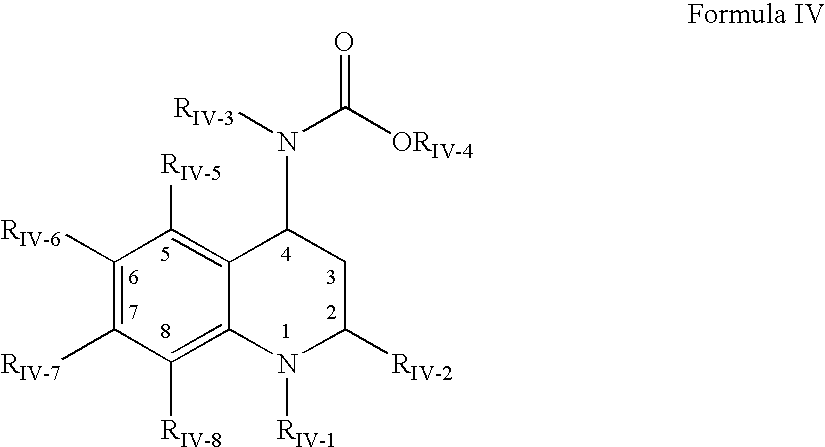
and pharmaceutically acceptable salts, enantiomers, or stereoisomers of said compounds;
wherein RIV-1 is hydrogen, YIV, WIV—XIV or WIV—YIV;
wherein WIV is a carbonyl, thiocarbonyl, sulfinyl or sulfonyl;
XIV is —O—YIV, —S—YIV, —N(H)—YIV or —N—(YIV)2;
- [2S,4S]4-[(3,5-bis-trifluoromethyl-benzyl)-methoxycarbonyl-amino]-2-isopropyl-6-trifluoromethyl-3,4-dihydro-2H-quinoline-1-carboxylic acid isopropyl ester;
- [2S,4S]4-[(3,5-bis-trifluoromethyl-benzyl)-methoxycarbonyl-amino]-6-chloro-2-cyclopropyl-3,4-dihydro-2H-quinoline-1-carboxylic acid isopropyl ester;
- [2S,4S]2-cyclopropyl-4-[(3,5-dichloro-benzyl)-methoxycarbonyl-amino]-6-trifluoromethyl-3,4-dihydro-2H-quinoline-1-carboxylic acid isopropyl ester;
- [2S,4S]4-[(3,5-bis-trifluoromethyl-benzyl)methoxycarbonyl-amino]-2-cyclopropyl-6-trifluoromethyl-3,4-dihydro-2H-quinoline-1-carboxylic acid tert-butyl ester;
- [2R,4R]4-[(3,5-bis-trifluoromethyl-benzyl)-methoxycarbonyl-amino]-2-cyclopropyl-6-trifluoromethyl-3,4-dihydro-2H-quinoline-1-carboxylic acid isopropyl ester;
- [2S,4S]4-[(3,5-bis-trifluoromethyl-benzyl)-methoxycarbonyl-amino]-2-cyclopropyl-6-trifluoromethyl-3,4-dihydro-2H-quinoline-1-carboxylic acid isopropyl ester;
- [2S,4S]4-[(3,5-bis-trifluoromethyl-benzyl)-methoxycarbonyl-amino]-2-cyclobutyl-6-trifluoromethyl-3,4-dihydro-2H-quinoline-1-carboxylic acid isopropyl ester;
- [2R,4S]4-[(3,5-bis-trifluoromethyl-benzyl)-methoxycarbonyl-amino]-2-ethyl-6-trifluoromethyl-3,4-dihydro-2H-quinoline-1-carboxylic acid isopropyl ester;
- [2S,4S]4-[(3,5-bis-trifluoromethyl-benzyl)-methoxycarbonyl-amino]-2-methoxymethyl-6-trifluoromethyl-3,4-dihydro-2H-quinoline-1-carboxylic acid isopropyl ester;
- [2R,4S]4-[(3,5-bis-trifluoromethyl-benzyl)-methoxycarbonyl-amino]-2-ethyl-6-trifluoromethyl-3,4-dihydro-2H-quinoline-1-carboxylic acid 2-hydroxy-ethyl ester;
- [2S,4S]4-[(3,5-bis-trifluoromethyl-benzyl)-methoxycarbonyl-amino]-2-cyclopropyl-6-trifluoromethyl-3,4-dihydro-2H-quinoline-1-carboxylic acid ethyl ester;
- [2R,4S]4-[(3,5-bis-trifluoromethyl-benzyl)-methoxycarbonyl-amino]-2-ethyl-6-trifluoromethyl-3,4-dihydro-2H-quinoline-1-carboxylic acid ethyl ester;
- [2S,4S]4-[(3,5-bis-trifluoromethyl-benzyl)-methoxycarbonyl-amino]-2-cyclopropyl-6-trifluoromethyl-3,4-dihydro-2H-quinoline-1-carboxylic acid propyl ester; and
- [2R,4S]4-[(3,5-bis-trifluoromethyl-benzyl)-methoxycarbonyl-amino]-2-ethyl-6-trifluoromethyl-3,4-dihydro-2H-quinoline-1-carboxylic acid propyl ester.

and pharmaceutically acceptable salts, enantiomers, or stereoisomers of said compounds;
- [2S,4S]4-[(3,5-bis-trifluoromethyl-benzyl)-formyl-amino]-2-cyclopropyl-6-trifluoromethyl-3,4-dihydro-2H-quinoline-1-carboxylic acid isopropyl ester;
- [2S,4S]4-[(3,5-bis-trifluoromethyl-benzyl)-formyl-amino]-2-cyclopropyl-6-trifluoromethyl-3,4-dihydro-2H-quinoline-1-carboxylic acid propyl ester;
- [2S,4S]4-[acetyl-(3,5-bis-trifluoromethyl-benzyl)-amino]-2-cyclopropyl-6-trifluoromethyl-3,4-dihydro-2H-quinoline-1-carboxylic acid tert-butyl ester;
- [2R,4S]4-[acetyl-(3,5-bis-trifluoromethyl-benzyl)-amino]-2-ethyl-6-trifluoromethyl-3,4-dihydro-2H-quinoline-1-carboxylic acid isopropyl ester;
- [2R,4S]4-[acetyl-(3,5-bis-trifluoromethyl-benzyl)-amino]-2-methyl-6-trifluoromethyl-3,4-dihydro-2H-quinoline-1-carboxylic acid ethyl ester;
- [2S,4S]4-[1-(3,5-bis-trifluoromethyl-benzyl)-ureido]-2-cyclopropyl-6-trifluoromethyl-3,4-dihydro-2H-quinoline-1-carboxylic acid isopropyl ester;
- [2R,4S]4-[acetyl-(3,5-bis-trifluoromethyl-benzyl)-amino]-2-ethyl-6-trifluoromethyl-3,4-dihydro-2H-quinoline-1-carboxylic acid ethyl ester;
- [2S,4S]4-[acetyl-(3,5-bis-trifluoromethyl-benzyl)-amino]-2-methoxymethyl-6-trifluoromethyl-3,4-dihydro-2H-quinoline-1-carboxylic acid isopropyl ester;
- [2S,4S]4-[acetyl-(3,5-bis-trifluoromethyl-benzyl)-amino]-2-cyclopropyl-6-trifluoromethyl-3,4-dihydro-2H-quinoline-1-carboxylic acid propyl ester;
- [2S,4S]4-[acetyl-(3,5-bis-trifluoromethyl-benzyl)-amino]-2-cyclopropyl-6-trifluoromethyl-3,4-dihydro-2H-quinoline-1-carboxylic acid ethyl ester;
- [2R,4S]4-[(3,5-bis-trifluoromethyl-benzyl)-formyl-amino]-2-ethyl-6-trifluoromethyl-3,4-dihydro-2H-quinoline-1-carboxylic acid isopropyl ester;
- [2R,4S]4-[(3,5-bis-trifluoromethyl-benzyl)-formyl-amino]-2-methyl-6-trifluoromethyl-3,4-dihydro-2H-quinoline-1-carboxylic acid ethyl ester;
- [2S,4S]4-[acetyl-(3,5-bis-trifluoromethyl-benzyl)-amino]-2-cyclopropyl-6-trifluoromethyl-3,4-dihydro-2H-quinoline-1-carboxylic acid isopropyl ester;
- [2R,4S]4-[(3,5-bis-trifluoromethyl-benzyl)-formyl-amino]-2-ethyl-6-trifluoromethyl-3,4-dihydro-2H-quinoline-1-carboxylic acid ethyl ester;
- [2S,4S]4-[(3,5-bis-trifluoromethyl-benzyl)-formyl-amino]-2-cyclopropyl-6-trifluoromethyl-3,4-dihydro-2H-quinoline-1-carboxylic acid ethyl ester;
- [2R,4S]4-[(3,5-bis-trifluoromethyl-benzyl)-formyl-amino]-2-methyl-6-trifluoromethyl-3,4-dihydro-2H-quinoline-1-carboxylic acid isopropyl ester; and
- [2R,4S]4-[acetyl-(3,5-bis-trifluoromethyl-benzyl)-amino]-2-methyl-6-trifluoromethyl-3,4-dihydro-2H-quinoline-1-carboxylic acid isopropyl ester.

and pharmaceutically acceptable salts, enantiomers, or stereoisomers of said compounds;
in which

or RVI-9-TVI-VVI—XVI, wherein

—NRVI-15RVI-16,
wherein

wherein

wherein

wherein

wherein
- 2-cyclopentyl-4-(4-fluorophenyl)-7,7-dimethyl-3-(4-trifluoromethylbenzoyl)-4,6,7,8-tetrahydro-1H-quinolin-5-one;
- 2-cyclopentyl-4-(4-fluorophenyl)-7,7-dimethyl-3-(4-trifluoromethylbenzoyl)-7,8-dihydro-6H-quinolin-5-one;
- [2-cyclopentyl-4-(4-fluorophenyl)-5-hydroxy-7,7-dimethyl-5,6,7,8-tetrahydroquinolin-3-yl]-(4-trifluoromethylphenyl)-methanone;
- [5-(t-butyldimethylsilanyloxy)-2-cyclopentyl-4-(4-fluorophenyl)-7,7-dimethyl-5,6,7,8-tetrahydroquinolin-3-yl]-(4-trifluoromethylphenyl)-methanone;
- [5-(t-butyldimethylsilanyloxy)-2-cyclopentyl-4-(4-fluorophenyl)-7,7-dimethyl-5,6,7,8-tetrahydroquinolin-3-yl]-(4-trifluoromethylphenyl)-methanol;
- 5-(t-butyldimethylsilanyloxy)-2-cyclopentyl-4-(4-fluorophenyl)-3-[fluoro-(4-trifluoromethylphenyl)-methyl]-7,7-dimethyl-5,6,7,8-tetrahydroquinoline; and
- 2-cyclopentyl-4-(4-fluorophenyl)-3-[fluoro-(4-trifluoromethylphenyl)-methyl]-7,7-dimethyl-5,6,7,8-tetrahydroquinolin-5-ol.

or a pharmaceutically acceptable salt or tautomer thereof,


—N═RVI-41,


—N═S═O;
—N═C═S;
—N═C═O;
—N3;
—SRVII-45


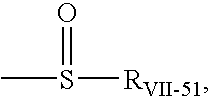


or a pharmaceutically acceptable salt, enantiomers, or stereoisomers thereof, in which
—NRVIII-3RVIII-4, wherein
—NRVIII-5RVIII-6, wherein

—NRVIII-11RVIII-12, wherein
—NRVIII-13RVIII-14, wherein

or a pharmaceutically acceptable salt or tautomer thereof;
- 2,4-dihydro-4-(3-methoxyphenyl)-5-tridecyl-3H-1,2,4-triazole-3-thione;
- 2,4-dihydro-4-(2-fluorophenyl)-5-tridecyl-3H-1,2,4-triazole-3-thione;
- 2,4-dihydro-4-(2-methylphenyl)-5-tridecyl-3H-1,2,4-triazole-3-thione;
- 2,4-dihydro-4-(3-chlorophenyl)-5-tridecyl-3H-1,2,4-triazole-3-thione;
- 2,4-dihydro-4-(2-methoxyphenyl)-5-tridecyl-3H-1,2,4-triazole-3-thione;
- 2,4-dihydro-4-(3-methylphenyl)-5-tridecyl-3H-1,2,4-triazole-3-thione;
- 4-cyclohexyl-2,4-dihydro-5-tridecyl-3H-1,2,4-triazole-3-thione;
- 2,4-dihydro-4-(3-pyridyl)-5-tridecyl-3H-1,2,4-triazole-3-thione;
- 2,4-dihydro-4-(2-ethoxyphenyl)-5-tridecyl-3H-1,2,4-triazole-3-thione;
- 2,4-dihydro-4-(2,6-dimethylphenyl)-5-tridecyl-3H-1,2,4-triazole-3-thione;
- 2,4-dihydro-4-(4-phenoxyphenyl)-5-tridecyl-3H-1,2,4-triazole-3-thione;
- 4-(1,3-benzodioxol-5-yl)-2,4-dihydro-5-tridecyl-3H-1,2,4-triazole-3-thione;
- 4-(2-chlorophenyl)-2,4-dihydro-5-tridecyl-3H-1,2,4-triazole-3-thione;
- 2,4-dihydro-4-(4-methoxyphenyl)-5-tridecyl-3H-1,2,4-triazole-3-thione;
- 2,4-dihydro-5-tridecyl-4-(3-trifluoromethylphenyl)-3H-1,2,4-triazole-3-thione;
- 2,4-dihydro-5-tridecyl-4-(3-fluorophenyl)-3H-1,2,4-triazole-3-thione;
- 4-(3-chloro-4-methylphenyl)-2.4-dihydro-5-tridecyl-3H-1,2,4-triazole-3-thione;
- 2,4-dihydro-4-(2-methylthiophenyl)-5-tridecyl-3H-1,2,4-triazole-3-thione;
- 4-(4-benzyloxyphenyl)-2,4-dihydro-5-tridecyl-3H-1,2,4-triazole-3-thione;
- 2,4-dihydro-4-(2-naphthyl)-5-tridecyl-3H-1,2,4-triazole-3-thione;
- 2,4-dihydro-5-tridecyl-4-(4-trifluoromethylphenyl)-3H-1,2,4-triazole-3-thione;
- 2,4-dihydro-4-(1-naphthyl)-5-tridecyl-3H-1,2,4-triazole-3-thione;
- 2,4-dihydro-4-(3-methylthiophenyl)-5-tridecyl-3H-1,2,4-triazole-3-thione;
- 2,4-dihydro-4-(4-methylthiophenyl)-5-tridecyl-3H-1,2,4-triazole-3-thione;
- 2,4-dihydro-4-(3,4-dimethoxyphenyl)-5-tridecyl-3H-1,2,4-triazole-3-thione;
- 2,4-dihydro-4-(2,5-dimethoxyphenyl)-5-tridecyl-3H-1,2,4-triazole-3-thione;
- 2,4-dihydro-4-(2-methoxy-5-chlorophenyl)-5-tridecyl-3H-1,2,4-triazole-3-thione;
- 4-(4-aminosulfonylphenyl)-2,4-dihydro-5-tridecyl-3H-1,2,4-triazole-3-thione;
- 2,4-dihydro-5-dodecyl-4-(3-methoxyphenyl)-3H-1,2,4-triazole-3-thione;
- 2,4-dihydro-4-(3-methoxyphenyl)-5-tetradecyl-3H-1,2,4-triazole-3-thione;
- 2,4-dihydro-4-(3-methoxyphenyl)-5-undecyl-3H-1,2,4-triazole-3-thione; and
- 2,4-dihydro-(4-methoxyphenyl)-5-pentadecyl-3H-1,2,4-triazole-3-thione.

and pharmaceutically acceptable salts, enantiomers, or stereoisomers or N-oxides of said compounds;
in which


in which

BNRX-15RX-16,
in which

in which a and b are identical or different and denote a number equaling 1, 2, or 3,

in which

in which

in which
—NRX-34,
in which
- 2-cyclopentyl-5-hydroxy-7,7-dimethyl-4-(3-thienyl)-3-(4-trifluoromethylbenxoyl)-5,6,7,8-tetrahydroquinoline;
- 2-cyclopentyl-3-[fluoro-(4-trifluoromethylphenyl)methyl]-5-hydroxy-7,7-dimethyl-4-(3-thienyl)-5,6,7,8-tetrahydroquinoline; and
- 2-cyclopentyl-5-hydroxy-7,7-dimethyl-4-(3-thienyl)-3-(trifluoromethylbenxyl)-5,6,7,8-tetrahydroquinoline.

and stereoisomers, stereoisomer mixtures, and salts thereof, in which
—NRXI-3RXI-4,
in which

in which
—ORXI-10,
—SRXI-11,
—SO2RXI-12 or
—NRXI-13RXI-14,
in which


in which

in which

in which

in which

or pharmaceutically acceptable salts, enantiomers, or stereoisomers of said compounds,
in which

where
- 4,6-bis-(p-fluorophenyl)-2-isopropyl-3-[(p-trifluoromethylphenyl)-(fluoro)-methyl]-5-(1-hydroxyethyl)pyridine;
- 2,4-bis-(4-fluorophenyl)-6-isopropyl-5-[4-(trifluoromethylphenyl)-fluoromethyl]-3-hydroxymethyl)pyridine; and
- 2,4-bis-(4-fluorophenyl)-6-isopropyl-5-[2-(3-trifluoromethyl phenyl)vinyl]-3-hydroxymethyl)pyridine.

or pharmaceutically acceptable salts, enantiomers, stereoisomers, hydrates, or solvates of said compounds, in which
- N,N′-(dithiodi-2,1-phenylene)bis[2,2-dimethyl-propanamide];
- N,N′-(dithiodi-2,1-phenylene)bis[1-methyl-cyclohexanecarboxamide];
- N,N′-(dithiodi-2,1-phenylene)bis[1-(3-methylbutyl)-cyclopentanecarboxamide];
- N,N′-(dithiodi-2,1-phenylene)bis[1-(3-methylbutyl)-cyclohexanecarboxamide];
- N,N′-(dithiodi-2,1-phenylene)bis[1-(2-ethylbutyl)-cyclohexanecarboxamide];
- N,N′-(dithiodi-2,1-phenylene)bis-tricyclo[3.3.1.13,7]decane-1-carboxamide;
- propanethioic acid, 2-methyl-, S-[2[[[1-(2-ethylbutyl)cyclohexyl]carbonyl]amino]phenyl]ester;
- propanethioic acid, 2,2-dimethyl-, S-[2-[[[1-(2-ethyl butyl)cyclohexyl]carbonyl]amino]phenyl]ester; and
- ethanethioic acid, S-[2-[[[1-(2-ethylbutyl)cyclohexyl]carbonyl]amino]phenyl]ester.

and pharmaceutically acceptable forms thereof, wherein:
- 3-[[3-(3-trifluoromethoxyphenoxy)phenyl][[3-(1,1,2,2-tetrafluoroethoxy)-phenyl]methyl]amino]-1,1,1-trifluoro-2-propanol;
- 3-[[3-(3-isopropylphenoxy)phenyl][[3-(1,1,2,2-tetrafluoroethoxy)phenyl]-methyl]amino]-1,1,1-trifluoro-2-propanol;
- 3-[[3-(3-cyclopropyl phenoxy)phenyl][[3-(1,1,2,2-tetrafluoroethoxy)phenyl]-methyl]amino]-1,1,1-trifluoro-2-propanol;
- 3-[[3-(3-(2-furyl)phenoxy)phenyl][[3-(1,1,2,2-tetrafluoroethoxy)phenyl]-methyl]amino]1,1,1-trifluoro-2-propanol;
- 3-[[3-(2,3-dichlorophenoxy)phenyl][[3-(1,1,2,2-tetrafluoroethoxy)phenyl]-methyl]amino]-1,1,1-trifluoro-2-propanol;
- 3-[[3-(4-fluorophenoxy)phenyl][[3-(1,1,2,2-tetrafluoroethoxy)phenyl]-methyl]amino]-1,1,1-trifluoro-2-propanol;
- 3-[[3-(4-methylphenoxy)phenyl][[3-(1,1,2,2-tetrafluoroethoxy)phenyl]-methyl]amino]-1,1,1-trifluoro-2-propanol;
- 3-[[3-(2-fluoro-5-bromophenoxy)phenyl][[3-(1,1,2,2-tetrafluoroethoxy)phenyl]-methyl]amino]-1,1,1-trifluoro-2-propanol;
- 3-[[3-(4-chloro-3-ethylphenoxy)phenyl][[3-(1,1,2,2-tetrafluoroethoxy)phenyl]-methyl]amino]-1,1,1-trifluoro-2-propanol;
- 3-[[3-[3-(1,1,2,2-tetrafluoroethoxy)phenoxy]phenyl][[3-(1,1,2,2-tetrafluoroethoxy)phenyl]methyl]amino]-1,1,1-trifluoro-2-propanol;
- 3-[[3-[3-(pentafluoroethyl)phenoxy]phenyl][[3-(1,1,2,2-tetrafluoroethoxy)-phenyl]methyl]amino]-1,1,1-trifluoro-2-propanol;
- 3-[[3-(3,5-dimethyl phenoxy)phenyl][[3-(1,1,2,2-tetrafluoroethoxy)phenyl]-methyl]amino]-1,1,1-trifluoro-2-propanol;
- 3-[[3-(3-ethylphenoxy)phenyl][[3-(1,1,2,2-tetrafluoroethoxy)phenyl]-methyl]amino]-1,1,1-trifluoro-2-propanol;
- 3-[[3-(3-t-butylphenoxy)phenyl][[3-(1,1,2,2-tetrafluoroethoxy)phenyl]-methyl]amino]1,1,1-trifluoro-2-propanol;
- 3-[[3-(3-methylphenoxy)phenyl][[3-(1,1,2,2-tetrafluoroethoxy)phenyl]-methyl]amino]-1,1,1-trifluoro-2-propanol;
- 3-[[3-(5,6,7,8-tetrahydro-2-naphthoxy)phenyl][[3-(1,1,2,2-tetrafluoroethoxy)phenyl]methyl]amino]-1,1,1-trifluoro-2-propanol;
- 3-[[3-(phenoxy)phenyl][[3-(1,1,2,2-tetrafluoroethoxy) phenyl]methyl]amino]-1,1,1-trifluoro-2-propanol;
- 3-[[3-[3-(N,N-dimethylamino)phenoxy]phenyl][[3-(1,1,2,2-tetrafluoroethoxy)phenyl]methyl]amino]-1,1,1-trifluoro-2-propanol;
- 3-[[[3-(1,1,2,2-tetrafluoroethoxy)phenyl]methyl][3-[[3-(trifluoromethoxy)phenyl]methoxy]phenyl]amino]-1,1,1-trifluoro-2-propanol;
- 3-[[[3-(1,1,2,2-tetrafluoroethoxy)phenyl]methyl][3-[[3-(trifluoromethyl)phenyl]methoxy]phenyl]amino]-1,1,1-trifluoro-2-propanol;
- 3-[[[3-(1,1,2,2-tetrafluoroethoxy)phenyl]methyl][3-[[3,5-dimethylphenyl]-methoxy]phenyl]amino]-1,1,1-trifluoro-2-propanol;
- 3-[[[3-(1,1,2,2-tetrafluoroethoxy)phenyl]methyl][3-[[3-(trifluoromethylthio)phenyl]methoxy]phenyl]amino]-1,1,-trifluoro-2-propanol;
- 3-[[[3-(1,1,2,2-tetrafluoroethoxy)phenyl]methyl][3-[[3,5-difluorophenyl]-methoxy]phenyl]amino]-1,1,1-trifluoro-2-propanol;
- 3-[[[3-(1,1,2,2-tetrafluoroethoxy)phenyl]methyl][3-[cyclohexylmethoxy]-phenyl]amino]-1,1,1-trifluoro-2-propanol;
- 3-[[3-(2-difluoromethoxy-4-pyridyloxy)phenyl][[3-(1,1,2,2-tetrafluoroethoxy)-phenyl]methyl]amino]-1,1,1-trifluoro-2-propanol;
- 3-[[3-(2-trifluoromethyl-4-pyridyloxy)phenyl][[3-(1,1,2,2-tetrafluoroethoxy)-phenyl]methyl]amino]-1,1,1-trifluoro-2-propanol;
- 3-[[3-(3-difluoromethoxyphenoxy)phenyl][[3-(1,1,2,2-tetrafluoroethoxy)-phenyl]methyl]amino]-1,1,1-trifluoro-2-propanol;
- 3-[[[3-(3-trifluoromethylthio)phenoxy]phenyl][[3-(1,1,2,2-tetrafluoroethoxy)-phenyl]methyl]amino]-1,1,1-trifluoro-2-propanol;
- 3-[[3-(4-chloro-3-trifluoromethylphenoxy)phenyl][[3-(1,1,2,2-tetrafluoroethoxy)phenyl]methyl]amino]-1,1,1,-trifluoro-2-propanol;
- 3-[[3-(3-trifluoromethoxyphenoxy)phenyl][[3-(pentafluoroethymethyl]amino]-1,1-trifluoro-2-propanol;
- 3-[[3-(3-isopropyl phenoxy)phenyl][[3-(pentafluoroethyl)phenyl]methyl]-amino]-1,1,1-trifluoro-2-propanol;
- 3-[[3-(3-cyclopropylphenoxy)phenyl][[3-(pentafluoroethyl)phenyl]methyl]-amino]-1,1,1-trifluoro-2-propanol;
- 3-[[3-(3-(2-furyl)phenoxy)phenyl][[3-(pentafluoroethyl)phenyl]methyl]-amino]-1,1,1-trifluoro-2-propanol;
- 3-[[3-(2,3-dichlorophenoxy)phenyl][[3-(pentafluoroethyl)phenyl]methyl]-amino]-1,1,1-trifluoro-2-propanol;
- 3-[[3-(4-fluorophenoxy)phenyl][[3-(pentafluoroethyl)phenyl]methyl]amino]-1,1,1-trifluoro-2-propanol;
- 3-[[3-(4-methylphenoxy)phenyl][[3-(pentafluoroethyl)phenyl]methyl]amino]-1,1,1-trifluoro-2-propanol;
- 3-[[3-(2-fluoro-5-bromophenoxy)phenyl][[3-(pentafluoroethyl)phenyl]methyl]-amino]-1,1,1-trifluoro-2-propanol;
- 3-[[3-(4-chloro-3-ethylphenoxy)phenyl][[3-(pentafluoroethyl)phenyl]methyl]-amino]-1,1,1-trifluoro-2-propanol;
- 3-[[3-[3-(1,1,2,2-tetrafluoroethoxy)phenoxy]phenyl][[3-(pentafluoroethyl)-phenyl]methyl]amino]-1,1,1-trifluoro-2-propanol;
- 3-[[3-[3-(pentafluoroethyl)phenoxy]phenyl][[3-(pentafluoroethyl)phenyl]-methyl]amino]-1,1,1-trifluoro-2-propanol;
- 3-[[3-(3,5-dimethylphenoxy)phenyl][[3-(pentafluoroethyl)phenyl]methyl)-amino]-1,1,1-trifluoro-2-propanol;
- 3-[[3-(3-ethylphenoxy)phenyl][(3-(pentafluoroethyl)phenyl]methyl]amino]-1,1,1-trifluoro-2-propanol;
- 3-[[3-(3-t-butyl phenoxy)phenyl][[3-(pentafluoroethyl)phenyl]methyl]amino]-1,1,1-trifluoro-2-propanol;
- 3-[[3-(3-methylphenoxy)phenyl][[3-pentafluoroethyl)phenyl]methyl]amino]-1,1,1-trifluoro-2-propanol;
- 3-[[3-(5,6,7,8-tetrahydro-2-naphthoxy)phenyl][[3-(pentafluoroethyl)phenyl]-methyl]amino]-1,1,1-trifluoro-2-propanol;
- 3-[[3-(phenoxy)phenyl][[3-(pentafluoroethyl)phenyl]methyl]amino]-1,1,1-trifluoro-2-propanol;
- 3-[[3-[3-(N,N-dimethylamino)phenoxy]phenyl][[3-(pentafluoroethyl)phenyl]-methyl]amino]-1,1,1-trifluoro-2-propanol;
- 3-[[[3-(pentafluoroethyl)phenyl]methyl][3-[[3-(trifluoromethoxy)phenyl]-methoxy]phenyl]amino]-1,1,1-trifluoro-2-propanol;
- 3-[[[3-(pentafluoroethyl)phenyl]methyl][3-[[3-(trifluoromethyl)phenyl]-methoxy]phenyl]amino]-1,1,1-trifluoro-2-propanol;
- 3-[[[3-(pentafluoroethyl)phenyl]methyl][3-[[3,5-dimethyl phenyl]methoxy]-phenyl]amino]-1,1,1-trifluoro-2-propanol;
- 3-[[[3-(pentafluoroethyl)phenyl]methyl][3-([3-(trifluoromethylthio)phenyl]-methoxy]phenyl]amino]-1,1,1-trifluoro-2-propanol;
- 3-[[[3-(pentafluoroethyl)phenyl]methyl][3-[[3,5-difluorophenyl]methoxy]-phenyl]amino]-1,1,1-trifluoro-2-propanol;
- 3-[[[3-(pentafluoroethyl)phenyl]methyl][3-[cyclohexylmethoxy]phenyl]-amino]-1,1,1-trifluoro-2-propanol;
- 3-[[3-(2-difluoromethoxy-4-pyridyloxy)phenyl][[3-(pentafluoroethyl)phenyl]-methyl]amino]-1,1,1-trifluoro-2-propanol;
- 3-[[3-(2-trifluoromethyl-4-pyridyloxy)phenyl][[3-(pentafluoroethyl)phenyl]-methyl]amino]-1,1,1-trifluoro-2-propanol;
- 3-[[3-(3-difluoromethoxyphenoxy)phenyl][[3-(pentafluoroethyl)phenyl]-methyl]amino]-1,1,1-trifluoro-2-propanol;
- 3-[[[3-(3-trifluoromethylthio)phenoxy]phenyl][[3-(pentafluoroethyl)phenyl]-methyl]amino]-1,1,1-trifluoro-2-propanol;
- 3-[[3-(4-chloro-3-trifluoromethyl phenoxy)phenyl][[3-(pentafluoroethyl)-phenyl]methyl]amino]-1,1,1-trifluoro-2-propanol;
- 3-[[3-(3-trifluoromethoxyphenoxy)phenyl][[3-(heptafluoropropyl)phenyl]-methyl]amino]-1,1-trifluoro-2-propanol;
- 3-[[3-(3-isopropylphenoxy)phenyl][[3-(heptafluoropropyl)phenyl]methyl]-amino]-1,1,1-trifluoro-2-propanol;
- 3-[[3-(3-cyclopropylphenoxy)phenyl][[3-(heptafluoropropyl)phenyl]methyl]-amino]-1,1,1-trifluoro-2-propanol;
- 3-[[3-(3-(2-furyl)phenoxy)phenyl][[3-(heptafluoropropyl)phenyl]methyl]-amino]-1,1,1-trifluoro-2-propanol;
- 3-[[3-(2,3-dichlorophenoxy)phenyl][[3-(heptafluoropropyl)phenyl]methyl]-amino]-1,1,1-trifluoro-2-propanol;
- 3-[[3-(4-fluorophenoxy)phenyl][[3-(heptafluoropropyl)phenyl]methyl]amino]-1,1,1-trifluoro-2-propanol;
- 3-[[3-(4-methylphenoxy)phenyl][[3-(heptafluoropropyl)phenyl]methyl]amino]-1,1,1-trifluoro-2-propanol;
- 3-[[3-(2-fluoro-5-bromophenoxy)phenyl][[3-(heptafluoropropyl)phenyl]-methyl]amino]-1,1,1-trifluoro-2-propanol;
- 3-[[3-(4-chloro-3-ethylphenoxy)phenyl][[3-(heptafluoropropyl)phenyl]methyl]-amino]-1,1,1-trifluoro-2-propanol;
- 3-[[3-[3-(1,1,2,2-tetrafluoroethoxy)phenoxy]phenyl][[3-(heptafluoropropyl)-phenyl]methyl]amino]-1,1,1-trifluoro-2-propanol;
- 3-[[3-[3-(pentafluoroethyl)phenoxy]phenyl][[3-(heptafluoropropyl)phenyl]-methyl]amino]-1,1,1-trifluoro-2-propanol;
- 3-[[3-(3,5-dimethylphenoxy)phenyl][[3-(heptafluoropropyl)phenyl]methyl]-amino]-1,1,1-trifluoro-2-propanol;
- 3-[[3-(3-ethylphenoxy)phenyl][[3-(heptafluoropropyl)phenyl]methyl]amino]-1,1,1-trifluoro-2-propanol;
- 3-[[3-(3-t-butylphenoxy)phenyl][[3-(heptafluoropropyl)phenyl]methyl]amino]-1,1,1-trifluoro-2-propanol;
- 3-[[3-(3-methylphenoxy)phenyl][[3-(heptafluoropropyl)phenyl]methyl]amino]-1,1,1-trifluoro-2-propanol;
- 3-[[3-(5,6,7,8-tetrahydro-2-naphthoxy)phenyl][[3-(heptafluoropropyl)phenyl]-methyl]amino]-1,1,1-trifluoro-2-propanol;
- 3-[[3-(phenoxy)phenyl][[3-(heptafluoropropyl)phenyl]methyl]amino]-1,1,1-trifluoro-2-propanol;
- 3-[[3-[3-(N,N-dimethylamino)phenoxy]phenyl][[3-(heptafluoropropyl)phenyl]-methyl]amino]-1,1,1-trifluoro-2-propanol;
- 3-[[[3-(heptafluoropropyl)phenyl]methyl][3-[[3-(trifluoromethoxy)phenyl]-methoxy]phenyl]amino]-1,1,1-trifluoro-2-propanol;
- 3-[[[3-(heptafluoropropyl)phenyl]methyl][3-[[3-(trifluoromethyl)phenyl]-methoxy]phenyl]amino]-1,1,1-trifluoro-2-propanol;
- 3-[[[3-(heptafluoropropyl)phenyl]methyl][3-[[3,5-dimethylphenyl]methoxy]-phenyl]amino]-1,1,1-trifluoro-2-propanol;
- 3-[[[3-(heptafluoropropyl)phenyl]methyl][3-[[3-(trifluoromethylthio)phenyl]-methoxy]phenyl]amino]-1,1,1-trifluoro-2-propanol;
- 3-[[[3-(heptafluoropropyl)phenyl]methyl][3-[[3,5-difluorophenyl]methoxy]-phenyl]amino]-1,1,1-trifluoro-2-propanol;
- 3-[[[3-(heptafluoropropyl)phenyl]methyl][3-[cyclohexylmethoxy]phenyl]-amino]-1,1,1-trifluoro-2-propanol;
- 3-[[3-(2-difluoromethoxy-4-pyridyloxy)phenyl][[3-(heptafluoropropyl)phenyl]-methyl]amino]-1,1,1-trifluoro-2-propanol;
- 3-[[3-(2-trifluoromethyl-4-pyridyloxy)phenyl][[3-(heptafluoropropyl)phenyl]-methyl]amino]-1,1,1-trifluoro-2-propanol;
- 3-[[3-(3-difluoromethoxyphenoxy)phenyl][[3-(heptafluoropropyl)phenyl]-methyl]amino]-1,1,1-trifluoro-2-propanol;
- 3-[[[3-(3-trifluoromethylthio)phenoxy]phenyl][[3-(heptafluoropropyl)phenyl]-methyl]amino]-1,1,1-trifluoro-2-propanol;
- 3-[[3-(4-chloro-3-trifluoromethylphenoxy)phenyl][[3-(heptafluoropropyl)-phenyl]-methyl]amino]-1,1,1-trifluoro-2-propanol;
- 3-[[3-(3-trifluoromethoxyphenoxy)phenyl][[2-fluoro-5-(trifluoromethyl)-phenyl]-methyl]amino]-1,1,1-trifluoro-2-propanol;
- 3-[[3-(3-isopropylphenoxy)phenyl][[2-fluoro-5-(trifluoromethyl)phenyl]-methyl]amino]-1,1,1-trifluoro-2-propanol;
- 3-[[3-(3-cyclopropylphenoxy)phenyl][[2-fluoro-5-(trifluoromethyl)phenyl]-methyl]amino]-1,1,1-trifluoro-2-propanol;
- 3-[[3-(3-(2-furyl)phenoxy)phenyl][[2-fluoro-5-(trifluoromethyl)phenyl]-methyl]amino]-1,1,1-trifluoro-2-propanol;
- 3-[[3-(2,3-dichlorophenoxy)phenyl][[2-fluoro-5-(trifluoromethyl)phenyl]-methyl]amino]-1,1,1-trifluoro-2-propanol;
- 3-[[3-(4-fluorophenoxy)phenyl][[2-fluoro-5-(trifluoromethyl)phenyl]-methyl]amino]-1,1,1-trifluoro-2-propanol;
- 3-[[3-(4-methylphenoxy)phenyl][[2-fluoro-5-(trifluoromethyl)phenyl]-methyl]amino]-1,1,1-trifluoro-2-propanol;
- 3-[[3-(2-fluoro-5-bromophenoxy)phenyl][[2-fluoro-5-(trifluoromethyl)-phenyl]methyl]amino]-1,1,1-trifluoro-2-propanol;
- 3-[[3-(4-chloro-3-ethyl phenoxy)phenyl][[2-fluoro-5-(trifluoromethyl)-phenyl]methyl]amino]-1,1,1-trifluoro-2-propanol;
- 3-[[3-[3-(1,1,2,2-tetrafluoroethoxy)phenoxy]phenyl][[2-fluoro-5-(trifluoromethyl)phenyl]methyl]amino]-1,1,1-trifluoro-2-propanol;
- 3-[[3-[3-(pentafluoroethyl)phenoxy]phenyl][[2-fluoro-5-(trifluoromethyl)-phenyl]-methyl]amino]-1,1,1-trifluoro-2-propanol;
- 3-[[3-(3,5-dimethylphenoxy)phenyl][[2-fluoro-5-(trifluoromethyl)phenyl]-methyl]amino]-1,1,1-trifluoro-2-propanol;
- 3-[[3-(3-ethylphenoxy)phenyl][[2-fluoro-5-(trifluoromethyl)phenyl]methyl]-amino]-1,1,1-trifluoro-2-propanol;
- 3-[[3-(3-t-butylphenoxy)phenyl][[2-fluoro-5-(trifluoromethyl)phenyl]methyl]-amino]-1,1,1-trifluoro-2-propanol;
- 3-[[3-(3-methylphenoxy)phenyl][[2-fluoro-5-(trifluoromethyl)phenyl]methyl]-amino]-1,1,1-trifluoro-2-propanol;
- 3-[[3-(5,6,7,8-tetrahydro-2-naphthoxy)phenyl][[2-fluoro-5-(trifluoromethyl)-phenyl]methyl]amino]-1,1,1-trifluoro-2-propanol;
- 3-[[3-(phenoxy)phenyl][[2-fluoro-5-(trifluoromethyl)phenyl]methyl]amino]-1,1,1-trifluoro-2-propanol;
- 3-[[3-[3-(N,N-dimethylamino)phenoxy]phenyl][[2-fluoro-5-(trifluoromethyl)-phenyl]methyl]amino]-1,1,1-trifluoro-2-propanol;
- 3-[[[2-fluoro-5-(trifluoromethyl)phenyl]methyl][3-[[3-(trifluoromethoxy)phenyl]methoxy]phenyl]amino]-1,1,1-trifluoro-2-propanol;
- 3-[[[2-fluoro-5-(trifluoromethyl)phenyl]methyl][3-[[3-(trifluoromethyl)phenyl]methoxy]phenyl]amino]-1,1,1-trifluoro-2-propanol;
- 3-[[[2-fluoro-5-(trifluoromethyl)phenyl]methyl][3-[[3,5-dimethylphenyl]-methoxy]phenyl]amino]-1,1,1-trifluoro-2-propanol;
- 3-[[[2-fluoro-5-(trifluoromethyl)phenyl]methyl][3-[[3-(trifluoromethylthio)phenyl]methoxy]phenyl]amino]-1,1,1-trifluoro-2-propanol;
- 3-[[[2-fluoro-5-(trifluoromethyl)phenyl]methyl][3-[[3,5-difluorophenyl]-methoxy]phenyl]amino]-1,1,1-trifluoro-2-propanol;
- 3-[[[2-fluoro-5-(trifluoromethyl)phenyl]methyl][3-[cyclohexylmethoxy]-phenyl]amino]-1,1,1-trifluoro-2-propanol;
- 3-[[3-(2-difluoromethoxy-4-pyridyloxy)phenyl][[2-fluoro-5-(trifluoromethyl)-phenyl]methyl]amino]-1,1,1-trifluoro-2-propanol;
- 3-[[3-(2-trifluoromethyl-4-pyridyloxy)phenyl][[2-fluoro-5-(trifluoromethyl)-phenyl]methyl]amino]-1,1,1-trifluoro-2-propanol;
- 3-[[3-(3-difluoromethoxyphenoxy)phenyl][[2-fluoro-5-(trifluoromethyl)-phenyl]methyl]amino]-1,1-trifluoro-2-propanol;
- 3-[[[3-(3-trifluoromethylthio)phenoxy]phenyl][[2-fluoro-5-(trifluoromethyl)-phenyl]methyl]amino]-1,1,1-trifluoro-2-propanol;
- 3-[[3-(4-chloro-3-trifluoromethylphenoxy)phenyl][[2-fluoro-5-(trifluoromethyl)phenyl]methyl]amino]-1,1,1-trifluoro-2-propanol;
- 3-[[3-(3-trifluoromethoxyphenoxy)phenyl][[2-fluoro-4-(trifluoromethyl)-phenyl]methyl]amino]-1,1,1-trifluoro-2-propanol;
- 3-[[3-(3-isopropylphenoxy)phenyl][[2-fluoro-4-(trifluoromethyl)phenyl]-methyl]amino]-1,1,1-trifluoro-2-propanol;
- 3-[[3-(3-cyclopropylphenoxy)phenyl][[2-fluoro-4-(trifluoromethyl)phenyl]-methyl]amino]-1,1,1-trifluoro-2-propanol;
- 3-[[3-(3-(2-furyl)phenoxy)phenyl][[2-fluoro-4-(trifluoromethyl)phenyl]-methyl]amino]-1,1,1-trifluoro-2-propanol;
- 3-[[3-(2,3-dichlorophenoxy)phenyl][[2-fluoro-4-(trifluoromethyl)phenyl]-methyl]amino]-1,1,1-trifluoro-2-propanol;
- 3-[[3-(4-fluorophenoxy)phenyl][[2-fluoro-4-(trifluoromethyl)phenyl]-methyl]amino]-1,1,1-trifluoro-2-propanol;
- 3-[[3-(4-methylphenoxy)phenyl][[2-fluoro-4-(trifluoromethyl)phenyl]-methyl]amino]-1,1,1-trifluoro-2-propanol;
- 3-[[3-(2-fluoro-5-bromophenoxy)phenyl][[2-fluoro-4-(trifluoromethyl)-phenyl]methyl]amino]-1,1,1-trifluoro-2-propanol;
- 3-[[3-(4-chloro-3-ethyl phenoxy)phenyl][[2-fluoro-4-(trifluoromethyl)-phenyl]methyl]amino]-1,1,1-trifluoro-2-propanol;
- 3-[[3-[3-(1,1,2,2-tetrafluoroethoxy)phenoxy]phenyl][[2-fluoro-4-(trifluoromethyl)phenyl]methyl]amino]-1,1,1-trifluoro-2-propanol;
- 3-[[3-[3-(pentafluoroethyl)phenoxy]phenyl][[2-fluoro-4-(trifluoromethyl)-phenyl]methyl]amino]-1,1,1-trifluoro-2-propanol;
- 3-[[3-(3,5-dimethylphenoxy)phenyl][[2-fluoro-4-(trifluoromethyl)phenyl]-methyl]amino]-1,1,1-trifluoro-2-propanol;
- 3-[[3-(3-ethylphenoxy)phenyl][[2-fluoro-4-(trifluoromethyl)phenyl]methyl]-amino]-1,1,1-trifluoro-2-propanol;
- 3-[[3-(3-t-butylphenoxy)phenyl][[2-fluoro-4-(trifluoromethyl)phenyl]methyl]-amino]-1,1,1-trifluoro-2-propanol;
- 3-[[3-(3-methylphenoxy)phenyl][[2-fluoro-4-(trifluoromethyl)phenyl]methyl]-amino]-1,1,1-trifluoro-2-propanol;
- 3-[[3-(5,6,7,8-tetrahydro-2-naphthoxy)phenyl][[2-fluoro-4-(trifluoromethyl)-phenyl]methyl]amino]-1,1,1-trifluoro-2-propanol;
- 3-[[3-(phenoxy)phenyl][[2-fluoro-4-(trifluoromethyl)phenyl]methyl]amino]-1,1,1-trifluoro-2-propanol;
- 3-[[3-[3-(N,N-dimethylamino)phenoxy]phenyl][[2-fluoro-4-(trifluoromethyl)-phenyl]methyl]amino]-1,1,1-trifluoro-2-propanol;
- 3-[[[2-fluoro-4-(trifluoromethyl)phenyl]methyl][3-[[3-(trifluoromethoxy)phenyl]methoxy]phenyl]amino]-1,1,1-trifluoro-2-propanol;
- 3-[[[2-fluoro-4-(trifluoromethyl)phenyl]methyl][3-[[3-(trifluoromethyl)phenyl]methoxy]phenyl]amino]-1,1,1-trifluoro-2-propanol;
- 3-[[[2-fluoro-4-(trifluoromethyl)phenyl]methyl][3-[[3,5-dimethylphenyl]-methoxy]phenyl]amino]-1,1,1-trifluoro-2-propanol;
- 3-[[[2-fluoro-4-(trifluoromethyl)phenyl]methyl][3-[[3-(trifluoromethylthio)phenyl]methoxy]phenyl]amino]-1,1,1-trifluoro-2-propanol;
- 3-[[[2-fluoro-4-(trifluoromethyl)phenyl]methyl][3-[[3,5-difluorophenyl]-methoxy]phenyl]amino]-1,1,1-trifluoro-2-propanol;
- 3-[[[2-fluoro-4-(trifluoromethyl)phenyl]methyl][3-[cyclohexylmethoxy]-phenyl]amino]-1,1,1-trifluoro-2-propanol;
- 3-[[3-(2-difluoromethoxy-4-pyridyloxy)phenyl][[2-fluoro-4-(trifluoromethyl)-phenyl]methyl]amino]-1,1,1-trifluoro-2-propanol;
- 3-[[3-(2-trifluoromethyl-4-pyridyloxy)phenyl][[2-fluoro-4-(trifluoromethyl)-phenyl]methyl]amino]-1,1,1-trifluoro-2-propanol;
- 3-[[3-(3-difluoromethoxyphenoxy)phenyl][[2-fluoro-4-(trifluoromethyl)-phenyl]methyl]amino]-1,1,1-trifluoro-2-propanol;
- 3-[[[3-(3-trifluoromethylthio)phenoxy]phenyl][[2-fluoro-4-(trifluoromethyl)phenyl]methyl]amino]-1,1,1-trifluoro-2-propanol; and
- 3-[[3-(4-chloro-3-trifluoromethylphenoxy)phenyl][[2-fluoro-4-(trifluoromethyl)phenyl]methyl]amino]-1,1,1-trifluoro-2-propanol.

and pharmaceutically acceptable forms thereof, wherein:

with the provisos that one of AXV and QXV must be AQ-1 and that one of AXV and QXV must be selected from the group consisting of AQ-2 and —CH2(CRXV-37RXV-38)vXV—(CRXV-33RXV-34)uxv-TXV-(CRXV-35RXV-36)wXV—H;
- 3-[[3-(4-chloro-3-ethylphenoxy)phenyl](cyclohexylmethyl)amino]-1,1,1-trifluoro-2-propanol;
- 3-[[3-(4-chloro-3-ethylphenoxy)phenyl](cyclopentylmethyl)amino]-1,1,1-trifluoro-2-propanol;
- 3-[[3-(4-chloro-3-ethyl phenoxy)phenyl](cyclopropylmethyl)amino]-1,1,1-trifluoro-2-propanol;
- 3-[[3-(4-chloro-3-ethyl phenoxy)phenyl][(3-trifluoromethyl)cyclohexyl-methyl]amino]-1,1,1-trifluoro-2-propanol;
- 3-[[3-(4-chloro-3-ethyl phenoxy)phenyl][(3-pentafluoroethyl)cyclohexyl-methyl]amino]-1,1,1-trifluoro-2-propanol;
- 3-[[3-(4-chloro-3-ethyl phenoxy)phenyl][(3-trifluoromethoxy)cyclohexyl-methyl]amino]-1,1,1-trifluoro-2-propanol;
- 3-[[3-(4-chloro-3-ethylphenoxy)phenyl][[3-(1,1,2,2-tetrafluoroethoxy)cyclo-hexylmethyl]amino]-1,1,1-trifluoro-2-propanol;
- 3-[[3-(3-trifluoromethoxyphenoxy)phenyl](cyclohexylmethyl)amino]-1,1,1-trifluoro-2-propanol;
- 3-[[3-(3-trifluoromethoxyphenoxy)phenyl](cyclopentylmethyl)amino]-1,1,1-trifluoro-2-propanol;
- 3-[[3-(3-trifluoromethoxyphenoxy)phenyl](cyclopropylmethyl)amino]-1,1,1-trifluoro-2-propanol;
- 3-[[3-(3-trifluoromethoxyphenoxy)phenyl][(3-trifluoromethyl)cyclohexyl-methyl]amino]-1,1,1-trifluoro-2-propanol;
- 3-[[3-(3-trifluoromethoxyphenoxy)phenyl](3-pentafluoroethyl)cyclohexyl-methyl]amino]-1,1,1-trifluoro-2-propanol;
- 3-[[3-(3-trifluoromethoxyphenoxy)phenyl][(3-trifluoromethoxy)cyclohexyl-methyl]amino]-1,1,1-trifluoro-2-propanol;
- 3-[[3-(3-trifluoromethoxyphenoxy)phenyl][[3-(1,1,2,2-tetrafluoroethoxy)cyclohexyl-methyl]amino]-1,1,1-trifluoro-2-propanol;
- 3-[[3-(3-isopropylphenoxy)phenyl](cyclohexylmethyl]amino]-1,1,1-trifluoro-2-propanol;
- 3-[[3-(3-isopropylphenoxy)phenyl](cyclopentylmethyl]amino]-1,1,1-trifluoro-2-propanol;
- 3-[[3-(3-isopropylphenoxy)phenyl](cyclopropylmethyl)amino]-1,1,1-trifluoro-2-propanol;
- 3-[[3-(3-isopropylphenoxy)phenyl][(3-trifluoromethyl)cyclohexyl-methyl]amino]-1,1,1-trifluoro-2-propanol;
- 3-[[3-(3-isopropylphenoxy)phenyl][(3-pentafluoroethyl)cyclohexyl-methyl]amino]-1,1,1-trifluoro-2-propanol;
- 3-[[3-(3-isopropylphenoxy)phenyl][(3-trifluoromethoxy)cyclohexyl-methyl]amino]-1,1,1-trifluoro-2-propanol;
- 3-[[3-(3-isopropylphenoxy)phenyl][3-(1,1,2,2-tetrafluoroethoxy)cyclohexyl-methyl]amino]-1,1,1-trifluoro-2-propanol;
- 3-[[3-(2,3-dichlorophenoxy)phenyl](cyclohexylmethyl)amino]-1,1,1-trifluoro-2-propanol;
- 3-[[3-(2,3-dichlorophenoxy)phenyl](cyclopentylmethyl)amino]-1,1,1-trifluoro-2-propanol;
- 3-[[3-(2,3-dichlorophenoxy)phenyl](cyclopropylmethy)amino]-1,1,1-trifluoro-2-propanol;
- 3-[[3-(2,3-dichlorophenoxy)phenyl][(3-trifluoromethyl)cyclohexyl-methyl]amino]-1,1,1-trifluoro-2-propanol;
- 3-[[3-(2,3-dichlorophenoxy)phenyl][(3-pentafluoroethyl)cyclohexyl-methyl]amino]-1,1,1-trifluoro-2-propanol;
- 3-[[3-(2,3-dichlorophenoxy)phenyl][(3-trifluoromethoxy)cyclohexyl-methyl]amino]-1,1,1-trifluoro-2-propanol;
- 3-[[3-(2,3-dichlorophenoxy)phenyl][3-(1,1,2,2-tetrafluoroethoxy)cyclo-hexyl-methyl]amino]-1,1,1-trifluoro-2-propanol;
- 3-[[3-(4-fluorophenoxy)phenyl](cyclohexylmethyl)amino]-1,1,1-trifluoro-2-propanol;
- 3-[[3-(4-fluorophenoxy)phenyl](cyclopentylmethyl)amino]-1,1,1-trifluoro-2-propanol;
- 3-[[3-(4-fluorophenoxy)phenyl](cyclopropylmethyl)amino]-1,1,1-triflouro-2-propanol;
- 3-[[3-(4-fluorophenoxy)phenyl][(3-trifluoromethyl)cyclohexyl-methyl]amino]-1,1,1-trifluoro-2-propanol;
- 3-[[3-(4-fluorophenoxy)phenyl][(3-pentafluoroethyl)cyclohexyl-methyl]amino]-1,1,1-trifluoro-2-propanol;
- 3-[[3-(4-fluorophenoxy)phenyl][(3-trifluoromethoxy)cyclohexyl-methyl]amino]-1,1,1-trifluoro-2-propanol;
- 3-[[3-(4-fluorophenoxy)phenyl][[3-(1,1,2,2-tetrafluoroethoxy)cyclohexyl-methyl]amino]-1,1,1-trifluoro-2-propanol;
- 3-[[3-(3-trifluoromethoxybenzyloxy]phenyl](cyclohexyl methyl)amino]-1,1,1-trifluoro-2-propanol;
- 3-[[3-(3-trifluoromethoxybenzyloxy)phenyl](cyclopentylmethyl)amino]-1,1,1-trifluoro-2-propanol;
- 3-[(3-(3-trifluoromethoxybenzyloxy)phenyl](cyclopropylmethyl]amino]-1,1,1-trifluoro-2-propanol;
- 3-[[3-(3-trifluoromethoxybenzyloxy)phenyl][(3-trifluoromethyl)cyclohexyl-methyl]amino]-1,1,1-trifluoro-2-propanol;
- 3-[[3-(3-trifluoromethoxybenzyloxy)phenyl][(3-pentafluoroethyl)cyclohexyl-methyl]amino]-1,1,1-trifluoro-2-propanol;
- 3-[[3-(3-trifluoromethoxybenzyloxy]phenyl][(3-trifluoromethoxy)cyclohexyl-methyl]amino]-1,1,1-trifluoro-2-propanol;
- 3-[[3-(3-trifluoromethoxybenzyloxy)phenyl][3-(1, 1, 2, 2-tetrafluoroethoxy)-cyclohexylmethyl]amino]-1,1,1-trifluoro-2-propanol;
- 3-[[3-(3-trifluoromethyl benzyloxy)phenyl](cyclohexylmethyl)amino]-1,1,1-trifluoro-2-propanol;
- 3-[[3-(3-trifluoromethylbenzyloxy)phenyl](cyclopentylmethyl)amino]-1,1,1-trifluoro-2-propanol;
- 3-[[3-(3-trifluoromethylbenzyloxy)phenyl](cyclopropyl methyl)amino]-1,1,1-trifluoro-2-propanol;
- 3-[[3-(3-trifluoromethylbenzyloxy)phenyl][(3-trifluoromethyl)cyclohexyl-methyl]amino]-1,1,1-trifluoro-2-propanol;
- 3-[[3-(3-trifluoromethyl benzyloxy)phenyl][(3-pentafluoroethyl)cyclohexyl-methyl]amino]-1,1,1-trifluoro-2-propanol;
- 3-[[3-(3-trifluoromethyl benzyloxy)phenyl][(3-trifluoromethoxy)cyclohexyl-methyl]amino]-1,1,1-trifluoro-2-propanol;
- 3-[[3-(3-trifluoromethyl benzyloxy)phenyl][3-(1,1,2,2-tetrafluoroethoxy)cyclohexyl-methyl]amino]-1,1,1-trifluoro-2-propanol;
- 3-[[[(3-trifluoromethyl)phenyl]methyl](cyclohexyl)amino]-1,1,1-trifluoro-2-propanol;
- 3-[[[(3-pentafluoroethyl)phenyl]methyl](cyclohexyl)amino]-1,1,1-trifluoro-2-propanol;
- 3-[[[(3-trifluoromethoxy)phenyl]methyl](cyclohexyl)amino]-1,1,1-trifluoro-2-propanol;
- 3-[[[3-(1,1,2,2-tetrafluoroethoxy)phenyl]methyl](cyclohexyl)amino]-1,1,1-trifluoro-2-propanol;
- 3-[[[(3-trifluoromethyl)phenyl]methyl](4-methylcyclohexyl)amino]-1,1,1-trifluoro-2-propanol;
- 3-[[[(3-pentafluoroethyl)phenyl]methyl](4-methylcyclohexyl)amino]-1,1,1-trifluoro-2-propanol;
- 3-[[[(3-trifluoromethoxy)phenyl]methyl](4-methylcyclohexyl)amino]-1,1,1-trifluoro-2-propanol;
- 3-[[[3-(1,1,2,2-tetrafluoroethoxy)phenyl]methyl](4-methylcyclohexyl)amino]-1,1,1-trifluoro-2-propanol;
- 3-[[[(3-trifluoromethyl]phenyl]methyl](3-trifluoromethylcyclohexyl)amino]-1,1,1-trifluoro-2-propanol;
- 3-[[[(3-pentafluoroethyl)phenyl]methyl](3-trifluoromethylcyclohexyl)amino]-1,1,1-trifluoro-2-propanol;
- 3-[[[(3-trifluoromethoxy)phenyl]methyl](3-trifluoromethylcyclohexyl)amino]-1,1,1-trifluoro-2-propanol;
- 3-[[[3-(1,1,2,2-tetrafluoroethoxy)phenyl]methyl](3-trifluoromethylcyclohexyl)amino]-1,1,1-trifluoro-2-propanol;
- 3-[[((3-trifluoromethyl)phenyl]-methyl)[3-(4-chloro-3-ethylphenoxy)cyclo-hexyl]amino]-1,1,1-trifluoro-2-propanol;
- 3-[[[(3-pentafluoroethyl)phenyl]methyl][3-(4-chloro-3-ethylphenoxy)cyclo-hexyl]amino]-1,1,1-trifluoro-2-propanol;
- 3-[[[(3-trifluoromethoxy)phenyl]methyl][3-(4-chloro-3-methylphenoxy)cyclo-hexyl]amino]-1,1,1-trifluoro-2-propanol;
- 3-[[[3-(1,1,2,2-tetrafluoroethoxy)phenyl]methyl][3-(4-chloro-3-ethylphenoxy)-cyclohexyl]amino]-1,1,1-trifluoro-2-propanol;
- 3-[[[(3-trifluoromethyl]phenyl]methyl](3-phenoxycyclohexyl)amino]-1,1,1-trifluoro-2-propanol;
- 3-[[[(3-pentafluoroethyl)phenyl]methyl](3-phenoxycyclohexyl)amino]-1,1,1-trifluoro-2-propanol;
- 3-[[[(3-trifluoromethoxy)phenyl]methyl](3-phenoxycyclohexyl)amino]-1,1,1-trifluoro-2-propanol;
- 3-[[[3-(1,1,2,2-tetrafluoroethoxy)phenyl]methyl](3-phenoxycyclohexyl)amino]-1,1,1-trifluoro-2-propanol;
- 3-[[[(3-trifloromethyl)phenyl]methyl](3-isopropoxycyclohexyl)amino]-1,1,1-trifluoro-2-propanol;
- 3-[[[(3-pentafluoroethyl)phenyl]methyl](3-isopropoxycyclohexyl)amino]-1,1,1-trifluoro-2-propanol;
- 3-[[[(3-trifluoromethoxy)phenyl]methyl](3-isopropoxycyclohexyl)amino]-1,1,1-trifluoro-2-propanol;
- 3-[[[3-(1,1,2,2-tetrafluoroethoxy)phenyl]methyl](3-isopropoxycyclohexyl)-amino]-1,1,1-trifluoro-2-propanol;
- 3-[[[(3-trifluoromethyl)phenyl]methyl](3-cyclopentyloxycyclohexyl]amino]-1,1,1-trifluoro-2-propanol;
- 3-[[[(3-pentafluoroethyl]phenyl]methyl](3-cyclopentyloxycyclohexyl)amino]-1,1,1-trifluoro-2-propanol;
- 3-[[[(3-trifluoromethoxy)phenyl]methyl](3-cyclopentyloxycyclohexyl)amino]-1,1,1-trifluoro-2-propanol;
- 3-[[[3-(1,1,2,2-tetrafluoroethoxy)phenyl]methyl](3-cyclopentyloxycyclohexyl)-amino]-1,1,1-trifluoro-2-propanol;
- 3-[[[(2-trifluoromethyl)pyrid-6-yl]methyl](3-isopropoxycyclohexyl)amino]-1,1,1-trifluoro-2-propanol;
- 3-[[[(2-trifluoromethyl)pyrid-6-yl]methyl](3-cyclopentyloxycyclohexyl)-amino]-1,1,1-trifluoro-2-propanol;
- 3-[[[(2-trifluoromethyl)pyrid-6-yl]methyl](3-phenoxycyclohexyl)amino]-1,1,1-trifluoro-2-propanol;
- 3-[[[(2-trifluoromethyl)pyrid-6-yl]methyl](3-trifluoromethylcyclohexyl)amino]-1,1,1-trifluoro-2-propanol;
- 3-[[[(2-trifluoromethyl)pyrid-6-yl]methyl][3-(4-chloro-3-ethylphenoxy)cyclo-hexyl]amino]-1,1-trifluoro-2-propanol;
- 3-[[[(2-trifluoromethyl)pyrid-6-yl]methyl][3-(1,1,2,2-tetrafluoroethoxy)cyclo-hexyl]amino]-1,1,1-trifluoro-2-propanol;
- 3-[[[(2-trifluoromethyl)pyrid-6-yl]methyl](3-pentafluoroethylcyclohexyl)-amino]-1,1,1-trifluoro-2-propanol;
- 3-[[[(2-trifluoromethyl)pyrid-6-yl]methyl](3-trifluoromethoxycyclohexyl)-amino]-1,1,1-trifluoro-2-propanol;
- 3-[[[(3-trifluoromethyl)phenyl]methyl][3-(4-chloro-3-ethylphenoxy)propyl]-amino]-1,1,1-trifluoro-2-propanol;
- 3-[[[(3-pentafluoroethyl)phenyl]methyl][3-(4-chloro-3-ethylphenoxy)propyl]-amino]-1,1,1-trifluoro-2-propanol;
- 3-[[[(3-trifluoromethoxy)phenyl]methyl][3-(4-chloro-3-ethylphenoxy)propyl]-amino]-1,1,1-trifluoro-2-propanol;
- 3-[[[3-(1,1,2,2-tetrafluoroethoxy)phenyl]methyl][3-(4-chloro-3-ethylphenoxy)-propyl]amino]-1,1,1-trifluoro-2-propanol;
- 3-[[[(3-trifluoromethyl)phenyl]methyl][3-(4-chloro-3-ethylphenoxy)-2,2,-di-fluropropyl]amino]-1,1,1-trifluoro-2-propanol;
- 3-[[[3-pentafluoroethyl)phenyl]methyl][3-(4-chloro-3-ethylphenoxy)-2,2-di-fluropropyl]amino]-1,1,1-trifluoro-2-propanol;
- 3-[[[(3-trifluoromethoxy)phenyl]methyl][3-(4-chloro-3-ethylphenoxy)-2,2,-di-fluropropyl]amino]-1,1,1-trifluoro-2-propanol;
- 3-[[[3-(1,1,2,2-tetrafluoroethoxy)phenyl]methyl][3-(4-chloro-3-ethylphenoxy)-2,2,-difluropropyl]amino]-1,1,1-trifluoro-2-propanol;
- 3-[[[(3-trifluoromethyl)phenyl]methyl][3-(isopropoxy)propyl]amino]-1,1,1-trifluoro-2-propanol;
- 3-[[[(3-pentafluoroethyl)phenyl]methyl][3-(isopropoxy)propyl]amino]-1,1,1-trifluoro-2-propanol;
- 3-[[[(3-trifluoromethoxy)phenyl]methyl][3-(isopropoxy)propyl]amino]-1,1,1-trifluoro-2-propanol;
- 3-[[[3-(1,1,2,2-tetrafluoroethoxy)phenyl]methyl]]3-(isopropoxy)propyl]amino]-1,1,1-trifluoro-2-propanol; and
- 3-[[[3-(1,1,2,2-tetrafluoroethoxy)phenyl]methyl][3-(phenoxy)propyl]amino]-1,1,1-trifluoro-2-propanol.

and pharmaceutically acceptable forms thereof, wherein:

- (2R)-3-[[3-(3-trifluoromethoxyphenoxy)phenyl][[3-(1,1,2,2-tetrafluoroethoxy)phenyl]methyl]amino]-1,1,1-trifluoro-2-propanol;
- (2R)-3-[[3-(3-isopropylphenoxy)phenyl][[3-(1,1,2,2-tetrafluoroethoxy)phenyl]-methyl]amino]-1,1,1-trifluoro-2-propanol;
- (2R)-3-[[3-(3-cyclopropylphenoxy)phenyl][[3-(1,1,2,2-tetrafluoroethoxy)phenyl]-methyl]amino]-1,1,1-trifluoro-2-propanol;
- (2R)-3-[[3-(3-(2-furyl)phenoxy)phenyl][[3-(1,1,2,2-tetrafluoroethoxy)phenyl]-methyl]amino]-1,1,1-trifluoro-2-propanol;
- (2R)-3-[[3-(2,3-dichlorophenoxy)phenyl][[3-(1,1,2,2-tetrafluoroethoxy)phenyl]-methyl]amino]-1,1,1-trifluoro-2-propanol;
- (2R)-3-[[3-(4-fluorophenoxy)phenyl][[3-(1,1,2,2-tetrafluoroethoxy)phenyl]-methyl]amino]-1,1,1-trifluoro-2-propanol;
- (2R)-3-[[3-(4-methylphenoxy)phenyl][[3-(1,1,2,2-tetrafluoroethoxy)phenyl]-methyl]amino]-1,1,1-trifluoro-2-propanol;
- (2R)-3-[[3-(2-fluoro-5-bromophenoxy)phenyl][[3-(1,1,2,2-tetrafluoroethoxy)phenyl]-methyl]amino]-1,1,1-trifluoro-2-propanol;
- (2R)-3-[[3-(4-chloro-3-ethylphenoxy)phenyl][[3-(1,1,2,2-tetrafluoroethoxy)phenyl]-methyl]amino]-1,1,1-trifluoro-2-propanol;
- (2R)-3-[[3-[3-(1,1,2,2-tetrafluoroethoxy)phenoxy]phenyl][[3-(1,1,2,2-tetrafluoroethoxy)phenyl]methyl]amino]-1,1,1-trifluoro-2-propanol;
- (2R)-3-[[3-[3-(pentafluoroethyl)phenoxy]phenyl][[3-(1,1,2,2-tetrafluoroethoxy)phenyl]methyl]amino]-1,1,1-trifluoro-2-propanol;
- (2R)-3-[[3-(3,5-dimethylphenoxy)phenyl][[3-(1, 1, 2, 2-tetrafluoroethoxy)phenyl]-methyl]amino]-1,1,1-trifluoro-2-propanol;
- (2R)-3-[[3-(3-ethylphenoxy)phenyl][[3-(1,1,2,2-tetrafluoroethoxy)phenyl]-methyl]amino]-1,1,1-trifluoro-2-propanol;
- (2R)-3-[[3-(3-t-butylphenoxy)phenyl][[3-(1,1,2,2-tetrafluoroethoxy)phenyl]-methyl]amino]-1,1,1-trifluoro-2-propanol:
- (2R)-3-[[3-(3-methylphenoxy)phenyl][[3-(1,1,2,2-tetrafluoroethoxy)phenyl]-methyl]amino]-1,1,1-trifluoro-2-propanol;
- (2R)-3-[[3-(5,6,7,8-tetrahydro-2-naphthoxy)phenyl][[3-(1,1,2,2-tetrafluoroethoxy)phenyl]methyl]amino]-1,1,1-trifluoro-2-propanol;
- (2R)-3-[[3-(phenoxy)phenyl][[3-(1,1,2,2-tetrafluoroethoxy)phenyl]methyl]amino]-1,1,1-trifluoro-2-propanol;
- (2R)-3-[[3-[3-(N,N-dimethylamino)phenoxy]phenyl][[3-(1,1,2,2-tetrafluoroethoxy)phenyl]methyl]amino]-1,1,1-trifluoro-2-propanol;
- (2R)-3-[[[3-(1,1,2,2,-tetrafluoroethoxy)phenyl]methyl][3-[[3-(trifluoromethoxy)phenyl]methoxy]phenyl]amino]-1,1,1-trifluoro-2-propanol;
- (2R)-3-[[[3-(1,1,2,2-tetrafluoroethoxy)phenyl]methyl][3-[[3-(trifluoromethyl)phenyl]methoxy]phenyl]amino]-1,1,1-trifluoro-2-propanol;
- (2R)-3-[[[3-(1,1,2,2-tetrafluoroethoxy)phenyl]methyl][3-[[3,5-dimethylphenyl]-methoxy]phenyl]amino]-1,1,1-trifluoro-2-propanol;
- (2R)-3-[[[3-(1,1,2,2-tetrafluoroethoxy)phenyl]methyl][3-[[3-(trifluoromethylthio)phenyl]methoxy]phenyl]amino]-1,1,1-trifluoro-2-propanol;
- (2R)-3-[[[3-(1,1,2,2-tetrafluoroethoxy)phenyl]methyl][3-[[3,5-difluorophenyl]-methoxy]phenyl]amino]-1,1,1-trifluoro-2-propanol;
- (2R)-3-[[[3-(1,1,2,2-tetrafluoroethoxy)phenyl]methyl][3-[cyclohexylmethoxy]-phenyl]amino]-1,1,1-trifluoro-2-propanol;
- (2R)-3-[[3-(2-difluoromethoxy-4-pyridyloxy)phenyl][[3-(1,1,2,2-tetrafluoroethoxy)phenyl]methyl]amino]-1,1,1-trifluoro-2-propanol;
- (2R)-3-[[3-(2-trifluoromethyl-4-pyridyloxy)phenyl][[3-(1,1,2,2-tetrafluoroethoxy)phenyl]methyl]amino]-1,1-trifluoro-2-propanol;
- (2R)-3-[[3-(3-difluoromethoxyphenoxy)phenyl][[3-(1,1,2,2-tetrafluoroethoxy) phenyl]methyl]amino]-1,1,1-trifluoro-2-propanol;
- (2R)-3-[[[3-(3-trifuoromethylthio)phenoxy]phenyl][[3-(1,1,2,2-tetrafluoroethoxy)phenyl]methyl]amino]-1,1,1-trifluoro-2-propanol;
- (2R)-3-[[3-(4-chloro-3-trifluoromethylphenoxy)phenyl][[3-(1,1,2,2-tetrafluoroethoxy)phenyl]methyl]amino]-1,1,1-trifluoro-2-propanol;
- (2R)-3-[[3-(3-trifluoromethoxyphenoxy)phenyl][[3-(pentafluoroethyl)phenyl]-methyl]amino]-1,1,1-trifluoro-2-propanol;
- (2R)-3-[[3-(3-isopropylphenoxy)phenyl][[3-(pentafluoroethyl)phenyl]methyl]-amino]-1,1,1-trifluoro-2-propanol;
- (2R)-3-[[3-(3-cyclopropylphenoxy)phenyl][[3-(pentafluoroethyl)phenyl]methyl]-amino]-1,1,1-trifluoro-2-propanol;
- (2R)-3-[[3-(3-(2-furyl)phenoxy)phenyl][[3-(pentafluoroethyl)phenyl]methyl]-amino]-1,1,1-trifluoro-2-propanol;
- (2R)-3-[[3-(2,3-dichlorophenoxy)phenyl][[3-(pentafluoroethyl)phenyl]methyl]-amino]-1,1,1-trifluoro-2-propanol;
- (2R)-3-[[3-(4-fluorophenoxy)phenyl][[3-(pentafluoroethyl)phenyl]methyl]amino]-1,1,1-trifluoro-2-propanol;
- (2R)-3-[[3-(4-methylphenoxy)phenyl][[3-(pentafluoroethyl)phenyl]methyl]amino]-1,1,1-trifluoro-2-propanol;
- (2R)-3-[[3-(2-fluoro-5-bromophenoxy)phenyl][[3-(pentafluoroethyl)phenyl]methyl]-amino]-1,1,1-trifluoro-2-propanol;
- (2R)-3-[[3-(4-chloro-3-ethylphenoxy)phenyl][[3-(pentafluoroethyl)phenyl]methyl]-amino]-1,1,1-trifluoro-2-propanol;
- (2R)-3-[[3-[3-(1,1,2,2-tetrafluoroethoxy)phenoxy]phenyl][[3-(pentafluoroethyl)phenyl]methyl]amino]-1,1,1-trifluoro-2-propanol;
- (2R)-3-[[3-[3-(pentafluoroethyl)phenoxy]phenyl][[3-(pentafluoroethyl)phenyl]-methyl]amino]-1,1,1-trifluoro-2-propanol;
- (2R)-3-[[3-(3,5-dimethylphenoxy)phenyl][[3-(pentafluoroethyl)phenyl]methyl]-amino]-1,1,1-trifluoro-2-propanol;
- (2R)-3-[[3-(3-ethylphenoxy)phenyl][[3-(pentafluoroethyl)phenyl]methyl]amino]-1,1,1-trifluoro-2-propanol;
- (2R)-3-[[3-(3-t-butylphenoxy)phenyl][[3-(pentafluoroethyl)phenyl]methyl]amino]-1,1,1-trifluoro-2-propanol;
- (2R)-3-[[3-(3-methylphenoxy)phenyl][[3-(pentafluoroethyl)phenyl]methyl]amino]-1,1,1-trifluoro-2-propanol;
- (2R)-3-[[3-(5,6,7,8-tetrahydro-2-naphthoxy)phenyl][[3-(pentafluoroethyl)phenyl]-methyl]amino]-1,1,1-trifluoro-2-propanol;
- (2R)-3-[[3-(phenoxy)phenyl][[3(pentafluoroethyl)phenyl]methyl]amino]-1,1,1-trifluoro-2-propanol;
- (2R)-3-[[3-[3-(N,N-dimethylamino)phenoxy]phenyl][[3(pentafluoroethyl)phenyl]-methyl]amino]-1,1,1-trifluoro-2-propanol;
- (2R)-3-[[[3-(pentafluoroethyl)phenyl]methyl][3-[[3-(trifluoromethoxy)phenyl]-methoxy]phenyl]amino]-1,1,1-trifluoro-2-propanol;
- (2R)-3-[[[3-(pentafluoroethyl)phenyl]methyl][3-([3-(trifluoromethyl)-phenyl]-methoxy]phenyl]amino]-1,1,1-trifluoro-2-propanol;
- (2R)-3-[[[3-(pentafluoroethyl)phenyl]methyl][3-[[3,5-dimethylphenyl]methoxy]-phenyl]amino]-1,1,1-trifluoro-2-propanol;
- (2R)-3-[[[3-(pentafluoroethyl)phenyl]methyl][3-[[3-(trifluoromethylthio)phenyl]-methoxy]phenyl]amino]-1,1,1-trifluoro-2-propanol;
- (2R)-3-[[[3-(pentafluoroethyl)phenyl]methyl][3-[[3,5-difluorophenyl]methoxy]-phenyl]amino]-1,1,1-trifluoro-2-propanol;
- (2R)-3-[[[3-(pentafluoroethyl)phenyl]methyl][3-[cyclohexylmethoxy]phenyl]-amino]-1,1,1-trifluoro-2-propanol;
- (2R)-3-[[3-(2-difluoromethoxy-4-pyridyloxy)phenyl][[3-(pentafluoroethyl)phenyl]-methyl]amino]-1,1,1-trifluoro-2-propanol;
- (2R)-3-[[3-(2-trifluoromethyl-4-pyridyloxy)phenyl][[3-(pentafluoroethyl)phenyl]-methyl]amino]-1,1,1-trifluoro-2-propanol;
- (2R)-3-[[3-(3-difluoromethoxyphenoxy)phenyl][[3-(pentafluoroethyl)phenyl]-methyl]amino]-1,1,1-trifluoro-2-propanol;
- (2R)-3-[[[3-(3-trifluoromethylthio)phenoxy]phenyl][[3-(pentafluoroethyl)phenyl]-methyl]amino]-1,1,1-trifluoro-2-propanol;
- (2R)-3-[[3-(4-chloro-3-trifluoromethylphenoxy)phenyl][[3-(pentafluoroethyl)-phenyl]methyl]amino]-1,1,1-trifluoro-2-propanol;
- (2R)-3-[[3-(3-trifluoromethoxyphenoxy)phenyl][[3-(heptafluoropropyl)phenyl]-methyl]amino]-1,1,1-trifluoro-2-propanol;
- (2R)-3-[[3-(3-isopropylphenoxy)phenyl][[3-(heptafluoropropyl)phenyl]methyl]-amino]-1,1,1-trifluoro-2-propanol;
- (2R)-3-[[3-(3-cyclopropylphenoxy)phenyl][[3-(heptafluoropropyl)phenyl]methyl]-amino]-1,1,1-trifluoro-2-propanol;
- (2R)-3-[[3-(3-(2-furyl)phenoxy)phenyl][[3-(heptafluoropropyl)phenyl]methyl]-amino]-1,1,1-trifluoro-2-propanol;
- (2R)-3-[[3-(2,3-dichlorophenoxy)phenyl]methyl]-amino]-1,1,1-trifluoro-2-propanol;
- (2R)-3-[[3-(4-fluorophenoxy)phenyl][[3-(heptafluoropropyl)phenyl]methyl]amino]-1,1,1-trifluoro-2-propanol;
- (2R)-3-[[3-(2-fluoro-5-bromophenoxy)phenyl][[3-(heptafluoropropyl)phenyl]-methyl]amino]-1,1,1-trifluoro-2-propanol;
- (2R)-3-[[3-(4-chloro-3-ethylphenoxy)phenyl][13-(heptafluoropropyl)phenyl]methyl]-amino]-1,1,1-trifluoro-2-propanol;
- (2R)-3-[[3-[3-(1,1,2,2-tetrafluoroethoxy)phenoxy]phenyl][[3-(heptafluoropropyl)-phenyl]methyl]amino]-1,1,1-trifluoro-2-propanol;
- (2R)-3-[[3-[3-(pentafluoroethyl)phenoxy]phenyl][[3-(heptafluoropropyl)phenyl]-methyl]amino]-1,1,1-trifluoro-2-propanol;
- (2R)-3-[[3-(3,5-dimethylphenoxy)phenyl][[3-(heptafluoropropyl)phenyl]methyl]-amino]-1,1,1-trifluoro-2-propanol;
- (2R)-3-[[3-(3-ethylphenoxy)phenyl][[3-(heptafluoropropyl)phenyl]methyl]amino]-1,1,1,-trifluoro-2-propanol;
- (2R)-3-[[3-(3-t-butylphenoxy)phenyl][[3-(heptafluoropropyl)phenyl]methyl]amino]-1,1,1-trifluoro-2-propanol;
- (2R)-3-[[3-(3-methylphenoxy)phenyl][[3-(heptafluoropropyl)phenyl]methyl]amino]-1,1,1-trifluoro-2-propanol;
- (2R)-3-[[3-(5,6,7,8-tetrahydro-2-naphthoxy)phenyl][[3-(heptafluoropropyl)phenyl]-methyl]amino]-1,1,1-trifluoro-2-propanol;
- (2R)-3-[[3-(phenoxy)phenyl][[3-(heptafluoropropyl)phenyl]methyl]amino]-1,1,1-trifluoro-2-propanol;
- (2R)-3-[[3-[3-(N,N-dimethylamino)phenoxy]phenyl][[3-(heptafluoropropyl)phenyl]-methyl]amino]-1,1,1-trifluoro-2-propanol;
- (2R)-3-[[[3-(heptafluoropropyl)phenyl]methyl][3-[[3-(trifluoromethoxy)phenyl]-methoxy]phenyl]amino]-1,1,1-trifluoro-2-propanol;
- (2R)-3-[[[3-(heptafluoropropyl)phenyl]methyl][3-[[3-(trifluoromethyl)phenyl]-methoxy]phenyl]amino]-1,1,1-trifluoro-2-propanol;
- (2R)-3-[[[3-(heptafluoropropyl)phenyl]methyl][3-[[3,5-dimethylphenyl]methoxy]-phenyl]amino]-1,1,1-trifluoro-2-propanol;
- (2R)-3-[[[3-(heptafluoropropyl)phenyl]methyl][3-[[3-(trifluoromethylthio)phenyl]-methoxy]phenyl]amino]-1,1,1-trifluoro-2-propanol;
- (2R)-3-[[[3-(heptafluoropropyl)phenyl]methyl][3-[[3,5-difluorophenyl]methoxy]-phenyl]amino]-1,1,1-trifluoro-2-propanol;
- (2R)-3-[[[3-(heptafluoropropyl)phenyl]methyl][3-[cyclohexylmethoxy]phenyl]-amino]-1,1,1-trifluoro-2-propanol;
- (2R)-3-[[3-(2-difluoromethoxy-4-pyridyloxy)phenyl][[3-(heptafluoropropyl)phenyl]-methyl]amino]-1,1,1-trifluoro-2-propanol;
- (2R)-3-[[3-(2-trifluoromethyl-4-pyridyloxy)phenyl][[3-(heptafluoropropyl)phenyl]-methyl]amino]-1,1,1-trifluoro-2-propanol;
- (2R)-3-[[3-(3-difluoromethoxyphenoxy)phenyl][[3-(heptafluoropropyl)phenyl]-methyl]amino]-1,1,1-trifluoro-2-propanol;
- (2R)-3-[[[3-(3-trifluoromethylthio)phenoxy]phenyl][[3-(heptafluoropropyl)phenyl]-methyl]amino]-1,1,1-trifluoro-2-propanol;
- (2R)-3-[[3-(4-chloro-3-trifluoromethylphenoxy)phenyl][[3-(heptafluoropropyl)phenyl]methyl]amino]-1,1,1-trifluoro-2-propanol;
- (2R)-3-[[3-(3-trifluoromethoxyphenoxy)phenyl][[2-fluoro-5-(trifluoromethyl)-phenyl]methyl]amino]-1,1,1-trifluoro-2-propanol;
- (2R)-3-[[3-(3-isopropylphenoxy)phenyl][[2-fluoro-5-(trifluoromethyl)phenyl]-methyl]amino]-1,1,1-trifluoro-2-propanol;
- (2R)-3-[[3-(3-cyclopropylphenoxy)phenyl][[2-fluoro-5-(trifluoromethyl)phenyl]-methyl]amino]-1,1,1-trifluoro-2-propanol;
- (2R)-3-[[3-(3-(2-furyl)phenoxy)phenyl][[2-fluoro-5-(trifluoromethyl)phenyl]-methyl]amino]-1,1,1-trifluoro-2-propanol;
- (2R)-3-[[3-(2,3-dichlorophenoxy)phenyl][[2-fluoro-5-(trifluoromethyl)phenyl]-methyl]amino]-1,1,1-trifluoro-2-propanol;
- (1R)-3-[[3-(4-fluorophenoxy)phenyl][[2-fluoro-5-(trifluoromethyl)phenyl]-methyl]amino]-1,1,1-trifluoro-3-propanol;
- (2R)-3-[[3-(4-methylphenoxy)phenyl][[2-fluoro-5-(trifluoromethyl)phenyl]-methyl]amino]-1,1,1-trifluoro-2-propanol;
- (2R)-3-[[3-(2-fluoro-5-bromophenoxy)phenyl][[2-fluoro-5-(trifluoromethyl)-phenyl]methyl]amino]-1,1,1-trifluoro-2-propanol;
- (2R)-3-[[3-(4-chloro-3-ethylphenoxy)phenyl][[2-fluoro-5-(trifluoromethyl)-phenyl]methyl]amino]-1,1,1-trifluoro-2-propanol;
- (2R)-3-[[3-[3-(1,1,2,2-tetrafluoroethoxy)phenoxy]phenyl][[2-fluoro-5-(trifluoromethyl)phenyl]methyl]amino]-1,1,1-trifluoro-2-propanol;
- (2R)-3-[[3-[3-(pentafluoroethyl)phenoxy]phenyl][[2-fluoro-5-(trifluoromethyl)-phenyl]methyl]amino]-1,1,1-trifluoro-2-propanol;
- (2R)-3-[[3-(3,5-dimethylphenoxy)phenyl][[2-fluoro-5-(trifluoromethyl)phenyl]-methyl]amino]-1,1,1-trifluoro-2-propanol;
- (2R)-3-[[3-(3-ethylphenoxy)phenyl][[2-fluoro-5-(trifluoromethyl)phenyl]methyl]-amino]-1,1,1-trifluoro-2-propanol;
- (2R)-3-[[3-(3-t-butylphenoxy)phenyl][[2-fluoro-5-(trifluoromethyl)phenyl]methyl]-amino]-1,1,1-trifluoro-2-propanol;
- (2R)-3-[[3-(3-methylphenoxy)phenyl][[2-fluoro-5-(trifluoromethyl)phenyl]methyl]-amino]-1,1,1-trifluoro-2-propanol;
- (2R)-3-[[3-(5,6,7,8-tetrahydro-2-naphthoxy)phenyl][[2-fluoro-5-(trifluoromethyl)phenyl]methyl]amino]-1,1,1-trifluoro-2-propanol;
- (2R)-3-[[3-(phenoxy)phenyl][[2-fluoro-5-(trifluoromethyl)phenyl]methyl]amino]-1,1,1-trifluoro-2-propanol;
- (2R)-3-[[3-[3-(N,N-dimethylamino,phenoxy]phenyl][[2-fluoro-5-(trifluoromethyl)phenyl]methyl]amino]-1,1,1-trifluoro-2-propanol;
- (2R)-3-[[[2-fluoro-5-(trifluoromethyl)phenyl]methyl][3-[[3-(trifluoromethoxy)phenyl]methoxy]phenyl]amino]-1,1,1-trifluoro-3-propanol;
- (2R)-3-[[[2-fluoro-5-(trifluoromethyl)phenyl]methyl][3-[[3-(trifluoromethyl)phenyl]methoxy]phenyl]amino]-1,1,1-trifluoro-2-propanol;
- (2R)-3-[[[2-fluoro-5-(trifluoromethyl)phenyl]methyl][3-[[3,5-dimethylphenyl]-methoxy]phenyl]amino]-1,1,1-trifluoro-2-propanol;
- (2R)-3-[[[2-fluoro-5-(trifluoromethyl)phenyl]methyl)]3-[[3-(trifluoromethylthio)phenyl]methoxy]phenyl]amino]-1,1,1-trifluoro-2-propanol;
- (2R)-3-[[[2-fluoro-5-(trifluoromethyl)phenyl]methyl][3-[[3,5-difluorophenyl]-methoxy]phenyl]amino]-1,1,1-trifluoro-2-propanol;
- (2R)-3-[[[2-fluoro-5-(trifluoromethyl)phenyl]methyl][3-[cyclohexylmethoxy]-phenyl]amino]-1,1,1-trifluoro-2-propanol;
- (2R)-3-[[3-(2-difluoromethoxy-4-pyridyloxy)phenyl][[2-fluoro-5-(trifluoromethyl)phenyl]methyl]amino]-1,1,1-trifluoro-2-propanol;
- (2R)-3-[[3-(2-trifluoromethyl 4-pyridyloxy)phenyl][[2-fluoro-5-(trifluoromethyl)phenyl]methyl]amino]-1,1,1-trifluoro-2-propanol;
- (2R)-3-[[3-(3-difluoromethoxyphenoxy)phenyl][[2-fluoro-5-(trifluoromethyl)-phenyl]methyl]amino]-1,1,1-trifluoro-2-propanol;
- (2R)-3-[[[3-(3-trifluoromethylthio)phenoxy]phenyl][[2-fluoro-5-(trifluoromethyl)y phenyl]methyl]amino]-1,1,1-trifluoro-2-propanol;
- (2R)-3-[[3-(4-chloro-3-trifluoromethylphenoxy)phenyl][[2-fluoro-5-(trifluoromethyl)phenyl]methyl]amino]-1,1,1-trifluoro-2-propanol;
- (2R)-3-[[3-(3-trifluoromethoxyphenoxy)phenyl][[2-fluoro-4-(trifluoromethyl)-phenyl]methyl]amino]-1,1,1-trifluoro-2-propanol;
- (2R)-3-[[3-(3-isopropylphenoxy)phenyl][[2-fluoro-4-(trifluoromethyl)phenyl]-methyl]amino]-1,1,1-trifluoro-2-propanol;
- (2R)-3-[[3-(3-cyclopropylphenoxy)phenyl][[2-flouro-4-(trifluoromethyl)phenyl]-methyl]amino]-1,1,1-trifluoro-2-propanol;
- (2R)-3-[[3-(3-(2-furyl)phenoxy)phenyl][[2-fluoro-4-(trifluoromethyl)phenyl]-methyl]amino]-1,1,1-trifluoro-2-propanol;
- (2R)-3-[[3-(2,3-dichlorophenoxy)phenyl][[2-fluoro-4-(trifluoromethyl)phenyl]-methyl]amino]-1,1,1-trifluoro-2-propanol;
- (2R)-3-[[3-(4-fluorophenoxy)phenyl][[2-fluoro-4-(trifluoromethyl)phenyl]-methyl]amino]-1,1,1-trifluoro-2-propanol;
- (2R)-3-[[344-methylphenoxy)phenyl][[2-fluoro-4-(trifluoromethyl)phenyl]-methyl]amino]-1,1,1-trifluoro-2-propanol;
- (2R)-3-[[3-(2-fluoro-5-bromophenoxy)phenyl][[2-fluoro-4-(trifluoromethyl)-phenyl]methyl]amino]-1,1,1-trifluoro-2-propanol;
- (2R)-3-[[3-(4-chloro-3-ethylphenoxy)phenyl][[2-fluoro-4-(trifluoromethyl)-phenyl]methyl]amino]-1,1,1-trifluoro-2-propanol;
- (2R)-3-[[3-[3-(1,1,2,2-tetrafluoroethoxy)phenoxy]phenyl][[2-fluoro-4-(trifluoromethyl)phenyl]methyl]amino]-1,1,1-trifluoro-2-propanol;
- (2R)-3-[[3-[3-(pentafluoroethyl)phenoxy]phenyl][[2-fluoro-4-(trifluoromethyl)-phenyl]methyl]amino]-1,1,1-trifluoro-2-propanol;
- (2R)-3-[[3-(3,5-dimethylphenoxy)phenyl][[2-fluoro-4-(trifluoromethyl)phenyl]-methyl]amino]-1,1,1]-trifluoro-2-propanol;
- (2R)-3-[[3-(3-ethylphenoxy)phenyl][[2-fluoro-4-(trifluoromethyl)phenyl]methyl]-amino]-1,1,1-trifluoro-2-propanol;
- (2R)-3-[[3-(3-t-butylphenoxy)phenyl][[2-fluoro-4-(trifluoromethyl)phenyl]methyl]-amino]-1,1,1-trifluoro-2-propanol;
- (2R)-3-[[3-(3-methylphenoxy)phenyl][[2-fluoro-4-(trifluoromethyl)phenyl]methyl]-amino]-1,1,1-trifluoro-2-propanol;
- (2R)-3-[[3-(5,6,7,8-tetrahydro-2-naphthoxy)phenyl][[2-fluoro-4-(trifluoromethyl)phenyl]methyl]amino]-1,1,1-trifluoro-2-propanol;
- (2R)-3-[[3-(phenoxy)phenyl][[2-fluoro-4-(trifluoromethyl)phenyl]methyl]amino]-1,1,1-trifluoro-2-propanol;
- (2R)-3-[[3-[3-(N,N-dimethylamino)phenoxy]phenyl][[2-fluoro-4-(trifluoromethyl)phenyl]methyl]amino]-1,1,1-trifluoro-2-propanol;
- (2R)-3-[[[2-fluoro-4-(trifluoromethyl)phenyl]methyl][3-[[3-(trifluoromethoxy)phenyl]methoxy]phenyl]amino]-1,1,1-trifluoro-2-propanol;
- (3R)-3-[[[2-fluoro-4-(trifluoromethyl)phenyl]methyl][3-[[3-(trifluoromethyl)phenyl]methoxy]phenyl]amino]-1,1,1-trifluoro-2-propanol;
- (2R)-3-[[[2-fluoro-4-(trifluoromethyl)phenyl]methyl](3-[[3,5-dimethylphenyl]-methoxy]phenyl]amino]-1,1,1-trifluoro-2-propanol;
- (2R)-3-[[[2-fluoro-4-(trifluoromethyl)phenyl]methyl][3-[[3-(trifluoromethylthio)phenyl]methoxy]phenyl]amino]-1,1,1-trifluoro-2-propanol;
- (2R)-3-[[[2-fluoro-4-(trifluoromethyl)phenyl]methyl][3-[[3,5-difluorophenyl]-methoxy]phenyl]amino]-1,1,1-trifluoro-2-propanol;
- (2R)-3-[[[2-fluoro-4-(trifluoromethyl)phenyl]methyl][3-[cyclohexylmethoxy]-phenyl]amino]-1,1,1-trifluoro-2-propanol;
- (2R)-3-[[3-(2-difluoromethoxy-4-pyridyloxy)phenyl][[2-fluoro-4-(trifluoromethyl)phenyl]methyl]amino]-1,1,1-trifluoro-2-propanol;
- (2R)-3-[[3-(2-trifluoromethyl-4-pyridyloxy)phenyl][[2-fluoro-4-(trifluoromethyl)phenyl]methyl]amino]-1,1,1-trifluoro-2-propanol;
- (2R)-3-[[3-(3-difluoromethoxyphenoxy)phenyl][[2-fluoro-4-(trifluoromethyl)-phenyl]methyl]amino]-1,1,1-trifluoro-2-propanol;
- (2R)-3-[[[3-(3-trifluoromethylthio)phenoxy]phenyl][[2-fluoro-4-(trifluoromethyl)phenyl]methyl]amino]-1,1,1-trifluoro-2-propanol; and
- (2R)-3-[[3-(4-chloro-3-trifluoromethylphenoxy)phenyl][[2-fluoro-4-(trifluoromethyl)phenyl]methyl]amino]-1,1,1-trifluoro-2-propanol.

and pharmaceutically acceptable forms thereof, wherein:

wherein


N oxides thereof, and pharmaceutically acceptable forms thereof, wherein:


- quinoxaline-2-carboxylic acid [4(R)-carbamoyl-1(S)-(3-chloro-benzyl)-2(S),7-dihydroxy-7-methyl-octyl]-amide;
- 7,8-difluoro-quinoline-3-carboxylic acid (1S)-benzyl-4(R)-carbamoyl-2(S),7-dihydroxy-7-methyl-octyl)-amide;
- 6,7,8-trifluoro-quinoline-3-carboxylic acid (1(S)-benzyl-4(R)-carbamoyl-2(S),7-dihydroxy-7-methyl-octyl)-amide;
- quinoxaline-2-carboxylic acid [4(R)-carbamoyl-1(S)-(3-fluoro-benzyl)-2(S),7-dihydroxy-7-methyl-octyl]-amide;
- quinoxaline-2-carboxylic acid (1(S)-benzyl-2(S),7-dihydroxy-4(R)-hydroxycarbamoyl-7-methyl-octyl)-amide;
- quinoxaline-2-carboxylic acid [4(R)-carbamoyl-1(S)-(2-chloro-benzyl)-2(S),7-dihydroxy-7-methyl-octyl]-amide;
- quinoxaline-2-carboxylic acid [1(S)-(2-fluoro-benzyl)-2(S),7-dihydroxy-4(R)-hydroxycarbamoyl-7-methyl-octyl]-amide;
- quinoxaline-2-carboxylic acid [4(R)-carbamoyl-1(S)-(2-fluoro-benzyl)-2(S),7-dihydroxy-7-methyl-octyl]-amide;
- quinoxaline-2-carboxylic acid [1 (S)-(3,4-difluoro-benzyl)-2(S),7-dihydroxy-4(R)-hydroxycarbamoyl-7-methyl-octyl]-amide;
- quinoxaline-2-carboxylic acid [4(R)-carbamoyl-1(S)-(3,4-difluoro-benzyl)-2(S),7-dihydroxy-7-methyl-octyl]-amide;
- quinoxaline-2-carboxylic acid (4(R)-carbamoyl-2(S),7-dihydroxy-7-methyl-1(S)-naphthalen-1-ylmethyl-octyl)-amide;
- 7,8-difluoro-quinoline-3-carboxylic acid 1 (S)-benzyl-2(S)-hydroxy-7-methyl-4(R)-methylcarbamoyl-octyl)-amide;
- 8-fluoro-quinoline-3-carboxylic acid 1(S)-benzyl-2(S)-hydroxy-7-methyl-4(R)-methylcarbamoyl-octyl)-amide;
- quinoxaline-2-carboxylic acid [4(R)-carbamoyl-7-fluoro-1-(3(S)-fluoro-benzyl)-2(S)-hydroxy-7-methyl-octyl]-amide;
- quinoxaline-2-carboxylic acid [4(R)-carbamoyl-1-(2(S)-fluoro-benzyl)-2(S)-hydroxy-7-methyl-octyl]-amide;
- quinoxaline-2-carboxylic acid [1(S)-benzyl-4(S)-carbamoyl-4(S)-(2,6-dimethyl-tetrahydro-pyran-4-yl)-2(S)-hydroxy-butyl]-amide;
- quinoxaline-2-carboxylic acid 1(S)-benzyl-4(R)-carbamoyl-7-fluoro-2(S)-hydroxy-7-methyl-octyl)-amide;
- quinoxaline-2-carboxylic acid 1 (S)-benzyl-5-cyclohexyl-2(S)-hydroxy-4(R)-methylcarbamoyl-pentyl)-amide;
- quinoxaline-2-carboxylic acid 1 (S)-cyclohexylmethyl-2(S)-hydroxy-7-methyl-4(R)-methylcarbamoyl-octyl)-amide;
- quinoxaline-2-carboxylic acid [1(S)-benzyl-2(S)-hydroxy-4(S)-hydroxycarbamoyl-4-(1-hydroxy-4-methyl-cyclohexyl)-butyl]-amide;
- quinoxaline-2-carboxylic acid [1(S)-benzyl-4(S)-(4,4-difluoro-1-hydroxy-cyclohexyl)-2(S)-hydroxy-4-hydroxycarbamoyl-butyl]-amide;
- quinoxaline-2-carboxylic acid [1(S)-benzyl-4(S)-carbamoyl-4(S)-(4,4-difluoro-cyclohexyl)-2(S)-hydroxy-butyl]-amide;
- quinoline-3-carboxylic acid (1 (S)-benzyl-4(S)-carbamoyl-4-cyclohexyl-2(S)-hydroxy-butyl)-amide;
- quinoxaline-2-carboxylic acid (4(R)-carbamoyl-2(S)-hydroxy-7-methyl-1(S)-thiophen-2-ylmethyl-octyl)-amide;
- quinoxaline-2-carboxylic acid 1(S)-benzyl-4(R)-carbamoyl-7-chloro-2(S)-hydroxy-oct-6-enyl)-amide;
- quinoxaline-2-carboxylic acid 1(S)-benzyl-4(R)-carbamoyl-2(S)-hydroxy-5-phenyl-pentyl)-amide;
- N-1(S)-benzyl-4(R)-carbamoyl-7-fluoro-2(S)-hydroxy-7-methyl-octyl)-5,6-dichloro-nicotinamide;
- quinoxaline-2-carboxylic acid (4(R)-carbamoyl-2(S)-hydroxy-7-methyl-1(S)-thiazol-4(R)-ylmethyl-octyl)-amide;
- benzothiazole-2-carboxylic acid 1(S)-benzyl-4(R)-carbamoyl-7-fluoro-2(S)-hydroxy-7-methyl-octyl)-amide; and
- benzofuran-2-carboxylic acid 1(S)-benzyl-4(R)carbamoyl-7-fluoro-2(S)-hydroxy-7-methyl-octyl)-amide.


with a Grinard reagent formed in situ by addition of 2-(2-bromo-ethyl)-[1,3]dioxane to a mixture comprising magnesium and the compound of the formula (VII-1). In one embodiment, the mixture further comprises methyl magnesium chloride and/or methyl magnesium bromide in a solvent. Any exotherm formed from the reaction may be controlled by the rate of addition of the bromide. The compound of the formula (VII-1) may be formed by coupling N,O-dimethylhydroxylamine hydrochloride and a compound of the formula (VIII-1)

This coupling reaction may be performed by mixed anhydride procedure. In one mixed anhydride procedure, compound VIII-1 is combined with methylene chloride and N-methylmorpholine is added followed by isobutyl chloroformate. In a separate mixture, a slurry of N,O-dimethylhydroxylamine hydrochloride is treated with N-methylmorpholine. The two reaction mixtures are combined and then quenched with a solution of citric acid in water. This procedure preferably operates at a temperature below about 20° C., more preferably below about 0° C.


where Ebase is the number of milliequivalents of base per gram of polymer, Epolymer is the number of milliequivalents of acidic moieties (of the polymer) per gram of polymer, and pKa,Base and pKa,polymer are the pKa values of the base and polymer, respectively. It should be noted that if the calculated value of a from this equation is greater than 1, the degree of neutralization can be considered essentially 1, meaning that essentially all of the acidic moieties on the polymer have been neutralized.
pH=pK a,polymer−log [(1−α)/α]

where A and B represent “hydrophilic, hydroxyl-containing” and “hydrophobic” substituents, respectively, and n and m represent the average number of hydrophilic vinyl repeat units and average number of hydrophobic vinyl repeat units respectively per polymer molecule. Copolymers may be block copolymers, random copolymers or they may have structures anywhere between these two extremes. The sum of n and m is generally from about 50 to about 20,000 and therefore the polymers have molecular weights from about 2,500 to about 1,000,000 daltons.
Thus, vinylbutyrate/vinylalcohol copolymer (formed by hydrolysis of a portion of the butyrate groups) having a percent hydrolysis of 75% has an n/m ratio of 3.
| TABLE 1 | |||||||
| Drug Mass | Excipient Mass | Polymer Mass | Solvent | ||||
| Ex. | (mg) | Excipient | (mg) | Polymer | (mg) | Solvent | Mass (g) |
| 1 | 125 | NaOAc | 51.4 | HPMCAS-HF | 375 | MeOH/water 9/1 | 10 |
| 2 | 125 | NaHCO3 | 32 | HPMCAS-HF | 375 | MeOH/water 9/1 | 10 |
| 3 | 125 | NaBorate | 142 | HPMCAS-HF | 375 | MeOH/water 9/1 | 10 |
| C1 | 50 | none | 0 | HPMCAS-HF | 150 | MeOH | 4 |
| TABLE 2 | |||||
| Drug 1 | Potency Day 5 at | Degree of | Relative | ||
| Aqueous-Soluble | Conc. In the | 40° C./ | Degradation | Degree of | |
| Ex. | Polymer/Base | Dispersion (wt %) | 75% RH (%) | at Day 5 | Improvement |
| 1 | HPMCAS/NaOAc | 23 | 90.6 | 9.4 | 4.3 |
| 2 | HPMCAS/NaHCO3 | 24 | 95.4 | 4.6 | 8.7 |
| 3 | HPMCAS/NaBorate | 20 | 92.7 | 7.3 | 5.5 |
| C1 | HPMCAS-HF | 25 | 60 | 40 | — |
| TABLE 3 | ||||||
| Drug 1 | Potency After 3.8 | Degree of | Relat. | |||
| Conc. in the | Poten. Before | Days @ 40° C./ | Degradation | Degree of | ||
| Ex. No. | Polymer | Dispersion (wt %) | Stor. (%) | 75% RH | @3.8 Days | Improvement |
| 5 (99% neutralized) | HPMCAS-MF/Na+ | 25 | 98.18 | 96.08 | 2.10 | 20 |
| 6 (50% neutralized) | HPMCAS-MF/Na+ | 25 | 98.17 | 89.34 | 8.83 | 5 |
| C2 | HPMCAS-MF | 25 | 97.42 | 55.12 | 42.30 | — |
| TABLE 4 | |||||
| Drug 2 | |||||
| Time | Concentration | AUC | |||
| Example | (min) | (μg/mL) | (μg/mL) | ||
| 8 | 0 | 0 | 0 | ||
| 4 | 1405 | 2,800 | |||
| 10 | 1986 | 13,000 | |||
| 20 | 2069 | 33,300 | |||
| 40 | 2079 | 74,700 | |||
| 90 | 2087 | 178,900 | |||
| 1200 | 358 | 1,535,900 | |||
| C3 | 0 | 0 | 0 | ||
| 4 | 1939 | 3,900 | |||
| 10 | 1859 | 15,300 | |||
| 20 | 1880 | 34,000 | |||
| 40 | 1899 | 71,800 | |||
| 90 | 1875 | 166,100 | |||
| 1200 | 334 | 1,392,100 | |||
| C4 | 0 | 0 | 0 | ||
| Crystalline | 4 | 131 | 300 | ||
| Drug 2 | 10 | 114 | 1,000 | ||
| 20 | 124 | 2,200 | |||
| 40 | 107 | 4,500 | |||
| 90 | 126 | 10,300 | |||
| 1200 | 72 | 120,200 | |||
| TABLE 5 | ||||
| Drug 2 | ||||
| Concentration | AUC | |||
| Example | (μg/mL) | (μg/mL) | ||
| 8 | 2087 | 178,900 | ||
| C3 | 1939 | 166,100 | ||
| C4 | 131 | 10,300 | ||
| Crystalline | ||||
| Drug 2 | ||||
| TABLE 6 | |||||
| Drug 2 | |||||
| Time | Concentration | AUC | |||
| Example | (min) | (μg/mL) | (min*μg/mL) | ||
| 10 | 0 | 0 | 0 | ||
| 4 | 888 | 1,800 | |||
| 10 | 880 | 7,100 | |||
| 20 | 804 | 15,500 | |||
| 40 | 782 | 31,400 | |||
| 90 | 734 | 69,300 | |||
| 1200 | 165 | 568,200 | |||
| 0 | 0 | 0 | |||
| C4 | 4 | 131 | 300 | ||
| Crystalline | 10 | 114 | 1,000 | ||
| Drug 2 | 20 | 124 | 2,200 | ||
| 40 | 107 | 4,500 | |||
| 90 | 126 | 10,300 | |||
| 1200 | 72 | 120,200 | |||
| TABLE 7 | ||||
| Cmax90 | AU C90 | |||
| Example | (μg/mL) | (min*μg/mL) | ||
| 10 | 888 | 69,300 | ||
| C4 | 131 | 10,300 | ||
| crystalline | ||||
| Drug 2 | ||||
| TABLE 8 | |||||
| Drug 3 | |||||
| Time | Concentration | AUC | |||
| Example | (min) | (μg/mL) | (min*μg/mL) | ||
| 12 | 0 | 0 | 0 | ||
| 4 | 203 | 400 | |||
| 10 | 38 | 1,100 | |||
| 20 | 22 | 1,400 | |||
| 40 | 18 | 1,800 | |||
| 90 | 16 | 2,700 | |||
| 1200 | 14 | 19,300 | |||
| 13 | 0 | 0 | 0 | ||
| 4 | 88 | 200 | |||
| 10 | 83 | 700 | |||
| 20 | 31 | 1,300 | |||
| 40 | 14 | 1,700 | |||
| 90 | 14 | 2,400 | |||
| 1200 | 23 | 22,900 | |||
| 14 | 0 | 0 | 0 | ||
| 4 | 115 | 200 | |||
| 10 | 89 | 800 | |||
| 20 | 70 | 1,600 | |||
| 40 | 61 | 2,900 | |||
| 90 | 50 | 5,700 | |||
| 1200 | 23 | 46,200 | |||
| C5 | 0 | 0 | 0 | ||
| Drug 3B | 4 | 196 | 400 | ||
| 10 | 29 | 1,100 | |||
| 20 | 16 | 1,300 | |||
| 40 | 12 | 1,600 | |||
| 90 | 10 | 2,100 | |||
| 1200 | 7 | 11,600 | |||
| C6 | 0 | 0 | 0 | ||
| Drug 3B | 4 | 87 | 200 | ||
| 10 | 83 | 700 | |||
| 20 | 9 | 1,100 | |||
| 40 | 5 | 1,300 | |||
| 90 | 4 | 1,500 | |||
| 1200 | 4 | 5,900 | |||
| C7 | 0 | 0 | 0 | ||
| Drug 3B | 4 | 32 | 100 | ||
| 10 | 36 | 300 | |||
| 20 | 45 | 700 | |||
| 40 | 53 | 1,700 | |||
| 90 | 53 | 4,300 | |||
| 180 | 29 | 8,000 | |||
| 1200 | 24 | 47,000 | |||
| C8 | 0 | 0 | 0 | ||
| Crystalline Drug 3A | 4 | 1 | 0 | ||
| 10 | 1 | 0 | |||
| 20 | 1 | 0 | |||
| 40 | 2 | 0 | |||
| 90 | 1 | 100 | |||
| 1200 | 2 | 1,800 | |||
| TABLE 9 | ||||
| Cmax90 | AUC | |||
| Example | (μg/mL) | (min*μg/mL) | ||
| 12 | 203 | 2700 | ||
| C5 | 196 | 2100 | ||
| 13 | 88 | 2400 | ||
| C6 | 87 | 1500 | ||
| 14 | 115 | 5700 | ||
| C7 | 53 | 4300 | ||
| C8 | 2 | 100 | ||
| Crystalline Drug 3A | ||||
| TABLE 10 | |||||
| Drug 2 | |||||
| Time | Concentration | AUC | |||
| Example | (min) | (μg/mL) | (min*μg/mL) | ||
| 16 | 0 | 0 | 0 | ||
| 4 | 930 | 1,900 | |||
| 10 | 950 | 7,500 | |||
| 20 | 981 | 17,200 | |||
| 40 | 1014 | 37,100 | |||
| 90 | 978 | 86,900 | |||
| 1200 | 221 | 752,400 | |||
| C4 | 0 | 0 | 0 | ||
| Crystalline | 4 | 131 | 300 | ||
| Drug 2 | 10 | 114 | 1,000 | ||
| 20 | 124 | 2,200 | |||
| 40 | 107 | 4,500 | |||
| 90 | 126 | 10,300 | |||
| 1200 | 72 | 120,200 | |||
| TABLE 11 | ||||
| Cmax90 | AU C90 | |||
| Example | (μg/mL) | (min*μg/mL) | ||
| 16 | 1014 | 86,900 | ||
| C4 | 131 | 10,300 | ||
| Crystalline | ||||
| Drug 2 | ||||
Claims (16)
Priority Applications (1)
| Application Number | Priority Date | Filing Date | Title |
|---|---|---|---|
| US11/422,133 US8173142B2 (en) | 2001-06-22 | 2006-06-05 | Pharmaceutical compositions of drugs and neutralized acidic polymers |
Applications Claiming Priority (4)
| Application Number | Priority Date | Filing Date | Title |
|---|---|---|---|
| US30025601P | 2001-06-22 | 2001-06-22 | |
| US10/175,566 US20030054038A1 (en) | 2001-06-22 | 2002-06-17 | Pharmaceutical compositions of drugs and neutralized acidic polymers |
| US11/213,118 US8147872B2 (en) | 2001-06-22 | 2005-08-26 | Pharmaceutical compositions of drugs and neutralized acidic polymers |
| US11/422,133 US8173142B2 (en) | 2001-06-22 | 2006-06-05 | Pharmaceutical compositions of drugs and neutralized acidic polymers |
Related Parent Applications (1)
| Application Number | Title | Priority Date | Filing Date |
|---|---|---|---|
| US11/213,118 Continuation US8147872B2 (en) | 2001-06-22 | 2005-08-26 | Pharmaceutical compositions of drugs and neutralized acidic polymers |
Publications (2)
| Publication Number | Publication Date |
|---|---|
| US20060204577A1 US20060204577A1 (en) | 2006-09-14 |
| US8173142B2 true US8173142B2 (en) | 2012-05-08 |
Family
ID=23158332
Family Applications (3)
| Application Number | Title | Priority Date | Filing Date |
|---|---|---|---|
| US10/175,566 Abandoned US20030054038A1 (en) | 2001-06-22 | 2002-06-17 | Pharmaceutical compositions of drugs and neutralized acidic polymers |
| US11/213,118 Expired - Fee Related US8147872B2 (en) | 2001-06-22 | 2005-08-26 | Pharmaceutical compositions of drugs and neutralized acidic polymers |
| US11/422,133 Expired - Fee Related US8173142B2 (en) | 2001-06-22 | 2006-06-05 | Pharmaceutical compositions of drugs and neutralized acidic polymers |
Family Applications Before (2)
| Application Number | Title | Priority Date | Filing Date |
|---|---|---|---|
| US10/175,566 Abandoned US20030054038A1 (en) | 2001-06-22 | 2002-06-17 | Pharmaceutical compositions of drugs and neutralized acidic polymers |
| US11/213,118 Expired - Fee Related US8147872B2 (en) | 2001-06-22 | 2005-08-26 | Pharmaceutical compositions of drugs and neutralized acidic polymers |
Country Status (28)
| Country | Link |
|---|---|
| US (3) | US20030054038A1 (en) |
| EP (1) | EP1399190B1 (en) |
| JP (1) | JP2004534822A (en) |
| KR (1) | KR20040011549A (en) |
| CN (1) | CN1545421A (en) |
| AT (1) | ATE480226T1 (en) |
| BG (1) | BG108488A (en) |
| BR (1) | BR0210530A (en) |
| CA (1) | CA2450762A1 (en) |
| CO (1) | CO5540325A2 (en) |
| CR (1) | CR7171A (en) |
| CZ (1) | CZ20033457A3 (en) |
| DE (1) | DE60237602D1 (en) |
| EA (1) | EA200301250A1 (en) |
| EC (1) | ECSP034913A (en) |
| EE (1) | EE200400033A (en) |
| HU (1) | HUP0400264A2 (en) |
| IL (1) | IL158991A0 (en) |
| IS (1) | IS7047A (en) |
| MA (1) | MA27039A1 (en) |
| MX (1) | MXPA03011933A (en) |
| NO (1) | NO20035699D0 (en) |
| OA (1) | OA12624A (en) |
| PL (1) | PL368587A1 (en) |
| SK (1) | SK15732003A3 (en) |
| TN (1) | TNSN03137A1 (en) |
| WO (1) | WO2003000292A1 (en) |
| ZA (1) | ZA200308989B (en) |
Cited By (1)
| Publication number | Priority date | Publication date | Assignee | Title |
|---|---|---|---|---|
| US20140210117A1 (en) * | 2001-06-22 | 2014-07-31 | Bend Research, Inc. | Pharmaceutical compositions of dispersions of drug and neutral polymers |
Families Citing this family (59)
| Publication number | Priority date | Publication date | Assignee | Title |
|---|---|---|---|---|
| EP1175205B1 (en) * | 1999-11-12 | 2006-06-14 | Abbott Laboratories | Solid dispersion comprising ritonavir, fenofibrate or griseofulvin |
| US7364752B1 (en) | 1999-11-12 | 2008-04-29 | Abbott Laboratories | Solid dispersion pharamaceutical formulations |
| DE10026698A1 (en) * | 2000-05-30 | 2001-12-06 | Basf Ag | Self-emulsifying active ingredient formulation and use of this formulation |
| US7115279B2 (en) | 2000-08-03 | 2006-10-03 | Curatolo William J | Pharmaceutical compositions of cholesteryl ester transfer protein inhibitors |
| US7557149B2 (en) * | 2000-08-11 | 2009-07-07 | Ishihara Sangyo Kaisha, Ltd. | Colloidal metal solution, process for producing the same, and coating material containing the same |
| US20050260273A1 (en) * | 2001-06-07 | 2005-11-24 | Chinea Vanessa I | Applicatin of a bioactive agent in a solvent composition to produce a target particle morphology |
| EP1269994A3 (en) * | 2001-06-22 | 2003-02-12 | Pfizer Products Inc. | Pharmaceutical compositions comprising drug and concentration-enhancing polymers |
| AR038375A1 (en) | 2002-02-01 | 2005-01-12 | Pfizer Prod Inc | PHARMACEUTICAL COMPOSITIONS OF INHIBITORS OF THE PROTEIN OF TRANSFER OF ESTERES DE COLESTERILO |
| JP2006513186A (en) * | 2002-12-20 | 2006-04-20 | ファイザー・プロダクツ・インク | Dosage form comprising CETP inhibitor and HMG-COA reductase inhibitor |
| US20070059346A1 (en) * | 2003-07-01 | 2007-03-15 | Todd Maibach | Film comprising therapeutic agents |
| BRPI0412752B8 (en) | 2003-07-24 | 2021-05-25 | Glaxosmithkline Llc | oral dissolution film composition |
| US7838029B1 (en) * | 2003-07-31 | 2010-11-23 | Watson Laboratories, Inc. | Mirtazapine solid dosage forms |
| BRPI0413363A (en) * | 2003-08-04 | 2006-10-10 | Pfizer Prod Inc | dosage forms providing controlled release of cholesteryl ester transfer protein inhibitors and immediate release of hmg-coa reductase inhibitors |
| US8377952B2 (en) * | 2003-08-28 | 2013-02-19 | Abbott Laboratories | Solid pharmaceutical dosage formulation |
| US8025899B2 (en) | 2003-08-28 | 2011-09-27 | Abbott Laboratories | Solid pharmaceutical dosage form |
| CA2568007A1 (en) * | 2004-05-28 | 2005-12-08 | Pfizer Products Inc. | Pharmaceutical compositions with enhanced performance |
| JPWO2006064906A1 (en) * | 2004-12-17 | 2008-06-12 | 小野薬品工業株式会社 | Amorphous composition |
| WO2006082518A1 (en) | 2005-02-03 | 2006-08-10 | Pfizer Products Inc. | Pharmaceutical compositions with enhanced performance |
| DE102005007059A1 (en) * | 2005-02-15 | 2006-08-24 | Röhm GmbH & Co. KG | Partially neutralized anionic (meth) acrylate copolymer |
| US20060228487A1 (en) * | 2005-04-11 | 2006-10-12 | J. Rettenmaier & Söehne GmbH + Co. KG | Methods of combining active agents with augmented microcrystalline cellulose |
| US8093408B2 (en) * | 2005-06-21 | 2012-01-10 | The Company Wockhardt | Antidepressant oral pharmaceutical compositions |
| US8153824B2 (en) * | 2005-06-22 | 2012-04-10 | The Wockhardt Company | Antidepressant oral liquid compositions |
| US20060165776A1 (en) * | 2005-08-31 | 2006-07-27 | Ramesh Sesha | Antidepressant oral pharmaceutical compositions |
| US7811604B1 (en) | 2005-11-14 | 2010-10-12 | Barr Laboratories, Inc. | Non-effervescent, orally disintegrating solid pharmaceutical dosage forms comprising clozapine and methods of making and using the same |
| GB0613925D0 (en) * | 2006-07-13 | 2006-08-23 | Unilever Plc | Improvements relating to nanodispersions |
| US8372836B2 (en) * | 2006-10-17 | 2013-02-12 | Bend Research, Inc. | Spray dried formulation |
| PE20081506A1 (en) * | 2006-12-12 | 2008-12-09 | Infinity Discovery Inc | ANSAMYCIN FORMULATIONS |
| US20100215774A1 (en) * | 2007-02-09 | 2010-08-26 | Todd Maibach | Film comprising nitroglycerin |
| GB0703627D0 (en) * | 2007-02-24 | 2007-04-04 | Agt Sciences Ltd | Aqueous formulations |
| GB2446953A (en) * | 2007-02-24 | 2008-08-27 | Agt Sciences Ltd | Aqueous pharmaceutical formulations |
| DK2152250T3 (en) * | 2007-05-07 | 2019-12-09 | Evonik Degussa Gmbh | FIXED DOSAGE FORMS CONCERNING AN ENTERIC COATING, WITH ACCELERATED PHARMACEUTICAL RELEASE |
| KR100955669B1 (en) * | 2007-08-13 | 2010-05-06 | 한올바이오파마주식회사 | Combination preparations containing HMBCCA reductase inhibitors and aspirin and preparation methods thereof |
| WO2009073216A1 (en) * | 2007-12-06 | 2009-06-11 | Bend Research, Inc. | Nanoparticles comprising a non-ionizable polymer and an amine-functionalized methacrylate copolymer |
| AU2008334580A1 (en) * | 2007-12-12 | 2009-06-18 | Basf Se | Salts of active ingredients with polymeric counter-ions |
| US20100184870A1 (en) * | 2008-03-14 | 2010-07-22 | Rolf Groteluschen | Long-term stable pharmaceutical preparation containing the active ingredient glycerol trinitrate |
| EP2293782B1 (en) | 2008-05-06 | 2015-08-12 | Dexcel Pharma Technologies Ltd. | Stable benzimidazole formulation |
| PH12012501111A1 (en) | 2009-12-03 | 2016-09-09 | Novartis Ag | Carboxyvinyl polymer-containing nanoparticles suspensions |
| ES2582309T3 (en) | 2010-08-03 | 2016-09-12 | G. Pohl-Boskamp Gmbh & Co. Kg | Use of glyceryl trinitrate for the treatment of traumatic edema |
| WO2012113564A1 (en) | 2011-02-25 | 2012-08-30 | G. Pohl-Boskamp Gmbh & Co. Kg | Stabilized granules containing glyceryl trinitrate |
| US20130338121A1 (en) * | 2011-03-01 | 2013-12-19 | Le Tien Canh | Two speed monolithic system for controlled release of drugs |
| JP2014521745A (en) * | 2011-08-16 | 2014-08-28 | メルク・シャープ・アンド・ドーム・コーポレーション | Use of inorganic matrix and organic polymer combinations to prepare stable amorphous dispersions |
| PL2668947T3 (en) | 2012-05-31 | 2017-06-30 | G. Pohl-Boskamp Gmbh & Co. Kg | Induction of arteriogenesis with a nitric oxide-donor such as nitroglycerin |
| US9248099B2 (en) | 2012-05-31 | 2016-02-02 | Desmoid Aktiengesellschaft | Use of stabilized granules containing glyceryl trinitrate for arteriogenesis |
| WO2014159637A1 (en) * | 2013-03-14 | 2014-10-02 | Shire Human Genetic Therapies, Inc. | Methods of treating b2-bradykinin receptor mediated angioedema |
| EP2878310B1 (en) | 2013-11-29 | 2017-01-11 | G. Pohl-Boskamp GmbH & Co. KG | Sprayable aqueous composition comprising glyceryl trinitrate |
| CN106232144B (en) * | 2014-03-18 | 2019-12-06 | 武田药品工业株式会社 | Solid dispersion |
| HUE054935T2 (en) | 2014-12-05 | 2021-10-28 | Aragon Pharmaceuticals Inc | Anticancer compositions |
| SG11201704267VA (en) * | 2014-12-05 | 2017-06-29 | Aragon Pharmaceuticals Inc | Anticancer compositions |
| JP6548287B2 (en) * | 2016-06-23 | 2019-07-24 | ダウ グローバル テクノロジーズ エルエルシー | Esterified cellulose ether containing phthalyl group |
| BR112019003048A2 (en) * | 2016-08-23 | 2019-05-21 | Dow Global Technologies Llc | cellulose ether acetate phthalate |
| CN110225877B (en) * | 2016-12-21 | 2022-01-25 | 可口可乐公司 | Beverage dispensers for dispensing low solubility ingredients |
| US10347667B2 (en) * | 2017-07-26 | 2019-07-09 | International Business Machines Corporation | Thin-film negative differential resistance and neuronal circuit |
| ES2967689T3 (en) | 2018-04-06 | 2024-05-03 | Capsugel Belgium Nv | Spray drying process for low aspect ratio particles comprising poly[(methyl methacrylate)-co-(methacrylic acid)] |
| US20210290541A1 (en) | 2018-07-30 | 2021-09-23 | Chugai Seiyaku Kabushiki Kaisha | Solid dispersion of hydantoin derivative |
| EP4013393B1 (en) * | 2019-08-15 | 2024-06-05 | Capsugel Belgium NV | Ammonia as a processing aid for sprayed solid dispersions |
| CN111973596B (en) * | 2020-06-15 | 2022-02-15 | 深圳市泰力生物医药有限公司 | Anti-pulmonary fibrosis composition with improved dissolution property |
| US20250000800A1 (en) * | 2021-11-09 | 2025-01-02 | Board Of Regents, The University Of Texas System | Methods of preparing dosage forms using 3d printing containing amorphous solid dispersions |
| JPWO2024143501A1 (en) | 2022-12-28 | 2024-07-04 | ||
| JP2025015449A (en) | 2023-07-18 | 2025-01-30 | 信越化学工業株式会社 | Composition for solid dispersion, solid dispersion, and method of manufacturing solid dispersion |
Citations (36)
| Publication number | Priority date | Publication date | Assignee | Title |
|---|---|---|---|---|
| US2784185A (en) | 1953-03-27 | 1957-03-05 | Promonta Chem Fab | Phenothiazine compounds |
| US2830987A (en) | 1958-04-15 | Derivatives of phenthiazine | ||
| US2901478A (en) | 1957-02-11 | 1959-08-25 | Promonta Chem Fab | Phenothiazine compounds |
| JPS59193832A (en) | 1983-04-18 | 1984-11-02 | Sankyo Co Ltd | Preparation of enteric drug |
| US4540602A (en) | 1979-04-13 | 1985-09-10 | Freund Industry Company, Limited | Process for the preparation of activated pharmaceutical compositions |
| EP0232155A2 (en) | 1986-02-03 | 1987-08-12 | Elan Corporation Plc | Drug delivery system |
| US4689319A (en) * | 1983-01-13 | 1987-08-25 | Colorado State University Research Foundation | Oral energy rich therapy for diarrhea in mammals |
| US4753800A (en) | 1985-10-04 | 1988-06-28 | Warner-Lambert Company | Medicament adsorbates and their preparation |
| EP0291838A2 (en) | 1987-05-21 | 1988-11-23 | E.R. Squibb & Sons, Inc. | Oral drug delivery formulation and method for preparing same |
| US4835186A (en) | 1987-06-15 | 1989-05-30 | American Home Products Corporation | Spray dried ibuprofen |
| US4894235A (en) | 1984-10-23 | 1990-01-16 | Dr. Rentschler, Arzneimmittel Gmbh & Co. | Nifedipine-containing form of administration and method for its production |
| US4985419A (en) | 1988-06-10 | 1991-01-15 | Rhone-Poulenc Sante | Phenothiazine derivatives, their preparation and pharmaceutical compositions containing them |
| EP0462066A1 (en) | 1990-06-15 | 1991-12-18 | Warner-Lambert Company | Amorphous gemfibrozil |
| WO1993011749A1 (en) | 1991-12-18 | 1993-06-24 | Warner-Lambert Company | A process for the preparation of a solid dispersion |
| US5225202A (en) | 1991-09-30 | 1993-07-06 | E. R. Squibb & Sons, Inc. | Enteric coated pharmaceutical compositions |
| EP0580860A1 (en) | 1991-04-16 | 1994-02-02 | Nippon Shinyaku Company, Limited | Method of manufacturing solid dispersion |
| US5508276A (en) | 1994-07-18 | 1996-04-16 | Eli Lilly And Company | Duloxetine enteric pellets |
| US5593690A (en) | 1988-11-08 | 1997-01-14 | Takeda Chemical Industries, Ltd. | Sustained release preparations |
| US5656297A (en) | 1992-03-12 | 1997-08-12 | Alkermes Controlled Therapeutics, Incorporated | Modulated release from biocompatible polymers |
| US5684040A (en) | 1993-05-18 | 1997-11-04 | Basf Aktiengesellschaft | Compositions in the form of solid solutions |
| EP0901786A2 (en) | 1997-08-11 | 1999-03-17 | Pfizer Products Inc. | Solid pharmaceutical dispersions with enhanced bioavailability |
| US5916590A (en) * | 1994-12-29 | 1999-06-29 | Mcneil-Ppc, Inc. | Soft gelatin pharmaceutical dosage form |
| US5955475A (en) | 1997-06-30 | 1999-09-21 | Endo Pharmaceuticals Inc. | Process for manufacturing paroxetine solid dispersions |
| US5968251A (en) | 1996-09-09 | 1999-10-19 | Basf Aktiengesellschaft | Production of carotenoid preparations in the form of coldwater-dispersible powders, and the use of the novel carotenoid preparations |
| EP0988863A2 (en) | 1998-09-22 | 2000-03-29 | F. Hoffmann-La Roche Ag | Stable complexes of poorly soluble compounds |
| US6068856A (en) | 1995-07-05 | 2000-05-30 | Byk Gulden Chemische Fabrik Gmbh | Oral pharmaceutical composition with delayed release of active ingredient for pantoprazole |
| EP1027886A2 (en) | 1999-02-10 | 2000-08-16 | Pfizer Products Inc. | Pharmaceutical solid dispersions |
| EP1027888A2 (en) | 1999-02-10 | 2000-08-16 | Pfizer Products Inc. | Osmotic system for delivery of solid amorphous dispersions of drugs |
| EP1027887A2 (en) | 1999-02-10 | 2000-08-16 | Pfizer Products Inc. | Matrix controlled release device |
| WO2000064414A2 (en) | 1999-04-23 | 2000-11-02 | Basf Aktiengesellschaft | Solid pharmaceutical formulations of acid-sensitive proton-pump blockers |
| WO2001030768A1 (en) | 1999-10-27 | 2001-05-03 | Cytokinetics, Inc. | Methods and compositions utilizing quinazolinones |
| US6306434B1 (en) | 1997-02-12 | 2001-10-23 | Chong Kun Dang Corp. | Pharmaceutical composition comprising cyclosporin solid-state microemulsion |
| WO2001098278A1 (en) | 2000-06-21 | 2001-12-27 | Cytokinetics, Inc. | Methods and compositions utilizing quinazolinones |
| WO2002011710A2 (en) | 2000-08-03 | 2002-02-14 | Pfizer Products Inc. | Pharmaceutical compositions of cholesteryl ester transfer protein inhibitors |
| WO2002057244A1 (en) | 2001-01-19 | 2002-07-25 | Cytokinetics, Inc. | Phenothiazine kinesin inhibitors |
| US6468559B1 (en) | 2000-04-28 | 2002-10-22 | Lipocine, Inc. | Enteric coated formulation of bishosphonic acid compounds and associated therapeutic methods |
Family Cites Families (5)
| Publication number | Priority date | Publication date | Assignee | Title |
|---|---|---|---|---|
| US103225A (en) * | 1870-05-17 | andrew myers | ||
| US565629A (en) * | 1896-08-11 | Fastener for bottles | ||
| US522520A (en) * | 1894-07-03 | Flower-holder for florists use | ||
| JP3142919B2 (en) * | 1991-11-06 | 2001-03-07 | 旭化成株式会社 | Cellulose derivative latex and method for producing the same |
| US6706283B1 (en) * | 1999-02-10 | 2004-03-16 | Pfizer Inc | Controlled release by extrusion of solid amorphous dispersions of drugs |
-
2002
- 2002-05-08 TN TNPCT/IB2002/001710A patent/TNSN03137A1/en unknown
- 2002-05-08 KR KR10-2003-7016765A patent/KR20040011549A/en not_active Ceased
- 2002-05-08 CA CA002450762A patent/CA2450762A1/en not_active Abandoned
- 2002-05-08 EE EEP200400033A patent/EE200400033A/en unknown
- 2002-05-08 AT AT02730571T patent/ATE480226T1/en not_active IP Right Cessation
- 2002-05-08 DE DE60237602T patent/DE60237602D1/en not_active Expired - Lifetime
- 2002-05-08 EA EA200301250A patent/EA200301250A1/en unknown
- 2002-05-08 CZ CZ20033457A patent/CZ20033457A3/en unknown
- 2002-05-08 BR BR0210530-6A patent/BR0210530A/en not_active IP Right Cessation
- 2002-05-08 WO PCT/IB2002/001710 patent/WO2003000292A1/en not_active Ceased
- 2002-05-08 OA OA1200300325A patent/OA12624A/en unknown
- 2002-05-08 IL IL15899102A patent/IL158991A0/en unknown
- 2002-05-08 MX MXPA03011933A patent/MXPA03011933A/en not_active Application Discontinuation
- 2002-05-08 EP EP02730571A patent/EP1399190B1/en not_active Expired - Lifetime
- 2002-05-08 HU HU0400264A patent/HUP0400264A2/en unknown
- 2002-05-08 SK SK1573-2003A patent/SK15732003A3/en unknown
- 2002-05-08 PL PL02368587A patent/PL368587A1/en not_active Application Discontinuation
- 2002-05-08 JP JP2003506934A patent/JP2004534822A/en active Pending
- 2002-05-08 CN CNA028163338A patent/CN1545421A/en active Pending
- 2002-06-17 US US10/175,566 patent/US20030054038A1/en not_active Abandoned
-
2003
- 2003-11-19 ZA ZA200308989A patent/ZA200308989B/en unknown
- 2003-11-20 IS IS7047A patent/IS7047A/en unknown
- 2003-11-27 CR CR7171A patent/CR7171A/en not_active Application Discontinuation
- 2003-12-11 MA MA27436A patent/MA27039A1/en unknown
- 2003-12-15 CO CO03109223A patent/CO5540325A2/en not_active Application Discontinuation
- 2003-12-18 EC EC2003004913A patent/ECSP034913A/en unknown
- 2003-12-19 NO NO20035699A patent/NO20035699D0/en not_active Application Discontinuation
- 2003-12-22 BG BG108488A patent/BG108488A/en unknown
-
2005
- 2005-08-26 US US11/213,118 patent/US8147872B2/en not_active Expired - Fee Related
-
2006
- 2006-06-05 US US11/422,133 patent/US8173142B2/en not_active Expired - Fee Related
Patent Citations (38)
| Publication number | Priority date | Publication date | Assignee | Title |
|---|---|---|---|---|
| US2830987A (en) | 1958-04-15 | Derivatives of phenthiazine | ||
| US2784185A (en) | 1953-03-27 | 1957-03-05 | Promonta Chem Fab | Phenothiazine compounds |
| US2901478A (en) | 1957-02-11 | 1959-08-25 | Promonta Chem Fab | Phenothiazine compounds |
| US4540602A (en) | 1979-04-13 | 1985-09-10 | Freund Industry Company, Limited | Process for the preparation of activated pharmaceutical compositions |
| US4689319A (en) * | 1983-01-13 | 1987-08-25 | Colorado State University Research Foundation | Oral energy rich therapy for diarrhea in mammals |
| JPS59193832A (en) | 1983-04-18 | 1984-11-02 | Sankyo Co Ltd | Preparation of enteric drug |
| US4894235A (en) | 1984-10-23 | 1990-01-16 | Dr. Rentschler, Arzneimmittel Gmbh & Co. | Nifedipine-containing form of administration and method for its production |
| US4753800A (en) | 1985-10-04 | 1988-06-28 | Warner-Lambert Company | Medicament adsorbates and their preparation |
| EP0232155A2 (en) | 1986-02-03 | 1987-08-12 | Elan Corporation Plc | Drug delivery system |
| EP0291838A2 (en) | 1987-05-21 | 1988-11-23 | E.R. Squibb & Sons, Inc. | Oral drug delivery formulation and method for preparing same |
| US4835186A (en) | 1987-06-15 | 1989-05-30 | American Home Products Corporation | Spray dried ibuprofen |
| US4985419A (en) | 1988-06-10 | 1991-01-15 | Rhone-Poulenc Sante | Phenothiazine derivatives, their preparation and pharmaceutical compositions containing them |
| US5593690A (en) | 1988-11-08 | 1997-01-14 | Takeda Chemical Industries, Ltd. | Sustained release preparations |
| EP0462066A1 (en) | 1990-06-15 | 1991-12-18 | Warner-Lambert Company | Amorphous gemfibrozil |
| EP0580860A1 (en) | 1991-04-16 | 1994-02-02 | Nippon Shinyaku Company, Limited | Method of manufacturing solid dispersion |
| US5456923A (en) | 1991-04-16 | 1995-10-10 | Nippon Shinyaku Company, Limited | Method of manufacturing solid dispersion |
| US5225202A (en) | 1991-09-30 | 1993-07-06 | E. R. Squibb & Sons, Inc. | Enteric coated pharmaceutical compositions |
| WO1993011749A1 (en) | 1991-12-18 | 1993-06-24 | Warner-Lambert Company | A process for the preparation of a solid dispersion |
| US5656297A (en) | 1992-03-12 | 1997-08-12 | Alkermes Controlled Therapeutics, Incorporated | Modulated release from biocompatible polymers |
| US5684040A (en) | 1993-05-18 | 1997-11-04 | Basf Aktiengesellschaft | Compositions in the form of solid solutions |
| US5508276A (en) | 1994-07-18 | 1996-04-16 | Eli Lilly And Company | Duloxetine enteric pellets |
| US5916590A (en) * | 1994-12-29 | 1999-06-29 | Mcneil-Ppc, Inc. | Soft gelatin pharmaceutical dosage form |
| US6068856A (en) | 1995-07-05 | 2000-05-30 | Byk Gulden Chemische Fabrik Gmbh | Oral pharmaceutical composition with delayed release of active ingredient for pantoprazole |
| US5968251A (en) | 1996-09-09 | 1999-10-19 | Basf Aktiengesellschaft | Production of carotenoid preparations in the form of coldwater-dispersible powders, and the use of the novel carotenoid preparations |
| US6306434B1 (en) | 1997-02-12 | 2001-10-23 | Chong Kun Dang Corp. | Pharmaceutical composition comprising cyclosporin solid-state microemulsion |
| US5955475A (en) | 1997-06-30 | 1999-09-21 | Endo Pharmaceuticals Inc. | Process for manufacturing paroxetine solid dispersions |
| EP0901786A2 (en) | 1997-08-11 | 1999-03-17 | Pfizer Products Inc. | Solid pharmaceutical dispersions with enhanced bioavailability |
| EP0988863A2 (en) | 1998-09-22 | 2000-03-29 | F. Hoffmann-La Roche Ag | Stable complexes of poorly soluble compounds |
| EP1027888A2 (en) | 1999-02-10 | 2000-08-16 | Pfizer Products Inc. | Osmotic system for delivery of solid amorphous dispersions of drugs |
| EP1027887A2 (en) | 1999-02-10 | 2000-08-16 | Pfizer Products Inc. | Matrix controlled release device |
| EP1027886A2 (en) | 1999-02-10 | 2000-08-16 | Pfizer Products Inc. | Pharmaceutical solid dispersions |
| WO2000064414A2 (en) | 1999-04-23 | 2000-11-02 | Basf Aktiengesellschaft | Solid pharmaceutical formulations of acid-sensitive proton-pump blockers |
| WO2001030768A1 (en) | 1999-10-27 | 2001-05-03 | Cytokinetics, Inc. | Methods and compositions utilizing quinazolinones |
| US6468559B1 (en) | 2000-04-28 | 2002-10-22 | Lipocine, Inc. | Enteric coated formulation of bishosphonic acid compounds and associated therapeutic methods |
| WO2001098278A1 (en) | 2000-06-21 | 2001-12-27 | Cytokinetics, Inc. | Methods and compositions utilizing quinazolinones |
| WO2002011710A2 (en) | 2000-08-03 | 2002-02-14 | Pfizer Products Inc. | Pharmaceutical compositions of cholesteryl ester transfer protein inhibitors |
| US20020103225A1 (en) | 2000-08-03 | 2002-08-01 | Curatolo William J. | Pharmaceutical compositions of cholesteryl ester transfer protein inhibitors |
| WO2002057244A1 (en) | 2001-01-19 | 2002-07-25 | Cytokinetics, Inc. | Phenothiazine kinesin inhibitors |
Non-Patent Citations (5)
| Title |
|---|
| Kohri et al. ("Improving the oral Bioavailability of Albendazole in Rabbits by the Solid Dispersion Technique," in J. Pharm. Pharmacol., 1999, 51, 159-164). * |
| Schmidt, et al., Incorporation of Polymeric Nanoparticles into Solid Dosage Forms, Journal of Controlled Release, 57, pp. 115-125 (1998). |
| Takenaka, et al., Preparation of Enteric-Coated Microcapsules for Tableting by Spray-Drying Technique and In Vitro Simulation of Drug Release from the Tablet in GI Tract, Journal of Pharmaceutical Sciences, vol. 69, No. 12, pp. 1388-1392 (1980). |
| Takeuchi et al. ("Spherical Solid Dispersion Containing Amorphous Tolbutamide Embedded in Enteric Coating Polymers or Colloidal Silica Prepared by Spray-Drying Technique," in Chem. Pharm. Bull. vol. 35, pp. 3800-3806, 1987, provided by applicant on 1449). * |
| Takeuchi, et al., Spherical Solid Dispersion Containing Amorphous Tolbutamide Embedded in Enteric Coating Polymers or Colloidal Silica Prepared by Spray-Drying Technique, Chem. Pharm. Bull. vol. 35, pp. 3800-3806, (1987). |
Cited By (2)
| Publication number | Priority date | Publication date | Assignee | Title |
|---|---|---|---|---|
| US20140210117A1 (en) * | 2001-06-22 | 2014-07-31 | Bend Research, Inc. | Pharmaceutical compositions of dispersions of drug and neutral polymers |
| US9468604B2 (en) * | 2001-06-22 | 2016-10-18 | Bend Research, Inc. | Pharmaceutical compositions of dispersions of drug and neutral polymers |
Also Published As
| Publication number | Publication date |
|---|---|
| US20030054038A1 (en) | 2003-03-20 |
| MXPA03011933A (en) | 2004-03-26 |
| CO5540325A2 (en) | 2005-07-29 |
| JP2004534822A (en) | 2004-11-18 |
| CN1545421A (en) | 2004-11-10 |
| CR7171A (en) | 2004-02-23 |
| NO20035699D0 (en) | 2003-12-19 |
| ZA200308989B (en) | 2004-11-19 |
| EP1399190B1 (en) | 2010-09-08 |
| PL368587A1 (en) | 2005-04-04 |
| MA27039A1 (en) | 2004-12-20 |
| CA2450762A1 (en) | 2003-01-03 |
| TNSN03137A1 (en) | 2005-12-23 |
| IS7047A (en) | 2003-11-20 |
| US20060003011A1 (en) | 2006-01-05 |
| EA200301250A1 (en) | 2004-06-24 |
| EE200400033A (en) | 2004-06-15 |
| ATE480226T1 (en) | 2010-09-15 |
| KR20040011549A (en) | 2004-02-05 |
| DE60237602D1 (en) | 2010-10-21 |
| SK15732003A3 (en) | 2005-01-03 |
| HUP0400264A2 (en) | 2004-08-30 |
| CZ20033457A3 (en) | 2004-09-15 |
| US20060204577A1 (en) | 2006-09-14 |
| IL158991A0 (en) | 2004-05-12 |
| BG108488A (en) | 2005-01-31 |
| OA12624A (en) | 2006-06-12 |
| WO2003000292A1 (en) | 2003-01-03 |
| ECSP034913A (en) | 2004-01-28 |
| BR0210530A (en) | 2004-06-22 |
| US8147872B2 (en) | 2012-04-03 |
| EP1399190A1 (en) | 2004-03-24 |
Similar Documents
| Publication | Publication Date | Title |
|---|---|---|
| US8173142B2 (en) | Pharmaceutical compositions of drugs and neutralized acidic polymers | |
| US9468604B2 (en) | Pharmaceutical compositions of dispersions of drug and neutral polymers | |
| US8236328B2 (en) | Pharmaceutical compositions of dispersions of amorphous drugs mixed with polymers | |
| US8389006B2 (en) | Pharmaceutical compositions of adsorbates of amorphous drug | |
| US7887840B2 (en) | Pharmaceutical compositions comprising drug and concentration-enhancing polymers | |
| EP2305217B1 (en) | Method for the preparation of pharmaceutical compositions comprising a solid amorphous dispersion of cholesteryl ester transfer protein inhibitors | |
| US20030170309A1 (en) | Pharmaceutical compositions containing polymer and drug assemblies | |
| AU2002302903A1 (en) | Pharmaceutical compositions of adsorbates of amorphous drug | |
| AU2002302886A1 (en) | Pharmaceutical compositions comprising low-solubility and/or acid-sensitive drugs and neutralized acidic polymers |
Legal Events
| Date | Code | Title | Description |
|---|---|---|---|
| AS | Assignment |
Owner name: BEND RESEARCH, INC., OREGON Free format text: ASSIGNMENT OF ASSIGNORS INTEREST;ASSIGNORS:PFIZER INC.;PFIZER PRODUCTS INC.;REEL/FRAME:021998/0880;SIGNING DATES FROM 20081103 TO 20081104 Owner name: BEND RESEARCH, INC.,OREGON Free format text: ASSIGNMENT OF ASSIGNORS INTEREST;ASSIGNORS:PFIZER INC.;PFIZER PRODUCTS INC.;SIGNING DATES FROM 20081103 TO 20081104;REEL/FRAME:021998/0880 Owner name: BEND RESEARCH, INC., OREGON Free format text: ASSIGNMENT OF ASSIGNORS INTEREST;ASSIGNORS:PFIZER INC.;PFIZER PRODUCTS INC.;SIGNING DATES FROM 20081103 TO 20081104;REEL/FRAME:021998/0880 |
|
| ZAAA | Notice of allowance and fees due |
Free format text: ORIGINAL CODE: NOA |
|
| ZAAB | Notice of allowance mailed |
Free format text: ORIGINAL CODE: MN/=. |
|
| STCF | Information on status: patent grant |
Free format text: PATENTED CASE |
|
| AS | Assignment |
Owner name: PFIZER INC., NEW YORK Free format text: ASSIGNMENT OF ASSIGNORS INTEREST;ASSIGNORS:CREW, MARSHALL D.;FRIESEN, DWAYNE T.;KETNER, RODNEY J.;AND OTHERS;SIGNING DATES FROM 20010730 TO 20010815;REEL/FRAME:031182/0042 Owner name: PFIZER PRODUCTS INC., CONNECTICUT Free format text: ASSIGNMENT OF ASSIGNORS INTEREST;ASSIGNORS:CREW, MARSHALL D.;FRIESEN, DWAYNE T.;KETNER, RODNEY J.;AND OTHERS;SIGNING DATES FROM 20010730 TO 20010815;REEL/FRAME:031182/0042 |
|
| FPAY | Fee payment |
Year of fee payment: 4 |
|
| MAFP | Maintenance fee payment |
Free format text: PAYMENT OF MAINTENANCE FEE, 8TH YEAR, LARGE ENTITY (ORIGINAL EVENT CODE: M1552); ENTITY STATUS OF PATENT OWNER: LARGE ENTITY Year of fee payment: 8 |
|
| FEPP | Fee payment procedure |
Free format text: MAINTENANCE FEE REMINDER MAILED (ORIGINAL EVENT CODE: REM.); ENTITY STATUS OF PATENT OWNER: LARGE ENTITY |
|
| LAPS | Lapse for failure to pay maintenance fees |
Free format text: PATENT EXPIRED FOR FAILURE TO PAY MAINTENANCE FEES (ORIGINAL EVENT CODE: EXP.); ENTITY STATUS OF PATENT OWNER: LARGE ENTITY |
|
| STCH | Information on status: patent discontinuation |
Free format text: PATENT EXPIRED DUE TO NONPAYMENT OF MAINTENANCE FEES UNDER 37 CFR 1.362 |
|
| FP | Lapsed due to failure to pay maintenance fee |
Effective date: 20240508 |