US8104101B2 - Integrated protective ensemble - Google Patents
Integrated protective ensemble Download PDFInfo
- Publication number
- US8104101B2 US8104101B2 US11/728,203 US72820307A US8104101B2 US 8104101 B2 US8104101 B2 US 8104101B2 US 72820307 A US72820307 A US 72820307A US 8104101 B2 US8104101 B2 US 8104101B2
- Authority
- US
- United States
- Prior art keywords
- ensemble
- constructed
- shell
- liner
- layer
- Prior art date
- Legal status (The legal status is an assumption and is not a legal conclusion. Google has not performed a legal analysis and makes no representation as to the accuracy of the status listed.)
- Active, expires
Links
- 230000001681 protective effect Effects 0.000 title claims description 23
- 230000001133 acceleration Effects 0.000 claims abstract description 16
- 238000009423 ventilation Methods 0.000 claims description 39
- 239000000463 material Substances 0.000 claims description 31
- 238000003860 storage Methods 0.000 claims description 25
- 230000007246 mechanism Effects 0.000 claims description 22
- 238000007493 shaping process Methods 0.000 claims description 21
- 238000013461 design Methods 0.000 claims description 10
- 210000000707 wrist Anatomy 0.000 claims description 8
- 230000003750 conditioning effect Effects 0.000 claims description 7
- 239000012528 membrane Substances 0.000 claims description 4
- 239000013013 elastic material Substances 0.000 claims description 3
- 210000003414 extremity Anatomy 0.000 claims description 2
- 238000001816 cooling Methods 0.000 abstract description 19
- 230000007613 environmental effect Effects 0.000 abstract description 10
- 238000007654 immersion Methods 0.000 abstract description 7
- 239000007789 gas Substances 0.000 description 46
- 238000012360 testing method Methods 0.000 description 14
- 210000002414 leg Anatomy 0.000 description 8
- 238000000034 method Methods 0.000 description 8
- 239000000126 substance Substances 0.000 description 7
- XLYOFNOQVPJJNP-UHFFFAOYSA-N water Substances O XLYOFNOQVPJJNP-UHFFFAOYSA-N 0.000 description 7
- 230000008901 benefit Effects 0.000 description 6
- 238000010276 construction Methods 0.000 description 6
- 239000004744 fabric Substances 0.000 description 6
- 229920000742 Cotton Polymers 0.000 description 5
- 239000000835 fiber Substances 0.000 description 5
- 230000010354 integration Effects 0.000 description 4
- 239000004677 Nylon Substances 0.000 description 3
- 238000005516 engineering process Methods 0.000 description 3
- 239000007788 liquid Substances 0.000 description 3
- 229920001778 nylon Polymers 0.000 description 3
- 230000035699 permeability Effects 0.000 description 3
- 125000006850 spacer group Chemical group 0.000 description 3
- 238000004078 waterproofing Methods 0.000 description 3
- 229920000784 Nomex Polymers 0.000 description 2
- 230000000845 anti-microbial effect Effects 0.000 description 2
- 239000011248 coating agent Substances 0.000 description 2
- 238000000576 coating method Methods 0.000 description 2
- 230000006835 compression Effects 0.000 description 2
- 238000007906 compression Methods 0.000 description 2
- 230000001143 conditioned effect Effects 0.000 description 2
- 238000009826 distribution Methods 0.000 description 2
- 230000001747 exhibiting effect Effects 0.000 description 2
- 238000005188 flotation Methods 0.000 description 2
- 230000008642 heat stress Effects 0.000 description 2
- 238000010438 heat treatment Methods 0.000 description 2
- 230000002706 hydrostatic effect Effects 0.000 description 2
- 210000003127 knee Anatomy 0.000 description 2
- 239000004763 nomex Substances 0.000 description 2
- 229920001343 polytetrafluoroethylene Polymers 0.000 description 2
- 239000004810 polytetrafluoroethylene Substances 0.000 description 2
- 238000004445 quantitative analysis Methods 0.000 description 2
- 230000004044 response Effects 0.000 description 2
- 238000007789 sealing Methods 0.000 description 2
- 229920002994 synthetic fiber Polymers 0.000 description 2
- 230000008685 targeting Effects 0.000 description 2
- 241001672694 Citrus reticulata Species 0.000 description 1
- 241000196324 Embryophyta Species 0.000 description 1
- 206010020843 Hyperthermia Diseases 0.000 description 1
- 239000004698 Polyethylene Substances 0.000 description 1
- 208000003443 Unconsciousness Diseases 0.000 description 1
- 206010052428 Wound Diseases 0.000 description 1
- 208000027418 Wounds and injury Diseases 0.000 description 1
- 210000001015 abdomen Anatomy 0.000 description 1
- 238000010521 absorption reaction Methods 0.000 description 1
- 239000000654 additive Substances 0.000 description 1
- 230000000996 additive effect Effects 0.000 description 1
- 238000004026 adhesive bonding Methods 0.000 description 1
- 239000000443 aerosol Substances 0.000 description 1
- 230000003466 anti-cipated effect Effects 0.000 description 1
- 210000000617 arm Anatomy 0.000 description 1
- 230000000386 athletic effect Effects 0.000 description 1
- 230000004888 barrier function Effects 0.000 description 1
- 230000036760 body temperature Effects 0.000 description 1
- 244000309466 calf Species 0.000 description 1
- 230000015556 catabolic process Effects 0.000 description 1
- 230000008859 change Effects 0.000 description 1
- 238000004891 communication Methods 0.000 description 1
- 238000006731 degradation reaction Methods 0.000 description 1
- 238000007791 dehumidification Methods 0.000 description 1
- 230000009429 distress Effects 0.000 description 1
- 230000000694 effects Effects 0.000 description 1
- 229920001971 elastomer Polymers 0.000 description 1
- 239000012530 fluid Substances 0.000 description 1
- 230000005802 health problem Effects 0.000 description 1
- 239000000017 hydrogel Substances 0.000 description 1
- 230000002209 hydrophobic effect Effects 0.000 description 1
- 230000036031 hyperthermia Effects 0.000 description 1
- 230000002631 hypothermal effect Effects 0.000 description 1
- 230000001771 impaired effect Effects 0.000 description 1
- 230000006872 improvement Effects 0.000 description 1
- 238000010348 incorporation Methods 0.000 description 1
- 229920000126 latex Polymers 0.000 description 1
- 239000004816 latex Substances 0.000 description 1
- 238000004900 laundering Methods 0.000 description 1
- 238000002844 melting Methods 0.000 description 1
- 230000008018 melting Effects 0.000 description 1
- 239000000203 mixture Substances 0.000 description 1
- 239000012768 molten material Substances 0.000 description 1
- 210000004197 pelvis Anatomy 0.000 description 1
- 230000000704 physical effect Effects 0.000 description 1
- 229920001084 poly(chloroprene) Polymers 0.000 description 1
- 229920000728 polyester Polymers 0.000 description 1
- -1 polyethylene Polymers 0.000 description 1
- 229920000573 polyethylene Polymers 0.000 description 1
- 229920002635 polyurethane Polymers 0.000 description 1
- 239000004814 polyurethane Substances 0.000 description 1
- 239000011148 porous material Substances 0.000 description 1
- 230000002035 prolonged effect Effects 0.000 description 1
- 230000001737 promoting effect Effects 0.000 description 1
- 230000009467 reduction Effects 0.000 description 1
- 230000002787 reinforcement Effects 0.000 description 1
- 238000011160 research Methods 0.000 description 1
- 230000002441 reversible effect Effects 0.000 description 1
- 230000011218 segmentation Effects 0.000 description 1
- 238000004088 simulation Methods 0.000 description 1
- 238000013112 stability test Methods 0.000 description 1
- 239000000758 substrate Substances 0.000 description 1
- 230000004083 survival effect Effects 0.000 description 1
- 230000002459 sustained effect Effects 0.000 description 1
- 230000008961 swelling Effects 0.000 description 1
- 230000002123 temporal effect Effects 0.000 description 1
- 230000001225 therapeutic effect Effects 0.000 description 1
- 210000005010 torso Anatomy 0.000 description 1
- 238000011282 treatment Methods 0.000 description 1
- 210000000689 upper leg Anatomy 0.000 description 1
- 230000000007 visual effect Effects 0.000 description 1
- 230000001755 vocal effect Effects 0.000 description 1
- 238000010792 warming Methods 0.000 description 1
- 238000003466 welding Methods 0.000 description 1
- 210000002268 wool Anatomy 0.000 description 1
Images




Classifications
-
- A—HUMAN NECESSITIES
- A41—WEARING APPAREL
- A41D—OUTERWEAR; PROTECTIVE GARMENTS; ACCESSORIES
- A41D13/00—Professional, industrial or sporting protective garments, e.g. surgeons' gowns or garments protecting against blows or punches
-
- A—HUMAN NECESSITIES
- A41—WEARING APPAREL
- A41D—OUTERWEAR; PROTECTIVE GARMENTS; ACCESSORIES
- A41D13/00—Professional, industrial or sporting protective garments, e.g. surgeons' gowns or garments protecting against blows or punches
- A41D13/002—Professional, industrial or sporting protective garments, e.g. surgeons' gowns or garments protecting against blows or punches with controlled internal environment
- A41D13/005—Professional, industrial or sporting protective garments, e.g. surgeons' gowns or garments protecting against blows or punches with controlled internal environment with controlled temperature
Definitions
- At least one embodiment of the present invention relates generally to equipment for personal protection and comfort and, more particularly, to integrated protective ensembles.
- Prolonged exposure to harmful and/or extreme environmental factors can lead to fatigue, discomfort, impaired performance and serious health problems.
- Technological advances in various lines of service and employment continue to widen the range of dangers associated with operational conditions, including climate, chemical, biological and ballistic threats. For example, pilots and aircrew, such as those of high-G performance aircraft, experience increasingly higher altitudes and rates of acceleration.
- the invention relates generally to an improved ensemble for personal protection and comfort.
- the invention relates to an integrated protective ensemble.
- the ensemble comprises a substantially waterproof liner having at least a torso portion, the liner comprising a closure system oriented substantially diagonally across the torso portion, constructed and arranged to facilitate dressing and removal.
- the ensemble further comprises a shell constructed and arranged to be worn in cooperation with the substantially waterproof liner, the shell having at least a torso portion.
- the shell comprises a storage system integrated on the torso portion, constructed and arranged to facilitate access to stored items, an integrated casing system constructed and arranged within the shell to provide conditioning for a body, and a shaping system constructed and arranged to conform the shell to the body.
- the invention relates to an integrated protective ensemble.
- the ensemble comprises a first multifunctional layer having at least a torso portion, the first layer comprising a closure system oriented substantially diagonally across the torso portion, constructed and arranged to facilitate dressing and removal.
- the first layer further comprises an integrated ventilation system, constructed and arranged to direct airflow substantially parallel to a body.
- the ensemble further comprises a second multifunctional layer constructed and arranged to cooperate with the first multifunctional layer.
- the invention relates to an integrated protective ensemble.
- the ensemble comprises a first multifunctional layer comprising an integrated ventilation system, constructed and arranged to direct airflow substantially parallel to a body.
- the ensemble further comprises a second multifunctional layer constructed and arranged to be worn in cooperation with the first layer, the second layer having at least a torso portion.
- the second multifunctional layer comprises an integrated casing system constructed and arranged within the second layer to provide conditioning and acceleration protection for the body.
- the invention relates to a multifunctional shell.
- the shell comprises a storage system integrated on a torso portion of the shell, constructed and arranged to facilitate access to stored items, an integrated casing system constructed and arranged within the shell to provide conditioning and acceleration protection for a body, and a shaping system constructed and arranged to conform the shell to the body.
- FIG. 1 illustrates a multifunctional layer of an integrated protective ensemble in accordance with one or more embodiments of the present invention
- FIG. 2 illustrates a multifunctional layer of an integrated protective ensemble in accordance with one or more embodiments of the present invention
- FIG. 4 illustrates placement of one or more integrated casing systems on a multifunctional layer of an integrated protective ensemble in accordance with one or more embodiments of the present invention
- FIGS. 5A and 5B illustrate flat ribbing and piped ribbing patterns, respectively, of a casing system sheath in accordance with one or more embodiments of the present invention
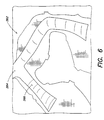
- FIG. 6 details a bladder for a multifunctional layer of an integrated protective ensemble in accordance with one or more embodiments of the present invention
- FIGS. 7A and 7B illustrate a shaping system for a multifunctional layer of an integrated protective ensemble in both open and closed orientations, respectively, in accordance with one or more embodiments of the present invention
- FIGS. 8A through 8T present data collected during quantitative analysis of an integrated protective ensemble in accordance with one or more embodiments of the present invention tested under various acceleration scenarios.
- FIG. 9 presents power output data collected during quantitative analysis of an integrated ventilation system in accordance with one or more embodiments of the present invention.
- the present invention relates generally to an integrated ensemble that provides a range of protection while significantly reducing bulk and heat stress levels typically associated with such equipment.
- Advanced materials technology including multifunctional fabrics, is leveraged with unique design elements to create a functionally integrated protective ensemble.
- the resulting garment-based equipment may be generally effective in providing protection and personal comfort to a user of the ensemble.
- Various types of potential users may be associated with distinct requirements for protection based on applicable environmental conditions.
- groups include, but are not limited to, fighter pilots, aircraft ground crew, firemen and other first responders, soldiers, athletes, race car drivers, “hazmat” operators, chemical plant operators, construction workers, and various medical personnel including surgical staff.
- individuals may benefit from one or more types of protection including thermal, cold water immersion and/or acceleration (anti-G) protection.
- Anti-G acceleration
- the ensembles presented herein are beneficially capable of customization to accommodate various requirements, as well as to target specific regions of a user's body for protection and comfort.
- the disclosed ensembles may be wearable systems.
- the systems are generally low bulk, designed to provide a requisite level of protection and enhance personal comfort while attempting to minimize the thickness and/or number of layers worn by a user in order to reduce thermal burden and facilitate mobility.
- the systems may also be flexible in terms of their functionality, generally adaptable in response to changes in a user's environment.
- a disclosed ensemble comprises garment-based equipment.
- one or more elements of the disclosed systems may be incorporated into the form of a body suit, a vest, a jacket, shorts, trousers, or helmet.
- Body coverage may vary.
- the ensemble may involve gloves, mask, hood and/or booties.
- Placement and/or distribution of a particular functional element on and among layers may be dictated by factors including its intended purpose, advantageous distance from the body of a user, and/or region of the body to be targeted.
- Functional elements may be interchangeable among various multifunctional layers and any specific functionality is not limited to placement on a particular multifunctional layer discussed herein.
- Functionality of one layer may be partially or fully identical to the functionality of another layer.
- layers may have completely different functionality associated therewith.
- cooperation between one or more layers, such as adjacent layers may give rise to one or more types of protection.
- Layers may be independent of one another, designed to be worn by a user in a layered manner.
- one or more functional elements may be constructed and arranged to be removably connectable to various sources, such as a power or gas source, to enable its operation.
- a ventilation system integrated in a multifunctional layer may be removably connectable to source of gas.
- a source may be a portable or tethered external supply, such as a blower, fan or compressed air canister.
- the source may be an on-site supply.
- the source may be installed at a construction site, athletic field, surgical theater, or be part of a vehicle air supply such as may be present in an airplane, race car or other mode of transport.
- any required source may be fully integrated within the ensemble itself.
- the ensemble may generally comprise a system of two multifunctional layers.
- a first multifunctional layer may be designed for wear proximate to the body of a user or over an undergarment.
- the first multifunctional layer may be generally capable of providing immersion protection, ventilation, and/or cold weather protection.
- the first multifunctional layer may also have various chemical and/or biological protective properties.
- the first multifunctional layer may serve as a liner.
- a second multifunctional layer may be designed for wear in cooperation with the first multifunctional layer, such as in a layered manner.
- the second multifunctional layer may be capable of providing protection against flame, acceleration, and other environmental factors, providing ventilation and/or providing gear carriage capabilities.
- the second multifunctional layer may serve as a shell.
- Either multifunctional layer may have different and/or additional functionality from that exemplarily discussed herein.
- a user may choose to wear one or both layers depending on requirements dictated by environmental conditions. For example, in applications where the functionality of a first multifunctional layer is not required, such as when cold water immersion is not a concern, a second multifunctional layer may be worn proximate to the body of the user without the first layer. Additional layers may be present in the ensemble as well.
- the ensembles disclosed herein may be used in conjunction with other equipment, such as that intended for protection, comfort, storage and/or carriage, including other garment-based devices.
- a first multifunctional layer may generally include one or more functional elements such as those exemplarily illustrated in FIG. 1 .
- liner 100 may be in direct contact with the user's body, or may alternatively be applied over an undergarment.
- Liner 100 may be constructed and arranged to provide any desired degree of body coverage.
- liner 100 may substantially cover a user's body, including torso, arms and legs.
- Integrated functionality of liner 100 may be directed to one or more requirements as needed.
- liner 100 may be generally aimed at personal cooling, cold water immersion protection, as well as cold weather protection, as illustrated in FIG. 1 .
- a multifunctional layer such as liner 100
- liner 100 may be constructed of any material capable of promoting personal comfort aims and/or fulfilling various predetermined protection requirements, such as those dictated by expected and/or potential environmental conditions.
- liner 100 may be a substantially gas permeable layer.
- permeable generally refers to having pores or openings that permit liquids or gases to pass through.
- a user may advantageously discern gas flow through permeable liner 100 , such as when a cooling system is integrated therein.
- Liner 100 may be a relatively thin layer and/or be streamlined to generally contour a user's body in order to reduce bulk and/or heat stress.
- a multifunctional layer such as liner 100
- liner 100 may be made of a natural or synthetic material but should generally be compatible with intended use for the disclosed integrated ensemble.
- flame resistance may be important and a substantially non-melt and/or non-drip material may be selected for liner 100 .
- non-melt refers generally to having a sufficiently high melting point such that the material will not substantially change phases under anticipated environmental conditions.
- liner 100 material may be required to withstand environmental temperatures of up to 125 degrees Fahrenheit or higher for a given application.
- non-drip refers generally to physical properties such that molten materials will tend not to form and/or fall in drops.
- Various tests and/or standards for material properties commonly known to those skilled in the art, such as the Thermal Stability Test, Vertical Flammability Test (ASTM D-6413), and NFPA 1951: Standard on Protective Ensemble for USAR Operations may be referenced in selecting material for various multifunctional layers of the disclosed integrated protective ensembles.
- a multifunctional layer may exhibit wicking properties for enhanced cooling and comfort.
- wicking refers generally to an ability to promote absorption of moisture, such as perspiration off the skin or an undergarment.
- the wicking material may be a natural fiber such as wool.
- liner 100 may enhance the rate and uniformity of evaporative cooling by diffusing moisture through wicking.
- the material of a multifunctional layer may be a substantially elastic material.
- the term “elastic” refers generally to an ability to repeatedly deform or stretch from, and subsequently return to, a normal condition, position or shape such as when dictated by a user's motion.
- An elastic material may beneficially promote mobility and comfort for a user, and may facilitate bulk reduction.
- liner 100 for example, may be constructed of a two- or four-way stretch material.
- a multifunctional layer such as liner 100 may also exhibit insulative properties when desirable.
- insulative refers generally to an ability to prevent passage of heat or cold.
- Certain potential applications for the disclosed ensemble wherein a user may be exposed to uncomfortably low temperatures, such as ambient temperatures of below 60 degrees Fahrenheit, may require or benefit from an insulating liner 100 . Pilots and aircrew, for example, may experience low air temperatures depending on flight altitude. Low environmental temperatures may also be associated with cold water immersion.
- liner 100 may therefore be able to prevent declines in body temperature of, for example, more than two degrees Fahrenheit over the course of an hour in 32 degrees Fahrenheit water.
- a multifunctional layer may generally be a weatherproof layer.
- liner 100 may be a substantially waterproof garment layer.
- the term “waterproof” as used herein refers generally to liquid barrier properties of a material.
- Liner 100 may provide varying levels of waterproof protection depending on specific requirements for an intended application.
- liner 100 may be characterized as providing full waterproof protection when exhibiting an ability to support a 30-inch hydrostatic head for three minutes without allowing passage of a predetermined amount of liquid based on results generated by a standard hydrohead test device. Waterproof protection may be provided by implementing one or more suitable techniques commonly known in the art.
- the material of liner 100 may be coated or laminated with a substantially waterproof membrane such as PTFE, polyester, polyurethane, polyethylene or other commercially available stretch membrane in accordance with one or more embodiments of the present invention.
- a substantially waterproof membrane such as PTFE, polyester, polyurethane, polyethylene or other commercially available stretch membrane in accordance with one or more embodiments of the present invention.
- An ability to reject other fluids, including aerosols and vapors, may be an additional consideration in selecting a material for liner 100 .
- a coating such as a PTFE plasma coating, may be applied to fibers of a multifunctional layer to impart substantially hydrophobic properties to the layer. Seam sealing among components of a multifunctional layer may also promote waterproofing through employing methods such as taping, gluing, ultrasonic welding and/or heat sealing.
- a multifunctional layer such as liner 100
- the neck seals 110 and/or wrist seals 120 may be permanently sealed to liner 100 around neck and wrist regions, respectively, and configured to generate a substantially tight, waterproof fit with respect to a user's body.
- seals 110 , 120 may comprise a material with waterproof qualities, such as latex or neoprene.
- seals 110 , 120 may be constructed and arranged to be self-closing, remaining open until closure is needed, such as when a user enters a submerged state. Automatic seal closure may be implemented with any suitable means known in the art.
- Such self-closing neck seals 110 and wrist seals 120 may be reversibly sealable and may also be removable for laundering.
- a multifunctional layer may also include a closure system.
- liner 100 typically includes a closure system 140 .
- Closure system 140 may involve one or more features for assisting a user in dressing and removal of liner 100 as desired. Design considerations for closure system 140 may include, for example, comfort, ease of use, and minimizing interference with other elements of the disclosed ensemble.
- Closure system 140 may generally be constructed and arranged to secure a user within liner 100 , such as with zippers, snaps, hook and loop closures, or other known closure mechanisms.
- Closure system 140 may be substantially waterproof in cooperation with other waterproofing features of liner 100 .
- the slide fastener may generally involve a fastener on a waterproof tape and include a cover flap.
- the disclosed ensemble may include a second multifunctional layer, for instance a shell 200 , generally including one or more functional elements such as those illustrated in FIG. 2 for purposes of example only.
- the second multifunctional layer may generally cooperate with another multifunctional layer, such as the first multifunctional layer.
- shell 200 may be worn over liner 100 or another undergarment.
- shell 200 may be worn proximate to the skin as discussed above.
- a multifunctional layer, shell 200 for example, may be substantially low-bulk while providing sufficient fitting room to accommodate an underlayer, such as liner 100 .
- Shell 200 may generally be constructed of a flexible material for comfort and mobility. As with liner 100 , various potential environmental factors may impact choice of material. For example, in some applications it may be desirable for shell 200 to be substantially flame resistant, such as non-melt and/or non-drip.
- shell 200 may be constructed of a material containing NOMEX® fiber commercially available from DuPont. For example, shell 200 may contain about 97% NOMEX® fiber and about 3% of an anti-static additive.
- the second multifunctional layer may also exhibit weatherproof (such as hydrophic or waterproof), wicking, insulative, permeability, antimicrobial and/or other material properties as desired.
- a multifunctional layer such as shell 200
- shell 200 may generally include one or more design features to enhance comfort and/or mobility.
- shell 200 may include one or more articulated joints 210 , such as at elbow and shoulder regions, to facilitate range of motion.
- Shell 200 may also integrate stretch panels 220 , such as at the shoulder and/or lower back regions to augment movement and the ability to sit comfortably, particularly when shell 200 is tightened for use. Extra space at underarm regions may be provided as well, such as through incorporation of raglan sleeves 230 for comfort. Additional features may likewise be integrated into the design of shell 200 for safety.
- a substantially raised collar 240 such as a mandarin collar, may be incorporated for in-place neck protection of a user.
- Shell 200 may also include reinforcement in various high-wear areas, such as knees and elbows.
- a multifunctional layer such as shell 200
- the storage system may generally facilitate access to stored items. Carriage by a user may be facilitated by one or more integrated storage features 250 . Placement, number and/or nature of storage features 250 on shell 200 may be provided in any desired manner, such as to make useful items available within easy reach of a user.
- one or more storage features 250 may be integrated on a front torso region of shell 200 .
- Storage features 250 may generally involve any mechanism capable of facilitating carriage of one or more items.
- the types of items to be stored, such as survival gear or safety equipment, may be specified by applicable requirements.
- the size and/or nature of a particular item to be carried may dictate characteristics of a storage feature 250 .
- storage features 250 may include inner and/or outer pockets, as well as other mechanisms such as loops, hooks and clips configured to hold items.
- storage features 250 include pocket bags, these may be constructed from a mesh material so as to minimize thermal burden. Interior pockets, and a reduced number of external pockets, may create a more streamlined load and reduce the possibility of losing items.
- FIG. 3 One example of a potential arrangement of storage features 250 on shell 200 is illustrated in FIG. 3 .
- storage features 250 may be based on pull-out platform designs where items are held in place on a platform via an elastic or other suitable material.
- the platforms may be tethered, and constructed and arranged to be pulled out for ease and organized access by a user.
- the platforms may be removable. Finger loops on movable platforms may also be integrated to enable one-handed access to items that may otherwise be out of reach.
- Such platforms may be constructed using a spacer fabric to reduce thermal burden of the platform layer, provide structural stability for supporting items, and provide cushioning between stored gear and a body of the user.
- a multifunctional layer such as shell 200
- Casing system 260 may generally be capable of providing conditioning, such as ventilation or cooling, to a user.
- Casing system 260 may also provide acceleration protection as discussed herein.
- Casing systems 260 may be integrated into a multifunctional layer, such as shell 200 , in any desired position.
- the construction of the present invention may provide cooling specifically to areas prone to heat build-up.
- Casing systems 260 may be shaped and oriented to target particular regions of a user's body as well. FIG.
- Casing system 260 should generally be constructed of a high-strength material, and may be substantially non-melt and/or non-drip as may be required.
- the sheath of casing system 260 may generally create air pockets to promote air flow, such as between layers of the disclosed ensemble or between a multifunctional layer and a user's body. Some materials for the sheath of integrated casing system 260 , such as muslin or silk, may also enhance wicking to further condition the body as discussed above. Additionally or alternatively, ventilation functionality may be integrated into shell 200 implementing structures similar to ventilation system 130 discussed above, and vice versa.
- one or more counter-pressure bladders 262 may be positioned within casing system 260 .
- Bladder 262 may be surrounded by the sheath of casing system 260 .
- FIG. 6 details a bladder 262 in accordance with one or more embodiments of the present invention.
- gas may be supplied to bladder 262 by a duct via manifold 264 .
- Bladder 262 may therefore be filled or inflated to provide acceleration (anti-G) protection to a user by exhibiting counter-pressure.
- gas may also be supplied to a space around bladder 262 , such as may be defined by the sheath of casing system 260 , for ventilation.
- Thermal improvements may be made by using a breathable material for bladder 262 construction, such as ULTREX® supplex nylon.
- breathable bladders 262 may allow for better passive cooling by increased permeability of bladder 262 material covering the body.
- Bladder supports 266 may be integrated into bladder 262 to generally prevent collapse of interior space to be filled with gas, such as may be due to compression while seated or other applied force.
- a spacer fabric may be incorporated within bladder 262 to maintain an open space within bladder 262 even under no active air flow.
- the ducts and/or manifolds to supply gas to casing system 260 for ventilation and/or acceleration protection should generally be high strength, durable, flexible and substantially incompressible to avoid pinch points. Both should also be substantially air impermeable and sealable to avoid leaks.
- a coated fabric such as a coated nylon or cotton may be used for a gas duct and manifold.
- a membrane laminated fabric material may also be used.
- gas may travel from one or more gas sources (not shown) along a gas duct to enter a manifold, such as manifold 264 . In some embodiments, the gas source may be directly connected to a manifold.
- the gas may then be distributed to the interior of casing system 260 for ventilation as well as to bladders 262 for acceleration protection.
- the gas sources may include a gas supply and associated equipment such as fans, blowers, pumps and vacuums generally required to generate and maintain gas flow.
- a gas source may be portable, tethered, integrated, or may be available on-site, such as for plug-in access.
- the flow rate and system pressure within casing system 260 should generally be sufficient to provide discernible gas flow and adequate to achieve enhanced personal comfort. Gas supplied to bladders 262 should be sufficient to exhibit effective counter-pressure.
- one or more internal ducts may facilitate establishing uniform airflow to distant regions within casing system 260 .
- a spacer fabric in the internal duct may be implemented to prevent blockage of airflow in case of restriction, for example by a harness or while seated, even under no active air flow.
- the gas from the gas sources to be delivered for ventilation may be treated or conditioned for enhanced personal comfort.
- the gas may therefore be conditioned to facilitate heating, cooling, humidification, dehumidification, or circulation of filtered or otherwise treated gas. It is therefore contemplated that embodiments of the present invention may be used to treat conditions such as hypothermia and hyperthermia, as well as to facilitate therapeutic treatments.
- casing system 260 may also be configured to exhaust or extract gas, such as through reverse flow to the gas source by a vacuum pump. For example, it may be configured to extract gas such that gas flows through casing system 260 and exits a manifold.
- casing systems 260 integrated in a multifunctional layer can vary dramatically depending on an intended application.
- a ventilation and/or anti-G protection requirement for a class of users may first be determined.
- Casing systems 260 may then be selectively disposed based on the determined requirement to target regions of a user's body. For example, various embodiments of the present invention may target a user's torso, arms, legs, pelvis and/or head.
- shell 200 may have multiple casing systems 260 stemming from a single manifold. Another embodiment may have a manifold and a casing system 260 stemming from a gas duct roughly every few inches.
- Multiple casing systems 260 may be connected as part of a larger system.
- the multiple systems may be arranged in series or parallel from a single or multiple source of gas.
- a first system targeting a wearer's chest or torso may be fluidly connected to a second system targeting a wearer's leg.
- a single source of gas may provide gas flow to multiple users.
- ventilation systems on two or more multifunctional layers may cooperate.
- a single source of gas may supply ventilation systems on two or more multifunctional layers, such as liner 100 and shell 200 .
- Various integrated ventilation systems may also share gas ducts and/or manifolds.
- a multifunctional layer such as shell 200 may also include a closure system 270 .
- Closure system 270 may employ any commonly known closure mechanisms such as those described above with respect to closure system 140 . Integration of functionality in a multifunctional layer, such as storage features 250 and casing system 260 discussed above, may be accommodated by the configuration of closure system 270 .
- closure system 270 may generally be constructed and arranged to provide a free area on the front torso region for integration of storage features 250 as well as counter-pressure bladders in a chest region casing 260 as desired.
- closure system 270 may generally facilitate side entry by a user.
- closure system 270 may include a first closure mechanism operating along a side torso region of shell 200 , such as from a user's elbow to knee.
- Closure system 270 may also include a second closure mechanism operating at a neck region of shell 200 , such as from a user's neck to shoulder, providing the user with additional space to facilitate entry into and out of shell 200 .
- a user may step into both leg portions of shell 200 , push his/her head through raised collar 240 while inserting a first arm through an associated first arm portion, and then insert a second arm though a second arm portion before engaging closure system 270 .
- Finger loops (not shown) at the end of arm portions may facilitate closure with an intuitive grab feature to provide resistance while closing shell 200 via closure system 270 .
- a shaping system may be integrated in shell 200 or other multifunctional layer to facilitate adjustment of the integrated ensemble relative to the body contour of a specific user. Proper adjustment and/or fitting may be important for comfort, motion, and to ensure anti-G protection capabilities.
- the shaping system may generally involve one or more shaping mechanisms placed on regions of a multifunctional layer that may require custom fitting. Segmentation of the shaping system, such as through strategic placement of multiple shaping mechanisms, may enable further customization and accuracy of fit along a length of a user's body. Shaping mechanisms may be positioned, for example, on a front torso, back torso, arm and/or leg region of shell 200 as desired. Any commonly known shaping technique may be implemented in shaping mechanisms.
- a shaping mechanism may involve lacings, belts or another tensioning, tightening or fitting device.
- one or more shaping mechanisms 280 comprises a mechanism constructed and arranged to facilitate ease of adjustment, such as with a single motion.
- a shaping mechanism 280 may involve a fan lacing arrangement as illustrated in FIGS. 7A and 7B .
- Lacing elements 282 may be attached to one or more regions of shell 200 , such as by threading them through an array of eyelets 284 positioned on one or more regions of shell 200 .
- Free ends of a plurality of lacing elements 282 may be fed through a single holding device, such as buckle 286 , in an open orientation as illustrated in FIG. 7A . In a closed orientation as illustrated in FIG. 7B , the plurality of free ends of lacing elements 282 may be simultaneously pulled through buckle 286 to increase tension therein.
- Eyelets 284 associated with a single lacing element 282 may therefore be pulled closer together and/or closer to buckle 286 , generally narrowing gaps in shell 200 to result in an increasingly contoured fit relative to a user's body.
- Multiple lacing elements 282 may be tightened simultaneously such that a shaping mechanism 280 may be actuated with a single motion.
- a multifunctional layer such as shell 200 may also include an integrated or partially integrated harness (not shown).
- a rear of a harness may be integrated into a rear torso portion of shell 200 .
- a front of the harness may be exposed and configured in a substantially modular manner to accommodate attachment of various harness structures, such as those associated with aircraft.
- the harness may be padded and include leg loops which may be contoured and/or removable.
- One or more sensors may be integrated in a multifunctional layer to monitor characteristics of a user and/or operational parameter of the integrated protective ensembles disclosed herein.
- Such sensors may include, for example, temperature sensors, pressure sensors and flow meters.
- One or more functional elements may be controlled based on information collected by the sensors via a control system.
- Communication equipment such as GPS technology, radios and alarms may also be integrated.
- audible and/or visual cues may be generated, such as to signal distress, based on information collected by one or more sensors.
- a bladder, such as that illustrated in FIG. 6 , made of waterproof/breathable ULTREX supplex nylon was installed into each of two prototype casing systems in accordance with one or more embodiments of the present invention.
- the first prototype casing system was made of silk and included piped ribbing for enhanced ventilation.
- the second prototype casing system was made of silk with flat ribs for enhanced ventilation.
- Each casing system was installed in a multifunctional layer in accordance with one or more embodiments of the present invention.
- FIGS. 8A through 8T Data collected for each of the four subjects during each of the five acceleration scenarios is presented in FIGS. 8A through 8T .
- Both prototype multifunctional layers sustained some damage, mainly tearing, in all but those trials associated with test Subject 1 , mainly due to inexact fit and prototype quality hardware.
- the damaged multifunctional layers continued to provide protection. Chatter was detected in all experimental runs between 3 and 5 Gz.
- Thermal manikin testing was conducted on a cooling vest including an integrated ventilation system in accordance with one or more embodiments of the present invention.
- the ventilation system was constructed and arranged in accordance with the description presented above of ventilation system 130 of liner 100 .
- the chamber conditions were maintained at a temperature of 35 degrees Celsius and a relative humidity of 50 percent.
- the thermal manikin included power sensors in the chest and back regions. Five runs were conducted. In each run, the amount of power required to maintain the thermal manikin skin temperature at 35 degrees Celsius was monitored. The data is summarized in FIG. 9 .
- a baseline test 1 was conducted with the thermal manikin dressed in cotton skin and a chemical suit.
- a baseline test 2 was conducted with the thermal manikin dressed in cotton skin, a chemical suit, and body armor.
- a baseline test 3 was conducted with the thermal manikin dressed in cotton skin, a chemical suit and the cooling vest in “off” mode.
- a test condition 1 run was conducted with the thermal manikin wearing cotton skin, a chemical suit and the cooling vest in “on” mode. In this test condition 1, the cooling vest was operating and providing ventilation so as to result in cooling of the manikin skin. No record was kept of parameters and/or data associated with a test condition 2 run.
- test condition 1 The data indicates that the operable “cooling vest” configuration (test condition 1) resulted in increased power needed to maintain the manikin skin temperature at 35 degrees Celcius. Substantially lower amounts of required power were associated with each of the three baseline runs. Thus, it was concluded that the cooling vest was effective in providing ventilation and cooling to the manikin skin.
- the term “plurality” refers to two or more items or components.
- the terms “comprising,” “including,” “carrying,” “having,” “containing,” and “involving,” whether in the written description or the claims and the like, are open-ended terms, i.e., to mean “including but not limited to.” Thus, the use of such terms is meant to encompass the items listed thereafter, and equivalents thereof, as well as additional items. Only the transitional phrases “consisting of” and “consisting essentially of,” are closed or semi-closed transitional phrases, respectively, with respect to the claims.
Landscapes
- Engineering & Computer Science (AREA)
- Health & Medical Sciences (AREA)
- General Health & Medical Sciences (AREA)
- Physical Education & Sports Medicine (AREA)
- Textile Engineering (AREA)
- Environmental & Geological Engineering (AREA)
- Professional, Industrial, Or Sporting Protective Garments (AREA)
- Heterocyclic Compounds That Contain Two Or More Ring Oxygen Atoms (AREA)
Abstract
Description
Claims (39)
Priority Applications (1)
| Application Number | Priority Date | Filing Date | Title |
|---|---|---|---|
| US11/728,203 US8104101B2 (en) | 2006-03-24 | 2007-03-23 | Integrated protective ensemble |
Applications Claiming Priority (2)
| Application Number | Priority Date | Filing Date | Title |
|---|---|---|---|
| US78556806P | 2006-03-24 | 2006-03-24 | |
| US11/728,203 US8104101B2 (en) | 2006-03-24 | 2007-03-23 | Integrated protective ensemble |
Publications (2)
| Publication Number | Publication Date |
|---|---|
| US20070289050A1 US20070289050A1 (en) | 2007-12-20 |
| US8104101B2 true US8104101B2 (en) | 2012-01-31 |
Family
ID=38541669
Family Applications (1)
| Application Number | Title | Priority Date | Filing Date |
|---|---|---|---|
| US11/728,203 Active 2030-06-06 US8104101B2 (en) | 2006-03-24 | 2007-03-23 | Integrated protective ensemble |
Country Status (4)
| Country | Link |
|---|---|
| US (1) | US8104101B2 (en) |
| EP (1) | EP2001314A4 (en) |
| CA (1) | CA2647183A1 (en) |
| WO (1) | WO2007111981A2 (en) |
Cited By (2)
| Publication number | Priority date | Publication date | Assignee | Title |
|---|---|---|---|---|
| US20110000009A1 (en) * | 2009-07-02 | 2011-01-06 | Culpepper E Alan | External pocket for a protective suit |
| US20140115744A1 (en) * | 2011-06-28 | 2014-05-01 | Whites Manufacturing Ltd. | Dviving dry suit having zippered front compression flaps |
Families Citing this family (26)
| Publication number | Priority date | Publication date | Assignee | Title |
|---|---|---|---|---|
| DE202007018496U1 (en) * | 2007-04-24 | 2008-09-11 | Dräger Safety AG & Co. KGaA | Arrangement for monitoring the body fluid condition of a person |
| US20090055990A1 (en) * | 2007-09-04 | 2009-03-05 | Arthur Tseshao Shih | Wader with interior air ventilation arrangement |
| DE102008035351B4 (en) * | 2008-07-29 | 2018-10-11 | Dräger Safety AG & Co. KGaA | Multilayer material web, especially for protective suits |
| AT506861B1 (en) * | 2008-10-03 | 2009-12-15 | Eska Lederhandschuhfabrik Ges | HEAT-RESISTANT GLOVE |
| GB0819596D0 (en) | 2008-10-24 | 2008-12-03 | Survitec Group Ltd | Attachment systems |
| US20100154105A1 (en) * | 2008-12-24 | 2010-06-24 | Mathis Michael P | Treated cuff |
| US20110078848A1 (en) * | 2009-10-05 | 2011-04-07 | Mathis Michael P | Treatment of Folded Articles |
| US10893709B2 (en) * | 2010-08-25 | 2021-01-19 | The Surgical Company International B.V. | Garment for preventing redistribution hypothermia |
| GB201016384D0 (en) | 2010-09-30 | 2010-11-10 | Survitec Group Ltd | Aircrew ensembles |
| GB201016375D0 (en) | 2010-09-30 | 2010-11-10 | Survitec Group Ltd | Flight suits |
| GB201016374D0 (en) | 2010-09-30 | 2010-11-10 | Survitec Group Ltd | Aircrew ensembles |
| GB201016377D0 (en) | 2010-09-30 | 2010-11-10 | Survitec Group Ltd | Aircrew ensembles |
| CH704164A1 (en) | 2010-11-19 | 2012-05-31 | Nius Ltd G | Acceleration protective suit. |
| USD736883S1 (en) * | 2011-09-28 | 2015-08-18 | Swimways Corporation | Swimming assistance shirt with inflatable sleeve |
| US11027156B2 (en) | 2011-10-21 | 2021-06-08 | Honeywell International Inc. | Emergency filter system for ventilated hood |
| US10004925B2 (en) | 2011-10-21 | 2018-06-26 | Honeywell International Inc. | Emergency filter system for encapsulated suit |
| WO2015085405A1 (en) * | 2013-12-12 | 2015-06-18 | Stephan/H | Flight suits |
| USD744721S1 (en) * | 2014-01-10 | 2015-12-08 | Lineweight Llc | One piece garment |
| ES2573852T3 (en) * | 2014-04-07 | 2016-06-10 | Honeywell International Inc. | Integral air distribution system on the back in a ventilated suit |
| CN104026770B (en) * | 2014-06-25 | 2016-03-02 | 襄阳宏伟航空器有限责任公司 | There are pilot's clothes of environment temperature feedback function |
| WO2017180619A2 (en) * | 2016-04-12 | 2017-10-19 | Caro Michael F | Athletic garment and hygienic system |
| US20180317562A1 (en) * | 2017-05-04 | 2018-11-08 | Monee Denine Gagliardo | Neutral Spine Support Garment |
| CH716557A2 (en) | 2019-09-04 | 2021-03-15 | G Beyeler Patrick | Acceleration protection pants. |
| GB2618999A (en) | 2022-05-10 | 2023-11-29 | Survitec Group Ltd | Inflatable bladder for aircrew anti-G garment |
| USD1087472S1 (en) * | 2022-08-17 | 2025-08-05 | Honeywell International Inc. | Safety garment |
| CN118614668A (en) * | 2024-05-23 | 2024-09-10 | 中国人民解放军总医院第一医学中心 | Smart thermal underwear |
Citations (10)
| Publication number | Priority date | Publication date | Assignee | Title |
|---|---|---|---|---|
| US2853758A (en) * | 1956-01-26 | 1958-09-30 | Sam B Topf | Water-proof closure |
| US3493972A (en) * | 1967-01-03 | 1970-02-10 | Frankenstein Group Ltd | Waterproof suits |
| US3643264A (en) * | 1970-10-02 | 1972-02-22 | Carl T Rector | Underwater diving garment construction |
| US3771169A (en) * | 1970-08-10 | 1973-11-13 | E Edmund | Adjustable size wet suit |
| US4242769A (en) * | 1978-12-14 | 1981-01-06 | Ilc Dover, A Division Of Ilc Industries, Inc. | Anti-exposure inflatable structure |
| US4464795A (en) * | 1982-06-17 | 1984-08-14 | Diving Unlimited International, Inc. | Easy access underwater diving suit |
| US5191658A (en) * | 1991-05-01 | 1993-03-09 | Dive N'surf, Inc. | Offset zipper closed wet suit |
| US5245993A (en) | 1991-10-31 | 1993-09-21 | The Boeing Company | Pilot's ensemble with integrated threat protection |
| US6415440B1 (en) * | 2001-12-20 | 2002-07-09 | Diving Unlimited International, Inc. | Diver's suit with diagonal torso zipper that partially encircles the waist |
| US7013489B1 (en) | 2002-06-13 | 2006-03-21 | Mcgrath Diverse Products, L.L.C. | Liner and garment ensemble for thermal wear and anti-exposure suits |
Family Cites Families (7)
| Publication number | Priority date | Publication date | Assignee | Title |
|---|---|---|---|---|
| US2563179A (en) * | 1946-07-31 | 1951-08-07 | Wagner Electric Corp | Circuit regulating apparatus |
| US3049896A (en) * | 1960-04-27 | 1962-08-21 | Environment Inc | Personnel isolation and protection systems |
| US3751727A (en) * | 1968-08-05 | 1973-08-14 | Nasa | Space suit |
| US3516404A (en) * | 1969-09-09 | 1970-06-23 | Nasa | Biological isolation garment |
| US4271833A (en) * | 1979-06-25 | 1981-06-09 | E. D. Bullard Company | Ventilating system for protective clothing |
| US4925133A (en) * | 1988-12-27 | 1990-05-15 | Rockwell International Corporation | Hydraulic buoyancy force suit |
| US6209144B1 (en) * | 2000-01-10 | 2001-04-03 | Eddie R. Carter | Protective garment |
-
2007
- 2007-03-23 US US11/728,203 patent/US8104101B2/en active Active
- 2007-03-23 EP EP07753806A patent/EP2001314A4/en not_active Withdrawn
- 2007-03-23 WO PCT/US2007/007208 patent/WO2007111981A2/en not_active Ceased
- 2007-03-23 CA CA002647183A patent/CA2647183A1/en not_active Abandoned
Patent Citations (10)
| Publication number | Priority date | Publication date | Assignee | Title |
|---|---|---|---|---|
| US2853758A (en) * | 1956-01-26 | 1958-09-30 | Sam B Topf | Water-proof closure |
| US3493972A (en) * | 1967-01-03 | 1970-02-10 | Frankenstein Group Ltd | Waterproof suits |
| US3771169A (en) * | 1970-08-10 | 1973-11-13 | E Edmund | Adjustable size wet suit |
| US3643264A (en) * | 1970-10-02 | 1972-02-22 | Carl T Rector | Underwater diving garment construction |
| US4242769A (en) * | 1978-12-14 | 1981-01-06 | Ilc Dover, A Division Of Ilc Industries, Inc. | Anti-exposure inflatable structure |
| US4464795A (en) * | 1982-06-17 | 1984-08-14 | Diving Unlimited International, Inc. | Easy access underwater diving suit |
| US5191658A (en) * | 1991-05-01 | 1993-03-09 | Dive N'surf, Inc. | Offset zipper closed wet suit |
| US5245993A (en) | 1991-10-31 | 1993-09-21 | The Boeing Company | Pilot's ensemble with integrated threat protection |
| US6415440B1 (en) * | 2001-12-20 | 2002-07-09 | Diving Unlimited International, Inc. | Diver's suit with diagonal torso zipper that partially encircles the waist |
| US7013489B1 (en) | 2002-06-13 | 2006-03-21 | Mcgrath Diverse Products, L.L.C. | Liner and garment ensemble for thermal wear and anti-exposure suits |
Cited By (3)
| Publication number | Priority date | Publication date | Assignee | Title |
|---|---|---|---|---|
| US20110000009A1 (en) * | 2009-07-02 | 2011-01-06 | Culpepper E Alan | External pocket for a protective suit |
| US20140115744A1 (en) * | 2011-06-28 | 2014-05-01 | Whites Manufacturing Ltd. | Dviving dry suit having zippered front compression flaps |
| US10093401B2 (en) * | 2011-06-28 | 2018-10-09 | Whites Manufacturing Ltd. | Diving dry suit having zippered front compression flaps |
Also Published As
| Publication number | Publication date |
|---|---|
| EP2001314A4 (en) | 2009-12-16 |
| US20070289050A1 (en) | 2007-12-20 |
| WO2007111981A2 (en) | 2007-10-04 |
| EP2001314A2 (en) | 2008-12-17 |
| CA2647183A1 (en) | 2007-10-04 |
| WO2007111981A3 (en) | 2008-01-31 |
Similar Documents
| Publication | Publication Date | Title |
|---|---|---|
| US8104101B2 (en) | Integrated protective ensemble | |
| CN101022741B (en) | Gas distribution garment | |
| US7117687B2 (en) | Personal air conditioning | |
| US3751727A (en) | Space suit | |
| US4271833A (en) | Ventilating system for protective clothing | |
| JP6343073B2 (en) | Chemical protective clothing | |
| CN108348017B (en) | cooling clothes | |
| US20240228041A9 (en) | Protective Aviation Garment | |
| US20070095088A1 (en) | Body ventilation system and method | |
| EP2510816A2 (en) | Personal cooling apparatus | |
| US9708061B2 (en) | Aircrew ensembles | |
| US8925112B2 (en) | Aircrew ensembles | |
| RU47631U1 (en) | MARINE RESCUE KIT | |
| RU114144U1 (en) | PROTECTIVE OVERALLS FOR PROTECTION AGAINST SPLITS, CUTS AND EXPOSURE OF THE FIRE UNDER THE VEHICLE | |
| WO2012041974A1 (en) | Aircrew ensembles | |
| RU101165U1 (en) | PROTECTIVE OVERALLS FOR PROTECTION AGAINST SHARDING, CUTS AND FIRE EXPOSURE | |
| CZ2022269A3 (en) | Filter ventilation unit | |
| CN120187637A (en) | Protective clothing | |
| Carson et al. | Extravehicular mobility unit | |
| Shepard et al. | Space suit | |
| D'ANDRADE et al. | Extravehicular space suit system for Apollo and Skylab missions | |
| TY | PROJ ECT DOCUMENT CHANGE/REV Is I ON LOG PAGE OF FOR CSD OR Igi NATED DOCUMENT | |
| Spano et al. | MICROCLIMATE-CONTROLLED (THERMALIBRIUM) CLOTHING SYSTEMS FOR MILITARY APPLICATIONS | |
| GB2553046A (en) | Garment | |
| GB2553047A (en) | Garment |
Legal Events
| Date | Code | Title | Description |
|---|---|---|---|
| AS | Assignment |
Owner name: TIAX LLC, MASSACHUSETTS Free format text: ASSIGNMENT OF ASSIGNORS INTEREST;ASSIGNORS:NOCENTE, ANNA MARIE;DEVINE, MARLENE A;STOKES, JOHN F;AND OTHERS;REEL/FRAME:019614/0542;SIGNING DATES FROM 20070621 TO 20070702 Owner name: TIAX LLC, MASSACHUSETTS Free format text: ASSIGNMENT OF ASSIGNORS INTEREST;ASSIGNORS:NOCENTE, ANNA MARIE;DEVINE, MARLENE A;STOKES, JOHN F;AND OTHERS;SIGNING DATES FROM 20070621 TO 20070702;REEL/FRAME:019614/0542 |
|
| STCF | Information on status: patent grant |
Free format text: PATENTED CASE |
|
| FEPP | Fee payment procedure |
Free format text: PAYOR NUMBER ASSIGNED (ORIGINAL EVENT CODE: ASPN); ENTITY STATUS OF PATENT OWNER: LARGE ENTITY |
|
| REMI | Maintenance fee reminder mailed | ||
| FPAY | Fee payment |
Year of fee payment: 4 |
|
| SULP | Surcharge for late payment | ||
| FEPP | Fee payment procedure |
Free format text: MAINTENANCE FEE REMINDER MAILED (ORIGINAL EVENT CODE: REM.); ENTITY STATUS OF PATENT OWNER: LARGE ENTITY |
|
| FEPP | Fee payment procedure |
Free format text: 7.5 YR SURCHARGE - LATE PMT W/IN 6 MO, LARGE ENTITY (ORIGINAL EVENT CODE: M1555); ENTITY STATUS OF PATENT OWNER: LARGE ENTITY |
|
| MAFP | Maintenance fee payment |
Free format text: PAYMENT OF MAINTENANCE FEE, 8TH YEAR, LARGE ENTITY (ORIGINAL EVENT CODE: M1552); ENTITY STATUS OF PATENT OWNER: LARGE ENTITY Year of fee payment: 8 |
|
| FEPP | Fee payment procedure |
Free format text: MAINTENANCE FEE REMINDER MAILED (ORIGINAL EVENT CODE: REM.); ENTITY STATUS OF PATENT OWNER: LARGE ENTITY |
|
| FEPP | Fee payment procedure |
Free format text: 11.5 YR SURCHARGE- LATE PMT W/IN 6 MO, LARGE ENTITY (ORIGINAL EVENT CODE: M1556); ENTITY STATUS OF PATENT OWNER: LARGE ENTITY |
|
| MAFP | Maintenance fee payment |
Free format text: PAYMENT OF MAINTENANCE FEE, 12TH YEAR, LARGE ENTITY (ORIGINAL EVENT CODE: M1553); ENTITY STATUS OF PATENT OWNER: LARGE ENTITY Year of fee payment: 12 |