US8097763B2 - Process for production of aromatic compound - Google Patents
Process for production of aromatic compound Download PDFInfo
- Publication number
- US8097763B2 US8097763B2 US12/067,148 US6714806A US8097763B2 US 8097763 B2 US8097763 B2 US 8097763B2 US 6714806 A US6714806 A US 6714806A US 8097763 B2 US8097763 B2 US 8097763B2
- Authority
- US
- United States
- Prior art keywords
- catalyst
- gas
- ethane
- aromatic compound
- producing
- Prior art date
- Legal status (The legal status is an assumption and is not a legal conclusion. Google has not performed a legal analysis and makes no representation as to the accuracy of the status listed.)
- Active, expires
Links
- 238000000034 method Methods 0.000 title claims abstract description 55
- 150000001491 aromatic compounds Chemical class 0.000 title claims abstract description 32
- 238000004519 manufacturing process Methods 0.000 title abstract description 31
- 239000007789 gas Substances 0.000 claims abstract description 96
- 239000003054 catalyst Substances 0.000 claims abstract description 81
- 238000006243 chemical reaction Methods 0.000 claims abstract description 73
- OTMSDBZUPAUEDD-UHFFFAOYSA-N Ethane Chemical compound CC OTMSDBZUPAUEDD-UHFFFAOYSA-N 0.000 claims abstract description 68
- ZOKXTWBITQBERF-UHFFFAOYSA-N Molybdenum Chemical compound [Mo] ZOKXTWBITQBERF-UHFFFAOYSA-N 0.000 claims abstract description 33
- 229910052750 molybdenum Inorganic materials 0.000 claims abstract description 33
- 239000011733 molybdenum Substances 0.000 claims abstract description 33
- UFHFLCQGNIYNRP-UHFFFAOYSA-N Hydrogen Chemical compound [H][H] UFHFLCQGNIYNRP-UHFFFAOYSA-N 0.000 claims abstract description 25
- 239000001257 hydrogen Substances 0.000 claims abstract description 24
- 229910052739 hydrogen Inorganic materials 0.000 claims abstract description 24
- BASFCYQUMIYNBI-UHFFFAOYSA-N platinum Chemical compound [Pt] BASFCYQUMIYNBI-UHFFFAOYSA-N 0.000 claims description 28
- 229910052751 metal Inorganic materials 0.000 claims description 14
- 239000002184 metal Substances 0.000 claims description 14
- 229910052697 platinum Inorganic materials 0.000 claims description 14
- 229910052703 rhodium Inorganic materials 0.000 claims description 11
- 239000010948 rhodium Substances 0.000 claims description 11
- MHOVAHRLVXNVSD-UHFFFAOYSA-N rhodium atom Chemical compound [Rh] MHOVAHRLVXNVSD-UHFFFAOYSA-N 0.000 claims description 11
- KDLHZDBZIXYQEI-UHFFFAOYSA-N Palladium Chemical compound [Pd] KDLHZDBZIXYQEI-UHFFFAOYSA-N 0.000 claims description 6
- 229910052702 rhenium Inorganic materials 0.000 claims description 5
- WUAPFZMCVAUBPE-UHFFFAOYSA-N rhenium atom Chemical compound [Re] WUAPFZMCVAUBPE-UHFFFAOYSA-N 0.000 claims description 5
- WFKWXMTUELFFGS-UHFFFAOYSA-N tungsten Chemical compound [W] WFKWXMTUELFFGS-UHFFFAOYSA-N 0.000 claims description 5
- 229910052721 tungsten Inorganic materials 0.000 claims description 5
- 239000010937 tungsten Substances 0.000 claims description 5
- KJTLSVCANCCWHF-UHFFFAOYSA-N Ruthenium Chemical compound [Ru] KJTLSVCANCCWHF-UHFFFAOYSA-N 0.000 claims description 3
- 229910052741 iridium Inorganic materials 0.000 claims description 3
- GKOZUEZYRPOHIO-UHFFFAOYSA-N iridium atom Chemical compound [Ir] GKOZUEZYRPOHIO-UHFFFAOYSA-N 0.000 claims description 3
- 229910052763 palladium Inorganic materials 0.000 claims description 3
- 229910052707 ruthenium Inorganic materials 0.000 claims description 3
- 238000002407 reforming Methods 0.000 claims description 2
- GYHNNYVSQQEPJS-UHFFFAOYSA-N Gallium Chemical group [Ga] GYHNNYVSQQEPJS-UHFFFAOYSA-N 0.000 claims 1
- 229910052733 gallium Inorganic materials 0.000 claims 1
- VNWKTOKETHGBQD-UHFFFAOYSA-N methane Chemical compound C VNWKTOKETHGBQD-UHFFFAOYSA-N 0.000 abstract description 119
- UHOVQNZJYSORNB-UHFFFAOYSA-N Benzene Chemical compound C1=CC=CC=C1 UHOVQNZJYSORNB-UHFFFAOYSA-N 0.000 abstract description 111
- 239000003345 natural gas Substances 0.000 abstract description 21
- 239000000203 mixture Substances 0.000 abstract description 19
- -1 benzene Chemical class 0.000 abstract description 13
- 229930195733 hydrocarbon Natural products 0.000 abstract description 10
- 150000002430 hydrocarbons Chemical class 0.000 abstract description 10
- 239000004215 Carbon black (E152) Substances 0.000 abstract description 7
- 125000004432 carbon atom Chemical group C* 0.000 abstract description 4
- 238000002474 experimental method Methods 0.000 description 37
- YXFVVABEGXRONW-UHFFFAOYSA-N Toluene Chemical compound CC1=CC=CC=C1 YXFVVABEGXRONW-UHFFFAOYSA-N 0.000 description 30
- UFWIBTONFRDIAS-UHFFFAOYSA-N Naphthalene Chemical compound C1=CC=CC2=CC=CC=C21 UFWIBTONFRDIAS-UHFFFAOYSA-N 0.000 description 20
- XKRFYHLGVUSROY-UHFFFAOYSA-N Argon Chemical compound [Ar] XKRFYHLGVUSROY-UHFFFAOYSA-N 0.000 description 14
- HNPSIPDUKPIQMN-UHFFFAOYSA-N dioxosilane;oxo(oxoalumanyloxy)alumane Chemical compound O=[Si]=O.O=[Al]O[Al]=O HNPSIPDUKPIQMN-UHFFFAOYSA-N 0.000 description 14
- 229910021536 Zeolite Inorganic materials 0.000 description 12
- 239000010457 zeolite Substances 0.000 description 12
- 239000000126 substance Substances 0.000 description 11
- 239000011230 binding agent Substances 0.000 description 9
- XLYOFNOQVPJJNP-UHFFFAOYSA-N water Chemical compound O XLYOFNOQVPJJNP-UHFFFAOYSA-N 0.000 description 9
- VYPSYNLAJGMNEJ-UHFFFAOYSA-N Silicium dioxide Chemical compound O=[Si]=O VYPSYNLAJGMNEJ-UHFFFAOYSA-N 0.000 description 8
- 229910052786 argon Inorganic materials 0.000 description 7
- 238000001354 calcination Methods 0.000 description 7
- 239000012495 reaction gas Substances 0.000 description 7
- 239000011324 bead Substances 0.000 description 5
- 230000003197 catalytic effect Effects 0.000 description 5
- 238000001035 drying Methods 0.000 description 5
- 230000000694 effects Effects 0.000 description 5
- 238000001125 extrusion Methods 0.000 description 5
- 238000007493 shaping process Methods 0.000 description 5
- VQTUBCCKSQIDNK-UHFFFAOYSA-N Isobutene Chemical compound CC(C)=C VQTUBCCKSQIDNK-UHFFFAOYSA-N 0.000 description 4
- 238000005470 impregnation Methods 0.000 description 4
- 229910001026 inconel Inorganic materials 0.000 description 4
- 239000002994 raw material Substances 0.000 description 4
- 230000035484 reaction time Effects 0.000 description 4
- ATUOYWHBWRKTHZ-UHFFFAOYSA-N Propane Chemical compound CCC ATUOYWHBWRKTHZ-UHFFFAOYSA-N 0.000 description 3
- VLKZOEOYAKHREP-UHFFFAOYSA-N n-Hexane Chemical compound CCCCCC VLKZOEOYAKHREP-UHFFFAOYSA-N 0.000 description 3
- OFBQJSOFQDEBGM-UHFFFAOYSA-N n-pentane Natural products CCCCC OFBQJSOFQDEBGM-UHFFFAOYSA-N 0.000 description 3
- 239000011148 porous material Substances 0.000 description 3
- 239000000843 powder Substances 0.000 description 3
- 238000002360 preparation method Methods 0.000 description 3
- 239000000377 silicon dioxide Substances 0.000 description 3
- OKTJSMMVPCPJKN-UHFFFAOYSA-N Carbon Chemical compound [C] OKTJSMMVPCPJKN-UHFFFAOYSA-N 0.000 description 2
- VGGSQFUCUMXWEO-UHFFFAOYSA-N Ethene Chemical compound C=C VGGSQFUCUMXWEO-UHFFFAOYSA-N 0.000 description 2
- 239000005977 Ethylene Substances 0.000 description 2
- NBIIXXVUZAFLBC-UHFFFAOYSA-N Phosphoric acid Chemical compound OP(O)(O)=O NBIIXXVUZAFLBC-UHFFFAOYSA-N 0.000 description 2
- 229910002839 Pt-Mo Inorganic materials 0.000 description 2
- GWEVSGVZZGPLCZ-UHFFFAOYSA-N Titan oxide Chemical compound O=[Ti]=O GWEVSGVZZGPLCZ-UHFFFAOYSA-N 0.000 description 2
- PNEYBMLMFCGWSK-UHFFFAOYSA-N aluminium oxide Inorganic materials [O-2].[O-2].[O-2].[Al+3].[Al+3] PNEYBMLMFCGWSK-UHFFFAOYSA-N 0.000 description 2
- 229910000323 aluminium silicate Inorganic materials 0.000 description 2
- 229910052799 carbon Inorganic materials 0.000 description 2
- 238000010000 carbonizing Methods 0.000 description 2
- 239000004927 clay Substances 0.000 description 2
- 239000003034 coal gas Substances 0.000 description 2
- 239000000571 coke Substances 0.000 description 2
- 238000012790 confirmation Methods 0.000 description 2
- 239000012153 distilled water Substances 0.000 description 2
- 239000003365 glass fiber Substances 0.000 description 2
- 239000001307 helium Substances 0.000 description 2
- 229910052734 helium Inorganic materials 0.000 description 2
- SWQJXJOGLNCZEY-UHFFFAOYSA-N helium atom Chemical compound [He] SWQJXJOGLNCZEY-UHFFFAOYSA-N 0.000 description 2
- 238000004898 kneading Methods 0.000 description 2
- 238000000746 purification Methods 0.000 description 2
- 238000000926 separation method Methods 0.000 description 2
- 238000000629 steam reforming Methods 0.000 description 2
- 239000000758 substrate Substances 0.000 description 2
- 238000012795 verification Methods 0.000 description 2
- VXNZUUAINFGPBY-UHFFFAOYSA-N 1-Butene Chemical compound CCC=C VXNZUUAINFGPBY-UHFFFAOYSA-N 0.000 description 1
- 229910000147 aluminium phosphate Inorganic materials 0.000 description 1
- APUPEJJSWDHEBO-UHFFFAOYSA-P ammonium molybdate Chemical compound [NH4+].[NH4+].[O-][Mo]([O-])(=O)=O APUPEJJSWDHEBO-UHFFFAOYSA-P 0.000 description 1
- 229940010552 ammonium molybdate Drugs 0.000 description 1
- 235000018660 ammonium molybdate Nutrition 0.000 description 1
- 239000011609 ammonium molybdate Substances 0.000 description 1
- 125000003118 aryl group Chemical group 0.000 description 1
- QVGXLLKOCUKJST-UHFFFAOYSA-N atomic oxygen Chemical compound [O] QVGXLLKOCUKJST-UHFFFAOYSA-N 0.000 description 1
- DALDUXIBIKGWTK-UHFFFAOYSA-N benzene;toluene Chemical compound C1=CC=CC=C1.CC1=CC=CC=C1 DALDUXIBIKGWTK-UHFFFAOYSA-N 0.000 description 1
- 239000001273 butane Substances 0.000 description 1
- 239000003245 coal Substances 0.000 description 1
- 150000001875 compounds Chemical class 0.000 description 1
- 208000012839 conversion disease Diseases 0.000 description 1
- 239000012013 faujasite Substances 0.000 description 1
- 239000006260 foam Substances 0.000 description 1
- 238000002309 gasification Methods 0.000 description 1
- 230000005484 gravity Effects 0.000 description 1
- 238000009396 hybridization Methods 0.000 description 1
- 150000002431 hydrogen Chemical class 0.000 description 1
- 239000002808 molecular sieve Substances 0.000 description 1
- IJDNQMDRQITEOD-UHFFFAOYSA-N n-butane Chemical compound CCCC IJDNQMDRQITEOD-UHFFFAOYSA-N 0.000 description 1
- 239000007800 oxidant agent Substances 0.000 description 1
- 239000001301 oxygen Substances 0.000 description 1
- 229910052760 oxygen Inorganic materials 0.000 description 1
- 239000001294 propane Substances 0.000 description 1
- 238000011160 research Methods 0.000 description 1
- SONJTKJMTWTJCT-UHFFFAOYSA-K rhodium(iii) chloride Chemical compound [Cl-].[Cl-].[Cl-].[Rh+3] SONJTKJMTWTJCT-UHFFFAOYSA-K 0.000 description 1
- URGAHOPLAPQHLN-UHFFFAOYSA-N sodium aluminosilicate Chemical compound [Na+].[Al+3].[O-][Si]([O-])=O.[O-][Si]([O-])=O URGAHOPLAPQHLN-UHFFFAOYSA-N 0.000 description 1
- 230000000087 stabilizing effect Effects 0.000 description 1
- 238000009628 steelmaking Methods 0.000 description 1
- 238000003860 storage Methods 0.000 description 1
- 238000010792 warming Methods 0.000 description 1
Images



Classifications
-
- C—CHEMISTRY; METALLURGY
- C07—ORGANIC CHEMISTRY
- C07C—ACYCLIC OR CARBOCYCLIC COMPOUNDS
- C07C2/00—Preparation of hydrocarbons from hydrocarbons containing a smaller number of carbon atoms
- C07C2/76—Preparation of hydrocarbons from hydrocarbons containing a smaller number of carbon atoms by condensation of hydrocarbons with partial elimination of hydrogen
-
- C—CHEMISTRY; METALLURGY
- C07—ORGANIC CHEMISTRY
- C07C—ACYCLIC OR CARBOCYCLIC COMPOUNDS
- C07C15/00—Cyclic hydrocarbons containing only six-membered aromatic rings as cyclic parts
-
- C—CHEMISTRY; METALLURGY
- C07—ORGANIC CHEMISTRY
- C07C—ACYCLIC OR CARBOCYCLIC COMPOUNDS
- C07C2/00—Preparation of hydrocarbons from hydrocarbons containing a smaller number of carbon atoms
- C07C2/54—Preparation of hydrocarbons from hydrocarbons containing a smaller number of carbon atoms by addition of unsaturated hydrocarbons to saturated hydrocarbons or to hydrocarbons containing a six-membered aromatic ring with no unsaturation outside the aromatic ring
- C07C2/64—Addition to a carbon atom of a six-membered aromatic ring
- C07C2/66—Catalytic processes
-
- Y—GENERAL TAGGING OF NEW TECHNOLOGICAL DEVELOPMENTS; GENERAL TAGGING OF CROSS-SECTIONAL TECHNOLOGIES SPANNING OVER SEVERAL SECTIONS OF THE IPC; TECHNICAL SUBJECTS COVERED BY FORMER USPC CROSS-REFERENCE ART COLLECTIONS [XRACs] AND DIGESTS
- Y02—TECHNOLOGIES OR APPLICATIONS FOR MITIGATION OR ADAPTATION AGAINST CLIMATE CHANGE
- Y02P—CLIMATE CHANGE MITIGATION TECHNOLOGIES IN THE PRODUCTION OR PROCESSING OF GOODS
- Y02P20/00—Technologies relating to chemical industry
- Y02P20/50—Improvements relating to the production of bulk chemicals
- Y02P20/52—Improvements relating to the production of bulk chemicals using catalysts, e.g. selective catalysts
Definitions
- the present invention relates to a process for stably producing an aromatic compound such as benzene, toluene and naphthalene (particularly, benzene) in the presence of a catalyst.
- the aromatic compound is produced from a lower hydrocarbon having 2 or more carbon atoms, particularly from an ethane-containing gas composition such as an ethane gas, natural gas and a reformed gas containing a lower hydrocarbon having 2 or more carbon atoms.
- the reformed gas is obtained by a hydrogen reforming reaction such as Fisher-Tropsch (FT) reaction of a coal gas, a coke oven gas or the like.
- FT Fisher-Tropsch
- Natural gas is expected to be an effective energy against global warming, and therefore an interest in techniques using natural gas has grown.
- natural gas contains ethane (C 2 H 6 ) in an amount ranging from 1 to 10%, propane (C 3 H 8 ) in an amount less than 5%, butane (C 4 H 10 ) in an amount less than 2%, pentane (C 5 H 12 ) in an amount less than 1% and hexane (C 6 H 14 ) in an amount less than 0.5%, other than methane (CH 4 ) contained in an amount ranging from 70 to 98% as a main component.
- ethane C 2 H 6
- propane C 3 H 8
- butane C 4 H 10
- pentane C 5 H 12
- hexane C 6 H 14
- methane gas serving as the main component is held in high regard so that ethane contained in the natural gas is sometimes eliminated when the natural gas is put into storage in liquefied form or when the natural gas is transported through a pipeline or the like.
- ethane is generally known as a raw material for ethylene production in petrochemical industry; however, in Again nations including Japan, a raw material for ethylene is naphtha and therefore ethane is treated as a redundant gas so as not to be recognized to be important.
- Patent literature 1 Japanese Patent Provisional Publication No. 2005-255605
- a main lower hydrocarbon is methane and the other usable lower hydrocarbons are exemplified by ethane, ethylene, propylene, n-butane, isobutene, n-butene and isobutene.
- Patent literature 1 is to provide an art widely applicable to lower hydrocarbons, and not to focus on ethane for studying the effective use of ethane.
- ethane is still treated as a redundant gas and is not yet effectively used, even though it exists as a reformed gas (a raw gas) which is not yet used in a gasification process for a lignitious coal or the like, the process being seen in steelmaking industry. Therefore, it is a vital object to develop an art of achieving the effective use of ethane.
- the present invention is made in view of the above-mentioned circumstance, and an object of the present invention is to achieve the effective use of ethane by providing a process for stably producing an aromatic compound such as benzene, toluene and naphthalene from an ethane-containing gas composition such as an ethane gas, natural gas and a reformed gas containing a lower hydrocarbon having 2 or more carbon atoms, the reformed gas being obtained by a hydrogen reforming reaction such as Fisher-Tropsch (FT) reaction of a coal gas, a coke oven gas or the like.
- FT Fisher-Tropsch
- An invention as claimed in Claim 1 is a process for producing an aromatic compound by reacting ethane or an ethane-containing raw gas in presence of a catalyst, wherein the catalyst is formed such that metallosilicate carries one of molybdenum, rhenium and tungsten, and one of rhodium and platinum as a secondary metal in addition to molybdenum, rhenium and tungsten.
- An invention as claimed in Claim 2 is a process for producing an aromatic compound as claimed in Claim 1 , wherein a reaction temperature applied in a reaction made in the presence of the catalyst is from 550 to less than 750° C., preferably not less than 600° C. and not more than 680° C.
- An invention as claimed in Claim 3 is a process for producing an aromatic compound as claimed in Claim 1 , wherein the metallosilicate is formed of H-type ZSM-5 or H-type MCM-22.
- An invention as claimed in Claim 4 is a process for producing an aromatic compound as claimed in Claim 1 , wherein hydrogen is added to the raw gas in an amount more than 2% and less than 10%, preferably in an amount ranging from 4 to 8%.
- An invention as claimed in Claim 5 is a process for producing an aromatic compound by reacting an ethane-containing raw gas in presence of a catalyst, the process comprising the steps of: a first stage for reforming ethane contained in the raw gas by the process for producing an aromatic compound, the process as claimed in Claim 1 ; and a second stage for reacting a gas produced at the first stage in presence of a catalyst again, wherein the catalyst used in the second stage is formed carrying molybdenum and a platinum-group element.
- An invention as claimed in Claim 6 is a process for producing an aromatic compound as claimed in Claim 5 , wherein the platinum-group element contained in the catalyst is rhodium, ruthenium, iridium, palladium or platinum.
- An invention as claimed in Claim 7 is a process for producing an aromatic compound, as claimed in Claim 5 , wherein hydrogen is added to the gas produced at the first stage in a reaction made by the second stage, in an amount more than 2% and less than 10%, preferably in an amount ranging from 4 to 8%.
- An invention as claimed in Claim 8 is a process for producing an aromatic compound by reacting an ethane-containing raw gas in presence of a catalyst, wherein an outlet gas that has underwent the reaction made in the second stage of the process for producing an aromatic compound as claimed in Claim 5 is supplied to the first stage again, thereby being circulated between the first stage and the second stage twice or more to be reacted.
- an aromatic compound can be stably produced from raw materials such as the ethane-containing gas including ethane gas, natural gas and the like.
- the raw gas is reacted in the presence of a Mo/HZSM-5 catalyst in the first stage so as to convert ethane into benzene, and thereafter in the second stage a technique for producing benzene from methane is applied to a gas produced in the first stage.
- a technique for producing benzene from methane is applied to a gas produced in the first stage.
- an outlet gas that has underwent the reaction made in the second stage is supplied to the first stage again and circulated between the first stage and the second stage twice or more to be reacted.
- ethane gas produced in the second stage in an amount ranging from 10 to 20%
- FIG. 1 is a plot of properties, showing a time variation in a benzene-production rate in the case where each of gas samples 1 to 3 was supplied to and reacted with a Mo/HZSM-5 catalyst.
- FIG. 2 is a plot of properties, showing a time variation in a benzene-production rate at each reaction temperature.
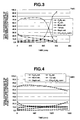
- FIG. 3 is a plot of properties, showing a time variation in a selectivity (%) of product (ethylene, propylene, benzene, toluene, and naphthalene) at a reaction temperature of 750° C.
- FIG. 4 is a plot of properties, showing a time variation in a selectivity (%) of product (ethylene, propylene, benzene, toluene, and naphthalene) at a reaction temperature of 680° C.
- FIG. 5 is a plot of properties, showing a time variation in a selectivity (%) of product (ethylene, propylene, benzene, toluene, and naphthalene) at a reaction temperature of 600° C.
- FIG. 6 is a plot of properties, showing a time variation in a selectivity (%) of product (ethylene, propylene, benzene, toluene, and naphthalene) at a reaction temperature of 550° C.
- FIG. 7 is a plot of properties, showing a time variation in a benzene-production rate in the case where each of gas samples 4 to 7 was supplied to and reacted with a Mo/HZSM-5 catalyst.
- FIG. 8 is a plot of properties, showing a time variation in a conversion amount of methane and ethane in the cases of using as a catalyst: a Mo/HZSM-5 catalyst (680° C.-Mo); secondary metal-carrying catalyst 1 (680° C.-Rh—Mo) which carries rhodium in addition to molybdenum, as a secondary metal; and secondary metal-carrying catalyst 2 (680° C.-Pt—Mo) which carries platinum in addition to molybdenum, as a secondary metal.
- a Mo/HZSM-5 catalyst (680° C.-Mo)
- secondary metal-carrying catalyst 1 (680° C.-Rh—Mo) which carries rhodium in addition to molybdenum, as a secondary metal
- secondary metal-carrying catalyst 2 (680° C.-Pt—Mo) which carries platinum in addition to molybdenum, as a secondary metal.
- the inventors have studied a technique for producing an aromatic compound (mainly benzene) and hydrogen from a lower hydrocarbon (mainly methane) by adopting a catalytic and chemical conversion technique, with which they have hitherto obtained various results.
- a H-type ZSM-5 zeolite catalyst is employed, the catalyst carrying molybdenum thereon so as to be referred to as “Mo/HZSM-5 catalyst” hereinafter.
- composition of an inorganic component molybdenum-carrying zeolite (82.5 wt. %), clay (10.5 wt. %), and glass fiber (7 wt. %)
- Total composition the above-mentioned inorganic component (65.4 wt. %), an organic binder (13.6 wt. %), polymeric beads (which was available from Matsumoto Yushi-Seiyaku Co., Ltd. under the trade name of F-80E, and had an average diameter of 90 to 110 ⁇ m and a true specific gravity of 0.0025) (5.0 wt. %), and a water content (21 wt. %)
- the inorganic component, the organic binder, polymeric beads and the water content prepared in the above-mentioned ratio were mixed or kneaded by a means of kneading (a kneader). Subsequently, the thus mixed substance was shaped by a vacuum extrusion machine into a rod (5 mm in diameter). An extrusion pressure applied during this shaping process was set within a range of from 70 to 100 kg/cm 2 .
- a drying process was carried out at 100° C. for about 5 hours, so as to eliminate the water content added in the shaping process.
- Temperature-increasing and temperature-decreasing rates in a calcination process were set within a range of from 30 to 50° C. /hour.
- the temperature was kept within a range of from 120 to 150° C. for 2 hours in order not to instantaneously calcine the polymeric beads added in the shaping process.
- the binder calcines instantaneously so as to decrease the strength of the calcined substance.
- the catalyst produced by the above-mentioned method was increased in temperature to 550° C. in an air atmosphere and then kept in this condition for 1 hour. Thereafter, the catalyst was increased in temperature to 700° C. upon replacing the atmosphere with that of a reaction gas (CH 4 +4H 2 ), and kept under this condition for 1 hour.
- a reaction gas CH 4 +4H 2
- Results of Experiment 1 are shown in FIG. 1 . It is found from the results shown in FIG. 1 that a benzene production was made. Additionally, it is found to be preferable for stability of a benzene-production rate that hydrogen is contained in the gas sample.
- FIG. 2 is a graph showing a time variation in a benzene-production rate at each reaction temperature. It is found from the results shown in FIG. 2 that benzene is stably produced while maintaining a certain production rate, at each of the reaction temperatures of 680° C. and 600° C. At a reaction temperature of 750° C., a benzene-production rate is high during the early stages or of reaction (up to 400 minutes); however, the production rate thereafter drops significantly, and results in a value of 0 after 600 minutes. At a reaction temperature of 550° C., a production rate is extremely low, though it is stable.
- FIGS. 3 to 6 show results obtained by examining a time variation in a selectivity (%) of product (ethylene, propylene, benzene, toluene and naphthalene) at each reaction temperature of 750° C., 680° C., 600° C. and 550° C.
- C 2 H 4 sel.” represents a selectivity of C 2 H 4 .
- C 3 sel.” represents a selectivity of a C 3 compound.
- Benz sel.” represents a selectivity of benzene.
- Tol sel.” represents a selectivity of toluene.
- Noph sel.” represents a selectivity of naphthalene.
- CH 4 +C 2 H 6 conv.” represents a total conversion rate of methane and ethane.
- Table 1 provides a summary of a total conversion rate and a percentage of each product (ethylene, propylene, benzene, toluene and naphthalene), which are obtained at each reaction temperature of 750° C., 680° C., 600° C. and 550° C.
- Table 2 shows an average conversion rate (a theoretical value) of methane into benzene, at each reaction temperature at which the experiment was conducted.
- benzene can be produced directly from ethane when an ethane-containing gas composition is used as a raw gas and the raw gas is reacted in the presence of the Mo/HZSM-5 catalyst according to the present invention; hydrogen is preferably added to the raw gas in order to maintain a stable production rate; and a reaction temperature is within a range of from 550 to less than 750° C., preferably not less than 600° C. and not more than 680° C. thereby stably producing benzene while maintaining a certain production rate.
- a reaction temperature of 750° C. in such a reaction as to produce benzene from methane has been known to be a temperature condition providing an extremely preferable result.
- a temperature preferable to the benzene production is within a range further low and clearly different from that preferable for producing benzene from methane. This is a factor verifying that benzene is produced by reaction of a component other than methane, i.e. reaction of ethane, in the present experiment.
- a result of the reaction experiment using the gas sample 4 shows that benzene is produced, with which it is verified that ethane is directly reacted thereby producing benzene.
- a result of the reaction experiment using the gas sample 5 shows that a benzene-production rate is improved when methane is contained in the raw gas, as compared with the case of ethane alone (the gas sample 4). With this, it is supposed that methane is activated in the coexistence of methane so that a part thereof is converted into ethane to be reacted.
- a result of the reaction experiment using the gas sample 7 shows that a rate at which benzene is produced from ethane is more improved in stability than that in the case where hydrogen alone is added, when methane and hydrogen are contained in the raw gas.
- a catalyst which carries a secondary metal in addition to molybdenum (the catalyst is hereinafter referred to as “a secondary metal-carrying catalyst”) was produced, and there was conducted an experiment for verifying a difference in performance between the secondary metal-carrying catalyst and the hitherto used Mo/HZSM-5 catalyst.
- a secondary metal-carrying catalyst 1 was prepared such that molybdenum and rhodium were carried on H-type ZSM-5.
- the secondary metal-carrying catalyst 1 was produced by the same method as the production method of Mo/HZSM-5, discussed in “1. Production of catalyst”, with the exception of a step of carrying. In the step of carrying, there was used ammonium molybdate to which rhodium chloride was added. Molybdenum was carried in an amount of 6% by weight relative to the weight of a sintered substance. Rhodium was carried at a mole ratio to molybdenum, more specifically at the following ratio:
- a secondary metal-carrying catalyst 2 was produced such that the H-type ZSM-5 zeolite catalyst carries molybdenum and platinum thereon, by the following method.
- a catalyst composition and a composition ratio thereof are as below.
- composition of the inorganic component and a composition ratio thereof are as below.
- Metal-carrying zeolite:clay:glass fiber 82.5:10.5:7.0
- the inorganic component, the organic component and the water content were mixed in the above-discussed ratio, and then kneaded by a means of kneading, for example, by a kneader. Subsequently, the thus mixed substance was shaped by a vacuum extrusion machine into a rod (5 mm in diameter). An extrusion pressure applied during this process was set within a range of from 70 to 100 kg/cm 2 . Then, the rod-like substrate having a diameter of 5 mm, obtained by the extrusion, was cut to be 10 mm thereby obtaining an extrudate.
- a drying process was carried out at 100° C. for about 12 hours in order to eliminate the water content added in the shaping process.
- Temperature in a calcination process was set within a range of from 600 to 700° C.
- Temperature-increasing and temperature-decreasing rates in the calcination process were set within a range of from 30 to 50° C.
- the temperature was kept within a range of from 120 to 150° C. for 2 hours in order not to instantaneously calcine the added polymeric beads.
- the catalyst produced by the above-mentioned method was increased in temperature to 550° C. in an air atmosphere and then kept in this condition for 1 hour. Thereafter, the catalyst was increased in temperature to 700° C. upon replacing the atmosphere with that of a reaction gas (CH 4 +4H 2 ), and kept under this condition for 1 hour.
- a reaction gas CH 4 +4H 2
- a reaction experiment with ethane was conducted by using the secondary metal-carrying catalysts 1 and 2 produced through the above-mentioned production process, as well as the Mo/HZSM-5 catalyst
- each catalyst was charged into a reaction pipe of a fixed-bed flow reactor (the pipe had an internal diameter of 18 mm and was produced in such a manner as to make a calorizing treatment on a Inconel 800H's portion with which gas is to be brought into contact), in an amount of 7 g.
- a temperature condition was set at 680° C. at which a good result was obtained in both the basic experiment and the applied experiment 1. Then, and a conversion amount of methane and ethane was measured with time by using TCD-GC and FID-GC. Results of the applied experiment 3 are shown in FIG. 8
- Rhenium or tungsten may be effectively used instead of molybdenum. Therefore, in addition to each of the catalysts used in the above-mentioned experiment, a catalyst which carries rhodium or platinum as the secondary metal may be used.
- aluminosilicate When aluminosilicate serves as metallosilicate, it may be a porous material formed of silica and alumina and formed with pores of 4.5 to 6.5 angstrom in diameter.
- effective metallosilicate include those of MCM such as MCM-22, molecular sieve 5A, and faujasite (of type NaY or NaX), in addition to ZSM represented by the above-mentioned ZSM-5.
- Effective examples further include: porous materials (such as ALPO-5 and VPI-5) formed with micropores of 6 to 13 angstrom in diameter and containing phosphoric acid as a main component; a zeolite substrate formed with a channels; and those who contains silica as a main component and alumina as a part and is formed with cylindrical mesopores (or channel) of 10 to 1000 angstrom in diameter, such as FSM-16 and MCM-41.
- metallosilicate is further exemplified by those made of silica and titania, in addition to the above-mentioned aluminosilicate.
- the raw gas is a gas containing ethane in addition to methane serving as a main component
- ethane contained in the raw gas is firstly converted into benzene in the first stage (prereformer) by reacting the raw gas in the presence of such a catalyst as to produce benzene from ethane, the catalyst being confirmed by the above experiments to be effective.
- the inventors' technique for producing benzene from methane is applied to a gas produced in the first stage.
- natural gas is supplied as it is without undergoing separation and purification, which allows natural gas to directly convert into benzene.
- this technique is certainly to be an extremely effective one.
- ethane is produced in an amount ranging from 10 to 20% in the second stage so as to be an exhaust gas in the second stage. Therefore, when an outlet gas in the second stage is supplied to the first stage again, more specifically when the outlet gas is circulated twice or more to be reacted, a use efficiency of the raw gas can be further enhanced.
- the catalyst can be suitably selected from the above-mentioned kinds of catalysts, the Mo/HZSM-5 catalyst whose raw materials are obtained at a low cost is preferably used in the case where the first stage serves as the prereformer.
Landscapes
- Chemical & Material Sciences (AREA)
- Organic Chemistry (AREA)
- Chemical Kinetics & Catalysis (AREA)
- Organic Low-Molecular-Weight Compounds And Preparation Thereof (AREA)
- Low-Molecular Organic Synthesis Reactions Using Catalysts (AREA)
- Catalysts (AREA)
Abstract
Description
-
- Patent literature 1: Japanese Patent Provisional Publication No. 2005-255605
Space velocity of reaction=450 ml/g−MFI/h (a space velocity that C2H6 had in the reaction gas),
-
- Reaction temperature: 600° C. (873 K),
- Reaction time: 1400 minutes, and
- Reaction pressure: 0.3 MPa.
Space velocity of reaction=450 ml/g−MFI/h (a space velocity that C2H6 had in the reaction gas),
-
- Reaction time: 1400 minutes,
- Reaction pressure: 0.3 MPa, and
- Temperature condition changed as follows: 750° C. (1023 K), 680° C. (953 K), 600° C. (873 K), and 550° C. (823 K)
| TABLE 1 | ||
| Total | ||
| Reaction | conversion | |
| Temper- | rate (%) | Selectivity of product (%, based on carbon) |
| ature | based on | Ethyl- | Propyl- | Naph- | ||
| (° C.) | carbon | ene | ene | Benzene | Toluene | thalene |
| 550 | 7.4 | 23.8 | 13.7 | 48.3 | 11.5 | 2.7 |
| 600 | 10.8 | 5.3 | 1.1 | 68.4 | 12.7 | 9.1 |
| 680 | 13.9 | 2.8 | 0.1 | 74.1 | 5.7 | 16.0 |
| 750 | 20.8 | 2.5 | 0.2 | 72.0 | 8.6 | 16.7 |
| TABLE 2 |
| Average conversion rate (%) of methane |
| 550° C. | 600° C. | 680° C. | 750° C. | ||
| 0.00355 | 0.2892 | 3.34 | 7.98 | ||
Space velocity of reaction=450 ml/g−MFI/h (a space velocity that C2H6 had in the reaction gas),
-
- Reaction time: 1400 minutes,
- Reaction pressure: 0.3 MPa, and
- Reaction temperature: 600° C. at which a good result was obtained in both the basic experiment and the applied experiment 1.
Space velocity of reaction=450 ml/g−MFI/h (a space velocity that C2H6 had in the reaction gas),
Space velocity of reaction=3000 ml/g−MFI/h (a space velocity that CH4 had in the reaction gas),
-
- Reaction time: 1400 minutes, and
- Reaction pressure: 0.3 MPa.
Claims (10)
Applications Claiming Priority (3)
| Application Number | Priority Date | Filing Date | Title |
|---|---|---|---|
| JP2005-287504 | 2005-09-30 | ||
| JP2005287504 | 2005-09-30 | ||
| PCT/JP2006/319497 WO2007037388A1 (en) | 2005-09-30 | 2006-09-29 | Process for production of aromatic compound |
Publications (2)
| Publication Number | Publication Date |
|---|---|
| US20090240093A1 US20090240093A1 (en) | 2009-09-24 |
| US8097763B2 true US8097763B2 (en) | 2012-01-17 |
Family
ID=37899808
Family Applications (1)
| Application Number | Title | Priority Date | Filing Date |
|---|---|---|---|
| US12/067,148 Active 2028-10-25 US8097763B2 (en) | 2005-09-30 | 2006-09-29 | Process for production of aromatic compound |
Country Status (7)
| Country | Link |
|---|---|
| US (1) | US8097763B2 (en) |
| JP (1) | JPWO2007037388A1 (en) |
| KR (1) | KR101019518B1 (en) |
| CN (1) | CN101277916B (en) |
| CA (1) | CA2620480C (en) |
| DE (1) | DE112006002572B4 (en) |
| WO (1) | WO2007037388A1 (en) |
Cited By (1)
| Publication number | Priority date | Publication date | Assignee | Title |
|---|---|---|---|---|
| US20100234658A1 (en) * | 2007-08-13 | 2010-09-16 | Saudi Basic Industries Corporation | Catalyst Composition and Process For Converting Aliphatic Oxygenates to Aromatics |
Families Citing this family (13)
| Publication number | Priority date | Publication date | Assignee | Title |
|---|---|---|---|---|
| EA018886B1 (en) * | 2007-12-12 | 2013-11-29 | Шелл Интернэшнл Рисерч Маатсхаппий Б.В. | Process for the conversion of ethane or mixed lower alkanes to aromatic hydrocarbons |
| US8809608B2 (en) | 2008-02-18 | 2014-08-19 | Shell Oil Company | Process for the conversion of lower alkanes to aromatic hydrocarbons |
| US8871990B2 (en) | 2008-02-18 | 2014-10-28 | Shell Oil Company | Process for the conversion of ethane to aromatic hydrocarbons |
| CN101945841B (en) | 2008-02-18 | 2014-07-16 | 国际壳牌研究有限公司 | Process for the conversion of ethane to aromatic hydrocarbons |
| EA201070974A1 (en) | 2008-02-20 | 2011-02-28 | Шелл Интернэшнл Рисерч Маатсхаппий Б.В. | METHOD OF CONVERSION OF ETHANE IN AROMATIC HYDROCARBONS |
| AU2009235497B2 (en) * | 2008-04-08 | 2013-11-14 | Basf Se | Method for the dehydroaromatisation of mixtures containing methane by regenerating the corresponding catalysts that are devoid of precious metal |
| US8835706B2 (en) | 2009-11-02 | 2014-09-16 | Shell Oil Company | Process for the conversion of mixed lower alkanes to aromatic hydrocarbons |
| WO2011143306A2 (en) | 2010-05-12 | 2011-11-17 | Shell Oil Company | Process for the conversion of lower alkanes to aromatic hydrocarbons |
| SG188767A1 (en) * | 2011-09-21 | 2013-04-30 | Agency Science Tech & Res | Aromatization of methane with combination of catalysts |
| GB201317870D0 (en) | 2013-10-09 | 2013-11-20 | Protia As | Process for dehydroaromatization of alkanes with in-situ hydrogen removal |
| JP6302824B2 (en) * | 2014-11-27 | 2018-03-28 | 東京瓦斯株式会社 | Process for producing aromatic hydrocarbons |
| JP6925193B2 (en) * | 2017-07-24 | 2021-08-25 | 学校法人 関西大学 | Aromatic compound production method |
| CN117327538A (en) * | 2023-11-01 | 2024-01-02 | 常州大学 | Method for preparing biodiesel by catalyzing hermetia illucens grease through ZSM-5H type molecular sieve |
Citations (4)
| Publication number | Priority date | Publication date | Assignee | Title |
|---|---|---|---|---|
| US4766265A (en) * | 1987-06-08 | 1988-08-23 | The Standard Oil Company | Catalysts for the conversion of ethane to liquid aromatic hydrocarbons |
| JPH10272366A (en) | 1997-03-19 | 1998-10-13 | Osaka Sekiyu Kagaku Kk | Aromatizing catalyst for lower hydrocarbon, and production of aromatic compound using the catalyst |
| JPH1160514A (en) | 1997-08-21 | 1999-03-02 | Osaka Sekiyu Kagaku Kk | Production of aromatic compound using lower hydrocarbon as raw material |
| JP2005255605A (en) | 2004-03-11 | 2005-09-22 | Masaru Ichikawa | Method of catalytically converting lower hydrocarbon |
Family Cites Families (4)
| Publication number | Priority date | Publication date | Assignee | Title |
|---|---|---|---|---|
| US4120910A (en) * | 1976-12-27 | 1978-10-17 | Mobil Oil Corporation | Aromatization of ethane |
| US5936135A (en) * | 1997-05-02 | 1999-08-10 | Council Of Scientific & Industrial Research | Process for the preparation of hydrocarbons |
| US20010008949A1 (en) * | 1997-09-30 | 2001-07-19 | Phillips Petroleum Company | Hydrocarbon conversion catalyst composition and processes therefor and therewith |
| US8148590B2 (en) | 2004-07-28 | 2012-04-03 | Meidensha Corporation | Process for producing aromatic hydrocarbon and hydrogen |
-
2006
- 2006-09-29 DE DE112006002572.4T patent/DE112006002572B4/en active Active
- 2006-09-29 JP JP2007537712A patent/JPWO2007037388A1/en active Pending
- 2006-09-29 WO PCT/JP2006/319497 patent/WO2007037388A1/en not_active Ceased
- 2006-09-29 US US12/067,148 patent/US8097763B2/en active Active
- 2006-09-29 CN CN200680035968.1A patent/CN101277916B/en active Active
- 2006-09-29 CA CA2620480A patent/CA2620480C/en active Active
- 2006-09-29 KR KR1020087008488A patent/KR101019518B1/en active Active
Patent Citations (4)
| Publication number | Priority date | Publication date | Assignee | Title |
|---|---|---|---|---|
| US4766265A (en) * | 1987-06-08 | 1988-08-23 | The Standard Oil Company | Catalysts for the conversion of ethane to liquid aromatic hydrocarbons |
| JPH10272366A (en) | 1997-03-19 | 1998-10-13 | Osaka Sekiyu Kagaku Kk | Aromatizing catalyst for lower hydrocarbon, and production of aromatic compound using the catalyst |
| JPH1160514A (en) | 1997-08-21 | 1999-03-02 | Osaka Sekiyu Kagaku Kk | Production of aromatic compound using lower hydrocarbon as raw material |
| JP2005255605A (en) | 2004-03-11 | 2005-09-22 | Masaru Ichikawa | Method of catalytically converting lower hydrocarbon |
Non-Patent Citations (6)
| Title |
|---|
| Amin et al., "Characterization and Activity of Cr, Cu and Ga Modified ZSM-5 for Direct Conversion of Methane to Liquid Hydrocarbons," Journal of Natural Gas Chemistry 12(2003): 123-134. |
| F. Solymosi et al., "Conversion of ethane in benzene on Re/ZSM-5," Catalysis Letters, vol. 98, Nos. 1-2, 2004, pp. 7-11. |
| F. Solymosi et al., "Conversion of ethane into benzene on Mo2C/ZSM-5 catalyst," Applied Catalysis A: General, 166, 1998, pp. 225-235. |
| J. Hui et al., "Non-oxidizing aromatization of methane and ethane over supported Mo catalysts," Journal of Molecular Catalysis, vol. 12, No. 5, 1998, p. s335-341. |
| S. Wong et al., "Methane and ethane activation without adding oxygen: promotional effect of W in MO-W/HZSM-5," Catalysis Letters, 38, 1996, pp. 39-43. |
| W. Chu et al., "Dehydroaromatization of Methane with a Small Amount of Ethane for higher Yield of Benzene," Chinese Chemical Letters, vol. 15, No. 5, 2004, pp. 591-593. |
Cited By (1)
| Publication number | Priority date | Publication date | Assignee | Title |
|---|---|---|---|---|
| US20100234658A1 (en) * | 2007-08-13 | 2010-09-16 | Saudi Basic Industries Corporation | Catalyst Composition and Process For Converting Aliphatic Oxygenates to Aromatics |
Also Published As
| Publication number | Publication date |
|---|---|
| CA2620480C (en) | 2012-01-03 |
| JPWO2007037388A1 (en) | 2009-04-16 |
| KR20080046699A (en) | 2008-05-27 |
| CN101277916B (en) | 2015-08-19 |
| US20090240093A1 (en) | 2009-09-24 |
| WO2007037388A1 (en) | 2007-04-05 |
| DE112006002572B4 (en) | 2020-08-06 |
| DE112006002572T5 (en) | 2009-01-02 |
| CA2620480A1 (en) | 2007-04-05 |
| KR101019518B1 (en) | 2011-03-07 |
| CN101277916A (en) | 2008-10-01 |
Similar Documents
| Publication | Publication Date | Title |
|---|---|---|
| KR101234448B1 (en) | Process for The Preparation of Aromatic Hydrocarbons and Liquefied Petroleum Gas from Hydrocarbon Mixture | |
| US8148590B2 (en) | Process for producing aromatic hydrocarbon and hydrogen | |
| US11472755B2 (en) | Methods of heavy reformate conversion into aromatic compounds | |
| Vogel et al. | The synthesis of cresol from toluene and N2O on H [Al] ZSM-5: minimizing the product diffusion limitation by the use of small crystals | |
| US11273430B2 (en) | Olefin aromatization catalyst, preparation method and use thereof, and low-carbon olefin aromatization process | |
| US20090240093A1 (en) | Process for production of aromatic compound | |
| JP2000300987A (en) | Process of converting small carbon number aliphatic hydrocarbon into greater carbon number hydrocarbon, and catalyst therefor | |
| JP4934588B2 (en) | Xylene isomerization catalyst system and method of use | |
| JP2009179801A (en) | Method for producing liquefied petroleum gas | |
| WO2009076005A1 (en) | Continuous process for oxygen-free conversion of methane | |
| KR102252013B1 (en) | Dealkylation and transalkylation of heavy aromatic hydrocarbons | |
| US10821427B2 (en) | Processes for regenerating catalysts | |
| US20190284110A1 (en) | Methods of heavy reformate conversion into aromatic compounds | |
| WO2012066012A1 (en) | Isomerisation catalyst preparation process | |
| CN107109244A (en) | Conversion from oxygenatedchemicals to aromatic compounds | |
| JP5564769B2 (en) | Lower hydrocarbon aromatization catalyst and method for producing aromatic compound | |
| TW201822880A (en) | Catalyst system and process for conversion of a hydrocarbon feed utilizing the catalyst system | |
| JP4943671B2 (en) | Lower hydrocarbon aromatization catalyst and method for producing aromatic hydrocarbon and hydrogen from lower hydrocarbon using the same | |
| CN101130470B (en) | A kind of method for producing propylene by alkylation of ethylene | |
| JP6925193B2 (en) | Aromatic compound production method | |
| WO2011061204A1 (en) | Catalyst and isomerisation process |
Legal Events
| Date | Code | Title | Description |
|---|---|---|---|
| AS | Assignment |
Owner name: MEIDENSHA CORPORATION, JAPAN Free format text: ASSIGNMENT OF ASSIGNORS INTEREST;ASSIGNORS:ICHIKAWA, MASARU;KOJIMA, RYOICHI;OGAWA, YUJI;AND OTHERS;REEL/FRAME:020682/0172;SIGNING DATES FROM 20080122 TO 20080207 Owner name: MASARU ICHIKAWA, JAPAN Free format text: ASSIGNMENT OF ASSIGNORS INTEREST;ASSIGNORS:ICHIKAWA, MASARU;KOJIMA, RYOICHI;OGAWA, YUJI;AND OTHERS;REEL/FRAME:020682/0172;SIGNING DATES FROM 20080122 TO 20080207 Owner name: MEIDENSHA CORPORATION, JAPAN Free format text: ASSIGNMENT OF ASSIGNORS INTEREST;ASSIGNORS:ICHIKAWA, MASARU;KOJIMA, RYOICHI;OGAWA, YUJI;AND OTHERS;SIGNING DATES FROM 20080122 TO 20080207;REEL/FRAME:020682/0172 Owner name: MASARU ICHIKAWA, JAPAN Free format text: ASSIGNMENT OF ASSIGNORS INTEREST;ASSIGNORS:ICHIKAWA, MASARU;KOJIMA, RYOICHI;OGAWA, YUJI;AND OTHERS;SIGNING DATES FROM 20080122 TO 20080207;REEL/FRAME:020682/0172 |
|
| FEPP | Fee payment procedure |
Free format text: PAYOR NUMBER ASSIGNED (ORIGINAL EVENT CODE: ASPN); ENTITY STATUS OF PATENT OWNER: LARGE ENTITY |
|
| STCF | Information on status: patent grant |
Free format text: PATENTED CASE |
|
| FEPP | Fee payment procedure |
Free format text: PAYER NUMBER DE-ASSIGNED (ORIGINAL EVENT CODE: RMPN); ENTITY STATUS OF PATENT OWNER: LARGE ENTITY Free format text: PAYOR NUMBER ASSIGNED (ORIGINAL EVENT CODE: ASPN); ENTITY STATUS OF PATENT OWNER: LARGE ENTITY |
|
| FPAY | Fee payment |
Year of fee payment: 4 |
|
| MAFP | Maintenance fee payment |
Free format text: PAYMENT OF MAINTENANCE FEE, 8TH YEAR, LARGE ENTITY (ORIGINAL EVENT CODE: M1552); ENTITY STATUS OF PATENT OWNER: LARGE ENTITY Year of fee payment: 8 |
|
| MAFP | Maintenance fee payment |
Free format text: PAYMENT OF MAINTENANCE FEE, 12TH YEAR, LARGE ENTITY (ORIGINAL EVENT CODE: M1553); ENTITY STATUS OF PATENT OWNER: LARGE ENTITY Year of fee payment: 12 |