US8091725B2 - Anti-twist device for a container - Google Patents

Anti-twist device for a container Download PDF

Info

Publication number
US8091725B2
US8091725B2 US10/587,145 US58714504A US8091725B2 US 8091725 B2 US8091725 B2 US 8091725B2 US 58714504 A US58714504 A US 58714504A US 8091725 B2 US8091725 B2 US 8091725B2
Authority
US
United States
Prior art keywords
container
drive
sealing
connecting piece
twist
Prior art date
Legal status (The legal status is an assumption and is not a legal conclusion. Google has not performed a legal analysis and makes no representation as to the accuracy of the status listed.)
Expired - Fee Related, expires
Application number
US10/587,145
Other versions
US20070289969A1 (en
Inventor
René Koerber
Helmut Fuchs
Current Assignee (The listed assignees may be inaccurate. Google has not performed a legal analysis and makes no representation or warranty as to the accuracy of the list.)
Reutter Metallwarenfabrik GmbH
Original Assignee
Reutter Metallwarenfabrik GmbH
Priority date (The priority date is an assumption and is not a legal conclusion. Google has not performed a legal analysis and makes no representation as to the accuracy of the date listed.)
Filing date
Publication date
Application filed by Reutter Metallwarenfabrik GmbH filed Critical Reutter Metallwarenfabrik GmbH
Publication of US20070289969A1 publication Critical patent/US20070289969A1/en
Assigned to REUTTER METALLWARENFABRIK GMBH reassignment REUTTER METALLWARENFABRIK GMBH ASSIGNMENT OF ASSIGNORS INTEREST (SEE DOCUMENT FOR DETAILS). Assignors: FUCHS, HELMUT, KORBER, RENE
Application granted granted Critical
Publication of US8091725B2 publication Critical patent/US8091725B2/en
Expired - Fee Related legal-status Critical Current
Adjusted expiration legal-status Critical

Links

Images

Classifications

    • FMECHANICAL ENGINEERING; LIGHTING; HEATING; WEAPONS; BLASTING
    • F01MACHINES OR ENGINES IN GENERAL; ENGINE PLANTS IN GENERAL; STEAM ENGINES
    • F01PCOOLING OF MACHINES OR ENGINES IN GENERAL; COOLING OF INTERNAL-COMBUSTION ENGINES
    • F01P11/00Component parts, details, or accessories not provided for in, or of interest apart from, groups F01P1/00 - F01P9/00
    • F01P11/02Liquid-coolant filling, overflow, venting, or draining devices
    • F01P11/0204Filling
    • F01P11/0209Closure caps
    • F01P11/0247Safety; Locking against opening
    • FMECHANICAL ENGINEERING; LIGHTING; HEATING; WEAPONS; BLASTING
    • F01MACHINES OR ENGINES IN GENERAL; ENGINE PLANTS IN GENERAL; STEAM ENGINES
    • F01PCOOLING OF MACHINES OR ENGINES IN GENERAL; COOLING OF INTERNAL-COMBUSTION ENGINES
    • F01P11/00Component parts, details, or accessories not provided for in, or of interest apart from, groups F01P1/00 - F01P9/00
    • F01P11/02Liquid-coolant filling, overflow, venting, or draining devices
    • F01P11/0204Filling
    • F01P11/0209Closure caps
    • F01P11/0247Safety; Locking against opening
    • F01P2011/0261Safety; Locking against opening activated by temperature
    • FMECHANICAL ENGINEERING; LIGHTING; HEATING; WEAPONS; BLASTING
    • F01MACHINES OR ENGINES IN GENERAL; ENGINE PLANTS IN GENERAL; STEAM ENGINES
    • F01PCOOLING OF MACHINES OR ENGINES IN GENERAL; COOLING OF INTERNAL-COMBUSTION ENGINES
    • F01P11/00Component parts, details, or accessories not provided for in, or of interest apart from, groups F01P1/00 - F01P9/00
    • F01P11/02Liquid-coolant filling, overflow, venting, or draining devices
    • F01P11/0204Filling
    • F01P11/0209Closure caps
    • F01P11/0247Safety; Locking against opening
    • F01P2011/0266Safety; Locking against opening activated by pressure
    • YGENERAL TAGGING OF NEW TECHNOLOGICAL DEVELOPMENTS; GENERAL TAGGING OF CROSS-SECTIONAL TECHNOLOGIES SPANNING OVER SEVERAL SECTIONS OF THE IPC; TECHNICAL SUBJECTS COVERED BY FORMER USPC CROSS-REFERENCE ART COLLECTIONS [XRACs] AND DIGESTS
    • Y10TECHNICAL SUBJECTS COVERED BY FORMER USPC
    • Y10STECHNICAL SUBJECTS COVERED BY FORMER USPC CROSS-REFERENCE ART COLLECTIONS [XRACs] AND DIGESTS
    • Y10S220/00Receptacles
    • Y10S220/32Radiator cap
    • YGENERAL TAGGING OF NEW TECHNOLOGICAL DEVELOPMENTS; GENERAL TAGGING OF CROSS-SECTIONAL TECHNOLOGIES SPANNING OVER SEVERAL SECTIONS OF THE IPC; TECHNICAL SUBJECTS COVERED BY FORMER USPC CROSS-REFERENCE ART COLLECTIONS [XRACs] AND DIGESTS
    • Y10TECHNICAL SUBJECTS COVERED BY FORMER USPC
    • Y10STECHNICAL SUBJECTS COVERED BY FORMER USPC CROSS-REFERENCE ART COLLECTIONS [XRACs] AND DIGESTS
    • Y10S220/00Receptacles
    • Y10S220/33Gasoline tank cap

Definitions

  • the present invention relates to an anti-twist device for a sealing cap, mountable or mounted on a fixed connecting piece of a container, in particular a motor vehicle radiator.
  • the anti-twist stop is embodied as a coupling insert, whose axial disengagement and engagement motion is derived from a pressure-dependent axial motion of a valve body of the valve assembly.
  • This type of drive of the anti-twist stop is relatively complicated, and it cannot be used particularly whenever there is no valve assembly embodied as an excess/negative pressure combination.
  • a simplified anti-twist stop between the sealing element of the sealing cap on the one hand and the container on the other is described in German Patent Disclosure DE 101 64 669 A1, in which a drive, accommodated inside the container, is provided with a blocking bolt which plunge directly into the sealing element of the sealing cap.
  • the anti-twist device is designed such that rotational locking is done between the sealing cap and the container.
  • a disadvantage of this is that it cannot be told in advance whether the sealing cap is only firmly seated or is actually locked, which means that if too much force is expended, the blocking bolt can be broken off.
  • the object of the present invention is therefore to provide an anti-twist device for a sealing cap, mountable or mounted on a fixed connecting piece of a container, in particular a motor vehicle radiator, of the type defined at the outset which on the one hand, instead of a locking function has an idle-travel function and on the other is nevertheless constructed more simply from the standpoint of both engineering and production.
  • an anti-twist device for a sealing cap mountable or mounted on a fixed connecting piece of a container, in particular a motor vehicle radiator
  • the anti-twist stop is actuatable by means of a drive triggered by the operating data in the container, the drive being accommodated inside the container near the external cap part.
  • a rotation preventer in the form of an idle-travel connection is obtained between the grip element and the sealing element of the external cap part, and furthermore, a drive connection acting on this anti-twist stop is obtained, which originates from inside the container and is thus directly exposed to the pressure and temperature present in the container. There is no mechanical connection, which might possibly be damaged, between the container and the sealing cap.
  • a drive part is disposed on a circumferential region of a container wall adjacent to the connecting piece.
  • the drive may be formed by two or more drive parts, distributed preferably uniformly over the circumference of a container wall adjacent to the connecting piece.
  • the individual drive parts can be held in position for instance by a ring, or in the manner whereby each of two drive parts is disposed, held separately, inside the container and tangentially below the counterpart sealing element of the connecting piece, so that a spatially direct association is achieved between the drive in the container and the anti-twist stop in the sealing cap.
  • each drive part is received in a housing that is held suspended from the container wall.
  • the housing is held in pressure tight fashion in a recess in the container wall.
  • the housing is comprised of a hood part, protruding from the container wall, and a basket part whose bottom is provided with an opening.
  • the hood part is provided with an axial leadthrough, which penetrates the container wall and is held in it in pressure tight fashion.
  • the hood part and the basket part are joined, locking over and in one another.
  • Each drive part has a vertically oriented actuation bolt, which, facing toward the anti-twist stop, is covered by a diaphragm, which is fastened tightly between the hood part and the basket part.
  • the drive part is pressure-controlled, and its activation bolt is spring-loaded in the opposite direction, the drive in the container is pressure-controlled; it is also possible for it to be thermally controlled.
  • the present invention also relates to a unit comprising a container with a connecting piece and a sealing cap, or comprising a container connecting piece and a sealing cap, which is provided with an anti-twist device of the invention.
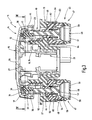
  • FIG. 1 in a schematic longitudinal section, a sealing cap, mounted on a motor vehicle radiator, with a pressure-controlled anti-twist stop in the coupled state, in a preferred exemplary embodiment of the present invention
  • FIG. 2 a section taken along the line 11 - 11 of FIG. 1 ;
  • FIG. 3 a view corresponding to FIG. 1 , but with the anti-twist stop in the uncoupled state;
  • FIG. 4 a section taken along the line IV-IV of FIG. 3 .
  • the anti-twist device 10 serves the purpose of operationally controlled prevention of unscrewing a sealing cap 11 from the sealing connecting piece 12 of a container 13 , such as a motor vehicle radiator, whenever because of the operating state of the container (elevated pressure or temperature) unscrewing the sealing cap 11 from the container connecting piece 12 can involve risks to the user.
  • the sealing cap 11 has an external cap part 14 , which is provided with a grip element 16 and a sealing element 17 , and the sealing element in this case has a female thread 18 for screwing the sealing cap 11 onto and unscrewing it from the opening of the sealing connecting piece 12 , provided with a male thread 19 , of the motor vehicle radiator 13 or other container.
  • the sealing element 17 may be provided with a bayonet-type cap, which can be connected to a corresponding sealing part on the connecting piece.
  • an internal cap part 21 is disposed, which is held rotatably relative to the sealing element 17 of the external cap part 14 but firmly held axially.
  • the internal cap part 21 may, in a manner not shown, be embodied as a valve pot, which can for instance have an excess/negative pressure valve assembly, whose excess pressure valve is triggerable in a single stage or in two stages.
  • the grip element 16 is fitted over the sealing element 17 and engages it from below annularly; an internal annular extension 23 of the grip element 16 engages an outer annular extension 34 of the sealing element 17 from below.
  • the grip element 16 is held freely rotatably relative to the sealing element 17 , but is axially fixed.
  • the counterpart support or contact is formed by the two contacting top walls 26 and 27 of the grip element 16 and sealing element 17 , respectively.
  • an indexable or coupleable anti-twist stop 30 is provided between the grip element 16 and the sealing element 17 .
  • the anti-twist stop 30 here has two diametrically opposed engageable and disengageable coupling elements 31 , each of which in the engagement position in FIG. 1 is loaded by a compression spring 29 .
  • Each coupling element 31 has one coupling bolt 36 , oriented axially to the underside of the sealing element 17 , and one approximately trapezoidal coupling locking bar 37 firmly joined to it.
  • the coupling bolt 36 of the coupling element 31 which in longitudinal section is approximately T-shaped, is held axially movably but in a manner fixed against relative rotation inside the sealing element 17 , for instance in a bore.
  • the coupling locking bar 37 radially on its outside, has a set of teeth 43 , which is brought into connection, in a manner fixed against relative rotation, with a radially inner set of teeth 44 on an annular collar 33 , extending all the way around on the inside, of the grip element 16 as shown in FIGS. 1 and 2 .
  • FIGS. 1 and 2 In other words, in the pressureless outset state of the container 13 , as shown in FIGS.
  • the coupling locking bar 37 under the action of the compression spring 39 , rests by positive engagement in the annular collar 33 of the grip element 16 , and in this engaged coupling position, it is located on an annular wall 32 of the sealing element 17 .
  • the free end of the coupling bolt 36 remote from the compression spring 39 and the coupling locking bar 37 , is located inside an annular chamber of the sealing element 17 , which chamber is open toward the container 13 .
  • a drive 45 is provided in the container 13 , on a wall 46 of the container 13 that surrounds the sealing connecting piece 12 below the male thread 19 , and inside the container 13 .
  • the drive 45 here comprises two drive parts 47 , which on two diametrically opposed sides of the annular wall 46 surrounding the sealing connecting piece 12 , suspended from the underside of this wall in the container 13 .
  • Each drive part has a cylindrical housing 48 , which hangs downward from the annular wall 46 and which on its bottom 49 has an opening 51 into the container interior.
  • the two drive parts 47 in parallel axial alignment, are located below the coupling bolt 36 of the applicable coupling element 31 .
  • a piston 52 with an axial tappet 53 and a compression spring 54 are provided, in the form of an upside-down T, inside the housing 48 .
  • the compression spring 45 which is braced on an inner side of the housing 48 , presses the piston 52 against the bottom 49 of the housing 48 .
  • the housing 48 substantially comprises a hood part 56 , which is provided with a leadthrough 57 , and a basket part 58 , whose bottom 49 has the annularly disposed openings 51 . By its end remote from the bottom 49 , the basket part 58 is thrust over the end of the hood part 56 remote from the leadthrough 57 and is held in locking fashion.
  • a diaphragm 59 is fastened between an annular end face of the hood part 56 and an annular shoulder of the basket part 58 and wraps around the piston 52 and thus seals off the housing interior from the container interior.
  • the leadthrough 57 of the hood part 56 is press-fitted into a bore 61 of the annular wall 46 of the container 13 or firmly held in some other way such that a tight connection results.
  • the annular face of the hood part 56 around the leadthrough 57 is provided with an O-ring 62 , with which a sealing action can be attained in such a way that the hood part 56 is locked by positive engagement at the annular point 65 between container walls 63 , 64 that protrude perpendicular to the annular wall 46 .
  • the leadthrough 57 of the hood part 56 is such that the tappet 53 of the piston 52 of the drive part 47 , in the pressureless state shown in FIG. 1 , penetrates the leadthrough 57 but does not protrude past it.
  • the two drive parts 47 are exposed to the internal pressure in the container 13 . If the internal pressure in the container 13 exceeds the specified allowable pressure, the piston 52 is moved with the tappet 53 in the axial direction A; the tappet 53 meets the coupling bolt 36 and disengages the coupling locking bar 37 of the coupling element 31 from its connection, fixed against relative rotation, with the grip element 16 ( FIGS. 3 and 4 ). In this position of the coupling locking bar 37 , disengaged from the connection that is fixed against relative rotation, the grip element 16 rotates idly relative to the sealing element 17 , so that unscrewing the sealing cap 11 from the sealing connecting piece 12 of the container 13 is not possible.
  • a stop is integrated into the sealing cap, and this assures that in the state in which the sealing cap 11 is screwed onto the sealing connecting piece 12 , the two coupling elements 31 of the anti-twist stop 30 are located axially diametrically opposite the two drive parts 47 of the drive 45 .

Landscapes

  • Engineering & Computer Science (AREA)
  • Chemical & Material Sciences (AREA)
  • Combustion & Propulsion (AREA)
  • Mechanical Engineering (AREA)
  • General Engineering & Computer Science (AREA)
  • Closures For Containers (AREA)
  • Burglar Alarm Systems (AREA)
  • Pressure Vessels And Lids Thereof (AREA)

Abstract

An anti-twist device for a sealing cap that is located on a fixed connecting piece of a motor vehicle radiator. The sealing cap comprises an external cap part with a grip element and a sealing element, which can be connected to a counter sealing element of the connecting piece and in relation to which the grip element can be rotated. The sealing cap also comprises an internal cap part comprising a valve assembly that is configured in an excess/negative pressure combination. An anti-twist stop acts in the external cap part between the grip element and the sealing element. An anti-twist device of this type has a no-load function instead of a locking function and yet has a simple construction and is easy to produce. To achieve this, the anti-twist stop can be actuated by means of a drive, which is controlled by the operating data in the container and is located inside said container in close proximity to the external cap part.

Description

FIELD OF THE INVENTION
The present invention relates to an anti-twist device for a sealing cap, mountable or mounted on a fixed connecting piece of a container, in particular a motor vehicle radiator.
BACKGROUND OF THE INVENTION
In one such anti-twist device, known from German Patent Disclosure DE 100 35 729 A1, the anti-twist stop is embodied as a coupling insert, whose axial disengagement and engagement motion is derived from a pressure-dependent axial motion of a valve body of the valve assembly. This type of drive of the anti-twist stop is relatively complicated, and it cannot be used particularly whenever there is no valve assembly embodied as an excess/negative pressure combination.
A simplified anti-twist stop between the sealing element of the sealing cap on the one hand and the container on the other is described in German Patent Disclosure DE 101 64 669 A1, in which a drive, accommodated inside the container, is provided with a blocking bolt which plunge directly into the sealing element of the sealing cap. This means that the anti-twist device is designed such that rotational locking is done between the sealing cap and the container. A disadvantage of this is that it cannot be told in advance whether the sealing cap is only firmly seated or is actually locked, which means that if too much force is expended, the blocking bolt can be broken off.
SUMMARY OF THE INVENTION
The object of the present invention is therefore to provide an anti-twist device for a sealing cap, mountable or mounted on a fixed connecting piece of a container, in particular a motor vehicle radiator, of the type defined at the outset which on the one hand, instead of a locking function has an idle-travel function and on the other is nevertheless constructed more simply from the standpoint of both engineering and production.
For attaining this object, in an anti-twist device for a sealing cap, mountable or mounted on a fixed connecting piece of a container, in particular a motor vehicle radiator, the anti-twist stop is actuatable by means of a drive triggered by the operating data in the container, the drive being accommodated inside the container near the external cap part.
By the provisions according to the invention, on the one hand a rotation preventer in the form of an idle-travel connection is obtained between the grip element and the sealing element of the external cap part, and furthermore, a drive connection acting on this anti-twist stop is obtained, which originates from inside the container and is thus directly exposed to the pressure and temperature present in the container. There is no mechanical connection, which might possibly be damaged, between the container and the sealing cap.
In a preferred embodiment of the drive, a drive part is disposed on a circumferential region of a container wall adjacent to the connecting piece. The drive may be formed by two or more drive parts, distributed preferably uniformly over the circumference of a container wall adjacent to the connecting piece. The individual drive parts can be held in position for instance by a ring, or in the manner whereby each of two drive parts is disposed, held separately, inside the container and tangentially below the counterpart sealing element of the connecting piece, so that a spatially direct association is achieved between the drive in the container and the anti-twist stop in the sealing cap. For simplification in terms of engineering and assembly, each drive part is received in a housing that is held suspended from the container wall. The housing is held in pressure tight fashion in a recess in the container wall. The housing is comprised of a hood part, protruding from the container wall, and a basket part whose bottom is provided with an opening. The hood part is provided with an axial leadthrough, which penetrates the container wall and is held in it in pressure tight fashion. The hood part and the basket part are joined, locking over and in one another. Each drive part has a vertically oriented actuation bolt, which, facing toward the anti-twist stop, is covered by a diaphragm, which is fastened tightly between the hood part and the basket part.
According to one feature the drive part is pressure-controlled, and its activation bolt is spring-loaded in the opposite direction, the drive in the container is pressure-controlled; it is also possible for it to be thermally controlled.
The present invention also relates to a unit comprising a container with a connecting piece and a sealing cap, or comprising a container connecting piece and a sealing cap, which is provided with an anti-twist device of the invention.
BRIEF DESCRIPTION OF THE DRAWINGS
Further details of the invention can be learned from the ensuing description, in which the invention is described and explained in further detail in terms of an exemplary embodiment shown in the drawings. Shown are:
FIG. 1, in a schematic longitudinal section, a sealing cap, mounted on a motor vehicle radiator, with a pressure-controlled anti-twist stop in the coupled state, in a preferred exemplary embodiment of the present invention;
FIG. 2, a section taken along the line 11-11 of FIG. 1;
FIG. 3, a view corresponding to FIG. 1, but with the anti-twist stop in the uncoupled state; and
FIG. 4, a section taken along the line IV-IV of FIG. 3.
DESCRIPTION OF THE PREFERRED EMBODIMENTS
The anti-twist device 10, shown in the drawings in a preferred exemplary embodiment, serves the purpose of operationally controlled prevention of unscrewing a sealing cap 11 from the sealing connecting piece 12 of a container 13, such as a motor vehicle radiator, whenever because of the operating state of the container (elevated pressure or temperature) unscrewing the sealing cap 11 from the container connecting piece 12 can involve risks to the user.
The sealing cap 11 has an external cap part 14, which is provided with a grip element 16 and a sealing element 17, and the sealing element in this case has a female thread 18 for screwing the sealing cap 11 onto and unscrewing it from the opening of the sealing connecting piece 12, provided with a male thread 19, of the motor vehicle radiator 13 or other container. It is understood that instead of being provided with a thread, the sealing element 17 may be provided with a bayonet-type cap, which can be connected to a corresponding sealing part on the connecting piece. On the inside of the sealing cap 11, concentric with the sealing element 17 and suspended from it, an internal cap part 21 is disposed, which is held rotatably relative to the sealing element 17 of the external cap part 14 but firmly held axially. The internal cap part 21 may, in a manner not shown, be embodied as a valve pot, which can for instance have an excess/negative pressure valve assembly, whose excess pressure valve is triggerable in a single stage or in two stages.
As can be seen from the drawings, the grip element 16 is fitted over the sealing element 17 and engages it from below annularly; an internal annular extension 23 of the grip element 16 engages an outer annular extension 34 of the sealing element 17 from below. Thus the grip element 16 is held freely rotatably relative to the sealing element 17, but is axially fixed. The counterpart support or contact is formed by the two contacting top walls 26 and 27 of the grip element 16 and sealing element 17, respectively.
In order to design the grip element 16 and the sealing element 17 freely rotatably relative to one another for certain operating states, on the one hand, and on the other to attain a connection that is fixed against relative rotation for the normal situation, an indexable or coupleable anti-twist stop 30 is provided between the grip element 16 and the sealing element 17. The anti-twist stop 30 here has two diametrically opposed engageable and disengageable coupling elements 31, each of which in the engagement position in FIG. 1 is loaded by a compression spring 29. Each coupling element 31 has one coupling bolt 36, oriented axially to the underside of the sealing element 17, and one approximately trapezoidal coupling locking bar 37 firmly joined to it. The coupling bolt 36 of the coupling element 31, which in longitudinal section is approximately T-shaped, is held axially movably but in a manner fixed against relative rotation inside the sealing element 17, for instance in a bore. The coupling locking bar 37, radially on its outside, has a set of teeth 43, which is brought into connection, in a manner fixed against relative rotation, with a radially inner set of teeth 44 on an annular collar 33, extending all the way around on the inside, of the grip element 16 as shown in FIGS. 1 and 2. In other words, in the pressureless outset state of the container 13, as shown in FIGS. 1 and 2, the coupling locking bar 37, under the action of the compression spring 39, rests by positive engagement in the annular collar 33 of the grip element 16, and in this engaged coupling position, it is located on an annular wall 32 of the sealing element 17. The free end of the coupling bolt 36, remote from the compression spring 39 and the coupling locking bar 37, is located inside an annular chamber of the sealing element 17, which chamber is open toward the container 13.
For the axial disengagement motion in the direction of the arrow A of the coupling element 31, a drive 45 is provided in the container 13, on a wall 46 of the container 13 that surrounds the sealing connecting piece 12 below the male thread 19, and inside the container 13. The drive 45 here comprises two drive parts 47, which on two diametrically opposed sides of the annular wall 46 surrounding the sealing connecting piece 12, suspended from the underside of this wall in the container 13. Each drive part has a cylindrical housing 48, which hangs downward from the annular wall 46 and which on its bottom 49 has an opening 51 into the container interior. The two drive parts 47, in parallel axial alignment, are located below the coupling bolt 36 of the applicable coupling element 31. A piston 52 with an axial tappet 53 and a compression spring 54 are provided, in the form of an upside-down T, inside the housing 48. The compression spring 45, which is braced on an inner side of the housing 48, presses the piston 52 against the bottom 49 of the housing 48. The housing 48 substantially comprises a hood part 56, which is provided with a leadthrough 57, and a basket part 58, whose bottom 49 has the annularly disposed openings 51. By its end remote from the bottom 49, the basket part 58 is thrust over the end of the hood part 56 remote from the leadthrough 57 and is held in locking fashion. A diaphragm 59 is fastened between an annular end face of the hood part 56 and an annular shoulder of the basket part 58 and wraps around the piston 52 and thus seals off the housing interior from the container interior. The leadthrough 57 of the hood part 56 is press-fitted into a bore 61 of the annular wall 46 of the container 13 or firmly held in some other way such that a tight connection results. The annular face of the hood part 56 around the leadthrough 57 is provided with an O-ring 62, with which a sealing action can be attained in such a way that the hood part 56 is locked by positive engagement at the annular point 65 between container walls 63, 64 that protrude perpendicular to the annular wall 46. The leadthrough 57 of the hood part 56 is such that the tappet 53 of the piston 52 of the drive part 47, in the pressureless state shown in FIG. 1, penetrates the leadthrough 57 but does not protrude past it.
Thus the two drive parts 47 are exposed to the internal pressure in the container 13. If the internal pressure in the container 13 exceeds the specified allowable pressure, the piston 52 is moved with the tappet 53 in the axial direction A; the tappet 53 meets the coupling bolt 36 and disengages the coupling locking bar 37 of the coupling element 31 from its connection, fixed against relative rotation, with the grip element 16 (FIGS. 3 and 4). In this position of the coupling locking bar 37, disengaged from the connection that is fixed against relative rotation, the grip element 16 rotates idly relative to the sealing element 17, so that unscrewing the sealing cap 11 from the sealing connecting piece 12 of the container 13 is not possible. Not until the internal pressure in the container 13 drops again does the piston tappet 53 move, and as a consequence of it the coupling bolt 36 and coupling locking bar 37, under the influence of the respective compression spring 54 and 39, into the outset position and hence the coupling engagement position shown in FIGS. 1 and 2. This can be done in every relative rotated position of the grip element 16 compared to the coupling elements 31, since the set of teeth 44 in the annular collar 33 of the grip element 16 is provided over the entire 360° circumference.
It also remains to be said that in a manner not shown, a stop is integrated into the sealing cap, and this assures that in the state in which the sealing cap 11 is screwed onto the sealing connecting piece 12, the two coupling elements 31 of the anti-twist stop 30 are located axially diametrically opposite the two drive parts 47 of the drive 45.
Although in the exemplary embodiment shown two diametrically opposed coupling elements 31 and correspondingly two diametrically opposed drive parts 47 are provided, it is understood that more than two such pairs of elements, for instance offset by 90°, can be located diametrically opposite two further such pairs. However, it is also possible to make due with only one pair comprising one coupling element 31 and one drive part 47.
It is furthermore possible to provide the drive part 47, instead of with a piston that reacts to the internal pressure conditions in the container 13, with a thermal expansion element that responds to the internal temperature in the container 13.

Claims (6)

1. An anti-twist device for a sealing cap, mountable or mounted on a fixed connecting piece of a container, said sealing cap having:
an external cap part with a grip element and with a sealing element that is connectable to a counterpart sealing element of the connecting piece, relative to which sealing element said grip element is kept relatively rotatable;
an internal cap part with a valve assembly embodied as an excess/negative pressure combination;
an anti-twist stop in the external cap part which acts between said grip element and said sealing element; and
a drive triggered by the operating data in the container, the drive being accommodated inside the container near the external cap part and serving to actuate said anti-twist stop, said drive has a drive part, disposed on a circumferential region of a container wall adjacent to the connecting piece.
2. The anti-twist device as defined by claim 1, wherein:
said anti-twist stop has a horizontally disposed and axially movable coupling unit.
3. The anti-twist device as defined by claim 1, wherein:
the drive part has a vertically oriented actuation bolt, which, facing toward said anti-twist stop, penetrates the container wall.
4. The anti-twist device as defined by claim 3, wherein:
said drive part is pressure-controlled, and its actuation bolt is spring-loaded in the opposite direction.
5. A unit comprising a container having one of: a connecting piece, and a container connecting piece and a sealing cap, having an anti-twist device, said sealing cap having:
an external cap part with a grip element and with a sealing element that is connectable to a counterpart sealing element of the connecting piece, relative to which sealing element said grip element is kept relatively rotatable;
an internal cap part with a valve assembly embodied as an excess/negative pressure combination;
an anti-twist stop in the external cap part which acts between said grip element and said sealing element; and
a drive triggered by the operating data in the container, the drive being accommodated inside the container near the external cap part and serving to actuate said anti-twist stop, said drive has a drive part, disposed on a circumferential region of a container wall adjacent to the connecting piece.
6. An anti-twist device for a sealing cap, mountable or mounted on a fixed connecting piece of a container, said sealing cap having:
an external cap part with a grip element and with a sealing element that is connectable to a counterpart sealing element of the connecting piece, relative to which sealing element said grip element is kept relatively rotatable;
an internal cap part with a valve assembly embodied as an excess/negative pressure combination;
an anti-twist stop in the external cap part which acts between said grip element and said sealing element;
a drive triggered by the operating data in the container, the drive being accommodated inside the container near the external cap part and serving to actuate said anti-twist stop, said drive has a drive part, disposed on a circumferential region of a container wall adjacent to the connecting piece, wherein:
each drive part has a vertically oriented actuation bolt, which, facing toward said anti-twist stop, penetrates the container wall; and
said actuation bolt, on its end remote from said anti-twist stop, is covered by a diaphragm, which is fastened tightly between a hood part and a basket part.
US10/587,145 2004-01-22 2004-11-05 Anti-twist device for a container Expired - Fee Related US8091725B2 (en)

Applications Claiming Priority (4)

Application Number Priority Date Filing Date Title
DE2020040001333.9 2004-01-22
DE202004001333U DE202004001333U1 (en) 2004-01-22 2004-01-22 Shut-off device for containers
DE202004001333U 2004-01-22
PCT/EP2004/012573 WO2005073532A1 (en) 2004-01-22 2004-11-05 Anti-twist device for a container

Publications (2)

Publication Number Publication Date
US20070289969A1 US20070289969A1 (en) 2007-12-20
US8091725B2 true US8091725B2 (en) 2012-01-10

Family

ID=34638909

Family Applications (1)

Application Number Title Priority Date Filing Date
US10/587,145 Expired - Fee Related US8091725B2 (en) 2004-01-22 2004-11-05 Anti-twist device for a container

Country Status (5)

Country Link
US (1) US8091725B2 (en)
EP (1) EP1706611B1 (en)
AT (1) ATE503093T1 (en)
DE (2) DE202004001333U1 (en)
WO (1) WO2005073532A1 (en)

Families Citing this family (1)

* Cited by examiner, † Cited by third party
Publication number Priority date Publication date Assignee Title
US7791055B2 (en) * 2006-07-10 2010-09-07 Micron Technology, Inc. Electron induced chemical etching/deposition for enhanced detection of surface defects

Citations (3)

* Cited by examiner, † Cited by third party
Publication number Priority date Publication date Assignee Title
DE19946845A1 (en) 1999-09-30 2001-04-19 Blau Kunststofftechnik Zweigni Car radiator cap has spring-biased insert which is moved by internal pressure in radiator to position where it cooperates with locking component to prevent cap being removed
DE10035729A1 (en) 2000-07-22 2002-01-31 Heinrich Reutter Sealing closing cap has axial outward and inward movement of coupling insert derived from pressure-dependent axial movement of valve body of valve device
DE10164669A1 (en) 2001-12-22 2003-07-03 Reutter Heinrich Unscrew protection device for containers

Family Cites Families (2)

* Cited by examiner, † Cited by third party
Publication number Priority date Publication date Assignee Title
US5407039A (en) * 1993-06-04 1995-04-18 Alper; Brad Wheeled luggage case
US6241313B1 (en) * 2000-05-18 2001-06-05 Randall G. Lenz Child seat attachable to a suitcase

Patent Citations (5)

* Cited by examiner, † Cited by third party
Publication number Priority date Publication date Assignee Title
DE19946845A1 (en) 1999-09-30 2001-04-19 Blau Kunststofftechnik Zweigni Car radiator cap has spring-biased insert which is moved by internal pressure in radiator to position where it cooperates with locking component to prevent cap being removed
DE19946845C2 (en) 1999-09-30 2002-04-18 Blau Kunststofftechnik Zweigni cap
DE10035729A1 (en) 2000-07-22 2002-01-31 Heinrich Reutter Sealing closing cap has axial outward and inward movement of coupling insert derived from pressure-dependent axial movement of valve body of valve device
US20030183632A1 (en) * 2000-07-22 2003-10-02 Heinrich Reutter Closure cap provided with anti-twisting
DE10164669A1 (en) 2001-12-22 2003-07-03 Reutter Heinrich Unscrew protection device for containers

Also Published As

Publication number Publication date
ATE503093T1 (en) 2011-04-15
EP1706611A1 (en) 2006-10-04
DE502004012338D1 (en) 2011-05-05
EP1706611B1 (en) 2011-03-23
DE202004001333U1 (en) 2005-06-02
WO2005073532A1 (en) 2005-08-11
US20070289969A1 (en) 2007-12-20

Similar Documents

Publication Publication Date Title
US6772989B2 (en) Maintenance-easy two-port valve
US11305213B2 (en) Filter element with torsion lock and/or sliding piston, assembly and methods
EP0309131B1 (en) Oil drain valve
US4215790A (en) Guard for compressed air fitting bowl
JP5408453B2 (en) Lid for containers with safety function under internal pressure and closing lid for fuel tank
TWI710407B (en) Member joint and spray nozzle unit using the same
US7380681B2 (en) Sealing lid for motor vehicle radiator
US4292682A (en) Water-tight winder for a diver's watch
US6349842B1 (en) Cover fastenable on a container connection
US8091725B2 (en) Anti-twist device for a container
US7353965B2 (en) Closure cap provided with anti-twisting
US8087529B2 (en) Safety closure for steam pressurized containers of household appliances
EP1772177B1 (en) Element replacement type filter
US5590680A (en) External valve operating means
US6729271B1 (en) Closure cap for a motor vehicle radiator
US20040056034A1 (en) Sealing gap
US6073791A (en) Closure cap with temperature-dependent unscrewing protection
IT9012483A1 (en) ANTI-RELEASE SAFETY DEVICE FOR TAPS FROM LIQUID GAS CYLINDER PROVIDED WITH A QUICK USE.
WO2007113723A2 (en) Push button for water-tight watch cases
US6024201A (en) Disengaging mechanism for a friction clutch
US20040099668A1 (en) Sealing cover with an anti-unscrew safety device
US20050121453A1 (en) Unscrewing security device for containers
EP3810971B1 (en) Pressure tight plug, assembly and method
JP4083022B2 (en) Joint between the shaft end of the gas exchange valve of the internal combustion engine and the sleeve-like actuating piston of the valve actuator
US20070272690A1 (en) Sealing Lid for a Motor Vehicle Radiator

Legal Events

Date Code Title Description
AS Assignment

Owner name: REUTTER METALLWARENFABRIK GMBH, GERMANY

Free format text: ASSIGNMENT OF ASSIGNORS INTEREST;ASSIGNORS:KORBER, RENE;FUCHS, HELMUT;SIGNING DATES FROM 20060205 TO 20110728;REEL/FRAME:027047/0156

STCF Information on status: patent grant

Free format text: PATENTED CASE

FEPP Fee payment procedure

Free format text: PAYOR NUMBER ASSIGNED (ORIGINAL EVENT CODE: ASPN); ENTITY STATUS OF PATENT OWNER: SMALL ENTITY

FPAY Fee payment

Year of fee payment: 4

FEPP Fee payment procedure

Free format text: MAINTENANCE FEE REMINDER MAILED (ORIGINAL EVENT CODE: REM.); ENTITY STATUS OF PATENT OWNER: SMALL ENTITY

LAPS Lapse for failure to pay maintenance fees

Free format text: PATENT EXPIRED FOR FAILURE TO PAY MAINTENANCE FEES (ORIGINAL EVENT CODE: EXP.); ENTITY STATUS OF PATENT OWNER: SMALL ENTITY

STCH Information on status: patent discontinuation

Free format text: PATENT EXPIRED DUE TO NONPAYMENT OF MAINTENANCE FEES UNDER 37 CFR 1.362

FP Lapsed due to failure to pay maintenance fee

Effective date: 20200110