US809133A - Repeating alarm-clock. - Google Patents
Repeating alarm-clock. Download PDFInfo
- Publication number
- US809133A US809133A US10338102A US1902103381A US809133A US 809133 A US809133 A US 809133A US 10338102 A US10338102 A US 10338102A US 1902103381 A US1902103381 A US 1902103381A US 809133 A US809133 A US 809133A
- Authority
- US
- United States
- Prior art keywords
- alarm
- lever
- repeating
- train
- checking
- Prior art date
- Legal status (The legal status is an assumption and is not a legal conclusion. Google has not performed a legal analysis and makes no representation as to the accuracy of the status listed.)
- Expired - Lifetime
Links
- 238000010276 construction Methods 0.000 description 1
- 230000000737 periodic effect Effects 0.000 description 1
- 235000020004 porter Nutrition 0.000 description 1
- 230000001105 regulatory effect Effects 0.000 description 1
Images
Classifications
-
- G—PHYSICS
- G04—HOROLOGY
- G04B—MECHANICALLY-DRIVEN CLOCKS OR WATCHES; MECHANICAL PARTS OF CLOCKS OR WATCHES IN GENERAL; TIME PIECES USING THE POSITION OF THE SUN, MOON OR STARS
- G04B23/00—Arrangements producing acoustic signals at preselected times
- G04B23/02—Alarm clocks
- G04B23/10—Alarm clocks with presignal; with repeated signal; with changeable intensity of sound
Definitions
- WITNESSES IN VENTOR 1% (13M azpmwv fgwfi @411 L ATTOHNE m No. 809,133. PATENTED JAN. 2, 1906. W. B. PORTER.
- WVILSON E. PORTER. OF NEIV HAVEN, CONNECTICUT, ASSIGNOR TO THE NEW HAVEN CLOCK COMPANY, OF NEW HAVEN, CONNECTICUT, A
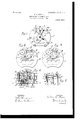
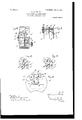
- Figure 1 represents a front view of a clock embodying my invention, the dial-plate and case having been removed Figs. 2 and 3, vertical sections on line 2 2 of Fig. 4, the parts beingshown in different positions; Fig. 4, a plan view; Fig. 5, a transverse vertical section on line 5 5 of Fig. 4 Figs. 6 and 7, corresponding views to Figs.
- FIG. 8 and 9 perspective detail views of the spring alarm-lever engaging and disengaging the checking-lever and repeating alarm-lever, respectively; and Fig. 10, a similar View to Fig. 2 with the parts in diflerent positions.
- This invention relates to alarm-clocks, and more particularly to that class in which the alarm is sounded intermittently or repeated at intervals.
- the alarm is sounded, then checked for a certain regulated period, and then is sounded again, t 1e operation being repeated until the alarm runs down or is positively shut off, which latter requires some action on the part of the person for whom it is sounded.
- the intermittent checking is accomplished by mechanism operated by the timetrain, and it is one of the objects of the present invention to disengage the checking mechanism from the time-train eXcept during the time when the alarm is otherwise released to erence may be made for a more detailed description of the operation of the alarm mechanism described herein.
- the parts designated by the letters A, A, and A represent the plates upon which the movement is mounted, and a pillars connecting the same.
- the train of wheels driven therey- C is an escapement-wheel mounted on.
- the shaft of gear b and D is a verge coacting therewith.
- the verge D is mounted on a rotary shaft d, on which are also mounted a wire 6, carrying the hammer E, and the checking-lever E.
- time-train A detailed description of the time-train is omitted, as it may embody any suitable construction. It is only necessary to refer particularly to the dial-wheels, which are desig nated by F and F, and to one of the wheels (herein shown as the third wheel) of the timetrain marked G, on the shaft 9 of which is a ratchet H.
- the lever I is a repeating alarm-lever, shown mounted on the plate A and having one end normally pressed into engagement with the ratchet H by a spring h.
- the lever I when rocked on its pivot by the successive projecting teeth of the ratchet H alternately engages and disengages the checking-lever E of the alarm.
- the 7c is a rotatable shaft, on which is loosely mounted a gear L meshing with the dial or hour wheel F.
- the shaft 7c is provided with a lateral pin K, against which a cam-shoulder Z on the face of the gear L is held in contact by a spring alarm-lever M.
- the checking-lever E is adapted to be engaged by an arm N on the spring alarm-lever IOO M when the latter is in its inward position, (see Figs. 6, 7, 9, and 10,) and is disengaged upon the outward movement of the lever M and its arm N, Figs. 4, 5, and 8, so that the checking-lever and hammer may vibrate under the action of the verge.
- a second arm N on the alarm-lever M is provided with a chamfered surface n, which upon the inward movement of the arm with the alarm-lever M bears upon the repeating alarm-lever I to force it from engagement with the ratchet H. (See Figs.
- the operation of the device is as follows: The shaft 7c is turned, by means of a button 7c or other means, until its indicator or hand 0 points to the desired hour for sounding the alarm. Until this time is reached the pin K of the shaft 76 rides upon the even surface or edge of the cam Z as the latter is rotated by the hour-wheel, when (at the appointed hour) the notch Z is brought into alinement with the pin K, the spring alarm-lever is allowed to move outward to release the checking-lever E and the repeating alarm-lever I from engagement by the arms N and N, respectively. Upon the release of the repeating alarm-lever I the spring h forces it into engagement with the ratchet H.
- the alarm is sounded except when by the rotation of the ratchet H the repeating alarm-lever I intermittently engages and disengages the checking-lever E. This continues until the alarm runs down or is shut off.
- the continued rotation of the gear L brings the pin K against the inclined surface Z of the cam Z, when the spring alarm-lever M is forced inward, so that one arm N engages the checking-lever to prevent the further sounding of the alarm, and the other arm N engages the repeating alarm-lever I to swing it out of engagement with the ratchet H.
- a repeating alarmclock the combination with the time-train of an alarm-train an alarm-checking lever; a repeating alarmlever normally yieldingly engaging said alarm-checking lever; a device operated by the time-train to intermittently release said repeating alarm-lever from engagement with repeating alarm-lever from said releasing device, substantially as described.
- a repeating alarm-clock the combination with the time-train of an alarm-train an alarm-checking lever; a repeating alarmlever normally yieldingly engaging said alarm-checking lever; a device operated by the time-train to intermittently release said repeating alarm-lever from engagement with said alarm-checking lever; and mechanism for simultaneously disengaging the repeating alarmlever from said releasing device, and engaging said alarm-checking lever to check the alarm-train, substantially as described.
- a repeatingalarm-clock the combination with the time-train of an alarm-train; an alarm-checking lever; an alarm-lever adapted to engage said alarm-checking lever and operated by the time-train to periodic ally release the alarm-checking lever; a repeating alarm-lever normally yieldingly engaging said alarm-ehecking lever; a device operated by the time-train to intermittently release saidrepeating alarm-lever from engagement with said alarm-checking lever, said repeating alarm-lever being disengaged from said releasing device by said alarni-lever when the latter is in engagement with said alarm-checking lever, substantially as described.
- a repeating alarm-clock the combination with the time-train of an alarm-train an alarm-checking lever; a repeating alarmlever normally yieldingly engaging said alarm-checking lever a device operated by the time-train to intermittently release said repeating alarm-lever from engagement with said checking-lever; and an alarm-lever adapted to simultaneously engage said alarmchecking lever to check the same and said Topeating alarm-lever to disengage the latter from said releasing device, said alarm-lever being operated by the time-train periodically to simultaneously release said alarmchecking lever and said repeating alarm-lever, substantially as described.
- a repeating alarm-clock the combination with the time-train; of an alarm-train; an alarm-checking lever; a repeating alarmlever normally yieldingly engaging said alarm-checking lover; a device operated. by the time-train to intermittently release said repeating alarm-lever from engagement with said alarm-checking lever; and mechanism operated by the time-train for simultaneously disengaging said repeating alarm-lever from said releasing device and engaging said alarm-lever, substantially as described.
- a repeating alarm-clock the combination With the time-train; of an alarm-train an alarm-checking lever; a repeating alarmlever normally yieldingly engaging said alarm-checking lever; a device operated by the time-train to intermittently release said repeating alarm-lever from engagement With said alarm-checking lever; a lever operated by the time-train adapted to disengage said repeating alarm-lever from said releasing device, and to periodically release said repeating alarm-lever, substantially as described.
- a repeating alarm-clock the combination with the time-train; of an alarm-train; an alarm-checking lever; a repeating alarmlever normally yieldingly engaging said alarm-checking lover; a ratchet-wheel operated by the time-train to intermittently release said repeating alarm-lever from engagement with said alarm-checking lever; and a lever operated by the time-train to disengage said repeating alarm-lever from said ratchet, substantially as described.
Landscapes
- Physics & Mathematics (AREA)
- Acoustics & Sound (AREA)
- General Physics & Mathematics (AREA)
- Electromechanical Clocks (AREA)
Description
No. 809,133. PATENTED JAN. 2, 1906. W. E. PORTER.
RBPEATING ALARM CLOCK.
APPLICATION FILED APB.17, 1902.
2 SHEETS-:SHEET 1.
WITNESSES IN VENTOR 1%, (13M azpmwv fgwfi @411 L ATTOHNE m No. 809,133. PATENTED JAN. 2, 1906. W. B. PORTER.
REPEATING ALARM CLOCK.
APPLICATION FILED APR.17, 1902.
- 2 SHEETS-SHEBT 2.
on rrnn sTArns PATENT OFFICE.
WVILSON E. PORTER. OF NEIV HAVEN, CONNECTICUT, ASSIGNOR TO THE NEW HAVEN CLOCK COMPANY, OF NEW HAVEN, CONNECTICUT, A
REPEATING ALARM-CLOCK.
Specification of Letters Patent.
Patented Jan. 2, 1906.
Application filed April 1'7, 1902. Serial No. 103,381.
To all whmn it may concern:
Be it known that I, WILsON E. PORTER, of the city and county of New Haven, State of Connecticut, have invented a new and useful Improvement in Repeating Alarm-Clocks, of which the following is a full, clear, and eX- act description when taken in connection with the accompanying drawings, which form a part thereof, and in which Figure 1 represents a front view of a clock embodying my invention, the dial-plate and case having been removed Figs. 2 and 3, vertical sections on line 2 2 of Fig. 4, the parts beingshown in different positions; Fig. 4, a plan view; Fig. 5, a transverse vertical section on line 5 5 of Fig. 4 Figs. 6 and 7, corresponding views to Figs. 4 and 5 of the spring alarm-lever and associated parts in different positions; Figs. 8 and 9, perspective detail views of the spring alarm-lever engaging and disengaging the checking-lever and repeating alarm-lever, respectively; and Fig. 10, a similar View to Fig. 2 with the parts in diflerent positions.
In all figures similar letters of reference represent like parts.
This invention relates to alarm-clocks, and more particularly to that class in which the alarm is sounded intermittently or repeated at intervals. In this class of alarm-clocks the alarm is sounded, then checked for a certain regulated period, and then is sounded again, t 1e operation being repeated until the alarm runs down or is positively shut off, which latter requires some action on the part of the person for whom it is sounded. The intermittent checking is accomplished by mechanism operated by the timetrain, and it is one of the objects of the present invention to disengage the checking mechanism from the time-train eXcept during the time when the alarm is otherwise released to erence may be made for a more detailed description of the operation of the alarm mechanism described herein.
Referring to the drawings for a more particular description, the parts designated by the letters A, A, and A represent the plates upon which the movement is mounted, and a pillars connecting the same.
B represents the spring for the alarm, and 11;, I), and b the train of wheels driven therey- C is an escapement-wheel mounted on. the shaft of gear b and D is a verge coacting therewith. The verge D is mounted on a rotary shaft d, on which are also mounted a wire 6, carrying the hammer E, and the checking-lever E.
A detailed description of the time-train is omitted, as it may embody any suitable construction. It is only necessary to refer particularly to the dial-wheels, which are desig nated by F and F, and to one of the wheels (herein shown as the third wheel) of the timetrain marked G, on the shaft 9 of which is a ratchet H.
I is a repeating alarm-lever, shown mounted on the plate A and having one end normally pressed into engagement with the ratchet H by a spring h. The lever I when rocked on its pivot by the successive projecting teeth of the ratchet H alternately engages and disengages the checking-lever E of the alarm.
7c is a rotatable shaft, on which is loosely mounted a gear L meshing with the dial or hour wheel F. The shaft 7c is provided with a lateral pin K, against which a cam-shoulder Z on the face of the gear L is held in contact by a spring alarm-lever M. In the cam Zis a notch Z and on one side of the notch an inclined surface Z so that upon the rotation of the gear L and cam Z when the pin K comes opposite to the notch Z the gear L and alarmlever M will be moved by the resiliency of the lever M outward from the movement-plate A, while upon the further rotation of the cam Z when the pin K travels upon the inclined surface Z the gear L and spring alarm-lever M will be forced inward toward the move ment-plate A.
The checking-lever E is adapted to be engaged by an arm N on the spring alarm-lever IOO M when the latter is in its inward position, (see Figs. 6, 7, 9, and 10,) and is disengaged upon the outward movement of the lever M and its arm N, Figs. 4, 5, and 8, so that the checking-lever and hammer may vibrate under the action of the verge. A second arm N on the alarm-lever M is provided with a chamfered surface n, which upon the inward movement of the arm with the alarm-lever M bears upon the repeating alarm-lever I to force it from engagement with the ratchet H. (See Figs. 6, 7, 9, and 10.) As the movement of both arms N and N are simultaneous, the ratchet H and time-train are relieved from acting upon the lever I, except at such times as the alarm is free to sound by the disengagement of the checking-lever E from the arm N, On the reverse movement the arm N is drawn away from the repeating alarm-lever I, so that the surface n will not bear on the lever, but the latter will be free to swing against the ratchet H and vibrate under its impetus, Figs. 4, 5, and 8.
The operation of the device is as follows: The shaft 7c is turned, by means of a button 7c or other means, until its indicator or hand 0 points to the desired hour for sounding the alarm. Until this time is reached the pin K of the shaft 76 rides upon the even surface or edge of the cam Z as the latter is rotated by the hour-wheel, when (at the appointed hour) the notch Z is brought into alinement with the pin K, the spring alarm-lever is allowed to move outward to release the checking-lever E and the repeating alarm-lever I from engagement by the arms N and N, respectively. Upon the release of the repeating alarm-lever I the spring h forces it into engagement with the ratchet H. The alarm is sounded except when by the rotation of the ratchet H the repeating alarm-lever I intermittently engages and disengages the checking-lever E. This continues until the alarm runs down or is shut off. The continued rotation of the gear L brings the pin K against the inclined surface Z of the cam Z, when the spring alarm-lever M is forced inward, so that one arm N engages the checking-lever to prevent the further sounding of the alarm, and the other arm N engages the repeating alarm-lever I to swing it out of engagement with the ratchet H.
Having now described my invention, (which may vary in its details without departing from the spirit thereof,) what I claim, and desire to secure by Letters Patent, is
1. In a repeating alarmclock, the combination with the time-train of an alarm-train an alarm-checking lever; a repeating alarmlever normally yieldingly engaging said alarm-checking lever; a device operated by the time-train to intermittently release said repeating alarm-lever from engagement with repeating alarm-lever from said releasing device, substantially as described.
2. In a repeating alarm-clock, the combination with the time-train of an alarm-train an alarm-checking lever; a repeating alarmlever normally yieldingly engaging said alarm-checking lever; a device operated by the time-train to intermittently release said repeating alarm-lever from engagement with said alarm-checking lever; and mechanism for simultaneously disengaging the repeating alarmlever from said releasing device, and engaging said alarm-checking lever to check the alarm-train, substantially as described.
3. In a repeating alarm-clock, the combination with the time-train of an alarm-train an alarm-checking lever; a repeating alarmlever normally yieldingly engaging said alarm-checking lever; a device operated by the time-train to intermittently release said repeating alarm-lever from engagement with said alarm-checking lever; and mechanism operated by the time-train for disengaging the repeating alarm-lever from said releasing device except when the alarm-train is released, substantially as described.
4. In a repeatingalarm-clock, the combination with the time-train of an alarm-train; an alarm-checking lever; an alarm-lever adapted to engage said alarm-checking lever and operated by the time-train to periodic ally release the alarm-checking lever; a repeating alarm-lever normally yieldingly engaging said alarm-ehecking lever; a device operated by the time-train to intermittently release saidrepeating alarm-lever from engagement with said alarm-checking lever, said repeating alarm-lever being disengaged from said releasing device by said alarni-lever when the latter is in engagement with said alarm-checking lever, substantially as described.
5. In a repeating alarm-clock, the combination with the time-train of an alarm-train an alarm-checking lever; a repeating alarmlever normally yieldingly engaging said alarm-checking lever a device operated by the time-train to intermittently release said repeating alarm-lever from engagement with said checking-lever; and an alarm-lever adapted to simultaneously engage said alarmchecking lever to check the same and said Topeating alarm-lever to disengage the latter from said releasing device, said alarm-lever being operated by the time-train periodically to simultaneously release said alarmchecking lever and said repeating alarm-lever, substantially as described.
6. In a repeating alarm-clock, the combination with the time-train; of an alarm-train; an alarm-checking lever; a repeating alarmlever normally yieldingly engaging said alarm-checking lover; a device operated. by the time-train to intermittently release said repeating alarm-lever from engagement with said alarm-checking lever; and mechanism operated by the time-train for simultaneously disengaging said repeating alarm-lever from said releasing device and engaging said alarm-lever, substantially as described.
7. In a repeating alarm-clock, the combination With the time-train; of an alarm-train an alarm-checking lever; a repeating alarmlever normally yieldingly engaging said alarm-checking lever; a device operated by the time-train to intermittently release said repeating alarm-lever from engagement With said alarm-checking lever; a lever operated by the time-train adapted to disengage said repeating alarm-lever from said releasing device, and to periodically release said repeating alarm-lever, substantially as described.
8. In a clock-movement, the combination With a time-train; ofa lever rocked by said time-train; mechanism adapted to disengage said lever from said time-train and operated by said train to periodically release said lever, substantially as described.
9. In a repeating alarm-clock, the combination with the time-train; of an alarm-train; an alarm-checking lever; a repeating alarmlever normally yieldingly engaging said alarm-checking lover; a ratchet-wheel operated by the time-train to intermittently release said repeating alarm-lever from engagement with said alarm-checking lever; and a lever operated by the time-train to disengage said repeating alarm-lever from said ratchet, substantially as described.
In Witness whereof I have hereunto set my hand on the 8th day of April, 1902.
WILSON E. PORTER.
WVitnesses:
EUGENE CARTIER, Gnonem NOLIN.
Priority Applications (1)
| Application Number | Priority Date | Filing Date | Title |
|---|---|---|---|
| US10338102A US809133A (en) | 1902-04-17 | 1902-04-17 | Repeating alarm-clock. |
Applications Claiming Priority (1)
| Application Number | Priority Date | Filing Date | Title |
|---|---|---|---|
| US10338102A US809133A (en) | 1902-04-17 | 1902-04-17 | Repeating alarm-clock. |
Publications (1)
| Publication Number | Publication Date |
|---|---|
| US809133A true US809133A (en) | 1906-01-02 |
Family
ID=2877614
Family Applications (1)
| Application Number | Title | Priority Date | Filing Date |
|---|---|---|---|
| US10338102A Expired - Lifetime US809133A (en) | 1902-04-17 | 1902-04-17 | Repeating alarm-clock. |
Country Status (1)
| Country | Link |
|---|---|
| US (1) | US809133A (en) |
-
1902
- 1902-04-17 US US10338102A patent/US809133A/en not_active Expired - Lifetime
Similar Documents
| Publication | Publication Date | Title |
|---|---|---|
| US809133A (en) | Repeating alarm-clock. | |
| US329078A (en) | Heney l | |
| US188865A (en) | Improvement in alarm-clocks | |
| US825347A (en) | Alarm-clock. | |
| US1254212A (en) | Alarm-clock. | |
| US979585A (en) | Time-recorder. | |
| US458348A (en) | Ferdinand bourquin | |
| US368002A (en) | pfisteb | |
| US378592A (en) | jeannot | |
| US1011596A (en) | Alarm clock and watch. | |
| US692054A (en) | Electric clock. | |
| US360338A (en) | Burglar-alarm clock | |
| US864726A (en) | Time-alarm. | |
| US248935A (en) | Striking mechanism of repeating-clocks | |
| US294338A (en) | smith | |
| US383260A (en) | walzee | |
| US483696A (en) | George reiss | |
| US1611134A (en) | Clock mechanism | |
| US831233A (en) | Intermittent-alarm clock. | |
| US53146A (en) | Improvement in time-pieces | |
| US295627A (en) | Jacob gauss | |
| US433225A (en) | Baillot | |
| US563883A (en) | Electrical program-clock | |
| US937232A (en) | Clock. | |
| US546651A (en) | Time-stamp |