US8091241B2 - Electric hair remover - Google Patents

Electric hair remover Download PDF

Info

Publication number
US8091241B2
US8091241B2 US12/277,485 US27748508A US8091241B2 US 8091241 B2 US8091241 B2 US 8091241B2 US 27748508 A US27748508 A US 27748508A US 8091241 B2 US8091241 B2 US 8091241B2
Authority
US
United States
Prior art keywords
body part
holder
electric hair
holder part
hair remover
Prior art date
Legal status (The legal status is an assumption and is not a legal conclusion. Google has not performed a legal analysis and makes no representation as to the accuracy of the status listed.)
Expired - Fee Related, expires
Application number
US12/277,485
Other versions
US20090163932A1 (en
Inventor
Kazuyuki Ouchi
Hitoshi Ogawa
Wei Wang
Current Assignee (The listed assignees may be inaccurate. Google has not performed a legal analysis and makes no representation or warranty as to the accuracy of the list.)
Panasonic Electric Works Co Ltd
Original Assignee
Panasonic Electric Works Co Ltd
Priority date (The priority date is an assumption and is not a legal conclusion. Google has not performed a legal analysis and makes no representation as to the accuracy of the date listed.)
Filing date
Publication date
Application filed by Panasonic Electric Works Co Ltd filed Critical Panasonic Electric Works Co Ltd
Assigned to PANASONIC ELECTRIC WORKS CO., LTD. reassignment PANASONIC ELECTRIC WORKS CO., LTD. ASSIGNMENT OF ASSIGNORS INTEREST (SEE DOCUMENT FOR DETAILS). Assignors: OGAWA, HITOSHI, OUCHI, KAZUYUKI, WANG, WEI
Publication of US20090163932A1 publication Critical patent/US20090163932A1/en
Application granted granted Critical
Publication of US8091241B2 publication Critical patent/US8091241B2/en
Expired - Fee Related legal-status Critical Current
Adjusted expiration legal-status Critical

Links

Images

Classifications

    • BPERFORMING OPERATIONS; TRANSPORTING
    • B26HAND CUTTING TOOLS; CUTTING; SEVERING
    • B26BHAND-HELD CUTTING TOOLS NOT OTHERWISE PROVIDED FOR
    • B26B19/00Clippers or shavers operating with a plurality of cutting edges, e.g. hair clippers, dry shavers
    • B26B19/38Details of, or accessories for, hair clippers, or dry shavers, e.g. housings, casings, grips, guards
    • B26B19/3806Accessories
    • B26B19/382Built-in accessories
    • BPERFORMING OPERATIONS; TRANSPORTING
    • B26HAND CUTTING TOOLS; CUTTING; SEVERING
    • B26BHAND-HELD CUTTING TOOLS NOT OTHERWISE PROVIDED FOR
    • B26B19/00Clippers or shavers operating with a plurality of cutting edges, e.g. hair clippers, dry shavers
    • B26B19/38Details of, or accessories for, hair clippers, or dry shavers, e.g. housings, casings, grips, guards
    • B26B19/3853Housing or handle

Definitions

  • the present invention relates to an electric hair remover (epilator) for removing hair.
  • an electric hair remover such as electric razor has such a structure that a blade block for cutting hair is disposed at a head end of a body part which also serves as a holder part.
  • a motor for driving the blade, a driver for transmitting the driving force of the motor and a battery block for driving the motor, and the like are received in the body part.
  • a switch drives the motor, thereby moving the blade for removing hair.
  • JP2007105077 discloses a manual safety razor (referred to as “T-shaped trimmer for shaving eyebrows”) which has such a structure that a body part is made bendable or telescopic. As such, the razor has a convenient configuration during operation by the user while the razor is made compact for storage (put in a receptacle) after the operation.
  • the above conventional electric hair remover For receiving the motor, driver, battery block and the like in the body part, the above conventional electric hair remover, however, has difficulty in making the body part telescopic which also serves as a holder part. In other words, the body part of the conventional electric hair remover is fixed at a relatively short length, making it difficult to remove hair which is beyond the reach of hand or hard to reach.
  • an electric hair remover comprises: a body part having a head end part in a longitudinal direction, a blade part for cutting hair being formed at the head end part; a holder part mounted to the body part in such a configuration as to slide along the longitudinal direction of the body part and to rotate.
  • FIG. 1 is a front view of an electric hair remover, according to an embodiment of the present invention.
  • FIG. 2 is a side view of the electric hair remover, according to the embodiment of the present invention.
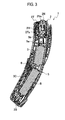
  • FIG. 3 is a cross sectional view taken along the line III-III in FIG. 1 .
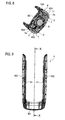
  • FIG. 4 is a front view of the electric hair remover, with a holder part and a front cover removed, according to the embodiment of the present invention.
  • FIG. 5 is a side view of the electric hair remover, with the holder part and front cover removed, according to the embodiment of the present invention.
  • FIG. 6 is a front view of the electric hair remover, with the holder part most pulled out, according to the embodiment of the present invention.
  • FIG. 7 is a side view of the electric hair remover, with the holder part most pulled out, according to the embodiment of the present invention.
  • FIG. 8 is a cross sectional view taken along the line VIII-VIII in FIG. 7 .
  • FIG. 9 is a front view of the holder part of the electric hair remover, according to the embodiment of the present invention.
  • FIG. 10 is a cross sectional view taken along the line X-X in FIG. 9 .
  • FIG. 11 is a cross sectional view of an angle adjuster of the electric hair remover, according to the embodiment of the present invention.
  • FIG. 12 is a perspective view of the electric hair remover, with the holder part most rotated, according to the embodiment of the present invention.
  • FIG. 13 is a side view of the electric hair remover, with the holder part most rotated, according to the embodiment of the present invention.
  • FIG. 14 is a side view showing that a load relief part of the electric hair remover is in operation, according to the embodiment of the present invention.
  • FIG. 15 is a side view of an angle adjuster when the load relief part of the electric hair remover is in operation, according to the embodiment of the present invention.
  • FIG. 1 to FIG. 15 show an electric hair remover, according to an embodiment of the present invention.
  • FIG. 1 is a front view of the electric hair remover.
  • FIG. 2 is a side view of the electric hair remover.
  • FIG. 3 is a cross sectional view taken along the line III-III in FIG. 1 .
  • FIG. 4 is a front view of the electric hair remover, with a holder part and a front cover removed.
  • FIG. 5 is a side view of the electric hair remover, with the holder part and front cover removed.
  • FIG. 6 is a front view of the electric hair remover, with the holder part most pulled out.
  • FIG. 7 is a side view of the electric hair remover, with the holder part most pulled out.
  • FIG. 8 is a cross sectional view taken along the line VIII-VIII in FIG. 7 .
  • FIG. 9 is a front view of the holder part of the electric hair remover.
  • FIG. 10 is a cross sectional view taken along the line X-X in FIG. 9 .
  • FIG. 11 is a cross sectional view of an angle adjuster of the electric hair remover.
  • FIG. 12 is a perspective view of the electric hair remover, with the holder part most rotated.
  • FIG. 13 is a side view of the electric hair remover, with the holder part most rotated.
  • FIG. 14 is a side view showing that a load relief part of the electric hair remover is in operation.
  • FIG. 15 is a side view of an angle adjuster when the load relief part of the electric hair remover is in operation.
  • an electric hair remover 1 (epilator) according to an embodiment includes a body part 3 having such a structure that a blade block 2 as a blade part for cutting hair is disposed at a head end 3 e along a longitudinal direction (upper-lower direction in FIG. 1 and FIG. 2 ).
  • the body part 3 is gently curved along an arc having substantially a constant radius, as shown in FIG. 2 .
  • portions of a holder part 4 on respective right and left sides of the body part 3 are each curved.
  • a radial inner side of the curved body part 3 is defined as front side while a radial outer side of the body part 3 is defined as back side.
  • the blade block 2 has a comb-shaped trimmer blade 2 T for cutting a long hair and a net blade 2 N for finishing the hair shortened by the trimmer blade 2 T.
  • the net blade 2 N fixedly protrudes at a head end of the blade block 2 .
  • upward-downward operations of a trimmer handle 2 H disposed on the front side of the blade block 2 allow the trimmer blade 2 T to protrude (upward) from and subside (downward) in the head end of the blade block 2 .
  • the body part 3 includes a motor 5 for driving the trimmer blade 2 T and net blade 2 N.
  • a driver 5 b is mounted via an eccentric cam 5 a in such a state that the driver 5 b is eccentric. It is so structured that rotation of the motor 5 is converted into reciprocation of the driver 5 b .
  • the body part 3 includes a battery block B for driving the motor 5 .
  • an inner blade 2 Na of the net blade 2 N is mounted to a head end of the driver 5 b , and the inner blade 2 Na sliding with is configured to cut hair. Furthermore, a trimmer driver 2 Ta for transmitting the driving force to the trimmer blade 2 T is disposed on the way of the driver 5 b.
  • a switch handle 6 is disposed substantially in the center on the front side of the body part 3 . Being hooked with a hook (not shown) of a front cover 3 C of the body part 3 , the switch handle 6 makes reciprocation in the longitudinal direction, thereby switching open-and-close of a circuit for driving the motor 5 . As such, the switch handle 6 serves as an operator for switching ons-and-offs (i.e., on-operation and off-operation) of a power source.
  • the electric hair remover 1 has the holder part 4 which is a member separated from the body part 3 .
  • the holder part 4 is mounted to the body part 3 in such a configuration as to be telescopically slidable relative to the body part 3 along the longitudinal direction and to make a rotation relative to the body part 3 .
  • the holder part 4 includes a left part 4 S 1 , a right part 4 S 2 and a connector part 4 C which are combined to be shaped substantially into an alphabetical U extending along an outer periphery of the body part 3 .
  • the left part 4 S 1 and right part 4 S 2 extend on respective left and right sides in the lateral direction of the body part 3 in front view while the connector part 4 C connects head end sides (in the pull-out direction) of the respective left and right parts 4 S 1 , 4 S 2 .
  • rotation bases 9 each configured to make a rotation around a slide lock button 7 are disposed on both sides of a base part 3 B in the lower part of the body part 3 .
  • a rail groove 10 is formed for allowing the holder part 4 to slide on the rail groove 10 .
  • the rotation base 9 has a rail groove 10 A on an extension of the rail groove 10 .
  • a rail 11 slidably engaged with the rail grooves 10 , 10 A is formed on an inner face of each of the left and right parts 4 S 1 , 4 S 2 of the holder part 4 , where FIG. 10 shows the left part 4 S 1 .
  • Inserting the rails 11 into the rail grooves 10 , 10 A allows the portions of the holder parts 4 to be disposed on both sides of the body part 3 , as shown in FIG. 1 and FIG. 2 . Then, sliding the rails 11 along the rail grooves 10 , 10 A allows the holder part 4 to move along the longitudinal direction of the body part 3 .
  • FIG. 1 and FIG. 2 show a shrunk state of the combination while FIG. 6 and FIG. 7 show an extended state of the combination.
  • a plurality of rail dent parts 11 a , 11 b , 11 c each disengageably mated with the slide lock button 7 are disposed at certain intervals in the longitudinal direction.
  • an inner face of the slide lock button 7 is formed with a coil spring 7 a which is so set as to continuously press (bias) the slide lock button 7 outward.
  • a head end of the slide lock button 7 is caused to continuously protrude through a hole formed in the rail groove 10 A disposed on the rotation base 9 .
  • a head end protrusion part 7 b of the slide lock button 7 is so configured to be sequentially mated with the rail dent parts 11 a , 11 b , 11 c according to sliding positions of the holder part 4 .
  • the head end protrusion part 7 b of the slide lock button 7 is brought into such a state as to be mated with the rail dent part 11 a .
  • pulling the holder part 4 in the extended direction disengages the head end protrusion part 7 b from the rail dent part 11 a , thus allowing the holder part 4 to slide with the head end protrusion part 7 b pressed in.
  • the biasing force of the coil spring 7 a allows the head end protrusion part 7 b of the slide lock button 7 to protrude and thereby to engage with the rail dent part 11 b , thus fixing the holder part 4 .
  • the head end protrusion part 7 b of the slide lock button 7 is mated with the rail dent part 11 c , thus fixing the holder part 4 .
  • the rail 11 is mated with both of the rail groove 10 on the body part 3 side and the rail groove 10 A on the rotation base 9 side. As shown in FIG. 6 and FIG. 7 , however, with the body part 3 and holder part 4 most extended (i.e., the holder part 4 most pulled out of the body part 3 ), that is, when the slide lock button 7 is engaged with the rail dent part 11 c , the rail 11 is removed from the rail groove 10 and mates only with the rail groove 10 A.
  • the rotation base 9 is allowed to make a rotation only when the body part 3 and holder part 4 are most extended.
  • the body part 3 can be so bent relative to the holder part 4 as to form substantially an alphabetical V in combination with the holder part 4 .
  • a rotation center brought about in this state is referred to as a rotation axis Ax in FIG. 12 and FIG. 13 .
  • the rotation base 9 as a rotation part of the holder part 4 has an angle adjuster 12 for accomplishing multi-step rotational fixations within the rational area of the holder part 4 .
  • the angle adjuster 12 includes a click gear 13 and a plate-spring click plate 14 , where the click gear 13 is integrally rotatable with the rotation base 9 and has an outer periphery formed with a gear-shaped irregular part 13 a while the click plate 14 is disposed on the body part 3 side and adds a rotational resistance to the irregular part 13 a of the click gear 13 .
  • a protrusion part 14 a engageable with a dent of the irregular part 13 a of the click gear 13 is formed in substantially the center part of the click plate 14 .
  • the protrusion part 14 a engaged with one of the dents of the irregular part 13 a can prevent the rotation of the rotation base 9 by means of a certain resistance force.
  • the irregular part 13 a is formed corresponding to the allowable rotational area of the holder part 4 .
  • First and second stepped parts 13 b , 13 c formed on respective sides of the irregular part 13 a of the click gear 13 are configured to abut on respective first and second stopper parts 3 p 1 , 3 p 2 formed on the body part 3 side, thus stopping the rotation of the holder part 4 to thereby prevent further rotation of the holder part 4 .
  • the body part 3 is gently curved in the longitudinal direction.
  • the angle adjuster 12 of the rotation base 9 has a load relief part 15 .
  • the load relief part 15 is so set as to make the following operation:
  • the load relief part 15 relieves, corresponding to a certain load or over applied to the rotation base 9 , the body part 3 from the holder part 4 in the direction for opening (see FIG. 14 ).
  • the load relief part 15 is, as shown in FIG. 11 , set by cutting away the irregular part 13 a of the click gear 13 in a certain range. That is, in the following range, the load relief part 15 is formed by cutting away the irregular part 13 a which corresponds to the protrusion part 14 a of the click plate 14 :
  • the holder part 4 is made free. Then, as shown in FIG. 15 , the holder part 4 is allowed to be bent without resistance until the second stepped part 13 c of the click gear 13 abuts on the second body part 3 p 2 .
  • the load relief part 15 provided for the rotation base 9 works to allow the body part 3 and holder part 4 to open in a form of a reversed bending, as shown in FIG. 14 .
  • an edge part of the base part 3 B of the body part 3 contacts the flat base and thereby can receive the load.
  • a substantially flat mounting face 3 F is formed on a surface of the base part 3 B.
  • the base part 3 B is disposed on a side opposite to a side of the head end part (for providing the blade block 2 ) of the body part 3 .
  • a single point of a part spaced apart from the rotation axis Ax of the holder part 4 is disposed on an extended face E along the mounting face 3 F.
  • the single point is defined as a contact part 4 P.
  • the head end part 4 T of the holder part 4 is disposed on the extended face E of the mounting face 3 F.
  • the electric hair remover 1 can be disposed in such a state that the holder part 4 is most rotated for use while the body part 3 is standing on the flat face as the pedestal.
  • the holder part 4 having the left and right parts 4 S 1 , 4 S 2 and the connector part 4 C is formed substantially into an alphabetical U.
  • the user In a shower room and the like, the user, as the case may be, removes hair in a standing state.
  • the user for checking the finished state after clearing (or dusting) off the hair which was adhered to the body, the user is supposed to once release the electric hair remover 1 from hand.
  • hooking the pulled-out holder part 4 (set forth above) with a protrusion such as hook can rapidly restart the hair-removing operation without leaving the electric hair remover 1 on the floor or the like.
  • the holder part 4 which is a member separated from the body part 3 is telescopically slidable relative to the body part 3 in the longitudinal direction and rotatable relative to the body part 3 .
  • the blade block 2 at the head end of the electric hair remover 1 of the present invention can easily abut on tiptoes, calf, back and the like on which the conventional fixed-type counterpart fails to easily abut.
  • rotating the holder part 4 in its elongated state allows the blade block 2 to abut on a portion far away from hand, such as back.
  • the holder part 4 's rotation relative to the body part 3 is allowed only when the combination of the body part 3 and the holder part 4 is most elongated.
  • the holder part 4 's angle relative to the body part 3 can be set variable.
  • the above structure of the electric hair remover 1 allows the blade block 2 to abut on the user's back and the like which is a portion far away from hand.
  • the above structure of the electric hair remover 1 can prevent such a failure that the holder part 4 is moved relative to the body part 3 when the electric hair remover 1 is being used by the user, which is an advantage.
  • the angle adjuster 12 is capable of engaging the body part 3 with the holder part 4 for fixation at multi-step angles.
  • the relative angles can be set variable at multiple steps, thus more improving usability of the electric hair remover 1 .
  • the electric hair remover 1 can be set more usable and convenient.
  • the load is applied to the body part 3 and holder part 4 in the direction of relative rotation, thereby elastically deforming at least a part (click plate 14 ) between the rotation axis Ax (of the relative rotation) and the mutual engagement part.
  • the engagement state by means of the angle adjuster 12 can be disengaged in the direction for opening the body part 3 relative to the holder part 4 .
  • the combination of the body part 3 and holder part 4 is curved along the longitudinal direction to form substantially an arch and the load relief part 15 set at the rotation base 9 disposed substantially in the center part of the longitudinal direction works for allowing a reversed-bending relative rotation between the body part 3 and the holder part 4 .
  • the substantially flat mounting face 3 F is formed on the surface of the base part 3 B, as shown in FIG. 13 .
  • the base part 3 B is disposed on the side opposite to the side of the head end part 3 e of the body part 3 .
  • a surface of a part (the head end part 4 T of the holder part 4 , according to the embodiment) which is spaced apart from the rotation axis Ax is disposed on the extended face E along the mounting face 3 F.
  • the surface of the above part is defined as a contact part 4 P.
  • the mounting face 3 F and contact part 4 P are caused to have a contact with a flat face as a pedestal, and thereby the body part 3 is allowed to stand on the flat face, with the blade block 2 positioned upper.
  • the electric hair remover 1 can be disposed on the flat face, thus further improving usability of the electric hair remover 1 .
  • the holder part 4 includes the left part 4 S 1 , right part 4 S 2 and connector part 4 C which are combined to be shaped substantially into an alphabetical U extending along an outer periphery of the body part 3 .
  • the left part 4 S 1 and right part 4 S 2 are disposed on respective left and right sides in the lateral direction of the body part 3 substantially perpendicular to the longitudinal direction of the body part 3 while the connector part 4 C connects head end sides (in the pull-out direction) of the respective left and right parts 4 S 1 , 4 S 2 .
  • the holder part 4 's U-shaped part can be used as a hook, thus further improving usability of the electric hair remover 1 .
  • each of the mounting face 3 F and the contact part 4 P may be properly changed.
  • trimmer blade 2 T and net blade 2 N are disposed at the blade block 2 , but not limited thereto.
  • a single blade or other blade(s) may be provided for the blade block 2 .

Landscapes

  • Life Sciences & Earth Sciences (AREA)
  • Forests & Forestry (AREA)
  • Engineering & Computer Science (AREA)
  • Mechanical Engineering (AREA)
  • Dry Shavers And Clippers (AREA)
  • Cosmetics (AREA)

Abstract

An electric hair remover, includes: a body part having a head end part in a longitudinal direction, a blade part for cutting hair being formed at the head end part; a holder part mounted to the body part in such a configuration as to slide along the longitudinal direction of the body part and to rotate.

Description

BACKGROUND OF THE INVENTION
1. Field of the Invention
The present invention relates to an electric hair remover (epilator) for removing hair.
2. Description of the Related Art
Conventionally, an electric hair remover such as electric razor has such a structure that a blade block for cutting hair is disposed at a head end of a body part which also serves as a holder part. A motor for driving the blade, a driver for transmitting the driving force of the motor and a battery block for driving the motor, and the like are received in the body part. Turning on (on-operation) a switch drives the motor, thereby moving the blade for removing hair.
On the other hand, Japanese Patent Application Laid-Open No. 2007-105077 (=JP2007105077) discloses a manual safety razor (referred to as “T-shaped trimmer for shaving eyebrows”) which has such a structure that a body part is made bendable or telescopic. As such, the razor has a convenient configuration during operation by the user while the razor is made compact for storage (put in a receptacle) after the operation.
SUMMARY OF THE INVENTION
For receiving the motor, driver, battery block and the like in the body part, the above conventional electric hair remover, however, has difficulty in making the body part telescopic which also serves as a holder part. In other words, the body part of the conventional electric hair remover is fixed at a relatively short length, making it difficult to remove hair which is beyond the reach of hand or hard to reach.
It is therefore an object the present invention to provide an electric hair remover capable of improving usability during operation.
According to an aspect of the present invention, an electric hair remover, comprises: a body part having a head end part in a longitudinal direction, a blade part for cutting hair being formed at the head end part; a holder part mounted to the body part in such a configuration as to slide along the longitudinal direction of the body part and to rotate.
Other objects and features of the present invention will become understood from the following description with reference to the accompanying drawings.
BRIEF DESCRIPTION OF THE DRAWINGS
FIG. 1 is a front view of an electric hair remover, according to an embodiment of the present invention.
FIG. 2 is a side view of the electric hair remover, according to the embodiment of the present invention.
FIG. 3 is a cross sectional view taken along the line III-III in FIG. 1.
FIG. 4 is a front view of the electric hair remover, with a holder part and a front cover removed, according to the embodiment of the present invention.
FIG. 5 is a side view of the electric hair remover, with the holder part and front cover removed, according to the embodiment of the present invention.
FIG. 6 is a front view of the electric hair remover, with the holder part most pulled out, according to the embodiment of the present invention.
FIG. 7 is a side view of the electric hair remover, with the holder part most pulled out, according to the embodiment of the present invention.
FIG. 8 is a cross sectional view taken along the line VIII-VIII in FIG. 7.
FIG. 9 is a front view of the holder part of the electric hair remover, according to the embodiment of the present invention.
FIG. 10 is a cross sectional view taken along the line X-X in FIG. 9.
FIG. 11 is a cross sectional view of an angle adjuster of the electric hair remover, according to the embodiment of the present invention.
FIG. 12 is a perspective view of the electric hair remover, with the holder part most rotated, according to the embodiment of the present invention.
FIG. 13 is a side view of the electric hair remover, with the holder part most rotated, according to the embodiment of the present invention.
FIG. 14 is a side view showing that a load relief part of the electric hair remover is in operation, according to the embodiment of the present invention.
FIG. 15 is a side view of an angle adjuster when the load relief part of the electric hair remover is in operation, according to the embodiment of the present invention.
DESCRIPTION OF THE PREFERRED EMBODIMENTS
In the following, an embodiment of the present invention will be described in detail with reference to the accompanying drawings.
For ease of understanding, the following description will contain various directional terms, such as right, left, upper, lower, forward, rearward and the like. However, such terms are to be understood with respect to only a drawing or drawings on which the corresponding part of element is illustrated.
In addition, it is noted that the drawings referred to hereinafter as illustrating the preferred embodiment of the present invention are not to scale and are schematic in nature and, therefore, should not be taken too literally. Nevertheless, the drawings illustrate the invention sufficiently to enable one skilled in the art to practice the invention.
FIG. 1 to FIG. 15 show an electric hair remover, according to an embodiment of the present invention.
FIG. 1 is a front view of the electric hair remover.
FIG. 2 is a side view of the electric hair remover.
FIG. 3 is a cross sectional view taken along the line III-III in FIG. 1.
FIG. 4 is a front view of the electric hair remover, with a holder part and a front cover removed.
FIG. 5 is a side view of the electric hair remover, with the holder part and front cover removed.
FIG. 6 is a front view of the electric hair remover, with the holder part most pulled out.
FIG. 7 is a side view of the electric hair remover, with the holder part most pulled out.
FIG. 8 is a cross sectional view taken along the line VIII-VIII in FIG. 7.
FIG. 9 is a front view of the holder part of the electric hair remover.
FIG. 10 is a cross sectional view taken along the line X-X in FIG. 9.
FIG. 11 is a cross sectional view of an angle adjuster of the electric hair remover.
FIG. 12 is a perspective view of the electric hair remover, with the holder part most rotated.
FIG. 13 is a side view of the electric hair remover, with the holder part most rotated.
FIG. 14 is a side view showing that a load relief part of the electric hair remover is in operation.
FIG. 15 is a side view of an angle adjuster when the load relief part of the electric hair remover is in operation.
As shown in FIG. 1 and FIG. 2, an electric hair remover 1 (epilator) according to an embodiment includes a body part 3 having such a structure that a blade block 2 as a blade part for cutting hair is disposed at a head end 3 e along a longitudinal direction (upper-lower direction in FIG. 1 and FIG. 2).
In the longitudinal direction, the body part 3 is gently curved along an arc having substantially a constant radius, as shown in FIG. 2. According to the curved configuration of the body part 3, portions of a holder part 4 on respective right and left sides of the body part 3 are each curved. Hereinafter, for convenience' sake, a radial inner side of the curved body part 3 is defined as front side while a radial outer side of the body part 3 is defined as back side.
The blade block 2 has a comb-shaped trimmer blade 2T for cutting a long hair and a net blade 2N for finishing the hair shortened by the trimmer blade 2T. The net blade 2N fixedly protrudes at a head end of the blade block 2. Meanwhile, upward-downward operations of a trimmer handle 2H disposed on the front side of the blade block 2 allow the trimmer blade 2T to protrude (upward) from and subside (downward) in the head end of the blade block 2.
As shown in FIG. 3, the body part 3 includes a motor 5 for driving the trimmer blade 2T and net blade 2N. To a head end of the motor 5, a driver 5 b is mounted via an eccentric cam 5 a in such a state that the driver 5 b is eccentric. It is so structured that rotation of the motor 5 is converted into reciprocation of the driver 5 b. Moreover, the body part 3 includes a battery block B for driving the motor 5.
Moreover, an inner blade 2Na of the net blade 2N is mounted to a head end of the driver 5 b, and the inner blade 2Na sliding with is configured to cut hair. Furthermore, a trimmer driver 2Ta for transmitting the driving force to the trimmer blade 2T is disposed on the way of the driver 5 b.
A switch handle 6 is disposed substantially in the center on the front side of the body part 3. Being hooked with a hook (not shown) of a front cover 3C of the body part 3, the switch handle 6 makes reciprocation in the longitudinal direction, thereby switching open-and-close of a circuit for driving the motor 5. As such, the switch handle 6 serves as an operator for switching ons-and-offs (i.e., on-operation and off-operation) of a power source.
In addition, the electric hair remover 1 according to the embodiment has the holder part 4 which is a member separated from the body part 3. The holder part 4 is mounted to the body part 3 in such a configuration as to be telescopically slidable relative to the body part 3 along the longitudinal direction and to make a rotation relative to the body part 3.
As shown in FIG. 9, the holder part 4 includes a left part 4S1, a right part 4S2 and a connector part 4C which are combined to be shaped substantially into an alphabetical U extending along an outer periphery of the body part 3. Hereinabove, the left part 4S1 and right part 4S2 extend on respective left and right sides in the lateral direction of the body part 3 in front view while the connector part 4C connects head end sides (in the pull-out direction) of the respective left and right parts 4S1, 4S2.
As shown in FIG. 4 and FIG. 5, rotation bases 9 each configured to make a rotation around a slide lock button 7 are disposed on both sides of a base part 3B in the lower part of the body part 3.
Moreover, on a sideface of the body part 3, a rail groove 10 is formed for allowing the holder part 4 to slide on the rail groove 10. Meanwhile, the rotation base 9 has a rail groove 10A on an extension of the rail groove 10.
Meanwhile, as shown in FIG. 10, a rail 11 slidably engaged with the rail grooves 10, 10A is formed on an inner face of each of the left and right parts 4S1, 4S2 of the holder part 4, where FIG. 10 shows the left part 4S1.
Inserting the rails 11 into the rail grooves 10, 10A allows the portions of the holder parts 4 to be disposed on both sides of the body part 3, as shown in FIG. 1 and FIG. 2. Then, sliding the rails 11 along the rail grooves 10, 10A allows the holder part 4 to move along the longitudinal direction of the body part 3.
The above accomplishes a structure which allows a combination of the body part 3 and holder part 4 to make a telescopic movement. Hereinabove and hereinafter, FIG. 1 and FIG. 2 show a shrunk state of the combination while FIG. 6 and FIG. 7 show an extended state of the combination.
In addition, as shown in FIG. 10, on the inner side of the rail 11, a plurality of rail dent parts 11 a, 11 b, 11 c each disengageably mated with the slide lock button 7 are disposed at certain intervals in the longitudinal direction.
As shown in FIG. 8, an inner face of the slide lock button 7 is formed with a coil spring 7 a which is so set as to continuously press (bias) the slide lock button 7 outward.
As such, a head end of the slide lock button 7 is caused to continuously protrude through a hole formed in the rail groove 10A disposed on the rotation base 9.
Then, a head end protrusion part 7 b of the slide lock button 7 is so configured to be sequentially mated with the rail dent parts 11 a, 11 b, 11 c according to sliding positions of the holder part 4.
In other words, with the body part 3 and holder part 4 most shrunk, the head end protrusion part 7 b of the slide lock button 7 is brought into such a state as to be mated with the rail dent part 11 a. In this state, pulling the holder part 4 in the extended direction disengages the head end protrusion part 7 b from the rail dent part 11 a, thus allowing the holder part 4 to slide with the head end protrusion part 7 b pressed in.
Then, when the next rail dent part 11 b comes to a position of the slide lock button 7 according to the sliding of the holder part 4, the biasing force of the coil spring 7 a allows the head end protrusion part 7 b of the slide lock button 7 to protrude and thereby to engage with the rail dent part 11 b, thus fixing the holder part 4. Likewise, with the holder part 4 most pulled out of the body part 3, the head end protrusion part 7 b of the slide lock button 7 is mated with the rail dent part 11 c, thus fixing the holder part 4.
The rail 11 is mated with both of the rail groove 10 on the body part 3 side and the rail groove 10A on the rotation base 9 side. As shown in FIG. 6 and FIG. 7, however, with the body part 3 and holder part 4 most extended (i.e., the holder part 4 most pulled out of the body part 3), that is, when the slide lock button 7 is engaged with the rail dent part 11 c, the rail 11 is removed from the rail groove 10 and mates only with the rail groove 10A.
As such, the rotation base 9 is allowed to make a rotation only when the body part 3 and holder part 4 are most extended. In this state, as shown in FIG. 12 and FIG. 13, the body part 3 can be so bent relative to the holder part 4 as to form substantially an alphabetical V in combination with the holder part 4. A rotation center brought about in this state is referred to as a rotation axis Ax in FIG. 12 and FIG. 13.
Then, as shown in FIG. 11, the rotation base 9 as a rotation part of the holder part 4 has an angle adjuster 12 for accomplishing multi-step rotational fixations within the rational area of the holder part 4. The angle adjuster 12 includes a click gear 13 and a plate-spring click plate 14, where the click gear 13 is integrally rotatable with the rotation base 9 and has an outer periphery formed with a gear-shaped irregular part 13 a while the click plate 14 is disposed on the body part 3 side and adds a rotational resistance to the irregular part 13 a of the click gear 13.
A protrusion part 14 a engageable with a dent of the irregular part 13 a of the click gear 13 is formed in substantially the center part of the click plate 14. The protrusion part 14 a engaged with one of the dents of the irregular part 13 a can prevent the rotation of the rotation base 9 by means of a certain resistance force.
Then, applying to the rotation base 9 a rotational force having a certain resistance force or over allows the protrusion part 14 a of the click plate 14 to be pushed out of the dent of the irregular part 13 a while allowing the rotation of the click gear 13, thus varying the rotation angle (i.e., angle between the body part 3 and the holder part 4) of the holder part 4.
The irregular part 13 a is formed corresponding to the allowable rotational area of the holder part 4. First and second stepped parts 13 b, 13 c formed on respective sides of the irregular part 13 a of the click gear 13 are configured to abut on respective first and second stopper parts 3 p 1, 3 p 2 formed on the body part 3 side, thus stopping the rotation of the holder part 4 to thereby prevent further rotation of the holder part 4.
Moreover according to the embodiment, the body part 3 is gently curved in the longitudinal direction. As shown in FIG. 11, the angle adjuster 12 of the rotation base 9 has a load relief part 15. The load relief part 15 is so set as to make the following operation:
When the holder part 4 slides in the longitudinal direction of the body part 3 thereby forming an extended state in a curved form in combination with the body part 3, the load relief part 15 relieves, corresponding to a certain load or over applied to the rotation base 9, the body part 3 from the holder part 4 in the direction for opening (see FIG. 14).
In other words, the load relief part 15 is, as shown in FIG. 11, set by cutting away the irregular part 13 a of the click gear 13 in a certain range. That is, in the following range, the load relief part 15 is formed by cutting away the irregular part 13 a which corresponds to the protrusion part 14 a of the click plate 14:
From a first state that the holder part 4 is extended (see FIG. 7) to a second state that the holder part 4 is rotated in the opening direction (see FIG. 14).
The above structure accomplishes the following operation:
After the protrusion part 14 a of the click plate 14 goes over the protrusion of the irregular part 13 a (which has the dent engageable with the protrusion part 14 a) with the holder part 4 ordinarily extended, the holder part 4 is made free. Then, as shown in FIG. 15, the holder part 4 is allowed to be bent without resistance until the second stepped part 13 c of the click gear 13 abuts on the second body part 3 p 2.
When the body part 3 and holder part 4 are most extended to form substantially an arch, i.e., when the electric hair remover 1 is disposed on a flat face (such as upper face of a shelf) as a pedestal such that the left side (in FIG. 7) of the electric hair remover 1 is disposed downward, a sudden load which may be applied leftward in FIG. 7 to the center part of the arch is entirely received by a first head end P1 of the holder part 4 and a second head end P2 of the blade block 2.
According to the embodiment, the load relief part 15 provided for the rotation base 9 works to allow the body part 3 and holder part 4 to open in a form of a reversed bending, as shown in FIG. 14. As such, an edge part of the base part 3B of the body part 3 contacts the flat base and thereby can receive the load.
Moreover according to the embodiment, as shown in FIG. 13, a substantially flat mounting face 3F is formed on a surface of the base part 3B. In the longitudinal direction, the base part 3B is disposed on a side opposite to a side of the head end part (for providing the blade block 2) of the body part 3.
With the holder part 4 rotated, a single point of a part (the head end part 4T according to the embodiment) spaced apart from the rotation axis Ax of the holder part 4 is disposed on an extended face E along the mounting face 3F. The single point is defined as a contact part 4P.
In addition, according to the embodiment, with the body part 3 and holder part 4 most rotated, the head end part 4T of the holder part 4 is disposed on the extended face E of the mounting face 3F.
With this, for such a case as to remove unwanted hair on the back and the like with the electric hair remover 1, the electric hair remover 1 can be disposed in such a state that the holder part 4 is most rotated for use while the body part 3 is standing on the flat face as the pedestal.
Herein, as shown in FIG. 9, the holder part 4 having the left and right parts 4S1, 4S2 and the connector part 4C is formed substantially into an alphabetical U. With the above configuration, pulling the holder part 4 out of the body part 3 allows the thus pulled-out part of the holder part 4 to be kept hooked with a hook and the like (not shown).
In a shower room and the like, the user, as the case may be, removes hair in a standing state. In such a case, for checking the finished state after clearing (or dusting) off the hair which was adhered to the body, the user is supposed to once release the electric hair remover 1 from hand. In this case, hooking the pulled-out holder part 4 (set forth above) with a protrusion such as hook can rapidly restart the hair-removing operation without leaving the electric hair remover 1 on the floor or the like.
As set forth above, with the electric hair remover 1 according to the embodiment, the holder part 4 which is a member separated from the body part 3 is telescopically slidable relative to the body part 3 in the longitudinal direction and rotatable relative to the body part 3.
As such, when the user abuts the blade block 2 on skin, length or angle of the body part 3 in combination with the holder part 4 can be conveniently changed, thus improving usability of the electric hair remover 1.
As such, the blade block 2 at the head end of the electric hair remover 1 of the present invention can easily abut on tiptoes, calf, back and the like on which the conventional fixed-type counterpart fails to easily abut. Especially, rotating the holder part 4 in its elongated state allows the blade block 2 to abut on a portion far away from hand, such as back.
Moreover according to the embodiment, it is so structured that the holder part 4's rotation relative to the body part 3 is allowed only when the combination of the body part 3 and the holder part 4 is most elongated.
As such, with the blade block 2 spaced apart from the holder part 4, the holder part 4's angle relative to the body part 3 can be set variable. During operation of removing hair, the above structure of the electric hair remover 1 allows the blade block 2 to abut on the user's back and the like which is a portion far away from hand.
Moreover, the above structure of the electric hair remover 1 can prevent such a failure that the holder part 4 is moved relative to the body part 3 when the electric hair remover 1 is being used by the user, which is an advantage.
Moreover according to the embodiment, the angle adjuster 12 is capable of engaging the body part 3 with the holder part 4 for fixation at multi-step angles.
As such, the relative angles can be set variable at multiple steps, thus more improving usability of the electric hair remover 1.
That is, according to physique and body flexibility and the like of the user, the electric hair remover 1 can be set more usable and convenient.
Moreover according to the embodiment, the load is applied to the body part 3 and holder part 4 in the direction of relative rotation, thereby elastically deforming at least a part (click plate 14) between the rotation axis Ax (of the relative rotation) and the mutual engagement part. As such, the engagement state by means of the angle adjuster 12 can be disengaged in the direction for opening the body part 3 relative to the holder part 4.
As such, a possible breakage of the part mutually engaged by means of the angle adjuster 12 can be prevented, which breakage is attributable to the above applied load.
Especially according to the embodiment, the combination of the body part 3 and holder part 4 is curved along the longitudinal direction to form substantially an arch and the load relief part 15 set at the rotation base 9 disposed substantially in the center part of the longitudinal direction works for allowing a reversed-bending relative rotation between the body part 3 and the holder part 4.
As such, a possible breakage of the body part 3 or holder part 4 can be prevented, which breakage is attributable to a sudden load applied to the center part.
Moreover according to the embodiment, the substantially flat mounting face 3F is formed on the surface of the base part 3B, as shown in FIG. 13. In the longitudinal direction, the base part 3B is disposed on the side opposite to the side of the head end part 3 e of the body part 3.
In addition according to the embodiment, with the body part 3 and holder part 4 rotated relative to each other by a certain angle, a surface of a part (the head end part 4T of the holder part 4, according to the embodiment) which is spaced apart from the rotation axis Ax is disposed on the extended face E along the mounting face 3F. The surface of the above part is defined as a contact part 4P.
The mounting face 3F and contact part 4P are caused to have a contact with a flat face as a pedestal, and thereby the body part 3 is allowed to stand on the flat face, with the blade block 2 positioned upper.
As such, with the body part 3 and holder part 4 bent relative to each other, the electric hair remover 1 can be disposed on the flat face, thus further improving usability of the electric hair remover 1.
Moreover according to the embodiment, the holder part 4 includes the left part 4S1, right part 4S2 and connector part 4C which are combined to be shaped substantially into an alphabetical U extending along an outer periphery of the body part 3. Hereinabove, the left part 4S1 and right part 4S2 are disposed on respective left and right sides in the lateral direction of the body part 3 substantially perpendicular to the longitudinal direction of the body part 3 while the connector part 4C connects head end sides (in the pull-out direction) of the respective left and right parts 4S1, 4S2.
As such, the holder part 4's U-shaped part can be used as a hook, thus further improving usability of the electric hair remover 1.
Although the embodiment of the present invention has been described above, the present invention is not limited to the above embodiment. Modifications and variations of the embodiment described above will occur to those skilled in the art, in light of the above teachings.
For example, configuration, position and the like of each of the mounting face 3F and the contact part 4P may be properly changed.
Furthermore, the trimmer blade 2T and net blade 2N are disposed at the blade block 2, but not limited thereto. A single blade or other blade(s) may be provided for the blade block 2.
This application is based on a prior Japanese Patent Application No. P2007-332622 (filed Dec. 25, 2007 in Japan). The entire contents of the Japanese Patent Application No. P2007-332622 from which priority is claimed are incorporated herein by reference, in order to take some protection against translation errors or omitted portions.
The scope of the present invention is defined with reference to the following claims.

Claims (8)

1. An electric hair remover, comprising:
a body part having a head end part in a longitudinal direction, a blade part for cutting hair being formed at the head end part;
a holder part mounted to the body part in such a configuration as to make a sliding operation along the longitudinal direction of the body part and to make a rotating operation; and
an angle adjuster configured to engage both the body part and the holder part in a multi-step engagement so as to fix the body part and holder part at respective angles,
wherein,
the angle adjuster includes:
a click gear having a gear-shaped irregular part formed on an outer periphery of the click gear,
a click plate having a protrusion part engageable with a dent of the irregular part,
a load relief part provided at an outer periphery of the click gear within a range corresponding to a first state in which the holder part is extended to a second state in which the holder part is rotated in an opening direction that opens the body part and the holder part relative to each other, and
the load relief part defined by an absence of the irregular part on an outer periphery of the click gear within the range.
2. The electric hair remover according to claim 1, wherein
the holder part is allowed to rotate relative to the body part only when a combination of the body part and the holder part is substantially most extended.
3. The electric hair remover according to claim 1, wherein
when a load is applied to the body part and the holder part in a direction of the rotation relative to each other, the click plate is elastically deformed and
an engagement state of the angle adjuster is disengaged in the opening direction for opening the body and the holder part relative to each other.
4. The electric hair remover according to claim 3, wherein
the combination of the body part and the holder part is curved along the longitudinal direction to form substantially an arch, and
the load relief part is set at a rotation base disposed substantially in a center part of the arch in the longitudinal direction, and the load relief part is configured to allow the body part and the holder part to be rotatably opened relative to each other to such an extent as to be folded in a reverse direction.
5. The electric hair remover according to claim 1, wherein
a substantially flat mounting face is formed on a surface of a base part which is disposed, in the longitudinal direction, on a side opposite to a side of the head end part of the body part,
with the body part and the holder part rotated relative to each other by a certain angle, a surface of a head end part of the holder part is disposed in a certain position along the mounting face, to thereby form a contact part, where the head end part is spaced apart from a rotation axis of the holder part, and
the mounting face and the contact part are configured to contact a flat face of a pedestal so as to allow the body part to stand on the flat face of the pedestal.
6. The electric hair remover according to claim 1, wherein
the holder part includes:
a first part, a second part and a connector part which are combined to be shaped substantially into an alphabetical U extending along an outer periphery of the body part, and
the first part and the second part are disposed on respective first and second sides in a lateral direction of the body part substantially perpendicular to the longitudinal direction of the body part while the connector part connects head end sides of the respective first and second parts, the head end sides being disposed in a pull-out direction.
7. The electric hair remover according to claim 1, wherein
a rail of the holder part is simultaneously engageable with both a first rail groove on the body part and a second rail groove on a rotation base which is configured to rotate relative to the body part.
8. The electric hair remover according to claim 7, wherein
the rail of the holder part is configured to slide longitudinally to disengage the first rail groove and mate only with the second rail groove, allowing the rotation base to rotate relative to the body part.
US12/277,485 2007-12-25 2008-11-25 Electric hair remover Expired - Fee Related US8091241B2 (en)

Applications Claiming Priority (2)

Application Number Priority Date Filing Date Title
JP2007-332622 2007-12-25
JP2007332622A JP4613948B2 (en) 2007-12-25 2007-12-25 Electric hair remover

Publications (2)

Publication Number Publication Date
US20090163932A1 US20090163932A1 (en) 2009-06-25
US8091241B2 true US8091241B2 (en) 2012-01-10

Family

ID=40467024

Family Applications (1)

Application Number Title Priority Date Filing Date
US12/277,485 Expired - Fee Related US8091241B2 (en) 2007-12-25 2008-11-25 Electric hair remover

Country Status (7)

Country Link
US (1) US8091241B2 (en)
EP (1) EP2075102B1 (en)
JP (1) JP4613948B2 (en)
CN (1) CN101468470B (en)
AT (1) ATE496741T1 (en)
DE (1) DE602008004725D1 (en)
RU (1) RU2008150323A (en)

Cited By (10)

* Cited by examiner, † Cited by third party
Publication number Priority date Publication date Assignee Title
US9718200B2 (en) 2014-01-31 2017-08-01 Dryfhout Enterprises, Llc Safety razor with comb and integrated blade and associated methods
US9937629B1 (en) 2016-05-17 2018-04-10 Dryfhout Enterprises, Llc Two-point discrimination safety razor assembly
US10131062B1 (en) 2014-01-31 2018-11-20 Dryfhout Enterprises, Llc Body shaver with comb and blade
US10315322B1 (en) 2016-05-17 2019-06-11 Dryfhout Properties, Llc Method of using a back shaver handle
US10493643B1 (en) 2016-05-17 2019-12-03 Dryfhout Properties, Llc Leveled back shaver
US10500744B1 (en) 2014-01-31 2019-12-10 Dryfhout Properties, Llc Safety razor with plurality of comb and integrated blade groups
US10543609B2 (en) 2016-05-17 2020-01-28 Dryfhout Properties, Llc Elevated shaver
US11077570B2 (en) 2014-01-31 2021-08-03 Dryfhout Properties, Llc Flexible back shaver
US11351685B2 (en) * 2017-11-10 2022-06-07 Spectrum Brands, Inc. Hair grooming appliance
US12280512B2 (en) 2014-01-31 2025-04-22 Bakblade Limited Safety razor with comb and blade

Families Citing this family (2)

* Cited by examiner, † Cited by third party
Publication number Priority date Publication date Assignee Title
JP5572048B2 (en) * 2010-09-27 2014-08-13 パナソニック株式会社 Hair cutter
US10414058B2 (en) 2016-08-11 2019-09-17 The Gillette Company Llc Handle for a razor

Citations (16)

* Cited by examiner, † Cited by third party
Publication number Priority date Publication date Assignee Title
US4188717A (en) * 1977-10-19 1980-02-19 Mansfield Henry T Apparatus aid
JPS6091176A (en) * 1983-10-25 1985-05-22 日新興業株式会社 Ship contact freezer cargo handling rationalization device
US4521962A (en) 1984-02-27 1985-06-11 Harold Van Natta Grooming device
JPS61103472A (en) 1984-10-25 1986-05-21 泉精密工業株式会社 Reciprocal electric razor
US5193528A (en) * 1990-01-13 1993-03-16 Matsushita Electric Works, Ltd. Hand-held vibratory massager
US6189222B1 (en) * 1999-10-15 2001-02-20 Calvin M. Doyle Articulated razor handle extension
US20040107585A1 (en) 2002-12-09 2004-06-10 Helmrich Christopher M. Shaver extension arm assembly and method
CA2443881A1 (en) 2003-10-02 2005-04-02 Jean Kelly Shaver assembly with radial rotation and axial pivoting head and telescopic handle
US20050229398A1 (en) 2004-04-15 2005-10-20 Leventhal James M Integrated shaver and hair trimmer device with adjustable handle
US20070044320A1 (en) 2005-08-26 2007-03-01 Matsushita Electric Works, Ltd. Hair clipper
JP2007105077A (en) 2005-10-11 2007-04-26 Nikken Kamisori Kk T-shaped trimmer for shaving eyebrows
US20070261249A1 (en) * 2004-12-16 2007-11-15 Matsushita Electric Works, Ltd. Hair Removing Apparatus
US20070289144A1 (en) 2006-06-16 2007-12-20 Matsushita Electric Works, Ltd. Hair clipper
US20080208190A1 (en) 2007-02-23 2008-08-28 Matsushita Electric Works, Ltd. Hair removal apparatus
US20080294176A1 (en) 2007-02-23 2008-11-27 Matsushita Electric Works, Ltd. Hair removal apparatus
US20110088268A1 (en) * 2005-09-21 2011-04-21 Marut Brett C Razor with articulated handle extension

Family Cites Families (1)

* Cited by examiner, † Cited by third party
Publication number Priority date Publication date Assignee Title
JPS6091176U (en) * 1983-11-28 1985-06-21 東芝テック株式会社 electric razor

Patent Citations (16)

* Cited by examiner, † Cited by third party
Publication number Priority date Publication date Assignee Title
US4188717A (en) * 1977-10-19 1980-02-19 Mansfield Henry T Apparatus aid
JPS6091176A (en) * 1983-10-25 1985-05-22 日新興業株式会社 Ship contact freezer cargo handling rationalization device
US4521962A (en) 1984-02-27 1985-06-11 Harold Van Natta Grooming device
JPS61103472A (en) 1984-10-25 1986-05-21 泉精密工業株式会社 Reciprocal electric razor
US5193528A (en) * 1990-01-13 1993-03-16 Matsushita Electric Works, Ltd. Hand-held vibratory massager
US6189222B1 (en) * 1999-10-15 2001-02-20 Calvin M. Doyle Articulated razor handle extension
US20040107585A1 (en) 2002-12-09 2004-06-10 Helmrich Christopher M. Shaver extension arm assembly and method
CA2443881A1 (en) 2003-10-02 2005-04-02 Jean Kelly Shaver assembly with radial rotation and axial pivoting head and telescopic handle
US20050229398A1 (en) 2004-04-15 2005-10-20 Leventhal James M Integrated shaver and hair trimmer device with adjustable handle
US20070261249A1 (en) * 2004-12-16 2007-11-15 Matsushita Electric Works, Ltd. Hair Removing Apparatus
US20070044320A1 (en) 2005-08-26 2007-03-01 Matsushita Electric Works, Ltd. Hair clipper
US20110088268A1 (en) * 2005-09-21 2011-04-21 Marut Brett C Razor with articulated handle extension
JP2007105077A (en) 2005-10-11 2007-04-26 Nikken Kamisori Kk T-shaped trimmer for shaving eyebrows
US20070289144A1 (en) 2006-06-16 2007-12-20 Matsushita Electric Works, Ltd. Hair clipper
US20080208190A1 (en) 2007-02-23 2008-08-28 Matsushita Electric Works, Ltd. Hair removal apparatus
US20080294176A1 (en) 2007-02-23 2008-11-27 Matsushita Electric Works, Ltd. Hair removal apparatus

Non-Patent Citations (1)

* Cited by examiner, † Cited by third party
Title
English language Abstract of JP 2007-105077, Apr. 26, 2007.

Cited By (11)

* Cited by examiner, † Cited by third party
Publication number Priority date Publication date Assignee Title
US9718200B2 (en) 2014-01-31 2017-08-01 Dryfhout Enterprises, Llc Safety razor with comb and integrated blade and associated methods
US10131062B1 (en) 2014-01-31 2018-11-20 Dryfhout Enterprises, Llc Body shaver with comb and blade
US10500744B1 (en) 2014-01-31 2019-12-10 Dryfhout Properties, Llc Safety razor with plurality of comb and integrated blade groups
US11077570B2 (en) 2014-01-31 2021-08-03 Dryfhout Properties, Llc Flexible back shaver
US11104018B2 (en) 2014-01-31 2021-08-31 Dryfhout Properties, Llc Safety razor with comb and blade
US12280512B2 (en) 2014-01-31 2025-04-22 Bakblade Limited Safety razor with comb and blade
US9937629B1 (en) 2016-05-17 2018-04-10 Dryfhout Enterprises, Llc Two-point discrimination safety razor assembly
US10315322B1 (en) 2016-05-17 2019-06-11 Dryfhout Properties, Llc Method of using a back shaver handle
US10493643B1 (en) 2016-05-17 2019-12-03 Dryfhout Properties, Llc Leveled back shaver
US10543609B2 (en) 2016-05-17 2020-01-28 Dryfhout Properties, Llc Elevated shaver
US11351685B2 (en) * 2017-11-10 2022-06-07 Spectrum Brands, Inc. Hair grooming appliance

Also Published As

Publication number Publication date
US20090163932A1 (en) 2009-06-25
JP4613948B2 (en) 2011-01-19
JP2009153593A (en) 2009-07-16
EP2075102A1 (en) 2009-07-01
CN101468470B (en) 2011-07-20
DE602008004725D1 (en) 2011-03-10
EP2075102B1 (en) 2011-01-26
ATE496741T1 (en) 2011-02-15
RU2008150323A (en) 2010-06-27
CN101468470A (en) 2009-07-01

Similar Documents

Publication Publication Date Title
US8091241B2 (en) Electric hair remover
US20090158596A1 (en) Electric hair remover
US12145283B2 (en) Attachment comb and hair cutting appliance
AU2021202402B2 (en) Multipurpose tool having accessible tool members
US7178244B2 (en) Powered utility knife
JP5612118B2 (en) Device for trimming hair
US6862810B2 (en) Hair-trimmer with releasable cutting head
US20110277326A1 (en) Manual razor with pivoting shaving head
US20070101580A1 (en) Powered Utility Knife
JP6568418B2 (en) Extension handle for handheld rechargeable power tools
AU2015287069A1 (en) Electric power tool having a slide switch
CN114474169A (en) A cutter head structure and a hair trimmer with a self-contained movable protective cover
CN216577977U (en) From tool bit structure and hair trimmer of taking movable safety cover
CN214561104U (en) An electric clipper push rod adjusting and locking device
EP2815856A1 (en) Slide switch device and electric shaver
HK1250502B (en) Multipurpose tool having accessible tool members
HK40024428A (en) Multipurpose tool having accessible tool members
HK40024428B (en) Multipurpose tool having accessible tool members
JPH02161978A (en) Hair cutter
JPH02167195A (en) Hair cutter
HK1144082A (en) Electric shaver
JPS59135089A (en) Electric razor

Legal Events

Date Code Title Description
AS Assignment

Owner name: PANASONIC ELECTRIC WORKS CO., LTD.,JAPAN

Free format text: ASSIGNMENT OF ASSIGNORS INTEREST;ASSIGNORS:OUCHI, KAZUYUKI;OGAWA, HITOSHI;WANG, WEI;REEL/FRAME:021887/0227

Effective date: 20081031

Owner name: PANASONIC ELECTRIC WORKS CO., LTD., JAPAN

Free format text: ASSIGNMENT OF ASSIGNORS INTEREST;ASSIGNORS:OUCHI, KAZUYUKI;OGAWA, HITOSHI;WANG, WEI;REEL/FRAME:021887/0227

Effective date: 20081031

FEPP Fee payment procedure

Free format text: PAYOR NUMBER ASSIGNED (ORIGINAL EVENT CODE: ASPN); ENTITY STATUS OF PATENT OWNER: LARGE ENTITY

REMI Maintenance fee reminder mailed
LAPS Lapse for failure to pay maintenance fees
STCH Information on status: patent discontinuation

Free format text: PATENT EXPIRED DUE TO NONPAYMENT OF MAINTENANCE FEES UNDER 37 CFR 1.362

FP Lapsed due to failure to pay maintenance fee

Effective date: 20160110