US8045063B2 - Apparatus, method, and computer program for processing image, and recording medium storing the computer program - Google Patents
Apparatus, method, and computer program for processing image, and recording medium storing the computer program Download PDFInfo
- Publication number
- US8045063B2 US8045063B2 US11/652,538 US65253807A US8045063B2 US 8045063 B2 US8045063 B2 US 8045063B2 US 65253807 A US65253807 A US 65253807A US 8045063 B2 US8045063 B2 US 8045063B2
- Authority
- US
- United States
- Prior art keywords
- video data
- edge component
- edge
- component
- smoothed
- Prior art date
- Legal status (The legal status is an assumption and is not a legal conclusion. Google has not performed a legal analysis and makes no representation as to the accuracy of the status listed.)
- Expired - Fee Related, expires
Links
Images




Classifications
-
- H—ELECTRICITY
- H04—ELECTRIC COMMUNICATION TECHNIQUE
- H04N—PICTORIAL COMMUNICATION, e.g. TELEVISION
- H04N1/00—Scanning, transmission or reproduction of documents or the like, e.g. facsimile transmission; Details thereof
- H04N1/40—Picture signal circuits
- H04N1/409—Edge or detail enhancement; Noise or error suppression
-
- H—ELECTRICITY
- H04—ELECTRIC COMMUNICATION TECHNIQUE
- H04N—PICTORIAL COMMUNICATION, e.g. TELEVISION
- H04N5/00—Details of television systems
- H04N5/14—Picture signal circuitry for video frequency region
- H04N5/20—Circuitry for controlling amplitude response
- H04N5/205—Circuitry for controlling amplitude response for correcting amplitude versus frequency characteristic
- H04N5/208—Circuitry for controlling amplitude response for correcting amplitude versus frequency characteristic for compensating for attenuation of high frequency components, e.g. crispening, aperture distortion correction
-
- H—ELECTRICITY
- H04—ELECTRIC COMMUNICATION TECHNIQUE
- H04N—PICTORIAL COMMUNICATION, e.g. TELEVISION
- H04N5/00—Details of television systems
- H04N5/14—Picture signal circuitry for video frequency region
- H04N5/142—Edging; Contouring
Definitions
- the present invention contains subject matter related to Japanese Patent Application JP 2006-007203 filed in the Japanese Patent Office on Jan. 16, 2006, the entire contents of which are incorporated herein by reference.
- the present invention relates to an apparatus, method, computer program, and recording medium for processing an image for use in an image pickup apparatus, for example.
- the present invention relates to a technique that outline enhances input video data in a manner free from image degradation by separating an edge component from a smoothing process result of the input video data with an edge component thereof preserved, and by adjusting a level of the input video data.
- Video apparatuses for processing a variety of video data enhance an outline in a corresponding image with an outline enhancing circuit to improve image quality.
- FIG. 7 is a block diagram of a typical known outline enhancing circuit 1 .
- a sharpness component extractor 2 including a high-pass filter for example, extracts and outputs a high-frequency component from input video signal Y 1 , thereby extracting a component for use in an outline enhancement process.
- An amplifier 3 amplifies the high-frequency component with a predetermined gain, and outputs the amplified component.
- An adder 4 adds the output signal from the amplifier 3 to the original video signal Y 1 , thereby enhancing the outline of a video signal Y 2 with the edge component thereof enhanced as shown in FIGS. 8A and 8B .
- Japanese Unexamined Patent Application Publication No. 2001-298621 discloses a technique of improving contrast and sharpness.
- a separator 7 limits the bandwidth of a luminance signal Y 1 with a non-linear filter, thereby smoothing the luminance signal Y 1 with an edge component thereof preserved, and outputting a luminance signal ST 1 as shown in FIGS. 10A and 10B .
- the separator 7 subtracts the smoothed luminance signal ST 1 from the luminance signal Y 1 , thereby extracting a high-frequency component TX 1 not containing the edge component as shown in FIG. 10C .
- the non-linear filter is a two-dimensional ⁇ filter, for example.
- An amplifier 8 in the image processing circuit 6 amplifies the high-frequency component TX 1 not containing the edge component with a predetermined gain and outputs the amplified high-frequency component TX 2 .
- An adder 9 adds the output signal TX 2 from the amplifier 8 to the smoothed luminance signal ST 1 output from the separator 7 , and thus outputs a luminance signal Y 3 with an edge component removed therefrom and the high-frequency component enhanced. Since the edge component is not processed at all in this method, enhancement is performed with the occurrence of pre-shooting and over-shooting controlled.
- the known outline enhancing circuit of FIG. 7 enhances a high-frequency component other than the edge component, thereby enhancing a noise component. This process makes noise pronounced, leading to image quality degradation.
- So-called coring process may be contemplated to remove noise component. If a noise component and a variation in signal level, each having a level higher than a coring level, are superimposed on an edge, etc., these signals cannot be removed. This technique has room for improvement.
- an image processing apparatus includes a non-linear smoother for smoothing input video data with an edge component thereof preserved, and outputting smoothed video data, a subtractor for subtracting the smoothed video data from the input video data and outputting high-frequency component video data not containing the edge component, an outline extractor for extracting the edge component from the smoothed video data and outputting edge component video data, a first amplifier for varying a signal level of the edge component video data, a second amplifier for varying a signal level of the high-frequency component video data not containing the edge component, and an adder for adding video data output from the first amplifier and video data output from the second amplifier to one of the smoothed video data and the input video data.
- an image processing method includes steps of smoothing input video data with an edge component thereof preserved, and outputting smoothed video data, subtracting the smoothed video data from the input video data and outputting high-frequency component video data not containing the edge component, extracting the edge component from the smoothed video data and outputting edge component video data, varying in level the edge component video data, varying in level the high-frequency component video data not containing the edge component, and adding the level-varied edge component video data and the level-varied high-frequency component video data not containing the edge component to one of the smoothed video data and the input video data.
- a computer program for causing a compute to process input image data includes steps of smoothing input video data with an edge component thereof preserved, and outputting smoothed video data, subtracting the smoothed video data from the input video data and outputting high-frequency component video data not containing the edge component, extracting the edge component from the smoothed video data and outputting edge component video data, varying in level the edge component video data, varying in level the high-frequency component video data not containing the edge component, and adding the level-varied edge component video data and the level-varied high-frequency component video data not containing the edge component to one of the smoothed video data and the input video data.
- a recording medium stores a computer program for causing a compute to process input image data.
- the computer program includes steps of smoothing input video data with an edge component thereof preserved, and outputting smoothed video data, subtracting the smoothed video data from the input video data and outputting high-frequency component video data not containing the edge component, extracting the edge component from the smoothed video data and outputting edge component video data, varying in level the edge component video data, varying in level the high-frequency component video data not containing the edge component, and adding the level-varied edge component video data and the level-varied high-frequency component video data not containing the edge component to one of the smoothed video data and the input video data.
- the image processing apparatus includes the non-linear smoother for smoothing input video data with an edge component thereof preserved, and outputting smoothed video data, the subtractor for subtracting the smoothed video data from the input video data and outputting high-frequency component video data not containing the edge component, the outline extractor for extracting the edge component from the smoothed video data and outputting the edge component video data, the first amplifier for varying the signal level of the edge component video data, the second amplifier for varying the signal level of the high-frequency component video data not containing the edge component, and the adder for adding video data output from the first amplifier and video data output from the second amplifier to one of the smoothed video data and the input video data.
- the edge component is level adjusted independently with noise intrusion prevented. Outline enhancement is thus performed with image degradation controlled.
- Embodiments of the present invention thus provide a method, program, and recording medium for enhancing the outline of image with image degradation controlled.
- FIG. 1 is a block diagram of an image processing circuit in an image pickup apparatus in accordance with one embodiment of the present invention
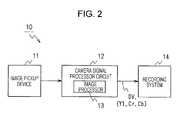
- FIG. 2 is a block diagram illustrating the image pickup apparatus in accordance with one embodiment of the present invention.
- FIG. 3 is a block diagram illustrating a separator in the image processing circuit of FIG. 1 ;
- FIG. 4 is a block diagram illustrating a non-linear smoothing circuit in the separator of FIG. 3 ;
- FIGS. 5A-5E are waveform diagrams illustrating operation of the image processing circuit of FIG. 1 ;
- FIGS. 6A-6D illustrate how an outline of an image is extracted
- FIG. 7 is a block diagram illustrating a known outline enhancing circuit
- FIGS. 8A and 8B are waveform diagrams illustrating operation of the outline enhancing circuit
- FIG. 9 is a block diagram illustrating an image processing circuit for enhancing contrast and sharpness.
- FIGS. 10A-10E are waveform diagrams illustrating operation of an image processing circuit of FIG. 9 .
- FIG. 2 is a block diagram of an image pickup apparatus 10 as an image processing apparatus in accordance with one embodiment of the present invention.
- an image pickup device 11 is a charge coupled device or solid-state image pickup device and outputs an optical image pickup result focused on an imaging surface through a lens (not shown).
- a camera signal processor circuit 12 performs a calculation process, an analog-to-digital conversion process, a gamma correction process, a white-balance process, and other processes on the image pickup result output from the image pickup device 11 , and then outputs video data DV composed of luminance data Y 1 , and color difference data Cr and Cb.
- an image processor 13 in the camera signal processor circuit 12 outputs the video data VD with image outline enhanced and contrast and sharpness improved.
- the image pickup apparatus 10 displays on display means a monitor image of the video data VD output from the camera signal processor circuit 12 .
- a recording system 14 compresses the video data VD and records the compressed video data VD onto one of recording media.
- the recording media include an optical disk, a magneto-optical disk, a magnetic tape, and a memory card.
- FIG. 1 is a block diagram of the image processor 13 used in the image pickup apparatus 10 .
- the secondary power monitor 13 enhances an outline in input video data composed of luminance data Y 1 , and color difference data Cr and Cb, and further improves contrast and sharpness of image.
- a separator 15 in the image processor 13 smoothes luminance data ST 1 with an edge component preserved, and then outputs the smoothed luminance data ST 1 .
- the separator 15 also subtracts the smoothed luminance data ST 1 from the original luminance data Y 1 , thereby outputting a high-frequency component TX 1 containing no edge component.
- FIG. 3 is a block diagram of the separator 15 .
- the separator 15 includes a horizontal-direction processor 16 and a vertical-direction processor 17 .
- the horizontal-direction processor 16 smoothes the luminance data Y 1 in a horizontal direction and then the vertical-direction processor 17 smoothes luminance data in a vertical direction.
- the image processor 13 successively inputs to a horizontal-direction component extractor 18 the luminance data Y 1 from a buffer memory (not shown) in a raster sequence.
- the horizontal-direction component extractor 18 successively delays the luminance data Y 1 through a shift register having a predetermined number of stages.
- the horizontal-direction component extractor 18 outputs to a non-linear smoother 21 a plurality of samples of luminance data S 1 from the shift register at a time in parallel.
- the plurality of luminance data S 1 is composed of data at a target sampling point and a plurality of sampling points in front of and behind the target sampling point in a horizontal direction. In this way, the horizontal-direction component extractor 18 outputs the luminance data S 1 at the plurality of sampling points to the non-linear smoother 21 for smoothing process.
- a vertical-direction component extractor 19 receives and then transfers the luminance data Y 1 at a line buffer having a plurality of stages connected in cascade, and outputs the luminance data Y 1 respectively output from the line buffers to a reference value determiner 20 . In this way, the vertical-direction component extractor 19 outputs luminance data S 2 at a target sampling point of the horizontal-direction component extractor 18 and a plurality of sampling points above and below the target sampling point in a vertical direction to the reference value determiner 20 .
- the reference value determiner 20 detects a variation in the sample values at the sampling points adjacent to the target sampling point from the luminance data S 2 at the sampling points consecutively arranged in a vertical direction output from the vertical-direction component extractor 19 . In response to the magnitude of variation in the sample values, the reference value determiner 20 determines a reference value ⁇ 1 to be supplied for a non-linear smoothing process. The reference value determiner 20 thus sets the reference value ⁇ 1 so that the non-linear smoother 21 appropriately performs the smoothing process.
- An absolute difference calculator 22 in the reference value determiner 20 receives the luminance data S 2 at the plurality of sampling points consecutively arranged in a vertical direction output from the vertical-direction component extractor 19 .
- the absolute difference calculator 22 subtracts the luminance data at the target sampling point from the luminance data at a next sampling point, and then converts the resulting difference into an absolute difference.
- the absolute difference calculator 22 detects absolute differences at the plurality of sampling points consecutively arranged in a vertical direction with respect to the target sampling point.
- a reference value setter 23 detects a maximum value from among the plurality of absolute differences at the plurality of sampling points consecutively arranged in a vertical direction detected by the absolute difference calculator 22 , and adds a constant margin to the maximum absolute difference as the reference value ⁇ 1 .
- the reference value setter 23 sets 10% as a margin, thereby setting 1.1 times the maximum absolute difference as the reference value ⁇ 1 .
- the non-linear smoother 21 performs a non-linear smoothing process on the luminance data S 1 at the plurality of sampling points consecutively arranged in a horizontal direction output from the horizontal-direction component extractor 18 , with respect to the reference value ⁇ 1 .
- the non-linear smoother 21 weight-averages the smooth process result and the original luminance data Y 1 to compensate for a weak edge component that is lost in the smoothing process, and outputs the averaged result.
- a non-linear filter 31 in the non-linear smoother 21 is an ⁇ filter.
- the non-linear filter 31 performs a non-linear smoothing process on the luminance data S 1 at the plurality of sampling points consecutively arranged in a horizontal direction output from the horizontal-direction component extractor 18 with respect to the reference value ⁇ 1 output from the reference value determiner 20 .
- the non-linear filter 31 thus smoothes the luminance data Y 1 with a component varying greatly beyond the reference value ⁇ 1 preserved.
- the non-linear filter 31 stores a signal level that greatly varies beyond the reference value ⁇ 1 .
- the reference value ⁇ 1 is determined based on the variation in the sample values in a vertical direction.
- the non-linear filter 31 thus performs a non-linear smoothing process on the luminance data Y 1 in a horizontal direction.
- a mixer 33 weight averages luminance data S 3 output from the non-linear filter 31 and the original luminance data Y 1 using weight coefficients calculated by a mixing ratio detector 32 , and outputs luminance data S 4 .
- the mixing ratio detector 32 detects a variation in the signal level at a sampling point adjacent to the target sampling point in a horizontal direction with respect to a signal level at the target sampling point, from the luminance data S 1 at the plurality of sampling points consecutively arranged in a horizontal direction output from the horizontal-direction component extractor 18 .
- the mixing ratio detector 32 also detects the presence of a weak edge based on the detected variation in the signal level. Based on the detection result, the mixing ratio detector 32 further calculates the weight coefficient for use in the weight averaging process of the mixer 33 .
- the mixing ratio detector 32 determines a certain percentage of the reference value 81 detected in the vertical direction by the reference value determiner 20 or subtracts a certain value from the reference value ⁇ 1 , as a reference value ⁇ 2 smaller than the reference value ⁇ 1 .
- the reference value ⁇ 2 is set up so that a weak edge component smoothed through the non-linear smoothing process using the reference value ⁇ 1 is detected in comparison with an absolute difference to be discussed later.
- the reference value ⁇ 1 is set up depending on the variation in the signal level in a vertical direction.
- the mixing ratio detector 32 receives the luminance data S 1 at the plurality of sampling points consecutively arranged in a horizontal direction output from the horizontal-direction component extractor 18 , and calculates successively the absolute differences, each absolute difference between the luminance data at the target sampling point and the luminance data at each of the sampling points adjacent to the target sampling point. The mixing ratio detector 32 determines that there is no weak edge if each of all calculated absolute differences is smaller than the reference value ⁇ 2 .
- the mixing ratio detector 32 determines whether the sampling point having the reference value ⁇ 2 or higher is ahead of or behind the target sampling point and also determines the polarity of the difference of that sampling point. If there are sampling points having the reference value ⁇ 2 or higher both ahead of and behind the target sampling point, and if those sampling points have the same polarity, the sample value may temporarily increase due to noise. The mixing ratio detector 32 thus determines that there is no weak edge.
- the sampling point having the reference value ⁇ 2 or higher is present ahead of or behind the process sampling rather than on both sides of the target sampling point, or if the sampling points, present on both sides of the target sampling point, provides the difference values different in polarity, the sample value changes slightly across the target sampling point.
- the mixing ratio detector 32 determines that there is a weak edge.
- the mixing ratio detector 32 determines the weight coefficient to be used in the weight averaging process of the mixer 33 so that the original luminance data Y 1 is selectively output.
- the weight coefficient to be used in the weight averaging process of the mixer 33 is set so that the component of the luminance data S 3 obtained through the non-linear smoothing process is increased in luminance data S 4 output from the mixer 33 in response to the maximum value of the absolute differences used to result in the reference value ⁇ 2 .
- the weight coefficient related to the luminance data S 3 obtained through the non-linear smoothing process is linearly increased from a value 0 to a value 1 in proportion to the increase in the maximum value of the absolute difference.
- the mixing ratio detector 32 sets the weight to be larger in the smoothing process as a variation in the sample value becomes larger. The luminance data is output in this setting.
- the horizontal-direction processor 16 performs the non-linear smoothing process on the luminance data Y 1 in a horizontal direction so as to preserve a variation in the sample value equal to or larger than the variation in the sample values at the consecutive sampling points in a vertical direction.
- the horizontal-direction processor 16 detects an edge related to a variation in the sample value in the horizontal direction smaller than the variation in the sample values at the sampling points consecutively arranged in a vertical direction. If there is such a variation, the horizontal-direction processor 16 selectively outputs the original luminance data Y 1 .
- the horizontal-direction processor 16 weight averages the luminance data S 4 resulting from the non-linear smoothing process and the original luminance data Y 1 in response to the magnitude of the variation in the sample value in the horizontal direction, and outputs the weight-averaged luminance data.
- the horizontal-direction processor 16 smoothes the luminance data Y 1 in a horizontal direction with the weak edge component preserved.
- a vertical-direction processor 17 ( FIG. 7 ) performs the vertical smoothing process on the luminance data S 4 output from the horizontal-direction processor 16 .
- the vertical-direction processor 17 performs the vertical non-linear smoothing process on the luminance data S 4 so that a variation in the sample value equal to or larger than a variation in the sample values at the sampling points consecutively arranged in a horizontal direction is preserved.
- the vertical-direction processor 17 also detects an edge related to a variation in the sample value in a vertical direction smaller than the variation in the sample values at the sampling points arranged consecutively in a horizontal direction. If there is such an edge, the vertical-direction processor 17 selectively outputs the original luminance data S 4 .
- the vertical-direction processor 17 weight averages the non-linear smoothing process result and the original luminance data S 4 in response to the magnitude of the variation in the sample values in the vertical direction.
- the vertical-direction processor 17 thus vertically smoothes the luminance data Y 1 with the weak edge component preserved.
- the separator 15 performs the non-linear smoothing process on the successively input luminance data Y 1 , thereby outputting luminance data ST 1 as a two-dimensional smoothing process result with the edge component preserved.
- a subtractor 40 subtracts the luminance data ST 1 from the original luminance data Y 1 , thereby outputting luminance data TX 1 containing the high-frequency component without the edge component.
- the amplifier 41 ( FIG. 1 ) amplifies the luminance data TX 1 containing the high-frequency component without the edge component with a predetermined gain, thereby outputting the level-adjusted high-frequency component without the edge component.
- an outline extractor 42 extracts an edge component from the luminance data ST 1 obtained through the smoothing process of the separator 15 and outputs the extracted edge component. More specifically, the outline extractor 42 , including a two-dimensional filter, successively calculates difference values between adjacent sampling points in one of a horizontal direction and a vertical direction, thereby detecting an edge component OT 1 from an derivative of the luminance data ST 1 .
- an amplifier 43 amplifies the edge component OTI with a predetermined gain, thereby outputting the level-adjusted OT 2 .
- an adder 44 sums the luminance data ST 1 output by the separator 15 in the smoothing process, the high-frequency component TX 2 without the edge component output from the amplifier 41 , and the edge component OT 2 output from the amplifier 43 , thereby outputting luminance data Y 4 .
- a level corrector 45 adjusts the signal level of the color difference data Cr and Cb so that the ratio of the color difference data Cr and Cb to the luminance data Y 4 as the process result equals the ratio of the color difference data Cr and Cb to the original luminance data Y 1 , and outputs the level-adjusted color difference data Cr and Cb.
- the level corrector 45 thus prevents hue of the image from being varied.
- the image pickup result obtained from the image pickup device 11 is processed by the camera signal processor circuit 12 in this way, and then displayed as a monitor image and recorded on the recording system 14 in response to an operational input from the user.
- the image processor 13 in the camera signal processor circuit 12 thus enhances the high-frequency component of the luminance data Y 1 , thereby improving image quality.
- the separator 15 smoothes the luminance data Y 1 with the edge component preserved, and the outline extractor 42 extracts the edge component from the smoothed luminance data ST 1 .
- the image processor 13 thus extracts the edge component OT 1 by preventing effectively the intrusion of the high-frequency component other than the edge component.
- the intrusion of the high-frequency component other than the edge component cannot be avoided.
- a noise component is also enhanced through the outline enhancement, leading to image degradation.
- the edge component is extracted from the smoothing process result with the edge component preserved in accordance with the present embodiment, the noise component is prevented from intruding.
- the outline enhancement is thus performed without enhancing the noise component.
- the use of an ⁇ filter permits the non-linear smoothing process to be performed with the edge component preserved. If the edge component is extracted from the smoothing process result containing the preserved edge component, the outline enhancement is performed with image degradation prevented. Even if a signal to noise (S/N) ratio is low, the outline enhancement is performed with image degradation controlled.
- FIGS. 6A-6D illustrate images obtained through the high-frequency component extraction process of the present embodiment in contrast with images obtained through known high-frequency extraction process.
- a high-frequency component Y 2 ( FIG. 6B ) is obtained by limiting bandwidth on an input image Y 1 ( FIG. 6A ) with a high-pass filter.
- Contained in the high-frequency component Y 2 is an edge component besides fine variations in luminance of an image including head hair, clothes, a fine structure of a flower, etc.
- a noise component is contained in the high-frequency component Y 2 .
- the edge component is extracted as shown in FIG. 6C with mean luminance level of each portion of the input image Y 1 ( FIG. 6A ) preserved. More specifically, in the smoothing process result ST 1 , the fine variations in luminance of an image including head hair, clothes, a fine structure of a flower, etc. are selectively smoothed. If the outline is extracted from the smoothing process result ST 1 , only the edge component useful in the outline enhancement process is extracted with neither a fine luminance variation nor noise contained in the image ( FIG. 6D ). In accordance with the present embodiment, the edge component is extracted for enhancement using the non-linear filter, and the useful edge component only is used for outline enhancement in a manner different from the known art.
- the amplifier 43 sets the degree of outline enhancement by level-adjusting the detected edge component OT 1 , and the adder 44 adds the edge component OT 1 to the other component.
- the adder 44 thus generates the luminance data Y 4 with the outline enhanced.
- the separator 15 subtracts the smoothing process result with the edge component preserved from the original luminance data Y 1 , thereby detecting the high-frequency component TX 1 other than the edge component.
- the high-frequency component TX 1 without the edge component may be a pattern in the image, and is in need of setting of contact and sharpness.
- the high-frequency component TX 1 without the edge component is level-adjusted by the amplifier 41 , and is then added to the other components by the adder 44 . The contrast and sharpness of the image are thus improved.
- edge component and the high-frequency component without the edge component are separately level-adjusted, a variety of enhancement processes may be performed to improve image quality in a manner different the known art. A wide variety of freedom of image quality setting is assured in comparison with the known art.
- the adder 44 may add the smoothing process result with the edge component preserved output from the separator 15 , instead of the original luminance data Y 1 , as an addend.
- a mechanism for assuring timing synchronization with a variety of data to be added by the adder 44 is thus simplified, and the entire structure of the apparatus is simplified accordingly.
- the separator 15 smoothes the luminance data Y 1 with the edge component thereof preserved.
- the horizontal-direction component extractor 18 in the horizontal-direction processor 16 selects the luminance data at a target sampling point for the smoothing process and the luminance data at a sampling point adjacent to the target sampling point, the non-linear filter 31 as an ⁇ filter ( FIG. 4 ) processes these units of luminance data, thereby performing the smoothing process with the edge component preserved.
- the vertical-direction component extractor 19 of the horizontal-direction processor 16 selects the luminance data at a plurality of sampling points adjacent to the sampling point in a vertical direction, and the absolute difference calculator 22 detects the magnitude of a variation in the sample value in a vertical direction from the luminance data selected by the vertical-direction component extractor 19 .
- the reference value setter 23 sets a reference value ⁇ 1 related to the smoothing process of the non-linear filter 31 so that the magnitude of the variation in the sample value in a vertical direction is preserved.
- the smoothing process is performed to preserve the edge component with characteristic of the non-linear filter 31 adaptively switched in response to the magnitude of the variation in the sample value in a vertical direction.
- the smoothing process is thus appropriately performed with the reference value ⁇ 1 set in response to the video data to be processed.
- the mixing ratio detector 32 sets a reference value ⁇ 2 with respect to the reference value ⁇ 1 that has been set in response to the magnitude of the variation in a vertical direction.
- the magnitude of a variation in the sample value in a horizontal direction using the reference value ⁇ 2 , and the weak edge is detected based on the magnitude of the variation in the sample value in the horizontal direction. If there is a weak edge, the mixer 33 selects the original luminance data Y 1 .
- the mixer 33 switches a weight averaging process of the luminance data Y 1 and the output data S 3 from the non-linear filter 31 in a manner such that the output data of the non-linear filter 31 is intensified in response to an increase in the magnitude of the variation in the sample value in a horizontal direction.
- a vertical smoothing process is performed on the luminance data Y 1 with the edge component preserved.
- the luminance data Y 1 is smoothed with the edge component of even a weak edge preserved.
- the outline enhancement process using the luminance data ST 1 as the smoothing process reliably enhances an outline having a weak edge. Image quality is thus improved.
- the input video data is smoothed with the edge component preserved, the edge component is then removed from the smoothed video data, and the level adjustment is performed on the resulting video data.
- the outline enhancement is thus performed in a manner free from image degradation.
- the reference value is set based on the variation in the sample values at adjacent sampling points in a horizontal direction and a vertical direction.
- the non-linear smoothing process is performed in a horizontal direction and a vertical direction with a variation in the signal level above the reference value being preserved.
- the smoothing process result and the input video data are weight averaged using the weight coefficient set based on the weak edge detection result to perform a series of smoothing processes.
- the outline enhancement is thus reliably performed on a weak edge. Image quality is thus improved.
- the edge component having undergone the level adjustment and the high-frequency component containing no edge component are added to the smoothing process result with the edge component preserved therewithin.
- the present invention is not limited to this method.
- the edge component having undergone the level adjustment and the high-frequency component containing no edge component may be added directly to the input video data.
- the video data is smoothed in a vertical direction using the non-linear smoothing filter after being smoothed in a horizontal direction.
- the present invention is not limited to this method.
- the video data may be smoothed in a horizontal direction after being smoothed in a vertical direction.
- the smoothing process result and the input video data are weight averaged and then output, and the weight coefficients for use in the weight averaging process are switched depending on the detection result of the weak edge component.
- the present invention is not limited to this method. If sufficient performance is practically attained, the weight averaging process may be omitted, and the smoothing process result may be directly output.
- the reference value for use in the non-linear smoothing process is adaptively switched.
- the present invention is not limited to this method. If sufficient performance is practically attained, the smoothing process may be performed with a fixed reference value.
- an ⁇ filter is used in the smoothing process.
- the present invention is not limited to the ⁇ filter.
- a wide variety of filters performing the smoothing process with the edge component preserved can be used.
- the luminance data is used in the outline enhancement.
- the present invention is not limited to this method.
- Color difference data may be used.
- the input video data may be processed at the color data phase thereof.
- the image pickup apparatus processes video data as an image pickup result.
- the present invention is not limited to the process of the video data as an image pickup result.
- the present invention is also applicable to image processing by using a variety of video apparatuses including a television receiver, and a digital versatile disk (DVD) recorder, or by executing a program on a computer.
- the program may be installed beforehand onto the computer or may be supplied to the computer in a variety of recording media including an optical disk, a magneto-optical disk, or a memory card, or may be downloaded to the computer via a network such as the Internet.
Landscapes
- Engineering & Computer Science (AREA)
- Multimedia (AREA)
- Signal Processing (AREA)
- Image Processing (AREA)
- Facsimile Image Signal Circuits (AREA)
- Picture Signal Circuits (AREA)
- Studio Devices (AREA)
- Television Signal Processing For Recording (AREA)
Abstract
Description
Claims (5)
Applications Claiming Priority (3)
| Application Number | Priority Date | Filing Date | Title |
|---|---|---|---|
| JPP2006-007203 | 2006-01-16 | ||
| JP2006-007203 | 2006-01-16 | ||
| JP2006007203A JP4240324B2 (en) | 2006-01-16 | 2006-01-16 | Image processing apparatus, image processing method, program for image processing method, and recording medium recording program for image processing method |
Publications (2)
| Publication Number | Publication Date |
|---|---|
| US20070182834A1 US20070182834A1 (en) | 2007-08-09 |
| US8045063B2 true US8045063B2 (en) | 2011-10-25 |
Family
ID=38006614
Family Applications (1)
| Application Number | Title | Priority Date | Filing Date |
|---|---|---|---|
| US11/652,538 Expired - Fee Related US8045063B2 (en) | 2006-01-16 | 2007-01-12 | Apparatus, method, and computer program for processing image, and recording medium storing the computer program |
Country Status (5)
| Country | Link |
|---|---|
| US (1) | US8045063B2 (en) |
| EP (1) | EP1809018B1 (en) |
| JP (1) | JP4240324B2 (en) |
| KR (1) | KR101329469B1 (en) |
| CN (1) | CN100556074C (en) |
Cited By (1)
| Publication number | Priority date | Publication date | Assignee | Title |
|---|---|---|---|---|
| US9390485B2 (en) | 2014-03-07 | 2016-07-12 | Ricoh Company, Ltd. | Image processing device, image processing method, and recording medium |
Families Citing this family (10)
| Publication number | Priority date | Publication date | Assignee | Title |
|---|---|---|---|---|
| KR101408254B1 (en) * | 2007-11-27 | 2014-06-17 | 엘지디스플레이 주식회사 | Apparatus and method for improving response time of liquid crystal display |
| EP2362347A4 (en) | 2008-12-22 | 2012-07-18 | Mitsubishi Electric Corp | IMAGE PROCESSING APPARATUS AND METHOD, AND IMAGE DISPLAY APPARATUS |
| JP5348145B2 (en) | 2009-01-28 | 2013-11-20 | 富士通株式会社 | Image processing apparatus and image processing program |
| TWI387319B (en) * | 2009-06-02 | 2013-02-21 | Novatek Microelectronics Corp | Circuit and method for image processing |
| JP2011035776A (en) * | 2009-08-04 | 2011-02-17 | Sanyo Electric Co Ltd | Video information processing apparatus, and program |
| TW201120809A (en) * | 2009-12-15 | 2011-06-16 | Ability Entpr Co Ltd | System and method for processing an image edge |
| JP5652272B2 (en) * | 2011-03-14 | 2015-01-14 | 富士通株式会社 | Image processing apparatus, image processing program, and image processing method |
| CN102694962B (en) * | 2011-03-22 | 2016-01-20 | 深圳市中兴微电子技术有限公司 | Noise-reduction method and device |
| JP7265316B2 (en) * | 2017-12-28 | 2023-04-26 | 三星電子株式会社 | Image processing device and image processing method |
| CN116189178A (en) * | 2022-12-30 | 2023-05-30 | 广州市明美光电技术有限公司 | Identification method, equipment and storage medium for microscopic cell image |
Citations (9)
| Publication number | Priority date | Publication date | Assignee | Title |
|---|---|---|---|---|
| US5262863A (en) * | 1989-10-06 | 1993-11-16 | Kabushiki Kaisha Toshiba | Video signal processor having an adjustable noise cancelling circuit |
| EP1137267A2 (en) | 2000-02-07 | 2001-09-26 | Sony Corporation | Device and method for image processing |
| JP2001298621A (en) | 2000-02-07 | 2001-10-26 | Sony Corp | Image processing apparatus and method |
| JP2002300402A (en) | 2001-03-30 | 2002-10-11 | Fuji Photo Film Co Ltd | Image processor, processing method and recording medium |
| US20040091145A1 (en) | 2002-04-11 | 2004-05-13 | Atsushi Kohashi | Image signal processing system and camera having the image signal processing system |
| JP2004289607A (en) | 2003-03-24 | 2004-10-14 | Sony Corp | Signal processing apparatus and method, recording medium, and program |
| EP1496472A2 (en) | 2003-07-11 | 2005-01-12 | Sony Corporation | Edge-sensitive image enhancement |
| JP2005301910A (en) | 2004-04-15 | 2005-10-27 | Sony Corp | Image processing apparatus, image processing method, program, and recording medium |
| JP2005309945A (en) | 2004-04-23 | 2005-11-04 | Sony Corp | Image processing apparatus and method, program, and recording medium |
Family Cites Families (2)
| Publication number | Priority date | Publication date | Assignee | Title |
|---|---|---|---|---|
| US5038388A (en) * | 1989-05-15 | 1991-08-06 | Polaroid Corporation | Method for adaptively sharpening electronic images |
| KR100374791B1 (en) | 2000-11-22 | 2003-03-04 | 삼성전자주식회사 | Method and apparatus for sectioning image into a plurality of regions |
-
2006
- 2006-01-16 JP JP2006007203A patent/JP4240324B2/en not_active Expired - Fee Related
-
2007
- 2007-01-12 US US11/652,538 patent/US8045063B2/en not_active Expired - Fee Related
- 2007-01-16 KR KR1020070004703A patent/KR101329469B1/en not_active Expired - Fee Related
- 2007-01-16 CN CNB2007100017801A patent/CN100556074C/en not_active Expired - Fee Related
- 2007-01-16 EP EP07100624.1A patent/EP1809018B1/en not_active Not-in-force
Patent Citations (11)
| Publication number | Priority date | Publication date | Assignee | Title |
|---|---|---|---|---|
| US5262863A (en) * | 1989-10-06 | 1993-11-16 | Kabushiki Kaisha Toshiba | Video signal processor having an adjustable noise cancelling circuit |
| EP1137267A2 (en) | 2000-02-07 | 2001-09-26 | Sony Corporation | Device and method for image processing |
| JP2001298621A (en) | 2000-02-07 | 2001-10-26 | Sony Corp | Image processing apparatus and method |
| JP2002300402A (en) | 2001-03-30 | 2002-10-11 | Fuji Photo Film Co Ltd | Image processor, processing method and recording medium |
| US20040091145A1 (en) | 2002-04-11 | 2004-05-13 | Atsushi Kohashi | Image signal processing system and camera having the image signal processing system |
| US7456873B2 (en) * | 2002-04-11 | 2008-11-25 | Olympus Corporation | Image signal processing system and camera for obtaining luminance-system signal and color-system signal |
| JP2004289607A (en) | 2003-03-24 | 2004-10-14 | Sony Corp | Signal processing apparatus and method, recording medium, and program |
| EP1496472A2 (en) | 2003-07-11 | 2005-01-12 | Sony Corporation | Edge-sensitive image enhancement |
| JP2005033688A (en) | 2003-07-11 | 2005-02-03 | Sony Corp | Signal processing apparatus and method, recording medium, and program |
| JP2005301910A (en) | 2004-04-15 | 2005-10-27 | Sony Corp | Image processing apparatus, image processing method, program, and recording medium |
| JP2005309945A (en) | 2004-04-23 | 2005-11-04 | Sony Corp | Image processing apparatus and method, program, and recording medium |
Cited By (1)
| Publication number | Priority date | Publication date | Assignee | Title |
|---|---|---|---|---|
| US9390485B2 (en) | 2014-03-07 | 2016-07-12 | Ricoh Company, Ltd. | Image processing device, image processing method, and recording medium |
Also Published As
| Publication number | Publication date |
|---|---|
| KR101329469B1 (en) | 2013-11-13 |
| CN100556074C (en) | 2009-10-28 |
| JP4240324B2 (en) | 2009-03-18 |
| JP2007188391A (en) | 2007-07-26 |
| US20070182834A1 (en) | 2007-08-09 |
| KR20070076507A (en) | 2007-07-24 |
| CN101005568A (en) | 2007-07-25 |
| EP1809018A3 (en) | 2009-07-29 |
| EP1809018B1 (en) | 2013-06-19 |
| EP1809018A2 (en) | 2007-07-18 |
Similar Documents
| Publication | Publication Date | Title |
|---|---|---|
| US8045063B2 (en) | Apparatus, method, and computer program for processing image, and recording medium storing the computer program | |
| US7903148B2 (en) | Apparatus, method, and computer program for processing image, and recording medium storing the computer program | |
| US8248537B2 (en) | Video-signal processing method, program of video-signal processing method, recording medium having recorded thereon program of video-signal processing method, and video-signal processing apparatus | |
| US20050248687A1 (en) | Apparatus and method for filtering digital image signal | |
| US10368017B2 (en) | Image processing apparatus, image processing method, and computer-readable recording medium | |
| US20090002562A1 (en) | Image Processing Device, Image Processing Method, Program for Image Processing Method, and Recording Medium Having Program for Image Processing Method Recorded Thereon | |
| JP2000013643A (en) | Noise reduction device and method, video signal processing device, and motion detection method | |
| US20120308156A1 (en) | Image processing apparatus, image processing method, and program | |
| KR100579883B1 (en) | Gamma Correction Device and Gamma Correction Method | |
| US20100194934A1 (en) | Image processing apparatus, program, method and image capturing system | |
| EP1933556A2 (en) | TV user interface and processing for personal video players | |
| KR950011528B1 (en) | Video signal edge-enhancement method and apparatus | |
| US6215527B1 (en) | Video signal contour correcting circuit | |
| JPH1013734A (en) | Imaging device | |
| US7265785B2 (en) | Imaging apparatus and method that provide high resolution under low illumination without substantial S/N degradation | |
| JP2001189944A (en) | Imaging device | |
| US7817209B2 (en) | Video signal processing device and video signal processing method | |
| JP2003209716A (en) | Video signal processing apparatus and method, recording medium, and program | |
| JP2872005B2 (en) | Automatic image quality adjustment device | |
| KR101007840B1 (en) | Signal processing apparatus and method, recording medium | |
| CN100521799C (en) | Colour noise suppressing system | |
| JP7300164B2 (en) | noise reduction method | |
| JP2007028468A (en) | Image processing apparatus and method | |
| JP2001189878A (en) | Imaging device | |
| EP2541895B1 (en) | Image processing apparatus, display apparatus provided with same, and image processing method |
Legal Events
| Date | Code | Title | Description |
|---|---|---|---|
| AS | Assignment |
Owner name: SONY CORPORATION, JAPAN Free format text: ASSIGNMENT OF ASSIGNORS INTEREST;ASSIGNORS:YOKOYAMA, KAZUKI;INADA, TETSUJI;ASANO, MITSUYASU;AND OTHERS;SIGNING DATES FROM 20070323 TO 20070402;REEL/FRAME:019165/0856 Owner name: SONY CORPORATION, JAPAN Free format text: ASSIGNMENT OF ASSIGNORS INTEREST;ASSIGNORS:YOKOYAMA, KAZUKI;INADA, TETSUJI;ASANO, MITSUYASU;AND OTHERS;REEL/FRAME:019165/0856;SIGNING DATES FROM 20070323 TO 20070402 |
|
| FEPP | Fee payment procedure |
Free format text: PAYOR NUMBER ASSIGNED (ORIGINAL EVENT CODE: ASPN); ENTITY STATUS OF PATENT OWNER: LARGE ENTITY |
|
| ZAAA | Notice of allowance and fees due |
Free format text: ORIGINAL CODE: NOA |
|
| ZAAB | Notice of allowance mailed |
Free format text: ORIGINAL CODE: MN/=. |
|
| STCF | Information on status: patent grant |
Free format text: PATENTED CASE |
|
| FPAY | Fee payment |
Year of fee payment: 4 |
|
| AS | Assignment |
Owner name: SATURN LICENSING LLC, NEW YORK Free format text: ASSIGNMENT OF ASSIGNORS INTEREST;ASSIGNOR:SONY CORPORATION;REEL/FRAME:043177/0794 Effective date: 20170613 |
|
| MAFP | Maintenance fee payment |
Free format text: PAYMENT OF MAINTENANCE FEE, 8TH YEAR, LARGE ENTITY (ORIGINAL EVENT CODE: M1552); ENTITY STATUS OF PATENT OWNER: LARGE ENTITY Year of fee payment: 8 |
|
| FEPP | Fee payment procedure |
Free format text: MAINTENANCE FEE REMINDER MAILED (ORIGINAL EVENT CODE: REM.); ENTITY STATUS OF PATENT OWNER: LARGE ENTITY |
|
| LAPS | Lapse for failure to pay maintenance fees |
Free format text: PATENT EXPIRED FOR FAILURE TO PAY MAINTENANCE FEES (ORIGINAL EVENT CODE: EXP.); ENTITY STATUS OF PATENT OWNER: LARGE ENTITY |
|
| STCH | Information on status: patent discontinuation |
Free format text: PATENT EXPIRED DUE TO NONPAYMENT OF MAINTENANCE FEES UNDER 37 CFR 1.362 |
|
| FP | Lapsed due to failure to pay maintenance fee |
Effective date: 20231025 |