US8024129B2 - Method and apparatus for searching gene sequence - Google Patents

Method and apparatus for searching gene sequence Download PDF

Info

Publication number
US8024129B2
US8024129B2 US11/561,479 US56147906A US8024129B2 US 8024129 B2 US8024129 B2 US 8024129B2 US 56147906 A US56147906 A US 56147906A US 8024129 B2 US8024129 B2 US 8024129B2
Authority
US
United States
Prior art keywords
gene sequence
search
sequence
sequences
ranking
Prior art date
Legal status (The legal status is an assumption and is not a legal conclusion. Google has not performed a legal analysis and makes no representation as to the accuracy of the status listed.)
Expired - Fee Related, expires
Application number
US11/561,479
Other versions
US20070218473A1 (en
Inventor
Ki Eun KIM
Current Assignee (The listed assignees may be inaccurate. Google has not performed a legal analysis and makes no representation or warranty as to the accuracy of the list.)
Samsung Electronics Co Ltd
Original Assignee
Samsung Electronics Co Ltd
Priority date (The priority date is an assumption and is not a legal conclusion. Google has not performed a legal analysis and makes no representation as to the accuracy of the date listed.)
Filing date
Publication date
Application filed by Samsung Electronics Co Ltd filed Critical Samsung Electronics Co Ltd
Assigned to SAMSUNG ELECTRONICS CO., LTD. reassignment SAMSUNG ELECTRONICS CO., LTD. ASSIGNMENT OF ASSIGNORS INTEREST (SEE DOCUMENT FOR DETAILS). Assignors: KIM, KI EUN
Publication of US20070218473A1 publication Critical patent/US20070218473A1/en
Application granted granted Critical
Publication of US8024129B2 publication Critical patent/US8024129B2/en
Expired - Fee Related legal-status Critical Current
Adjusted expiration legal-status Critical

Links

Images

Classifications

    • GPHYSICS
    • G16INFORMATION AND COMMUNICATION TECHNOLOGY [ICT] SPECIALLY ADAPTED FOR SPECIFIC APPLICATION FIELDS
    • G16BBIOINFORMATICS, i.e. INFORMATION AND COMMUNICATION TECHNOLOGY [ICT] SPECIALLY ADAPTED FOR GENETIC OR PROTEIN-RELATED DATA PROCESSING IN COMPUTATIONAL MOLECULAR BIOLOGY
    • G16B50/00ICT programming tools or database systems specially adapted for bioinformatics
    • EFIXED CONSTRUCTIONS
    • E04BUILDING
    • E04CSTRUCTURAL ELEMENTS; BUILDING MATERIALS
    • E04C2/00Building elements of relatively thin form for the construction of parts of buildings, e.g. sheet materials, slabs, or panels
    • E04C2/02Building elements of relatively thin form for the construction of parts of buildings, e.g. sheet materials, slabs, or panels characterised by specified materials
    • E04C2/26Building elements of relatively thin form for the construction of parts of buildings, e.g. sheet materials, slabs, or panels characterised by specified materials composed of materials covered by two or more of groups E04C2/04, E04C2/08, E04C2/10 or of materials covered by one of these groups with a material not specified in one of the groups
    • E04C2/284Building elements of relatively thin form for the construction of parts of buildings, e.g. sheet materials, slabs, or panels characterised by specified materials composed of materials covered by two or more of groups E04C2/04, E04C2/08, E04C2/10 or of materials covered by one of these groups with a material not specified in one of the groups at least one of the materials being insulating
    • GPHYSICS
    • G16INFORMATION AND COMMUNICATION TECHNOLOGY [ICT] SPECIALLY ADAPTED FOR SPECIFIC APPLICATION FIELDS
    • G16BBIOINFORMATICS, i.e. INFORMATION AND COMMUNICATION TECHNOLOGY [ICT] SPECIALLY ADAPTED FOR GENETIC OR PROTEIN-RELATED DATA PROCESSING IN COMPUTATIONAL MOLECULAR BIOLOGY
    • G16B50/00ICT programming tools or database systems specially adapted for bioinformatics
    • G16B50/30Data warehousing; Computing architectures
    • EFIXED CONSTRUCTIONS
    • E04BUILDING
    • E04BGENERAL BUILDING CONSTRUCTIONS; WALLS, e.g. PARTITIONS; ROOFS; FLOORS; CEILINGS; INSULATION OR OTHER PROTECTION OF BUILDINGS
    • E04B1/00Constructions in general; Structures which are not restricted either to walls, e.g. partitions, or floors or ceilings or roofs
    • E04B1/62Insulation or other protection; Elements or use of specified material therefor
    • E04B1/92Protection against other undesired influences or dangers
    • E04B1/94Protection against other undesired influences or dangers against fire
    • E04B1/941Building elements specially adapted therefor
    • E04B1/942Building elements specially adapted therefor slab-shaped
    • GPHYSICS
    • G16INFORMATION AND COMMUNICATION TECHNOLOGY [ICT] SPECIALLY ADAPTED FOR SPECIFIC APPLICATION FIELDS
    • G16BBIOINFORMATICS, i.e. INFORMATION AND COMMUNICATION TECHNOLOGY [ICT] SPECIALLY ADAPTED FOR GENETIC OR PROTEIN-RELATED DATA PROCESSING IN COMPUTATIONAL MOLECULAR BIOLOGY
    • G16B30/00ICT specially adapted for sequence analysis involving nucleotides or amino acids

Definitions

  • the present invention relates to a method and apparatus for searching a gene sequence, and more particularly, to a method and apparatus for searching a gene sequence, through which study trends in a biology field can be understood.
  • NCBI BLAST National Center for Biotechnology Information Basic Local Alignment Search Tool
  • EBI BLAST European Bioinformatics Institute Basic Local Alignment Search Tool
  • An exemplary embodiment provides a method for searching a gene sequence.
  • the method provides a variety of information regarding a specific gene sequence so that study trends in the biology field can be understood.
  • An exemplary embodiment provides an apparatus for searching a gene sequence.
  • the apparatus provides a variety of information regarding a specific gene sequence so that study trends in the biology field can be understood.
  • a method for searching a gene sequence includes receiving the gene sequence to be searched from a user, generating extended sequences including the received gene sequence, partial sequences included in the gene sequence and an inverse sequence complementary to the gene sequence, storing the gene sequence, the extended sequences, the partial sequences, the inverse sequence and input-related record information in a database, integrated-searching the gene sequence using a gene sequence search server, estimating a gene sequence search ranking for a first predetermined period using the database and outputting an integrated and searched result of the gene sequence and a gene sequence search ranking result to the user.
  • the receiving the gene sequence includes receiving a second predetermined period for estimating the gene sequence search ranking and the estimating a gene sequence search ranking includes estimating the gene sequence search ranking for the second received predetermined period.
  • the input-related record information may include user information, input region information and input time information.
  • the integrated-searching the gene sequence includes additionally searching at least one of the extended sequences, the partial sequences, and the inverse sequence, other than the gene sequence.
  • the estimating a gene sequence search ranking includes estimating a gene sequence search ranking for a region.
  • the method further includes extracting search sequences of a different user from the database, the extracted search sequences including the received gene sequence.
  • the outputting an integrated and searched result of the gene sequence and a gene sequence search ranking result includes additionally outputting extracted results.
  • the method further includes extracting different search sequences of a different user from the database, the different user having searched the received gene sequence or a sequence including the received gene sequence.
  • the outputting an integrated and searched result of the gene sequence and a gene sequence search ranking result includes additionally outputting extracted results.
  • the method further includes estimating transition in search frequency of the received gene sequence for a predetermined period using the database.
  • the outputting an integrated and searched result of the gene sequence and a gene sequence search ranking result includes additionally outputting a transition result.
  • the outputting an integrated and searched result of the gene sequence and a gene sequence search ranking result includes additionally outputting information related to the searched gene sequence or a gene sequence having a higher ranking.
  • the related information may includes names of pathogens, mutant types, patent information and news information, regarding the gene sequence.
  • an apparatus for searching a gene sequence includes an input unit receiving the gene sequence to be searched from a user, a related sequence generator generating extended sequences including the gene sequence, partial sequences included in the gene sequence and an inverse sequence complementary to the gene sequence, a database storing the gene sequence, the extended sequences, the partial sequences, the inverse sequence and input-related record information, an integrated search unit integrating and searching the gene sequence using a gene sequence search server, a search ranking estimator estimating a gene sequence search ranking for a first predetermined period using the database and an output unit outputting an integrated-searched result or a search ranking result of the gene sequence to the user.
  • the input unit further receives a second predetermined period for estimating the gene sequence search ranking and the search ranking estimator estimates a search ranking for the received second predetermined period.
  • the input-related record information may include user information, input region information and input time information.
  • the integrated-search unit additionally searches at least one of the extended sequences, the partial sequences and the inverse sequence, other than the gene sequence.
  • the search ranking estimator estimates a search ranking for a region.
  • the apparatus further includes a first search sequence extractor extracting search sequences of a different user from the database, the extracted search sequences including the received gene sequence.
  • the output unit additionally outputs extracted results.
  • the apparatus further includes a second search sequence extractor extracting different search sequences of a different user from the database, the different user having searched the received gene sequence and a sequence including the received gene sequence.
  • the output unit additionally outputs extracted results.
  • the apparatus further includes a search transition estimator estimating transition in search frequency of the received gene sequence for a third predetermined period using the database.
  • the output unit additionally outputs the transition result.
  • the output unit additionally outputs information related to the searched gene sequence or a gene sequence having a ranking.
  • the related information may include names of pathogens, mutant types, patent information, and news information, regarding the gene sequence.
  • FIG. 1 is a schematic view illustrating an exemplary embodiment of a network connection of a gene sequence search apparatus according to the present invention
  • FIG. 2 is a flowchart illustrating an exemplary embodiment of a gene sequence search method according to the present invention
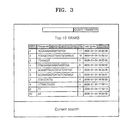
  • FIG. 3 shows an exemplary embodiment of a display including an output result of a gene sequence search apparatus search according to the present invention. Sequences shown having a rank of 1 to 10 correspond to SEQ ID NOS: 6-15 respectively;
  • FIG. 4 shows another exemplary embodiment of a display including an output result of a gene sequence search apparatus search according to the present invention.
  • the input gene sequence CTTGACTGCGA (Related Searches and Current search) corresponds to SEQ ID NO: 5; and
  • FIG. 5 is a block diagram of an exemplary embodiment of a gene sequence search apparatus according to the present invention.
  • first, second, third, etc. may be used herein to describe various elements, components, regions, layers and/or sections, these elements, components, regions, layers and/or sections should not be limited by these terms. These terms are only used to distinguish one element, component, region, layer or section from another region, layer or section. Thus, a first element, component, region, layer or section discussed below could be termed a second element, component, region, layer or section without departing from the teachings of the present invention.
  • the terminology used herein is for the purpose of describing particular embodiments only and is not intended to be limiting of the invention.
  • the singular forms “a”, “an” and “the” are intended to include the plural forms as well, unless the context clearly indicates otherwise.
  • FIG. 1 is a schematic view illustrating an exemplary embodiment of a network connection of a gene sequence search apparatus 100 according to the present invention.
  • the gene sequence search apparatus 100 is connected to at least one user terminal 118 and one or more gene sequence search servers 104 , 106 and 108 through a network 102 .
  • the one or more gene sequence search servers 104 , 106 , and 108 may be a search engine server, etc.
  • the gene sequence search servers 104 , 106 , and 108 support searching for a gene sequence by a user 116 wanting to obtain the gene sequence from one or more gene sequence databases 110 , 112 , and 114 .
  • a search tool used by the gene sequence search servers 104 , 106 , and 108 may be a program, such as Basic Local Alignment Search Tool (“BLAST”), FASTA, and/or Smith-Waterman algorithm.
  • the gene sequence databases 110 , 112 , and 114 may be databases provided by National Center for Biotechnology Information (NCBI), Swiss Institute of Bioinformatics (SIB) and/or European Bioinformatics Institute (EBI).
  • the user 116 has a user terminal 118 for accessing the gene sequence search servers 104 , 106 , and 108 . If the user 116 inputs a gene sequence which he or she wants to search to a search word input blank of the gene sequence search apparatus 100 through the user terminal 118 , he or she can obtain an integrated search result from the gene sequence search servers 104 , 106 , and 108 and understand study trends in the biology field.
  • the user terminal 118 is connected to the gene sequence search apparatus 100 through the network 102 .
  • the network 102 may be, but is not limited to, the Internet.
  • the user terminal 118 may display a result provided by the gene sequence search apparatus 100 .
  • the user terminal 118 may be a terminal, such as a personal computer, a handheld computer, a Personal Digital Assistant (“PDA”), an MP3 player, an electronic dictionary, a cellular phone, a smart phone, etc., having a predetermined memory device and in which a predetermined microprocessor is installed so as to have a predetermined calculation function.
  • PDA Personal Digital Assistant
  • FIG. 2 is a flowchart illustrating an exemplary embodiment of a gene sequence search method according to the present invention.
  • a gene sequence to be searched is received from a user (operation 210 ).
  • the user inputs the gene sequence, he or she can additionally input different search conditions.
  • the user wants to obtain a search ranking result for a predetermined period, he or she can input the predetermined period.
  • the user wants to know a search ranking result for a specific region, he or she can input the specific region.
  • Sequences related to the input gene sequence are created (operation 220 ).
  • the related sequences may include, but are not limited to, extended sequences including the input gene sequence, partial sequences included in the gene sequence and/or an inverse sequence complementary to the gene sequence.
  • the input gene sequence is ‘agtcaacgttaag’ (SEQ ID NO. 1)
  • one of the extended sequences may be ‘ttacagtcaacgttaagtacg’ (SEQ ID NO. 2)
  • one of the partial sequences may be ‘aacgtt’ (SEQ ID NO. 3)
  • the inverse sequence may be ‘tcagttgcaattc’ (SEQ ID NO. 4).
  • the related sequences such as the gene sequence, the extended sequences, the partial sequences, the inverse sequence, and input-related record information are stored in a database (operation 230 ).
  • the input-related record information may include user information, input region information and input time information.
  • the input-related record information is used as basic data in the following statistical processing operation.
  • An integrated search is performed using at least one gene sequence search server (operation 240 ).
  • the input gene sequence is input to an integrated search server, searching is performed in the integrated search server and the searched results are integrated.
  • searching is performed in the integrated search server and the searched results are integrated.
  • at least one of the extended sequences, the partial sequences and the inverse sequence other than the gene sequence can be additionally searched.
  • the one or more gene sequence search servers may be web servers, which use a search tool, such as BLAST, FASTA, or Smith-Waterman algorithm, and in which a database provided by NCBI, SIB, or EBI is installed.
  • a gene sequence search ranking for a predetermined period is calculated using the database (operation 250 ). If another predetermined period for calculating a gene sequence search ranking is additionally input by the user when the gene sequence is input, a search ranking for the input predetermined period is calculated in operation 250 . Also, in operation 250 , a search ranking for each region can be calculated. In one exemplary embodiment, a search ranking for each country can be calculated using an access IP domain.
  • a gene sequence search ranking searched by different users is extracted from the database (operation 260 ).
  • search sequences of a different user including the input gene sequence, can be extracted. Also, it is possible to extract different search sequences of different users that have searched the input gene sequence or a sequence including the input gene sequence. Through the extracted search sequences of the different users, the user can understand the whole study trends in the current biology field.
  • Transition in search frequency of the input gene sequence for a predetermined period is estimated using the database (operation 270 ).
  • transition in a search ranking regarding a specific gene sequence for recent three months is estimated.
  • the integrated search result and/or search ranking result of the gene sequence is output to the user (operation 280 ).
  • the sequence search results and/or sequence search ranking results of different users, other than the integrated search result or search ranking result of the input gene sequence, can be additionally output to the user in operation 280 .
  • information related to the searched gene sequence or a gene sequence having a search ranking can be additionally output.
  • the related information may include, but is not limited to, names of pathogens, mutant types, patent information and/or news information, regarding the sequence.
  • FIG. 3 shows an exemplary embodiment of a display including an output result of a gene sequence search apparatus according to the present invention.
  • ten (10) gene sequences having higher search rankings are arranged in an order and the number of searches and a recent search time for each gene sequence are provided.
  • FIG. 4 shows another exemplary embodiment of a display including an output result of a gene sequence search apparatus according to the present invention.
  • gene sequences searched previously by different users which have searched the input gene sequence ‘cttgactgcga’ (SEQ ID NO. 5) or a sequence including the input gene sequence ‘cttgactgcga’ (SEQ ID NO. 5) are provided together with the search rankings.
  • a result integrated and searched using the gene sequence search server is provided on the lower portion of the screen.
  • FIG. 5 is a block diagram of an exemplary embodiment of a gene sequence search apparatus according to the present invention.
  • the gene sequence search apparatus includes an input unit 510 , a related-sequence generator 520 , a database 530 , an integrated search unit 540 , a search ranking estimator 550 , a first search sequence extractor 560 , a second search sequence extractor 570 , a search transition estimator 580 and an output unit 590 .
  • the input unit 510 receives a gene sequence to be searched from a user.
  • the user inputs the gene sequence, he or she can additionally input different search conditions.
  • the user wants to know a search ranking result for a predetermined period, he or she can input the predetermined period.
  • search trends of a specific region he or she can input the specific region.
  • the input unit 510 can provide a correct search result by temporarily storing gene sequences searched frequently by each user and/or can perform a separate management by temporarily storing a history or frequency count, etc. for a gene sequence input by the user.
  • the related sequence generator 520 generates sequences related to the input gene sequence.
  • the related sequences may include, but are not limited to, extended sequences including the input gene sequence, partial sequences included in the gene sequence and an inverse sequence complementary to the gene sequence.
  • the database 530 stores the gene sequence, the extended sequences, the partial sequences, the inverse sequence and input-related record information.
  • the input-related record information can include user information, input region information and/or input time information.
  • the input-related record information is used as basic data in the following statistical processing operation.
  • the integrated search unit 540 performs integrated search using one or more gene sequence search servers.
  • the input gene sequence is input to an integrated search server and search and integration are performed in the integrated search server.
  • at least one of the extended sequences, the partial sequences, and the inverse sequence, other than the gene sequence can be additionally searched.
  • the one or more gene sequence search servers may be web servers which use a search tool, such as BLAST, FASTA, or Smith-Waterman algorithm and in which a database provided by NCBI, SIB, or EBI is installed.
  • the search ranking estimator 550 estimates a gene sequence search ranking for a predetermined period using the database. If another predetermined period for estimating a gene sequence search ranking is additionally input to the input unit 510 , the search ranking estimator 550 estimates a search ranking for the input predetermined period.
  • the search ranking estimator 550 can estimate a search ranking for each region, such as estimating a search ranking for countries using an access IP domain.
  • the first search sequence estimator 560 extracts search sequences of different users, including the input gene sequence, from the database.
  • the second search sequence extractor 570 extracts different search sequences of different users that have searched the input gene sequence or a sequence including the input gene sequence, from the database.
  • the search transition estimator 580 estimates a search transition for the input gene sequence for the predetermined period, using the database. In one exemplary embodiment, a search ranking change for a specific gene sequence during recent three months can be estimated.
  • the output unit 590 outputs the integrated search result and/or search ranking result of the gene sequence to the user.
  • the output unit 590 can additionally output the search sequence results or sequence search transition results of different users, other than the integrated search result or search ranking result of the gene sequence, to the user.
  • the output unit 590 can additionally output information related to the searched gene sequence or a gene sequence having a higher ranking.
  • the related information may be names of pathogens, mutant types, patent information, and news information, regarding the sequence.
  • the invention can also be embodied as computer readable codes on a computer readable recording medium.
  • the computer readable recording medium may be any of a number of data storage devices that store data which can be thereafter read by a computer system. Exemplary embodiments of the computer readable recording medium include read-only memory (“ROM”), random-access memory (“RAM”), CD-ROMs, magnetic tapes, floppy disks, optical data storage devices, and carrier waves (such as data transmission through the Internet).
  • ROM read-only memory
  • RAM random-access memory
  • CD-ROMs compact discs
  • magnetic tapes magnetic tapes
  • floppy disks floppy disks
  • optical data storage devices such as data transmission through the Internet
  • carrier waves such as data transmission through the Internet

Landscapes

  • Engineering & Computer Science (AREA)
  • Health & Medical Sciences (AREA)
  • Life Sciences & Earth Sciences (AREA)
  • Physics & Mathematics (AREA)
  • Theoretical Computer Science (AREA)
  • Biophysics (AREA)
  • Biotechnology (AREA)
  • Bioethics (AREA)
  • Spectroscopy & Molecular Physics (AREA)
  • Databases & Information Systems (AREA)
  • Bioinformatics & Cheminformatics (AREA)
  • Bioinformatics & Computational Biology (AREA)
  • Medical Informatics (AREA)
  • Evolutionary Biology (AREA)
  • General Health & Medical Sciences (AREA)
  • Architecture (AREA)
  • Structural Engineering (AREA)
  • Civil Engineering (AREA)
  • Information Retrieval, Db Structures And Fs Structures Therefor (AREA)

Abstract

A method and apparatus for searching a gene sequence. The gene sequence search method includes receiving the gene sequence from a user, generating extended sequences including the received gene sequence, partial sequences included in the gene sequence and an inverse sequence complementary to the gene sequence, storing the gene sequence, the extended sequences, the partial sequences, the inverse sequence and input-related record information in a database, integrated-searching the gene sequence using a gene sequence search server, estimating a gene sequence search ranking for a predetermined period using the database and outputting an integrated and searched result of the gene sequence and a gene sequence search ranking result to the user.

Description

This application claims priority to Korean Patent Application No. 10-2006-0024788, filed on Mar. 17, 2006, and all the benefits accruing therefrom under 35 U.S.C. §119, the contents of which are incorporated herein in its entirety by reference.
BACKGROUND OF THE INVENTION
1. Field of the Invention
The present invention relates to a method and apparatus for searching a gene sequence, and more particularly, to a method and apparatus for searching a gene sequence, through which study trends in a biology field can be understood.
2. Description of the Related Art
The Human Genome Project for revealing a complete sequence of human genome is established and thus diagnosis and treatment of intractable diseases using a gene are being significantly developed. The future of so-called Personalized Medicine and Predictive Medicine is opening due to the Human Genome Project.
When genes properly perform their own parts and functions, the human body grows normally, persons can perform his/her functions and maintain his/her life. However, if mutation occurs at even a very small part in a gene and thus an aberration is generated, a variety of diseases, malformations and even death can be caused by the aberration.
With growth in genetics, functions of genes, correlations between genes and diseases, etc. are being revealed, diagnosis on gene mutations regarding specific diseases becomes possible and gene diagnosis is used in clinical treatment.
In such gene research, gene sequence search is essential.
Gene researchers have sequences for desired genes or bacteria. Gene researchers obtain new information, such as new or mutant viruses, through searching web sites updated frequently. The web sites may include the National Center for Biotechnology Information Basic Local Alignment Search Tool (“NCBI BLAST”) and the European Bioinformatics Institute Basic Local Alignment Search Tool (“EBI BLAST”).
However, when the conventional search method is used, there is inconvenience that a researcher must access an individual web site and separately search a desired gene sequence. Also, as the search result, only whether a desired gene sequence exists can be checked and no information regarding study trends in the biology field can be obtained. For example, through the conventional search method, there is provided no information about search frequency of gene sequences, different gene sequences in which researchers studying a specific gene sequence are interested, transition in search frequency of a specific gene sequence, etc.
BRIEF SUMMARY OF THE INVENTION
An exemplary embodiment provides a method for searching a gene sequence. The method provides a variety of information regarding a specific gene sequence so that study trends in the biology field can be understood.
An exemplary embodiment provides an apparatus for searching a gene sequence. The apparatus provides a variety of information regarding a specific gene sequence so that study trends in the biology field can be understood.
In an exemplary embodiment there is provided a method for searching a gene sequence. The method includes receiving the gene sequence to be searched from a user, generating extended sequences including the received gene sequence, partial sequences included in the gene sequence and an inverse sequence complementary to the gene sequence, storing the gene sequence, the extended sequences, the partial sequences, the inverse sequence and input-related record information in a database, integrated-searching the gene sequence using a gene sequence search server, estimating a gene sequence search ranking for a first predetermined period using the database and outputting an integrated and searched result of the gene sequence and a gene sequence search ranking result to the user. In an exemplary embodiment, the receiving the gene sequence includes receiving a second predetermined period for estimating the gene sequence search ranking and the estimating a gene sequence search ranking includes estimating the gene sequence search ranking for the second received predetermined period.
In an exemplary embodiment, the input-related record information may include user information, input region information and input time information.
In an exemplary embodiment, the integrated-searching the gene sequence includes additionally searching at least one of the extended sequences, the partial sequences, and the inverse sequence, other than the gene sequence.
In an exemplary embodiment, the estimating a gene sequence search ranking includes estimating a gene sequence search ranking for a region.
In an exemplary embodiment, the method further includes extracting search sequences of a different user from the database, the extracted search sequences including the received gene sequence. The outputting an integrated and searched result of the gene sequence and a gene sequence search ranking result includes additionally outputting extracted results.
In an exemplary embodiment, the method further includes extracting different search sequences of a different user from the database, the different user having searched the received gene sequence or a sequence including the received gene sequence. The outputting an integrated and searched result of the gene sequence and a gene sequence search ranking result includes additionally outputting extracted results.
The method further includes estimating transition in search frequency of the received gene sequence for a predetermined period using the database. The outputting an integrated and searched result of the gene sequence and a gene sequence search ranking result includes additionally outputting a transition result.
In an exemplary embodiment, the outputting an integrated and searched result of the gene sequence and a gene sequence search ranking result includes additionally outputting information related to the searched gene sequence or a gene sequence having a higher ranking.
In an exemplary embodiment, the related information may includes names of pathogens, mutant types, patent information and news information, regarding the gene sequence.
In an exemplary embodiment, there is provided an apparatus for searching a gene sequence. The apparatus includes an input unit receiving the gene sequence to be searched from a user, a related sequence generator generating extended sequences including the gene sequence, partial sequences included in the gene sequence and an inverse sequence complementary to the gene sequence, a database storing the gene sequence, the extended sequences, the partial sequences, the inverse sequence and input-related record information, an integrated search unit integrating and searching the gene sequence using a gene sequence search server, a search ranking estimator estimating a gene sequence search ranking for a first predetermined period using the database and an output unit outputting an integrated-searched result or a search ranking result of the gene sequence to the user.
In an exemplary embodiment, the input unit further receives a second predetermined period for estimating the gene sequence search ranking and the search ranking estimator estimates a search ranking for the received second predetermined period.
In an exemplary embodiment, the input-related record information may include user information, input region information and input time information.
In an exemplary embodiment, the integrated-search unit additionally searches at least one of the extended sequences, the partial sequences and the inverse sequence, other than the gene sequence.
In an exemplary embodiment, the search ranking estimator estimates a search ranking for a region.
In an exemplary embodiment, the apparatus further includes a first search sequence extractor extracting search sequences of a different user from the database, the extracted search sequences including the received gene sequence. The output unit additionally outputs extracted results.
In an exemplary embodiment, the apparatus further includes a second search sequence extractor extracting different search sequences of a different user from the database, the different user having searched the received gene sequence and a sequence including the received gene sequence. The output unit additionally outputs extracted results.
In an exemplary embodiment, the apparatus further includes a search transition estimator estimating transition in search frequency of the received gene sequence for a third predetermined period using the database. The output unit additionally outputs the transition result.
In an exemplary embodiment, the output unit additionally outputs information related to the searched gene sequence or a gene sequence having a ranking.
In an exemplary embodiment, the related information may include names of pathogens, mutant types, patent information, and news information, regarding the gene sequence.
BRIEF DESCRIPTION OF THE DRAWINGS
The above and other features and advantages of the present invention will become more apparent by describing in detail exemplary embodiments thereof with reference to the attached drawings in which:
FIG. 1 is a schematic view illustrating an exemplary embodiment of a network connection of a gene sequence search apparatus according to the present invention;
FIG. 2 is a flowchart illustrating an exemplary embodiment of a gene sequence search method according to the present invention;
FIG. 3 shows an exemplary embodiment of a display including an output result of a gene sequence search apparatus search according to the present invention. Sequences shown having a rank of 1 to 10 correspond to SEQ ID NOS: 6-15 respectively;
FIG. 4 shows another exemplary embodiment of a display including an output result of a gene sequence search apparatus search according to the present invention. Sequences shown having a RANK of 1 to 10 in the Table “Top 10 RANKS”, correspond to SEQ ID NOS: 6-15 respectively. The sequence shown having a RANK of 3 in the Table “Related Searches” corresponds to SEQ ID NO:16. The input gene sequence CTTGACTGCGA (Related Searches and Current search) corresponds to SEQ ID NO: 5; and
FIG. 5 is a block diagram of an exemplary embodiment of a gene sequence search apparatus according to the present invention.
DETAILED DESCRIPTION OF THE INVENTION
The invention is described more fully hereinafter with reference to the accompanying drawings, in which exemplary embodiments of the invention are shown. This invention may, however, be embodied in many different forms and should not be construed as limited to the exemplary embodiments set forth herein. Rather, these embodiments are provided so that this disclosure will be thorough and complete, and will fully convey the scope of the invention to those skilled in the art.
It will be understood that, although the terms first, second, third, etc., may be used herein to describe various elements, components, regions, layers and/or sections, these elements, components, regions, layers and/or sections should not be limited by these terms. These terms are only used to distinguish one element, component, region, layer or section from another region, layer or section. Thus, a first element, component, region, layer or section discussed below could be termed a second element, component, region, layer or section without departing from the teachings of the present invention. The terminology used herein is for the purpose of describing particular embodiments only and is not intended to be limiting of the invention. As used herein, the singular forms “a”, “an” and “the” are intended to include the plural forms as well, unless the context clearly indicates otherwise. It will be further understood that the terms “comprises” and/or “comprising,” when used in this specification, specify the presence of stated features, integers, steps, operations, elements, and/or components, but do not preclude the presence or addition of one or more other features, integers, steps, operations, elements, components, and/or groups thereof.
Unless otherwise defined, all terms (including technical and scientific terms) used herein have the same meaning as commonly understood by one of ordinary skill in the art to which this invention belongs. It will be further understood that terms, such as those defined in commonly used dictionaries, should be interpreted as having a meaning that is consistent with their meaning in the context of the relevant art and will not be interpreted in an idealized or overly formal sense unless expressly so defined herein.
Hereinafter, embodiments of the present invention will be described in detail with reference to the appended drawings.
FIG. 1 is a schematic view illustrating an exemplary embodiment of a network connection of a gene sequence search apparatus 100 according to the present invention.
Referring to FIG. 1, the gene sequence search apparatus 100 is connected to at least one user terminal 118 and one or more gene sequence search servers 104, 106 and 108 through a network 102.
In an exemplary embodiment, the one or more gene sequence search servers 104, 106, and 108 may be a search engine server, etc. The gene sequence search servers 104, 106, and 108 support searching for a gene sequence by a user 116 wanting to obtain the gene sequence from one or more gene sequence databases 110, 112, and 114.
In exemplary embodiments, a search tool used by the gene sequence search servers 104, 106, and 108 may be a program, such as Basic Local Alignment Search Tool (“BLAST”), FASTA, and/or Smith-Waterman algorithm. The gene sequence databases 110, 112, and 114 may be databases provided by National Center for Biotechnology Information (NCBI), Swiss Institute of Bioinformatics (SIB) and/or European Bioinformatics Institute (EBI).
The user 116 has a user terminal 118 for accessing the gene sequence search servers 104, 106, and 108. If the user 116 inputs a gene sequence which he or she wants to search to a search word input blank of the gene sequence search apparatus 100 through the user terminal 118, he or she can obtain an integrated search result from the gene sequence search servers 104, 106, and 108 and understand study trends in the biology field.
As illustrated in FIG. 1, the user terminal 118 is connected to the gene sequence search apparatus 100 through the network 102. The network 102 may be, but is not limited to, the Internet. The user terminal 118 may display a result provided by the gene sequence search apparatus 100. In exemplary embodiments, the user terminal 118 may be a terminal, such as a personal computer, a handheld computer, a Personal Digital Assistant (“PDA”), an MP3 player, an electronic dictionary, a cellular phone, a smart phone, etc., having a predetermined memory device and in which a predetermined microprocessor is installed so as to have a predetermined calculation function.
FIG. 2 is a flowchart illustrating an exemplary embodiment of a gene sequence search method according to the present invention.
Referring to FIG. 2, a gene sequence to be searched is received from a user (operation 210). In exemplary embodiments, then the user inputs the gene sequence, he or she can additionally input different search conditions. In one exemplary embodiment, if the user wants to obtain a search ranking result for a predetermined period, he or she can input the predetermined period. Also, if the user wants to know a search ranking result for a specific region, he or she can input the specific region.
Sequences related to the input gene sequence are created (operation 220). In exemplary embodiments, the related sequences may include, but are not limited to, extended sequences including the input gene sequence, partial sequences included in the gene sequence and/or an inverse sequence complementary to the gene sequence. In one exemplary embodiment, if the input gene sequence is ‘agtcaacgttaag’ (SEQ ID NO. 1), one of the extended sequences may be ‘ttacagtcaacgttaagtacg’ (SEQ ID NO. 2), one of the partial sequences may be ‘aacgtt’ (SEQ ID NO. 3), and the inverse sequence may be ‘tcagttgcaattc’ (SEQ ID NO. 4).
The related sequences, such as the gene sequence, the extended sequences, the partial sequences, the inverse sequence, and input-related record information are stored in a database (operation 230). The input-related record information may include user information, input region information and input time information. The input-related record information is used as basic data in the following statistical processing operation.
An integrated search is performed using at least one gene sequence search server (operation 240). The input gene sequence is input to an integrated search server, searching is performed in the integrated search server and the searched results are integrated. In an exemplary embodiment, at least one of the extended sequences, the partial sequences and the inverse sequence other than the gene sequence can be additionally searched. The one or more gene sequence search servers may be web servers, which use a search tool, such as BLAST, FASTA, or Smith-Waterman algorithm, and in which a database provided by NCBI, SIB, or EBI is installed.
A gene sequence search ranking for a predetermined period is calculated using the database (operation 250). If another predetermined period for calculating a gene sequence search ranking is additionally input by the user when the gene sequence is input, a search ranking for the input predetermined period is calculated in operation 250. Also, in operation 250, a search ranking for each region can be calculated. In one exemplary embodiment, a search ranking for each country can be calculated using an access IP domain.
A gene sequence search ranking searched by different users is extracted from the database (operation 260). In an exemplary embodiment, search sequences of a different user, including the input gene sequence, can be extracted. Also, it is possible to extract different search sequences of different users that have searched the input gene sequence or a sequence including the input gene sequence. Through the extracted search sequences of the different users, the user can understand the whole study trends in the current biology field.
Transition in search frequency of the input gene sequence for a predetermined period is estimated using the database (operation 270). In one exemplary embodiment, transition in a search ranking regarding a specific gene sequence for recent three months is estimated.
The integrated search result and/or search ranking result of the gene sequence is output to the user (operation 280). In an exemplary embodiment, the sequence search results and/or sequence search ranking results of different users, other than the integrated search result or search ranking result of the input gene sequence, can be additionally output to the user in operation 280.
In an exemplary embodiment, in operation 280, information related to the searched gene sequence or a gene sequence having a search ranking can be additionally output. The related information may include, but is not limited to, names of pathogens, mutant types, patent information and/or news information, regarding the sequence.
FIG. 3 shows an exemplary embodiment of a display including an output result of a gene sequence search apparatus according to the present invention.
Referring to FIG. 3, ten (10) gene sequences having higher search rankings are arranged in an order and the number of searches and a recent search time for each gene sequence are provided.
FIG. 4 shows another exemplary embodiment of a display including an output result of a gene sequence search apparatus according to the present invention.
Referring to FIG. 4, other than the search rankings of the ten (10) gene sequences as illustrated in FIG. 3, gene sequences searched previously by different users which have searched the input gene sequence ‘cttgactgcga’ (SEQ ID NO. 5) or a sequence including the input gene sequence ‘cttgactgcga’ (SEQ ID NO. 5) are provided together with the search rankings. On the lower portion of the screen, a result integrated and searched using the gene sequence search server is provided.
FIG. 5 is a block diagram of an exemplary embodiment of a gene sequence search apparatus according to the present invention.
Referring to FIG. 5, the gene sequence search apparatus includes an input unit 510, a related-sequence generator 520, a database 530, an integrated search unit 540, a search ranking estimator 550, a first search sequence extractor 560, a second search sequence extractor 570, a search transition estimator 580 and an output unit 590.
The input unit 510 receives a gene sequence to be searched from a user. When the user inputs the gene sequence, he or she can additionally input different search conditions. In one exemplary embodiment, if the user wants to know a search ranking result for a predetermined period, he or she can input the predetermined period. If the user wants to know search trends of a specific region, he or she can input the specific region.
In exemplary embodiments, the input unit 510 can provide a correct search result by temporarily storing gene sequences searched frequently by each user and/or can perform a separate management by temporarily storing a history or frequency count, etc. for a gene sequence input by the user.
The related sequence generator 520 generates sequences related to the input gene sequence. The related sequences may include, but are not limited to, extended sequences including the input gene sequence, partial sequences included in the gene sequence and an inverse sequence complementary to the gene sequence.
The database 530 stores the gene sequence, the extended sequences, the partial sequences, the inverse sequence and input-related record information. The input-related record information can include user information, input region information and/or input time information. The input-related record information is used as basic data in the following statistical processing operation.
The integrated search unit 540 performs integrated search using one or more gene sequence search servers. The input gene sequence is input to an integrated search server and search and integration are performed in the integrated search server. In an exemplary embodiment, at least one of the extended sequences, the partial sequences, and the inverse sequence, other than the gene sequence, can be additionally searched. The one or more gene sequence search servers may be web servers which use a search tool, such as BLAST, FASTA, or Smith-Waterman algorithm and in which a database provided by NCBI, SIB, or EBI is installed.
The search ranking estimator 550 estimates a gene sequence search ranking for a predetermined period using the database. If another predetermined period for estimating a gene sequence search ranking is additionally input to the input unit 510, the search ranking estimator 550 estimates a search ranking for the input predetermined period. The search ranking estimator 550 can estimate a search ranking for each region, such as estimating a search ranking for countries using an access IP domain.
The first search sequence estimator 560 extracts search sequences of different users, including the input gene sequence, from the database.
The second search sequence extractor 570 extracts different search sequences of different users that have searched the input gene sequence or a sequence including the input gene sequence, from the database.
The search transition estimator 580 estimates a search transition for the input gene sequence for the predetermined period, using the database. In one exemplary embodiment, a search ranking change for a specific gene sequence during recent three months can be estimated.
The output unit 590 outputs the integrated search result and/or search ranking result of the gene sequence to the user. The output unit 590 can additionally output the search sequence results or sequence search transition results of different users, other than the integrated search result or search ranking result of the gene sequence, to the user.
In an exemplary embodiment, the output unit 590 can additionally output information related to the searched gene sequence or a gene sequence having a higher ranking. The related information may be names of pathogens, mutant types, patent information, and news information, regarding the sequence.
The invention can also be embodied as computer readable codes on a computer readable recording medium. The computer readable recording medium may be any of a number of data storage devices that store data which can be thereafter read by a computer system. Exemplary embodiments of the computer readable recording medium include read-only memory (“ROM”), random-access memory (“RAM”), CD-ROMs, magnetic tapes, floppy disks, optical data storage devices, and carrier waves (such as data transmission through the Internet). The computer readable recording medium can also be distributed over network coupled computer systems so that the computer readable code is stored and executed in a distributed fashion.
As in the illustrated exemplary embodiments, by performing integrated search using a plurality of conventional gene sequence search servers, it is possible to conveniently obtain a variety of information about a specific gene sequence through one search. Also, by providing information, such as a higher gene sequence search ranking, a change in the higher gene sequence search ranking, different gene sequences searched by different users that have searched a specific gene sequence, etc., a user can understand study trends in the biology field through the one search. Also, by using the searched results, it is possible to monitor a degree of interest in the biology field about whether mutation exists at which part of a specific gene sequence, where an important part in a conventional virus sequence is, or where a mutation sequence part of a new virus is.
While the present invention has been particularly shown and described with reference to exemplary embodiments thereof, it will be understood by those of ordinary skill in the art that various changes in form and details may be made therein without departing from the spirit and scope of the present invention as defined by the following claims.

Claims (22)

1. A method for searching a gene sequence, the method comprising:
on a gene sequence search apparatus,
receiving the gene sequence from a user;
generating extended sequences of the received gene sequence, partial sequences included in the gene sequence and an inverse sequence complementary to the gene sequence;
storing the gene sequence, the extended sequences, the partial sequences, the inverse sequence and input-related record information in a database;
performing an integrated search using an integrated search server by inputting the gene sequence to the integrated search server;
estimating a gene sequence search ranking of a first predetermined period, wherein the estimating is performed using the database;
integrating and storing an integrated search result of the gene sequence and a gene sequence search ranking result in the database; and
outputting the integrated search result of the gene sequence and the gene sequence search ranking result to the user.
2. The method of claim 1, wherein the receiving the gene sequence comprises receiving a second predetermined period and the estimating a gene sequence search ranking comprises estimating the gene sequence search ranking of the received second predetermined period.
3. The method of claim 1, wherein the input-related record information comprises user information, input region information, input time information or a combination comprising at least one of the foregoing.
4. The method of claim 1, wherein performing an integrated search comprises additionally searching at least one of the extended sequences, the partial sequences and the inverse sequence, other than the gene sequence.
5. The method of claim 1, wherein the estimating a gene sequence search ranking comprises estimating a gene sequence search ranking for a region.
6. The method of claim 1, further comprising extracting search sequences of a different user from the database, the extracted search sequences comprising the received gene sequence, wherein the outputting an integrated and searched result of the gene sequence and a gene sequence search ranking result comprises additionally outputting extracted results.
7. The method of claim 1, further comprising extracting different search sequences of a different user from the database, the different user having searched the received gene sequence or a sequence comprising the received gene sequence, wherein the outputting an integrated and searched result of the gene sequence and a gene sequence search ranking result comprises additionally outputting extracted results.
8. The method of claim 1, further comprising estimating transition in search frequency of the received gene sequence for a third predetermined period using the database, wherein the outputting an integrated and searched result of the gene sequence and a gene sequence search ranking result comprises additionally outputting a transition result.
9. The method of claim 1, wherein the outputting of the integrated and searched result of the gene sequence and the gene sequence search ranking result comprises additionally outputting information related to the searched gene sequence or a gene sequence having a higher ranking.
10. The method of claim 9, wherein the related information comprises names of pathogens, mutant types, patent information, news information, regarding the gene sequence, or a combination comprising at least one of the foregoing.
11. An apparatus for searching a gene sequence, the apparatus comprising:
an input unit for receiving the gene sequence from a user;
a related sequence generator for generating extended sequences comprising the gene sequence, partial sequences included in the gene sequence and an inverse sequence complementary to the gene sequence;
a database for storing the gene sequence, the extended sequences, the partial sequences, the inverse sequence and input-related record information;
an integrated search unit for integrating and searching one or more gene sequence search servers using the gene sequence;
a search ranking estimator for estimating a gene sequence search ranking of a first predetermined period, wherein the estimating is performed using the database; and
an output unit for outputting an integrated-searched result, a search ranking result of the gene sequence, or the integrated-searched result and the search ranking result of the gene sequence to the user.
12. The apparatus of claim 11, wherein the input unit further receives a second predetermined period used in the estimating a gene sequence search ranking and the search ranking estimator estimates a search ranking of the second received predetermined period.
13. The apparatus of claim 11, wherein the input-related record information comprises user information, input region information, input time information or a combination comprising at least one of the foregoing.
14. The apparatus of claim 11, wherein the integrated-search unit additionally searches at least one of the extended sequences, the partial sequences and the inverse sequence, other than the gene sequence.
15. The apparatus of claim 11, wherein the search ranking estimator estimates a search ranking for each region.
16. The apparatus of claim 11, further comprising a first search sequence extractor extracting search sequences of a different user from the database, the extracted search sequences comprising the received gene sequence, wherein the output unit additionally outputs extracted results.
17. The apparatus of claim 11, further comprising a second search sequence extractor extracting different search sequences of a different user from the database, the different user having searched the received gene sequence and a sequence comprising the received gene sequence, wherein the output unit additionally outputs extracted results.
18. The apparatus of claim 11, further comprising a search transition estimator estimating transition in search frequency of the received gene sequence for a third predetermined period using the database, wherein the output unit additionally outputs a transition result.
19. The apparatus of claim 11, wherein the output unit additionally outputs information related to the searched gene sequence or a gene sequence having a ranking.
20. The apparatus of claim 19, wherein the related information comprises names of pathogens, mutant types, patent information, news information regarding the gene sequence or a combination comprising at least one of the foregoing.
21. A computer-readable recording medium storing a computer program executing the method of claim 1, wherein the computer readable recording medium is a device to store computer readable data.
22. The computer-readable recording medium of claim 21, wherein the device consists of a read-only memory (ROM), a random-access memory (RAM), a CD-ROM, a magnetic tape, a floppy disk, or an optical data storage device.
US11/561,479 2006-03-17 2006-11-20 Method and apparatus for searching gene sequence Expired - Fee Related US8024129B2 (en)

Applications Claiming Priority (3)

Application Number Priority Date Filing Date Title
KR10-2006-0024788 2006-03-17
KR1020060024788 2006-03-17
KR1020060024788A KR100790870B1 (en) 2006-03-17 2006-03-17 Gene sequence search method and apparatus

Publications (2)

Publication Number Publication Date
US20070218473A1 US20070218473A1 (en) 2007-09-20
US8024129B2 true US8024129B2 (en) 2011-09-20

Family

ID=38518309

Family Applications (1)

Application Number Title Priority Date Filing Date
US11/561,479 Expired - Fee Related US8024129B2 (en) 2006-03-17 2006-11-20 Method and apparatus for searching gene sequence

Country Status (2)

Country Link
US (1) US8024129B2 (en)
KR (1) KR100790870B1 (en)

Families Citing this family (9)

* Cited by examiner, † Cited by third party
Publication number Priority date Publication date Assignee Title
US20080250016A1 (en) * 2007-04-04 2008-10-09 Michael Steven Farrar Optimized smith-waterman search
KR101638594B1 (en) * 2010-05-26 2016-07-20 삼성전자주식회사 Method and apparatus for searching DNA sequence
US20130198182A1 (en) * 2011-08-12 2013-08-01 Sanofi Method, system and program for comparing claimed antibodies with a target antibody
KR101287400B1 (en) * 2011-11-16 2013-07-18 (주)인실리코젠 Dna searching method
KR101482010B1 (en) * 2013-01-23 2015-01-14 숭실대학교산학협력단 Ultrafast general searching device and method for whole genome sequencing
KR102030055B1 (en) 2017-12-20 2019-10-08 강신덕 A method for extracting specific protein sequence of virus
JP7269582B2 (en) * 2019-03-22 2023-05-09 株式会社日立製作所 FUNCTIONAL SEQUENCE SELECTION METHOD AND FUNCTIONAL SEQUENCE SELECTION SYSTEM
KR102231336B1 (en) 2019-12-30 2021-03-24 주식회사 쓰리빌리언 System for fast searching similar string and method thereof
CN115732036B (en) * 2022-12-06 2023-11-28 云舟生物科技(广州)股份有限公司 Method for adjusting transcript base stock, computer storage medium and electronic device

Family Cites Families (4)

* Cited by examiner, † Cited by third party
Publication number Priority date Publication date Assignee Title
KR20020051573A (en) * 2000-12-22 2002-06-29 강경석 Portal site for searching technology information from distributed database and it's operating method
KR100650203B1 (en) * 2002-12-11 2006-11-27 주식회사 씨티앤디 Genome sequence analysis and data management system and method
KR100551954B1 (en) * 2003-12-04 2006-02-20 한국전자통신연구원 Protein Interaction Network Retrieval System and Method Using Gene Ontology
KR100538451B1 (en) * 2003-12-23 2005-12-22 학교법인 한국정보통신학원 High performance sequence searching system and method for dna and protein in distributed computing environment

Also Published As

Publication number Publication date
KR100790870B1 (en) 2008-01-03
US20070218473A1 (en) 2007-09-20
KR20070094291A (en) 2007-09-20

Similar Documents

Publication Publication Date Title
Li et al. RefSeq: expanding the Prokaryotic Genome Annotation Pipeline reach with protein family model curation
Pearl et al. The CATH Domain Structure Database and related resources Gene3D and DHS provide comprehensive domain family information for genome analysis
Budowski-Tal et al. FragBag, an accurate representation of protein structure, retrieves structural neighbors from the entire PDB quickly and accurately
Wang et al. Genomic patterns of pleiotropy and the evolution of complexity
Boon et al. An anatomy of normal and malignant gene expression
Schultz et al. The internal transcribed spacer 2 database—a web server for (not only) low level phylogenetic analyses
Gerstein et al. A structural census of the current population of protein sequences
He et al. PPI finder: a mining tool for human protein-protein interactions
Long et al. Relationship between “proto-splice sites” and intron phases: evidence from dicodon analysis
US20050165819A1 (en) Document tabulation method and apparatus and medium for storing computer program therefor
US20100332502A1 (en) Method and system for searching numerical terms
JP2007004807A (en) System, method, and computer readable medium for performing region specific metasearch and visualizing search results
US20120078901A1 (en) Personal Genome Indexer
Coin et al. Enhanced protein domain discovery by using language modeling techniques from speech recognition
Pearl et al. A rapid classification protocol for the CATH Domain Database to support structural genomics
JP2008234550A (en) Expert information retrieval device, expert information retrieval method and program
US8024129B2 (en) Method and apparatus for searching gene sequence
Liang SAGE Genie: a suite with panoramic view of gene expression
US20050171931A1 (en) Database searching method and system
Egorov et al. A simple and practical dictionary-based approach for identification of proteins in Medline abstracts
US7676515B2 (en) Systems and methods for recruiter rating
JP5897991B2 (en) Expert evaluation information management device
Liu et al. Diversity and longitudinal records: Genetic architecture of disease associations and polygenic risk in the Taiwanese Han population
JP5250231B2 (en) Electronic medical record system and search system
JP5072792B2 (en) Retrieval method, program and server for preferentially displaying pages according to amount of information

Legal Events

Date Code Title Description
AS Assignment

Owner name: SAMSUNG ELECTRONICS CO., LTD., KOREA, REPUBLIC OF

Free format text: ASSIGNMENT OF ASSIGNORS INTEREST;ASSIGNOR:KIM, KI EUN;REEL/FRAME:018537/0660

Effective date: 20061113

ZAAA Notice of allowance and fees due

Free format text: ORIGINAL CODE: NOA

ZAAB Notice of allowance mailed

Free format text: ORIGINAL CODE: MN/=.

STCF Information on status: patent grant

Free format text: PATENTED CASE

FEPP Fee payment procedure

Free format text: PAYOR NUMBER ASSIGNED (ORIGINAL EVENT CODE: ASPN); ENTITY STATUS OF PATENT OWNER: LARGE ENTITY

FPAY Fee payment

Year of fee payment: 4

MAFP Maintenance fee payment

Free format text: PAYMENT OF MAINTENANCE FEE, 8TH YEAR, LARGE ENTITY (ORIGINAL EVENT CODE: M1552); ENTITY STATUS OF PATENT OWNER: LARGE ENTITY

Year of fee payment: 8

FEPP Fee payment procedure

Free format text: MAINTENANCE FEE REMINDER MAILED (ORIGINAL EVENT CODE: REM.); ENTITY STATUS OF PATENT OWNER: LARGE ENTITY

LAPS Lapse for failure to pay maintenance fees

Free format text: PATENT EXPIRED FOR FAILURE TO PAY MAINTENANCE FEES (ORIGINAL EVENT CODE: EXP.); ENTITY STATUS OF PATENT OWNER: LARGE ENTITY

STCH Information on status: patent discontinuation

Free format text: PATENT EXPIRED DUE TO NONPAYMENT OF MAINTENANCE FEES UNDER 37 CFR 1.362

FP Lapsed due to failure to pay maintenance fee

Effective date: 20230920