US7998656B2 - Chemically amplified positive resist composition - Google Patents
Chemically amplified positive resist composition Download PDFInfo
- Publication number
- US7998656B2 US7998656B2 US12/536,239 US53623909A US7998656B2 US 7998656 B2 US7998656 B2 US 7998656B2 US 53623909 A US53623909 A US 53623909A US 7998656 B2 US7998656 B2 US 7998656B2
- Authority
- US
- United States
- Prior art keywords
- group
- formula
- structural unit
- resist composition
- resin
- Prior art date
- Legal status (The legal status is an assumption and is not a legal conclusion. Google has not performed a legal analysis and makes no representation as to the accuracy of the status listed.)
- Active, expires
Links
Classifications
-
- G—PHYSICS
- G03—PHOTOGRAPHY; CINEMATOGRAPHY; ANALOGOUS TECHNIQUES USING WAVES OTHER THAN OPTICAL WAVES; ELECTROGRAPHY; HOLOGRAPHY
- G03F—PHOTOMECHANICAL PRODUCTION OF TEXTURED OR PATTERNED SURFACES, e.g. FOR PRINTING, FOR PROCESSING OF SEMICONDUCTOR DEVICES; MATERIALS THEREFOR; ORIGINALS THEREFOR; APPARATUS SPECIALLY ADAPTED THEREFOR
- G03F7/00—Photomechanical, e.g. photolithographic, production of textured or patterned surfaces, e.g. printing surfaces; Materials therefor, e.g. comprising photoresists; Apparatus specially adapted therefor
- G03F7/004—Photosensitive materials
- G03F7/039—Macromolecular compounds which are photodegradable, e.g. positive electron resists
- G03F7/0392—Macromolecular compounds which are photodegradable, e.g. positive electron resists the macromolecular compound being present in a chemically amplified positive photoresist composition
-
- G—PHYSICS
- G03—PHOTOGRAPHY; CINEMATOGRAPHY; ANALOGOUS TECHNIQUES USING WAVES OTHER THAN OPTICAL WAVES; ELECTROGRAPHY; HOLOGRAPHY
- G03F—PHOTOMECHANICAL PRODUCTION OF TEXTURED OR PATTERNED SURFACES, e.g. FOR PRINTING, FOR PROCESSING OF SEMICONDUCTOR DEVICES; MATERIALS THEREFOR; ORIGINALS THEREFOR; APPARATUS SPECIALLY ADAPTED THEREFOR
- G03F7/00—Photomechanical, e.g. photolithographic, production of textured or patterned surfaces, e.g. printing surfaces; Materials therefor, e.g. comprising photoresists; Apparatus specially adapted therefor
- G03F7/004—Photosensitive materials
- G03F7/0045—Photosensitive materials with organic non-macromolecular light-sensitive compounds not otherwise provided for, e.g. dissolution inhibitors
-
- G—PHYSICS
- G03—PHOTOGRAPHY; CINEMATOGRAPHY; ANALOGOUS TECHNIQUES USING WAVES OTHER THAN OPTICAL WAVES; ELECTROGRAPHY; HOLOGRAPHY
- G03F—PHOTOMECHANICAL PRODUCTION OF TEXTURED OR PATTERNED SURFACES, e.g. FOR PRINTING, FOR PROCESSING OF SEMICONDUCTOR DEVICES; MATERIALS THEREFOR; ORIGINALS THEREFOR; APPARATUS SPECIALLY ADAPTED THEREFOR
- G03F7/00—Photomechanical, e.g. photolithographic, production of textured or patterned surfaces, e.g. printing surfaces; Materials therefor, e.g. comprising photoresists; Apparatus specially adapted therefor
- G03F7/004—Photosensitive materials
- G03F7/0046—Photosensitive materials with perfluoro compounds, e.g. for dry lithography
-
- G—PHYSICS
- G03—PHOTOGRAPHY; CINEMATOGRAPHY; ANALOGOUS TECHNIQUES USING WAVES OTHER THAN OPTICAL WAVES; ELECTROGRAPHY; HOLOGRAPHY
- G03F—PHOTOMECHANICAL PRODUCTION OF TEXTURED OR PATTERNED SURFACES, e.g. FOR PRINTING, FOR PROCESSING OF SEMICONDUCTOR DEVICES; MATERIALS THEREFOR; ORIGINALS THEREFOR; APPARATUS SPECIALLY ADAPTED THEREFOR
- G03F7/00—Photomechanical, e.g. photolithographic, production of textured or patterned surfaces, e.g. printing surfaces; Materials therefor, e.g. comprising photoresists; Apparatus specially adapted therefor
- G03F7/004—Photosensitive materials
- G03F7/039—Macromolecular compounds which are photodegradable, e.g. positive electron resists
- G03F7/0392—Macromolecular compounds which are photodegradable, e.g. positive electron resists the macromolecular compound being present in a chemically amplified positive photoresist composition
- G03F7/0397—Macromolecular compounds which are photodegradable, e.g. positive electron resists the macromolecular compound being present in a chemically amplified positive photoresist composition the macromolecular compound having an alicyclic moiety in a side chain
-
- Y—GENERAL TAGGING OF NEW TECHNOLOGICAL DEVELOPMENTS; GENERAL TAGGING OF CROSS-SECTIONAL TECHNOLOGIES SPANNING OVER SEVERAL SECTIONS OF THE IPC; TECHNICAL SUBJECTS COVERED BY FORMER USPC CROSS-REFERENCE ART COLLECTIONS [XRACs] AND DIGESTS
- Y10—TECHNICAL SUBJECTS COVERED BY FORMER USPC
- Y10S—TECHNICAL SUBJECTS COVERED BY FORMER USPC CROSS-REFERENCE ART COLLECTIONS [XRACs] AND DIGESTS
- Y10S430/00—Radiation imagery chemistry: process, composition, or product thereof
- Y10S430/1053—Imaging affecting physical property or radiation sensitive material, or producing nonplanar or printing surface - process, composition, or product: radiation sensitive composition or product or process of making binder containing
- Y10S430/1055—Radiation sensitive composition or product or process of making
- Y10S430/106—Binder containing
- Y10S430/108—Polyolefin or halogen containing
-
- Y—GENERAL TAGGING OF NEW TECHNOLOGICAL DEVELOPMENTS; GENERAL TAGGING OF CROSS-SECTIONAL TECHNOLOGIES SPANNING OVER SEVERAL SECTIONS OF THE IPC; TECHNICAL SUBJECTS COVERED BY FORMER USPC CROSS-REFERENCE ART COLLECTIONS [XRACs] AND DIGESTS
- Y10—TECHNICAL SUBJECTS COVERED BY FORMER USPC
- Y10S—TECHNICAL SUBJECTS COVERED BY FORMER USPC CROSS-REFERENCE ART COLLECTIONS [XRACs] AND DIGESTS
- Y10S430/00—Radiation imagery chemistry: process, composition, or product thereof
- Y10S430/1053—Imaging affecting physical property or radiation sensitive material, or producing nonplanar or printing surface - process, composition, or product: radiation sensitive composition or product or process of making binder containing
- Y10S430/1055—Radiation sensitive composition or product or process of making
- Y10S430/106—Binder containing
- Y10S430/111—Polymer of unsaturated acid or ester
Definitions
- the present invention relates to a chemically amplified positive resist composition.
- a chemically amplified positive resist composition used for semiconductor microfabrication employing a lithography process contains an acid generator comprising a compound generating an acid by irradiation.
- US 2005/0158656 A1 discloses a chemically amplified positive resist composition
- a resin which comprises a structural unit having a cyclohexyl group or a cyclopentyl group and an acid generator.
- the present invention is to provide a chemically amplified positive resist composition.
- the present invention relates to the followings:
- R 1 represents a hydrogen atom, a halogen atom, a C1-C4 alkyl group or a C1-C4 perfluoroalkyl group
- Z represents a single bond or —(CH 2 ) k —CO—X 4 —
- k represents an integer of 1 to 4
- X 1 , X 2 , X 3 and X 4 each independently represents an oxygen atom or a sulfur atom
- m represents an integer of 1 to 3 and n represents an integer of 0 to 3, and an acid generator
- R 21 represents a hydrogen atom, a halogen atom, a C1-C4 alkyl group or a C1-C4 perfluoroalkyl group
- R b , R c and R d independently represents a C1-C6 alkyl group or a C3-C12 alicyclic hydrocarbon group, or R b and R c may be bonded to form a C3-C20 cyclic hydrocarbon group which may be substituted
- Z′′ represents a single bond or —(CH 2 ) r —COO—, and r represents an integer of 1 to 4;
- R 12 represents a C1-C30 linear, branched chain or cyclic hydrocarbon group which may be substituted with at least one selected from the group consisting of a C1-C6 alkyl group, a C1-C6 alkoxy group, a C1-C4 perfluoroalkyl group, a hydroxyl group and a cyano group, and one or more —CH 2 — in the hydrocarbon group may be replaced by —CO—, —O— or —COO—, and A + represents an organic counter ion;
- P 22 , P 23 and P 24 each independently represent a hydrogen atom, a hydroxyl group, a C1-C12 alkyl group or a C1-C12 alkoxy group;
- the present resist composition comprises a resin comprising a structural unit represented by the formula (I):
- R 1 represents a hydrogen atom, a halogen atom, a C1-C4 alkyl group or a C1-C4 perfluoroalkyl group
- Z represents a single bond or —(CH 2 ) k —CO—X 4 —
- k represents an integer of 1 to 4
- X 1 , X 2 , X 3 and X 4 each independently represents an oxygen atom or a sulfur atom
- m represents an integer of 1 to 3
- n represents an integer of 0 to 3 (hereinafter, simply referred to as the structural unit (I)).
- Examples of the halogen atom include a fluorine atom.
- Examples of the C1-C4 alkyl group include a methyl group, an ethyl group, an n-propyl group, an isopropyl group, an n-butyl group and tert-butyl group, and a methyl group is preferable.
- Examples of the C1-C4 perfluoroalkyl group include a trifluoromethyl group, a pentafluoroethyl group, a heptafluoropropyl group and a nonafluorobutyl group, and a trifluoromethyl group is preferable.
- R 1 is preferably a hydrogen atom, a C1-C4 alkyl group or a C1-C4 perfluoroalkyl group, and is more preferably a hydrogen atom, a methyl group or a trifluoromethyl group.
- X 1 , X 2 and X 4 are preferably oxygen atoms or a sulfur atom, and X 3 is preferably a sulfur atom.
- m is preferably 1 and n is preferably 0, 1 or 2.
- Examples of a monomer used for giving the structural unit (I) include the followings:
- These monomers can be produced by reacting the corresponding alcohol compounds with acryloyl chloride, methacryloyl chloride, acrylic anhydride or methacrylic anhydride.
- the resin preferably contains a structural unit having an acid-labile group in a side chain in addition to the structural unit (I).
- an acid-labile group means a group capable to eliminate by the action of an acid.
- ester group means “a structure having ester of carboxylic acid”.
- tert-butyl ester group is “a structure having tert-butyl ester of carboxylic acid”, and may be described as “—COOC(CH 3 ) 3 ”.
- Examples of the acid-labile group include a structure having ester of carboxylic acid such as an alkyl ester group in which a carbon atom adjacent to the oxygen atom is quaternary carbon atom, an alicyclic ester group in which a carbon atom adjacent to the oxygen atom is quaternary carbon atom, and a lactone ester group in which a carbon atom adjacent to the oxygen atom is quaternary carbon atom.
- the “quaternary carbon atom” means a “carbon atom joined to four substituents other than hydrogen atom”.
- the acid-labile group examples include an alkyl ester group in which a carbon atom adjacent to the oxygen atom is quaternary carbon atom such as a tert-butyl ester group; an acetal type ester group such as a methoxymethyl ester, ethoxymethyl ester, 1-ethoxyethyl ester, 1-isobutoxyethylester, 1-isopropoxyethylester, 1-ethoxypropoxyester, 1-(2-methoxyethoxy)ethyl ester, 1-(2-acetoxyethoxy)ethyl ester, 1-[2-(1-adamantyloxy)ethoxy]ethyl ester, 1-[2-(1-adamantanecarbonyloxy)ethoxy]ethyl ester, tetrahydro-2-furyl ester and tetrahydro-2-pyranyl ester group; an alicyclic ester group in which a carbon atom adjacent to the oxygen
- the preferable structural unit having an acid-labile group in a side chain is a structural unit represented by the formula (II):
- R 21 represents a hydrogen atom, a C1-C4 alkyl group or a C1-C4 perfluoroalkyl group
- R b , R c and R d independently represents a C1-C6 alkyl group or a C3-C12 alicyclic hydrocarbon group, or R b and R c may be bonded to form a C3-C20 cyclic hydrocarbon group which may be substituted
- Z′′ represents a single bond or —[CH 2 ] r —COO—
- r represents an integer of 1 to 4.
- Examples of the C1-C4 alkyl group and the C1-C4 perfluoroalkyl group include the same as described above.
- Examples of the C1-C6 alkyl group include the above mentioned C1-C4 alkyl group, an n-pentyl group and an n-hexyl group.
- Examples of the C3-C12 alicyclic hydrocarbon group include a cyclopentyl group, a cyclohexyl group, a norbornyl group, a methylcyclopentyl group, a methylcyclohexyl group, a dimethylcyclohexyl group and a methylnorbornyl group.
- Examples of the C3-C20 cyclic hydrocarbon group include an adamantyl group.
- R 21 is preferably a hydrogen atom, a methyl group or a trifluoromethyl group.
- a structural unit (IIa) or (IIb) is preferable.
- R 21 and Z′′ are the same as defined above, R 2 represents a linear or branched chain C1-C8 alkyl group or a C3-C10 cycloalkyl group, R 3 represents a methyl group, p represents an integer of 0 to 14, R 4 and R 5 each independently represent a hydrogen atom or a C1-C8 monovalent hydrocarbon group which may have one or more heteroatoms, or R 4 and R 5 may be bonded to form a C1-C8 divalent hydrocarbon group which may have at least one heteroatom which forms a ring together with the adjacent carbon atoms to which R 4 and R 5 are bonded, or R 4 and R 5 may be also bonded to form a carbon-carbon double bond between the carbon atom to which R 4 is bonded and the carbon atom to which R 5 is bonded, and q represents an integer of 1 to 3 (hereinafter, simply referred to as the structural unit (IIa), (IIb), respectively).
- Examples of the linear or branched chain C1-C8 alkyl group include a methyl group, an ethyl group, an n-propyl group, an isopropyl group, an n-butyl group, an isobutyl group, a sec-butyl group, an n-pentyl group, an isopentyl group, a neopentyl group, an n-hexyl group, an n-heptyl group and an n-octyl group.
- Examples of the C3-C10 cycloalkyl group include a cyclopentyl group, a cyclohexyl group, a cyclooctyl group, a 2-methylcyclopentyl group, a 3-methylcyclohexyl group, a 4-methylcyclohexyl group, a 2,3-dimethylcyclohexyl group, a 4,4-dimethylcyclohexyl group, a 2-norbornyl group and a 5-methyl-2-norbornyl group.
- a C2-C8 linear or branched chain alkyl group and a C3-C10 cycloalkyl group are preferable.
- p is preferably 0 or 1
- z′′ preferably represents a single bond or —CH 2 —COO—, and more preferably represents a single bond.
- Examples of the C1-C8 monovalent hydrocarbon group include a methyl group, an ethyl group, an n-propyl group, an isopropyl group, an n-butyl group, an isobutyl group, a sec-butyl group, an n-pentyl group, an n-hexyl group, an n-heptyl group and an n-octyl group.
- Examples of the C1-C8 divalent hydrocarbon group formed by bonding R 4 and R 5 include an ethylene group and a trimethylene group.
- the resin may have one or more structural units having an acid-labile group.
- Examples of the monomer used for giving the structural unit (IIa) include the followings:
- Examples of the monomer used for giving the structural unit (IIb) include the followings.
- the structural unit (IIa) is preferable.
- the structural unit (IIa) is particularly the structural unit derived from 2-ethyl-2-adamantyl acrylate, 2-ethyl-2-adamantyl methacrylate, 2-isopropyl-2-adamantyl acrylate or 2-isopropyl-2-adamantyl methacrylate, a resist composition having excellent sensitivity and heat resistance tends to be obtained.
- the monomers used for giving the structural unit (IIa) can usually be produced by a reaction of the corresponding hydroxyl-containing adamantane compound with an acrylic halide or a methacrylic halide.
- the monomers used for giving the structural unit (IIb) can usually be produced by a reaction of the corresponding hydroxyl-containing norbornene compound with an acrylic halide or a methacrylic halide.
- the resin may have a structural unit having a hydroxyl group in a side chain.
- —OH of a carboxyl group is not a hydroxyl group.
- Examples of the structural unit having a hydroxyl group in a side chain include a structure having an alkyl ester group (for example, a methyl ester group and a tert-butyl ester group) in which at least one hydrogen atom is replaced by a hydroxyl group, an alicyclic ester group (for example, a cyclopentyl ester group, a cyclohexyl ester group, a norbornyl ester group, a 1-adamantyl ester group and a 2-adamantyl ester group) in which at least one hydrogen atom is replaced by a hydroxyl group.
- an alkyl ester group for example, a methyl ester group and a tert-butyl ester group
- an alicyclic ester group for example, a cyclopentyl ester group, a cyclohexyl ester group, a norbornyl ester group, a 1-adamantyl ester group and
- the structural unit having a hydroxyl group in a side chain include the following structural unit represented by the formula (III):
- R 31 represents a hydrogen atom or a methyl group
- R 6 and R 7 each independently represents a hydrogen atom, a methyl group or a hydroxyl group
- R 8 represents a methyl group
- n′ represents an integer of 0 to 10
- Z 2 represents a single bond or a —(CH 2 ) s —COO— group
- s represents an integer of 1 to 4 (hereinafter, simply referred to as the structural unit (III)).
- Z 2 preferably represents a single bond or —CH 2 —COO—, and n′ is preferably 0.
- the resin may have two or more kinds of the structural unit (III).
- Examples of the monomer used for giving the structural unit (III) include the followings.
- 3-hydroxy-1-adamantyl acrylate, 3,5-dihydroxy-1-adamantyl acrylate, 3-hydroxy-1-adamantyl methacrylate, 3,5-dihydroxy-1-adamantyl methacrylate, 1-(3-hydroxy-1-adamantyloxycarbonyl)methyl methacrylate and 1-(3,5-dihydroxy-1-adamantyloxycarbonyl)methyl methacrylate are preferable since excellent resolution is obtained when the resin containing the structural unit derived from such monomer is used in the present resist composition.
- 3-Hydroxy-1-adamantyl acrylate, 3,5-dihydroxy-1-adamantyl acrylate, 3-hydroxy-1-adamantyl methacrylate and 3,5-dihydroxy-1-adamantyl methacrylate can be produced, for example, by reacting corresponding hydroxyl-substituted adamantane with acrylic acid, methacrylic acid, or its acid halide, and they are also commercially available.
- the resin may have one or more structural units having a lactone structure.
- Examples of the structural units having a lactone structure include the following structural units represented by the formulae (IVa), (IVb) and (IVc):
- R 41 represents a hydrogen atom or a methyl group
- R 9 represents a methyl group
- R 10 is independently in each occurrence a carboxyl group, a cyano group or a C1-C4 hydrocarbon group
- 1 represents an integer of 0 to 5
- 1′ represents an integer of 0 to 3
- Z 3 represents a single bond or a —(CH 2 ) t —COO— group
- t represents an integer of 1 to 4.
- Examples of the C1-C4 hydrocarbon group include a methyl group, an ethyl group, an n-propyl group, an isopropyl group, an n-butyl group, an isobutyl group and a tert-butyl group.
- Z 3 preferably represents a single bond or —CH 2 —COO—.
- R 10 preferably represents a methyl group, a carboxyl group or a cyano group, and 1′ is preferably 0, 1 or 2.
- Examples of the monomer used for giving the structural unit represented by the formula (IVa) include the followings.
- Examples of the monomer used for giving the structural unit represented by the formula (IVb) include the followings.
- Examples of the monomer used for giving the structural unit represented by the formula (IVc) include the followings.
- the resin may contain two or more structural units selected from the group consisting of the structural units (IVa), (IVb) and (IVc).
- the structural unit (IVa) is preferable.
- the monomers used for giving the structural units represented by the formulae (IVa), (IVb) and (IVc) can usually be produced by a reaction of the corresponding hydroxyl-containing lactone compound with an acrylic halide or methacrylic halide.
- the resin usually contains the structural unit (I) in a ratio of 1 to 30 mol %, preferably in a ratio of 3 to 20 mol % and more preferably in a ratio of 7 to 15 mol % in all structural units of the resin.
- the resin When the resin contains the structural unit having an acid-labile group in addition to the structural unit (I), the resin usually contains the structural unit having an acid-labile group in a ratio of 10 to 80 mol % and preferably in a ratio of 20 to 70 mol % in all structural units of the resin, with the proviso that the total ratio of the structural unit (I) and the structural unit having an acid-labile group does not exceed 100 mol %, although the ratio varies depending on the kind of radiation for patterning exposure, the kind of the acid-labile group, and the like.
- the resin itself is insoluble or poorly soluble in an alkali aqueous solution but becomes soluble in an alkali aqueous solution by the action of an acid.
- the resin may have other structural unit or units.
- Examples of the other structural unit include a structural unit derived from an alicyclic compound having an olefinic double bond such as a structural unit represented by the formula (1):
- R 25 and R 26 each independently represents a hydrogen atom, a C1-C3 alkyl group, a C1-C3 hydroxyalkyl group, a carboxyl group, a cyano group, a hydroxyl group or a —COOU group in which U represents an alcohol residue, or R 25 and R 26 can be bonded together to form a carboxylic anhydride residue represented by —C( ⁇ O)OC( ⁇ O)—; a structural unit derived from an aliphatic unsaturated dicarboxylic anhydride such as a structural unit represented by the formula (2):
- the polymer containing a structural unit derived from 2-norbornene shows strong structure because the alicyclic group is directly present on its main chain and shows a property that dry etching resistance is more excellent.
- the structural unit derived from 2-norbornene can be introduced into the main chain by radical polymerization using, for example, an aliphatic unsaturated dicarboxylic anhydride such as maleic anhydride and itaconic anhydride together in addition to corresponding 2-norbornene.
- the structural unit derived from 2-norbornene is formed by opening of its double bond, and can be represented by the above-mentioned formula (1).
- the structural units derived from maleic anhydride and from itaconic anhydride which are the structural units derived from aliphatic unsaturated dicarboxylic anhydrides, are formed by opening of their double bonds, and can be represented by the above-mentioned formula (2) and the formula (3), respectively.
- examples of the C1-C3 alkyl group include a methyl group, an ethyl group, and an n-propyl group
- examples of the C1-C3 hydroxyalkyl group include a hydroxymethyl group and a 2-hydroxyethyl group.
- the —COOU group is an ester formed from the carboxyl group, and as the alcohol residue corresponding to U, for example, an optionally substituted C1-C8 alkyl group, 2-oxooxolan-3-yl group, 2-oxooxolan-4-yl and the like are listed, and as the substituent on the C1-C8 alkyl group, a hydroxyl group, an alicyclic hydrocarbon residue and the like are listed.
- Specific examples of the monomer used to give the structural unit represented by the above-mentioned formula (1) include 2-norbornene, 2-hydroxy-5-norbornene, 5-norbornene-2-carboxylic acid, methyl 5-norbornene-2-carboxylate, 2-hydroxyethyl 5-norbornene-2-carboxylate, 5-norbornene-2-methanol and 5-norbornene-2,3-dicarboxylic anhydride.
- the structural unit represented by the formula (1) is a structural unit having the acid-labile group even if it has the norbornane structure.
- monomers giving structural unit having the acid-labile group include tert-butyl 5-norbornene-2-carboxylate, 1-cyclohexyl-1-methylethyl 5-norbornene-2-carboxylate, 1-methylcyclohexyl 5-norbornene-2-carboxylate, 2-methyl-2-adamantyl 5-norbornene-2-carboxylate, 2-ethyl-2-adamantyl 5-norbornene-2-carboxylate, 1-(4-methylcyclohexyl)-1-methylethyl 5-norbornene-2-carboxylate, 1-(4-hydroxycyclohexyl)-1-methylethyl 5-norbornene-2-carboxylate, 1-methyl-1-(4-oxocyclo
- the resin preferably has no structural unit having a fluorine atom in a side chain.
- the resin can be produced by conducting the polymerization reaction of the corresponding monomer or monomers.
- the resin can be also produced by conducting the oligomerization reaction of the corresponding monomer or monomers followed by polymerizing the oligomer obtained.
- the polymerization reaction is usually carried out in the presence of a radical initiator.
- the radical initiator is not limited and examples thereof include an azo compound such as 2,2′-azobisisobutyronitrile, 2,2′-azobis(2-methylbutyronitrile), 1,1′-azobis(cyclohexane-1-carbonitrile), 2,2′-azobis(2,4-dimethylvaleronitrile), 2,2′-azobis(2,4-dimethyl-4-methoxyvaleronitrile), dimethyl-2,2′-azobis(2-methylpropionate) and 2,2′-azobis(2-hydroxymethylpropionitrile); an organic hydroperoxide such as lauroyl peroxide, tert-butyl hydroperoxide, benzoyl peroxide, tert-butyl peroxybenzoate, cumene hydroperoxide, diisopropyl peroxydicarbonate, di-n-propyl peroxydicarbonate, tert-butyl peroxyneodecanoate, tert-butyl peroxypivalate and
- the azo compound is preferable and 2,2′-azobisisobutyronitrile, 2,2′-azobis(2-methylbutyronitrile), 1,1′-azobis(cyclohexane-1-carbonitrile), 2,2′-azobis(2,4-dimethylvaleronitrile) and dimethyl-2,2′-azobis(2-methylpropionate) are more preferable, and 2,2′-azobisisobutyronitrile and 2,2′-azobis(2,4-dimethylvaleronitrile) are especially preferable.
- radical initiators may be used alone or in a form of a mixture of two or more kinds thereof.
- the mixed ratio is not particularly limited.
- the amount of the radical initiator is preferably 1 to 20% by mole based on all monomer or oligomer molar amounts.
- the polymerization temperature is usually 0 to 150° C., and preferably 40 to 100° C.
- the polymerization reaction is usually carried out in the presence of a solvent and it is preferred to use a solvent which is sufficient to dissolve the monomer, the radical initiator and the resin obtained.
- a solvent which is sufficient to dissolve the monomer, the radical initiator and the resin obtained.
- examples thereof include a hydrocarbon solvent such as toluene; an ether solvent such as 1,4-dioxane and tetrahydrofuran; a ketone solvent such as methyl isobutyl ketone; an alcohol solvent such as isopropyl alcohol; a cyclic ester solvent such as ⁇ -butyrolactone; a glycol ether ester solvent such as propylene glycol monomethyl ether acetate; and an acyclic ester solvent such as ethyl lactate. These solvents may be used alone and a mixture thereof may be used.
- the amount of the solvent is not limited, and practically, it is preferably 1 to 5 parts by weight relative to 1 part of all monomers or oligomers.
- the resin produced can be isolated, for example, by adding a solvent in which the resin is insoluble or poorly soluble to the reaction mixture obtained and filtering the precipitated resin. If necessary, the isolated resin may be purified, for example, by washing with a suitable solvent.
- the present chemically amplified resist composition contains an acid generator.
- the acid generator is a substance which is decomposed to generate an acid by applying a radiation such as a light, an electron beam or the like on the substance itself or on a resist composition containing the substance.
- the acid generated from the acid generator acts on the polymer resulting in cleavage of the acid-labile group existing in the resin.
- Examples of the acid generator include an onium salt compound, an organo-halogen compound, a sulfone compound, a sulfonate compound, and the like.
- the onium salt compound is preferable.
- Salt (V) (hereinafter, simply referred to as Salt (V)).
- R 12 represents a C1-C30 linear, branched chain or cyclic hydrocarbon group which may be substituted with at least one selected from the group consisting of a C1-C6 alkyl group, a C1-C6 alkoxy group, a C1-C4 perfluoroalkyl group, a hydroxyl group and a cyano group, and one or more —CH 2 — in the hydrocarbon group may be replaced by —CO—, —O— or —COO—, and A + represents an organic counter ion.
- Examples of the C1-C6 perfluoroalkyl group represented by Y 1 and Y 2 include a trifluoromethyl group, a pentafluoroethyl group, a heptafluoropropyl group, a nonafluorobutyl group, an undecafluoropentyl group and a tridecafluorohexyl group, and a trifluoromethyl group is preferable.
- Y 1 and Y 2 each independently is preferably a fluorine atom or a trifluoromethyl group, and is more preferably fluorine atoms.
- the C3-C30 monocyclic or polycyclic hydrocarbon group of R 12 may have an alicyclic structure or structures and may have an aromatic group or groups.
- the C3-C30 monocyclic or polycyclic hydrocarbon group may have a carbon-carbon double bond or bonds.
- Examples of the C1-C6 linear or branched chain hydrocarbon group include a methyl group, an ethyl group, an n-propyl group, an isopropyl group, an n-butyl group, an isobutyl group, a sec-butyl group, a tert-butyl group, an n-pentyl group and an n-hexyl group.
- Examples of the C3-C30 monocyclic or polycyclic hydrocarbon group include a hydrocarbon group having a cyclobutane ring, a hydrocarbon group having a cyclopentane ring, a hydrocarbon group having a cyclohexane ring, a hydrocarbon group having a cyclooctane ring, a hydrocarbon group having an adamantane ring, a hydrocarbon group having a benzene ring and a hydrocarbon group having a norbornane ring.
- Examples of the C1-C6 alkyl group include a methyl group, an ethyl group, an n-propyl group, an isopropyl group, an n-butyl group, an isobutyl group, a sec-butyl group, a tert-butyl group, an n-pentyl group and n-hexyl group.
- Examples of the C1-C6 alkoxy group include a methoxy group, an ethoxy group, an n-propoxy group, an isopropoxy group, an n-butoxy group, an isobutoxy group, a sec-butoxy group, a tert-butoxy group, an n-pentyloxy group and an n-hexyloxy group.
- Examples of the C1-C4 perfluoroalkyl group include a trifluoromethyl group, a pentafluoroethyl group, a heptafluoropropyl group and a nonafluorobutyl group.
- anion part of Salt (V) include the followings.
- Examples of the C1-C6 alkyl group, the C1-C6 alkoxy group and the C1-C4 perfluoroalkyl group include the same groups as described above, respectively.
- Examples of the C1-C6 hydroxyalkyl group include a hydroxymethyl group, a 2-hydroxyethyl group, a 3-hydroxypropyl group, a 4-hydroxybutyl group and a 6-hydroxyhexyl group.
- Examples of the C1-C4 alkylene group include a methylene group, an ethylene group, a trimethylene group and a tetramethylene group.
- Z′ is preferably a single bond, a methylene group or an ethylene group, and is more preferable a single bond or a methylene group.
- Examples of X 10 include a C4-C8 cycloalkyl group such as a cyclobutyl group, a cyclopentyl group, a cyclohexyl group and a cyclooctyl group, an adamantyl group, and a norbornyl group, in which at least one hydrogen atom may be replaced with a C1-C6 alkyl group, a C1-C6 alkoxy group, a C1-C4 perfluoroalkyl group, a C1-C6 hydroxyalkyl group, a hydroxyl group or a cyano group.
- a C4-C8 cycloalkyl group such as a cyclobutyl group, a cyclopentyl group, a cyclohexyl group and a cyclooctyl group, an adamantyl group, and a norbornyl group, in which at least one hydrogen atom may be replaced with
- X 10 include a 2-oxocyclopentyl group, a 2-oxocyclohexyl group, a 3-oxocyclopentyl group, a 3-oxocyclohexyl group, a 4-oxocyclohexyl group, a 2-hydroxycyclopentyl group, a 2-hydroxycyclohexyl group, a 3-hydroxycyclopentyl group, a 3-hydroxycyclohexyl group, a 4-hydroxycyclohexyl group, a 4-oxo-2-adamantyl group, a 3-hydroxy-1-adamantyl group, a 4-hydroxy-1-adamantyl group, a 5-oxonorbornan-2-yl group, a 1,7,7-trimethyl-2-oxonorbornan-2-yl group, a 3,6,6-trimethyl-2-oxo-bicyclo[3.1.1]heptan-3-yl group, a 2-hydroxy-norbornan-3-yl group,
- a + represents an organic counter ion.
- organic counter ion include a cation represented by the formula (IXz)
- P a , P b and P c each independently represent a C1-C30 linear or branched chain alkyl group which may be substituted with at least one selected from the group consisting of a hydroxyl group, a C3-C12 cyclic hydrocarbon group and a C1-C12 alkoxy group, or a C3-C30 cyclic hydrocarbon group which may be substituted with at least one selected from the group consisting of a hydroxyl group and a C1-C12 alkoxy group (hereinafter, simply referred to as the cation (IXz)), a cation represented by the formula (IXb):
- P 4 and P 5 each independently represent a hydrogen atom, a hydroxyl group, a C1-C12 alkyl group or a C1-C12 alkoxy group (hereinafter, simply referred to as the cation (IXb)), a cation represented by the formula (IXc):
- P 6 and P 7 each independently represent a C1-C12 alkyl group or a C3-C12 cycloalkyl group, or P 6 and P 7 are bonded to form a C3-C12 divalent acyclic hydrocarbon group which forms a ring together with the adjacent S + , and at least one —CH 2 — in the divalent acyclic hydrocarbon group may be substituted with —CO—, —O— or —S—, P 8 represents a hydrogen atom, P 9 represents a C1-C12 alkyl group, a C3-C12 cycloalkyl group or an aromatic group which may be substituted, or P 8 and P 9 are bonded to form a divalent acyclic hydrocarbon group which forms a 2-oxocycloalkyl group together with the adjacent —CHCO—, and at least one —CH 2 — in the divalent acyclic hydrocarbon group may be replaced with —CO—, —O— or —S— (herein
- P 10 , P 11 , P 12 , P 13 , P 14 , P 15 , P 16 , P 17 , P 18 , P 19 , P 20 and P 21 each independently represent a hydrogen atom, a hydroxyl group, a C1-C12 alkyl group or a C1-C12 alkoxy group
- B represents a sulfur or oxygen atom
- t represents 0 or 1 (hereinafter, simply referred to as the cation (IXd)).
- Examples of the C1-C12 alkoxy group in the cations (IXz), (IXb) and (IXd) include a methoxy group, an ethoxy group, an n-propoxy group, an isopropoxy group, an n-butoxy group, an isobutoxy group, a sec-butoxy group, a tert-butoxy group, an n-pentyloxy group, an n-hexyloxy group, an n-octyloxy group and a 2-ethylhexyloxy group.
- Examples of the C3-C12 cyclic hydrocarbon group in the cation (IXz) include a cyclopentyl group, a cyclohexyl group, a 1-adamantyl group, a 2-adamantyl group, a phenyl group, a 2-methylphenyl group, a 4-methylphenyl group, a 1-naphthyl group and a 2-naphthyl group.
- Examples of the C1-C30 alkyl group which may be substituted with at least one selected from the group consisting of a hydroxyl group, a C3-C12 cyclic hydrocarbon group and a C1-C12 alkoxy group in the cation (IXz) include a methyl group, an ethyl group, an n-propyl group, an isopropyl group, an n-butyl group, an isobutyl group, a sec-butyl group, a tert-butyl group, an n-pentyl group, an n-hexyl group, an n-octyl group, a 2-ethylhexyl group and benzyl group.
- Examples of the C3-C30 cyclic hydrocarbon group which may be substituted with at least one selected from the group consisting of a hydroxyl group and a C1-C12 alkoxy group in the cation (IXz) include a cyclopentyl group, a cyclohexyl group, a 1-adamantyl group, a 2-adamantyl group, a bicyclohexyl group, a phenyl group, a 2-methylphenyl group, a 4-methylphenyl group, a 4-ethylphenyl group, a 4-isopropylphenyl group, a 4-tert-butylphenyl group, a 2,4-dimethylphenyl group, a 2,4,6-trimethylphenyl group, a 4-n-hexylphenyl group, a 4-n-octylphenyl group, a 1-naphthyl group, a 2-naphthyl group
- Examples of the C1-C12 alkyl group in the cations (IXb), (IXc) and (IXd) include a methyl group, an ethyl group, an n-propyl group, an isopropyl group, an n-butyl group, an isobutyl group, a sec-butyl group, a tert-butyl group, an n-pentyl group, an n-hexyl group, an n-octyl group and a 2-ethylhexyl group.
- Examples of the C3-C12 cycloalkyl group in the cation (IXc) include a cyclopropyl group, a cyclobutyl group, a cyclopentyl group, a cyclohexyl group, a cycloheptyl group, a cyclooctyl group and a cyclodecyl group.
- Examples of the C3-C12 divalent acyclic hydrocarbon group formed by bonding P 6 and P 7 include a trimethylene group, a tetramethylene group and a pentamethylene group.
- Examples of the ring group formed together with the adjacent S + and the divalent acyclic hydrocarbon group include a tetramethylenesulfonio group, a pentamethylenesulfonio group and oxybisethylenesulfonio group.
- Examples of the aromatic group in the cation (IXc) include a phenyl group, a tolyl group, a xylyl group, a 4-n-butylphenyl group, a 4-isobutylphenyl group, a 4-tert-butylphenyl group, a 4-cyclohexylphenyl group, a 4-phenylphenyl group and a naphthyl group.
- the aromatic group may be substituted, and examples of the substituents include a C1-C6 alkoxy group such as a methoxy group, an ethoxy group, an n-propoxy group, an n-butoxy group, a tert-butoxy group and an n-hexyloxy group; a C2-C12 acyloxy group such as an acetyloxy group and a 1-adamantylcarbonyloxy group; and a nitro group.
- a C1-C6 alkoxy group such as a methoxy group, an ethoxy group, an n-propoxy group, an n-butoxy group, a tert-butoxy group and an n-hexyloxy group
- a C2-C12 acyloxy group such as an acetyloxy group and a 1-adamantylcarbonyloxy group
- a nitro group such as an acetyloxy group and a 1-adamantylcarbonyl
- Examples of the divalent acyclic hydrocarbon group formed by bonding P 8 and P 9 include a methylene group, an ethylene group, a trimethylene group, a tetramethylene group and a pentamethylene group and examples of the 2-oxocycloalkyl group formed together with the adjacent —CHCO— and the divalent acyclic hydrocarbon group include a 2-oxocyclopentyl group and a 2-oxocyclohexyl group.
- P 1 , P 2 and P 3 each independently represent a hydrogen atom, a hydroxyl group, a C1-C12 alkyl group or a C1-C12 alkoxy group, is preferable.
- Examples of the C1-C12 alkyl group and the C1-C12 alkoxy group include the same as described above.
- P 22 , P 23 and P 24 each independently represent a hydrogen atom or a C1-C4 alkyl group, is also preferable.
- salt (V) a salt wherein A + is the cation represented by the above-mentioned formula (IXe) and the anion part is any of the followings:
- a + is the cation represented by the above-mentioned formula (IXc) and the anion part is any one of the followings:
- Salt (V) wherein R 12 is a group represented by the following formula: —Z′—X 10 can be produced by a process comprising reacting a salt of the formula (10):
- a + is the same meaning as defined above, and G represents F, Cl, Br, I, BF 4 , AsF 6 , SbF 6 , PF 6 or ClO 4 .
- the reaction of the salt of the formula (10) and the compound of the formula (11) is usually conducted in an inert solvent such as acetonitrile, water and methanol, at a temperature of about 0 to 150° C., preferably of 0 to 100° C., with stirring.
- an inert solvent such as acetonitrile, water and methanol
- the amount of the compound of the formula (11) is usually 0.5 to 2 moles per 1 mole of the salt of the formula (10).
- the obtained Salt (V) by the process above can be isolated by recrystallization, and can be purified by washing with water.
- the salt of the formula (10) used for the production of Salt (V) can be produced by a process comprising esterifying an alcohol compound of the formula (12): HO—Z′—X 10 (12) wherein Z′ and X 10 are the same meaning as defined above with a carboxylic acid of the formula (13):
- the carboxylic acid of the formula (13) can be also produced, for example, by a process comprising esterifying the alcohol compound of the formula (12) with a carboxylic acid of the formula (14):
- Y 1 , Y 2 , Z′ and X 10 are the same meanings as defined above and reacting the ester compound obtained above with a compound of the following formula: M-OH wherein M is the same meaning as defined above, in water.
- the esterification reaction of the alcohol compound and the carboxylic acid can generally be carried out by mixing materials in an aprotic solvent such as dichloroethane, toluene, ethylbenzene, monochlorobenzene and acetonitrile, at 20 to 200° C., preferably 50 to 150° C.
- an acid catalyst is usually added, and examples of the acid catalyst include organic acids such as p-toluenesulfonic acid, and inorganic acids such as sulfuric acid.
- the esterification reaction may preferably be conducted with dehydration since the reaction time tends to be shortened. Examples of the dehydration method include Dean and Stark method.
- the amount of the carboxylic acid of the formula (13) is usually 0.2 to 3 moles and preferably 0.5 to 2 moles per 1 mole of the alcohol compound of the formula (12).
- the amount of the acid catalyst may be catalytic amount or the amount equivalent to solvent, and is usually 0.001 to 5 moles per 1 mole of the alcohol compound of the formula (12).
- Salt (V) wherein R 12 is a group represented by the formula: —Z′—X 10 and X 10 is a C3-C30 monocyclic or polycyclic hydrocarbon group having a hydroxyl group can be also produced by reducing Salt (V) wherein R 12 is a group represented by the following formula: —Z′—X 10 and X 10 is a C3-C30 monocyclic or polycyclic hydrocarbon group having a carbonyl group.
- the salt of the formula (10) wherein R 12 is a group represented by the following formula: —Z′—X 10 and X 10 is a C3-C30 monocyclic or polycyclic hydrocarbon group having a hydroxyl group can be also produced by reducing the salt of the formula (10) wherein R 12 is a group represented by the following formula: —Z′—X 10 and X 10 is a C3-C30 monocyclic or polycyclic hydrocarbon group having a carbonyl group.
- the reducing reaction described above can generally be carried out using a reducing agent in a solvent such as water, alcohols, acetonitrile, N,N-dimethylformamide, diglyme, tetrahydrofuran, diethyl ether, dichloromethane, 1,2-dimethoxyethane and benzene, at ⁇ 80 to 100° C. and preferably ⁇ 10 to 60° C.
- a solvent such as water, alcohols, acetonitrile, N,N-dimethylformamide, diglyme, tetrahydrofuran, diethyl ether, dichloromethane, 1,2-dimethoxyethane and benzene
- the reducing agent examples include a borohydride compound such as sodium borohydride, zinc borohydride, lithium tri(sec-butyl)borohydride and borane, an aluminum hydride compound such as lithium tri (tert-butoxy) aluminum hydride and diisobutylaluminum hydride, an organic hydrosilane compound such as triethylsilane and diphenylsilane and an organic tin hydride compound such as tributyltin hydride.
- a borohydride compound such as sodium borohydride, zinc borohydride, lithium tri(sec-butyl)borohydride and borane
- an aluminum hydride compound such as lithium tri (tert-butoxy) aluminum hydride and diisobutylaluminum hydride
- an organic hydrosilane compound such as triethylsilane and diphenylsilane
- an organic tin hydride compound such as tributyltin hydride.
- the present resist composition preferably includes 80 to 99.9% by weight of the resin comprising the structural unit (I) and 0.1 to 20% by weight of an acid generator based on the total amount of said resin and an acid generator.
- nitrogen-containing organic base compound examples include an amine compound represented by the following formulae:
- T 1 and T 12 independently represent a hydrogen atom, an alkyl group, a cycloalkyl group or an aryl group, and the alkyl, cycloalkyl and aryl group may be substituted with at least one group selected from the group consisting of a hydroxyl group, an amino group which may be substituted with a C1-C4 alkyl group and a C1-C6 alkoxy group which may be substituted with a C1-C6 alkoxy group,
- T 7 , T 8 , T 9 and T 10 independently represent an alkyl group, a cycloalkyl group or an aryl group, and the alkyl, cycloalkyl and aryl groups may be substituted with at least one group selected from the group consisting a hydroxyl group, an amino group which may be substituted with a C1-C4 alkyl group and a C1-C6 alkoxy group.
- the alkyl group in T 1 , T 2 , T 3 , T 4 , T 5 , T 6 , T 7 , T 8 , T 9 and T 10 preferably has about 1 to 10 carbon atoms, and more preferably has about 1 to 6 carbon atoms.
- Examples of the amino group which may be substituted with the C1-C4 alkyl group include an amino group, a methylamino group, an ethylamino group, an n-butylamino group, a dimethylamino group and a diethylamino group.
- Examples of the C1-C6 alkoxy group which may be substituted with the C1-C6 alkoxy group include a methoxy group, an ethoxy group, an n-propoxy group, an isopropoxy group, an n-butoxy group, a tert-butoxy group, an n-pentyloxy group, an n-hexyloxy group and a 2-methoxyethoxy group.
- alkyl group which may be substituted with at least one group selected from the group consisting of a hydroxyl group, an amino group which may be substituted with a C1-C4 alkyl group, and a C1-C6 alkoxy group which may be substituted with a C1-C6 alkoxy group
- a methyl group an ethyl group, an n-propyl group, an isopropyl group, an n-butyl group, a tert-butyl group, an n-pentyl group, an n-hexyl group, an n-octyl group, an n-nonyl group, an n-decyl group, a 2-(2-methoxyethoxy)ethyl group, a 2-hydroxyethyl group, a 2-hydroxypropyl group, a 2-aminoethyl group, a 4-aminobutyl group and a 6-aminohexyl
- the cycloalkyl group in T 1 , T 2 , T 3 , T 4 , T 5 , T 6 , T 7 , T 8 , T 9 and T 10 preferably has about 5 to 10 carbon atoms.
- Specific examples of the cycloalkyl group which may be substituted with at least one group selected from the group consisting of a hydroxyl group, an amino group which may be substituted with a C1-C4 alkyl group and a C1-C6 alkoxy group include a cyclopentyl group, a cyclohexyl group, a cycloheptyl group and a cyclooctyl group.
- the aryl group in T 1 , T 2 , T 3 , T 4 , T 5 , T 6 , T 7 , T 8 , T 9 and T 10 preferably has about 6 to 10 carbon atoms.
- Specific examples of the aryl group which may be substituted with at least one group selected from the group consisting of a hydroxyl group, an amino group which may be substituted with a C1-C4 alkyl group and a C1-C6 alkoxy group include a phenyl group and a naphthyl group.
- the alkoxy group in T 3 , T 4 and T 5 preferably has about 1 to 6 carbon atoms and specific examples thereof include a methoxy group, an ethoxy group, an n-propoxy group, an isopropoxy group, an n-butoxy group, a tert-butoxy group, an n-pentyloxy group and an n-hexyloxy group.
- the alkylene and alkenylene groups in W preferably have 2 to 6 carbon atoms.
- Specific examples of the alkylene group include an ethylene group, a trimethylene group, a tetramethylene group, a methylenedioxy group and an ethylene-1,2-dioxy group
- specific examples of the alkenylene group include an ethene-1,2-diyl group, a 1-propene-1,3-diyl group and a 2-butene-1,4-diyl group.
- amine compound examples include n-hexylamine, n-heptylamine, n-octylamine, n-nonylamine, n-decylamine, aniline, 2-methylaniline, 3-methylaniline, 4-methylaniline, 4-nitroaniline, 1-naphthylamine, 2-naphthylamine, ethylenediamine, tetramethylenediamine, hexamethylenediamine, 4,4′-diamino-1,2-diphenylethane, 4,4′-diamino-3,3′-dimethyldiphenylmethane, 4,4′-diamino-3,3′-diethyldiphenylmethane, dibutylamine, dipentylamine, dihexylamine, diheptylamine, dioctylamine, dinonylamine, didecylamine, N-methylaniline, piperidine, diphenylamine, tri
- Examples of the quaternary ammonium hydroxide include tetramethylammonium hydroxide, tetraisopropylammonium hydroxide, tetrabutylammonium hydroxide, tetrahexylammonium hydroxide, tetraoctylammonium hydroxide, phenyltrimethylamnonium hydroxide, (3-trifluoromethylphenyl)trimethylammonium hydroxide and (2-hydroxyethyl) trimethylamnmonium hydroxide (so-called “choline”)
- a hindered amine compound having a piperidine skelton as disclosed in JP 11-52575 A1 can be also used as the quencher.
- the quaternary ammonium hydroxide is preferably used as the quencher.
- the present resist composition preferably includes 0.01 to 5% by weight of the basic compound based on the total amount of the solid components.
- the present resist composition can contain, if necessary, a small amount of various additives such as a sensitizer, a dissolution inhibitor, other polymers, a surfactant, a stabilizer and a dye as long as the effect of the present invention is not prevented.
- various additives such as a sensitizer, a dissolution inhibitor, other polymers, a surfactant, a stabilizer and a dye as long as the effect of the present invention is not prevented.
- the present resist composition is usually in the form of a resist liquid composition in which the above-mentioned ingredients are dissolved in a solvent and the resist liquid composition is applied onto a substrate such as a silicon wafer by a conventional process such as spin coating.
- the solvent used is sufficient to dissolve the above-mentioned ingredients, have an adequate drying rate, and give a uniform and smooth coat after evaporation of the solvent. Solvents generally used in the art can be used.
- the solvent examples include a glycol ether ester such as ethyl cellosolve acetate, methyl cellosolve acetate and propylene glycol monomethyl ether acetate; an acyclic ester such as ethyl lactate, butyl acetate, amyl acetate and ethyl pyruvate; a ketone such as acetone, methyl isobutyl ketone, 2-heptanone and cyclohexanone; and a cyclic ester such as ⁇ -butyrolactone.
- a glycol ether ester such as ethyl cellosolve acetate, methyl cellosolve acetate and propylene glycol monomethyl ether acetate
- an acyclic ester such as ethyl lactate, butyl acetate, amyl acetate and ethyl pyruvate
- a ketone such as acetone, methyl iso
- a resist film applied onto the substrate and then dried is subjected to exposure for patterning, then heat-treated to facilitate a deblocking reaction, and thereafter developed with an alkali developer.
- the alkali developer used may be any one of various alkaline aqueous solution used in the art. Generally, an aqueous solution of tetramethylammonium hydroxide or (2-hydroxyethyl)trimethylammonium hydroxide (commonly known as “choline”) is often used.
- the present invention will be described more specifically by way of examples, which are not construed to limit the scope of the present invention.
- the “%” and “part(s)” used to represent the content of any component and the amount of any material used in the following examples and comparative examples are on a weight basis unless otherwise specifically noted.
- the weight-average molecular weight of any material used in the following examples is a value found by gel permeation chromatography [HLC-8120GPC Type, Column (Three Columns): TSKgel Multipore HXL-M, Solvent: Tetrahydrofuran, manufactured by TOSOH CORPORATION] using polystyrene as a standard reference material.
- Monomers used in the following Resin Synthetic Examples are following monomers M1, M2, M3, M4, M5, M6, M7, M8 and M9.
- the following components were mixed and dissolved, further, filtrated through a fluorine resin filter having pore diameter of 0.2 ⁇ m, to prepare resist liquid.
- A4/10 S1/1.38 Q1/0.135 Y1 100 95 Ex. 3 Comp.
- A4/10 S1/1.38 Q1/0.135 Y1 100 100 Ex. 4 Comp.
- A4/10 S1/1.38 Q1/0.135 Y1 100 105 Ex. 5 Comp.
- A4/10 S1/1.38 Q2/0.220 Y1 100 100 Ex. 6 Comp.
- Silicon wafers were each coated with “ARC-95”, which is an organic anti-reflective coating composition available from Nissan Chemical Industries, Ltd., and then baked under the conditions: 205° C., 60 seconds, to form a 800 ⁇ -thick organic anti-reflective coating.
- ARC-95 organic anti-reflective coating composition available from Nissan Chemical Industries, Ltd.
- Each of the resist liquids prepared as above was spin-coated over the anti-reflective coating so that the thickness of the resulting film became 0.12 ⁇ m after drying.
- the silicon wafers thus coated with the respective resist liquids were each prebaked on a direct hotplate at a temperature shown in column of “PB” of Table 1 for 60 seconds.
- each wafer thus formed with the respective resist film was subjected to line and space pattern exposure, with the exposure quantity being varied by 0.5 mJ/cm 2 .
- each wafer was subjected to post-exposure baking on a hotplate at a temperature shown in column of “PEB” of Table 1 for 60 seconds and then to paddle development for 60 seconds with an aqueous solution of 2.38 wt % tetramethylammonium hydroxide.
- dark field pattern means a pattern obtained by exposure and development through a reticle comprising chromium base surface (light-shielding portion) and linear glass layers (light-transmitting portion) formed in the chromium surface and aligned with each other.
- the dark field pattern is such that, after exposure and development, resist layer surrounding the line and space pattern remains on substrate.
- Effective Sensitivity It was expressed as the amount of exposure that the line pattern and the space pattern of 85 nm become 1:1 after exposure and development.
- the following components were mixed and dissolved, further, filtrated through a fluorine resin filter having pore diameter of 0.2 ⁇ m, to prepare resist liquid.
- Resin (kind and amount are described in Table 4)
- Silicon wafers were each coated with “ARC-29SR”, which is an organic anti-reflective coating composition available from Nissan Chemical Industries, Ltd., and then baked under the conditions: 205° C., 60 seconds, to form a 930 ⁇ -thick organic anti-reflective coating.
- ARC-29SR organic anti-reflective coating composition available from Nissan Chemical Industries, Ltd.
- Each of the resist liquids prepared as above was spin-coated over the anti-reflective coating so that the thickness of the resulting film became 0.11 ⁇ m after drying.
- the silicon wafers thus coated with the respective resist liquids were each prebaked on a direct hotplate at a temperature shown in column of “PB” of Table 4 for 60 seconds.
- each wafer was subjected to post-exposure baking on a hotplate at a temperature shown in column of “PEB” of Table 4 for 60 seconds and then to paddle development for 60 seconds with an aqueous solution of 2.38 wt % tetramethylammonium hydroxide.
- dark field pattern means a pattern obtained by exposure and development through a reticle comprising chromium base surface (light-shielding portion) and linear glass layers (light-transmitting portion) formed in the chromium surface and aligned with each other.
- the dark field pattern is such that, after exposure and development, resist layer surrounding the line and space pattern remains on substrate.
- Effective Sensitivity It was expressed as the amount of exposure that the line pattern and the space pattern of 42 nm become 1:1 after exposure and development.
- the resultant mixture was heated at 73° C. for 5 hours.
- the reaction mixture was cooled and was diluted with 50.92 parts of 1,4-dioxane.
- the resultant mixture was poured into a solution obtained by mixing 481 parts of methanol and 120 parts of ion-exchanged water to cause precipitation.
- the precipitated polymer was isolated by filtration.
- the polymer was mixed with 301 parts of methanol, and the resultant mixture was stirred and then filtrated to obtain a resin. This procedure was further repeated twice.
- the obtained resin was dried under reduced pressure to obtain 37.0 parts of a resin in a yield of 80%.
- This resin had the following structural units and had a weight-average molecular weight of about 7,883 and a dispersion degree of 1.96. This is called as polymer A5.
- the first pattern on the wafer is obtained according to the same manner as that described in Example 1, and then the pattern is hard-baked.
- the resist liquid prepared above is applied onto the first pattern, and then, is prebaked on a direct hotplate.
- the wafer is subjected to line and space pattern exposure to obtain the second pattern formed parallel to the first pattern between the first pattern.
- the wafer After the exposure, the wafer is subjected to post-exposure baking on a hotplate and then to paddle development with an aqueous solution of 2.38 wt % tetramethylammonium hydroxide.
- the resist pattern developed on the wafer after the development is observed with a scanning electron microscope to find out that the second pattern is formed parallel to the first pattern between the first pattern.
- the resist pattern can be obtained according to the same manner as that of Example 22, except that resist liquid prepared in Example 2, 3, 4, 5, 6, 7, 8, 9, 10, 11, 12 or 13 is used in place of resist liquid prepared in Example 1.
- the present resist composition provides a good resist pattern having good effective sensitivity and exposure latitude, and is especially suitable for ArF excimer laser lithography, KrF excimer laser lithography and ArF immersion lithography.
Landscapes
- Physics & Mathematics (AREA)
- Spectroscopy & Molecular Physics (AREA)
- General Physics & Mathematics (AREA)
- Materials For Photolithography (AREA)
- Exposure And Positioning Against Photoresist Photosensitive Materials (AREA)
- Addition Polymer Or Copolymer, Post-Treatments, Or Chemical Modifications (AREA)
Abstract

wherein R1 represents a hydrogen atom, a halogen atom, a C1-C4 alkyl group or a C1-C4 perfluoroalkyl group, Z represents a single bond or —(CH2)k—CO—X4—, k represents an integer of 1 to 4, X1, X2, X3 and X4 each independently represents an oxygen atom or a sulfur atom, m represents an integer of 1 to 3 and n represents an integer of 0 to 3, and an acid generator.
Description
- <1> A chemically amplified positive resist composition comprising:
- a resin comprising a structural unit represented by the formula (I):

wherein R1 represents a hydrogen atom, a halogen atom, a C1-C4 alkyl group or a C1-C4 perfluoroalkyl group, Z represents a single bond or —(CH2)k—CO—X4—, k represents an integer of 1 to 4, X1, X2, X3 and X4 each independently represents an oxygen atom or a sulfur atom, m represents an integer of 1 to 3 and n represents an integer of 0 to 3, and an acid generator;
- <2> The chemically amplified positive resist composition according to <1>, wherein the resin contains a structural unit having an acid-labile group in a side chain in addition to the structural unit represented by the formula (I);
- <3> The chemically amplified positive resist composition according to <2>, wherein the structural unit having an acid-labile group in a side chain is a structural unit represented by the formula (II):

wherein R21 represents a hydrogen atom, a halogen atom, a C1-C4 alkyl group or a C1-C4 perfluoroalkyl group, Rb, Rc and Rd independently represents a C1-C6 alkyl group or a C3-C12 alicyclic hydrocarbon group, or Rb and Rc may be bonded to form a C3-C20 cyclic hydrocarbon group which may be substituted, Z″ represents a single bond or —(CH2)r—COO—, and r represents an integer of 1 to 4;
- <4> The chemically amplified positive resist composition according to any one of <1> to <3>, wherein the acid generator is an acid generator represented by the formula (V):

wherein Y1 and Y2 each independently represent a fluorine atom or a C1-C6 perfluoroalkyl group, R12 represents a C1-C30 linear, branched chain or cyclic hydrocarbon group which may be substituted with at least one selected from the group consisting of a C1-C6 alkyl group, a C1-C6 alkoxy group, a C1-C4 perfluoroalkyl group, a hydroxyl group and a cyano group, and one or more —CH2— in the hydrocarbon group may be replaced by —CO—, —O— or —COO—, and A+ represents an organic counter ion;
- <5> The chemically amplified positive resist composition according to <4>, wherein R12 in the formula (V) is a group represented by the formula:
—Z′—X10
wherein X10 represents a C3-C30 monocyclic or polycyclic hydrocarbon group having a hydroxyl group or a carbonyl group, and one or more hydrogen atoms in the monocyclic or polycyclic hydrocarbon group may be replaced by a C1-C6 alkyl group, a C1-C6 alkoxy group, a C1-C4 perfluoroalkyl group, a C1-C6 hydroxyalkyl group, a hydroxyl group or a cyano group and Z′ represents a single bond or a C1-C4 alkylene group; - <6> The chemically amplified positive resist composition according to <4>, wherein the organic counter ion is a cation represented by the formula (IXe):

wherein P22, P23 and P24 each independently represent a hydrogen atom, a hydroxyl group, a C1-C12 alkyl group or a C1-C12 alkoxy group;
- <7> The chemically amplified positive resist composition according to any one of <1> to <6>, wherein the resin has no structural unit having a fluorine atom in a side chain.

wherein R1 represents a hydrogen atom, a halogen atom, a C1-C4 alkyl group or a C1-C4 perfluoroalkyl group, Z represents a single bond or —(CH2)k—CO—X4—, k represents an integer of 1 to 4, X1, X2, X3 and X4 each independently represents an oxygen atom or a sulfur atom, m represents an integer of 1 to 3 and n represents an integer of 0 to 3 (hereinafter, simply referred to as the structural unit (I)).


wherein R21 represents a hydrogen atom, a C1-C4 alkyl group or a C1-C4 perfluoroalkyl group, Rb, Rc and Rd independently represents a C1-C6 alkyl group or a C3-C12 alicyclic hydrocarbon group, or Rb and Rc may be bonded to form a C3-C20 cyclic hydrocarbon group which may be substituted, Z″ represents a single bond or —[CH2]r—COO—, and r represents an integer of 1 to 4.

wherein R21 and Z″ are the same as defined above, R2 represents a linear or branched chain C1-C8 alkyl group or a C3-C10 cycloalkyl group, R3 represents a methyl group, p represents an integer of 0 to 14, R4 and R5 each independently represent a hydrogen atom or a C1-C8 monovalent hydrocarbon group which may have one or more heteroatoms, or R4 and R5 may be bonded to form a C1-C8 divalent hydrocarbon group which may have at least one heteroatom which forms a ring together with the adjacent carbon atoms to which R4 and R5 are bonded, or R4 and R5 may be also bonded to form a carbon-carbon double bond between the carbon atom to which R4 is bonded and the carbon atom to which R5 is bonded, and q represents an integer of 1 to 3 (hereinafter, simply referred to as the structural unit (IIa), (IIb), respectively).


wherein R31 represents a hydrogen atom or a methyl group, R6 and R7 each independently represents a hydrogen atom, a methyl group or a hydroxyl group, R8 represents a methyl group, n′ represents an integer of 0 to 10, Z2 represents a single bond or a —(CH2)s—COO— group, and s represents an integer of 1 to 4 (hereinafter, simply referred to as the structural unit (III)).


wherein R41 represents a hydrogen atom or a methyl group, R9 represents a methyl group, R10 is independently in each occurrence a carboxyl group, a cyano group or a C1-C4 hydrocarbon group, 1 represents an integer of 0 to 5, 1′ represents an integer of 0 to 3, Z3 represents a single bond or a —(CH2)t—COO— group, and t represents an integer of 1 to 4.


wherein R25 and R26 each independently represents a hydrogen atom, a C1-C3 alkyl group, a C1-C3 hydroxyalkyl group, a carboxyl group, a cyano group, a hydroxyl group or a —COOU group in which U represents an alcohol residue, or R25 and R26 can be bonded together to form a carboxylic anhydride residue represented by —C(═O)OC(═O)—;
a structural unit derived from an aliphatic unsaturated dicarboxylic anhydride such as a structural unit represented by the formula (2):

and
a structural unit represented by the formula (3):


(hereinafter, simply referred to as Salt (V)).


—Z′-X10
wherein X10 represents a C3-C30 monocyclic or polycyclic hydrocarbon group having a hydroxyl group or a carbonyl group, and one or more hydrogen atoms in the monocyclic or polycyclic hydrocarbon group may be replaced by a C1-C6 alkyl group, a C1-C6 alkoxy group, a C1-C4 perfluoroalkyl group, a C1-C6 hydroxyalkyl group, a hydroxyl group or a cyano group and Z′ represents a single bond or a C1-C4 alkylene group, is preferable.

—Z′—X10
include the followings.


wherein Pa, Pb and Pc each independently represent a C1-C30 linear or branched chain alkyl group which may be substituted with at least one selected from the group consisting of a hydroxyl group, a C3-C12 cyclic hydrocarbon group and a C1-C12 alkoxy group, or a C3-C30 cyclic hydrocarbon group which may be substituted with at least one selected from the group consisting of a hydroxyl group and a C1-C12 alkoxy group (hereinafter, simply referred to as the cation (IXz)),
a cation represented by the formula (IXb):

wherein P4 and P5 each independently represent a hydrogen atom, a hydroxyl group, a C1-C12 alkyl group or a C1-C12 alkoxy group (hereinafter, simply referred to as the cation (IXb)),
a cation represented by the formula (IXc):

wherein P6 and P7 each independently represent a C1-C12 alkyl group or a C3-C12 cycloalkyl group, or P6 and P7 are bonded to form a C3-C12 divalent acyclic hydrocarbon group which forms a ring together with the adjacent S+, and at least one —CH2— in the divalent acyclic hydrocarbon group may be substituted with —CO—, —O— or —S—, P8 represents a hydrogen atom, P9 represents a C1-C12 alkyl group, a C3-C12 cycloalkyl group or an aromatic group which may be substituted, or P8 and P9 are bonded to form a divalent acyclic hydrocarbon group which forms a 2-oxocycloalkyl group together with the adjacent —CHCO—, and at least one —CH2— in the divalent acyclic hydrocarbon group may be replaced with —CO—, —O— or —S— (hereinafter, simply referred to as the cation (IXc)); and
a cation represented by the formula (IXd):

wherein P10, P11, P12, P13, P14, P15, P16, P17, P18, P19, P20 and P21 each independently represent a hydrogen atom, a hydroxyl group, a C1-C12 alkyl group or a C1-C12 alkoxy group, B represents a sulfur or oxygen atom and t represents 0 or 1 (hereinafter, simply referred to as the cation (IXd)).


wherein P1, P2 and P3 each independently represent a hydrogen atom, a hydroxyl group, a C1-C12 alkyl group or a C1-C12 alkoxy group, is preferable. Examples of the C1-C12 alkyl group and the C1-C12 alkoxy group include the same as described above.

wherein P22, P23 and P24 each independently represent a hydrogen atom or a C1-C4 alkyl group, is also preferable.
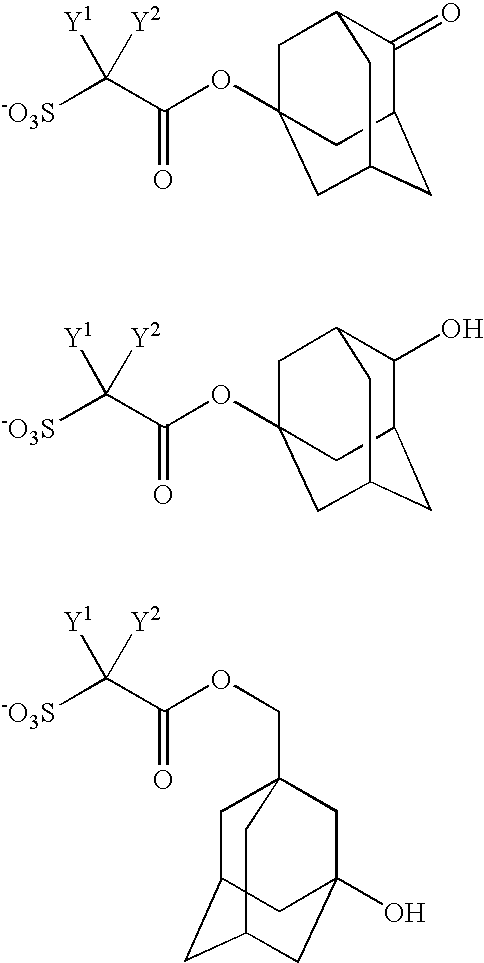
and a salt wherein A+ is the cation represented by the above-mentioned formula (IXc) and the anion part is any one of the followings:

are preferable.
—Z′—X10
can be produced by a process comprising reacting a salt of the formula (10):

wherein M represents Li, Na, K or Ag, and Y1, Y2, Z′ and X10 are the same meanings as defined above with a compound of the formula (11):
A+−G (11)
HO—Z′—X10 (12)
wherein Z′ and X10 are the same meaning as defined above with a carboxylic acid of the formula (13):

wherein M, Y1 and Y2 are the same meanings as defined above.

to obtain an ester compound of the following formula:

wherein Y1, Y2, Z′ and X10 are the same meanings as defined above and reacting the ester compound obtained above with a compound of the following formula:
M-OH
wherein M is the same meaning as defined above, in water.
—Z′—X10
and X10 is a C3-C30 monocyclic or polycyclic hydrocarbon group having a hydroxyl group can be also produced by reducing Salt (V) wherein R12 is a group represented by the following formula:
—Z′—X10
and X10 is a C3-C30 monocyclic or polycyclic hydrocarbon group having a carbonyl group.
—Z′—X10
and X10 is a C3-C30 monocyclic or polycyclic hydrocarbon group having a hydroxyl group can be also produced by reducing the salt of the formula (10) wherein R12 is a group represented by the following formula:
—Z′—X10
and X10 is a C3-C30 monocyclic or polycyclic hydrocarbon group having a carbonyl group.

wherein T1 and T12 independently represent a hydrogen atom, an alkyl group, a cycloalkyl group or an aryl group, and the alkyl, cycloalkyl and aryl group may be substituted with at least one group selected from the group consisting of a hydroxyl group, an amino group which may be substituted with a C1-C4 alkyl group and a C1-C6 alkoxy group which may be substituted with a C1-C6 alkoxy group,
- T3 and T4 independently represent a hydrogen atom, an alkyl group, a cycloalkyl group, an aryl group or an alkoxy group, and the alkyl, cycloalkyl, aryl and alkoxy group may be substituted with at least one group selected from the group consisting of a hydroxyl group, an amino group which may be substituted with a C1-C4 alkyl group and a C1-C6 alkoxy group, or T3 and T4 bond together with the carbon atoms to which they bond to form an aromatic ring,
- T5 represent a hydrogen atom, an alkyl group, a cycloalkyl group, an aryl group, an alkoxy group or a nitro group, and the alkyl, cycloalkyl, aryl and alkoxy groups may be substituted with at least one group selected from the group consisting of a hydroxyl group, an amino group which may be substituted with a C1-C4 alkyl group and a C1-C6 alkoxy group,
- T6 represents an alkyl or cycloalkyl group, and the alkyl and cycloalkyl group may be substituted with at least one group selected from the group consisting of a hydroxyl group, an amino group which may be substituted with a C1-C4 alkyl group and a C1-C6 alkoxy group, and W represents —CO—, —NH—, —S—, —S—S—, an alkylene group of which at least one methylene group may be replaced with —O—, or an alkenylene group of which at least one methylene group may be replaced with —O—, and a quaternary ammonium hydroxide represented by the following formula:

wherein T7, T8, T9 and T10 independently represent an alkyl group, a cycloalkyl group or an aryl group, and the alkyl, cycloalkyl and aryl groups may be substituted with at least one group selected from the group consisting a hydroxyl group, an amino group which may be substituted with a C1-C4 alkyl group and a C1-C6 alkoxy group.


<Resin>
Resin A1, A2, A3, A4
<Quencher>
- Q1: 2,6-diisopropylaniline
- Q2: tetrabutylammonium hydroxide
- Q3: tris[2-(2-methoxyethoxy)ethyl]amine
<Solvent>
| Y1: | propylene glycol monomethyl ether acetate | 170 | parts |
| 2-heptanone | 35 | parts | |
| propylene glycol monomethyl ether | 20 | parts | |
| γ-butyrolactone | 3 | parts | |
| TABLE 1 | ||||||
| Acid | Quencher | |||||
| Resin | generator | (kind/ | ||||
| Ex. | (kind/amount | (kind/amount | amount | PB | PEB | |
| No. | (part)) | (part)) | (part)) | Solvent | (° C.) | (° C.) |
| Ex. 1 | A1/10 | S1/1.20 | Q1/0.126 | Y1 | 100 | 100 |
| Ex. 2 | A1/10 | S1/1.20 | Q1/0.126 | Y1 | 100 | 105 |
| Ex. 3 | A1/10 | S1/1.38 | Q1/0.135 | Y1 | 100 | 95 |
| Ex. 4 | A2/10 | S1/1.38 | Q1/0.135 | Y1 | 100 | 95 |
| Ex. 5 | A3/10 | S1/1.38 | Q1/0.135 | Y1 | 100 | 95 |
| Ex. 6 | A1/10 | S1/1.38 | Q1/0.135 | Y1 | 100 | 100 |
| Ex. 7 | A1/10 | S1/1.38 | Q1/0.135 | Y1 | 100 | 105 |
| Ex. 8 | A1/10 | S1/1.38 | Q2/0.220 | Y1 | 100 | 100 |
| Ex. 9 | A2/10 | S1/1.38 | Q2/0.220 | Y1 | 100 | 100 |
| Ex. 10 | A3/10 | S1/1.38 | Q2/0.220 | Y1 | 100 | 100 |
| Ex. 11 | A1/10 | S1/1.38 | Q3/0.270 | Y1 | 100 | 100 |
| Ex. 12 | A2/10 | S1/1.38 | Q3/0.270 | Y1 | 100 | 100 |
| Ex. 13 | A3/10 | S1/1.38 | Q3/0.270 | Y1 | 100 | 100 |
| Comp. | A4/10 | S1/1.20 | Q1/0.140 | Y1 | 100 | 100 |
| Ex. 1 | ||||||
| Comp. | A4/10 | S1/1.20 | Q1/0.140 | Y1 | 100 | 105 |
| Ex. 2 | ||||||
| Comp. | A4/10 | S1/1.38 | Q1/0.135 | Y1 | 100 | 95 |
| Ex. 3 | ||||||
| Comp. | A4/10 | S1/1.38 | Q1/0.135 | Y1 | 100 | 100 |
| Ex. 4 | ||||||
| Comp. | A4/10 | S1/1.38 | Q1/0.135 | Y1 | 100 | 105 |
| Ex. 5 | ||||||
| Comp. | A4/10 | S1/1.38 | Q2/0.220 | Y1 | 100 | 100 |
| Ex. 6 | ||||||
| Comp. | A4/10 | S1/1.38 | Q3/0.270 | Y1 | 100 | 100 |
| Ex. 7 | ||||||
EL (%)=(X 76.5 −X 93.5)/X 85.0×100
wherein X76.5 is an amount of exposure when the line width becomes 76.5 nm, X93.5 is an amount of exposure when the line width becomes 93.5 μm, and X85.0 is an amount of exposure when the line width becomes 85.0 nm.
| TABLE 2 | ||||
| Ex. No. | ES (mJ/cm2) | EL (%) | ||
| Ex. 1 | 43 | 13.6 | ||
| Ex. 2 | 35 | 14.2 | ||
| Comp. | 43 | 12.3 | ||
| Ex. 1 | ||||
| Comp. | 35 | 8.7 | ||
| Ex. 2 | ||||
| TABLE 3 | ||||
| Ex. No. | ES (mJ/cm2) | EL (%) | ||
| Ex. 3 | 50.3 | 13.0 | ||
| Ex. 4 | 54.1 | 12.3 | ||
| Ex. 5 | 44.6 | 13.3 | ||
| Ex. 6 | 39.8 | 12.8 | ||
| Ex. 7 | 32.7 | 12.0 | ||
| Ex. 8 | 38.4 | 15.2 | ||
| Ex. 9 | 41.4 | 14.6 | ||
| Ex. 10 | 34.6 | 12.4 | ||
| Ex. 11 | 28.0 | 15.2 | ||
| Ex. 12 | 29.7 | 14.6 | ||
| Ex. 13 | 25.2 | 12.6 | ||
| Comp. | 48.7 | 11.6 | ||
| Ex. 3 | ||||
| Comp. | 37.8 | 11.5 | ||
| Ex. 4 | ||||
| Comp. | 30.8 | 8.2 | ||
| Ex. 5 | ||||
| Comp. | 36.6 | 11.8 | ||
| Ex. 6 | ||||
| Comp. | 26.2 | 11.8 | ||
| Ex. 7 | ||||
| TABLE 4 | ||||||
| Acid | Quencher | |||||
| Resin | generator | (kind/ | ||||
| Ex. | (kind/amount | (kind/amount | amount | PB | PEB | |
| No. | (part)) | (part)) | (part)) | Solvent | (° C.) | (° C.) |
| Ex. 14 | A1/10 | S1/1.38 | Q1/0.135 | Y1 | 100 | 95 |
| Ex. 15 | A2/10 | S1/1.38 | Q1/0.135 | Y1 | 100 | 95 |
| Ex. 16 | A3/10 | S1/1.38 | Q1/0.135 | Y1 | 100 | 95 |
| Ex. 17 | A1/10 | S1/1.38 | Q1/0.135 | Y1 | 100 | 100 |
| Ex. 18 | A2/10 | S1/1.38 | Q1/0.135 | Y1 | 100 | 100 |
| Ex. 19 | A3/10 | S1/1.38 | Q1/0.135 | Y1 | 100 | 100 |
| Ex. 20 | A1/10 | S1/1.38 | Q3/0.270 | Y1 | 100 | 100 |
| Ex. 21 | A2/10 | S1/1.38 | Q3/0.270 | Y1 | 100 | 100 |
| Comp. | A4/10 | S1/1.38 | Q1/0.135 | Y1 | 100 | 95 |
| Ex. 8 | ||||||
| Comp. | A4/10 | S1/1.38 | Q1/0.135 | Y1 | 100 | 100 |
| Ex. 9 | ||||||
| Comp. | A4/10 | S1/1.38 | Q3/0.270 | Y1 | 100 | 100 |
| Ex. 10 | ||||||
EL (%)=(X 37.8 −X 46.2)/X 42.0×100
wherein X37.8 is an amount of exposure when the line width becomes 37.8 nm, X46.2 is an amount of exposure when the line width becomes 46.2 nm, and X42.0 is an amount of exposure when the line width becomes 42.0 nm.
| TABLE 5 | ||||
| Ex. No. | ES (mJ/cm2) | EL (%) | ||
| Ex. 14 | 56.5 | 69.6 | ||
| Ex. 15 | 60.5 | 56.1 | ||
| Ex. 16 | 51.9 | 78.8 | ||
| Comp. | 55.3 | 44.3 | ||
| Ex. 8 | ||||
| TABLE 6 | ||||
| Ex. No. | ES (mJ/cm2) | EL (%) | ||
| Ex. 17 | 42.4 | 34.8 | ||
| Ex. 18 | 44.7 | 33.6 | ||
| Ex. 19 | 39.3 | 35.5 | ||
| Comp. | 40.9 | 31.5 | ||
| Ex. 9 | ||||
| TABLE 7 | ||||
| Ex. No. | ES (mJ/cm2) | EL (%) | ||
| Ex. 20 | 39.2 | 40.1 | ||
| Ex. 21 | 41.4 | 31.5 | ||
| Comp. | 37.5 | 25.7 | ||
| Ex. 10 | ||||

Claims (7)


—Z′—X10

Applications Claiming Priority (2)
| Application Number | Priority Date | Filing Date | Title |
|---|---|---|---|
| JP2008203966 | 2008-08-07 | ||
| JP2008-203966 | 2008-08-07 |
Publications (2)
| Publication Number | Publication Date |
|---|---|
| US20100035180A1 US20100035180A1 (en) | 2010-02-11 |
| US7998656B2 true US7998656B2 (en) | 2011-08-16 |
Family
ID=41653248
Family Applications (1)
| Application Number | Title | Priority Date | Filing Date |
|---|---|---|---|
| US12/536,239 Active 2030-02-03 US7998656B2 (en) | 2008-08-07 | 2009-08-05 | Chemically amplified positive resist composition |
Country Status (5)
| Country | Link |
|---|---|
| US (1) | US7998656B2 (en) |
| JP (1) | JP5487784B2 (en) |
| KR (1) | KR101648871B1 (en) |
| CN (1) | CN101644895A (en) |
| TW (1) | TWI453542B (en) |
Families Citing this family (75)
| Publication number | Priority date | Publication date | Assignee | Title |
|---|---|---|---|---|
| JP5270187B2 (en) * | 2008-02-22 | 2013-08-21 | 株式会社クラレ | Novel (meth) acrylic acid ester derivatives, haloester derivatives and polymer compounds |
| JP5024109B2 (en) * | 2008-02-22 | 2012-09-12 | Jsr株式会社 | Radiation sensitive composition and resist pattern forming method using the same |
| JP2010191221A (en) * | 2009-02-18 | 2010-09-02 | Kuraray Co Ltd | Chemically amplified photoresist composition for exposure to extreme-ultraviolet ray |
| KR101827695B1 (en) * | 2009-06-12 | 2018-03-22 | 스미또모 가가꾸 가부시키가이샤 | Salt and photoresist composition containing the same |
| KR101777260B1 (en) * | 2009-06-12 | 2017-09-26 | 스미또모 가가꾸 가부시키가이샤 | Salt and photoresist composition containing the same |
| JP2012203401A (en) * | 2011-03-28 | 2012-10-22 | Jsr Corp | Radiation-sensitive resin composition |
| JP5956800B2 (en) * | 2011-04-07 | 2016-07-27 | 住友化学株式会社 | Resist composition and method for producing resist pattern |
| JP6576162B2 (en) | 2014-08-25 | 2019-09-18 | 住友化学株式会社 | Resist composition and method for producing resist pattern |
| JP6596263B2 (en) | 2014-08-25 | 2019-10-23 | 住友化学株式会社 | Compound, resin, resist composition, and method for producing resist pattern |
| JP6450660B2 (en) | 2014-08-25 | 2019-01-09 | 住友化学株式会社 | Salt, acid generator, resist composition, and method for producing resist pattern |
| JP6615536B2 (en) | 2014-08-25 | 2019-12-04 | 住友化学株式会社 | Resist composition and method for producing resist pattern |
| JP6541508B2 (en) | 2014-08-25 | 2019-07-10 | 住友化学株式会社 | Salt, resin, resist composition and method for producing resist pattern |
| JP6595255B2 (en) | 2014-08-25 | 2019-10-23 | 住友化学株式会社 | Resist composition and method for producing resist pattern |
| JP6507065B2 (en) | 2014-08-25 | 2019-04-24 | 住友化学株式会社 | Compound, resin, resist composition and method for producing resist pattern |
| JP6533724B2 (en) | 2014-09-16 | 2019-06-19 | 住友化学株式会社 | Resin, resist composition and method for producing resist pattern |
| JP6706891B2 (en) | 2014-09-16 | 2020-06-10 | 住友化学株式会社 | Resist composition and method for producing resist pattern |
| JP6706892B2 (en) | 2014-09-16 | 2020-06-10 | 住友化学株式会社 | Resist composition and method for producing resist pattern |
| US9869929B2 (en) | 2014-09-16 | 2018-01-16 | Sumitomo Chemical Company, Limited | Resin, resist composition and method for producing resist pattern |
| JP6541526B2 (en) | 2014-09-16 | 2019-07-10 | 住友化学株式会社 | Resin, resist composition and method for producing resist pattern |
| JP6541525B2 (en) | 2014-09-16 | 2019-07-10 | 住友化学株式会社 | Resin, resist composition and method for producing resist pattern |
| JP6688041B2 (en) | 2014-11-11 | 2020-04-28 | 住友化学株式会社 | Resist composition and method for producing resist pattern |
| JP6684075B2 (en) | 2014-11-11 | 2020-04-22 | 住友化学株式会社 | Resin, resist composition, and method for producing resist pattern |
| JP6585471B2 (en) | 2014-11-11 | 2019-10-02 | 住友化学株式会社 | Resist composition and method for producing resist pattern |
| JP6670591B2 (en) | 2014-11-11 | 2020-03-25 | 住友化学株式会社 | Resist composition and method for producing resist pattern |
| JP6664932B2 (en) | 2014-11-14 | 2020-03-13 | 住友化学株式会社 | Resin, resist composition and method for producing resist pattern |
| JP6585477B2 (en) | 2014-11-26 | 2019-10-02 | 住友化学株式会社 | Salt, resin, resist composition and method for producing resist pattern |
| JP6721319B2 (en) | 2014-11-26 | 2020-07-15 | 住友化学株式会社 | Nonionic compound, resin, resist composition, and method for producing resist pattern |
| JP6782070B2 (en) | 2014-11-26 | 2020-11-11 | 住友化学株式会社 | Method for manufacturing resist composition and resist pattern |
| JP6637740B2 (en) | 2014-11-28 | 2020-01-29 | 住友化学株式会社 | Resist composition and method for producing resist pattern |
| JP6637750B2 (en) | 2014-12-15 | 2020-01-29 | 住友化学株式会社 | Resist composition and method for producing resist pattern |
| JP6769735B2 (en) | 2015-05-12 | 2020-10-14 | 住友化学株式会社 | Method for producing salt, acid generator, resin, resist composition and resist pattern |
| JP6883954B2 (en) | 2015-06-26 | 2021-06-09 | 住友化学株式会社 | Resist composition |
| JP6864994B2 (en) | 2015-06-26 | 2021-04-28 | 住友化学株式会社 | Resist composition |
| JP6782102B2 (en) | 2015-06-26 | 2020-11-11 | 住友化学株式会社 | Resist composition |
| JP7042598B2 (en) | 2016-12-14 | 2022-03-28 | 住友化学株式会社 | Method for manufacturing resin, resist composition and resist pattern |
| JP6963979B2 (en) | 2016-12-14 | 2021-11-10 | 住友化学株式会社 | Method for manufacturing resin, resist composition and resist pattern |
| US11214635B2 (en) | 2017-02-08 | 2022-01-04 | Sumitomo Chemical Company, Limited | Compound, resin, resist composition and method for producing resist pattern |
| JP7167539B2 (en) * | 2017-08-22 | 2022-11-09 | 住友化学株式会社 | Compound, resin, resist composition, and method for producing resist pattern |
| JP7283883B2 (en) | 2017-11-09 | 2023-05-30 | 住友化学株式会社 | Salt, acid generator, resist composition and method for producing resist pattern |
| US11378883B2 (en) | 2018-04-12 | 2022-07-05 | Sumitomo Chemical Company, Limited | Salt, acid generator, resist composition and method for producing resist pattern |
| US11820735B2 (en) | 2018-04-12 | 2023-11-21 | Sumitomo Chemical Company, Limited | Salt, acid generator, resist composition and method for producing resist pattern |
| JP7269093B2 (en) | 2018-05-29 | 2023-05-08 | 住友化学株式会社 | Salt, acid generator, resist composition and method for producing resist pattern |
| JP7341787B2 (en) | 2018-08-27 | 2023-09-11 | 住友化学株式会社 | Resin, resist composition, and method for producing resist pattern |
| JP7389622B2 (en) | 2018-11-20 | 2023-11-30 | 住友化学株式会社 | Salt, quencher, resist composition, and method for producing resist pattern |
| JP7412186B2 (en) | 2019-01-18 | 2024-01-12 | 住友化学株式会社 | Resin, resist composition, and method for producing resist pattern |
| JP7492842B2 (en) | 2019-03-25 | 2024-05-30 | 住友化学株式会社 | Resin, resist composition, and method for producing resist pattern |
| JP7488102B2 (en) | 2019-05-17 | 2024-05-21 | 住友化学株式会社 | Salt, quencher, resist composition, and method for producing resist pattern |
| JP7537913B2 (en) | 2019-06-04 | 2024-08-21 | 住友化学株式会社 | Salt, quencher, resist composition, and method for producing resist pattern |
| JP7499071B2 (en) | 2019-06-04 | 2024-06-13 | 住友化学株式会社 | Salt, quencher, resist composition, resist pattern manufacturing method, and salt manufacturing method |
| JP7545834B2 (en) | 2019-08-29 | 2024-09-05 | 住友化学株式会社 | Salt, quencher, resist composition, and method for producing resist pattern |
| JP7607416B2 (en) | 2019-08-29 | 2024-12-27 | 住友化学株式会社 | Salt, quencher, resist composition, and method for producing resist pattern |
| JP7790865B2 (en) | 2019-12-18 | 2025-12-23 | 住友化学株式会社 | Resist composition and method for producing resist pattern |
| JP7659395B2 (en) | 2020-02-06 | 2025-04-09 | 住友化学株式会社 | Salt, acid generator, resist composition and method for producing resist pattern |
| JP7614850B2 (en) | 2020-02-06 | 2025-01-16 | 住友化学株式会社 | Carboxylic acid salt, carboxylic acid generator, resist composition and method for producing resist pattern |
| US11740555B2 (en) | 2020-03-05 | 2023-08-29 | Sumitomo Chemical Company, Limited | Resist composition and method for producing resist pattern |
| US11681220B2 (en) | 2020-03-05 | 2023-06-20 | Sumitomo Chemical Company, Limited | Resist composition and method for producing resist pattern |
| US11675267B2 (en) | 2020-03-23 | 2023-06-13 | Sumitomo Chemical Company, Limited | Resist composition and method for producing resist pattern |
| TWI858248B (en) | 2020-04-22 | 2024-10-11 | 日商住友化學股份有限公司 | Anti-corrosion agent composition and method for producing anti-corrosion agent pattern |
| JP7689013B2 (en) | 2020-05-15 | 2025-06-05 | 住友化学株式会社 | Carboxylic acid salt, quencher, resist composition, and method for producing resist pattern |
| JP7758475B2 (en) | 2020-05-15 | 2025-10-22 | 住友化学株式会社 | Acid generator, resist composition, and method for producing resist pattern |
| TWI877361B (en) | 2020-05-21 | 2025-03-21 | 日商住友化學股份有限公司 | Salt, acid generator, anti-corrosion agent composition and method for producing anti-corrosion agent pattern |
| TWI849314B (en) | 2020-06-01 | 2024-07-21 | 日商住友化學股份有限公司 | Compound, resin, anti-corrosion agent composition and method for producing anti-corrosion agent pattern |
| JP7789494B2 (en) | 2020-06-01 | 2025-12-22 | 住友化学株式会社 | Compound, resin, resist composition, and method for producing resist pattern |
| JP2022008152A (en) | 2020-06-25 | 2022-01-13 | 住友化学株式会社 | Salt, acid generator, resist composition and method for producing resist pattern |
| JP7758480B2 (en) | 2020-07-01 | 2025-10-22 | 住友化学株式会社 | Salt, acid generator, resist composition and method for producing resist pattern |
| JP7696275B2 (en) | 2020-11-06 | 2025-06-20 | 住友化学株式会社 | Salt, acid generator, resist composition and method for producing resist pattern |
| JP7748854B2 (en) | 2020-11-11 | 2025-10-03 | 住友化学株式会社 | Carboxylic acid salt, resist composition, and method for producing resist pattern |
| JP7714438B2 (en) | 2020-11-12 | 2025-07-29 | 住友化学株式会社 | Salt, acid generator, resist composition and method for producing resist pattern |
| JP7790991B2 (en) | 2021-02-12 | 2025-12-23 | 住友化学株式会社 | Salt, acid generator, resist composition and method for producing resist pattern |
| JP2022164583A (en) | 2021-04-15 | 2022-10-27 | 住友化学株式会社 | Salt, acid generator, resist composition, and method for producing resist pattern |
| JP2022164585A (en) | 2021-04-15 | 2022-10-27 | 住友化学株式会社 | Salt, acid generator, resist composition, and method for producing resist pattern |
| US12566375B2 (en) | 2021-05-06 | 2026-03-03 | Sumitomo Chemical Company, Limited | Salt, acid generator, resist composition and method for producing resist pattern |
| JP2022183077A (en) | 2021-05-28 | 2022-12-08 | 住友化学株式会社 | Salt, acid generator, resist composition, and method for producing resist pattern |
| JP2022183074A (en) | 2021-05-28 | 2022-12-08 | 住友化学株式会社 | Salt, acid generator, resist composition, and method for producing resist pattern |
| US12487528B2 (en) | 2021-08-06 | 2025-12-02 | Sumitomo Chemical Company, Limited | Resist composition and method for producing resist pattern |
Citations (9)
| Publication number | Priority date | Publication date | Assignee | Title |
|---|---|---|---|---|
| US4075263A (en) * | 1976-04-13 | 1978-02-21 | Rohm And Haas Company | Process for preventing hydrolytic degradation of linear saturated aromatic polyesters comprising a thermoplastic saturated aromatic polyester and a moisture scavenger polymer |
| US4536554A (en) * | 1984-02-22 | 1985-08-20 | Barnes-Hind, Inc. | Hydrophilic polymers and contact lenses made therefrom |
| JPS6140279A (en) * | 1984-08-01 | 1986-02-26 | Mitsubishi Gas Chem Co Inc | Polyfunctional cyclic acetal compound and its production method |
| JPH0259570A (en) * | 1988-08-25 | 1990-02-28 | Tokuyama Soda Co Ltd | Dithiane compound and its manufacturing method |
| US6692888B1 (en) * | 1999-10-07 | 2004-02-17 | Shipley Company, L.L.C. | Copolymers having nitrile and alicyclic leaving groups and photoresist compositions comprising same |
| WO2009144801A1 (en) * | 2008-05-29 | 2009-12-03 | 富士通株式会社 | Dithiane derivative, polymer, resist composition, and process for producing semiconductor using the resist composition |
| US20100331508A1 (en) * | 2008-02-22 | 2010-12-30 | Kuraray Co., Ltd. | (meth)acrylate derivative, intermediate thereof, and polymer compound |
| US20110009643A1 (en) * | 2008-02-22 | 2011-01-13 | Kuraray Co., Ltd. | Method for producing acrylate derivative, acrylate derivative, and intermediate thereof |
| US20110060112A1 (en) * | 2008-02-22 | 2011-03-10 | Kuraray Co., Ltd. | Acrylate ester derivatives and polymer compounds |
Family Cites Families (5)
| Publication number | Priority date | Publication date | Assignee | Title |
|---|---|---|---|---|
| JPH07295221A (en) * | 1994-04-27 | 1995-11-10 | Mitsubishi Electric Corp | Photosensitive resin composition |
| TWI291953B (en) * | 2001-10-23 | 2008-01-01 | Mitsubishi Rayon Co | |
| JP2008138073A (en) * | 2006-12-01 | 2008-06-19 | Jsr Corp | Polymer for radiosensitive resin composition, radiosensitive resin composition and method for forming resist pattern |
| JP5024109B2 (en) * | 2008-02-22 | 2012-09-12 | Jsr株式会社 | Radiation sensitive composition and resist pattern forming method using the same |
| JP5391908B2 (en) * | 2008-08-07 | 2014-01-15 | 住友化学株式会社 | Chemically amplified positive resist composition |
-
2009
- 2009-08-03 JP JP2009180393A patent/JP5487784B2/en active Active
- 2009-08-04 CN CN200910160590A patent/CN101644895A/en active Pending
- 2009-08-05 KR KR1020090071877A patent/KR101648871B1/en active Active
- 2009-08-05 TW TW098126404A patent/TWI453542B/en active
- 2009-08-05 US US12/536,239 patent/US7998656B2/en active Active
Patent Citations (9)
| Publication number | Priority date | Publication date | Assignee | Title |
|---|---|---|---|---|
| US4075263A (en) * | 1976-04-13 | 1978-02-21 | Rohm And Haas Company | Process for preventing hydrolytic degradation of linear saturated aromatic polyesters comprising a thermoplastic saturated aromatic polyester and a moisture scavenger polymer |
| US4536554A (en) * | 1984-02-22 | 1985-08-20 | Barnes-Hind, Inc. | Hydrophilic polymers and contact lenses made therefrom |
| JPS6140279A (en) * | 1984-08-01 | 1986-02-26 | Mitsubishi Gas Chem Co Inc | Polyfunctional cyclic acetal compound and its production method |
| JPH0259570A (en) * | 1988-08-25 | 1990-02-28 | Tokuyama Soda Co Ltd | Dithiane compound and its manufacturing method |
| US6692888B1 (en) * | 1999-10-07 | 2004-02-17 | Shipley Company, L.L.C. | Copolymers having nitrile and alicyclic leaving groups and photoresist compositions comprising same |
| US20100331508A1 (en) * | 2008-02-22 | 2010-12-30 | Kuraray Co., Ltd. | (meth)acrylate derivative, intermediate thereof, and polymer compound |
| US20110009643A1 (en) * | 2008-02-22 | 2011-01-13 | Kuraray Co., Ltd. | Method for producing acrylate derivative, acrylate derivative, and intermediate thereof |
| US20110060112A1 (en) * | 2008-02-22 | 2011-03-10 | Kuraray Co., Ltd. | Acrylate ester derivatives and polymer compounds |
| WO2009144801A1 (en) * | 2008-05-29 | 2009-12-03 | 富士通株式会社 | Dithiane derivative, polymer, resist composition, and process for producing semiconductor using the resist composition |
Also Published As
| Publication number | Publication date |
|---|---|
| JP5487784B2 (en) | 2014-05-07 |
| JP2010061117A (en) | 2010-03-18 |
| KR101648871B1 (en) | 2016-08-17 |
| TW201011471A (en) | 2010-03-16 |
| KR20100019346A (en) | 2010-02-18 |
| US20100035180A1 (en) | 2010-02-11 |
| TWI453542B (en) | 2014-09-21 |
| CN101644895A (en) | 2010-02-10 |
Similar Documents
| Publication | Publication Date | Title |
|---|---|---|
| US7998656B2 (en) | Chemically amplified positive resist composition | |
| US7566522B2 (en) | Chemically amplified resist composition | |
| US7575850B2 (en) | Chemically amplified resist composition | |
| US8048612B2 (en) | Polymer and chemically amplified resist composition comprising the same | |
| US7741007B2 (en) | Chemicallly amplified resist composition | |
| US7439006B2 (en) | Salt suitable for an acid generator and a chemically amplified positive resist composition containing the same | |
| US7579132B2 (en) | Salt suitable for an acid generator and a chemically amplified positive resist composition containing the same | |
| US7572570B2 (en) | Chemically amplified resist composition | |
| US20100151380A1 (en) | Resist composition | |
| US7972763B2 (en) | Chemically amplified positive resist composition | |
| US20100273112A1 (en) | Process for producing photoresist pattern | |
| US8614046B2 (en) | Salt and photoresist composition containing the same | |
| US7803513B2 (en) | Chemically amplified resist composition | |
| US8003296B2 (en) | Chemically amplified positive resist composition | |
| US8057983B2 (en) | Chemically amplified positive resist composition | |
| US8062830B2 (en) | Chemically amplified positive resist composition | |
| US20090286937A1 (en) | Chemically amplified positive resist composition | |
| US7981985B2 (en) | Polymer and chemically amplified resist composition comprising the same | |
| US20080220369A1 (en) | Chemically amplified resist composition | |
| US20080176168A1 (en) | Chemically amplified resist composition | |
| US8232039B2 (en) | Polymer and resist composition comprising the same | |
| US20100081085A1 (en) | Polymer and Resist Composition Comprising the Same | |
| US8298746B2 (en) | Chemically amplified positive resist composition | |
| US8173352B2 (en) | Resist composition | |
| US20100167199A1 (en) | Chemically amplified positive resist composition |
Legal Events
| Date | Code | Title | Description |
|---|---|---|---|
| AS | Assignment |
Owner name: SUMITOMO CHEMICAL COMPANY, LIMITED,JAPAN Free format text: ASSIGNMENT OF ASSIGNORS INTEREST;ASSIGNORS:SHIMADA, MASAHIKO;HASHIMOTO, KAZUHIKO;YAMAGUCHI, SATOSHI;AND OTHERS;SIGNING DATES FROM 20090825 TO 20090828;REEL/FRAME:023417/0126 Owner name: SUMITOMO CHEMICAL COMPANY, LIMITED, JAPAN Free format text: ASSIGNMENT OF ASSIGNORS INTEREST;ASSIGNORS:SHIMADA, MASAHIKO;HASHIMOTO, KAZUHIKO;YAMAGUCHI, SATOSHI;AND OTHERS;SIGNING DATES FROM 20090825 TO 20090828;REEL/FRAME:023417/0126 |
|
| FEPP | Fee payment procedure |
Free format text: PAYOR NUMBER ASSIGNED (ORIGINAL EVENT CODE: ASPN); ENTITY STATUS OF PATENT OWNER: LARGE ENTITY |
|
| STCF | Information on status: patent grant |
Free format text: PATENTED CASE |
|
| FPAY | Fee payment |
Year of fee payment: 4 |
|
| MAFP | Maintenance fee payment |
Free format text: PAYMENT OF MAINTENANCE FEE, 8TH YEAR, LARGE ENTITY (ORIGINAL EVENT CODE: M1552); ENTITY STATUS OF PATENT OWNER: LARGE ENTITY Year of fee payment: 8 |
|
| MAFP | Maintenance fee payment |
Free format text: PAYMENT OF MAINTENANCE FEE, 12TH YEAR, LARGE ENTITY (ORIGINAL EVENT CODE: M1553); ENTITY STATUS OF PATENT OWNER: LARGE ENTITY Year of fee payment: 12 |