US7986195B2 - Digital FM modulator - Google Patents

Digital FM modulator Download PDF

Info

Publication number
US7986195B2
US7986195B2 US12/036,377 US3637708A US7986195B2 US 7986195 B2 US7986195 B2 US 7986195B2 US 3637708 A US3637708 A US 3637708A US 7986195 B2 US7986195 B2 US 7986195B2
Authority
US
United States
Prior art keywords
function
signal
oscillator
cosine
sine
Prior art date
Legal status (The legal status is an assumption and is not a legal conclusion. Google has not performed a legal analysis and makes no representation as to the accuracy of the status listed.)
Expired - Fee Related, expires
Application number
US12/036,377
Other versions
US20080204159A1 (en
Inventor
Sergio R. Ramirez
Current Assignee (The listed assignees may be inaccurate. Google has not performed a legal analysis and makes no representation or warranty as to the accuracy of the list.)
Mentor Graphics Corp
Original Assignee
Mentor Graphics Corp
Priority date (The priority date is an assumption and is not a legal conclusion. Google has not performed a legal analysis and makes no representation as to the accuracy of the date listed.)
Filing date
Publication date
Application filed by Mentor Graphics Corp filed Critical Mentor Graphics Corp
Priority to US12/036,377 priority Critical patent/US7986195B2/en
Assigned to MENTOR GRAPHICS CORPORATION reassignment MENTOR GRAPHICS CORPORATION ASSIGNMENT OF ASSIGNORS INTEREST (SEE DOCUMENT FOR DETAILS). Assignors: RAMIREZ, SERGIO R.
Publication of US20080204159A1 publication Critical patent/US20080204159A1/en
Application granted granted Critical
Publication of US7986195B2 publication Critical patent/US7986195B2/en
Expired - Fee Related legal-status Critical Current
Adjusted expiration legal-status Critical

Links

Images

Classifications

    • HELECTRICITY
    • H03ELECTRONIC CIRCUITRY
    • H03CMODULATION
    • H03C3/00Angle modulation
    • H03C3/02Details

Definitions

  • the invention relates generally to a digital FM modulator. More specifically, the invention relates to FM modulation with signal decomposition.
  • Digital FM modulators may be used for transmitting signals over a frequency modulated (FM) wave.
  • FM modulation the frequency of a carrier wave varies in a continuous manner based on an analog message signal.
  • changes in the message signal include integration of the message signal followed by phase shifting of the message signal.
  • phase shifting of the signal in a digital FM modulator values are chosen from a list of entries in a lookup table that conveys a different possible symbol or piece of information.
  • a frequency of a carrier signal is varied by adding a time varying component such that the frequency may be the unmodulated carrier frequency plus a deviation from the carrier frequency with respect to the input message signal.
  • phase shifting of the integrated message signal may be problematic in digital signal processing hardware.
  • phase shifting of the integrated message signal may be time and power consuming. For example, an input signal is received and processed and the processed input signal is then matched on a table of entries in a lookup table for phase shifting. A corresponding lookup table entry is selected to obtain the phase-shifted FM modulated signal.
  • FIG. 1 illustrates a typical modulator.
  • a message signal may be integrated by an integrator 101 .
  • the output of the integrator 101 provides an integrated message signal which is used to phase shift the carrier in the phase shifter 102 and modulator 103 to result in the output modulated signal.
  • phase shifting of the message signal may be both time consuming and costly as a lookup table is used to obtain the FM modulated signal. Therefore, a need exists for FM modulation in an efficient manner such that a message signal may be computed in digital signal processing hardware in a power and time-saving manner.
  • a method for modulating a carrier signal in FM modulation.
  • a message signal may be integrated and decomposed into a complex signal.
  • the complex signal may be modulated, for example, with at least two AM modulators operating in quadrature.
  • a digital FM modulator including an integrator for integrating a message signal and a decomposing unit for decomposing the integrated message signal into a complex signal.
  • the complex signal may comprise at least two complex components (e.g., a sine and a cosine component).
  • the at least two complex components may interfere to produce a modulated signal.
  • FIG. 1 illustrates a typical digital FM modulator.
  • FIG. 2 illustrates an example of a method for determining a modulated carrier signal in a digital FM modulator in accordance with an aspect of one embodiment.
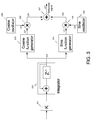
  • FIG. 3 is a partial block diagram illustrating an example of a digital FM modulator in accordance with an aspect of one embodiment.
  • FM modulation a bit stream of data is modulated for transmission based on the frequency of a carrier wave. Modulation of the data facilitates transfer of the information over a transmission medium.
  • frequency modulation the frequency of a carrier wave is adjusted based on the transmitted signal. When the signal is high, the frequency of the carrier wave is increased. Conversely, when the signal is low, the frequency of the carrier wave may be decreased.
  • ⁇ (t) represents the phase and may be written as:
  • ⁇ ⁇ ( t ) K ⁇ ⁇ - ⁇ t ⁇ f ⁇ ( t ) ⁇ d t
  • f(t) represents the frequency of the carrier response to a message signal.
  • the range of f(t) may vary in the interval [ ⁇ A, A], where A represents the amplitude of the message signal.
  • the range of the phase ⁇ (t) may range in the interval [ ⁇ , ⁇ ], for example.
  • f(t) may vary by adding a time varying component to the carrier frequency.
  • K is a scaling factor and m(t) is the message signal.
  • K*m(t) represents the deviation from the carrier frequency based on the message signal in this example.
  • an FM modulator integrates the message signal prior to modulating the signal such that the integrated signal is used in place of the phase.
  • the carrier may be expressed as follows:
  • the message signal is first integrated and then used in place of the phase for phase shifting and modulating.
  • the integrated message signal is decomposed to provide a complex signal for modulation.
  • phase shifting of the signal is not needed.
  • lookup tables are also not necessary.
  • the carrier signal may be represented as a cosine signal.
  • the carrier signal may be FM modulated with a phase shift of ⁇ (t) as a function of the message signal as follows.
  • C m ( t ) A cos( ⁇ t + ⁇ ( t ))
  • the frequency of the input message signal may be related to the phase ⁇ (t) as follows:
  • ⁇ ⁇ ( t ) K ⁇ ⁇ - ⁇ t ⁇ f ⁇ ( t ) ⁇ d t
  • the function ⁇ (t) may vary within a range given by the amplitude of the message signal. For example, if the amplitude of the message signal is [ ⁇ A, A], then the range of f(t) may range in the interval [ ⁇ A, A]. In this example, the range of ⁇ (t) may be in the range of [ ⁇ , ⁇ ].
  • the message signal is integrated, then decomposed into a complex signal comprising cosine and sine components. Modulation of the signal is accomplished on the complex signal and phase shifting is not necessary.
  • functions representing the modulated carrier signal may be implemented in a digital oscillator.
  • components of the modulation of the signal may be provided by a function generator.
  • cos ⁇ (n+1) may be expressed by a cosine function generator and sin ⁇ (n+1) may be implemented by a sine function generator.
  • FIG. 2 illustrates an example of a method for digital FM modulation.
  • a modulating carrier signal is received (STEP 120 ).
  • the modulating carrier signal may be processed, for example, by in integrator, and decomposed into a complex signal.
  • the integrated signal may be decomposed into cosine and sine components to produce the least one complex signal (STEP 121 ).
  • the complex signal may be modulated (STEP 122 ) without the need for phase shifting.
  • the complex components of the signal such as a cosine component and a sine component, may interfere with each other to produce an FM modulated signal.
  • no lookup table is necessary in modulation.
  • FIG. 3 is a partial block diagram illustrating an example of an FM modulator.
  • the FM modulator may contain a gain adjustment component 201 in which the gain of a message signal may be adjusted with a gain of K.
  • the message signal may be further processed in the integrator 202 .
  • the integrator 202 may integrate the message signal which may provide for decomposition of the messaging signal into a complex signal.
  • the output 220 of the integrator 202 may be an integrated function ⁇ (t) determined as a function over time of the amplitude of the message signal.
  • ⁇ (t) may be represented as a function of the signal sample n as ⁇ (n) or ⁇ (n+1).
  • the FM modulator may include function generators.
  • the FM modulator contains a cosine function generator 203 and a sine function generator 204 .
  • the cosine function generator 203 and the sine function generator 204 are merely examples and that any number of function generators of any type may be included in the FM modulator.
  • the function generators may form a decomposing unit with the integrator 202 .
  • the cosine function generator 203 and the integrator 202 may form a decomposing unit for decomposing a message signal into a cosine component of a complex signal.
  • the sine function generator 204 and the integrator 202 may form a decomposing unit for decomposing a message signal into a sine component of a complex signal.
  • the cosine function generator 203 and the sine function generator 204 may decompose the integrated message signal into a complex signal that may include a cosine component from the cosine function generator 203 and a sine component from the sine function generator 204 .
  • the output of the cosine function generator 203 and the output of the sine function generator 204 from the integrator 202 may provide two complex components of a complex signal based on the original signal.
  • the output of the integrator 202 may be a function of the modulated signal in terms of the number of samples processed n as ⁇ (n+1) and may be further processed by the cosine function generator 203 .
  • the output 221 of the cosine function generator 203 may be cos ⁇ (n+1).
  • the output 220 of integrator 202 may be processed by the sine function generator 204 with an output 222 of sin ⁇ (n+1).
  • the FM modulator illustrated in the example of FIG. 3 may further include a cosine oscillator 208 and a sine oscillator 209 .
  • the cosine oscillator 203 and the sine oscillator 209 may be AM modulators that may oscillate in quadrature.
  • two AM modulators are illustrated, however, any number of AM modulators may be used.
  • a complex modulator may be used to remove a side band of the modulating or message signal in which additional AM modulators may be used.
  • the cosine oscillator 208 provides a cosine component of the modulated signal as a function of the number of samples and/or the ratio between the oscillator frequency and the sample rate of the digital modulator. For example, if the ratio between the oscillator frequency and the sample rate of the digital modulator is given as ⁇ , the sample given as n, the next sample given as (n+1) and the previous sample as (n ⁇ 1), then the output 223 of the cosine oscillator 208 may be, for example, cos [(n+1) ⁇ ] which may be further provided by the cosine oscillator 208 as [2 cos ⁇ cos(n ⁇ ) ⁇ cos [(n ⁇ 1) ⁇ ]].
  • the sine oscillator 209 may provide a sine component of the modulated signal as a function of the number of samples and/or the ratio between the oscillator frequency and the sample rate of the digital modulator.
  • the output 224 of the sine oscillator 209 may be sin [(n+1) ⁇ ] which may be further provided by the sine oscillator 209 as [2 cos ⁇ sin(n ⁇ ) ⁇ sin [(n ⁇ 1) ⁇ ]].
  • the output 221 of the cosine function generator 203 and the output 223 of the cosine oscillator 208 may be further processed by a multiplier 205 .
  • the output 225 of the multiplier 205 may be the product of the output of the cosine function generator 203 (in this example, equal to cos ⁇ (n+1)) and the output of the cosine oscillator 208 (in this example, equal to cos [(n+1) ⁇ ]).
  • the output of the multiplier 205 ( 225 ) may be ⁇ cos ⁇ (n+1)cos [(n+1) ⁇ ] ⁇ .
  • the output 222 of the sine function generator 204 and the output 224 of the sine oscillator 209 may be processed by a multiplier 206 such that the output 226 of the multiplier 206 may be the product of the output 222 of the sine function generator 204 (in this example, equal to sin ⁇ (n+1)) and the output 224 of the sine oscillator 209 (in this example, equal to sin [(n+1) ⁇ ].
  • the output 226 of the multiplier 206 may be ⁇ sin ⁇ (n+1)sin [(n+1) ⁇ ] ⁇ .
  • the FM modulator in this example may further include a subtractor 207 in which the output of multiplier 205 ( 225 ) and the output of multiplier 206 ( 226 ) may be added or subtracted to form the modulated signal 227 .
  • the modulated signal 227 may be provided by the FM modulator without phase shifting of the carrier. Also, lookup tables are not necessary in modulating of the signal.
  • the integrator 202 and cosine function generator 203 may provide an output 221 of cos ⁇ (n+1) and the integrator 202 and the sine function generator 204 may provide an output 222 of sin ⁇ (n+1).
  • the multiplier 205 may multiply the output of the cosine oscillator 223 with the output of the integrator 202 and the cosine function generator 203 .
  • the output of the multiplier 205 ( 225 ) may be expressed as follows: cos [(n+1) ⁇ ] cos ⁇ (n+1)
  • the multiplier 206 may multiply the output of the sine oscillator 224 with the output of the integrator 202 and the sine function generator 204 ( 222 ).
  • the output of the multiplier 206 may be given as follows: sin [(n+1) ⁇ ] sin ⁇ (n+1)
  • the output of the multiplier 206 ( 226 ) may be subtracted from the output of the multiplier 205 ( 225 ) by an adder/subtractor 207 .
  • the digital FM modulator may be implemented in hardware blocks with each component being a hardware component.
  • the modulator may be implemented in a DSP processor such that computations performed by each component of the modulator may be performed in software.
  • the modulator may be implemented as a component of a processor or other component or may be implemented as a separate, dedicated hardware device or software module.
  • the modulator may further be implemented as a dedicated hardware device and in a DSP processor or a software module.
  • a portion of the modulator may be provided in a dedicated hardware device and another portion may be provided in a DSP processor.
  • a FM modulator is provided in which look up tables are not used. Because lookup tables are not used, different carrier frequencies may be conveniently used with the same hardware components.

Landscapes

  • Transmitters (AREA)
  • Digital Transmission Methods That Use Modulated Carrier Waves (AREA)

Abstract

Provided are apparatuses and methods for digital FM modulation. In one example, a message signal is integrated by an integrator to transform the message signal into a complex signal. The complex signal may include at least two complex components that may interfere to produce an FM modulated carrier signal. Hence, in this example, the method and apparatus for digital FM modulation may produce an FM modulated carrier signal without phase shifting. In another example, a lookup table is not necessary for modulation of the carrier signal.

Description

CROSS-REFERENCE TO RELATED APPLICATIONS
This application claims priority to provisional application 60/903,609, filed Feb. 26, 2007, and having the same title, herein incorporated by reference.
FIELD OF THE INVENTION
The invention relates generally to a digital FM modulator. More specifically, the invention relates to FM modulation with signal decomposition.
BACKGROUND OF THE INVENTION
Digital FM modulators may be used for transmitting signals over a frequency modulated (FM) wave. In FM modulation, the frequency of a carrier wave varies in a continuous manner based on an analog message signal. In digital modulation, changes in the message signal include integration of the message signal followed by phase shifting of the message signal. In phase shifting of the signal in a digital FM modulator, values are chosen from a list of entries in a lookup table that conveys a different possible symbol or piece of information.
Thus, in FM modulation, a frequency of a carrier signal is varied by adding a time varying component such that the frequency may be the unmodulated carrier frequency plus a deviation from the carrier frequency with respect to the input message signal.
Typically in FM modulation, a message signal is integrated, then the integrated message signal is used to phase shift the carrier to modulate the signal. However, efficient implementation of phase shifting of the integrated message signal may be problematic in digital signal processing hardware. Also, phase shifting of the integrated message signal may be time and power consuming. For example, an input signal is received and processed and the processed input signal is then matched on a table of entries in a lookup table for phase shifting. A corresponding lookup table entry is selected to obtain the phase-shifted FM modulated signal.
FIG. 1 illustrates a typical modulator. A message signal may be integrated by an integrator 101. The output of the integrator 101 provides an integrated message signal which is used to phase shift the carrier in the phase shifter 102 and modulator 103 to result in the output modulated signal. However, phase shifting of the message signal may be both time consuming and costly as a lookup table is used to obtain the FM modulated signal. Therefore, a need exists for FM modulation in an efficient manner such that a message signal may be computed in digital signal processing hardware in a power and time-saving manner.
BRIEF SUMMARY OF THE INVENTION
The following presents a simplified summary in order to provide a basic understanding of some aspects of the invention. The summary is not an extensive overview of the invention. It is neither intended to identify key or critical elements of the invention nor to delineate the scope of the invention. The following summary merely presents some concepts of the invention in a simplified form as a prelude to the more detailed description below.
In one example, a method is provided for modulating a carrier signal in FM modulation. In one example, a message signal may be integrated and decomposed into a complex signal. The complex signal may be modulated, for example, with at least two AM modulators operating in quadrature.
In another example, a digital FM modulator is provided including an integrator for integrating a message signal and a decomposing unit for decomposing the integrated message signal into a complex signal. The complex signal may comprise at least two complex components (e.g., a sine and a cosine component). In one example, the at least two complex components may interfere to produce a modulated signal.
BRIEF DESCRIPTION OF THE DRAWINGS
A more complete understanding of the present invention and the advantages thereof may be acquired by referring to the following description in consideration of the accompanying drawings, in which like reference numbers indicate like features, and wherein:
FIG. 1 illustrates a typical digital FM modulator.
FIG. 2 illustrates an example of a method for determining a modulated carrier signal in a digital FM modulator in accordance with an aspect of one embodiment.
FIG. 3 is a partial block diagram illustrating an example of a digital FM modulator in accordance with an aspect of one embodiment.
DETAILED DESCRIPTION OF THE INVENTION
In the following description of the various embodiments, reference is made to the accompanying drawings, which form a part hereof, and in which is shown by way of illustration various embodiments in which the invention may be practiced. It is to be understood that other embodiments may be utilized and structural and functional modifications may be made without departing from the scope and spirit of the present invention.
In FM modulation, a bit stream of data is modulated for transmission based on the frequency of a carrier wave. Modulation of the data facilitates transfer of the information over a transmission medium. In frequency modulation, the frequency of a carrier wave is adjusted based on the transmitted signal. When the signal is high, the frequency of the carrier wave is increased. Conversely, when the signal is low, the frequency of the carrier wave may be decreased.
The carrier may be expressed as follows:
C m(t)=A cos(ωt+Φ(t))
In which Φ(t) represents the phase and may be written as:
Φ ( t ) = K - t f ( t ) t
Where f(t) represents the frequency of the carrier response to a message signal. In one example, the range of f(t) may vary in the interval [−A, A], where A represents the amplitude of the message signal. The range of the phase Φ(t) may range in the interval [−π,π], for example. Also, f(t) may vary by adding a time varying component to the carrier frequency. For example, the carrier frequency may be provided as follows:
f(t)=f c +K*m(t)
Where fc is the frequency of the unmodulated carrier, K is a scaling factor and m(t) is the message signal. K*m(t) represents the deviation from the carrier frequency based on the message signal in this example.
Typically, an FM modulator integrates the message signal prior to modulating the signal such that the integrated signal is used in place of the phase. For example, the carrier may be expressed as follows:
s ( t ) = A c cos ( 2 π f c t + 2 π k f - t m ( t ) t )
As the above illustrates, the message signal is first integrated and then used in place of the phase for phase shifting and modulating.
In an example of one aspect of the invention, the integrated message signal is decomposed to provide a complex signal for modulation. Thus, in this example, phase shifting of the signal is not needed. One additional advantage is that lookup tables are also not necessary.
In one example, the carrier signal may be represented as a cosine signal. For example, the carrier signal may be expressed as follows:
C(t)=A cos(ωt)
The carrier signal may be FM modulated with a phase shift of Φ(t) as a function of the message signal as follows.
C m(t)=A cos(ωt+Φ(t))
In which the argument is an angle and includes the phase of the message signal. The frequency of the input message signal may be related to the phase Φ(t) as follows:
Φ ( t ) = K - t f ( t ) t
The function ƒ(t) may vary within a range given by the amplitude of the message signal. For example, if the amplitude of the message signal is [−A, A], then the range of f(t) may range in the interval [−A, A]. In this example, the range of Φ(t) may be in the range of [−π, π].
The modulated carrier signal may be further translated into the discrete time domain and expressed in terms of the ratio between the oscillator frequency and the sample rate of the digital modulator. For example, if the ratio between the oscillator frequency and the sample rate of the digital modulator is expressed as θ and the number of samples is given as n, then the modulated signal at sample n translated into the discrete time domain may be expressed as follows:
C m(n)=A cos [nθ+Φ(n)]
Similarly, the modulated signal at sample (n+1) translated into the discrete time domain may be expressed as follows:
C m(n+1)=A cos [(n+1)θ+Φ(n+1)]
Expanding the above equation using the general known identity for cos(A+B)=cos A cos B−sin A sin B, the modulated signal at sample (n+1) translated into the discrete time domain may be further expressed as follows:
C m(n+1)=A { cos [(n+1)θ] cos Φ(n+1)−sin [(n+1)θ] sin Φ(n+1)}
As the above illustrates, the message signal is integrated, then decomposed into a complex signal comprising cosine and sine components. Modulation of the signal is accomplished on the complex signal and phase shifting is not necessary.
In one example, functions representing the modulated carrier signal may be implemented in a digital oscillator. For example, the function cos [(n+1)θ] may be expressed as a function of signal sample and the ratio between the oscillator frequency and the sample rate of the digital modulator (represented as θ) by a digital oscillator as follows:
cos [(n+1)θ]=2 cos θ cos(nθ)−cos [(n−1)θ]
Similarly, the function sin [(n+1)θ] may be expressed by a digital oscillator as follows:
sin [(n+1)θ]=2 cos θ sin(nθ)−sin [(n−1)θ]
Additionally, components of the modulation of the signal may be provided by a function generator. For example, cos Φ(n+1) may be expressed by a cosine function generator and sin Φ(n+1) may be implemented by a sine function generator.
FIG. 2 illustrates an example of a method for digital FM modulation. In this example, a modulating carrier signal is received (STEP 120). The modulating carrier signal may be processed, for example, by in integrator, and decomposed into a complex signal. For example, the integrated signal may be decomposed into cosine and sine components to produce the least one complex signal (STEP 121). The complex signal may be modulated (STEP 122) without the need for phase shifting. For example, the complex components of the signal, such as a cosine component and a sine component, may interfere with each other to produce an FM modulated signal. As illustrated in the example of FIG. 2, no lookup table is necessary in modulation.
FIG. 3 is a partial block diagram illustrating an example of an FM modulator. In this example, the FM modulator may contain a gain adjustment component 201 in which the gain of a message signal may be adjusted with a gain of K. The message signal may be further processed in the integrator 202. The integrator 202 may integrate the message signal which may provide for decomposition of the messaging signal into a complex signal. For example, the output 220 of the integrator 202 may be an integrated function Φ(t) determined as a function over time of the amplitude of the message signal. Also, in this example, Φ(t) may be represented as a function of the signal sample n as Φ(n) or Φ(n+1).
In addition, the FM modulator may include function generators. In the example illustrated in FIG. 3, the FM modulator contains a cosine function generator 203 and a sine function generator 204. It is noted that the cosine function generator 203 and the sine function generator 204 are merely examples and that any number of function generators of any type may be included in the FM modulator. The function generators may form a decomposing unit with the integrator 202. For example, the cosine function generator 203 and the integrator 202 may form a decomposing unit for decomposing a message signal into a cosine component of a complex signal. Also, the sine function generator 204 and the integrator 202 may form a decomposing unit for decomposing a message signal into a sine component of a complex signal.
In this example, the cosine function generator 203 and the sine function generator 204 may decompose the integrated message signal into a complex signal that may include a cosine component from the cosine function generator 203 and a sine component from the sine function generator 204. Hence, the output of the cosine function generator 203 and the output of the sine function generator 204 from the integrator 202 may provide two complex components of a complex signal based on the original signal.
The two complex components (e.g., the cosine and the sine functions) may interfere to produce an FM modulated signal. Hence, no lookup table is necessary in the present invention. For example, the output of the integrator 202 (220) may be a function of the modulated signal in terms of the number of samples processed n as Φ(n+1) and may be further processed by the cosine function generator 203. In this example, the output 221 of the cosine function generator 203 may be cos Φ(n+1). Similarly, the output 220 of integrator 202 may be processed by the sine function generator 204 with an output 222 of sin Φ(n+1).
The FM modulator illustrated in the example of FIG. 3 may further include a cosine oscillator 208 and a sine oscillator 209. The cosine oscillator 203 and the sine oscillator 209 may be AM modulators that may oscillate in quadrature. In this example, two AM modulators are illustrated, however, any number of AM modulators may be used. For example, a complex modulator may be used to remove a side band of the modulating or message signal in which additional AM modulators may be used.
In one example, the cosine oscillator 208 provides a cosine component of the modulated signal as a function of the number of samples and/or the ratio between the oscillator frequency and the sample rate of the digital modulator. For example, if the ratio between the oscillator frequency and the sample rate of the digital modulator is given as θ, the sample given as n, the next sample given as (n+1) and the previous sample as (n−1), then the output 223 of the cosine oscillator 208 may be, for example, cos [(n+1)θ] which may be further provided by the cosine oscillator 208 as [2 cos θ cos(nθ)−cos [(n−1)θ]].
Similarly, the sine oscillator 209 may provide a sine component of the modulated signal as a function of the number of samples and/or the ratio between the oscillator frequency and the sample rate of the digital modulator. For example, the output 224 of the sine oscillator 209 may be sin [(n+1)θ] which may be further provided by the sine oscillator 209 as [2 cos θ sin(nθ)−sin [(n−1)θ]].
The output 221 of the cosine function generator 203 and the output 223 of the cosine oscillator 208 may be further processed by a multiplier 205. Hence, in this example, the output 225 of the multiplier 205 may be the product of the output of the cosine function generator 203 (in this example, equal to cos Φ(n+1)) and the output of the cosine oscillator 208 (in this example, equal to cos [(n+1)θ]). In this example, the output of the multiplier 205 (225) may be { cos Φ(n+1)cos [(n+1)θ]}.
Also, the output 222 of the sine function generator 204 and the output 224 of the sine oscillator 209 may be processed by a multiplier 206 such that the output 226 of the multiplier 206 may be the product of the output 222 of the sine function generator 204 (in this example, equal to sin Φ(n+1)) and the output 224 of the sine oscillator 209 (in this example, equal to sin [(n+1)θ]. Thus, in this example, the output 226 of the multiplier 206 may be { sin Φ(n+1)sin [(n+1)θ]}.
The FM modulator in this example may further include a subtractor 207 in which the output of multiplier 205 (225) and the output of multiplier 206 (226) may be added or subtracted to form the modulated signal 227. Hence, the modulated signal 227 may be provided by the FM modulator without phase shifting of the carrier. Also, lookup tables are not necessary in modulating of the signal.
As one example of the FM modulator, the integrator 202 and cosine function generator 203 may provide an output 221 of cos Φ(n+1) and the integrator 202 and the sine function generator 204 may provide an output 222 of sin Φ(n+1). Also in this example, the cosine oscillator 208, which may be an AM modulator, may provide an output 223 as follows:
cos [(n+1)θ]=2 cos θ cos(n θ)−cos [(n−1)θ]
And the sine oscillator 209, which may be an AM modulator operating in quadrature with the cosine oscillator 208 may provide an output 224 as follows:
sin [(n+1)θ]=2 cos θ sin(n θ)−sin [(n−1)θ]
The multiplier 205 may multiply the output of the cosine oscillator 223 with the output of the integrator 202 and the cosine function generator 203. In this example, the output of the multiplier 205 (225) may be expressed as follows:
cos [(n+1)θ] cos Φ(n+1)
The multiplier 206 may multiply the output of the sine oscillator 224 with the output of the integrator 202 and the sine function generator 204 (222). In this example, the output of the multiplier 206 may be given as follows:
sin [(n+1)θ] sin Φ(n+1)
Also in this example, the output of the multiplier 206 (226) may be subtracted from the output of the multiplier 205 (225) by an adder/subtractor 207. The output of the adder/subtractor 207 (227) may be the modulated signal 227 and may be expressed as follows:
C m(n+1)=A{ cos [(n+1)θ] cos Φ(n+1)−sin [(n+1)θ] sin Φ(n+1)}
The digital FM modulator may be implemented in hardware blocks with each component being a hardware component. In addition, the modulator may be implemented in a DSP processor such that computations performed by each component of the modulator may be performed in software.
The modulator may be implemented as a component of a processor or other component or may be implemented as a separate, dedicated hardware device or software module. The modulator may further be implemented as a dedicated hardware device and in a DSP processor or a software module. For example, a portion of the modulator may be provided in a dedicated hardware device and another portion may be provided in a DSP processor.
In an example of the present invention, a FM modulator is provided in which look up tables are not used. Because lookup tables are not used, different carrier frequencies may be conveniently used with the same hardware components.
The embodiments herein include any feature or combination of features disclosed herein either explicitly or any generalization thereof. While the invention has been described with respect to specific examples including presently preferred modes of carrying out the invention, those skilled in the art will appreciate that there are numerous variations and permutations of the above described systems and techniques.

Claims (21)

1. A method of modulating a carrier signal in FM modulation comprising:
integrating a message signal;
decomposing the integrated message signal into a complex signal;
modulating the carrier signal in a discrete time domain based on the complex signal, wherein modulating the carrier signal includes:
determining a first function corresponding to a cosine function of a ratio between a first oscillator frequency and a sample rate of the FM modulation, and
determining a second function corresponding to a sine function of a ratio between a second oscillator frequency and the sample rate of the FM modulation.
2. The method of claim 1 wherein the complex signal comprises a first complex component and a second complex component.
3. The method of claim 2 wherein the first complex component comprises a cosine function and the second complex component comprises a sine function.
4. The method of claim 3 wherein the first complex component interferes with the second complex component to provide a modulated signal.
5. The method of claim 1 wherein modulating the complex signal comprises operating two AM modulators in quadrature.
6. The method of claim 1 further comprising: determining a third function corresponding to a cosine function and a fourth function corresponding to a sine function.
7. The method of claim 6 wherein the third function comprises cos Φ(n+1) and the fourth function comprises sin Φ(n+1), wherein n is the number of samples and Φ(n+1) represents a phase of the carrier signal in the discrete time domain.
8. The method of claim 7 wherein the first function is cos [(n+1)θ] and the second function is sin [(n+1)θ], wherein n is the number of samples and θ is a ratio between an oscillator frequency and the sample rate of the FM modulation.
9. The method of claim 8 wherein the modulating step further comprises determining a third function corresponding to cos Φ(n+1) and a fourth function corresponding to sin Φ(n+1), wherein n is the number of samples and Φ(n+1) represents a phase of the carrier signal in a discrete time domain.
10. The method of claim 9 wherein the modulating step further comprises determining the product of the first function and the third function to obtain a fifth function and determining the product of the second function and the fourth function to obtain a sixth function.
11. The method of claim 10 wherein the fifth function comprises cos [(n+1)θ] cos Φ(n+1) and the sixth function comprises sin [(n+1)θ] sin Φ(n+1).
12. The method of claim 10 wherein the modulating step further comprises subtracting the sixth function from the fifth function.
13. A digital FM modulator for modulating a carrier signal in FM modulation comprising:
an integrator for integrating a message signal;
a decomposing unit for decomposing the integrated message signal into a complex signal, wherein the complex signal is based on a phase of the carrier signal in a discrete time domain; and
a first and second digital oscillator oscillating in quadrature for modulating the carrier signal based on the complex signal, and wherein modulating the carrier signal includes:
determining a first function corresponding to a cosine function of a ratio between a first oscillator frequency and a sample rate of the FM modulation, and
determining a second function corresponding to a sine function of a ratio between a second oscillator frequency and the sample rate of the FM modulation.
14. The modulator of claim 13 wherein the complex signal comprises at least a first and second complex component, the first and second complex components interfering.
15. The modulator of claim 13 wherein the decomposing unit comprises a third function generator and a fourth function generator.
16. The modulator of claim 15 wherein the third function generator is a cosine function generator outputting a function corresponding to cos Φ(n+1) and the fourth function generator is a sine function generator outputting a function corresponding to sin Φ(n+1).
17. The modulator of claim 13 wherein first digital oscillator is a cosine oscillator outputting a function corresponding to cos [(n+1)θ] and the second digital oscillator is a sine oscillator outputting a function corresponding to sin [(n+1)θ].
18. The modulator of claim 13 wherein the decomposing unit comprises a cosine function generator and a sine function generator, the modulator further comprising:
a first multiplier for multiplying output of the cosine function generator and the first digital oscillator, the first digital oscillator being a cosine oscillator;
a second multiplier for multiplying output of the sine function generator and the second digital oscillator, the second digital oscillator being a sine oscillator.
19. The modulator of claim 18 further comprising a subtractor for subtracting output from the second multiplier from corresponding output from the first multiplier to produce a modulated signal.
20. The method of claim 6, wherein modulating the complex signal includes multiplying the first function with a third function generated by a cosine oscillator and multiplying the second function with a fourth function generated by a sine oscillator.
21. The method of claim 20, wherein the cosine oscillator and the sine oscillator operate in quadrature.
US12/036,377 2007-02-26 2008-02-25 Digital FM modulator Expired - Fee Related US7986195B2 (en)

Priority Applications (1)

Application Number Priority Date Filing Date Title
US12/036,377 US7986195B2 (en) 2007-02-26 2008-02-25 Digital FM modulator

Applications Claiming Priority (2)

Application Number Priority Date Filing Date Title
US90360907P 2007-02-26 2007-02-26
US12/036,377 US7986195B2 (en) 2007-02-26 2008-02-25 Digital FM modulator

Publications (2)

Publication Number Publication Date
US20080204159A1 US20080204159A1 (en) 2008-08-28
US7986195B2 true US7986195B2 (en) 2011-07-26

Family

ID=39715214

Family Applications (1)

Application Number Title Priority Date Filing Date
US12/036,377 Expired - Fee Related US7986195B2 (en) 2007-02-26 2008-02-25 Digital FM modulator

Country Status (1)

Country Link
US (1) US7986195B2 (en)

Cited By (3)

* Cited by examiner, † Cited by third party
Publication number Priority date Publication date Assignee Title
US20110033003A1 (en) * 2009-08-05 2011-02-10 The Aerospace Corporation Generalized frequency modulation
US8264388B1 (en) * 2010-07-21 2012-09-11 Applied Micro Circuits Corporation Frequency integrator with digital phase error message for phase-locked loop applications
CN102709711A (en) * 2012-05-22 2012-10-03 北京东方联星科技有限公司 Improved beam pointing phase adjusting method and beam pointing module

Citations (3)

* Cited by examiner, † Cited by third party
Publication number Priority date Publication date Assignee Title
US5091705A (en) * 1989-04-07 1992-02-25 Sharp Kabushiki Kaisha Fm modulator
US5121412A (en) * 1989-01-03 1992-06-09 Motorola, Inc. All-digital quadrature modulator
US5905413A (en) * 1996-11-22 1999-05-18 Oki Electric Industry Co., Ltd. Angular modulator with a phase variation divided and integrated

Patent Citations (3)

* Cited by examiner, † Cited by third party
Publication number Priority date Publication date Assignee Title
US5121412A (en) * 1989-01-03 1992-06-09 Motorola, Inc. All-digital quadrature modulator
US5091705A (en) * 1989-04-07 1992-02-25 Sharp Kabushiki Kaisha Fm modulator
US5905413A (en) * 1996-11-22 1999-05-18 Oki Electric Industry Co., Ltd. Angular modulator with a phase variation divided and integrated

Cited By (5)

* Cited by examiner, † Cited by third party
Publication number Priority date Publication date Assignee Title
US20110033003A1 (en) * 2009-08-05 2011-02-10 The Aerospace Corporation Generalized frequency modulation
US8638890B2 (en) 2009-08-05 2014-01-28 The Aerospace Corporation Generalized frequency modulation
US8971444B2 (en) * 2009-08-05 2015-03-03 Rajendra Kumar Generalized frequency modulation
US8264388B1 (en) * 2010-07-21 2012-09-11 Applied Micro Circuits Corporation Frequency integrator with digital phase error message for phase-locked loop applications
CN102709711A (en) * 2012-05-22 2012-10-03 北京东方联星科技有限公司 Improved beam pointing phase adjusting method and beam pointing module

Also Published As

Publication number Publication date
US20080204159A1 (en) 2008-08-28

Similar Documents

Publication Publication Date Title
US9699014B2 (en) Digital modulation jitter compensation for polar transmitter
JPH0681169B2 (en) Quadrature modulation method and device
US6308057B1 (en) Radio receiver having compensation for direct current offset
US20090213960A1 (en) Transmitter
US7711336B2 (en) Single sideband mixer and method of extracting single sideband signal
US7986195B2 (en) Digital FM modulator
US7881397B2 (en) Wireless communication system
GB2236225A (en) Superhetorodyne circuit
EP0403085B1 (en) Responsive simultaneous frequency agile radar
US10680863B2 (en) Modulation apparatus
US20010041542A1 (en) Modulated local oscillator
US4475216A (en) FSK Data transceiver
US6826389B2 (en) Transmitter and method of generating a transmission signal
JP2843699B2 (en) Digitized quadrature modulator
CN108604906B (en) Circuit arrangement and method for generating high frequency analog transmit signals
US7164327B2 (en) Compensation of the IQ phase asymmetry in quadrature modulation and demodulation methods
US6901114B2 (en) Transmitter and method of generating a transmission signal
JPH06120990A (en) Orthogonal modulation circuit
US7876169B2 (en) Modulating circuit
JPH08265381A (en) Quadrature modulator
KR100246539B1 (en) A direct conversion rz ssb transmitter
JPH05207080A (en) Modulator
JP2002152293A (en) Modulation circuit
JPH03171953A (en) linear modulator
Kokhanov Single sideband quadrature amplitude modulation

Legal Events

Date Code Title Description
AS Assignment

Owner name: MENTOR GRAPHICS CORPORATION, OREGON

Free format text: ASSIGNMENT OF ASSIGNORS INTEREST;ASSIGNOR:RAMIREZ, SERGIO R.;REEL/FRAME:020841/0715

Effective date: 20080422

Owner name: MENTOR GRAPHICS CORPORATION,OREGON

Free format text: ASSIGNMENT OF ASSIGNORS INTEREST;ASSIGNOR:RAMIREZ, SERGIO R.;REEL/FRAME:020841/0715

Effective date: 20080422

STCF Information on status: patent grant

Free format text: PATENTED CASE

FEPP Fee payment procedure

Free format text: PAYOR NUMBER ASSIGNED (ORIGINAL EVENT CODE: ASPN); ENTITY STATUS OF PATENT OWNER: LARGE ENTITY

FPAY Fee payment

Year of fee payment: 4

FEPP Fee payment procedure

Free format text: MAINTENANCE FEE REMINDER MAILED (ORIGINAL EVENT CODE: REM.); ENTITY STATUS OF PATENT OWNER: LARGE ENTITY

LAPS Lapse for failure to pay maintenance fees

Free format text: PATENT EXPIRED FOR FAILURE TO PAY MAINTENANCE FEES (ORIGINAL EVENT CODE: EXP.); ENTITY STATUS OF PATENT OWNER: LARGE ENTITY

STCH Information on status: patent discontinuation

Free format text: PATENT EXPIRED DUE TO NONPAYMENT OF MAINTENANCE FEES UNDER 37 CFR 1.362

FP Lapsed due to failure to pay maintenance fee

Effective date: 20190726