US7951874B2 - Non-conjugated polymeric perarylated boranes, use thereof as organically semiconductor transmitters and/or transport materials, methods for producing same and uses thereof - Google Patents
Non-conjugated polymeric perarylated boranes, use thereof as organically semiconductor transmitters and/or transport materials, methods for producing same and uses thereof Download PDFInfo
- Publication number
- US7951874B2 US7951874B2 US10/555,982 US55598204A US7951874B2 US 7951874 B2 US7951874 B2 US 7951874B2 US 55598204 A US55598204 A US 55598204A US 7951874 B2 US7951874 B2 US 7951874B2
- Authority
- US
- United States
- Prior art keywords
- copolyarylborane
- bis
- diarylene
- naphthyl
- diphenyl
- Prior art date
- Legal status (The legal status is an assumption and is not a legal conclusion. Google has not performed a legal analysis and makes no representation as to the accuracy of the status listed.)
- Expired - Fee Related, expires
Links
- 0 *B(C)CC.C.C Chemical compound *B(C)CC.C.C 0.000 description 60
- YUWFEBAXEOLKSG-UHFFFAOYSA-N CC1=C(C)C(C)=C(C)C(C)=C1C Chemical compound CC1=C(C)C(C)=C(C)C(C)=C1C YUWFEBAXEOLKSG-UHFFFAOYSA-N 0.000 description 4
- TYCXNFYPKREEON-UHFFFAOYSA-N C/C1=C/C=C(/C)C2=C1C=CC=C2.CC Chemical compound C/C1=C/C=C(/C)C2=C1C=CC=C2.CC TYCXNFYPKREEON-UHFFFAOYSA-N 0.000 description 2
- OZMAYWZGTQFIRX-UHFFFAOYSA-N C/C1=C2\C=CC=C\C2=C(/C)C2=C1C=CC=C2.CC Chemical compound C/C1=C2\C=CC=C\C2=C(/C)C2=C1C=CC=C2.CC OZMAYWZGTQFIRX-UHFFFAOYSA-N 0.000 description 2
- QQRZELSIZQHOKU-UHFFFAOYSA-N CC.CC.CC1=C(C2=CC=CC=C2)N=C(C2=NC(C3=CC=CC=C3)=C(C)S2)S1 Chemical compound CC.CC.CC1=C(C2=CC=CC=C2)N=C(C2=NC(C3=CC=CC=C3)=C(C)S2)S1 QQRZELSIZQHOKU-UHFFFAOYSA-N 0.000 description 2
- DPUBDDSHIBXKNV-UHFFFAOYSA-N CC.CC.CC1=CC(C2=CC=C(C)S2)=CC=C1 Chemical compound CC.CC.CC1=CC(C2=CC=C(C)S2)=CC=C1 DPUBDDSHIBXKNV-UHFFFAOYSA-N 0.000 description 2
- IHRLSGMEFJAECJ-UHFFFAOYSA-N CC.CC.CC1=CC(C2=CC=CC(C)=C2)=CC=C1 Chemical compound CC.CC.CC1=CC(C2=CC=CC(C)=C2)=CC=C1 IHRLSGMEFJAECJ-UHFFFAOYSA-N 0.000 description 2
- RWVWAAWAYOGBMR-UHFFFAOYSA-N CC.CC.CC1=CC=C(C2=C3C=CC=CC3=C(C3=CC=C(C)C=C3)C3=C2C=CC=C3)C=C1 Chemical compound CC.CC.CC1=CC=C(C2=C3C=CC=CC3=C(C3=CC=C(C)C=C3)C3=C2C=CC=C3)C=C1 RWVWAAWAYOGBMR-UHFFFAOYSA-N 0.000 description 2
- IGEHWWPKCIKKOC-UHFFFAOYSA-N CC.CC.CC1=CC=C(C2=CC=C(C)C=C2)C=C1 Chemical compound CC.CC.CC1=CC=C(C2=CC=C(C)C=C2)C=C1 IGEHWWPKCIKKOC-UHFFFAOYSA-N 0.000 description 2
- QLEJPVZCXFWTMQ-UHFFFAOYSA-N CC.CC.CC1=CC=C(C2=CC=C(C)S2)C=C1 Chemical compound CC.CC.CC1=CC=C(C2=CC=C(C)S2)C=C1 QLEJPVZCXFWTMQ-UHFFFAOYSA-N 0.000 description 2
- MJEQSAORELYMAU-UHFFFAOYSA-N CC.CC.CC1=CC=C(C2=CC=C(C)S2)S1 Chemical compound CC.CC.CC1=CC=C(C2=CC=C(C)S2)S1 MJEQSAORELYMAU-UHFFFAOYSA-N 0.000 description 2
- XHABZPMUABGNCJ-UHFFFAOYSA-N CC.CC.CC1=CC=C(C2=CC=CC(C)=C2)C=C1 Chemical compound CC.CC.CC1=CC=C(C2=CC=CC(C)=C2)C=C1 XHABZPMUABGNCJ-UHFFFAOYSA-N 0.000 description 2
- UBSWDOCDSCQYPN-UHFFFAOYSA-N CC.CC.CC1=CC=C(C2=NN=C(C3=CC=C(C)C=C3)O2)C=C1 Chemical compound CC.CC.CC1=CC=C(C2=NN=C(C3=CC=C(C)C=C3)O2)C=C1 UBSWDOCDSCQYPN-UHFFFAOYSA-N 0.000 description 2
- TWLQBESOWCCBBY-UHFFFAOYSA-N CC.CC.CC1=CC=C(C2=NN=C(C3=CC=C(C)C=C3)S2)C=C1 Chemical compound CC.CC.CC1=CC=C(C2=NN=C(C3=CC=C(C)C=C3)S2)C=C1 TWLQBESOWCCBBY-UHFFFAOYSA-N 0.000 description 2
- NNSGWYPUFKRWIU-UHFFFAOYSA-N CC.CC.CC1=CC=C(C2=NN=C(C3=CC=C(C)S3)O2)S1 Chemical compound CC.CC.CC1=CC=C(C2=NN=C(C3=CC=C(C)S3)O2)S1 NNSGWYPUFKRWIU-UHFFFAOYSA-N 0.000 description 2
- JWICYTJSMOQCTQ-UHFFFAOYSA-N CC.CC.CC1=CC=C(C2=NN=C(C3=CC=C(C)S3)S2)S1 Chemical compound CC.CC.CC1=CC=C(C2=NN=C(C3=CC=C(C)S3)S2)S1 JWICYTJSMOQCTQ-UHFFFAOYSA-N 0.000 description 2
- UZUKCGWWZUUCAO-UHFFFAOYSA-N CC.CC1=C(C)C(C)=C(C2=C(C3=CC=CC=C3)C(C3=CC=CC=C3)=C(N(C3=CC=CC=C3)C3=CC=CC4=C3C=CC=C4)S2)C(C)=C1C Chemical compound CC.CC1=C(C)C(C)=C(C2=C(C3=CC=CC=C3)C(C3=CC=CC=C3)=C(N(C3=CC=CC=C3)C3=CC=CC4=C3C=CC=C4)S2)C(C)=C1C UZUKCGWWZUUCAO-UHFFFAOYSA-N 0.000 description 2
- XVHZPOSBRNJPGQ-UHFFFAOYSA-N CC.CC1=C(C)C(C)=C(C2=C(C3=CC=CC=C3)C(C3=CC=CC=C3)=C(N(C3=CC=CC=C3)C3=CC=CC=C3)S2)C(C)=C1C Chemical compound CC.CC1=C(C)C(C)=C(C2=C(C3=CC=CC=C3)C(C3=CC=CC=C3)=C(N(C3=CC=CC=C3)C3=CC=CC=C3)S2)C(C)=C1C XVHZPOSBRNJPGQ-UHFFFAOYSA-N 0.000 description 2
- XSXJRCYNTFALQV-UHFFFAOYSA-N CC.CC1=C(C)C(C)=C(N(C2=CC=CC=C2)C2=CC=CC3=C2C=CC=C3)C(C)=C1C Chemical compound CC.CC1=C(C)C(C)=C(N(C2=CC=CC=C2)C2=CC=CC3=C2C=CC=C3)C(C)=C1C XSXJRCYNTFALQV-UHFFFAOYSA-N 0.000 description 2
- CQBGSACDWMYDMK-UHFFFAOYSA-N CC.CC1=C(C)C(C)=C(N(C2=CC=CC=C2)C2=CC=CC=C2)C(C)=C1C Chemical compound CC.CC1=C(C)C(C)=C(N(C2=CC=CC=C2)C2=CC=CC=C2)C(C)=C1C CQBGSACDWMYDMK-UHFFFAOYSA-N 0.000 description 2
- WLLOCGWTRLNBBU-UHFFFAOYSA-N CC.CC1=C(C)C(C)=C(N2C3=CC=CC=C3C3=C2C=CC=C3)C(C)=C1C Chemical compound CC.CC1=C(C)C(C)=C(N2C3=CC=CC=C3C3=C2C=CC=C3)C(C)=C1C WLLOCGWTRLNBBU-UHFFFAOYSA-N 0.000 description 2
- FWZYPZWNGPLNGE-UHFFFAOYSA-N CC.CC1=C(C2=CC=CC=C2)C(C2=CC=CC=C2)=C(N(C2=CC=CC=C2)C2=CC=CC3=C2C=CC=C3)S1 Chemical compound CC.CC1=C(C2=CC=CC=C2)C(C2=CC=CC=C2)=C(N(C2=CC=CC=C2)C2=CC=CC3=C2C=CC=C3)S1 FWZYPZWNGPLNGE-UHFFFAOYSA-N 0.000 description 2
- UVWMMPQMGIHSPL-UHFFFAOYSA-N CC.CC1=C(C2=CC=CC=C2)C(C2=CC=CC=C2)=C(N(C2=CC=CC=C2)C2=CC=CC=C2)S1 Chemical compound CC.CC1=C(C2=CC=CC=C2)C(C2=CC=CC=C2)=C(N(C2=CC=CC=C2)C2=CC=CC=C2)S1 UVWMMPQMGIHSPL-UHFFFAOYSA-N 0.000 description 2
- DHYPKZCGQNCJOZ-UHFFFAOYSA-N CC.CC1=C(C2=CC=CC=C2)C(C2=CC=CC=C2)=C(N2C3=CC=CC=C3C3=C2C=CC=C3)S1 Chemical compound CC.CC1=C(C2=CC=CC=C2)C(C2=CC=CC=C2)=C(N2C3=CC=CC=C3C3=C2C=CC=C3)S1 DHYPKZCGQNCJOZ-UHFFFAOYSA-N 0.000 description 2
- WSZJSKGXUBMOJC-UHFFFAOYSA-N CC.CC1=C(C2=CC=CC=C2)N=C(N(C2=CC=CC=C2)C2=CC=CC3=C2C=CC=C3)S1 Chemical compound CC.CC1=C(C2=CC=CC=C2)N=C(N(C2=CC=CC=C2)C2=CC=CC3=C2C=CC=C3)S1 WSZJSKGXUBMOJC-UHFFFAOYSA-N 0.000 description 2
- ZIWCVVATNLQEEO-UHFFFAOYSA-N CC.CC1=C(C2=CC=CC=C2)N=C(N(C2=CC=CC=C2)C2=CC=CC=C2)S1 Chemical compound CC.CC1=C(C2=CC=CC=C2)N=C(N(C2=CC=CC=C2)C2=CC=CC=C2)S1 ZIWCVVATNLQEEO-UHFFFAOYSA-N 0.000 description 2
- BWQHPPSOSPABTM-UHFFFAOYSA-N CC.CC1=CC2=C(C=CC=C2)C=C1 Chemical compound CC.CC1=CC2=C(C=CC=C2)C=C1 BWQHPPSOSPABTM-UHFFFAOYSA-N 0.000 description 2
- RMOIFFTVYLATMZ-UHFFFAOYSA-N CC.CC1=CC=C(C)C2=C1/C=C1/C=CC=C/C1=C/2 Chemical compound CC.CC1=CC=C(C)C2=C1/C=C1/C=CC=C/C1=C/2 RMOIFFTVYLATMZ-UHFFFAOYSA-N 0.000 description 2
- DHAYQKNYTOMPGY-UHFFFAOYSA-N CC.CC1=CC=C(C)C=C1 Chemical compound CC.CC1=CC=C(C)C=C1 DHAYQKNYTOMPGY-UHFFFAOYSA-N 0.000 description 2
- JBZVKQANGBOXKW-UHFFFAOYSA-N CC.CC1=CC=C(C)S1 Chemical compound CC.CC1=CC=C(C)S1 JBZVKQANGBOXKW-UHFFFAOYSA-N 0.000 description 2
- ZWRRCXDCXWEDRJ-UHFFFAOYSA-N CC.CC1=CC=CC(C)=C1 Chemical compound CC.CC1=CC=CC(C)=C1 ZWRRCXDCXWEDRJ-UHFFFAOYSA-N 0.000 description 2
- MAYBJWPNSJBWHB-UHFFFAOYSA-N CC.CC1=CC=CC2=C1/C=C\C=C/2C Chemical compound CC.CC1=CC=CC2=C1/C=C\C=C/2C MAYBJWPNSJBWHB-UHFFFAOYSA-N 0.000 description 2
- UZGHIXKGQHBXQJ-UHFFFAOYSA-N CC.CC1=CC=CC2=C1C=CC=C2 Chemical compound CC.CC1=CC=CC2=C1C=CC=C2 UZGHIXKGQHBXQJ-UHFFFAOYSA-N 0.000 description 2
- NYYHXUIVBAVHQM-UHFFFAOYSA-N CC.CN1C2=CC=CC=C2C2=C1C=CC=C2 Chemical compound CC.CN1C2=CC=CC=C2C2=C1C=CC=C2 NYYHXUIVBAVHQM-UHFFFAOYSA-N 0.000 description 2
- MZCRQGVXXVRNAC-UHFFFAOYSA-N CC1=C(C)C(C2=CC=C(C3=C(C)C(C)=C(Br)C(C)=C3C)C3=NSN=C23)=C(C)C(C)=C1Br Chemical compound CC1=C(C)C(C2=CC=C(C3=C(C)C(C)=C(Br)C(C)=C3C)C3=NSN=C23)=C(C)C(C)=C1Br MZCRQGVXXVRNAC-UHFFFAOYSA-N 0.000 description 2
- BFIMMTCNYPIMRN-UHFFFAOYSA-N CC1=CC(C)=C(C)C(C)=C1 Chemical compound CC1=CC(C)=C(C)C(C)=C1 BFIMMTCNYPIMRN-UHFFFAOYSA-N 0.000 description 2
- VFHCPNLOWVCHGV-UHFFFAOYSA-N CC1=CC=C2C3=CC=C(C)C=C3C(C)(C)C2=C1 Chemical compound CC1=CC=C2C3=CC=C(C)C=C3C(C)(C)C2=C1 VFHCPNLOWVCHGV-UHFFFAOYSA-N 0.000 description 2
- YZNUORUFHLKUKE-UHFFFAOYSA-N CCCCCCCC1(CCCCCCC)C2=CC(C3=C(C)C(C)=CC(C)=C3C)=CC=C2C2=C1C=C(C1=C(C)C(C)=CC(C)=C1C)C=C2 Chemical compound CCCCCCCC1(CCCCCCC)C2=CC(C3=C(C)C(C)=CC(C)=C3C)=CC=C2C2=C1C=C(C1=C(C)C(C)=CC(C)=C1C)C=C2 YZNUORUFHLKUKE-UHFFFAOYSA-N 0.000 description 2
- HDZXYEWAUXJZAO-UHFFFAOYSA-N BrC1=CC=C(C2=C(C3=C(C4=CC=C(Br)C=C4)C(C4=CC=CC=C4)=C(N(C4=CC=CC=C4)C4=CC=CC5=C4C=CC=C5)S3)SC(N(C3=CC=CC=C3)C3=CC=CC4=C3C=CC=C4)=C2C2=CC=CC=C2)C=C1 Chemical compound BrC1=CC=C(C2=C(C3=C(C4=CC=C(Br)C=C4)C(C4=CC=CC=C4)=C(N(C4=CC=CC=C4)C4=CC=CC5=C4C=CC=C5)S3)SC(N(C3=CC=CC=C3)C3=CC=CC4=C3C=CC=C4)=C2C2=CC=CC=C2)C=C1 HDZXYEWAUXJZAO-UHFFFAOYSA-N 0.000 description 1
- YTVNVYABGIIINS-UHFFFAOYSA-N BrC1=CC=C(C2=CSC(N(C3=CC=CC=C3)C3=CC=CC4=C3C=CC=C4)=C2C2=CC=CC=C2)C=C1 Chemical compound BrC1=CC=C(C2=CSC(N(C3=CC=CC=C3)C3=CC=CC4=C3C=CC=C4)=C2C2=CC=CC=C2)C=C1 YTVNVYABGIIINS-UHFFFAOYSA-N 0.000 description 1
- BBTYSOANRXFILU-UHFFFAOYSA-N C.C.CCCCCCCC1(CCCCCCC)C2=CC(B(C)C3=C(C)C=C(C)C=C3C)=CC=C2C2=C1C=C(C)C=C2 Chemical compound C.C.CCCCCCCC1(CCCCCCC)C2=CC(B(C)C3=C(C)C=C(C)C=C3C)=CC=C2C2=C1C=C(C)C=C2 BBTYSOANRXFILU-UHFFFAOYSA-N 0.000 description 1
- UJJBQBNMWFGYPC-UHFFFAOYSA-N C.C.CCCCCCCC1(CCCCCCC)C2=CC(B(C)F)=CC=C2C2=C1C=C(C)C=C2 Chemical compound C.C.CCCCCCCC1(CCCCCCC)C2=CC(B(C)F)=CC=C2C2=C1C=C(C)C=C2 UJJBQBNMWFGYPC-UHFFFAOYSA-N 0.000 description 1
- LMQCXPWNNZFKTF-UHFFFAOYSA-N C1=CC=C(C2=C(N(C3=CC=CC=C3)C3=CC=CC=C3)SC=C2C2=CC=C(C3=CSC(N(C4=CC=CC=C4)C4=CC=CC=C4)=C3C3=CC=CC=C3)C=C2)C=C1 Chemical compound C1=CC=C(C2=C(N(C3=CC=CC=C3)C3=CC=CC=C3)SC=C2C2=CC=C(C3=CSC(N(C4=CC=CC=C4)C4=CC=CC=C4)=C3C3=CC=CC=C3)C=C2)C=C1 LMQCXPWNNZFKTF-UHFFFAOYSA-N 0.000 description 1
- CQZSVUPKOOHQPL-UHFFFAOYSA-N C1=CC=C(C2=CSC(N(C3=CC=CC=C3)C3=CC=C(N(C4=CC=CC=C4)C4=C(C5=CC=CC=C5)C(C5=CC=CC=C5)=CS4)C=C3)=C2C2=CC=CC=C2)C=C1 Chemical compound C1=CC=C(C2=CSC(N(C3=CC=CC=C3)C3=CC=C(N(C4=CC=CC=C4)C4=C(C5=CC=CC=C5)C(C5=CC=CC=C5)=CS4)C=C3)=C2C2=CC=CC=C2)C=C1 CQZSVUPKOOHQPL-UHFFFAOYSA-N 0.000 description 1
- XXVMCPJNNARREN-UHFFFAOYSA-N CC1=C(C)C(N(C2=CC=CC=C2)C2=CC=CC=C2)=C(C)C(C)=C1Br Chemical compound CC1=C(C)C(N(C2=CC=CC=C2)C2=CC=CC=C2)=C(C)C(C)=C1Br XXVMCPJNNARREN-UHFFFAOYSA-N 0.000 description 1
- ICYNDJZIWKJWNE-UHFFFAOYSA-N CC1=CC(C)=C(C)C(C2=CC=C(C3=C(C)C(C)=CC(C)=C3C)C3=NSN=C23)=C1C Chemical compound CC1=CC(C)=C(C)C(C2=CC=C(C3=C(C)C(C)=CC(C)=C3C)C3=NSN=C23)=C1C ICYNDJZIWKJWNE-UHFFFAOYSA-N 0.000 description 1
- YUQRNACCGCZMRI-UHFFFAOYSA-N CCCCCCCC1(CCCCCCC)C2=CC(B(C)C3=C(C4=CC=CC=C4)C(C4=CC=CC=C4)=C(N(C4=CC=CC=C4)C4=CC=CC=C4)S3)=CC=C2C2=C1C=C(C)C=C2 Chemical compound CCCCCCCC1(CCCCCCC)C2=CC(B(C)C3=C(C4=CC=CC=C4)C(C4=CC=CC=C4)=C(N(C4=CC=CC=C4)C4=CC=CC=C4)S3)=CC=C2C2=C1C=C(C)C=C2 YUQRNACCGCZMRI-UHFFFAOYSA-N 0.000 description 1
- UYEYCKYDXNIPBS-UHFFFAOYSA-N CCCCCCCC1(CCCCCCC)C2=CC(C3=C(C)C(C)=C(B(C)C4=C(C)C(C)=C(N(C5=CC=CC=C5)C5=CC=CC=C5)C(C)=C4C)C(C)=C3C)=CC=C2C2=C1C=C(C1=C(C)C(C)=C(C)C(C)=C1C)C=C2 Chemical compound CCCCCCCC1(CCCCCCC)C2=CC(C3=C(C)C(C)=C(B(C)C4=C(C)C(C)=C(N(C5=CC=CC=C5)C5=CC=CC=C5)C(C)=C4C)C(C)=C3C)=CC=C2C2=C1C=C(C1=C(C)C(C)=C(C)C(C)=C1C)C=C2 UYEYCKYDXNIPBS-UHFFFAOYSA-N 0.000 description 1
- GFBQUMDDUMFLTQ-UHFFFAOYSA-N CCCCCCCC1(CCCCCCC)C2=CC(C3=C(C)C(C)=C(Br)C(C)=C3C)=CC=C2C2=C1C=C(C1=C(C)C(C)=C(Br)C(C)=C1C)C=C2 Chemical compound CCCCCCCC1(CCCCCCC)C2=CC(C3=C(C)C(C)=C(Br)C(C)=C3C)=CC=C2C2=C1C=C(C1=C(C)C(C)=C(Br)C(C)=C1C)C=C2 GFBQUMDDUMFLTQ-UHFFFAOYSA-N 0.000 description 1
- BCRVNLMKIXFSCO-UHFFFAOYSA-L CCCCCCCC1(CCCCCCC)C2=CC([Mg]Br)=CC=C2C2=C1C=C([Mg]Br)C=C2 Chemical compound CCCCCCCC1(CCCCCCC)C2=CC([Mg]Br)=CC=C2C2=C1C=C([Mg]Br)C=C2 BCRVNLMKIXFSCO-UHFFFAOYSA-L 0.000 description 1
- LOEQNPXXJUELBC-UHFFFAOYSA-N CCCCCCCCC1=CC=C(C2=C(B(C)C3=C(C)C=C(C)C=C3C)SC(N(C3=CC=CC=C3)C3=CC=C(N(C4=CC=CC=C4)C4=C(C5=CC=CC=C5)C(C5=CC=C(CCCCCCCC)C=C5)=C(B(C5=C(C)C=C(C)C=C5C)C5=C/C=C6\C7=C(C=C(C)C=C7)C(CCCCCCC)(CCCCCCC)\C6=C\5)S4)C=C3)=C2C2=CC=CC=C2)C=C1 Chemical compound CCCCCCCCC1=CC=C(C2=C(B(C)C3=C(C)C=C(C)C=C3C)SC(N(C3=CC=CC=C3)C3=CC=C(N(C4=CC=CC=C4)C4=C(C5=CC=CC=C5)C(C5=CC=C(CCCCCCCC)C=C5)=C(B(C5=C(C)C=C(C)C=C5C)C5=C/C=C6\C7=C(C=C(C)C=C7)C(CCCCCCC)(CCCCCCC)\C6=C\5)S4)C=C3)=C2C2=CC=CC=C2)C=C1 LOEQNPXXJUELBC-UHFFFAOYSA-N 0.000 description 1
- LCZWUSSULOHLSN-UHFFFAOYSA-N CCCCCCCCC1=CC=C(C2=CSC(N(C3=CC=CC=C3)C3=CC=C(N(C4=CC=CC=C4)C4=C(C5=CC=CC=C5)C(C5=CC=C(CCCCCCCC)C=C5)=CS4)C=C3)=C2C2=CC=CC=C2)C=C1 Chemical compound CCCCCCCCC1=CC=C(C2=CSC(N(C3=CC=CC=C3)C3=CC=C(N(C4=CC=CC=C4)C4=C(C5=CC=CC=C5)C(C5=CC=C(CCCCCCCC)C=C5)=CS4)C=C3)=C2C2=CC=CC=C2)C=C1 LCZWUSSULOHLSN-UHFFFAOYSA-N 0.000 description 1
- NCEUIABFEQHUQB-UHFFFAOYSA-N COB(OC)C1=C(C)C=C(C)C=C1C Chemical compound COB(OC)C1=C(C)C=C(C)C=C1C NCEUIABFEQHUQB-UHFFFAOYSA-N 0.000 description 1
- GFVVVKSEIHWSDD-UHFFFAOYSA-N Cc(c(C)c1C)c(C)c(C)c1-[n]1c2ccccc2c2c1cccc2 Chemical compound Cc(c(C)c1C)c(C)c(C)c1-[n]1c2ccccc2c2c1cccc2 GFVVVKSEIHWSDD-UHFFFAOYSA-N 0.000 description 1
- QCKVLQHNNANKEO-UHFFFAOYSA-N Cc1c(-c2ccccc2)nc(N(c2ccccc2)c2ccccc2)[s]1 Chemical compound Cc1c(-c2ccccc2)nc(N(c2ccccc2)c2ccccc2)[s]1 QCKVLQHNNANKEO-UHFFFAOYSA-N 0.000 description 1
- YULAKJLIGRXAOM-UHFFFAOYSA-N Cc1c(C)c(C)c(-c([s]c(N(c2ccccc2)c2c(cccc3)c3ccc2)c2-c3ccccc3)c2-c2ccccc2)c(C)c1C Chemical compound Cc1c(C)c(C)c(-c([s]c(N(c2ccccc2)c2c(cccc3)c3ccc2)c2-c3ccccc3)c2-c2ccccc2)c(C)c1C YULAKJLIGRXAOM-UHFFFAOYSA-N 0.000 description 1
- VUKGBFHIYRSDDG-UHFFFAOYSA-N O=C(CC1=CC=CC=C1)N(C1=CC=CC=C1)C1=CC=C(N(C(=O)CC2=CC=CC=C2)C2=CC=CC=C2)C=C1 Chemical compound O=C(CC1=CC=CC=C1)N(C1=CC=CC=C1)C1=CC=C(N(C(=O)CC2=CC=CC=C2)C2=CC=CC=C2)C=C1 VUKGBFHIYRSDDG-UHFFFAOYSA-N 0.000 description 1
- XCZFMLSRNIZKFJ-UHFFFAOYSA-N O=C(CC1=CC=CC=C1)N(C1=CC=CC=C1)C1=CC=CC2=C1C=CC=C2 Chemical compound O=C(CC1=CC=CC=C1)N(C1=CC=CC=C1)C1=CC=CC2=C1C=CC=C2 XCZFMLSRNIZKFJ-UHFFFAOYSA-N 0.000 description 1
- OJJDDQBPSFGSOH-UHFFFAOYSA-N O=C(CC1=CC=CC=C1)N(C1=CC=CC=C1)C1=CC=CC=C1 Chemical compound O=C(CC1=CC=CC=C1)N(C1=CC=CC=C1)C1=CC=CC=C1 OJJDDQBPSFGSOH-UHFFFAOYSA-N 0.000 description 1
- GMTYQLBTEXAHRK-UHFFFAOYSA-N S=C(CC1=CC=CC=C1)N(C1=CC=CC=C1)C1=CC=C(N(C(=S)CC2=CC=CC=C2)C2=CC=CC=C2)C=C1 Chemical compound S=C(CC1=CC=CC=C1)N(C1=CC=CC=C1)C1=CC=C(N(C(=S)CC2=CC=CC=C2)C2=CC=CC=C2)C=C1 GMTYQLBTEXAHRK-UHFFFAOYSA-N 0.000 description 1
- DTPHTMXVBRWSQJ-UHFFFAOYSA-N S=C(CC1=CC=CC=C1)N(C1=CC=CC=C1)C1=CC=CC2=C1C=CC=C2 Chemical compound S=C(CC1=CC=CC=C1)N(C1=CC=CC=C1)C1=CC=CC2=C1C=CC=C2 DTPHTMXVBRWSQJ-UHFFFAOYSA-N 0.000 description 1
- BAKLHRIBHUKCMD-UHFFFAOYSA-N S=C(CC1=CC=CC=C1)N(C1=CC=CC=C1)C1=CC=CC=C1 Chemical compound S=C(CC1=CC=CC=C1)N(C1=CC=CC=C1)C1=CC=CC=C1 BAKLHRIBHUKCMD-UHFFFAOYSA-N 0.000 description 1
- KWBQFIPUNXNSAK-UHFFFAOYSA-N [Li]C1=C(C)C(C)=C(N(C2=CC=CC=C2)C2=CC=CC=C2)C(C)=C1C Chemical compound [Li]C1=C(C)C(C)=C(N(C2=CC=CC=C2)C2=CC=CC=C2)C(C)=C1C KWBQFIPUNXNSAK-UHFFFAOYSA-N 0.000 description 1
- DSGRGKUJWPNYKV-UHFFFAOYSA-N [Li]C1=CC=C2C(=C1)C(CCCCCCC)(CCCCCCC)C1=C2C=CC([Li])=C1 Chemical compound [Li]C1=CC=C2C(=C1)C(CCCCCCC)(CCCCCCC)C1=C2C=CC([Li])=C1 DSGRGKUJWPNYKV-UHFFFAOYSA-N 0.000 description 1
Images


Classifications
-
- C—CHEMISTRY; METALLURGY
- C08—ORGANIC MACROMOLECULAR COMPOUNDS; THEIR PREPARATION OR CHEMICAL WORKING-UP; COMPOSITIONS BASED THEREON
- C08G—MACROMOLECULAR COMPOUNDS OBTAINED OTHERWISE THAN BY REACTIONS ONLY INVOLVING UNSATURATED CARBON-TO-CARBON BONDS
- C08G79/00—Macromolecular compounds obtained by reactions forming a linkage containing atoms other than silicon, sulfur, nitrogen, oxygen, and carbon with or without the latter elements in the main chain of the macromolecule
- C08G79/08—Macromolecular compounds obtained by reactions forming a linkage containing atoms other than silicon, sulfur, nitrogen, oxygen, and carbon with or without the latter elements in the main chain of the macromolecule a linkage containing boron
-
- C—CHEMISTRY; METALLURGY
- C08—ORGANIC MACROMOLECULAR COMPOUNDS; THEIR PREPARATION OR CHEMICAL WORKING-UP; COMPOSITIONS BASED THEREON
- C08G—MACROMOLECULAR COMPOUNDS OBTAINED OTHERWISE THAN BY REACTIONS ONLY INVOLVING UNSATURATED CARBON-TO-CARBON BONDS
- C08G61/00—Macromolecular compounds obtained by reactions forming a carbon-to-carbon link in the main chain of the macromolecule
- C08G61/12—Macromolecular compounds containing atoms other than carbon in the main chain of the macromolecule
-
- H—ELECTRICITY
- H10—SEMICONDUCTOR DEVICES; ELECTRIC SOLID-STATE DEVICES NOT OTHERWISE PROVIDED FOR
- H10K—ORGANIC ELECTRIC SOLID-STATE DEVICES
- H10K85/00—Organic materials used in the body or electrodes of devices covered by this subclass
- H10K85/10—Organic polymers or oligomers
- H10K85/111—Organic polymers or oligomers comprising aromatic, heteroaromatic, or aryl chains, e.g. polyaniline, polyphenylene or polyphenylene vinylene
-
- H—ELECTRICITY
- H10—SEMICONDUCTOR DEVICES; ELECTRIC SOLID-STATE DEVICES NOT OTHERWISE PROVIDED FOR
- H10K—ORGANIC ELECTRIC SOLID-STATE DEVICES
- H10K85/00—Organic materials used in the body or electrodes of devices covered by this subclass
- H10K85/10—Organic polymers or oligomers
- H10K85/151—Copolymers
-
- H—ELECTRICITY
- H10—SEMICONDUCTOR DEVICES; ELECTRIC SOLID-STATE DEVICES NOT OTHERWISE PROVIDED FOR
- H10K—ORGANIC ELECTRIC SOLID-STATE DEVICES
- H10K10/00—Organic devices specially adapted for rectifying, amplifying, oscillating or switching; Organic capacitors or resistors having potential barriers
- H10K10/40—Organic transistors
- H10K10/46—Field-effect transistors, e.g. organic thin-film transistors [OTFT]
-
- H—ELECTRICITY
- H10—SEMICONDUCTOR DEVICES; ELECTRIC SOLID-STATE DEVICES NOT OTHERWISE PROVIDED FOR
- H10K—ORGANIC ELECTRIC SOLID-STATE DEVICES
- H10K30/00—Organic devices sensitive to infrared radiation, light, electromagnetic radiation of shorter wavelength or corpuscular radiation
-
- H—ELECTRICITY
- H10—SEMICONDUCTOR DEVICES; ELECTRIC SOLID-STATE DEVICES NOT OTHERWISE PROVIDED FOR
- H10K—ORGANIC ELECTRIC SOLID-STATE DEVICES
- H10K85/00—Organic materials used in the body or electrodes of devices covered by this subclass
- H10K85/10—Organic polymers or oligomers
- H10K85/111—Organic polymers or oligomers comprising aromatic, heteroaromatic, or aryl chains, e.g. polyaniline, polyphenylene or polyphenylene vinylene
- H10K85/115—Polyfluorene; Derivatives thereof
-
- H—ELECTRICITY
- H10—SEMICONDUCTOR DEVICES; ELECTRIC SOLID-STATE DEVICES NOT OTHERWISE PROVIDED FOR
- H10K—ORGANIC ELECTRIC SOLID-STATE DEVICES
- H10K85/00—Organic materials used in the body or electrodes of devices covered by this subclass
- H10K85/30—Coordination compounds
- H10K85/321—Metal complexes comprising a group IIIA element, e.g. Tris (8-hydroxyquinoline) gallium [Gaq3]
- H10K85/324—Metal complexes comprising a group IIIA element, e.g. Tris (8-hydroxyquinoline) gallium [Gaq3] comprising aluminium, e.g. Alq3
-
- H—ELECTRICITY
- H10—SEMICONDUCTOR DEVICES; ELECTRIC SOLID-STATE DEVICES NOT OTHERWISE PROVIDED FOR
- H10K—ORGANIC ELECTRIC SOLID-STATE DEVICES
- H10K85/00—Organic materials used in the body or electrodes of devices covered by this subclass
- H10K85/60—Organic compounds having low molecular weight
- H10K85/631—Amine compounds having at least two aryl rest on at least one amine-nitrogen atom, e.g. triphenylamine
-
- H—ELECTRICITY
- H10—SEMICONDUCTOR DEVICES; ELECTRIC SOLID-STATE DEVICES NOT OTHERWISE PROVIDED FOR
- H10K—ORGANIC ELECTRIC SOLID-STATE DEVICES
- H10K85/00—Organic materials used in the body or electrodes of devices covered by this subclass
- H10K85/60—Organic compounds having low molecular weight
- H10K85/649—Aromatic compounds comprising a hetero atom
-
- Y—GENERAL TAGGING OF NEW TECHNOLOGICAL DEVELOPMENTS; GENERAL TAGGING OF CROSS-SECTIONAL TECHNOLOGIES SPANNING OVER SEVERAL SECTIONS OF THE IPC; TECHNICAL SUBJECTS COVERED BY FORMER USPC CROSS-REFERENCE ART COLLECTIONS [XRACs] AND DIGESTS
- Y02—TECHNOLOGIES OR APPLICATIONS FOR MITIGATION OR ADAPTATION AGAINST CLIMATE CHANGE
- Y02E—REDUCTION OF GREENHOUSE GAS [GHG] EMISSIONS, RELATED TO ENERGY GENERATION, TRANSMISSION OR DISTRIBUTION
- Y02E10/00—Energy generation through renewable energy sources
- Y02E10/50—Photovoltaic [PV] energy
- Y02E10/549—Organic PV cells
Definitions
- the invention relates to luminophoric compounds with semiconducting properties and to their preparation and their use in organic light-emitting diodes (OLEDs), organic solar cells, organic photodetectors and organic field-effect transistors.
- OLEDs organic light-emitting diodes
- organic solar cells organic solar cells
- organic photodetectors organic field-effect transistors.
- “Small molecules” i.e. single molecules with luminophoric properties for OLED applications
- perarylated borane structures are disclosed, for example, by the publication of M. Kinoshita et al./“Boron containing materials for blue/blue-violet Electroluminescence”.
- a disadvantage of the small molecules is that they are difficult to apply because single molecules cannot be produced as OLED layers by spincoating or other coating methods such as printing processes, but rather entail costly application methods such as vapor deposition processes.
- x, y and z are molar parts of components and add up to 1, where two of the indices x, y and z may also have the value 0, hydrogen atoms are bonded to the ends
- Ar n represents the particular arylene component, —Ar 1 — and/or —Ar 2 — and/or —Ar 3 — in the copolymer
- Ar 1 and Ar 2 each represent components having a mono or polycyclic, aromatic and/or heteroaromatic arylene structure which is bonded in a bivalent, conjugating manner, where Ar 1 represents a component whose ⁇ electron density is equal to or greater than that of benzene and Ar 2 represents a component which is capable of hole transport,
- Ar 3 represents a component having any mono- or polynuclear heteroaromatic arylene structure which is bonded in any bivalent, conjugating manner and has low ⁇ electron density which is equal to or less than that of benzene, where the ⁇ electron density of Ar 3 is in each case less
- the invention further provides a process for preparing the copolyarylboranes of the K type by the general preparation scheme
- the starting materials are the arenes A to C or the bromine-substituted arylene structures A* to C*, and these are subjected to umpolung either by a Grignard reaction (D* to F*) or by lithiation (D to F) (see scheme). Two basic reaction paths can then be utilized to form the copolyboranes K.
- Either the metallated compounds are converted by means of boron trifluoride G to fluorocopolyborane products H and these, without workup, are in turn converted by means of a Grignard reagent I or of a lithiated reagent I* (see scheme) to copolyboranes K in thermodynamically driven substitution reactions to form alkali metal or alkaline earth metal bromides, or the metallated compounds are converted in one step by means of an arylboron compound G directly to the copolyboranes K, where Y (see scheme) represents two halide, two alkoxy or one dioxy-alkylene structure (having from 1 to 3 carbon atoms).
- An embodiment of the invention provides for the use of the copolyarylboranes of the K type in organic semiconducting elements such as light-emitting diodes and/or light-emitting diode displays, according to their composition,
- An embodiment of the invention provides for the use of the copolyarylboranes K as blends of single component polymers, i.e. in the case that two of the relative variables x, y and/or z (structural formula type K) have the value zero.
- An embodiment of the invention provides for the use of the polymeric single components as material for an electroluminescent layer and/or organic semiconductor layer, i.e. electron transporting, hole blocking or hole transporting.
- FIG. 1 shows the cyclic voltametry of polymer ac having the desired oxidative and reductive reversibility and stability over several cycles.
- FIG. 2 shows the current density as a function of voltage for an OLED.
- FIG. 3 shows the EI spectrum at varying voltages.
- Ar n represents the particular arylene components —Ar 1 — and/or —Ar 2 — and/or —Ar 3 — in the copolymer
- aryl or arylene component is understood to mean a conjugated system of at least one cyclic substructure which, in the case of a plurality of cyclic substructures, may also be interrupted by vinylene units, where the cyclic substructures are of aromatic nature, i.e.
- Ar 1 has an arylene structure, preferably the 2,7-fluorenylene structure, which can be substituted in the 9 position easily by unbranched and/or branched alkyl radicals, especially preferably having from 1 to 10 carbon atoms, where the term arylene structure is understood to mean any mono- or polycyclic aromatic or heteroaromatic structure which is bonded in a bivalent, conjugating manner, and whose ⁇ electron density is equal to or greater than that of benzene, as specified, for example, in Table 1 Ar 1 (a-h)
- Ar 1 (a1) 1,4-phenylene Ar 1 (a2) 1,3-phenylene Ar 1 (b1) 1,1′- (4,4′-biphenylene) Ar 1 (b2) 1,1′-(3,3′- biphenylene) Ar 1 (b3) 1,1′-(3,4′- biphenylene) Ar 1 (c) 2,7-fluorenylene Ar 1 (d) 2,5-thienylene Ar 1 (e) 2,2′-(5,5′- bisthienylene) Ar 1 (f1) 4′,5-(2- phenylthienylene) Ar 1 (f2) 3′,5-(2- phenylthienylene) Ar 1 (g1) 1,4-naphthylene Ar 1 (g2) 1,5-naphthylene Ar 1 (h1) 1,4-anthrylene Ar 1 (h2) 9,10-anthrylene Ar 1 (h3) 4′,4′-bis- (9,10-diphenyl)- anthrylene whose solubility
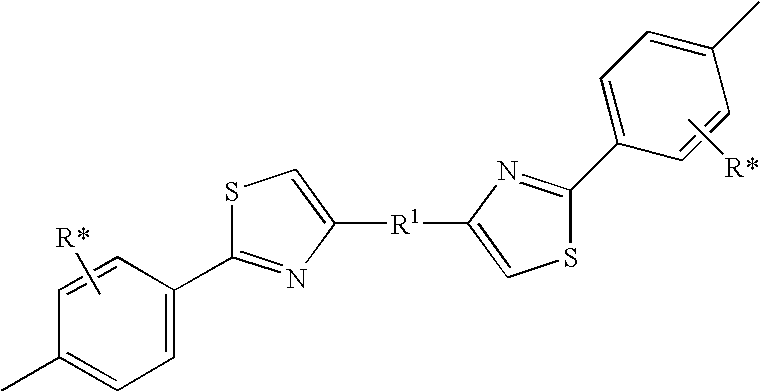
- Ar 3 (a1) 2,6-(diarylene)pyridinylenes Ar 3 (a2) 2,5-(diarylene)pyridinylenes Ar 3 (b) 2,5-(diarylene)pyrazinylenes Ar 3 (c) 3,6-(diarylene)-1,2,4- triazinylenes Ar 3 (d1) 1,4-(diarylene)phthalazinylenes Ar 3 (d2) 2,3-(diarylene)quinoxalinylenes Ar 3 (d3) 1,4-(diarylene)phenazinylenes Ar 3 (e) 1,4-(diarylene)benzo- thiadiazolylenes Ar 3 (f) 3,9-(diarylene)-1,7-diaza- chrysenylenes Ar 3 (g1) bis(2,2′-(diarylene)- pyrimidin-5,5′-ylene)arylenes Ar 3 (g2) 2,2-pyrimidine-5,5- (diarylene
- Ar 1 has an arylene structure and is the arylene component of a preferred polymer material which emits in the blue to green spectral region as the single component polyborane and has very good electron transport properties by virtue of the trivalent, sp 2 -hybridized boron with vacant p orbital; also, Ar 1 preferably has substituents which are capable of imparting solubility to the polymer which forms.
- Ar 2 is the arylene component of a further preferred polymer material for optimal adjustment of the hole transport properties and for the longer-wavelength emission correction of the copolymer for white balancing and
- Ar 3 is the arylene component of a further preferred polymer material which, by virtue of its low ⁇ electron density, emits in the blue and also serves for shorter wavelength color equalization of the emission of the copolymer, for example for attaining the white point.
- the polymer material comprises substituted arylene moieties, in particular of the R 1 type, for improving the solubility.
- lithiation reactions are carried out by means of butyllithium in tetrahydrofuran at ⁇ 78° C. and Grignard reactions with magnesium in tetrahydrofuran at 65° C.
- the lithiated products D, E and F are then reacted individually or in any desired ratios with boron trifluoride etherate G first at room temperature and later in boiling THF, in such a way that the molar sum of the lithiated components corresponds to the molar amount of the boron halide.
- the reaction of the bifunctional lithiated components leads only to one linear copolyfluoroaryleneborane H.
- Copolyfluoroaryleneboranes H are likewise obtained when the Grignard products D*, E* and F* are reacted individually or in any desired ratios with boron trifluoride etherate G in boiling THF, in such a way that the molar sum of the Grignard components corresponds to the molar amount of the boron halide.
- the reaction of the bifunctional Grignard components likewise leads only to one linear copolyfluoroaryleneborane H.
- a further monofunctional Grignard component I or lithiated component I* is synthesized and, after exchange of the THF solvent for toluene (now in boiling toluene), added dropwise in the molar ratio to the copolyfluoroaryleneborane H synthesized beforehand. After boiling at approx. 120° C. for 5 hours, this leads to the substitution of the remaining fluorine by the aryl radical of the Grignard component I to form a copolyarylborane derivative K.
- a further means of preparing the copolyarylborane derivatives K is offered by the substitution reaction from the lithiated compounds A, B and C or from the Grignard compounds A*, B* and C* and the arylboric esters or arylboron halides G* in stoichiometric ratios.
- the reactions are started in THF beginning at room temperature and increased to boiling temperature within 2 hours, then the tetrahydrofuran solvent is exchanged for toluene by distillation and the reaction is completed by heating at reflux for a further 4 to 6 hours.
- copolyaryleneboranes K which have been synthesized by one of the two synthetic routes shown are worked up by extracting the salts into water and repeatedly precipitating the polymer solution which has been concentrated in each case in methanol, as a result of which copolyaryleneboranes K have tailored electrical and optical properties owing to their component ratios.
- An embodiment of the invention relates to non-conjugated luminophoric compounds having semiconducting properties and to their preparation and their use in organic light-emitting diodes (OLEDs), organic solar cells, organic photo-detectors and organic field-effect transistors.
- OLEDs organic light-emitting diodes
- These are copolyarylboranes of the K type which are only converted by application of a suitable electrical field and/or by donor substitution of the aryl substituent R to a structure type which behaves like a conjugated polymer
- aryl systems A are not commercially available, they are prepared by known C—C bond-forming reactions (for example Suzuki coupling); beforehand, alkylations or alkoxylations are carried out on at least one coupling unit in order to aim for good solubility of the polymeric materials to be formed therefrom.
- C—C bond-forming reactions for example Suzuki coupling
- alkylations or alkoxylations are carried out on at least one coupling unit in order to aim for good solubility of the polymeric materials to be formed therefrom.
- reaction mixture is extracted three times with ether and water and the organic phase is removed.
- reaction mixture is poured onto 2 N HCl-ice mixture and hydrolyzed for 12 h, the organic phase is extracted and concentrated, and the residue is admixed with pentane to precipitate out the product.
- the product is filtered off with suction and dried under reduced pressure mp: 101-3° C.
- 0.04 mol of durylboronic acid is initially charged in a 1-liter 3-neck flask with 600 ml of toluene, admixed with 0.04 mol of propane-1,3-diol and heated on a water separator until no further water is separated out. Afterward, the water separator is removed and replaced by a reflux condenser, and 0.01 mol of 2,7-dibromo-9,9-diheptylfluorene and 11.6 g of potash dissolved in 42 ml of water are added to the reaction mixture. The flask is then repeatedly evacuated under reduced pressure and flooded with argon in order to add the catalyst, tetrakis(triphenylphosphine)palladium.
- the mixture is heated to 110° C. for 48 h and purged with argon during this time.
- the organic phase is washed repeatedly with water, extracted and concentrated to dryness. The residue is washed in methanol and filtered off with suction.
- the crude product is purified by chromatography on silica gel by means of cyclohexane.
- N,N′-di(2-phenylacetyl)-N,N′-diphenylphenylene-1,4-diamine (mp: 190° C.), for example, is prepared from N,N′-diphenyl-p-phenylenediamine and 2-phenylacetyl chloride.
- N,N′-di(2-phenylthioacetyl)-N,N′-diphenylphenylene-1,4-diamine (mp: 224-227° C.), for example, is prepared from N,N′-di(2-phenylacetyl)-N,N′-diphenylphenylene-1,4-diamine and the Lawesson reagent.
- 0.2 mol of haloacylaryl derivative is initially charged with 0.1 mol of N,N′-di(2-phenylthioacetyl)-N,N′-diphenylphenylene-1,4-diamine in tetrahydrofuran and refluxed under a nitrogen atmosphere for 30 minutes. After 30 minutes, 0.2 mol of triethylamine is added and the mixture is refluxed for another 30 minutes. The product is precipitated in methanol in the form of bright yellow crystals.
- N,N′-diphenyl-N,N′-dithiene-3,4-diphenyl-2-ylphenylene-1,4-diamine (mp: 266-268° C.), for example, is prepared from N,N′-di(2-phenylthioacetyl)-N,N′-diphenylphenylene-1,4-diamine and phenacyl bromide.
- N,N′-diphenyl-N,N′-dithiene-3-phenyl-4-(4-octylphenyl)-2-ylphenylene-1,4-diamine (mp: 83° C.), for example, is prepared from N,N′-di(2-phenylthioacetyl)N,N′-diphenylphenylene-1,4-diamine and phenacyl bromide.
- N-phenyl-N-(1-naphthyl)-2-phenylacetamide (mp: 85-88° C.), for example, is prepared from N-phenyl-N-(1-naphthyl)amine and 2-phenylacetyl chloride.
- N,N-Diphenyl-2-phenylacetamide (mp: 71-72° C.), for example, is prepared from diphenylamine and 2-phenylacetyl chloride.
- N-phenyl-N-(1-naphthyl)-2-phenylthioacetamide (mp: 100-103° C.), for example, is prepared from N-phenyl-N-(1-naphthyl)-2-phenylacetamide and the Lawesson reagent.
- N,N-diphenyl-2-phenylthioacetamide (mp: 142-144° C.), for example, is prepared from N,N-diphenyl-2-phenylacetamide and the Lawesson reagent.
- 2,2′-diphenylamino-3,3′-diphenyl-4,4′-bisthienyl-p-phenylene (mp: 232-235° C.), for example, is prepared from N,N-diphenyl-2-phenylthioacetamide and bis- ⁇ -bromoacetyl-p-phenylene.
- 0.04 mol of durylboronic acid (Example 1c) is initially charged in a 1-liter 3-neck flask with 600 ml of toluene, admixed with 0.04 mol of propane-1,3-diol and heated on a water separator until no further water is separated out. The water separator is then removed and replaced by a reflux condenser, and 0.01 mol of 1,4-dibromobenzo-b-thiadiazole and 11.6 g of potash dissolved in 42 ml of water are added to the reaction mixture. The flask is then repeatedly evacuated under reduced pressure and flooded with argon in order to add the catalyst, tetrakis(triphenylphosphine)palladium.
- the mixture is heated to 110° C. for 48 h and purged with argon during this time.
- the organic phase is repeatedly washed with water, extracted and concentrated to dryness. The residue is washed in methanol and filtered off with suction.
- the crude product is purified by chromatography on silica gel by means of toluene.
- the DMSO phase is washed with water and extracted with ether.
- the ether is distilled off by means of a rotary evaporator and the product is precipitated with methanol in the form of bright yellow crystals.
- 2-bromo-9,9-diheptylfluorene (mp: 32° C.), for example, is prepared from 2-bromofluorene and heptyl bromide in the presence of potassium tert-butoxide.
- the mixture is poured into ice/water/HCl (500 ml:500 ml:50 ml) and stirred for 20 minutes. The mixture is then washed once more with water. The organic phase is removed and the solvent is distilled off. The product precipitates out in the form of white crystals in methanol.
- 2-bromo-7-chloroacetyl-9,9-diheptylfluorene (mp: 83-4° C.), for example, is prepared from 2-bromo-9,9-diheptylfluorene and chloroacetyl chloride under Friedel-Crafts conditions.
- 0.1 mol of haloacylaryl derivative is initially charged with 0.1 mol of N,N-diaryl-2-phenylthioacetamide (Example 3b) in tetrahydrofuran and refluxed under a nitrogen atmosphere for 30 minutes. After 30 minutes, 0.1 mol of trimethylamine is added and the mixture is refluxed once again for 30 minutes. The product is precipitated in the form of yellowish crystals in methanol.
- An apparatus for working under inert conditions and exclusion of moisture is initially charged with 0.1 mol of diphenylamine, 0.4 mol of dibromodurene and 0.12 mol of sodium tert-butoxide.
- the reaction solution is heated at reflux until diphenylamine can no longer be detected by TLC comparison. For workup, the reaction solution is washed to neutrality and the organic phase is extracted.
- lithiated arenes In an apparatus as is customary in organometallic chemistry, 0.1 mol of highly purified and dried dibromoarylene component (A*, B*, C*), bromoaryl component (R—Br) or the unbrominated arenes (A, B, C) with terminal thiophene substituents are dissolved with exclusion of moisture and under an inert atmosphere in 600 ml of THF and cooled to ⁇ 78° C. Afterward, butyllithium is added slowly in a 20% excess through a septum and the temperature is kept at ⁇ 78° C. for a further hour. After thawing, the lithiated arenes may be processed further directly from the solution. The synthesis of the lithiated arenes required for the polymer synthesis should as far as possible be carried out in parallel in order to be able to use them freshly.
- 9,9-diheptyl-2,7-fluorenylenedilithium is prepared from 9,9-diheptyl-2,7-dibromofluorene and butyllithium.
- diphenylamino-2,3,5,6-tetramethylphenyl-4-yllithium is prepared from 4-bromo-2,3,5,6-tetramethylphenyldiphenylamine and butyllithium.
- 9,9-diheptyl-2,7-fluorenylenemagnesium bromide is prepared from 9,9-diheptyl-2,7-dibromofluorene and magnesium.
- One of the aryllithium compounds synthesized according to Example 9 or one of the aryl Grignard compounds synthesized according to Example 10 is slowly added dropwise at ⁇ 78° C. with exclusion of moisture and under inert conditions to an ethereal solution which comprises one equivalent of trimethyl borate. After thawing to room temperature, the mixture is stirred for another 12 h, then the reaction solution is available for further reaction.
- dimethyl mesitylboronate for example, is prepared from mesitylmagnesium bromide and trimethyl borate.
- polyfluoro(9,9-diheptyl)-2,7-fluorenyleneborane for example, is prepared from 9,9-diheptyl-2,7-fluorenylenemagnesium bromide and boron trifluoride etherate.
- the reflux condenser of the apparatus is replaced by a distillation head with condenser and the THF solvent is distilled off.
- the dropping funnel is filled with about the same volume as the reaction mixture of dry toluene and is added dropwise as the solvent instead of the THF.
- the desired dissolved Grignard compound I or aryllithium compound I* is metered into the dropping funnel under argon atmosphere and with exclusion of moisture in a stoichiometric ratio based on the copolyfluoroaryleneborane H, and slowly added dropwise with gently boiling toluene.
- the solvent (THF) of the Grignard compound I or aryllithium compound I* being added dropwise is distilled off.
- the distillation head with condenser is again exchanged for the reflux condenser and the mixture is heated at reflux for a further 5 h.
- reaction mixture is poured onto ice/HCl and the toluene phase is removed.
- the toluene is distilled off fully on a rotary evaporator, then the residue is dissolved in a little THF and precipitated in ethanol with stirring. Further purification of the product is effected by repeated dissolution in THF and precipitation again in ethanol.
- polymesityl(9,9-diheptyl)-2,7-fluorenyleneborane (MW: 21 000, Tg: 110° C., CV reversible on reduction), for example, is prepared from polyfluoro(9,9-diheptyl)-2,7-fluorenyleneborane and mesitylmagnesium bromide.
- poly(2-diphenylamino-3,4-diphenylthien-5-yl)(9,9-diheptyl-2,7-fluorenylene)borane (MW: 19 000, Tg: 135° C., CV: reversible on oxidation and reduction), for example, is prepared from polyfluoro(9,9-diheptyl)-2,7-fluorenyleneborane and 2-diphenylamino-3,4-diphenylthiophene.
- poly(4-diphenylamino-2,3,5,6-tetramethylphenyl)-[(9,9-diheptyl)-2,7-di(2,3,5,6-tetramethylphen-4-yl)fluorenylene]borane for example, is prepared from polyfluoro[(9,9-diheptyl)-2,7-di(2,3,5,6-tetramethylphen-4-yl)fluorenylene]borane and 4-bromo-2,3,5,6-tetramethylphenyldiphenylamine.
- Cyclic voltammetry on polymer ac shows the desired oxidative and reductive reversibility and stability over several cycles. See FIG. 1 .
- the metal organyls required to form the desired copolyborane are mixed in a flask according to the desired stoichiometry and the desired arylboronic ester is subsequently added in the stoichiometric ratio with stirring.
- the temperature is initially increased to 60° C. for 2 h, then the reflux condenser of the apparatus is replaced by a distillation head with condenser and the THF solvent is distilled off.
- the dropping funnel is filled with about the same volume as the reaction mixture of dry toluene and added dropwise as the solvent instead of the THF.
- the distillation head with condenser is exchanged again for the reflux condenser and the mixture is heated at reflux for a further 5 h.
- reaction mixture is poured onto ice/HCl and the toluene phase is removed.
- the toluene is distilled off fully on a rotary evaporator, then the residue is dissolved in a little THF and precipitated in ethanol with stirring. Further purification of the product is effected by repeated dissolution in THF and precipitation again in ethanol.
- the copolymer ba (CV reversible on oxidation and reduction, MW: 20 000), for example, is prepared from 0.8 molar part of the substituted fluorene component, 0.2 molar part of the substituted diamine component and 1.0 molar part of dimethyl mesitylboronate.
- An OLED was constructed by the following layer sequence:
- ITO indium tin oxide
- novel materials are suitable for obtaining electroluminescent diodes in the different colors of the visible spectral region (blue to red). These materials can also be converted by copolymerization reactions in appropriate ratios to materials which electroluminesce at or close to the white point.
- polymeric materials can be processed by all processes applicable from solution (for example spincoating, knifecoating, screenprinting, inkjet printing).
- the materials are obtainable preparatively in high yields and derive from arylated boranes, and the electronic properties and thus also the color of the particular compound are influenced by the selection of the arylene fragments (donor/acceptor structure).
- white-emitting materials are of great interest for the production of light sources and full-color displays in which the full color is achieved by filtering.
- the advantage of the white light-driven full-color displays consists in the color-independent aging of the emitting material.
Landscapes
- Chemical & Material Sciences (AREA)
- Engineering & Computer Science (AREA)
- Materials Engineering (AREA)
- Health & Medical Sciences (AREA)
- Chemical Kinetics & Catalysis (AREA)
- Medicinal Chemistry (AREA)
- Polymers & Plastics (AREA)
- Organic Chemistry (AREA)
- Electroluminescent Light Sources (AREA)
- Polyoxymethylene Polymers And Polymers With Carbon-To-Carbon Bonds (AREA)
- Photovoltaic Devices (AREA)
Abstract

wherein hydrogen atoms are bonded to the ends; Arn represents at least one of Ar1, Ar2, and Ar3; each of Ar1 and Ar2 represents an arylene radical; Ar3 represents an heteroaromatic arylene radical; Ar1 has a π electron density of no less than that of benzene; Ar2 is capable of hole transport; Ar3 has a π electron density of no greater than that of benzene and less than that of Ar1; x, y, and z respectively represent the molar parts of Ar1, Ar2, and Ar3; each of x, y, and z is in the range of 0-1, and x+y+z=1; and R represents an aryl radical. This K type of copolyarylborane may be of use for organic light-emitting diodes (OLEDs), organic solar cells, organic photodetectors, and organic field-effect transistors.
Description

where:
x, y and z are molar parts of components and add up to 1, where two of the indices x, y and z may also have the value 0,
hydrogen atoms are bonded to the ends,
Arn represents the particular arylene component, —Ar1— and/or —Ar2— and/or —Ar3— in the copolymer,
Ar1 and Ar2 each represent components having a mono or polycyclic, aromatic and/or heteroaromatic arylene structure which is bonded in a bivalent, conjugating manner, where Ar1 represents a component whose π electron density is equal to or greater than that of benzene and Ar2 represents a component which is capable of hole transport,
Ar3 represents a component having any mono- or polynuclear heteroaromatic arylene structure which is bonded in any bivalent, conjugating manner and has low π electron density which is equal to or less than that of benzene,
where the π electron density of Ar3 is in each case less than that of Ar1,
and
R represents a radical which has aryl structure and, depending on the intended conjugation of the polyborane K, includes a heteroaromatic and/or a (homo)aromatic aryl radical
-
- which is donor-free, where a conjugation in the polyborane K can be formed by application of an electrical field, and/or
- in which at least one additional donor function is substituted (intrinsic formation of conjugation) and/or
- its hydrogen atoms may also be substituted in any way by one or more branched or unbranched alkyl radicals or alkoxy radicals R*.

where the starting materials are the arenes A to C or the bromine-substituted arylene structures A* to C*, and these are subjected to umpolung either by a Grignard reaction (D* to F*) or by lithiation (D to F) (see scheme). Two basic reaction paths can then be utilized to form the copolyboranes K. Either the metallated compounds are converted by means of boron trifluoride G to fluorocopolyborane products H and these, without workup, are in turn converted by means of a Grignard reagent I or of a lithiated reagent I* (see scheme) to copolyboranes K in thermodynamically driven substitution reactions to form alkali metal or alkaline earth metal bromides, or the metallated compounds are converted in one step by means of an arylboron compound G directly to the copolyboranes K, where Y (see scheme) represents two halide, two alkoxy or one dioxy-alkylene structure (having from 1 to 3 carbon atoms).
-
- as an emitting layer in various colors and white,
- as an electron transporting layer and/or
- as a hole blocking layer
- and/or with an excess of components of the Ar2 type as a hole transporting layer and also as a tailored transport material in the functional layers of organic solar cells, organic photodetectors and organic field-effect transistors.
the term aryl or arylene component is understood to mean a conjugated system of at least one cyclic substructure which, in the case of a plurality of cyclic substructures, may also be interrupted by vinylene units, where the cyclic substructures are of aromatic nature, i.e. are obtained from carbon or rings consisting of carbon and other elements, whose number of π electrons corresponds to (4n+2) (n is a parameter which can assume the values from 0 to 5) and their other σ bonds, apart from one in the case of the monovalent aryl structure or two in the case of the bivalent arylene structure, are bonded to hydrogen and/or any other substituents;

where Ar1 has an arylene structure, preferably the 2,7-fluorenylene structure, which can be substituted in the 9 position easily by unbranched and/or branched alkyl radicals, especially preferably having from 1 to 10 carbon atoms, where the term arylene structure is understood to mean any mono- or polycyclic aromatic or heteroaromatic structure which is bonded in a bivalent, conjugating manner, and whose π electron density is equal to or greater than that of benzene, as specified, for example, in Table 1 Ar1(a-h)
| TABLE 1 |
 |
| Ar1(a1) |
| 1,4-phenylene |
 |
| Ar1(a2) |
| 1,3-phenylene |
 |
| Ar1(b1) 1,1′- |
| (4,4′-biphenylene) |
 |
| Ar1(b2) 1,1′-(3,3′- |
| biphenylene) |
 |
| Ar1(b3) 1,1′-(3,4′- |
| biphenylene) |
 |
| Ar1(c) |
| 2,7-fluorenylene |
 |
| Ar1(d) |
| 2,5-thienylene |
 |
| Ar1(e) 2,2′-(5,5′- |
| bisthienylene) |
 |
| Ar1(f1) 4′,5-(2- |
| phenylthienylene) |
 |
| Ar1(f2) 3′,5-(2- |
| phenylthienylene) |
 |
| Ar1(g1) |
| 1,4-naphthylene |
 |
| Ar1(g2) |
| 1,5-naphthylene |
 |
| Ar1(h1) |
| 1,4-anthrylene |
 |
| Ar1(h2) |
| 9,10-anthrylene |
 |
| Ar1(h3) 4′,4′-bis- |
| (9,10-diphenyl)- |
| anthrylene |
whose solubility in organic solvents may be improved by any additional arrangement of one or more unbranched and/or branched alkyl substituents and/or alkoxy substituents arranged preferably in the ortho position to the boron atom, with especially preferably from 1 to 10 carbon atoms R*;
Ar2 has an arylene structure capable of hole transport, the term arylene structure capable of hole transport being understood to mean any mono- or polycyclic aromatic and/or heteroaromatic structure which is bonded in a bivalent, conjugating manner and additionally has perarylated amine substituents attached in a conjugating manner, as specified, for example, in Table 2 Ar2(a-f)
| TABLE 2 |
 |
| Ar2 (a) |
| [bis(2,2′diarylamino-3,3′-diaryl-5,5′thiene)]-4,4′-ylene |
 |
| Ar2 (b) |
| [N,N′-bis(thien-2-yl)- or N,N′-bis-(1,3-thiazol-2-yl)- |
| N,N′-diaryldiaminoarylene]-5,5′-ylene |
 |
| Ar2 (c) |
| [bis(2,2′-diarylamino)-3,3′-diaryl-4,4′-thienyl)arylene]- |
| 5,5′-ylene |
 |
| Ar2 (d) |
| [N,N′-bis(3-duryl)-N,N′-diaryldiaminoarylene]-6,6′-ylene |
 |
| Ar2 (e) |
| Bis[(5,5-diarylaminophenyl)arlene]-2,2′-ylene |
 |
| Ar2 (f) |
| bis(4,4′-diarylaminophenyl)2,2′-ylene |
where the substituents R2, R3 and R4 are aryl substituents, preferably phenyl, 1-naphthyl, 2-naphthyl, whose solubility in organic solvents can be improved by any additional arrangement of one or more unbranched and/or branched alkyl substituents and/or alkoxy substituents preferably arranged in the ortho position to the boron atom, especially preferably having from 1 to 10 carbon atoms; the definitions of the substituents Rn with the same index n are identical and/or the definition of the substituents R1 is the same as the substituent selection for the arylene component Ar1, preferably 9,9-dialkyl-2,7-fluorenylene Ar1(c) type or 3,6-durylene Ar1(a) type;
for Ar2(b), x is also N or C—R4;
Ar3 has an arylene structure with low π electron density, the term arylene structure with low π electron density being understood to mean any mono- or polycyclic heteroaromatic structure which is bonded in a bivalent, conjugating manner and whose π electron density is equal to or less than that of benzene, as specified, for example, in Table 3 Ar3(a-m)
| TABLE 3 |
 |
| Ar3 (a1) |
| 2,6-(diarylene)pyridinylenes |
 |
| Ar3 (a2) |
| 2,5-(diarylene)pyridinylenes |
 |
| Ar3 (b) |
| 2,5-(diarylene)pyrazinylenes |
 |
| Ar3 (c) 3,6-(diarylene)-1,2,4- |
| triazinylenes |
 |
| Ar3 (d1) |
| 1,4-(diarylene)phthalazinylenes |
 |
| Ar3 (d2) |
| 2,3-(diarylene)quinoxalinylenes |
 |
| Ar3 (d3) |
| 1,4-(diarylene)phenazinylenes |
 |
| Ar3 (e) |
| 1,4-(diarylene)benzo- |
| thiadiazolylenes |
 |
| Ar3 (f) |
| 3,9-(diarylene)-1,7-diaza- |
| chrysenylenes |
 |
| Ar3 (g1) |
| bis(2,2′-(diarylene)- |
| pyrimidin-5,5′-ylene)arylenes |
 |
| Ar3 (g2) |
| 2,2-pyrimidine-5,5- |
| (diarylene)-ylenes |
 |
| Ar3 (h) |
| bis[5,5′-(diarylene)- |
| pyrimidin-2,2′-ylene]arylenes |
 |
| Ar3 (i1) |
| 2,2′-(5,5′-bis-1,3- |
| thiazolylenes) |
 |
| Ar3 (i2) |
| 2,2′-(5,5′arylenebis-1,3- |
| thiazolylenes) |
 |
| Ar3 (j1) |
| 5,5′-bis[2,5-(di-2′,2′- |
| thienyl)oxadiazolylenes] |
 |
| Ar3 (j2) |
| 5,5′-bis(2,5-(di-2′,2′- |
| thienyl)thiadiazolylenes] |
 |
| Ar3 (k1) |
| 4′,4′-bis(2,5-diphenyl- |
| oxadiazolylenes) |
 |
| Ar3 (k2) |
| 4′,4′-bis(2,5-diphenyl- |
| thiadiazolylenes) |
 |
| Ar3 (l1) |
| 2,2′-(5,5′-arylenebis-1,3- |
| thiazolylene)arylenes |
 |
| Ar3 (l2) |
| 2,2′-(5,5′arylenebis-1,3- |
| thiazolylenes) |
 |
| Ar3 (m1) |
| 4-(2,2′arylenebis-1,3- |
| thiazolylene)arylenes |
 |
| Ar3 (m2) |
| 4,4′-(5,5′ylenebis-1,3- |
| thiazolylene)arylenes |
whose solubility in organic solvents can be improved by any additional arrangement of one or more unbranched and/or branched alkyl substituents and/or alkoxy substituents preferably arranged in the ortho position to the boron atom, especially having from 1 to 10 carbon atoms R*; the definition of the substituents R1 is the same as the substituent selection for the arylene component Ar1, preferably 9,9-dialkyl-2,7-fluorenylene Ar1(c) type or 3,6-durylene Ar1(a) type;
where the π electron density of Ar3 is in each case less than that of Ar1,
and
R represents a radical with aryl structure which, depending on the intended conjugation of the polyborane K, includes a heteroaromatic and/or a (homo)aromatic aryl radical which
-
- [R(a1-a5)] is donor free, where a conjugation in the polyborane K can be formed by applying an electrical field, and/or
- [R(b-e)] in which at least one additional donor function is substituted (intrinsic formation of conjugation) and/or
- whose hydrogen atoms may also be substituted in any way by one or more branched or unbranched alkyl radicals or alkoxy radicals R*, preferably having from 1 to 10 carbon atoms;
R may, in the polyborane K in the case of intrinsic formation of conjugation, also be an N-carbazolyl radical R(f).
| TABLE 4 |
 |
| R(a1) |
| mesityl |
 |
| R(a2) pen- |
| tamethylphenyl |
 |
| R(a3) |
| 1-naphthyl |
 |
| R(a4) |
| 2-naphthyl |
 |
| R(a5) |
| 3-alkyl/alkoxydur- |
| 6-yl |
 |
| R(b1) |
| 2-diphenylamino |
| 3,4-diphenylthien- |
| 5-yl |
 |
| R(b2) |
| 2-[(1-naphthyl)- |
| phenylamino] 3,4- |
| diphenylthien-5-yl |
 |
| R(b3) |
| 2-(N-carbazoyl) |
| 3,4-dipheny]thien- |
| 5-yl |
 |
| R(c1) |
| 2-diphenylamino |
| 3,4-diphenyl-1,3- |
| thiazol-5-yl |
 |
| R(c2) |
| 2-[(1-naphthyl)- |
| phenylamino]-3,4 |
| diphenyl-1,3 |
| thiazol-5-yl |
 |
| R(d1) |
| 3-diphenylamino- |
| dur-6-yl |
 |
| R(d2) |
| 3-[(1-naphthyl)- |
| phenylamino]dur-6- |
| yl |
 |
| R(d3) |
| 3-(N-carbazoyl)- |
| dur-6-yl |
 |
| R(e1) |
| 2-diphenylamino- |
| 3,4-diphenyl-5-(3- |
| dur-6-yl)thiophene |
 |
| R(e2) |
| 2-[(1-naphthyl)- |
| phenylamino]-3,4 |
| diphenyl-5-(3-dur- |
| 6-yl)thiophene |
 |
| R(f) |
| N-carbazoyl |
x, y and z (structural formula type K) are the relative numbers which specify in which ratios relative to one another the polymeric single components are copolymerized. The polymeric individual components may also each alone be utilized as a material for an electroluminescent layer and/or organic semiconductor layer (electron transporting, hole blocking or hole transporting).

with the definitions of the symbols specified in


Claims (16)




Applications Claiming Priority (7)
| Application Number | Priority Date | Filing Date | Title |
|---|---|---|---|
| DE10320713 | 2003-05-08 | ||
| DE10320713 | 2003-05-08 | ||
| DE10320713.9 | 2003-05-08 | ||
| DE102004001865.0 | 2004-01-13 | ||
| DE102004001865 | 2004-01-13 | ||
| DE102004001865A DE102004001865A1 (en) | 2003-05-08 | 2004-01-13 | Non-conjugated polymeric perarylated boranes, their use as organic semiconducting emitters and / or transport materials, processes for their production and uses thereof |
| PCT/EP2004/004901 WO2004099291A1 (en) | 2003-05-08 | 2004-05-07 | Non-conjugated polymeric perarylated boranes, use thereof as organically semiconductor transmitters and/or transport materials, methods for producing same and uses thereof |
Publications (2)
| Publication Number | Publication Date |
|---|---|
| US20060229431A1 US20060229431A1 (en) | 2006-10-12 |
| US7951874B2 true US7951874B2 (en) | 2011-05-31 |
Family
ID=33435967
Family Applications (1)
| Application Number | Title | Priority Date | Filing Date |
|---|---|---|---|
| US10/555,982 Expired - Fee Related US7951874B2 (en) | 2003-05-08 | 2004-05-07 | Non-conjugated polymeric perarylated boranes, use thereof as organically semiconductor transmitters and/or transport materials, methods for producing same and uses thereof |
Country Status (4)
| Country | Link |
|---|---|
| US (1) | US7951874B2 (en) |
| EP (1) | EP1620492B9 (en) |
| KR (1) | KR101102102B1 (en) |
| WO (1) | WO2004099291A1 (en) |
Cited By (2)
| Publication number | Priority date | Publication date | Assignee | Title |
|---|---|---|---|---|
| US9255221B2 (en) | 2011-08-31 | 2016-02-09 | Sumitomo Chemical Company, Limited | Composition containing borane compound and conjugated polymer compound, and element |
| US10556864B2 (en) | 2007-12-03 | 2020-02-11 | Semiconductor Energy Laboratory Co., Ltd. | Carbazole derivative, and light-emitting element, light-emitting device, and electronic device using the carbazole derivative |
Families Citing this family (8)
| Publication number | Priority date | Publication date | Assignee | Title |
|---|---|---|---|---|
| DE10361385B4 (en) * | 2003-12-29 | 2011-07-28 | OSRAM Opto Semiconductors GmbH, 93055 | Polymers, phosphorescent organic semiconducting emitter materials based on perarylated boranes, process for their preparation and uses thereof |
| DE102004015845B4 (en) * | 2004-03-31 | 2012-12-20 | Osram Opto Semiconductors Gmbh | Organic light emitting diode, as well as uses thereof |
| DE102004023221B4 (en) * | 2004-05-11 | 2006-03-09 | Siemens Ag | Organic light emitting diode with improved lifetime |
| DE102004023219B4 (en) * | 2004-05-11 | 2006-03-09 | Siemens Ag | Organic electronic component |
| WO2007072691A1 (en) * | 2005-12-16 | 2007-06-28 | National University Corporation Nagoya University | ORGANIC BORON π-ELECTRON SYSTEM COMPOUND AND INTERMEDIATE FOR PRODUCTION OF THE COMPOUND |
| US20070215864A1 (en) * | 2006-03-17 | 2007-09-20 | Luebben Silvia D | Use of pi-conjugated organoboron polymers in thin-film organic polymer electronic devices |
| KR100914383B1 (en) | 2006-06-20 | 2009-08-28 | 주식회사 엘지화학 | Polyheterocyclic compound, an electronic device including an organic electronic device and a weaner electronic device using the same |
| CN103613708A (en) * | 2013-11-11 | 2014-03-05 | 大连理工大学 | Boracic polyacetylene derivative suitable for fluorinion detection and preparation method thereof |
Citations (5)
| Publication number | Priority date | Publication date | Assignee | Title |
|---|---|---|---|---|
| US3213136A (en) | 1961-10-30 | 1965-10-19 | American Potash & Chem Corp | Borimidazoles |
| EP0775706A2 (en) | 1995-11-24 | 1997-05-28 | Ciba SC Holding AG | Borates photoinitiators from polyboranes |
| JP2000294373A (en) | 1999-04-05 | 2000-10-20 | Toyo Ink Mfg Co Ltd | Organic electroluminescent device material and organic electroluminescent device using the same |
| EP1142895A1 (en) | 1999-01-08 | 2001-10-10 | Chisso Corporation | Borane derivatives and organic electroluminescents |
| JP2003031368A (en) | 2001-07-11 | 2003-01-31 | Konica Corp | Organic electroluminescence element and display device |
-
2004
- 2004-05-07 US US10/555,982 patent/US7951874B2/en not_active Expired - Fee Related
- 2004-05-07 EP EP04731627A patent/EP1620492B9/en not_active Expired - Lifetime
- 2004-05-07 KR KR1020057021219A patent/KR101102102B1/en not_active Expired - Fee Related
- 2004-05-07 WO PCT/EP2004/004901 patent/WO2004099291A1/en not_active Ceased
Patent Citations (8)
| Publication number | Priority date | Publication date | Assignee | Title |
|---|---|---|---|---|
| US3213136A (en) | 1961-10-30 | 1965-10-19 | American Potash & Chem Corp | Borimidazoles |
| EP0775706A2 (en) | 1995-11-24 | 1997-05-28 | Ciba SC Holding AG | Borates photoinitiators from polyboranes |
| CN1160058A (en) | 1995-11-24 | 1997-09-24 | 希巴特殊化学控股公司 | Borate photoinitiators from polyboranes |
| US5807905A (en) | 1995-11-24 | 1998-09-15 | Ciba Specialty Chemicals Corporation | Borate photoinitiators from polyboranes |
| US6057078A (en) | 1995-11-24 | 2000-05-02 | Ciba Specialty Chemicals Corporation | Polyborane photoinitiators and borate photoinitiators from polyboranes |
| EP1142895A1 (en) | 1999-01-08 | 2001-10-10 | Chisso Corporation | Borane derivatives and organic electroluminescents |
| JP2000294373A (en) | 1999-04-05 | 2000-10-20 | Toyo Ink Mfg Co Ltd | Organic electroluminescent device material and organic electroluminescent device using the same |
| JP2003031368A (en) | 2001-07-11 | 2003-01-31 | Konica Corp | Organic electroluminescence element and display device |
Non-Patent Citations (4)
| Title |
|---|
| Gompper et al., Synthesis of Oligo(diazaphenyls). Tailor-Made Fluorescent Heteroaromatics and Pathways to Nanostructures, Feature Article, (1997). |
| M. Kinoshita et al., A Novel Family of Boron-Containing Hole-Blocking Amorphous Molecular Materials for Blue-and Blue-Violet-Emitting Organic Electroluminescent Devices, Adv. Funct. Mater., 12, vol. No. 11-12, Dec. 2002. |
| Noriyoshi Matsumi et al., "Poly(p-phenylene-borane)s. Novel Organoboron pi-Conjugated Polymers via Grignard Reagent", J. Am. Chem. Soc. 1998, 120 p. 10776-10777. |
| Noriyoshi Matsumi et al., "Poly(p-phenylene-borane)s. Novel Organoboron π-Conjugated Polymers via Grignard Reagent", J. Am. Chem. Soc. 1998, 120 p. 10776-10777. |
Cited By (3)
| Publication number | Priority date | Publication date | Assignee | Title |
|---|---|---|---|---|
| US10556864B2 (en) | 2007-12-03 | 2020-02-11 | Semiconductor Energy Laboratory Co., Ltd. | Carbazole derivative, and light-emitting element, light-emitting device, and electronic device using the carbazole derivative |
| US12110274B2 (en) | 2007-12-03 | 2024-10-08 | Semiconductor Energy Laboratory Co., Ltd. | Carbazole derivative, and light-emitting element, light-emitting device, and electronic device using carbazole derivative |
| US9255221B2 (en) | 2011-08-31 | 2016-02-09 | Sumitomo Chemical Company, Limited | Composition containing borane compound and conjugated polymer compound, and element |
Also Published As
| Publication number | Publication date |
|---|---|
| KR101102102B1 (en) | 2012-01-18 |
| EP1620492B1 (en) | 2009-03-25 |
| EP1620492A1 (en) | 2006-02-01 |
| US20060229431A1 (en) | 2006-10-12 |
| EP1620492B9 (en) | 2009-11-04 |
| WO2004099291A1 (en) | 2004-11-18 |
| KR20060009005A (en) | 2006-01-27 |
Similar Documents
| Publication | Publication Date | Title |
|---|---|---|
| US7960725B2 (en) | Aryl-aryl dendrimers | |
| Justin Thomas et al. | New star-shaped luminescent triarylamines: Synthesis, thermal, photophysical, and electroluminescent characteristics | |
| US8860007B2 (en) | Aryl-substituted polyindenofluorenes for use in organic electroluminiscent devices | |
| Prachumrak et al. | Novel bis [5-(fluoren-2-yl) thiophen-2-yl] benzothiadiazole end-capped with carbazole dendrons as highly efficient solution-processed nondoped red emitters for organic light-emitting diodes | |
| TW200815313A (en) | Novel materials for organic electroluminescent devices | |
| CN102272966A (en) | Compounds for electronic devices | |
| WO2011025282A2 (en) | Novel organic compound and organic light-emitting device using same | |
| TW200842140A (en) | Polymers comprising fused selenophene | |
| US11812660B2 (en) | Organic compound, electroluminescent material and application thereof | |
| TW201127866A (en) | Polymers comprising structural units which contain alkylalkoxy groups, blends comprising these polymers, and opto-electronic devices comprising these polymers and blends | |
| JP5294560B2 (en) | Polymer phosphorescent organic semiconductor emitter material based on perarylated borane, its preparation and use | |
| CN112592363B (en) | A condensed ring compound containing boron atom and selenium/tellurium atom and organic electroluminescent device | |
| US8008418B2 (en) | High-molecular copolymer containing metal coordination compound and organic electroluminescence element using the same | |
| TW201829385A (en) | a compound having a valeramine structure | |
| TW201130947A (en) | Organic light-emitting diode, display and illuminating device | |
| US20060229431A1 (en) | Non-conjugated polymeric perarylated boranes, use thereof as organically semiconductor transmitters and/or transport materials, methods for producing same and uses thereof | |
| US11532793B2 (en) | Compound, display panel, and display apparatus | |
| JPWO2003050201A1 (en) | Organic electroluminescence element material | |
| CN101280187A (en) | Soluble electron-transporting electroluminescent material and its preparation method and application | |
| US9150536B2 (en) | Cycloalkene derivatives and organic electronic devices using the same | |
| JP4741467B2 (en) | Perarylated boranes of non-conjugated polymers, their use as organic semiconductor light emitting materials and / or transport materials, their production methods and their use | |
| CN110759936B (en) | Compound, display panel and display device | |
| CN101314635A (en) | Polymers containing carbazole and oxadiazole units and their use | |
| US7951965B2 (en) | Phenanthrene derivatives and organic light-emitting diodes containing said phenanthrene derivative | |
| US12082499B2 (en) | Compound and its application |
Legal Events
| Date | Code | Title | Description |
|---|---|---|---|
| AS | Assignment |
Owner name: OSRAM OPTO SEMICONDUCTORS GMBH, GERMANY Free format text: ASSIGNMENT OF ASSIGNORS INTEREST;ASSIGNORS:KANITZ, ANDREAS;ROGLER, WOLFGANG;WOERLE, JASMIN;SIGNING DATES FROM 20060427 TO 20060504;REEL/FRAME:017934/0877 Owner name: OSRAM OPTO SEMICONDUCTORS GMBH, GERMANY Free format text: ASSIGNMENT OF ASSIGNORS INTEREST;ASSIGNORS:KANITZ, ANDREAS;ROGLER, WOLFGANG;WOERLE, JASMIN;REEL/FRAME:017934/0877;SIGNING DATES FROM 20060427 TO 20060504 |
|
| STCF | Information on status: patent grant |
Free format text: PATENTED CASE |
|
| FEPP | Fee payment procedure |
Free format text: PAYOR NUMBER ASSIGNED (ORIGINAL EVENT CODE: ASPN); ENTITY STATUS OF PATENT OWNER: LARGE ENTITY |
|
| FPAY | Fee payment |
Year of fee payment: 4 |
|
| AS | Assignment |
Owner name: OSRAM OLED GMBH, GERMANY Free format text: ASSIGNMENT OF ASSIGNORS INTEREST;ASSIGNOR:OSRAM OPTO SEMICONDUCTORS GMBH;REEL/FRAME:037567/0993 Effective date: 20151216 |
|
| FEPP | Fee payment procedure |
Free format text: MAINTENANCE FEE REMINDER MAILED (ORIGINAL EVENT CODE: REM.); ENTITY STATUS OF PATENT OWNER: LARGE ENTITY |
|
| LAPS | Lapse for failure to pay maintenance fees |
Free format text: PATENT EXPIRED FOR FAILURE TO PAY MAINTENANCE FEES (ORIGINAL EVENT CODE: EXP.); ENTITY STATUS OF PATENT OWNER: LARGE ENTITY |
|
| STCH | Information on status: patent discontinuation |
Free format text: PATENT EXPIRED DUE TO NONPAYMENT OF MAINTENANCE FEES UNDER 37 CFR 1.362 |
|
| FP | Lapsed due to failure to pay maintenance fee |
Effective date: 20190531 |