US7931978B1 - Electrochemical power source using halogenated organic compounds - Google Patents
Electrochemical power source using halogenated organic compounds Download PDFInfo
- Publication number
- US7931978B1 US7931978B1 US11/746,326 US74632607A US7931978B1 US 7931978 B1 US7931978 B1 US 7931978B1 US 74632607 A US74632607 A US 74632607A US 7931978 B1 US7931978 B1 US 7931978B1
- Authority
- US
- United States
- Prior art keywords
- cathode
- power source
- electrochemical power
- oxyhalogenated
- metallic anode
- Prior art date
- Legal status (The legal status is an assumption and is not a legal conclusion. Google has not performed a legal analysis and makes no representation as to the accuracy of the status listed.)
- Expired - Fee Related, expires
Links
Images




Classifications
-
- H—ELECTRICITY
- H01—ELECTRIC ELEMENTS
- H01M—PROCESSES OR MEANS, e.g. BATTERIES, FOR THE DIRECT CONVERSION OF CHEMICAL ENERGY INTO ELECTRICAL ENERGY
- H01M12/00—Hybrid cells; Manufacture thereof
- H01M12/04—Hybrid cells; Manufacture thereof composed of a half-cell of the fuel-cell type and of a half-cell of the primary-cell type
-
- H—ELECTRICITY
- H01—ELECTRIC ELEMENTS
- H01M—PROCESSES OR MEANS, e.g. BATTERIES, FOR THE DIRECT CONVERSION OF CHEMICAL ENERGY INTO ELECTRICAL ENERGY
- H01M4/00—Electrodes
- H01M4/02—Electrodes composed of, or comprising, active material
- H01M4/36—Selection of substances as active materials, active masses, active liquids
- H01M4/38—Selection of substances as active materials, active masses, active liquids of elements or alloys
-
- H—ELECTRICITY
- H01—ELECTRIC ELEMENTS
- H01M—PROCESSES OR MEANS, e.g. BATTERIES, FOR THE DIRECT CONVERSION OF CHEMICAL ENERGY INTO ELECTRICAL ENERGY
- H01M4/00—Electrodes
- H01M4/02—Electrodes composed of, or comprising, active material
- H01M4/36—Selection of substances as active materials, active masses, active liquids
- H01M4/38—Selection of substances as active materials, active masses, active liquids of elements or alloys
- H01M4/381—Alkaline or alkaline earth metals elements
- H01M4/382—Lithium
-
- H—ELECTRICITY
- H01—ELECTRIC ELEMENTS
- H01M—PROCESSES OR MEANS, e.g. BATTERIES, FOR THE DIRECT CONVERSION OF CHEMICAL ENERGY INTO ELECTRICAL ENERGY
- H01M4/00—Electrodes
- H01M4/86—Inert electrodes with catalytic activity, e.g. for fuel cells
- H01M4/88—Processes of manufacture
- H01M4/8803—Supports for the deposition of the catalytic active composition
-
- H—ELECTRICITY
- H01—ELECTRIC ELEMENTS
- H01M—PROCESSES OR MEANS, e.g. BATTERIES, FOR THE DIRECT CONVERSION OF CHEMICAL ENERGY INTO ELECTRICAL ENERGY
- H01M4/00—Electrodes
- H01M4/86—Inert electrodes with catalytic activity, e.g. for fuel cells
- H01M4/88—Processes of manufacture
- H01M4/8825—Methods for deposition of the catalytic active composition
- H01M4/8867—Vapour deposition
- H01M4/8871—Sputtering
-
- H—ELECTRICITY
- H01—ELECTRIC ELEMENTS
- H01M—PROCESSES OR MEANS, e.g. BATTERIES, FOR THE DIRECT CONVERSION OF CHEMICAL ENERGY INTO ELECTRICAL ENERGY
- H01M4/00—Electrodes
- H01M4/86—Inert electrodes with catalytic activity, e.g. for fuel cells
- H01M4/90—Selection of catalytic material
- H01M4/92—Metals of platinum group
-
- Y—GENERAL TAGGING OF NEW TECHNOLOGICAL DEVELOPMENTS; GENERAL TAGGING OF CROSS-SECTIONAL TECHNOLOGIES SPANNING OVER SEVERAL SECTIONS OF THE IPC; TECHNICAL SUBJECTS COVERED BY FORMER USPC CROSS-REFERENCE ART COLLECTIONS [XRACs] AND DIGESTS
- Y02—TECHNOLOGIES OR APPLICATIONS FOR MITIGATION OR ADAPTATION AGAINST CLIMATE CHANGE
- Y02E—REDUCTION OF GREENHOUSE GAS [GHG] EMISSIONS, RELATED TO ENERGY GENERATION, TRANSMISSION OR DISTRIBUTION
- Y02E60/00—Enabling technologies; Technologies with a potential or indirect contribution to GHG emissions mitigation
- Y02E60/10—Energy storage using batteries
Definitions
- a battery is a device in which an electrochemical reaction, capable of producing energy, occurs spontaneously.
- Research in battery designs have been intensive technological endeavors for over five decades.
- Electronic devices, common in households, as well as observing and sensing systems with applications in various arenas motivate the development of powering systems with increased performance.
- an electrochemical cell or galvanic cell couples two half-reactions to create a battery or power source. In one of these reactions a first compound reduces its oxidation state and in the other reaction a second compound oxidizes or losses electrons. The electron transfer can be harvested and used in electrical and electronics devices.
- oxidation potential is an indication of the achievable potential that the cell in which the selected material is used as an electrode is capable of providing, since the overall reaction potential is given by the sum of the potentials of the half reactions involved. Additionally, the sign of the oxidation potential and its magnitude provides insight on the spontaneity of the reaction.
- the table shown in FIG. 1 presents a list of standard oxidation potentials of several common anode materials in battery systems currently known in the art.
- the molecular weight of the substance and its change in oxidation state will dictate the theoretical maximum specific energy that such a material can provide.
- the maximum specific energy is the energy per unit weight of the material.
- the theoretical energy density will be directly influenced by the material's density.
- the theoretical energy density is the energetic content per unit volume of the material.
- the parameters that have been regarded as the most important to rate the performance of an electrochemical battery are the specific energy and/or the energetic density.
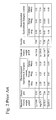
- the table in FIG. 2 illustrates several physicochemical properties of selected anode materials, including lithium, magnesium, aluminum and zinc, along with their theoretical energy content under standard conditions.
- the table in FIG. 2 also illustrates that lithium is the material with the highest energetic content per unit of mass. This explains why this chemical has been thoroughly investigated for battery development.
- Aluminum due to its relatively low molecular weight for a charge transfer of three electron-mol per mol of substance and its low mass density has a higher energy density when compared to that of lithium. This is one of the reasons why aluminum has also been intensively investigated for the development of batteries.
- the table in FIG. 2 illustrates additional metals that present very attractive characteristics for electrochemical batteries, including magnesium and zinc, both of which have also been used in the past for developing battery systems.
- a cathode half reaction is coupled to an anode reaction.
- the cathode reagent should be an oxidizer that is able to reduce the anode material.
- the table of FIG. 3 illustrates some common oxidizer reactions that have been used for electrochemical batteries that are currently known in the art.
- the table shown in FIG. 4 includes primary batteries, those cells that are designed to be on the shelf and produce energy when in use and be disposed of after their useful life, in addition to secondary batteries, rechargeable batteries and fuel cells.
- An additional type of electrochemical cell known in the art is a reserve battery.
- a reserve battery requires activation operations that will close the circuit and start the production of energy “on-demand”. The activation operation could encompass events such as the introduction of electrolyte or the melting of substances to induce the conduction of ions responsible for the charge transfer between the anode and the cathode.
- materials capable of releasing ions to supply the necessary chemicals that directly participate in cathode reactions can be coupled to anode reactions and produce electrical energy.
- batteries with different configurations that have many attractive features are provided.
- the electrochemical cells in accordance with the present invention can be used as reserve cells and can be activated by simply adding water or aqueous solutions of conductive salts.
- the cells have a high energy density and are ideal to power systems that require long shelf life and are reliable when used.
- an electrochemical power source including a cathode and a metallic anode positioned to define an interstitial space between the catalytic cathode and the metallic anode and a non-aqueous oxyhalogenated ion releaser positioned at least partially within the interstitial space between the catalytic cathode and the metallic anode.
- the cathode is a current collector that is a conductive surface capable of charge transfer with the reduced species resulting from the reaction of the oxyhalogenated ion releaser.
- metallic anode including, but not limited to aluminum, lithium, magnesium, zinc, iron, indium, tin and tin-lead alloy.
- oxyhalogenated ion releaser Various materials are within the scope of the present invention for use as the oxyhalogenated ion releaser, including, but not limited to trichloro-isocianuric acid, sodium dichloro-s-triazinetrione, 1-bromo-3-chloro-5,5-dimethylhydantoin, 1,3-dichloro-5-methyl, 5-ethyl hydantoin, chlorosucciminide, bromosucciminide and iodo succiminide.
- the oxyhalogenated ion releaser is a halogenated solid heterocyclic compound.
- the cathode, the metallic anode and the oxyhalogenated ion releaser are layered to form a substantially flat cell.
- the cathode is formed by a thin layer of platinum sputtered on a silicon wafer and the metallic anode is either a metallic plate or a metallic wire.
- the cathode is separated from the anode by a polysulfone layer.
- the metallic anode and the oxyhalogenated ion releaser are concentrically positioned within a cylindrical container to form a cylindrical cell.
- the cathode is a substantially thin carbon cloth sputtered with platinum and the anode is either an aluminum or platinum rod or a Mylar rod having an aluminum or platinum wire coiled around it.
- a method of providing electrochemical power including the steps of positioning a cathode and a metallic anode to form an interstitial space therebetween, positioning a non-aqueous oxyhalogenated ion releaser within the interstitial space, introducing an aqueous solution into the interstitial space to enable the production of oxyhalogenated acid and the subsequent release of hypochlorite ions from the oxyhalogenated ion and providing electrochemical power resulting from the reaction between the hypochlorite ions, the cathode and the metallic anode.
- the aqueous solution may be water or an aqueous solution of conductive salts.
- Halogenated organic compounds that are inexpensive and are readily available have been used to present the examples of the invention. These chemicals, when in contact with water experience a reaction that releases oxy-halogenated acid. These compounds are weak acids and release hydrogen ions according to their ionization constants, keeping a constant level of oxy-halogenated ion. These ions are capable of reacting with catalytic cathodes and can be coupled with anode materials to fabricate galvanic cells. Exemplary embodiments of the present invention include cells with flat and cylindrical form factors having a variety of anodes.
- FIG. 1 is a table illustrating the oxidation reactions and standard potential for common anode materials known in the art.
- FIG. 2 is a table illustrating the physiochemical properties of various common anode materials known in the art.
- FIG. 3 is a table illustrating some common cathode half reactions that have lead to patented and commercial cells known in the art.
- FIG. 4 is a table of selected battery systems as an illustration of available commercial systems known in the art.
- FIG. 5 is a table illustrating several aluminum anode systems that are known in the art.
- FIG. 6 is a table illustrating various chemicals capable of producing hypochlorous acid in accordance with embodiments of the present invention.
- FIG. 7 is an equation illustrating the reaction that takes place, using trichloro-isocianuric acid, when water is added, in accordance with a particular embodiment of the present invention.
- FIG. 8A is an illustration of a flat form factor battery fabricated having a plate anode material in accordance with an embodiment of the present invention.
- FIG. 8B is an illustration of a flat form factor battery having a wire functioning as the anode in accordance an embodiment of the present invention.
- FIG. 9 is an illustration of a cylindrical assembly of cells, both bobbin type and button size, in accordance with the present invention.
- FIG. 10 is a table illustrating anode materials that have been tested with the new set of cathode materials proposed by the present invention.
- FIG. 11 is a table illustrating the commercially available materials capable of releasing oxy-halogenated acids.
- FIG. 12 is a chart illustrating the potential vs. time for flat cells constructed with different anodes in accordance with the present invention.
- FIG. 13 is a table illustrating the performance characteristics with flat cells built using foils or sheet metals in accordance with the present invention.
- FIG. 14 is a table illustrating the performance characteristics of cells built in accordance with the present invention.
- FIG. 15 is a chart illustrating the cell potential vs. time for various cells in accordance with the present invention.
- FIG. 16 is a table illustrating the various aluminum anodes utilized for testing the novel chemistry in accordance with the present invention.
- FIG. 17 is a table illustrating a summary of the obtained results after testing the novel cells again with a 50 ohm load.
- FIG. 18 is a table illustrating the performance characteristics with flat cells built using anodes acquired as wires in accordance with the present invention.
- FIG. 19 is a table illustrating the results obtained in the cylindrical cell configurations of the present invention tested at constant loads.
- FIG. 20 is a graph illustrating the voltage vs. current drawn from a fabricated cell with aluminum anode plates, trichloroisocyanuric acid and a wafer onto which platinum has been sputtered in accordance with an embodiment of the present invention.
- FIG. 21 is a graphical illustration of the comparison of cells using platinum, Pt, and PAC as catalyst mixed w/oxidizer (each point represents 1-hour averages).
- the present invention provides for an electrochemical power source using halogenated organic compounds.
- the present invention focuses on optimizing aluminum-anode systems for use as reserve battery systems.
- the reserve battery utilizing the solid dissolutions in accordance with the present invention enables improved control in the release of hydroxide ions, which in turn provides for better control of parasitic reactions in the reserve battery.
- Equation 1 Na 2 O 2(s) +H 2 O (1) ⁇ O 2 H (aq) ⁇ 1 +2Na (aq) +1 OH ⁇ 1 (aq) Equation 1 O 2 H (aq) ⁇ 1 +H 2 O (l) +2 e ⁇ 3OH ⁇ 1 (aq) Equation 2
- Equation 5 Water is the only necessary reagent to start the reaction of Equation 3, while hydrogen peroxide requires the initial presence of hydroxide ion as shown in Equation 5.
- Equation 3 Excess hydroxide ions are produced in accordance with Equation 3 such that the aluminum hydroxide does not form as a scale. Soluble sodium aluminate is formed.
- the properties of aluminum compounds were taken into account. Specifically the formation of soluble/insoluble species in the presence of certain pHs was utilized to improve the electrochemical energy production.
- a solid material is used that will maintain optimal conditions so that the energy-producing reactions are kept.
- Aluminum systems were examined in accordance with particular embodiments of the present invention, as shown with reference to the table of FIG. 6 .
- solid chemical systems are sought that are capable of releasing hypochlorite ions.
- Chemical compounds are known in the art that can release hypochlorous acid.
- Hypochlorous acid is a weak acid and it is able to produce hypochlorite ions.
- Equation 6a-6c The chemical reactions shown in Equation 6a-6c indicates that hydroxide ions can be maintained at an optimal level if a chemical is found that can produce hypochlorous acid.
- solid chemicals that are able to produce hypochlorous acid are used to provide high energy content batteries.
- Some of the chemicals identified, capable of releasing hypochlorous acid (hypochlorite ions) that are readily available are halogenated nitrogen heterocyclic compounds. Some of these materials are listed in the table of FIG. 6 .
- hypochlorous acid very strong oxidizer
- cathode collectors were used.
- platinum and palladium were two of the catalytic materials used; however other materials are within the scope of the present invention.
- the cathode is a current collector that is a conductive surface capable of charge transfer with the reduced species resulting from the reaction of the oxyhalogenated ion releaser. Both flat cells and cylindrical cells were tested.
- the flat fabricated cells were constructed layering three basic components as illustrated.
- a flat battery cell 5 having a catalytic material that is a thin layer of platinum 15 sputtered on a 100 cm diameter 500 micron-thick silicon wafer 10 .
- the second layer of material is a thin polysulfone layer (800 ⁇ m) 20 that was cut to serve as a separator and a structural supporter of the anode material 25 .
- the anode material is an aluminum plate 25 .
- an aluminum wire 30 is used as the anode material to form the flat cell 45 .
- the layers were glued after a predetermined amount of the hypochlorous acid releaser 40 was placed on the space formed within the polysulfone spaces 20 .
- the cylindrical cell types were constructed as shown with reference to FIG. 9 .
- the cell construction consisted of assembling concentric electrodes on a plastic cylindrical container 70 .
- a battery cell 50 is assembled wherein the cathode electrode 55 is a thin carbon cloth onto which platinum was sputtered. The cloth was rolled and placed on the cylindrical container 70 . The anode was then placed and filled with the hypochlorous acid releaser 75 .
- a solid rod of aluminum 60 was utilized as the anode.
- the anode consists of an aluminum coil 85 rolled onto a cylindrical mylar piece 80 .
- the cell assembly 55 of FIG. 9B is considerably lighter than the cell assembly 50 of FIG. 9A .
- the cell illustrated in FIG. 9C 90 resembles a coin cell rather than a “D”-type cell, as was the case for the cells shown in FIG. 9A and FIG. 9B .
- the cell of FIG. 9C 90 also differs from cell types A and B in that a palladium wire forming a coil 100 is used as the cathode.
- Aluminum wire forming a circular loop 95 is utilized as the anode and the cell assembly is similar to that illustrated with reference to FIG. 9A and FIG. 9B in which the anode 95 and cathode 100 electrodes are placed on the plastic container 70 and then the hypochlorous releaser 75 is added.
- the table shown in FIG. 10 shows several of the anode materials that are within the scope of the present invention to be used to fabricate cells as described above.
- the table shows some of the materials that were identified to react with water to produce hypochlorite ions through the chemical production of hypochlorous acid.
- the table shown in FIG. 11 lists some commercially available materials utilized herein to release the hypochlorite ion in fabricated cells in accordance with particular embodiments of the present invention.
- thrichloro-s-triazinetrione was coupled with various metal anodes in flat battery cells to test the results of these exemplary embodiments.
- the thrichloro-s-triazinetrione material that was used is a commercially available material with the highest content of halogen (99.0% Chlorine).
- the graph in FIG. 12 illustrates the potential obtained as a function of time from these exemplary cells while subjected to a 50-ohm load nominal load utilizing the anode materials shown.
- the table in FIG. 13 illustrates the performance characteristics with flat cells built using foils or sheet metals as described. In most cases the operational time was around 0.4 ⁇ 0.3 hours. Tri-chloro-s-triazinetrione power was used as the hypochlorous acid releasing material and tap water was used to activate the cells. Constant load testing using a nominal 50 ohm-load was used.
- Sheet aluminum with a purity of 99.998% was used to test the other chemicals capable of releasing oxy-halogenated compounds.
- the hypochlorous acid releaser materials, when available as a solid tablet, were pulverized using a mortar. Cells as that shown in FIG. 9A were then assembled and tested also with a constant load.
- the table illustrated in FIG. 14 shows a compilation of the results obtained after running the cells for about 6 hours. Again integration of the delivered current and work was numerically performed. In the table of FIG. 14 , characteristics of cells built as described in text are illustrated. In most cases the operational time was around 6.4+ ⁇ 0.3 hours. Aluminum is used as the anode. Tap water is used to activate the cells unless as indicated. Constant load testing using a nominal 50 ohms-load.
- the graphs in FIG. 15 illustrate the performance under various loads for a flat cell constructed as stated in FIG. 9A using aluminum (99.998% purity as an anode) and trichloro-s-azinetnone.
- cells as illustrated in FIG. 9 were fabricated with aluminum anodes of various purities.
- the table illustrated in FIG. 16 shows some of the characteristics of these materials.
- the table in FIG. 17 shows a summary of the obtained results after testing the cells again with a 50 ohm-load.
- the cells with cylindrical configurations hosted a different amount of hypochlorous acid releaser than that contained in the flat cells. For this reason, the runs were not limited to just 6 hours.
- the results utilizing cells having a cylindrical configuration are illustrated in the table of FIG. 19 .
- lower cost cells may be produced in accordance with the present invention by utilizing less expensive materials for the cathode of the cell.
- a cell is fabricated with aluminum anodes plates, trichloroisocyanuric acid and a wafer onto which platinum has been sputtered. The results for this cell are illustrated in the graph of FIG. 20 .
- a graph comparing cells in accordance with the present invention using various combinations of platinum, PAC and C foil are illustrated with reference to FIG. 21 .
Landscapes
- Chemical & Material Sciences (AREA)
- Chemical Kinetics & Catalysis (AREA)
- Electrochemistry (AREA)
- General Chemical & Material Sciences (AREA)
- Engineering & Computer Science (AREA)
- Manufacturing & Machinery (AREA)
- Materials Engineering (AREA)
- Battery Electrode And Active Subsutance (AREA)
Abstract
Description
Na2O2(s)+H2O(1)→O2H(aq) −1+2Na(aq) +1OH−1 (aq) Equation 1
O2H(aq) −1+H2O(l)+2e→3OH−1 (aq) Equation 2
Na2O2(s)+2H2O(1)+2e→2Na(aq) +1+4OH(aq) −1 E°=+0.87
2Al(s)+3Na2O2(s)+6H2O→2NaAl(OH)4(aq)+4NaOH(aq) E°=3.2
H2O2(aq)+OH(aq) −1+2e→3OH(aq) −1 E°=+0.89
HClO(aq)

HBrO(aq)
HlO(aq)
2HClO(aq)+2H+ (aq)+2ē→Cl2(g)+2H2O E°=1.64 V Equation 8a
2HBrO(aq)+2H+ (aq)+2ē→Br2(g)+2H2O E°=0.76 V Equation 8b
Claims (17)
Priority Applications (1)
| Application Number | Priority Date | Filing Date | Title |
|---|---|---|---|
| US11/746,326 US7931978B1 (en) | 2006-05-09 | 2007-05-09 | Electrochemical power source using halogenated organic compounds |
Applications Claiming Priority (2)
| Application Number | Priority Date | Filing Date | Title |
|---|---|---|---|
| US74681606P | 2006-05-09 | 2006-05-09 | |
| US11/746,326 US7931978B1 (en) | 2006-05-09 | 2007-05-09 | Electrochemical power source using halogenated organic compounds |
Publications (1)
| Publication Number | Publication Date |
|---|---|
| US7931978B1 true US7931978B1 (en) | 2011-04-26 |
Family
ID=43880430
Family Applications (1)
| Application Number | Title | Priority Date | Filing Date |
|---|---|---|---|
| US11/746,326 Expired - Fee Related US7931978B1 (en) | 2006-05-09 | 2007-05-09 | Electrochemical power source using halogenated organic compounds |
Country Status (1)
| Country | Link |
|---|---|
| US (1) | US7931978B1 (en) |
Cited By (1)
| Publication number | Priority date | Publication date | Assignee | Title |
|---|---|---|---|---|
| CN116902950A (en) * | 2023-06-29 | 2023-10-20 | 上海第二工业大学 | A selective leaching and closed-loop recycling method of lithium in waste lithium iron phosphate batteries |
Citations (8)
| Publication number | Priority date | Publication date | Assignee | Title |
|---|---|---|---|---|
| US4007054A (en) * | 1971-12-02 | 1977-02-08 | P. R. Mallory & Co., Inc. | Electric cell with zinc coil anode and method of making it |
| US4011373A (en) * | 1976-04-29 | 1977-03-08 | The United States Of America As Represented By The United States Energy Research And Development Administration | Uncharged positive electrode composition |
| US4160069A (en) * | 1976-02-18 | 1979-07-03 | University Of Utah | Electrically conductive and corrosion resistant current collector and/or container |
| US4397922A (en) * | 1981-10-08 | 1983-08-09 | Pokhodenko Vitaly D | Chemical power supply |
| US5718986A (en) | 1996-09-17 | 1998-02-17 | Brenner; Abner | Cells with a battery positive of hypochlorite or chlorite ion and anodes of magnesium or aluminum |
| US6159533A (en) * | 1997-09-11 | 2000-12-12 | Southwest Research Institute | Method of depositing a catalyst on a fuel cell electrode |
| US6465124B1 (en) | 2000-07-28 | 2002-10-15 | The United States Of America As Represented By The Secretary Of The Navy | Magnesium anode, seawater/acid/catholyte electrolyte utilizing a palladium and iridium carbon paper cathode electrochemical system |
| US6527955B1 (en) * | 2001-12-28 | 2003-03-04 | Policell Technologies, Inc. | Heat-activatable microporous membrane and its uses in batteries |
-
2007
- 2007-05-09 US US11/746,326 patent/US7931978B1/en not_active Expired - Fee Related
Patent Citations (8)
| Publication number | Priority date | Publication date | Assignee | Title |
|---|---|---|---|---|
| US4007054A (en) * | 1971-12-02 | 1977-02-08 | P. R. Mallory & Co., Inc. | Electric cell with zinc coil anode and method of making it |
| US4160069A (en) * | 1976-02-18 | 1979-07-03 | University Of Utah | Electrically conductive and corrosion resistant current collector and/or container |
| US4011373A (en) * | 1976-04-29 | 1977-03-08 | The United States Of America As Represented By The United States Energy Research And Development Administration | Uncharged positive electrode composition |
| US4397922A (en) * | 1981-10-08 | 1983-08-09 | Pokhodenko Vitaly D | Chemical power supply |
| US5718986A (en) | 1996-09-17 | 1998-02-17 | Brenner; Abner | Cells with a battery positive of hypochlorite or chlorite ion and anodes of magnesium or aluminum |
| US6159533A (en) * | 1997-09-11 | 2000-12-12 | Southwest Research Institute | Method of depositing a catalyst on a fuel cell electrode |
| US6465124B1 (en) | 2000-07-28 | 2002-10-15 | The United States Of America As Represented By The Secretary Of The Navy | Magnesium anode, seawater/acid/catholyte electrolyte utilizing a palladium and iridium carbon paper cathode electrochemical system |
| US6527955B1 (en) * | 2001-12-28 | 2003-03-04 | Policell Technologies, Inc. | Heat-activatable microporous membrane and its uses in batteries |
Non-Patent Citations (18)
| Title |
|---|
| Bhatt, D. P. , S. Karthikeyan, and R. Udhayan, A New Magnesium/Organic Primary Cell J. Electrochem. Soc. 139, 3019 (1992). |
| Cardenas-Valencia, A. M, J. J. Dlutowski, J. Bumgarner, S. Knighton, C. Biver and L. Langebrake. "Aluminum-Anode, Silicon-based Micro-cells for Powering Expendable MEMS & Lab-on-a-Chip Devices". Submitted to Sensors and Actuators: Chem. B, (Jul. 2006). |
| Cardenas-Valencia, A. M., D. Fries, H. Broadbent, L. Langebrake, and R. F. Benson. "Microactuated Aluminum Galvanic and Semi-Fuel Cells for Powering Remote Lab on a Chip Applications" Proc. Volume, iTAS 2003, the 7th International Conference on Miniaturized Chemical and BioChemical Analysis Systems, vol. 1 pp. 311-314. |
| Cardenas-Valencia, A. M., D. P. Fries, G. Steimle, H. Broadbent, L. C. Langebrake and R. F. Benson. "Fabrication of Micro-Actuated Galvanic Cells as Power Sources for Lab on Chip Applications By Means of Novel PCB/MEMS technology". Fuel Cell Science, Engineering and Technology 2003 p. 279-286 First International Conference on Fuel Cells, NY, USA. |
| Cardenas-Valencia, A. M., V. R Challa, D. Fries, L. Langebrake, R. F. Benson and S. Bhansali. A Microfluidic Galvanic Cell as an on-chip power source. Sensors and Actuators: Chem. B vol. 95(1-3), 2003, pp. 406-413. |
| Karpinski, P., S. J. Russell, J. R. Serenyi, and J. P. Murphy. Silver Based Batteries for High Power Applications. J. Power Sources, 91(2000) 77. |
| Li, Q. and N. J. Bjerrum. Al as Anode for Energy Storage and Conversion. J. Power Sources, 110, (2002), 1-10. |
| Licht, S. A Novel Aqueous Aluminum/Permanganate Fuel Cell. Electrochem. Commun, 1,33, 1999. |
| Licht, S. Novel aluminum batteries: A Step Towards Derivation of Superbatteries. Col. Surf. A. 134. I, (1998), 241-248. |
| Licht, S., and C. Marsh. A Novel Aqueous Aluminum/Ferricyanide Battery. . J. Electrochem. Soc. 139 (1992) L109. |
| Licht,S, and N. Myung. A High Energy and Power Novel Aluminum/Nickel BatteryJ. Electrochem. Soc. 142 (1995) L179. |
| Licht,S., and D. Peramunage. Novel Aqueous Aluminum/Sulfur Batteries. J. Electrochem. Soc. 140 (1993)L4. |
| Medeiros, Maria G., Dow, Eric G. Magnesium-solution phase catholyte seawater electrochemical System. Journal of Power Sources vol. 80 n 1 1999. p. 78-82. |
| Peramunage, D., and S. Licht. A Solid Sulfur Cathode for Aqueous Batteries. Science 261(1993) 1029. |
| Pollack, M. J. Corporate author Honeywell Inc Horsham PA Power Sources Center. Low Cost Water Activated Reserve Battery, ADA008053, DTIC, Feb. 1974. |
| Trevethan, L., D. Bockstie, and S. Zaromb, Control of Al Corrosion in Caustic Solutions. J. Electrochem. Soc, 110 (1963) 267. |
| Udhayan, R. and D. P. Bhatt. Evaluation of Open Circuit Voltage and Corrosion Rate in Magnesium/N-Halogen Organic Cells J. Electrochem. Soc. 140, L58 (1993). |
| Zaromb,S. The Use and Behavior of Aluminum Anodes in Alkaline Primary Batteries. J. Electrochem. Soc. 109. (1962) 1125. |
Cited By (1)
| Publication number | Priority date | Publication date | Assignee | Title |
|---|---|---|---|---|
| CN116902950A (en) * | 2023-06-29 | 2023-10-20 | 上海第二工业大学 | A selective leaching and closed-loop recycling method of lithium in waste lithium iron phosphate batteries |
Similar Documents
| Publication | Publication Date | Title |
|---|---|---|
| US6468694B1 (en) | High energy density boride batteries | |
| CN103190031B (en) | Magnesium Metal Air Batteries | |
| US8709635B1 (en) | Aluminum galvanic cell | |
| EP1393393B1 (en) | Ionically conductive additive for zinc-based anode in alkaline electrochemical cells | |
| US20180287237A1 (en) | Metal-Air Battery | |
| US20160028133A1 (en) | Lithium-air battery for electric vehicles and other applications using molten nitrate electrolytes | |
| CA2152624A1 (en) | Aluminum and sulfur electrochemical batteries and cells | |
| US20110052945A1 (en) | Sodium Based Aqueous Electrolyte Electrochemical Secondary Energy Storage Device | |
| EP3229309B1 (en) | Rechargeable aluminum-air electrochemical cell | |
| Zhang et al. | A H2O2 Self‐Charging Zinc Battery with Ultrafast Power Generation and Storage | |
| US20040053114A1 (en) | Method for manufacturing nickel hydrogen battery | |
| WO2017218643A1 (en) | Aqueous batteries with a mediator-ion solid state electrolyte | |
| JP4568124B2 (en) | Air electrode and air secondary battery using the air electrode | |
| KR102854230B1 (en) | Electrolyte for aluminum air battery, and aluminum air battery comprising the same | |
| KR20100027753A (en) | Metal air battery generated an electric energy by the water | |
| US11769895B2 (en) | Redox flow battery and method for operating a redox flow battery | |
| KR100859176B1 (en) | Electrolyte solution for hydrogen generator and hydrogen generator including the same | |
| US20210399311A1 (en) | Compositions and processes for optimizing oxygen reduction and oxygen evolution reactions | |
| JP2015046312A (en) | Magnesium battery | |
| US20130088184A1 (en) | Battery device utilizing oxidation and reduction reactions to produce electric potential | |
| RU2282917C1 (en) | Direct-current galvanic element | |
| Cardenas-Valencia et al. | Novel enhancement of thin-form-factor galvanic cells: Probing halogenated organic oxidizers and metal anodes | |
| KR20220163772A (en) | Electrolyte for aluminum air battery and method of fabricating the same | |
| Chatenet et al. | KINETICS OF OXYGEN REDUCTION IN SODIUM (HYDROXIDE+ BOROHYDRIDE) ELECTROLYTE | |
| KR20100029589A (en) | Tour maline battery |
Legal Events
| Date | Code | Title | Description |
|---|---|---|---|
| AS | Assignment |
Owner name: UNIVERSITY OF SOUTH FLORIDA, FLORIDA Free format text: ASSIGNMENT OF ASSIGNORS INTEREST;ASSIGNORS:CARDENAS-VALENCIA, ANDRES M;BIVER, CARL J;LANGEBRAKE, LAWRENCE C.;AND OTHERS;REEL/FRAME:019456/0184 Effective date: 20070605 |
|
| STCF | Information on status: patent grant |
Free format text: PATENTED CASE |
|
| FEPP | Fee payment procedure |
Free format text: PATENT HOLDER CLAIMS MICRO ENTITY STATUS, ENTITY STATUS SET TO MICRO (ORIGINAL EVENT CODE: STOM); ENTITY STATUS OF PATENT OWNER: MICROENTITY |
|
| FPAY | Fee payment |
Year of fee payment: 4 |
|
| MAFP | Maintenance fee payment |
Free format text: PAYMENT OF MAINTENANCE FEE, 8TH YEAR, MICRO ENTITY (ORIGINAL EVENT CODE: M3552); ENTITY STATUS OF PATENT OWNER: MICROENTITY Year of fee payment: 8 |
|
| FEPP | Fee payment procedure |
Free format text: MAINTENANCE FEE REMINDER MAILED (ORIGINAL EVENT CODE: REM.); ENTITY STATUS OF PATENT OWNER: MICROENTITY |
|
| LAPS | Lapse for failure to pay maintenance fees |
Free format text: PATENT EXPIRED FOR FAILURE TO PAY MAINTENANCE FEES (ORIGINAL EVENT CODE: EXP.); ENTITY STATUS OF PATENT OWNER: MICROENTITY |
|
| STCH | Information on status: patent discontinuation |
Free format text: PATENT EXPIRED DUE TO NONPAYMENT OF MAINTENANCE FEES UNDER 37 CFR 1.362 |
|
| FP | Lapsed due to failure to pay maintenance fee |
Effective date: 20230426 |